Article

A Practical Application of Real Options Valuation to Urban Development Projects—The Case of the Deferral Option


by
Dimitrios Kantianis
1,
Dimitrios Tsiotas
2,* and
Thomas Krabokoukis
3
1
Department of Business Administration, School of Business, University of the Aegean, 8, Michalon St., 82132 Chios, Greece
2
Department of Regional and Economic Development, Agricultural University of Athens, Drosou Kravvartogiannou, Nea Poli, 33100 Amfissa, Greece
3
Department of Planning and Regional Development, University of Thessaly, Pedion Areos, 38334 Volos, Greece
*
Author to whom correspondence should be addressed.
Urban Sci. 2026, 10(3), 134; https://doi.org/10.3390/urbansci10030134
Submission received: 11 November 2025 / Revised: 5 February 2026 / Accepted: 9 February 2026 / Published: 3 March 2026

Abstract

Nowadays, the urban population is steadily increasing worldwide and, as a result, global construction output is expected to grow to more than 16 trillion EUR by 2030. This rapid urbanization has created a strong need for the successful selection and delivery of urban development projects to meet the challenges related to the provision of sustainable and resilient infrastructure, together with affordable residence solutions. Meanwhile, the dominance of the traditional capital budgeting discounted cash flow (DCF) technique has long been questioned for its inability to be effectively applied to the complex, uncertain, and turbulent current environment. The main cause of this stems from its deficiencies in recognizing and incorporating the value of managerial interventions through strategic decisions to delay, expand, or even abandon an investment. A real options analysis (ROA) is proposed in this paper as a dynamic “wait and see” alternative to the static “now or never” DCF methodology, which is based entirely on a positive net present value (NPV) output. Thus, the aim of the research is to explore whether the practical application of ROA for the assessment of the financial viability of urban development capital investment projects can be improved from the obtained managerial flexibility in the decision-making process. Spreadsheet-based mathematical models are developed for the analysis and implementation of both the Black–Scholes formula and the binomial lattice method. The results are discussed and compared with a classic DCF analysis. The main advantages of using ROA, i.e., determining alternative paths of urban development and providing a practical and flexible means to adapt to changing external conditions, are highlighted through the application of a common type of real option to an actual new multistorey office building project. Based on the DCF model and its negative NPV, the investment under study is not viable. However, when simply considering the delay strategic option, the project turns out to be highly valuable. For comparison reasons, future work is recommended on alternative types of real options, like the compound staging option, and towards the use of alternative ROA tools, like the Monte Carlo Simulation technique, non-recombining binomial lattices, and the dividend-based version of the Black–Scholes model.

1. Introduction

According to the United Nations, by 2050 the urban population is expected to increase by 75% to 6.3 billion, from 3.6 billion in 2010. As a result, the volume of building activity worldwide will also be increased, with an estimated compound annual growth rate of around 5–6% over the next five years, and an anticipated global construction output of 16–17 trillion EUR by 2030, up from 12.1 trillion EUR in 2025 [1]. Urban development refers to the process of planning and improving urban areas to accommodate growing populations and enhance quality of life [2]. This involves constructing new buildings; improving infrastructure, such as roads and public transportation; and managing the existing built environment [3]. Meanwhile, the current unstable economic conditions due to unpredictable force majeure situations, such as recent geopolitical disputes, reflect a broader range of investment risks in capital intensive undertakings. Urban development projects, usually being subject to several uncertain complexities, are no exception, and this can make predictions of future outcomes a challenging task for real property planners [4]. Furthermore, critical actual deviations from the planned execution of the final physical assets are endemic in production processes. The development of real estate investments is also characterized as low in liquidity and slow in payback, whilst suffering from several uncertainties regarding demand, sale price/m2, land cost, etc., which may increase the risk perceived by investors [5]. This risk is usually reflected in what is called “market volatility”, which refers to the variations and unpredictability involved in property demand and pricing, and is influenced by various factors, such as: economic conditions; interest rates; governmental policies; and the specific dynamics of local markets [6]. In times of economic “booms”, real estate demand tends to rise, resulting in higher prices, but during economic “busts”, decreased demand and thus lower prices are quite common [7]. Interest rates’ variability can have a significant impact on borrowing affordability, resulting in increased demand when rates are lower and in decreased demand when rates are higher [8]. Tax incentives or zoning laws regulated by governments may also affect demand, supply, and prices stability. Finally, population growth, migration patterns, and construction rates may all influence the demand and supply dynamics within urban local markets [9].
An emphasis must also be placed on three further characteristics of urban development projects. First, decision-making is hardly straightforward from the beginning because the development process commonly occurs in sequential phases. Second, urban development is usually a creative endeavor, and thus developers often choose to shift to different directions or programs than those originally planned. Third, developers may decide at every project phase to reconsider all the remaining stages of the process. As a result, urban development investment projects can be seriously affected by uncertain events that could lower future project returns [10]. Notwithstanding this critical feature of urban development, the typical use of the traditional “go-no go” net present value (NPV) measure in corporate planning puts pressure on developers to react in a passive way to any changes in their operating environment, often leading to early significant sunk costs without having the potential to effectively reverse initial decisions.
For more than 50 years, the criterion of positive NPV as calculated by discounted cash flows (DCFs) to account for the time value of money has been the most widely accepted and straightforward method for decision-making on capital intensive projects. Future project net cash flows (inflows minus outflows) are discounted to today’s values using a subjective rate based on the level of the perceived risk of the project, and the sum of these present values is contrasted with the initial investment. An NPV > 0 supports the project’s acceptance, whereas an NPV < 0 indicates its rejection. If the NPV = 0, the project is expected to merely break even. However, the NPV measure, whilst uncomplicated, can be misleading under the current unstable, complex and uncertain economic environment. The main reason is the DCF methodology’s fundamental assumptions. The first one is its static modeling nature based on a single deterministic “now or never” investment outcome. This view completely ignores potential managerial interventions from newly added information. The second assumption is the use of a discount rate that directly increases with the risk, therefore treating uncertain future cash flows as a negative effect even when that volatility contains a significant upside potential [11]. As a result, highly uncertain but innovative investments could be abandoned at the outset [12].
Originating from financial markets, a real options analysis (ROA) [13] represents an ever-increasing widely accepted dynamic and stochastic alternative to static and deterministic DCF calculations. A real option is the right, but without any obligation, to invest in an underlying asset (project) later, e.g., to delay the expansion of a commercial property, or even to abandon an underlying asset, like a new residential complex, prior to its commencement [14]. The value of an option lies in the inherent uncertainty related to the project under consideration. Once this uncertainty clears, the real option may either be exercised or abandoned, thus letting investors take advantage of opportunities while avoiding risks [15]. The idea is that an investment project may have a greater value if delayed to the future. Further, if a project is not currently executed, its value may increase or decrease with the lapse of time because some of the project uncertainties will be clarified. If the value of the project drops, it may fail the selection process, but if the project value increases, the investor might get a higher payoff. Using real options methodology enables managers to handle uncertainty issues more effectively [16]. Thus, although real options are founded on financial options’ principles, their difference lies in their contribution to the strategic decision-making of an organization. In other words, there is a value in the possibility of waiting [17].
Therefore, the purpose of the paper is to implement an ROA in the practical assessment of the financial viability of urban development capital investments to explore the extent of the improvement of managerial flexibility in the decision-making process. The paper is structured as follows. At first, the theoretical as well as practical shortcomings of the traditional DCF valuation method are explained to justify the need for a more flexible and realistic approach. Then, an ROA is introduced as a dynamic alternative to the NPV static positive or negative figure, and common types of options for valuing investments in tangible assets are outlined. Consequently, two of the most used ROA techniques are described, the well-known option pricing formula developed by Black & Scholes [18], followed by the binomial (recombining) lattice option pricing method introduced by Cox, Ross & Rubinstein [19]. The main benefits from using an ROA, i.e., the identification of alternative project execution paths and the provision of flexibility to effectively respond to uncertain environments, are demonstrated by a typical real option when assessing urban development projects, the option to defer or wait, applied to an actual new multistorey office building project. The results of the case study are discussed and compared with the conventional DCF technique. Finally, the conclusions, research limitations and recommendations for future work close out the paper.

2. Literature Review

Traditional DCF approaches to capital budgeting investment appraisal have long been questioned for their inability to support the need for managerial flexibility beyond the classic rigid decisions based on a positively or negatively calculated static NPV. Several unrealistic assumptions are involved in the above calculations: (i) capital expenditure is implicitly taken as reversible when, in fact, it represents an irreversible sunk cost if something goes wrong [20]; (ii) management’s corrective actions in response to new information are ignored when there are options for alternative strategies [21]; and (iii) risk is a priori treated as a negative factor that increases the discount rate used to calculate the NPV, thus causing the systematic undervaluation and possible rejection of highly uncertain but essentially innovative projects [22]. Broyles (2003) argues that standard DCF analysis [23] treats investing in a physical project as an investment in bonds that cannot be changed until maturity, thus ignoring any valuable potential from positive future events [15]. According to Hodder and Riggs (1985), since project risk gradually decreases as a project progresses, the use of a single and fixed discount rate throughout a project’s execution can be misleading [22]. Dixit and Pindyck (1995) point out that traditional investment decision-making could be erroneous, due to its ignorance of the added value created by waiting to realize an investment until further information clarifies the uncertainty [11]. The main shortcoming of DCF method is the absence of embedded pragmatic options in the analysis, which results in the inability to capture the real investment value. This often forces investors to proceed with an investment and then to recognize its success or failure without any intervention in-between [24].
An ROA is a method for the quantitative calculation of the value of flexibility in tangible assets through several stochastic mathematical techniques that have been developed since the 1970s. The method emerged from the fields of finance and economics to criticize the traditional DCF methodology [12]. Managerial flexibility is the ability to adapt to uncertain and changing operating environments by making decision-making reversible or by even postponing irreversible decisions whenever possible, so that extra value can be added to investment projects [25]. Decision-makers are usually forced to decide on every detail of a capital investment project in its early phases, which is inevitably irrational considering the inherent uncertainty and lack of market information [26]. An ROA, on the other hand, offers an adaptive planning tool by keeping options open and seeking to find a flexible equilibrium between early and more urgent decisions and later decisions that can be deferred without delaying the overall project planning and execution process [27,28].
Several types of real options can be found in the literature. Based on the well-known textbook by Trigeorgis [29], the most common option types for physical assets can be defined as follows:
  • The option to defer (or delay or wait) a decision to proceed with a project. This is the right to wait for a prespecified period before committing to an investment, hence allowing for the resolution of uncertainty. A typical example of a delay option is when an urban developer owns undeveloped land. This is the type of real option that is implemented in the case examined in this paper.
  • The option to scale (either to expand or to contract), i.e., the scale of a project can later be expanded (scaled up) or contracted (scaled down). The former is the right to proceed with further follow-on investments to increase a project’s scale if the initial results are favorable, and the latter is the right to reduce the scale of project operations to save on planned future expenses if the market conditions become unfavorable.
  • The option to switch, i.e., allowing for future changes in the functional use of a project. This is the right to alter the state of operations, such as switching the inputs used or the outputs produced by a project.
  • The option to temporarily suspend or completely abandon a project. This is the right to pause or completely cease a project if the results are unacceptable, to liquidate the residual value of the remaining assets.
  • The (compound) option to stage an investment project in different phases. This is the right on a project that involves a sequence of investments, where each stage provides the option to invest in the next.
Urban developers generally recognize that ownership of sizeable and buildable vacant (undeveloped) land can be viewed as owning a real option, since a choice can be made whether to keep the land unstructured if the building plot is more valuable undeveloped, or to proceed immediately with constructing a specific dwelling. Titman (1985) first developed a framework for real call option valuation modeling to demonstrate the essential insight that plot values become higher as the uncertainty about future built property prices increase [30]. Based on the general options literature on the optimal timing of irreversible investments, several models were subsequently developed to value perpetual American-style call options for real estate assets [31,32,33,34]. Lucius (2001) explained that the practical implementation of real options theory in real estate development is rare, probably due to the theoretical difficulties, mathematical complexity, and problems in identifying real options categories [24]. de Neufville et al. (2006) suggested through a case example of a parking garage that spreadsheet-based modeling could be an easy-to-implement alternative to the mathematically advanced financial approaches to ROA [35]. Shen & Pretorius (2013), whilst presenting practical and generic binomial ROA models for actual real property development environments by considering institutional arrangements, direct interactions, and financial constraints that may influence decision-making flexibility, suggested that more practical factors should be incorporated and examined from the firm’s perspective [36]. Baldi (2013), valuing an actual greenfield real estate property development project, estimated that the project value was increased by approximately 30% when using an ROA as opposed to traditional DCF techniques [10]. Durica et al. (2018) [37] focused on the application of ROA to an actual real estate project using the binomial lattice method to calculate the flexibility value of the project in the form of three potential managerial interventions. The most important factor that influenced the option value was the volatility of the expected project cash flows. Izotov et al. (2018) used binomial trees to evaluate four different real options, i.e., refuse, delay, expand, and staging, on a high-rise building project in a rapidly changing environment; they concluded that in all cases, additional hidden opportunities were identified and valued, allowing investors to feel more confident in a risky environment [38]. Mintah et al. (2018) adopted a newly developed fuzzy payoff method (FPOM) to evaluate the staging option on a large-scale residential property development project and concluded that the ROA delivered better results than the DCF analysis [39]. Čirjevskis (2021) proposed a hybrid methods combination of Black–Scholes, binomial lattice, and Monte Carlo Simulation ROA methodologies to stress the importance of deriving new insights into the practical applications of real options theory towards more flexible decision-making in a real property market [40]. The need to expand the capacity of an airport’s infrastructure due to the increased mobility of the local population and tourism activity was the subject of the ROA valuation in Oliveira et al. (2021) [41]. The authors applied the binomial model developed by Smit (2003) [42] and concluded that the final project value was maximized. Kantianis (2022) showed how real options methodology can be practically implemented in the financial appraisal of commercial real estate projects [43]. Papadimitriou et al. (2023) [44] and Na et al. (2025) [45] applied ROA to evaluate the economic viability and strategic flexibility of renewable energy projects in Greece and Korea, respectively. Al-Obaidli et al. (2023) used a recombining binomial lattice model to conduct a multidimensional risk-based real options valuation for low-carbon cogeneration pathways in Qatar [46]. D’Uggento et al. (2025) [47], after pointing out several limitations of the Black–Scholes formula, such as the restriction to European-style options, the absence of dividends, and the constant volatility assumption, conducted a comprehensive comparative analysis of this traditional option pricing model and the most used machine learning algorithms, such as Artificial Neural Networks (ANNs). The results showed that machine learning-based models are particularly accurate and adaptive at predicting option prices by capturing the complex, non-linear patterns that traditional models may miss. In contrast to the traditional models, which are based on mathematical principles, ANNs learn directly from real data without relying on these theoretical restrictions.
The above literature review on real options theory and implementation is not exhaustive, but it highlights the potential of ROA for evaluating managerial flexibility in capital-intensive projects under conditions of uncertainty. Notwithstanding this prospect, it is evident that ROA still lacks a wider practical adoption in the relevant academic literature. Therefore, the next sections of the paper focus on the practical implementation of ROA in the assessment of the financial viability of urban development capital investments to explore the extent of the improvement of managerial flexibility in the decision-making process.

3. Methodology

Two widely used real option pricing methods are applied in the research: (i) the Black–Scholes model and (ii) the binomial lattice model. The basic assumptions of these methodologies, together with their associated mathematical formulae, are summarized as follows.

3.1. Black–Scholes Option Pricing (BSOP) Model

The Black–Scholes Option Pricing (BSOP) method relies on the assumption that the project value follows a geometric Brownian motion (GBM) stochastic process over time. A GBM is rather difficult to implement in practical problems in real options and, as a result, a single summary measure of the endemic unpredictability in the process is used instead, which is called the volatility factor of a project. The model further assumes that: the underlying project is traded within a situation of perfect markets where information on the asset is freely available and is correctly reflected in the asset value; interest rates and the volatility factor remain constant until the option expires; and the relevant cash flows follow a lognormal distribution, similar to the equity markets on which the model is based. However, the Black–Scholes equation is the easiest way to calculate a real option value and is used as the starting point in most situations. European-type call (C) or put (P) options can be “exercised” only at specific future points in time (commonly, at the end of the option period), and their values can be estimated using the BSOP formulae [18]. American-type options, on the other hand, can be exercised at any time. The following five variables are used in the BSOP calculation:
  • The underlying asset value (So), which is the present value (at time zero) of future cash flows arising from the project.
  • The exercise or strike price (X), which is the amount paid or received when exercising the call or put option, respectively.
  • The continuously compounded risk-free rate (r), which is normally taken from the discrete annualized rate of return offered by a riskless short-dated government bill.
  • The volatility (σ), which is the risk attached to the underlying asset (project), measured as the standard deviation of the natural logarithm of cash flow returns and not the actual cash flows (the return for a given time period is the ratio of the current time period cash flow to the preceding one) [6].
  • The time (T), which is the time (in years) before the opportunity to exercise the option expires.
The equations used for pricing a call option C and a put option P on a non-dividend paying stock at time zero are
C = SoN(d1) − Xe−rTN(d2)
P = Xe−rTN(−d2) − SoN(−d1)
where
d1 = [ln(So/X) + {r + (σ2/2)}Τ]/σ√Τ
d2 = [ln(So/X) + {r − (σ2/2)}Τ]/σ√Τ = d1 − σ√Τ
N(d) is the cumulative probability function for a normally distributed variable with a mean of zero (μ = 0) and a standard deviation of one (σ = 1).

3.2. Binomial Lattice Option Pricing (BLOP) Model

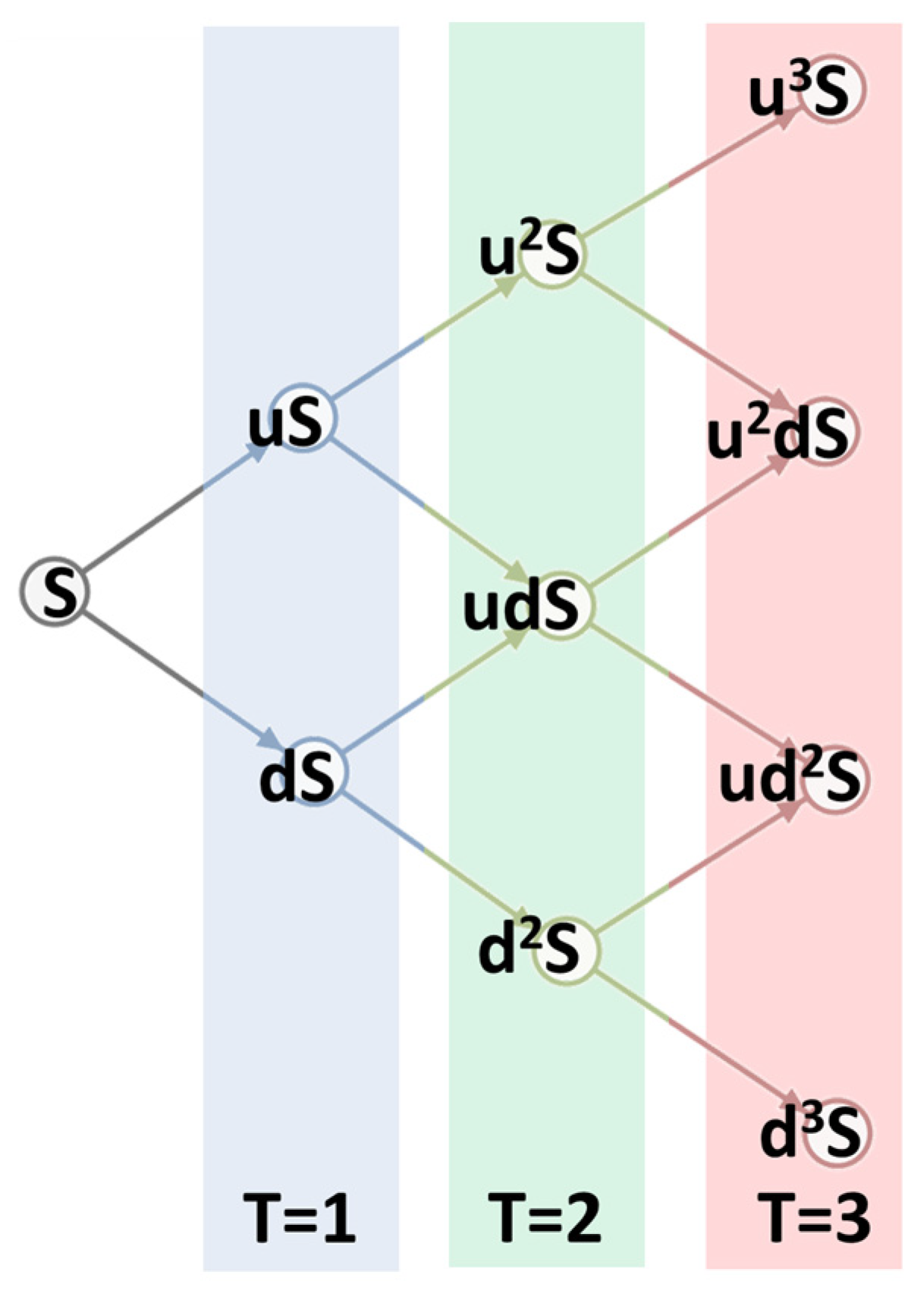
A binomial (recombining) lattice is essentially a decision tree (Figure 1) representing all the possible values that the underlying asset or project could take during the lifetime T of the real option [48].
So is the initial value of the underlying project, i.e., the present value of future cash flows arising from the project. During the first time increment (e.g., one year), this value may go up (u) or down (d) by two factors, u > 1 and d < 1, and from there continue to increase or decrease during the next steps depending on the volatility of the project. It is assumed that u = 1/d or equally d = 1/u. The number of nodes increases from one time increment to the next, and all possible values are calculated from the above possibilities. Thus, at the end of the first step, there are two nodes with possible values of uSo and dSo. The second step results in three nodes, with u2So, udSo, and d2So; the third step in four nodes, with u3So, u2dSo, ud2So, and d3So; and so forth. The up and down probabilities are calculated as follows (with Δt being a one-time step):
u = eσ√(Δt)
d = e−σ√(Δt)
A risk-neutral probability p is also calculated to discount the project cash flows by a risk-free interest rate r:
p = [er(Δt) − d]/(u − d)
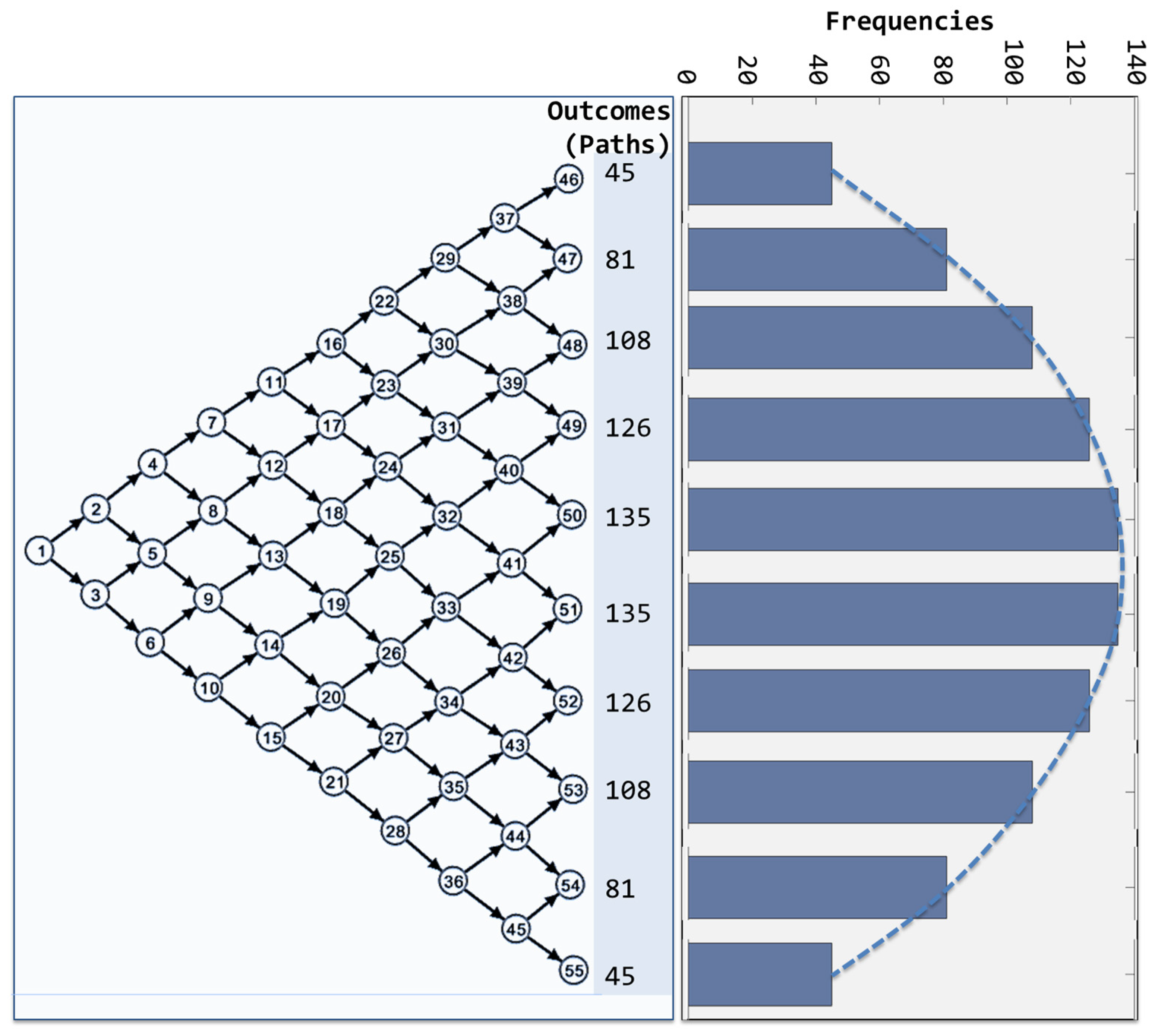
An optimal solution to the entire problem can be obtained by optimizing future decisions at each specific time point and folding them backwards to the current decision [18]. The final nodes in a binomial recombining lattice represent the range of possible values for the underlying project at the end of the option life, and can be demonstrated in the form of a frequency histogram (Figure 2).
The detailed ROA step-by-step calculation process for a call option is described below:
  • At the present year t = 0, the underlying asset value is So. The binomial lattice is thus constructed in a forward manner, up to the option expiration year T, by multiplying So with the upper and lower factors u and d, respectively.
  • At the end of option life t = T, the value of the call option CT is either zero (CT = 0) or (VT–Io), where VT is the value of the underlying project at time T, and Io is the initial project expenditure at time t = 0.
  • Next, the option values at the intermediate nodes are calculated following a backward process by one step at a time (from T to T–Δt, etc.). Therefore, the option at each previous node is either exercised or is being kept open for the next period. The value of early exercise is Ce = max(Vt–Co, 0), and the value of holding (continuing with) the option Ch is the discounted expected value of the project in the next period, using the risk-neutral probability p:
Ch = [pVu(t+Δt) + (1 − p)Vd(t+Δt)]e–rΔt
Vu(t+Δt) is the expected upper value of the underlying project at time (t + Δt), and Vd(t+Δt) is the expected lower value of the underlying project at time (t + Δt). If Ce > Ch, the value maximization rule dictates that the option is exercised. On the contrary, if Ce < Ch, the rational decision is to keep the option open.
4.
This backward calculation process continues until the present time is reached. The resulting value Co at the starting node t = 0 is the current real option value (ROV).

4. Case Study

A commercial real property developer is examining the financial viability of a major capital investment project involving the construction of a new multistorey office building in the center of Athens, Greece. The land plot acquisition cost (Lo) was 1,200,000 EUR. The total (sunk) cost (Po) for (i) the preparation of the architectural design and engineering studies and (ii) the issuing of the required building permits was 350,000 EUR. The total investment cost (Io) for the construction production of the physical asset is budgeted at 10,350,000 EUR. The project’s operating analysis period (T) is decided to be 5 years, and the expected annual revenue (R) from the lease of premises is estimated at 2,880,000 EUR for the first year of operation. The anticipated operation and maintenance (O&M) expense rate is 4%, i.e., 320,000 EUR per year. Both the revenues and O&M costs are increased yearly by a 2.1% growth rate (g) (today’s annual inflation rate in the Euro area) in each of the forthcoming years. Regarding the funding scheme for the investment, the capital cost of the project will be fully covered by the developer’s own funds. According to the relevant legislation, the construction cost is depreciated through the straight-line method with a fixed factor (D) = 20% (= 1/5 years.). No residual (resale) value will be considered. The corporate income tax rate (Φ) is currently 22%. All project cash inflows and outflows are assumed to occur at the end of each year of operation. Based on the current office rental yield figures published by the Bank of Greece, the developer has set 7.5% as the minimum acceptable rate of return (MARR) for the specific undertaking. Table 1 summarizes the above information for the project under study.

4.1. DCF Base Case

At the beginning, the project is analyzed based on a traditional DCF valuation analysis according to the simple “positive NPV decision rule”. The NPV can be calculated by Equation (9):
NPV = Io − ∑[E(NCFt)/(1 + MARR)t], for t = 1, …, T
where
Io:              the initial capital investment at time t = 0;
E(NCFt):   the expected net cash flow (NCF) at time t;
MARR:   the minimum attractive rate of return (i.e., risk-adjusted discount rate);
T:               the investment analysis period.
The base case’s main input and output values are summarized in Table 2.
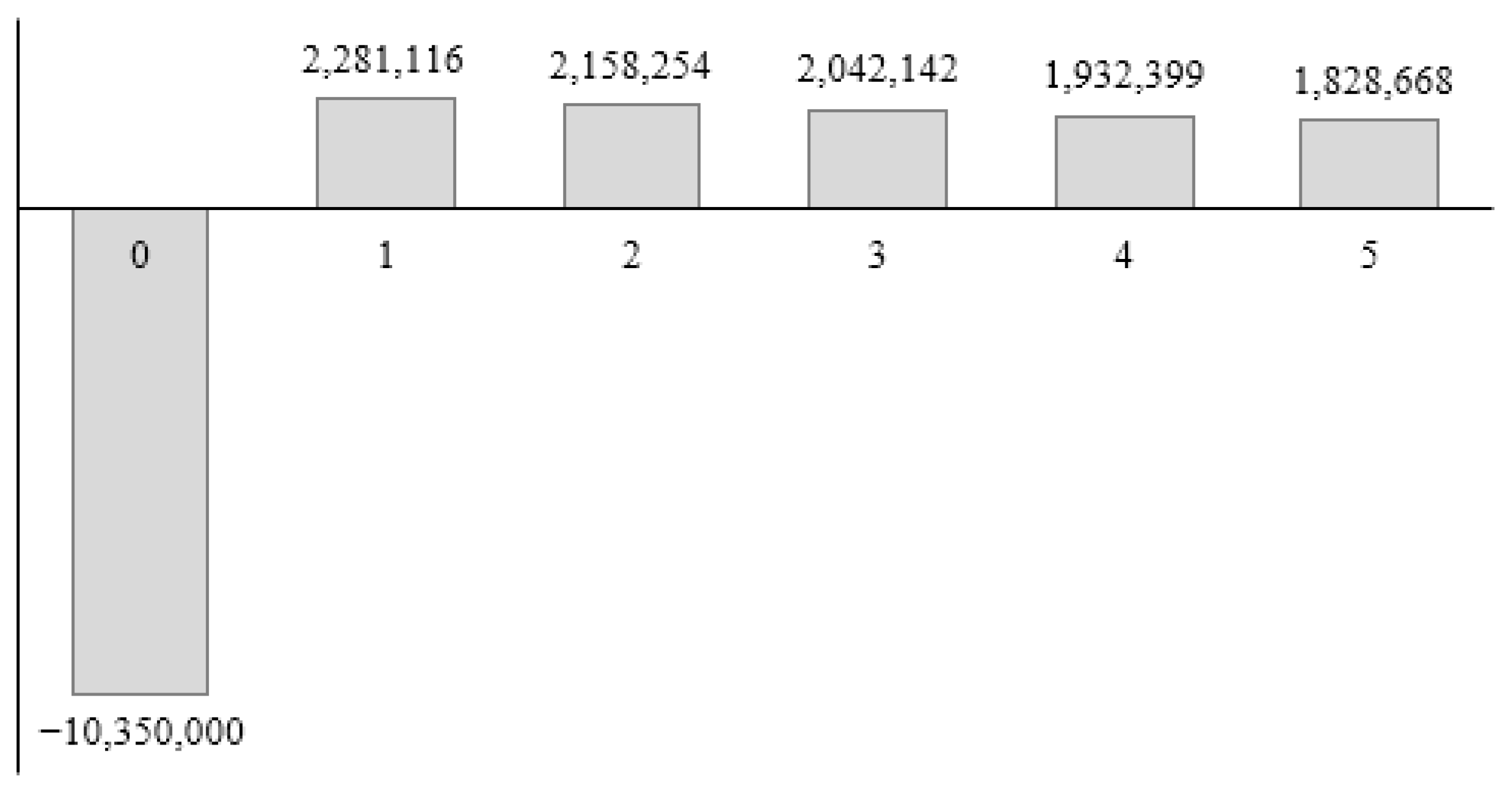
Figure 3 presents the DCF plot for the 5-year analysis period. Following this traditional analysis, the NPV figure is negative (−107,421 EUR), which corresponds to an internal rate of return (IRR) of less than 7.5% (7.1% per annum). Therefore, based on these results, the project is not acceptable for implementation.

4.2. Real Option to Defer (Delay Option)

An option to defer (or wait) is the flexibility to postpone investment decisions until more information becomes available or market conditions improve [26]. Having purchased the land plot and issuing the required building approvals to secure today’s favorable town planning regulations, the developer is examining the option to postpone (i.e., the right to a call option) the commencement of construction production operations until real estate market conditions become more attractive. However, this delay should not exceed a time horizon of five years, i.e., the validity period of the issued building approvals (option expiration time, T = 5 years). The current value of the underlying asset is the present value of the sum of the expected revenues from the project (So = 10,242,579 EUR), i.e., the sum of DCF values from the years t = 1 to t = 5 in Figure 3. The exercise (strike) price is equal to the construction production cost of the investment (X = 10,350,000 EUR). The annual volatility σ of anticipated cash flows, reflecting the uncertainty inherent in the underlying project, is estimated at 17% by the “logarithmic cash-flow returns approach” [49], with data derived from the Bank of Greece’s published office price indices. The annual risk-free rate of return is r = 3.45%, which is the Greek government’s current 10-year bond yield.

4.2.1. BSOP Valuation

The ROA calculations and results (call option CT) using the BSOP method for different option expiration times from T = 1 to T = 5 (Equations (1), (3) and (4)) are presented in Table 3. Obviously, all the calculations required to implement the BSOP formulae can be easily set up in a spreadsheet. The values for N(d1) and N(d2) are calculated with the standard Normal cumulative probability distribution built-in function [= NORM.S.DIST (z; cumulative)].
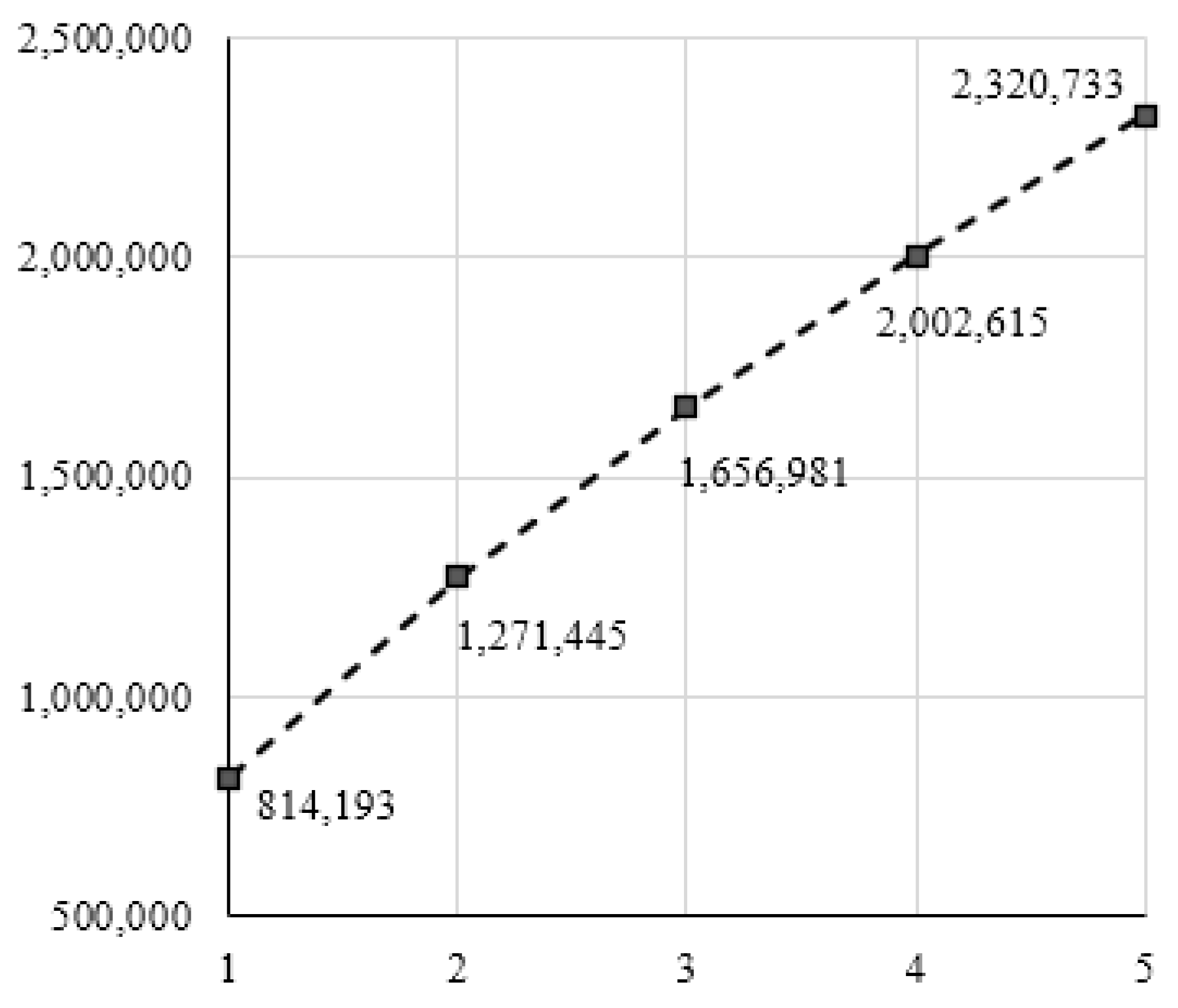
The maximum call option value is CT = 2,320,733 EUR at the expiration time T = 5. Figure 4 shows the level of increase in the option value as the expiration time alters from T = 1 to T = 5. It is worth noting that the real option value changes at significantly lower percentages as the option expiration time T is increased (from 56.2% at time T = 1 to 15.9% at time T = 5).

4.2.2. BLOP Valuation

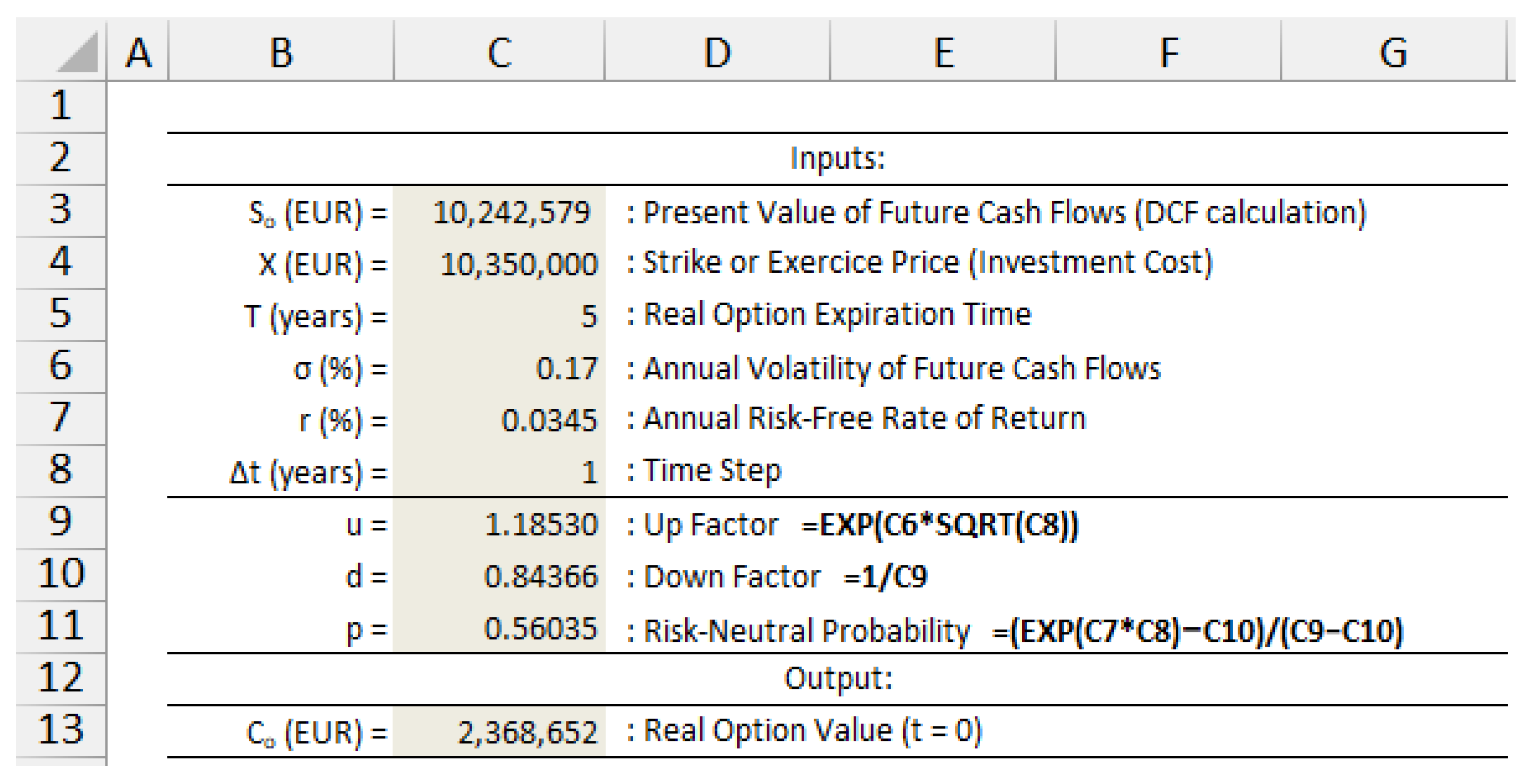
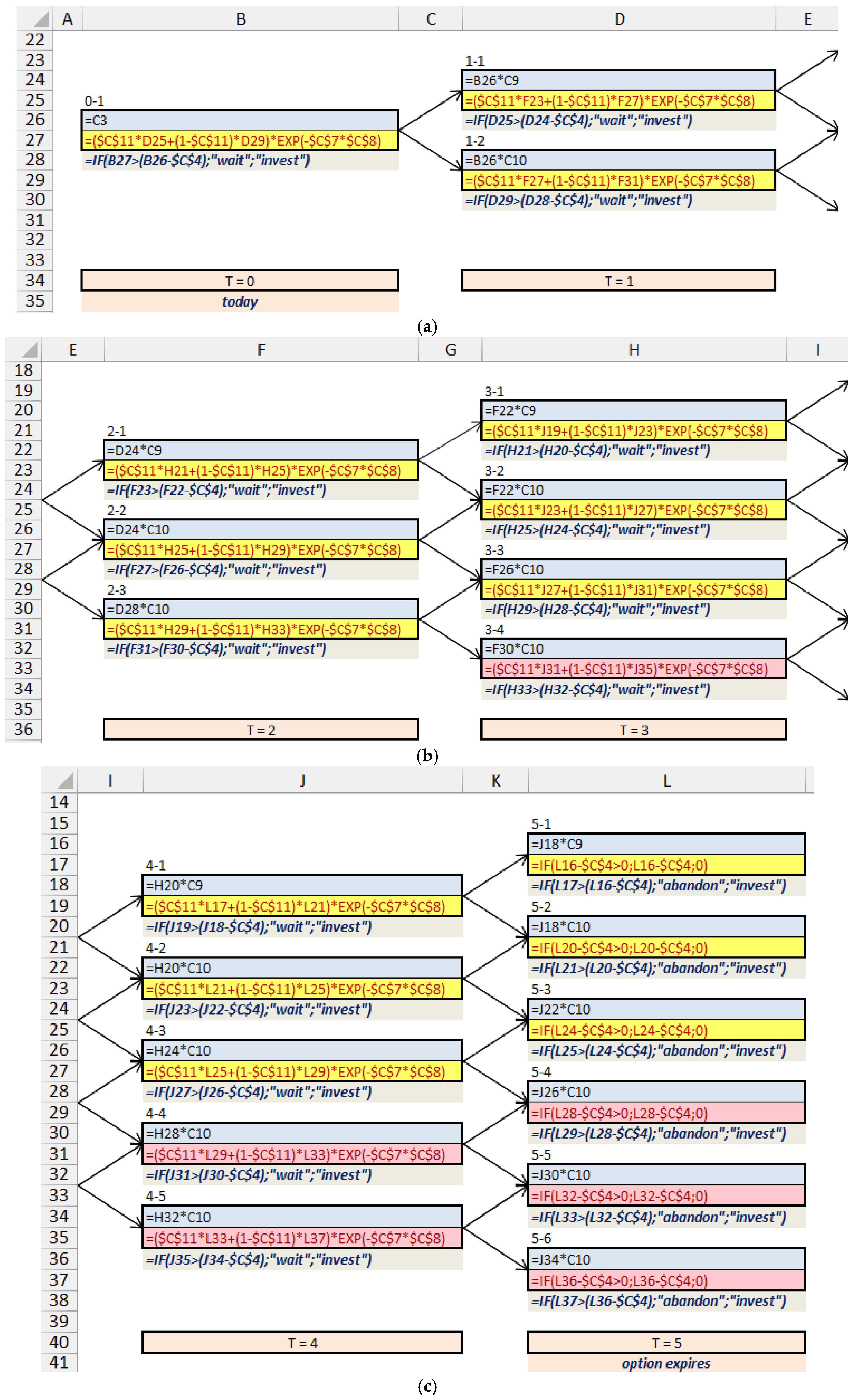
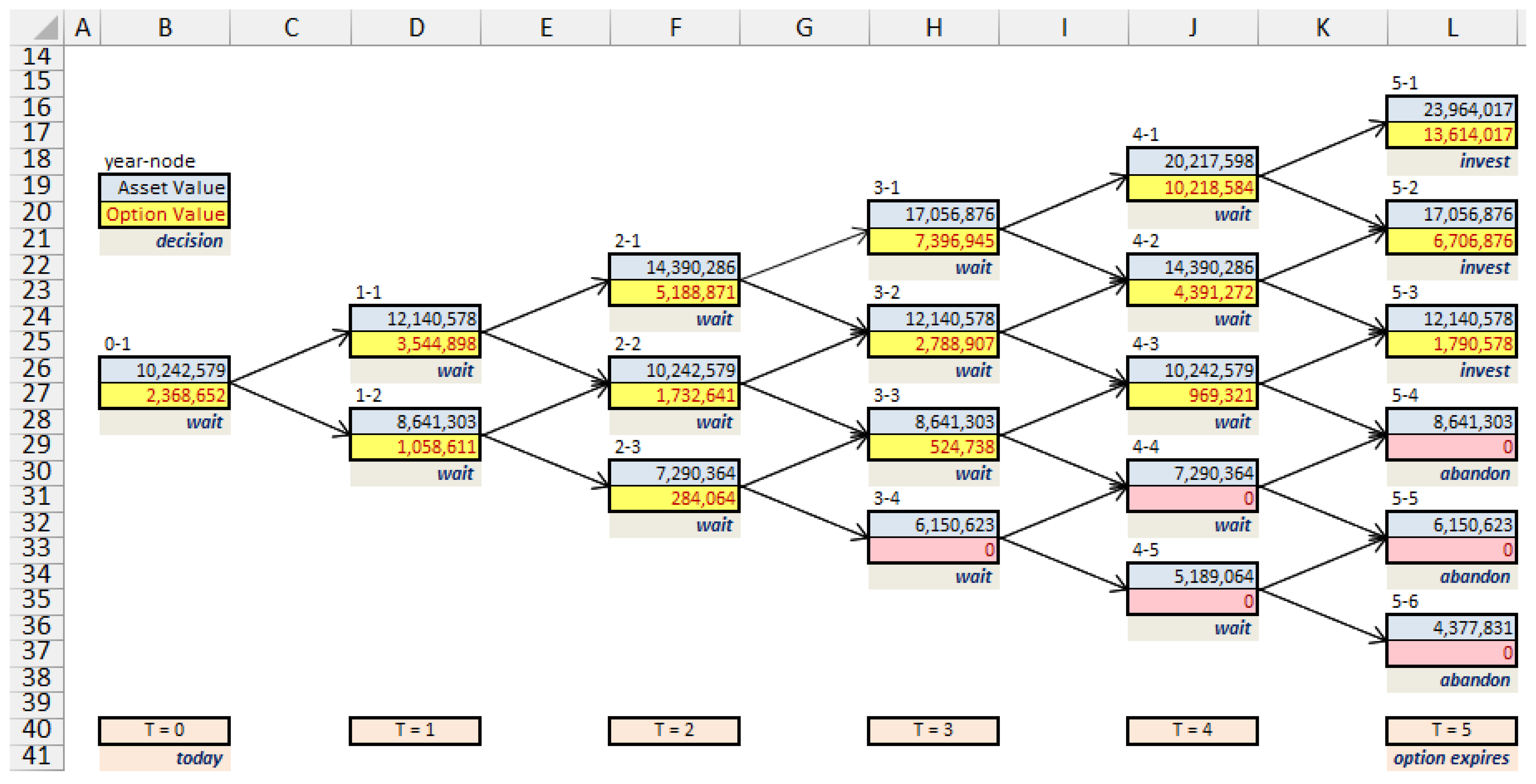
The time step is one year (Δt = 1 year). Figure 5, Figure 6 and Figure 7 demonstrate the spreadsheet-based option value tree model used for calculating the ROV for the project under consideration, according to the detailed process already outlined in Section 3.2.
It is assumed that during each year, the value of the underlying project can either increase, with u = 1.1853, or decrease, with d = 0.8437. The calculations begin from the rightmost nodes. Folding the model from right to left, the desired value of the real option Co at the present time t = 0 is calculated (Co = 2,368,652 EUR).
The main input and output values for implementing the BLOP model are summarized in Table 4.
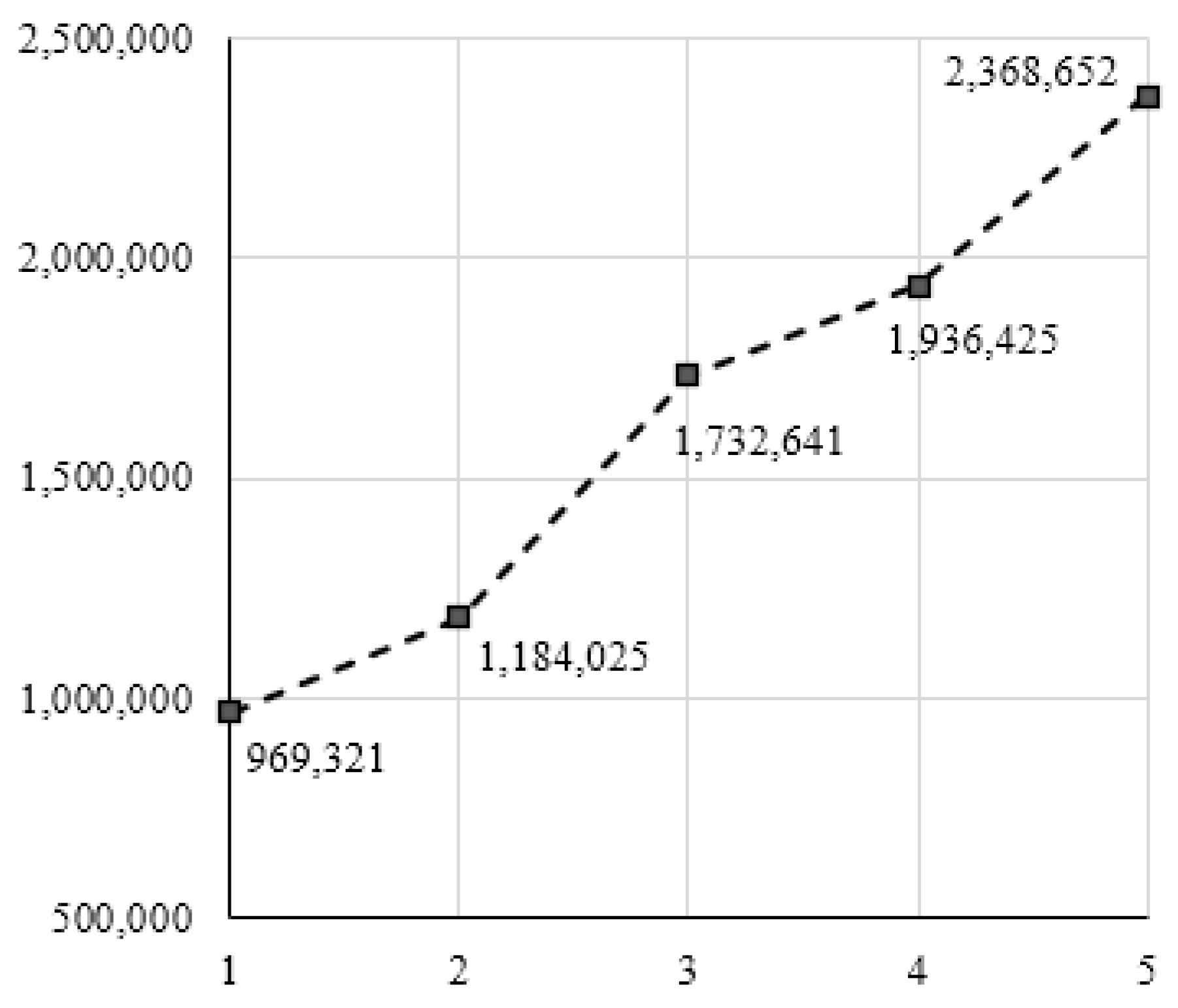
The maximum call option value at t = 0 is Co = 2,368,652 EUR when the expiration period T is 5 years. Figure 8 shows the level of increase in the option value Co as the expiration time changes from T = 1 to T = 5.
It is again worth mentioning that changes in the ROV fluctuate considerably as the expiration time T increases (Table 5): from 18.4% at time T = 2, to 50.9% at time T = 3, to 11.8% at time T = 4, and finally to 22.3% at time T = 5.

5. Results and Discussion

Examining the BLOP model’s results in Figure 7, the following critical points are discussed. At year–node (5-1), when the deferral option expires, the expected asset value of the investment is 23,964,017 EUR. Therefore, the net asset value is 13,614,017 EUR (= 23,964,017 − 10,350,000), and the rational decision would be to invest in the project. At year–node (5-4), if an investment is decided upon at the cost of 10,350,000 EUR, the expected project value is 8,641,303 EUR, resulting in a net loss of –1,708,697 EUR. Thus, the decision at this node would be to abandon the investment since the option value is zero. Moving on to the intermediate nodes, at year–node (4-1), an expected option value of 10,218,584 EUR is calculated as the discounted risk-free rate of return (r) weighted average of next year’s future option values using the risk-neutral probability (p) (Figure 6). If the option is exercised at this node by investing 10,350,000 EUR, the net project value would be 9,867,598 EUR (= 20,217,598 − 10,350,000). Since keeping the option open shows a higher asset value (10,218,584 > 9,867,598), the rational decision would be not to exercise the option but instead continue to wait. Similar calculations can be examined for every year–node point in the binomial tree. The present, i.e., year–node (0-1), real option value Co to delay the investment is 2,368,652 EUR. Considering the expense of acquiring the land plot and the cost for the design/permits phase (i.e., 1,200,000 + 350,000 = 1,550,000 EUR), the net value of the project when choosing the deferral option is 818,652 EUR (= 2,368,652 − 1,550,000). As a result, the so-called expanded NPV (eNPV) [40,50] increases to 926,073 EUR (= 818,652 + 107,421). This value can be seen as the true opportunity value for the developer.
Therefore, the investment project is now considered as highly valuable with a positive eNPV, and a rational decision could be not to discard the investment today based on the incorrect conclusion derived from the rigid negative NPV value, but instead to actively manage the holding deferral option throughout its 5-year period. This real-world case study thus highlights the dynamic strategic power provided by ROA to the investment appraisal and decision-making process.
In the presented actual case example, examining the proposed project based on an ROA allowed the developer to identify additional opportunities hidden in the project under study and, thus, to gain more confidence in the decision-making process. An ROV-based physical assets calculation may also enable the planning of flexible future solutions from the outset. If a project’s net cash flows exceed expectations, then the project can be expanded, but if they are less than expected, the project can be delayed, reduced, or even abandoned. Using an ROA allows management not to concentrate solely on estimating accurate deterministic forecasts, but on determining alternative ways of successful urban development by responding in a more flexible manner to changing external conditions. The power of influencing the outcome of an investment decision has a certain value, which could convert a negative traditional output into a great future opportunity. Therefore, estimating and adding to a low project NPV figure the potential ROV, which is often embedded in urban development projects, gives a more accurate and hence reliable assessment of the true project value.
The BSOP model is essentially a simplification of the BLOP model and assumes that the real option held is a European-style option that can only be exercised on the expiration date of the option. On the other hand, American-style options can be exercised at any time prior to the end of the option and the BLOP model can be used instead. The latter offers transparency by calculating the project values in the future for the given expected payoffs and highlights the rational decisions to be taken in the course of time. The main reason is that as a project’s uncertainty is clarified in the future, planners and managers can trigger favorable actions by comparing the expected payoffs with the capital investment cost. The BLOP methodology facilitates these possibilities and provides a useful roadmap for effective strategic decision-making.
The research also shows that spreadsheet-based ROA modeling is easy to use and provides flexibility compared to alternative approaches, which require advanced mathematics and complex financial concepts and are narrowly focused on the expected value of a real option, thus ignoring how changes in the input values affect the distribution of outcomes. Sensitivity analyses can also be automatically performed with the spreadsheet models developed, providing more insightful and valuable information.

6. Conclusions

The conventional DCF-based NPV technique for capital investment projects is outdated, being incapable of reflecting the turbulent, uncertain, and dynamic current business environment. Its static and strategically rigid approach generally underestimates the upside potential of highly uncertain whilst innovative investments, and the value of managerial flexibility. On the contrary, ROA-based approaches offer a broader and more flexible framework for investment project evaluation, appreciating the potential of achieving improved returns on an investment.
The inherent uncertainty in major urban development investments demands active managerial decision-making through alternative options to secure against future negative outcomes and, at the same time, to enable urban developers to exploit emerging opportunities when market conditions are positive. This research shows how the application of ROA can significantly improve the investment appraisal of urban development capital-intensive projects to support the decision-making process through managing uncertainty by applying different strategic options. The application of the delay option in the presented detailed case study resulted in the identification of the optimal timing for the commencement of the project, and the estimation of the maximum value that could be expected from the specific project. The value of the waiting option for an actual new commercial building investment in Athens, Greece, was estimated through the application of two widely accepted ROA techniques, the Black–Scholes formula and the recombining binomial lattice model. Spreadsheet-based modeling was used to develop the required formulae. The results in both cases were virtually identical (with the ROV derived from the BSOP model being slightly underestimated) and showed that the delay option increased the project value significantly when compared to the traditional DCF valuation method, and thus transformed what would have been an otherwise rejected undertaking into a financially attractive one. These option values cannot be underseen in markets that involve high sunk costs, endemic economic uncertainty and construction production risk, which is the norm in the real estate development sector. However, it is worth noting that an ROA should not be considered as an alternative, but rather as a supplement to refine the estimates of conventional base-case DCF method. Further research into the theory and practice of ROA in urban development is still required for it to have more widespread practical application by academics and professionals, and should focus on relaxing the mathematical complexity of the process. This work is limited by examining solely the waiting option. As such, future research by the authors will be directed to addressing more complex real options alternatives, such as the staging option. Additionally, other commonly used ROA techniques will be examined, e.g., Monte Carlo Simulations, non-recombining binomial lattices, and the dividend-based BSOP model.

Author Contributions

Conceptualization, D.K.; methodology, D.K.; software, D.K.; validation, D.K., D.T., and T.K.; formal analysis, D.K.; investigation, D.K., D.T., and T.K.; resources, D.K.; data curation, D.K.; writing—original draft preparation, D.K., D.T., and T.K.; writing—review and editing, D.K., D.T., and T.K.; visualization, D.K. and D.T.; supervision, D.K., D.T., and T.K. All authors have read and agreed to the published version of the manuscript.

Funding

This research received no external funding.

Institutional Review Board Statement

Not applicable.

Informed Consent Statement

Not applicable.

Data Availability Statement

Data can be made available upon request.

Acknowledgments

The authors would like to express sincere thanks to Emeritus Serafeim Polyzos for his initiative in assembling the author team and fostering the collaboration that resulted in this paper.

Conflicts of Interest

The authors declare no conflicts of interest.

References

  1. United Nations. 2018 Revision of World Urbanization Prospects; Department of Economic & Social Affairs: New York, NY, USA, 2018. [Google Scholar]
  2. United Nations, Department of Economic and Social Affairs, Population Division. World Urbanization Prospects: The 2018 Revision (ST/ESA/SER.A/420). New York: United Nations. 2019. Available online: https://population.un.org/wup/assets/WUP2018-Report.pdf (accessed on 22 December 2025).
  3. Sustainability Directory. Urban Development. Available online: https://energy.sustainability-directory.com/term/urban-development/ (accessed on 22 December 2025).
  4. Liapis, K.J.; Kantianis, D.D.; Galanos, C.L. Commercial property whole-life costing and the taxation environment. J. Prop. Invest. Financ. 2014, 32, 56–77. [Google Scholar] [CrossRef]
  5. Rocha, K.; Salles, L.; Garcia, F.A.A.; Sardinha, J.A.; Teixeira, J.P. Real estate and real options—A case study. Emerg. Mark. Rev. 2007, 8, 67–79. [Google Scholar] [CrossRef]
  6. Kodukula, P.; Papudesu, C. Project Valuation Using Real Options: A Practitioner’s Guide; J. Ross Publishing: Plantation, FL, USA, 2006. [Google Scholar]
  7. Liapis, K.J.; Kantianis, D.D.; Galanos, C.L. Commercial Real Property Investments under Debt Crisis Economic Conditions. In EU Crisis and the Role of the Periphery, Contributions to Economics; Springer International Publishing: Berlin/Heidelberg, Germany, 2015; pp. 165–187, ISBN 978-3-319-10132-3 (Print), 978-3-319-10133-0 (Online). [Google Scholar]
  8. Hillebrandt, P.M. Going bust: What are the facts? Building 1977, 232, 52–53. [Google Scholar]
  9. Hillebrandt, P.M. Economic Theory and the Construction Industry, 3rd ed.; Palgrave-Macmillan: London, UK, 2000. [Google Scholar]
  10. Baldi, F. Valuing a greenfield real estate property development project: A real options approach. J. Eur. Real Estate Res. 2013, 6, 186–217. [Google Scholar] [CrossRef]
  11. Dixit, A.K.; Pindyck, R.S. The options approach to capital investment. Harv. Bus. Rev. 1995, 73, 105–115. [Google Scholar]
  12. Myers, S.C. Finance theory and financial strategy. Interfaces 1984, 14, 126–137. [Google Scholar] [CrossRef]
  13. Yeo, K.; Qiu, F. The value of management flexibility—A real option approach to investment evaluation. Int. J. Proj. Manag. 2003, 21, 243–250. [Google Scholar] [CrossRef]
  14. Myers, S.C. Determinants of corporate borrowing. J. Financ. Econ. 1977, 5, 147–175. [Google Scholar] [CrossRef]
  15. Broyles, J. Financial Management and Real Options; John Wiley & Sons: Hoboken, NJ, USA, 2003. [Google Scholar]
  16. Copeland, T.E.; Antikarov, V. Real Options: A Practitioner’s Guide; Thomson Texere: New York, NY, USA, 2001. [Google Scholar]
  17. Copeland, T.; Weiner, J. Proactive management of uncertainty. McKinsey Q. 1990, 10, 133–152. [Google Scholar]
  18. Black, F.; Scholes, M. The pricing of options and corporate liabilities. J. Political Econ. 1973, 81, 637–654. [Google Scholar] [CrossRef]
  19. Cox, J.C.; Ross, S.A.; Rubinstein, M. Option pricing: A simplified approach. J. Financ. Econ. 1979, 7, 229–263. [Google Scholar] [CrossRef]
  20. Dixit, A.K.; Pindyck, R.S. Investment Under Uncertainty; Princeton University Press: Princeton, NJ, USA, 1994. [Google Scholar]
  21. Esty, B.C. Improved techniques for valuing large-scale projects. J. Proj. Financ. 1999, 5, 9–26. [Google Scholar] [CrossRef]
  22. Hodder, J.E.; Riggs, H.E. Pitfalls in evaluating risky projects. Harv. Bus. Rev. 1985, 63, 128–135. [Google Scholar]
  23. Brealey, R.A.; Myers, S.C.; Marcus, A.J. Fundamentals of Corporate Finance; McGraw-Hill Education: New York. NY, USA, 2018; pp. 274–294. [Google Scholar]
  24. Lucius, D.I. Real options in real estate development. J. Prop. Invest. Financ. 2001, 19, 73–78. [Google Scholar] [CrossRef]
  25. Trigeorgis, L.; Mason, S.P. Valuing Managerial Flexibility. Midl. Corp. Financ. J. 1987, 5, 14–21. [Google Scholar]
  26. Amram, M.; Kulatilaka, N. Real Options: Managing Strategic Investment in an Uncertain World; Harvard Business School Press: Boston, MA, USA, 1999. [Google Scholar]
  27. Leslie, K.J.; Michaels, M.P. The real power of real options. McKinsey Q. 1997, 3, 4. [Google Scholar]
  28. McDonald, R.; Siegel, D. The Value of Waiting to Invest. Q. J. Econ. 1986, 101, 707–728. [Google Scholar] [CrossRef]
  29. Trigeorgis, L. Real Options: Managerial Flexibility and Strategy in Resource Allocation; MIT Press: Cambridge, MA, USA, 1996. [Google Scholar]
  30. Titman, S. Urban land prices under uncertainty. Am. Econ. Rev. 1985, 75, 505–514. [Google Scholar]
  31. Williams, J.T. Real estate development as an option. J. Real Estate Financ. Econ. 1991, 4, 191–208. [Google Scholar] [CrossRef]
  32. Quigg, L. Empirical testing of real option-pricing models. J. Financ. 1993, 48, 621–640. [Google Scholar]
  33. Capozza, D.; Li, Y. The intensity and timing of investment: The case of land. Am. Econ. Rev. 1994, 84, 889–904. [Google Scholar]
  34. Capozza, D.R.; Sick, G.A. The risk structure of land markets. J. Urban Econ. 1994, 35, 297–319. [Google Scholar] [CrossRef]
  35. de Neufville, R.; Scholtes, S.; Wang, T. Real options by spreadsheet: Parking garage case example. J. Infrastruct. Syst. 2006, 12, 107–111. [Google Scholar] [CrossRef]
  36. Shen, J.; Pretorius, F. Binomial option pricing models for real estate development. J. Prop. Invest. Financ. 2013, 31, 418–440. [Google Scholar] [CrossRef]
  37. Durica, M.; Guttenova, D.; Pinda, L.; Svabova, L. Sustainable value of investment in real estate: Real options approach. Sustainability 2018, 10, 4665. [Google Scholar] [CrossRef]
  38. Izotov, A.; Rostova, O.; Dubgorn, A. The application of the real options method for the evaluation of high-rise construction projects. In E3S Web of Conferences; EDP Sciences: Les Ulis, France, 2018; Volume 33. [Google Scholar]
  39. Mintah, K.; Higgins, D.; Callanan, J.; Wakefield, R. Staging option application to residential development: Real options approach. Int. J. Hous. Mark. Anal. 2018, 11, 101–116. [Google Scholar] [CrossRef]
  40. Čirjevskis, A. Value maximizing decisions in the real estate market: Real options valuation approach. J. Risk Financ. Manag. 2021, 14, 278. [Google Scholar] [CrossRef]
  41. Oliveira, A.; Couto, G.; Pimentel, P. Uncertainty and flexibility in infrastructure investments: Application of real options analysis to the Ponta Delgada airport expansion. Res. Transp. Econ. 2021, 90, 100845. [Google Scholar] [CrossRef]
  42. Smit, H. Infrastructure Investment as a Real Options Game: The Case of European Airport Expansion. Financ. Manag. 2003, 32, 5–35. [Google Scholar] [CrossRef]
  43. Kantianis, D. Improving Decision Flexibility in Urban Development: A Real Options Approach. Presented at the 14th International Conference “Economies of the Balkan and Eastern European Countries” EBEEC-2022, Florence, Italy, 20–22 May 2022. [Google Scholar]
  44. Papadimitriou, V.; Polyzos, S.; Tsiotas, D. Renewable Energy Project Appraisal using the Real Options Methodology. Reg. Sci. Inq. 2023, 15, 85–96. [Google Scholar]
  45. Na, S.; Jang, W.; Lee, Y. Economic Feasibility and Strategic Planning for Floating Solar Power Plants in Korea: A Real Options Approach. Sustainability 2025, 17, 137. [Google Scholar] [CrossRef]
  46. Al-Obaidli, H.; Govindan, R.; Al-Ansari, T. Multidimensional Risk-Based Real Options Valuation for Low-Carbon Cogeneration Pathways. Energies 2023, 16, 1250. [Google Scholar] [CrossRef]
  47. D’Uggento, A.M.; Biancardi, M.; Ciriello, D. Predicting option prices: From the Black-Scholes model to machine learning methods. Big Data Res. 2025, 40, 100518. [Google Scholar] [CrossRef]
  48. Hull, J.C.; Basu, S. Options, Futures, and Other Derivatives; Pearson Education India: Noida, India, 2016. [Google Scholar]
  49. Mun, J. Modelling Risk: Applying Monte Carlo Simulation, Real Options Analysis, Forecasting, and Optimization Techniques; John Wiley & Sons: Hoboken, NJ, USA, 2006. [Google Scholar]
  50. Mun, J. Real Options Analysis: Tools and Techniques for Valuing Strategic Investments and Decisions; John Wiley & Sons: Hoboken, NJ, USA, 2012. [Google Scholar]
Figure 1. A typical binomial recombining lattice with three sequential time steps [own elaboration].
Urbansci 10 00134 g001
Figure 2. Distribution of BLOP model outcomes [own elaboration].
Urbansci 10 00134 g002
Figure 3. Traditional DCF values vs. analysis period t [own elaboration].
Urbansci 10 00134 g003
Figure 4. BSOP-based ROV (CT) vs. T [own elaboration].
Urbansci 10 00134 g004
Figure 5. BLOP spreadsheet-based research model (inputs–output formulae) [own elaboration].
Urbansci 10 00134 g005
Figure 6. (a) BLOP spreadsheet-based research model (binomial lattice formulae for years 0–1) [own elaboration]; (b) BLOP spreadsheet-based research model (binomial lattice formulae for years 2–3); (c) BLOP spreadsheet-based research model (binomial lattice formulae for years 4–5).
Urbansci 10 00134 g006
Figure 7. BLOP spreadsheet-based research model (binomial lattice results) [own elaboration].
Urbansci 10 00134 g007
Figure 8. BLOP-based ROV (Co) vs. T.
Urbansci 10 00134 g008
Table 1. Description of the new multistorey office building.
Lo
(EUR)
Po
(EUR)
R
(EUR)
MARR
(%)
Φ
(%)
D
(%)
g
(%)
O&M
(%)
T
(Years)
1,200,000 350,0002,880,0007.522202.145
Table 2. Summary of input–output values for conventional DCF base-case analysis.
T
(Years)
Io
(EUR)
R
(EUR)
MARR
(%)
Φ
(%)
D
(%)
g
(%)
O&M
(%)
NPV
(EUR)
IRR
(%)
5 10,350,0002,880,0007.522202.14–107,4217.1
Table 3. BSOP-based ROA summary of calculations and results.
T12345
So10,242,57910,242,57910,242,57910,242,57910,242,579
X10,350,00010,350,00010,350,00010,350,00010,350,000
σ0.170.170.170.170.17
r0.03450.03450.03450.03450.0345
d10.226570.363810.463300.545200.61641
d20.056570.123400.168850.205200.23628
N(d1)0.589620.642000.678420.707190.73119
N(d2)0.522560.549100.567040.581290.59339
CT814,1931,271,4451,656,9812,002,6152,320,733
ΔCT0.0%56.2%30.3%20.9%15.9%
Table 4. BLOP-based ROA summary of calculations and result.
T
(Years)
Δt
(Year)
So
(EUR)
X
(EUR)
σ
(%)
r
(%)
udpCo
(EUR)
5 110,242,57910,350,00017.03.451.18530.84370.560352,368,652
Table 5. BLOP-based ROV (Co) vs. T.
T12345
Co969,3211,148,0251,732,6411,936,4252,368,652
ΔCo0.0%18.4%50.9%11.8%22.3%
Disclaimer/Publisher’s Note: The statements, opinions and data contained in all publications are solely those of the individual author(s) and contributor(s) and not of MDPI and/or the editor(s). MDPI and/or the editor(s) disclaim responsibility for any injury to people or property resulting from any ideas, methods, instructions or products referred to in the content.