Posting the Urban Tourism Experience: Motivations Behind Multimodal UGC Sharing


Abstract
1. Introduction
2. Literature Review and Research Model
2.1. SOBC (Stimulus–Organism–Behavior–Consequence) Framework
2.2. Stimulus and Servicecapes
2.3. Organism
2.4. Behavior
2.5. Consequence

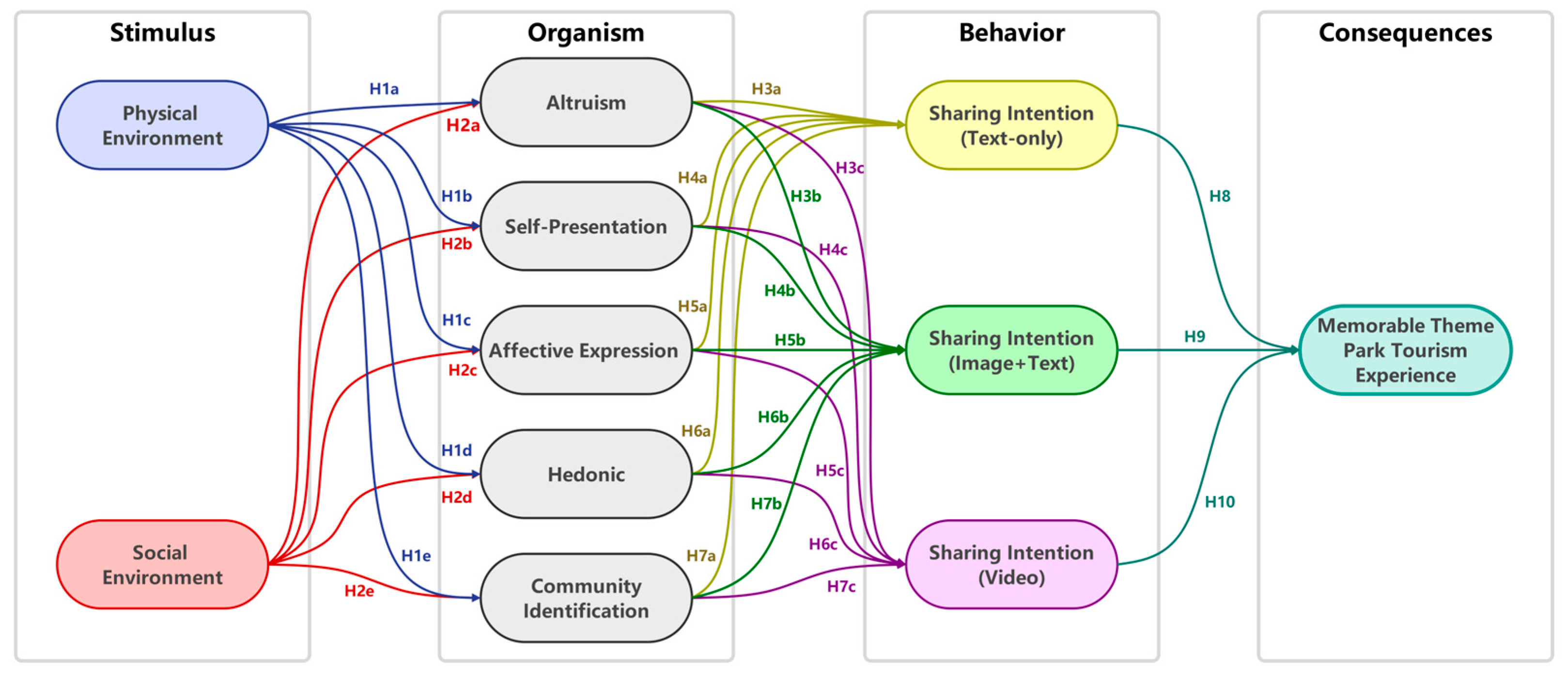
2.6. Hypothesis Development
2.6.1. Stimulus–Organism
2.6.2. Organism–Behavior
2.6.3. Behavior–Consequence
3. Materials and Methods
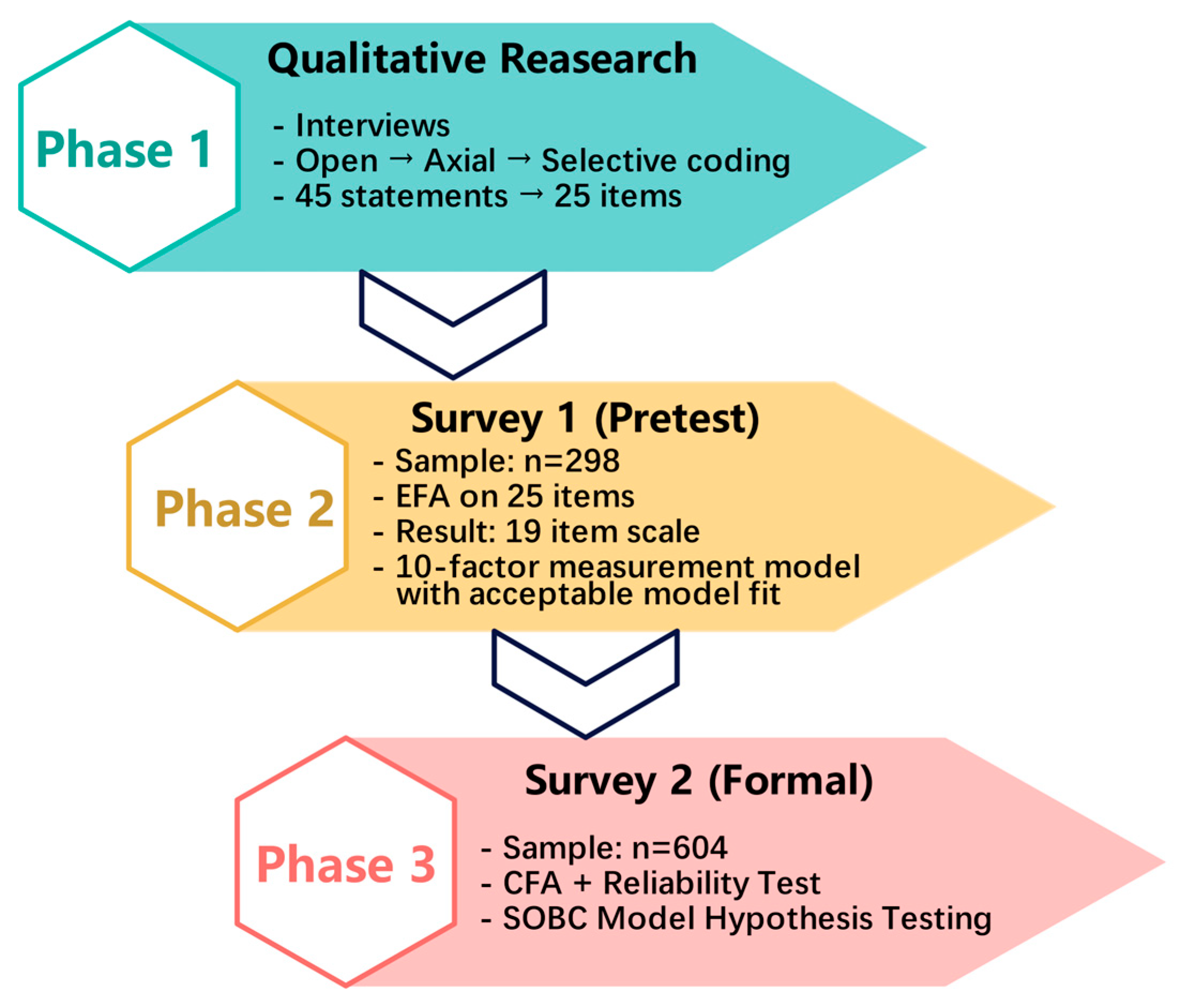
3.1. Research Design
3.2. Qualitative Research
3.2.1. Purpose and Samples
3.2.2. Data Collection
3.2.3. Data Analysis
3.3. Survey 1 (Pretest)
3.3.1. Purpose and Sample (Survey 1)
3.3.2. Measurement Instruments (Survey 1)
3.3.3. Data Analysis Methods (Survey 1)
3.4. Survey 2 (Formal Survey)
3.4.1. Purpose and Sample (Survey 2)
3.4.2. Measurement Instruments (Survey 2)
3.4.3. Data Analysis Methods (Survey 2)
4. Results
4.1. Scale Development and Survey 1 Results
4.1.1. Exploratory Factor Analysis
4.1.2. CFA
4.2. Measurement Results (Survey 2)
4.3. Common Method Bias (Survey 2)
4.4. Structural Results and Hypotheses Tested
4.5. Model Explanatory Power Assessment
5. Discussion
6. Conclusions
6.1. Theoretical Innovations
6.2. Management Insights
6.3. Shortcomings and Future Research Directions
Author Contributions
Funding
Institutional Review Board Statement
Informed Consent Statement
Data Availability Statement
Acknowledgments
Conflicts of Interest
References
- Ervina, E.; Octaviany, V. Visitor behavior at theme parks as an urban tourism in the city of Bandung, Indonesia. J. Bus. Hosp. Tour. 2016, 2, 131–142. [Google Scholar] [CrossRef]
- Albayrak, T.; Cengizci, A.D.; Caber, M.; Fong, L.H.N. Big data use in determining competitive position: The case of theme parks in Hong Kong. J. Destin. Mark. Manag. 2021, 22, 100668. [Google Scholar] [CrossRef]
- Liang, Z.; Luo, H. China Theme Park Development Report 2025; China Tourism Press: Beijing, China, 2025. [Google Scholar]
- Themed Entertainment Association. Official Release: 2024 TEA Global Experience Index™. Available online: https://www.teaconnect.org/news/official-release-2024-tea-global-experience-indextm (accessed on 24 November 2025).
- Luo, J.M.; Vu, H.Q.; Li, G.; Law, R. Topic modelling for theme park online reviews: Analysis of Disneyland. J. Travel Tour. Mark. 2020, 37, 272–285. [Google Scholar] [CrossRef]
- Park, S.B.; Kim, J.; Lee, Y.K.; Ok, C.M. Visualizing theme park visitors’ emotions using social media analytics and geospatial analytics. Tour. Manag. 2020, 80, 104127. [Google Scholar] [CrossRef]
- Muda, M.; Hamzah, M.I. Should I suggest this YouTube clip? The impact of UGC source credibility on eWOM and purchase intention. J. Res. Interact. Mark. 2021, 15, 441–459. [Google Scholar] [CrossRef]
- Cheung, M.L.; Leung, W.K.; Cheah, J.H.; Ting, H. Exploring the effectiveness of emotional and rational user-generated content in digital tourism platforms. J. Vacat. Mark. 2022, 28, 152–170. [Google Scholar] [CrossRef]
- Narangajavana Kaosiri, Y.; Callarisa Fiol, L.J.; Moliner Tena, M.Á.; Rodríguez Artola, R.M.; Sánchez García, J. User-generated content sources in social media: A new approach to explore tourist satisfaction. J. Travel Res. 2019, 58, 253–265. [Google Scholar] [CrossRef]
- Zhang, Y.; Gao, J.; Cole, S.; Ricci, P. How the spread of user-generated contents shapes international tourism distribution: Using agent-based modeling to inform strategic UGC marketing. J. Travel Res. 2021, 60, 1469–1491. [Google Scholar] [CrossRef]
- Bronner, F.; De Hoog, R. Vacationers and eWOM: Who posts, and why, where, and what? J. Travel Res. 2011, 50, 15–26. [Google Scholar] [CrossRef]
- Xu, X.; Gursoy, D. Exploring the relationship between servicescape, place attachment, and intention to recommend accommodations marketed through sharing economy platforms. J. Travel Tour. Mark. 2020, 37, 429–446. [Google Scholar] [CrossRef]
- Wiyata, W.; Yulianto, E.; Asyraff, M.A.; Md Zain, N.A.; Hanafiah, M.H. Creating memorable theme park experiences: The role of customer-to-customer interactions, perceived similarity and sense of immersive. Tour. Rev. 2024, in press. [Google Scholar] [CrossRef]
- Waysdorf, A.; Reijnders, S. Immersion, authenticity and the theme park as social space: Experiencing the Wizarding World of Harry Potter. Int. J. Cult. Stud. 2018, 21, 173–188. [Google Scholar] [CrossRef]
- Oliveira, T.; Araujo, B.; Tam, C. Why do people share their travel experiences on social media? Tour. Manag. 2020, 78, 104041. [Google Scholar] [CrossRef]
- Geri, N.; Gafni, R.; Bengov, P. Crowdsourcing as a business model: Extrinsic motivations for knowledge sharing in user-generated content websites. J. Glob. Oper. Strateg. Sourc. 2017, 10, 90–111. [Google Scholar] [CrossRef]
- Naeem, M.; Ozuem, W. Developing UGC social brand engagement model: Insights from diverse consumers. J. Consum. Behav. 2021, 20, 426–439. [Google Scholar] [CrossRef]
- Zhan, L.; Cheng, M.; Zhu, J. Progress on image analytics: Implications for tourism and hospitality research. Tour. Manag. 2024, 100, 104798. [Google Scholar] [CrossRef]
- Mirzamurodova Kizi, A.A.; Zielinski, S.; Milanes, C.B.; Ahn, Y.J. Tourist destination image projected by YouTube travel videos: The case of Seoul, Republic of Korea. Int. J. Tour. Res. 2025, 27, e70049. [Google Scholar] [CrossRef]
- Kim, J.H.; Ritchie, J.B.; McCormick, B. Development of a scale to measure memorable tourism experiences. J. Travel Res. 2012, 51, 12–25. [Google Scholar] [CrossRef]
- Tung, V.W.S.; Ritchie, J.B. Exploring the essence of memorable tourism experiences. Ann. Tour. Res. 2011, 38, 1367–1386. [Google Scholar] [CrossRef]
- Li, N.; Meng, F.; Martin, D. The influence of travel photo editing on tourists’ experiences. Tour. Manag. 2023, 98, 104762. [Google Scholar] [CrossRef]
- Bandura, A. Self-efficacy: Toward a unifying theory of behavioral change. Psychol. Rev. 1977, 84, 191–215. [Google Scholar] [CrossRef]
- Mehrabian, A.; Russell, J.A. An Approach to Environmental Psychology; MIT Press: Cambridge, MA, USA, 1974. [Google Scholar]
- Sreen, N.; Tandon, A.; Jabeen, F.; Srivastava, S.; Dhir, A. The interplay of personality traits and motivation in leisure travel decision-making during the pandemic. Tour. Manag. Perspect. 2023, 46, 101095. [Google Scholar] [CrossRef]
- Yang, Z.; Liu, V.; Lyu, C. Exploring social sharing value: Effects on customer attitudes and behaviors in restaurant livestreaming. Behav. Sci. 2024, 14, 621. [Google Scholar] [CrossRef]
- Bitner, M.J. Servicescapes: The impact of physical surroundings on customers and employees. J. Mark. 1992, 56, 57–71. [Google Scholar] [CrossRef]
- Spielmann, N.; Laroche, M.; Borges, A. How service seasons the experience: Measuring hospitality servicescapes. Int. J. Hosp. Manag. 2012, 31, 360–368. [Google Scholar] [CrossRef]
- Kucukergin, K.G.; Uygur, S.M. Are emotions contagious? Developing a destination social servicescape model. J. Destin. Mark. Manag. 2019, 14, 100386. [Google Scholar] [CrossRef]
- Gounaris, S.; Chatzipanagiotou, K.; Karantinou, K.; Koritos, C.D. Revisiting the effects of tourism and hospitality servicescapes on customers: A complexity approach. Tour. Manag. 2025, 107, 105068. [Google Scholar] [CrossRef]
- Dong, P.; Siu, N.Y.M. Servicescape elements, customer predispositions and service experience: The case of theme park visitors. Tour. Manag. 2013, 36, 541–551. [Google Scholar] [CrossRef]
- Reimer, T.; Benkenstein, M. Altruistic eWOM marketing: More than an alternative to monetary incentives. J. Retail. Consum. Serv. 2016, 31, 323–333. [Google Scholar] [CrossRef]
- Previte, J.; Russell-Bennett, R.; Mulcahy, R.; Hartel, C. The role of emotional value for reading and giving eWOM in altruistic services. J. Bus. Res. 2019, 99, 157–166. [Google Scholar] [CrossRef]
- Munar, A.M.; Jacobsen, J.K.S. Motivations for sharing tourism experiences through social media. Tour. Manag. 2014, 43, 46–54. [Google Scholar] [CrossRef]
- Hsu, C.L.; Lin, J.C.C. Acceptance of blog usage: The roles of technology acceptance, social influence and knowledge sharing motivation. Inf. Manag. 2008, 45, 65–74. [Google Scholar] [CrossRef]
- Waterloo, S.F.; Baumgartner, S.E.; Peter, J.; Valkenburg, P.M. Norms of online expressions of emotion: Comparing Facebook, Twitter, Instagram, and WhatsApp. New Media Soc. 2018, 20, 1813–1831. [Google Scholar] [CrossRef]
- Mainolfi, G.; Lo Presti, L.; Marino, V.; Filieri, R. “You post, I travel.” Bloggers’ credibility, digital engagement, and travelers’ behavioral intention: The mediating role of hedonic and utilitarian motivations. Psychol. Mark. 2022, 39, 1022–1034. [Google Scholar] [CrossRef]
- Quan-Haase, A.; Young, A.L. Uses and gratifications of social media: A comparison of Facebook and instant messaging. Bull. Sci. Technol. Soc. 2010, 30, 350–361. [Google Scholar] [CrossRef]
- Ham, C.D.; Lee, J.; Hayes, J.L.; Bae, Y.H. Exploring sharing behaviors across social media platforms. Int. J. Mark. Res. 2019, 61, 157–177. [Google Scholar] [CrossRef]
- Ajzen, I. The theory of planned behavior. Organ. Behav. Hum. Decis. Process. 1991, 50, 179–211. [Google Scholar] [CrossRef]
- Reychav, I.; Weisberg, J. Bridging intention and behavior of knowledge sharing. J. Knowl. Manag. 2010, 14, 285–300. [Google Scholar] [CrossRef]
- Chidiac, D.; Bowden, J. When media matters: The role of media richness and naturalness on purchase intentions within influencer marketing. J. Strateg. Mark. 2023, 31, 1178–1198. [Google Scholar] [CrossRef]
- Blanco-Moreno, S.; González-Fernández, A.M.; Muñoz-Gallego, P.A.; Egger, R. What do you do or with whom? Understanding happiness with the tourism experience: An AI approach applied to Instagram. Humanit. Soc. Sci. Commun. 2024, 11, 346. [Google Scholar] [CrossRef]
- Van House, N.A. Personal photography, digital technologies and the uses of the visual. Vis. Stud. 2011, 26, 125–134. [Google Scholar] [CrossRef]
- Lee, C.; Richardson, S.; Goh, E.; Presbury, R. From the tourist gaze to a shared gaze: Exploring motivations for online photo-sharing in present-day tourism experience. Tour. Manag. Perspect. 2023, 46, 101099. [Google Scholar] [CrossRef]
- Oh, S.; Syn, S.Y. Motivations for sharing information and social support in social media: A comparative analysis of Facebook, Twitter, Delicious, YouTube, and Flickr. J. Assoc. Inf. Sci. Technol. 2015, 66, 2045–2060. [Google Scholar] [CrossRef]
- Daft, R.L.; Lengel, R.H. Organizational information requirements, media richness and structural design. Manag. Sci. 1986, 32, 554–571. [Google Scholar] [CrossRef]
- Sundar, S.S.; Limperos, A.M. Uses and gratifications 2.0: New gratifications for new media. J. Broadcast. Electron. Media 2013, 57, 504–525. [Google Scholar] [CrossRef]
- Mehraliyev, F.; Kirilenko, A.P.; Choi, Y. From measurement scale to sentiment scale: Examining the effect of sensory experiences on online review rating behavior. Tour. Manag. 2020, 79, 104096. [Google Scholar] [CrossRef]
- Kim, J.; Fesenmaier, D.R. Sharing tourism experiences: The posttrip experience. J. Travel Res. 2017, 56, 28–40. [Google Scholar] [CrossRef]
- Stone, M.J.; Migacz, S.; Sthapit, E. Connections between culinary tourism experiences and memory. J. Hosp. Tour. Res. 2022, 46, 797–807. [Google Scholar] [CrossRef]
- Zheng, Y.; Wei, W.; Line, N.; Zhang, L. Integrating the tourist gaze with the social servicescape: Implications for creating memorable theme park experiences. Int. J. Hosp. Manag. 2021, 93, 102782. [Google Scholar] [CrossRef]
- Bigné, J.E.; Andreu, L.; Gnoth, J. The theme park experience: An analysis of pleasure, arousal and satisfaction. Tour. Manag. 2005, 26, 833–844. [Google Scholar] [CrossRef]
- Ma, J.; Scott, N.; Gao, J.; Ding, P. Delighted or satisfied? Positive emotional responses derived from theme park experiences. J. Travel Tour. Mark. 2017, 34, 1–19. [Google Scholar] [CrossRef]
- Volo, S. Conceptualizing experience: A tourist-based approach. In Marketing of Tourism Experiences; Taylor & Francis Group: Oxfordshire, UK, 2013; pp. 13–28. [Google Scholar]
- Ali, F.; Kim, W.G.; Li, J.; Jeon, H.M. Make it delightful: Customers’ experience, satisfaction and loyalty in Malaysian theme parks. J. Destin. Mark. Manag. 2018, 7, 1–11. [Google Scholar] [CrossRef]
- Milman, A.; Tasci, A.D. Exploring the experiential and sociodemographic drivers of satisfaction and loyalty in the theme park context. J. Destin. Mark. Manag. 2018, 8, 385–395. [Google Scholar] [CrossRef]
- Wei, W.; Qi, R.; Zhang, L. Effects of virtual reality on theme park visitors’ experience and behaviors: A presence perspective. Tour. Manag. 2019, 71, 282–293. [Google Scholar] [CrossRef]
- Grissemann, U.S.; Stokburger-Sauer, N.E. Customer co-creation of travel services: The role of company support and customer satisfaction with the co-creation performance. Tour. Manag. 2012, 33, 1483–1492. [Google Scholar] [CrossRef]
- Lieberman, M.D.; Eisenberger, N.I. Pains and pleasures of social life. Science 2009, 323, 890–891. [Google Scholar] [CrossRef]
- Hennig-Thurau, T.; Gwinner, K.P.; Walsh, G.; Gremler, D.D. Electronic word-of-mouth via consumer-opinion platforms: What motivates consumers to articulate themselves on the internet? J. Interact. Mark. 2004, 18, 38–52. [Google Scholar] [CrossRef]
- Chen, R.; Yuan, R.; Huang, B.; Liu, M.J. Feeling warm or skeptical? Effects of incentivized eWOM programs on customers’ eWOM sharing intentions. J. Bus. Res. 2023, 167, 114178. [Google Scholar] [CrossRef]
- Yang, F.X. Effects of restaurant satisfaction and knowledge sharing motivation on eWOM intentions: The moderating role of technology acceptance factors. J. Hosp. Tour. Res. 2017, 41, 93–127. [Google Scholar] [CrossRef]
- Hanks, L.; Line, N.; Dogru, T.; Lu, L. Saving local restaurants: The impact of altruism, self-enhancement, and affiliation on restaurant customers’ eWOM behavior. J. Hosp. Tour. Res. 2024, 48, 301–326. [Google Scholar] [CrossRef]
- Bareket-Bojmel, L.; Moran, S.; Shahar, G. Strategic self-presentation on Facebook: Personal motives and audience response to online behavior. Comput. Hum. Behav. 2016, 55, 788–795. [Google Scholar] [CrossRef]
- Kwon, J.E.; Kim, S.H.; Cha, K.C. How electronic word-of-mouth forms and affects the market performance of art exhibitions. Int. J. Arts Manag. 2022, 25, 21–36. [Google Scholar]
- Dong, L.; Hou, J.; Huang, L.; Liu, Y.; Zhang, J. Impacts of normative and hedonic motivations on continuous knowledge contribution in virtual community: The moderating effect of past contribution experience. Inf. Technol. People 2024, 37, 502–520. [Google Scholar] [CrossRef]
- Qu, H.; Lee, H. Travelers’ social identification and membership behaviors in online travel community. Tour. Manag. 2011, 32, 1262–1270. [Google Scholar] [CrossRef]
- Wong, J.W.C.; Lai, I.K.W.; Tao, Z. Sharing memorable tourism experiences on mobile social media and how it influences further travel decisions. Curr. Issues Tour. 2020, 23, 1773–1787. [Google Scholar] [CrossRef]
- Craik, F.I.; Tulving, E. Depth of processing and the retention of words in episodic memory. J. Exp. Psychol. Gen. 1975, 104, 268–294. [Google Scholar] [CrossRef]
- Robinson, P. Emediating the tourist gaze: Memory, emotion and choreography of the digital photograph. Inf. Technol. Tour. 2014, 14, 177–196. [Google Scholar] [CrossRef]
- Oeldorf-Hirsch, A.; Sundar, S.S. Social and technological motivations for online photo sharing. J. Broadcast. Electron. Media 2016, 60, 624–642. [Google Scholar] [CrossRef]
- Tung, V.W.S.; Lin, P.; Zhang, H.Q.; Zhao, A. A framework of memory management and tourism experiences. J. Travel Tour. Mark. 2017, 34, 853–866. [Google Scholar] [CrossRef]
- Wood, E.H. I remember how we all felt: Perceived emotional synchrony through tourist memory sharing. J. Travel Res. 2020, 59, 1339–1352. [Google Scholar] [CrossRef]
- Sigala, M. Social media and the co-creation of tourism experiences. In The Handbook of Managing and Marketing Tourism Experiences; Emerald: Bingley, UK, 2016; pp. 85–111. [Google Scholar]
- Christou, P.; Farmaki, A.; Saveriades, A.; Georgiou, M. Travel selfies on social networks, narcissism and the attraction-shading effect. J. Hosp. Tour. Manag. 2020, 43, 289–293. [Google Scholar] [CrossRef]
- Fornell, C.; Larcker, D.F. Evaluating structural equation models with unobservable variables and measurement error. J. Mark. Res. 1981, 18, 39–50. [Google Scholar] [CrossRef]
- Organ, D.W. Self-reports in organizational research: Problems and prospects. J. Manag. 1986, 12, 69–82. [Google Scholar] [CrossRef]
- Fuller, C.M.; Simmering, M.J.; Atinc, G.; Atinc, Y.; Babin, B.J. Common methods variance detection in business research. J. Bus. Res. 2016, 69, 3192–3198. [Google Scholar] [CrossRef]
- Kuznetsov, S. Motivations of contributors to Wikipedia. ACM SIGCAS Comput. Soc. 2006, 36, 1-es. [Google Scholar] [CrossRef]
- Rafaeli, S.; Ariel, Y.; Hayat, T. Wikipedia community: Users’ motivations and knowledge building. In Proceedings of the Cyberculture 3rd Global Conference, Prague, Czech Republic, 21 May 2005. [Google Scholar]
- Liu, Y.; Li, Y.; Ma, S.; Li, J. Theme park reviews: How text mining cognitive characteristics and emotions can determine theme park image. Tour. Rev. 2025, in press. [Google Scholar] [CrossRef]
- Davis, T.R.; Luthans, F. A social learning approach to organizational behavior. Acad. Manag. Rev. 1980, 5, 281–290. [Google Scholar] [CrossRef]
- Yu, G.; Lim, J.H.; Cho, N. A study of vlog that analyze variables affecting perceived enjoyment: Using social communication as a control variable. J. Inf. Technol. Appl. Manag. 2020, 27, 23–33. [Google Scholar]
- Nguyen, H.T. Memorable tourism experiences and revisit intention: The mediating role of destination attachment and sharing experiences on social media. Innov. Mark. 2024, 20, 78–88. [Google Scholar]


| Construct and Indicators | Standardized Factor Loading | p-Value |
|---|---|---|
| Physical environment (Cronbach’s α: 0.941) | ||
| PE1 | 0.828 | 0.000 |
| PE2 | 0.782 | 0.000 |
| PE3 | 0.733 | 0.000 |
| PE4 | 0.724 | 0.000 |
| PE5 | 0.772 | 0.000 |
| PE6 | 0.729 | 0.000 |
| PE7 | 0.781 | 0.000 |
| PE8 | 0.696 | 0.000 |
| PE9 | 0.707 | 0.000 |
| PE10 | 0.778 | 0.000 |
| PE11 | 0.722 | 0.000 |
| PE12 | 0.800 | 0.000 |
| Social environment (Cronbach’s α: 0.912) | ||
| SE1 | 0.741 | 0.000 |
| SE2 | 0.728 | 0.000 |
| SE3 | 0.731 | 0.000 |
| SE4 | 0.723 | 0.000 |
| SE5 | 0.732 | 0.000 |
| SE6 | 0.746 | 0.000 |
| SE7 | 0.720 | 0.000 |
| SE8 | 0.717 | 0.000 |
| SE9 | 0.783 | 0.000 |
| Altruism motivation (Cronbach’s α: 0.841) | ||
| ALT1 | 0.761 | 0.000 |
| ALT3 | 0.776 | 0.000 |
| ALT4 | 0.771 | 0.000 |
| ALT5 | 0.711 | 0.000 |
| Self-presentation motivation (Cronbach’s α: 0.845) | ||
| SP1 | 0.792 | 0.000 |
| SP3 | 0.749 | 0.000 |
| SP4 | 0.734 | 0.000 |
| SP5 | 0.769 | 0.000 |
| Affective expression motivation (Cronbach’s α: 0.825) | ||
| AE1 | 0.757 | 0.000 |
| AE2 | 0.718 | 0.000 |
| AE3 | 0.760 | 0.000 |
| AE4 | 0.708 | 0.000 |
| Hedonic motivation (Cronbach’s α: 0.817) | ||
| HED1 | 0.797 | 0.000 |
| HED2 | 0.705 | 0.000 |
| HED3 | 0.681 | 0.000 |
| HED4 | 0.730 | 0.000 |
| Community identification motivation (Cronbach’s α: 0.814) | ||
| CI2 | 0.736 | 0.000 |
| CI4 | 0.775 | 0.000 |
| CI5 | 0.801 | 0.000 |
| Text-only sharing intention (Cronbach’s α: 0.857) | ||
| SI_T1 | 0.770 | 0.000 |
| SI_T2 | 0.894 | 0.000 |
| SI_T3 | 0.829 | 0.000 |
| Image + text sharing intention (Cronbach’s α: 0.782) | ||
| SI_I1 | 0.737 | 0.000 |
| SI_I2 | 0.744 | 0.000 |
| SI_I3 | 0.739 | 0.000 |
| Video sharing intention (Cronbach’s α: 0.872) | ||
| SI_V1 | 0.856 | 0.000 |
| SI_V2 | 0.837 | 0.000 |
| SI_V3 | 0.809 | 0.000 |
| Memorable theme park experience (Cronbach’s α: 0.824) | ||
| MTTE1 | 0.790 | 0.000 |
| MTTE2 | 0.733 | 0.000 |
| MTTE3 | 0.819 | 0.000 |
| Construct | CR | AVE | PE | SE | ALT | SP | AE | HED | CI | SI_T | SI_I | SI_V | MTTE |
|---|---|---|---|---|---|---|---|---|---|---|---|---|---|
| PE | 0.944 | 0.584 | 0.764 | ||||||||||
| SE | 0.917 | 0.551 | 0.251 *** | 0.742 | |||||||||
| ALT | 0.847 | 0.581 | 0.373 *** | 0.371 *** | 0.762 | ||||||||
| SP | 0.831 | 0.552 | 0.357 *** | 0.354 *** | 0.267 *** | 0.743 | |||||||
| AE | 0.816 | 0.525 | 0.281 *** | 0.358 *** | 0.239 *** | 0.248 *** | 0.725 | ||||||
| HED | 0.823 | 0.538 | 0.151 *** | 0.399 *** | 0.207 *** | 0.204 *** | 0.163 *** | 0.733 | |||||
| CI | 0.815 | 0.595 | 0.214 *** | 0.418 *** | 0.226 *** | 0.245 *** | 0.236 *** | 0.186 *** | 0.771 | ||||
| SI_T | 0.865 | 0.682 | 0.302 *** | 0.323 *** | 0.457 *** | 0.255 *** | 0.435 *** | 0.168 *** | 0.228 *** | 0.826 | |||
| SI_I | 0.806 | 0.581 | 0.299 *** | 0.344 *** | 0.407 *** | 0.370 *** | 0.206 *** | 0.254 *** | 0.366 *** | 0.262 *** | 0.762 | ||
| SI_V | 0.855 | 0.664 | 0.332 *** | 0.338 *** | 0.243 *** | 0.482 *** | 0.292 *** | 0.324 *** | 0.387 *** | 0.274 *** | 0.329 *** | 0.815 | |
| MTTE | 0.827 | 0.614 | 0.318 *** | 0.346 *** | 0.355 *** | 0.348 *** | 0.308 *** | 0.276 *** | 0.303 *** | 0.483 *** | 0.432 *** | 0.491 *** | 0.784 |
| Hypothetical Path | Estimate | S.E. | Est./S.E. | p-Value |
|---|---|---|---|---|
| H1a PE → ALT | 0.326 | 0.042 | 7.717 | 0.000 |
| H1b PE → SP | 0.327 | 0.039 | 8.480 | 0.000 |
| H1c PE → AE | 0.231 | 0.044 | 5.207 | 0.000 |
| H1d PE → HED | 0.058 | 0.045 | 1.298 | 0.194 |
| H1e PE→CI | 0.136 | 0.046 | 2.946 | 0.003 |
| H2a SE → ALT | 0.344 | 0.040 | 8.556 | 0.000 |
| H2b SE → SP | 0.317 | 0.043 | 7.403 | 0.000 |
| H2c SE → AE | 0.352 | 0.043 | 8.102 | 0.000 |
| H2d SE → HED | 0.442 | 0.042 | 10.533 | 0.000 |
| H2e SE → CI | 0.445 | 0.041 | 10.787 | 0.000 |
| H3a ALT → SI_T | 0.366 | 0.043 | 8.599 | 0.000 |
| H3b ALT → SI_I | 0.318 | 0.045 | 7.126 | 0.000 |
| H3c ALT → SI_V | 0.009 | 0.043 | 0.215 | 0.830 |
| H4a SP → SI_T | 0.076 | 0.045 | 1.665 | 0.096 |
| H4b SP → SI_I | 0.259 | 0.048 | 5.443 | 0.000 |
| H4c SP → SI_V | 0.422 | 0.043 | 9.891 | 0.000 |
| H5a AE → SI_T | 0.361 | 0.042 | 8.570 | 0.000 |
| H5b AE → SI_I | −0.016 | 0.046 | −0.353 | 0.724 |
| H5c AE → SI_V | 0.112 | 0.044 | 2.570 | 0.010 |
| H6a HED → SI_T | 0.005 | 0.044 | 0.122 | 0.903 |
| H6b HED → SI_I | 0.115 | 0.047 | 2.427 | 0.015 |
| H6c HED → SI_V | 0.198 | 0.041 | 4.784 | 0.000 |
| H7a CI → SI_T | 0.050 | 0.045 | 1.103 | 0.270 |
| H7b CI → SI_I | 0.268 | 0.048 | 5.625 | 0.000 |
| H7c CI → SI_V | 0.264 | 0.045 | 5.845 | 0.000 |
| H8 SI_T → MTTE | 0.358 | 0.039 | 9.143 | 0.000 |
| H9 SI_I → MTTE | 0.282 | 0.043 | 6.590 | 0.000 |
| H10 SI_V → MTTE | 0.358 | 0.044 | 8.218 | 0.000 |
| Variables | Estimate | S.E. | Est./S.E. | p-Value |
|---|---|---|---|---|
| ALT | 0.291 | 0.037 | 7.893 | 0.000 |
| SP | 0.268 | 0.036 | 7.484 | 0.000 |
| AE | 0.229 | 0.035 | 6.482 | 0.000 |
| HED | 0.216 | 0.037 | 5.886 | 0.000 |
| CI | 0.250 | 0.037 | 6.676 | 0.000 |
| SI_T | 0.403 | 0.038 | 10.524 | 0.000 |
| SI_I | 0.416 | 0.040 | 10.502 | 0.000 |
| SI_V | 0.466 | 0.038 | 12.407 | 0.000 |
| MTTE | 0.555 | 0.036 | 15.281 | 0.000 |
Disclaimer/Publisher’s Note: The statements, opinions and data contained in all publications are solely those of the individual author(s) and contributor(s) and not of MDPI and/or the editor(s). MDPI and/or the editor(s) disclaim responsibility for any injury to people or property resulting from any ideas, methods, instructions or products referred to in the content. |
© 2026 by the authors. Licensee MDPI, Basel, Switzerland. This article is an open access article distributed under the terms and conditions of the Creative Commons Attribution (CC BY) license.
Share and Cite
Liu, S.; Wang, L.; Yang, X.; Peng, Y. Posting the Urban Tourism Experience: Motivations Behind Multimodal UGC Sharing. Urban Sci. 2026, 10, 88. https://doi.org/10.3390/urbansci10020088
Liu S, Wang L, Yang X, Peng Y. Posting the Urban Tourism Experience: Motivations Behind Multimodal UGC Sharing. Urban Science. 2026; 10(2):88. https://doi.org/10.3390/urbansci10020088
Chicago/Turabian StyleLiu, Shangqing, Liying Wang, Xiaolu Yang, and Yuanxiang Peng. 2026. "Posting the Urban Tourism Experience: Motivations Behind Multimodal UGC Sharing" Urban Science 10, no. 2: 88. https://doi.org/10.3390/urbansci10020088
APA StyleLiu, S., Wang, L., Yang, X., & Peng, Y. (2026). Posting the Urban Tourism Experience: Motivations Behind Multimodal UGC Sharing. Urban Science, 10(2), 88. https://doi.org/10.3390/urbansci10020088