1. Introduction
Considered the starting point for defining sustainable development, the Brundtland Report describes this concept as humanity’s ability to “meet the needs of the present without compromising the ability of future generations to meet their own needs” [
1]. Given that most of the activities that humans do or want to do have implications for society, the economy and the environment, these domains constitute the three pillars of sustainable development [
2]. In the context of sustainability, the economic pillar refers to the ability of this field to develop and support future generations, while the ecological pillar refers to the identification of procedures designed to not affect the environment and to limit resource consumption [
3]. As for the social pillar, it involves individual and collective development with the aim of leading a meaningful life in which gender equality, stability and well-being are considered normal [
2].
The purpose of this study was to determine how the counties of Romania are classified into classes according to their degree of homogeneity. To identify the results obtained by the counties following the signing of the 2030 Agenda, the analyzed period began with 2015 and ended with 2023, this being the last year for which data was available for the investigated indicators. The examination of these data was carried out by implementing a cluster panel analysis, the source of inspiration for this research being the study conducted by Weifeng and Yugui [
4]. The R programming language and the integrated development environment, RStudio 4.5.1, were chosen to implement this clustering method due to their popularity among researchers and the multitude of analyses and graphs that can be performed. Created to serve computational statistics, this programming language provides support at all stages of research, starting from data processing, identifying descriptive statistics and performing data mining techniques [
5].
The choice to study the counties of Romania was due to the poor results recorded by this country compared to other EU member states. For example, in terms of indicators related to the ecological pillar, in 2020 Romania was the country with the lowest percentage of the population with access to safely managed drinking water services [
6]. Additionally, in 2021, only Bulgaria had a lower percentage of people using at least basic sanitation services [
7]. Moreover, also in 2021, Romania was faced with the lowest share of people employed in the circular economy in the EU [
8]. Furthermore, in 2016, Romania had a waste disposal rate almost three times higher than the EU average, being the highest value recorded that year [
9].
In the case of the social pillar, Romania’s situation is not more favorable either, with greater discrepancies being highlighted between employment rates by gender in Romania compared to the EU average in the period 2008–2020. However, it is necessary to mention that the wage difference was not as large as the average of the European union [
10]. Additionally, in the case of a study on Eastern European countries, health expenditure in Romania had the lowest value among EU member states in 2012 [
11]. Moreover, in a study applied to the Balkans and East European countries, in 2014, Romania had the second lowest share of GDP in health expenditure [
12]. As for vocational training, Romania was among the countries with the highest percentages of students enrolled in vocational education out of total upper secondary students in 2015. Unfortunately, the situation was diametrically opposite in the case of the percentage of students in the vocational field enrolled in combined work- and school-based programs. A program is considered combined work- and school-based if at least 25% of the learning activities take place outside of school [
13]. Also, in 2016, Romania had the third lowest share of vocational training costs in the structure of labor costs among the 28 EU member states at that time. The other two countries with values lower than Romania’s were Bulgaria and Belgium [
14].
Regarding the economic pillar, according to a study conducted on Central and Eastern EU countries, in 2023, Romania recorded the third highest percentage of employed people who had graduated at most with lower secondary education and the fourth highest employment rate of tertiary education graduates [
15]. Furthermore, Romania seems to be paying increased interest to agritourism. According to a study on the implementation of the ecological label in agritourism in Ukraine, Romania and Bulgaria, the possible degree of application in Romania increased from 58% in 2007 to 81% in 2017 [
16]. Moreover, according to a bibliometric analysis conducted for the period 2020–2024 on agritourism, 1915 articles were identified in the Web of Science, with two universities from Romania in the top 10 most productive affiliations. The University of Agronomic Science Veterinary Medicine Bucharest occupied second place in this ranking, while the University of Craiova Romania was in ninth position. Romania also ranked fourth in the top most productive countries [
17]. As for the last indicator chosen to be part of the economic pillar, a study comparing the results of a cluster analysis of EU member states from 2015 to 2020 found that Romania was part of the group with the highest share of companies with over 250 employees. However, a decrease in the percentage of these companies was noted from 2015 to 2020 [
18]. Moreover, in 2024 Romania will have one of the lowest values of small- and medium-sized enterprises (SMEs) reported per capita but one of the highest growth rates of the number of SMEs.
One of the most well-known regional indicators at the EU level is the EU Regional Competitiveness Index, which assesses performance at the NUTS2 level by analyzing three sub-indices (basic, efficiency and innovation) composed of 68 indicators. Starting with 2010, this indicator appears every three years. For 2022 (the last year for which data were recorded), except for the Bucharest–Ilfov region, the regions of Romania faced some of the lowest values associated with this index [
19]. Another index designed to illustrate the regional performance of the EU is the Social Progress Index, which includes indicators designed to describe basic needs, foundations of well-being and opportunity. According to the 2024 edition, the NUTS2 regions of Romania and Bulgaria presented the lowest values, except for the Bucharest–Ilfov area [
20].
In studying the regional analysis at the Romanian level, it was found that research often involves the analysis of NUTS2 regions [
21,
22,
23,
24], without delving into the NUTS3 level. Additionally, a multitude of studies perform regressions [
25,
26] and not cluster analyses or investigate only certain regions of Romania [
27,
28,
29]. The current research aims to help improve the specialized literature by examining the performances recorded at the county level. In this sense, it is intended to highlight the most problematic counties that drag Romania towards the bottom of the rankings regarding the indicators analyzed at the EU level in order to determine possible ways to correct these problems by implementing policies specific to each identified cluster. Thus, the scientific problems this study attempts to address are related to the adaptation of specific policies based on the results obtained by the clusters, in the context in which policies are often standardized at the national level. Moreover, as previously mentioned, the deepening of research at the county level represents another gap in the literature that the current paper aims to address, especially since it integrates a series of indicators designed to show all three plans of sustainability, as most studies are limited to a single dimension. Additionally, the paper aims to group the counties according to the degree of homogeneity between them, as most territorial studies use methods designed to create rankings. Another benefit of the research refers to the identification of the dynamics of the indicators, because a multitude of studies only analyze records for a single year.
The following sections detail the methods used and the results obtained regarding the grouping of Romanian counties according to the performances recorded for the indicators chosen to designate the three pillars of sustainable development.
2. Materials and Methods
The methodology involves describing the steps taken to obtain the results related to the cluster analysis of panel data for the period 2015–2023 of the 42 counties of Romania. It should be noted that Romania is made up of 41 counties plus Bucharest, which is considered a separate region, thus forming the 42 NUTS3 regions. The source of inspiration for the methodological part is the study published by Weifeng and Yugui [
4]: the authors provided the following steps to group 31 provinces of China based on eight indicators, investigating the period 2008–2018. Their paper presents all the R code used in the current research, and the analysis can be replicated using the code provided by the authors.
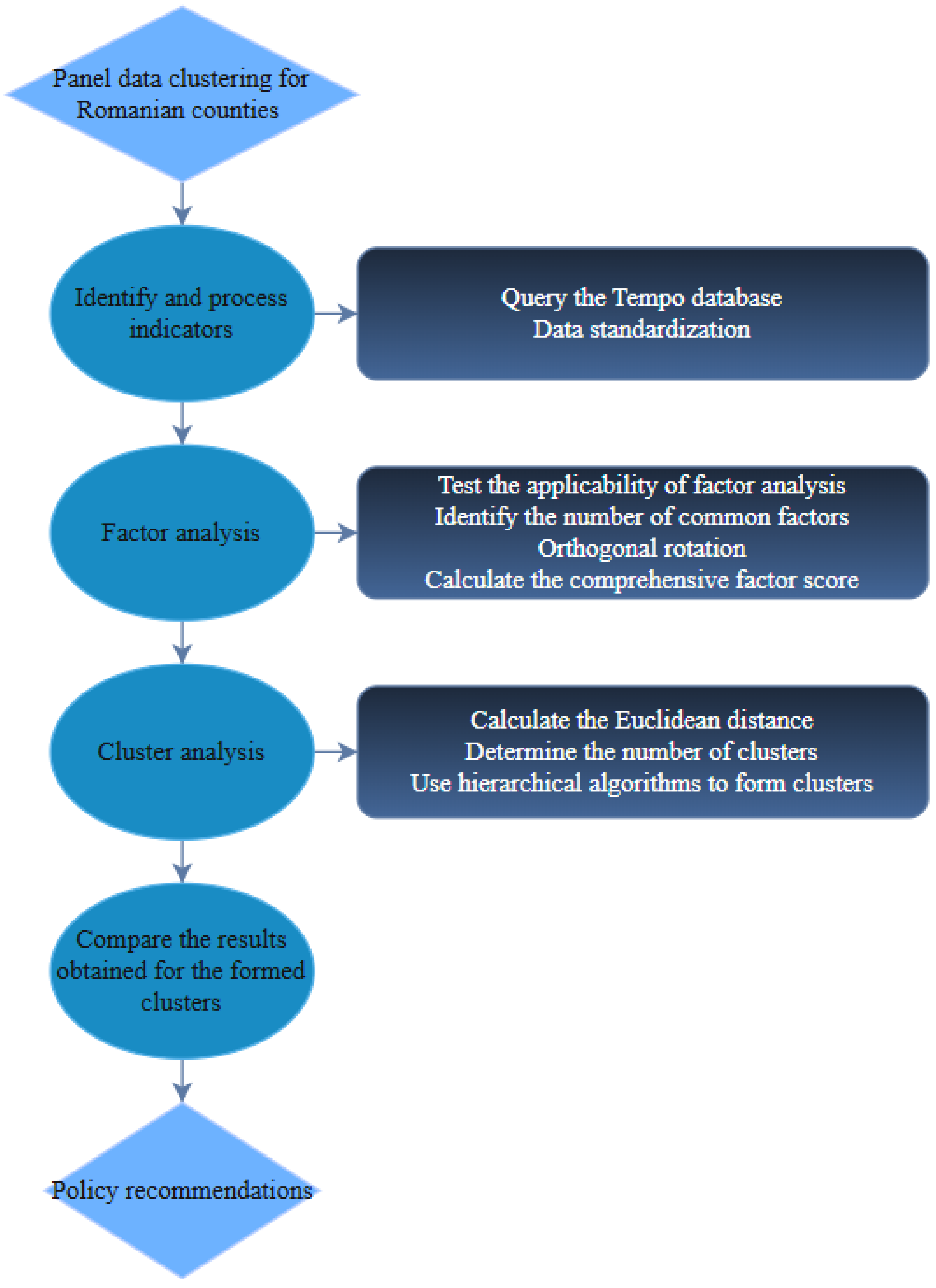
According to
Figure 1, the first step of this analysis refers to the identification and processing of indicators obtained by querying the Tempo database, made available by the National Institute of Statistics of Romania. In order to be able to operate with the selected indicators, it was necessary for them to be standardized. This standardization is necessary because there are differences in scale between indicators, with different units of measurement; standardization ensures comparable contributions of the indicators, so that variables with high variability do not dominate the results [
30]. Following this, factor analysis begins with the application of the Kaiser–Meyer–Olkin (KMO) test to determine the factorability of the data. Developed by Kaiser [
31] and later modified at Olkin’s suggestion to normalize the Sampling Adequacy Measure (MSA), the test involves obtaining a value of MSA as close to one as possible for the data used to be suitable for the application of factor analysis [
32]. The identification of the number of common factors is carried out by means of Principal Component Analysis (PCA). PCA is used to reduce dimensionality but with the minimization of the loss of information provided by the original data. The way in which the maximum amount of information is retrieved is achieved by rotating the orthogonal axes. The principal components are linear functions of the initial variables, with the first component retrieving the maximum of the variance in the data, while the second one retrieves the maximum of the remaining variance available, considering that the correlation between the components must be equal to 0. This procedure is carried out for all principal components, their number being equal to the number of initial variables [
33]. Using this procedure before cluster analysis helps reduce information redundancy by combining correlated indicators and providing uncorrelated components, thus reducing problems that may arise when operating with the original variables (e.g., multicollinearity).
The determination of the number of components used in the analysis was carried out by different criteria. For example, a first method is Kaiser’s criterion [
34], according to which components whose eigenvalues are greater than one are taken into account. A second criterion is that of variance coverage, which stipulates that components that accumulate a variance of approximately 80% are included in the analysis. After the number of components has been chosen, an orthogonal rotation of the factors is performed to maximize the variance [
4]. The new resulting eigenvalues are used to calculate the comprehensive factor score.
In the case of cluster analysis, it uses the matrix formed through comprehensive factor scores, the first step of this stage being the calculation of Euclidean distances between objects. Let
x and
y be two objects in an
n-dimensional space; the formula for calculating the Euclidean distance is [
35] as follows:
where
n is represented by the number of indicators examined. The choice of calculating the distance using the Euclidean method is due to its popularity among researchers, with studies stating that it is the most widely used method for calculating distance in cluster analysis [
36]. Moreover, and from a performance point of view, in the case of unsupervised cluster analysis, the efficiency seems to be higher when using Euclidean or Manhattan distances compared to the Canberra method [
37].
To group objects into clusters, hierarchical algorithms were used, representing an unsupervised clustering method. Hierarchical algorithms were chosen in the current research due to their increased use observed among researchers [
38,
39], as well as due to their simplicity [
40]; in the current research, the agglomerative method is used, according to which, in a first step, each object represents a class, and in each new iteration, the objects unite to form a single cluster [
41]. Because the number of clusters must be indicated by the researcher, so as not to be considered a randomly chosen number, the NbClust [
42] package was used, available in R (version 4.4.2). The package encapsulates a total of 30 indices intended to recommend an optimal number of clusters, including the Calinski and Harabasz (CH) index [
43], Davies and Bouldin (DB) index [
44], Dunn index [
45], Gap index [
46], Silhouette index [
47], etc. To achieve this, the NbClust function is given a series of parameters by the researcher. These parameters include the distance calculation method, the cluster linking method and the number of clusters, as well as the possibility of choosing indices. In the current research, Euclidean distance was used, together with Ward’s method and complete, the number of clusters chosen being a minimum of two and a maximum of five, taking into account all 30 indicators. The motivation for using Euclidean distance and the two linking methods was due to their popularity among researchers and their increased performance compared to other known methods for calculating distances [
37], respectively, for uniting objects into classes. In this sense, even though the most popular linking methods are Ward’s method, complete, single, average, centroid method, etc. [
48], the choice of the first two methods is due to research that affirms the increased performance of these techniques, especially the first method, to the detriment of the others [
49,
50]; Ward’s method is recognized as the most widely used linkage method [
51].
The Silhouette method was used as a method to validate the results, for which it can be stated that an average silhouette width greater than 0.5 indicates robust clusters. To calculate the average silhouette width, it is necessary to calculate the individual coefficients for each object. These coefficients take values between −1 and 1, a value as close to the positive maximum indicating a good classification, while a negative value indicates that the object was incorrectly classified into a particular class. The silhouette coefficient of the object
i is calculated according to the formula presented in Equation (2) [
52]:
where
a(
i) represents the average distance between
i and the objects belonging to the same cluster and
b(
i) corresponds to the smallest average distance between
i and all the objects belonging to any cluster to which object
i does not belong.
Following this calculation, the dendrogram [
53] is created to show how objects are grouped into clusters, the last step of this research being the comparison of the clusters.
This analysis presents how counties are grouped according to their manifestation over time. In order to determine and group them in various periods, cluster analyses were performed on cross-sectional data in order to see possible transformations of the clusters. For these cluster analyses, the same steps mentioned previously for hierarchical algorithms were used.
The nine indicators examined are presented in
Table 1, noting that three indicators were chosen to form part of each of the three pillars of sustainable development. While there are certainly a multitude of indicators designed to describe sustainability and the SDG targets, it must be taken into account that there are a limited number of indicators that can be reported at the county level; moreover, there are an even smaller number of indicators for which reporting can be carried out over a longer period of time. Additionally, at the time of implementation of the current analysis, including the year 2023 was problematic, further limiting the number of indicators that could be considered in the analysis. In this sense, the ecological pillar integrated indicators related to SDG 6 (Clean water and sanitation)—percentage of population connected to the water supply system (WSS) and to wastewater treatment plants (WTPs)—and SDG 12 (Responsible consumption and production)—percentage of recycling employees (PRE). According to Frone and Constantinescu [
54], only since 2017 has the rate of residents whose homes are connected to the sewage system exceeded 50%. In 2016, Romania was among the countries forced to increase its annual per capita investments in wastewater infrastructure. Moreover, the disparities between rural and urban WTPs are significant, with differences of over 60% [
55]. The importance of connecting the population to these systems is all the greater, as water sources (wells and fountains) are vulnerable and easily contaminated, leading to public health risks that directly conflict with the achievement of SDG 6 [
56]. As for recycling, including e-waste management, a field regulated at EU level, Romania seems to be performing very poorly, with collection being well below the European target [
57]. Moreover, the recycling rate is very low and the population is not educated in this regard [
58], making it all the more important that the number of recycling employees be as high as possible, given the high level of waste.
The social pillar encapsulates the percentage of female employees (PFE), which is associated with SDG 5 (Gender equality), and the percentage of vocational training expenditure out of total expenditure on social protection of the unemployed (VTE), which is part of SDG 10 (Reduced inequalities). The third indicator, the average number of beds in public hospitals (BPHs) falls within SDG 3 (Good health and well-being). Regarding the social dimension of the indicators, it can be stated that although there are no significant discrepancies between salaries by gender, there are in terms of their employment rate, which is higher compared to the EU average, taking into account the fact that inactive care responsibilities are predominantly attributed to women [
10]. Regarding vocational training, as part of the European 2020 Strategy, Romania aimed to increase the participation rate in such courses, as well as improve career counseling for young people, thus helping to increase employment rates among them [
59], this being consistent with one of the SDG 8 targets. Moreover, young people seem to attach greater importance to these training activities compared to older people [
60]. Additionally, according to a study, staff reductions are less likely when companies offer training courses, in addition to those regulated by law [
61]. Hospital beds are used as an indicator of health infrastructure, and it is noted that their number has decreased, especially in rural areas and small towns, leading to territorial disparities. Moreover, the number of localities with hospitals has registered significant decreases, although none of the hospitals located in localities with over 100,000 inhabitants have been closed [
62].
The percentage of active enterprises with more than 250 employees (E250), which is part of SDG 9 (Industry, innovation and infrastructure), is the first indicator associated with the economic pillar. The employment rate (ER) and percentage of agrotourism pensions (PAP), associated with SDG 8 (Decent work and economic growth), are the other two indicators examined related to the economic plan. It is worth noting that except for BPHs, all other indicators are expressed as a percentage. The study of ER is closely linked to the imbalance between the active and aging population, with difficulties in maintaining social support. Moreover, Romania faces a lower employment rate compared to the EU average, with an even greater dependency of the elderly predicted in the coming decades [
63]. Although E250 is the lowest, this category enjoyed the largest increase in the number of employees [
64]. As for agritourism, it represents a way to integrate responsible practices in this field, encouraging the promotion of green practices and environmentally conscious tourism [
65].
3. Results
This section begins by applying a factor analysis in order to substantiate a cluster analysis aimed at presenting how the counties of Romania are positioned in terms of the transition to sustainable development. The first step in determining the results refers to the standardization of the data, followed by the calculation of the KMO index to identify the degree of factorability of the data.
Thus, according to
Table 2, a total value of 0.66 was identified, indicating the presence of average factorability. According to Shrestha [
54], a value exceeding the threshold of 0.60 is considered acceptable for applying factor analysis.
To determine the number of common factors, Principal Component Analysis was used. Thus, according to Kaiser’s criterion, those components whose eigenvalues exceed one are taken into account [
34]. Also, the variance coverage criterion involves including in the analysis those principal components that cover approximately 80% of the information provided by the original data [
4].
Table 3 presents the results obtained from the application of the Principal Component Analysis, and according to the previously mentioned criteria, the first four components were chosen so that the coverage percentage was near 80% and the eigenvalues were as close to one as possible.
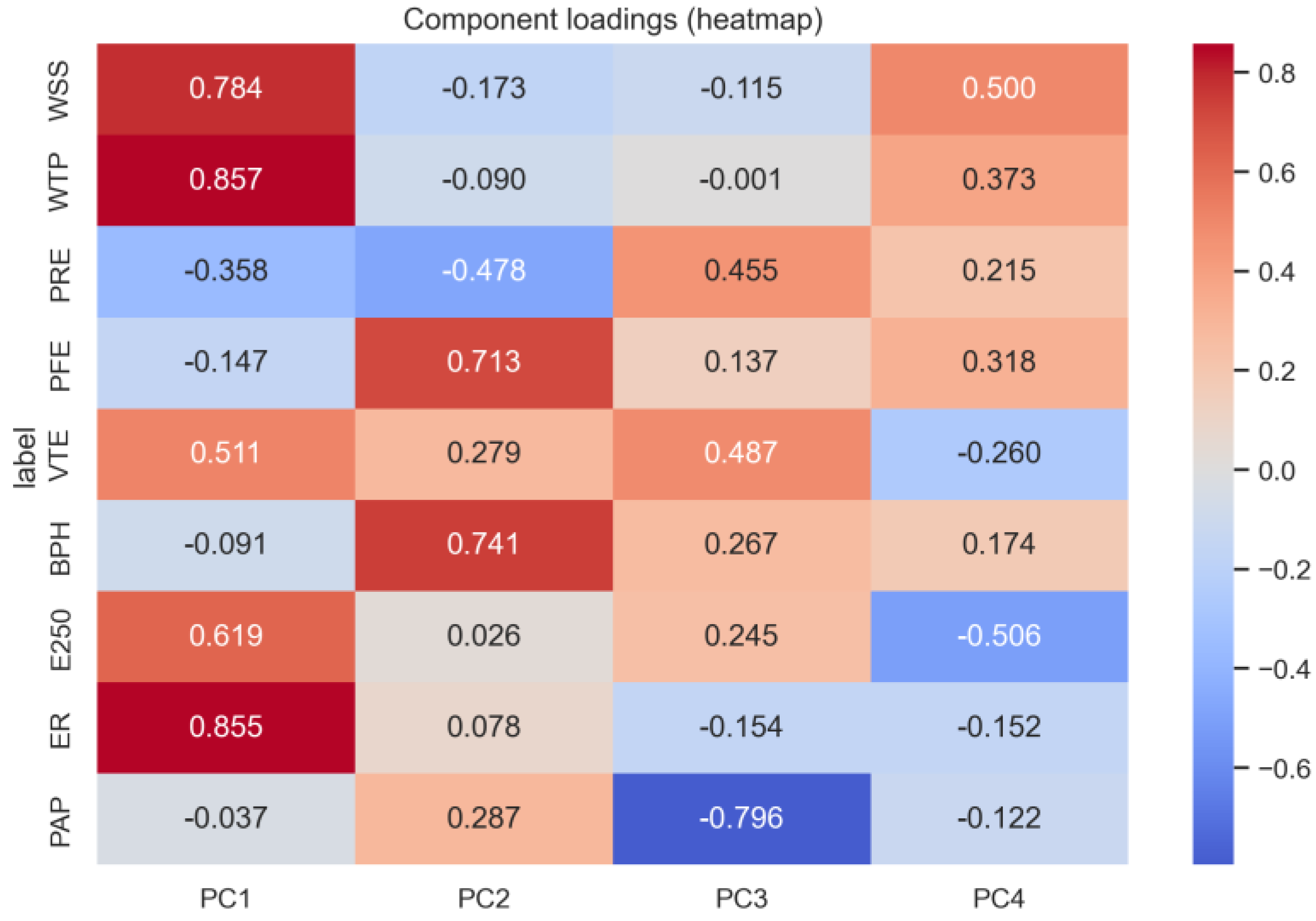
Principal components are intended to explain the original variables. In this sense, there are correlations between the components and the variables.
As expected, the first component seems to present the most correlations, given that it exhibits the maximum variance correlation. However, the most significant links seem to be made with WSS, WTP and ER. In the case of component 2, the highest correlations are noted for PFE and BPHs, with an inverse link being observed for PRE (
Figure 2). Component 3 records a positive correlation with VTE and a strongly negative one with PAP, while for component 4 the highest correlation is the inverse one, with E250.
The next step is to apply an orthogonal rotation of the common factors to maximize the variance. Thus, it can be observed in
Table 4 that after applying the Varimax method [
55,
56], all eigenvalues are greater than one. Afterward, the four eigenvalues are retained in order to calculate the score of comprehensive factor. This score is calculated as the ratio between the sum of the multiplication of the eigenvalues and the scores of the common factors and the sum of the eigenvalues.
Cluster analysis begins by using the resulting matrix to calculate the Euclidean distance between counties. For this part of the analysis, hierarchical algorithms were used.
In the first stage, the complete method was applied to link the objects. By applying the NbClust function, it was found, according to
Table 5, that most indicators recommend the formation of three clusters.
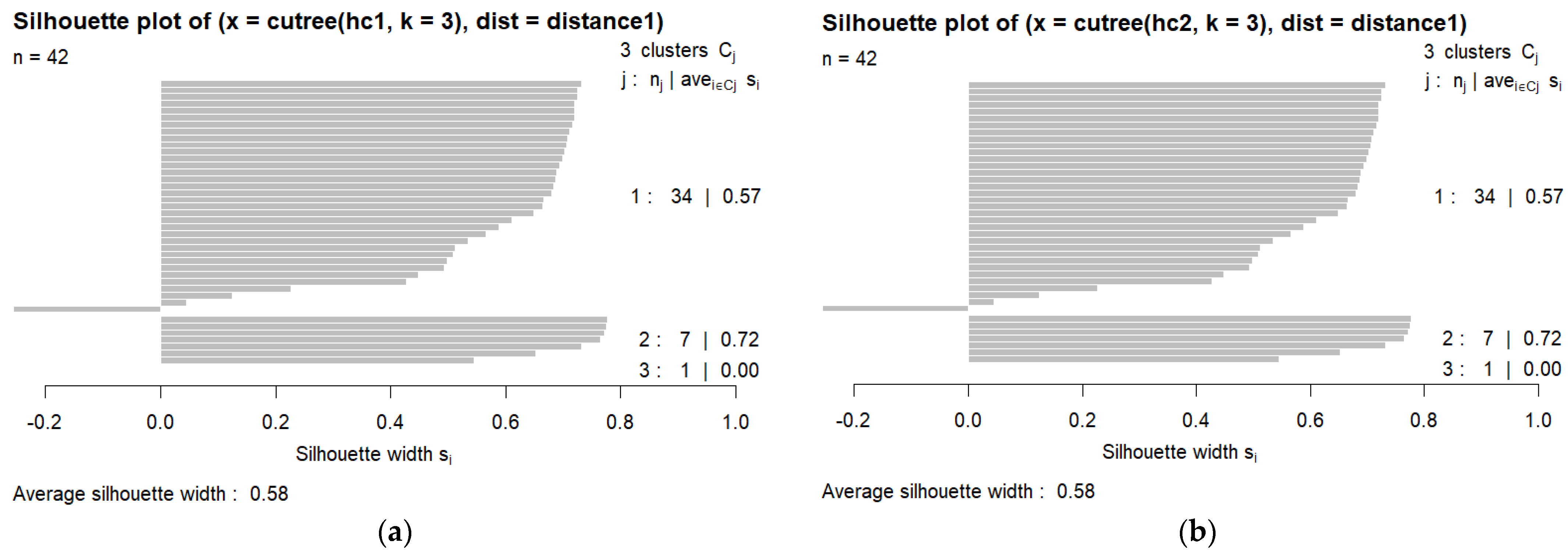
Subsequently, Ward’s method was used, indicating that this time too, most indices still recommend three clusters. To determine which method is better, Silhouette coefficients were calculated.
Figure 3 shows the individual values of the 42 counties for the two linking methods. It can be observed that in
Figure 3a,b, the average value of the Silhouette coefficients is the same, regardless of the case, with an object in cluster I that was incorrectly classified. This incorrect classification was given by the negative coefficient. The average silhouette width represents a method of evaluating the validity of clustering, with a value above 0.5 indicating that objects are closer to their own cluster compared to neighboring ones, thus giving the obtained grouping a robust structure.
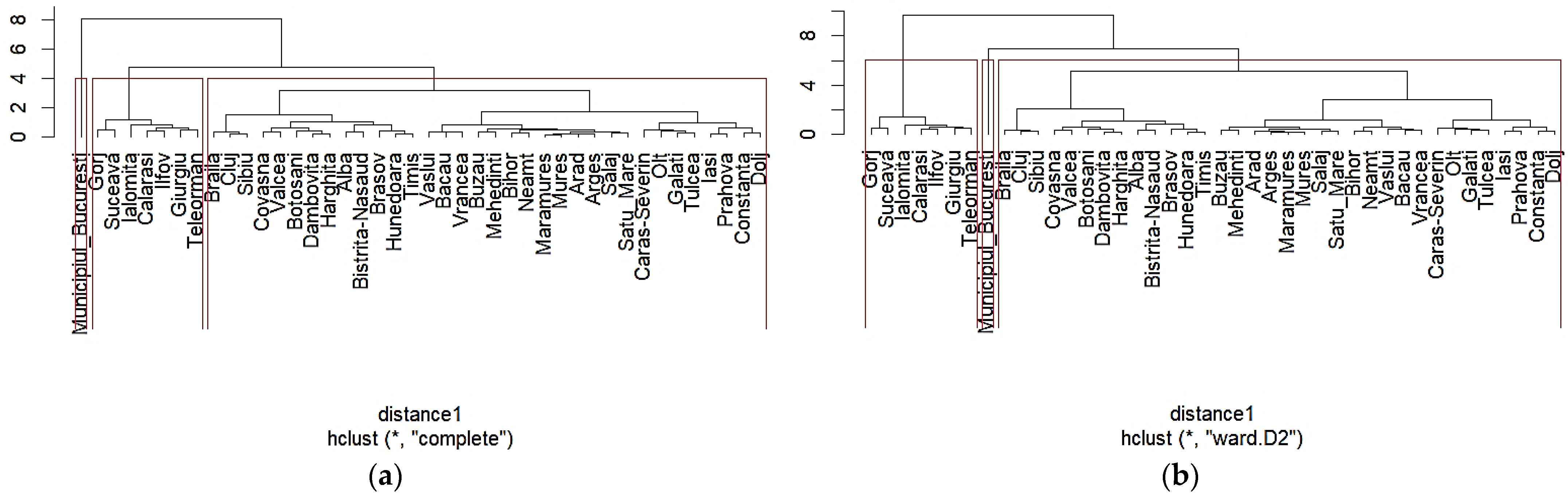
Figure 4a illustrates the dendrogram resulting from the application of the complete method, while
Figure 4b shows the one obtained using Ward’s linkage method. As can be noted, the clusters are the same using both methods, with Bucharest being included in an individual cluster.
For an easier visualization of the three clusters formed,
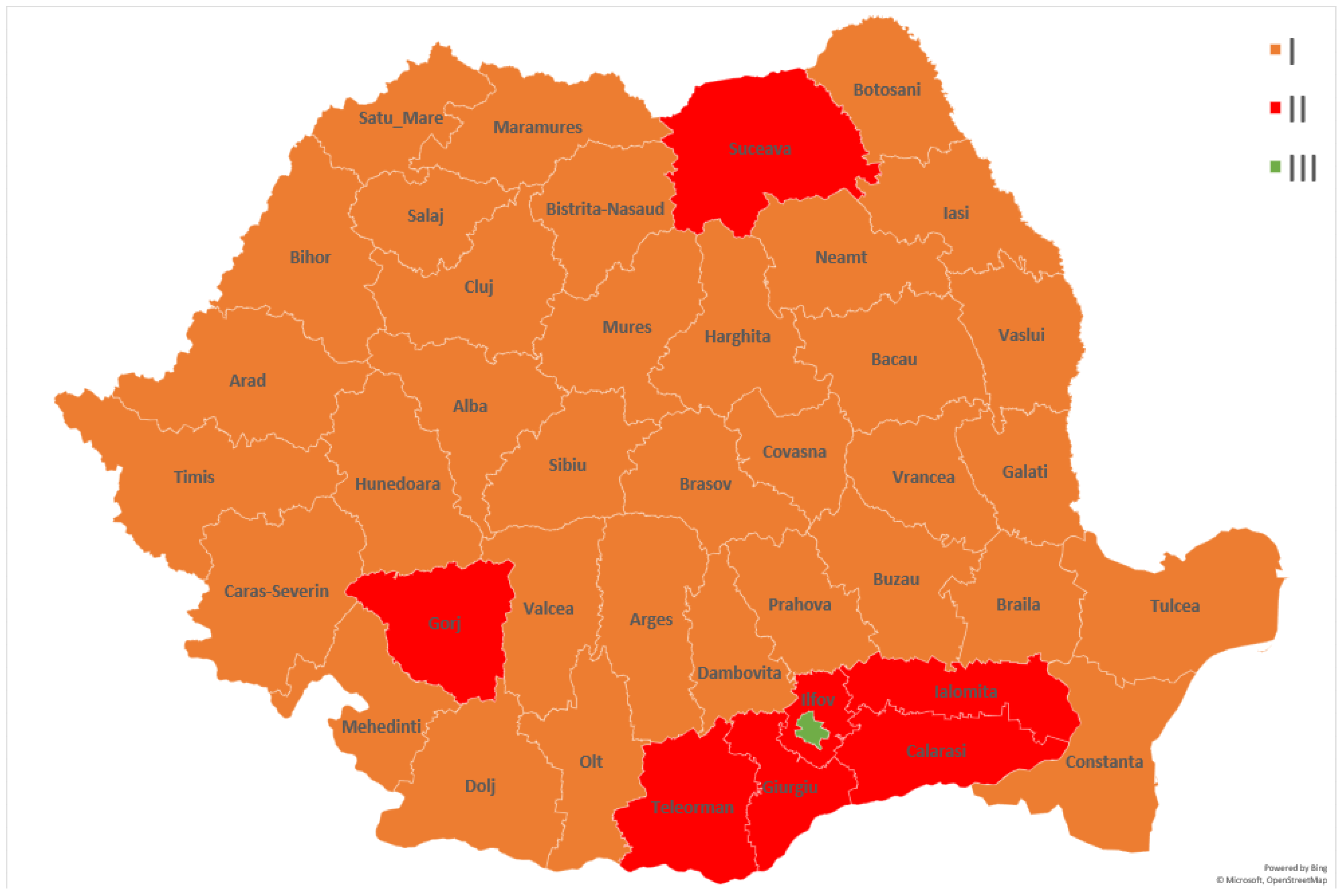
Table 6 was drawn up, noting that the third cluster has Bucharest as its sole representative, while cluster II includes seven counties (Călărași, Giurgiu, Gorj, Ialomița, Ilfov, Suceava and Teleorman). As for cluster I, it contains most of Romania’s counties.
Table 7 presents the average values for the three clusters for each of the nine indicators. Regarding the first two indicators of the ecological pillar, WSS and WTP, the ranking is the same, with Bucharest ensuring access to drinking water and sewage systems for almost all resident citizens.
Cluster I is in second place, while the lowest values were reserved for cluster II. In the case of WSS, the differences, although large, are not so significant, and it can be noted that the counties belonging to cluster I had an average access two times lower compared to Bucharest, while cluster II reached percentages over three times lower compared to the capital. In the case of PRE, the ranking was reversed, with Bucharest having the lowest percentage of people employed in the field of recycling in all of Romania, while the highest percentage was attributed to cluster II. This fact can be explained by the low total number of employees in counties such as Giurgiu, Călărași and Ialomița. In 2023, Bucharest had 8501 employees in this field, while the number of employees in Giurgiu County was only 361 people, the number of employees in Bucharest being approximately 23.55 times higher. Also, when comparing the total number of employees in the two counties, in 2023, in Bucharest there were over one million employees, while in Giurgiu County there were only 37,261, the number of employees being 27.59 times higher in Bucharest.
Moving on to the social pillar, it can be noted that, except for PFE, where the difference between first and second place is minor, Bucharest obtained the highest score for all indicators. The largest difference is recorded for VTE, where the average of the first two clusters is insignificant compared to the Bucharest average. In a society that emphasizes lifelong learning and the integration of people into the workforce, a percentage of less than 1% allocated to training expenses for the unemployed is absolutely irrelevant, as the citizens of those places are not given the opportunity to learn something new, something useful that could make it easier for them to obtain a job. Economically, Bucharest is once again at the top of the ranking in terms of cluster averages, except for PAP, where the value is 0%. Given the urban specificity of the capital, it is understandable why there are no agrotourism guesthouses. However, the average of cluster I reached 30.61%, a sign that there is an increased interest of tourists in returning to nature and a rustic space. Also, cluster II was again confronted with the lowest values associated with the indicators of this pillar, thus completing the ensemble made up of the three plans studied.
To determine whether geographic location had any connection with the way counties were grouped into clusters,
Figure 5 was created. According to this map, it can be noted that most of the counties that compose cluster II are located in the immediate vicinity of the capital. A possible explanation for this phenomenon is found in the concept of shadow cities: large cities (such as the capital) limit the development of the cities around them, taking over the resources of these cities. Thus, it can also be explained why ER is so high in Bucharest compared to the average of cluster II because many of the residents of these counties prefer to find jobs in the capital. In the case of the other two counties belonging to cluster II, Suceava encountered low values for the indicators of the ecological and economic pillars, while Gorj had difficulties in the social pillar, as well as for one economic indicator. For example, Suceava had the second lowest value for the WSS indicator and E250 and the seventh lowest value for WTP and ER. In the case of Gorj county, it presented the second lowest value for PFE and the seventh lowest value for VTE and E250, respectively.
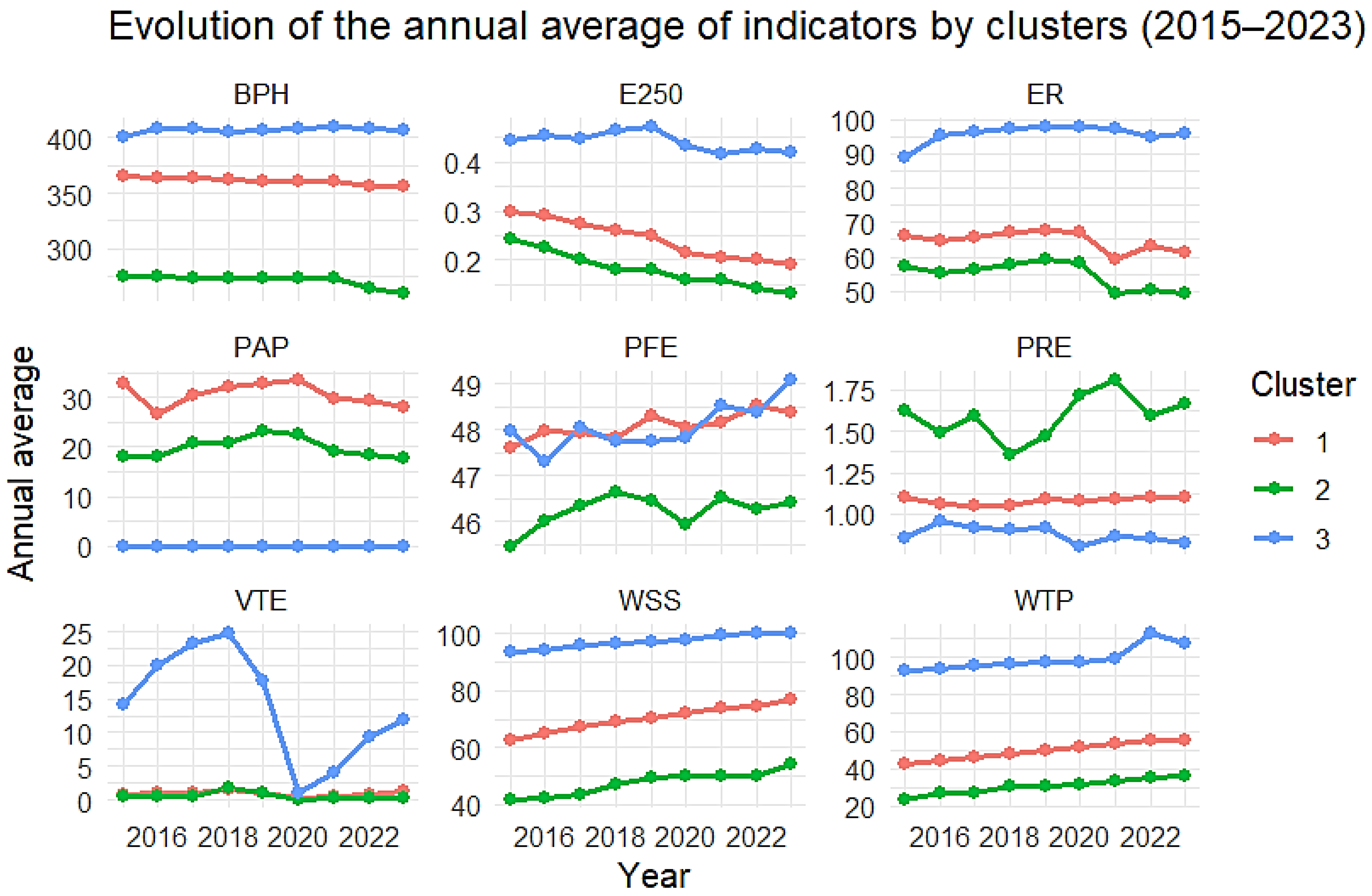
For an easier visualization of the changes that occurred during the analyzed period, the averages of the three clusters were calculated and their specific trend for each indicator was highlighted.
Thus, according to
Figure 6, for most of the investigated indicators, the superior performances of cluster III are evident compared to the other two, with the exception of PAP and PRE. In the case of PFE, a change in the ranking between cluster I and cluster III is noted from one year to another, with the values of cluster II being much lower compared to the others. The most drastic change is identified for cluster III regarding VTE, with the indicator reaching a maximum in 2018 followed by a decrease in 2019 and a much more significant one in 2020; by the end of the investigated period, it had failed to reach the 2018 performance. Although the changes were much less significant for the other two clusters, the trend was similar, with the same decreases in the period 2019–2020, a sign that the pandemic definitely affected the evolution of this indicator. An encouraging fact noted is found in the environmental area, where WSS and WTP had an upward trend throughout the analyzed period, although the values associated with cluster II for both indicators, especially WTP, are worryingly low.
To determine whether there were significant differences in the composition of the clusters, three distinct periods were taken into account: 2015—indicating the performance of Romania’s counties before the signing of the 2030 Agenda, 2019—the interim period presenting the context before the pandemic and implicitly before the implementation of the National Recovery and Resilience Plan, and 2023—showing how counties are grouped as a result of both progress in achieving the SDGs and recovery from COVID-19.
According to
Table 8, in the case of comparing the cluster analysis on panel data with the cross-sectional one, it is evident that for the first two years analyzed, 2015 and 2019, Bucharest constituted a unitary cluster, with all other counties being included in a single cluster, thus showing as clearly as possible the differences between the capital of Romania and the other counties. What is striking is the total difference of 2023 compared to all other situations analyzed. Although, in this situation too, Bucharest appears to be framed separately from most counties, it nevertheless manages to be framed in a cluster, together with counties such as Brașov, Cluj, Dolj, Sibiu and Timiș. An interesting aspect is that in the case of the 2023 analysis, Bucharest is placed together with other important counties of the country, while in the case of the 2015–2023 period, the counties with the worst performances are presented in a cluster. According to this analysis, Bucharest’s performance in relation to the other counties is observed, detaching itself from them throughout the entire period examined. However, it is noted that by the end of the investigated period, some counties end up being integrated into the same cluster as the capital, showing that, over time, and with the help of various national projects and plans, counties can be helped to achieve performances similar to those of the capital.
What can also be noted is the fact that very few counties change their places in the cluster depending on the periods analyzed. Thus, among these counties, there are two categories of changes identified. Counties such as Brașov, Cluj, Dolj, Sibiu and Timiș present a positive change, reaching the end of the analyzed time interval having aligned with the performances of the capital. It is worth mentioning that all these counties host the largest university centers in Romania. Moreover, Timiș, Brașov and Cluj counties are among the most industrialized; also, all the aforementioned counties attract the largest companies. Thus, this combination of industry and education only helps to improve, in particular, the economic factors, but without leaving aside the other dimensions of sustainability. As for the second category of counties that changed their clusters following the annual analyses, Călărași, Giurgiu, Gorj, Suceava, Teleorman, Ialomița and Ilfov, they seem to be very affected on all levels, especially the economic one, with this being due to the preponderance of the rural environment and the agricultural specificity. However, an upward trend in environmental indicators was observed, a sign that attempts are being made to improve living conditions in these areas.
4. Discussion
As highlighted in the Introduction, Romania faced low values for most of the indicators analyzed in the current research. Thus, whether it was access to drinking water [
6], sanitation services [
7] or other indicators related to SDG 6 [
66], Romania was among the EU countries with the worst performances. Moreover, the situation was not better for the indicators related to the social field. In this sense, although the wage discrepancies were not significant in Romania, the differences between ER by gender were higher compared to the EU average [
10]. The situation in the health sector does not appear to be more favorable either; in 2021 public per capita health spending was over 2.5 times lower than the EU average [
67]. However, it should be noted that in 2019, it was the country in the EU with the fourth highest number of beds per 100,000 inhabitants, although in terms of medical personnel (excluding nursing and caring professionals), it represented the eighth lowest value per 100,000 inhabitants. Additionally, in terms of the share of GDP associated with public spending on health, Romania faced the fourth lowest value in the EU [
68]. Romania does not seem to excel in terms of VTE, facing some of the lowest shares of total labor costs [
14]. Moreover, in a study of Central and Eastern EU countries, Romania had the highest percentage of young people neither in employment nor in education and training and one of the lowest shares of adults who participated in education or training courses [
15].
The current research focused on regional analysis, investigating county performances. According to the cluster analysis, Bucharest obtained the best values for most of the evaluated indicators. Moreover, in 2015 and 2019, cluster analyses indicate the formation of two groups, grouping Bucharest into a distinct class. This fact shows that there are significant differences between Bucharest and the rest of the country, a notion also noted in the case of various indicators analyzing regional performance, such as the EU Regional Competitiveness Index [
19] or the Social Progress Index [
20], in which the NUTS 2 region that includes the capital is much more developed compared to the other regions. Thus, this county was characterized by the highest E250, a fact confirmed by another study in which regional performances in Romania and Bulgaria were evaluated for the year 2022 [
69]. Moreover, according to a study aimed at evaluating companies based on the number of employees, the average of the cluster in which Romania was included was 0.37% in 2015 and 0.35% in 2020 [
18], with Bucharest’s average for the investigated period, 0.44%, being higher compared to these values. The most affected counties, with the lowest percentages of these types of companies, are those surrounding Bucharest, which are also characterized by the lowest ER, as Bucharest takes over a collection of the employees of these adjacent counties. According to the same analysis of counties in Romania and Bulgaria, all counties in cluster II were characterized by values below 0.14% in 2022, to which counties such as Sălaj, Bistrița-Năsăud, Vaslui, Brăila and Caraș-Severin were added [
69]. In 2018, the Bucharest–Ilfov area comprised 29.96% of E250, with the lowest shares being noted in areas such as the South-West, North-East and South-East of Oltenia [
70]. However, the ER had an upward trend from 2004 to 2019, with a higher increase in the period 2016–2019. Nevertheless, it should be noted that the development of the business area is deficient due to the lack of qualified personnel, the aging population and excessive migration [
71]. Although Romania is among the EU countries with the largest discrepancies between the shares of employees by gender [
72], the monthly analysis in 2019 showed an unemployment rate that was higher by approximately 1% among male employees. Performing an analysis by age range, it was noted that young people aged 15–24 face the highest unemployment rates, with women being more affected in this age category [
73].
Concerning training costs, it can be noted that for the first two clusters, their VTE was below 1%. Regarding the evolution of this indicator over time, it is noted that the pandemic led to its drastic reduction, including in Bucharest; this city was the most affected, with the percentage of these expenses going from 25% in 2018 to almost 0% in 2020. Although funds were allocated for these courses after this year, their share did not return to pre-pandemic values, reaching approximately half of the value recorded in 2018 at the end of the analyzed period. Training expenditure should not be considered costs but investments, as it improves employee performance and thus increases company profits [
74]. Moreover, in the period 2008–2016, a decrease in the percentage of training expenditure in total labor expenditure was noted, with the value in 2008 being more than twice as high as in 2016 [
14]. The poor results of cluster II, in terms of the low ER or E250, at least in the counties around the capital, are explained by the predominantly rural nature. Another possible explanation is the concept of “agglomeration shadows” which states that due to the effect of competition, firms located in the shadow area of metropolises are limited in their growth, affecting their productivity. This concept also introduces the idea that the development opportunities of the areas around large cities are limited [
75]. Moreover, this concept also explains the fact that the regions in the “shadow” have fewer urban functions than they would normally have if they were not located around these urban agglomerations [
76], hence the agricultural predominance of these areas. Through the Administrative Capacity Operational Program 2014–2020, a strategy for the development of rural areas and infrastructure, as well as for increasing the employment rate in these areas, was implemented for Giurgiu County, including through professional retraining or qualification of the rural population [
77].
This preponderance of rural areas may also explain the low WTP and WSS in this cluster. In 2017, 96.90% of the urban population was connected to a water supply system, compared to 33.50% in rural areas. Importantly, the share of the population with access to a water supply system showed an upward trend during the period 2013–2017 [
55]. Of all three clusters, cluster II faced the lowest values of WSS and WTP; in the case of the last indicator, the situation is very worrying, despite the upward trend identified in the case of the analyzed period. This upward trend of the two indicators can be explained by the third target of SDG 6: by 2030 Romania proposes to “Connect households of the population in cities, communes and compact villages to the drinking water and sewage network in a proportion of at least 90%” [
78]. According to the same source, the WTP was 47.8% in 2016 [
78]; our analysis clearly shows that this average is significantly higher in Bucharest (cluster III) and for cluster I a share close to this average is noted, while cluster II is faced with a value of less than 30% this year. It is encouraging that by the end of the analyzed period, the percentage increased to approximately 40% in the case of cluster II and approximately 60% for cluster I. However, if the growth rate remains similar to that of the analyzed period, the target proposed by the National Strategy for Sustainable Development of Romania 2030 will not be achieved, and additional resources directed in this direction are needed.
The possible recommendations that can be made based on the results obtained are addressed to the counties in cluster II (associated with the entire analyzed period) because most problems were noted there. In this regard, it was noted that the environmental indicators, as well as the PFE, recorded upward trends, although in the case of the first two variables, the percentages are far from those desired to be achieved by SDG6. In the case of the other indicators, especially in the second period of the analyzed time interval, a downward trend was noted. A vicious circle is created in which limiting access to environmental resources makes the areas unattractive for investors, especially as a result of the rural and agricultural specifics associated with these regions, while the lack of industrialization leads to the marginalization of these regions and the limitation of resources. Thus, in order for these counties to prosper, it is necessary to try to attract investments and train qualified personnel. Given that most of these counties are located in the vicinity of Bucharest, policies can be implemented to facilitate the education of people from the surrounding areas in order to prepare them for the creation of new jobs. Including the creation of centers aimed at qualifying personnel can be considered useful. According to a study conducted at county level, counties with the lowest number of school workshops and enrolled population had the lowest values associated with GDP and ER [
79], showing once again the role of education in achieving economic performance. Another example of policies refers to improving transportation in these areas to connect them to the already heavily industrialized regions and facilitate their access, in order to attract investment. Moreover, tax exemption for those who want to open businesses in those areas represents a plus that can provide an incentive to increase industrialization; moreover, companies that offer training to employees could even receive certain additional benefits from the state, thus helping to create new jobs. The role of the cluster analysis was to present the similarities as well as the disparities that may arise between counties. As has been observed, there are different degrees of regional performance, with significant discrepancies between the analyzed indicators. In this context, it is very clear that a uniform policy at national level will not bring equal benefits to counties. For this reason, especially in the context of the EU cohesion policy, Romania should adapt its national strategy according to the zonal needs.
As for the limitations, they refer, first, to the limited number of indicators selected in the analysis. Unfortunately, in the case of such analyses, the research is dependent on data published in public sources. In many situations, there are data series for which publication is interrupted, or there are many missing data points, which is why the number of variables that can be analyzed is reduced. Moreover, the way counties are grouped into clusters refers strictly to the use of these indicators, with results potentially differing significantly by introducing one or more indicators. However, it should be noted that indicators were chosen for which factor analysis could be applied, with the KMO index having a value of 0.66, an acceptable level for the data to be used [
80]. Secondly, it should be noted that different analyses lead to different results; thus, choosing a different linking method or unsupervised learning technique could have determined a different way of grouping the counties into classes. However, the positive average Silhouette coefficient showed that the counties were appropriately classified into classes. Possible future research directions may address expanding the database or applying other clustering methods such as the K-means algorithm and comparing the results obtained. Moreover, the role of spatiality in obtaining clusters could be addressed in more depth, and various econometric models could be created for the three clusters in order to identify the role of indicators and their importance depending on the category of counties analyzed.
5. Conclusions
The purpose of the current research was to determine the grouping of Romanian counties according to the values recorded for a series of indicators intended to describe the three pillars of sustainable development. Thus, for the social pillar, indicators were chosen to assess gender equality in the workplace, the interest given to vocational training, and the infrastructure of the medical system. The ecological pillar focused on the population’s access to water and sewage treatment plants but also on the interest given to recycling, considering the share of employees in the recycling field (collection, treatment and disposal of waste and activities for recovering recyclable materials, as well as decontamination activities and services). The last pillar, the economic one, took into account the share of large enterprises in total enterprises, employment rate and the share of agrotourism guesthouses in total guesthouses.
By implementing cluster analysis applied to panel data during 2015–2023 for the 42 counties of Romania, it was found that Bucharest achieved the best results for most of the evaluated indicators, except for PRE and PAP. However, it should be noted that by presenting real values and not percentages, Bucharest has by far the largest number of employees in this field. The second cluster formed included regions in the immediate vicinity of the capital (Călărași, Giurgiu, Gorj, Ialomița and Ilfov), as well as the counties of Gorj and Suceava. These counties were characterized by the lowest values for almost all the evaluated indicators, except for the two previously mentioned. Therefore, the average PAP in this group was 19.84%, while cluster I (in which all the other counties were included) obtained an average weight of 30.61%. For PRE, it was found that cluster II had the highest average value recorded among the three classes.
As noted throughout the research, the most affected counties were those in the proximity of the capital. This may be due to the fact that the population can look for jobs in Bucharest, given the large number of companies in this area. Also, the agrarian specificity of most of these counties and the seasonal nature of agricultural work prevent the provision of constant jobs and push the resident population to look for jobs in nearby large cities or abroad. This absence of infrastructure and the deficiency of emphasis on agricultural specifics can be considered a cause of the lack of sustainable development in these areas. Moreover, the development of infrastructure would lead to the attraction of investments, to encouraging companies to open their offices in these counties and to help modernize them. Additionally, the training or professional reform of citizens and their grouping in associations would be another way of attracting investments. Another problem encountered is the limited access of the population to water and sewage services, which can be solved with the help of European funds. As previously mentioned, the National Strategy for Sustainable Development of Romania 2030, which was adopted by the Romanian Government in 2018, foresees that by 2030, at least 90% of the population will be connected to the water and sewage system. In the current context, the only cluster that meets this condition is cluster III, with the other two clusters having values very far from this target, especially cluster II, where the percentages are extremely low. As studies found in the literature state that the biggest problem occurs in rural zones, in areas where the infrastructure exists but the population is not connected, subsidies could be granted to help connect these systems to households. Moreover, since the public administration cannot always support local infrastructure, it could be possible to grant tax exemptions to companies located in problem counties, especially in the most affected areas, in exchange for helping communities connect to the water and sewage system.