
Bridging the Capability Gap: A Multidimensional Maturity Model for Smart City Development in German Municipalities


Abstract
1. Introduction
- RQ1 (Model Development and Validation). How can a comprehensive, empirically validated Smart City Maturity Model (SMMM) be developed and tested to meet the administrative and governance requirements of German municipalities?
- RQ2 (Empirical Pattern and Capability Gap). How is digital maturity distributed across the ten SMMM dimensions in German municipalities, and what evidence substantiates a systemic capability gap between strategy/governance and foundational technical capacity (infrastructure, data management)?
2. Materials and Methods
2.1. Research Design
2.2. Literature Review
- (1)
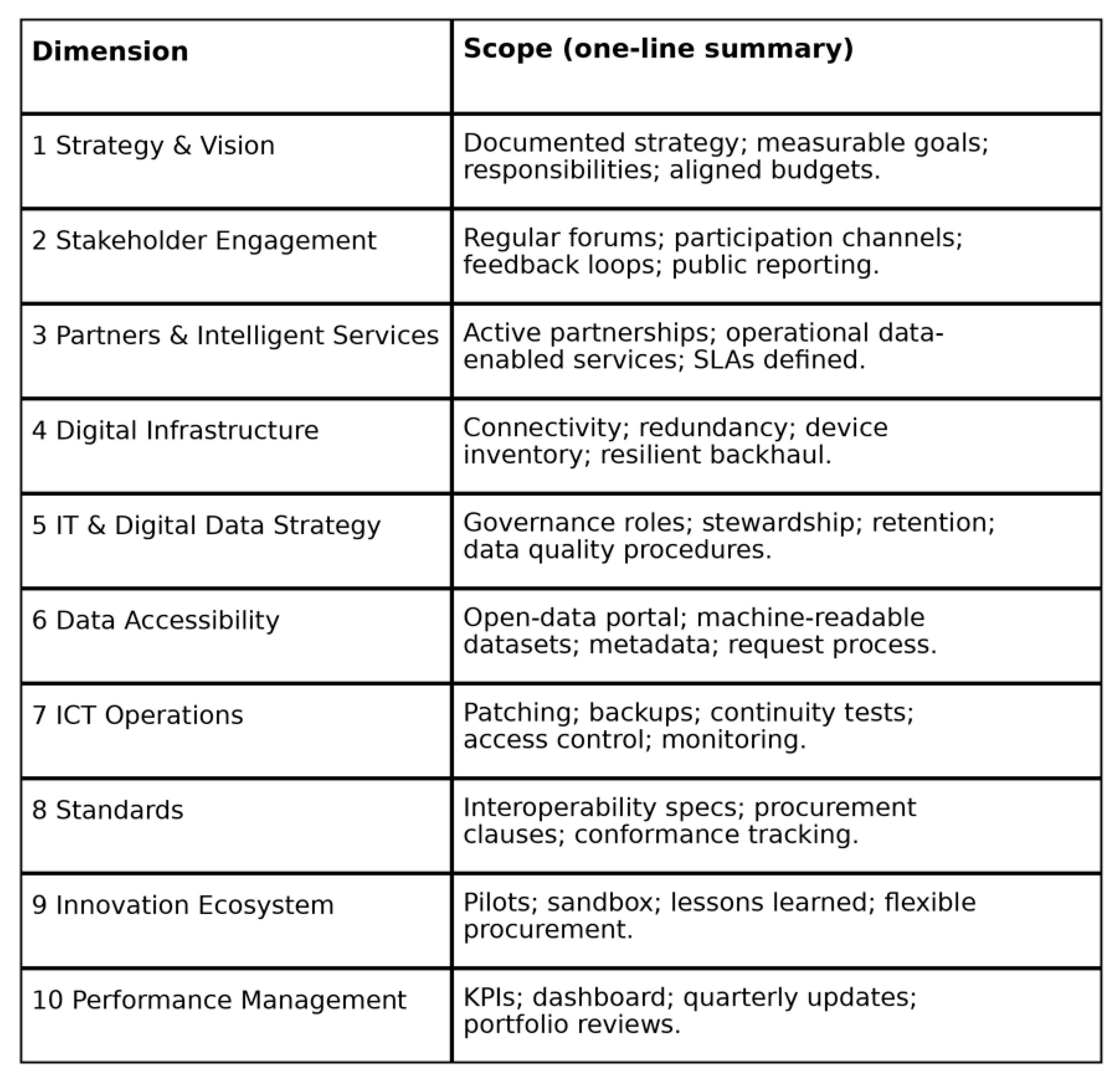
- a consolidated set of ten capability dimensions covering strategy, governance, data, infrastructure, services, operations, standards, innovation, and performance;
- (2)
- an operational item pool from which the final 99 binary indicators were derived;
- (3)
- a set of design requirements used in the subsequent conceptualization of the SMMM.
2.3. Model Development
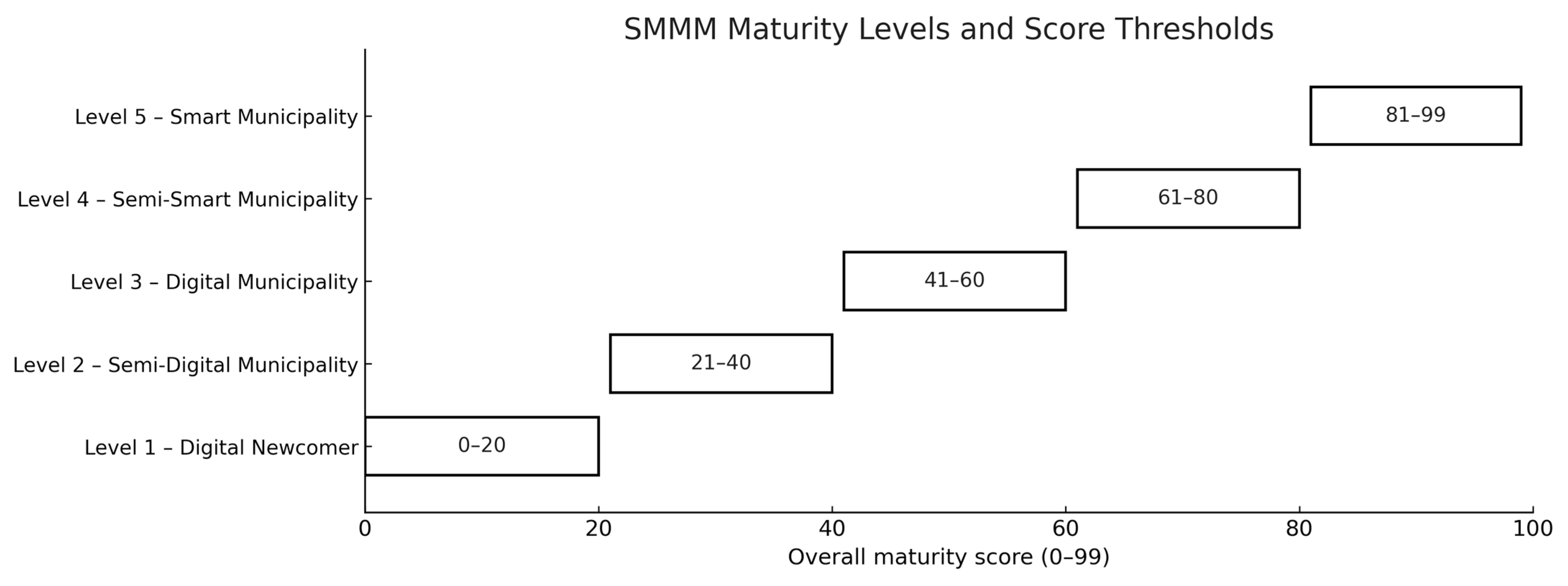
2.4. Instrument Structure and Scoring
2.5. Validation Pipeline
- Expert review to assess clarity and content coverage;
- Industry validation with a public IT provider to ensure operational relevance;
- Pilot with 24 municipalities to test usability and scoring patterns;
- Large-scale deployment across 1136 municipalities (≈3400 decision-makers) to assess robustness and comparability [11].
2.6. Data Collection and Sample
2.7. Measures and Variables
2.8. Analysis Plan
2.9. Methodological Limitations
3. Results
3.1. Overall Distribution of Maturity by Population Class
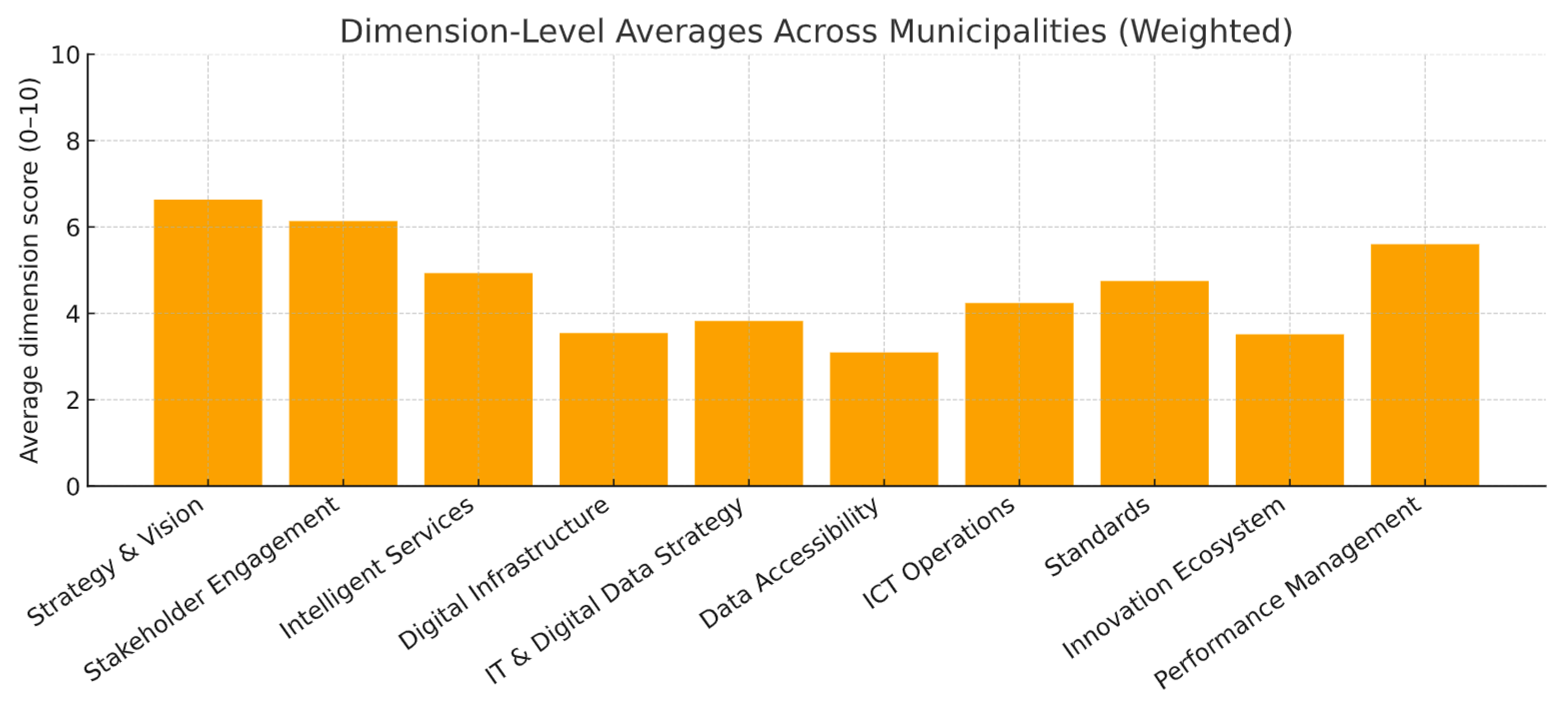
3.2. Dimension Profiles: Governance Leads; Infrastructure and Data Lag
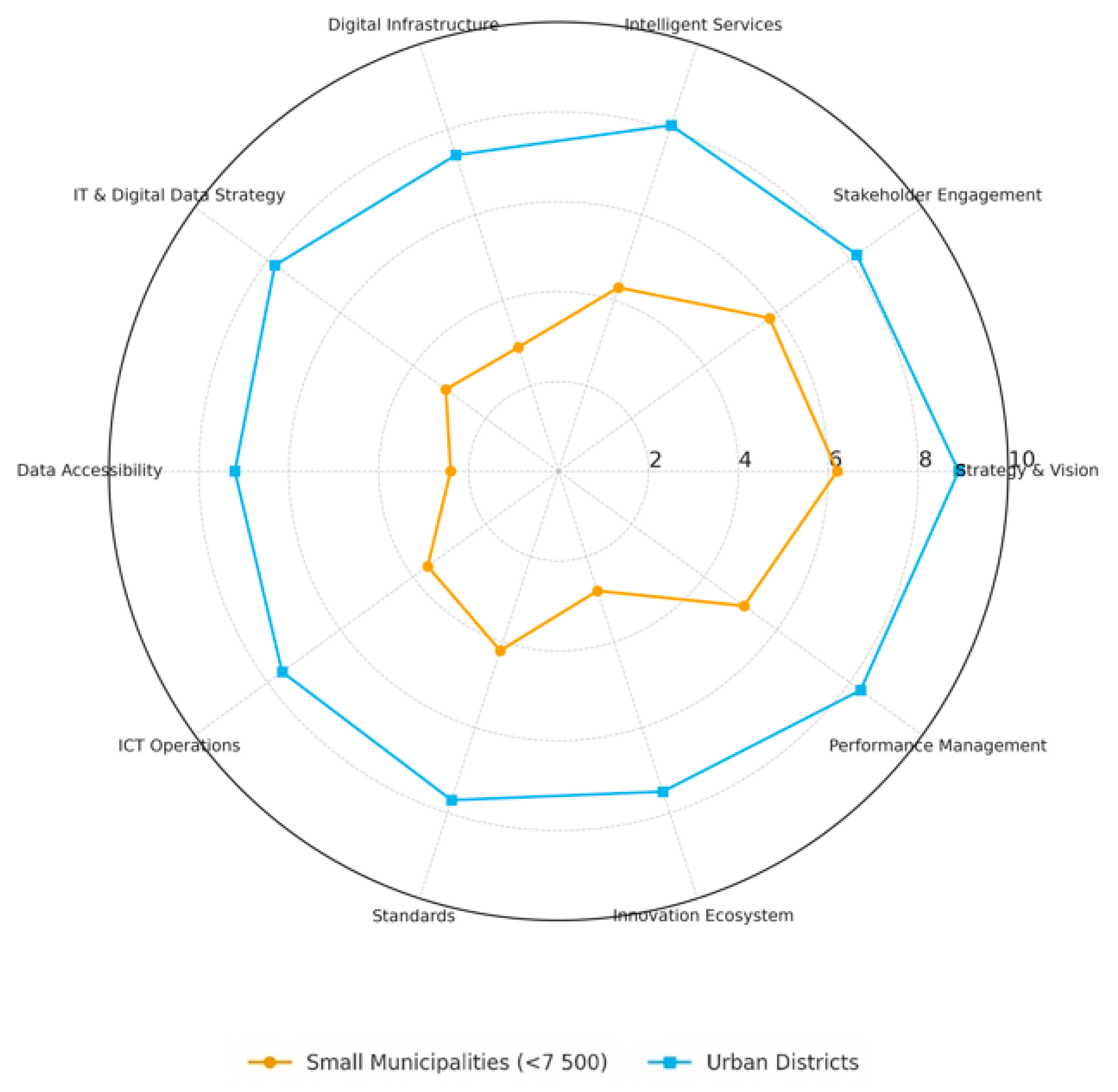
3.3. Subgroup Contrast: Urban Districts Versus Small Municipalities
3.4. Robustness and Sensitivity
4. Discussion
4.1. Interpretation of the Systemic Capability Gap
4.2. Theoretical Contributions and Alignment with the Literature
4.3. Comparison with Recent and Representative Maturity Models (2019–2025)

| Model/Source (Ref) | Primary Focus | Validation/Evidence | Intended Use/Scope | Notes vs. SMMM |
|---|---|---|---|---|
| Sulman et al., 2021 [31] | CSR/sustainability lens for smart-city maturity | Conceptual development + structured review; illustrative operationalization | Conceptual robustness; strengthens sustainability & governance perspective | Rich CSR framing; heavier for routine self-assessment than SMMM |
| TM Forum TR259, 2019/20 [32] | Industry benchmark model; practitioner vocabulary | Ecosystem adoption; iterative releases; practitioner pilots | Cross-city benchmarking; vendor/ecosystem alignment | Strong for benchmarking; less diagnostic on admin-internal gaps; SMMM adds transparent item-level scoring |
| Caird & Hallett, 2019 [33] | Stage-based urban development/evaluation design | Conceptual synthesis; cases/examples | Policy sequencing; maturity-phase logic | SMMM operationalizes 5 levels + 10 dimensions with validated items |
| Ghazinoory et al., 2024 [37] | Meta-review; synthesized multidimensional framework | Systematic review & synthesis | Landscape mapping; international comparability | SMMP provides deployable, large-N instrument aligned with the synthesized dimensions |
| Aragão et al., 2023 [34] | Multicriteria (TOPSIS) smart-city maturity index | MODM/TOPSIS; country dataset | Quantitative ranking where indicator data exist | Needs data & analytics capacity; SMMM lowers burden via binary self-assessment |
| UrbanTide, 2023 [38] | Vendor-supported self-assessment (EU practice) | Co-developed with Scottish partners; field deployment | Municipal self-diagnosis; investment road-mapping | Similar usability space; SMMM adds uniform item wording, transparent scoring, and state-wide scale |
| Ajoudanian & Aboutalebi, 2025 [35] | Capability/process-aware CMM for digital transformation | Conceptual + case-oriented/process evidence | Process design; ICT-transformation alignment | Complementary: SMMM shows where gaps are; process-CMMs guide how to fix them |
| Anschütz, Ebner & Smotnik, 2024 [36] | Maturity model tailored to small/medium cities | Design-science; expert interviews + municipal case (Bad Hersfeld) | SME-scale administrations; context fit under constraints | SMMM complements with large-N deployment and population-class benchmarks |
4.4. Practical Implications and Policy Recommendations
- Foundational support for small municipalities: co-funded connectivity/backbone upgrades, data stewardship programs, shared services (hosting, security operations), and training to lift baseline capacity.
- Innovation support for large municipalities: incentives for interoperability pilots, open-data ecosystems, and cross-jurisdictional standards adoption.
4.5. Limitations
4.6. Future Research
5. Conclusions
- RQ1 (Model Development and Validation): How can a comprehensive, empirically validated Smart City Maturity Model (SMMM) be developed and tested to meet the administrative and governance requirements of German municipalities?
- RQ2 (Empirical Pattern and Capability Gap): How is digital maturity distributed across the ten SMMM dimensions in German municipalities, and what evidence substantiates a systemic capability gap between strategy/governance and foundational technical capacity (infrastructure, data management)?
Author Contributions
Funding
Institutional Review Board Statement
Informed Consent Statement
Data Availability Statement
Acknowledgments
Conflicts of Interest
Abbreviations
| AöR | Anstalt des öffentlichen Rechts (Statutory Public-Law Institution) |
| CSR | Corporate Social Responsibility |
| DSR | Design Science Research |
| GenAI | Generative Artificial Intelligence |
| ICT | Information and Communication Technology |
| IoS3 | Institute for Smart Systems and Services |
| ISO | International Organization for Standardization (e.g., ISO 37122) |
| ITU | International Telecommunication Union |
| KPI | Key Performance Indicator |
| PAS | Publicly Available Specification (e.g., PAS 181) |
| RQ | Research Question |
| SD | Standard Deviation |
| SLA | Service-Level Agreement |
| SME | Small and Medium-sized Enterprise |
| SMMM | Smart Municipality Maturity Model |
| TOPSIS | Technique for Order Preference by Similarity to Ideal Solution |
Appendix A. Instrument Overview and Exemplar Items
Appendix A.1. Structure and Dimensions
- (1)
- Strategy and Vision
- A documented smart city strategy is formally adopted by the council.
- Annual objectives include measurable digital outcomes (with baselines).
- The strategy assigns responsibilities to named units/roles.
- (2)
- Stakeholder Engagement
- A standing multi-stakeholder forum meets at least twice per year.
- Citizen feedback channels (e.g., online portal) are routinely analyzed and reported.
- Co-creation is embedded in at least one service redesign per year.
- (3)
- Partners and Intelligent Services
- The municipality maintains active partnerships with at least one university or public IT provider.
- At least one data-enabled service (e.g., mobility, energy, and environment) is in regular operation.
- Service-level agreements (SLAs) exist for the partner-supported services.
- (4)
- Digital Infrastructure
- Municipal broadband or equivalent backhaul supports administrative sites.
- Critical facilities have documented redundancy for connectivity and power.
- IoT devices are inventoried with lifecycle management.
- (5)
- IT and Digital Data Strategy
- A written data strategy defines ownership, stewardship, and retention.
- Data governance roles (owner or steward) are assigned and active.
- Procedures exist for data quality checks before publication/use.
- (6)
- Data Accessibility
- An open-data portal or equivalent publishes machine-readable datasets.
- Metadata follow a recognized schema; datasets have update schedules.
- External developers or agencies can request data via a documented process.
- (7)
- ICT Operations
- Configuration and patch management are centrally managed and logged.
- Business continuity and disaster recovery plans are tested annually.
- Access control uses MFA for privileged accounts.
- (8)
- Standards
- Interoperability standards (APIs, formats) are specified and enforced in procurements.
- Conformance to relevant national/EU standards is documented.
- Data exchange contracts include format and security obligations.
- (9)
- Innovation Ecosystem
- A small innovation budget or sandbox supports pilots.
- Lessons learned from pilots are documented and shared internally.
- Procurement allows functional specifications (not vendor lock-in).
- (10)
- Performance Management
- KPIs link smart city actions to policy targets (e.g., mobility or emissions).
- A dashboard tracks KPIs with quarterly updates.
- Results inform yearly portfolio reviews and budget proposals.
Appendix A.2. The Smart Municipality Maturity Model Assessment Framework
| Item | Category 1: Smart Strategy and Vision |
| 1.1 | Clarification on whether the municipality possesses a distinct vision for its future development. |
| 1.2 | Definition of specific goals, priorities, and necessary actions regarding the future vision. |
| 1.3 | Awareness of the primary challenges the municipality is currently facing. |
| 1.4 | Opportunity for all stakeholders (e.g., citizens) to participate in developing the vision. |
| 1.5 | Execution of a strengths/weaknesses and environmental analysis (e.g., SWOT, PESTEL). |
| 1.6 | Consideration of citizens’ needs within the strategic framework. |
| 1.7 | Analysis of the specific skills required for the planned projects. |
| 1.8 | Usage of terminology that is comprehensible to all involved stakeholders. |
| 1.9 | Application of data analytics or comparable methods within the decision-making process. |
| 1.10 | Utilization of data analytics insights for making decisions or adapting political guidelines. |
| Item | Category 2: Stakeholder Engagement |
| 2.1 | Involvement of representatives from affected departments, private sector experts, and citizens. |
| 2.2 | Active participation of citizens in the planning processes. |
| 2.3 | Acting in accordance with generally accepted decisions. |
| 2.4 | Informing stakeholders about decisions that have been made. |
| 2.5 | Consideration of diverse stakeholder perspectives to improve services. |
| 2.6 | Existence of a digital inclusion strategy to ensure access for all societal segments. |
| 2.7 | Implementation and usage of new proposals submitted by citizens and businesses. |
| 2.8 | Integration of digital and non-digital channels (e.g., workshops) to foster participation. |
| 2.9 | Mapping of the municipality’s stakeholder environment. |
| 2.10 | Regular measurement of citizen satisfaction regarding services and quality of life. |
| Item | Category 3: Partners and Intelligent Services |
| 3.1 | Usage of strategies to ensure collaboration across different departments. |
| 3.2 | Regular review of partners and service providers (e.g., regarding scope of services). |
| 3.3 | Existence of a portfolio containing cross-departmental projects. |
| 3.4 | Development of employee skills in agile management, UX, or digital business models. |
| 3.5 | Focus on agility and innovation in the development of new citizen services. |
| 3.6 | Existence of smart pilot projects within this context. |
| 3.7 | Reorganization of departments and offices to align with smart service goals. |
| 3.8 | Conduct of cost-benefit analyses for smart projects to ensure efficient resource allocation. |
| 3.9 | Exchange of information with other municipalities to learn from experiences. |
| 3.10 | Prioritization of compatible systems and shared data sources to reduce departmental barriers. |
| Item | Category 4: Digital Infrastructure |
| 4.1 | Plans for joint investments in installing networked facilities with sensors (e.g., emissions, fill levels). |
| 4.2 | Existence of a register listing all physical and digital assets for management purposes. |
| 4.3 | Equipment of existing physical assets with sensors for data collection. |
| 4.4 | Future maintenance plans for assets that are currently installed or managed by third parties. |
| 4.5 | Knowledge regarding the ownership of assets within the municipality. |
| 4.6 | Use of predictive methods for proactive asset management. |
| 4.7 | Connections between public and private infrastructures. |
| 4.8 | Accessibility of asset data to all service providers to improve public services. |
| 4.9 | Support of service provision through real-time asset data. |
| Item | Category 5: IT and Digital Data Strategy |
| 5.1 | Active management of data, for instance through a data management system (cloud/network). |
| 5.2 | Analysis of datasets to gain insights into service delivery or resource utilization. |
| 5.3 | Usage of data from various sources to achieve maximum coverage. |
| 5.4 | Implementation of standards for data management. |
| 5.5 | Definition of compatibility between systems and data sources as a prerequisite. |
| 5.6 | Active search for methods to collect more data in real-time. |
| 5.7 | Agreements with partners regarding data exchange, security, and management standards. |
| 5.8 | Continuous development, monitoring, and review of data processes using agile methods. |
| 5.9 | Usage of data for predictive models (e.g., AI, Big Data) to improve services. |
| 5.10 | Usage of real-time data to react to unpredictable events. |
| Item | Category 6: Data Accessibility |
| 6.1 | Accessibility of municipal data to the general public. |
| 6.2 | Operation of an Open Data platform. |
| 6.3 | Consideration of user-friendliness during the creation of the platform (if applicable). |
| 6.4 | Existence of physical and virtual spaces to support data communities. |
| 6.5 | Definition of goals, results, and appropriate metrics for data exchange. |
| 6.6 | Commissioning of internal/external organizations to remove barriers to data exchange. |
| 6.7 | Accessibility of administrative and partner data (e.g., utilities) via a data hub. |
| 6.8 | Cross-departmental accessibility of data. |
| 6.9 | Public accessibility of performance indicators. |
| 6.10 | Publication of data in the agreed-upon format. |
| Item | Category 7: ICT Operations |
| 7.1 | Support of smart strategic goals by the existing (digital) infrastructure. |
| 7.2 | Provision of access to next-generation broadband networks (wireless/fixed). |
| 7.3 | Construction of holistically networked facilities (e.g., e-mobility charging). |
| 7.4 | Continuous review of the Information and Communication Technology (ICT) infrastructure. |
| 7.5 | Existence of a direct reaction mechanism for ICT system disruptions. |
| 7.6 | Capacity of ICT structure to support increasing numbers of sensors and devices. |
| 7.7 | Analysis of the existing ICT infrastructure. |
| 7.8 | Standardization of ICT facilities. |
| 7.9 | Capability of the digital infrastructure to generate real-time data. |
| 7.10 | Favorable location of the ICT infrastructure for the municipality. |
| Item | Category 8: Standards |
| 8.1 | Consideration of using open standards (barrier-free data access). |
| 8.2 | Dependency of service provider selection on their willingness to adopt chosen standards. |
| 8.3 | Usage of standards that promote cross-departmental collaboration and decision-making. |
| 8.4 | Usage of standards when building essential technology infrastructure. |
| 8.5 | Usage and encouragement of uniform technical vocabulary from standardization bodies. |
| 8.6 | Identification of key areas for efficient collaboration of compatible systems. |
| 8.7 | Discussion of digital infrastructure development with national/international standard bodies. |
| 8.8 | Usage of new standards to break established thought patterns in administration/industry. |
| 8.9 | Identification of bottlenecks that can be eliminated through standards. |
| 8.10 | Familiarity with various initiatives (e.g., Smart City) of standardization bodies. |
| Item | Category 9: Innovation Ecosystem |
| 9.1 | Involvement of the municipality in promoting innovation. |
| 9.2 | Existence of an open incubator to promote new ideas and innovations. |
| 9.3 | Investment in innovation to promote competition (e.g., via hackathons). |
| 9.4 | Exchange of ideas with start-ups, universities, and SMEs in the city. |
| 9.5 | Encouragement of citizens to participate in the innovation movement. |
| 9.6 | Taking of calculated risks to implement new ideas. |
| 9.7 | Promotion of innovative, data-driven start-ups to drive public sector reforms. |
| 9.8 | Accessibility of prototypical smart solutions to citizens. |
| 9.9 | Focus of innovations on the specific needs of the municipality. |
| 9.10 | Organization of events for citizens to expand networks and exchange ideas. |
| Item | Category 10: Performance Management |
| 10.1 | Use of results-oriented performance indicators (KPIs) to monitor services and processes. |
| 10.2 | Transparency of the performance monitoring process and KPI collection. |
| 10.3 | Knowledge of the smart administration’s maturity level (e.g., via assessments). |
| 10.4 | Familiarity with ISO-37122 indicators for sustainable urban development. |
| 10.5 | Existence of a generally accepted evaluation framework with associated figures. |
| 10.6 | Existence of clearly defined baseline values for all goals. |
| 10.7 | Existence of measurable performance criteria for all intended goals. |
| 10.8 | Involvement of different stakeholders in the performance monitoring process. |
| 10.9 | Measurement of the ""quality of life"" within the municipality. |
| 10.10 | Use of monitoring results to exchange info with other cities and learn from success/failure. |
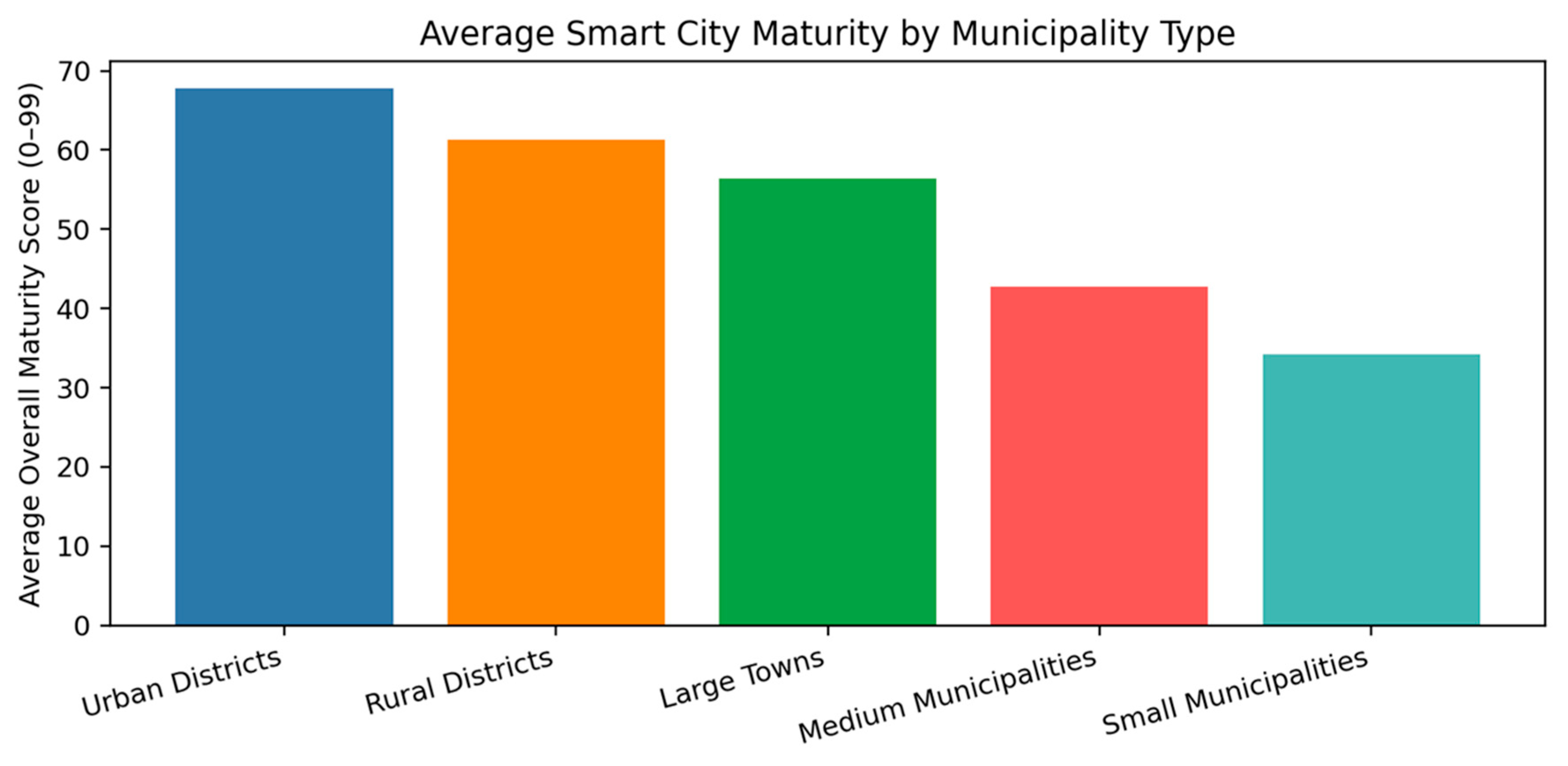
| Municipality Type | Average Overall Maturity (0–99) |
|---|---|
| Urban Districts | 67.8 |
| Rural Districts | 61.3 |
| Large Towns | 56.4 |
| Medium Municipalities | 42.7 |
| Small Municipalities | 34.2 |
| Dimension | Average Score (0–10) |
|---|---|
| Strategy & Vision | 8.2 |
| Stakeholder Engagement | 6.9 |
| Digital Infrastructure | 4.1 |
| Data Strategy | 3.8 |
| Data Accessibility | 3.2 |
Appendix A.3. Branching Logic (Examples)
- If no municipal data strategy is in place (Dim. 5, Item 1 = no), skip advanced stewardship items (Dim. 5, Items 2–3).
- If no open-data mechanism exists (Dim. 6, Item 1 = no), skip metadata and reuse items.
- If no documented interoperability standards (Dim. 8, Item 1 = no), skip conformance checks.
Appendix A.4. Scoring Guide (Worked Example)
Appendix A.5. Administration Notes
- Target respondents: administrative leadership + IT/data leads; single consolidated response per municipality.
- Completion time: typically <30 min for informed respondents.
- Evidence: where possible, respondents should reference existing documents (strategies, SLAs, and policies).
Appendix A.6. Data Protection
Appendix B. Full Corpus of Relevant Publications Included in the Systematic Literature Review
- B1
- Ahlemann, F.; Schröder, C.; Teuteberg, F. Kompetenz- und Reifegradmodelle für das Projektmanagement: Grundlagen, Vergleich und Einsatz; ISPRI: Osnabrück, Germany, 2005.
- B2
- Al-Azawei, A.; Al-Sartawi, A.M.A.; Al-Dulaimi, A. A Focus Area Maturity Model for Smart Cities: A Validation Using the Delphi Method. Future Internet 2023, 15, 2150.
- B3
- Al Nuaimi, E.; Al Neyadi, H.; Mohamed, N.; Al-Jaroodi, J. Applications of big data to smart cities. J. Internet Serv. Appl. 2015, 6, 25.
- B4
- Albino, V.; Berardi, U.; Dangelico, R.M. Smart Cities: Definitions, Dimensions, Performance, and Initiatives. J. Urban Technol. 2015, 22, 3–21.
- B5
- Allam, Z.; Jones, D.S. On the Coronavirus (COVID-19) Outbreak and the Smart City Network: Universal Data Sharing Standards Coupled with Artificial Intelligence (AI) to Benefit Urban Health Monitoring and Management. Healthcare 2020, 8, 46.
- B6
- Angelidou, M. Smart cities: A conjuncture of four forces. Cities 2015, 47, 95–106.
- B7
- Anthopoulos, L.G. Smart City Cybersecurity and Privacy; Springer: Cham, Switzerland, 2022.
- B8
- Aouin, C. Urban Mobility in the Smart City Age; Arup: London, UK, 2015.
- B9
- Austin Office of Design & Delivery. Becoming an Open and Smart City; City of Austin: Austin, TX, USA, 2018.
- B10
- Backlund, F.; Chronéer, D.; Sundqvist, E. Project Management Maturity Models—A Critical Review. Procedia Soc. Behav. Sci. 2014, 119, 837–846.
- B11
- Bakıcı, T.; Almirall, E.; Wareham, J. A Smart City Initiative: The Case of Barcelona. J. Knowl. Econ. 2013, 4, 135–148.
- B12
- Barrionuevo, J.M.; Berrone, P.; Ricart, J.E. Smart Cities, Sustainable Progress. IESE Insight 2012, 14, 50–57.
- B13
- Batty, M.; Axhausen, K.W.; Giannotti, F.; Pozdnoukhov, A.; Bazzani, A.; Wachowicz, M.; Ouzounis, G.; Portugali, Y. Smart cities of the future. Eur. Phys. J. Spec. Top. 2012, 214, 481–518.
- B14
- Beck, C.; McCue, C. Predictive Policing: What Can We Learn from Walmart and Amazon about Fighting Crime in a Recession? Police Chief 2009, 76, 18–24.
- B15
- Becker, J.; Knackstedt, R.; Pöppelbuß, J. Entwicklung von Reifegradmodellen für das IT-Management. WIRTSCHAFTSINFORMATIK 2009, 51, 249–260.
- B16
- Becker, J.; Niehaves, B.; Poeppelbuss, J.; Simons, A. Maturity Models in IS Research. In Proceedings of the 18th European Conference on Information Systems, Pretoria, South Africa, 7–9 June 2010; pp. 1–12.
- B17
- Becker, J.; Rosemann, M.; Uthmann, C.V. Guidelines of Business Process Modeling. In Business Process Management; Springer: Berlin/Heidelberg, Germany, 2000; pp. 30–49.
- B18
- Becker, M. Hinweise zur Anfertigung eines Literatur-Reviews; University of Stuttgart: Stuttgart, Germany, 2013.
- B19
- Benbasat, I.; Dexter, A.S.; Drury, D.H.; Goldstein, R.C. A critique of the stage hypothesis: Theory and empirical evidence. Commun. ACM 1984, 27, 476–485.
- B20
- Bertolini, M.; Esposito, G.; Neroni, M.; Romagnoli, G. Maturity Models in Industrial Internet: A Review. Procedia Manuf. 2019, 39, 1854–1863.
- B21
- Brooks, P.; El-Gayar, O.; Sarnikar, S. A framework for developing a domain specific business intelligence maturity model: Application to healthcare. Int. J. Inf. Manag. 2015, 35, 337–345.
- B22
- Caragliu, A.; Del Bo, C.; Nijkamp, P. Smart Cities in Europe. J. Urban Technol. 2011, 18, 65–82.
- B23
- Charles, P.; Ferreira, L.; Galiza, R. Improving traffic systems strategy and operations using a capability maturity approach. In Proceedings of the 34th Australasian Transport Research Forum, Adelaide, Australia, 28–30 September 2011; pp. 1–14.
- B24
- Chen, T. Smart grids, smart cities need better networks. IEEE Netw. 2010, 24, 2–3.
- B25
- Chourabi, H.; Nam, T.; Walker, S.; Gil-Garcia, J.R.; Mellouli, S.; Nahon, K.; Pardo, T.A.; Scholl, H.J. Understanding Smart Cities: An Integrative Framework. In Proceedings of the 45th Hawaii International Conference on System Sciences, Maui, HI, USA, 4–7 January 2012; pp. 2289–2297.
- B26
- civsourceonline. IDC Releases First Smart City Maturity Model. CivSource Online 2013. Available online: https://civsourceonline.com/2013/04/15/idc-releases-first-smart-city-maturity-model/ (accessed on 1 October 2023).
- B27
- CMMI Product Team. CMMI for Development, Version 1.3; Software Engineering Institute, Carnegie Mellon University: Pittsburgh, PA, USA, 2010.
- B28
- Comstock, M. What Is a Smart City and How Can a City Boost Its IQ? World Bank Blogs 2012. Available online: https://blogs.worldbank.org/en/sustainablecities/what-is-a-smart-city-and-how-can-a-city-boost-its-iq (accessed on 23 January 2025).
- B29
- Cooper, H.M. Organizing Knowledge Syntheses: A Taxonomy of Literature Reviews. Knowledge in Society 1988, 1, 104–126.
- B30
- Da Santana, E.S.; Nunes, É.D.O.; Passos, D.C.; Santos, L.B. SMM: A Maturity Model of Smart Cities Based on Sustainability Indicators of the ISO 37122. Int. J. Adv. Eng. Res. Sci. 2019, 6, 13–20.
- B31
- Dameri, R.P.; Cocchia, A. Smart City and Digital City: Twenty Years of Terminology Evolution. In Proceedings of the 10th International Conference on Intellectual Capital, Knowledge Management and Organisational Learning, Washington, DC, USA, 25–26 October 2011; pp. 1–8.
- B32
- de Bruin, T.; Rosemann, M.; Freeze, R.; Kaulkarni, U. Understanding the Main Phases of Developing a Maturity Assessment Model. In Proceedings of the 16th Australasian Conference on Information Systems, Sydney, Australia, 29 November–2 December 2005; pp. 8–19.
- B33
- Delazari, L.S.; Filho, L.E.; Skroch, A.L.S.D. UFPR CampusMap: a laboratory for a Smart City developments. Int. Arch. Photogramm. Remote Sens. Spatial Inf. Sci. 2019, 42, 385–392.
- B34
- Demir, C.; Kocabaş, İ. Project Management Maturity Model (PMMM) in educational organizations. Procedia Soc. Behav. Sci. 2010, 9, 1641–1645.
- B35
- Derudder, B.; Hoyler, M.; Taylor, P.J. International Handbook of Globalization and World Cities; Edward Elgar: Cheltenham, UK, 2012.
- B36
- Deutschland intelligent vernetzt. Intelligente Städte und Regionen in Deutschland: Handreichung zur Umsetzung der digitalen Transformation; Deutschland intelligent vernetzt: Berlin, Germany, 2017.
- B37
- Doran, M.-A.; Daniel, S. Geomatics and Smart City: A transversal contribution to the Smart City development. In Proceedings of the ACFAS Conference, Montreal, QC, Canada, 12–16 May 2014; pp. 1–19.
- B38
- Ehwi, R.J.; Agyekum, K.; Boakye-Danquah, J. A framework for engaging stakeholders in Smart City development. Local Econ. 2023, 38, 645–663.
- B39
- European Parliament. Mapping Smart Cities in the EU; Policy Department A: Economic and Scientific Policy: Brussels, Belgium, 2014.
- B40
- Fletcher, G.; Griffiths, M. Digital transformation during a lockdown. Int. J. Inf. Manag. 2020, 55, 102185.
- B41
- Fraser, P.; Moultrie, J.; Gregory, M. The use of maturity models/grids as a tool in assessing product development capability. In Proceedings of the IEEE International Engineering Management Conference, Cambridge, UK, 18–20 August 2002; pp. 244–249.
- B42
- Gascó-Hernández, M. Building a smart city. Commun. ACM 2018, 61, 50–57.
- B43
- Gassmann, O.; Böhm, J.; Palmié, M. Smart City: Innovationen für die vernetzte Stadt—Geschäftsmodelle und Management; Hanser: Munich, Germany, 2018.
- B44
- Ghazinoory, S.; Ghazinoori, S.; Al-Azawei, A. Smart City Maturity Models: A Multidimensional Synthesized Approach. Sustainability 2023, 15, 1–25.
- B45
- Giffinger, R.; Fertner, C.; Kramar, H.; Kalasek, R.; Pichler-Milanović, N.; Meijers, E. Smart Cities: Ranking of European Medium-Sized Cities; Centre of Regional Science, Vienna University of Technology: Vienna, Austria, 2007.
- B46
- Girardi, P.; Temporelli, A. Smartainability: A Methodology for Assessing the Sustainability of the Smart City. Energy Procedia 2017, 111, 810–816.
- B47
- Glaser, P. Entwicklung eines Modells zur Messung des Reifegrads Smarter Kommunen. Master’s Thesis, Pforzheim University, Pforzheim, Germany, 2020.
- B48
- Glasmeier, A.; Christopherson, S. Thinking about smart cities. Camb. J. Reg. Econ. Soc. 2015, 8, 3–12.
- B49
- Goksen, Y.; Cevik, E.; Avunduk, H. A Case Analysis on the Focus on the Maturity Models and Information Technologies. Procedia Econ. Finance 2015, 19, 208–216.
- B50
- Green, J. The Smart City Playbook: Smart, Safe, Sustainable; Machina Research: London, UK, 2016.
- B51
- Guan, L. Smart Steps to a Battery City. Gov. News 2012, 32, 28–30.
- B52
- Hall, R.E. The Vision of a Smart City. In Proceedings of the 2nd International Life Extension Technology Workshop, Paris, France, 28 September 2000.
- B53
- Hall, R.E. The Vision of a Smart City; Brookhaven National Laboratory: Upton, NY, USA, 2000.
- B54
- Hammer, M. The Process Audit. Harvard Business Review 2007, 85, 111–123.
- B55
- Hancke, G.P.; Silva, B.D.C.E. The role of advanced sensing in smart cities. Sensors 2013, 13, 393–425.
- B56
- Harrison, C.; Eckman, B.; Hamilton, R.; Hartswick, P.; Kalagnanam, J.; Paraszczak, J.; Williams, P. Foundations for Smarter Cities. IBM J. Res. Dev. 2010, 54, 1–16.
- B57
- Hartley, J. Innovation in Governance and Public Services. Public Money Manag. 2005, 25, 27–34.
- B58
- Hatzelhoffer, L.; Humboldt, K.; Lobeck, M.; Wiegandt, C. Smart City konkret: Eine Zukunftswerkstatt in Deutschland zwischen Idee und Praxis; Jovis: Berlin, Germany, 2012.
- B59
- Henshall, A. What Are Maturity Models in Business? Process Street Blog 2019. Available online: https://www.process.st/maturity-model/ (accessed on 1 October 2023).
- B60
- Hessen Trade & Invest GmbH. Digitalisierungs-Check; State of Hesse: Wiesbaden, Germany, 2020.
- B61
- Hevner, A.R.; March, S.T.; Park, J.; Ram, S. Design Science in Information Systems Research. MIS Q. 2004, 28, 75–105.
- B62
- Hilgers, D.; Müller-Seitz, G.; Piller, F.T. Benkler Revisited—Venturing Beyond the Open Source Software Arena? In Proceedings of the Academy of Management Annual Meeting, Montreal, QC, Canada, 6–10 August 2010; pp. 1–16.
- B63
- Hogrebe, F.; Nüttgens, M. Business Process Maturity Model (BPMM): Konzeption, Anwendung und Nutzenpotenziale. HMD Praxis der Wirtschaftsinformatik 2009, 46, 17–25.
- B64
- Hollands, R.G. Critical interventions into the corporate smart city. Camb. J. Reg. Econ. Soc. 2015, 8, 61–77.
- B65
- IBM. Smart Cities—The Insight to Identify, Transform and Progress; IBM: Armonk, NY, USA, 2015.
- B66
- IDA Singapore. Singapore iN2015 Masterplan; Infocomm Development Authority of Singapore: Singapore, 2012.
- B67
- International Telecommunication Union. Smart Sustainable Cities Maturity Model; ITU-T Focus Group on Smart Sustainable Cities: Geneva, Switzerland, 2019.
- B68
- ISO. ISO 37122:2019 Sustainable Cities and Communities—Indicators for Smart Cities; International Organization for Standardization: Geneva, Switzerland, 2019.
- B69
- Iversen, J.; Nielsen, P.A.; Norbjerg, J. Situated assessment of problems in software development. ACM SIGMIS Database 1999, 30, 66–81.
- B70
- Jaekel, M. Smart City wird Realität: Wegweiser für neue Urbanität in der Digitalmoderne; Springer: Wiesbaden, Germany, 2015.
- B71
- Jucevičius, R.; Patašienė, I.; Patašius, M. Digital Dimension of Smart City: Critical Analysis. Procedia Soc. Behav. Sci. 2014, 156, 146–150.
- B72
- Kamprath, N. Einsatz von Reifegradmodellen im Prozessmanagement—Eine anwendungsorientierte Analyse; University of Augsburg: Augsburg, Germany, 2011.
- B73
- Khan, A. Innovationsmanagement in der Energiewirtschaft: Entwicklung eines Reifegradmodells; Springer Gabler: Wiesbaden, Germany, 2016.
- B74
- Khan, Z.; Anjum, A.; Kiani, S.L. Cloud Based Big Data Analytics for Smart Future Cities. In Proceedings of the 6th IEEE/ACM International Conference on Utility and Cloud Computing, Dresden, Germany, 9–12 December 2013; pp. 381–386.
- B75
- Kitchin, R. Making sense of smart cities: addressing present shortcomings. Camb. J. Reg. Econ. Soc. 2015, 8, 131–136.
- B76
- Klimko, G. Knowledge Management and Maturity Models: Building Common Understanding. In Proceedings of the 10th European Conference on Information Systems, Gdansk, Poland, 6–8 June 2002; pp. 269–278.
- B77
- Kohoutek, H.J. Reflections on the capability and maturity models of engineering processes. Qual. Reliab. Engng Int. 1996, 12, 147–155.
- B78
- Komninos, N. Intelligent Cities and Globalisation of Innovation Networks; Routledge: London, UK, 2008.
- B79
- Komninos, N. The architecture of intelligent cities: integrating human, collective and artificial intelligence to enhance knowledge and innovation. In Proceedings of the 2nd IET International Conference on Intelligent Environments, Athens, Greece, 5–6 July 2006; Volume 1, pp. 13–20.
- B80
- Korachi, Z.; Bounabat, B. Data Driven Maturity Model for Assessing Smart Cities. In Proceedings of the 2nd International Conference on Smart Digital Environment, Rabat, Morocco, 18–20 October 2018; pp. 140–147.
- B81
- Kourtit, K.; Nijkamp, P. Smart cities in the innovation age. Innovation 2012, 25, 93–95.
- B82
- Kourtit, K.; Nijkamp, P.; Arribas, D. Smart cities in perspective—a comparative European study by means of self-organizing maps. Innovation 2012, 25, 229–246.
- B83
- KPMG. Principles for digital transformation in cities; KPMG: Amstelveen, The Netherlands, 2022.
- B84
- Krausmann, F.; Gingrich, S.; Eisenmenger, N.; Erb, K.-H.; Haberl, H.; Fischer-Kowalski, M. Growth in global materials use, GDP and population during the 20th century. Ecol. Econ. 2009, 68, 2696–2705.
- B85
- Kummitha, R.K.R. Smart cities and entrepreneurship: An agenda for future research. Technol. Forecast. Soc. Chang. 2019, 149, 119763.
- B86
- Kummitha, R.K.R.; Crutzen, N. Governing smart cities to nurture and promote citizen engagement: A review of the emergent literature. Reg. Stud. 2024, 1–15.
- B87
- Kuwata, Y.; Takeda, K.; Miura, H. A Study on Maturity Model of Open Source Software Community to Estimate the Quality of Products. Procedia Comput. Sci. 2014, 35, 1711–1717.
- B88
- Lahrmann, G.; Marx, F.; Winter, R.; Wortmann, F. Business Intelligence Maturity: Development and Evaluation of a Theoretical Model. In Proceedings of the 44th Hawaii International Conference on System Sciences, Kauai, HI, USA, 4–7 January 2011; pp. 1–10.
- B89
- Lazaroiu, G.C.; Roscia, M. Definition methodology for the smart cities model. Energy 2012, 47, 326–332.
- B90
- Lee, J.H.; Hancock, M.G.; Hu, M.C. Towards an effective framework for building smart cities: Lessons from Seoul and San Francisco. Technol. Forecast. Soc. Change 2014, 89, 80–99.
- B91
- Marsal-Llacuna, M.-L.; Colomer-Llinàs, J.; Meléndez-Frigola, J. Lessons in urban monitoring taken from sustainable and livable cities to better address the Smart Cities initiative. Technol. Forecast. Soc. Chang. 2015, 90, 611–622.
- B92
- Meijering, J.V.; Kern, K.; Tobi, H. Identifying the methodological characteristics of European green city rankings. Ecol. Indic. 2014, 43, 132–142.
- B93
- Mettler, T. Supply-Management im Krankenhaus: Konstruktion und Evaluation eines konfigurierbaren Reifegradmodells zur zielgerichteten Gestaltung; Sierke: Göttingen, Germany, 2010.
- B94
- Moody, D.L.; Shanks, G.G. What makes a good data model? Evaluating the quality of entity relationship models. In Proceedings of the 13th International Conference on the Entity-Relationship Approach, Manchester, UK, 13–16 December 1994; pp. 94–111.
- B95
- Mora, L.; Gerli, P.; Ardito, L.; Messeni Petruzzelli, A. Smart city governance: A systematic literature review. Cities 2024, 149, 105003.
- B96
- Muggah, R. Fixing Fragile Cities: Solutions for Urban Violence and Poverty. Foreign Aff. 2015. Available online: https://www.foreignaffairs.com/articles/africa/2015-01-15/fixing-fragile-cities (accessed on 1 October 2023).
- B97
- Müller-Seitz, G.; Seiter, M.; Wenz, P. Smart City: Vom Hype zur Realität; Springer: Wiesbaden, Germany, 2016.
- B98
- Müller-Seitz, G.; Seiter, M.; Wenz, P. Was ist eine Smart City? Springer: Wiesbaden, Germany, 2016.
- B99
- Nam, T.; Pardo, T.A. Conceptualizing Smart City with Dimensions of Technology, People, and Institutions. In Proceedings of the 12th Annual International Conference on Digital Government Research, College Park, MD, USA, 12–15 June 2011; pp. 282–291.
- B100
- Nam, T.; Pardo, T.A. Smart City as Urban Innovation: Focusing on Management, Policy, and Context. In Proceedings of the 5th International Conference on Theory and Practice of Electronic Governance, Tallinn, Estonia, 26–28 September 2011; pp. 185–194.
- B101
- Natural Resources Defense Council. What Are Smarter Cities? NRDC: New York, NY, USA, 2010.
- B102
- Neff, A.A.; Hamel, F.; Herz, T.P.; Uebernickel, F.; Brenner, W.; vom Brocke, J. Developing a maturity model for service systems in heavy equipment manufacturing enterprises. Inf. Manag. 2014, 51, 895–911.
- B103
- Neirotti, P.; De Marco, A.; Cagliano, A.C.; Mangano, G.; Scorrano, F. Current trends in Smart City initiatives: Some stylised facts. Cities 2014, 38, 25–36.
- B104
- Niehaves, B.; Röding, K.; Oschinsky, F.; Klein, H.C. Digitalisierungsstrategien für Kommunen: Studie im Rahmen des Projekts ‘Digitale Modellkommunen’ in Nordrhein-Westfalen; University of Siegen: Siegen, Germany, 2018.
- B105
- Nikkei BP Cleantech Institute and Techno Associates. World Smart City Report 2013; Nikkei BP: Tokyo, Japan, 2012.
- B106
- O’Grady, M.; O’Hare, G. How smart is your city? Science 2012, 335, 1581–1582.
- B107
- Oliveira Monteiro, S.P.; Carayannis, E.G. The Quadruple Innovation Helix Nexus: A Smart Growth Model; Palgrave Macmillan: New York, NY, USA, 2017.
- B108
- Ooms, W.; Caniëls, M.C.J.; Roijakkers, N.; Cobben, D. Ecosystems for smart cities: tracing the evolution of governance structures in a dutch smart city initiative. Int. Entrep. Manag. J. 2020, 16, 1125–1154.
- B109
- Paavel, M.; Karjust, K.; Majak, J. PLM Maturity Model Development and Implementation in SME. Procedia CIRP 2017, 63, 651–657.
- B110
- Partridge, H. Developing a Human Perspective to the Digital Divide in the ‘Smart City’. In Proceedings of the Australian Library and Information Alliance Biennial Conference, Gold Coast, Australia, 21–24 September 2004; pp. 1–15.
- B111
- Paulk, M.C.; Curtis, B.; Chrissis, M.B.; Weber, C.V. Capability Maturity Model for Software (Version 1.1); Carnegie Mellon University: Pittsburgh, PA, USA, 1993.
- B112
- Paulzen, O.; Doumi, M.; Perc, P.; Cereijo-Roibas, A. A Maturity Model for Quality Improvement in Knowledge Management. In Proceedings of the 13th Australasian Conference on Information Systems, Melbourne, Australia, 4–6 December 2002; pp. 1–12.
- B113
- Pelton, J.N.; Singh, I.B. Future Cities: Designing Better, Smarter, More Sustainable and Secure Cities; Intelligent Community Forum: New York, NY, USA, 2009.
- B114
- Pfeifer, U. Ein Beitrag zum Monitoring des Reifegrades in der Entwicklung eines Produktes; Shaker: Aachen, Germany, 2005.
- B115
- Pigosso, D.C.A.; Rozenfeld, H.; McAloone, T.C. Ecodesign maturity model: A management framework to support ecodesign implementation into manufacturing companies. J. Clean. Prod. 2013, 59, 160–173.
- B116
- Prananto, A.; McKay, J.; Marshall, P. A study of the progression of e-business maturity in Australian SMEs: Some evidence of the applicability of the stages of growth for e-business model. In Proceedings of the 7th Pacific Asia Conference on Information Systems, Adelaide, Australia, 10–13 July 2003; pp. 68–80.
- B117
- PressReleasePoint. IDC Government Insights Unveils First Smart City Maturity Model; IDC: Framingham, MA, USA, 2013.
- B118
- Pullen, W. A public sector HPT maturity model. Performance Improvement 2007, 46, 9–15.
- B119
- Rawat, D.B.; Ghafoor, K.Z. Smart Cities Cybersecurity and Privacy, 2nd ed.; Elsevier: Amsterdam, The Netherlands, 2022.
- B120
- Rodríguez-Bolívar, M.P. Transforming City Governments for Successful Smart Cities; Springer: Cham, Switzerland, 2015.
- B121
- Röglinger, M.; Kamprath, N. Prozessverbesserung mit Reifegradmodellen—Eine Analyse ökonomischer Zusammenhänge; University of Augsburg: Augsburg, Germany, 2012.
- B122
- Röglinger, M.; Pöppelbuß, J. What makes a useful maturity model? A framework for general design principles for maturity models and its demonstration in business process management. In Proceedings of the 19th European Conference on Information Systems, Helsinki, Finland, 9–11 June 2011.
- B123
- Rohde, F.; Loew, T. Smart City: Begriff, Charakteristika und Beispiele; 4sustainability: Berlin, Germany, 2011.
- B124
- Rosemann, M.; de Bruin, T. Towards a Business Process Management Maturity Model. In Proceedings of the 13th European Conference on Information Systems, Regensburg, Germany, 26–28 May 2005; pp. 521–532.
- B125
- Schaffers, H.; Komninos, N.; Pallot, M.; Aguas, M.; Almirall, E.; Bakici, T.; Barroca, J.; Carter, D.; Corriou, M.; Ferreira, J.; et al. Smart Cities as Innovation Ecosystems sustained by the Future Internet; European Commission: Brussels, Belgium, 2012.
- B126
- Schmelzer, H.J.; Sesselmann, W. Geschäftsprozessmanagement in der Praxis: Kunden zufrieden stellen—Produktivität steigern—Wert erhöhen, 9th ed.; Hanser: Munich, Germany, 2020.
- B127
- Schüßler, E.; Grabher, G.; Müller-Seitz, G. Field-Configuring Events: Arenas for Innovation and Learning? Industry Innovation 2015, 22, 165–172.
- B128
- Silva, J.; Mojica, J.; Piñeres, A.; Rojas, R.; Acosta, S.; Guliany, J.G.; Sanabria, E.S. Algorithms for the Control of Key Performance Indicators for Smart Cities. Procedia Comput. Sci. 2020, 170, 971–976.
- B129
- Solli-Sæther, H.; Gottschalk, P. The Modeling Process for Stage Models. J. Organ. Comput. Electron. Commer. 2010, 20, 279–293.
- B130
- Su, K.; Li, J.; Fu, H. Smart city and the applications. In Proceedings of the International Conference on Electronics, Communications and Control (ICECC), Ningbo, China, 9–11 September 2011; pp. 1028–1031.
- B131
- Šurdonja, S.; Giuffrè, T.; Deluka-Tibljaš, A. Smart mobility solutions—necessary precondition for a well-functioning smart city. Transp. Res. Procedia 2020, 45, 604–611.
- B132
- Tepe, K. Fünf Leitplanken für Smart-City-Projekte. eGovernment Computing 2017. Available online: https://www.egovernment-computing.de/fuenf-leitplanken-fuer-smart-city-projekte-a-578008/ (accessed on 1 October 2023).
- B133
- The British Standards Institution. PAS 181:2014 Smart city framework. Guide to establishing strategies for smart cities and communities; BSI: London, UK, 2014.
- B134
- The Scottish Government; Scottish Cities Alliance; The Urban Tide. Smart Cities Maturity Model and Self-Assessment Tool; The Scottish Government: Edinburgh, UK, 2014.
- B135
- The Urban Tide. Overview of the Smart Cities Maturity Model; The Urban Tide: Edinburgh, UK, 2016.
- B136
- Thite, M. Smart cities: implications of urban planning for human resource development. Hum. Resour. Dev. Int. 2011, 14, 623–631.
- B137
- Thuzar, M. Urbanization in Southeast Asia: Developing Smart Cities for the Future? ISEAS Perspective 2011, 2011, 1–7.
- B138
- Tokoro, N. The Smart City and the Co-creation of Value; Springer: Tokyo, Japan, 2016.
- B139
- Toppeta, D. The Smart City Vision: How Innovation and ICT Can Build Smart, ‘Liveable’, Sustainable Cities; The Innovation Knowledge Foundation: London, UK, 2010.
- B140
- United Nations. The Future We Want; A/RES/66/288; United Nations General Assembly: New York, NY, USA, 2012.
- B141
- United Nations. World Urbanization Prospects: The 2014 Revision; United Nations: New York, NY, USA, 2015.
- B142
- Uzelac, G. Personal Communication on Municipal Digital Transformation; Komm.ONE: Stuttgart, Germany, 2020.
- B143
- Vanolo, A. Smartmentality: The Smart City as Disciplinary Strategy. Urban Stud. 2014, 51, 883–898.
- B144
- Vaziri, R. A Questionnaire-Based Data Quality Methodology. Int. J. Database Manag. Syst. 2012, 4, 55–68.
- B145
- vom Brocke, J.; Simons, A.; Niehaves, B.; Riemer, K.; Plattfaut, R.; Cleven, A. Reconstructing the Giant: On the Importance of Rigour in Documenting the Literature Search Process. In Proceedings of the 17th European Conference on Information Systems, Verona, Italy, 8–10 June 2009.
- B146
- Waidelich, L.; Richter, A.; Bulander, R.; Kölmel, B.; Glaser, P. Product-Service Systems at a Glance. In E-Business and Telecommunications; Springer: Cham, Switzerland, 2020; pp. 61–84.
- B147
- Washburn, D.; Sindhu, U.; Balaouras, S.; Dines, R.A.; Hayes, N.; Nelson, L.E. Helping CIOs Understand “Smart City” Initiatives; Forrester Research: Cambridge, MA, USA, 2010.
- B148
- Weber, C.V.; Curtis, B.; Gardiner, T. Business Process Modeling Notation (BPMN), Version 1.0; Object Management Group: Needham, MA, USA, 2008.
- B149
- Webster, J.; Watson, R.T. Analyzing the past to prepare for the future: Writing a literature review. MIS Q. 2002, 26, xiii–xxiii.
- B150
- Weckenmann, A.; Behrens, B.-A.; Reithmeier, E.; Akkasoglu, G.; Vucetic, M.; Ohrt, C.; Hartmann, W. Appliance of the Maturity Method in the Development of Endoscopic Geometry Inspection for Sheet-Bulk Metal Forming Tools. Steel Research International 2011, 82, 708–713.
- B151
- Wendler, R. The maturity of maturity model research: A systematic mapping study. Inf. Softw. Technol. 2012, 54, 1317–1339.
- B152
- Wirtschaftsverband Handwerk und Dienstleister. Digicheck: Wie digital ist mein Betrieb? WHD: Stuttgart, Germany, 2020.
- B153
- Woods, E. Smart Cities: Infrastructure, Information, and Communication Technologies for Energy, Transportation, Buildings, and Government; Pike Research: Boulder, CO, U.
- B154
- Yanrong, K.; Lei, Z.; Cai, C.; Yuming, G.; Li, H.; Ying, C.; Jialin, W.; Tomas, Z.; Jiri, J. EU-China Smart and Green City Cooperation: Comparative Study of Smart Cities in Europe and China; EU-China Policy Dialogues Support Facility: Beijing, China, 2014.
- B155
- Yesner, R.; Clarke, R. Smart Cities and the Internet of Everything: The Foundation for Delivering Next-Generation Citizen Services; IDC Government Insights: Framingham, MA, USA, 2013.
- B156
- Yigitcanlar, T.; Cömert, B.A. Post-Pandemic Urban Planning and Use of Smart Technologies; IGI Global: Hershey, PA, USA, 2022.
- B157
- Yigitcanlar, T.; Desouza, K.C.; Butler, L.; Roozkhosh, F. A systematic literature review of smart cities and smart city governance. WIREs Data Min. Knowl. Discov. 2021, 11, e1402.
- B158
- Yigitcanlar, T.; Kankanamge, N.; Vella, K.; et al. Smart governance for smart cities: A systematic literature review and a research agenda. Sustain. Cities Soc. 2025, 115, 105500.
- B159
- Zygiaris, S. Smart City Reference Model: Assisting Planners to Conceptualize the Building of Smart City Innovation Ecosystems. J. Knowl. Econ. 2013, 4, 217–231.
References
- Batty, M.; Axhausen, K.W.; Giannotti, F.; Pozdnoukhov, A.; Bazzani, A.; Wachowicz, M.; Schönfelder, S.; Ratti, C. Smart Cities of the Future. Eur. Phys. J. Spec. Top. 2012, 214, 481–518. [Google Scholar] [CrossRef]
- Zygiaris, S. Smart City Reference Model: Assisting Planners to Conceptualize the Building of Smart City Innovation Ecosystems. J. Knowl. Econ. 2013, 4, 217–231. [Google Scholar] [CrossRef]
- European Parliament. Mapping Smart Cities in the EU. Policy Department A: Economic and Scientific Policy. Brussels, Belgium. Available online: http://www.europarl.europa.eu/studies (accessed on 23 October 2025).
- Rawat, D.B.; Ghafoor, K.Z. Smart Cities Cybersecurity and Privacy; Elsevier: Amsterdam, The Netherlands, 2018; ISBN 978-0-12-815033-7. [Google Scholar]
- Becker, J.; Knackstedt, R.; Pöppelbuß, J. Entwicklung von Reifegradmodellen Für Das IT-Management. Wirtsch. Inform. 2009, 51, 249–260. [Google Scholar] [CrossRef]
- Röglinger, M.; Pöppelbuß, J. What Makes a Useful Maturity Model? A Framework for General Design Principles for Maturity Models and Its Demonstration in Business Process Management. In Proceedings of the 19th European Conference on Information Systems, Helsinki, Finland, 9–11 June 2011. [Google Scholar]
- de Bruin, T.; Rosemann, M.; Freeze, R.; Kaulkarni, U. Understanding the Main Phases of Developing a Maturity Assessment Model. In Proceedings of the 16th Australasian Conference on Information Systems, Sydney, Australia, 29 November–2 December 2005; pp. 8–19. [Google Scholar]
- Hevner, A.R.; March, S.T.; Park, J.; Ram, S. Design Science in Information Systems Research. MIS Q. 2004, 28, 75–105. [Google Scholar] [CrossRef]
- Peffers, K.; Tuunanen, T.; Rothenberger, M.A.; Chatterjee, S. A Design Science Research Methodology for Information Systems Research. J. Manag. Inf. Syst. 2007, 24, 45–77. [Google Scholar] [CrossRef]
- Gassmann, O.; Böhm, J.; Palmié, M. Smart City: Innovationen Für Die Vernetzte Stadt-Geschäftsmodelle Und Management; Hanser: Munich, Germany, 2018. [Google Scholar]
- Glaser, P. Entwicklung Eines Modells Zur Messung Des Reifegrads Smarter Kommunen. Master’s Thesis, Pforzheim University, Pforzheim, Germany, 2020. [Google Scholar]
- Gassmann, O.; Böhm, J.; Palmié, M. Smart Cities: Introducing Digital Innovation to Cities; Emerald Publishing Limited: Leeds, UK, 2019; ISBN 978-1-78769-614-3. [Google Scholar]
- The Scottish Government; Scottish Cities Alliance; UrbanTide. Smart Cities Maturity Model and Self-Assessment Tool: Guidance Note for Completion of Self-Assessment Tool. Available online: https://scottishcities.org.uk/wp-content/uploads/2021/01/Smart-Cities-Scotland-Maturity-Model-and-Self-Assessment-Tool.pdf (accessed on 21 October 2025).
- International Telecommunication Union (ITU). ITU-T Y.4904/L.1604 (12/2019): Smart Sustainable Cities Maturity Model; ITU: Geneva, Switzerland, 2019; Available online: http://itu.int/ITU-T/recommendations (accessed on 22 October 2025).
- Waidelich, L.; Richter, A.; Koelmel, B.; Bulander, R. Design Thinking Process Model Review. In Proceedings of the 2018 IEEE International Conference on Engineering, Technology and Innovation (ICE/ITMC), Stuttgart, Germany, 17–20 June 2018; IEEE: Stuttgart, Germany, 2018; pp. 1–9. [Google Scholar]
- Vom Brocke, J.; Simons, A.; Riemer, K.; Niehaves, B.; Plattfaut, R.; Cleven, A. Standing on the Shoulders of Giants: Challenges and Recommendations of Literature Search in Information Systems Research. Commun. Assoc. Inf. Syst. 2015, 37, 9. [Google Scholar] [CrossRef]
- Caragliu, A.; Del Bo, C.; Nijkamp, P. Smart Cities in Europe. J. Urban Technol. 2011, 18, 65–82. [Google Scholar] [CrossRef]
- Albino, V.; Berardi, U.; Dangelico, R.M. Smart Cities: Definitions, Dimensions, Performance, and Initiatives. J. Urban Technol. 2015, 22, 3–21. [Google Scholar] [CrossRef]
- Neirotti, P.; De Marco, A.; Cagliano, A.C.; Mangano, G.; Scorrano, F. Current Trends in Smart City Initiatives: Some Stylised Facts. Cities 2014, 38, 25–36. [Google Scholar] [CrossRef]
- Kitchin, R. Making Sense of Smart Cities: Addressing Present Shortcomings. Camb. J. Reg. Econ. Soc. 2014, 8, 131–136. [Google Scholar] [CrossRef]
- Hollands, R.G. Critical Interventions into the Corporate Smart City. Camb. J. Reg. Econ. Soc. 2015, 8, 61–77. [Google Scholar] [CrossRef]
- Chourabi, H.; Nam, T.; Walker, S.; Gil-Garcia, J.R.; Mellouli, S.; Nahon, K.; Pardo, T.A.; Scholl, H.J. Understanding Smart Cities: An Integrative Framework. In Proceedings of the 45th Hawaii International Conference on System Sciences, Maui, HI, USA, 4–7 January 2012; pp. 2289–2297. [Google Scholar] [CrossRef]
- Nam, T.; Pardo, T.A. Conceptualizing Smart City with Dimensions of Technology, People, and Institutions. In Proceedings of the 12th Annual International Conference on Digital Government Research, College Park, MD, USA, 12–15 June 2011; pp. 282–291. [Google Scholar]
- Giffinger, R.; Fertner, C.; Kramar, H.; Kalasek, R.; Pichler-Milanović, N.; Meijers, E. Smart Cities: Ranking of European Medium-Sized Cities; Centre of Regional Science, Vienna University of Technology: Vienna, Austria, 2007. [Google Scholar]
- ISO 37122:2019; Sustainable Cities and Communities-Indicators for Smart Cities 2019. International Organization for Standardization: Geneva, Switzerland, 2019.
- PAS 181:2014; Smart City Framework. The British Standards Institution: London, UK, 2014; ISBN 978 0 580 81856 1.
- IDC Government Insights. Smart Cities and the Internet of Everything: The Foundation for Delivering Next-Generation Citizen Services. Available online: https://www.cisco.com/c/dam/global/es_mx/assets/brand/iot/ciudades/pdfs/ioe_citizen_svcs_white_paper_idc_2013.pdf (accessed on 21 October 2025).
- Tomor, Z.; Meijer, A.; Michels, A.; Geertman, S. Smart Governance For Sustainable Cities: Findings from a Systematic Literature Review. J. Urban Technol. 2019, 26, 3–27. [Google Scholar] [CrossRef]
- Yigitcanlar, T.; Desouza, K.; Butler, L.; Roozkhosh, F. Contributions and Risks of Artificial Intelligence (AI) in Building Smarter Cities: Insights from a Systematic Review of the Literature. Energies 2020, 13, 1473. [Google Scholar] [CrossRef]
- Mora, L.; Gerli, P.; Ardito, L.; Messeni Petruzzelli, A. Smart City Governance from an Innovation Management Perspective: Theoretical Framing, Review of Current Practices, and Future Research Agenda. Technovation 2023, 123, 102717. [Google Scholar] [CrossRef]
- Suliman, A.; Rankin, J.; Robak, A. CSR Maturity Model for Smart City Assessment. Can. J. Civ. Eng. 2021, 48, 785–802. [Google Scholar] [CrossRef]
- TM Forum. TM Forum TR259—Smart City Maturity and Benchmark Model (R19.0.0, Updated 2019–2020). Available online: https://www.tmforum.org/resources/technical-report/tr259-smart-city-maturity-benchmark-model-r19-0-0/ (accessed on 21 October 2025).
- Caird, S.P.; Hallett, S.H. Towards Evaluation Design for Smart City Development. J. Urban Des. 2019, 24, 188–209. [Google Scholar] [CrossRef]
- Aragão, F.V.; Chiroli, D.M.D.G.; Zola, F.C.; Aragão, E.V.; Marinho, L.H.N.; Correa, A.L.C.; Colmenero, J.C. Smart Cities Maturity Model—A Multicriteria Approach. Sustainability 2023, 15, 6695. [Google Scholar] [CrossRef]
- Ajoudanian, S.; Aboutalebi, H.R. A Capability Maturity Model for Smart City Process-Aware Digital Transformation. J. Urban Manag. 2025, 14, 877–895. [Google Scholar] [CrossRef]
- Anschütz, C.; Ebner, K.; Smolnik, S. Size Does Matter: A Maturity Model for the Special Needs of Small and Medium-Sized Smart Cities. Cities 2024, 150, 104998. [Google Scholar] [CrossRef]
- Ghazinoory, S.; Roshandel, J.; Parvin, F.; Nasri, S.; Fatemi, M. Smart City Maturity Models: A Multidimensional Synthesized Approach. WIREs Data Min. Knowl. Discov. 2024, 14, e1516. [Google Scholar] [CrossRef]
- UrbanTide. Overview of the Smart Cities Maturity Model and Self-Assessment Tool. Available online: https://urbantide.com/wp-content/uploads/2023/10/UT_Smart_Model_FINAL.pdf (accessed on 21 October 2025).
- CivSource. IDC Releases First Smart City Maturity Model. Available online: https://civsourceonline.com/2013/04/15/idc-releases-first-smart-city-maturity-model/ (accessed on 23 January 2025).
- Paulk, M.C.; Curtis, B.; Chrissis, M.B.; Weber, C.V. Capability Maturity Model for Software, Version 1.1; Defense Technical Information Center: Fort Belvoir, VA, USA, 1993. [Google Scholar]
- Solli-Sæther, H.; Gottschalk, P. The Modeling Process for Stage Models. J. Organ. Comput. Electron. Commer. 2010, 20, 279–293. [Google Scholar] [CrossRef]
- Wendler, R. The Maturity of Maturity Model Research: A Systematic Mapping Study. Inf. Softw. Technol. 2012, 54, 1317–1339. [Google Scholar] [CrossRef]
- Da Santana, E.S.; Nunes, É.D.O.; Passos, D.C.; Santos, L.B. SMM: A Maturity Model of Smart Cities Based on Sustainability Indicators of the ISO 37122. Int. J. Adv. Eng. Res. Sci. 2019, 6, 13–20. [Google Scholar] [CrossRef]


| Population Category | Number of Municipalities | Average Maturity Score | Standard Deviation | Range |
|---|---|---|---|---|
| <7500 inhabitants | 766 | 34.2 | 12.8 | 8–72 |
| 7500–20,000 inhabitants | 233 | 42.7 | 15.3 | 15–78 |
| Large district towns | 93 | 56.4 | 18.2 | 22–89 |
| Urban districts | 9 | 67.8 | 14.6 | 45–86 |
| Rural districts | 35 | 61.3 | 16.9 | 28–84 |
| Dimension | Small (<7500) | Medium (7500–20,000) | Large District Towns | Urban Districts | Rural Districts |
|---|---|---|---|---|---|
| Smart Strategy and Vision | 6.2 | 7.1 | 8.3 | 8.9 | 8.0 |
| Stakeholder Engagement | 5.8 | 6.4 | 7.6 | 8.2 | 7.3 |
| Intelligent Services | 4.3 | 5.7 | 7.2 | 8.1 | 6.8 |
| Digital Infrastructure | 2.9 | 4.1 | 6.3 | 7.4 | 5.6 |
| Data Strategy | 3.1 | 4.5 | 6.8 | 7.8 | 6.2 |
| Data Accessibility | 2.4 | 3.8 | 5.9 | 7.2 | 5.1 |
| ICT Operations | 3.6 | 4.9 | 6.7 | 7.6 | 6.4 |
| Standards | 4.2 | 5.3 | 6.9 | 7.7 | 6.6 |
| Innovation Ecosystem | 2.8 | 4.2 | 6.4 | 7.5 | 5.9 |
| Performance Management | 5.1 | 6.2 | 7.4 | 8.3 | 7.1 |
Disclaimer/Publisher’s Note: The statements, opinions and data contained in all publications are solely those of the individual author(s) and contributor(s) and not of MDPI and/or the editor(s). MDPI and/or the editor(s) disclaim responsibility for any injury to people or property resulting from any ideas, methods, instructions or products referred to in the content. |
© 2026 by the authors. Licensee MDPI, Basel, Switzerland. This article is an open access article distributed under the terms and conditions of the Creative Commons Attribution (CC BY) license.
Share and Cite
Koelmel, B.; Brugger, T.; Bulander, R.; Volz, R. Bridging the Capability Gap: A Multidimensional Maturity Model for Smart City Development in German Municipalities. Urban Sci. 2026, 10, 86. https://doi.org/10.3390/urbansci10020086
Koelmel B, Brugger T, Bulander R, Volz R. Bridging the Capability Gap: A Multidimensional Maturity Model for Smart City Development in German Municipalities. Urban Science. 2026; 10(2):86. https://doi.org/10.3390/urbansci10020086
Chicago/Turabian StyleKoelmel, Bernhard, Tanja Brugger, Rebecca Bulander, and Raphael Volz. 2026. "Bridging the Capability Gap: A Multidimensional Maturity Model for Smart City Development in German Municipalities" Urban Science 10, no. 2: 86. https://doi.org/10.3390/urbansci10020086
APA StyleKoelmel, B., Brugger, T., Bulander, R., & Volz, R. (2026). Bridging the Capability Gap: A Multidimensional Maturity Model for Smart City Development in German Municipalities. Urban Science, 10(2), 86. https://doi.org/10.3390/urbansci10020086