Systematic Review

Challenges and Vulnerabilities of Female-Headed Households in Obtaining Affordable Housing in Urban Areas: A Systematic Review


by
Haile Legese Zewale
1,2,*,
Sayeh Kassaw Agegnehu
2,
Petra Hirschler
3 and
Gerhard Navratil
1
1
Department of Geodesy and Geoinformation, TU Wien, 1040 Vienna, Austria
2
Institute of Land Administration, Debre Markos University, Debre Markos 269, Ethiopia
3
Research Unit of Regional Planning and Regional Development, TU Wien, 1040 Vienna, Austria
*
Author to whom correspondence should be addressed.
Urban Sci. 2026, 10(2), 111; https://doi.org/10.3390/urbansci10020111
Submission received: 12 November 2025 / Revised: 22 January 2026 / Accepted: 30 January 2026 / Published: 11 February 2026
(This article belongs to the Section Urban Planning and Design)

Abstract

This study explores the key challenges and vulnerabilities of Female-Headed Households (FHHs) in accessing affordable housing in urban areas worldwide. Besides, the study discusses the global experience of FHHs regarding access to affordable housing in the global south, particularly in the Ethiopian context. To this aim, 73 peer-reviewed papers published between 1 January 2014 and 30 February 2025 were analyzed. The Preferred Reporting Items for Systematic Reviews and Meta-Analyses (PRISMA) approach was employed to select studies. The findings of the papers were analyzed using thematic analysis, word clouds, and keyword bibliometric analysis. The results indicate that the key problems affecting FHHs’ access to affordable housing globally are high housing prices, inadequate supply of affordable housing, economic insecurity, policy gaps, gender inequality, and patriarchal and socio-cultural practices. All of these factors and their intersectionality have forced FHHs to various socio-economic and health problems, including homelessness, delayed marriage and childbearing, gender based violence, food insecurity, and physical and mental health problems. Improving the supply of affordable housing is crucial to address the financial stress of FHHs and enhance their livelihoods. Additionally, implementing gender-responsible housing policies and promoting gender inequality in education and job opportunities is vital to promote an inclusive and sustainable urban development.

1. Introduction

Female-headed households (FHH) are often the most vulnerable and marginalized social groups in a society. Mostly, FHHs are defined as “households where the female head lived only with children (residents below age 18), or she was alone, or she lived with other adults (men and women) and children but without a husband” [1]. Female-headed households suffer from extreme poverty, low levels of education, and limited skills, resulting in economic insecurity [2,3]. As a result, they struggle to fulfill their basic needs, such as adequate housing and food, especially those with children [4].
This phenomenon seems to be present in countries with different backgrounds, as shown by analysis of the situation in Israel and Iran [5,6]. A study by [7] emphasized the financial insecurity of single mothers in acquiring affordable housing. The gender pay gap is one of the main factors causing this financial crisis. According to the International Labour Organization report [8], women, on average, earn 20% less than men. Besides, they are more likely to work in the informal sector and face precarious job conditions. FHHs also bear additional responsibilities for unpaid care work within their families [9]. On the other hand, in the USA, women who live alone primarily with children were cost-burdened, spending more than 30% of their income on housing costs, compared to their male counterparts [10]. Similarly, in the Niagara region of Canada, the unaffordable housing costs becomes a key barrier to FHHs’ access to housing [11]. To say a house is affordable, the housing cost should not exceed 30 percent of the household’s income. It should not necessarily affect other basic household requirements, such as food and health care, as defined by UN-HABITAT [12].
Moreover, emerging policies and rising house prices make it exceedingly difficult for individuals, especially single mothers, to buy and own a home [7]. In developed countries, neoliberal housing policies have limited government intervention in the housing market and promoted deregulation. As a result, housing provision primarily be in the hands of the private sector, and prices have become unaffordable for low-income earners. In combination with the gender pay gap, this leads to a situation in which FHHs suffer disproportionately [13]. As a result, FHHs are more likely to be exposed to socio-economic problems such as displacement [14,15] and health-related issues such as depressive symptoms [15] and mental health problems [16,17].
Access to adequate and affordable housing for women is enshrined in many international laws. It is also a primary target of the UN Sustainable Development Goals (SDGs) [18], particularly in Goal 1 (No poverty), 5 (gender inequality), 8 (decent work and economic growth), and 11 (sustainable cities and communities). Thus, addressing the bottlenecks to women’s access to housing is essential to promoting inclusive and sustainable urban development, ensuring gender equality and women’s empowerment.
Empirical studies have identified several reasons regarding the global disadvantage of FHHs’ access to affordable housing in urban areas. For instance, the high housing prices in the urban areas have been mentioned as a critical problem for FHHs especially those with children [10,19,20]. In addition, their high level of poverty due to gender pay gap and work in low paying jobs also affects their ability to access affordable housing in the urban areas [2,7,21,22]. On the other hand, gender unresponsive housing policies and patriarchal and social stereotypes have also been identified as critical issues for FHHs to own a house [5,23,24]. However, no systematic review of previous studies has been conducted.
Therefore, this study aimed to answer the following questions. What are the key challenges that affect female-headed households regarding to access to affordable housing in urban areas globally? What is the impact of the lack of access to affordable housing on female-headed households’ livelihoods? Furthermore, the study discusses the global experiences of FHHs with respect to access to affordable housing in the global South context, particularly in Ethiopia. This is because the region is characterized by the rapid urbanization and population growth [25]. For instance, Ethiopia has experienced rapid urbanization and population growth over the past few decades, with an annual growth rate of 5.4% [26], which has put pressure on access to housing by increasing demand in the urban areas of the country [27]. On the other hand, the rising number of FHHs is a contemporary issue in Ethiopia urban areas [28]. These households are among the most vulnerable social groups, often living in absolute poverty [29] and struggle to access housing within their income level. As a result, FHHs were exposed to housing insecurity and socio-economic problems [30]. Thus, the study’s findings are crucial for understanding the experience of FHHs regarding access to affordable housing in urban areas. Besides, the findings contribute to urban planners and policymakers in decision-making regarding the design and preparation of the urban environment from a gender perspective, thereby helping to ensure gender equality, and inclusive and sustainable urban cities.

2. Materials and Methods

This systematic review follows the Preferred Reporting Items for Systematic Reviews and Meta-Analysis (PRISMA) statement protocol to select the most relevant studies [31]. We conducted the review based on the guidelines of the PRISMA 2020 (see Supplementary Materials) checklists and adherence to the guidelines.

2.1. Inclusion and Exclusion Criteria of the Review

This section highlights the characteristics of the study used in this review and explains the Population, Interventions, Comparison, and Outcome (PICO) framework. The housing affordability crisis is a global concern; however, its effects vary by gender, and women are disproportionately suffering the burden [32]. Accordingly, we included female-headed households living in urban areas in our study. This is because FHHs are among the most struggling groups in society when it comes to accessing housing in urban areas within their income groups. The intervention is their activities to become homeowners or to afford housing costs in the rental or homeownership market. Regarding the outcomes, we have explored the living status and vulnerabilities of FHHs due to gaps in access to affordable housing in urban areas, including socio-economic and health problems. Moreover, as shown in the Table 1 below, this study selected four databases: Scopus, Web of Science, ScienceDirect, and Google Scholar. This helps us to explore available studies across different databases.

2.2. Searching Strategy

We selected keywords to identify studies that explore the struggles of women in general and, in particular, of women in female-headed households regarding access to affordable housing in urban areas. As a result, the extensive literature search was conducted using Boolean operators and keywords (see Table 2). The search was performed on the academic databases Scopus, ScienceDirect, Web of Science, and Google Scholar with the keywords ((“female*” OR “women*” OR “gender”) AND (“housing affordability” OR “affordable housing” OR “hous* cost burden” OR “hous* price”)). The initial search result consisted of 44,830 records of studies (13,993, 23,400, 7121, and 316 in Scopus, Google Scholar, ScienceDirect, and Web of Science, respectively).
Regarding the selection criteria, initially, the selection was computed by the principal author with the help of previous researchers who conducted a systematic review. Then, later, two authors came together to discuss the results, and we argued about the selection of studies and whether the PICO met our selection criteria. Finally, the process presented for the remaining two was approved by all the participant researchers, along with the findings and the selection process. After selecting the studies, data extraction and analysis were conducted. Microsoft Excel and Zotero 7 were used for data extraction. The data outcome was expected to relate to the challenges FHHs have faced and their vulnerabilities arising from these problems. The data shows the multidimensionality of female-headed households, including single mothers, those living with partners, older women, and divorced and widowed women. Regarding the synthesis documentation, we focused on FHHs and studies that are discussed the challenges and vulnerabilities of FHHs were eligible for the study.

2.3. Inclusion and Exclusion of Studies

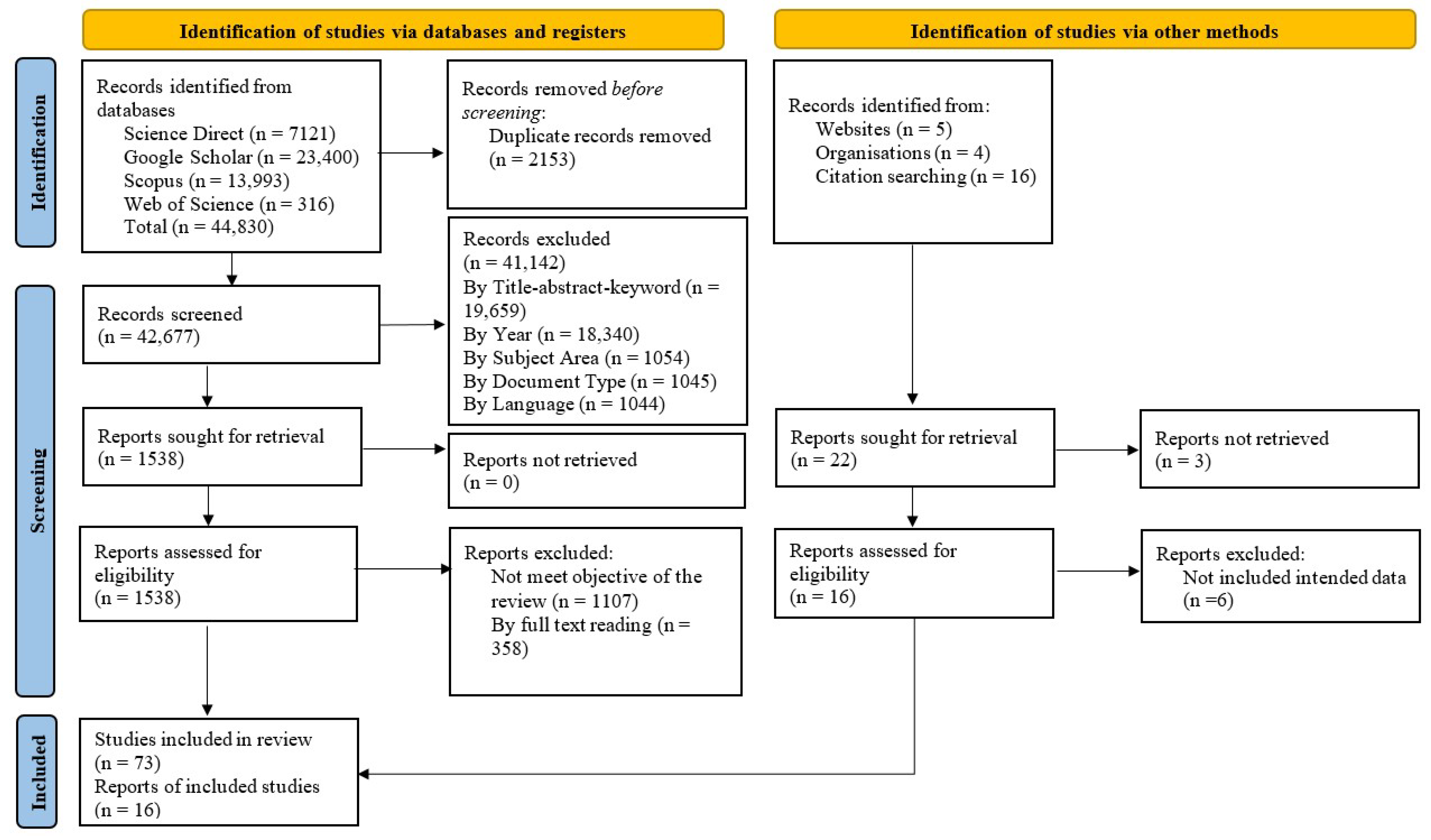
As illustrated in Figure 1, 2153 records were duplicated and excluded from the initial search results. Then, the records were screened by titles, abstracts, and keywords, resulting in 19,656 studies. We then filtered the results by year, spanning from 1 January 2014 to 1 January 2025, yielding 18,340 records. The staring year was selected based on the United Nations adoption of the 2030 Agenda for Sustainable Development [33], which includes gender equality and ensuring access to adequate, safe, and affordable housing for all as outlined in Goals 5 and 11, respectively. The records were also filtered by document type (Article) and language (English). This process resulted in 1538 studies, which were used for further assessment. Finally, text-based screening was conducted. As a result, 1107 papers were excluded as unrelated to the review’s objective after a review of the abstract and keywords, and 358 additional studies were excluded after reading the full text. This left 73 studies that met the review criteria (see Figure 1). During the screening stage for the title and abstract, the researcher selected studies by discussing the ideas with previous researchers to identify the most relevant studies and avoid bias. Besides, the result of the filtering result was discussed with two co-authors.

2.4. Data Extraction and Method of Analysis

After the screening of studies, data extraction and analysis were conducted. Both a thematic and keywords bibliometric analysis were used to scrutinize the selected studies. Thematic analysis was the most common method used for analyzing the qualitative data across multiple disciplines [34]. Thus, in this study, the thematic analysis was based on qualitative content analysis of existing studies through “encoding qualitative information” as suggested by [35]. The study involved in-depth analysis of the selected study’s findings, followed by organization and creation of codes (themes). During the code computation, five elements of a code—its label, characteristics, flag, description, and examples—were examined as per the suggestions of [35]. In this regard, Zotero 7, Microsoft Excel, and Python 3.11.5 were used. On the other hand, a bibliometric analysis of keywords was conducted using VOSviewer 1.6.2, a tool that generates maps from bibliometric network data. The bibliometric analysis was used to visualize the relationship between keywords and possible themes as a cluster with different colors [36]. To achieve this, the Authors’ Keywords were initially identified and a thesaurus file was computed (Appendix A). The thesaurus file aims to merge similar keywords into one that have the same meaning and context but different spelling. The studies were arranged and grouped by year, title, objective, methodology, and findings. Finally, we synthesized the themes and present the main findings of the studies.

3. Results

3.1. PRISMA Flow Diagram

As shown in Figure 1, the PRISMA flow diagram illustrates the selection of relevant literature from the following databases: Scopus, ScienceDirect, Web of Science, and Google Scholar. As previously mentioned, a total of 73 studies were selected for thematic analysis word cloud, and keyword biblometric analysis.

3.2. Background Information of Studies

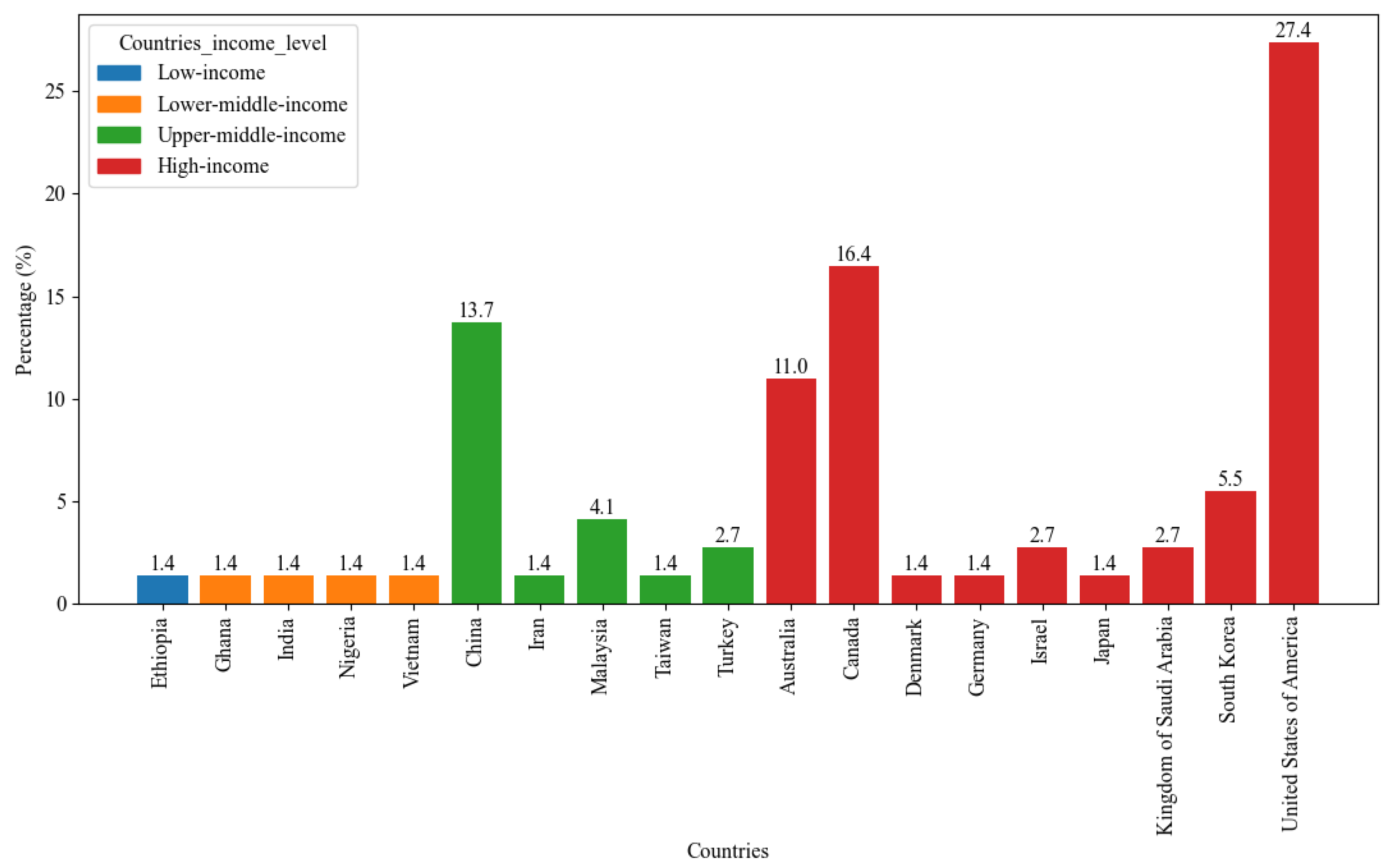
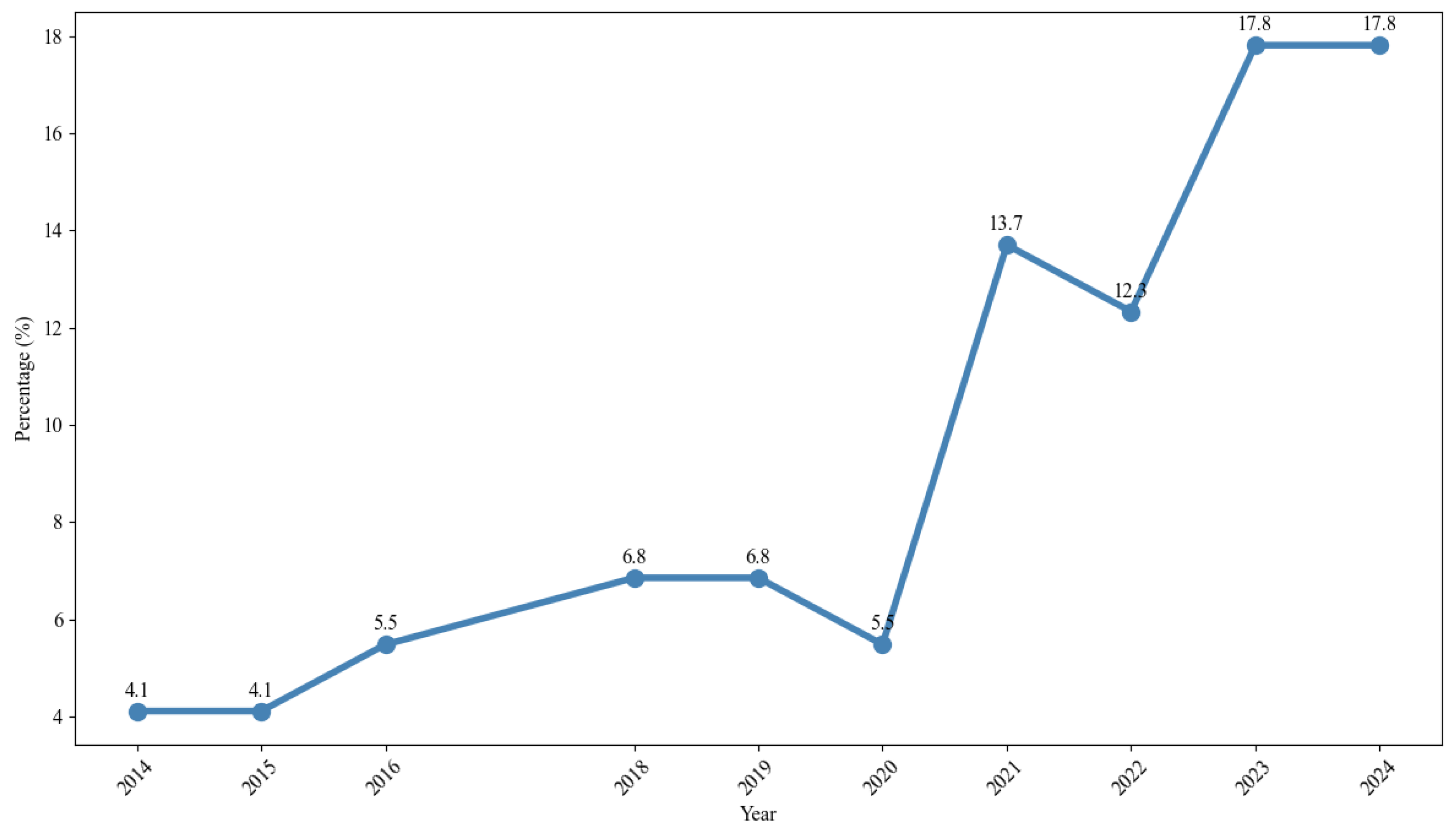
As illustrated in Figure 2, most studies were conducted in high-income countries (HICs), which contributed about 71% of the reviewed studies. Studies conducted in upper-middle-income countries (UMCs) contributed to about 22% of the total reviewed studies. Finally, a small proportion of studies (about 7%) were conducted in lower-middle-income countries (LMCs) and low-income countries (LICs). The distribution highlights significant research gaps in LICs and LMCs, indicating the need for more comprehensive studies in these regions. The income levels of countries were computed based on the World Bank classification report [37]. Figure 3 highlights the growing attention of research’s to housing and gender research, particularly in 2023 and 2024.

3.3. Word Cloud and Bibliometric Analysis of Keywords

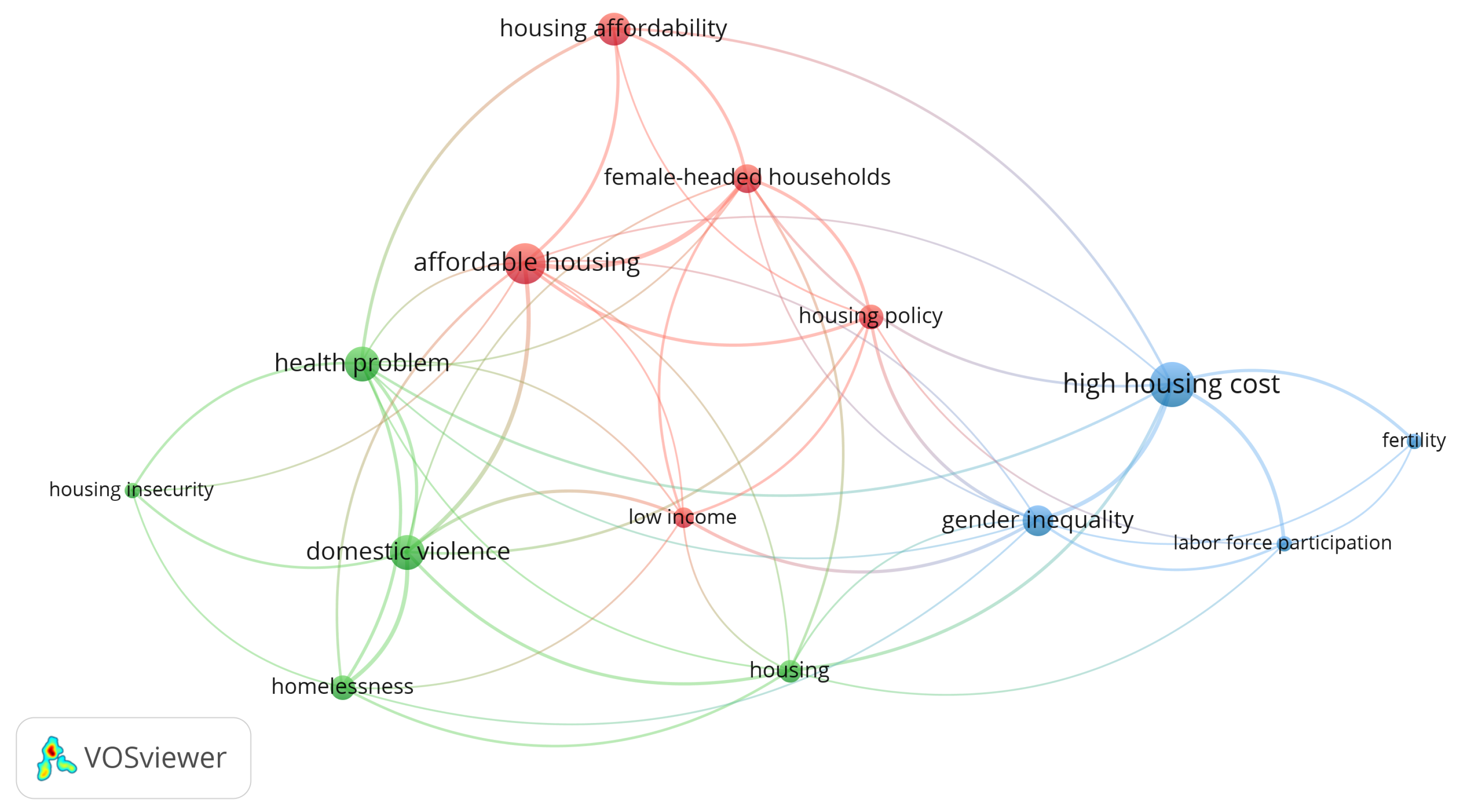
The total number of authors’ keywords found in selected studies is 252. For the keywords co-occurrence map, keywords that occurred more than five times were chosen for analysis. However, due to similarities in keywords with similar spellings and meanings, they were merged into a single treasure file (Appendix A). As a result, of the 252 keywords, 14 keywords meet the threshold of occurring more than five times, as shown in Table 3, and are used for final analysis. The keywords network map (see Figure 4), comprising nodes, lines, and clusters. The size of the nodes/items indicates the frequency of occurrence of item; the larger the node, the more critical the keyword. The thicker the line, the stronger the relationship between items, and the thinner the line, the weaker the relationship. Besides, three clusters, each in a distinct color—red, green, and blue—show related themes that can be used for further discussion.
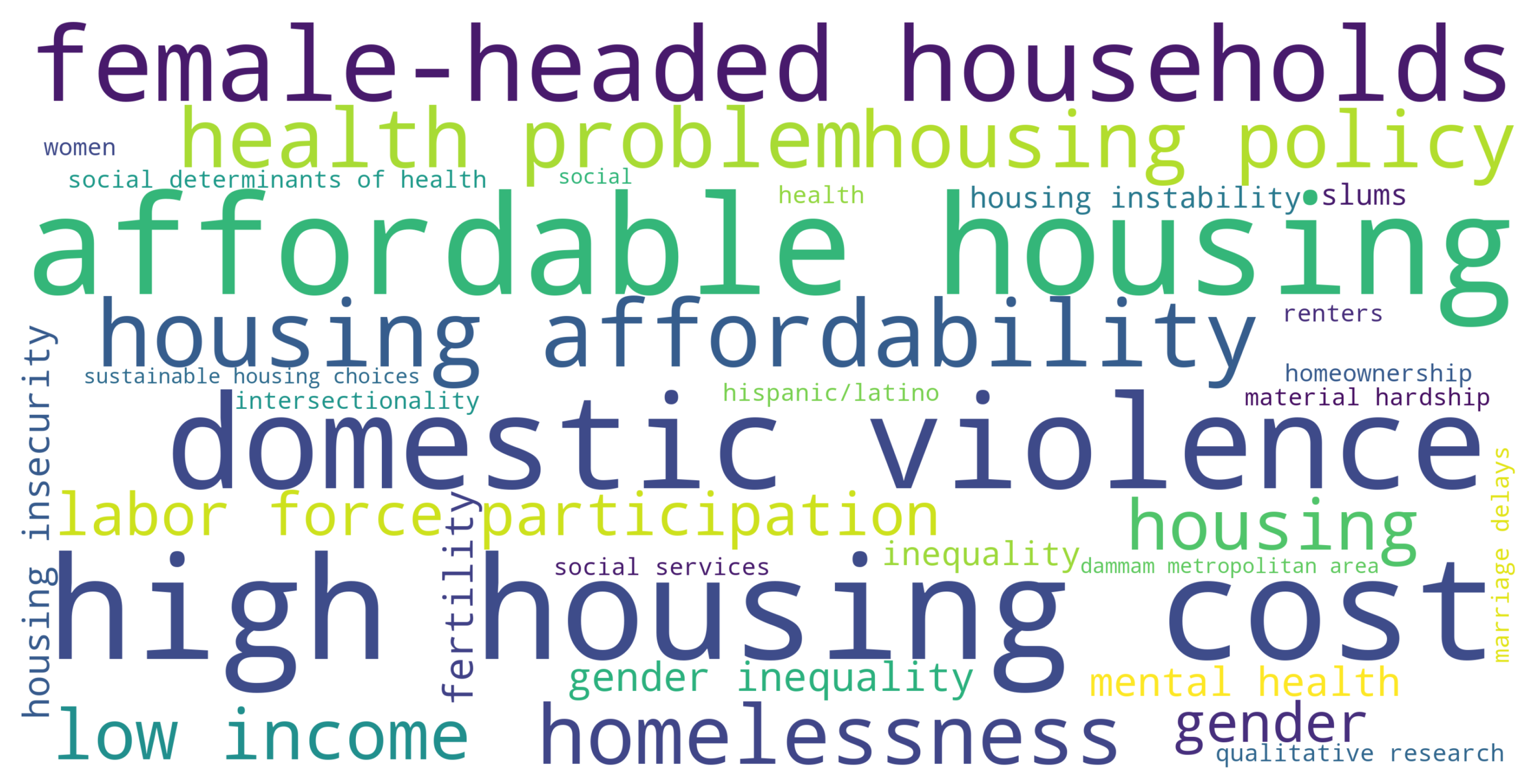
The word cloud in Figure 5 highlighted the most frequently used keywords, including high housing costs, female-headed households, affordable housing, homelessness, housing affordability, domestic violence, health problems, and housing policy. These imply the study’s primary focus and highlight the possible themes used in the analysis.

3.4. Study Characteristics

As illustrated in Table 4, selected study characteristics included the authors’ names, the study country, the main objective, the study design, and the key challenges faced by FHHs. Highlighting the study’s characteristics helps to synthesize the main findings, identify overarching themes, and understand the geographical variation and vulnerabilities of FHHs regarding access to affordable housing in urban areas worldwide.

3.5. Quality Appraisal of Selected Studies

After the selection of relevant studies using inclusion and exclusion criteria, standardized appraisal tools were employed to assess the quality of studies. After grouping all selected studies by their research design, the Critical Appraisal Skills Program (CASP) quality assessment method was used to evaluate the strength and weakness of the included studies. CASP have different checklists for different study designed [92]. CASP is a widely used method and assess the studies using three sections: Are the results of the study valid (Section A)? What are the results (Section B)? Will the results help locally (Section C)? The results can be found in the Table A2, Table A3 and Table A4.

3.6. Challenges of Female-Headed Households to Access Affordable Housing

The thematic analysis of 73 peer-reviewed studies identified six key themes that female-headed households have faced in accessing affordable housing in urban areas worldwide. The studies characteristics illustrated in Table 4, highlights the Authors, country of studies and the main findings that affect FHHs regrading access to affordable housing. These major findings were summarized as a theme and the main themes are high housing prices, economic insecurity, inadequate supply of affordable housing, policy gaps, gender inequality, and patriarchal and socio-cultural practices as shown in Table 5.

3.6.1. High Housing Price

The unaffordability of housing prices is a global crisis that affects all. However, its effect is gendered, and female-headed households were disproportionately suffering its burden. The majority of studies, 52 of 73 (Table 2), emphasize the high housing prices as a substantial challenge for female-headed households in accessing affordable housing in both the rental and home ownership markets of urban areas.
Among 52 studies, 23 found that high housing prices for low-income households, including female-headed households, are due to rapid housing price escalation relative to income [11,72,76,85]. Female-headed households with children were the most vulnerable groups in a society [19]. Accordingly, they spent a higher percentage of their income on housing due to the rapid increase in housing costs in the USA. A study by [10] also noted that high housing prices are the leading struggle for women in urban areas of the USA. Ref. [5] reported that female-headed households in Tehran, Iran, allocate 49% of their income to housing. Similarly, the high housing costs have been identified as primary challenge for women, particularly single mothers, in their efforts to purchase a house in Malaysia [7]. In addition, the study by [32] demonstrated the unaffordability of housing costs and highlighted it as a problem for female-headed households in seeking housing in Kelowna, Canada. As noted across these studies, female-headed households bear the burden of housing challenges and spend a significant share of their income on housing costs.
Eight of 52 studies discussed the issue of the high housing cost related to its impact on female-headed households’ health [15,16,17,54,59,73,81,83]. Four of 51 studies highlight the impact of rapid urbanization on low-income households’ ability to afford housing due to the escalation of housing prices resulting from rising demand, affecting low-income residents such as women [21,64,68,70]. This implies that rapid urbanization and population growth are influencing low-income earners, such as female-headed households, in their access to affordable housing.
Seven of 52 studies highlight the problem of delay of fertility and marriage for female-headed households due to the high housing price [49,58,61,63,86,93,94]. Three of 52 studies emphasize the impact of the high housing price on consumption of female-headed households [4,5,7]. Four of 52 studies reported the effect of the high housing costs on female labor force participation [53,55,60,79]. The rise in house prices prompts women, not necessarily mean only FHHs, in China to enter the wage labor force to cover their housing costs [53]. Still, they could not fulfill their housing demands to the same degree as men. A gender diversity of home ownership were also highlighted in Australia as shown by [39]. They found that the home ownership rate for female sole parents is substantially lower than that of male sole parents. In contrast, a study by [91] found no gender difference in the financial burden of housing costs in Vietnam.

3.6.2. Economic Insecurity

Financial problems are among the key challenges that female-headed households face when trying to own a house. About 30 of the 73 studies (Table 2) demonstrated that economic insecurity affects the availability of affordable housing for female-headed households in urban areas. Among 30 studies, 19 show that the low income and the highest poverty level of households headed by women compared to those headed by men is a cause of their economic insecurity, impacting their access to housing. A study by [87,90] found that female-headed households are among the most economically challenged groups in the USA. According to [2,32], low-and moderate-income earner women’s are less likely to be homeowners in Canada. The stagnation of household incomes is as a problem in their efforts to withstand the impact of the high housing costs [19]. The low income of households headed by women is the result of unemployment compared to male-headed households and their work in precarious and informal jobs [2,5,47,51,58,75,85].
Furthermore, Figure 4 illustrates the relationship between female-headed households and low income, suggesting their economic insecurity. Overall, systemic exclusion of women in the labor market and institutional barriers, including education, have influenced their ability to have adequate income. Accordingly, policies that facilitate job security, equal pay, and affordable childcare for female-headed households are fundamental to an inclusive housing market [39].

3.6.3. Inadequate Supply of Affordable Housing

Access to adequate, safe, and affordable housing is one of the targets that the United Nations has identified for cities to address housing problems [33]. However, 21 of the 73 studies (Table 2) highlight the global shortage of affordable housing in urban areas. Most studies point out that an inadequate supply of affordable housing has become a significant challenge for low-income and marginalized groups. Female-headed households are one of these groups [2,20,76,81] document the supply gap for the USA. Similarly, social housing provision in Australia has declined, and housing policy responses favor demand-side subsidies to assist with rental payments [45]. The lack of affordable housing in urban areas was from little attention of government investment on social housing [32,70], underfunded for social housings [45,76], rapid urbanization and population migration [2,5,21,70]. The impact of all these problems, however, disproportionally affects households headed by women, as they are among the most vulnerable and poverty-stricken groups.
Thus, increasing the supply of affordable housing will ease the financial strain and improve the mental health of Australian women as highlighted by [41]. Moreover, affordable housing is often discussed in relation to female-headed households, and scientific literature suggests a connection between social housing, female-headed households, and affordable housing (Figure 4). Thus, incorporating the provision of affordable housing for low-income earners was crucial for a healthy urban environment and enhancing the safety of marginalized social groups, especially for female-headed households with children.

3.6.4. Housing Policy Gap

Among 73 studies, 30 highlight gaps in housing policies that hinder female-headed households’ access to affordable housing. In Canada, the marketization and deregulation of the housing system have a disproportionately negative impact on access to housing opportunities for female-headed households [13,47,50]. In Denmark, the immutable local housing market and neoliberal housing policy have also affected disadvantaged women and families [63]. In Australia, existing housing ideologies and policies are unable to address the specific housing needs of women [47]. Besides, women have become vulnerable to housing precarity and insecurity in Australia, as exemplified by [44]. Similarly, there is a gap of policy to address the housing needs of single black mothers in the USA [19]. The one-child policy in China, introduced in 1978, led to a shift in ownership of assets, such as housing, resulting in fewer women becoming homeowners. This is due to the parents’ preference for having male offspring, resulting in a higher proportion of male children. This allows marriageable females with greater bargaining power to select a male whom they want. As a result, parents have been buying housing for their male offspring, and the tendency of homeownership will shift to males, giving them the power to have a wife [62].
The housing system was not designed to address the gendered aspects of women’s experiences in Canada [24]. Discriminatory housing practices affect female-headed households’ ability to own a house in the USA [78]. A study by [5] also demonstrated that female-headed households face challenges in accessing affordable housing in Tehran, Iran, due to discriminatory issues in housing policies. Additionally, women’s current situations are attributed to several structural issues in tenancy laws, housing policy, and retirement/superannuation policy in the Australian housing market [38]. Its also mentioned that, the Malaysian housing policies have failed to provide adequate and affordable housing for residents, particularly for low incomes households [7]. Similarly, in Ethiopia, many residents face the unaffordability of housing schemes [64]. Additionally, women highlighted the gap in affordable housing design, emphasizing the need to consider women’s perceptions of the space layout in housing design [70]. In Australia, the government has shifted its focus from providing affordable housing, such as social housing, to offering subsidies for private rental housing. However, this approach has become problematic and can lead vulnerable social groups, such as women, into lower-cost, poor amenity locations as the rental market becomes commodified [45]. Thus, gender-responsible housing design and programs are crucial in addressing the housing needs of women since a house is not just a physical structure, but rather a place where every aspect of their lives unfolds. The need for a gender-responsive housing system in Halifax, Canada [24]. They conclude that gender-responsible housing design and programs would create “flexibility in the system that would be more responsive to other undeserved groups”.

3.6.5. Gender Inequality

In many societies, housing and ownership rights are presumed to be chiefly reserved for males rather than females. Historically, women’s voices received less attention due to the male-dominated nature of political arenas and decision-making processes [2]. Similarly, owning housing has often been perceived as a male-dominated domain, excluding the perspectives of females [41]. Of the 73 studies, 28 (Table 2) demonstrated that gender inequality is a barrier to female-headed households accessing affordable housing in urban areas. Seven of 28 papers highlight the gender inequality in terms of domestic violence [40,43,45,51,77,84,89]. Similarly, seven of 28 papers highlight the gender inequality in terms of social exclusion and systemic exclusion of women in having their and assuring their right in surrounding and having housing [2,32,41,46,48,62,81]. They found that women’s systemic exclusion from accessing resources and norms has resulted in their exclusion from housing ownership. Three of 28 studies highlight the gender inequality in residential segregation [6,23,24]. Two of the 28 studies highlighted gender inequality in accessing microfinance and loans, which affects the ability of female-headed households to own a house [21,68].
The housing policy also contributes to gender inequality in accessing housing in urban areas. In this regard, three studies have highlighted the gap in policy regarding the incorporation of women’s housing rights [11,13,14]. Furthermore, racial discrimination has also been pinpointed as a challenge for female-headed households to secure housing. For instance, studies by [19,83,85] in the USA found racial discrimination against Black female-headed households in accessing affordable housing. Finally, studies by [4,22,87] have shown that the disparity in home ownership and income among gender, female-headed households facing challenges to access affording and adequate housing.

3.6.6. Patriarchal and Socio-Cultural Practices

Studies show that national cultures and practices can hinder female-headed households from having a house. Nine of the 73 studies identified such challenges [2,5,14,23,24,61,62,66,94]. For instance, the socio-cultural practices in Ghana have prevented females from acquiring housing and land [66]. Similarly, female-headed households, especially those in the first and second-income quantiles, do not have equal rights to land ownership, property, and affordable housing. This is due to the patriarchal cultural practices and unequal rights in legislative and urban planning goals in Tehran, Iran [5]. In Chinese tradition, it is often expected that the fiancé will supply the marital home, a practice that has become nearly mandatory for marriage. This, in turn, increases the demand for housing for males, affecting women’s ability to own land and housing [62]. Furthermore, a study by [24] noted the patriarchal forces in housing policies and practices, which affect women’s efforts to find secure housing in Canada. Thus, raising social awareness and overcoming harmful norms is crucial to women’s empowerment and reducing the historic disadvantage of women resulting from patriarchal practices.

3.7. Vulnerability of Female-Headed Households

This section highlights the vulnerability of female-headed households due to the problems that they face in securing housing in urban areas. The results of the thematic analysis highlight issues related to economic, social, physical, and psychological health.

3.7.1. Housing Insecurity

Stable, affordable housing is crucial for ensuring the safety of women and their children. However, due to the lack of affordable housing and the rising housing price in urban areas, women are forced to move to sub-standard housing and/or undesirable neighborhoods in developed countries as well as to informal areas in developing countries [5,20,23,64,70]. High housing prices have an adverse impact on the livelihoods of urban residents, particularly on those of women. The unaffordability of housing prices in British Columbia, Canada, forced women to live in the city’s outskirts [2]. In Israel, high housing prices are the primary reason for the relocation of residents from the metropolitan center to outskirts [14]. Similarly, female-headed households with lower incomes are more likely to migrate to less expensive locations than those with higher incomes in the USA [19]. Similarly, Female-headed households are frequently relocated in search of affordable housing. Female-headed households are vulnerable to housing instability due to the gap of the supply of affordable housing in Republic of Korea [72,80]. This backs up the claim that a lack of affordable housing in urban areas exacerbates the expansion of informal settlements and the growth of slums. Thus, high housing prices negatively impact the quality of life, and the resulting high costs drive women out of the city, as shown in Canada by [32]. In contrast, rising local housing prices in Germany make it less likely for low-income households, such as women-headed households, to relocate when faced with excessive housing burdens [65].

3.7.2. Health Problems

Housing is essential for health [51], but its impact varies according to age and household composition [15]. It has been shown that the unaffordability of housing in urban areas results in mental illness, such as stress and psychological depression [15,16,38,51,73,75,78].
In Australia, women have experienced various forms of physical and psychological problems, such as depression, due to housing insecurity [40]. Homeless females also reported higher levels of psychosocial distress and suicidal than their male counterparts in Ghana [66]. Similarly, a 1% increase in the housing-price-to-income ratio is associated with a 1.2% decrease in physical health and a 1.9% decrease in psychological health among females in China [54]. Also, living in a rent-burdened neighborhood was associated with a 3% increase in the risk of maternal depression in the postpartum year in the USA [82].
The recent COVID-19 pandemic has exacerbated the health problems of women living in urban areas. Adverse mental health problems were particularly pronounced among women compared to men due to a lack of adequate housing [75]. Women are more inclined to seek medical help for mental health issues due to the high housing prices compared to men in Republic of Korea [73]. According to [95], women are disproportionate suffer due to the high housing cost in the USA. Similarly, higher municipal rental housing costs were significantly associated with greater odds of severe maternal morbidity in NJ, USA [86]. As a result, households facing housing affordability problems are subject to greater mental health problems [16]. In contrast, as [59] shows, the growth rates of housing prices in China resulted in high mental problems, but not vary among genders. Therefore, housing affordability is a growing public health crisis and disproportionately affects lower-income families, especially FHHs [83].
In summary, women headed households have incurred the higher percentage of their income, mostly more than 30%, for housing. As a result they were vulnerable to different types of health problems. Thus, promoting social safety nets is crucial to overcome the difficult situation of female-headed households.

3.7.3. Marriage and Childbearing Delay

Having a house or being a homeowner significantly impacts the decision to get married and start a family. In contrast, those without a house tend to increase their working time or wages due to the high cost of housing. This resulted in delayed marriage and lower fertility rates. For instance, in China, housing is considered a “status symbol” and being a homeowner is a prerequisite in the society. Thus, a 1000 yuan upward shift in housing price induces the possibility of a new child birth by 13.9% for homeowners [57]. A similar study in China indicated that a higher house price significantly reduces women’s reproductive probability. Women aged 30 years or younger, without children, are susceptible to this effect [56]. However, a study by [63] highlighted a positive impacts of the housing price escalation on child birth in Denmark. They found that for a 12,000 USD increase in house prices, the probability of giving birth increases by 2.35%.
Housing is the major store of wealth for most families and one of the main determinants of child-rearing costs in Canada. For women who already own their homes, an increase in housing prices generates wealth effects [49]. However, women’s gendered dispossession and weak involvement in affordable housing options resulted in power dynamics on marriage, housing, and institutional structures in Turkey [23]. Thus, policy enhancements to supply housing elasticity can control the adverse impact of house prices and improve fertility rates. Therefore, accessing affordable housing in urban areas has a significant impact on female-headed households to get married and start a family [52].

3.7.4. Gender Based Violence

Women’s housing insecurity caused by the intersectionality of factors, including gender inequality, low income, lack of access to affordable housing options, has led them to domestic and family Violence (DFV). In this regard, the studies keywords co-occurrence map as indicated in Figure 4, highlights the relationship between female-headed households and domestic violence.
Domestic violence is one of the leading causes of homelessness for women and children in Australia [42]. Similarly, due to the limited supply of affordable housing in the urban areas of Ghana, women’s have been exposed to sexual harassment and physical assaults [66]. As a result, they have become victims of housing-related trauma [77]. Similarly, a study by [11] also showed housing related trauma and discrimination as a critical issue that hinders female-headed households from accessing housing in Canada. On the other hand, due to the limited supply of affordable housing in Australia, women are forced to return and live with their abusive relationships [45]. Women’s who are victims of abusive partners have limited resources, resulting in food insecurity, economic barriers to re-housing, and dependence on their abusive partner in Canada [51].
Meanwhile, a study by [85] indicated the disparity of housing related trauma among the female-headed households in the USA. The finding highlighted that black women experience worse abuse than white women and disproportionately experience intimate partner violence (IPV). This is the result of gender and racial inequalities in income, employment, housing, and social networks. Thus, the limited resources of women’s coupled with the shortage of affordable housing have force them to live with an abusive partner and being vulnerable to gender based violence. Thus, the provision of affordable and safe housing for women experiencing violence and trauma is crucial for enhancing the livelihood of them [46].

3.7.5. Feminization of Homelessness

Homelessness is a persistent social problem that affects women uniquely [46]. Studies have shown that the impact of housing insecurity, particularly high housing costs, contributes to women’s homelessness [24,78,81,82,88]. Besides, the lack of affordable housing, poverty, and intimate partner violence are among the most common reasons for mothers’ homelessness with their children in Canada [48]. Similarly, single, older women are particularly vulnerable to housing-related stress and homelessness [38], and women under 65 are at a greater risk of financial strain and poorer housing security in Australia [41]. Similarly, it has also been reported that domestic violence is the leading cause of women’s homelessness with their children in Australia [45].
Moreover, the neoliberal housing policies systematically contributes to the feminization of homelessness due to the failure to consider their specific need and prioritize market-oriented housing policies [2]. This shows that rising house prices and low incomes, coupled with an inadequate supply of affordable housing, make it challenging for female-headed households to rent or buy a house, resulting in homelessness. Addressing these barriers requires multifaceted solutions, including increasing affordable housing options, improving safety standards, and policies that combat income-based discrimination [32].

4. Discussion

The analysis of 73 peer-reviewed studies identified several critical points for women regarding affordable housing. The most critical issue is the rapid escalation of housing prices. Other relevant issues are economic insecurity, limited supply of affordable housing, policy gap, gender inequality, and patriarchal and socio-cultural practices.
Most of the reviewed studies have argued that high housing prices have a disproportionate impact on female-headed households’ ability to access affordable housing in urban areas. For instance, the high housing prices are the primary issue preventing single mothers from accessing affordable housing in Malaysia [7]. This is similar to Canada [76], China [55,56,60], and Iran [5]. This might be due to the commodification of housing rather than it being a fundamental human need. As a result, its exchange value is prioritized over its use value. Additionally, rapid inflation negatively affects the prices of construction materials used in housing. Thus, the government should intervene in the housing market and design policies and strategies to stabilize it, crucial to safeguarding access to housing for low-income households, including female-headed households.
The findings of this study indicated that the limited supply of affordable housing has been another challenge that influences female-headed households in owning a house. Affordable housing options designed for low-income and vulnerable social groups are scarce in Canada [47,48,50]. A similar problem has also been identified in Australia [45], Malaysia [70], and the USA [81]. This is due to governments’ reluctance to build affordable housing and a shift in policy from direct housing construction to subsidizing vulnerable groups. Thus, it is crucial to improve access to affordable social housing, particularly for women and low-income earners [42].
Economic insecurity is also another challenge for female-headed households in their ability to purchase a house or afford rental costs. Due to several reasons, such as divorce, the husbands’ deaths, sometimes husbands’ disability and addiction, female-headed households have become solely responsible for the family without the presence and support of males. As a result, they were severely affected in their ability to purchase and rent a house, coupled with their responsibility of caring for children, an insecure job, and poverty [68]. Studies also show that households headed by women, who have the highest poverty level, suffer in the housing market [11,22,71,87,90]. This is because most female-headed households were unemployed and worked in informal occupations [5].
The findings also reveal that the gap in housing policies excludes female-headed households from accessing adequate housing. In neoliberal regimes, there is a reluctance to construct housing that supports low-income households. As a result, the provision of affordable housing, such as social housing, that supports low-income group earners, including female-headed households, decreases. In this regard, the marketization and deregulation of the neoliberal housing system have created uneven impacts on housing opportunities and vulnerabilities across genders in Canada [13]. However, in patriarchal societies, male dominance is more pronounced in the social structure. As a result, women’s likelihood of owning land and housing has declined, and they are denied equal opportunities for credit from financial institutions. A study by [5,21] have demonstrated that women have limited societal power to own land, make decisions, and affect their access to mortgage and bank loans.
Furthermore, gender inequality has been identified as a critical challenge for FHHs to own an asset such as housing. This may resulted from systemic and narrative assertions about the roles of males and females across different cultural contexts. This intern helps to create diversity in the labor force and the employment sector in the societies. Thus, women’s lower pay for the same work, fewer job opportunities, the additional burden of childcare, and a heavier burden of unpaid care impact their economic independence and their capacity to afford housing. Thus, ensuring substantial support for female-headed households and their families is crucial to sustain their livelihood [51]. This implies systemic and institutional exclusion of female-headed households from education and the labor market, affecting their efforts to own a home.
Overall, this study shows the intersectionality of the factors influencing female-headed households’ access to housing. Women faced various health and socio-economic problems, including physical and mental issues, marriage delay and fertility decline, gender-based violence, homelessness, housing and food insecurity. For instance, low and vulnerable social groups were exposed to depressive symptoms due to housing insecurity in the USA [88]. Due to the unaffordability of housing, males tend to be mentally healthier than females in China [17]. Similarly, females have experienced higher levels of psychosocial distress and suicidality than their male counterparts in Ghana [66]. On the other hand, mothers with young children struggle to afford basic needs due to the unaffordability of housing in the USA [82]. As a result, they decide to return to their abusive partner due to their inability to afford housing costs in Australia [45]. This implies that women are subjected to various forms of abuse due to economic dependence.
In summary, most studies have focused on upper-middle and high-income countries. There are a few studies in low- and lower-middle-income countries. One possible reason is that Western countries are concerned about their population decline, as females play a crucial role in the reproduction and sustainability of future generations. As a result, future studies should address the issue of female-headed households’ experiences in obtaining affordable housing in low- and lower-middle-income countries.

5. Implications and Future Agenda

This section discusses the theoretical and practical implication of the review, implications for practice and policy development in Ethiopian Context, and highlights limitations and future works for further empirical researches.

5.1. Theoretical and Practical Implication

This study addresses missing and unaccounted societal housing issues for FHHs, expands existing knowledge about the lived experiences and struggles of FHHs by examining their challenges and vulnerabilities, and underscores the relevance of the study. The findings can support policy development, strengthen social support practices and programs, and address longstanding socio-cultural structures and inequities. In addition, the insights from this study contribute to policymakers’ decision-making in land-use planning and housing policy from gender perspectives. Besides, the results are vital to address the gender gap in labor markets. However, it requires flexibility in housing policies to address the specific housing preferences, needs, and concerns of FHHs from diverse socio-economic backgrounds. Besides, the government should design a housing policy that recognizes the complex and culturally diverse housing needs and preferences of the local population, including FHHs, and ensures gender-responsible housing policies.
In addition, stabilize the housing cost burden of FHHs. Increasing the investment in low-income and affordable housing. Additionally, the government must adopt incentive measures to encourage developers to build low-income and affordable housing units. On the other hand, it’s crucial to address the location of housing units. Urban planners should develop site selection strategies that consider the availability of amenities and safety concerns in neighborhoods before providing affordable units. Furthermore, ensuring equitable and accessible job opportunities is highly relevant to addressing job opportunities for FHHs in a country. To tackle these challenges, ensure inclusive economic development policies that address gender disparity in housing affordability. The economic development policies should be reformed to address financial insecurity and low educational attainment of FHHs, which are critical to achieving inclusive and sustainable urban development.
In summary, the study advances our understanding of FHHs’ precarious housing conditions by narrating their lived experiences across different cultural contexts. In addition, the study addresses the structural factors arising from gender arrangements and housing policies, which play a crucial role in advancing policy in this area. As such, the study’s findings contribute to the literature focused on gender, housing, and inclusive urban development.

5.2. Implications for Practice and Policy Development in Ethiopian Context

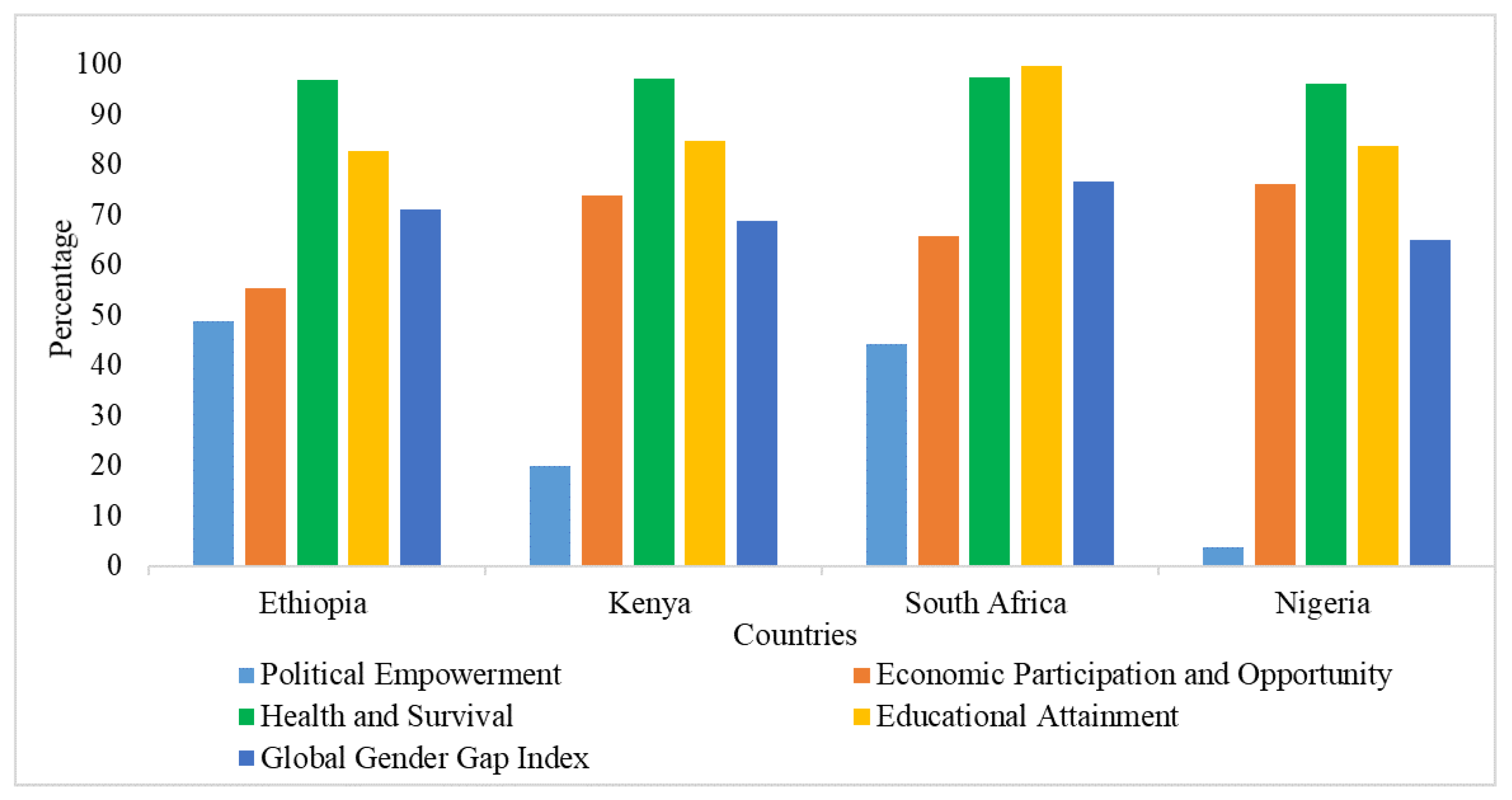
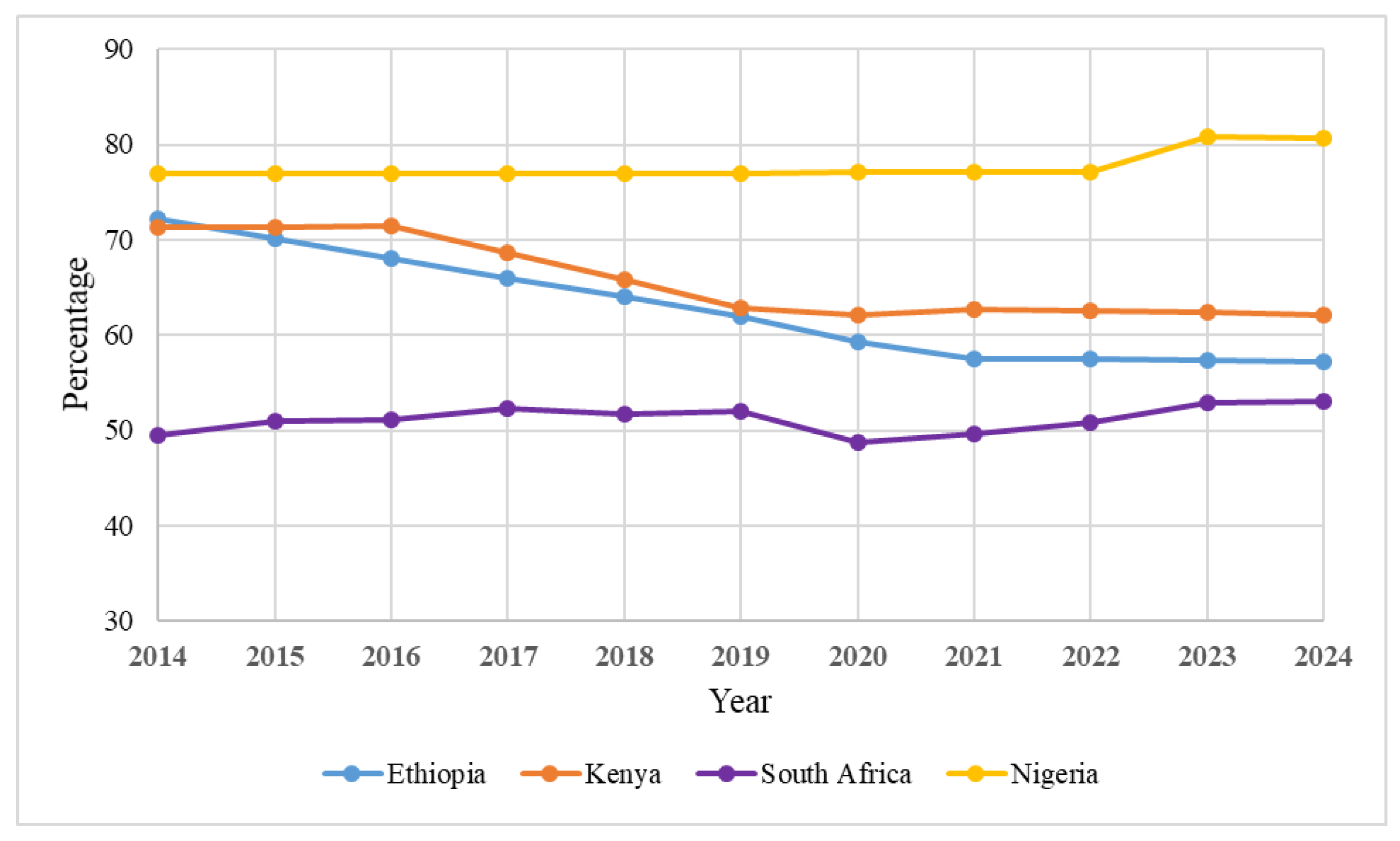
The results of this study imply a need for attention and gender mainstreaming, particularly for FHHs’ living conditions and housing vulnerability in urban areas, especially in developing countries such as Ethiopia. Evidences from the World Economic Forum’s [96] report indicates a need to strengthen women’s participation and educational attainment, as Ethiopia ranks among the lowest levels of women’s involvement and educational attainment among Sub-Saharan African countries, compared to Kenya, South Africa, and Nigeria, as shown in Figure 6. This implies a gap in women’s empowerment in the workforce and education. As a result, women are more likely to work in low-income and informal jobs. For instance, in Addis Ababa, the capital city of Ethiopia, the number of FHHs living under absolute poverty is higher than that of male-headed households [29,97]. Similarly, most FHHs are represented in low-income groups in Jimma, a city in Ethiopia [98]. Besides, the World Bank [99] reported the decline in women’s labour force participation in Ethiopia, as shown in the Figure 7. Thus, the government should design policies and strategies to address labour market disparities through increasing women’s labour force participation.
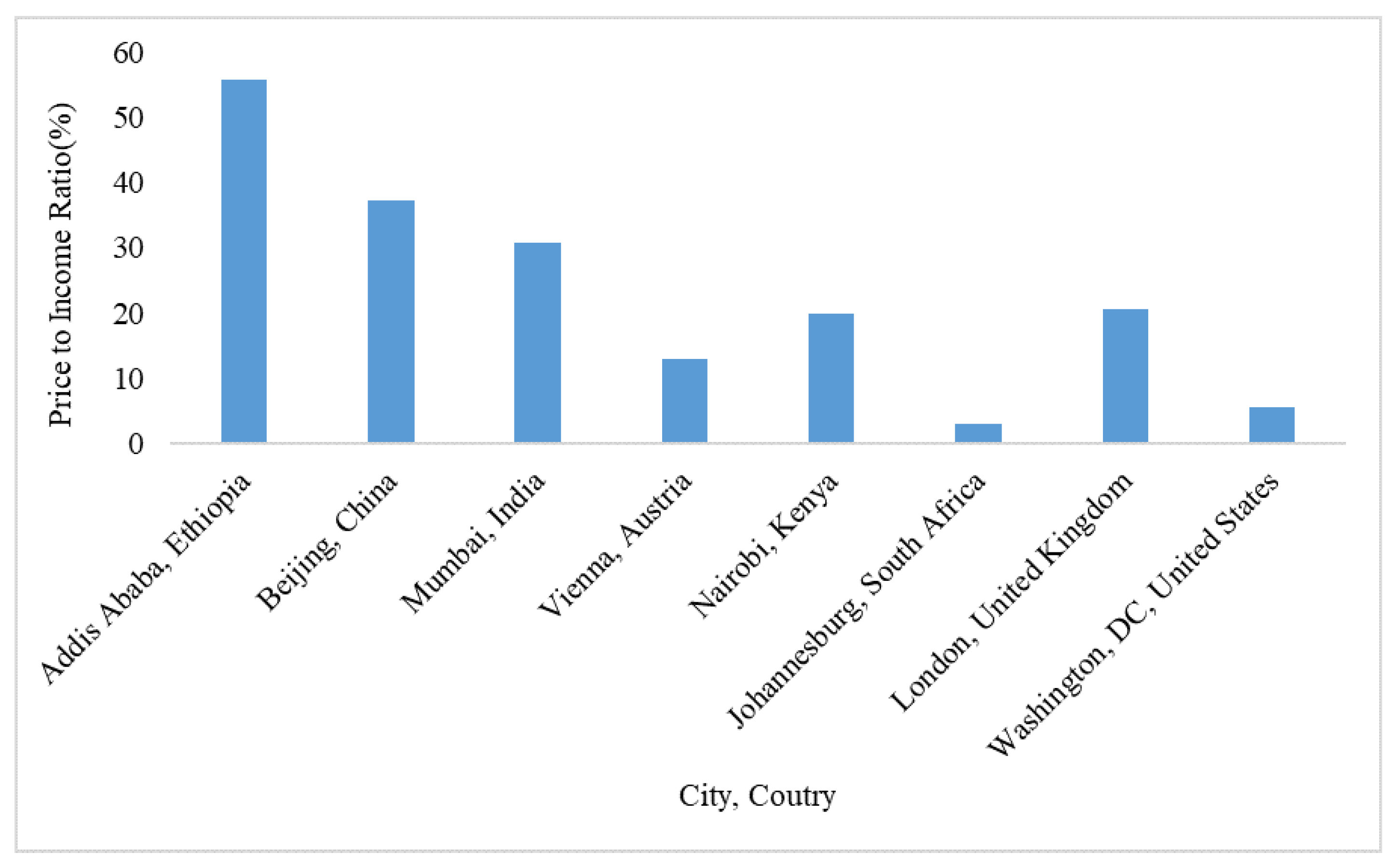
Ethiopian urban areas have been experienced by expensive housing market, disproportionately affecting low-income households, including FHHs. For instance, in Addis Ababa, housing is not affordable for the low-income households [100,101]. According to the NUMBEO report published in Mid-2025, Addis Ababa is the world’s least affordable city, with a price-to-income ratio of 55.8% (Figure 8). This shows housing prices are unaffordable for low-income earners including FHHs. On the other side, the number of households headed by women has been increasing in Ethiopia due to the rise of divorce, the death of husbands due to ethnic based conflicts, and instability in Ethiopia. However, these households still lack policy attention and are among the most vulnerable social groups [28]. Thus, the government must be aware of the challenges faced by FHHs, as their numbers and struggles have increased, and design strategies and policies to empower them, thereby helping create inclusive and accessible cities.
Regarding the adequacy of affordable housing, the Ethiopian government introduced the Integrated Housing Development Program (IHDP) in 2005, which aims to ensure affordable housing for low-income urban residents by constructing condominium houses [102]. However, the program is criticized for its limited supply and the unaffordable cost of construction. In this regard, the study of [30] underscored that FHHs’ vulnerabilities occurred from the acute shortage of affordable housing in Hawassa, Ethiopia. In addition, the difficulty of access to housing finance exacerbated the struggle of low income households [27]. Therefore, the government should increase the supply of affordable housing.
The housing policy gap also contributes to women’s low level of asset ownership, such as land and housing in Ethiopia [97]. The influence of patriarchal systems in housing policies has forced FHHs to face political, social, and economic discrimination [98]. On the other hand, gender inequality, patriarchal and socio-cultural practices are also the critical concerns for FHHs to access housing. For instance, gender disparities in housing ownership and labour market inequalities was found in Ethiopia as shown by [103]. The historical trends of women working at home and responsible for household chores was driven by societal norms and cultural practices, made them financially dependent on men. In Hawassa, a city in Ethiopia, gender norms and roles have become a challenge for equal division of property assets for FHHs during divorce [30]. Overall, the findings highlighted the intersectional nature of the factors influencing FHHs in urban areas. Therefore, strategies and policies that enable FHHs to access assets, such as housing, need to be reformed and redesigned to empower women and ensure their economic independence.

5.3. Future Works

Most studies suggest the need for low-income and affordable housing to reduce the burden on FHHs; however, affordable flats alone are insufficient unless they are located in accessible, desirable areas and constructed to be inexpensive. Future research addresses the effect of location on women’s affordable housing preferences. Besides, the term “affordability” is generally defined as housing costs that should not exceed 30% of a household’s income; however, the 30% approach is often calculated based on market rents and may not reflect affordability for low-income families, such as FHHs. Thus, the need for further research, despite the standardization of housing affordability for low-income and vulnerable social groups, has been paramount. Furthermore, studies have focused on the lived experiences and precarious housing conditions of FHHs due to unaffordable housing prices; however, in-depth research is needed to examine the impact of the housing affordability crisis on the livelihoods of FHHs, especially those with children. Finally, the study underlined the heterogeneity of FHHs within and between countries; however, studies were limited in their review of the extent of housing cost burden diversity across different FHHs groups, and future research will address this gap.

6. Conclusions

The rising number of households headed by women has become a contemporary urban issue globally. However, little attention is given to their terrible living conditions due to the lack of affordable housing. This study identifies the key factors influencing FHHs’ access to affordable housing and their vulnerability in urban areas worldwide. Besides, the study seeks to discuss its practical implications in the Global South, particularly in Ethiopia.
The thematic analysis of 73 papers revealed that high housing prices are the primary factor influencing FHHs access to affordable housing in urban areas, followed by inadequate supply of affordable housing, economic insecurity, gender inequality, policy gaps, and patriarchal and socio-cultural practices. Besides, the study underlined the intersectionality of these factors. As a result, FHHs were exposed to a range of socio-economic and health-related problems.
Women in general and female-headed households in particular are often prevalent in poverty. They usually work in low-paying jobs because of their lower levels of education than males. Additionally, they are sole caregivers to their children, often without a partner’s support. Besides, the high gender pay gap, coupled with high housing costs, disproportionately affects FHHs in securing housing. On the other hand, neoliberal housing policy has limited affordable housing provision due to the financialization and deregulation of the housing market. This led to a high price for existing housing, which increased demand and affected low-income households, such as FHHs. This situation of FHHs, however, is much worse in the global south. For instance, in urban Ethiopia, due to rapid population growth and urbanization, people are moving towards cities and towns to find better jobs and a more stable life. The ethnic-based conflicts in Ethiopia further exemplify this situation and magnify the pressure to demand housing in urban areas. Besides, the gender inequality emanates from the socio-cultural stereotypes that highly discourage women from owning assets and acting independently. As a result, they are exposed to domestic violence and forced to live in urban slums, especially in areas without basic infrastructure.
The insights of this study contribute to policymakers’ decision-making in spatial planning and urban development programs by considering gender. Additionally, the findings are vital to addressing the gender gap in labor markets and housing policy and, most importantly, align with the United Nations Sustainable Development Goals (UN-SDGs). Moreover, attention is needed, especially regarding the impact of housing unaffordability and its social, economic, and health-related effects on FHHs. Research in the global South, particularly in Africa, still requires significant attention. On the other hand, this study is also limited by the lack of primary data on FHHs in Ethiopia, which would have strengthened the findings. Furthermore, even if the study follows the PRISMA guidelines but not registered in the PRISMA protocol. Future studies will address the multifaceted impact of housing unaffordability on the livelihoods of female-headed households, especially in developing countries. Besides, most studies lack intersectional approaches, which could be a focus of future research. Overall, considering the study’s findings, the following recommendations are proposed.
  • Improving the provision of affordable housing, such as public housing, is vital to ensuring access to decent, low-cost housing for FHHs. Besides, it improves the well-being of FHHs and their children. On the other hand, it helps to reduce poverty and allows them to allocate their resources to other necessities, such as food, healthcare, education, and savings. Moreover, it also plays a crucial role in creating sustainable, equitable, and inclusive communities. Thus, the government should strengthen affordable housing initiatives, policies, and programs.
  • Ensuring and implementing gender-responsible housing policy. This can be achieved through public participation and the incorporation of women’s specific needs in housing policy design, as well as the strengthening of advocacy systems. This is crucial for FHHs to act independently without the pressure of an abusive partner and domestic violence.
  • Addressing the gender inequality and structural differences in education and employment. Female-headed households are often less educated and tend to work in low-paying, precarious jobs compared to male-households. Besides, they are the sole caregivers of the family and highly vulnerable to poverty. Thus, urban governments should address gender inequality in education and the labor market, and ensure equal pay for the same job, regardless of gender.
  • Subsidizing FHHs is highly paramount. This helps female-headed households to overcome their financial stress. In turn, will increase the likelihood of childbearing.
  • Female-headed households are disproportionately affected by the high housing costs compared to male households and are mostly exposed to health problems. Thus, governments should design strategies that enhance their well-being through improving access to housing finance, advance welfare benefits, and strengthen the support of community-based organizations (CBOs) and non-governmental organizations (NGOs) for vulnerable groups.

Supplementary Materials

The following supporting information can be downloaded at: https://www.mdpi.com/article/10.3390/urbansci10020111/s1.

Author Contributions

Conceptualization, H.L.Z., G.N., P.H. and S.K.A.; methodology, H.L.Z., P.H., G.N. and S.K.A.; software, H.L.Z. and G.N.; formal analysis, H.L.Z.; investigation, H.L.Z.; data curation, H.L.Z.; writing—original draft preparation, H.L.Z.; writing—review and editing, H.L.Z., P.H., G.N. and S.K.A.; visualization, H.L.Z. and G.N.; supervision, P.H., G.N. and S.K.A.; project administration, P.H., G.N. and S.K.A.; funding acquisition, G.N. All authors have read and agreed to the published version of the manuscript.

Funding

This research was a part of PhD study, funded by the Austrian partnership program in higher education and research for development (APPEAR) and a program of Austrian development cooperation (ADC) and implemented by Austria’s Agency for Education and Internationalization (OeAD-GmbH) 0894-01/2020. APPEAR is an individual scholarship, reference number (MPCl-2022-03545).

Institutional Review Board Statement

Not applicable.

Informed Consent Statement

Not applicable.

Data Availability Statement

The data presented in this study are available on request from the corresponding author.

Acknowledgments

I would like to express my special thanks to Austrian development cooperation (ADC) and TU Wien for their support during the research, including finance, stationary, and a computer laptop. The authors acknowledge Open Access Funding by TU Wien Bibliothek for financial support through its Open Access Funding Programme.

Conflicts of Interest

The authors declare no conflicts of interest.

Abbreviations

FHHsFemale-headed households
ILOInternational Labour Organization
USAUnited States of America
NGOsNon-Governmental Organizations
CBOsCommunity-based organizations
SDGsSustainable Development Goals
UN-HabitatUnited Nations Human Settlements Programme
IHDPIntegrated Housing Development Program
IPVIntimate Partner Violence
DFVDomestic and Family Violence

Appendix A

Table A1. Thesaurus file of keywords.
No.LabelReplace byNo.LabelReplace by
1low-incomelow income38gender imbalancegender inequality
2povertylow income39gender wagesgender inequality
3economic crisislow income40gendergender inequality
4financial strainlow income41planning and housing policyhousing policy
5financial stresslow income42social policyhousing policy
6low-income single motherfemale-headed households43woman housing righthousing policy
7older womenfemale-headed households44policyhousing policy
8female heads of single-parent familiesfemale-headed households45neoliberalismhousing policy
9female-headed householdfemale-headed households46housing policyhousing policy
10female-headed householdsfemale-headed households47economic abusedomestic violence
11femalesfemale-headed households48intimate partner violencedomestic violence
12single mothersfemale-headed households49domestic and family violencedomestic violence
13single older womenfemale-headed households50violencedomestic violence
14black womenfemale-headed households51working age populationlabor force participation
15black householdsfemale-headed households52working age populationslabor force participation
16family homelessnesshomelessness53women’s employmentlabor force participation
17homelesshomelessness54labor supplylabor force participation
18homeless personhomelessness55labour supplylabor force participation
19homeless personshomelessness56affordabilityhigh housing cost
20homelessnesshomelessness57house price increasehigh housing cost
21women’s homelessnesshomelessness58house pricehigh housing cost
22age at first marriagefertility59house priceshigh housing cost
23fertility intentionsfertility60housing cost burdenhigh housing cost
24fertility ratesfertility61housing costshigh housing cost
25health consequenceshealth Problem62housing pricehigh housing cost
26health disparitieshealth Problem63housing price inequalityhigh housing cost
27severe maternal morbidityhealth problem64housing priceshigh housing cost
28depressionhealth Problem65rental affordabilityhigh housing cost
29maternal mental healthhealth Problem66rental housing costshigh housing cost
30postpartum depressionhealth Problem67rising housing priceshigh housing cost
31psychological healthhealth Problem68urban housing priceshigh housing cost
32psychosocial distresshealth Problem69price appreciationhigh housing cost
33stresshealth Problem70social housingaffordable housing
34women’s healthhealth Problem71self-help cooperative housingaffordable housing
35physical healthhealth Problem72rapid rehousingaffordable housing
36mental healthhealth Problem73permanent supportive housingaffordable housing
37wealth inequalitygender inequality74cohousingaffordable housing
Table A2. CASP Checklist:For Descriptive/Cross-Sectional Studies.
No.AuthorsCS1CS2CS3CS4CS5CS6CS7CS8CS9CS10CS11
1[64]YesYesYesNoYesNoYesYesYesYesYes
2[21]YesYesYesYesYesYesYesYesYesYesYes
3[68]YesYesNoNoNoYesYesYesYesYesYes
4[66]YesYesNoCan’t tellNoYesYesYesYesYesYes
5[45]YesYesYesCan’t tellYesNoYesYesYesYesYes
6[76]YesYesYesCan’t tellYesNoYesYesYesYesYes
7[72]YesYesYesCan’t tellYesYesYesYesYesYesYes
8[53]YesYesYesYesYesYesYesYesYesYesYes
9[5]YesYesYesCan’t tellYesNoYesYesYesYesYes
10[71]YesYesYesYesYesYesYesYesYesYesYes
11[4]YesYesYesYesYesYesYesYesYesYesYes
12[91]YesYesYesYesYesYesYesYesYesYesYes
13[7]YesYesYesYesYesNoYesYesYesYesYes
14[79]YesYesYesYesYesYesYesYesYesYesYes
15[73]YesYesYesYesYesYesYesYesYesYesYes
16[51]YesYesYesYesYesNoYesYesYesYesYes
17[69]YesYesYesYesYesYesYesYesYesYesYes
18[74]YesYesYesYesYesYesYesYesYesYesYes
19[14]YesYesYesYesYesYesYesYesYesYesYes
20[86]YesYesYesNoYesYesYesYesYesCan’t tellYes
21[87]YesYesYesYesYesYesYesYesYesYesYes
22[10]YesYesYesYesYesYesYesYesYesYesYes
23[41]YesYesYesNoYesYesYesYesYesYesYes
24[32]YesYesYesYesYesNoYesYesYesYesYes
25[17]YesYesYesYesYesYesYesYesYesYesYes
26[61]YesYesYesYesYesYesYesYesYesYesYes
27[43]YesYesYesNoYesYesYesYesYesYesYes
Where CS1 = Did the study address a clearly focused issue? CS2 = Did the authors use an appropriate method to answer their question? CS3 = Were the subjects recruited in an acceptable way? CS4 = Were the measures accurately measured to reduce bias? CS5 = Were the data collected in a way that addressed the research issue? CS6 = Did the study have enough participants to minimise the play of chance? CS7 = How are the results presented and what is the main result? CS8 = Was the data analysis sufficiently rigorous? CS9 = Is there a clear statement of findings? CS10 = Can the results be applied to the local population? CS11 = How valuable is the research?
Table A3. CASP Checklist:For Qualitative Research.
No.AuthorsQQ1QQ2QQ3QQ4QQ5QQ6QQ7QQ8QQ9QQ10
1[44]YesYesYesYesYesYesNoYesYesYes
2[48]YesYesYesYesYesYesYesYesYesYes
3[46]YesYesYesYesYesYesYesYesYesYes
4[23]YesYesYesYesYesYesNoYesYesYes
5[70]YesYesYesYesYesYesNoYesYesYes
6[76]YesYesYesYesYesYesYesYesYesYes
7[20]YesYesYesYesYesYesCan’t tellYesYesYes
8[24]YesYesYesYesYesYesNoYesYesYes
9[38]YesYesYesYesYesYesYesYesYesYes
10[50]YesYesYesYesYesYesCan’t tellYesYesYes
11[11]YesYesYesYesYesYesCan’t tellYesYesYes
12[77]YesYesYesNoYesYesCan’t tellYesYesYes
13[78]YesYesYesYesYesYesYesYesYesYes
14[80]YesYesYesYesYesYesCan’t tellYesYesYes
15[81]YesYesYesYesYesYesCan’t tellYesYesYes
16[40]YesYesYesYesYesYesYesYesYesYes
17[47]YesYesYesYesYesYesNoYesYesYes
18[84]YesYesYesYesYesYesYesYesYesYes
19[85]YesYesCan’t tellYesCan’t tellCan’t tellNoYesYesYes
20[2]YesYesYesYesYesYesYesYesYesYes
21[89]YesYesYesYesYesYesYesYesYesYes
22[42]YesYesYesYesYesYesYesYesYesYes
23[90]YesYesYesYesYesYesNoYesYesYes
Where, QQ1 = Was there a clear statement of the aims of the research? QQ2 = Is a qualitative methodology appropriate? QQ3 = Was the research design appropriate to address the aims of the research? QQ4 = Was the recruitment strategy appropriate to the aims of the research? QQ5 = Was the data collected in a way that addressed the research issue? QQ6 = Has the relationship between researcher and participants been adequately considered? QQ7 = Have ethical issues been taken into consideration? QQ8 = Was the data analysis sufficiently rigorous? QQ9 = Is there a clear statement of findings? QQ10 = How valuable is the research?
Table A4. CASP Checklist:For Cohort Studies.
No.AuthorsC1C2C3C4C5(a)C5(b)C6(a)C6(b)C7C8C9C10C11C12
1[16]YesYesCan’t tellCan’t tellYesYesYesYesYesYesYesYesYesYes
2[6]YesYesYesYesCan’t tellCan’t tellYesYesYesYesYesYesYesYes
3[19]YesYesYesYesYesCan’t tellYesYesYesYesYesYesYesYes
4[49]YesYesYesYesYesYesYesYesYesYesYesYesYesYes
5[22]YesYesYesYesCan’t tellYesYesYesYesYesYesYesYesYes
6[63]YesYesYesYesCan’t tellYesYesYesYesYesYesYesYesYes
7[54]YesYesYesYesYesYesYesYesYesYesYesYesYesYes
8[15]YesYesYesYesCan’t tellCan’t tellYesYesYesYesYesYesYesYes
9[39]YesYesYesYesCan’t tellCan’t tellYesYesYesYesYesYesYesYes
10[55]YesYesYesYesYesYesYesYesYesYesYesYesYesYes
11[94]YesYesYesYesCan’t tellCan’t tellYesYesYesYesYesYesYesYes
12[82]YesYesYesYesCan’t tellCan’t tellYesYesYesYesYesYesYesYes
13[83]YesYesYesYesYesYesYesYesYesYesYesYesYesYes
14[57]YesYesYesYesYesYesYesYesYesYesYesYesYesYes
15[88]YesYesYesYesNoNoYesYesYesYesYesYesYesYes
16[67]YesYesYesYesYesYesYesYesYesYesYesYesYesYes
17[58]YesYesYesYesYesYesYesYesYesYesYesYesYesYes
18[59]YesYesYesYesYesYesYesYesYesYesYesYesYesYes
19[65]YesYesYesYesNoNoYesYesYesYesYesYesNoYes
20[60]YesYesYesYesNoNoYesYesYesYesYesYesYesYes
21[62]YesYesYesCan’t tellCan’t tellCan’t tellYesYesYesYesYesYesYesYes
22[13]YesYesYesCan’t tellYesYesYesYesYesYesYesYesYesYes
Where, C1 = Did the study address a clearly focused issue? C2 = Was the cohort recruited in an acceptable way? C3 = Was the exposure accurately measured to minimize bias? C4 = Was the outcome accurately measured to minimize bias? C5(a) = Have the authors identified all important confounding factors? C5(b) = Have they taken account of the confounding factors in the design and/or analysis? C6(a) = Was the follow up of subjects complete enough? C6(b) = Was the follow up of subjects long enough? C7 = What are the results of this study? C8 = How precise are the results? C9 = Do you believe the results? C10 = Can the results be applied to the local population? C11 = Do the results of this study fit with other available evidence? C12 = What are the implications of this study for practice?

References

  1. Saad, G.E.; Ghattas, H.; Wendt, A.; Hellwig, F.; DeJong, J.; Boerma, T.; Victora, C.; Barros, A.J. Paving the Way to Understanding Female-Headed Households: Variation in Household Composition across 103 Low- and Middle-Income Countries. J. Glob. Health 2022, 12, 04038. [Google Scholar] [CrossRef]
  2. Stewart, A.; Cloutier, D. More than a Roof; Challenges for Older Women Renters in British Columbia, Canada. J. Women Aging 2022, 34, 582–595. [Google Scholar] [CrossRef]
  3. Mukherjee, N.; Ray, J. Are Female Headed Households in Distress? Recent Evidence from Indian Labour Market; Technical Report; Universität München: München, Fermany, 2014. [Google Scholar]
  4. Hung, C.H.; Chen, Y.H.; Cheng, C.C.; Tzang, S.W. Housing Price Family Structures and Household Consumption: Empirical Evidence of Taiwan. Int. J. Strateg. Prop. Manag. 2024, 28, 211–222. [Google Scholar] [CrossRef]
  5. Ghaedrahmati, S.; Shahsavari, F. Women Housing Right, Affordable Housing for Female-Headed Households, Case Study: City of Tehran. Int. J. Hous. Mark. Anal. 2019, 12, 952–965. [Google Scholar] [CrossRef]
  6. Ben-Shahar, D.; Warszawski, J. Inequality in Housing Affordability: Measurement and Estimation. Urban Stud. 2016, 53, 1178–1202. [Google Scholar] [CrossRef]
  7. Ismail, A.B. Single Mother Affordability to Own a House. J. Appl. Philos. Manag. Innov. 2018, 1, 1. [Google Scholar] [CrossRef]
  8. International Labour Organization. Global Wage Report 2018/19 What Lies Behind Gender Pay Gaps; Technical Report; International Labour Organization: Geneva, Switzerland, 2018. [Google Scholar]
  9. Reall. Safe and Secure Affordable Housing Communities for Women and Girls: Key Learnings and Recommendations in Africa and Asia; Technical Report; Reall: Coventry, UK, 2021. [Google Scholar]
  10. Odeyemi, E.; Skobba, K. Housing Affordability Among Rural and Urban Female-Headed Householders in the United States. J. Fam. Econ. Issues 2022, 43, 854–866. [Google Scholar] [CrossRef]
  11. Heritz, J. Unhoused Women in Niagara: Lived Expertise of Homelessness in Community-engaged Research. Can. Public Adm. 2024, 67, 72–88. [Google Scholar] [CrossRef]
  12. UN-HABITAT. THE GLOBAL HOUSING AFFORDABILITY CHALLENGE: A More Comprehensive Understanding of the Housing Sector; Urban Data Digest: Nairobi, Kenya, 2019. [Google Scholar]
  13. Zhu, Y.; Yuan, Y.; Gu, J.; Fu, Q. Neoliberalization and Inequality: Disparities in Access to Affordable Housing in Urban Canada 1981–2016. Hous. Stud. 2023, 38, 1860–1887. [Google Scholar] [CrossRef]
  14. Mann, Y.; Hananel, R. Moving Away from Equality. Prog. Plan. 2022, 157, 100537. [Google Scholar] [CrossRef]
  15. Kim, S.H.; Kim, H.; Joo, H.J.; Jeong, S.H.; Park, E.C.; Jang, S.I. Impact of Changes in Housing Tenure and Affordability Status on Depressive Symptoms: Evidence from a Longitudinal Study. J. Affect. Disord. 2021, 295, 40–49. [Google Scholar] [CrossRef]
  16. Baker, E.; Lester, L.; Mason, K.; Bentley, R. Mental Health and Prolonged Exposure to Unaffordable Housing: A Longitudinal Analysis. Soc. Psychiatry Psychiatr. Epidemiol. 2020, 55, 715–721. [Google Scholar] [CrossRef]
  17. Wang, Y.; Mao, Z.; Wang, D. Housing Affordability and Mental Health in Urban China: A Cross-Sectional Study. Hous. Stud. 2023, 38, 484–504. [Google Scholar] [CrossRef]
  18. United Nations. The Sustainable Development Goals Report 2018; Technical Report; United Nations: New York, NY, USA, 2018. [Google Scholar]
  19. Brown-Robertson, L.N.; Ntembe, A. Contributing Factors to the Housing Cost Burden of Female-Headed Households. Rev. Black Political Econ. 2023, 50, 368–380. [Google Scholar] [CrossRef]
  20. Clough, A.; Draughon, J.E.; Njie-Carr, V.; Rollins, C.; Glass, N. ‘Having Housing Made Everything Else Possible’: Affordable, Safe and Stable Housing for Women Survivors of Violence. Qual. Soc. Work. 2014, 13, 671–688. [Google Scholar] [CrossRef] [PubMed]
  21. Alhajri, M.F. Housing Challenges and Programs to Enhance Access to Affordable Housing in the Kingdom of Saudi Arabia. Ain Shams Eng. J. 2022, 13, 101798. [Google Scholar] [CrossRef]
  22. Coskun, Y. Housing Affordability Crisis and Vulnerable Social Groups in Turkey. Open House Int. 2023, 48, 258–284. [Google Scholar] [CrossRef]
  23. Borsuk, I. Gendered Dispossession and Women’s Changing Poverty by Slum/Squatter Redevelopment Projects: A Case Study from Turkey. Environ. Plan. Econ. Space 2023, 55, 1190–1206. [Google Scholar] [CrossRef]
  24. Crocker, D.; Dej, E. “Our Stories Are Different but Our Situations Are the Same”: Gendered Experiences Finding Housing. Hous. Care Support 2024, 27, 77–89. [Google Scholar] [CrossRef]
  25. World Bank. Democratic Republic of Congo Urbanization Review Productive and Inclusive Cities for an Emerging Democratic Republic of Congo. In Directions in Development: Environment and Sustainable Development; World Bank: Washington, DC, USA, 2018. [Google Scholar]
  26. UN-Habitat. A Better Quality of Life for all in an Urbanizing World; Technical Report; United Nations Human Settlements Programme: Nairobi, Kenya, 2023. [Google Scholar]
  27. Alemu, K.D. Assessment of Housing Demand and Feasibility of Establishing Real Estate Business in Ethiopia. J. Land Manag. Apprais. 2021, 8, 28–38. [Google Scholar] [CrossRef]
  28. Dagnew, G.W.; Asresie, M.B.; Fekadu, G.A.; Gelaw, Y.M. Factors Associated with Divorce from First Union among Women in Ethiopia: Further Analysis of the 2016 Ethiopia Demographic and Health Survey Data. PLoS ONE 2020, 15, e0244014. [Google Scholar] [CrossRef] [PubMed]
  29. Eskezia, B. The Incidence of Urban Poverty in the Female-Headed Households in Addis Ababa, Ethiopia; Technical Report; Global Development Network (GDN): Addis Ababa, Ethiopia, 2011. [Google Scholar]
  30. Hassan, F.; Grant, E.; Stevens, S. Understanding Shelter from a Gender Perspective: The Case of Hawassa, Ethiopia. Int. Inst. Environ. Dev. 2020, 32, 463–480. [Google Scholar] [CrossRef]
  31. Page, M.J.; McKenzie, J.E.; Bossuyt, P.M.; Boutron, I.; Hoffmann, T.C.; Mulrow, C.D.; Shamseer, L.; Tetzlaff, J.M.; Akl, E.A.; Brennan, S.E.; et al. The PRISMA 2020 Statement: An Updated Guideline for Reporting Systematic Reviews. BMJ 2021, 372, n71. [Google Scholar] [CrossRef] [PubMed]
  32. Vrabic, K.; Teixeira, C. Gender and Pathways to Housing: In Search of Affordable and Safe Rental Housing in a Mid-Sized Canadian City (Kelowna, B.C.). Hous. Soc. 2024, 52, 13–36. [Google Scholar] [CrossRef]
  33. UN-SDSN. Indicators and a Monitoring Framework for the Sustainable Development Goals; Technical Report; United Nation Sustainable Development Solutions Networks: New York, NY, USA, 2015. [Google Scholar]
  34. Kiger, M.E.; Varpio, L. Thematic Analysis of Qualitative Data: AMEE Guide No. 131. Med. Teach. 2020, 42, 846–854. [Google Scholar] [CrossRef]
  35. Boyatzis, R.E. Transforming Qualitative Information: Thematic Analysis and Code Development; Sage: Thousand Oaks, CA, USA, 1998. [Google Scholar]
  36. van Eck, N.J.; Waltman, L. VOSviewer Manual, version 1.6.20; Universiteit Leiden: Leiden, The Netherlands, 2023.
  37. World Bank. Country Classifications by Income Level for 2024–2025; Technical Report; World Bank: Washington, DC, USA, 2024. [Google Scholar]
  38. Darab, S.; Hartman, Y.; Holdsworth, L. What Women Want: Single Older Women and Their Housing Preferences. Hous. Stud. 2018, 33, 525–543. [Google Scholar] [CrossRef]
  39. Kupke, V.; Rossini, P.; McGreal, S.; Yam, S. Female-Headed Households and Achieving Home Ownership in Australia. Hous. Stud. 2014, 29, 871–892. [Google Scholar] [CrossRef]
  40. Kuskoff, E.; Sharma, N.; Stambe, R.M.; Plage, S.; Parsell, C. ‘Moving, Moving, Moving’: The Social Forces That Perpetuate Housing Instability for Women Experiencing Intimate Partner Violence. Hous. Stud. 2024, 40, 1710–1731. [Google Scholar] [CrossRef]
  41. Viljoen, C.; Lowies, B.; Lushington, K.; McGreal, S. Female Perspectives on Housing Quality and Household Characteristics, Perceptions and Challenges: Evidence from Australia. Habitat Int. 2020, 105, 102276. [Google Scholar] [CrossRef] [PubMed]
  42. Warren, S.; McAuliffe, D. Homelessness and Domestic and Family Violence in Queensland Mining Communities: The Experiences of Women and Families Accessing Safe and Affordable Housing. Extr. Ind. Soc. 2021, 8, 100974. [Google Scholar] [CrossRef]
  43. Zufferey, C.; Chung, D.; Franzway, S.; Wendt, S.; Moulding, N. Intimate Partner Violence and Housing: Eroding Women’s Citizenship. Affilia 2016, 31, 463–478. [Google Scholar] [CrossRef]
  44. Barham, G.; Ellis, J.; Neikirk, A.; Mallett, X. Women’s Housing Precarity in the Context of Domestic and Family Violence: An Analysis of Australian Policy. Hous. Stud. 2025, 41, 444–466. [Google Scholar] [CrossRef]
  45. Blunden, H.; Flanagan, K. Housing Options for Women Leaving Domestic Violence: The Limitations of Rental Subsidy Models. Hous. Stud. 2022, 37, 1896–1915. [Google Scholar] [CrossRef]
  46. Berkum, A.V.; Oudshoorn, A. ‘Where to Now?’ Understanding the Landscape of Health and Social Services for Homeless Women in London, Ontario, Canada. J. Soc. Incl. 2019, 10, 41. [Google Scholar] [CrossRef]
  47. Leviten-Reid, C.; Parker, B. Left out? Housing Insecurity for One-person, Low-income, Non-senior Households in Cape Breton Regional Municipality. Canadian. Geogr. Géographies Can. 2018, 62, 470–481. [Google Scholar] [CrossRef]
  48. Benbow, S.; Forchuk, C.; Berman, H.; Gorlick, C.; Ward-Griffin, C. Spaces of Exclusion: Safety, Stigma, and Surveillance of Mothers Experiencing Homelessness. Can. J. Nurs. Res. 2019, 51, 202–213. [Google Scholar] [CrossRef] [PubMed]
  49. Clark, J.; Ferrer, A. The Effect of House Prices on Fertility: Evidence from Canada. Economics 2019, 13, 20190038. [Google Scholar] [CrossRef]
  50. Desroches, M.E.; Poland, B. The Place of Care in Social Housing in a Neoliberal Era. Int. J. Hous. Policy 2023, 23, 70–91. [Google Scholar] [CrossRef]
  51. Katrina, M.; Meaghan, B.; Kaylee, R.; Christina, S.; Courtney, P. Examining Housing as a Determinant of Health: Closing the ‘Poverty Gap’ to Improve Outcomes for Women in Affordable Housing. Open Public Health J. 2022, 15, e187494452202080. [Google Scholar] [CrossRef]
  52. Day, C. Fertility and Housing. China Econ. J. 2015, 8, 172–190. [Google Scholar] [CrossRef]
  53. Fu, S.; Liao, Y.; Zhang, J. The Effect of Housing Wealth on Labor Force Participation: Evidence from China. J. Hous. Econ. 2016, 33, 59–69. [Google Scholar] [CrossRef]
  54. Guo, X.; Zhong, S.; Li, L.; Luo, M. How Housing Burden Damages Residents’ Health: Evidence from Chinese Cities. Front. Public Health 2024, 12, 1345775. [Google Scholar] [CrossRef]
  55. Li, Y.; Khan, J.; Mahsud, Q.J. Urban Housing Prices, Female Labor Participation, and Economic Development in China: A Theoretical and Empirical Analysis. Front. Psychol. 2023, 13, 970039. [Google Scholar] [CrossRef]
  56. Liu, T.; Wang, J.; Liu, L.; Peng, Z.; Wu, H. What Are the Pivotal Factors Influencing Housing Prices? A Spatiotemporal Dynamic Analysis Across Market Cycles from Upturn to Downturn in Wuhan. Land 2025, 14, 356. [Google Scholar] [CrossRef]
  57. Pan, Y.; Yang, H. Impacts of Housing Booms on Fertility in China: A Perspective from Homeownership. Int. Reg. Sci. Rev. 2022, 45, 534–554. [Google Scholar] [CrossRef]
  58. Su, C.W.; Khan, K.; Hao, L.N.; Tao, R.; Peculea, A.D. Do House Prices Squeeze Marriages in China? Econ.-Res.-Ekon. IstražIvanja 2020, 33, 1419–1440. [Google Scholar] [CrossRef]
  59. Wei, G.; Zhu, H.; Han, S.; Chen, J.; Shi, L. Impact of House Price Growth on Mental Health: Evidence from China. SSM-Popul. Health 2021, 13, 100696. [Google Scholar] [CrossRef]
  60. Zhao, J.; Liu, L.; Liu, R. How House Price Appreciation Affects Homeowners’ Labour Force Participation: Evidence from Urban China. Econ. Transit. 2018, 26, 233–252. [Google Scholar] [CrossRef]
  61. Zhao, C.; Chen, B.; Li, X. Rising Housing Prices and Marriage Delays in China: Evidence from the Urban Land Transaction Policy. Cities 2023, 135, 104214. [Google Scholar] [CrossRef]
  62. Zhou, S.; Wang, S. Gender Imbalance in the Marriage Market and Housing Demand: Evidence from China. Sustainability 2024, 16, 5861. [Google Scholar] [CrossRef]
  63. Daysal, N.M.; Lovenheim, M.; Siersbæk, N.; Wasser, D.N. Home Prices, Fertility, and Early-Life Health Outcomes. J. Public Econ. 2021, 198, 104366. [Google Scholar] [CrossRef]
  64. Adigeh, D.T.; Abebe, B.G. Land Acquisition Policy and Practice for Cooperative Housing Scheme in Bahir Dar, Ethiopia: Toward Affordable Housing Solutions. Front. Sustain. Cities 2024, 5, 1234620. [Google Scholar] [CrossRef]
  65. Winke, T. Housing Affordability Sets Us Apart: The Effect of Rising Housing Prices on Relocation Behaviour. Urban Stud. 2021, 58, 2389–2404. [Google Scholar] [CrossRef]
  66. Amissah, N.B.; Amissah, C.M.; Amponsah, B. Assessing Psychosocial Distress Associated with Homelessness in Ghana: A Springboard for Interventional Policy Design. J. Health Psychol. 2022, 27, 3085–3096. [Google Scholar] [CrossRef]
  67. Rooj, D.; Saha, A.; Sengupta, R.; Banerjee, A. The Impact of Financial Stress on House Price Expectations: Evidence from Survey Data. Int. J. Hous. Mark. Anal. 2025. ahead of print. [Google Scholar] [CrossRef]
  68. Alhajri, M.F. The Relationship between Socio-Demographic Factors and Housing Affordability in Saudi Arabia. Int. J. Hous. Mark. Anal. 2024. ahead of print. [Google Scholar] [CrossRef]
  69. Lai, L.X.; Wong, P.F.; Yong, F.Y.Y. Investigating the Influence of Homebuyers Sociodemographic Factors on Preferences of Sustainable Affordable Housing. Int. J. Strateg. Prop. Manag. 2023, 27, 261–274. [Google Scholar] [CrossRef]
  70. Afrin, S.; Khan, T.H. Women’s Perception on Space Layouts in Affordable Housing in the Context of Dhaka City. Br. J. Humanit. Soc. Sci. 2015, 14, 1–9. [Google Scholar]
  71. Haruna, A.C.; Mukiibi, S.; Nnaggenda-Musana, A. Gender Analysis of Sustainable Housing Choices of Rental Household Heads In Abuja Municipal Council, Nigeria. CSID J. Infrastruct. Dev. 2023, 6, 4–17. [Google Scholar] [CrossRef]
  72. Cho, M. Residential Satisfaction among Low-Income Single-Mother Households: The Case of Residential Welfare Facilities in South Korea. Int. J. Archit. Res. 2020, 14, 359–378. [Google Scholar] [CrossRef]
  73. Kang, S.; Son, H.; Song, B. The Effect of Housing Price Inequality on Mental Health. Labour Econ. 2023, 85, 102460. [Google Scholar] [CrossRef]
  74. Lee, H.J.; Hwang, Y.S. Housing Cost Burdens and Parental Support for Young Renters in South Korea. Sustainability 2021, 13, 11105. [Google Scholar] [CrossRef]
  75. Bakal, M.; Ambriz, E.; Ortiz-Pivaral, L.; Kogut, K.; Rood, C.S.; Rauch, S.; Eskenazi, B.; Deardorff, J. Impacts of COVID-19 Shelter in Place across Key Life Domains among Immigrant Farmworker Latina Mothers and Young Adults. BMC Public Health 2024, 24, 2036. [Google Scholar] [CrossRef]
  76. Bullock, H.E.; Reppond, H.A.; Truong, S.V.; Singh, M.R. An Intersectional Analysis of the Feminization of Homelessness and Mothers’ Housing Precarity. J. Soc. Issues 2020, 76, 835–858. [Google Scholar] [CrossRef]
  77. Hetling, A.; Dunford, A.; Lin, S.; Michaelis, E. Long-Term Housing and Intimate Partner Violence: Journeys to Healing. Affilia 2018, 33, 526–542. [Google Scholar] [CrossRef]
  78. Holliday, C.N.; Bevilacqua, K.; Grace, K.T.; Denhard, L.; Kaur, A.; Miller, J.; Decker, M.R. Examining the Neighborhood Attributes of Recently Housed Partner Violence Survivors in Rapid Rehousing. Int. J. Environ. Res. Public Health 2021, 18, 4177. [Google Scholar] [CrossRef]
  79. Johnson, W.R. House Prices and Female Labor Force Participation. J. Urban Econ. 2014, 82, 1–11. [Google Scholar] [CrossRef]
  80. Keefe, R.; Hahn, S.A. Policy Roles in Promoting Affordable Housing for Survivors of Intimate Partner Violence. Violence Against Women 2021, 27, 1317–1336. [Google Scholar] [CrossRef]
  81. Kulkarni, S.J.; Notario, H. Trapped in Housing Insecurity: Socioecological Barriers to Housing Access Experienced by Intimate Partner Violence Survivors from Marginalized Communities. J. Community Psychol. 2024, 52, 439–458. [Google Scholar] [CrossRef] [PubMed]
  82. Marçal, K.; Chang, O.D.; Park, Y.; Maguire-Jack, K. Material Hardship in the Postpartum Year: Links to Child Maltreatment. Child Abus. Negl. 2023, 145, 106438. [Google Scholar] [CrossRef] [PubMed]
  83. McGovern, M.E.; Rokicki, S.; Von Jaglinsky, A.; Reichman, N.E. Neighborhood-Level Housing Affordability and Maternal Depression. SSM-Ment. Health 2023, 3, 100192. [Google Scholar] [CrossRef]
  84. Messing, J.T.; Thomas, K.A.; Ward-Lasher, A.; Johnson, J. Survivors Achieving Stable Housing: Implementation, Challenges, and Lessons Learned. Soc. Work. 2021, 66, 49–58. [Google Scholar] [CrossRef]
  85. Morrow, S. “But Did You Die?”: Intimate Partner Violence as a Social Determinant of Health. Affilia 2025, 40, 121–134. [Google Scholar] [CrossRef]
  86. Muchomba, F.M.; Teitler, J.; Reichman, N.E. Association Between Housing Affordability and Severe Maternal Morbidity. JAMA Netw. Open 2022, 5, e2243225. [Google Scholar] [CrossRef] [PubMed]
  87. Ntembe, A.N.; Brown-Robertson, L. Housing Options of Female-Headed Households: Evidence from the American Housing Survey. J. Econ. Econ. Educ. Res. 2021, 22, 1533–3604. [Google Scholar]
  88. Roberts, M.K.; Bhat, A.C.; Fenelon, A. The Long-Term Effects of Housing Insecurity in Young Adulthood on Subsequent Material Hardship, Physiological and Mental Health. Soc. Sci. Med. 2025, 367, 117761. [Google Scholar] [CrossRef]
  89. Sullivan, C.M.; López-Zerón, G.; Bomsta, H.; Menard, A. ‘There’s Just All These Moving Parts:’ Helping Domestic Violence Survivors Obtain Housing. Clin. Soc. Work. J. 2019, 47, 198–206. [Google Scholar] [CrossRef]
  90. Wilson, P.R.; Laughon, K. House to House, Shelter to Shelter: Experiences of Black Women Seeking Housing After Leaving Abusive Relationships. J. Forensic Nurs. 2015, 11, 77–83. [Google Scholar] [CrossRef]
  91. Huynh, T.T.; Truong, D.T. Disparity in Housing Affordability: Evidence from a Developing City. Cogent Econ. Financ. 2024, 12, 2297604. [Google Scholar] [CrossRef]
  92. Long, H.A.; French, D.P.; Brooks, J.M. Optimising the Value of the Critical Appraisal Skills Programme (CASP) Tool for Quality Appraisal in Qualitative Evidence Synthesis. Res. Methods Med. Health Sci. 2020, 1, 31–42. [Google Scholar] [CrossRef]
  93. Day, C.; Guest, R. Fertility and Female Wages: A New Link via House Prices. Econ. Model. 2016, 53, 121–132. [Google Scholar] [CrossRef]
  94. Liu, J.; Xing, C.; Zhang, Q. House Price, Fertility Rates and Reproductive Intentions. China Econ. Rev. 2020, 62, 101496. [Google Scholar] [CrossRef]
  95. Graetz, N.; Gershenson, C.; Porter, S.R.; Sandler, D.H.; Lemmerman, E.; Desmond, M. The Impacts of Rent Burden and Eviction on Mortality in the United States, 2000–2019. Soc. Sci. Med. 2024, 340, 116398. [Google Scholar] [CrossRef] [PubMed]
  96. World Economic Forum. Global Gender Gap Report 2025; Insight Report; World Economic Forum: Geneva, Switzerland, 2025. [Google Scholar]
  97. Lika, T. Promises and Perils of Housing and Urban Redevelopment Projects in Ethiopia: A Policy Perspective from a Study of Female-headed Households in Addis Ababa. In Proceedings of the Sixteenth International Conference on Ethiopian Studies, Institute of Ethiopian Studies, Trondheim, Norway, 2 July 2007. [Google Scholar]
  98. Wondimu, H.; Delelegn, W.; Dejene, K. What Do Female-Headed Households’ Livelihood Strategies in Jimma City, South West Ethiopia Look like from the Perspective of the Sustainable Livelihood Approach? Cogent Soc. Sci. 2022, 8, 2075133. [Google Scholar] [CrossRef]
  99. World Bank Group. Labor Force Participation Rate, Female (% of Female Population Ages 15+) (Modeled ILO Estimate); Technical Report; World Bank: Washington, DC, USA, 2025. [Google Scholar]
  100. Melesse, H. Factors Determining the Continuous Price Appreciation of Condominium Units in Addis Ababa. World J. Civ. Eng. Constr. Technol. 2020, 4, 64–78. [Google Scholar]
  101. Yohannes, S.; Dinku, A. Housing Provisions and Affordability in Private residential Real Estates in Addis Ababa. J. EEA 2018, 36, 13–27. [Google Scholar]
  102. UN-Habitat. Condominium Housing in Ethiopia: The Integrated Housing Development Programme; Technical Report; United Nations Human Settlements Programme: Nairobi, Kenya, 2011. [Google Scholar]
  103. Weldegiorgis, T.; Jayamohan, M.K. Livelihoods and Coping Strategies-Looking beyond Poverty a Study of Female Headed Households in Urban Ethiopia. Asia Pac. J. Soc. Sci. 2013, 5, 31. [Google Scholar]
Figure 1. The flow diagram of the PRISMA 2020 framework.
Urbansci 10 00111 g001
Figure 2. Selected studies for review by countries.
Urbansci 10 00111 g002
Figure 3. Studies by publication year for this systematic review.
Urbansci 10 00111 g003
Figure 4. Keywords co-occurrence network map.
Urbansci 10 00111 g004
Figure 5. Word Cloud of Keywords.
Urbansci 10 00111 g005
Figure 6. Global gender gap index comparison in Sub-Saharan countries. Source: world economic forum (2025).
Urbansci 10 00111 g006
Figure 7. Labor force participation rate, female (% of female population ages 15+) (modeled ILO estimate) Source: World Bank, (2025).
Urbansci 10 00111 g007
Figure 8. Property Prices Index by City 2025 Mid-Year. Source Numbeo (2025).
Urbansci 10 00111 g008
Table 1. Information Sources.
ItemsDescriptions
DatabasesScopus, Web of Science, ScienceDirect, Google Scholar
DateStudies conducted from January 2014 to January 2025
Table 2. Selected Keywords.
KeywordsSynonymous
Womenfemale, female’s, female-headed households, female-headed households, women, women’s. gender
Housing Affordabilityhousing affordability, affordable housing, housing cost burden, house cost burden, housing cost burden, housing price, house price
Boolean OperatorsOR, AND
Table 3. Keywords that frequently occur five and more times.
IDKeywordOccurrencesTotal Link Strength
2affordable housing1725
30domestic violence1424
42female-headed households1121
44fertility55
48gender inequality1219
55health problem1418
56high housing cost1922
60homelessness915
67housing815
69housing affordability1312
77housing insecurity56
81housing policy915
96labor force participation59
104low income714
Table 4. Study Characteristics.
No.AuthorsCountryObjectiveStudy DesignChallenges of Female-Headed Households
1[38]AustraliaHousing experiences of FHHsQualitativeStructural factors, Lack of affordable housing and unaffordable rent, low incomes, Patriarchy and neoliberalism policies, housing insecurity
2[39]AustraliaFactors affecting female home ownershipCohortLow-income, unstable income, rising house prices and declining affordability, gender discrimination by financial institutions
3[40]AustraliaWomen’s experiences of housingQualitativeHigh housing demand and cost, low-income, limited supportive housing programs, housing instability
4[41]AustraliaWomen’s housing challengeCross-SectionalWomen’s financially vulnerabilities, gender pay gaps, gender unresponsive housing policy
5[42]AustraliaExperiences of women and their families who have experienced homelessnessQualitativeHousing stress, Women’s homelessness, scarcity of access of affordable housing, neoliberal housing policy
6[43]AustraliaIPV on women’s housing circumstancesCross-SectionalGendered inequalities, women experience IPV and subsequent post separation violence, women’s fundamental freedoms and rights violated
7[44]AustraliaWomen’s Domestic and family violence related housing precarityQualitativeHousing policy gaps, Unemployment of women’s, women’s forced to live with abused partner
8[45]AustraliaHousing options for women leaving domestic violenceCross-SectionalHigh cost, inadequate supply of rental housing, housing policy gap, women’s returned to violent situations
9[46]CanadaExperiences and empowerment of womenQualitativeWomen’s homelessness, housing related trauma, lack of adequate housing, housing policy gap, and gender inequality
10[47]CanadaHousing affordability crisis, for single personsQualitativehousing unaffordability, homelessness, gendered, colonial, and neoliberal policies, With low wages, high unemployment, and fragmented social and family fabrics
11[48]CanadaReasons for homelessness among mothers and their childrenQualitativeLack of affordable housing, poverty, and intimate partner violence. Systemic social exclusion of mothers, structural inequalities such as gender-based violence
12[49]CanadaImpact of House prices on women’s fertilityCohortUnaffordability of house price, Delay childbearing for women’s who does not own a house
13[24]CanadaWomen accessing support servicesQualitativeGender stereotypes, women’s discrimination in the private rental market, High housing costs, lack of affordable housing, gender irresponsible housing policies and gender inequality
14[50]CanadaFHHs access to public housing and effects of neoliberalizationQualitativeLack of adequate supply of public housings, neoliberal housing policies, homelessness of FHHs
15[11]CanadaA gender lens to the housing needs of vulnerable womenQualitativeIncome disparities, intimate partner violence, trauma
16[51]CanadaWomen’s experiences living in affordable housingCross-SectionalWomen’s lower education levels and higher likelihood to be unemployed than men, Gender disparity
17[2]CanadaHousing affordability effects on female rentersQualitativeFHHs spend more than 36.5%, of their income to housing cost, women’s income insecurity, financialization of housing, and male-dominated political arenas and decision-making processes
18[32]CanadaWomen’s barriers in locating affordable rental housingCross-SectionalHigh housing costs, scarcity of affordable rental options, inadequate safety features in rental units, and discrimination based on income sources
19[13]CanadaHousing inequality and strengthened income effect in determining access to affordable housingCohortHousing financialization, housing inequality, gender variation of housing affordability
20[52]ChinaEffect of house prices on fertilityCohortLow gender wage gaps, high housing price, fertility delay, population growth and land scarcity
21[53]ChinaThe link between housing and labor marketsCohortRapid housing price increase, women’s labor force participation negatively affected
22[54]ChinaHousing burden and residents’ healthCohortDisparity of housing unaffordability via gender, High housing-price-to-income ratios, high rent-to-income ratios, physical and psychological health of residents and increases the possibility of negative emotions
23[55]ChinaHousing prices and Female labor participationCohortRising housing prices increase FLP, low income
24[56]ChinaHouse price and women’s childbearingCohortA higher house price lowers women’s reproductive probability for renters
25[57]ChinaHousing price and fertilityCohortGender disparity in owning a houses
26[58]ChinaHouse prices effect on marriageCohortHigh housing prices, Unemployment, low level of female education, housing prices negative impact on marriage
27[17]ChinaHousing affordability and mental healthCross-sectionalUnaffordability of housing cost, mental health problem
28[59]ChinaHousing affordability and mental healthCohortNo gender variation of the rising of housing price on medical visit
29[60]ChinaHouse price appreciation and labor supply decisionsCohortLFP behavior of female and younger homeowners was more likely to be affected by house price, cultural inheritance and institutional restrictions
30[61]ChinaRising housing prices on marriage delaysCross-SectionalMarriage delay, rising housing prices
31[62]ChinaGender disparities within the matrimonial arena on housing demandCohortHigh housing costs, Socio-cultural norms, gaps in housing policies, Gender inequality
32[63]DenmarkEffect of housing price on fertilityCohortPositive effect of house price on fertility in short run
33[64]EthiopiaCurrent practices of affordable housing program and challenges.Cross-SectionalUnaffordability of the housing cost, Policy gap
34[65]GermanyHousing prices and relocation behavior of low- and medium-incomeCohortSocio-spatial segregation, low-income households, high housing price and paying more than 40% of income on rent
35[66]GhanaCauses of homelessness in GhanaCross-sectionalSocio-cultural norms, Economic insecurity
36[67]IndiaFinancial stability and house price expectationsCohortA rise in financial stress leads to an increase women’s expectations of house prices
37[5]IranHousing right for FHHs.Cross-SectionalUnaffordable housing prices, Lack of access to adequate housing, patriarchal cultural practices and unequal rights in legislative and urban planning goals, FHHs were unemployed and worked in informal occupations, systematic exclusion in housing policy
38[6]IsraelAssessing the state of housing affordability inequalityCohortgender inequality in housing affordability, High housing prices, housing policy gap
39[14]IsraelEffect of planning and housing policy and women’s housing instabilitiesCross-Sectionalunaffordable housing, unemployment of women’s, and low level of education
40[21]Kingdom of Saudi ArabiaHousing challenges and enabling programs to affordable housingCross-SectionalHigh price of residential land and house, High urbanization rate, High construction cost, inadequate supply of affordable housing
41[68]Kingdom of Saudi ArabiaDemographic factors and housing affordabilityCross-SectionalGender and job rank significantly associated with housing value
42[7]MalaysiaSingle mother’s problem in effort to buy and owned houseCross-SectionalHigh housing price, low Income and socio-economic factor
43[69]Malaysiahome buyers and preferences for sustainable affordable housingCross-SectionalFemales need the issue of sustainability issues and accessibility in affordable housings
44[70]MalaysiaWomen’s Perception on Space Layouts in Affordable HousingQualitativeWomen’s high level of Poverty, High housing prices, inadequate supply of affordable housing
45[71]NigeriaHousing choices to affordable rental needsCross-SectionalEmployment, housing prices, income and expenditure are considered for sustainable housing choices
46[72]Republic of KoreaHousing issues of FHHs to find affordable housingCross-SectionalHousing design and policy gap, FHHs safety concerns
47[73]Republic of KoreaHousing price inequality and individuals’ mental healthCross-SectionalHigh housing price, Mental health impact and women are, on average, more likely to have visited doctors
48[15]Republic of KoreaHousing tenure and affordability on depressive symptomsCohortUnaffordable housing prices, depressive symptoms
49[74]Republic of KoreaYoung renters’ housing situationsCross-SectionalHigh rental cost, Unaffordable rental deposit, females financially dependent on their parents
50[4]TaiwanHigh housing prices on budget allocation on consumptionCross-SectionalHigh housing price, FHHs are negative affected their consumption due to high housing prices
51[23]TurkeyGendered implications of dispossessionQualitativeNeoliberal policies, Socio-cultural norms, housing policy gap, gender inequality
52[22]TurkeyHousing affordability crisis from the perspective of vulnerable social groupsCohortDisparity of housing affordability based on various socioeconomic/geographical factors, high house prices, poverty rates, low/unequal income, housing policy gaps
53[75]USAImpacts of Shelter in Place on mothers livelihoodQualitativeMothers Economic insecurity, Vulnerabilities to mental health problems
54[16]USAMental health effects of patterns of exposure to housing affordability problems.CohortExposure for health problems due to unaffordability of housing costs
55[19]USADisparities of housing cost burdens among FHHsCohortHigh housing cost, economic insecurity, a lack of attention in policy, gender inequality
56[76]USAFeminization of homelessness and mothers’ housing precarityCross-SectionalSystemic inequalities of FHHs with children’s in the work places, housing, social services, health care, financial services, education and the legal system.
57[20]USAAbused women’s experiences accessing affordable, safe, and stable housingQualitativePoverty, Unaffordable housing payments, Housing instability and insecurity, moving to substandard housing and neighborhoods, Limited affordable housing units, Intimate Partner Violence, systemic or individual barriers to housing
58[77]USARole of housing heal from trauma for women’s survivorsQualitativeHousing is unaffordable for low- and moderate-income families, intimate partner violence
59[78]USABarriers to survivors re-housingQualitativeEconomic stress, Unaffordability of housing, Lack of income left many survivors stressed about their ability to afford housing, discriminatory housing practices
60[79]USALabor force participation of females and house price risingCross-SectionalHigher house prices do not raise LFPMW but there is some likelihood that LFP of married women increases house prices
61[80]USAPolicies effectiveness in addressing the housing needs of survivors of Intimate partnerQualitativeHigh housing prices, policy gap to safeguard the right of women’s in accessing affordable housing, a lack of supply or insufficient of housing
62[81]USAHousing experiences of marginalized survivors in obtaining housingQualitativeLack of affordable housing, gender inequality among FHHs, being homeless and living in unhealthy environment, structural and systemic oppression resulting, Unaffordable housing prices, Stigma and discrimination
63[82]USAMaterial hardship experienced by at-risk mothersCohortHousing insecurity, Unaffordable housing cost, inflation, widening income gap, a lack of affordable housing, economic hardship
64[83]USANeighborhood-level housing affordability and maternal depressionCohortHigh housing price, Health problems, Gender inequality
65[84]USAChallenges survivors encountered in access housingQualitativeHomelessness, IPV, Conflicts with landlords, moving costs, and lack of affordable housing
66[85]USAWomen and IPVQualitativeBlack FHHs are cost burdened and experience IPV, housing and financial, and economic instability
67[86]USARental housing costs and severe maternal morbidity (SMM)Cross-sectionalHigh rental cost, a lack of affordable housings, SMM
68[87]USAFHHs housing instabilityCross-SectionalHousing cost burden for FHHs, low-income, lack of housing assistance programs, FHHs with children experienced more housing hardship and worse economic conditions
69[10]USAHousing affordability among FHHsCross-SectionalHousing cost burden, Low incomes, Female householders with children experienced more housing hardship and worse economic
70[88]USAHousing insecurity in young adulthoodCohortEconomic and material hardship, Economic and material hardship
71[89]USAIPV survivors obtain safe and stable housingQualitativeHousing insecurity of IPV survivors, limited income of survivors
72[90]USANarratives of Black mothers in seeking housingQualitativeUnstable/insecure housing, limited support, mental health
73[91]VietnamInvestigating housing
affordability
Cross-SectionalNo gender-based disparities in housing affordability. Housing is affordable and takes less than 30% of households income.
Table 5. Summery of Individual Studies.
No.Number of StudiesThemesReferences
152High Housing Prices[2,4,5,6,7,10,11,13,14,15,16,17,19,20,21,22,32,38,39,40,45,47,49,53,54,55,59,60,61,62,63,64,68,69,70,72,73,74,76,77,78,79,81,82,83,85,86,87,91,93]
230Economic Insecurity[2,5,7,10,11,19,20,21,22,32,38,39,41,47,48,51,52,55,58,66,67,70,71,72,74,75,77,78,80,82,85,87,88,90]
321Inadequate Supply of
Affordable Housing
[5,11,20,24,32,38,40,42,45,46,47,48,50,64,70,76,80,81,82,84,88]
430Policy gap[2,5,6,7,11,13,14,19,22,23,24,38,39,40,41,42,44,45,46,47,50,62,63,64,69,70,72,78,87,94]
528Gender Inequality[2,4,6,11,13,14,19,21,22,23,24,32,40,41,45,46,48,51,61,62,67,68,77,78,81,83,84,85,87]
69Socio-cultural norms
and practices
[2,5,14,23,24,61,62,66,94]
Disclaimer/Publisher’s Note: The statements, opinions and data contained in all publications are solely those of the individual author(s) and contributor(s) and not of MDPI and/or the editor(s). MDPI and/or the editor(s) disclaim responsibility for any injury to people or property resulting from any ideas, methods, instructions or products referred to in the content.