Article

Urban Heat and Cooling Demand: Tree Canopy Targets for Equitable Energy Planning in Baltimore


by
Chibuike Chiedozie Ibebuchi
1,2,* and
Clement Nyamekye
3
1
Department of Mathematics, Morgan State University, Baltimore, MD 21251, USA
2
Center for Urban and Coastal Climate Science Research, Morgan State University, Baltimore, MD 21251, USA
3
Department of Civil Engineering, Koforidua Technical University, Koforidua 03420, Ghana
*
Author to whom correspondence should be addressed.
Urban Sci. 2026, 10(1), 61; https://doi.org/10.3390/urbansci10010061
Submission received: 16 December 2025 / Revised: 9 January 2026 / Accepted: 14 January 2026 / Published: 18 January 2026

Abstract

Urban heat and hardscapes increase cooling electricity demand, stressing power grids and disproportionately burdening deprived neighborhoods. While previous studies have documented the cooling benefits of urban tree canopy, most analyses remain at coarse spatial scales and do not isolate the canopy’s marginal effect from built surfaces, limiting their utility for equitable neighborhood-level planning. We introduce a novel neighborhood-scale (census block-group, CBG) model to estimate cooling-season energy demand across Baltimore City and Baltimore County, Maryland. We quantify demand drivers and actionable tree-canopy targets while controlling for built surfaces. Correlation analysis shows demand increases with developed fraction and imperviousness, and decreases with tree canopy and other vegetated or water cover. Using an explainable monotone gradient-boosted tree model (SHAP) with controls for imperviousness and development, we isolate the canopy’s marginal effect. Demand reductions begin once the canopy exceeds ~11% in Baltimore City and ~23% in Baltimore County, with diminishing returns beyond ~18% (City) and ~24% (County). This flattening is strongest in highly impervious CBGs, while low-impervious county areas show renewed reductions at very high canopy (>55–60%), consistent with forest-dominated microclimates. Spatial hotspots cluster in Baltimore City and southern Baltimore County, where low canopy and high hardscapes coincide with elevated demand; 61% of City CBGs fall below the 18% threshold. We translate these findings into priority intervention tiers combining demand, hardscapes, jurisdiction-specific canopy thresholds, and an equity overlay, identifying 21% of City and 1.2% of County CBGs as high-priority targets for greening and energy-relief interventions.

1. Introduction

Rising urban temperatures and expanding impervious surfaces are intensifying electricity demand for space cooling, straining electrical grids, and worsening environmental injustices in cities worldwide [1,2,3]. Urban heat islands (UHIs), where built environments absorb and retain heat, can elevate temperatures compared to greener areas, increasing cooling energy costs and disproportionately affecting historically underserved communities [4,5]. In Baltimore, Maryland, a legacy of redlining and uneven green space distribution has left many low-income neighborhoods heat-vulnerable, due to limited tree canopy and abundant impervious surfaces such as asphalt and concrete [6,7]. As climate change amplifies summer heatwaves, understanding the spatial drivers of cooling energy demand at the neighborhood scale and identifying effective mitigation strategies are critical for sustainable urban planning and equitable energy access [8]. Heat exposure is also a direct public-safety and public-health risk: extreme heat elevates risks of heat exhaustion/heatstroke and worsens cardiovascular and respiratory outcomes, with disproportionate impacts for low-income and historically marginalized communities that face higher exposure and fewer protective resources [9].
Urban tree canopies are a proven and versatile strategy for reducing UHI effects and lowering energy demand for cooling, with measurable impacts on microclimate regulation and energy savings across diverse climate zones and city types [10,11]. Trees lower surface and air temperatures through shade and evapotranspiration, with studies estimating 15–35% savings on residential cooling costs [12,13]. Studies show that land cover significantly influences energy use: areas with more impervious surfaces and developed land tend to have higher cooling energy demand, while greater tree canopy and vegetated cover are associated with lower demand [14,15,16]. Grove et al. [17] show that targeted tree planting can enhance cooling benefits and energy savings, especially in areas with low canopy coverage and high impervious surface area. Modeling approaches, such as regression, have quantified these relationships; however, benefits may be nonlinear, with diminishing returns beyond certain canopy levels, particularly in dense urban settings [18]. Therefore, machine learning models are increasingly preferred for modeling the cooling impacts of urban tree canopy, as they can capture the nonlinear relationships and spatial complexities that traditional regression models may overlook [19]. Beyond energy savings, urban greenery functions as a protective adaptation that supports thermal comfort and reduces heat-related illness and mortality—linking environmental protection to social wellbeing, while also lowering household cooling costs and grid stress [20].

Related Literature and Hypotheses

Prior research consistently shows that (i) rising temperatures and heatwaves increase cooling electricity demand and stress power systems [1,2,3,8]; (ii) land cover and urban form shape heat exposure and cooling needs, with imperviousness and development intensity amplifying urban heat and demand [4,5,14,15,16]; and (iii) urban trees reduce heat through shading and evapotranspiration and can yield measurable cooling-energy savings, particularly when targeted to low-canopy, high-impervious areas [10,11,12,13,17,18]. At the same time, cities such as Baltimore exhibit strong inequities in canopy access and heat vulnerability tied to historical and structural drivers [6,7]. However, many studies either rely on coarse spatial units (city-wide or tract) or do not isolate the canopy’s marginal contribution while controlling for built surfaces, limiting actionable neighborhood targets [19,20,21,22]. This perspective is consistent with recent framing of climate adaptation as an environmental–social–economic security issue, reinforcing the need for equity-centered neighborhood interventions [23].
Building on the literature, we test three hypotheses: H1—cooling-season electricity demand increases with imperviousness and developed fraction and decreases with tree canopy cover; H2—canopy benefits are nonlinear, exhibiting threshold behavior and diminishing marginal returns in highly impervious settings; and H3—the highest-demand neighborhoods coincide with low canopy and high hardscapes, motivating equity-informed prioritization.
In Baltimore City, the current canopy is ~28% (2018 assessment) with a goal of 40% by 2037 [24], and in Baltimore County, with its mix of suburban and rural landscapes, neighborhood-level disparities in canopy, imperviousness, and development potentially drive localized cooling demand spikes. Existing studies on Baltimore and comparable cities rarely isolate the canopy’s marginal effect while controlling built surfaces, and they seldom provide actionable canopy thresholds for prioritizing interventions in heat-vulnerable, low-canopy neighborhoods [6,17,25,26]. Moreover, most urban heat–energy studies cannot operate at the Census Block Group (CBG) scale because direct electricity-consumption data are rarely available at that resolution (privacy and utility reporting constraints), so analyses typically remain at coarser units or rely on temperature proxies. Here, we bridge this gap by reconstructing CBG cooling demand from publicly available data to enable neighborhood-level planning. We introduce a novel approach to estimate CBG energy demand for cooling and quantify the drivers of cooling-season electricity demand (kWh/km2) at the CBG scale across Baltimore City and Baltimore County, focusing on the tree canopy’s role while controlling for imperviousness and developed fraction. Using correlation analysis and an explainable monotone gradient-boosted tree model interpreted with Shapley Additive Explanations (SHAP), policy-relevant canopy thresholds are identified. Additionally, priority neighborhoods for interventions like tree planting, cool roofs, high-albedo pavements, building-envelope retrofits, and demand response are mapped. By emphasizing high-impervious, low-canopy CBGs, particularly in underserved areas, the study supports Baltimore’s equity-focused initiatives (e.g., Tree Baltimore, Blue Water Baltimore) and sustainable energy planning.
Accordingly, alongside introducing a novel approach to model neighborhood-scale cooling-season energy demand, this study addresses three core research questions to foster sustainable energy planning under urban heat and a warming climate:
  • How do tree canopy, impervious surfaces, local climate, and land cover fraction influence cooling-season electricity demand at the CBG scale in Baltimore City and County?
  • What are the canopy cover thresholds at which cooling demand begins to decline, and marginal benefits diminish, controlling for built surfaces?
  • Which CBGs, characterized by low canopy, high imperviousness, and high development, should be prioritized for interventions to maximize energy relief and heat equity?

2. Materials and Methods

2.1. Study Area and Units of Analysis

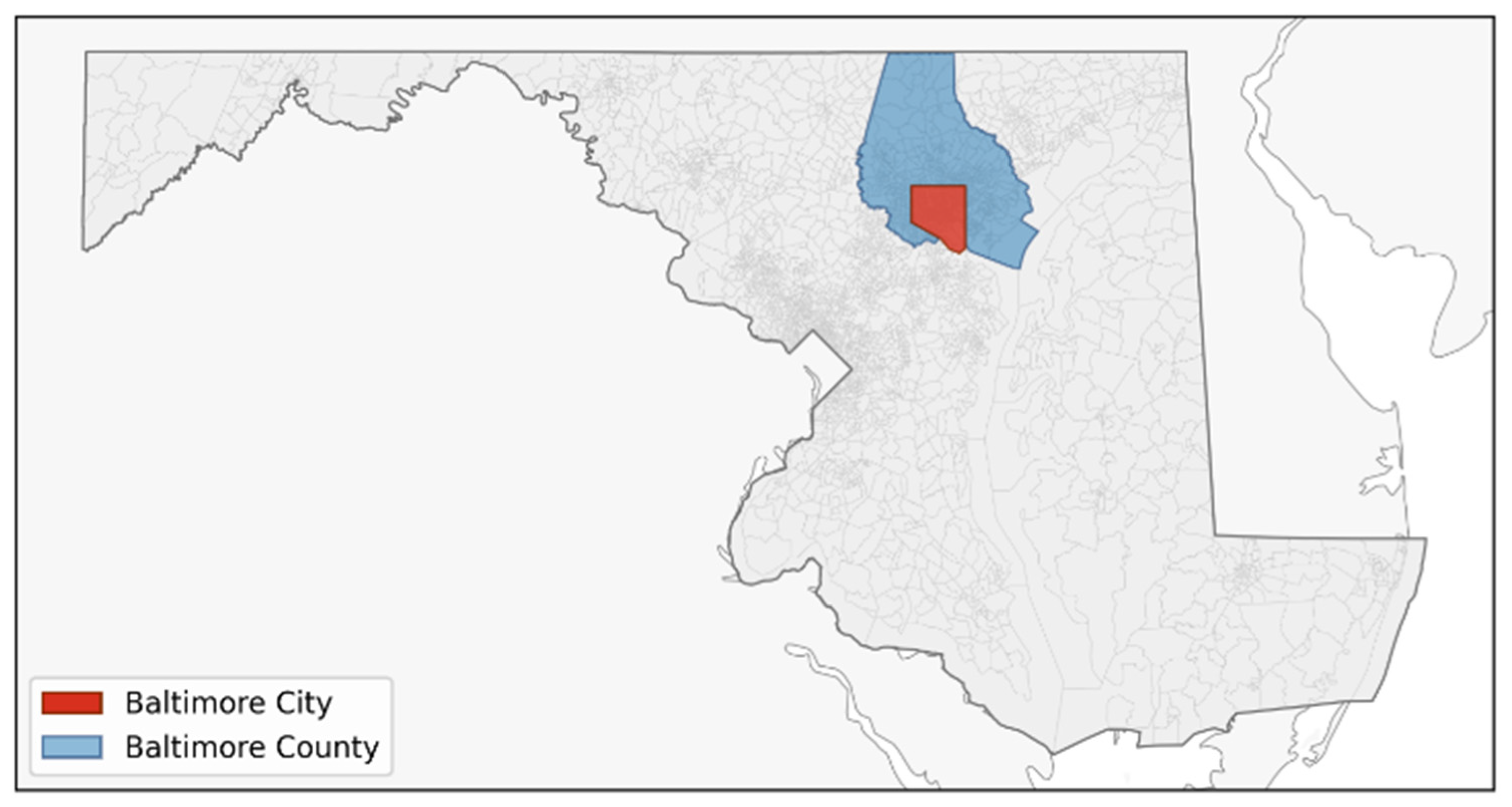
Figure 1 shows the study area—Baltimore City and Baltimore County—located in the state of Maryland, United States. Maryland lies in the Mid-Atlantic region on the U.S. East Coast. This analysis includes all CBGs within Baltimore City and Baltimore County, based on TIGER/Line 2024 CBG boundaries. Baltimore’s climate is classified as humid subtropical (Köppen Cfa), characterized by hot, humid summers; cool to cold winters; and precipitation that is relatively evenly distributed throughout the year.

2.2. Data

To estimate electricity demand at the CBGs, monthly electricity bill brackets (used to reconstruct spending), units in structure (single-family versus multifamily shares), and occupied housing units were obtained from the U.S. Census Bureau—American Community Survey (ACS) 2019–2023 (5-year) [27].
To estimate air conditioning (AC) saturation at the CBG level, we used housing composition data—specifically the proportion of single-family (SF) and multifamily (MF) units—alongside regional AC prevalence rates from the Residential Energy Consumption Survey (RECS) 2020, conducted by the U.S. Energy Information Administration (EIA). In the South Atlantic region, RECS reports that 92% of SF homes and 85% of MF homes have central or room AC [28]. These values were applied to each CBG’s SF/MF housing mix to approximate local AC saturation.
To characterize seasonal cooling demand, Cooling Degree Days (CDD) data from the National Oceanic and Atmospheric Administration (NOAA) and the National Centers for Environmental Information were used. The South Atlantic regional reference is approximately 1800 CDDs annually, while Baltimore City, represented by the BWI station, averages around 1300 CDDs [29]. Based on urban–suburban gradients observed in climate literature, Baltimore County is estimated at roughly 1200 CDDs. Additionally, the June–August (JJA) period accounts for about 65% of annual CDDs, reflecting the seasonal concentration of cooling needs.
To convert electricity bills into estimated consumption, we used a representative residential summer rate of 0.19 USD/kWh for BGE, consistent with Maryland’s average electricity prices reported by the U.S. Energy Information Administration [30].
CBG land area was calculated using the 2024 TIGER/Line shapefiles from the U.S. Census Bureau, projected in EPSG:4326 (WGS 84). The ALAND field, which represents land area in square meters, was used to compute area in square kilometers (km2).
To characterize surface conditions at the CBG level, we compiled and aggregated multiple geospatial datasets. Tree canopy coverage was derived from the 2023 National Land Cover Database (NLCD), using the mean canopy fraction per CBG [31]. Land cover fractions were calculated by aggregating NLCD 2023 classes into thematic groups, including Developed_frac (sum of developed open space, low, medium, and high intensity), Forest_frac (deciduous, evergreen, and mixed forest), Grass_frac (grassland/herbaceous), Shrub_frac (shrub/scrub), Wetland_frac (woody and emergent wetlands), Crop_frac (cultivated crops), Bare_frac (barren land), and Water_frac (open water) [32]. Impervious surface coverage was represented by impervious_pct from NLCD 2023, converted to a fractional value [33].
Topographic and hydrologic controls were extracted from the Shuttle Radar Topography Mission 10 m dataset, including elevation, slope, aspect, and topographic wetness index [34]. Climate normals (1991–2020) were obtained from the PRISM Climate Group at 800 m resolution and aggregated to the CBG scale. These included mean temperature (tmean), maximum temperature (tmax), minimum temperature (tmin), minimum and maximum vapor pressure deficit (vpdmin, vpdmax), and total precipitation [35].

2.3. Method

To estimate residential cooling electricity demand at the CBG level for Baltimore City and County, Maryland, we integrated data from the 2019–2023 American Community Survey 5-year estimates and the 2020 RECS. The methodology derives monthly cooling energy consumption (kWh) per CBG, normalizes it by land area for spatial analysis, and classifies CBGs into priority tiers based on cooling intensity, land cover characteristics, and population density.

2.3.1. Research Workflow

To improve clarity and reproducibility, the study follows the workflow below:
  • Units and harmonization: Define CBGs for Baltimore City and County (TIGER/Line version 2024), compute land area (equal-area projection), and harmonize all datasets to the CBG scale.
  • Cooling-demand reconstruction: Convert ACS monthly electricity bill brackets to kWh using rate P (Equations (1)–(3)), estimate AC saturation from RECS using CBG housing mix (Equation (4)), scale cooling share using local CDD (Equations (5)–(7)), and compute annual and summer (JJA) cooling demand and intensity (Equations (6)–(9)).
  • Sensitivity and system check: Evaluate uncertainty by varying cooling-share assumptions and bracket edges and perform a system-level sanity check against an independent residential cooling benchmark (Equation (8)).
  • Model canopy effects (explainable ML): Fit monotone-constrained XGBoost models (version 3.0.0) separately for the City and County to predict log cooling intensity from canopy and hardscape controls, apply spatially blocked cross-validation, and interpret canopy effects using SHAP dependence curves to extract policy-relevant thresholds.
  • Intervention tiers and equity overlay: Combine SHAP-derived thresholds with demand and hardscape screens to define High/Medium/Low tiers and apply the ADI overlay to highlight equity-priority locations.

2.3.2. Cooling Demand Construction from ACS Bills

To estimate electricity consumption from monthly bill brackets for occupied housing units (HUs) with individually metered electricity costs, let n j be the number of HUs in the expenditure bracket j (e.g., <USD 50, 50–99, …, 250+), with midpoints m j (USD/month, e.g., 25, 75, 125, 175, 225, 400). Total monthly expenditure per CBG is calculated as:
S m i d = j n j m j
An effective household count H U u s e d reconciles bracket sums with “charged” households (use bracket total if within 10%, else the minimum).
For CBGs lacking direct ACS data on the number of households using electricity as their primary heating fuel, tract-level estimates were apportioned using the share of occupied housing units in each CBG. Specifically, the number of electricity-heated households in each CBG, n ^ j , C B G , was estimated using Equation (2),
n ^ j , C B G = n j ,   t r a c t × o c c H U C B G C B G t r a c t o c c H U C B G
where o c c H U C B G is the number of occupied housing units in the CBG. This proportional allocation assumes that the distribution of heating fuel types within a tract is approximately uniform across its constituent block groups—a reasonable assumption in the absence of finer-scale data.
Per-HU expenditure and kWh were computed as:
S ¯ m i d   =   S m i d H U u s e d ,   K ¯ m i d   =   S ¯ m i d P ,   K t o t a l ,   m i d   =     K ¯ m i d   ×   H U u s e d
where P = 0.19   U S D / k W h is the BGE summer residential rate (2023–2025, derived from EIA and BLS data).

2.3.3. AC Saturation (RECS 2020)

To isolate cooling demand, we applied an AC saturation rate per CBG by computing SF and MF HU shares ( S S F ,   S M F ). RECS 2020 South Atlantic AC prevalence rates ( r S F = 0.92 ,   r M F = 0.85 ) were weighted by these shares, with a fallback rate of 0.89 (RECS 2020, Maryland) for CBGs with missing or invalid shares:
A C s a t = S S F r S F   + S M F r M F
This accounts for variations in AC usage by building type, critical for urban (MF-heavy) versus suburban (SF-heavy) CBGs.

2.3.4. Cooling Fraction with City–County CDD Scaling

The cooling fraction of total electricity was derived from RECS 2020’s South Atlantic estimate, with a base cooling share f b a s e = 0.28   (upper bound, conservative proxy). To reflect the local climate, we scaled this by CDD, using separate values for Baltimore City ( C D D c i t y = 1300 ) and Baltimore County ( C D D c o u n t y = 1200 ) relative to the South Atlantic average ( C D D r e g i o n = 1800 ) :
f l o c a l = c l i p f b a s e × C D D l o c a l 1800 ,   0.10 ,   0.35
Yielding f l o c a l   0.202 (city) and 0.187 (county). Cooling demand per CBG was then calculated as:
K c o o l , m i d =   K t o t a l , m i d × A C s a t × f l o c a l
Summer cooling demand (June–August, JJA) assumes 65% of annual CDD occurs in these months, averaged over three months:
K c o o l , m i d J J A   p e r   m o n t h = K c o o l , m i d × 0.65 3

2.3.5. Sensitivity Analysis and System Check

To address uncertainty in the cooling fraction, we conducted a sensitivity analysis by varying f b a s e to lower ( f l o w = 0.22 ) and upper ( f h i g h = 0.33 ) bounds reflecting RECS 2020’s 15–30% range. These bounds were scaled by the same CDD ratio derived from Equation (5):
K c o o l , l o w = K t o t a l , l o w   ×   A C s a t   ×   f l o c a l ( f l o w f b a s e ) ,   K c o o l , h i g h = K t o t a l , h i g h   ×   A C s a t   ×   f l o c a l ( f h i g h f b a s e ) ,  
where K t o t a l , l o w and K t o t a l , h i g h use expenditure bracket edges (USD 0, 50, …, 500) instead of midpoints. A system-level sanity check validated the annualized mid estimate (12 ×   K c o o l , m i d = 1,196,436,071   k W h ) with a BGE residential cooling benchmark (1.5 billion kWh, ~20% of BGE’s annual residential sales, derived from EIA 2023). The resulting 20.24% deviation is within ACS sampling error (20%) and RECS uncertainty (±5%), confirming the robustness of the methodology developed in this study. Larger deviations from the expected output would prompt review of f b a s e , CDD, or P .

2.3.6. Outcome Normalization and Controls

For spatial comparability, we normalized cooling demand by land area (from CBG shapefiles, EPSG:5070 for equal-area projection):
k W h   p e r   k m 2 = 12 K c o o l , m i d A l a n d / 10 6
where A l a n d is in square meters. This intensity metric supports regression analyses with tree canopy cover and other surface and climatic variables.

2.4. Priority CBG Identification and Tiers

To identify CBGs for urban heat mitigation, we defined a binary priority flag for CBGs meeting all five criteria: cooling energy intensity ( k W h   p e r   k m 2 ) 75th Percentile, impervious surface percentage ≥ 75th percentile, developed land percentage ≥ 75th percentile, tree canopy cover ≤ 25th percentile, and population ≥ 50th percentile.

Modeling and Explainability

The predictand, that is, cooling energy intensity at the block-group level is modeled as
y = I n 12 K c o o l A l a n d / 10 6 + ϵ
where K c o o l is the monthly, annual-average cooling kWh estimated from ACS–RECS–CDD (Methods above), and ϵ = 10 9 avoids I n ( 0 ) .
The predictors include Tree Canopy (%) (primary variable of interest), Imperviousness (%), and Developed Fraction (%) (i.e., hardscape controls).
An Extreme Gradient Boosting Regressor (XGBoost) [36] is fit to y . To isolate the marginal effect of canopy while remaining conservative, a monotone constraint is imposed on the canopy feature so that additional canopy should not increase cooling energy intensity, after controlling for hardscapes.
Hyperparameters {max_depth, n_estimators, η, subsample, colsample_bytree, λ} are tuned using GridSearchCV (scikit-learn 1.8.0) [36]. To mitigate spatial leakage and account for autocorrelation, we used spatially blocked GroupKFold with 4 × 4 blocks. Blocks were formed by projecting CBG polygons to a planar CRS, computing centroids, and binning x–y coordinates into a 4 × 4 grid; all CBGs within a block share the same fold label. Model performance is summarized using cross-validated R 2 and RMSE on the log scale.
Separate models are trained for Baltimore City and Baltimore County to allow for distinct canopy–demand response curves under different urban forms. In both cases, canopy enters first in the design matrix (to align with the constraint), followed by Imperviousness (%) and Developed Fraction (%).
After fitting the model, SHAP (TreeExplainer) values are computed. The canopy dependence curve is obtained by plotting SHAP values for canopy against Canopy (%), using Imperviousness (%) as the interaction index to visualize hardscape-conditioned effects. A LOESS smoother is fitted to the point cloud to extract two policy-relevant thresholds:
Neutral-impact canopy: The canopy level at which the LOESS-smoothed SHAP crosses zero (no net marginal effect on y ).
Diminishing-return canopy: The smallest canopy level where the absolute slope of the LOESS curve satisfies d   S H A P d   %   c a n p p y τ , with τ = 0.003 SHAP units per 1% canopy. The slope tolerance τ is used to operationalize a ‘near-flat’ region of the SHAP dependence curve, marking the point at which additional canopy produces a negligible marginal change in modeled log cooling-intensity. We set τ = 0.003 SHAP units per 1% canopy as a conservative, planning-oriented criterion, and verified that the resulting diminishing-returns breakpoint is qualitatively stable under small perturbations of τ , so conclusions and tier assignment are not driven by this single choice.
Finally, block-group intervention tiers were assigned by overlaying SHAP-derived canopy thresholds with a hardscape screen (impervious and developed ≥ 75th percentile, pooled City and County) and a demand screen (cooling energy intensity ≥ pooled 75th percentile). Eligible CBGs were labeled High/Medium using jurisdiction-specific canopy thresholds. To reflect equity and public-health need, we added an Area Deprivation Index (ADI) overlay [37] that flags the top 20% most deprived CBGs (by ADI) within each intervention tier. This highlights places where social disadvantage is greatest, and thus where canopy investments may yield the largest health co-benefits, while not excluding sparsely populated but environmentally high-need areas that still meet the tier criteria.

3. Results

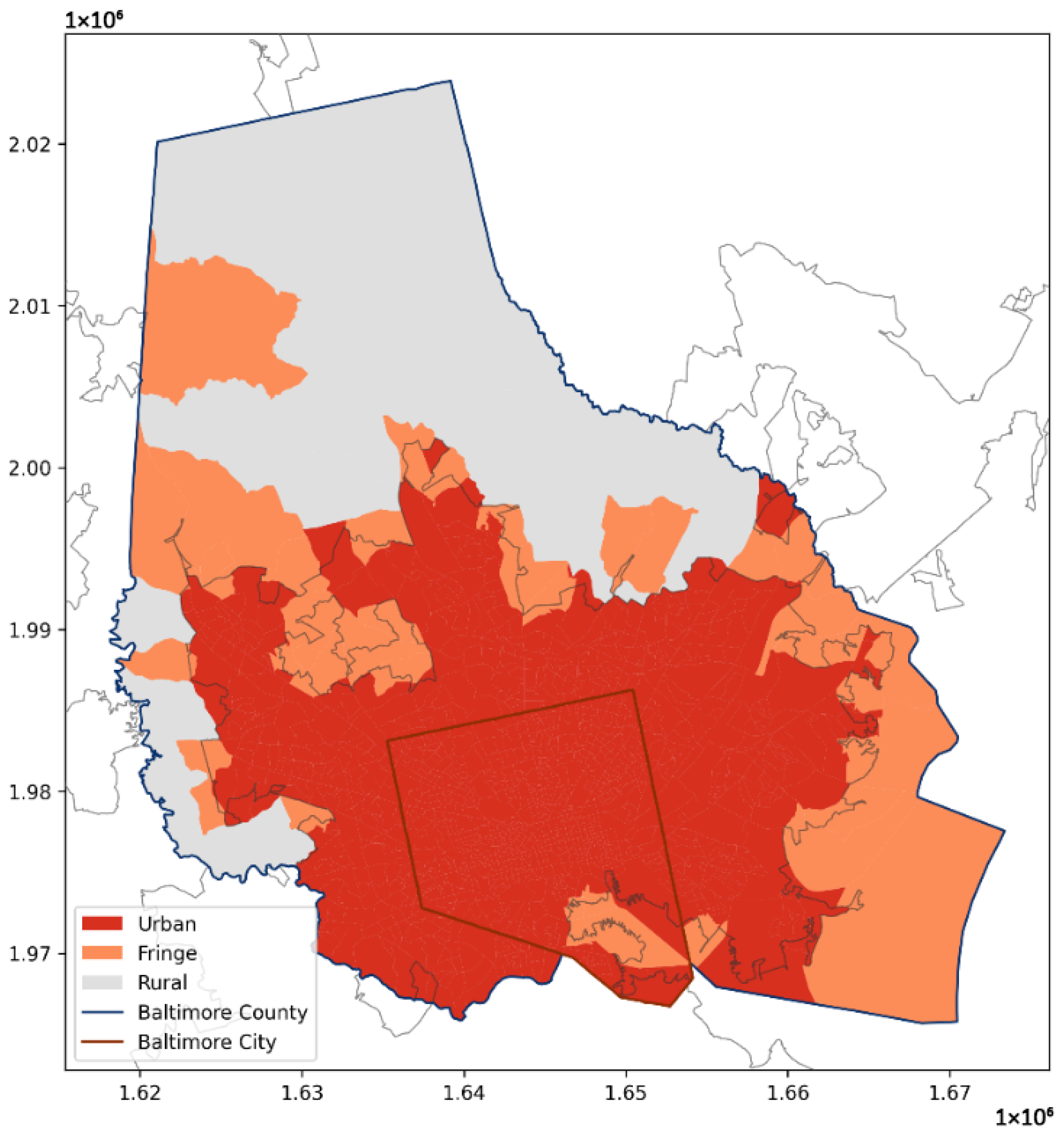
To assess the degree of urbanicity across Baltimore City and Baltimore County, we overlaid the 2020 Census Urban Area Classifications (UACs) onto CBG geometries as shown in Figure 2. UACs are defined by the U.S. Census Bureau to delineate densely developed territory with a minimum population threshold of 2500, capturing areas characterized by concentrated residential, commercial, and infrastructural development. All spatial data were reprojected to the CONUS Albers Equal Area projection (EPSG:5070) to ensure accurate area-based calculations. For each CBG, we computed the urban fraction as the proportion of its land area intersecting any UAC polygon. Based on this fraction, CBGs were classified as urban if the urban fraction was greater than or equal to 0.50, fringe if the fraction was greater than 0 but less than 0.50, and rural if the fraction was zero.
From Figure 2, in Baltimore City, nearly all CBGs are classified as urban, with 99.5% meeting the urban threshold, 0.5 percent falling into the fringe category, and none classified as rural. By land area, 91.9% of the city is urban, and 8.1% is fringe. In terms of population distribution, urban CBGs contain 99.9% of residents, while fringe areas account for only 0.1%.
In contrast, Baltimore County exhibits a more heterogeneous spatial and demographic profile. By CBG count, 88.8% are urban, 5.9% fringe, and 5.3% rural. However, when measured by land area, only 36.0% of the county is urban, with 28.7% classified as fringe and 35.4% as rural. Population distribution in the county mirrors the city’s pattern: 90.0% of residents live in urban CBGs, while fringe and rural areas account for 5.1% and 4.9%, respectively.
Although Baltimore County contains a larger proportion of fringe and rural land, the overwhelming concentration of population in urban-designated CBGs across both jurisdictions indicates the shared exposure to UHI effects on cooling energy demand. These urban-driven demands are not confined to the city core but extend across the broader metropolitan region (Figure 2).
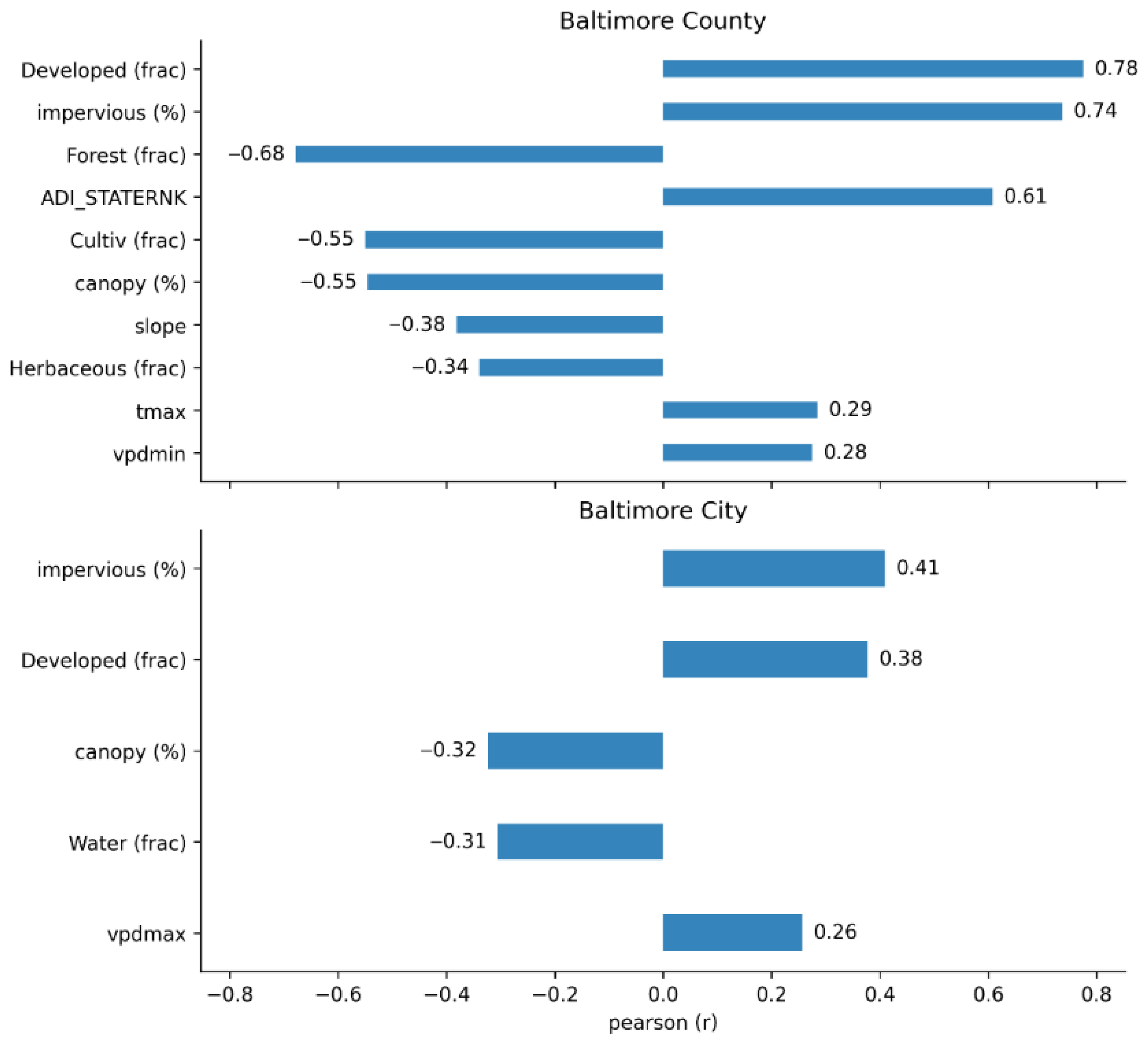
Figure 3 presents Pearson correlation coefficients between energy demand at the CBG level and a suite of environmental and socioeconomic covariates across Baltimore City and Baltimore County. Built environment indicators—specifically developed land fraction and impervious surface percentage—exhibited the strongest positive associations with energy demand, ranging from 0.38 to 0.41 in the City and 0.74 to 0.78 in the County (Figure 3). These findings reinforce that more heavily built environments tend to exhibit higher cooling energy demand, due to increased heat retention and reduced natural cooling.
Conversely, vegetative and open water land cover types—including forest, canopy, herbaceous cover, and water fraction—were consistently negatively correlated with energy demand. In Baltimore County, these correlations ranged from −0.30 to −0.68, while in the City, they were slightly weaker, between −0.31 and −0.32. Notably, canopy cover emerged as a significant inverse correlation in both regions, indicating the crucial role of urban vegetation in mitigating energy demand through shading and microclimate regulation (Figure 3).
In Baltimore County, slope also showed a negative correlation (r = −0.38, Figure 3), potentially reflecting lower development density or reduced heat accumulation in more topographically varied areas. Climatic variables such as maximum daily temperature (Tmax) and minimum vapor pressure deficit (VPDmin) were positively correlated with energy demand in the County (r = 0.29 to 0.28, Figure 3), suggesting that hotter and drier conditions may drive increased cooling needs.
In contrast, Baltimore City showed a positive correlation with maximum vapor pressure deficit (VPDmax, r = 0.26, Figure 3). In dense urban cores, high VPDmax often co-occurs with low canopy, high imperviousness, and strong UHI effects. Thus, VPDmax likely serves as a proxy for extreme afternoon heat stress in dense urban areas, where low humidity and high surface temperatures jointly elevate cooling demand.
Interestingly, energy demand in Baltimore County showed a statistically significant positive correlation with socioeconomic deprivation, measured by ADI (r = 0.61, Figure 3), suggesting that more disadvantaged populations in the County experience relatively higher cooling-related energy demand. This may reflect a combination of factors, including lower housing quality, limited access to passive cooling infrastructure (e.g., tree canopy or ventilation), and greater exposure to heat-retaining built environments.
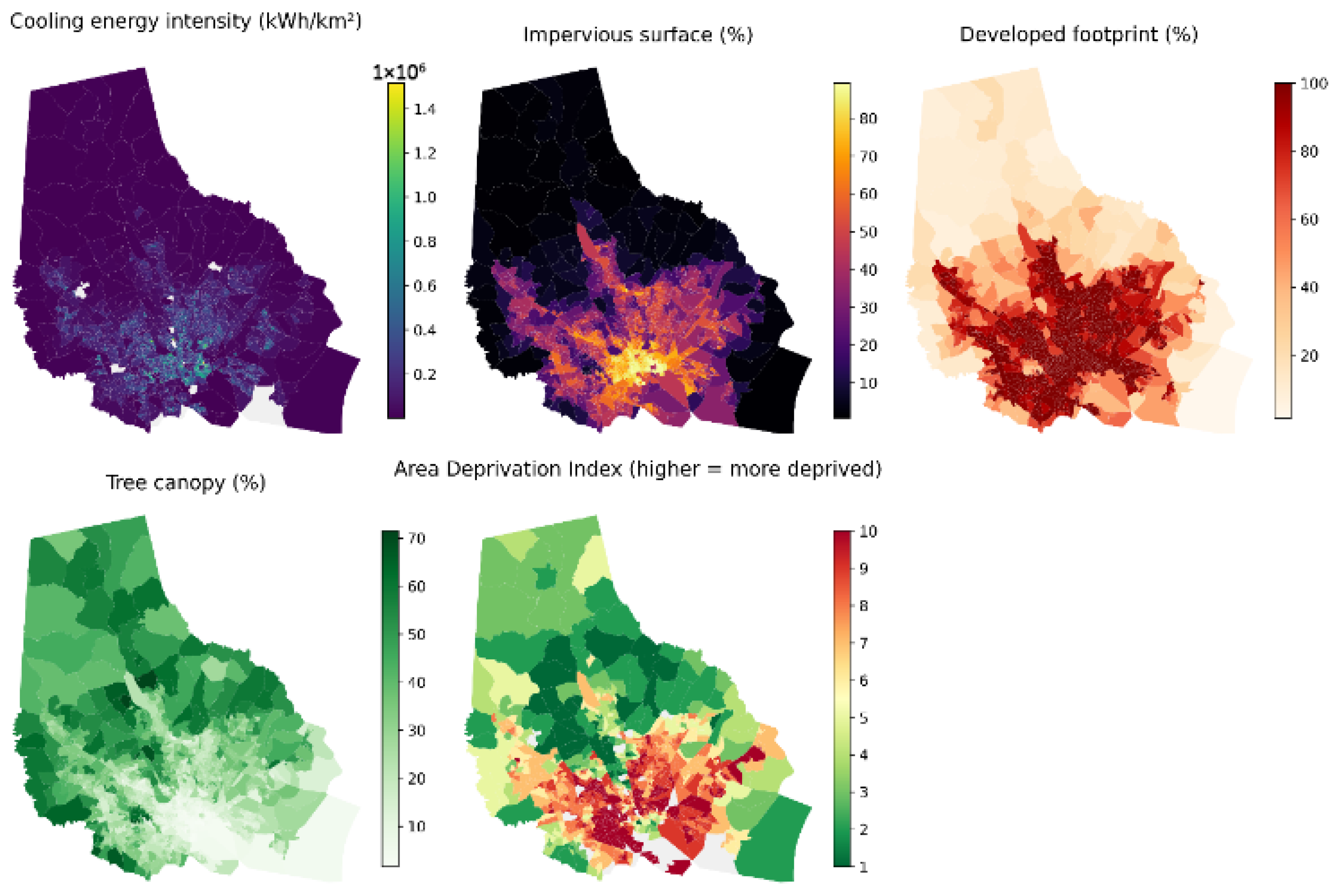
Figure 4 illustrates the spatial distribution of key environmental and socioeconomic variables across Baltimore City and County, including impervious surface percentage, developed land fraction, cooling energy intensity, tree canopy coverage, and ADI. The maps reveal a pronounced concentration of hardscaped surfaces—characterized by high imperviousness and dense development—in southern Baltimore, particularly within the urban core of the City. These areas coincide with elevated cooling energy intensity, reflecting increased demand for air conditioning, likely driven by UHI effects and limited natural shading.
Tree canopy coverage is notably sparse in these same regions, reinforcing the link between reduced vegetative cover and heightened thermal exposure. The ADI map further highlights that many of these high-demand, low-canopy zones are also among the most socioeconomically deprived, suggesting compounded vulnerability to heat stress and energy burden. In contrast, peripheral areas in Baltimore County exhibit lower impervious surface percentages, greater canopy cover, and reduced cooling energy intensity, indicating more favorable microclimatic conditions and potentially lower exposure to heat-related energy costs. Together, these spatial patterns reinforce the correlations in Figure 3 and highlight the intersection of built environment, ecological infrastructure, and social vulnerability—pointing to priority zones for targeted cooling interventions, tree planting, and equitable energy resilience planning.
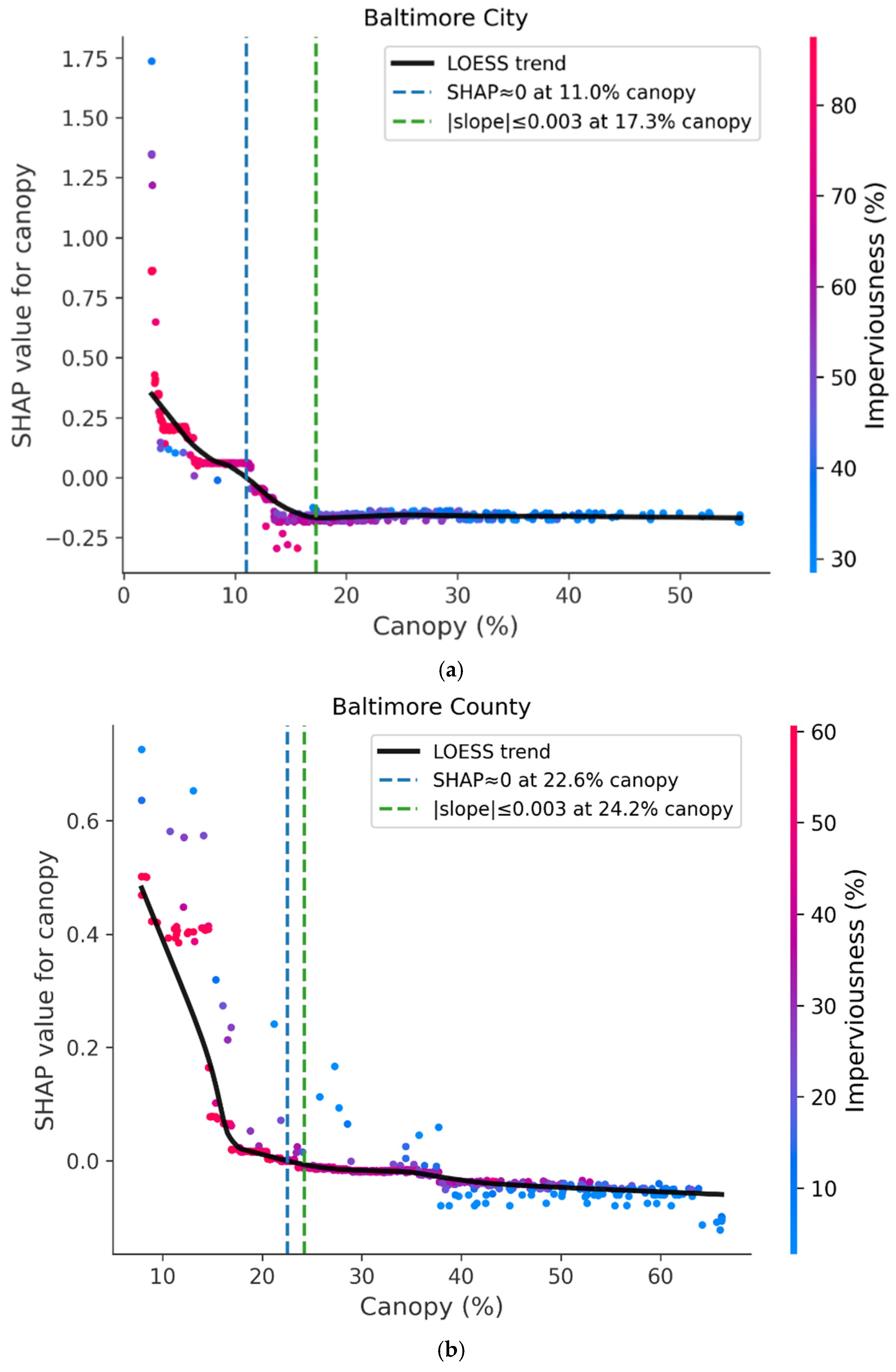
Using monotone gradient-boosted models (XGBoost; canopy constrained non-increasing) with controls for imperviousness and developed land, the cooling-demand response to increases in tree canopy and the implied intervention targets are shown in Figure 5. The black line shows a LOESS-smoothed SHAP dependence trend for canopy. The blue dashed vertical line marks the neutral-impact threshold where canopy begins to reduce cooling demand. The green dashed vertical line indicates the diminishing-returns point where additional canopy provides minimal further reduction (|slope| ≤ 0.003 at 24.2%). In Baltimore City, the SHAP canopy–response curve crosses zero at ~11% canopy and flattens by ~17–18%, indicating that marginal energy-reduction benefits are strongest as canopy is raised up to ~11%, with diminishing additional gains beyond that level. In Baltimore County, the neutral point is ~22–23% with diminishing returns by ~24%, a higher threshold consistent with the county’s generally lower imperviousness; these jurisdiction-specific breakpoints anchor our high/medium intervention targets. Also, notably, from Figure 4, low-impervious county areas show renewed demand reductions at very high canopy (>55–60%), consistent with forest-dominated microclimates.
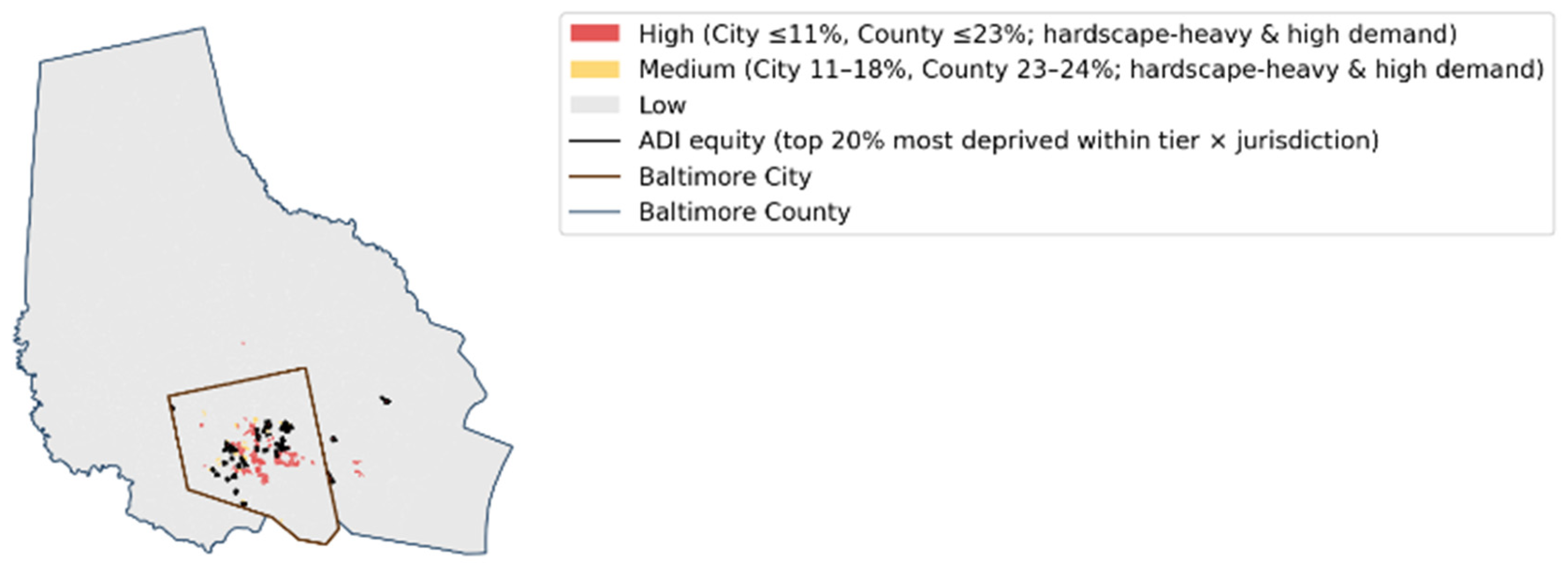
Figure 6 shows the canopy breakpoints together with hardscape and demand screens to map intervention tiers. In Baltimore City, 130 CBGs were classified as High (21.0%) and 23 as Medium (3.7%). In Baltimore County, 7 CBGs were High (1.2%), and none were Medium. The remainder were Low, either because they fail the hardscape/demand screen or because they already meet the canopy targets (i.e., above the jurisdictional breakpoints: ≥~18% in the City; ≥~24% in the County), implying a maintenance rather than expansion need. Adding the ADI equity overlay (top-20% most deprived within each tier and jurisdiction) highlights 43 of the City’s High-tier CBGs (33.1% of High; 7.0% of all City CBGs) and 3 of the County’s High-tier CBGs (42.9% of High; 0.5% of all County CBGs). Spatially, City priorities form a broad, contiguous band; County priorities are fewer and more clustered, with the equity overlay pinpointing where benefits would reach residents facing the greatest socioeconomic disadvantage.
Concerning canopy attainment by jurisdiction, in Baltimore City, 39.0% of block groups already meet the canopy target (≥18%), while 61.0% are below it. Within the shortfall, 37.5% are in a very-low band (≤11%) and 23.5% lie in the 11–18% near-threshold band. These results indicate substantial room to reduce cooling demand through tree planting, especially in the ≤11% regions, with additional gains likely from nudging 11–18% areas over the 18% breakpoint.
In Baltimore County, the pattern is reversed: 72.8% of block groups already meet the higher county target (≥24%), and 27.2% fall below it. Only 2.1% fall just below the target (23–24%), while 25.1% are at ≤23% canopy. This points to a more targeted need for action, including focused infill in the limited pockets under 23% (and the small 23–24% group), prioritizing locations that also intersect hardscape, high-demand, and ADI equity screens as shown in Figure 6.
These tiers translate the canopy–demand response into a practical decision map that guides where and how canopy expansion should be prioritized. High-tier CBGs represent places where (i) cooling demand is high, (ii) hardscape intensity is high, and (iii) canopy is below the jurisdiction-specific threshold—conditions under which canopy expansion is expected to yield the largest marginal demand reductions. Medium-tier CBGs fall near the canopy threshold and may benefit from targeted infill or complementary measures (e.g., cool roofs, high-albedo pavements, envelope retrofits, and demand response) where planting space is limited. CBGs classified as Low either already meet canopy targets or do not satisfy the combined demand/hardscape screens, implying that the maintenance of existing canopy and broader heat-resilience measures may be more appropriate than large canopy expansion. The ADI outlines further indicate where these interventions align with social vulnerability, helping prioritize actions that jointly reduce cooling burden and improve heat safety for disadvantaged residents.

4. Discussion

This study provides neighborhood-scale evidence that urban greening can function as high-leverage cooling-demand infrastructure, complementing established findings that trees reduce urban heat and household energy use through shading and evapotranspiration [38,39,40]. Moving beyond general associations, our results identify jurisdiction-specific canopy breakpoints that indicate where marginal cooling-demand reductions are strongest and where returns begin to flatten. In Baltimore City, most block groups remain below the canopy effectiveness range, with a large share in the very-low band (≤11%), implying substantial “headroom” for demand reduction through nature-based solutions. In Baltimore County, by contrast, priority need is concentrated in fewer pockets below a higher neutral threshold (~23–24%), consistent with the county’s lower baseline hardscape intensity (Figure 6).

4.1. What Is New Relative to Prior Research?

A key contribution of this paper is translating canopy–heat insights into actionable neighborhood energy planning. Prior studies often evaluate greening benefits using citywide averages, census tracts, or land-surface temperature proxies, which can mask within-city heterogeneity and do not directly yield operational thresholds for targeting interventions [10,11,19,20,21,22]. Our framework advances this literature in three ways.
First, we estimate cooling-season electricity demand at the CBG scale, a resolution better aligned with inequities in canopy access and heat exposure shaped by historical segregation and uneven greening [6,7,41,42,43]. Second, we use a monotone-constrained gradient-boosted model so that, conditional on hardscape controls, increased canopy is not permitted to increase modeled cooling intensity—an intentionally conservative design that helps isolate canopy’s marginal role in a policy-facing context. Third, by extracting SHAP-derived breakpoints and combining them with demand and hardscape screens, we move from explanation to prioritization, producing intervention tiers that can be directly used by planners and utilities (Figure 6) [17,41]. Together, these elements define a replicable approach for aligning canopy investments with energy relief and equity objectives.

4.2. Why Do Thresholds Differ Between City and County?

The observed differences in canopy breakpoints between Baltimore City (~11% neutral; ~18% diminishing returns) and Baltimore County (~23% neutral; ~24% diminishing returns) are consistent with the idea that canopy benefits are context-dependent and shaped by background urban form and hardscape intensity [18]. In denser, more impervious settings, a modest increase in canopy can quickly improve shading and microclimate conditions, whereas additional canopy may face diminishing returns once shade and evapotranspiration effects saturate relative to persistent hardscape heat storage. In the County, where baseline imperviousness is generally lower, and vegetation is higher, canopy may need to reach a higher level before yielding detectable marginal reductions in cooling demand at the CBG scale, and the intervention need becomes more localized to those pockets where hardscapes and demand remain high.

4.3. Social, Environmental, and Economic “Security” Implications

The results support framing heat adaptation as a multidimensional security challenge—social, environmental, and economic—where tree canopy can deliver co-benefits that extend beyond temperature reduction. These include the following:
Social/public-health security: Targeting low-canopy, high-demand neighborhoods can reduce heat exposure and cooling burden where vulnerability is highest, aligning with evidence that heat risk and canopy access are unequally distributed and often reflect structural drivers [6,7,42,43].
Environmental security: Urban trees provide ecosystem services that reinforce broader resilience goals—stormwater regulation, air-quality improvement, and biodiversity support—making canopy investments a multifunctional strategy rather than a single-purpose intervention [44,45]. This is particularly relevant where climate extremes increase compound risks (heat, flooding, degraded air quality).
Economic/energy security: Cooling-demand spikes stress power systems during heat events; therefore, reducing peak cooling intensity can support grid reliability and reduce the need for costly capacity expansion [38,39,40]. Because the framework identifies where marginal benefits are largest, it can improve the cost-effectiveness of investments by concentrating resources in high-leverage block groups (Figure 6) [17,41].

4.4. Practical Recommendations for Implementation

The intervention tiers (Figure 6) imply differentiated actions rather than one-size-fits-all canopy goals.
High-tier CBGs (high demand + high hardscape + below canopy breakpoint): Prioritize canopy expansion and near-term heat relief. In these areas, planting should be paired with site design that maximizes survivability and canopy growth (soil volume, stormwater capture, irrigation during establishment) and focuses on shade where exposure is highest (street corridors, transit stops, school zones, dense residential blocks).
Medium-tier CBGs (near breakpoint): Implement targeted infill planting to push canopy above the jurisdiction-specific breakpoint, while using complementary cooling measures where planting space is constrained—cool roofs, reflective pavements, and building-envelope retrofits [46,47].
Low-tier CBGs (meet targets or fail screens): Emphasize maintenance, protection of existing canopy, and monitoring; for areas that fail the demand/hardscape screens, prioritize broader resilience measures and heat preparedness rather than large canopy expansion.
Across tiers, the ADI overlay highlights where interventions are most likely to yield equity-relevant co-benefits, helping ensure that canopy investments reduce heat burden and improve thermal comfort for disadvantaged residents rather than reinforcing existing disparities [42,43].

4.5. Limitations and Future Work

Several limitations merit discussion. First, cooling demand is reconstructed from ACS monthly electricity bill brackets and regional AC prevalence and therefore cannot resolve all household-level heterogeneity in building stock, occupancy, behavior, or equipment efficiency. While the system-level benchmark and sensitivity analysis support overall robustness, residual uncertainty likely remains at fine spatial scales. Relatedly, our AC saturation term captures AC presence rather than efficiency or building-envelope performance; if high-ADI neighborhoods have older, less efficient units or poorer insulation, reconstructed cooling kWh may underestimate true demand and peak stress, making the equity-priority screening conservative. Because building vintage and envelope efficiency are not explicitly modeled, reconstructed cooling kWh may be biased in older, poorly insulated housing areas; future work will incorporate parcel-level/vintage indicators to capture this key driver.
Second, ACS reports expenditures rather than kWh and does not include tariff details (e.g., fixed customer charges, riders, or tiered pricing). Converting bills to consumption using a single representative rate (0.19 USD/kWh) should therefore be interpreted as an effective average price and may bias absolute kWh estimates, although relative spatial contrasts and tier classification should be less sensitive to moderate rate variation.
Third, our CDD-based scaling localizes the cooling fraction using climate differences, but it does not explicitly decompose total household electricity into a seasonally stable base load (appliances, lighting, plug loads) and a temperature-sensitive cooling component. As a result, the reconstructed cooling kWh should be interpreted as an effective attribution rather than a direct meter-measured cooling load, and absolute levels may be biased where non-cooling electricity use differs systematically across neighborhoods. Future work will implement a two-component load model (baseline + temperature-sensitive term) using degree-day or change-point approaches and, where feasible, interval utility/smart-meter data to better isolate cooling-specific demand.
Fourth, SHAP-based canopy thresholds provide policy-relevant guidance but are not strict causal estimates and could shift under alternative model specifications or under future changes in electricity prices, electrification, or AC adoption [48].
Fifth, we impose a monotone non-increasing constraint on canopy to reflect the expected cooling mechanism and to obtain conservative, policy-stable marginal effects. However, this constraint can mask potential non-monotone pathways—particularly in humid conditions where added vegetation may increase near-surface moisture and wet-bulb temperature, potentially raising perceived heat stress or latent cooling loads in some settings. Future work will test unconstrained and partially constrained models and explicitly incorporate humidity/heat-stress variables (e.g., dew point, wet-bulb/heat index) and canopy–humidity interactions to assess whether canopy effects become locally non-monotonic.
Sixth, ADI captures neighborhood deprivation but cannot fully represent lived vulnerability, adaptive capacity, or local stewardship conditions. Future work could integrate parcel-level building characteristics (e.g., age, insulation, HVAC efficiency proxies), longitudinal canopy-change data, and community-informed stewardship indicators to refine thresholds and strengthen implementation pathways.

5. Conclusions

To support sustainable and equitable energy planning under urban heat, this study introduced a CBG-scale framework for estimating cooling-season electricity demand across Baltimore City and Baltimore County and for translating canopy–demand relationships into actionable intervention guidance. We combined (i) a demand-reconstruction approach based on ACS bill brackets, RECS AC prevalence, and local CDD scaling, with (ii) explainable monotone gradient-boosted models that isolate canopy’s marginal association with cooling demand while controlling for hardscapes, and (iii) a tiered prioritization scheme that integrates demand intensity, imperviousness/development screens, and an ADI equity overlay.
Key findings were fourfold. First, hardscape intensity is a dominant driver of cooling demand: imperviousness and developed fraction are positively associated with cooling energy intensity, while tree canopy and other vegetated or water cover types are negatively associated. Second, canopy benefits are nonlinear and locally contingent: the monotone explainable models indicate a neutral-impact canopy threshold of ~11% in Baltimore City and ~23% in Baltimore County, with diminishing returns beyond ~18% (City) and ~24% (County). Third, a large share of City block groups remain below effective canopy ranges (61% below 18%, including 37.5% at ≤11%), indicating substantial opportunity for demand reduction through targeted canopy expansion, whereas County needs are concentrated in fewer pockets (27.2% below 24%). Fourth, integrating canopy thresholds with demand and hardscape screens yields clear intervention priorities: 130 City CBGs (21.0%) and 7 County CBGs (1.2%) are classified as High priority, and the ADI overlay highlights where these actions align with social vulnerability and likely deliver the greatest health and equity co-benefits.

5.1. Contribution to Theory and Practice

Theoretically, the study advances urban-heat and greening research by demonstrating that canopy–demand relationships exhibit threshold behavior that varies by urban form and hardscape context, and by operationalizing these nonlinearities into jurisdiction-specific targets. Practically, the framework provides planners and utilities with a replicable, neighborhood-scale decision method that links canopy investments to energy relief and heat equity, rather than relying on generic citywide canopy goals.

5.2. Recommendations

For implementation, High-tier neighborhoods should be prioritized for canopy expansion and near-term heat relief, with design choices that maximize survival and shading benefits and with coordinated complementary measures in space-limited settings (cool roofs, reflective pavements, and building-efficiency retrofits). Medium-tier areas can benefit from targeted infill to cross the canopy breakpoint, while Low-tier areas should emphasize canopy protection, maintenance, and monitoring. The ADI overlay can guide equity-informed sequencing so that interventions reduce heat burden and cooling costs for residents facing the highest socioeconomic disadvantage.
Overall, the results indicate that evidence-tuned, equity-aware urban forestry can function as multifunctional climate infrastructure—supporting public-health protection, environmental resilience, and energy-system reliability—while providing a transparent planning tool that can be adapted to other cities using commonly available datasets.

Author Contributions

Conceptualization, C.C.I.; methodology, C.C.I.; software, C.C.I.; validation, C.C.I. and C.N.; formal analysis, C.C.I.; investigation, C.C.I. and C.N.; resources, C.C.I.; data curation, C.C.I.; writing—original draft preparation, C.C.I.; writing—review and editing, C.C.I. and C.N.; visualization, C.C.I. and C.N.; supervision, C.C.I.; project administration, C.C.I.; funding acquisition, C.C.I. All authors have read and agreed to the published version of the manuscript.

Funding

This research received no external funding.

Institutional Review Board Statement

Not applicable.

Informed Consent Statement

Not applicable.

Data Availability Statement

American Community Survey (ACS) data used in this study are publicly available from the U.S. Census Bureau at https://data.census.gov (accessed on 23 June 2025).

Conflicts of Interest

The authors declare no conflicts of interest.

References

  1. Li, H.; Zhao, Y.; Bardhan, R.; Chan, P.W.; Derome, D.; Luo, Z.; Ürge-Vorsatz, D.; Carmeliet, J.C. Relating three-decade surge in space cooling demand to urban warming. Environ. Res. Lett. 2023, 18, 124033. [Google Scholar] [CrossRef]
  2. Abdollahzadeh, N.; Biloria, N. Urban microclimate and energy consumption: A multi-objective parametric urban design approach for dense subtropical cities. Front. Archit. Res. 2022, 11, 453–465. [Google Scholar] [CrossRef]
  3. Harish, S.; Singh, N.; Tongia, R. Impact of temperature on electricity demand: Evidence from Delhi and Indian states. Energy Policy 2020, 140, 111445. [Google Scholar] [CrossRef]
  4. Joshi, K.; Khan, A.; Anand, P.; Sen, J. Understanding the synergy between heat waves and the built environment: A three-decade systematic review informing policies for mitigating urban heat island in cities. Sustain. Earth Rev. 2024, 7, 25. [Google Scholar] [CrossRef]
  5. Golden, J.S. The built environment induced urban heat island effect in rapidly urbanizing arid regions–a sustainable urban engineering complexity. Environ. Sci. 2004, 1, 321–349. [Google Scholar] [CrossRef]
  6. Chuang, W.C.; Boone, C.G.; Locke, D.H.; Grove, J.M.; Whitmer, A.; Buckley, G.; Zhang, S. Tree canopy change and neighborhood stability: A comparative analysis of Washington, DC and Baltimore, MD. Urban For. Urban Green. 2017, 27, 363–372. [Google Scholar] [CrossRef]
  7. Locke, D.H.; Hall, B.; Grove, J.M.; Pickett, S.T.A.; Ogden, L.A.; Aoki, C.; Boone, C.G.; O’nEil-Dunne, J.P.M. Residential housing segregation and urban tree canopy in 37 US Cities. Npj Urban Sustain. 2021, 1, 15. [Google Scholar] [CrossRef]
  8. Ibebuchi, C.C.; Lee, C.C.; Sheridan, S.C. Recent trends in extreme temperature events across the contiguous United States. Int. J. Climatol. 2025, 45, e8693. [Google Scholar] [CrossRef]
  9. Croft, D.P.; Lee, A.; Nordgren, T.M.; Jackson, C.L.; Bayram, H.; Balmes, J.R.; Nassikas, N.; Ewart, G.; Rice, M.B.; Benmarhnia, T.; et al. Climate Change and Respiratory Health: Opportunities to Contribute to Environmental Justice: An Official American Thoracic Society Workshop Report. Ann. Am. Thorac. Soc. 2025, 22, 631–650. [Google Scholar] [CrossRef] [PubMed]
  10. Yin, Y.; Li, S.; Xing, X.; Zhou, X.; Kang, Y.; Hu, Q.; Li, Y. Cooling benefits of urban tree canopy: A systematic review. Sustainability 2024, 16, 4955. [Google Scholar] [CrossRef]
  11. Locke, D.H.; Baker, M.; Alonzo, M.; Yang, Y.; Ziter, C.D.; Murphy-Dunning, C.; O’Neil-Dunne, J.P. Variation the in relationship between urban tree canopy and air temperature reduction under a range of daily weather conditions. Heliyon 2024, 10, e25041. [Google Scholar] [CrossRef]
  12. U.S. Environmental Protection Agency. Reducing Urban Heat Islands: Compendium of Strategies. Draft. 2008. Available online: https://www.epa.gov/heat-islands/heat-island-compendium (accessed on 14 January 2025).
  13. Shickman, K.; Rogers, M. Capturing the true value of trees, cool roofs, and other urban heat island mitigation strategies for utilities. Energy Effic. 2020, 13, 407–418. [Google Scholar] [CrossRef]
  14. Ralls, C.; Polyakov, A.Y.; Shandas, V. Scale-Dependent Effects of Urban Canopy Cover, Canopy Volume, and Impervious Surfaces on Near-Surface Air Temperature in a Mid-Sized City. Land 2024, 13, 1741. [Google Scholar] [CrossRef]
  15. Wachs, L.; Singh, S. Projecting the urban energy demand for Indiana, USA, in 2050 and 2080. Clim. Change 2020, 163, 1949–1966. [Google Scholar] [CrossRef]
  16. Tamaskani Esfehankalateh, A.; Ngarambe, J.; Yun, G.Y. Influence of tree canopy coverage and leaf area density on urban heat island mitigation. Sustainability 2021, 13, 7496. [Google Scholar] [CrossRef]
  17. Grove, J.M.; Locke, D. Urban Tree Canopy Prioritization (UTC): Experience from Baltimore. Nat. Preced. 2011, 1. [Google Scholar] [CrossRef]
  18. Alonzo, M.; Baker, M.E.; Gao, Y.; Shandas, V. Spatial configuration and time of day impact the magnitude of urban tree canopy cooling. Environ. Res. Lett. 2021, 16, 084028. [Google Scholar] [CrossRef]
  19. Wilkening, J.V.; Feng, X. Canopy temperature reveals disparities in urban tree benefits. AGU Adv. 2025, 6, e2024AV001438. [Google Scholar] [CrossRef]
  20. Nazish, A.; Abbas, K.; Sattar, E. Health impact of urban green spaces: A systematic review of heat-related morbidity and mortality. BMJ Open 2024, 14, e081632. [Google Scholar] [CrossRef]
  21. Nath, B.; Ni-Meister, W.; Özdoğan, M. Fine-scale urban heat patterns in New York city measured by ASTER satellite—The role of complex spatial structures. Remote Sens. 2021, 13, 3797. [Google Scholar] [CrossRef]
  22. Wilson, B.; Kashem, S.B.; Slonim, L. Modeling the relationship between urban tree canopy, landscape heterogeneity, and land surface temperature: A machine learning approach. Environ. Plan. B Urban Anal. City Sci. 2024, 51, 1895–1912. [Google Scholar] [CrossRef]
  23. Chomać-Pierzecka, E. Economic, Environmental and Social Security in accordance with the Concept of Sustainable Development. Stud. Adm. Bezpiecz 2025, 18, 257–272. [Google Scholar] [CrossRef]
  24. Bowers Ashley, A.; Gilder-Busatti Amy, L.; Lautar Katherine, J. Preservation, Regulations, and Policy to Protect and Grow Baltimore’s Forests. Cities Environ. (CATE) 2020, 13, 22. [Google Scholar] [CrossRef]
  25. Roberts, A. Urban Street Tree Priorities for Baltimore City’s Watershed 263. 2008. Available online: http://jhir.library.jhu.edu/handle/1774.2/34158 (accessed on 14 January 2025).
  26. Anderson, E.C.; Avolio, M.L.; Sonti, N.F.; LaDeau, S.L. More than green: Tree structure and biodiversity patterns differ across canopy change regimes in Baltimore’s urban forest. Urban For. Urban Green. 2021, 65, 127365. [Google Scholar] [CrossRef]
  27. U.S. Census Bureau. American Community Survey 5-Year Estimates, 2019–2023; U.S. Department of Commerce: Washington, DC, USA, 2024. Available online: https://data.census.gov/ (accessed on 28 May 2025).
  28. U.S. Energy Information Administration. Residential Energy Consumption Survey (RECS) 2020: Air Conditioning Prevalence by Housing Type and Region; U.S. Department of Energy: Washington, DC, USA, 2022. Available online: https://www.eia.gov/consumption/residential/ (accessed on 14 January 2025).
  29. National Oceanic and Atmospheric Administration. Climate at a Glance: County Mapping—Cooling Degree Days, January–August 2025; National Centers for Environmental Information: Washington, DC, USA, 2025. Available online: https://www.ncei.noaa.gov/access/monitoring/climate-at-a-glance/county/mapping (accessed on 28 May 2025).
  30. U.S. Energy Information Administration. Electric Power Monthly: Table 5.6.A—Average Retail Price of Electricity to Ultimate Customers by End-Use Sector; U.S. Department of Energy: Washington, DC, USA, 2025. Available online: https://www.eia.gov/electricity/monthly/ (accessed on 28 May 2025).
  31. U.S. Geological Survey. National Land Cover Database (NLCD) 2023 Tree Canopy Cover; U.S. Department of the Interior: Washington, DC, USA, 2024. Available online: https://www.mrlc.gov/data (accessed on 14 April 2025).
  32. U.S. Geological Survey. National Land Cover Database (NLCD) 2023 Land Cover; U.S. Department of the Interior: Washington, DC, USA, 2024. Available online: https://www.mrlc.gov/data (accessed on 14 April 2025).
  33. U.S. Geological Survey. NLCD 2023 Impervious Surface; U.S. Department of the Interior: Washington, DC, USA, 2024. Available online: https://www.mrlc.gov/data (accessed on 28 May 2025).
  34. NASA JPL. SRTM Global 1 Arc-Second Elevation Data; NASA Jet Propulsion Laboratory: Pasadena, CA, USA, 2023. Available online: https://earthexplorer.usgs.gov/ (accessed on 28 May 2025).
  35. PRISM Climate Group. PRISM 30-Year Climate Normals (1991–2020); Oregon State University: Corvallis, OR, USA, 2024; Available online: https://prism.oregonstate.edu (accessed on 28 May 2025).
  36. Ibebuchi, C.C. Day-Ahead Energy Price Forecasting with Machine Learning: Role of Endogenous Predictors. Forecasting 2025, 7, 18. [Google Scholar] [CrossRef]
  37. Kind, A.J.H.; Buckingham, W.R. Making neighborhood-disadvantage metrics accessible—The Neighborhood Atlas. N. Engl. J. Med. 2018, 378, 2456–2458. [Google Scholar] [CrossRef] [PubMed]
  38. Akbari, H. Energy Saving Potentials and Air Quality Benefits of Urban Heat Island Mitigation; Lawrence Berkeley National Laboratory (LBNL-58285), U.S. Department of Energy: Berkeley, CA, USA, 2005.
  39. Simpson, J.R.; McPherson, E.G. Potential of tree shade for reducing residential energy use in California. J. Arboric. 1996, 22, 10–18. [Google Scholar] [CrossRef]
  40. Meili, N.; Zheng, X.; Takane, Y.; Nakajima, K.; Yamaguchi, K.; Chi, D.; Zhu, Y.; Wang, J.; Qiu, Y.; Paschalis, A. Modeling the effect of trees on energy demand for indoor cooling and dehumidification across cities and climates. J. Adv. Model. Earth Syst. 2025, 17, E2024MS004590. [Google Scholar] [CrossRef]
  41. Venter, Z.S.; Krog, N.H.; Barton, D.N. Linking green infrastructure to urban heat and human health risk mitigation in Oslo, Norway. Sci. Total Environ. 2020, 709, 136193. [Google Scholar] [CrossRef]
  42. Ibebuchi, C.C.; Abu, I.-O. Threefold Environmental Inequality: Canopy Cover, Deprivation, and Cancer-Risk Burdens Across Baltimore Neighborhoods. World 2026, 7, 6. [Google Scholar] [CrossRef]
  43. Jesdale, B.M.; Morello-Frosch, R.; Cushing, L. The racial/ethnic distribution of heat risk–related land cover in relation to residential segregation. Environ. Health Perspect. 2013, 121, 811–817. [Google Scholar] [CrossRef]
  44. Xu, M.; Ding, L. Ecosystem Service Assessment of Campus Street Trees for Urban Resilience: A Case Study from Guangxi Arts University. Forests 2025, 16, 1465. [Google Scholar] [CrossRef]
  45. Roeland, S.; Moretti, M.; Amorim, J.H.; Branquinho, C.; Fares, S.; Morelli, F.; Niinemets, Ü.; Paoletti, E.; Pinho, P.; Sgrigna, G.; et al. Towards an integrative approach to evaluate the environmental ecosystem services provided by urban forest. J. For. Res. 2019, 30, 1981–1996. [Google Scholar] [CrossRef]
  46. Akbari, H.; Matthews, H.D. Global cooling updates: Reflective roofs and pavements. Energy Build. 2012, 55, 2–6. [Google Scholar] [CrossRef]
  47. Wang, C.; Wang, Z.H.; Kaloush, K.E.; Shacat, J. Cool pavements for urban heat island mitigation: A synthetic review. Renew. Sustain. Energy Rev. 2021, 146, 111171. [Google Scholar] [CrossRef]
  48. Ibebuchi, C.C. Uncertainty in machine learning feature importance for climate science: A comparative analysis of SHAP, PDP, and gain-based methods. Theor. Appl. Climatol. 2025, 156, 476. [Google Scholar] [CrossRef]
Figure 1. Study area showing the Census Block Groups in Maryland, US, and the location of Baltimore City and Baltimore County in the state of Maryland.
Urbansci 10 00061 g001
Figure 2. Classification of urbanicity in Baltimore using 2020 Census Urban Area Classifications.
Urbansci 10 00061 g002
Figure 3. Pearson correlations between covariates and cooling demand in Baltimore Census Block Groups. Only statistically significant correlations at 95% confidence level were reported.
Urbansci 10 00061 g003
Figure 4. Spatial patterns of cooling energy demand; impervious surface, developed footprint, and tree canopy percentages; and ADI across CBGs in Baltimore.
Urbansci 10 00061 g004
Figure 5. Cooling-demand response to increases in tree canopy using monotone gradient-boosted models (canopy constrained non-increasing) with controls for imperviousness and developed land in Baltimore City (a) and County (b). Each dot represents CBG, colored by impervious surface percentage.
Urbansci 10 00061 g005
Figure 6. Intervention priority tiers for cooling-energy relief in Baltimore City and Baltimore County, based on canopy thresholds, hardscape intensity, and cooling-demand intensity. Black outlines highlight the equity overlay, denoting the top-20% most socioeconomically deprived block groups (ADI) within each jurisdictional tier.
Urbansci 10 00061 g006
Disclaimer/Publisher’s Note: The statements, opinions and data contained in all publications are solely those of the individual author(s) and contributor(s) and not of MDPI and/or the editor(s). MDPI and/or the editor(s) disclaim responsibility for any injury to people or property resulting from any ideas, methods, instructions or products referred to in the content.