Article

Beyond the Urban Heat Island: A Global Metric for Urban-Driven Climate Warming

by
Lahouari Bounoua
1,*,
Niama Boukachaba
1,2,
Shawn Paul Serbin
1,
Kurtis J. Thome
1,
Noura Ed-Dahmany
1,3 and
Mohamed Amine Lachkham
3
1
Biospheric Sciences Laboratory, National Aeronautics and Space Administration, Goddard Space Flight Center, Greenbelt, MD 20771, USA
2
Goddard Earth Sciences Technology and Research II, Morgan State University, Baltimore, MD 21251, USA
3
Laboratory of Water Sciences, Microbial Biotechnologies, and Natural Resources Sustainability (AQUABIOTECH), Faculty of Sciences Semlalia, Cadi Ayyad University, Marrakesh 40000, Morocco
*
Author to whom correspondence should be addressed.
Urban Sci. 2026, 10(1), 6; https://doi.org/10.3390/urbansci10010006
Submission received: 4 November 2025 / Revised: 10 December 2025 / Accepted: 15 December 2025 / Published: 22 December 2025

Abstract

Urbanization has accelerated globally, with the proportion of people living in cities increasing from 43% in 1990 to 56% today. This rapid urban growth profoundly affects Earth’s surface climate by altering land surface characteristics and energy fluxes. Using Landsat–MODIS data fusion to characterize land use in a biophysical model, this study assesses the global thermal impact of urbanization through two complementary metrics: the Urban Heat Island (UHI), measuring the temperature contrast between urban and adjacent vegetated areas, and an Urban Impact Metric (UIM), quantifying the net warming effect of urban land relative to a fully vegetated baseline. Results indicate that although urban areas cover only 0.31% of global land, they contribute disproportionately to surface warming, particularly in the mid-latitudes of the Northern Hemisphere, where impervious surface cover is dense. While the UHI captures localized thermal contrasts, UIM provides a spatially integrated, scalable indicator of urban-induced warming. Globally, the annual mean UHI is 1.21 °C while the urban-induced warming is 0.77 °C. This result is striking, given the limited areal extent of urbanization, and exceeds the net historical effect of land use change, underscoring the disproportionate impact of urbanization on surface temperature. These results highlight urbanization’s outsized role in shaping surface temperature patterns across regions and seasons.

1. Introduction

1.1. Background

Urbanization is among the most pervasive and irreversible forms of land transformation, fundamentally altering surface biophysical properties and influencing climate from local to global scales. Currently, over half the world’s population resides in urban areas, with this proportion projected to reach 68% by 2050 [1]. Globally, urban land has expanded from roughly 200,000 km2 in 1975 to over 700,000 km2 today [2]. Expansion of impervious surfaces modifies the surface energy balance, increases anthropogenic heat emissions, alters hydrological processes, and reshapes both the carbon and water cycles.
A well-documented consequence of urbanization is the Urban Heat Island (UHI) effect, whereby urban areas experience significantly warmer temperatures than their surrounding rural counterparts, particularly at night and during the summer [3,4]. Enhanced solar adsorption, reduced evapotranspiration, and thermal storage in built surfaces contribute to these persistent temperature anomalies.
Urban climate research has a long scientific foundation. Classic studies established the key physical mechanisms underlying the Urban Heat Island (UHI), including altered surface energy balance, reduced evapotranspiration, increased heat storage, and changes in aerodynamic roughness [3,5]. More recent conceptual advances, such as the Local Climate Zone (LCZ) framework [6], formalized the link between urban form and thermal response. Parallel progress in remote sensing has enabled large-scale assessments of the surface urban heat island (SUHI), with major reviews summarizing satellite-based approaches, uncertainties, and methodological advances [7,8,9]. Contemporary syntheses (e.g., Ref. [10]) continue to emphasize the combined roles of land cover, morphology, and atmospheric processes in shaping urban climate. These foundations motivate the need for global, physically consistent metrics, such as UHI and UIM, to assess urban-induced thermal impacts at broad spatial scales.
While the UHI has been extensively studied at the city scale, the global thermal effect of urban land on the Earth’s surface temperature remains less well quantified, despite the disproportionate energetic impact of urban land relative to its limited spatial extent [11].
Recent advances in land surface models (LSMs) and remote sensing have enabled the explicit simulation of urban land processes and surface-atmosphere exchanges. However, global-scale modeling of urbanization effects remains rare, particularly at resolutions capable of resolving urban heterogeneity using observationally constrained parameters. This study addresses this gap by applying a land surface modeling framework (SiB2) that integrates urban-specific land cover and its phenology to characterize the global impact of urbanization on surface climate in the baseline year 2010, where multi-source data are available.

1.2. State of the Art

Numerous global and regional studies have advanced our understanding of how urbanization affects surface climate, using satellite remote sensing and regional climate modeling. Refs. [11,12], for example, used MODIS-derived surface temperatures to evaluate UHI effects across hundreds of cities worldwide. These studies demonstrated that UHI intensity varies with biome, urban form, and surrounding vegetation; however, their reliance on clear-sky satellite observations limits temporal continuity and provides only partial insight into surface energy partitioning.
More recently, process-based models that incorporate urban land parameterizations [13,14] have enabled scenario-based climate simulations. For instance, ref. [15] applied regional models over the United States to assess the impacts of future urban expansion. While valuable, these efforts are typically constrained in spatial coverage or limited by coarse land cover resolution.
A notable advance is the work of [16], who quantified urbanization’s impact across the continental United States. Although urban areas occupied only 1.1% of the land surface, they contributed to an average summer warming of 1.9 °C and altered surface runoff and carbon fluxes. The study highlighted strong diurnal contrasts between urban and vegetated surfaces but remained geographically limited.
In this study, we extend that framework globally, leveraging sub-grid land cover heterogeneity and explicitly representing urban surfaces. We also introduce an Urban Impact Metric (UIM), defined as the difference between modeled surface temperatures with and without urban effects. This metric enables a global, physically consistent quantification of urbanization’s direct biophysical imprint on surface temperature.

2. Data, Model, and Method

2.1. Land Cover

To accurately capture sub-grid land heterogeneity, we adopt a data fusion approach that combines high-resolution Landsat and MODIS datasets to characterize the fractional composition and phenology of each land cover class within a 0.1° × 0.1° Climate Modeling Grid (CMG), approximately 10 km at the equator.
Urban areas are defined using 30 m Landsat-based Impervious Surface Area (ISA) data from the Global Man-made Impervious Surface (GMIS) dataset [17]. These data are aggregated to the CMG by computing the fractional ISA within each grid cell. To improve spatial accuracy, the Landsat-derived ISA replaces the MODIS “urban” class, which tends to overestimate the extent of built-up areas. This substitution conserves total land cover area by proportionally adjusting the non-urban classes.
The remaining land cover types are characterized using the MODIS MCD12Q1 product (500 m resolution) [18]. For each land cover type in the CMG, vegetation dynamic is represented by the MODIS 16-day composite NDVI product (MOD13A1) [19], from which we derive key biophysical variables: Leaf Area Index (LAI), Fraction of Photosynthetically Active Radiation (FPAR), snow-free albedo, roughness length, and bulk aerodynamic resistance.
All data layers were co-registered to the CMG. When discrepancies occurred between the MODIS and Landsat-derived urban fractions, we applied a proportional adjustment to the non-urban land-cover fractions following the procedure described in [20]. Specifically, the difference between the two urban-fraction estimates was redistributed across the existing non-urban classes in proportion to their original fractions, ensuring area conservation and preservation of the internal consistency of the land-cover dataset while aligning it with the higher-resolution Landsat urban fraction. This ensures that total land cover fractions amount to 100% in every CMG. Each land cover class is assigned its own biophysical parameters and phenological trajectory, updated every 16 days. This enables the model to simulate surface processes with high spatial and temporal fidelity.

2.2. Meteorological Forcing

The model is driven by hourly meteorological forcing from the Modern-Era Retrospective analysis for Research and Applications, Version 2 (MERRA-2) [21], which provides globally consistent fields of air temperature, surface pressure, downward shortwave and longwave radiation, specific humidity, wind speed, and both convective and large-scale precipitation. These variables are interpolated to the 0.1° CMG and applied uniformly across all land cover simulations.

2.3. Model Overview

We use the Simple Biosphere Model (SiB2) [22], as modified by [23], to simulate energy, water, and carbon exchanges between the land surface and the atmosphere. SiB2 is a process-based land surface model that dynamically computes these exchanges for 12 distinct land cover classes, including forests, croplands, shrublands, grasslands, and urban areas. It uses satellite-derived biophysical inputs and meteorological forcing to represent surface dynamics.
In this study, SiB2 operates in standalone mode, where the meteorological data are fed to the land surface model from observations without feedback to the atmosphere, independently simulating fluxes and state variables for each land cover type within a CMG. Urban areas are represented as a distinct land cover class, characterized by impervious surface properties such as albedo, roughness length, and modified thermal inertia and heat capacity. The urban surface is modeled as a thin concrete slab with heat storage that varies diurnally with solar angle and is modulated by water or snow presence [23]. Its water holding capacity is limited to 2 mm, and any amount above this threshold is expelled as surface runoff [16]. Surface variables are simulated independently for each sub-grid land cover and then aggregated to the CMG level using area-weighted averaging.
This sub-grid approach enables attribution of modeled differences to individual land cover types, allowing the isolation of the urban contribution within each pixel.

2.4. Spatial Resolution and Temporal Scope

Simulations are performed at a global resolution of 0.1° × 0.1° (latitude/longitude), consistent with the CMG framework. This resolution represents a practical balance between capturing urban heterogeneity and maintaining computational feasibility at a global scale. While finer resolution could better resolve small cities, the sub-grid formulation in SiB2 allows explicit representation of urban and vegetated fractions within each pixel, preserving the relative thermal contrasts at the city scale.
The year 2010 is selected as the baseline for this study due to the simultaneous availability of global Landsat-derived impervious surface area (ISA) data, hourly MERRA-2 reanalysis, and gap-filled biophysical data. Each simulation is initialized with a spin-up period and integrated forward for one full year using identical atmospheric forcing across land cover types. This experimental design isolates the biophysical response to land cover differences, without atmospheric feedback, allowing thus attribution of the surface warming to urbanization.
Model outputs are generated at an hourly timestep for each land cover type within a pixel and subsequently aggregated to the CMG level using land cover fractions as weights. These outputs cover over 1000 cities globally, enabling analysis of diurnal variability, seasonal energy partitioning, and urban-rural thermal contrasts across climate zones.

3. Model Evaluation

3.1. Validation Approach

SiB2 has been extensively validated over multiple decades and across diverse ecosystems since its initial release in 1996 [22]. Numerous studies have confirmed its ability to reproduce surface energy balance, evapotranspiration, and near-surface temperature dynamics under a wide range of climatic and land cover conditions (e.g., Refs. [24,25]). Accordingly, the purpose of the present validation is not to re-evaluate SiB2 as a model, but rather to verify that the sub-grid formulation and land cover parametrizations introduced in this study yield physically consistent behavior under the prescribed global modeling framework.
The validation presented here is intended to assess the general performance of the land surface model under well-observed conditions rather than to validate urban-specific processes. We therefore used two FLUXNET forest sites (FR-Fon and US-Ha1), which provide high-quality, continuous measurements of surface fluxes and temperatures, enabling a rigorous evaluation of the model’s representation of the core surface energy balance. Although these sites are not urban, demonstrating accurate performance over well-characterized land covers builds confidence in the physical realism of the model used in the urban-vegetation sensitivity experiments. Direct validation over urban flux towers was not feasible due to the very limited global availability of such observations.
For each validation site, model outputs for the corresponding vegetation types-deciduous forest (land cover type 2) for FR-Fon and scattered trees with short vegetation (type 6) for US-Ha1 were extracted for the relevant CMG cells and compared against gap-filled daily mean air temperature observations. Evaluation metrics included mean bias error (MBE), root mean square error (RMSE), mean absolute error (MAE), and Pearson correlation coefficient (r), enabling quantitative assessment of model-observation agreement.
To further isolate and examine the thermal effect of urbanization, additional simulations were conducted in which the forest cover at both sites was replaced by impervious (urban) surfaces, allowing direct comparison between natural and urbanized land cover under identical meteorological forcing.

3.2. Evaluation

At Fontainebleau, SiB2 simulations for the deciduous forest class closely matched observations, with correlation = 0.99, MBE = 0.68 °C; RMSE = 1.60 °C; and MAE = 1.28 °C (Figure 1A,B). Replacing forest with urban surface increased temperatures as expected, resulting in a warm bias of 0.89 °C and a higher RMSE of 2.29 °C, while maintaining a high correlation (0.98).
At Harvard Forest, the model also reproduced temperature variability well (correlation = 0.98), though errors were larger (MBE = 1.90 °C; RMSE = 3.05 °C; MAE = 2.43 °C). This difference may reflect the site’s greater spatial heterogeneity, mixed forest stands interspersed with short vegetation, which can lead to more variable evaporative cooling and energy partitioning than in the more homogeneous canopy at Fontainebleau. This explanation is offered as a plausible contributing factor based on FLUXNET site descriptions and is not used in any subsequent analysis.
Overall, these results show that SiB2 captures air temperature variability robustly across contrasting vegetated environments. The urban-replacement experiments consistently produce the expected warming signal (e.g., ~0.9 °C at Fontainebleau), supporting the model’s suitability for global assessments of surface climate responses to land cover change, including the thermal impacts of urbanization.

4. Results and Discussion

4.1. ISA Distribution

Although urban areas occupy a small fraction of Earth’s surface, urbanization remains one of the most permanent and uneven forms of land transformation. Based on 30 m Landsat-derived Impervious Surface Area (ISA) data circa 2010, we estimate global ISA to cover approximately 0.31% of total land area (excluding Greenland and Antarctica). This estimate is slightly lower than the 0.45% reported by [26], which was based on coarser 500 m MODIS data highlighting resolution-driven differences.
Urbanization is highly concentrated by latitude. As summarized in Table 1, 97.7% of global ISA falls within just three latitudinal zones. The northern mid-latitudes (17.0° N–68.5° N) dominate, comprising 85.0% of the total urban area, followed by the intertropical belt (21.0° S–17.0° N) with 9.6%, and the southern mid-latitudes (32.0° S–21.0° S) with just 3.1%.
This distribution largely reflects the global concentration of population, economic activity, and historically developed urban infrastructure in the northern mid-latitudes. In contrast, tropical and southern mid-latitude regions contain smaller shares of the global population and built-up land, which is reflected in their more limited ISA extent.

4.2. Hourly Analysis

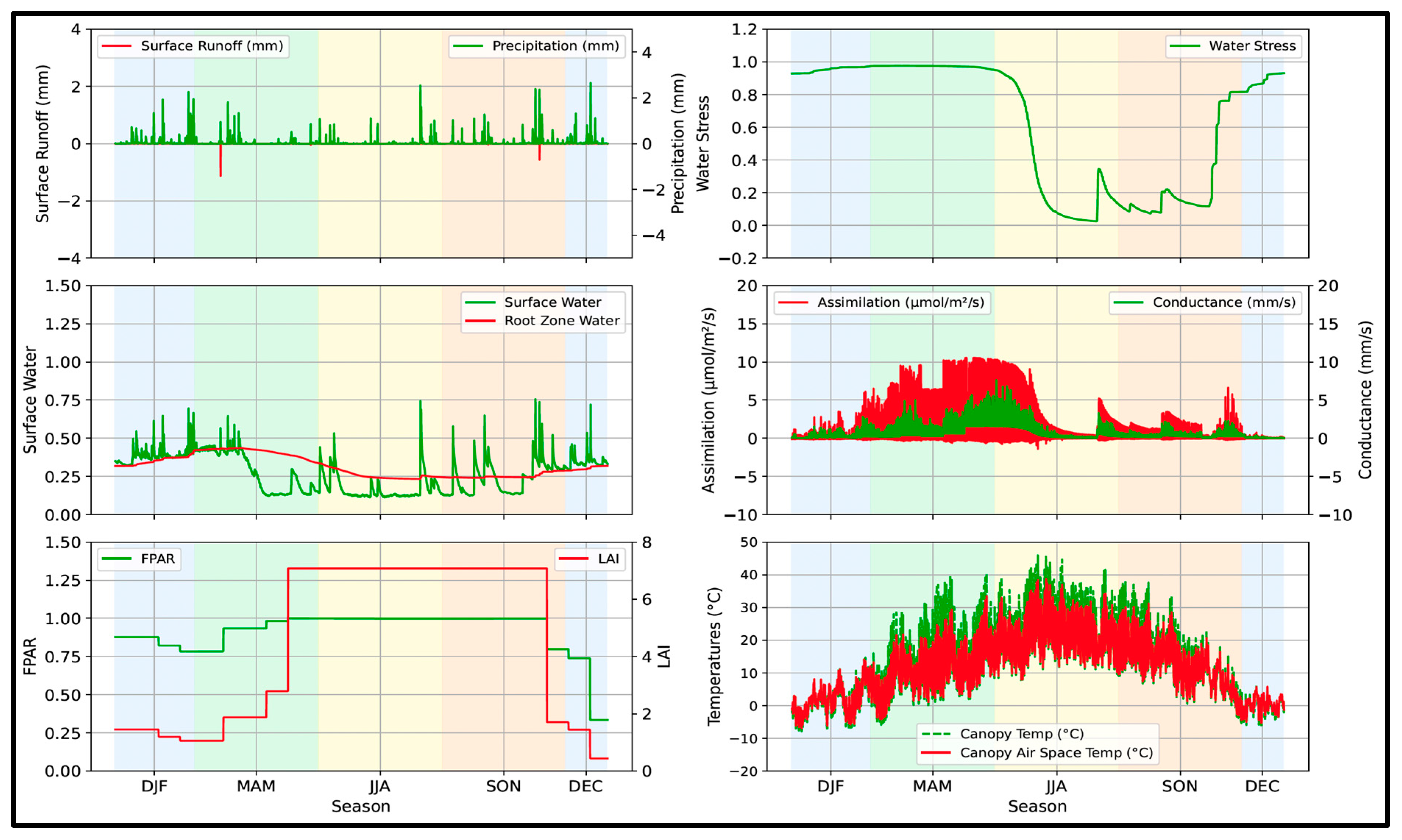
Hourly time series of climate and physiological variables were extracted for selected urban grid cells over a full annual cycle. As an illustrative case, we analyze a 0.1° CMG centered on Paris, France, containing both impervious surfaces and coexisting land cover types: broadleaf deciduous forest and short vegetation (grassland) (Figure 2).
The broadleaf deciduous forest exhibits pronounced seasonal dynamics. During spring and summer (MAM–JJA), photosynthetic activity peaks, as reflected by elevated LAI and FPAR, along with increased carbon assimilation and stomatal conductance. Root-zone water content is gradually depleted by rising evapotranspiration, eventually inducing water stress by early June, which limits photosynthesis and shifts energy partitioning toward sensible heat flux. Canopy temperatures during peak summer exceed 40 °C, and the surrounding canopy air-space can reach 35 °C.
As rainfall resumes in autumn and winter, the root zone recharges. The forest generates low runoff relative to precipitation, due to canopy interception and infiltration. The annual runoff-to-precipitation ratio is approximately 7%, reflecting the forest’s role as a hydrological buffer.
The short vegetation shows a shorter, less intense growing season, with modest increases in FPAR, carbon uptake, and stomatal conductance during MAM-SON. Despite their shallower rooting depth, grasslands contribute to transpiration and moderate surface warming.
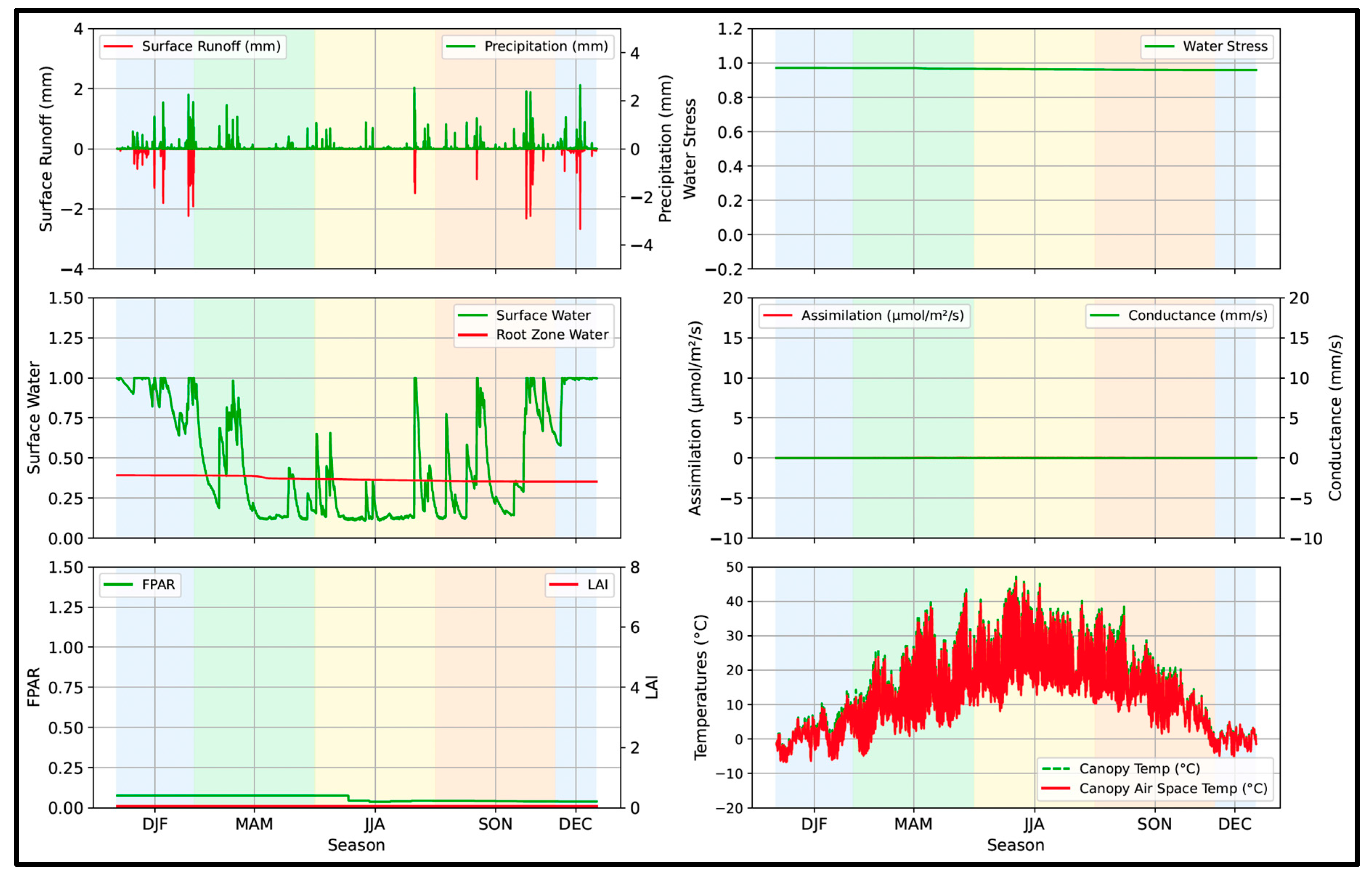
In contrast, the urban fraction is biologically inert, with zero LAI and FPAR and no stomatal exchange (Figure 3). The impervious surface rapidly sheds rainfall, producing frequent runoff spikes and a runoff-to-precipitation ratio near 88%, reflecting limited infiltration. Most of the net radiation is converted to sensible heat, causing higher canopy and air-space temperatures, especially in summer. The strong diurnal amplitude and persistent thermal elevation are characteristic of the Urban Heat Island (UHI) effect.
This comparison highlights how urbanization alters key land-atmosphere exchanges by replacing vegetation, which regulates surface temperature through evapotranspiration, interception, and shading, with impervious materials that store heat, limit moisture fluxes, and accelerate runoff. Vegetated surfaces dissipate energy through latent heat flux and maintain cooler microclimates, whereas urban surfaces suppress evapotranspiration, increase sensible heat flux, and enhance heat storage, producing thermal amplification and hydrologic flashiness. As a result, the inherent cooling, buffering, and carbon-sequestration capacities of natural vegetation are largely removed in urban environments, leading to reduced local climate mitigation potential.

4.3. Urban Effects on Surface Climate: Insights from UIM and UHI

To quantify the influence of urban land cover on surface temperature, we define a pixel-level Urban Impact Metric (UIM) based on the modeled sub-pixel temperatures and fractional land cover contributions within each 0.1° × 0.1° CMG. The actual surface temperature of a pixel (Tact) is computed as a weighted average of the surface temperatures simulated for each land cover type, using their fractional coverage within the pixel. To isolate the impact of urban areas, we compute a counterfactual temperature by excluding the urban land cover fraction from this average (Tno_urb). The UIM is then defined as the difference between the actual pixel temperature (including urban) and the counterfactual vegetation-only temperature as
UIM = Tact − Tno_urb
where
T act = i = 1 n T i f i i = 1 n f i   and   T no_urb = i # u n T i * f i i # u n f i
here, Ti is the modeled surface temperature for land cover class i, fi is the corresponding fractional area, and u refers to the urban land cover class with temperature Turb. This formulation allows us to assess the urbanization-induced effect within each pixel without altering the surrounding biophysical context and without requiring a separate simulation. On the other hand, the UHI, representing the contrast between urban and rural areas, is obtained as the difference between the urban core temperature, Turb, and the surrounding vegetation, Tno_urb:
UHI = Turb − Tno_urb

4.3.1. The Urban Heat Island-UHI

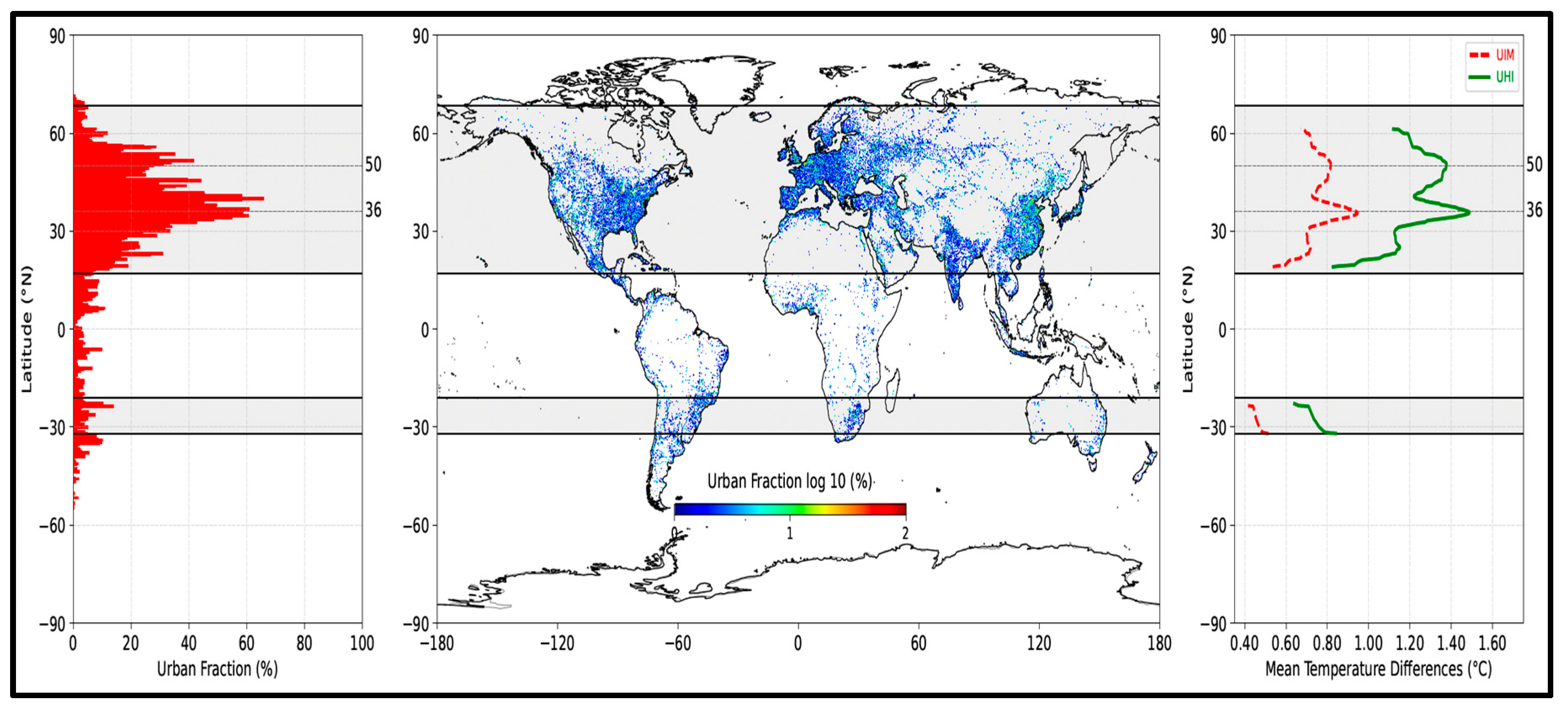
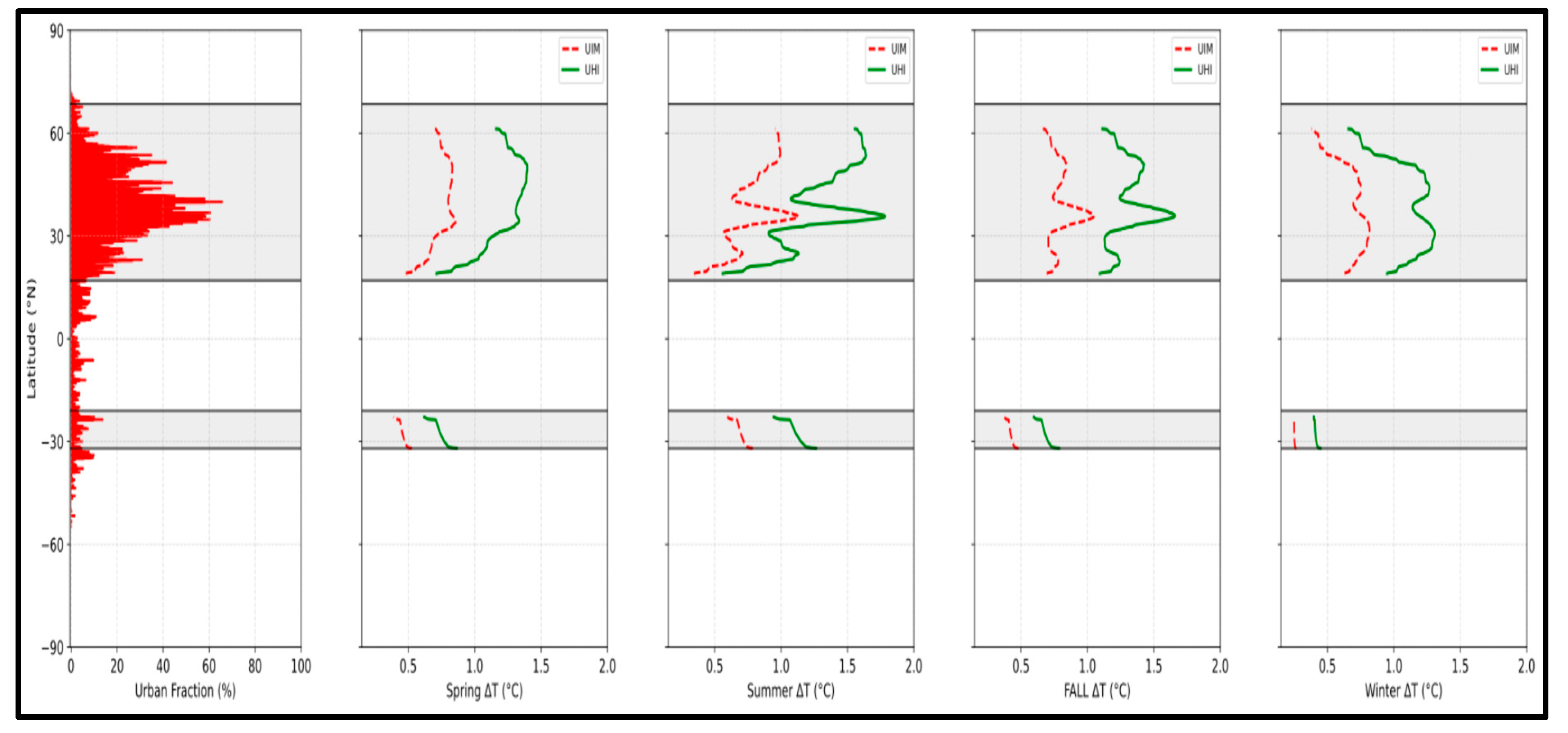
The annual mean UHI and UIM latitudinal signatures for CMGs with urban fractions of 50% or more are presented in Figure 4 (right panel), along with the latitudinal (left panel) and global (central panel) distributions of the ISA fractions. The UHI effect is strongest across mid-latitudes in the Northern Hemisphere, particularly between 30° N and 50° N, where Impervious Surface Area (ISA) is highest. The amplitude peaks at over 1.30 °C near 50° N and exceeds 1.45 °C around 36° N. In urban areas at lower latitudes (20° N–30° N), a moderate UHI signal persists, ranging from 0.8 °C to 1.15 °C. However, it becomes negligible in the intertropical zone, where the thermal contrast between urban and surrounding vegetated land is minimal. In the Southern Hemisphere’s temperate latitudes, the UHI amplitude is lower overall, reaching a maximum of around 0.5 °C near 30° S.

4.3.2. The Urban Impact Metric–UIM

The UIM provides a more integrated assessment of urbanization’s thermal impact by estimating the warming attributable to urban land use above a counterfactual vegetated baseline. Unlike UHI, which reflects the internal contrast within cities, UIM captures the total contribution of urban land to regional warming, including reduced evapotranspiration, altered surface energy balance, and loss of vegetation cover.
At 50° N, the UIM is modeled at approximately 0.80 °C, which is notably lower than the corresponding UHI value, yet still significant. A striking maximum of about 0.95 °C is observed near 36° N, highlighting the impact of dense urbanization in warm, semi-arid regions. South of 36° N, both UHI and UIM decline, reaching minimum values of roughly 0.8 °C and 0.5 °C, respectively. In these regions, urban development often replaces already sparse vegetation in naturally warm and dry environments, limiting the potential cooling benefit of hypothetical re-vegetation.
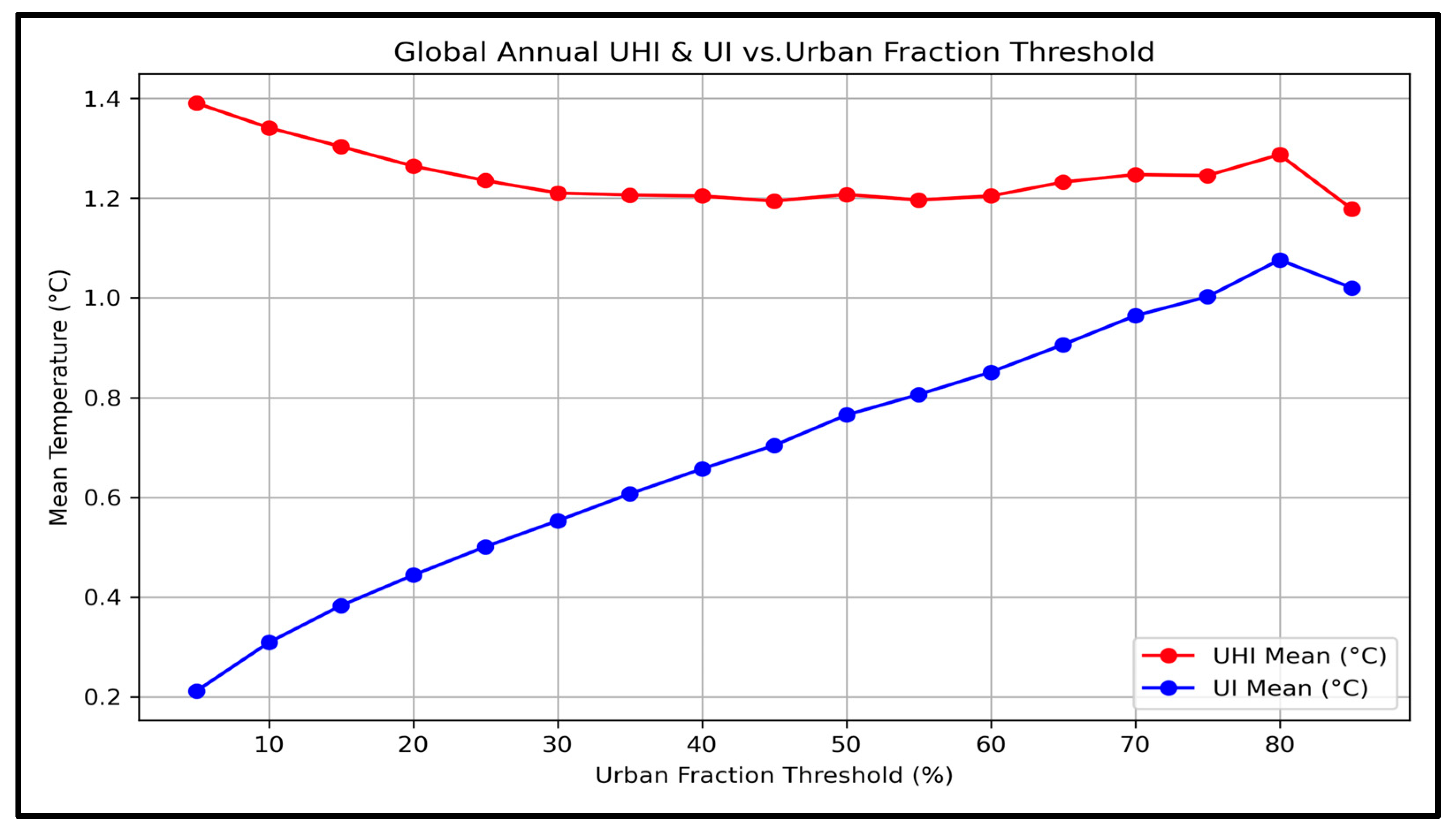
The two metrics differ fundamentally in what they quantify. UHI defines the temperature difference between adjacent urban and non-urban areas and, as such, is largely independent of the areal extent of urban land within a CMG (Figure 5). This temperature contrast can emerge even with minimal urban coverage, as long as both urban and vegetated surfaces are present. Consequently, UHI values remain relatively stable across varying urban fractions, only increasing modestly at very high urban densities. In contrast, the UIM represents the overall warming contribution of urban land relative to a hypothetical fully vegetated baseline. As such, it captures not just the presence of an urban–rural contrast, but the cumulative effect of impervious surfaces within the pixel. UIM increases nearly linearly with urban fraction, reflecting the growing thermal influence of urbanization over a larger area. This makes UIM more sensitive to the spatial extent of urban land and a more intuitive, scalable indicator of urban-induced warming at the landscape level.
This analysis suggests that UIM is a complementary metric to UHI, offering a more spatially continuous and intuitive measure of urban-induced warming. Its strength lies in capturing the full thermal footprint of urbanization, not just temperature contrasts within cities, and thus serves as a better indicator for evaluating urban climate impacts on regional to global scales.
Unlike conventional metrics such as the Surface Urban Heat Island (SUHI), which measure the temperature contrast between urban and rural pixels, the Urban Impact Metric (UIM) quantifies the additional warming directly attributable to urban land cover by comparing actual surface temperatures to a consistent vegetation-only counterfactual. This formulation removes sensitivity to heterogeneous rural baselines and enables spatially consistent comparisons across climates and continents. While a full quantitative comparison with alternative global metrics is beyond the scope of the present study, this conceptual improvement makes UIM more suitable for regional-to-global-scale assessments, particularly where rural reference conditions vary substantially.
While our analysis focuses on the year 2010, previous multi-year assessments of surface Urban Heat Islands have shown that the spatial structure of urban-rural thermal contrasts is generally stable from year to year, even though the absolute magnitudes may vary with background climate conditions (e.g., Refs. [27,28]). Interannual variability driven by fluctuations in regional meteorology or anomalous precipitation may modulate UIM/UHI intensity by several tenths of a degree, but is unlikely to alter the global patterns or relative regional differences highlighted here. Therefore, the 2010 dataset provides a representative snapshot of global urban thermal impacts, while future extensions of this work could explicitly quantify multi-year variability.

4.4. Seasonal UHI and UIM

We estimate the average latitudinal distribution of the UHI and UIM across seasons for pixels having more than 50% urban fractions. For both UHI and UIM, the overall latitudinal distribution has a similar form across all seasons, albeit with different intensities (Figure 6).
At around 35° N, the maximum UHI reaches about 1.75 °C during summer (JJA), highlighting the strong thermal contrast between impervious surfaces and surrounding vegetated areas, and a minimum of 1.20 °C during winter (DJF). In contrast, the UIM, which measures the net warming effect of urban land cover at the CMG scale, is more modest, with values ranging from about 0.70 °C in winter to 1.15 °C in summer. In this latitude band, the spatial pattern of UIM closely follows the distribution of urban fraction, with peak values in regions of dense urbanization, which includes several of the world’s largest and most populated urban centers, such as Tokyo, Los Angeles, Casablanca, Algiers, Cairo, and Shanghai. These cities are in regions characterized by high solar insolation and arid to semi-arid climates, conditions that intensify urban heating. These results indicate that while the UHI effect is locally large, its contribution to large-scale surface temperature is only slightly moderated by the fractional urban cover, yielding a strong warming impact.
In contrast, the 40–60° N band includes major cities such as New York City, London, Berlin, Paris, Istanbul, and Moscow, located in more temperate climates where UHI effects have greater seasonal variability, with an annual mean of 1.38 °C. The geographic clustering of high-impact urban centers highlights the importance of targeted climate adaptation strategies in regions where urbanization and climate sensitivity converge most intensely.

4.5. Regional and Global Analysis

The analysis of annual and seasonal surface temperature responses to urbanization reveals a clear distinction between the UHI and the UIM, two metrics that capture different facets of urban-induced warming. While the UHI quantifies the localized urban–vegetation thermal contrast, it does not reflect the net impact of urbanization on the regional climate. UIM, by contrast, is a more integrative metric that directly quantifies the change in temperature caused by the presence of urban land cover, thereby providing a more direct and spatially averaged indicator of urbanization’s actual climatic impact.
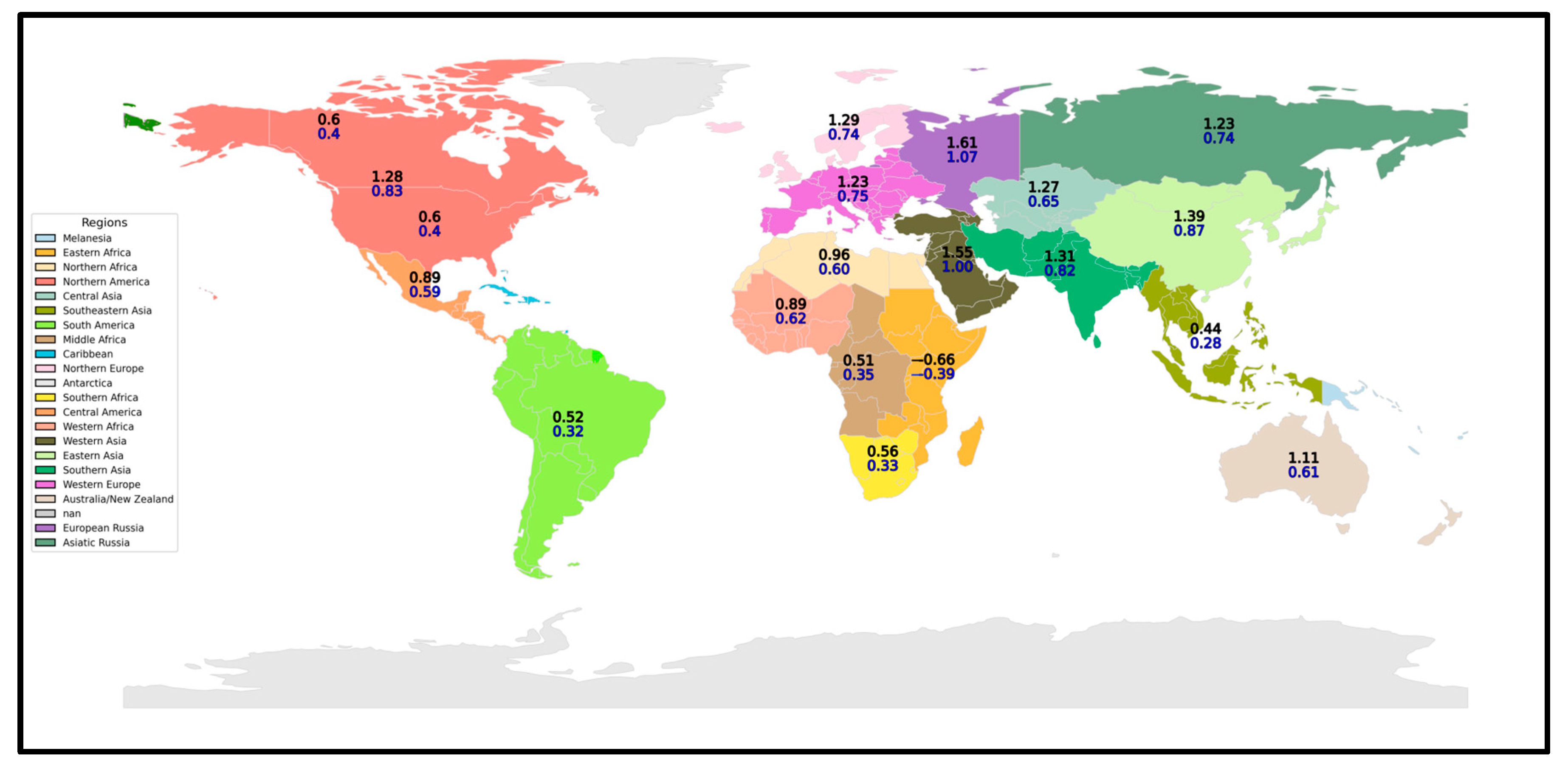
Annually, the strongest UHI (1.61 °C) is observed in European Russia, where dense, impervious surfaces and high-latitude radiative forcing amplify local heating. This peak is largely influenced by the summer (JJA) seasonal maximum of 2.34 °C. Conversely, Eastern Africa experiences an annual negative UHI of −0.66 °C, with a summer minimum of −1.10 °C (Figure 7). This counterintuitive phenomenon, referred to here as an Urban Heat Sink (UHS), indicates that urban areas in this region can be cooler than the surrounding vegetation. Interestingly, major East African urban centers, such as in Nairobi (Kenya) and Addis Ababa (Ethiopia), are located at elevations exceeding 1600–2400 m, where cooler highland conditions moderate surface temperatures. In addition, global land-cover products (e.g., Refs. [29,30]) indicate relatively low impervious surface fractions and substantial vegetation within these urban areas. These characteristics reduce the urban–rural thermal contrast and help explain the observed Urban Heat Sink behavior. These geographic and climatic conditions, combined with low urban density and high vegetation integration, reduce the urban-rural thermal contrast and help explain the observed negative UHI values.
When assessing the broader impact using the UIM, the maximum annual urban impact is again found in European Russia (1.07 °C), while Eastern Africa exhibits the lowest UIM (−0.39 °C). Seasonal extremes are also observed, with JJA maxima reaching 1.55 °C in European Russia and −0.66 °C in Eastern Africa, further underscoring regional disparities in urban extent and biophysical characteristics.
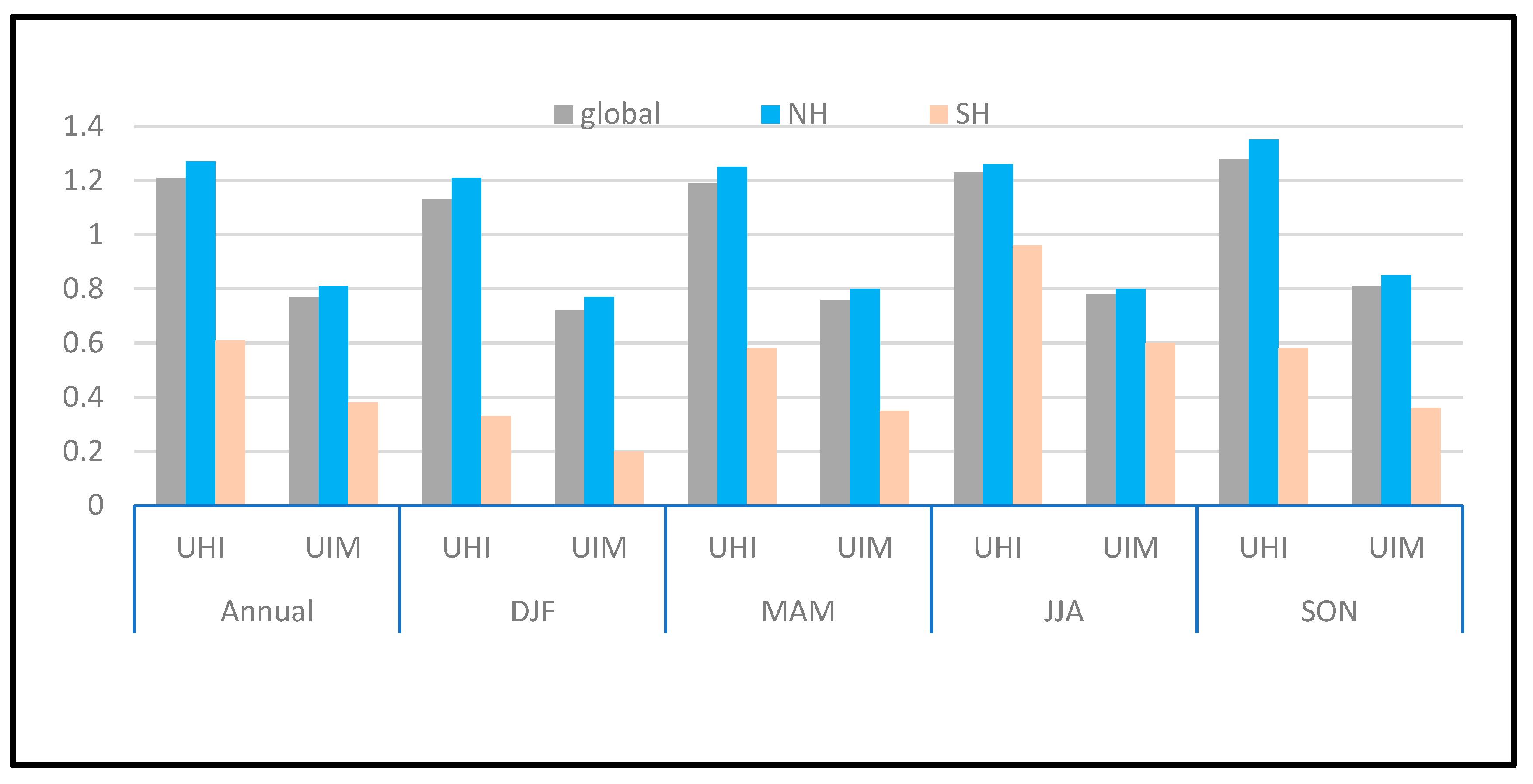
Globally, the annual mean UHI is 1.21 °C with 1.27 °C in the Northern Hemisphere (NH) and 0.61 °C in the Southern Hemisphere (SH), while the global annual mean UIM is 0.77 °C with more impact in the NH 0.81 °C, driven by concentrated urban development and extensive impervious land cover compared to just 0.38 °C in the SH (Figure 8).
On a global scale, the seasonal signal of UIM is most pronounced in autumn (SON), with a mean of 0.81 °C, and lowest in winter (DJF), at 0.72 °C, reflecting stronger urban warming under intermediate solar input and reduced moisture availability.
Our global UHI patterns are in line with previous satellite-based assessments showing stronger daytime UHI in mid-latitude and arid regions [11,27,31]. Similarly, the magnitude of surface UHI values, 1–3 °C in temperate regions, is consistent with regional estimates from MODIS LST. The UIM distribution parallels global urban energy balance findings from [32,33], with the strongest warming occurring in dense, impervious regions.
In SiB2, urban areas are represented using impervious surface fractions derived from 30 m Landsat data. Impervious surfaces follow a heat-storage formulation based on a thin concrete slab whose heat capacity varies with diurnal solar angle and surface water and snow. Urban morphology is reduced to a mean building height applied to the impervious fraction to adjust aerodynamic roughness. Surface albedo is computed using the two-stream scheme, and excess rainfall is removed as runoff due to the slab’s limited storage. SiB2 is not an urban canyon model, but a land-surface model focused on coupled water, energy, and carbon exchanges.
These simplifications—uniform material properties, absence of street-canyon geometry, and omission of anthropogenic heat—may lead to underestimation of the localized trapping of heat in dense urban cores. However, they capture the dominant biogeophysical contrasts between vegetated and impervious surfaces needed for global-scale UHI and UIM assessment.
These results reinforce that while the UHI captures localized urban heating, the UIM provides a more comprehensive and integrative metric for quantifying the true climatic impact of urbanization across spatial and temporal scales.

5. Conclusions

This study provides the first global, process-based assessment of the biophysical warming directly attributable to urban land, integrating high-resolution land-cover data within a physically consistent land-surface modeling framework. We introduce the Urban Impact Metric (UIM) as a scalable indicator of urban-driven warming, complementing the traditional Urban Heat Island (UHI) metric. Whereas UHI measures local thermal contrasts between urban and nearby vegetated areas, UIM quantifies the additional warming relative to a fully vegetated counterfactual surface, thereby linking localized urban modification to global land–atmosphere energy exchanges.
Compared with earlier global UHI studies, which largely rely on satellite thermal observations (e.g., Refs. [11,12,31]), our results provide a physically grounded estimate isolating the direct biogeophysical effect of urban land cover. Consistent with these prior assessments, we find that the strongest warming occurs in the densely urbanized mid-latitudes of the Northern Hemisphere. However, the UIM framework extends previous work by quantifying the magnitude of warming attributable solely to urban land surface processes, rather than only measuring surface temperature contrasts.
Although cities cover only ~0.31% of global land area, the global mean UIM of 0.77 °C indicates a disproportionate contribution to surface warming. When considered alongside other climate drivers, this signal represents roughly 40–50% of the temperature increase associated with CO2 doubling under transient climate response estimates and exceeds historical warming attributed to land-use and land-cover change. These results highlight the importance of representing urban land processes explicitly in Earth system models and in climate policy assessments.
The global UIM and UHI maps offer a consistent, spatially continuous depiction of urban-induced warming, offering valuable tools for regional and global climate assessments, identifying large-scale thermal hotspots, and informing urban planning and mitigation strategies. However, because city structure is represented in a simplified manner and the modeling resolution is coarse, these products are not suitable for neighborhood- or building-scale applications, where fine-scale urban form and material properties strongly influence local temperatures.
Overall, the UIM offers a biophysically consistent, scalable, and policy-relevant metric that complements UHI, enabling broader assessment of urbanization’s role in shaping the global surface climate.
A detailed city-scale analysis using the hourly outputs generated for over 1000 global cities, including sensitivity to impervious surface data, topographic influences, and seasonal UHI/UIM variability, will be presented in a follow-up study.

Author Contributions

L.B. conceived and designed the study. L.B. and N.B. performed the simulations. L.B., N.B., S.P.S., K.J.T., N.E.-D. and M.A.L. contributed to the analysis and interpretation of the results. All authors contributed to scientific discussion and critical revision of the manuscript. All authors have read and agreed to the published version of the manuscript.

Funding

This work was supported by NASA Grant via ROSES solicitation NNH21ZDA001N-LCLUC grant number 21-LCLUC21_2-0001; Garik Gutman, Program Manager.

Institutional Review Board Statement

Not applicable.

Informed Consent Statement

Not applicable.

Data Availability Statement

The datasets generated and/or analyzed during this study are available from the corresponding author upon request.

Conflicts of Interest

The authors declare no competing interests.

References

  1. United Nations, Department of Economic and Social Affairs, Population Division. World Urbanization Prospects: The 2018 Revision. UN DESA: New York, NY, USA, 2018; Available online: https://population.un.org/wup (accessed on 16 November 2025).
  2. Güneralp, B.; Zhou, Y.; Ürge-Vorsatz, D.; Gupta, M.; Yu, S.; Patel, P.L.; Fragkias, M.; Li, X.; Seto, K.C. Global scenarios of urban density and its impacts on building energy use through 2050. Proc. Natl. Acad. Sci. USA 2017, 114, 8945–8950. [Google Scholar] [CrossRef] [PubMed]
  3. Oke, T.R. The energetic basis of the urban heat island. Q. J. R. Meteorol. Soc. 1982, 108, 1–24. [Google Scholar] [CrossRef]
  4. Arnfield, A.J. Two decades of urban climate research: A review of turbulence, exchanges of energy and water, and the urban heat island. Int. J. Climatol. 2003, 23, 1–26. [Google Scholar] [CrossRef]
  5. Oke, T.R.; Mills, G.; Voogt, J.A.; Christen, A. Urban Climates; Cambridge University Press: Cambridge, UK, 2017. [Google Scholar] [CrossRef]
  6. Stewart, I.D.; Oke, T.R. Local Climate Zones for urban temperature studies. Bull. Am. Meteorol. Soc. 2012, 93, 1879–1900. [Google Scholar] [CrossRef]
  7. Rasul, A.; Balzter, H.; Smith, C.; Remedios, J.; Adamu, B.; Sobrino, J.A.; Srivanit, M.; Weng, Q. A Review on Remote Sensing of Urban Heat and Cool Islands. Land 2017, 6, 38. [Google Scholar] [CrossRef]
  8. Zhou, D.; Xiao, J.; Bonafoni, S.; Berger, C.; Deilami, K.; Zhou, Y.; Frolking, S.; Yao, R.; Qiao, Z.; Sobrino, J.A. Satellite remote sensing of surface urban heat islands: Progress, challenges, and perspectives. Remote Sens. 2019, 11, 48. [Google Scholar] [CrossRef]
  9. Shi, H.; Xian, G.; Auch, R.; Gallo, K.; Zhou, Q. Urban Heat Island and Its Regional Impacts Using Remotely Sensed Thermal Data—A Review of Recent Developments and Methodology. Land 2021, 10, 867. [Google Scholar] [CrossRef]
  10. Magyari-Sáska, Z.; Horváth, C.; Pop, S.; Croitoru, A.-E. A New Approach for Identification and Analysis of Urban Heat Island Hotspots. J. Settl. Spat. Plan. 2024, 15, 89–96. [Google Scholar] [CrossRef]
  11. Zhou, D.; Zhao, S.; Liu, S.; Zhang, L.; Zhu, C. Surface urban heat island in China’s 32 major cities: Spatial patterns and drivers. Remote Sens. Environ. 2014, 152, 51–61. [Google Scholar] [CrossRef]
  12. Peng, S.; Piao, S.; Ciais, P.; Friedlingstein, P.; Ottlé, C.; Bréon, F.-M.; Nan, H.; Zhou, L.; Myneni, R.B. Surface urban heat island across 419 global big cities. Environ. Sci. Technol. 2012, 46, 696–703. [Google Scholar] [CrossRef] [PubMed]
  13. Masson, V. A physically-based scheme for the urban energy budget in atmospheric models. Bound.-Layer. Meteorol. 2000, 94, 357–397. [Google Scholar] [CrossRef]
  14. Kusaka, H.; Kimura, F. Coupling a single-layer urban canopy model with a simple atmospheric model: Impact on urban heat island simulation for an idealized case. J. Meteorol. Soc. Jpn. 2004, 82, 67–80. [Google Scholar] [CrossRef]
  15. Georgescu, M.; Morefield, P.E.; Bierwagen, B.G.; Weaver, C.P. Urban adaptation can roll back warming of emerging megapolitan regions. Proc. Natl. Acad. Sci. USA 2014, 111, 2909–2914. [Google Scholar] [CrossRef] [PubMed]
  16. Bounoua, L.; Zhang, P.; Mostovoy, G.; Thome, K.J.; Masek, J.G.; Imhoff, M.L.; Shepherd, M.; Quattrochi, D.; Santanello, J.; Silva, J.; et al. Impact of urbanization on US surface climate. Environ. Res. Lett. 2015, 10, 084010. [Google Scholar] [CrossRef]
  17. Brown de Colstoun, E.C.; Huang, C.; Wang, P.; Tilton, J.C.; Tan, B.; Phillips, J.; Niemczura, S.; Ling, P.-Y.; Wolfe, R.E. Global Man-Made Impervious Surface (GMIS) Dataset From Landsat; Version 1.00; NASA SEDAC: Palisades, NY, USA, 2017; p. H4P55KKF. [Google Scholar]
  18. Friedl, M.A.; Sulla-Menashe, D.; Skole, B.; Hook, S.; Dwyer, J.L.; Morisette, A.; Schaaf, C.B. MODIS Collection 5 global land cover: Algorithm refinements and dataset characterization. Remote Sens. Environ. 2010, 114, 168–182. [Google Scholar] [CrossRef]
  19. Didan, K. MOD13A1 MODIS/Terra Vegetation Indices 16-Day L3 Global 500m SIN Grid V006; Version 006; NASA LP DAAC: Sioux Falls, SD, USA, 2017. [Google Scholar] [CrossRef]
  20. Bounoua, L.; Nigro, J.; Zhang, P.; Thome, K.; Lachir, A. Mapping urbanization in the United States from 2001 to 2011. Appl. Geogr. 2018, 90, 123–133. [Google Scholar] [CrossRef]
  21. Gelaro, R.; McCarty, W.; Suárez, M.J.; Todling, R.; Molod, A.; Takacs, L.; Randles, C.A.; Darmenov, A.; Bosilovich, M.G.; Reichle, R.; et al. The Modern-Era Retrospective Analysis for Research and Applications, Version 2 (MERRA-2). J. Clim. 2017, 30, 5419–5454. [Google Scholar] [CrossRef]
  22. Sellers, P.; Randall, D.; Collatz, G.; Berry, J.; Field, C.; Dazlich, D.; Zhang, C.; Collelo, G.; Bounoua, L. A revised land surface parameterization (SiB2) for atmospheric GCMs. Part I: Model formulation. J. Clim. 1996, 9, 676–705. [Google Scholar] [CrossRef]
  23. Bounoua, L.; Safia, A.; Masek, J.; Peters-Lidard, C.; Imhoff, M.L. Impact of urban growth on surface climate: A case study in Oran, Algeria. J. Appl. Meteorol. Climatol. 2009, 48, 217–231. [Google Scholar] [CrossRef]
  24. Sellers, P.J.; Mintz, Y.; Sud, Y.C.; Dalcher, A. A Simple Biosphere Model (SiB) for use within general circulation models. J. Atmos. Sci. 1986, 43, 505–531. [Google Scholar] [CrossRef]
  25. Zhang, P.; Bounoua, L.; Thome, K.; Wolfe, R.E.; Imhoff, M. Modeling Surface Climate in U.S. Cities Using Simple Biosphere Model SiB2. Can. J. Remote Sens. 2015, 41, 525–535. [Google Scholar] [CrossRef]
  26. Liu, Z.; He, C.; Zhou, Y.; Wu, J. How much of the world’s land has been urbanized, really? A hierarchical framework for avoiding confusion. Landsc. Ecol. 2014, 29, 763–771. [Google Scholar] [CrossRef]
  27. Yao, R.; Wang, L.; Huang, X.; Zhang, W.; Li, J.; Niu, Z. Interannual variations in surface urban heat island intensity and associated drivers in China. J. Environ. Manag. 2018, 222, 86–94. [Google Scholar] [CrossRef]
  28. Silva, F.B.; Longo, K.M.; Andrade, F.M. Spatial and Temporal Variability Patterns of the Urban Heat Island in São Paulo. Environments 2017, 4, 27. [Google Scholar] [CrossRef]
  29. European Space Agency (ESA); WorldCover Consortium. WorldCover 10 m 2020 Product. 2021. Available online: https://worldcover2020.esa.int/ (accessed on 13 March 2025).
  30. Pesaresi, M.; Ehrlich, D.; Ferri, S.; Florczyk, A.J.; Freire, S.; Halkia, M.; Julea, A.; Kemper, T.; Soille, P.; Syrris, V. GHS Built-Up Grid, Derived from Landsat, Multitemporal (1975–1990–2000–2014); European Commission: Bruxelles, Belgium, 2016. [Google Scholar] [CrossRef]
  31. Li, X.; Zhou, Y.; Asrar, G.R.; Imhoff, M.; Li, X. The surface urban heat island response to urban expansion: A panel analysis for the conterminous United States. Sci. Total Environ. 2018, 605–606, 426–435. [Google Scholar] [CrossRef]
  32. Oleson, K.W.; Bonan, G.B.; Feddema, J.; Vertenstein, M. An urban parameterization for a global climate model. Part II: Sensitivity to input parameters and the simulated urban heat island in offline simulations. J. Appl. Meteorol. Climatol. 2008, 47, 1061–1076. [Google Scholar] [CrossRef]
  33. Zhao, L.; Lee, X.; Smith, R.B.; Oleson, K. Strong contributions of local background climate to urban heat islands. Nature 2014, 511, 216–219. [Google Scholar] [CrossRef]
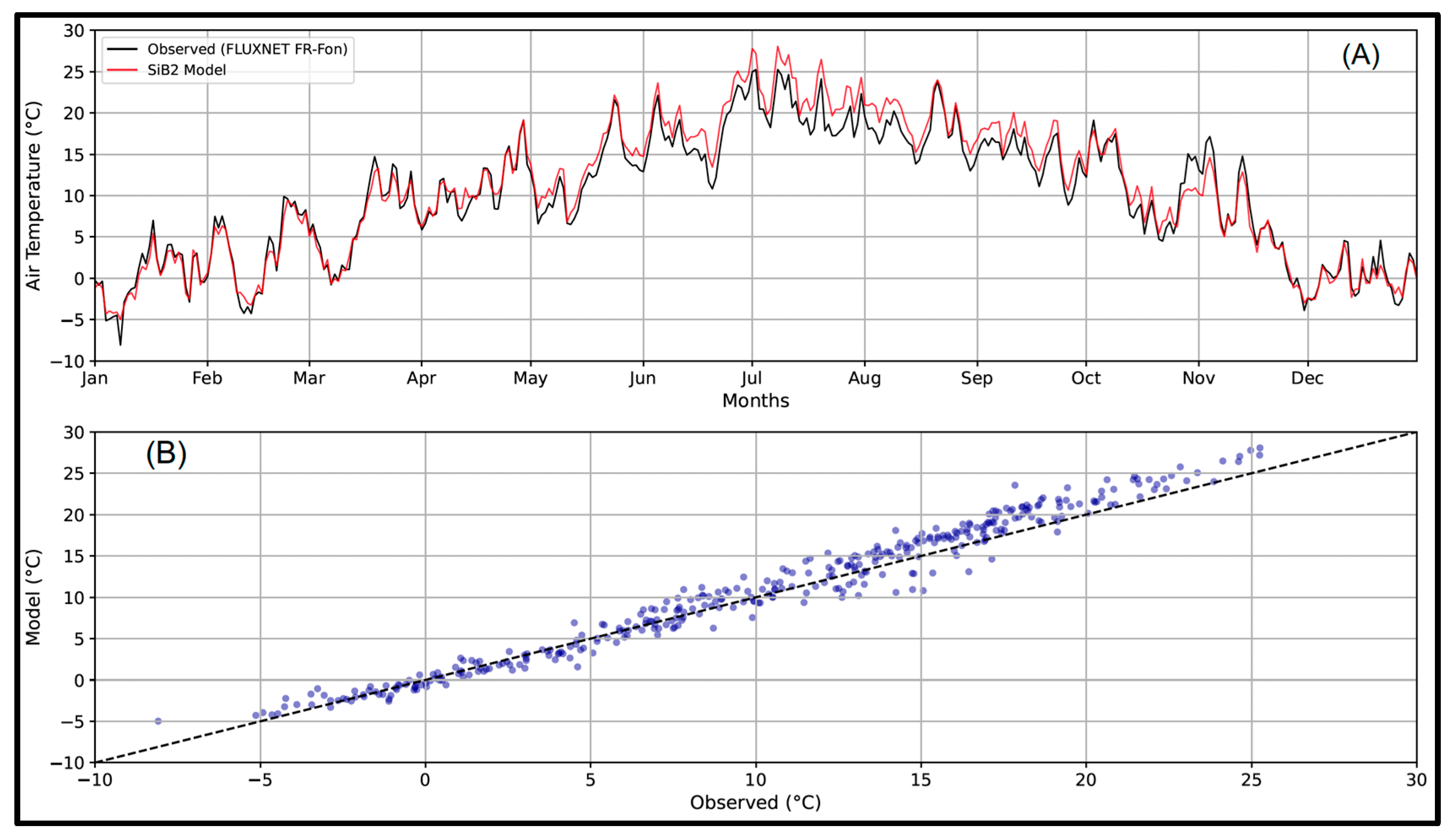
Figure 1. (A) Time series of modeled canopy–air space temperature versus observed air temperature at Fontainebleau, France. (B) Scatter plot comparing modeled and observed temperatures for the same site.
Urbansci 10 00006 g001
Figure 2. Seasonal and diurnal surface–vegetation–atmosphere interactions simulated by SiB2 for a broadleaf deciduous forest canopy in a climate model grid (CMG) over Paris. Left panels show (UL) surface runoff (red) versus precipitation (green), (CL) surface water content (green) and root zone water content (red), and (LL) fraction of photosynthetically active radiation (FPAR; green) and leaf area index (LAI; red). Right panels show (UR) water stress, (CR) carbon assimilation (red) and stomatal conductance (green), and (LR) canopy and canopy air space temperatures. For visualization purposes, surface runoff values were multiplied by 100 and displayed using a reversed scale to enhance contrast among precipitation. The four background colors correspond to the four seasons.
Urbansci 10 00006 g002
Figure 3. Same as Figure 2, but for a grid cell dominated by impervious surface area. The four background colors correspond to the four seasons. Both assimilation and conductance are null for the grid cell in the second row, second column.
Urbansci 10 00006 g003
Figure 4. Global distribution and latitudinal patterns of urban fraction and associated temperature impacts for grid cells with ≥50% urban land cover. The center map shows the global distribution of urban fraction (log10 scale). The left panel displays the zonal mean urban fraction by latitude. The right panel shows the latitudinal mean profiles of the Urban Heat Island (UHI) and Urban Impact Metric (UIM).
Urbansci 10 00006 g004
Figure 5. Global mean Urban Heat Island (UHI) and Urban Impact Metric (UIM) in degrees Celsius, along with corresponding impervious surface area (ISA) fractions.
Urbansci 10 00006 g005
Figure 6. The latitudinal mean seasonal profiles of the Urban Heat Island (UHI) and Urban Impact Metric (UIM) along with the latitudinal distribution of urban fraction.
Urbansci 10 00006 g006
Figure 7. Global distribution of annual Urban Heat Island (UHI, upper values) and Urban Impact Metric (UIM, lower values), in degrees Celsius. For North America, UHI = 1.28 °C and UIM = 0.83 °C.
Urbansci 10 00006 g007
Figure 8. Annual and seasonal values of UHI and UIM (°C) for the global domain, Northern Hemisphere (NH), and Southern Hemisphere (SH).
Urbansci 10 00006 g008
Table 1. Global urban impervious surface distribution and fraction of global urban area (excluding Greenland and Antarctica), estimated at 407,460.44 km2.
BandsUrban Area (km2)% Urban Fraction
1 (17.0 N–68.5 N)346,481.2885.03
2 (21.0 S–17.0 N)39,031.999.58
3 (32.0 S–21.0 S)12,601.56 3.09
Total 97.7
Disclaimer/Publisher’s Note: The statements, opinions and data contained in all publications are solely those of the individual author(s) and contributor(s) and not of MDPI and/or the editor(s). MDPI and/or the editor(s) disclaim responsibility for any injury to people or property resulting from any ideas, methods, instructions or products referred to in the content.