


Abstract
About 16% of typhoons making landfall in China strike Hainan Island, where near-surface extreme winds in dense urban areas exhibit a strong spatiotemporal heterogeneity that is difficult to capture with current observations and mesoscale models. Focusing on Haikou during Super Typhoon Yagi (2024)—the strongest autumn typhoon to hit China since 1949—we developed a multiscale ERA5–WRF–PALM framework to conduct 30 m resolution large-eddy simulations. PALM results are in reasonable agreement with most of the five automatic weather stations, while performance is weaker at the most sheltered park site. Mean near-surface wind speeds increased by 20–50% relative to normal conditions, showing a coastal–urban gradient: maps of weighted cumulative exposure to strong winds (≥Beaufort force 8) show much longer and more intense events along open coasts than within built-up urban cores. Urban morphology exerted nonlinear effects: wind speeds followed a U-shaped relation with both the open-space ratio and mean building height, with suppression zones at ~0.5–0.7 openness and ~20–40 m height, while clusters of super-tall buildings induced Venturi-like acceleration of 2–3 m s−1. Spatiotemporal analysis revealed banded swaths of high winds, with open areas and islands sustaining longer, broader extremes, and dense street grids experiencing shorter, localized events. Methodologically, this study provides a rare, systematically evaluated application of a multiscale ERA5–WRF–PALM framework to a real typhoon case at 30 m resolution in a tropical coastal city. These findings clarify typhoon–city interactions, quantify morphological regulation of extreme winds, and support risk assessment, urban planning, and wind-resilient design in coastal megacities.
1. Introduction
Under global climate change, the intensity and frequency of tropical cyclones (TCs; called typhoons in the western North Pacific) are undergoing notable shifts, posing an increasingly severe threat to coastal regions [1,2,3]. Coastal cities, with highly concentrated populations and economic activities, are particularly vulnerable [4]; extreme winds at landfall frequently cause serious loss of life and property. High-density clusters of tall buildings substantially modify the near-surface boundary-layer wind field, producing strong spatial heterogeneity in local extreme winds [5], and even doubling the local mean wind speed relative to open terrain in some cases [6]. However, for super typhoons (e.g., Rammasun in 2014 or Katrina in 2005), large uncertainties remain in the interaction mechanisms between boundary-layer turbulence and urban surfaces [7]. Hainan, China’s only tropical island province, experiences frequent typhoon disasters with pronounced terrain–track modulation; the frequency of typhoon-induced extreme precipitation events increased during 2000–2020 [8]. At the national level, the Hainan Free Trade Port is a major strategic initiative, further highlighting the constraints that meteorological resilience imposes on critical infrastructure and urban functions [9,10].
Beyond the meteorological perspective, typhoon resilience in coastal cities has been extensively examined in the fields of disaster management and urban planning. Previous research has shown that typhoon hazards can interact with land-use change to reshape the resilience of socio-ecological systems [11] and that indicator-based frameworks can be used to assess local resilience to typhoon disasters in Nansha, Guangzhou [12]. Other studies have highlighted the role of disaster policies and networked governance in promoting community resilience [13] and have extended this perspective to infrastructure by using carbon emissions as an indicator when evaluating the resilience and sustainability of bridge systems under wind disasters [14]. Collectively, these studies show that typhoon resilience depends on hazard, urban form and governance; yet, typhoon winds are usually represented by coarse statistics or empirical proxies rather than building-resolving flow fields, leaving a gap that our high-resolution modeling seeks to fill [11,12,13,14].
At present, mesoscale models such as ERA5 and WRF are limited by kilometer-scale grids and parameterizations and thus struggle to resolve building-scale flow structures, often underestimating gust extremes within cities [15,16,17,18]. By contrast, large-eddy simulation (LES) models (e.g., PALM) can explicitly resolve urban turbulence on tens-of-meters grids (including the O (30 m) resolution used here) [17], providing far finer characterization of near-surface winds than traditional RANS approaches [18]. For the typhoon boundary layer, high-fidelity LES frameworks that have undergone systematic evaluation can, within O (5 km) subdomains, reproduce near-surface strong wind shear, low-level jets, and energy-spectrum characteristics and have been used to examine the applicability of planetary boundary layer (PBL) schemes [19]. LES under idealized and realistic urban morphologies further shows that the roughness jump induced by landfall rapidly spawns an internal boundary layer and redistributes turbulent kinetic energy, thereby amplifying near-shore gust extremes and altering the turbulence-scale structure [18,20]; in real cases, neighborhood-scale LES has successfully reproduced spatial contrasts in extreme wind pressure and window-failure risk around buildings [21]. In recent years, multiscale nesting between WRF and LES has attracted much attention [22]. For example, WRF–PALM simulations indicate that districts with dense high-rise buildings accentuate the nonuniformity of near-surface extreme winds [5]; introducing data assimilation into meso-to-micro coupling increased the consistency index for urban near-surface wind forecasts from 0.28 to 0.72 [23]. Combining mesoscale and microscale models offers clear advantages for simulating typhoon winds in urban areas and compensates for the deficiencies of any single-scale model. However, applications of such multiscale WRF–LES couplings to real coastal cities at O (30 m) resolution with systematic evaluation remain scarce, which motivates the present study.
During Typhoons Saola and Koinu, Hong Kong employed NWP–PALM coupling to verify bridge-site gust thresholds and revealed meter-scale wind-field differences [24]; in Tokyo, building-resolving LES evaluated strong urban winds during Typhoon Melor [7]; and in Miami, WRF simulations during Irma showed the weak sensitivity of near-surface urban winds to the choice of PBL scheme but high sensitivity to the urban canopy model (UCM) configuration [25]. Haikou is a low-latitude island city where coastline and dense built-up belts are juxtaposed, making 30 m LES particularly necessary to finely resolve the extreme winds of Typhoon Yagi. On 6 September 2024, Yagi made landfall along the coast of Wenchang, Hainan, as a super typhoon, with a maximum sustained wind near the center of 62 m s−1 (≥Beaufort force 17) and a minimum central pressure of 915 hPa; the event has been characterized as the strongest autumn typhoon to make landfall in China since 1949 [26,27]. Gusts of force 11–15 were recorded over northern Hainan on land and nearshore, and an extreme gust of 66.7 m s−1 (≥force 17) was measured in Longlou, Wenchang [28,29]; provincial assessments indicate that the destructive power far exceeded that of Rammasun (2014), making Yagi the second strongest typhoon to make landfall in Hainan [30]. The characteristic intensity of Typhoon Yagi thus provides an ideal case to test a multiscale modeling system. At building-resolving scales, embedded LES and multiscale coupling have achieved observational verification of urban wind fields and impacts in complex megacities [31].
In this study, we develop and apply a multiscale ERA5–WRF–PALM coupled modeling system to explicitly simulate the near-surface urban wind field in Haikou under the influence of super Typhoon Yagi at a 30 m resolution. ERA5 global reanalysis provides the background, WRF performs dynamical downscaling, and PALM finally resolves turbulence within the urban canopy and building-induced flow features. We therefore pursue three objectives: (1) to evaluate the system’s performance in reproducing the spatiotemporal evolution of urban winds under a super typhoon; (2) to quantify the nonlinear relationships between urban morphological parameters (e.g., open-space ratio, building height) and near-surface extreme winds; and (3) to elucidate differential responses across urban functional zones and their underlying physical mechanisms. The results not only deepen our understanding of typhoon–urban boundary-layer interactions but also provide key scientific evidence for wind-hazard risk assessment and climate-adaptation planning and design in densely built coastal cities.
2. Data and Methods
2.1. Observational Data and Meteorological Station Configuration
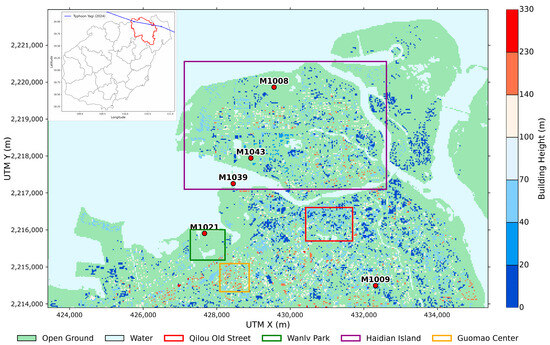
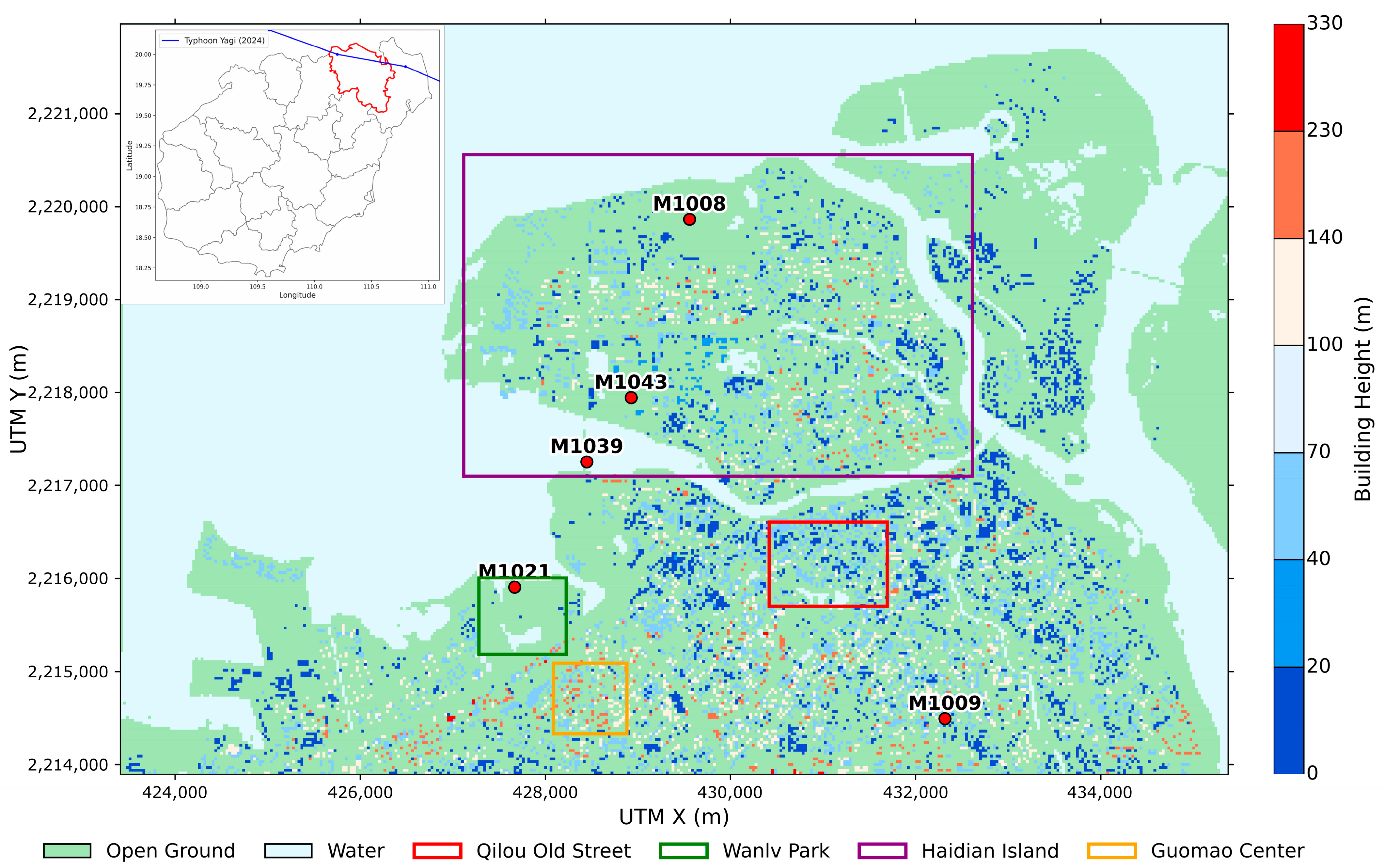
The study area is Haikou, the core city in northern Hainan Island, situated in a low-latitude tropical coastal setting dominated by coastal plains. Figure 1 shows the spatial distribution of land-surface types and building heights across the main urban area and its surroundings. The basemap, at meter-scale resolution, distinguishes open ground, water bodies, and built-up areas; the maximum building height reaches ~330 m. High-rise buildings are primarily concentrated on Haidian Island and in the Guomao (CBD) center, while the old town and coastal belts are characterized by lower building heights and extensive open surfaces and water bodies. The five instrumented sites—M1008, M1043, M1039, M1021, M1009—cover major functional zones and typical underlying-surface types. The inset depicts the track of Typhoon Yagi (2024) over northern Hainan and the location of the study domain. Because of power outages, communication failures, and instrument damage during the typhoon, many originally planned stations suffered data gaps; only these five sites maintained complete, continuous records. The boundaries of key functional zones (e.g., Qilou Old Street, Wanlv Park, Haidian Island, Guomao) are marked by colored rectangles to provide spatial references for subsequent analyses of wind-field features and spatial heterogeneity.
Figure 1.
Spatial distribution of building heights and surface types in Haikou City. Notes: Red dots indicate meteorological stations (M1008, M1009, M1021, M1039, M1043). Colored rectangles delineate four urban districts. The inset shows Typhoon Yagi’s (2024) track and the study area location (red outline) on Hainan Island. Basemap/building-footprint data: © Amap (Gaode) Open Platform, 2021 edition. Used under the Amap Open Platform terms of use (accessed 19 September 2025). Map approval number: GS(2024)0650.
2.2. ERA5/WRF/PALM Model Configuration
In this study, “ERA5–WRF–PALM” denotes a three-stage multiscale workflow rather than a new standalone numerical model. We build a multiscale coupled modeling system driven by ERA5 reanalysis, with stepwise refinement from the regional to the urban scale via WRF mesoscale modeling and PALM large-eddy simulation (LES). The WRF-ARW v4.3 configuration employs triple nesting at 9 km, 3 km, and 1 km horizontal resolutions with 50 sigma levels. Physics options include WSM6 microphysics, RRTMG radiation, the YSU planetary boundary layer scheme, and the Noah land-surface model; cumulus parameterization is activated only on the coarser nests. The PALM LES uses a 30 m horizontal grid (400 × 270 points). The vertical grid starts at 10 m near the surface and is stretched by a factor of 1.11 up to 400 m, yielding 55 levels in total. Buildings are represented explicitly; the surface roughness length is set to 0.1 m. PALM is one-way coupled to WRF to obtain boundary conditions, and a turbulence recycling zone is configured to generate a fully developed inflow. The workflow uses ERA5 fields as large-scale forcing, near-surface wind observations for evaluation, and building-footprint and land-cover data to construct PALM static inputs. The main user-defined choices are the WRF domain configuration (extent, nesting and vertical levels), the planetary boundary-layer and land-surface schemes, and the PALM grid spacing, turbulence closure and surface roughness.
Observational data are taken from the five automatic weather stations in Haikou that span diverse urban functions and underlying surfaces; due to equipment failures during the typhoon, only these five maintained complete records. Urban building data are sourced from the Amap (Gaode) Open Platform (2021 edition) and were processed for PALM static boundary inputs. The simulation window is 12:00 UTC 5 September to 00:00 UTC 8 September 2024, covering the full influence period of Typhoon Yagi.
The analysis adopts a multiscale statistical evaluation strategy, including time-series comparisons, spatial correlation assessment, and extreme-value diagnostics. The correlation coefficient, root-mean-square error (RMSE), and systematic bias are computed to evaluate model performance, with emphasis on how urban structure modulates the wind field and on the spatial patterns of extreme winds.
For urban morphology and block definitions, the PALM 30 m grid is aggregated into regular blocks by 20 × 20 grid points (≈600 m × 600 m), which serve as the basic units for statistics and binning. For the resolved building surfaces, a uniform aerodynamic roughness length of z0 = 0.1 m is prescribed, following previous PALM studies of explicitly resolved urban geometry, where building-scale roughness dominates over sub-grid roughness elements. Two indicators are computed for each block: (i) the open-space ratio (per block), defined as the fraction of grid cells labeled as open ground (cells with no building height assigned and not classified as water); and (ii) the mean building height (per block), i.e., the average of building heights over building cells only. Blocks without buildings are recorded as missing. For practical use, the ERA5–WRF–PALM workflow can be summarized in five steps: (1) prepare nested WRF domains and generate initial and boundary conditions from ERA5; (2) run WRF to downscale the typhoon circulation to 3 km and 1 km; (3) derive PALM static input files from building-footprint and land-cover data on the 30 m grid; (4) drive PALM with fields from the innermost WRF domain to simulate 10 m winds over urban Haikou; and (5) post-process model outputs together with station observations for time-series, spatial and extreme-value evaluation.
2.3. Time Standardization and Sequence Alignment
All data are standardized to UTC and to right-edge interval averages. In the observations, an hourly value at HH:00 represents the average over (HH–1:00, HH:00]. WRF outputs are aggregated to hourly means and then shifted forward by 1 h to match the observational semantics. PALM 5 min outputs are first aggregated to hourly means and then advanced by 1 h for alignment. For quality control, periods with <80% valid sample coverage are flagged as missing and excluded.
Based on the evolution of Typhoon Yagi, the typhoon period is defined as 00:00 UTC 6 September to 00:00 UTC 7 September 2024, and the pre-typhoon period as 00:00 UTC 5 September to 00:00 UTC 6 September 2024.
3. Results
3.1. Model Performance Evaluation
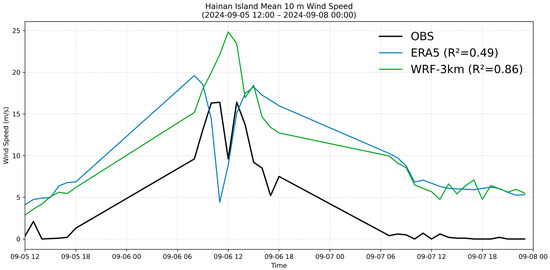
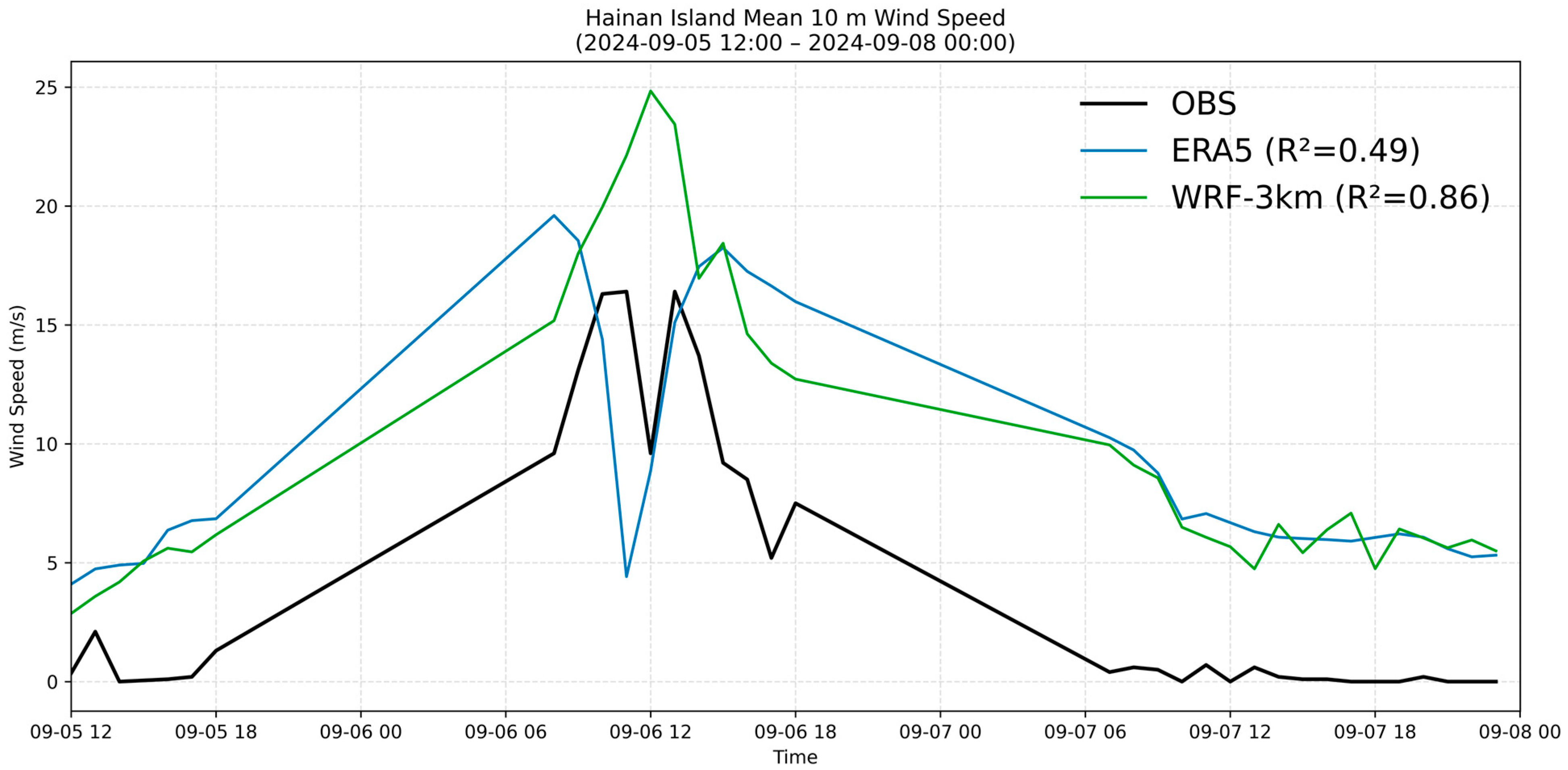
Figure 2 compares the temporal evolution of the 10 m mean wind speed over Hainan during Typhoon Yagi. Values rose rapidly to a peak of 13.5 m s−1 around 06:00 UTC on 6 September, followed by a rapid decay. Both ERA5 and WRF captured the overall evolution, with R2 = 0.49 and 0.86, respectively, relative to observations; however, both systems systematically overestimated winds during the peak and post-peak phases. WRF produced a transient spike exceeding 24 m s−1 near 12:00 UTC on 6 September, while ERA5 exhibited a dip-and-rebound feature shortly after the peak. In the late stage of the event, both models overpredicted low-wind conditions, indicating systematic biases in the amplitude and timing of extremes during the typhoon.
Figure 2.
Time series of 10 m mean wind speed, spatially averaged over all observation stations on Hainan Island, during the passage of Typhoon Yagi from 12:00 UTC 5 September to 00:00 UTC 8 September 2024. The black line denotes station observations (OBS), the blue line represents ERA5 reanalysis, and the green line shows the WRF-3km simulation. The coefficient of determination (R2) between each dataset and the observations is provided in the legend.
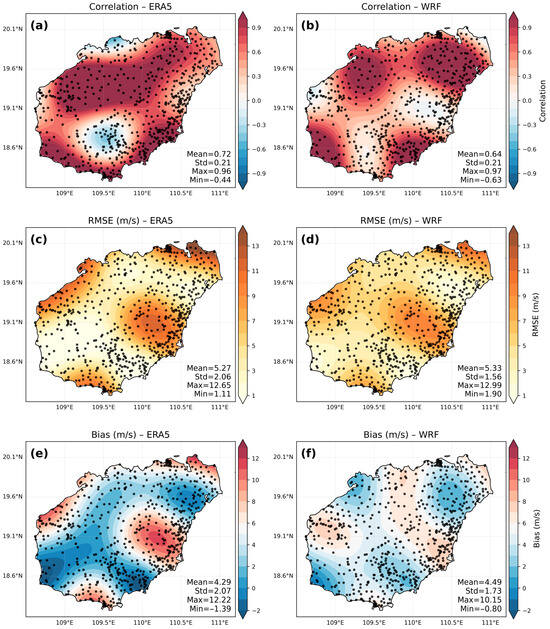
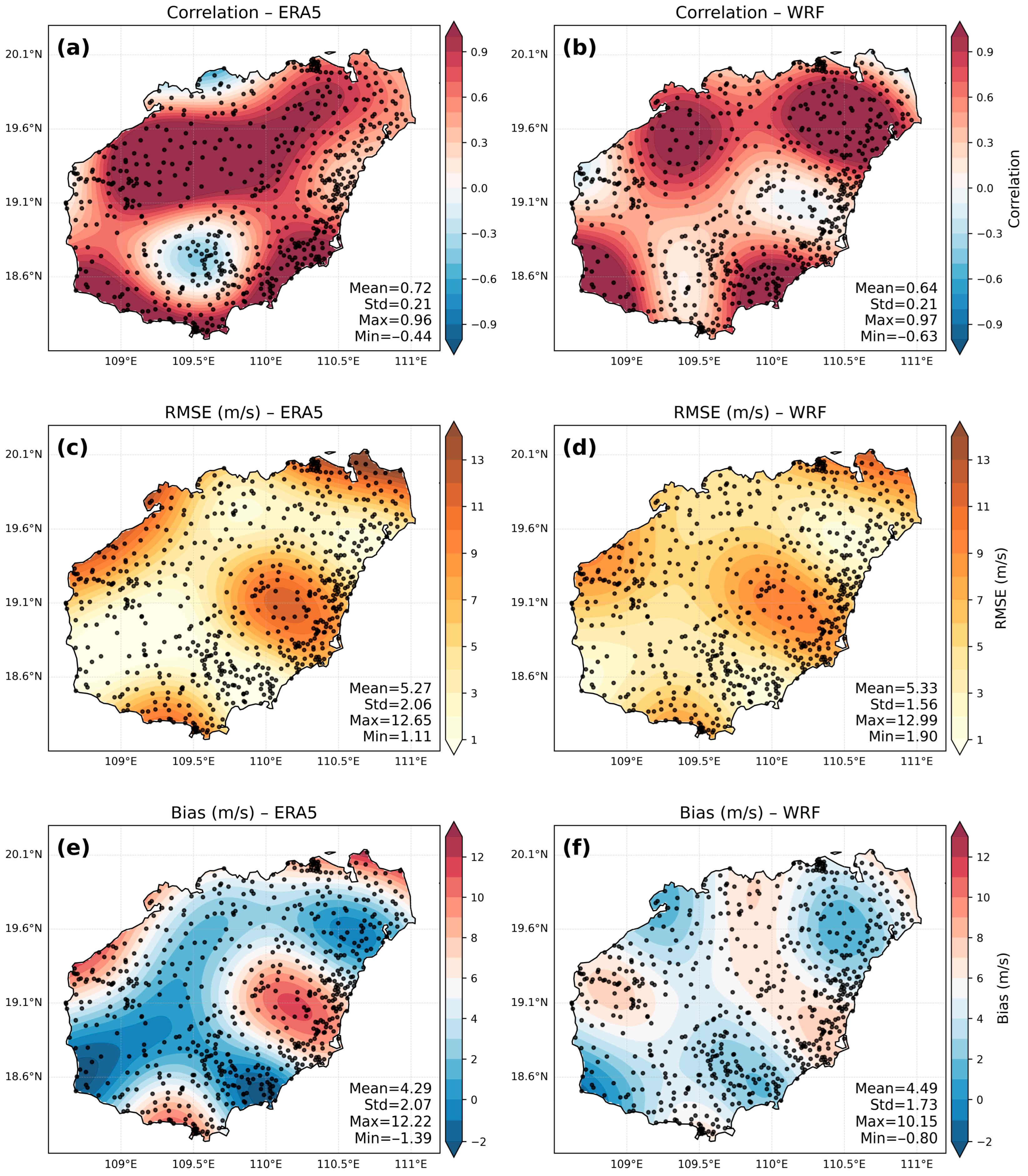
Figure 3 evaluates the spatial performance of ERA5 and WRF for wind speed over Hainan. For spatial correlation, island-wide means were 0.72 for ERA5 and 0.64 for WRF; both performed best over the central–northern island (max up to 0.96), with negative correlations in parts of the south and mountainous regions (min down to –0.44). Mean RMSE values were comparable—5.27 m s−1 (ERA5) and 5.33 m s−1 (WRF)—with larger errors over urban and inland areas (peaks > 12 m s−1) and smaller errors along the coast. Systematic bias maps show overall positive biases (overestimation) for both systems, with mean biases of 4.29 and 4.49 m s−1; positive biases dominate the central and northwestern island, with negative pockets along parts of the coast. Detailed station-level time series and inter-model differences are provided in Appendix A (Figure A1 and Figure A2), including high-resolution (10 min) validation of PALM at the five representative sites. These patterns indicate that both ERA5 and WRF reproduce the broad structure of near-surface winds but tend to overestimate magnitudes over inland and urban areas during the peak and decay phases, and the correlation map highlights where the multiscale system is most and least reliable for potential applications.
Figure 3.
Spatial evaluation of 10 m wind speed simulations from (left column) ERA5 and (right column) WRF over Hainan Island. Panels show (a,b) the temporal correlation coefficient (R), (c,d) the root mean square error (RMSE) in m s−1, and (e,f) the bias in m s−1. Black dots indicate the locations of the meteorological observation stations used for the evaluation.
3.2. Wind Field Characteristics
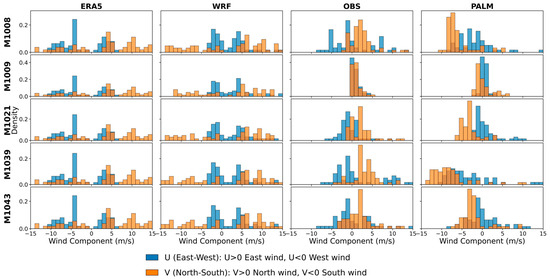
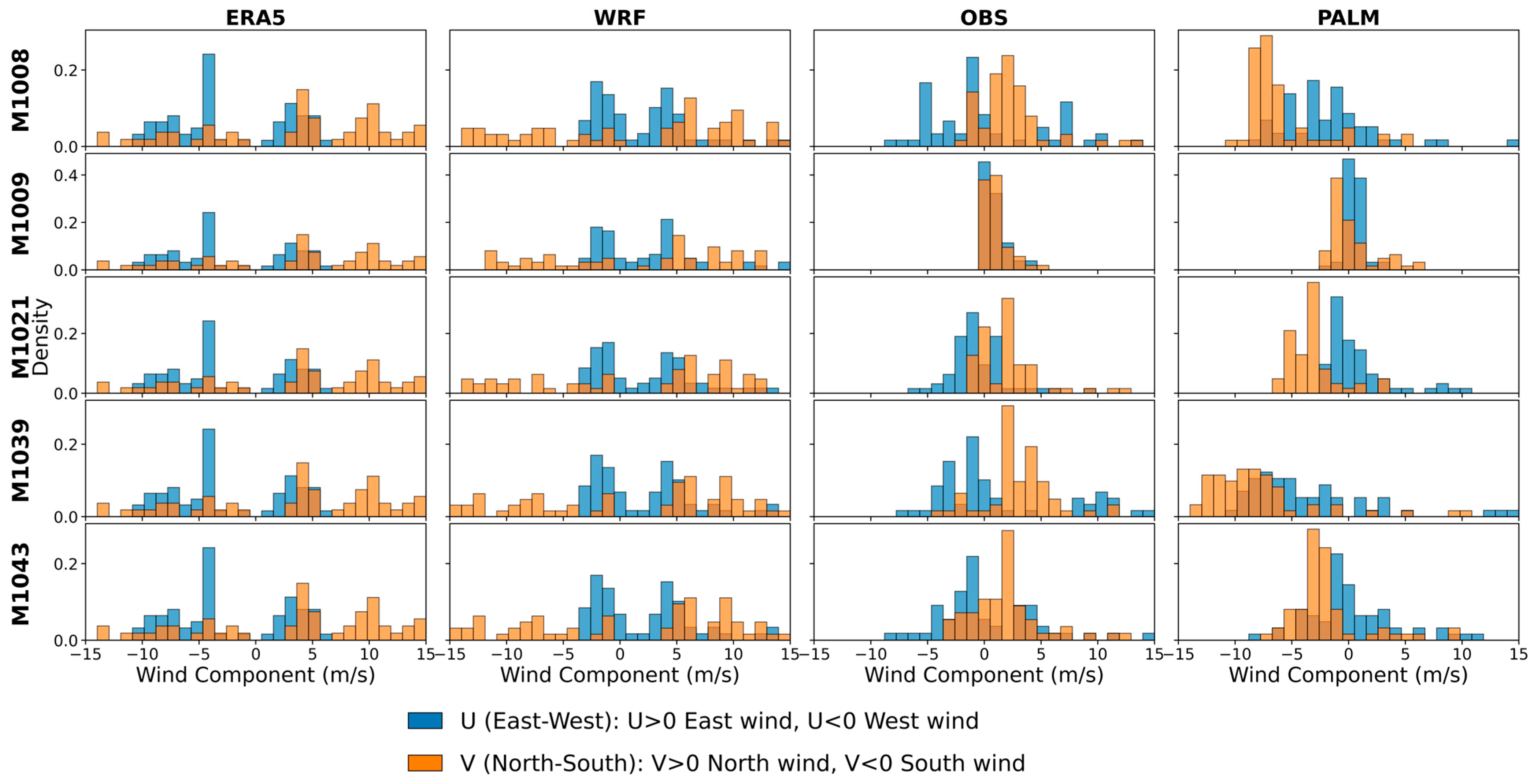
Figure 4 compares the probability distributions of U/V wind components at the five stations during the typhoon. Observations show predominantly negative U and positive V, indicating a prevailing southeasterly–southerly flow. PALM reproduces the modal positions of U/V but tends to overestimate spread and extremes, yielding more concentrated distributions with heavier tails, particularly at the high-wind sites M1008 and M1039. ERA5 and WRF align on the principal modes but show broader distributions and multimodality at some sites. At lower-wind stations M1009 and M1021, the primary modes in ERA5/WRF diverge more from observations, highlighting the limitations of reanalysis and mesoscale models in capturing local wind-direction variability.
Figure 4.
Probability density functions (PDFs) of the hourly zonal (U, blue) and meridional (V, orange) wind components at 10 m for five observation stations (rows). The columns compare results from ERA5, WRF, station observations (OBS), and the PALM simulation for the period of 5–8 September 2024.
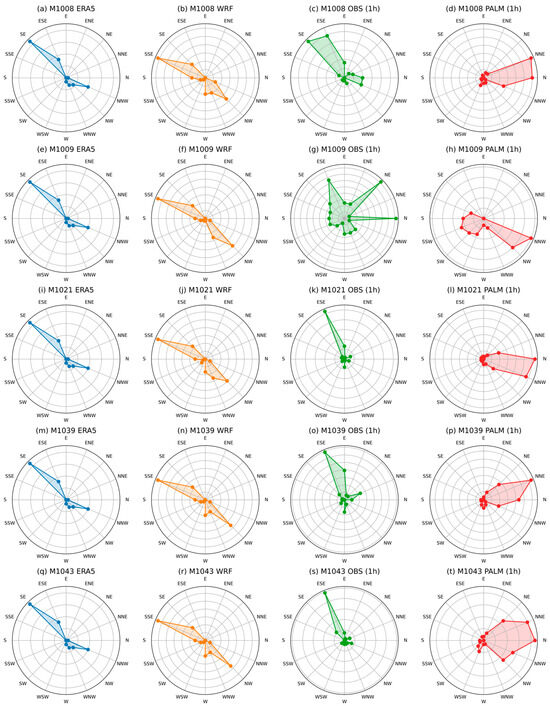
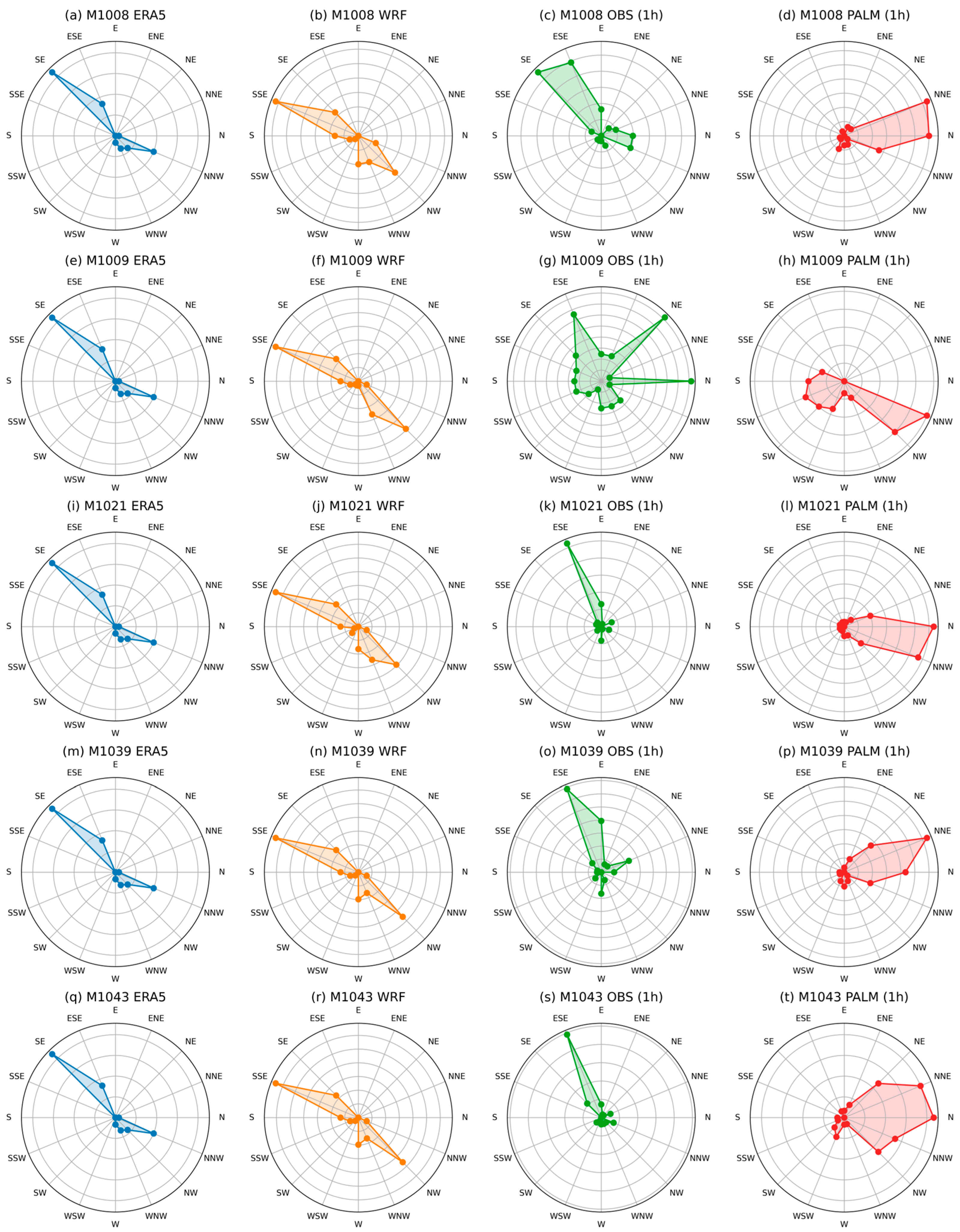
Figure 5 shows wind roses for the five stations. During the event, all sites are dominated by winds from the southeast to south, consistent with the landfall circulation. The observed roses exhibit a strongly concentrated primary lobe (SE, SSE) with only limited secondary lobes. ERA5 and WRF reproduce this primary lobe and its azimuthal range well, with substantial overlap between their southeast–south sectors and the observed distribution. The 30 m PALM simulations also capture the dominant southeasterly sector at most stations, but the corresponding wind roses are more dispersed. This behavior is characteristic of high-resolution LES: PALM explicitly resolves local turbulence, gusts and flow-channeling effects induced by buildings within the urban canopy, whereas these fine, transient structures are smoothed out in the coarser ERA5 and WRF fields. Although the high-resolution fields appear noisier, they also contain a great deal of additional, physically meaningful signals. This behavior is consistent with the high-resolution directional roses shown in Appendix A (Figure A4).
Figure 5.
Wind roses showing the frequency distribution of hourly 10 m wind direction at five observation stations (rows). The columns compare results from ERA5, WRF, station observations (OBS), and the PALM simulation for the period of 5–8 September 2024.
3.3. Urban Structure Impact on Wind Speed
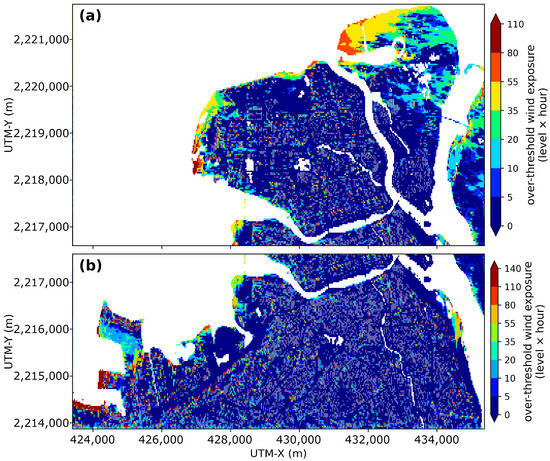
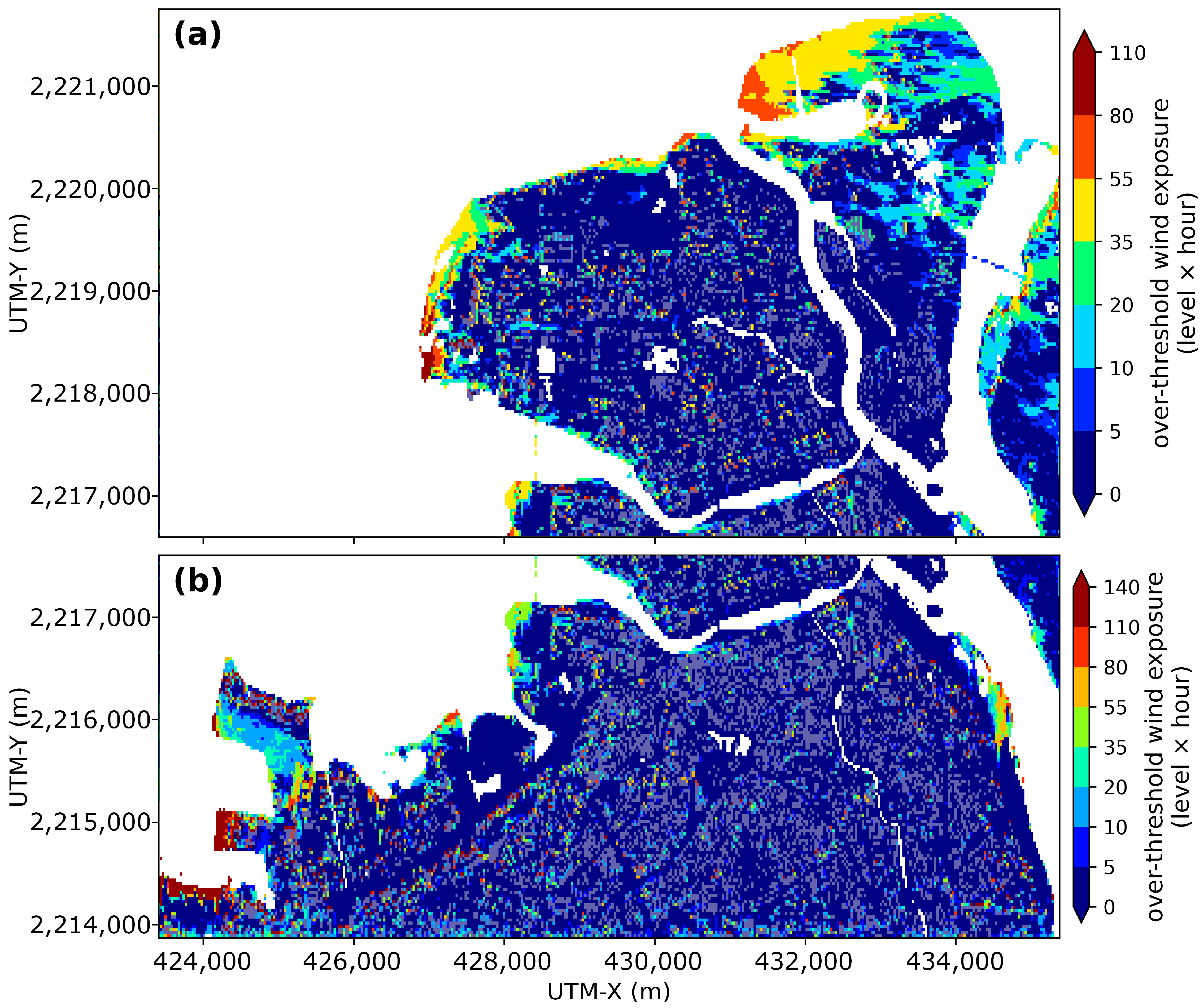
Figure 6 maps the over-threshold wind exposure for the northern and southern subregions, defined as the hourly accumulation of the product of Beaufort level exceeding (≥8) and its duration (unit: BFT·h). High values cluster over coasts, river mouths, and open urban edges, whereas values are generally low inside the urban core, yielding pronounced spatial contrasts. In the north, hotspots concentrate along the northeastern coast and peninsulas, with maxima > 100 BFT·h, indicating prolonged extreme winds in wind-facing open sectors. In the south, elevated belts occur along the southwestern coast and open tracts, with patchy peaks (>140 BFT·h) near estuaries and shorelines. In contrast, values in the dense urban core—including compact residential and commercial districts—are typically <20 BFT·h, reflecting strong attenuation of extremes by dense development. This pattern underscores how urban layout and surface types modulate extreme-wind risk. A fuller analysis of total wind exposure (no threshold) is provided in Appendix B (Figure A5).
Figure 6.
Spatial distribution of the maximum consecutive over-threshold wind exposure (BFT·h; Beaufort ≥ 8) simulated by PALM for the (a) northern and (b) southern subregions. The color scale shows, for each grid cell, the largest time-continuous accumulation of Beaufort wind level (≥8) multiplied by its hourly duration within the simulation period. Buildings and water surfaces are masked.
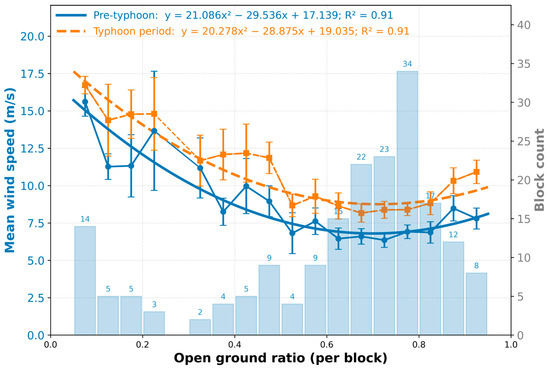
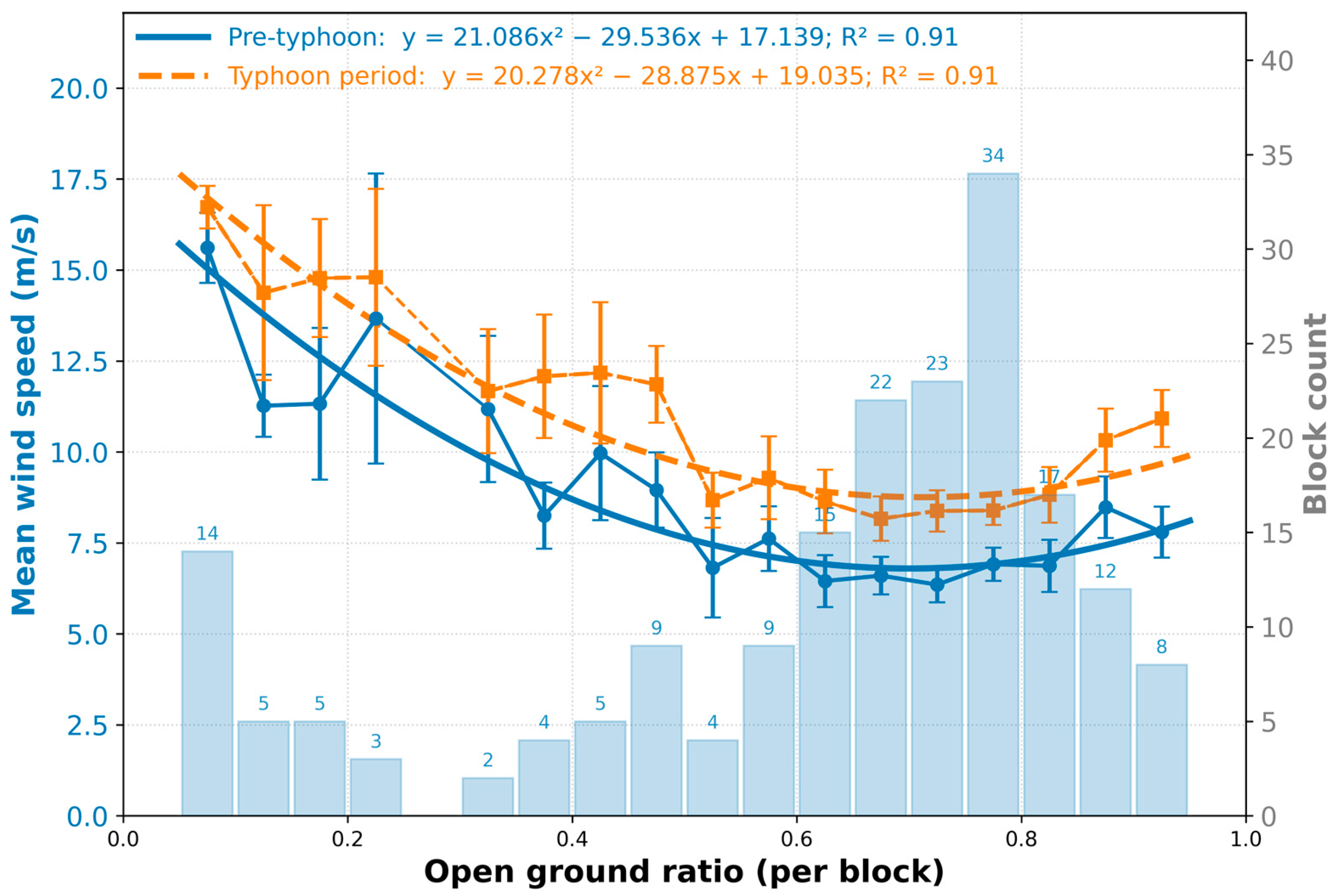
Figure 7 reveals a robust U-shaped nonlinear relationship between the near-surface wind speed and the open-space ratio, confirmed by highly consistent quadratic fits (R2 = 0.91) both before and during the typhoon. The shape reflects regime shifts in the dominant aerodynamic mechanisms across building densities. In open sectors (open-space ratio > 0.8), surface drag is minimal and high-level momentum downmixes efficiently, yielding the highest winds. As openness declines to moderate levels (~0.5–0.7), collective shielding by building arrays becomes most effective, inducing skimming flow over rooftops and creating a wind-suppression band with the lowest speeds. With further densification (<0.2), overall shielding gives way to canyon-jetting (Venturi-like) acceleration in narrow passages; enhanced vertical mixing transports momentum downward, causing a rebound in near-surface speed. The typhoon does not alter this rule but acts as a strong dynamical forcing that uplifts the entire U-curve by ~1.8–2.0 m s−1, with uneven amplification: the suppression band shows relative resilience, while the open-exposed and dense-accelerated ends respond strongly and emerge as risk hotspots. Because the multiscale ERA5–WRF–PALM chain exhibits an island-mean high bias of about 4–5 m s−1 (Section 4), the vertical shift of ~1.8–2.0 m s−1 in the fitted U-curves should be interpreted as a relative intensification under typhoon forcing within the same model configuration, rather than as a bias-corrected estimate of absolute wind-speed change. Partitioned analyses for four representative districts are provided in Appendix B (Figure A6).
Figure 7.
PALM-simulated mean 10 m wind speed as a function of the open ground ratio (per urban block). The solid blue line denotes the pre-typhoon period, and the orange dashed line denotes the typhoon period. Sample-size-weighted quadratic fits are overlaid for both periods. Error bars indicate the standard error, and the light-blue histogram (right axis) shows the number of urban blocks in each bin.
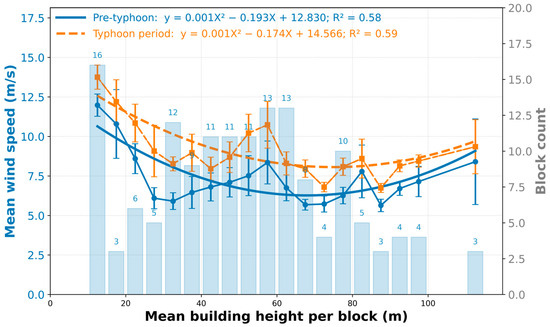
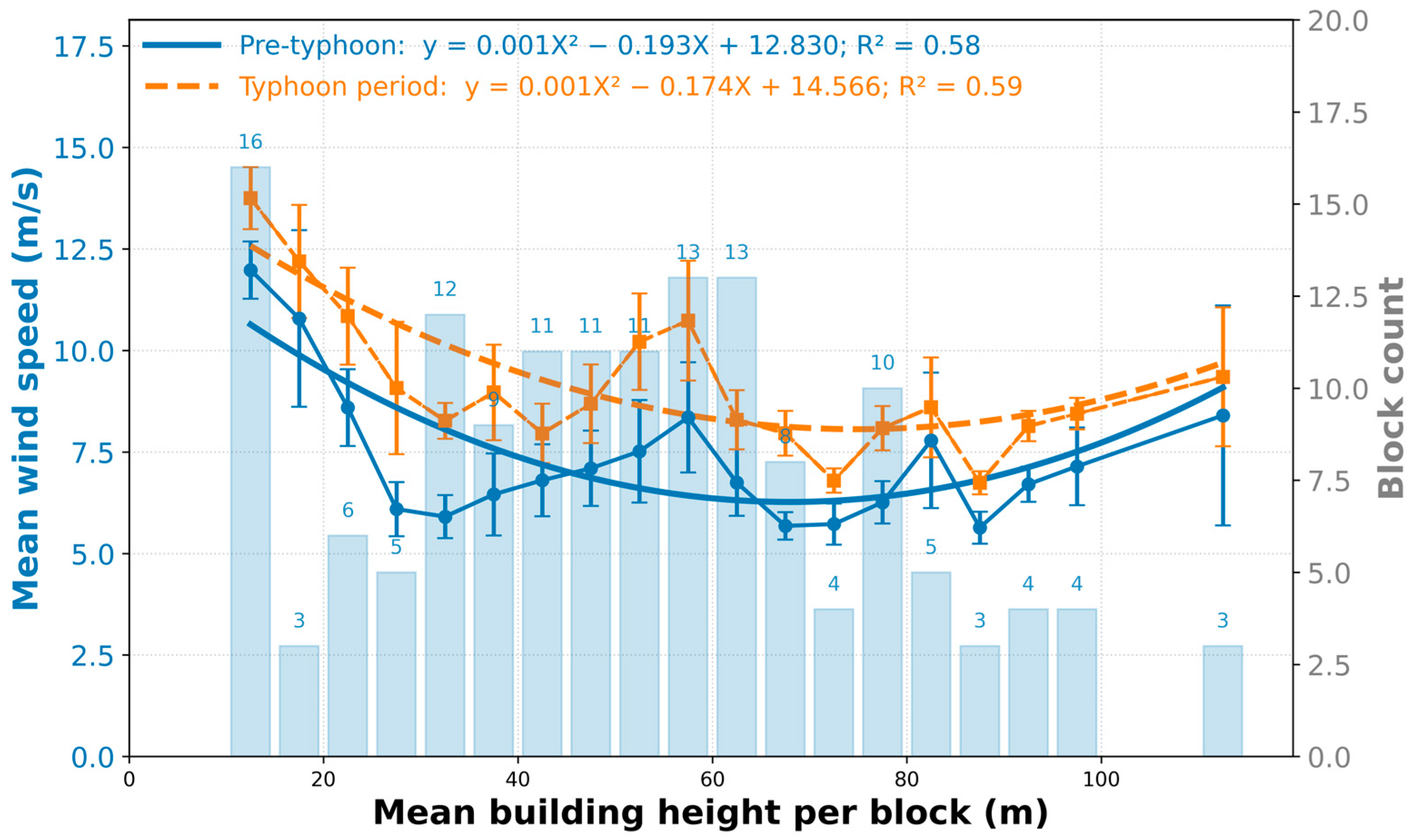
Figure 8 documents a similarly U-shaped relation with building height (R2 = 0.58–0.59). Typhoon passage elevates the curve by ~1.7 m s−1 without altering the basic shape. The pattern arises from the relative position of the 10 m observation height to building configurations. When buildings are low (<20 m), 10 m sits near or above rooftops, where little blockage is experienced and the boundary-layer flow is directly sampled—hence the higher speeds. For 20–70 m, the 10 m level is fully embedded in the canopy, with skimming flow over roofs and vortical structures within the canopy, forming a sheltered zone with minimum speeds. Beyond ~80 m, very tall buildings stir the flow and induce separation, recirculation, and downwash, re-energizing canopy winds. In Haikou, most buildings fall within the 20–70 m range, implying a natural wind-shielding advantage. Error bars are smallest for mid-heights, consistent with uniform skimming; they grow toward both ends—especially in the super-tall regime—reflecting strong local variability due to canyon jets and downwash. Further diagnostics on district-specific height effects appear in Appendix B (Figure A7); the roles of neighboring building heights and the heterogeneous response of open areas are discussed in Appendix B (Figure A8 and Figure A9).
Figure 8.
PALM-simulated mean 10 m wind speed as a function of the mean building height per urban block. The blue line represents the pre-typhoon period, and the orange dashed line represents the typhoon period. Both periods have sample-size-weighted quadratic fits overlaid. Error bars denote the standard error, and the light blue histogram shows the number of urban blocks in each bin.
3.4. Spatiotemporal Evolution
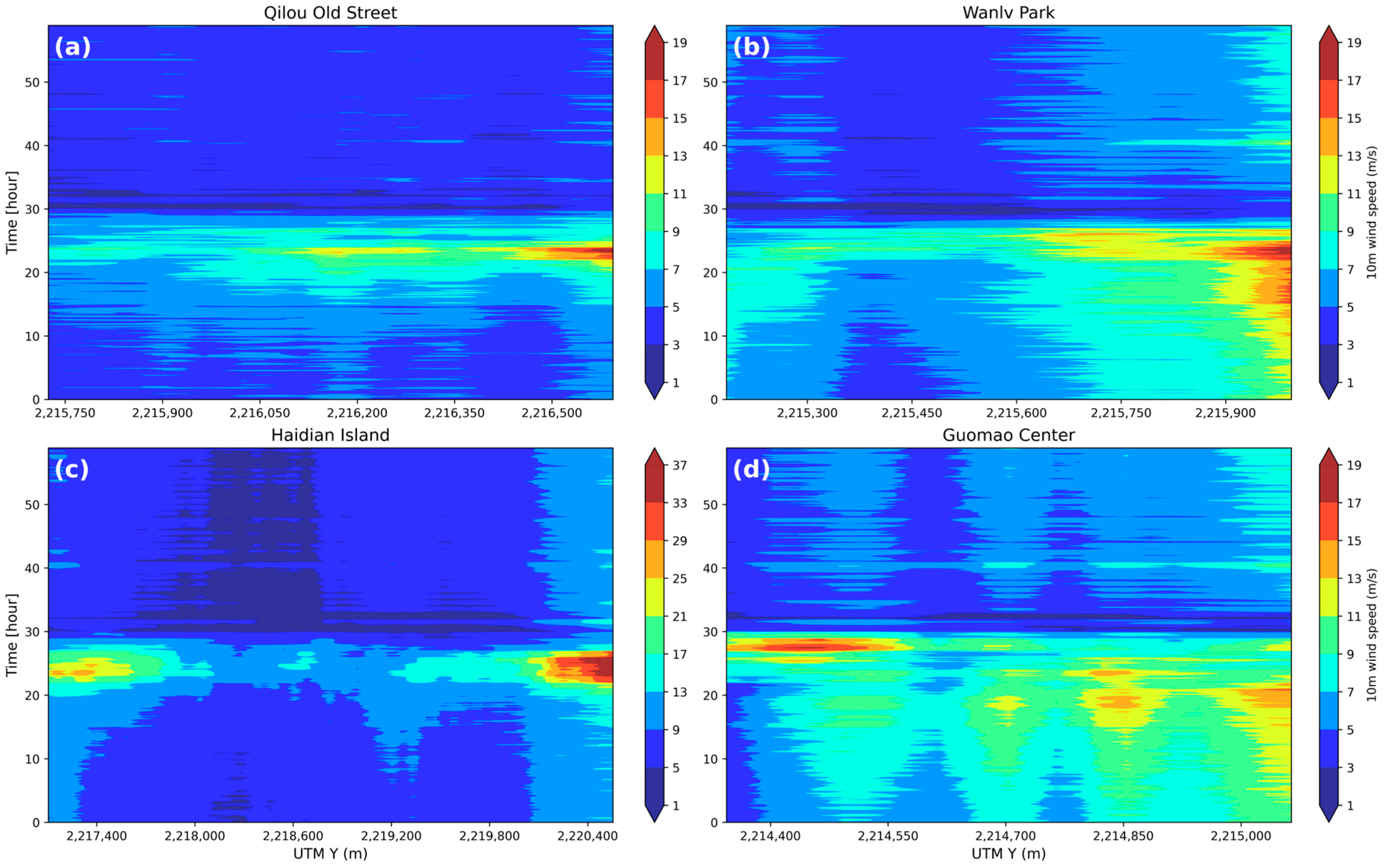
Figure 9 presents Hovmöller latitude–time sections of 10 m winds for four representative districts (Qilou Old Street, Wanlv Park, Haidian Island, Guomao), depicting the spatiotemporal evolution during Typhoon Yagi. The abscissa is UTM Y, the ordinate is hours since start, and color denotes the 10 m wind. All four districts exhibit banded wind-enhancement swaths during the typhoon’s peak (~hours 20–30). Wanlv Park (b) and Haidian Island (c) show broader high-wind zones and longer persistence (>15 m s−1) during the strongest phase, with pronounced maxima over the eastern cross-section or islet segments—evidence that topography and surface type extend the duration and footprint of extremes. The maximum for Qilou Old Street (a) is concentrated its on the eastern side, with a narrow spatial extent and short duration. Guomao (d) features multiple pulses and larger amplitude variability, with a more dispersed spatial distribution—indicating distinct responses between dense urban cores and open/island settings. Haidian Island (c) displays a “high–low–high” pattern across the section, suggesting local enhancement and shielding due to the island shape and coastline effects. Wanlv Park and Guomao illustrate a rise-then-fall temporal evolution with migrating spatial maxima. Overall, the Hovmöller diagrams reveal propagation pathways and zone-dependent persistence: open and island areas sustain long-lived, widespread extremes, whereas dense districts experience short-lived, localized peaks—highlighting the strong modulation of extreme winds by urban surfaces and spatial layout.
Figure 9.
Hovmöller diagrams illustrating the spatiotemporal evolution of PALM-simulated 10 m wind speed (m s−1, color scale) along south-to-north transects (UTM Y-coordinate, x-axis) through four distinct urban districts: (a) Qilou Old Street, (b) Wanlv Park, (c) Haidian Island, and (d) Guomao Center. The y-axis represents the simulation time in hours from the start time of 12:00 UTC 5 September 2024.
4. Discussion
By building an ERA5–WRF–PALM multiscale coupled modeling system, this study reproduced the near-surface wind field over Haikou during the passage of super Typhoon Yagi at an ultra-high resolution of 30 m. Although the system consistently captured the “rise–peak–decay” evolution of wind speed during landfall, the simulations showed a systematic high bias, with island-wide errors of RMSE ≈ 5.3 m s−1 and bias ≈ 4–5 m s−1. This bias does not originate from a single component, but rather from uncertainty accumulation along the entire modeling chain. The root causes originally trace back to the driving data: ERA5 reanalysis exhibits inherent limitations in representing the intensity and fine structure of tropical cyclones—especially during rapid intensification [32]. Subsequently, at the mesoscale WRF stage, the responses of the planetary boundary layer (PBL) and urban canopy schemes to frictional drag and turbulent kinetic energy under strong winds exhibit scheme dependence and systematic errors [33,34].
With respect to parameterizations, typhoon extremes challenge the applicability of existing boundary-layer theory. For example, Monin–Obukhov similarity theory, which underpins most surface-layer schemes, may break down under the highly non-stationary, strongly sheared typhoon boundary layer [35]. In addition, accurate representation of drag is a central difficulty. Numerous studies confirm that the sea-surface drag coefficient saturates or even decreases at very high wind speeds [36,37]; whether an analogous “equivalent drag coefficient” exists over urban canopies under typhoon intensities remains an open question. Current urban parameterizations, largely developed for fair-weather conditions, have uncertain validity in typhoon regimes and may underestimate aggregate urban friction [38]. These errors are then propagated into the microscale PALM model and, via wall functions whose validity is also uncertain at extreme Reynolds numbers, may further amplify simulated wind speeds [39]. Meanwhile, simplifications in the urban representation—static building geometries neglecting vegetation and small-scale structures—constitute additional sources of uncertainty.
There are also intrinsic limitations in observational validation. Owing to typhoon damage, only five automatic weather stations provided complete data, limiting spatial representativeness. Although these stations span shoreline, island, and urban-core settings and suffice for process-level checks, they are insufficient to fully verify the fine-scale spatial patterns produced by PALM (e.g., leeward wakes behind buildings or street-canyon hotspots). Hence, the high-resolution wind maps in this study should be interpreted as high-likelihood hazard scenarios inferred from the best-available physics, rather than as the fully validated ground truth.
Despite these limitations, the revealed U-shaped response of near-surface wind speed to urban surface morphology aligns closely with classical urban-flow theory. Wind speeds are highest in high-openness and low-rise areas due to weaker morphological blockage and more efficient downward transport of typhoon boundary-layer momentum. In moderately tall and dense districts (≈40–70 m), wind speeds exhibit a pronounced minimum consistent with skimming-flow dynamics—flow passes primarily over rooftops, rendering the pedestrian level a relatively sheltered zone [38,40,41,42]. As building height increases further, wind speeds rise again, pointing to the combined actions of canyon-jetting (Venturi-like) acceleration between tall buildings and strong downwash around structures. Under typhoon forcing, these nonlinear effects are substantially amplified [18,22].
These findings have important practical implications for rapidly urbanizing tropical and subtropical coasts. At the urban-planning scale, wind-sensitive design should be implemented [43]. Open coastal and estuarine sectors act as amplifiers of extremes; in transition zones between these areas and dense built-up belts, planners should avoid broad, straight corridors aligned with the prevailing typhoon winds. At the building-design scale, the documented strong heterogeneity of the urban wind field implies that traditional wind-load provisions based on uniform profiles may underestimate site-specific risks; site-specific microscale wind assessments should become a necessary step for critical infrastructure and super-tall buildings. Although this case study focuses on Haikou and Typhoon Yagi, the ERA5–WRF–PALM workflow itself is generic and can be applied to other coastal or inland cities where (i) reliable reanalysis or NWP forcing, (ii) basic near-surface wind observations, and (iii) building-footprint and land-cover data at a tens-of-meters resolution are available. In new applications, the WRF domain setup, land-use fields and PALM static inputs need to be adapted to local conditions, but no fundamental change in the modeling framework is required. Finally, the study’s limitations indicate pathways for improvement: at the provincial level, multi-model ensembles and data assimilation should be advanced and both surface and upper-level wind measurements should be densified, and in model development, urban-canopy parameterizations tailored to typhoon conditions should be pursued and machine learning should be integrated to improve forecasts of extreme winds. From a resilience perspective, the building-resolving wind maps and morphology–wind response curves derived here provide the physical hazard information required by composite resilience indices and local resilience assessments that have been developed for typhoon-prone cities [11,12]. Combined with social and infrastructural indicators, they can help identify districts where extreme winds, exposure and limited recovery capacity coincide, and should therefore be prioritized for wind-resilience interventions in Haikou and similar coastal cities.
5. Conclusions
Drawing on ERA5–WRF–PALM simulations, multi-source observations, spatial statistics, and sensitivity analyses, we summarize the coupling between the temporal evolution, directional structure, and extremes of the near-surface wind field during Typhoon Yagi in Haikou and its links to urban morphology (open-space ratio, building height, and neighborhood structure) as follows:
- (1)
- Multiscale modeling performance.
ERA5/WRF reproduced the typhoon evolution (R2 = 0.49/0.86) but exhibited a systematic high bias of 4–5 m s−1, mainly due to limitations in boundary-layer parameterizations and land–sea roughness treatments. PALM showed higher sensitivity to extremes at strong-wind sites (e.g., M1039, r = 0.77), refining local turbulence features, yet its directional concentration and late-stage decay still require improvement. The multiscale nesting effectively combines mesoscale circulation positioning with microscale refinement, offering a feasible pathway for urban typhoon wind modeling.
- (2)
- Spatial pattern (“coastal high, urban-core low”).
PALM simulations reveal high wind exposure over coasts, estuaries and peninsulas (Beaufort ≥ 8; 100–400 BFT·h versus < 30 BFT·h in dense cores). NE and SW coasts form continuous high-exposure belts, aligning with wind-facing open terrain and low-density districts. The contrast reflects the combined effects of roughness jumps and ventilation corridors; dense urban fabrics systematically shorten the persistence of extremes, offering quantitative guidance for risk zoning. In practice, these results suggest that coastal estuaries and the transition zones between open coastal sectors and dense built-up belts should be treated as priority areas for wind-risk zoning and wind-resilient urban design in Haikou.
- (3)
- Open-space ratio: robust U-shape.
The near-surface wind speed exhibits a stable U-shaped relation with the open-space ratio (sample-size-weighted quadratic fits, R2 ≈ 0.91/0.91 for pre-/during typhoon). Moderate openness (0.4–0.7) yields the lowest and most stable winds (6–9 m s−1); both low (<0.2) and high (>0.7) openness produce higher winds. Typhoon forcing lifts winds by 1–4 m s−1 overall, with the largest increases at both ends (peaks up to 17.5 m s−1). Responses vary by district: in historic blocks, they fluctuate weakly; in open areas, they amplify strongly; and in island zones, they show homogenization. Moderately open blocks exert damping and stabilizing effects. This provides a quantitative basis for optimizing the arrangement and size of open spaces in typhoon-prone neighborhoods, avoiding layouts that are either too closed or excessively open.
- (4)
- Building height: U-shaped nonlinearity.
The wind speed decreases then increases with building height (weighted quadratic R2 = 0.58/0.59). Low-rise (<20 m) districts average ~14 m s−1 during the typhoon; 40–70 m dense mid-rise districts form a velocity trough (7.5–9 m s−1); and super-tall (≥90 m) areas rebound to 9–10 m s−1. The U-shape reflects differential flow modulation: shielding dominates in dense mid-rise areas, while canyon-jetting intensifies in super-tall clusters. Under typhoon forcing, nonlinearity is amplified, informing layout optimization of high-rise districts. When the prevailing wind aligns parallel to the major street axis, the right branch (high-openness/high-height end) steepens due to stronger acceleration; with perpendicular/oblique incidence, upwind blockage widens the trough and flattens the curve. Thus, the urban wind response depends not only on the static form but also on coupling between the typhoon wind direction and street fabric. The identified U-shaped response of wind to building height indicates that height limits and street orientation in new high-rise clusters should be evaluated with building-resolving wind simulations under dominant typhoon tracks.
- (5)
- Spatiotemporal evolution.
All four districts exhibit synchronized wind enhancement around hours 20–30, but with distinct modes. Open (Wanlv Park) and island (Haidian) areas experience long-lived, expansive extremes; Haidian peaks approach 30 m s−1 with a “high–low–high” spatial pattern. The historic core (Qilou) has narrow, short-lived high-wind bands, while the modern CBD (Guomao) shows multi-core fluctuations. These contrasts reflect strong terrain and surface modulation of extreme winds and support mitigation strategies differentiated by urban function. In operational terms, this calls for district-specific design standards and emergency planning that reflect the distinct wind-exposure characteristics of each functional zone.
Overall, while the study delineates clear physical regularities, its quantitative outcomes rest on limited station validation data. Broader observations will be required to further verify and refine the fine-scale spatial patterns indicated by the model.
Author Contributions
Conceptualization, J.X., C.S. (Chenxiao Shi), C.S. (Chunxiang Shi) and L.B.; Methodology, J.X., Y.X., C.S. (Chenxiao Shi), C.S. (Chunxiang Shi) and L.B.; Software, Y.X.; Validation, J.W., Y.X., C.S. (Chenxiao Shi) and C.S. (Chunxiang Shi); Formal analysis, J.X., J.W., Y.X. and M.S.; Investigation, J.X., D.Y. and M.S.; Resources, D.Y. and L.B.; Data curation, J.X., J.W. and D.Y.; Writing—original draft, J.X.; Writing—review and editing, J.X., J.W., Y.X., D.Y., M.S., C.S. (Chenxiao Shi), C.S. (Chunxiang Shi) and L.B.; Visualization, J.X., J.W. and M.S.; Supervision, C.S. (Chenxiao Shi) and L.B.; Project administration, C.S. (Chenxiao Shi); Funding acquisition, L.B. All authors have read and agreed to the published version of the manuscript.
Funding
This research was funded by Lei Bai’s research grants (Grant Nos. 32260294, KYQD(ZR)-22083, and 425RC692) and by the project supporting Chenxiao Shi (Grant No. 423QN317). The APC was funded by [Hainan Meteorological Information Center] under the above funding support.
Institutional Review Board Statement
Not applicable.
Informed Consent Statement
Not applicable.
Data Availability Statement
ERA5 reanalysis data are openly available from the ECMWF Climate Data Store [15]. WRF model outputs used to provide mesoscale forcing are archived in Zenodo [16].
Acknowledgments
We gratefully acknowledge the Baiwangxin Intelligent Computing Center for providing the computational resources required for this study. We also sincerely thank the three anonymous reviewers for their valuable and constructive comments.
Conflicts of Interest
The authors declare no conflicts of interest.
Appendix A
Figure A1 compares 10 m wind-speed time series at five representative stations, including observations and results from ERA5, WRF-1 km, and PALM. All models capture the overall evolution, with consistent behavior during rapid intensification and peak timing. At some sites, extreme winds were observed during typhoon passage: peak values reached 25.39, 29.74, and 17.15 m s−1 at M1008, M1039, and M1043, respectively. ERA5 generally overestimates the peak and shows a slight lag in peak timing; WRF reproduces peaks better at most sites but with timing offsets. PALM responds more sensitively at some sites—e.g., M1039 shows the highest correlation (r = 0.77)—yet overestimates magnitudes overall. At low-wind site M1021, model agreement degrades, with correlations as low as 0.19 (ERA5) and 0.04 (PALM), indicating substantially increased model uncertainty under weak-wind conditions. WRF exhibits relatively high correlations (0.51–0.82) at most sites and performs best in reproducing the peak and the post-peak decay.
Figure A1.
Time series comparison of hourly 10 m wind speeds at five representative stations during Typhoon Yagi (12:00 UTC 5 September to 00:00 UTC 8 September 2024). The comparison includes station observations (OBS, black), ERA5 reanalysis (blue), the WRF-1km simulation (green), and the PALM simulation (orange). Correlation coefficients (R) between each model and the observations are provided in the legends. (a) M1008 (Haikou Haidian Island Sewage Treatment Plant); (b) M1009 (Hainan Province Meteorological Administration); (c) M1021 (Park Wanlvyuan); (d) M1039 (Shiji Bridge); (e) M1043 (Hainan University, Haidian Campus).
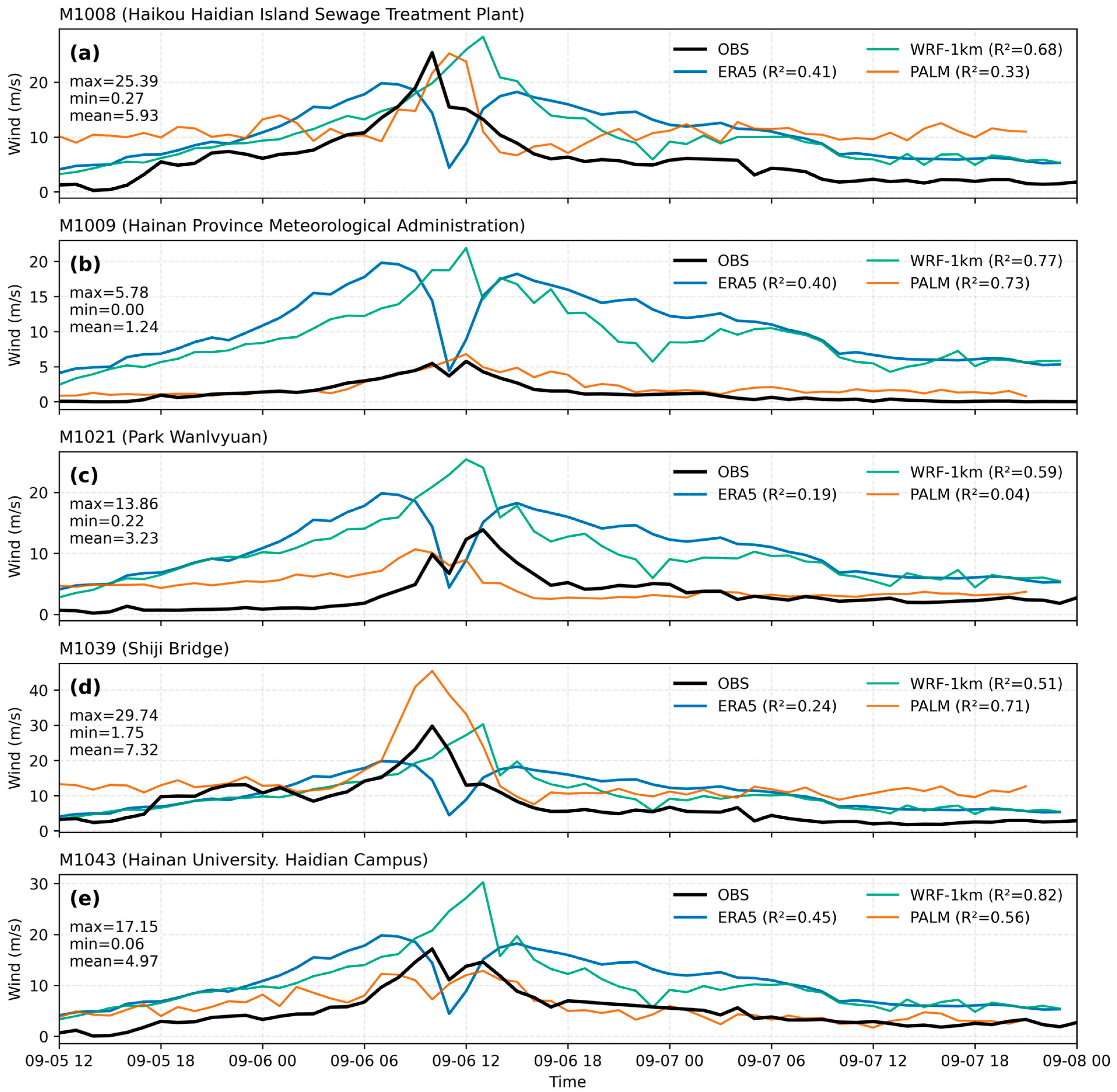
Figure A2 presents 10 min wind-speed time series from PALM versus observations at the five stations. PALM captures the principal features of the observed evolution—trend, peak timing, and decay—and shows strong consistency during the rapid rise, peak, and subsequent weakening. At M1008 and M1039, PALM captures the peak timing but overestimates the amplitude. At lower-wind sites (M1009, M1021, M1043), PALM shows a systematic high bias, especially during the post-typhoon and weak-wind phases. Overall, PALM is more sensitive to extremes than large-scale products and better reflects abrupt local changes, but it tends to overpredict peak and late-stage winds.
Figure A2.
Time series of 10 min-averaged 10 m wind speeds at five stations comparing PALM simulations (orange) with station observations (OBS, blue) for the period of 5–8 September 2024. (a) M1008 (Haikou Haidian Island Sewage Treatment Plant); (b) M1009 (Hainan Province Meteor-ological Administration); (c) M1021 (Park Wanlvyuan); (d) M1039 (Shiji Bridge); (e) M1043 (Hainan University, Haidian Campus).
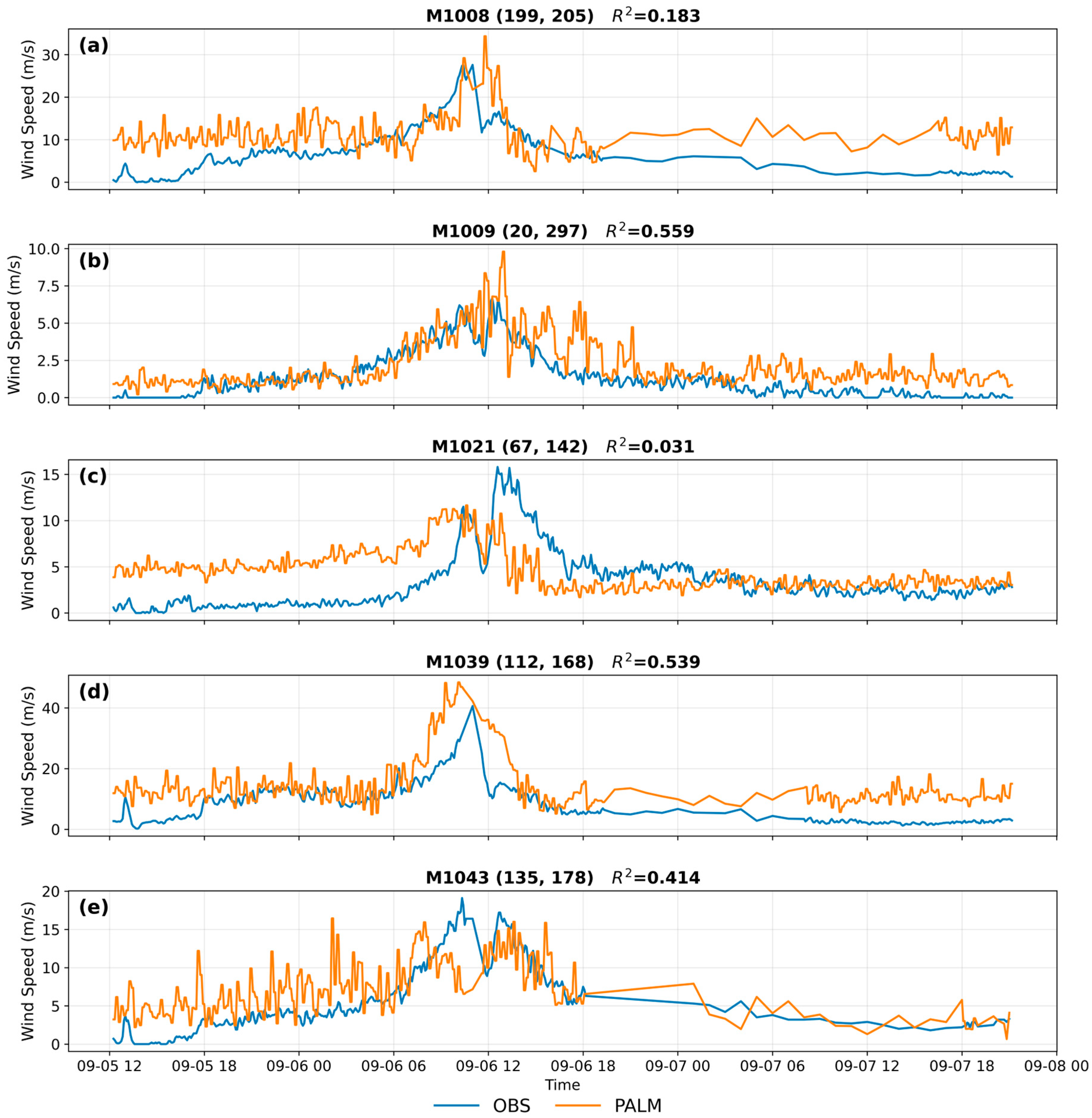
Figure A3 compares pairwise station time series to assess spatial synchronicity during extremes and the skill of PALM. All station pairs exhibit good agreement during the extreme phase: observed winds peak around 06:00 UTC on 6 September and then decrease rapidly. PALM reproduces the co-occurrence of multi-site extremes but tends to overestimate magnitudes and to decay too slowly afterward. For high-wind pairs, PALM overpredicts peak magnitude, maintains elevated winds before/after the peak, and shows smaller inter-station differences than observed—indicating underestimation of spatial differentiation in local extremes. For low-wind pairs, PALM also exhibits a systematic high bias and a smaller amplitude of variation than observed. PALM’s response is smoother than the observations, lacking some short-lived rapid changes present in the measurements.
Figure A3.
Pairwise comparisons of hourly 10 m wind-speed time series among the five observation stations. Each panel compares two stations, showing the observations (colored solid lines) and the corresponding PALM simulations (dashed lines) to evaluate the model’s ability to capture intra-city spatial coherence.
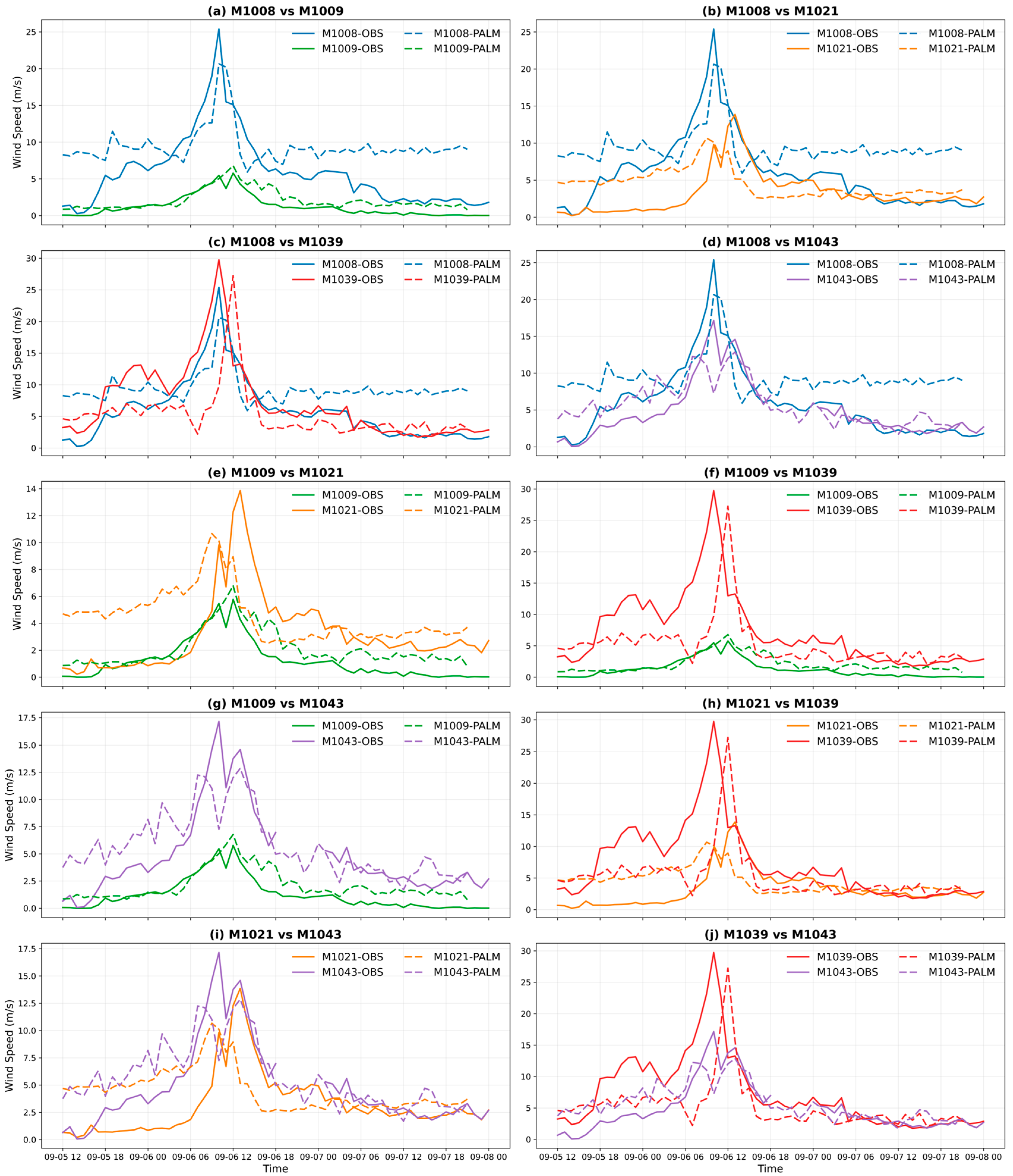
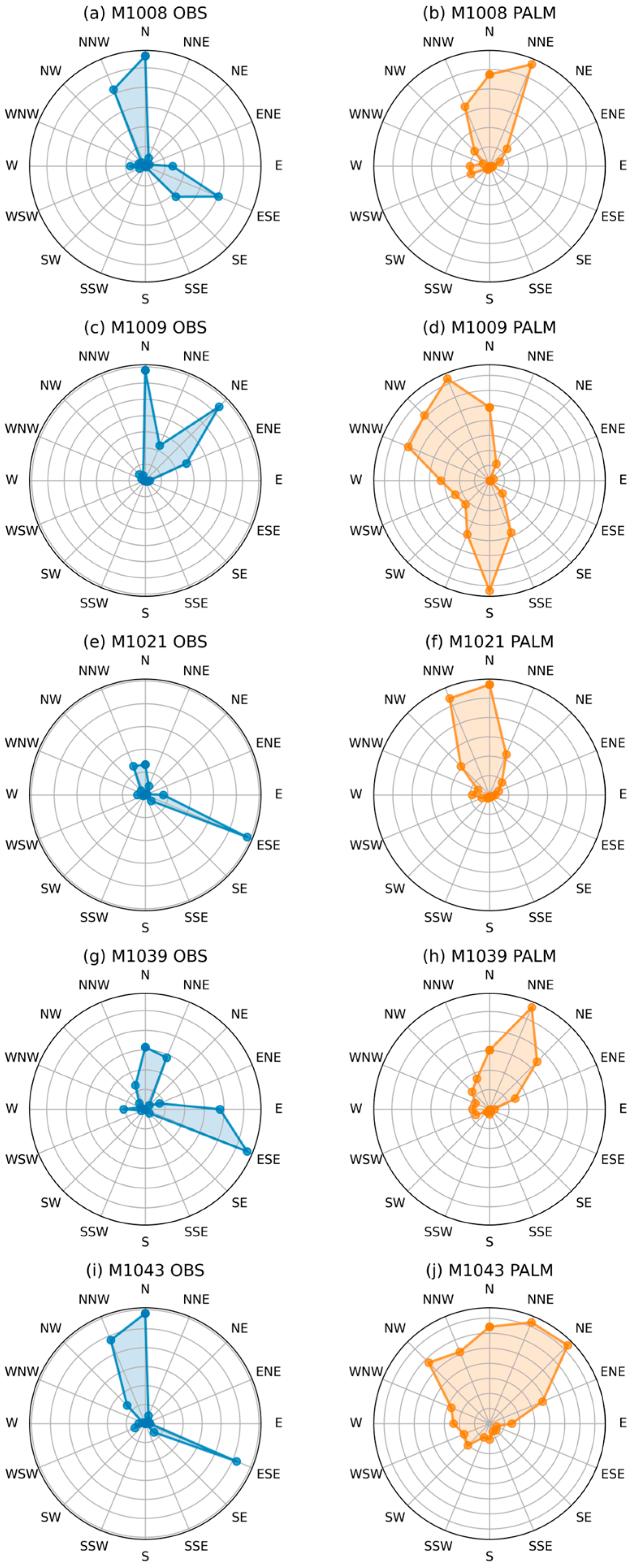
Figure A4 shows 10 min wind-direction roses for the five stations, comparing observations and PALM. The observations exhibit a clear dominant direction with a high concentration: N/NE at M1008, M1009, and M1043, and SE/E at M1021 and M1039. The observed distributions feature a pronounced primary lobe with weak secondary lobes, reflecting circulation control during the typhoon. PALM captures the dominant direction at most sites but shows systematic differences: simulated roses are generally more dispersed, with a lower dominant-direction frequency and higher probabilities for secondary directions. At SE-dominated sites, PALM reproduces the high-frequency sector but with a lower peak than observed. PALM responds strongly to small-scale disturbances and the local topography, but under extreme circulation control, its directional concentration is underrepresented.
Figure A4.
Wind roses showing the frequency distribution of 10-min mean 10 m wind direction at five stations for the period of 5–8 September 2024. The left column shows station observations (OBS), and the right column shows the corresponding PALM simulations.
Appendix B
Figure A5 maps the total wind exposure over the full simulation for the northern (a) and southern (b) sub-regions. It maps wind speed to the Beaufort level, multiplied by duration and summed over time (unit: BFT·h); no thresholding is applied here, so it differs from the over-threshold exposure in Section 3.3. High values (>100–300 BFT·h) occur along coasts, estuaries, and peninsulas, mainly over wind-facing open terrain. Northern hotspots cluster along the NE coast and islands; southern hotspots lie along the SW and SE coasts. In dense urban cores, cumulative exposure is generally <30 BFT·h, indicating strong attenuation of persistent extremes by complex urban morphology. The spatial pattern broadly aligns with that of maximum consecutive exposure, but the high-exposure footprint is more extensive, corroborating the key regulatory role of surface type and spatial layout in the cumulative effects of extreme winds.
Figure A5.
Spatial distribution of total wind exposure (BFT·h) simulated by PALM for the (a) northern and (b) southern subregions. Over the full simulation period, the Beaufort wind level is multiplied by its hourly duration without thresholding. Buildings and water surfaces are masked.
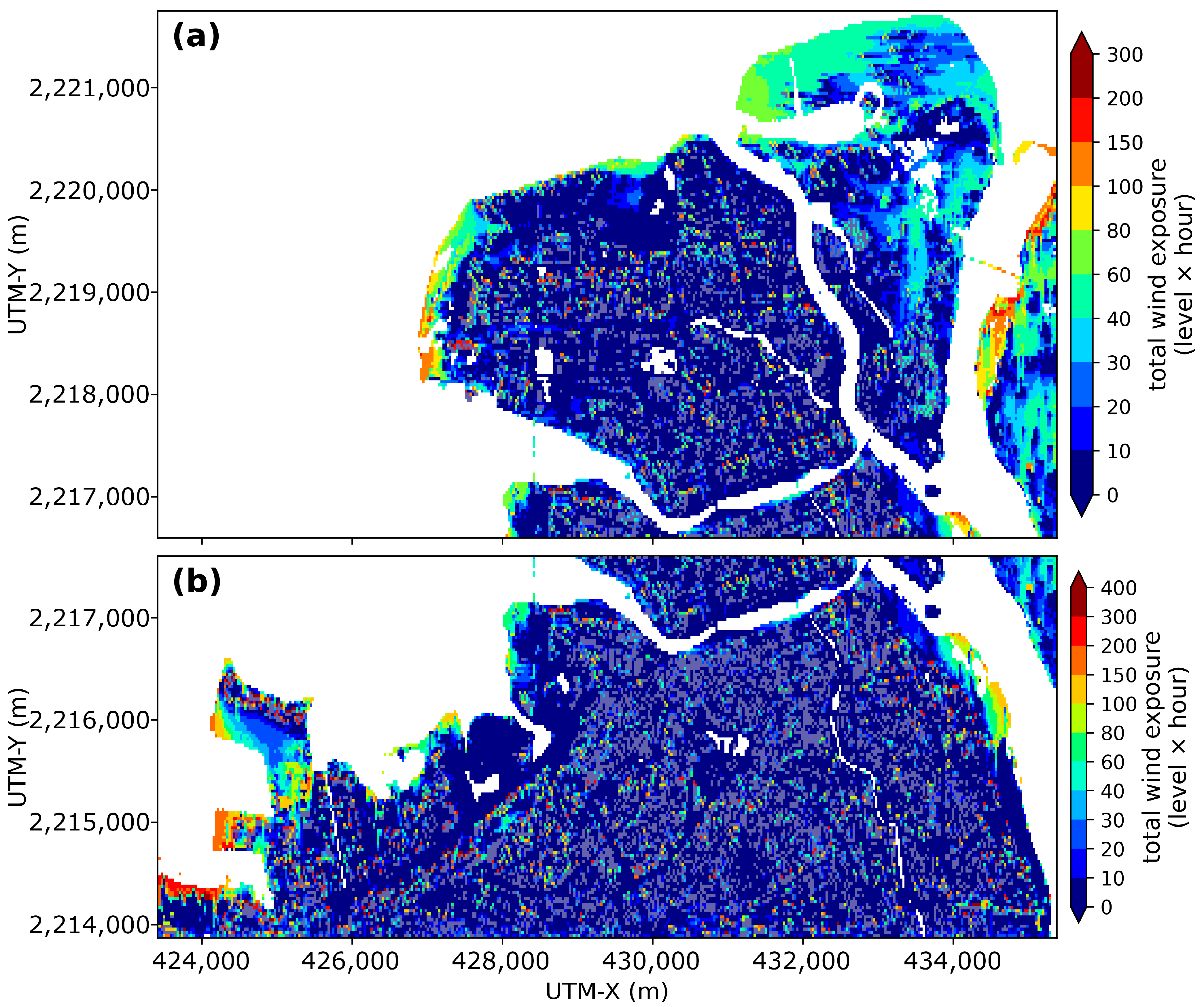
Figure A6 compares block-averaged wind speeds across open-space-ratio bins for four districts (Qilou Old Street, Wanlv Park, Haidian Island, Guomao) before and during the typhoon. Mean winds increase in all districts during the event, but responses are heterogeneous. Qilou samples cluster at moderate openness (0.3–0.7) with overall lower winds and limited inter-bin contrast, reflecting dense fabric and constrained ventilation corridors. Wanlv Park shows higher overall winds and a +1–2 m s−1 increase during the typhoon, highlighting amplification in highly open spaces. Haidian spans the widest openness range and exhibits homogenization across surface types during the event. Guomao samples concentrate at high openness (0.6–0.9), with a marked wind increase during the typhoon. These results reveal complex coupling between the functional structure and extreme-wind response.
Figure A6.
Comparison of PALM-simulated mean 10 m wind speed as a function of the open space ratio for four distinct urban districts: (a) Qilou Old Street, (b) Wanlv Park, (c) Haidian Island, and (d) Guomao Center. Blue lines represent the pre-typhoon period, and orange dashed lines represent the typhoon period. Error bars denote the standard error, and histograms show the sample size.
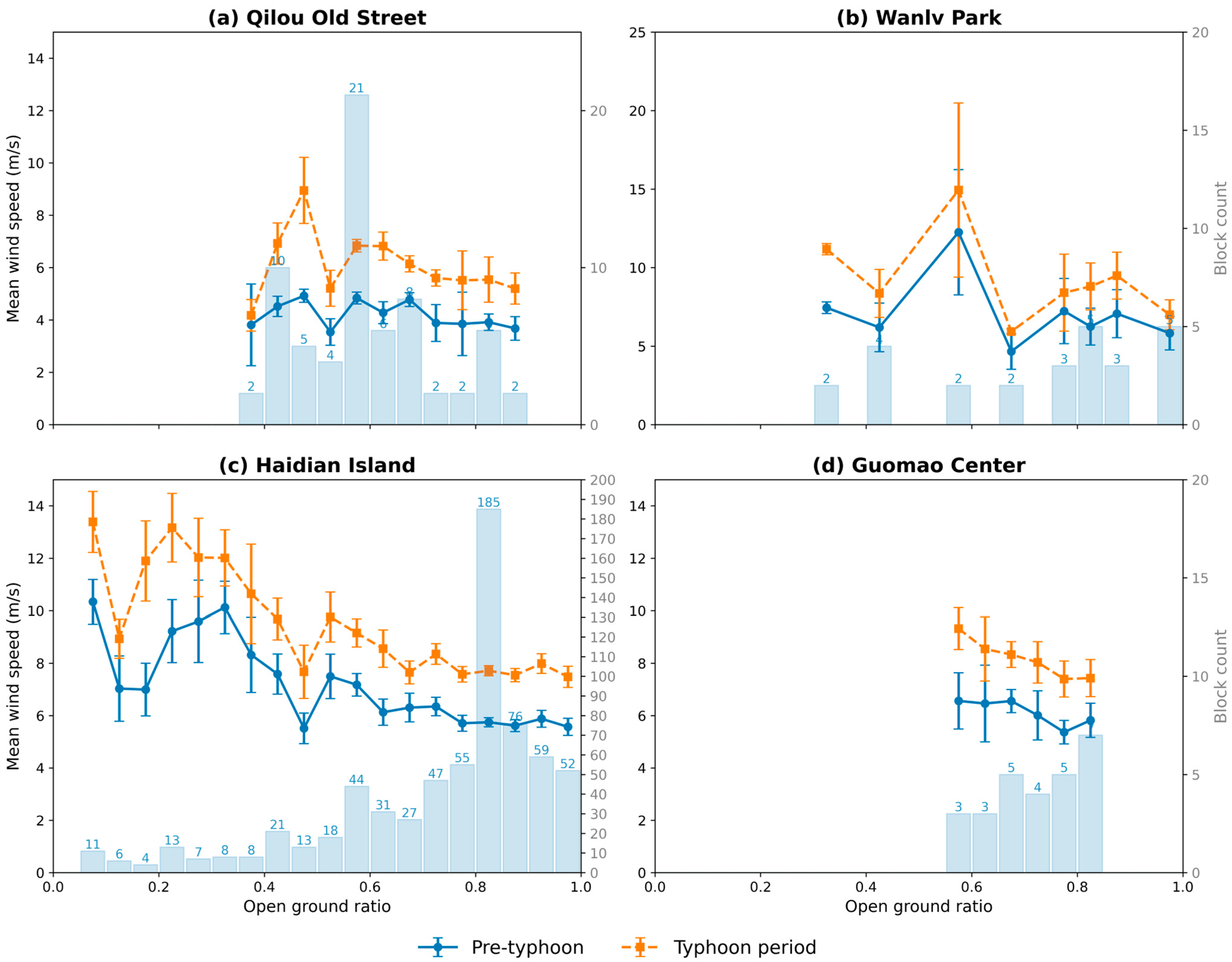
Figure A7 compares block-averaged winds across building-height bins in the four districts. During the typhoon, winds in all height bins are higher than under normal conditions, but spatial response patterns differ. Qilou is dominated by low–mid heights with limited wind variation versus height; Wanlv Park (open space) shows a pronounced wind increase during the event; Haidian exhibits a clear U-shape with a minimum at 40–60 m (dense high rises), and high-rise blocks develop wind peaks during the event; and Guomao samples cluster at high heights, with broadly elevated winds and a weaker height dependence. Overall, building height nonlinearly modulates wind speed; dense high-rise clusters exhibit canyon-jetting effects and complex local amplification under extremes, informing urban risk assessments and mitigation planning.
Figure A7.
Comparison of PALM-simulated mean 10 m wind speed as a function of mean building height for four distinct urban districts: (a) Qilou Old Street, (b) Wanlv Park, (c) Haidian Island, and (d) Guomao Center. Blue lines represent the pre-typhoon period, and orange dashed lines represent the typhoon period. Error bars denote the standard error, and histograms show the sample size.
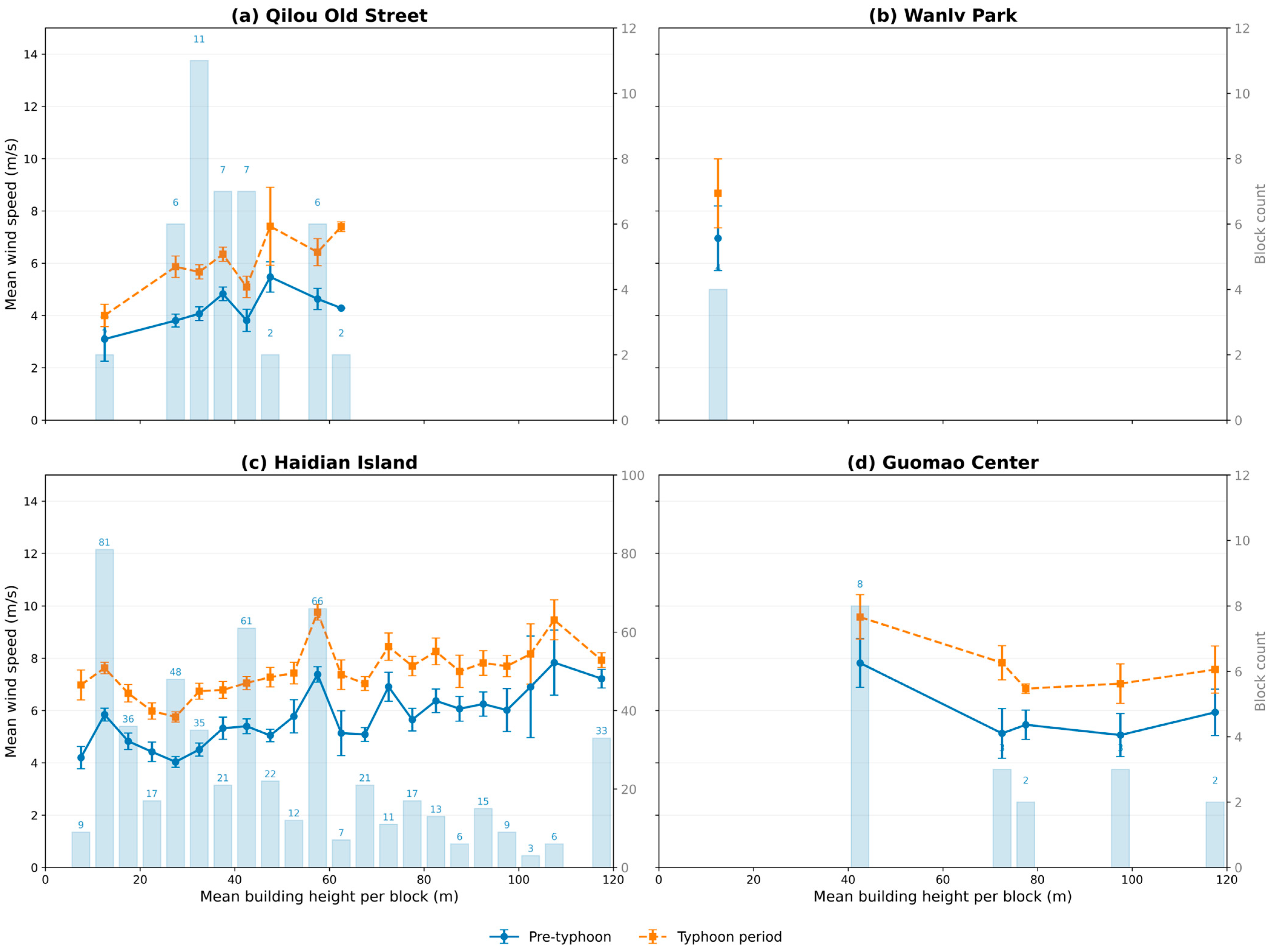
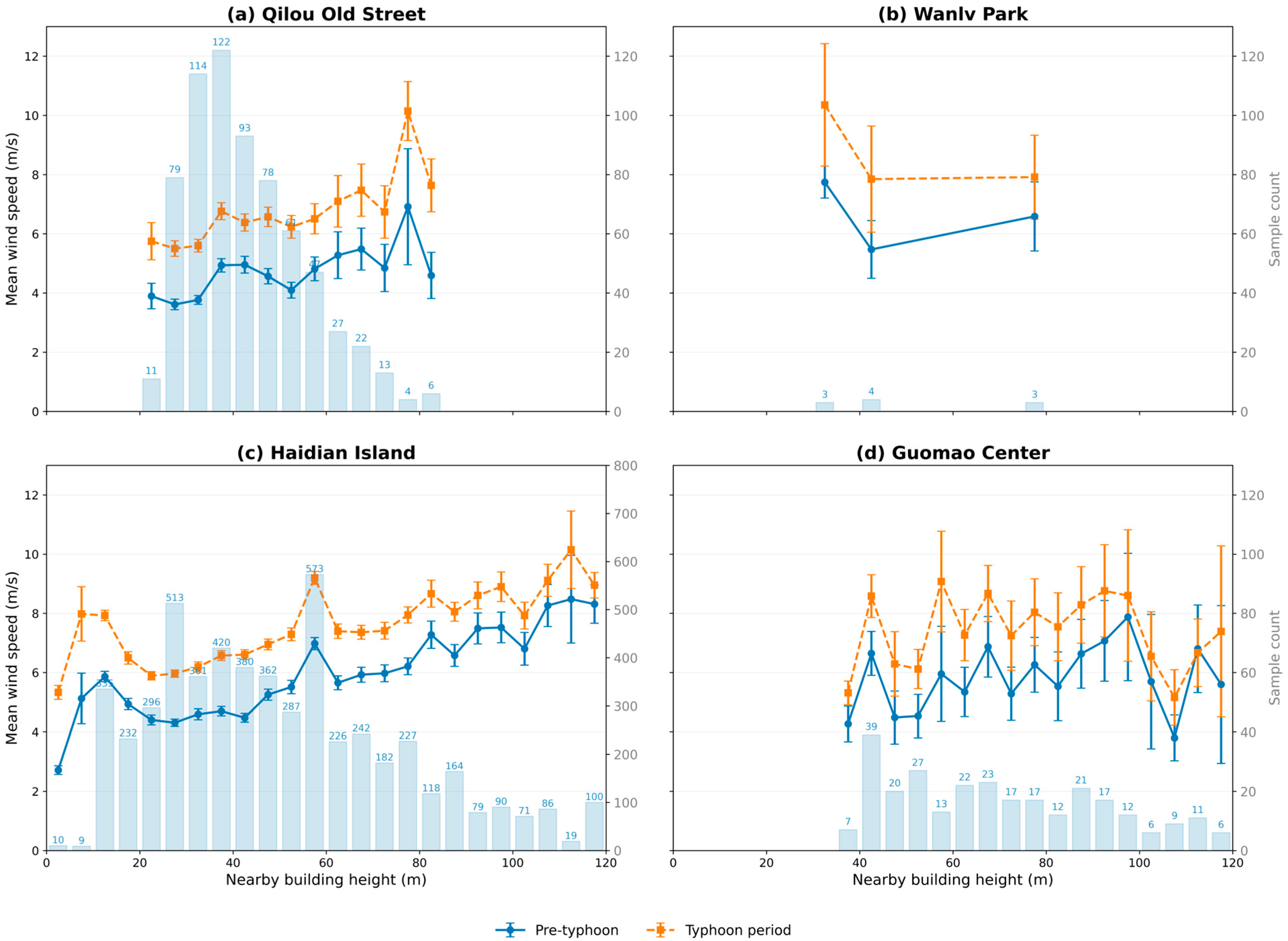
Figure A8 analyzes the effect of neighboring-building height on mean urban winds. During the typhoon, all height bins show significantly higher winds than in the pre-event period, with nonlinear regulation. Low heights (<20 m) have the highest winds (event-time peaks > 10 m s−1), indicating strong amplification over open/low-rise settings. As the height increases to 20–40 m, winds drop rapidly to a minimum (5–6 m s−1), reflecting effective blockage by moderate-height dense fabrics. Above 40 m, winds increase gradually, with a stronger rise during the event—likely tied to canyon-jetting in tall clusters. Sample counts concentrate in the 30–70 m band—Haikou’s primary building stock—where winds are lower and more stable, exerting primary control on the urban wind environment. Weighted quadratic fits for neighboring height show U-shapes in both periods (R2 = 0.31 pre-typhoon; 0.29 during-typhoon). Differences are largest for <20 m (event winds up to ~11 m s−1) and smaller for 30–70 m (with ~1100–1300 samples per bin). The relative roles of building shielding versus channeling adjust nonlinearly with typhoon stage and wind direction, evidencing phase-dependent modulation by urban form.
Figure A8.
PALM-simulated mean 10 m wind speed as a function of the mean height of neighboring buildings (calculated with kernel = 8, min_buildings = 12). The blue line represents the pre-typhoon period, and the orange dashed line represents the typhoon period. Both periods have sample-size-weighted quadratic fits overlaid. Error bars denote the standard error, and the histogram shows the number of samples in each bin.
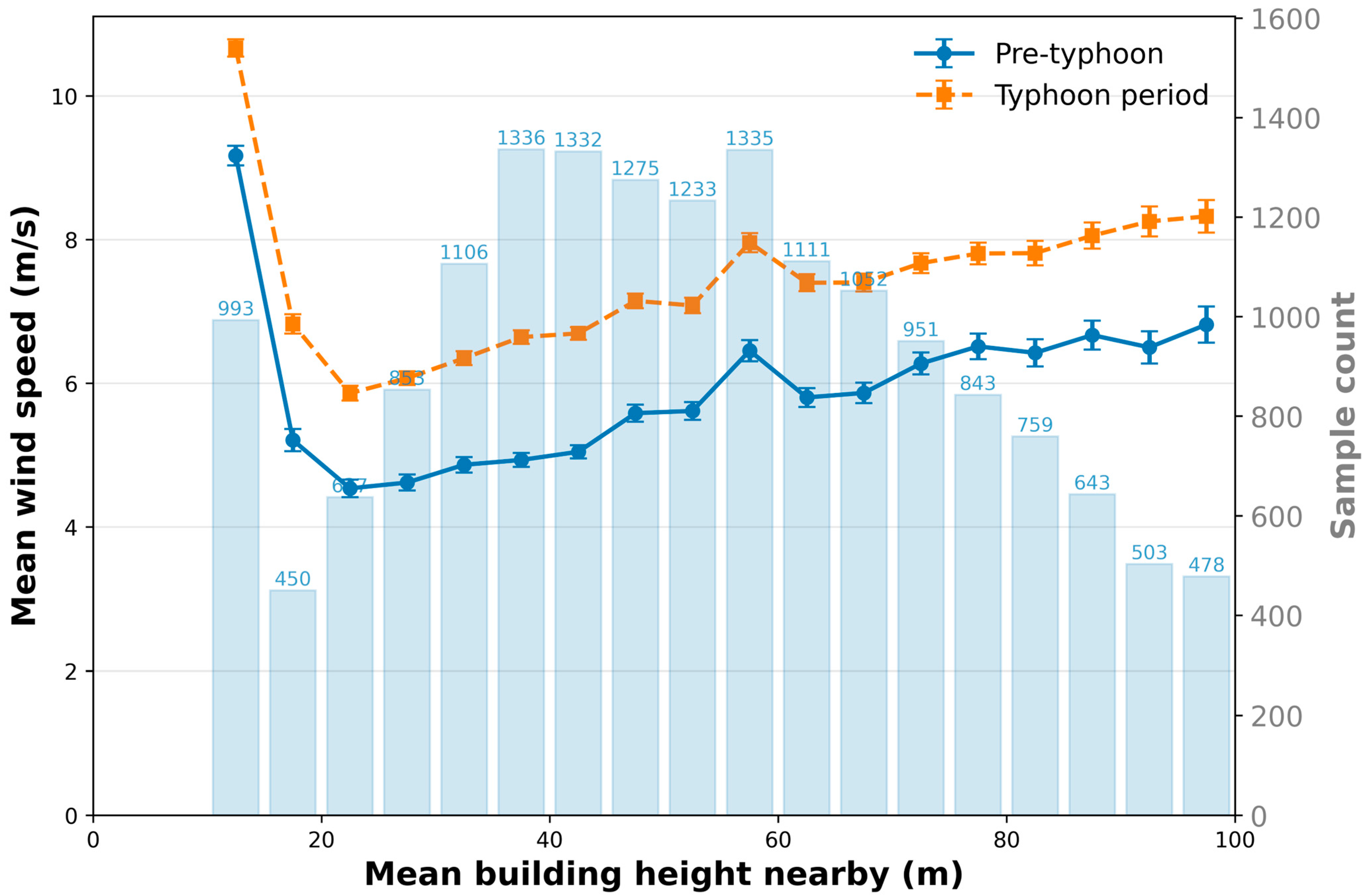
Figure A9 contrasts how open-area winds respond to neighboring-building height across the four districts. In Qilou, open-area winds are nearly flat and then increase with neighboring height; during the event, winds peak in the >70 m bin, suggesting a guiding effect of local high rises under extremes. Wanlv Park has limited samples but shows distinct wind increases during the event, emphasizing the exposure of large open spaces. Haidian shows a U-shape: before the event, the minimum lies at 40–60 m; during the event, peaks emerge for >80 m, indicating cooperative amplification between open areas and tall buildings in complex districts. Guomao samples cluster at high heights, with broadly elevated winds during the event; open spaces in high-rise business districts bear greater wind risk. These results reveal spatial heterogeneity in the response of open-area winds to building height and provide a basis for risk assessment of urban open spaces.
Figure A9.
Comparison of PALM-simulated mean 10 m wind speed in open spaces as a function of the mean height of neighboring buildings for four distinct urban districts: (a) Qilou Old Street, (b) Wanlv Park, (c) Haidian Island, and (d) Guomao Center. Blue lines represent the pre-typhoon period, and orange dashed lines represent the typhoon period. Error bars denote the standard error, and histograms show the sample size.
References
- Emanuel, K. Increasing destructiveness of tropical cyclones over the past 30 years. Nature 2005, 436, 686–688. [Google Scholar] [CrossRef] [Scilit]
- Peduzzi, P.; Chatenoux, B.; Dao, H.; De Bono, A.; Herold, C.; Kossin, J.; Mouton, F.; Nordbeck, O. Global trends in tropical cyclone risk. Nat. Clim. Change 2012, 2, 289–294. [Google Scholar] [CrossRef] [Scilit]
- Webster, P.J.; Holland, G.J.; Curry, J.A.; Chang, H.-R. Changes in tropical cyclone number, duration, and intensity in a warming environment. Science 2005, 309, 1844–1846. [Google Scholar] [CrossRef] [Scilit]
- Hallegatte, S.; Green, C.; Nicholls, R.J.; Corfee-Morlot, J. Future flood losses in major coastal cities. Nat. Clim. Change 2013, 3, 802–806. [Google Scholar] [CrossRef] [Scilit]
- Yang, D.; Zhang, N.; Tang, J. Impacts of urban morphology on typhoon-induced wind hazards at the pedestrian level. Urban Clim. 2025, 60, 102351. [Google Scholar] [CrossRef] [Scilit]
- Kim, D.-H.; Rho, J.-H.; Kim, J.J. Impact of super high-rise buildings on gust generation in surrounding areas during typhoon landfall: Large-eddy simulations. Sustain. Cities Soc. 2025, 74, 106714. [Google Scholar] [CrossRef] [Scilit]
- Nakayama, H.; Takemi, T.; Nagai, H. Coupling of WRF and building-resolving urban CFD models for analysis of strong winds over an urban area. In Proceedings of the 14th Conference on Mesoscale Processes, American Meteorological Society, Los Angeles, CA, USA, 1–4 August 2011; p. 31. [Google Scholar]
- Xu, M.; Tan, Y.; Shi, C.; Xing, Y.; Shang, M.; Wu, J.; Yang, Y.; Du, J.; Bai, L. Spatiotemporal patterns of typhoon-induced extreme precipitation in Hainan Island, China, 2000–2020, using satellite-derived precipitation data. Atmosphere 2024, 15, 891. [Google Scholar] [CrossRef] [Scilit]
- CPC Central Committee & The State Council of PRC. Overall Plan for the Construction of Hainan Free Trade Port. Official Government Document, 1 June 2020. Available online: https://www.gov.cn/zhengce/2020-06/01/content_5516608.htm (accessed on 12 November 2025).
- Yang, F.; Wu, S. Change of frequency of extreme weather events in Hainan Island over the last 39 years. Meteorol. Mon. 2007, 33, 107–113. [Google Scholar] [CrossRef]
- Wang, S.H.; Huang, S.L.; Budd, W.W. Resilience analysis of the interaction of between typhoons and land use change. Landsc. Urban Plan. 2012, 106, 303–315. [Google Scholar] [CrossRef] [Scilit]
- Song, J.; Huang, B.; Li, R. Assessing local resilience to typhoon disasters: A case study in Nansha, Guangzhou. PLoS ONE 2018, 13, e0190701. [Google Scholar] [CrossRef] [Scilit] [PubMed]
- Kapucu, N.; Sadiq, A.A. Disaster policies and governance: Promoting community resilience. Politics Gov. 2016, 4, 58–61. [Google Scholar] [CrossRef] [Scilit]
- Wang, T.Y.; Lin, C.Y. Enhancing urban resilience and sustainability under wind disasters with carbon emission as an indicator. In Bridge Maintenance, Safety, Management, Digitalization and Sustainability; CRC Press: Boca Raton, FL, USA, 2024; pp. 3311–3319. [Google Scholar]
- Hersbach, H.; Bell, B.; Berrisford, P.; Hirahara, S.; Horányi, A.; Muñoz-Sabater, J.; Nicolas, J.; Peubey, C.; Radu, R.; Schepers, D.; et al. The ERA5 global reanalysis. Q. J. R. Meteorol. Soc. 2020, 146, 1999–2049. [Google Scholar] [CrossRef] [Scilit]
- Xu, J. Yagi. Zenodo. 2026. Available online: https://zenodo.org/records/18214138 (accessed on 1 December 2025).
- Maronga, B.; Banzhaf, S.; Burmeister, C.; Esch, T.; Forkel, R.; Fröhlich, D.; Fuka, V.; Gehrke, K.F.; Geletič, J.; Giersch, S.; et al. Overview of the PALM model system 6.0. Geosci. Model Dev. 2020, 13, 1335–1372. [Google Scholar] [CrossRef] [Scilit]
- Rozoff, C.M.; Nolan, D.S.; Bryan, G.H.; Hendricks, E.A.; Knievel, J.C. Large-eddy simulations of the tropical cyclone boundary layer at landfall in an idealized urban environment. J. Appl. Meteorol. Climatol. 2023, 62, 1499–1518. [Google Scholar] [CrossRef] [Scilit]
- Chen, X.; Bryan, G.H.; Zhang, J.A.; Cione, J.J.; Marks, F.D. A framework for simulating the tropical-cyclone boundary layer using large-eddy simulation and its use in evaluating PBL parameterizations. J. Atmos. Sci. 2021, 78, 3559–3580. [Google Scholar] [CrossRef] [Scilit]
- Chen, X.; Rozoff, C.M. Large-eddy simulation of internal boundary layers and near-surface wind estimation during hurricane landfalls. Geophys. Res. Lett. 2025, 52, e2025GL114816. [Google Scholar] [CrossRef] [Scilit]
- Wang, H.; Wang, Q.; Fu, Z.; Tang, J.; Chan, P.W.; Zheng, X. Wind impacts on buildings in Hong Kong during Super Typhoon Mangkhut: LES diagnosis of pressure and risk hotspots. Build. Simul. 2025, 18, 385–401. [Google Scholar] [CrossRef] [Scilit]
- Huang, M.; Liao, S.; Lou, W.; Lin, W.; Kareem, A. Multi-scale simulation of typhoon wind field at building scale utilizing mesoscale model with nested large-eddy simulation. J. Wind. Eng. Ind. Aerodyn. 2024, 249, 105733. [Google Scholar] [CrossRef] [Scilit]
- Zhao, Z.; Xiao, Y.; Li, C.; Chan, P.W.; Hu, G.; Zhou, Q. Multiscale simulation of the urban wind environment under typhoon weather conditions. Build. Simul. 2023, 16, 1713–1734. [Google Scholar] [CrossRef] [Scilit]
- Lo, K.-W.; Chan, P.-W.; Lai, K.K. Observations and simulations of the winds at a bridge in Hong Kong during two tropical cyclone events in 2023. Appl. Sci. 2024, 14, 7789. [Google Scholar] [CrossRef] [Scilit]
- Hendricks, E.A.; Knievel, J.C.; Nolan, D.S. Evaluation of boundary-layer and urban-canopy parameterizations for simulating wind in Miami during Hurricane Irma (2017). Mon. Weather. Rev. 2021, 149, 2321–2349. [Google Scholar] [CrossRef] [Scilit]
- China News Service. Hainan Meteorological Observatory Assessment: Typhoon Yagi’s Destructive Power Far Exceeded Rammasun, the First Strongest Typhoon to Make Landfall in Hainan. Video News Report. China News Service, 4 September 2024. Available online: https://www.chinanews.com/shipin/cns-d/2024/09-04/news999015.shtml (accessed on 12 November 2025).
- The Paper (Pengpai News). Super Typhoon Yagi Makes Landfall in Wenchang, Hainan, the Strongest Autumn Typhoon Since 1949 in China. News Report. China News Service, 6 September 2024. Available online: https://www.thepaper.cn/newsDetail_forward_28653768 (accessed on 12 November 2025).
- Hainan Meteorological Service. Top Ten Weather and Climate Events in Hainan Province in 2024: Typhoon Yagi Ranks First (Longlou, Wenchang, 66.7 m·s−1). Press Release. Hainan Meteorological Service, 13 February 2025. Available online: http://hi.cma.gov.cn/xwzx/gzdt/202502/t20250213_6851155.html (accessed on 12 November 2025).
- State Council Information Office (China). Monthly Meteorological Review for September: Gusts of 66.7 m·s−1 at Longlou Town. Press Conference Transcript. China Meteorological Administration, 9 September 2024. Available online: http://www.scio.gov.cn/xwfb/bwxwfb/gbwfbh/qxj/202409/t20240909_862184.html (accessed on 12 November 2025).
- China Meteorological Administration. Typhoon Yagi Made Landfall Along the Coast of Wenchang, Hainan, on September 6 at 16:20 UTC. CMA News Release. China Meteorological Administration, 6 September 2024. Available online: https://www.cma.gov.cn/2011xwzx/2011xqxxw/2011xqxyw/202409/t20240906_6547833.html (accessed on 12 November 2025).
- Zhang, Y.; Li, Q.; Cao, S.; Cao, J. Embedded large eddy simulation of typhoon wind field and its effects in a large-scale complex urban area with field validations. Phys. Fluids 2025, 37, 087103. [Google Scholar] [CrossRef] [Scilit]
- Wei, C.; Zhao, X.; Liu, Y.; Yang, P.; Zhou, Z.; Chen, Y. Bias analysis and correction of ERA5 reanalysis in the context of tropical cyclones. J. Geophys. Res. Atmos. 2025, 130, e2024JD042737. [Google Scholar] [CrossRef] [Scilit]
- Zhang, Y.; Cao, S.; Zhao, L.; Cao, J. A case application of WRF-UCM models to the simulation of urban wind speed profiles in a typhoon. J. Wind. Eng. Ind. Aerod. 2022, 220, 104874. [Google Scholar] [CrossRef] [Scilit]
- Xie, B.; Fung, J.C.H.; Chan, A.; Lau, A.K.-H. Evaluation of nonlocal and local planetary boundary layer schemes in the WRF model. J. Geophys. Res. Atmos. 2012, 117, D12103. [Google Scholar] [CrossRef] [Scilit]
- Mahrt, L. Stably stratified atmospheric boundary layers. Annu. Rev. Fluid Mech. 2014, 46, 23–45. [Google Scholar] [CrossRef] [Scilit]
- Donelan, M.A.; Haus, B.K.; Reul, N.; Plant, W.J.; Stiassnie, M.; Graber, H.C.; Brown, O.B.; Saltzman, E.S. On the limiting aerodynamic roughness of the ocean in very strong winds. Geophys. Res. Lett. 2004, 31, L18306. [Google Scholar] [CrossRef] [Scilit]
- Powell, M.D.; Vickery, P.J.; Reinhold, T.A. Reduced drag coefficient for high wind speeds in tropical cyclones. Nature 2003, 422, 279–283. [Google Scholar] [CrossRef] [Scilit]
- Blocken, B.; Carmeliet, J. Pedestrian wind environment around buildings: Literature review and practical examples. J. Therm. Envel. Build. Sci. 2004, 28, 107–159. [Google Scholar] [CrossRef] [Scilit]
- Blocken, B. 50 years of computational wind engineering: Past, present and future. J. Wind. Eng. Ind. Aerodyn. 2014, 129, 69–102. [Google Scholar] [CrossRef] [Scilit]
- Britter, R.E.; Hanna, S.R. Flow and dispersion in urban areas. Annu. Rev. Fluid Mech. 2003, 35, 469–496. [Google Scholar] [CrossRef] [Scilit]
- Tominaga, Y.; Mochida, A.; Yoshie, R.; Kataoka, H.; Nozu, T.; Yoshikawa, M.; Shirasawa, T. AIJ guidelines for practical applications of CFD to pedestrian wind environment around buildings. J. Wind. Eng. Ind. Aerodyn. 2008, 96, 1749–1761. [Google Scholar] [CrossRef] [Scilit]
- Hunter, L.; Johnson, G.T.; Watson, I.D. An investigation of three-dimensional characteristics of flow regimes within the urban canyon. Atmos. Environ. Part B Urban Atmos. 1992, 26, 425–432. [Google Scholar] [CrossRef] [Scilit]
- Ng, E. Policies and technical guidelines for urban planning of high-density cities—Air ventilation assessment (AVA) of Hong Kong. Build. Environ. 2009, 44, 1478–1488. [Google Scholar] [CrossRef] [Scilit]
Disclaimer/Publisher’s Note: The statements, opinions and data contained in all publications are solely those of the individual author(s) and contributor(s) and not of MDPI and/or the editor(s). MDPI and/or the editor(s) disclaim responsibility for any injury to people or property resulting from any ideas, methods, instructions or products referred to in the content. |
© 2026 by the authors. Licensee MDPI, Basel, Switzerland. This article is an open access article distributed under the terms and conditions of the Creative Commons Attribution (CC BY) license.