Review

Alcohol Consumption and Cardiovascular and All-Cause Mortality in Poland and the Wider Central and Eastern European Region: A Scoping Review


by
Damian Sendrowski
1,*,
Martyna Kaja Sendrowska
2 and
Dariusz Kozłowski
3
1
Institute of Health Sciences, Pomeranian University in Słupsk, 76-200 Słupsk, Poland
2
Department of Cardiology, Amsterdam UMC, University of Amsterdam, 1105 AZ Amsterdam, The Netherlands
3
Department of Cardiology and Electrotherapy, Faculty of Medicine, Medical University of Gdańsk, 80-210 Gdańsk, Poland
*
Author to whom correspondence should be addressed.
Sci 2026, 8(9), 221; https://doi.org/10.3390/sci8090221
Submission received: 15 July 2026 / Revised: 12 August 2026 / Accepted: 20 August 2026 / Published: 25 August 2026
(This article belongs to the Section Clinical Medicine and Healthcare)

Abstract

Cardiovascular disease is the leading cause of death in Poland, and alcohol is among the principal modifiable determinants of cardiovascular health there. The view of light-to-moderate drinking as cardioprotective has been challenged by bias-corrected synthesis, Mendelian randomisation, and the 2023 World Health Organization position that no level of alcohol consumption is safe. We synthesised the primary epidemiological and modelling evidence on alcohol and cardiovascular mortality in Poland and the wider Central and Eastern European region. PubMed/MEDLINE and ClinicalTrials.gov were searched on 18 June 2026 from 1998 onward; 107 studies were included. Risk of bias was assessed with the Newcastle–Ottawa Scale and AMSTAR-2 and certainty with GRADE. Heterogeneity precluded meta-analysis, so the evidence was synthesised without meta-analysis (SWiM). The review was registered in PROSPERO (CRD420261427480) and follows PRISMA 2020. Excess cardiovascular and all-cause mortality tracked high average intake and alcohol use disorder rather than occasional intake. Polish data showed dose-graded rises in blood pressure, and stronger alcohol-control policy in the Baltic states and Poland was associated with lower mortality. The lower mortality of moderate drinkers relative to abstainers is consistent with sick-quitter bias rather than cardioprotection. Certainty was low to very low. The evidence does not support promoting any level of alcohol consumption for cardiovascular protection.

1. Introduction

Cardiovascular disease is the single largest contributor to mortality in Poland. It accounts for a plurality of all deaths and remains the principal reason for the persistent life-expectancy gap between Poland and Western Europe, a gap concentrated in premature, working-age death among men. Behavioural risk factors account for much of this burden. The major modifiable determinants of cardiovascular health in Poland are cigarette smoking, diet, physical inactivity, and alcohol, alongside biological factors such as elevated blood pressure, low-density lipoprotein cholesterol, and body mass index.
Among these determinants, alcohol occupies a uniquely contested position. For several decades, observational epidemiology suggested that light-to-moderate intake was cardioprotective, producing a characteristic J-shaped or U-shaped risk curve in which people who drank moderately appeared to have lower coronary and all-cause mortality than those who abstained. The accumulation of Mendelian randomisation studies, re-analyses that correct for systematic bias, and the 2023 World Health Organization position that no level of alcohol consumption is safe for health have together unsettled the protective paradigm.
The protective interpretation has been progressively undermined by recognition of abstainer misclassification. Many studies define the reference group so that it includes former drinkers, who frequently stop drinking because of ill health, the so-called sick-quitter effect. This inflates the apparent mortality of the reference group and manufactures an artefactual benefit for people who continue to drink moderately. Bias-corrected syntheses show that, once study-level controls for abstainer bias and confounding are introduced, the apparent protection at low volumes attenuates or disappears. Mendelian randomisation analyses, which use genetic variants affecting alcohol metabolism as instruments less susceptible to confounding, provide little support for a causal protective effect and indicate causal harm at higher intakes.
Poland is an instructive setting in which to examine this question. It lies within the CEE region, which carries both high cardiovascular mortality and high per capita alcohol consumption within the WHO European Region, itself the heaviest-drinking region in the world. The Polish drinking pattern, historically dominated by spirits and characterised by episodic heavy drinking, differs qualitatively from the wine-with-meals pattern of parts of Southern Europe and may carry different cardiovascular consequences. Poland experienced a marked decline in ischaemic heart disease (IHD) mortality after 1991 during a period of rapid socio-economic transformation [1], while alcohol-control policy weakened after 2001 and per capita consumption rose [2]. The neighbouring Baltic states adopted a sequence of alcohol-control measures over the same period, creating an informative natural experiment in alcohol policy and mortality [3,4].
Previous reviews of alcohol and cardiovascular disease have been predominantly narrative and global in scope, and none have systematically identified and appraised the Poland-specific and CEE-specific primary evidence within a single transparent, reproducible framework that also documents the screening process quantitatively. We therefore aimed to identify, critically appraise, and synthesise the primary epidemiological and modelling evidence on the association between alcohol consumption and cardiovascular mortality, with Poland as the focal population and the CEE and global literature as comparative context. The review question, framed using the PECO structure, was: among adult populations in Poland and the wider CEE region (population), how is alcohol consumption, including level and pattern (exposure), compared with abstention or lower intake (comparator), associated with cardiovascular and all-cause mortality and intermediate cardiovascular outcomes (outcome)?

2. Methods

2.1. Protocol and Registration

This scoping review was registered prospectively in the International Prospective Register of Systematic Reviews (PROSPERO; registration CRD420261427480) before screening began, and a protocol was prepared a priori following PRISMA-P. The review was conducted and reported in accordance with the PRISMA 2020 statement [5]. The completed PRISMA 2020 checklist and the full search strategy and registration record are provided as Supplementary Materials. The synthesis followed the Synthesis Without Meta-analysis (SWiM) reporting guideline.

2.2. Eligibility Criteria

Eligibility was defined a priori using the PECO framework. Eligible studies enrolled adult human populations in Poland or the wider CEE region, or were modelling and review studies that reported region-relevant or global estimates applicable to that context. The exposure of interest was alcohol consumption, characterised by volume, frequency, drinking pattern (including binge or episodic heavy drinking), or a diagnosis of alcohol use disorder. The comparator was abstention, occasional drinking, or a lower category of intake. Eligible outcomes were cardiovascular mortality (the primary outcome), all-cause mortality with a cardiovascular component, incident ischaemic or coronary heart disease, stroke, heart failure, alcoholic cardiomyopathy, alcohol-attributable cardiovascular burden, and established intermediate outcomes such as blood pressure and lipid profile when reported in relation to alcohol exposure.
Eligible designs were prospective and retrospective cohort studies, cross-sectional studies, case–control studies, ecological and interrupted-time-series analyses, systematic and narrative reviews, and comparative-risk-assessment or global burden of disease (GBD) modelling analyses. Records were eligible if published from 1 January 1998 onward, with no language restriction at the search stage. Records were excluded when alcohol was not a substantively analysed exposure, when no cardiovascular-specific or mortality outcome was reported, when alcohol entered only as a covariate rather than as an analysed exposure, when the population or setting was outside the review scope, when the publication type was ineligible, or when the clinical focus was off-scope for the review question.

2.3. Information Sources and Search Strategy

The registered protocol specified searches of MEDLINE/PubMed, the Cochrane Central Register of Controlled Trials, the Cochrane Database of Systematic Reviews, LILACS, ClinicalTrials.gov, Google Scholar (first 200 records), and the Polish Medical Bibliography, together with citation chasing. PubMed/MEDLINE and ClinicalTrials.gov were searched on 18 June 2026 for records from 1 January 1998 onward. The PubMed search combined three concept blocks with the Boolean operator AND: an alcohol-exposure block, a cardiovascular or mortality outcome block, and a Poland or CEE geographic block, each combining Medical Subject Headings terms with free-text title and abstract terms, restricted by a publication-date clause from 1 January 1998. The full executed search string is reproduced verbatim in the Supplementary Materials. The ClinicalTrials.gov registry was searched with equivalent free-text condition and intervention terms. The subscription databases Embase, Scopus, and Web of Science were not searched; this restriction is acknowledged as a limitation.

2.4. Study Selection

Records retrieved by the search were exported with full bibliographic metadata, including title, abstract, publication year, journal, publication type, digital object identifier (DOI), and language. Selection was conducted in two stages, title-and-abstract screening followed by full-text eligibility assessment. In accordance with the registered protocol, records were assessed independently by at least two assessors, comprising a human reviewer and an automated screening tool applied as a second, independent assessor, with both applying the same pre-specified PECO eligibility rules. The automated assessor was a generative artificial intelligence large language model (Perplexity), prompted with the PECO eligibility criteria reproduced verbatim from the registered protocol and applied to the title and abstract of each record and, at the second stage, to the full text. The same tool was also used to check the formatting of the reference list against the source records. It was not used to generate text, data, or figures; to design the review; or to interpret the findings. Discrepancies between the human and the automated assessment were resolved by discussion among the authors, and the final eligibility decision for every record rested with the human reviewers, with a third author available for adjudication. Reasons for exclusion at the full-text stage were recorded and are reported below and in the PRISMA flow diagram.

2.5. Data Collection and Data Items

For each included study, the following data items were extracted into a structured table: first author, publication year, country or region, study design, sample size where applicable, the alcohol exposure assessed, the cardiovascular or mortality outcome, and the principal quantitative or qualitative finding relevant to the alcohol–cardiovascular relationship. Where a study reported an adjusted relative measure of association (hazard ratio, odds ratio, or risk ratio) for a defined high-versus-low exposure contrast on a cardiovascular or all-cause mortality outcome, the point estimate and its 95% confidence interval were extracted verbatim from the full text for potential quantitative display. Citation metadata for every included study, comprising authors, year, journal, volume, pages, and DOI, were independently verified against the PubMed and Crossref records.

2.6. Risk-of-Bias Assessment

The risk of bias of each included study was assessed according to its design. Cohort and cross-sectional studies were appraised with the Newcastle–Ottawa Scale (NOS) and its cross-sectional adaptation, and case–control studies with the case–control NOS, each yielding an overall rating of good, fair, or poor. Systematic and narrative reviews were appraised with AMSTAR-2, yielding a confidence rating of high, moderate, low, or critically low. Of the 107 included studies, 38 were appraised with the NOS, 2 with AMSTAR-2, and 67 modelling, ecological, interrupted-time-series, and comparative-risk-assessment analyses were appraised narratively, because the standard instruments do not apply to these designs.

2.7. Synthesis Methods

The included studies were heterogeneous in design, population, exposure measurement, and outcome definition. The primary synthesis was therefore conducted following the SWiM guideline. Studies were grouped into pre-specified thematic domains: Polish primary epidemiology; CEE cohort evidence, principally the Health, Alcohol and Psychosocial Factors In Eastern Europe (HAPIEE) cohort; Russian, Belarusian, and Baltic mortality epidemiology; alcohol-control policy evaluations, principally interrupted-time-series analyses; and global modelling of the alcohol-attributable cardiovascular burden. Within each domain, findings were summarised with attention to the direction and magnitude of association, the drinking pattern examined, and the risk-of-bias rating, and vote-counting based on the direction of effect was used where formal pooling was not possible, in line with SWiM.
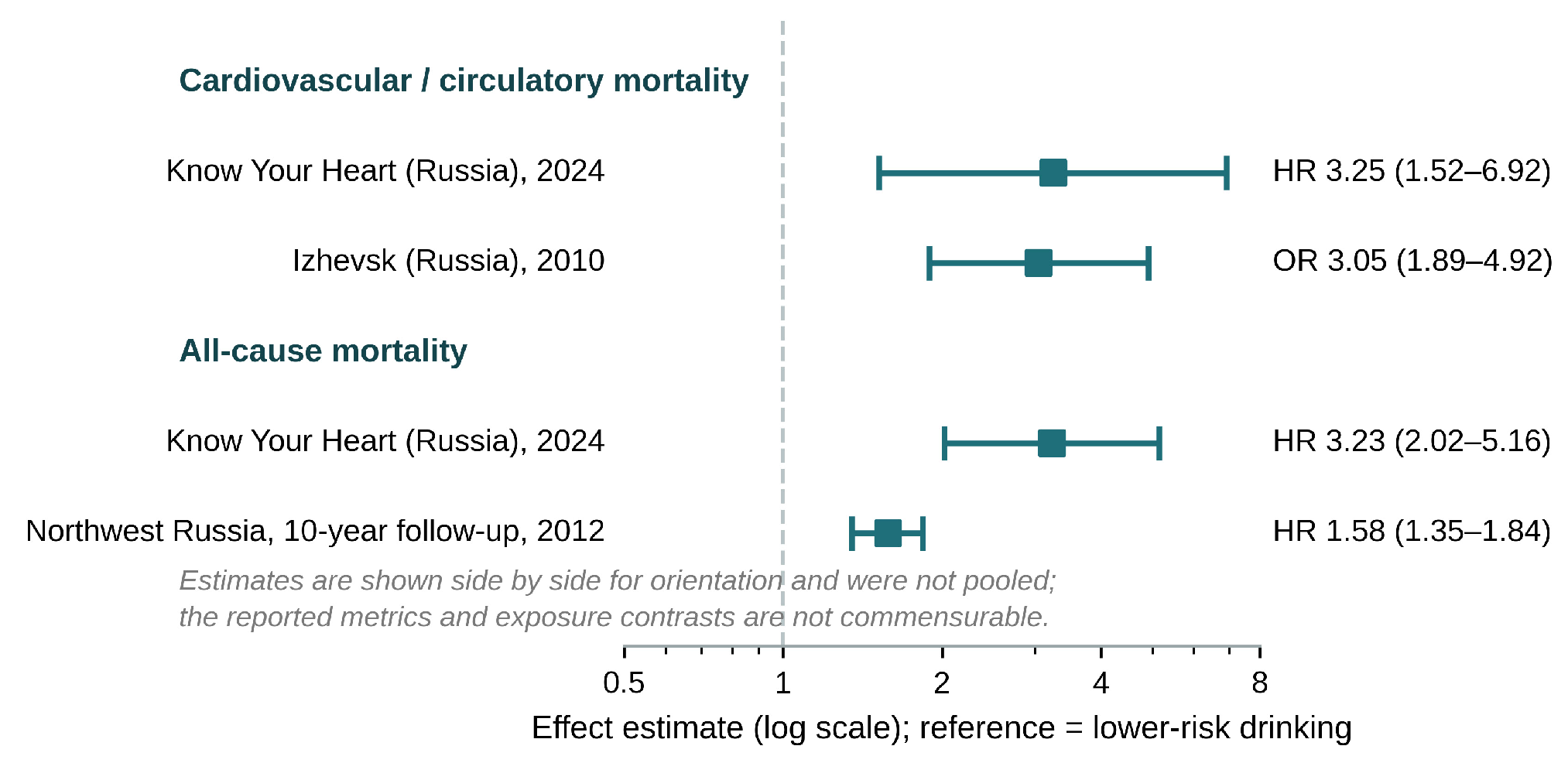
Because the included studies differed in design, exposure definition, comparator, and outcome ascertainment, no quantitative pooling was undertaken and no meta-analytic estimate is reported. Where a study reported an adjusted relative measure of association for a defined high-versus-low exposure contrast on a cardiovascular or all-cause mortality outcome, the estimate and its 95% confidence interval were extracted verbatim and are displayed alongside one another for orientation only. These study-level values were not combined: the reported metrics differ, the exposure contrasts and reference categories are not commensurable, and no outcome was supported by more than two such estimates.

2.8. Certainty of Evidence

The certainty of the body of evidence for the principal cardiovascular and all-cause mortality outcomes was rated with the Grading of Recommendations Assessment, Development and Evaluation (GRADE) approach, considering risk of bias, inconsistency, indirectness, imprecision, and publication bias, with observational evidence starting at low certainty.

3. Results

3.1. Study Selection

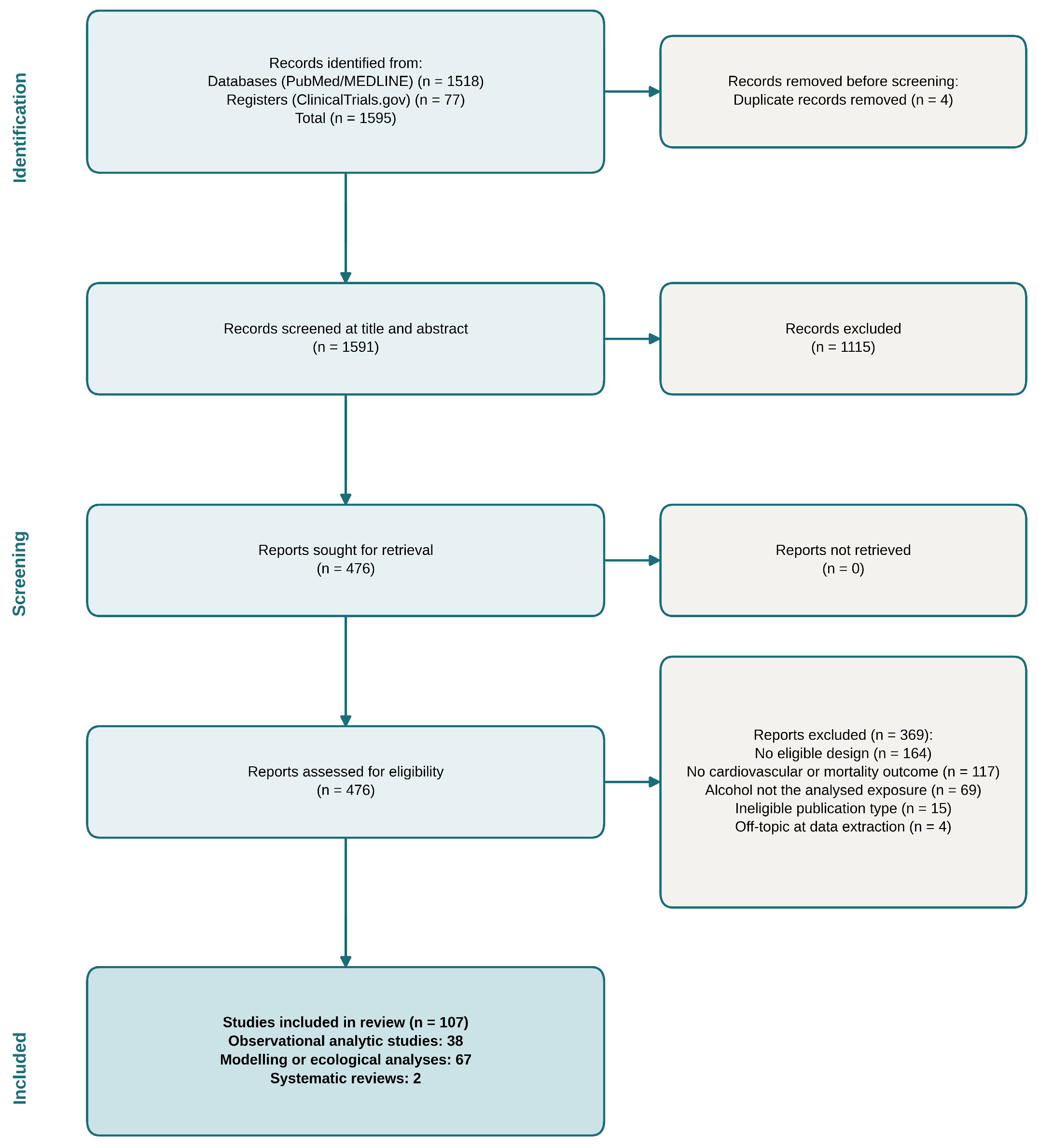
The search executed on 18 June 2026 identified 1518 records in PubMed/MEDLINE and 77 records in ClinicalTrials.gov, for a total of 1595 records. After removal of 4 duplicate records, 1591 records were screened on title and abstract, of which 1115 were excluded as clearly ineligible. The remaining 476 reports were sought and assessed in full text and 369 were excluded: 164 had no eligible study design for the review question, 117 reported no cardiovascular-specific or mortality outcome, 69 did not analyse alcohol as the exposure of interest, 15 were of an ineligible publication type, and 4 were judged off-topic at the data-extraction stage. A total of 107 studies met all eligibility criteria and were included in the synthesis. The study-selection process and the count at each stage are shown in the PRISMA 2020 flow diagram (Figure 1).
The four records removed at the data-extraction stage are documented for transparency: a national series of alcohol septal ablation in obstructive hypertrophic cardiomyopathy (a therapeutic procedure rather than dietary alcohol exposure); a Polish long-COVID cardiovascular study in which alcohol was incidental; a Polish blood-pressure screening campaign analysis without an alcohol–cardiovascular analysis; and a randomised trial of zinc supplementation in adults with HIV and heavy alcohol use.

3.2. Characteristics of Included Studies

The 107 included studies are summarised in Table 1 (selected key studies) and in full in the reference list. They comprised 38 observational analytic studies (prospective and retrospective cohorts, cross-sectional studies, and case–control studies); 67 modelling, ecological, interrupted-time-series, and comparative-risk-assessment analyses; and 2 systematic reviews, published between 1998 and 2026. The temporal distribution reflects the growth of the field: 6 were published in the 1990s, 29 in the 2000s, 43 in the 2010s, and 29 from 2020 onward. The Polish primary evidence was anchored by the Warsaw Pol-MONICA project [6], the PURE Poland cohort [7], and the Polish (Kraków) arm of the HAPIEE study [8]. The CEE cohort evidence was dominated by the multi-centre HAPIEE study [9,10,11] and by Russian, Belarusian, and Baltic mortality cohorts [12,13,14,15,16]. The most recent stratum consisted largely of GBD modelling analyses quantifying the burden of alcoholic cardiomyopathy and of cardiovascular disease attributable to high alcohol use [17,18,19,20,21,22,23], and of interrupted-time-series evaluations of Baltic and Polish alcohol-control policy [2,3,4,24,25].

3.3. Risk of Bias Within Studies

Of the 38 observational analytic studies appraised with the NOS, the major CEE and Russian cohorts that anchor the synthesis were generally rated good, reflecting adequate selection, comparability, and outcome ascertainment in the HAPIEE-derived, Pol-MONICA, Izhevsk, Novosibirsk, and Know Your Heart cohorts [6,8,10,11,12,14,15,16,30,33,34]. Cross-sectional studies received good or fair ratings, with lower ratings reflecting limited control of confounding; the single case–control study of non-fatal myocardial infarction was rated fair, principally because adjustment was limited to age and sex [29]. Of the two reviews appraised with AMSTAR-2, both received a low confidence rating [26,28], consistent with the absence of pre-registered protocols and formal risk-of-bias assessment in older syntheses. The 67 modelling, ecological, interrupted-time-series, and comparative-risk-assessment analyses were appraised narratively; the principal concerns were the ecological fallacy and the dependence of GBD estimates on the underlying relative-risk functions and exposure data. Risk-of-bias ratings for the key studies appear in the final column of Table 1.

3.4. Synthesis of Results

Polish primary epidemiology. The earliest and most influential Polish study was the ecological analysis by Zatoński and colleagues, which examined the sharp decline in IHD mortality after 1991 and attributed it principally to a dietary shift from animal to vegetable fats rather than to changes in alcohol consumption [1]. Prospective cohort evidence came from the Warsaw Pol-MONICA project, which related alcohol consumption to cardiovascular mortality across abstainers and intake tertiles in men and women aged 35 to 64 years [6]. Several Polish cross-sectional studies documented the cardiovascular correlates of alcohol, including dose-graded rises in blood pressure with intake category and a roughly fourfold higher probability of high-intake drinking in men than in women in the PURE Poland cohort [7,38]. The most direct Polish causal evidence came from the Kraków arm of the HAPIEE study, in which alcohol use disorder, defined by the CAGE questionnaire, was positively associated with fatal and non-fatal cardiovascular disease over an 11-year follow-up of 7112 adults [8]. Further Polish studies characterised psychosocial and nutritional cardiovascular risk factors, ideal cardiovascular health, heart failure in older adults, the incidence of hypertension, and homocysteine and lifestyle correlates of cardiovascular risk, consistently placing alcohol among the behavioural determinants examined [39,40,41,42,43,44].
Central and Eastern European cohort evidence. The most informative regional cohort evidence came from the multi-centre HAPIEE study, which followed 34,304 men and women aged 45 to 69 years across Polish, Czech, Russian, and Lithuanian centres. People who abstained had 30% to 50% higher mortality than people who drank lightly to moderately, a finding consistent with abstainer bias, and men with high average intake had elevated hazards for coronary and alcohol-related mortality, with mortality associated with high average intake rather than with binge drinking as such [10]. A related HAPIEE analysis found that hazardous drinking did not improve the prediction of fatal cardiovascular disease beyond conventional SCORE risk factors in men [11], and the Czech HAPIEE cohort, followed for 12 years with 494 cardiovascular deaths, identified education as the strongest determinant and binge drinking as one of several multifactorial contributors [35]. Additional Czech, Lithuanian, Hungarian, Croatian, and pan-European cohort and cross-sectional studies examined the prognostic value of combined smoking and drinking, genetic and classical risk factors, predictors of mortality by self-rated health, hazardous drinking prevalence and educational inequalities, and beverage-specific and lifestyle correlates of cardiovascular risk across the region [11,35,36,37,45,46,47,48,49,50,51,52,53,54,55,56,57,58,59,60,61].
Russian, Belarusian, and Baltic mortality epidemiology. A substantial body of Russian and Belarusian evidence reinforced the positive alcohol–mortality association. Large prospective cohorts and case–control studies linked hazardous and binge drinking to circulatory-disease and all-cause mortality, including a 151,000-participant Russian cohort in which heavy vodka drinking was strongly associated with cardiovascular and all-cause death [15], Novosibirsk cohort evidence relating heavy and binge drinking to mortality [30], and analyses of young Russian men examining the alcohol–cardiovascular death link critically [31]. The Izhevsk case–control study reported that hazardous drinking was associated with circulatory-disease mortality, with an odds ratio of 3.05 (95% CI 1.89 to 4.92) for the hazardous-versus-non-problem contrast [16]. A 10-year cohort study in northwest Russia reported an all-cause mortality hazard ratio of 1.58 (95% CI 1.35 to 1.84) for very-high-risk versus low-risk use [33], and the Know Your Heart study reported a cardiovascular mortality hazard ratio of 3.25 (95% CI 1.52 to 6.92) and an all-cause mortality hazard ratio of 3.23 (95% CI 2.02 to 5.16) for alcohol use disorder ascertained through narcology registration versus low-risk drinkers [12]. Ecological and time-series analyses of beverage-specific sales, alcohol-attributable fractions, and the Russian mortality crisis converged on alcohol as a major driver of the regional cardiovascular excess [27,62,63,64,65,66,67]. The broad supporting literature from Russia, Belarus, Ukraine, Kazakhstan, and the wider former Soviet region examined alcohol-attributable mortality fractions, the socioeconomic patterning of adult mortality, and the contribution of alcohol and smoking to the East–West and gender mortality gaps [14,32,34,68,69,70,71,72,73,74,75,76,77,78,79,80,81,82,83,84,85,86,87,88,89,90,91,92,93,94].
Alcohol-control policy and mortality. A coherent set of interrupted-time-series and modelling analyses from the Baltic states and Poland evaluated the mortality impact of alcohol-control policy enacted between 2001 and 2020. These analyses associated the strengthening of taxation, availability restrictions, and marketing controls with reductions in all-cause and cardiovascular mortality, with the Baltic states providing the clearest natural-experiment evidence [3,4,24,25,95,96], and a classification and modelling study estimated the potential impact of the corresponding policies in Poland and the Baltic countries [2]. Related analyses examined alcohol-attributable mortality, taxation effects, socioeconomic inequalities, and male mortality in Lithuania and the Baltic states under changing alcohol-control regimes, documented Russian alcohol-policy effects, and modelled cardiovascular medicine utilisation and regional hypertension management under these regimes [97,98,99,100,101,102,103,104,105]. Where the cohort studies establish that high intake raises mortality, the policy evaluations indicate that population-level measures reducing intake are followed by lower mortality.
Global modelling of the alcohol-attributable cardiovascular burden. The most recent stratum comprised comparative-risk-assessment and GBD modelling analyses. A series of GBD 2019 and GBD 2021 analyses quantified the global, regional, and national burden of alcoholic cardiomyopathy and of cardiovascular disease attributable to high alcohol use, including the burden among middle-aged men, the working-age population, and adults aged 60 years and older, with projections to 2050 [17,18,19,20,21,22,23,106], and a recent national analysis quantified directly alcohol-attributable mortality and its contribution to all-cause mortality in the Russian Federation [107]. Across these analyses, the alcohol-attributable cardiovascular burden remained substantial and was disproportionately concentrated in working-age men and in Eastern European and Central Asian regions, consistent with the cohort and policy evidence. A review of global and regional alcohol impacts emphasised the central role of alcohol-control policy in mitigating this burden [108].
Study-level effect estimates. Where a study reported an adjusted relative measure of association for a defined high-versus-low exposure contrast on a cardiovascular or all-cause mortality outcome, the estimate was extracted verbatim from the full text. Four such estimates were available. For cardiovascular or circulatory mortality, the Know Your Heart hazard ratio was 3.25 (95% CI 1.52 to 6.92) [12] and the Izhevsk odds ratio was 3.05 (95% CI 1.89 to 4.92) [16]. For all-cause mortality, the Know Your Heart hazard ratio was 3.23 (95% CI 2.02 to 5.16) [12] and the northwest Russia hazard ratio was 1.58 (95% CI 1.35 to 1.84) [33]. These four values are displayed side by side in Figure 2. They were not pooled: the reported metrics differ, the exposure contrasts and reference categories are not commensurable, and no outcome was supported by more than two estimates. No pooled value and no measure of heterogeneity is therefore reported, and the study-level estimates carry no weight in the synthesis or the conclusions.
Synthesis across domains. Synthesising across domains by direction of effect, the evidence converges on four points. First, in Polish and CEE populations the excess cardiovascular and all-cause mortality associated with alcohol tracks high average intake and alcohol use disorder rather than occasional intake, with binge drinking contributing to arrhythmic and alcohol-related death [8,10,12,16,30,35]. Second, the apparent excess mortality of people who abstain relative to those who drink moderately in the regional cohorts is consistent with sick-quitter bias rather than with a genuine protective effect [10]. Third, alcohol-control policy evaluations in the Baltic states and Poland associate population-level reductions in intake with reduced all-cause and cardiovascular mortality [3,4,25]. Fourth, the global modelling evidence confirms that the alcohol-attributable cardiovascular burden is large, persistent, and concentrated in the working-age male populations that also dominate Poland’s premature-mortality excess [20,21,22]. The dose-graded rise in blood pressure with intake observed in Polish men provides a coherent intermediate-outcome mechanism linking the population drinking pattern to the mortality burden [7].

3.5. Heterogeneity and Reporting Biases

Statistical heterogeneity was not quantified, because no outcome was supported by enough compatible estimates to justify pooling and no meta-analytic model was fitted. The clinical and methodological heterogeneity of the included studies, evident in their differing designs, exposure definitions, comparators, and outcome ascertainment, was the principal reason for adopting a SWiM synthesis. For the same reason, funnel-plot asymmetry and small-study effects could not be assessed formally, and the possibility of publication bias across the wider evidence base cannot be excluded.

3.6. Certainty of Evidence

For the association between high alcohol intake or alcohol use disorder and cardiovascular mortality, the body of evidence was rated low certainty: it begins at low certainty as observational evidence, with the consistent direction of effect across well-conducted CEE and Russian cohorts and the supporting policy and modelling evidence balanced against residual confounding, exposure misclassification, and imprecision in the smaller studies. For the association with all-cause mortality, certainty was rated very low, downgraded further for the substantial inconsistency between the contributing estimates. For the intermediate outcome of blood pressure, the dose-graded Polish cross-sectional evidence was rated low certainty. The certainty ratings indicate that the true effects may differ from the estimated direction and magnitude, although the consistency of direction across independent designs and populations lends qualitative support to a harmful association at higher intakes.

4. Discussion

4.1. Principal Findings

This scoping review identified 107 studies addressing alcohol consumption and cardiovascular mortality in Poland and the wider CEE region. The synthesised evidence indicates that alcohol contributes materially to the cardiovascular mortality burden in this setting, principally through high average intake and a spirits-heavy, episodically heavy drinking pattern, and that the historically observed lower mortality of people who drink moderately relative to those who abstain is largely attributable to sick-quitter bias rather than to a causal protective effect. The cohort evidence on high intake, the policy-evaluation evidence on population-level intake reduction, and the global modelling evidence on attributable burden point in the same direction. These findings are concordant with the bias-corrected and Mendelian randomisation literature, which does not support a causal cardioprotective effect of light-to-moderate intake and which indicates causal harm at higher intakes. The certainty of the evidence is nonetheless low to very low, and the conclusions are framed accordingly.

4.2. Interpretation and Comparison with Other Evidence

The Polish and CEE pattern of drinking, dominated by spirits and episodic heavy consumption, is mechanistically unfavourable, because the haemostatic and lipid benefits attributed to steady low-dose intake do not apply and the harms of arrhythmia, hypertension, and sudden death predominate [26,28]. The dose-graded rise in blood pressure with alcohol category in Polish men [7], the positive association of alcohol use disorder with cardiovascular disease in the Polish HAPIEE arm [8], and the strong cohort associations in Russia [12,15,16] provide locally relevant evidence that aligns with the regional finding that excess mortality tracks high average intake [10]. The Baltic policy experience demonstrates the converse: reducing population intake through fiscal and availability measures is followed by lower all-cause and cardiovascular mortality [3,4,25]. Even where a small genuine cardioprotective effect of steady low-dose wine consumption might exist in some Western populations, it is of limited relevance to Poland given the prevailing drinking pattern. The recent WHO position that no level of alcohol consumption is safe and the convergent global modelling evidence reinforce this conclusion [20,21,22].

4.3. Strengths and Limitations

The principal strengths of this review are its prospective registration, its transparent and reproducible PRISMA 2020-compliant approach, its SWiM-based synthesis with formal certainty grading, and the independent verification of every included reference against PubMed and Crossref.
Several limitations must be acknowledged. First, although the registered protocol specified a broad set of information sources, PubMed/MEDLINE and ClinicalTrials.gov were the sources searched, and the subscription databases Embase, Scopus, and Web of Science were not searched, so some eligible studies will have been missed. The likely shape of that loss can be characterised. Coverage of the clinical and epidemiological literature relevant to this question overlaps substantially between MEDLINE and Embase, and the studies most likely to be unique to Embase, Scopus, or Web of Science are conference proceedings, regional and non-English-language journals not indexed in MEDLINE, and reports in the grey literature. For a Central and Eastern European question, this is not a neutral omission: Polish, Russian, and Baltic regional journals are unevenly indexed, and the restriction bears most heavily on the regional primary evidence the review set out to synthesise. Two considerations temper the effect on the conclusions rather than remove it. The direction of the synthesised association is consistent across designs, countries, and decades, and across studies of very different provenance, so the synthesis is unlikely to be reversed by additional regional reports; and the principal conclusion, that the evidence identifies no threshold below which intake is free of cardiovascular risk, rests on the absence of a protective signal once abstainer misclassification is addressed, which additional indexing coverage would be unlikely to supply. What the restriction does compromise is completeness: the count of 107 included studies is a floor rather than a full enumeration of the regional evidence, and the gaps identified here should be read as gaps in the indexed and openly searchable literature rather than as established absences of research. Second, the included studies were clinically and methodologically heterogeneous, which precluded meta-analysis; the four study-level estimates are displayed side by side and were not pooled, because their metrics and exposure contrasts are not commensurable. Third, the certainty of the evidence was low to very low, reflecting residual confounding, exposure misclassification, and imprecision in the observational literature. Fourth, the Polish cohort evidence that isolates the causal contribution of alcohol to cardiovascular mortality remains limited, and the Polish HAPIEE arm is restricted to one urban centre. These limitations temper the strength of the conclusions, although they do not alter the consistent direction of the synthesised evidence.

4.4. Implications for Policy and Research

Poland’s recent experience constitutes a natural experiment with a clear lesson, in which the weakening of alcohol control after 2001 coincided with rising consumption, while neighbouring Baltic states that adopted WHO best-buy policies saw more favourable mortality trends [2,3,4]. The implication is that strengthening population-level alcohol policy, through pricing and taxation, restrictions on availability, and controls on marketing, is a plausible and evidence-based lever for reducing the cardiovascular and total mortality burden in Poland, complementing continued investment in tobacco control, dietary improvement, and cardiovascular care. Future research should prioritise nationally representative Polish cohorts that use lifetime-abstainer reference groups and pattern-specific exposure measurement, together with Poland-specific Mendelian randomisation analyses, to quantify the alcohol-attributable cardiovascular burden with greater precision.

5. Conclusions

This scoping review of 107 studies indicates that alcohol contributes materially to Poland’s cardiovascular and premature-mortality burden, principally through high average intake and a spirits-heavy, episodically heavy drinking pattern, and that the historically reassuring lower mortality of people who drink moderately relative to those who abstain is largely an artefact of sick-quitter bias rather than evidence of cardioprotection. The cohort, policy evaluation, and global modelling evidence converge on this conclusion, although the certainty of the body of evidence is low to very low. The synthesised evidence does not support the promotion of any level of alcohol consumption for cardiovascular protection in this population. Against a backdrop of weakened alcohol-control policy since 2001, strengthening population-level alcohol policy, alongside sustained tobacco control, dietary improvement, and cardiovascular care, offers a credible path to further reductions in cardiovascular mortality in Poland.

Supplementary Materials

The following supporting information can be downloaded at: https://www.mdpi.com/article/10.3390/sci8090221/s1, Table S1: PRISMA 2020 checklist; File S1: Registered review protocol (PROSPERO CRD420261427480); File S2: Executed search strategy with result counts.

Author Contributions

Conceptualisation, D.S.; methodology, D.S.; validation, D.S., M.K.S. and D.K.; formal analysis, D.S.; investigation, D.S. and M.K.S.; data curation, D.S.; writing—original draft preparation, D.S.; writing—review and editing, D.S., M.K.S. and D.K.; visualisation, D.S.; supervision, D.K. All authors have read and agreed to the published version of the manuscript.

Funding

This research received no external funding.

Institutional Review Board Statement

Ethical review and approval were waived for this study because it analysed only previously published, aggregated data and involved no human participants, human material or identifiable personal data.

Informed Consent Statement

Not applicable. The review analysed only previously published, aggregated data and involved no human participants.

Data Availability Statement

The data underlying this review are openly available. The extraction dataset for all references, with the 107 included studies flagged and characterised; the PRISMA 2020 record counts with itemised reasons for exclusion; the executed search strategies with result counts and search date; and the study-level effect estimates with the script reproducing Figure 2 are deposited as a citeable dataset in the Repository for Open Data (RepOD), Interdisciplinary Centre for Mathematical and Computational Modelling, University of Warsaw, at https://doi.org/10.18150/XYSQSP (version V2, accessed on 12 August 2026), under a CC BY 4.0 licence, with a cross-reference to the PROSPERO registration CRD420261427480. A record-level screening log for the 1591 records screened is not available, because the screening workflow did not retain the decision trail in an exportable form; the aggregate screening outcome is reported in full and the record set is reproducible from the deposited search strategies. The primary studies included in the review are the published articles cited in the reference list.

Acknowledgments

The authors thank their families for their patience and support during the preparation of this work; and their colleagues at the Department of Cardiology, CCU and Cardiac Rehabilitation of the Janusz Korczak Voivodeship Specialist Hospital in Słupsk, and at the Institute of Health Sciences, Pomeranian University in Słupsk, for the collegial environment in which the ideas developed in this article were discussed.

Conflicts of Interest

The authors declare no conflicts of interest.

References

  1. Zatonski, W.A.; McMichael, A.J.; Powles, J.W. Ecological study of reasons for sharp decline in mortality from ischaemic heart disease in Poland since 1991. BMJ 1998, 316, 1047–1051. [Google Scholar] [CrossRef] [Scilit]
  2. Rehm, J.; Lange, S.; Gobiņa, I.; Janik-Koncewicz, K.; Miščikienė, L.; Reile, R.; Stoppel, R.; Tran, A.; Ferreira-Borges, C.; Jasilionis, D.; et al. Classifying alcohol control policies enacted between 2000 and 2020 in Poland and the Baltic countries to model potential impact. Addiction 2023, 118, 449–458. [Google Scholar] [CrossRef] [Scilit]
  3. Vaitkevičiūtė, J.; Gobiņa, I.; Janik-Koncewicz, K.; Lange, S.; Miščikienė, L.; Petkevičienė, J.; Radišauskas, R.; Reile, R.; Štelemėkas, M.; Stoppel, R.; et al. Alcohol control policies reduce all-cause mortality in Baltic Countries and Poland between 2001 and 2020. Sci. Rep. 2023, 13, 6326. [Google Scholar] [CrossRef] [Scilit]
  4. Štelemėkas, M.; Manthey, J.; Badaras, R.; Casswell, S.; Ferreira-Borges, C.; Kalėdienė, R.; Lange, S.; Neufeld, M.; Petkevičienė, J.; Radišauskas, R.; et al. Alcohol control policy measures and all-cause mortality in Lithuania: An interrupted time-series analysis. Addiction 2021, 116, 2673–2684. [Google Scholar] [CrossRef] [Scilit]
  5. Page, M.J.; McKenzie, J.E.; Bossuyt, P.M.; Boutron, I.; Hoffmann, T.C.; Mulrow, C.D.; Shamseer, L.; Tetzlaff, J.M.; Akl, E.A.; Brennan, S.E.; et al. The PRISMA 2020 statement: An updated guideline for reporting systematic reviews. BMJ 2021, 372, n71. [Google Scholar] [CrossRef] [Scilit] [PubMed]
  6. Waśkiewicz, A.; Sygnowska, E.; Drygas, W. Relationship between alcohol consumption and cardiovascular mortality: The Warsaw Pol-MONICA Project. Kardiol. Pol. 2004, 60, 552–562. [Google Scholar]
  7. Zatońska, K.; Psikus, P.; Basiak-Rasała, A.; Stępnicka, Z.; Wołyniec, M.; Wojtyła, A.; Szuba, A.; Połtyn-Zaradna, K. Patterns of Alcohol Consumption in the PURE Poland Cohort Study and Their Relationship with Health Problems. Int. J. Environ. Res. Public Health 2021, 18, 4185. [Google Scholar] [CrossRef] [Scilit]
  8. Kozela, M.; Doryńska, A.; Bobak, M.; Pająk, A. Alcohol use disorder increases the risk of nonfatal and fatal cardiovascular disease: An 11-year follow-up of a Polish population-based cohort. The HAPIEE study. Pol. Arch. Intern. Med. 2020, 130, 960–966. [Google Scholar] [CrossRef] [Scilit]
  9. Dalecká, A.; Peasey, A.; Pan, Y.; Čapková, N.; Šebejová, L.; Piler, P.; Kozela, M.; Pajak, A.; Tamosiunas, A.; Andrýsková, L.; et al. Cohort profile: The Czech Health, Alcohol and Psychosocial Factors In Eastern Europe study (HAPIEE-CZ). Res. Sq. 2026, preprint. [Google Scholar] [CrossRef] [Scilit]
  10. Bobak, M.; Malyutina, S.; Horvat, P.; Pajak, A.; Tamosiunas, A.; Kubinova, R.; Simonova, G.; Topor-Madry, R.; Peasey, A.; Pikhart, H.; et al. Alcohol, drinking pattern and all-cause, cardiovascular and alcohol-related mortality in Eastern Europe. Eur. J. Epidemiol. 2016, 31, 21–30. [Google Scholar] [CrossRef] [Scilit]
  11. Vikhireva, O.; Kubinova, R.; Malyutina, S.; Pająk, A.; Simonova, G.; Bobak, M.; Pikhart, H. Inclusion of hazardous drinking does not improve the SCORE performance in men from Central and Eastern Europe: The findings from the HAPIEE cohorts. BMC Public Health 2014, 14, 1187. [Google Scholar] [CrossRef] [Scilit]
  12. Mitkin, N.A.; Brenn, T.; Unguryanu, T.N.; Malyutina, S.; Cook, S.; Kudryavtsev, A.V. Alcohol and cause-specific mortality in Russia: The Know Your Heart Study 2015-23. BMC Public Health 2024, 24, 3128. [Google Scholar] [CrossRef] [Scilit]
  13. Azizova, T.V.; Bannikova, M.V.; Briks, K.V.; Grigoryeva, E.S.; Hamada, N. Incidence risks for subtypes of heart diseases in a Russian cohort of Mayak Production Association nuclear workers. Radiat. Environ. Biophys. 2023, 62, 51–71. [Google Scholar] [CrossRef] [Scilit]
  14. Horvat, P.; Stefler, D.; Murphy, M.; King, L.; McKee, M.; Bobak, M. Alcohol, pattern of drinking and all-cause mortality in Russia, Belarus and Hungary: A retrospective indirect cohort study based on mortality of relatives. Addiction 2018, 113, 1252–1263. [Google Scholar] [CrossRef] [Scilit]
  15. Zaridze, D.; Lewington, S.; Boroda, A.; Scélo, G.; Karpov, R.; Lazarev, A.; Konobeevskaya, I.; Igitov, V.; Terechova, T.; Boffetta, P.; et al. Alcohol and mortality in Russia: Prospective observational study of 151,000 adults. Lancet 2014, 383, 1465–1473. [Google Scholar] [CrossRef] [Scilit]
  16. Leon, D.A.; Shkolnikov, V.M.; McKee, M.; Kiryanov, N.; Andreev, E. Alcohol increases circulatory disease mortality in Russia: Acute and chronic effects or misattribution of cause? Int. J. Epidemiol. 2010, 39, 1279–1290. [Google Scholar] [CrossRef] [Scilit]
  17. Xu, S.; Ying, X.; Hong, Q.; Miao, T.; Cai, W.; Chen, Y.; Chen, X.; Hu, L. Global Burden of Alcoholic Cardiomyopathy in Adults Aged 60 and Older From 1990 to 2021: A Secondary Analysis of Global Burden of Disease 2021 Data. Health Sci. Rep. 2026, 9, e72358. [Google Scholar] [CrossRef] [Scilit]
  18. Zhou, H.; Mao, Y.; Zheng, Z.; Tu, Z.; Li, Y.; Yang, J.; Chen, W.; Fan, C. Dissecting burden of alcoholic cardiomyopathy: Age-period-cohort analysis from the global burden of disease study 2019. Clin. Exp. Hypertens. 2026, 48, 2636171. [Google Scholar] [CrossRef] [Scilit]
  19. Zheng, M.; Sun, C.; Li, M.; Xiang, H.; Ren, H.; Cheng, J. Global burden and cross-country inequalities of alcoholic cardiomyopathy: A 1990–2021 analysis. Int. J. Cardiol. Cardiovasc Risk Prev. 2026, 28, 200561. [Google Scholar] [CrossRef] [Scilit]
  20. Zhou, Y.; Liu, T.; Meng, Y.; Ji, Z.; Chen, Z.; Ma, G. Global burden of alcoholic cardiomyopathy in middle-aged men (1990–2021) and projections to 2050: A systematic analysis of the Global Burden of Disease 2021 data. Front. Public Health 2025, 13, 1608351. [Google Scholar] [CrossRef] [Scilit]
  21. Wang, Z.; Wu, C.; Zhang, B.; Sun, H.; Liu, W.; Yang, Y.; Gu, Y.; Pu, L.; Zheng, L.; Bao, S.; et al. Global, regional and national burdens of alcoholic cardiomyopathy among the working-age population, 1990-2021: A systematic analysis. J. Health Popul. Nutr. 2025, 44, 170. [Google Scholar] [CrossRef] [Scilit]
  22. Niu, C.; Dong, J.; Zhang, P.; Yang, Q.; Xue, D.; Liu, B.; Xiao, D.; Zhuang, R.; Li, M.; Zhang, L. The global burden of cardiovascular disease attributable to high alcohol use from 1990 to 2021: An analysis for the global burden of disease study 2021. Front. Public Health 2025, 13, 1541641. [Google Scholar] [CrossRef] [Scilit]
  23. Zhang, J.; Liu, H.; Bu, X.; Lu, Q.; Cheng, L.; Ma, A.; Wang, T. The burden of alcoholic cardiomyopathy in China and different regions around the world. J. Glob. Health 2022, 12, 04041. [Google Scholar] [CrossRef] [Scilit]
  24. Kim, K.V.; Rehm, J.; Feng, X.; Jiang, H.; Manthey, J.; Radišauskas, R.; Štelemėkas, M.; Tran, A.; Zafar, A.; Lange, S. Impact of alcohol control policy on hemorrhagic and ischemic stroke mortality rates in Lithuania: An interrupted time series analysis. Adicciones 2024, 36, 227–236. [Google Scholar] [CrossRef] [Scilit]
  25. Manthey, J.; Jasilionis, D.; Jiang, H.; Meščeriakova, O.; Petkevičienė, J.; Radišauskas, R.; Štelemėkas, M.; Rehm, J. The impact of alcohol taxation increase on all-cause mortality inequalities in Lithuania: An interrupted time series analysis. BMC Med. 2023, 21, 22. [Google Scholar] [CrossRef] [Scilit]
  26. McKee, M.; Britton, A. The positive relationship between alcohol and heart disease in eastern Europe: Potential physiological mechanisms. J. R. Soc. Med. 1998, 91, 402–407. [Google Scholar] [CrossRef] [Scilit]
  27. Chenet, L.; McKee, M.; Leon, D.; Shkolnikov, V.; Vassin, S. Alcohol and cardiovascular mortality in Moscow; new evidence of a causal association. J. Epidemiol. Community Health 1998, 52, 772–774. [Google Scholar] [CrossRef] [Scilit]
  28. Britton, A.; McKee, M. The relation between alcohol and cardiovascular disease in Eastern Europe: Explaining the paradox. J. Epidemiol. Community Health 2000, 54, 328–332. [Google Scholar] [CrossRef] [Scilit]
  29. Genchev, G.D.; Georgieva, L.M.; Weijenberg, M.P.; Powles, J.W. Does alcohol protect against ischaemic heart disease in Bulgaria? A case-control study of non-fatal myocardial infarction in Sofia. Cent. Eur. J. Public Health 2001, 9, 83–86. [Google Scholar]
  30. Malyutina, S.; Bobak, M.; Kurilovitch, S.; Gafarov, V.; Simonova, G.; Nikitin, Y.; Marmot, M. Relation between heavy and binge drinking and all-cause and cardiovascular mortality in Novosibirsk, Russia: A prospective cohort study. Lancet 2002, 360, 1448–1454. [Google Scholar] [CrossRef] [Scilit]
  31. Shkolnikov, V.M.; McKee, M.; Chervyakov, V.V.; Kyrianov, N.A. Is the link between alcohol and cardiovascular death among young Russian men attributable to misclassification of acute alcohol intoxication? Evidence from the city of Izhevsk. J. Epidemiol. Community Health 2002, 56, 171–174. [Google Scholar] [CrossRef] [Scilit]
  32. Nicholson, A.; Bobak, M.; Murphy, M.; Rose, R.; Marmot, M. Alcohol consumption and increased mortality in Russian men and women: A cohort study based on the mortality of relatives. Bull. World Health Organ. 2005, 83, 812–819. [Google Scholar]
  33. Sidorenkov, O.; Nilssen, O.; Grjibovski, A.M. Determinants of cardiovascular and all-cause mortality in northwest Russia: A 10-year follow-up study. Ann. Epidemiol. 2012, 22, 57–65. [Google Scholar] [CrossRef] [Scilit]
  34. Tomkins, S.; Collier, T.; Oralov, A.; Saburova, L.; McKee, M.; Shkolnikov, V.; Kiryanov, N.; Leon, D.A. Hazardous alcohol consumption is a major factor in male premature mortality in a typical Russian city: Prospective cohort study 2003-2009. PLoS ONE 2012, 7, e30274. [Google Scholar] [CrossRef] [Scilit]
  35. Lustigova, M.; Dzurova, D.; Pikhart, H.; Kubinova, R.; Bobak, M. Cardiovascular health among the Czech population at the beginning of the 21st century: A 12-year follow-up study. J. Epidemiol. Community Health 2018, 72, 442–448. [Google Scholar] [CrossRef] [Scilit]
  36. Cífková, R.; Krajčoviechová, A. Alcohol and cardiovascular disease: Position Paper of the Czech Society of Cardiology. Cent. Eur. J. Public Health 2019, 27, S6–S9. [Google Scholar] [CrossRef] [Scilit]
  37. Iakunchykova, O.; Averina, M.; Kudryavtsev, A.V.; Wilsgaard, T.; Soloviev, A.; Schirmer, H.; Cook, S.; Leon, D.A. Evidence for a Direct Harmful Effect of Alcohol on Myocardial Health: A Large Cross-Sectional Study of Consumption Patterns and Cardiovascular Disease Risk Biomarkers From Northwest Russia, 2015 to 2017. J. Am. Heart Assoc. 2020, 9, e014491. [Google Scholar] [CrossRef] [Scilit]
  38. Pajak, A.; Kawalec, E. Lifestyle characteristics and hypertension in the middle-aged population of Kraków. Blood Press Suppl. 2005, 2, 17–21. [Google Scholar] [CrossRef] [Scilit]
  39. Bielecka-Dabrowa, A.; Lewek, J.; Sakowicz, A.; Paduszyńska, A.; Dąbrowa, M.; Orszulak-Michalak, D.; Banach, M.; CARDIOPLUS Investigators. Effects of Implementing Personalized Health Education in Ambulatory Care on Cardiovascular Risk Factors, Compliance and Satisfaction with Treatment. J. Pers. Med. 2022, 12, 1583. [Google Scholar] [CrossRef] [Scilit]
  40. Manczuk, M.; Vaidean, G.; Dehghan, M.; Vedanthan, R.; Boffetta, P.; Zatonski, W.A. Ideal cardiovascular health is associated with self-rated health status. The Polish Norwegian Study (PONS). Int. J. Cardiol. 2017, 230, 549–555. [Google Scholar] [CrossRef] [Scilit]
  41. Ozierański, K.; Balsam, P.; Tymińska, A.; Peller, M.; Kapłon-Cieślicka, A.; Marchel, M.; Drożdż, J.; Filipiak, K.J.; Opolski, G. Heart failure in elderly patients: Differences in clinical characteristics and predictors of 1-year outcome in the Polish ESC-HF Long-Term Registry. Pol. Arch. Med. Wewn. 2016, 126, 502–513. [Google Scholar] [CrossRef] [Scilit]
  42. Sygnowska, E.; Rywik, S.; Pajak, A.; Waśkiewicz, A.; Janas, J.; Gazdzik, D. Homocysteine level, relationship with cardiovascular risk factors in selected Polish population. Przegl Lek. 2005, 62, 1372–1376. [Google Scholar]
  43. Pajak, A. Psychosocial and nutritional risk factors for cardiovascular disease: Longitudinal cohort study. Assumptions, goals and methods of the screening survey. Przegl Lek. 2002, 59, 993–998. [Google Scholar]
  44. Rywik, S.L.; Williams, O.D.; Pajak, A.; Broda, G.; Davis, C.E.; Kawalec, E.; Manolio, T.A.; Piotrowski, W.; Hutchinson, R. Incidence and correlates of hypertension in the Atherosclerosis Risk in Communities (ARIC) study and the Monitoring Trends and Determinants of Cardiovascular Disease (POL-MONICA) project. J. Hypertens. 2000, 18, 999–1006. [Google Scholar] [CrossRef] [Scilit]
  45. Trias-Llimós, S.; Bosque-Prous, M.; Obradors-Rial, N.; Teixidó-Compañó, E.; Belza, M.J.; Janssen, F.; Espelt, A. Alcohol and educational inequalities: Hazardous drinking prevalence and all-cause mortality by hazardous drinking group in people aged 50 and older in Europe. Subst. Abus. 2022, 43, 152–160. [Google Scholar] [CrossRef] [Scilit]
  46. Kékes, E.; Paksy, A.; Baracsi-Botos, V.; Szőke, V.B.; Járai, Z. The combined effect of regular alcohol consumption and smoking on blood pressure and on the achievement of blood pressure target values in treated hypertensive patients. Orv. Hetil. 2020, 161, 1252–1259. [Google Scholar] [CrossRef] [Scilit]
  47. Luksiene, D.; Tamosiunas, A.; Virviciute, D.; Radisauskas, R. The Prognostic Value of Combined Smoking and Alcohol Consumption Habits for the Estimation of Cause-Specific Mortality in Middle-Age and Elderly Population: Results from a Long-Term Cohort Study in Lithuania. BioMed Res. Int. 2017, 2017, 9654314. [Google Scholar] [CrossRef] [Scilit]
  48. Fiala, J.; Sochor, O.; Klimusová, H.; Homolka, M. Alcohol Consumption in Population Aged 25-65 Years Living in the Metropolis of South Moravia, Czech Republic. Cent. Eur. J. Public Health 2017, 25, 191–199. [Google Scholar] [CrossRef] [Scilit]
  49. Burokienė, N.; Domarkienė, I.; Ambrozaitytė, L.; Uktverytė, I.; Meškienė, R.; Karčiauskaitė, D.; Kasiulevičius, V.; Šapoka, V.; Kučinskas, V.; Kučinskienė, Z.A. Classical rather than genetic risk factors account for high cardiovascular disease prevalence in Lithuania: A cross-sectional population study. Adv. Med. Sci. 2017, 62, 121–128. [Google Scholar] [CrossRef] [Scilit]
  50. Grosso, G.; Stepaniak, U.; Micek, A.; Stefler, D.; Bobak, M.; Pajak, A. Coffee consumption and mortality in three Eastern European countries: Results from the HAPIEE (Health, Alcohol and Psychosocial Factors In Eastern Europe) study. Public Health Nutr. 2017, 20, 82–91. [Google Scholar] [CrossRef] [Scilit]
  51. Reile, R.; Stickley, A.; Leinsalu, M. Large variation in predictors of mortality by levels of self-rated health: Results from an 18-year follow-up study. Public Health 2017, 145, 59–66. [Google Scholar] [CrossRef] [Scilit]
  52. Stefler, D.; Pikhart, H.; Kubinova, R.; Pajak, A.; Stepaniak, U.; Malyutina, S.; Simonova, G.; Peasey, A.; Marmot, M.G.; Bobak, M. Fruit and vegetable consumption and mortality in Eastern Europe: Longitudinal results from the Health, Alcohol and Psychosocial Factors in Eastern Europe study. Eur. J. Prev. Cardiol. 2016, 23, 493–501. [Google Scholar] [CrossRef] [Scilit]
  53. Mackenbach, J.P.; Kulhánová, I.; Bopp, M.; Borrell, C.; Deboosere, P.; Kovács, K.; Looman, C.W.N.; Leinsalu, M.; Mäkelä, P.; Martikainen, P.; et al. Inequalities in Alcohol-Related Mortality in 17 European Countries: A Retrospective Analysis of Mortality Registers. PLoS Med. 2015, 12, e1001909. [Google Scholar] [CrossRef] [Scilit]
  54. Petkeviciene, J.; Klumbiene, J.; Simonyte, S.; Ceponiene, I.; Jureniene, K.; Kriaucioniene, V.; Raskiliene, A.; Smalinskiene, A.; Lesauskaite, V. Physical, behavioural and genetic predictors of adult hypertension: The findings of the Kaunas Cardiovascular Risk Cohort study. PLoS ONE 2014, 9, e109974. [Google Scholar] [CrossRef] [Scilit]
  55. Andel, R. Aging in the Czech Republic. Gerontologist 2014, 54, 893–900. [Google Scholar] [CrossRef] [Scilit]
  56. Babinska, I.; Geckova, A.M.; Jarčuška, P.; Pella, D.; Mareková, M.; Štefková, G.; Veselská, Z.D. Does the population living in Roma settlements differ in physical activity, smoking and alcohol consumption from the majority population in Slovakia? Cent. Eur. J. Public Health 2014, 22, S22–S27. [Google Scholar] [CrossRef] [Scilit]
  57. Leon, D.A.; Shkolnikov, V.M.; Borinskaya, S.; Casas, J.-P.; Evans, A.; Gil, A.; Kee, F.; Kiryanov, N.; McKee, M.; O’Doherty, M.G.; et al. Hazardous alcohol consumption is associated with increased levels of B-type natriuretic peptide: Evidence from two population-based studies. Eur. J. Epidemiol. 2013, 28, 393–404. [Google Scholar] [CrossRef] [Scilit]
  58. Kuhrs, E.; Winkler, V.; Becher, H. Risk factors for cardiovascular and cerebrovascular diseases among ethnic Germans from the former Soviet Union: Results of a nested case-control study. BMC Public Health 2012, 12, 190. [Google Scholar] [CrossRef] [Scilit]
  59. Carević, V.; Kuzmanić, M.; Rumboldt, M.; Rumboldt, Z. Predictive impact of coronary risk factors in southern Croatia: A case control study. Coll. Antropol. 2010, 34, 1363–1368. [Google Scholar]
  60. Johansson, J.; Viigimaa, M.; Jensen-Urstad, M.; Krakau, I.; Hansson, L.O. Risk factors for coronary heart disease in 55- and 35-year-old men and women in Sweden and Estonia. J. Intern. Med. 2002, 252, 551–560. [Google Scholar] [CrossRef] [Scilit]
  61. Jenei, Z.; Páll, D.; Katona, E.; Kakuk, G.; Polgár, P. The epidemiology of hypertension and its associated risk factors in the city of Debrecen, Hungary. Public Health 2002, 116, 138–144. [Google Scholar] [CrossRef] [Scilit]
  62. Razvodovsky, Y.E. Estimation of alcohol attributable fraction of mortality in Russia. Adicciones 2012, 24, 247–252. [Google Scholar] [CrossRef] [Scilit]
  63. Razvodovsky, Y.E. Alcohol consumption and ischemic heart disease mortality in Russia. Adicciones 2012, 24, 23–29. [Google Scholar] [CrossRef] [Scilit]
  64. Norström, T. The role of alcohol in the Russian mortality crisis. Addiction 2011, 106, 1957–1965. [Google Scholar] [CrossRef] [Scilit]
  65. Razvodovsky, Y.E. Beverage-specific alcohol sale and cardiovascular mortality in Russia. J. Environ. Public Health 2010, 2010, 253853. [Google Scholar] [CrossRef] [Scilit]
  66. Norström, T.; Ramstedt, M. Mortality and population drinking: A review of the literature. Drug Alcohol Rev. 2005, 24, 537–547. [Google Scholar] [CrossRef] [Scilit]
  67. Péter, A. Correlation between cancer mortality and alcohol-related mortality in a South-Hungarian village. Orv. Hetil. 2001, 142, 497–502. [Google Scholar]
  68. Doniec, K.; Stefler, D.; Murphy, M.; Gugushvili, A.; McKee, M.; Marmot, M.; Bobak, M.; King, L. Education and mortality in three Eastern European populations: Findings from the PrivMort retrospective cohort study. Eur. J. Public Health 2019, 29, 549–554. [Google Scholar] [CrossRef] [Scilit]
  69. Grigoriev, P.; Andreev, E.M. The Huge Reduction in Adult Male Mortality in Belarus and Russia: Is It Attributable to Anti-Alcohol Measures? PLoS ONE 2015, 10, e0138021. [Google Scholar] [CrossRef] [Scilit]
  70. Davletov, K.; McKee, M.; Berkinbayev, S.; Battakova, Z.; Vujnovic, M.; Rechel, B. Regional differences in cardiovascular mortality in Kazakhstan: Further evidence for the ‘Russian mortality paradox’? Eur. J. Public Health 2015, 25, 890–894. [Google Scholar] [CrossRef] [Scilit]
  71. Razvodovsky, Y.E. Fraction of stroke mortality attributable to alcohol consumption in Russia. Adicciones 2014, 26, 126–133. [Google Scholar] [CrossRef] [Scilit]
  72. Pridemore, W.A.; Chamlin, M.B.; Kaylen, M.T.; Andreev, E. The effects of the 2006 Russian alcohol policy on alcohol-related mortality: An interrupted time series analysis. Alcohol Clin. Exp. Res. 2014, 38, 257–266. [Google Scholar] [CrossRef] [Scilit]
  73. Guillot, M.; Gavrilova, N.; Torgasheva, L.; Denisenko, M. Divergent paths for adult mortality in Russia and Central Asia: Evidence from Kyrgyzstan. PLoS ONE 2013, 8, e75314. [Google Scholar] [CrossRef] [Scilit]
  74. Krestinina, L.Y.; Epifanova, S.; Silkin, S.; Mikryukova, L.; Degteva, M.; Shagina, N.; Akleyev, A. Chronic low-dose exposure in the Techa River Cohort: Risk of mortality from circulatory diseases. Radiat. Environ. Biophys. 2013, 52, 47–57. [Google Scholar] [CrossRef] [Scilit]
  75. Drachev, S.N.; Unguryanu, T.N.; Grjibovski, A.M. Daily variations in ambulance calls for selected causes in Arkhangelsk, Russia: Potential role of excessive alcohol consumption on weekends. Int. J. Circumpolar Health 2012, 71, 19124. [Google Scholar] [CrossRef] [Scilit]
  76. McCartney, G.; Mahmood, L.; Leyland, A.H.; Batty, G.D.; Hunt, K. Contribution of smoking-related and alcohol-related deaths to the gender gap in mortality: Evidence from 30 European countries. Tob. Control. 2011, 20, 166–168. [Google Scholar] [CrossRef] [Scilit]
  77. Sidorenkov, O.; Nilssen, O.; Grjibovski, A.M. Metabolic syndrome in Russian adults: Associated factors and mortality from cardiovascular diseases and all causes. BMC Public Health 2010, 10, 582. [Google Scholar] [CrossRef] [Scilit]
  78. Grabauskas, V.; Prochorskas, R.; Veryga, A. Associations between mortality and alcohol consumption in Lithuanian population. Medicina 2009, 45, 1000. [Google Scholar] [CrossRef] [Scilit]
  79. Krasovsky, K. Alcohol-related mortality in Ukraine. Drug Alcohol Rev. 2009, 28, 396–405. [Google Scholar] [CrossRef] [Scilit]
  80. Ramstedt, M. Fluctuations in male ischaemic heart disease mortality in Russia 1959-1998: Assessing the importance of alcohol. Drug Alcohol Rev. 2009, 28, 390–395. [Google Scholar] [CrossRef] [Scilit]
  81. Razvodovsky, Y.E. Alcohol psychoses and all-cause mortality in Belarus. Adicciones 2008, 20, 395–405. [Google Scholar]
  82. Razvodovsky, Y.E. All-cause mortality and fatal alcohol poisoning in Belarus, 1970-2005. Drug Alcohol Rev. 2008, 27, 562–565. [Google Scholar] [CrossRef] [Scilit]
  83. Perlman, F.; Bobak, M. Socioeconomic and behavioral determinants of mortality in posttransition Russia: A prospective population study. Ann. Epidemiol. 2008, 18, 92–100. [Google Scholar] [CrossRef] [Scilit]
  84. Grogan, L. Alcoholism, tobacco, and drug use in the countries of Central and Eastern Europe and the former Soviet Union. Subst. Use Misuse 2006, 41, 567–571. [Google Scholar] [CrossRef] [Scilit]
  85. Averina, M.; Nilssen, O.; Arkhipovsky, V.L.; Kalinin, A.G.; Brox, J. C-reactive protein and alcohol consumption: Is there a U-shaped association? Results from a population-based study in Russia. The Arkhangelsk study. Atherosclerosis 2006, 188, 309–315. [Google Scholar] [CrossRef] [Scilit]
  86. Nilssen, O.; Averina, M.; Brenn, T.; Brox, J.; Kalinin, A.; Archipovski, V. Alcohol consumption and its relation to risk factors for cardiovascular disease in the north-west of Russia: The Arkhangelsk study. Int. J. Epidemiol. 2005, 34, 781–788. [Google Scholar] [CrossRef] [Scilit]
  87. Stevens, J.; Evenson, K.R.; Thomas, O.; Cai, J.; Thomas, R. Associations of fitness and fatness with mortality in Russian and American men in the lipids research clinics study. Int. J. Obes. Relat. Metab. Disord. 2004, 28, 1463–1470. [Google Scholar] [CrossRef] [Scilit]
  88. Bobak, M.; Murphy, M.; Rose, R.; Marmot, M. Determinants of adult mortality in Russia: Estimates from sibling data. Epidemiology 2003, 14, 603–611. [Google Scholar] [CrossRef] [Scilit]
  89. Konstantinov, V.V.; Deev, A.D.; Kapustina, A.V.; Shestov, D.B.; Timofeeva, T.N.; Lel’Chuk, I.N.; A Balanova, I.; Oganov, R.G. Prevalence of excessive body mass and its relation to mortality from cardiovascular and main chronic noninfectious diseases among urban male population of geographical different regions in Russia. Kardiologiia 2002, 42, 45–49. [Google Scholar]
  90. Nemtsov, A.V. Alcohol-related human losses in Russia in the 1980s and 1990s. Addiction 2002, 97, 1413–1425. [Google Scholar] [CrossRef] [Scilit]
  91. Zaridze, D.G.; Karpov, R.S.; Kiseleva, S.M.; Konobeevskaia, I.N.; Men’, T.K.; A Shaĭn, A.; Shikhman, S.M. Smoking: The main cause of high mortality rate among Russian population. Vestn. Ross. Akad. Meditsinskikh Nauk 2002, 9, 40–45. [Google Scholar]
  92. Bobak, M.; Marmot, M. Alcohol and mortality in Russia: Is it different than elsewhere? Ann. Epidemiol. 1999, 9, 335–338. [Google Scholar] [CrossRef] [Scilit]
  93. McKee, M.; Sanderson, C.; Chenet, L.; Vassin, S.; Shkolnikov, V. Seasonal variation in mortality in Moscow. J. Public Health Med. 1998, 20, 268–274. [Google Scholar] [CrossRef] [Scilit]
  94. Deev, A.; Shestov, D.; Abernathy, J.; Kapustina, A.; Muhina, N.; Irving, S. Association of alcohol consumption to morality in middle-aged U.S. and Russian men and women. Ann. Epidemiol. 1998, 8, 147–153. [Google Scholar] [CrossRef] [Scilit]
  95. Radisauskas, R.; Kim, K.V.; Lange, S.; Liutkute-Gumarov, V.; Mesceriakova-Veliuliene, O.; Petkeviciene, J.; Stelemekas, M.; Telksnys, T.; Tran, A.; Rehm, J. Cardiovascular diseases mortality and alcohol control policy in Lithuania: Exploring a possible link. BMC Public Health 2021, 21, 2116. [Google Scholar] [CrossRef] [Scilit]
  96. Tran, A.; Manthey, J.; Lange, S.; Jiang, H.; Štelemėkas, M.; Liutkutė-Gumarov, V.; Meščeriakova-Veliulienė, O.; Petkevičienė, J.; Radišauskas, R.; Telksnys, T.; et al. Alcohol control policies add to secular trends in all-cause mortality rates in young adults. Sci. Rep. 2021, 11, 15127. [Google Scholar] [CrossRef] [Scilit]
  97. Maksimov, S.A.; Shalnova, S.A.; Balanova, Y.A.; Imaeva, A.E.; Kotova, M.B.; Kashtanova, D.A.; Kontsevaya, A.V.; Drapkina, O.M. Individual Alcohol Consumption Depending on Regional Living Conditions: Results of a Russian Nationwide Study Based on 2012–2022 Data. J. Res. Health Sci. 2026, 26, e00669. [Google Scholar] [CrossRef] [Scilit]
  98. Rehm, J.; Jiang, H.; Kim, K.V.; Room, R.; Rovira, P.; Shield, K.D.; Tran, A.; Lange, S.; Štelemėkas, M. Using Direct and Indirect Estimates for Alcohol-Attributable Mortality: A Modelling Study Using the Example of Lithuania. Eur. Addict Res. 2023, 29, 119–126. [Google Scholar] [CrossRef] [Scilit]
  99. Manthey, J.; Jasilionis, D.; Jiang, H.; Meščeriakova-Veliulienė, O.; Petkevičienė, J.; Radišauskas, R.; Rehm, J.; Štelemėkas, M. Interrupted time series analyses to assess the impact of alcohol control policy on socioeconomic inequalities in mortality in Lithuania: A study protocol. BMJ Open 2021, 11, e053497. [Google Scholar] [CrossRef] [Scilit]
  100. Stumbrys, D.; Telksnys, T.; Jasilionis, D.; Gumarov, V.L.; Galkus, L.; Midttun, N.G.; Štelemėkas, M. Alcohol-related male mortality in the context of changing alcohol control policy in Lithuania 2000-2017. Drug Alcohol Rev. 2020, 39, 818–826. [Google Scholar] [CrossRef] [Scilit]
  101. Artamonova, G.V.; Tabakaiev, M.V.; Maksimov, S.A.; Barbarash, L.S. The Social Economic Factors and Models of Forecasting Mortality Because of Cardiovascular Diseases. Probl. Sotsialnoi Gig. Zdr. Istor. Med. 2018, 26, 221–225. [Google Scholar] [CrossRef] [Scilit]
  102. Lisauskienė, I.; Garuolienė, K.; Gulbinovič, J. Utilization of cardiovascular medicines and cardiovascular mortality in Lithuania, Sweden and Norway in 2003-2012. Medicina 2017, 53, 259–267. [Google Scholar] [CrossRef] [Scilit]
  103. Mozheyko, M.; Eregin, S.; Vigdorchik, A.; Hughes, D. A cross-sectional survey of hypertension diagnosis and treatment practices among physicians in Yaroslavl Region, Russia. Adv. Ther. 2012, 29, 1016–1025. [Google Scholar] [CrossRef] [Scilit]
  104. Radisauskas, R.; Prochorskas, R.; Grabauskas, V.; Bernotiene, G.; Tamosiunas, A.; Veryga, A. Recent heavy alcohol consumption at death certified as ischaemic heart disease: Correcting mortality data from Kaunas (Lithuania). Alcohol Alcohol 2011, 46, 614–619. [Google Scholar] [CrossRef] [Scilit]
  105. Kirkutis, A.; Norkiene, S.; Griciene, P.; Gricius, J.; Yang, S.; Gintautas, J. Prevalence of hypertension in Lithuanian mariners. Proc. West Pharmacol. Soc. 2004, 47, 71–75. [Google Scholar]
  106. Manthey, J.; Imtiaz, S.; Neufeld, M.; Rylett, M.; Rehm, J. Quantifying the global contribution of alcohol consumption to cardiomyopathy. Popul. Health Metr. 2017, 15, 20. [Google Scholar] [CrossRef] [Scilit]
  107. Osmanov, E.M.; Reshetnikov, V.A.; Akaev, T.M.; Khamzaev, B.S.; Omarov, M.A. Dynamics of mortality from causes directly attributable to alcohol and their contribution to all-cause mortality in the Russian Federation. Ter. Arkh 2026, 97, 981–986. [Google Scholar] [CrossRef] [Scilit]
  108. Park, S.H.; Kim, D.J. Global and regional impacts of alcohol use on public health: Emphasis on alcohol policies. Clin. Mol. Hepatol. 2020, 26, 652–661. [Google Scholar] [CrossRef] [Scilit]
Figure 1. PRISMA 2020 flow diagram of the study-selection process.
Sci 08 00221 g001
Figure 2. Study-level effect estimates for the highest-versus-lowest alcohol exposure contrast on cardiovascular and all-cause mortality, shown side by side for orientation. The estimates were not pooled and do not constitute a meta-analysis; the reported metrics and the exposure contrasts are not commensurable.
Sci 08 00221 g002
Table 1. Characteristics of selected key included studies, ordered by publication year. The complete set of 107 studies appears in the reference list. CI, confidence interval; HR, hazard ratio; IHD, ischaemic heart disease; ITS, interrupted time series; NOS, Newcastle–Ottawa Scale; OR, odds ratio; RoB, risk of bias.
RefStudyRegionDesignKey Alcohol-Cardiovascular FindingRoB
[1]Zatoński et al., 1998PolandEcologicalSharp post-1991 decline in IHD mortality attributed mainly to a dietary fat shift rather than to alcohol.Narrative
[26]McKee and Britton 1998CEESystematic reviewPositive alcohol–heart disease association in CEE and the former Soviet Union; binge drinking abolishes any HDL benefit.AMSTAR-2: Low
[27]Chenet et al., 1998RussiaEcologicalDay-to-day association of alcohol with cardiovascular death in Moscow; evidence of an acute effect.Narrative
[28]Britton and McKee 2000CEESystematic reviewDrinking pattern (binge), rather than volume, explains the CEE positive alcohol-cardiovascular association.AMSTAR-2: Low
[29]Genchev et al., 2001BulgariaCase–controlNon-fatal myocardial infarction; J-shaped IHD association, age- and sex-adjusted only.NOS: Fair
[30]Malyutina et al., 2002RussiaProspective cohortHeavy and binge drinking associated with all-cause and cardiovascular mortality in Novosibirsk men.NOS: Good
[31]Shkolnikov et al., 2002RussiaCohortLink between alcohol and cardiovascular death among young Russian men examined critically.NOS: Fair
[6]Waśkiewicz et al., 2004PolandProspective cohortWarsaw Pol-MONICA; alcohol–cardiovascular mortality relationship across abstainers and intake tertiles.NOS: Good
[32]Nicholson et al., 2005RussiaProspective cohortIncreased mortality with heavier drinking in Russian men and women.NOS: Good
[16]Leon et al., 2010Russia (Izhevsk)Case–controlHazardous drinking associated with circulatory-disease mortality; OR 3.05 (1.89 to 4.92).NOS: Good
[33]Sidorenkov et al., 2012NW RussiaProspective cohort10-year follow-up; very-high-risk vs. low-risk drinking, all-cause mortality HR 1.58 (1.35 to 1.84).NOS: Good
[34]Tomkins et al., 2012RussiaCohortHazardous alcohol consumption a major factor in male premature mortality in Izhevsk.NOS: Good
[15]Zaridze et al., 2014RussiaProspective cohort151,000 adults; heavy vodka drinking strongly associated with cardiovascular and all-cause mortality.NOS: Good
[11]Vikhireva et al., 2014CEE (HAPIEE)Prospective cohortHazardous drinking did not improve SCORE prediction of fatal cardiovascular disease in men.NOS: Good
[10]Bobak et al., 2016CEE (HAPIEE)Prospective cohort34,304 adults; abstainers +30 to 50% mortality vs. light–moderate drinkers; high mean intake the main driver.NOS: Good
[14]Horvat et al., 2018Russia/Belarus/CEEProspective cohortPattern of drinking and all-cause mortality across Russia, Belarus, and Hungary.NOS: Good
[35]Lustigová et al., 2018Czechia (HAPIEE)Prospective cohort12-year follow-up, 494 cardiovascular deaths; education strongest determinant; binge drinking a contributor.NOS: Good
[36]Cífková et al., 2019CzechiaPosition paperCzech Society of Cardiology position on alcohol and cardiovascular disease.AMSTAR-2: Low
[8]Kozela et al., 2020Poland (HAPIEE)Prospective cohort11-year follow-up, 7112 adults; CAGE-defined alcohol use disorder positively associated with cardiovascular disease.NOS: Good
[37]Iakunchykova et al., 2020RussiaCohortEvidence for a direct harmful effect of alcohol on myocardial health (Know Your Heart).NOS: Good
[7]Zatońska et al., 2021PolandCross-sectionalPURE Poland; 67.3% current drinkers; high-intake drinking ~4-fold more likely in men.NOS: Good
[3]Vaitkevičiūtė et al., 2023Baltic states/PolandITSAlcohol-control policies associated with reduced all-cause mortality, 2001–2020.Narrative
[2]Rehm et al., 2023Poland/BalticModellingClassification of 2000–2020 alcohol-control policies in Poland and the Baltic states.Narrative
[12]Mitkin et al., 2024RussiaProspective cohortKnow Your Heart; AUD vs. low-risk, cardiovascular mortality HR 3.25 (1.52 to 6.92), all-cause HR 3.23 (2.02 to 5.16).NOS: Good
[22]Niu et al., 2025Global/CEEModelling (GBD)Global burden of cardiovascular disease attributable to high alcohol use, 1990–2021.Narrative
[20]Zhou et al., 2025Global/CEEModelling (GBD)Burden of alcoholic cardiomyopathy in middle-aged men, with projections to 2050.Narrative
[17]Xu et al., 2026Global/CEEModelling (GBD)Burden of alcoholic cardiomyopathy in adults aged 60 and older.Narrative
Disclaimer/Publisher’s Note: The statements, opinions and data contained in all publications are solely those of the individual author(s) and contributor(s) and not of MDPI and/or the editor(s). MDPI and/or the editor(s) disclaim responsibility for any injury to people or property resulting from any ideas, methods, instructions or products referred to in the content.