1. Introduction
Maritime transport remains one of the most important pillars of global trade, supporting the movement of goods, energy resources, passengers, and critical supply chains across international waters. Despite continuous improvements in ship design, navigation systems, crew training, and regulatory frameworks, maritime accidents continue to occur and can lead to severe consequences, including loss of life, structural damage, environmental pollution, disruption of port operations, and major economic losses. These consequences are rarely isolated. A single accident may simultaneously involve hull damage, casualties, search and rescue (SAR) operations, evacuation procedures, and wider operational disruption. Therefore, maritime accident analysis requires methods that can capture the interconnected nature of accident outcomes rather than treating each consequence independently [
1].
International regulations, including the Safety of Life at Sea (SOLAS) [
2], the International Convention for the Prevention of Pollution from Ships (MARPOL) [
3], and the International Safety Management (ISM) Code [
4] have played a central role in improving maritime safety by establishing minimum standards for ship construction, equipment, operation, crew competence, and environmental protection [
5,
6]. However, compliance-based safety management alone is not sufficient to address the increasing complexity of modern maritime operations. Ships now operate in dense-traffic areas, challenging weather conditions, restricted waters, and highly connected port environments, where accident development is influenced by interactions among vessel characteristics, environmental conditions, operational context, and human decision-making [
7]. This has increased the need for data-driven decision-support tools capable of identifying hidden risk patterns from historical accident data and translating them into actionable safety insights.
In recent years, machine learning (ML) has been increasingly applied to maritime safety analysis, including collision-risk prediction, accident-severity classification, near-miss detection, trajectory forecasting, and human-factor assessment. Existing studies have demonstrated that ML methods can model nonlinear relationships between risk-influencing factors and accident outcomes. Nevertheless, many available approaches focus on single-output prediction, such as estimating accident probability, severity level, or one specific consequence. This limits their operational usefulness because real maritime accidents often produce multiple interdependent outcomes. For example, the same accident scenario may involve structural damage, casualties, SAR intervention, and the deployment of emergency assets. Predicting these consequences separately may ignore correlations among outputs and produce inconsistent decision-support information. However, it is important to distinguish between models that estimate accident-occurrence probability and models that predict accident consequences. Unless non-accident exposure data, fleet-at-risk information, operational hours, or traffic baseline data are included, a model trained only on recorded accident cases cannot estimate accident-occurrence probability in the strict statistical sense.
Another important challenge is the nature of maritime accident data. Historical accident datasets are often sparse, heterogeneous, partially incomplete, and imbalanced. Some accident types, such as collisions, fire/explosion events, and groundings, are more frequently reported, while rare but catastrophic cases may be represented by only a limited number of records. Similarly, ship categories and operational regions are not always evenly distributed. These characteristics make maritime accident modelling more difficult and require methods that can learn from mixed data types, handle nonlinear dependencies, and provide transparent interpretation of the factors influencing accident consequences. In the present study, all samples represent recorded accident cases; therefore, the modelling objective is not to predict whether an accident will occur, but to estimate the relative likelihood, severity, or magnitude of accident consequences within the accident scenarios represented in the dataset.
To address these challenges, this study proposes a data-driven decision-support framework based on a Multi-Input Multi-Output Artificial Neural Network (MIMO-ANN) for integrated prediction of maritime accident consequences. The model is trained using a curated dataset of 582 accident cases compiled from SafePASS project records and additional accident-consequence, severity, and structural-damage information from the literature. The input space comprises 15 risk-influencing factors, including ship particulars, environmental conditions, operational status, accident type, and geographical context. The output space includes 15 accident-consequence variables covering severity classification, ship-level consequences, structural damage, human casualties, emergency-response indicators, and secondary consequence/escalation mechanisms. By adopting a multi-output learning structure, the proposed ANN can jointly predict correlated accident consequences and provide a more coherent representation of accident impact than separate single-output models. Accordingly, the ANN outputs should be interpreted as consequence predictions conditional on a recorded or scenario-defined accident case, rather than as probabilities of accident occurrence.
The methodology consists of five main stages. First, the accident dataset is preprocessed through categorical encoding, output normalisation, missing-value treatment, and consistent data partitioning. Second, a feedforward MIMO-ANN is developed and trained using the Scaled Conjugate Gradient (SCG) algorithm. Third, the model is systematically evaluated under different hidden-neuron configurations and training/validation/testing split ratios using regression analysis, mean squared error (MSE), correlation coefficient (R), and error histograms. Fourth, 10-fold cross-validation is applied to the selected model to further assess internal predictive stability and reduce dependence on a single random data partition. Finally, permutation-based sensitivity analysis is conducted to improve interpretability and identify the relative influence of accident type, vessel characteristics, operational region, environmental conditions, and contextual variables on the predicted consequences. The main contributions of this study are as follows:
A MIMO-ANN framework is developed for the simultaneous prediction of 15 interdependent maritime accident consequences, moving beyond conventional single-output consequence prediction.
A multi-source maritime accident dataset containing 582 cases is structured into input risk-influencing factors and multidimensional consequence outputs suitable for data-driven safety modelling, including secondary consequence/escalation outcomes such as fire, flooding, grounding, or unknown consequence status.
A grouped permutation-based sensitivity analysis is introduced to improve model interpretability and identify the dominant drivers of accident consequences.
The study explicitly distinguishes accident-consequence prediction from accident-occurrence probability estimation, clarifying that the proposed framework predicts consequence severity and related outcomes within recorded or scenario-defined accident cases rather than estimating the probability that an accident will occur.
The proposed framework is positioned as a decision-support tool to assist ship operators, port authorities, emergency planners, and regulators in translating historical accident records into practical, consequence-based safety insights. The remainder of this paper is organised as follows.
Section 2 reviews relevant literature on machine-learning-based maritime safety analysis, accident-consequence prediction, and interpretable risk modelling.
Section 3 presents the novelty of the current study.
Section 4 describes the dataset, preprocessing steps, and MIMO-ANN methodology.
Section 5 presents and discusses the model performance, comparative evaluation, cross-validation assessment, and sensitivity analysis.
Section 6 summarises the main conclusions, while
Section 7 discusses the limitations and future research directions.
2. Literature Review
Research on ML for maritime safety has advanced rapidly over the past decade, evolving from early experiments with pattern recognition on automatic identification system (AIS) data to sophisticated multimodal deep-learning architectures, interpretable Bayesian networks (BN), and domain-integrated risk-assessment frameworks [
8]. The earliest studies in this collection focused primarily on classical machine-learning algorithms, limited datasets, and simplified encounter scenarios. Over time, the field moved toward real-time risk identification, multi-ship interaction modelling, human-factor integration, and fully data-driven decision-support systems. However, these studies differ substantially in their modelling objectives. Some aim to estimate the probability of accident occurrence or near-miss frequency using traffic exposure, AIS trajectories, or operational baseline data, while others focus on predicting severity or consequences after an accident has already occurred. This distinction is important for positioning the present work, which belongs to the second category.
The first group of studies focused on collision-avoidance and ship-encounter modelling, covering both supervised-learning approaches and reinforcement-learning-based decision-making. Supervised-learning methods have mainly been used to classify encounter situations, predict vessel trajectories, estimate motion patterns, and infer manoeuvring intentions from AIS or simulated navigation data. In contrast, reinforcement-learning methods have been increasingly applied to autonomous collision-avoidance decision-making, where an agent learns safe manoeuvring policies under COLREGs constraints and dynamic multi-vessel interactions. For example, Zhao and Roh [
9] demonstrated that deep reinforcement learning (DRL) could outperform rule-based systems in complex multi-vessel situations, though simulated datasets and limited environmental variation limited its performance. This line is extended by other DRL-based collision-avoidance studies, which expanded dynamic collision-avoidance policies in more realistic scenarios. At the same time, Gao et al. [
10] and Namgung and Kim [
11] used Support Vector Machine (SVM) and Support Vector Regression (SVR) to classify encounter geometry and predict vessel motion. These classical algorithms offered interpretability and low computational cost yet lacked the capacity to model long-term temporal dependencies or to adapt to complex traffic behaviours. To address these limitations, researchers introduced deep-learning architectures such as Long Short-Term Memory (LSTM) networks, Convolutional Neural Networks (CNNs), and attention-based sequence models. In this context, attention-based models primarily refer to self-attention mechanisms and transformer architectures, which improve the model’s ability to identify relevant time steps, vessel-interaction features, and long-range dependencies in AIS-based trajectory and encounter data. Ma et al. [
12] applied early-trajectory analysis with learning-based motion-pattern recognition to infer manoeuvring intentions, while Wang et al. [
13] demonstrated the superiority of transformer architectures for long-term sequential prediction under noisy AIS conditions. Similarly, Gan et al. [
14] combined convolutional spatial encoders with temporal LSTM decoders to improve accuracy in dense-traffic regions. Across these works, the main limitation remained the strong dependence on AIS quality and the absence of concurrent environmental features.
In parallel with collision-avoidance studies, a substantial research stream has focused on predicting accident severity, consequence classes, or the probability of accident occurrence using structured accident databases. It is important to note that the probability of an accident occurring and the severity of its consequences are not equivalent modelling targets. Occurrence probability models require information on exposure, traffic volume, fleet at risk, voyage frequency, operating hours, or comparable non-accident cases. In contrast, consequence-prediction models use recorded accident cases to estimate the likely severity or magnitude of outcomes once an accident scenario has already been defined. Classical statistical models are first extended using ML techniques in [
15], where models such as Random Forest and eXtreme Gradient Boosting (XGBoost) demonstrated superior ability to capture nonlinear patterns in historical tanker-accident data. This progression continued in [
16,
17,
18], all of which relied on ensemble learning, particularly Random Forest, Gradient Boosting, and XGBoost, to outperform regression-based baselines. Ensemble methods proved advantageous for their robustness across heterogeneous datasets and their ability to identify high-impact variables, such as ship size, wave height, or the number of persons involved. Their limitations stemmed mainly from interpretability challenges, which are later addressed by integrating techniques such as SHapley Additive exPlanations (SHAP) [
19,
20,
21]. These studies collectively demonstrated that SHAP could reveal the causal structure of accident outcomes, thereby exposing factors otherwise obscured in black-box models. However, when these methods are trained only on accident records, their outputs should be interpreted as severity- or consequence-related predictions rather than strict accident-occurrence probabilities.
A significant conceptual evolution occurred with the introduction of BN frameworks for risk analysis. Early BN applications are primarily expert-driven, but over time, they have evolved into hybrid models integrating machine learning with structured causal reasoning. Notable examples include [
22,
23], which began merging probabilistic reasoning with sensor and AIS data. This matured into complex hybrid systems [
24,
25]. These studies introduced multi-factorial accident frameworks (e.g., the nSmE and 2S2E models) and employed chi-square tests, Expectation-Maximisation (EM) algorithms, and Bayesian Search algorithms to learn structure and parameters while incorporating expert reasoning. The advantage of BN-based methods lies in their ability to model causal dependencies, uncertainty, and counterfactual reasoning—capabilities that classical ML lacks. Their limitations include the need for extensive, clean datasets to avoid spurious correlations and the complexity of manually tuning Conditional Probability Tables (CPTs). Still, hybrid BN methods showed significant improvements over fully data-driven models in interpretability and scenario-specific reasoning. Compared with ANN-based models, BN approaches are often more transparent in representing causal assumptions, but they may become difficult to scale when many heterogeneous consequence outputs are considered simultaneously.
Meanwhile, maritime ML research has increasingly expanded toward multimodal fusion, recognising that accidents arise from interactions between AIS motion patterns, weather, ship particulars, and human factors. Rawson et al. [
26] incorporated metocean datasets, while Zhang et al. [
27] combined AIS with wind, current, and wave fields to quantify risk dynamically across large sea areas. These methods benefited from contextual input but are computationally demanding and require high-resolution environmental datasets. This multimodal trend intensified in later works [
28,
29], which integrated deep-learning image analysis with navigation-risk models. The most comprehensive example is presented by Wu et al. [
30], which fused AIS, weather, ship parameters, and accident data and introduced kernel density estimation to model near-miss probabilities. Multimodal fusion significantly enhanced predictive accuracy (often exceeding 95%) but introduced challenges in synchronising datasets with different temporal and spatial resolutions. Such models are particularly relevant for accident occurrence, near-miss, and dynamic risk identification because they include operational exposure and traffic-context information. By contrast, accident-consequence models require detailed post-accident-outcome information, such as structural damage, casualties, response actions, and escalation mechanisms.
Another major research direction focused on human factors, seafarer performance, and onboard safety behaviours. Xue et al. [
31] pioneered the modelling of human navigational strategies, while Fan and Yang [
32] used Functional Near-Infrared Spectroscopy (fNIRS) and artificial neural network (ANN) models to classify workload states, thereby demonstrating the feasibility of physiological sensor-based safety monitoring. In parallel, Ma et al. [
33] and Choi et al. [
34] showed that multimodal biosignal fusion can reliably detect fatigue, workload, and fall-risk patterns. These approaches benefit from early-warning capabilities but are limited by small sample sizes, privacy concerns, and the difficulty of continuously deploying sensors onboard. Although human-factor models are highly relevant for understanding accident precursors, their integration into large-scale accident-consequence datasets remains challenging because such information is rarely reported consistently in historical accident records.
The domain of pollution, grounding, and environmental risk prediction has also expanded. References [
35,
36,
37,
38] used classification, clustering, and BN methods to predict spill probabilities or detect pollution signatures in radar imagery. Simple texture-based computer vision models are computationally efficient but unreliable in the presence of noise or rough seas. More advanced methods used machine learning to combine environmental factors and historical spill records, achieving higher performance but still limited by sparse ground-truth data and inconsistencies in accident reporting. These studies highlight the importance of environmental and metocean variables in maritime risk analysis, especially for assessments of occurrence, grounding, flooding, and pollution. However, the importance of such variables may differ when the modelling objective shifts from accident occurrence or flooding probability to the severity of consequences after the accident type and operational context are already known.
Trajectory prediction research has branched into deep spatiotemporal learning, driven by the need for autonomous navigation and early-warning systems. References [
39,
40,
41] expanded from AIS-only modelling to heterogeneous temporal–spatial representations using CNN–LSTM hybrids, graph neural networks, and attention mechanisms. These architectures improved accuracy under irregular traffic patterns but faced persistent issues of missing AIS records and difficulty validating predictions in unobserved traffic regimes. Complementing this, References [
42,
43] explored autonomous decision-making driven by historical route distributions and probabilistic safety maps. These works demonstrated the operational usefulness of ML for autonomous ships but are constrained by region-specific training sets. Their primary contribution lies in predicting movement behaviour, route risk, anomaly patterns, or potential encounter situations, rather than predicting multiple post-accident consequences.
A further emerging trend concerns knowledge-graph-based and text-mining-based accident causation analysis, addressing the challenge of unstructured accident reports. Hatlas-Sowinska and Misztal [
44] and Chen et al. [
45] applied natural-language processing and deep triple-extraction models to structure causal knowledge embedded in narrative reports. These approaches benefited from uncovering hidden relations—such as organisational failures or human-factor patterns—that are not visible in structured datasets. Their main limitations lie in the labour-intensive annotation and in variations in report formats. Nevertheless, these methods are valuable for future accident-consequence modelling because narrative reports often contain information on escalation pathways, response actions, and secondary consequences that are not captured in structured fields.
Finally, several studies combined physics-based modelling with ML to create hybrid surrogate models. Das et al. [
46] trained ML surrogates using finite-element (FE) crash simulations, while Nubli et al. [
47] used Random Forests to approximate computational fluid dynamics (CFD)-generated thermal fields for FE structural analysis. These hybrid approaches significantly reduced computational time and enabled scenario exploration, though they remained limited by the fidelity of the underlying physics models. Such physics-informed and simulation-supported approaches are especially useful for structural damage and consequence estimation, but their application is often limited to specific accident mechanisms, such as collision and grounding, rather than to broad multi-accident consequence prediction.
Across the reviewed literature, several overarching trends emerge. First, datasets expanded from single-source AIS to rich multimodal repositories integrating weather, ship particulars, port state control (PSC) inspection data, radar imagery, and physiological sensors. This improved predictive performance but posed challenges in data cleaning, temporal alignment, and imbalance, which are often addressed using, for instance, down-sampling techniques. Second, the progression from classical ML to deep learning enhanced the modelling of nonlinearity and long-sequence dependencies, particularly for trajectory and dynamic-risk prediction. Third, interpretability became an essential requirement for operational deployment, leading to the integration of SHAP, hybrid BN frameworks, and knowledge graphs. Fourth, the integration of human-factor modelling indicated a broad recognition that safety risks emerge from coupled human-ship-environment interactions rather than from mechanical failures alone. Despite these advances, most existing studies remain focused on either accident occurrence/near-miss identification or single-output severity prediction. Fewer studies address the simultaneous prediction of multiple interdependent accident consequences within a single data-driven framework.
Overall, the literature demonstrates substantial progress toward real-time, interpretable, and context-aware maritime safety systems. Despite this progress, important limitations remain. Maritime accident datasets are often sparse, heterogeneous, and imbalanced, which can reduce the robustness of accident-severity and consequence-prediction models [
18]. AIS-based analyses are also affected by data-quality issues, including missing values, noisy trajectories, irregular sampling, and erroneous static or dynamic vessel information [
48,
49]. Similarly, multimodal risk models that integrate AIS, weather, sea-state, vessel, and accident data face challenges related to temporal synchronisation, spatial resolution, and inconsistent data availability [
30]. Human-factor data, including fatigue, workload, physiological signals, and onboard behavioural indicators, remain difficult to collect objectively and at scale due to privacy, sensor deployment, and operational constraints [
33]. A further limitation is that many existing maritime ML studies focus on single-output prediction, such as accident probability, severity class, near-miss probability, or one specific consequence. Such models provide useful risk indicators but may not fully capture the multidimensional and interdependent nature of maritime accident outcomes. Real accident scenarios may simultaneously involve structural damage, casualties, SAR intervention, helicopter deployment, total loss, and secondary consequences such as flooding or fire. Therefore, multi-output learning frameworks are needed to provide more coherent consequence predictions and support operational decision-making. In this context, the present study focuses specifically on accident-consequence prediction conditional on recorded or scenario-defined accident cases. It does not estimate the probability of accident occurrence because the dataset does not include non-accident exposure data, fleet-at-risk information, operational hours, or traffic baseline records. The ANN outputs should therefore be interpreted as relative likelihoods, severities, or magnitudes of accident consequences within the accident scenarios represented in the dataset, rather than as probabilities that accidents will occur.
These limitations may affect model transferability when trained models are applied to traffic patterns, geographical regions, vessel populations, or operating conditions that differ from those represented in the training data. Therefore, validation strategies such as repeated data partitioning, k-fold cross-validation, feature-ablation analysis, and external testing on independent accident datasets are important for distinguishing meaningful maritime risk patterns from dataset-specific behaviour. Nevertheless, advances in multimodal fusion, hybrid Bayesian networks, interpretable machine learning, and multi-output neural-network architectures indicate that the field is moving steadily toward comprehensive, digital-twin-enabled maritime risk prediction and intelligent shipping decision support.
3. Novelty of the Current Study
The novelty of this study lies in shifting maritime accident modelling from isolated single-output prediction toward an integrated multi-consequence decision-support framework. While many existing machine-learning studies focus on estimating the probability of accident occurrence, classifying accident severity, identifying near-miss frequency, or predicting a specific consequence, the proposed MIMO-ANN simultaneously predicts 15 interdependent accident outcomes, including structural damage, human consequences, emergency-response indicators, and secondary consequences/escalation mechanisms. This enables the model to capture relationships among accident consequences and generate more coherent consequence-based decision-support information.
A key novelty of the proposed framework is that it explicitly distinguishes accident-consequence prediction from accident-occurrence probability estimation. The present model is trained on recorded accident cases and does not include non-accident exposure data, fleet-at-risk information, operational hours, traffic density baselines, or voyage-frequency data. Therefore, the ANN outputs should not be interpreted as the probability that an accident will occur. Instead, they represent the relative likelihood, severity, or magnitude of accident consequences within the accident scenarios represented in the dataset, conditional on an accident case being recorded or scenario-defined. This distinction is important because factors associated with accident occurrence may differ from those that drive the severity of consequences once accident type, operational context, environmental conditions, and emergency-response variables are known.
The study also demonstrates the applicability of a MIMO-ANN to a realistic maritime accident dataset characterised by heterogeneous variables, missing information, and class imbalance. By combining careful preprocessing, systematic model evaluation, 10-fold cross-validation, and permutation-based sensitivity analysis, the framework provides both predictive capability and interpretability. This allows the dominant consequence-driving factors to be identified and linked to specific accident outcomes. In addition, the study strengthens the internal validation of the selected model by combining fixed train/validation/test split comparisons with 10-fold cross-validation, thereby reducing reliance on a single favourable data partition.
Another novelty is the integration of multi-source accident records into a unified consequence-prediction structure. The dataset combines detailed collision/grounding-related structural damage and flooding information with broader emergency-response and consequence records covering multiple accident types. This enables the proposed framework to move beyond single-mechanism analysis and support multidimensional prediction across accident categories, while also acknowledging that rare or underrepresented accident types require cautious interpretation.
Overall, the main novelty of this work is the development of an interpretable multi-output ANN framework that transforms historical maritime accident records into practical consequence-based safety insights for operational planning, emergency preparedness, and maritime risk management. The present framework focuses on predicting accident consequences for recorded or scenario-defined accident cases, rather than estimating the probability of accident occurrence or near-miss frequency. Future extension of the framework toward accident occurrence probability estimation would require additional exposure data, such as fleet-at-risk information, traffic volume, operational hours, or non-accident baseline cases.
4. Materials and Methodology
4.1. General Overview
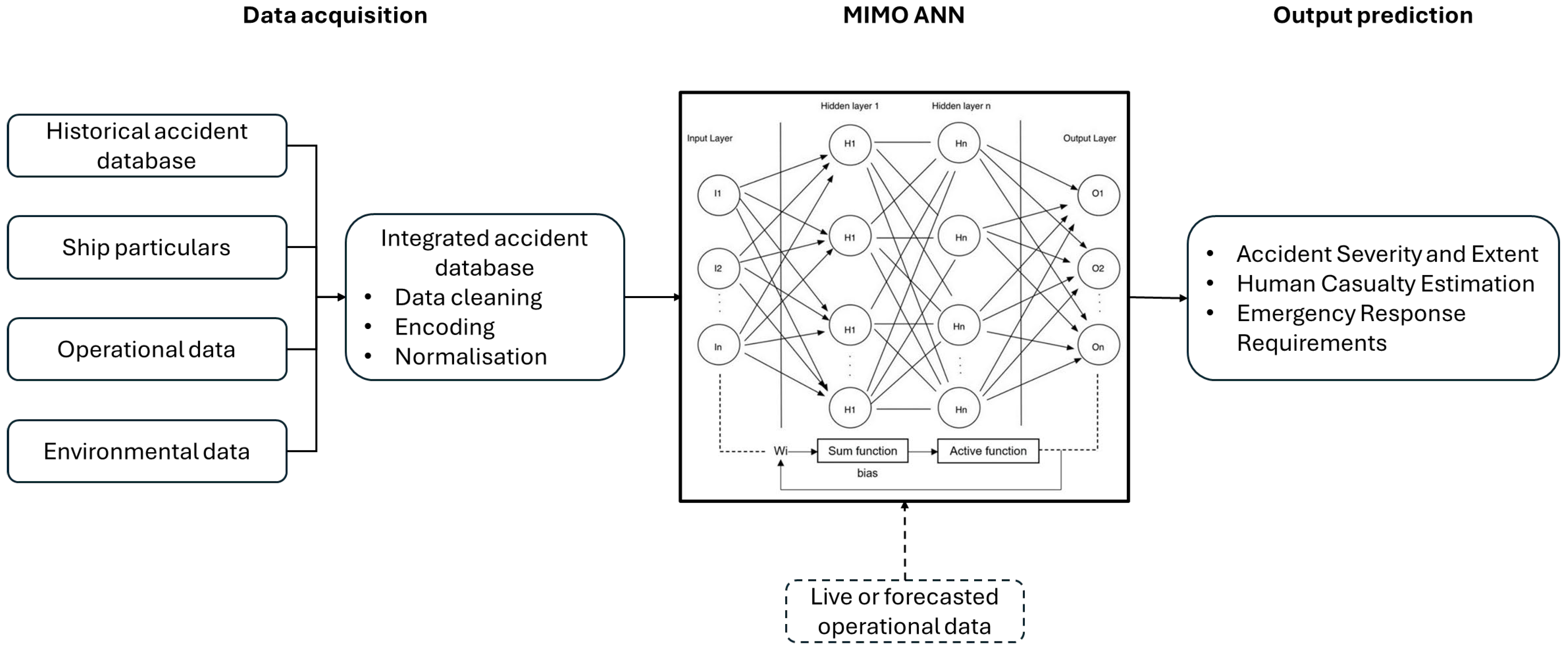
The decision-support tool developed in this study integrates a curated maritime accident dataset with a MIMO-ANN to provide a unified, data-driven assessment of maritime accident consequences. A schematic diagram of the proposed strategy is presented in
Figure 1.
The dataset—containing ship particulars, environmental factors, navigational conditions, operational information, accident type, and recorded accident outcomes—forms the core knowledge base from which the neural network learns patterns associated with accident-consequence severity, structural damage, human consequences, emergency response, and secondary consequence escalation. Each input variable in the dataset represents a consequence-influencing factor in recorded accident scenarios, and together they provide a multidimensional view of the contextual, operational, environmental, and vessel-related conditions associated with recorded maritime accidents.
During operation, the decision-support tool receives real, historical, or simulated maritime accident-scenario data—representing a vessel’s characteristics, operational profile, surrounding conditions, and defined accident type—and runs it through the trained neural network. The ANN evaluates the combined effect of all inputs and generates multiple accident-consequence outputs, including severity indicators, total loss, number of ships involved, structural-damage metrics, human-consequence variables, emergency-response requirements, and subsequent consequence/escalation outcomes as defined in the training dataset. The present implementation, therefore, focuses on consequence prediction for recorded or scenario-defined accident cases rather than estimating the probability of accident occurrence or near-miss frequency. Since the dataset consists of accident records and does not include non-accident exposure data, fleet-at-risk information, traffic baselines, voyage frequency, or operational hours, the ANN outputs should not be interpreted as accident occurrence probabilities. Instead, they represent the relative likelihood, severity, or magnitude of accident consequences within the accident scenarios represented in the dataset, conditional on an accident case being defined. Because the model has learned from historical multidimensional patterns, it can identify nonlinear relationships and subtle interactions between factors that traditional methods often overlook.
The generated outputs are subsequently translated into actionable decision guidance, such as consequence-based alerts, recommended operational adjustments, emergency-response prioritisation, or preparedness indicators for port authorities, ship operators, regulators, and safety managers. For example, in a scenario involving reduced visibility, high wind force, and a heavily loaded passenger vessel operating in restricted waters, with a specified accident mechanism, the MIMO-ANN may indicate higher predicted consequence severity, greater structural-damage extent, increased casualty potential, stronger need for SAR intervention, possible helicopter involvement, or secondary consequences such as flooding or fire. Such multidimensional predictions of consequences can support proactive decision-making, resource allocation, and the prioritisation of risk-mitigation measures.
After model training and performance evaluation, permutation-based sensitivity analysis is applied as an interpretability layer within the proposed framework. This layer translates the behaviour of the trained ANN into feature-importance rankings and input–output influence patterns, showing which risk-influencing factors contribute most strongly to specific accident consequences. Therefore, the framework does not rely solely on predictive accuracy metrics but also provides transparent insight into the drivers of the model’s predictions. The sensitivity analysis is therefore interpreted as identifying consequence-driving factors, not as identifying the factors that make accidents more likely to occur.
Overall, the proposed decision-support tool represents a shift from static rule-based safety assessment toward a data-driven, context-aware, and updateable framework for maritime accident-consequence assessment. The framework is considered dynamic in the operational sense because it can process varying vessel characteristics, environmental conditions, navigational contexts, operational states, and accident scenarios to generate corresponding multi-output consequence predictions. Moreover, as additional accident records become available, the model can be retrained to reflect evolving vessel types, traffic patterns, operational practices, reporting standards, and environmental conditions. However, the present implementation does not perform online learning in real time; rather, it provides a flexible, updatable modelling structure for maritime accident-consequence prediction. By combining a comprehensive accident dataset, a MIMO-ANN architecture, and permutation-based sensitivity analysis, the framework enables scalable and transparent consequence evaluation and supports practical safety decisions in maritime operations. Extension of this framework to estimate accident-occurrence probability would require additional exposure and baseline data, such as fleet-at-risk records, traffic density, operating hours, voyage frequency, or non-accident cases.
4.2. Dataset of Maritime Accidents
The dataset employed in this study is a comprehensive, multi-source maritime accident database constructed by combining incident records from the SafePASS project [
50,
51] with annotated accident-consequence, severity, and structural-damage information derived from Mujeeb-Ahmed et al. [
52]. The two sources play complementary roles within the integrated dataset rather than contributing identical types of information. The Mujeeb-Ahmed et al. [
52] database primarily supports the collision-, grounding-, and stranding-related subset, particularly for structural damage, flooding risk, and severity descriptors. In contrast, the SafePASS-based and newly compiled records broaden the accident coverage to include fire/explosion, contact, foundering, and hull/machinery damage, while also adding consequence variables such as casualties, total loss, SAR intervention, helicopter involvement, and secondary consequence escalation. Accordingly, the MIMO-ANN is trained on the complete integrated dataset rather than on the Mujeeb-Ahmed database alone. This distinction is important because different sources contribute different types of consequence information, and predictions for rare or underrepresented accident categories should therefore be interpreted with caution.
The integrated dataset comprises 582 accident cases spanning different vessel types, operational scenarios, and geographical zones. It brings together technical ship characteristics, environmental conditions, operational context, accident mechanisms, secondary consequences, and recorded outcomes, providing a multidimensional basis for data-driven accident-consequence prediction. The input variables describe static ship particulars, including ship type, tonnage, hull size, and year built; operational parameters, such as loading status and ship detail status; and environmental conditions, including visibility, wind force, and natural light. These variables represent risk- and consequence-influencing factors within recorded accident cases and provide the contextual information required to model accident consequences.
It is also necessary to distinguish between accident-occurrence modelling and accident-consequence modelling. The Mujeeb-Ahmed et al. [
52] database provides valuable evidence on collision and grounding events, particularly for flooding-risk assessment, accident characteristics, and the conditions associated with such events. In that context, variables such as ship characteristics, operational area, loading conditions, wind, waves, or visibility may be analysed in relation to accident occurrence, accident frequency, or the development of flooding risk. In contrast, the present study does not aim to estimate how frequently accidents occur. Instead, it focuses on predicting the severity and multidimensional consequences of accidents once an accident scenario has been defined. Because the dataset does not include non-accident exposure data, fleet-at-risk information, traffic baselines, voyage frequency, or operational hours, the ANN outputs should not be interpreted as accident occurrence probabilities. Rather, they represent the relative likelihood, severity, or magnitude of accident consequences within the accident scenarios represented in the dataset. Therefore, a variable may be strongly associated with accident frequency in an occurrence-based analysis but may become less influential in predicting consequence severity once accident type, operational context, environmental condition, and emergency-response information are already included in the model. This distinction is important when comparing the present sensitivity analysis results with previous accident frequency or flood risk studies.
A further distinction concerns the treatment of near-miss and nonserious events. Mujeeb-Ahmed et al. [
52] considered a wider severity spectrum for collision and grounding analysis, including serious, nonserious, and incident/near-miss cases. Such lower-severity records are important because they provide information on accident precursors, preventive actions, and safety barriers that may prevent escalation to severe outcomes. In contrast, the present study focuses on accident-consequence prediction using records for which sufficient consequence information is available. Therefore, near-miss and nonserious events are not explicitly modelled as output classes in the current MIMO-ANN framework. This choice supports the prediction of detailed consequence variables, such as structural damage, casualties, SAR intervention, helicopter involvement, and secondary consequence escalation, but it may bias the model toward more severe accident outcomes. The results should therefore be interpreted as consequence predictions for recorded accident cases rather than as a complete representation of the full safety spectrum from near-miss to catastrophic accident.
Although the dataset contains 582 cases, maritime accident records are naturally imbalanced. Certain accident types, such as collision, fire/explosion, and stranding, are more frequently represented, whereas rare but potentially catastrophic events, such as foundering or contact cases, are less common. A similar imbalance is observed across ship categories, where passenger/Ro-Ro vessels are more strongly represented than less common passenger/cargo subtypes. To improve transparency, the distribution of accident cases by Accident Type and Ship Type is summarised in
Table A1. Since the reported R and MSE values represent aggregated performance over the complete multi-output dataset, prediction accuracy for rare accident categories may be affected by the limited number of available samples. This limitation is inherent to historical maritime accident data and is considered when interpreting the decision-support capability of the proposed framework.
The input layer consists of 15 heterogeneous variables. These include situational descriptors, such as Natural Light, Accident Type, Environment, and Zone, which indicate the external and operational conditions prevailing at the time of the incident. Vessel-related attributes include Ship Type, Ship Length Overall (LOA), Built Year, Flag, Gross Tonnage (GT), and Deadweight Tonnage (DWT). Operational-status descriptors are represented by Cargo Load Status and Ship Detail Status, while exposure is represented by the total number of passengers and crew on board. Environmental severity is captured through the Visibility and Beaufort Scale, enabling the model to learn how meteorological and visibility-related factors influence accident consequences, escalation, and emergency-response requirements. These inputs should therefore be interpreted as contextual descriptors of recorded accident scenarios rather than as variables used to estimate the probability of accident occurrence.
The output layer includes 15 accident-consequence variables, providing a detailed representation of accident outcomes rarely available in maritime safety datasets. Unlike datasets that only report a single severity index, the present dataset covers six consequence groups: overall severity classification, ship-level consequences, hull-structural impact metrics, human consequences, emergency-response indicators, and secondary consequence/escalation mechanisms. This multifaceted output space enables the MIMO-ANN to jointly predict correlated outcomes, including structural damage, casualties, SAR intervention, helicopter involvement, total loss, number of ships involved, and subsequent consequences such as fire, flooding, grounding, or unknown escalation status. This reflects the interdependent nature of the consequences of maritime accidents.
Casualty-related terminology differs across the source datasets and should be interpreted carefully. In [
52], the term “fatalities” is used within a broader accident-severity and human-consequence context, whereas the present study represents human outcomes in a more disaggregated form. Specifically, the MIMO-ANN output space separates casualties into killed, injured, and missing persons, with a further distinction between crew and passengers. This results in six human-consequence variables: Killed Crew, Injured Crew, Missing Crew, Killed Passenger, Injured Passenger, and Missing Passenger. Therefore, the casualty-related outputs in this study should not be interpreted as a direct one-to-one replication of the terminology used in [
52], but as a refined representation of available human-consequence information to support detailed multi-output accident-consequence prediction.
Before ANN training, the dataset is cleaned and preprocessed to ensure consistency, numerical suitability, and data reliability. Missing or null values are identified by checking blank fields, unavailable entries, inconsistent labels, and values reported as “Unknown” or “Not reported”. For categorical variables, missing or unavailable entries are retained as an “Unknown” category where appropriate, rather than being treated as numerical zero values. The completeness of each accident record is assessed at the variable level by reviewing the availability of key input and output fields. Essential descriptors, including Accident Type, Ship Type, Zone, Severity, and Consequence, are checked to ensure that each retained record contains sufficient information for model training. Numerical variables, including LOA, GT, DWT, damage dimensions, casualty numbers, and total persons onboard, are examined for missing values, unrealistic ranges, negative values that are not physically meaningful, and consistency with the reported accident context.
Continuous numerical variables, including LOA, GT, DWT, total persons onboard, damage dimensions, and casualty-related outputs, are normalised before training using min–max scaling. The scaling parameters are derived from the training subset and then applied consistently to the validation and testing subsets to prevent information leakage. This ensured that variables with larger numerical ranges did not dominate the ANN optimisation process and that all input and output variables are represented on comparable numerical scales. Categorical variables, including Accident Type, Ship Type, Flag, Cargo Load Status, Ship Detail Status, Visibility, Environment, Zone, Total Loss, SAR Intervention, Helicopters Involved, Severity, and Consequence, are numerically encoded before ANN training.
The dataset also captures variability in geographical and operational conditions. The Zone parameter covers 54 geographical categories, representing different accident locations and risk contexts. Similarly, Environment and Visibility values provide diversity in accident scenarios, covering conditions such as at sea, ports/harbours/docks, restricted waters, shipyards/dry docks, and unknown environments. This supports the model’s ability to learn from a wider range of operational contexts.
Table 1 and
Table 2 present the description and criteria of the input and output parameters, respectively.
In summary, the dataset provides a detailed and operationally relevant foundation for accident-consequence prediction. It captures interactions among environmental, operational, vessel-specific, accident-mechanism, and consequence-escalation factors, enabling a holistic assessment of maritime accident outcomes. The applied cleaning, missing-value treatment, categorical encoding, and numerical normalisation procedures ensure that the dataset is suitable for reliable MIMO-ANN training and evaluation. However, because the dataset is composed of recorded accident cases, the resulting model should be interpreted as a consequence-prediction framework conditional on an accident scenario, not as a full accident-occurrence probability model.
4.3. Artificial Neural Network Model
The proposed accident-consequence-prediction framework is based on a Multi-Input Multi-Output Artificial Neural Network (MIMO-ANN) architecture that simultaneously learns from heterogeneous ship, environmental, and operational features and produces multidimensional predictions of accident outcomes. Unlike traditional single-output models, the MIMO formulation captures shared information across outputs, reduces redundancy in training, and improves the internal representation of correlated accident consequences, including severity, structural damage, human casualties, and SAR activation [
53]. The model is therefore designed to predict consequences conditional on a recorded or scenario-defined accident case, rather than estimating the probability of accident occurrence.
Let the input feature vector describing each accident case be denoted as x ∈ ℝ
n, where
n = 15 represents the number of input variables:
The MIMO-ANN maps this input vector to a multidimensional output vector y ∈ ℝ
m, where
m = 15 corresponds to the number of predicted accident outcomes:
The network adopts a feedforward structure consisting of an input layer, a single hidden layer, and an output layer. For the hidden layer, each neuron performs a weighted transformation followed by a nonlinear activation function:
where W represents the weight connecting neuron in layer (l − 1) to another neuron in layer l, b is the bias term, and f is an activation function. The final output layer consists of m neurons, each producing an output.
where g is the activation function of the output layer.
Because the proposed ANN predicts multiple accident consequences simultaneously, the training process jointly considers all output variables. Rather than optimising separate models for each target, the network minimises a single multi-output error function across all 15 preprocessed outputs. In the present MATLAB 2025b implementation, the model is trained using the MSE, applied to the normalised numerical outputs and numerically encoded categorical outputs. Therefore, the ANN outputs should be interpreted as predicted consequence values or encoded consequence classes after post-processing, not as direct accident-occurrence probabilities. The MSE is defined as:
where
yk is the true value of the output for sample
k,
ŷk is the corresponding network prediction, and N is the total number of training samples. MSE penalises larger deviations more strongly and provides a unified error measure for the preprocessed multi-output matrix:
The network is trained using MSE applied to the preprocessed output matrix, which contains normalised continuous outputs and numerically encoded categorical outputs. Continuous outputs, such as damage dimensions, number of ships involved, casualties, and missing-person counts, are normalised before training to avoid dominance by variables with larger numerical ranges. Categorical outputs, including Severity, Total Loss, SAR Intervention, Helicopters Involved, and Consequence, are transformed into numerically encoded representations before ANN training and decoded after prediction. Therefore, categorical outputs should be interpreted as predicted consequence classes or encoded class tendencies, not as calibrated class probabilities. The reported MSE consequently represents aggregate prediction error across the complete preprocessed multi-output space, rather than a separate classification loss for each categorical output.
Because the proposed ANN predicts multiple accident consequences simultaneously, the training process jointly considers all output variables rather than optimising separate models for each target. A general weighted multi-output objective can be expressed as in Equation (7).
where
m corresponds to the total number of predicted accident-outcome variables. Each term
Li represents the loss associated with output
i, and
λi is a weighting coefficient controlling the relative influence of each output during training. This equal-weight formulation is considered appropriate because output normalisation and categorical encoding reduce magnitude differences among output variables. No additional empirical weighting factors are introduced, thereby avoiding subjective prioritisation of specific accident outcomes. In this equal-weight setting, the implemented training objective is equivalent to minimising the aggregate MSE across the entire preprocessed multi-output matrix.
By optimising all output variables within a single MIMO-ANN structure, the network updates its internal weights in a coordinated manner. This enables the model to learn relationships among accident consequences and generate mutually consistent predictions across the output space. In this way, the consequences of maritime accidents are treated as a multidimensional, interdependent system, yielding more coherent predictions than separate single-output models.
The ANN model is implemented as a feedforward network with a single hidden layer and trained using the SCG algorithm. The selection of SCG is based on its optimisation characteristics rather than on software availability. The present problem involves a moderate-sized dataset of 582 accident cases, a fixed preprocessed input–output matrix, and repeated training of comparable network configurations with 10, 20, and 30 hidden neurons. Under these conditions, a stable full-batch training algorithm is appropriate because it supports reproducible comparison across alternative architectures and data-partitioning ratios.
SCG combines the conjugate gradient search direction with a scaling mechanism that avoids the computationally expensive line-search procedure required by conventional conjugate gradient algorithms. This reduces training complexity while maintaining stable convergence for small- and medium-sized feedforward networks. SCG also requires less memory than Hessian-based or quasi-Newton methods, which is advantageous when repeated model training is required for parametric comparison and cross-validation. In the present study, these properties make SCG suitable for training the MIMO-ANN consistently across all evaluated configurations. The MATLAB implementation is therefore used as a practical platform for applying SCG, but the methodological rationale for selecting the algorithm is its stability, computational efficiency, and suitability for moderate-sized full-batch neural-network training [
54].
Nevertheless, future work may compare SCG with Adam [
55] and other adaptive gradient-based optimisation algorithms to assess their influence on convergence speed, prediction accuracy, and robustness for larger maritime accident datasets. Future work may also consider class-weighted or severity-weighted loss functions to improve the prediction of rare but catastrophic accident outcomes. If future versions of the framework are extended to estimate the probability of accident occurrence, additional exposure data, such as fleet-at-risk information, traffic density, operational hours, voyage frequency, or non-accident baseline cases, will be required.
5. Results and Discussion
This section presents and discusses the performance of the proposed MIMO-ANN in predicting maritime accident consequences using the compiled dataset. The objective is to evaluate the model’s predictive capability across multiple accident-consequence outputs while assessing its internal stability under controlled changes in model configuration and data partitioning. The ANN is trained using the trainSCG algorithm, selected for its numerical stability, efficient convergence, and suitability for networks with multiple outputs and heterogeneous targets. Separate training, validation, and testing subsets are used to assess generalisation and reduce the risk of overfitting, particularly given the inherent imbalance and variability of maritime accident data. The reported predictions should be interpreted as consequence predictions conditional on recorded or scenario-defined accident cases, not as accident-occurrence probabilities.
To examine the influence of network capacity and data partitioning, a parametric simulation study is conducted using three hidden-neuron configurations (10, 20, and 30 neurons) and two train/validation/test split ratios (60/20/20 and 70/15/15). For each configuration, the ANN is trained and evaluated using identical preprocessing settings to ensure a fair comparison. Varying the number of hidden neurons allows the sensitivity of the model to network complexity to be assessed, including whether it tends toward underfitting, overfitting, or stable generalisation. Similarly, comparing different data split ratios assesses whether the model maintains reliable performance as the amounts of data allocated to training, validation, and testing change.
Model performance is evaluated using four complementary diagnostics: (i) regression plots showing the relationship between predicted and target values, (ii) error histograms showing the distribution and bias of prediction errors, (iii) MSE values for training, validation, and testing subsets, and (iv) R between predicted and target values for each subset. Because the MIMO-ANN contains both continuous and encoded categorical outputs, the reported R and MSE values represent aggregated performance over the preprocessed multi-output space rather than separate class-specific classification accuracy. In this study, robustness is interpreted as internal performance stability, assessed through the consistency of R and MSE across subsets, the size of the generalisation gap between seen and unseen data, and the concentration of prediction errors around zero. A robust configuration is expected to maintain high correlation, low error, limited divergence between training and testing performance, and stable error distributions across the experimental settings tested.
Therefore, the comparison of network architectures and data-partitioning strategies provides an assessment of internal robustness and stability rather than a full external validation. External validation using independent datasets from different geographical regions, vessel populations, and operational conditions remains an important direction for future work. Moreover, because the dataset does not include non-accident exposure data, fleet-at-risk information, operational hours, traffic baselines, or voyage-frequency data, this section evaluates consequence-prediction performance rather than estimating accident-occurrence probability.
5.1. Performance of the ANN Model at 60/20/20 Split Ratio
To evaluate the influence of network complexity on prediction accuracy and generalisation capability, the MIMO-ANN is trained using three different hidden-layer sizes (10, 20, and 30 neurons) under a fixed data-partitioning scheme of 60% training, 20% validation, and 20% testing. The Scaled Conjugate Gradient algorithm (trainSCG) is employed consistently across all cases. Model performance is assessed using R and MSE, with support from regression plots and error histograms.
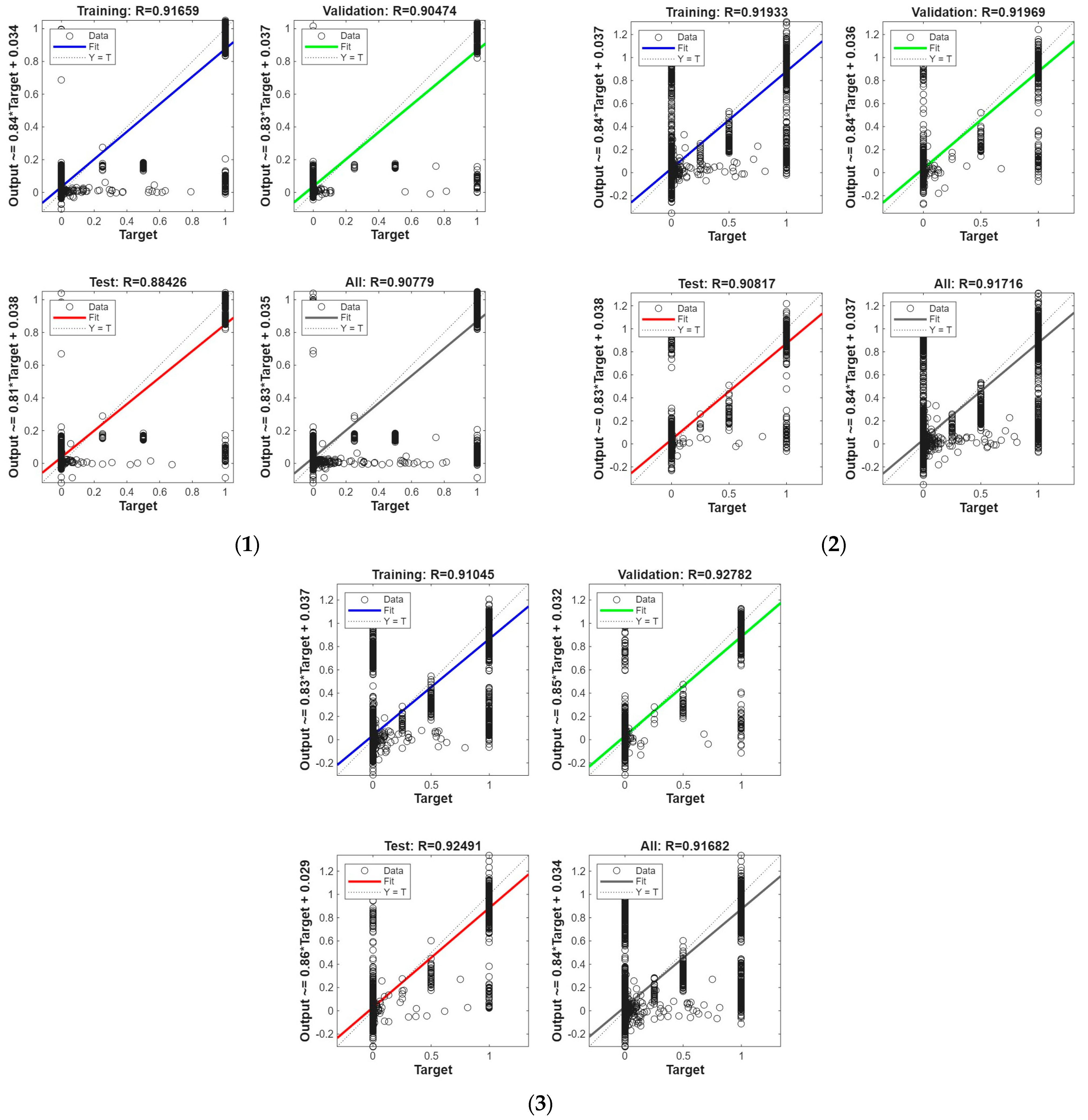
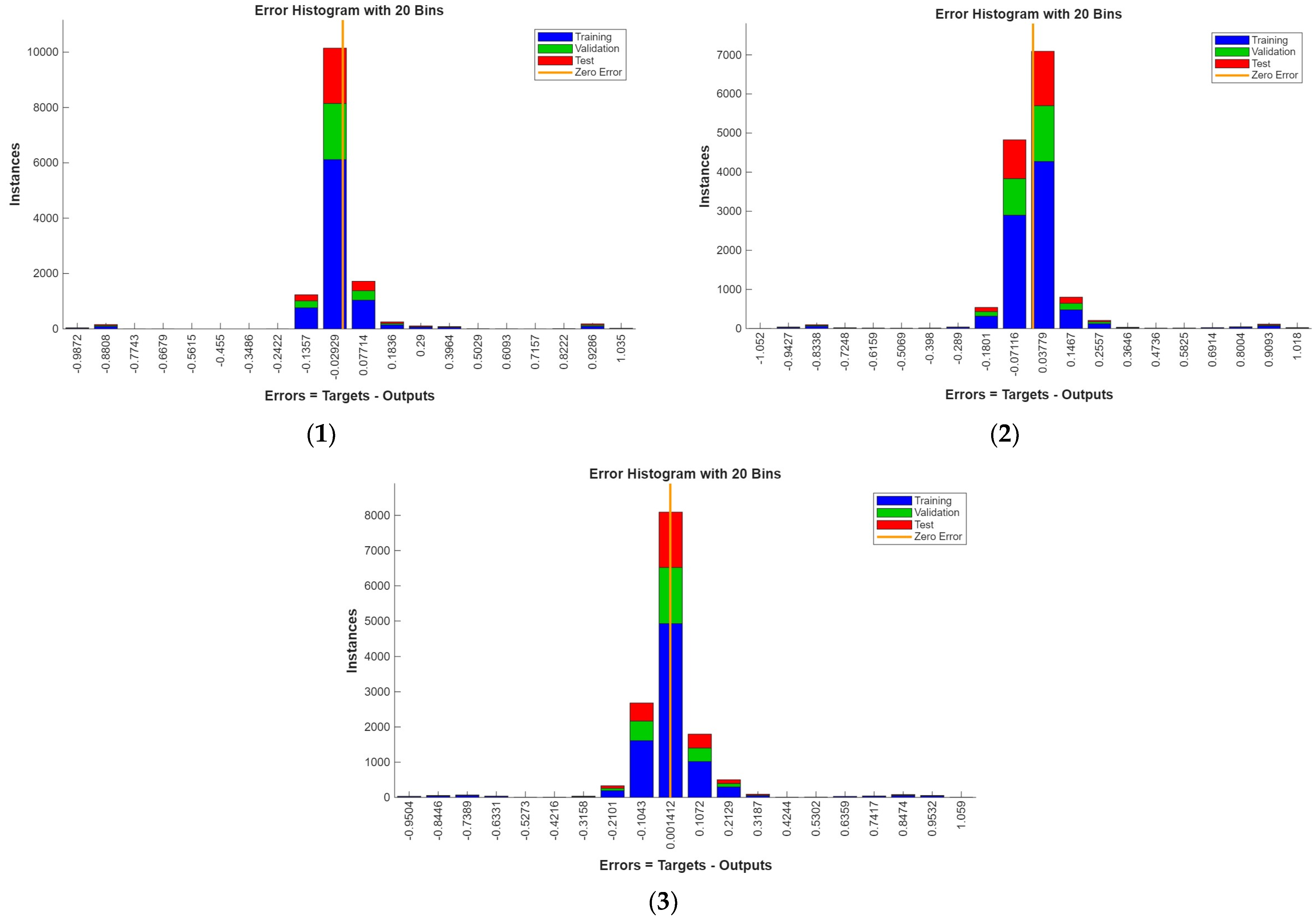
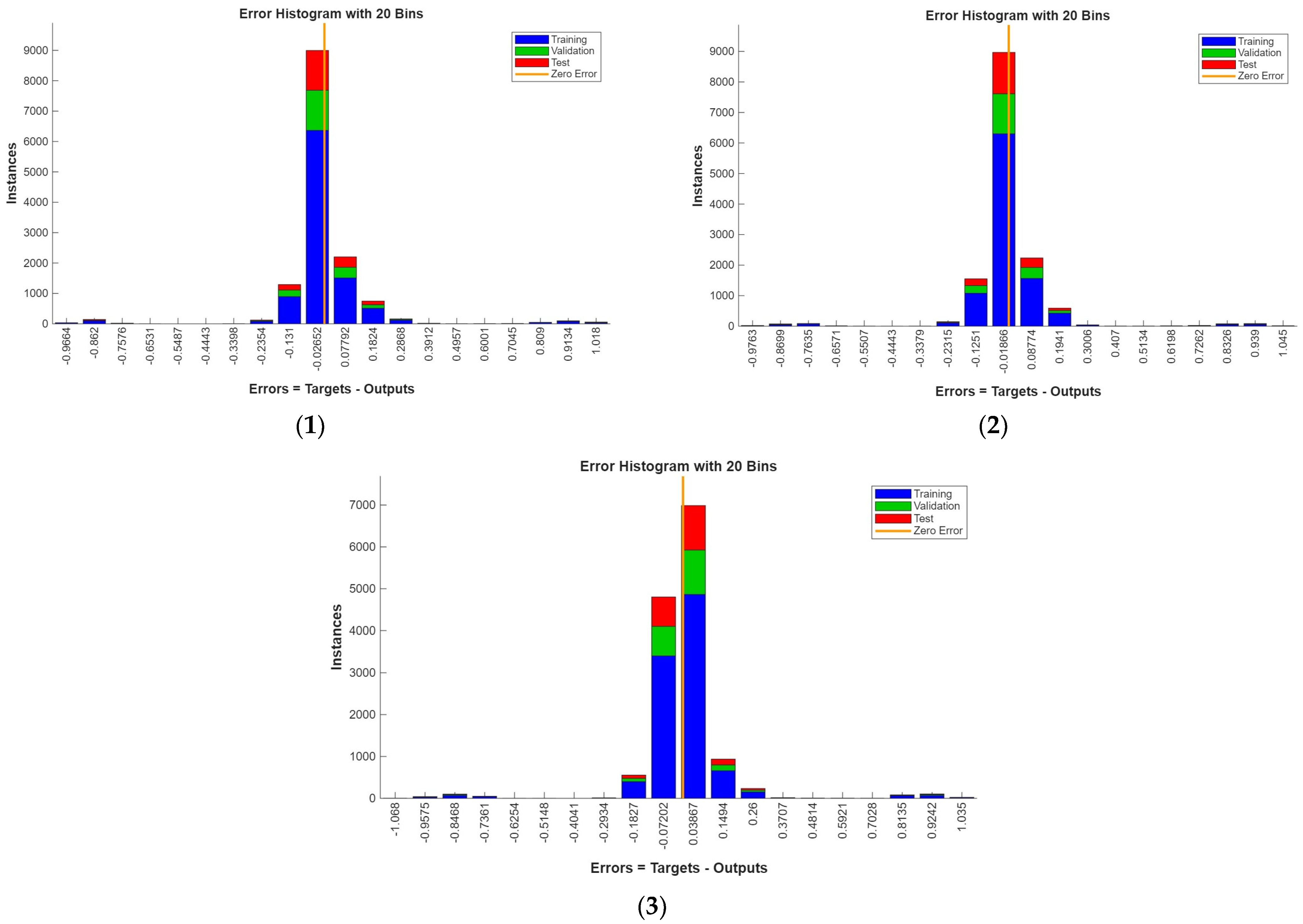
Figure 2 illustrates the regression performance of the ANN models trained with a 60/20/20 data split using 10, 20, and 30 hidden neurons, while
Figure 3 presents the corresponding error histograms and
Table 3 summarises the quantitative evaluation metrics.
For the network with 10 hidden neurons, the ANN demonstrates strong and balanced predictive performance across all data subsets. The R reaches 0.9166 for training, 0.9047 for validation, and 0.8843 for testing. These values indicate a high degree of agreement between predicted and target values, with a moderate reduction from training to unseen testing data, suggesting acceptable generalisation but slightly lower testing performance compared with the larger networks.
The corresponding MSE values remain low, with 0.0265 for training, 0.0301 for validation, and 0.0363 for testing. The relatively small gap between the training and validation errors suggests that the model is stable, although the higher testing MSE indicates that the 10-neuron configuration has more limited predictive capability on unseen samples than the 20- and 30-neuron models.
The regression plots show an overall positive relationship between predicted and target values, while the error histogram shows a strong concentration of errors near zero, with only a limited number of larger deviations. Overall, this configuration provides a stable and computationally efficient baseline model, but its lower test R and higher test MSE suggest that 10 hidden neurons may not have sufficient representational capacity to capture the full nonlinear complexity of the accident-consequence dataset.
Increasing the hidden-layer size to 20 neurons improves the model performance across all subsets. The training R increases to 0.9193, while the validation and testing correlations reach 0.9197 and 0.9081, respectively. These results show that the 20-neuron model improves generalisation over the 10-neuron configuration and maintains consistent predictive behaviour across the training, validation, and test subsets.
This improvement is also reflected in the error metrics. The MSE values decrease to 0.0256 for training, 0.0255 for validation, and 0.0292 for testing, all lower than those obtained using 10 hidden neurons. The close agreement between training and validation errors indicates stable learning behaviour, while the reduced testing error confirms improved predictive accuracy on unseen data. Therefore, the 20-neuron configuration provides a stronger balance between model complexity and generalisation than the 10-neuron model.
The regression plots for the 20-neuron model show a clearer alignment between predicted and target values, and the error histogram indicates a sharper concentration of errors around zero. These results suggest that increasing the number of hidden neurons improves the network’s ability to capture nonlinear relationships among the accident inputs and consequence outputs without introducing evident overfitting.
The ANN with 30 hidden neurons exhibits the strongest overall generalisation performance under the 60/20/20 split. Although the training correlation is slightly lower than that of the 20-neuron model (R = 0.9105), the validation and testing correlations are the highest among all configurations, at 0.9278 and 0.9249, respectively. This pattern is desirable because it indicates that the model does not over-specialise to the training subset but instead maintains stronger predictive capability on unseen data.
The MSE results further support this conclusion. The 30-neuron ANN achieves the lowest validation and testing errors, with MSE equal to 0.0231 for validation and 0.0240 for testing, compared with 0.0255 and 0.0292 for the 20-neuron model and 0.0301 and 0.0363 for the 10-neuron model. Although the training MSE increases slightly to 0.0283, the reduced validation and testing errors indicate improved generalisation and reduced sensitivity to unseen samples.
The regression plots for this configuration show the strongest validation and testing agreement among the three models, while the error histogram demonstrates a high concentration of errors around zero with limited dispersion. These results indicate that the 30-neuron network provides the best balance between model capacity and generalisation, effectively capturing complex nonlinear interactions without compromising predictive stability.
A comparative analysis of the three configurations highlights the trade-off between model simplicity and representational power. The 10-neuron ANN delivers acceptable, stable performance but achieves the lowest test accuracy, suggesting limited model capacity. The 20-neuron ANN improves both correlation and error metrics, providing a strong intermediate configuration. However, the 30-neuron ANN achieves the best overall performance, as evidenced by the highest validation and testing R values and the lowest validation and testing MSE values.
Overall, for the 60/20/20 split ratio, the results show that increasing the number of hidden neurons enhances the ANN’s ability to model complex accident-outcome relationships. The 30-hidden-neuron configuration is therefore identified as the most suitable model for this split ratio, providing the strongest predictive performance on unseen validation and testing data and offering the most balanced configuration for the proposed MIMO-ANN decision-support framework.
5.2. Performance of the ANN Model at 70/15/15 Split Ratio
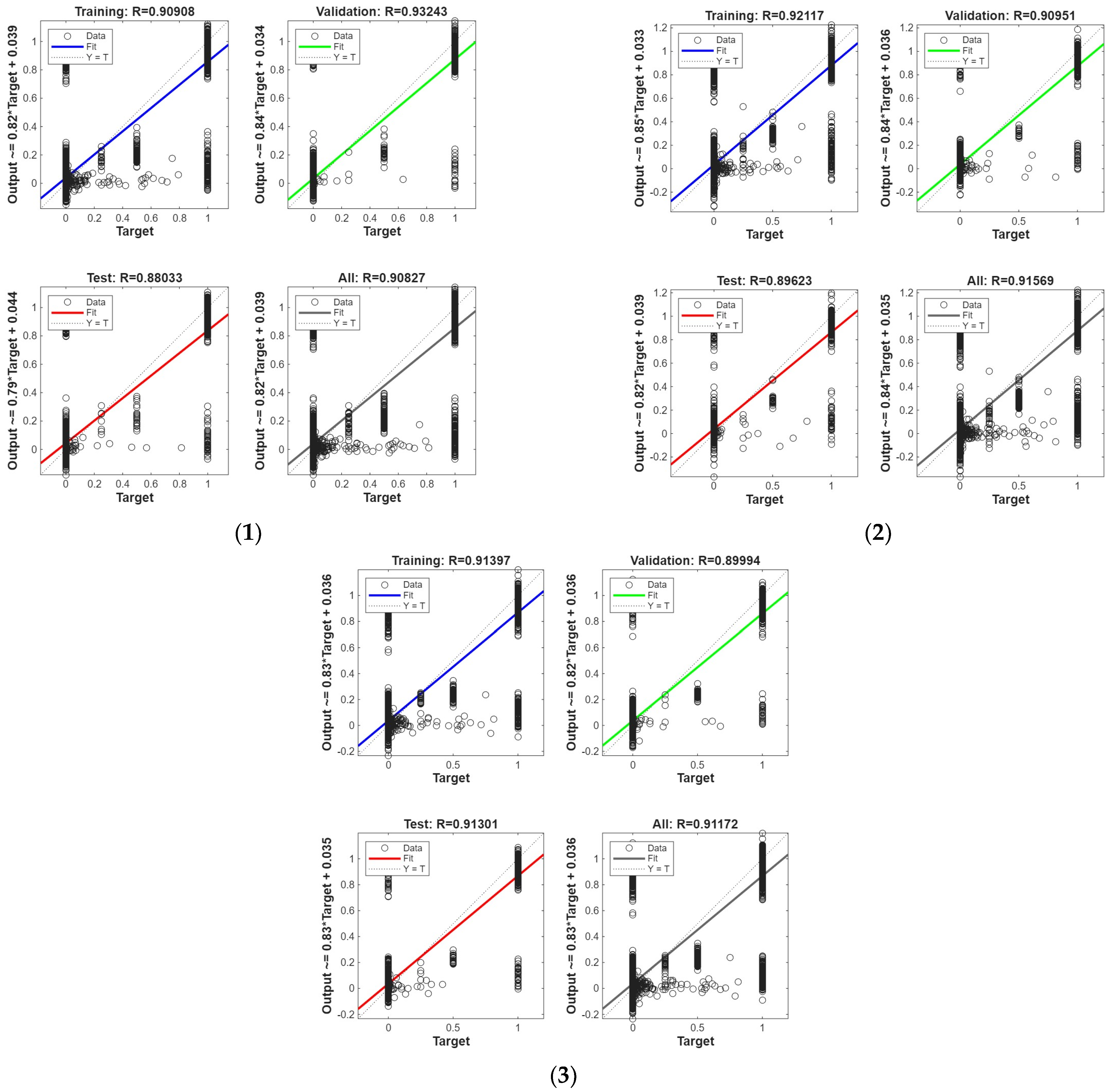
To further investigate the influence of data partitioning on model robustness and generalisation, the proposed MIMO-ANN is evaluated using a 70/15/15 training–validation–testing split, while maintaining the same network architecture, preprocessing strategy, and training algorithm (trainSCG). Similar to the previous analysis, three hidden-layer configurations—10, 20, and 30 neurons—are examined. Model performance is assessed through regression plots, error histograms, and quantitative metrics (R and MSE), as presented in
Figure 4 and
Figure 5 and summarised in
Table 4. The evaluation focuses on predicting the consequences of recorded accidents, not on estimating the probability that accidents occur.
For the 10-hidden-neuron configuration, the ANN demonstrates stable performance across all subsets. The R equals 0.9090 for training, 0.9319 for validation, and 0.8801 for testing. These values indicate that the model captures the overall relationship between the input factors and the accident-consequence outputs, although the reduction in test performance relative to validation suggests some sensitivity to the unseen test subset.
The corresponding MSE values are 0.0287 for training, 0.0219 for validation, and 0.0375 for testing. The low validation error indicates good performance on the validation subset, while the higher testing MSE suggests that the 10-neuron model has limited representational capacity for some unseen accident cases. Overall, this configuration provides a stable baseline, but its lower test correlation and higher test error indicate that additional hidden neurons may be needed to capture the nonlinear relationships in the accident-consequence dataset.
Increasing the number of hidden neurons to 20 improves training performance while maintaining good validation and test results. The training R increases to 0.9212, while the validation and testing correlations reach 0.9094 and 0.8959, respectively. These values show that the 20-neuron model improves the testing correlation compared with the 10-neuron configuration, although its validation performance is lower than that of the 10-neuron case.
This trend is also reflected in the MSE values, which are 0.0251 for training, 0.0286 for validation, and 0.0328 for testing. The reduction in testing MSE compared with the 10-neuron model indicates improved predictive accuracy on unseen data. However, the differences between training, validation, and test values suggest that the 20-neuron configuration does not provide the strongest overall generalisation under this split ratio.
The ANN with 30 hidden neurons delivers the strongest testing performance under the 70/15/15 split. The training R is 0.9140, while the testing correlation is 0.9130, the highest among the three configurations. The validation R is 0.8998, which remains acceptable but is lower than the testing value. This pattern suggests that the 30-neuron model provides strong predictive capability for unseen test samples, although validation performance is slightly less favourable than under the 60/20/20 split.
The MSE results further support the strong testing performance of this configuration. The 30-neuron ANN achieves MSE equal to 0.0273 for training, 0.0276 for testing, and 0.0315 for validation. The close agreement between training and testing MSE indicates stable generalisation, while the slightly higher validation MSE suggests some sensitivity to the smaller validation subset used in the 70/15/15 split.
The comparative analysis of
Figure 4 and
Figure 5 and
Table 4 reveals a clear interaction between network capacity and data-partitioning strategy. While the 10-neuron ANN provides a stable baseline, its testing performance is lower than that of the larger networks. The 20-neuron ANN improves testing performance but does not achieve the best overall results. In contrast, the 30-neuron ANN achieves the highest testing correlation and the lowest testing MSE under the 70/15/15 split, indicating that the larger network has a stronger capacity to represent nonlinear relationships among accident type, vessel characteristics, operational context, environmental variables, and consequence outputs.
Overall, for the 70/15/15 split ratio, the ANN with 30 hidden neurons offers the strongest testing performance among the evaluated configurations. However, when compared with the 60/20/20 split, its validation performance is weaker, and its testing performance remains slightly lower than that of the 30-neuron model trained with the 60/20/20 split. Therefore, the 70/15/15 configuration is considered a strong alternative but not the final model selected.
5.3. Comparison Between 60/20/20 and 70/15/15 Split Ratios and Model Selection
A final comparative analysis is conducted to evaluate the influence of data-partitioning strategy on the predictive accuracy, generalisation capability, and operational suitability of the proposed MIMO-ANN models. Two commonly used split ratios, 60/20/20 and 70/15/15, are examined across three network configurations: 10, 20, and 30 hidden neurons. Model performance is assessed using R, MSE, regression behaviour, and error-distribution characteristics.
Overall, both split ratios yield strong predictive performance, with R generally close to or above 0.88 across training, validation, and testing subsets. However, clear differences emerge when validation reliability and testing accuracy are considered together. These criteria are particularly important for a decision-support framework, where the selected model must provide stable predictions on unseen accident cases rather than only fitting the training subset.
For the 60/20/20 split, the ANN with 30 hidden neurons achieves the strongest overall performance among the tested configurations. This model achieves the highest validation and testing correlations, with R values of 0.9278 and 0.9249, respectively. It also achieves the lowest validation and test MSE values, at 0.0231 and 0.0240, respectively. These results indicate that the 30-neuron model under the 60/20/20 split has sufficient representational capacity to capture nonlinear accident-consequence relationships while maintaining strong predictive performance on unseen validation and testing data.
For the 70/15/15 split, the 30-hidden-neuron ANN also achieves the best testing performance within that split, with R equal to 0.9130 and MSE equal to 0.0276. However, its validation performance is lower, with R equal to 0.8998 and MSE equal to 0.0315. Although the 70/15/15 split allocates a larger portion of the dataset to training, the reduced validation subset may limit the reliability of validation-based model assessment. In addition, the testing performance remains slightly lower than that obtained using the 30-neuron ANN under the 60/20/20 split.
The comparison shows that increasing the number of hidden neurons generally improves the ability of the ANN to model complex nonlinear relationships among accident type, vessel characteristics, environmental conditions, operational context, and consequence variables. However, the results also show that increasing the training-data allocation alone does not necessarily improve generalisation. For the present dataset, the 60/20/20 split provides a more favourable balance between training sufficiency, validation reliability, and testing accuracy.
A comparison of
Table 3 and
Table 4, therefore, indicates that the 60/20/20 split with 30 hidden neurons is the most suitable configuration. It achieves the highest test correlation and the lowest test MSE across all evaluated models, while also maintaining the strongest validation performance. The corresponding regression and error-distribution results further support this conclusion by showing concentrated prediction errors around zero and stable predictive behaviour across unseen subsets.
Based on this analysis, the MIMO-ANN with 30 hidden neurons trained using the 60/20/20 split is selected as the final model for implementation. This configuration provides the best balance between representational capacity, validation reliability, and testing generalisation, making it the most appropriate choice for the proposed maritime accident decision-support framework. To further verify that this result is not dependent on a single data partition, an additional 10-fold cross-validation assessment is performed in the following section.
5.4. Cross-Validation Assessment of the Selected Model
To further assess the internal generalisation capability of the selected MIMO-ANN model, 10-fold cross-validation is conducted using the final architecture with 30 hidden neurons. While the 60/20/20 split is used for model selection, cross-validation is applied as an additional robustness check to reduce dependence on a single random data partition. The full dataset of 582 accident cases is divided into ten approximately equal folds. In each run, nine folds are used for training and internal validation, while the remaining fold is retained as an unseen test subset. This process is repeated ten times so that each fold is used once for testing.
For each fold, the same MIMO-ANN architecture, preprocessing procedure, training algorithm, and performance metrics are applied. Normalisation parameters are derived from the training portion of each fold and then applied to the corresponding test subset to avoid information leakage. Model performance is evaluated using the R and MSE for both training and testing subsets. The results are summarised in
Table 5.
The training results are highly consistent across the ten folds, with a mean training R of 0.9335 ± 0.0117 and a mean training MSE of 0.0208 ± 0.0023. This indicates stable learning behaviour and limited sensitivity to the composition of the training subsets. The testing results also show generally strong predictive performance, with a mean testing R of 0.8803 ± 0.0827 and a mean testing MSE of 0.0445 ± 0.0478. Most folds achieve testing R values close to or above 0.89, with low testing MSE values generally below 0.04, confirming that the selected MIMO-ANN maintains good predictive capability across different unseen subsets.
However, Fold 2 shows reduced testing performance, with R equal to 0.6553 and MSE equal to 0.1793. Fold 4 also shows a comparatively lower testing correlation, with R equal to 0.8512, although its testing MSE remains moderate at 0.0390. The weaker performance in Fold 2 suggests that the model is sensitive to the composition of the test subset when rare accident types, underrepresented ship categories, missing-data patterns, or high-consequence outliers are concentrated in a particular fold. This behaviour is consistent with the imbalanced structure of the maritime accident dataset, as shown in
Table A1.
Overall, the 10-fold cross-validation results provide additional evidence that the selected MIMO-ANN has learned meaningful internal relationships within the compiled dataset rather than relying solely on a single favourable train/test split. Nevertheless, this analysis remains an internal validation procedure. It does not fully establish external transferability to independent accident datasets from different geographical regions, vessel populations, reporting systems, or time periods. Future work should therefore include stratified cross-validation, feature-group ablation analysis, and external validation using independent maritime accident datasets.
5.5. Sensitivity Analysis
To enhance the interpretability of the proposed MIMO-ANN and address the black-box nature of neural-network predictions, permutation-based sensitivity analysis is integrated into the framework as a post-training interpretability module. The analysis is applied after the optimal ANN configuration has been trained and selected to quantify how changes in each input feature affect the predicted accident consequences.
It is important to clarify that this sensitivity analysis identifies drivers of accident consequences rather than drivers of accident occurrence. Each sample in the dataset represents a recorded accident case; therefore, the ANN does not estimate the probability that an accident will occur under a given set of conditions. Instead, it evaluates how the recorded accident type, vessel characteristics, operational context, environmental conditions, and emergency-response variables influence the severity and multidimensional consequences of an already defined accident scenario. Consequently, variables that are important in accident-frequency or occurrence-based studies may not necessarily appear as dominant predictors in the present consequence-severity model. Once Accident Type, Zone, Environment, Visibility, and other contextual variables are included, the marginal influence of certain vessel or metocean variables may be reduced because some of their effect is already captured by the accident mechanism and operating context. The sensitivity results should therefore be interpreted as consequence-specific importance scores, not as general indicators of accident likelihood.
Because several input and output variables are categorical and represented by multiple encoded columns, the analysis is performed at the grouped variable level. All encoded columns belonging to the same original feature, such as Accident Type, Ship Type, Natural Light, Environment, or Zone, are treated as a single input group. This preserves the physical meaning of each variable and avoids misleading interpretation of individual encoded components.
The procedure consists of four main steps. First, the trained MIMO-ANN generates baseline predictions using the original, unmodified dataset. Second, one input group is randomly permuted across all samples while all other input variables are kept unchanged. Third, the trained model generates a new set of predictions from the perturbed dataset. Fourth, the influence of the permuted input group is quantified by calculating the average absolute deviation between the baseline and perturbed predictions. A larger deviation indicates that the input group has a stronger influence on the ANN outputs.
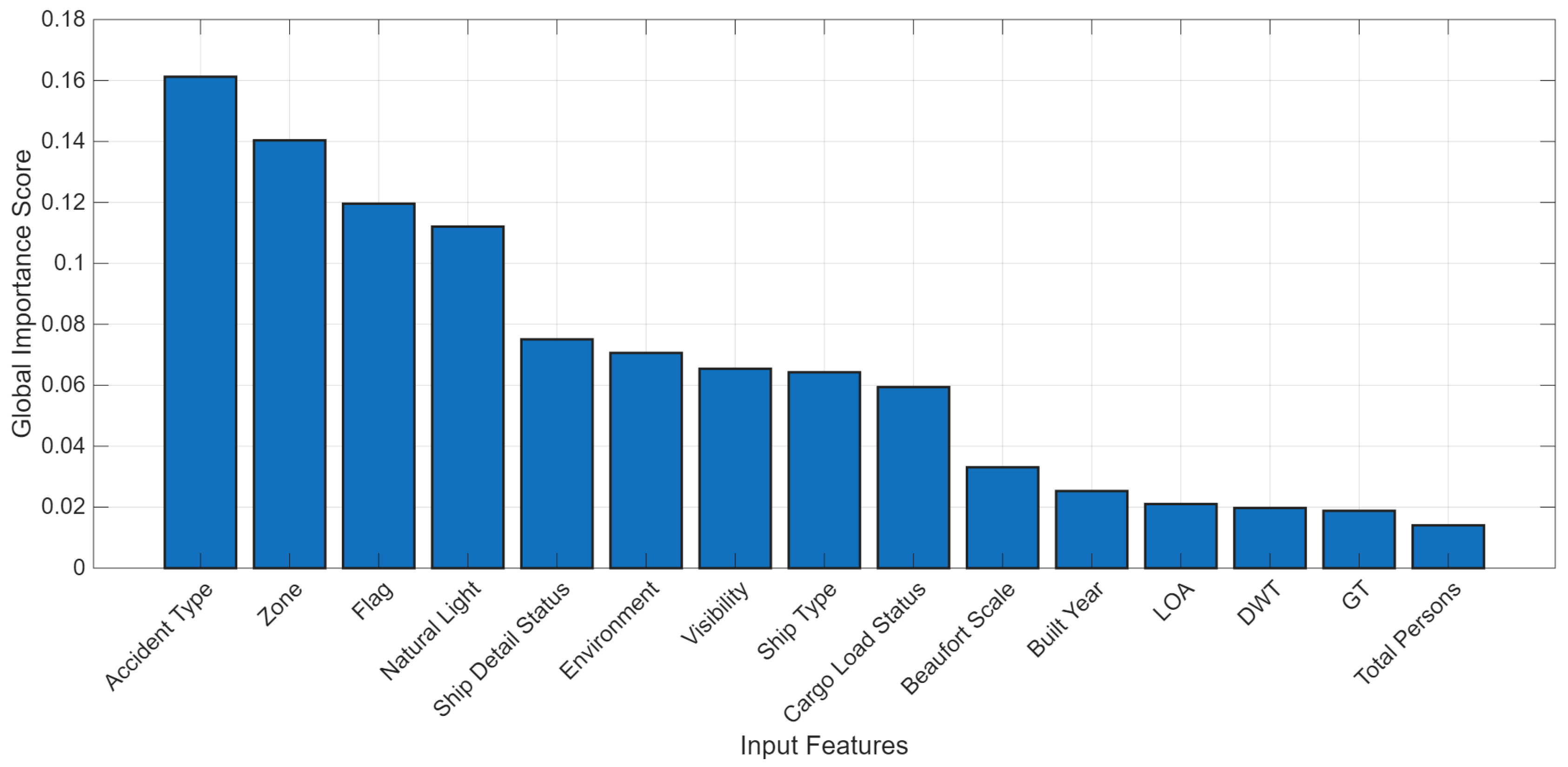
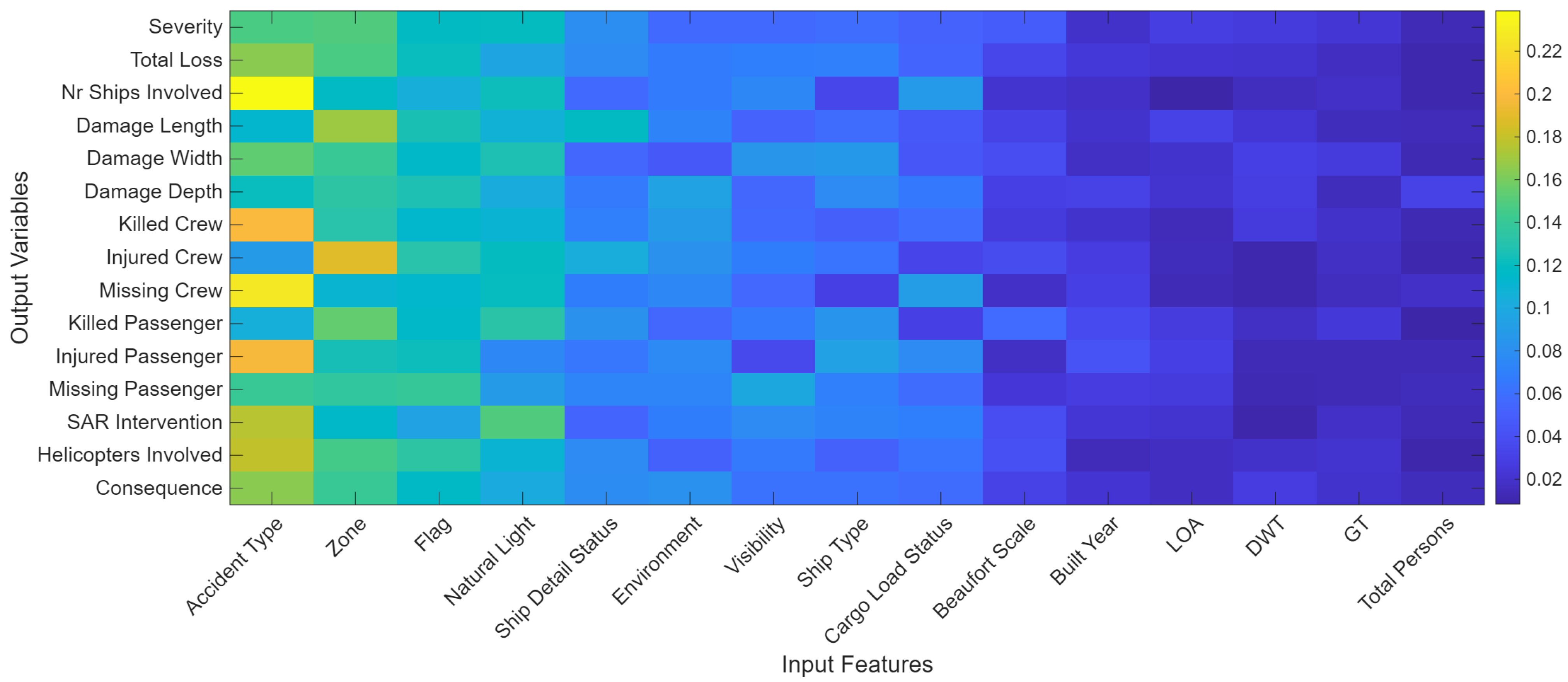
This process is repeated for all input groups and all predicted accident-consequence variables. The resulting sensitivity scores are used in two complementary ways. First, the average influence across all outputs provides a global feature-importance ranking, identifying the dominant consequence-driving factors in the model. Second, the normalised input–output sensitivity matrix shows how each input group contributes to each specific accident consequence, such as severity, structural damage, casualties, SAR intervention, helicopter involvement, and secondary consequence escalation. Therefore, the sensitivity analysis improves model transparency by linking ANN predictions to physically interpretable maritime risk factors and by showing whether the model relies on meaningful accident-, operational-, environmental-, and vessel-related variables.
Figure 6 presents the global importance ranking of the input features. The results show that Accident Type is the most influential variable, with the highest global importance score of approximately 0.16. This finding is physically intuitive because the accident mechanism, such as collision, fire/explosion, stranding, or foundering, strongly affects the expected severity, damage pattern, casualty potential, and emergency-response requirements. Zone is the second most influential feature, with an importance score of approximately 0.14, indicating that the geographical and operational context of the accident plays a major role in shaping the predicted consequences. This may reflect differences in traffic density, navigational restrictions, emergency-response accessibility, operating conditions, and regional reporting characteristics.
Flag and Natural Light are ranked as the third- and fourth-most influential features, with importance scores of approximately 0.12 and 0.11, respectively. The influence of Flag may reflect differences in vessel management practices, inspection regimes, safety culture, regulatory compliance, or reporting patterns, while Natural Light highlights the role of visibility and situational-awareness conditions during accident development and emergency response. Ship Detail Status, Environment, Visibility, Ship Type, and Cargo Load Status form a second group of influential variables, indicating that operational condition, environmental exposure, visual conditions, vessel category, and loading condition all contribute meaningfully to the predicted accident outcomes.
In contrast, Beaufort Scale, Built Year, LOA, DWT, GT, and Total Persons show lower global importance scores. This does not imply that vessel size, age, onboard population, wind force, wave height, or sea-state conditions are unimportant in maritime safety. Rather, within the present dataset and model structure, their marginal influence is smaller than that of accident mechanism, zone, flag, light condition, and operational-status variables. This interpretation is particularly important for the Beaufort Scale, since previous collision and grounding studies, including Mujeeb-Ahmed et al. [
52], considered wind and wave conditions as relevant factors for accident characterisation and flooding-risk assessment. The lower sensitivity of the Beaufort Scale in the present model should therefore be regarded as dataset- and model-specific. First, the current MIMO-ANN predicts accident consequences after an accident scenario has already been defined, rather than estimating accident occurrence or flooding probability. Second, the Beaufort Scale is a coarse ordinal proxy for wind force and does not directly represent wave height, wave direction, current, sea state, local exposure, or combined metocean loading. Third, environmental information in historical accident reports is often incomplete or unevenly reported, which may reduce its apparent influence in data-driven models. Finally, part of the wind-force effect may already be captured by correlated contextual variables such as Environment, Visibility, and Zone. Therefore, the lower importance of the Beaufort Scale should not be interpreted as evidence that wind or wave conditions are physically unimportant, but rather as a result of the available data structure, encoding approach, and consequence-prediction objective of the present study.
To further analyse the relationship between input features and individual accident outcomes, a sensitivity heatmap is presented in
Figure 7. This figure illustrates the normalised influence of each input group on each output variable, providing a detailed view of how different risk factors contribute to specific accident consequences.
The heatmap confirms that Accident Type has a consistently strong influence across several outputs, especially for Nr. Ships Involved, Killed Crew, Missing Crew, Injured Passenger, SAR Intervention, Helicopters Involved, Severity, Total Loss, and Consequence. This confirms that the physical accident mechanism is a primary driver of both human consequences and emergency-response requirements. Accident Type also contributes to structural-damage variables, although these outputs show additional dependence on contextual variables such as Zone, Flag, and Natural Light.
Zone exhibits a strong influence on several outputs, particularly Damage Length, Injured Crew, Killed Passenger, SAR Intervention, Helicopters Involved, and Consequence. This indicates that accident outcomes are strongly conditioned by the location of the accident. Restricted waters, port approaches, coastal zones, or regions with different rescue accessibility may produce different damage and response patterns even for similar accident mechanisms.
The flag shows a moderate and relatively consistent influence across many outputs, including Severity, Total Loss, Damage Depth, Missing Passenger, and Consequence. This suggests that flag-related information may serve as a proxy for safety management, regulatory oversight, inspection history, reporting standards, or fleet operational characteristics. Although Flag should not be interpreted as a direct causal variable, its influence indicates that institutional and operational factors embedded in the dataset contribute to accident-consequence prediction.
Natural Light also shows notable sensitivity across multiple outputs, especially SAR Intervention, Helicopters Involved, Killed Passenger, Missing Crew, Consequence, and damage-related outcomes. This highlights the role of situational awareness, detection capability, and response conditions in determining the severity and development of accident consequences. Similarly, Environment and Visibility contribute across a wide range of outputs, reinforcing the importance of external operating conditions in accident escalation and response complexity.
The heatmap further shows that Ship Detail Status, Ship Type, and Cargo Load Status have meaningful but more selective effects. These variables are particularly relevant for damage and consequence-related outputs because vessel operating status, ship category, and loading condition can affect vulnerability, survivability, damage propagation, and response needs. For example, cargo or loading conditions may influence the severity of structural damage or the likelihood of secondary consequences, while ship type can affect evacuation complexity, passenger exposure, and emergency-response requirements.
Vessel-specific parameters such as LOA, DWT, GT, Built Year, and Total Persons exhibit comparatively lower sensitivity across most outputs. Their effects appear to be more indirect and context-dependent, potentially acting through vessel design, manoeuvrability, subdivision, onboard safety systems, and exposure level. This suggests that static vessel characteristics alone are not sufficient to explain accident consequences when accident type, zone, operational condition, and environmental context are already included in the model.
An important implication is that operational and contextual factors may function as consequence equalisers in maritime accident analysis. Severe accident mechanisms, poor visibility, limited natural light, complex zones, and adverse environmental conditions can dominate predicted consequences even when vessels differ in size, age, or design standard. Therefore, while vessel characteristics remain relevant, they should not be interpreted as standalone indicators of accident-consequence severity.
From a decision-support perspective, these findings highlight the need to prioritise accident-mechanism identification, region-specific risk assessment, real-time situational awareness, visibility-informed operations, and emergency-response planning. The results also indicate that risk mitigation should not rely only on vessel design or size-related indicators, but should integrate operational context, environmental conditions, and emergency-response accessibility.
Overall, the sensitivity analysis demonstrates that the MIMO-ANN captures physically meaningful relationships between input factors and accident consequences. The results align with established maritime safety understanding, in which accident mechanisms, operational areas, environmental contexts, visibility conditions, and emergency-response constraints are central drivers of accident severity and impact. The sensitivity scores should therefore be interpreted as consequence-specific importance indicators within recorded accident scenarios, not as indicators of accident-occurrence probability.
From a decision-support perspective, this analysis significantly enhances the usability of the proposed framework. By identifying the most influential variables and clarifying their effects on different accident-consequence outputs, the model provides not only accurate predictions but also actionable insights to support consequence-based risk mitigation, operational planning, emergency preparedness, and data-driven maritime safety management.
6. Conclusions
This study presented a data-driven framework for integrated maritime accident-consequence assessment using a MIMO-ANN. The proposed approach addresses a key limitation of many existing machine-learning-based maritime safety studies, which often focus on single-output prediction, such as accident-occurrence probability, severity class, near-miss frequency, or one specific consequence. By coupling a comprehensive multi-source accident dataset with a multi-output learning architecture, the proposed framework enables simultaneous prediction of 15 interdependent accident-consequence outputs, including severity, total loss, structural-damage dimensions, human casualties, SAR intervention, helicopter involvement, and secondary consequence/escalation mechanisms.
A key clarification of this study is that the proposed ANN does not estimate accident-occurrence probability in the strict statistical sense. The model is trained on recorded accident cases and does not include non-accident exposure data, fleet-at-risk information, voyage frequency, operational hours, traffic baseline records, or comparable non-accident cases. Therefore, the ANN outputs should be interpreted as predictions of consequences conditional on a recorded or scenario-defined accident case. In other words, the framework estimates the relative likelihood, severity, or magnitude of accident consequences within the accident scenarios represented in the dataset, rather than predicting whether an accident will occur.
The results demonstrate that the MIMO-ANN trained using the SCG algorithm achieves strong predictive performance across different network configurations and data-partitioning strategies. The comparison between 60/20/20 and 70/15/15 split ratios shows that the 30-hidden-neuron configuration trained with the 60/20/20 split provides the strongest overall performance. This model achieves the highest testing and validation correlations (R = 0.9249 and 0.9278, respectively) and the lowest testing and validation MSE values (0.0240 and 0.0231, respectively). These results indicate that the selected model provides a strong balance between representational capacity, validation reliability, and generalisation to unseen accident cases.
To further assess internal robustness, 10-fold cross-validation was conducted for the selected 30-hidden-neuron MIMO-ANN. The results show stable training behaviour, with a mean training R of 0.9335 ± 0.0117 and a mean training MSE of 0.0208 ± 0.0023. The mean testing performance was also acceptable, with R equal to 0.8803 ± 0.0827 and MSE equal to 0.0445 ± 0.0478. Most folds achieved strong testing performance, although Fold 2 showed a marked reduction in accuracy. This behaviour reflects the imbalanced nature of the dataset, where rare accident types, underrepresented ship categories, missing-data patterns, or high-consequence outliers may be concentrated in specific folds.
Beyond predictive accuracy, the integration of permutation-based sensitivity analysis improves the interpretability of the MIMO-ANN. The results indicate that Accident Type is the dominant driver of predicted accident consequences, followed by Zone, Flag, Natural Light, operational status, Environment, Visibility, Ship Type, and Cargo Load Status. These findings are physically meaningful because accident mechanisms, operational regions, visibility conditions, and emergency-response accessibility strongly influence the escalation of accidents and the severity of consequences. Vessel-specific parameters such as LOA, GT, DWT, Built Year, and Total Persons show lower global importance in the present model, but this should not be interpreted as evidence that vessel characteristics are unimportant. Rather, their marginal influence diminishes once accident type, operational context, environmental conditions, and emergency-response variables are already accounted for in the model.
The main contribution of this work lies in its decision-support orientation. The proposed framework transforms historical accident records into multidimensional, interpretable, consequence-based safety insights. This can support ship operators, port authorities, emergency planners, regulators, and safety managers in operational planning, emergency preparedness, consequence prioritisation, and resource allocation. Unlike separate single-output models, the MIMO-ANN provides a coherent set of linked predictions across structural, human, operational, and emergency-response consequence categories.
7. Limitations and Future Research
Several limitations should be acknowledged. First, the proposed framework relies on a single compiled maritime accident dataset for both model development and evaluation. Although the dataset integrates multiple sources and includes 582 accident cases, the reported results primarily demonstrate internal generalisation within the available data. Therefore, the present study does not fully establish external transferability across independent accident databases, geographical regions, vessel populations, reporting systems, or time periods. This limitation should be considered when interpreting the operational applicability of the proposed MIMO-ANN framework. Future work should validate the model using independent maritime accident datasets to assess its generalisation capability under different operational and reporting contexts.
Second, the dataset is naturally imbalanced and heterogeneous. Collision, fire/explosion, and stranding cases are more strongly represented than rare but potentially catastrophic events, such as foundering or contact. A similar imbalance exists across ship types, where passenger/Ro-Ro vessels dominate the dataset. In addition, casualty-related terminology differs across source datasets. While some source records use broader terms such as “fatalities” or aggregate human-consequence descriptors, the present study separates human outcomes into killed, injured, and missing crew/passenger categories. This improves the level of output detail but may introduce uncertainty when the original source reports do not clearly distinguish between casualty subtypes. These data-related limitations may affect prediction accuracy for rare accident categories, underrepresented vessel types, and specific human-consequence outputs. Future research should expand the dataset and apply stratified cross-validation, feature-group ablation, uncertainty quantification, and data-balancing techniques to improve robustness for rare but high-consequence accident scenarios.
Third, near-miss, incident, and nonserious records are not explicitly represented as output classes in the current framework. As a result, the model is more strongly oriented toward serious and very serious accident consequences, which may bias the learned relationships toward higher-severity outcomes. Future work should extend the dataset to include near-miss and nonserious events so that the framework can better capture accident precursors, safety-barrier performance, and escalation pathways from hazardous situations to severe consequences.
Fourth, the current framework does not include non-accident exposure data, fleet-at-risk information, traffic baselines, voyage frequency, or operational hours. Therefore, the model should not be interpreted as estimating the probability of accident occurrence. Its outputs represent accident-consequence predictions conditional on recorded or scenario-defined accident cases. Future work should integrate exposure and fleet-at-risk data if the objective is extended from consequence prediction to full accident-occurrence probability estimation.
Fifth, some environmental descriptors are coarse or incomplete. In particular, the Beaufort Scale is a broad ordinal proxy for wind force and does not directly capture wave height, wind direction, current, sea state, local exposure, or combined metocean loading. Its relatively low importance in the sensitivity analysis should therefore be interpreted as dataset- and model-specific rather than as evidence that wind or wave conditions are physically unimportant. Future work should incorporate richer metocean descriptors, including wave height, wind direction, current, sea state, and local exposure, to better distinguish environmental loading effects from broader contextual variables such as Environment, Visibility, and Zone.
Finally, the current implementation provides an offline, retrainable decision-support framework and does not perform online learning in real time. Future versions could integrate real-time AIS data, vessel traffic density, weather forecasts, port operations data, and emergency-response information. The framework could also be embedded within digital twin, emergency-response, and autonomous shipping decision-support systems to enable more adaptive, interpretable, and operationally useful maritime safety management.