Article

Shifting Focus in the Bradford Assay: Interfering Compounds Re-Examined

1
Department of Bioorganic Chemistry, Institute of Chemistry, University of Tartu, 50411 Tartu, Estonia
2
Department of Haematology and Oncology, Institute of Clinical Medicine, University of Tartu, 50408 Tartu, Estonia
3
Celvia CC AS, 50411 Tartu, Estonia
*
Author to whom correspondence should be addressed.
Sci 2026, 8(7), 145; https://doi.org/10.3390/sci8070145 (registering DOI)
Submission received: 27 April 2026 / Revised: 19 June 2026 / Accepted: 23 June 2026 / Published: 25 June 2026
(This article belongs to the Section Chemistry Science)

Abstract

Since its introduction in 1976, the Bradford assay has served as a gold standard for protein quantification across a wide range of applications. While its limitations—including protein-to-protein variation in dye binding, challenges in selecting a representative calibration standard, and susceptibility to matrix interferences—are recognized, the relevant information remains scattered throughout the literature, with little quantitative guidance available for assay optimization. Here, we review interfering compounds reported in the literature during nearly 50 years and report a systematic characterization of a panel of potential interfering compounds, evaluating the effects of 29 different substances in the presence or absence of the protein analytes. Our findings revealed that 12 of the tested compounds induce significant artefacts in the Bradford assay, with minimal interfering concentrations varying widely across compounds. Detergents were confirmed as the most problematic interference; furthermore, two novel groups of interfering compounds were identified, represented by the transfection reagents and oligoarginine peptides with molecular weight below 3 kDa. Importantly, the resulting artefacts were also observed in complex biological matrices. While these compounds also affected the Lowry assay, the magnitude of the artefacts was substantially lower than that observed in the Bradford assay. This study will provide a valuable resource for researchers working in proteomics and related fields, offering practical insights for improving the reliability of Bradford-based protein quantification.

1. Introduction

The Bradford assay measures total protein content in simple or complex mixtures using the Coomassie Brilliant Blue G-250 (CBBG) dye [1]. The assay is based on the binding of the dye to the protein(s), which results in formation of a dye–protein complex with a shifted UV-Vis absorbance spectrum relative to the free dye. Typically, the assay is performed at acidic pH, at which the free dye is protonated and absorbs at 465 nm in solution; upon interaction with proteins, a metachromatic shift occurs, resulting in the emergence of deprotonated species with absorbance maxima in the range from 650 nm (neutral dye) to 595 nm (anionic dye) [2]. The binding of CBBG and the change in its optical properties occur very fast, enabling nearly immediate measurement of the absorbance after mixing of CBBG and the sample of interest. Few works have assessed the temporal stability of the signal in the Bradford assay, but the available reports indicate that the signal is relatively stable within a 5–120 min time-frame in the case of both high (200 μg/mL) or low concentrations (2 μg/mL) of bovine serum albumin (BSA) [3].
The nature of the protein can also affect the absorbance spectrum of the formed complex. For instance, for the N-termini of the glycine transporters 1 and 2, a somewhat exceptional shift in the CBBG absorbance spectrum was reported where an increase in absorbance at 300 nm and 700 nm occurs [4]. Still, for quantification of the protein content in the sample, either just absorbance at 595 nm or the ratio of absorbances at 595 nm and 465 nm is reported in most studies [5,6]. According to previous review articles [5,6], although there is no direct correlation between the affinity of the dye for the analyte and the spectral change, the major interactions between CBBG and proteins include ion pairs (between the sulphonic acid groups of the dye and lysine or arginine residues of the protein) as well as hydrophobic interactions (the latter also being important for binding of a similar dye, Coomassie Brilliant Blue Red-250 aka CBBR to proteins). Interestingly, differences in the sensitivity of CBBG to different amino acid residues have even been used in forensic analysis to distinguish between male and female fingerprints due to the sex-specific variation in the amino acid content in bodily fluids [7].
The tendency of CBBG to bind preferentially to certain amino acids translates into the fact that the Bradford assay measurement window is analyte-dependent [1,2,5,8,9,10,11,12]. The mechanistic complexity behind the readout is further exacerbated by the fact that protein aggregation and the post-translational modifications of proteins (e.g., carbamoylation, glycosylation) also affect binding of CBBG, whereas the measured outcome depends on the specific protein (and, putatively, the site of modification) [6,13,14]. Consequently, the total protein quantification by CBBG can only be performed reliably relative to a standard protein, and the calibration curve is further necessary since the relationship between the protein concentration and the absorbance at 595 nm becomes non-linear at the elevated concentrations of the standard. Several studies have compared different protein analytes in the context of choice of proteins suitable for calibration [6,15,16,17,18,19,20]—with the arginine-rich BSA being among the most popular candidates.
The effect of protein size on the assay response has also been explored. In 1977, it was reported that peptides with a molecular weight of less than 3000 Da could not form a complex with CBBG [21], a finding that has since become widely accepted in the literature. More recent studies showed that the peptidic agonist of GLP-1 receptor, exendin-4 (molecular weight of ca 4200 Da) or amyloid beta 1–42 peptide (molecular weight of ca 4500 Da) could be quantified using the Bradford assay [22,23]. Furthermore and in contrast with the previous findings, application of CBBG for quantification of the pentapeptide Gln-Arg-Phe-Ser-Arg (693 Da) has been reported following production as multimer, enzymatic cleavage, and purification [24]; to our knowledge, this remains the only study that has accomplished detection of such a short peptide by the Bradford assay.
The reports on the importance of protein folding for CBBG binding also remain somewhat controversial. Given that CBBG is used for protein detection in the denaturing sodium dodecyl sulphate-polyacrylamide gel electrophoresis (SDS-PAGE) method, the absence of high-order structures in proteins should be well-tolerated also in the Bradford assay. This conclusion is supported by early studies which reported good performance of the assay in a large range of pH values [25], absence of negative interference from urea (up to 8 M) when using BSA as the analyte [26], and improvement of assay performance relative to variation of analytes by addition of a low concentration of SDS to the analyzed mixture [27]. Still, a recent study reported interference of CBBG and CBBR with aggregation of α-synuclein into fibrils [28], thus inferring that binding of dyes can alter the pattern of interactions formed by the proteins and, putatively, the spatial structure of the proteins.
Comparisons of the efficacy and sensitivity of the Bradford assay to other well-known methods for measuring total protein content have yielded variable results depending on the system analyzed. In the case of purified BSA or porcine kidney extract, the Bradford method was reported as the most sensitive assay (limit of detection of 0.006 mg/mL) and had the widest range of detectability (0.006 to 100 mg/mL) when compared to several other methods (including direct spectrophotometric quantitation, bicinchoninic acid (BCA), Biuret, Lowry, and ninhydrin assays) [29]. The superiority of the Bradford assay to the BCA assay was also reported in the case of origin milk and retentate samples [30] and in the case of beer samples [31] when Kjeldahl values were used as the reference. On the other hand, a study focused on the quantification of the digestible protein in the exoskeleton or the full body or arthropods indicated that among the Bradford assay, BCA assay, and Lowry assay, the latter correlated best to the amino acid analysis results used as the reference, while the Bradford assay was the second choice [32]. Furthermore, the Bradford assay was outperformed by the BCA method during estimation of residual protein content in hydroxypropyl chitin [33] and estimation of protein content in plankton [6]. Finally, a very problematic performance of the Bradford assay has been reported in a study of Hymenoptera venoms [30] and in an analysis of protein content in soils [34].
The issues associated with poor performance of the Bradford assay can originate not only from the sample matrix, but also from auxiliary reagents and vessels used during the sample preparation and subsequent steps. The interfering effects of detergents such as SDS and Triton X-100 have already been reported in the original work [1]; standard protocols for the Bradford assay emphasize that plastic and glassware should be detergent-free [5]. Additionally, the use of quartz (silica) cuvettes is discouraged due to the non-specific binding of CBBG to the material [5]. Studies have further demonstrated that CBBG can adsorb to glass cuvettes [35] as well as a range of plastic materials [36,37], presenting challenges for implementing the assay in microplate formats. Still, given a sufficient optical pathway length, the measurement of absorbance can be carried out in polystyrene and polypropylene multi-well plates.
Several modified versions of the Bradford assay have been reported, aimed at reduction of the artefacts caused by detergents and other interfering compounds. Such modifications usually involve drying of the sample or coprecipitation of the protein analyte, followed by exhaustive washing stages; while these steps make the assay significantly more time-consuming [38,39,40,41,42], in several cases, the calibration curve remains shifted as compared to the control [38,39]. Alteration of assay buffer to achieve alkaline conditions (pH of 8.2 [25], pH of 9 [43]) or strongly acidic conditions (11% phosphoric acid content in the dye [44]) has also been suggested to reduce the artefacts, but the mildly acidic version of the assay remains most widely used due to its compatibility with the buffer pH range commonly used during lysis of biological specimens. Spiking of the protein sample with a known amount of BSA (so-called standard addition) has also been suggested to establish possible negative or positive interferences in the case of complex matrices [45].
Despite the widespread use of the Bradford assay, many reports on interfering substances date back several decades, and potential assay-disrupting compounds are often overlooked in contemporary experimental workflows. In this study, we not only systematically consolidate and contextualize all previously reported interfering agents but extend the field by investigating several previously unexamined classes of compounds—including synthetic peptides, endocrine disruptors, and cationic transfection reagents—selected based on chemical principles predicting their likelihood to perturb the assay. By combining literature-based systematization with targeted experimental validation, we aim to highlight a broader and more chemically diverse landscape of assay interference than previously recognized. Our findings underscore the need for renewed attention to auxiliary reagents and sample treatments that can generate misleading signals, reinforcing the importance of critically evaluating assay conditions even for methods as widely used and seemingly robust as the Bradford assay.

2. Materials and Methods

2.1. Chemicals and Apparatus

The assays were carried out in 96-well clear flat bottom plates (Nunc™ 269620, Thermo Fisher Scientific; Waltham, MA, USA). For the Bradford assay, Pierce™ Coomassie Plus Assay Reagent (Thermo Fisher Scientific, catalogue number 23238; Waltham, MA, USA) was used; this formulation is modified to improve calibration curve linearity and reduce protein-to-protein variation relative to classical Bradford reagents, yet is not detergent-compatible.
Phosphate-buffered saline (PBS) was used as the assay buffer (pH 7.45); the Ca2+ and Mg2+-supplemented formulation was from Sigma-Aldrich (St. Louis, MO, USA), and the non-supplemented version from VWR (Fontenay-sous-Bois, France). As standard proteins and mixtures of proteins, BSA (Roche, Germany), bovine γ-globulin (BGG; BioRad, Hercules, CA, USA) and non-fat milk powder (Frisolac Gold, Amersfoort, The Netherlands) were used. Prior to each independent experiment, a fresh solution of BSA in PBS was prepared (20 mg/mL by weight), and the non-fat milk powder was dissolved in MilliQ water (also 20 mg/mL by weight); the protein content of the reconstituted milk powder was 20% from nominal weight as assessed by SDS-PAGE. The lyophilized BGG powder was reconstituted in MilliQ water according to the manufacturer’s instructions, yielding protein content of 1.48 mg/mL.
The substances explored as interfering compounds were from the following sources: SDS, dodecyl-β-d-maltopyranoside (DDM), L-arginine, L-tryptophan, digitonin—Sigma (St. Louis, MO, USA); glycerol and Nonidet P-40 (NP-40)—AppliChem GmbH (Darmstadt, Germany); dimethyl sulfoxide (DMSO)—Fisher Scientific (Waltham, MA, USA); dithiothreitol (DTT)—Fisher (Darmstadt, Germany); dimethylformamide (DMF)—Merck KGaA (Darmstadt, Germany); Triton X-100—Ferak (Berlin, Germany); glycine—Fluka (Neu-Ulm, Germany); Tween-20—Naxo (Tartu, Estonia); 3-{Dimethyl [3-(3α,7α,12α-trihydroxy-5β-cholan-24-amido)propyl]azaniumyl}propane-1-sulfonate (CHAPS)—Calbiochem (Burlington, MA, USA); Fugene® 6—Promega (Madison, WI, USA); Lipofectamine® 2000—Invitrogen (Waltham, MA, USA); TurboFect—Thermo Scientific (Vilius, Lithuania). MilliQ water (for detergents and DTT) or PBS (for amino acids) was used for preparation of the stock solutions.
The endocrine-disrupting compounds (EDCs) 1,1-dichloro-2,2-bis(p-chlorophenyl) ethylene (DDE), hexachlorobenzene (HCB), bisphenol A (BPA), mono(2-ethyl-5-hydroxyhexyl) phthalate (MEHHP), 2,2′,3,3′,4,4′,5-heptachloro-1,1′-biphenyl (PCB170), 2,2′,3,4,4′,5,5′-Heptachloro-1,1′-biphenyl (PCB180), perfluorooctanoic acid (PFOA) and perfluorooctanesulfonic acid (PFOS) were purchased from Sigma-Aldrich (St. Louis, MO, USA); bisphenol F (BPF) and mono(2-ethylhexyl) phthalate (MEHP) were provided by Prof. Christian Lindh (Lund University, Sweden). Stock solutions of all EDCs were prepared as described previously [46,47] and diluted to 1 mM nominal concentration using DMSO; the stocks were stored in borosilicate glass vials at −20 °C. ARC-902 and ARC-1041 (structures shown in the Supplementary Figure S1) were synthesized in-house as previously reported [48,49] and stored as lyophilized powders at 4 °C; prior to the assay, the compounds were dissolved in DMSO.
Human lung adenocarcinoma cell lines HCC-44 and A549 as well as human bone osteosarcoma cell line U2OS were obtained from the Leibniz Institute DSMZ (German Collection of Microorganisms and Cell Cultures GmbH, Braunschweig, Germany). The solutions and growth medium components for the cell culture were purchased from the following sources: phosphate-buffered saline (PBS), fetal bovine serum (FBS), L-glutamine, Dulbecco’s Modified Eagle’s medium (for the lung adenocarcinoma cell lines), McCoy’s 5A medium (for the osteosarcoma cell line)—Sigma-Aldrich (Steinheim, Germany); a mixture of penicillin, streptomycin, and amphotericin B—Capricorn (Ebsdorfergrund, Germany).
The cells were grown at 37 °C in 5% CO2 humidified incubator (Sanyo; Osaka, Japan) as adherent cultures on Falcon 75 cm2 canted neck tissue culture-treated flasks with vented caps (Corning; Durham, NC, USA). For lysis of cells, HEPES and NaCl from Calbiochem (Darmstadt, Germany), Triton X from Ferak (Berlin, Germany), EDTA-containing cOmplete™ protease inhibitor cocktail from Roche (Basel, Switzerland) and PMSF from AppliChem (Darmstadt, Germany) were used; the lysis buffer contained 1% Triton X by volume. The cells were lysed on ice for 1 h; subsequently, the membranes were pelleted by centrifugation (20,000× g, 20 min, 4 °C), and the supernatant (lysate) was collected.
The reagents for the Lowry assay were obtained from the following sources: sodium carbonate (Na2CO3) and potassium sodium tartrate (KNaC4H4O6)—Sigma-Aldrich (Saint Louis, MO, USA); sodium hydroxide (NaOH)—AppliChem GmbH (Darmstadt, Germany); copper(II) sulphate pentahydrate (CuSO4·5H2O)—BioTop (Tartu, Estonia), and Folin–Ciocalteu phenol reagent—Merck (Darmstadt, Germany).

2.2. Literature Search

The initial search for reports on compounds interfering with the Bradford assay was performed in the Clarivate Web of Science (All databases) bibliographic collection on 19 May 2025. For the search, Web of Science AI assistant was used, and the query was formulated as “please list publications reporting compounds interfering with Bradford assay”; the keywords chosen by the AI assistant were as follows: interfering, interference, intervene, impair, impairment, false positive, false negative, Coomassie, Bradford, colorimetry. The keywords “disruption”/“disrupting” and “inhibition”/“inhibitor” were manually removed to avoid multiple hits reporting use of the Bradford assay for systems where EDCs or inhibitors of enzymes were in fact explored.
An additional manual search was performed in the NIH PubMed bibliographic database search on 17 July 2025 to include more recent publications. The following query was used for the search: “Bradford assay interfering”.
Based on the two searches, a list of 171 publications was generated and analyzed. Of these articles, the full text of 12 reports was not accessible, and 1 article mentioned the Bradford assay only as a part of its reference section. The data from the other publications are summarized below.

2.3. Bradford Assay

For the experiments conducted in the presence of the protein analyte, 2-fold dilutions of BSA or non-fat milk were prepared in PBS on a separate multi-well plate. Initially, both Ca2+ and Mg2+-supplemented formulations as well as a non-supplemented version of PBS were tried; as the difference in outcomes for the initial tests and both analytes were marginal (see Supplementary Figures S2–S4), subsequent measurements were carried out in the Ca2+ and Mg2+-supplemented formulation of PBS only. The human cell line lysates were diluted in the Ca2+ and Mg2+-containing PBS, with the dilution of lysate starting from 13.5% by volume.
The dilutions were then transferred to a measurement plate containing PBS (same formulation as used for the analyte dilution) and a fixed concentration of interfering compound was added to some of the wells. Prior to addition of CBBG, the working volume in each well of the measurement plate was 75 μL, and the final total concentrations of the components were as follows: for BSA and non-fat milk, starting from 133 μg/mL; for lysates, 1.35% or 0.675% or 0.338% v/v (the final concentration of the Triton X-100 of 0.0135%, 0.00675% and 0.00338%, respectively); for SDS, 1% or 0.01% v/v; for Triton X-100, Tween-20 and NP-40, 2% or 0.02% v/v; for glycine and L-arginine, 10 mM; for glycerol, 5% v/v; for DTT, 5 mM; for DMSO and DMF, 1% v/v; for CHAPS and DDM, 0.25% v/v; for L-tryptophan, 5.6 mM; for digitonin, 50 μM; for Fugene® 6, Lipofectamine® 2000 and TurboFect, 1% v/v or 0.3% v/v; for ARC-902 or ARC-1041, 1 μM or 0.2 μM or 0.1 μM; and for EDCs, 5 μM. Finally, 75 μL of CBBG solution was added to each well.
For the experiments conducted in the absence of the protein analyte, 2-fold or 3-fold dilutions of interfering compounds were prepared in PBS directly on the measurement plate. Prior to addition of CBBG, the working volume in each well of the measurement plate was 75 μL, and the final total concentrations of the components were as follows: for SDS, CHAPS, DDM, DMSO and DMF, starting from 1% v/v; for Triton X-100, Tween-20, NP-40, Fugene® 6, Lipofectamine® 2000 and TurboFect, starting from 2% v/v; for L-arginine and L-tryptophan, starting from 20 mM; for digitonin, starting from 100 μM; and for ARC-902 or ARC-1041, starting from 133 μM. For the following compounds, only one concentration was tested: glycine, 10 mM; DTT, 5 mM; glycerol, 5% v/v; and EDCs, 5 μM. Finally, 75 μL of CBBG solution was added to each well.
The absorbance at a single wavelength (590 ± 10 nm) was measured 3–5 min after addition of CBBG with a PHERAstar multi-mode reader (BMG Labtech; Ortenberg, Germany), with the following parameters: filter block ABS 608A, 20 flashes per well, focal height 10.5 mm, and optical pathway correction for volume of 150 μL. A selection of the obtained dose-response curves in the absence of the protein analyte is shown in Supplementary Figure S5. The absorbance spectra were recorded in the same samples 15–30 min after addition of CBBG with NEO or Cytation 5 multi-mode readers (BioTek; Winooski, VT, USA) within the range of 300 to 700 nm (step of 5 nm) using a monochromator; the examples are shown in Supplementary Figures S6 and S7. The suggested detailed measurement protocol is provided under Supplementary Methods.

2.4. Lowry Assay

Three stock solutions were prepared and stored at 4 °C until use. Reagent A consisted of 5% Na2CO3 and 0.1 N NaOH in MilliQ water, Reagent B consisted of 1% KNaC4H4O6 in MilliQ water, and Reagent C consisted of 0.5% CuSO4·5H2O in MilliQ water. The working reagent (Reagent E) was prepared immediately before use by mixing Reagents A, B, and C in a ratio of 48:1:1 (v/v/v).
Calibration curves in the presence or absence of the interfering compounds were prepared in Ca2+ and Mg2+-supplemented PBS as in the case of the Bradford assay (final volume of 75 μL). Subsequently, 150 μL of Reagent E was added to each well, and the plate was immediately mixed and shaken for 10 min on a rotating shaker. Finally, 20 μL of Folin–Ciocalteu phenol reagent (1:1 dilution with MilliQ water) was added, followed by incubation for 30 min in the dark. Absorbance was measured using a Synergy Neo multimode plate reader (BioTek; Winooski, VT, USA) by recording absorbance spectra using a monochromator scan over the range of 700–800 nm with 1 nm increments.

2.5. Data Analysis and Software

For general data analysis, GraphPad Prism 6 or 10 (Boston, MA, USA) and Excel 2016 (Microsoft Office 365; Redmon, WA, USA) were used. For the Bradford assay, absorbance values measured at 590 ± 10 nm were used for all quantitative analyses. For the Lowry assay, absorbance spectra recorded between 740 and 760 nm were integrated to calculate the area under the curve (AUC), which was used as the primary quantitative readout. Interference effects were evaluated either by comparing signal intensities obtained at different protein concentrations or by linear regression analysis of the calibration curves, with differences in slope used to assess changes in assay response. The effect of each interfering compound was established in N ≥ 2 independent experiments (each performed in duplicate, triplicate or quadruplicate), and raw data were pooled for all experiments. For datasets containing a sufficient number of observations, the signal profiles were generally consistent with a normal distribution, as indicated by at least one of the four normality tests applied (D’Agostino–Pearson, Shapiro–Wilk, Anderson–Darling, or Kolmogorov–Smirnov); for the negative and the positive controls, all tests indicated normal distribution. Therefore, the grouped comparisons relative to the negative control (PBS) or positive controls (different concentrations of the analytes) were then carried out using one-way ANOVA with Dunnett’s test for multiple comparisons. In all statistical tests, the significance of comparisons is indicated as follows: **** p < 0.0001, *** p < 0.001, ** p < 0.01, * p < 0.05.
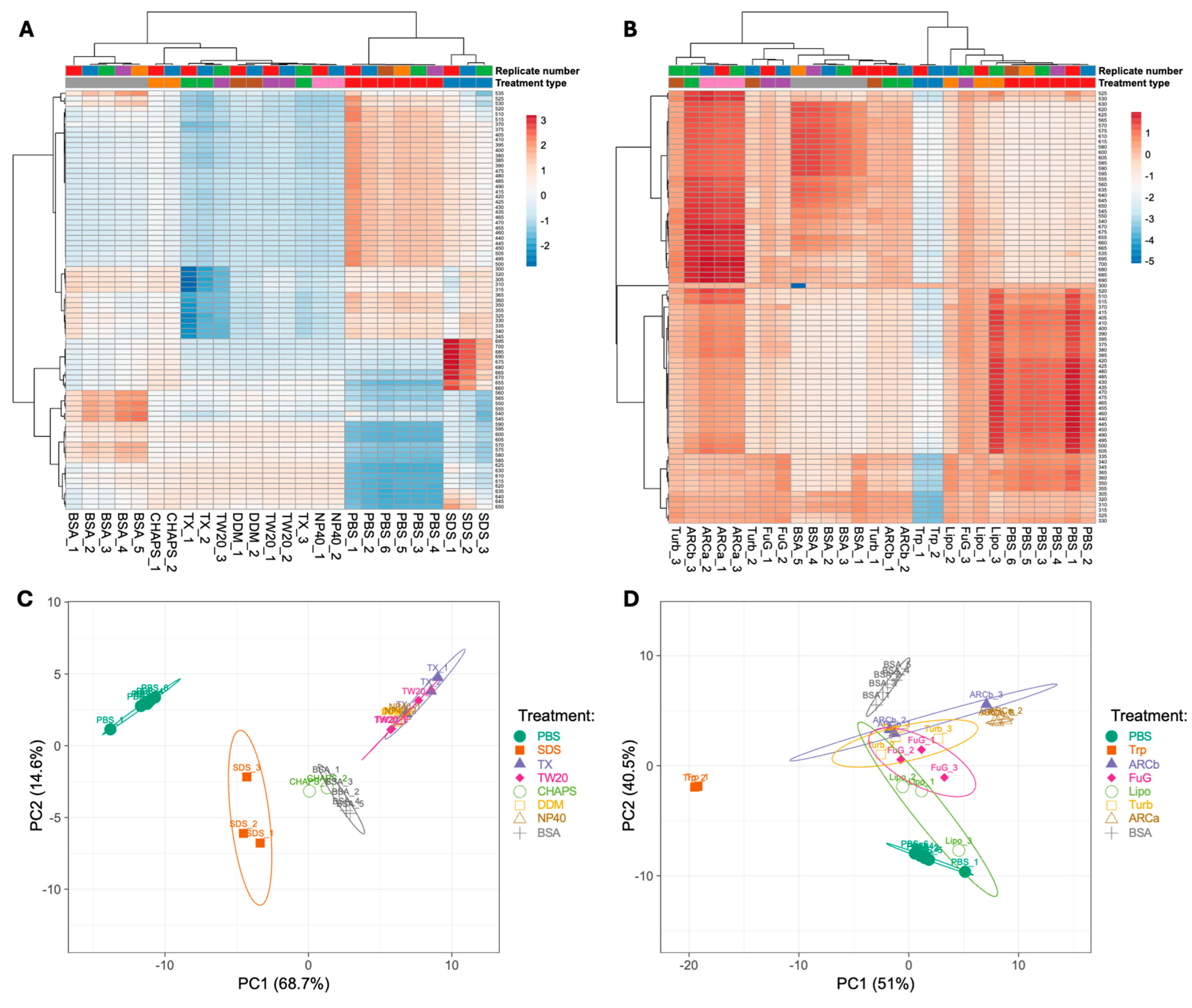
A heatmap and PCA plot were generated using the ClustVis 2.0 web tool [50]. For analysis, positive and negative controls as well as compounds that statistically significantly altered CBBG absorbance at 590 ± 10 nm relative to the negative control were chosen (except for L-arginine, which affected the assay only at the highest concentration tested). The absorbance spectra of the chosen compounds at the highest concentration tested in the presence of CBBG were averaged and normalized for each independent experiment to minimize uncertainty originating from variations of the CBBG amount in different experiments (maximal absorbance set to 100%).

3. Results and Discussion

3.1. Review of the Interfering Compounds Reported So Far

Based on the literature search in bibliographic databases Clarivate Web of Science and NIH PubMed, a total of 158 full-text articles were found reporting on the Bradford assay or use of CBBG/CBBR dye and exploring interfering compounds. The search covered the period from the original description of the Bradford assay in 1976 through June 2025. No retracted publications were identified among the articles included in the review. The data from articles which reported artefacts in the context of the Bradford assay in particular are summarized in Table 1.
Among the articles not listed in the table, several reports focused on the development of novel assays (e.g., refs. [9,10,51,52,53,54,55,56,57,58,59,60,61,62] for proteins generally, or refs. [63,64,65,66] for a certain specific protein) and compared these assays to Bradford, including characterization of the assay performance in the presence of interfering compounds known at the time. One publication referred to flavonoids as interfering compounds for the Bradford assay but explored effects of flavonoids on the Lowry and BCA assays instead [67]. One conference abstract reported application of the Bradford assay for quantification of proteins in hair, and the authors claimed the assay to be relatively robust towards lipids, cationic surfactants and EDTA, yet no experimental data were presented to verify such claims [68]. Finally, several articles utilized the Bradford assay as an example for educational purposes [19,20,69] and aimed at more user-friendly signal detection (e.g., by utilizing smartphone), yet interfering compounds were mentioned as the assay limitations only generally, without further experimental exploration. In the case of ref. [70], smartphone-mediated detection of protein-induced changes in the CBBG absorbance spectrum was reported, but interference was addressed in the context of artefacts caused by external light during the imaging.
Furthermore, numerous publications used the Bradford assay for various purposes, yet the interfering compounds were either not identified (i.e., artefacts were described as just matrix effects) or were not addressed relative to the Bradford assay specifically (i.e., those were mentioned in the context of other methods). For instance, the Bradford assay has been used alone or in parallel with other methods as a part of biomarker discovery [71,72,73,74,75]; characterization of the proteome of various biological systems [3,18,30,32,34,76,77,78,79]; assessment of effects of pathological alterations [80,81,82,83,84,85] or (putative) therapeutic interventions [23,86,87,88,89,90,91,92,93,94,95,96,97,98,99,100,101]; or optimization of protocols for various protein-related analyses [102,103,104,105,106,107] and technological processes [108,109,110,111,112,113,114]. References [14,115,116,117,118,119,120,121,122] report the application of CBBG or CBBR staining as a part of a newly developed assay (in one case, such staining was not related to protein detection but to electrochemical detection of an organophosphorus pesticide triazophos [123]), and references [124,125,126,127] report CBBG-mediated precipitation of proteins from and detection of proteins in complex samples.
Table 1. Compounds interfering with Bradford assay performance according to reports published in 1976–2025.
Interfering CompoundClass of Compound aSample Dilution BufferProtein Present or NotLowest Concentration of Compound with Interfering EffectReported Type of InterferenceRef(s)
CellobioseCarbohydrateWaterPresent150 mg/mLDecrease in absorbance at 595 nm[128]
GlucoseCarbohydrateWaterPresent600 mg/mLDecrease in absorbance at 595 nm[128]
MannoseCarbohydrateWaterPresent600 mg/mLDecrease in absorbance at 595 nm[128]
MelibioseCarbohydrateWaterPresent100 mg/mLDecrease in absorbance at 595 nm[128]
Tween-20 (Polysorbate-80)Alcohol,
detergent, incorporates polymer chain
WaterAbsent0.2%Absorption maximum at 650 nm[129]
WaterAbsent5 g/LAbsorbance at 595 nm[11]
WaterPresent5 g/LIncrease in the intercept of the protein curve[11]
Tween-80 (Polysorbate-80) bAlcohol,
detergent, incorporates polymer chain
PBS pH 7.4Present1%Decrease in absorbance at 595 nm[43]
Not reportedPresent2 mg/mLIncrease in absorbance at 595 nm[42]
DNA (bovine, salmon, shrimp, kiwi) cCarbohydrate, aromatic compoundWaterAbsent13 μg (assay volume not specified)Absorbance at 595 nm[130]
MetrizamideAlcohol, aromatic compound, density gradient reagentWaterAbsent1%Absorbance at 672 nm[131]
Present4%Decrease in the slope of the protein curve
NP-40 (Nonidet P-40) dAlcohol, aromatic compound, detergentWaterAbsent4%; 5 g/LAbsorbance at 595 nm[11,44]
WaterAbsent0.2%Absorbance at 650 nm[129]
Sample buffer (undisclosed)Present>0.5%Decrease in the slope of the protein curve[26]
WaterPresent5 g/LIncrease in the intercept of the protein curve[11]
HeparinPolysaccharide, complex forming reagentPBSPresent5 μg/mLDecrease in the color yield at 595 nm[132]
GlycerolAlcohol, density gradient reagent150 mM NaClAbsent99%Equivalent of BSA[1]
WaterAbsent100 g/LAbsorbance at 595 nm[11]
WaterPresentNot specifiedDecrease in absorbance at 600 nm[5]
Sucrose eCarbohydrate, density gradient reagent150 mM NaClAbsent1 MEquivalent of BSA[1]
WaterPresent600 mg/mLDecrease in absorbance at 595 nm[128]
Ethanol fAlcohol, organic solventWaterPresent10.56%Stabilizes neutral form of the dye[133]
Carboxy methyl cellulosePolysaccharideWaterPresent50 mg/mLIncrease in absorbance at 595 nm[128]
ChitosanPolysaccharidePBS pH 7.4PresentNot quantified (chitosan nanoparticle supernatant)Decrease in absorbance at 595 nm[43]
FicollPolysaccharideWaterPresent150 mg/mLDecrease in absorbance at 595 nm[128]
Hydroxypropyl chitin (HPCH)PolysaccharideNot reportedPresent1 mg/mLDecrease in the slope of the protein curve[33]
Hydroxypropyl starch, Reppal PESPolysaccharideWaterPresent5%Decrease in the slope of the protein curve[134]
MannanPolysaccharideWaterPresent20 mg/mLDecrease in absorbance at 595 nm[128]
Dithiothreitol (DTT)Alcohol, reducing agentWaterPresent100 g/LIncrease in the intercept of the protein curve[11]
2-mercaptoethanol gAlcohol, reducing compound150 mM NaClAbsent1 MEquivalent of BSA[1]
Chlorophyll extractAromatic compound0.1 M NaOHPresentNot quantifiedIncreased absorbance readings[135]
RNA (baker’s yeast)Carbohydrate, aromatic compoundWaterAbsent17 μg (assay volume not specified)Absorbance at 595 nm[130]
Humic acid hAromatic compound, complex mixture, organic acid, phenol, polymer30 mM trisodium citrate at pH 7.0PresentSpiked to sample at 0.25 g/kgIncrease in the intercept of the protein curve[136]
WaterPresent10 mg Cl−1Decrease in the slope of the protein curve[137]
PBSPresent100 ppmIncrease in the intercept of the protein curve[138]
Triton X-100 iAromatic compound, detergent, incorporates polymer chain150 mM NaClAbsent0.1%Equivalent of BSA[1]
150 mM NaClAbsent4%Absorbance at 595 nm[44]
WaterAbsent0.2%Absorption maximum at 650 nm[129]
WaterAbsent5 g/LAbsorbance at 595 nm[11]
WaterPresent5 g/LIncrease in the intercept of the protein curve[11]
Tannic acid jAromatic compound, organic acid, phenol30 mM trisodium citrate at pH 7.0PresentSpiked to sample at 0.25 g/kgIncrease in the intercept of the protein curve[136]
ApigeninAromatic compound, phenolWater or low percentage of DMSO in waterAbsent10 mMAbsorption maximum at 650 nm[2]
ChrysinAromatic compound, phenolWater or low percentage of DMSO in waterAbsent10 mMAbsorption maximum at 650 nm[2]
Endogenous wine phenolic compounds fAromatic compound, phenolWaterPresent200 mg/LDecrease in the slope of the protein curve[133]
EpicatechinAromatic compound, phenol0.2 M, pH 4.0 sodium acetate buffer containing 5% ethanolPresent100 mg/LIncrease in the intercept of the protein curve[16]
FisetinAromatic compound, phenolWater or low percentage of DMSO in waterAbsent10 mMAbsorption maximum at 650 nm[2]
FlavoneAromatic compound, phenolWater or low percentage of DMSO in waterAbsent10 mMAbsorption maximum at 650 nm[2]
KaempferolAromatic compound, phenolWater or low percentage of DMSO in waterAbsent10 mMAbsorption maximum at 650 nm[2]
MyricetinAromatic compound, phenolWater or low percentage of DMSO in waterAbsent10 mMAbsorption maximum at 650 nm[2]
Phenol kAromatic compound, phenol150 mM NaClAbsent5%Equivalent of BSA[1]
QuercetinAromatic compound, phenolWater or low percentage of DMSO in waterAbsent10 mMAbsorption maximum at 650 nm[2]
QuercetrinAromatic compound, phenolWater or low percentage of DMSO in waterAbsent10 mMAbsorption maximum at 650 nm[2]
RutinAromatic compound, phenolWater or low percentage of DMSO in waterAbsent10 mMAbsorption maximum at 650 nm[2]
PolyquinonesAromatic compound, polymerSaline and 0.1 N NaOHPresentNot quantifiedIncrease in absorbance at 595 nm[139]
Reduced polyquinonesAromatic compound, polymerCys-containing assay bufferPresentNot quantifiedIncrease in the intercept of the protein curve[139]
GlycineBuffering compound, organic acidWaterPresent100 g/LIncrease in the intercept of the protein curve[11]
IPG buffer (pH 4–7)Buffering compoundWaterAbsent2%Absorbance at 595 nm[44]
8 M ureaPresent0.5%Decrease in the slope of the protein curve[140]
Tris (tris(hydroxymethyl)-aminomethane) lBuffering compound150 mM NaClAbsent2 MEquivalent of BSA[1]
WaterAbsent100 g/LAbsorbance at 595 nm[11]
WaterPresent100 g/LIncrease in the intercept of the protein curve[11]
2-D lysis buffer (7 M urea, 2 M thiourea, 4% CHAPS, 2% (v/v) ampholytes (pH 3–10), 120 mM DTT, and 40 mM Tris-base)Buffering compound, complex mixture, detergentWaterPresent100% (dissolved in buffer, compared to dilutions in water)Increase in absorbance at 595 nm[29]
Laemmli’s buffer (2% SDS, 10% glycerol, 5% β-mercaptoethanol, 0.01% bromophenol blue, 60 mM Tris-HCl; pH 6.8)Buffering compound, complex mixture, detergentWaterPresent100% (dissolved in buffer, compared to dilutions in water)Decrease in absorbance at 595 nm[29]
Citrate buffer pH 4.5Buffering compound, saltWaterPresent1%Decrease in the slope of the protein curve[134]
Citrate buffer pH 7.0WaterPresent1%Decrease in absorbance at 595 nm[141]
Phosphate-buffered saline (PBS) mBuffering compound, saltWaterPresent5%Decrease in absorbance at 595 nm[141]
Sodium acetateBuffering compound, saltWaterPresent0.5%Decrease in the slope of the protein curve[134]
Sodium bicarbonateBuffering compound, saltWaterPresent1%Decrease in the slope of the protein curve[134]
Sodium carbonateBuffering compound, saltWaterPresent0.5%Decrease in the slope of the protein curve[134]
Sodium citrateBuffering compound, saltWaterPresent0.5%Decrease in the slope of the protein curve[134]
Ethylenediaminetetraacetic acid (EDTA) nChelator, complex forming reagent150 mM NaClAbsent0.1 MEquivalent of BSA[1]
WaterPresent10 mMDecrease in absorbance at 600 nm[5]
Protamine sulphateComplex forming reagentSample buffer containing 9 M urea, 4% Nonidet P-40, 2% ampholine, and 2% 2-mercaptoethanolPresent1.6 mg/mLDecrease in the slope of the protein curve[8]
Algal compounds in fish gut fluidComplex mixtureWaterPresentNot quantifiedDecrease in the slope of the protein curve[142]
Components of diapersComplex mixtureIPG rehydration bufferPresentNot quantifiedDecrease in absorbance at 595 nm[143]
Compounds co-extracted with glomalin-related soil proteinComplex mixtureCitrate solution (pH 7–8)Present1:5 dilutions of the extractDecrease in the slope of the protein curve; increase in absorbance at 615 nm and 740 nm[45,144]
Clay particlesComplex mixture, saltWaterPresent0.435 mg/mLDecrease in the slope of the protein curve[145]
Urea oDenaturing compoundWaterAbsent100 g/LAbsorbance at 595 nm[11]
Not reportedPresent8 MElevated absorbance at 595 nm[146]
Dextran sulphate pDensity gradient reagent, polysaccharideWaterPresent0.1 g/LDecrease in the slope of the protein curve[11]
Cetyltrimethylammonium bromide, CTABDetergentWaterAbsent400 μg/mLAbsorbance at 650 nm, which gradually shifts to 800–950 nm[147]
Present400 μg/mLIncrease in absorbance at 595 nm
CHAPS (3-((3-cholamidopropyl) dimethylammonio)-1-propanesulfonate) qDetergentWaterAbsent4%Absorbance at 595 nm[44]
WaterAbsent0.2%Absorbance at 650 nm[129]
8 M ureaPresent2%Decrease in the slope of the protein curve[140]
DDM (n-dodecyl-β-D-maltoside)DetergentWaterAbsent4%Absorbance at 595 nm[44]
Hexyl-β-D-glucopyranosideDetergentWaterAbsent0.2%Absorbance at 595 nm[129]
Present0.5%Systematically increased absorbance at 595 nm
OGP, OG (octyl-β-D-glucopyranoside)DetergentWaterAbsent4%Absorbance at 595 nm[44]
WaterAbsent0.2%Absorbance at 650 nm[129]
Sodium dodecyl sulphate (SDS) rDetergent150 mM NaClAbsent0.1%Equivalent of BSA[1,5]
WaterAbsent10 mM; 0.2%Absorption maximum at 650 nm[2,129]
WaterAbsent5 g/LAbsorbance at 595 nm[11]
Sample buffer containing 9 M urea, 4% Nonidet P-40, 2% ampholine, and 2% 2-mercaptoethanolPresent0.1%Decrease in the slope of the protein curve[8]
SalinePresent0.004%Decrease in the slope of the protein curve[148]
WaterPresent5 g/LIncrease in the intercept of the protein curve[11]
WaterPresent2%Overestimation of the analyte (milk protein) as compared to no SDS conditions[149]
Brij-35Detergent, polymerWaterAbsent0.2%Absorption maximum at 650 nm[129]
Citric acidOrganic acidWaterPresent100 g/LIncrease in the intercept of the protein curve[11]
1%Decrease in the slope of the protein curve[134]
Oxalic acidOrganic acidWaterPresent25 g/LIncrease in the intercept of the protein curve[11]
Tartaric acidOrganic acidWaterPresent100 g/LIncrease in the intercept of the protein curve[11]
AcetoneOrganic solvent150 mM NaClAbsent100%Equivalent of BSA[1]
N,N-dimethylformamide, DMFOrganic solventIn polyacrylamide gel matrixPresent1.29 M in the loaded sampleDecrease in band intensity[150]
Ampholine (pH 3.5–10)pH gradient reagentWaterAbsent2%Absorbance at 595 nm[44]
Ampholine (pH 4–6)pH gradient reagentWaterAbsent2%Absorbance at 595 nm[44]
Pharmalyte (pH 3–10)pH gradient reagentWaterAbsent2%Absorbance at 595 nm[44]
Pharmalyte (pH 5–8)pH gradient reagentWaterAbsent2%Absorbance at 595 nm[44]
Poly(ethylene glycol), PEG (600, 1000, 3350 or 10,000 Da)Polymer5 mM Tris-HCl buffer, pH 7.5Present20% w/wDecrease in the slope of the protein curve[151]
(4000, 8000 or 20,000 Da)WaterPresent10% w/wDecrease in the slope of the protein curve[134]
PEGylation of a protein exendin-4 with PEG20000Not reportedPresent20% PEGylated protein in mixture with non-modified proteinDecrease in absorbance at 595 nm[22]
PEGylation of a protein uricase from Bacillus fastidiosus with PEG5000100 mM sodium phosphate bufferPresent5 mg/mL of PEG5000Decrease in absorbance at 595 nm[152]
poly(lactide-co-glycolide), PLGPolymerDMSOAbsent5 mg/mLAbsorbance at 595 nm[12]
Polyvinylpyrrolidone, PVPPolymerWaterPresent5%Decrease in the slope of the protein curve[134]
UCON (a random copolymer of 50% ethylene oxide and 50% propylene oxide)PolymerWaterPresent5%Decrease in the slope of the protein curve[134]
GlycosylationPost-translational modificationPBS, pH 7.4PresentNot quantifiedDecrease in the slope of the protein curve[13]
Ammonium sulphate sSaltWaterPresent100 g/LDecrease in the slope of the protein curve[11]
Ammonium sulphateSaltWaterPresent0.5%Decrease in the slope of the protein curve[134]
Lithium sulphateSaltWaterPresent1%Decrease in the slope of the protein curve[134]
Magnesium sulphateSaltWaterPresent0.5%Decrease in the slope of the protein curve[134]
Sodium chloride tSaltWaterPresent4 MDecrease in absorbance at 600 nm[5]
WaterPresent0.5–3.5%Non-monotonous change in the slope of the protein curve[153]
Sodium orthovanadateSaltpH 1.8 or belowPresent25 μMDecrease in absorbance at 595 nm and concomitant shift in the Amax to 405 nm[154]
Sodium sulphateSaltWaterPresent1%Decrease in the slope of the protein curve[134]
HemosolSalt mixture150 mM NaClAbsent0.1%Equivalent of BSA[1]
AmoxicillinSmall-molecular-weight drugPhosphate bufferAbsent10 g/LAbsorbance at 595 nm[155]
ChlorpromazineSmall-molecular-weight drug0.1 M sodium phosphate buffer, pH 7Absent1 mg/mLAbsorbance at 595 nm[156]
WaterAbsent1 g/LAbsorbance at 595 nm[11]
Phosphate bufferAbsent5 g/LAbsorbance at 595 nm[155]
0.1 M sodium phosphate buffer, pH 7Present1 mg/mLIncrease in the intercept of the protein curve[11,156]
FluphenazineSmall-molecular-weight drugPhosphate bufferAbsent10 g/LAbsorbance at 595 nm[155]
WaterAbsent0.5 g/LAbsorbance at 595 nm[11]
ProchlorperazineSmall-molecular-weight drugPhosphate bufferAbsent10 g/LAbsorbance at 595 nm[155]
PromazineSmall-molecular-weight drugPhosphate bufferAbsent10 g/LAbsorbance at 595 nm[155]
WaterAbsent1 g/LAbsorbance at 595 nm[11]
ThioridazineSmall-molecular-weight drugWaterAbsent0.5 g/LAbsorbance at 595 nm[11]
WaterPresent0.5 g/LIncrease in the intercept of the protein curve[11]
TrifluoperazineSmall-molecular-weight drugWaterAbsent0.5 g/LAbsorbance at 595 nm[11]
WaterPresent0.5 g/LIncrease in the intercept of the protein curve[11]
TriflupromazineSmall-molecular-weight drugWaterAbsent1 g/LAbsorbance at 595 nm[11]
WaterPresent1 g/LIncrease in the intercept of the protein curve[11]
The table is sorted alphabetically by the “Class of compound” and then by the “Interfering compound”. a The keywords were assigned based on the chemical structure of the compound or mixture and its common role in assays. b By contrast, addition of Tween-80 (at 0.1%) was claimed to sensitize detection of proteins in forest litter [157]. c,d Ref. [17] reported 0.25 mg DNA (volume not specified) and 0.5% NP-40 as non-interfering compounds (not specified whether in the presence or absence of protein). e At lower concentration (up to 100 mg/mL), ref. [42] reported sucrose, trehalose and mannitol to have no effect on the absorbance spectra of CBBG/CBBR dyes. f Non-additive interference from ethanol and phenolic compounds in wine was also reported in [158], but the full text of this publication was not accessible for us. In the absence of protein, ref. [1] reported 95% ethanol to have no effect on the absorbance spectra of CBBG. g Ref. [159] reported 5% 2-mercaptoethanol as a non-interfering compound in the presence of protein. h An interfering effect of humic substances during BSA measurement was also reported in [160]. i Ref. [17] reported 0.125% Triton X-100 as a non-interfering compound (not specified whether in the presence or absence of protein). At lower concentration (0.008%), Triton X-100 was claimed to sensitize detection of proteins in [148]. j Ref. [16] reported tannic acid to have no effect on the measurement of hordein using the Bradford assay. k In the case of helminth parasite phenols and catecholamines, ref. [161] reported no interference in the presence of protein. l,m,n Ref. [17] reported 2 M Tris, undiluted PBS and 100 mM EDTA as non-interfering compounds (not specified whether in the presence or absence of protein). o Ref. [159] reported no interference in the presence of protein for 4–8 M urea, and ref. [26] reported no interference from pH or urea (up to 8 M) when using BSA as the standard. p Ref. [151] reported no interference from dextran at 20% w/w in the presence of protein. q Ref. [17] reported 5% CHAPS as a non-interfering compound (not specified whether in the presence or absence of protein). r At lower concentration (0.0035%), SDS was claimed to sensitize detection of collagens in [162], but the authors noted that detection of other proteins was desensitized. Ref. [17] reported 0.125% SDS as a non-interfering compound (not specified whether in the presence or absence of protein). s In the absence of protein, ref. [1] reported 1 M ammonium sulphate to have no effect on the absorbance spectra of CBBG; ref. [17] also reported 1 M ammonium sulphate as a non-interfering compound (not specified whether in the presence or absence of protein). t In the absence of protein, ref. [1] reported 5 M NaCl, 1 M KCl and 1 M MgCl2 to have no effect on the absorbance spectra of CBBG.
The compounds listed in the table represent structurally diverse classes: apart from detergents already mentioned earlier, various alcohols, carbohydrates, phenols (including humic acids and flavonoids) and inorganic salts have been reported to interfere with the assay either in the presence or in the absence of the analyte, or in both formats. On the other hand, several publications report no interference from the substances at the assay settings explored. Such examples include melanin if added to the reaction system (at a mass equal to the mass of the protein analyzed) and then removed by centrifugation prior to the measurement [163]; melamine and cyanuric acid if added to the reaction system at a mass nearly double the mass of the protein analyzed [164]; low (0.004 mg/mL) to high levels (0.05 mg/mL) of urobilin in the presence of BSA [165]; 1-ethyl-3-(3-dimethylaminopropyl)carbodiimide (EDC) at 200 mg/mL [12]; and a range of other compounds including buffers, salts and reducing agents [17] or widely used small-molecular-weight drugs [156].
Additionally, within the analyzed set of publications, some conflicting data can also be found regarding the effects of certain compounds (see footnotes under Table 1): some report a substance as interfering, whereas other report no disturbance of the Bradford assay in the presence of the same substance. Such discrepancies can be explained by the presence or absence of the analytes, the nature of the analytes, the use of different concentrations of the interfering compounds or CBBG, the application of different buffers or sample matrices, and even the pipetting precision that affects the estimation of the statistical significance.

3.2. Construction of the Validation Set and Characterization of Interfering Effects in the Presence of Analytes

Building on the literature analysis presented in the previous sections, we sought to extend the landscape of known Bradford assay-interfering substances by systematically examining compound classes that, to our knowledge, have not been previously evaluated in this context. Guided by chemical principles governing CBBG–analyte interactions, we selected several additional categories of molecules that are increasingly common in proteomics workflows yet remain uncharacterized with respect to their potential assay-disrupting effects. For example, EDCs were included due to their typically low molecular weight, moderate-to-high hydrophobicity, and frequent incorporation of aromatic structures that are known to interfere with CBBG binding. Transfection reagents, characterized by their large size and positive charge, were also tested in light of the affinity of CBBG for positively charged functional groups. In addition, we examined oligoarginine-containing synthetic conjugates (ARC-902 and ARC-1041, structures shown in Supplementary Figure S1), given scattered reports suggesting that CBBG may interact with small peptides below 5000 Da. By introducing and experimentally probing these novel and chemically diverse classes of potential interfering compounds, our study aimed to identify previously unrecognized vulnerabilities relevant to contemporary proteomics workflows.
The validation set comprised 29 chemically diverse substances, each screened for its potential to interfere with the Bradford assay in the presence or absence of protein analytes. To ensure methodological robustness and internal consistency with established knowledge, we included several well-documented interfering agents—ionic detergents, non-ionic detergents, and reducing agents—as positive controls for assay disruption. The remaining compounds were selected based on mechanistic reasoning derived from the known principles of CBBG–analyte interactions (electrostatic and hydrophobic interactions) and their frequent use in contemporary proteomics workflows. Concentrations were chosen to reflect realistic exposure levels in applications such as cell lysis, membrane solubilization, protein extraction, and sample storage. For example, non-ionic detergents (Triton X-100, NP-40, Tween-20) and mild zwitterionic detergents (DDM, CHAPS) were tested near concentrations commonly used for membrane protein solubilization (0.02–2% v/v), while SDS concentrations (0.01–1% v/v) encompassed the lower ranges at which ionic detergents are typically present after sample dilution or carryover from denaturing lysis buffers. Reducing agents (DTT, 5 mM) and cryoprotectants (glycerol, 5% v/v) were evaluated at concentrations routinely used during protein stabilization or storage. Positively charged reagents—cationic transfection agents (Fugene® 6, Lipofectamine® 2000, TurboFect) and oligoarginine-containing synthetic conjugates (ARC-902, ARC-1041)—were included because their high cationic charge density makes them plausible competitors for CBBG binding. Their tested concentrations (0.1–1 µM for ARCs; 0.3–1% v/v for transfection reagents) reflect levels likely to remain in lysates following transfection or reagent washout, based on manufacturer protocols and empirical observations of incomplete reagent removal; while oligo-L-arginine peptides can be degraded intracellularly, the utilized compounds represented proteolytically stable oligo-D-arginine peptides. The selected endocrine-disrupting chemicals (EDCs) were tested at 5 µM, a concentration aligned with exposure levels often used in cell-based assays and sufficient to interrogate their potential hydrophobic or aromatic interactions with CBBG. Finally, three amino acids—glycine, arginine, and tryptophan—were intentionally tested at supraphysiological concentrations (10 mM) to explicitly challenge the long-standing assumption that small molecules below ~3000 Da cannot meaningfully interfere with the Bradford assay. This design allowed us to probe whether chemical functionality, rather than molecular weight alone, determines interference potential.
As representative protein standards, we selected two biologically and chemically distinct models: BSA, a purified arginine-rich protein commonly used in assay calibration, and reconstituted non-fat milk, a complex protein mixture predominantly composed of glutamate-rich caseins. PBS served as the assay buffer, tested in two formulations—with or without calcium and magnesium ions—to assess the possible influence of divalent cations on assay performance. Initial absorbance measurements were conducted at 590 nm, a wavelength within the typical range for CBBG–protein complex detection. The interfering effects of compounds were systematically assessed for two concentrations of each analyte: 16.6 μg/mL or 33.3 μg/mL BSA (representing the concentration in the mid-linear range or at the end of the linear range), and 33.3 μg/mL or 133 μg/mL non-fat milk (one concentration was chosen for enabling comparison with BSA, and another concentration was the highest tested).
The results for compounds that showed significant interference with the assay under these conditions are summarized in Figure 1 and Supplementary Figures S2 and S3. In the paired experiments comparing conditions with and without divalent metal ions, the presence of these cations had only a minor impact on the assessment of compound interference. While the overall measurement window of the assay was slightly reduced in the presence of the metal ions, their effect on the detection of interfering substances was negligible. Of the 29 substances tested, 12 showed significant interference with Bradford assay performance at one or more analyte concentrations. Among these compounds, six were detergents previously reported to affect Bradford assay performance, thus validating our experimental approach. In addition, our study identified several compounds with a substantial impact on the assay that, to our knowledge, have not been reported earlier. An amino acid, tryptophan, interfered with the assay, albeit only at millimolar concentrations. More strikingly, all three tested transfection reagents demonstrated measurable interference, which was especially pronounced when non-fat milk was used as the analyte. Furthermore, both tested oligoarginine peptides included in the panel also disrupted the assay, supporting earlier suggestions that CBBG can interact with smaller peptides, particularly those rich in positively charged residues.
As a general trend, interference was more pronounced at lower protein concentrations—a predictable outcome, as higher analyte levels are more likely to outcompete the interfering compound for CBBG binding. For milk samples, interfering effects remained detectable even at the highest analyte concentrations, likely because the calibration curve had not yet reached a saturation plateau (in contrast to BSA, which exhibited a typical sigmoidal curve with a clear upper plateau). This difference is consistent with the previous reports [166,167] and can be explained by the fact that the reconstituted non-fat milk contained only 20% or protein by weight, and by the distinct amino-acid compositions of the analytes. BSA is relatively arginine-rich [168], and its strong positive charge density provides a large number of high-affinity binding sites for CBBG, which is known to preferentially interact with basic residues, particularly arginine. In contrast, the dominant proteins in non-fat milk, the caseins, are enriched in glutamate and aspartate residues and contain markedly fewer basic amino acids [169,170]. When the effect of oligoarginine peptides and transfection reagents was explored with another widely used calibrant represented by BGG, statistically significant interference was still observed at 16.6 μg/mL calibrant protein (Supplementary Figure S8).
In line with the previous reports (Table 1), all 12 interfering compounds markedly increased the intercept of the calibration curve. However, the net effect on signal intensity in the presence of analyte could not be systematically classified as a false positive or false negative: the same compound, at the same concentration, could either enhance or suppress the signal depending on the analyte concentration and the specific region of the calibration curve (see, e.g., Figure 1B). This also implies that a commonly used simple correction—subtracting the difference between intercept values measured in the presence versus absence of an interfering compound—cannot reliably account for the complex nature of the interference and may not ensure adequate accuracy. A more robust approach should be preferred, testing the compound across a wide range of analyte concentrations (spanning several orders of magnitude) to fully capture its impact on assay behavior.

3.3. Assessment of the Compound Concentrations Interfering with the Assay in the Absence of Proteins

Although the interfering compounds varied in their specific effects, the substances consistently elevated the intercept of the calibration curve, functioning as false positives at analyte concentrations near the limit of detection. Based on this observation, we focused further analysis on this parameter to determine the lowest concentration at which each compound begins to interfere with the assay. To achieve this, we assessed the statistically significant differences in CBBG absorbance at 590 nm in the absence of analyte by pooling of data from all experiments, thereby isolating the compound-specific signal and eliminating variability due to differing protein concentrations across independent experiments. For experiments conducted in the absence of analyte, concentration ranges were extended (e.g., digitonin up to 100 μM; amino acids up to 20 mM; synthetic peptides up to 133 μM) to map the dose–response profile of each interfering compound. Together, these concentration choices ensured coverage of both physiologically relevant and mechanistically informative ranges, enabling a systematic and chemically grounded assessment of interference across all compound classes tested.
The results are summarized in Table 2 (results in the presence of calcium and magnesium ions) and Supplementary Figure S4A (results in the absence of divalent cations). Overall, the minimal interfering concentrations differed markedly even among chemically related compounds (the dose–response curves are shown in Supplementary Figure S5). For instance, despite both being mild non-reducing detergents, DDM and CHAPS exhibited substantially different interference thresholds. Less mild non-ionic detergents (Triton X-100, Tween-20, NP-40) generally showed tolerable concentrations below 0.007%, notably lower than concentrations typically used in protein extraction protocols (even accounting for the dilutions of the lysates). Among transfection reagents, Lipofectamine® 2000 had the least effect on CBBG absorbance, whereas TurboFect exhibited the strongest interference. Strikingly, for compounds ARC-902 and ARC-1041, a statistically significant increase in CBBG absorbance was observed at sub-micromolar concentrations of the synthetic peptides. This last observation is particularly noteworthy, as it underscores the potential for substantial bias in protein quantification when comparing treated and untreated lysates—especially in workflows involving cell membrane-penetrating peptides or transfection reagents. These compounds can become enriched within cells or extracellular vesicles relative to the surrounding medium [171,172,173,174], potentially distorting total protein concentration estimates obtained via the Bradford assay and leading to inaccurate interpretations of the downstream data.

3.4. Validation of the Interfering Effect of Synthetic Peptides and Transfection Reagents in Cancerous Cell Lysates

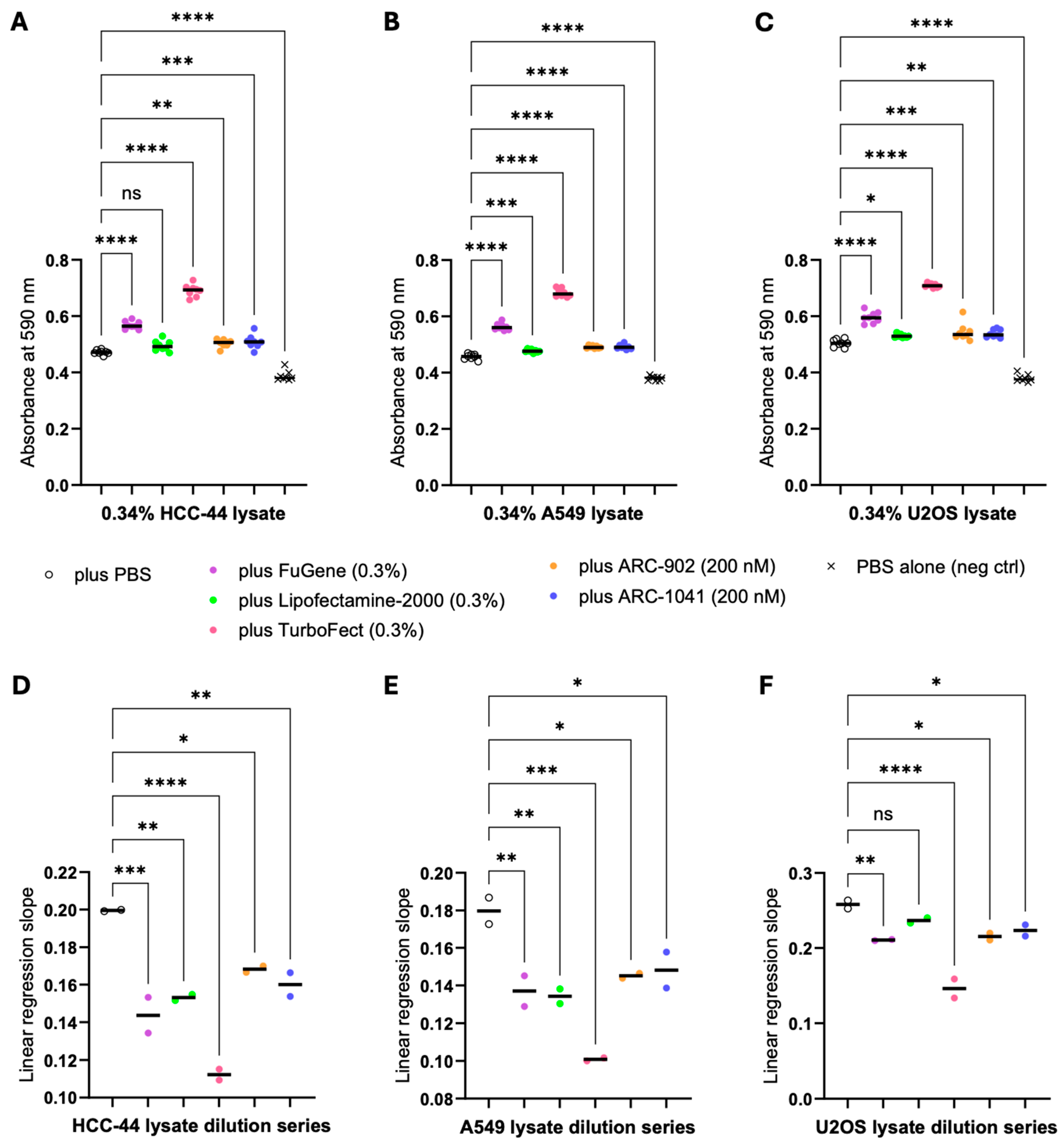
To extend our analyses into more physiologically relevant environments, we evaluated the effects of synthetic peptides and transfection reagents in lysates derived from the lung adenocarcinoma (HCC-44, A549) or bone osteosarcoma (U2OS) cell lines. The lysates were prepared in the presence of Triton X-100; the detergent concentration was adjusted such that it remained non-interfering at two of the three lysate dilution points, thereby allowing selective assessment of additional interfering agents. Synthetic peptides were tested at a final concentration of 200 nM, slightly exceeding the previously determined interference threshold (180 nM), whereas transfection reagents were tested at 0.3% (v/v), a concentration informed by earlier experiments showing interference at approximately 0.22% or lower. Two quantitative parameters were compared between conditions with and without interfering compounds: (i) the absorbance at 590 nm for the lowest lysate concentration (Figure 2A–C) and (ii) the slope of the linear regression across the lysate dilution series (Figure 2D–F).
Across all three lysate types, both synthetic peptides and two of the three transfection reagents (TurboFect and Fugene® 6) produced statistically significant effects on both metrics (p < 0.05), indicating perturbation of apparent protein concentration. Lipofectamine displayed the least pronounced interference profile, significantly affecting the 590 nm signal at the lowest lysate dilution in U2OS and A549 lysates, and altering the regression slope in HCC-44 and A549 lysates. Overall, these results confirmed that the interference patterns identified in simplified model systems remained detectable in complex biological matrices, thereby validating the robustness and practical relevance of the trends observed earlier.

3.5. Clustering of Interfering Compounds According to the Shift of CBBG Absorbance Spectrum

The distinct alterations observed in the shape of analyte response curves in the presence of various interfering compounds (Figure 1) indicated that some interfering compounds could affect the CBBG absorbance spectrum differently than true protein analytes (i.e., the changes are not limited to increase in absorbance at 590 nm). For several compounds, such spectral effects have been indeed previously reported (as indicated in Table 1). To investigate this phenomenon systematically, we measured full absorbance spectra of CBBG in the presence of compounds that significantly affected absorbance at 590 nm; the resulting spectra are presented in Supplementary Figures S6 and S7.
Our analysis revealed two major spectral patterns arising from addition of the interfering compounds. In the first case, represented by detergents, a marked increase in CBBG absorbance at higher wavelengths was evident—with the maxima in the range of 615–625 nm (and in the case of SDS, extending up to 650 nm). For other compounds of interest (including arginine, tryptophan, synthetic peptides, and transfection reagents), the spectral shift of CBBG resembled that observed in the presence of genuine protein analytes, with enhanced absorbance around 590 nm. In addition, certain compounds (e.g., tryptophan) exhibited characteristic intrinsic absorbance in the UV region. Mechanistically, CBBG binds proteins through a combination of electrostatic and charge-assisted hydrogen-bonding interactions with basic residues (most prominently arginine) and hydrophobic or van der Waals contacts with aromatic and nonpolar side chains [175,176,177]. Non-ionic detergents lack charged headgroups, and although SDS is an ionic surfactant, its hydrophobic tail contains no positively charged groups; consequently, these classes of detergents do not participate in direct electrostatic interactions with the sulfonated dye structure. Instead, they interfere primarily through hydrophobic or micelle-mediated effects, which can perturb the dye’s spectral properties (particularly at higher wavelengths [147]) without mimicking true protein-binding modes. In contrast, cationic transfection reagents and oligoarginine-rich peptides can interact directly with the negatively charged sulfonate groups of CBBG, forming electrostatically stabilized complexes that closely resemble the spectral signature of the protein–dye complex, thereby producing strong false-positive responses.
To further systematize the spectral data and distinguish compound-specific spectral fingerprints, we performed clustering analysis based on the full absorbance spectra of CBBG in the presence of each interfering substance at its highest tested concentration. Normalized spectra from several independent experiments were included for each compound to account for variability. As reference, we included both negative controls (PBS with CBBG) and positive controls (133 μg/mL BSA with CBBG) in the analysis. Due to the limitations of the clustering algorithm, which could process only eight conditions per run, the set of interfering compounds was divided into two subsets according to the spectral patterns mentioned above. The clustering analysis results are presented in Figure 3, which includes both hierarchical clustering heatmaps (where absorbance at each wavelength is treated as an individual variable) and PCA plots derived from the same dataset.
For the compounds in subset A, along with the positive and negative controls, PCA revealed four distinct clusters (Figure 3C): (1) the negative control (PBS); (2) SDS; (3) positive control (BSA) and CHAPS; and (4) the remaining detergents. The separation between the negative and positive controls was clearly resolved along the PC1. Notably, CHAPS clustered closely with the BSA control, despite its spectrum not overtly resembling that of a typical analyte-bound CBBG profile. In contrast, the distinct clustering of SDS was consistent with its pronounced and atypical spectral shift toward higher wavelengths, as observed in the raw spectral data. The corresponding hierarchical clustering heatmap (Figure 3A) supported these observations. It confirmed that the normalized CBBG spectra in the presence of CHAPS were most similar to those observed in the presence of BSA, suggesting that complexation of CHAPS with CBBG mimics protein–dye interactions. Meanwhile, the remaining detergents clustered together, yet the algorithm reliably grouped replicate measurements of the same compound, indicating strong internal consistency within treatments.
In contrast to subset A, the clustering results for subset B revealed a more heterogeneous distribution of samples (Figure 3D). Along the PC1, samples containing tryptophan were clearly separated from the others, largely due to the intrinsic absorbance of this amino acid, which was particularly pronounced in the normalized spectra at lower wavelengths. Along the PC2, the negative and positive controls (PBS and BSA, respectively) formed distinct clusters. The remaining treatments clustered between the two controls, reflecting varying degrees of interference. Lipofectamine® 2000 was positioned closest to the negative control, consistent with earlier observations showing minimal spectral alteration. In contrast, the two other transfection reagents and the oligoarginine peptides (ARCs) clustered closer to the positive control, confirming their behavior as false analytes. The hierarchical clustering heatmap corroborated these trends, generally grouping replicates of the same compound together, thus demonstrating good reproducibility; minor inconsistencies were observed among the transfection reagents. Nevertheless, the overall clustering patterns aligned well with the spectral data, providing further support for the classification of interference types based on the full-spectrum profiling.

3.6. Comparison with the Lowry Assay Reveals Assay-Specific Susceptibility to Interference

Finally, to compare the Bradford assay with a widely used alternative protein quantification method, we evaluated the effects of selected novel interfering compounds in the Lowry assay. The latter is based on the Biuret reaction of peptide bonds with copper ions under alkaline conditions, followed by reduction of the Folin–Ciocalteu reagent by copper-treated proteins and selected amino acid residues, resulting in the formation of a blue chromophore measurable at approximately 750 nm [178,179]. Oligoarginine peptides and transfection reagents were selected for comparison, as these compounds were identified among the most prominent novel interfering agents in the Bradford assay, whereas Tween-20 was used as a positive control, since detergent interference has been reported for the classical Lowry assay.
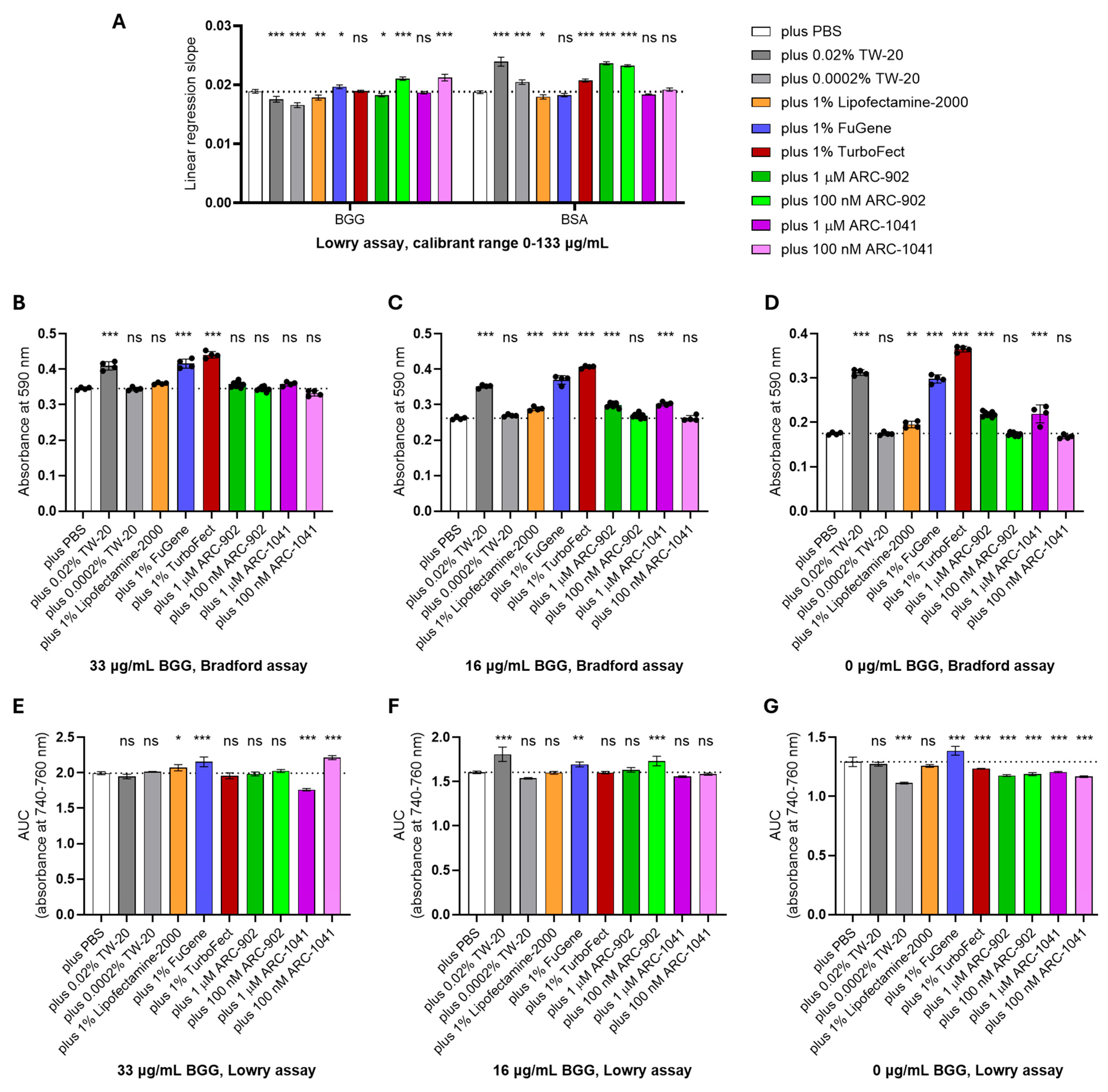
Calibration curves were generated using both BSA and BGG as protein standards in the presence or absence of the selected compounds. Representative calibration curves are shown in Supplementary Figure S9, while the corresponding slopes obtained by linear regression analysis are summarized in Figure 4A. Similarly to the Bradford assay, high concentrations of Tween-20 (0.02%), transfection reagents (1%), and oligoarginine peptides (1 μM) altered the response of the Lowry assay. However, the direction and magnitude of these effects depended on the protein standard used. In some cases, the slope of the calibration curve increased, whereas in others, it decreased, highlighting the complex chemistry underlying the Lowry assay and complicating mechanistic interpretation of the resulting artefacts.
To enable a direct comparison between the Bradford and Lowry assays, signal changes were further evaluated at representative BGG concentrations of 0, 16.6, and 33.3 μg/mL in the presence or absence of the interfering compounds (Figure 4B–G). Consistent with observations in the Bradford assay, the greatest relative errors were observed at lower protein concentrations, where the contribution of the interfering compound to the total signal was proportionally greater. Nevertheless, the magnitude of the artefacts was generally lower in the Lowry assay. While the Bradford assay consistently produced overestimations of protein concentration in the presence of oligoarginine peptides and transfection reagents, the Lowry assay exhibited a more variable response, with both increases and decreases in signal observed depending on the interfering compound and calibration standard employed. These findings suggest that the newly identified interfering compounds are not exclusive to the Bradford assay, although their impact appears substantially less pronounced in the Lowry method.

4. Conclusions

In conclusion, this study serves as a reminder that despite its technical simplicity, speed, and widespread use, the Bradford assay remains vulnerable to interference from a range of commonly used laboratory compounds. Our findings demonstrate that the nature of interference is not uniform; rather, it varies depending on the chemical properties of the interfering substance and, in some cases, mimics the spectral response of genuine protein analytes. At the same time, the large number of interference reports should not be interpreted as evidence that the Bradford assay lacks utility. Rather, its continued widespread adoption across diverse research fields has enabled researchers to identify and document assay-specific artefacts under many different experimental conditions. Our results underscore that interference effects cannot always be reliably corrected by simple adjustment of the calibration curve according to the intercept value. Spectral analysis provides valuable information for distinguishing between different modes of interference, yet comprehensive evaluation—particularly across a range of analyte concentrations—is essential for accurate interpretation. Notably, the newly identified interfering compounds also affected the Lowry assay, although their impact was generally less pronounced than in the Bradford assay. This observation suggests that assay substitution alone may not fully eliminate interference-related artefacts and highlights the importance of validating protein quantification methods within the context of the specific sample matrix and experimental workflow.
Among the limitations of this work is the fact that only 29 compounds were experimentally validated as potential interferents in the Bradford assay, and only classical formulations of the Bradford assay and Lowry assay were used. Still, we hope that this work contributes to renewed awareness within the proteomics and biochemical research communities about the limitations of the Bradford assay and encourages more informed and critical application of this widely used method. By highlighting common sources of interference and their underlying mechanisms, we aim not to discourage the use of the assay, but rather to support its more reliable implementation in contemporary research workflows.

Supplementary Materials

The following supporting information can be downloaded at: https://www.mdpi.com/article/10.3390/sci8070145/s1, Figure S1: Structures of oligo-D-arginine conjugates ARC-902 and ARC-1041 used as the Bradford-interfering compounds in the current study; Figure S2: Examples of the analyte calibration curves measured by the Bradford assay in the absence or presence of Ca2+ and Mg2+ ions; Figure S3: Examples of the analyte calibration curves measured by the Bradford assay in the presence or absence of the compounds from the validation set that did not interfere with the assay; Figure S4: Assessment of the interfering effect of various compounds on the signal of CBBG in the absence (panel A) vs. presence (panel B) of Ca2+ and Mg2+ ions; Figure S5: Dose–response curves for the compounds of interest (COI) after addition of CBBG in the absence of analyte; Figure S6: Absorbance spectra of Coomassie Brilliant Blue G-250 (CBBG) in the presence of interfering compounds (subset A); Figure S7: Absorbance spectra of CBBG in the presence of interfering compounds (subset B) or BSA; Figure S8: Examples of the BGG calibration curves measured by the Bradford assay in the presence or absence of the interfering compounds; Figure S9: Examples of the analyte calibration curves measured by the Lowry assay in the presence or absence of the interfering compounds; Supplementary Methods—Suggested Bradford assay protocol.

Author Contributions

Conceptualization, D.L.; methodology, D.L.; validation, all authors; formal analysis, all authors; resources, D.L.; writing—original draft preparation, N.N., E.L. and D.L.; writing—review and editing, all authors; visualization, D.L.; supervision, D.L.; project administration, D.L.; funding acquisition, D.L. All authors have read and agreed to the published version of the manuscript.

Funding

D.L. was supported by internal financing from the Institute of Chemistry, University of Tartu, Estonia (PLTKTARENG21).

Data Availability Statement

The raw data corresponding to Table 2, Figure 1 and Figure 2 and Supplementary Figures S2–S7 are available as GraphPad Prism 6 or GraphPad Prism 10 files from the free online repository FigShare (https://doi.org/10.6084/m9.figshare.30749102).

Acknowledgments

We thank Ago Rinken group members for the maintenance of the microplate reader platform.

Conflicts of Interest

The authors declare that the research was conducted in the absence of any commercial or financial relationships that could be construed as potential conflicts of interest.

References

  1. Bradford, M.M. A rapid and sensitive method for the quantitation of microgram quantities of protein utilizing the principle of protein-dye binding. Anal. Biochem. 1976, 72, 248–254. [Google Scholar] [CrossRef] [PubMed]
  2. Compton, S.J.; Jones, C.G. Mechanism of dye response and interference in the Bradford protein assay. Anal. Biochem. 1985, 151, 369–374. [Google Scholar] [CrossRef] [PubMed]
  3. Martínez, I.; Herrera, A.; Tames-Espinosa, M.; Bondyale-Juez, D.R.; Romero-Kutzner, V.; Packard, T.T.; Gómez, M. Protein in marine plankton: A comparison of spectrophotometric methods. J. Exp. Mar. Biol. Ecol. 2020, 526, 151357. [Google Scholar] [CrossRef]
  4. Juhasova, A.; Baliova, M.; Jursky, F. A Dynamic Interaction of Coomassie Dye with the Glycine Transporters N-termini. Protein J. 2016, 35, 371–378. [Google Scholar] [CrossRef] [PubMed]
  5. Kruger, N.J. The Bradford Method For Protein Quantitation. In The Protein Protocols Handbook; Walker, J.M., Ed.; Humana Press: Totowa, NJ, USA, 2009; pp. 17–24. [Google Scholar] [CrossRef]
  6. Sapan, C.V.; Lundblad, R.L.; Price, N.C. Colorimetric protein assay techniques. Biotechnol. Appl. Biochem. 1999, 29, 99–108. [Google Scholar] [CrossRef]
  7. Brunelle, E.; Le, A.M.; Huynh, C.; Wingfield, K.; Halámková, L.; Agudelo, J.; Halámek, J. Coomassie Brilliant Blue G-250 Dye: An Application for Forensic Fingerprint Analysis. Anal. Chem. 2017, 89, 4314–4319. [Google Scholar] [CrossRef] [PubMed]
  8. Ramagli, L.S.; Rodriguez, L.V. Quantitation of microgram amounts of protein in two-dimensional polyacrylamide gel electrophoresis sample buffer. Electrophoresis 1985, 6, 559–563. [Google Scholar] [CrossRef]
  9. Krystal, G.; Macdonald, C.; Munt, B.; Ashwell, S. A method for quantitating nanogram amounts of soluble protein using the principle of silver binding. Anal. Biochem. 1985, 148, 451–460. [Google Scholar] [CrossRef] [PubMed]
  10. Stoscheck, C.M. Protein assay sensitive at nanogram levels. Anal. Biochem. 1987, 160, 301–305. [Google Scholar] [CrossRef] [PubMed]
  11. Marshall, T.; Williams, K.M. Interference in the Coomassie Brilliant Blue and Pyrogallol Red protein dye-binding assays is increased by the addition of sodium dodecyl sulfate to the dye reagents. Anal. Biochem. 2004, 331, 255–259. [Google Scholar] [CrossRef] [PubMed]
  12. Yap, W.T.; Song, W.K.; Chauhan, N.; Scalise, P.N.; Agarwal, R.; Miller, S.D.; Shea, L.D. Quantification of Particle-Conjugated or Particle-Encapsulated Peptides on Interfering Reagent Backgrounds. BioTechniques 2014, 57, 39–44. [Google Scholar] [CrossRef] [PubMed]
  13. Fountoulakis, M.; Juranville, J.F.; Manneberg, M. Comparison of the Coomassie brilliant blue, bicinchoninic acid and Lowry quantitation assays, using non-glycosylated and glycosylated proteins. J. Biochem. Biophys. Methods 1992, 24, 265–274. [Google Scholar] [CrossRef] [PubMed]
  14. Nicolás, P.; Lassalle, V.L.; Ferreira, M.L. Quantification of immobilized Candida antarctica lipase B (CALB) using ICP-AES combined with Bradford method. Enzym. Microb. Technol. 2017, 97, 97–103. [Google Scholar] [CrossRef] [PubMed]
  15. Berges, J.A.; Fisher, A.E.; Harrison, P.J. A comparison of Lowry, Bradford and Smith protein assays using different protein standards and protein isolated from the marine diatom Thalassiosira pseudonana. Mar. Biol. 1993, 115, 187–193. [Google Scholar] [CrossRef]
  16. Siebert, K.J.; Lynn, P.Y. Comparison of Methods for Measuring Protein in Beer. J. Am. Soc. Brew. Chem. 2005, 63, 163–170. [Google Scholar] [CrossRef]
  17. Noble, J.E.; Bailey, M.J.A. Chapter 8 Quantitation of Protein. In Methods in Enzymology; Burgess, R.R., Deutscher, M.P., Eds.; Academic Press: Cambridge, MA, USA, 2009; pp. 73–95. [Google Scholar] [CrossRef] [PubMed]
  18. Li, K.; Chen, Z.; Duan, F.; Liang, J.; Wu, K. Quantification of tear proteins by SDS-PAGE with an internal standard protein: A new method with special reference to small volume tears. Graefes Arch. Clin. Exp. Ophthalmol. 2010, 248, 853–862. [Google Scholar] [CrossRef] [PubMed]
  19. Astrof, N.S.; Horowitz, G. Protein Colorimetry Experiments That Incorporate Intentional Discrepancies and Historical Narratives. J. Chem. Educ. 2018, 95, 1198–1204. [Google Scholar] [CrossRef]
  20. Filgueiras, M.F.; Borges, E.M. Quick and Cheap Colorimetric Quantification of Proteins Using 96-Well-Plate Images. J. Chem. Educ. 2022, 99, 1778–1787. [Google Scholar] [CrossRef]
  21. Sedmak, J.J.; Grossberg, S.E. A rapid, sensitive, and versatile assay for protein using Coomassie brilliant blue G250. Anal. Biochem. 1977, 79, 544–552. [Google Scholar] [CrossRef] [PubMed]
  22. Qian, X.; Dong, H.; Hu, X.; Tian, H.; Guo, L.; Shen, Q.; Gao, X.; Yao, W. Analysis of the interferences in quantitation of a site-specifically PEGylated exendin-4 analog by the Bradford method. Anal. Biochem. 2014, 465, 50–52. [Google Scholar] [CrossRef] [PubMed]
  23. Gomes, L.M.F.; Bataglioli, J.C.; Jussila, A.J.; Smith, J.R.; Walsby, C.J.; Storr, T. Modification of Aβ Peptide Aggregation via Covalent Binding of a Series of Ru(III) Complexes. Front. Chem. 2019, 7, 838. [Google Scholar] [CrossRef] [PubMed]
  24. Guler, H.I. Recombinant Production of Opiorphin Pentapeptide as Tandem Multimers Through Rational Design of Primers. Appl. Biochem. Microbiol. 2020, 56, 141–148. [Google Scholar] [CrossRef]
  25. Silber, M.L.; Davitt, B.B. Preparative Binding of Coomassie Brilliant Blue to Bovine Serum Albumine at Alkaline PH. In Preparative Biochemistry & Biotechnology; Taylor & Francis Group: Oxfordshire, UK, 2000; Volume 30, pp. 209–229. [Google Scholar] [CrossRef] [PubMed]
  26. Carroll, K.; O’kennedy, R. Interference effects from Nonidet P-40 and urea in the Bradford protein assay. Biochem. Soc. Trans. 1988, 16, 382–383. [Google Scholar] [CrossRef]
  27. Macart, M.; Gerbaut, L. An improvement of the Coomassie Blue dye binding method allowing an equal sensitivity to various proteins: Application to cerebrospinal fluid. Clin. Chim. Acta 1982, 122, 93–101. [Google Scholar] [CrossRef] [PubMed]
  28. Ahsan, N.; Siddique, I.A.; Gupta, S.; Surolia, A. A routinely used protein staining dye acts as an inhibitor of wild type and mutant alpha-synuclein aggregation and modulator of neurotoxicity. Eur. J. Med. Chem. 2018, 143, 1174–1184. [Google Scholar] [CrossRef] [PubMed]
  29. Chutipongtanate, S.; Watcharatanyatip, K.; Homvises, T.; Jaturongkakul, K.; Thongboonkerd, V. Systematic comparisons of various spectrophotometric and colorimetric methods to measure concentrations of protein, peptide and amino acid: Detectable limits, linear dynamic ranges, interferences, practicality and unit costs. Talanta 2012, 98, 123–129. [Google Scholar] [CrossRef] [PubMed]
  30. Wanandy, T.; Handley, S.A.; Mulcahy, E.; Wiese, M. Comparative study of the commonly used protein quantitation assays on different Hymenoptera venoms: A fundamental aspect of Hymenoptera venom proteome analysis. Toxicon 2024, 241, 107685. [Google Scholar] [CrossRef] [PubMed]
  31. Williams, K.M.; Fox, P.; Marshall, T. A Comparison of Protein Assays for the Determination of the Protein Concentration of Beer. J. Inst. Brew. 1995, 101, 365–369. [Google Scholar] [CrossRef]
  32. Wilder, S.M.; Barnes, C.L. Comparing the accuracy of protein measures for arthropods. J. Insect Physiol. 2023, 144, 104470. [Google Scholar] [CrossRef] [PubMed]
  33. Li, J.; Zhao, Y.; Jiang, X. Quantitative analysis of protein in thermosensitive hydroxypropyl chitin for biomedical applications. Anal. Biochem. 2020, 599, 113745. [Google Scholar] [CrossRef] [PubMed]
  34. McClellan, S.A.; Laws, E.A.; Elsey-Quirk, T. Estimates of protein in coastal marsh soils: A case study of the utility of the Bradford assay for quantifying soil protein. Geoderma 2022, 410, 115676. [Google Scholar] [CrossRef]
  35. Copeland, R.A. Methods for Protein Quantitation. In Methods for Protein Analysis: A Practical Guide for Laboratory Protocols; Copeland, R.A., Ed.; Springer: Boston, MA, USA, 1994; pp. 39–58. [Google Scholar] [CrossRef]
  36. Oseas da Silva, M.A.; Zezzi Arruda, M.A. Mechanization of the Bradford reaction for the spectrophotometric determination of total proteins. Anal. Biochem. 2006, 351, 155–157. [Google Scholar] [CrossRef] [PubMed]
  37. Li, L.; Dong, L.; Tian, X.; Kalkhajeh, Y.K.; Yang, Y.; Gan, S.K.-E. Optimizing the ratio of coomassie and methylene blue dyes for a cost-effective and rapid staining of PET, PVC, PP, PS, LLDPE, LDPE, and HDPE. Discov. Sustain 2024, 5, 74. [Google Scholar] [CrossRef]
  38. Ghosh, S.; Gepstein, S.; Heikkila, J.J.; Dumbroff, E.B. Use of a scanning densitometer or an ELISA plate reader for measurement of nanogram amounts of protein in crude extracts from biological tissues. Anal. Biochem. 1988, 169, 227–233. [Google Scholar] [CrossRef] [PubMed]
  39. Said-Fernández, S.; González-Garza, M.T.; Mata-Cárdenas, B.D.; Navarro-Marmolejo, L. A multipurpose solid-phase method for protein determination with Coomassie brilliant blue G-250. Anal. Biochem. 1990, 191, 119–126. [Google Scholar] [CrossRef] [PubMed]
  40. Minamide, L.S.; Bamburg, J.R. A filter paper dye-binding assay for quantitative determination of protein without interference from reducing agents or detergents. Anal. Biochem. 1990, 190, 66–70. [Google Scholar] [CrossRef] [PubMed]
  41. Pande, S.V.; Murthy, M.S.R. A Modified Micro-Bradford Procedure for Elimination of Interference from Sodium Dodecyl Sulfate, Other Detergents, and Lipids. Anal. Biochem. 1994, 220, 424–426. [Google Scholar] [CrossRef] [PubMed]
  42. Cheng, Y.; Wei, H.; Sun, R.; Tian, Z.; Zheng, X. Rapid method for protein quantitation by Bradford assay after elimination of the interference of polysorbate 80. Anal. Biochem. 2016, 494, 37–39. [Google Scholar] [CrossRef] [PubMed]
  43. Su, Z.Q.; Wu, S.H.; Zhang, H.L.; Feng, Y.F. Development and validation of an improved Bradford method for determination of insulin from chitosan nanoparticulate systems. Pharm. Biol. 2010, 48, 966–973. [Google Scholar] [CrossRef] [PubMed]
  44. Cui, W.; Xue, H.; Cheng, H.; Zhang, H.; Jin, J.; Wang, Q. Increasing the amount of phosphoric acid enhances the suitability of Bradford assay for proteomic research. Electrophoresis 2019, 40, 1107–1112. [Google Scholar] [CrossRef] [PubMed]
  45. Moragues-Saitua, L.; Merino-Martín, L.; Stokes, A.; Staunton, S. Towards meaningful quantification of glomalin-related soil protein (GRSP) taking account of interference in the Coomassie Blue (Bradford) assay. Eur. J. Soil Sci. 2019, 70, 727–735. [Google Scholar] [CrossRef]
  46. Lavogina, D.; Visser, N.; Samuel, K.; Davey, E.; Björvang, R.D.; Hassan, J.; Koponen, J.; Rantakokko, P.; Kiviranta, H.; Rinken, A.; et al. Endocrine disrupting chemicals interfere with decidualization of human primary endometrial stromal cells in vitro. Front. Endocrinol. 2022, 13, 903505. [Google Scholar] [CrossRef] [PubMed]
  47. Lavogina, D.; Kask, K.; Kopanchuk, S.; Visser, N.; Laws, M.; Flaws, J.A.; Kallak, T.K.; Olovsson, M.; Damdimopoulou, P.; Salumets, A. Phthalate monoesters affect membrane fluidity and cell-cell contacts in endometrial stromal adherent cell lines and spheroids. Reprod. Toxicol. 2024, 130, 108733. [Google Scholar] [CrossRef] [PubMed]
  48. Enkvist, E.; Lavogina, D.; Raidaru, G.; Vaasa, A.; Viil, I.; Lust, M.; Viht, K.; Uri, A. Conjugation of Adenosine and Hexa-(d-arginine) Leads to a Nanomolar Bisubstrate-Analog Inhibitor of Basophilic Protein Kinases. J. Med. Chem. 2006, 49, 7150–7159. [Google Scholar] [CrossRef] [PubMed]
  49. Lavogina, D.; Lust, M.; Viil, I.; König, N.; Raidaru, G.; Rogozina, J.; Enkvist, E.; Uri, A.; Bossemeyer, D. Structural Analysis of ARC-Type Inhibitor (ARC-1034) Binding to Protein Kinase A Catalytic Subunit and Rational Design of Bisubstrate Analogue Inhibitors of Basophilic Protein Kinases. J. Med. Chem. 2009, 52, 308–321. [Google Scholar] [CrossRef] [PubMed]
  50. Metsalu, T.; Vilo, J. ClustVis: A web tool for visualizing clustering of multivariate data using Principal Component Analysis and heatmap. Nucleic Acids Res. 2015, 43, W566–W570. [Google Scholar] [CrossRef] [PubMed]
  51. Ma, C.Q.; Li, K.A.; Tong, S.Y. Determination of proteins by fluorescence quenching of erythrosin B. Anal. Chim. Acta 1996, 333, 83–88. [Google Scholar] [CrossRef]
  52. Ma, C.Q.; Li, K.A.; Tong, S.Y. Spectrophotometric Micromethod for Protein Determination with Tetrachloro Tetraiodo Fluorescein. Anal. Lett. 1998, 31, 1021–1036. [Google Scholar] [CrossRef]
  53. Guo, Z.-X.; Shen, H.-X. A novel method for the determination of protein utilizing 4-azochromotropic acid phenylfluorone–molybdenum(VI) complex. Anal. Chim. Acta 1999, 396, 83–90. [Google Scholar] [CrossRef]
  54. Guo, Z.-X.; Shen, H.-X.; Guo, Z.-X. Determination of protein based on absorbance decrease of molybdenum(VI) complex with 2,6,7-trihydroxy-9-(4′-chlorophenyl)-3H-xanthen-3-one. Analyst 1999, 124, 1093–1098. [Google Scholar] [CrossRef]
  55. Yao, G.; Li, K.A.; Tong, S.Y. Determination of protein by its enhancement effect on the Rayleigh light scattering of carboxyarsenazo. Talanta 1999, 50, 585–594. [Google Scholar] [CrossRef] [PubMed]
  56. Guo, Z.-X.; Hao, Y.-M.; Cong, X.; Shen, H.-X. Application of the dibromohydroxyphenylfluorone–molybdenum(VI) complex to the sensitive spectrophotometric determination of protein. Anal. Chim. Acta 2000, 403, 225–233. [Google Scholar] [CrossRef]
  57. Li, Q.; Chen, X.; Zhang, H.; Xue, C.; Fan, Y.; Hu, Z. Microdetermination of proteins using m-carboxychlorophosphonazo as detection probe by enhanced resonance light scattering spectroscopy. Fresenius J. Anal. Chem. 2000, 368, 715–719. [Google Scholar] [CrossRef] [PubMed]
  58. Li, Q.; Chen, X.; Zhang, H.; Xue, C.; Liu, S.; Hu, Z. The high-sensitivity determination of protein concentrations by the enhancement of Rayleigh light scattering of Arsenazo-DBN. Analyst 2000, 125, 1483–1486. [Google Scholar] [CrossRef] [PubMed]
  59. Zhong, H.; Zhao, F.L.; Li, K.A. Rayleigh Light Scattering Study on Interaction of Protein with Beryllon Ii and Its Application. Anal. Lett. 2001, 34, 701–712. [Google Scholar] [CrossRef]
  60. Wu, L.; Mu, D.; Gao, D.; Deng, X.; Tian, Y.; Zhang, H.; Yu, A. Determination of protein by resonance light scattering technique using dithiothreitol–sodium dodecylbenzene sulphonate as probe. Spectrochim. Acta Part A Mol. Biomol. Spectrosc. 2009, 72, 178–181. [Google Scholar] [CrossRef] [PubMed]
  61. Yuan, D.; O’Riordan, E.D.; Jacquier, J.C. Development of a first order derivative spectrophotometry method to rapidly quantify protein in the presence of chitosan and its application in protein encapsulation systems. Food Chem. 2019, 289, 1–6. [Google Scholar] [CrossRef] [PubMed]
  62. Datki, Z.; Olah, Z.; Macsai, L.; Pakaski, M.; Galik, B.; Mihaly, G.; Kalman, J. Application of BisANS fluorescent dye for developing a novel protein assay. PLoS ONE 2019, 14, e0215863. [Google Scholar] [CrossRef] [PubMed]
  63. Rosier, C.L.; Hoye, A.T.; Rillig, M.C. Glomalin-related soil protein: Assessment of current detection and quantification tools. Soil Biol. Biochem. 2006, 38, 2205–2211. [Google Scholar] [CrossRef]
  64. Siangproh, W.; Teshima, N.; Sakai, T.; Katoh, S.; Chailapakul, O. Alternative method for measurement of albumin/creatinine ratio using spectrophotometric sequential injection analysis. Talanta 2009, 79, 1111–1117. [Google Scholar] [CrossRef] [PubMed]
  65. Sun, Y.; Fan, J.; Hu, X.-Y.; Liu, L.-S.; Hu, C.-M.; Yin, C.; Wei, S. Studies on the Interaction between Sodium Fluorescein and Bovine Serum Albumin by Fluorescence Spectroscopy and Its Analytical Application. Acta Chim. Sin. 2011, 69, 937. [Google Scholar]
  66. Qi, Y.; He, J.; Xiu, F.-R.; Yu, X.; Li, Y.; Lu, Y.; Gao, X.; Song, Z.; Li, B. A facile chemiluminescence sensing for ultrasensitive detection of heparin using charge effect of positively-charged AuNPs. Spectrochim. Acta Part A Mol. Biomol. Spectrosc. 2019, 216, 310–318. [Google Scholar] [CrossRef] [PubMed]
  67. Singh, R.; Lu, R.; Hu, M. Flavonoids interference in common protein assays: Effect of position and degree of hydroxyl substitution. Anal. Biochem. 2020, 597, 113644. [Google Scholar] [CrossRef] [PubMed]
  68. Silva, A.L.S.; Nunes, A.S.; Gesztesi, J.L. Protein loss quantification of abraded virgin and abraded bleached hair according to Bradford assay. J. Cosmet. Sci. 2004, 55, S175–S179. [Google Scholar] [PubMed]
  69. Moreira, D.C. RGBradford: Protein Quantitation with a Smartphone Camera. J. Vis. Exp. (JoVE) 2023, 199, e65547. [Google Scholar] [CrossRef] [PubMed]
  70. de Camargo, C.L.; Vicentini, M.B.R.; Gobbi, A.L.; Martinez, D.S.T.; Lima, R.S. Smartphone for Point-of-Care Quantification of Protein by Bradford Assay. J. Braz. Chem. Soc. 2017, 28, 689–693. [Google Scholar] [CrossRef]
  71. Sandeman, S.R.; Faragher, R.G.A.; Allen, M.C.A.; Liu, C.; Lloyd, A.W. Does MMP-2 expression and secretion change with increasing serial passage of keratocytes in culture? Mech. Ageing Dev. 2001, 122, 157–167. [Google Scholar] [CrossRef] [PubMed]
  72. Janciauskiene, S.; Brandt, L.; Wallmark, A.; Westin, U.; Krakau, T. Secreted leukocyte protease inhibitor is present in aqueous humours from cataracts and other eye pathologies. Exp. Eye Res. 2006, 82, 505–511. [Google Scholar] [CrossRef] [PubMed]
  73. Hedenbjörk-Lager, A.; Bjørndal, L.; Gustafsson, A.; Sorsa, T.; Tjäderhane, L.; Åkerman, S.; Ericson, D. Caries Correlates Strongly with Salivary Levels of Matrix Metalloproteinase-8. Caries Res. 2014, 49, 1–8. [Google Scholar] [CrossRef] [PubMed]
  74. Lundmark, A.; Johannsen, G.; Eriksson, K.; Kats, A.; Jansson, L.; Tervahartiala, T.; Rathnayake, N.; Åkerman, S.; Klinge, B.; Sorsa, T.; et al. Mucin 4 and matrix metalloproteinase 7 as novel salivary biomarkers for periodontitis. J. Clin. Periodontol. 2017, 44, 247–254. [Google Scholar] [CrossRef] [PubMed]
  75. Mashayekhi, F.; Saberi, A.; Mashayekhi, S. Serum TIMP1 and TIMP2 concentration in patients with different grades of meningioma. Clin. Neurol. Neurosurg. 2018, 170, 84–87. [Google Scholar] [CrossRef] [PubMed]
  76. Seevaratnam, R.; Patel, B.P.; Hamadeh, M.J. Comparison of Total Protein Concentration in Skeletal Muscle as Measured by the Bradford and Lowry Assays. J. Biochem. 2009, 145, 791–797. [Google Scholar] [CrossRef] [PubMed]
  77. James, J.J.; Sandhya, K.V.; Sridhar, K.N.; Sudarson, S.; Basavaraj, B.V.; Bharath, S. Proteomic Characterization of Human Placenta: Insights into Potential Therapeutic Applications for Osteoarthritis. AAPS PharmSciTech 2024, 25, 139. [Google Scholar] [CrossRef] [PubMed]
  78. Pérez-Atehortúa, M.; Short, S.E.; Aranzaez-Rios, C.; Farías, J.; Oliveira, R.P.S.; Pereira, W.A.; Risopatrón, J.; Valdebenito, I.; Villalobos, E.F. Preparation and extraction of chorion proteins from Salmo salar embryos at the pigmented eye stage for electrophoresis with SDS-polyacrylamide gel. MethodsX 2024, 12, 102533. [Google Scholar] [CrossRef] [PubMed]
  79. Sun, Y.; Wei, T.; Ma, T.; Fan, Z.; Song, J. Dellaglioa Algida Cell-Free Supernatant Inhibits Pseudomonas Fluorescence and Pseudomonas Fragi by Destroying Cell Membranes. Foods 2024, 13, 2986. [Google Scholar] [CrossRef] [PubMed]
  80. Dan, J.; Belyea, D.; Gertner, G.; Leshem, I.; Lusky, M.; Miskin, R. Plasminogen Activator Inhibitor-1 in the Aqueous Humor of Patients With and Without Glaucoma. Arch. Ophthalmol. 2005, 123, 220–224. [Google Scholar] [CrossRef] [PubMed]
  81. Weinstein, W.L.; Dietrich, U.M.; Sapienza, J.S.; Carmichael, K.P.; Moore, P.A.; Krunkosky, T.M. Identification of ocular matrix metalloproteinases present within the aqueous humor and iridocorneal drainage angle tissue of normal and glaucomatous canine eyes. Vet. Ophthalmol. 2007, 10, 108–116. [Google Scholar] [CrossRef] [PubMed]
  82. Mishra, R.; Sharma, S.; Sharma, R.S.; Singh, S.; Sardesai, M.M.; Sharma, S.; Mishra, V. Viscum articulatum Burm. f. aqueous extract exerts antiproliferative effect and induces cell cycle arrest and apoptosis in leukemia cells. J. Ethnopharmacol. 2018, 219, 91–102. [Google Scholar] [CrossRef] [PubMed]
  83. Hanafusa, K.; Murakami, H.; Ueda, T.; Yano, E.; Zaima, N.; Moriyama, T. Worm wounding increases levels of pollen-related food allergens in soybean (Glycine max). Biosci. Biotechnol. Biochem. 2018, 82, 1207–1215. [Google Scholar] [CrossRef] [PubMed]
  84. Jessica, S.; Sekar, R.; Ghosh, S.; Dhungel, S.B.K.; Ramakrishnan, M.; Jh, S.F.; Prasad, M.; I, J.; Subramani, S. Differential Expression of Hard Tissue Proteins in Hypomineralized Second Primary Molars in Comparison to Normal Teeth. Clin. Exp. Dent. Res. 2025, 11, e70079. [Google Scholar] [CrossRef] [PubMed]
  85. Jappie, D.; Rodgers, A.; Ravenscroft, N.; Webber, D.; Gohel, M.D.I. Composition and inhibitory properties of endogenous urinary GAGS are different in subjects from two race groups with different occurrence rates of kidney stones: Pilot studies provide unique evidence in support of an inhibitory role for this group of compounds. Clin. Chim. Acta 2022, 525, 84–90. [Google Scholar] [CrossRef] [PubMed]
  86. Jiang, T.; Zhi, X.-L.; Zhang, Y.-H.; Pan, L.-F.; Zhou, P. Inhibitory effect of curcumin on the Al(III)-induced Aβ42 aggregation and neurotoxicity in vitro. Biochim. Biophys. Acta (BBA)-Mol. Basis Dis. 2012, 1822, 1207–1215. [Google Scholar] [CrossRef] [PubMed]
  87. Leone, M.G.; Grippa, E.; Guidolin, D.; Tita, B.; Abdel–Haq, H.; Gatto, M.T.; Bordi, F.; Cheng, C.Y.; Silvestrini, B.; Saso, L. Effects of lonidamine on testicular and epididymal proteins in the rat☆. Reprod. Toxicol. 2000, 14, 257–263. [Google Scholar] [CrossRef] [PubMed]
  88. Barańska-Rybak, W.; Sonesson, A.; Nowicki, R.; Schmidtchen, A. Glycosaminoglycans inhibit the antibacterial activity of LL-37 in biological fluids. J. Antimicrob. Chemother. 2006, 57, 260–265. [Google Scholar] [CrossRef] [PubMed]
  89. Lopilly Park, H.-Y.; Kim, J.H.; Lee, K.M.; Park, C.K. Effect of prostaglandin analogues on tear proteomics and expression of cytokines and matrix metalloproteinases in the conjunctiva and cornea. Exp. Eye Res. 2012, 94, 13–21. [Google Scholar] [CrossRef] [PubMed]
  90. Feussner, A.; Kalina, U.; Hofmann, P.; Machnig, T.; Henkel, G. Biochemical comparison of four commercially available C1 esterase inhibitor concentrates for treatment of hereditary angioedema. Transfusion 2014, 54, 2566–2573. [Google Scholar] [CrossRef] [PubMed]
  91. Liang, Y.R.; Kang, S.; Deng, L.; Xiang, L.P.; Zheng, X.Q. Inhibitory effects of (-)-epigallocatechin-3-gallate on melanogenesis in ultraviolet A-induced B16 murine melanoma cell. Trop. J. Pharm. Res. 2014, 13, 1825–1831. [Google Scholar] [CrossRef]
  92. Tian, J.; Wang, Y.; Zhou, X.; Li, Y.; Wang, C.; Li, J.; Li, R. Rapamycin Slows IgA Nephropathy Progression in the Rat. Am. J. Nephrol. 2014, 39, 218–229. [Google Scholar] [CrossRef] [PubMed]
  93. Kern, G.; Palmer, T.; Ehmann, D.E.; Shapiro, A.B.; Andrews, B.; Basarab, G.S.; Doig, P.; Fan, J.; Gao, N.; Mills, S.D.; et al. Inhibition of Neisseria gonorrhoeae Type II Topoisomerases by the Novel Spiropyrimidinetrione AZD0914*. J. Biol. Chem. 2015, 290, 20984–20994. [Google Scholar] [CrossRef] [PubMed]
  94. Xu, L.B.; Chi, N.; Shi, W. Amiloride, a urokinase-type plasminogen activator receptor (uTPA) inhibitor, reduces proteinurea in podocytes. Genet. Mol. Res. 2015, 14, 9518–9529. [Google Scholar] [CrossRef] [PubMed]
  95. Tian, J.; Wang, Y.; Liu, X.; Zhou, X.; Li, R. Rapamycin ameliorates IgA nephropathy via cell cycle-dependent mechanisms. Exp. Biol. Med. 2015, 240, 936–945. [Google Scholar] [CrossRef] [PubMed]
  96. Tian, J.; Wang, Y.; Guo, H.; Li, R. The Akt/mTOR/p70S6K pathway is activated in IgA nephropathy and rapamycin may represent a viable treatment option. Exp. Mol. Pathol. 2015, 99, 435–440. [Google Scholar] [CrossRef] [PubMed]
  97. Zhu, Y.; Ramasawmy, R.; Johnson, S.P.; Taylor, V.; Gibb, A.; Pedley, R.B.; Chattopadhyay, N.; Lythgoe, M.F.; Golay, X.; Bradley, D.; et al. Non-invasive imaging of disrupted protein homeostasis induced by proteasome inhibitor treatment using chemical exchange saturation transfer MRI. Sci. Rep. 2018, 8, 15068. [Google Scholar] [CrossRef] [PubMed]
  98. Taghavi, S.; Campbell, A.; Engelhardt, D.; Duchesne, J.; Shaheen, F.; Pociask, D.; Kolls, J.; Jackson-Weaver, O. Dimethyl malonate protects the lung in a murine model of acute respiratory distress syndrome. J. Trauma Acute Care Surg. 2024, 96, 386. [Google Scholar] [CrossRef] [PubMed]
  99. Niranjan, R.; Sumitha, M.K.; Sankari, T.; Muthukumaravel, S.; Jambulingam, P. Nonstructural protein-1 (NS1) of dengue virus type-2 differentially stimulate expressions of matrix metalloproteinases in monocytes: Protective effect of paracetamol. Int. Immunopharmacol. 2019, 73, 270–279. [Google Scholar] [CrossRef] [PubMed]
  100. Cai, L.; Li, Q.; Deng, Y.; Liu, X.; Du, W.; Jiang, X. Construction and expression of recombinant uricase-expressing genetically engineered bacteria and its application in rat model of hyperuricemia. Int. J. Mol. Med. 2020, 45, 1488–1500. [Google Scholar] [CrossRef] [PubMed]
  101. Kurnia, R.S.; Tarigan, S.; Nugroho, C.M.H.; Silaen, O.S.M.; Natalia, L.; Ibrahim, F.; Sudarmono, P.P. Potency of bacterial sialidase Clostridium perfringens as antiviral of Newcastle disease infections using embryonated chicken egg in ovo model. Vet. World 2022, 15, 1896–1905. [Google Scholar] [CrossRef] [PubMed]
  102. Mizon, C.; Balduyck, M.; Albani, D.; Michalski, C.; Burnouf, T.; Mizon, J. Development of an enzyme-linked immunosorbent assay for human plasma inter-α-trypsin inhibitor (ITI) using specific antibodies against each of the H1 and H2 heavy chains. J. Immunol. Methods 1996, 190, 61–70. [Google Scholar] [CrossRef] [PubMed]
  103. Song, M.; Wang, J.; Shao, J.; He, B.; Jiang, G.; Shi, G. Separation and detection of vitellogenin in fish plasma by capillary zone electrophoresis. J. Chromatogr. B 2005, 821, 38–44. [Google Scholar] [CrossRef] [PubMed]
  104. Feng, J.; Liu, H.; Yang, X.; Gao, A.; Liao, J.; Feng, L.; Pu, J.; Xie, Y.; Long, G.; Li, Y.; et al. Comparison of activity indexes for recognizing enzyme mutants of higher activity with uricase as model. Chem. Cent. J. 2013, 7, 69. [Google Scholar] [CrossRef] [PubMed][Green Version]
  105. Mhatre, S.V.; Bhagit, A.A.; Yadav, R.P. Proteinaceous Pancreatic Lipase Inhibitor from the Seed of Litchi chinensis. Food Technol. Biotechnol. 2019, 57, 113–118. [Google Scholar] [CrossRef] [PubMed]
  106. Tee, Y.Y.; Mat, K.; Adam, M.A.; Rusli, N.D.; Hasnita, C.H.; Khalid, H.N.M. Preliminary Study of Buffer Ratio in Protein Extraction from Placental Cotyledons of Kedah-Kelantan Cattle. Trop. Anim. Sci. J. 2020, 43, 300–305. [Google Scholar] [CrossRef]
  107. Wang, Y.; Chen, S.; Yang, X.; Zhang, S.; Cui, C. Preparation Optimization of Bovine Serum Albumin Nanoparticles and Its Application for siRNA Delivery. Drug Des. Dev. Ther. 2021, 15, 1531–1547. [Google Scholar] [CrossRef] [PubMed]
  108. Putri, R.E.; Lisdiyanti, P.; Fahrurrozi. Screening and activity of yeast-associated with cocoa-bean fermentation against phytopathogenic yeast and fungi. IOP Conf. Ser. Earth Environ. Sci. 2020, 439, 012056. [Google Scholar] [CrossRef]
  109. Watson, S.D.; Akhurst, T.; Whiteley, C.G.; Rose, P.D.; Pletschke, B.I. Primary sludge floc degradation is accelerated under biosulphidogenic conditions: Enzymological aspects. Enzym. Microb. Technol. 2004, 34, 595–602. [Google Scholar] [CrossRef]
  110. Reiner, T.; Kababya, S.; Gotman, I. Protein incorporation within Ti scaffold for bone ingrowth using Sol-gel SiO2 as a slow release carrier. J. Mater. Sci. Mater. Med. 2008, 19, 583–589. [Google Scholar] [CrossRef] [PubMed]
  111. Liu, H.; Zhu, J.Y.; Chai, X.S. In Situ, Rapid, and Temporally Resolved Measurements of Cellulase Adsorption onto Lignocellulosic Substrates by UV−vis Spectrophotometry. Langmuir 2011, 27, 272–278. [Google Scholar] [CrossRef] [PubMed]
  112. Mbeh, D.A.; Javanbakht, T.; Tabet, L.; Merhi, Y.; Maghni, K.; Sacher, E.; Yahia, L.H. Protein Corona Formation on Magnetite Nanoparticles: Effects of Culture Medium Composition, and Its Consequences on Superparamagnetic Nanoparticle Cytotoxicity. J. BioMed. Nanotechnol. 2015, 11, 828–840. [Google Scholar] [CrossRef] [PubMed]
  113. Aldred, P.; Kanauchi, M.; Bamforth, C.W. An investigation into proteolysis in mashing. J. Inst. Brew. 2021, 127, 21–26. [Google Scholar] [CrossRef]
  114. Qazi, R.E.M.; Sajid, Z.; Zhao, C.; Hussain, I.; Iftikhar, F.; Jameel, M.; Rehman, F.U.; Mian, A.A. Lyophilization Based Isolation of Exosomes. Int. J. Mol. Sci. 2023, 24, 10477. [Google Scholar] [CrossRef] [PubMed]
  115. Mohan, S.; Ma, P.W.K.; Luthe, D.S. Rapid qualitative protease microassay (RPM). J. Biochem. Biophys. Methods 2005, 64, 182–188. [Google Scholar] [CrossRef] [PubMed]
  116. Nishihama, S.; Imabayashi, H.; Matoba, T.; Toya, C.; Watanabe, K.; Yoshizuka, K. Micro-flow injection system for the urinary protein assay. Talanta 2008, 74, 1350–1354. [Google Scholar] [CrossRef] [PubMed]
  117. Tong, A.; Zhang, H.; Li, Z.; Gou, L.; Wang, Z.; Wei, H.; Tang, M.; Liang, S.; Chen, L.; Huang, C.; et al. Proteomic analysis of liver cancer cells treated with suberonylanilide hydroxamic acid. Cancer Chemother. Pharmacol. 2008, 61, 791–802. [Google Scholar] [CrossRef] [PubMed]
  118. Prabhakar, K.; Afzal, S.M.; Kumar, P.U.; Rajanna, A.; Kishan, V. Brain delivery of transferrin coupled indinavir submicron lipid emulsions—Pharmacokinetics and tissue distribution. Colloids Surf. B Biointerfaces 2011, 86, 305–313. [Google Scholar] [CrossRef] [PubMed]
  119. Eldred, J.A.; Hodgkinson, L.M.; Dawes, L.J.; Reddan, J.R.; Edwards, D.R.; Wormstone, I.M. MMP2 Activity is Critical for TGFβ2-Induced Matrix Contraction—Implications for Fibrosis. Investig. Ophthalmol. Vis. Sci. 2012, 53, 4085–4098. [Google Scholar] [CrossRef] [PubMed]
  120. Yin, H.; Zhou, Y.; Xu, Z.; Chen, L.; Zhang, D.; Ai, S. An electrochemical assay for DNA methylation, methyltransferase activity and inhibitor screening based on methyl binding domain protein. Biosens. Bioelectron. 2013, 41, 492–497. [Google Scholar] [CrossRef] [PubMed]
  121. Boonsriwong, W.; Chunta, S.; Thepsimanon, N.; Singsanan, S.; Lieberzeit, P.A. Thin Film Plastic Antibody-Based Microplate Assay for Human Serum Albumin Determination. Polymers 2021, 13, 1763. [Google Scholar] [CrossRef] [PubMed]
  122. Xu, J.; Zhou, J.; Bu, T.; Dou, L.; Liu, K.; Wang, S.; Liu, S.; Yin, X.; Du, T.; Zhang, D.; et al. Self-Assembling Antibody Network Simplified Competitive Multiplex Lateral Flow Immunoassay for Point-of-Care Tests. Anal. Chem. 2022, 94, 1585–1593. [Google Scholar] [CrossRef] [PubMed]
  123. Shalini Devi, K.S.; Anusha, N.; Raja, S.; Senthil Kumar, A. A New Strategy for Direct Electrochemical Sensing of a Organophosphorus Pesticide, Triazophos, Using a Coomassie Brilliant-Blue Dye Surface-Confined Carbon-Black-Nanoparticle-Modified Electrode. ACS Appl. Nano Mater. 2018, 1, 4110–4119. [Google Scholar] [CrossRef]
  124. Bueno, J.S.; Silva, B.J.G.; Queiroz, M.E.C. Enantioselective analysis of fluoxetine and norfluoxetine in plasma samples by protein precipitation and liquid chromatography with fluorescence detection. J. Braz. Chem. Soc. 2011, 22, 1221–1228. [Google Scholar] [CrossRef]
  125. Meng, Q.; Qi, X.; Fu, Y.; Chen, Q.; Cheng, P.; Yu, X.; Sun, X.; Wu, J.; Li, W.; Zhang, Q.; et al. Flavonoids extracted from mulberry (Morus alba L.) leaf improve skeletal muscle mitochondrial function by activating AMPK in type 2 diabetes. J. Ethnopharmacol. 2020, 248, 112326. [Google Scholar] [CrossRef] [PubMed]
  126. Lin, S.; Xu, K.; Zhang, Q.; Zhu, Q.; Khan, M.M.; Zhang, Z.; Cheng, D. Low Concentration of Rotenone Impairs Membrane Function of Spodoptera litura Cells by Promoting Their Aggregation. Agronomy 2022, 12, 2611. [Google Scholar] [CrossRef]
  127. Sreejith, S.; Tom, J.; Sangeetha, V.P.; Vandana, U.; Xavier, J.; Jayaprakas, C.A.; Mohanan, P.V. Antineoplastic effects of cassava-cyanide extract on human glioblastoma (LN229) cells. Toxicon 2023, 232, 107200. [Google Scholar] [CrossRef] [PubMed]
  128. Banik, S.P.; Pal, S.; Ghorai, S.; Chowdhury, S.; Khowala, S. Interference of sugars in the Coomassie Blue G dye binding assay of proteins. Anal. Biochem. 2009, 386, 113–115. [Google Scholar] [CrossRef] [PubMed]
  129. Fanger, B.O. Adaptation of the Bradford protein assay to membrane-bound proteins by solubilizing in glucopyranoside detergents. Anal. Biochem. 1987, 162, 11–17. [Google Scholar] [CrossRef] [PubMed]
  130. Wenrich, B.R.; Trumbo, T.A. Interaction of nucleic acids with Coomassie Blue G-250 in the Bradford assay. Anal. Biochem. 2012, 428, 93–95. [Google Scholar] [CrossRef] [PubMed]
  131. Gogstad, G.O. Measurement of protein by dye-binding assay in the presence of metrizamide. Anal. Biochem. 1980, 106, 524–528. [Google Scholar] [CrossRef] [PubMed]
  132. Khan, M.Y.; Newman, S.A. An assay for heparin by decrease in color yield (DECOY) of a protein-dye-binding reaction. Anal. Biochem. 1990, 187, 124–128. [Google Scholar] [CrossRef] [PubMed]
  133. Gazzola, D.; Vincenzi, S.; Pasini, G.; Lomolino, G.; Curioni, A. Advantages of the KDS/BCA Assay over the Bradford Assay for Protein Quantification in White Wine and Grape Juice. Am. J. Enol. Vitic. 2015, 66, 227–233. [Google Scholar] [CrossRef]
  134. Silvério, S.C.; Moreira, S.; Milagres, A.M.F.; Macedo, E.A.; Teixeira, J.A.; Mussatto, S.I. Interference of some aqueous two-phase system phase-forming components in protein determination by the Bradford method. Anal. Biochem. 2012, 421, 719–724. [Google Scholar] [CrossRef] [PubMed]
  135. Eze, J.M.O.; Dumbroff, E.B. A comparison of the Bradford and Lowry methods for the analysis of protein in chlorophyllous tissue. Can. J. Bot. 1982, 60, 1046–1049. [Google Scholar] [CrossRef]
  136. Whiffen, L.K.; Midgley, D.J.; McGee, P.A. Polyphenolic compounds interfere with quantification of protein in soil extracts using the Bradford method. Soil Biol. Biochem. 2007, 39, 691–694. [Google Scholar] [CrossRef]
  137. Roberts, P.; Jones, D.L. Critical evaluation of methods for determining total protein in soil solution. Soil Biol. Biochem. 2008, 40, 1485–1495. [Google Scholar] [CrossRef]
  138. Redmile-Gordon, M.A.; Armenise, E.; White, R.P.; Hirsch, P.R.; Goulding, K.W.T. A comparison of two colorimetric assays, based upon Lowry and Bradford techniques, to estimate total protein in soil extracts. Soil Biol. Biochem. 2013, 67, 166–173. [Google Scholar] [CrossRef] [PubMed]
  139. Mattoo, R.L.; Ishaq, M.; Saleemuddin, M. Protein assay by Coomassie brilliant blue G-250-binding method is unsuitable for plant tissues rich in phenols and phenolases. Anal. Biochem. 1987, 163, 376–384. [Google Scholar] [CrossRef] [PubMed]
  140. Kao, S.-H.; Wong, H.-K.; Chiang, C.-Y.; Chen, H.-M. Evaluating the compatibility of three colorimetric protein assays for two-dimensional electrophoresis experiments. Proteomics 2008, 8, 2178–2184. [Google Scholar] [CrossRef] [PubMed]
  141. Glyk, A.; Heinisch, S.L.; Scheper, T.; Beutel, S. Comparison of colorimetric methods for the quantification of model proteins in aqueous two-phase systems. Anal. Biochem. 2015, 477, 35–37. [Google Scholar] [CrossRef] [PubMed][Green Version]
  142. Crossman, D.J.; Clements, K.D.; Cooper, G.J.S. Determination of protein for studies of marine herbivory: A comparison of methods. J. Exp. Mar. Biol. Ecol. 2000, 244, 45–65. [Google Scholar] [CrossRef]
  143. Kennedy, M.J.; Griffin, A.; Su, R.; Merchant, M.; Klein, J. Urine collected from diapers can be used for 2-D PAGE in infants and young children. Proteom. Clin. Appl. 2009, 3, 989–999. [Google Scholar] [CrossRef] [PubMed]
  144. Cissé, G.; Essi, M.; Nicolas, M.; Staunton, S. Bradford quantification of Glomalin-Related Soil Protein in coloured extracts of forest soils. Geoderma 2020, 372, 114394. [Google Scholar] [CrossRef]
  145. Lozzi, I.; Pucci, A.; Pantani, O.L.; D’Acqui, L.P.; Calamai, L. Interferences of suspended clay fraction in protein quantitation by several determination methods. Anal. Biochem. 2008, 376, 108–114. [Google Scholar] [CrossRef] [PubMed]
  146. Hildebrandt, S.; Steinhart, H.; Paschke, A. Comparison of different extraction solutions for the analysis of allergens in hen’s egg. Food Chem. 2008, 108, 1088–1093. [Google Scholar] [CrossRef] [PubMed]
  147. Aminian, M.; Nabatchian, F.; Vaisi-Raygani, A.; Torabi, M. Mechanism of Coomassie Brilliant Blue G-250 binding to cetyltrimethylammonium bromide: An interference with the Bradford assay. Anal. Biochem. 2013, 434, 287–291. [Google Scholar] [CrossRef] [PubMed]
  148. Friedenauer, S.; Berlet, H.H. Sensitivity and variability of the Bradford protein assay in the presence of detergents. Anal. Biochem. 1989, 178, 263–268. [Google Scholar] [CrossRef] [PubMed]
  149. Hueso, D.; Fontecha, J.; Gómez-Cortés, P. Comparative study of the most commonly used methods for total protein determination in milk of different species and their ultrafiltration products. Front. Nutr. 2022, 9, 925565. [Google Scholar] [CrossRef] [PubMed]
  150. Raghupathy, V.; Oommen, A.; Ramachandran, A. Dimethylformamide interferes with Coomassie dye staining of proteins on blue native gel electrophoresis. Anal. Biochem. 2014, 455, 1–2. [Google Scholar] [CrossRef] [PubMed]
  151. Barbosa, H.; Slater, N.K.H.; Marcos, J.C. Protein quantification in the presence of poly(ethylene glycol) and dextran using the Bradford method. Anal. Biochem. 2009, 395, 108–110. [Google Scholar] [CrossRef] [PubMed]
  152. Nanda, P.; JagadeeshBabu, P.E. Studies on the Site-specific PEGylation Induced Interferences Instigated in Uricase Quantification Using the Bradford Method. Int. J. Pept. Res. Ther. 2016, 22, 399–406. [Google Scholar] [CrossRef]
  153. Miranda, M.P. Comparison of the effect of Sodium Chloride concentration on protein determination: Bradford and Biuret methods. Anal. Biochem. 2024, 687, 115450. [Google Scholar] [CrossRef] [PubMed]
  154. Shareef, M.M.; Shetty, K.T. Effect of Vanadate on Different Forms of Coomassie Brilliant Blue and Protein Assay. Anal. Biochem. 1998, 258, 143–146. [Google Scholar] [CrossRef] [PubMed]
  155. Williams, K.M.; Arthur, S.J.; Burrell, G.; Kelly, F.; Phillips, D.W.; Marshall, T. An evaluation of protein assays for quantitative determination of drugs. J. Biochem. Biophys. Methods 2003, 57, 45–55. [Google Scholar] [CrossRef] [PubMed]
  156. Marshall, T.; Williams, K.M. Drug interference in the Bradford and 2,2′-bicinchoninic acid protein assays. Anal. Biochem. 1991, 198, 352–354. [Google Scholar] [CrossRef] [PubMed]
  157. Criquet, S.; Farnet, A.; Ferre, E. Protein measurement in forest litter. Biol. Fertil. Soils 2002, 35, 307–313. [Google Scholar] [CrossRef]
  158. Marchal, R.; Seguin, V.; Maujean, A. Quantification of Interferences in the Direct Measurement of Proteins in Wines From the Champagne Region Using the Bradford Method. Am. J. Enol. Vitic. 1997, 48, 303–309. [Google Scholar] [CrossRef]
  159. Gotham, S.M.; Fryer, P.J.; Paterson, W.R. The measurement of insoluble proteins using a modified Bradford assay. Anal. Biochem. 1988, 173, 353–358. [Google Scholar] [CrossRef] [PubMed]
  160. Jorge-Araújo, P.; Quiquampoix, H.; Matumoto-Pintro, P.T.; Staunton, S. Glomalin-related soil protein in French temperate forest soils: Interference in the Bradford assay caused by co-extracted humic substances. Eur. J. Soil Sci. 2015, 66, 311–319. [Google Scholar] [CrossRef]
  161. Abidi, S.M.; Nizami, W.A. A comparative study of the protein content of some helminths and the suitability of assay methods. J. Helminthol. 1991, 65, 62–66. [Google Scholar] [CrossRef] [PubMed]
  162. López, J.M.; Imperial, S.; Valderrama, R.; Navarro, S. An improved Bradford protein assay for collagen proteins. Clin. Chim. Acta 1993, 220, 91–100. [Google Scholar] [CrossRef] [PubMed]
  163. Borovanský, J.; Melezínek, I.; Buděšínská, A. Interference of melanin in protein determination. Anal. Biochem. 1986, 159, 249–252. [Google Scholar] [CrossRef] [PubMed]
  164. Field, A.; Field, J. Melamine and cyanuric acid do not interfere with Bradford and Ninhydrin assays for protein determination. Food Chem. 2010, 121, 912–917. [Google Scholar] [CrossRef] [PubMed]
  165. Sampson, D.L.; Chng, Y.L.; Upton, Z.; Hurst, C.P.; Parker, A.W.; Parker, T.J. The highly abundant urinary metabolite urobilin interferes with the bicinchoninic acid assay. Anal. Biochem. 2013, 442, 110–117. [Google Scholar] [CrossRef] [PubMed]
  166. Brady, P.N.; Macnaughtan, M.A. Evaluation of Colorimetric Assays for Analyzing Reductively Methylated Proteins: Biases and Mechanistic Insights. Anal. Biochem. 2015, 491, 43–51. [Google Scholar] [CrossRef] [PubMed]
  167. Kamizake, N.K.K.; Gonçalves, M.M.; Zaia, C.T.B.V.; Zaia, D.A.M. Determination of total proteins in cow milk powder samples: A comparative study between the Kjeldahl method and spectrophotometric methods. J. Food Compos. Anal. 2003, 16, 507–516. [Google Scholar] [CrossRef]
  168. Alvi, S.S.; Nabi, R.; Khan, M.S.; Akhter, F.; Ahmad, S.; Khan, M.S. Glycyrrhizic Acid Scavenges Reactive Carbonyl Species and Attenuates Glycation-Induced Multiple Protein Modification: An In Vitro and In Silico Study. Oxidative Med. Cell. Longev. 2021, 2021, 7086951. [Google Scholar] [CrossRef] [PubMed]
  169. Egan, A.R.; Black, A.L. Glutamic Acid Metabolism in the Lactating Dairy Cow1. J. Nutr. 1968, 96, 450–460. [Google Scholar] [CrossRef] [PubMed]
  170. Ma, B.; Al-Wraikat, M.; Shu, Q.; Yang, X.; Liu, Y. An Overview of Interactions between Goat Milk Casein and Other Food Components: Polysaccharides, Polyphenols, and Metal Ions. Foods 2024, 13, 2903. [Google Scholar] [CrossRef] [PubMed]
  171. Hällbrink, M.; Oehlke, J.; Papsdorf, G.; Bienert, M. Uptake of cell-penetrating peptides is dependent on peptide-to-cell ratio rather than on peptide concentration. Biochim. Biophys. Acta (BBA)-Biomembr. 2004, 1667, 222–228. [Google Scholar] [CrossRef] [PubMed]
  172. Rahnel, H.; Viht, K.; Lavogina, D.; Mazina, O.; Haljasorg, T.; Enkvist, E.; Uri, A. A Selective Biligand Inhibitor of CK2 Increases Caspase-3 Activity in Cancer Cells and Inhibits Platelet Aggregation. ChemMedChem 2017, 12, 1723–1736. [Google Scholar] [CrossRef] [PubMed]
  173. McCann, J.; Sosa-Miranda, C.D.; Guo, H.; Reshke, R.; Savard, A.; Zardini Buzatto, A.; Taylor, J.A.; Li, L.; Gibbings, D.J. Contaminating transfection complexes can masquerade as small extracellular vesicles and impair their delivery of RNA. J. Extracell. Vesicles 2022, 11, e12220. [Google Scholar] [CrossRef] [PubMed]
  174. McConnell, R.E.; Youniss, M.; Gnanasambandam, B.; Shah, P.; Zhang, W.; Finn, J.D. Transfection reagent artefact likely accounts for some reports of extracellular vesicle function. J. Extracell. Vesicles 2022, 11, e12253. [Google Scholar] [CrossRef] [PubMed]
  175. Cao, Y.; Zhao, J.; Xiong, Y.L. Coomassie Brilliant Blue-binding: A simple and effective method for the determination of water-insoluble protein surface hydrophobicity. Anal. Methods 2016, 8, 790–795. [Google Scholar] [CrossRef]
  176. Maity, M.; Dolui, S.; Maiti, N.C. Hydrogen bonding plays a significant role in the binding of coomassie brilliant blue-R to hemoglobin: FT-IR, fluorescence and molecular dynamics studies. Phys. Chem. Chem. Phys. 2015, 17, 31216–31227. [Google Scholar] [CrossRef] [PubMed]
  177. Katrahalli, U.; Kalanur, S.S.; Seetharamappa, J. Interaction of Bioactive Coomassie Brilliant Blue G with Protein: Insights from Spectroscopic Methods. Sci. Pharm. 2010, 78, 869–880. [Google Scholar] [CrossRef] [PubMed]
  178. Lowry, O.H.; Rosebrough, N.J.; Farr, A.L.; Randall, R.J. Protein measurement with the Folin phenol reagent. J. Biol. Chem. 1951, 193, 265–275. [Google Scholar] [CrossRef]
  179. Everette, J.D.; Bryant, Q.M.; Green, A.M.; Abbey, Y.A.; Wangila, G.W.; Walker, R.B. Thorough study of reactivity of various compound classes toward the Folin–Ciocalteu reagent. J. Agric. Food Chem. 2010, 58, 8139–8144. [Google Scholar] [CrossRef] [PubMed]
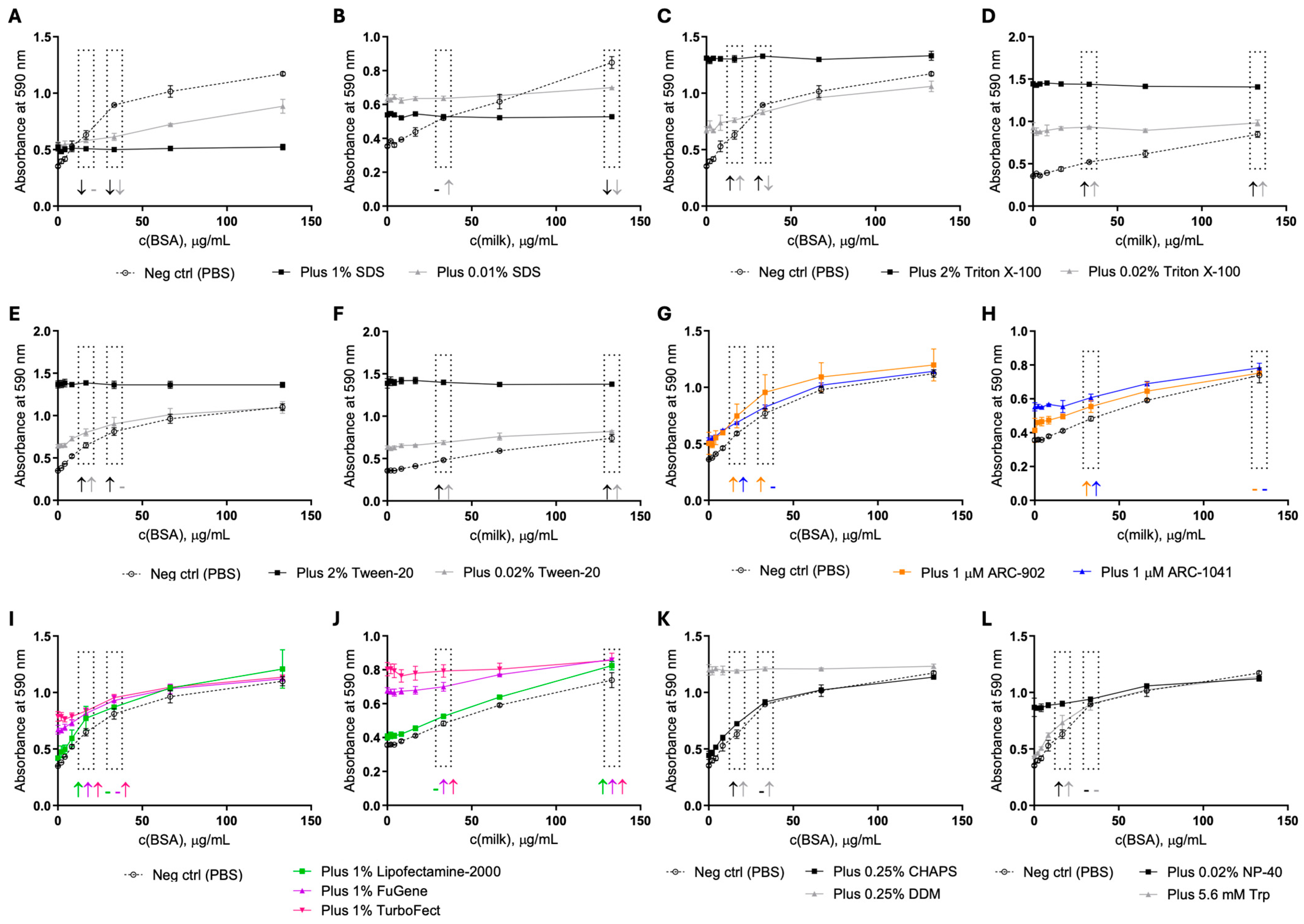
Figure 1. Examples of the analyte calibration curves measured by Bradford assay in the presence or absence of the interfering compounds from the validation set. Each panel represents data from a single independent experiment (mean and standard deviation of replicates); the data are shown only for compounds and concentrations which featured statistically significant interference with the analyte detection at least at one concentration of the analyte in all independent experiments (N ≥ 2). Analytes: in panels (A,C,E,G,I,K,L) BSA; in panels (B,D,F,H,J) non-fat milk. The interfering compounds together with the final total concentrations used in the assay are listed below each panel (or a pair of panels if data for both BSA and milk are shown). The boxes indicate analyte concentrations at which the interfering effects of compounds were systematically assessed. The arrows under the boxes show statistically significant effects for the given experiment (p < 0.05); dashes indicate no statistical significance relative to the positive control. The color codes of the symbols are consistent with the color codes used for the interfering compound annotation; the direction of the arrow indicates whether, in the presence of the shown concentration of the interfering compound, the measured signal is higher (↑) or lower (↓) than for the analyte alone.
Sci 08 00145 g001
Figure 2. Interfering effects of transfection reagents and synthetic peptides spiked into lysates of the cancerous cell lines. (AC) Pooled signals (N = 2 in quadruplicates) measured for the most dilute concentration of the lysate (0.34% v/v, cell line indicated at the bottom of each panel) in the presence or absence of the interfering compounds (listed in the middle section of the image); negative control signal shown for reference. (DF) Slope of the linear regression plotted for three lysate dilutions (N = 2) in the presence or absence of the interfering compounds. Note that in (D,E), the y-axis does not start from zero. Statistical significance of grouped comparisons (one-way ANOVA with Dunnett’s test for multiple comparisons): **** p < 0.0001, *** p < 0.001, ** p < 0.01, * p < 0.05, ns—not significant.
Sci 08 00145 g002
Figure 3. Clustering of interfering compounds based on the absorbance spectrum shift of CBBG dye in the absence of analytes. (A,B) Heatmaps based on the normalized absorbance spectra of CBBG in the presence of PBS only (negative control), BSA (positive control), or various interfering compounds at the highest concentration tested (abbreviations: TX, Triton X-100; TW20, Tween-20; ARCa, ARC-902; ARCb, ARC-1041; FuG, Fugene® 6; Lipo, Lipofectamine® 2000; Trp, L-tryptophan; Turb, TurboFect). Sample annotations are listed at the bottom (different numbers represent independent experiments), and wavelength annotations on the right side of each panel. (C,D) PCA plots based on the same data as in the case of heatmaps. Sample annotations are listed on the right side of each panel (different numbers represent independent experiments); the circles represent confidence intervals (95% probability).
Sci 08 00145 g003
Figure 4. Comparison of interfering effects in Lowry vs. Bradford assays. (A) Lowry assay linear regression slope values for two different calibrants (left, BGG; right, BSA) in the absence or presence of a set of interfering compounds. (BD) Bradford assay results at different concentrations of the calibrant (listed at the bottom of each panel; results of individual measurements are shown as dark circles); (EG) corresponding Lowry assay results. The names and final concentrations of the interfering compounds are listed to the right of panel (A), or below the X-axis in panels (BG). All panels show mean and standard deviation of replicates for two independent experiments performed in quadruplicate (in the case of ARC-902) or duplicate (for all other compounds); dashed lines show the signal corresponding to the negative control. In all panels, asterisks indicate statistical significance of grouped comparisons related to the data measured in the absence of interfering compounds (one-way ANOVA with Dunnett’s test for multiple comparisons): *** p < 0.001, ** p < 0.01, * p < 0.05, ns stands for non-significant.
Sci 08 00145 g004
Table 2. Interfering effects of tested compounds on CBBG absorbance at 595 nm in the absence of protein analyte.
CompoundClass of CompoundLowest Tested Concentration Interfering with the CBBG Signal at 590 nmStatistical Significance and Fold Change Relative to Free CBBG at 590 nm bHighest Tested Concentration Not Interfering with the CBBG Signal at 590 nm cChange in Spectral Characteristics of CBBG in the Presence of the Compound
SDSDetergent0.010% v/v***
1.66×
NAIncrease in absorbance at 650 nm
Triton X-100Detergent, aromatic compound0.013% v/v***
1.31×
0.0067% v/vIncrease in absorbance at 620 nm
Tween-20Detergent, alcohol0.0082% v/v***
1.27×
0.0027% v/vIncrease in absorbance at 625 nm
NP-40Detergent, alcohol, aromatic compound0.0083% v/v***
1.49×
0.0027% v/vIncrease in absorbance at 625 nm
CHAPSDetergent, alcohol0.25% v/v***
1.28×
0.11%Increase in absorbance at 625 nm
DDMDetergent, alcohol0.012% v/v***
1.27×
0.0041% v/vIncrease in absorbance at 620 nm
DigitoninDetergent, alcoholNAns100 μMNM
GlycerolSolvent, alcoholNAns5.0% v/vNM
DMSOSolventNAns1.0% v/vNM
DMFSolventNAns1.0% v/vNM
GlycineAmino acidNAns10 mMNM
L-arginineAmino acid20 mM*
1.20×
10 mMIncrease in absorbance at 595 nm
L-tryptophanAmino acid5.6 mM**
1.23×
2.2 mMIncrease in absorbance at 595 nm
BPAEDC, aromatic compound, phenolNAns5.0 μMNM
BPFEDC, aromatic compound, phenolNAns5.0 μMNM
DDEEDC, aromatic compoundNAns5.0 μMNM
HCBEDC, aromatic compoundNAns5.0 μMNM
MEHPEDC, aromatic compoundNAns5.0 μMNM
MEHHPEDC, aromatic compoundNAns5.0 μMNM
PCB170EDC, aromatic compoundNAns5.0 μMNM
PCB180EDC, aromatic compoundNAns5.0 μMNM
PFOAEDC, perfluorinated compoundNAns5.0 μMNM
PFOSEDC, perfluorinated compoundNAns5.0 μMNM
Fugene® 6 aTransfection reagent0.67% v/v***
1.48×
0.22% v/vIncrease in absorbance at 585 nm
Lipofectamine® 2000 aTransfection reagent1.0% v/v**
1.17×
0.22% v/vIncrease in absorbance at 585 nm
TurboFect aTransfection reagent0.22% v/v***
1.44×
0.074% v/vIncrease in absorbance at 585 nm
ARC-902D-arginine-rich peptide conjugate370 nM***
1.06×
180 nMIncrease in absorbance at 585 nm
ARC-1041D-arginine-rich peptide conjugate550 nM***
1.18×
180 nMIncrease in absorbance at 585 nm
DTTReducing agent (thiol)NAns5.0 mMNM
Abbreviations: NA, not achieved; NM, not measured; ns, not significant. a The percentage shown corresponds to the dilution of the stock solutions; the concentrations of the stock solutions were not specified by the producers. b The fold change shown corresponds to the ratio of absorbance values measured in the presence vs. absence of the lowest tested concentration of compound interfering with the CBBG signal; statistical significance (one-way ANOVA with Dunnett’s test for multiple comparisons): *** p < 0.001, ** p < 0.01, * p < 0.05. c The indicated concentrations can be considered safe if the same assay format is used as reported here.
Disclaimer/Publisher’s Note: The statements, opinions and data contained in all publications are solely those of the individual author(s) and contributor(s) and not of MDPI and/or the editor(s). MDPI and/or the editor(s) disclaim responsibility for any injury to people or property resulting from any ideas, methods, instructions or products referred to in the content.