Article

Data-Driven Modelling of Damping Behaviour in Austempered Ductile Iron: Influence of Manganese Content and Heat Treatment Parameters


Manipal Institute of Technology, Manipal Academy of Higher Education, Manipal 576104, Karnataka, India
*
Author to whom correspondence should be addressed.
Sci 2026, 8(6), 128; https://doi.org/10.3390/sci8060128
Submission received: 2 April 2026 / Revised: 9 May 2026 / Accepted: 14 May 2026 / Published: 30 May 2026
(This article belongs to the Section Materials Science)

Abstract

Mechanical components subjected to dynamic loading require materials that combine adequate strength with effective vibration-damping capability. Austempered ductile iron (ADI) is a promising candidate for such applications because of its ausferritic matrix, which provides a useful combination of strength, toughness, wear resistance, and energy dissipation. However, the damping behaviour of manganese-alloyed ADI and its dependence on austempering parameters have not been sufficiently clarified. In this study, ductile iron containing 0.3, 0.6, and 0.9 wt% Mn was austempered at 320, 370, and 420 °C for 1, 1.5, and 2 h using a full-factorial experimental design. The damping response was evaluated through impact hammer-based experimental modal analysis and correlated with hardness, ausferritic morphology, and the volume fraction of carbon-enriched/high-carbon austenite. The results showed that manganese content and austempering temperature significantly influenced the loss factor, whereas austempering time had only a minor effect within the selected range. The highest damping performance was obtained for the alloy containing 0.6 wt% Mn austempered at 370 °C, where a favourable balance was achieved between stabilized high-carbon austenite, refined ausferritic morphology, ferrite/austenite interface density, and controlled matrix hardness. At 320 °C, limited austenite stabilization restricted damping improvement, while at 420 °C, ausferritic coarsening reduced the effective interface-related energy dissipation. ANOVA confirmed manganese content and austempering temperature as the dominant factors, contributing approximately 59% and 39%, respectively, to the variation in loss factor. The regression model showed strong predictive capability within the investigated process window. Overall, the study demonstrates that damping behaviour in manganese-alloyed ADI can be effectively tailored through controlled alloy chemistry and austempering temperature, supporting its potential use in vibration-sensitive engineering components.

1. Introduction

Structure-borne noise and vibration are causes of concern for a system exposed to dynamic loading. Mitigation of these adverse effects of vibration is a challenging task for design engineers. This could lead to a paradigm shift in addressing the materials science aspect to meet the demands of a dynamic system. Selection of a material with good damping could be a viable option, as it reduces the adverse effects of the vibrations significantly [1]. On the contrary, damping alone would not be sufficient to meet the criteria of the design for the dynamic loading. Good strength and ductility are the other metrics that need to be addressed [2,3]. For vibration-damping applications, the cast iron (CI) was often preferred for the lathe bed and machine foundations [4,5]. However, the CI performs badly under cyclic loads, as it possesses poor ductility [6]. In recent years, there has been an increased interest in a material with good strength, damping, and ductility. Literature reports indicate that austempered ductile iron (ADI), a class of CI, has been extensively explored to meet the demand for the material with the aforementioned properties [7,8,9,10,11].
ADI is a high-performance class of ductile iron known for its exceptional combination of strength, toughness, wear resistance, and damping capability. Its superior strength-to-weight ratio and excellent fatigue resistance make it a competitive alternative to forged steels in demanding applications such as gears, crankshafts, suspension components, agricultural implements, and off-highway machinery [7,8,9,10,11]. ADI derives its properties from the ausferritic microstructure formed through austempering heat treatment, where a mixture of acicular ferrite and carbon-enriched austenite provides a balanced combination of hardness, ductility, and impact resistance [12,13,14,15,16]. The ability to tailor its mechanical properties through controlled alloying additions and precise manipulation of austempering parameters makes ADI a versatile engineering material suitable for both static and dynamic loading conditions. Machine components manufactured from ADI have superior performance under static as well as dynamic loading, which elevates them from other categories of cast irons. However, under dynamic loading, it is very important that these components should withstand the undesirable vibration emanating from various sources [17]. In such a scenario, damping plays a major role. A material with low damping may be detrimental as it is susceptible to resonance, which eventually leads to failure due to the fatigue loading [18]. The mechanism of damping may be viscous, hysteretic, or structural [19]. However, for the metals, the damping is mainly associated with the structural level, which is essentially the interaction at the microscopic level [19]. From an economic viewpoint, ADI is also attractive because it can be produced from ductile iron castings using near-net-shape manufacturing, thereby reducing machining requirements and material wastage compared with many forged steel components. Although austempering introduces an additional heat-treatment step, the resulting improvement in strength, toughness, wear resistance, and damping capability provides a favourable property-to-cost ratio. In the present study, manganese is added only within a controlled low range of 0.3–0.9 wt%, and hence its contribution to the overall alloy cost is expected to be limited. Therefore, manganese-alloyed ADI can still be considered a cost-effective material for dynamically loaded engineering components requiring both mechanical performance and vibration-damping capability.
Estimation of structural damping is essential to understand the energy dissipation characteristics of materials. There are very well-established approaches to characterize the damping properties of the material, like a piezoelectric oscillator where the material is exposed to a longitudinal wave [20] or measurement of the ratio of loss and the storage modulus from the Dynamic Mechanical Thermal Analysis (DMTA) [4]. An approach based on the flexural internal frictional measurement [21] or from the inverted torsional pendulum method [22] can be employed to measure the damping. Few studies have adopted an approach based on the free vibration, where decay in oscillations would be used to estimate the damping [23,24]. Additionally, experimental modal analysis using an impact hammer test can also be implemented to measure the damping characteristics of the materials [4]. This method is more versatile, and it measures dynamic stiffness and damping characteristics. Moreover, this approach is more effective in terms of the ease of measurement and from an economic point of view.
Manganese is one of the important alloying elements in ductile iron and plays a significant role in controlling the austempering response of ADI. The addition of Mn improves hardenability and helps in delaying pearlitic transformation during cooling, thereby supporting the formation of the ausferritic matrix during austempering. However, the effect of Mn is composition-sensitive, because excessive Mn may promote microsegregation, particularly near eutectic cell boundaries, and may adversely affect the uniformity of transformation. Within a controlled range, Mn also contributes to the stabilization of carbon-enriched austenite, which is an important phase in ADI because it influences strength, toughness, and damping response. Therefore, optimizing Mn content is necessary to obtain a favourable balance between matrix refinement, phase stability, and energy dissipation capability.
In addition to alloy chemistry, austempering temperature and holding time strongly influence the morphology and phase balance of ADI. Lower austempering temperatures generally promote finer acicular ferrite and higher hardness, whereas higher austempering temperatures favour coarser ausferritic morphology and greater stabilization of carbon-enriched austenite. Similarly, the holding time controls the progress of austempering transformation and carbon partitioning between ferrite and austenite. Insufficient holding time may result in incomplete transformation, while excessive holding time may promote microstructural coarsening or undesirable transformation products. Since damping in ADI is closely associated with microstructural features such as ferrite/austenite interface density, carbon-enriched austenite stability, graphite–matrix interfaces, and matrix hardness, the combined influence of Mn content, austempering temperature, and holding time must be systematically evaluated.
Although ADI has been extensively studied for its strength, toughness, wear resistance, and fatigue performance, comparatively limited attention has been given to its damping behaviour, particularly with respect to the combined effects of manganese content, austempering temperature, and holding time. Previous studies have generally focused on mechanical properties or microstructural development, while systematic quantification of damping response using a full-factorial design remains limited. Therefore, the present work investigates the damping characteristics of manganese-alloyed ADI using impact hammer-based experimental modal analysis. The measured loss factor is correlated with ausferritic morphology, carbon-enriched austenite stability, hardness, and process parameters. In addition, analysis of variance and regression modelling are employed to identify the dominant factors and develop a predictive relationship for damping behaviour within the selected processing window.

2. Materials and Methods

2.1. Material Preparation

Ductile iron required for the present study was produced in accordance with ASTM A897/A897M [25]. Melting was carried out in a medium-frequency induction furnace, followed by the addition of alloying elements, nodulizing agents, and inoculants. The melt was poured into standard 1-inch Y-block moulds at a pouring temperature between 1490 and 1520 °C. To investigate the influence of manganese content, three compositions were prepared by varying Mn at 0.3 wt%, 0.6 wt%, and 0.9 wt%, while keeping the remaining alloying elements nearly constant. The selected manganese levels were chosen based on typical industrial ADI compositional limits and prior literature indicating that Mn in the range of 0.2 to 1.0 wt% significantly influences transformation kinetics, carbon-enriched austenite stability, and hardenability without promoting carbide formation. The upper limit (0.9 wt%) was selected to remain below segregation-induced embrittlement thresholds reported in industrial ADI practice [26]. These compositions, referred to as Alloy 1, Alloy 2, and Alloy 3, respectively, are listed in Table 1. The final chemical compositions were confirmed using optical emission spectroscopy.

2.2. Microstructure Observation

The as-cast microstructure of the alloys was examined using an optical microscope (Make: Olympus GX53). Standard metallographic preparation (sectioning, grinding, polishing, and etching) was used to reveal the graphite nodules and matrix phases. The typical bull’s-eye morphology of ductile iron was observed in all alloys (Figure 1), consisting of graphite nodules surrounded by ferrite [27]. Nodule count (number/mm2) was determined following standard image-analysis procedures to quantify the effect of manganese on nodule distribution. Also, the hardness of the as-cast alloy samples is measured. The nodule count and the hardness of the alloy samples are listed in Table 2.

2.3. Heat Treatment and Mechanical Characterization

A full factorial Design of Experiments (DoE) [28] approach was employed to study the combined influence of manganese content, austempering time, and austempering temperature on the damping characteristics of ADI. Three parameters were selected, each at three levels, and the corresponding details are listed in Table 3.
The full factorial design resulted in 27 unique combinations, and all 27 heat-treatment trials were carried out. This enabled the systematic study of both main effects and potential interactions among the three process parameters.

2.4. Heat Treatment Procedure

To establish the influence of these three factors on the formation of the ausferritic microstructure and related mechanical performance, all 27 heat-treatment combinations were systematically evaluated. Samples were first austenitized at 900 °C for 2 h in a muffle furnace to achieve a uniform austenite phase and to homogenize the alloying elements across the matrix. Immediately after the austenitizing hold, each specimen was transferred to a salt bath furnace set to the specific austempering temperature assigned by the experimental matrix (320 °C, 370 °C, or 420 °C). The samples were then held isothermally in the salt bath for the designated duration of 1 h, 1.5 h, or 2 h, depending on the trial condition. After the completion of the austempering stage, samples were removed and allowed to cool in still air to room temperature.
Conducting all 27 trials enabled a clear understanding of how each parameter, individually and in combination, affects the development of the ausferritic matrix, carbon-enriched austenite stability, hardness, and resulting damping behavior. Following heat treatment, SEM was used to assess the microstructural evolution under each condition. X-ray diffraction (XRD) was employed to quantify carbon-enriched austenite, and Brinell hardness measurements were carried out according to ASTM E10 to determine the effect of the process parameters on mechanical properties. The volume fraction of carbon-rich austenite in the austempered samples was estimated using X-ray diffraction analysis. Prior to XRD, the samples were metallographically polished to obtain a smooth and defect-free surface. XRD analysis was carried out using Cr-Kα radiation over a 2θ range of 35–50°, covering the principal austenite 111 and ferrite 110 diffraction peaks generally used for ADI phase-fraction estimation. The diffraction data were plotted using OriginPro 8.5 software, and the integrated intensities of the austenite and ferrite peaks were obtained from the corresponding peak areas. The volume fraction of high-carbon austenite was calculated according to the ASTM E975-based intensity-ratio method using the following equation:
V γ = I γ / R γ I α / R α + I γ / R γ
where V γ is the volume fraction of high-carbon austenite, I γ is the integrated intensity of the austenite 111 peak, I α is the integrated intensity of the ferrite 110 peak, and R γ and R α are the corresponding theoretical intensity factors for Cr-Kα radiation. The theoretical intensity values were taken from ASTM E975, while the integrated peak intensities were obtained from the XRD plots generated in OriginPro.
Hardness test was carried out using Brinnel hardness test as per ASTM E10 standard. Tensile strength was determined using ASTM A897 standard.

3. Damping Property Characterization

3.1. Material Damping Behavior

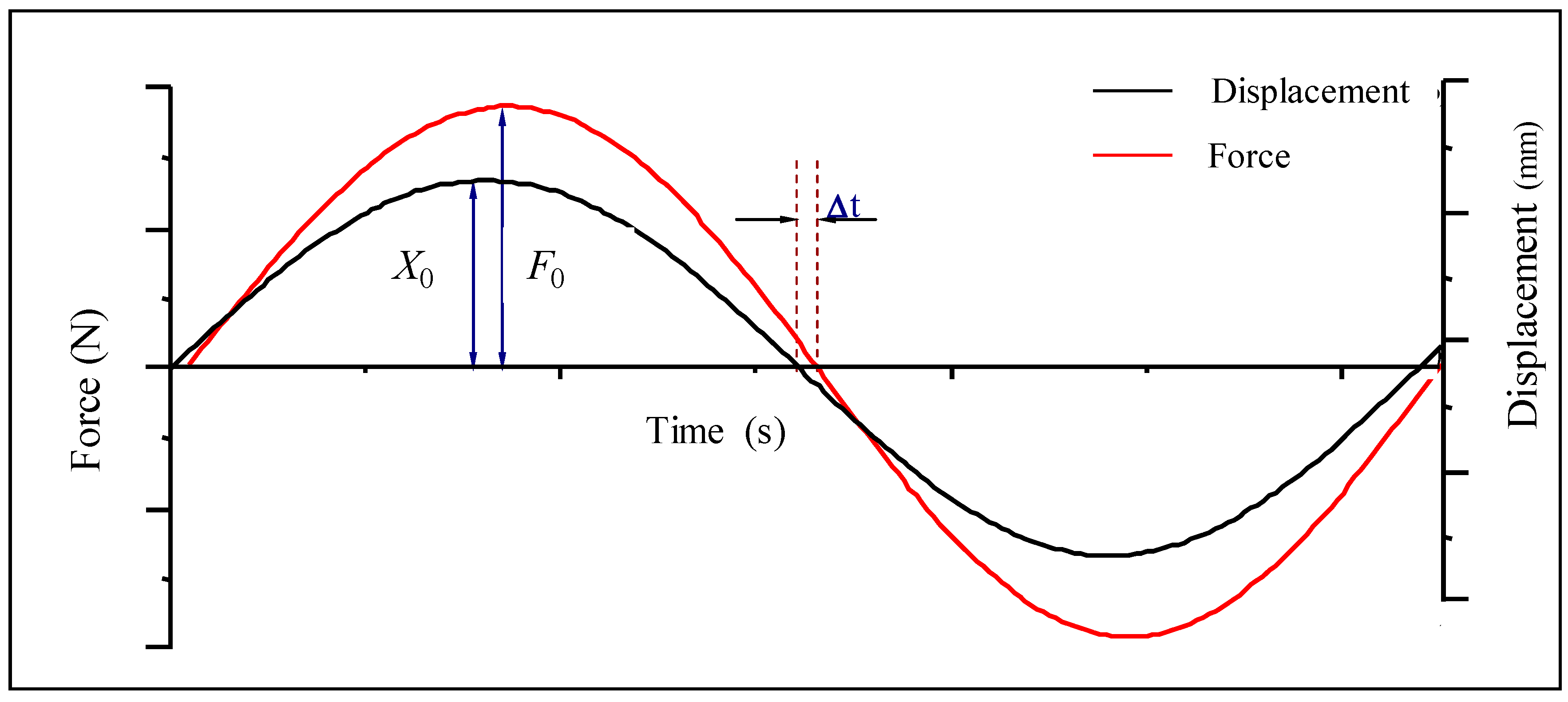
The response of engineering materials differs under dynamic and static loading conditions. Under cyclic loading, the material response slightly deviates from the ideal solid behavior. This typical response is characterized by having a phase difference between the load and the displacement response. This deviation is associated with the energy dissipation characteristics of a material, which is defined as the damping or the loss factor [28]. A graphical response is presented in Figure 2, where a harmonic input force produces a sinusoidal displacement response with the same angular frequency. However, because of the energy dissipation characteristics of the material, the displacement response lags behind the applied force by a phase angle, δ [29].
F ( t ) = F 0 s i n ( ω t )
X ( t ) = X 0 s i n ( ω t δ )
where F ( t ) is the applied harmonic force, F 0 is the force amplitude, X ( t ) is the displacement response, X 0 is the displacement amplitude, ω is the angular frequency, and δ is the phase angle between force and displacement. Since the present experimental approach is based on impact hammer excitation and beam response measurement, the quantities are expressed in terms of force and displacement rather than shear stress and shear strain.
The term complex stiffness represents the ability of the material to dissipate and absorb energy. It represents the ability of the material to resist deformation. Mathematically it is expressed as [30],
k * = F ( t ) x ( t ) = F 0 e j ( ω t + ϕ ) X 0 e j ω t = F 0 X 0 cos ϕ + i sin ϕ
The complex stiffness consists of two terms, first term k’ represents the instantaneous response, which represents the ability of the material to absorb the vibration energy and the second term k″ signifies the ability of the material to dissipate the energy in terms of heat [29,30].
k = F 0 X 0 c o s   ϕ   and   k = F 0 X 0 sin ϕ
The ability of a material to dissipate the energy is expressed in terms of loss factor η [29]. It is expressed as the ratio between the imaginary and real parts of the complex stiffness.
η = tan ϕ = k K k
In terms of loss factor, the complex stiffness is expressed as
k * = k + i k = k ( 1 + i η )

3.2. Methodology

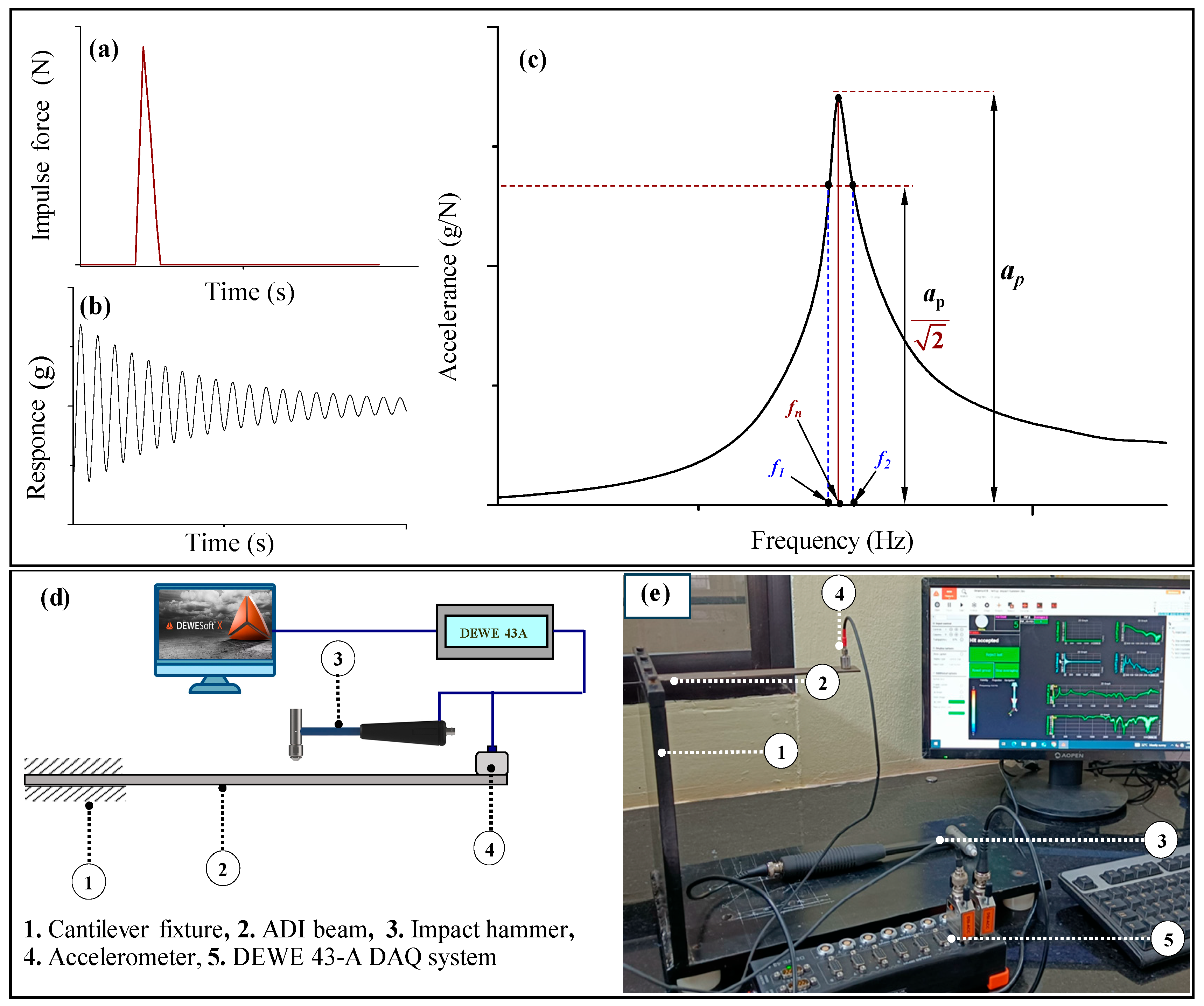
Damping characteristics measure the ability of the material to dissipate the energy. There are very well-defined approaches to measure the damping characteristics of a material. In the proposed study, an approach based on the impact hammer excitation method is adopted. According to this method, the test material is excited by an impulse force (Figure 3a) from an impact hammer. A motion sensor is used to measure the response (Figure 3b). From the excitation and the response, the impulse response function is estimated. A sample plot corresponding to the transfer function, which is the ratio of the response and the impulse, is presented in Figure 3c. The damping ratio is estimated as the loss factor, which is extracted according to the half-power bandwidth method. In the response plots, the frequency corresponding to the peak amplitude was identified as the natural frequency fn.
Using peak picking method, the natural frequency of the beam is estimated for the peak amplitude of ap. The half-power points (f1 and f2) correspond to the amplitude level ap/ 2 is estimated from the response plots. The loss factor of tested sample is calculated by the following expression [31,32],
η = f 2 f 1 f n
where f2 and f1 are the frequencies corresponding to the half-power points.

3.3. Experimental Set up

In the present study, the damping characteristics of ADI are estimated using the impact hammer-based experimental modal analysis approach [33,34]. Test samples of dimensions 250 mm × 25 mm × 2 mm were prepared as per the standard ASTM E756–05. The schematic representation and the actual images of the experimental setup are presented in Figure 3. As per the standard, the ADI sample is tested in a fixed free configuration. The input excitation was given at the fixed end by using an impact hammer (PCB, type-086C40) of sensitivity 2.25 mV/N. The response signals were measured from an accelerometer (MMF, type-145A100) attached to the free end of the beam. The impulse and the excitation signals were acquired through DEWE-43A—USB data acquisition system (DAQ). DewesoftX software interface was used to obtain the frequency response plot to extract the loss factor of the ADI.
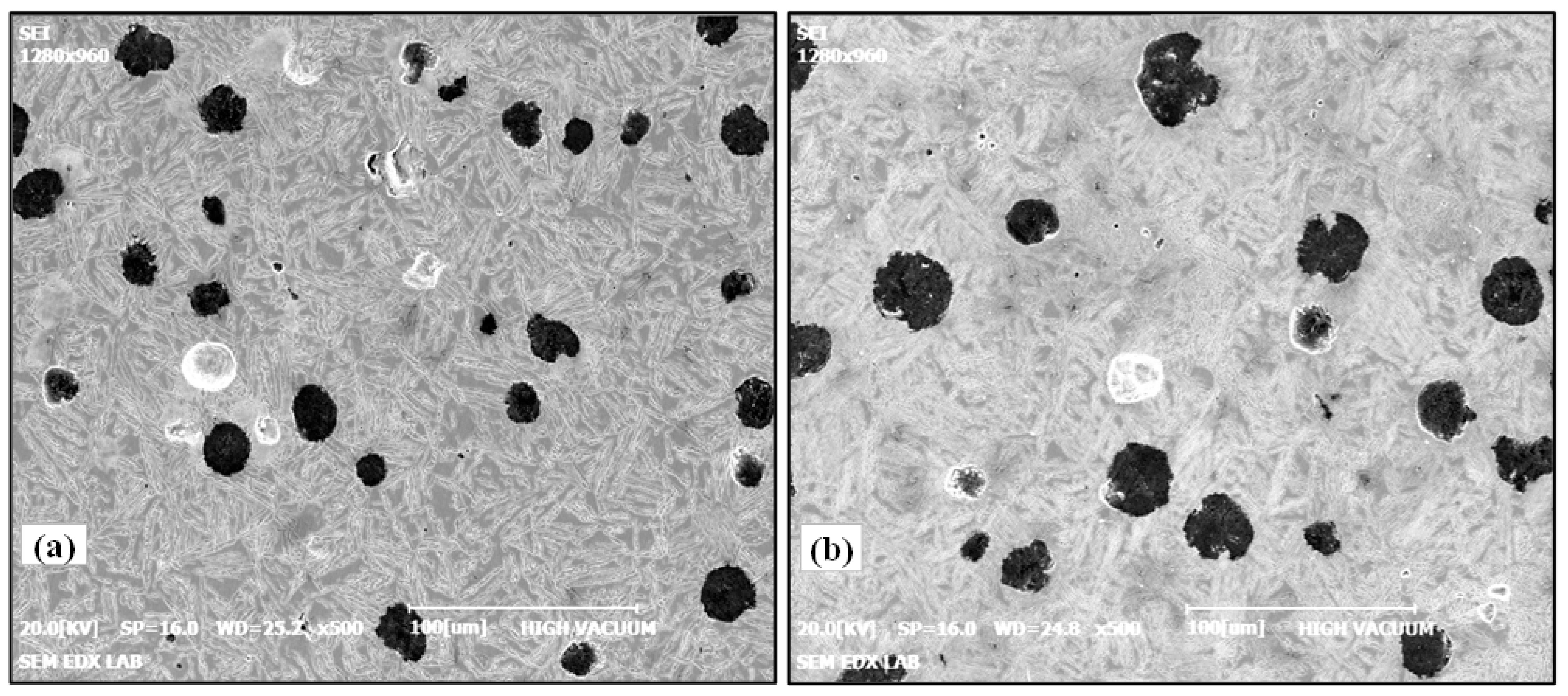
Figure 4 compares the SEM microstructures of ADI samples containing 0.3 wt% and 0.9 wt% Mn austempered at 370 °C for 1 h. In both cases, graphite nodules are clearly retained within the ausferritic matrix, confirming the successful transformation of the ductile iron matrix during austempering. The 0.3 wt% Mn alloy shows a relatively uniform ausferritic morphology with clearly distributed acicular ferrite and carbon-enriched austenite. With the increase in Mn content to 0.9 wt%, the matrix still exhibits an ausferritic structure; however, the morphology appears comparatively different due to the stronger influence of Mn on hardenability, carbon partitioning, and austenite stabilization. Since Mn delays the austenite-to-ausferrite transformation and may promote local segregation at higher concentration, the 0.9 wt% Mn alloy is expected to show greater stabilization of carbon-enriched austenite, but not necessarily a proportionate improvement in damping. Thus, the comparison indicates that Mn content influences the transformation behaviour and phase stability of ADI, although the damping response is ultimately governed by the combined effect of Mn content, ausferritic morphology, carbon-enriched austenite fraction, and ferrite/austenite interfacial characteristics.
The damping characteristic of the ADI is estimated for the fundamental mode of vibration using the impulse response plots expressed in terms of accelerance [35]. These measurements were repeated for all the samples listed in Table 1. The clamping torque is carefully monitored to maintain consistency in the test results. To ensure consistency in the measured response, experiments were performed on three identical beam samples, with a total of 15 averages considered. Experiments were repeated three times under the same working conditions, and the average response was considered for the analysis.

4. Results

4.1. Microstructure and Mechanical Property Evaluation

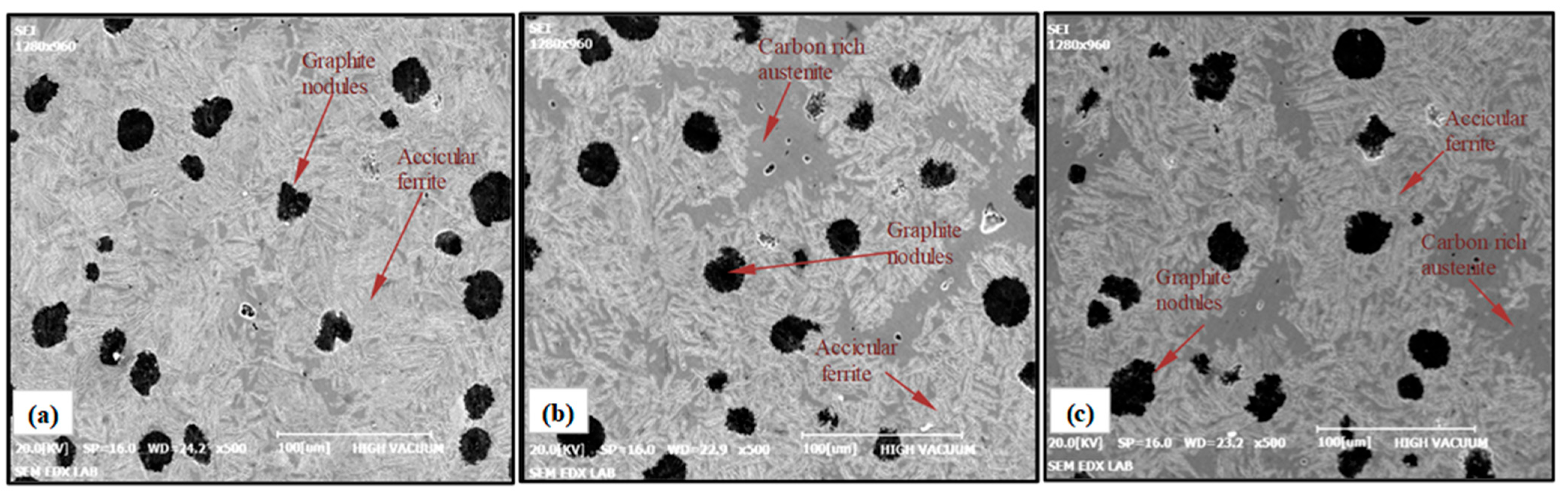
SEM (JEOL JSM-IT500) is used to study the images of the ADI samples to determine the variation in microstructure during heat treatment cycles. Samples were sectioned, mounted in Bakelite, ground using SiC papers (220–1200 grit), polished using 6 µm and 1 µm diamond suspension, and finally polished using colloidal silica. Etching was performed using 2% Nital for 8–10 s to reveal matrix phases. SEM images of ADI samples with 0.6 wt% Mn, heat treated at temperatures 320 °C, 370 °C and 420 °C are presented in Figure 5.
In all cases, the characteristic graphite nodules of ductile iron remain visible and are embedded within an ausferritic matrix composed of acicular ferrite and carbon-enriched carbon enriched austenite.
A clear variation in matrix morphology is observed with austempering temperature. At 320 °C, the microstructure appears relatively fine, with closely packed acicular ferrite and comparatively narrow inter-lath spacing. This refined ausferritic morphology is characteristic of lower austempering temperatures, where transformation occurs under restricted carbon diffusion conditions. As a result, nucleation is favoured over growth, leading to the formation of finer ferrite needles and a comparatively harder matrix. This interpretation is consistent with the higher hardness values observed for the samples austempered at 320 °C.
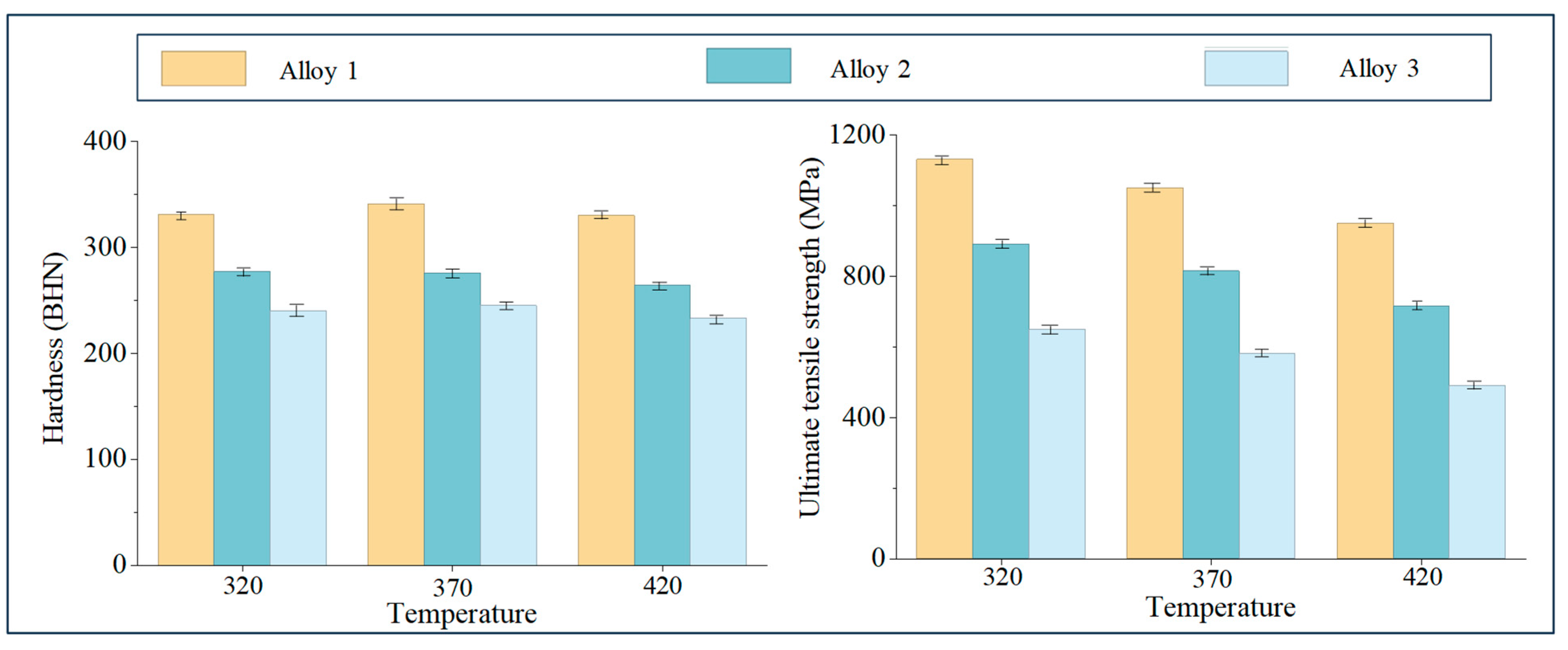
At 370 °C, the ausferritic structure becomes more balanced, with adequate ferrite refinement together with improved stabilization of carbon-enriched austenite. This condition appears to provide a favourable microstructural combination in which the ferrite-austenite interfaces remain sufficiently abundant while the carbon-enriched austenite fraction becomes more stable. Such a microstructure is expected to support a better combination of strength, ductility, and damping performance. The hardness and tensile strength trends presented in Figure 6 further support this observation, indicating that intermediate austempering temperature produces a more favourable balance between phase refinement and phase stability.
When the austempering temperature is increased to 420 °C, the ausferritic morphology becomes noticeably coarser, with thicker ferrite plates and larger interlath spacing. At this higher temperature, ferrite growth is promoted more strongly than ferrite nucleation, resulting in coarsening of the matrix and a reduction in hardness. Although carbon-enriched austenite content tends to increase with increasing austempering temperature, the associated coarsening of the microstructure reduces interface density, which is less favourable for structural energy dissipation during dynamic loading. Thus, the microstructural observations indicate that austempering temperature strongly governs the morphology of the ausferritic matrix and thereby influences the mechanical and damping responses of ADI [36,37].
The SEM micrographs presented in Figure 5 correspond to representative ADI samples containing 0.6 wt% Mn and illustrate the effect of austempering temperature on the development of the ausferritic matrix. Therefore, the microstructural interpretation based on these images is limited to the temperature-dependent evolution of the 0.6 wt% Mn alloy. The influence of Mn content is discussed cautiously based on its metallurgical role in ADI, supported by the measured hardness, damping response, and high-carbon austenite fraction. Manganese is known to improve hardenability and delay the austenite-to-ausferrite transformation; however, higher Mn levels may also promote segregation near eutectic cell boundaries and reduce the effective austempering process window. Thus, within the investigated range, the effect of Mn is expected to be reflected more strongly through transformation kinetics, phase stability, and carbon-enriched austenite stabilization than through drastic visible morphological changes in the representative SEM images.
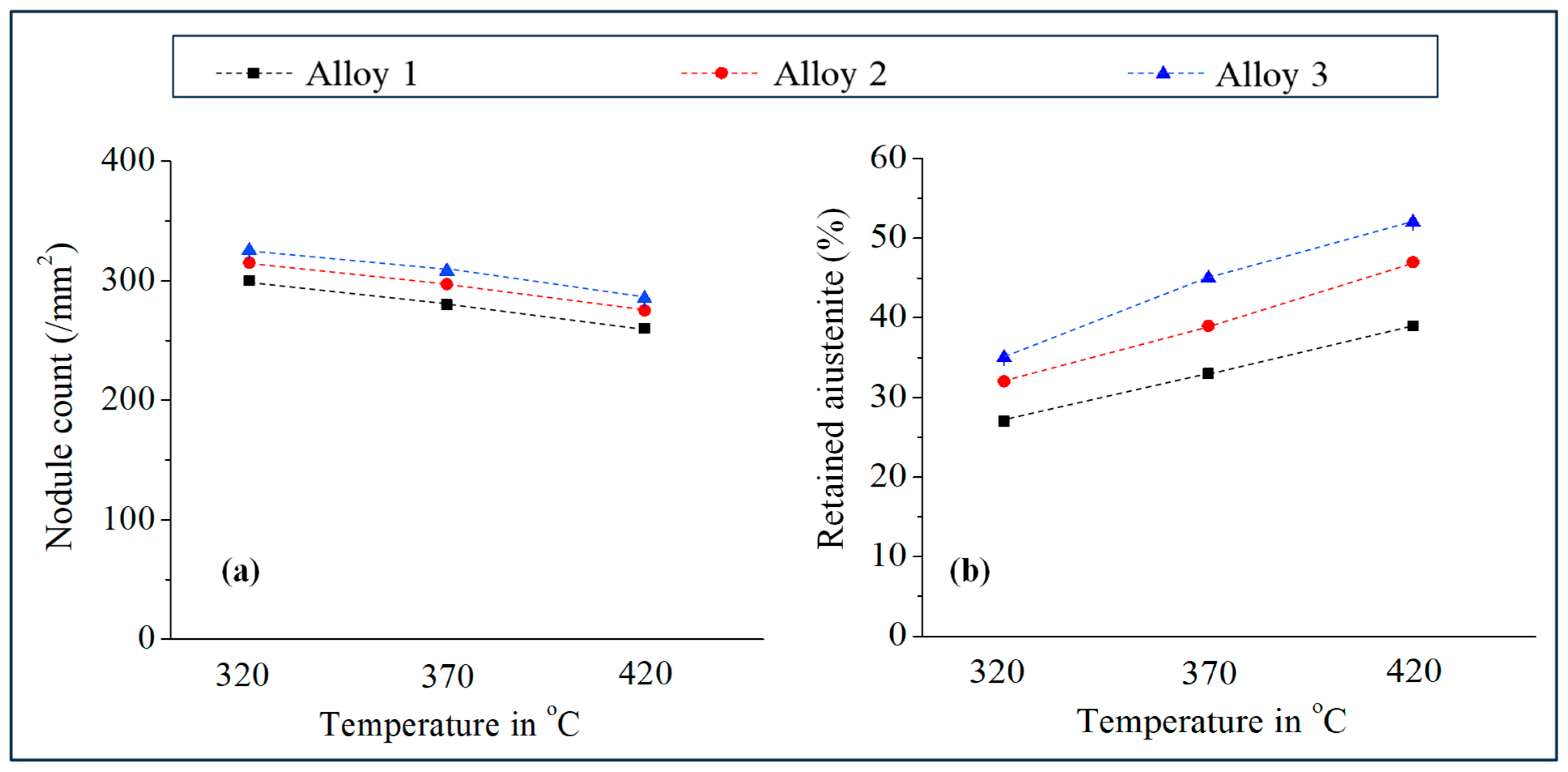
The variations in hardness, tensile strength, graphite nodule count, and carbon-enriched austenite fraction shown in Figure 6 and Figure 7 further support the interpretation that the final response of ADI is governed by the combined influence of austempering temperature, matrix refinement, phase balance, and carbon-enriched austenite stability. The higher hardness at lower austempering temperature can be associated with a finer ausferritic matrix, while the increase in carbon-enriched austenite fraction at higher temperature suggests greater austenite stabilization. However, since direct comparative SEM micrographs for each Mn level are not presented, the Mn-dependent response is interpreted primarily through its influence on transformation kinetics, phase stability, hardness, and damping behaviour rather than through direct visual comparison of morphology. Lower austempering temperature promotes a finer and harder ausferritic matrix, whereas increasing temperature leads to a progressive reduction in hardness due to coarsening of ferrite laths. At the same time, carbon-enriched austenite becomes more stabilized at elevated austempering temperatures. Therefore, the final performance of ADI is governed by the balance among matrix refinement, carbon-enriched austenite stability, graphite morphology, and interfacial characteristics [38,39,40]. Although Alloy 1 contains the lowest Mn content and shows comparatively lower as-cast hardness, the hardness and ultimate tensile strength after austempering should not be interpreted solely based on the as-cast pearlite fraction. The final mechanical response of ADI after austempering is mainly governed by the transformation behaviour during austempering, the refinement of the ausferritic matrix, the ferrite/austenite phase balance, and the extent of carbon partitioning into austenite. In low-Mn alloyed ductile iron, the austempering transformation can proceed relatively faster because Mn delays the austenite-to-ausferrite transformation. Therefore, Alloy 1 may develop a relatively finer and more completely transformed ausferritic matrix under certain austempering conditions, which can contribute to increased hardness and UTS despite its lower as-cast hardness. By contrast, higher Mn content improves hardenability and stabilizes carbon-enriched austenite, but excessive stabilization or segregation tendency may delay transformation and reduce the uniformity of the ausferritic matrix. Hence, the apparently higher hardness and UTS of austempered Alloy 1 under selected conditions are attributed to its final austempered microstructure rather than to its initial as-cast pearlite content alone.
The calculated volume fraction of carbon-enriched/high-carbon austenite, obtained from the XRD integrated intensity method, is shown in Figure 7. The results indicate that the high-carbon austenite fraction generally increases with increasing austempering temperature. This trend is associated with enhanced carbon diffusion and stabilization of austenite at higher austempering temperatures. However, the damping response does not increase continuously with increasing high-carbon austenite fraction. Instead, the highest loss factor is obtained at 370 °C, indicating that damping is controlled not only by the amount of high-carbon austenite but also by the morphology of the ausferritic matrix, ferrite/austenite interface density, and matrix coarsening. At 320 °C, the matrix is finer, but the austenite stabilization is relatively lower, whereas at 420 °C, the higher austenite fraction is accompanied by coarser ferrite laths and reduced interface density. Therefore, the optimum damping at 370 °C can be attributed to a favourable balance between high-carbon austenite fraction, ausferritic refinement, and interface-related energy dissipation.

4.2. Damping Characteristics of ADI

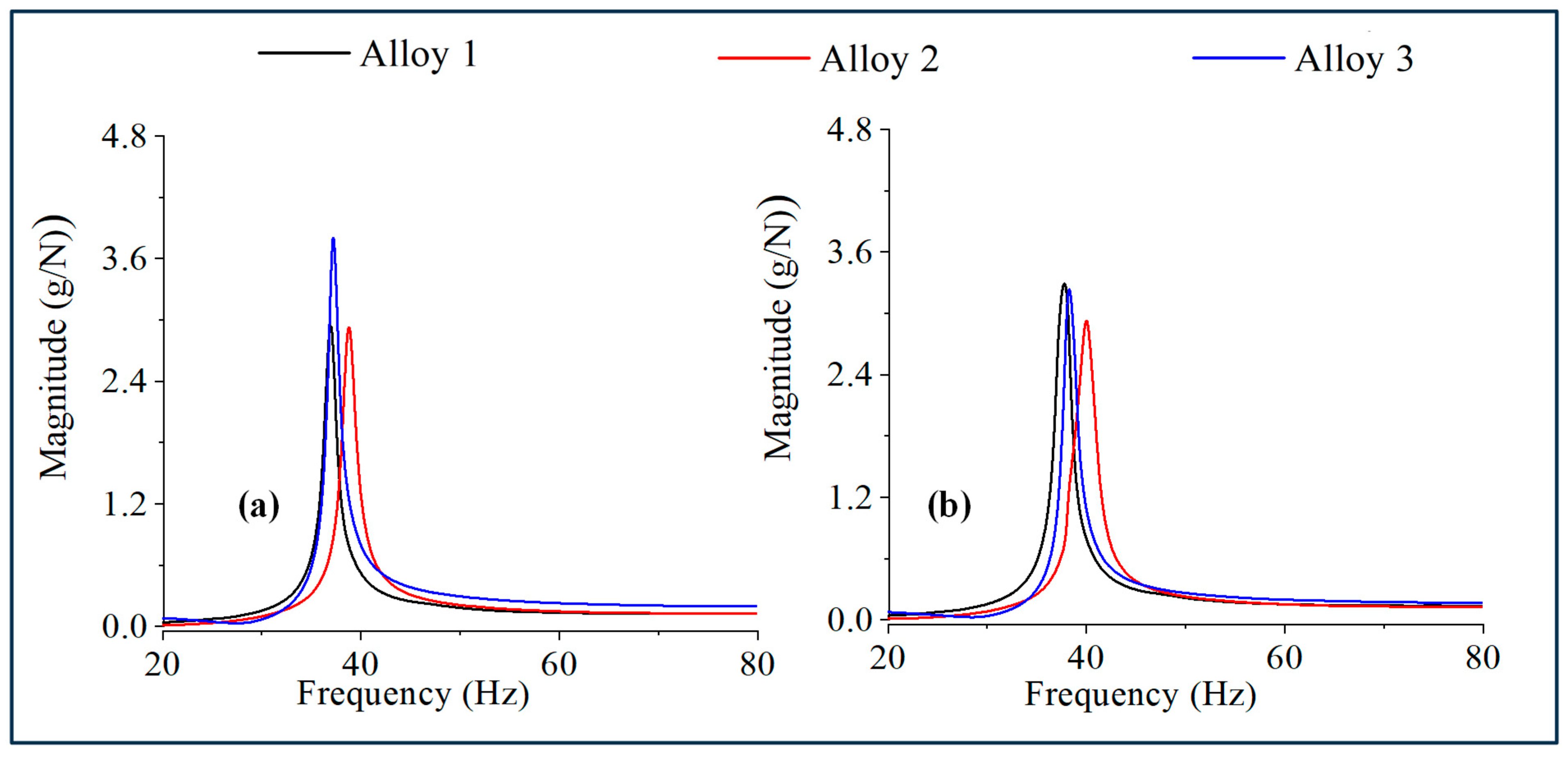
The damping characteristics are measured from the frequency response plots obtained from the experimental modal analysis approach using impact hammer tests. The frequency response plots of ADI samples corresponding to the heat treatment temperatures of 320 °C and 370 °C are presented in Figure 8. The variations are assessed only for the first mode, as at the higher modes, the differences are not quite evident. To assess the influence of the austempering heat treatment process, the loss factor of as-cast samples is investigated, and the corresponding values are listed in Table 4.
As evident from the frequency response plots, the resonance frequencies of the ADI differ with the alloy composition and the austempering temperature. For Alloy 1, corresponding to the austempering temperature of 320 °C and heat treatment duration of 1 h, the natural frequency is 37 Hz. The corresponding value is increased to 37.8 Hz as the austempering temperature is raised to 370 °C. For similar processing conditions, the natural frequency of alloy 2 is increased from 38.6 Hz to 39.9 Hz, and corresponding values for alloy 3 are increased from 37.8 Hz to 38.2 Hz. Similar values are registered for the ADI samples heat-treated for a duration of 1.5 h and 2 h. These variations indicate that the heat treatment process could not induce a significant variation in natural frequency, which implies that the complex Young’s modulus of ADI is unaffected by the heat treatment process. However, the variation in the damping properties is quite evident.
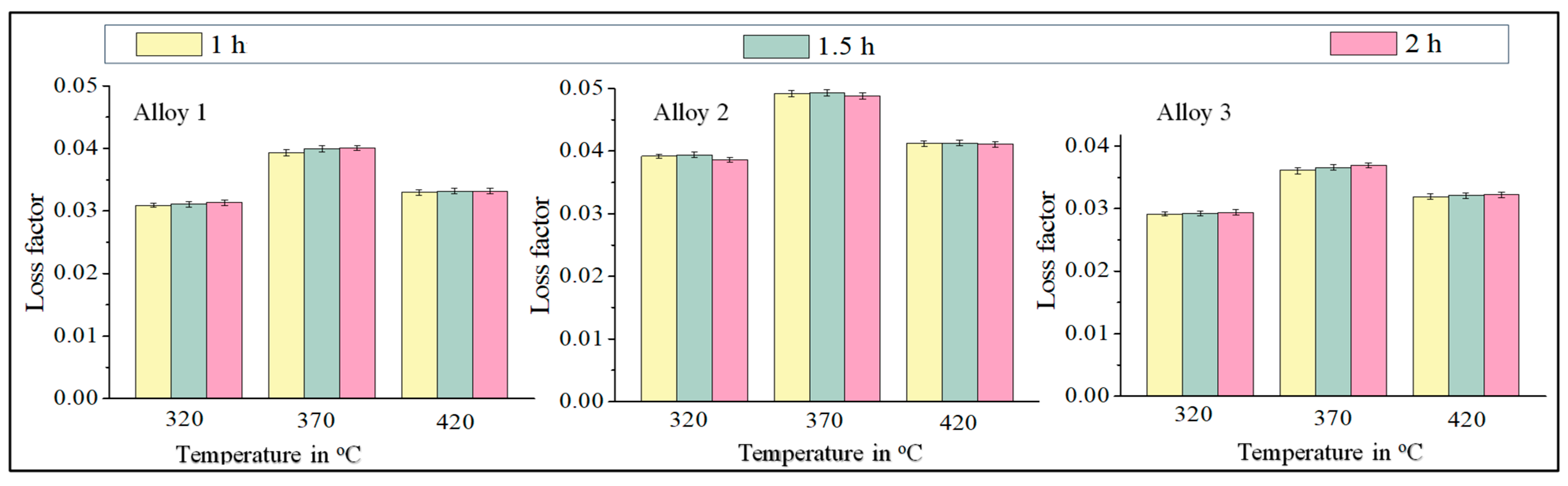
Figure 9 presents the variation in the loss factor as a function of the austempering heat treatment temperature and the heat treatment duration. For alloy 1, corresponding to 320 °C, the loss factor registered for 1 h, 1.5 h, and 2 h of heat treatment duration are 0.0309, 0.0311, and 0.0313, respectively. A similar trend is observed for alloy 2 and alloy 3 samples. This signifies that the heat treatment time does not contribute to the variation in the damping characteristics of ADI samples. However, it is evident that the loss factor for alloy 1 is increased from 0.0309 to 0.0398 as the heat treatment temperature is increased from 320 °C to 370 °C. Conversely, with a further increase in the temperature to 420 °C, the loss factor is reduced to 0.0330. A consistency in temperature-dependent variation in the loss factor is observed for alloy 2 and alloy 3 samples.
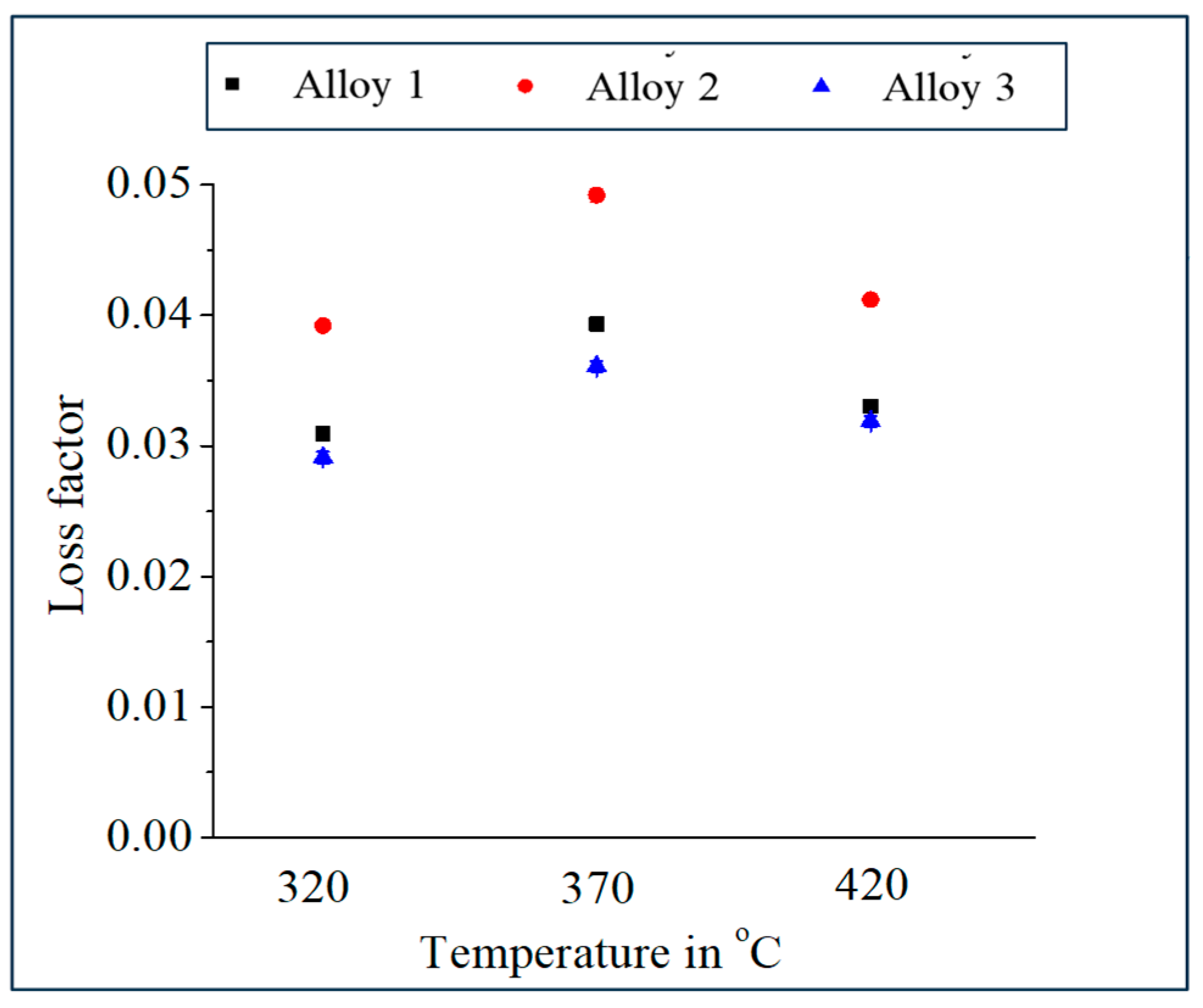
Figure 10 presents the variation in the loss factor as a function of the austempered temperature. As stated earlier, the damping values for alloy 2 are higher compared to alloy 1 and alloy 3. However, these values depend on the base values of the as-cast samples (Table 4). Alloy 2 has a higher loss factor under as cast state. From the austempering temperature-dependent variations presented in Figure 10, it is quite clear that the loss factor exhibited an increasing and decreasing trend with respect to the temperature. The loss factor of alloy 2 is increased from 0.0392 to 0.0492 as the temperature is increased from 320 °C to 370 °C. Further increasing the temperature from 370 °C to 420 °C, the loss factor showed a decreasing trend. These variations suggest the existence of an optimum value of temperature, which could result in a superior damping characteristic of ADI samples. The variation in damping characteristics with respect to the temperature is consistent for the alloy 1 and alloy 2 ADI samples. However, the temperature-dependent trends remain unchanged despite the variations in the Mn content in the ADI.
The damping is an important attribute for a mechanical component exposed to dynamic loading. A material with good damping characteristics could be more viable to withstand the vibrations and overcome fatigue failure [37]. For ADI, the damping characteristics originate from the structural level, which is attributed to the interactions at the microstructure levels [4,20,23,41]. There is a clear distinction in the microstructure of ADI in the as-cast state for varying levels of Mn content. Under the heat-treated state, the microstructure is further modified, which in turn contributes to the variation in the mechanical properties.
Generally, the damping characteristics of ADI are associated with the interactions at the microstructure level. ADI primarily consists of graphite nodules embedded within an ausferritic matrix composed of acicular ferrite and carbon-rich carbon enriched austenite [16,42]. Structural damping is the major contributor to the energy dissipation in ADI. Dislocation motion, plastic flow, internal friction brought on by deformation, and microstructural flaws are the factors contributing to the structural damping [4,20,23,41]. Apart from these factors, the energy dissipation in ADI damping is also contributed to by the graphite count, graphite surface area, contact interaction between ferrite and graphite phases, and the carbon-enriched austenite after the heat treatment process. Additionally, the grain size and the percentage of carbon in the carbon-enriched austenite also contribute to the energy dissipation [20,23,41]. For ADI, the mechanism of damping differs, as the contribution of the above-stated factors may vary. For the tested alloy samples, under the as-cast state, the 0.6 wt% of Mn resulted in higher damping characteristics. Under the heat-treated state, there is a noticeable enhancement in the damping characteristics of the ADI. The ADI structure consists of graphite nodules embedded in the metallic matrix. Graphite is a relatively soft phase and acts as a microstructural discontinuity within the matrix. Therefore, its contribution to damping is mainly associated with graphite–matrix interfacial interaction, local stress concentration, and internal friction during dynamic loading, rather than any hardness-related effect [24]. Thus, it contributes to the increase in energy dissipation. Although graphite nodules provide graphite–matrix interfaces that may assist energy dissipation, their contribution is expected to be limited in the present study because the measured nodule count differs only slightly among the alloys. Consequently, there will be more interfaces between the graphite and the ferrite, which eventually enhances the dissipation due to friction at the interface [21,24]. In addition to these factors, the distribution of grain size can also contribute to energy dissipation by promoting the friction at the interfaces. A smaller grain size offers more interfaces as compared to the larger grain, and it can contribute significantly to the energy dissipation.
Under the as-cast condition, only a mild variation in graphite nodule count and hardness is observed among Alloy 1, Alloy 2, and Alloy 3. Therefore, graphite nodule count alone cannot be considered a dominant factor controlling the damping response. Graphite nodules may contribute to damping through graphite–matrix interfacial interactions and local stress redistribution; however, in the present alloys, this effect is considered secondary because the difference in nodule count is relatively small. The variation in damping is therefore interpreted mainly in relation to manganese-induced changes in matrix hardness, transformation behaviour, ausferritic morphology, high-carbon austenite stability, and ferrite/austenite interface density.
After austempering, the microstructure consists of graphite nodules embedded within an ausferritic matrix composed of acicular ferrite and carbon-enriched/high-carbon austenite. As evident from Figure 8b, the volume fraction of carbon-enriched/high-carbon austenite increases with increasing austempering temperature. This stabilized high-carbon austenite can contribute to damping by accommodating localized strain and promoting internal friction during dynamic loading. In addition, the ferrite/austenite interfaces in the ausferritic matrix provide additional sites for energy dissipation through interfacial friction, dislocation interaction, and localized stress redistribution. Therefore, the damping response is influenced by both the amount of stabilized high-carbon austenite and the interface density within the ausferritic matrix. The thickness of the ausferritic ferrite laths is also an important factor affecting damping behaviour. Acicular ferrite is relatively harder, whereas carbon-enriched/high-carbon austenite is comparatively softer and more compliant. Therefore, a finer ausferritic structure with thinner ferrite laths provides a higher ferrite/austenite interface density, which can enhance internal friction and phase-boundary-related energy dissipation during dynamic loading. In contrast, coarser ausferritic morphology with thicker ferrite laths and larger inter-lath spacing reduces the effective interface density, thereby decreasing the contribution of interface-related damping.
The austempering-temperature-dependent variation in loss factor can be attributed to the combined influence of matrix morphology, high-carbon austenite stability, ferrite/austenite interface density, and graphite–matrix interfacial effects. As the austempering temperature increases from 320 °C to 370 °C, carbon diffusion and austenite stabilization improve, which enhances energy dissipation during dynamic loading. However, when the austempering temperature is further increased to 420 °C, coarsening of ferrite laths and increased inter-lath spacing reduce the effective interface density, thereby lowering the contribution of interface-related damping. Therefore, the increase in loss factor up to 370 °C and its subsequent decrease at 420 °C confirm the presence of an optimum austempering condition for achieving superior damping characteristics in ADI [16,42].
Although graphite nodularity can influence damping behaviour through its effect on graphite–matrix interfacial area and local stress distribution, detailed quantitative nodularity analysis was not performed in the present study. Therefore, the role of graphite morphology is discussed only as a secondary contributing factor, and the main interpretation of damping behaviour is based on austempering-temperature-dependent changes in the ausferritic matrix, high-carbon austenite fraction, ferrite/austenite interface density, and hardness. Future work may include quantitative nodularity analysis to further establish its specific contribution to damping response in manganese-alloyed ADI. The superior damping response obtained for the 0.6 wt% Mn alloy austempered at 370 °C can be attributed to an optimum balance of microstructural features. At 320 °C, the ausferritic matrix is relatively fine; however, the stabilization of carbon-enriched/high-carbon austenite is comparatively limited. At 420 °C, although the high-carbon austenite fraction increases, the ausferritic matrix becomes coarser, with thicker ferrite laths and larger inter-lath spacing, thereby reducing the effective ferrite/austenite interface density. In contrast, austempering at 370 °C provides a favourable intermediate condition, where sufficiently high-carbon austenite stabilization occurs without excessive coarsening of the ausferritic matrix. Therefore, the highest loss factor observed for the 0.6 wt% Mn alloy at 370 °C is attributed to the combined effect of stabilized high-carbon austenite, refined ausferritic morphology, higher ferrite/austenite interface density, and balanced matrix hardness.

4.3. Statistical Analysis

Statistical analysis was employed to quantify the relative influence of each process parameter on the damping ratio. Analysis of Variance (ANOVA) was used to evaluate the significance of individual factors and their percentage contributions, providing a systematic understanding of the controlling mechanisms. Table 5 provides the result for the loss factor for the various combinations of heat treatment parameters and manganese content of ADI. These results are further analyzed using statistical tools to study the effects of the parameters on the loss factor.

4.4. ANOVA

To assess the effect of heat treatment parameters and manganese content of the ADI on the damping ratio, a two-way ANOVA was conducted at a 95% confidence level. The percentage contributions of each factor were also calculated to understand their relative influence on the properties. The results of ANOVA of damping property of the ADI are provided in Table 6.
From the results depicted in Table 5, it is clearly observed that manganese content is the major contributing factor to the variation in the damping property of the ADI, which has a relative contribution of 59%. Austempering Temperature has approximately 39% of relative contribution to the variation of the damping property of the ADI. However, for the range of values selected for the austempering time, this does not have a significant effect on the variation of the damping ratio. This may be related to the change in microstructure observed with the increase in austempering temperature from 320 to 420 °C.

4.5. Regression Analysis

To further understand and evaluate the effects of the weight percentage of manganese content (M), holding time (t) and austempering temperature (T) on the loss factor of ADI, a linear regression analysis was conducted. The regression equations, with the respective R-squared value of the loss factor, are expressed as,
Loss factor = −0.4069 + 0.1207 (M) + 0.0028 (t) + 0.002239 (T)
                 −0.10530 (M2) − 0.00061(t2) − 0.000003 (T2)
                     −0.0019 (M × t) + 0.000006 (M × T) − 0.000002 (t × T)
         +0.000005 (M × t × T)
R-sq = 97%, R-sq (adj) = 96%, R-sq (pred) = 94%
The above equation 8 can be used to predict the loss factor of manganese alloyed ADI subjected to heat treatment for the heat treatment parameters that are within the range of values considered for the current study.

5. Conclusions

This study investigated the damping behaviour of manganese-alloyed austempered ductile iron processed under different austempering temperatures and holding times using impact hammer-based experimental modal analysis. The effect of manganese content, austempering temperature, and holding time on loss factor was systematically evaluated and correlated with microstructural evolution and hardness.
The experimental results confirmed that austempering significantly modifies the damping response of ductile iron by altering the ausferritic matrix and carbon-enriched austenite characteristics. Among the investigated factors, manganese content and austempering temperature were found to be the dominant parameters governing the loss factor, whereas austempering time had no statistically significant influence within the selected range of 1 to 2 h. ANOVA results showed that manganese content and austempering temperature contributed approximately 59% and 39%, respectively, to the overall variation in damping behaviour.
The damping response exhibited a clear temperature-dependent trend, increasing from 320 °C to 370 °C and then decreasing at 420 °C, thereby indicating the presence of an optimum austempering condition for enhanced energy dissipation. The highest damping performance was obtained for the ADI containing 0.6 wt% Mn austempered at 370 °C, where the loss factor increased by about 77% compared with the corresponding as-cast alloy. This improvement is attributed to a favourable balance between carbon-enriched/high-carbon austenite stability, refined ausferritic morphology, ferrite/austenite interface density, and controlled matrix hardness. The 370 °C austempering condition provides an intermediate microstructural state, avoiding both the insufficient austenite stabilization associated with 320 °C and the excessive ausferritic coarsening observed at 420 °C.
The regression model developed in this work showed strong predictive capability, with high R2, adjusted R2, and predicted R2 values, demonstrating its suitability for estimating the loss factor of ADI within the investigated process window. Overall, the present study demonstrates that damping performance in ADI can be effectively tailored through controlled alloying and heat treatment, thereby enhancing its potential for vibration-sensitive and dynamically loaded engineering applications.

Author Contributions

U.R.P.: Data curation, Writing original draft, analysis, review, and editing; A.H.: Data curation, Writing original draft, analysis, review, and editing. S.H.: Writing original draft, analysis and review. All authors have read and agreed to the published version of the manuscript.

Funding

This research received no external funding.

Institutional Review Board Statement

Not applicable.

Data Availability Statement

Corresponding author agrees to provide the data upon reasonable request.

Conflicts of Interest

The authors declare no conflicts of interest.

References

  1. Johnson, C.D. Design of passive damping systems. J. Vib. Acoust. 1995, 117, 171–176. [Google Scholar] [CrossRef]
  2. Guesser, W.L.; Martins, L.P. Stiffness and Vibration Damping Capacity of High Strength Cast Irons; SAE Technical Paper; Society of Automotive Engineers: Warrendale, PA, USA, 2016. [Google Scholar]
  3. Murugan, S.; Thyla, P.R. Mechanical and dynamic properties of alternate materials for machine tool structures: A review. J. Reinf. Plast. Compos. 2018, 37, 1456–1467. [Google Scholar] [CrossRef]
  4. Omole, S.O.; Alaneme, K.K.; Oyetunji, A. Mechanical damping characteristics of ductile and grey irons micro-alloyed with combinations of Mo, Ni, Cu and Cr. Acta Metall. Slovaca 2021, 27, 87–93. [Google Scholar] [CrossRef]
  5. Schaller, R. 8.7 High Damping Materials. In Materials Science Forum; Trans Tech Publications Ltd.: Baech, Switzerland, 2001; Volume 366, pp. 621–634. [Google Scholar]
  6. Wu, X.; Quan, G.; MacNeil, R.; Zhang, Z.; Sloss, C. Failure mechanisms and damage model of ductile cast iron under low-cycle fatigue conditions. Metall. Mater. Trans. A 2014, 45, 5085–5097. [Google Scholar] [CrossRef]
  7. Sckudlarek, W.; Krmasha, M.N.; Al-Rubaie, K.S.; Preti, O.; Milan, J.C.; da Costa, C.E. Effect of austempering temperature on microstructure and mechanical properties of ductile cast iron modified by niobium. J. Mater. Res. Technol. 2021, 12, 2414–2425. [Google Scholar] [CrossRef]
  8. Ahmed, M.; Soliman, M.; Youssef, M.; Bähr, R.; Nofal, A. Effect of niobium on the microstructure and mechanical properties of alloyed ductile irons and austempered ductile irons. Metals 2021, 11, 703. [Google Scholar] [CrossRef]
  9. Stepanova, N.V.; Mikhalev, R.I.; Tarasova, T.D.; Volkov, S.S. Effect of aluminum, copper and manganese on the structure and properties of cast irons. Met. Sci. Heat. Treat. 2024, 65, 651–656. [Google Scholar] [CrossRef]
  10. Uyar, A.; Sahin, O.; Akar, N.; Kilicli, V. Effect of austempering temperatures on mechanical properties of dual matrix structure austempered ductile iron. Mater. Test. 2024, 66, 1999–2010. [Google Scholar] [CrossRef]
  11. Gecu, R. Microstructure, mechanical, and wear properties of Al-alloyed austempered ductile irons. Tribol. Trans. 2022, 65, 952–962. [Google Scholar] [CrossRef]
  12. Wang, X.; Du, Y.; Wang, Z.; Li, H.; Zheng, Y.; Li, P.; Mi, T.; Jiang, B. Influence of Ni addition on strain-induced martensite in austempered ductile iron. Mater. Sci. Eng. A 2025, 943, 148786. [Google Scholar] [CrossRef]
  13. Montes González, F.; Magaña Hernández, A.; Miranda Pérez, A.; Almanza Casas, E.; Luna Alvarez, S.; García Vazquez, F. Effect of austenitization time on corrosion and wear resistance in austempered ductile Iron. Int. J. Met. 2025, 19, 1974–1986. [Google Scholar] [CrossRef]
  14. Wang, X.; Du, Y.; Zhang, R.; Liu, C.; Mei, X.; Yang, X.; Jiang, B. Effects of nickel contents on phase constituent and mechanical properties of ductile iron. Int. J. Met. 2024, 18, 2721–2731. [Google Scholar] [CrossRef]
  15. Gundlach, R.B.; Tartaglia, J.M. Achieving higher strength and ductility in heavy-section ductile iron castings. Int. J. Met. 2024, 18, 1883–1908. [Google Scholar] [CrossRef]
  16. Ma, J.; Zhang, W.; Li, G.; Qu, Y.; Zhou, Z.; Zhang, Y.; Sun, W. Microstructure and low-temperature impact behavior of ADI containing Ni. Int. J. Met. 2025, 19, 917–928. [Google Scholar] [CrossRef]
  17. El-Khoury, O.; Adeli, H. Recent advances on vibration control of structures under dynamic loading. Arch. Comput. Methods Eng. 2013, 20, 353–360. [Google Scholar] [CrossRef]
  18. Mortezavi, V.; Haghshenas, A.; Khonsari, M.M.; Bollen, B. Fatigue analysis of metals using damping parameter. Int. J. Fatigue 2016, 91, 124–135. [Google Scholar] [CrossRef]
  19. Akay, A.; Carcaterra, A. Damping mechanisms. In Active and Passive Vibration Control of Structures; Springer: Vienna, Austria, 2014; pp. 259–299. [Google Scholar]
  20. Carpenter, S.H.; Stuch, T.E.; Salzbrenner, R. An investigation of the mechanical damping of ductile iron. Metall. Mater. Trans. A 1995, 26, 2785–2790. [Google Scholar] [CrossRef]
  21. Kang, C.Y.; Sung, J.H.; Kim, G.H.; Kim, B.S.; Kim, I.S. Effect of heat treatment on the damping capacity of austempered ductile cast iron. Mater. Trans. 2009, 50, 1390–1395. [Google Scholar] [CrossRef]
  22. Masumoto, H.; Sawaya, S.; Hinai, M. On the Damping Capacity of Fe–Cr Alloys. Trans. Jpn. Inst. Met. 1979, 20, 409–413. [Google Scholar] [CrossRef][Green Version]
  23. Zhang, Y.; Guo, E.; Wang, L.; Feng, Y.; Zhao, S.; Song, M. Research and analysis of the effect of heat treatment on damping properties of ductile iron. Open Phys. 2019, 17, 566–574. [Google Scholar] [CrossRef]
  24. Jayamathy, M.; Vasanth, R. Noise reduction in two wheeler gears using Austempered ductile iron. SAE Trans. 2003, 2066–2070. [Google Scholar] [CrossRef]
  25. ASTM A897/A897M-22; Standard Specification for Austempered Ductile Iron Castings. ASTM International: West Conshohocken, PA, USA, 2022.
  26. Murthy, K.N.; Sampathkumaran, P.; Seetharamu, S. Abrasion and erosion behaviour of manganese alloyed permanent moulded austempered ductile iron. Wear 2009, 267, 1393–1398. [Google Scholar] [CrossRef]
  27. Poojary, U.R.; Hegde, A.; Hegde, S. Damping Performance of Manganese Alloyed Austempered Ductile Iron. Appl. Sci. 2026, 16, 420. [Google Scholar] [CrossRef]
  28. Montgomery, D.C. Design and Analysis of Experiments; John Wiley & Sons: Hoboken, NJ, USA, 2017. [Google Scholar]
  29. Roylance, D. Engineering Viscoelasticity; Department of Materials Science and Engineering–Massachusetts Institute of Technology: Cambridge, MA, USA, 2001; pp. 1–37. [Google Scholar]
  30. Lakes, R. Viscoelastic Materials; Cambridge University Press: Cambridge, UK, 2009. [Google Scholar]
  31. Brennan, M.J.; Tang, B. Virtual Experiments in Mechanical Vibrations; John Wiley and Sons Ltd.: Hoboken, NJ, USA, 2023. [Google Scholar]
  32. Thomson, W.T.; Dahleh, M.D.; Padmanabhan, C. Theory of Vibrations with Applications; Pearson: London, UK, 2011. [Google Scholar]
  33. Lin, T.R.; Farag, N.H.; Pan, J. Evaluation of frequency dependent rubber mount stiffness and damping by impact test. Appl. Acoust. 2006, 66, 829–844. [Google Scholar] [CrossRef]
  34. Ooi, L.E.; Ripin, Z.M. Dynamic stiffness and loss factor measurement of engine rubber mount by impact test. Mater. Des. 2011, 32, 1880–1887. [Google Scholar] [CrossRef]
  35. Ewins, D.J. Modal Testing: Theory, Practice and Application; John Wiley & Sons: Hoboken, NJ, USA, 2009. [Google Scholar]
  36. Hegde, A.; Sharma, S. Machinability study of manganese alloyed austempered ductile iron. J. Braz. Soc. Mech. Sci. Eng. 2018, 40, 338. [Google Scholar] [CrossRef]
  37. Hegde, A.; Sharma, S. Comparison of machinability of manganese alloyed austempered ductile iron produced using conventional and two step austempering processes. Mater. Res. Express 2018, 5, 056519. [Google Scholar] [CrossRef]
  38. Putatunda, S.K. Development of Austempered Ductile Iron (ADI) with Enhanced Fracture Toughness. Mater. Sci. Eng. A 2001, 315, 70–80. [Google Scholar] [CrossRef]
  39. Riebisch, M.; Seiler, C.; Pustal, B.; Bührig-Polaczek, A. Microstructure of As-Cast High-Silicon Ductile Iron Produced via Permanent Mold Casting. Int. J. Met. 2019, 13, 112–120. [Google Scholar] [CrossRef]
  40. Voigt, R.C. Austempered Ductile Iron—Processing and Properties. Cast Met. 1989, 2, 71–93. [Google Scholar] [CrossRef]
  41. Damir, A.N.; Elkhatib, A.; Nassef, G. Prediction of fatigue life using modal analysis for grey and ductile cast iron. Int. J. Fatigue 2007, 29, 499–507. [Google Scholar] [CrossRef]
  42. Sharma, S.; Hegde, A. An Analysis of the Amount of Carbon enriched austenite in Manganese Alloyed Austempered Ductile Iron. Mater. Res. 2021, 24, e20210301. [Google Scholar] [CrossRef]
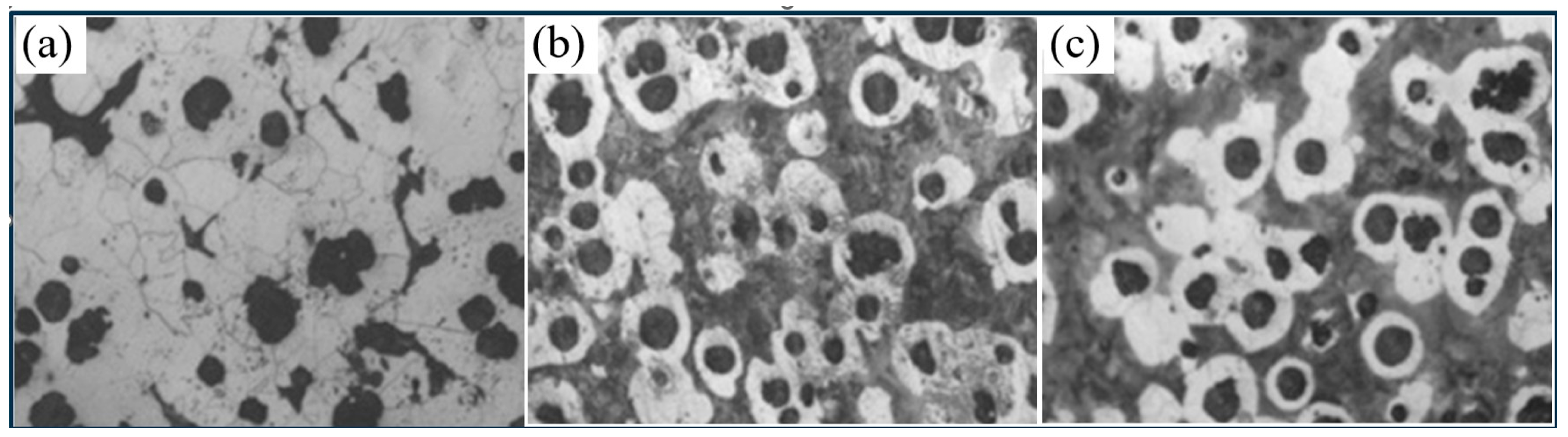
Figure 1. Microstructure of as-cast ductile iron with (a) 0.3 wt% Mn, (b) 0.6 wt% Mn, (c) 0.9 wt% Mn [27].
Sci 08 00128 g001
Figure 2. Schematic force–displacement response of a material under harmonic excitation.
Sci 08 00128 g002
Figure 3. Methodology to estimate the damping from impact hammer test (a) Impulse excitation; (b) Response signal; (c) Frequency response plot to estimate natural frequency and half power points; (d) Schematic representation of impact hammer test set up; (e) An actual image of the impact hammer test set up.
Sci 08 00128 g003
Figure 4. SEM images of ductile iron samples austempered at 370 °C for 1 h with (a) 0.3 wt% Mn (b) 0.9 wt% Mn.
Sci 08 00128 g004
Figure 5. SEM images of ductile iron samples with 0.6 wt% Mn austempered for 1 h at (a) 320 °C, (b) 370 °C, (c) 420 °C.
Sci 08 00128 g005
Figure 6. Variation in the hardness and the ultimate tensile strength of the ADI samples heat-treated at different temperatures for a duration of 1 h.
Sci 08 00128 g006
Figure 7. (a) Variation in the measured graphite nodule count of carbon-enriched austenite in ADI samples austempered at different temperatures for 1 h; (b) Variation in the volume fraction of carbon-enriched austenite in ADI samples austempered at different temperatures for 1 h.
Sci 08 00128 g007
Figure 8. Frequency response curves of ADI samples subjected to 1-h austempering at (a) 320 °C and (b) 370 °C.
Sci 08 00128 g008
Figure 9. Variations in the loss factor of ADI with austempering heat treatment temperatures and heat treatment durations.
Sci 08 00128 g009
Figure 10. Variations in loss factor of ADI sample with different austetmpering temperature for the heat treatment duration of 1 h.
Sci 08 00128 g010
Table 1. Chemical composition of ductile iron casting [27].
Type of Casting\Element in wt%CSiMnPSCrMgFe
Alloy 13.7002.6000.3100.0150.0130.0170.036093.350
Alloy 23.7102.6000.6000.0150.0130.0170.038092.960
Alloy 33.7102.5900.9200.0150.0130.0160.037092.600
Table 2. Nodule count and hardness of as- cast ductile iron samples.
MaterialNodule Count
(Number/mm2)
Hardness
(BHN)
Alloy 1340 ± 3245 ± 4
Alloy 2360 ± 4257 ± 2
Alloy 3368 ± 2268 ± 3
Table 3. Design of Experiments (DoE)—Process parameters and their Levels.
FactorsLevels
123
Mn Content (wt%)0.30.60.9
Austempering
Time (h)
11.52
Austempering
Temperature (°C)
320370420
Table 4. Loss factor of as- cast ductile iron samples.
Alloy 1Alloy 2Alloy 3
0.02770.03050.0251
Table 5. Results of Loss factor analysis for the full factorial approach.
Si NoWeight Percentange of Mn (%)Time in Hours (h)Temperature (°C)Loss Factor
10.31.03200.03090
20.31.03700.03932
30.31.04200.03301
40.31.53200.03110
50.31.53700.03994
60.31.54200.03318
70.32.03200.03135
80.32.03700.04010
90.32.04200.03320
100.61.03200.03920
110.61.03700.04920
120.61.04200.04120
130.61.53200.03940
140.61.53700.04930
150.61.54200.04130
160.62.03200.03860
170.62.03700.04880
180.62.04200.04110
190.91.03200.02911
200.91.03700.03610
210.91.04200.03190
220.91.53200.02924
230.91.53700.03660
240.91.54200.03210
250.92.03200.02937
260.92.03700.03690
270.92.04200.03220
Table 6. ANOVA results for the damping characteristics for ADI.
FactorsAdj. SSAdj. MsF-Valuep-Value% Contribution
Mn content (wt%)0.000558 0.000279495.51<0.0000159
Austempering Time (h)0.0000000.000000.260.770--
Austempering Temperature (°C)0.0003620.000181321.55<0.000139
Error0.000011
Total0.000932
Disclaimer/Publisher’s Note: The statements, opinions and data contained in all publications are solely those of the individual author(s) and contributor(s) and not of MDPI and/or the editor(s). MDPI and/or the editor(s) disclaim responsibility for any injury to people or property resulting from any ideas, methods, instructions or products referred to in the content.