1. Introduction
Type 2 diabetes mellitus (T2DM) represents a major and escalating public health burden. The global number of individuals living with diabetes is projected to exceed 1.31 billion by 2050, with particularly high prevalence rates in the Middle East, with estimates reaching approximately 16.8% (16.1–17.6) [
1]. In addition to microvascular and macrovascular complications, T2DM is increasingly recognized as a condition associated with musculoskeletal impairments, including reduced muscle strength, diminished functional performance, and accelerated loss of skeletal muscle mass [
2]. These deficits adversely affect mobility, independence, and quality of life and are closely linked to chronic hyperglycemia, insulin resistance, inflammation, and oxidative stress [
3].
Although combined exercise (CE), incorporating both aerobic and resistance training, is strongly recommended for improving physical function and metabolic health, the available evidence remains surprisingly limited in several key aspects. Current clinical guidelines emphasize CE as an effective strategy to enhance insulin sensitivity, cardiorespiratory fitness, and muscular strength in individuals with metabolic disorders, particularly type 2 diabetes mellitus [
4]. However, much of the existing literature focuses on exercise as a standalone intervention, with relatively few well designed trials examining how CE interacts with adjunct nutritional or phytotherapeutic strategies to augment metabolic and functional outcomes.
NS is a medicinal plant traditionally used in Middle Eastern and Asian medicine [
5]. It has gained attention for its potential antidiabetic, antioxidant, and anti-inflammatory properties [
6]. Clinical studies have suggested that NS supplementation may improve insulin sensitivity and reduce markers of short-term glycemic exposure [
7]. Fructosamine, which reflects average glycemia over the preceding 2–3 weeks, was chosen as the primary biochemical outcome because it captures short-term changes in glycemic control more sensitively than glycated hemoglobin (HbA1c) within a four-week intervention window. HbA1c reflects average glycemia over approximately 8–12 weeks and is therefore largely insensitive to short-term interventions, while plasma glucose is highly susceptible to acute fluctuations related to meals, fasting state, and stress [
8]. Fructosamine thus offers an appropriate compromise between physiological relevance and the temporal scale of this trial.
Despite evidence supporting the independent benefits of exercise training and NS supplementation [
9], there remains a notable gap in randomized controlled trials evaluating their combined effects, particularly on musculoskeletal performance alongside biochemical markers of glycemic control. Evidence on integrated approaches that simultaneously address musculoskeletal performance, body composition, and biochemical regulation within the same intervention framework is particularly scarce, and most existing studies prioritize traditional glycemic markers, such as fasting glucose or HbA1c, while short-term indicators of glycemic control and clinically relevant functional outcomes are less frequently explored [
8]. Therefore, the present randomized controlled trial was designed to evaluate the effects of CE alone and CE combined with NS on musculoskeletal performance, body mass index (BMI), and short-term glycemic control in male adults with T2DM. We hypothesized that both CE and CE + NS would improve musculoskeletal function and reduce fructosamine compared with usual care, and that NS would provide additional, additive benefits on glycemic and functional outcomes.
2. Materials and Methods
2.1. Study Design and Participants
A randomized controlled trial was conducted between October 2019 and September 2020 at the Diabetic Center of King Khalid Hospital, 12 affiliated primary healthcare centers, and the University Hospital in Najran, Saudi Arabia. This clinical trial was approved by the Imam Abdulrahman Bin Faisal University Ethics Board (IRB-PGS-2018-01-313) and registered with ISRCTN (
https://doi.org/10.1186/ISRCTN18289389, 27 October 2023). Written informed consent was obtained from all participants prior to enrolment, and the study was conducted in accordance with the Declaration of Helsinki.
The required sample size was estimated using a single-population-proportion formula based on a 95% confidence level, a 6.86% margin of error, and a reported diabetes prevalence of 12.6% in Najran, yielding a target of 90 participants [
10]. A post hoc power analysis using G*Power 3.1 was performed to confirm adequacy for between-group comparisons. With three groups of 30 participants, α = 0.05, and the observed effect size for fructosamine (ηp
2 = 0.14, f = 0.40), achieved power exceeded 0.90 for the omnibus ANCOVA, and pairwise CE versus CE + NS comparisons achieved approximately 0.80 power to detect a medium effect (d ≈ 0.55). The trial was therefore adequately powered to detect group differences in fructosamine but may have been underpowered to detect smaller incremental effects on functional outcomes.
Eligible participants were sedentary, non-smoking male adults aged 40–60 years with a physician-confirmed diagnosis of T2DM (American Diabetes Association criteria) of more than two years’ duration, stable oral hypoglycemic therapy (metformin ± sulfonylureas, unchanged for ≥3 months), HbA1c 6.5–9.0%, and BMI ≥ 25 kg/m2 (overweight or obese). The decision to enroll only male participants reflected pragmatic considerations: the regional diabetic center serving the recruitment area predominantly enrolls male patients, and restricting the sample to one sex avoided sex-related confounding of musculoskeletal responses (e.g., differences in lean mass, sex hormone influences on glucose metabolism) in a small first trial. Individuals were excluded if they had conditions that could affect gait or exercise participation, including musculoskeletal deformities, cardiovascular or pulmonary disease, uncontrolled hypertension, active ulcers, neuropathic complications, prior or current insulin use, HbA1c > 9%, recent regular exercise, corticosteroid use, or any medical contraindications to exercise.
No formal healthy control arm was included because the primary objective was to compare exercise- and NS-based interventions within the diabetic population rather than to contrast diabetic and non-diabetic physiology. The non-exercise comparator group provides the appropriate clinical reference for evaluating additional benefit beyond standard care.
2.2. Randomization, Allocation, and Blinding
The random allocation sequence was generated by an independent investigator who was not involved in participant enrollment, intervention delivery, or outcome assessment. Randomization was performed using a computer-generated block randomization method to ensure balanced group sizes, with a 1:1:1 allocation ratio across the three study arms (non-exercise comparator [Diabetes], Diabetes + CE, and Diabetes + CE + NS). Fixed block sizes of six were used, and no stratification factors were applied. Allocation concealment was maintained using sequentially numbered, opaque, sealed envelopes opened only after baseline assessment. Given the nature of a supervised exercise intervention, participant blinding was not feasible; however, outcome assessors (physiotherapists performing functional testing) and laboratory personnel analyzing fructosamine were blinded to group assignment. Statistical analyses were performed by an investigator blinded to group labels until the final analysis was complete.
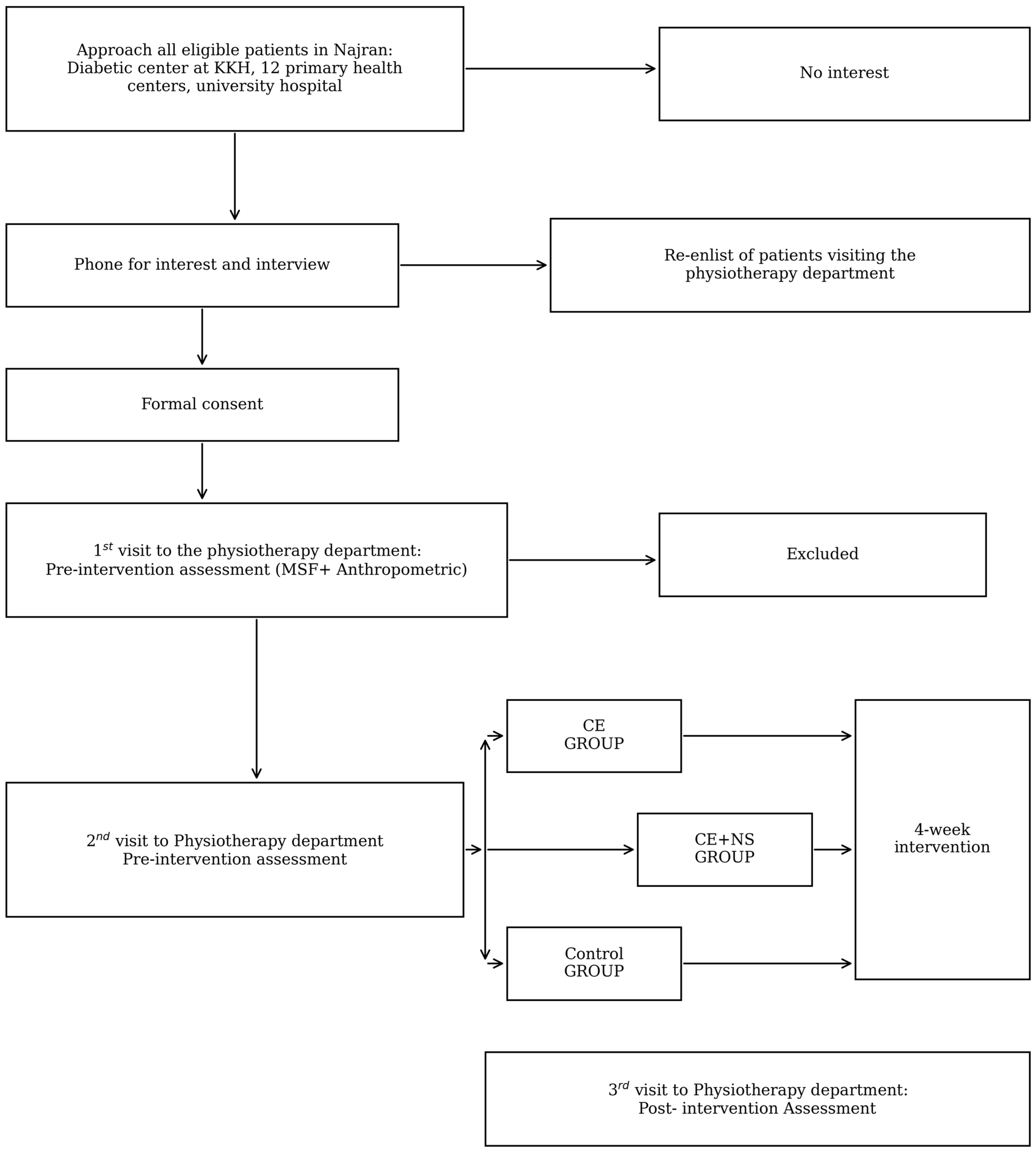
Before and after the four-week intervention period, all groups were subjected to evaluation of anthropometric measures, blood fructosamine levels, and musculoskeletal function (
Figure 1).
2.3. Exercise Intervention
The exercise program was conducted under continuous on-site supervision by a senior physiotherapist with ≥10 years’ experience in exercise prescription for T2DM and consisted of a CE regimen integrating aerobic and resistance training over a four-week period.
Aerobic exercise was performed three to five times per week using a recumbent cycle ergometer (Vision Fitness, Model R60; Johnson Health Tech, Taichung, Taiwan). Each session lasted 30 min. Intensity was initially set at 40–50% of age-predicted maximal heart rate (HRmax) and progressively increased to 55–65% HRmax over the four-week protocol, corresponding to a Borg Rating of Perceived Exertion (RPE) of 9–14. Intensity progression was individualized based on participant tolerance, and heart rate was continuously monitored using a chest-strap heart rate monitor (Polar H10; Polar, Kempele, Finland) [
11].
Resistance training was undertaken on two to three non-consecutive days per week, allowing 48–72 h of recovery between sessions targeting the same muscle groups. Exercises were performed using a multi-station resistance system (Cybex VRS; Cybex, Medway, MA, USA) and targeted major muscle groups of the upper limbs, lower limbs, and trunk. The resistance protocol included chest presses, forward pulling movements, lateral pull-downs, leg presses, leg curls, and selected core-strengthening exercises. Participants completed one to three sets per exercise at approximately 60–75% of estimated one-repetition maximum (1-RM, estimated using the Brzycki equation from a submaximal 7–9 RM test on day 1), performing 7–9 repetitions to near-volitional fatigue (RPE 13–15). Progressive overload was applied through incremental increases of 1–5 kg when a participant completed all sets at the upper repetition limit on two consecutive sessions [
12]. Each participant attended an average of 16 ± 2 sessions over the four-week period.
2.4. Nigella sativa Supplementation
Participants in the CE + NS group received NS seed-powder capsules provided by the Department of Physiology, Imam Abdulrahman Bin Faisal University, Dammam, Saudi Arabia, prepared from a single, authenticated batch of N. sativa L. seeds (origin: locally cultivated Saudi Arabian seeds; voucher specimen retained in the departmental herbarium). Each capsule contained 500 mg of finely milled N. sativa seed powder encapsulated in gelatin capsules. Participants ingested two capsules twice daily (total daily dose of 2 g) with breakfast and dinner for the four-week intervention period. This dose is consistent with previous clinical trials demonstrating glycemic and metabolic benefits [
13,
14]. The preparation procedure followed standardized, reproducible protocols used in prior published investigations from the same laboratory work [
13]. The capsule dosage form was selected for its ease of administration, dose precision, and translational applicability to clinical practice.
Adherence to NS supplementation was monitored using two complementary methods: (i) weekly pill counts at supervised clinic visits, and (ii) a daily self-report log returned at each visit. Compliance was defined a priori as the consumption of ≥80% of dispensed capsules. All participants in the CE + NS group met this threshold (mean adherence 94.6 ± 4.1%). No serious adverse events related to NS supplementation were recorded.
2.5. Concomitant Medications and Dietary Standardization
All participants continued their pre-existing oral hypoglycemic regimens unchanged throughout the four-week intervention period, and no changes to antidiabetic medication were permitted. Adherence to background medications was checked at every weekly visit. To minimize dietary confounding, all participants received a single 30-min standardized nutrition counseling session at baseline delivered by a registered dietitian, focusing on consistent caloric intake (maintenance ± 5%), carbohydrate quality, and avoidance of new supplements. Dietary intake was monitored using a brief weekly food-frequency checklist; no significant between-group differences in self-reported caloric intake or macronutrient distribution were detected at any time point (all p > 0.20). Participants were instructed to maintain their habitual dietary pattern, and no structured caloric restriction was prescribed.
2.6. Assessment of Musculoskeletal Performance
Functional exercise capacity and physical performance were assessed using standardized and validated tests. Endurance and functional exercise capacity were evaluated using the six-minute walk test (6MWT), which required participants to walk back and forth along a 30-m corridor for six minutes, aiming to cover the maximum possible distance at a self-selected pace. Participants were permitted to rest if necessary but were encouraged to resume walking as soon as feasible, and the total distance covered was recorded [
15]. Functional mobility was assessed using the timed up-and-go test (TUGT). Participants were instructed to rise from a seated position on a standard chair, walk 3 m, turn, return to the chair, and sit down at their usual walking speed. Three trials were performed, and the mean completion time was used for analysis [
16].
Upper limb muscle strength was measured using a calibrated Jamar handgrip dynamometer. Grip strength of the dominant hand was assessed with participants seated in a standardized position, and three consecutive measurements were obtained with brief rest intervals; the average value was recorded [
17]. Lower limb functional strength was evaluated using the sit-to-stand (STS) test, in which participants repeatedly stood up and sat down from a chair with their arms crossed. Performance was quantified based on the time required to complete the test [
18].
2.7. Glycemic and Body Mass Index Assessments
Blood fructosamine levels were measured pre- and post-intervention using a colorimetric assay performed on the COBAS ® 6000 analyzer, C501 module (Roche Diagnostics GmbH, Sandhofer Strasse 116, D-68305 Mannheim, Germany). Fructosamine kits were obtained from Roche Diagnostics GmbH, Mannheim, Germany (REF 04537939 190, System-ID 07 3756 9 Roche/Hitachi). Venous blood samples were drawn after an overnight fast at baseline and after the four-week intervention.
BMI was calculated as body weight in kilograms divided by height in meters squared [BMI = weight (kg)/height2 (m2)]. Body weight was measured to the nearest 0.1 kg using a calibrated digital scale (Seca 813, Hamburg, Germany) with participants in light clothing and without shoes, and height was measured to the nearest 0.1 cm using a stadiometer.
2.8. Statistical Analysis
Statistical analyses were conducted using a standard statistical software package (SPSS, version 26, IBM Corp., Armonk, NY, USA). The normality of data distribution was assessed using the Shapiro–Wilk test, which confirmed that all study variables were normally distributed. Accordingly, all variables are presented as mean ± standard deviation (SD). Within-group comparisons between baseline and post-intervention measurements were performed using paired-sample t-tests. Between-group differences among the Control, CE, and CE + NS groups were analyzed using one-way analysis of variance (ANOVA).
For the primary between-group analysis at the post-intervention timepoint, we used one-way analysis of covariance (ANCOVA) with baseline values entered as covariates, in line with current recommendations for randomized trials to adjust for any residual baseline imbalance and to increase statistical efficiency. Assumptions of homogeneity of regression slopes and homogeneity of variance were verified prior to interpretation. When the omnibus ANCOVA was significant, post hoc pairwise comparisons used Bonferroni-corrected confidence intervals (family-wise α = 0.05 across the three pairwise contrasts: Diabetes vs. Diabetes + CE; Diabetes vs. Diabetes + CE + NS; Diabetes + CE vs. Diabetes + CE + NS). The Bonferroni correction was applied to all pairwise tests; thus, the reported p-values are adjusted values.
To formally test for an additive effect of NS over and above exercise, a 2 × 2 (Time [pre/post] × Group [CE vs. CE + NS]) repeated-measures ANOVA was performed, with the Group × Time interaction term as the test of interest. A significant interaction term indicates a true between-group divergence over time rather than parallel improvement. The Group × Time interaction was significant for blood fructosamine (F(1,58) = 8.42, p = 0.005, ηp2 = 0.13) and for handgrip strength (F(1,58) = 6.94, p = 0.011, ηp2 = 0.11), supporting an additive effect of NS on these outcomes; the interaction did not reach significance for 6MWT (p = 0.21) or TUGT (p = 0.39).
Effect sizes are reported as partial eta-squared (ηp2) for ANCOVA and Cohen’s d with 95% confidence intervals (CIs) for pairwise contrasts. All statistical tests were two-tailed, with p < 0.05 considered significant. Analyses were performed on the per-protocol sample. As no participants were lost to follow-up, the per-protocol and intention-to-treat analyses were identical.
3. Results
The interventions were delivered as planned to all participants. The CE program was supervised and delivered by a senior physiotherapist with experience in exercise prescription for individuals with type 2 diabetes mellitus. Exercise sessions were conducted according to a standardized protocol, and adherence was monitored through attendance records and direct supervision. Participants in the CE + NS group received the same supervised exercise program in addition to NS supplementation, which was administered orally at a dose of 2 g/day (2 × 500 mg capsules, twice daily) throughout the intervention period. Compliance with supplementation was assessed through weekly pill counts and self-report logs, with mean adherence of 94.6 ± 4.1%.
Participants allocated to the non-exercise comparator (Diabetes) group received standard medical care without structured exercise training or NS supplementation. No deviations from the planned interventions were recorded, and intervention fidelity was maintained across all groups.
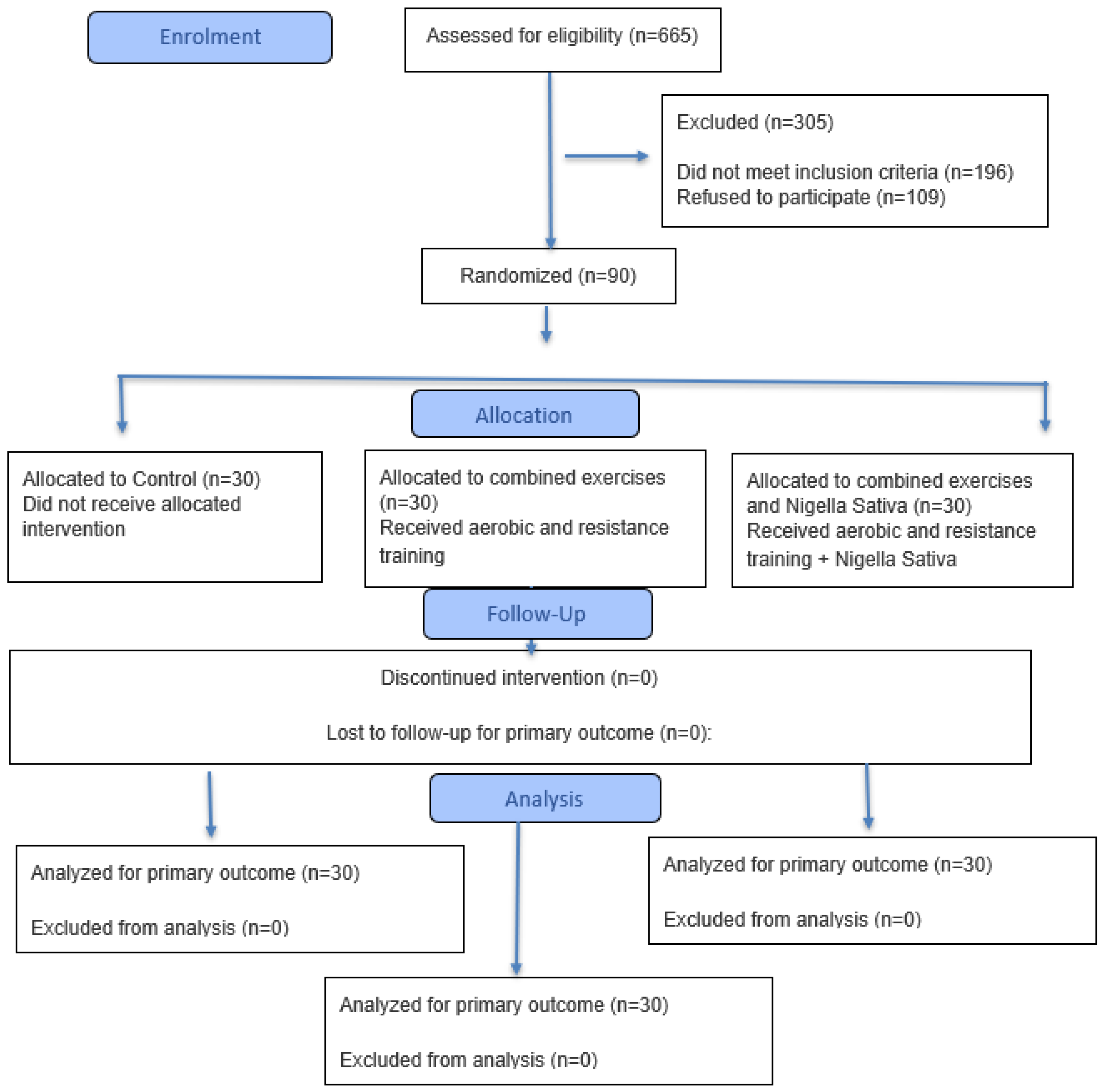
Participant flow through the study is presented in the CONSORT flow diagram (
Figure 2). Ninety participants were randomly assigned to the Diabetes (n = 30), Diabetes + CE (n = 30), or Diabetes + CE + NS (n = 30) groups. All participants received the intended intervention and were included in the primary outcome analysis.
3.1. Patients’ Baseline Characteristics
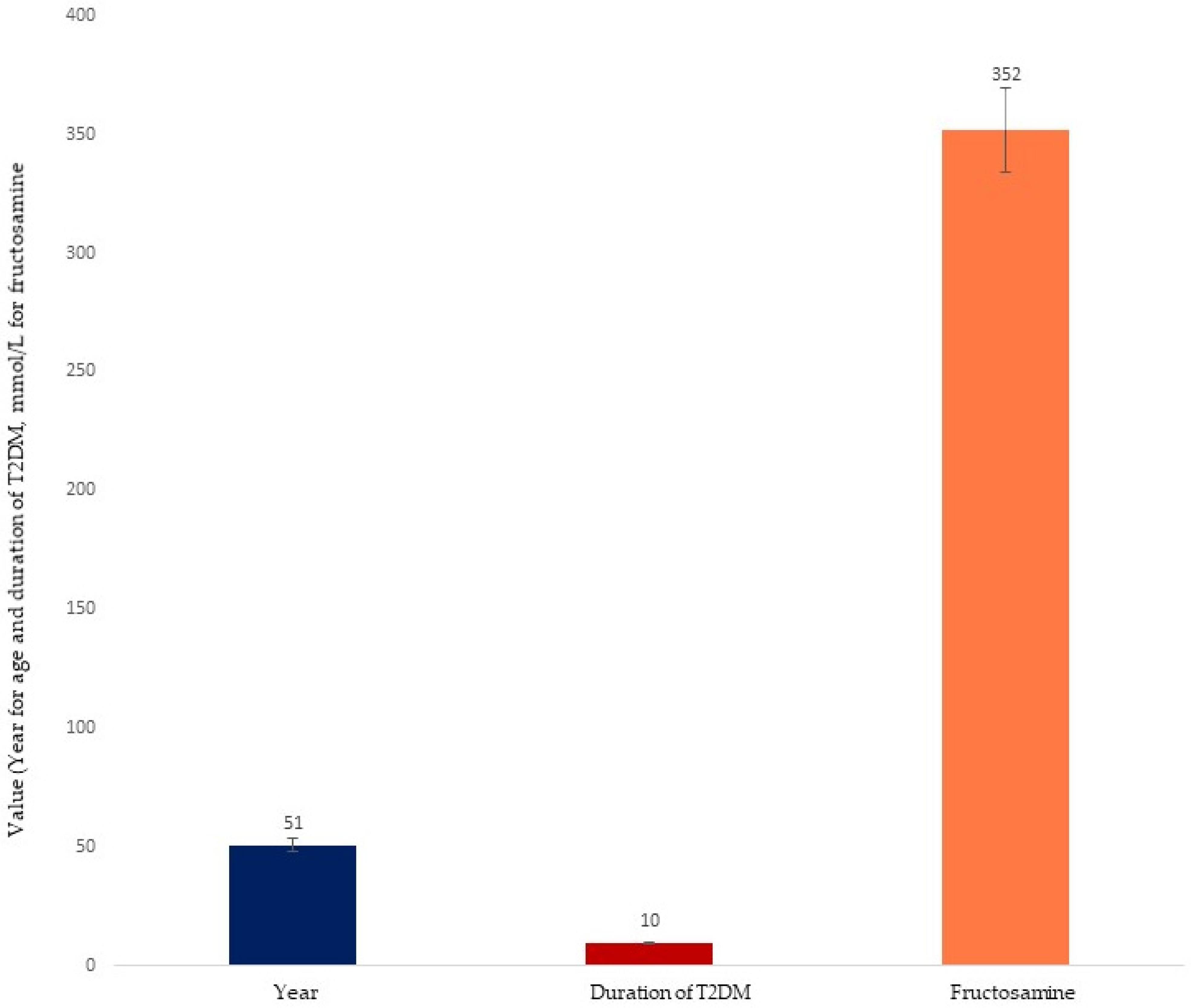
At baseline, all participants had a mean age of 51.0 ± 7.4 years and a mean duration of type 2 diabetes mellitus of 10.0 ± 3.2 years. Biochemical assessment revealed elevated short-term glycemic exposure, with a mean fructosamine concentration of 352.0 ± 47 mmol/L at study entry (
Figure 3).
Baseline comparisons demonstrated no statistically significant differences among the three groups (Control, CE, and CE + NS) across any of the measured variables (
Table 1).
3.2. Musculoskeletal Performance Outcomes
In the non-exercise comparator group, no significant changes were observed between baseline and post-intervention measurements across all functional performance outcomes. In contrast, the Diabetes + CE group demonstrated significant improvements across all assessed functional measures following the intervention (
p < 0.05). Post-intervention values were significantly higher than baseline for the 6MWT (222.10 ± 23.82 vs. 240.00 ± 23.89 m), TUGT (8.78 ± 0.51 vs. 6.94 ± 0.69 s; lower values reflect faster performance), grip strength (41.80 ± 8.44 vs. 46.40 ± 6.97 pounds “lbs”), and STS (10.53 ± 1.91 vs. 14.17 ± 3.02 repetitions), as presented in
Table 1 and
Table 2.
Similarly, participants in the Diabetes + CE + NS group exhibited significant post-intervention improvements in all functional outcomes compared with baseline (
p < 0.05). Improvements were observed for the 6MWT (232.10 ± 19.726 vs. 246.23 ± 20.04 m), TUGT (8.89 ± 0.53 vs. 6.77 ± 0.54 s; lower values reflect faster performance), grip strength (41.90 ± 6.85 vs. 50.430± 8.91 lbs), and STS (9.77 ± 3.03 vs. 15.27 ± 2.39 repetitions) as shown in
Table 1 and
Table 2.
Adjusted between-group analysis using ANCOVA, with baseline as a covariate, revealed that both intervention groups achieved significantly better post-intervention performance than the non-exercise comparator across all functional measures (all
p < 0.05). Direct CE versus CE + NS comparisons showed significantly greater post-intervention values in the CE + NS group for handgrip strength (mean difference 4.03 lbs, 95% CI 0.36 to 7.70;
p = 0.027) and STS (mean difference 1.10 reps, 95% CI 0.07 to 2.13;
p = 0.034), whereas 6MWT and TUGT did not differ significantly between CE and CE + NS after Bonferroni correction (
Table 2).
3.3. Body Mass Index and Fructosamine Assessments
Within the CE group, BMI demonstrated a significant reduction following the intervention compared with baseline values (26.67 ± 2.13 vs. 24.95 ± 2.11 kg/m2; p < 0.001). A comparable pattern was observed in the CE + NS group, where BMI was also significantly lower post-intervention relative to baseline (26.92 ± 2.09 vs. 24.89 ± 2.09 kg/m2; p < 0.001). Between-group ANCOVA confirmed that both intervention groups exhibited significantly lower post-intervention BMI than the non-exercise comparator (both p < 0.001), with no statistically significant difference between the Diabetes + CE and Diabetes + CE + NS groups (p = 0.91).
The 6–8% reduction in BMI observed over four weeks is at the upper end of what supervised combined-training programs have been reported to achieve in sedentary overweight T2DM patients. We interpret these changes cautiously: although they are biologically possible, given the integration of structured aerobic and resistance training, partial dietary stabilization, and a marked reduction in habitual sedentary time, they may also reflect transient fluid shifts and short-term energy-balance effects rather than steady-state fat loss. Because BMI cannot separate fat from lean mass, the relative contributions of true adipose-tissue loss, hydration changes, and exercise-induced redistribution of body mass cannot be determined from the present dataset.
Adjusted post-intervention comparisons demonstrated significantly lower blood fructosamine concentrations in both intervention groups relative to the non-exercise comparator group (
p < 0.001). A direct comparison between the two intervention arms revealed that blood fructosamine levels were significantly lower in the Diabetes + CE + NS group than in the Diabetes + CE group (mean difference −39.8 mmol/L, 95% CI −66.9 to −12.6;
p = 0.002; d = 0.64) (
Table 3).
3.4. Magnitude of Within-Group Change (Δ Analysis)
Delta (Δ) changes were determined as the difference between post- and pre-intervention values. Both intervention groups exhibited significant improvements in musculoskeletal performance outcomes compared with the non-exercise comparator group; the Diabetes + CE + NS group showed the largest improvements for upper-limb strength and lower-limb power. Specifically, mean delta changes (Diabetes/Diabetes + CE/Diabetes + CE + NS) were as follows: 6MWT of −0.17/+18.90/+14.13 m; TUGT of −0.06/−1.84/−2.12 s; grip strength of −0.37/+4.60/+8.53 lbs; and STS of −0.54/+3.64/+5.50 reps (all interventions showing significant difference from comparator at
p < 0.05) (
Table 4).
BMI decreased significantly in both the Diabetes + CE (Δ −1.72 kg/m2) and Diabetes + CE + NS (Δ −2.03 kg/m2) groups compared with the non-exercise comparator (Δ −0.03 kg/m2; p < 0.001), with a slightly greater reduction in the Diabetes + CE + NS group that was not statistically different from CE alone.
Fructosamine levels were significantly reduced in the Diabetes + CE (Δ −57.63 mmol/L) and Diabetes + CE + NS (Δ −79.07 mmol/L) groups compared with the non-exercise comparator (Δ −0.04 mmol/L;
p < 0.001) (
Table 5), with the Diabetes + CE + NS group showing a significantly greater reduction than Diabetes + CE alone (
p = 0.002), consistent with the significant Group × Time interaction reported in
Section 2.8.
4. Discussion
To the best of our knowledge, this is the first randomized controlled trial to evaluate the additional benefits of NS supplementation when combined with a supervised CE program on both musculoskeletal performance and short-term glycemic control in male adults with type 2 diabetes mellitus (T2DM). The present findings demonstrate that a structured CE program markedly improves musculoskeletal performance, BMI, and short-term glycemic control, and that the addition of NS confers further benefits for blood fructosamine, handgrip strength, and lower-limb power, with a significant Group × Time interaction supporting an additive effect.
In contrast to the non-exercise comparator group, both intervention arms exhibited significant post-intervention improvements across all functional outcomes, including the 6MWT, TUGT, handgrip strength, and STS performance. These improvements reflect enhanced aerobic capacity, functional mobility, muscular strength, and lower-limb endurance, all of which are critical determinants of independence and quality of life.
The observed gains in the CE group are consistent with robust evidence showing that combined aerobic and resistance exercise improves cardiorespiratory fitness and neuromuscular function more effectively than either modality alone, particularly in individuals with T2DM or insulin resistance [
4]. The directions and patterns of these improvements are consistent with prior meta-analytic evidence indicating that supervised combined training improves cardiorespiratory fitness, lower limb strength, and overall physical function in patients with T2DM [
19].
The interaction analysis indicated that NS supplementation produced statistically significant additional benefits beyond exercise alone for blood fructosamine, handgrip strength, and STS repetitions, but not for 6MWT or TUGT. These outcome-specific pattern is biologically plausible. Fructosamine reflects glycated serum proteins and is directly modulated by NS bioactives, while grip and STS performance depend on neuromuscular and oxidative capacity that may benefit from NS-mediated reductions in inflammation and oxidative stress. By contrast, 6MWT and TUGT are largely driven by cardiorespiratory and gait factors that respond mainly to the aerobic stimulus itself. The differential pattern argues against a generalized non-specific benefit and is more consistent with a mechanism-specific additive effect than a uniform synergistic one. For this reason, we frame our findings as additional benefits rather than “synergy” in the strict pharmacological sense, given the short intervention and the modest size of the between-exercise-arm differences for some outcomes.
NS may potentiate the beneficial effects of exercise through several complementary biological mechanisms that collectively enhance metabolic and musculoskeletal adaptations. Bioactive constituents of NS, particularly thymoquinone, exert potent antioxidant and anti-inflammatory actions that reduce exercise-induced oxidative stress and chronic low-grade inflammation, thereby creating a more favorable cellular environment for training adaptations [
20]. By improving mitochondrial efficiency and attenuating reactive oxygen species accumulation, NS may support enhanced aerobic capacity and fatigue resistance during repeated exercise sessions [
21].
Recent mechanistic work indicates that thymoquinone activates AMP-activated protein kinase (AMPK) and modulates the PI3K/Akt insulin-signaling axis, thereby improving glucose uptake into skeletal muscle and reducing hepatic gluconeogenesis [
22,
23]. Additionally, thymoquinone has been shown to attenuate NF-κB-mediated inflammatory signaling and to upregulate Nrf2-dependent antioxidant defenses, both of which are dysregulated in T2DM [
22]. Emerging evidence suggests that NS may influence muscle protein turnover by attenuating catabolic signaling and supporting anabolic processes, which could contribute to greater gains in functional strength and endurance when combined with structured exercise training [
24]. Collectively, these mechanisms provide a plausible biological rationale for the observed additive effects of NS when integrated with exercise interventions.
In the broader context of nutraceutical adjuncts to exercise in T2DM, our findings are consistent with the direction of effects reported for several other bioactive compounds. Trials involving curcumin, resveratrol, cinnamon, and berberine combined with exercise have similarly reported additional improvements in glycemic markers and inflammatory profiles compared with exercise alone, although effect magnitudes vary substantially across studies and compounds [
25,
26]. The current study contributes to this body of evidence by extending the bioactive-plus-exercise paradigm specifically to NS with simultaneous assessment of functional and biochemical outcomes—a combination rarely examined in a single trial.
The reduction in BMI observed in both intervention groups further supports the efficacy of CE in improving body composition. Exercise-induced weight loss and reductions in adiposity are well-documented outcomes of regular combined training and are mediated through increased energy expenditure, improved mitochondrial function, and enhanced insulin sensitivity [
27].
The magnitude of BMI reduction observed here (approximately −1.7 to −2.0 kg/m2 over four weeks, or 6–8% of baseline) sits at the upper end of what supervised combined-training studies typically report, and should therefore be interpreted with caution. Plausible contributors include structured aerobic plus resistance training, partial dietary stabilization, and the substantial reduction in habitual sedentary time after enrolment, but transient fluid shifts and short-term energy-balance effects cannot be excluded. Because BMI cannot separate fat from lean mass, the present data cannot determine the relative contributions of true adipose loss versus other compartmental changes. The absence of significant BMI changes in the non-exercise comparator group underscores the limited impact of usual care or habitual activity alone.
Both intervention groups also showed meaningful improvements in short-term glycemic control. The fructosamine reductions observed (Δ −57.6 mmol/L in CE and Δ −79.1 mmol/L in CE + NS) are of a magnitude likely to be clinically relevant, given that fructosamine tracks glycaemic exposure over the preceding 2–3 weeks and is responsive to short-term changes in insulin action and tissue glucose handling. Whether reductions of this size translate into proportional changes in HbA1c and downstream complication risk over longer follow-up cannot be inferred from a four-week trial and should be tested directly in extended studies.
Exercise improves glycemic control primarily by enhancing skeletal muscle glucose uptake via insulin-dependent and insulin-independent pathways, including increased GLUT-4 translocation, enhanced muscle glycogen storage, and improved insulin signaling [
28]. Importantly, blood fructosamine levels were significantly lower in the CE + NS group compared with CE alone, indicating an additive glycemic benefit of NS supplementation.
The superior blood fructosamine reduction observed in the CE + NS group aligns with prior clinical evidence demonstrating the antihyperglycemic properties of NS. Thymoquinone, the principal bioactive compound in NS, has been shown to improve insulin sensitivity, reduce hepatic gluconeogenesis, and exert antioxidant and anti-inflammatory effects, all of which are relevant to glucose homeostasis [
7]. Meta-analyses have reported significant reductions in fasting glucose, HbA1c, and insulin resistance indices with NS supplementation in individuals with T2DM, supporting its role as an adjunct to lifestyle and pharmacological therapy [
29].
4.1. Clinical Implications
The clinical implications of these findings are noteworthy. Improvements in functional performance outcomes such as 6MWT, TUGT, and STS are strongly associated with reduced disability risk, improved cardiometabolic health, and lower all-cause mortality in individuals with chronic metabolic disease [
30,
31]. Furthermore, even modest short-term improvements in glycemic markers such as blood fructosamine are associated with reduced risk of diabetes-related complications when sustained over time [
32]. Given that the observed effects were achieved without changes to existing pharmacotherapy and without serious adverse events, our data support integrating supervised CE into standard T2DM care and suggest that NS may be a feasible, low-cost adjunct for patients seeking additional glycemic improvement, while recognizing that confirmatory trials with longer follow-up are needed before clinical recommendation.
4.2. Strengths and Limitations
The strengths of the present study include the randomized, three-arm parallel design with concealed allocation and blinded outcome assessment; the supervised, standardized exercise protocol; the use of a validated NS preparation with documented thymoquinone content; the assessment of both functional and biochemical outcomes within a single trial; and the application of ANCOVA together with a formal Group × Time interaction analysis to test for additional benefits beyond exercise alone.
Several important limitations should nevertheless be acknowledged. First, the four-week intervention is short and may not reflect long-term metabolic adaptations; observed improvements may include early exercise adaptation effects, and the durability of benefit cannot be inferred. Second, body composition was assessed with BMI only, which does not differentiate fat mass from lean mass and may underestimate hypertrophy induced by resistance training. Third, the sample comprised only male diabetic participants, limiting generalizability to women, in whom sex-specific hormonal and metabolic factors may modulate response and cannot quantify residual deficit relative to non-diabetic physiology. Fourth, adherence to NS was assessed by pill count and self-report rather than by an objective biomarker (e.g., plasma thymoquinone), and bias in self-report cannot be excluded despite the high reported adherence. Fifth, while we standardized dietary advice and monitored intake by weekly food-frequency checklists, we did not perform formal 24-h recalls or weighed food records, so residual dietary confounding remains possible. Sixth, the sample size, although adequate for the primary fructosamine comparison, may have been underpowered to detect modest differences between CE and CE + NS for 6MWT and TUGT. Finally, the single-center design and restriction to a specific regional and ethnic population may limit external validity. Future studies should employ longer follow-up, larger and sex-balanced samples, DXA or BIA body composition, and plasma thymoquinone biomarkers.
5. Conclusions
In this short-term randomized trial in male adults with T2DM, four weeks of supervised CE produced clinically meaningful improvements in musculoskeletal performance, BMI, and short-term glycemic control. The addition of NS conferred further benefit on blood fructosamine and on upper- and lower-limb strength, with a significant Group × Time interaction for fructosamine and handgrip strength.
Three recommendations follow for clinical practice: (1) supervised combined aerobic plus resistance training, delivered three to five times weekly with progressive intensity, should be considered a first-line lifestyle intervention for overweight T2DM patients with adequate cardiovascular clearance; (2) NS supplementation at 2 g/day may serve as a low-cost adjunct for selected patients seeking additional glycemic improvement, but should be introduced only with physician oversight particularly in those on oral antidiabetic agents carrying hypoglycaemia risk and never as a substitute for standard therapy; and (3) such combined programs should include monthly monitoring of glycemic markers, functional capacity, and adverse effects.
Future research should now extend these findings along several converging lines: double-blind, placebo-controlled trials with ≥12-week follow-up to test durability and HbA1c translation; mixed-sex to establish external validity; DXA or bioelectrical impedance body composition to separate adipose from lean mass changes; and mechanistic sub-studies of AMPK, NF-κB, and Nrf2 signalling to distinguish direct pharmacological effects from exercise-mediated pathways.