Article

Elemental Composition, Heavy Metal Accumulation and Biologically Active Substances in Wild Plants of Kazakhstan

by
Yuliya A. Litvinenko
1,
Larissa R. Sassykova
1,*,
Albina R. Sassykova
2,
Azamat T. Konysbayev
1,
Renata R. Aitbayeva
1,
Tleutai S. Abildin
1,
Fatima M. Kanapiyeva
1,*,
Nurbubi K. Zhakirova
1,
Aisulu K. Zhussupova
1,
Subramanian Sendilvelan
3,
Kathirvelu Bhaskar
4,
Kannayiram Gomathi
5 and
Ruimao Hua
6
1
Faculty of Chemistry and Chemical Technology, Al-Farabi Kazakh National University, 71, Al-Farabi Ave., Almaty 050040, Kazakhstan
2
Almaty College of Finance and Economics, 39a, Ryskulbekov Str., Almaty 050042, Kazakhstan
3
Department of Mechanical Engineering, Dr. M.G.R. Educational and Research Institute, Chennai 600095, India
4
Department of Automobile Engineering, Rajalakshmi Engineering College, Thandalam, Chennai 602105, India
5
Department of Biotechnology, Dr. M.G.R. Educational and Research Institute, Chennai 600095, India
6
Department of Chemistry, Tsinghua University, 30 Shuangqing Rd, Haidian District, Beijing 100084, China
*
Authors to whom correspondence should be addressed.
Sci 2026, 8(6), 123; https://doi.org/10.3390/sci8060123
Submission received: 19 March 2026 / Revised: 20 May 2026 / Accepted: 25 May 2026 / Published: 27 May 2026
(This article belongs to the Section Chemistry Science)

Abstract

This study investigated the macro- and microelement profiles and bioactive substances (BAS) in the herbaceous species of the genus Rheum collected from two villages near Almaty, Kazakhstan, and the accumulation of heavy metals (HMs) in wild plants of Eastern Kazakhstan. Representative zonal species from the steppes and desert–steppes (Eastern Kazakhstan) were analyzed—totaling one hundred samples across 18 species from six families. According to the research, different plant species have a selective ability to accumulate heavy metals, even when growing in the same type of soil. Long-term observations reveal dominant patterns of HM (Cu, Zn, Mn, Co, Pb, Cd) occurrence in dry-steppe vegetation. It was found that Cu and Co demonstrate moderate bioadsorption with minimal accumulation, while Zn, Mn, and Pb show strong biological enrichment. Cadmium falls under elements with pronounced biological retention. Copper and cobalt are classified as moderately absorbed with limited buildup. Native plants in this region contain substantially greater amounts of lead relative to cobalt, and reflect cadmium–zinc geochemical specificity: Cd 3.85, Zn 0.15, Mn 0.10, Pb 0.09, Co 0.07, Cu 0.04, per Clark’s concentration index. Samples of collected Rheum tataricum L. in the village of Miyaly were found to have higher levels of flavonoids, phenolic compounds, and organic acids, while raw materials from the village of Bakbakty showed increased accumulation of anthracene derivatives and tannins. Flavonoids constituted the largest proportion of the studied groups of biologically active substances in both samples, confirming the high biological and pharmacological value of the plant material studied. The results obtained during the research can be successfully applied to the development of a strategy for the conservation of plant biodiversity in the studied areas and the sustainable management of plant resources.

1. Introduction

1.1. Micro- and Macroelements Accumulation in Plants

Many chemical elements are present in plant organs, while the so-called “macronutrients” are contained in significant concentrations, and “microelements” are in concentrations of thousandths of a percent. Plants absorb minerals from the soil and air to support their growth and development—a process known as nutrient accumulation. Specific metabolic characteristics in different plant species determine their selective ability to accumulate one or more elements. Soil is the primary source and primary medium for the absorption of microelements by plants. Plants absorb microelements through the root system and leaf surfaces, with the primary route of absorption occurring through root absorption. Rootless absorption of microelements by plants occurs through significant atmospheric metal deposition on leaf surfaces in areas where large industrial facilities are concentrated. Essential macronutrients, like nitrogen, phosphorus, potassium, calcium, magnesium, and sulfur, are needed in substantial amounts to form plant structures. Micronutrients—such as iron, copper, manganese, molybdenum, zinc, cobalt, and boron—are present in very small concentrations within plant tissues yet play vital roles as catalysts in key metabolic activities, including photosynthesis and respiration [1,2,3,4,5].
Based on their absorption by plant organs, microelements are divided into the following groups: (1) Cd, Cs, and Rb—highly absorbed microelements; (2) Zn, Mo, Cu, Pb, Ag, As, and Co—microelements with moderate absorption; (3) Mn, Ni, Li, Cr, Be, and Sb—microelements poorly absorbed by plants; (4) Se, Fe, Ba, and Te—microelements that are difficult for plant organs to absorb. Based on their absolute content, microelements also form the following groups: (1) elements with increased concentrations in plants—Sr, Mn, and Zn; (2) elements with moderate concentrations—Cu, Ni, Pb, and Cr; (3) elements with low concentrations in plant organs—Mo, Cd, Se, Co, and Sn; (4) elements with very low abundances in plant organs—Hg.
The accumulation of macro- and microelements occurs depending on the climatic conditions, the geographical location of the area, the type of soil, its physical and chemical properties, and the type, variety, and stage of vegetation of the plant, among other factors [6,7,8,9]. The “Clark number” is the average content of a chemical element in the Earth’s crust.
For plants, as well as for animals and microorganisms, in addition to the usual nutrients that have long been known in agronomic science and practice (organogens and non-organogens), other chemical elements are also needed that are contained in plant tissues in extremely small quantities and, at the same time, are characterized by high biological activity. Such elements are commonly referred to as trace elements. Trace elements are found in soils, water basins, rocks, plants, and soil microorganisms. The presence of trace elements in the soil in a form assimilable for plants is one of the most important conditions necessary for harvesting high yields of agricultural crops. Trace elements are part of the enzymes, vitamins, and hormones, and, thus, are involved in the regulation of biochemical processes occurring in plant and animal organisms [10,11,12]. It is quite natural that the soils of different places on the planet contain different amounts of trace elements: this amount may be normal/excessive/insufficient, and depends on the composition of the parent rocks, the vegetation growing, as well as the degree of development/cultivation of the soil cover, the presence of flows of trace elements from the outside in the form of climate, and organic and mineral fertilizers. Thus, scientists have found that acidic soils with an acidic pH, that is, soils that were born on acidic rocks, especially those with a light mechanical composition, have a low content of copper and cobalt, while the soils formed on rocks with an alkaline pH contain a large number of microelements. A certain percentage of trace elements in the soil is part of soil minerals, while another part of the trace elements may be adsorbed on the surface of soil colloids, while this part may participate in metabolic reactions and partially fixate on the surface of colloidal particles in the form of organic and inorganic compounds with a complex configuration. An extremely important role is played by the biological absorption and fixation of trace elements in plants and microorganisms, which, using them for vital biochemical processes, affect the movement of various forms of trace elements in the soil [13,14,15]. This is especially true for easily mobile compounds that dissolve in water and in weak acids.

1.2. Heavy Metals Accumulation in Plants

The chemical composition of plants depends on the environment in which they grow, and plants selectively absorb the elements they need in accordance with their physiological and biochemical needs [7,13]. However, plants are capable of accumulating heavy metals (HMs) that are toxic to humans, and the quantitative content of elements in them is determined by their habitat and environmental factors. In the works devoted to the problems of environmental pollution and environmental monitoring, today more than 40 elements of the periodic table of D.I. Mendeleyev with an atomic mass of over 40 atomic units are classified as heavy metals, including V, Cr, Mn, Fe, Co, Ni, Cu, Zn, Mo, Cd, Sn, Hg, Pb, and Bi, among others. According to some classifications, metals with a density of more than 8 g/cm3 should be considered heavy. HMs are the second most dangerous, second only to pesticides, and outperform such common pollutants as “sulfur oxides” and “nitrogen oxides” in terms of direct toxic effects [16,17,18,19]. The bulk of HMs in ecosystems are formed due to their content in the soil-forming rock. In addition, the replenishment of these elements occurs due to human activity. Soil pollution around industrial centers occurs mainly due to the emissions of harmful compounds from industrial enterprises and transport [20,21].
HM contamination is associated with their widespread use in industrial production. The main sources of waste enriched with metals include enterprises for the smelting of non-ferrous metals (aluminum, alumina, copper–zinc, lead-smelting, nickel, titanium–magnesium, mercury, etc.), as well as for the processing of non-ferrous metals (radio engineering, electrical engineering, instrument-making, galvanic, etc.).
The main sources of heavy metals by industry/elements of metals include the following: non-ferrous metallurgy/Pb, Zn, Cu, Hg, Mn, Sb, W, Co, Cd; ferrous metallurgy/Ni, Mn, Pb, Cu, Zn, W, Co; energy industry/As, Sb, Se; oil production and refining industry/Pb, Cu, Ni, Zn, Mn; coal burning/Sb, As, Cd, Cr, Mo; oil burning/As, Pb, Cd.
The negative impact of pollutants extends for tens of kilometers from the source of the elements entering the atmosphere. So, at a distance of 10 km or more from an industrial enterprise, it is possible to detect from 1/10 to 1/3 of the HMs content of their total emissions into the atmosphere. In this case, it is quite natural to form a combined contamination of plants, which is the sum of the direct precipitation of water-soluble and solid particles on the leaves of plants, and from the amount of HMs that accumulate in the soil over a long time, and accumulate by the roots of plants. Substances in mobile, easily soluble forms can actively migrate into soils and are rapidly absorbed by living organisms, thereby becoming involved in biogeochemical cycles. Numerous observations by researchers have shown that heavy metals accumulate relatively quickly and unhindered in the soil, while they are removed from the soil very slowly. This is indicated by data on the half-life of heavy elements from the soil: zinc—up to 500 years, cadmium—up to 1100 years, copper—up to 1500 years, lead—up to several thousand years [22,23,24,25,26,27].
HMs are absorbed from the soil by plants, which then enter the food system. Root absorption of the ions of HMs is carried out mainly by the young part of the root, both directly from the soil solution and as a result of exchange with particles of the soil absorbing complex, while the rate of metal entry into the roots positively correlates with their available supply (mobile forms) in the soil volume in contact with the root system. The movement of elements from the soil into the root occurs through the cell walls. The main barrier to the entry of ions into tissues is the endoderm of young roots: the Caspari belts on its radial walls make the roots relatively impervious to water and substances dissolved in it.
So, due to imperfect purification systems, HMs enter the environment, including the soil, polluting and poisoning it. HMs are special pollutants that must be monitored in all environments. The absorption of minerals by root cells is a selective process, which is regulated by both membranes and ion pumps located in them, acting at the expense of metabolic energy. The HMs absorbed by the root move in it and are transported to the higher organs. Therefore, the intake of toxic substances from the soil through the root system depends on the protective properties of plants [28,29,30,31,32,33,34]. The first obstacle is the selective ability of root absorption; the second factor regulating the accumulation of elements is the physiological barrier of absorption. If these protective mechanisms do not work, then the influx of HMs occurs in the least physiologically active organs. The impact of excess heavy metals on plants can be both direct and indirect. Direct impacts are associated with the accumulation of metals by plants, while indirect impacts are associated with the negative impact of heavy metals on the composition and properties of the soil, as well as its fertility [35,36,37,38,39,40]. Studying plant responses to heavy metal pollution is one of the objectives of biological and chemical environmental monitoring.
This paper describes the study of the presence of macroelements, microelements, and biologically active substances of Rheum herbaceous plants in two villages near the city of Almaty (Kazakhstan), as well as the content of HMs in wild plants of Eastern Kazakhstan, conducting a study of the accumulation of heavy metals under various plant growth conditions and the bioavailability of the elements.

2. Materials and Methods

2.1. Brief Description of the Plant Collection Sites Used for This Study

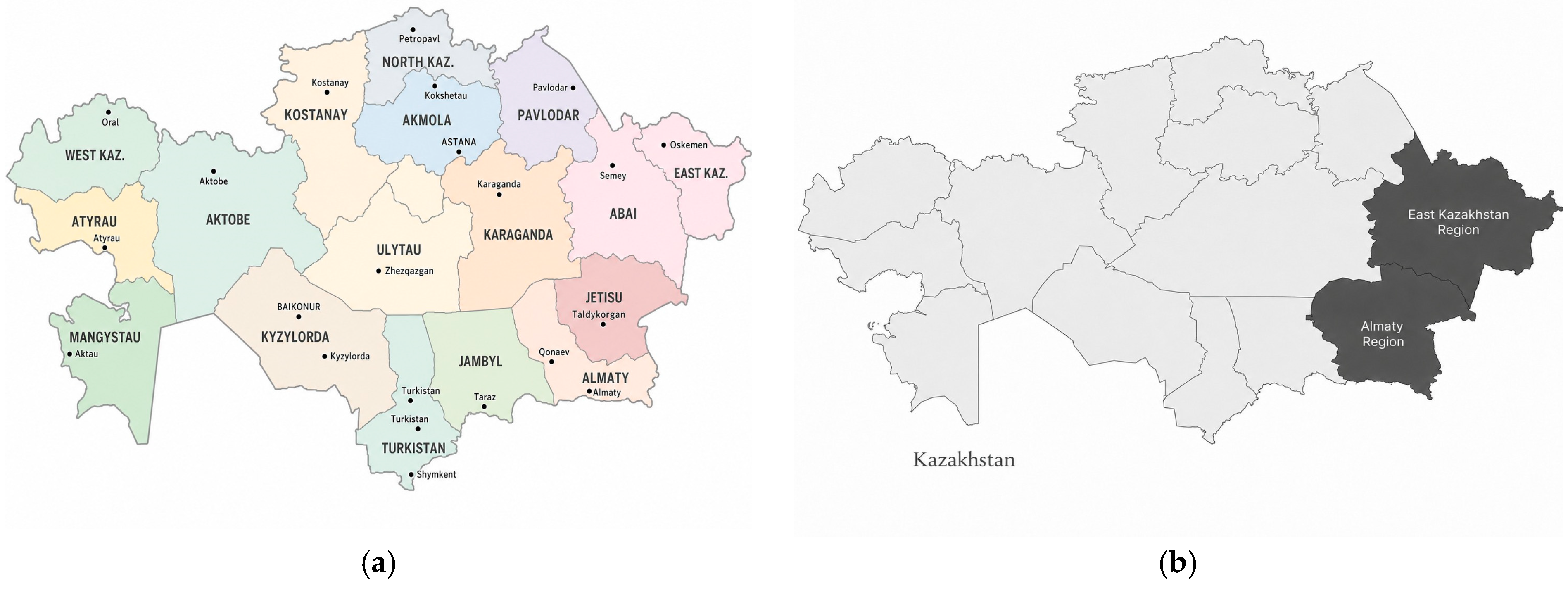
Kazakhstan is located in the center of Eurasia, most of the country belongs to Asia, and the other part of the republic belongs to Europe [29,41,42]. The geographical center of Eurasia is located in Kazakhstan (Figure 1).
The Almaty region with the center, the city of Konaev (the former city of Kapchagay) has an area of 105.1 thousand km2, and has a very diverse terrain. Its territory is characterized by a sharply continental climate, uneven distribution of water bodies, and the presence of very arid places.
The diverse weather conditions in the Almaty region, where the sampling sites include the two aforementioned villages, are explained by the geographical contrast: the north is dominated by flat terrain marked by rolling, sandy areas, while the south is characterized by extensive mountainous regions.
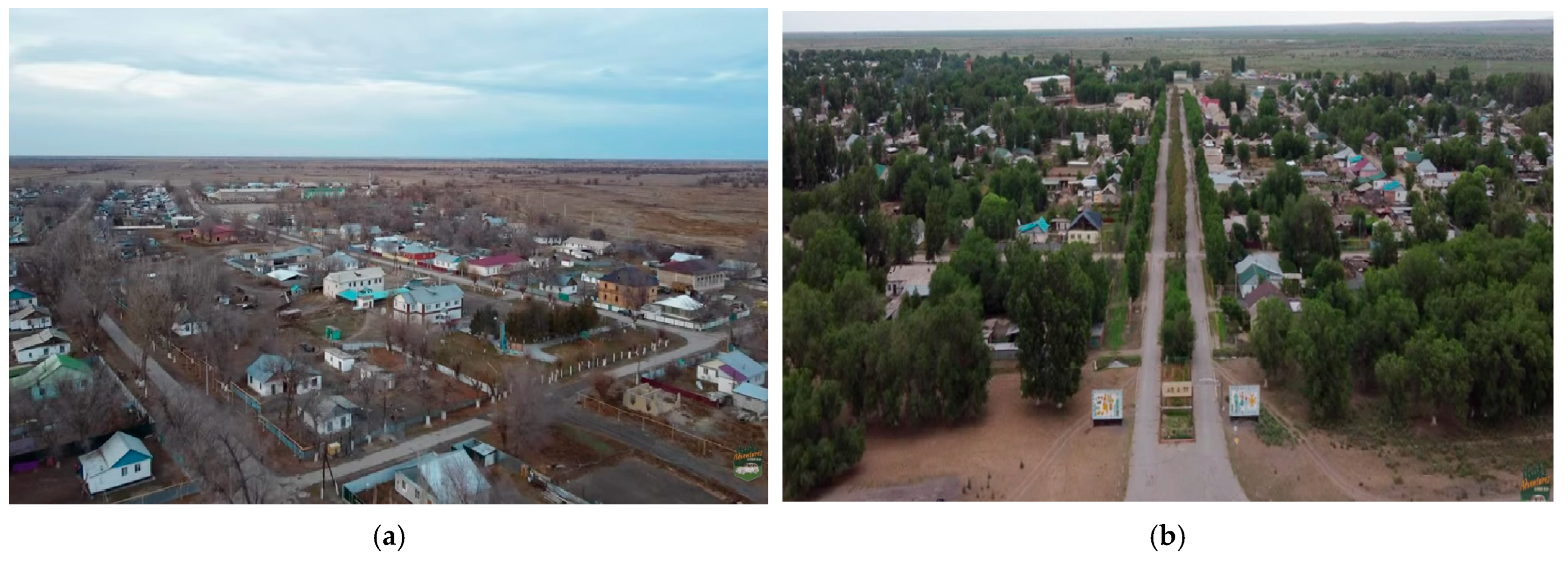
Miyaly and Bakbakty, villages in the Almaty region of Kazakhstan were the places of collection of the original plant material of Rheum tataricum L. (Figure 2).
The variability in climatic conditions in the Almaty region, which includes the villages where plants were collected for this study, is due to the fact that the northern part of the region is a plain characterized by ridged and dune sands, while the south is rich in mountain ranges with alternating vertical zones [42,43,44,45,46,47,48].
The choice of the settlements of Miyaly and Bakbakty is due to the need to study the influence of natural and environmental factors on the mineral composition of the Rheum tataricum L. plant, which is the object of this study. The selected territories differ in soil and climatic conditions, which may affect the accumulation of macro- and microelements in the plant raw materials. The study of samples collected in different areas of the plant’s natural growth makes it possible to identify differences in the elemental composition and assess the influence of environmental factors on the formation of the plant’s mineral composition.
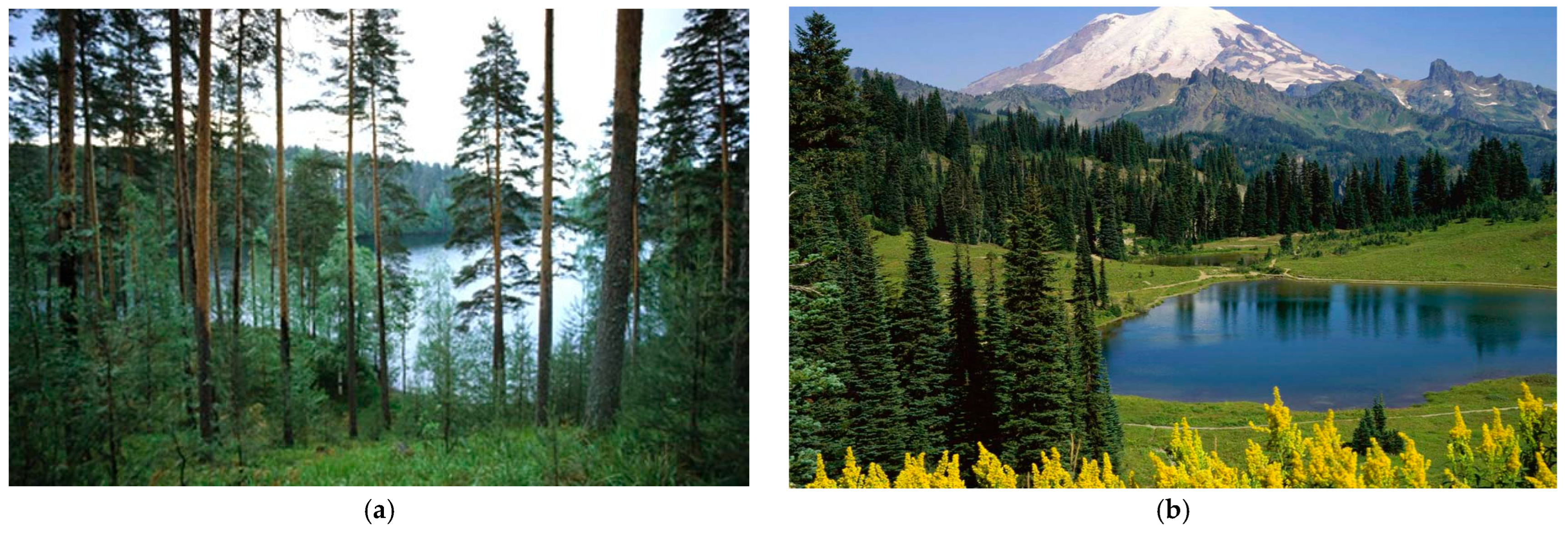
The Eastern Kazakhstan Region lies in the eastern portion of Kazakhstan, sharing borders with both Russia and China (Figure 1). It encompasses a broad spectrum of geographic and climatic zones, stretching from the Altai Mountains in the east to the western edges of the Kazakh steppes [16,22,42,49,50,51,52,53,54,55]. The area boasts remarkable biodiversity in plant and animal life, housing approximately 90% of the country’s forest resources. Vegetation across the region displays significant variety, reflecting conditions typical of the steppe and partial desert–steppe ecosystems. On the historic alluvial plains, dominant plant communities include sand-needle fescue associations thriving on dark chestnut, low-humus “light” soils, often deep and well-drained. Alongside common turf-forming grasses, such as Festuca sulcata and Stipa joannis, various other species appear, including Festuca beckeri, Cleistogenes squarrosa, Taraxacum sibiricum, Artemisia scoparia, and Potentilla acaulis, among others (Figure 3).

2.2. The Genus of Herbaceous Plants Rheum

2.2.1. General Information

Plants of the genus Rheum have a wide geographical distribution, comprising about 60 species. Their distribution range mainly covers the temperate and subtropical zones of Central and East Asia. A significant part of the species also grows in Mongolia, Kazakhstan, Kyrgyzstan, Altai, Tajikistan, and some species are found in Iran, Afghanistan, and Pakistan. Nine species of rhubarb are known in Kazakhstan, they grow mainly in the foothills and mountainous regions of the Tien Shan, Zhetysu Alatau, and Tarbagatai, as well as in the steppes and semi-desert zones, adapting to a wide range of environmental conditions [54,55,56,57,58,59,60,61,62,63,64].
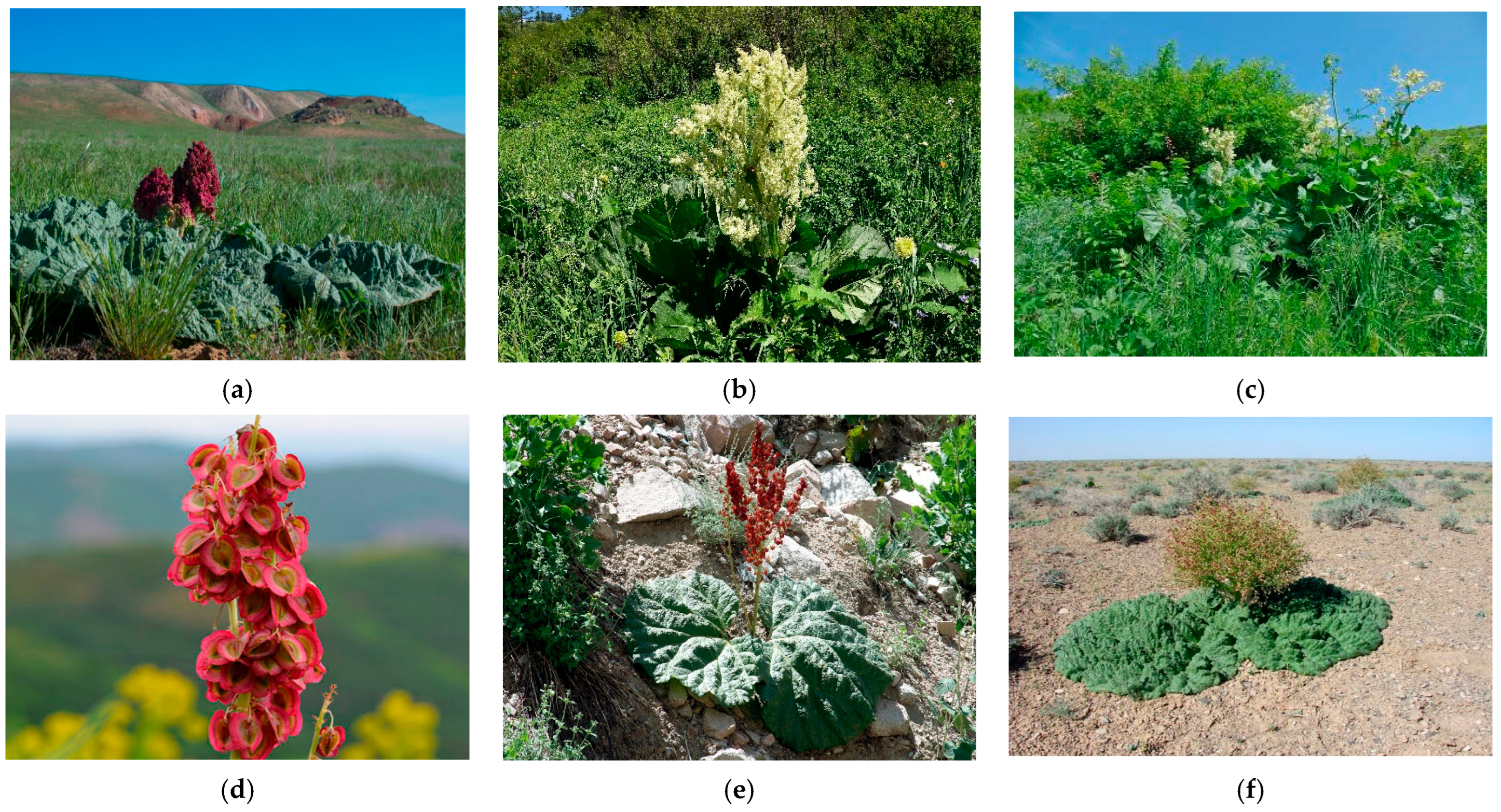
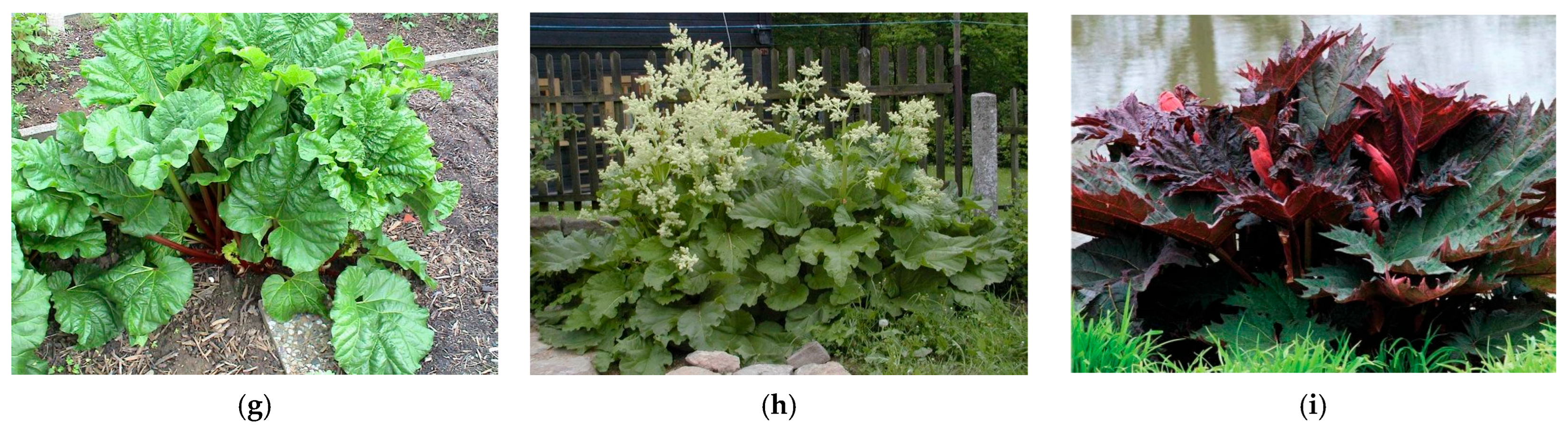
Brief information about the main representatives of this genus is presented in the Table 1. The general appearance of the plants is shown in Figure 4.

2.2.2. The Sequence of Selection, Preparation and Analysis of Plant Materials Using Rheum tataricum L. As an Example

Here, we present a sequential process that we developed for the selection, preparation, and analysis of the plant material—Rheum tataricum L. roots—that ensures reliable and reproducible results when studying their mineral composition. Strict adherence to all sample preparation steps ensures sample homogeneity and reduces potential analytical errors. This method (Table 2) can be used to study the mineral composition of medicinal plants, as well as for the standardization and quality control of Rheum tataricum L.-based herbal preparations. It has been found that acid mineralization effectively converts mineral elements into a soluble form, which is necessary for further analysis. The use of atomic absorption spectroscopy enables the highly accurate determination of macro- and microelement content in plant material.

2.3. Determination of Macro- and Microelement Composition and Heavy Metal Content in Plants

2.3.1. Equipment for Analysis

The concentration of elements in plants was determined by electrothermal atomic absorption spectrometry on an AA-6200 dual-beam spectrophotometer using a GFA-EX7 graphite furnace (Shimadzu, Kyoto, Japan) at a temperature of up to 3000 °C. An acetylene–air flame was used for atomization. The slit width of the monochromator, the gas flow rate, the current, and the hollow cathode feeding lamp were set according to the instructions provided with the atomic absorption spectrophotometer (AA-6200 Shimadzu, Kyoto, Japan) and the lamps.
The composition of macro- and microelements in the plant roots was determined by atomic absorption spectroscopy using the ASSIN device from Carl Zeiss [65,66].
To minimize instrumental error and baseline drift, the preparation procedure for the AA-6200 spectrophotometer (Shimadzu, Japan) includes a mandatory stabilization stage. The resonant radiation sources (hollow cathode lamps) are preheated for 30 min until a constant luminous flux intensity is achieved. Simultaneously, thermal stabilization of the atomizer is performed: the burner is warmed up for 5–10 min with continuous aspiration of deionized water. Optical alignment was performed based on the criterion of maximizing the analytical signal when the beam passes through the densest absorption zone of the flame. Elemental composition is determined using the most sensitive resonance lines: for example, Lead (Pb) is measured at 283.3 nm; Cadmium (Cd) at 228.8 nm; Copper (Cu) at 324.8 nm; Zinc (Zn) at 213.9 nm; Iron (Fe) at 248.3 nm; Nickel (Ni) at 357.9 nm. For lead, it is important to choose the line with the least “noise” and the most stable meter pointer [67,68].

2.3.2. Procedure

A precise sample of crushed plant material in the amount of 1 g (or 3–5 g) is placed in a pre-calcined and accurately weighed porcelain, platinum, or quartz crucible, with a uniform distribution of the substance on the bottom of the crucible. After this, the crucible is carefully heated to allow the substance to burn or evaporate at the lowest possible temperature. The combustion of the remaining coal particles should be carried out at a lower temperature, and after the coal has burned almost completely, the flame should be increased. If the coal particles are not completely burned, the residue is cooled, moistened with water or a saturated solution of ammonium nitrate, evaporated in a water bath, and the residue is calcined. If necessary, this operation is repeated several times.
Calcination is carried out at a weak red heat (about 500 °C) to a constant mass, avoiding fusion of ash and sintering with the walls of the crucible. After calcination, the crucible is cooled in a desiccator and then the resulting ash is burned again at 600 °C until a uniform gray color is obtained. If the result is not achieved, the residue is dissolved in concentrated nitric acid, after which it is heated on a hotplate to remove the nitric acid, and then in a muffle at 400 °C for 30 min. Finally, the precipitate is dissolved in 5 mL HNO3 (1:1) with heating. The resulting solution must be heated on a hotplate until the salts are wet. The result is dissolved in 10–15 mL of 1 N HCl or 1 N HNO3 and transferred to a 25 mL volumetric flask, bringing the volume to the mark.
In parallel, a blank experiment is carried out, which consists in preparing a solution of the same concentration from the same acid using the same glassware. The sample prepared according to the above-described method is examined by atomic adsorption spectroscopy. A total of 300 mg of the obtained ash residues of plants are evaporated in a DC arc. Photographing the spectra is carried out using DFS-13 (inverse linear dispersion 1 A/mm) in the areas of 2100–3600 A. The standard is prepared on a silicon base. The sensitivity of the analysis is 10−2–10−5. Control over the correctness of the determination is carried out using a standard sample of copper sludge CS–CT Sample 2962-84, 2964-84.
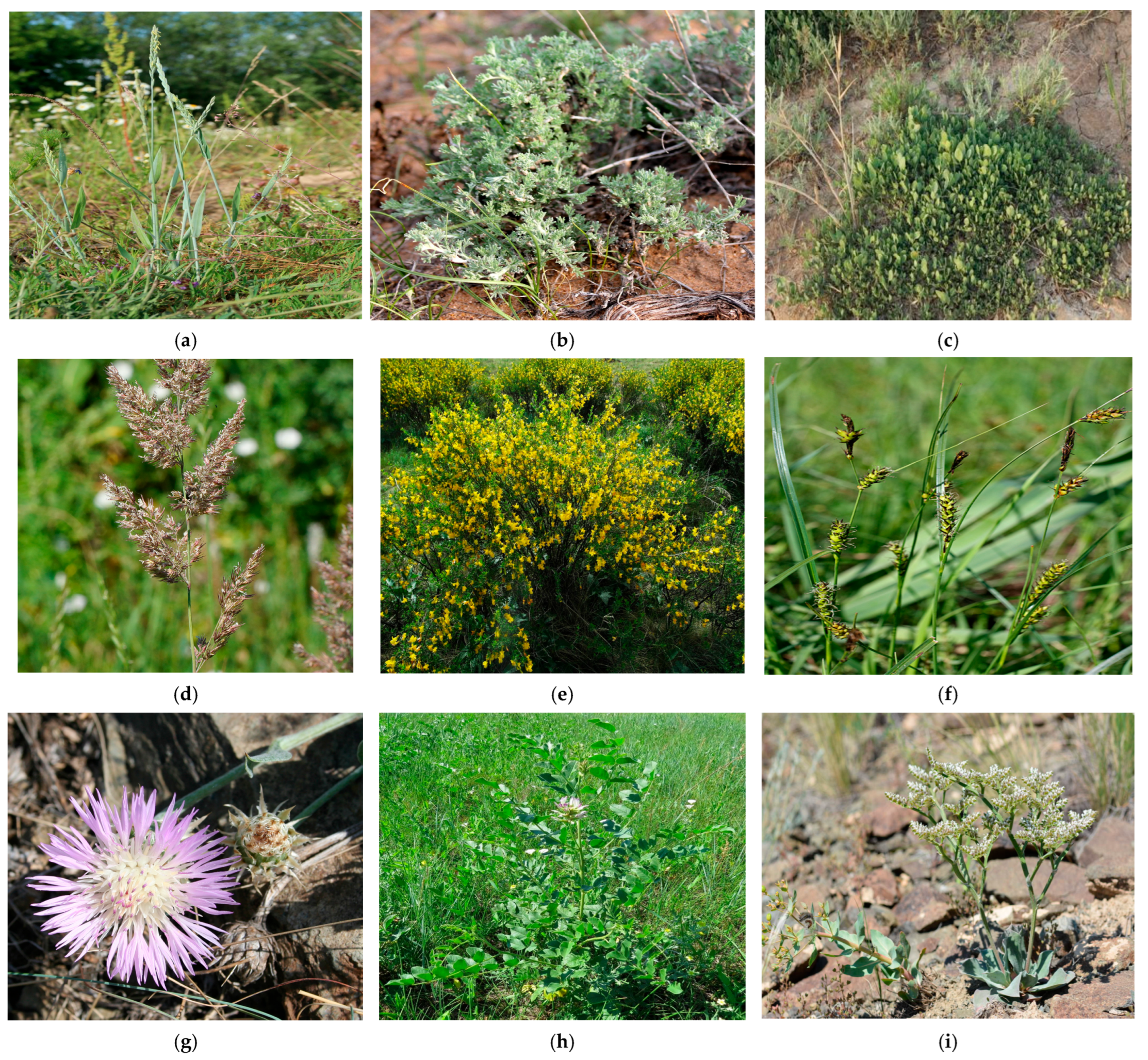
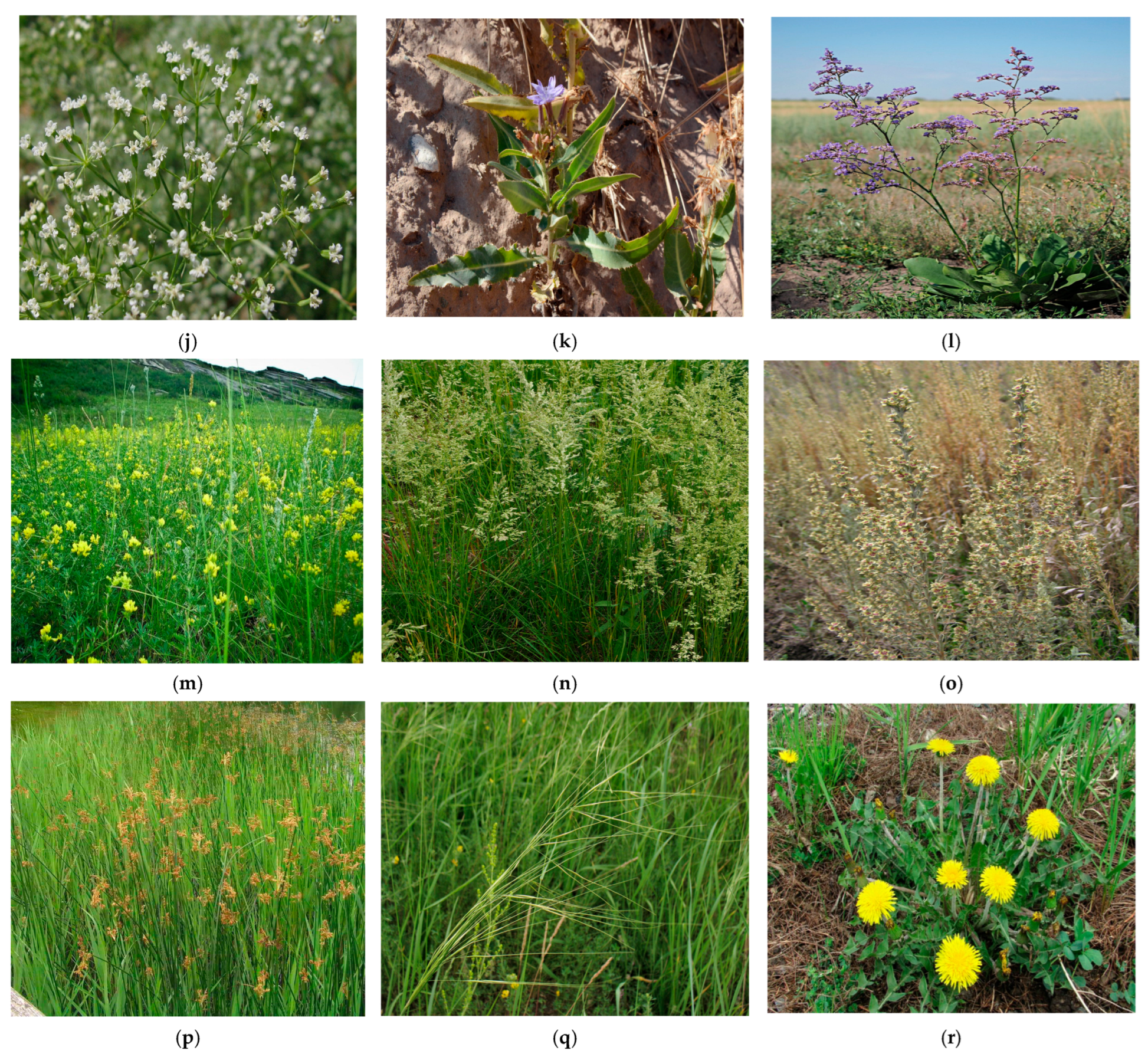
To assess the HM concentrations in natural plant communities across the Eastern Kazakhstan region, representative flora from the steppes and semi-desert zones were examined (totaling 100 plant samples from 18 species spanning six families) (Figure 5).
Heavy metal levels were measured via the photometric dithizone technique on a KFK-3 instrument, with absorbance readings guiding quantification following G.Ya. Rinkis’ protocol. The method exhibits a precision of ±4.2% and a detection limit of 0.01 mg/kg. The fractional separation of HMs utilized sequential leaching techniques. Data processing employed the statistical and mathematical modeling approaches outlined by E.A. Dmitriyev, commonly used in soil analytical studies [16,22,49,65,66,67,68,69,70,71,72,73].

2.4. Quantitative Determination of the Content of the Main Groups of Biologically Active Compounds in the Roots of Rheum tataricum L.

Quantitative determination of the content of the main groups of biologically active compounds in the roots of Rheum tataricum L. was carried out in accordance with the methods described in the pharmacopoeial articles of the State Pharmacopoeia of the Republic of Kazakhstan [60].

2.4.1. Quantitative Determination of Total Flavonoids

Flavonoid content was determined spectrophotometrically using a complexation reaction with aluminum chloride after preliminary acid hydrolysis of the glycosides.
A 2.0 g sample of the raw material was extracted with 30 mL of 90% ethyl alcohol in the presence of 1% concentrated hydrochloric acid (or 10% sulfuric acid) while heating in a water bath under reflux for 1 h. The resulting extract was filtered into a 100 mL volumetric flask; the extraction was repeated twice until the mark was reached. For analysis, 2 mL of the resulting solution was mixed with 1 mL of a 1% alcoholic AlCl3 solution and diluted to 25 mL with 95% ethanol. Optical density was measured after 20 min at a wavelength of 430 nm (10 mm cuvette). The extract without the added reagent was used as a reference solution. The calculation was carried out in terms of quercetin and absolutely dry raw materials according to Formula (1):
X =   D · 100   · 100   · 25   · 100 764.6   · m · 2   · ( 100 W )
where D is the optical density of the test solution at 430 nm, 764.6 is the specific absorption coefficient of the quercetin complex with 1% aluminum chloride at 430 nm, W is the loss on drying of the raw material, and m is the mass of the raw material sample in grams.

2.4.2. Quantitative Determination of Anthraquinone Derivatives

The analysis was performed by absorption spectrophotometry. A sample of crushed raw material (1.0 g) was subjected to acid hydrolysis (15 mL of 10% H2SO4, 1 h in a boiling water bath). The hydrolysis products were extracted with chloroform (50 mL) under heating for 1 h. After phase separation, the anthraquinones were converted to a water-soluble form by repeated extraction with an alkaline ammonia solution until the organic layer was completely decolorized. The optical density of the combined alkaline extracts was recorded at 525 nm. The quantitative content was determined using a calibration curve.
Formula (2) will be used to determine the amount of anthraquinones, as follows:
X = C · 50 · 100 · 100 m   ( 100 W )
where C is the content of anthraquinone derivatives in 1 mL of the test solution, determined from the calibration curve in grams, m is the mass of the raw material sample in grams, and W is the loss on drying of the raw material as a percentage.

2.4.3. Quantitative Determination of Tannins

The permanganometric method was used according to the State Pharmacopoeia of the Republic of Kazakhstan. A sample of the dry extract (equivalent to 1 g of raw material) was dissolved in 50 mL of hot purified water with stirring (2 h, water bath). To 10 mL of the filtrate, 100 mL of water and 10 mL of indigo sulfonic acid solution were added. Titration was performed with a 0.02 M KMnO4 solution until the color changed to golden yellow. The content was calculated taking into account the control experiment, assuming that 1 mL of a 0.02 M KMnO4 solution corresponds to 0.004157 g of tannin.
The content of tannins (X), expressed as a percentage of the absolutely dry matter of the extract, was calculated using Formula (3):
X = ((V1 − V2)·0.004157·V·100·100)/(V3·m·(100 − W))
where V1 is the volume of 0.02 M potassium permanganate solution used for titration of the extract in mL, V2 is the volume of 0.02 M potassium permanganate solution used for titration in the control experiment in mL, V3 is the volume of the extract taken for titration in mL, V is the volume of the extract in mL, m is the mass of the raw material sample in grams, and W is the loss in mass upon drying the raw material as a percentage.

2.4.4. Quantitative Determination of Organic Acids

Quantitative analysis of the acids was performed using direct titration. An aqueous extract (1:10), obtained by heating in a boiling water bath for 2 h, was titrated with a 0.1 M sodium hydroxide solution in the presence of phenolphthalein until a stable pink color appeared. The content was calculated as malic or valeric acid (titer 0.0067 g/mL and 0.01021 g/mL, respectively), taking into account the moisture content of the raw materials. The percentage content of free organic acids in absolutely dry raw materials is calculated using Formula (4):
X =   V · 0.0067 · 250 · 100 · 100 m · 10 · ( 100 W )
where V is the volume of 0.1 M NaOH solution added for titration in mL, m is the mass of the sample in g, W is the loss on drying, as a percentage, and P is 0.0067 g malic acid and 0.01021 g valerianic acid, corresponding to 1 mL of 0.1 M sodium hydroxide solution.
The indicator can be a mixture of 1 mL of 1% phenolphthalein in alcohol and 2 mL of 0.1% methylene blue; titration is carried out until a purple–red color appears.

2.4.5. Quantitative Determination of Total Phenolic Compounds

Quantitative determination of the total phenolic compounds was performed using the Folin–Ciocalteu method [74]. The total phenol content was assessed colorimetrically. A total of 0.45 mL of distilled water and 2.5 mL of Folin–Ciocalteu reagent (diluted 1:10) were added to 0.05 mL of the test extract. After some time, 2 mL of a 7.5% Na2CO3 solution were added, followed by incubation at 50 °C for 5 min. Optical density was measured at 760 nm relative to the control sample (distilled water). The results were expressed as gallic acid equivalents (mg GAE/100 mL).

3. Results and Discussion

3.1. Determination of the Macro- and Microelement Content in the Roots of Tatar rhubarb (Rheum tataricum L.) Collected in the Almaty Region

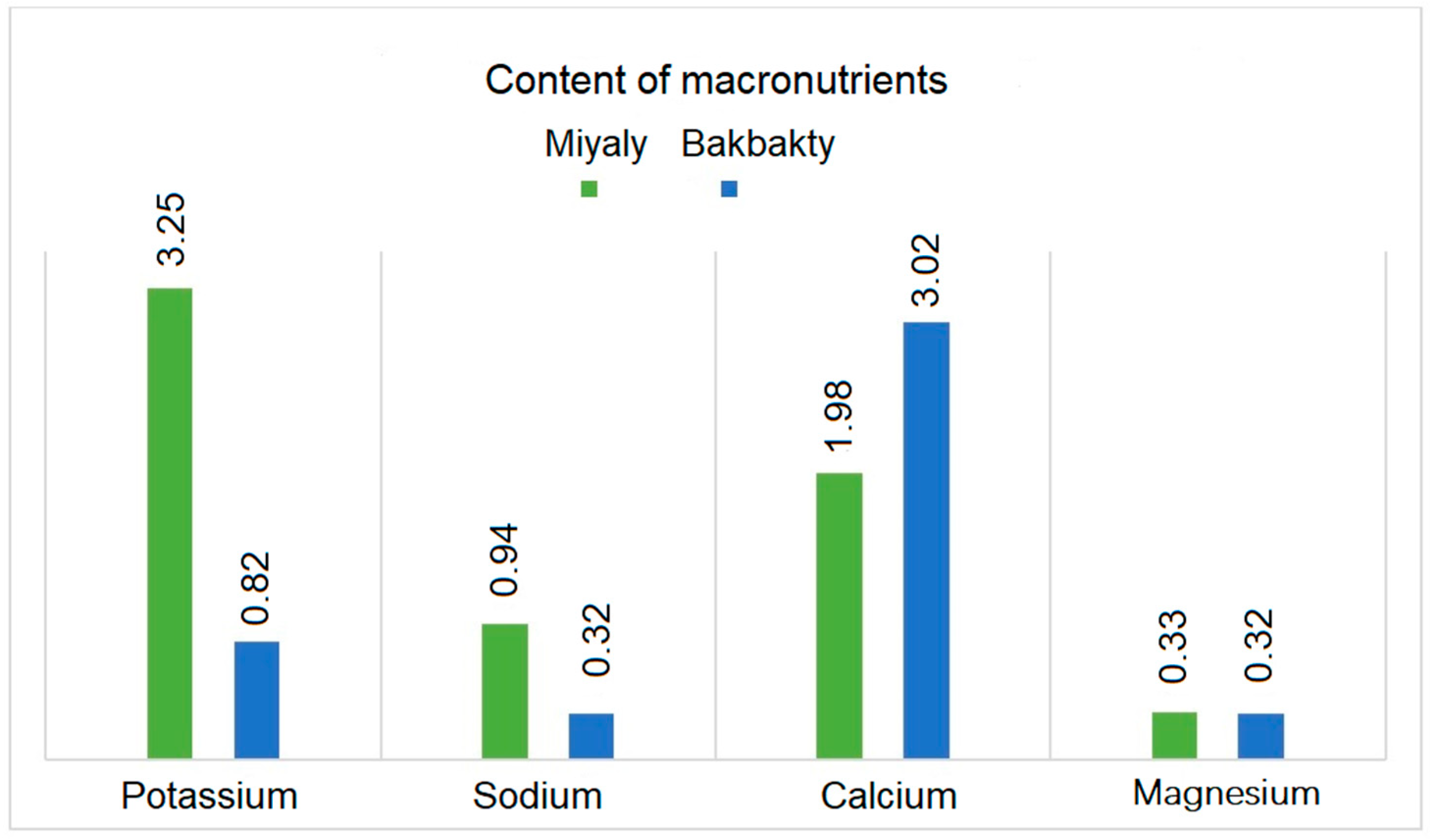
The macro- and microelement composition of the Rheum tataricum L. plant is presented in Figure 6 and Table 3.
The obtained data demonstrate significant spatial variability in the microelement composition of Rheum tataricum L. roots, due to differences in soil conditions within the Almaty region. Plants collected near the village of Miyaly contained higher concentrations of Zn, Mn, Ni, Fe, and Pb compared to samples from the village of Bakbakty, where, conversely, relatively elevated Cu levels were observed, along with lower levels of other elements. Particularly notable differences were found in the iron content: in the samples from Miyaly, its concentration (137 mg/kg) was almost twice that of the plants from Bakbakty (78.4 mg/kg). Given the key role of iron in photosynthesis, respiration, and chlorophyll biosynthesis, its increased accumulation may be related to both soil geochemistry and the plant’s adaptation mechanisms to growing conditions.
Both areas belong to the arid zone of the Balkhash region, and differences in the elemental composition of plants are most likely due to edaphic factors. In the area of the village of Miyaly, solonetzic and alkaline–saline soils predominate, characterized by high ionic activity and increased availability of several microelements, which facilitate their more intensive uptake by plants [75].
Meanwhile, in the Bakbakty area, carbonate and floodplain soils are likely prevalent, formed under the influence of the hydrological regime of the Ili River and characterized by increased calcium content in the form of carbonates. Such conditions may limit the availability of certain microelements, including iron, and alter the ratio of absorbed elements, creating a calcium-dominated environment. Thus, the differences in the accumulation of microelements between the studied populations of Rheum tataricum L. are apparently determined, first of all, by the characteristics of soil–geochemical conditions: the solonetzic soils of Miyaly contribute to increased migration and availability of elements, while the carbonate-floodplain soils of Bakbakty have a selective effect on their absorption.
Overall, the obtained results confirm that, even within a single arid zone, spatial heterogeneity of soils, particularly in terms of salinity, alkalinity, and carbonate content, is a key factor determining the elemental composition of medicinal plant materials. Clearly, these data must be taken into account when standardizing raw materials, conducting environmental monitoring, and efficiently harvesting Rheum tataricum L.

3.2. Evaluation of the Component Composition of the Main Groups of Biologically Active Substances (BAS) in the Roots of Rheum tataricum L.

A qualitative assessment of the component composition of the main groups of biologically active substances was conducted using a set of specific qualitative reactions.
A phytochemical study of Rheum tataricum L. roots revealed the presence of a significant number of polyphenolic compounds, predominantly anthraquinones, flavonoids, and tannins. The presence of anthraquinones was confirmed by the appearance of red and reddish–brown coloration during the Borntreger reaction with a 5% sodium hydroxide solution. Flavonoids were identified by the formation of a yellow color upon interaction with a 1% aluminum chloride solution, while tannins were determined by the development of a black–blue and black–green coloration with a 1% iron ammonium alum solution. Qualitative reactions using specific reactions also detected organic acids in the plant.
Table 4 presents the quantitative analysis data for the main groups of biologically active substances in two root samples.
The results of the quantitative analysis indicate that the accumulation of the main groups of biologically active substances in the roots of Rheum tataricum L. depends significantly on the environmental and geographic growing conditions. Samples collected in the village of Miyaly were found to have higher levels of flavonoids, phenolic compounds, and organic acids, while raw materials from the village of Bakbakty showed increased accumulation of anthracene derivatives and tannins. Flavonoids constituted the largest proportion of the studied groups of biologically active substances in both samples, confirming the high biological and pharmacological value of the plant material studied.
These differences are likely due to the soil and climatic conditions of the studied regions, which influence the intensity of secondary plant metabolism. The availability of micro- and macronutrients in plants is known to play an important role in the biosynthesis of phenolic compounds and other secondary metabolites. Macronutrients such as potassium, calcium, and magnesium are involved in the regulation of enzymatic activity, photosynthesis, and energy metabolism, while micronutrients such as iron, manganese, zinc, and copper act as cofactors for enzyme systems that synthesize flavonoids and other polyphenolic compounds.
The increased content of flavonoids and phenolic compounds in the samples from Miyaly may indicate more favorable mineral nutrition of the plants and high activity of biosynthetic processes. Meanwhile, the increased content of anthracene derivatives and tannins in the raw materials from Bakbakty is likely related to plant adaptation mechanisms in response to environmental stress factors. It is known that changes in the elemental composition of the soil, as well as the deficiency or excess of individual micronutrients, can stimulate the synthesis of protective phenolic metabolites with pronounced antioxidant properties. Consequently, the quantitative composition of biologically active substances in the roots of Rheum tataricum L. is determined not only by the plant’s species characteristics but by a range of environmental factors, including the soil’s mineral composition and the availability of micro- and macronutrients.
It is obvious that the microelement composition of plants is directly influenced by natural and anthropogenic factors of the growing zones, i.e., the places of growth (soil areas), which should be taken into account when harvesting raw materials [71,76]. The results confirm the need to consider regional growth characteristics when assessing the quality, standardization, and pharmacological potential of medicinal plant materials.

3.3. Determination the Distribution of HMs in Vegetation of Eastern Kazakhstan

The plants of the studied territory of the eastern region of Kazakhstan have a wide variety, and it is typical for steppe and/or desert–steppe zones. In the ancient alluvial plain areas, sandy-grass-type plants growing on dark-brown low-humus “light” mainly deep-boiling soils are most characteristic.
The way plants absorb chemical elements, as outlined in the scientific sources [77,78,79,80], is similarly evident within the studied region. The wild vegetation of the studied region has a significant amount of lead, more so than cobalt. The maximum variation of HMs occurs in cadmium (over 70%) and manganese (60–63%); the minimum variation occurs in zinc (23–24%).
The significant variability of metals in plants is due to their genotypic specificity and their geochemical and ecological environment. According to the value of the coefficient of biological absorption CBA, which shows how many times the element content in plant ash is more than in the lithosphere, Cu and Co are elements of the average biological capture and weak accumulation in plants; Zn, Mn, Pb—which refer to the elements of strong biological accumulation and Cd—are elements of energetic biological accumulation (in calculating the CBA, the average content of elements in the crust was used according to A.P. Vinogradov [13]). According to the CBA level, the elements under study are in the following descending order:
Cd > Zn > Mn > Pb > Co > Cu
As can be seen from the results of our research in Table 5, each plant organism has a specific selective ability to absorb mineral salts formed during a long evolutionary development [13,14,29,33]. Wild plants of the studied region are characterized by the geochemical specialization of cadmium and zinc in terms of HM content, as follows: Cd 3.85, Zn 0.15, Mn 0.10, Pb 0.09, Co 0.07, Cu 0.04.
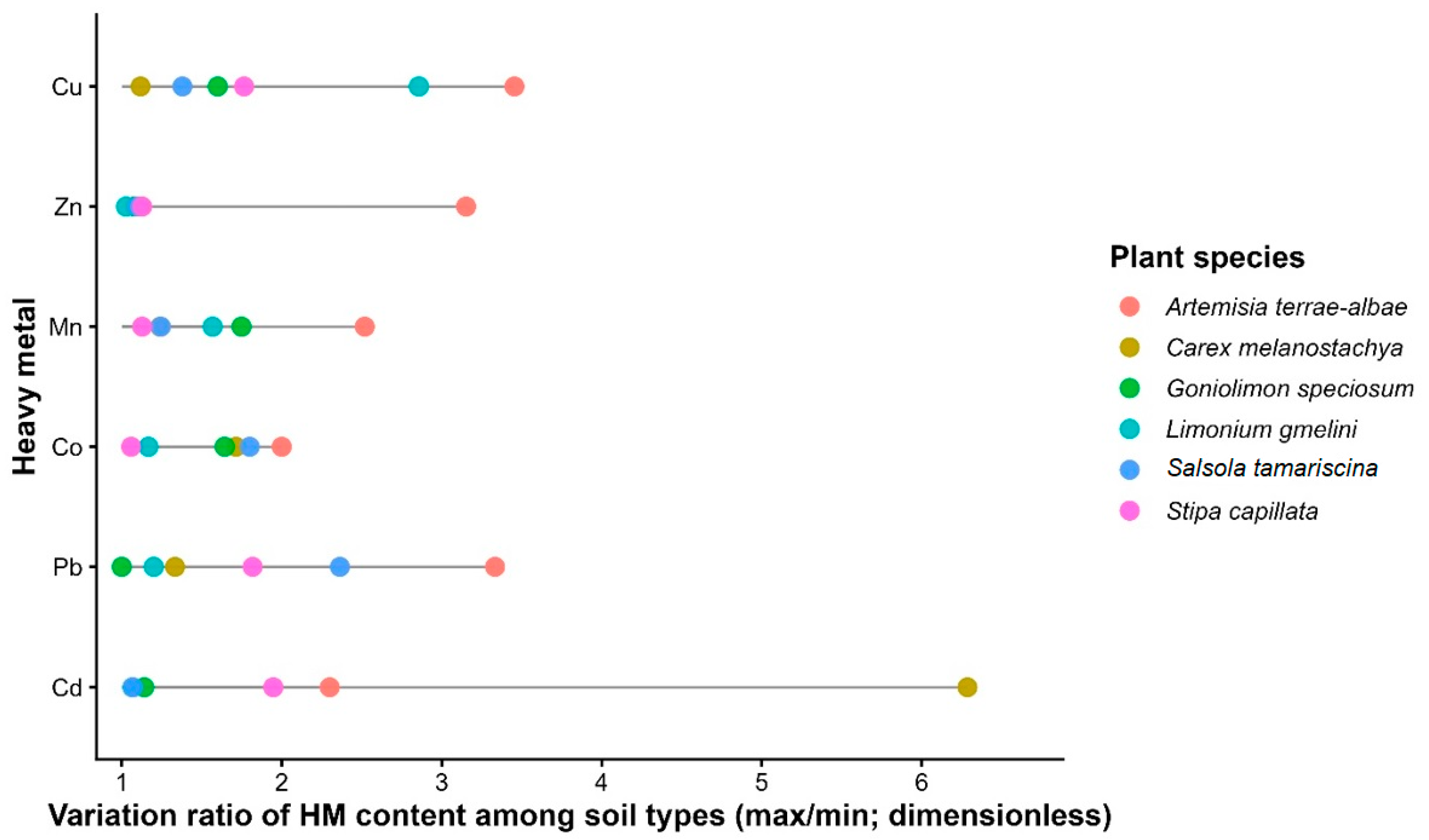
The maximum difference in copper content in the most contrasting types of Lactuca tatarica and Limonium gmelinii was 4.3 times; for zinc in Goniolimon speciosum and Caragana frutex, it was 1.7 times; for manganese in Lactuca tatarica and Stipa capillata, it was 31.6 times; for cobalt in Poa angustifolia and Agropyron repens, it was 3.2 times; for lead in Stipa capillata and Goniolimon speciosum, it was 5.5 times; for cadmium in Taraxacum officinale and Artemisia terrae-albae, it was 6.3 times.
The increased content of all six elements studied is noted in Salsola tamariscina, Lactuca tatarica, and Medicago falcate.
The plants with a low content of copper and lead in relation to the flora of the studied region include the Goniolimon speciosum; for zinc, it includes Caragana frutex; for manganese and cadmium, it includes Stipa capillata; for cobalt, it includes Scirpus lacustris.
According to our research, different plant species have a selective ability to accumulate heavy metals, even when growing in the same type of soil (Table 6). Considerable differences in heavy metal accumulation were observed among the studied plant species growing on light chestnut soils. The highest Mn concentration was detected in Lactuca tatarica (297.1 mg/kg), whereas the highest Cd concentration was observed in Taraxacum officinale (1.52 mg/kg). Lower Cd concentrations were characteristic of Artemisia terrae-albae, Limonium gmelinii, and Stipa capillata. A comparative statistical evaluation of the mean heavy metal concentrations among the plant species was performed using descriptive statistical methods because of unequal and limited sample sizes for several taxa.
It has been shown that the accumulation of heavy metals may depend on the type of soil: the same plant species contains different amounts of heavy metals during the transition from one type of soil to another type. The HM content in plants growing on different types of soils in Eastern Kazakhstan was found and compared (Table 7, Figure 7). The wild plants of Eastern Kazakhstan growing in three types of soils were researched, including light chestnut normal soils (Ch1), light meadow soils (M1), and solonchaks (S).
Heavy metal levels in local flora are governed by soil concentrations and specific mineral nutrition dynamics. This relationship is reflected in the coefficient of biological absorption (CBA), which serves as an indirect indicator of elemental accessibility; typically, higher CBA values correlate with increased element accumulation in plant tissues. Variations in heavy metal uptake among identical species across diverse soil types stem from both inherent botanical traits and ecological factors, specifically differences in elemental content and bioavailability within the soils.
The chemical composition of plants naturally reflects the chemical composition and properties of soils. The level of microelements in plants, crop yields, chemical composition, and various technological parameters depend on the concentration of microelements in the soil. Under natural conditions, the concentration of microelements in plants varies widely. Plants growing in areas with geochemical anomalies have the highest trace element content. Normal trace element concentrations for most plants can vary by tens of times or more. The microelement content of plant organs changes during the growing season, due to seasonal fluctuations in microelement levels, differences in the requirements of certain soil elements for plant growth and viability, characteristics of plant species and varieties, developmental stages, climatic conditions, and variations in the landscape in which plants grow.
The species specificity of HM accumulation by plants with their equal concentration in the soil is due entirely to their biological features—the selectivity of absorption by root systems and metabolic processes in tissues [19,48,74,75,76,77].
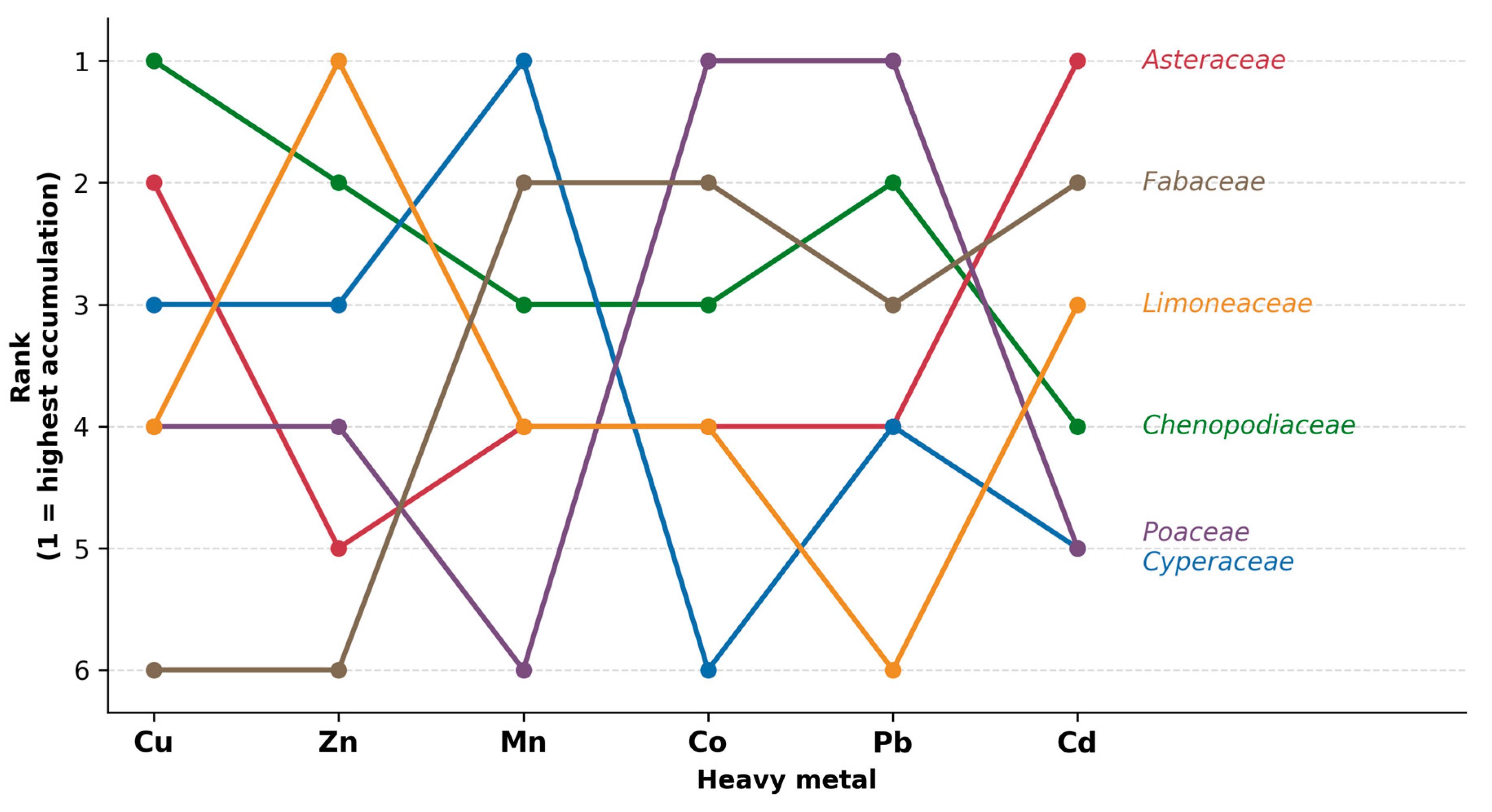
The research results show that the accumulation of HMs in the studied plant families occurs in the following increasing sequence (Figure 8):
Copper: Fabaceae < Poaceae, Limoneaceae < Cyperaceae < Asteraceae < Chenopodiaceae.
Zinc: Fabaceae < Asteraceae < Poaceae < Cyperaceae < Chenopodiaceae < Limoneaceae.
Manganese: Poaceae < Asteraceae, Limoneaceae < Chenopodiaceae < Fabaceae < Cyperaceae.
Cobalt: Cyperaceae < Asteraceae, Limoneaceae < Chenopodiaceae < Fabaceae < Poaceae.
Lead: Limoneaceae < Asteraceae, Cyperaceae < Fabaceae < Chenopodiaceae < Poaceae.
Cadmium: Cyperaceae, Poaceae < Chenopodiaceae < Limoneaceae < Fabaceae < Asteraceae.
Typically, in the region examined, copper, manganese, cobalt, and lead are categorized as having moderate uptake by plants, whereas zinc and cadmium exhibit high absorption rates. For these highly absorbed elements, biogenic migration likely serves as the primary driver of their movement across the landscape.
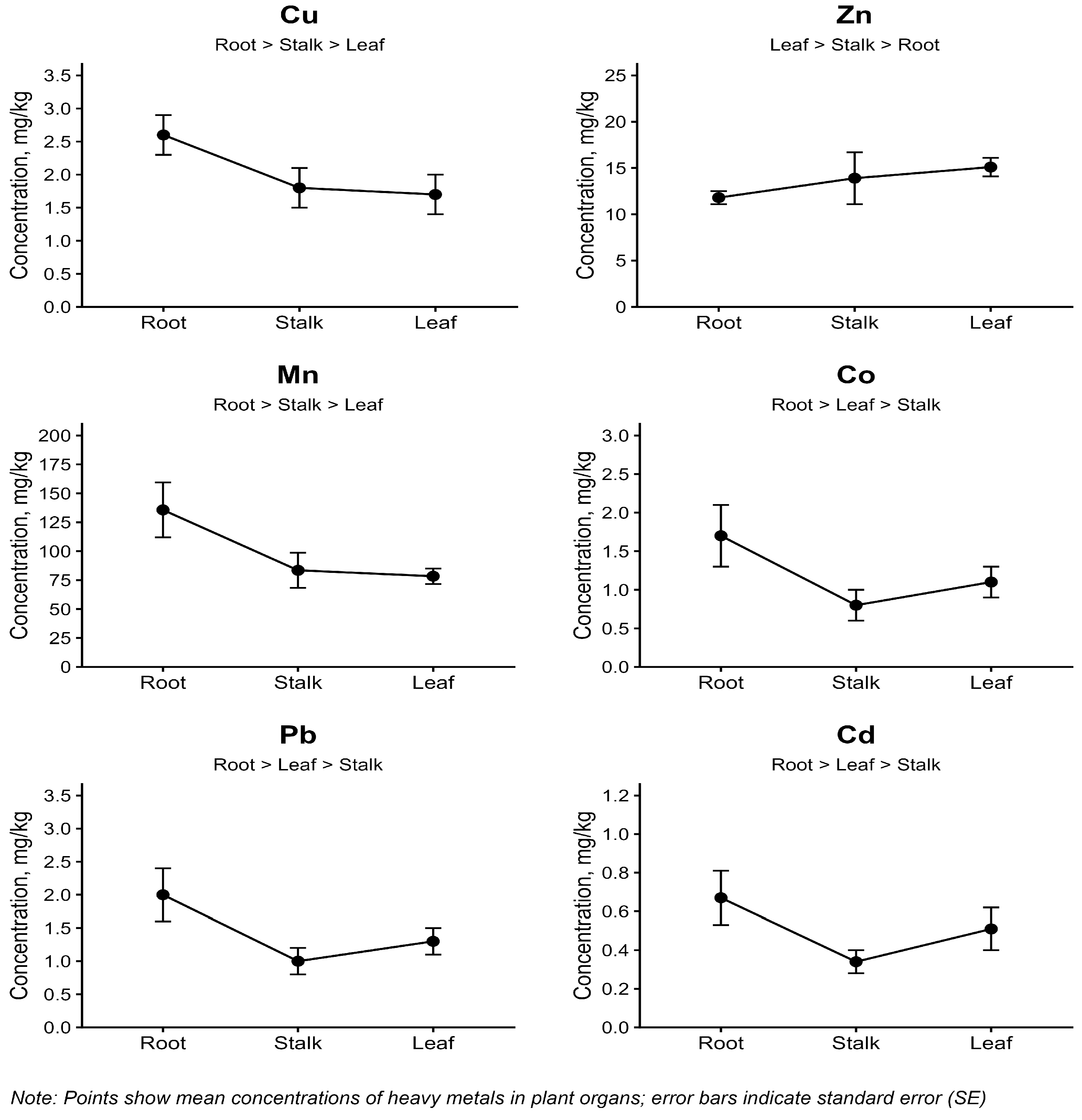
It was determined that Zn displays a basipetal movement pattern throughout different plant parts, whereas Cu and Mn follow an acropetal distribution. Minor variations were noted in the accumulation of Co, Pb, and Cd across plant structures: root levels were the highest, followed by leaves and stems, with the least accumulation occurring in stems. Notably, consistent trends among plant organs were evident solely for cadmium.
Cobalt, lead, and cadmium exhibit the highest concentrations in roots, with levels declining in leaves and stems (Figure 9).
Stems contain the lowest amounts of these metals. Copper and zinc show intense absorption in stems, followed by leaves and roots, resulting in a biological absorption coefficient (CBA) pattern where CBA stem > CBA leaf > CBA root. For lead and manganese, the order is CBA root > CBA stem > CBA leaf, while for cobalt and cadmium, it is CBA root > CBA leaf > CBA stem. Regarding the CBA values, copper and cobalt are classified as having medium biological capture and weak accumulation, while zinc, manganese, and lead are categorized as strong accumulators, and cadmium is considered to be a vigorous accumulator. Plants from the Fabaceae family demonstrated higher CBA values for all elements.
The distribution of HMs among the plant organs indicates differences in their ability to accumulate and transport elements. High concentrations of cobalt, lead, and cadmium in the roots indicate that these metals are predominantly retained in the underground organs, which may be a mechanism for protecting the aboveground parts from toxic effects.
Low levels of these elements in stems and leaves confirm limited transport through the vascular system. By contrast, copper and zinc accumulate most in the stems, indicating their greater mobility and likely a physiological role in the metabolism of the aboveground organs. The observed ratios of CBA confirm differences in the transport pathways and tissue retention capacity of the elements.
Classification by accumulation intensity indicates that copper and cobalt are elements with moderate biological uptake capacity, while zinc, manganese, and lead are strong accumulators, and cadmium is the most rapidly accumulating metal. Elevated CBA in members of the Fabaceae family may be related to their developed root systems and symbiotic relationships with nitrogen-fixing bacteria, which promote active ion exchange in the rhizosphere. These data highlight species-specific and physiological differences in plant responses to HM pollution.
Similar patterns of heavy metal accumulation and species-specific absorption capacity have been observed in various studies by researchers in Kazakhstan and other regions of the world for native plants growing in anthropogenic conditions and arid ecosystems. Researchers have noted that copper accumulation in plants is consistent with its content in the soil [81]. Lead and cadmium are, of course, the main pollutants, but zinc and copper can also be quite harmful and toxic to plants if their levels in the growing environment, and therefore in the plant organs, are high [82]. It has been found that, in areas close to areas burdened with chemical waste, plants such as Cirsium arvense and Agropyron repens exhibit the greatest growth and development [83]. Based on a study of vegetation in Romania, it was found that Cirsium arvense accumulates higher amounts of chromium compared to Agropyron repens, and the authors recommended using Cirsium arvense as an indicator of chromium pollution.
Various processes in the soil can affect the solubility of heavy metals, which affects their ability to enter plant organs. A number of HMs, including cobalt, iron, and chromium are characterized by their accumulation in plant roots, while very small amounts of heavy metals can reach the upper part of plants. This situation can be explained by the low solubility of heavy metal compounds in the different parts of plants (the roots and part of the stem closer to the root of the plant). Some researchers explain this phenomenon by the presence of division of the contents of the plant cell into isolated biologically safe zones (compartments) to prevent the spread of toxic components and their movement into the xylem, the main transport and water-conducting tissue of plants, through which water and the minerals dissolved in it move from the roots to the vital organs of the plants [84,85,86,87,88,89,90].
Investigating elemental composition and heavy metal buildup in vegetation across the Almaty region and Eastern Kazakhstan holds substantial scientific and practical importance for the country. Kazakhstan grapples with major ecological challenges stemming from intense anthropogenic contamination, notably radioactive pollution prevalent in the eastern regions. The nation’s land assets are severely degraded—fertile farmland has drastically diminished, and pasturelands have undergone extensive desertification. Almaty lies on the northern slopes of the Tien Shan mountains, at the base of the Trans-Ili Alatau range, situated within the alluvial plains between the Ulken (Big) and Kishi (Small) Almaty river valleys. As a meeting point of cold northern and hot southern ecosystems, this urban center experiences challenging topography and weather patterns that hinder pollutant dispersal from low-altitude emissions, leading to elevated levels of toxic compounds and frequent smog formation. Being Kazakhstan’s most populous city, Almaty hosts numerous industrial facilities, thermal power stations, residential areas, and dense traffic, all contributing significantly to environmental degradation. Surface and groundwater throughout Almaty and the surrounding areas are heavily contaminated, with heavy metals infiltrating soils and being absorbed by plant life. Bakbakty and Miyaly are rural settlements within the Balkhash District of the Almaty Region; their local ecosystems suffer due to human-induced pollution affecting Lake Balkhash, whose ongoing shrinkage threatens regional biodiversity and demands urgent monitoring and intervention. HM pollution is one of the adverse factors that slows plant growth. Researchers studying the effects of HMs in soils and plants have found that the accumulation of lead, chromium, cadmium, and other heavy metal compounds in plant organs can cause various negative effects, including slowed growth, changes in appearance and color, lack of flowering, and even rapid plant death. It is obvious that the mechanisms of selective movement and accumulation of heavy metals serve as the foundation for maintaining an optimal balance of substances and require mandatory consideration in the development of agronomic strategies, including breeding, genotyping, and the use of agrotechnical techniques [91,92,93,94].
As a result of the conducted research and review of the literature data, the content of micronutrients, macronutrients and HMs in the studied regions of Kazakhstan was determined. It is obvious that their concentration and rate of entry into plants are significantly related to regional climatic conditions, soil characteristics, and the proximity of industrial plants and areas of dumping and recycling of household waste. Both climatic conditions and the number of large settlements with industrial facilities near the sites chosen for collecting plant raw materials directly influence the content of microelements, macroelements, and HMs in plants. Contamination of biosphere objects of plant origin, in particular those described in this work, with HM compounds having high toxicity leads to the possibility of accumulation in living organisms, giving a negative effect in the presence of even small concentrations, which can then lead to a number of serious consequences for the human and animal body.
The obtained results agree with earlier investigations from Eastern Kazakhstan demonstrating significant variability in HM accumulation in plants depending on environmental and anthropogenic conditions. Studies have also reported increased accumulation of HMs in soils and agricultural plants under the influence of industry, for example, in the Ridder district (Kazakhstan) as well as in other parts of the world [32,33,95,96,97,98,99,100]. These observations are generally consistent with the patterns of elemental accumulation identified in the present study.
This study has also established that the quantitative composition of biologically active substances in Rheum tataricum L. roots is determined not only by the plant’s species characteristics but by a number of environmental factors, including the soil’s mineral composition and the availability of micro- and macronutrients. Samples of Rheum tataricum L. collected in the village of Miyaly contained higher levels of flavonoids, phenolic compounds, and organic acids, while raw materials from the village of Bakbakty showed increased accumulation of anthracene derivatives and tannins. Flavonoids constituted the largest proportion of the studied groups of biologically active substances in both samples, confirming the high biological and pharmacological value of the plant material studied.

4. Conclusions

This study investigated the elemental composition, heavy metal accumulation, and biologically active substances in wild plants from different regions of Kazakhstan. A determination of the macro- and microelement composition of the roots of Rheum tataricum L. collected in the settlements of Miyaly and Bakbakty have been made. Differences in the content of individual macro- and microelements in plant samples have been established, which is related to the peculiarities of the soil and climatic conditions of its growth. The results obtained confirm the influence of environmental factors on the formation of the mineral composition of plant raw materials. The key aspects of heavy metal (Cu, Zn, Mn, Co, Pb, Cd) distribution within plant tissues in the dry-steppe area of Eastern Kazakhstan are presented. The findings indicate that heavy metal concentrations in native flora are largely influenced by genetic traits and species-specific characteristics. The availability of these metals in soils varies based on plant physiology, allowing control over uptake even when soil content remains constant. High variation in heavy metal levels characterizes wild-growing vegetation in the surveyed region. Plants from this area exhibit notably higher lead levels compared to cobalt, and display distinct geochemical specialization toward cadmium and zinc. Heavy metal concentrations for Cd (3.85), Zn (0.15), Mn (0.10), Pb (0.09), Co (0.07), and Cu (0.04) were expressed using Clark’s concentration index. It is obvious that uncontrolled pollution of the environment by heavy metals threatens human health, and this indicates the urgent need for the environmental monitoring of heavy metals in plant raw materials, air, water, and soil. At the state level, standards are mandatory for the permissible limits of concentrations of heavy metals in biological environments, in particular in plants growing in a particular area, which could help assess the level of anthropogenic stress and the risk to public health. The results of the quantitative analysis indicate that the accumulation of the main groups of biologically active substances in the roots of Rheum tataricum L. depends significantly on the environmental and geographic growing conditions. It is obvious that the microelement composition of plants directly depends on the natural and anthropogenic factors of the growing areas, i.e., soil type, which should be taken into account when collecting raw materials. The results confirm the need to take into account the regional peculiarities of growth when assessing the quality, standardization, and pharmacological potential of medicinal plant raw materials.

Author Contributions

Conceptualization, Y.A.L. and L.R.S.; methodology, Y.A.L., L.R.S., N.K.Z. and S.S.; software, A.R.S., A.T.K. and R.R.A.; validation, Y.A.L., S.S., K.B., K.G. and R.H.; formal analysis, A.R.S. and R.R.A.; investigation, A.R.S., A.T.K. and R.R.A.; resources, T.S.A., A.K.Z. and N.K.Z.; data curation, Y.A.L., L.R.S. and S.S.; writing—original draft preparation, Y.A.L., L.R.S. and F.M.K.; writing—review and editing, Y.A.L., L.R.S. and S.S.; visualization, F.M.K., T.S.A. and K.G.; supervision, Y.A.L., L.R.S. and S.S.; project administration, Y.A.L. and L.R.S.; funding acquisition, Y.A.L., L.R.S. and S.S. All authors have read and agreed to the published version of the manuscript.

Funding

This research received no external funding.

Data Availability Statement

The original contributions presented in this study are included in the article. Further inquiries can be directed to the corresponding authors.

Conflicts of Interest

The authors declare no conflicts of interest.

References

  1. Agarwala, S.C.; Sharma, C.P.; Farooq, S. Effect of iron supply on growth, chlorophyll, tissue iron and activity of certain enzymes in maize and radish. Plant Physiol. 1965, 40, 493–499. [Google Scholar] [CrossRef]
  2. Baker, A.J.M.; Brooks, R.R. Terrestrial Higher Plants which Hyperaccumulate Metallic Elements. A Review of Their Distribution, Ecology and Phytochemistry. Biorecovery 1989, 1, 81–126. [Google Scholar] [CrossRef]
  3. Akenga, P.; Salim, A.; Onditi, A.; Yusuf, A.; Waudo, W. Determination of selected micro and macronutrients in sugarcane growing soils at Kakamega North District, Kenya. IOSR J. Appl. Chem. 2014, 7, 34–41. [Google Scholar] [CrossRef]
  4. Awad, E.M.; El-Ghamry, A.M. Effect of humic acid, effective microorganisms (em) and magnesium on potatoes in clayey soil. J. Plant Prod. 2007, 32, 7629–7639. [Google Scholar] [CrossRef]
  5. Elless, M.P.; Blaylock, M.J.; Huang, J.W.; Gussman, C.D. Plants as a natural source of concentrated mineral nutritional supplements. Food Chem. 2000, 71, 181–188. [Google Scholar] [CrossRef]
  6. Fodor, F. Iron nutrition and its biochemical interactions in plants: Iron uptake, biofortification, bacteria, and fungi in focus. Plants 2024, 13, 561. [Google Scholar] [CrossRef]
  7. Pilon-Smits, E.A.; Quinn, C.F.; Tapken, W.; Malagoli, M.; Schiavon, M. Physiological functions of beneficial elements. Curr. Opin. Plant Biol. 2009, 12, 267–274. [Google Scholar] [CrossRef] [PubMed]
  8. Rahman, S.U.; Ullah, Z.; Ali, A.; Ahmad, M.; Sher, H.; Shinwari, Z.K.; Nazir, A. Ethnoecological knowledge of wild fodder plant resources of district Buner Pakistan. Pak. J. Bot. 2022, 54, 645–652. [Google Scholar] [CrossRef]
  9. Rout, G.R.; Sahoo, S. Role of iron in plant growth and metabolism. Rev. Agric. Sci. 2015, 3, 1–24. [Google Scholar] [CrossRef]
  10. Madejón, P.; Murillo, J.M.; Marañón, T.; Cabrera, F.; López, R. Bioaccumulation of As, Cd, Cu, Fe and Pb in wild grasses affected by the Aznalcóllar mine spill (SW Spain). Sci. Total Environ. 2002, 290, 105–120. [Google Scholar] [CrossRef]
  11. Madejón, P. Trace elements and nutrients in white poplar trees affected by the Aznalcóllar mine spill. For. Syst. 2003, 12, 19–32. [Google Scholar] [CrossRef]
  12. Terry, N.; Abadía, J. Function of iron in chloroplasts. J. Plant Nutr. 1986, 9, 609–646. [Google Scholar] [CrossRef]
  13. Vinogradov, A.P. Geochemistry of Rare and Trace Chemical Elements in Soils; USSR Academy of Sciences Press: Moscow, Russia, 1957; pp. 203–207. [Google Scholar]
  14. Zayed, A.; Gowthaman, S.; Terry, N. Phytoaccumulation of Trace Elements by Wetland Plants: I. Duckweed. J. Environ. Qual. 1998, 27, 715–721. [Google Scholar] [CrossRef]
  15. Qian, J.H.; Zayed, A.; Zhu, Y.L.; Yu, M.; Terry, N. Phytoaccumulation of trace elements by wetland plants: III. Uptake and accumulation of ten trace elements by twelve plant species. J. Environ. Qual. 1999, 28, 1448–1455. [Google Scholar] [CrossRef]
  16. Akhmetkaliyeva, M.S.; Sassykova, L.R.; Aubakirov, Y.A.; Sendilvelan, S.; Zhumakanova, A.S.; Abildin, T.S.; Zhussupova, A.K.; Amangeldi, M.B. The accumulation of heavy metals by the vegetation of the East Kazakhstan. News Natl. Acad. Sci. Repub. Kazakhstan Ser. Geol. Tech. Sci. 2018, 429, 20–29. [Google Scholar]
  17. Arias, M.; Pérez-Novo, C.; Osorio, F.; López, E.; Soto, B. Adsorption and desorption of copper and zinc in the surface layer of acid soils. J. Colloid Interface Sci. 2005, 288, 21–29. [Google Scholar] [CrossRef] [PubMed]
  18. Bačeva, K.; Stafilov, T.; Šajn, R.; Tănăselia, C.; Makreski, P. Distribution of chemical elements in soils and stream sediments in the area of abandoned Sb–As–Tl Allchar mine, Republic of Macedonia. Environ. Res. 2014, 133, 77–89. [Google Scholar] [CrossRef]
  19. Belzile, N.; Chen, Y.-W. Thallium in the environment: A critical review focused on natural waters, soils, sediments and airborne particles. Appl. Geochem. 2017, 84, 218–243. [Google Scholar] [CrossRef]
  20. Bi, X.; Feng, X.; Yang, Y.; Qiu, G.; Li, G.; Li, F.; Liu, T.; Fu, Z.; Jin, Z. Environmental contamination of heavy metals from zinc smelting areas in Hezhang County, western Guizhou, China. Environ. Int. 2006, 32, 883–890. [Google Scholar] [CrossRef] [PubMed]
  21. Bradl, H.B. Adsorption of heavy metal ions on soils and soils constituents. J. Colloid Interface Sci. 2004, 277, 1–18. [Google Scholar] [CrossRef]
  22. Akhmetkaliyeva, M.S.; Sassykova, L.R.; Aubakirov, Y.A.; Sendilvelan, S. Heavy metals accumulation by the vegetation of the territory of the East Kazakhstan. Int. J. Biol. Chem. 2017, 10, 40–44. [Google Scholar] [CrossRef]
  23. Cai, L.; Xu, Z.; Ren, M.; Guo, Q.; Hu, X.; Hu, G.; Wan, H.; Peng, P. Source identification of eight hazardous heavy metals in agricultural soils of Huizhou, Guangdong Province, China. Ecotoxicol. Environ. Saf. 2012, 78, 2–8. [Google Scholar] [CrossRef] [PubMed]
  24. Covelo, E.F.; Vega, F.A.; Andrade, M.L. Competitive sorption and desorption of heavy metals by individual soil components. J. Hazard. Mater. 2007, 140, 308–315. [Google Scholar] [CrossRef]
  25. Edelstein, M.; Ben-Hur, M. Heavy metals and metalloids: Sources, risks and strategies to reduce their accumulation in horticultural crops. Sci. Hortic. 2018, 234, 431–444. [Google Scholar] [CrossRef]
  26. Inelova, Z.; Nesterova, S.; Yerubayeva, G.; Yessimsiitova, Z.; Seitkadyr, K.; Zaparina, Y. Heavy metal accumulation in plants of Atyrau region. Pak. J. Bot. 2018, 50, 2259–2263. [Google Scholar]
  27. Kaverina, M.; Ualiyeva, R.; Syso, A. The impact of heavy metals on plant organisms and methods of their analysis: An overview. Fundam. Exp. Biol. 2025, 12030, 92–109. [Google Scholar] [CrossRef]
  28. Malik, R.N.; Husain, S.Z.; Nazir, I. Heavy metal concentration and accumulation in soil and wild plant species from industrial area of Islamabad., Pakistan. Pak. J. Bot. 2010, 42, 291–301. [Google Scholar]
  29. Naimanova, A.; Akhmetova, S.; Issayeva, A.; Vyrakhmanova, A.; Alipbekova, A. Phytoaccumulation of Heavy Metals in South Kazakhstan Soils (Almaty and Turkestan Regions): An Evaluation of Plant-Based Remediation Potential. Int. J. Des. Nat. Ecodynamics 2024, 19, 451–464. [Google Scholar] [CrossRef]
  30. Onder, S.; Dursun, S.; Gezgin, S.; Demirbas, A. Determination of Heavy Metal Pollution in Grass and Soil of City Centre Green Areas (Konya, Turkey). Pol. J. Environ. Stud. 2007, 16, 145–154. [Google Scholar]
  31. Oves, M.; Saghir Khan, M.; Huda Qari, A.; Nadeen Felemban, M.; Almeelbi, T. Heavy metals: Biological importance and detoxification strategies. J. Biorem. Biodegrad. 2016, 7, 1–15. [Google Scholar] [CrossRef]
  32. Pinto, M.C.; da Silva, E.F.; Silva, M.M.V.G.; Melo-Gonçalves, P. Heavy metals of Santiago Island (Cape Verde) top soils: Estimated Background Value maps and environmental risk assessment. J. Afr. Earth Sci. 2015, 101, 162–176. [Google Scholar] [CrossRef]
  33. Saglam, C. Heavy metal accumulation in the edible parts of some cultivated plants and media samples from a volcanic region in Southern Turkey. Ekoloji 2013, 22, 1–8. [Google Scholar] [CrossRef]
  34. Sandeep, G.; Vijayalatha, K.R.; Anitha, T. Heavy metals and its impact in vegetable crops. Int. J. Chem. Stud. 2019, 7, 1612–1621. [Google Scholar]
  35. Smedley, P.L.; Kinniburgh, D.G. Molybdenum in natural waters: A review of occurrence, distributions and controls. Appl. Geochem. 2017, 84, 387–432. [Google Scholar] [CrossRef]
  36. Smith, C.J.; Hopmans, P.; Cook, F.J. Accumulation of Cr, Pb, Cu, Ni, Zn and Cd in soil following irrigation with untreated urban effluents in Australia. Environ. Pollut. 1996, 94, 317–323. [Google Scholar] [CrossRef]
  37. Sobukola, O.P.; Adeniran, O.M.; Odedairo, A.A.; Kajihausa, O.E. Heavy metal levels of some fruits and leafy vegetables from selected markets in Lagos, Nigeria. Afr. J. Food Sci. 2010, 4, 389–393. [Google Scholar]
  38. Sresty, T.V.S.; Rao, K.M. Ultrastructural alterations in response to zinc and nickel stress in the root cells of pigeonpea. Environ. Exp. Bot. 1999, 41, 3–13. [Google Scholar] [CrossRef]
  39. Wang, X.S.; Qin, Y. Heavy metals in urban soils of Xuzhou (China), Part I: Total concentration of heavy metals in soils. Int. J. Environ. Pollut. 2008, 33, 173–184. [Google Scholar] [CrossRef]
  40. Yoon, J.; Cao, X.; Zhou, Q.; Ma, L.Q. Accumulation of Pb, Cu, and Zn in native plants growing on a contaminated Florida site. Sci. Total Environ. 2006, 368, 456–464. [Google Scholar] [CrossRef]
  41. Dyachkov, Y.V.; Farzalieva, G.S.; Fomichev, A.A. New data on the centipede (chilopoda) fauna of East Kazakhstan region. Biol. Bull. Bogdan Chmeln. Melitopol State Pedagog. Univ. 2016, 6, 438–442. [Google Scholar] [CrossRef]
  42. Regions of Kazakhstan. Available online: https://en.wikipedia.org/wiki/Regions_of_Kazakhstan (accessed on 24 May 2026).
  43. Balkhash District. Available online: https://www.trip.com/travel-guide/destination/balkhash-district-1915764/?locale=en_xx (accessed on 24 May 2026).
  44. Weather and Climate in Kazakhstan. Available online: https://www.uscisguide.com/international/weather-and-climate-in-kazakhstan/#google_vignette (accessed on 24 May 2026).
  45. Salnikov, V.; Turulina, G.; Polyakova, S.; Petrova, Y.; Skakova, A. Climate change in Kazakhstan during the past 70 years. Quat. Int. 2015, 358, 77–82. [Google Scholar] [CrossRef]
  46. Cherednichenko, A.V.; Cherednichenko, A.V.; Cherednichenko, V.S.; Storozhenko, N.D.; Kozhachmetova, E.P.; Kupchishin, A.I.; Abdrahimov, R.G. Dynamic of Balkhash lake level under climate change conditions. IOP Conf. Ser. Earth Environ. Sci. 2019, 321, 012012. [Google Scholar] [CrossRef]
  47. Cherednichenko, A.; Cherednichenko, A.; Vilesov, E.N.; Cherednichenko, V.S. Climate change in the City of Almaty during the past 120 years. Quat. Int. 2015, 358, 101–105. [Google Scholar] [CrossRef]
  48. Kyrgyzbay, K.; Kakimzhanov, Y.; Sagin, J. Climate data verification for assessing climate change in Almaty region of the Republic of Kazakhstan. Clim. Serv. 2023, 32, 100423. [Google Scholar] [CrossRef]
  49. KAZFLORA. Biodiversity of Kazakhstan’s flora. Botany. Available online: https://kazflora.kz/catalog/?action=catalog&sort=P_SEML&sort_order=ASC (accessed on 24 May 2026).
  50. Samatova, I.; Inelova, Z.; Kakimzhanova, A.; Hoshino, B.; Zaparina, Y.; Aitzhan, M. Rare, endemic and wild species of the genus Ribes in central Asia and Kazakhstan: Current status and conservation prospects. Pak. J. Bot. 2026, 58, 539–545. [Google Scholar] [CrossRef] [PubMed]
  51. Sassykova, L.R.; Aubakirov, Y.A.; Akhmetkaliyeva, M.S.; Sassykova, A.R.; Sendilvelan, S.; Prabhahar, M.; Prakash, S.; Tashmukhambetova, Z.K.; Abildin, T.S.; Zhussupova, A.K. Heavy metals accumulation in plants of the dry-steppe zone of the East Kazakhstan region. Mater. Today Proc. 2020, 33, 1187–1191. [Google Scholar] [CrossRef]
  52. Vdovina, T.A.; Lagus, O.A.; Isakova, E.A.; Vinokurov, A.A. State of coenopopulations of wild berry plants in the territory of Kazakhstan Altai. Bull. Karaganda Univ. Biol. Med. Geogr. Ser. 2024, 11629, 129–134. [Google Scholar] [CrossRef]
  53. Zhang, Y.; Zhang, D.; Li, W.; Li, Y.; Zhang, C.; Guan, K.; Pan, B. Characteristics and utilization of plant diversity and resources in Central Asia. Reg. Sustain. 2020, 1, 1–10. [Google Scholar] [CrossRef]
  54. Litvinenko, Y.A.; Muzychkina, R.A. Phytochemical investigation of biologically active substances in certain Kazakhstan Rumex species. 1. Chem. Nat. Compd. 2003, 39, 446–449. [Google Scholar] [CrossRef]
  55. Rheum maximowiczii. Available online: https://en.wikipedia.org/wiki/Rheum_maximowiczii (accessed on 24 May 2026).
  56. Grudzinskaya, L.M.; Gemedzhieva, N.G.; Nelina, N.V.; Karzhaubekova, Z.Z. Annotated list of medicinal plants of Kazakhstan. Almaty 2014, 20, 113. [Google Scholar]
  57. Fairbairn, J.W.; El-Muhtadi, F.J. Chemotaxonomy of anthraquinones in Rumex. Phytochemistry 1972, 11, 263–268. [Google Scholar] [CrossRef]
  58. Litvinenko, Y.A. Chemical Study of the Roots of Some Kazakh Species of Sorrel (Rumex L.). Doctoral Dissertation, Almaty, Kazakhstan, 2008; pp. 55–56. [Google Scholar]
  59. Bussmann, R.W.; Batsatsashvili, K.; Kikvidze, Z. Rheum maximowiczii Losisnsk. Polygonaceae. In Ethnobotany of the Mountain Regions of Central Asia and Altai; Ethnobotany of Mountain Regions; Batsatsashvili, K., Kikvidze, Z., Bussmann, R., Eds.; Springer: Cham, Switzerland, 2020. [Google Scholar] [CrossRef]
  60. State Pharmacopoeia of the Republic of Kazakhstan; Zhibek Zholy Publishing House: Almaty, Kazakhstan, 2009; Volume 2, 804p, Available online: https://labtorg.kz/downloads/Methods/Gosudarstvennaya-farmakopeya-Respubliki-Kazahstan-tom-II.pdf (accessed on 7 May 2026).
  61. Khojimatov, O.K.; Kosimov, Z.Z.; Bussmann, R.W. Rheum maximowiczii Losinsk—POLYGONACEAE. In Ethnobiology of Uzbekistan; Khojimatov, O.K., Gafforov, Y., Bussmann, R.W., Eds.; Springer: Cham, Switzerland, 2023. [Google Scholar] [CrossRef]
  62. Chen, Z.M.; Tang, R.Q. Recent advances in Polygonaceae endophytes: Diversity, secondary metabolites and biotechnological applications. Front. Bioeng. Biotechnol. 2025, 13, 1666908. [Google Scholar] [CrossRef]
  63. Miao, H.; Wang, K.E.; Li, P.; Zhao, Y.Y. Rhubarb: Traditional uses, phytochemistry, multiomics-based novel pharmacological and toxicological mechanisms. Drug Des. Dev. Ther. 2025, 19, 9457–9480. [Google Scholar] [CrossRef]
  64. Yang, X.; Dai, L.; Yan, F.; Ma, Y.; Guo, X.; Jenis, J.; Wang, Y.; Zhang, J.; Miao, X.; Shang, X. The phytochemistry and pharmacology of three Rheum species: A comprehensive review with future perspectives. Phytomedicine 2024, 131, 155772. [Google Scholar] [CrossRef]
  65. Grinkevich, N.I.; Safronych, L.N. Chemical Analysis of Medicinal Plants; Nauka: Moscow, Russia, 1983; 176p. [Google Scholar]
  66. Ermachenko, L.A.; Ermachenko, V.M. Atomic Absorption Analysis in Sanitary and Hygienic Studies; Chuvashia: Moscow, Russia, 1997. [Google Scholar]
  67. State Standard 30178-96; Raw Materials and Food Products. Atomic Absorption Method for Determining Toxic Elements. Standartinform: Moscow, Russia, 2010.
  68. State Standard R 53218-2008; Organic Fertilizers. Atomic Absorption Method for Determining Heavy Metal Content. Standartinform: Moscow, Russia, 2020.
  69. Dmitriev, E.A. Mathematical Statistics in Soil Science; Librokom Book House: Moscow, Russia, 2009. [Google Scholar]
  70. Brown, J.G.; Lilleland, O.M.U.N.D. Rapid determination of potassium and sodium in plant materials and soil extracts by flame photometry. Proc. Amer. Soc. Hort. Sci. 1946, 48, 341–346. [Google Scholar]
  71. Alekseev, Y.V. Heavy Metals in Soils and Plants; Agropromizdat: Moscow, Russia, 1987. [Google Scholar]
  72. Vazhenin, I.G. Methodological Recommendations for the Study and Mapping of Soil Cover by Levels of Pollution by Industrial Discharges; Vaskhnil: Moscow, Russia, 1987. [Google Scholar]
  73. Rinkis, G.Y.; Ramane, H.K.; Kunitskaya, T.A. Methods of Soil and Plant Analysis; Zinatne: Riga, Latvia, 1987; 174p. [Google Scholar]
  74. Ainsworth, E.A.; Gillespie, K.M. Estimation of total phenolic content and other oxidation substrates in plant tissues using Folin–Ciocalteu reagent. Nat. Protoc. 2007, 2, 875–877. [Google Scholar] [CrossRef]
  75. Madibekov, A.; Ismukhanova, L.; Opp, C.; Saidaliyeva, Z.; Zhadi, A.; Sultanbekova, B.; Kurmanova, M. Spatial Distribution of Cu, Zn, Pb, Cd, Co, Ni in the Soils of Ili River Delta and State Natural Reserve “Ili-Balkhash”. Appl. Sci. 2023, 13, 5996. [Google Scholar] [CrossRef]
  76. Divrikli, U.; Horzum, N.; Soylak, M.; Elci, L. Trace heavy metal contents of some spices and herbal plants from western Anatolia, Turkey. Int. J. Food Sci. Technol. 2006, 41, 712–716. [Google Scholar] [CrossRef]
  77. Malcolm, J.R.; Markham, A. Global Warming and Terrestrial Biodiversity Decline; WWF-World Wide Fund For Nature: Washington, DC, USA, 2000. [Google Scholar]
  78. Mann, A.; Reimann, C.; De Caritat, P.; Turner, N.; Birke, M. Mobile Metal Ion® analysis of European agricultural soils: Bioavailability, weathering, geogenic patterns and anthropogenic anomalies. Geochem Explor. Environ. Anal. 2015, 15, 99–112. [Google Scholar] [CrossRef]
  79. Reddy, S.K.; Reddy, C.S.; Reddy, G.V.S. Bioaccumulation of Trace Metals in Selected Vegetable Crops around Tummalapalle uranium mine in Kadapa District, Andhra Pradesh. Orient J. Chem. 2018, 34, 1078–1090. [Google Scholar] [CrossRef]
  80. Zinkutė, R.; Baužienė, I.; Dilys, K.; Mažeika, J.; Taminskas, J.; Taraškevičius, R. Recent Lithuanian peri-urban ombrotrophic bog records: Indices derived from the contents of lead, zinc, copper and nickel. Geochem Explor. Environ. Anal. 2015, 15, 293–318. [Google Scholar] [CrossRef]
  81. Ernst, W.H.O.; Verkleij, J.A.C.; Schat, H. Metal tolerance in plants. Acta Bot. Neerl. 1992, 41, 229–248. [Google Scholar] [CrossRef]
  82. Ebbs, S.D.; Kochian, L.V. Toxicity of zinc and copper to Brassica species: Implications for phytoremediation. J. Environ. Qual. 1997, 26, 776–781. [Google Scholar] [CrossRef]
  83. Alda, S.; Nita, S.; Nita, L.D.; Rada, M.; Bordean, D.M.; Alda, L.M. Heavy Metals (Cr, Cd, Cu, Pb and Zn) Uptake by Cirsium arvense and Agropyron repens. Rev. Chim. 2018, 69, 1145–1148. [Google Scholar] [CrossRef]
  84. Hänsch, R.; Mendel, R.R. Physiological functions of mineral micronutrients (Cu, Zn, Mn, Fe, Ni, Mo, B, Cl). Curr. Opin. Plant Biol. 2009, 12, 259–266. [Google Scholar] [CrossRef]
  85. Kosegarten, H.; Koyro, H.W. Apoplastic accumulation of iron in the epidermis of maize (Zea mays) roots grown in calcareous soil. Physiol. Plant. 2001, 113, 515–522. [Google Scholar] [CrossRef]
  86. Bravin, M.N.; Travassac, F.; Le Floch, M.; Hinsinger, P.; Garnier, J.M. Oxygen input controls the spatial and temporal dynamics of arsenic at the surface of a flooded paddy soil and in the rhizosphere of lowland rice (Oryza sativa L.): A microcosm study. Plant Soil 2008, 312, 207–218. [Google Scholar] [CrossRef]
  87. Yang, X.; Li, T.Q.; Yang, J.C.; He, Z.L.; Lu, L.L.; Memg, F.H. Zinc compartmentation in root, transport into xylem, and absorption into leaf cells in the hyperaccumulating species of Sedum alfredii Hance. Planta 2006, 224, 185–195. [Google Scholar] [CrossRef] [PubMed]
  88. Richau, K.H.; Kozhevnikova, A.D.; Seregin, I.V.; Voojis, R.; Koevoets, P.L.M.; Snith, J.A.C.; Ivanov, V.B.; Schat, H. Chelation by histidine inhibits the vacuolar sequestration of nickel in roots of the hyperaccumulator Thlaspi caerulescens. New Phytol. 2009, 183, 106–116. [Google Scholar] [CrossRef] [PubMed]
  89. Page, V.; Weisskopf, L.; Feller, U. Heavy metals in white lupin: Uptake, root-to-shoot transfer and redistribution within the plant. New Phytol. 2006, 171, 329–341. [Google Scholar] [CrossRef] [PubMed]
  90. Page, V.; Feller, U. Selective transport of zinc, manganese, nickel, cobalt and cadmium in the root system and transfer to the leaves in young wheat plants. Ann. Bot. 2005, 96, 425–434. [Google Scholar] [CrossRef] [PubMed]
  91. Bouis, H.E.; Welch, R.M. Biofortification-A sustainable agricultural strategy for reducing micronutrient malnutrition in the global south. Crop Sci. 2010, 50, S20–S32. [Google Scholar] [CrossRef]
  92. Welch, R.M.; Graham, R.D. Agriculture: The real nexus for enhancing bioavailable micronutrients in food crops. J. Trace Elem. Med. Biol. 2005, 18, 299–307. [Google Scholar] [CrossRef]
  93. Welch, R.M.; Graham, R.D. Breeding for micronutrients in staple food crops from a human nutrition perspective. J. Exp. Bot. 2004, 55, 353–364. [Google Scholar] [CrossRef]
  94. Page, V.; Feller, U. Heavy Metals in Crop Plants: Transport and Redistribution Processes on the Whole Plant Level. Agronomy 2015, 5, 447–463. [Google Scholar] [CrossRef]
  95. Daurov, D.; Zhambakin, K.; Daurova, A.; Sapakhova, Z.; Isgandarov, I.; Ramazanova, R.; Zhumagulova, M.; Sumbembayev, A.; Abilda, Z.; Toishimanov, M.; et al. Assessment of Heavy Metal Accumulation in Soils and Dominant Agricultural Crops in an Industrial Environment of Ridder, East Kazakhstan Region. Plants 2026, 15, 983. [Google Scholar] [CrossRef] [PubMed]
  96. Inelova, Z.; Nesterova, S.; Erubaeva, G.; Sejtkadyr, K.; Zaparina, E.; Baubekova, A.; Galamova, G.G. The heavy metals in Alhagi pseudalhagi, Artemisia terrae-albae, Ceratocarpus arenarius of Mangystau region. Eurasian J. Ecol. 2018, 52, 66–75. [Google Scholar] [CrossRef]
  97. Vysochina, G.I. Anthraquinones and Biological Activity of Species of The Genus Rheum L. (Polygonaceae) (Review). Chem. Plant Raw Mater. 2018, 4, 29–41. [Google Scholar] [CrossRef]
  98. Terletskaya, N.; Mamirova, A.; Litvinenko, Y.; Kurmanbayeva, M.; Polyakova, S.; Gemejiyeva, N.; Kulmanov, T.; Mussayeva, A. Soil–Climatic Drivers of Anatomical and Metabolic Plasticity in Rheum tataricum L.f. Across Arid Landscapes of Kazakhstan. Plants 2026, 15, 1025. [Google Scholar] [CrossRef]
  99. Radulescu, C.; Stihi, C.; Barbes, L.; Chilian, A.; Chelarescu, D.E. Studies concerning heavy metals accumulation of Carduus nutans L. and Taraxacum officinale as potential soil bioindicator species. Rev. Chim. 2013, 64, 754–760. [Google Scholar]
  100. Gulzira, G.; Yerbolat, M.; Nuriya, A.; Zharas, B.; Gulshat, A.; Kairat, S.; Assiya, D.; Aidana, B.; Saltanat, A. Ecological and Geochemical Characteristics of the Content of Heavy Metals in Steppe Ecosystems of the Akmola Region, Kazakhstan. Sustainability 2025, 17, 6576. [Google Scholar] [CrossRef]
Figure 1. Map of the Republic of Kazakhstan: (a) general view; (b) the Almaty region and Eastern Kazakhstan, the regions where plant materials were collected for this study, are highlighted in dark shades.
Sci 08 00123 g001
Figure 2. General views of the sampling locations in the Almaty region where Rheum tataricum L. samples were collected: (a) Miyaly village; (b) Bakbakty village.
Sci 08 00123 g002
Figure 3. Typical images of landscape of Eastern Kazakhstan: (a) Semey-Ormany; (b) Katon-Karagay National Park.
Sci 08 00123 g003
Figure 4. Photographic images of the Rheum plant varieties studied in this work: (a) Rheum tataricum L. (Tatar rhubarb, Tuyezhapyrak); (b) Rheum altaicum; (c) Rheum compactum; (d) Rheum wittrockii Lundstr; (e) Rheum maximowiczii Losinsk–Maximovich’s rhubarb; (f) Rheum turkestanicum; (g) Rheum cordatum; (h) Rheum rhabarbarum; (i) Rheum palmatum.
Sci 08 00123 g004aSci 08 00123 g004b
Figure 5. Photos of plants selected to determine the content of heavy metals growing on the territory of Eastern Kazakhstan: (a) Agropyron repens (L.) Beauv.; (b) Artemisia terrae-albae Krasch.; (c) Atriplex verrucifera M.Bieb.; (d) Calamagrostis epigeios (L.) Roth.; (e) Caragana frutex (L.) C.Koch.; (f) Carex melanostachya Bieb. Ex. Wiild.; (g) Centaurea sibirica (L.); (h) Glycyrrhiza uralensis Fisch.; (i) Goniolimon speciosum (L.) Boiss.; (j) Gypsophila paniculata (L.) C.A.Mey.; (k) Lactuca tatarica (L.); (l) Limonium gmelinii (Willd.) O. Kuntze; (m) Medicago falcata (L.); (n) Poa angustifolia (L.); (o) Salsola tamariscina Pall.; (p) Scirpus lacustris (L.); (q) Stipa capillata (L.); (r) Taraxacum officinale (Wigg.).
Sci 08 00123 g005aSci 08 00123 g005b
Figure 6. Quantitative content of macronutrients in the roots of Rheum tataricum L.
Sci 08 00123 g006
Figure 7. Changes in the level of HM accumulation (mg/kg) in plants depending on soil type.
Sci 08 00123 g007
Figure 8. Ranking of botanical families according to HM accumulation.
Sci 08 00123 g008
Figure 9. Distribution of heavy metals by the morphological organs of wild plants.
Sci 08 00123 g009
Table 1. The main representatives of Rheum plants.
NameAppearance
(Habitus)
HabitatNotes
Rheum
tataricum L.—Tatar rhubarb
A perennial herbaceous plant with a vertical rhizome and a leaf width of up to 55 cm, the leaves themselves are wide and oval with small petioles.It is found in various natural zones of the country: in semi-desert and steppe regions, and also frequently in the Caspian region, Bukeyev, Aktobe, Turgay, and Kyzylorda regions, Turkestan, the Chu-Il Mountains, and Karatau.
It prefers open, well-lit areas with moderately dry and well-drained soils.
Flowering time is April–May, fruiting is May–June.
Rheum altaicumAltai rhubarbA perennial frost-resistant herbaceous plant with a powerful multi-headed short rhizome and fleshy roots. The leaves are stalked and rounded heart-shaped with long petioles. The aboveground part of the plant is characterized by large leaves gathered in a basal rosette, and tall peduncles that can reach 1.5 m in height. The flowers are small, greenish–yellow, collected in a paniculate inflorescence.It is found in Eastern Kazakhstan and Tarbagatai, is endemic to the Altai region, and prefers subalpine meadows and foothill zones.It is a rare plant listed in the Red Book of Kazakhstan.
Rheum
compactum—thick-flowered rhubarb or compact rhubarb
A perennial herbaceous plant, reaching 120 cm in height. The rhizome is strong and significantly thickened, dark brown in color with a pronounced orange tint. The leaves vary in shape from oval-rounded to round-ovate.The distribution area
covers Altai, the mountain ranges of Eastern Kazakhstan and the southeastern regions of the country. This plant prefers to grow on mountain slopes with calcareous and rocky soils.
It is officially included in the Red Book of Kazakhstan as a declining species.
Rheum wittrockii Lundstr.—Wittrock’s rhubarbA perennial herbaceous plant from the buckwheat family, the height of the plant varies from 70cm to 110 cm. It has a powerful root system of light brown color, having a yellowish–orange color on the cut. The root system is well developed, which makes the plant resistant to mountain conditions. The basal leaves are wide, with thin petioles equal to the lamina. The flowers are pinkish–white, the leaf surface is smooth, and the pedicels are short.It is found in subalpine and Alpine belts, at an altitude of 2000 m above sea level. In the territory of Kazakhstan, it is most often found in the following regions: the Trans-Ili Alatau, including the vicinity of the Great Almaty Lake, the Dzungarian Alatau, the Ketmen Range, and some areas of Eastern Kazakhstan.
Rheum maximowiczii Losinsk—Maximovich’s rhubarbA perennial plant native to the mountainous regions of Central Asia. The rhizome is powerful, vertical, dark brown in color. The stem is erect, reaching 100 cm, with a reddish tinge at the base. The leaves are large, roundish-ovate, up to 55–60 cm wide, with short petioles.It is found in the mountainous regions of Central Asia, including Uzbekistan, Kyrgyzstan, Tajikistan, Kazakhstan, and Afghanistan. The fruit are large, broadly oval nuts up to 18–20 mm long and 14–15 mm wide, with bright red wings that turn purple–brown when ripe. It grows at altitudes ranging from 1300 m to 3200 m above sea level, preferring gravel slopes, as well as the banks of rivers and other springs.
Rheum turkestanicumTurkestan rhubarbA perennial herbaceous plant with large basal leaves, rounded in shape, and small yellowish–pinkish flowers.Turkestan rhubarb mainly grows on the Turkestan range, in the valley of the Isfara River, where it is found on slopes and in gorges with rocky and gravelly soils. It also grows in the regions of Central Asia and Central Kazakhstan, including the Turanian plain and desert areas such as Kyzylkum. The preferred habitat for this species is mountain slopes with calcareous and rocky soils.
Rheum cordatumheart-shaped rhubarbIt is a perennial plant with a well-developed, powerful taproot. Its leaves are large, rounded, with a characteristic heart-shaped base, wide and elongated.In Kazakhstan, it is found primarily in three floristic regions: the Chu-Ili Mountains, the Karatau Range, and within the Western Tien Shan. Its most typical habitats are rocky mountain slopes and dry, well-lit areas with sparse vegetation. The plant prefers the mid-mountain zone, where it forms stable populations adapted to harsh environmental conditions.
Rheum
rhabarbarumwavy rhubarb
This perennial plant with a strong taproot has a strong, upright, woody rhizome. The basal leaves are large, wide, rounded, and have characteristically wavy margins, which gives the plant its name.This plant is widespread in the temperate regions of Eurasia and is found in the natural environments of Kazakhstan, Russia, Mongolia, and China. It prefers open rocky slopes, steppes, forest meadows, riverbanks, and ravines.It is known as a wild species, as well as a cultivated one, used for food and medicinal purposes.
Rheum rhabarbarum—wavy
rhubarb
This Rhubarb is a vigorous herbaceous plant with large, palmately lobed leaves up to 75 cm wide. This leaf blade gives the plant an ornamental appearance and promotes active photosynthesis. The stem is erect, thick, hollow, and can reach a height of up to 2.5 m. The root system is well-developed and consists of a powerful rhizome with numerous roots, which serves as the main source of raw material for medicinal purposes. In Korea, Mongolia, Japan, and parts of Eastern Europe, it grows in shrubby and rocky areas, as well as along stream banks. It is found in China,
in other regions of Asia, including Korea, Mongolia, Japan, and parts of Eastern Europe, where it grows at altitudes ranging from 2500 to 4000 m above sea level.
It is widely used in traditional Chinese medicine and is cultivated in various regions of Asia.
Table 2. Stages of selection and preparation of plant materials (using Rheum tataricum L. as an example) for analysis.
Stage No.StageDescriptionConditions/ParametersResult
1SamplingCollection of plant material in natural conditions or from cultivated areas.Underground parts of Tatar rhubarb (Polygonaceae family), collected during the growing and fruiting phases in two different villages in the Almaty region in late summer.Initial plant material—Rheum tataricum L.
2Primary processingRemoval of mechanical and foreign particles (soil particles, dust, organic, and inorganic impurities), as well as damaged and discolored plant parts.Manual sorting; no washing (according to the State Methodology of the Republic of Kazakhstan).Purified plant material—Rheum tataricum L.
3FractionationSeparation into morphological parts (leaves, stems, roots, flowers).Visual/manual separation.Individual plant organs
4DryingRemove moisture to prevent decomposition.Temperature: 40–60 °C; air circulation; until constant weight.Dried plant material
5Milling
(grinding)
Reducing particle size to ensure uniformity.Particle size: 3–7 mm.Crushed vegetable raw materials
6HomogenizationEnsuring sample homogeneity.Mechanical mixing.Homogeneous sample
7StorageStorage before analysis procedure.Dry, dark place; sealed containers, paper or cloth bags.Stabilized raw
materials
8Sample
Preparation
Mineralization of plant material to convert elements into soluble form.Acid decomposition (HNO3 or a mixture of HNO3 + H2O2); heating
(in electric stove, muffle furnace);
filtration; bringing to volume with distilled water.
A mineralized solution suitable for analysis
9AnalysisDetermination of
sample mineral
composition.
Atomic absorption spectroscopy (AAS); calibration using standard solutions; determination of macro- and microelements.Mineral element content in the sample (mg/kg)
Table 3. Quantitative content of microelements in the roots of Tatar rhubarb (Rheum tataricum L.).
Place of Collection of Raw
Materials for Research
Elements Content, mg/kg
ZnMnNiFePbCdCu
Almaty region, Miyaly village29.426.715.413727.65.71.2
Almaty region, Bakbakty village15.014.811.378.415.00.84.2
Table 4. Quantitative analysis data for the main groups of biologically active substances in Rheum tataricum L. root samples.
Group of Biologically Active SubstancesContent of the Main Groups of BAS, %
Almaty Region,
Bakbakty Village
Almaty Region,
Miyaly Village
flavonoids14.5417.32
anthracene derivatives2.341.05
phenolic compounds0.610.82
tannins8.567.72
organic acids0.680.76
Table 5. The content of HMs in wild plants of the study area, mg/kg.
Plant Type (n)Development PhaseAsh, %CuZnMnCoPbCd
Agropyron repens (L.) Beauv (n = 2)flower8.11.613.813.80.61.40.73
Artemisia terrae-albae Krasch (n = 12)flower9.62.5 ± 0.6
1.1–4.0
(56)
9.2 ± 2.2
3.36–15.1
(57)
115.2 ± 21.5
61.1–187.9
(45)
0.9 ± 0.2
0.4–1.5
(51)
1.5 ± 0.5
0.4–3.8
(82)
0.59 ± 0.31
0.18–2.07
(98)
Atriplex verrucifera Bieb. (n = 2)vegetation9.53.011.582,11.01.10.38
Calamagrostis epigeios (L.) Roth (n = 2)flower3.71.512.012.01.11.20.55
Caragana frutex (L.) C.Koch (n = 10)flower3.01.4 ± 0.2
1.1–2.0
(29)
9.0 ± 0.4
7.8–10.0
(9)
120.6 ± 13.5
93.0–160.2
(25)
1.4 ± 0.2
0.8–2.0
(39)
1.4 ± 0.1
1.1–1.8
(23)
0.41 ± 0.12
0.12–0.73
(67)
Carex melanostachya Bieb. Ex. Wiild (n = 10)vegetation10.01.9 ± 0.2
1.6–2.5
(21)
12.1 ± 0.6
10.4–13.4
(11)
140.9 ± 18.1
103.6–197.8
(28)
0.8 ± 0.1
0.5–1.2
(36)
1.5 ± 0.1
1.2–2.0
(22)
0.36 ± 0.09
0.07–0.59
(53)
Centaurea sibirica (L.)
(n = 4)
flower11.41.6 ± 0.114.2 ± 1.654.1 ± 2.81.3 ± 0.41.2 ± 0.00.64 ± 0.0
Glycyrrhiza uralensis Fisch (n = 4)flower9.42.0 ± 0.012.6 ± 0.588.9 ± 2.32.1 ± 0.52.1 ± 0.10.37 ± 0.05
Goniolimon speciosum (L.) Boiss (n = 6)flower7.41.2 ± 0.2
1.0–1.6
(27)
16.2 ± 0.2
15.8–16.5
(2)
111.3 ± 24.0
75.8–155.8
(37)
1.7 ± 0.3
1.4–2.3
(29)
0.4 ± 0.1
0.4–0.5
(14)
0.67 ± 0.06
0.56–0.73
(15)
Gypsophila paniculata (L.) C.A.Mey (n = 2)vegetation9.71.610.510.51.51.50.42
Lactuca tatarica (L.) (n = 2)vegetation18.53.014.9297.11.21.60.58
Limonium gmelinii (Willd.) O. Kuntze (n = 12)flower9.11.6 ± 0.3
0.5–2.3
(43)
14.7 ± 0.2
14.2–15.6
(4)
116.3 ± 19.8
70.0–194.8
(41)
0.7 ± 0.04
0.6–0.8
(15)
1.2 ± 0.07
0.9–1.4
(15)
0.32 ± 0.01
0.28–0.37
(11)
Medicago falcata (L.)
(n = 4)
flower10.81.9 ± 0.0512.9 ± 1.2187.6 ± 0.91.2 ± 0.21.4 ± 0.31.12 ± 0.50
Poa angustifolia (L.)
(n = 4)
vegetation8.22.1 ± 0.114.1 ± 1.912.4 ± 0.21.9 ± 0.41.5 ± 0.10.43 ± 0.07
Salsola tamariscina Pall. (n = 10)flower11.23.4 ± 0.3
2.6–4.1
(19)
15.7 ± 0.4
14.7–17.0
(6)
123.3 ± 11.2
101.6–150.9
(20)
1.3 ± 0.4
0.6–2.9
(76)
1.7 ± 0.4
0.8–2.9
(50)
0.44 ± 0.03
0.35–0.53
(16)
Scirpus lacustris (L.) (n = 4)vegetation9.32.6 ± 0.212.9 ± 0.4103.2 ± 0.20.4 ± 0.050.9 ± 0.00.55 ± 0.09
Stipa capillata (L.) (n = 8)vegetation8.92.1 ± 0.4
1.4–3.0
(33)
9.7 ± 0.7
7.7–10.6
(14)
9.8 ± 0.2
6.7–12.1
(17)
1.8 ± 0.1
1.5–2.1
(14)
2.7 ± 0.5
1.8–4.0
(35)
0.31 ± 0.04
0.19–0.37
(26)
Taraxacum officinale (Wigg.) (n = 2)flower13.41.114.152.00.71.21.52
Note: n is the number of samples; in the numerator—the arithmetic average and its error, mg/kg; in the denominator—the range of variation, mg/kg; in parentheses—the coefficient of variation, %.
Table 6. HM content in different plant species on light chestnut soil, Eastern Kazakhstan, mg/kg.
Plant Type (n)HM
CopperZincManganeseCobaltLeadCadmium
Agropyron repens (L.) Beauv1.6 a13.8 ab13.8 a0.6 a1.4 ab0.73 b
Artemisia terrae-albae Krasch1.4 a13.6 ab84.2 b0.9 ab1.3 ab0.24 a
Caragana frutex (L.) C.Koch1.4 a9.0 a120.6 c1.4 b1.4 ab0.41 ab
Goniolimon speciosum (L.) Boiss1.0 a15.2 b89.1 b1.4 b0.4 a0.64 b
Lactuca tatarica (L.)3.0 b14.9 b297.1 d1.2 b1.6 b0.58 b
Limonium gmelinii (Willd.) O. Kuntze0.7 a15.2 b84.3 b0.6 a1.0 ab0.30 a
Poa angustifolia (L.)2.1 b14.1 ab12.4 a1.9 c1.5 b0.43 ab
Stipa capillata (L.)1.7 a9.4 a9.4 a1.8 c2.2 c0.30 a
Taraxacum officinale (Wigg.)1.1 a14.1 ab52.0 b0.7 a1.2 ab1.52 c
Note: Different superscript letters within a column indicate statistically significant differences at p < 0.05.
Table 7. HM content in plant species growing on light chestnut normal soils, Eastern Kazakhstan, mg/kg.
PlantHM Content/CBA
CuZnMnCoPbCd
Artemisia terrae-albae Krasch.Ch1
1.4/0.113.6/0.884.2/0.10.9/0.21.3/0.10.24/0.53
M1
1.1/0.114.5/0.661.1/0.10.6/0.10.6/0.050.46/0.56
S
3.8/0.24.6/0.2153.9/0.21.2/0.22.0/0.20.2/0.1
Carex melanostachya Bieb. Ex. Wiild.Ch1
1.9/0.211.8/0.7146.5/0.20.7/0.11.6/0.20.44/1.02
M1
1.7/0.113.2/0.7118.2/0.11.2/0.21.2/0.10.07/0.08
Goniolimon speciosum (L.) Boiss.Ch1
1.0/0.115.2/0.889.1/0.11.4/0.20.4/0.040.64/1.49
S
1.6/0.116.4/0.8155.8/0.22.3/0.30.4/0.040.73/0.37
Limonium gmelinii (Willd) O. KuntzeCh1
0.7/0.115.2/0.884.3/0.10.6/0.11.0/0.10.3/0.7
S
2.0/0.114.8/0.7132.2/0.20.7/0.11.2/0.10.32/0.16
Salsola tamariscina Pall.Ch1
2.9/0.215.1/0.8107.5/0.11.0/0.21.1/0.10.43/1.00
S
4.0/0.316.6/0.8133.8/0.21.8/0.32.6/0.20.46/0.23
Stipa capillata (L.)Ch1
1.7/0.19.4/0.59.4/0.011.7/0.22.2/0.20.19/0.72
S
3.0/0.210.6/0.510.6/0.011.8/0.24.0/0.30.37/1.5
Note: Ch1—light chestnut normal soils, M1—meadow light soils, S—solonchaks; CBA—coefficient of biological absorption.
Disclaimer/Publisher’s Note: The statements, opinions and data contained in all publications are solely those of the individual author(s) and contributor(s) and not of MDPI and/or the editor(s). MDPI and/or the editor(s) disclaim responsibility for any injury to people or property resulting from any ideas, methods, instructions or products referred to in the content.