Review

A Review of Climate-Modulated Redistribution of Trace Elements in the Black Sea: A Framework for Monitoring and Risk Assessment in Semi-Enclosed Seas


Chemical Oceanography and Marine Pollution Department, National Institute for Marine Research and Development (NIMRD) “Grigore Antipa”, 300 Mamaia Boulevard, 900581 Constanta, Romania
*
Author to whom correspondence should be addressed.
Submission received: 17 February 2026 / Revised: 9 April 2026 / Accepted: 15 April 2026 / Published: 17 April 2026

Abstract

Climate change is modifying the physical structure and biogeochemical functioning of stratified marine systems, with important consequences for trace element (TE) transport, speciation, and exposure. The Black Sea provides a structurally amplified case because restricted exchange, persistent stratification, a basin-scale redoxcline, and extensive shelf-sediment reservoirs intensify climate–contaminant interactions. This review synthesizes mechanistic evidence to develop a climate-informed interpretive framework for TE redistribution under non-stationary environmental forcing. We examine how warming, deoxygenation, hydrological variability, sediment resuspension, acidification, and episodic events alter TE partitioning across dissolved, particulate, sedimentary, and biotic compartments. The synthesis identifies six major redistribution pathways involving surface-layer retention, river plume and suspended particulate transport, shelf-sediment remobilization, redoxcline dynamics, acidification–ligand effects, and event-driven exposure pulses. Together, these processes show that TE patterns increasingly reflect state-dependent internal redistribution rather than external loading alone. To address this shift, we propose a monitoring and risk-interpretation framework that links climate-sensitive state variables to redistribution pathways, integrates multiple matrices, and supports adaptive assessment through trigger-based monitoring escalation. The Black Sea is treated as a structurally amplified reference system for examining climate-sensitive redistribution pathways in stratified basins, although their expression and relative importance remain dependent on basin-specific structural controls.

Graphical Abstract

1. Introduction

Trace elements (TE) are ubiquitous constituents of marine environments and exert a dual role in ocean biogeochemistry, functioning both as essential micronutrients and as potential toxicants. Elements such as cobalt (Co), copper (Cu), chromium (Cr), iron (Fe), nickel (Ni), selenium (Se), and zinc (Zn) are required in trace quantities to sustain primary production, photosynthesis, and nitrogen fixation, whereas others, including lead (Pb) and mercury (Hg), have no known biological function and are inherently toxic [1]. Even essential metals may become harmful when concentrations exceed narrow physiological ranges, illustrating the tight coupling between essentiality and toxicity [2,3,4]. Because TE behavior is regulated by temperature, redox state, pH, organic matter availability, and particle dynamics, environmental change can reorganize their transport, speciation, and ecological relevance [5,6,7,8].
In marine systems, many TE exhibit nutrient-like vertical and horizontal distributions, reflecting biological uptake, regeneration, and physical circulation rather than conservative mixing alone [9]. Elements such as Fe, Zn, Cu, Co, Ni, and Cd are assimilated by phytoplankton and bacteria, leading to surface depletion under productive conditions and enrichment at depth through remineralization [4]. Cd may substitute for Zn in metalloenzymes under Zn limitation, explaining its characteristic oceanic behavior [10,11]. Consequently, TE distributions are governed not only by external inputs but also by biological demand, regeneration depth, stratification intensity, and water-mass structure [12].
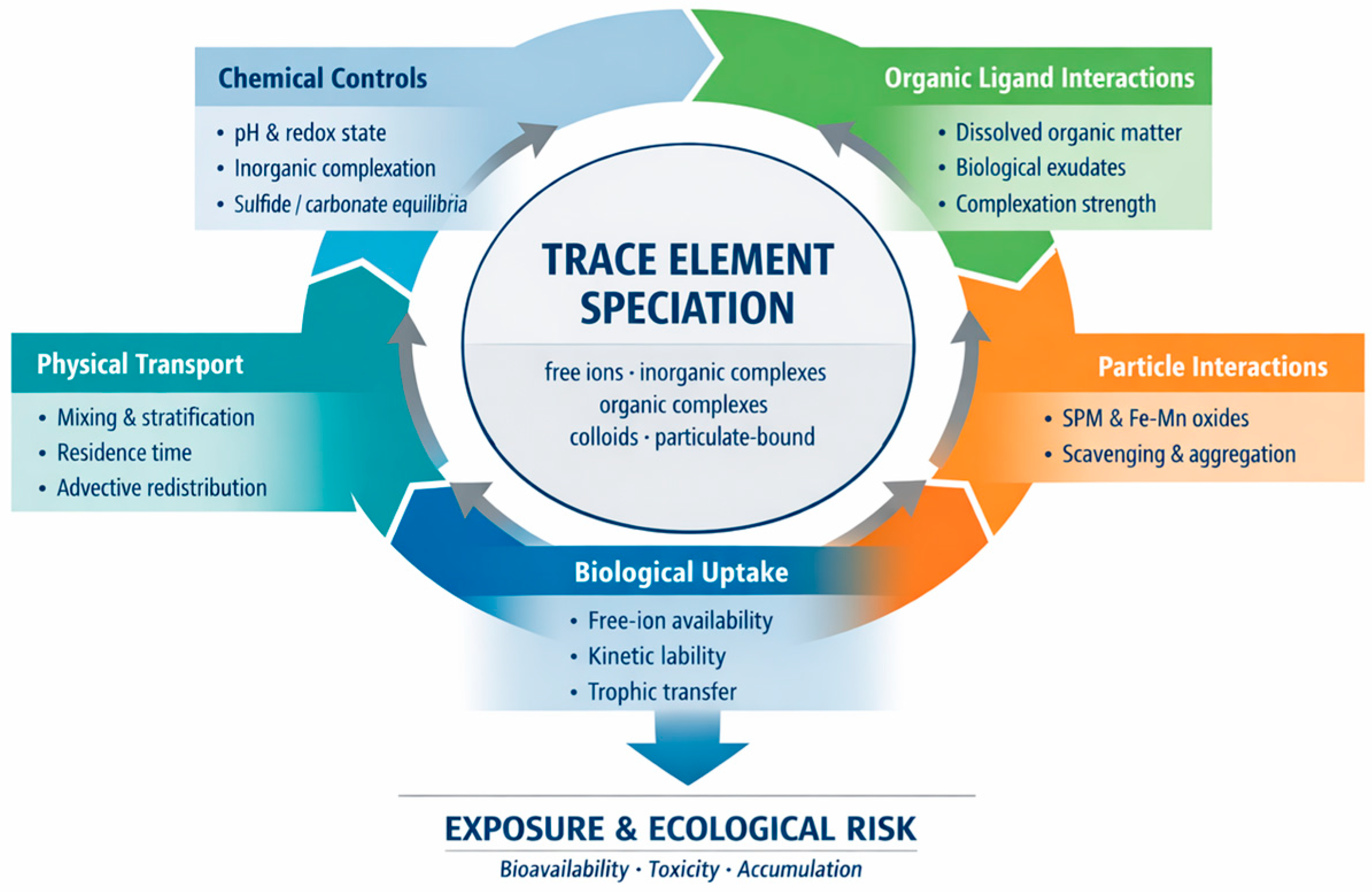
A central control on TE fate is chemical speciation (Figure 1). In seawater, TE partition among free ions, inorganic complexes, organic ligand-bound forms, colloids, and particulate phases, with proportions varying among elements [12]. This partitioning determines solubility, reactivity, residence time, and biological uptake, thereby modulating whether TE behave conservatively or non-conservatively during transport and mixing [13]. Strong complexation by dissolved organic matter (DOM), as observed for copper and lead, can buffer free-ion concentrations and partially decouple bioavailability from bulk dissolved loads, whereas elements such as cadmium and nickel remain comparatively labile and respond more directly to physical redistribution [14]. Because speciation is dynamically linked to redox conditions, particle interactions, and organic matter processing, TE cycling is inherently sensitive to shifts in stratification, oxygen distribution, and sediment–water exchange [15].
Traditionally, coastal TE contamination has been interpreted within a source-driven framework, emphasizing emission control, sediment burial, and gradual recovery following regulatory measures. This paradigm implicitly assumes relatively stable environmental baselines and quasi-stationary physical forcing. However, growing evidence indicates that climate change acts as a system-level modifier of contaminant behavior rather than an independent stressor [8]. Warming, intensified stratification, acidification, deoxygenation, and extreme events modify contaminant loads as well as speciation, mobility, residence times, and bioavailability [16,17,18,19,20,21,22,23].
Under such conditions, contaminant dynamics can no longer be interpreted solely as responses to changing emissions. Instead, climate forcing introduces temporal variability, non-linear responses, and context-dependent redistribution that complicate trend analysis and ecological risk interpretation. Semi-enclosed seas are particularly susceptible to such effects due to restricted exchange, long residence times, strong stratification, and intense land–sea coupling [24,25]. In strongly stratified semi-enclosed systems, internal redistribution and remobilization can become increasingly important modifiers of TE exposure, particularly where hydrographic structure, redox variability, and legacy sediment reservoirs amplify state-dependent redistribution.
The Black Sea (BS) represents an extreme expression of these characteristics. Its persistent stratification, basin-wide redoxcline, limited deep-water renewal, substantial riverine inputs, and extensive continental shelf deposits create conditions under which internal biogeochemical controls dominate TE fate [26,27,28,29,30,31,32,33,34,35,36,37,38,39,40,41,42]. Modest shifts in vertical density structure, oxygen distribution, or hydrological forcing may therefore trigger disproportionate changes in metal partitioning, sediment–water exchange, and exposure pathways. These properties position the BS not merely as a regional case study, but as a structurally amplified reference system for examining how climate variability reorganizes contaminant regulation in stratified semi-enclosed seas.
Building on recent syntheses of climate-modulated TE transport and biogeochemistry [8,43], this review examines how these mechanisms are expressed in the BS and evaluates their implications for contaminant interpretation and ecosystem assessment. Specifically, it aims to:
(i)
Synthesize how climate-driven modifications of circulation, hydrology, redox structure, and acidification alter dominant TE transport and remobilization pathways in the BS;
(ii)
Assess how these changes modify TE speciation, bioavailability, and the balance between chronic and episodic exposure; and
(iii)
Evaluate the implications of climate-modulated, non-stationary TE dynamics for contaminant assessment and conservation-oriented management in the BS and comparable semi-enclosed seas.
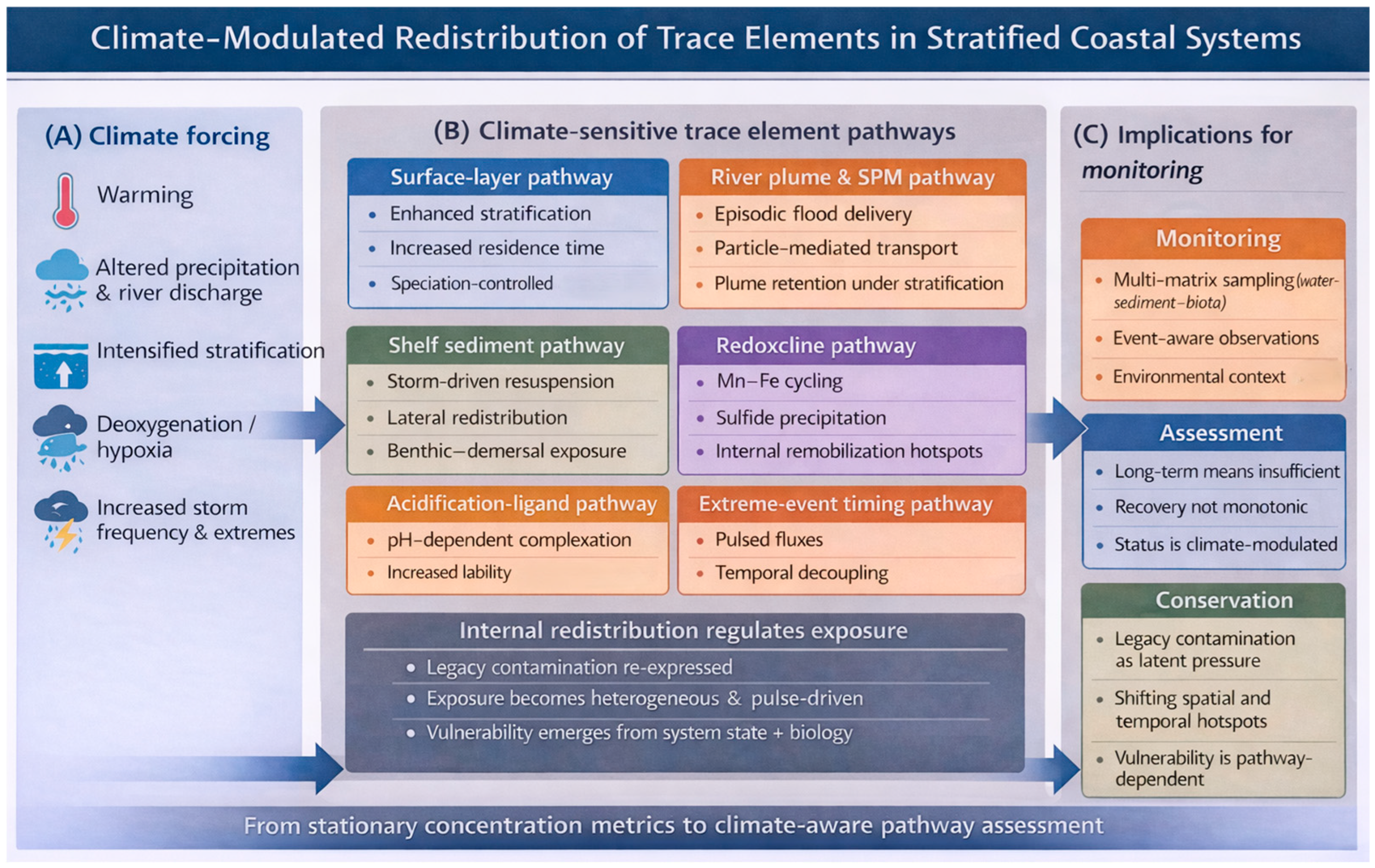
The distinctive contribution of this review is a BS-centered, pathway-based, and operational framework that links climate-sensitive state variables to TE behavior, monitoring triggers, and risk interpretation. Accordingly, the BS is used here as a structurally amplified reference system for examining climate-sensitive TE redistribution under non-stationary forcing. Figure 2 summarizes the conceptual framework guiding this review. The manuscript progresses from general concept to basin-specific application and assessment. Section 3 develops the broader conceptual foundation by explaining how climate forcing shifts TE dynamics from predominantly source-controlled behavior toward state-dependent redistribution. Section 4 then examines the BS as the structural setting in which these processes are amplified, Section 5 synthesizes the principal Black Sea redistribution pathways, Section 6 translates these insights into monitoring and assessment implications, and Section 7 outlines future research priorities.

2. Materials and Methods

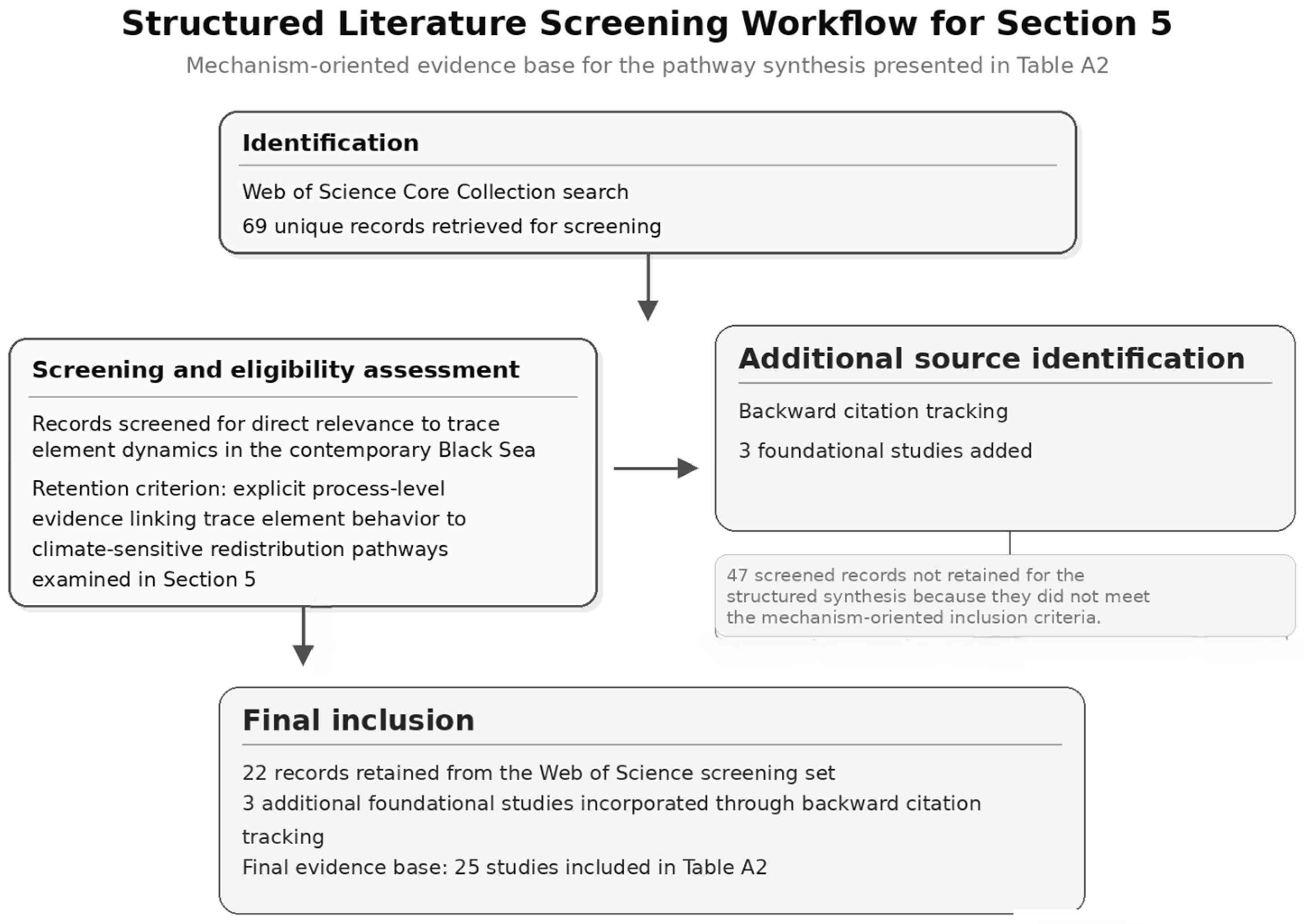
This review combines a broader narrative literature base with a focused, structured search used to support the mechanism-oriented pathway synthesis. The broader review was informed by targeted searches across major bibliographic and publisher platforms relevant to marine pollution, environmental geochemistry, and ecotoxicology, including Scopus, Google Scholar, PubMed and ScienceDirect, as well as backward citation tracking of key papers. However, to provide a transparent and reproducible evidence base for the structured pathway synthesis, the Section 5 search was anchored in the Web of Science Core Collection. This review therefore adopts a structured, mechanism-oriented narrative synthesis designed to integrate process-level evidence across climate-sensitive TE pathways in the BS, rather than to perform a quantitative meta-analysis. Study selection and pathway mapping were based on predefined search combinations and explicit inclusion criteria to improve transparency and reproducibility. Reliance on Web of Science for the structured search was intended to ensure consistency in indexing, search syntax, and record management, but this approach may underrepresent some regional or older BS literature not optimally captured by a single indexed database. To reduce this limitation, backward citation tracking and supplementary source consultation were used to recover influential studies outside the primary structured search stream. The structured search strategy used for the Section 5 pathway synthesis is summarized in Table A1; the screening workflow is presented in Figure A1, and the studies retained for structured pathway synthesis are listed in Table A2.
The term “Black Sea” was combined with process-defining keywords reflecting redistribution mechanisms examined in Section 5, including stratification and vertical mixing, river plumes and suspended particulate matter (SPM), sediment resuspension, hypoxia and redox structure, Fe–Mn cycling, acidification and speciation, and episodic or extreme events. These were coupled with standardized trace-element descriptors (“trace element*”, “trace metal*”, “heavy metal*”, “potentially toxic element*” (PTE), “metal contamination”, “metal pollution”). Queries were refined through relevant synonyms and mechanistic modifiers (e.g., mixed layer, estuary/delta, hydrodynamics, porewater, diagenesis, benthic flux, DOC/DOM), using quotation marks and wildcards to capture terminological variation (Table A1).
Results were filtered with no publication-year restriction in order to capture both foundational and recent studies. The Web of Science Core Collection search retrieved 69 unique records for screening. Full-text access was required to enable methodological evaluation. Of these, 22 were retained for the structured pathway synthesis because they provided explicit process-level evidence linking trace element (TE) dynamics in the contemporary Black Sea to climate-sensitive redistribution mechanisms. Three additional foundational studies from the 1990s and early 2000s, particularly addressing redox-mediated TE cycling, were identified through backward citation tracking, resulting in a final set of 25 studies. The screening workflow is summarized in Figure A1, and the full disposition of the 69 screened records is provided in Supplementary Table S1. The remaining 47 screened records were not retained because, although often topically relevant, they did not meet the mechanism-oriented inclusion criteria of the pathway synthesis. Most represented contamination inventories or status assessments without pathway-level resolution, studies from non-Black Sea or paleo-anoxic systems retrieved through keyword overlap, or analytical and methodological papers lacking direct evidence on Black Sea redistribution processes. The resulting evidence base was synthesized narratively in Section 5 and structured in Table A2, which maps the selected studies onto the climate-sensitive redistribution pathways considered in this review and identifies their monitoring-relevant implications. The analysis emphasizes mechanistic convergence and dominant pathway controls, focusing on the processes that structurally regulate TE redistribution in the BS.
Generative AI tools were used to support the visual rendering of conceptual figures and limited language refinement. OpenAI’s ChatGPT, using the GPT-5.2 model family (accessed February 2026), assisted in generating figures from author-defined prompts and design constraints and in minor editorial polishing of the text. All outputs were subsequently reviewed, revised, and scientifically validated by the authors.

3. Reframing Trace Element Assessment Under Non-Stationary Climate Forcing

3.1. The Stationary Paradigm in Coastal Contaminant Assessment

Trace element (TE) contamination in coastal marine ecosystems has traditionally been interpreted through a source-driven framework emphasizing emission control, sediment burial, and gradual recovery following regulatory measures [3,6,14]. Within this paradigm, environmental baselines are implicitly assumed to be quasi-stationary, and long-term concentration trends are primarily attributed to changes in external inputs. Growing evidence, however, indicates that climate change acts as a system-level modifier of contaminant behavior rather than as an independent or merely additive stressor [7,8,16,43]. Temperature increase, ocean acidification, deoxygenation, and intensification of extreme events fundamentally reorganize the transport, transformation, and ecological relevance of TE in coastal systems [17,18,19,20,22,23,27,28,29,30]. These changes influence not only contaminant loads but also speciation, mobility, residence times, and bioavailability, thereby altering uptake potential and risk profiles [9,12,15]. A critical implication is that contaminant dynamics can no longer be interpreted under stable environmental forcing [8,43,44]. In this context, non-stationary dynamics describe systems in which statistical properties, such as mean concentrations, variance, and frequency of extreme events, evolve over time, preventing interpretation under fixed baseline assumptions. Climate variability introduces non-linear, context-dependent redistribution that complicates trend attribution and ecosystem status evaluation.

3.2. Climate Drivers as System-Level Reorganizers of Trace Element Cycling

Climate change influences TE contamination through tightly coupled physical, chemical, and biogeochemical mechanisms. Ocean warming enhances thermal stratification and suppresses vertical mixing, increasing water-mass residence times and favoring in situ transformation of dissolved and particulate TE [16]. Ocean acidification modifies metal–ligand equilibria and adsorption–desorption dynamics, potentially increasing the proportion of biologically available metal species [17,18,19]. Deoxygenation and expansion of hypoxic zones destabilize associations between redox-sensitive TE and iron–manganese oxides, strengthening benthic–pelagic coupling and sediment-derived fluxes [20,21]. In parallel, climate-induced extremes, including intense precipitation, floods, storms, and marine heatwaves, have emerged as major vectors for TE transport and redistribution [22,23]. These episodic events enhance riverine delivery, resuspend contaminated sediments, and generate short-lived but intense pulses that may dominate annual contaminant fluxes despite limited influence on long-term averages [22,23,45,46,47]. Collectively, these responses shift exposure regimes from predominantly chronic to increasingly episodic and state dependent [7,8,16,20,43]. Contaminant regulation becomes progressively linked to environmental state variables: stratification intensity, oxygen distribution, hydrological variability, and carbonate chemistry, rather than to emissions alone [12,17,18,19,20,27,28,35]. The combined influence of warming, acidification, deoxygenation, and hydrological extremes does not operate independently but through interacting pathways that reorganize TE partitioning across dissolved, particulate, sedimentary, and biological compartments. Conceptually, this transition represents a shift from stationary, source-controlled regulation toward climate-modulated redistribution governed by environmental state [7,8,16,43].

3.3. Structural Amplification in Stratified Semi-Enclosed Seas

While the mechanisms outlined above operate across marine systems globally, their magnitude and ecological consequences are strongly modulated by basin structure. Stratified semi-enclosed seas are particularly susceptible to amplification of climate–contaminant interactions due to restricted exchange with the open ocean, extended residence times, persistent density gradients, and strong land–sea coupling [24,25]. In such systems, internal redistribution processes can become major controls on TE exposure patterns. These include redox-driven remobilization, sedimentary reactivation of legacy inventories, and plume-driven particle transport [8,15,20,35,43]. Structural constraints on vertical mixing and lateral exchange limit dilution pathways [28,37], allowing climate-sensitive processes to exert disproportionate influence on contaminant partitioning and mobility [8,12,17,20]. Despite recognition of these amplification mechanisms, their integrated implications for contaminant assessment remain insufficiently synthesized at the regional scale [7,8,9,16,43]. As a result, system-specific vulnerabilities remain difficult to anticipate. Monitoring data also become harder to interpret under changing climatic conditions, and assessment frameworks may lose robustness under increasing variability.

3.4. From Source Control to State Dependence: The Black Sea as a Structurally Amplified Reference System

Among stratified semi-enclosed basins, the BS represents an extreme and well-defined configuration of structural amplification. Persistent stratification and basin-scale redox organization [26,27,28,29,30,31], restricted exchange with the open ocean and pronounced oxic–anoxic separation [32,33,34,35,36,37], together with substantial riverine inputs and extensive shelf sedimentary inventories [38,39,40,41,42], create a setting in which climate-sensitive internal redistribution can exert strong control over TE fate. Under ongoing climate variability, warming-driven intensification of density gradients, altered hydrological regimes, and shifts in oxygen distribution further enhance the sensitivity of this system to redistribution and remobilization processes [8].
In such systems, stratification strength, oxygen structure, and discharge variability become central regulators of TE partitioning and exposure [12,20,28,35,46]. Climate forcing therefore drives a structural transition from predominantly source-controlled behavior toward internally regulated, state-dependent TE dynamics [7,8,16,43]. Within this framework, non-stationarity refers to the time-evolving statistical behavior of contaminant distributions under changing climate conditions [7,8,43], structural amplification denotes basin-scale physical and biogeochemical characteristics that intensify redistribution processes [15,28,35], and state dependence describes the conditional response of TE cycling to specific environmental configurations. In this sense, the BS is best interpreted not simply as a regional case study, but as a structurally amplified reference system in which climate-sensitive redistribution mechanisms can be examined with clarity [7,8,9,16]. The following section identifies the basin-scale structural amplifiers that condition these mechanisms in the BS.

4. The Black Sea as a Structural Amplifier of Climate-Sensitive Trace Element Dynamics

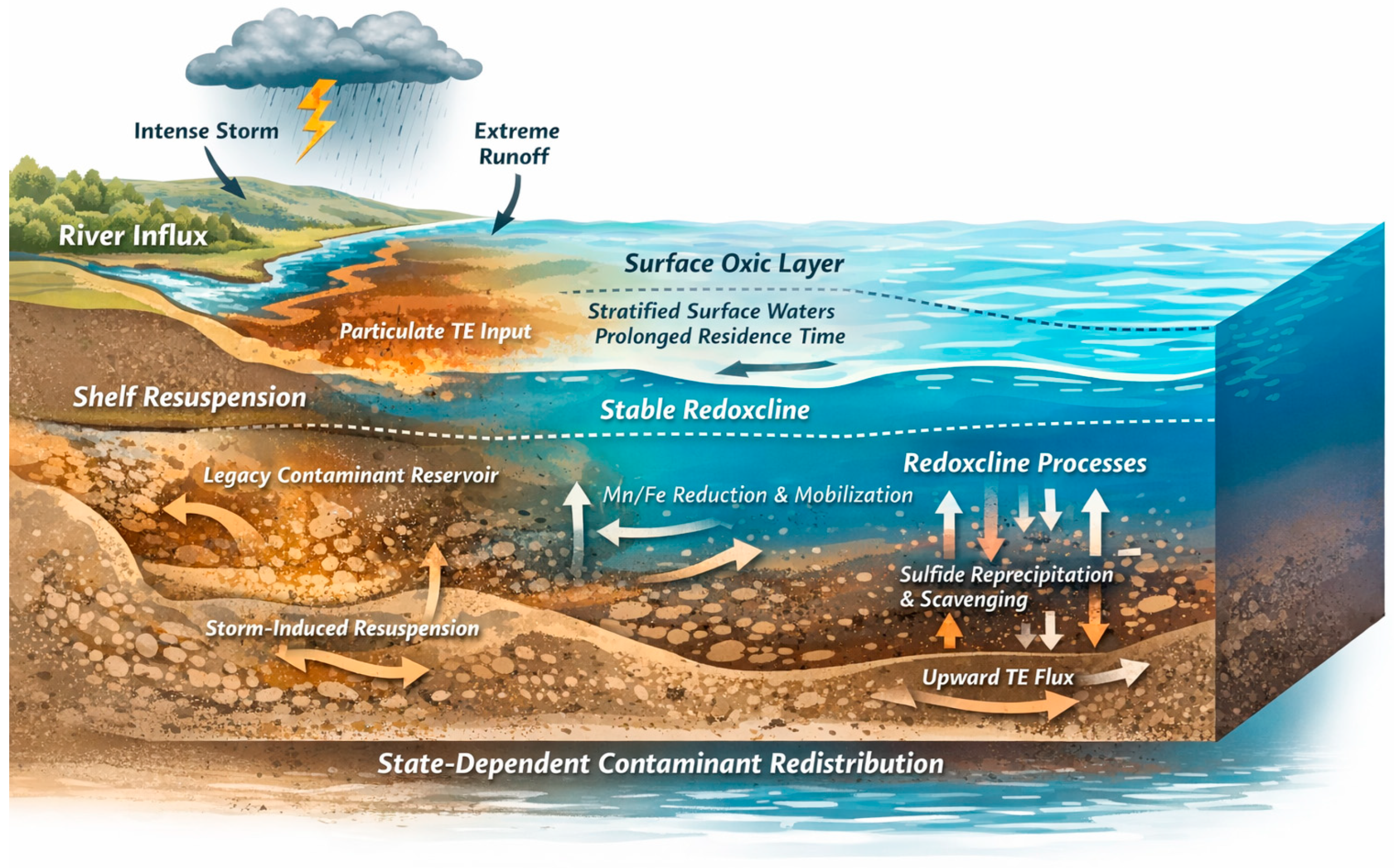
The BS is examined here as a structurally amplified reference system in which internal physical and biogeochemical controls exert strong influence on TE fate. Restricted exchange with the global ocean through the Bosphorus–Dardanelles system results in long water-mass residence times and heightened sensitivity to both external inputs and internal feedback mechanisms [48,49,50]. As a result, relatively modest shifts in environmental state can produce disproportionate changes in TE partitioning, mobility, and exposure. Four structural characteristics underpin this amplification effect: persistent stratification, a stable basin-wide redoxcline, extensive shelf sedimentary legacy reservoirs, and strong river–shelf coupling (Figure 3).

4.1. Persistent Stratification and Basin-Scale Redox Organization

Large freshwater inflows from the Danube, Dniester, Dnieper, and other rivers establish a low-salinity surface layer over denser Mediterranean-derived waters, forming a permanent halocline that limits vertical exchange [51,52,53]. Oxygenated waters are generally confined to the upper ~100–150 m, beneath which suboxic and anoxic conditions dominate [35,54,55]. The suboxic zone is the intermediate layer between oxic and sulfidic waters, where chemically reactive conditions strongly influence TE transformation and mobility. This vertical isolation extends residence times within the surface layer and constrains vertical dilution pathways. Climate warming and altered freshwater input are expected to intensify density gradients and reduce ventilation of intermediate waters [35,56]. In structural terms, the basin’s strong and persistent stratification enhances sensitivity of contaminant distribution to changes in mixing depth and oxygen structure.
A defining feature of the BS is its spatially coherent and persistent redoxcline separating oxic surface waters from anoxic deep layers [35,54,55]. The redoxcline denotes the vertically compressed transition between oxic and anoxic waters, controlling metal speciation and partitioning. This transition zone regulates the stability of metal-bearing phases and exerts basin-scale control over iron–manganese cycling and sulfide formation [35,41,57]. Because deep-water renewal is extremely limited, shifts in oxygen distribution or redoxcline depth influence large water volumes rather than localized zones. Redoxcline therefore functions as a basin-wide geochemical boundary whose position and intensity are sensitive to climate-driven modifications in stratification and ventilation.

4.2. Shelf Dominance and Sedimentary Legacy Reservoirs

The north-western BS shelf serves as a major depositional area for fine-grained sediments and associated contaminants derived from historical industrial, mining, and agricultural activities [58,59,60]. Over decadal timescales, substantial TE inventories have accumulated in these deposits, reflecting past loading rather than current emissions [61,62]. The structural configuration of the shelf: shallow depths, fine-grained sediments, and proximity to major river inputs, creates extensive legacy reservoirs whose stability depends on hydrodynamic conditions and bottom-water oxygen status [40,63]. This large sedimentary inventory represents a key internal control on long-term contaminant availability.

4.3. Hydrographic Sensitivity to Climate Perturbations

The BS receives one of the largest riverine freshwater and particulate fluxes among marine basins, with the Danube exerting dominant control over north-western shelf hydrochemistry [58,59,60]. Sustained land–sea coupling establishes strong connectivity between catchment-derived inputs, stratified surface waters, and depositional shelf environments. Climate-related variability in discharge magnitude and timing is expected to modify this coupling [22,23]. Because exchange with the open ocean is limited and vertical mixing is weak, riverine inputs are retained within the basin’s stratified structure rather than being rapidly dispersed.
Taken together, restricted circulation [48,49,50], persistent stratification and redox organization [35,51,52,53,54,55,56], extensive shelf legacy deposits [40,58,59,60,61,62,63], and strong river–shelf connectivity [58,59,60] create a basin configuration in which internal redistribution processes are structurally amplified. The physical and biogeochemical architecture of the BS therefore enhances sensitivity to warming, deoxygenation, and hydrological variability [64]. Within this setting, TE regulation becomes increasingly influenced by environmental state variables, particularly stratification intensity, oxygen distribution, and discharge variability, rather than by external loading alone [8,65,66]. The following section translates these structural amplifiers into identifiable redistribution pathways by synthesizing observational and process-based evidence from the reviewed BS literature and showing how climate-sensitive processes govern TE remobilization, partitioning, and biological exposure across interconnected water, sediment, and biotic compartments.

5. Climate-Driven Trace Element Pathways in the Black Sea

This section synthesizes the dominant pathways through which climate change modifies trace element (TE) transport, partitioning, and exposure in the BS. Interpretations are distinguished, where relevant, as observed in the BS, inferred for the BS from process understanding and analogous systems, or projected under climate-driven environmental change.

5.1. Surface Layer Pathway: Stratification, Residence Time, and Dissolved-Phase Exposure

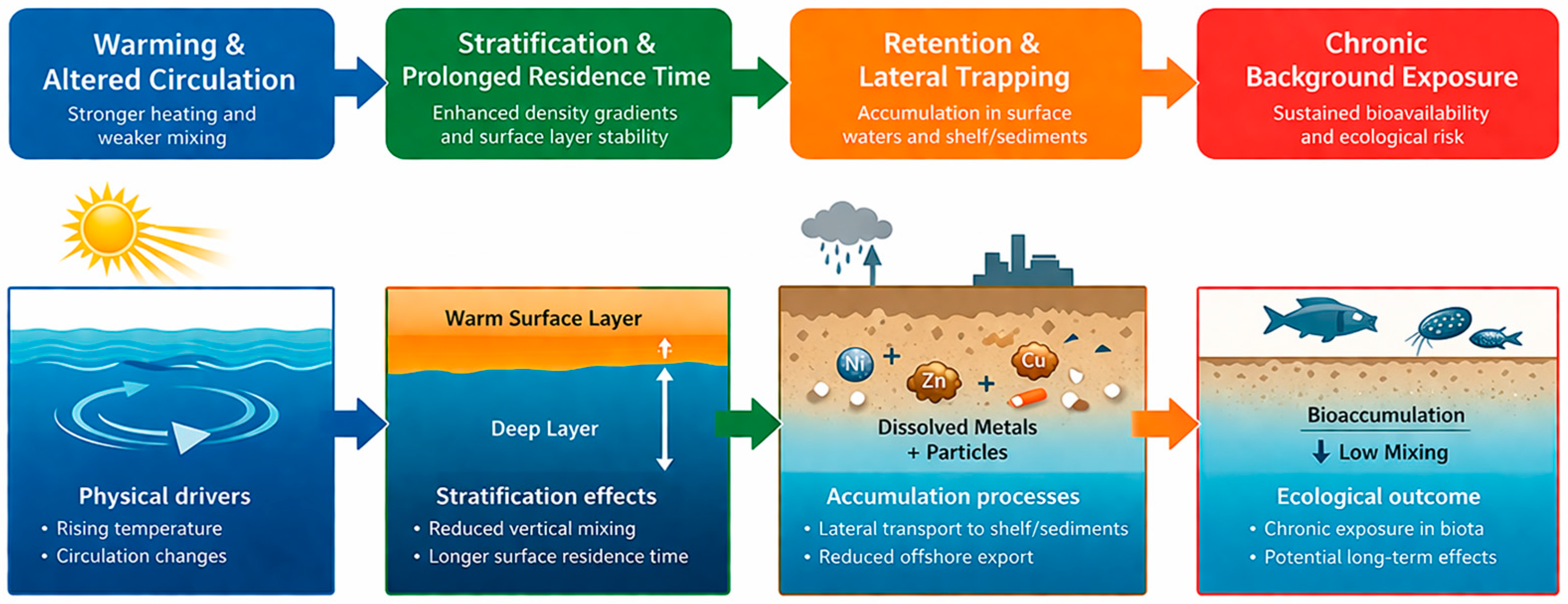
Projected climatic warming is expected to strengthen the BS’s already pronounced upper-layer stratification, further reducing vertical exchange between the oxic surface layer and deeper waters. The dominant processes and exposure implications of this pathway are summarized in Figure 4. In mechanistic terms, stronger density separation would be expected to prolong the residence time of dissolved and fine particulate TE within the biologically active surface layer and to limit the vertical redistribution that would otherwise moderate short-term concentration anomalies. Under such conditions, surface-layer exposure may remain elevated even where external inputs do not increase because contaminants persist longer within the compartment most directly linked to planktonic uptake and early food-web transfer [67].
Observed evidence from the north-western BS shelf supports this interpretation by showing that strong density gradients during stratified periods can effectively decouple surface waters from benthic metal sources, thereby limiting upward transport of reactive particulate phases and reinforcing residence time as a first-order control on dissolved-phase exposure [67]. This density-controlled structuring is particularly important for redox-sensitive elements such as Mn and Fe, whose cycling influences TE scavenging, partitioning, and redistribution across the shelf system [38].
Within the stratified surface layer, changes in temperature, pH, and dissolved organic matter (DOM) exert strong control on TE speciation and complexation, thereby modifying dissolved-phase lability and uptake potential. Foundational studies reported persistently elevated dissolved Cu and Ni concentrations in oxic surface waters, with no pronounced surface depletion, consistent with strong organic complexation and reduced scavenging efficiency [38]. This behavior illustrates how ligand-controlled reactions sustain dissolved metal pools independently of total inputs under stable stratification. Detailed speciation analyses further demonstrate that Cu and Zn are regulated by distinct organic complexation mechanisms in BS surface waters [68]. Cu speciation is governed by two ligand classes, including a strong ligand present at concentrations comparable to ambient dissolved Cu and a weaker ligand associated with river inputs and diffusive fluxes from reducing sediments, whereas Zn speciation is controlled by a single ligand class linked to microbial degradation of particulate organic matter. Consequently, free-ion Cu concentrations exhibit substantially greater spatial variability than those of Zn, despite comparable variability in total dissolved concentrations, highlighting metal-specific buffering within the stratified surface layer [68].
Direct measurements of metal lability provide complementary insight into how speciation translates into biological exposure. Studies using in situ diffusive gradients in thin films (DGT) demonstrated pronounced element-specific differences in the proportion of kinetically labile species, with Cu and Pb largely complexed by DOM (only ~20–40% labile), whereas Cd and Ni remained predominantly labile (~60–80%) [69]. These observations indicate that dissolved-phase exposure under stratified conditions is governed primarily by speciation and lability rather than total concentration. Consequently, climate-mediated shifts in DOM composition, microbial processing, or pH can substantially alter surface-layer exposure intensity without requiring changes in bulk metal loads, confirming the combined role of speciation and residence time in climate-sensitive phase partitioning [68,69].
Stratification and low suspended particulate matter (SPM) conditions further interact with atmospheric inputs to influence surface-layer burden patterns. Elevated dissolved Pb concentrations in outer shelf surface waters have been attributed to atmospheric deposition combined with inefficient particle scavenging under low-SPM conditions [38]. Under such circumstances, physical isolation of the surface layer and limited particle availability allow dissolved Pb to persist despite its generally high particle affinity. During stratified periods, particulate metal transport is largely confined to subsurface and near-bottom layers, implying that surface enrichment is maintained primarily by atmospheric and riverine inputs rather than by vertical transfer [67]. Longer residence times in offshore surface waters therefore amplify dissolved-phase persistence, a mechanism expected to strengthen under climate scenarios favoring enhanced stratification and reduced resuspension.
Finally, vertical segregation imposed by water-column layering constrains TE behavior across the oxic–anoxic interface, reinforcing element-specific responses. For most TE examined [38], including Mn, Fe, Co, Pb, Cu, Cd, and Zn, dissolved concentrations are strongly suppressed in anoxic waters due to sulfide phase control, whereas Ni shows limited sensitivity to sulfide precipitation and maintains a more conservative vertical distribution. This divergence highlights the importance of accounting for element-specific geochemical behavior when assessing how climate-induced deoxygenation and redox-gradient expansion may redefine surface-layer bioavailable burden and associated biological risks.

5.2. River Plume and SPM Pathway: Hydrological Extremes, Particle Transport, and Episodic Exposure

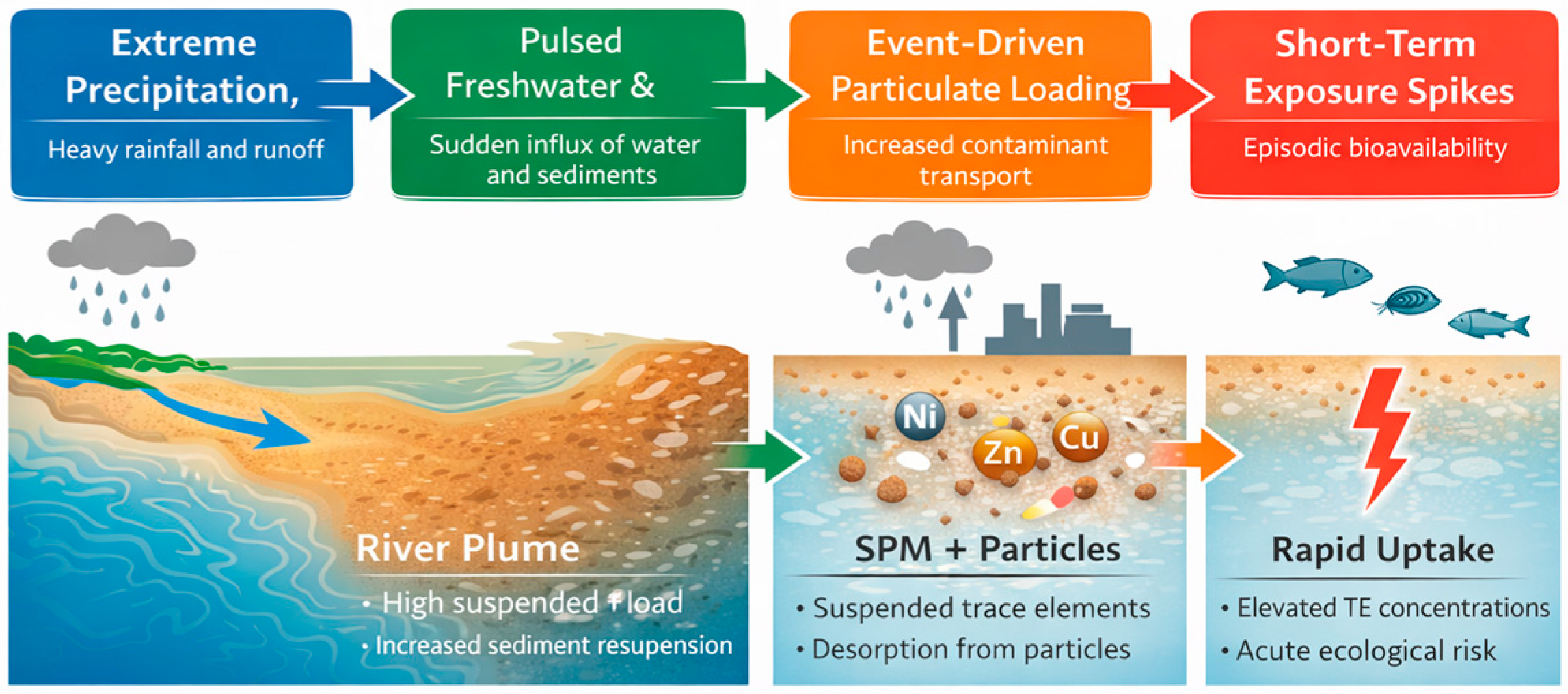
Riverine inputs dominate TE delivery to the BS, particularly along the north-western shelf, where the Danube plume exerts strong control over coastal turbidity, sedimentation patterns, and contaminant distribution [70]. The main transformation and transport processes are summarized in Figure 5. Detailed investigations of the Danube freshwater–seawater mixing zone demonstrate that riverine influence on TE presence is highly element specific and strongly mediated by estuarine processes [70]. While total dissolved concentrations of most TE entering the BS via the Danube were relatively low, conservative transport and mid-estuarine release mechanisms can generate localized enrichment of dissolved Cd, Mn, and Zn, whereas Cu exhibited persistently elevated concentrations linked to upstream sources and seasonal biological modulation. These findings establish the Danube plume not merely as a delivery route, but as an active transformation zone in which dissolved-phase exposure can be amplified independently of bulk riverine loads [70].
Projected climate-driven changes in precipitation and hydrological extremes are expected to modify the magnitude, seasonality, and variability of river discharge to the BS, increasing the likelihood that TE delivery occurs through shorter, more episodic high-flow pulses rather than through stable mean transport. For the BS, this interpretation is supported indirectly by observed discharge sensitivity in regional river–coast systems. In the Sochi River, for example, contrasting flood and low-water conditions produce marked shifts in elemental delivery, with high-flow events mobilizing a wider suite of TE through soil runoff, organic–inorganic complexation, and colloid-bound transport, whereas low-flow conditions emphasize groundwater and lithogenic controls [47]. Longer-term evaluation of BS river–coastal systems likewise indicates that seasonal and event-driven discharge variability exerts stronger control on TE delivery than mean flow conditions, with suspended particulate matter and associated organic phases acting as major carriers during high-flow periods [45]. Together, these observations support the inference that peak discharge events, rather than long-term average concentrations alone, are likely to govern episodic TE delivery to coastal waters under climate-sensitive hydrological forcing.
Field observations from the north-western shelf further demonstrate that stations most strongly influenced by the Danube plume exhibit elevated dissolved concentrations and higher leachable or “available” particulate fractions of multiple TE, including Co, Pb, Cu, Ni, Cd, and Zn, highlighting the central role of plume-driven inputs in determining surface-layer exposure patterns [38]. Together, these studies indicate that contact intensity along the shelf is governed not only by river discharge magnitude but also by estuarine mixing behavior, phase partitioning, and element-specific reactivity within the plume.
During such discharge events, suspended particulate matter (SPM) acts as a primary vector for TE transport and partitioning across coastal and shelf waters. Enhanced riverine supply, combined with elevated SPM loads, directly influences both dissolved and particulate metal pools in plume-affected surface waters, suggesting the importance of particle-mediated mechanistic route [38]. Studies of medium and small rivers along the Russian BS coast further demonstrate that while many dissolved TE behave conservatively during river–sea mixing, others, including Mn, Fe, Pb, and rare earth elements, exhibit pronounced non-conservative behavior driven by sorption–desorption reactions and colloidal coagulation processes [71]. Desorption of TE from riverine suspended particles within the mixing zone can substantially augment dissolved concentrations, highlighting the active role of particulate reservoirs in regulating dissolved phase. These particle–solution interactions promote lateral transport of metal-bearing phases across the shelf, followed by deposition in nearshore and mid-shelf sediments, amplifying spatial heterogeneity and contributing to the formation of transient or persistent contamination hotspots [71].
Salinity gradients and estuarine type mixing transformations therefore provide an additional level of control on plume behavior and contaminant fate. The shelf-wide sampling, targeting the Danube-influenced zone during summer stratified conditions, explicitly captured the interaction between freshwater inflow, particle transport, and vertical stability [38]. In combination with the estuarine mixing processes [70] and the particle-reactive transformations [71], these observations illustrate how stratified plume conditions can retain metal-enriched particles and dissolved fractions within the surface layer, enhancing residence times and increasing the likelihood of biological contact. From an ecological perspective, such plume-driven events can generate short-lived but intense exposure pulses through direct particle ingestion, elevated contact with contaminated SPM, and desorption-driven increases in labile dissolved fractions. These transient responses are particularly relevant for filter feeders, deposit feeders, and early life stages of fish, for which brief bioavailable load peaks associated with hydrological extremes may exert disproportionate biological effects relative to long-term mean concentrations.

5.3. Shelf Sediment Pathway: Resuspension, Lateral Redistribution, and Benthic–Pelagic Exposure

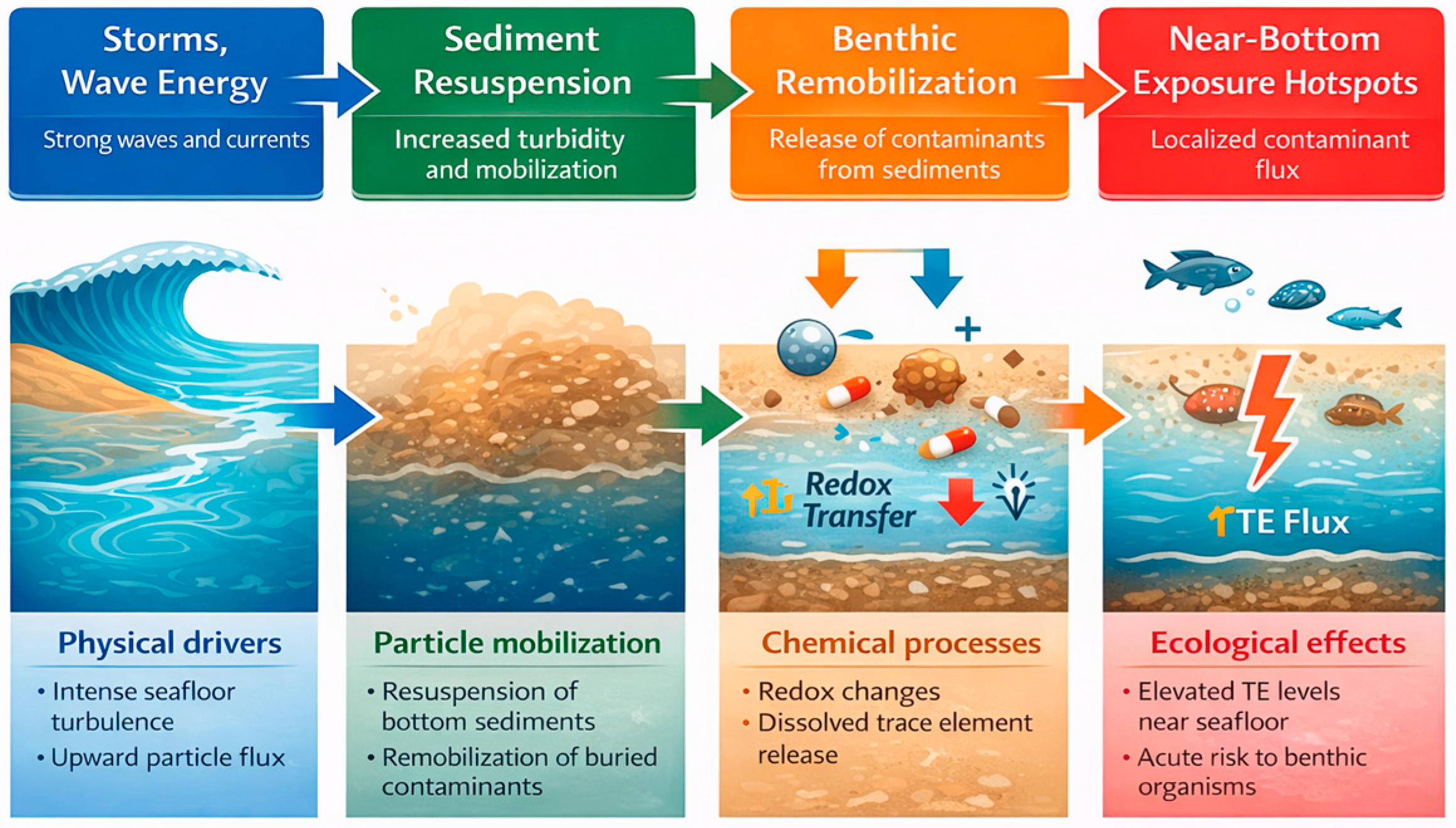
Depositional matrices in the BS store substantial inventories of historically deposited TE reflecting decadal-scale inputs. The dominant resuspension, remobilization, and benthic–pelagic exchange processes are summarized in Figure 6. Climate-driven changes in storm intensity, wave climate, and circulation are expected to increase the frequency and magnitude of resuspension events on the shelf. Such disturbances enhance benthic–pelagic coupling by reintroducing contaminated particles into the water column, increasing turbidity and temporarily elevating particulate-bound TE concentrations. They also promote lateral transfer from depositional zones to adjacent habitats, including ecologically sensitive coastal areas and shelf–slope transition regions [67,72]. Process-based observations indicate that under stratified conditions, resuspension and near-bottom particle formation favor horizontal transport along density surfaces rather than vertical dilution, strengthening lateral connectivity across the shelf [67].
Sedimentological analyses demonstrate that BS shelf deposits form an actively reworked surface layer rather than a permanently stable contaminant sink. Shelf sedimentation rates are comparable to storm reworking depths, indicating repeated resuspension of the metal-rich surface veneer during high-energy events [72]. Grain-size trend analyses reveal strong along-shelf transport driven by coastal circulation and storm-generated currents, facilitating lateral redistribution of fine, metal-rich particles. TE such as Cu, Pb, Zn, As, Fe, and Mn are closely associated with fine sediment fractions, implying that resuspension preferentially mobilizes the most contaminant-enriched material [72]. Additional evidence confirms that fine-grained, organic-rich surface sediments repeatedly concentrate and release TE under hydrodynamic forcing, proving the role of shelf sediments as active reservoirs rather than passive archives [45].
Observations from the north-western BS shelf further demonstrate that depositional matrices act not only as long-term particulate reservoirs but also as sustained sources of dissolved TE under stratified and low-oxygen conditions. Pronounced benthic enhancement of dissolved Mn and Fe has been reported at multiple shelf stations, with concentrations increasing below the thermocline and peaking near the sediment–water interface [38]. This pattern reflects reductive dissolution of Mn and Fe oxides during organic matter degradation and subsequent diffusive fluxes from sediments, highlighting the sensitivity of benthic metal release to redox conditions. Similar studies indicate that shelf and slope seabed deposits constitute ongoing sources of dissolved Mn and Fe to bottom waters, emphasizing that benthic release represents a persistent mechanism rather than a transient response to individual disturbance events [67].
Upon re-oxygenation, benthically released Mn(II) and Fe(II) undergo rapid oxidation, generating particulate Mn–Fe oxyhydroxides within the benthic boundary layer. These redox-driven Fe–Mn transformations, detailed further in Section 5.4, couple benthic release with particle-mediated lateral redistribution, producing highly reactive carrier phases that efficiently scavenge additional TE and are readily mobilized during subsequent resuspension [38,67].
At the shelf scale, observed distributions of particulate Mn and Fe indicate net export of Mn–Fe oxyhydroxides from depositional areas via coastal circulation and isopycnal transport [38,67]. This process provides a physical link between benthic sources and adjacent shelf or slope environments, confirming the role of shelf sediments in driving spatial connectivity and cross-habitat exposure. Consistent with this mechanism, elevated particulate Co, Cu, Ni, and Zn concentrations have been observed near the shelf edge, with near-bottom maxima strongly correlated with particulate Mn and Fe [38]. These associations reflect both resuspension of sedimentary material and adsorption of dissolved TE onto freshly formed Mn–Fe oxides, effectively repackaging TE into mobile particulate phases during benthic–pelagic exchange. In parallel, dissolved Cd and Zn generally increase with depth due to biological remineralization, yet elevated bottom-water concentrations at several stations indicate additional benthic inputs linked to reductive dissolution of Mn–Fe oxides [38,67]. Together, these patterns highlight the combined importance of benthic release, particle-mediated transport, and lateral redistribution in shaping shelf-scale exposure beyond original depositional zones.
For benthic communities, these coupled processes mean that sediments represent both a chronic contaminant reservoir and an intermittent source of elevated exposure under physical or redox disturbance. Direct contact with contaminated seabed, ingestion of fine particles, and porewater-derived fluxes at the sediment–water interface contribute to long-term accumulation, while storm-driven resuspension and oxygen variability generate episodic pulses that can substantially elevate short-term risk. Such combined chronic and event-driven exposure regimes disproportionately affect demersal fish and benthic invertebrates, linking climate-sensitive disturbance and redox stress to observed biological impacts in shallow shelf environments [73].

5.4. Redoxcline Pathway: Deoxygenation, Remobilization, and Hotspot Exposure Under Reduced Tolerance

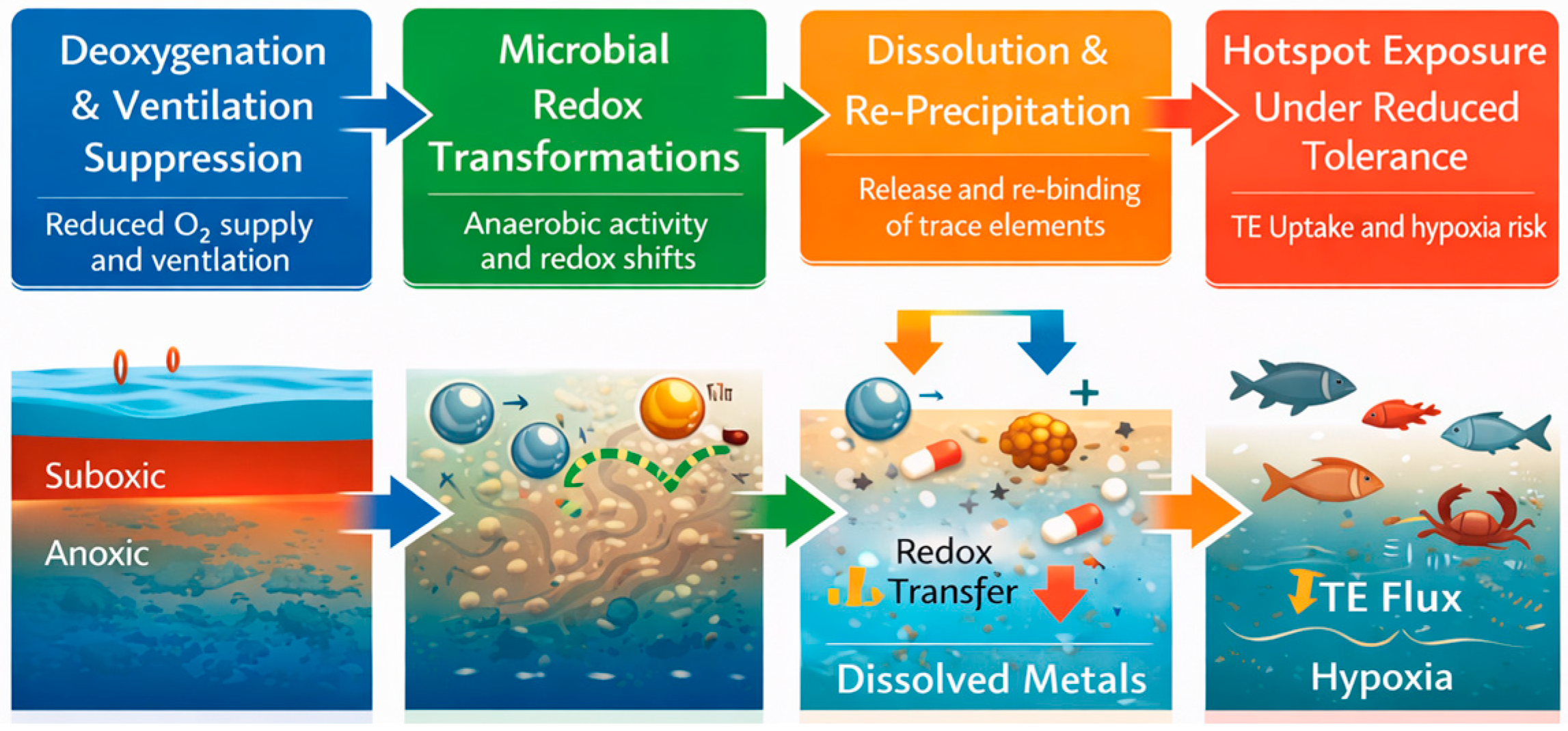
Changes in oxygen availability reorganize microbial metabolic pathways, driving redox transformations that regulate TE speciation, mobility, and bioavailability. The main redoxcline processes and exposure implications are summarized in Figure 7. Under suboxic conditions, microbial reduction of iron and manganese oxyhydroxides promotes their dissolution and the release of associated TE, while the onset of anoxia and sulfate reduction favors metal–sulfide formation and redistribution between dissolved and particulate phases [74,75]. Re-oxygenation events driven by ventilation or mixing trigger rapid microbial oxidation of reduced species accumulated during anoxia, including Fe(II), Mn(II), sulfide, and reduced nitrogen compounds, leading to the re-formation of reactive metal oxides and renewed scavenging of dissolved TE [76]. These biologically accelerated reactions can partially reverse redox-driven metal release but often operate transiently and heterogeneously, establishing redox oscillations rather than a simple return to pre-anoxic conditions, with important consequences for TE partitioning and exposure pathways.
Oxidation-reduction conditions exert first-order control on the fate and mobility of many TE in the BS [77]. Deoxygenation and reduced ventilation can destabilize metal-bearing phases, particularly iron and manganese oxyhydroxides that scavenge or co-precipitate a wide range of TE. Foundational observations show that under suboxic to anoxic conditions these particulate phases undergo reductive dissolution, generating pronounced dissolved Mn(II) and Fe(II) maxima immediately below the redox transition zone [78]. These releases occur independently of new inputs, confirming redoxcline transformations as effective secondary TE sources. Upon re-encounter with oxygen or alternative oxidants, dissolved Mn(II) and Fe(II) rapidly reoxidize, forming highly reactive Mn–Fe oxyhydroxide particles that efficiently scavenge additional TE and concentrate contaminant loads at redox boundaries. Together, these coupled dissolution–reoxidation reactions increase the likelihood that sedimentary reservoirs and redoxcline-associated particle pools function as internal sources under declining oxygen conditions [78,79].
BS observations, supported by comparison with other stratified low-oxygen basins such as the Baltic Sea, indicate that redoxclines can function as persistent hotspots of TE remobilization and accumulation [79]. Particle-scale investigations show that pelagic redoxclines host intense coupled cycling of Mn, Fe, and associated TE, driven by microbial oxidation–reduction reactions and steep redox gradients [79]. At these interfaces, upward-diffusing Mn(II) and Fe(II) are rapidly oxidized, forming Mn–Fe-rich oxyhydroxide particles that dominate suspended matter and act as highly effective scavengers. These authigenic particles accumulate within narrow depth intervals and undergo repeated transformation, lateral advection, and dissolution as they encounter changing redox conditions, establishing a dynamic internal shuttle that concentrates and redistributes TE largely independently of external loading. Evidence from analogous stratified basins supports the broader interpretation that this type of redoxcline-driven metal cycling is a general feature of deoxygenating marine systems, although its expression in the BS is amplified by the basin’s persistent stratification and extensive anoxic reservoir [79].
TE behavior in anoxic basins is further constrained by sulfide chemistry and its interaction with Mn–Fe phase transformations [80]. It was demonstrated that in both the BS and the permanently anoxic Framvaren Fjord (North Sea), a substantial fraction of redox-sensitive and particle-reactive TE is removed from the dissolved phase through coprecipitation with iron sulfides and adsorption onto Mn–Fe oxyhydroxides formed at or near the redox transition. Importantly, this trapping is not confined to fully sulfidic deep waters but also occurs near and above the chemocline, indicating that redox boundaries exert influence over TE speciation and availability well beyond the anoxic core [80]. Thermodynamic analyses of TE behavior under BS euxinic conditions further support this framework: sulfide activity exerts dominant control on dissolved metal speciation, stabilizing TE as sulfides associated or neutral hydroxo-complexes and sharply limiting the persistence of oxyanionic species across the redoxcline [81]. Together, these findings consolidate the view of the redoxcline as a chemically active interface governed by tightly coupled Mn–Fe–S-phase equilibria rather than a simple oxic–anoxic boundary.
Beyond the Mn–Fe-centered redox cycling emphasized above, several redox-sensitive and toxicologically important elements also merit explicit consideration in this context. Mercury (Hg) is particularly relevant because BS measurements and numerical modeling indicate that methylmercury production and accumulation are closely linked to the basin’s anoxic and euxinic waters, showing that redox structure can directly influence mercury speciation, persistence, and food-web exposure [82]. These results further suggest that methylation can proceed under sulfidic conditions when organic matter remains bioavailable, linking redox structure directly to food-web exposure and human health relevance. For arsenic (As) and chromium (Cr), the implications for the BS are inferred primarily from established redox geochemistry. Arsenic shifts between more mobile As(III), which predominates under mildly reducing conditions as uncharged As(OH)3, and less mobile As(V); Mn oxides can oxidize As(III) to As(V) more rapidly than Fe (oxyhydr)oxides, while Fe/Al (oxyhydr)oxides, Mn oxides, and clays can also sorb arsenic and thereby regulate its retention. Chromium shows the opposite redox tendency: Cr(VI) is the more mobile and toxic form favored under oxidizing and alkaline conditions, whereas Cr(III) is less mobile and can be regenerated through reduction by Fe(II), sulfides, and organic matter [83,84]. Spectroscopic evidence from natural environmental samples further shows that Mn oxides can oxidize Cr(III) to Cr(VI), while a substantial fraction of the newly formed Cr(VI) may become adsorbed onto adjacent Fe oxyhydroxides, especially near Mn–Fe phase boundaries, limiting immediate mobility but preserving redox-sensitive release potential [85]. In this sense, Hg, As, and Cr reinforce the broader interpretation that the redoxcline functions not only as a boundary for Mn–Fe cycling, but also as a chemically selective regulator of trace-element form, persistence, and exposure [82,83,84,85].
A synthetic classification of the principal elements discussed in this review, including dominant carrier phases, redox sensitivity, climate-sensitive drivers, and sentinel matrices, is provided in Table A3.
The BS’s pronounced stratification further amplifies this effect by conferring both persistence and sensitivity to the redox transition zone. Deep BS waters exhibit millennial-scale residence times, reflecting extremely limited vertical renewal below the chemocline and attesting to the long-term stability of redox-mediated metal inventories [80]. At the same time, the depth and geometry of the redoxcline are regulated by density structure and circulation, particularly the balance between the Bosphorus inflow of saline Mediterranean waters and surface freshwater inputs. Changes in vertical density structure, freshwater balance, or ventilation can therefore displace the redox transition vertically or laterally, relocating zones of enhanced metal release, scavenging, and sulfide precipitation into shallower, more biologically active layers. Consistent with this behavior, Mn and Fe cycling within the oxidation-reduction transition zone is structured along density surfaces, facilitating lateral transport of dissolved and particulate TE along the redoxcline rather than simple vertical reallocation [78]. Accordingly, climate-driven upward migration or lateral expansion of suboxic conditions is projected to shift the position and spatial footprint of exposure hotspots across shelf-margin and slope environments, although the magnitude of this response remains inferred from current redox structure and process understanding rather than directly observed under future climate conditions [80,81].
Importantly, bioavailable loads in and near hypoxic conditions occur when organismal tolerance is already constrained. Reduced oxygen availability limits aerobic performance, alters energy allocation, and can impair detoxification and repair mechanisms, thereby increasing susceptibility to TE stress. Observations from the BS indicate that peak dissolved and particulate Mn and Fe concentrations coincide spatially with low-oxygen conditions, implying that maximum metal availability overlaps with periods of increased physiological vulnerability [78]. This coupling of enhanced redox-driven metal remobilization with reduced biological tolerance provides a mechanistic basis for synergistic effects under climate-driven deoxygenation, positioning the redoxcline as a critical mechanistic route through which climate change can amplify TE uptake potential and ecological risk in the BS.

5.5. Acidification–Ligand Pathway: Speciation Control, Mobility Shifts, and Bioavailability Changes

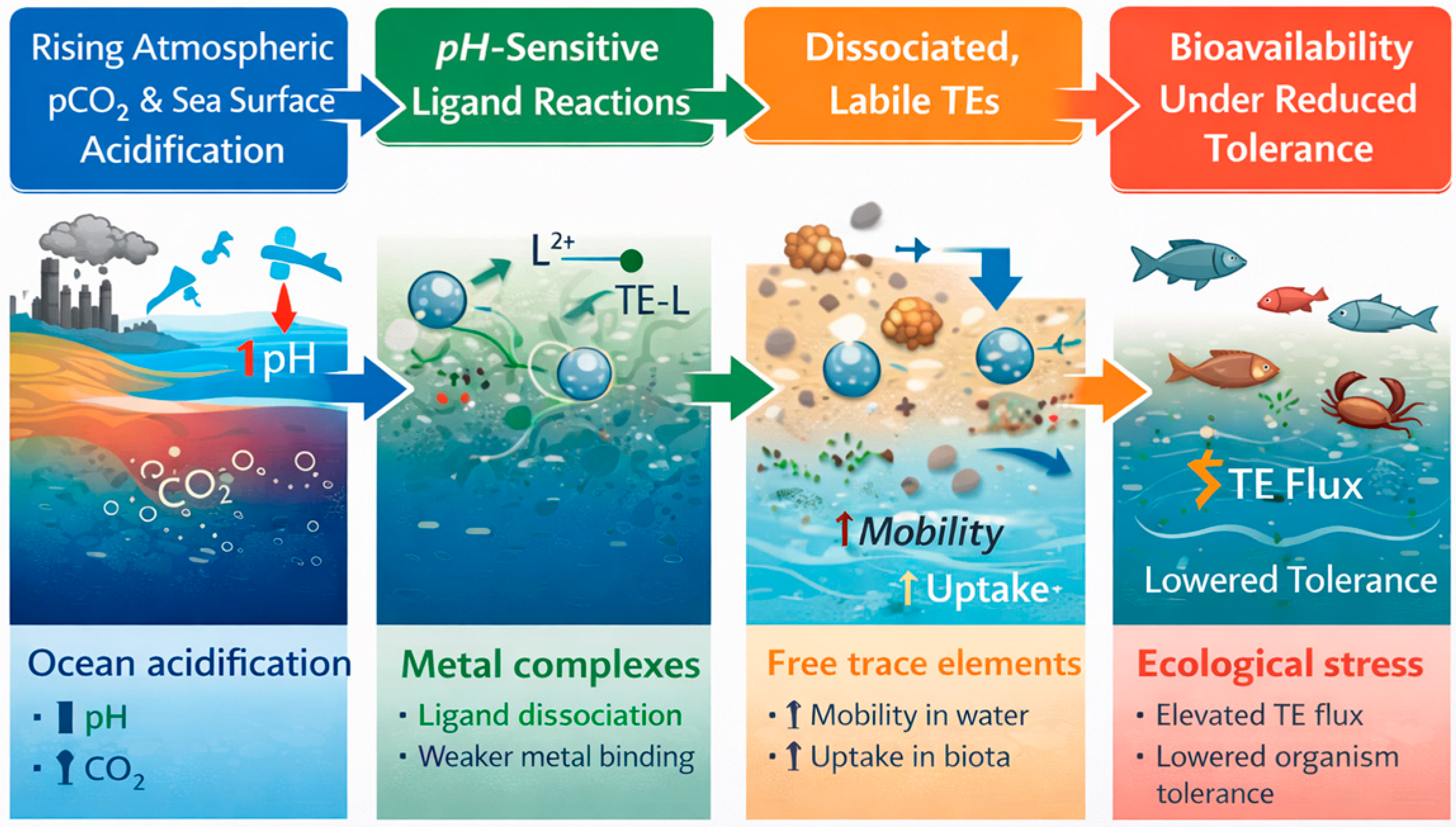
Direct BS evidence for acidification-driven changes in TE behavior remains comparatively limited relative to the stronger observational basis available for stratification, redoxcline dynamics, or sediment remobilization. The principal acidification–ligand interactions considered here are summarized in Figure 8. Accordingly, this pathway is interpreted through a combination of available BS speciation evidence and mechanistic inference from established metal–ligand principles, river–estuary–sea speciation studies, and the broader ocean acidification literature.
Available BS observations nevertheless indicate that ligand-controlled partitioning is a relevant component of TE behavior. In surface waters, dissolved organic matter (DOM) composition and metal-specific complexation strongly influence the balance between dissolved and particulate fractions and therefore regulate the proportion of potentially bioavailable forms [68]. Detailed speciation analyses show that organic ligands dominate the dissolved pools of key TE, particularly Cu and Zn, while diffusive gradients in thin films (DGT) measurements demonstrate marked differences in lability among elements, with Cu and Pb remaining more strongly complexed and Cd and Ni comparatively more labile [69]. These observations support the view that shifts in protonation state, ligand strength, or DOM character could alter exposure intensity even in the absence of changes in total concentrations.
Beyond these direct observations, the implications of acidification for the BS are inferred mechanistically from thermodynamic and estuarine–marine speciation behavior. Modeling along BS river–estuary–sea gradients shows that inorganic ligand fields respond strongly to pH and ionic composition, driving substantial changes in metal speciation without changes in bulk concentrations [86]. As waters become more marine, Cu, Pb, Zn, and Cd increasingly form carbonate-, phosphate-, sulfate-, and chloride-associated species, whereas Mn remains predominantly as free Mn2+ [86]. On this basis, decreasing pH would be expected to weaken carbonate- and phosphate-mediated complexation for selected TE, increasing dissolved mobility and lability, while also modifying adsorption behavior through coupled changes in phosphate chemistry and particle surface interactions. In the BS context, the acidification–ligand pathway should therefore be regarded primarily as a mechanistically supported inference, rather than as a pathway already resolved through extensive direct field evidence.
Its ecological relevance follows from the fact that speciation shifts can alter uptake potential and toxicity without detectable increases in bulk TE loads. In parallel, broader ocean acidification literature indicates that lowered pH can impose additional physiological costs associated with acid–base regulation and metabolic compensation, thereby reducing the capacity available for detoxification and repair [87]. For the BS, this chemical–physiological coupling should be interpreted mainly as a climate-related projection supported by general marine evidence, rather than as a directly demonstrated basin-specific response. Even so, the available BS speciation data [69] indicate that acidification-related modification of ligand binding, lability, and dissolved-phase persistence is a plausible pathway through which climate change may amplify TE exposure, particularly for sensitive taxa and early life stages. While the divalent cationic metals emphasized above are strongly influenced by pH-dependent ligand effects, redox-sensitive elements such as Hg, As, and Cr may show more complex responses because their speciation and mobility also depend on oxidation-state transformations and interactions with Fe–Mn and sulfide phases [82,83,84,85].

5.6. Extreme Event Timing Pathway: Pulsed Fluxes, Temporal Decoupling, and Non-Stationary Risk

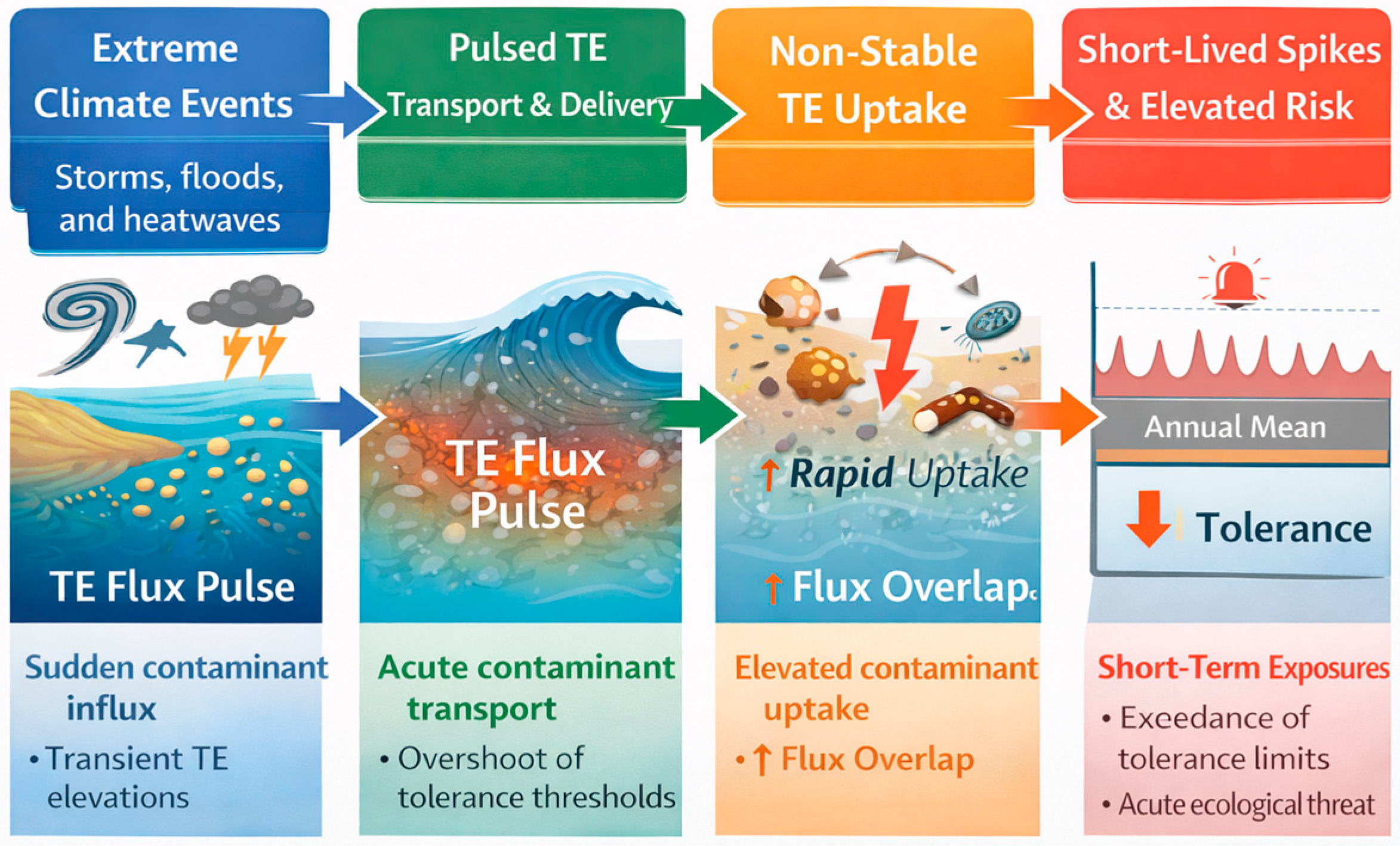
Across mechanistic routes, an overarching consequence of climate modifications is the increasing importance of episodic events: floods, storms, and marine heatwaves, in controlling TE phase partitioning and biological contact intensity. The main pulse-driven processes and exposure implications are summarized in Figure 9. Such events can generate short-lived but intense pulses that dominate biological relevance while contributing relatively little to mean annual concentrations [88]. This temporal decoupling complicates monitoring interpretation, as exposure peaks may fall outside routine sampling windows [46]. Consistent with this pattern, basin-wide analyses show that a limited number of high-discharge or storm-driven events can account for a substantial fraction of annual trace metal fluxes, while contributing little to long-term mean concentrations, emphasizing the dominance of event timing over average conditions in modulating ecotoxicological risk [45].
Direct field evidence from the BS illustrates how flow-mediated processes create mobile, short-duration exposure hotspots. Measurements in the Kerch Strait and adjacent BS waters show that concentrations of multiple pollutant classes, including TE, hydrocarbons, and pesticides, can exceed regulatory thresholds and vary sharply over seasonal and event-driven timescales [46]. Elevated concentrations are frequently confined to buoyant surface plumes associated with episodic water exchange between the Sea of Azov and the BS, rather than reflecting basin-wide background conditions. Distinct seasonal maxima were observed for different contaminant groups, indicating that input pulses are shaped jointly by physical forcing and seasonal system state. These results highlight that circulation-driven plume events, modulated by wind, stratification, and freshwater balance, can rapidly redistribute contaminants across ecologically sensitive areas, decoupling peak exposure from long-term mean concentrations [46].
Additional observations from BS coastal river systems further confirm the dominance of event timing over mean conditions in modulating ecotoxicological risk [47]. Extreme hydrological events, including floods and storm-driven runoff, mobilize disproportionately large fluxes of suspended particulate matter and associated TE over short periods. Peak elemental concentrations were tightly coupled with high-discharge episodes and elevated particle loads, while declining rapidly during post-event conditions [47]. These findings demonstrate that contaminant encounters are governed primarily by short-term hydrological forcing rather than by average river discharge or background concentrations. The resulting river plumes are spatially confined but highly mobile, acting as transient hotspots whose location and duration depend on circulation, stratification, and coastal mixing at the time of disturbance [47].
Additional BS-specific evidence from atmospheric and coastal observations further supports the importance of episodic forcing in shaping TE exposure dynamics [89,90]. Short-lived meteorological events, including dust intrusions and storm-driven sea-salt generation, can produce sharp concentration peaks that dominate exceedance risk despite contributing little to long-term mean values [90]. Although these studies do not directly resolve subsequent TE redistribution within the marine water column, they demonstrate that episodic atmospheric and nearshore particulate inputs in the BS can generate short-duration concentration maxima whose ecological relevance is likely to be underestimated by annual averages. In this sense, they support a mechanistic interpretation in which a limited number of extreme events exert disproportionate control over short-term exposure pressure under non-stationary forcing [89,90].
Crucially, biological responses confirm that such episodic pulses propagate beyond geochemical compartments into higher trophic levels [91]. TE concentrations in demersal fish increased significantly following flood events, with species- and tissue-specific patterns indicating recent uptake rather than long-term accumulation. Flood-associated loads also resulted in elevated human health risk indices, despite mean concentrations remaining within regulatory thresholds [91]. These results confirm that event-driven contaminant pulses translate directly into biological uptake and risk, and that status interpretation based on long-term averages can substantially underestimate short-term ecological and food safety impacts.
In the BS region, where episodic riverine delivery, shelf resuspension, and redox-sensitive secondary release can be event triggered or seasonally intensified, exposure risk therefore becomes increasingly non-stationary [47]. Under such conditions, short-lived contaminant pulses may coincide with vulnerable biological windows, such as spawning, early life stages, or periods of thermal stress, while remaining poorly captured by conventional monitoring programs. This non-stationarity challenges the use of long-term averages as proxies for ecological pressure and strengthens the case for process-aware interpretations that explicitly account for timing, system state, and disturbance regimes [89,91].

5.7. Synthesis: Shifting Pathway Dominance and Implications for Vulnerability

Although the pathway-based synthesis developed here is grounded in the BS, its broader interpretation is supported by observations from other stratified and semi-enclosed marine systems that provide useful mechanistic analogs. Comparable climate-sensitive processes have been documented in the Baltic Sea, where redoxcline Mn–Fe cycling and hypoxia-driven metal release are well established [79]; in sulfidic systems such as Framvaren Fjord [80] and the Cariaco Basin [92], where sulfide control and redox trapping govern TE fate; and in hypoxic estuaries such as Chesapeake Bay and the Gulf of Mexico, where deoxygenation enhances sediment–water metal fluxes [93,94]. Taken together, these cross-system observations support the broader inference that restricted vertical mixing, redox change, sedimentary reservoir remobilization, and episodic forcing are widely relevant mechanisms in stratified marine environments, although their intensity, persistence, and monitoring implications depend on basin structure and hydrographic setting.
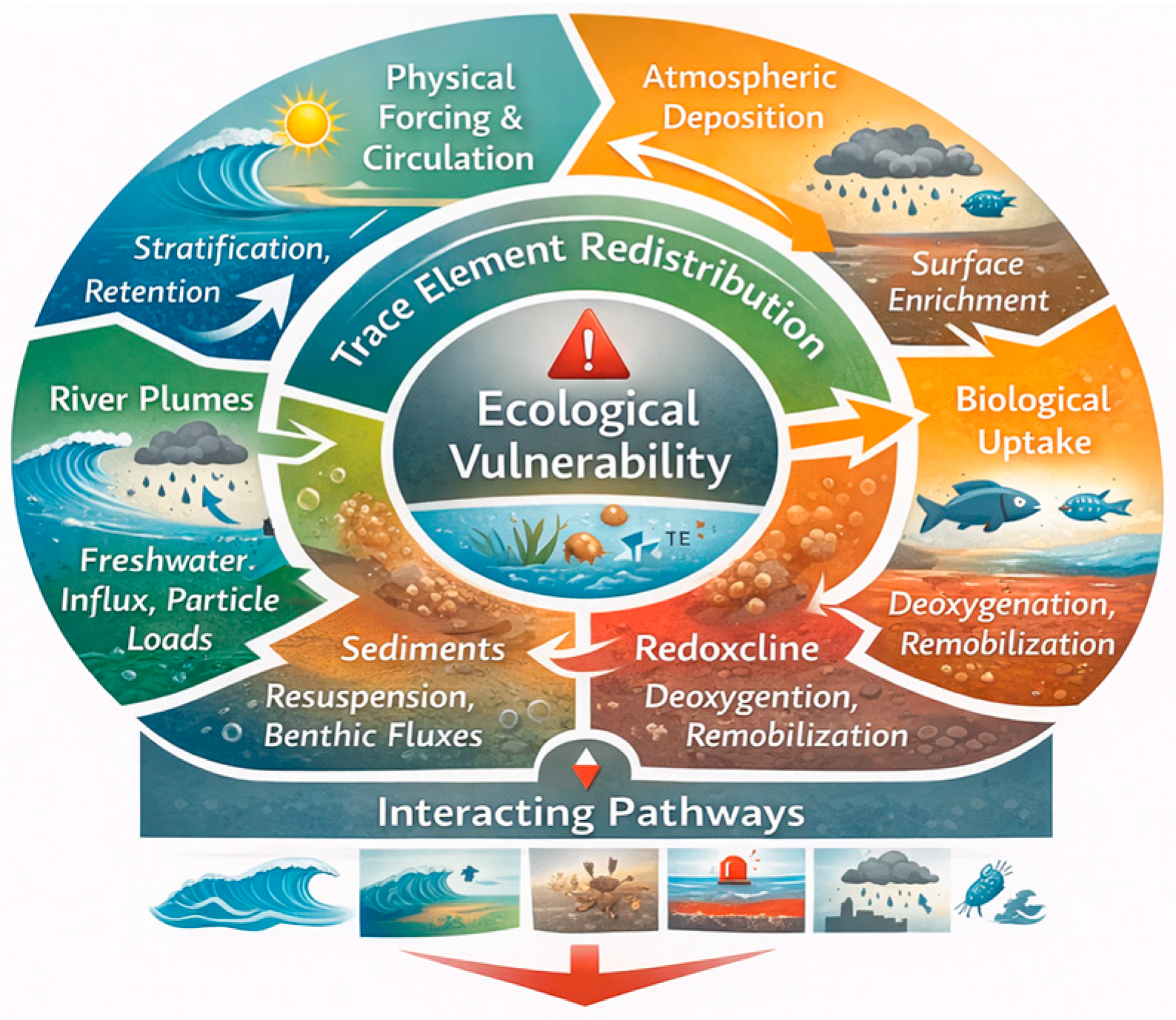
A brief comparison with the Baltic Sea illustrates both the utility and the limits of transferability. The Black Sea and Baltic Sea share strong sensitivity to redoxcline displacement, Fe–Mn shuttle processes, and low-oxygen remobilization, making the pathway framework broadly transferable at the mechanistic level [79]. However, the Black Sea’s permanent euxinia, stronger halocline control, and larger deep anoxic reservoir amplify pathway persistence and vertical decoupling to a degree not uniformly matched in the Baltic. Accordingly, pathway structure is transferable, but pathway intensity, vertical extent, and monitoring thresholds require basin-specific parameterization. A structured comparison of the BS framework with other stratified and low-oxygen marine systems is provided in Table A4, highlighting which pathway-based insights are directly transferable, which require basin-specific adaptation, and the minimum structural conditions needed for applicability. Integrated pathway interactions and vulnerability implications are summarized in Figure 10.
In the BS, amplified stratification, altered hydrological forcing, enhanced disturbance of shelf deposits, and redox-controlled secondary reactivation act in concert to extend TE spatial reorganization mechanisms. Restricted circulation, extensive shelf deposits, and strong biogeochemical gradients create conditions in which redistribution and secondary release of legacy contamination can strongly influence TE exposure patterns and may, under specific hydrographic or event-driven conditions, locally rival the influence of contemporary inputs. Integrated multi-matrix observations from the north-western BS shelf show that spatial patterns of TE are governed also by hydrographic structure, sedimentary context, and carrier-phase availability, rather than by source proximity alone, confirming the dominance of internal system controls over simple source–sink relationships [40]. Other assessments further confirm that internal transfer, driven by sediment storage, redox variability, and episodic hydrological forcing, can dominate ecological risk even where water-column concentrations appear moderate, highlighting the limits of source-based interpretations under non-stationary climate forcing [45].
Observational evidence further shows that the north-western shelf functions as a tightly coupled river–stratification–sediment–Mn/Fe redox system, in which Danube and local inputs are rapidly transformed by internal biogeochemical controls rather than simply diluted or exported [38,42]. TE distributions across dissolved and particulate phases can only be interpreted by considering river plume dynamics, surface-layer stratification, benthic fluxes, and Mn-Fe cycling together. These interacting processes govern speciation, partitioning, and bioavailability across environmental compartments. In this framework, the pycnocline and the sediment-water interface emerge as key zones of transformation that are highly sensitive to warming, deoxygenation, and hydrodynamic change [38].
Recent sediment-focused analyses reinforce this interpretation by showing that fine-grained terrigenous material and Mn-Fe oxide phases act as the principal carriers for most TE on the shelf. They also show that episodic resuspension and physical sorting repeatedly reorganize sediment–water exchange. As a result, historically deposited contamination is not passively stored, but repeatedly re-expressed through physical disturbance and redox-driven transformations, generating spatial heterogeneity that reflects pathway interaction rather than steady external forcing [40]. These findings support the pathway-based organization adopted here by showing that exposure patterns emerge from coupled physical and biogeochemical processes acting across interfaces, rather than from single source inputs.
Notably, biological status interpretations indicate that the ecological consequences of the redistribution depend strongly on organismal tolerance and adaptive capacity. Biological responses to TE burden in the BS are modulated by concurrent climate-related stressors, including warming, hypoxia, and food-web alteration, which reduce detoxification capacity and energetic resilience [95]. It was demonstrated that sublethal effects, such as oxidative stress, metabolic disruption, and altered energy allocation, are amplified when TE bioavailable burden coincides with elevated temperature or reduced oxygen availability [96]. These effects were most pronounced in environments characterized by strong physical and biogeochemical variability, indicating that biological impact is governed not only by bioavailable burden but also by the coincidence of exposure with periods of constrained physiological performance.
Consequently, uptake potential is expected to become increasingly heterogeneous and pulse-driven, with biological effects emerging under multistressor conditions that modulate organismal tolerance and adaptive capacity [95,96]. This process chain-based framework offers a coherent basis for interpreting observed contaminant patterns under climate variability and for identifying zones of increased vulnerability, particularly river-influenced coastal waters [97,98], depositional shelf sediments, redox transition layers, and habitats subject to increasing hydrodynamic disturbance [99,100], where climate variability is most likely to amplify TE mobilization and ecological risk. These findings support integrated, multi-matrix monitoring approaches that include sediments, particles, and episodic events, as water-only evaluation frameworks systematically underestimate ecological risk in the BS [45,95].
Taken together, this synthesis demonstrates that climate change is redefining TE risk in the BS by shifting dominance, redistributing inherited contaminant inventories, and lowering biological tolerance thresholds. As exposure becomes increasingly heterogeneous, pulse-driven, and state dependent, assessment approaches based solely on long-term mean concentrations or static source attribution are likely to underestimate ecological pressure. Effective monitoring and management therefore require pathway-aware, event-sensitive frameworks that account for internal redistribution, system state, and biological sensitivity under climate variability.

6. Implications for Monitoring and Environmental Assessment in the Black Sea

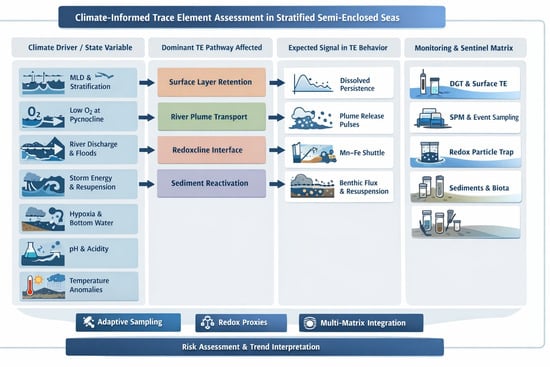
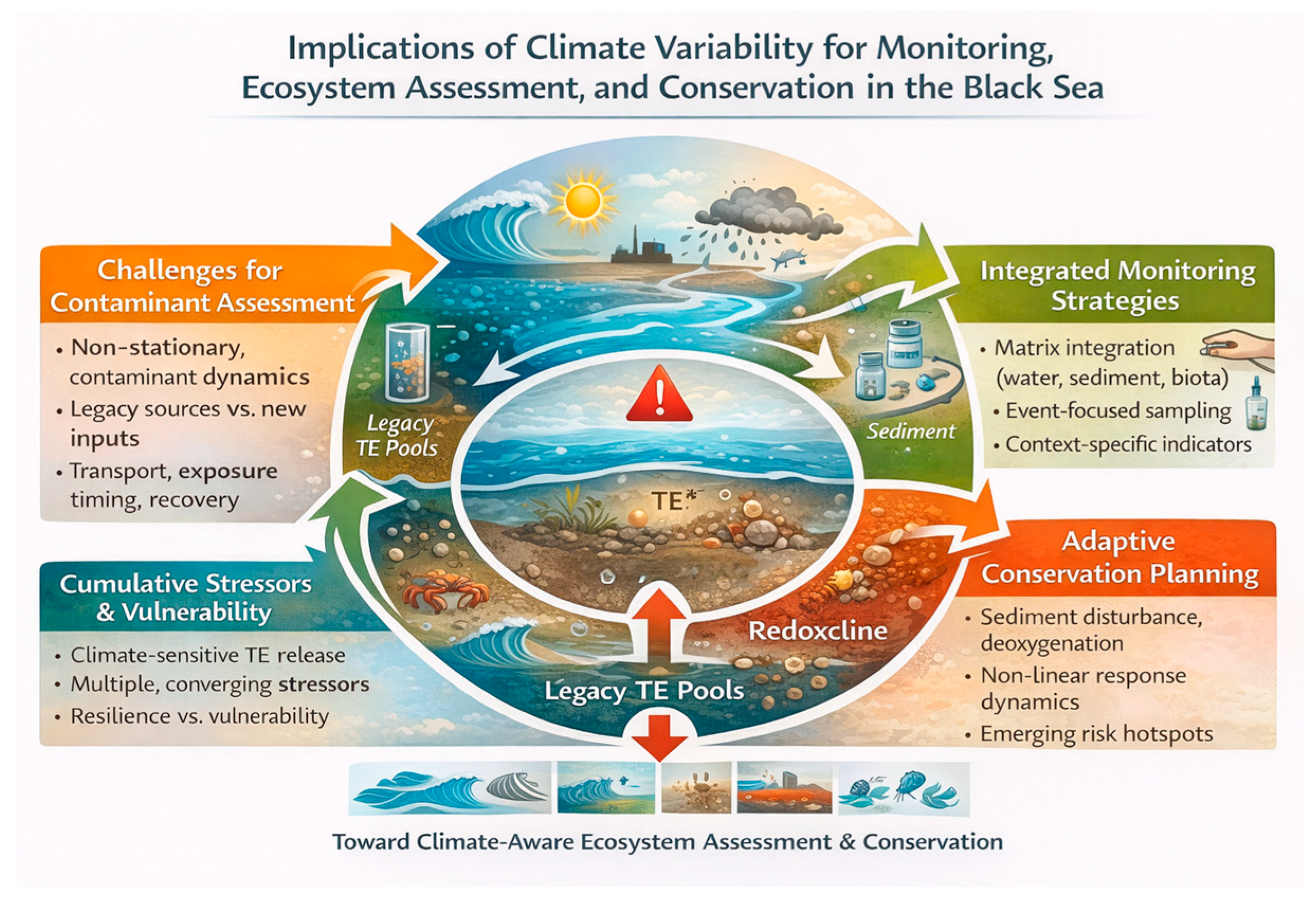
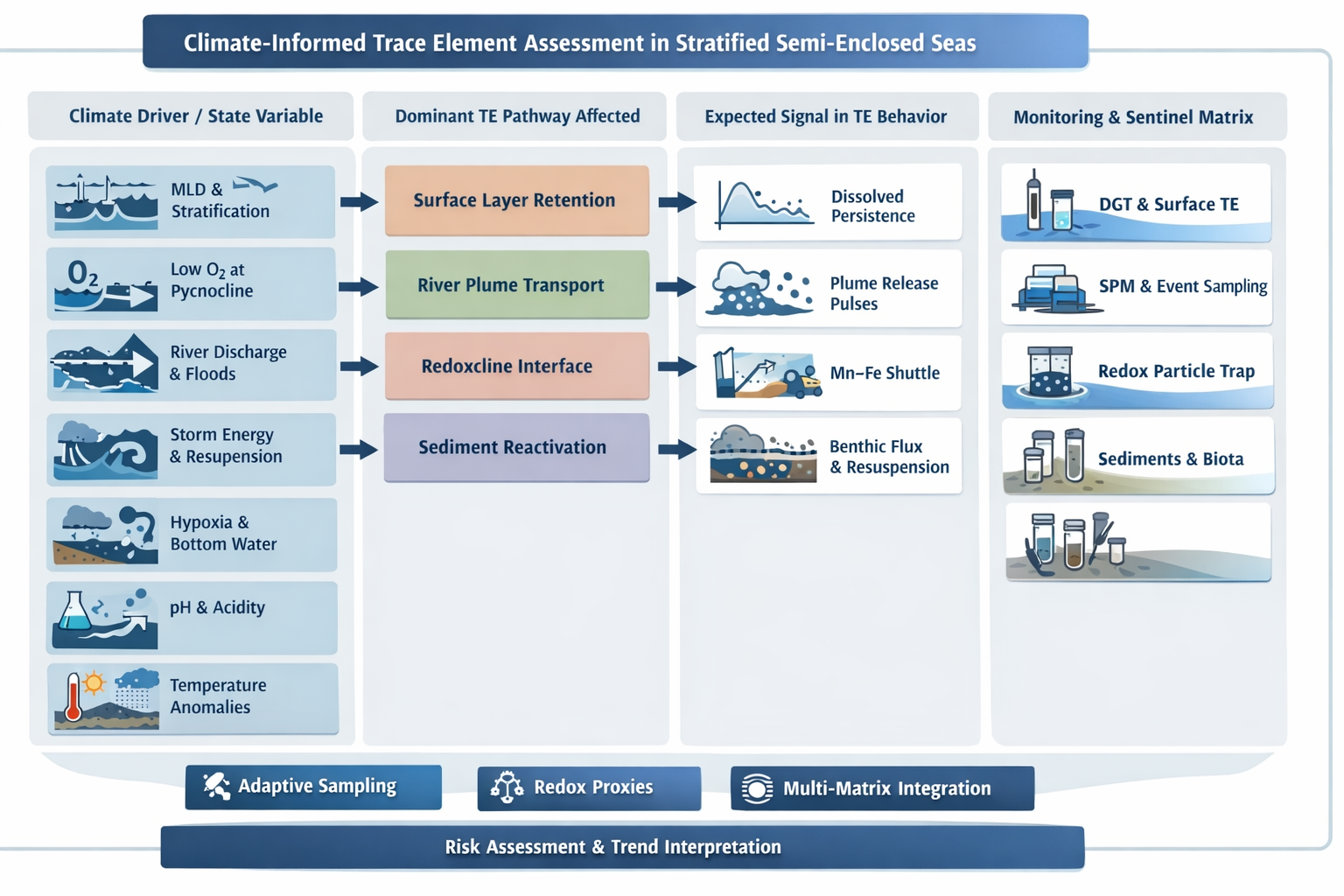
By integrating structural amplifiers and climate-sensitive redistribution pathways, the BS provides an operational reference framework for climate-informed contaminant monitoring and assessment, with broader relevance to other stratified semi-enclosed seas subject to basin-specific structural controls. Climate-driven changes in stratification, redox structure, hydrological variability, and sediment dynamics modify trace element (TE) redistribution patterns, with direct implications for ecosystem status evaluation and conservation appraisal (Figure 11). Under these conditions, observed concentration trends increasingly reflect the interaction between external loading and climate-sensitive internal processes rather than emissions alone. Effective interpretation therefore requires explicit consideration of environmental state variables alongside contaminant measurements.
To translate the pathway-based synthesis into a more operational assessment framework, Table 1 links climate-sensitive state variables to the principal TE redistribution pathways, the expected exposure signals, the priority matrices and indicators for observation, and the associated monitoring implications. To improve practical interpretability, the table also includes trigger conditions that can support escalation from routine monitoring to enhanced or research-grade investigation when anomalous hydrographic, biogeochemical, or event-driven conditions are likely to alter TE redistribution, bioavailability, or ecological exposure. These triggers are informed by the pathway-specific evidence synthesized in Section 5, particularly with respect to stratification-controlled surface retention, flood- and SPM-driven plume dynamics, sediment resuspension, redoxcline migration, and speciation-sensitive responses under changing carbonate chemistry [38,45,47,67,68,69,78,79,80,81,86].

6.1. From Monitoring Variables to Risk Interpretation

Conventional TE assessment frameworks in the BS have largely been developed under assumptions of relatively stable environmental forcing. Under ongoing climatic change, however, modifications in transport pathways, exposure timing, and biological sensitivity complicate interpretation of long-term concentration trends [101]. In strongly stratified and redox-sensitive systems such as the BS, observed TE variability may increasingly reflect interactions between external inputs and climate-sensitive internal processes rather than emissions alone. Redistribution and reactivation of legacy pools can generate substantial concentration variability independent of contemporary loading [102,103], potentially obscuring recovery signals or creating the appearance of deterioration in the absence of new sources. This challenge does not arise primarily from analytical limitations [104] but from a mismatch between stationary evaluation approaches and systems increasingly influenced by non-linear environmental forcing [44]. Reliable ecosystem status interpretation therefore requires explicit consideration of hydrographic structure, oxygen dynamics, and discharge variability alongside contaminant measurements.
To improve operational interpretability, the monitoring framework summarized in Table 1 can be translated into a simple hazard–exposure–sensitivity structure [105,106,107,108,109,110]. In this context, hazard refers to the climate-sensitive hydrographic or biogeochemical condition capable of mobilizing, redistributing, or transforming TE, such as anomalous stratification, oxygen decline, redoxcline displacement, flood-driven plume expansion, sediment resuspension, or acidification-related speciation shifts. Exposure refers to the resulting increase in dissolved, particulate, sedimentary, or bioavailable TE burden, including changes in timing, persistence, and cross-compartment transfer. Sensitivity refers to the susceptibility of the receiving system, including redox-sensitive habitats, productive surface layers, early life stages, filter-feeding communities, and organisms already subject to thermal or oxygen stress [98,111,112,113,114,115,116]. Within this framework, risk increases when a hydrographic or biogeochemical hazard coincides with elevated TE exposure and periods of heightened biological sensitivity.
Monitoring design must also account for increasing temporal variability and cross-compartment redistribution [16]. Fixed seasonal sampling and single-matrix assessments may overlook short-lived but ecologically significant processes, including flood-driven inputs, storm resuspension, and hypoxia development [43]. For episodic processes, interpretation should therefore not rely on concentration maxima alone, but also on the frequency, magnitude, and duration of anomalous conditions. Event significance depends not only on the size of the TE pulse, but also on how often such events occur, how long altered exposure persists, and whether they coincide with sensitive biological windows. Integrated monitoring that links dissolved, particulate, sedimentary (<63 μm), and biotic compartments, while contextualizing TE measurements with environmental covariates such as temperature, oxygen, stratification, and discharge, is necessary to distinguish climate-induced redistribution from emission-driven change [105].
A tiered monitoring structure can further improve implementation. Core monitoring should provide routine seasonal coverage of water, sediment, and biota together with the principal state variables controlling TE redistribution. Enhanced monitoring should be activated when indicator conditions suggest anomalous system behavior, such as persistent shallow mixing, bottom-water oxygen decline, major flood discharge, intensified turbidity, or sustained carbonate chemistry anomalies. Research-grade monitoring should be reserved for conditions requiring process resolution, including depth-resolved redoxcline sampling, porewater and speciation analyses, particle-flux characterization, and short-term event-focused campaigns. This approach is particularly relevant in the BS, where extensive reservoirs of historically deposited TE persist in shelf sediments and depositional zones [62,107,108,109], and may regain ecological relevance under intensified disturbance, deoxygenation, or hydrological extremes through remobilization and speciation shifts [22,103]. From a management perspective, such legacy contamination should therefore be regarded not as a resolved historical condition, but as a latent, climate-sensitive pressure [110].

6.2. Illustrative Application Under Event-Driven Conditions

A simplified Danube flood scenario illustrates how the framework proposed here changes interpretation relative to static assessment. Under a conventional concentration-based approach, elevated TE levels detected in coastal waters after a high-discharge event might be interpreted as evidence of worsening contamination status or increased external loading. Within a climate-informed framework, the same observation would instead be evaluated in relation to hydrological anomaly, plume extent, suspended particulate matter transport, dissolved-versus-particulate partitioning, and the persistence of the event relative to seasonal background conditions [16,43,105]. If the anomaly is short-lived, strongly particle-associated, and clearly linked to flood-driven plume expansion, the assessment emphasis shifts from long-term status deterioration toward episodic redistribution and transient exposure. In such cases, enhanced monitoring should prioritize coupled water–SPM sampling, plume tracking, and short-term biological exposure indicators, while trend interpretation should be deferred until post-event conditions are re-evaluated against seasonal baselines.
Comparable logic applies to hypoxia-season conditions over depositional shelf areas. Under static assessment, elevated near-bottom TE concentrations may be interpreted simply as continued contamination pressure. Under the framework proposed here, coincident oxygen decline, sediment–water interface instability, and secondary remobilization from historically contaminated deposits indicate a hazard–exposure interaction in which climate-sensitive bottom-water conditions reactivate legacy pools [22,102,103,106,107,108,109,110]. In such cases, the key management question is not only whether concentrations are elevated, but whether a redox-sensitive or disturbance-driven state shift has altered TE mobility, exposure timing, and biological relevance. This perspective is especially important in the BS, where TE contamination interacts with eutrophication, habitat degradation, and broader climate-driven ecosystem change [98,111,112], and where climate-modified TE fractions may amplify biological responses even when total concentrations remain comparatively stable [113,114,115,116]. Overall, this framework supports a more adaptive form of monitoring and assessment in which observed TE patterns are interpreted in relation to environmental state, pathway activation, and ecological sensitivity, rather than through concentration trends alone. Recognizing TE contamination as climate-modulated and state dependent strengthens ecosystem status interpretation and supports adaptive monitoring without requiring abandonment of existing regulatory structures [44,117].

6.3. Alignment with Existing Monitoring and Regulatory Frameworks

The framework proposed here is intended to complement existing monitoring obligations in the BS. In practice, climate-informed interpretation can be integrated into the current regulatory architecture by treating environmental state variables as explanatory context for contaminant measurements, not as a substitute for established chemical assessment. This is consistent with the fact that the Water Framework Directive (WFD) remains the main legal instrument for inland, transitional, and coastal waters, while the Marine Strategy Framework Directive (MSFD) provides the principal ecosystem-based framework for marine waters through recurring assessment, monitoring, and measures cycles. At the regional level, the Bucharest Convention/Black Sea Commission already provides a cooperative framework for pollution monitoring, assessment, and protection of the marine environment. Within this structure, the approach advanced here should be understood as an interpretive enhancement that improves robustness of assessment under non-stationary environmental forcing while remaining compatible with existing compliance-based obligations.
Operationally, this means that the core elements of current programs remain valid: fixed-station and transect-based sampling, established water–sediment–biota matrices, and routine contaminant measurements should continue to provide the backbone of assessment. What changes is the interpretive and adaptive layer added around them. For WFD-oriented coastal and transitional assessments, this framework helps distinguish concentration changes associated with hydrological anomalies, plume dynamics, or stratification shifts from genuine source-driven deterioration or recovery. For MSFD- and Black Sea Commission-oriented marine assessments, it supports a more robust interpretation of contaminant status by linking TE measurements to redox structure, oxygen conditions, sediment remobilization, and event-driven variability. The most feasible additions are therefore not redesign of programs, but targeted co-measurement of key state variables such as mixed-layer depth, dissolved oxygen, redoxcline position, pH/carbonate chemistry, discharge anomalies, plume extent, turbidity, and suspended particulate matter.
A practical implementation pathway is to retain routine core monitoring for compliance and long-term trend analysis, while using the trigger logic developed in Table 1 to activate enhanced or research-grade investigation only when anomalous conditions are likely to alter TE redistribution, bioavailability, or ecological exposure. In this way, legacy monitoring structures remain fully usable, novel indicators are introduced selectively rather than universally, and resource demands are concentrated on periods or locations where climate-sensitive redistribution is most likely to affect interpretation. This staged approach is particularly important in the BS, where regulatory continuity, regional comparability, and operational feasibility must be balanced against the need for more state-aware assessment under increasing climatic variability. Top of Form

7. Future Directions

Advancing climate-informed understanding of TE dynamics in stratified semi-enclosed seas requires tighter integration of physical forcing, redox transformations, sedimentary processes, and biological exposure within a non-stationary framework. Future research should prioritize quantifying state dependence and threshold behavior, particularly identifying stratification intensity, mixed-layer variability, redoxcline position, and oxygen penetration depth at which small hydrographic shifts trigger disproportionate changes in TE speciation, mobility, and partitioning [27,28,29,30,35,44,101,105]. Establishing indicators that link environmental structure to redistribution will improve predictive capacity under climate change.
Higher-resolution investigation of redox transitions represents a central research need. Sustained, depth-resolved observations across oxic–suboxic–anoxic interfaces, integrating Fe–Mn cycling, sulfide dynamics, and TE speciation, would clarify how vertical compression or expansion of reactive zones modulates metal remobilization and hotspot formation [64,77,78,79,80]. Such efforts are particularly relevant in systems where redox boundaries are sensitive to warming and ventilation changes.
Greater attention should also be directed toward episodic forcing. Extreme river discharge, storm-induced sediment resuspension, and heatwave-driven stratification anomalies may dominate annual TE exposure budgets despite limited representation in conventional monitoring schemes [22,23,45,46,47,102,103]. Integrating event-scale observations with seasonal and interannual datasets will clarify variability regimes and cumulative redistribution effects.
Progress in exposure assessment further depends on expanded application of speciation-resolved and bioavailability-sensitive approaches. Distinguishing total concentrations from biologically relevant fractions under shifting carbonate chemistry and organic complexation regimes will enhance interpretation of ecological risk [12,17,18,19,68,69,86,87]. Development of tools that resolve lability, competitive binding, and ligand-mediated buffering is essential for evaluating climate-modified exposure scenarios.
Coupled climate–contaminant modeling frameworks offer an additional pathway forward. Mechanistic models linking temperature-driven stratification, redox transformations, sediment remobilization, plume dynamics, and biological uptake could enable scenario-based projections of TE redistribution under future climate trajectories [8,16,44,101,105]. Incorporating state-dependent processes and episodic amplification would strengthen risk forecasting and management planning. A key next step is the development of a basin-scale flux framework capable of comparing internal redistribution, sediment remobilization, redoxcline cycling, riverine delivery, and atmospheric deposition on a common quantitative basis.
Comparative synthesis across stratified systems, including Baltic-type basins, fjords, estuarine hypoxic systems, and permanently euxinic seas, is summarized in Table A4 and helps evaluate which aspects of the pathway framework identified in the Black Sea are broadly transferable, which require adaptation, and which depend on structural conditions not uniformly shared across basins [79,80,92,93,94,117]. Such cross-system analysis clarifies how basin morphology, residence time, ventilation regime, salinity structure, shelf configuration, and redox persistence influence pathway dominance and redistribution sensitivity. In this sense, the BS should be regarded not as a universally representative model, but as a structurally amplified end-member that helps identify climate-sensitive redistribution mechanisms whose expression in other systems must be parameterized according to local hydrographic and biogeochemical controls.
At the assessment level, moving beyond static concentration thresholds toward frameworks incorporating environmental state variables, probabilistic exposure metrics, and non-linear dynamics represents an important conceptual shift [44,104,105,113,114,115,116,117]. Integrating redistribution mechanisms into risk evaluation will improve the resilience of monitoring programs under accelerating climatic variability.
Collectively, these directions support a transition from load-centered interpretation toward process-oriented evaluation of TE behavior under a changing climate. Strengthening mechanistic resolution, predictive modeling, and state-aware assessment will enhance the scientific basis for environmental monitoring and ecosystem risk management in stratified marine basins.

8. Conclusions

Climate change is altering TE behavior in the BS by modifying the physical and biogeochemical conditions that govern redistribution, remobilization, speciation, and exposure. Across the pathways synthesized here, TE patterns increasingly reflect state-dependent internal processes linked to stratification, hydrological variability, sediment disturbance, redoxcline dynamics, acidification-related speciation change, and episodic forcing, rather than external inputs alone. In this sense, the principal contribution of this review is the development of a Black Sea-centered, pathway-based, and operational framework that links climate-sensitive state variables to TE redistribution mechanisms, monitoring triggers, and risk interpretation under non-stationary environmental forcing. By integrating mechanistic evidence with monitoring and assessment implications, this framework helps clarify why static, source-based interpretations are increasingly insufficient in stratified marine systems. The Black Sea is therefore best understood as a structurally amplified reference system in which climate-sensitive redistribution processes can be examined with particular clarity, while their broader applicability remains dependent on basin-specific structural controls.

Supplementary Materials

The following supporting information can be downloaded at: https://www.mdpi.com/article/10.3390/sci8040091/s1, Table S1: Disposition of the Web of Science records screened for the structured pathway synthesis.

Author Contributions

Conceptualization, A.O. and L.L.; methodology, A.O., V.C., N.D., D.D., E.R. and L.L.; software, A.O. and L.L.; literature search and selection, A.O., V.C., N.D., D.D., E.R. and L.L.; data curation, A.O., V.C., and L.L.; writing—original draft preparation, A.O., V.C., N.D., D.D., E.R. and L.L.; writing—review and editing, A.O., V.C., N.D., D.D., E.R. and L.L.; visualization, A.O. All authors have read and agreed to the published version of the manuscript.

Funding

This research was supported by the Nucleu Programme SMART-BLUE 2023–2026, funded by the Ministry of Research, Innovation and Digitization (grant no. 33N/2023, PN23230103).

Institutional Review Board Statement

Not applicable.

Data Availability Statement

No new data were created or analyzed in this study.

Acknowledgments

During the preparation of this manuscript, the authors used OpenAI’s GPT-5.2 model, accessed through a ChatGPT Plus subscription, to assist with the illustrative rendering of conceptual schematic figures and limited language refinement. All outputs were reviewed, revised, and scientifically validated by the authors, who assume full responsibility for the content of this publication.

Conflicts of Interest

The authors declare no conflicts of interest.

Abbreviations

The following abbreviations are used in this manuscript:
BSBlack Sea
BSCBlack Sea Commission
DGTDiffusive gradients in thin films
DINDissolved inorganic nitrogen
DODissolved oxygen
DOMDissolved organic matter
DOCDissolved organic carbon
MeHgMethylmercury
MLDMixed-layer depth
MSFDMarine Strategy Framework Directive
pCO2Partial pressure of carbon dioxide
PTEPotentially toxic element(s)
PM10Particulate matter with an aerodynamic diameter ≤ 10 μm
PM2.5Particulate matter with an aerodynamic diameter ≤ 2.5 μm
SPMSuspended particulate matter
TATotal alkalinity
TETrace element(s)
WFDWater Framework Directive

Appendix A. Search Strategy, Study Selection, and Supplementary Synthesis Tables

Table A1. Web of Science Core Collection search strategy used to support the pathway-based synthesis. Base queries were refined with optional modifiers when needed to improve coverage.
SectionWoS QueryOptional Terms Purpose
5.1 Surface-layer pathway
(stratification,
residence time,
dissolved exposure)
“Black Sea” AND (stratification OR “vertical mixing”) AND (“heavy metal*” OR “trace metal*” OR “trace element*” OR “potentially toxic element*” OR PTE* OR “toxic metal*” OR “metal contamination” OR “metal pollution” OR “metal contaminant*”) AND (dissolved OR speciation OR bioavailability)warming OR
temperature OR “mixed layer” OR
“water column” OR complexation OR
ligand*
Warming/
stratification effects on dissolved-phase behavior and
bioavailability in
surface waters.
5.2 River plume and SPM pathway (Danube, floods, particle transport)“Black Sea” AND (Danube OR river*) AND (“heavy metal*” OR “trace metal*” OR “trace element*” OR “potentially toxic element*” OR PTE* OR “toxic metal*” OR “metal contamination” OR “metal pollution” OR “metal contaminant*”) AND (“suspended particulate matter” OR SPM OR particulate) AND (flood* OR discharge OR runoff)plume OR estuar* OR delta OR “extreme event*” OR storm* OR Dnieper OR DniesterRiver-driven delivery, plume processes, SPM-associated TE, flood-driven pulses.
5.3 Shelf sediment pathway (resuspension, redistribution, benthic exposure)“Black Sea” AND (shelf OR coastal) AND sediment* AND
(resuspension OR “sediment transport”) AND (“heavy metal*” OR “trace metal*” OR “trace element*” OR “potentially toxic element*” OR PTE* OR “toxic metal*” OR “metal contamination” OR “metal pollution” OR “metal contaminant*”)
storm* OR wave* OR current* OR
hydrodynamic* OR turbidity OR “bottom shear”
Sediment
resuspension and
hydrodynamic
redistribution of
particle-bound
contaminants.
5.4 Redoxcline
pathway
(deoxygenation,
remobilization, Fe–Mn cycling)
“Black Sea” AND (hypoxia OR deoxygenation OR anoxia OR
suboxic OR redox OR “redoxcline”) AND (iron OR manganese OR “Fe Mn” OR “Fe oxide*” OR “Mn oxide*”) AND (release OR
remobilization OR mobilization) AND (“heavy metal*” OR “trace metal*” OR “trace element*” OR “potentially toxic element*” OR PTE* OR “toxic metal*” OR “metal contamination” OR “metal
pollution” OR “metal contaminant*”)
porewater OR
diagenesis OR
“benthic flux” OR
“sediment-water”
Redox-controlled
mobilization and
benthic–pelagic
exchange under low oxygen.
5.5 Acidification–
ligand pathway (pH, DOC/DOM,
complexation,
partitioning)
“Black Sea” AND (acidification OR pH) AND (DOC OR DOM OR “dissolved organic matter” OR ligand* OR complexation OR
speciation) AND (“heavy metal*” OR “trace metal*” OR “
trace element*” OR “potentially toxic element*” OR PTE* OR “toxic metal*” OR “metal contamination” OR “metal pollution” OR “metal contaminant*”)
carbonate OR
alkalinity OR
buffering OR humic* OR copper OR
cadmium OR zinc
pH/DOM-driven speciation shifts affecting mobility and
bioavailability.
5.6 Extreme-event timing pathway (pulses, episodic fluxes, temporal decoupling)“Black Sea” AND (“extreme event*” OR flood* OR storm* OR
heatwave* OR episodic OR pulse*) AND (“heavy metal*” OR “trace metal*” OR “trace element*” OR “potentially toxic element*” OR PTE* OR “toxic metal*” OR “metal contamination” OR “metal
pollution” OR “metal contaminant*”)
event-based OR
“high-frequency” OR runoff OR resuspension OR “river
discharge”
Event-driven pulses and short-term
variability relevant to exposure/
interpretation.
5.7 Synthesis (vulnerability, cumulative stress, assessment relevance)“Black Sea” AND (“heavy metal*” OR “trace metal*” OR “trace
element*” OR “potentially toxic element*” OR PTE* OR “toxic metal*” OR “metal contamination” OR “metal pollution” OR “metal contaminant*”) AND (“multiple stressor*” OR cumulative OR
vulnerability OR “risk assessment” OR “ecosystem assessment”) AND (climate OR “climate change” OR warming OR hypoxia OR variability OR “non-stationary” OR nonstationary)
hotspot* OR resilience OR conservationIntegrative literature linking TE with
climate stressors and assessment
implications.
Additional identificationBackward/forward citation trackingTargeted author/topic searchesReduce omission risk for influential studies not captured by
keywords.
Figure A1. Structured literature screening workflow for the Section 5 pathway synthesis.
Sci 08 00091 g0a1
Table A2. Summary of selected studies supporting the pathway-based synthesis of climate-driven trace element behavior in the Black Sea. Studies are listed once and mapped to one or more pathways described in Section 5, together with BS subregion, the principal processes addressed, and the key mechanism-level findings relevant to this review.
StudyPathways Black Sea
Subregion
Key Process(es)Main Findings
Bakan et al., 2010 [45]5.2; 5.6; 5.7Kizilirmak River and TR coastal zoneSeasonal discharge variability; river-borne TELinks catchment pressures and discharge variability to coastal environmental quality.
Bezberdaya et al., 2024 [90]5.2; 5.6; 5.7Crimean Peninsula
(N BS)
Urban dust resuspension; PM10 fractionationIdentifies land-based TE sources and particle-mediated pathways relevant to episodic coastal inputs.
Catianis et al., 2025 [40]5.1; 5.2; 5.3; 5.6; 5.7RO NW shelfStratification controls; Danube-influenced gradients; nearshore enrichment; multi-matrix baselineProvides an integrated shelf baseline showing how
physical structure and terrigenous inputs shape metal
patterns, with localized nearshore signals consistent with episodic/coastal enrichment.
Dakova et al., 2011 [69]5.1; 5.5; 5.7Burgas Gulf
(BG coast)
Labile vs. total dissolved pools; operational speciationShows divergence between total dissolved and
bioavailable metal fractions, supporting
speciation-sensitive, climate-aware exposure assessment.
Dellwig et al., 2010 [79]5.4; 5.7BS redoxcline (comparative with Baltic)Mn–Fe–P particle cycling; redoxcline successionProvides particle-scale evidence that coupled Mn–Fe
cycling at redoxclines drives metal redistribution across oxic–anoxic boundaries.
Duman et al., 2006 [72]5.3; 5.6; 5.7South-central BS shelf and slope (TR)Sediment transport setting; grain-size control; redox overprintsLinks sedimentological context to geochemical patterns, supporting hydrodynamic redistribution and redox imprinting of sediment-associated TE.
Duyar et al., 2023 [91]5.2; 5.6; 5.7TR BS coast (Sinop)Flood-driven exposure pulses; biotic responseShows increased metal concentrations in fish following flood events, illustrating short-term exposure
amplification.
Dyrssen et al., 1999 [80]5.4; 5.7Deep BS (comparative with Framvaren fjord)Chemocline control; sulfidic trapping; Shows strong removal of certain TE under sulfidic
conditions, reinforcing redoxcline control on metal fate.
Guieu & Martin, 2002 [70]5.2; 5.5; 5.6Danube Delta/NW BS plumeRiver–sea mixing; dissolved vs. particulate partitioningShows strong non-conservative metal behavior in the
Danube plume, demonstrating the importance of estuarine transformation processes.
Konovalov et al., 2004 [64]5.4; 5.7Central and northern BS deep water column (suboxic–anoxic transition zone)Redox cycling of Fe and Mn; transport-reaction kinetics; dissolved–particulate transformation parameterizationQuantifies coupled Fe–Mn redox transformations across the suboxic–anoxic gradient, showing how oxidation–reduction cycling, phase changes, and sinking regulate
dissolved and particulate distributions, providing a
mechanistic basis for redoxcline-driven TE behavior and exposure hotspots in the BS.
Kocak et al., 2015 [89]5.6; 5.7Central BS coast (TR, Sinop)Atmospheric particulate matter (PM10/PM2.5) transport; seasonal and episodic variability; trace metal association with aerosolsDemonstrates pronounced seasonal variability and source-dependent enrichment of TE in atmospheric particulate matter over the central BS, indicating that episodic
atmospheric transport can act as an intermittent trace
element input to coastal surface waters.
Lazar et al., 2024 [98]5.6; 5.7Western BS basin Climate warming; temperature–contaminant interaction; altered bioaccumulationShows that warming conditions modulate trace metal
accumulation in Pontic shad, indicating climate-driven changes in contaminant burdens independent of
concentration trends.
Lenstra et al., 2019 [67]5.1; 5.2; 5.3; 5.4; 5.7Northwestern BS shelfReductive dissolution of Fe oxides; hypoxia-sensitive release; lateral shelf-to-basin transportProvides mechanistic evidence that low-oxygen conditions enhance Fe release from shelf sediments and lateral transport, supporting a climate-sensitive metal
remobilization pathway.
Lesnikova & Zakharikhina, 2025 [47]5.2; 5.6Sochi River
(RU coast)
Flood vs. low-water regimes; dissolved load pulsesDemonstrates sharp hydrology-driven changes in elemental delivery, supporting flood-driven pulse dynamics.
Lewis et al., 1991 [78]5.1;5.4 Basin-wide BS water columnFe–Mn cycling across suboxic zone; scavenging and releaseFoundational evidence that Fe–Mn redox cycling governs TE partitioning and mobility, underpinning the redoxcline hotspot concept.
Muller et al., 2001 [68]5.1; 5.5; 5.7Western BS surface watersOrganic ligand complexation; hydrographic controls;
speciation–bioavailability
Demonstrates strong organic complexation of Cu and Zn, implying climate-driven changes in DOM and
stratification can shift bioavailable fractions without changes in totals.
Oros et al., 2025 [95]5.2; 5.3; 5.6; 5.7Romanian BS sector (coastal–shelf–offshore)Multi-matrix gradients; shelf sediment enrichmentProvides a contemporary multi-matrix baseline
highlighting spatial heterogeneity and potential
under-sampling of episodic signals.
Özseker et al., 2026 [88]5.2; 5.6; 5.7SE Black Sea basin (reservoir; land–sea context)SPM–sediment partitioning; seasonal inflow pulsesDemonstrates strong seasonal heterogeneity in metal loads, supporting catchment-to-coast episodic particulate delivery.
Pakhomova et al., 2009 [77]5.4; 5.7Central Black Sea water column; (suboxic–anoxic redox transition zone)Redox-controlled partitioning of Fe and Mn; dissolved–particulate phase exchange; formation and dissolution of metal oxyhydroxides across the redoxclineDemonstrates strong redox control on Fe–Mn speciation and phase partitioning across narrow oxygen gradients, with rapid dissolved–particulate transformations.
Provides in situ evidence that the BS redoxcline functions as a dynamic geochemical barrier and secondary source/sink, acting as a climate-sensitive hotspot for TE remobilization and redistribution under
deoxygenation.
Ryabushko et al., 2023 [73]5.3; 5.7N BS
(Crimean coast)
Sediment–biota couplingDemonstrates co-occurrence of TE in sediments and seagrass, supporting benthic exposure pathways.
Savenko & Pokrovsky, 2022 [71]5.2; 5.6RU BS river mouthsRiver–seawater mixing; flocculation/coagulation; non-conservative behaviorQuantifies conservative vs. non-conservative TE
behavior during mixing, highlighting colloidal and particle processes controlling coastal export.
Tankéré et al., 2001 [38]5.1; 5.2; 5.3; 5.7Northwestern BS shelfDissolved and particulate TE (Mn, Fe, Co, Pb, Cd, Zn, Cu, Ni) distributions in relation to shelf circulation, Danube influence, and redox conditionsShows that riverine influence and shelf hydrography (stratification, isopycnal transport) control spatial patterns of dissolved and particulate TE, with evidence for benthic fluxes and advective redistribution; supports integration of river plume, stratification, and shelf redistribution pathways in the BS context.
Tepavitcharova et al., 2009 [86]5.2; 5.5; 5.7BG rivers–estuaries–coastpH/salinity-controlled speciation along gradientsDemonstrates systematic speciation shifts from river to sea, controlling metal mobility and exposure
pathways.
Xiong et al., 2003 [81]5.4; 5.5; 5.7BS euxinic watersThermodynamic speciation under anoxia; sulfide controlShows that redox regime fundamentally governs TE form and solubility under euxinic conditions.
Zavialov et al., 2022 [46]5.2; 5.6; 5.7Kerch Strait and adjacent BSStrait/plume transport; stratification; SPM-associated maximaShows pollutant (including TE) maxima tied to plume dynamics and stratification, illustrating spatially
focused, seasonally variable hotspot behavior.
Pathway codes correspond to Section 5: 5.1 surface-layer pathway (stratification/residence time; dissolved exposure); 5.2 river plume and SPM pathway (riverine pulses; particulate transport); 5.3 shelf sediment pathway (resuspension; sediment–water exchange; benthic exposure); 5.4 redoxcline pathway (deoxygenation; Fe–Mn cycling; remobilization/hotspots); 5.5 acidification–ligand pathway (pH/DOC controls on speciation and bioavailability); 5.6 extreme-event timing pathway (episodic pulses; temporal decoupling/non-stationarity); 5.7 synthesis (integrative vulnerability and assessment framing).
Table A3. Element-specific controls relevant to climate-modulated redistribution pathways in the Black Sea.
ElementDominant Carrier Phase/Controlling CompartmentKey Redox SensitivityMain
Climate-Sensitive Driver
Most
Relevant
Pathway(s)
Sentinel Matrix/
Indicator
FeMn–Fe oxyhydroxides; suspended particles;
redoxcline interface
Reductive dissolution
under suboxia/anoxia; rapid reoxidation and particle
re-formation
Deoxygenation;
redoxcline migration; resuspension
5.3, 5.4Dissolved Fe(II)/Fe, particulate Fe,
redoxcline particle maxima
MnDissolved Mn(II);
Mn oxides; redoxcline
particle shuttle
Very strong redox
sensitivity;
oxidation–reduction cycling across the suboxic
boundary
Deoxygenation;
redoxcline
displacement;
resuspension
5.3, 5.4Dissolved Mn(II), particulate Mn
oxides, redoxcline depth
CuStrongly ligand-bound dissolved pool;
DOM-associated
Less redox-sensitive than Fe/Mn; mobility controlled largely by complexationStratification; DOM shifts;
acidification/
speciation change
5.1, 5.5Free-ion/labile Cu, DOM composition, ligand titrations
ZnMixed dissolved–
particulate behavior;
ligand-sensitive
dissolved fraction
Moderate redox/speciation sensitivity; sulfide control under anoxiaStratification;
acidification; plume transformation
5.1, 5.2, 5.5Dissolved Zn, DGT-labile Zn, plume transects
CdComparatively labile
dissolved phase;
estuarine/plume-sensitive
Can remain mobile in
dissolved form; sensitive to pH/speciation shifts
River plume
variability;
acidification;
stratification
5.1, 5.2, 5.5Dissolved Cd, DGT-labile Cd, plume-phase partitioning
NiMore conservative
dissolved behavior than many sulfide-reactive TE
Lower sensitivity to sulfide removal than Cu/Zn/Pb-type behaviorRiver/plume transport;
stratification;
acidification
5.1, 5.2, 5.5Dissolved Ni, DGT-labile Ni, salinity-gradient profiles
PbParticle-reactive; strong DOM/particle interactions; atmospheric input
important in surface
waters
Strong scavenging
tendency; suppressed in
anoxic waters by sulfide-phase control
Atmospheric
deposition; low-SPM stratified surface
conditions;
resuspension
5.1, 5.3, 5.5Dissolved Pb,
particulate Pb,
atmospheric/surface-water contrast
HgDissolved Hg(II)/MeHg; particulate Hg; organic matter and Fe/Mn particle interactionsSpeciation and methylation strongly linked to l
ow-oxygen/euxinic
conditions
Deoxygenation;
redoxcline structure; organic matter
remineralization
5.4, 5.5Total Hg, MeHg,
dissolved/particulate Hg, biota tissue Hg
AsOxyanion-forming
dissolved species;
adsorption to Fe/Mn
oxides and particles
As(V)/As(III) shifts across redox gradients;
sorption/desorption linked to Fe/Mn phases
Redoxcline
displacement;
hypoxia/anoxia;
particle-phase
transformation
5.4, 5.5Dissolved As
speciation,
particulate Fe/Mn-associated As
CrDissolved oxyanion Cr(VI) vs. particulate/sorbed Cr(III); Mn–Fe mineral
interfaces
Cr(VI)/Cr(III) transitions strongly redox-controlled; Mn oxides can oxidize Cr(III), Fe phases can retain Cr(VI)Redoxcline migration; particle-phase
transformation; pH/speciation shifts
5.4, 5.5Dissolved Cr
speciation, Mn/Fe particulate phases, redox-sensitive
profiles
Fe and Mn are included not only as monitored elements, but also as regulator elements because their redox-sensitive cycling exerts strong control on trace-element scavenging, remobilization, carrier-phase formation, and exposure pathways in the Black Sea.
Table A4. Comparative transferability of the Black Sea pathway framework across contrasting stratified and low-oxygen marine systems.
SystemKey Structural
Features
Dominant Structural
Amplifiers
Main Pathway(s)Directly Transferable from the Black SEA FrameworkRequires
Adaptation
Minimum Structural
Conditions for
Applicability
Black Sea
[28,37,38,42,53,59]
Permanently stratified
semi-enclosed basin with strong halocline control,
persistent redoxcline, euxinic deep waters, restricted deep ventilation, broad shelf
sectors, strong river
influence, and substantial legacy contaminant
reservoirs
Persistent
stratification; restricted exchange; stable redox interface;
large sedimentary/
particulate reservoirs; river-shelf coupling
5.1, 5.2, 5.3, 5.4, 5.5, 5.6Reference system for the full pathway framework Persistent or recurrent
stratification; restricted
ventilation; redox-sensitive internal interface; internal sedimentary or particulate TE reservoirs
Baltic Sea
[118,119,120,121,122]
Semi-enclosed brackish sea with permanent halocline in the Baltic Proper, negligible tides, irregular deep-water
renewal, and recurrent deep hypoxia/anoxia
Halocline-controlled ventilation restriction; deoxygenation;
episodic inflow
dependence;
sedimentary recycling
5.3, 5.4, 5.6; partly 5.1Redoxcline dynamics;
deoxygenation-driven
remobilization; sediment–water exchange;
state-dependent
monitoring logic
Brackish salinity regime; irregular deep-water
renewal; shallower basin geometry;
strong importance of
inflow events
Persistent or seasonally
recurrent stratification;
restricted renewal;
recurring low-oxygen deep waters; sedimentary
reservoir capable of
internal remobilization
Framvaren Fjord
[123,124,125,126]
Small fjord with extremely
restricted exchange,
permanently anoxic deep
waters, and highly persistent sulfidic conditions
Extreme ventilation
restriction; stable oxic-anoxic boundary;
sulfide-rich deep waters; strong Mn-Fe-S control
5.4 primarily; secondarily 5.5Sulfidic speciation control; redoxcline chemistry; chemically selective
trapping/remobilization
River-plume dynamics; broad-shelf resuspension; large-scale river-shelf coupling; contaminant loading contextPersistent stratification; extreme exchange
restriction; stable
redoxcline/euxinia;
internally regulated Mn-Fe-S cycling
Cariaco Basin
[125,127,128,129]
Permanently anoxic marine basin with stable redoxcline and long-term redox-stratified deep waters; productivity strongly influenced by
seasonal upwelling
Persistent redox
stratification; particle-associated processing at the redoxcline; organic-matter supply linked to upwelling
5.4 primarily; partly 5.1 and 5.6Redoxcline-controlled TE transformation; particle-mediated transport across oxic-anoxic gradients; low-oxygen process
interpretation
Upwelling-driven rather than river-driven forcing; shelf legacy
contamination less
central; weaker
semi-enclosed behavior
Persistent stratification with anoxic deep waters; stable redox interface;
sufficient particulate flux to sustain internal redoxcline processing
Chesapeake Bay
[130,131,132,133]
Large estuary with strong
seasonal density stratification, long residence times, and recurring summer
hypoxia driven by nutrient loading and physical
stratification
Seasonal stratification; nutrient-enhanced
oxygen demand;
episodic river
discharge; sediment–water exchange
5.2, 5.3, 5.6; partly 5.4Hazard-exposure-
sensitivity logic; event-sensitive monitoring; plume/discharge
interpretation; seasonal low-oxygen
remobilization
Seasonal rather than
persistent hypoxia; stronger tidal exchange and estuarine
circulation; weaker
redox persistence; no permanent euxinia
Seasonal stratification;
sufficient residence time; recurrent low-oxygen
bottom waters; event-
sensitive sediment/plume coupling
Northern Gulf of Mexico
[94,134,135]
Open, river-influenced
continental shelf with
seasonal stratification and
recurrent midsummer bottom-water hypoxia driven mainly by Mississippi-Atchafalaya loading and freshwater buoyancy
Large river plume;
seasonal stratification; high nutrient loading; seasonal benthic
oxygen depletion; event sensitivity on an open shelf
5.2, 5.3, 5.6; partly 5.1Plume-driven exposure pulses;
frequency-magnitude-duration interpretation;
seasonal sediment–water exchange;
climate-sensitive event monitoring
Open-shelf ventilation and morphology;
no permanent
redoxcline; no euxinic deep-water reservoir; weaker semi-enclosed control
Seasonal stratification; river/plume control;
recurring bottom
hypoxia; sedimentary reservoir capable of transient remobilization
The Black Sea framework is most directly transferable where systems share persistent or recurrent stratification, restricted or seasonally limited ventilation, redox-sensitive interfaces, and sufficient sedimentary or particulate reservoirs to sustain internal redistribution. Transferability is strongest at the level of pathway logic and monitoring interpretation, whereas parameter values, thresholds, and pathway dominance require basin-specific adaptation.

References

  1. Oros, A.; Coatu, V.; Damir, N.; Danilov, D.; Ristea, E.; Lazar, L. Molecular Mechanisms and Biomarker-Based Early-Warning Indicators of Heavy Metal Toxicity in Marine Fish. Fishes 2025, 10, 339. [Google Scholar] [CrossRef] [Scilit]
  2. Gilmour, C.; Riedel, G. Biogeochemistry of Trace Metals and Mettaloids. In Encyclopedia of Inland Waters; Elsevier: Amsterdam, The Netherlands, 2009; pp. 7–15. [Google Scholar]
  3. Ghosh, A.; Das Karmaker, K.; Hasan, M.; Rahman, M.; Shimu, N.J.; Islam, M.S.; Rahman, M.S.; Hossain, M.S.; Ismail, Z. Trace Element Contamination in Water and Sediment in an Estuarine Ecosystem Connected to the Bay of Bengal: A Preliminary Assessment of Ecological and Human Health Risks. Mar. Pollut. Bull. 2024, 207, 116897. [Google Scholar] [CrossRef] [Scilit] [PubMed]
  4. Bruland, K.W.; Donat, J.R.; Hutchins, D.A. Interactive Influences of Bioactive Trace Metals on Biological Production in Oceanic Waters. Limnol. Oceanogr. 1991, 36, 1555–1577. [Google Scholar] [CrossRef] [Scilit]
  5. Abalasei, M.E.; Toma, D.; Dorus, M.; Teodosiu, C. The Impact of Climate Change on Water Quality: A Critical Analysis. Water 2025, 17, 3108. [Google Scholar] [CrossRef] [Scilit]
  6. Sen, I.S.; Peucker-Ehrenbrink, B. Anthropogenic Disturbance of Element Cycles at the Earth’s Surface. Environ. Sci. Technol. 2012, 46, 8601–8609. [Google Scholar] [CrossRef] [Scilit]
  7. Hatje, V.; Sarin, M.; Sander, S.G.; Omanović, D.; Ramachandran, P.; Völker, C.; Barra, R.O.; Tagliabue, A. Emergent Interactive Effects of Climate Change and Contaminants in Coastal and Ocean Ecosystems. Front. Mar. Sci. 2022, 9, 936109. [Google Scholar] [CrossRef] [Scilit]
  8. Zitoun, R.; Marcinek, S.; Hatje, V.; Sander, S.G.; Völker, C.; Sarin, M.; Omanović, D. Climate Change Driven Effects on Transport, Fate and Biogeochemistry of Trace Element Contaminants in Coastal Marine Ecosystems. Commun. Earth Environ. 2024, 5, 560. [Google Scholar] [CrossRef] [Scilit]
  9. Bruland, K.W.; Lohan, M.C. Controls of Trace Metals in Seawater. In Treatise on Geochemistry; Holland, H.D., Turekian, K.K., Eds.; Elsevier: Oxford, UK, 2003; Volume 6, pp. 23–47. [Google Scholar]
  10. Lane, T.W.; Morel, F.M.M. A Biological Function for Cadmium in Marine Diatoms. Proc. Natl. Acad. Sci. USA 2000, 97, 4627–4631. [Google Scholar] [CrossRef] [Scilit] [PubMed]
  11. Tian, H.-A.; van Manen, M.; Wille, F.; Jung, J.; Lee, S.; Kim, T.-W.; Aoki, S.; Eich, C.; Brussaard, C.P.D.; Reichart, G.-J.; et al. The Biogeochemistry of Zinc and Cadmium in the Amundsen Sea, Coastal Antarctica. Mar. Chem. 2023, 249, 104223. [Google Scholar] [CrossRef] [Scilit]
  12. Whitby, H.; Park, J.; Shaked, Y.; Boiteau, R.; Buck, K.; Bundy, R. New Insights into the Organic Complexation of Bioactive Trace Metals in the Global Ocean from the GEOTRACES Era. Oceanography 2024, 37, 142–155. [Google Scholar] [CrossRef] [Scilit]
  13. Wang, Z.-L.; Liu, C.-Q. Distribution and Partition Behavior of Heavy Metals between Dissolved and Acid-Soluble Fractions along a Salinity Gradient in the Changjiang Estuary, Eastern China. Chem. Geol. 2003, 202, 383–396. [Google Scholar] [CrossRef] [Scilit]
  14. El-Sharkawy, M.; Alotaibi, M.O.; Li, J.; Du, D.; Mahmoud, E. Heavy Metal Pollution in Coastal Environments: Ecological Implications and Management Strategies: A Review. Sustainability 2025, 17, 701. [Google Scholar] [CrossRef] [Scilit]
  15. Vink, J.P.M. Measurement of Heavy Metal Speciation over Redox Gradients in Natural Water−Sediment Interfaces and Implications for Uptake by Benthic Organisms. Environ. Sci. Technol. 2002, 36, 5130–5138. [Google Scholar] [CrossRef] [Scilit]
  16. Hauser-Davis, R.A.; Wosnick, N. Climate Change Implications for Metal and Metalloid Dynamics in Aquatic Ecosystems and Its Context within the Decade of Ocean Sciences. Water 2022, 14, 2415. [Google Scholar] [CrossRef] [Scilit]
  17. Kim, J.-M.; Baars, O.; Morel, F.M.M. The Effect of Acidification on the Bioavailability and Electrochemical Lability of Zinc in Seawater. Philos. Trans. R. Soc. A Math. Phys. Eng. Sci. 2016, 374, 20150296. [Google Scholar] [CrossRef] [Scilit]
  18. Lewis, C.; Ellis, R.P.; Vernon, E.; Elliot, K.; Newbatt, S.; Wilson, R.W. Ocean Acidification Increases Copper Toxicity Differentially in Two Key Marine Invertebrates with Distinct Acid-Base Responses. Sci. Rep. 2016, 6, 21554. [Google Scholar] [CrossRef] [Scilit]
  19. Campbell, A.L.; Mangan, S.; Ellis, R.P.; Lewis, C. Ocean Acidification Increases Copper Toxicity to the Early Life History Stages of the Polychaete Arenicola Marina in Artificial Seawater. Environ. Sci. Technol. 2014, 48, 9745–9753. [Google Scholar] [CrossRef] [Scilit]
  20. Lenstra, W.K.; Hermans, M.; Séguret, M.J.M.; Witbaard, R.; Severmann, S.; Behrends, T.; Slomp, C.P. Coastal Hypoxia and Eutrophication as Key Controls on Benthic Release and Water Column Dynamics of Iron and Manganese. Limnol. Oceanogr. 2021, 66, 807–826. [Google Scholar] [CrossRef] [Scilit]
  21. Krueger, K.M.; Vavrus, C.E.; Lofton, M.E.; McClure, R.P.; Gantzer, P.; Carey, C.C.; Schreiber, M.E. Iron and Manganese Fluxes across the Sediment-Water Interface in a Drinking Water Reservoir. Water Res. 2020, 182, 116003. [Google Scholar] [CrossRef] [Scilit]
  22. Laino, E.; Iglesias, G. Extreme Weather Events and Environmental Contamination under Climate Change: A Comparative Review of Ten European Coastal Cities. Curr. Opin. Environ. Sci. Health 2025, 45, 100606. [Google Scholar] [CrossRef] [Scilit]
  23. Warrick, J.A.; East, A.E.; Dow, H. Fires, Floods and Other Extreme Events—How Watershed Processes under Climate Change Will Shape Our Coastlines. Camb. Prism. Coast. Futures 2023, 1, e2. [Google Scholar] [CrossRef] [Scilit]
  24. Robinson, A.R.; Leslie, W.G.; Theocharis, A.; Lascaratos, A. Mediterranean Sea Circulation. In Encyclopedia of Ocean Sciences; Elsevier: Amsterdam, The Netherlands, 2001; pp. 1689–1705. [Google Scholar]
  25. Todorova, N.; Alyomov, S.V.; Chiotoroiu, B.C.; Fach, B.; Osadchaya, T.S.; Rangelov, M.; Salihoglu, B.; Vasilev, V. Black Sea. In World Seas: An Environmental Evaluation; Elsevier: Amsterdam, The Netherlands, 2019; pp. 209–226. [Google Scholar]
  26. Degens, E.T.; Ross, D.A. Chronology of the Black Sea over the Last 25,000 Years. Chem. Geol. 1972, 10, 1–16. [Google Scholar] [CrossRef] [Scilit]
  27. Capet, A.; Vandenbulcke, L.; Grégoire, M. A New Intermittent Regime of Convective Ventilation Threatens the Black Sea Oxygenation Status. Biogeosciences 2020, 17, 6507–6525. [Google Scholar] [CrossRef] [Scilit]
  28. Capet, A.; Stanev, E.V.; Beckers, J.-M.; Murray, J.W.; Grégoire, M. Decline of the Black Sea Oxygen Inventory. Biogeosciences 2016, 13, 1287–1297. [Google Scholar] [CrossRef] [Scilit]
  29. Capet, A.; Troupin, C.; Carstensen, J.; Grégoire, M.; Beckers, J.-M. Untangling Spatial and Temporal Trends in the Variability of the Black Sea Cold Intermediate Layer and Mixed Layer Depth Using the DIVA Detrending Procedure. Ocean Dyn. 2014, 64, 315–324. [Google Scholar] [CrossRef] [Scilit]
  30. Capet, A.; Beckers, J.-M.; Grégoire, M. Drivers, Mechanisms and Long-Term Variability of Seasonal Hypoxia on the Black Sea Northwestern Shelf—Is There Any Recovery after Eutrophication? Biogeosciences 2013, 10, 3943–3962. [Google Scholar] [CrossRef] [Scilit]
  31. Buesseler, K.O.; Livingston, H.D.; Ivanov, L.; Romanov, A. Stability of the Oxic-Anoxic Interface in the Black Sea. Deep. Sea Res. Part I Oceanogr. Res. Pap. 1994, 41, 283–296. [Google Scholar] [CrossRef] [Scilit]
  32. Mihailov, M.E. The Black Sea Upwelling System: Analysis on the Western Shallow Waters. Atmosphere 2024, 15, 999. [Google Scholar] [CrossRef] [Scilit]
  33. Kubryakov, A.A.; Svishchev, S.V.; Lishaev, P.N.; Kubryakova, E.A. The Impact of Mesoscale Eddies on the Vertical Distribution of Oxygen in the Black Sea. In All-Russian Conference of Young Scientists “Complex Investigation of the World Ocean”, St. Petersburg, Russia, 15–19 May 2023; Springer Nature: Cham, Switzerland, 2023; pp. 446–455. [Google Scholar]
  34. Diaz, R.J. Anoxia, Hypoxia, and Dead Zones. In Encyclopedia of Estuaries. Encyclopedia of Earth Sciences Series; Kennish, M.J., Ed.; Springer: Dordrecht, The Netherlands, 2016; pp. 19–29. [Google Scholar]
  35. Murray, J.W.; Yakushev, E. The Suboxic Transition Zone in the Black Sea. In Past and Present Water Column Anoxia. Nato Science Series: IV: Earth and Environmental Sciences; Neretin, L., Ed.; Springer: Dordrecht, The Netherlands, 2006; Volume 64, pp. 105–138. [Google Scholar]
  36. Vasiliu, D.; Bucșe, A.; Rădulescu, F.; Fediuc, F.; Balan, S. Surface and Vertical Nutrient Profiles in the Northwestern Black Sea: Trends, Comparisons, and Sample Preservation Assessment. J. Mar. Sci. Eng. 2025, 13, 2178. [Google Scholar] [CrossRef] [Scilit]
  37. Stanev, E.V.; Chtirkova, B. Interannual Change in Mode Waters: Case of the Black Sea. J. Geophys. Res. Oceans 2021, 126, e2020JC016429. [Google Scholar] [CrossRef] [Scilit]
  38. Tankéré, S.P.C.; Muller, F.L.L.; Burton, J.D.; Statham, P.J.; Guieu, C.; Martin, J.-M. Trace Metal Distributions in Shelf Waters of the Northwestern Black Sea. Cont. Shelf Res. 2001, 21, 1501–1532. [Google Scholar] [CrossRef] [Scilit]
  39. Piper, D.Z. Geochemistry of the Black Sea during the Last 15 Kyr: A Protracted Evolution of Its Hydrography and Ecology. Paleoceanography 2016, 31, 1117–1137. [Google Scholar] [CrossRef] [Scilit]
  40. Catianis, I.; Mureșan, M.; Begun, T.; Teacă, A.; Bucșe, A.; Rădulescu, F.; Macau, F.; Lupașcu, N.; Florea, D.; Fediuc, F.; et al. Geochemical and Radiometric Assessment of Romanian Black Sea Shelf Waters and Sediments: Implications for Anthropogenic Influence. J. Mar. Sci. Eng. 2025, 14, 84. [Google Scholar] [CrossRef] [Scilit]
  41. Yiğiterhan, O.; Murray, J.W. Trace Metal Composition of Particulate Matter of the Danube River and Turkish Rivers Draining into the Black Sea. Mar. Chem. 2008, 111, 63–76. [Google Scholar] [CrossRef] [Scilit]
  42. Guieu, C.; Martin, J.-M.; Tankéré, S.P.C.; Mousty, F.; Trincherini, P.; Bazot, M.; Dai, M.H. On Trace Metal Geochemistry in the Danube River and Western Black Sea. Estuar. Coast. Shelf Sci. 1998, 47, 471–485. [Google Scholar] [CrossRef] [Scilit]
  43. Punia, A.; Singh, S.K. Evaluating Climate-Induced Drivers of Trace Metal Mobilization in Environmental Systems. J. Trace Elem. Miner. 2026, 15, 100271. [Google Scholar] [CrossRef] [Scilit]
  44. Guan, X.; Huang, H.; Ke, X.; Cheng, X.; Zhang, H.; Chen, A.; Qiu, G.; Wu, H.; Wei, C. Monitoring, Modeling, and Forecasting Long-Term Changes in Coastal Seawater Quality Due to Climate Change. Nat. Commun. 2025, 16, 2616. [Google Scholar] [CrossRef] [Scilit]
  45. Bakan, G.; Boke Ozkoc, H.; Tulek, S.; Cuce, H. Integrated Environmental Quality Assessment of Kizilirmak River and Its Coastal Environment. Turk. J. Fish. Aquat. Sci. 2010, 10, 453–462. [Google Scholar] [CrossRef]
  46. Zavialov, P.O.; Zavialov, I.B.; Izhitskiy, A.S.; Izhitskaya, E.S.; Konovalov, B.V.; Krementskiy, V.V.; Nemirovskaya, I.A.; Chasovnikov, V.K. Assessment of Pollution of the Kerch Strait and Adjacent Black Sea Area Based on Field Measurements of 2019–2020. Oceanology 2022, 62, 162–170. [Google Scholar] [CrossRef] [Scilit]
  47. Lesnikova, P.S.; Zakharikhina, L.V. Elemental Composition of Waters of the Sochi River, the Black Sea Coast of Russia, during Flood and Low-Water Seasons. Water Resour. 2025, 52, 952–965. [Google Scholar] [CrossRef] [Scilit]
  48. Poulos, S.E. The Mediterranean and Black Sea Marine System: An Overview of Its Physico-Geographic and Oceanographic Characteristics. Earth. Sci. Rev. 2020, 200, 103004. [Google Scholar] [CrossRef] [Scilit]
  49. Petalas, S.; Tragou, E.; Mamoutos, I.G.; Zervakis, V. Simulating the Interconnected Eastern Mediterranean–Black Sea System on Climatic Timescales: A 30-Year Realistic Hindcast. J. Mar. Sci. Eng. 2022, 10, 1786. [Google Scholar] [CrossRef] [Scilit]
  50. Bosneagu, R. The Morphohydrography and Morphodynamics of the Black Sea. In The Black Sea from Paleogeography to Modern Navigation; Springer International Publishing: Cham, Switzerland, 2022; pp. 63–93. [Google Scholar]
  51. Girleanu, A.; Rusu, E. An Evaluation of the Main Physical Features and Circulation Patterns in the Black Sea Basin. J. Mar. Sci. 2021, 3, 8–18. [Google Scholar] [CrossRef] [Scilit]
  52. Boudreau, B.P.; Calvert, S.; Kienast, M.; Leeman, R. Inverse Modeling of the Net Water Balance of the Black Sea From the Last Glacial Maximum to the Present. Paleoceanogr. Paleoclimatol. 2021, 36, e2021PA004242. [Google Scholar] [CrossRef] [Scilit]
  53. Stanev, E.V.; Staneva, J.; Bullister, J.L.; Murray, J.W. Ventilation of the Black Sea Pycnocline. Parameterization of Convection, Numerical Simulations and Validations against Observed Chlorofluorocarbon Data. Deep. Sea Res. Part I Oceanogr. Res. Pap. 2004, 51, 2137–2169. [Google Scholar] [CrossRef] [Scilit]
  54. Gomez-Saez, G.V.; Dittmar, T.; Holtappels, M.; Pohlabeln, A.M.; Lichtschlag, A.; Schnetger, B.; Boetius, A.; Niggemann, J. Sulfurization of Dissolved Organic Matter in the Anoxic Water Column of the Black Sea. Sci. Adv. 2021, 7, eabf6199. [Google Scholar] [CrossRef] [Scilit] [PubMed]
  55. Pavlovska, M.; Prekrasna, I.; Dykyi, E.; Zotov, A.; Dzhulai, A.; Frolova, A.; Slobodnik, J.; Stoica, E. Niche Partitioning of Bacterial Communities along the Stratified Water Column in the Black Sea. Microbiologyopen 2021, 10, e1195. [Google Scholar] [CrossRef] [Scilit] [PubMed]
  56. German, C.R.; Holliday, B.P.; Elderfield, H. Redox Cycling of Rare Earth Elements in the Suboxic Zone of the Black Sea. Geochim. Cosmochim. Acta 1991, 55, 3553–3558. [Google Scholar] [CrossRef] [Scilit]
  57. Yemenicioglu, S.; Erdogan, S.; Tugrul, S. Distribution of Dissolved Forms of Iron and Manganese in the Black Sea. Deep. Sea Res. Part II Top. Stud. Oceanogr. 2006, 53, 1842–1855. [Google Scholar] [CrossRef] [Scilit]
  58. Ene, A.; Teodorof, L.; Chiţescu, C.L.; Burada, A.; Despina, C.; Bahrim, G.E.; Vasile, A.M.; Seceleanu-Odor, D.; Enachi, E. Surface Water Contaminants (Metals, Nutrients, Pharmaceutics, Endocrine Disruptors, Bacteria) in the Danube River and Black Sea Basins, SE Romania. Appl. Sci. 2025, 15, 5009. [Google Scholar] [CrossRef] [Scilit]
  59. Bologa, A.Ş.; Bloesch, J. The Coast and the Shelf of the Black Sea. In The Danube River and The Western Black Sea Coast; Elsevier: Amsterdam, The Netherlands, 2025; pp. 123–144. [Google Scholar]
  60. Karageorgis, A.P.; Kourafalou, V.H.; Anagnostou, C.; Tsiaras, K.P.; Raitsos, D.E.; Papadopoulos, V.; Papadopoulos, A. River-induced Particle Distribution in the Northwestern Black Sea (September 2002 and 2004). J. Geophys. Res. Oceans 2009, 114, C12003. [Google Scholar] [CrossRef] [Scilit]
  61. Bat, L.; Arici, E.; Öztekin, A. Threats to Quality in the Coasts of the Black Sea: Heavy Metal Pollution of Seawater, Sediment, Macro-Algae and Seagrass. In Spatial Modeling and Assessment of Environmental Contaminants. Environmental Challenges and Solutions; Springer: Cham, Switzerland, 2021; pp. 289–325. [Google Scholar]
  62. Bucşe, A.; Pârvulescu, O.C.; Vasiliu, D.; Rădulescu, F.; Lupaşcu, N.; Ispas, B.A. Spatial Distribution of Trace Elements and Potential Contamination Sources for Surface Sediments of the North-Western Black Sea, Romania. Front. Mar. Sci. 2024, 10, 1310164. [Google Scholar] [CrossRef] [Scilit]
  63. Middelburg, J.J.; Levin, L.A. Coastal Hypoxia and Sediment Biogeochemistry. Biogeosciences 2009, 6, 1273–1293. [Google Scholar] [CrossRef] [Scilit]
  64. Konovalov, S.; Murray, J.; Luther, G. Basic Processes of Black Sea Biogeochemistry. Oceanography 2005, 18, 24–35. [Google Scholar] [CrossRef] [Scilit]
  65. Spinu, A.-D.; Mihailov, M.-E.; Marin, D.; Cindescu, A.-C.; Nenita, R.-D. Assessment of Coastal Vulnerability to Hydro-Geo-Morphological Factors and Anthropogenic Pressures: A Case Study of the Romanian Black Sea Coast Using a Tailored Coastal Vulnerability Index. Earth 2025, 6, 158. [Google Scholar] [CrossRef] [Scilit]
  66. Mihailov, M.-E.; Grigorescu, L.; Pera, R. Climate Change and Security: The Case for Black Sea. Strateg. Impact 2024, 88, 54–71. [Google Scholar] [CrossRef] [Scilit]
  67. Lenstra, W.K.; Hermans, M.; Séguret, M.J.M.; Witbaard, R.; Behrends, T.; Dijkstra, N.; van Helmond, N.A.G.M.; Kraal, P.; Laan, P.; Rijkenberg, M.J.A.; et al. The Shelf-to-Basin Iron Shuttle in the Black Sea Revisited. Chem. Geol. 2019, 511, 314–341. [Google Scholar] [CrossRef] [Scilit]
  68. Muller, F.L.L.; Gulin, S.B.; Kalvøy, Å. Chemical Speciation of Copper and Zinc in Surface Waters of the Western Black Sea. Mar. Chem. 2001, 76, 233–251. [Google Scholar] [CrossRef] [Scilit]
  69. Dakova, I.; Vasileva, P.; Karadjova, I.; Karadjov, M.; Slaveykova, V. Solid Phase Extraction and Diffusive Gradients in Thin Films Techniques for Determination of Total and Labile Concentrations of Cd(II), Cu(II), Ni(II) and Pb(II) in Black Sea Water. Int. J. Environ. Anal. Chem. 2011, 91, 62–73. [Google Scholar] [CrossRef] [Scilit]
  70. Guieu, C.; Martin, J.M. The Level and Fate of Metals in the Danube River Plume. Estuar. Coast. Shelf Sci. 2002, 54, 501–512. [Google Scholar] [CrossRef] [Scilit]
  71. Savenko, A.V.; Pokrovsky, O.S. Transformation of the Major and Trace Element Composition of Dissolved Matter Runoff in the Mouths of Medium and Small Rivers of Russia’s Black Sea Coast. Oceanology 2022, 62, 324–345. [Google Scholar] [CrossRef] [Scilit]
  72. Duman, M.; Duman, Ş.; Lyons, T.W.; Avcı, M.; İzdar, E.; Demirkurt, E. Geochemistry and Sedimentology of Shelf and Upper Slope Sediments of the South-Central Black Sea. Mar. Geol. 2006, 227, 51–65. [Google Scholar] [CrossRef] [Scilit]
  73. Ryabushko, V.I.; Kapranov, S.V.; Gureeva, E.V.; Bobko, N.I.; Barinova, S.S. Rare Earth Elements in the Seagrass Zostera Noltei and Sediments from the Black Sea Coast of Crimea. J. Mar. Sci. Eng. 2023, 11, 2021. [Google Scholar] [CrossRef] [Scilit]
  74. Beckler, J.S.; Kiriazis, N.; Rabouille, C.; Stewart, F.J.; Taillefert, M. Importance of Microbial Iron Reduction in Deep Sediments of River-Dominated Continental-Margins. Mar. Chem. 2016, 178, 22–34. [Google Scholar] [CrossRef] [Scilit]
  75. Zhao, R.; Mogollón, J.M.; Abby, S.S.; Schleper, C.; Biddle, J.F.; Roerdink, D.L.; Thorseth, I.H.; Jørgensen, S.L. Geochemical Transition Zone Powering Microbial Growth in Subsurface Sediments. Proc. Natl. Acad. Sci. USA 2020, 117, 32617–32626. [Google Scholar] [CrossRef] [Scilit]
  76. van de Velde, S.J.; Hylén, A.; Kononets, M.; Marzocchi, U.; Leermakers, M.; Choumiline, K.; Hall, P.O.J.; Meysman, F.J.R. Elevated Sedimentary Removal of Fe, Mn, and Trace Elements Following a Transient Oxygenation Event in the Eastern Gotland Basin, Central Baltic Sea. Geochim. Cosmochim. Acta 2020, 271, 16–32. [Google Scholar] [CrossRef] [Scilit]
  77. Pakhomova, S.V.; Rozanov, A.G.; Yakushev, E.V. Dissolved and Particulate Forms of Iron and Manganese in the Redox Zone of the Black Sea. Oceanology 2009, 49, 773–787. [Google Scholar] [CrossRef] [Scilit]
  78. Lewis, B.L.; Landing, W.M. The Biogeochemistry of Manganese and Iron in the Black Sea. Deep. Sea Res. Part A. Oceanogr. Res. Pap. 1991, 38, S773–S803. [Google Scholar] [CrossRef] [Scilit]
  79. Dellwig, O.; Leipe, T.; März, C.; Glockzin, M.; Pollehne, F.; Schnetger, B.; Yakushev, E.V.; Böttcher, M.E.; Brumsack, H.-J. A New Particulate Mn–Fe–P-Shuttle at the Redoxcline of Anoxic Basins. Geochim. Cosmochim. Acta 2010, 74, 7100–7115. [Google Scholar] [CrossRef] [Scilit]
  80. Dyrssen, D.W. Framvaren and the Black Sea—Similarities and Differences. Aquat. Geochem. 1999, 5, 59–73. [Google Scholar] [CrossRef] [Scilit]
  81. Xiong, Y. Solubility and Speciation of Rhenium in Anoxic Environments at Ambient Temperature and Applications to the Black Sea. Deep. Sea Res. Part I Oceanogr. Res. Pap. 2003, 50, 681–690. [Google Scholar] [CrossRef] [Scilit]
  82. Rosati, G.; Heimbürger, L.E.; Melaku Canu, D.; Lagane, C.; Laffont, L.; Rijkenberg, M.J.A.; Gerringa, L.J.A.; Solidoro, C.; Gencarelli, C.N.; Hedgecock, I.M.; et al. Mercury in the Black Sea: New Insights from Measurements and Numerical Modeling. Global Biogeochem. Cycles 2018, 32, 529–550. [Google Scholar] [CrossRef] [Scilit]
  83. Wang, Z.; Bush, R.T.; Sullivan, L.A.; Liu, J. Simultaneous Redox Conversion of Chromium(VI) and Arsenic(III) under Acidic Conditions. Environ. Sci. Technol. 2013, 47, 6486–6492. [Google Scholar] [CrossRef] [Scilit]
  84. Ao, M.; Zhou, R.; Meng, R.; Bonaventure, L.A.; Luo, B.; Qian, X.; Xu, X.; Wang, S.; Wu, P. Chromium Transformations and Biological Impacts in Aquatic Systems: From Sediment-Water Interfaces to Food Web Complexity. Ecotoxicol. Environ. Saf. 2025, 303, 118850. [Google Scholar] [CrossRef] [Scilit]
  85. Fandeur, D.; Juillot, F.; Morin, G.; Olivi, L.; Cognigni, A.; Webb, S.M.; Ambrosi, J.-P.; Fritsch, E.; Guyot, F.; Brown, G.E., Jr. XANES Evidence for Oxidation of Cr(III) to Cr(VI) by Mn-Oxides in a Lateritic Regolith Developed on Serpentinized Ultramafic Rocks of New Caledonia. Environ. Sci. Technol. 2009, 43, 7384–7390. [Google Scholar] [CrossRef] [Scilit] [PubMed]
  86. Tepavitcharova, S.; Todorov, T.; Rabadjieva, D.; Dassenakis, M.; Paraskevopoulou, V. Chemical Speciation of Inorganic Pollutants in River–Estuary–Sea Water Systems. Environ. Monit. Assess. 2009, 149, 251–260. [Google Scholar] [CrossRef] [Scilit] [PubMed]
  87. Guo, X.; Huang, M.; Shi, B.; You, W.; Ke, C. Effects of Ocean Acidification on Toxicity of Two Trace Metals in Two Marine Molluscs in Their Early Life Stages. Aquac. Environ. Interact. 2020, 12, 281–296. [Google Scholar] [CrossRef] [Scilit]
  88. Özşeker, K.; Terzi, Y.; Erüz, C. Spatiotemporal Assessment of Toxic Metals in Total Suspanded Matter and Surface Sediments of Borçka Reservoir (Türkiye): Tracing Pollution and Ecological Risk Implications. J. Contam. Hydrol. 2026, 277, 104814. [Google Scholar] [CrossRef] [Scilit]
  89. Koçak, M.; Mihalopoulos, N.; Tutsak, E.; Theodosi, C.; Zarmpas, P.; Kalegeri, P. PM10 and PM2.5 Composition over the Central Black Sea: Origin and Seasonal Variability. Environ. Sci. Pollut. Res. 2015, 22, 18076–18092. [Google Scholar] [CrossRef] [Scilit]
  90. Bezberdaya, L.; Chernitsova, O.; Lychagin, M.; Aseeva, E.; Tkachenko, A.; Kasimov, N. Pollution of a Black Sea Coastal City: Potentially Toxic Elements in Urban Soils, Road Dust, and Their PM10 Fractions. J. Soils Sediments 2024, 24, 3485–3506. [Google Scholar] [CrossRef] [Scilit]
  91. Duyar, H.A.; Bayrakli, B.; Altuntas, M. Effects of Floods Resulting from Climate Change on Metal Concentrations in Whiting (Merlangius merlangus Euxinus) and Red Mullet (Mullus barbatus) and Health Risk Assessment. Environ. Monit. Assess. 2023, 195, 979. [Google Scholar] [CrossRef] [Scilit]
  92. Piper, D.Z.; Dean, W.E. Trace-Element Deposition in the Cariaco Basin, Venezuela Shelf, Under Sulfate-Reducing Conditions—A History of the Local Hydrography and Global Climate, 20 Ka to the Present; U.S. Geological Survey: Reston, VA, USA, 2002; Volume 1670.
  93. Cai, W.-J.; Huang, W.-J.; Luther, G.W.; Pierrot, D.; Li, M.; Testa, J.; Xue, M.; Joesoef, A.; Mann, R.; Brodeur, J.; et al. Redox Reactions and Weak Buffering Capacity Lead to Acidification in the Chesapeake Bay. Nat. Commun. 2017, 8, 369. [Google Scholar] [CrossRef] [Scilit] [PubMed]
  94. Bianchi, T.S.; DiMarco, S.F.; Cowan, J.H.; Hetland, R.D.; Chapman, P.; Day, J.W.; Allison, M.A. The Science of Hypoxia in the Northern Gulf of Mexico: A Review. Sci. Total Environ. 2010, 408, 1471–1484. [Google Scholar] [CrossRef] [Scilit] [PubMed]
  95. Oros, A.; Marin, D.; Reiz, G.; Nenita, R.D. Tracing Heavy Metal Pollution in the Romanian Black Sea: A Multi-Matrix Study of Contaminant Profiles and Ecological Risk Across the Continental Shelf and Beyond. Water 2025, 17, 2406. [Google Scholar] [CrossRef] [Scilit]
  96. Lazăr, N.-N.; Simionov, I.-A.; Petrea, Ș.-M.; Iticescu, C.; Georgescu, P.-L.; Dima, F.; Antache, A. The Influence of Climate Changes on Heavy Metals Accumulation in Alosa immaculata from the Danube River Basin. Mar. Pollut. Bull. 2024, 200, 116145. [Google Scholar] [CrossRef] [Scilit]
  97. Cozzi, S.; Ibáñez, C.; Lazar, L.; Raimbault, P.; Giani, M. Flow Regime and Nutrient-Loading Trends from the Largest South European Watersheds: Implications for the Productivity of Mediterranean and Black Sea’s Coastal Areas. Water 2018, 11, 1. [Google Scholar] [CrossRef] [Scilit]
  98. Lazar, L.; Vlas, O.; Pantea, E.; Boicenco, L.; Marin, O.; Abaza, V.; Filimon, A.; Bisinicu, E. Black Sea Eutrophication Comparative Analysis of Intensity between Coastal and Offshore Waters. Sustainability 2024, 16, 5146. [Google Scholar] [CrossRef] [Scilit]
  99. Bisinicu, E.; Harcota, G.; Lazar, L. Interactions between Environmental Factors and the Mesozooplankton Community from the Romanian Black Sea Waters. Turk. J. Zool. 2023, 47, 202–215. [Google Scholar] [CrossRef] [Scilit]
  100. Bișinicu, E.; Boicenco, L.; Pantea, E.; Timofte, F.; Lazăr, L.; Vlas, O. Qualitative Model of the Causal Interactions between Phytoplankton, Zooplankton, and Environmental Factors in the Romanian Black Sea. Phycology 2024, 4, 168–189. [Google Scholar] [CrossRef] [Scilit]
  101. Hipsey, M.R.; Gal, G.; Arhonditsis, G.B.; Carey, C.C.; Elliott, J.A.; Frassl, M.A.; Janse, J.H.; de Mora, L.; Robson, B.J. A System of Metrics for the Assessment and Improvement of Aquatic Ecosystem Models. Environ. Model. Softw. 2020, 128, 104697. [Google Scholar] [CrossRef] [Scilit]
  102. Crawford, S.E.; Brinkmann, M.; Ouellet, J.D.; Lehmkuhl, F.; Reicherter, K.; Schwarzbauer, J.; Bellanova, P.; Letmathe, P.; Blank, L.M.; Weber, R.; et al. Remobilization of Pollutants during Extreme Flood Events Poses Severe Risks to Human and Environmental Health. J. Hazard. Mater. 2022, 421, 126691. [Google Scholar] [CrossRef] [Scilit]
  103. Bolan, S.; Padhye, L.P.; Jasemizad, T.; Govarthanan, M.; Karmegam, N.; Wijesekara, H.; Amarasiri, D.; Hou, D.; Zhou, P.; Biswal, B.K.; et al. Impacts of Climate Change on the Fate of Contaminants through Extreme Weather Events. Sci. Total Environ. 2024, 909, 168388. [Google Scholar] [CrossRef] [Scilit]
  104. Oros, A.; Coatu, V.; Oleinik, Y.; Atabay, H.; Aslan, E.; Bat, L.; Machitadze, N.; Bucse, A.; Çağlar Balkıs, N.; Ersoy Korkmaz, N.; et al. Toward Harmonized Black Sea Contaminant Monitoring: Bridging Methods and Assessment. Water 2025, 17, 3107. [Google Scholar] [CrossRef] [Scilit]
  105. Moe, S.J.; Brix, K.V.; Landis, W.G.; Stauber, J.L.; Carriger, J.F.; Hader, J.D.; Kunimitsu, T.; Mentzel, S.; Nathan, R.; Noyes, P.D.; et al. Integrating Climate Model Projections into Environmental Risk Assessment: A Probabilistic Modeling Approach. Integr. Environ. Assess. Manag. 2024, 20, 367–383. [Google Scholar] [CrossRef] [Scilit]
  106. Alum, E.U. The Role of Toxicology in Climate Change: Understanding the Risks of Novel Environmental Toxins. Sustain. Environ. 2025, 11, 2467485. [Google Scholar] [CrossRef] [Scilit]
  107. Boran, M.; Altinok, I. A Review of Heavy Metals in Water, Sediment and Living Organisms in the Black Sea. Turk. J. Fish. Aquat. Sci. 2010, 10, 565–572. [Google Scholar] [CrossRef]
  108. Dekov, V.M.; Darakchieva, V.Y.; Billström, K.; Garbe-Schönberg, C.D.; Kamenov, G.D.; Gallinari, M.; Dimitrov, L.; Ragueneau, O.; Kooijman, E. Element Enrichment and Provenance of the Detrital Component in Holocene Sediments from the Western Black Sea. Oceanologia 2020, 62, 139–163. [Google Scholar] [CrossRef] [Scilit]
  109. Sarı, E.; Çağatay, M.N.; Acar, D.; Belivermiş, M.; Kılıç, Ö.; Arslan, T.N.; Tutay, A.; Kurt, M.A.; Sezer, N. Geochronology and Sources of Heavy Metal Pollution in Sediments of Istanbul Strait (Bosporus) Outlet Area, SW Black Sea, Turkey. Chemosphere 2018, 205, 387–395. [Google Scholar] [CrossRef] [Scilit]
  110. Loveluck, C.P.; Tielidze, L.G.; Elashvili, M.; Kurbatov, A.V.; Gadrani, L.; Erb-Satullo, N.; von Suchodoletz, H.; Dan, A.; Laermanns, H.; Brückner, H.; et al. Rapid Climate Change, Integrated Human–Environment–Historical Records and Societal Resilience in Georgia. Sustainability 2024, 16, 7116. [Google Scholar] [CrossRef] [Scilit]
  111. Gogaladze, A.; Son, M.O.; Lattuada, M.; Anistratenko, V.V.; Syomin, V.L.; Pavel, A.B.; Popa, O.P.; Popa, L.O.; ter Poorten, J.; Biesmeijer, J.C.; et al. Decline of Unique Pontocaspian Biodiversity in the Black Sea Basin: A Review. Ecol. Evol. 2021, 11, 12923–12947. [Google Scholar] [CrossRef] [Scilit] [PubMed]
  112. Bisinicu, E.; Lazar, L. Vulnerability of Black Sea Mesozooplankton to Anthropogenic and Climate Forcing. J. Mar. Sci. Eng. 2025, 13, 2151. [Google Scholar] [CrossRef] [Scilit]
  113. Xiao, W.; Zhang, Y.; Chen, X.; Sha, A.; Xiong, Z.; Luo, Y.; Peng, L.; Zou, L.; Zhao, C.; Li, Q. The Easily Overlooked Effect of Global Warming: Diffusion of Heavy Metals. Toxics 2024, 12, 400. [Google Scholar] [CrossRef] [Scilit]
  114. Schultz, J.; Berry Gobler, D.L.; Young, C.S.; Perez, A.; Doall, M.H.; Gobler, C.J. Ocean Acidification Significantly Alters the Trace Element Content of the Kelp, Saccharina latissima. Mar. Pollut. Bull. 2024, 202, 116289. [Google Scholar] [CrossRef] [Scilit] [PubMed]
  115. Filice, M.; Reinero, F.R.; Cerra, M.C.; Faggio, C.; Leonetti, F.L.; Micarelli, P.; Giglio, G.; Sperone, E.; Barca, D.; Imbrogno, S. Contamination by Trace Elements and Oxidative Stress in the Skeletal Muscle of Scyliorhinus canicula from the Central Tyrrhenian Sea. Antioxidants 2023, 12, 524. [Google Scholar] [CrossRef] [Scilit] [PubMed]
  116. Lima, A.R.A.; Booms, E.M.; Lopes, A.R.; Martins-Cardoso, S.; Novais, S.C.; Lemos, M.F.L.; Ribeiro, L.; Castanho, S.; Candeias-Mendes, A.; Pousão-Ferreira, P.; et al. Early Life Stage Mechanisms of an Active Fish Species to Cope with Ocean Warming and Hypoxia as Interacting Stressors. Environ. Pollut. 2024, 341, 122989. [Google Scholar] [CrossRef] [Scilit]
  117. Cabral, H.; Fonseca, V.; Sousa, T.; Costa Leal, M. Synergistic Effects of Climate Change and Marine Pollution: An Overlooked Interaction in Coastal and Estuarine Areas. Int. J. Environ. Res. Public Health 2019, 16, 2737. [Google Scholar] [CrossRef] [Scilit] [PubMed]
  118. Liblik, T.; Lips, U. Stratification Has Strengthened in the Baltic Sea—An Analysis of 35 Years of Observational Data. Front. Earth Sci. 2019, 7, 174. [Google Scholar] [CrossRef] [Scilit]
  119. Mariia, K.; Ekaterina, B.; Ivan, D. Deep Water of the Gdansk Deep (Baltic Sea): Variability of Hydrology and Dissolved Oxygen over Recent Decades. Reg. Stud. Mar. Sci. 2026, 93, 104727. [Google Scholar] [CrossRef] [Scilit]
  120. Holtermann, P.; Prien, R.; Naumann, M.; Umlauf, L. Interleaving of Oxygenized Intrusions into the Baltic Sea Redoxcline. Limnol. Oceanogr. 2020, 65, 482–503. [Google Scholar] [CrossRef] [Scilit]
  121. Väli, G.; Meier, H.E.M.; Elken, J. Simulated Halocline Variability in the Baltic Sea and Its Impact on Hypoxia during 1961–2007. J. Geophys. Res. Oceans 2013, 118, 6982–7000. [Google Scholar] [CrossRef] [Scilit]
  122. Rolff, C.; Walve, J.; Larsson, U.; Elmgren, R. How Oxygen Deficiency in the Baltic Sea Proper Has Spread and Worsened: The Role of Ammonium and Hydrogen Sulphide. Ambio 2022, 51, 2308–2324. [Google Scholar] [CrossRef] [Scilit]
  123. Stoeck, T.; Behnke, A. The Anoxic Framvaren Fjord as a Model System to Study Protistan Diversity and Evolution. In Anoxia. Cellular Origin, Life in Extreme Habitats and Astrobiology; Altenbach, A., Bernhard, J., Seckbach, J., Eds.; Springer: Dordrecht, The Netherlands, 2012; Volume 21, pp. 421–448. [Google Scholar]
  124. Skei, J. Geochemical and Sedimentological Considerations of a Permanently Anoxic Fjord—Framvaren, South Norway. Sediment. Geol. 1983, 36, 131–145. [Google Scholar] [CrossRef] [Scilit]
  125. Algeo, T.J.; Lyons, T.W. Mo–Total Organic Carbon Covariation in Modern Anoxic Marine Environments: Implications for Analysis of Paleoredox and Paleohydrographic Conditions. Paleoceanography 2006, 21, PA1016. [Google Scholar] [CrossRef] [Scilit]
  126. Skei, J.M. Framvaren—Environmental Setting. Mar. Chem. 1988, 23, 209–218. [Google Scholar] [CrossRef] [Scilit]
  127. McParland, E.; Benitez-Nelson, C.R.; Taylor, G.T.; Thunell, R.; Rollings, A.; Lorenzoni, L. Cycling of Suspended Particulate Phosphorus in the Redoxcline of the Cariaco Basin. Mar. Chem. 2015, 176, 64–74. [Google Scholar] [CrossRef] [Scilit]
  128. Li, X.N.; Taylor, G.T.; Astor, Y.; Varela, R.; Scranton, M.I. The Conundrum between Chemoautotrophic Production and Reductant and Oxidant Supply: A Case Study from the Cariaco Basin. Deep. Sea Res. Part I Oceanogr. Res. Pap. 2012, 61, 1–10. [Google Scholar] [CrossRef] [Scilit]
  129. Muller-Karger, F.E.; Astor, Y.M.; Benitez-Nelson, C.R.; Buck, K.N.; Fanning, K.A.; Lorenzoni, L.; Montes, E.; Rueda-Roa, D.T.; Scranton, M.I.; Tappa, E.; et al. The Scientific Legacy of the CARIACO Ocean Time-Series Program. Ann. Rev. Mar. Sci. 2019, 11, 413–437. [Google Scholar] [CrossRef] [Scilit]
  130. Murphy, R.R.; Kemp, W.M.; Ball, W.P. Long-Term Trends in Chesapeake Bay Seasonal Hypoxia, Stratification, and Nutrient Loading. Estuaries Coasts 2011, 34, 1293–1309. [Google Scholar] [CrossRef] [Scilit]
  131. Scavia, D.; Bertani, I.; Testa, J.M.; Bever, A.J.; Blomquist, J.D.; Friedrichs, M.A.M.; Linker, L.C.; Michael, B.D.; Murphy, R.R.; Shenk, G.W. Advancing Estuarine Ecological Forecasts: Seasonal Hypoxia in Chesapeake Bay. Ecol. Appl. 2021, 31, e2384. [Google Scholar] [CrossRef] [Scilit] [PubMed]
  132. Frankel, L.T.; Friedrichs, M.A.M.; St-Laurent, P.; Bever, A.J.; Lipcius, R.N.; Bhatt, G.; Shenk, G.W. Nitrogen Reductions Have Decreased Hypoxia in the Chesapeake Bay: Evidence from Empirical and Numerical Modeling. Sci. Total Environ. 2022, 814, 152722. [Google Scholar] [CrossRef] [Scilit] [PubMed]
  133. St-Laurent, P.; Friedrichs, M.A.M. On the Sensitivity of Coastal Hypoxia to Its External Physical Forcings. J. Adv. Model. Earth Syst. 2024, 16, e2023MS003845. [Google Scholar] [CrossRef] [Scilit]
  134. Ahmad, H.; Jose, F.; Dash, P.; Shoemaker, D.J.; Jhara, S.I. Hypoxia in the Gulf of Mexico: A Machine Learning Approach for Evaluation and Prediction. Reg. Stud. Mar. Sci. 2025, 89, 104363. [Google Scholar] [CrossRef] [Scilit]
  135. Feng, Y.; DiMarco, S.F.; Jackson, G.A. Relative Role of Wind Forcing and Riverine Nutrient Input on the Extent of Hypoxia in the Northern Gulf of Mexico. Geophys. Res. Lett. 2012, 39, L09601. [Google Scholar] [CrossRef] [Scilit]
Figure 1. The role of chemical speciation in controlling trace element behavior in marine systems.
Sci 08 00091 g001
Figure 2. From source control to climate-modulated redistribution: a conceptual framework for the Black Sea.
Sci 08 00091 g002
Figure 3. Structural amplifiers of state-dependent trace element redistribution in the Black Sea.
Sci 08 00091 g003
Figure 4. Surface layer pathway: dominant processes and exposure implications.
Sci 08 00091 g004
Figure 5. River plume pathway: dominant processes and exposure implications.
Sci 08 00091 g005
Figure 6. Shelf sediment pathway: dominant processes and exposure implications.
Sci 08 00091 g006
Figure 7. Redoxcline pathway: dominant processes and exposure implications.
Sci 08 00091 g007
Figure 8. Acidification–ligand pathway: dominant processes and exposure implications.
Sci 08 00091 g008
Figure 9. Extreme event timing pathway: dominant processes and exposure implications.
Sci 08 00091 g009
Figure 10. Integrated synthesis pathway: dominant processes and vulnerability implications.
Sci 08 00091 g010
Figure 11. Climate-modulated trace element dynamics and implications for assessment and conservation.
Sci 08 00091 g011
Table 1. Climate-informed framework for trace element assessment in stratified semi-enclosed seas.
Climate-
Sensitive state
Variable
Primary
Redistribution Pathway(s)
Expected TE Response/
Exposure Signal
Priority Matrices/
Indicators
Monitoring
Implication
Indicative Trigger/Assessment Escalation
Mixed-layer depth (MLD) variability; stratification index5.1 Surface-layer pathwayIncreased dissolved-phase persistence; prolonged surface residence; reduced vertical dilutionSurface dissolved TE; DGT-labile fraction *; DOM characterizationCo-measure density structure with TE; interpret trends relative to mixing depthPersistent shallow mixed-layer conditions or unusually strong stratification relative to seasonal climatology during
biologically active periods, particularly under low-SPM
offshore conditions favoring dissolved-phase persistence.
Dissolved oxygen at pycnocline; redoxcline depth5.4 Redoxcline pathwayIntensified Mn–Fe shuttle;
reductive dissolution; redox-boundary metal enrichment; redox-sensitive speciation shifts, including Hg methylation potential and As/Cr transitions
Redoxcline particle traps; dissolved Mn/Fe profiles; near-interface TE speciation;
Hg species where feasible
Depth-resolved sampling; include Fe–Mn proxies; track redoxcline
migration;
consider speciation-sensitive assessment for redox-reactive elements
Oxygen declines toward suboxic/hypoxic conditions,
upward displacement of redox boundaries, or expansion of low-oxygen layers relative to seasonal or multiannual structure. Escalate to depth-resolved redoxcline sampling, including Mn/Fe phases, particulate carriers, and dissolved
redox-sensitive TE.
Bottom-water oxygen; hypoxia extent5.3 Shelf-sediment and 5.4 Redoxcline pathwaysEnhanced benthic flux;
secondary sediment release; particulate scavenging pulses; remobilization and redox-sensitive speciation shifts for
associated metalloids and oxyanion-forming
elements where relevant
Near-bottom dissolved TE; sediments (<63 μm); porewater profiles;
redox-sensitive
dissolved/speciated fractions where
feasible
Integrate sediment–water interface sampling; include oxygen covariates in trend analysis;
distinguish
secondary
remobilization from persistent external inputs
Onset, intensification, or lateral expansion of bottom-water hypoxia relative to seasonal norms, particularly over depositional shelf areas. Escalate to coupled bottom-water, sediment–water interface, and porewater sampling to distinguish secondary sediment release and benthic remobilization from persistent
external loading.
River discharge anomaly; flood frequency5.2 River plume and 5.6 Extreme-event pathwaysNon-conservative plume behavior; SPM-associated pulses; short-term dissolved spikesSuspended particulate matter (SPM); plume transects; event-based dissolved samplingImplement event-triggered sampling; increase frequency during peak flowHigh-discharge events, anomalous plume expansion, sharp turbidity increases, or strong freshwater anomalies relative to seasonal conditions. Where such anomalies occur as short-lived, high-magnitude episodes, evaluate significance using frequency–magnitude–duration logic and activate event-based coupled water–SPM sampling, plume tracking, and short-term assessment of dissolved versus particulate partitioning.
Storm energy proxy; wave/current intensity5.3 Shelf-sediment and 5.6 Extreme-event pathwaysResuspension pulses; lateral redistribution of fine metal-rich particlesTurbidity; particulate TE; grain-size
fractionation
Couple
hydrodynamic
metrics with TE; avoid
interpreting
episodic peaks as new inputs
Storm periods, increased wave/current energy, turbidity pulses, or evidence of benthic disturbance/resuspension in depositional shelf zones.
Intensify sediment–water interface and near-bottom particulate monitoring; where possible, include benthic boundary layer sampling and sediment-associated TE fractions.
pH; total alkalinity (TA); carbonate chemistry5.5 Acidification–ligand pathwayAltered metal–ligand equilibria; increased lability of selected complexed TE;
element-specific speciation
responses
Speciation analyses; DGT-labile fraction *; ligand titrations;
complementary
redox/speciation
indicators where
relevant
Include pH and DOM in TE interpretation;
distinguish speciation shifts from load changes;
recognize that
responses are
element-specific and not limited to divalent cationic TE
Sustained pH anomaly, carbonate chemistry shift, or marked DOM/composition changes in surface or plume-influenced waters. Prioritize speciation- and lability-sensitive
measurements rather than total concentrations alone; escalate to research-grade analyses where bioavailability interpretation is critical.
Temperature anomalies; heatwaves5.1 Surface-layer and 5.6 Extreme-event pathwaysEnhanced stratification;
increased biological
sensitivity; coincidence of
exposure and stress
Surface dissolved TE; biota tissue concentrations (seasonal windows)Align sampling with biological
vulnerability
periods
Marine heatwaves or sustained positive temperature anomalies coinciding with stratified conditions and biologically sensitive periods. Escalate seasonal monitoring toward targeted sampling during spawning, larval development, or periods of
elevated filtration activity to assess coincident thermal stress and TE exposure.
SPM load and particle-reactive phase shifts5.2 River plume, 5.3 Shelf-sediment, and 5.4 Redoxcline pathwaysEnhanced scavenging or desorption; Mn–Fe oxide carrier formationParticulate Mn/Fe; metal partition
coefficients (Kd)
Interpret dissolved trends jointly with particle dynamicsAbrupt increase in SPM load, marked shift in particle-reactive fractions, or evidence of Mn–Fe oxide enrichment during plume, resuspension, or redox-boundary events. Intensify paired dissolved–particulate sampling and partitioning
analyses to resolve carrier-phase controls on TE transport,
scavenging, and remobilization.
* DGT: Diffusive Gradients in Thin Films; a technique used to estimate labile (bioavailable) metal fractions.
Disclaimer/Publisher’s Note: The statements, opinions and data contained in all publications are solely those of the individual author(s) and contributor(s) and not of MDPI and/or the editor(s). MDPI and/or the editor(s) disclaim responsibility for any injury to people or property resulting from any ideas, methods, instructions or products referred to in the content.