Review

Combinations of Drugs for Pulmonary Inhalation: A Review of Novel Technologies and Toxicological Evaluation Using Cellular Models

by
Sarah Zellnitz-Neugebauer
1 and
Eleonore Fröhlich
1,2,*
1
Research Center Pharmaceutical Engineering GmbH, Inffeldgasse 13, 8010 Graz, Austria
2
Center for Medical Research, Medical University of Graz, Stiftingtalstr. 24, 8010 Graz, Austria
*
Author to whom correspondence should be addressed.
Submission received: 5 March 2026 / Revised: 1 April 2026 / Accepted: 8 April 2026 / Published: 14 April 2026
(This article belongs to the Section Biology Research and Life Sciences)

Abstract

This review summarizes innovative co-formulation strategies for non-marketed dry powder inhalers (DPIs), enabling the simultaneous pulmonary delivery of multiple active pharmaceutical ingredients (APIs). Key approaches include co-amorphous systems (COAMS) and co-crystals, which combine two APIs into a single particle, improving aerodynamic properties, solubility, dissolution, and patient compliance while reducing manufacturing complexity. Core–shell microparticles, produced via spray drying, allow spatial separation and controlled release of APIs, minimizing drug–drug interactions and enabling tailored pharmacokinetics. Co-spray drying of dual APIs can yield particles with superior aerosolization and stability, though examples remain limited. Nanoparticle-based systems offer enhanced lung deposition and cellular uptake but face challenges in device compatibility, scalability, and regulatory approval. Each technology presents unique advantages and limitations regarding manufacturability, dose flexibility, and clinical translation. This review also highlights advances in in vitro toxicity testing, including air–liquid interface cultures, organoids, lung-on-chip models, and precision-cut lung slices, which are increasingly important as alternatives to animal studies. The importance of using an aerosol exposure system for the testing is highlighted. Ultimately, the choice of co-formulation platform should balance scientific innovation with practical considerations of manufacturing and regulatory requirements to maximize therapeutic benefit and commercial viability for future DPI combination products.

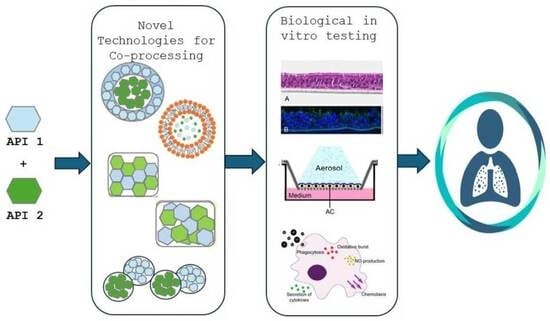
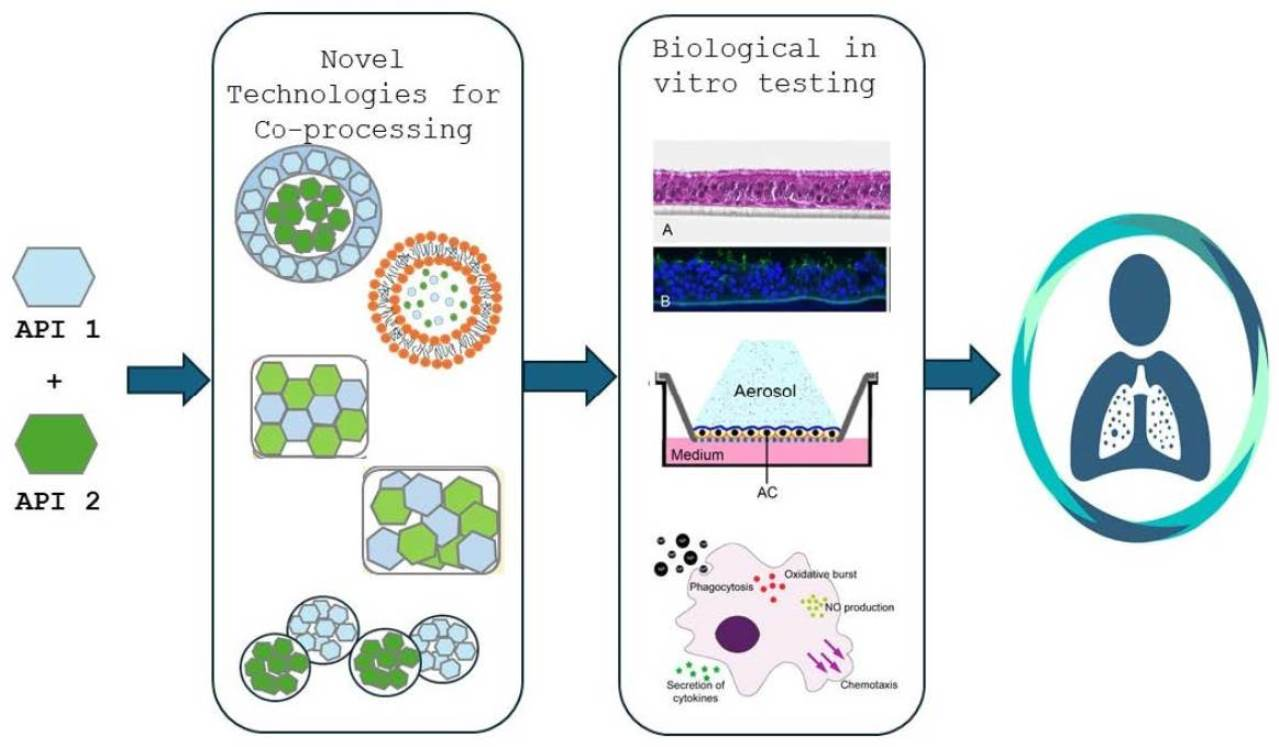
Graphical Abstract

1. Introduction

Most pulmonary formulations are delivered by one of the three inhalers: pressurized metered dose inhaler (pMDI), DPI, and nebulizers. Only a few drugs, for instance, formoterol and budesonide, are available as DPI, pMDI, and nebulizer formulations. Despite the inhaler specificity, all formulations share the requirements of a size between 1 and 5 µm to enable deposition in the human lung. Heyder et al. experimentally determined the deposition of differently sized particles [1]. They found that large particles (>5–10 µm) deposit in the nose and upper airways by impaction, very small particles (<0.5–1 µm) tend to remain suspended and many are exhaled (or deposit by diffusion if extremely small), and particles in the intermediate range (about 1–5 µm) have the highest probability of depositing in the bronchioles and alveoli. Similar data were also mentioned in the International Commission on Radiological Protection (ICRP) reports, which focus on pulmonary toxicity, and in the Pharmacopoeias and regulatory guidance [2]. The 1–5 µm size range results in high deposition in the small bronchi and bronchioles, where obstructive lung diseases are located [3]. The bronchial tree consists of an air-conducting and a respiratory part and can be described as a system of branching tubes (Figure 1).
Inhalation treatment poses challenges for patients because, in contrast to taking a pill, the procedure to inhale an aerosol is more difficult. While the use of nebulizers requires only normal breathing from the patient, the use of hand-held devices requires hand–breath coordination and breath holding. It is therefore not surprising that patient compliance for inhaled medication is lower than for oral treatment of asthma [6]. It is also understandable that compliance is lower when patients need four doses/day (monitored compliance: 71%) compared to two doses/day (monitored compliance: 18%). A meta-analysis comparing adherence of patients’ cohorts that inhaled their medication either through multiple or a single inhaler did not report consistent results [7]. There were no significant differences between a single inhaler and multiple inhalers, but single-inhaler use was associated with decreased healthcare resource utilization and improved cost-effectiveness compared with multiple inhalers. Patient adherence in routine clinical practice is expected to be lower because patients in clinical trials are usually more motivated, monitoring is better, free medication and structured support are provided, and follow-up is more intense [8]. A SWOT (strengths, weaknesses, opportunities, and threats) analysis by Banat et al. highlighted co-delivery as an opportunity for better control of lung diseases in general and drug resistance in particular, and a way to improve patient noncompliance [9,10,11]. They mentioned development costs, availability of appropriate pre-clinical models, and test availability for pulmonary delivery as major obstacles/threats.
Various methods for combined delivery of active pharmaceutical ingredients (APIs) to the lung have been reported. Important formulation strategies for co-delivery include co-formulation as co-suspension (pMDI or nebulizer) [12] or blended powders, engineered DPI particles (co-spray drying and spray–freeze drying for a combination of dry powders) [13,14,15], nebulization of mixed aqueous formulations or suspensions [16], co-encapsulation in lipid-based carriers (liposomes, lipid nanoparticles) [17,18], and core–shell particle architectures [19].
Combining two or more APIs for pulmonary delivery is aimed at achieving either additive, antagonistic, or synergistic effects, with the primary goal of improving clinical outcomes. Numerous studies have assessed the therapeutic effects of inhaled drug combinations compared with monotherapies [9,10,20,21,22]. Combination drug products for inhalation therapy have historically been most extensively developed and marketed for asthma and chronic obstructive pulmonary disease (COPD), where they nowadays represent a cornerstone of treatment. However, recently, new therapeutic areas are emerging, with increasing research activity and a growing pipeline of novel inhalation combination products entering the market. These new therapeutic areas include, for example, cystic fibrosis, lung cancer, and tuberculosis, where the administration of different antibiotics is required.
This chapter first gives a short overview of conventional marketed fixed-dose combinations, followed by new potential non-marketed drug combinations under research. The focus is not on the therapeutic area—this topic is covered in another review [11]—but on the technologies used to generate novel combination products. The focus here is on the different co-processing techniques used to formulate API combinations for DPI formulations, which are a research focus but are not yet marketed.

2. Marketed Fixed-Dose Combinations

For the standard therapy of COPD and asthma, the following main drug classes are available: (1) Inhalable glucocorticoids (IGC), (2) long-acting muscarinic receptor antagonists (LAMAs), (3) short-acting muscarinic receptor antagonists (SAMAs), (4) long-acting beta-adrenoceptor agonists (LABAs), (5) short-acting beta adrenoreceptor agonists (SABAs), and (6) alternative agents such as chromoglicic acid or theophylline are available. These drugs are administered via inhalation, and in most cases, the therapy involves a combination of at least two drugs [9]. Available fixed-dose combinations (FDCs) for the treatment of these diseases primarily combine bronchodilators (LABA, LAMA) and corticosteroids (ICSs) into single devices to improve adherence and efficacy [22]. Such combined inhalation products include, for example, Seretide® Diskus DPI, GSK plc, London, UK as a fixed-dose combination and formoterol/budesonide (Symbicort® Turbohaler DPI, AstraZeneca, Cambridge, UK) for flexible and adjustable maintenance dosing in a single-dose DPI. For the latter, patient compliance increased, and the treatment was as effective as therapy with two different single-API inhalers and superior to monotherapy with only one API [9]. In addition to long-term therapy, quick-relief medication to be used on an as-needed basis in acute phases is also needed. For this purpose, SAMAs and SABAs are combined to treat acute bronchoconstriction and exacerbations. Combinations of the latter, like ipratropium/salbutamol and ipratropium/fenoterol (Berodual® pMDI, Berodual® Respimat® soft mist inhaler (SMI), Böhringer Ingelheim, Ingelheim, Germany), have been shown to provide a greater bronchodilator response compared to the single APIs [9].
In addition to dual combinations, triple combinations have now also reached the market for the maintenance therapy of COPD and asthma. The rationale for ICS/LABA/LAMA fixed-dose combinations is sound, as the three agents act through distinct mechanisms and targets, which may permit the use of lower doses of each component while improving overall tolerability and side-effect profiles [23]. DPI products include Trelegy Elliptra (fluticasone furoate, umeclidinium, vilanterol) GSK plc, London, UK and Trimbow®/Nexthaler (beclomethasone, glycopyrronium, formoterol) Chiesi Farmaceutici S.p.A., and the pMDI product Trixeo Aerosphere® (formoterol, glycopyrronium, and budesonide) AstraZeneca, Cambridge, UK.
These combination products simplify treatment regimens by reducing the need for multiple inhalers. Products on the market range from DPIs to pMDIs, nebulizers, and the more rarely used SMIs. A detailed list of all marketed fixed-dose combination products in Europe, the UK, and the US as of 2023 can be found in [11].
New formulation concepts for FDCs are rarely reported for nebulizers, pMDIs, and SMIs, as liquid-based systems are generally less formulation-intensive than dry powder platforms. The main breakthrough enabling marketed fixed-dose combinations has been co-suspension delivery technology, which utilizes porous, low-density phospholipid particles to suspend micronized drug crystals within a hydrofluoroalkane (HFA) propellant. This approach stabilizes the suspension, minimizes crystal aggregation, and ensures consistent dosing of two or even three APIs, despite differences in their physicochemical properties [12]. Nanoparticle-based approaches dispersed in propellant have also been explored for co-delivery [24]. As these liquid formulations are comparatively straightforward and already represented in marketed products, current formulation challenges and research efforts are primarily directed toward combination development for DPIs, as discussed in the following section.

3. Innovative Co-Formulation Approaches for Non-Marketed DPIs

3.1. Co-Amorphous Systems (COAMSs)

One recently described approach for the co-delivery of two APIs to the lungs is co-processing two or more APIs to form either a co-amorphous system (COAMS) or a co-crystalline system, which acts as one single entity, although composed of two APIs. Advantages are associated with a reduction in unit operations like blending and improved patient compliance. Further, improved properties like improved aerodynamic performance, solubility, dissolution rate, and/or bioavailability and stability are associated with COAMS and co-crystals. To achieve this goal, the selection of a functional excipient or another API as a co-former (either for COAMS or co-crystals) is crucial [24]. Co-formers can be, on the one hand excipient or small molecules like amino acids or organic acids, and on the other hand, another API. In API-API co-processed systems, the second API acts as a co-former and, besides the advantage of improved particle properties, also enables dual API administration. Here, the APIs can complement each other and add benefits from a therapeutic perspective in addition to improving particle properties. API-API co-processed systems offer advantages like reduced drug dose variability (compared to simple API-API blends), improved patient compliance, and manufacturing efficiency via simplifying manufacturing processes by reducing the number of unit operations (e.g., blending).
Pharmaceutical COAMSs describe single-phase amorphous systems where an API is stabilized through a co-former [25]. Co-formers can be (a) organic acid, (b) amino acid, (c) other small molecules like, e.g., alkaloids, glycosides, sugars, or (d) another API, as is the focus of the present review, to allow for the co-delivery of two APIs [26]. A detailed review of co-former cases and types can be found here [27]. The goal of API-API COAMS is improving therapeutic outcomes in addition to advantages that are associated with COAMS in general, like improved solubility, bioavailability, and/or stability, or in the context of pulmonary drug delivery improving the aerosolization performance (amount of drug reaching the lungs), improving solubility and the dissolution profile. Spray drying seems to be the preparation method of choice for inhalable co-amorphous particles. This process combines the advantage of tailoring the particle size via process parameter selection and being a process well described for co-amorphization via the thermodynamic method [28].
For example, spray-dried COAMS comprising levofloxacin and 4-aminosalicylic acid for pulmonary applications significantly improved the fine particle fraction (FPF) compared to single drugs and a physical mixture [29]. Similarly, spray-dried levofloxacin-theophylline COAMS (1:1) and budesonide-theophylline (1:1) showed better in vitro aerodynamic performance than a physical mixture of these compounds and permitted simultaneous delivery of both drugs [30]. A co-amorphous system of ciprofloxacin and quercetin shows how two drugs can ideally complement each other and that the co-former can also enhance the therapeutic effect; quercetin protects the infected epithelial cell in addition to suppressing the Pseudomonas aeruginosa factor and reinforcing the effect of the antibiotic ciprofloxacin [31]
Recently, rifampicin API-API COAMSs have also been introduced for tuberculosis (TB) treatment, where the traditional treatment regimen relies on the parallel application of multiple drugs over a long period (oral or parenteral). Here, the administration of inhalable API-API COAMS could significantly improve patient compliance, reduce side effects, and prevent antibiotic resistance. Rifampicin-ethambutol (1:1) as well as rifampicin-moxifloxacin HCl (1:1.25) have been prepared via co-milling and spray drying, and the COAMS showed more consistent drug delivery with fewer variations and improved aerodynamic performance and dissolution [28,32].

3.2. Co-Crystals

Co-crystals, per the FDA definition, are solid crystalline materials composed of two or more molecules in the same crystal lattice [33]. Similar to COAMS, the advantages of co-crystals are also increased stability, solubility, and/or bioavailability. For poorly soluble drugs where high drug loads are required in the lungs, this is especially interesting as the amount of foreign material (co-former) can be very low, and particle properties (solubility and dissolution rate) are improved by the co-crystal structure compared to the standard API [34]. Consequently, co-crystals have also been explored for inhalation therapy to improve the delivery of high doses to the lung and improve particle properties [35].
For example, a remdesivir (RDV) (an antiviral drug with broad-spectrum activities against RNA viruses)-salicylic acid (SA) (1:1) co-crystal was identified via liquid-assisted grinding. Furthermore, the RDV-SA co-crystal showed an FPF of 41%, and compared with raw RDV, the co-crystal showed a 15.4-fold higher release fraction in simulated lung fluid after 120 min. Further, RDV-SA co-crystal was safe in A549 cells without any in vitro cytotoxicity observed (RDV concentrations from 0.05 to 10 μM), demonstrating potential for COVID-19 therapy [36]. Itraconazole-succinic acid (1:1) co-crystals, generated via gas antisolvent and liquid antisolvent co-crystallization [37], are proposed for pulmonary treatment of lung infections, in particular, fungi such as aspergillosis. Initial trials showed higher fine particle fractions of the co-crystal and better wettability compared to itraconazole alone [34].
Additionally, theophylline (THEO), a caffeine-derived alkaloid commonly present in tea and coffee, which is widely used as a bronchodilator, particularly in asthma therapy, has drawn significant scientific interest for its possible anti-inflammatory, anticancer, and neurological effects. Developing co-crystals with THEO has emerged as a promising strategy to improve its physicochemical behavior and mitigate toxicity. THEO is also a candidate with good co-forming potential and is reported in several co-crystals. A recent comprehensive review summarizes known theophylline co-crystals, although in this review, the focus is not on inhalation application, and biopharmaceutical and pharmacological assessments of the described co-crystals are mostly missing [38]. An example for inhalable co-crystals with THEO is the drug–drug co-crystal of favipiravir and THEO [39]. The spray-dried 1:1 powder for concomitant influenza infections and chronic obstructive treatment showed an FPF of 79.3% and no in vitro cytotoxicity in A549 cells. Recently, THEO-glycopyrronium bromide (GB) (1:1) co-crystals have also been reported via sonocrystallization and freeze drying, with the freeze-dried co-crystal showing 65% FPF after nebulization. Combining THEO and GB provides a complementary therapeutic strategy for COPD by targeting multiple pathways in airway obstruction. Although THEO is limited by poor solubility and a narrow therapeutic index, advanced formulations such as co-crystals with GB improve its solubility and pulmonary delivery while maintaining the benefits of both drugs [40].
A review on co-crystals for tuberculosis treatment gives good insight and overview on co-crystals with TB drugs; however, here, the focus is not only on formulations for pulmonary application; oral treatment is also considered [41]. The main findings are that no co-crystals are reported with ethambutol, rifampicin, and streptomycin so far, but several co-crystals with isoniazid (INH) and pyrazinamide, and functional excipients or other drugs (not typical first- or second-line TB drugs). Additionally, a recently spray-dried INH-4-aminosalicylic acid (PAS) co-crystal formulation for pulmonary TB treatment showed improved FPFs of INH when co-crystallized with PAS [42].

3.3. Core–Shell Particles

Core–shell microparticle architectures generated via spray drying, where one API is in the core and one in the shell, represent a promising strategy for the sequential co-delivery of multiple APIs via inhalation. Using a three-fluid nozzle (3FN), a highly engineered clofazimine (CFZ) shell and INH core combination, excipient-free DPI formulation was developed [43]. The core shell particles were rapidly internalized by macrophages within 4 h, and in vivo imaging confirmed sustained pulmonary retention of INH for up to 4 h, demonstrating that CFZ-mediated encapsulation improves INH lung retention and therapeutic efficacy against tuberculosis.
Polymer–polymer core–shell microparticles, where the core containing one API is obtained by an emulsion technology, followed by resuspension in another polymer containing the second API to form the shell layer by spray drying for the sequential delivery of multiple APIs by inhalation delivery, have been reported as well. As an example, biodegradable systems comprising a silk fibroin shell and a poly(L-lactic acid) core have been designed to deliver ciprofloxacin and ibuprofen as model antibiotic and anti-inflammatory agents, respectively [44]. These microparticles exhibited aerodynamic diameters suitable for inhalation therapy (≤4.94 ± 0.21 μm), no cytotoxic effects on A549 cells, and differences in the release profile of CM from the core–shell particles compared to the release profile of the single drug alone [19]. Similarly, polycaprolactone loaded with curcumin (CM) core and polyvinyl alcohol containing ciprofloxacin shell particles were generated, showing an average size suitable for inhalation (3.8 ± 1.2 μm), no cytotoxic effects on A549 cells, and differences in the release profile of CM from the core shell particles, when compared to the release profile of the single drug alone [19]. Further, compartmentalization of the APIs within the core–shell structure minimized potential drug–drug interactions and may enable modulation of individual release profiles from a single inhaled administration. Additionally, dual delivery of a radiosensitizer in a polylactide-co-glycolide (PLGA) core with a N-isopropylacrylamide–carboxymethyl chitosan (PNIPAAm-CMC) shell containing gemcitabine (a chemotherapeutic) in the form of multifunctional dual drug-loaded nanoparticles (MDNPs) was developed for lung cancer therapy. The MDNPs exhibited biphasic NU7441 release and pH-dependent gemcitabine release, while showing strong stability, excellent hemo- and cytocompatibility with alveolar type I cells, and dose-dependent caveolae-mediated uptake by lung cancer cells [45].

3.4. Other Co-Spray-Dried Dual API Particles

Co-spray drying has been identified as a promising strategy for the development of composite inhaled fixed-dose antibiotic combinations, although formulation challenges remain that are linked to the high dosage requirements and the physicochemical properties of anti-infectives compared to established combination therapies for asthma and COPD [46]. Relative to conventional spray drying, co-spray drying generally produces particles with superior aerosolization properties and greater physicochemical stability. Nevertheless, despite decades of use, this technology remains underrepresented, and a recent review by Chen et al. found only two examples of API-API co-spray-dried systems for inhalation [13]; the combination of the antibiotics, colistin and tobramycin, to achieve synergistic antibacterial effects and mitigate toxicity, and the combination of two anti-TB drugs, isoniazid and clofazimine, two APIs with contrasting molecular properties, to extend release and prolong pulmonary retention of the short-half-life INH (as described above for core–shell particles).
Co-spray-dried combinations of colistin and tobramycin exhibit superior aerosolization performance compared to tobramycin alone (FPF ~85% versus tobramycin alone ~45%). Surface enrichment of colistin creates hydrophobic particles that enhance dispersibility and stability during storage under mild humidity conditions [47].
Furthermore, special co-spray-dried particles using two independent nozzles to spray separate solutions of API simultaneously into a single drying chamber—resulting in a uniform mixture of two distinct particle types within one operation, called Simul-Spray—were introduced by Shepard et al. [45]. With that technique, inhalable particles of the biologic (bevacizumab) and small molecules (erlotinib, paclitaxel, cisplatin) were generated for potential local treatment of lung cancer. The resulting formulations preserved the biologic activity of the antibody, achieved target drug concentration, and had aerosol properties suitable for pulmonary delivery. Compared to fixed-dose combinations, APIs that cannot withstand a milling-based particle engineering process can also be processed, and this method allows for the combination of distinct API groups. Another study used a 3FN to successfully produce API combinations (THEO and salbutamol sulfate) with adjustable ratios, overcoming solubility limitations of theophylline by varying feed rates of the two nozzles. However, the aerosolization performance of the powder was inferior to that of its two-fluid nozzle counterparts, indicating challenges in achieving homogeneous API distribution with the 3FN [48].

3.5. Nanoparticle Systems for Combination Delivery of APIs

Inhalable nano-formulations have gained considerable research interest due to their potential to overcome physiological barriers, enhance aerosol lung deposition, and improve drug bioavailability compared with conventional systems. However, despite these advantages and their promise in addressing challenges in lung disease treatment, clinical translation remains limited by device–formulation compatibility and manufacturing constraints. Nevertheless, diverse nano-based co-delivery approaches have been reported, highlighting continued progress in this field [49].
For example, hybrid lipid–polysaccharide nanoparticles co-loaded with rifampicin (RIF) and INH using a solvent injection method have been developed to address limitations in conventional tuberculosis therapy, including poor oral bioavailability and dose-related toxicity. The resulting mannose-decorated nanosystems exhibited favorable physicochemical properties, pH-responsive sustained drug release, and enhanced macrophage uptake in RAW 264.7 cells, leading to significantly higher intracellular drug accumulation compared to non-mannosylated carriers, highlighting their potential for targeted anti-TB drug delivery [50]. Additionally, a one-step fabrication of inhalable nanoaggregates via interfacial polycondensation was developed, employing a biodegradable L-lysine-based polyamide to encapsulate fluticasone propionate (FP) and salmeterol xinafoate (SAL) for dry powder inhaler applications. The resulting nanocapsules exhibited favorable particle properties, including a mean particle size of 226.7 ± 35.3 nm and a negative zeta potential, high emitted doses (ED: 88.5% for FP; 98.5% for SAL) and a superior FPF compared to Seretide Diskus, along with efficient dual-drug encapsulation and sustained in vitro release, highlighting their potential as an advanced platform for pulmonary fixed-dose combination delivery [51]. Furthermore, liposomal encapsulation was used to enhance the antimicrobial and antibiofilm efficacy of levofloxacin in combination with serratiopeptidase, resulting in a synergistic effect. This approach achieved high entrapment efficiency (>80%) and, after co-spray drying, produced inhalable particles with a mass median aerodynamic diameter (MMAD) below 5 μm. In vivo evaluation in Staphylococcus aureus-infected rats demonstrated sustained lung concentrations (3.39 μg/mL over 3 h), a favorable area under the curve (AUC)/minimal inhibition concentration (MIC) (≥100), and significant reductions in biofilm burden and inflammatory markers, confirming enhanced therapeutic efficacy of the liposomal levofloxacin-serratiopeptidase system [52]. Moreover, a hierarchical lipid-based delivery platform was utilized for resistant lung cancer therapy, in which afatinib is first incorporated into stearic acid-based solid lipid nanoparticles and subsequently co-encapsulated with paclitaxel into PLGA porous microspheres for pulmonary administration. Designed to overcome acquired resistance to EGFR tyrosine kinase inhibitors in non-small-cell lung cancer, this inhalable system demonstrated synergistic cytotoxicity in resistant non-small-cell lung cancer (NSCLC) cells and, in Sprague–Dawley rat models, maintained elevated lung drug concentrations for up to 96 h with limited systemic distribution and acceptable safety, highlighting its promise for localized combination therapy in drug-resistant lung cancer [53]. Finally, an inhalable nanomedicine strategy was developed based on a lactoferrin–chondroitin sulfate nanocomplex for the co-delivery of doxorubicin and ellagic acid nanocrystals to lung cancer cells. The 192.3 nm nanocomplex, subsequently transformed into spray-dried inhalable nanocomposites, enabled sequential drug release (rapid ellagic acid followed by doxorubicin), receptor-mediated internalization via transferrin and CD44 pathways in A549 cells, and achieved deep lung deposition (FPF 89.58%) with marked antitumor efficacy in tumor-bearing mice, underscoring its potential for localized and targeted lung cancer therapy [54].
A big challenge for nanoparticle-based products is device compatibility of inhalable nanoparticle formulations, as successful translation requires tight alignment between formulation properties and inhaler performance. Nanoparticles are typically exhaled unless engineered into larger aerosolizable structures, such as nano-in-microparticles, with an aerodynamic diameter in the 1–5 µm range. Achieving this balance while preserving nanoparticle integrity is non-trivial, particularly because inhalation devices—including dry powder inhalers, nebulizers, and pressurized metered-dose inhalers—impose mechanical stresses (e.g., shear forces, vibration, propellant effects) that may destabilize nanocarriers or alter drug release profiles [55]. In addition, formulation–device mismatches can compromise performance: dry powder systems require adequate flowability and deagglomeration, liquid systems must resist sedimentation and aggregation, and propellant-based systems demand physicochemical compatibility. These issues directly impact dose uniformity and reproducibility, as nanoparticles are prone to aggregation, surface adsorption, and instability during storage and actuation. Furthermore, lung deposition efficiency is highly sensitive to particle size distribution, device airflow characteristics, and patient-dependent inhalation patterns, making consistent deep lung delivery difficult to achieve. Further, material interactions between nanoparticles and device components (e.g., plastics, elastomers, metals) may lead to drug loss or degradation, while long-term stability within the device remains a concern due to moisture exposure, particle growth, or repeated use. Consequently, the gap between laboratory-scale successes and approved products remains significant [56]. A recent review from Mahmoud et al. summarized nanoparticle–device studies for inhalation formulations and, in addition, discussed scale-up and regulatory hurdles of inhalable nanoparticles in more detail [57].

3.6. Comparison of Co-Processing Platforms and Regulatory Considerations

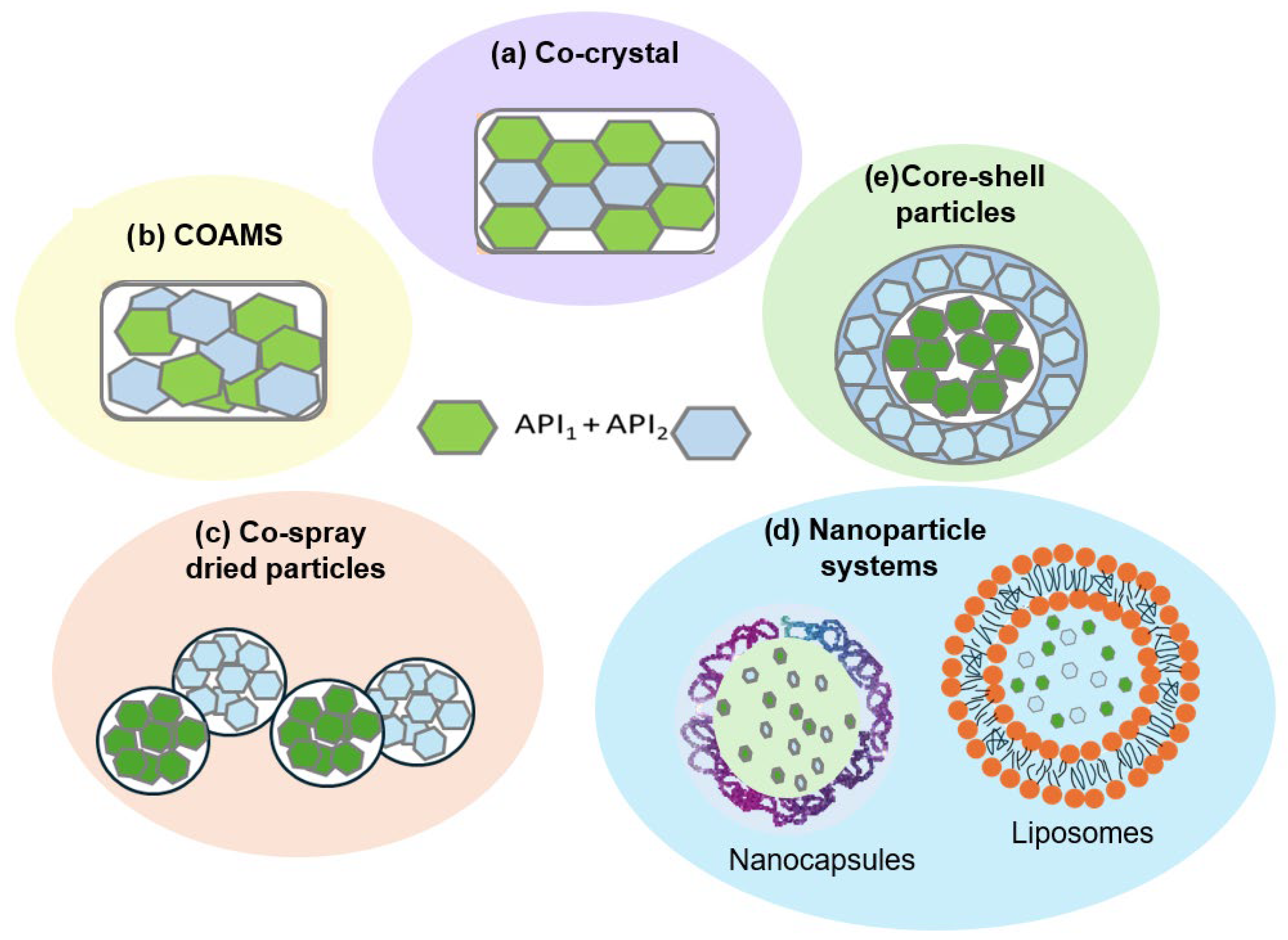
Each of the described technologies or platforms for the dual delivery of drugs to the lungs (Figure 2) offers unique advantages and faces specific challenges that are summarized in Table 1. COAMS and co-crystals both enable the combination of two APIs into a single particle entity, improving aerodynamic properties, solubility, and potentially patient compliance, while reducing manufacturing complexity. However, their success is highly dependent on the selection of compatible co-formers, and especially for drug–drug COAMS or co-crystals, the stoichiometric ratio in which a co-processed system is formed is unlikely to correspond to the therapeutically relevant dose of the drugs required in the lungs [32]. Core–shell particles allow for spatial separation and sequential or controlled release of APIs, minimizing drug–drug interactions and enabling tailored pharmacokinetics, but their production can be technically complex, and matrix systems for core and shell must be carefully selected and compatible with the drugs used. Co-spray-drying approaches are relatively straightforward and can yield particles with excellent aerosolization and stability, yet achieving homogeneous distribution of the APIs and compatibility between APIs can be challenging, especially with more complex nozzle systems. Nanoparticle-based systems offer the greatest potential for targeted delivery, enhanced cellular uptake, and overcoming physiological barriers, but their translation to clinical use is limited by manufacturing scalability, device compatibility, and regulatory hurdles. Moreover, to be delivered to the lungs, nanoparticles must still be formulated into microparticles, as only particles with an aerodynamic size of 1–5 µm are able to reach the deep lungs, which further increases formulation complexity.
From a regulatory perspective, co-processed particle systems for DPIs pose additional challenges compared to conventional inhalable particles due to their structural complexity and sensitivity to processing and storage conditions. The U.S. Food and Drug Administration (FDA) does not provide dedicated bioequivalence and stability guidance specifically for inhalable co-processed or nanoparticle formulations; instead, requirements follow the broader framework for orally inhaled and nasal drug products (OINDPs) and, e.g., nanotechnology-enabled medicines. Regulatory authorities such as the FDA require robust demonstration of physicochemical stability, including maintenance of the amorphous state in co-amorphous systems, preservation of crystal form in co-crystals, integrity of core–shell architectures, and stability of nanoparticle size and surface characteristics, alongside reproducible aerodynamic particle size distributions and scalable manufacturing performance throughout shelf life in line with the International Council for Harmonization (ICH) stability expectations [58]. In addition, aerosol performance parameters such as emitted dose (ED) and FPF must remain consistent over time, as these are considered critical quality attributes for inhaled products. Bioequivalence follows a weight-of-evidence approach combining in vitro aerosol performance testing, pharmacokinetic evaluation where appropriate, and sometimes pharmacodynamic or clinical endpoint studies, which becomes more demanding for complex co-processed systems because small structural or compositional variations can affect lung deposition, dissolution, and redispersion behavior [59,60]. In addition, the number of excipients approved for pulmonary delivery is limited [61], and co-processed systems frequently require stabilizers (e.g., in nanoparticle systems), dispersibility enhancers, surface modifiers, or core–shell matrix materials. Given the limited number of excipients approved for pulmonary delivery, additional toxicological evaluation and regulatory justification may be required. Altogether, these requirements substantially increase development complexity, timelines, and cost compared with conventional DPI formulations and likely contribute to the persistent translational gap between promising lab-scale systems and approved products.
This challenge is particularly pronounced for nanoparticle-based inhalation formulations, for which currently no globally harmonized regulatory pathway exists. FDA and European Medicines Agency (EMA) guidelines look at nanotechnology-related guidance and inhalation-product guidance individually [62]. One of the main concerns is the safety of nanoparticles, and data needed for approval are additional toxicity evaluation, justification of pulmonary safety, and long-term exposure assessment, as nanoparticles compared with conventional microparticles are likely to penetrate into the deeper lung region, cross biological barriers, accumulate in organs, and/or induce oxidative stress or inflammation [63].
As already mentioned above, another important aspect is the complexity of manufacturing certain co-processing techniques and the associated costs. While all described technologies are scientifically advanced and suitable for dual-drug inhalation, their manufacturing complexity and cost must be carefully weighed when considering commercial viability. Ultimately, the choice of technology should balance scientific innovation with practical considerations of manufacturability and market potential.

4. Toxicity Testing

In parallel to the development of improved formulations, cellular testing and aerosol exposure systems have been improved. It is expected that the use of animals for toxicity testing in academia and industry will further decrease because alternative systems will be approved by regulatory authorities. Major reasons for this are the obvious limitations of animal experiments due to the anatomical and physiological differences between humans and rodents, which are the most often studied species. These problems range from difficulties in the administration of the aerosol to differences in the deposition profiles [64]. For example, whole-body aerosol exposure in rodents results in deposition on the fur and mainly in the nasal cavity. Tracheal instillation is an invasive procedure that primarily deposits material at the tracheal bifurcation [1]. Furthermore, improved in vitro testing is needed because regulations aim to phase out animal experiments in scientific research.
Even if the toxicity of individual APIs is known, testing of combinations is necessary because combinations of APIs may differ in their biological behavior from single compounds. When APIs are inhaled separately, they will have distinct distribution pattern but interaction at the cellular level may take place when two or more APIs are contained in the same particle. Potential interactions may concern transport, dissolution, and metabolization of the different APIs. Most inhaled medications should reach either the small airways as the most relevant region for obstructive lung diseases or the alveoli to display systemic action (Figure 1). These regions differ markedly regarding their morphology and physiology. Whereas the proximal parts of the lung are characterized by the prevalence of bronchial epithelial cells covered with motile cilia and mucus-producing goblet cells, the most distal parts are populated mainly by flat alveolar epithelial cells and alveolar macrophages. The composition is described in more detail in textbooks, e.g., [65].
Representative biological models should reflect the morphology of these regions because both will be exposed to particles of the pulmonary formulation. Furthermore, exposure should resemble the actual route of administration, e.g., as aerosol. To comply with these requirements, researchers have optimized exposure systems and cellular models.

4.1. Exposure Systems with Pulmonary Formulation

The challenge for physiologically relevant biological testing in vitro is the coupling of the cellular model with adequate aerosol exposure. The cellular model should be an air–liquid interface (ALI) culture because it provides the cells with an apolar environment, which represents a stimulus for increased differentiation. Further, respiratory cells, in contrast to most other cells in the human body, are adapted to exposure to an O2-rich atmosphere [62]. Madlova et al. suggested that P-gp activity may depend on the differentiation status of the cultures, emphasizing the importance of using fully differentiated primary cell-based ALI cultures for drug transport research [66].
For exposure to pharmaceutical aerosols, pMDI, DPI, or nebulizer can be coupled via a custom or commercial adapter to an exposure module or chamber that holds the cell inserts by mouthpiece adaptors, Luer fittings, tubing, and manifold. Either the aerosol is drawn into a dilution system (to reach the target concentration, remove solvent vapor, and control humidity/temperature) and then delivered to the exposure chamber, or syringe pumps, critical-flow orifices, or mixing flows are used to achieve target aerosol concentrations. Other systems (e.g., jet or vibrating mesh nebulizers) generate an aerosol and feed it through tubing in the cell chamber. Patented systems include Vitrocell Cloud and Cultex RFS, which use electrostatic/cloud deposition modules to deposit the aerosol by gravitational settling/impaction. These aerosol generation devices are connected to an exposure chamber containing the membrane-grown cells. Among research-focused systems are the commercially available PreciseInhale/XposeALI, where the aerosol generation device (PreciseInhale) can be coupled to an ALI culture chamber [67]. Additional systems are specialized for cigarette smoke or nanoparticle exposure (e.g., Borgwaldt RM20S, Vitrocell VC10, MALIES, NACIVT) [68]. Cytotoxicity testing of chemicals and nanoparticles using these instruments has been summarized by Nossa et al. [69]. The exposed cells are generally cell lines, such as A549, BEAS-2B, and 16HBE14o cells, but reconstructed tissues, such as MucilAir, have also been used.
Aerosol exposure systems face challenges with repeatability, reproducibility, and homogeneity of aerosol delivery. Deposition variability in the Vitrocell 24/48 in vitro exposure system was 15% for the 2.2 µm and 3.3 µm particles [70]. To avoid this, particles could also be applied as a suspension in a small amount of liquid, because, according to mRNA expression, cells maintained >80% of genes expressed in the ALI condition when ≤221 µL fluid/cm2 membrane area was applied for 6 h [71]. For infection studies, short exposure to small volumes of virus particles was used in an ALI lung-on-chip model [72]. As a suspension medium, simulated lung fluid is appropriate because this is the medium that particles are immersed in after deposition. The medium proved to be suitable to assess nanoparticle toxicity over prolonged periods [73].
For regulatory toxicology, standardized ALI-based systems remain the most practical and validated approach.

4.2. Cellular Models

Acellular models may be sufficient to assess mucus permeation, but cellular models are needed to identify toxic effects in the respiratory tract. Conventional basal cytotoxicity testing using cells cultured on plastic surfaces and exposure by suspension in cell culture media is not specific for the respiratory tract and will not be discussed. Similarly, inflammation and reactive oxygen generation are parameters that can be assessed in a variety of mono- and co-culture systems. However, for respiratory cells, submersed culture is not appropriate.
An alternative to the culture of cells on porous membranes is the use of cell-grown decellularized lung scaffolds. Theoretically, complex constructs could be generated by seeding multiple cell types. However, the generation method is complicated, and the successful growth of only one cell type is challenging. Therefore, cell-grown decellularized lung scaffolds are rarely used for toxicity testing. In one study, three lung adenocarcinoma cell lines were grown on the scaffolds and exposed to cisplatin and erlotinib [74], which demonstrates that cytotoxicity testing using these models in principle is possible.
The most commonly used cells for cytotoxicity testing are A549, BEAS-2B, and 16HBE14o cells. Calu-3 cells are the established cells for the assessment of permeation. Primary respiratory cells obtained from bronchial biopsies are occasionally used for testing of inhaled toxicants [75]. The possibilities to isolate and culture human alveolar epithelial cells are more limited. Therefore, they are not suitable for cytotoxicity testing. Cell lines have a limited differentiation, whereas induced pluripotent stem cells (iPSCs) have great potential for therapy by genetic manipulation and as models for fundamental biology studies and disease modeling [76]. Further, iPSC-derived alveolar type 2 cells were successfully used for the toxicological assessment of benzo(a)pyrene, nano-carbon black, and nano-silica oxide (SiO2) [77]. However, their use in the testing of pulmonary formulations is limited.
Lung spheroids and organoids are promising 3D models for chemical safety assessments because the three-dimensional structure resembles the situation in tissue more but their culture in ALI is difficult. Liu et al. generated A549 spheroids in the “hanging drop” technique and were able to assess their reaction to volatile substances [78]. However, the exposure of 3D structures in ALI to particle-containing aerosols, which will sediment, will result in asymmetric distribution. Spheroids consisting of either H538 or A549 cells were generated by seeding the cells on collagen layers and were exposed to paclitaxel powder [79]. Unfortunately, the methodology of the powder exposure is not described and particle distribution is unknown. Alveolar organoids derived from iPSCs have been generated, but culture and toxicity testing were performed under submersed conditions [80].

4.2.1. Complex In Vitro Models

Co-culture models better mimic the physiological situation because lung tissue consists of more cell types than epithelial cells. ALI cultures often use monocultures, but the co-culture of A549 cells and THP-1 cells has also been used [74]. Since cells have different requirements in culture, the lifetime of the construct in the desired combination is limited to 14 days. One group developed a co-culture model consisting of A549 cells, monocyte-derived macrophages, and monocyte-derived dendritic cells, all of which were derived from human blood [81]. Another group used primary alveolar type II (AT-II) cells in combination with human macrophages and dendritic cells [82]. Additionally, two systems consisting of four cell types were developed: one containing A549 cells, THP-1 macrophages, HMC-1 mast cells, and EAhy926 cells; and the other consisting of A549 cells, monocyte-derived macrophages, monocyte-derived dendritic cells, and CD4+ T cells [83,84]. However, these systems have not been used for the assessment of aerosolized drugs.

4.2.2. Commercially Available Reconstructed Tissues

Reconstructed tissues are considered reproducible relevant models because they contain several primary cell types. The best-known tissues are the commercially available products that consist of bronchial epithelial cells, goblet cells, and basal cells and include EpiAirway [85], AIR-100 [86], MucilAir, and SmallAir [87]. The quality of EpiAirway and MucilAir to predict rat lethal dose 50% (LD50) values was determined as 87.5–100% sensitivity and 56–89% specificity [88]. Extrapolation to in vivo data was complicated by an insufficient number of animals that died at the highest concentration. In addition, in vivo test classifications differed depending on the application of vapor, dust, or mist, which further hindered predictions. Reconstructed tissues are commonly used to study the effects of exposure to toxic gases, such as cigarette smoke, in both acute and repeated exposure studies [89]. The effect of Bepanthen on pollen-induced allergies was also evaluated. In this model, false ragweed pollen was applied to MucilAir tissues using a Vitrocell Powder Chamber [90]. To our knowledge, the Vitrocell Cloud system is the only example of an aerosol administration system that has been used on these reconstructed tissues. This system has been used to administer the Signal Transducer and Activator of Transcription 3 (STAT3) inhibitor anatabine, the 20S proteasome inhibitor bortezomib, and the Inhibitor of kappa B (IκB) kinase inhibitor IKK-16 on MucilAir tissues [91]. The more recently developed EpiAlveolar and AlveolAir contain AT-I and AT-II-like cells, fibroblasts, and microvascular endothelial cells, and represent the alveolar part of the lung [92,93]. Whereas EpiAlveolar has been used in a Vitrocell Cloud system for toxicity assessment of carbon nanotubes [94], AlveolAir was exposed to trastuzumab deruxtecan in submersed culture [95].

4.2.3. Lung-on-Chip (LOC)

Lung-on-chip models have been designed to mimic alveolar and bronchial morphology. They recreate the alveolar or airway architecture better by co-culture of epithelial and endothelial cells and allow airflow and perfusion. Culture in ALI is possible in a self-constructed device based on Calu-3 cells and human airway cells + airway fibroblast co-culture [96]. In some LOC, the situation of the alveoli, e.g., growth on a curved surface or cyclic stretching, is realized [97]. ALI culture conditions were also provided in a LOC composed of epithelial cells, hydrogel, and smooth muscle cells [98]. The commercially available breathing LOC AlveoliX Lung-on-Chip consists of a primary-derived alveolar epithelial cell line, primary human lung microvascular endothelial cells, and peripheral blood mononuclear cells. It has been used for the safety testing of tiotropium, CdCl2, lipopolysaccharide, and lipid nanoparticles [99]. In these systems, no aerosol exposure was tested. However, the effects of aerosolized doxorubicin were tested on A549 cells on LOC in a chamber [100]. Frost et al. reported the use of a transwell system containing A549 cells and human umbilical endothelial cells (HUVECs) in ALI connected to microfluidics and exposure to compounds through a jet nebulizer [101]. The effect of cyclic stretching on cytotoxicity and apoptosis was studied in a LOC composed of normal bronchial epithelial (NBE) cells cultured in ALI conditions [102]. Aerosols of 2 µm polystyrene particles in exposure representative of quiet breathing were applied by a TSI aerosol generator 3076. Another group grew Arlo cells, a monoclonal lentivirus-immortalized epithelial cell line, or primary alveolar epithelial cells, and THP-1 macrophages on the apical side of a flexible, porous membrane of biocompatible silicone [103]. Cells were cultured at ALI and the membrane was subjected to cyclic stretch to mimic breathing. Exposure to budesonide as an aerosol was performed using the Cloud AX12 system. Breath simulation was further realized in a LOC consisting of Calu-3 cells cultured in ALI, where budesonide was administered by a vibrating mesh nebulizer [104].

4.2.4. Precision-Cut Lung Slices (PCLSs)

PCLSs can be valuable systems because they represent the composition of human lungs. After standardization of the procedure and optimization of the culture medium, PCLSs from human lungs remained viable in submersed culture for 14 days [105]. Upon longer culturing times, important cell populations, such as pneumocytes and lymphocytes, are lost. PCLSs also tolerate short periods (~1 h) of ALI [106]. However, the limitation for physiologically relevant exposure to aerosols is that not all cells get into contact with the inhaled substances [107].
As illustrated above, the models have different advantages and limitations, which are summarized in Table 2.
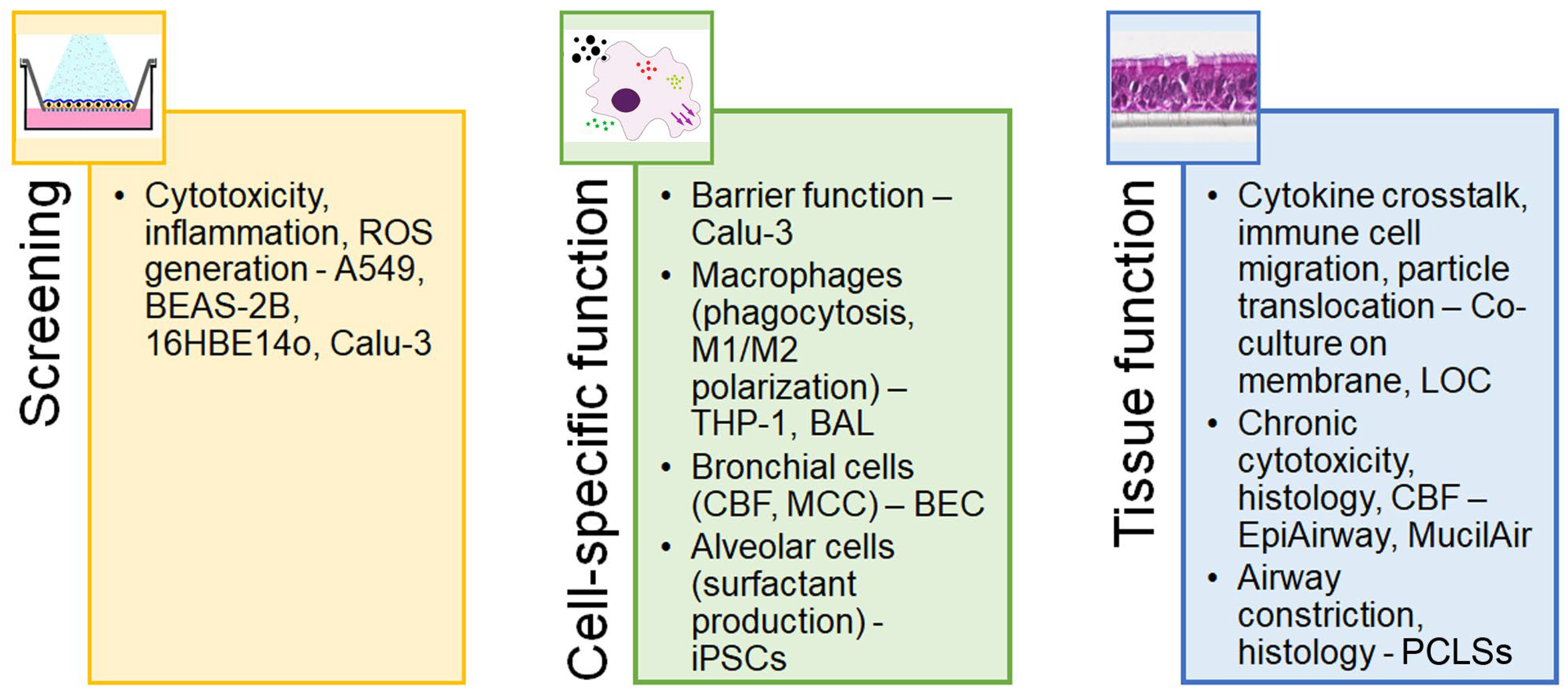
Toxicological evaluations should preferably use multiple in vitro models. For assessment of cell-specific parameters such as phagocytosis and macrophage polarization, differentiated human THP-1 monocytes or primary macrophages isolated from bronchoalveolar lavage (BAL) can be used (Figure 3). Mucociliary clearance (MCC) and ciliary beat frequency (CBF) are primarily studied in bronchial epithelial biopsies. iPSCs are a better choice to study the effects on surfactant than A549 cells, in which production is low. For respiratory barrier function, Calu-3 cells are most often used. Cytotoxicity, inflammation, and ROS generation can be measured in single-cell cultures or in co-cultures. Co-cultures—either on membranes or in LOC systems—are recommended for studying cytokine crosstalk, immune cell migration, and particle transport. Because primary cultures often survive only for short periods, commercially available reconstructed tissues such as EpiAirway and MucilAir are commonly used to assess histology and long-term exposures. Although the survival time of PCLS is limited, this ex vivo system has the advantage of enabling assessment of airway constriction.

4.3. Effects of Co-Formulations on Cells

Few studies have evaluated the effects of co-delivery of APIs in cellular models. However, single compounds and co-delivery of ciprofloxacin and colistin by liposomes have been compared in Calu-3 monolayers [108]. Both APIs were applied as solutions and were transported to a lower extent across Calu-3 monolayers that were cultured in ALI. The authors concluded that the combination was suitable for the treatment of respiratory infections, where systemic uptake was not intended. Synergistic effects were also recorded upon co-delivery of aerosolized formoterol and budesonide, where budesonide increased the transport of formoterol in ALI-cultured Calu-3 monolayers [109]. Further, fluticasone furoate and umeclidinium were more potent on sensitized immortalized human bronchial epithelial cells than each of the compounds alone in submersed culture [110].

5. Conclusions

In summary, the landscape of combination drug products for pulmonary inhalation is rapidly evolving, driven by the need for improved therapeutic efficacy, patient compliance, and the management of complex respiratory diseases. Innovative formulation strategies—including co-amorphous systems, co-crystals, core–shell particles, co-spray-dried powders, and nanoparticle-based carriers—offer distinct advantages in terms of drug stability, solubility, targeted delivery, and the potential for synergistic or additive effects. However, each technology also presents its own challenges related to co-former compatibility, manufacturing complexity, scalability, regulatory aspects, and cost, which must be carefully balanced against their clinical and commercial potential. Importantly, the translation of these advanced formulations into clinical practice is closely linked to the development of physiologically relevant in vitro toxicity testing models. Advances in aerosol exposure systems, air–liquid interface cultures, co-culture and organoid models, lung-on-chip platforms, and precision-cut lung slices are enhancing our ability to predict the safety and efficacy of inhaled drug combinations while reducing reliance on animal testing. Although studies evaluating the cellular effects of co-formulated active ingredients remain limited, new findings suggest that co-administration may offer synergistic therapeutic benefits and influence the transport of active ingredients across respiratory barriers.
Looking ahead, the integration of cutting-edge technologies such as personalized inhalers, smart devices, and artificial intelligence (AI)-driven prescription design will further revolutionize inhalation therapy. Personalized inhalers equipped with sensors and connectivity can optimize dosing and treatment adherence for individual patients, while algorithms based on AI and machine learning (ML) can enable the development of customized drug combinations and administration regimens based on patient-specific data. These advances, combined with ongoing developments in formulation science and in vitro modeling, hold great promise for expanding treatment options and improving treatment outcomes for respiratory and systemic diseases through inhalation therapy. Continued interdisciplinary collaboration among formulation scientists, clinicians, engineers, and regulatory bodies will be essential to realize the full potential of these innovations in the coming years.

Author Contributions

Conceptualization, E.F. and S.Z.-N.; Resources, S.Z.-N.; Visualization, E.F. and S.Z.-N.; Writing—original draft, E.F. and S.Z.-N.; Writing—review and editing, E.F. and S.Z.-N. All authors have read and agreed to the published version of the manuscript.

Funding

This research was funded through the FWF—Austrian Science Fund as part of the Hertha-Firnberg program (Hertha-Firnberg grant no. T1105). The Research Center Pharmaceutical Engineering (RCPE) is funded within the framework of COMET—Competence Centers for Excellent Technologies by the Federal Ministry for Innovation, Mobility and Infrastructure (BMIMI), the Federal Ministry of Economy, Energy and Tourism (BMWET), Land Steiermark, and SFG. The COMET program is managed by the Austrian Research Promotion Agency (FFG).

Data Availability Statement

No new data were created or analyzed in this study. Data sharing is not applicable to this article.

Conflicts of Interest

Eleonore Fröhlich is a key researcher at the RCPE GmbH. Sarah Zellnitz-Neugebauer is a senior scientist employed at RCPE GmbH and currently working on a personalized FWF funded project (HFT1105). RCPE GmbH is the location where the research is conducted. The company RCPE GmbH has no role or interest in this work.

Abbreviations

The following abbreviations are used in this manuscript:
3FNThree fluid nozzle
ACAlveolar cell
AIArtificial intelligence
ALIAir-lung interface
AMAlveolar macrophage
ATAlveolar type
AUCArea under the curve
BBlood
BALBronchoalveolar fluid
BCBronchial epithelial cell
CCartilage
CBFCiliary beating frequency
CdCl2Cadmium chloride
CFZClofazimine
CMCurcumin
COAMSco-amorphous system
COPDChronic obstructive pulmonary disease
DCDendritic cell
DPIDry powder inhaler
ECEndothelial cell
EMAEuropean Medicines Agency
FFibroblast
FDAUS Food and Drug Administration
FDCFixed-dose combination
FDFFine particle fraction
FPFluticasone propionate
GBGlycopyrronium bromide
GCGoblet cell
HFAhydrofluoroalkane
HUVECHuman umbilical endothelial cells
ICHInternational Council for Harmonization
ICSInhaled corticosteroid
ICRPInternational Commission on Radiological Protection
IκBInhibitor of kappa B
INHIsoniazid
iPSCInduced pluripotent lung cells
LLymphocyte
LABALong-acting beta adrenoreceptor agonists
LAMALong-acting muscarinic receptor antagonists
LOCLung on chip
MMucus
MCCMucociliary clearance
MDNPsMultifunctional dual drug-loaded nanoparticles
MICMinimum inhibitors concentration
MLMachine learning
MMADMass median aerodynamic diameter
NBENormal bronchial epithelium
NSCLCNon-small cell lung cancer
OINDPsOrally inhaled and nasal drug products
PAS4-aminosalicylic acid
PCLSPrecision cut lung slices
PLGAPolylactide-co-glycolide
pMDIPressurized metered dose inhaler
PNIPAAm-CMCN-isopropylacrylamide–carboxymethyl chitosan
RDV-SARemdesivir-salicylic acid
RIFRifampicin
SSurfactant
SCSmooth muscle cell
SABAShort-acting beta adrenoreceptor agonists
SALSalmeterol xinafoate
SAMAShort-acting muscarinic receptor antagonists
SMISoft mist inhaler
STAT3Signal Transducer and Activator of Transcription
TBTuberculosis
THEOTheophylline

References

  1. Heyder, J.; Gebhart, J.; Rudolf, G.; Schiller, C.F.; Stahlhofen, W. Deposition of particles in the human respiratory tract in the size range 0.005–15 μm. J. Aerosol Sci. 1986, 17, 811–825. [Google Scholar] [CrossRef] [Scilit]
  2. U.S. Food and Drug Administration. CDER/FDA Metered Dose Inhaler (MDI) and Dry Powder Inhaler (DPI) Products-Quality Considerations Guidance for Industry DRAFT GUIDANCE; U.S. Food and Drug Administration: Silver Spring, MD, USA, 2018.
  3. Ryu, J.H.; Scanlon, P.D. Obstructive Lung Diseases: COPD, Asthma, and Many Imitators. Mayo Clin. Roc. 2001, 76, 1144–1153. [Google Scholar] [CrossRef] [Scilit]
  4. Zellnitz, S.; Roblegg, E.; Pinto, J.; Fröhlich, E. Delivery of Dry Powders to the Lungs: Influence of Particle Attributes from a Biological and Technological Point of View. Curr. Drug Deliv. 2019, 16, 180–194. [Google Scholar] [CrossRef] [Scilit]
  5. Sankhe, K.; Khan, T.; Bhavsar, C.; Momin, M.; Omri, A. Selective Drug Deposition in Lungs through Pulmonary Drug Delivery System for Effective Management of Drug-Resistant TB. Expert Opin. Drug Deliv. 2019, 16, 525–538. [Google Scholar] [CrossRef] [Scilit]
  6. Rau, J.L. Determinants of Patient Adherence to an Aerosol Regimen. Respir. Care 2005, 50, 1346–1356, discussion 1357–1359. [Google Scholar] [CrossRef] [Scilit]
  7. Zhang, S.; King, D.; Rosen, V.M.; Ismaila, A.S. Impact of Single Combination Inhaler versus Multiple Inhalers to Deliver the Same Medications for Patients with Asthma or COPD: A Systematic Literature Review. Int. J. Chron. Obstruct. Pulmon. Dis. 2020, 15, 417–438. [Google Scholar] [CrossRef] [Scilit] [PubMed]
  8. Kisa, A.; Sabaté, E.; Nuño-Solinís, R. Adherence to Long-Term Therapies: Evidence for Action; World Health Organization: Geneva, Switzerland, 2003; ISBN 9241545992. [Google Scholar]
  9. Tashkin, D.P.; Ferguson, G.T. Combination Bronchodilator Therapy in the Management of Chronic Obstructive Pulmonary Disease. Respir. Res. 2013, 14, 49. [Google Scholar] [CrossRef] [Scilit] [PubMed]
  10. Lötvall, J. Combination Therapy in Asthma--Fixed or Variable Dosing in Different Patients? Curr. Med. Res. Opin. 2004, 20, 1711–1727. [Google Scholar] [CrossRef] [Scilit]
  11. Banat, H.; Ambrus, R.; Csóka, I. Drug Combinations for Inhalation: Current Products and Future Development Addressing Disease Control and Patient Compliance. Int. J. Pharm. 2023, 643, 123070. [Google Scholar] [CrossRef] [Scilit]
  12. Ferguson, G.T.; Hickey, A.J.; Dwivedi, S. Co-Suspension Delivery Technology in Pressurized Metered-Dose Inhalers for Multi-Drug Dosing in the Treatment of Respiratory Diseases. Respir. Med. 2018, 134, 16–23. [Google Scholar] [CrossRef] [Scilit]
  13. Chen, X.; Huang, Z.; Zhang, X.; Pan, X.; Wu, C.; Jiang, J. Recent Advances in Dry Powder Inhalation Formulations Prepared by Co-Spray Drying Technology: A Comprehensive Review. Int. J. Pharm. 2025, 681, 125825. [Google Scholar] [CrossRef] [Scilit]
  14. Van Drooge, D.-J.; Hinrichs, W.L.J.; Dickhoff, B.H.J.; Elli, M.N.A.; Visser, M.R.; Zijlstra, G.S.; Frijlink, H.W. Spray Freeze Drying to Produce a Stable Delta(9)-Tetrahydrocannabinol Containing Inulin-Based Solid Dispersion Powder Suitable for Inhalation. Eur. J. Pharm. Sci. 2005, 26, 231–240. [Google Scholar] [CrossRef] [Scilit]
  15. Wanning, S.; Süverkrüp, R.; Lamprecht, A. Pharmaceutical Spray Freeze Drying. Int. J. Pharm. 2015, 488, 136–153. [Google Scholar] [CrossRef] [Scilit]
  16. Specialist Pharmacy Service. Compatibility of Nebuliser Solution Combinations; Specialist Pharmacy Service: Dagenham, UK, 2025; Available online: https://www.sps.nhs.uk/articles/compatibility-of-nebuliser-solution-combinations/ (accessed on 7 April 2026).
  17. Costabile, G.; Conte, G.; Brusco, S.; Savadi, P.; Miro, A.; Quaglia, F.; d’Angelo, I.; Ungaro, F. State-of-the-Art Review on Inhalable Lipid and Polymer Nanocarriers: Design and Development Perspectives. Pharmaceutics 2024, 16, 347. [Google Scholar] [CrossRef] [Scilit] [PubMed]
  18. Asghar, S.; Iliescu, R.; Stiufiuc, R.-I.; Dragoi, B. Co-Encapsulation of Multiple Antineoplastic Agents in Liposomes by Exploring Microfluidics. Int. J. Mol. Sci. 2025, 26, 3820. [Google Scholar] [CrossRef] [Scilit] [PubMed]
  19. Silva, D.M.; Liu, R.; Gonçalves, A.F.; da Costa, A.; Castro Gomes, A.; Machado, R.; Vongsvivut, J.; Tobin, M.J.; Sencadas, V. Design of Polymeric Core-Shell Carriers for Combination Therapies. J. Colloid Interface Sci. 2021, 587, 499–509. [Google Scholar] [CrossRef] [Scilit] [PubMed]
  20. Lajoie, A.C.; Lauzière, G.; Lega, J.-C.; Lacasse, Y.; Martin, S.; Simard, S.; Bonnet, S.; Provencher, S. Combination Therapy versus Monotherapy for Pulmonary Arterial Hypertension: A Meta-Analysis. Lancet Respir. Med. 2016, 4, 291–305. [Google Scholar] [CrossRef] [Scilit]
  21. Smith, H. Fixed-Combination Inhalers for Asthma and Chronic Obstructive Pulmonary Disease. SA Pharm. J. 2013, 80, 16–19. Available online: https://www.researchgate.net/publication/286272540_Fixed-combination_inhalers_for_asthma_and_chronic_obstructive_pulmonary_disease (accessed on 7 April 2026).
  22. Ehrick, J.D.; Wylie, J.; Goodey, A.P.; Li, Y.; Liu, O.; Donovan, B. Orally Inhaled Fixed-Dose Combination Products for the Treatment of Asthma and Chronic Obstructive Pulmonary Disease: Not Simple Math. Ther. Deliv. 2014, 5, 297–317. [Google Scholar] [CrossRef] [Scilit]
  23. Fan, C.; Eedara, B.B.; Sinha, S.; Uddin, M.K.M.; Doyle, C.; Banu, S.; Das, S.C. Triple Combination Dry Powder Formulation of Pretomanid, Moxifloxacin, and Pyrazinamide for Treatment of Multidrug-Resistant Tuberculosis. Int. J. Pharm. 2024, 654, 123984. [Google Scholar] [CrossRef] [Scilit]
  24. Liu, J.; Grohganz, H.; Löbmann, K.; Rades, T.; Hempel, N.J. Co-Amorphous Drug Formulations in Numbers: Recent Advances in Co-Amorphous Drug Formulations with Focus on Co-Formability, Molar Ratio, Preparation Methods, Physical Stability, in Vitro and in Vivo Performance, and New Formulation Strategies. Pharmaceutics 2021, 13, 389. [Google Scholar] [CrossRef] [Scilit]
  25. Dengale, S.J.; Grohganz, H.; Rades, T.; Löbmann, K. Recent Advances in Co-Amorphous Drug Formulations. Adv. Drug Deliv. Rev. 2016, 100, 116–125. [Google Scholar] [CrossRef] [Scilit]
  26. Fink, E.; Brunsteiner, M.; Mitsche, S.; Schröttner, H.; Paudel, A.; Zellnitz-Neugebauer, S. Data-Driven Prediction of the Formation of Co-Amorphous Systems. Pharmaceutics 2023, 15, 347. [Google Scholar] [CrossRef] [Scilit]
  27. Mahmoud, A.A.K.; Regdon, G.; Kristó, K. Cutting-Edge Approaches in the Co-Amorphization Process. Pharmaceutics 2025, 17, 850. [Google Scholar] [CrossRef] [Scilit]
  28. Fröhlich, E.; Bordoni, A.; Mohsenzada, N.; Mitsche, S.; Schröttner, H.; Zellnitz-Neugebauer, S. Development of Co-Amorphous Systems for Inhalation Therapy—Part 1: From Model Prediction to Clinical Success. Pharmaceutics 2025, 17, 922. [Google Scholar] [CrossRef] [Scilit]
  29. Ueda, H.; Tse, J.Y.; Miyano, T.; Nakayama, Y.; Mo, P.; Hatanaka, Y.; Uchiyama, H.; Tozuka, Y.; Kadota, K. Formation of Drug-Drug Salt Crystals and Co-Amorphous Forms of Levofloxacin and 4-Aminosalicylic Acid for Pulmonary Applications. RSC Pharm. 2025, 2, 264–278. [Google Scholar] [CrossRef] [Scilit]
  30. Ueda, H.; Hirakawa, Y.; Miyano, T.; Nakayama, Y.; Hatanaka, Y.; Uchiyama, H.; Tozuka, Y.; Kadota, K. Improvement in Inhalation Properties of Theophylline and Levofloxacin by Co-Amorphization and Enhancement in Its Stability by Addition of Amino Acid as a Third Component. Mol. Pharm. 2023, 20, 6368–6379. [Google Scholar] [CrossRef] [Scilit]
  31. Alhajj, N.; O’Reilly, N.J.; Cathcart, H. Development and Characterization of a Spray-Dried Inhalable Ciprofloxacin-Quercetin Co-Amorphous System. Int. J. Pharm. 2022, 618, 121657. [Google Scholar] [CrossRef] [Scilit]
  32. Fröhlich, E.; Sharafeldin, N.; Reinisch, V.; Mohsenzada, N.; Mitsche, S.; Schröttner, H.; Zellnitz-Neugebauer, S. Development of Co-Amorphous Systems for Inhalation Therapy—Part 2: In Silico Guided Co-Amorphous Rifampicin–Moxifloxacin and –Ethambutol Formulations. Pharmaceutics 2025, 17, 1339. [Google Scholar] [CrossRef] [Scilit] [PubMed]
  33. Aitipamula, S.; Banerjee, R.; Bansal, A.K.; Biradha, K.; Cheney, M.L.; Choudhury, A.R.; Desiraju, G.R.; Dikundwar, A.G.; Dubey, R.; Duggirala, N.; et al. Polymorphs, Salts, and Cocrystals: What’s in a Name? Cryst. Growth Des. 2012, 12, 2147–2152. [Google Scholar] [CrossRef] [Scilit]
  34. Lösing, H.; Bauer-Brandl, A.; Scherließ, R. Co-Crystals of Itraconazole and Succinic Acid for Inhalation Therapy of Fungal Lung Infections. In Proceedings of the Drug Delivery to the Lungs Conference, Scotland, UK, 11–13 December 2024; Volume 35, p. 2024. [Google Scholar]
  35. Marcos Valdez, M.M.; Sperandeo, N.R.; Bueno, M.S.; Garnero, C. Pharmaceutical Cocrystals in Drug-Delivery Technologies: Advances from Rational Design to Therapeutic Applications. Pharmaceutics 2026, 18, 128. [Google Scholar] [CrossRef] [Scilit] [PubMed]
  36. Wong, S.N.; Low, K.H.; Poon, Y.L.; Chan, H.W.; Chow, S.F. Synthesis of the First Remdesivir Cocrystal: Design, Characterization, and Therapeutic Potential for Pulmonary Delivery. Int. J. Pharm. 2023, 640, 122983. [Google Scholar] [CrossRef] [Scilit]
  37. Ober, C.A.; Gupta, R.B. Formation of Itraconazole-Succinic Acid Cocrystals by Gas Antisolvent Cocrystallization. AAPS PharmSciTech 2012, 13, 1396–1406. [Google Scholar] [CrossRef] [Scilit]
  38. Jia, Y.; Yang, D.; Wang, W.; Hu, K.; Yan, M.; Zhang, L.; Gao, L.; Lu, Y. Recent Advances in Pharmaceutical Cocrystals of Theophylline. Nat. Prod. Bioprospect. 2024, 14, 53. [Google Scholar]
  39. Wong, S.N.; Weng, J.; Ip, I.; Chen, R.; Lakerveld, R.; Telford, R.; Blagden, N.; Scowen, I.J.; Chow, S.F. Rational Development of a Carrier-Free Dry Powder Inhalation Formulation for Respiratory Viral Infections via Quality by Design: A Drug-Drug Cocrystal of Favipiravir and Theophylline. Pharmaceutics 2022, 14, 300. [Google Scholar] [CrossRef] [Scilit]
  40. Desai, H.; Jaiswal, S.; Bhave, G. Synergistic Pulmonary Delivery via Cocrystal Based Dry Powder Inhaler: Theophylline and Glycopyrronium Bromide Combination. Indian J. Nov. Drug Deliv. 2025, 17, 94–105. [Google Scholar]
  41. Salem, A.; Khanfar, E.; Nagy, S.; Széchenyi, A. Cocrystals of Tuberculosis Antibiotics: Challenges and Missed Opportunities. Int. J. Pharm. 2022, 623, 121924. [Google Scholar] [CrossRef] [Scilit]
  42. Mo, P.; Hatanaka, Y.; Furukawa, S.; Takase, M.; Yamanaka, S.; Doi, M.; Kämäräinen, T.; Uchiyama, H.; Kadota, K.; Tozuka, Y. Cocrystal Formulation Design of 4-Aminosalicylic Acid and Isoniazid via Spray-Drying Based on a Ternary Phase Diagram toward Simultaneous Pulmonary Delivery. Powder Technol. 2024, 445, 120126. [Google Scholar] [CrossRef] [Scilit]
  43. Reddy, K.P.; Naraharisetti, L.T.; Prasanna, V.S.; Babu, S.S.; Ehsan, I.; Godugu, C.; Datta, P. Excipient-Free Inhalable Combination Shell-Core Microparticles with Clofazimine as Shell for Extended Pulmonary Retention of Isoniazid in Core. Int. J. Pharm. 2025, 672, 125310. [Google Scholar] [CrossRef] [Scilit] [PubMed]
  44. Silva, D.M.; dos Reis, L.G.; Tobin, M.J.; Vongsvivut, J.; Traini, D.; Sencadas, V. Co-Delivery of Inhalable Therapies: Controlling Active Ingredients Spatial Distribution and Temporal Release. Mater. Sci. Eng. C 2021, 122, 111831. [Google Scholar] [CrossRef] [Scilit] [PubMed]
  45. Menon, J.U.; Kuriakose, A.; Iyer, R.; Hernandez, E.; Gandee, L.; Zhang, S.; Takahashi, M.; Zhang, Z.; Saha, D.; Nguyen, K.T. Dual-Drug Containing Core-Shell Nanoparticles for Lung Cancer Therapy. Sci. Rep. 2017, 7, 13249. [Google Scholar] [CrossRef] [Scilit]
  46. Brunaugh, A.D.; Sharma, S.; Smyth, H. Inhaled Fixed-Dose Combination Powders for the Treatment of Respiratory Infections. Expert Opin. Drug Deliv. 2021, 18, 1101–1115. [Google Scholar] [CrossRef] [Scilit]
  47. Pathak, V.; Park, H.; Zemlyanov, D.; Bhujbal, S.V.; Ahmed, M.U.; Azad, M.A.K.; Li, J.; Zhou, Q.T. Improved Aerosolization Stability of Inhalable Tobramycin Powder Formulation by Co-Spray Drying with Colistin. Pharm. Res. 2022, 39, 2781–2799. [Google Scholar] [CrossRef] [Scilit] [PubMed]
  48. Focaroli, S.; Jiang, G.; O’connell, P.; Fahy, J.V.; Healy, A.M. The Use of a Three-Fluid Atomising Nozzle in the Production of Spray-Dried Theophylline/Salbutamol Sulphate Powders Intended for Pulmonary Delivery. Pharmaceutics 2020, 12, 1116. [Google Scholar] [CrossRef] [Scilit] [PubMed]
  49. Peng, S.; Wang, W.; Zhang, R.; Wu, C.; Pan, X.; Huang, Z. Nano-Formulations for Pulmonary Delivery: Past, Present, and Future Perspectives. Pharmaceutics 2024, 16, 161. [Google Scholar] [CrossRef] [Scilit]
  50. Sumaila, M.; Kumar, P.; Ubanako, P.; Adeyemi, S.A.; Choonara, Y.E. Dual Rifampicin and Isoniazid Mannose-Decorated Lipopolysaccharide Nanospheres for Macrophage- Targeted Lung Delivery. Curr. Drug Deliv. 2023, 20, 1487–1503. [Google Scholar] [CrossRef] [Scilit]
  51. Alyami, M.H.; Dahmash, E.Z.; Ali, D.K.; Alyami, H.S.; AbdulKarim, H.; Alsudir, S.A. Novel Fluticasone Propionate and Salmeterol Fixed-Dose Combination Nano-Encapsulated Particles Using Polyamide Based on L-Lysine. Pharmaceuticals 2022, 15, 321. [Google Scholar] [CrossRef] [Scilit] [PubMed]
  52. Gupta, P.V.; Nirwane, A.M.; Belubbi, T.; Nagarsenker, M.S. Pulmonary Delivery of Synergistic Combination of Fluoroquinolone Antibiotic Complemented with Proteolytic Enzyme: A Novel Antimicrobial and Antibiofilm Strategy. Nanomedicine 2017, 13, 2371–2384. [Google Scholar] [CrossRef] [Scilit] [PubMed]
  53. Yang, Y.; Huang, Z.; Li, J.; Mo, Z.; Huang, Y.; Ma, C.; Wang, W.; Pan, X.; Wu, C. PLGA Porous Microspheres Dry Powders for Codelivery of Afatinib-Loaded Solid Lipid Nanoparticles and Paclitaxel: Novel Therapy for EGFR Tyrosine Kinase Inhibitors Resistant Nonsmall Cell Lung Cancer. Adv. Healthc. Mater. 2019, 8, 2371–2384. [Google Scholar] [CrossRef] [Scilit]
  54. Abd Elwakil, M.M.; Mabrouk, M.T.; Helmy, M.W.; Abdelfattah, E.-Z.A.; Khiste, S.K.; Elkhodairy, K.A.; Elzoghby, A.O. Inhalable Lactoferrin–Chondroitin Nanocomposites for Combined Delivery of Doxorubicin and Ellagic Acid to Lung Carcinoma. Nanomedicine 2018, 13, 2015–2035. [Google Scholar] [CrossRef] [Scilit]
  55. Sakkal, M.; Abdelmoteleb, R.W.A.; Al Ali, A.; Bin Jardan, Y.A.; Löbenberg, R.; Sarfraz, M. Inhalable Nanoparticle-Based Drug Delivery System for Non-Small Cell Lung Cancer Therapy: Promises and Challenges. Saudi Pharm. J. 2025, 33, 50. [Google Scholar] [CrossRef] [Scilit] [PubMed]
  56. Naureen, F.; Shah, Y.; Rehman, M.; Chaubey, P.; Nair, A.K.; Khan, J.; Abdullah; Shafique, M.; Shah, K.U.; Ahmad, B. Inhalable Dry Powder Nano-Formulations: Advancing Lung Disease Therapy-a Review. Front. Nanotechnol. 2024, 6, 1403313. [Google Scholar] [CrossRef] [Scilit]
  57. Mahmoud, D.E.; Hosseini, S.H.; Rathore, H.A.; Alkilany, A.M.; Heise, A.; Elhissi, A. Inhalable Nanotechnology-Based Drug Delivery Systems for the Treatment of Inflammatory Lung Diseases. Pharmaceutics 2025, 17, 893. [Google Scholar] [CrossRef] [Scilit] [PubMed]
  58. Schug, B.; Beuerle, G.; Bilensoy, E.; Cook, J.; Fernandes, E.; Haertter, S.; Kuribayashi, R.; Mehta, M.; Paixao, P.; Seidlitz, A.; et al. The Global Bioequivalence Harmonisation Initiative (GBHI): Report of the Sixth International EUFEPS/PQRI Conference. Eur. J. Pharm. Sci. 2025, 212, 107129. [Google Scholar] [CrossRef] [Scilit]
  59. Lu, D.; Lee, S.L.; Lionberger, R.A.; Choi, S.; Adams, W.; Caramenico, H.N.; Chowdhury, B.A.; Conner, D.P.; Katial, R.; Limb, S.; et al. International Guidelines for Bioequivalence of Locally Acting Orally Inhaled Drug Products: Similarities and Differences. AAPS J. 2015, 17, 546–557. [Google Scholar] [CrossRef] [Scilit]
  60. Blume, H.H.; Mehta, B.G.; Dorantes, A.; Hempel, G.; Jiang, W.; Kovar, A.; Lee, J.; Potthast, H.; Schug, B.; Seidlitz, A.; et al. The Global Bioequivalence Harmonisation Initiative (GBHI): Report of EUFEPS/AAPS Fourth Conference. Eur. J. Pharm. Sci. 2021, 167, 105987. [Google Scholar] [CrossRef] [Scilit]
  61. Sou, T.; Bergström, C.A.S. Contemporary Formulation Development for Inhaled Pharmaceuticals. J. Pharm. Sci. 2021, 110, 66–86. [Google Scholar] [CrossRef] [Scilit]
  62. Desai, N.; Rana, D.; Patel, M.; Bajwa, N.; Prasad, R.; Vora, L.K. Nanoparticle Therapeutics in Clinical Perspective: Classification, Marketed Products, and Regulatory Landscape. Small 2025, 21, e2502315. [Google Scholar] [CrossRef] [Scilit]
  63. De Jong, W.H.; Geertsma, R.E.; Borchard, G. Regulatory Safety Evaluation of Nanomedical Products: Key Issues to Refine. Drug Deliv. Transl. Res. 2022, 12, 2042–2047. [Google Scholar] [CrossRef] [Scilit]
  64. Phillips, J.E. Inhaled Efficacious Dose Translation from Rodent to Human: A Retrospective Analysis of Clinical Standards for Respiratory Diseases. Pharmacol. Ther. 2017, 178, 141–147. [Google Scholar] [CrossRef] [Scilit]
  65. Mescher, A.L. Chapter 17. Respiratory System. In Junqueira’s Basic Histology: Text and Atlas; McGraw Hill Education: New York, NY, USA, 2024; pp. 345–372. [Google Scholar]
  66. Madlova, M.; Bosquillon, C.; Asker, D.; Dolezal, P.; Forbes, B. In-Vitro Respiratory Drug Absorption Models Possess Nominal Functional P-Glycoprotein Activity. J. Pharm. Pharmacol. 2009, 61, 293–301. [Google Scholar] [CrossRef]
  67. Ji, J.; Hedelin, A.; Malmlöf, M.; Kessler, V.; Seisenbaeva, G.; Gerde, P.; Palmberg, L. Development of Combining of Human Bronchial Mucosa Models with XposeALI® for Exposure of Air Pollution Nanoparticles. PLoS ONE 2017, 12, e0170428. [Google Scholar] [CrossRef] [Scilit]
  68. Leroux, M.M.; Hocquel, R.; Bourge, K.; Kokot, B.; Kokot, H.; Koklič, T.; Štrancar, J.; Ding, Y.; Kumar, P.; Schmid, O.; et al. Aerosol–Cell Exposure System Applied to Semi-Adherent Cells for Aerosolization of Lung Surfactant and Nanoparticles Followed by High Quality RNA Extraction. Nanomaterials 2022, 12, 1362. [Google Scholar] [CrossRef] [Scilit]
  69. Nossa, R.; Costa, J.; Cacopardo, L.; Ahluwalia, A. Breathing in Vitro: Designs and Applications of Engineered Lung Models. J. Tissue Eng. 2021, 12, 20417314211008696. [Google Scholar] [CrossRef] [Scilit]
  70. Oldham, M.J.; Castro, N.; Zhang, J.; Rostami, A.; Lucci, F.; Pithawalla, Y.; Kuczaj, A.K.; Gilman, I.G.; Kosachevsky, P.; Hoeng, J.; et al. Deposition Efficiency and Uniformity of Monodisperse Solid Particle Deposition in the Vitrocell® 24/48 Air–Liquid-Interface in Vitro Exposure System. Aerosol Sci. Technol. 2020, 54, 52–65. [Google Scholar] [CrossRef] [Scilit]
  71. Mallek, N.M.; Martin, E.M.; Dailey, L.A.; McCullough, S.D. Liquid Application Dosing Alters the Physiology of Air-Liquid Interface (ALI) Primary Human Bronchial Epithelial Cell/Lung Fibroblast Co-Cultures and in Vitro Testing Relevant Endpoints. Front. Toxicol. 2024, 5, 1264331. [Google Scholar] [CrossRef] [Scilit]
  72. Barata, D.; Koornneef, S.; Giacomini, F.; Tahmasebi Birgani, Z.N.; Zhou, J.; Li, P.; Rottier, R.J.; Truckenmüller, R.K. Simple and High-Containment Lung-on-Chip Model for Studying Respiratory Viral Infections Using Human Primary Lung Cells. Mater. Today Bio 2025, 35, 102316. [Google Scholar] [CrossRef] [Scilit] [PubMed]
  73. Meindl, C.; Öhlinger, K.; Zrim, V.; Steinkogler, T.; Fröhlich, E. Screening for Effects of Inhaled Nanoparticles in Cell Culture Models for Prolonged Exposure. Nanomaterials 2021, 11, 606. [Google Scholar] [CrossRef] [Scilit]
  74. Tapias, L.F.; Gilpin, S.E.; Ren, X.; Wei, L.; Fuchs, B.C.; Tanabe, K.K.; Lanuti, M.; Ott, H.C. Assessment of Proliferation and Cytotoxicity in a Biomimetic Three-Dimensional Model of Lung Cancer. Ann. Thorac. Surg. 2015, 100, 414–421. [Google Scholar] [CrossRef] [Scilit] [PubMed]
  75. Hiemstra, P.S.; Grootaers, G.; van der Does, A.M.; Krul, C.A.M.; Kooter, I.M. Human Lung Epithelial Cell Cultures for Analysis of Inhaled Toxicants: Lessons Learned and Future Directions. Toxicol. Vitr. 2018, 47, 137–146. [Google Scholar] [CrossRef] [Scilit]
  76. Moreira, A.; Müller, M.; Costa, P.F.; Kohl, Y. Advanced In Vitro Lung Models for Drug and Toxicity Screening: The Promising Role of Induced Pluripotent Stem Cells. Adv. Biol. 2022, 6, 2101139. [Google Scholar] [CrossRef] [Scilit]
  77. Liu, S.; Yang, R.; Chen, Y.; Zhao, X.; Chen, S.; Yang, X.; Cheng, Z.; Hu, B.; Liang, X.; Yin, N.; et al. Development of Human Lung Induction Models for Air Pollutants’ Toxicity Assessment. Environ. Sci. Technol. 2021, 55, 2440–2451. [Google Scholar] [CrossRef] [Scilit] [PubMed]
  78. Liu, F.F.; Peng, C.; Escher, B.I.; Fantino, E.; Giles, C.; Were, S.; Duffy, L.; Ng, J.C. Hanging Drop: An in Vitro Air Toxic Exposure Model Using Human Lung Cells in 2D and 3D Structures. J. Hazard. Mater. 2013, 261, 701–710. [Google Scholar] [CrossRef] [Scilit]
  79. Meenach, S.A.; Tsoras, A.N.; Mcgarry, R.C.; Mansour, H.M.; Hilt, J.Z.; Anderson, K.W. Development of Three-Dimensional Lung Multicellular Spheroids in Air- and Liquid-Interface Culture for the Evaluation of Anticancer Therapeutics. Int. J. Oncol. 2016, 48, 1701–1709. [Google Scholar] [CrossRef] [Scilit]
  80. Lee, J.; Baek, H.; Hong, S.-H.; Lee, J.-H.; Wang, S.-J.; Lee, J.Y.; Song, M.H.; Yang, S.-R. Alveolar Organoids: Development of an in vitro Assay to Facilitate Pulmonary Toxicity Assessments. Organoid 2022, 2, e31. [Google Scholar] [CrossRef] [Scilit]
  81. Rothen-Rutishauser, B.M.; Kiama, S.G.; Gehr, P. A Three-Dimensional Cellular Model of the Human Respiratory Tract to Study the Interaction with Particles. Am. J. Respir. Cell Mol. Biol. 2005, 32, 281–289. [Google Scholar] [CrossRef] [Scilit]
  82. Lehmann, A.D.; Daum, N.; Bur, M.; Lehr, C.-M.; Gehr, P.; Rothen-Rutishauser, B.M. An in Vitro Triple Cell Co-Culture Model with Primary Cells Mimicking the Human Alveolar Epithelial Barrier. Eur. J. Pharm. Biopharm. 2011, 77, 398–406. [Google Scholar] [CrossRef] [Scilit] [PubMed]
  83. Klein, S.G.; Serchi, T.; Hoffmann, L.; Blömeke, B.; Gutleb, A.C. An Improved 3D Tetraculture System Mimicking the Cellular Organisation at the Alveolar Barrier to Study the Potential Toxic Effects of Particles on the Lung. Part. Fibre Toxicol. 2013, 10, 31. [Google Scholar] [CrossRef] [Scilit]
  84. Schleh, C.; Rothen-Rutishauser, B.M.; Blank, F.; Lauenstein, H.D.; Nassimi, M.; Krug, N.; Braun, A.; Erpenbeck, V.J.; Gehr, P.; Hohlfeld, J.M. Surfactant Protein D Modulates Allergen Particle Uptake and Inflammatory Response in a Human Epithelial Airway Model. Respir. Res. 2012, 13, 8. [Google Scholar] [CrossRef] [Scilit]
  85. Rotoli, B.; Barilli, A.; Visigalli, R.; Ferrari, F.; Frati, C.; Lagrasta, C.; Di Lascia, M.; Riccardi, B.; Puccini, P.; Dall’Asta, V. Characterization of ABC Transporters in EpiAirwayTM, a Cellular Model of Normal Human Bronchial Epithelium. Int. J. Mol. Sci. 2020, 21, 3190. [Google Scholar] [CrossRef] [Scilit]
  86. Mathis, C.; Poussin, C.; Weisensee, D.; Gebel, S.; Hengstermann, A.; Sewer, A.; Belcastro, V.; Xiang, Y.; Ansari, S.; Wagner, S.; et al. Human Bronchial Epithelial Cells Exposed in Vitro to Cigarette Smoke at the Air-Liquid Interface Resemble Bronchial Epithelium from Human Smokers. Am. J. Physiol.-Lung Cell. Mol. Physiol. 2013, 304, L489–L503. [Google Scholar] [CrossRef] [Scilit] [PubMed]
  87. Huang, S.; Boda, B.; Vernaz, J.; Ferreira, E.; Wiszniewski, L.; Constant, S. Establishment and Characterization of an in Vitro Human Small Airway Model (SmallAirTM). Eur. J. Pharm. Biopharm. 2017, 118, 68–72. [Google Scholar] [CrossRef] [Scilit]
  88. Sauer, U.G.; Vogel, S.; Hess, A.; Kolle, S.N.; Ma-Hock, L.; van Ravenzwaay, B.; Landsiedel, R. In Vivo–in Vitro Comparison of Acute Respiratory Tract Toxicity Using Human 3D Airway Epithelial Models and Human A549 and Murine 3T3 Monolayer Cell Systems. Toxicol. Vitr. 2013, 27, 174–190. [Google Scholar] [CrossRef] [Scilit]
  89. Chapman, F.; Pour, S.J.; Wieczorek, R.; Trelles Sticken, E.; Budde, J.; Röwer, K.; Otte, S.; Mason, E.; Czekala, L.; Nahde, T.; et al. Twenty-Eight Day Repeated Exposure of Human 3D Bronchial Epithelial Model to Heated Tobacco Aerosols Indicates Decreased Toxicological Responses Compared to Cigarette Smoke. Front. Toxicol. 2023, 5, 1076752. [Google Scholar] [CrossRef] [Scilit]
  90. Metz, J.; Knoth, K.; Groß, H.; Lehr, C.-M.; Stäbler, C.; Bock, U.; Hittinger, M. Combining MucilAirTM and Vitrocell® Powder Chamber for the In Vitro Evaluation of Nasal Ointments in the Context of Aerosolized Pollen. Pharmaceutics 2018, 10, 56. [Google Scholar] [CrossRef] [Scilit]
  91. Steiner, S.; Morelli, M.; Ferreira, S.; Fischli, M.; Merg, C.; Titz, B.; Kondylis, A.; Xiang, Y.; Sewer, A.; Toorn, M.; et al. A Comparison of in Vitro Drug Exposure Modes: Submerged versus ALI in the Vitrocell® Cloud 24 Aerosol Exposure System. 2023. Available online: https://www.researchsquare.com/article/rs-3024607/v1 (accessed on 7 April 2026).
  92. Barilli, A.; Visigalli, R.; Ferrari, F.; Di Lascia, M.; Riccardi, B.; Puccini, P.; Dall’Asta, V.; Rotoli, B.M. Organic Cation Transporters (OCTs/OCTNs) in Human Primary Alveolar Epithelial Cells. Biochem. Biophys. Res. Commun. 2021, 576, 27–32. [Google Scholar] [CrossRef] [Scilit] [PubMed]
  93. Ferreira Lopes, C.; Gusciora, M.; Marfin, M.; Nguyen, D.K.A.; Caul-Futy, M.; Huang, S.; Boda, B.; Constant, S. In Vitro Primary Human Alveolar Epithelium/Endothelium and Fibroblast Model: A Tool for Investigating IPF and Treatment Strategies. In Proceedings of the Idiopathic Interstitial Pneumonias, 27 September 2025; European Respiratory Society: Lausanne, Switzerland, 2025; p. PA867. [Google Scholar]
  94. Barosova, H.; Maione, A.G.; Septiadi, D.; Sharma, M.; Haeni, L.; Balog, S.; O’Connell, O.; Jackson, G.R.; Brown, D.; Clippinger, A.J.; et al. Use of EpiAlveolar Lung Model to Predict Fibrotic Potential of Multiwalled Carbon Nanotubes. ACS Nano 2020, 14, 3941–3956. [Google Scholar] [CrossRef] [Scilit]
  95. Barbin, G. A Human Systemic Model for Concurrent Evaluation of Antibody-Drug Conjugates Efficacy and Interstitial Lung Disease Risk. In Proceedings of the Molecular Pathology and Functional Genomics, 27 September 2025; European Respiratory Society: Lausanne, Switzerland, 2025; p. PA1024. [Google Scholar]
  96. Rae, B.; Vasse, G.F.; Mosayebi, J.; van den Berge, M.; Pouwels, S.D.; Heijink, I.H. Development of a Widely Accessible, Advanced Large-Scale Microfluidic Airway-on-Chip. Bioengineering 2025, 12, 182. [Google Scholar] [CrossRef] [Scilit]
  97. Baptista, D.; Moreira Teixeira, L.; Barata, D.; Tahmasebi Birgani, Z.; King, J.; Van Riet, S.; Pasman, T.; Poot, A.A.; Stamatialis, D.; Rottier, R.J.; et al. 3D Lung-on-Chip Model Based on Biomimetically Microcurved Culture Membranes. ACS Biomater. Sci. Eng. 2022, 8, 2684–2699. [Google Scholar] [CrossRef] [Scilit]
  98. Humayun, M.; Chow, C.W.; Young, E.W.K. Microfluidic Lung Airway-on-a-Chip with Arrayable Suspended Gels for Studying Epithelial and Smooth Muscle Cell Interactions. Lab Chip 2018, 18, 1298–1309. [Google Scholar] [CrossRef] [Scilit] [PubMed]
  99. Johansson, L.; Raggi, G.; Cartwright, J.; Lindqvist, J.; Froment, L.; Andersson, P.; Betts, C.; Hornberg, J.J.; Hobi, N.; Ollerstam, A.; et al. Breathing Lung-on-Chip: A Versatile Tool for Assessing Respiratory Toxicity across Multiple Therapeutic Modalities. Arch. Toxicol. 2026, 100, 1465–1484. [Google Scholar] [CrossRef] [Scilit]
  100. Kanev, I.L.; Verkholashin, M.V.; Taylakov, M.E.; Antonova, O.Y. Modeling the Interaction of Aerosol Particles with Lung Epithelial Cells Using the Lung-On-A-Chip Platform. Genes Cells 2025, 20, 106–119. [Google Scholar] [CrossRef] [Scilit]
  101. Frost, T.S.; Jiang, L.; Zohar, Y. Pharmacokinetic Analysis of Epithelial/Endothelial Cell Barriers in Microfluidic Bilayer Devices with an Air–Liquid Interface. Micromachines 2020, 11, 536. [Google Scholar] [CrossRef] [Scilit] [PubMed]
  102. Elias-Kirma, S.; Artzy-Schnirman, A.; Das, P.; Heller-Algazi, M.; Korin, N.; Sznitman, J. In Situ-Like Aerosol Inhalation Exposure for Cytotoxicity Assessment Using Airway-on-Chips Platforms. Front. Bioeng. Biotechnol. 2020, 8, 91. [Google Scholar] [CrossRef] [Scilit] [PubMed]
  103. Richter, C.; Latta, L.; Harig, D.; Carius, P.; Stucki, J.D.; Hobi, N.; Hugi, A.; Schumacher, P.; Krebs, T.; Gamrekeli, A.; et al. A Stretchable Human Lung-on-chip Model of Alveolar Inflammation for Evaluating Anti-inflammatory Drug Response. Bioeng. Transl. Med. 2025, 10, e10715. [Google Scholar] [CrossRef] [Scilit] [PubMed]
  104. Liu, C.-Y.; Chen, Y.-R.; Mu, H.-Y.; Huang, J.-H. A Dynamic Breathing Lung Chip for Precise Evaluation of Inhaled Drug Efficacy and Airway Epithelial Responses. ACS Biomater. Sci. Eng. 2025, 11, 682–691. [Google Scholar] [CrossRef] [Scilit] [PubMed]
  105. Temann, A.; Golovina, T.; Neuhaus, V.; Thompson, C.; Chichester, J.A.; Braun, A.; Yusibov, V. Evaluation of Inflammatory and Immune Responses in Long-Term Cultured Human Precision-Cut Lung Slices. Hum. Vaccin. Immunother. 2017, 13, 351–358. [Google Scholar] [CrossRef] [Scilit]
  106. Danov, O.; Wolff, M.; Bartel, S.; Böhlen, S.; Obernolte, H.; Wronski, S.; Jonigk, D.; Hammer, B.; Kovacevic, D.; Reuter, S.; et al. Cigarette Smoke Affects Dendritic Cell Populations, Epithelial Barrier Function, and the Immune Response to Viral Infection with H1N1. Front. Med. 2020, 7, 571003. [Google Scholar] [CrossRef] [Scilit]
  107. Liu, G.; Betts, C.; Cunoosamy, D.M.; Åberg, P.M.; Hornberg, J.J.; Sivars, K.B.; Cohen, T.S. Use of Precision Cut Lung Slices as a Translational Model for the Study of Lung Biology. Respir. Res. 2019, 20, 162. [Google Scholar] [CrossRef] [Scilit] [PubMed]
  108. Yu, S.; Yuan, H.; Chai, G.; Peng, K.; Zou, P.; Li, X.; Li, J.; Zhou, F.; Chan, H.-K.; Zhou, Q.T. Optimization of Inhalable Liposomal Powder Formulations and Evaluation of Their in Vitro Drug Delivery Behavior in Calu-3 Human Lung Epithelial Cells. Int. J. Pharm. 2020, 586, 119570. [Google Scholar] [CrossRef] [Scilit]
  109. Meindl, C.; Stranzinger, S.; Dzidic, N.; Salar-behzadi, S. Permeation of Therapeutic Drugs in Different Formulations across the Airway Epithelium In Vitro. PLoS ONE 2015, 10, e0135690. [Google Scholar] [CrossRef] [Scilit] [PubMed]
  110. Matera, M.G.; Rinaldi, B.; Calabrese, C.; Belardo, C.; Calzetta, L.; Cazzola, M.; Page, C. The Effect of Combining an Inhaled Corticosteroid and a Long-Acting Muscarinic Antagonist on Human Airway Epithelial Cells in Vitro. Respir. Res. 2024, 25, 104. [Google Scholar] [CrossRef] [Scilit] [PubMed]
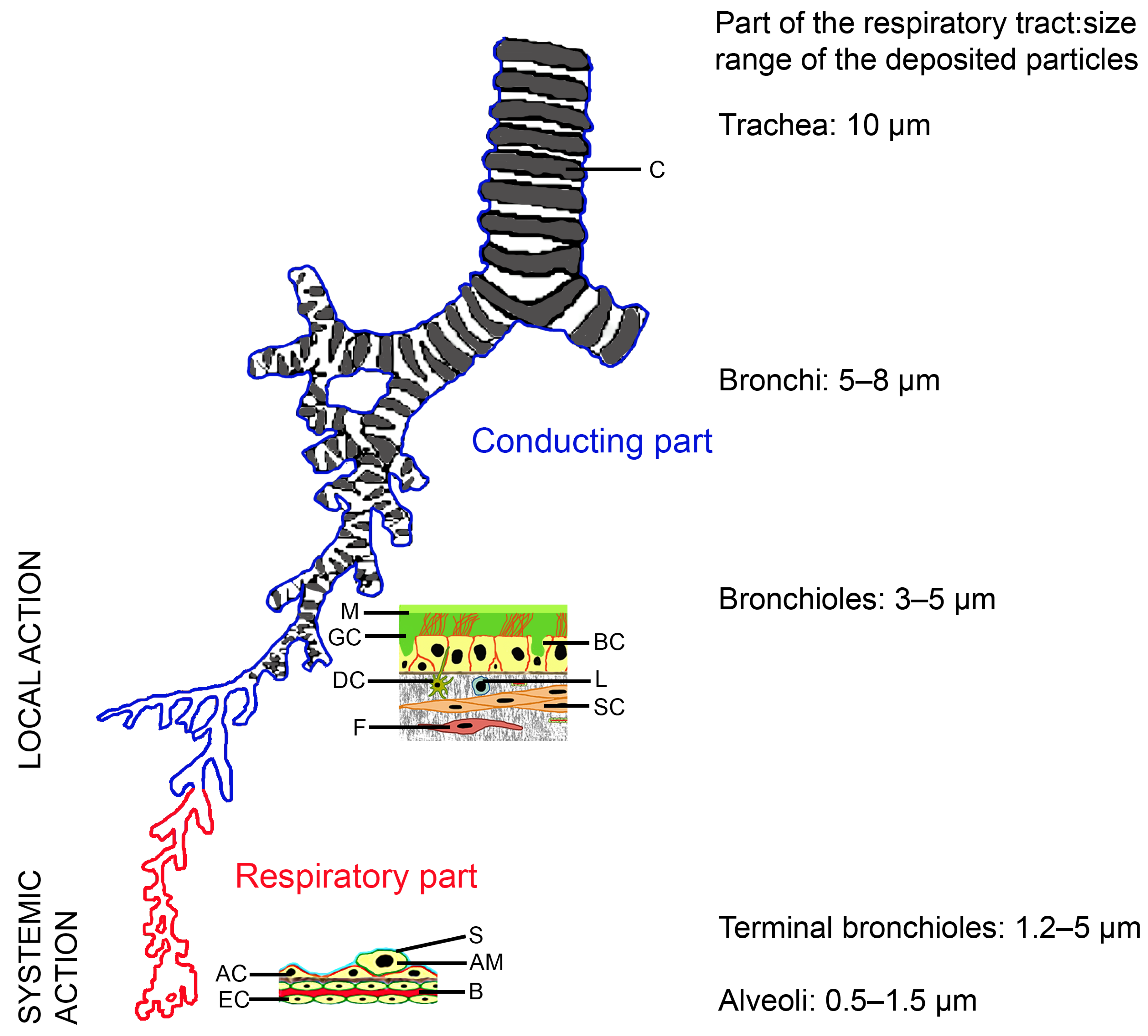
Figure 1. Scheme of the respiratory tract with indication of the air-conducting part and gas-exchanging respiratory part, with indication of particle sizes that were most efficiently deposited in the respective region. Abbreviations: AC, alveolar epithelial cell; AM, alveolar macrophage; B, blood; BC, bronchial epithelial cell; C, cartilage; DC, dendritic cell; EC, endothelial cell; F, fibroblast; GC, goblet cell; L, lymphocyte; M, mucus; S, surfactant; SC, smooth muscle cell. The scheme of the bronchial tract was modified from [4]. Deposited particle sizes were taken from Sankhe [5].
Sci 08 00089 g001
Figure 2. Schematic of particle technologies available enabling co-delivery of APIs to the lungs: (a) co-crystals, (b) co-amorphous systems (COAMSs), (c) co-spray-dried particles, (d) nanoparticle systems (examples: nanocapsules and liposomes incorporating the two APIs and (e) core–shell particles.
Sci 08 00089 g002
Figure 3. Overview of in vitro systems for screening, cell-specific function, and tissue function of pulmonary formulations. Abbreviations: BAL, bronchoalveolar fluid; CBF, ciliary beat frequency; iPSCs, induced pluripotent stem cells; LOC, lung on chip; MCC, mucociliary clearance; BEC, primary bronchial epithelial cells; PCLSs, precision cut lung sections.
Sci 08 00089 g003
Table 1. Overview of advantages and limitations of co-processing technologies.
TechnologyAdvantagesLimitations
COAMSSingle-phase entity; reduced drug dose variability compared to API–API blends;
spray drying is an established method to generate COAMS and simultaneously adjust size; improved manufacturing efficiency (avoid steps like milling and blending).
In addition to dual API administration (synergistic and additive effects), improved solubility, dissolution rate, and bioavailability for poorly soluble APIs.
Formulation challenge: Co-former section–2 APIs with synergistic or additive effect have to match.
Clinical translation–stoichiometric API ratio may not match therapeutic dose requirements. Limited flexibility for independent dose adjustment (during and after manufacturing).
Co-crystalsTwo APIs into one crystal lattice (one single entity);
improved solid-state stability; spray drying is an established method to generate co-crystals and simultaneously adjust size.
Enable multi-pathway therapeutic strategies; improved solubility dissolution rate and bioavailability for poorly soluble APIs; support use of toxicity-limited APIs through co-former selection.
Formulation challenge: Not all APIs form co-crystals; require compatible co-former selection (2 APIs with synergistic or additive effect have to match).
Clinical translation: Requires precise stoichiometric API ratios; ratios do not necessarily correspond to therapeutically relevant doses needed in the lungs; limited dose flexibility.
Co-spray-dried particlesCompatible with standard spray-drying (SD) infrastructure; SD is an established process to generate dry particles for inhalation with tailored size;
potential to combine two drugs with minimal formulation effort and adjustable API ratios (multi-nozzle configuration); allow uniform mixed particle populations within one production step (independent atomization stream).
Improve manufacturing efficiency (avoid steps like milling and blending).
Homogeneous distribution of the 2 APIs; compatibility of the 2 API during co-processing; complex feed formulation design and nozzle design (e.g., three-fluid nozzle) requires vast process parameter adjustment to obtain uniform particle composition;
multi-nozzle systems may lead to particles with inferior aerosol performance.
Nanoparticle systemsVarious advanced strategies in formulation design dependent on nano-formulation approach.
Examples: Targeted delivery via surface functionalization, controlled and sustained release, enhanced cellular uptake, overcoming physiological barriers; encapsulation of multiple APIs within one carrier; sequential drug release from structured nanosystems; allow highly tunable surface properties (charge, hydrophobicity, ligands).
Additional formulation steps required for inhalation suitability.
Nanoparticles to microparticles to be delivered to the lungs; limited clinical translation; device–formulation compatibility; manufacturing scalability; regulatory translation challenges; higher manufacturing complexity associated with higher production cost; scalability of manufacturing processes.
Core Shell particlesSpatial separation of APIs within a single particle; Formulation possibilities—Functionalization and targeting of particles.
E.g., sequential or controlled release, independent tuning of release behavior per compartment;
reduced drug–drug interaction risk during storage;
Multi-material particle architectures resulting in multifunctional particles.
Technically complex particle engineering process.
Material compatibility between core and shell matrices is required.
Often, multi-step manufacturing workflows involved.
Scalability and large-scale manufacturing; production cost.
Table 2. Overview of advantages and limitations of cellular models in the testing of respiratory toxicity.
ModelAdvantagesLimitations
Membrane Culture (ALI)Simple, reproducible, cost-effective; allows barrier integrity measurements (TEER); suitable for inhalation and permeability studies; compatible with high-throughput drug screeningLacks 3D architecture; limited cell–cell and cell–matrix interactions; simplified immune environment
Induced Pluripotent Stem Cell (iPSC)-Derived Lung CellsPatient-specific modeling; genetic disease research; renewable cell source; useful for personalized medicineDifferentiation protocols are complex and variable; limited complexity
Cell-Grown Decellularized Lung ScaffoldsNative extracellular matrix preserved; supports recellularization with multiple lung cell types; closer structural mimic of lung tissueTechnically challenging; incomplete recellularization; scalability issues
Spheroids3D cell–cell interactions; good mimic of gradients (oxygen, nutrients, drugs); relatively easy to generateNo true airway architecture; diffusion limits may cause necrotic core; batch variability; aerosol exposure difficult
Organoids (Airway/Alveolar)Self-organized 3D structures resembling airway or alveolar regions; retain stem cell differentiation capacityLack vascularization and immune complexity; batch variability; technically demanding and costly; aerosol exposure difficult
Lung-on-ChipMicrofluidic systems mimic airflow, vascular perfusion, and mechanical stretch; dynamic modeling of drug responsesHigh technical complexity; expensive; low throughput; requires specialized equipment
Precision-Cut Lung Slices (PCLSs)Preserve native lung architecture, multiple cell types, and extracellular matrix; maintain airway contractility and immune componentsLimited lifespan ex vivo; donor variability; not suitable for long-term chronic studies
Reconstructed Tissue (Engineered Airway Models)Multilayered epithelial structure; useful for toxicology studies; standardized commercial models availableOften lack immune and vascular compartments; limited long-term remodeling capacity
Disclaimer/Publisher’s Note: The statements, opinions and data contained in all publications are solely those of the individual author(s) and contributor(s) and not of MDPI and/or the editor(s). MDPI and/or the editor(s) disclaim responsibility for any injury to people or property resulting from any ideas, methods, instructions or products referred to in the content.