


Abstract
Several long-standing empirical laws in geophysics have recently come under scrutiny, with emerging evidence suggesting that some may be based on misinterpretations of seismic data. These developments have been facilitated by the application of Exploratory Data Analysis (EDA), a statistical approach that emphasizes data-driven discovery over model-driven assumptions. This tutorial review introduces EDA as a practical and reproducible framework for seismic data analysis using the R programming environment. Through selected case studies, I demonstrate how EDA can reveal overlooked patterns, challenge conventional models, and offer new insights into earthquake behavior. The article also outlines key methodological tools, including Principal Component Analysis (PCA) and three-dimensional visualization, and discusses ongoing challenges and future directions for integrating EDA into mainstream seismological research.
1. Introduction
We explore black holes, debate the origins of the universe, and track interstellar objects across vast distances—yet our understanding of the processes unfolding beneath our own feet remains surprisingly limited. Despite the abundance of seismic data, subtle signals preceding earthquakes and the gradual motion of tectonic plates often go undetected. This disconnect between data availability and insight presents a striking paradox in modern geoscience.
Scientific progress is often nonlinear, marked by periods of resistance and eventual paradigm shifts. A well-known example is the theory of continental drift, first proposed by Alfred Wegener in 1912 [1], though earlier hints had been noted by cartographers and naturalists [2]. Despite compelling fossil evidence, Wegener’s ideas were largely dismissed for decades, in the absence of a clear mechanism. Only in the late 1960s did the theory of plate tectonics gain widespread acceptance, following the accumulation of supporting geophysical data [3]. Even then, its adoption varied across regions; for instance, in Japan, the concept gained public attention through popular media in the 1970s [4], but was not fully embraced within academic circles until the 1990s [5].
Today, seismology faces a similar moment of reflection. While the theory of plate tectonics has become foundational, certain anomalies and precursory signals remain insufficiently explained [6]. This suggests that further progress may require not only new data, but also new ways of interpreting it.
In this context, I propose a return to first principles: the independent, assumption-light examination of data through Exploratory Data Analysis (EDA). Over the past year, I have applied this approach to reassess several long-standing empirical laws in seismology, including the Gutenberg–Richter law [7], the Omori–Utsu formula [8], and regional seismic hazard models [9,10,11]. These studies suggest that some widely accepted formulations may warrant re-evaluation in light of empirical inconsistencies. While the implications may appear disruptive, the goal is not to displace established knowledge, but to refine it through transparent, reproducible, and data-driven methods.
This tutorial review introduces EDA as a practical framework for seismic data analysis using the R (version 4.3.0) programming environment. It outlines key techniques, including Principal Component Analysis (PCA) and three-dimensional visualization, and demonstrates how these tools can uncover patterns that challenge conventional assumptions. The aim is to encourage broader adoption of EDA in seismology and to foster a more open, exploratory approach to understanding the Earth’s dynamic behavior.
2. Materials and Methods
The analysis was conducted within an Exploratory Data Analysis (EDA) framework, which emphasizes visual inspection and data-driven model selection to identify structural patterns in complex scientific datasets [12,13]. Earthquake data were obtained from the publicly available catalogues of the Japan Meteorological Agency (JMA) [14,15], with the most recent entries retrieved daily from the JMA website [15]. The study primarily focused on seismic events occurring within the Japanese archipelago and surrounding offshore regions, bounded approximately between 24 and 46° N latitude and 123–146° E longitude. The temporal coverage extends from 1 January 2000 to 31 December 2025, unless otherwise specified in individual analyses.
No magnitude threshold or declustering was applied. This decision was made to preserve the full structure of the data and to avoid introducing selection bias through arbitrary filtering. While this approach may include events below the conventional magnitude of completeness, it allows for the detection of subtle distributional features and potential precursory signals that might otherwise be excluded. The implications of this choice are discussed in Section 3.4.
All computations were performed using the R statistical environment (version 4.3.0) [16], with a key package, rgl. The full R code and data processing scripts used in this study are available via Zenodo [17], ensuring full reproducibility.
3. Results and Discussion
3.1. On Exploratory Data Analysis (EDA)
This study adopts Exploratory Data Analysis (EDA) as a guiding statistical framework [12,13]. EDA aims to uncover the underlying structure of data through direct examination, without imposing strong prior assumptions. As such, it closely aligns with the empirical spirit of the scientific method.
The EDA process begins by acknowledging the analyst’s limited prior knowledge about the data’s distributional form. Rather than fitting data to a predefined model, EDA emphasizes selecting analytical tools based on the observed characteristics of the data itself. A central focus of this approach is the identification of the data’s distribution.
Because all theoretical distributions are mathematically defined, one can generate idealized datasets from candidate distributions and compare them directly to empirical data. A common technique for this purpose is the quantile–quantile (Q–Q) plot, which compares the quantiles of the observed data to those of a reference distribution. If the plotted points align approximately along a straight line, the empirical data is considered consistent with the reference distribution.
A natural starting point in EDA is to test for normality. This is motivated by the Central Limit Theorem, which states that the sum of independent random variables tends to follow a normal distribution under broad conditions. Given the ubiquity of such additive processes in nature, the normal distribution often serves as a useful baseline for initial exploration. An example of a normal Q–Q plot is provided in Appendix A.
3.2. Magnitude Distribution
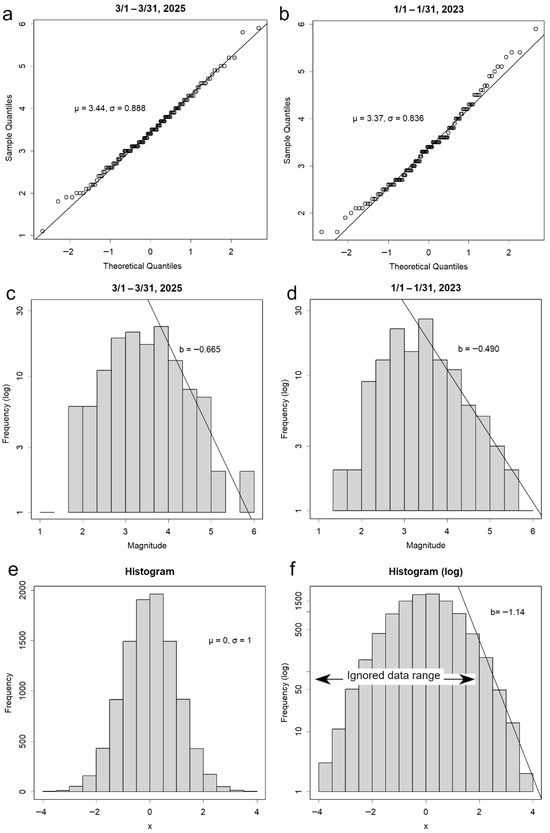
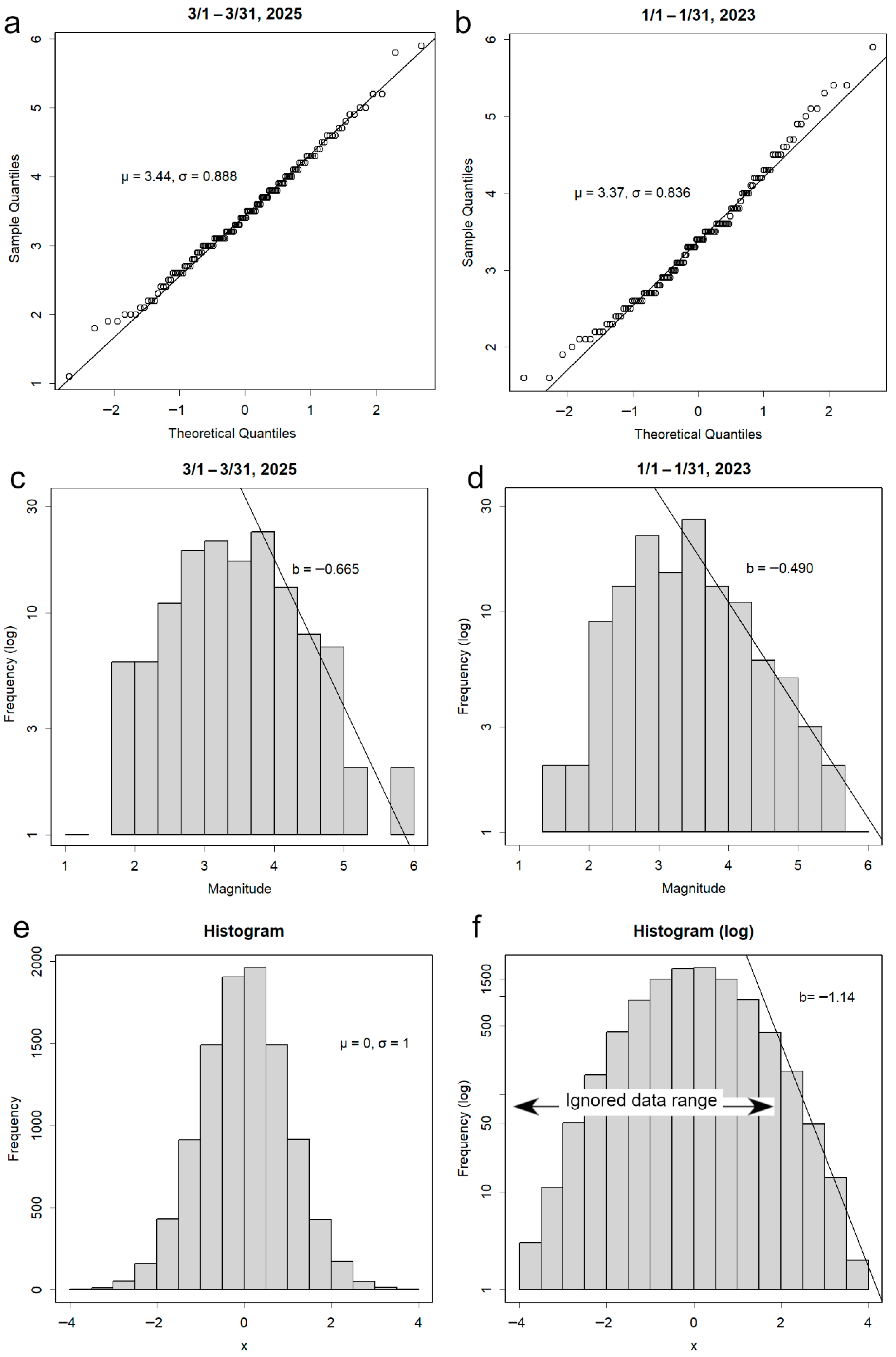
Empirical evidence suggests that earthquake magnitudes are well approximated by a normal distribution. This observation has been independently confirmed across multiple datasets [7] (see Appendix C), and is further illustrated here using two additional examples. As shown in Figure 1a,b, the normal Q–Q plots exhibit near-linear alignment, indicating strong conformity to a normal distribution. This pattern is particularly evident in datasets that are free from major anomalies such as foreshock or aftershock clusters.
Figure 1.
(a): Normal Q–Q plot of earthquake magnitudes from March 2005. (b): Normal Q–Q plot from January 2023. In both cases, sample quantiles are compared with the normal distribution. Both the data exhibit a strong linear relationship, consistent with a normal distribution. Deviations from linearity are observed near the time of major earthquakes [7,11]. Data were obtained from the Japan Meteorological Agency (JMA) [15]. (c,d): Application of the Gutenberg–Richter (GR) law to the magnitude histograms corresponding to panels (a,b), respectively. (e): Histogram of synthetic data generated from a normal distribution. (f): Semi-logarithmic plot of the histogram in panel (e). A straight line is fitted to the right-hand tail of the distribution, mimicking the GR law. However, because the underlying distribution is not truly exponential, this linearity is an artefact of the scaling. The fitted slope corresponds to the b-value in the GR law but is derived from only the largest magnitudes, effectively excluding the majority of the data—including the median—and thereby introducing substantial estimation error.
Importantly, this result is derived from the complete dataset—no data points were excluded [7]. The two parameters of the normal distribution, the location (μ) and scale (σ), are estimated from the intercept and slope of the Q–Q plots. Because the analysis retains all available data, these parameters can be estimated with high precision and tend to remain stable over time, provided no significant seismic disturbances occur.
In contrast, the Gutenberg–Richter (GR) law posits a linear relationship between the logarithm of event frequency and magnitude. When applied to the same datasets (Figure 1c,d), a straight line does appear on a semi-logarithmic plot—but only after excluding a substantial number of lower-magnitude events. Moreover, the estimated b-values vary considerably between two nearly identical distributions, and these values do not correspond directly to the parameters of the normal distribution.
To further investigate the origin of this apparent linearity, I generated synthetic data from a normal distribution. As expected, the histogram displays a bell-shaped curve (Figure 1e). However, when plotted on a semi-logarithmic scale, the right-hand tail appears approximately linear (Figure 1f). This visual effect arises from the transformation itself and does not reflect an intrinsic property of the data. The slope increases with magnitude, revealing that the perceived linearity is an artefact of the scaling rather than a fundamental feature of the distribution.
From both visual and statistical perspectives, the normal distribution offers a more consistent and interpretable representation of earthquake magnitudes. In line with the EDA philosophy, which prioritizes transparency and minimal assumptions, I evaluated the relative performance of the GR and normal models using Akaike’s Information Criterion (AIC) [18,19] (see Appendix B). The AIC results favor the normal model, although visual diagnostics remain central to the interpretive process.
A recurring question from reviewers concerns data selection: “How were the data filtered or excluded?” In this study, I explicitly state that no data points were removed. This decision reflects a commitment to scientific transparency and reproducibility. While filtering based on magnitude completeness is common in seismology, it may inadvertently introduce bias—particularly if used to preserve theoretical expectations. In many scientific disciplines, such practices would warrant caution. In the case of the GR law, the need to systematically exclude lower-magnitude events to maintain linearity raises questions about its robustness as a universal law.
Given that magnitude is a logarithmic measure of seismic energy, a normal distribution of magnitudes implies a log-normal distribution of energy. This form is frequently observed in systems governed by multiplicative processes, suggesting a potentially more realistic framework for modeling earthquake energetics.
Ultimately, the question is not merely statistical, but epistemological: Which model more faithfully represents the observed data—the GR law or the normal distribution? The simplicity and consistency of the normal distribution, combined with its theoretical grounding in the Central Limit Theorem, make it a compelling candidate for re-evaluating seismic magnitude patterns. It is notable that a basic diagnostic tool such as qqnorm(data)—widely used in other scientific fields—has been underutilized in seismology. Broader application of such tools may help uncover patterns that have long remained obscured by conventional assumptions.
3.3. Implications of Recognising a Normal Distribution
The recognition that earthquake magnitudes follow a normal distribution carries important implications for seismic analysis. One immediate benefit is the ability to quantify how typical or atypical a given event is within a specific region by calculating its standardized score (e.g., z-score) relative to the regional distribution. This enables a consistent assessment of the relative extremity of individual events, independent of arbitrary thresholds.
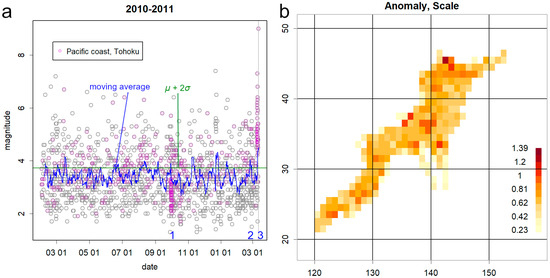
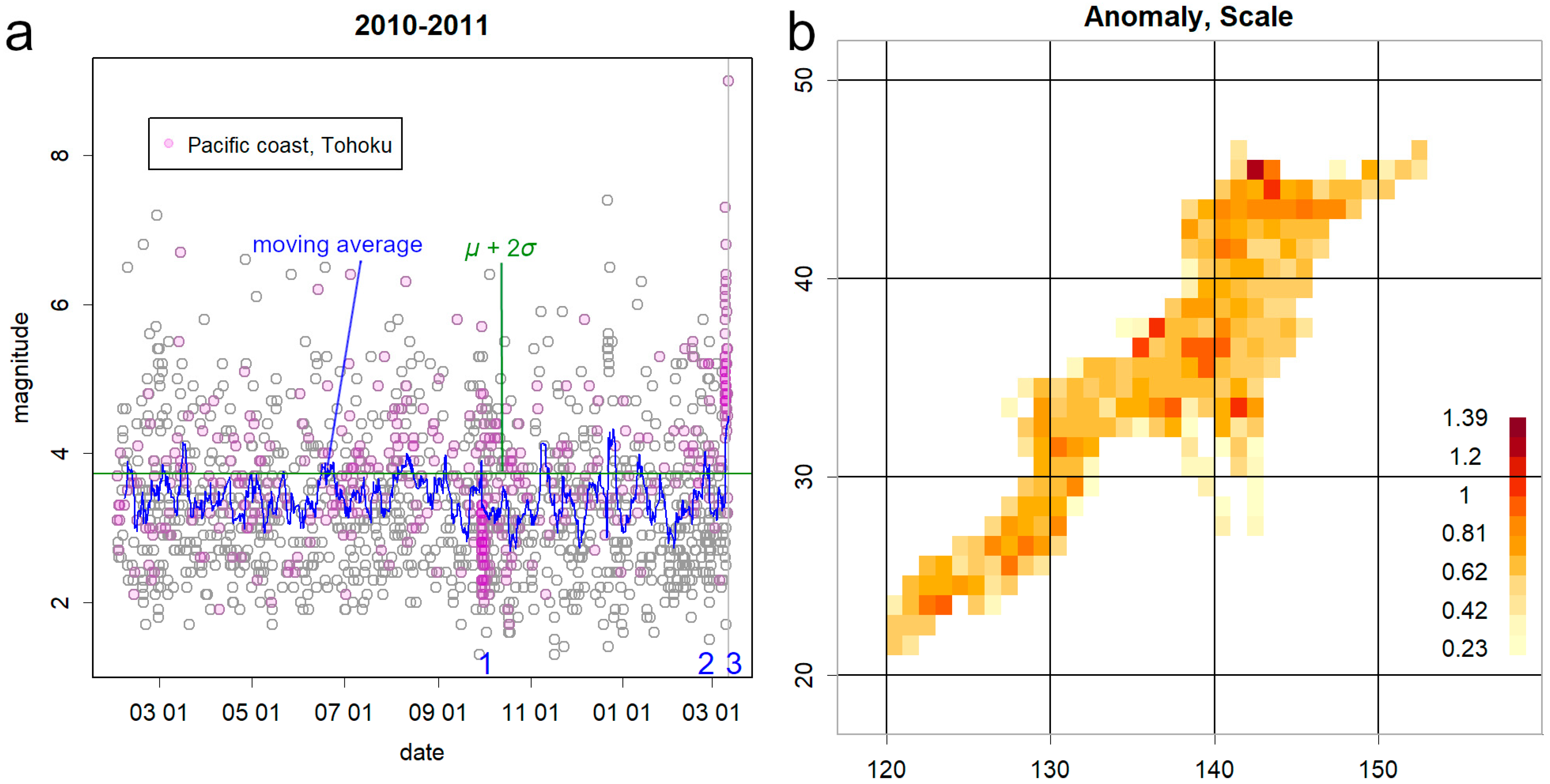
More significantly, this framework allows for the detection of deviations from baseline seismic conditions in the lead-up to major earthquakes. For example, in the months preceding the 2011 Tohoku earthquake, a pronounced precursor swarm was observed. As shown in Figure 2a, the moving average of magnitudes exceeded the 2σ threshold on multiple occasions. In the final days before the mainshock, z-scores surpassed 20—an extreme deviation with a negligible probability under normal conditions. These findings suggest that such anomalies may serve as statistically detectable precursors.
Figure 2.
(a). Time series of earthquake magnitudes at the hypocenter prior to the 2011 Tohoku earthquake, shown with a moving average. Events exceeding the 2σ threshold—calculated from the mean (μ) and standard deviation (σ) of several years of prior data—are highlighted [7]. Although such deviations are statistically rare, multiple exceedances are observed in the months preceding the mainshock. A pronounced precursor swarm is evident immediately before the event. The numbers 1, 2, and 3 are the timings when swarms occurred. (b): Spatial distribution of the magnitude scale (σ) estimated for each 1° × 1° grid cell using data from 2022. Regions with unusually high or low σ values are apparent, indicating potential seismic anomalies [10]. These variations suggest spatial heterogeneity in seismic activity that may not be captured by conventional models.
The assumption of normality also facilitates spatial analysis. By dividing the study area into a one-degree grid in both latitude and longitude, it becomes possible to estimate the local magnitude scale (σ) within each cell. This approach enables the identification of regions exhibiting anomalously high or low seismic variability (Figure 2b) [11]. As anticipated, higher σ values are generally found in tectonically active or structurally complex zones [8], reflecting greater heterogeneity in seismic behavior.
This grid-based method reveals spatial patterns that may remain hidden under conventional models. In several regions, clusters of elevated σ values emerge, potentially indicating areas of heightened seismic hazard or complex fault interactions. The chosen grid resolution of one degree represents a balance between spatial granularity and statistical robustness: finer grids may lack sufficient data for reliable estimation, while coarser grids risk obscuring localized anomalies. For regional-scale analysis in Japan, this resolution offers a practical compromise [10].
3.4. Number of Aftershocks
The temporal decay of aftershock frequency has traditionally been modeled using Omori’s formula, later refined by Utsu [20,21], which posits that aftershock rates decay inversely with time. While this model has been widely adopted, empirical evidence suggests that its core assumption may not consistently hold across observed datasets.
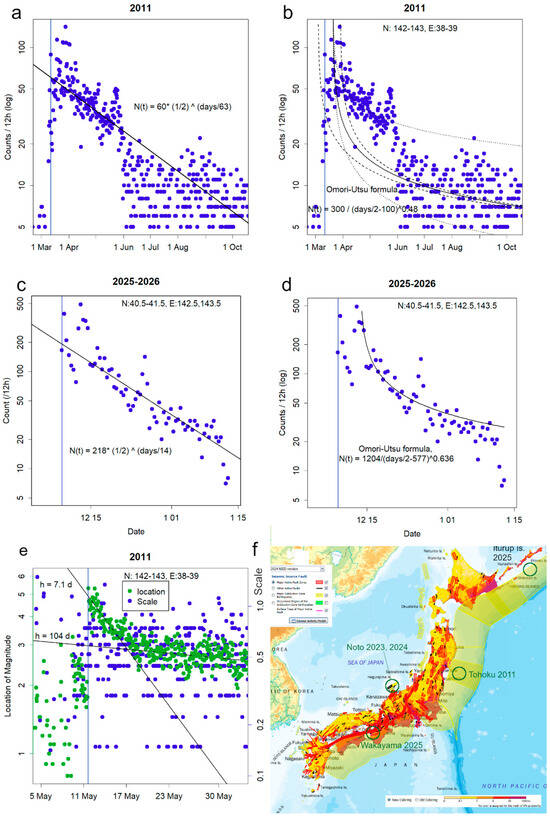
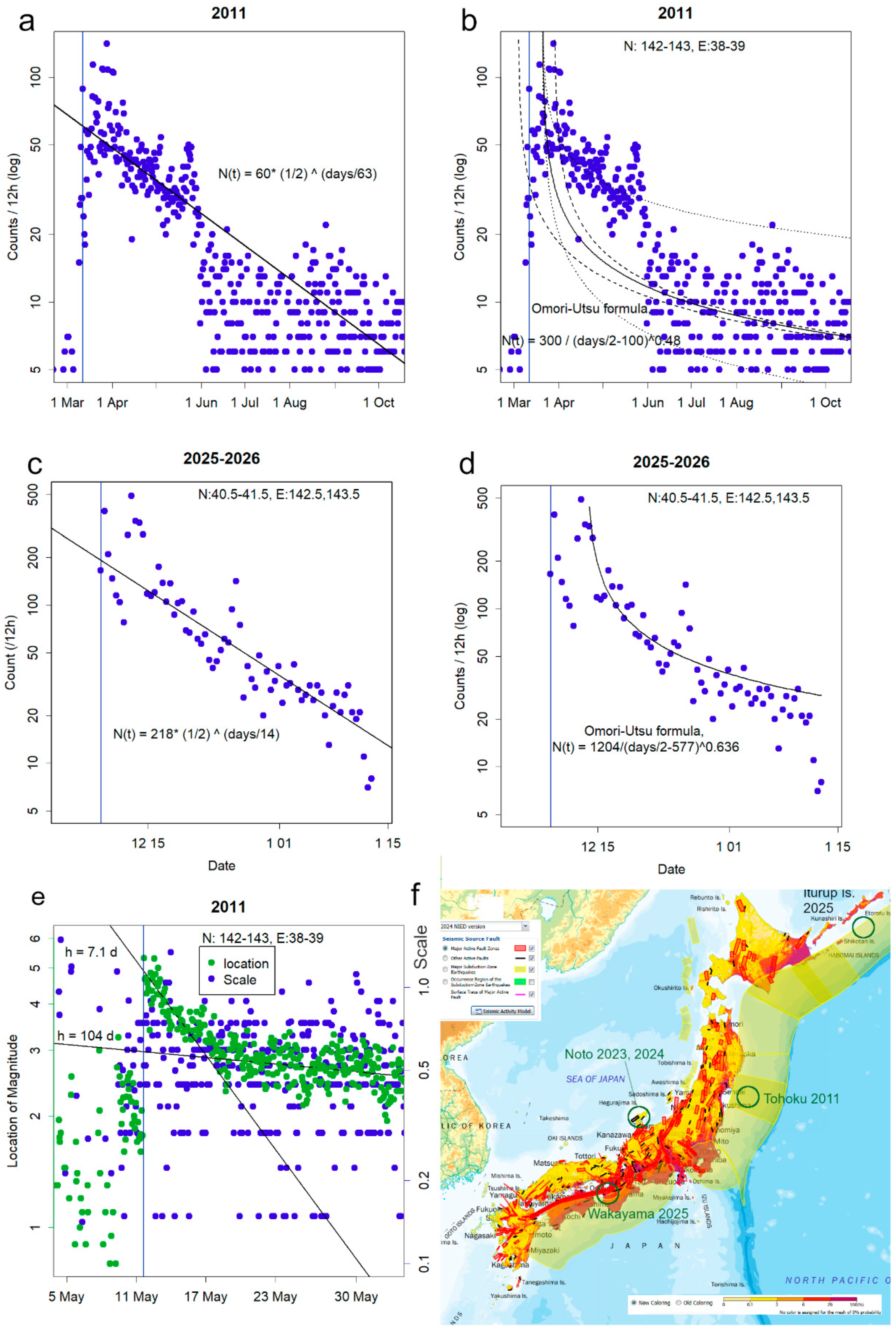
As demonstrated in multiple case studies [8] (see Appendix C) and illustrated here with two representative examples, the observed decay patterns deviate from the expected behavior of the Omori–Utsu model. If the decay followed an inverse power law, the data would be expected to trace a curved trajectory on a log–log plot. However, the actual data exhibit a linear trend on a semi-logarithmic scale (Figure 3a,c), suggesting an alternative underlying process. In contrast, applying the Omori–Utsu model introduces curvature and systematic deviations from linearity (Figure 3b,d) [8]. Despite the model’s flexibility—incorporating three adjustable parameters—no combination successfully reproduces the observed linear decay.
Figure 3.
Decay patterns exhibiting half-life dynamics, based on data from the 2021 Tohoku earthquake, analyzed at a 1° × 1° latitude–longitude grid resolution. (a): Temporal variation in earthquake frequency plotted on a semi-logarithmic scale. The linear trend suggests a first-order decay process. (b): Fit of the Omori–Utsu formula using various parameter settings. The inverse proportionality structure introduces curvature, resulting in deviations from the observed data. (c): Earthquake frequency data for the Sanriku region in 2025, showing a similar decay pattern to panel (a). (d): Application of the Omori–Utsu formula to the data in panel (c), illustrating similar distortions as in panel (b). (e): Temporal variation in the parameters of the normal distribution of magnitudes. Both y-axes are logarithmic; the linear trends indicate first-order decay with distinct half-lives for each parameter. (f): Map of Japan showing the spatial distribution of seismic hazard and the locations referenced in this analysis [22].
In practical terms, fitting the Omori–Utsu model can be challenging. Parameter optimization often yields unstable or non-robust solutions, even when employing established numerical methods such as the Newton–Raphson algorithm. By comparison, the linear model requires only two parameters and can be reliably estimated using standard least squares regression.
These observations suggest that a linear decay on a semi-logarithmic scale may offer a more parsimonious and empirically consistent alternative. Such a pattern is characteristic of first-order processes with well-defined half-lives, analogous to phenomena like radioactive decay or damped oscillations. This raises the possibility that aftershock sequences may reflect relaxation dynamics governed by proportional decay. Clarifying these statistical properties may help elucidate the physical mechanisms underlying seismicity and support the development of simpler, more interpretable models—an approach consistent with the principles of Exploratory Data Analysis (EDA) [12,13]. To complement the visual analysis, I also compared the Omori–Utsu and linear models using Akaike’s Information Criterion (AIC); see Appendix B. The AIC results favor the linear model, supporting its superior balance of fit and simplicity.
An additional observation concerns the temporal evolution of the location parameter (μ) in the Q–Q plots. As shown in Figure 3e, μ increases sharply following a major earthquake and subsequently decays over time in a manner consistent with a half-life process. Interestingly, this decay occurs more rapidly than the corresponding decline in aftershock frequency. Given that both magnitude and frequency distributions exhibit log-normal characteristics, this discrepancy in half-lives may reflect differing underlying mechanisms. It is plausible that the final triggering process—analogous to a “last card” in a cascade—differs between magnitude and timing. To the best of my knowledge, this distinction has not been previously reported. Further investigation into these dynamics may enhance our ability to forecast not only the size of future earthquakes, but also their timing and spatial distribution.
Figure 3f presents the locations of several sites referenced in this study, along with their corresponding seismic hazard levels. These data incorporate information from the J-SHIS database provided by the National Research Institute for Earth Science and Disaster Resilience [22].
3.5. Position of the Boundary
Although focal depths are routinely measured and publicly available, current tectonic models—such as those maintained by the Japan Meteorological Agency (JMA)—are still largely based on interpretations developed in earlier decades [23,24]. This continuity suggests that existing models may not fully reflect the present understanding of the three-dimensional configuration of subduction zones around Japan.
Recent advances in data visualization offer new opportunities to revisit and refine these models. The R statistical environment, while primarily designed for data analysis, supports a wide range of visualization capabilities through its extensive ecosystem of packages. In particular, the rgl package enables interactive three-dimensional rendering of spatial data [25] (see Appendix A).
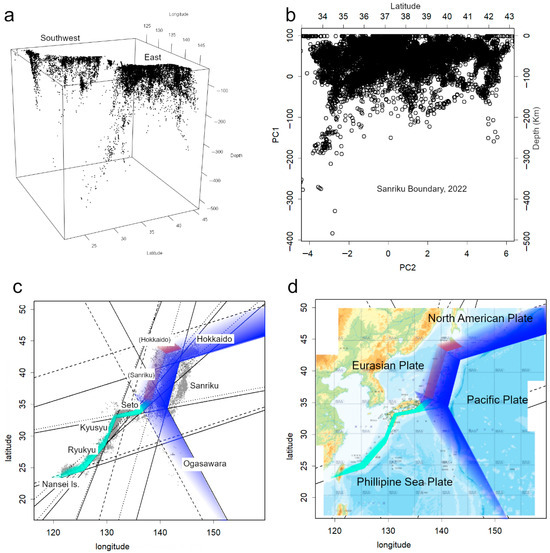
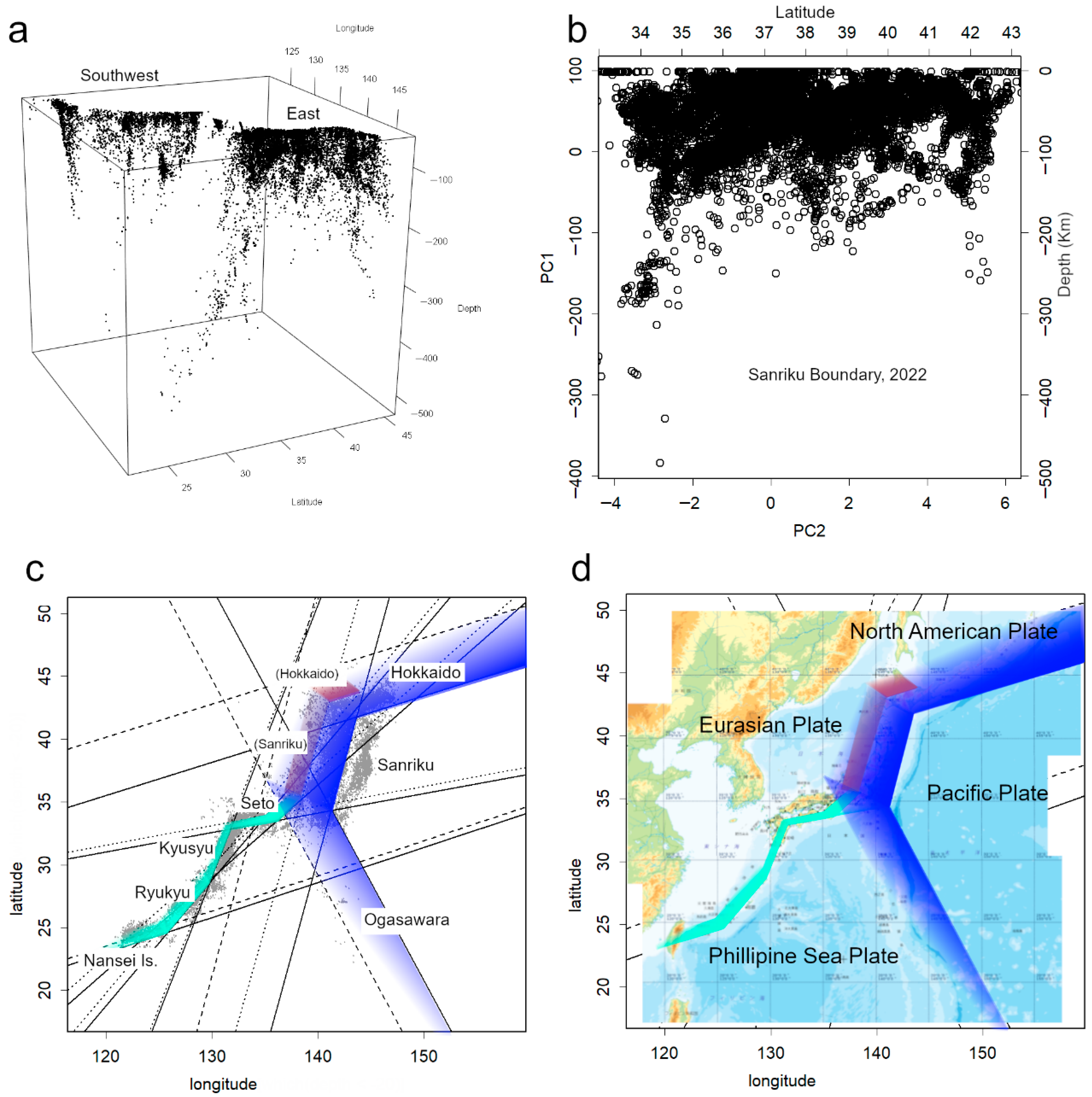
Using this tool, three-dimensional datasets—such as matrices of earthquake hypocenter coordinates (x, y, z)—can be visualized with a single command (Figure 4a). The resulting models are fully interactive, allowing users to rotate, zoom, and explore spatial structures from multiple perspectives. These visualizations can also be exported as standalone HTML files, facilitating broader dissemination and accessibility beyond the R environment [16].
Figure 4.
Three-dimensional visualization of earthquake hypocenters with depth information and plate boundary configuration. (a): Overview of major plate boundaries surrounding Japan. The eastern and southwestern boundaries are connected by the shallow Seto boundary, forming a continuous structure in the 3D visualization (generated using plot3D in R). The figure can be interactively rotated and zoomed within the R environment. The R code used to generate this plot is available in the corresponding publications for reproducibility [17]. (b): Sanriku boundary, representing the central portion of the eastern plate boundary, extracted using Principal Component Analysis (PC1 and PC2). Approximate latitude is shown along the top axis, and depth along the right. An increase in deeper hypocenters is observed prior to major seismic events. (c): Plate boundaries mapped from equations derived via PCA. The solid line indicates the surface (depth = 0 km), while the dashed line represents depth = −400 km. The shallow Seto boundary is plotted at −50 km, and the southwestern boundary at −200 km. Due to their steep dip angles, these boundaries appear narrower in cross-section [8]. Color coding: blue for the eastern boundary, green for the Seto and southwestern boundaries, and brown for shallow seismic zones. (d): Conceptual diagram illustrating the relative positions of tectonic plates around Japan.
Applying this approach to JMA hypocenter data, I constructed a three-dimensional model of seismicity in the region. The resulting visualization reveals the geometry of the subducting plate boundary with greater clarity and resolution than conventional two-dimensional projections. Notably, the observed structure exhibits significant deviations from the standard tectonic models currently in use. These discrepancies highlight the potential value of updating tectonic frameworks using modern data and visualization techniques, which may enhance our understanding of subduction dynamics and seismic hazard assessment [8].
3.6. A Single Boundary as a Tilted Plane
The subducting plate boundary can be approximated as a single tilted plane in three-dimensional space, naturally described by the standard equation of a plane. Earthquake hypocenters located along this surface can be visualized to reveal the geometry of the boundary (Figure 4b,c).
To construct this representation, I applied Principal Component Analysis (PCA) [26,27], a multivariate technique commonly used for dimensionality reduction and pattern recognition. One of PCA’s key strengths lies in its objectivity: it identifies dominant directions of variance in the data without requiring subjective assumptions, making it well-suited for scientific applications. A detailed introduction to PCA is provided in [8], and the implementation in R is concise, requiring only a few lines of code (see Appendix A).
When applied to earthquake hypocenter data—represented by latitude, longitude, and depth—PCA identifies the principal axes of variation in the spatial distribution. The first principal component (PC1) captures the greatest variance and typically aligns with the direction of maximum spatial spread. The second component (PC2), orthogonal to PC1, captures the next most significant variation. Together, PC1 and PC2 define a plane that best fits the distribution of hypocenters. The third component (PC3), orthogonal to both, serves as the normal vector to this plane and captures residual curvature or vertical dispersion.
This PCA-derived plane—here referred to as the boundary plane—provides an objective and reproducible estimate of the subducting plate interface. By projecting hypocenters onto the PC1–PC2 plane, their spatial clustering becomes clearly visible (Figure 4b,c). In the examples shown, PC1 primarily corresponds to depth, while PC2 reflects horizontal variation along the plate interface.
Notably, the intersection of the boundary plane with the Earth’s surface often aligns with shallow, belt-shaped zones of concentrated seismicity (Figure 4d). These shallow seismic zones are likely regions where crustal materials from converging plates are compressed, leading to stress accumulation and frequent shallow earthquakes. For example, the Seto boundary may represent such a zone, where seismicity is concentrated at shallow depths despite the absence of active subduction.
From the orientation and position of the boundary plane, the geometry and extent of the subducting plate can be estimated (Figure 4d). This approach offers a data-driven alternative to traditional tectonic models and may contribute to more accurate representations of plate boundaries in seismically active regions.
3.7. Predictions for Areas Particularly Prone to Earthquakes
Mesh-based and three-dimensional visualization techniques offer complementary perspectives for analyzing seismicity, though effective use requires some familiarity with the tools. Regional variability is a critical factor in seismic hazard assessment. For example, the Noto Peninsula is situated near the complex junction of the Eurasian, Pacific, and Philippine Sea plates, a setting conducive to the formation of shallow seismic zones [28].
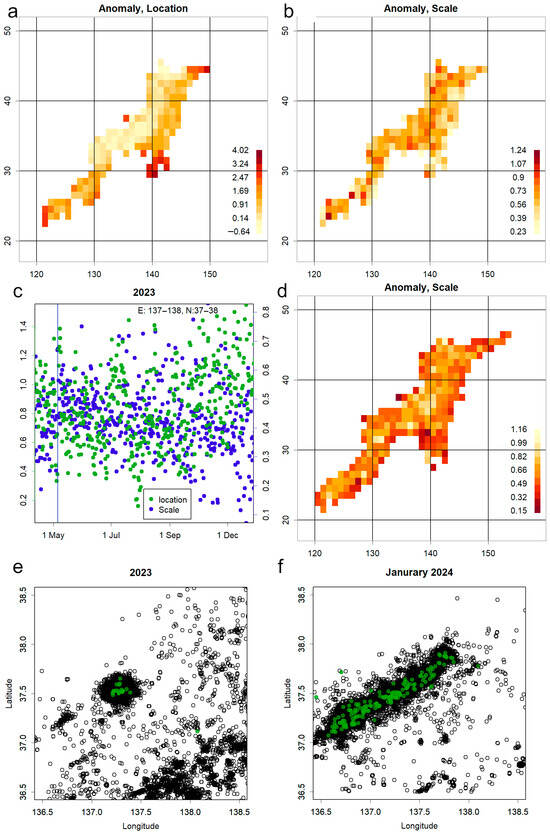
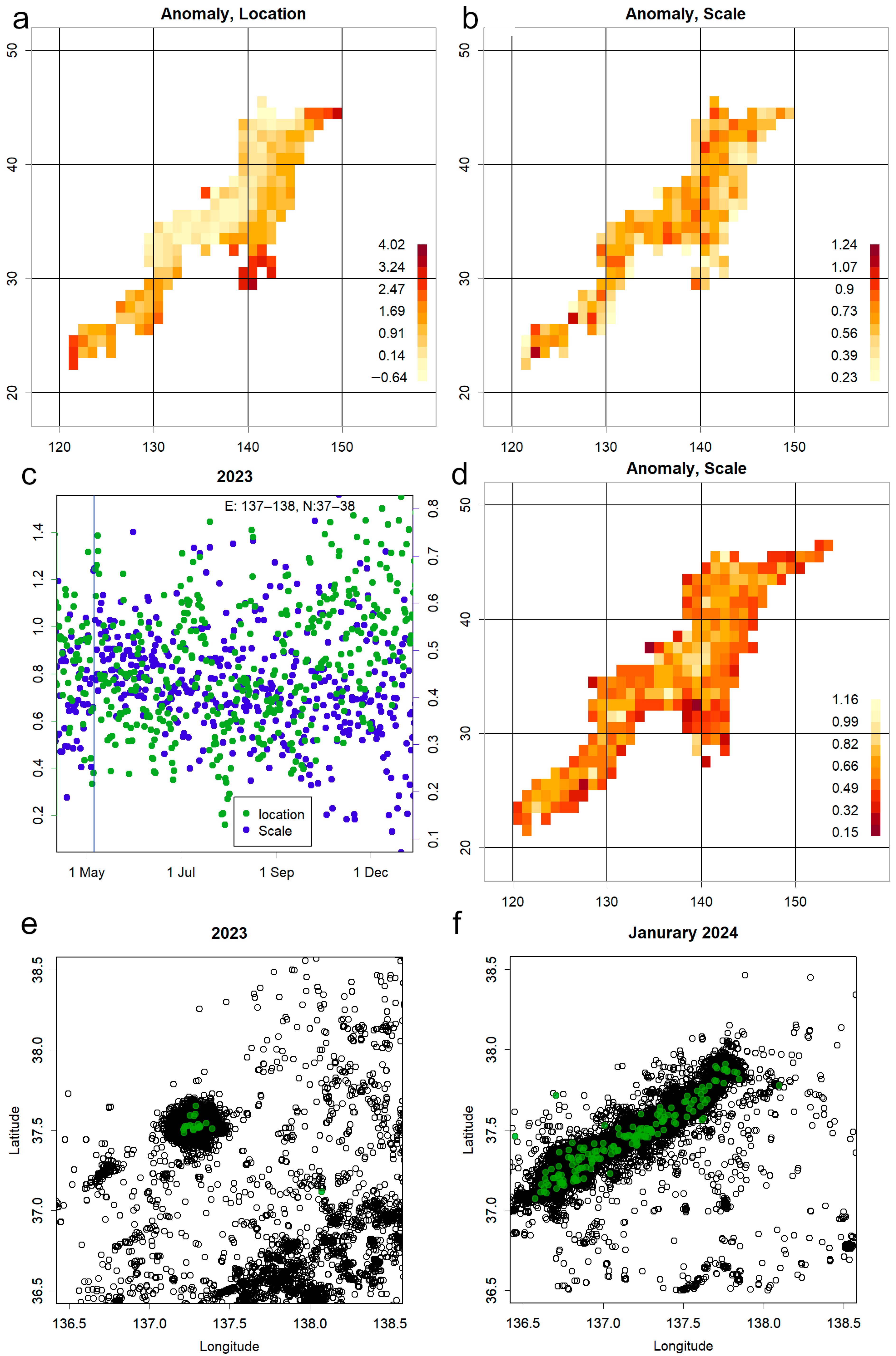
The magnitude 7.6 earthquake that struck the Noto Peninsula on 1 January 2024 [29] was preceded by a notable seismic swarm on 5 May 2023 (M6.5). During this swarm, both the location (μ) and scale (σ) parameters of the magnitude distribution increased. However, these changes were largely driven by the swarm itself. Following the swarm, seismic activity declined, and from October to December 2023, event counts dropped to levels that allowed for clearer detection of magnitude anomalies. During this period, an anomaly was observed primarily in the location parameter (Figure 5a,b).
Figure 5.
Spatiotemporal analysis of magnitude parameters and seismicity in the Noto region. (a): Spatial distribution of the magnitude location parameter (μ) on a 1° latitude grid, based on data from October to December 2023. A pronounced peak is observed in the Noto region. (b): Spatial distribution of the magnitude scale parameter (σ) over the same period. (c): Time series of μ and σ from May 2023 to January 2024 (blue line). Notably, μ began to rise in October, rather than immediately following the M6.5 event on 5 May. (d): Spatial distribution of σ anomalies, with color scale inverted relative to panel (b) to emphasize regions with lower σ values. (e): Epicenter map of the Noto region during the 2023 seismic swarm. (f): Epicenter map of the same region in April 2024, following the M7.6 mainshock. Most hypocenters are shallow (≤20 km). Green circles indicate epicenters with magnitudes greater than 4.0.
How should such conditions be interpreted in terms of seismic risk? First, the region’s proximity to a major plate boundary inherently implies elevated seismic potential. Therefore, even modest anomalies in the location parameter warrant attention. Second, the locator increase during the May 2023 swarm was relatively small: while event counts decreased along two linear trends, magnitudes did not exhibit a corresponding pattern (Figure 5c). In typical mainshock sequences, the locator rises by 2–3 units over several days. In this case, the increase was less than one unit and returned to baseline within a day [8], suggesting that the energy accumulation necessary for a large mainshock may not have been fully realized. The May swarm may not have functioned as a conventional mainshock in terms of energy release.
By October 2023, however, a gradual increase in magnitude was observed, eventually surpassing the levels recorded during the May event (Figure 5c). This trend may indicate a renewed phase of stress accumulation.
Volcanic influences may also play a role in the adjacent offshore region. This sector of the Sea of Japan exhibits elevated locator values [8], and during volcanic episodes at Mount Aso and the Tokara Islands, reductions in σ have been observed [9,10]. A similar decrease in σ was detected west of the Noto Peninsula (Figure 5d). Additional regional indicators—such as fine-silt deposits and low Bouguer gravity anomalies—are consistent with volcanic processes [30].
Following the M7.6 earthquake in January 2024, seismicity initiated in the offshore region and, unlike the localized pattern observed in 2023 (Figure 5e), expanded more broadly around the peninsula (Figure 5f). A plausible interpretation is that the 2024 seismicity was influenced by residual energy from the 2023 swarm, interacting with volcanic-type processes offshore. This interaction may have contributed to the generation of the large mainshock.
These observations suggest that the Noto region functions as both a tectonic convergence zone and an area influenced by volcanic dynamics—two factors that may jointly modulate seismic hazard. While further investigation is needed, integrating tectonic and volcanic indicators may enhance our understanding of complex earthquake-generating environments.
3.8. Several Phenomena That Still Require Future Observations
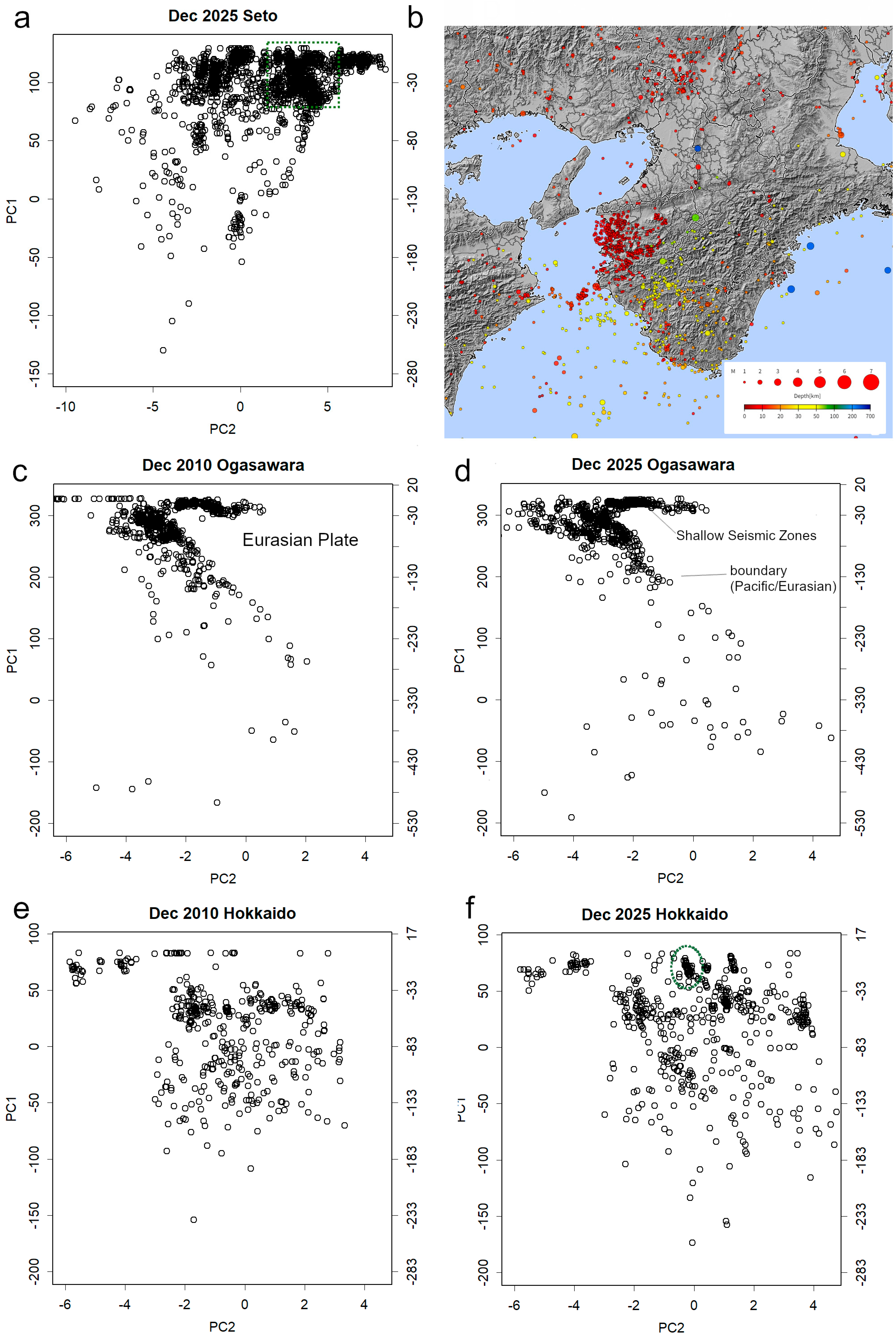
Even when seismic anomalies are detected, their interpretation may remain uncertain. For example, recent data reveal clusters of large, lump-like hypocenters along the Seto boundary (Figure 6a, green), particularly in Wakayama Prefecture at depths of approximately 10–15 km and around 30 km (Figure 6b). This region has exhibited persistently high seismic activity since the 1990s, with consistently elevated event counts. However, no significant anomalies are observed in the magnitude parameters, as large earthquakes remain rare. The nature of this swarm remains unclear. Although the local meteorological observatory has acknowledged the phenomenon, no definitive explanation for its underlying cause has been provided to date [31]. Understanding how to interpret such patterns remains an open question for future research.
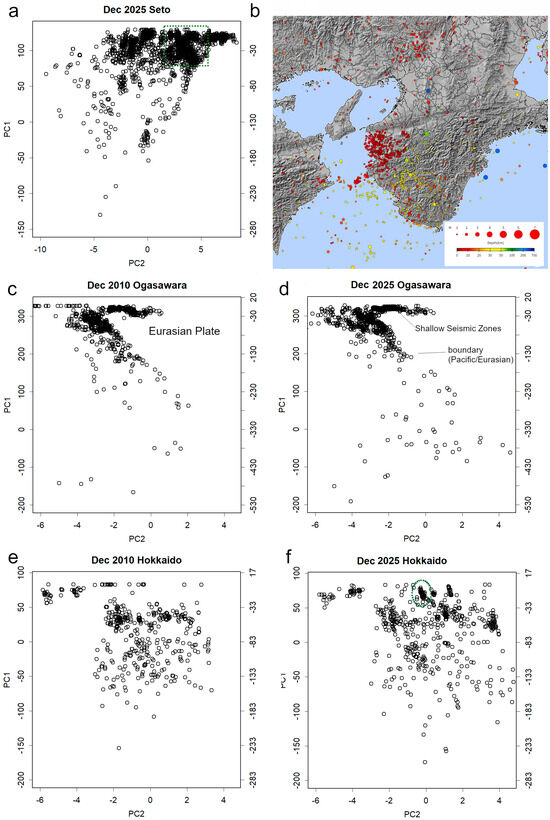
Figure 6.
Seismic activity along major plate boundaries in December 2025, based on recent data. (a): Seto boundary. The Philippine Sea Plate appears to be impeded from subducting beneath the Eurasian Plate due to compressive forces acting from below. This boundary is characterized by compressive stress. The green-outlined cluster in Wakayama Prefecture includes both very shallow hypocenters (<10 km) and moderately shallow ones (~30 km). (b): Hypocenter locations from Japan Meteorological Agency (JMA) [15]. Red indicates depths shallower than 10 km; yellow indicates depths of approximately 30–50 km. (c,d): Ogasawara boundary. When inverted, the orientation aligns with that shown in Figure 4d. The Eurasian Plate lies to the right, with the Philippine Sea Plate in the foreground and the Pacific Plate beyond the hypocenters. A shallow seismic zone is visible in the upper section, connecting to the Sanriku shallow seismic zone and extending beyond the diagram. (c): Data from 2010. (d): Data from 2025, showing a marked increase in very deep earthquakes and widespread seismic activity across the Japanese archipelago. (e,f): Hokkaido boundary. This region is shaped by the subduction of the Pacific Plate beneath the North American Plate. By 2025, seismic activity has intensified, particularly at greater depths. A concentration of shallow earthquakes (green) is also evident, accompanied by elevated magnitude-location (μ) values, suggesting a potential seismic hazard.
Another notable observation occurred in December 2025, when a marked increase in deep-focus earthquakes was recorded along the subduction boundaries Ogasawara (Figure 6c,d) and Hokkaido (Figure 6e,f). For comparison, data from 2010 are also presented. The 2025 activity was characterized by a dispersed distribution across broad regions, with no clear spatial clustering. Due to the considerable depths involved, these events did not result in surface damage. Nevertheless, the sudden increase raises questions about potential changes in the dynamics of the Pacific Plate or other deep-seated processes. Whether this represents a transient fluctuation or a more significant geophysical signal remains to be determined, highlighting the importance of continued monitoring.
Additionally, a concentration of shallow seismic activity has been observed along the Hokkaido boundary (Figure 6f, green), near E147.7°, N44.4°, in the offshore region adjacent to Iturup (Etorofu) Island. This area lies some distance from the Kuril–Kamchatka Trench but is known for frequent seismicity, including a notable event in 2020 [32]. Given its proximity to coastal cities such as Nemuro, Kushiro, and Abashiri, a major earthquake in this region could pose a significant tsunami risk. The geography of the Nemuro and Shiretoko peninsulas, which form prominent capes, may further enhance wave refraction and amplify tsunami impacts. Currently, the magnitude distribution in this area shows an elevated location parameter, while the scale remains stable. Although no immediate conclusions can be drawn, the situation warrants continued vigilance and further investigation.
3.9. Preparing for the Future
As demonstrated throughout this study, the application of modern statistical methods—particularly those grounded in Exploratory Data Analysis (EDA)—has helped to re-evaluate and, in some cases, correct long-standing assumptions in seismology [12,13]. These methods have also contributed to a renewed perspective on earthquake prediction, a task once widely considered infeasible [6]. While inherent uncertainties remain, the results presented here suggest that certain large earthquakes may exhibit detectable precursory signals, making limited forms of anticipation increasingly plausible [11].
For instance, if an event similar in scale to the 2011 Tohoku earthquake were to occur again, the types of anomalies identified in this study—such as shifts in magnitude parameters or spatial clustering—could potentially serve as early indicators [7]. Although such signals do not guarantee precise forecasts, they may offer valuable lead time for risk assessment and preparedness.
The mesh-based observation framework introduced here provides a scalable approach for long-term, wide-area monitoring of seismic activity [10]. In parallel, three-dimensional visualization techniques enhance our understanding of subsurface structures and plate interactions [8]. In the current era, it is increasingly clear that meaningful progress in earthquake forecasting is unlikely without the support of robust statistical analysis. In this context, the limited success of earlier prediction efforts—conducted without such tools—is perhaps understandable.
Nevertheless, significant challenges remain. The true performance of the proposed methods—including their rates of false positives and false negatives—can only be evaluated through sustained application and retrospective validation. Prediction, by its nature, is a forward-looking endeavor that must rely on the best available evidence at any given time. As our understanding of seismic systems deepens and analytical techniques continue to evolve, it is reasonable to expect that predictive accuracy will improve.
Ultimately, the goal is not to eliminate uncertainty, but to reduce it to a level that enables informed decision-making. By embracing data-driven approaches and maintaining a commitment to transparency and reproducibility, the seismological community can move closer to this objective—transforming earthquake prediction from a speculative pursuit into a scientifically grounded discipline.
4. Conclusions
This review has demonstrated that the application of modern statistical methods—particularly those grounded in Exploratory Data Analysis (EDA)—can enhance the accuracy, interpretability, and reproducibility of seismic data analysis. Practical implementations using the R environment were introduced, offering accessible tools for researchers seeking to adopt these approaches.
A key finding is that earthquake magnitudes are well-described by a normal distribution, implying a log-normal distribution for seismic energy. This observation aligns with the behavior of systems governed by multiplicative processes and suggests a need to revisit traditional assumptions. Additionally, both the magnitude location parameter and aftershock frequency exhibit linear decay on logarithmic scales, consistent with first-order relaxation processes characterized by distinct half-lives. The divergence in these half-lives may reflect different underlying physical mechanisms.
Three-dimensional visualization techniques further enable precise mapping of structural boundaries and the spatial organization of seismicity. These tools reveal features that are not readily apparent in conventional two-dimensional analyses and may inform more accurate tectonic models.
Taken together, these findings suggest that several long-standing empirical laws and formulas in seismology warrant careful re-evaluation. While these models have historically provided useful approximations, their limitations become evident when subjected to rigorous statistical scrutiny. The approaches outlined here offer a framework for such reassessment, grounded in transparency, reproducibility, and data-driven reasoning.
At the same time, many aspects of seismic behavior remain poorly understood. This review has highlighted several phenomena—such as deep-focus earthquake clusters and unexplained swarms—that merit further investigation. Continued observation, combined with open methodological innovation, will be essential for advancing our understanding of earthquake processes.
Finally, it is worth noting that the methods presented here are widely used in other scientific disciplines, such as bioinformatics and systems biology, where data complexity demands flexible, assumption-light approaches. Their relative absence in seismology may reflect historical inertia rather than methodological limitations. By embracing these tools, the field has an opportunity to move beyond inherited assumptions and toward a more empirical, reproducible, and transparent scientific foundation.
Science progresses not by preserving tradition, but by continually testing and refining its models. In this spirit, I hope that the approaches discussed in this review will encourage researchers to engage more directly with their data, to question long-held assumptions, and to contribute to a more robust and dynamic understanding of the Earth’s seismic behavior.
Funding
This research received no external funding.
Data Availability Statement
All the data can be downloaded from JMA: https://www.data.jma.go.jp/eqev/data/gaikyo/ (accessed on 2 March 2026). R code can be downloaded from Zenodo at https://zenodo.org/records/17983156 (accessed on 2 March 2026).
Conflicts of Interest
The author declares no conflicts of interest.
Abbreviations
The following abbreviations are used in this manuscript:
| EDA | Exploratory Data Analysis |
| JMA | Japan Meteorological Agency |
| GR | Gutenberg–Richter |
| PCA | Principal Component Analysis |
Appendix A. R Codes Used in This Text
Appendix A.1. About R
Effective data analysis requires a basic understanding of statistics and access to appropriate computational tools. While Excel is widely used, it is not well-suited for statistical analysis. Fortunately, many statistical packages are available. I recommend R, a free and open-source environment supported by a vibrant and helpful community. The latest version can always be downloaded from the CRAN website [16].
Using R does require some programming, but I encourage learning it in parallel with statistics—this is how I teach my students. Statistical study often involves tedious calculations, which R can handle efficiently, allowing learners to focus on interpretation rather than arithmetic. And if you get stuck, just ask online—someone will almost certainly help. That is the power of a supportive community.
That said, Excel remains convenient for data handling. You can prepare your dataset in Excel, then export it as a text-based file and import it into R using
data <- ead.table(file = “xxx.txt”, sep = “\t”, header = TRUE)
This command stores the file contents in an object called data. In R, although the equals sign (=) is also accepted, assignment is typically indicated with->or <-To treat the data as a matrix, simply apply
data <- as.matrix(data)
All necessary R code is available at zendo [17].
Appendix A.2. Normal Q–Q Plot
Exploratory Data Analysis (EDA) selects models based on the intrinsic characteristics of the data, rather than imposing assumptions a priori. As such, identifying the underlying distribution is a fundamental first step. Given the Central Limit Theorem, many natural phenomena tend to follow a normal distribution. It is therefore essential to assess whether the normal distribution is an appropriate model for the data at hand.
R provides a remarkably simple and effective tool for this purpose. The following command generates a Q–Q plot to visually assess normality:
qqnorm(data)
This plot compares the quantiles of the observed data with those of a theoretical normal distribution. If the data are approximately normally distributed, the points will align closely along a straight line. This visual diagnostic is a cornerstone of EDA and serves as a powerful first check before applying more complex models. Just this one line. If you set this data to magnitude data, the result will surely be a straight line (Figure 1a,b). This is the simplest way to realise a Q–Q plot [16,17]. To do this a little more carefully,
ideal <- qnorm(ppoints(length(data)))
This means: prepare probability points (ppoints) equal to the length of the data, find the corresponding quantiles from the normal distribution (qnorm), and store them in an object called ideal. By comparing this with the sorted data and plotting it, we can compare the quantiles of the data with those of the normal distribution.
plot(ideal, sort(data))
Adding
z <- line(sort(data)~ideal)
abline(coef(z))
draws a line of best fit (abline). Using coef(z) to extract the coefficients gives the slope as an estimate of the data’s scale σ, and the intercept as an estimate of the location μ. If you forget R functions, execute `?line’. A tutorial will appear immediately.
Appendix A.3. Semi Log Plot
To examine the relationship between two numeric vectors, a and b, a standard scatter plot can be generated in R using
plot(a, b)
If you wish to display the y-axis on a logarithmic scale (i.e., a semi-log plot), simply specify the log argument as follows:
plot(a, b, log = “y”)
To apply logarithmic scaling to both axes, use
plot(a, b, log = “xy”)
These simple commands allow for flexible visualization of data with exponential or power-law characteristics, and are particularly useful when exploring relationships such as aftershock decay or magnitude–frequency distributions.
Appendix A.4. Position of the Boundary
Although focal depths are routinely measured, the Japan Meteorological Agency (JMA) has continued to rely on outdated models of the tectonic plates surrounding Japan, based on submissions from years past [23,24]. This persistence highlights a lack of understanding of the current three-dimensional tectonic configuration.
Fortunately, this issue can be addressed with relative ease using R. While R’s core functionality supports many types of analysis, it also offers a rich ecosystem of specialized packages—known as libraries—for more advanced tasks. One particularly useful package for 3D visualization is rgl [25]. To install it, simply run
install.packages(“rgl”)
This downloads the package from a CRAN mirror and integrates it into your R environment—a testament to the community’s generosity, as maintaining such packages requires significant effort. Once installed, load the library with
library(rgl)
To visualize three-dimensional data (e.g., a matrix with three column vectors representing x, y, and z coordinates), use
plot3d(data)
This displays a 3D plot in the R console (Figure 4a). To export it as an interactive HTML widget, use
rglwidget()
This allows you to save and share the visualization with others [8].
Using this approach, I was able to visualise the distribution of earthquake hypocenters, revealing the actual position of the plate boundary—a structure that had long been misrepresented.
Appendix B. Verification Using Akaike’s Information Criterion
Exploratory Data Analysis (EDA) typically avoids heavy reliance on formal hypothesis testing, as many such tests depend on unvalidated assumptions that may compromise scientific objectivity. Instead, EDA emphasizes the generation of results that can be clearly visualized, operating under the principle that visually discernible patterns often provide more reliable evidence than statistical significance alone.
This philosophy also applies when comparing competing models. In this paper, Figure 1 visually contrasts the distribution of earthquake magnitudes under the assumption of a normal distribution versus the Gutenberg–Richter (GR) law. The difference is, in my view, striking. Similarly, Figure 3 compares the decay of aftershock frequency using a half-life model versus the classical Omori formula, again revealing a substantial divergence.
Nevertheless, given the historical acceptance of the GR law and Omori’s formula—both of which have been widely cited for nearly a century—some readers may remain skeptical of alternative formulations unless supported by quantitative evidence. To address this, I apply Akaike’s Information Criterion (AIC) [18], a well-established and widely trusted method for model comparison that accounts for both model fit and complexity.
AIC evaluates models based on the maximized value of the likelihood function, penalized by the number of parameters. While it does not provide an absolute measure of model quality, it allows for relative comparison: the model with the lower AIC is considered to offer a better balance between goodness-of-fit and parsimony.
In this study, I use the formulation of AIC based on the residual sum of squares (RSS), as described in [19]. AIC = n ln (RSS/n) + 2k, where is the number of data points and is the number of model parameters.
The computed AIC values for each model are as follows:
| n | RSS | k | AIC | |
| Figure 1c (Normal) | 14 | 0.68 | 2 | −38.4 |
| Figure 1c (GR law) | 14 | 18.56 | 2 | 1.2 |
| Figure 1c (GR law) M > 3.3 | 7 | 0.05 | 3 | −29.0 |
| Figure 1d (Normal) | 14 | 0.07 | 2 | −55.1 |
| Figure 1d (GR law) | 14 | 8.79 | 2 | 1.1 |
| Figure 1d (GR law) M > 3.3 | 7 | 0.05 | 3 | −4.2 |
| Figure 3a (linear) | 97 | 2.3 | 2 | −604 |
| Figure 3b (Omori) | 97 | 121.6 | 3 | 26 |
| Figure 3c (linear) | 60 | 1.3 | 2 | −225 |
| Figure 3d (Omori) | 60 | 2.1 | 3 | −195 |
When estimating a normal distribution for magnitude, it is possible to compute the residual sum of squares (RSS) using, for example, a quantile–quantile (QQ) plot, which yields a very small AIC. However, in accordance with the principles of AIC, the input data must be standardized. To ensure consistency with the GR law, the calculation was instead based on histogram representations.
In Figure 1c (Normal), the RSS was calculated from the difference between the histogram of the observed (non-logarithmic) magnitudes and a fitted normal distribution, using the scale and locator derived from Figure 1a. To maintain consistency of units with the GR law, logarithmic transformation was applied to both the observed and model distributions.
Figure 1c (GR law) shows the relationship between the logarithmic histogram and the fitted GR line. Figure 1c (GR law, M > 3.3) presents the same comparison, restricted to magnitudes above 3.3. While the RSS decreases under this constraint, the resulting AIC remains higher than that of the normal distribution. A similar pattern is observed in Figure 1d.
In Figure 3a (linear), the AIC is calculated from the slope of a semi-log plot and the RSS of the observed aftershock decay. Figure 3b applies the same method using semi-logarithmic values. In both cases, the linear model yields a lower AIC. This trend continues in Figure 3c,d. The Omori–Utsu equation, with its three parameters, presents challenges in optimization; the best-fit values were estimated using the Newton method. In contrast, the linear model parameters were obtained automatically via robust least squares using the line function in R.
It is important to note, however, that AIC is itself based on assumptions and is not an absolute measure of model validity. While widely used, it remains a proposal by a single statistician and is not immune to critique. In particular, I believe the penalty term for model complexity may be too lenient, especially when parameters are derived from unverifiable assumptions. This can undermine scientific validity.
This is precisely why EDA emphasizes parsimony and visual interpretability. In this context, I argue that the Omori–Utsu formula, with its higher parameter count and reliance on theoretical assumptions, should be subject to a more substantial penalty. Ultimately, numerical criteria such as AIC can inform model selection, but they do not guarantee objectivity. In many cases, the clarity of visualized differences may offer more compelling evidence. In this study, I believe the contrast between Figure 3c,d illustrates this point more effectively than the AIC values alone.
Appendix C. Examples of Evidences Presented to Date Regarding GR Kaw and the Omori–Utsu Formula
Appendix C.1. GR-Law
Appendix C.2. Formula for Omori–Utsu
References
- Wegener, A. Die Entstehung der Kontinente. Geol. Rundsch. 1912, 3, 276–292. [Google Scholar] [CrossRef] [Scilit]
- Romm, J. A new forerunner for continental drift. Nature 1994, 367, 407–408. [Google Scholar] [CrossRef] [Scilit]
- Frankel, H. Plate Tectonics. In The Cambridge History of Science: Volume 6: The Modern Biological and Earth Sciences; Bowler, P.J., Pickstone, J.V., Eds.; The Cambridge History of Science; Cambridge University Press: Cambridge, UK, 2009; Volume 6, pp. 383–394. [Google Scholar]
- Komatsu, S. Japan Sinks; Kobunsha: Tokyo, Japan, 1973. [Google Scholar]
- Tomari, J. Rejection and Acceptance of Plate Tectonics; University of Tokyo: Tokyo, Japan, 2017. [Google Scholar]
- JMA. About Earthquake Prediction. Available online: https://www.jma.go.jp/jma/kishou/know/faq/faq24.html (accessed on 2 March 2026).
- Konishi, T. Seismic pattern changes before the 2011 Tohoku earthquake revealed by exploratory data analysis. Interpretation 2025, 13, T725–T735. [Google Scholar] [CrossRef] [Scilit]
- Konishi, T. Visualising Earthquakes: Plate Interfaces and Seismic Decay. Trends Ecol. Indoor Environ. Eng. 2025, 4, 45–59. [Google Scholar] [CrossRef] [Scilit]
- Konishi, T. Earthquake Swarm Activity in the Tokara Islands (2025): Statistical Analysis Indicates Low Probability of Major Seismic Event. GeoHazards 2025, 6, 52. [Google Scholar] [CrossRef] [Scilit]
- Konishi, T. Identifying Seismic Anomalies through Latitude-Longitude Mesh Analysis. Preprints 2025. [Google Scholar] [CrossRef]
- Konishi, T. Exploratory Statistical Analysis of Precursors to Moderate Earthquakes in Japan. GeoHazards 2025, 6, 82. [Google Scholar] [CrossRef] [Scilit]
- Tukey, J.W. Exploratory Data Analysis; Addison-Wesley Pub. Co.: Reading, MA, USA; London, UK, 1977. [Google Scholar]
- NIST/SEMATECH. E-Handbook of Statistical Methods. Available online: http://www.itl.nist.gov/div898/handbook (accessed on 2 December 2025).
- JMA. List of Epicenter Location. Available online: https://www.data.jma.go.jp/eqev/data/daily_map/index.html (accessed on 2 December 2025).
- JMA. Earthquake Monthly Report (Catalog Edition). Available online: https://www.data.jma.go.jp/eqev/data/bulletin/hypo.html (accessed on 2 November 2025).
- R Core Team. R: A Language and Environment for Statistical Computing; R Foundation for Statistical Computing: Vienna, Austria, 2025. [Google Scholar]
- Konishi, T. R-Codes Used in Earthquake-Studies. Available online: https://zenodo.org/records/17983156 (accessed on 25 December 2025).
- Akaike, H. A new look at the statistical model identification. IEEE Trans. Autom. Control. 1974, 19, 716–723. [Google Scholar] [CrossRef] [Scilit]
- Burnham, K.P.; Anderson, D.R. Model Selection and Multimodel Inference: A Practical Information-Theoretic Approach, 2nd ed.; Springer: Berlin/Heidelberg, Germany, 2010. [Google Scholar]
- Omori, F. On the After-Shocks of Earthquakes. Available online: https://repository.dl.itc.u-tokyo.ac.jp/records/37571 (accessed on 2 December 2025).
- Utsu, T. Magnitude of earthquakes and occurance of their aftershocks. J. Seismol. Soc. Jpn. 2nd Ser. 1957, 10, 35–45. [Google Scholar] [CrossRef] [Scilit]
- National Research Institute for Earth Science and Disaster Resilience. J-SHIS Japan Seismic Hazard Information. Available online: https://www.j-shis.bosai.go.jp/map/?lang=en (accessed on 2 December 2025).
- Barnes, G.L. Origins of the Japanese Islands: The New “Big Picture”. Jpn. Rev. 2003, 15, 3–50. Available online: https://nichibun.repo.nii.ac.jp/record/260/files/IJ1501.pdf (accessed on 2 December 2025).
- JMA. Nankai Trough Earthquake. Available online: https://www.jma.go.jp/jma/kishou/know/jishin/nteq/index.html (accessed on 2 December 2025).
- Murdoch, D.; Adler, D.; Nenadic, O.; Urbanek, S.; Chen, M.; Gebhardt, A.; Bolker, B.; Csardi, G.; Strzelecki, A.; Senger, A.; et al. Rgl: 3D Visualization Using OpenGL. Available online: https://cran.r-project.org/web/packages/rgl/index.html (accessed on 2 December 2025).
- Jolliffe, I.T. Principal Component Analysis; Springer: Berlin/Heidelberg, Germany, 2002. [Google Scholar]
- Konishi, T. Principal component analysis for designed experiments. BMC Bioinform. 2015, 16, S7. [Google Scholar] [CrossRef] [Scilit] [PubMed]
- JMA. Related Information on the 2024 Noto Peninsula Earthquake. Available online: https://www.jma.go.jp/jma/menu/20240101_noto_jishin.html (accessed on 2 December 2025).
- Konishi, T. Seismicity of the Noto Peninsula: Spatial Patterns, Shallow Zones, and Possible Volcano-Related Signals. Preprints 2026. [Google Scholar] [CrossRef]
- Geological Survey of Japan. Seamless Geoinformation of Coastal Zone “Northern Coastal Zone of Noto Peninsula”. Available online: https://www.gsj.jp/researches/project/coastal-geology/results/s-1.html (accessed on 2 December 2025).
- Wakayama Local Meterological Office. Characteristic Earthquakes in Wakayama Prefecture and Surrounding Areas. Available online: https://www.data.jma.go.jp/wakayama/bousai/phenomenon/tokuchoutekinajishin.html (accessed on 25 December 2025).
- The Headquarters for Earthquake Research Promotion. Long-Term Assessment of Seismic Activity Along the Kuril Trench. Available online: https://www.jishin.go.jp/main/chousa/kaikou_pdf/chishima3.pdf (accessed on 2 December 2025).
Disclaimer/Publisher’s Note: The statements, opinions and data contained in all publications are solely those of the individual author(s) and contributor(s) and not of MDPI and/or the editor(s). MDPI and/or the editor(s) disclaim responsibility for any injury to people or property resulting from any ideas, methods, instructions or products referred to in the content. |
© 2026 by the author. Licensee MDPI, Basel, Switzerland. This article is an open access article distributed under the terms and conditions of the Creative Commons Attribution (CC BY) license.