Article

Hexane Fraction of Cinnamomum verum Leaves Induces Apoptosis-like Cell Death in Leishmania amazonensis


by
Caroline Martins Jesus
1,2,†,
Fernanda Farias Costa
1,2,†,
Louriane Nunes Gomes
1,
Luis Douglas Miranda Silva
3,
Yaron Santos Alencar
2,
Richard Pereira Dutra
1,4,
Cláudia Quintino da Rocha
5,
Lucilene Amorim Silva
2,6,* and
Aramys Silva Reis
1,2,*
1
Graduate Program in Health and Technology, Center for Sciences of Imperatriz, Federal University of Maranhão, Imperatriz 65915-240, Maranhão, Brazil
2
Laboratory of Pathophysiology and Therapeutic Investigation, Medical School, Center for Sciences of Imperatriz, Federal University of Maranhão, Imperatriz 65915-240, Maranhão, Brazil
3
Graduate Program in Health Sciences, Center for Biological and Health Sciences, Federal University of Maranhão, São Luís 65080-805, Maranhão, Brazil
4
Laboratory of Natural Products Chemistry, Undergraduate Program in Natural Sciences, Center for Sciences of Imperatriz, Federal University of Maranhão, Imperatriz 65915-240, Maranhão, Brazil
5
Department of Chemistry, Center for Exact Sciences and Technology, Federal University of Maranhão, São Luís 65080-805, Maranhão, Brazil
6
Department of Pathology, Center for Biological and Health Sciences, Federal University of Maranhão, São Luís 65080-805, Maranhão, Brazil
*
Authors to whom correspondence should be addressed.
These authors contributed equally to this work.
Submission received: 5 December 2025 / Revised: 27 February 2026 / Accepted: 17 March 2026 / Published: 1 April 2026
(This article belongs to the Special Issue One Health)

Abstract

Leishmaniasis is a serious public health issue, but current treatments have significant adverse effects. Although the leishmanicidal potential of Cinnamomum verum (cinnamon) bark is well known, the therapeutic potential of its leaves for leishmaniosis is still unclear. Through an in vitro study, we found that the hexane fraction of C. verum leaves had significant cytotoxic effects on L. amazonensis promastigotes (IC50 = 15.43 µg/mL) and amastigotes (IC50 = 16.6 µg/mL), whereas the hydroalcoholic extract and the more polar fractions did not show any effect. The fraction was highly selective against the parasite and induced apoptosis-like cell death, whereas the standard drug, pentamidine, promoted necrosis-like cell death. We suggest that this effect is due to the chemical composition of the fraction, which is rich in phytol and hexadecanoic acid. Our findings indicate the therapeutic potential of the hexane fraction of C. verum leaves for the treatment of leishmaniasis.

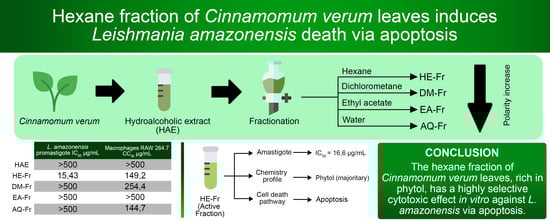
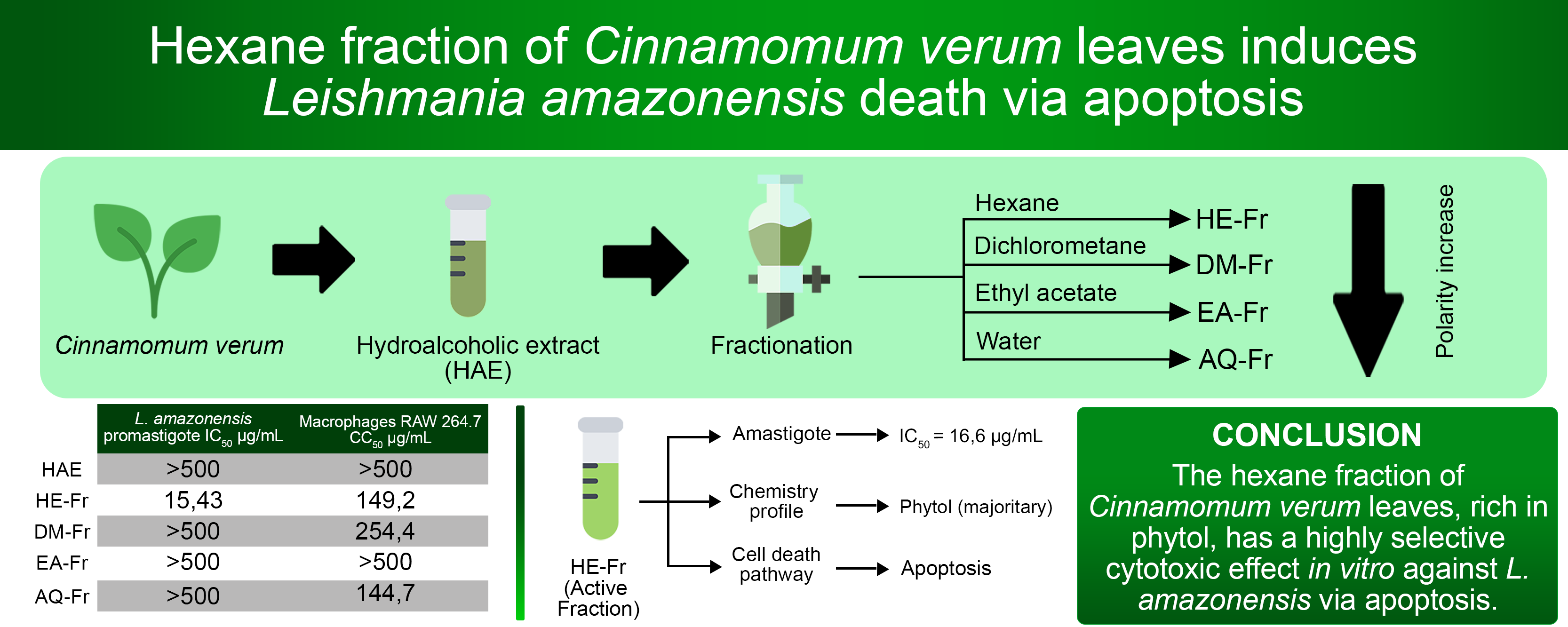
Graphical Abstract

1. Introduction

Leishmaniasis is a neglected disease and a major public health concern. It manifests as cutaneous lesions, known as tegumentary leishmaniasis (TL), or as severe systemic involvement, characteristic of leishmaniasis (VL) [1,2]. In Brazil, the main etiological agents of TL are Leishmania (Viannia) braziliensis, Leishmania (Leishmania) amazonensis, and Leishmania (Viannia) guyanensis [3]. Current therapeutic options remain limited and are associated with high toxicity, significant adverse effects, and emerging drug resistance [4].
These limitations underscore the urgent need to identify and develop new pharmacologically active compounds.
Plant species such as Cinnamomum verum J.S. Presl (Lauraceae, synonym Cinnamomum zeylanicum), commonly known as cinnamon, represent important sources of bioactive compounds [5,6]. However, most studies on C. verum have focused on the chemical characterization and biological activity of its essential oils, including antileishmanial activity [7,8,9]. In contrast, the biological activity of its nonvolatile constituents remains poorly explored. For example, Maleki et al. (2017) [10] reported that the methanolic extract of C. verum stems inhibits the growth of promastigote forms of L. major in a dose-dependent manner. However, factors such as the collection site, the extraction method [11], and the parasite developmental stage [12] can influence its efficacy.
Furthermore, the type of cell death induced by C. verum in the TL parasite, particularly L. amazonensis, remains uncharacterized. Extracts and isolated compounds from this genus kill Leishmania through distinct mechanisms, including modulation of enzymes essential for parasite growth [13], disruption of cellular respiration, and inhibition of DNA replication [14]. These effects compromise parasite viability and may trigger necrotic or apoptosis-like pathways. Importantly, the mode of cell death can influence pathogen–host interactions, drug efficacy, and treatment safety, emphasizing the relevance of mechanistic studies.
Here, we show that the hexane fraction of C. verum leaves, rich in phytol, exerts a highly selective cytotoxic effect in vitro against L. amazonensis by inducing apoptosis-like cell death. These findings identify this fraction as a promising source of leishmanicidal compounds, either as a standalone therapeutic candidate or as an adjuvant in leishmaniasis treatment.

2. Materials and Methods

2.1. Plant Material

Leaves of C. verum were collected from the Campus Dom Delgado of the Federal University of Maranhão (UFMA), São Luís, Maranhão, Brazil (S 2°55′35.5″ and W 44°30′58.1″). The species was identified by the Herbarium of Maranhão at the UFMA, where a voucher specimen was deposited under number 12494. The leaves were cleaned, dried, and ground, yielding 250 g of raw material.
This material was subjected to an exhaustive percolation process in a 70% hydroalcoholic solution for 24 h at a hydromodule ratio of 1:5 (w/w) for approximately 20 days [15]. The hydroalcoholic extract (HAE) was subsequently filtered, concentrated under reduced pressure, and lyophilized, yielding a dry extract with a 32% yield. This research is registered in the Brazilian National System for the Management of Genetic Heritage and Associated Traditional Knowledge (SISGEN) under the code AF8E9CC.
To obtain the hexane (HE-Fr), dichloromethane (DM-Fr), ethyl acetate (EA-Fr), and aqueous (AQ-Fr) fractions, 30 g of lyophilized HAE was dissolved in a water/methanol solution (7:3) and partitioned with the respective solvent [16,17]. The following fractions were obtained: 11.66% HE-Fr, 6% DM-Fr, 13.33% EA-Fr, 47.23% AQ-Fr, and 21.78% residues.

2.2. Maintenance of L. amazonensis Promastigotes

L. amazonensis (MHOM/BR/1987/BA-125) promastigotes kindly provided by Dr. Aldina Barral (Gonçalo Moniz Research Center–FIOCRUZ-BA) were cultured, with adaptations, in Schneider medium (Sigma-Aldrich, St. Louis, MO, USA) supplemented with 10% fetal bovine serum (FBS) (Gibco, Grand Island, NY, USA), 50 µg/mL gentamicin (Gibco, Grand Island, NY, USA), 0.4 g/L sodium bicarbonate (Isofar, Duque de Caxias, RJ, Brazil), and 0.6 g/L calcium chloride (Isofar, Duque de Caxias, RJ, Brazil) at a pH of 6.8. The culture was maintained at 27 °C in a biochemical oxygen demand (BOD) incubator. Promastigotes in the stationary phase of growth (4 days of culture) with flagellar motility were used in the experiments [18].

2.3. Differentiation of Promastigote Forms of L. amazonensis in Axenic Amastigotes

To obtain the axenic amastigote forms of L. amazonensis, promastigote forms (5.0 × 10⁷/mL) in the stationary growth phase were used. They were cultured in Schneider medium at pH 5.5 supplemented with 5% FBS, 50 µg/mL gentamicin, 0.4 g/L sodium bicarbonate, and 0.6 g/L calcium chloride. The culture was maintained in a BOD incubator at 32 °C for 96 h. Afterward, amastigote morphology was analyzed via Giemsa staining and microscopy [19,20].

2.4. In Vitro Leishmanicidal Activity

The effects of the hydroalcoholic extract of C. verum leaves and its fractions on L. amazonensis promastigote proliferation were evaluated first. The parasites (5 × 10⁷ cells/mL) were treated with concentrations ranging from 500 to 0.24 μg/mL in triplicate and cultivated for 48 h at 26 °C in a final volume of 100 µL of supplemented Schneider medium. The negative control consisted of promastigotes cultivated in Schneider medium supplemented with 1% DMSO (Isofar, Duque de Caxias, RJ, Brazil), while the positive control was pentamidine (100 to 0.9 μg/mL). The most active fraction was selected for further testing on axenic amastigotes. The parasites (1 × 10⁶/well) were treated with serial dilutions (125 to 3.9 μg/mL) in triplicate and cultivated for 24 h at 32 °C in supplemented Schneider medium. Amastigotes were cultured in Schneider medium supplemented with 1% DMSO as a negative control, and pentamidine (50 to 1.56 μg/mL) was used as a positive control. At the end of the experiments, cytotoxicity was evaluated via the MTT assay [18].

2.5. In Vitro RAW 264.7 Macrophage Cytotoxicity Assay

To evaluate the cytotoxicity in normal cells, the RAW 264.7 murine macrophage line, which was kindly provided by Dr. André Moraes Nicola (University of Brasília), was used. Macrophages (2 × 10⁶ cells/mL) were seeded in 96-well plates and exposed to the hydroalcoholic extract of C. verum leaves and its fractions and pentamidine at the same concentrations tested in the leishmanicidal assay described in Section 2.4. The cells were maintained in 100 μL of RPMI-1640 medium (Sigma–Aldrich, St. Louis, MO, USA) supplemented with 100 µg/mL penicillin, 100 U/mL streptomycin, 0.25 µg/mL amphotericin B, and 10% FBS. After a 1 h adhesion period, the plates were incubated at 37 °C under 5% CO2 for 48 h.
Macrophages cultured in supplemented RPMI containing 1% DMSO were used as a negative control, while cells exposed to 100% DMSO were used as a positive control. Cell viability was subsequently determined by the MTT assay [21]. The experiments were performed in triplicate.

2.6. MTT Assay

The viability of L. amazonensis promastigotes, axenic amastigotes, and RAW 264.7 macrophages treated with C. verum extract and fractions was assessed via the MTT assay. This test converts the water-soluble yellow salt 3-(4,5-dimethyl-2-thiazolyl)-2,5-diphenyltetrazolium bromide (MTT; Sigma-Aldrich, St. Louis, MO, USA) into insoluble purple formazan crystals. This conversion occurs in viable, metabolically active cells via the mitochondrial enzyme succinate tetrazolium reductase. Thus, it is possible to quantify living cells [22,23].
After the incubation period, the plates were centrifuged, and the supernatant was removed and replaced with 100 μL of medium containing MTT (5 mg/mL). The plates were then incubated under the same cell culture conditions in the absence of light. Three hours later, the plates were centrifuged, and the resulting formazan was dissolved in 100 μL of DMSO. The absorbance at 540 nm was measured via a microplate reader ELx800 (BioTek Instruments, Winooski, VT, USA) [24,25].

2.7. Cell Death Type Assay via Acridine Orange/Ethidium Bromide (AO/EB) Labeling

To investigate the type of cell death induced by the most active fraction, L. amazonensis promastigotes and axenic amastigotes were incubated with the IC50 value of the fraction for 4 h. The IC50 values of pentamidine and Schneider medium supplemented with 1% DMSO were used as positive and negative controls, respectively. After incubation, the plates were centrifuged at 3000× g rpm for 10 min, and the supernatant was discarded. Afterward, 100 µL of acridine orange/ethidium bromide (AO/EB) dye solution (20 µg/mL) was added, and the leaves were incubated for 10 min. The plate was subsequently centrifuged, and the parasites were resuspended in 100 µL of phosphate-buffered saline (PBS). From this suspension, 20 µL was removed to make slides, which were analyzed via an inverted fluorescence microscope (Eclipse Ti-U, Nikon) at 400× magnification.
A total of 100 parasites were evaluated and classified on the basis of membrane integrity and nuclear morphology as follows, viable cells (green fluorescence with organized chromatin), cells exhibiting apoptosis-like features (chromatin condensation or fragmentation with green or orange fluorescence), or cells displaying necrosis-like characteristics (predominant red/orange fluorescence indicating loss of membrane integrity), according to AO (green fluorescence) and EB (red fluorescence) uptake [26,27].

2.8. Chemical Characterization by Gas Chromatography Coupled with Mass Spectrometry (GC-MS)

To determine the chemical profile of the most active fraction, a sample was analyzed via a gas chromatography-mass spectrometry (GC-MS)-QP2010 Ultra system (Shimadzu Corporation, Tokyo, Japan) equipped with GC-MS-Solution 4.2 software, which included the Adams (2007), Mondello (2011) and NIST (2011) libraries [28,29,30]. An Rxi-5 MS silica capillary column (30 m × 0.25 mm; 0.25 μm film thickness) (Restek Corporation, Bellefonte, PA, USA) was used. The analysis conditions included an injector temperature of 250 °C; an oven temperature range of 60–240 °C; a heat rate of 3 °C/min; a carrier gas velocity of 36.5 cm/s (1.0 mL/min); a split-mode injection of 1.0 μL of sample; ionization by electronic impact at 70 eV; and ionization source and transfer line temperatures of 200 and 250 °C, respectively. Mass spectra were obtained via automatic scanning at 0.3 s intervals, m/z [31,32].

2.9. Statistical Analysis

Statistical analyses were performed via GraphPad Prism 7.0 software (GraphPad Software, Inc.). Nonlinear regression was used to determine the half-maximal inhibitory concentration (IC50) for L. amazonensis promastigotes and axenic amastigotes, as well as the cellular cytotoxicity (CC50) for RAW 264.7 macrophages. The concentrations were transformed into log(x) values, and the optical density (OD) was normalized to determine the relative viability (%) compared with the negative control OD. IC50 and CC50 values were determined from sigmoidal curves. The selectivity index (S.I.) was then defined as the ratio of the CC50 and IC50 values for the extract or fractions.
To assess the death pathway, the Shapiro-Wilk test was used to check for data normality. Since all variables were considered parametric, one-way analysis of variance (ANOVA) with a Tukey post hoc test was used to determine differences in the mean percentage of dead cells between groups. To compare cell death types (apoptosis or necrosis), two-way ANOVA with Tukey’s post hoc test was used. p values ≤ 0.05 were considered to indicate statistical significance [33].

3. Results

3.1. The Hexane Fraction of C. verum Leaves Has In Vitro Antipromastigote Activity

To evaluate the leishmanicidal activity, L. amazonensis promastigotes were treated with HAE and its fractions at various concentrations. HAE, DM-Fr, EA-Fr, and AQ-Fr did not exhibit any antipromastigote activity at the tested concentrations. However, HE-Fr demonstrated dose-dependent activity, with an IC50 of 15.43 µg/mL and the best S.I. (9.66). Importantly, HAE and the other fractions had more potent cytotoxic effects on RAW 264.7 cells than they did on promastigotes (Table 1). Thus, HE-Fr was selected for the subsequent stages of the study because it is the only fraction with clinically relevant IC50 values [34,35].

3.2. Hexane Fraction C. verum Leaves Inhibit the Growth of L. amazonensis Axenic Amastigotes In Vitro in a Dose-Dependent Manner

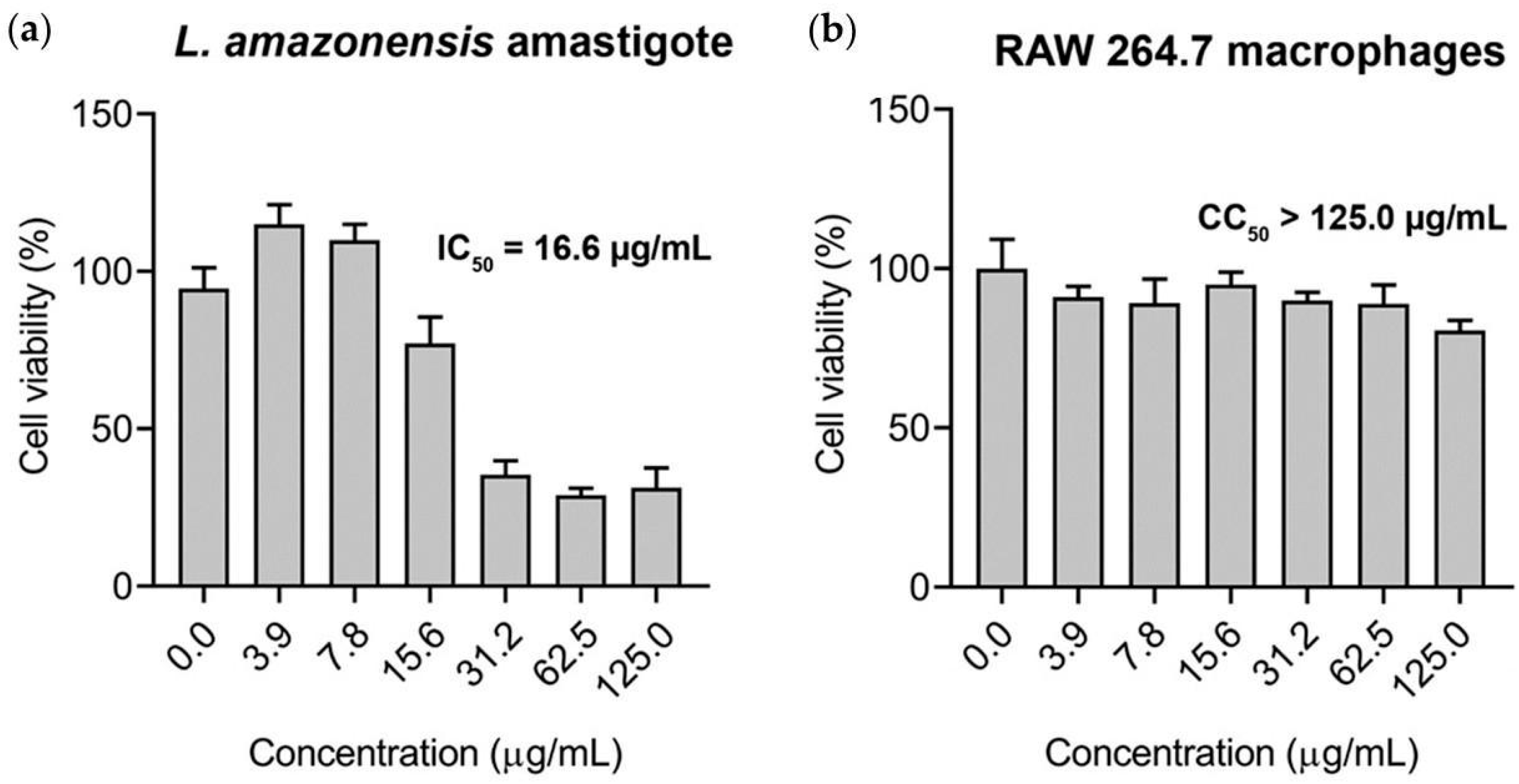
We evaluated the effect of the HE-Fr fraction on the viability of L. amazonensis axenic amastigotes and RAW 264.7 macrophages. As observed in the promastigote assay, HE-Fr decreased the viability of these parasitic forms, with an IC50 of 16.6 µg/mL (Figure 1a). However, it did not significantly reduce macrophage viability at any of the concentrations tested, resulting in an S.I. > 7.53 (Figure 1b). The standard drug, pentamidine, had an IC50 of 6.78 µg/mL and a CC50 value for RAW 264.7 macrophages of >100 µg/mL, resulting in a S.I. > 14.75.

3.3. The Hexane Fraction of C. verum Leaves Induces Apoptosis-like Cell Death in L. amazonensis Promastigotes and Axenic Amastigotes

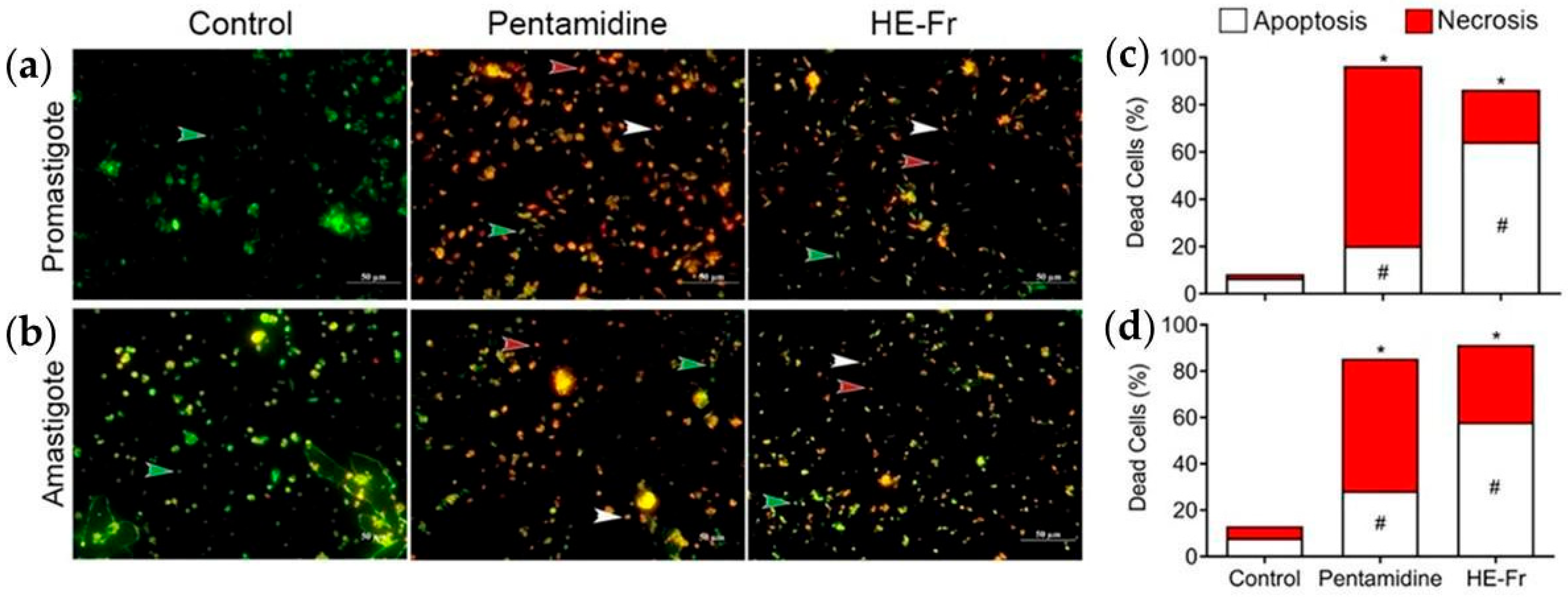
To investigate the cell death pathway, L. amazonensis promastigotes and amastigotes were treated with the previously obtained IC50 of HE-Fr for 4 h. Cell viability and morphological features consistent with apoptosis-like or necrosis-like death were evaluated by AO/EB fluorescence microscopy (Figure 2a,b).
Treatment with HE-Fr resulted in an average of 86.33% ± 11.24% deaths in promastigotes and 91.33% ± 5.50% in amastigotes. These results are statistically similar to those obtained with the standard drug pentamidine (96.33% ± 3.21% for promastigotes and 85.33% ± 5.0% for amastigotes) and significantly greater than those obtained with the negative control (8.33% ± 2.52% for promastigotes and 13.33% ± 1.0% for amastigotes) (Figure 2c,d).
No differences in cell death patterns were observed in the negative control group. However, the proportion of cells with apoptosis-like features was greater in parasites treated with the fraction, whereas the proportion of cells with necrosis-like characteristics was greater in those treated with pentamidine (Figure 2c,d).

3.4. Chemical Characterization of the Hexane Fraction of C. verum Leaves

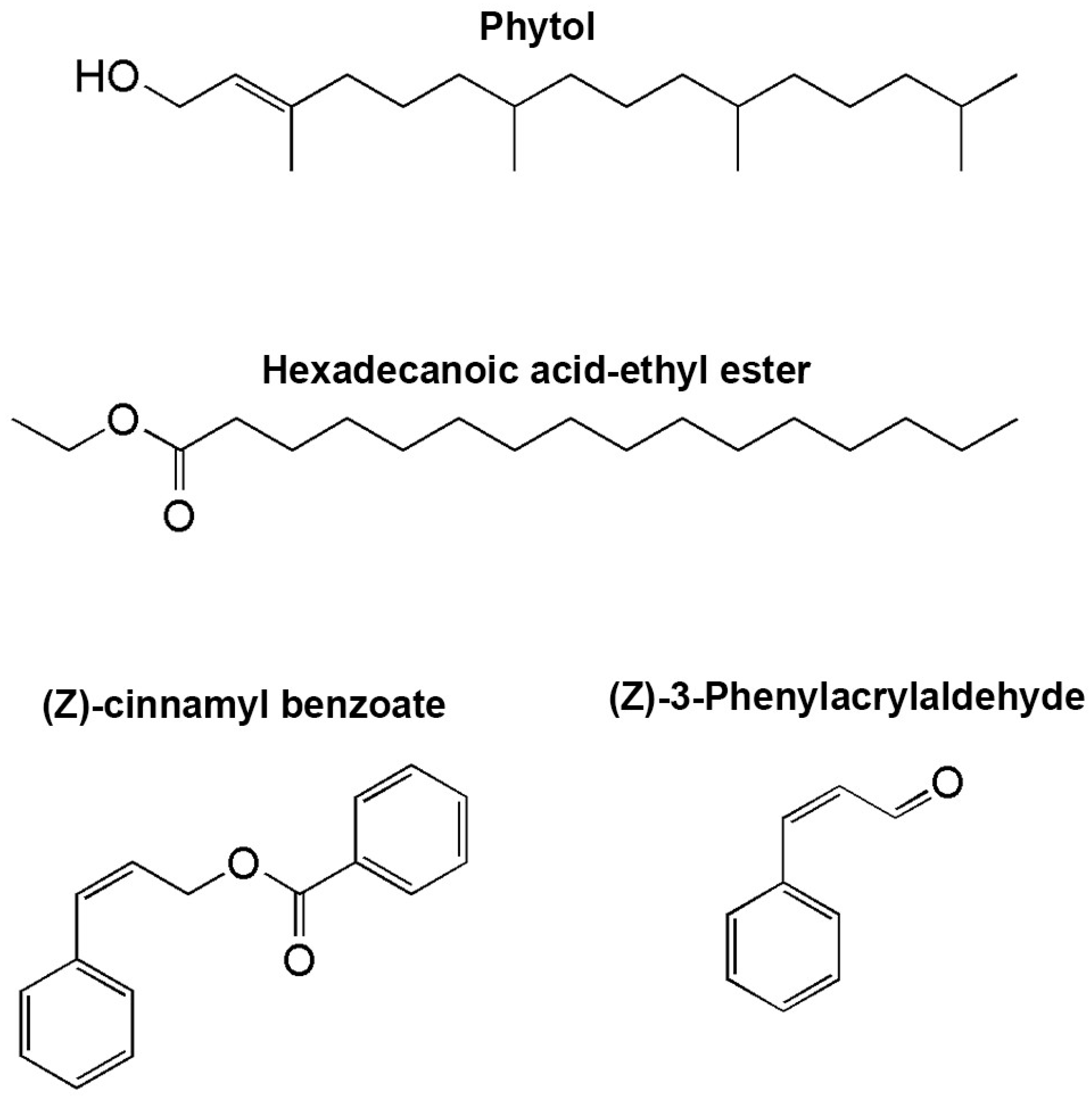
Considering the results presented, we decided to characterize the HE-Fr chemically. The results of the GC-MS analysis revealed 25 compounds (Table 2). The main metabolites were phytol diterpenes (15.37%), esters (Z)-cinnamyl benzoate (12.51%), hexadecenoic acid (10.34%), and aldehydes ((Z)-3-phenylacrylaldehyde (9.96%) (Figure 3).

4. Discussion

In this study, unlike the hydroalcoholic extract and other fractions, the hexane fraction of C. verum leaves exhibited highly selective leishmanicidal activity, inducing apoptosis-like cell death. First, we investigated the cytotoxic effects of HAE and its polar fractions on L. amazonensis promastigotes. Interestingly, our findings indicate that the HAE did not exhibit in vitro leishmanicidal activity even at the maximum tested concentration (500 µg/mL). It has been proposed that extracts with an IC50 above this value are not clinically relevant [36]. Our results confirm what Ohashi et al. (2017) [7] previously demonstrated. They reported that the hydroalcoholic extract of C. verum leaves showed no leishmanicidal activity against promastigote forms of L. donovani at concentrations up to 1000 µg/mL.
However, other studies have shown that the essential oil or the methanolic extract of the same species’ bark has significant leishmanicidal activity against Leishmania major promastigotes [8,10]. Furthermore, other species of the genus also showed antagonistic effects. For example, the essential oil from C. cassia bark exhibited an IC50 of 2.92 nL/mL against L. mexicana promastigotes [9]. Similarly, the methanolic extract of C. daphnoides leaves also had high leishmanicidal activity, with an IC50 of 7.2 µg/mL against L. donovani amastigotes [37]. On the other hand, in a study by Teles et al. (2019) [6], the essential oil from C. zeylanicum leaves showed no significant leishmanicidal activity against L. amazonensis promastigotes. These findings indicate that factors such as the pharmacogen used, the extraction method, the solvent [11] and Leishmania species [38] can influence the biological activity observed for plant-derived extracts under specific experimental conditions.
Our study revealed that the dichloromethane, ethyl acetate, and aqueous fractions did not have a significant leishmanicidal effect even at the maximum tested concentration. Interestingly, Afrin et al. (2019) [14] reported that the dichloromethane fraction of C. cassia bark inhibited parasite growth and was not toxic to the peritoneal macrophages of BALB/c mice. Conversely, we observed that both the hydroethanolic extract and its dichloromethane, ethyl acetate, and aqueous fractions had low selectivity for L. amazonensis promastigotes. Among these fractions, the dichloromethane and aqueous fractions showed greater cytotoxicity against macrophages than against parasites. These findings suggest that both fractions contain cytotoxic substances that do not interfere with Leishmania metabolism.
On the other hand, we demonstrated that the hexane fraction is highly effective and selective against L. amazonensis promastigotes (IC50 = 15.43 µg/mL and S.I. > 9.66) and axenic amastigotes (IC50 = 16.6 µg/mL and S.I. > 7.53). Although Tamilsevi et al. (2021) [39] reported antiplasmodial activity for a hexane extract of C. verum bark combined with Piper nigrum, there are no previous reports describing the activity of hexane fractions from C. verum leaves against Leishmania species. The observed efficacy against amastigotes reinforces the biological relevance of this fraction. However, since axenic amastigotes do not fully reproduce the intracellular environment of infected macrophages, further studies using infected macrophage models and in vivo systems are necessary to confirm the translational potential of these findings.
The lack of activity observed for the hydroethanolic extract and high-polarity fractions suggests that the bioactive compounds are likely low-polarity constituents enriched during hexane partitioning. These findings provide a chemical rationale for the selective activity of the hexane fraction.
While the leishmanicidal activity of Cinnamomum species has frequently been attributed to cinnamaldehyde [8,9,14], this compound was not detected in the hexane fraction under the analytical conditions applied. Instead, we identified the diterpene phytol as the major component, followed by (z)-cinnamyl benzoate, hexadecanoic acid ethyl ester, and (Z)-3-phenylacrylaldehyde. Notably, these compounds have not previously been reported in C. verum leaves [40]. According to this review, eugenol, linalool, trans-cinnamaldehyde, benzyl benzoate, and β-caryophyllene are the most common compounds present in leaves. Such variation may be influenced by geographic origin, cultivation conditions, and the extraction method employed [11,40].
Phytol has been associated with several biological activities, including antileishmanial effects [41]. Similarly, Silva et al. (2015) [42] reported that the pythol-rich hexane fraction of Lacistema pubescens leaves had anti-Leishmania amazonensis activity. This effect was associated with mitochondrial depolarization, followed by increased reactive oxygen species (ROS) generation and oxidative stress in the parasite, without plasma membrane disruption, suggesting that events consistent with apoptosis occurred. In this context, phytol may contribute to the leishmanicidal activity observed in the hexane fraction of C. verum, potentially through mechanisms involving mitochondrial dysfunction and oxidative imbalance.
Apoptosis-like cell death may favor host defense by limiting parasite persistence and modulating immune responses. Unlike necrosis-like death, apoptosis does not involve immediate cell lysis, allowing infected cells or parasite remnants to be cleared by phagocytosis, which may reduce excessive inflammatory responses [43].
Nevertheless, given the chemical complexity of the hexane fraction, the observed activity is likely not attributable solely to phytol. Instead, the leishmanicidal effect may result from synergistic interactions among multiple constituents that act on distinct parasite metabolic pathways. A similar phenomenon was described by Oliveira et al. (2020) [44], who investigated two phytol-rich extracts of Scheelea phalerata. Only the extract obtained during the rainy season exhibited antileishmanial activity, and molecular docking analyses suggested that additional constituents influenced membrane interactions, supporting a synergistic mechanism among the extract components.

5. Conclusions

Our findings indicate that the hydroethanolic extract of C. verum leaves is not effective against L. amazonensis. In contrast, the hexane fraction, which contained phytol as a major constituent, showed favorable selectivity against both parasite forms and induced apoptosis-like cell death.
Nevertheless, the data support the use of the hexane fraction as a promising bioactive candidate, warranting further investigation, including studies with intracellular amastigotes, detailed mechanistic assays, and in vivo evaluation, to better define its efficacy and safety profile.

Author Contributions

Conceptualization, L.A.S. and A.S.R.; methodology, C.M.J., L.N.G., L.D.M.S., Y.S.A. and C.Q.d.R.; formal analysis, C.M.J., R.P.D., C.Q.d.R., L.A.S. and A.S.R.; resources, C.Q.d.R., L.A.S. and A.S.R.; writing—original draft preparation, C.M.J., F.F.C., L.A.S. and A.S.R.; writing—review and editing, C.M.J., F.F.C., L.N.G., L.D.M.S., Y.S.A., R.P.D., C.Q.d.R., L.A.S. and A.S.R.; supervision, L.A.S. and A.S.R.; funding acquisition, L.A.S. and A.S.R. All authors have read and agreed to the published version of the manuscript.

Funding

This research was funded by the Maranhão Research Foundation (FAPEMA), Brazil (BM-02894/21; BM-02164/23; BEPP-03289/23; INFRA-15460/25; APP-01415/25); Brazilian National Council for Scientific and Technological Development (CNPq), Brazil (Pró-Amazônia/CNPq 445615/2024-9; PPBio 441189/2023-7); Coordination for the Improvement of Higher Education Personnel (CAPES), Brazil (Finance Code 001); Fund for Economic, Scientific, Technological and Innovation Development (FUNDECI) of Banco do Nordeste do Brasil (BNB), Brazil; and Studies and Projects Funding Agency (FINEP), Brazil (2362/24; 1449/24; 0721/24).

Data Availability Statement

The original contributions presented in this study are included in the article l. Further inquiries can be directed to the corresponding authors.

Acknowledgments

During the preparation of this manuscript, the authors used ChatGPT 5.2 (OpenAI, San Francisco, CA, USA) and Rubriq (Durham, NC, USA) to improve the language and readability of the manuscript. After using this tool, the authors reviewed and edited the content as needed and take full responsibility for the content of the publication.

Conflicts of Interest

The authors declare no conflicts of interest.

References

  1. Arenas, R.; Torres-Guerrero, E.; Quintanilla-Cedillo, M.R.; Ruiz-Esmenjaud, J. Leishmaniasis: A review. F1000Research 2017, 6, 750. [Google Scholar] [CrossRef]
  2. Von Stebut, E. Leishmaniasis. JDDG J. Dtsch. Dermatol. Ges. 2015, 13, 191–200. [Google Scholar] [CrossRef]
  3. Carvalho, S.H.; Frézard, F.; Pereira, N.P.; Moura, A.S.; Ramos, L.M.Q.C.; Carvalho, G.B.; Rocha, M.O.C. American tegumentary leishmaniasis in Brazil: A critical review of the current therapeutic approach with systemic meglumine antimoniate and short-term possibilities for an alternative treatment. Trop. Med. Int. Health 2019, 24, 380–391. [Google Scholar] [CrossRef] [PubMed]
  4. Roatt, B.M.; de Oliveira Cardoso, J.M.; Brito, R.C.F.; Coura-Vital, W.; de Oliveira Aguiar-Soares, R.D.; Reis, A.B. Recent advances and new strategies on leishmaniasis treatment. Appl. Microbiol. Biotechnol. 2020, 104, 8965–8977. [Google Scholar] [CrossRef]
  5. Lima, M.P.; Zoghbi, M.G.B.; Andrade, E.H.A.; Silva, T.M.D.; Fernandes, C.S. Constituintes voláteis das folhas e dos galhos de Cinnamomum zeylanicum Blume (Lauraceae). Acta Amaz. 2005, 35, 363–366. [Google Scholar] [CrossRef]
  6. Teles, A.M.; Rosa, T.D.D.S.; Mouchrek, A.N.; Abreu-Silva, A.L.; Da Silva Calabrese, K.; Almeida-Souza, F. Cinnamomum zeylanicum, Origanum vulgare, and Curcuma longa Essential Oils: Chemical Composition, Antimicrobial and Antileishmanial Activity. Evid. Based Complement. Altern. Med. 2019, 2019, 2421695. [Google Scholar] [CrossRef]
  7. Ohashi, M.; Amoa-Bosompem, M.; Kwofie, K.D.; Agyapong, J.; Adegle, R.; Sakyiamah, M.M.; Ayertey, F.; Owusu, K.B.A.; Tuffour, I.; Atchoglo, P.; et al. In vitro antiprotozoan activity and mechanisms of action of selected Ghanaian medicinal plants against Trypanosoma, Leishmania, and Plasmodium parasites. Phytother. Res. 2018, 32, 1617–1630. [Google Scholar] [CrossRef]
  8. Jorjani, O.; Raeisi, M.; Hezarjaribi, H.Z.; Soltani, M.; Soosaraei, M. Studying the chemical composition in vitro activity of Cinnamomum zeylanicum and Eugenia caryophyllata essential oils on Leishmania major. J. Pharm. Sci. Res. 2017, 9, 1300. [Google Scholar]
  9. Le, T.B.; Beaufay, C.; Nghiem, D.T.; Mingeot-Leclercq, M.-P.; Quetin-Leclercq, J.; Le, T.B.; Beaufay, C.; Nghiem, D.T.; Mingeot-Leclercq, M.-P.; Quetin-Leclercq, J. In Vitro Anti-Leishmanial Activity of Essential Oils Extracted from Vietnamese Plants. Molecules 2017, 22, 1071. [Google Scholar] [CrossRef]
  10. Maleki, F.; Zarebavani, M.; Mohebali, M.; Dayer, M.S.; Hajialiani, F.; Tabatabaie, F. In vitro and in vivo susceptibility of Leishmania major to some medicinal plants. Asian Pac. J. Trop. Biomed. 2017, 7, 37–42. [Google Scholar] [CrossRef]
  11. Gobbo-Neto, L.; Lopes, N.P. Medicinal plants: Factors of influence on the content of secondary metabolites. Quim. Nova 2007, 30, 374–381. [Google Scholar] [CrossRef]
  12. Vermeersch, M.; Da Luz, R.I.; Toté, K.; Timmermans, J.P.; Cos, P.; Maes, L. In Vitro Susceptibilities of Leishmania donovani Promastigote and Amastigote Stages to Antileishmanial Reference Drugs: Practical Relevance of Stage-Specific Differences. Antimicrob. Agents Chemother. 2009, 53, 3855–3859. [Google Scholar] [CrossRef]
  13. Hemeg, H.A.; Rauf, A.; Rashid, U.; Muhammad, N.; Al-Awthan, Y.S.; Bahattab, O.S.; Al-Duais, M.A.; Uzair, S.; Shah, A.; Sharma, R. In-Vitro Leishmanicidal Activity and Molecular Docking Simulations of a Flavonoid Isolated from Pistacia integerrima Stew ex Brandis. J. Food Qual. 2022, 2022, 6003869. [Google Scholar] [CrossRef]
  14. Ozbak, H.A.; Hemeg, H.A.; Afrin, F.; Chouhan, G.; Islamuddin, M.; Want, M.Y. Cinnamomum cassia exhibits antileishmanial activity against Leishmania donovani infection in vitro and in vivo. PLoS Neglected Trop. Dis. 2019, 13, e0007227. [Google Scholar] [CrossRef]
  15. Rodrigues, J.G.M.; Albuquerque, P.S.V.; Nascimento, J.R.; Campos, J.A.V.; Godinho, A.S.S.; Araújo, S.J.; Brito, J.M.; Jesus, C.M.; Miranda, G.S.; Rezende, M.C.; et al. The immunomodulatory activity of Chenopodium ambrosioides reduces the parasite burden and hepatic granulomatous inflammation in Schistosoma mansoni-infection. J. Ethnopharmacol. 2021, 264, 113287. [Google Scholar] [CrossRef] [PubMed]
  16. Khatun, M.S.; Mia, N.; Al Bashera, M.; Murad, M.A.; Zahan, R.; Parvin, S.; Akhtar, M.A. Evaluation of anti-inflammatory potential and GC-MS profiling of leaf extracts from Clerodendrum infortunatum L. J. Ethnopharmacol. 2024, 320, 117366. [Google Scholar] [CrossRef] [PubMed]
  17. Noriega, P.; Röpke, C.D.; Camilo, C.M.; De Freitas, P.C.D.; Barros, S.B.D.M. Evaluation of extraction conditions of 4-nerolidylchatecol from Pothomorphe umbellata (L). Miq. using factorial design. Rev. Bras. Cienc. Farm. 2005, 41, 261–269. [Google Scholar] [CrossRef]
  18. Dutra, R.P.; de Sousa, M.M.; Mignoni, M.S.P.M.; de Oliveira, K.G.M.; Pereira, E.B.; Figueredo, A.S.; da Costa, A.A.C.; Dias, T.G.; Vasconcelos, C.C.; Silva, L.A.; et al. Brazilian Amazon Red Propolis: Leishmanicidal Activity and Chemical Composition of a New Variety of Red Propolis. Metabolites 2023, 13, 1027. [Google Scholar] [CrossRef]
  19. Lima, G.S.; Machado, G.; Maciel, M.M.; Echevarria, A. Antitrypanosomal and antileishmanial effects of the hydroalcoholic extract of Croton cajucara benth and its 19-nor-clerodane chromatographic fractions. Pharmacogn. Mag. 2021, 17, 302. [Google Scholar] [CrossRef]
  20. Teixeira, M.; de Jesus Santos, R.; Sampaio, R.; Carvalho, L.P.; Santos, W.L. A simple and reproducible method to obtain large numbers of axenic amastigotes of different Leishmania species. Parasitol. Res. 2002, 88, 963–968. [Google Scholar] [CrossRef]
  21. Santos, R.P.; Barros, J.D.S.; Pereira, E.B.; de Oliveira, K.G.M.; Brito, G.S.; Costa, F.F.; Fidelis, Q.C.; Reis, A.S.; Holanda, C.A.; Dutra, R.P. Brazilian Amazon red propolis as a sustainable resource for the green synthesis of antibacterial silver nanoparticles. J. Biotechnol. 2025, 405, 263–274. [Google Scholar] [CrossRef] [PubMed]
  22. Mosmann, T. Rapid colorimetric assay for cellular growth and survival: Application to proliferation and cytotoxicity assays. J. Immunol. Methods 1983, 65, 55–63. [Google Scholar] [CrossRef]
  23. Stockert, J.C.; Horobin, R.W.; Colombo, L.L.; Blázquez-Castro, A. Tetrazolium salts and formazan products in Cell Biology: Viability assessment, fluorescence imaging, and labeling perspectives. Acta Histochem. 2018, 120, 159–167. [Google Scholar] [CrossRef] [PubMed]
  24. Kumar, P.; Nagarajan, A.; Uchil, P.D. Analysis of cell viability by the MTT assay. Cold Spring Harb. Protoc. 2018, 2018, 469–471. [Google Scholar] [CrossRef] [PubMed]
  25. Lima, M.M.A.; Alencar, Y.S.; de Jesus, C.M.; Dias, T.G.; Barros, J.D.S.; Guerra, R.N.M.; Dutra, R.P.; Reis, A.S. Photoprotective and antioxidant effect of babassu mesocarp flour extracts. Acta Amaz. 2023, 53, 294–301. [Google Scholar] [CrossRef]
  26. Alam, P.; Tyagi, R.; Farah, M.A.; Rehman, M.T.; Hussain, A.; AlAjmi, M.F.; Siddiqui, N.A.; Al-Anazi, K.M.; Amin, S.; Mujeeb, M.; et al. Cytotoxicity and molecular docking analysis of racemolactone I, a new sesquiterpene lactone isolated from Inula racemosa. Pharm. Biol. 2021, 59, 943–954. [Google Scholar] [CrossRef]
  27. Ribble, D.; Goldstein, N.B.; Norris, D.A.; Shellman, Y.G. A simple technique for quantifying apoptosis in 96-well plates. BMC Biotechnol. 2005, 5, 12. [Google Scholar] [CrossRef]
  28. Adams, R.P. Identification of Essential Oil Components by Gas Chromatography/Mass Spectrometry, 4th ed.; Allured Publishing Corporation: Carol Stream, IL, USA, 2007; p. 20. [Google Scholar]
  29. Lias, S.G.; Mikaia, A.I.; Sparkman, O.D.; Stein, S.E.; Zaikin, G. The NIST/EPA/NIHMassSpectral Database: Simultaneous Control of Quality and Quantity. In Proceedings of the 45th ASMS Conference on Mass Spectrometry and Allied Topics, Minneapolis, MN, USA, 5–9 June 2022; Available online: https://www.nist.gov/publications/nistepanih-mass-spectral-database-simultaneous-control-quality-and-quantity (accessed on 1 May 2023).
  30. Mondello, L. Flavors and Fragrances of Natural and Synthetic Compounds: Mass ectral Database, 2nd ed.; John Wiley & Sons Inc.: Hoboken, NJ, USA, 2011. [Google Scholar]
  31. Dutra, R.P.; Bezerra, J.L.; da Silva, M.C.P.; Batista, M.C.A.; Patrício, F.J.B.; Nascimento, F.R.F.; Ribeiro, M.N.S.; Guerra, R.N.M. Antileishmanial activity and chemical composition from Brazilian geopropolis produced by stingless bee Melipona fasciculata. Rev. Bras. Farmacogn. 2019, 29, 287–293. [Google Scholar] [CrossRef]
  32. Lima, A.S.; Fernandes, Y.M.L.; Silva, C.R.; Costa-Junior, L.M.; Figueiredo, P.L.B.; Monteiro, O.S.; Maia, J.G.S.; da Rocha, C.Q. Anthelmintic evaluation and essential oils composition of Hyptis dilatata Benth. and Mesosphaerum suaveolens Kuntze from the Brazilian Amazon. Acta Trop. 2022, 228, 106321. [Google Scholar] [CrossRef]
  33. Sokal, R.; Rohlf, F.J. Introduccion to Bioestatistics; W.H. Freeman & Co.: New York, NY, USA, 1987; p. 363. [Google Scholar]
  34. Cos, P.; Vlietinck, A.J.; Vanden Berghe, D.; Maes, L. Anti-infective potential of natural products: How to develop a stronger in vitro ‘proof-of-concept’. J. Ethnopharmacol. 2006, 106, 290–302. [Google Scholar] [CrossRef]
  35. Koutsoni, O.S.; Karampetsou, K.; Dotsika, E. In vitro Screening of Antileishmanial Activity of Natural Product Compounds: Determination of IC50, CC50 and SI Values. Bio-Protoc. 2019, 9, e3410. [Google Scholar] [CrossRef]
  36. Amaral, F.M.M.; Ribeiro, M.N.S.; Barbosa-Filho, J.M.; Reis, A.S.; Nascimento, F.R.F.; Macedo, R.O. Plants and chemical constituents with giardicidal activity. Rev. Bras. Farmacogn. 2006, 16, 696–720. [Google Scholar] [CrossRef]
  37. Tasdemir, D.; MacIntosh, A.J.J.; Stergiou, P.; Kaiser, M.; Mansour, N.R.; Bickle, Q.; Huffman, M.A. Antiprotozoal and antihelminthic properties of plants ingested by wild Japanese macaques (Macaca fuscata yakui) in Yakushima Island. J. Ethnopharmacol. 2020, 247, 112270. [Google Scholar] [CrossRef]
  38. Soares, R.O.d.A.; Leon, L. Modelos de Estudo Para O Desenvolvimento de Drogas Anti-Leishmania; SciELO Books: São Paulo, Brazil, 2014. [Google Scholar]
  39. Tamilselvi, E.; Karuppaiah, A.; Shyamala, G.; Shobana, S.; Thangaraj, P.; Hariharan, S.; Sankar, V. Exploring combined herbal extract-loaded phytoniosomes for antimalarial and antibacterial activity against methicillin-resistant Staphylococcus aureus. 3 Biotech 2021, 11, 177. [Google Scholar] [CrossRef] [PubMed]
  40. Singh, N.; Rao, A.S.; Nandal, A.; Kumar, S.; Yadav, S.S.; Ganaie, S.A.; Narasimhan, B. Phytochemical and pharmacological review of Cinnamomum verum J. Presl-a versatile spice used in food and nutrition. Food Chem. 2021, 338, 127773. [Google Scholar] [CrossRef] [PubMed]
  41. Islam, M.T.; Ali, E.S.; Uddin, S.J.; Shaw, S.; Islam, M.A.; Ahmed, M.I.; Chandra Shill, M.; Karmakar, U.K.; Yarla, N.S.; Khan, I.N.; et al. Phytol: A review of biomedical activities. Food Chem. Toxicol. 2018, 121, 82–94. [Google Scholar] [CrossRef] [PubMed]
  42. da Silva, J.M.; Antinarelli, L.M.R.; Ribeiro, A.; Coimbra, E.S.; Scio, E. The effect of the phytol-rich fraction from Lacistema pubescens against Leishmania amazonensis is mediated by mitochondrial dysfunction. Exp. Parasitol. 2015, 159, 143–150. [Google Scholar] [CrossRef]
  43. Zangger, H.; Mottram, J.C.; Fasel, N. Cell death in Leishmania induced by stress and differentiation: Programmed cell death or necrosis? Cell Death Differ. 2002, 9, 1126–1139. [Google Scholar] [CrossRef]
  44. Oliveira, D.M.; Furtado, F.B.; Gomes, A.A.S.; Belut, B.R.; Nascimento, E.A.; Morais, S.A.L.; Martins, C.H.G.; Santos, V.C.O.; Da Silva, C.V.; Teixeira, T.L.; et al. Chemical Constituents and Antileishmanial and Antibacterial Activities of Essential Oils from Scheelea phalerata. ACS Omega 2020, 5, 1363–1370. [Google Scholar] [CrossRef]
Figure 1. Cytotoxic effect of the hexane fraction of Cinnamomum verum leaves against Leishmania amazonensis amastigotes (a) and RAW 264.7 macrophages (b). The cells and parasites were treated with serial concentrations of the hexane fraction for 24 h, and cytotoxicity was measured via the MTT assay. The half-maximal inhibitory concentration (IC50) and half-maximal cytotoxic concentration (CC50) were subsequently calculated. The data represent the means ± SDs of triplicate cultures.
Sci 08 00076 g001
Figure 2. Cell death patterns induced by the hexane fraction of Cinnamomum verum leaves in Leishmania amazonensis promastigotes (a,c) and amastigotes (b,d). Parasites were treated with the IC50 of the fraction or pentamidine for 4 h at 32 °C and stained with acridine orange/ethidium bromide (AO/EB) (a,b). Viable parasites (green arrow) and cells exhibiting apoptosis-like (white arrow) or necrosis-like (red arrow) features were identified by fluorescence patterns. The data represent the means ± SDs of triplicate cultures. * p < 0.05 compared with the control group for total cell death. # p < 0.05 compared with the percentage of necrosis-like cells within the same group.
Sci 08 00076 g002
Figure 3. Chemical structures of the main components present in the hexane fraction of Cinnamomum verum leaves (Source: ChemDraw 8.0 Software).
Sci 08 00076 g003
Table 1. Cytotoxic effect of hydroalcoholic extract of Cinnamomum verum leaves and its fractions against Leishmania amazonensis promastigotes and RAW macrophages 264.7, after 48 h of incubation.
C. verumL. amazonensis
IC50 (µg/mL)
RAW Macrophages
CC50 (µg/mL)
S.I.
HAE>500>500id
HE-Fr15.43149.29.66
DM-Fr>500254.4<0.50
EA-Fr>500>500id
AQ-Fr>500144.7<0.28
Pentamidine1.920.210.6
IC50 = half-maximal inhibitory concentration; CC50 = half-maximal cytotoxic concentration; S.I. = selectivity index; id = indeterminate; HAE = hydroalcoholic extract; HE-Fr = hexane fraction; DM-Fr = dichloromethane fraction; EA-Fr = ethyl acetate fraction; AQ-Fr = aqueous fraction.
Table 2. Constituents from the hexane fraction of Cinnamomum verum leaves.
PeakRT NameArea %Molecular WeighMolecular Formula
121.02(Z)-3-Phenylacrylaldehyde9.96132C9H8O
222.512-Propen-1-ol, 3-phenyl-1.16134C9H10O
322.83Hexyl octyl ether0.63214C14H30O
428.52Acetic acid, cinnamyl ester1.44176C11H12O2
531.092,4-Di-tert-butylphenol1.10206C14H22O
635.89Dodecanoic acid, 1-methylethyl ester0.98242C15H30O2
740.69Benzyl benzoate0.61212C14H12O2
847.62n-Hexadecanoic acid3.27256C16H32O2
947.86Butanoic acid, 3-phenylpropyl ester1.59206C13H18O2
1048.62Hexadecanoic acid-ethyl ester10.34284C18H36O2
1151.06(Z)-cinnamyl benzoate12.51238C16H14O2
1252.11Phytol15.37296C20H40O
1352.775-Eicosane0.64278C20H38
1452.959,12,15-Octadecatrienoic acid, (Z,Z,Z)-3.52278C18H30O2
1553.62Linoleic acid-ethyl ester4.17308C20H36O2
1653.789,12,15-Octadecatrienoic acid, ethyl ester7.05306C20H34O2
1753.85(E)-9-Octadecenoic acid, ethyl ester3.27310C20H38O2
1854.70Octadecanoic acid, ethyl ester0.99312C20H40O2
1956.26Tributyl acetyl citrate0.80402C20H34O8
2061.90(E)-Hexadec-2-enal3.53238C16H30O
2167.68Linolenic acid0.85278C18H30O2
2277.26Vitamin E6.10430C29H50O2
2377.51α-Tocopherolquinone2.96446C29H50O3
2478.93Ergost-5-en-3-ol, (3beta,24R)-0.78400C28H48O
2581.14γ-Sitosterol6.37414C29H50O
RT = retention time. The main constituents (above 9%) are in bold.
Disclaimer/Publisher’s Note: The statements, opinions and data contained in all publications are solely those of the individual author(s) and contributor(s) and not of MDPI and/or the editor(s). MDPI and/or the editor(s) disclaim responsibility for any injury to people or property resulting from any ideas, methods, instructions or products referred to in the content.