Article

An Integrated Assessment Model for Evaluating Motor Skills in Trainee Primary School Teachers

by
Francesca D’Elia
1,2
1
Department of Human, Philosophical and Educational Sciences, University of Salerno, 84084 Fisciano, Salerno, Italy
2
Research Centre for Physical Education and Exercise, Pegaso Telematic University, 80143 Naples, Campania, Italy
Submission received: 20 October 2025 / Revised: 15 December 2025 / Accepted: 3 February 2026 / Published: 10 February 2026

Abstract

This study presents an integrated assessment model for evaluating motor skills in trainee generalist primary school teachers. The model integrates objective performance measures with self-reported qualitative observations, aiming to promote body awareness and highlight the quality of movement. A total of 547 university students, divided into two cohorts (2023/24 and 2024/25), completed a battery of standardized field tests and recorded both quantitative results (e.g., times, repetitions) and qualitative reflections on their execution. The findings show that the 2024/25 cohort performed better in balance and muscular endurance, while showing slower times in agility and sprint tests. Qualitative data revealed more fluid execution, a wider range of motor strategies, and greater self-reflection, suggesting a more mature motor profile. These differences are not solely attributable to individual factors; they may also reflect the evolving structure of the training program, the instructional approach, and the learning environment. The integration of objective and subjective data enabled the construction of multidimensional motor profiles, capturing not only outcomes but also processes. This model supports the development of reflective and adaptive motor competence and offers promising applications in teacher training and health promotion, contributing to a more inclusive and effective approach to physical education in primary schools.

1. Introduction

Motor skill assessment is a fundamental component in evaluating an individual’s functional status, both in sports contexts [1,2,3,4] and in health promotion [5,6]. Field-based motor tests are widely used to measure parameters such as balance, agility, strength, and coordination, and are valued for their cost-effectiveness, ease of administration, and scalability [7,8,9]. According to Cuenca-García et al. [9], tests assessing cardiorespiratory and muscular fitness show high reliability; however, the literature reveals a lack of robust studies on balance and coordination tests, such as the Flamingo test and agility test. Tests commonly used in educational and sports settings, like dribbling slalom or timed sprints, remain underexplored in terms of validity and reliability [8,9,10]. Moreover, most studies adopt a quantitative approach, focusing on objective metrics (e.g., time, counts), while neglecting qualitative observations that could offer a richer understanding of motor behavior [11,12]. This methodological limitation reduces the ability to capture key aspects such as movement quality, coordination, and execution efficiency. Recent research [13,14,15] suggests that increased subjective awareness of improvement can enhance training outcomes. This self-perception not only enriches the overall understanding of performance but also directly influences motivation and engagement, critical factors for learning retention and long-term physical activity adherence.
Recent contributions have proposed different assessment models for pre-service teachers, highlighting both strengths and limitations. For example, Cañabate et al. [16] developed a rubric to evaluate meaningful physical education experiences, emphasizing reflective practice; Yin et al. [17] provided a systematic review of physical literacy assessment among teachers; Beseler et al. [18] examined peer-teaching approaches to improve motor techniques; and Buckler et al. [19] reviewed educator-led interventions to foster physical literacy. While these studies offer valuable frameworks, they tend to emphasize either performance indicators or reflective/educational dimensions in isolation.
In this perspective, there is a need for an assessment model that goes beyond external performance measurement and actively involves individuals in recording and interpreting their own results. Self-assessment, assumed as a reflective and autonomous practice, enables the integration of objective measurements with subjective perceptions, generating a more nuanced motor profile aligned with the participant’s lived experience. Another critical issue concerns the limited attention in the literature to non-athlete young adults, particularly trainee generalist primary school teachers. Although not traditionally targeted in motor science research, this population is strategically important for health promotion and physical education, both for their own attitude to healthy and active lifestyles and for the children they will teach throughout their careers. The promotion of motor competence in future teachers aligns with the broader framework of physical literacy, understood as daily movement-based education, in accordance with the World Health Organization’s recommendations for early childhood development [20]. The absence of integrated or multidimensional interpretive models limits the ability to construct personalized motor profiles, which are essential for targeted educational or preventive interventions.
In light of the existing literature, the present study highlights the innovativeness of its proposed assessment model. Whereas previous approaches have typically concentrated either on measurable performance indicators or on reflective dimensions considered separately, our model combines both perspectives within multidimensional motor profiles. The distinctive element lies in the explicit use of triangulation, which makes it possible to detect points of convergence and divergence between objective test results and participants’ qualitative accounts. The aim is to analyze the motor performance of trainee generalist primary school teachers, using a battery of standardized field tests, to outline execution profiles, and to propose an evaluative approach that considers not only “how much” but also “how” individuals move. The adopted self-assessment procedure was designed to strengthen construct validity by capturing both objective performance and subjective perception of motor execution.

2. Materials and Methods

2.1. Participants

A total of 547 university students participated in the study. All were enrolled in the third year of a five-year integrated degree program in Primary Education, qualifying them as generalist teachers for primary schools. The study was conducted at a university in Southern Italy. The sample consisted of 94.4% female and 5.6% male participants, a distribution that closely mirrors both national enrollment trends in this type of degree program and the gender composition of the generalist teaching profession in primary education. The average age was 22 years, with a mean of 22.75 ± 0.3 years for females and 22.66 ± 0.7 years for males, consistent with national student demographics. Participation was voluntary. It should be noted that the pronounced gender imbalance limits the generalizability of the findings, particularly to male students, and this should be considered when interpreting the results.

2.2. Procedure

This study adopted a cross-sectional cohort design, conducted over two academic years (2023/2024 and 2024/2025), within a didactic–practical workshop focused on teaching methods of physical activity. The two cohorts consisted of different students enrolled in the course in separate academic years; no participant was tested more than once, and no longitudinal follow-up of the same individuals was performed. Accordingly, all comparisons between cohorts refer to independent groups. Each participant completed a series of field-based motor skill tests after receiving detailed written instructions on text execution and data recording procedures. After completing the tests, students filled out individual forms reporting both quantitative results (e.g., times, counts and scores) and qualitative observations related to their execution. These observations included posture, movement fluidity, motor control, spatial and rhythmic management, perceived fatigue, and concentration. Participants were encouraged to freely describe their motor experience, noting bodily sensations, strategies adopted, and difficulties encountered. Data collection was self-administered, aiming to foster reflective awareness of movement and to integrate objective measurement with subjective perception [13,14,15,21,22]. To ensure procedural comparability across cohorts, testing conditions were standardized. All assessments were conducted indoors in the same university sports facility, on a synthetic non-slip surface. Testing took place during scheduled coursework in the morning hours. Participants performed a standardized 10 min general warm-up prior to testing. Timing was carried out using manual stopwatches by the same academic supervisor in both academic years. Test instructions and demonstrations were delivered using identical protocols. All data were collected in a single session for each cohort during scheduled coursework, under the continuous supervision of the academic supervisor, who ensured procedural accuracy and provided methodological support. The present study is part of the research project entitled “Psychophysical perception and body awareness in school and sports contexts through observational and non-invasive tools”, approved by the Ethics Committee of Pegaso University (Prot./E 004726, dated 15 July 2025). As the data were self-reported and no sensitive or clinical procedures were involved, ethical approval was not required. This is consistent with the provisions of the EU Regulation 2016/679 (General Data Protection Regulation–GDPR) and the Italian Legislative Decree No. 196/2003 (as amended by Legislative Decree No. 101/2018), which regulate the processing of personal data in non-clinical research contexts. In accordance with these regulations, the study did not involve biomedical experimentation, invasive procedures, or the collection of health-related data, and therefore did not fall under the scope requiring review by an ethics committee. However, informed consent for data processing was obtained from all participants, in compliance with the GDPR and applicable national legislation on personal data protection.

2.3. Instruments and Tests

To assess motor skills, a battery of field-based tests was administered, selected for their simplicity, educational applicability, and ability to obtain both quantitative and qualitative data. The tests targeted core motor components such as balance, speed, coordination, strength, and endurance.
The selected battery included the 5 × 10 Shuttle Run, 20 m Sprint, Dribbling Slalom, and 30-Second Sit-Up Test. These tests are widely recognized in the literature as reliable field-based measures of agility, speed, coordination, and muscular endurance. Recent studies have recommended the use of these standardized tests in educational and training contexts, highlighting their validity for assessing motor competence and physical literacy among children, adolescents, and trainee teachers [6,16,17,23,24,25]. Given that some of the selected tests (e.g., the Flamingo Balance Test and the dribbling slalom) were originally developed for younger populations, their application to adult university students was intentionally framed within a pedagogical and exploratory perspective. These instruments were not employed as clinical or diagnostic measures, but rather as standardized motor tasks designed to elicit observable performance patterns and to stimulate reflective self-observation. Quantitative outcomes were therefore interpreted primarily in descriptive and comparative terms between cohorts, while qualitative reflections were used to contextualize potential sources of variability, including execution strategies, attentional focus, and situational constraints.
At the same time, several components of the test battery have a well-established tradition across educational and training settings. Shuttle run and sprint tests are consistently employed to assess agility and linear speed in school-based interventions, while dribbling slalom tasks are commonly used to examine coordination and technical control within motor skill development programs. The sit-up test remains a widely accepted indicator of trunk strength and muscular endurance, frequently included in large-scale physical fitness assessments. Beyond their documented use, the selected tests were chosen for their high feasibility in educational contexts: they require minimal equipment, are easy to administer, and can be implemented efficiently in school environments, making them particularly appropriate for the assessment of trainee teachers and for transferability to their future professional practice.
Given the exploratory and educational nature of the study, formal psychometric analyses such as test–retest reliability or inter-rater reliability were not conducted within this sample. This choice was consistent with the primary aim of the assessment, which was not to produce normative or diagnostic scores, but to promote motor awareness and reflective competence among trainee teachers. To minimize measurement error, several procedural controls were applied. All tests were administered under standardized conditions, following uniform verbal instructions and demonstration. Timing-based tests were conducted using manual stopwatches by the same instructor across all sessions, thereby reducing inter-observer variability. Quantitative data were interpreted descriptively, and their limitations were acknowledged by integrating qualitative observations that provided contextual information on execution quality, postural control, rhythm, and coordination. This mixed quantitative–qualitative approach was intended to compensate for the inherent variability of field-based motor assessments. The tests included:
  • Flamingo Balance Test [26]: This assesses static balance on one leg. Participants maintain the position as long as possible while the number of balance losses is recorded within a set time (60 s).
  • 5 × 10 Shuttle Run: This measures speed and change in direction ability. Participants run five times over a 10 m distance, with total time recorded.
  • 20 m Sprint: This assesses linear speed. The sprint test required participants to run a 20 m linear course, repeating the trial three times under identical conditions. Each run was timed using a manual stopwatch, and participants were instructed to perform at maximum effort. Among the three attempts, only the best performance, i.e., the shortest time recorded, was retained for analysis. This procedure was designed to reduce variability due to momentary distractions or execution errors and to better reflect each participant’s optimal motor output in terms of speed and coordination.
  • Dribbling Slalom: This evaluates hand–eye coordination and dexterity. Participants dribble a ball through a cone-lined path, aiming for control and fluidity.
  • 30-Second Sit-Up Test: This measures trunk muscular endurance. The number of correctly performed repetitions in 30 s is counted.
In addition to objective measurements, students recorded qualitative observations on posture, movement fluidity, precision, and spatial management, contributing to the construction of a more nuanced motor profile. These reflections were collected in a dedicated section of the individual form. Participants were encouraged to use descriptive and reflective language focusing on bodily sensations, perceived difficulties, compensatory strategies, and spontaneous adaptations during task execution.
Observations were not constrained by a rigid format but were guided by examples and prompts provided during the workshop, with the aim of promoting conscious reflection on movement.

2.4. Data Analysis

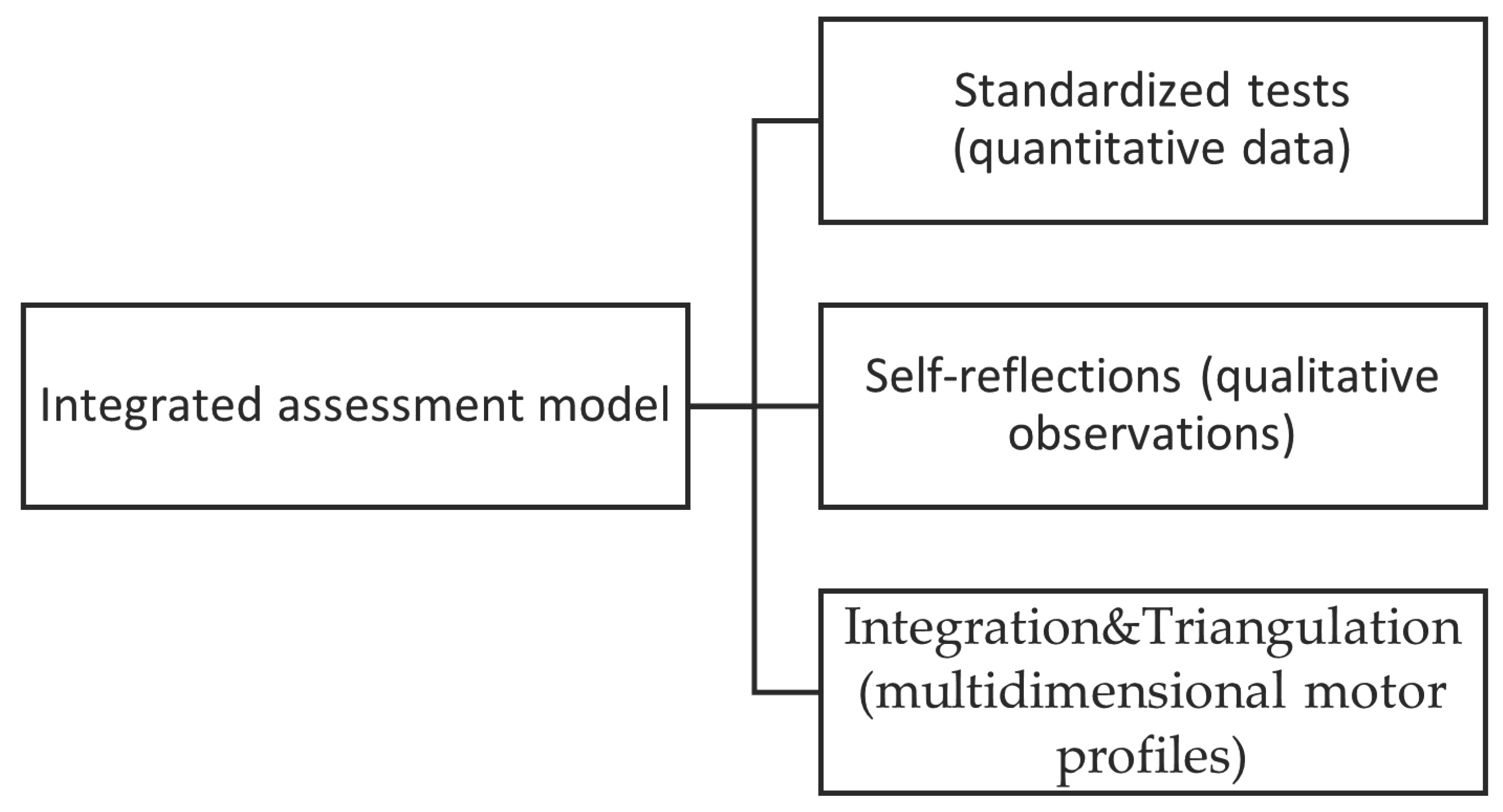
Data analysis was conducted through an integrated approach that combined objective (quantitative) measurements with subjective (qualitative) observations reported by participants. This framework allowed motor performance to be evaluated not only in terms of efficiency, but also with respect to execution style, adopted strategies, and perceived difficulties. The proposed assessment model is articulated into three complementary components: (a) quantitative data derived from standardized motor tests, (b) qualitative reflections describing movement quality and bodily awareness, and (c) the integration of both dimensions into multidimensional motor profiles.
Figure 1 shows the sequential process adopted in the study: administration of standardized motor skill tests, collection of quantitative performance data, and recording of qualitative self-reflections. These dimensions were integrated through a triangulation strategy aimed at identifying convergences and divergences between numerical outcomes and experiential descriptions. This explicit triangulation was implemented to strengthen internal validity and to mitigate the known limitations of field-based motor testing in adult educational samples. A dedicated table later in the article provides illustrative examples of this integrated interpretation, showing how numerical performance indicators align, or contrast, with participants’ qualitative reflections.

2.4.1. Quantitative Analysis

Descriptive statistics (M, SD) were calculated for each test to examine performance distributions. Normality was assessed using the Shapiro–Wilk test to determine the suitability of parametric analyses. Due to the independent nature of the cohorts, independent-samples t-tests were used for between-group comparisons. Homogeneity of variance was evaluated using Levene’s test; when this assumption was violated, Welch-adjusted t-tests were applied. Statistical significance was set at p < 0.05, and effect sizes were calculated using Cohen’s d to support practical interpretation of group differences. Given the exploratory and multidimensional nature of the assessment model, formal alpha correction was not applied to avoid excessive Type II error; instead, interpretation was guided by effect sizes (ES) and by convergence between quantitative results and qualitative evidence. To reduce the risk of inflated Type I error due to multiple correlated outcomes, results were therefore interpreted cautiously and primarily in relation to their practical magnitude and qualitative coherence rather than on statistical significance alone. Data were processed using SPSS 26.0 (IBM Corp., Armonk, NY, USA). The sample size was determined by cohort availability within the educational program and reflects typical enrollment in comparable field-based motor assessment studies. As such, the study prioritizes ecological validity and feasibility within an authentic educational context.
Prior to statistical analysis, all quantitative data were screened for completeness and plausibility. Values clearly incompatible with realistic human performance (e.g., sprint times exceeding typical execution ranges or unrealistically short durations) were examined individually. When such values could be attributed to timing errors, incorrect execution, or recording mistakes, they were excluded from the analysis. Exclusion criteria were applied consistently across tests to reduce distortion of data distributions and to ensure interpretability of results. The number of excluded cases and the reasons for exclusion were reported later in the article. This data-cleaning procedure was adopted to preserve the descriptive integrity of the dataset while acknowledging the practical constraints of field-based assessment in educational settings.

2.4.2. Qualitative Analysis

Textual observations recorded by students were analyzed using thematic analysis. Two researchers, both experienced in motor behavior analysis and qualitative research methods, independently coded the data. Prior to coding, both researchers completed a familiarization phase, repeatedly reading the entire dataset to gain an overall understanding of content, language, and context. Initial open coding was conducted inductively, generating preliminary codes closely linked to participants’ descriptions of motor execution, strategies, fatigue, and adaptation. Codes were then compared, refined, and grouped into broader thematic categories based on conceptual similarity and recurrence across the dataset. Themes were established inductively by grouping recurrent codes related to execution style, motor strategies, perceived difficulties, fatigue, and attentional control. Any discrepancies between coders were discussed until full consensus was reached. Given the exploration and educational nature of the study, inter-coder reliability was ensured through negotiated agreement rather than statistical coefficients.
To enhance credibility, representative excerpts are reported later in the article, illustrating how qualitative themes align with or diverge from quantitative performance indicators. This integration added interpretive depth, allowing motor performance to be assessed not only by numerical outcomes but also by how motor tasks were experienced and executed.

3. Results

As a result of the data cleaning process, a total of 474 valid observations out of 547 were analyzed, including 224 out of 270 from the 2023/2024 cohort and 250 out of 267 from the 2024/2025 cohort. The analysis proceeded with two distinct yet complementary approaches. The first focuses on quantitative outcomes, examining statistical differences across cohorts through descriptive and inferential metrics. The second explores qualitative dimensions, drawing on observational data to identify recurring motor patterns, execution strategies, and signs of fatigue or adaptation.

3.1. Quantitative Results

Descriptive statistics for the 2023/2024 cohort (Table 1) indicate an average of 0.37 ± 0.76 balance losses and a balance maintenance time of 43.59 ± 23.39 s in the Flamingo Test; agility performance averaged 11.63 ± 4.82 s in the dribbling slalom and 25.27 ± 6.50 s in the 5 × 10 shuttle run, while muscular endurance reached 12.71 ± 4.41 sit-ups and sprint performance averaged 7.38 ± 4.31 s over 20 m.
The 2024/2025 cohort (Table 2) showed an average of 0.57 ± 1.27 balance losses and a balance maintenance time of 54.71 ± 12.24 s in the Flamingo Test; agility performance averaged 12.21 ± 7.07 s in the dribbling slalom and 28.06 ± 15.35 s in the 5 × 10 shuttle run, while muscular endurance reached 14.35 ± 3.98 sit-ups and sprint performance averaged 8.61 ± 6.24 s over 20 m.
The comparison of data from the two cohorts (Table 3) reveals that the 2024/2025 cohort demonstrated superior performance in balance and muscular endurance tests but greater variability in sprint times and agility tasks. Effect sizes indicated a medium practical effect for balance duration, small-to-medium effects for muscular endurance, and small effects for speed and agility measures, suggesting that statistically significant differences were generally associated with modest practical magnitude.

3.2. Qualitative Results

Based on the thematic analysis procedure described above, seven recurring themes emerged from participants’ qualitative observations (Table 4). First, execution modalities reflected individual movement styles: some participants favored forefoot running with long strides, while others maintained either an upright or forward-leaning posture, often influenced by their level of task concentration. Motor strategies varied: many used their arms for balance, fixed their gaze on a spatial reference point to maintain stability, or alternate hands during dribbling to improve precision.
The most frequently observed motor difficulties involved coordination between upper and lower limbs, management of directional changes, and postural stability, particularly evident through swaying and tremors toward the end of the trials. Perceived fatigue manifested as shortness of breath, deceleration, muscle soreness, and tension, often more pronounced during the final repetitions or more demanding tests.
Control and concentration played a crucial role: rigid postures, fixed gazes, and distractions (such as laughter or peer interaction) affected execution quality. Some participants displayed spontaneous adaptations, such as small hops to regain balance or adjustments in rhythm and technique to compensate for difficulties. Finally, a positive progression was evident in many cases: times improved, coordination increased, and motor awareness became more refined with repetition.

3.2.1. Comparative Analysis Between Cohorts

Beyond individual observations, comparing the two cohorts allows for a deeper understanding of how motor awareness and execution styles evolve within different educational contexts. The comparison of qualitative observations between the two cohorts (Table 5) reveals differences both in execution and in motor awareness. The 2023/2024 cohort tends to exhibit greater difficulties in directional changes, rhythm management, and fine motor control, often relying on spontaneous compensatory strategies. Observational data suggest an emerging level of motor awareness, frequently linked to the perception of one’s physical limitations.
Differently, the 2024/2025 cohort is characterized by greater executional fluidity and a more pronounced capacity for self-reflection. Participants appear more adept at recognizing their own strategies, describing their motor style, and evaluating improvements across trials. This is reflected in a wider range of spontaneous adaptations and a richer descriptive language. Overall, the 2024/2025 cohort demonstrates a more mature and self-aware motor profile, whereas the 2023/2024 cohort shows a developmental trajectory still in progress, with growth potential supported by targeted interventions and personalized feedback.

3.2.2. Triangulation of Quantitative and Qualitative Findings

The integration of quantitative outcomes and qualitative observations was examined through an explicit triangulation strategy. This approach enabled the identification of convergences, where numerical performance results were consistent with participants’ self-reflections, and divergences, where lower scores were accompanied by evidence of improved execution quality or heightened motor awareness. Table 6 presents illustrative examples of this integrated interpretation, showing how standardized test results align, or contrast, with qualitative reflections. These joint displays reinforce the multidimensional nature of the proposed assessment model and highlight the added value of combining objective measures with reflective accounts in the evaluation of trainee teachers’ motor competence.
Table 6 reports representative cases, not aggregated values, illustrating the triangulation strategy adopted in the study. Each row shows how standardized test results (quantitative outcomes) were interpreted together with participants’ self-reflections (qualitative observations). Some cases demonstrate convergence, where numerical performance and descriptive accounts are consistent, while others highlight divergence, where lower scores are accompanied by evidence of improved execution quality or greater motor awareness. These examples reinforce the multidimensional nature of the proposed assessment model.

4. Discussion

The present study examined motor performance in two cohorts of trainee teachers using an integrated assessment model combining quantitative outcomes with structured qualitative observation. This approach made it possible to move beyond the exclusive reliance on standardized motor test scores, which, although widely used and validated for comparative purposes [27], are known to provide only a partial representation of motor competence. Quantitative analyses revealed statistically significant differences between cohorts in selected motor tasks, particularly in balance duration and muscular endurance, with effect sizes ranging from small to medium. These results indicate measurable variability in performance but also suggest that numerical outcomes alone are insufficient to capture execution quality, control strategies, and individual modes of adaptation. This interpretation is supported by the qualitative findings, which showed that similar scores could correspond to markedly different movement strategies and levels of motor awareness.
Qualitative observations consistently documented individual execution modalities and adaptive behaviors, including the use of arm movements for balance, focused visual attention, rhythm adjustments, and spontaneous compensations during task execution. Such patterns align with experimental evidence showing that individuals adapt movement strategies in response to environmental demands and task constraints [28,29]. Importantly, these adaptive behaviors were observed across performance levels, indicating that motor competence encompasses not only efficiency or speed but also the ability to regulate and reorganize movement in response to perceived difficulty [30,31]. The triangulation of quantitative and qualitative data further highlighted this multidimensionality. In some cases, higher numerical performance converged with conscious execution strategies and reflective descriptions, while in others, lower efficiency was accompanied by smoother execution, improved coordination, or increased awareness. Similar dissociations between performance outcomes and underlying control strategies have been reported in studies examining sensorimotor adaptation and compensation [32,33,34,35]. However, in the present study, these references serve solely as a conceptual backdrop, as no direct measures of sensory prediction, neural control, or learning mechanisms were collected.
When comparing cohorts, differences emerged not only in test outcomes but also in execution characteristics and verbalized reflections. The 2024/2025 cohort generally displayed greater executional fluidity and a richer descriptive vocabulary, whereas the 2023/2024 cohort more frequently relied on spontaneous compensatory behaviors and exhibited emerging motor awareness. Nevertheless, given the cross-sectional nature of the study, these differences cannot be interpreted as developmental progressions or attributed to changes in teaching methods or educational design. Alternative explanations, such as unmeasured cohort characteristics, prior motor experiences, or group composition, cannot be excluded. Accordingly, cohort contrasts should be interpreted as descriptive differences observed at a single time point, rather than as indicators of instructional effectiveness or pedagogical evolution. This cautious interpretation is consistent with the modest effect sizes observed in the quantitative analysis and avoids overextension beyond what the data can reasonably support. Theoretical models of motor regulation and compensation provide a useful interpretive context for understanding the observed behaviors. For example, adaptive responses such as rhythm modification, postural adjustments, and strategic use of visual focus are consistent with general accounts of sensorimotor integration and compensatory control described in the literature [31,33]. However, these models are referenced here only to frame the observed phenomena, not to infer underlying neurophysiological processes.
Finally, participants’ spontaneous self-reflections (e.g., references to stability, rhythm, breathing, and fatigue management) suggest that self-assessment can elicit meaningful insights into movement execution. Such reflective processes have been associated with increased psychophysical awareness and self-regulation in physical activity contexts [36]. Within the limits of the present design, the findings support the use of integrated assessment models that combine objective performance measures with guided qualitative reflection, particularly in educational settings where awareness and adaptability are considered important learning outcomes.

Limitations of the Study

Despite its methodological strengths, this study presents some limitations that should be acknowledged. First, the self-assessment procedure, while fostering reflective awareness, may be subject to bias due to individual differences in perception, verbalization skills, and motivation. The absence of external evaluators or video recordings limits the triangulation of qualitative data, potentially affecting the reliability of observational insights.
Second, the sample was predominantly female and drawn from a single academic institution, which may restrict the generalizability of findings to broader populations or different educational settings. This imbalance reflects national enrollment trends but nonetheless reduces applicability to male students. Additionally, the study did not include follow-up assessments to evaluate long-term retention or transferability of motor awareness and competence. Moreover, the cross-sectional design, based on independent cohorts, prevents causal interpretation of differences between groups.
Third, the selected test battery was applied in an exploratory and educational framework. Formal reliability analyses such as test–retest or inter-rater consistency were not conducted, and extreme values were excluded based on plausibility criteria. These choices, while appropriate for the context, may limit the robustness of quantitative conclusions.
Finally, while the integrated model offers a rich interpretive framework, its application requires careful scaffolding and training to ensure consistent and meaningful self-observation across participants. Future research should consider mixed-method designs, longitudinal tracking, and broader sampling to validate and expand the proposed model.

5. Conclusions

This study introduces an integrated evaluation model that considers both the quantitative (“how much”) and qualitative (“how”) dimensions of human movement. The model is structured across three complementary levels:
  • Objective performance, i.e., standardized measurements of time, repetitions, and oscillations.
  • Execution profile, i.e., observation of motor strategies, movement fluidity, and spontaneous adaptations.
  • Motor awareness, i.e., subjective reflections, gesture perception, and self-assessment. This framework enables the conception of personalized motor profiles, applicable in educational, preventive, and rehabilitative contexts. The relevance of field-based motor tests is further supported by systematic reviews that confirm their effectiveness in assessing health-related physical fitness in children and adolescents, reinforcing their evaluative value in educational settings [37,38]. In particular, qualitative observation enriched the interpretation of objective data by revealing competencies not evident in performance scores, while self-assessment fostered motor awareness and learning consolidation. The integration of these three analytical levels allowed for the development of multidimensional motor profiles, in which performance is evaluated not only in terms of outcomes but also in terms of process. This approach made it possible to: identify individuals with high efficiency but limited fluidity, or vice versa; highlight spontaneously adopted compensatory strategies; and detect intra-individual progress across trials, even in the absence of quantitative improvement.
The study provides an overview of students’ motor performance in a real educational setting, without external interference or experimental constraints. Differences in how individuals and cohorts performed highlight the value of flexible and inclusive learning environments. The comparison between cohorts showed not just variations in results, but also improvements in movement quality and self-awareness, suggesting that teaching methods and educational context can play a key role in shaping students’ motor and cognitive development.
The model can be a useful resource for helping future primary school teachers to develop both motor skills and reflective abilities, with positive effects on the quality of physical education in primary schools. Using it in training settings may support the development of body awareness and self-regulation, important foundations for a physical education that is inclusive, effective, and long-lasting.
Looking ahead, the proposed model may be applied in physical education programs, teacher training, and health promotion initiatives, contributing to a more equitable, motivating, and person-centered evaluation approach [22].

Funding

This research received no external funding.

Institutional Review Board Statement

The present study is part of the research project entitled “Psychophysical perception and body awareness in school and sports contexts through observational and non-invasive tools”, approved by the Ethics Committee of Pegaso University (Prot./E 004726, dated 15 July 2025).

Informed Consent Statement

Informed consent was obtained from all subjects involved in the study.

Data Availability Statement

The raw data supporting the conclusions of this article will be made available by the author upon request.

Conflicts of Interest

The author declares no conflicts of interest.

References

  1. Piotrowski, T.; Makaruk, H.; Tekień, E.; Feleszko, W.; Kołodziej, M.; Albrecht, K.; Grela, K.; Makuch, R.; Werner, B.; Gąsior, J.S. Fundamental Movement/Motor Skills as an Important Component of Physical Literacy and Bridge to Physical Activity: A Scoping Review. Children 2025, 12, 1406. [Google Scholar] [CrossRef]
  2. Reiman, M.P.; Manske, R.C. Functional Testing in Human Performance; Human Kinetics: Champaign, IL, USA, 2009. [Google Scholar]
  3. Hulteen, R.M.; Terlizzi, B.; Abrams, T.C.; Sacko, R.S.; De Meester, A.; Pesce, C.; Stodden, D.F. Reinvest to Assess: Advancing Approaches to Motor Competence Measurement Across the Lifespan. Sports Med. 2023, 53, 33–50. [Google Scholar] [CrossRef]
  4. Hill, P.J.; Mcnarry, M.A.; Mackintosh, K.A.; Murray, M.A.; Pesce, C.; Valentini, N.C.; Getchell, N.; Tomporowski, P.D.; Robinson, L.E.; Barnett, L.M. The Influence of Motor Competence on Broader Aspects of Health: A Systematic Review of the Longitudinal Associations Between Motor Competence and Cognitive and Social-Emotional Outcomes. Sports Med. 2024, 54, 375–427. [Google Scholar] [CrossRef]
  5. Robinson, L.E.; Stodden, D.F.; Barnett, L.M.; Lopes, V.P.; Logan, S.W.; Rodrigues, L.P.; D’Hondt, E. Motor Competence and its Effect on Positive Developmental Trajectories of Health. Sports Med. 2015, 45, 1273–1284. [Google Scholar] [CrossRef] [PubMed]
  6. Altavilla, G.; D’elia, F.; D’isanto, T.; Manna, A. Tests for the evaluation of the improvement of physical fitness and health at the secondary school. J. Phys. Educ. Sport 2019, 19, 1784–1787. [Google Scholar] [CrossRef]
  7. Altavilla, G.; Aliberti, S.; D’Elia, F. Assessment of Motor Performance and Self-Perceived Psychophysical Well-Being in Relation to Body Mass Index in Italian Adolescents. Children 2024, 11, 1119. [Google Scholar] [CrossRef]
  8. Cruz-León, C.; Expósito-Carrillo, P.; Sánchez-Parente, S.; Jiménez-Iglesias, J.; Borges-Cosic, M.; Cuenca-Garcia, M.; Castro-Piñero, J. Feasibility and Safety of Field-Based Physical Fitness Tests: A Systematic Review. Sports Med.-Open 2025, 11, 8. [Google Scholar] [CrossRef] [PubMed]
  9. Cuenca-Garcia, M.; Marin-Jimenez, N.; Perez-Bey, A.; Sánchez-Oliva, D.; Camiletti-Moiron, D.; Alvarez-Gallardo, I.C.; Ortega, F.B.; Castro-Piñero, J. Reliability of Field-Based Fitness Tests in Adults: A Systematic Review. Sports Med. 2022, 52, 1961–1979. [Google Scholar] [CrossRef]
  10. Castro-Piñero, J.; Marin-Jimenez, N.; Fernandez-Santos, J.R.; Martin-Acosta, F.; Segura-Jimenez, V.; Izquierdo-Gomez, R.; Ruiz, J.R.; Cuenca-Garcia, M. Criterion-Related Validity of Field-Based Fitness Tests in Adults: A Systematic Review. J. Clin. Med. 2021, 10, 3743. [Google Scholar] [CrossRef]
  11. Goods, P.S.R.; McKay, A.K.; Appleby, B.; Veli, D.; Peeling, P.; Jennings, D. A repeated shuttle sprint test with female and male international field hockey players is reliable and associated with single sprint but not intermittent endurance performance. PLoS ONE 2022, 17, e0271244. [Google Scholar] [CrossRef]
  12. Rosenbaum, D.; Brandes, M. Qualitative and Quantitative Aspects of Movement: The Discrepancy Between Clinical Gait Analysis and Activities of Daily Life. In Human Motion; Rosenhahn, B., Klette, R., Metaxas, D., Eds.; Computational Imaging and Vision; Springer: Dordrecht, The Netherlands, 2008; Volume 36. [Google Scholar] [CrossRef]
  13. Raiola, G.; Esposito, G.; Aliberti, S.; D’Elia, F. Effects on Performance, Perception, and Awareness of Plyometric Training in Youth Volleyball: A Novel Methodological Approach to Training. Appl. Sci. 2025, 15, 1581. [Google Scholar] [CrossRef]
  14. D’Isanto, T.; Karçurri, A.; Kasa, A.; Di Lascio, G.; D’Elia, F. New Training Method Approach on Perception-Awareness to Improve Sport Performance on Volleyball Athletes. Int. J. Kinesiol. Sports Sci. 2025, 13, 64–71. [Google Scholar] [CrossRef]
  15. Giardullo, G.; Ceruso, R.; Penna, G.; Aliberti, S. Exercise in the Workplace: A Qualitative-Quantitative Study of Enjoyment. Sport Mont. 2024, 22, 93–98. [Google Scholar] [CrossRef]
  16. Cañabate, D.; Bubnys, R.; Hernández, E.; Colomer, J. A rubric for pre-service teachers to evaluate meaningful physical education. Front. Educ. 2024, 8, 1324349. [Google Scholar] [CrossRef]
  17. Yin, H.; Omar Dev, R.D.; Soh, K.G.; Li, F.; Lian, M. Assessment and development of physical education teachers’ physical literacy: A systematic review. PLoS ONE 2024, 19, e0307505. [Google Scholar] [CrossRef]
  18. Beseler, B.; Plumb, M.S.; Spittle, M.; Johnson, N.F.; Harvey, J.T.; Mesagno, C. Examining single session peer-teaching instructional approaches on pre-service physical education teachers’ throwing techniques. Percept. Mot. Ski. 2024, 131, 246–266. [Google Scholar] [CrossRef]
  19. Buckler, E.J.; Faulkner, G.E.; Beauchamp, M.R.; Rizzardo, B.; DeSouza, L.; Puterman, E. A systematic review of educator-led physical literacy and activity interventions. Am. J. Prev. Med. 2023, 64, 742–760. [Google Scholar] [CrossRef]
  20. Raiola, G. Physical Literacy, According to the World Health Organization (WHO), in Italian Preschool and Education for a Daily Movement Routine. Children 2025, 12, 66. [Google Scholar] [CrossRef]
  21. D’Elia, F.; Altavilla, G.; Esposito, G.; Aliberti, S.; Raiola, G. Perceptions and benefits of static and dynamic stretching in dancers: Qualitative and quantitative aspects. J. Phys. Educ. 2022, 33, e3339. [Google Scholar] [CrossRef]
  22. Esposito, G.; Ceruso, R.; Invernizzi, P.L.; Manzi, V.; Raiola, G. Effects of Stretching and Resistance Training on Psychophysical Awareness: A Pilot Study. Appl. Sci. 2025, 15, 8259. [Google Scholar] [CrossRef]
  23. Rebelo, M.; Serrano, J.; Paulo, R.; Duarte-Mendes, P.; Santos, J.; Honório, S.; Petrica, J. The importance of oriented physical activity in the first 48 months: Differences in motor skills. BMC Pediatr. 2023, 23, 232. [Google Scholar] [CrossRef]
  24. Rodrigues, L.P.; Cordovil, R.; Costa, J.A.; Seabra, A.; Guilherme, J.; Vale, S.; Luz, C.; Flôres, F.; Lagoa, M.J.; Almeida, G.; et al. Improving motor competence of children: The “Super Quinas” intervention program in Portuguese primary schools. J. Phys. Act. Health 2025, 22, 436–443. [Google Scholar] [CrossRef]
  25. Civelek, P.; Uyanık, G. Development of the ‘Teacher Self-Efficacy Scale on Activities Supporting Motor Development (MSS-S)’ in preschool education. Particip. Educ. Res. 2024, 11, 245–264. [Google Scholar] [CrossRef]
  26. García-Liñeira, J.; Leirós-Rodríguez, R.; Romo-Pérez, V.; García-Soidán, J.L. Static and dynamic postural control assessment in schoolchildren: Reliability and reference values of the Modified Flamingo Test and Bar Test. J. Bodyw. Mov. Ther. 2023, 36, 14–19. [Google Scholar] [CrossRef] [PubMed]
  27. Palagina, N.I.; Polevshchikov, M.M.; Dorogova, Y.A.; Familnikova, N.V.; Blinova, M.L. Standardization of Testing the Level of Physical Fitness of Students of 18–20 years. Mediterr. J. Soc. Sci. 2015, 6, 265–273. [Google Scholar] [CrossRef]
  28. Rieger, M.; Knoblich, G.; Prinz, W. Compensation for and adaptation to changes in the environment. Exp. Brain Res. 2005, 163, 487–502. [Google Scholar] [CrossRef]
  29. Scheidt, R.A.; Conditt, M.A.; Secco, E.L.; Mussa-Ivaldi, F.A. Interaction of Visual and Proprioceptive Feedback During Adaptation of Human Reaching Movements. J. Neurophysiol. 2005, 93, 3200–3213. [Google Scholar] [CrossRef]
  30. Ellis, S.R.; Adelstein, B.D. Kinesthetic Compensation for Sensorimotor Rearrangements. J. Mot. Behav. 2009, 41, 501–518. [Google Scholar] [CrossRef] [PubMed]
  31. Uysal, S.A.; Düger, T. Motor control and sensory-motor integration of human movement. In Comparative Kinesiology of the Human Body; Angin, S., Şimşek, I.E., Eds.; Academic Press: Cambridge, MA, USA, 2020; Chapter 24; pp. 443–452. [Google Scholar] [CrossRef]
  32. Davidson, P.R.; Wolpert, D.M. Widespread access to predictive models in the motor system: A short review. J. Neural Eng. 2005, 2, S313–S319. [Google Scholar] [CrossRef]
  33. Wolpert, D.M.; Diedrichsen, J.; Flanagan, J.R. Principles of sensorimotor learning. Nat. Rev. Neurosci. 2011, 12, 739–751. [Google Scholar] [CrossRef]
  34. Perrin, P.; Mallinson, A.; Longridge, N.; Armato, E.; Magnusson, M.; Dumas, G.; Perrin, N.; Denise, P.; Gargiulo, P.; Petersen, H.; et al. Compensation for Balance Disorders: Analysis of This Multifactorial Process. Eur. J. Transl. Myol. 2025, 35, 13816. [Google Scholar] [CrossRef] [PubMed]
  35. Leow, L.A.; Marinovic, W.; de Rugy, A.; Carroll, T.J. Task errors contribute to implicit aftereffects in sensorimotor adaptation. Eur. J. Neurosci. 2018, 48, 3397–3409. [Google Scholar] [CrossRef] [PubMed]
  36. Esposito, G.; Ceruso, R.; Raiola, G. The impact of gentle physical activity on psychophysical well-being in older adults: A longitudinal study. Retos 2025, 67, 509–521. [Google Scholar] [CrossRef]
  37. Marques, A.; Henriques-Neto, D.; Peralta, M.; Martins, J.; Gomes, F.; Popovic, S.; Masanovic, B.; Demetriou, Y.; Schlund, A.; Ihle, A. Field-Based Health-Related Physical Fitness Tests in Children and Adolescents: A Systematic Review. Front. Pediatr. 2021, 9, 640028. [Google Scholar] [CrossRef]
  38. Rebelo, M.; Honório, S.; Pais, A.; Santos, J.; Afonso, P.; Marques, C.; Diniz, A.; Serrano, J. Study of body composition and motor competence in children from the 1st basic cycle and their relationship with school performance. BMC Pediatr. 2025, 25, 429. [Google Scholar] [CrossRef]
Figure 1. Workflow of the integrated assessment model.
Sci 08 00040 g001
Table 1. Descriptive statistics for motor performance in the 2023/2024 cohort.
Valid CasesMinMaxMSD
Flamingo Test—Balance losses (count)2240.003.000.36610.75757
Flamingo Test—Balance duration (seconds)2241.0060.0043.585023.38694
Dribbling Slalom—Completion time (seconds)2244.1839.0011.62814.81676
5 × 10 Shuttle Run—Total time (seconds)2246.5060.0025.26706.50445
Sit-up Test—Repetitions (count)2240.0026.0012.71434.40633
20 m Sprint—Time (seconds)2242.4150.007.38314.30760
Table 2. Descriptive statistics for motor performance in the 2024/2025 cohort.
Valid CasesMinMaxMSD
Flamingo Test—Balance losses (count)2500.0010.000.5681.269
Flamingo Test—Balance duration (seconds)2501.0060.0054.708012.23756
Dribbling Slalom—Completion time (seconds)2502.3460.0012.20707.07068
5 × 10 Shuttle Run—Total time (seconds)2507.73180.0028.058215.35209
Sit-up Test—Repetitions (count)2504.0030.0014.34803.98225
20 m Sprint—Time (seconds)2501.0055.008.60856.24244
Table 3. Group statistics and independent samples t-test comparing motor performance between the 2023/2024 and 2024/2025 cohorts.
tdfp < 0.05Mean DifferenceStd.
Error Difference
95% CIES
TestCohortMSD LowerHigher
Flamingo—Balance losses23–240.3660.757−2.0734720.039−0.2010.097−0.393−0.010d = 0.19 (small)
24–250.5681.269
Flamingo—Balance
duration (s)
23–2443.58523.386−6.5824720.000−11.1231.689−14.443−7.802d = 0.61 (medium)
24–2554.70812.237
Dribbling slalom (s)23–2411.6284.816−1.0304720.304−0.5780.562−1.6830.525d = 0.10 (small)
24–2512.2077.070
5 × 10 Shuttle Run (s)23–2425.2676.504−2.5254720.012−2.7911.105−4.963−0.619d = 0.23 (small)
24–2528.05815.352
Sit-up test (repetitions)23–2412.7144.406−4.2404720.000−1.6330.385−2.390−0.876d = 0.39 (small-to-medium)
24–2514.3483.982
20 m sprint (s)23–247.3834.307−2.4604720.014−1.2250.498−2.204−0.246d = 0.23 (small)
24–258.6086.242
Table 4. Thematic categories emerging from qualitative observation of motor performance.
Thematic CategoryBrief DescriptionRecurring Examples
Execution ModalitiesIndividual styles and characteristics of motor executionLong or short steps, forefoot running, standing or compensatory posture
Adopted Motor StrategiesConscious actions to enhance performance or maintain balanceUse of arms for balance, focused visual attention, alternating hands during dribbling
Motor DifficultiesLimitations or obstacles in movement executionLoss of balance, poor coordination, difficulty changing direction
Perceived FatigueSensations of tiredness, performance decline, physical energyShortness of breath, final-phase slowing, muscle ache, tension
Control and FocusAbility to maintain attention and motor controlFocused visual attention, rigid posture, distractions, laughter during the task
Spontaneous AdaptationsPersonal adjustments to motor actions to compensate for difficultiesSmall hops to regain balance, rhythm changes, use of supports
Progression and ImprovementPerformance evolution over time or across repetitionsImproved timing, increased fluidity, reduction in execution errors
Table 5. Qualitative comparison of motor performance across cohorts by test type.
Motor Test Cohort 2023/2024: Main ObservationsCohort 2024/2025: Main Observations
Flamingo Balance TestIncreased use of arms for compensation; instability with non-dominant legGreater overall stability; enhanced postural awareness
Dribbling Slalom One-handed dribbling; difficulty controlling the ballMore frequent hand alternation; smoother movement along the course
5 × 10 Shuttle RunSlowing during directional changes; evident fatigueMore fluid running; better recognition of individual running style
30-Second Sit-Up TestUse of arms to assist; early onset of fatigueMore consistent rhythm; greater attention to breathing
20 m SprintSlow starts; difficulty with directional transitionsFaster accelerations; more detailed technical observations
Table 6. Examples of integrated interpretation of quantitative and qualitative data.
Motor TestQuantitative Outcome (Example)Qualitative Observation (Example)Integrated Interpretation
Flamingo Balance TestLonger balance duration (≈55 s)“I fixed my gaze on a point and controlled breathing to stay stable.”Convergence: Higher numerical performance aligns with conscious postural strategies and motor awareness.
5 × 10 Shuttle RunSlower completion time (≈28 s)“Directional changes felt smoother; I adjusted rhythm to avoid imbalance.”Divergence: Lower speed but improved execution quality, showing adaptation and awareness despite reduced efficiency.
20-m SprintFaster acceleration (≈7.3 s)“I leaned forward and used arm drive to increase speed.”Convergence: Better times correspond with effective technical strategies and self-reflection on execution.
Dribbling SlalomModerate completion time (≈12 s)“Alternating hands improved control; movement felt more fluid.”Convergence: Numerical performance consistent with qualitative evidence of improved coordination.
30-Second Sit-Up TestHigher repetitions (≈14 s)“I kept a steady rhythm and focused on breathing to reduce fatigue.”Convergence: Greater endurance supported by conscious regulation of rhythm and breathing.
Disclaimer/Publisher’s Note: The statements, opinions and data contained in all publications are solely those of the individual author(s) and contributor(s) and not of MDPI and/or the editor(s). MDPI and/or the editor(s) disclaim responsibility for any injury to people or property resulting from any ideas, methods, instructions or products referred to in the content.