

An Integrated Assessment Model for Evaluating Motor Skills in Trainee Primary School Teachers


Abstract
1. Introduction
2. Materials and Methods
2.1. Participants
2.2. Procedure
2.3. Instruments and Tests
- Flamingo Balance Test [26]: This assesses static balance on one leg. Participants maintain the position as long as possible while the number of balance losses is recorded within a set time (60 s).
- 5 × 10 Shuttle Run: This measures speed and change in direction ability. Participants run five times over a 10 m distance, with total time recorded.
- 20 m Sprint: This assesses linear speed. The sprint test required participants to run a 20 m linear course, repeating the trial three times under identical conditions. Each run was timed using a manual stopwatch, and participants were instructed to perform at maximum effort. Among the three attempts, only the best performance, i.e., the shortest time recorded, was retained for analysis. This procedure was designed to reduce variability due to momentary distractions or execution errors and to better reflect each participant’s optimal motor output in terms of speed and coordination.
- Dribbling Slalom: This evaluates hand–eye coordination and dexterity. Participants dribble a ball through a cone-lined path, aiming for control and fluidity.
- 30-Second Sit-Up Test: This measures trunk muscular endurance. The number of correctly performed repetitions in 30 s is counted.
2.4. Data Analysis
2.4.1. Quantitative Analysis
2.4.2. Qualitative Analysis
3. Results
3.1. Quantitative Results
3.2. Qualitative Results
3.2.1. Comparative Analysis Between Cohorts
3.2.2. Triangulation of Quantitative and Qualitative Findings
4. Discussion
Limitations of the Study
5. Conclusions
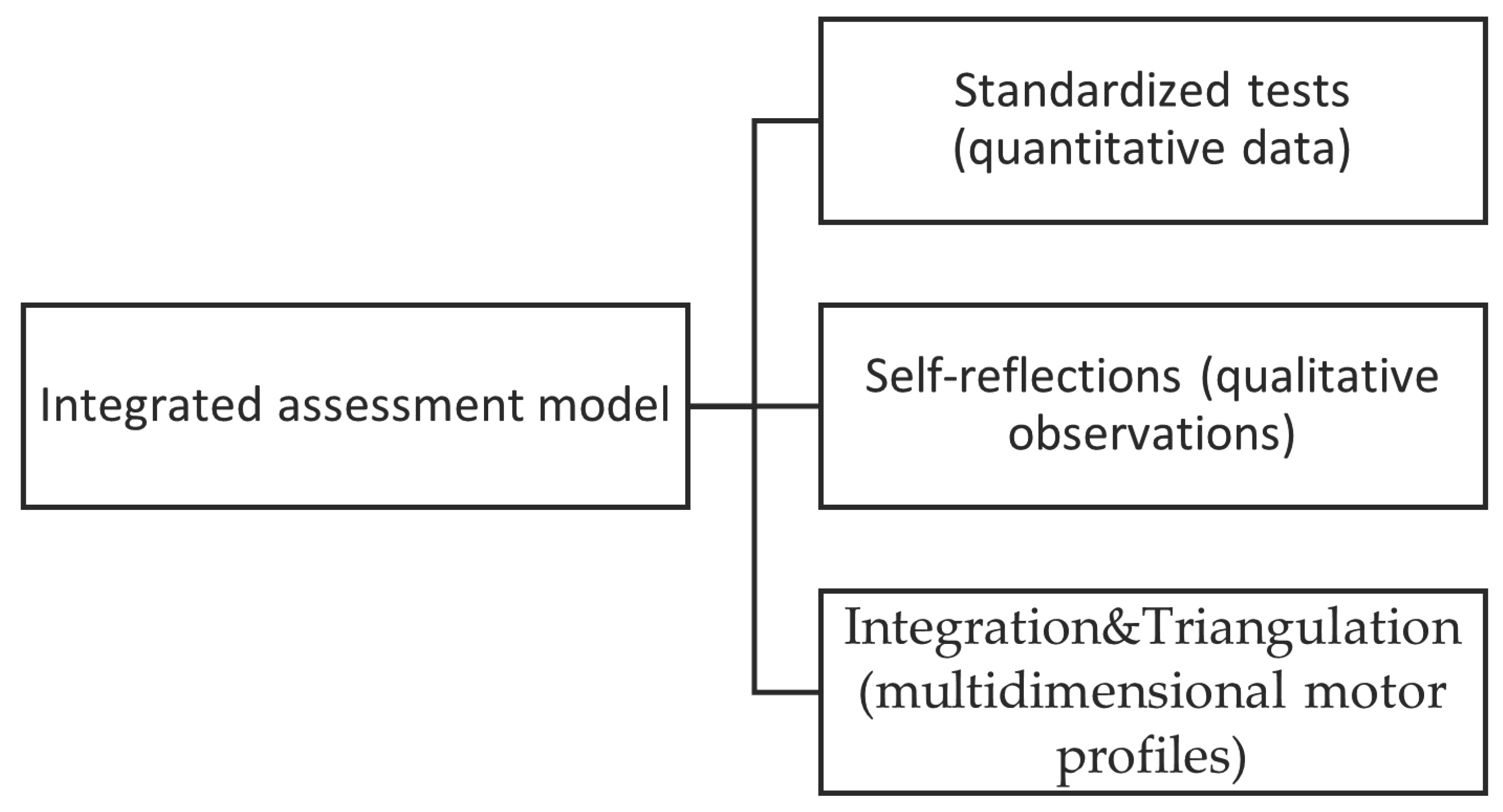
- Objective performance, i.e., standardized measurements of time, repetitions, and oscillations.
- Execution profile, i.e., observation of motor strategies, movement fluidity, and spontaneous adaptations.
- Motor awareness, i.e., subjective reflections, gesture perception, and self-assessment. This framework enables the conception of personalized motor profiles, applicable in educational, preventive, and rehabilitative contexts. The relevance of field-based motor tests is further supported by systematic reviews that confirm their effectiveness in assessing health-related physical fitness in children and adolescents, reinforcing their evaluative value in educational settings [37,38]. In particular, qualitative observation enriched the interpretation of objective data by revealing competencies not evident in performance scores, while self-assessment fostered motor awareness and learning consolidation. The integration of these three analytical levels allowed for the development of multidimensional motor profiles, in which performance is evaluated not only in terms of outcomes but also in terms of process. This approach made it possible to: identify individuals with high efficiency but limited fluidity, or vice versa; highlight spontaneously adopted compensatory strategies; and detect intra-individual progress across trials, even in the absence of quantitative improvement.
Funding
Institutional Review Board Statement
Informed Consent Statement
Data Availability Statement
Conflicts of Interest
References
- Piotrowski, T.; Makaruk, H.; Tekień, E.; Feleszko, W.; Kołodziej, M.; Albrecht, K.; Grela, K.; Makuch, R.; Werner, B.; Gąsior, J.S. Fundamental Movement/Motor Skills as an Important Component of Physical Literacy and Bridge to Physical Activity: A Scoping Review. Children 2025, 12, 1406. [Google Scholar] [CrossRef]
- Reiman, M.P.; Manske, R.C. Functional Testing in Human Performance; Human Kinetics: Champaign, IL, USA, 2009. [Google Scholar]
- Hulteen, R.M.; Terlizzi, B.; Abrams, T.C.; Sacko, R.S.; De Meester, A.; Pesce, C.; Stodden, D.F. Reinvest to Assess: Advancing Approaches to Motor Competence Measurement Across the Lifespan. Sports Med. 2023, 53, 33–50. [Google Scholar] [CrossRef]
- Hill, P.J.; Mcnarry, M.A.; Mackintosh, K.A.; Murray, M.A.; Pesce, C.; Valentini, N.C.; Getchell, N.; Tomporowski, P.D.; Robinson, L.E.; Barnett, L.M. The Influence of Motor Competence on Broader Aspects of Health: A Systematic Review of the Longitudinal Associations Between Motor Competence and Cognitive and Social-Emotional Outcomes. Sports Med. 2024, 54, 375–427. [Google Scholar] [CrossRef]
- Robinson, L.E.; Stodden, D.F.; Barnett, L.M.; Lopes, V.P.; Logan, S.W.; Rodrigues, L.P.; D’Hondt, E. Motor Competence and its Effect on Positive Developmental Trajectories of Health. Sports Med. 2015, 45, 1273–1284. [Google Scholar] [CrossRef] [PubMed]
- Altavilla, G.; D’elia, F.; D’isanto, T.; Manna, A. Tests for the evaluation of the improvement of physical fitness and health at the secondary school. J. Phys. Educ. Sport 2019, 19, 1784–1787. [Google Scholar] [CrossRef]
- Altavilla, G.; Aliberti, S.; D’Elia, F. Assessment of Motor Performance and Self-Perceived Psychophysical Well-Being in Relation to Body Mass Index in Italian Adolescents. Children 2024, 11, 1119. [Google Scholar] [CrossRef]
- Cruz-León, C.; Expósito-Carrillo, P.; Sánchez-Parente, S.; Jiménez-Iglesias, J.; Borges-Cosic, M.; Cuenca-Garcia, M.; Castro-Piñero, J. Feasibility and Safety of Field-Based Physical Fitness Tests: A Systematic Review. Sports Med.-Open 2025, 11, 8. [Google Scholar] [CrossRef] [PubMed]
- Cuenca-Garcia, M.; Marin-Jimenez, N.; Perez-Bey, A.; Sánchez-Oliva, D.; Camiletti-Moiron, D.; Alvarez-Gallardo, I.C.; Ortega, F.B.; Castro-Piñero, J. Reliability of Field-Based Fitness Tests in Adults: A Systematic Review. Sports Med. 2022, 52, 1961–1979. [Google Scholar] [CrossRef]
- Castro-Piñero, J.; Marin-Jimenez, N.; Fernandez-Santos, J.R.; Martin-Acosta, F.; Segura-Jimenez, V.; Izquierdo-Gomez, R.; Ruiz, J.R.; Cuenca-Garcia, M. Criterion-Related Validity of Field-Based Fitness Tests in Adults: A Systematic Review. J. Clin. Med. 2021, 10, 3743. [Google Scholar] [CrossRef]
- Goods, P.S.R.; McKay, A.K.; Appleby, B.; Veli, D.; Peeling, P.; Jennings, D. A repeated shuttle sprint test with female and male international field hockey players is reliable and associated with single sprint but not intermittent endurance performance. PLoS ONE 2022, 17, e0271244. [Google Scholar] [CrossRef]
- Rosenbaum, D.; Brandes, M. Qualitative and Quantitative Aspects of Movement: The Discrepancy Between Clinical Gait Analysis and Activities of Daily Life. In Human Motion; Rosenhahn, B., Klette, R., Metaxas, D., Eds.; Computational Imaging and Vision; Springer: Dordrecht, The Netherlands, 2008; Volume 36. [Google Scholar] [CrossRef]
- Raiola, G.; Esposito, G.; Aliberti, S.; D’Elia, F. Effects on Performance, Perception, and Awareness of Plyometric Training in Youth Volleyball: A Novel Methodological Approach to Training. Appl. Sci. 2025, 15, 1581. [Google Scholar] [CrossRef]
- D’Isanto, T.; Karçurri, A.; Kasa, A.; Di Lascio, G.; D’Elia, F. New Training Method Approach on Perception-Awareness to Improve Sport Performance on Volleyball Athletes. Int. J. Kinesiol. Sports Sci. 2025, 13, 64–71. [Google Scholar] [CrossRef]
- Giardullo, G.; Ceruso, R.; Penna, G.; Aliberti, S. Exercise in the Workplace: A Qualitative-Quantitative Study of Enjoyment. Sport Mont. 2024, 22, 93–98. [Google Scholar] [CrossRef]
- Cañabate, D.; Bubnys, R.; Hernández, E.; Colomer, J. A rubric for pre-service teachers to evaluate meaningful physical education. Front. Educ. 2024, 8, 1324349. [Google Scholar] [CrossRef]
- Yin, H.; Omar Dev, R.D.; Soh, K.G.; Li, F.; Lian, M. Assessment and development of physical education teachers’ physical literacy: A systematic review. PLoS ONE 2024, 19, e0307505. [Google Scholar] [CrossRef]
- Beseler, B.; Plumb, M.S.; Spittle, M.; Johnson, N.F.; Harvey, J.T.; Mesagno, C. Examining single session peer-teaching instructional approaches on pre-service physical education teachers’ throwing techniques. Percept. Mot. Ski. 2024, 131, 246–266. [Google Scholar] [CrossRef]
- Buckler, E.J.; Faulkner, G.E.; Beauchamp, M.R.; Rizzardo, B.; DeSouza, L.; Puterman, E. A systematic review of educator-led physical literacy and activity interventions. Am. J. Prev. Med. 2023, 64, 742–760. [Google Scholar] [CrossRef]
- Raiola, G. Physical Literacy, According to the World Health Organization (WHO), in Italian Preschool and Education for a Daily Movement Routine. Children 2025, 12, 66. [Google Scholar] [CrossRef]
- D’Elia, F.; Altavilla, G.; Esposito, G.; Aliberti, S.; Raiola, G. Perceptions and benefits of static and dynamic stretching in dancers: Qualitative and quantitative aspects. J. Phys. Educ. 2022, 33, e3339. [Google Scholar] [CrossRef]
- Esposito, G.; Ceruso, R.; Invernizzi, P.L.; Manzi, V.; Raiola, G. Effects of Stretching and Resistance Training on Psychophysical Awareness: A Pilot Study. Appl. Sci. 2025, 15, 8259. [Google Scholar] [CrossRef]
- Rebelo, M.; Serrano, J.; Paulo, R.; Duarte-Mendes, P.; Santos, J.; Honório, S.; Petrica, J. The importance of oriented physical activity in the first 48 months: Differences in motor skills. BMC Pediatr. 2023, 23, 232. [Google Scholar] [CrossRef]
- Rodrigues, L.P.; Cordovil, R.; Costa, J.A.; Seabra, A.; Guilherme, J.; Vale, S.; Luz, C.; Flôres, F.; Lagoa, M.J.; Almeida, G.; et al. Improving motor competence of children: The “Super Quinas” intervention program in Portuguese primary schools. J. Phys. Act. Health 2025, 22, 436–443. [Google Scholar] [CrossRef]
- Civelek, P.; Uyanık, G. Development of the ‘Teacher Self-Efficacy Scale on Activities Supporting Motor Development (MSS-S)’ in preschool education. Particip. Educ. Res. 2024, 11, 245–264. [Google Scholar] [CrossRef]
- García-Liñeira, J.; Leirós-Rodríguez, R.; Romo-Pérez, V.; García-Soidán, J.L. Static and dynamic postural control assessment in schoolchildren: Reliability and reference values of the Modified Flamingo Test and Bar Test. J. Bodyw. Mov. Ther. 2023, 36, 14–19. [Google Scholar] [CrossRef] [PubMed]
- Palagina, N.I.; Polevshchikov, M.M.; Dorogova, Y.A.; Familnikova, N.V.; Blinova, M.L. Standardization of Testing the Level of Physical Fitness of Students of 18–20 years. Mediterr. J. Soc. Sci. 2015, 6, 265–273. [Google Scholar] [CrossRef]
- Rieger, M.; Knoblich, G.; Prinz, W. Compensation for and adaptation to changes in the environment. Exp. Brain Res. 2005, 163, 487–502. [Google Scholar] [CrossRef]
- Scheidt, R.A.; Conditt, M.A.; Secco, E.L.; Mussa-Ivaldi, F.A. Interaction of Visual and Proprioceptive Feedback During Adaptation of Human Reaching Movements. J. Neurophysiol. 2005, 93, 3200–3213. [Google Scholar] [CrossRef]
- Ellis, S.R.; Adelstein, B.D. Kinesthetic Compensation for Sensorimotor Rearrangements. J. Mot. Behav. 2009, 41, 501–518. [Google Scholar] [CrossRef] [PubMed]
- Uysal, S.A.; Düger, T. Motor control and sensory-motor integration of human movement. In Comparative Kinesiology of the Human Body; Angin, S., Şimşek, I.E., Eds.; Academic Press: Cambridge, MA, USA, 2020; Chapter 24; pp. 443–452. [Google Scholar] [CrossRef]
- Davidson, P.R.; Wolpert, D.M. Widespread access to predictive models in the motor system: A short review. J. Neural Eng. 2005, 2, S313–S319. [Google Scholar] [CrossRef]
- Wolpert, D.M.; Diedrichsen, J.; Flanagan, J.R. Principles of sensorimotor learning. Nat. Rev. Neurosci. 2011, 12, 739–751. [Google Scholar] [CrossRef]
- Perrin, P.; Mallinson, A.; Longridge, N.; Armato, E.; Magnusson, M.; Dumas, G.; Perrin, N.; Denise, P.; Gargiulo, P.; Petersen, H.; et al. Compensation for Balance Disorders: Analysis of This Multifactorial Process. Eur. J. Transl. Myol. 2025, 35, 13816. [Google Scholar] [CrossRef] [PubMed]
- Leow, L.A.; Marinovic, W.; de Rugy, A.; Carroll, T.J. Task errors contribute to implicit aftereffects in sensorimotor adaptation. Eur. J. Neurosci. 2018, 48, 3397–3409. [Google Scholar] [CrossRef] [PubMed]
- Esposito, G.; Ceruso, R.; Raiola, G. The impact of gentle physical activity on psychophysical well-being in older adults: A longitudinal study. Retos 2025, 67, 509–521. [Google Scholar] [CrossRef]
- Marques, A.; Henriques-Neto, D.; Peralta, M.; Martins, J.; Gomes, F.; Popovic, S.; Masanovic, B.; Demetriou, Y.; Schlund, A.; Ihle, A. Field-Based Health-Related Physical Fitness Tests in Children and Adolescents: A Systematic Review. Front. Pediatr. 2021, 9, 640028. [Google Scholar] [CrossRef]
- Rebelo, M.; Honório, S.; Pais, A.; Santos, J.; Afonso, P.; Marques, C.; Diniz, A.; Serrano, J. Study of body composition and motor competence in children from the 1st basic cycle and their relationship with school performance. BMC Pediatr. 2025, 25, 429. [Google Scholar] [CrossRef]


| Valid Cases | Min | Max | M | SD | |
|---|---|---|---|---|---|
| Flamingo Test—Balance losses (count) | 224 | 0.00 | 3.00 | 0.3661 | 0.75757 |
| Flamingo Test—Balance duration (seconds) | 224 | 1.00 | 60.00 | 43.5850 | 23.38694 |
| Dribbling Slalom—Completion time (seconds) | 224 | 4.18 | 39.00 | 11.6281 | 4.81676 |
| 5 × 10 Shuttle Run—Total time (seconds) | 224 | 6.50 | 60.00 | 25.2670 | 6.50445 |
| Sit-up Test—Repetitions (count) | 224 | 0.00 | 26.00 | 12.7143 | 4.40633 |
| 20 m Sprint—Time (seconds) | 224 | 2.41 | 50.00 | 7.3831 | 4.30760 |
| Valid Cases | Min | Max | M | SD | |
|---|---|---|---|---|---|
| Flamingo Test—Balance losses (count) | 250 | 0.00 | 10.00 | 0.568 | 1.269 |
| Flamingo Test—Balance duration (seconds) | 250 | 1.00 | 60.00 | 54.7080 | 12.23756 |
| Dribbling Slalom—Completion time (seconds) | 250 | 2.34 | 60.00 | 12.2070 | 7.07068 |
| 5 × 10 Shuttle Run—Total time (seconds) | 250 | 7.73 | 180.00 | 28.0582 | 15.35209 |
| Sit-up Test—Repetitions (count) | 250 | 4.00 | 30.00 | 14.3480 | 3.98225 |
| 20 m Sprint—Time (seconds) | 250 | 1.00 | 55.00 | 8.6085 | 6.24244 |
| t | df | p < 0.05 | Mean Difference | Std. Error Difference | 95% CI | ES | |||||
|---|---|---|---|---|---|---|---|---|---|---|---|
| Test | Cohort | M | SD | Lower | Higher | ||||||
| Flamingo—Balance losses | 23–24 | 0.366 | 0.757 | −2.073 | 472 | 0.039 | −0.201 | 0.097 | −0.393 | −0.010 | d = 0.19 (small) |
| 24–25 | 0.568 | 1.269 | |||||||||
| Flamingo—Balance duration (s) | 23–24 | 43.585 | 23.386 | −6.582 | 472 | 0.000 | −11.123 | 1.689 | −14.443 | −7.802 | d = 0.61 (medium) |
| 24–25 | 54.708 | 12.237 | |||||||||
| Dribbling slalom (s) | 23–24 | 11.628 | 4.816 | −1.030 | 472 | 0.304 | −0.578 | 0.562 | −1.683 | 0.525 | d = 0.10 (small) |
| 24–25 | 12.207 | 7.070 | |||||||||
| 5 × 10 Shuttle Run (s) | 23–24 | 25.267 | 6.504 | −2.525 | 472 | 0.012 | −2.791 | 1.105 | −4.963 | −0.619 | d = 0.23 (small) |
| 24–25 | 28.058 | 15.352 | |||||||||
| Sit-up test (repetitions) | 23–24 | 12.714 | 4.406 | −4.240 | 472 | 0.000 | −1.633 | 0.385 | −2.390 | −0.876 | d = 0.39 (small-to-medium) |
| 24–25 | 14.348 | 3.982 | |||||||||
| 20 m sprint (s) | 23–24 | 7.383 | 4.307 | −2.460 | 472 | 0.014 | −1.225 | 0.498 | −2.204 | −0.246 | d = 0.23 (small) |
| 24–25 | 8.608 | 6.242 | |||||||||
| Thematic Category | Brief Description | Recurring Examples |
|---|---|---|
| Execution Modalities | Individual styles and characteristics of motor execution | Long or short steps, forefoot running, standing or compensatory posture |
| Adopted Motor Strategies | Conscious actions to enhance performance or maintain balance | Use of arms for balance, focused visual attention, alternating hands during dribbling |
| Motor Difficulties | Limitations or obstacles in movement execution | Loss of balance, poor coordination, difficulty changing direction |
| Perceived Fatigue | Sensations of tiredness, performance decline, physical energy | Shortness of breath, final-phase slowing, muscle ache, tension |
| Control and Focus | Ability to maintain attention and motor control | Focused visual attention, rigid posture, distractions, laughter during the task |
| Spontaneous Adaptations | Personal adjustments to motor actions to compensate for difficulties | Small hops to regain balance, rhythm changes, use of supports |
| Progression and Improvement | Performance evolution over time or across repetitions | Improved timing, increased fluidity, reduction in execution errors |
| Motor Test | Cohort 2023/2024: Main Observations | Cohort 2024/2025: Main Observations |
|---|---|---|
| Flamingo Balance Test | Increased use of arms for compensation; instability with non-dominant leg | Greater overall stability; enhanced postural awareness |
| Dribbling Slalom | One-handed dribbling; difficulty controlling the ball | More frequent hand alternation; smoother movement along the course |
| 5 × 10 Shuttle Run | Slowing during directional changes; evident fatigue | More fluid running; better recognition of individual running style |
| 30-Second Sit-Up Test | Use of arms to assist; early onset of fatigue | More consistent rhythm; greater attention to breathing |
| 20 m Sprint | Slow starts; difficulty with directional transitions | Faster accelerations; more detailed technical observations |
| Motor Test | Quantitative Outcome (Example) | Qualitative Observation (Example) | Integrated Interpretation |
|---|---|---|---|
| Flamingo Balance Test | Longer balance duration (≈55 s) | “I fixed my gaze on a point and controlled breathing to stay stable.” | Convergence: Higher numerical performance aligns with conscious postural strategies and motor awareness. |
| 5 × 10 Shuttle Run | Slower completion time (≈28 s) | “Directional changes felt smoother; I adjusted rhythm to avoid imbalance.” | Divergence: Lower speed but improved execution quality, showing adaptation and awareness despite reduced efficiency. |
| 20-m Sprint | Faster acceleration (≈7.3 s) | “I leaned forward and used arm drive to increase speed.” | Convergence: Better times correspond with effective technical strategies and self-reflection on execution. |
| Dribbling Slalom | Moderate completion time (≈12 s) | “Alternating hands improved control; movement felt more fluid.” | Convergence: Numerical performance consistent with qualitative evidence of improved coordination. |
| 30-Second Sit-Up Test | Higher repetitions (≈14 s) | “I kept a steady rhythm and focused on breathing to reduce fatigue.” | Convergence: Greater endurance supported by conscious regulation of rhythm and breathing. |
Disclaimer/Publisher’s Note: The statements, opinions and data contained in all publications are solely those of the individual author(s) and contributor(s) and not of MDPI and/or the editor(s). MDPI and/or the editor(s) disclaim responsibility for any injury to people or property resulting from any ideas, methods, instructions or products referred to in the content. |
© 2026 by the author. Licensee MDPI, Basel, Switzerland. This article is an open access article distributed under the terms and conditions of the Creative Commons Attribution (CC BY) license.
Share and Cite
D’Elia, F. An Integrated Assessment Model for Evaluating Motor Skills in Trainee Primary School Teachers. Sci 2026, 8, 40. https://doi.org/10.3390/sci8020040
D’Elia F. An Integrated Assessment Model for Evaluating Motor Skills in Trainee Primary School Teachers. Sci. 2026; 8(2):40. https://doi.org/10.3390/sci8020040
Chicago/Turabian StyleD’Elia, Francesca. 2026. "An Integrated Assessment Model for Evaluating Motor Skills in Trainee Primary School Teachers" Sci 8, no. 2: 40. https://doi.org/10.3390/sci8020040
APA StyleD’Elia, F. (2026). An Integrated Assessment Model for Evaluating Motor Skills in Trainee Primary School Teachers. Sci, 8(2), 40. https://doi.org/10.3390/sci8020040