


Abstract
This research presents a lens-based light collection system that integrates a handmade glass conical waveguide (GCW) with a single silica multimodal optical fiber (SMMF) and a concentrator Fresnel lens (FL). The GCW functions as a secondary optical element (SOE), effectively expanding the fiber’s receptive area and enabling efficient coupling of concentrated light. Calibrated ray-tracing simulations confirm that the complete FL + GCW + SMMF configuration maintains low transmission losses, thereby validating efficient coupling into the SMMF. Experimental results demonstrated a maximum net optical efficiency of 41% at an FL numerical aperture (NA) of 0.08, with GCW transmission reaching 60% and splice losses to the SMMF around 34%. With a luminous flux input of 155 lumens, the system delivered up to 63 lumens at the fiber output. Importantly, the FL + GCW + SMMF configuration combines reproducible fabrication, straightforward assembly, and reliable characterization, establishing a scalable pathway for daylight harvesting. The major contribution of this work is the demonstration that a simple, manufacturable GCW can substantially expand the effective collection area of multimodal fibers while preserving low optical losses, thereby bridging practical design with efficient energy transfer for sustainable photonics applications.
1. Introduction
Artificial lighting alone accounts for about 13 to 20 percent of global electricity consumption, and lighting-related greenhouse gas emissions represent approximately 5 to 7 percent, primarily due to fossil fuel consumption and flaring in recent years. Consequently, countries recognize the need to invest in renewable energy and promote innovative solutions and developments aimed at harnessing solar energy [1,2,3,4]. Transport natural daylight into buildings, shelters, bunkers, tunnels or any closed place where this is required can enhance productivity, create a pleasant working environment and reduce the electricity consumption.
However, the variability of natural light presents challenges in maintaining consistent lighting levels. To address these challenges, recent research has focused on developing efficient artificial lighting and advanced daylighting systems that combine natural and artificial light sources [5,6,7,8,9,10,11,12]. Regarding the previously mentioned topic, there are several studies related to visible spectrum light propagation phenomena through various elements or components that enable redirection to a desired destination or location, allowing it to be effectively utilized [13,14]. These studies employ various setups, arrangements, or configurations, primarily utilizing optical elements such as lenses, parabolic reflectors, optical fibers, mirrors, prisms and waveguides [15,16].
Nevertheless, a common factor found in these daylighting applications is that concentrated solar light collection through lenses, parabolic reflectors, or other devices produces a focused beam with a spot size (FBSS) of a few millimeters (mm) or centimeters (cm) [17,18,19]. This implies the use of either optical fibers with a large cross-sectional area or bundles of optical fibers for light transmission. Therefore, plastic optical fibers (POF) with large core diameters are typically used for bundles due to their low cost and ease of handling [20,21]. However, a drawback of POF is its high transmission loss, even over just a few meters of fiber, which increases the required size of the collector system to produce sufficient lighting in practice [22,23]. On the other hand, to avoid the high transmission loss of POF, SMMF is used, as its optical loss is lower than that of POF [24,25,26].
However, the typical core size of SMMF is small compared to the light concentrated FBSS. For this reason, it is necessary to employ bundles with a large number of optical fibers to increase the collection area and effectively receive the FBSS. Although it is possible to reduce the number of fibers in the bundle by using SMMF with larger core diameters, the cost will increase considerably, and a high fiber count will likely still be required.
With respect to the net efficiency achievable in light collectors, Reference [27] presents a 350 mm Fresnel lens-based system focusing onto a divergent lens that collimates rays into a 73-POF bundle (~30 mm, 2.95 mm core each). Simulations indicated 69% coupling into the bundle but only 42% transmission after 10 m via TIR. Indoor tests with a 10-POF bundle and a xenon solar simulator yielded 1382 lm (138 lm per fiber), though the input luminous flux was not measured, preventing assessment of net efficiency. Reference [28] describes a parabolic reflector solar collector concentrating sunlight into a 61-POF bundle. Although incident flux was not reported—precluding efficiency evaluation—the authors noted indoor illuminance levels of 350–500 lux under peak sunlight in a 2.5 m × 2.2 m × 3.2 m test room. Reference [21] reports a Fresnel lens daylighting system concentrating light into ~16 mm bundles (silica: ~54 fibers, 1.8 mm core, followed by POFs for indoor delivery), with efficiency inferred from input (1000 lux) versus output (279 lux), corresponding to 27.9%.
Regarding light collectors using silice fibers, in [16], a Fresnel lens with a conical taper and a 600 µm silica fiber achieved a maximum net experimental efficiency of ~29% under indoor tests with a 1000 W halogen source. Reference [25] reports a Fresnel lens solar collector concentrating light onto a 15 mm × 1 m silica fiber bundle (~27,000 fibers, 70 μm cladding), tested with a ~1000 W xenon solar simulator, achieving ~50% net efficiency. Additionally, Reference [26] reports a solar collector using a telescope mirror and aspheric lens to concentrate ~100 W into a 3 m silica fiber bundle (7 mm, 19 fibers, 1.5 mm core), yielding 60 W output (~60% net efficiency). Whether employing POFs or silica fibers, the comparison underscores that fiber-bundle collectors can achieve significant efficiencies but necessitate cutting, bonding, and thermal dissipation components, thereby increasing system complexity and cost relative to single-fiber collectors.
Unlike the above, the present research introduces a viable solution to the technical challenge of efficiently collecting and propagating concentrated light within a compact architecture. The system centers on a light collector incorporating a GCW (serving as a SOE), which receives the FBSS from an FL at its base and transmits the light from its tip into a single SMMF optically coupled to the GCW. This optical configuration offers a simplified assembly with a reduced component count and includes an indoor testing protocol to assess the net efficiency of the collected luminous flux. Including an FL adaptation (using masks) enables performance assessment of both the overall system and its individual components when the angular aperture of the launched light rays is varied for the concentrator FL. It eliminates the need for optical fiber bundles and their associated manufacturing constraints and protective measures (e.g., thermal shielding), while preserving the benefit of an expanded effective collection area. Additionally, the use of a single receiving SMMF ensures low transmission losses during light propagation.
Indeed, the design proposal is based on a previous study titled “Conical Waveguide Design for Propagating Light to a Single Fiber and Its Indoor Characterization Methodology” (COWDPLISFCM), where, through estimations based on etendue conservation and ray-tracing simulations, the achievable efficiency for transferring the luminous flux concentrated by the FL into a single step-index multimode fiber (SMMF) was investigated using a 3D-printed plastic conical waveguide (PCW) [29].
The previous study demonstrated an acceptable efficiency level (17%), suggesting its potential applicability for daylight transmission into interior spaces such as buildings, basements, tunnels, and similar environments. However, it also revealed areas for improvement in the configuration and material selection of the polymer collecting waveguide (PCW), which motivated the present investigation aimed at significantly enhancing the system’s net efficiency. One of the main issues identified in the COWDPLISFCM study was the significant optical loss (~66%) associated with the insertion of the plastic collecting waveguide (PCW), primarily due to light absorption and scattering.
To address this, and in pursuit of higher transparency (aimed at reducing thermal absorption), a cylindrical glass rod was selected and manually processed to fabricate the glass collecting waveguide (GCW). Given that glass is a polishing-friendly material, it was possible to achieve a GCW with acceptable optical quality, thereby mitigating scattering losses caused by surface irregularities along the conical geometry.
Improving materials and the cone’s geometric design resulted in a GCW optical transmission of approximately 60%. Furthermore, the strategic selection of FL + GCW + SMMF system components and optimized light-launching conditions, combined with splice losses minimized to 34%, yielded a net system efficiency up to ~41%. This study validates a feasible, cost-effective GCW manufacturing process that ensures reproducible results, while characterizing the influence of individual component insertion losses on the system’s net efficiency across different light-launching conditions.
2. Materials and Methods
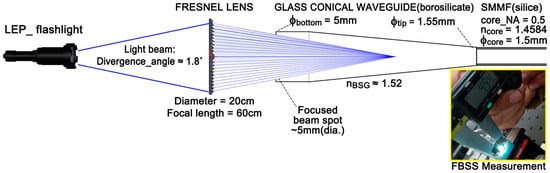
As shown in Figure 1, the setup consists of an FL (diameter = 20 cm, NA = 0.16, focal length = 600 mm, optical transmission = 85%) that concentrates collimated light onto a GCW (borosilicate, refractive index: nBSG ≈ 1.52), with height = 60 mm and base/tip diameters of ϕbottom = 5 mm and ϕtip = 1.55 mm, respectively. The GCW acts as a SOE and transmits the light to a single receiving SMMF (Thorlabs FP1500URT, core NA = 0.5, length = 1 m, wavelength range = 300–1200 nm) with a core diameter (ϕcore) of 1.5 mm. The proposed system is a light collector comprising a combination of devices and an indoor evaluation methodology, designed as a preliminary stage for a solar collection application intended for indoor lighting.
Figure 1.
Experimental setup. Combined with the masks, the selected Fresnel lens produces a focused spot with a diameter of less than 5 mm.
As the light source, a laser-excited phosphor (LEP) flashlight (Lumintop Technology Co., Ltd., Shenzhen, China; 400 lumens) with ~1.8° divergence is used. Due to the large core diameter of the SMMF (high V-number) and the overall dimensions of the GCW guide, a ray-tracing optics model is appropriate for analyzing the system. It should be noted that the tip diameter of the GCW is slightly larger than the core diameter of the SMMF; in fact, it matches exactly the cladding size of the fiber (~1.55 mm). Keeping the outer diameters the same provides better mechanical support when joining both ends.
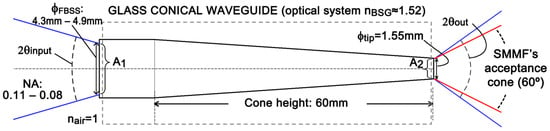
The present work builds upon the design concept proposed in the COWDPLISFCM study, where efficiency estimates based on etendue conservation and ray-tracing simulations were used to evaluate the degree of efficiency achievable in transferring the luminous flux concentrated by the FL (Dongguan Extraordinary Plastic Technology Co., Ltd., and HK Extraordinary Company Limited, Chang’an Town, China) to a single SMMF using a PCW (in that previous study, the fiber size was 1 mm and the PCW material was transparent resin). Similarly to the aforementioned study, masks are used here to reduce the diameter of the concentrating FL and thereby modify its NA. In this second iteration, the numerical aperture of the FL is adjusted to yield values in the range of 0.08–0.11 by using masks between 10 cm and 13.2 cm, respectively. This adjustment is illustrated in Figure 2, which shows the beam aperture (2θinput) incident on the base of the GCW.
Figure 2.
Illustration showing the ideal case of a conical guide that transmits 100% of the rays received at its base; at the output, a portion of these rays falls outside the acceptance cone of the SMMF. A1 and A2 denote the FBSS area (diameter varied between 4.3 and 4.9 mm) at the GCW base, and the light spot emerging from its tip (1.55 mm in diameter).
These NA values were chosen because they define a threshold beyond which light rays entering the GCW maintain a regime of total internal reflection throughout the cone until they exit through the tip, thereby improving the optical transmission of the guide. When concentrating light using lenses, typical FBSS values range from several millimeters to a few centimeters. This is why light collectors often use receiving optical fibers with large cross-sections or bundles of fibers, sometimes combined with other optical elements to facilitate light capture [25,26,27,28].
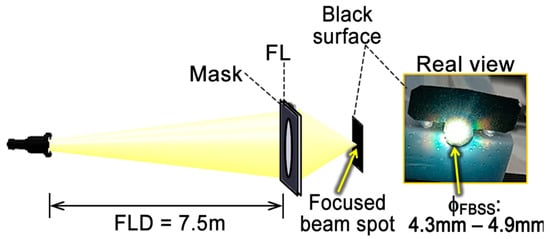
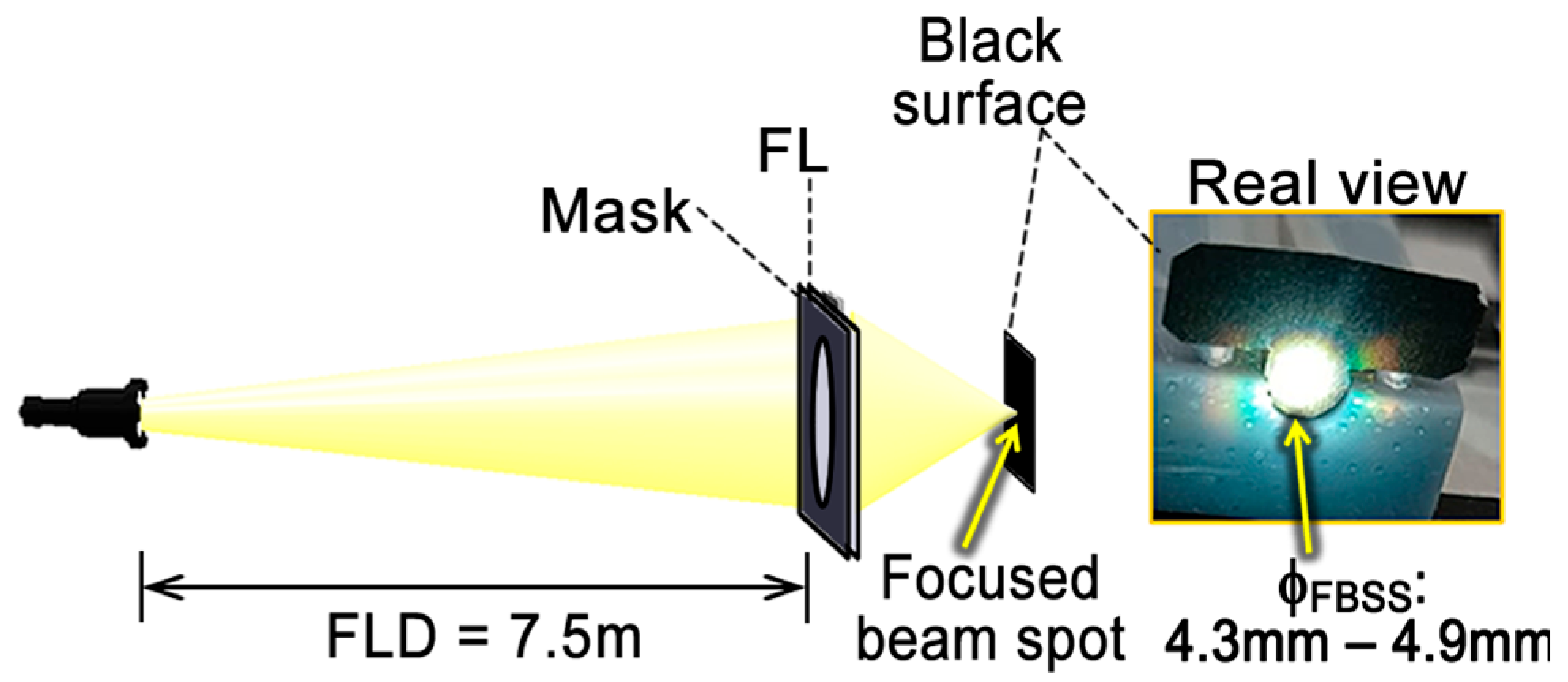
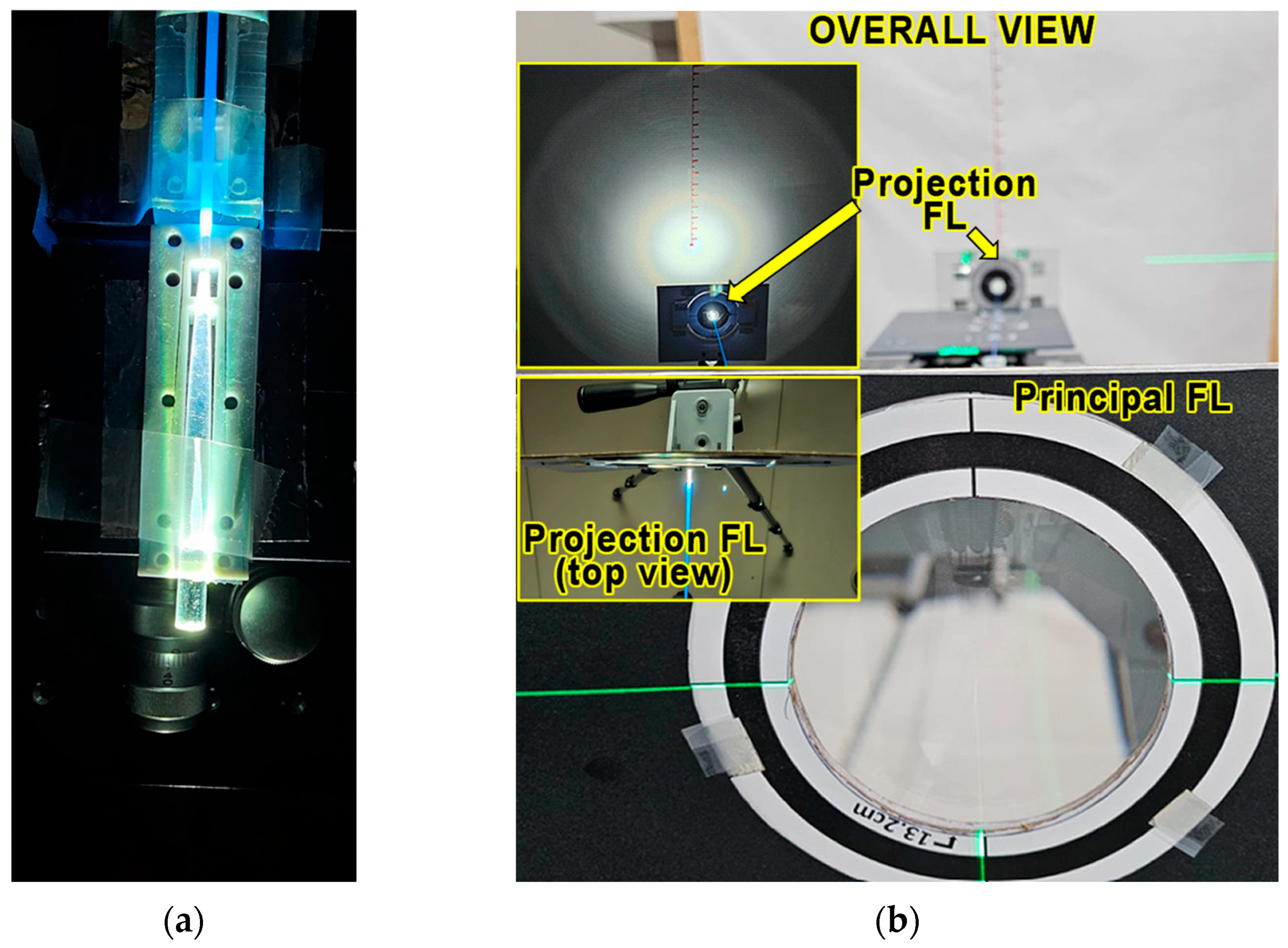
In our case, the GCW is used to increase the effective area of the SMMF, receiving the FBSS at its base and transmitting the light rays through its tip towards the receiving fiber. As shown in the magnified photograph in Figure 1, the selection of the FL (with the previously mentioned masks) was such that the FBSS was less than 5 mm. In this particular case (corresponding to the 13.2 cm mask), the FBSS measurement with the vernier caliper was approximately 4.9 mm, meaning it fits within the base of the GCW.
2.1. Étendue Conservation for Light Transmitted Through the GCW: Volume in Phase Space
For a light beam represented by a bundle of rays of given cross-sectional area and solid angle traversing an aperture of equal size, the equation is as follows [30,31]:
With ; y .
It corresponds to the definition of Etendue, in which dΩ is the solid angle of the portion of the beam that crosses a surface dA, and α is the angle of dΩ with respect to the normal to dA. Therefore, the conservation of etendue implies that the product of the projected area and the solid angle remain constant.
In practical terms, in the specific case of an optical system (ideally free from losses due to reflection, refraction, absorption, etc.) that reduces the beam area at its output, the passage through a second aperture (located immediately at the output) necessarily entails an increase in the solid angle of the ray bundle, ensuring that the product in Equation (1) remains conserved under the conditions at the output aperture. This situation corresponds to our GCW and is illustrated in Figure 2, where A1 and A2 represent the area of the FBSS (with a diameter experimentally adjusted between 4.3 mm and 4.9 mm), as well as the size of the light spot emerging from the tip of the GCW (1.55 mm in diameter).
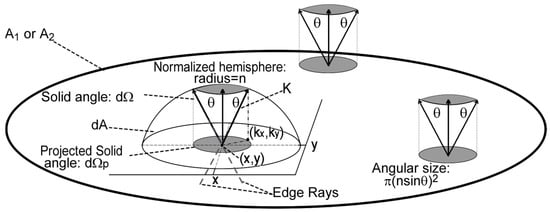
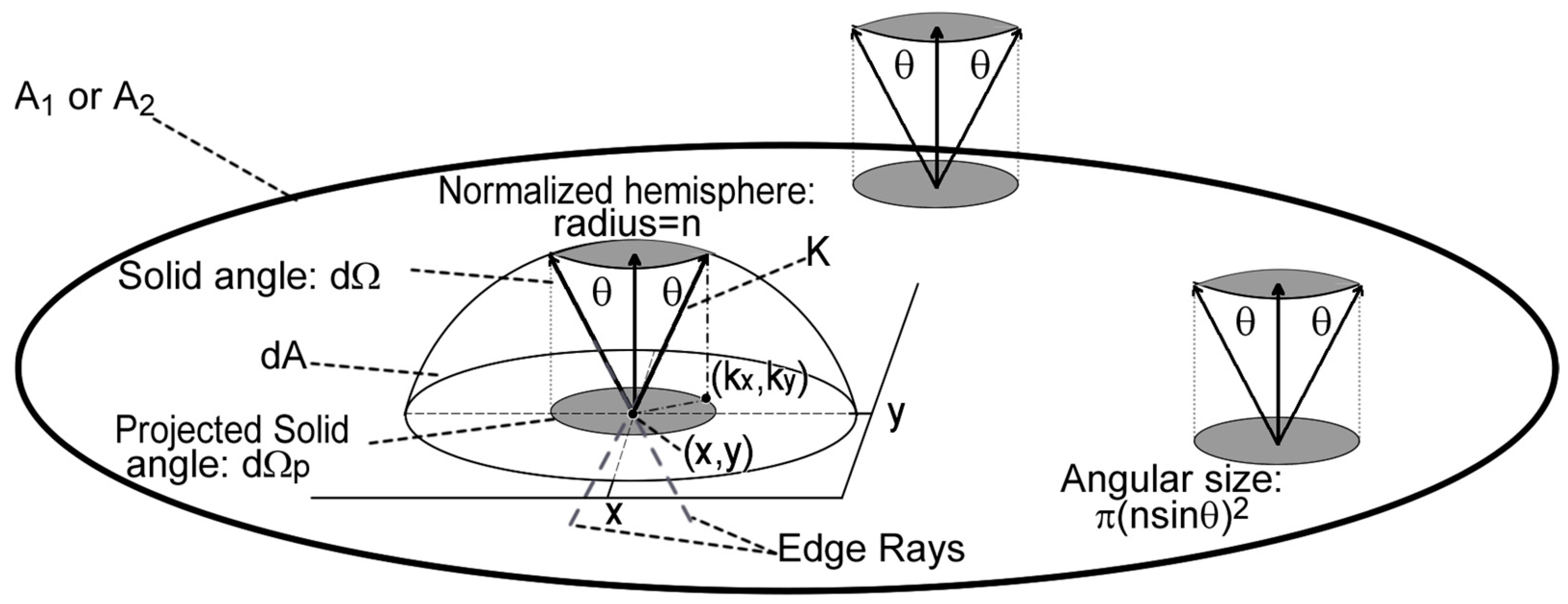
In phase space, the Etendue corresponds to the volume occupied by a bundle of three-dimensional rays, which can be represented as points in four-dimensional coordinates. As shown in Figure 3, at each point on surface A1 (the optical system input) or A2 (its output), the set of transmitted rays forms an envelope that defines a solid angle dΩ.
Figure 3.
Illustration showing the mapping of 3D rays onto points in 4D phase space. The outer circle represents the FBSS area at the base of the GCW (or alternatively the area of the beam spot emerging from its tip), while the circumference delimiting the hemisphere corresponds to the differential area (dA), respectively.
The crossing point determines a pair of coordinates (x, y) on that local surface. Likewise, at that point a hemisphere of radius n (the refractive index of the medium) is placed, so that when a vector K, carrying the direction of each ray (information about the angular coordinate θ), crosses the hemisphere, it defines another pair of coordinates called kx and ky (when projected onto the base). In summary, each 3D ray can be represented in a 4D phase space by points or coordinates (x, y, kx, ky).
However, the symmetry of our optical system (and of the light rays) with respect to the optical axis simplifies the evaluation of Equation (1). On the one hand, cos α = 1, and the corresponding angular size is constant for each point on the screen (i.e., dΩ does not change for each dA within surfaces A1 or A2). Consequently, the value of dΩp, obtained from the backward projection of the solid angle dΩ, also remains constant.
The value of dΩp is equal to πn2sin2θ (with n = refractive index media, θ = θinput at A1 and θ = θout at A2, respectively), and it is referred to as the angular size. Therefore, the volume integral determined by Equation (1) is simply the product of this angular size by the net surface A1 or A2, as appropriate. In this way, the phase-space volume corresponding to the input and output of the GCW would be
In our case, is simply the numerical aperture of the lens, while corresponds to the cone of light emerging from the GCW. This allows Equation (2) to be expressed in the following way:
Equation (3) allows us to explore combinations of areas and angular apertures for the rays entering and exiting the GCW, which could potentially achieve ideal efficiency. This means that, apart from the losses caused by wall roughness and Fresnel reflection at the base and tip of the cone, optical power is preserved.
Due to the divergence of the light beam produced by the flashlight, the size of the FBSS depends on the propagation distance. As the propagation distance increases, the curvature of the wavefront incident on the FL decreases, resulting in a more compact image (i.e., the FBSS). The addition of masks that reduce the FL’s numerical aperture (NA) further decreases the image size by eliminating the portion of the beam with higher divergence. Additionally, the beam expansion characterized by a 1.8° flashlight divergence affects the amount of light reaching the FL. When the beam area exceeds the FL’s aperture, the surplus light is lost, thereby reducing the usable portion for the characterization experiment. This necessitates a trade-off between the indoor light source’s propagation distance and the size of the FL.
Using the illustration in Figure 4 and the method established in COWDPLISFCM, the FBSS is measured under various propagation distances and mask sizes. Based on this method, the present work selects a propagation distance of approximately 7.5 m (designated as FLD), resulting in an FBSS (indicated as ϕFBSS) between 4.3 mm and 4.9 mm. This range corresponds to using masks between 10 cm and 13.2 cm, respectively. Table 1 provides a summary of these values.
Figure 4.
Setup for FBSS adjustment and measurement. By selecting an FLD of 7.5 m, the resulting FBSS has a diameter smaller than 5 mm for any of the masks used on the FL.
Table 1.
Summary of FBSS values corresponding to a propagation distance of 7.5 m, for each mask size.
Additionally, the size and relatively low NA of the FL impose another constraint on the focused beam side. Since a numerical aperture below 0.12 is required, for instance, if one wishes to switch from a lens with a diameter (D) of 13.2 cm (and focal length F ≈ 60 cm) to one with double the diameter, the approximate relationship NA = D/2F implies that the focal length would need to increase by a factor of 4. This scaling continues for larger lenses while maintaining the same NA, which ultimately determines the size of the setup (FL + GCW) on the receiving end of this design. Once indoor characterization is achieved, this size corresponds to the collector mounted on a mechanical solar tracker.
Furthermore, this work addresses improvement points identified in COWDPLISFCM and explores methodologies for the design and construction of the GCW that significantly reduce optical losses—both geometric (related to the acceptance cone of the MMF and Fresnel refraction at the cone’s lateral wall) and those due to diffuse scattering and absorption.
2.2. Simulation
The following discussion outlines key desired characteristics of the GCW that served as the foundation for designing the final geometry used in fabrication and in the corresponding ray-tracing simulation. One of the main goals was to reduce optical losses associated with the geometry of the GCW. In COWDPLISFCM, light-launching conditions similar to those shown in Figure 2 were used. By examining the experimental results from that study, it is possible to estimate the increase in angular aperture of the rays transmitted through the conical guide (exiting through its 1 mm diameter tip) due to etendue conservation.
In both the previous and current work, the aim is to design a conical guide that, from a geometric standpoint, preserves the critical angle condition for rays within the guide. That is, regardless of how many total internal reflection (TIR) bounces occur or the specific angle of each ray, this propagation regime remains intact throughout the cone until the rays exit through the tip, allowing for 96% transmission of the light rays received at the base (assuming ~4% loss due to reflection in the base/tip of the GCW). This design prevents optical losses due to partial refraction at the lateral walls, meaning that any losses observed in the conical guide are solely due to thermal absorption and diffuse scattering (caused by surface irregularities from polishing defects). These latter sources of loss are unavoidable and must be measured experimentally to determine the GCW’s optical transmission.
Additionally, when inspecting how losses occur at the splice zone with the receiving SMMF, COWDPLISFCM identified two components:
- i.
- Intrinsic splice loss from joining the guide to the SMMF;
- ii.
- Loss due to a portion of the rays transmitted by the guide falling outside the acceptance cone of the SMMF, resulting in ray leakage.The latter situation is illustrated in simplified form by the blue marginal rays in Figure 2, which represent the envelope of a beam fully transmitted by the guide. Of all the light rays transmitted by the GCW, only those within the acceptance cone are capable of being coupled into the optical fiber.
Given the above, the GCW design must not only maximize optical transmission but also produce output rays that meet the acceptance condition of the SMMF. With this in mind, the present study anticipates that by modifying the cone design of the COWDPLISFCM specifically by increasing the cone tip diameter from 1 mm to 1.55 mm, the corresponding angular increase imposed by Etendue conservation is significantly reduced. This increase in tip diameter arises from the proposed replacement of the 1 mm core SMMF with one of 1.50 mm. Although this change does not necessarily represent an optimal design, simulation results show that the portion of rays propagating in the marginal ray zone remains not only confined along the GCW and fully transmitted through its tip, but also that a significant portion falls within the acceptance cone of the receiving SMMF, thereby improving the system’s net efficiency. Consequently, this GCW adjustment methodology led to the dimensions indicated at the beginning of this section.
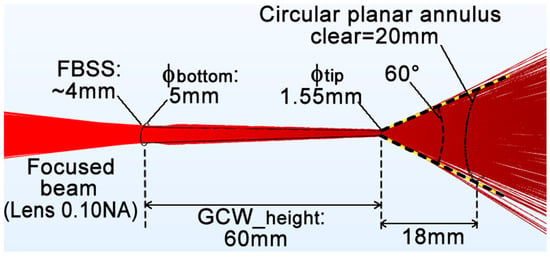
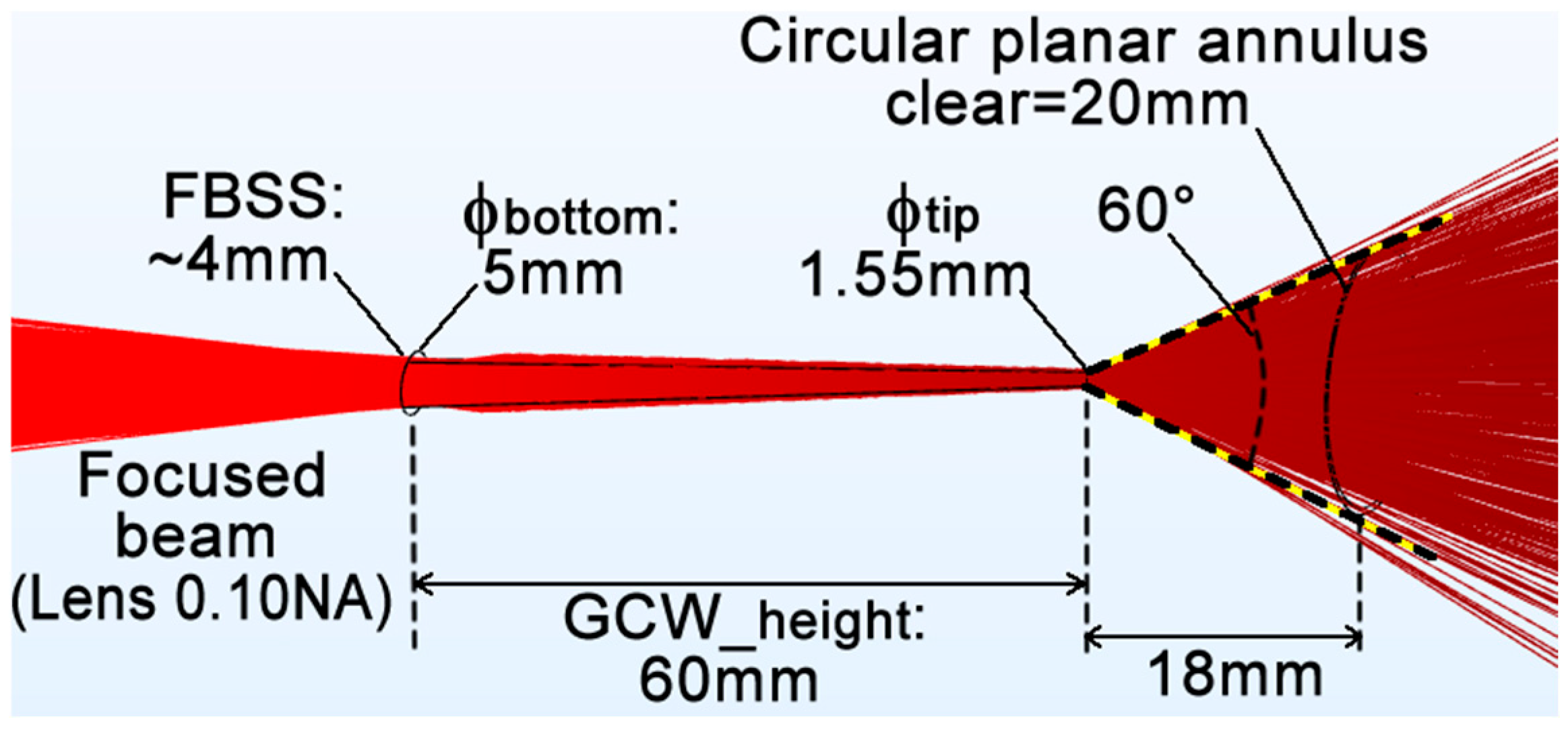
The ray trajectory simulation is presented in Figure 5. For clearer visualization, the top and bottom surfaces of the GCW were configured as “pass-through,” allowing rays to propagate without loss when traversing them. In practice, however, Fresnel reflections occur at both interfaces. In the absence of internal losses within the GCW (i.e., scattering, refraction, or absorption), approximately 96% of the rays exit through its tip, of which 90% remain within the SMMF acceptance cone (represented by a circular planar annulus placed at the specified distance, forming a 60° apex angle). The resulting net collector efficiency is estimated at 86%, serving as a reference value under ideal conditions.
Figure 5.
Ray trajectories simulation. The black-and-yellow dashed lines delimit the aperture corresponding to the circular planar annulus.
It is worth noting that in the simulation of Figure 5, the ray source used was designed to replicate light-launching conditions similar to the real case, where a FBSS of approximately 4 mm in diameter is obtained. Similarly to the approach used in COWDPLISFCM, an FL with low NA is also employed here; in fact, the angular aperture of the rays launched toward the GCW (in simulation) corresponds to the practical case of using a FL with a 0.10 NA (using a 12 cm diameter mask).
Although under ideal conditions the simulation predicts that 86% of the collected rays are likely to be coupled into the SMMF, the most significant experimental losses—such as diffuse scattering within the GCW, splice loss, and thermal absorption—must be quantified in order to evaluate the net efficiency of the collector.
2.3. GCW Fabrication
Based on the previously proposed dimensions and aiming for material compatibility with the receiving SMMF, the GCW is fabricated by machining a cylindrical glass rod. The selected glass piece is expected to have relatively high transparency, which minimizes heat absorption within the GCW. It is also well known that glass is a polishing-friendly material, allowing for an acceptable optical finish. As a result, diffuse scattering losses due to surface irregularities on the cone’s lateral walls are expected to be relatively low.
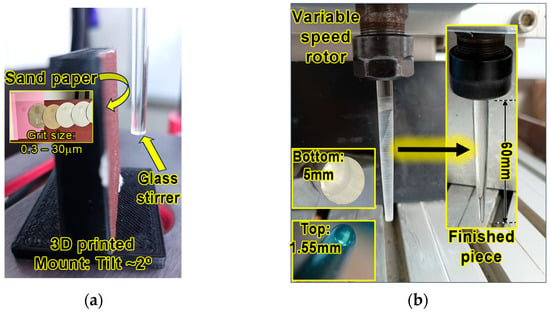
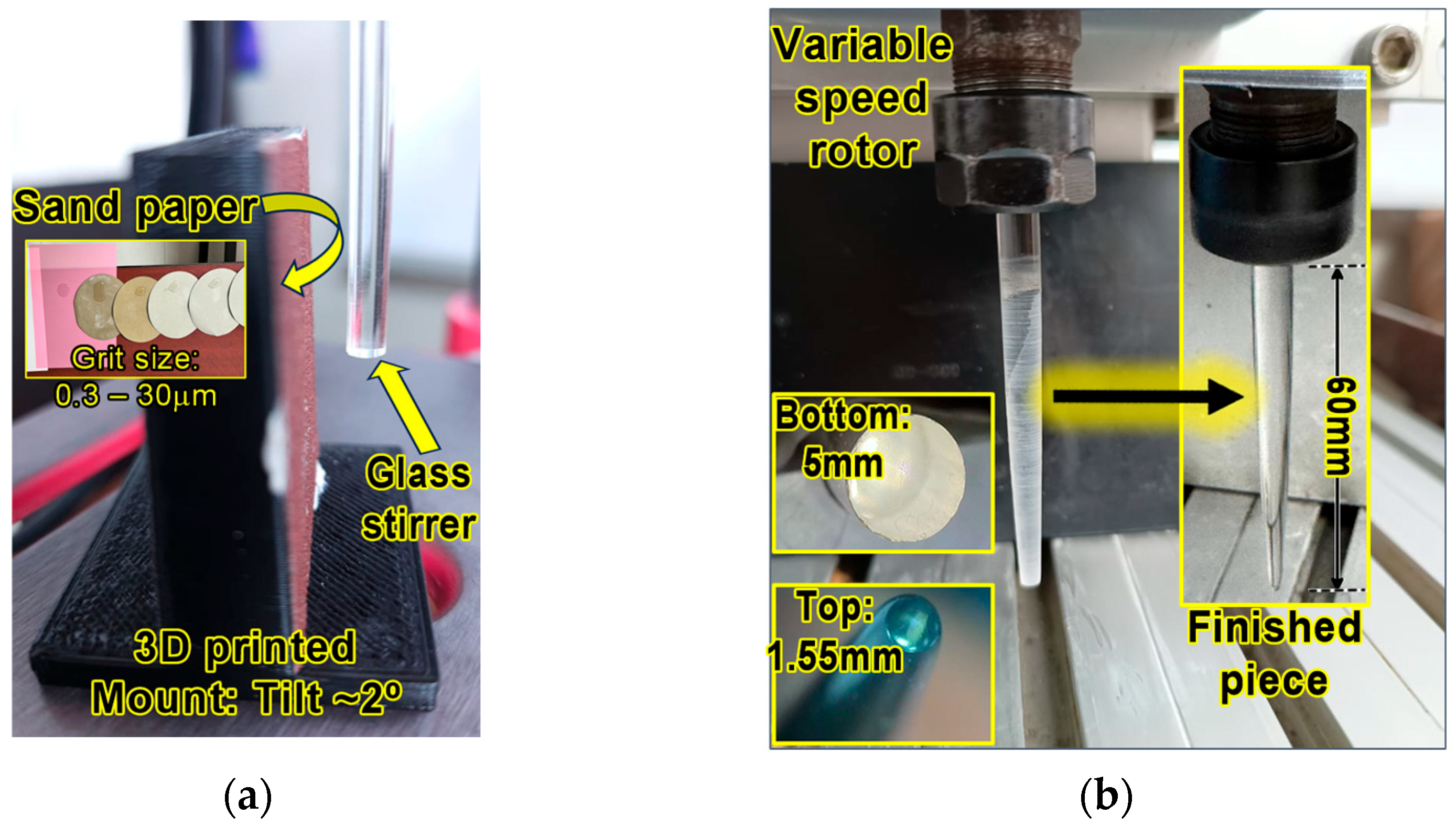
Specifically, as shown in Figure 6a,b, the manufacturing process involves mounting the glass rod on a high-precision mandrel (nut clamping ER-11 A) attached to the shaft of a DC motor with controlled speed. Using various coarse-grit abrasive papers mounted on a custom 3D-printed wedge-shaped tool (designed with the appropriate angle), the rod is gradually ground down to form the truncated cone shape. Once the cone reaches the specified dimensions, a final finish is applied using fine-grit polishing papers until an acceptable level of transparency is achieved.
Figure 6.
Setup for manufacturing the GCW. (a) The cone was machined with various abrasive papers mounted on a 3D printed wedged-shaped tool. (b) After achieving the specified cone dimensions, an optical finishing process is performed employing fine grit polishing abrasives.
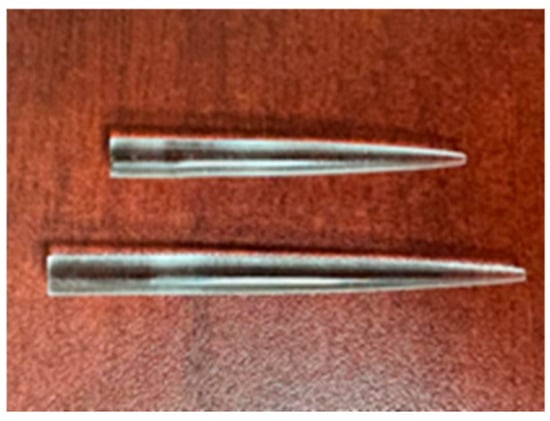
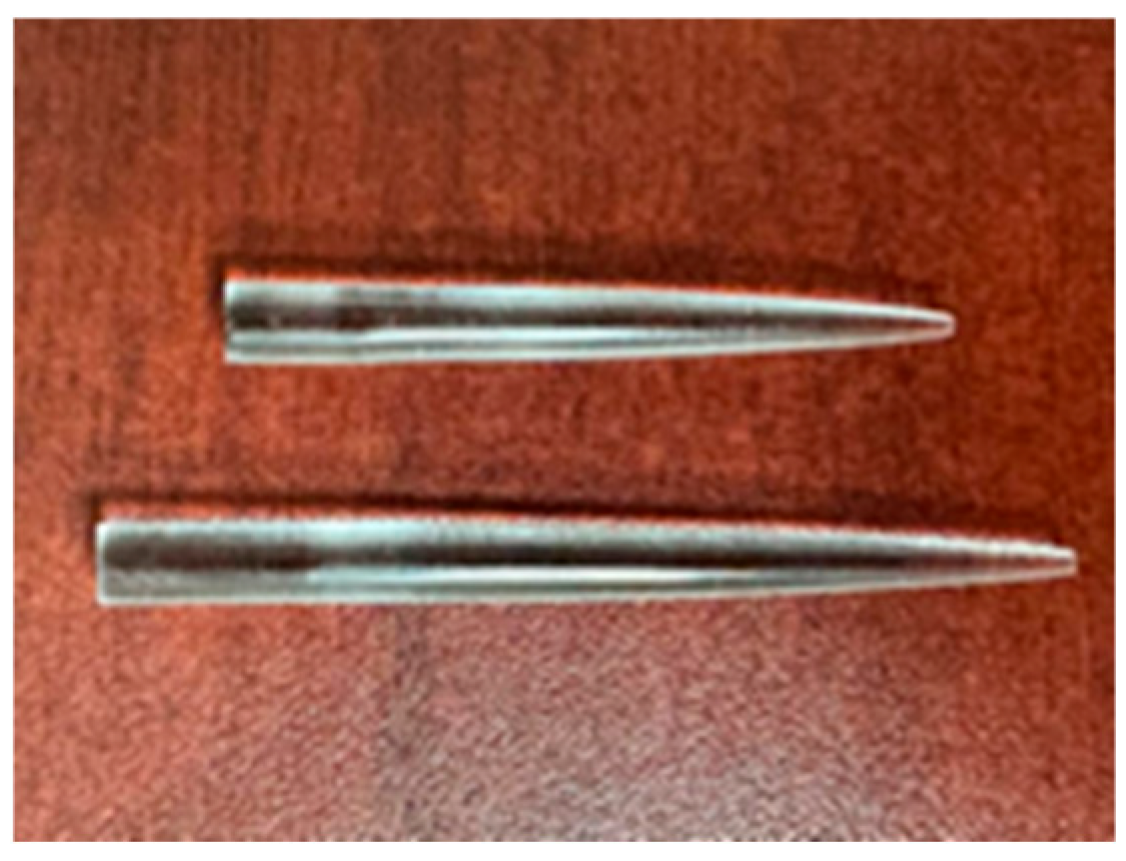
It is worth noting that the simple geometry of the GCW allows this manual finishing method to yield acceptable precision. In fact, as shown in Figure 7, the fabrication of another very similar piece was successfully replicated within a few days. Based on the previous discussion regarding the design criteria of the GCW geometry and the corresponding simulation, it was found that the mentioned increase in the tip diameter of the GCW would ideally result in 96% optical transmission. Of course, experimental determination is still required to assess the losses caused by polishing defects on the cone’s lateral wall and by thermal absorption.
Figure 7.
Overall aspect of two similar GCW pieces manufactured for this research.
2.4. Light Release Conditions, Luminous Flux Measurement, and GCW Loss Assessment
To determine the losses in the GCW, light is pumped into it using the LEP flashlight. By comparing the luminous flux incident at the base of the cone with the flux exiting its tip, the optical transmission percentage of the GCW is determined. These measurements are carried out using a propagation distance of FLD = 7.5 m and the masks mentioned at the beginning of this section.
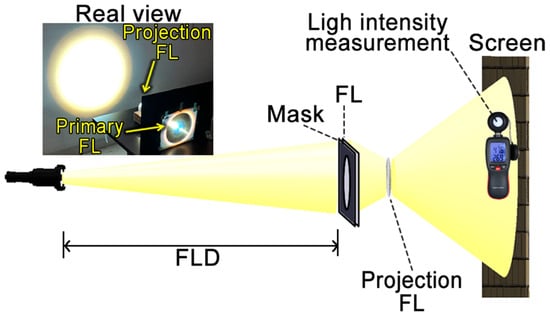
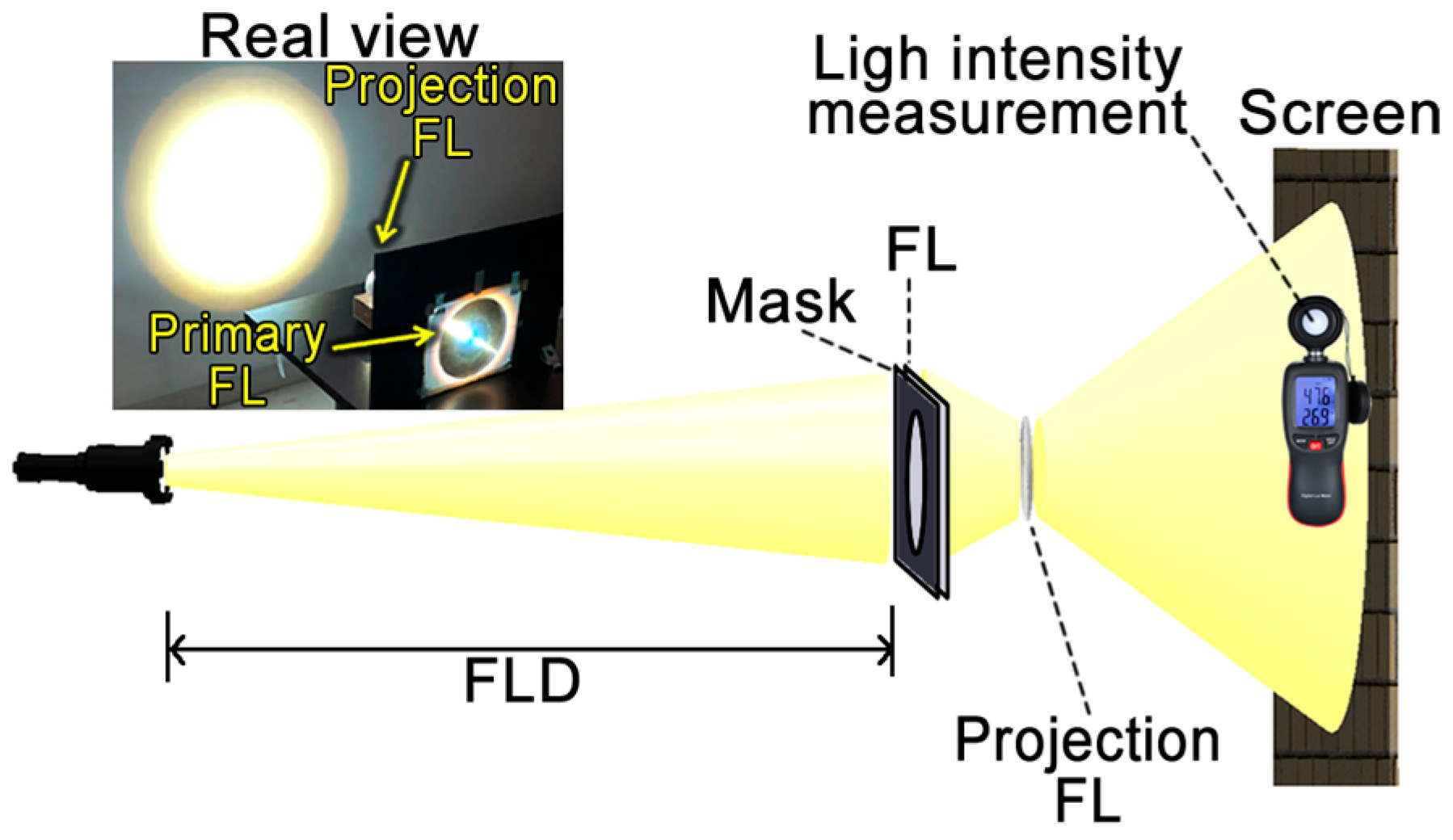
The setup shown in Figure 8 is used to measure the flux delivered by the main FL and reaching the base of the cone. A second FL lens (100 mm diameter, 100 mm focal length) is positioned at a distance such that it projects the light transmitted by the main FL onto a screen, forming a 900 mm diameter circle. Luminous intensity measurements are then taken using a lux meter. To calculate the total luminous flux incident on the screen, the method established in COWDPLISFCM is employed.
Figure 8.
Experimental setup for measuring the luminous flux emitted by the FL. Each mask corresponds to a distinct measurement configuration.
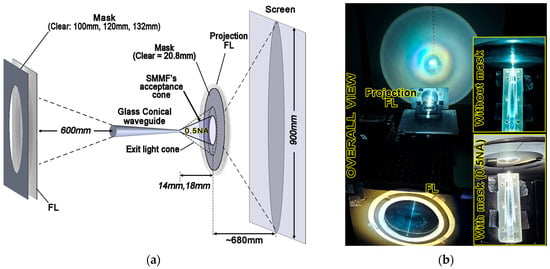
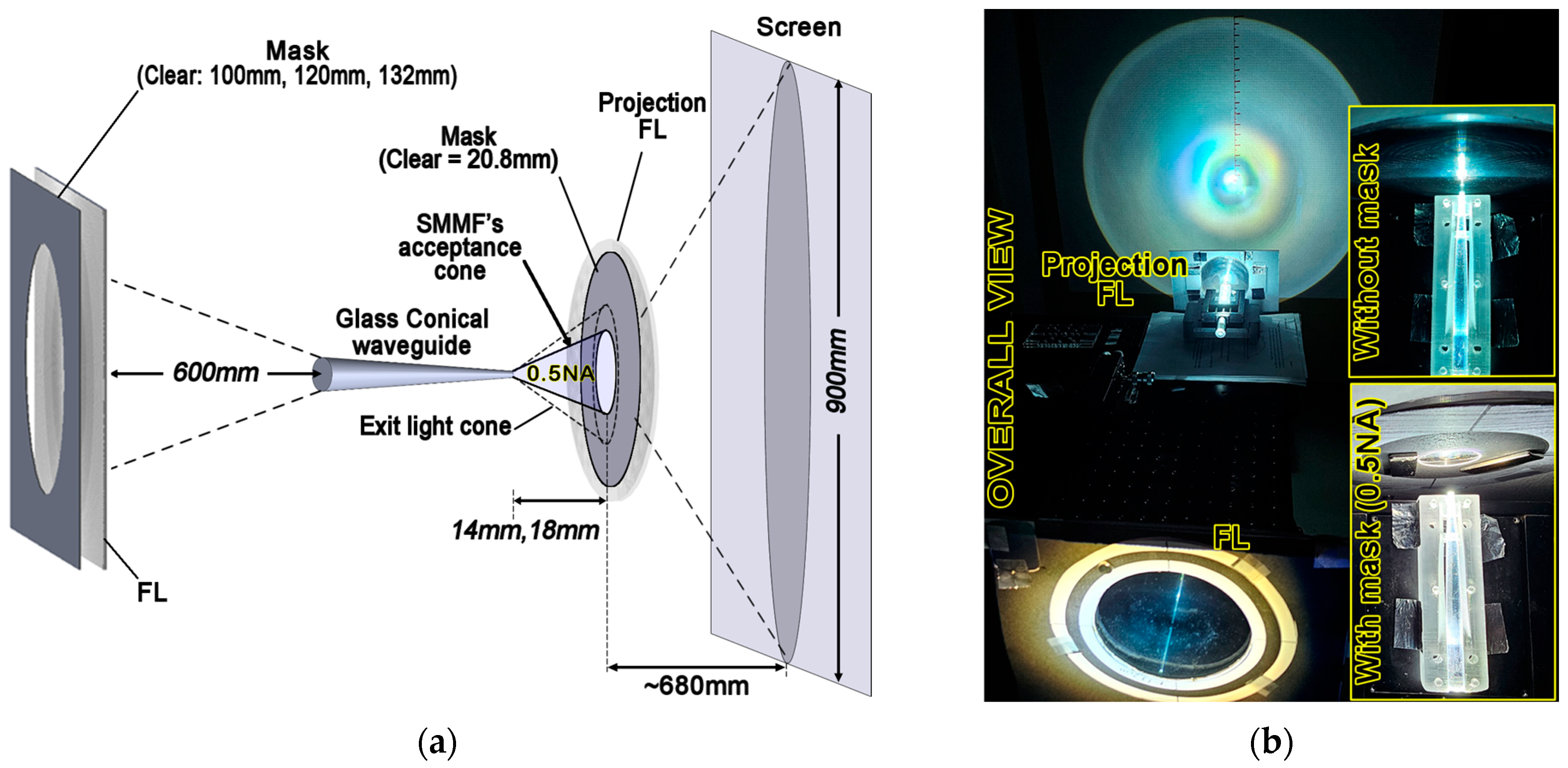
Figure 9a shows a schematic for measuring the luminous flux emitted from the GCW. The same flux measurement methodology as in the previous case is used, employing the same 100 mm diameter projection FL. To measure the total flux exiting the GCW, the lens is positioned approximately 14 mm away to achieve a 900 mm projection on the screen, which is placed about 680 mm from the lens.
Figure 9.
Setup for measuring the luminous flux emitted from the GCW. (a) Optical layout. (b) Photograph of the experimental setup.
The photograph in Figure 9b presents an overall view of the experimental setup, while the upper inset illustrates the configuration of the GCW and the FL employed to project the total flux emitted from the conical waveguide. As can be seen, the projection lens does not use any mask, allowing all light exiting the GCW to pass through. For these measurements, as well as other luminous flux measurements, attenuation caused by the projection FL (10%) is compensated by adding 11% to the total value measured using this method. (No compensation is needed for the main FL, as the flux it delivers represents the actual input flux of the system.)
A summary of the two measurements described above is presented in the Section 3.
2.5. GCW + SMMF Splice, and Methodology for Splice Loss Measurement
Upon confirming that our design performs similarly to the simulation (Figure 5), it is also expected that a portion of the rays exiting the GCW will exceed the acceptance cone of the receiving SMMF. This suggests that, when splicing the GCW to the fiber, the loss at the splice zone consists of both the intrinsic splice loss and the loss associated with rays falling outside the acceptance cone of the SMMF.
Therefore, to independently determine both sources of loss, it is necessary to first quantify the portion of the total flux from the GCW that is expected to couple into SMMF (i.e., rays within the acceptance cone), and then compare it with the output flux from the SMMF after splicing. As shown in Figure 9a, the inner light cone exiting the GCW—within an aperture equivalent to the SMMF’s acceptance cone (0.5 NA)—can be isolated by placing a mask with a ~20 mm clear aperture over the projection FL and positioning the lens at a distance of 18 mm. This setup, along with a screen placed approximately 680 mm away, produces a 900 mm diameter projection.
To experimentally determine the portion of luminous flux exiting the GCW tip but falling outside the SMMF’s acceptance cone, one simply subtracts the flux of the inner light cone from the total flux of the outer cone shown in Figure 9a. This measurement must be performed prior to the GCW + MMF splice. Afterwards, the GCW is bonded to the SMMF, and the corresponding output flux from the SMMF is measured. These measurements allow us to estimate in advance the amount of light flux exiting the GCW that is likely to couple into the SMMF (within its acceptance cone). The results of these measurements are presented in the next section.
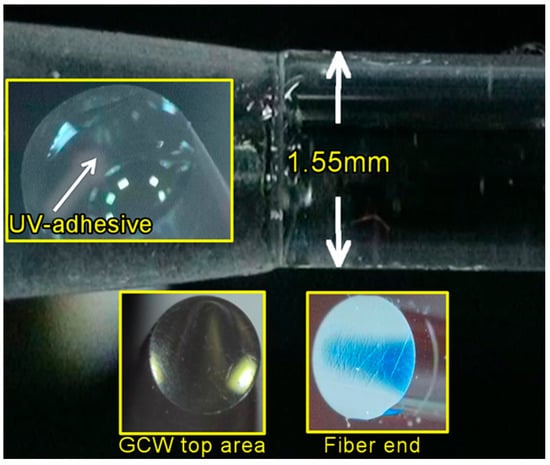
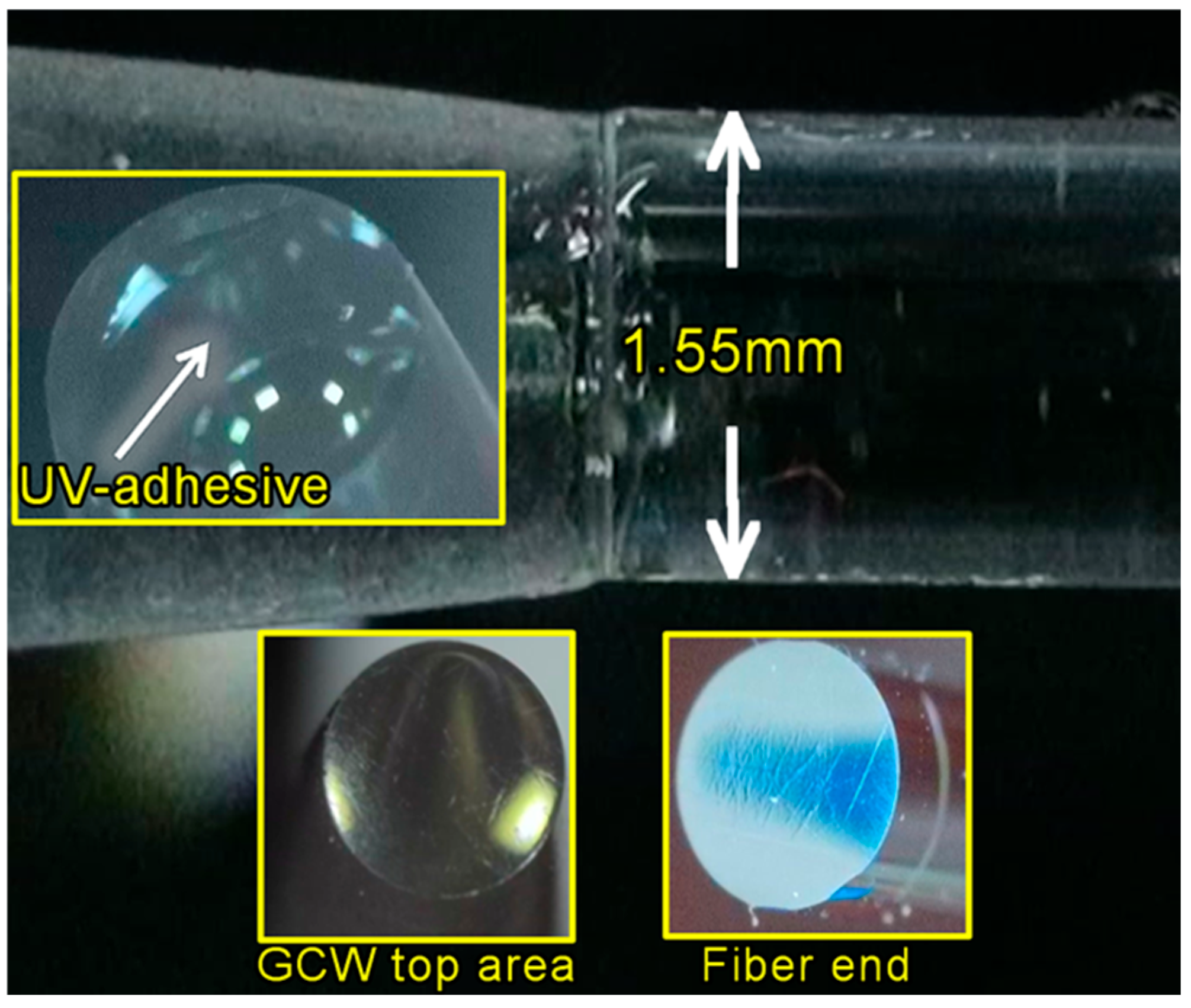
Figure 10 shows the GCW + SMMF splice, which is performed using UV-cured adhesive. Alignment is assisted by 3D-printed bases that keep both tips horizontally aligned and are mounted on three-axis translation stages for fine adjustment. As shown in the upper-left inset photograph of Figure 10, a small drop of adhesive is sufficient to complete the bonding.
Figure 10.
Magnified view of the splice between the GCW and the SMMF.
The lower inset photographs show the appearance of the GCW and SMMF tips, which received a polish prior to bonding. In the case of the SMMF, the tip was first cleaved using a Ruby Fiber Scribe (Thorlabs, Inc., Newton, NJ, USA, model S90R); however, polishing was necessary due to the fiber’s large size and the manual methodology, which makes it difficult to achieve a perfectly perpendicular cut.
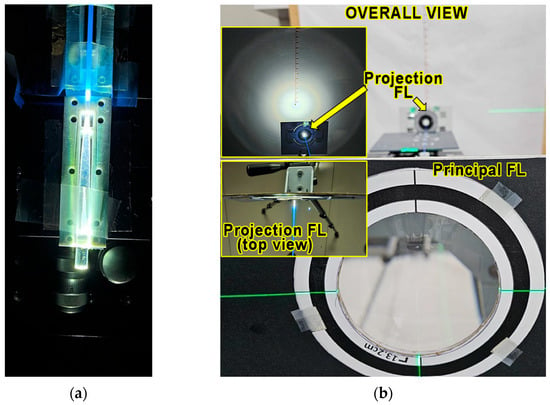
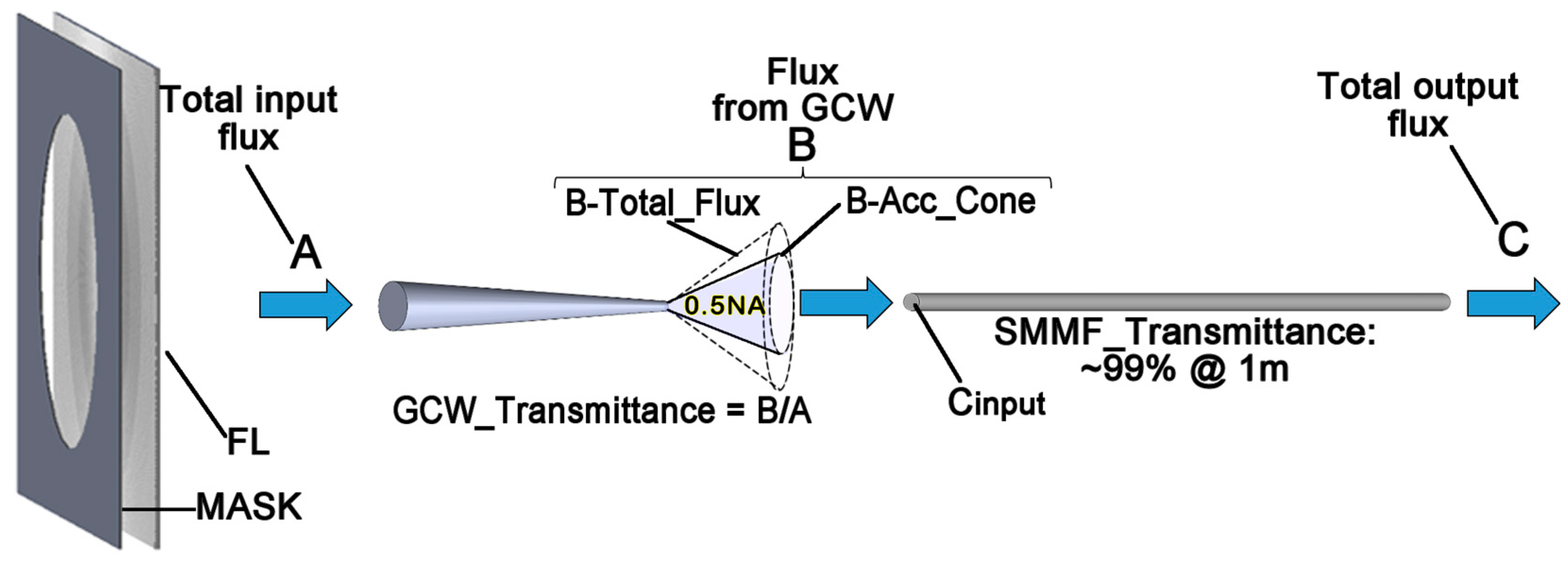
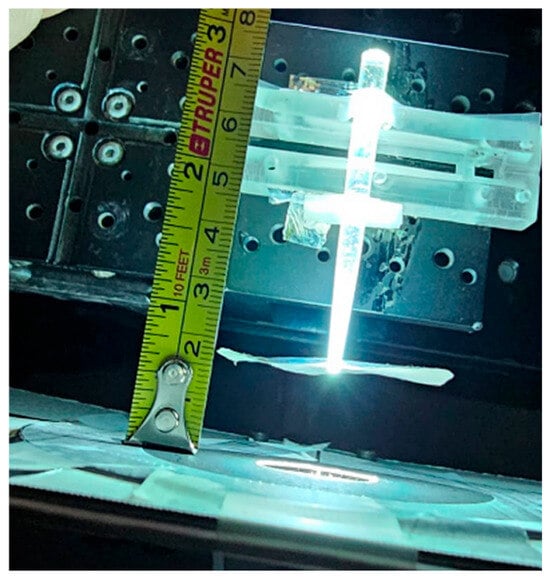
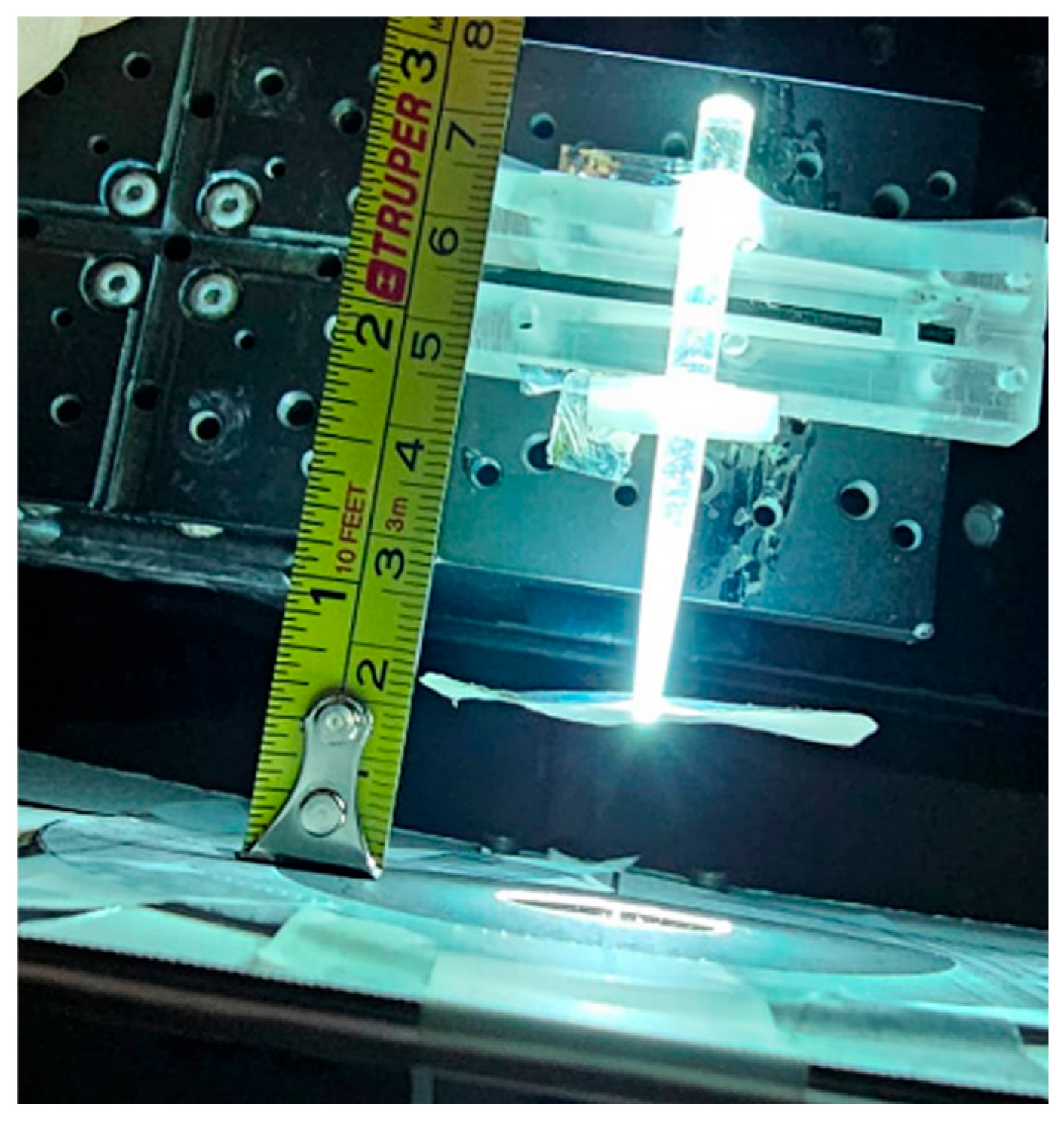
Figure 11a shows the appearance of the GCW + SMMF assembly being pumped with light from the LEP flashlight at maximum power. Figure 11b displays the setup used to measure the luminous flux at the output end of the SMMF. As seen in the inset photographs, the arrangement of the SMMF and the projection FL ensures that the light projected onto the screen maintains the same diameter of 900 mm. The projection and flux measurement methodology is identical to that used in the characterization of the GCW.
Figure 11.
(a) View of the GCW + SMMF assembly capturing concentrated light. (b) General view of the setup used for measuring luminous flux at the output end of the SMMF.
It is worth noting that this measurement methodology was applied for each mask size and used to determine both the transmission efficiency of the GCW and the net efficiency of the collection system.
3. Results: Efficiency, Splice Loss, and Uncertainty Analysis
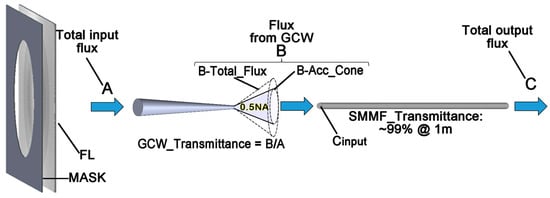
As shown in Figure 12, the measurements described in the previous section were taken at three main zones and used to perform the various efficiency calculations. As mentioned earlier, of the total luminous flux exiting the GCW, only the portion corresponding to rays within the acceptance cone of the SMMF is likely to be coupled into the fiber. These fluxes were measured at point B and recorded through two separate measurements: one labeled B-Total_Flux and the other labeled B-Acc_Cone. Table 2 summarizes these measurements (one for each mask) along with the corresponding transmission efficiencies.
Figure 12.
Main zones for luminous flux measurement.
Table 2.
Input–Output GCW measurements and net efficiency.
3.1. GCW Efficiency and Net Collector Efficiency for Each Mask
From Table 2, it can be observed that among all experiments, the highest net efficiency was achieved using the 10 cm mask (0.08 NA), yielding a transmission of 41% of the luminous flux collected by the FL. In this particular case, the luminous flux entering through the base of the cone was 155.58 lm, while 63.8 lm exited through the SMMF.
Regarding the optical transmission of the GCW, the experimental results in Table 2 show that for the smaller masks (12 cm and 10 cm), the GCW’s optical transmission was approximately 60%, whereas for the 13.2 cm mask, it was 48%.
In the case of experiments using the 12 cm and 10 cm masks, the optical transmission exhibited by the GCW showed a deviation of approximately 30% compared to the simulation, while for the 13.2 cm mask, the deviation was around 42%. Although the transmission efficiency was designed to reach 96% with any of the masks, it can initially be assumed that the observed loss in the conical guide (aside from the ~4% Fresnel reflection at the base of the cone) is mainly due to diffuse light scattering caused by imperfect polishing of the cone’s lateral wall. The following section discusses these causes in greater detail and proposes potential improvements to address the deviation from the expected GCW efficiency.
Additionally, regarding the rays transmitted by the GCW that are expected to couple into the SMMF, the simulation (ideal case, zero losses) indicated that only 10% of the total rays collected by the FL would escape, meaning the ideal net efficiency would be close to 86%. However, experimental losses reduce this value—first due to GCW losses and then due to losses at the splice zone. The measurements corresponding to the losses at the splice zone are presented below.
3.2. Splice Loss and Loss Due to Unbounded Rays
As indicated by the methodology described in the previous section, the loss at the splice zone consists of both the intrinsic splice loss and the loss associated with rays falling outside the acceptance cone of the receiving SMMF. Table 3 summarizes the corresponding measurements, where the loss due to rays outside the acceptance cone (referred to as unbounded ray loss) is determined by subtracting the flux corresponding to the portion of rays exiting the GCW but remaining within the acceptance cone of the SMMF (B-Acc_Cone) from the total output flux through the tip of the GCW (B-Total_Flux).
Table 3.
Output GCW and SMMF Measurements; Unbounded Ray Loss and Splice Loss.
This situation is illustrated in Figure 12 (Zone B), where these rays are located outside the inner light cone. It can be observed that, consistent with the simulation (performed for the 12 cm mask case), approximately 10% of the rays transmitted by the GCW fall outside the acceptance cone of the SMMF and are lost.
Regarding the splice loss shown in Table 3, its value was experimentally determined to range between 24 and 35%. That is, for each experimental case, a percentage of the luminous flux within the acceptance cone of the SMMF (OUTPUT GCW Acc_Cone) is lost (SPLICE LOSS), and the remainder exits through the SMMF’s output end (OUTPUT SMMF). While the classical definition of splice loss for optical fibers could have been used, it is important to note that this junction is not strictly between two fibers, which is why the loss was expressed in percentage terms. The following section discusses the possible causes behind the variation in splice loss observed across experiments.
It is worth mentioning that the splice loss calculation accounted for the attenuation caused by light propagation through the 1 m segment of optical fiber (mentioned at the beginning of the previous section). According to the manufacturer’s specifications, light in the visible spectrum experiences attenuation between 20 and 60 dB/km when propagating through this fiber, and the following formula was used to calculate attenuation loss:
where Pin and Pout represent the input and output luminous power, respectively, and considering a mid-range value of 40 dB/km as specified by the manufacturer, the approximate attenuation would be 0.04 dB/m. Using this value in Equation (4), we obtain that for 1 m of fiber, Pout/Pin = 0.9908, meaning that the light entering the SMMF experiences a 1% attenuation after propagation. In the case of a real outdoor application, attenuation in Equation (4) can be recalculated according to the required fiber length (i.e., Pout/Pin = 0.912 at 10 m, Pout/Pin = 0.831 at 20 m, and so on).
Attenuation(dB) = 10logPout/Pin,
3.3. Experimental Uncertainty Estimation
Experimental uncertainty estimation associated with transmittances and net efficiency was performed using the standard error propagation method proposed by Taylor. For each measurement, the statistical dispersion obtained from the area of 15 concentric rings, the luxmeter resolution, and the voltage variation in the LEP source light throughout all measurements were considered. This method establishes that, for independent magnitudes combined through products or quotients, the total relative uncertainty is obtained by the quadratic sum of the individual relative uncertainties.
where
- is the magnitude whose relative value is being evaluated, in this case, the transmittance and net efficiency;
- and are the measured magnitudes that are related to ;
- and are the experimental uncertainties associated with and magnitudes respectively.
Uncertainties in this work (approximately between 3% and 4%) arise from three independent contributions. First, the integration method based on concentric rings yields a natural scattering in illuminance measurements. The standard deviation of the 15 rings, normalized by the average value, results in a typical uncertainty of 2–3%. Second, the nominal precision of the luxmeter is approximately ±2%, which contributes an uncertainty of 2–3%. Finally, the LEP source presents a fluctuation from 3.90 to 3.94 volts, corresponding to a relative variation of about 1%. Combining these contributions through a quadratic sum, the total relative uncertainty in the transmittance calculation and system efficiency is given by
This procedure follows the uncertainty propagation standard proposed by Taylor [32]. “An introduction to error analysis: the study of uncertainties in physical measurements”. With this methodology, the GCW transmittance and system net efficiency yields
4. Discussion
4.1. Optical Losses in the GCW
Regarding the ~30% and ~42% losses observed in the GCW, several aspects of the system were analyzed to identify their causes and to explain why they differ in each case. In principle, both the GCW design and the light-launching conditions (with masks used to adapt the FL’s NA) generate an FBSS and rays whose angular distribution satisfies Etendue conservation during propagation through the GCW, ideally transmitting 96% of the optical power. As the rays exit through the tip of the cone, their angular aperture overfills the NA of the SMMF.
In fact, the GCW geometry was designed with constraints based on both the NA and the core diameter of the SMMF. Ray trajectory simulation (as well as experimental measurements) exhibited an overfilling of the receiving SMMF’s numerical aperture, with approximately 10% of the rays exiting the GCW exceeding the acceptance cone. Additionally, Etendue conservation ensured that all light rays within the GCW propagated under total internal reflection (TIR), ruling out optical losses due to refraction through the cone’s lateral wall.
However, although the GCW is geometrically designed to transmit concentrated light incident on its base without losses, small surface irregularities caused by imperfect polishing are expected to result in optical losses due to diffuse scattering—even when the rays satisfy the condition for total internal reflection. This, along with the ~4% Fresnel reflection loss at the cone’s base, accounts for the observed losses in the GCW and explains the brightness seen on its walls.
An example of such irregularities can be seen in Figure 10, both at the tips of the GCW and SMMF and along the lateral wall of the GCW near the splice point with the SMMF, where grooves left by early sanding stages with coarse grit are visible. Furthermore, this issue may persist even with surface imperfections that are not discernible in the photographs.
Given that the GCW was the system’s largest source of loss, improving its polishing could lead to a potentially significant increase in net efficiency. Although the manual polishing was performed carefully, finer polishing requires longer finishing time and a trial-and-error characterization process to achieve optimal results. While this is a viable option for future work, the goal of the current iteration is to demonstrate the collector’s effectiveness using a manual glass fabrication method.
To explain why the GCW loss varied across the three cases, one might consider that the case with the highest loss involved the largest mask, which produced a light-launching condition with the widest angular spread. The corresponding set of rays closest to the GCW’s critical angle had larger angles compared to similar rays in the other two cases. That is, although in all three cases (masks) the rays near the critical angle are the most susceptible to scattering due to surface irregularities, the use of the 13.2 cm mask results in a greater number of rays in this condition—corresponding to the experiment with the highest recorded optical loss (42%).
4.2. Optical Loss Due to Thermal Absorption
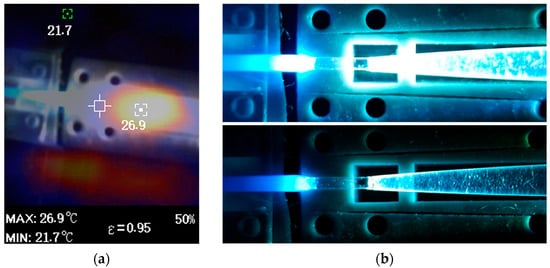
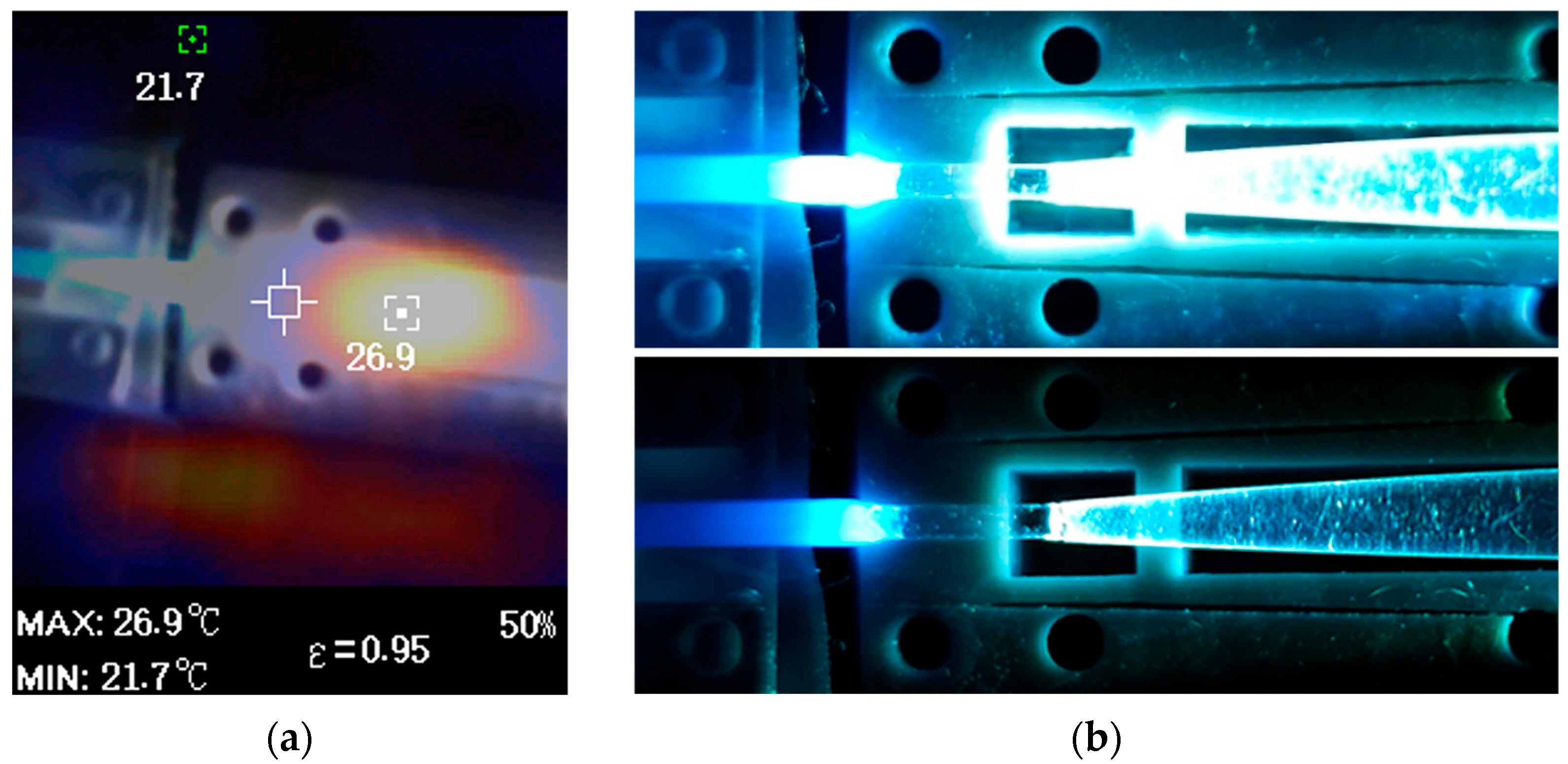
On the other hand, thermal absorption losses within the GCW have the potential to cause a temperature increase inside the guide, particularly near the tip region, where ray density is highest before transitioning into the SMMF. As shown in Figure 13a, the thermal image near the GCW tip indicates a temperature rise of approximately 4 °C under maximum light pumping power. This heating is primarily attributed to the GCW material rather than the SMMF, as can be observed by comparing the images in Figure 13a,b.
Figure 13.
(a) Thermal image of the GCW + SMMF splice operating at maximum light pumping power. (b) Actual image of the splice shown for comparison purposes; the area with intense brightness corresponds to the point of highest temperature increase.
Although this temperature increase is moderate under the current light pumping conditions, it is expected that under intense solar collection, thermal absorption would be greater, potentially affecting the splice zone and degrading the adhesive bond. This highlights that, given the feasibility of the GCW manufacturing process, alternative materials could be explored to reduce thermal absorption, such as high-purity quartz, which is proposed as a direction for future research.
To further decrease the temperature influence, several mitigation strategies can be adopted. First, the use of materials with lower absorption in the visible range such as fused silica or high-purity quartz can significantly reduce heat generation, as supported by temperature-compensation approaches reported for fiber Bragg grating (FBG) sensors. Second, improved polishing of the GCW surfaces would minimize scattering-related absorption, thereby reducing localized heating. Third, a passive thermal management component (e.g., an aluminum micro-heat-sink or a conductive mounting base) may be integrated to dissipate heat away from the GCW–SMMF interface.
Importantly, the principles discussed in the referenced FBG literature, such as thermal decoupling, controlled stress transfer, and stable bonding under thermal gradients [33,34], can be adapted to our system in future iterations. By mechanically isolating the splice region and employing thermally stable adhesives or fusion-bonding techniques, the amount of thermally induced stress transferred to the optical interface can be minimized, thereby improving stability under varying temperature conditions.
Furthermore, observing that the heat distribution zone within the GCW spans several millimeters suggests the possibility of implementing a heat dissipation method, such as using an aluminum heatsink. However, the design and fabrication of a heatsink, along with outdoor testing under sunlight, are left as future work, since the aim of the present study is to demonstrate the net efficiency improvement achieved by using a GCW.
Additionally, thermal fusion splicing is a bonding method that could reduce intrinsic splice loss reinforce the junction between the GCW and the SMMF under high temperatures. However, the development of such a method lies beyond the scope of this investigation and is also proposed for future work. Finally, it is worth noting that thermal images were taken at hot spots such as near the GCW tip, at the splice zone, and at any other location that appeared intensely bright to the naked eye.
4.3. Intrinsic Splice Loss
From the thermal image discussed earlier, no heating was observed in the splice zone, despite the joint being made with optical adhesive. This is attributed to the low thermal absorption of the adhesive, which forms a very thin layer (~10 microns; see Figure 10).
Therefore, the observed splice loss (24–34%) is likely not due to bonding heat degradation, but rather to the following factors:
- i.
- Scattering at the tip surfaces caused by polishing defects (see Figure 10, lower inset photographs) and imperfect alignment due to the manual bonding method.
- ii.
- Ray loss due to core mismatch (GCW diameter vs. SMMF core). Upon inspecting the main photograph in Figure 10, it is evident that the GCW diameter fully covers the SMMF cladding, meaning that a portion of the light exiting the cone inevitably transfers into the SMMF cladding and escapes. This leakage is visible in Figure 11a, where approximately 6 mm beyond the splice zone, a region of intense brightness surrounds the SMMF, illuminating the SMMF’s plastic jacket. Figure 13b provides a closer view of this area, showing both attenuated and non-attenuated images to help distinguish the points with the highest light leakage.
This situation (GCW tip size) was a design consideration from the outset of this research, intended to provide greater mechanical support to the joint. However, future work could explore the effects of shaping the GCW tip to match the exact diameter of the SMMF core. Additionally, when reviewing splice loss, the experimental values varied across cases (masks). Although this suggests a trend of greater loss with larger mask sizes (due to overfilling the SMMF’s NA), this trend was not observed. We attribute this to the high sensitivity of luminous flux measurements within the SMMF’s acceptance cone required for splice loss calculation to small variations in mask separation distance, which may have introduced moderate errors in those measurements (in this specific case).
In fact, in the flux measurement setup shown in Figure 9a, the separation between the GCW and the projection FL (along with the 20 mm diameter mask) required to allow light into the acceptance cone was 18 mm. Increasing this separation to reduce projection size sensitivity would have required a greater distance between the projection FL and the screen (to achieve the 900 mm diameter circle used for measurements), but space limitations prevented further separation. Figure 14 shows in greater detail how close the projection FL was to the GCW, making the 18 mm separation difficult to determine precisely. Moreover, any small variation caused abrupt changes in the projection size.
Figure 14.
Close view of the separation between the GCW and the 20 mm mask, used for projection FL.
Although the present work identifies the main contributors to splice loss—namely surface polishing defects, core–cladding mismatch, and alignment limitations—the study does not yet include a systematic evaluation of mitigation strategies. Future work will therefore involve controlled experiments using index-matching materials, precision alignment stages, and optimized tip geometries to quantitatively assess their impact on coupling efficiency. The implementation of fusion-based bonding techniques will also be investigated as a potential method to minimize intrinsic splice loss.
Consequently, once inside the SMMF, even when light fills the fiber within its NA limit, a light propagation regime is established that generates a large number of high-order modes (rays) which become susceptible to leakage (through the SMMF cladding) in the presence of even slight misalignments at the splice zone. Regardless of the splice losses obtained, it is possible to implement a heat dissipation method to prevent the leaked rays from damaging the fiber’s outer plastic sheath.
Alternatively, a small section of bare fiber could be left in the region where the majority of light leakage occurs, allowing the escaped light to dissipate safely. However, such improvements are proposed as future work. Finally, it is worth noting that throughout all measurements, care was taken to keep the flashlight fully charged at 100%, and readings were taken quickly to prevent any drop in lamp intensity.
5. Conclusions
This research work demonstrates the feasibility of a compact and cost-effective lens-based light collection system by integrating a manually fabricated glass conical waveguide with a Fresnel lens and a multimode fiber. The key findings can be summarized as folllows:
- (1)
- Fabrication and integration: A simple, low-cost manual process produced GCWs of acceptable optical quality, successfully integrated into the FL + GCW + MMF configuration to achieve ~41% net efficiency.
- (2)
- Splice loss: Experimental characterization revealed splice losses (~34%) and GCW transmission (~60%), with dominant losses attributed to polishing defects and material absorption, highlighting clear pathways for efficiency improvement.
- (3)
- Simulation vs. experiment: While simulations predicted ~86% efficiency, experimental results reached 41%, underscoring the critical role of fabrication quality and alignment precision in achieving higher performance.
Future efforts will focus on improving the polishing and fabrication techniques of the GCW to reduce scattering and absorption losses, thereby narrowing the gap between simulated and experimental efficiencies. Additionally, integration of the FL + GCW + MMF system into mechanical structures for direct solar collection will be pursued, enabling practical deployment in daylight harvesting applications. This will include testing under outdoor conditions to advance the applicability of the system in sustainable photonics and energy-efficient building technologies.
Author Contributions
Conceptualization, R.C.-G., D.T.-A. and R.S.-A.; methodology, R.C.-G., D.T.-A. and J.L.L.; software, R.C.-G., D.T.-A. and R.S.-A.; validation, D.T.-A. and R.S.-A.; formal analysis, D.T.-A.; investigation, R.C.-G., D.T.-A. and A.A.G.-R.; resources, R.C.-G., D.T.-A., R.S.-A. and J.L.L.; data curation, R.C.-G. and D.T.-A.; writing—original draft preparation, D.T.-A.; writing—review and editing, R.C.-G.; visualization, A.C.-G.; supervision, R.S.-A.; project administration, R.S.-A. and A.C.-G. All authors have read and agreed to the published version of the manuscript.
Funding
This research received no external funding.
Data Availability Statement
The data presented in this study are available upon request from the corresponding authors.
Acknowledgments
The authors thank CONAHCYT-SECIHTI for providing scholarships.
Conflicts of Interest
The authors declare no conflicts of interest.
References
- Moriarty, P.; Honnery, D. New Energy Technologies: Microalgae, Photolysis and Airborne Wind Turbines. Science 2021, 3, 5. [Google Scholar] [CrossRef] [Scilit]
- Rahmany, N.A.; Patmal, M.H. Impact of Solar Heating Technology Installation on Reduction of Greenhouse Gas Emissions in Kabul City. Int. J. Innov. Res. Sci. Stud. 2021, 4, 53–61. [Google Scholar] [CrossRef] [Scilit]
- International Energy Agency (IEA). Energy Efficiency 2023; IEA: Paris, France, 2023. [Google Scholar]
- United Nations Environment Programme. Model Regulation Guidelines for Energy Efficiency and Functional Performance Requirements for General Service Lamps and Linear Lighting Supporting Information; UNEP: Paris, France, 2021. [Google Scholar]
- Zhao, M.; Miyamoto, T. Efficient LED-Array Optical Wireless Power Transmission System for Portable Power Supply and Its Compact Modularization. Photonics 2023, 10, 824. [Google Scholar] [CrossRef] [Scilit]
- Zissis, G. Energy Consumption and Environmental and Economic Impact of Lighting: The Current Situation. In Handbook of Advanced Lighting Technology; Karlicek, R., Sun, C.-C., Zissis, G., Ma, R., Eds.; Springer International Publishing: Cham, Switzerland, 2017; pp. 921–933. [Google Scholar]
- Gentile, N.; Lee, E.S.; Osterhaus, W.; Altomonte, S.; Naves David Amorim, C.; Ciampi, G.; Garcia-Hansen, V.; Maskarenj, M.; Scorpio, M.; Sibilio, S. Evaluation of Integrated Daylighting and Electric Lighting Design Projects: Lessons Learned from International Case Studies. Energy Build. 2022, 268, 112191. [Google Scholar] [CrossRef] [Scilit]
- Hafezparast Moadab, N.; Olsson, T.; Fischl, G.; Aries, M. Smart versus Conventional Lighting in Apartments—Electric Lighting Energy Consumption Simulation for Three Different Households. Energy Build. 2021, 244, 111009. [Google Scholar] [CrossRef] [Scilit]
- Hsieh, J. Study of Energy Strategy by Evaluating Energy–Environmental Efficiency. Energy Rep. 2022, 8, 1397–1409. [Google Scholar] [CrossRef] [Scilit]
- Gentile, N. Improving Lighting Energy Efficiency through User Response. Energy Build. 2022, 263, 112022. [Google Scholar] [CrossRef] [Scilit]
- Sutherland, B.R. Lighting Policies Spur Global Innovation. Joule 2019, 3, 639–640. [Google Scholar] [CrossRef] [Scilit]
- Zia, U.; Qureshi, S.; Aslam, H.; Zulfiqar, M. Driving Parameters for Technology Penetration in Pakistan: A Case Study for Indoor LED Lighting. Eng. Proc. 2022, 23, 10. [Google Scholar]
- Wang, Y.; Hong, X.; Wu, D.; Wu, H.; Ishibashi, A. Cylindrical Waveguides and Multi-Junction Solar Cell Investigated for Two-Dimensional Photorecepto-Conversion Scheme. Photonics 2023, 10, 299. [Google Scholar] [CrossRef] [Scilit]
- Bodem, F. The Limits to Incoherent Optical Power Launching into Lightguides. Opt. Laser Technol. 1978, 10, 89–96. [Google Scholar] [CrossRef] [Scilit]
- Viera-Gonzalez, P.; Sanchez-Guerrero, G.; Ceballos-Herrera, G.; Selvas-Aguilar, R. Radiant Flux Analysis of a System based in Imaging Fresnel Lens and Plastic Optical Fiber with Fiber Lenses. Res. Comput. Sci. 2017, 131, 119–124. [Google Scholar] [CrossRef] [Scilit]
- Arnaoutakis, G.E.; Marques-Hueso, J.; Mallick, T.K.; Richards, B.S. Coupling of Sunlight into Optical Fibres and Spectral Dependence for Solar Energy Applications. Sol. Energy 2013, 93, 235–243. [Google Scholar] [CrossRef] [Scilit]
- Maatallah, T.; Wahab, F.; Alzahrani, M.; Jamal, A.; Ali, S. Fiber Optic Daylighting with Concentrating Solar Collectors: A State-of-the-Art Review. Energies 2025, 18, 2097. [Google Scholar] [CrossRef] [Scilit]
- Vu, N.-H.; Pham, T.-T.; Shin, S. Modified Optical Fiber Daylighting System with Sunlight Transportation in Free Space. Opt. Express 2016, 24, A1528. [Google Scholar] [CrossRef] [Scilit]
- Ullah, I.; Shin, S.Y. Development of Optical Fiber-Based Daylighting System with Uniform Illumination. J. Opt. Soc. Korea 2012, 16, 247–255. [Google Scholar] [CrossRef] [Scilit]
- Zazoum, B.; Hassan, M.E.; Jendoubi, A. Solar Optical Fiber Daylighting System with an IR Filter: Experimental and Modeling Studies. Energy Rep. 2020, 6, 903–908. [Google Scholar] [CrossRef] [Scilit]
- Ullah, I.; Shin, S. Uniformly Illuminated Efficient Daylighting System. Smart Grid Renew. Energy 2013, 4, 161–166. [Google Scholar] [CrossRef]
- Polyethylene Jacketed Optical Fiber Cord: BH4001, (Mitsubishi Chemical Corporation). Available online: https://fiberopticpof.com/pdfs/Plastic_Fiber_Optics_&_Cable/ESKA_BH_Fiber_Optic_Cable_Data&Sensors/BH-4001_Product_Information.pdf (accessed on 12 January 2026).
- Nugrahani, E.F.; Birahmatika, R.A.; Pratiwi, E.W.; K, S. Design of Solar Transmission System Using Fiber Optic for Indoor Lighting. KnE Energy 2015, 2, 59. [Google Scholar] [CrossRef] [Scilit]
- Antón, I.; Silva, D.; Sala, G.; Bett, A.W.; Siefer, G.; Luque-Heredia, I.; Trebst, T. The PV-FIBRE Concentrator: A System for Indoor Operation of 1000X MJ Solar Cells. Prog. Photovolt. 2007, 15, 431–447. [Google Scholar] [CrossRef] [Scilit]
- Rahou, M.; Mojiri, A.; Rosengarten, G.; Andrews, J. Optical Design of a Fresnel Concentrating Solar System for Direct Transmission of Radiation through an Optical Fibre Bundle. Sol. Energy 2016, 124, 15–25. [Google Scholar] [CrossRef] [Scilit]
- Liang, D.; Fraser Monteiro, L.; Ribau Teixeira, M.; Fraser Monteiro, M.L.; Collares-Pereira, M. Fiber-optic solar energy transmission and concentration. Sol. Energy Mater. Sol. Cells 1998, 54, 323–331. [Google Scholar] [CrossRef] [Scilit]
- Maatallah, T.; Alzahrani, M.; Almatar, A.; Wahab, F.; Ali, S. Numerical Investigation of Natural Light Transmission Through Fiber Optics. Energies 2025, 18, 1103. [Google Scholar] [CrossRef] [Scilit]
- Udhwani, L.; Soni, A.; Cuce, E.; Kumarasamy, S. Optical Fiber Technology for Efficient Daylighting and Thermal Control: A Sustainable Approach for Buildings. Eng 2024, 5, 2680–2694. [Google Scholar] [CrossRef] [Scilit]
- Chapa-Garcia, R.; Toral-Acosta, D.; Selvas-Aguilar, R.; López-Diaz, J.L.; Enriquez-Gomez, L.F. Conical Waveguide Design for Propagating Light to a Single Fiber and Its Indoor Characterization Methodology. Int. J. Innov. Res. Sci. Stud. 2025, 8, 2820–2833. [Google Scholar] [CrossRef] [Scilit]
- Chaves, J. Introduction to Nonimaging Optics, 2nd ed.; CRC Press: Boca Raton, FL, USA, 2016; pp. 101–155. [Google Scholar]
- Muschaweck, J. Designing Illumination Optics; SPIE PRESS: Bellingham, WA, USA, 2022; Volume TT123, pp. 7–25. [Google Scholar]
- Taylor, J.R. An Introduction to Error Analysis: The Study of Uncertainties in Physical Measurements; MIT Press: Cambridge, MA, USA, 2022. [Google Scholar]
- Hua-Ping, W.; Jian-Guo, D.; Xing-Zhe, W. Improved temperature compensation of fiber Bragg grating-based sensors applied to structures under different loading conditions. Opt. Fiber Technol. 2021, 63, 102506. [Google Scholar] [CrossRef] [Scilit]
- Huaping, W.; Jian-Guo, D.S. Strain transfer analysis of fiber Bragg grating sensor assembled composite structures subjected to thermal loading. Compos. Part B Eng. 2019, 162, 303–313. [Google Scholar] [CrossRef] [Scilit]

Disclaimer/Publisher’s Note: The statements, opinions and data contained in all publications are solely those of the individual author(s) and contributor(s) and not of MDPI and/or the editor(s). MDPI and/or the editor(s) disclaim responsibility for any injury to people or property resulting from any ideas, methods, instructions or products referred to in the content. |
© 2026 by the authors. Licensee MDPI, Basel, Switzerland. This article is an open access article distributed under the terms and conditions of the Creative Commons Attribution (CC BY) license.