Article

A Blockchain-Based Framework for Secure Healthcare Data Transfer and Disease Diagnosis Using FHM C-Means and LCK-CMS Neural Network


1
School of Engineering, University of Wollongong in Dubai, Dubai Knowledge Park, Dubai P.O. Box 20183, United Arab Emirates
2
Computer and Information Systems Department, Rafik Hariri University, Meshref, Damour-Chouf 2010, Lebanon
*
Author to whom correspondence should be addressed.
Submission received: 29 August 2025 / Revised: 29 November 2025 / Accepted: 6 January 2026 / Published: 9 January 2026
(This article belongs to the Section Computer Science, Mathematics and AI)

Abstract

IoT-based blockchain technology has improved the healthcare system to ensure the privacy and security of healthcare data. A Blockchain Bridge (BB) is a tool that enables multiple blockchain networks to communicate with each other. The existing approach combining the classical and quantum blockchain models failed to secure the data transmission during cross-chain communication. Thus, this study proposes a new BB verification for secure healthcare data transfer. Additionally, a brain tumor analysis framework is developed based on segmentation and neural networks. After the patient’s registration on the blockchain network, Brain Magnetic Resonance Imaging (MRI) data is encrypted using Hash-Keyed Quantum Cryptography and verified using a Peer-to-Peer Exchange model. The Brain MRI is preprocessed for brain tumor detection using the Fuzzy HaMan C-Means (FHMCM) segmentation technique. The features are extracted from the segmented image and classified using the LeCun Kaiming-based Convolutional ModSwish Neural Network (LCK-CMSNN) classifier. Subsequently, the brain tumor diagnosis report is securely transferred to the patient via a smart contract. The proposed model verified BB with a Verification Time (VT) of 12,541 ms, secured the input with a Security level (SL) of 98.23%, and classified the brain tumor with 99.15% accuracy, thus showing better performance than the existing models.

1. Introduction

In the healthcare system, the Internet of Things (IoT) has enabled fast diagnosis and efficient treatment plans for patients [1]. However, rapid advancement in healthcare system strategies can cause communication and storage issues between different vendors, such as physicians, health insurance agents, pharmacists, and patients [2]. Security must be a top priority for the future of IoT to protect sensitive patients’ healthcare data and maintain trust in digital treatment systems. Unfortunately, IoT channels are publicly available, making data vulnerable to manipulation [3]. To address this, a decentralized system, called Blockchain Technology (BT), is utilized to securely store and transfer large amounts of healthcare data [4,5]. BT is a decentralized digital record that transparently documents transactions on numerous computers and users. In healthcare, BT plays an essential role in sharing healthcare data with patients around the world [6]. Moreover, BT can maintain security and transparency even when numerous intrusions target IoT devices or networks [7]. In addition, blockchain networks can track, organize, and execute interactions by storing data generated from a large number of devices, allowing trusted data exchanges between parties without relying on a central or governmental authority [8,9]. In addition, the use of blockchain in healthcare enables the secure management of advanced medical operations, electronic health records, and patient data accessibility [10].
The Blockchain Bridge enables data transfer between the mainchain and sidechain. However, it is vulnerable to various attacks, including the Qubit Bridge Exploit, Meter.io Bridge Exploit, and Wormhole Bridge Exploit. In these attacks, an adversary will create fake proofs of data transfer or unauthorized tokens, bypassing the bridge verification mechanisms. Thus, ensuring the security of health data in blockchain-based healthcare networks becomes crucial [11].
The prevailing research performed data transfer without verifying the BB, thus affecting the security of the model [12]. Furthermore, several previous studies used inefficient techniques to secure data, such as Elliptic Curve Cryptography (ECC), Data Encryption Standard (DES), and Rivest, Shamir, and Adleman (RSA) [13,14]. In addition to secure data transmission, the data was also analyzed using Deep Neural Networks (DNN) and Convolutional Neural Networks (CNN), specifically for brain tumor detection [15]. However, existing blockchain-based healthcare models faced challenges such as poor BB verification, quantum-based attacks, and failure to protect sensitive information during communication. Moreover, the quantum-based and deep learning-based models were sensitive to noise and did not represent the important features, thus reducing the diagnostic accuracy. As a result, these drawbacks are assessed and a novel approach is proposed to enhance BB protection, ensure secure data transfer, and allow accurate diagnosis of brain tumor. The end-to-end fusion of a blockchain framework is necessary for a modern healthcare system because the blockchain ensures data integrity and a deep-learning model makes intelligent medical diagnoses.

1.1. Problem Statement

After conducting a literature review in this field, several gaps have been identified.
  • The blockchain Bridge (BB) used for data transfer between the mainchain and the sidechain was susceptible to exploitation. None of the existing studies focused on verifying the integrity of the BB before data transmission, leading to data exploitation.
  • The existing work by Mohammed et al. [16] uses blockchain to protect healthcare data via cryptographic mechanisms. However, the proposed scheme was inefficient and relied on weak randomness for key generation. Consequently, the keys were vulnerable to attack, leading to exposure of sensitive healthcare data.
  • The use of Proof of Work (PoW) to transfer healthcare data, as discussed in the prevailing work of [17], led to higher energy consumption.
  • In [18], disease prediction was carried out without input image segmentation, which reduced disease detection accuracy. Segmentation is important for isolating tumor regions from healthy tissue, enabling precise feature extraction and improved diagnostic performance.
In conclusion, ensuring security in BB is critical to safeguard the privacy and security of healthcare data. In addition, the preprocessing of brain MRI images plays a vital role in enabling an accurate and efficient medical diagnosis. This research is driven by these identified gaps, and the details will be outlined in Section 1.2.

1.2. Research Motivation

After the identification of gaps in the existing literature, the main motivations of this paper are given as follows.
  • A Private and Secret key-based Peer-to-Peer Exchange (PS-P2PE) technique is used to verify transactions across the mainchain and sidechain in the blockchain. This ensures secure data transfer across the BB, enhancing the confidentiality of healthcare data transmission.
  • The Hash-Keyed Quantum Cryptography (HK-QC) technique, which is a hybrid cryptographic approach that combines secret sharing with quantum-based key distribution, is used to secure healthcare data. Secret sharing divides data into shares, whereas quantum-based key distribution provides a secure mechanism for exchanging encryption keys. Together, the HK-QC improves the confidentiality of healthcare data during transmission.
  • The proposed He-based Proof-of-Stake (He-PoS) consensus model is utilized to reduce energy consumption during blockchain-based data transmission. In addition, it maintains scalability, security, and decentralization, making it sustainable for blockchain-based healthcare environments.
  • The diagnosis of brain tumors is enhanced via accurate image segmentation using the Fuzzy HaMan C-Means (FHMCM) approach, followed by classification using the LeCun Kaiming-based Convolutional ModSwish Neural Network (LCK-CMSNN). Hence, the diagnostic reliability is improved.
  • Secure data access between the doctor and the patient is carried out using the Hash Sheffer Stroke Stream Cipher-based Message Authentication Code (HS3CMAC) technique. The HS3CMAC technique forms a strong cryptographic structure for message authentication and avoids unauthorized access.

1.3. Contributions

The major contributions of the research are provided as below.
  • BB verification is carried out using the PS-P2PE method through the mainchain and sidechain of the BB. BB verification ensures that the data is securely and correctly transferred between different network blocks, enhancing the security level and data transmission.
  • The data is secured by using the HK-QC method. The hash function provides unique quantum keys for each user. Hence, this ensures the security of patient medical data, diagnosis reports, and treatment details.
  • The energy consumption of data transmission is reduced using the He-PoS mechanism.
  • Disease diagnosis is improved by improving image quality, proper region segmentation, and disease classification using the LCK-CMSNN technique.
  • In addition, a better authentication process is proposed between the doctor and the patient utilizing the HS3CMAC method. This avoids unauthorized access to patient data.
  • The performance of the proposed research methodology is demonstrated by comparing it with existing research based on several performance measures.

1.4. Novelty

The novelty of the proposed framework is to improve data security, energy efficiency, and diagnostic accuracy in a blockchain-based healthcare system. Here, to ensure secure and authenticated data transmission, the PS-P2PE-based BB verification is performed. Further, a hybrid HK-QC model is proposed to provide dual-layer protection of patient data against classic and quantum attacks. Then, to overcome the high energy consumption during blockchain operations, the He-PoS consensus mechanism is utilized. Afterward, the diagnosis of brain tumor is improved using FHMCM-based tumor segmentation and LCK-CMSNN-based brain tumor classification. Finally, HS3CMAC provides authentication and message integrity. Thus, the proposed framework represents important advances over existing blockchain-based healthcare systems.
The remainder of the paper is designed as follows. The prevailing studies on the proposed model are examined in Section 2. The proposed framework is explained in Section 3. The performance of the proposed system is presented in Section 4. Lastly, the paper is concluded with a future scope in Section 5.

2. Related Work

The authors in [18] implemented a robust and secure healthcare framework based on IoT using Bluetooth technology. The utilization of the Neighborhood Indexing Sequence (NIS) method ensured the security of input data, while Orthogonal Particle Swarm Optimization (OPSO) was effectively used for image secret sharing. Although the use of Deep Neural Network (DNN) for diagnosis introduced complexity, the precision of disease diagnosis was affected.
In a separate study, the authors in [16] successfully established a healthcare data security framework by integrating deep learning and Bluetooth technology. The Pattern-Proof Malware Validation (PoPMV) approach efficiently validated users and the use of Long Short-Term Memory (LSTM) effectively detected anomalies during data transfer. Despite secure transfer of healthcare data via blockchain, flaws in data encryption and key management caused data to be unrecoverable, resulting in loss of access to the healthcare records.
Furthermore, in [17], an advanced IoT-enabled healthcare system was developed for secure data transfer on blockchain. The implementation of the Zero Knowledge Proof (ZKP) technique significantly enhanced healthcare data security, and the combined use of the Deep Sparse AutoEncoder (DSAE) and Bidirectional Long Short-Term Memory (BiLSTM) effectively detected intrusions within the healthcare system. However, relying on the Private Key for authorization posed a potential vulnerability to attacks.
Furthermore, Mazumdar et al. [19] conducted a thorough investigation into a robust healthcare prediction model designed to ensure the highest security of patient data. This model used a BT-centric Quantum-Inspired Heuristic Algorithm (QIHA) and employed Elliptic Curve Cryptography (ECC) to safeguard patient healthcare data. Disease predictions were performed using the Deep Forward Neural Network (DFNN) with weight initialization optimized by Krill Herd Optimization (KHO). Although this approach accurately predicted diseases and ensured data security, it faced challenges to effectively balance data transparency and privacy.
In a study by Arul et al. [20], an IoT-enabled healthcare service using BT was introduced. They developed a Blockchain-centric Adaptable Service Compliance (BASC) to ensure the accessibility of healthcare data. The ledger for storing healthcare data was created using the Backpropagation Learning Model, enhancing the overall reliability of the service for patients and end-users. However, data exchange in the model resulted in higher latency.
Sutradhar et al. [21] implemented a blockchain-privacy framework for the secure transmission of medical data. It used the ZKP method to encrypt medical data and verified that the created blocks were able to store input data using the Quad Merkle Hash Tree. The data was then transferred to the end-user using smart contracts, ensuring the privacy and security of the medical data. However, the model struggled to handle computational overhead.
Taloba et al. [22] utilized a blockchain-centric model for multimedia data processing in the IoT. Patients and doctors registered and logged on to the blockchain, and authentication was required to access the data. The prediction of healthcare data was made using the Ethereum Network Agreement, maintaining the confidentiality of healthcare data throughout the process. However, an unstructured data format produced complexity during data transmission.
In a paper by Alruwaili et al. [23], a blockchain-enabled smart healthcare system was presented using a deep learning model. The system used the Ethereum-centric public blockchain to secure healthcare images. Data was securely transferred to the blockchain using the Jellyfish Search Optimization with Dual-Pathway Deep Convolutional Neural Network (JSO-DPCNN) technique. The disease identification was then performed using Multiplicative Long- and Short-Term Memory (MLSTM), leading to precise disease prediction and efficient data transfer. However, the smart contract was found to be susceptible to attacks.
However, Mohammad et al. [24] explained a secure data storage and diagnosis model using blockchain technology. The input data was encrypted, and each block was verified using the Proof of Work (PoW) algorithm during storage. Features were extracted using Convolutional Neural Network (CNN), and disease detection was performed using Visual Transformer-based transfer learning. Although the model efficiently detected diseases and stored data in the blockchain, it had limitations in handling a large volume of images.
Moreover, Yang et al. [25] presented an oblivious transfer and blockchain-enabled privacy-preserving data transmission scheme for smart healthcare. Here, two important processes, secure ciphertext conversion and malicious user detection, were performed. For ciphertext conversion, the proxy reencryption algorithm was used. In addition, the ( O T ) m n protocol was used to support privacy-preserving data access/transfer, while the integrity against tampering was ensured by the blockchain and cryptographic authentication mechanisms. The model provided high security and efficiency; however, it had higher transmission latency and exhibited scalability limitations.
In a separate study, Sonkamble et al. [26] developed a secure data transfer framework for electronic health records using blockchain. In this work, InterPlanetary File System (IPFS) and BT were used for the secure storage of electronic health records. To control unauthorized users, a key exchange method based on secure password authentication was developed. The model had a lower transactional computational overhead. However, in this work, unauthorized access happened when private keys were lost or stolen.
In [27], the authors established secure and efficient data sharing centered on permissioned blockchain and deep learning in healthcare systems. Here, the communication entities were validated employing a smart contract-based consensus mechanism. Subsequently, for the identification of the attacks, the Self-Attention-centric Bidirectional Long- and Short-Term Memory (SA-BiLSTM) was utilized. The model had a high level of security and superiority. Nevertheless, the model might leak sensitive information via parameters or gradients.
In the prevailing study, Patil et al. [28] developed a blockchain-based privacy preservation framework for smart healthcare big data management. This model combined blockchain technology with a privacy-preserving mechanism. Thus, the singular public key cryptography ensured data privacy and the blockchain enhanced secured data storage. In addition, system efficiency was improved using Hyperledger smart contracts. However, this model could not support real-world deployments.
Subsequently, the work in [29] enhanced the security of electronic health records by integrating blockchain-enabled federated learning. Here, a Zero-Knowledge Proof (ZKP) mechanism was used for authentication, followed by homomorphic encryption for data security. The secured data utility was maintained across the IoT networks using federated learning. In addition, the tamper-proof ledger improved data integrity and auditability during exchange. However, these security mechanisms increased computational overhead.
Meanwhile, Raheem et al. [30] established a precise brain tumor identification using an Improved Privacy-preserving Collaborative CNN (IPC-CNN). Here, the privacy of the brain tumor classification model was enhanced using federated learning. Each local model was trained on IPC-CNN, and the gradients were updated on the central server (global model). Thus, the brain tumor was detected accurately. In contrast, the processing time was increased, thus delaying disease prediction.
Dash et al. [31] introduced Improved Deviation Sparse Fuzzy C-Means (IDSFCM) for brain tumor segmentation in MRI images. The Two-Dimensional Cumulative Sum Average Filter (2D-CSAF) was utilized for pre-processing. Further, the IDSFCM model segmented the brain tumor precisely. Finally, the Wavelet Extreme Learning Machine (WELM) classifier with Modified Sine Cosine Algorithm-Crow Search Algorithm (MSCA-CSA) effectively detected the brain tumor. However, the discrete data could not be segmented accurately.
In a study by Ma et al. [32], the Deep Reinforcement Learning (DRL) was developed to maximize energy efficiency in the Integrated Sensing And Communication (ISAC) framework. In this model, the Three-Dimensional (3D) Geometry-Based Stochastic channel Model (GBSM) was utilized to effectively pass the data to the transceiver. Finally, RDL-based Rate Splitting Multiple Access (RSMA) provided energy-efficient data transmission across networks. Nevertheless, the dynamic adaptation of the splitting strategies in a highly time-varying environment was challenging.
The summary of the prevailing works is given as follows. The reviewed studies highlighted the advancement of secure healthcare data transmission through IoT, blockchain, and AI models. However, IoT-based models faced latency and complexity during diagnosis. In addition, blockchain-based models suffered from computational overhead and scalability issues. Finally, disease detection models increased the processing time. Some of the baseline models faced privacy leakage. Hence, to avoid these limitations, the proposed system integrates an energy-efficient, scalable, and privacy-preserving healthcare system.

3. Proposed Blockchain Bridge Protection, Secure Healthcare Data Transfer, and Diagnosis Methodology

This study presents a blockchain-based framework that strengthens the security of the Blockchain Bridge (BB), protects sensitive healthcare data, and supports accurate brain tumor prediction. Here, the patient transfers the secured data to the blockchain. The BB is verified before transmission using the PS-P2PE algorithm. Next, in the blockchain, the presence of a tumor in the brain is identified and the diagnosis report is sent to the patient.
Figure 1 shows the proposed framework architecture. Here, patients initially register on the server using their personal information, such as user ID, Email ID, and password. During the login time, if the registered details and the login details are the same, then the patient is allowed to transfer his data. If the patient is an authorized person, then the patient data is encrypted using the HK-QC approach. After that, blockchain bridge verification is carried out using the PS-P2PE approach. If the block is verified successfully, then the encrypted data is transferred through the verified bridge using He-PoS. On the other hand, the doctor authentication process is carried out using the HS3CMAC approach. If the doctor is an authorized person, then the disease is diagnosed; otherwise, the doctor’s request is blocked. The disease prediction phase consists of several sub-sections. Initially, the input data are pre-processed in terms of skull stripping, smoothing, and intensity normalization. The tumor region is then segmented using the FHMCM method. After that, the features are extracted from the segmented part, and the tumor and non-tumor are categorized by utilizing the LCK-CMSNN approach. Lastly, the diagnosis report is secured using the HK-QC approach and transferred to the patient through a smart contract.

3.1. Patient Registration and Login

The healthcare data of the patient (b) is registered in the blockchain associated with the healthcare system. The patient provides details, such as User Identification (ID), email address, and password for registration. After successful registration, the patient can log into the blockchain. Subsequently, the healthcare data is encrypted to ensure secure transfer.

3.2. Data Encryption

Here, the Hash-Keyed Quantum Cryptography (HK-QC) technique is used to secure the patient’s brain MRI during transmission and storage. In HK-QC, Quantum Cryptography (QC) is employed for quantum key distribution, where rapid variations in quantum states enable eavesdropping detection. However, the key is randomly generated in QC and security can still be undermined by weak key generation/derivation or poor key management. To mitigate this risk, a hash-based key-derivation mechanism that utilizes public and private keys is used to create a session key in QC. It provides unique values for each user and ensures the security of patient medical data, diagnosis reports, and treatment details. After key generation and verification, the MRI data are encrypted and transmitted. At the receiver side, the ciphertext is decrypted using the same session key for diagnosis.
The parameters of the HK-QC model are given as follows. The channel is an optical fiber with a channel loss of 0.2 dB/km and a channel length of 200 km. The detector efficiency is set to 0.8 and the dark count is maintained at 10 5 . The mean photon number for the single state and decoy state is 0.6 and 0.15, respectively. Further, the mean number of photons per pulse is 0.5. The proposed model processes 10 9 qubits with a bit generation rate up to a maximum GHz. The model operates at a wavelength of 1550 nm. Thus, the proposed HK-QC represents a quantum-inspired cryptographic scheme that leverages secure hash function for key generation, drawing conceptual principles from Quantum Key Distribution (QKD), e.g., photon-based transmission and eavesdropping detection. The healthcare data encryption process is given below.
  • Quantum Key Creation: At first, a Quantum Key ( δ ) is generated by utilizing the hash function, which is a non-linear function that makes the keys harder to reverse. This hash function examines the Public Key ( ε ) and Private Key ( ϕ ) generated during patient b registration and creates a unique key. Specifically, this function is based on a secure hash-based key derivation function. Here, we compute the quantum key δ as the cryptographic hash of the concatenation of the public key ε and the private key ϕ as follows.
    δ = Hash ( ε | | ϕ )
    This hash-based function ensures that the derived key δ is unique and computationally infeasible to reverse, enhancing the overall security of the encryption process. In this study, we have adopted the SHA-256 hash function due to its widespread use and well-studied security properties in cryptographic protocols.
  • Eavesdrop Check: Once the quantum key δ is generated, the legitimate user, patient b, performs an eavesdropping check β during the key distribution phase to ensure the integrity of δ . This verification is done with respect to δ as:
    β = A , if check ( δ ) = 1 A , if check ( δ ) = 0
    Here, check ( δ ) represents the outcome of an integrity check performed by the legitimate user b on the quantum key δ , where a result of 1 indicates no eavesdropping, denoted by β = A , and 0 indicates the presence of eavesdropping, denoted by β = A . If A is attained, then the generated δ is discarded and a new key δ is created using the hash-based key derivation function. Only keys verified as secure (i.e., β = A ) are used for encryption in the next stage.
  • Data Security: Now, the brain MRI, C, is encrypted using δ and photons ( ) , which are the particles of light, to protect the data during transmission. Next, the encrypted data is expressed as
    C ( A ) = [ C × α ( ) ] + δ ( A )
    Here, C ( A ) depicts the encrypted data with respect to condition A, i.e., the state where no eavesdropping is detected. The α represents the polarization factor used to map input bits to photon polarization states during the quantum transmission stage. The term δ ( A ) represents the secure instance of the quantum key δ , which is used as the encryption key only if the result of the eavesdrop check is A. Thus, the final encrypted data C ( A ) is accepted for transmission or storage only if the eavesdropping verification succeeds, i.e., b ( δ ) = 1 . Otherwise, the data are discarded. This condition can be written as
    if check ( δ ) = 1 , then accept C ( A ) ; else discard
After securing the input data, the BB is verified to securely transfer the healthcare data. The mathematical overview of the HK-QC-based data encryption model is given in Algorithm 1. Thus, the data are encrypted, and this secured data is decrypted during the diagnosis process. In addition, data transmission is performed only after successful BB verification.
Algorithm 1 HK-QC
  • Input: Brain MRI (C)
  • Output: Encrypted data [ C ( A ) ]
  • Begin
  •     Initialize Public Key ( ε ) and Private Key ( ϕ )
  •     For (C) of (b)
  •       Estimate Quantum key
  •          δ = Hash ( ε | | ϕ )    
  •       //Eavesdrop check
  •  
  •       If check ( δ ) = 1
  •          Absence of eavesdrop (A)
  •       if check ( δ ) = 0
  •          Presence of eavesdrop ( A )
  •       End if    
  •  
  •       //Data security
  •       Secure data C ( A ) = [ C × α ( ) ] + δ ( A )
  •       Consider encrypted data to be free from eavesdrop
  •          C ( A ) [ C ( A ) is accepted only if check ( δ ) = 1 ]
  •     End for    
  •  
  •     Obtain Encrypted data [ C ( A ) ]
  • End

3.3. Bridge Verification

Before transferring the secured data C ( A ) to the blockchain, the BB is verified using the Private and Secret key-based Peer-to-Peer Exchange (PS-P2PE) method. For BB verification, the Peer-to-Peer Exchange (P2PE) strategy is chosen that verifies the authenticity of the ledger with respect to other nodes. Nevertheless, data loss can occur during the verification. Thus, to overcome this issue, a unique key generated using HK-QC is utilized to prevent data loss. In addition, the unique key pair is helpful in reducing verification time because the unique key pair allows the server to quickly locate and verify specific blocks without the need to scan the entire block. The process of the PS-P2PE method is described next.
Primarily, the data C ( A ) is locked using the unique key V created using the Private Key ϕ and the Quantum Key δ generated in Section 3.2 to protect the BB from the Qubit Bridge Exploit, Meter.io Bridge Exploit, and Wormhole Bridge Exploit. These exploit incidents allow attackers to mint unbacked tokens and drain the collateral from blockchain bridge contracts. Thus, by integrating the BB verification, these exploits are avoided during secured data transfer between the chains. The bound/locked data F is expressed as
F = C ( A ) + V
V = ϕ δ
The data is bound using C ( A ) and V. After locking the data, atomic swap Y is performed to ensure that the BB is not exploited. The atomic swap utilizes a Hashed TimeLock Contract (HTLC), λ , which acts as a pathway for secure data transfer. During atomic swap, 2 keys, including θ and ς , are generated and applied to Y.
Y = λ ( [ θ , ς ] ) × F
Here, θ symbolizes the HashLock Key, which is generated only when the proof of the blockchain created for the transaction is available, and ς depicts the TimeLock Key that checks the time of creation of the block for the transmission of healthcare data.
Lastly, the BB verification ψ process is decided according to the following condition.
ψ = ψ ¨ , if Y ( θ , ς ) ψ , if Y ( θ ) / ( ς ) / ( ν )
The condition states that if Y contains both keys, then the BB is verified ( ψ ¨ ) and the input data can be transferred through the blockchain/sidechain. Meanwhile, if Y has only one key or no key ν , the BB is not verified ( ψ ) and the data cannot be transferred by the blockchain. After verification of BB, C ( A ) is transmitted via verified BB.

3.4. Data Transfer

Here, C ( A ) is transferred via the verified blockchain ( ψ ¨ ) using He-based Proof-of-Stake (He-PoS) consensus algorithm, which consumes low energy during healthcare data transfer. However, the stake is made based on the random selection of the block, resulting in the generation of large stake validators, and the network might become centralized. Thus, the block selection is performed using the He formula in PoS. The He-PoS process is explained next.
The set of nodes z required for transactions in the blockchain is initialized as
z = z 1 , z 2 , z 3 , , z τ
Here, τ signifies the number of nodes. Then, the block that helps to choose the validator, denoted by Π , is generated utilizing the He formula, which considers all nodes to select the block and is given as
Π = 2 ( 1 + z ) 2 × C ( A )
Here, the selected block is evaluated on the basis of z and C ( A ) . The validator u is selected with the help of Π and z as,
u = Π × z
Hence, u verifies all transactions and publishes Π as a block for data transfer, since the validator has a high stake. Thus, the block is filled for verified transactions, and the process is repeated until the transfer of C ( A ) is finished. After data transfer, the doctor and patient authorize access to the input data.

3.5. Authorization

Here, authorization of the doctor q and the patient b is performed. The authorization helps the doctor access the patient’s data for further treatment plans.

3.5.1. Doctor Registration and Login

The doctor q with the details, such as user ID, email ID, and password, registers on the blockchain. After successful registration, q logs in the blockchain and makes a request to access patient data C ( A ) . The authorization is then performed.

3.5.2. Authorization of the Patient and Doctor

Here, the Hash Sheffer Stroke Stream Cipher-based Message Authentication Code (HS3CMAC) technique is used to authorize the doctor to access C ( A ) . The Hash-centric Message Authentication Code (HMAC) that utilizes the keys and hash value for user authorization is utilized. However, hackers may attack the secret key. Thus, the secret key is estimated using the Stream Cipher formula, and along with this secret key, the key developed using HK-QC is also added for further protection. The process of the HS3CMAC technique is explained further,
Primarily, q sends a request to b to access the data C ( A ) . Now, the data is ciphered for the purpose of authorization using the Secret Key δ , which is generated by the HK-QC technique, as described in Section 3.2, and the Stream Cipher (SC) formula. The SC formula utilizes the eXclusively OR (XOR) operator for ciphering, and the ciphering is given as
B = m + C ( A )
m = δ + P
Here, m depicts the unique key utilized to create an HMAC and B is the ciphered text. The ciphered text is obtained by adding C ( A ) and m, which depends on δ and P. Subsequently, HMAC is created utilizing ciphered text B, a unique key m, and a hash value k, and is expressed as
L 1 = k m B
Here, L 1 refers to the HMAC created on the patient side based on the combination of m, B, and k. Next, the value L 1 is checked for similarity to the doctor’s HMAC L 2 for authorization. The L 2 is created on the doctor’s side using the same combination of m, B, and k. The HMAC L 2 is articulated as
L 2 = B k m
Lastly, the similarity Ω between L 1 and L 2 is checked, and the authorization is provided according to the condition given by
Ω = x if ( L 1 = L 2 ) n if ( L 1 L 2 )
The similarity between L 1 and L 2 determines whether the doctor is an authorized or unauthorized person. The condition explains that if the HMAC matches, then the doctor is an authorized person x. If the HMAC does not match, then the doctor is said to be an unauthorized doctor n. The patient transfers C ( A ) to the authorized doctor x. After authentication, the disease regarding the Brain MRI image of the patient is predicted.

3.6. Disease Diagnosis

For detecting brain tumors in the input image, the model is first trained to automatically predict the disease. During testing time, data is decrypted using the HK-QC approach and the disease is diagnosed with the help of a trained model. The steps involved in training the model for disease diagnosis are explained below.

3.6.1. Dataset

Primarily, the set of input images E for training the model is gathered from the Brain Tumor Detection dataset, available on Kaggle [33], and it is indicated as
E = E 1 , E 2 , E 3 , , E a
Here, a signifies the number of input images gathered from the dataset. Then E is pre-processed.

3.6.2. Pre-Processing

Next, E is preprocessed for brain extraction, smoothing, and intensity normalization to make accurate disease predictions.
  • Brain Extraction: The presence of a skull in the brain image gives an incorrect diagnosis; therefore, the skull is removed. To obtain a brain image, denoted by E , the brain is extracted separately from the input E using
    E = E d
    Here, d symbolizes the image portion with the presence of the brain in E. The image E is obtained by subtracting d from E.
  • Smoothing: Subsequently, by using a Spatial Filter that uses neighboring pixels ( s , t ) , the presence of salt and pepper noise is removed, which represents the spatial position of the image E . The filtering is given by
    E ¨ = 1 s × t × E ( s , t )
    Here, E ¨ depicts the smoothed image. This E ¨ is derived by multiplying the reciprocal of ( s , t ) by E . Then E ¨ is normalized for an accurate diagnosis.
  • Intensity Normalization: After removing the noise present in the input image, the image intensity is normalized using z-scoring, which normalizes the image in the range of 0 to 1 as
    E ^ = E ¨ χ ς
    χ = s + t 2
    = ( E ¨ χ ) 2 s × t
    Here, E ^ is the intensity-normalized image, which is said to be the preprocessed image, χ denotes the mean, depicts the standard deviation of E ¨ , and ( s , t ) denote the neighboring pixel values of E ¨ . The normalized image E ^ is obtained based on χ and . This pre-processing step ensures that the input image is clean and uniform for accurate segmentation. After pre-processing, the tumors are segmented from E ^ .

3.6.3. Segmentation

After improving the quality and consistency of the input image through preprocessing, the tumor is confidently segmented using the advanced Fuzzy HaMan C-Means (FHMCM) algorithm. This innovative approach uses Fuzzy-C-Means (FCM) clustering to effectively handle overlapped data for precise segmentation. The complex and overlapping nature of the brain tumors in the pre-processed image is effectively analyzed by the FCM model. The brain MRI image belongs to multiple pixels, and the FCM captures the subtle features more precisely. In addition, the FCM approach assigns the fractional membership function to each data point. It effectively handles different uncertainty data than the other conventional approaches; therefore, the FCM is chosen for segmentation. By replacing the traditional Euclidean Distance with the superior Hamming Manhattan (HM) distance, the FCM technique adeptly addresses the challenge of clustering discrete data. With the integration of the pre-processed image and HM distance, the brain tumor is segmented effectively by the proposed FHMCM model.
To enhance segmentation performance, the FHMCM model allows a balanced degree of overlap between clusters with a fuzziness coefficient of 2. The proposed model executes a maximum of 1000 iterations, with a tolerance threshold of 1.0 × 10 3 . The segmentation is performed with a random seed value of 42 and an error value of 0.005, demonstrating the reliability of the proposed segmentation technique. The detailed process of FHMCM is outlined below.
  • Centroid Initialization: The centroid f of E ^ is initialized with the T number of clusters, which is given as
    f = f 1 , f 2 , f 3 , f 4 , , f T
    Here, each pixel data point of E ^ , denoted by ( h , j ) , belonging to the cluster is expressed by,
    ( h , j ) ( h , j ) f ( E ^ )
    Next, each pixel is assigned to a cluster based on the distance calculated.
  • HaMan Distance Calculation: The HM distance Q that analogizes all data points in E ^ is used for tumor segmentation. Thus, the HM distance is evaluated as follows.
    Q = 1 η × | h j | 1 ( h j ) 2
    Here, η depicts the number of pixels in E ^ . Then, the clustering is done based on Q.
  • Membership Assignment: Here, each pixel is included in a cluster based on Q and membership degree κ of E ^ . Hence, the target function D is expressed as
    D = T η κ ( Q )
    For all clusters, the value of κ is equal to one. Then, the final segmentation of the tumor is performed.
  • Segmentation: segmentation U is the minimum of D with respect to the distance calculated, and is given by
    U = min ( D ) Q
    After segmenting the image according to the neighboring pixels and the target function, the process is repeated until convergence is achieved for the present iteration G and the maximum number of iterations G m a x . The pseudo-code for FHMCM is given in Algorithm 2. Subsequently, for effective tumor prediction, the features are extracted from the segmented image.

3.6.4. Feature Extraction

Features R, such as shapes, colors, textures, size, Histogram of Gradient (HoG), Kurtosis, skewness, correlation, gray level co-occurrence matrix, homogeneity, shape index, entropy, sum of square variance, standard variance, median, and area, are extracted from U, which is given by
R = R 1 , R 2 , R 3 , R 4 , , R i 1 , R i
Here, R depicts the extracted feature, and i signifies the number of features. The presence or absence of a tumor is then identified as described below.
Algorithm 2 FHMCN
Input: Preprocessed image ( E ^ )
Output: Segmented image ( U )
1:
Begin
2:
Initialize parameters ( T ) , ( f ) , ( η ) , and ( h , j )
3:
Set iteration ( G = 1 , 2 , , G max )
4:
while  G G max do
5:
   for all  ( h , j ) do
6:
      Consider number of clusters ( T )
7:
      Initialize centroid ( f )
f = f 1 , f 2 , f 3 , f 4 , , f T
8:
      Evaluate distance  ( Q )
Q = 1 η × | h j | 1 ( h j ) 2
9:
      Assign membership target function
D = T η κ ( Q )
10:
      Segment image
U = min ( D ) Q
11:
      Reiterate until centroid converges
12:
   end for
13:
end while
14:
Obtain Segmented image ( U )
15:
End

3.6.5. Classification

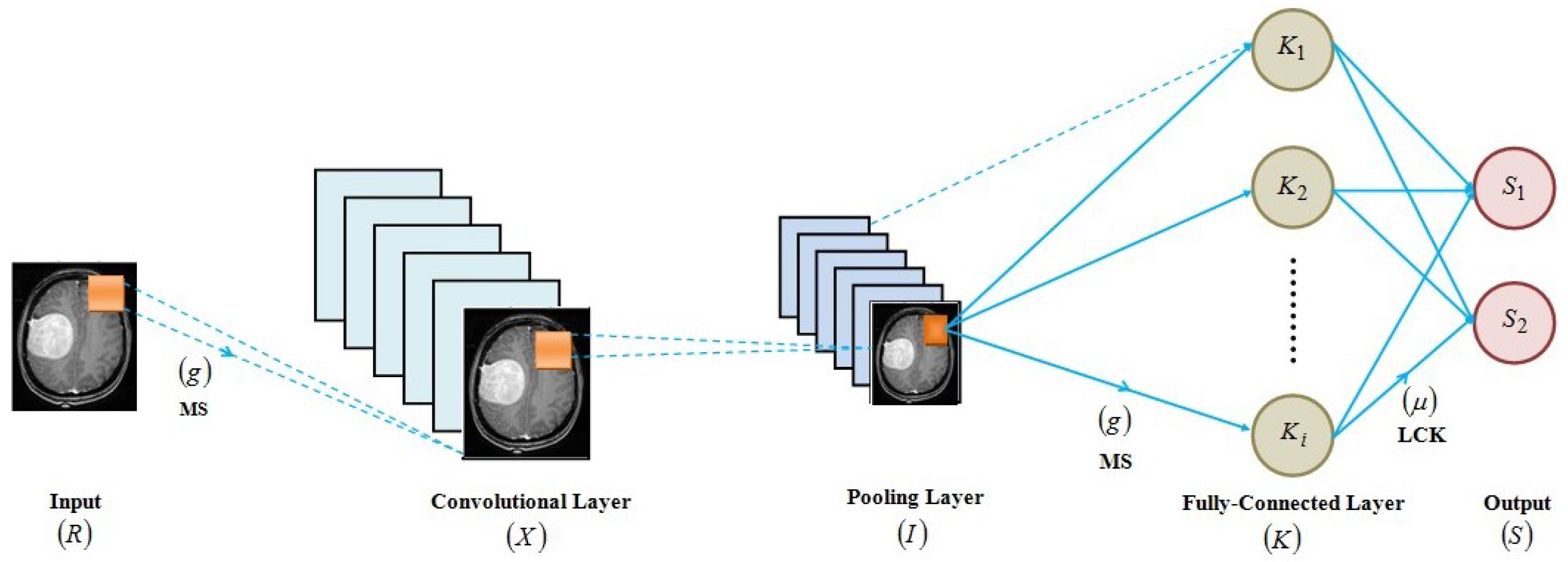
Here, the classification of brain tumors based on R is peformed utilizing the LeCun Kaiming-based Convolutional ModSwish Neural Network (LCK-CMSNN) classifier. Here, CNN uses correlation between the input data to accurately predict the disease. However, CNN takes a long time to train, and the classification becomes inaccurate if the dataset is large. Thus, to overcome the processing time issue, the ModSwish (MS) activation function is utilized; for accurate prediction of the results in CNN, the weights are initialized by using LeCun Kaiming (LCK) initialization. Figure 2 displays the architecture of the LCK-CMSNN classifier.
The LCK-CMSNN classifier comprises convolutional layers, a fully connected layer, a pooling layer, and an activation function. The parameters of the proposed classifier are: The first convolution includes 32 filters and 4 pooling layers. Then, the second convolution includes 64 filters with 4 pooling layers. The MS activation is utilized to extract nonlinear features. In addition, LCK-based weight initialization ensures stable gradient propagation and faster convergence during training. The classifier model is trained with a batch size of 50, ensuring balanced computational efficiency. The LCK-CMSNN approach is described in the following.
  • Input data and weight initialization: Initially, R is taken as input. In the input layer, the input is assigned to each node of the layer. Before that, the weight value of the node is initialized. The weight g utilized to convert the scalar input to vector form is estimated using the LCK formula, which overcomes the over-fitting issue of the classifier. The LCK-centric g that helps in effective learning is evaluated with regard to the random weight and LCK formula as
    g = w × ρ ( R ) R × 0.5 × w × R w ( R )
    Here, w is the random weight, ρ is the probability value utilized for weight selection, is the infinite value, which ensures that the weight values do not diverge and is the differential factor that represents the rate of change in the weight factor. Thus, g avoids the problem of a vanishing and exploding gradient during the classification process. Then, the convolution process takes place using these learnable weights g.
  • Convolutional Layer: The main building block of the classifier is the convolutional layer, which extracts significant features from the input. It recognizes patterns (features) by applying learnable filters and creates feature maps. In this process, the input is convolved by computing the element-wise products and then activated using the Rectified Linear Unit (ReLU) activation function to produce feature maps. The output X of the convolutional layer is estimated by
    X = R g + l × N
    N = max ( 0 , R )
    Here, l signifies the bias value of the input feature R, and N is the ReLU activation function. Here, convolution is performed based on the vectorization of R using g and l, followed by multiplication using N. Then, the pooling of X is performed as described below.
  • Pooling Layer: After convolution, the input X is down-sampled, that is, the dimensions of the features are reduced to minimize the complexity of the process. The pooling layer works by dividing X into small kernels and selecting the maximum value within the divided region. Then, the significant features of X are retrained to effectively downsample the feature maps.
    I = m a x ( X )
    Here, I denotes the max-pooled output, and these pooled features are given to the fully connected layer.
  • Fully Connected Layer: The fully connected layer, which is also known as the dense layer, is utilized to learn complex relationships between the input data. In this layer, the complex combination of the features in I is connected to each neuron from the preceding layer, thus giving a single output. This layer connects all neurons from the previous output as given below,
    K = I g + l
    Here, K depicts the output of the fully connected layer. In this layer, the summation of all the pooled inputs is performed with respect to g and l. Lastly, K is activated to obtain classified results.
  • Activation function: Here, to reduce the processing time of the classifier, an MS activation function μ is used that considers all inputs and converges quickly to achieve the classified result. The MS activation function μ is expressed as
    μ = K K 1 1 + e K
    Thus, μ is obtained regarding K and the inverse exponential of K. The MS activation function is better than the Rectified Linear Unit (ReLU) activation function in terms of adaptive smoothing, computational efficiency, and gradient flow. The function of MS activation smoothens the transition for different input values, making it more flexible than standard ReLU. The ModSwish activation function performs well for deep learning networks. The final output S is obtained by activating K using μ as
    S = K μ
    S = S 1 S 2
    Here, S signifies the output for the prediction of brain tumor, S 1 indicates the tumor-detected output, and S 2 specifies the non-tumor-detected output. The pseudo-code for the LCK-CMSNN classifier is given in Algorithm 3.
Once the model is trained for disease prediction, the image data C ( A ) of the patient is given to the trained model for testing, and the diagnosis takes place. Afterward, the diagnosis report J is secured as explained below.

3.6.6. Diagnosis Report Security

Here, after the prediction of the brain tumor in the MRI, the diagnosis report J is secured using the HK-QC algorithm, as explained in Section 3.2. A quantum key δ in HK-QC is generated by using the hash function and the input J is encrypted by
J = δ × J
Here, J denotes the encrypted diagnosis report, which is attained by multiplying δ with J. Then, J is transferred to the patient through a smart contract.

3.6.7. Smart Contract

Meanwhile, after successfully securing J, a smart contract H is generated with the help of a unique key m created by utilizing HS3CMAC, as explained in Section 3.5. The created smart contract is expressed by
H = b ( y ) , q ( y ) m
Here, [ b ( y ) ] depicts the details of the patient, and [ q ( y ) ] signify the details of the doctor. After creating H, the report J is sent to the patient and decrypted by
J = J × H m
Thus, the patient receives the final diagnosis report J . This J is determined based on J , H, and m. Hence, the proposed framework secured the healthcare data, verified the BB, predicted the disease, and transferred the identified result to the patient securely via the blockchain.
Algorithm 3 LCK-CMSNN
Input: Extracted Feature ( R )
Output: Tumor Detection ( S )
1:
Begin
2:
Initialize parameters ( w ) , ( ρ ) , ( l )
3:
Perform weight initialization
g = w × ρ ( R ) R 0.5 × w R [ w ( R ) ]
4:
for  ( R ) do
5:
   Convolute input feature
X = { [ R g ] + l } × N
6:
   Evaluate max-pooling I = max ( X )
7:
   Fully-connect each neuron
K = I g + l
8:
   Calculate activation function
μ = K K 1 1 + exp K
9:
   Find classified output S = K μ
10:
   for  ( S )  do
11:
     if  ( S = S 1 )  then
12:
        Tumor detected image
13:
     else
14:
        Non-tumor detected image
15:
     end if
16:
   end for
17:
end for
18:
Return Tumor Detection ( S )
19:
End

4. Results and Discussion

In this section, the proposed model’s performance in the blockchain is examined. The outcomes are obtained by using the PYTHON programming language platform, which is flexible in integrating blockchain simulation, QC computation, and deep learning modules. The software libraries used for the implementation are numpy, cv2, skfuzzy, matplotlib, tensorflow, keras, cryptography, hashlib, base64, skimage, typing, and json. The hardware requirements are provided as follows.
  • Integrated Development Environment: Visual Studio Code
  • Programming Language: PYTHON 3.10
  • Computing Platform: 13th Gen Intel® Core™ i7-9850H CPU @ 2.60 GHz
  • Memory: 16 GB RAM
  • Storage: 1 TB SSD
  • Operating System: Windows 11 (64 bit)
In Table 1, the blockchain and data transmission simulation parameters are included.

4.1. Dataset Description

For accurate disease diagnosis using blockchain, brain MRI images from Brain Tumor Detection dataset available on Kaggle are utilized (see Appendix A). This dataset comprises 253 images, including 155 non-tumor class and 98 tumor class images. From each class, 80% of the images are allocated for training and 20% of the images are reserved for testing.
The findings of the proposed model are presented in Table 2. In Table 2, the image results of the input image, brain extracted image, smoothened image, intensity normalized image, and segmented image for the respective tumor and non-tumor classes are described. Section 4.2 describes the performance of the proposed work.

4.2. Performance Analysis

Here, the performance of the proposed techniques, namely, PS-P2PE for bridge verification, HK-QC for data encryption, He-PoS for data transfer, LCK-CMSNN for classification, FHMCM for segmentation, and HS3CMAC for authorization, is evaluated against prevailing models to demonstrate the superior performance of the proposed framework. Table 3a,b present the specifications of the proposed classifier and the segmentation model, respectively.
Table 4 shows the formulae used to calculate various parameters. In the table, Z r defines the average distance between the current point and all other points, O r is the average distance between the current point and all the points in the nearest cluster, T T c , T T n , F F c , and F F n depict the true positive, true negative, false positive, and false negative, respectively, E p t is the consumed energy, t t is the time duration for data transmission, P r t specifies the probability value to select the key, and ( c o ) , ( n e ) , ( p r ) and ( b r ) indicate the time required of the transaction, time taken for transaction the data, time required for the bridge’s protocol to verify and validate the transaction, and additional time taken by bridge, respectively.
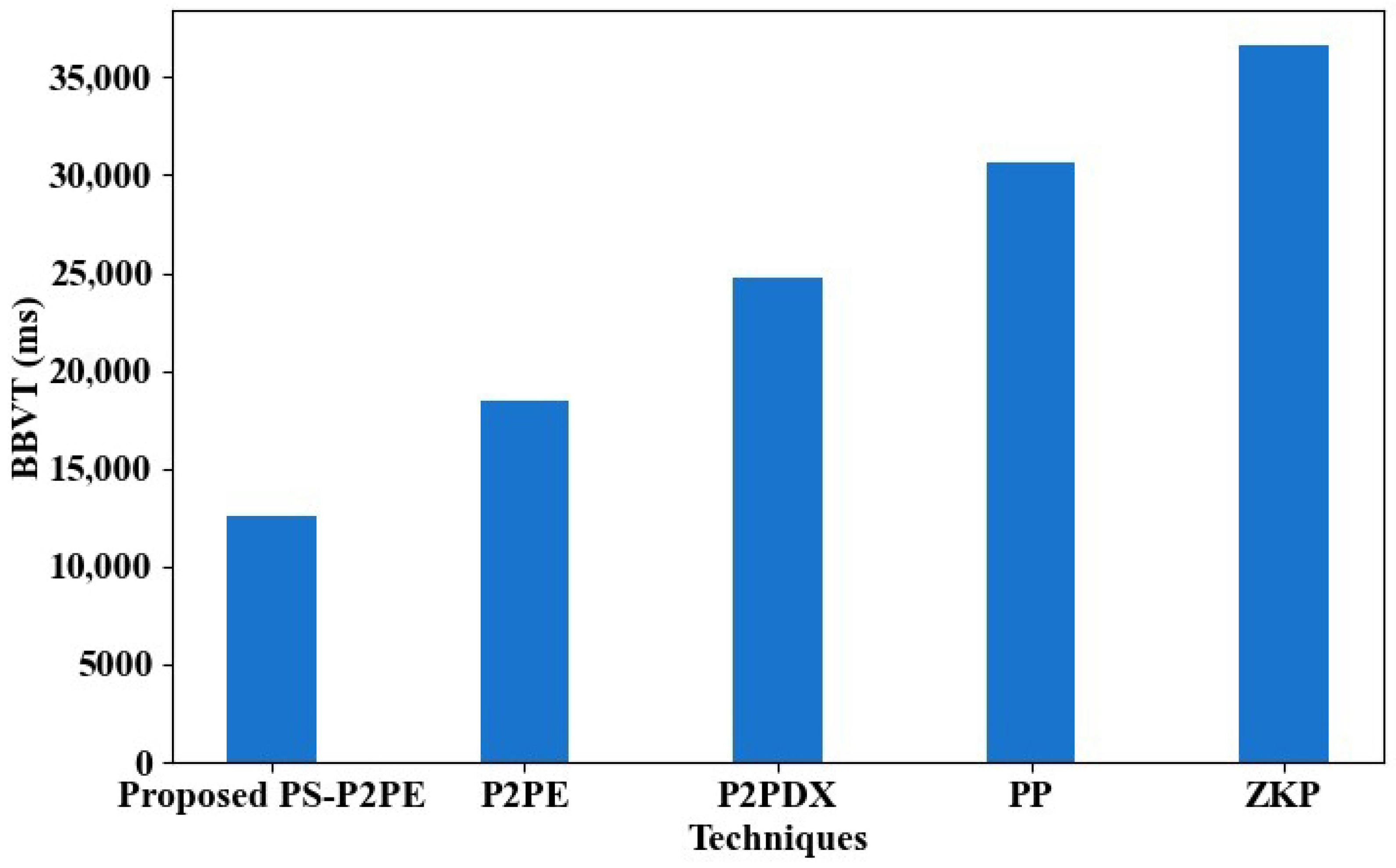
The proposed PS-P2PE technique prevents data loss during BB verification using a combination of Private Key and Secret Key. The Secret Key is generated using the HK-QC method. Thus, the proposed model achieved a Blockchain Bridge Verification Time (BBVT) of 12,541 ms, as shown in Figure 3. However, existing methods, such as P2PE, Peer-to-Peer Decentralized Exchange (P2PDX), Polymorph Polyring (PP), and Zero-Knowledge Proofs (ZKP), had higher BBVTs of 18,445 ms, 24,722 ms, 30,687 ms, and 36,594 ms, respectively, compared to the proposed PS-P2PE technique, as shown in Figure 3. Therefore, the proposed model verified the BB more effectively than the other existing approaches.
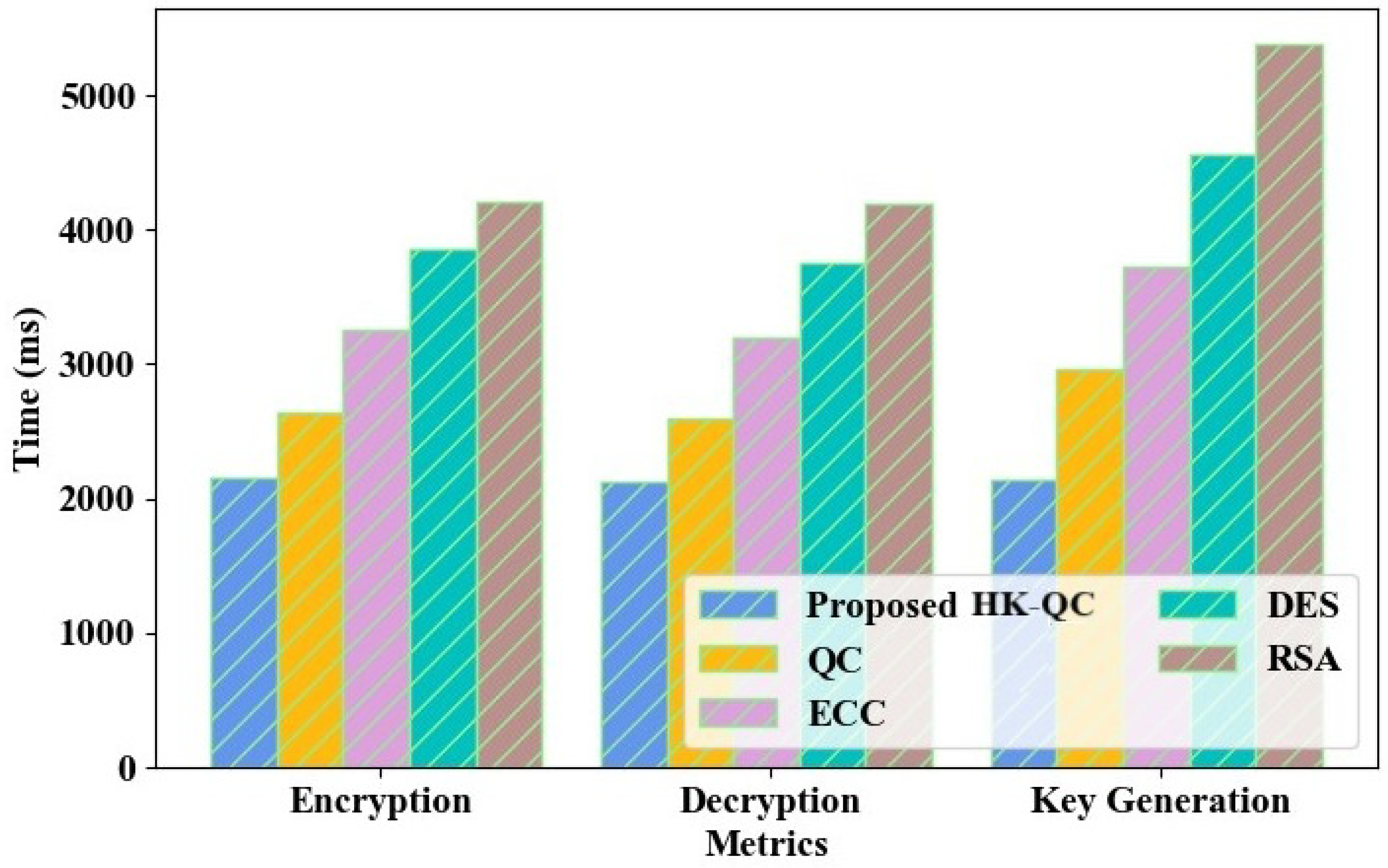
The comparative analysis of the proposed HK-QC technique and the prevailing QC, ECC, DES, and RSA regarding healthcare data security is represented in Table 5 and Figure 4. The hash function was utilized in the proposed HK-QC to create a quantum key. Hence, the patient data was secured with an SL of 98.23%, Encryption Time (ET) of 2151 ms, and Decryption Time (DT) of 2124 ms, while the prevailing approaches acquired an average SL of 91.36%, ET of 3489 ms, and DT of 3436 ms. Due to improper key creation, the ET and DT increased. SL value also decreased for existing methodologies. Thus, the lower SL and higher ET and DT of the existing models proved that the proposed model secured the input better than other prevailing encryption methods.
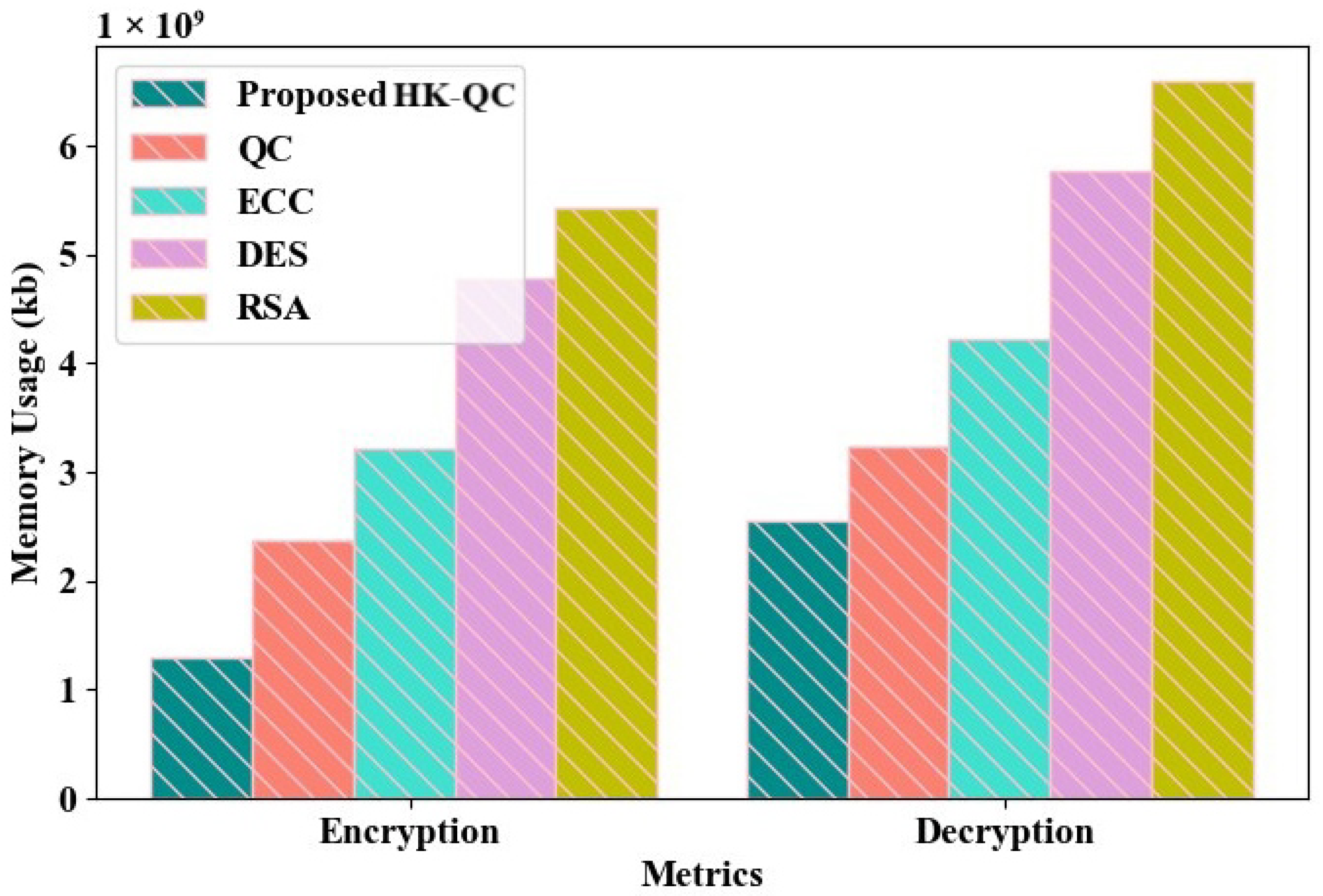
Figure 5 shows that the proposed HK-QC technique utilized a lower memory of about 1,287,465,423 kb during encryption and 2,546,105,062 kb during decryption. This was because of the usage of the HK-centric quantum key in the proposed approach. Figure 5 illustrates that QC, ECC, DES, and RSA approaches utilized memory of about 2,365,725,891 kb, 3,215,763,254 kb, 4,781,220,412 kb, and 5,431,602,642 kb to encrypt the input and 3,235,503,267 kb, 4,228,921,473 kb, 5,772,505,208 kb, and 6,589,208,764 kb to decrypt the input, respectively. The unique key selection was not concentrated in existing methods. So, the memory usage of the existing methods was higher than that of the proposed method. Hence, the proposed model outperformed the prevailing models in the security of healthcare data.
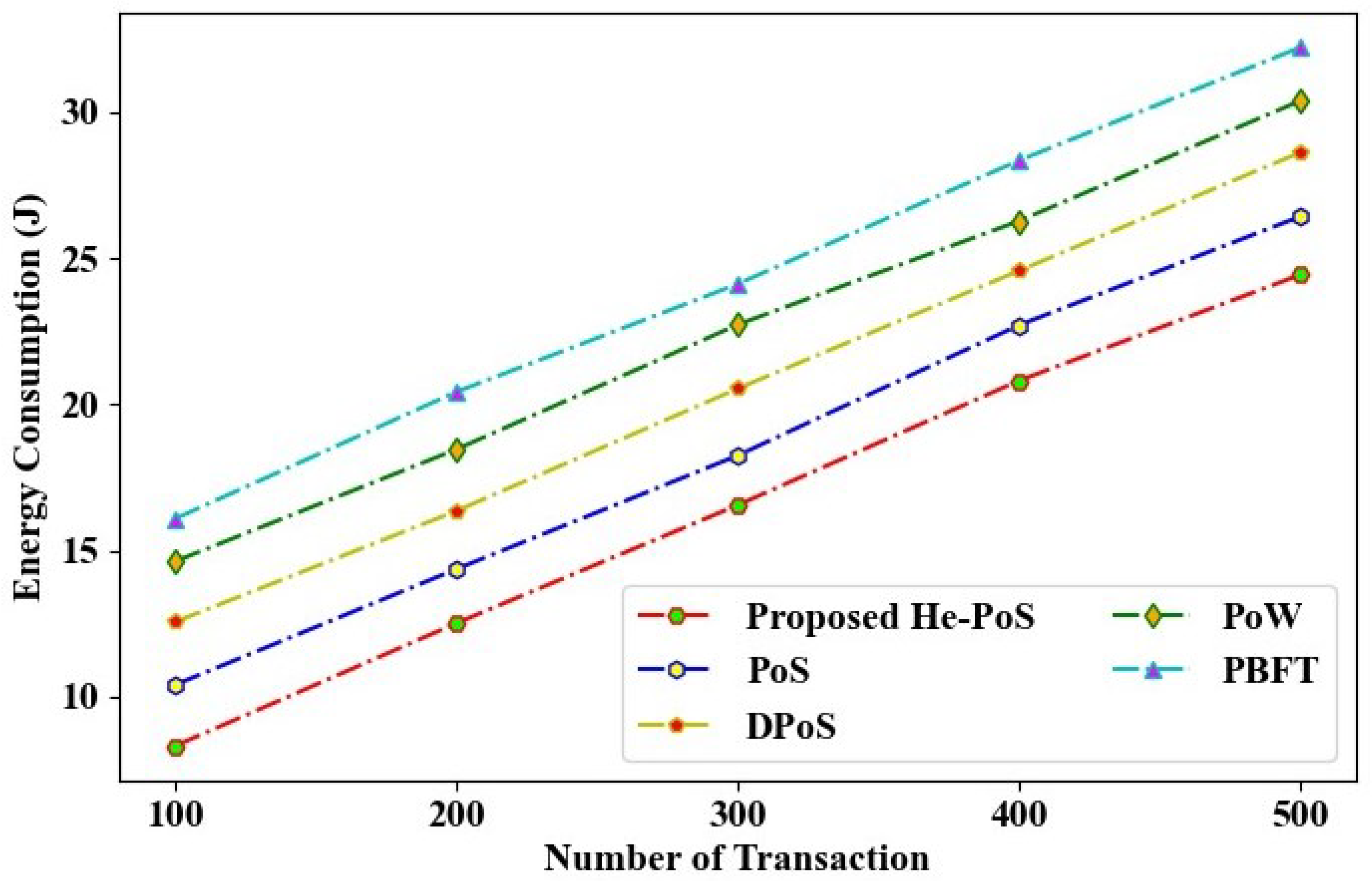
The performance of the proposed He-PoS is shown in Table 6 and Figure 6. The proposed He-PoS transferred the data into the blockchain with a Computational Time (CT) of 37,847 ms and an Energy Consumption (EC) of 12.51 J and 24.43 J for 200 Number of Transactions (NoT) and 500 NoT, correspondingly. Also, the selection of the block for secured data transfer was performed by utilizing the He formula. However, the prevailing models like PoS, Delegated Proof of Stake (DPoS), PoW, and Practical Byzantine Fault Tolerance (PBFT) attained an average CT of 50,555 ms. They also obtained an average EC of 17.4 J for 200 NoT and 29.41 J for 500 NoT, which were higher than the proposed system. Due to the random selection of blocks, large stake validators were presented, increasing the complexity and energy consumption of the existing methodologies. Thus, the proposed method was better than the prevailing techniques.
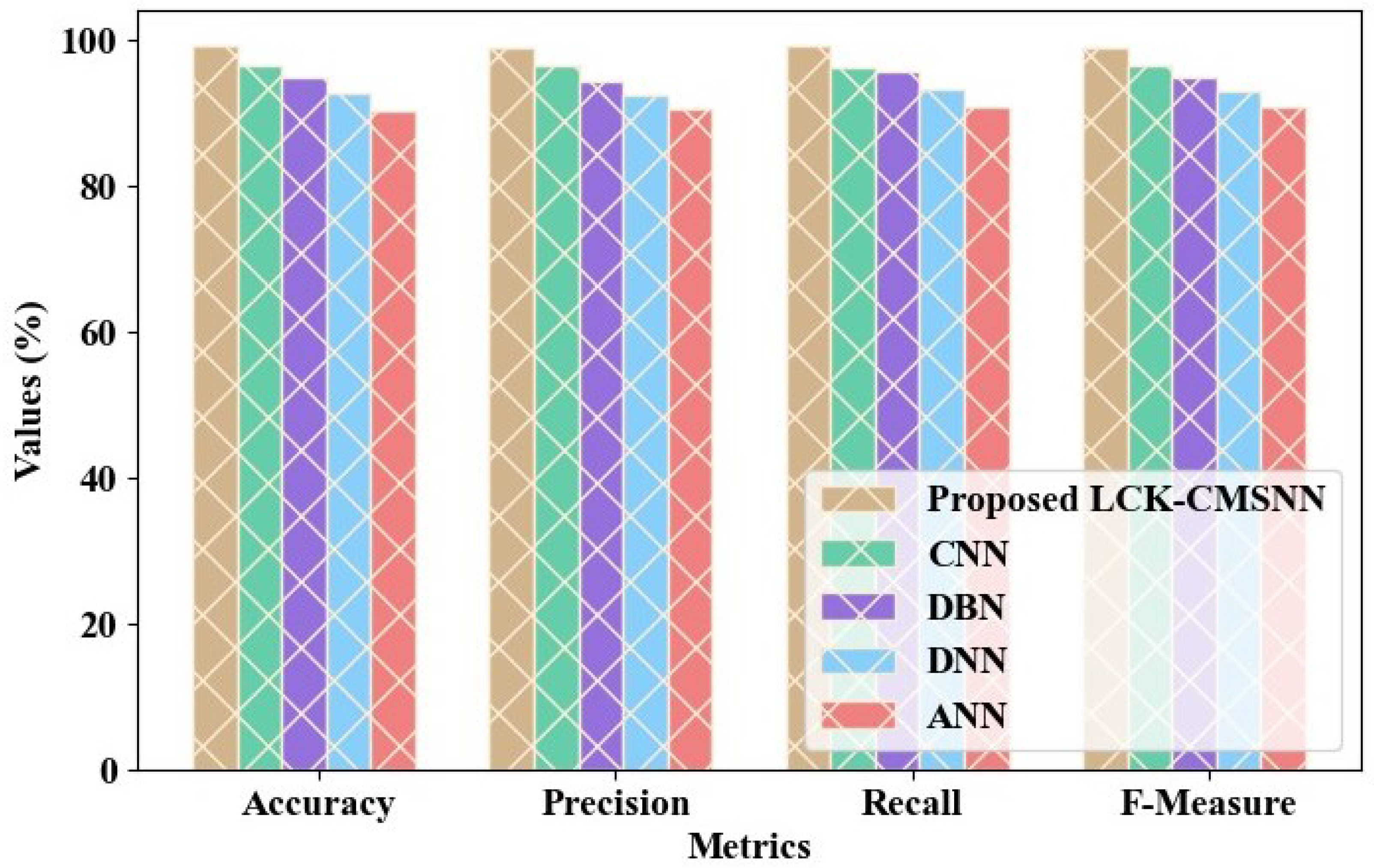
For the comparison of the proposed LCK-CMSNN technique and the existing CNN, Deep Belief Network (DBN), DNN, and Artificial Neural Network (ANN), metrics, such as accuracy, precision, recall, and F-Measure, are utilized. Figure 7 depicts that the proposed model diagnosed the brain tumor with 99.15% Accuracy, 99.07% Precision, 99.13% Recall, and 99.02% F-Measure. However, the prevailing CNN, DBN, DNN, and ANN attained a lower accuracy of 96.6%, 94.93%, 92.79%, and 90.42%, lower precision of 96.52%, 94.36%, 92.41%, and 90.67%, lower recall of 96.19%, 95.68%, 93.25%, and 90.82%, and lower F-Measure of 96.54%, 94.92%, 92.96%, and 90.74%, correspondingly. When analogized to the existing techniques, the weight initialization using the LCK function and activation by MS in the proposed classifier resulted in an accurate diagnosis of the brain tumor from MRI. The existing methods used the conventional activation function, which did not support all types of data, leading to poor performance.
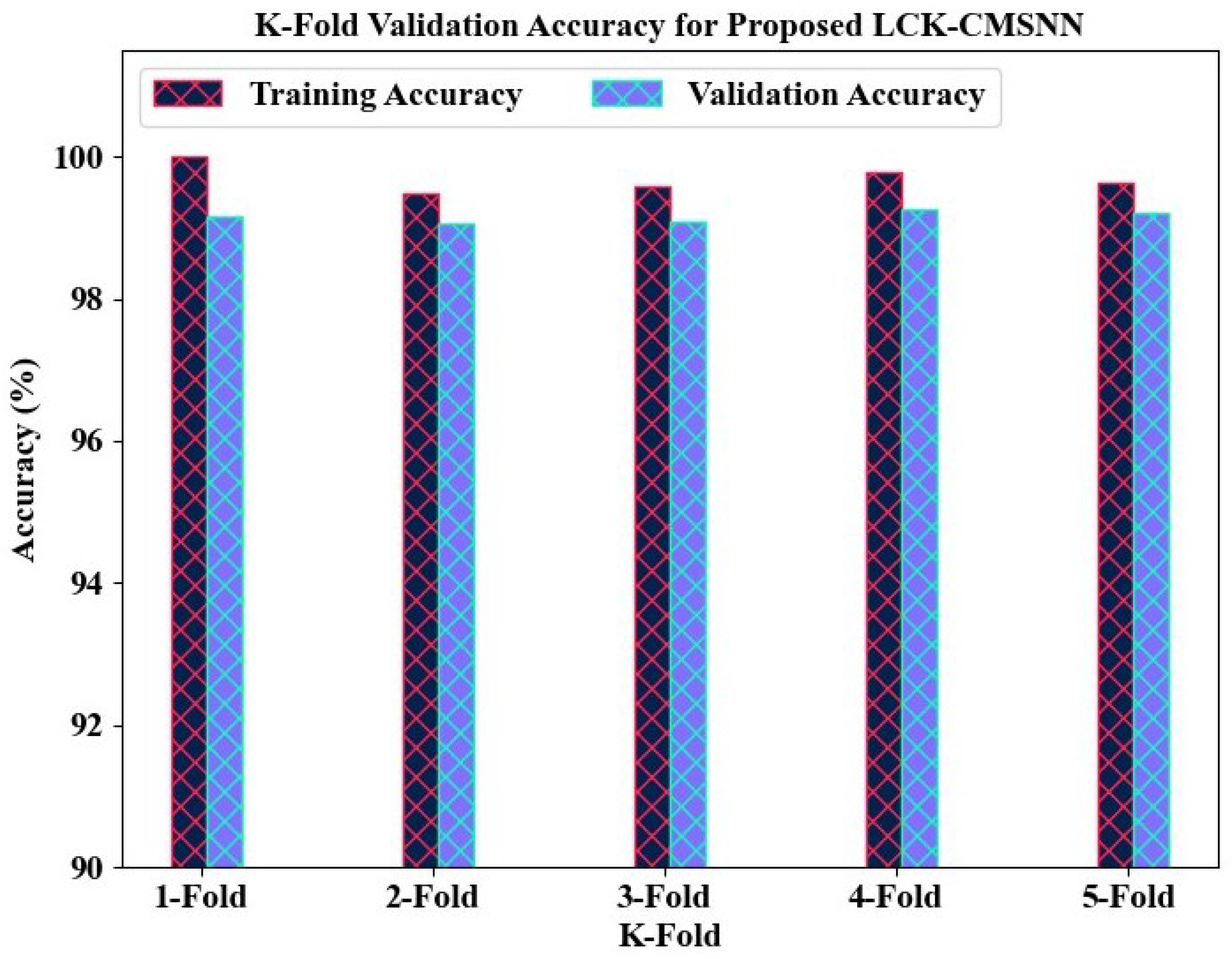
Figure 8 shows the cross-fold validation accuracy analysis graph for the proposed LCK-CMSNN approach. Here, the performance of the proposed LCK-CMSNN was analyzed for five different folds for training and validation accuracy. In all the folds, the validation accuracy nearly reached the training accuracy. The validation accuracy was above 98% for all the folds.
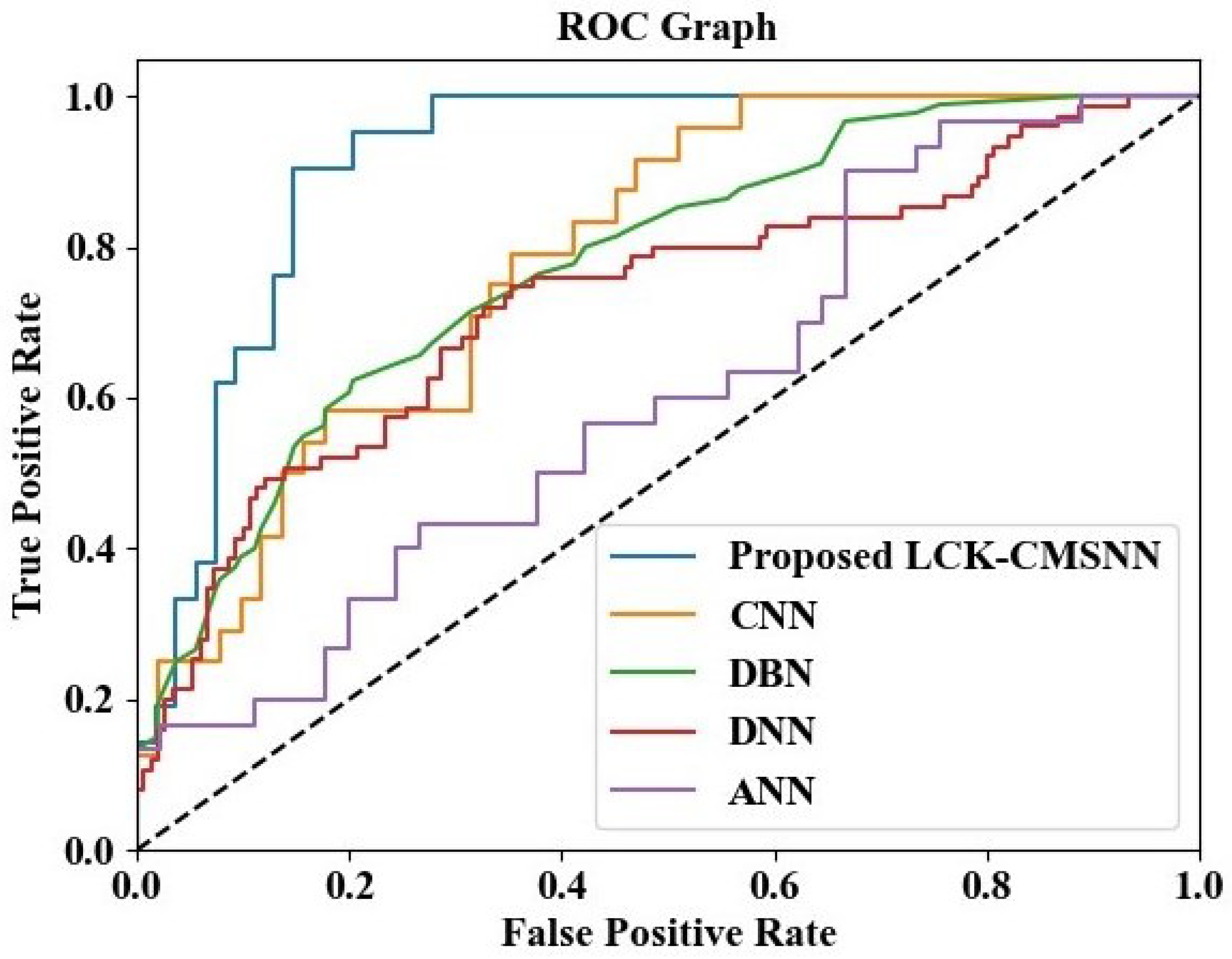
Figure 9 shows the Receiver Operating Characteristic (ROC) analysis of the proposed LCK-CMSNN approach and existing CNN, DBN, DNN, and ANN approaches. Here, according to the false positive rate, the true positive value varied. Compared with the existing approaches, the proposed method attained higher performance. This proved that that the proposed classifier classified the brain tumor effectively than the prevailing classifiers.
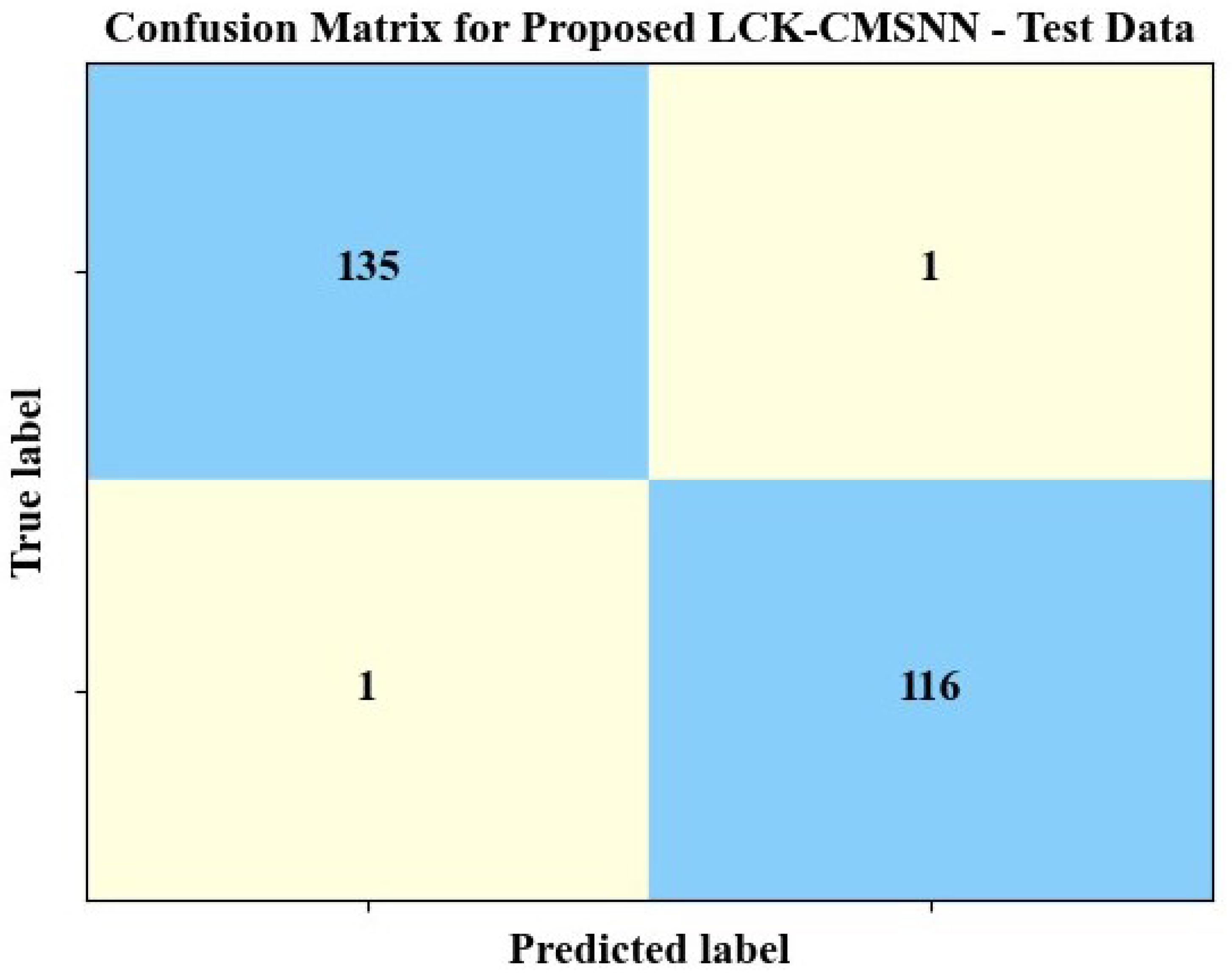
Figure 10 displays the confusion matrix for the proposed LCK-CMSNN approach. The confusion matrix was used to evaluate the effectiveness of the classification approach. Here, the matrix table compares the predicted label of a model against the true label. The confusion matrix depicted that the proposed model attained higher accuracy.
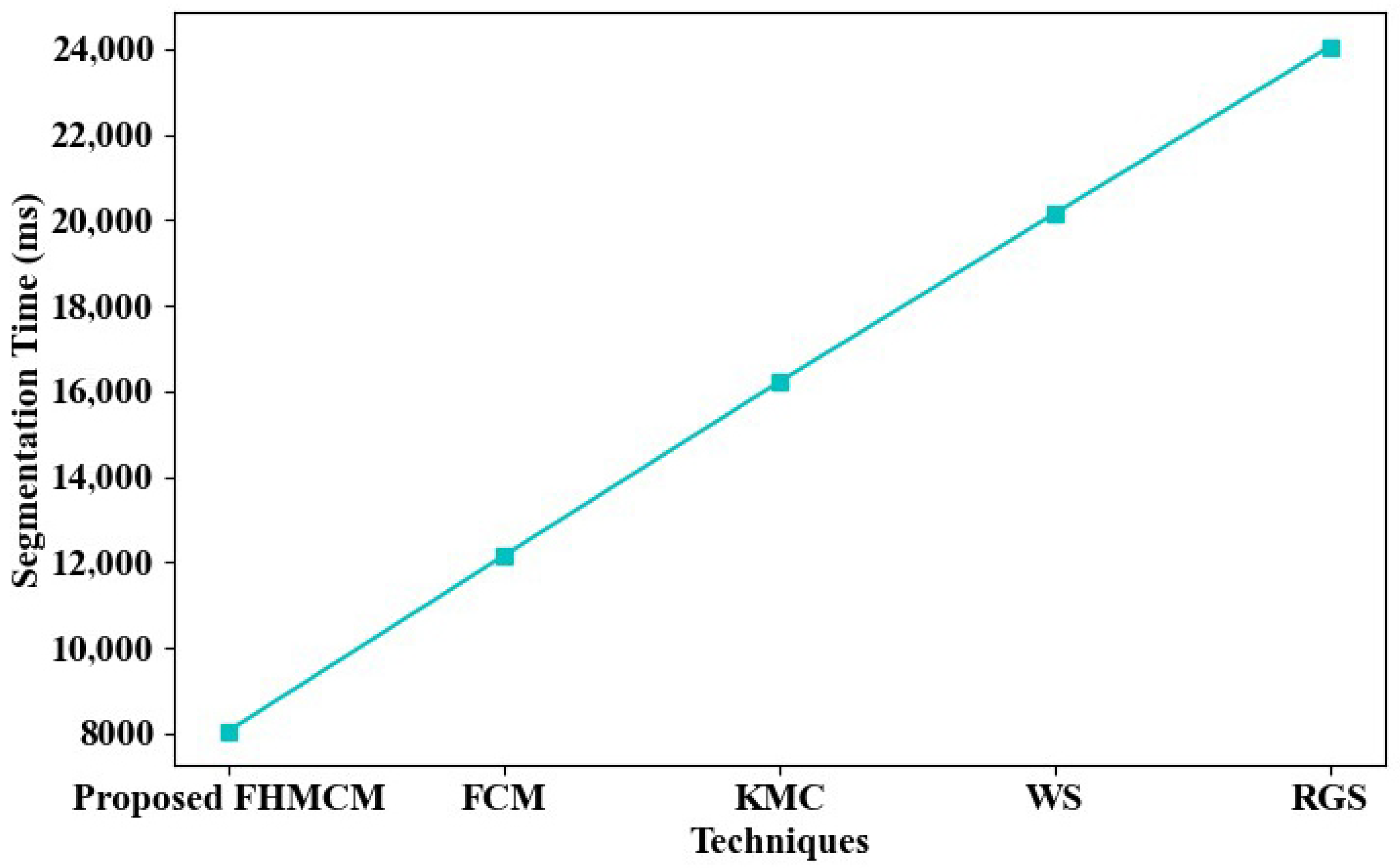
For effective diagnosis of tumors in the brain, the input MRI was segmented. In the proposed technique, the HM technique was utilized for distance calculation. Table 7 and Figure 11 displayed that the proposed FHMCM technique segmented the input with a silhouette score of 0.9273 and Segmentation Time (ST) of 8065 ms. However, the state-of-the-art methods like FCM, K-Means Clustering (KMC), Watershed Segmentation (WS), and Region Growing Segmentation (RGS) could segment the image with a lower silhouette score and higher ST. The existing methods attained an average silhouette score value and ST of 0.86245 and 18,151 ms, respectively. The proposed segmentation model’s performance was improved by the utilization of HM distance rather than Euclidean distance. Thus, the proposed model was better than the prevailing segmentation models.
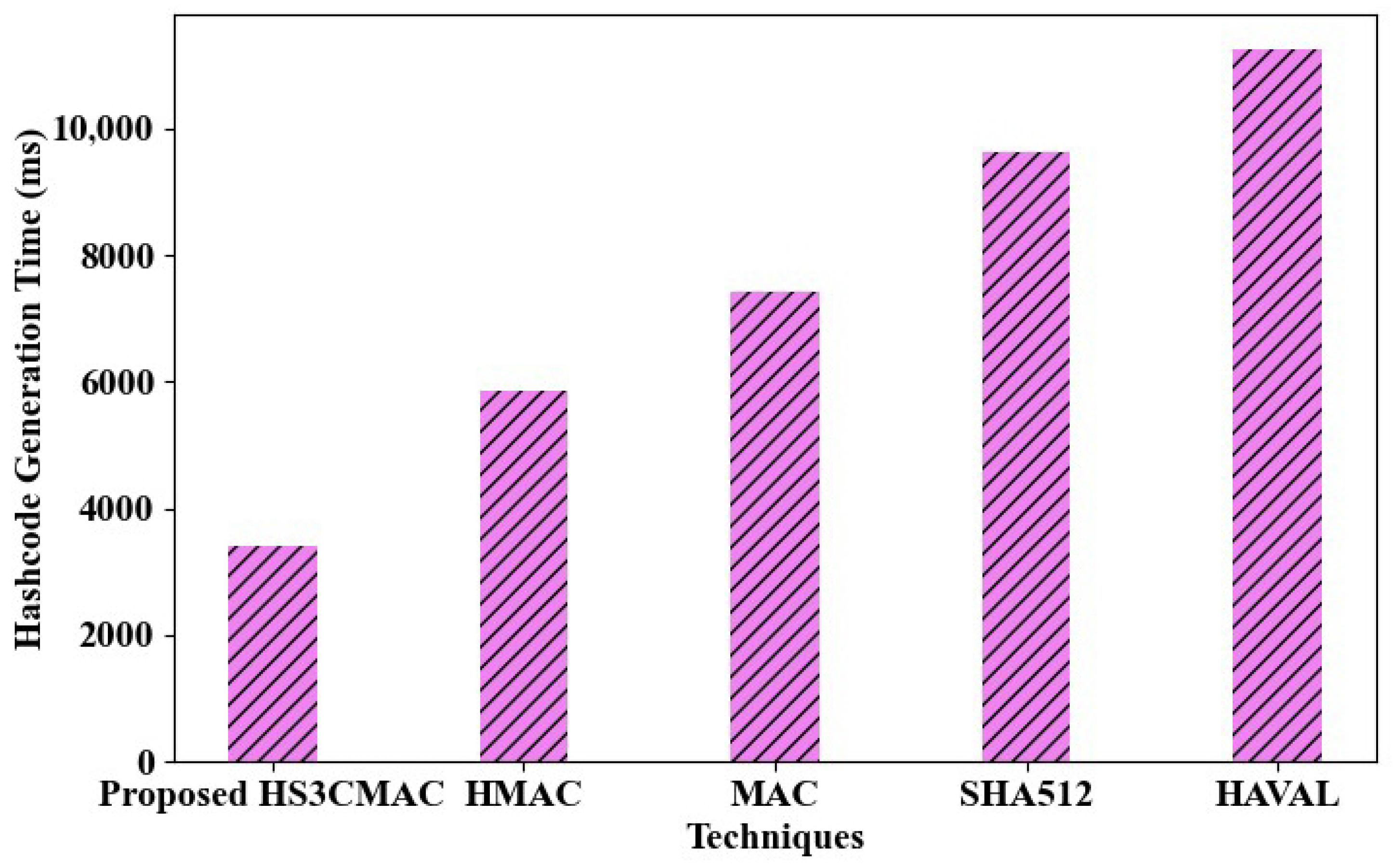
In Figure 12, the Hashcode Generation Time (HGT) of the proposed HS3CMAC and the prevailing HMAC, Message Authentication Code (MAC), Secure Hash Algorithm-512 (SHA-512), and HAVAL is compared. The proposed technique authorized the doctor and the patient with an HGT of 3415 ms, whereas the prevailing approaches could authorize only with a higher HGT. The existing HMAC, MAC, SHA512, and HAVAL took HGTs of 5864 ms, 7451 ms, 9638 ms, and 11,247 ms, respectively. The proposed model attained better performance due to the utilization of the hash function and Stream Cipher formula along with the hash value. Therefore, the proposed model was authorized better than the prevailing approaches.
Table 8 compares the proposed work with the prevailing models in healthcare data security. For input data encryption and decryption, the prevailing works utilized BlockChain Internet of Medical Things-based Security System (BC-IoMT-SeS), AES, Blockchain-based Condition Invisible Proxy Re-encryption (BCIPRE), Deep Belief-based Diffie-Hellman (DBDH), and Privacy-Preserved Threat Intelligence Framework (P2TIF). The proposed model generated the quantum key using the hash function, thus securing the data with a 98.23% SL, 2151 ms ET, and 2124 ms DT. In addition, the proposed LCK-CMSNN accurately classified the brain tumor with 99.15% accuracy, thus proving the dependability of the proposed model. However, in [34,35], the authors utilized private keys for data encryption, which gave an SL of 94% and 94.30%, respectively. In [36,37], the original data could not be re-encrypted, providing ETs of 25,000 ms and 7500 ms, respectively. Likewise, in [38], a crypto-analysis attack was possible, which decrypted the data in 2800 ms. The SL metric was an important measure to ensure the security level. According to the SL, the proposed approach achieved better performance than the existing works. Thus, the proposed system attained superior performance in data security. Likewise, in [39], the Federated Learning (FL) technique obtained a low accuracy of 93% due to its lower efficiency. Similarly, in [40], the CNN-LSTM approach attained a low accuracy of 98.51% owing to the overfitting and gradient vanishing problems. Thus, the proposed model had high reliability and trustworthiness.

5. Conclusions

In the proposed research, the protection of healthcare data, verification of the blockchain, and efficient transfer of healthcare reports were achieved. Initially, patients and doctors registered and logged into the blockchain system. Subsequently, the patient’s medical data was encrypted using the HK-QC technique, resulting in a 98.23% security level. The blockchain was then verified using the PS-P2PE algorithm, with a verification time of 12,541 ms. The data was efficiently transferred in a computational time of 37,847 ms using the He-PoS approach. Meanwhile, the HS3CMAC approach utilized 3415 ms for authorization. Following authorization, disease prediction was conducted with initial image preprocessing. Tumor segmentation, employing the FHMCM method, resulted in a silhouette score of 0.9273 and a segmentation time of 8065 ms. Disease identification achieved 99.15% accuracy using the LCK-CMSNN classifier. Finally, the diagnosis report was securely transferred to the patient. Thus, the proposed framework accomplished secure healthcare data transfer and diagnosis through the use of blockchain technology.
The proposed framework demonstrated the integration of blockchain with the intelligent diagnostic system. This transformed the healthcare data management regarding transparency, data traceability, and patient privacy. The hospital and large medical institutions could adopt this model to ensure tamper-proof health record exchange and automated verification of diagnostic reports. Therefore, the human error and administrative error were reduced. Also, the proposed system offered scalability for telemedicine and healthcare monitoring with continuous data flow, high security, and low energy consumption.
Although the proposed system effectively ensured secured data transfer, verification, and diagnostic accuracy, certain limitations existed. First, the attack detection was not carried out during the data transfer, which might cause adversarial attacks. Secondly, the transaction prioritization was not carried out, delaying the data transmission.
In the future, the attack detection and prevention model will be included within the blockchain network to further enhance the robustness of the proposed system. Also, the Artificial Intelligence (AI) models like Deep Reinforcement Learning (DRL) will be utilized for resource allocation and transaction prioritization across the blockchain network.

Author Contributions

Conceptualization, O.A.-K.; methodology, O.A.-K. and G.N.; software, O.A.-K., G.N. and A.E.A.; validation, O.A.-K. and A.E.; formal analysis, O.A.-K., A.E.A. and A.E.; investigation, G.N. and A.E.A.; resources, M.N.; data curation, A.E.A. and M.N.; writing—original draft preparation, O.A.-K.; writing—review and editing, O.A.-K. and G.N.; visualization, A.E. and M.N.; supervision, O.A.-K.; project administration, O.A.-K. and G.N. All authors have read and agreed to the published version of the manuscript.

Funding

This research received no external funding.

Data Availability Statement

No new data were created or analyzed in this study. Data sharing is not applicable to this article. The MRI images used in this study are openly available in Kaggle at https://www.kaggle.com/datasets/navoneel/brain-mri-images-for-brain-tumor-detection?select=yes (accessed on 28 November 2025).

Conflicts of Interest

The authors declare no conflicts of interest.

Abbreviations

The following abbreviations are used in this manuscript:
ANNArtificial Neural Network
BBBlockchain Bridge
BBVTBlockchain Bridge Verification Time
BiLSTMBidirectional Long Short-Term Memory
CNNConvolutional Neural Network
DBNDeep Belief Network
DESData Encryption Standard
DNNDeep Neural Network
DPoSDelegated Proof of Stake
DTDecryption Time
ECCElliptic Curve Cryptography
ETEncryption Time
FCMFuzzy-C-Means
FHMCMFuzzy HaMan C-Means
HMHamming Manhattan
HoGHistogram of Gradient
KMCK-Means Clustering
LCK-CMSNNLeCun Kaiming-based Convolutional ModSwish Neural Network
LSTMLong Short-Term Memory
MRIMagnetic Resonance Imaging
NISNeighborhood Indexing Sequence
OPSOOrthogonal Particle Swarm Optimization
P2PDXPeer-to-Peer Decentralized Exchange
P2PEPoint-to-Point Encryption
PBFTPractical Byzantine Fault Tolerance
PoPMVPattern-Proof Malware Validation
PoSProof of Stake
PoWProof of Work
PPPolymorph Polyring
RGSRegion Growing Segmentation
WSWatershed Segmentation
ZKPZero-Knowledge Proofs

Appendix A

The MRI scans of the human brain were collected from the MRI scanners. This scanner used strong magnetic fields and radio frequency pulses to generate a detailed cross-sectional image of the human brain. The images were in the form of 2D gray-scale image slices in JPEG/PNG format that were categorized into tumor and non-tumor classes.

References

  1. Khordadpour, P.; Ahmadi, S. Security and Privacy Enhancing in Blockchain-based IoT Environments via Anonym Auditing. arXiv 2024, arXiv:2403.01356, 1–16. [Google Scholar]
  2. Mehmood, A.; Shafique, A.; Alawida, M.; Khan, A.N. Advances and Vulnerabilities in Modern Cryptographic Techniques: A Comprehensive Survey on Cybersecurity in the Domain of Machine/Deep Learning and Quantum Techniques. IEEE Access 2024, 12, 27530–27555. [Google Scholar] [CrossRef] [Scilit]
  3. Jatain, D.; Singh, V.; Dahiya, N. Blockchain Base Community Cluster-Federated Learning for Secure Aggregation of Healthcare Data. Procedia Comput. Sci. 2022, 215, 752–762. [Google Scholar] [CrossRef] [Scilit]
  4. Roy, P.P.; Teju, V.; Kandula, S.R.; Sowmya, K.V.; Stan, A.I.; Stan, O.P. Secure Healthcare Model Using Multi-Step Deep Q Learning Network in Internet of Things. Electronics 2024, 13, 669. [Google Scholar] [CrossRef] [Scilit]
  5. Shafay, M.; Ahmad, R.W.; Salah, K.; Yaqoob, I.; Jayaraman, R.; Omar, M. Blockchain for deep learning: Review and open challenges. Clust. Comput. 2023, 26, 197–221. [Google Scholar] [CrossRef] [Scilit] [PubMed]
  6. Biswas, S.; Sharif, K.; Li, F.; Bairagi, A.K.; Latif, Z.; Mohanty, S.P. GlobeChain: An Interoperable Blockchain for Global Sharing of Healthcare Data—A COVID-19 Perspective. IEEE Consum. Electron. Mag. 2021, 10, 64–69. [Google Scholar] [CrossRef] [Scilit]
  7. Amiri, Z.; Heidari, A.; Navimipour, N.J.; Esmaeilpour, M.; Yazdani, Y. The deep learning applications in IoT-based bio- and medical informatics: A systematic literature review. Neural Comput. Appl. 2024, 36, 5757–5797. [Google Scholar] [CrossRef] [Scilit]
  8. Al-Nbhany, W.A.N.A.; Zahary, A.T.; Al-Shargabi, A.A. Blockchain-IoT Healthcare Applications and Trends: A Review. IEEE Access 2024, 12, 4178–4212. [Google Scholar] [CrossRef] [Scilit]
  9. Kayikci, S.; Khoshgoftaar, T.M. Blockchain meets machine learning: A survey. J. Big Data 2024, 11, 9. [Google Scholar] [CrossRef] [Scilit]
  10. Alwahedi, F.; Aldhaheri, A.; Ferrag, M.A.; Battah, A.; Tihanyi, N. Machine learning techniques for IoT security: Current research and future vision with generative AI and large language models. Internet Things Cyber-Phys. Syst. 2024, 4, 167–185. [Google Scholar] [CrossRef] [Scilit]
  11. Ali, S.; Li, Q.; Yousafzai, A. Blockchain and federated learning-based intrusion detection approaches for edge-enabled industrial IoT networks: A survey. Ad Hoc Netw. 2024, 152, 103320. [Google Scholar] [CrossRef] [Scilit]
  12. Dhasarathan, C.; Shanmugam, M.; Kumar, M.; Tripathi, D.; Khapre, S.; Shankar, A. A nomadic multi-agent based privacy metrics for e-health care: A deep learning approach. Multimed. Tools Appl. 2024, 83, 7249–7272. [Google Scholar] [CrossRef] [Scilit]
  13. Boopathy, P.; Liyanage, M.; Deepa, N.; Velavali, M.; Reddy, S.; Maddikunta, P.K.R.; Khare, N.; Gadekallu, T.R.; Hwang, W.J.; Pham, Q.V. Deep learning for intelligent demand response and smart grids: A comprehensive survey. Comput. Sci. Rev. 2024, 51, 100617. [Google Scholar] [CrossRef] [Scilit]
  14. Messinis, S.; Temenos, N.; Protonotarios, N.E.; Rallis, I.; Kalogeras, D.; Doulamis, N. Enhancing Internet of Medical Things security with artificial intelligence: A comprehensive review. Comput. Biol. Med. 2024, 170, 108036. [Google Scholar] [CrossRef] [Scilit]
  15. Kuznetsov, O.; Sernani, P.; Romeo, L.; Frontoni, E.; Mancini, A. On the Integration of Artificial Intelligence and Blockchain Technology: A Perspective About Security. IEEE Access 2024, 12, 3881–3897. [Google Scholar] [CrossRef] [Scilit]
  16. Mohammed, M.A.; Lakhan, A.; Zebari, D.A.; Ghani, M.K.A.; Marhoon, H.A.; Abdulkareem, K.H.; Nedoma, J.; Martinek, R. Securing healthcare data in industrial cyber-physical systems using combining deep learning and blockchain technology. Eng. Appl. Artif. Intell. 2024, 129, 107612. [Google Scholar] [CrossRef] [Scilit]
  17. Kumar, P.; Kumar, R.; Gupta, G.P.; Tripathi, R.; Jolfaei, A.; Islam, A.K.M.N. A blockchain-orchestrated deep learning approach for secure data transmission in IoT-enabled healthcare system. J. Parallel Distrib. Comput. 2023, 172, 69–83. [Google Scholar] [CrossRef] [Scilit]
  18. Veeramakali, T.; Siva, R.; Sivakumar, B.; Mahesh, P.C.S.; Krishnaraj, N. An intelligent internet of things-based secure healthcare framework using blockchain technology with an optimal deep learning model. J. Supercomput. 2021, 77, 9576–9596. [Google Scholar] [CrossRef] [Scilit]
  19. Mazumdar, H.; Chakraborty, C.; Venkatakrishnan, S.B.; Kaushik, A.; Gohel, H.A. Quantum-Inspired Heuristic Algorithm for Secure Healthcare Prediction using Blockchain Technology. IEEE J. Biomed. Health Inform. 2023, 28, 3371–3378. [Google Scholar] [CrossRef] [Scilit]
  20. Arul, R.; Alroobaea, R.; Tariq, U.; Almulihi, A.H.; Alharithi, F.S.; Shoaib, U. IoT-enabled healthcare systems using blockchain-dependent adaptable services. Pers. Ubiquitous Comput. 2024, 28, 43–57. [Google Scholar] [CrossRef] [Scilit]
  21. Sutradhar, S.; Majumder, S.; Bose, R.; Mondal, H.; Bhattacharyya, D. A blockchain privacy-conserving framework for secure medical data transmission in the internet of medical things. Decis. Anal. J. 2024, 10, 100419. [Google Scholar] [CrossRef] [Scilit]
  22. Taloba, A.I.; Elhadad, A.; Rayan, A.; El-Aziz, R.M.A.; Salem, M.; Alzahrani, A.A.; Alharithi, F.S.; Park, C. A blockchain-based hybrid platform for multimedia data processing in IoT-Healthcare. Alex. Eng. J. 2023, 65, 263–274. [Google Scholar] [CrossRef] [Scilit]
  23. Alruwaili, F.F.; Alabduallah, B.; Alqahtani, H.; Salama, A.S.; Mohammed, G.P.; Alneil, A.A. Blockchain Enabled Smart Healthcare System Using Jellyfish Search Optimization with Dual-Pathway Deep Convolutional Neural Network. IEEE Access 2023, 11, 87583–87591. [Google Scholar] [CrossRef] [Scilit]
  24. Mohammad, F.; Al-Ahmadi, S.; Al-Muhtadi, J. Block-Deep: A Hybrid Secure Data Storage and Diagnosis Model for Bone Fracture Identification of Athlete From X-Ray and MRI Images. IEEE Access 2023, 11, 142360–142370. [Google Scholar] [CrossRef] [Scilit]
  25. Yang, H.; Shen, J.; Lu, J.; Zhou, T.; Xia, X.; Ji, S. A privacy-preserving data transmission scheme based on oblivious transfer and blockchain technology in the smart healthcare. Secur. Commun. Netw. 2021, 2021, 5781354. [Google Scholar] [CrossRef] [Scilit]
  26. Sonkamble, R.G.; Bongale, A.M.; Phansalkar, S.; Sharma, A.; Rajput, S. Secure data transmission of electronic health records using blockchain technology. Electronics 2023, 12, 1015. [Google Scholar] [CrossRef] [Scilit]
  27. Kumar, R.; Kumar, P.; Tripathi, R.; Gupta, G.P.; Islam, A.N.; Shorfuzzaman, M. Permissioned blockchain and deep learning for secure and efficient data sharing in industrial healthcare systems. IEEE Trans. Ind. Inform. 2022, 18, 8065–8073. [Google Scholar] [CrossRef] [Scilit]
  28. Patil, S.M.; Dakhare, B.S.; Satre, A.M.; Pawar, S.D. Blockchain-based privacy preservation framework for preventing cyberattacks in smart healthcare big data management systems. Multimed. Tools Appl. 2025, 84, 25547–25566. [Google Scholar] [CrossRef] [Scilit]
  29. Ali, A.A.; Gunavathie, M.A.; Srinivasan, V.; Aruna, M.; Chennappan, R.; Matheena, M. Securing electronic health records using blockchain-enabled federated learning for IoT-based smart healthcare. Clin. eHealth 2025, 8, 125–133. [Google Scholar] [CrossRef] [Scilit]
  30. Raheem, A.; Yang, Z.; Yu, H.; Yaqub, M.; Sabah, F.; Ahmed, S.; Chuhan, I.S. IPC-CNN: A Robust Solution for Precise Brain Tumor Segmentation Using Improved Privacy-Preserving Collaborative Convolutional Neural Network. Ksii Trans. Internet Inf. Syst. 2024, 18, 2589–2604. [Google Scholar] [CrossRef] [Scilit]
  31. Dash, S.; Mishra, S.; Siddique, M.; Gelmecha, D.J.; Singh, R.S. Improved Deviation Sparse Fuzzy C-Means-2D Cumulative Sum Average Filter and Modified Sine Cosine Crow Search Algorithm-Wavelet Extreme Learning Machine for Brain Tumor Detection and Classification. Appl. Comput. Intell. Soft Comput. 2025, 2025, 9991264. [Google Scholar] [CrossRef] [Scilit]
  32. Ma, Z.; Zhang, R.; Ai, B.; Lian, Z.; Zeng, L.; Niyato, D.; Peng, Y. Deep Reinforcement Learning for Energy Efficiency Maximization in RSMA-IRS-Assisted ISAC System. IEEE Trans. Veh. Technol. 2025, 74, 18273–18278. [Google Scholar] [CrossRef] [Scilit]
  33. Brain MRI Images for Brain Tumor Detection. Available online: https://www.kaggle.com/datasets/navoneel/brain-mri-images-for-brain-tumor-detection?select=yes (accessed on 24 April 2025).
  34. Lodha, L.; Baghela, V.S.; Bhuvana, J.; Bhatt, R. A blockchain-based secured system using the Internet of Medical Things (IoMT) network for e-healthcare monitoring. Meas. Sens. 2023, 30, 100904. [Google Scholar] [CrossRef] [Scilit]
  35. Nazir, A.; He, J.; Zhu, N.; Wajahat, A.; Ullah, F.; Qureshi, S.; Ma, X.; Pathan, M.S. Collaborative threat intelligence: Enhancing IoT security through blockchain and machine learning integration. J. King Saud Univ.-Comput. Inf. Sci. 2024, 36, 101939. [Google Scholar] [CrossRef] [Scilit]
  36. Lin, G.; Wang, H.; Wan, J.; Zhang, L.; Huang, J. A blockchain-based fine-grained data sharing scheme for e-healthcare system. J. Syst. Archit. 2022, 132, 102731. [Google Scholar] [CrossRef] [Scilit]
  37. Shree, S.; Zhou, C.; Barati, M. Data protection in internet of medical things using blockchain and secret sharing method. J. Supercomput. 2024, 80, 5108–5135. [Google Scholar] [CrossRef] [Scilit]
  38. Goel, A.; Neduncheliyan, S. An intelligent blockchain strategy for decentralised healthcare framework. Peer Peer Netw. Appl. 2023, 16, 846–857. [Google Scholar] [CrossRef] [Scilit]
  39. Ullah, F.; Nadeem, M.; Abrar, M.; Amin, F.; Salam, A.; Khan, S. Enhancing brain tumor segmentation accuracy through scalable federated learning with advanced data privacy and security measures. Mathematics 2023, 11, 4189. [Google Scholar] [CrossRef] [Scilit]
  40. Mohanty, M.D.; Das, A.; Mohanty, M.N.; Altameem, A.; Nayak, S.R.; Saudagar, A.K.J.; Poonia, R.C. Design of smart and secured healthcare service using deep learning with modified SHA-256 algorithm. Healthcare 2022, 10, 1275. [Google Scholar] [CrossRef] [Scilit] [PubMed]
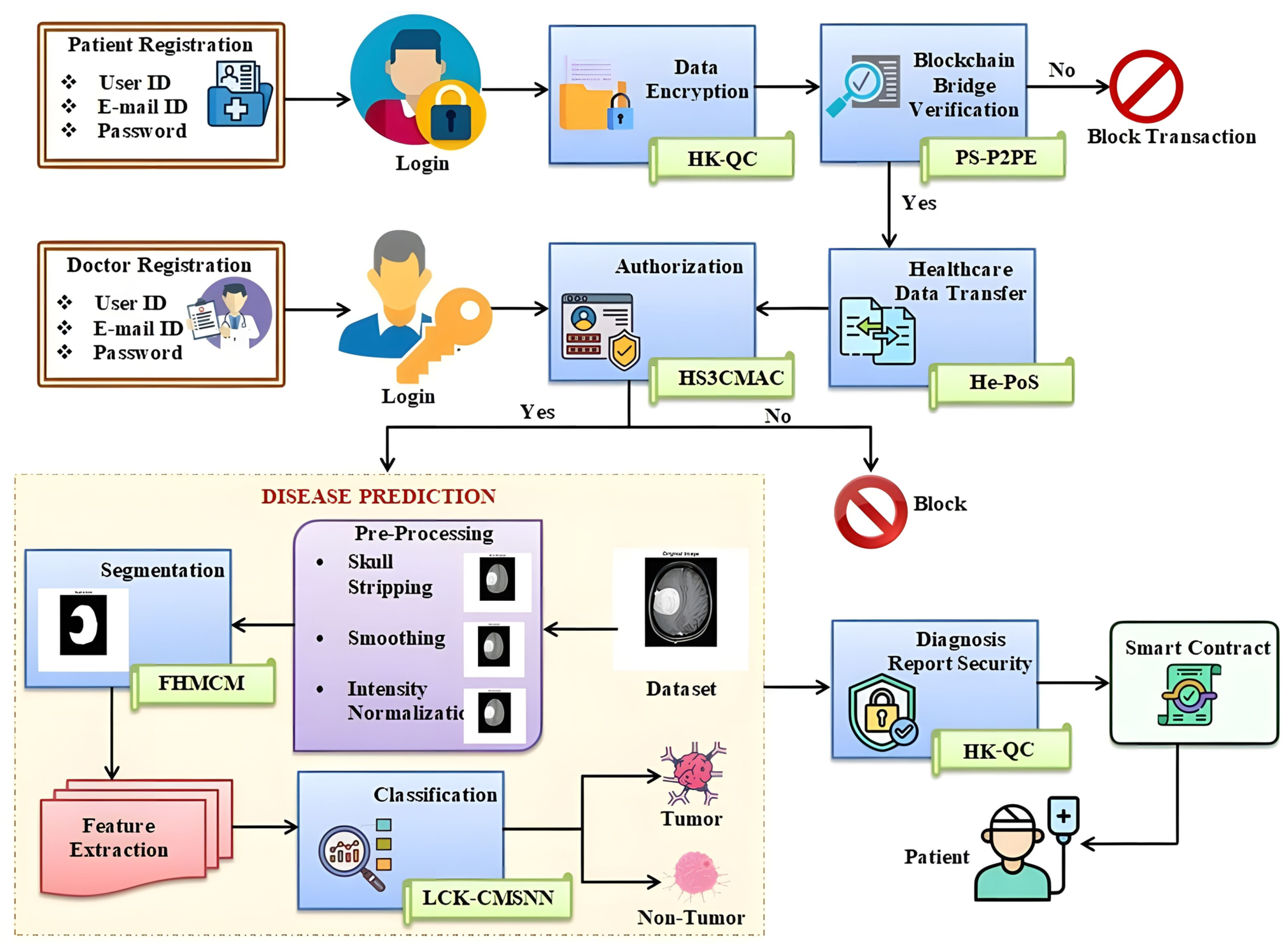
Figure 1. Framework of the Proposed Model.
Sci 08 00013 g001
Figure 2. Framework of LCK-CMSNN classifier.
Sci 08 00013 g002
Figure 3. BBVT Comparative Analysis of PS-P2PE.
Sci 08 00013 g003
Figure 4. Analysis of Encryption, Decryption, and Key Generation Times for HK-QC.
Sci 08 00013 g004
Figure 5. Memory Usage of Data Encryption and Decryption.
Sci 08 00013 g005
Figure 6. Energy Consumption Comparison of He-PoS.
Sci 08 00013 g006
Figure 7. Performance Analysis and Comparison of LCK-CMSNN Regarding Classification.
Sci 08 00013 g007
Figure 8. Cross-fold validation accuracy analysis.
Sci 08 00013 g008
Figure 9. Graphical representation of ROC analysis.
Sci 08 00013 g009
Figure 10. Confusion matrix for proposed LCK-CMSNN approach.
Sci 08 00013 g010
Figure 11. Graphical Comparison Regarding Segmentation Time.
Sci 08 00013 g011
Figure 12. Hashcode Generation Time Analysis of HS3CMAC.
Sci 08 00013 g012
Table 1. Simulation parameters of the proposed research methodology.
ParametersValues
Number of Nodes100 nodes (50% honest, 30% byzantine, 20% selfish)
Network Latency50 ms average, with a standard deviation of 10 ms
Network TopologyRandom graph with a connection probability of 0.3
Bandwidth Limit10 Mbps per node
Type of ConsensusHe-PoS (Hybrid Proof-of-Stake)
Block Time10 s per block
Block Size1 MB
Transaction Rate100 transactions per second (TPS)
Transaction Size500 bytes per transaction
Simulation Duration10,000 s (equivalent to ∼1000 blocks at 10 s/block)
Hash FunctionSHA-256
Key Size256 bits
Node Hardware8-core CPU, 16 GB RAM, 1 TB SSD per node
Table 2. Image results of the proposed framework.
MethodsTumorNon-Tumor
InputSci 08 00013 i001Sci 08 00013 i002
Brain ExtractionSci 08 00013 i003Sci 08 00013 i004
SmoothingSci 08 00013 i005Sci 08 00013 i006
Intensity NormalizationSci 08 00013 i007Sci 08 00013 i008
SegmentationSci 08 00013 i009Sci 08 00013 i010
Table 3. Specifications of Classifier and Segmentation Model Parameters.
(a) Specifications of Classifier Parameters
ParameterSize/Specification
Number of Convolutional Layers in 1st Convolution32
Number of Pooling Layers in 1st Convolution4
Activation Function in 1st ConvolutionModSwish
Number of Convolutional Layers in 2nd Convolution64
Number of Pooling Layers in 2nd Convolution4
Activation Function in 2nd ConvolutionModSwish
Number of Convolutional Layers in 3rd Convolution64
Number of Dense Layers64
Activation Function in Dense LayerModSwish
OptimizerAdam
Batch Size50
(b) Specifications of Segmentation Model Parameters
ParameterSize/Specification
Fuzziness coefficient2
Maximum number of iterations1000
Termination tolerance 1.0 × 10 3
Distance metricHaMan
Initialization methodRandom
Random seed42
Error0.005
Table 4. Formulae for the parameters.
ParametersFormulae
BBVT ( c o ) + ( n e ) + ( p r ) + ( b r )
SL log 2 1 P r t
Encryption time ( Encryption ending time Encryption starting time )
Decryption time ( Decryption ending time Decryption starting time )
Key generation time ( Keygeneration ending time Keygeneration starting time )
Memory usage on encryption ( Starting memory size Memory size after encryption )
Memory usage on decryption ( Starting memory size Memory size after decryption )
Computational Time ( Transfer ending time Transfer starting time )
Energy consumption E p t × t t
Accuracy T T c + T T n T T c + F F c + T T n + F F n
Precision T T c T T c + F F c
Recall T T c T T c + F F n
F-Measure 2 × Recall × Precision Recall + Precision
HGT ( Hashcode generation ending time Hashcode generation starting time )
Silhouette score Z r O r max ( Z r , O r )
Segmentation time ( Segmentation ending time Segmentation starting time )
Table 5. Security Level Comparative Analysis of HK-QC.
TechniquesSecurity Level (%)
Proposed HK-QC98.23
QC95.32
ECC92.53
DES89.73
RSA87.87
Table 6. Computational Time Analysis of He-PoS Regarding Data Transfer.
MethodsComputational Time (ms)
Proposed He-PoS37,847
PoS42,456
DPoS47,986
PoW53,364
PBFT58,415
Table 7. Silhouette Score Analysis of FHMCM.
TechniquesSilhouette Score
Proposed FHMCM0.9273
FCM0.8956
KMC0.8723
WS0.8552
RGS0.8267
Table 8. Comparison of Related Works.
StudyMethodSL (%)ET (ms)DT (ms)Accuracy (%)
Proposed WorkHK-QC and LCK-CMSNN98.232151212499.15
[34]BC-IoMT-SeS9494,00095,000-
[37]AES-25,00024,500-
[36]BCIPRE-75005000-
[38]DBDH95.9335002800-
[35]P2TIF94.30---
[39]FL---93
[40]CNN-LSTM---98.51
Disclaimer/Publisher’s Note: The statements, opinions and data contained in all publications are solely those of the individual author(s) and contributor(s) and not of MDPI and/or the editor(s). MDPI and/or the editor(s) disclaim responsibility for any injury to people or property resulting from any ideas, methods, instructions or products referred to in the content.