
Performance Tailoring and Environmental Implications of Biochar-Modified Asphalt Materials: Toward Sustainable Road Design

 ,
, 
Abstract
1. Introduction
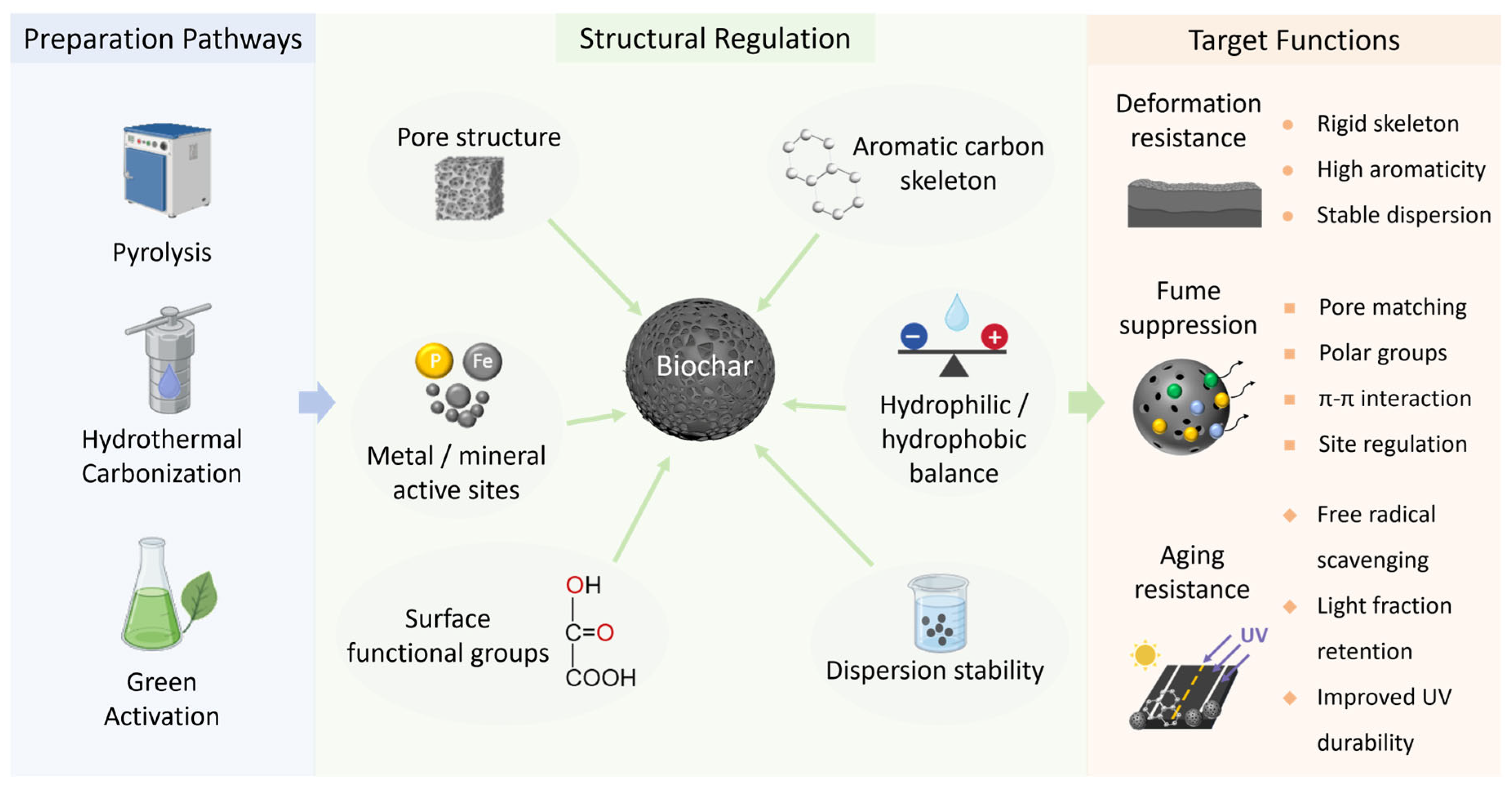
2. Biochar’s Structural Characteristics and Compatibility with Asphalt
2.1. Matching Biochar Feedstock Composition with Asphalt Performance Requirements
2.2. Matching Biochar Production Processes and Surface Structures with Asphalt Performance Requirements
2.3. Matching Biochar Particle Size, Dosage and Dispersion State with Asphalt Performance Requirements
3. Pavement Performance Responses of Biochar-Modified Asphalt
3.1. High-Temperature Rheological Performance and Rutting Resistance
3.2. Low-Temperature Cracking Resistance and Fatigue Behavior
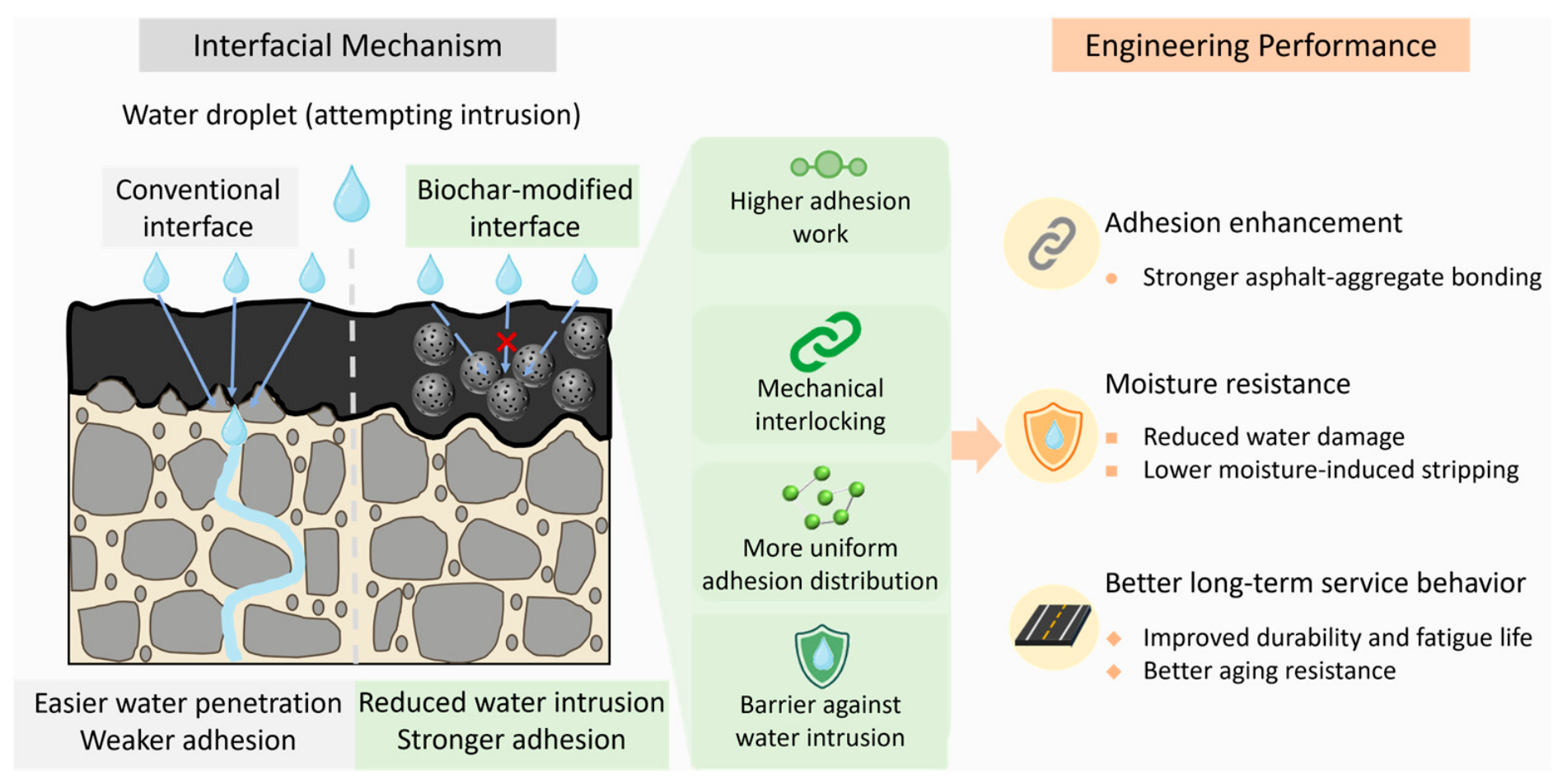
3.3. Asphalt–Aggregate Interfacial Adhesion and Moisture Resistance
4. Biochar-Mediated Regulation of Asphalt Fume Emissions
4.1. Asphalt Fume Constituents and Risk Assessment Indicators
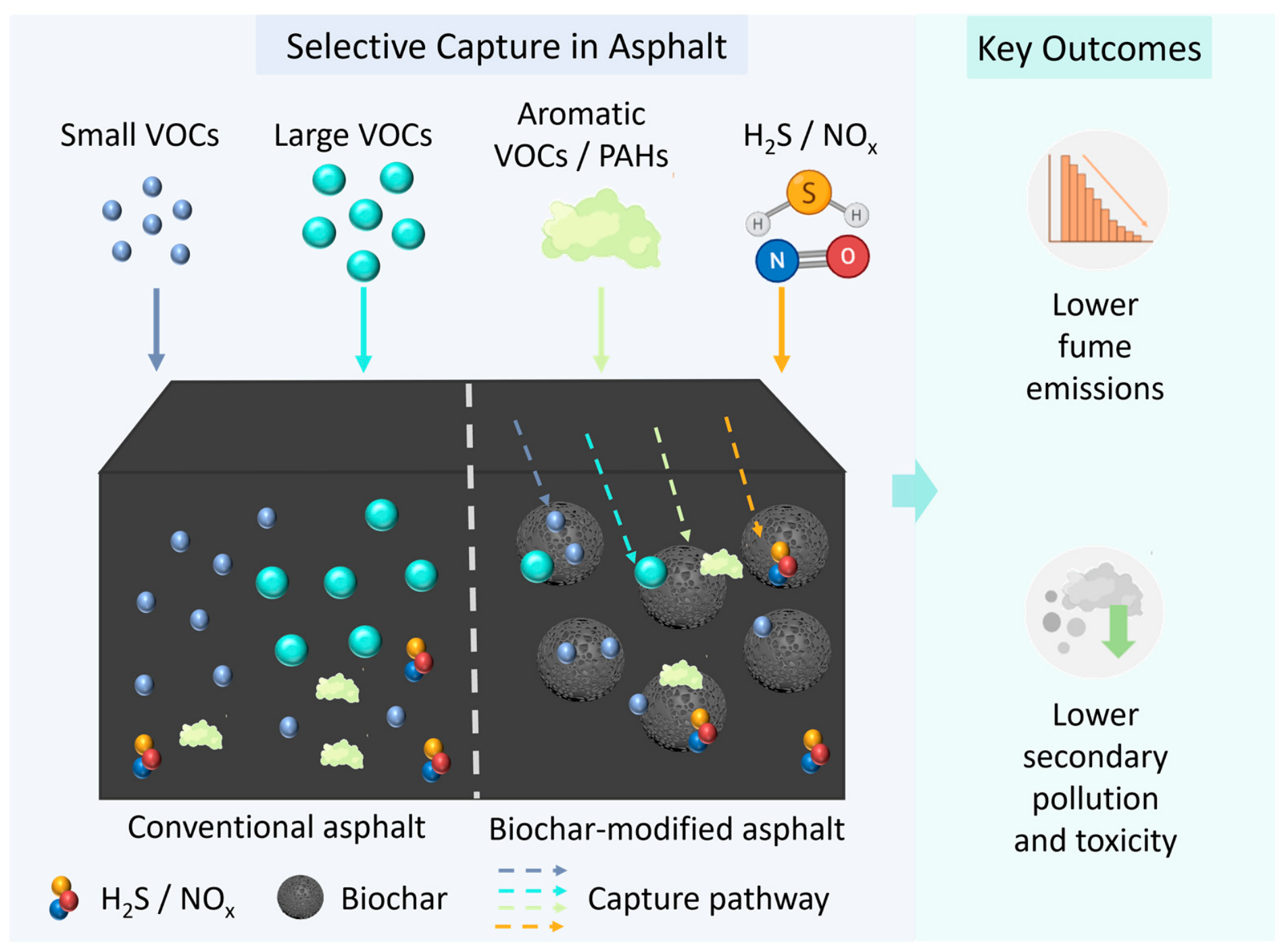
4.2. Structure-Dependent Selective Suppression of Asphalt Fume Emissions by Biochar
4.3. Synergistic Control of Asphalt Fumes Using Biochar-Based Composite Materials
5. Aging and Environmental Assessment of Biochar-Modified Asphalt
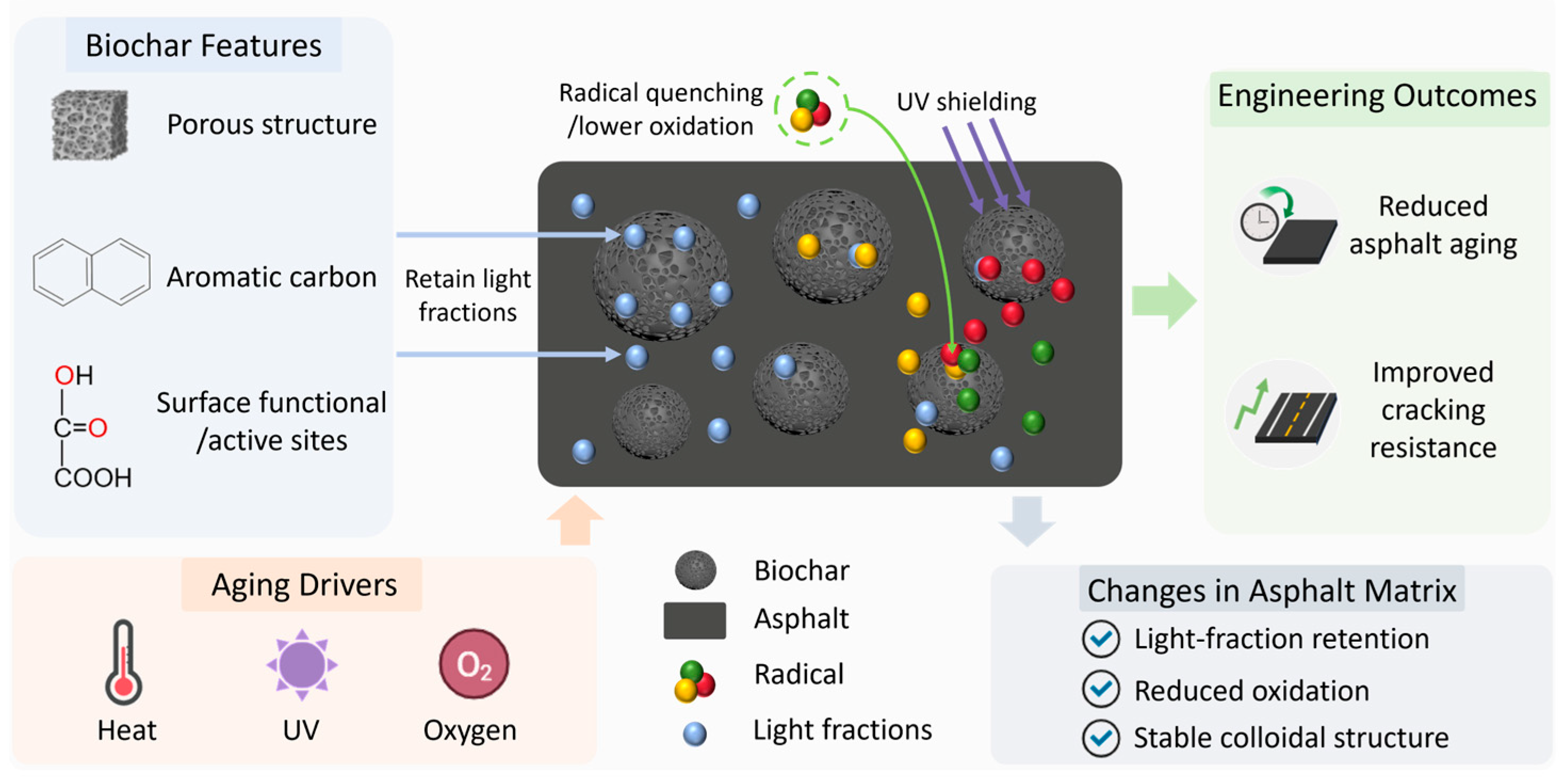
5.1. Retention of Light Fractions and Suppression of Oxidation During Aging
5.2. Low-Carbon Benefits and Environmental Safety Within Life-Cycle System Boundaries
6. Challenges and Future Perspectives
- The internal structural differences of biochar and its compatibility with asphalt are still unresolved problems. Even with the same raw materials, changes in pyrolysis temperature, residence time, particle size and post-treatment will all alter pore structure, aromaticity, ash content and surface functional groups to some extent. Different origins and compositions of the feedstock will also affect the interaction between biochar and the light fraction and resins and asphaltenes in the asphalt. In the future, research should continue to investigate the above parameters, such as particle size, pore size distribution, specific surface area, elemental composition, ash content and surface chemistry. Several base asphalt binders are used for validation to establish a general structure–function relationship among feedstock, production process, biochar structure, asphalt compatibility and functional performance.
- The heating temperature, mixing time, ventilation conditions and fume collection methods of the laboratory tests do not fully reflect the circumstances in plant mixing, transportation, paving and compaction. Therefore, the laboratory method may overestimate or underestimate the performance improvement and emission reduction. Future research will build a unified verification system covering laboratory tests, pilot-scale mixing, test sections and extended-duration field observations. The concept of a universal “optimal dosage” should be replaced with application-specific dosage windows. Pavements exposed to high temperatures and heavy traffic require rutting resistance that can be achieved by viscosity-related mixing and construction. Low-temperature cracking resistance and fatigue performance should be the first design constraints for cold regions. Pervious pavement needs to meet both moisture resistance and leaching requirements at the same time, and rejuvenated asphalt systems require evaluation for compatibility and storage stability. Particle size and dispersion state should also be incorporated into the definition of each application-specific dosage window. Field validation should further determine whether improved pavement durability reduces lane closures, congestion, and maintenance-related emissions across urban road networks.
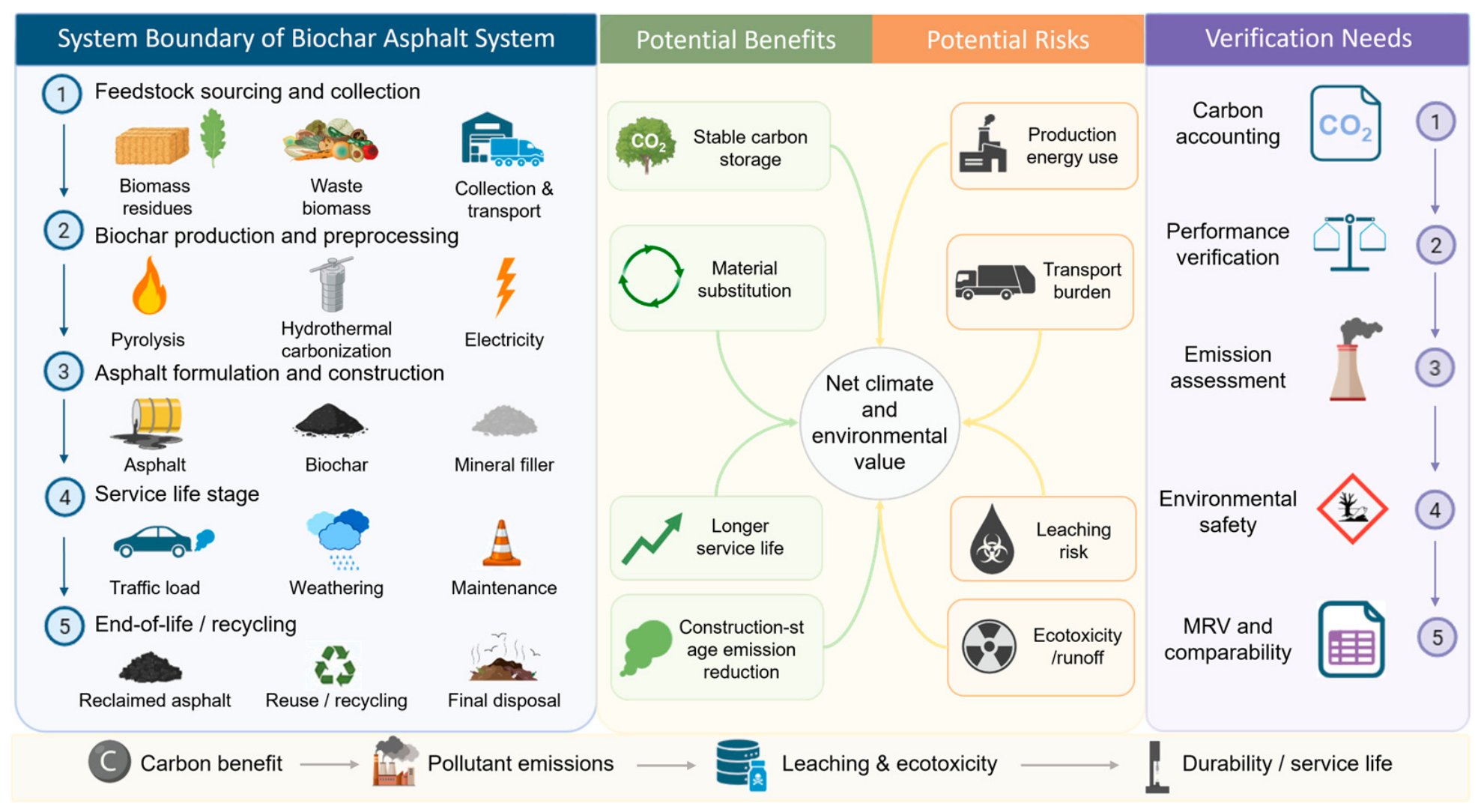
- Environmental assessment requires standardized test protocols and clearly defined life-cycle boundaries. Total VOCs, speciated VOCs, PAHs, OFP, SOAP and health risk indicators are different environmental dimensions and cannot be used interchangeably. We must standardize the heating conditions, sampling methods, and data normalization techniques and lower the minimum reporting thresholds. For biochars produced from municipal sewage sludge or those enhanced with metals and minerals, the potential release of heavy metals, salts, nitrogen, phosphorus and residual organic pollutants under rainfall and run-off exposure, aging and abrasion processes, and end-of-life management scenarios should also be evaluated. LCA studies should clearly state the functional unit and whether they use a cradle-to-gate or cradle-to-grave system boundary. These studies should also explicitly state whether construction-stage emission reductions, pavement service life extension, stable carbon sequestration and end-of-life management are included, thus avoiding contradictory conclusions arising solely from differences in the scope of accounting.
7. Conclusions
Supplementary Materials
Author Contributions
Funding
Data Availability Statement
Conflicts of Interest
References
- Magar, S.; Xiao, F.; Singh, D.; Showkat, B. Applications of reclaimed asphalt pavement in India—A review. J. Clean. Prod. 2022, 335, 130221. [Google Scholar] [CrossRef] [Scilit]
- Anupam, B.R.; Sahoo, U.C.; Chandrappa, A.K. A methodological review on self-healing asphalt pavements. Constr. Build. Mater. 2022, 321, 126395. [Google Scholar] [CrossRef] [Scilit]
- Wang, H.-P.; Guo, Y.-X.; Wu, M.-Y.; Xiang, K.; Sun, S.-R. Review on structural damage rehabilitation and performance assessment of asphalt pavements. Rev. Adv. Mater. Sci. 2021, 60, 438–449. [Google Scholar] [CrossRef] [Scilit]
- Moins, B.; Hernando, D.; Seghers, D.; van den Bergh, W.; Audenaert, A. Establishing greenhouse gas emission benchmarks for the asphalt industry—Are short-term reduction targets feasible using current practice or are more extensive measures needed? Resour. Conserv. Recycl. 2025, 212, 107994. [Google Scholar] [CrossRef] [Scilit]
- Huang, S.-L.; Hsu, W.-L. Materials flow analysis and emergy evaluation of Taipei’s urban construction. Landsc. Urban Plan. 2003, 63, 61–74. [Google Scholar] [CrossRef] [Scilit]
- Liu, T.; Yang, S.; Liao, B.; Yang, E.; Jiang, X. Contribution of climate change and traffic load on asphalt pavement carbon emissions. J. Clean. Prod. 2024, 434, 140553. [Google Scholar] [CrossRef] [Scilit]
- Bao, B.; Liu, J.; Li, S.; Si, C.; Zhang, Q. Laboratory Evaluation of the Relationship of Asphalt Binder and Asphalt Mastic via a Modified MSCR Test. Coatings 2023, 13, 304. [Google Scholar] [CrossRef] [Scilit]
- Samieadel, A.; Schimmel, K.; Fini, E.H. Comparative life cycle assessment (LCA) of bio-modified binder and conventional asphalt binder. Clean Technol. Environ. Policy 2018, 20, 191–200. [Google Scholar] [CrossRef] [Scilit]
- De Bortoli, A.; Rahimy, O.; Levasseur, A. Environmental life-cycle impacts of bitumen: Systematic review and new Canadian models. Transp. Res. Part D Transp. Environ. 2024, 136, 104439. [Google Scholar] [CrossRef] [Scilit]
- Khasawneh, M.A.; Sawalha, A.; Khasawneh, A.A. Life Cycle Assessment of Asphalt Pavement Materials: Methods, Environmental Impacts, and Future Perspectives; Springer Nature: Singapore, 2026; pp. 337–356. [Google Scholar]
- Zhang, Y.; He, M.; Wang, L.; Yan, J.; Ma, B.; Zhu, X.; Ok, Y.S.; Mechtcherine, V.; Tsang, D.C.W. Biochar as construction materials for achieving carbon neutrality. Biochar 2022, 4, 59. [Google Scholar] [CrossRef] [Scilit]
- Cao, R.; Leng, Z.; Yu, H.; Hsu, S.-C. Comparative life cycle assessment of warm mix technologies in asphalt rubber pavements with uncertainty analysis. Resour. Conserv. Recycl. 2019, 147, 137–144. [Google Scholar] [CrossRef] [Scilit]
- Vidal, R.; Moliner, E.; Martínez, G.; Rubio, M.C. Life cycle assessment of hot mix asphalt and zeolite-based warm mix asphalt with reclaimed asphalt pavement. Resour. Conserv. Recycl. 2013, 74, 101–114. [Google Scholar] [CrossRef] [Scilit]
- Zhan, Q.; Yuan, Y.; Yang, X.; Shan, B.; Cao, X.; Tang, B.; Zhang, X. A performance evaluation framework for asphalt rejuvenators based on the rheological properties of recycled asphalt. Dev. Built Environ. 2025, 24, 100807. [Google Scholar] [CrossRef] [Scilit]
- Yao, Y.; Yang, J.; Gao, J.; Xu, J.; Zhang, Y.; Yu, S.; Muhammad, N.S. Blending behavior of reclaimed asphalt and virgin asphalt in recycled asphalt mixtures: A comprehensive analysis on material composition and mixing process. Constr. Build. Mater. 2025, 465, 140229. [Google Scholar] [CrossRef] [Scilit]
- Mattinzioli, T.; Sol-Sánchez, M.; del Barco Carrión, A.J.; Moreno-Navarro, F.; Rubio-Gámez, M.D.C.; Martínez, G. Analysis of the GHG savings and cost-effectiveness of asphalt pavement climate mitigation strategies. J. Clean. Prod. 2021, 320, 128768. [Google Scholar] [CrossRef] [Scilit]
- Jia, M.; Li, H.; Zhang, X.; Cordeiro, I.M.D.C.; Bo, L.; Yeoh, G.H. Asphalt pavement emission behavior under solar radiation during in-service period. J. Hazard. Mater. 2025, 488, 137268. [Google Scholar] [CrossRef] [Scilit]
- Shi, K.; Ma, F.; Falchetto, A.C.; Fu, Z.; Yuan, D.; Song, R.; Dai, J.; Wang, H. Comprehensive review on the composition, influence, and inhibition of asphalt fumes. J. Traffic Transp. Eng. Engl. Ed. 2025, 12, 926–964. [Google Scholar] [CrossRef] [Scilit]
- Mousavi, M.; Park, K.-B.; Kim, J.-S.; Fini, E.H. Metal-rich biochar as an asphalt modifier to improve sustainability and reduce VOC emissions. Sustain. Mater. Technol. 2024, 40, e00903. [Google Scholar] [CrossRef] [Scilit]
- Mousavi, M.; Emrani, J.; Teleha, J.C.; Jiang, G.; Johnson, B.D.; Shamshiripour, A.; Fini, E.H. Health Risks of Asphalt Emission: State-of-the-Art Advances and Research Gaps. J. Hazard. Mater. 2024, 480, 136048. [Google Scholar] [CrossRef] [Scilit]
- Wang, J.; Zhang, R.; Zhou, H.; Huang, W.; Feng, D.; Li, X. Optimization of asphalt mix design considering mixture performance, environmental impact, and life cycle cost. J. Clean. Prod. 2025, 512, 145618. [Google Scholar] [CrossRef] [Scilit]
- He, L.; Tao, M.; Liu, Z.; Cao, Z.; Zhu, J.; Gao, J.; Bergh, W.V.D.; Chailleux, E.; Huang, Y.; Vasconcelos, K.; et al. Biomass valorization toward sustainable asphalt pavements: Progress and prospects. Waste Manag. 2023, 165, 159–178. [Google Scholar] [CrossRef] [Scilit]
- Zhou, X.; Moghaddam, T.B.; Chen, M.; Wu, S.; Adhikari, S.; Xu, S.; Yang, C. Life Cycle Assessment of Biochar Modified Bioasphalt Derived from Biomass. ACS Sustain. Chem. Eng. 2020, 8, 14568–14575. [Google Scholar] [CrossRef] [Scilit]
- Ghasemi, H.; Yazdani, H.; Rajib, A.; Fini, E.H. Toward Carbon-Negative and Emission-Curbing Roads to Drive Environmental Health. ACS Sustain. Chem. Eng. 2022, 10, 1857–1862. [Google Scholar] [CrossRef] [Scilit]
- Chen, X.; Cheng, P.; Li, Y.; Wang, H.; Zheng, C.; Ma, R.; Nian, T.; Wang, M. Application of corn straw biochar in pavement asphalt: Suppression of hazardous fume emissions and maintenance of rheological properties. Constr. Build. Mater. 2025, 481, 141635. [Google Scholar] [CrossRef] [Scilit]
- Yaashikaa, P.R.; Kumar, P.S.; Varjani, S.; Saravanan, A. A critical review on the biochar production techniques, characterization, stability and applications for circular bioeconomy. Biotechnol. Rep. 2020, 28, e00570. [Google Scholar] [CrossRef] [Scilit]
- Jiang, M.; He, L.; Niazi, N.K.; Wang, H.; Gustave, W.; Vithanage, M.; Geng, K.; Shang, H.; Zhang, X.; Wang, Z. Nanobiochar for the remediation of contaminated soil and water: Challenges and opportunities. Biochar 2023, 5, 2. [Google Scholar] [CrossRef] [Scilit]
- Zhou, Q.; Wu, D.; Ye, C.; Du, J.; Qiu, L.; Jin, M.; Wu, W. Carbon sequestration potential of biochar-modified building materials: A critical review. J. Build. Eng. 2026, 117, 114687. [Google Scholar] [CrossRef] [Scilit]
- Osman, A.I.; Fawzy, S.; Farghali, M.; El-Azazy, M.; Elgarahy, A.M.; Fahim, R.A.; Maksoud, M.I.A.A.; Ajlan, A.A.; Yousry, M.; Saleem, Y.; et al. Biochar for agronomy, animal farming, anaerobic digestion, composting, water treatment, soil remediation, construction, energy storage, and carbon sequestration: A review. Environ. Chem. Lett. 2022, 20, 2385–2485. [Google Scholar] [CrossRef] [Scilit] [PubMed]
- Li, W.; Yang, X.; Chen, Z.; Lv, T.; Wang, X.; Qiu, J. Synthesis and structure regulation of armor-wearing biomass-based porous carbon: Suppression the leakage current and self-discharge of supercapacitors. Carbon 2022, 196, 136–145. [Google Scholar] [CrossRef] [Scilit]
- Zhao, S.; Huang, B.; Ye, X.P.; Shu, X.; Jia, X. Utilizing bio-char as a bio-modifier for asphalt cement: A sustainable application of bio-fuel by-product. Fuel 2014, 133, 52–62. [Google Scholar] [CrossRef] [Scilit]
- Duan, H.; Liu, Q.; Mao, S.; He, Y.; Han, X.; Yu, J.; Xu, S. Effect of tea stalk biochar derived from pyrolysis at different temperatures on adsorption capacity of asphalt fume. Constr. Build. Mater. 2025, 481, 141523. [Google Scholar] [CrossRef] [Scilit]
- Gandem, A.K.; Gowda, S.; Bharath, G.; Raju, S.G.; Behl, A.; Bhaskar, T.; Kumar, J. A multi-scale rheological and mechanical assessment of biochar-modified asphalt binders and mixtures. Constr. Build. Mater. 2026, 535, 146915. [Google Scholar] [CrossRef] [Scilit]
- Li, H.; Dang, S.; Liu, L.; Zhang, G.; Liu, Z.; Li, J.; Shi, Z. Valorization of spent coffee grounds into biochar for sustainable asphalt pavements: A combined molecular dynamics and experimental study. Constr. Build. Mater. 2026, 511, 145314. [Google Scholar] [CrossRef] [Scilit]
- Aslan, İ.; Bayazit, M.; Tasdemir, Y. Influence of hemp-based biochar from pyrolysis on bitumen properties and bituminous mixture performance. Case Stud. Constr. Mater. 2026, 24, e06146. [Google Scholar] [CrossRef] [Scilit]
- Mahalakshmi, S.; Jayaseelan, R.; Pandulu, G. Microstructural and mechanical performance of coconut shell biochar–Modified asphalt for sustainable pavement applications. Next Mater. 2026, 11, 101595. [Google Scholar] [CrossRef] [Scilit]
- Zhang, R.; Wang, H.; Ji, J.; Wang, H. Viscoelastic Properties, Rutting Resistance, and Fatigue Resistance of Waste Wood-Based Biochar-Modified Asphalt. Coatings 2022, 12, 89. [Google Scholar] [CrossRef] [Scilit]
- Chaves-Pabón, S.B.; Rondón-Quintana, H.A.; Bastidas-Martínez, J.G. Mechanical Performance Assessment of a Hot-Mix Asphalt Modified with Biochar Obtained from Pine Wood Shavings. Coatings 2024, 14, 1212. [Google Scholar] [CrossRef] [Scilit]
- Martinez-Toledo, C.; Valdes-Vidal, G.; Calabi-Floody, A.; Gonzalez, M.E.; Reyes-Ortiz, O. Evaluation of Rheological Properties of Asphalt Binder Modified with Biochar from Oat Hulls. Materials 2024, 17, 4312. [Google Scholar] [CrossRef] [Scilit]
- Chaves-Pabón, S.B.; Rondón-Quintana, H.A.; Bastidas-Martínez, J.G. Mechanical Performance of a Hot Mix Asphalt Modified with Biochar Obtained from Oil Palm Mesocarp Fiber. Infrastructures 2024, 9, 156. [Google Scholar] [CrossRef] [Scilit]
- Wani, I.; Garg, A. Critical review on use of biochar as a modifier in asphaltic binders for pavement construction. Environ. Dev. Sustain. 2024, 1–22. [Google Scholar] [CrossRef] [Scilit]
- Gao, J.; Guo, G.; Wang, H.; Jin, D.; Bi, Y.; Jelagin, D. Research progress of bio-asphalt towards green pavement development: Preparation, properties, and mechanism. Fuel 2025, 381, 133409. [Google Scholar] [CrossRef] [Scilit]
- Yaro, N.S.A.; Sutanto, M.H.; Habib, N.Z.; Usman, A.; Kaura, J.M.; Murana, A.A.; Birniwa, A.H.; Jagaba, A.H. A Comprehensive Review of Biochar Utilization for Low-Carbon Flexible Asphalt Pavements. Sustainability 2023, 15, 6729. [Google Scholar] [CrossRef] [Scilit]
- Zhou, Y.; Shen, C.; Wang, T.; Xue, Y. Inhibition effect of three types of biochar on volatile organic compounds from asphalt: Revealing chemical adsorption as the primary mechanism. Constr. Build. Mater. 2024, 411, 134322. [Google Scholar] [CrossRef] [Scilit]
- Mousavi, M.; Aldagari, S.; Crocker, M.S.; Ackerman-Biegasiewicz, L.K.G.; Fini, E.H. Iron-Rich Biochar to Adsorb Volatile Organic Compounds Emitted from Asphalt-Surfaced Areas. ACS Sustain. Chem. Eng. 2023, 11, 2885–2896. [Google Scholar] [CrossRef] [Scilit]
- Zhang, X.; Gao, B.; Zheng, Y.; Hu, X.; Creamer, A.E.; Annable, M.D.; Li, Y. Biochar for volatile organic compound (VOC) removal: Sorption performance and governing mechanisms. Bioresour. Technol. 2017, 245, 606–614. [Google Scholar] [CrossRef] [Scilit]
- Xiang, W.; Zhang, X.; Chen, K.; Fang, J.; He, F.; Hu, X.; Tsang, D.C.W.; Ok, Y.S.; Gao, B. Enhanced adsorption performance and governing mechanisms of ball-milled biochar for the removal of volatile organic compounds (VOCs). Chem. Eng. J. 2020, 385, 123842. [Google Scholar] [CrossRef] [Scilit]
- Nguyen, T.H.; Cho, H.-H.; Poster, D.L.; Ball, W.P. Evidence for a Pore-Filling Mechanism in the Adsorption of Aromatic Hydrocarbons to a Natural Wood Char. Environ. Sci. Technol. 2007, 41, 1212–1217. [Google Scholar] [CrossRef] [Scilit]
- Rajabi, H.; Mosleh, M.H.; Prakoso, T.; Ghaemi, N.; Mandal, P.; Lea-Langton, A.; Sedighi, M. Competitive adsorption of multicomponent volatile organic compounds on biochar. Chemosphere 2021, 283, 131288. [Google Scholar] [CrossRef] [Scilit]
- Kumar, A.; Singh, E.; Khapre, A.; Bordoloi, N.; Kumar, S. Sorption of volatile organic compounds on non-activated biochar. Bioresour. Technol. 2020, 297, 122469. [Google Scholar] [CrossRef] [Scilit]
- Shen, F.; Liu, J.; Gu, C.; Wu, D. Roles of Oxygen Functional Groups in Hydrogen Sulfide Adsorption on Activated Carbon Surface: A Density Functional Study. Ind. Eng. Chem. Res. 2019, 58, 5526–5532. [Google Scholar] [CrossRef] [Scilit]
- Zhou, Y.; Shen, C.; Wang, T.; Wang, F.; Xue, Y. Metal-Loaded Biochar for Low-Emission and Long-Lasting Asphalt. ACS Sustain. Chem. Eng. 2025, 13, 14834–14843. [Google Scholar] [CrossRef] [Scilit]
- Qin, W.; Hu, C.; Meng, Y. Research on rheological property of hydrochar based bio modified asphalt binder: A promising way to solve environmental problems caused by waste corn stalks. Constr. Build. Mater. 2021, 308, 125005. [Google Scholar] [CrossRef] [Scilit]
- Das, B.P.; Tumwine, J.; Baniasadi, H.; Bordoloi, S. Compatibility of biochar-asphalt composites for pavement applications. Constr. Build. Mater. 2026, 523, 146312. [Google Scholar] [CrossRef] [Scilit]
- Zhou, X.; Zhao, G.; Wu, S.; Tighe, S.; Pickel, D.; Chen, M.; Adhikari, S.; Gao, Y. Effects of biochar on the chemical changes and phase separation of bio-asphalt under different aging conditions. J. Clean. Prod. 2020, 263, 121532. [Google Scholar] [CrossRef] [Scilit]
- Zhou, X.; Zhao, G.; Miljković, M.; Tighe, S.; Chen, M.; Wu, S. Crystallization kinetics and morphology of biochar modified bio-asphalt binder. J. Clean. Prod. 2022, 349, 131495. [Google Scholar] [CrossRef] [Scilit]
- Zhou, X.; Zhang, Z.; Wang, H.; Chen, M.; Wu, S.; Xu, S.; Zhou, X.; Ran, M.; Li, L.; Lu, G.; et al. Review on the properties and mechanisms of asphalt modified with bio-oil and biochar. J. Road Eng. 2024, 4, 421–432. [Google Scholar] [CrossRef] [Scilit]
- Tomczyk, A.; Sokołowska, Z.; Boguta, P. Biochar physicochemical properties: Pyrolysis temperature and feedstock kind effects. Rev. Environ. Sci. Biotechnol. 2020, 19, 191–215. [Google Scholar] [CrossRef] [Scilit]
- Duan, H.; Liu, Q.; He, Y.; Shen, Z.; Han, X.; Xu, S.; Yu, J. Enhanced asphalt fume suppression through cellulose- and lignin-rich biochar: A structure-property relationship. Constr. Build. Mater. 2025, 495, 143655. [Google Scholar] [CrossRef] [Scilit]
- Zhou, Y.; Liu, J.; Shen, C.; Li, J.; Wang, T.; Xue, Y. Effect of zinc chloride-modified biochar with varying pore structures on VOCs inhibition and pavement performance of asphalt. Constr. Build. Mater. 2025, 472, 140887. [Google Scholar] [CrossRef] [Scilit]
- Ahmedzade, P.; Yegane, M.; Yanık, J.; Günay, T. An investigation on effects of cotton and sunflower stalk biochar on bitumen modification. Case Stud. Constr. Mater. 2025, 23, e05400. [Google Scholar] [CrossRef] [Scilit]
- Jeffry, S.N.A.; Jaya, R.P.; Hassan, N.A.; Yaacob, H.; Mirza, J.; Drahman, S.H. Effects of nanocharcoal coconut-shell ash on the physical and rheological properties of bitumen. Constr. Build. Mater. 2018, 158, 1–10. [Google Scholar] [CrossRef] [Scilit]
- Pahlavan, F.; Rajib, A.I.; Martis, V.; Fini, E.H. A Nature-Inspired Design for Sequestering Polycyclic Aromatic Hydrocarbons in Asphalt-Surfaced Areas. Sustain. Mater. Technol. 2024, 41, e01035. [Google Scholar] [CrossRef] [Scilit]
- Duan, H.; Liu, Q.; Zou, Z.; Shen, Z.; Xu, S.; Yu, J. Tannic acid-activated biochar enables dual environmental and durability enhancements in asphalt: Fume suppression and anti-aging. Constr. Build. Mater. 2026, 537, 147176. [Google Scholar] [CrossRef] [Scilit]
- Duan, H.; Mao, S.; Liu, Q.; Zou, Z.; Xu, S.; Yu, J. Green activation of tea-stalk biochar for sustainable suppression of asphalt fume emissions via multi-mechanism adsorption. Constr. Build. Mater. 2026, 519, 145897. [Google Scholar] [CrossRef] [Scilit]
- Hu, C.; Feng, J.; Zhou, N.; Zhu, J.; Zhang, S. Hydrochar from corn stalk used as bio-asphalt modifier: High-temperature performance improvement. Environ. Res. 2021, 193, 110157. [Google Scholar] [CrossRef] [Scilit]
- Zhang, R.; Dai, Q.; You, Z.; Wang, H.; Peng, C. Rheological Performance of Biochar Modified Asphalt with Different Particle Sizes. Appl. Sci. 2018, 8, 1665. [Google Scholar] [CrossRef] [Scilit]
- Zhang, X.; Zhou, Y.; Xue, Y. Biochars from Cotton Seed, Camelia Seed Shell, and Coffee Ground in Modification of Asphalt: Fundamental Properties, Rheological Performance, and Inhibition of VOC Emissions. Materials 2025, 18, 1504. [Google Scholar] [CrossRef] [Scilit]
- Yegane, M.; Katanalp, B.Y.; Ahmedzade, P. Effects of using biochar materials obtained from cherry and sour cherry wastes on bitumen modification. Constr. Build. Mater. 2025, 489, 140609. [Google Scholar] [CrossRef] [Scilit]
- Martínez-Toledo, C.; Valdés-Vidal, G.; Calabi-Floody, A.; González, M.E.; Ruiz, A.; Mignolet, C.; Norambuena-Contreras, J.; Villegas, R.; Concha, J.L. Enhancing rheological and ageing performance of asphalt binders using hazelnut shell biochar additives. Constr. Build. Mater. 2026, 514, 145507. [Google Scholar] [CrossRef] [Scilit]
- Lu, Q.; Sha, A.; Jiao, W.; Shi, K.; Li, Z.; Chen, Y.; Du, P.; Peng, Z.; Song, R. Waste coffee biochar and bi-oil composite modified rejuvenated asphalt: Preparation, characterization, and performance evaluation. Constr. Build. Mater. 2024, 450, 138588. [Google Scholar] [CrossRef] [Scilit]
- Dintcheva, N.T.; Teresi, R.; Graziano, F.; Infurna, G.; Volpe, M.; Messineo, A.; Celauro, C. Impact of Waste-HydroChar on the Rheological Behavior, Physical Properties, and Aging Resistance of Bitumen. Materials 2026, 19, 245. [Google Scholar] [CrossRef] [Scilit]
- Aslan, İ.; Tasdemir, F.; Tasdemir, Y. Utilization of biochar derived from industrial hemp stalks with various cooling methods for asphalt binder modification. PLoS ONE 2025, 20, e0325943. [Google Scholar] [CrossRef] [Scilit]
- An, T.; Chang, Y.; Xie, J.; Tang, K.; Liu, Y.; Liu, Y.; Chen, C. Rapid Start-Up and Long-Term Stability of Anammox with Magnetic Biochar Addition: Performance Improvement, Microbial Community, and Potential Mechanisms. ACS ES&T Eng. 2023, 3, 2097–2108. [Google Scholar] [CrossRef] [Scilit]
- Sharma, T.; Hakeem, I.G.; Gupta, A.B.; Joshi, J.; Shah, K.; Vuppaladadiyam, A.K.; Sharma, A. Parametric influence of process conditions on thermochemical techniques for biochar production: A state-of-the-art review. J. Energy Inst. 2024, 113, 101559. [Google Scholar] [CrossRef] [Scilit]
- Adeniyi, A.G.; Iwuozor, K.O.; Emenike, E.C.; Amoloye, M.A.; Adeleke, J.A.; Omonayin, E.O.; Bamigbola, J.O.; Ojo, H.T.; Ezzat, A.O. Leaf-based biochar: A review of thermochemical conversion techniques and properties. J. Anal. Appl. Pyrolysis 2024, 177, 106352. [Google Scholar] [CrossRef] [Scilit]
- Rajput, V.; Saini, I.; Parmar, S.; Pundir, V.; Kumar, V.; Kumar, V.; Naik, B.; Rustagi, S. Biochar production methods and their transformative potential for environmental remediation. Discov. Appl. Sci. 2024, 6, 408. [Google Scholar] [CrossRef] [Scilit]
- Lee, Z.; Abdullah, R.; Yaacob, J.S.; Mohd Rosli, N.S. Engineering biochar through surface oxygenation: A green approach for sustainable environmental applications. Clean Technol. Environ. Policy 2026, 28, 118. [Google Scholar] [CrossRef] [Scilit]
- Udawatta, M.M.; De Silva, R.C.L.; De Silva, D.S.M. Surface modification of Trema orientalis wood biochar using natural coconut vinegar and its potential to remove aqueous calcium ions: Column and batch studies. Environ. Eng. Res. 2022, 28, 210522. [Google Scholar] [CrossRef] [Scilit]
- Gan, X.; Zhang, W. Application of biochar from crop straw in asphalt modification. PLoS ONE 2021, 16, e0247390. [Google Scholar] [CrossRef] [Scilit]
- Chen, Z.; Yu, D.; Feng, Z. Aging Resistance and Microcharacteristics of Asphalt Modified by Biochar from Spent Coffee Grounds. J. Mater. Civ. Eng. 2024, 36, 05024008. [Google Scholar] [CrossRef] [Scilit]
- Wu, Y.; Cao, P.; Shi, F.; Liu, K.; Wang, X.; Leng, Z.; Tan, Z.; Zhou, C. Modeling of the Complex Modulus of Asphalt Mastic with Biochar Filler Based on the Homogenization and Random Aggregate Distribution Methods. Adv. Mater. Sci. Eng. 2020, 2020, 2317420. [Google Scholar] [CrossRef] [Scilit]
- Dong, W.; Ma, F.; Li, C.; Fu, Z.; Huang, Y.; Liu, J. Evaluation of Anti-Aging Performance of Biochar Modified Asphalt Binder. Coatings 2020, 10, 1037. [Google Scholar] [CrossRef] [Scilit]
- Wang, D.; Hong, X.; Song, Y.; Zhang, Z.; Miao, C.; Zhu, Y.; Yang, F.; Gao, X.; Wu, J.; Ma, J. Fineness-Dependent Rheology and Chemothermal Modification Mechanism of RHB-SBS Composite-Modified Asphalt. Polymers 2026, 18, 495. [Google Scholar] [CrossRef] [Scilit]
- E, G.; Wang, M.; Wang, H.; Wang, C.; Chen, L.; Chen, Q. A novel low-emission road asphalt: Preparation, road performance, and emission reduction efficacy. Constr. Build. Mater. 2024, 454, 139089. [Google Scholar] [CrossRef] [Scilit]
- Rondón-Quintana, H.A.; Galeano-Arias, C.J.; Yate-García, J.D.; Huari-Quispe, R.A.; Reyes-Lizcano, F.A. Mechanical Performance of a Hot-Mix Asphalt Incorporating Rice-Husk-Biochar-Modified Binder. Transp. Res. Rec. 2026. Epub ahead of printing. [Google Scholar] [CrossRef] [Scilit]
- Yılmaz, B.; Özdemir, A.M.; Sancak, K. Asphalt modification using a novel bio-based amido-boron additive synthesized from waste tallow. Mater. Struct. 2026, 59, 149. [Google Scholar] [CrossRef] [Scilit]
- Zaumanis, M.; Poulikakos, L.D.; Partl, M.N. Performance-based design of asphalt mixtures and review of key parameters. Mater. Des. 2018, 141, 185–201. [Google Scholar] [CrossRef] [Scilit]
- Nair, R.K.; Bandyopadhyay, A.; Sunitha, V. Rheological and Mechanical Behaviour of Biochar-Modified Bitumen Under High-Temperature Conditions. Int. J. Pavement Res. Technol. 2026, 19, 1232–1248. [Google Scholar] [CrossRef] [Scilit]
- Li, Q.; Xu, L.; Chen, X.; Li, W.; Li, Y.; Wang, H.; Liu, K. Study on the Adhesion Performance of Biochar-Modified Asphalt Based on Surface Free Energy and Atomic Force Microscopy. Coatings 2024, 14, 1390. [Google Scholar] [CrossRef] [Scilit]
- Zhao, D.; Jiang, J.; Gu, X.; Liu, J.; Wang, J.; Yang, G. Value-added recycling of plant waste for modification of asphalt pavement used aggregates: Interface enhancement and carbon sequestration. Chem. Eng. J. 2025, 505, 159822. [Google Scholar] [CrossRef] [Scilit]
- Grossegger, D.; Hugener, M.; Lura, P. Feasibility study of biochar as alternative filler to limestone filler investigated at the asphalt mastic level. Constr. Build. Mater. 2025, 502, 144492. [Google Scholar] [CrossRef] [Scilit]
- Jiang, D.; Cao, Z.; Gong, G.; Wang, C.; Gao, Y. VOCs inhibited asphalt mixtures for green pavement: Emission reduction behavior, environmental health impact and road performance. J. Clean. Prod. 2025, 489, 144671. [Google Scholar] [CrossRef] [Scilit]
- Fini, E.H.; Pahlavan, F.; Vega, N.O.; Bibo, A.; Kaur, H.; Ghasemi, H.; Aldagari, S.; Hung, A.; Kannan, L.; Yazdani, H.; et al. Health impacts of asphalt emissions: Examining neurological risks and the need for long-term exposure mitigation. J. Hazard. Mater. 2025, 486, 136849. [Google Scholar] [CrossRef] [Scilit]
- Ge, L.; Yao, Y.; Xu, L.; Zhou, Z.; Li, J.; Zhang, X.; Liu, C.; Lv, H. Mitigation of asphalt volatile organic compounds emissions and health hazards using a TiO2-doped biochar composite: Microscopic and physiological insights. Environ. Technol. Innov. 2024, 36, 103763. [Google Scholar] [CrossRef] [Scilit]
- Zhang, J.; Chen, M.; Zhou, X.; Chen, D.; Fan, Y. Feasibility and mechanism analysis of functionalized waste biomass for fume suppression in rubber powder modified asphalt. Fuel 2026, 414, 138359. [Google Scholar] [CrossRef] [Scilit]
- Xie, J.; Zhou, Y.; Huang, H.; Jiang, Y.; Liu, L. Effect of biochar-clay mineral composites on rubber modified asphalt: Performance optimization and high-temperature emission suppression. Constr. Build. Mater. 2025, 492, 142942. [Google Scholar] [CrossRef] [Scilit]
- Liu, J.; Li, H.; Harvey, J.; Airey, G.; Lin, S.; Lee, S.L.J.; Zhou, Y.; Yang, B. Study on leaching characteristics and biotoxicity of porous asphalt with biochar fillers. Transp. Res. Part D Transp. Environ. 2023, 122, 103855. [Google Scholar] [CrossRef] [Scilit]
- Shen, Y. Biomass-derived porous carbons for sorption of Volatile organic compounds (VOCs). Fuel 2023, 336, 126801. [Google Scholar] [CrossRef] [Scilit]
- Liu, X.; Zhu, H.; Wu, W.; Lin, D.; Yang, K. Role of molecular size of volatile organic compounds on their adsorption by KOH-activated micro-mesoporous carbon. J. Hazard. Mater. 2022, 424, 127355. [Google Scholar] [CrossRef] [Scilit]
- Zhou, X.; Shi, L.; Moghaddam, T.B.; Chen, M.; Wu, S.; Yuan, X. Adsorption mechanism of polycyclic aromatic hydrocarbons using wood waste-derived biochar. J. Hazard. Mater. 2022, 425, 128003. [Google Scholar] [CrossRef] [Scilit]
- Yao, Y.; Ge, L.; Zhang, X.; Li, J.; Xu, L.; Chen, L. Iron Oxide–Grafted Biochar for Asphalt Modification: Mitigating Health Risks and Enhancing High-Temperature Performance. J. Mater. Civ. Eng. 2025, 37, 04025354. [Google Scholar] [CrossRef] [Scilit]
- Wang, M.; Wang, C.; Li, X.; Liu, S.; Chen, Q. Low-pollution asphalt: Road performance, emission reduction efficacy, and modification mechanism. J. Clean. Prod. 2024, 436, 140669. [Google Scholar] [CrossRef] [Scilit]
- Wang, M.; Wang, C.; Li, X.; Sun, X.; Chen, Q. Reducing road asphalt pollution: Preparation and properties of novel emission reduction agent. Transp. Res. Part D Transp. Environ. 2024, 128, 104082. [Google Scholar] [CrossRef] [Scilit]
- Camargo, I.G.D.N.; Hofko, B.; Mirwald, J.; Grothe, H. Effect of Thermal and Oxidative Aging on Asphalt Binders Rheology and Chemical Composition. Materials 2020, 13, 4438. [Google Scholar] [CrossRef] [Scilit]
- Lu, X.; Soenen, H.; Sjövall, P.; Pipintakos, G. Analysis of asphaltenes and maltenes before and after long-term aging of bitumen. Fuel 2021, 304, 121426. [Google Scholar] [CrossRef] [Scilit]
- Mousavi, M.; Aldagari, S.; Fini, E.H. Adsorbing Volatile Organic Compounds within Bitumen Improves Colloidal Stability and Air Quality. ACS Sustain. Chem. Eng. 2023, 11, 9581–9594. [Google Scholar] [CrossRef] [Scilit]
- Celauro, C.; Teresi, R.; Dintcheva, N.T. Evaluation of Anti-Aging Effect in Biochar-Modified Bitumen. Sustainability 2023, 15, 10583. [Google Scholar] [CrossRef] [Scilit]
- Azzi, E.S.; Karltun, E.; Sundberg, C. Assessing the diverse environmental effects of biochar systems: An evaluation framework. J. Environ. Manag. 2021, 286, 112154. [Google Scholar] [CrossRef] [Scilit]
- Santero, N.J.; Masanet, E.; Horvath, A. Life-cycle assessment of pavements. Part I: Critical review. Resour. Conserv. Recycl. 2011, 55, 801–809. [Google Scholar] [CrossRef] [Scilit]
- Grossegger, D.; Wyrzykowski, M.; Toropovs, N.; Lura, P. Exploring the carbon sequestration of an asphalt base course mixture containing novel cold-bonded biochar-rich lightweight aggregates. Mater. Struct. 2025, 58, 115. [Google Scholar] [CrossRef] [Scilit]
- Liu, J.; Li, H.; Harvey, J.; Zhang, H.; Tian, Y. Application of Biochar on the runoff purification performance of porous asphalt pavement. Transp. Saf. Environ. 2021, 3, tdab026. [Google Scholar] [CrossRef] [Scilit]
- Song, Y.; Lin, W.; Dong, M.; Chen, H.; Gustave, W.; He, L.; Guo, Z.; Han, X.; Zhang, X.; He, F. Carbon-based nanomaterials for heavy metal detoxification in soil-crop systems: Mechanisms and applications. Microchem. J. 2026, 225, 117980. [Google Scholar] [CrossRef] [Scilit]
- Song, Y.; Lin, W.; Gustave, W.; Zhang, Y.; Feng, D.; Zhang, X.; He, F. The promises and risks of carbon-based nanomaterials: A critical review on their roles in soil health and ecosystem safety. Environ. Geochem. Health 2026, 48, 176. [Google Scholar] [CrossRef] [Scilit] [PubMed]
- Rondón-Quintana, H.A.; Reyes-Lizcano, F.A.; Chaves-Pabón, S.B.; Bastidas-Martínez, J.G.; Zafra-Mejía, C.A. Use of Biochar in Asphalts: Review. Sustainability 2022, 14, 4745. [Google Scholar] [CrossRef] [Scilit]



| Feedstocks | Principal Composition and Structural Characteristics | Reported Effects in Asphalt Systems | Key Performance Limitations and Constraints | Representative References |
|---|---|---|---|---|
| Herbaceous crop residues and fibrous agricultural wastes | Rich in cellulose and hemicellulose, these feedstocks generally form porous carbon frameworks during pyrolysis while retaining varying amounts of ash, oxygen-containing functional groups, and mineral constituents. Hydrochars typically contain more oxygen-containing functional groups and exhibit greater surface polarity. | Improve asphalt’s high-temperature stability and rutting resistance. Some systems also show reduced fume emissions, changes in the aggregate skeleton, and improved mixture air-void characteristics. | High dosages may substantially increase viscosity and stiffness and impair low-temperature cracking resistance and fatigue performance. For hydrochar, compatibility with asphalt and storage stability require particular attention. Pyrolysis temperature, particle size, and dosage should not be evaluated independently. | [25,31,33,35,39,40,53,60,61,66] |
| Woody biomass and wood-processing wastes | Generally characterized by rough, porous surfaces and relatively stable aromatic carbon frameworks. Moderate pyrolysis temperatures can balance pore development with the retention of oxygen-containing functional groups, while finer particles provide greater interfacial contact with asphalt. | Improve high-temperature rutting resistance, interfacial adhesion, and the mechanical performance of asphalt mixtures. They may also retain light fractions, VOCs, and H2S, thereby providing some resistance to asphalt aging. | Excessively high pyrolysis temperatures reduce the abundance of oxygen-containing functional groups. Performance is sensitive to particle size, dosage, and dispersion, and excessive addition may increase viscosity and the risk of low-temperature cracking. | [32,37,38,48,54,59,64,65,67] |
| Lignin-rich shell and fruit pit wastes | Contain relatively high proportions of lignin and aromatic structures and tend to form highly aromatic carbon frameworks with combined microporous and mesoporous structures after pyrolysis. Ash content, residual lipids, and surface functional groups vary substantially among feedstocks. | Improve high-temperature stability and promote the retention of aromatic VOCs and PAHs. Under suitable conditions, some feedstocks may also preserve low-temperature performance and improve the mechanical properties of asphalt mixtures. | An excessive proportion of micropores may restrict the diffusion of larger molecules, while high dosages may cause excessive hardening. Considerable differences among shell and fruit pit feedstocks limit direct extrapolation between systems. | [36,59,62,68,69,70] |
| High-ash and siliceous agricultural residues | Characterized by high ash contents and silica-rich mineral phases that provide potential surface active sites. Additional metal loading can introduce sites for selective adsorption. | Enhance VOCs adsorption and enable more selective control of specific pollutants. | Removal efficiencies vary considerably among VOC species, requiring the pore size distribution and surface sites to be matched to the target compounds. | [19,44,52] |
| Food-processing residues | Typically contain aromatic carbon domains, nitrogen- and oxygen-containing functional groups, and porous structures. | Improve high-temperature stability and VOC control. In bio-oil-based rejuvenation systems, they may compensate for losses in high-temperature performance and improve phase stability. | Excessive biochar contents may promote phase separation or secondary crystallization. | [34,68,71] |
| Microalgae | Rich in nitrogen-containing functional groups and generally characterized by high surface polarity and abundant active sites. | Biochars derived from microalgae can enhance the retention of VOCs and PAHs and may suppress free-radical reactions and photo-oxidative aging. | Long-term compatibility, low-temperature performance, and applicability across different asphalt systems remain insufficiently verified. | [63] |
| Municipal sewage sludge | Contains high proportions of ash, inorganic minerals, and metals and has a comparatively complex composition. | Offers potential for mineral filling, modification of alkaline surface sites, and replacement of conventional fillers, while providing a route for the beneficial and potentially low-carbon use of sewage sludge. | Priority should be given to assessing heavy-metal leaching, biological toxicity, and life-cycle environmental impacts. | [26,29,58] |
| Assessment Category | Representative Indicator | Applicable Context | Limitations | Research Significance | References |
|---|---|---|---|---|---|
| Total emissions | Total VOCs | Preliminary comparison of volatile emissions among different materials, dosages, and temperatures | Does not resolve chemical composition, toxicity, or reactivity and is highly sensitive to sampling conditions | Determines whether biochar or other fume-suppressing materials reduce overall volatile emissions | [19,25,44,60,93,95,96] |
| Total emissions | Total PAHs | Assessment of PAH emissions during heating, construction, and aging | May obscure differences in constituent toxicity and gas particle partitioning | Evaluates overall changes in highly toxic organic pollutants in asphalt fumes | [25,63,94] |
| Key inorganic or sulfur-containing constituents | H2S | Evaluation of high-sulfur- or rubber-modified asphalt and odor control | Does not represent all sulfur-containing constituents and may be lost during sampling | Assesses the ability of biochar to capture polar and reactive fume constituents | [32,59,64,65,96] |
| Key inorganic or nitrogen-containing constituents | NOx | Evaluation of nitrogen-containing gas control by mineral- or metal-loaded materials | Concentrations may be low and are susceptible to interference from combustion sources and background levels | Evaluates the potential of oxygen-rich surfaces or mineral sites to control polar gaseous constituents | [59] |
| Constituent-specific toxicity | 16 priority PAHs | Assessment of key carcinogenic PAHs and associated health risks | Does not include alkylated, oxygenated, or nitrogen-containing PAHs | Prevents changes in highly toxic constituents from being obscured by total PAH measurements | [25] |
| Constituent-specific toxicity | Aromatic hydrocarbons and alkenes | Identification of highly reactive or highly toxic VOCs | Analytical coverage may be limited, and risks vary considerably among individual compounds | Determines whether high-risk constituents remain after total VOC emissions have decreased | [25,52,93,97] |
| Constituent-specific toxicity | Sulfur-containing compounds | Assessment of high-sulfur asphalt and odor-active constituents | Comprises chemically diverse and unstable species; measuring H2S alone may underestimate risk | Evaluates the selective control of H2S and other sulfur-containing constituents by biochar | [32,59,64,65,96] |
| Secondary pollution potential | OFP | Comparison of different VOC profiles and evaluation in regions susceptible to photochemical pollution | Depends on compound-specific reactivity coefficients and does not represent actual ozone formation | Determines whether VOC reduction effectively lowers the risk associated with ozone precursors | [64,65,93,96] |
| Secondary pollution potential | SOAP | Assessment of secondary aerosol formation from semivolatile and aromatic constituents | Depends on yield parameters and may not adequately represent atmospheric processes under real conditions | Estimates the contribution of fume constituents to secondary particulate matter formation | [64,93,96] |
| Sensory effects | Odor activity value | Assessment of mixing plants, construction sites, and short-range exposure | Influenced by odor thresholds and masking effects within complex mixtures | Evaluates the effects of low-emission asphalt on the construction environment and the comfort of exposed workers | [93] |
| Health risk | Carcinogenic risk or total carcinogenic toxicity | Long-term exposure assessment for PAHs and high-risk VOCs | Depends on toxicity parameters and exposure assumptions | Determines whether reductions in PAHs and high-risk VOCs translate into lower health risks | [25,93,94] |
| Health risk | Non-carcinogenic hazard index | Risk screening for construction workers and nearby populations | Does not readily account for synergistic or antagonistic effects among mixed pollutants | Compares the effectiveness of different fume-suppressing materials in reducing non-carcinogenic health hazards | [93,94] |
| Biological response | Cell viability | Verification of whether reduced emissions are accompanied by lower overall cytotoxicity | Influenced by cell type, exposure dose, and exposure route | Determines whether reductions in chemical concentrations correspond to lower biological toxicity | [95] |
| Biological response | Reactive oxygen species and inflammatory mediators | Evaluation of oxidative stress and inflammatory responses | Highly sensitive to experimental conditions, and individual biomarkers may have limited representativeness | Assesses the effects of asphalt fume reduction on cellular-level health responses | [95] |
| Environmental release risk | Leachate pH, total nitrogen, and total phosphorus | Assessment of releases from porous pavements under rainfall or immersion conditions | Does not cover metals or organic pollutants, and static tests may have limited environmental representativeness | Prevents environmental assessment from focusing solely on construction-stage fumes while overlooking operational-stage risks | [98] |
| Ecotoxicity | Zebrafish toxicity or leachate ecotoxicity | Evaluation of the overall risks of leachates to aquatic organisms | Acute tests cannot adequately represent long-term effects, and extrapolation across species is limited | Assesses the long-term environmental safety of biochar fillers used in porous asphalt | [98] |
Disclaimer/Publisher’s Note: The statements, opinions and data contained in all publications are solely those of the individual author(s) and contributor(s) and not of MDPI and/or the editor(s). MDPI and/or the editor(s) disclaim responsibility for any injury to people or property resulting from any ideas, methods, instructions or products referred to in the content. |
© 2026 by the authors. Licensee MDPI, Basel, Switzerland. This article is an open access article distributed under the terms and conditions of the Creative Commons Attribution (CC BY) license.
Share and Cite
Ke, Y.; Pang, E.; Gustave, W.; Gu, B.; Chen, H.; Song, Y.; Lin, W.; Zhang, X.; He, F. Performance Tailoring and Environmental Implications of Biochar-Modified Asphalt Materials: Toward Sustainable Road Design. Infrastructures 2026, 11, 305. https://doi.org/10.3390/infrastructures11090305
Ke Y, Pang E, Gustave W, Gu B, Chen H, Song Y, Lin W, Zhang X, He F. Performance Tailoring and Environmental Implications of Biochar-Modified Asphalt Materials: Toward Sustainable Road Design. Infrastructures. 2026; 11(9):305. https://doi.org/10.3390/infrastructures11090305
Chicago/Turabian StyleKe, Yihui, Enqi Pang, Williamson Gustave, Bi Gu, Hanbo Chen, Yumeng Song, Wei Lin, Xiaokai Zhang, and Feng He. 2026. "Performance Tailoring and Environmental Implications of Biochar-Modified Asphalt Materials: Toward Sustainable Road Design" Infrastructures 11, no. 9: 305. https://doi.org/10.3390/infrastructures11090305
APA StyleKe, Y., Pang, E., Gustave, W., Gu, B., Chen, H., Song, Y., Lin, W., Zhang, X., & He, F. (2026). Performance Tailoring and Environmental Implications of Biochar-Modified Asphalt Materials: Toward Sustainable Road Design. Infrastructures, 11(9), 305. https://doi.org/10.3390/infrastructures11090305