Long-term structural health monitoring (SHM) provides the empirical basis for evaluating the service condition of dams, retaining structures, bridges, and reinforced concrete infrastructure. Recent review work on concrete dam monitoring has emphasized the transition from isolated instrument interpretation toward integrated data processing, behavior modeling, and safety decision support [
1]. Deng et al. organized dam health monitoring studies from data preprocessing to behavior assessment, showing that long-term monitoring systems increasingly depend on reliable data-driven modeling pipelines [
2]. For displacement-based concrete dam SHM, Wang et al. summarized recent observation data-modeling practices and highlighted the importance of environmental actions such as water level, temperature, and rainfall [
3]. Plevris and Papazafeiropoulos reviewed the role of artificial intelligence in SHM-oriented maintenance and safety, emphasizing that data-driven decision support is becoming a central component of infrastructure management [
4]. Vijayan et al. discussed intelligent technologies and IoT-enabled SHM for civil engineering structures [
5], while Boratto et al. combined agglomerative clustering with unsupervised feature selection for SHM data interpretation [
6]. These studies collectively indicate that modern SHM research is moving toward multi-source sensing, automated data management, and interpretable predictive models.
1.1. Research Status
Dam prediction studies have mainly focused on deformation, displacement, seepage, or stress indicators. Madiniyeti et al. combined sparrow search optimization with LSTM for concrete dam deformation prediction, showing the utility of optimized recurrent networks for monitoring sequences [
7]. Zhang et al. proposed a DenseNet-LSTM deformation model with feature selection for concrete gravity dams, which strengthened nonlinear feature extraction before temporal prediction [
8]. He and Li used measured prototype temperature data to improve the interpretability of dam deformation forecasting, emphasizing that environmental variables should be treated as physical drivers rather than merely auxiliary inputs [
9]. Yin and Wu developed a separate modeling technique for concrete dam deformation, reflecting the long-standing idea that different monitored components may undergo different response mechanisms [
10]. Wen et al. introduced a combined model based on multiple regression and stacked GRUs for concrete dam deformation prediction [
11], while Li et al. proposed DRLSTM as a dual-stage deep learning model driven by raw dam monitoring data [
12]. Wei et al. used a Pearson K-means multi-head attention model for deformation prediction during the first impoundment of super-high dams [
13]. Wang et al. recently proposed an attention-enhanced LSTM sequence-to-sequence model for dam deformation prediction, further illustrating the value of attention mechanisms in dam-oriented monitoring sequences [
14]. For stress-related dam behavior, Tao et al. estimated in-service concrete dam stress from deformation data using a hybrid SIE-APSO-CNN-LSTM framework [
15]. These studies provide strong methodological references, but most of them predict one response type at a time.
Crack monitoring has developed along a partly separate line. Goszczynska et al. experimentally analyzed crack width development in reinforced concrete beams, providing a mechanics-oriented reference for crack evolution under load [
16]. Cramer et al. simulated crack propagation in reinforced concrete elements, showing how crack behavior can be connected to structural response mechanisms [
17]. Ganasan et al. used machine learning models to predict crack width in reinforced concrete beam–column joints under lateral cyclic loading [
18]. Razavi Tosee et al. proposed a hybrid grey wolf optimizer neural network for crack width prediction in CFRP-strengthened RC slabs [
19]. Rao et al. developed an attention recurrent residual U-Net for pixel-level concrete crack width prediction from images [
20]. Hui et al. developed a computer vision concrete crack identification method using MobileNetV2 and adaptive thresholding, representing a recent example of AI-assisted crack inspection [
21]. Li et al. further reported deep-learning-based fine-grained quantitative detection of defects in submerged concrete, which is relevant to hydraulic structure inspection but remains image-oriented rather than monitoring time-series forecasting [
22]. Laxman et al. combined automated crack detection with crack depth prediction for reinforced concrete structures using deep learning [
23]. These works confirm the importance of crack indicators, but most focus on laboratory members or image data rather than long-term multi-source monitoring series.
Another related stream concerns sensing, data quality, and AI-assisted SHM workflows. Malekloo et al. reviewed machine learning for SHM, with attention to emerging high-dimensional data sources [
24]. Mishra et al. discussed IoT-based SHM for civil engineering structures, which is relevant to database-oriented monitoring systems [
25]. Jayawickrema et al. reviewed fibre optic sensing and deep learning for civil structure SHM [
26], and Hassani and Dackermann surveyed advanced sensor technologies for nondestructive testing and SHM [
27]. Luleci et al. reviewed generative adversarial networks in civil SHM, mainly for data generation, anomaly handling, and data restoration tasks [
28]. Recent SHM studies also show that sensor data quality, clustering, and feature relevance must be treated carefully before a monitoring model is deployed [
6]. For trustworthy deployment, Sun et al. reviewed explainable and human-in-the-loop bridge SHM and risk prognosis [
29], while Xu et al. discussed few-shot learning for civil infrastructure structural health diagnosis [
30]. These studies motivate a conservative experimental design in which target values are not fabricated and chronological validation is preferred.
Forecasting methodology has also benefitted from recent general time-series research. Zhou et al. proposed Informer for efficient long-sequence time-series forecasting with Transformer-style attention [
31]. Deng et al. developed a multi-view multi-task learning framework for multivariate time-series forecasting, which is conceptually close to joint prediction of multiple structural responses [
32]. Song et al. reviewed deep-learning-based time-series forecasting and summarized the development from recurrent networks to attention-based models [
33]. Cini et al. reviewed graph deep learning for time-series forecasting, emphasizing relational modeling when multiple sensors interact [
34]. These methods suggest that crack and rebar stress responses should not necessarily be modeled as independent scalar targets when they are driven by shared environmental and structural states.
1.2. Research Gap and Contributions
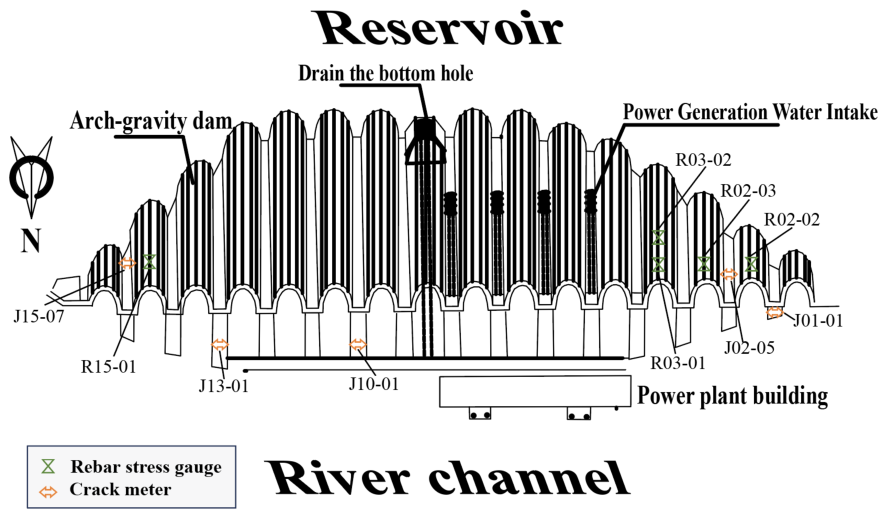
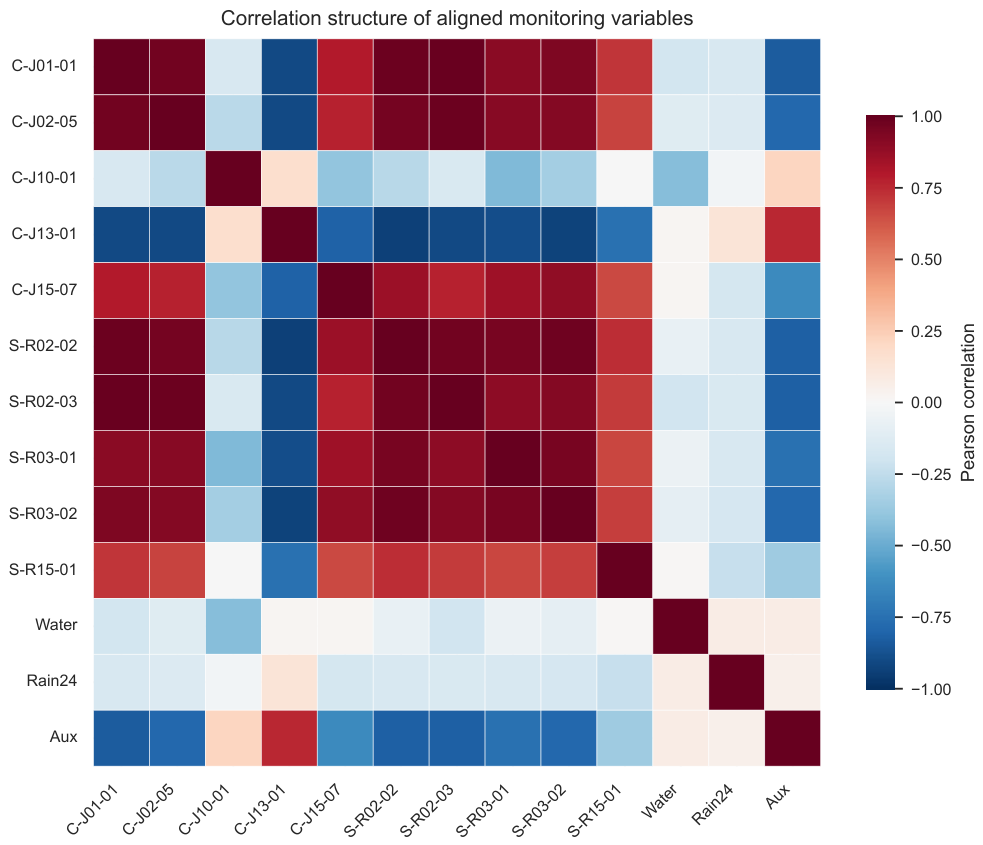
Despite this progress, a gap remains in the joint prediction of dam crack responses and rebar stress using field monitoring data. Crack opening reflects local concrete damage and joint movement, whereas rebar stress reflects internal force redistribution in reinforced components. The two response groups are physically related, and this study uses a simplified plan layout to identify representative crack–rebar associations and horizontal distances. However, the available information is still not a complete three-dimensional coordinate table or finite-element connectivity model. It is therefore used as a transparent spatial prior for ablation rather than as a forced one-to-one target-pairing rule. In addition, field monitoring data are not laboratory data: sampling frequencies differ, environmental variables may be sampled more frequently than response variables, and target interpolation can create false supervision. A defensible joint model must therefore align measured target timestamps conservatively, use environmental variables only as observed contextual inputs, and compare the proposed model with strong persistence and linear autoregressive baselines.
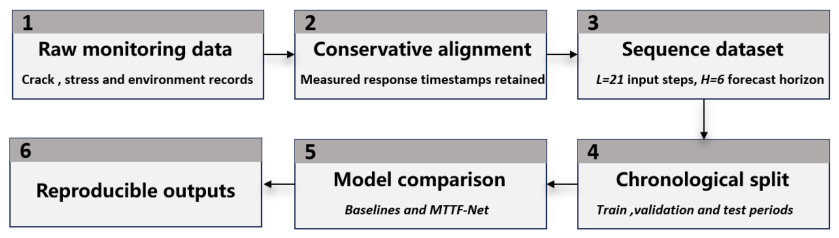
This study therefore builds a reproducible joint crack–stress prediction framework for infrastructure monitoring. All numerical results, figures, and tables are generated from measured monitoring data and reproducible code rather than from synthetic target observations. The main contributions are summarized as follows:
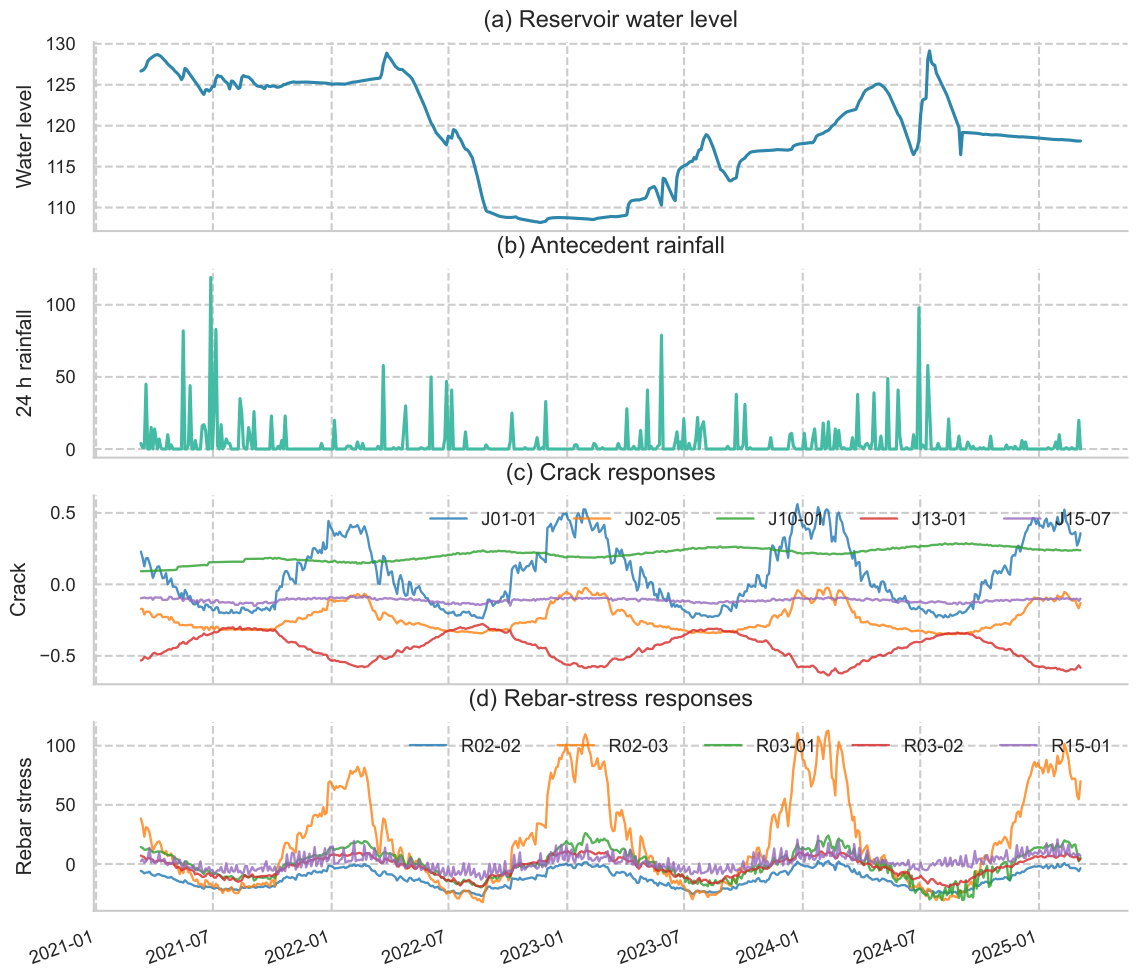
A conservative multi-source dataset is constructed from measured crack, rebar stress, temperature, reservoir water level, rainfall, and auxiliary environmental records, with common target timestamps retained and no synthetic target responses introduced.
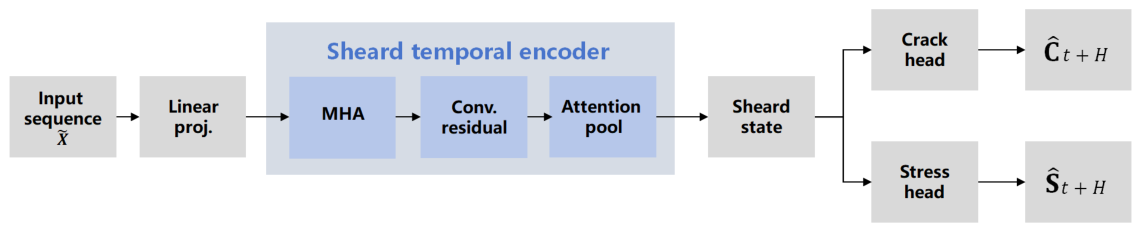
A residual multi-task temporal fusion network is formulated for 48 h ahead joint crack–stress prediction, and plan-distance-informed ablation (MTTF-Net-S) is designed to test the value and limits of the available crack–rebar spatial metadata.
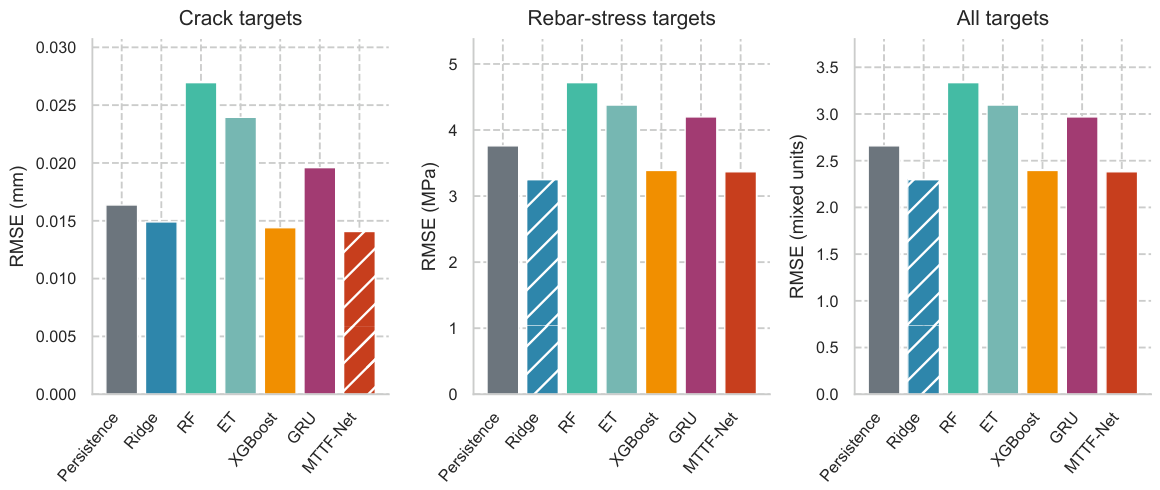
Persistence, Ridge, random forest, Extra Trees, XGBoost, GRU, MTTF-Net, and MTTF-Net-S are evaluated under the same chronological protocol, with reproducible code, equations, figures, tables, and symbol definitions prepared for external inspection.