Article

Decision-Making Framework for Equalizing Urban Electric Vehicle Charging Service Layout Based on the Spatial Supply and Demand Equilibrium Principle—A Case Study of the Main Urban Area in Wuhan

1
Faculty of Resources and Environmental Science, Hubei University, Wuhan 430062, China
2
School of Resources and Environmental Sciences, Wuhan University, Wuhan 430079, China
*
Author to whom correspondence should be addressed.
Infrastructures 2026, 11(6), 203; https://doi.org/10.3390/infrastructures11060203 (registering DOI)
Submission received: 9 May 2026 / Revised: 8 June 2026 / Accepted: 10 June 2026 / Published: 15 June 2026

Abstract

This study aims to develop a decision-making framework for equalizing urban electric vehicle (EV) charging services, which is applied to improve Wuhan’s charging infrastructure. Using grid units as the basic analytical units, the study constructs measurement models for two scenarios—daily commuting and weekend travel—including a spatial demand index based on classified population distribution prediction, a spatial supply index derived from regional charging station statistics, and a supply–demand balance index. Grading systems are established for each scenario’s demand, layout thresholds, and supply, together with an integrated classification combining both scenarios. According to the suitability of grid units for service improvement, three optimization strategies are proposed: adding charging stations, expanding existing stations, and retrofitting parking lots. Evaluation methods are designed to assess spatial equilibrium pre- and post-optimization for residential quarters and commercial POIs. An empirical case study of Wuhan’s main urban area shows that service satisfaction reaches 88.68% for residential quarters and 75.93% for commercial POIs under the current conditions. The proposed scheme recommends the addition of 6 new stations, expansion of 23 stations, and retrofit of 52 parking lots, increasing satisfaction to 99.16% and 89.66%, respectively. The model provides a feasible technical framework for urban EV charging station planning.

1. Introduction

Electric vehicle charging stations, which provide charging and battery swap services for electric vehicles (EVs), serve as critical infrastructure enabling the integration of urban green transportation and smart energy systems [1]. In recent years, although China has developed the world’s largest, most extensive, and most comprehensive charging infrastructure network [2], mismatches with future strategic demands and development trends have exposed persistent issues, including suboptimal spatial layout, irrational structural configuration, uneven spatial distribution of services, and non-standard operational management [3]. Accelerating the optimization and expansion of the charging infrastructure is crucial to strengthening charging service capacity and user satisfaction, stimulating the market potential of new energy vehicles (NEVs) [4], and facilitating the comprehensive green transition of economic and social development [5].
Existing academic research, grounded in a systems thinking approach [6] centered on supply–demand coupling [7,8], has broadly covered the full life cycle of charging infrastructure planning and construction. Relevant research spans multiple core dimensions, including spatial accessibility statistics [9], service equity assessment [10], service demand prediction [11], and layout optimization and site selection [12]. Specifically, research on charging service demand prediction encompasses three main categories: spatial statistical analysis correlated with population distribution [13], residential quarters [14], points of interest (POIs) [15], transportation networks [16], and traffic flow [17]; Monte Carlo simulations based on trip chain theory [18]; and fuzzy inference models that account for heterogeneity in user charging behavior [19]. Research on the supply side of charging services mainly focuses on path analysis within a defined service radius [20] and the delimitation of charging station service scopes using weighted Voronoi diagrams [21]. Taking supply–demand balance as a starting point, mainstream decision-making approaches for charging station layout optimization analyze the spatial characteristics of supply–demand clusters, including overlapping service ranges, excessive service distances, and coverage gaps [22,23]. Such approaches are designed to minimize spatial layout costs [24] and maximize service efficiency [25] while considering comprehensive constraints, including distribution network capacity [26], multi-facility synergy [27], and land-use compatibility [28]. Nevertheless, research priorities are typically concentrated on facility location, capacity configuration [29], and comprehensive benefit assessment [30]. Overall, although existing research on charging facility layout has formed a relatively complete research framework, there remains an urgent need to refine targeted methodologies and systematic techniques that can support the full decision-making process of charging service layout optimization.
As the largest metropolis in Central China and a national pilot city for the promotion and application of NEVs, Wuhan has carried out extensive and pioneering explorations in multiple key areas, including branded market access for charging stations [31], intelligent and low-carbon facility development [32], high-efficiency charging mode innovation [33], and operational service quality improvement [34]. However, existing studies have several limitations. Some are limited to specific districts, such as Zhuankou [35], Hongshan [36], Wuchang [37], and Hankou [38]. Others have explored citywide spatial distribution characteristics [39,40], supply–demand matching status [41], and multi-network integrated planning [42,43], yet such studies remain insufficient to fully support the city’s current development goals. These goals include the construction of a high-quality charging infrastructure system [44] and the realization of a “three-year doubling” target of EV charging service capacity [45]. Therefore, integrating relevant methods in this field to conduct a systematic analysis and diagnosis of the spatial layout of EV charging stations in Wuhan is of great practical significance for improving the city’s charging infrastructure system, establishing green residential living circles, and promoting high-quality urban renewal.

2. Methods

Following the basic logic of spatial supply–demand coupling, we define the system components and main demand scenarios for urban EV charging services. On this basis, we construct an indicator system and methodological models for measuring the supply–demand balance of charging services, and design a technical framework for evaluation and decision-making to support the optimization of charging station layout.

2.1. System Elements for Charging Station Layout Evaluation

The proposed urban EV charging station layout system consists of three core parts: charging service supply, charging service demand, and the spatial matching between supply and demand. The components, characteristics, and relationships of these parts are elaborated below.

2.1.1. Charging Service Demand Objects

Battery electric vehicles (BEVs) and plug-in hybrid electric vehicles (PHEVs), which rely on external charging to convert electrical energy into chemical energy that is stored in on-board batteries for vehicle propulsion and power supply, form the basic demand entities of urban EV charging services. Evs can be divided into four categories based on ownership and usage scenarios: private Evs, electric taxis, electric buses, and other specialized Evs. The specific features of each category are as follows: (1) Private Evs are primarily used for daily commuting or weekend travel by individuals or families, and they are typically charged in residential areas or near workplaces. (2) Electric taxis comprise ride-hailing or metered taxis providing personalized passenger transport services. The majority of these vehicles are operated by professional companies or mobility platforms (e.g., T3, Didi), and they are centrally charged at public charging stations or battery swap stations. (3) Electric buses are medium- and large-sized passenger vehicles operating on fixed routes and scheduled timetables, and they are generally charged at bus depots or route terminals. (4) Other specialized Evs include official government-use vehicles, freight trucks, and other types, which are typically charged at designated spots in institutional parking lots or specific areas. Among all NEVs, private Evs account for the vast majority in Wuhan (approximately 493,170, accounting for 85% of the total of 580,200 Evs in 2025) and constitute the core driver of growth in NEV consumption. Accordingly, the planning and layout of corresponding charging service facilities have become a key priority in urban infrastructure development, which also delimits the research scope of this study.

2.1.2. Charging Service Supply Facilities

EV charging is enabled by core service facilities including charging piles, charging stations, and supporting management systems. As the fundamental infrastructure unit, charging piles are installed in public parking lots, residential quarters, commercial buildings, transportation hubs, and other locations to provide convenient charging services. These charging piles fall into two types: DC fast chargers and AC slow chargers. Charging stations are integrated service sites equipped with clusters of charging piles, along with ancillary facilities such as rest areas and retail outlets. The construction and operation of these facilities face certain economic and technical barriers, as they depend on safe, reliable, and compatible power, electronic, and communication technologies, as well as a dedicated management system for equipment status monitoring, charging order management, billing settlement, and user services. Furthermore, the NIMBY (Not in My Backyard) effect triggered by charging safety risks results in a discrete, point-like spatial distribution of such facilities. The number of charging piles deployed at a station affects the number of vehicles that can be charged simultaneously, while the power rating of the piles directly affects charging time. Therefore, the service capacity of a charging station (Es) is defined as the maximum number of vehicles that can be effectively served within a specified time period. A station is deemed overloaded when charging demand exceeds its capacity, and underloaded or adequately loaded when demand is at or below capacity.

2.1.3. Charging Service Scenario Relationships

In line with the cyclical driving patterns of private car owners (weekday commuting, weekend entertainment/shopping trips), EV charging demand can be divided into two scenarios with distinct spatial supply–demand relationships: daily commuting and weekend travel. (1) Daily commuting scenario: Owners typically charge at charging stations located in or near their residential areas (within an accessibility distance threshold of D1). At any spatial unit ui, the charging service demand index ci is proportional to the fixed population within its neighborhood, while the corresponding service supply index sci is calculated based on the total charging service capacity within the same area. (2) Weekend travel scenario: Owners tend to charge at stations adjacent to POI clusters within commercial centers (within a radius D2). At any spatial unit ui, the charging service demand index ti is calculated based on the population attracted by the commercial center, which is allocated to the POIs within the neighborhood. The corresponding service supply index sti is calculated based on the total charging service capacity within the same area.
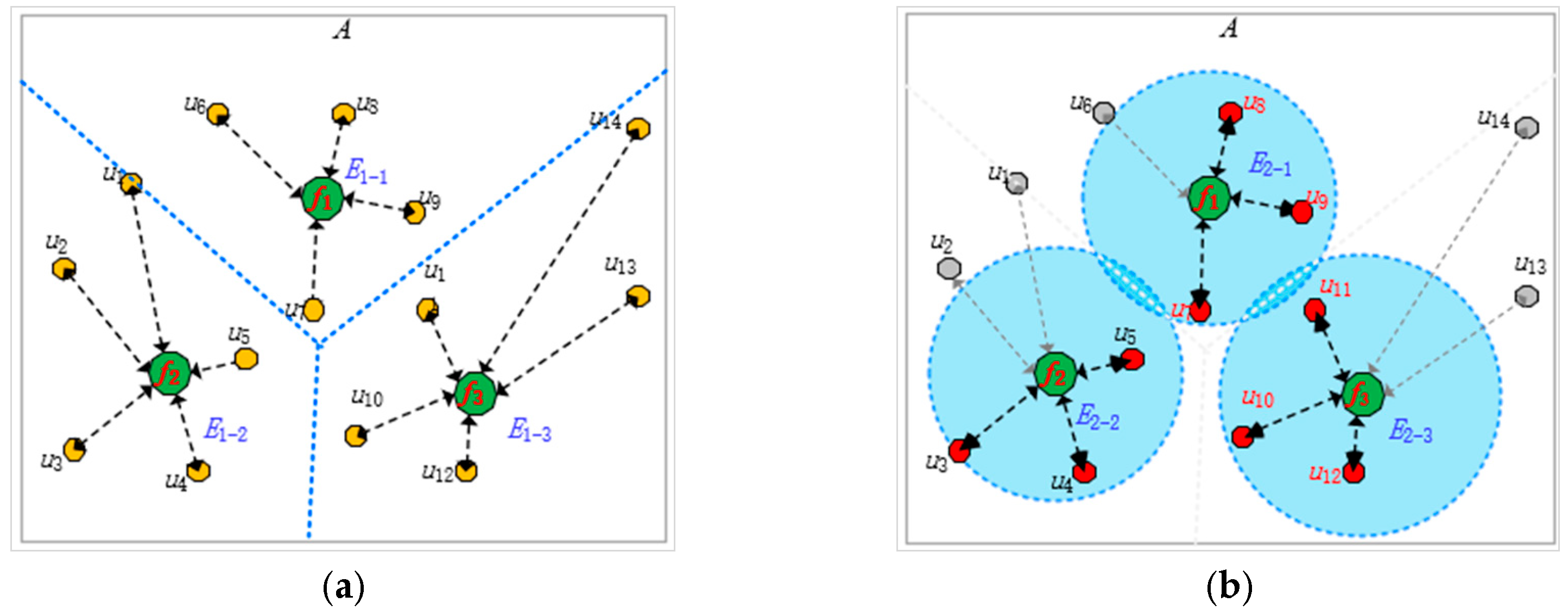
Theoretically, EV owners will prioritize the nearest available facility, forming a complete spatial duality relationship “Facility fi–Domain E1−i”, as shown in Figure 1a. When planning requires charging services to be accessible within a specified ideal distance of spatial point ui, an incomplete duality relationship “Facility fi–Domain E2−i” is formed, as shown in Figure 1b. The goal of charging service layout optimization is to eliminate or minimize the service blind spots under planning constraints, and to achieve an overall balance between supply and demand across the entire urban area.

2.2. Model for Measuring Charging Service Equity

Considering the components of the urban EV charging station layout system, indicator measurement models for spatial demand, spatial supply, and supply–demand balance are constructed sequentially.
(1) Spatial Demand Index for Charging Services
For the daily commuting scenario, a demand circle of area si is defined with any spatial unit ui as the center and a radius D1 (set to 3 km, referencing the urban residential living circle defined in GB 50180-2018 Standard for Urban Residential Area Planning and Design [46]). The residential population density wi within the demand circle is then statistically calculated. The charging service demand index ci is calculated by weighting the city’s per capita private EV ownership Ep, the average charging frequency Ef, and the proportion of weekdays in a week (in China), with the model specified as follows:
c i   =   s i   ×   w i   ×   E p   ×   E f   ×   5 / 7
For the weekend travel scenario, a demand circle of area sj is defined with any spatial unit ui as the center and a radius D2 (set to 0.5 km, referencing the service distance requirement in GB/T 50378-2019 Green Building Evaluation Standard [47]). For all POIs (count nki) within the demand circle that belong to a center of grade k (among m grades), the service area sk, population density wk, and resident travel probability rk of the center across grades (1, …, m) are statistically determined. The total travel population that is probabilistically attracted by the center is calculated and equally apportioned to the center’s POIs (center POI count nk). The charging service demand index ti is subsequently calculated by weighting the apportioned population per POI within the demand circle sj with Ep, Ef, and the proportion of weekends in a week (in China) with the model specified as follows:
t i   =   k = 1 m s k   ×   w k   ×   r k × n k i n k   ×   E p   ×   E f   ×   2 / 7
(2) Spatial Supply Index for Charging Services
With spatial unit ui as the center, the following parameters within the corresponding road-network accessibility demand zones (distance D1) are statistically calculated: the number of charging stations ni, the average daily service capacity per station Es, and the distance dj between a station and point ui. The spatial supply index sci for the daily commuting scenario is calculated via weighted summation as follows:
s ci   =   j = 1 n i [ E s × ( 1 d j D 1 ) ]
With spatial point ui as the center, the same parameters within its demand circle (radius D2) are statistically calculated, and the spatial supply index sti for the weekend travel scenario is calculated as follows:
s ti   =   j = 1 n i [ E s × ( 1 d j D 2 ) ]
(3) Supply–demand Balance Index for Charging Services
For any spatial point ui, the supply–demand balance indices hi1 and hi2 for the two scenarios are calculated as the ratio of the supply indices (scisti) to demand indices (citi), respectively:
h i 1   =   s ci / c i   c i     0  
h i 2 =   s ti / t i   t i     0  
Appropriate “supply–demand ratio” standards are determined for each scenario. Spatial points ui are classified based on hi into three balance levels: ① supply > demand, ② supply ≈ demand, and ③ supply < demand. The proportions of units at each balance level within the study urban area A, as well as their changes before and after optimization, are used as the core criteria for evaluating the current layout status and the effectiveness of optimization measures.

2.3. Technical Process for Charging Station Layout Evaluation

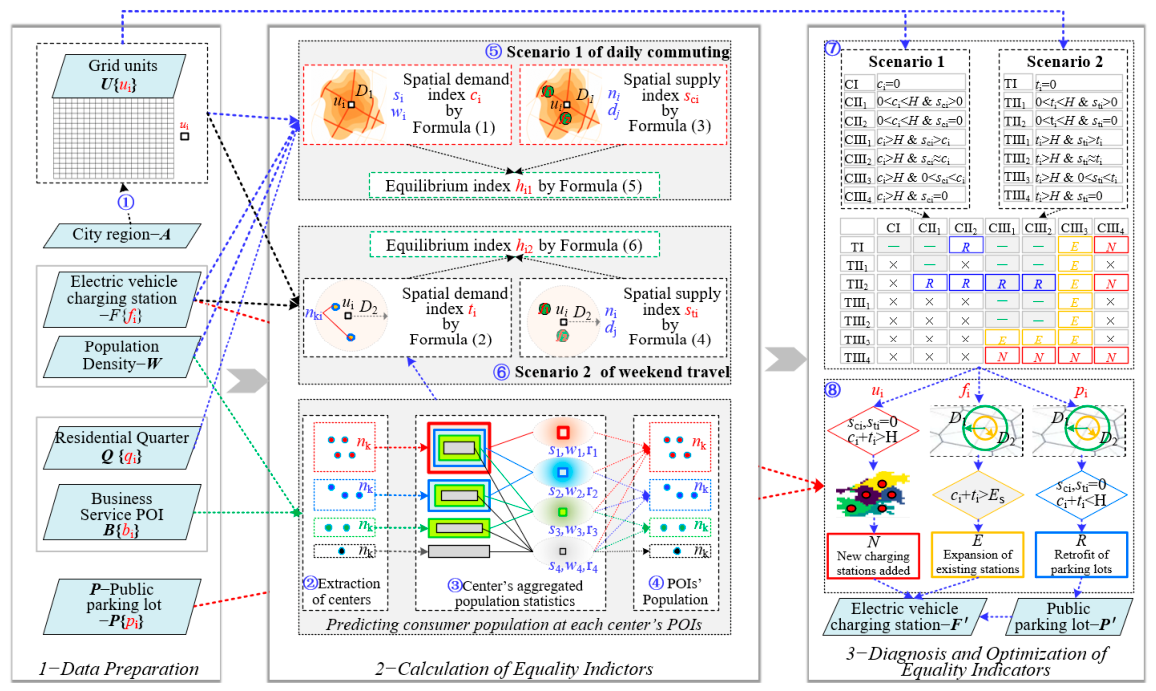
Based on the above analysis, the evaluation of urban charging station layout adopts the following methodological approach: Taking grid units as the basic evaluation unit, calculate the spatial demand index, spatial supply index, and supply–demand balance index for charging services under the two scenarios; taking residential quarters and commercial/service POIs as diagnostic units, overlay them with grid units to classify supply–demand balance levels, and propose targeted optimization strategies for supply–demand matching. The technical evaluation process is shown in Figure 2.
Description of the technical process: ① Basic grid unit generation: With the urban boundary study area A as the scope, a 100 m × 100 m grid of points is created via the fishnet tool of ArcGIS 10.8.2. Water bodies are then clipped out from the grid, resulting in grid layer U. ② Clustering and grading of commercial centers: Commercial POIs within the study urban area are extracted. Spatial clustering is performed using a local density gradient-based Python algorithm, implemented in PyCharm 2025.2.4, to identify Grade I, II, III, and IV commercial centers, and the POI set for each center is determined. ③ Prediction of weekend population clustering within commercial centers: In accordance with the principle that higher-grade centers encompass the functions of lower-grade ones, the functional levels of centers are defined. Residents’ daily weekend travel probabilities (r1, r2, r3, r4) are assigned according to each functional level. Service areas at these centers are defined using the Voronoi tool. Population density raster data are overlaid to calculate the probabilistically attracted travel population (w1, w2, w3, w4) for each center. ④ Apportionment of attracted population to POIs within commercial centers: The total population aggregated at each commercial center is apportioned to each POI unit within its cluster in order to obtain the service population size corresponding to each POI in the center. ⑤ Calculation of demand and supply indices for the daily commuting scenario: Demand zones are constructed based on the road-network accessibility distance D1, and the demand index ci for each grid unit is calculated based on the population density using Formula (1). Combined with the spatial distribution of charging stations, the supply index sci is calculated using Formula (3). ⑥ Calculation of demand and supply indices for the weekend travel scenario: Demand circles are constructed with a radius D2, and the demand index ti for each grid unit is calculated based on the distribution of POIs within each commercial center and their attracted population according to Formula (2). Combined with the spatial distribution data of charging stations, the supply index sti is calculated using Formula (4). ⑦ Classification of supply–demand balance levels: Using Formulas (5) and (6), the balance indices hi1 and hi2 for the two scenarios are calculated. Grid units are then classified into 7 balance levels based on the coupling relationships between demand and supply indicators: Type I (Demand Deficient), Type II1 (Supply Sufficient under Low Demand), Type II2 (Supply Deficient under Low Demand), Type III1 (Supply Sufficient under High Demand), Type III2 (Supply–demand Matched under High Demand), Type III3 (Supply Insufficient under High Demand), and Type III4 (Supply Deficient under High Demand). The diagnostic units (residential communities and commercial POIs) are overlaid with the grid units for grading. ⑧ Formulation of differentiated optimization strategies: Based on the combination of balance levels across the two scenarios, grid units of different types are extracted. In conjunction with the constraints of facility types (charging stations F and parking lots P) and service capacity, three optimization strategies are developed: (1) For Type N units (High Demand, Supply Deficient), new charging stations are required. Based on the clustering intensity of short-distance travel demand, units with ti > H are clustered with a radius D2 to identify the central points for new stations; for units with ti < H, site selection is conducted with a radius D1. (2) For Type E units (High Demand, Supply Insufficient), expansion of existing charging stations is required. Voronoi diagrams are drawn for existing charging stations and clipped by the service circles for daily commuting (D1) and weekend travel (D2). The demand indices ci and ti are corrected based on the ratio of the Thiessen polygon area to the service circle area. The comprehensive load for both scenarios is calculated, with the spatial load index defined as C1 = (ci + ti)/(22 × 5). A station is deemed overloaded and in need of expansion if C1 > 1. (3) For Type R units (Low Demand, Supply Deficient), retrofit of existing parking lots for charging deployment is required. Voronoi graphs are generated for existing parking lots. The demand indices are similarly corrected, and the comprehensive demand load is calculated. For units with ci + ti < H, the spatial load index for parking lots, C2 = (ci + ti)/5, is calculated to determine the scale of retrofit. ⑨ Evaluation of decision scheme effectiveness: Taking residential quarters and commercial POIs as evaluation units, the proportional changes in the supply–demand balance levels of these units before and after optimization are compared to assess the improvement in charging service equality achieved by the proposed decision-making scheme.

3. Case Study

3.1. Geographical Location of Study Area

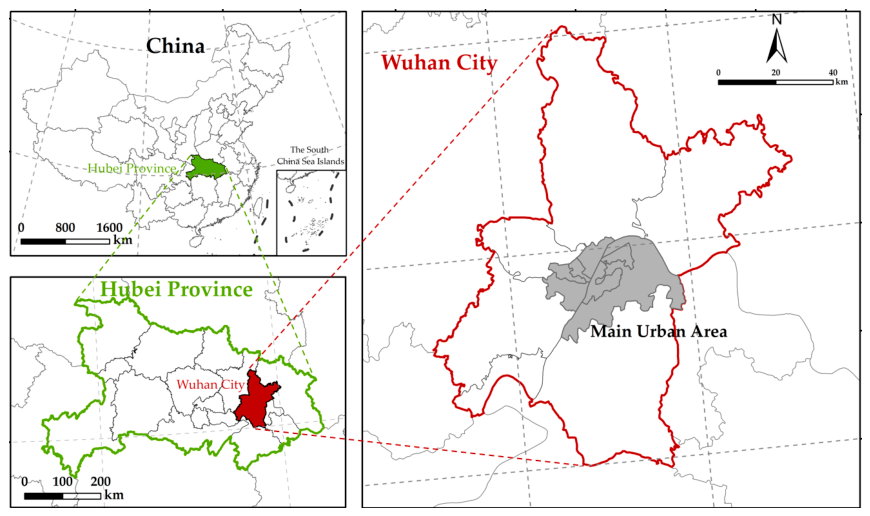
The main urban area of Wuhan, covering 955.15 square kilometers, was selected as the study area. This area includes seven administrative districts: Jiang’an, Jianghan, Qiaokou, Hanyang, Wuchang, Qingshan, and Hongshan. The geographical location of the area is illustrated in Figure 3.

3.2. Data Collection and Organization

3.2.1. Parameter Data Collection

The model parameter data relevant to evaluating the charging station layout system in Wuhan were obtained or derived from the Wuhan Statistical Yearbook, as well as official bulletins issued by the local Natural Resources, Urban Construction, and Traffic Management departments. The sorted and compiled parameter data are shown in Table 1.

3.2.2. Spatial Data Collection

Spatial data for the evaluation of Wuhan’s charging station layout system were obtained from the Natural Resources Management departments, Gaode Map, and Baidu Map. All spatial data were standardized, coded, and imported into ArcGIS 10.8.2 to construct corresponding feature layers. Attribute fields were designed in accordance with the evaluation technical process detailed in Section 2.3, followed by data verification and cleaning. The specific sources of all data are listed in Table 2.
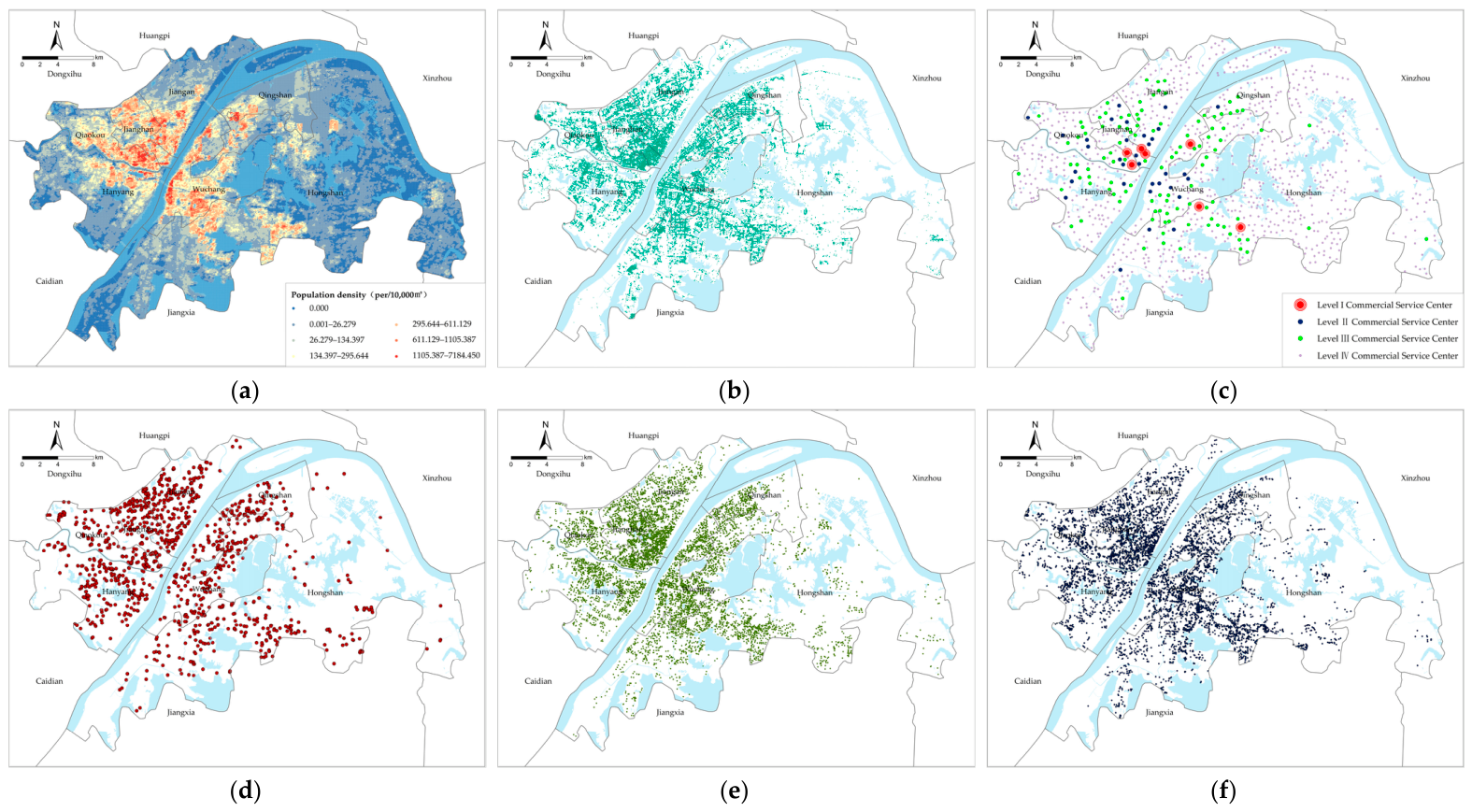
The spatial distribution of the processed layers (W: population density raster, B: commercial POIs, D: commercial centers, F: EV charging stations, Q: residential quarters, and P: public parking lots) is shown in Figure 4a–f.

3.3. Calculation of Evaluation Indicators and Results

3.3.1. Prediction of Travel Population Distribution

Following Steps ②–④ of the procedure described in Section 2.3, a total of 948 commercial centers were identified based on the scale characteristics of commercial POIs (7 Grade I, 33 Grade II, 109 Grade III, and 799 Grade IV). The key indicators and parameters for each grade, such as service function, number of POIs, radius of influence (m), travel frequency, and weekend travel probability, are shown in Table 3.
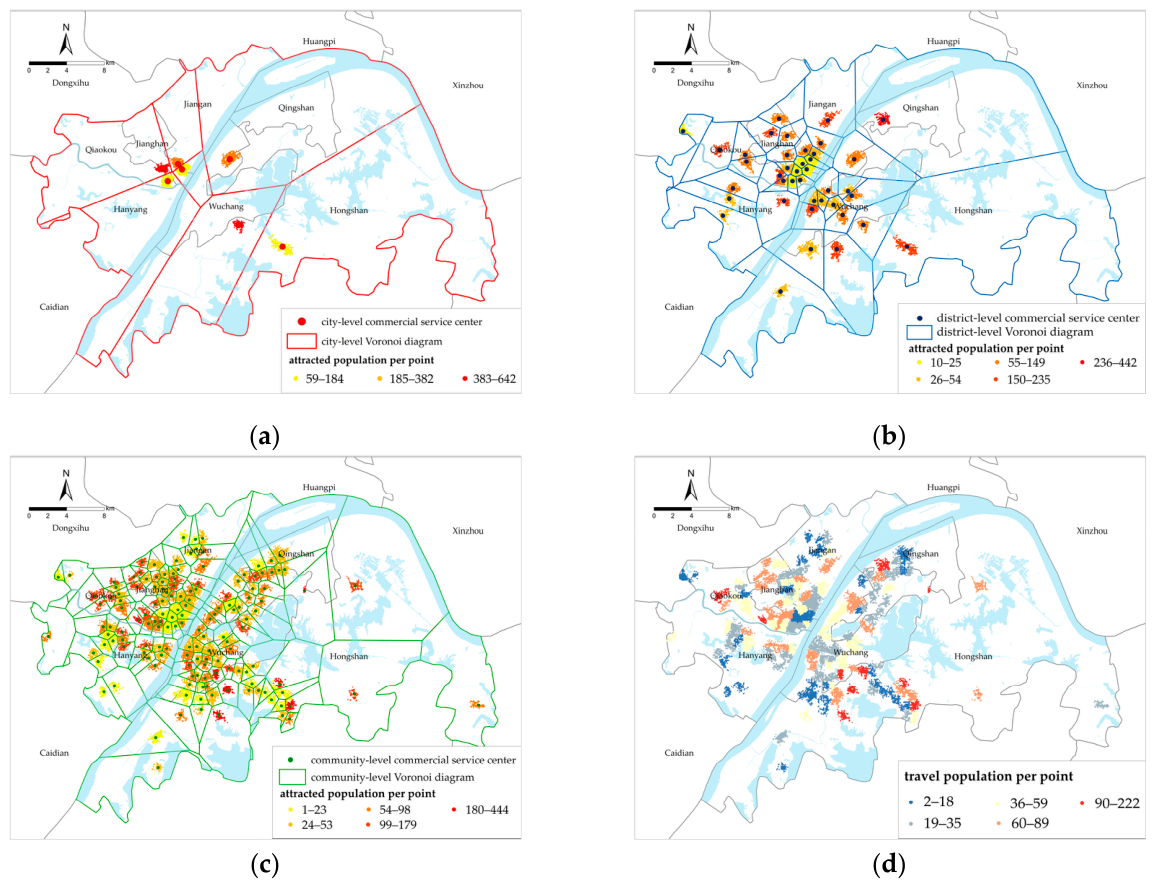
The service radius of commercial centers with neighborhood-level functions is less than 3 km; although residents have a relatively high probability of traveling to these centers, walking is their dominant travel mode. Accordingly, for the weekend travel scenario, the demand for charging services was statistically calculated and predicted based on the populations attracted to city-level, district-level, and community-level commercial centers. The service areas of these commercial centers, delineated using Voronoi graphs and overlaid with the population density raster data, are illustrated in Figure 5.

3.3.2. Spatial Demand Statistics for Charging Services

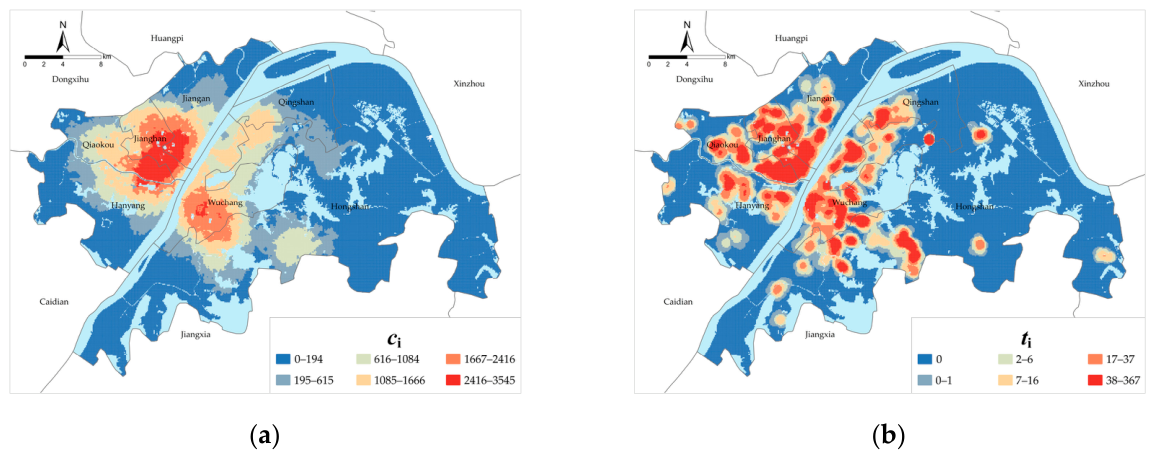
Following Step ⑤ and ⑥ of the procedure described in Section 2.3, the spatial demand indices ci (daily commuting) and ti (weekend travel) were calculated for each grid unit. The spatial distribution of the calculation results is presented in Figure 6a,b.
The demand coverage rates of charging services for the grid units under the daily commuting and weekend travel scenarios were 100% and 32.32%, respectively.

3.3.3. Spatial Supply Statistics for Charging Services

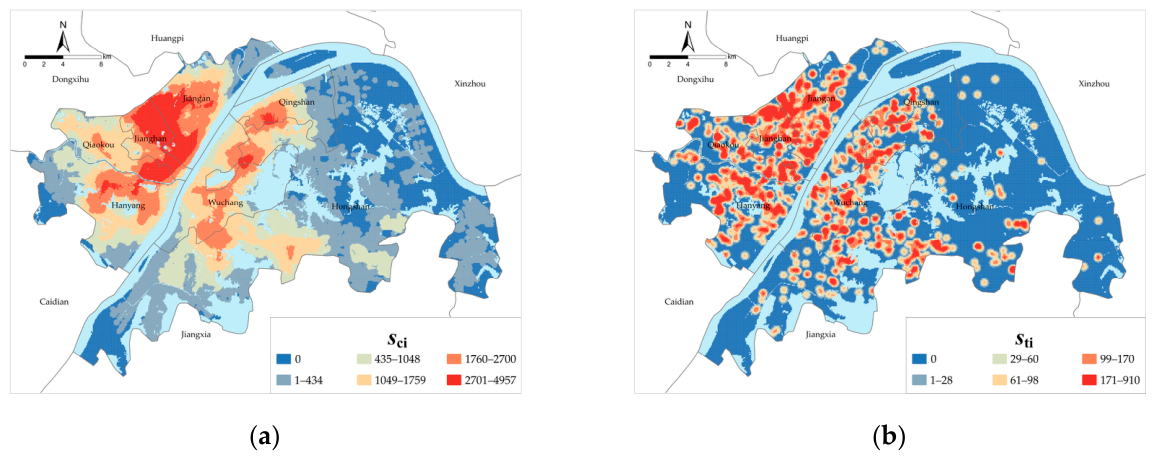
Following Step ⑤ and ⑥ of the procedure described in Section 2.3, the spatial supply indices sci (daily commuting) and sti (weekend travel) were calculated for each grid unit. The spatial distribution of the calculation results is illustrated in Figure 7a,b.
The supply coverage proportions of charging services for the grid units in the daily commuting and weekend travel scenarios were 78.88% and 34.85%, respectively.

3.3.4. Supply–Demand Balance Statistics for Charging Services

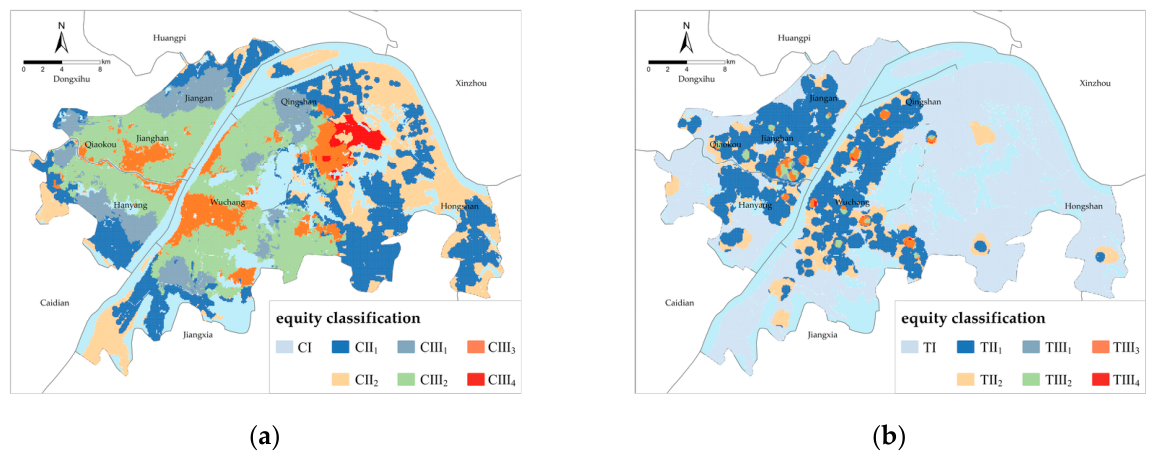
Following Step ⑦ of the procedure described in Section 2.3, the balance indices hi1 (daily commuting) and hi2 (weekend travel) were calculated for each grid unit, followed by equity-based classification. Grid units satisfying ci > H and sci > 0 were classified using two breakpoints, hi = 1 and hi = 3, yielding three categories: supply deficit (hi ≤ 1, type III1), supply–demand balance (1 < hi ≤ 3, type III2), and supply surplus (hi > 3, type III3). The interval ranges of the balance indices and the proportion of grid units in each category are listed in Table 4, with the corresponding spatial distribution maps shown in Figure 8a,b.
A sensitivity analysis was conducted on the classified grid units (types III1, III2, and III3) by simultaneously perturbing both classification breakpoints by ±10%. For hi1, the proportion of grid units in the supply–demand balance category remained within 55.6–58.7%, showing a variation of only 3.1 percentage points. For hi2, this proportion remained within 41.0–41.4%, showing a variation of only 0.4 percentage points. In both cases, the overall variation fell well below the 5 pp robustness threshold, indicating that the classification scheme is insensitive to breakpoint selection and that the results are robust and reliable.

3.3.5. Statistics for Evaluation Units

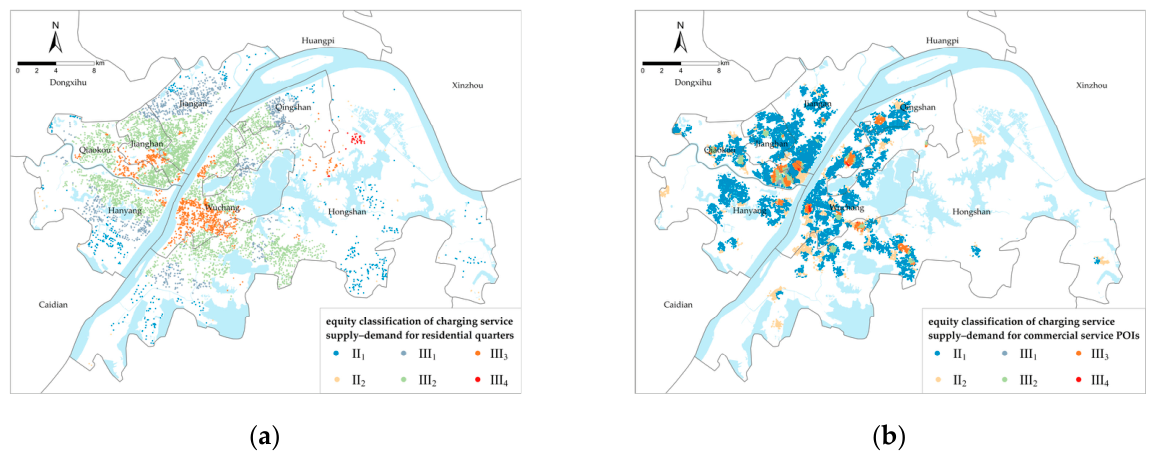
Following Step ⑦ of the procedure described in Section 2.3, the grid unit calculation results were overlaid to derive the supply–demand balance classification indices for residential quarters (daily commuting scenario) and commercial POIs (weekend travel scenario). The spatial distribution of the classification results is shown in Figure 9a,b.
Under the daily commuting scenario, the demand coverage rate and supply coverage rate of residential quarters reached 100% and 98.90%, respectively. The proportions of residential quarters where supply > demand, supply ≈ demand, and supply < demand were 15.27%, 69.56%, and 15.18%, respectively. Under the weekend travel scenario, the corresponding indicators for commercial POIs were 100% and 89.87% and 1.10%, 74.83%, and 24.07%, respectively. The comprehensive guaranteed rate for regional charging services reached 85.04%.

3.4. Diagnostic Analysis and Optimization Decision

3.4.1. Formulation of Charging Service Layout Optimization Scheme

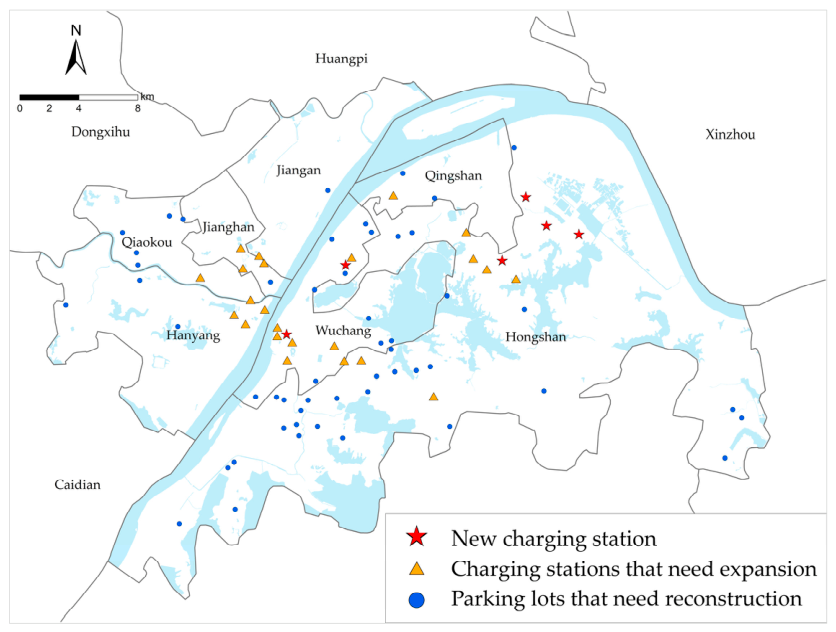
Following Step ⑧ of the procedure described in Section 2.3, a spatial layout optimization scheme for EV charging services in Wuhan was formulated by integrating the supply–demand classification results and grid-unit types. Three targeted optimization strategies were adopted in the scheme (N: addition of new stations, E: expansion of existing stations, R: retrofit of parking lots). The specific implementation details were as follows. N: add new charging stations, with 2 in Wuchang District and 4 in Hongshan District; E: expansion of charging stations, distributed as 1 in Jiang’an, 3 in Jianghan, 2 in Qiaokou, 3 in Hanyang, 6 in Wuchang, 1 in Qingshan, and 7 in Hongshan; and R: retrofit of 52 parking lots, distributed as 1 in Jiang’an, 1 in Jianghan, 5 in Qiaokou, 3 in Hanyang, 10 in Wuchang, 2 in Qingshan, and 30 in Hongshan. The spatial layout of the optimization results obtained with these three strategies is shown in Figure 10.

3.4.2. Evaluation of the Optimization Scheme

Following Step ⑨ of the procedure described in Section 2.3, a statistical analysis was conducted to examine changes to the classification proportions of charging service supply and demand for the evaluation units before and after the implementation of the proposed optimization scheme. The scheme’s effectiveness was evaluated via a cross-comparison of the classification proportions, and the statistical data for both scenarios pre- and post-optimization are presented in Table 5.
As indicated in the table, the share of evaluation units with fully met charging service demand (Types II1, III1, III2) increased significantly after optimization. Specifically, the service satisfaction rate of residential quarters (measured under the daily commuting scenario) rose from 84.73% to 99.16%, while that of commercial POIs (measured under the weekend travel scenario) increased from 75.93% to 89.66%. This confirms the substantial improvement effects of the proposed optimization scheme.

4. Discussion

4.1. Spatial Characteristics of Charging Service Supply–Demand Balance

The results reveal significant differences in the spatial distribution of charging service supply and demand between daily commuting and weekend travel scenarios. Under the daily commuting scenario, charging demand was strongly associated with residential population density, resulting in clusters with a relatively continuous demand across the built-up urban area. Consequently, the charging service demand covered all grid units, whereas supply coverage reached only 78.88%.
In contrast, charging demand under the weekend travel scenario exhibited a highly concentrated spatial pattern around major commercial centers. Only 32.32% of grid units generated effective weekend charging demand, while supply coverage was 34.85%. This result suggests that public charging infrastructure in Wuhan has already formed a certain degree of spatial agglomeration around commercial centers.
The identified imbalance patterns are consistent with the spatial evolution characteristics observed in many rapidly growing Chinese cities. Previous studies have shown that charging facilities are often concentrated in central urban districts, transportation hubs, and commercial centers, while peripheral residential communities experience insufficient service accessibility [20,41]. The findings of this study further demonstrate that such mismatches reflect not only spatial accessibility issues but also manifestations of the dynamic supply–demand disequilibrium under different travel scenarios.

4.2. Methodological Implications and Practical Significance

To better reflect the behavioral characteristics of private EV users, charging demand is differentiated into daily commuting and weekend travel scenarios. This dual-scenario framework captures the spatial heterogeneity of charging demand more effectively than traditional single-scenario approaches. Based on this classification, the study integrates demand measurement, supply evaluation, equilibrium diagnosis, and optimization decision-making into a complete analytical framework, supporting the entire planning process from problem identification to intervention design.
The proposed supply–demand balance index enables the identification of areas with supply surplus, supply–demand equilibrium, and supply deficiency, allowing planners to move beyond simple coverage analyses and diagnose the type and severity of spatial mismatches. Furthermore, unlike traditional optimization studies that mainly generate candidate station locations [12,25], the proposed method establishes differentiated implementation pathways, including the addition of new stations, expansion of existing stations, and retrofit of parking lots, which are more consistent with practical infrastructure management and urban planning requirements.
The Wuhan case further demonstrates the practical value of this framework. Most recommended interventions involve the expansion of existing stations and the retrofit of public parking lots rather than large-scale construction of new facilities, indicating that significant improvements in charging service equity can be achieved through stock optimization. After implementation of the proposed scheme, the service satisfaction rate increased from 84.73% to 99.16% for residential quarters and from 75.93% to 89.66% for commercial POIs. These results confirm the effectiveness of targeted spatial interventions and provide quantitative support for the enhancement of urban charging infrastructure systems.

4.3. Evaluation of Optimization Plan

4.3.1. Economic Feasibility of the Optimization Scheme

Beyond spatial planning, the economic feasibility of the proposed optimization scheme is an important dimension for evaluating its real-world applicability. In practice, the economic returns of a charging station are influenced by multiple factors, including construction costs, station type, pile utilization rate, and service fee standards. To assess economic viability, a benefit estimation model is formulated for newly constructed DC fast-charging stations (strategy N), which represents the highest investment intensity and most critical case for investment feasibility evaluation.
The annual electricity sales revenue Cp of a charging station is estimated as follows:
C P = K w × C s × n × 365
where Cs is the service fee per kWh charged to users (approximately 0.5 CNY/kWh), which constitutes the primary profit source for public charging operators; n is the number of charging piles at the station; and KW is the actual daily electricity dispensed per pile (kWh/pile/day). Based on an average DC fast-charging session duration of 0.76 h, a daily time-utilization rate of 50%, and approximately 15.4 kWh dispensed per session, KW is estimated at approximately 243 kWh/pile/day. For a representative newly constructed station with n = 22 piles (consistent with the average for Wuhan city shown in Table 1), the estimated annual electricity sales revenue is Cp ≈ 243 × 0.5 × 22 × 365 ≈ 977,000 CNY/year.
The total cost of a charging station consists of two components: equipment investment cost Cr (amortized annually) and annual operating and maintenance cost Co. Cr includes DC fast chargers at approximately 27,000–80,000 CNY per pile, plus transformer and distribution equipment at approximately 150,000–500,000 CNY per station; taking the mid-range values and amortizing over a 10-year equipment lifespan, the annualized capital cost is approximately 74,000–226,000 CNY/year. Co primarily covers equipment maintenance fees, staff wages, and site lease costs, estimated at approximately 300,000–600,000 CNY/year.
The net annual return C to the investor is
C = C p C r + C o
The estimated annual revenue of approximately 977,000 CNY exceeds the combined Cₒ and annualized Cᵣ under all modeled cost scenarios, yielding a positive net return C with an estimated payback period of 2–5 years. This confirms that newly constructed DC fast-charging stations under strategy N are economically feasible. Furthermore, by targeting the addition of new stations and expansion of existing stations to quantitatively verified high-demand, supply-deficient areas, the proposed spatial optimization framework raises effective pile utilization, thereby accelerating revenue generation and shortening the payback period relative to location-agnostic deployment.

4.3.2. Carbon Emission Reduction and Green Benefits

The green benefits are defined based on the revenue from CO2 emission reductions achieved by substituting fossil-fuel vehicle trips with EV trips, valued at the prevailing carbon trading price.
The CO2 emission per 100 km for an EV is calculated as follows:
E V c o 2 = M E V × D
where MEV is the electricity consumption per 100 km of an electric vehicle (kWh/100 km), and D is the CO2 emission factor of thermal power generation, taken as 913.5 kg/(MW·h) based on the emission factor for coal-fired power plants provided by the National Development and Reform Commission of China.
The CO2 emission per 100 km for a conventional internal combustion engine vehicle is estimated as follows:
F V c o 2 = M F V × V F V
where MFV is the fuel consumption per 100 km (L/100 km), and VFV is the CO2 emission per liter of gasoline combusted, generally taken as 2.23 kg/L. The net CO2 emission differential per 100 km between a conventional vehicle and an EV is Δ = FVco2EVco2. The annual carbon emission reduction benefit Ctp associated with the incremental daily EV service volume N derived from the optimization scheme is determined as follows:
C t p = d 100 × × 365 × N
where d is the average daily mileage of a pure electric vehicle (d = 50 km, consistent with Table 1). Taking the typical values for Chinese passenger vehicles (MEV = 15 kWh/100 km) and conventional gasoline vehicles (MFV = 8 L/100 km), the CO2 emissions are EVco2 = 15 × 0.9135 = 13.70 kg/100 km and FVco2 = 8 × 2.23 = 17.84 kg/100 km, yielding Δ = 4.14 kg CO2/100 km. The annual carbon emission reduction benefit for each incremental EV used is approximately (50/100) × 4.14 × 365 ≈ 756 kg CO2 per vehicle per year, with corresponding monetization of 38–76 CNY per EV per year at the current market prices. Aggregated across all incremental EVs brought into service by the 6 new stations and 23 expanded stations proposed for Wuhan, the scheme generates meaningful city-scale emission reductions, contributing to China’s “dual carbon” targets (peak carbon by 2030, neutrality by 2060) while providing an additional revenue stream for operators through carbon market participation.

4.4. Limitations and Future Research Directions

The charging service supply–demand equilibrium model proposed in this paper is applicable to travel patterns during a typical week; namely, daily commuting from Monday to Friday and weekend travel on Saturday and Sunday. For atypical travel behaviors during long holidays such as the Spring Festival and National Day holidays (e.g., intercity home-bound trips, long-distance tourism), whose spatiotemporal distribution of charging demand differs significantly from that of a typical week, these cases fall outside the scope of this model. Considering that long holidays account for only a small fraction of days in a year (e.g., the Spring Festival and National Day holidays together amount to approximately eight days, accounting for about 2.2% of days in a year), their impact on the annual planning of charging station layout is therefore neglected.
Charging demand estimation was primarily based on population distribution and commercial activity characteristics. Real-world charging behavior may also be affected by vehicle battery capacity, charging prices, user preferences, seasonal variations, and temporal charging patterns [39]. The incorporation of large-scale vehicle trajectory data and charging transaction records could further improve model accuracy.
Furthermore, the proposed optimization framework prioritizes spatial equity, and the estimates of economic viability and carbon emission reduction benefits are based on simplified parameters that are not quantitatively coupled with individual spatial locations. Charging infrastructure planning also entails multi-dimensional trade-offs among spatial efficiency, grid capacity, and land-use constraints. Future research should incorporate multi-objective optimization approaches that jointly integrate spatial equalization with economic returns, grid, and land-use constraints into a unified decision-making framework, thereby providing more comprehensive support for charging infrastructure planning.

5. Conclusions

This study puts forward an equity-oriented decision-making methodology for the spatial layout of urban EV charging services, with the core objective of improving the current system of NEV charging infrastructure. This methodology covers the entire closed-loop analytical requirements of the charging facility planning workflow, spanning six core links: “system elements—scenario classification—indicator measurement—feature identification—problem diagnosis—optimization decision”. Its feasibility has been verified through empirical case analysis.
Within the proposed methodology, the definition of spatial supply–demand relationships for charging systems under the daily commuting and weekend travel scenarios is highly consistent with the travel and charging behavioral characteristics of private EV owners. The prediction and statistical analysis of population clustering within commercial centers draws on evaluation methods from urban land grading research, laying a solid theoretical foundation for demand quantification. The analytical framework for spatial equilibrium evaluation and diagnosis, built on supply–demand matching comparison, conforms to the general evaluation logic for public service facility layout planning. The three differentiated optimization strategies proposed in this paper (addition of new stations, expansion of existing stations, retrofit of parking lots) present distinct application advantages, including spatial localizability, index traceability, and analyzable effects. This framework, thus, provides a transferable analytical framework that can be adapted to other urban contexts with appropriate local calibration for the planning of urban EV charging stations.
There are still limitations to this study. The proposed framework focuses on typical weekly travel patterns and does not consider atypical travel behaviors during long holidays. In addition, charging demand estimation is mainly based on population distribution and commercial activities, without fully capturing behavioral factors such as vehicle characteristics, pricing, user preferences, and temporal variations. Finally, the framework emphasizes spatial equity, while practical planning should also balance efficiency, costs, grid capacity, and land-use constraints.

Author Contributions

Conceptualization, methodology, software, validation, formal analysis, investigation, data curation, visualization, and writing—original draft preparation, X.C.; validation, investigation, resources, and writing—review and editing, L.Z.; conceptualization, validation, resources, writing—review and editing, supervision, project administration, and funding acquisition, X.T. All authors have read and agreed to the published version of the manuscript.

Funding

This research was funded by the National Natural Science Foundation of China(42471454, Identification and cause inference of imbalanced interactive relationship between residents’ travel and urban land based on integrated sensing data, January 2025–December 2028).

Data Availability Statement

Data are contained within the article. The original contributions presented in this study are included in the article. Further inquiries can be directed to the corresponding authors.

Acknowledgments

The authors would like to thank the National Natural Science Foundation of China for providing the grant for this research. In addition, the authors would like to thank all team members for their valuable contributions to data collection and discussion. No generative AI tools were used in the preparation of this manuscript.

Conflicts of Interest

The authors declare no conflicts of interest.

Abbreviations

The following abbreviations are used in this manuscript:
EVElectric vehicle
NEVNew energy vehicle
BEVBattery electric vehicle
PHEVPlug-in hybrid electric vehicle
POIPoint of interest
DCDirect current
ACAlternating current
NIMBYNot in my backyard
CADAChina Automobile Dealers Association
SHPShapefile
TIFTagged image file format

References

  1. Tao, Y.; Huang, M.; Chen, Y.; Yang, L. Review of optimized layout of electric vehicle charging infrastructures. J. Cent. South Univ. 2021, 28, 3268–3278. [Google Scholar] [CrossRef]
  2. National Development and Reform Commission. Implementation Opinions of the National Development and Reform Commission and Other Departments on Further Improving the Service Guarantee Capacity of Electric Vehicle Charging Infrastructure. Available online: https://zfxxgk.ndrc.gov.cn/web/iteminfo.jsp?id=18631 (accessed on 2 February 2026).
  3. General Office of the State Council of the People’s Republic of China. Guiding Opinions on Further Building a High-Quality Charging Infrastructure System. Available online: https://www.gov.cn/zhengce/content/202306/content_6887167.htm (accessed on 2 February 2026).
  4. China Government Network. New Energy Vehicles Are a Strategic Choice for the High-Quality Development of China’s Automobile Industry. Available online: https://www.gov.cn/xinwen/jdzc/202306/content_6887665.htm (accessed on 2 February 2026).
  5. Proposal of the Central Committee of the Communist Party of China on Formulating the 15th Five-Year Plan for National Economic and Social Development. Available online: https://www.mofcom.gov.cn/syxwfb/art/2025/art_d5da513be3fe491582dd17eae6d805d9.html (accessed on 28 October 2025).
  6. Zhai, T.; Ma, Y.; Fang, Y.; Chang, M.; Huang, L.; Ma, Z.; Li, L.; Zhao, C. Research on the Optimization of Urban Ecological Infrastructure Based on Ecosystem Service Supply, Demand, and Flow. Land 2024, 13, 208. [Google Scholar] [CrossRef]
  7. Wu, R.; Wang, T.; Wang, Z.Q.; Fang, Z.; Zhou, X.; Xu, N.N. Spatial Adaptability Evaluation and Optimal Location of Electric Vehicle Charging Stations: A Win-Win View from Urban Travel Dynamics. Energy Strategy Rev. 2023, 49, 101122. [Google Scholar] [CrossRef]
  8. Tampubolon, J.V.; Dalimi, R.; Sudiarto, B. Dynamic Machine Learning-Based Simulation for Preemptive Supply-Demand Balancing Amid EV Charging Growth in the Jamali Grid 2025–2060. World Electr. Veh. J. 2025, 16, 408. [Google Scholar] [CrossRef]
  9. Jia, Y.; Xiong, Y.; Liu, D.; Chen, S. Accessibility of New Energy Vehicle Public Charging Stations in Shanghai Based on OSMnx Route Planning. J. Resour. Ecol. 2025, 16, 1039–1051. [Google Scholar] [CrossRef]
  10. Yang, Y.; Wu, Y.; Jiao, H. Assessing Urban Park Equity in China Through Supply and Demand Balance: A Case Study of Wuhan City, China. Sustainability 2025, 17, 2255. [Google Scholar] [CrossRef]
  11. Chen, F.; Liu, X.; Wang, Y. A Hierarchical Spatio-Temporal Framework for Sustainable and Equitable EV Charging Station Location Optimization: A Case Study of Wuhan. Sustainability 2026, 18, 497. [Google Scholar] [CrossRef]
  12. O’Keefe, P.; Okonkwo, E. Multi-Stage Multi-Criteria Decision Analysis for Siting Electric Vehicle Charging Stations within and across Border Regions. Energies 2022, 15, 9396. [Google Scholar] [CrossRef]
  13. Kongjeen, Y.; Junlakan, W.; Bhumkittipich, K.; Mithulananthan, N. Estimation of the Quick Charging Station for Electric Vehicles based on Location and Population Density Data. Int. J. Intell. Eng. Syst. 2018, 11, 233–241. [Google Scholar] [CrossRef]
  14. Liang, Y.; Saner, C.B.; Chen, X.; Cui, Q.; Goh, K.X.J.; Li, C.; Li, W.; Zhao, C. Techno-environmental-economic Analysis of Electric Vehicle Charging Station Deployment in Residential Areas. In Proceedings of IECON 2023—49th Annual Conference of the IEEE Industrial Electronics Society, Singapore, 16–19 October 2023; IEEE: New York, NY, USA, 2023; pp. 1–6. [Google Scholar] [CrossRef]
  15. Zhou, H.; Liu, F.; Chen, H.; Ni, Y.; Yang, S.; Xu, W. Predicting electric vehicle charging demand in residential areas using POI data and decision-making model. IEEJ Trans. Electr. Electron. Eng. 2025, 20, 504–513. [Google Scholar] [CrossRef]
  16. Yao, K.; Li, X.; Niu, C. Research on Electric Vehicle Charging Station Planning Considering Road Network Structure. Electron. Meas. Technol. 2019, 42, 6–14. (In Chinese) [Google Scholar]
  17. Wang, H.; Wang, G.; Zhao, J.; Wen, F.; Li, J. Electric Vehicle Charging Station Planning Considering Traffic Network Flow. Autom. Electr. Power Syst. 2013, 37, 63–69+98. (In Chinese) [Google Scholar]
  18. Tao, S.; Liao, K.; Xiao, X.; Wen, J.; Yang, Y.; Zhang, J. Charging demand for electric vehicle based on stochastic analysis of trip chain. IET Gener. Transm. Distrib. 2016, 10, 2689–2698. [Google Scholar] [CrossRef]
  19. Zhu, Y.; Ye, Q.; Peng, S.; Chen, Y. Electric Vehicle Charging Station Planning Considering User Transfer Characteristics and Dynamic Charging Demand. In Proceedings of the 2024 6th Asia Energy and Electrical Engineering Symposium (AEEES), Chengdu, China, 28–31 March 2024; pp. 861–866. [Google Scholar] [CrossRef]
  20. Wang, Z.; Yang, Q.; Wang, C.; Wang, L. Spatial Layout Analysis and Evaluation of Electric Vehicle Charging Infrastructure in Chongqing. Land 2023, 12, 868. [Google Scholar] [CrossRef]
  21. Ge, S.; Feng, L.; Liu, H.; Wang, L. Optimization Method for Planning and Site Selection of Electric Vehicle Charging Stations. Electr. Power 2012, 45, 96–101. [Google Scholar]
  22. Hanig, L.; Ledna, C.; Nock, D.; Harper, C.D.; Yip, A.; Wood, E.; Spurlock, C.A. Finding Gaps in the National Electric Vehicle Charging Station Coverage of the United States. Nat. Commun. 2025, 16, 561. [Google Scholar] [CrossRef] [PubMed]
  23. Zhang, T.; Yang, Y.; Zhu, Y.; Yao, E.; Wu, K. Deploying Public Charging Stations for Battery Electric Vehicles on the Expressway Network Based on Dynamic Charging Demand. IEEE Trans. Transp. Electrif. 2022, 8, 2531–2548. [Google Scholar] [CrossRef]
  24. Chen, F.; Feng, M.; Han, B.; Lu, S. Multistage and Dynamic Layout Optimization for Electric Vehicle Charging Stations Based on the Behavior Analysis of Travelers. World Electr. Veh. J. 2021, 12, 243. [Google Scholar] [CrossRef]
  25. Yao, H.; Zhao, Z.; Huang, H.; Cong, L. Charge Stations Deployment Strategy for Maximizing the Charge Oppurnity of Electric Vehicles (EVs). In Computational Intelligence and Intelligent Systems; Li, Z., Li, X., Liu, Y., Cai, Z., Eds.; Springer: Berlin/Heidelberg, Germany, 2012. [Google Scholar] [CrossRef]
  26. Deng, M.; Zhao, J.; Huang, W.; Wang, B.; Liu, X.; Ou, Z. Optimal Layout Planning of Electric Vehicle Charging Stations Considering Road–Electricity Coupling Effects. Electronics 2025, 14, 135. [Google Scholar] [CrossRef]
  27. Lee, J.H.; Chakraborty, D.; Hardman, S.J.; Tal, G. Exploring electric vehicle charging patterns: Mixed usage of charging infrastructure. Transp. Res. Part D Transp. Environ. 2020, 79, 102249. [Google Scholar] [CrossRef]
  28. Pal, A.; Bhattacharya, A.; Chakraborty, A.K. Allocation of electric vehicle charging station considering uncertainties. Sustain. Energy Grids Netw. 2021, 25, 100422. [Google Scholar] [CrossRef]
  29. Zenginis, I.; Vardakas, J.; Zorba, N.; Verikoukis, C. Performance evaluation of a multi-standard fast charging station for electric vehicles. IEEE Trans. Smart Grid 2018, 9, 4480–4489. [Google Scholar] [CrossRef]
  30. Bi, J.; Wang, Y.; Zhao, X.; Zhu, Y. Optimization Model of Electric Vehicle Charging Allocation Considering Charging Station Profit. J. Highw. Transp. Res. Dev. 2018, 35, 117–125. (In Chinese) [Google Scholar]
  31. Liao, W. Regional Investigation and Analysis of Electric Vehicle Charging Stations in Wuhan. Sci. Technol. Inf. 2018, 16, 47+49. (In Chinese) [Google Scholar]
  32. Chen, X.; Geng, X.; Xie, D.; Gou, Z. Photovoltaic-energy storage-integrated charging station retrofitting: A study in Wuhan city. Transp. Res. Part D Transp. Environ. 2024, 132, 104241. [Google Scholar] [CrossRef]
  33. Fu, X.; Wang, Y.; Long, C.; Liu, S. Exploration of Pure Electric Bus Operation Mode Based on Intermittent Charging. J. Wuhan Univ. Technol. (Transp. Sci. Eng.) 2015, 39, 716–720. (In Chinese) [Google Scholar]
  34. Jia, L.; Yang, J. Running energy efficiency assessment in electric vehicle charging station based on AHP-entropy method. Electr. Power Constr. 2015, 36, 209–215. (In Chinese) [Google Scholar]
  35. Zhang, G.; Zhou, Z.; Shao, H. Research on the layout of shared electric vehicle charging stations based on AHP-MOP method. In Proceedings of the 2022 3rd International Conference on Information Science, Parallel and Distributed Systems (ISPDS), Guangzhou, China, 22–24 July 2022; pp. 1–5. [Google Scholar] [CrossRef]
  36. Zou, Y.; Guo, Y.; Zhao, Y.; Huang, Y.; Li, B. Spatial Layout Optimization of New Energy Vehicle Fast Charging Facilities from a Supply-Demand Perspective: A Case Study of Hongshan District, Wuhan. In Proceedings of the 2025 Urban Transport Planning Annual Conference, Guangzhou, China, 15 August 2025; pp. 1328–1346. [Google Scholar]
  37. He, X. Research on the Spatial Layout of Urban Public Charging Stations Based on Supply-Demand Relationship. Master’s Thesis, Wuhan University of Science and Technology, Wuhan, China, 2025. (In Chinese) [Google Scholar]
  38. Zou, H.; Xiong, Y. Research on Planning and Layout of Electric Vehicle Public Charging Piles in Hankou Historical and Cultural Street, Wuhan. Planners 2020, 36, 49–54. (In Chinese) [Google Scholar]
  39. Liu, C.; Peng, Z.; Liu, L.; Wu, H. Analysis of spatiotemporal characteristics and influencing factors of electric vehicle charging based on multisource data. ISPRS Int. J. Geo-Inf. 2024, 13, 37. [Google Scholar] [CrossRef]
  40. Ge, Y.; Li, K. Planning and Layout of Electric Vehicle Charging Piles Based on Kernel Density Analysis and Space Syntax: A Case Study of Wuhan, Hubei Province. Urban Arch. 2019, 16, 41–45. (In Chinese) [Google Scholar]
  41. Liu, C.; Liu, L.; Peng, Z.; Wu, H.; Wang, F.; Jiao, H.; Wang, J. Planning public electric vehicle charging stations to balance efficiency and equality: A case study in Wuhan, China. Sustain. Cities Soc. 2025, 124, 106314. [Google Scholar] [CrossRef]
  42. Yin, Z. Site Selection Research for Electric Vehicle Charging Stations in Wuhan. In Proceedings of the 2019 China Urban Planning Annual Conference, Beijing, China, 19–21 October 2019; Volume 5, pp. 1220–1227. [Google Scholar]
  43. Chen, X.; Liu, C.; Lu, J.; Cao, H. Exploration and Practice of Charging Facility Planning in Wuhan Considering Multi-network Integration. In Proceedings of the 2025 Urban Transport Planning Annual Conference, Guangzhou, China, 15 August 2025; pp. 1347–1356. [Google Scholar]
  44. Huang, Y.; Zha, Y.; Zou, Y.; Jia, X.; Fan, Z.; Ren, H.; Wei, Y.; Chen, D. Research on the Supply–Demand Evaluation and Configuration Optimization of Urban Residential Public Charging Facilities Based on Collaborative Service Networks: A Case Study of Hongshan District, Wuhan. World Electr. Veh. J. 2025, 16, 675. [Google Scholar] [CrossRef]
  45. National Development and Reform Commission. Notice of the National Development and Reform Commission and Other Departments on Issuing the “Three-Year Doubling” Action Plan for Electric Vehicle Charging Facility Service Capacity (2025–2027). Available online: https://www.gov.cn/zhengce/zhengceku/202510/content_7044559.htm (accessed on 2 February 2026).
  46. GB 50180-2018; Standard for Urban Residential Area Planning and Design. China Architecture & Building Press: Beijing, China, 2018. (In Chinese)
  47. GB/T 50378-2019; Green Building Evaluation Standard. China Architecture & Building Press: Beijing, China, 2019. (In Chinese)
  48. Wuhan Natural Resources and Planning Bureau. Notice on the Release of the 2021 Wuhan Maps. Available online: https://zrzyhgh.wuhan.gov.cn/gsggzx/zxwj/202108/t20210827_1767462.shtml?utm_source=chatgpt.com (accessed on 19 May 2026).
Figure 1. Spatial mapping of the supply–demand relationships of charging services under the current conditions (a) and planning constraints (b).
Infrastructures 11 00203 g001
Figure 2. Technical process for evaluation and decision-making of equalization of electric vehicle charging station layout.
Infrastructures 11 00203 g002
Figure 3. Geographical location of Wuhan City and its main urban area.
Infrastructures 11 00203 g003
Figure 4. Spatial distribution of basic elements for decision analysis regarding the layout of charging stations in Wuhan: (a) population density raster, (b) commercial POIs, (c) commercial centers, (d) EV charging stations, (e) residential quarters and (f) public parking lots.
Infrastructures 11 00203 g004
Figure 5. Service areas of commercial centers with city-, district-, and community-level functions (ac) in Wuhan and predicted populations gathered at these centers on weekends (d).
Infrastructures 11 00203 g005
Figure 6. Distribution maps of charging service demand indices ci (a) and ti (b) in Wuhan.
Infrastructures 11 00203 g006
Figure 7. Distribution maps of charging service supply indices sci (a) and sti (b) in Wuhan.
Infrastructures 11 00203 g007
Figure 8. Distribution maps of grid units for equity classification of charging service supply and demand in Wuhan under two scenarios: (a) daily commuting; (b) weekend travel.
Infrastructures 11 00203 g008
Figure 9. Distribution maps for equity classification of charging service supply and demand in residential quarters (a) and commercial POIs (b) in Wuhan.
Infrastructures 11 00203 g009
Figure 10. Distribution map of the charging service layout optimization results obtained through three different strategies for Wuhan.
Infrastructures 11 00203 g010
Table 1. Parameters for EV charging station layout planning in Wuhan.
ParameterData SourceValue/Calculation
Total permanent urban populationWuhan Statistical Bulletin13,809,100
Total number of electric vehicles (EVs)Wuhan Traffic Management Bureau580,200 vehicles
Proportion of private EVsWuhan Traffic Management Bureau85%
Ep—per capita private EV ownershipPrivate EV count/total permanent resident population0.0357
Average range of private EVsChina Automobile Dealers Association (CADA) 350 km
Average daily mileage of private EVs50 km
Ef—average charging frequencyAverage daily mileage/average range0.14 times/day
Total public charging piles in Hubei ProvinceChina Electric Vehicle Charging Infrastructure Promotion Alliance (as of January 2025)170,000
Ratio of slow/fast charging piles 65.88%/34.12%
Total public charging stations in Hubei Province7524 stations
Average number of piles per charging stationTotal piles/total stations 22 piles
Average charging duration per pile(Fast ratio × fast average time of 0.76 h) + (slow ratio × slow average time of 7 h)4.87 h
Average daily service capacity per pile24 h/average charging duration 5 vehicles/day
Es—average daily service capacity per stationAverage piles per station × average daily capacity per pile 22 × 5 vehicles/day
H—threshold demand index for layoutEs × 80% (80% refers to the transportation facility capacity planning standards and China’s charging infrastructure planning practice)88 vehicles/day
Table 2. Spatial data for decision-making regarding charging station layout in Wuhan.
System ElementData SourceData SpecificationFormat
A: City areaWuhan Natural Resources and Planning Bureau official map data [48]7 districtsSHP
U: Grid units100 m × 100 m grid units generated from city area A75,592 unitsSHP
W: Population density rasterWorldPop/Baidu Maps (2025 population heatmap, 100 m resolution) 95,516 points TIF
B: Commercial POIsGaode Map/Baidu Maps (Web collection, January 2025) 199,648 pointsSHP
D: Commercial centersClustering of commercial POIs B/2024 Grading Results948 centersSHP
F: EV charging stationsGaode Map/Baidu Maps (January 2025)1226 stations SHP
Q: Residential quarters Gaode Map/Baidu Maps (January 2025) 8182 points SHP
P: Public parking lotsGaode Map/Baidu Maps (January 2025)5928 pointsSHP
Table 3. Indicators and parameters for the classification function of commercial centers in Wuhan.
Function TypeDependent Center Grade Number of CentersNumber of POIsRadius of InfluenceTravel Frequency fi (times/day)Weekend Travel Probability ri (=fi × 7/2)
City level Grade I726,14822,5501/281/8
District levelGrades I and II4078,21622,5501/141/4
Community level Grades I, II, and III149143,82110,3701/71/2
Neighborhood level Grades I, II, III, and IV948199,648270010
Table 4. Equity classifications of charging service supply and demand in Wuhan under two scenarios.
Daily Commuting ScenarioWeekend Travel Scenario
ClassSupply–Demand Conditionhi1Proportion (%) ClassSupply–Demand Conditionhi2Proportion (%)
CIci = 0null0%TIti = 0null62.90%
CII10 < ci < H & sci > 027.14%TII10 < ti < H & sti > 026.48%
CII20 < ci < H & sci = 0019.49%TII20 < ti < H & sti = 008.65%
CIII1ci > H & sci > ci>312.21%TIII1ti > H & sti > ti>30.09%
CIII2ci > H & scici1–330.05%TIII2ti > H & stiti1–30.78%
CIII3ci > H & 0 < sci < ci0–19.48%TIII3ti > H & 0 < sti < ti0–11.04%
CIII4ci > H & sci = 001.59%TIII4ti > H & sti = 000.07%
Table 5. The optimization scheme’s effects on enhancing the equity of charging service supply and demand (%).
ScenarioStateIII1II2III1III2III3III4
Daily Commuting—Residential quarters Original 06.970.4315.1862.5914.190.65
Optimized07.170.2215.1876.800.620
Change0+0.21−0.210+14.21−13.57−0.65
Weekend Travel—Commercial POIsOriginal064.449.761.1010.3913.940.37
Optimized068.555.651.1020.014.550.15
Change0+4.11−4.110+9.61−9.39−0.22
Disclaimer/Publisher’s Note: The statements, opinions and data contained in all publications are solely those of the individual author(s) and contributor(s) and not of MDPI and/or the editor(s). MDPI and/or the editor(s) disclaim responsibility for any injury to people or property resulting from any ideas, methods, instructions or products referred to in the content.