

Machine Learning for Relative Compressive Strength of Concrete Incorporating Agricultural Bio-Supplementary Cementitious Materials

Abstract
1. Introduction
2. Literature Review
3. Methodology
3.1. Dataset Compilation and Response Definition
3.2. Data Curation and Feature Selection
3.3. Preprocessing, Imputation, and Model Training
3.4. Model Evaluation
3.5. Model Interpretation
4. Results and Discussion
4.1. SHAP-Based Interpretation of the Final XGBoost Model
4.2. SCM-Specific Descriptive Response Analysis
5. Conclusions
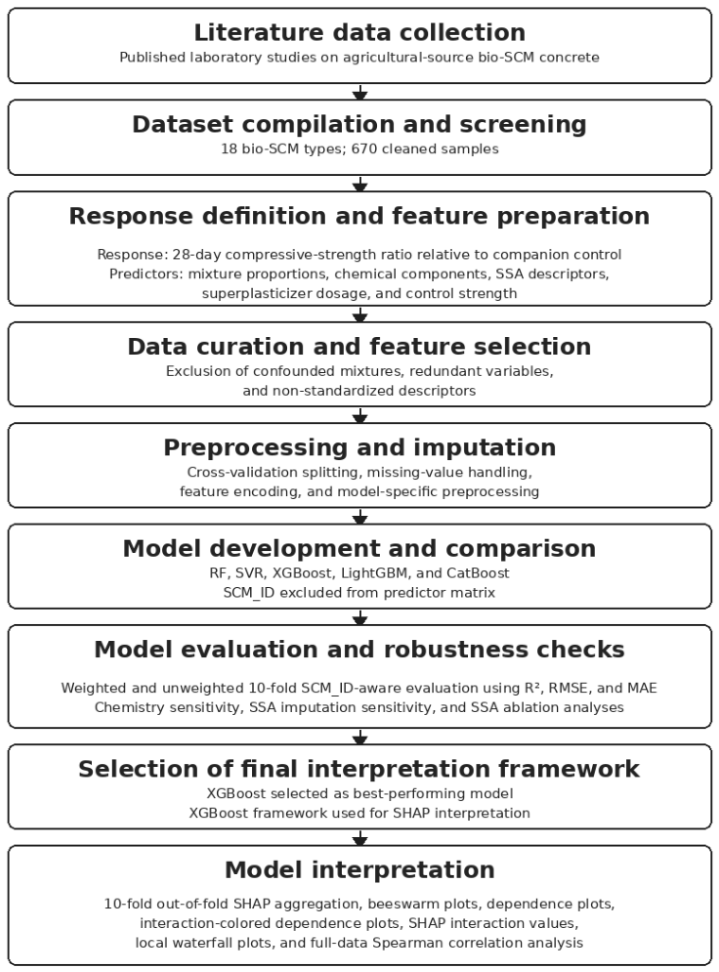
- XGBoost achieved the strongest predictive performance among the evaluated models under 10-fold SCM_ID-aware cross-validation. Weighted and unweighted evaluations showed similar performance, indicating that the model response was not governed only by highly represented SCM groups.
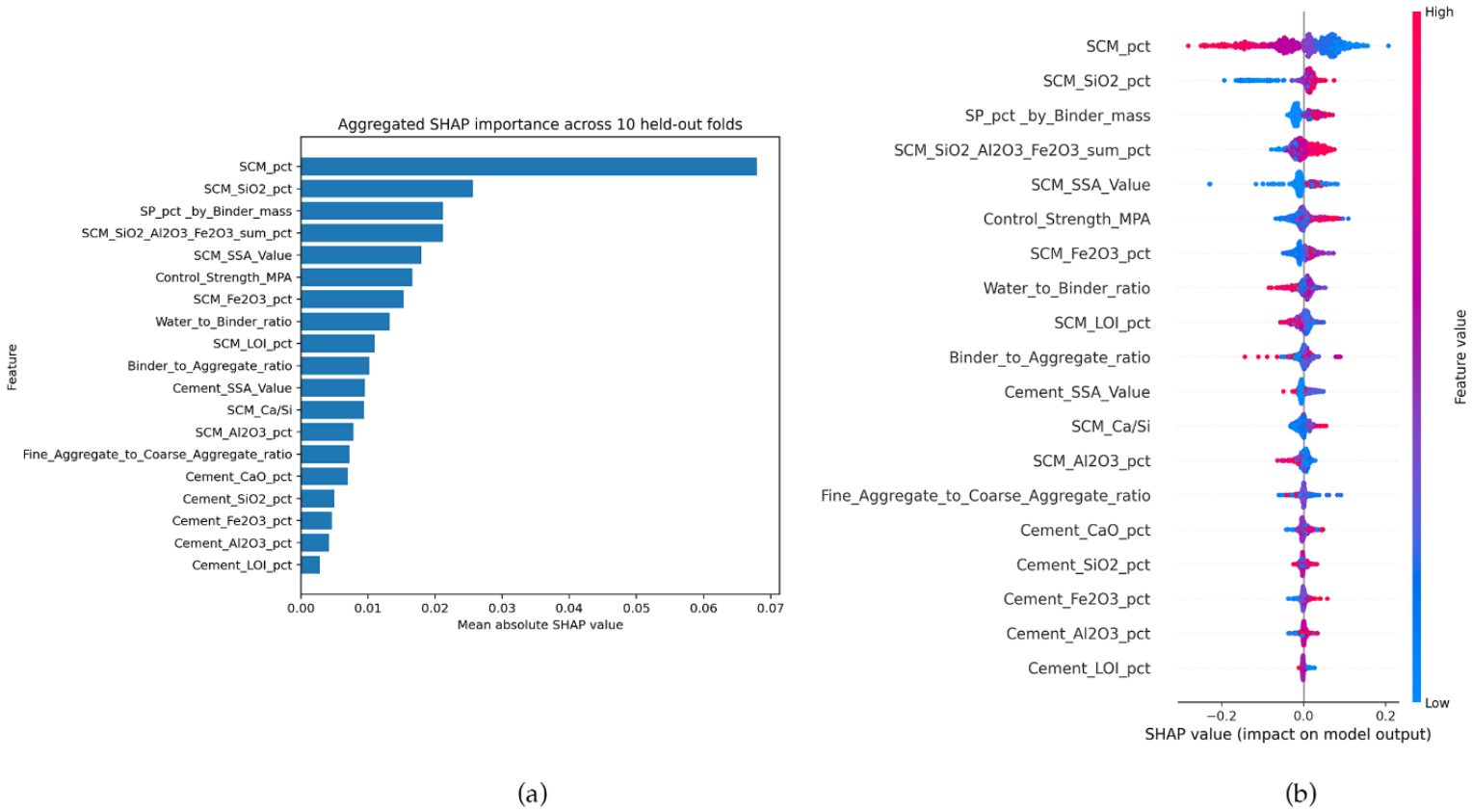
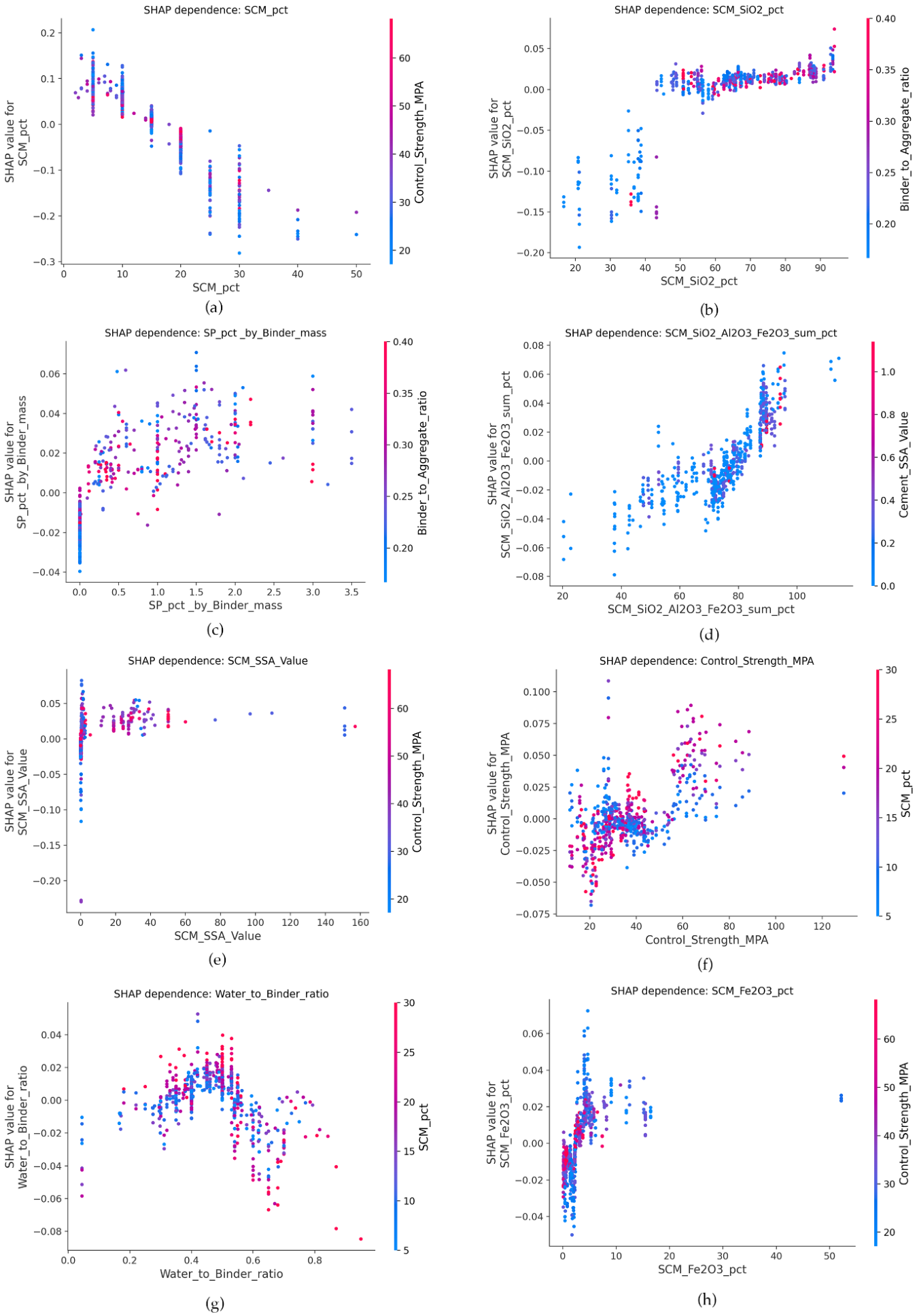
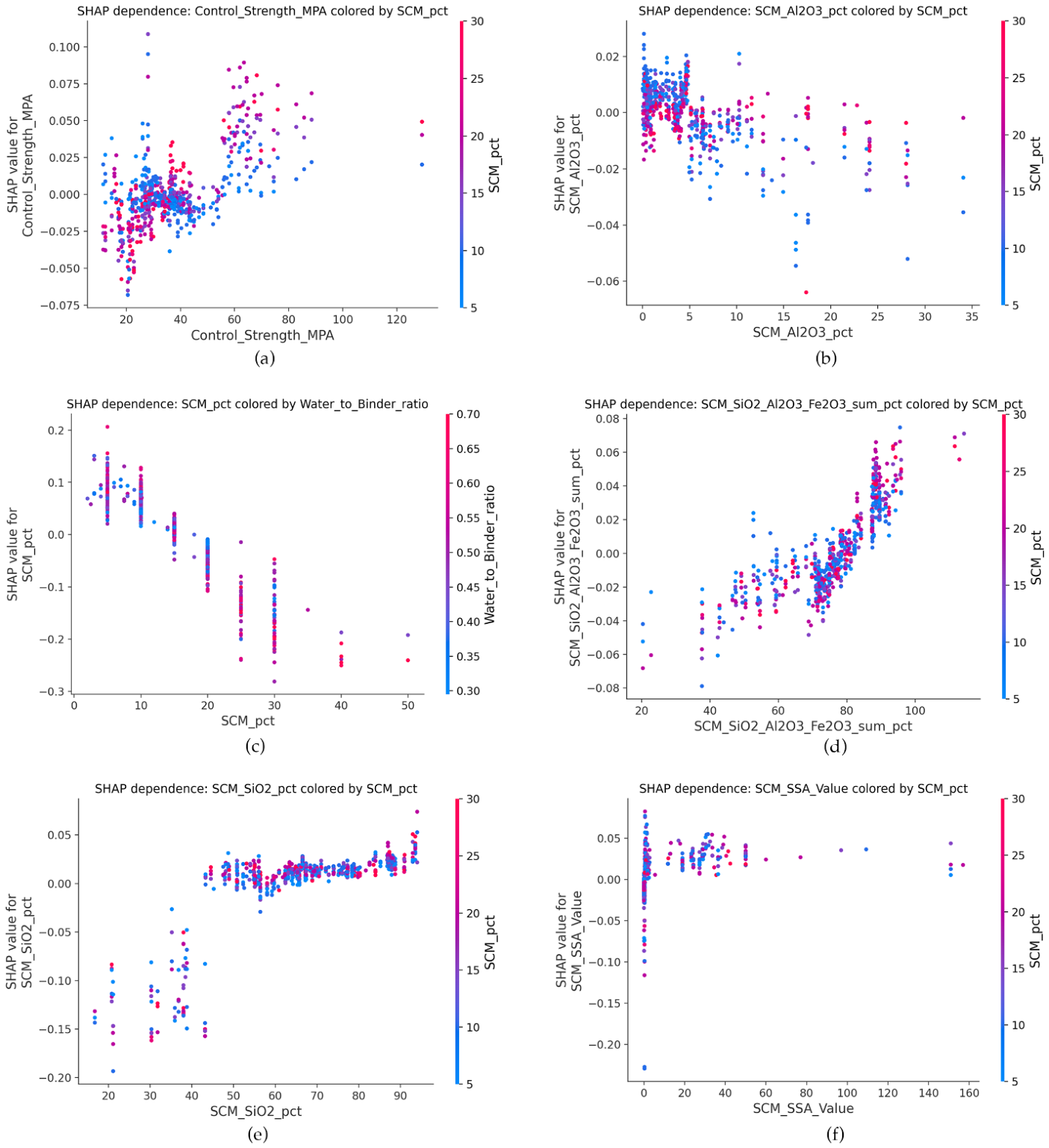
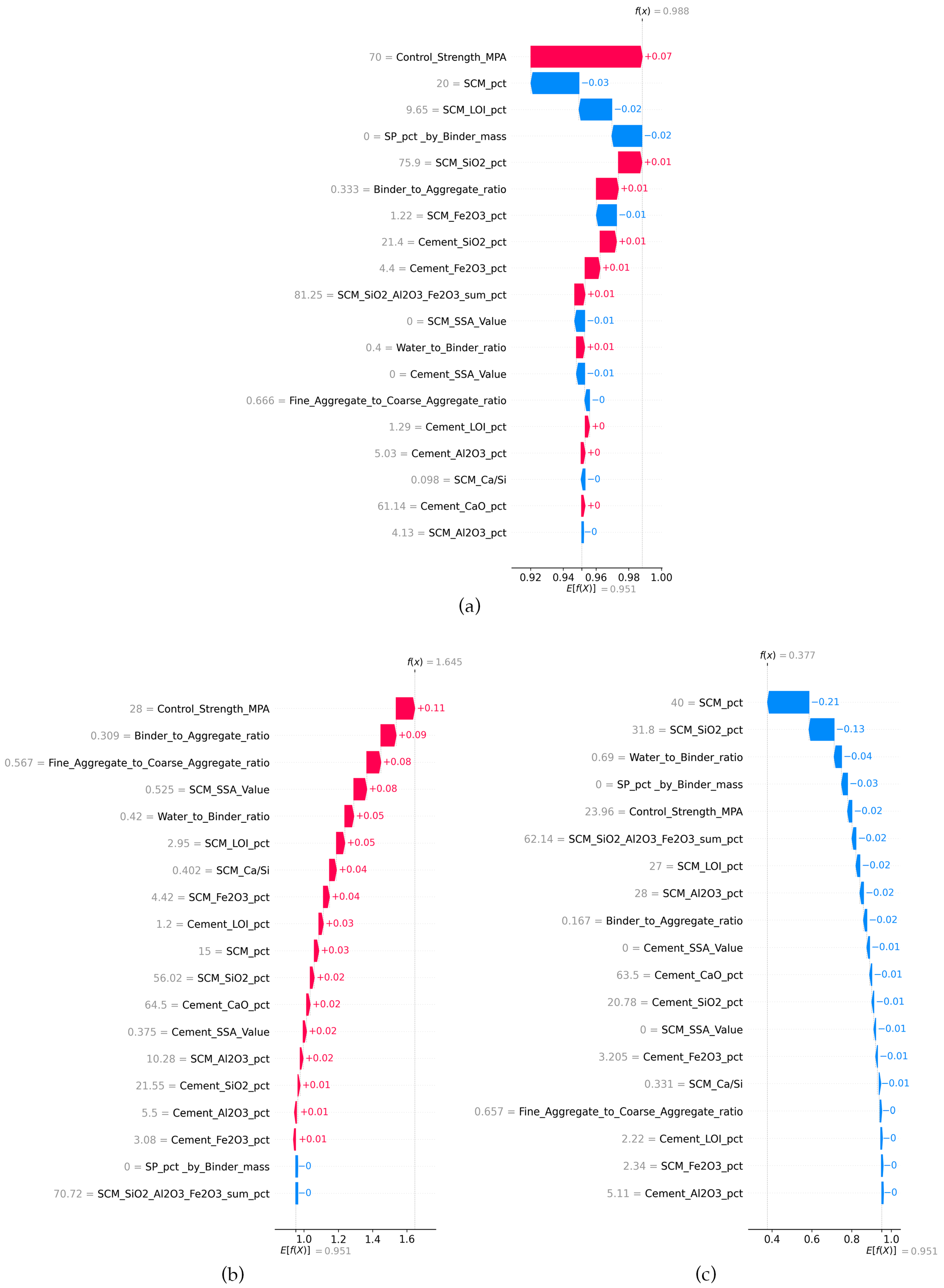
- Higher SCM replacement levels generally reduced the predicted strength ratio, whereas higher SCM SiO2 content, the SCM pozzolanic oxide content, the superplasticizer dosage, and the baseline control strength were associated with more favorable responses. The SCM SSA showed a weaker and more scattered positive tendency. A higher water-to-binder ratio and the SCM LOI were generally associated with less favorable responses.
- SCM-side descriptors were more influential than cement-side descriptors, indicating that variation in SCM chemistry and the specific surface area contributed substantially to the control-relative response.
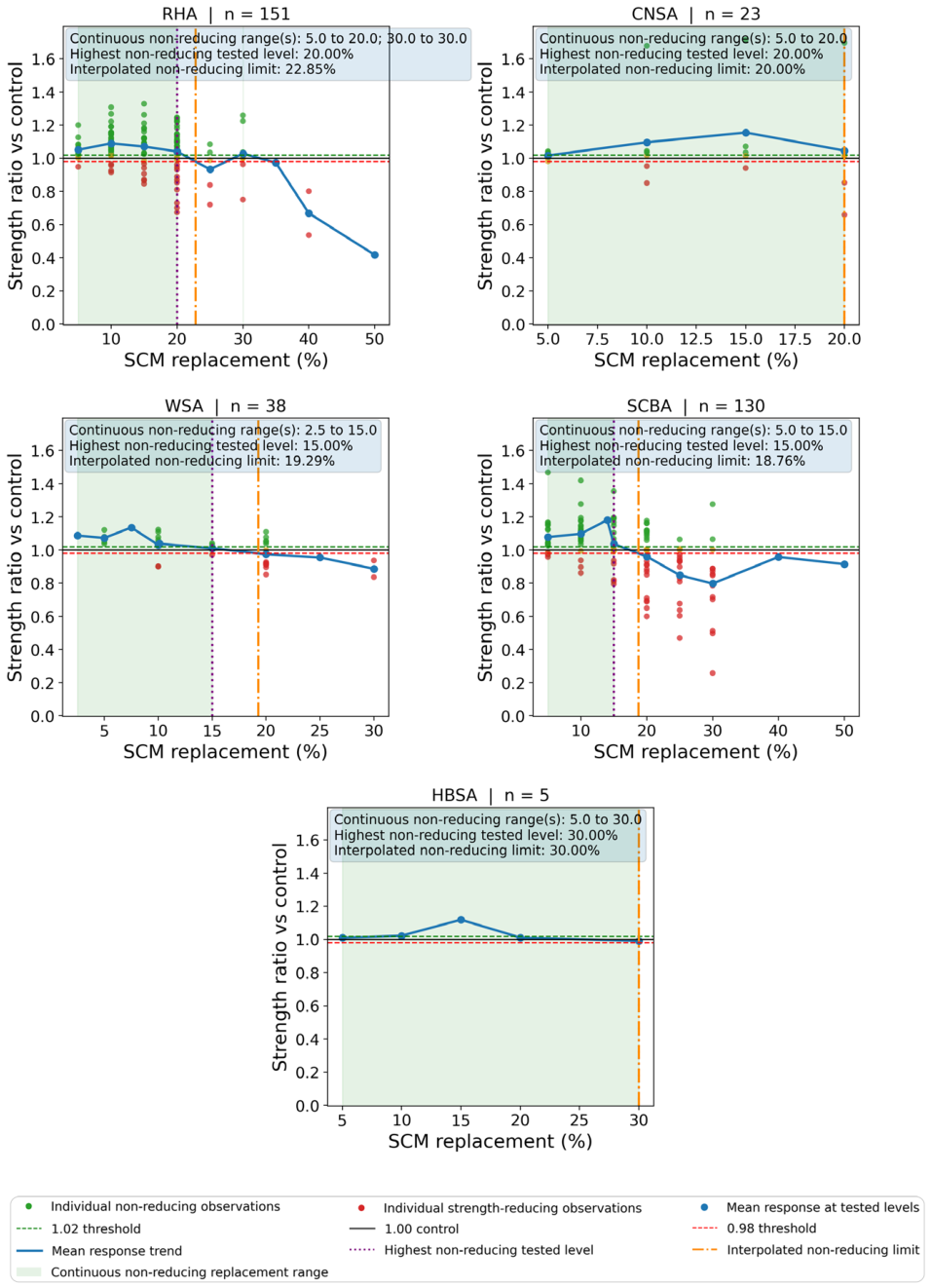
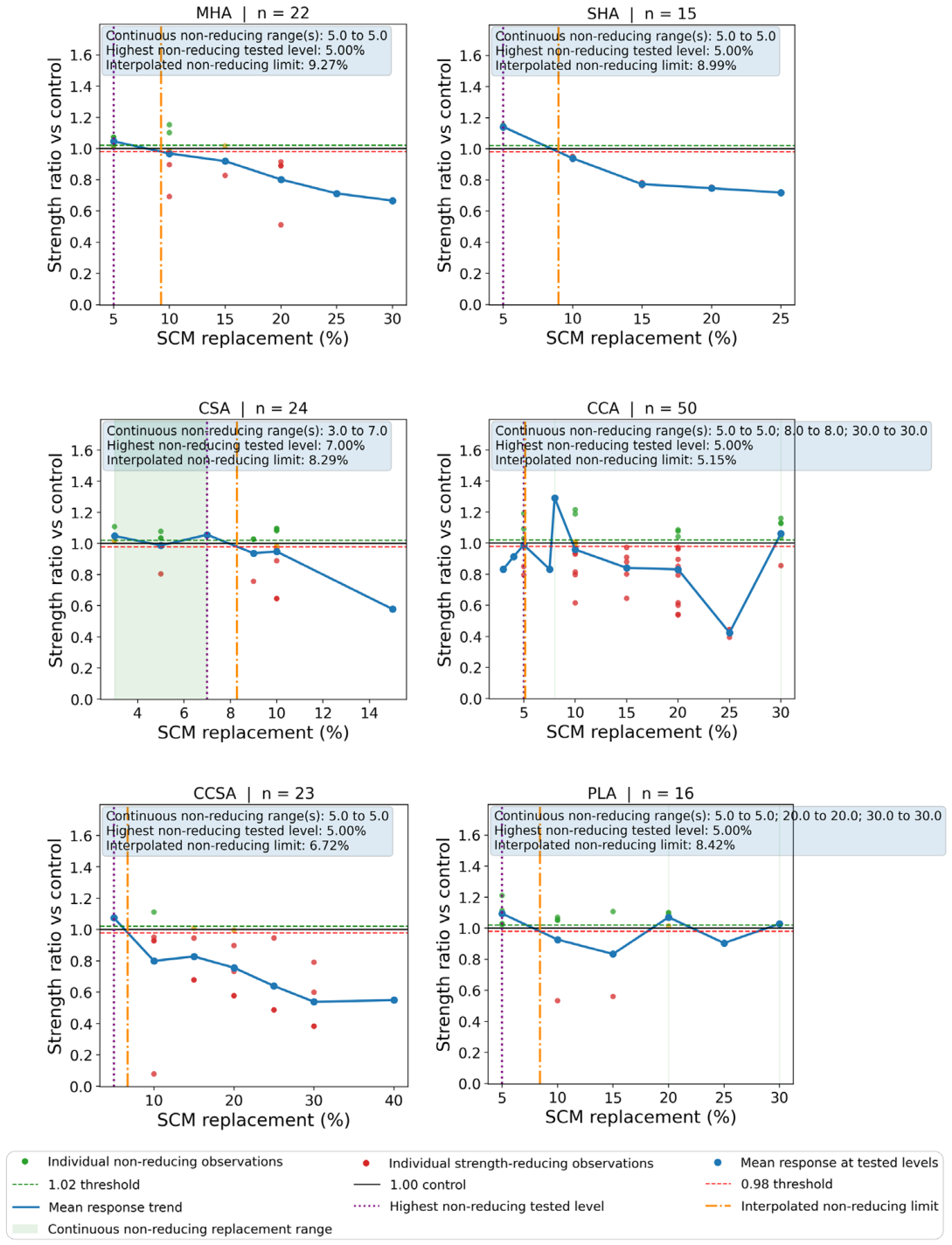
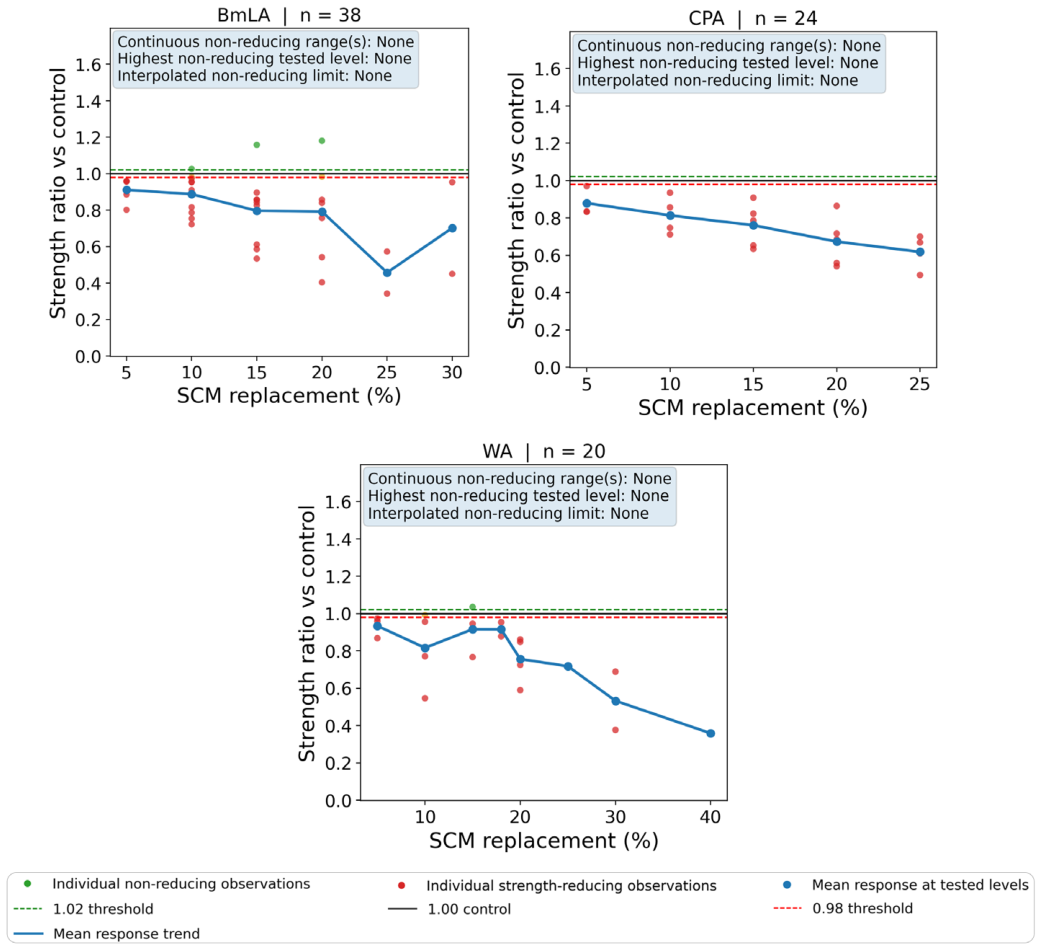
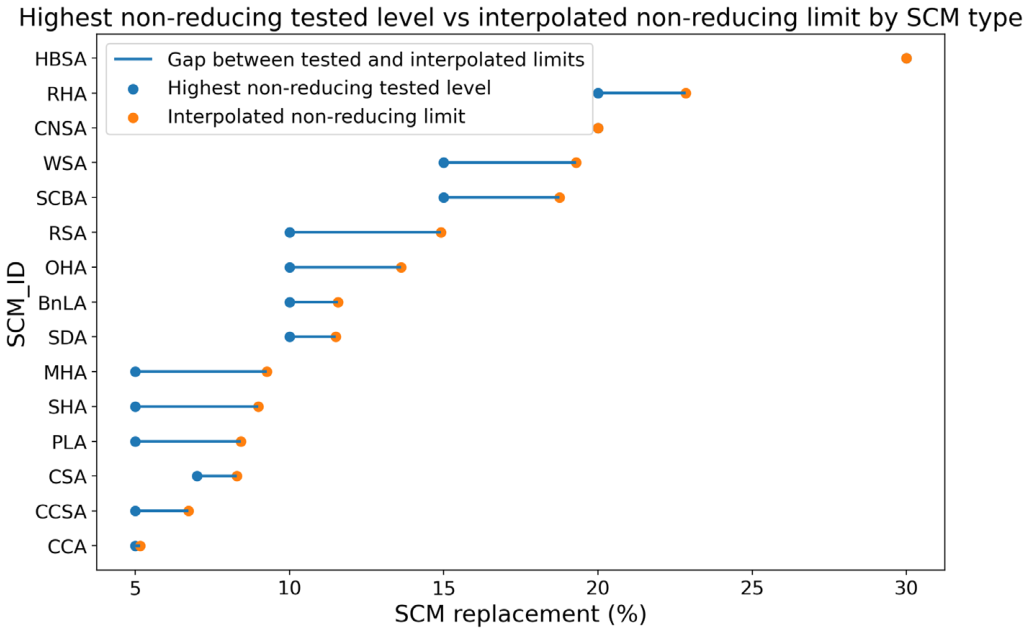
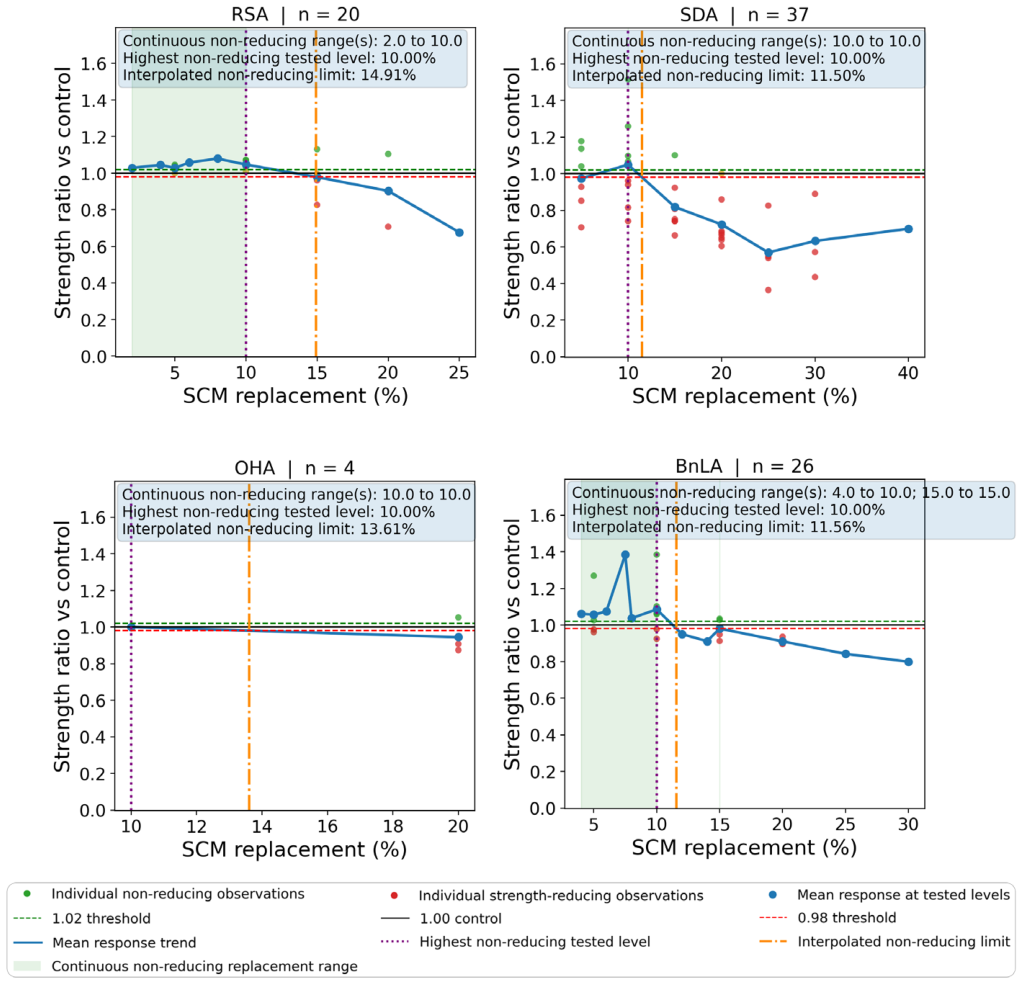
- An SCM-specific response analysis showed that the replacement tolerance was strongly material-dependent. The reported SCM-specific replacement ranges should be interpreted as literature-derived screening estimates rather than design limits because they remain affected by cross-study heterogeneity and require experimental validation. Considering both the highest non-reducing tested levels and the interpolated non-reducing limits, the SCMs were grouped into broad strength-based screening categories according to replacement-level tolerance.
- Based on the SCM-specific screening analysis, HBSA, RHA, CNSA, WSA, and SCBA showed the highest replacement potential, with conservative non-reducing limits of approximately 30.0%, 22.5%, 20.0%, 19.0%, and 18.5%, respectively. These values are literature-derived screening estimates rather than design limits and require experimental validation, especially for HBSA and CNSA because of the limited available data.
- Future work should prioritize the laboratory testing of underrepresented bio-SCMs, particularly HBSA, CNSA, and OHA. Future studies should consistently report SSA values and their measurement methods, chemical composition, and mixture proportions. The potential of blended bio-SCM systems should also be investigated to increase the total cement replacement while maintaining control-equivalent strength. Larger and more balanced datasets would support the evaluation of advanced models, including attention-based CNN, LSTM, CNN-LSTM, and chemistry-informed neural network architectures.
Author Contributions
Funding
Data Availability Statement
Conflicts of Interest
References
- Mirzaei, L.; Ghebrab, T.; Fedler, C.B. Review and evaluation of agricultural biomass ashes as supplementary cementitious materials for sustainable concrete. Processes 2025, 13, 3571. [Google Scholar] [CrossRef]
- Elshaarawy, M.K.; Alsaadawi, M.M.; Hamed, A.K. Machine learning and interactive GUI for concrete compressive strength prediction. Sci. Rep. 2024, 14, 16694. [Google Scholar] [CrossRef]
- Wang, W.; Zhong, Y.; Liao, G.; Ding, Q.; Zhang, T.; Li, X. Prediction of compressive strength of concrete specimens based on interpretable machine learning. Materials 2024, 17, 3661. [Google Scholar] [CrossRef] [PubMed]
- Alyami, M.; Khan, M.; Hammad, A.W.; Alabduljabbar, H.; Nawaz, R.; Fawad, M.; Gamil, Y. Estimating compressive strength of concrete containing rice husk ash using interpretable machine learning-based models. Case Stud. Constr. Mater. 2024, 20, e02901. [Google Scholar] [CrossRef]
- Omotayo, O.O.; Arum, C.; Ikumapayi, C.M. Assessment of Machine Learning Methods for Concrete Compressive Strength Prediction. J. Soft Comput. Civ. Eng. 2024, 8, 116–140. [Google Scholar]
- Hoang, N.-D.; Tran, V.-D.; Tran, X.-L. Predicting compressive strength of high-performance concrete using hybridization of nature-inspired metaheuristic and gradient boosting machine. Mathematics 2024, 12, 1267. [Google Scholar] [CrossRef]
- Kashem, A.; Karim, R.; Das, P.; Datta, S.D.; Alharthai, M. Compressive strength prediction of sustainable concrete incorporating rice husk ash (RHA) using hybrid machine learning algorithms and parametric analyses. Case Stud. Constr. Mater. 2024, 20, e03030. [Google Scholar] [CrossRef]
- Shaaban, M.; Amin, M.; Selim, S.; Riad, I.M. Machine learning approaches for forecasting compressive strength of high-strength concrete. Sci. Rep. 2025, 15, 25567. [Google Scholar] [CrossRef]
- Ahmed, A.H.A.; Jin, W.; Ali, M.A.H. Prediction of compressive strength of recycled concrete using gradient boosting models. Ain Shams Eng. J. 2024, 15, 102975. [Google Scholar] [CrossRef]
- Yu, Y.; Al-Damad, I.M.A.; Foster, S.; Nezhad, A.A.; Hajimohammadi, A. Compressive strength prediction of fly ash/slag-based geopolymer concrete using EBA-optimised chemistry-informed interpretable deep learning model. Dev. Built Environ. 2025, 23, 100736. [Google Scholar] [CrossRef]
- Yu, Y.; Jayathilakage, R.; Liu, Y.; Hajimohammadi, A. Intelligent compressive strength prediction of sustainable rubberised concrete using an optimised interpretable deep CNN-LSTM model with attention mechanism. Appl. Soft Comput. 2025, 185, 113993. [Google Scholar] [CrossRef]
- Chicco, D.; Warrens, M.J.; Jurman, G. The coefficient of determination R-squared is more informative than SMAPE, MAE, MAPE, MSE and RMSE in regression analysis evaluation. Peerj Comput. Sci. 2021, 7, e623. [Google Scholar] [CrossRef]
- Iqtidar, A.; Bahadur Khan, N.; Kashif-ur-Rehman, S.; Faisal Javed, M.; Aslam, F.; Alyousef, R.; Alabduljabbar, H.; Mosavi, A. Prediction of compressive strength of rice husk ash concrete through different machine learning processes. Crystals 2021, 11, 352. [Google Scholar] [CrossRef]
- Amin, M.N.; Ahmad, W.; Khan, K.; Deifalla, A.F. Optimizing compressive strength prediction models for rice husk ash concrete with evolutionary machine intelligence techniques. Case Stud. Constr. Mater. 2023, 18, e02102. [Google Scholar] [CrossRef]
- Li, Q.; Song, Z. Prediction of compressive strength of rice husk ash concrete based on stacking ensemble learning model. J. Clean. Prod. 2023, 382, 135279. [Google Scholar] [CrossRef]
- Tavana Amlashi, A.; Mohammadi Golafshani, E.; Ebrahimi, S.A.; Behnood, A. Estimation of the compressive strength of green concretes containing rice husk ash: A comparison of different machine learning approaches. Eur. J. Environ. Civ. Eng. 2023, 27, 961–983. [Google Scholar] [CrossRef]
- Uddin, M.N.; Li, L.-Z.; Deng, B.-Y.; Ye, J. Interpretable XGBoost–SHAP machine learning technique to predict the compressive strength of environment-friendly rice husk ash concrete. Innov. Infrastruct. Solut. 2023, 8, 147. [Google Scholar] [CrossRef]
- Sathiparan, N. Innovative use of corncob ash in concrete: A machine learning perspective on compressive strength prediction. Innov. Infrastruct. Solut. 2025, 10, 73. [Google Scholar] [CrossRef]
- Tipu, R.K.; Arora, R.; Kumar, K. Machine learning-based prediction of concrete strength properties with coconut shell as partial aggregate replacement: A sustainable approach in construction engineering. Asian J. Civ. Eng. 2024, 25, 2979–2992. [Google Scholar] [CrossRef]
- Momshad, A.M.; Islam, M.H.; Datta, S.D.; Sobuz, M.H.R.; Aayaz, R.; Kabbo, M.K.I.; Khan, M.M.H. Assessing the engineering properties and environmental impact with explainable machine learning analysis of sustainable concrete utilizing waste banana leaf ash as a partial cement replacement. Clean. Eng. Technol. 2025, 24, 100886. [Google Scholar] [CrossRef]
- Patil, S.; Niveda, G.; Babu, B.P.; Jayashree, G.; Anigowda; Chandra, S.S. Sustainable concrete incorporating banana leaf ash: Strength prediction and optimisation using advanced machine learning algorithms. Asian J. Civ. Eng. 2025, 27, 703–726. [Google Scholar] [CrossRef]
- Pazouki, G.; Tao, Z.; Saeed, N.; Kang, W.-H. Using artificial intelligence methods to predict the compressive strength of concrete containing sugarcane bagasse ash. Constr. Build. Mater. 2023, 409, 134047. [Google Scholar] [CrossRef]
- Abebaw, G.; Bewket, B.; Getahun, S. Experimental investigation on effect of partial replacement of cement with bamboo leaf ash on concrete property. Adv. Civ. Eng. 2021, 2021, 6468444. [Google Scholar] [CrossRef]
- Dacuan, C.N.; Abellana, V.Y.; Canseco, H.A.R. Assessment and evaluation of blended cement using bamboo leaf ash BLASH against corrosion. Civ. Eng. J. 2021, 7, 1015–1035. [Google Scholar] [CrossRef]
- Dwivedi, V.; Singh, N.; Das, S.; Singh, N. A new pozzolanic material for cement industry: Bamboo leaf ash. Int. J. Phys. Sci. 2006, 1, 106–111. [Google Scholar]
- Asha, P.; Salman, A.; Kumar, R.A. Experimental study on concrete with bamboo leaf ash. Int. J. Eng. Adv. Technol. 2014, 3, 46–51. [Google Scholar]
- Dhinakaran, G.; Chandana, G.H. Compressive Strength and Durability of Bamboo Leaf Ash Concrete. Jordan J. Civ. Eng. 2016, 10, 279–289. [Google Scholar] [CrossRef]
- Nduka, D.O.; Olawuyi, B.J.; Ajao, A.M.; Okoye, V.C.; Okigbo, O.M. Mechanical and durability property dimensions of sustainable bamboo leaf ash in high-performance concrete. Clean. Eng. Technol. 2022, 11, 100583. [Google Scholar] [CrossRef]
- Mujedu, K.; Lamidi, I.; Olomo, R.; Alao, M. Evaluation of physical and mechanical properties of partially replaced bamboo ash cement mortar. Int. J. Eng. Sci. 2018, 7, 35–41. [Google Scholar]
- Junior, F.K.S.; Wally, G.B.; Magalhães, F.C.; de Pires, M.M.; Kulakowski, M.P.; do Nascimento, C.d.D.; Flores, W.H.; Avellaneda, C.A.O. Effects of bamboo leaf ashes on concrete compressive strength, water absorption, and chloride penetration. J. Build. Eng. 2024, 97, 110986. [Google Scholar] [CrossRef]
- Silva, L.H.P.; Tamashiro, J.R.; de Paiva, F.F.G.; dos Santos, L.F.; Teixeira, S.R.; Kinoshita, A.; Antunes, P.A. Bamboo leaf ash for use as mineral addition with Portland cement. J. Build. Eng. 2021, 42, 102769. [Google Scholar] [CrossRef]
- Odeyemi, S.; Atoyebi, O.; Kegbeyale, O.; Anifowose, M.; Odeyemi, O.; Adeniyi, A.; Orisadare, O. Mechanical properties and microstructure of High-Performance Concrete with bamboo leaf ash as additive. Clean. Eng. Technol. 2022, 6, 100352. [Google Scholar] [CrossRef]
- Umoh, A.A.; Odesola, I. Characteristics of Bamboo Leaf Ash Blended Cement Paste and Mortar. Civ. Eng. Dimens. 2015, 17, 22–28. [Google Scholar] [CrossRef][Green Version]
- Onikeku, O.; Shitote, S.M.; Muse, S.; Adedeji, A. Comparative analysis of compressive strength of bamboo leaf ash and baggash ash concretes. Machakos Univ. J. Sci. Technol. 2021, 1–16. [Google Scholar]
- Onikeku, O.; Shitote, S.M.; Mwero, J.; Adedeji, A. Evaluation of characteristics of concrete mixed with bamboo leaf ash. Open Constr. Build. Technol. J. 2019, 13, 67–80. [Google Scholar] [CrossRef]
- Bhutto, S.; Ali, M.; Buller, A.S.; Bheel, N.; Gamil, Y.; Najeh, T.; Deifalla, A.F.; Ragab, A.E.; Almujibah, H.R. Effect of banana tree leaves ash as cementitious material on the durability of concrete against sulphate and acid attacks. Heliyon 2024, 10, e29236. [Google Scholar] [CrossRef]
- Tavares, J.C.; Lucena, L.F.; Henriques, G.F.; Ferreira, R.L.; dos Anjos, M.A. Use of banana leaf ash as partial replacement of Portland cement in eco-friendly concretes. Constr. Build. Mater. 2022, 346, 128467. [Google Scholar] [CrossRef]
- Kanning, R.C.; Portella, K.F.; Bragança, M.O.; Bonato, M.M.; dos Santos, J.C. Banana leaves ashes as pozzolan for concrete and mortar of Portland cement. Constr. Build. Mater. 2014, 54, 460–465. [Google Scholar] [CrossRef]
- Islam, M.H.; Law, D.W.; Gunasekara, C.; Sobuz, M.H.R.; Rahman, M.N.; Habib, M.A.; Sabbir, A.K. Assessing the influence of banana leaf Ash as pozzolanic material for the production of green concrete: A mechanical and microstructural evaluation. Materials 2024, 17, 720. [Google Scholar] [CrossRef]
- Darweesh, H. Effect of banana leaf ash as a sustainable material on the hydration of Portland cement pastes. Int. J. Mater. Sci. 2023, 4, 1–11. [Google Scholar]
- Stel’makh, S.A.; Shcherban’, E.M.; Beskopylny, A.N.; Chernilnik, A.; Elshaeva, D. Eco-Friendly Concrete with Improved Properties and Structure, Modified with Banana Leaf Ash. J. Compos. Sci. 2024, 8, 421. [Google Scholar] [CrossRef]
- Oyebisi, S.; Igba, T.; Oniyide, D. Performance evaluation of cashew nutshell ash as a binder in concrete production. Case Stud. Constr. Mater. 2019, 11, e00293. [Google Scholar] [CrossRef]
- Oyebisi, S.; Olutoge, F.; Oyaotuderekumor, I.; Bankole, F.; Owamah, H.; Mazino, U. Effects of cashew nutshell ash on the thermal and sustainability properties of cement concrete. Heliyon 2022, 8, e11593. [Google Scholar] [CrossRef]
- Mendu, J.K.; Pannem, R.M.R. Assessment of mechanical properties of cashew nut shell ash blended concrete. Innov. Infrastruct. Solut. 2021, 6, 227. [Google Scholar] [CrossRef]
- Shemu, M.; Mrema, A.; Crowley, R. The Use of Cashew Nuts Shell Ashes as Partial Replacement of Cement For Making Normal Concrete in Tanzania. Tanzan. Eng. J. Inst. Eng. Tanzan. 2025, 20, 19–29. [Google Scholar]
- Raheem, S.; Arubike, E.; Awogboro, O. Effects of cassava peel ash (CPA) as alternative binder in concrete. Int. J. Constr. Res. Civ. Eng. 2020, 1, 27–32. [Google Scholar]
- Salau, M.A.; Ikponmwosa, E.E.; Olonode, K.A. Structural strength characteristics of cement-cassava peel ash blended concrete. Civ. Environ. Res. 2012, 2, 68–78. [Google Scholar]
- Olatokunbo, O.; Anthony, E.; Rotimi, O.; Solomon, O.; Tolulope, A.; John, O.; Adeoye, O. Assessment of strength properties of cassava peel ash-concrete. Int. J. Civ. Eng. Technol. 2018, 9, 965–974. [Google Scholar]
- Abdulwahab, M.; Uche, O. Durability properties of self-compacting concrete (SCC) incorporating cassava peel ash (CPA). Niger. J. Technol. 2021, 40, 584–590. [Google Scholar] [CrossRef]
- Ikponmwosa, E.E.; Olonade, K.A. Shrinkage characteristics of cassava peel ash concrete. Pac. J. Sci. Technol. 2017, 18, 23–32. [Google Scholar]
- Akindahunsi, A.; Ogune, C.; Ayodele, A.; Fajobi, A.; Olajumoke, A. Evaluation of the performance of corncob ash in cement mortars. J. Build. Pathol. Rehabil. 2022, 7, 72. [Google Scholar] [CrossRef]
- Abubakar, A.; Mohammed, A.; Samson, D. Mechanical properties of concrete containing corn cob ash. Int. J. Sci. Res. Eng. Stud. 2016, 3, 47–51. [Google Scholar]
- Tumba, M.; Ofuyatan, O.; Uwadiale, O.; Oluwafemi, J.; Oyebisi, S. Effect of sulphate and acid on self-compacting concrete containing corn cob ash. Proc. IOP Conf. Ser. Mater. Sci. Eng. 2018, 413, 012040. [Google Scholar]
- Adesanya, D.; Raheem, A. A study of the workability and compressive strength characteristics of corn cob ash blended cement concrete. Constr. Build. Mater. 2009, 23, 311–317. [Google Scholar] [CrossRef]
- Raheem, A.A.; Oyebisi, S.O.; Akintayo, S.O.; Oyeniran, M.I. Effects of admixtures on the properties of corn cob ash cement concrete. Leonardo Electron. J. Pract. Technol. 2010, 16, 13–20. [Google Scholar]
- Shakouri, M.; Exstrom, C.L.; Ramanathan, S.; Suraneni, P. Hydration, strength, and durability of cementitious materials incorporating untreated corn cob ash. Constr. Build. Mater. 2020, 243, 118171. [Google Scholar] [CrossRef]
- Oluborode, K.; Olofintuyi, I. Strength Evaluation of Corn cob ash in a blended Portland cement. Int. J. Eng. Innov. Technol. 2015, 4, 123–131. [Google Scholar]
- Memon, S.A.; Khan, M.K. Ash blended cement composites: Eco-friendly and sustainable option for utilization of corncob ash. J. Clean. Prod. 2018, 175, 442–455. [Google Scholar] [CrossRef]
- Kesarwani, S.; Shukla, G.; Chauhan, M.S. Performance Evaluation of Waste Corn Cob Ash as Partial Cement Replacement in Concrete: A Study on Strength and Durability Properties. Int. J. Adv. Signal Image Sci. 2026, 11, 521–544. [Google Scholar] [CrossRef]
- Desai, P.H. Experimental study on corn cob ash powder as partial replacement of cement in concrete. Int. Res. J. Eng. Technol. (Irjet) 2018, 5, 724–728. [Google Scholar]
- Kamau, J.; Ahmed, A.; Hirst, P.; Kangwa, J. Suitability of corncob ash as a supplementary cementitious material. Int. J. Mater. Sci. Eng. 2016, 4, 215–228. [Google Scholar]
- Memon, S.A.; Khan, S.; Wahid, I.; Shestakova, Y.; Ashraf, M. Evaluating the Effect of Calcination and Grinding of Corn Stalk Ash on Pozzolanic Potential for Sustainable Cement-Based Materials. Adv. Mater. Sci. Eng. 2020, 2020, 1619480. [Google Scholar] [CrossRef]
- Salem, S.; Hamdy, Y.; Abdelraouf, E.-S.; Shazly, M. Towards sustainable concrete: Cement replacement using Egyptian cornstalk ash. Case Stud. Constr. Mater. 2022, 17, e01193. [Google Scholar] [CrossRef]
- Mildawati, R.; Puri, A.; Handayani, M.Z. Effects of corn stalks ash as a substitution material of cement due to the concrete strength of rigid pavement. J. Geosci. Eng. Environ. Technol. 2022, 7, 21–26. [Google Scholar] [CrossRef]
- Ismawan, D.; Munthe, A.T. Effect of Cement Substitution with Corn Stalk Ash and Addition of Snail Shell Powder on Concrete Compressive Strength. G-Tech. J. Teknol. Terap. 2025, 9, 839–850. [Google Scholar] [CrossRef]
- Utsev, J.; Taku, J. Coconut shell ash as partial replacement of ordinary Portland cement in concrete production. Int. J. Sci. Technol. Res. 2012, 1, 86–89. [Google Scholar]
- Adajar, M.A.; Galupino, J.; Frianeza, C.; Aguilon, J.F.; Sy, J.B.; Tan, P.A. Compressive strength and durability of concrete with coconut shell ash as cement replacement. Geomate J. 2020, 18, 183–190. [Google Scholar] [CrossRef]
- Ranatunga, K.S.; del Rey Castillo, E.; Toma, C.L. Evaluation of the optimal concrete mix design with coconut shell ash as a partial cement replacement. Constr. Build. Mater. 2023, 401, 132978. [Google Scholar] [CrossRef]
- Bheel, N.; Mahro, S.K.; Adesina, A. Influence of coconut shell ash on workability, mechanical properties, and embodied carbon of concrete. Environ. Sci. Pollut. Res. 2021, 28, 5682–5692. [Google Scholar] [CrossRef]
- Nagarajan, V.K.; Devi, S.A.; Manohari, S.; Santha, M.M. Experimental study on partial replacement of cement with coconut shell ash in concrete. Int. J. Sci. Res. 2014, 3, 651–661. [Google Scholar]
- Herring, T.C. Engineering and durability properties of modified coconut shell concrete. Civ. Eng. J. 2022, 8, 362–381. [Google Scholar] [CrossRef]
- Cao, F.; Qiao, H.; Li, Y.; Shu, X.; Cui, L. Effect of highland barley straw ash admixture on properties and microstructure of concrete. Constr. Build. Mater. 2022, 315, 125802. [Google Scholar] [CrossRef]
- Mohammed, A.; Aboshio, A.; Aliyu, M. Performance of millet husk ash in self compacting concrete. Niger. J. Technol. 2021, 40, 1010–1017. [Google Scholar] [CrossRef]
- Bheel, N.; Memon, F.A.; Meghwar, S.L. Study of fresh and hardened properties of concrete using cement with modified blend of millet husk ash as secondary cementitious material. Silicon 2021, 13, 4641–4652. [Google Scholar] [CrossRef]
- Bheel, N.; Ali, M.O.A.; Kirgiz, M.S.; de Sousa Galdino, A.G.; Kumar, A. Fresh and mechanical properties of concrete made of binary substitution of millet husk ash and wheat straw ash for cement and fine aggregate. J. Mater. Res. Technol. 2021, 13, 872–893. [Google Scholar] [CrossRef]
- Wasiu, J.; Oluwatosin, F.A. Experimental investigation of the pozzolanic potentials of millet and rice husk ash as mineral additive in self-compacting concrete. Acta Polytech. 2020, 60, 359–368. [Google Scholar] [CrossRef]
- Bheel, N.D.; Memon, F.; Meghwar, S.; Abro, A.; Shar, I. Millet husk ash as environmental friendly material in cement concrete. In Proceedings of the 5th International Conference on Energy, Environment and Sustainable Development, Jamshoro, Pakistan, 14–16 November 2018; pp. 153–158. [Google Scholar]
- Uche, O.; Adamu, M.; Bahuddeen, M. Influence of millet husk ash (MHA) on the properties of plain concrete. J. Epistem. Sci. Eng. Technol. 2012, 2, 68–73. [Google Scholar]
- Ruviaro, A.S.; dos Santos Lima, G.T.; Silvestro, L.; Barraza, M.T.; Rocha, J.C.; de Brito, J.; Gleize, P.J.P.; Pelisser, F. Characterization and investigation of the use of oat husk ash as supplementary cementitious material as partial replacement of Portland cement: Analysis of fresh and hardened properties and environmental assessment. Constr. Build. Mater. 2023, 363, 129762. [Google Scholar] [CrossRef]
- Farhat, M.; Abdullah, T.; Fenniche, F.; Kouider, H.H. The Effect of Adding Barley and Oats Husks Ashes on the Properties of Ordinary Portland cement. Bani Waleed Univ. J. Humanit. Appl. Sci. 2023, 8, 271–282. [Google Scholar]
- Sadoon, A.; Bassuoni, M.; Ghazy, A. Assessment of Oat Husk Ash from Cold Climates as a Supplementary Cementitious Material. J. Mater. Civ. Eng. 2025, 37, 04025371. [Google Scholar] [CrossRef]
- Alogla, S. Compressive strength evaluation of concrete with palm tree ash. Civ. Eng. Archit. 2022, 10, 725–733. [Google Scholar] [CrossRef]
- Amah, V.E.; Ugwoha, E.; Chukwuemeka, E. Effect of palm tree Leaf ash on the compressive strength of concrete and its workability. Int. J. Eng. Sci. (IJES) 2020, 9, 37–45. [Google Scholar]
- Amin, M.; Zeyad, A.M.; Tayeh, B.A.; Agwa, I.S. Effects of nano cotton stalk and palm leaf ashes on ultrahigh-performance concrete properties incorporating recycled concrete aggregates. Constr. Build. Mater. 2021, 302, 124196. [Google Scholar] [CrossRef]
- Bapon, M.F.A.; Mia, M.S.; Hosen, M.M.; Mahi, M.S.H. Palm Ash as a Sustainable Cement Replacement: Effects on Workability and Mechanical Properties of Concrete. In Proceedings of the International Conference on Civil Engineering Research & Innovations, Rajshahi, Bangladesh, 12–14 December 2025; p. 14. [Google Scholar]
- Elsakhawy, Y. Green high-strength concrete incorporation of rice straw ash, palm leaf ash, and olive waste ash. In Proceedings of the International Conference on Advances in Structural and Geotechnical Engineering, Hurghada, Egypt, 14–17 April 2025. [Google Scholar]
- Chao-Lung, H.; Le Anh-Tuan, B.; Chun-Tsun, C. Effect of rice husk ash on the strength and durability characteristics of concrete. Constr. Build. Mater. 2011, 25, 3768–3772. [Google Scholar] [CrossRef]
- Ganesan, K.; Rajagopal, K.; Thangavel, K. Rice husk ash blended cement: Assessment of optimal level of replacement for strength and permeability properties of concrete. Constr. Build. Mater. 2008, 22, 1675–1683. [Google Scholar] [CrossRef]
- Alsaed, M.; Al Mufti, R. The effects of rice husk ash as bio-cementitious material in concrete. Constr. Mater. 2024, 4, 629–639. [Google Scholar] [CrossRef]
- Saraswathy, V.; Song, H.-W. Corrosion performance of rice husk ash blended concrete. Constr. Build. Mater. 2007, 21, 1779–1784. [Google Scholar] [CrossRef]
- Habeeb, G.A.; Mahmud, H.B. Study on properties of rice husk ash and its use as cement replacement material. Mater. Res. 2010, 13, 185–190. [Google Scholar] [CrossRef]
- Gastaldini, A.; Da Silva, M.; Zamberlan, F.; Neto, C.M. Total shrinkage, chloride penetration, and compressive strength of concretes that contain clear-colored rice husk ash. Constr. Build. Mater. 2014, 54, 369–377. [Google Scholar] [CrossRef]
- Givi, A.N.; Rashid, S.A.; Aziz, F.N.A.; Salleh, M.A.M. Assessment of the effects of rice husk ash particle size on strength, water permeability and workability of binary blended concrete. Constr. Build. Mater. 2010, 24, 2145–2150. [Google Scholar] [CrossRef]
- Cordeiro, G.C.; Toledo Filho, R.D.; de Moraes Rego Fairbairn, E. Use of ultrafine rice husk ash with high-carbon content as pozzolan in high performance concrete. Mater. Struct. 2009, 42, 983–992. [Google Scholar] [CrossRef]
- Ramasamy, V.-W. Compressive strength and durability properties of rice husk ash concrete. KSCE J. Civ. Eng. 2012, 16, 93–102. [Google Scholar] [CrossRef]
- de Sensale, G.R. Strength development of concrete with rice-husk ash. Cem. Concr. Compos. 2006, 28, 158–160. [Google Scholar] [CrossRef]
- Giaccio, G.; de Sensale, G.R.; Zerbino, R. Failure mechanism of normal and high-strength concrete with rice-husk ash. Cem. Concr. Compos. 2007, 29, 566–574. [Google Scholar] [CrossRef]
- Chopra, D.; Siddique, R. Strength, permeability and microstructure of self-compacting concrete containing rice husk ash. Biosyst. Eng. 2015, 130, 72–80. [Google Scholar] [CrossRef]
- Madandoust, R.; Ranjbar, M.M.; Moghadam, H.A.; Mousavi, S.Y. Mechanical properties and durability assessment of rice husk ash concrete. Biosyst. Eng. 2011, 110, 144–152. [Google Scholar] [CrossRef]
- Nisar, N.; Bhat, J.A. Experimental investigation of Rice Husk Ash on compressive strength, carbonation and corrosion resistance of reinforced concrete. Aust. J. Civ. Eng. 2021, 19, 155–163. [Google Scholar] [CrossRef]
- Raisi, E.M.; Amiri, J.V.; Davoodi, M.R. Mechanical performance of self-compacting concrete incorporating rice husk ash. Constr. Build. Mater. 2018, 177, 148–157. [Google Scholar] [CrossRef]
- Khan, R.; Jabbar, A.; Ahmad, I.; Khan, W.; Khan, A.N.; Mirza, J. Reduction in environmental problems using rice-husk ash in concrete. Constr. Build. Mater. 2012, 30, 360–365. [Google Scholar] [CrossRef]
- Le, H.T.; Nguyen, S.T.; Ludwig, H.-M. A study on high performance fine-grained concrete containing rice husk ash. Int. J. Concr. Struct. Mater. 2014, 8, 301–307. [Google Scholar] [CrossRef]
- Hasan, N.M.S.; Sobuz, M.H.R.; Khan, M.M.H.; Mim, N.J.; Meraz, M.M.; Datta, S.D.; Rana, M.J.; Saha, A.; Akid, A.S.M.; Mehedi, M.T. Integration of rice husk ash as supplementary cementitious material in the production of sustainable high-strength concrete. Materials 2022, 15, 8171. [Google Scholar] [CrossRef]
- Alex, J.; Dhanalakshmi, J.; Ambedkar, B. Experimental investigation on rice husk ash as cement replacement on concrete production. Constr. Build. Mater. 2016, 127, 353–362. [Google Scholar] [CrossRef]
- Muthadhi, A.; Kothandaraman, S. Experimental investigations of performance characteristics of rice husk ash–blended concrete. J. Mater. Civ. Eng. 2013, 25, 1115–1118. [Google Scholar] [CrossRef]
- Bui, D.; Hu, J.; Stroeven, P. Particle size effect on the strength of rice husk ash blended gap-graded Portland cement concrete. Cem. Concr. Compos. 2005, 27, 357–366. [Google Scholar] [CrossRef]
- Munshi, S.; Sharma, R.P. Experimental investigation on strength and water permeability of mortar incorporate with rice straw ash. Adv. Mater. Sci. Eng. 2016, 2016, 9696505. [Google Scholar] [CrossRef]
- Singh, R.; Patel, M. Strength and durability performance of rice straw ash-based concrete: An approach for the valorization of agriculture waste. Int. J. Environ. Sci. Technol. 2023, 20, 9995–10012. [Google Scholar] [CrossRef]
- Heniegal, A.M.; Amin, M.; Zeyad, A.M.; Agwa, I.S.; Samy, M. Effect of rice straw ash at different burning temperatures on high-strength concrete properties. Innov. Infrastruct. Solut. 2025, 10, 38. [Google Scholar] [CrossRef]
- Agwa, I.S.; Omar, O.M.; Tayeh, B.A.; Abdelsalam, B.A. Effects of using rice straw and cotton stalk ashes on the properties of lightweight self-compacting concrete. Constr. Build. Mater. 2020, 235, 117541. [Google Scholar] [CrossRef]
- Pandey, A.; Kumar, B. Investigating the performance of cement mortar containing rice straw ash, microsilica and their composite by compressive strength. Int. J. Recent Technol. Eng. 2019, 7, 1–4. [Google Scholar]
- Cunningham, P.R.; Wang, L.; Nassiri, S.; Thy, P.; Harvey, J.T.; Jenkins, B.M.; Miller, S.A. Compressive strength and regional supply implications of rice straw and rice hull ashes used as supplementary cementitious materials. Resour. Conserv. Recycl. 2025, 214, 108024. [Google Scholar] [CrossRef]
- Udoeyo, F.F.; Dashibil, P.U. Sawdust ash as concrete material. J. Mater. Civ. Eng. 2002, 14, 173–176. [Google Scholar] [CrossRef]
- Darweesh, H.; El-Suoud, M.A. Saw dust ash substitution for cement pastes-Part I. Am. J. Constr. Build. Mater. 2017, 2, 1–9. [Google Scholar] [CrossRef]
- Malik, M.I.; Jan, S.R.; Peer, J.A.; Nazir, S.A.; Mohammad, K.F. Partial replacement of cement by saw Dust Ash in concrete a sustainable Approach. Int. J. Eng. Res. Dev. 2015, 11, 48–53. [Google Scholar]
- Gwarah, L.; Akatah, B.; Onungwe, I.; Akpan, P. Partial replacement of ordinary portland cement with sawdust ash in concrete. Curr. J. Appl. Sci. Technol. 2019, 32, 1–7. [Google Scholar] [CrossRef]
- Elinwa, A.U.; Ejeh, S.P.; Mamuda, A.M. Assessing of the fresh concrete properties of self-compacting concrete containing sawdust ash. Constr. Build. Mater. 2008, 22, 1178–1182. [Google Scholar] [CrossRef]
- Ikponmwosa, E.E.; Falade, F.A.; Fashanu, T.; Ehikhuenmen, S.; Adesina, A. Experimental and numerical investigation of the effect of sawdust ash on the performance of concrete. J. Build. Pathol. Rehabil. 2020, 5, 15. [Google Scholar] [CrossRef]
- Elinwa, A.U. Sawdust Ash-Conplast Admixed Concrete: Compressive Strength, and Acid-Sulphate Evaluation. Mater. Chem. Phys. 2025, 346, 131394. [Google Scholar] [CrossRef]
- Tijani, M.A.; Ajagbe, W.O.; Agbede, O.A. Combined reusing of sorghum husk ash and recycled concrete aggregate for sustainable pervious concrete production. J. Clean. Prod. 2022, 343, 131015. [Google Scholar] [CrossRef]
- Tijani, M.; Ajagbe, W.; Ganiyu, A.; Agbede, O. Sustainable pervious concrete incorporating sorghum husk ash as cement replacement. IOP Conf. Ser. Mater. Sci. Eng. 2019, 640, 012051. [Google Scholar] [CrossRef]
- Tijani, M.A.; Ajagbe, W.O.; Agbede, O.A. Recycling sorghum husk and palm kernel shell wastes for pervious concrete production. J. Clean. Prod. 2022, 380, 134976. [Google Scholar] [CrossRef]
- Sobuz, M.H.R.; Datta, S.D.; Jabin, J.A.; Aditto, F.S.; Hasan, N.M.S.; Hasan, M.; Zaman, A.A.U. Assessing the influence of sugarcane bagasse ash for the production of eco-friendly concrete: Experimental and machine learning approaches. Case Stud. Constr. Mater. 2024, 20, e02839. [Google Scholar] [CrossRef]
- Bahurudeen, A.; Kanraj, D.; Dev, V.G.; Santhanam, M. Performance evaluation of sugarcane bagasse ash blended cement in concrete. Cem. Concr. Compos. 2015, 59, 77–88. [Google Scholar] [CrossRef]
- Hussein, A.A.E.; Shafiq, N.; Nuruddin, M.F.; Memon, F.A. Compressive strength and microstructure of sugar cane bagasse ash concrete. Res. J. Appl. Sci. Eng. Technol. 2014, 7, 2569–2577. [Google Scholar] [CrossRef]
- de Siqueira, A.A.; Cordeiro, G.C. Sustainable cements containing sugarcane bagasse ash and limestone: Effects on compressive strength and acid attack of mortar. Sustainability 2022, 14, 5683. [Google Scholar] [CrossRef]
- Barbosa, F.L.; Cordeiro, G.C. Partial cement replacement by different sugar cane bagasse ashes: Hydration-related properties, compressive strength and autogenous shrinkage. Constr. Build. Mater. 2021, 272, 121625. [Google Scholar] [CrossRef]
- Priya, K.L.; Ragupathy, R. Effect of sugarcane bagasse ash on strength properties of concrete. Int. J. Res. Eng. Technol. 2016, 5, 159–164. [Google Scholar] [CrossRef]
- Jagadesh, P.; Ramachandramurthy, A.; Murugesan, R. Evaluation of mechanical properties of Sugar Cane Bagasse Ash concrete. Constr. Build. Mater. 2018, 176, 608–617. [Google Scholar] [CrossRef]
- Quedou, P.G.; Wirquin, E.; Bokhoree, C. Sustainable concrete: Potency of sugarcane bagasse ash as a cementitious material in the construction industry. Case Stud. Constr. Mater. 2021, 14, e00545. [Google Scholar] [CrossRef]
- Jagadesh, P.; Ramachandramurthy, A.; Rajasulochana, P.; Hasan, M.A.; Murugesan, R.; Khan, A.H.; Magbool, H.M.; Khan, N.A. Effect of processed sugarcane bagasse ash on compressive strength of blended mortar and assessments using statistical modelling. Case Stud. Constr. Mater. 2023, 19, e02435. [Google Scholar] [CrossRef]
- Gar, P.S.; Suresh, N.; Bindiganavile, V. Sugar cane bagasse ash as a pozzolanic admixture in concrete for resistance to sustained elevated temperatures. Constr. Build. Mater. 2017, 153, 929–936. [Google Scholar] [CrossRef]
- Batool, F.; Masood, A.; Ali, M. Characterization of sugarcane bagasse ash as pozzolan and influence on concrete properties. Arab. J. Sci. Eng. 2020, 45, 3891–3900. [Google Scholar] [CrossRef]
- El-Said, A.; Awad, A.; Ahmad, M.; Sabri, M.M.S.; Deifalla, A.F.; Tawfik, M. The mechanical behavior of sustainable concrete using raw and processed sugarcane bagasse ash. Sustainability 2022, 14, 11181. [Google Scholar] [CrossRef]
- Arif, E.; Clark, M.W.; Lake, N. Sugar cane bagasse ash from a high efficiency co-generation boiler: Applications in cement and mortar production. Constr. Build. Mater. 2016, 128, 287–297. [Google Scholar] [CrossRef]
- Neto, J.d.S.A.; de França, M.J.S.; de Amorim Júnior, N.S.; Ribeiro, D.V. Effects of adding sugarcane bagasse ash on the properties and durability of concrete. Constr. Build. Mater. 2021, 266, 120959. [Google Scholar] [CrossRef]
- Akram, T.; Memon, S.A.; Obaid, H. Production of low cost self compacting concrete using bagasse ash. Constr. Build. Mater. 2009, 23, 703–712. [Google Scholar] [CrossRef]
- Sankeeth, S.; Prabhath, A.; Damruwan, H.; Herath, H.; Priyadarshana, H.; Kumara, S.; Lewangamage, C.; Koswattage, K. Optimizing mechanical properties of concrete using sugarcane bagasse ash. Results Eng. 2025, 27, 105968. [Google Scholar] [CrossRef]
- Ganesan, K.; Rajagopal, K.; Thangavel, K. Evaluation of bagasse ash as supplementary cementitious material. Cem. Concr. Compos. 2007, 29, 515–524. [Google Scholar] [CrossRef]
- Bayapureddy, Y.; Muniraj, K.; Mutukuru, M.R.G. Sugarcane bagasse ash as supplementary cementitious material in cement composites: Strength, durability, and microstructural analysis. J. Korean Ceram. Soc. 2020, 57, 513–519. [Google Scholar] [CrossRef]
- Chusilp, N.; Jaturapitakkul, C.; Kiattikomol, K. Utilization of bagasse ash as a pozzolanic material in concrete. Constr. Build. Mater. 2009, 23, 3352–3358. [Google Scholar] [CrossRef]
- Praveenkumar, S.; Sankarasubramanian, G. Synergic effect of sugarcane bagasse ash based cement on high performance concrete properties. Silicon 2021, 13, 2357–2367. [Google Scholar] [CrossRef]
- Rerkpiboon, A.; Tangchirapat, W.; Jaturapitakkul, C. Strength, chloride resistance, and expansion of concretes containing ground bagasse ash. Constr. Build. Mater. 2015, 101, 983–989. [Google Scholar] [CrossRef]
- Yaseen, N. Exploring the potential of sugarcane bagasse ash as a sustainable supplementary cementitious material: Experimental investigation and statistical analysis. Results Chem. 2024, 10, 101723. [Google Scholar] [CrossRef]
- Amin, N.-u. Use of bagasse ash in concrete and its impact on the strength and chloride resistivity. J. Mater. Civ. Eng. 2011, 23, 717–720. [Google Scholar] [CrossRef]
- Amin, M.N.; Murtaza, T.; Shahzada, K.; Khan, K.; Adil, M. Pozzolanic potential and mechanical performance of wheat straw ash incorporated sustainable concrete. Sustainability 2019, 11, 519. [Google Scholar] [CrossRef]
- Katman, H.Y.B.; Khai, W.J.; Bheel, N.; Kırgız, M.S.; Kumar, A.; Khatib, J.; Benjeddou, O. Workability, strength, modulus of elasticity, and permeability feature of wheat straw ash-incorporated hydraulic cement concrete. Buildings 2022, 12, 1363. [Google Scholar] [CrossRef]
- Jankovský, O.; Pavlikova, M.; Sedmidubský, D.; Bouša, D.; Lojka, M.; Pokorný, J.; Zaleska, M.; Pavlík, Z. Study on pozzolana activity of wheat straw ash as potential admixture for blended cements. Ceram. Silik 2017, 61, 327–339. [Google Scholar] [CrossRef]
- Bheel, N.; Ibrahim, M.H.W.; Adesina, A.; Kennedy, C.; Shar, I.A. Mechanical performance of concrete incorporating wheat straw ash as partial replacement of cement. J. Build. Pathol. Rehabil. 2021, 6, 4. [Google Scholar] [CrossRef]
- Memon, S.A.; Wahid, I.; Khan, M.K.; Tanoli, M.A.; Bimaganbetova, M. Environmentally friendly utilization of wheat straw ash in cement-based composites. Sustainability 2018, 10, 1322. [Google Scholar] [CrossRef]
- Amin, M.N.; Siffat, M.A.; Shahzada, K.; Khan, K. Influence of fineness of wheat straw ash on autogenous shrinkage and mechanical properties of green concrete. Crystals 2022, 12, 588. [Google Scholar] [CrossRef]
- Khan, K.; Ishfaq, M.; Amin, M.N.; Shahzada, K.; Wahab, N.; Faraz, M.I. Evaluation of mechanical and microstructural properties and global warming potential of green concrete with wheat straw ash and silica fume. Materials 2022, 15, 3177. [Google Scholar] [CrossRef]
- Qudoos, A.; Kakar, E.; Rehman, A.U.; Jeon, I.K.; Kim, H.G. Influence of milling techniques on the performance of wheat straw ash in cement composites. Appl. Sci. 2020, 10, 3511. [Google Scholar] [CrossRef]
- Doğruyol, M.; Çetin, S.Y. From Agricultural Waste to Green Binder: Performance Optimization of Wheat Straw Ash in Sustainable Cement Mortars. Sustainability 2025, 17, 8960. [Google Scholar] [CrossRef]
- Babar, A.; Lakho, H.; Memon, M.; Gul, H.; Memon, F.; Siddiqui, F. The impact of wheat straw ash as a partial cement replacement material on concrete properties. Resour. Conserv. Recycl 2022, 3, 2616–4396. [Google Scholar]
- Abdullahi, M. Characteristics of wood ash/OPC concrete. Leonardo Electron. J. Pract. Technol. 2006, 8, 9–16. [Google Scholar]
- Udoeyo, F.F.; Inyang, H.; Young, D.T.; Oparadu, E.E. Potential of wood waste ash as an additive in concrete. J. Mater. Civ. Eng. 2006, 18, 605–611. [Google Scholar] [CrossRef]
- Chowdhury, S.; Maniar, A.; Suganya, O. Strength development in concrete with wood ash blended cement and use of soft computing models to predict strength parameters. J. Adv. Res. 2015, 6, 907–913. [Google Scholar] [CrossRef]
- Cordeiro, G.; Toledo Filho, R.; Tavares, L.; Fairbairn, E. Pozzolanic activity and filler effect of sugar cane bagasse ash in Portland cement and lime mortars. Cem. Concr. Compos. 2008, 30, 410–418. [Google Scholar] [CrossRef]
- Yu, Q.; Sawayama, K.; Sugita, S.; Shoya, M.; Isojima, Y. The reaction between rice husk ash and Ca (OH) 2 solution and the nature of its product. Cem. Concr. Res. 1999, 29, 37–43. [Google Scholar] [CrossRef]
- Bassi, A.; Manchanda, A.; Singh, R.; Patel, M. A comparative study of machine learning algorithms for the prediction of compressive strength of rice husk ash-based concrete. Nat. Hazards 2023, 118, 209–238. [Google Scholar] [CrossRef]
- Charitha, V.; Athira, V.; Jittin, V.; Bahurudeen, A.; Nanthagopalan, P. Use of different agro-waste ashes in concrete for effective upcycling of locally available resources. Constr. Build. Mater. 2021, 285, 122851. [Google Scholar] [CrossRef]





| No. | Bio-SCM Type | Abbreviation | References |
|---|---|---|---|
| 1 | Bamboo leaf ash | BmLA | [23,24,25,26,27,28,29,30,31,32,33,34,35] |
| 2 | Banana leaf ash | BnLA | [36,37,38,39,40,41] |
| 3 | Cashew nutshell ash | CNSA | [42,43,44,45] |
| 4 | Cassava peel ash | CPA | [46,47,48,49,50] |
| 5 | Corn cob ash | CCA | [51,52,53,54,55,56,57,58,59,60,61] |
| 6 | Corn stalk ash | CSA | [62,63,64,65] |
| 7 | Crushed coconut shell ash | CCSA | [66,67,68,69,70,71] |
| 8 | Highland barley straw ash | HBSA | [72] |
| 9 | Millet husk ash | MHA | [73,74,75,76,77,78] |
| 10 | Oat husk ash | OHA | [79,80,81] |
| 11 | Palm leaf ash | PLA | [82,83,84,85,86] |
| 12 | Rice husk ash | RHA | [87,88,89,90,91,92,93,94,95,96,97,98,99,100,101,102,103,104,105,106,107] |
| 13 | Rice straw ash | RSA | [108,109,110,111,112,113] |
| 14 | Sawdust ash | SDA | [114,115,116,117,118,119,120] |
| 15 | Sorghum husk ash | SHA | [121,122,123] |
| 16 | Sugarcane bagasse ash | SCBA | [124,125,126,127,128,129,130,131,132,133,134,135,136,137,138,139,140,141,142,143,144,145,146] |
| 17 | Wheat straw ash | WSA | [147,148,149,150,151,152,153,154,155,156] |
| 18 | Wood ash | WA | [157,158,159] |
| Descriptive Feature Name | Code Label/Figure | Unit | Definition |
|---|---|---|---|
| SCM replacement level | SCM_pct | % | Percentage of supplementary cementitious material replacing cement in the binder |
| SCM silica content | SCM_SiO2_pct | % | SiO2 content of the SCM |
| SCM alumina content | SCM_Al2O3_pct | % | Al2O3 content of the SCM |
| SCM iron oxide content | SCM_Fe2O3_pct | % | Fe2O3 content of the SCM |
| SCM loss on ignition | SCM_LOI_pct | % | Loss on ignition of the SCM |
| SCM Ca/Si ratio | SCM_Ca/Si | – | Calcium-to-silica ratio of the SCM |
| Sum of major pozzolanic oxides in SCM | SCM_SiO2_Al2O3_Fe2O3_sum_pct | % | Sum of SiO2, Al2O3, and Fe2O3 contents of the SCM |
| SCM SSA measurement method | SCM_SSA_Method | Categorical (BET or Blaine) | Measurement method used to determine the reported SCM specific surface area |
| SCM specific surface area | SCM_SSA_Value | m2/g | Specific surface area of the SCM after conversion to a common unit before modeling |
| Cement silica content | Cement_SiO2_pct | % | SiO2 content of the cement |
| Cement alumina content | Cement_Al2O3_pct | % | Al2O3 content of the cement |
| Cement iron oxide content | Cement_Fe2O3_pct | % | Fe2O3 content of the cement |
| Cement calcium oxide content | Cement_CaO_pct | % | CaO content of the cement |
| Cement loss on ignition | Cement_LOI_pct | % | Loss on ignition of the cement |
| Cement SSA measurement method | Cement_SSA_Method | Categorical (BET or Blaine) | Measurement method used to determine the reported cement specific surface area |
| Cement specific surface area | Cement_SSA_Value | m2/g | Specific surface area of the cement after conversion to a common unit before modeling |
| Superplasticizer content by binder mass | SP_pct_by_Binder_mass | % | Superplasticizer dosage expressed as a percentage of total binder mass |
| Water-to-binder ratio | Water_to_Binder_ratio | – | Mass ratio of water to total binder |
| Binder-to-aggregate ratio | Binder_to_Aggregate_ratio | – | Mass ratio of total binder to total aggregate |
| Fine-to-coarse aggregate ratio | Fine_Aggregate_to_Coarse_Aggregate_ratio | – | Mass ratio of fine aggregate to coarse aggregate |
| Control compressive strength at 28 days | Control_Strength_MPA | MPa | Compressive strength of the companion control mixture measured at 28 days |
| 28-day compressive-strength ratio relative to control | Strength_ratio_vs_control | – | Ratio of the 28-day compressive strength of the SCM-containing mixture to that of its companion control mixture |
| Model | R2_Mean | RMSE_Mean | MAE_Mean |
|---|---|---|---|
| XGBoost | 0.799 | 0.088 | 0.060 |
| LightGBM | 0.771 | 0.095 | 0.064 |
| SVM (SVR) | 0.742 | 0.100 | 0.067 |
| CatBoost | 0.738 | 0.102 | 0.072 |
| Random Forest | 0.695 | 0.110 | 0.076 |
| Model | R2_Mean | RMSE_Mean | MAE_Mean |
|---|---|---|---|
| XGBoost | 0.803 | 0.087 | 0.058 |
| LightGBM | 0.785 | 0.091 | 0.062 |
| CatBoost | 0.764 | 0.096 | 0.066 |
| SVM (SVR) | 0.756 | 0.097 | 0.066 |
| Random Forest | 0.706 | 0.108 | 0.074 |
Disclaimer/Publisher’s Note: The statements, opinions and data contained in all publications are solely those of the individual author(s) and contributor(s) and not of MDPI and/or the editor(s). MDPI and/or the editor(s) disclaim responsibility for any injury to people or property resulting from any ideas, methods, instructions or products referred to in the content. |
© 2026 by the authors. Licensee MDPI, Basel, Switzerland. This article is an open access article distributed under the terms and conditions of the Creative Commons Attribution (CC BY) license.
Share and Cite
Mirzaei, L.; Fedler, C.B.; Ghebrab, T. Machine Learning for Relative Compressive Strength of Concrete Incorporating Agricultural Bio-Supplementary Cementitious Materials. Infrastructures 2026, 11, 190. https://doi.org/10.3390/infrastructures11060190
Mirzaei L, Fedler CB, Ghebrab T. Machine Learning for Relative Compressive Strength of Concrete Incorporating Agricultural Bio-Supplementary Cementitious Materials. Infrastructures. 2026; 11(6):190. https://doi.org/10.3390/infrastructures11060190
Chicago/Turabian StyleMirzaei, Leila, Clifford B. Fedler, and Tewodros Ghebrab. 2026. "Machine Learning for Relative Compressive Strength of Concrete Incorporating Agricultural Bio-Supplementary Cementitious Materials" Infrastructures 11, no. 6: 190. https://doi.org/10.3390/infrastructures11060190
APA StyleMirzaei, L., Fedler, C. B., & Ghebrab, T. (2026). Machine Learning for Relative Compressive Strength of Concrete Incorporating Agricultural Bio-Supplementary Cementitious Materials. Infrastructures, 11(6), 190. https://doi.org/10.3390/infrastructures11060190