Article

Assessment of Integral Abutment Retrofit Performance for Steel Bridges Subjected to Thermal Loading †

1
WSP, Lincoln, NE 68503, USA
2
School of Engineering, University of Wollongong in Dubai, Dubai P.O. Box 20183, United Arab Emirates
3
Civil Engineering Department, University of Engineering and Technology, Lahore 54890, Pakistan
*
Author to whom correspondence should be addressed.
This paper is an extended version of the conference paper: Gull, J.; Amir, S. Repair Strategies for Bridge Abutment Damage Caused by Thermal Movements: A Finite Element Study. In Proceedings of International Structural Engineering and Construction (ISEC 2025), Sydney, Australia, 17–21 November 2025.
Current affiliation: Tetra Tech, Kansas City, MO 64106, USA.
Infrastructures 2026, 11(5), 163; https://doi.org/10.3390/infrastructures11050163
Submission received: 2 April 2026 / Revised: 29 April 2026 / Accepted: 1 May 2026 / Published: 7 May 2026
(This article belongs to the Section Infrastructures and Structural Engineering)

Abstract

Integral abutment bridges (IABs) eliminate deck joints by rigidly connecting the superstructure to the abutments, reducing maintenance costs but introducing thermal restraint forces. When only one abutment is made integral, all thermally induced longitudinal movement concentrates at the remaining non-integral end, overloading bearings and concrete elements not designed for this condition. This paper investigates IAB behavior and evaluates two repair options for two, three-span continuous steel bridges on Interstate 635 in Kansas City, Kansas, which sustained progressive abutment damage following a unilateral integral conversion in 2005. A 2D finite element model was developed in LARSA 4D, incorporating composite superstructure elements, shell element abutments, beam element piles, and soil-structure interaction via distributed lateral springs. The model was analyzed under dead, live, braking, and thermal load combinations in accordance with AASHTO LRFD. Full integral conversion generates thermal restraint moments of approximately 813.5 kN-m (600 kip-ft) at the abutments, and pile stresses of 383.9 MPa (55.68 ksi) under Service I and 497.4 MPa (72.14 ksi) under Strength I combinations, both exceeding allowable limits. Elastomeric bearing pads at the non-integral abutment satisfied all stress limits without foundation modification and are recommended as a practical repair strategy for bridges in similar conditions.

1. Introduction

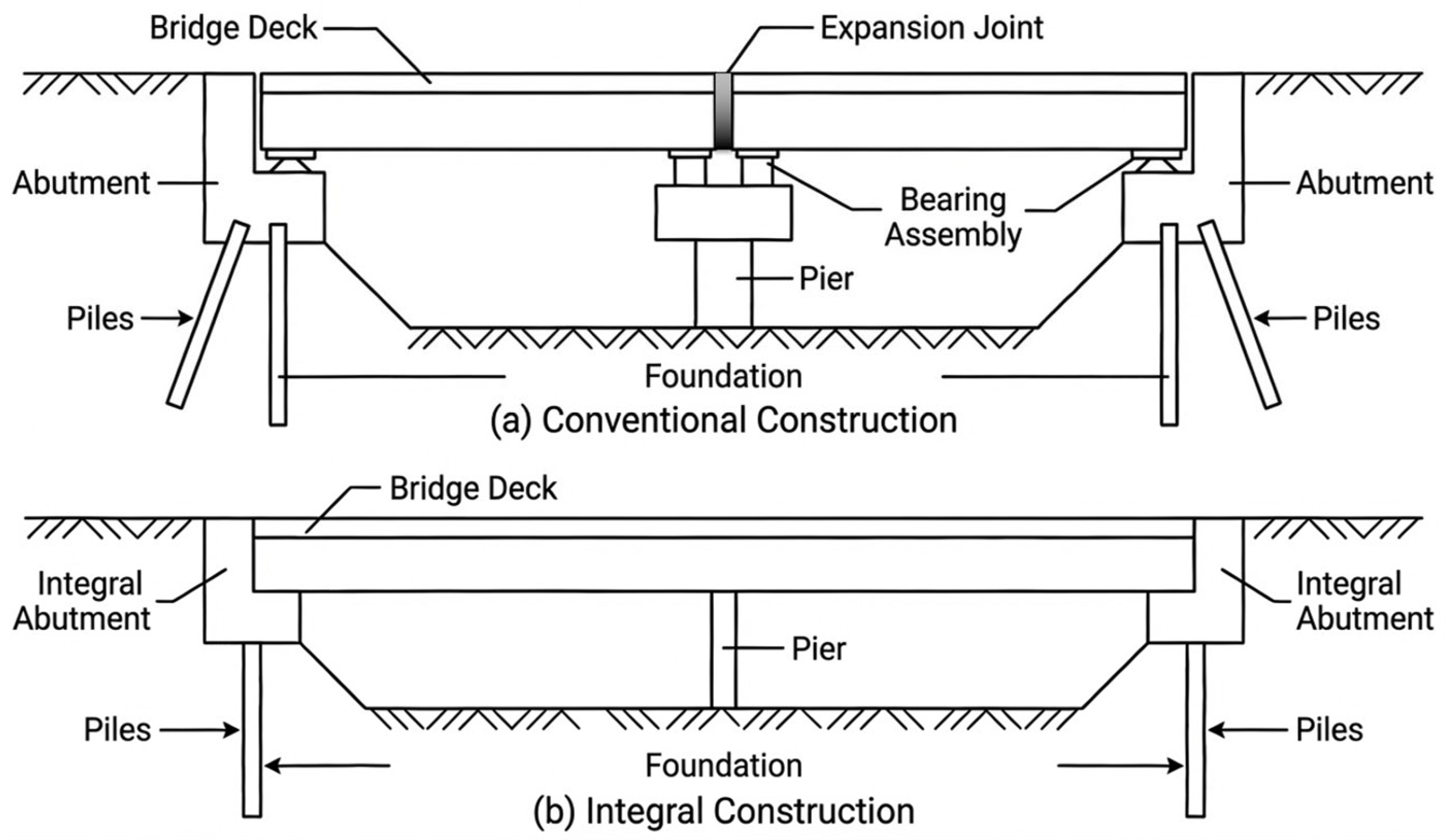
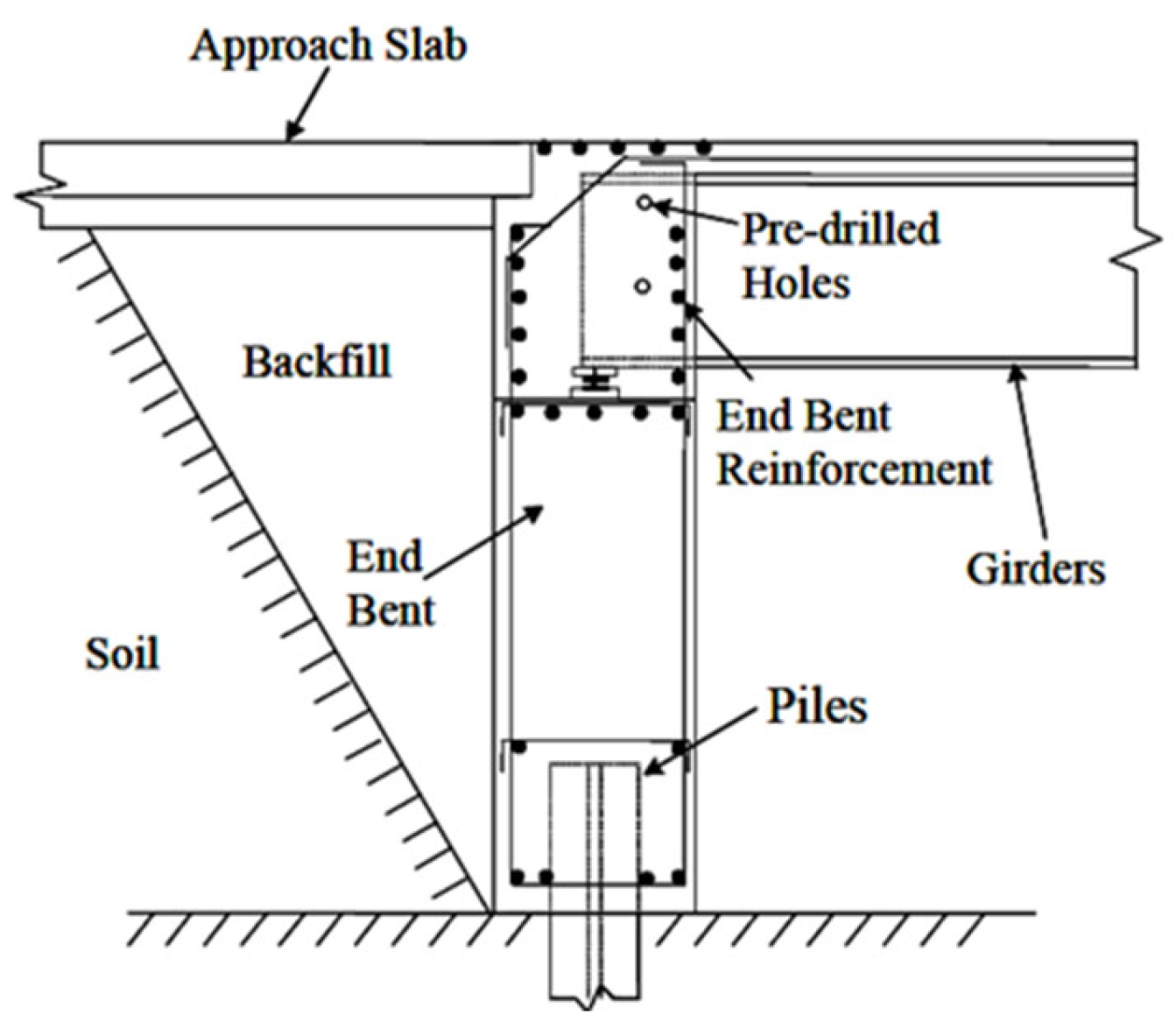
Integral abutment bridges (IABs), also referred to as “Jointless Bridges”, represent a significant advancement in bridge engineering philosophy. Conventional bridges rely on expansion joints and bearings to accommodate movements arising from thermal expansion, traffic loads, and other factors. These joints, however, are associated with significant maintenance issues: leaking, corrosion of adjacent steel elements and concrete surfaces, and a disproportionate share of the deterioration observed at girder ends, pier caps, and abutment seats, leading to high lifecycle costs and expensive repairs [1,2,3,4,5,6,7,8,9,10]. IABs address these issues by eliminating deck joints and bearings entirely, creating a continuous, monolithic system in which the deck, superstructure, and substructure respond cohesively to loading [3,8,10,11,12]. Figure 1 shows the difference between a “Conventional” and an “Integral Abutment Bridge”. The contrast between (a) and (b) reflects standard U.S. design practice for the two abutment types. Figure 2 shows the cross-section of a typical integral abutment showcasing the approach slab, backfill, end bent, piles, and girders.
The American Association of State Highway and Transport Officials (AASHTO) [13] defines an integral abutment bridge as a bridge without deck joints that has abutments rigidly connected to the superstructure and supported on spread footings or a single row of piles. The resulting frame action simplifies construction [10,12,14], lowers lifecycle costs [1,3,10,15], enhances structural redundancy [3,10], and improves resistance to seismic and other horizontal forces while providing greater longitudinal stiffness at the abutments [14,16,17,18,19,20]. Studies have also shown that IABs offer better long-term performance than conventional jointed bridges, particularly in cold climates, where freeze-thaw cycles and the ingress of de-icing chemicals through leaking joints accelerate deterioration [21,22,23]. Although less critical than these structural and durability advantages, IABs also offer improved aesthetics and better riding quality [2,5,21].
Despite having many advantages over conventional designs, IABs face several notable long-term challenges that may compromise their structural integrity [1,2,3,5,6,10,14,24,25]. Liu et al. [2] identify several critical concerns: (1) differential settlement between abutments and piers, which can impose additional shear forces and bending moments on the continuous frame system; (2) thermal expansion of the superstructure at elevated temperatures, which induces restraint moments in the deck and superstructure; (3) lateral pile movements driven by superstructure expansion and contraction, which can reduce vertical load-carrying capacity and, in severe cases, cause pile yielding through plastic-hinge formation [9,14,26]; (4) thermal contraction, which can trigger wingwall rotation and associated cracking [27]; and (5) unbalanced horizontal moments in skewed IABs caused by non-collinear abutment reactions [28]. Understanding and managing these effects are essential for both new designs and the retrofitting of existing infrastructure.
Figure 1. (a) Conventional jointed bridge with expansion bearings and battered piles at the abutments used to resist horizontal earth pressure. (b) Integral abutment detail showing a single row of vertical flexible piles, which accommodate cyclic thermal displacement of the superstructure without the excessive restraint that battered piles would generate.
Infrastructures 11 00163 g001
Figure 2. Cross-section of a typical integral abutment showcasing the approach slab, backfill, end bent, piles, and the girders [26]. Note: Copyright: No restrictions. This document is available to the public through the National Technical Information Service, Springfield, VA, USA.
Infrastructures 11 00163 g002

2. Literature Review

2.1. Development and Design Guidelines for IABs in the United States and Europe

In the United States, the first integral abutment bridge was constructed in Ohio in 1938. Since then, IABs have been widely adopted, with more than 13,000 currently in service and at least 32 states favoring them over conventional jointed bridge systems [29]. The evolution of IABs reflects a broader industry shift toward lower-maintenance, more sustainable infrastructure, with widespread adoption accelerating during the National Interstate Highway construction boom of the late 1950s and early 1960s [2,4]. According to Tabatabai et al. [20], approximately 73% of states allow the use of integral abutment bridges and about 65% of states prefer integral abutment bridges over conventional jointed bridges. In Europe, IABs were introduced later, gaining traction from the 1980s onward, although design and construction approaches differ considerably from those commonly adopted in the United States [30].
While both regions share the fundamental objective of eliminating deck joints to reduce maintenance costs, their design guidelines differ in geometric limits, structural philosophy, and treatment of soil–structure interaction. No unified national standard exists within AASHTO LRFD Bridge Design Specifications [13]; instead, the Federal Highway Administration (FHWA) and individual state departments of transportation (DOTs) have developed their own guidelines calibrated to local conditions including topography, predominant soil types, temperature ranges, seismicity, and wind exposure [2,3,4,6,20]. In the United States, the FHWA recommends maximum lengths of 91 m, 152 m, and 183 m for steel, cast-in-place concrete, and prestressed concrete girders, respectively, though some states permit considerably longer structures. Similarly, depending on the State, the skew angles (The skew angle is defined as the acute angle between the abutment centerline and the line perpendicular to the bridge longitudinal axis. A zero-skew bridge has abutments oriented at 90 degrees to the longitudinal axis; as skew increases, torsional effects and transverse force redistribution become significant, which is why several state DOTs impose upper limits on skew angle for IAB applicability.) limits can vary in the range of 20–45° [2,20]. The standard US configuration includes stub-type abutments on a single row of HP-piles oriented for weak-axis bending and is favored by over 70% of state agencies for their flexibility under thermal loading [4,6,20,23,30]. The state-specific guidelines typically address span and skew limitations, permissible abutment heights, wingwall geometry, pile orientation and type, and maximum allowable abutment displacement [31].
IABs are widely used in both North America and Europe, with U.S. state DOTs and European highway agencies having developed independent guidelines over the past four decades that reflect regional differences in climate, traffic loading, and construction practice. Based on the literature review comparing US and European practices [2,4,30,32,33,34,35,36], it can be concluded that overall US guidelines prioritize flexibility and practical applicability across a wide range of construction scenarios, while the European standards tend toward more conservative geometric limits with greater attention to the soil-structure interaction at the abutment backwall.
The present study adopts U.S. practice throughout, with loads and material specifications based on AASHTO LRFD and with design references drawn primarily from FHWA and state DOT sources.

2.2. In-Service Performance and Long-Term Behavior of IABs

Field monitoring studies of integral abutment bridges [4,23,29,37,38] have been instrumental in establishing realistic performance expectations for these structures. Lawver et al. [37] monitored an in-service IAB and confirmed that seasonal abutment displacements follow temperature cycles closely, with the magnitude of movement governed primarily by bridge length and the coefficient of thermal expansion of the superstructure material. Long-term field observations of bridges in Indiana, reported by Frosch et al. [34], demonstrated that pile strains at the abutment can reach or exceed yield for bridges at the upper end of the permissible span range, particularly during severe winter contractions. These findings highlight the importance of considering thermal load cycles in pile fatigue assessment for retrofit applications, where the piles were not originally designed for this mode of loading.
Sigdel et al. [4] conducted a comprehensive review of IAB performance data and identified recurring issues including approach slab settlement, backwall cracking, and pile yielding as the most frequently reported concerns. Despite these challenges, the authors concluded that overall field performance of IABs is superior to conventional jointed bridges in terms of long-term maintenance requirements and structural condition ratings.

2.3. Thermal Behavior and Structural Implications

Thermal movements are a primary design driver for IABs. Daily, seasonal, and annual temperature fluctuations induce cyclic longitudinal expansion and contraction in the bridge superstructure [2]. For statically indeterminate structures such as continuous-span bridges with integral abutments, these movements generate restraint forces and moments throughout the structure, with the most significant effects concentrated at the abutments and in the foundation piles [39]. Research has shown that thermal stresses can be significant in both steel and concrete bridges under certain conditions, including bridges with fully restrained abutments or those subject to extreme temperature ranges [27].
The response of the abutment backfill soil to cyclic thermal movements further complicates behavior. As the bridge expands during warm months, passive earth pressure builds behind the abutment; during contraction in cold months, the pressure drops and the soil may not fully recover, leading to an asymmetric ratcheting phenomenon [40]. Pile testing in integral abutment systems has shown that lateral displacements as small as 12.7 mm (0.5 in.) are sufficient to induce yielding at the pile head [12]. This finding has significant implications for design, since thermally driven abutment movements of this magnitude are routinely expected over a bridge’s service life. Recognizing that pile yielding is effectively unavoidable rather than a failure condition to be prevented, Abendroth et al. [41] proposed shifting the design philosophy away from elastic stress limits toward a ductility-based approach. Under this framework, the pile’s ability to sustain axial and lateral loads through repeated cycles of inelastic deformation, and its susceptibility to low-cycle fatigue over time, become the governing design considerations.
The magnitude of estimated bridge movement is also central to the acceptability of integral construction. Roeder [42] observed that improperly estimated thermal movements may lead to either over-design or inappropriate rejection of integral solutions. Accurate movement prediction requires accounting for the coefficient of thermal expansion of both steel and concrete components, the construction temperature, and the applicable temperature range for the bridge site per AASHTO procedures.

2.4. Soil-Pile Interaction and Pile Foundations in IABs

The interaction between foundation piles and the surrounding soil is among the most critical and uncertain aspects of IAB behavior. The pile acts as a flexural member subjected to lateral displacement imposed at its head by the thermally driven movement of the abutment, while also carrying vertical loads from dead and live load reactions [6].

2.4.1. Soil-Pile Interaction Model

Soil-pile interaction is commonly idealized using a Winkler-type beam-on-elastic-foundation model, in which the surrounding soil is represented by discrete springs distributed along the embedded length of the pile, with each spring acting independently and proportional to local pile deflection [43]. For IAB pile foundations, the spring stiffnesses are typically derived from p-y curves, which express the lateral soil resistance per unit length as a function of pile displacement and vary with soil type, effective stress, and depth [44]. The p-y relationship (where p is the lateral soil pressure against the pile and y is the corresponding lateral pile displacement) is commonly idealized as elastic–perfectly plastic, with an initial stiffness that increases with depth and an upper bound defined by the ultimate soil resistance [44,45].
For finite element analyses, the use of linear elastic springs to represent soil resistance is supported by a body of experimental and analytical evidence [7,46]. Xue [46] notes that various approaches have been used to calibrate spring stiffness values, including code-specified values for different soil types, stiffness derived from lateral earth pressure–displacement relationships, and values obtained from experimental or field data. Although this representation simplifies the inherently nonlinear soil response, parametric studies of IAB foundations have consistently shown that pile stresses and longitudinal displacements are relatively insensitive to reasonable variations in soil stiffness across a wide range of conditions [11,34]. This finding supports the use of linear elastic springs in the present model, where the primary objective is to evaluate relative changes in structural response rather than to carry out a detailed nonlinear geotechnical simulation.

2.4.2. Pile Foundations

The orientation of H-piles relative to the direction of thermal movement has a significant influence on pile flexural demand. Many state DOTs [4,6,15,20,47] require weak-axis bending orientation to minimize lateral pile stiffness and reduce restraint forces, though this recommendation is not universal across DOTs, as summarized by Liu et al. [2]. For pipe piles and for situations where thermal movements occur in multiple directions (as in skewed bridges), pile orientation becomes a more complex optimization problem [26].
In IAB pile analysis, the soil-pile system is commonly simplified by treating the pile as a cantilever with a fixed base at some depth below the ground surface [7,41]. Vasconez et al. [29] reports that there is no consensus on how to determine the pile length of fixity, with some states using empirical methods while others employ finite element analysis of the soil-pile interaction. The lateral modulus of subgrade reaction of the surrounding soil has been shown to influence the depth of the pile point of fixity and the distribution of bending demand along the pile [42], though its effect on peak pile stress is relatively insensitive over a wide range of soil stiffness values, as noted in Section 2.4.1 [11,34] and also confirmed by the study presented in this paper.
Approximate guidance is provided in AASHTO LRFD Commentary C10.7.3.13.4 [13], which identifies the first point of zero lateral deflection from a p-y analysis as a rational basis for locating the fixity point [22]. Experimental measurements from instrumented IAB pile tests have recorded fixity depths in the range of approximately 5 to 7 ft (1.5 to 2.1 m) below the ground surface for steel H-piles in clay and compacted fill [34]. Analytical models of the same test configurations predicted a fixity depth of approximately 5 to 6 ft, in good agreement with the measured response [34]. These values are consistent with the range of equivalent cantilever lengths computed from the Abendroth et al. [41] method for medium to stiff soil conditions. Other parametric studies have shown that a fixed-base boundary condition placed at twice the estimated depth of inflection produces displacement results consistent with those from full spring models, providing a practical simplified approach [34].

2.5. Retrofitting Existing Bridges with Integral Abutments

The concept of converting existing jointed bridges to integral or semi-integral configurations has gained broad acceptance in the United States as a durable and cost-effective repair strategy. Such conversions are most commonly undertaken when expansion joints and bearings have failed or when abutment damage attributable to excessive thermal movements necessitates intervention [38,46,48,49,50]. Burke [10] concluded that the IAB approach has been predominantly applied to retrofit single and multi-span moderate-length continuous bridges with expansion joints over rigid abutments. Surveys by the Rhode Island DOT [50] and by Kunin and Alampalli [21] documented IAB retrofitting activity in multiple states including Colorado, Tennessee, Illinois, Kansas, Oklahoma, and South Dakota.
The decision to retrofit a bridge as an IAB must be preceded by a thorough structural evaluation. Existing piles, which were designed under the original jointed configuration, may not have been sized to carry the additional bending demands imposed by integral action. Concrete abutment caps and superstructure elements near the abutment must also be evaluated for the additional restraint moments introduced by fixity at both ends of the structure. Where full integral conversion is not feasible (due to excessive pile demand, unsuitable soil conditions, or geometric constraints), semi-integral abutments or alternative bearing configurations can offer an intermediate solution that retains many of the maintenance benefits of integral construction while limiting restraint forces [51]. The present study examines precisely this scenario, in which full integral conversion was found to exceed the capacity of the existing piles, motivating the evaluation of an alternative solution.

2.6. Finite Element Methods for IAB Analysis

Finite element modeling has been widely applied in both US and Europe to evaluate IAB behavior under thermal and service loading, with studies employing both two- and three-dimensional approaches to capture nonlinear pile response, soil-structure interaction, and the effects of skew and bridge length on structural demand [21,25,29,34,46,52,53,54,55,56,57,58,59,60,61,62,63]. Typically, two-dimensional (2D) models use beam and frame elements for girders, piles, and abutment, with Winkler-type springs for soil-pile interaction [34]. In the literature, 2D models have been shown to produce results in good agreement with field measurements for bridges with low or zero skew, as well as having better suitability for parametric studies [34,57,58,60,62,63]. Most three-dimensional (3D) models found in the literature consist of thick-shell elements for various components of the bridge and are better suited to capturing transverse load distribution, torsional effects, and skew-induced behavior [11,34,59], though at greater modeling and computational effort [60]. It must be noted that, alongside physics-based finite element approaches, data-driven and surrogate modeling frameworks [64,65] have seen increasing application in structural bridge assessment representing a complementary direction for structural assessment problems where large parametric datasets are available.

3. Bridge Description and Background

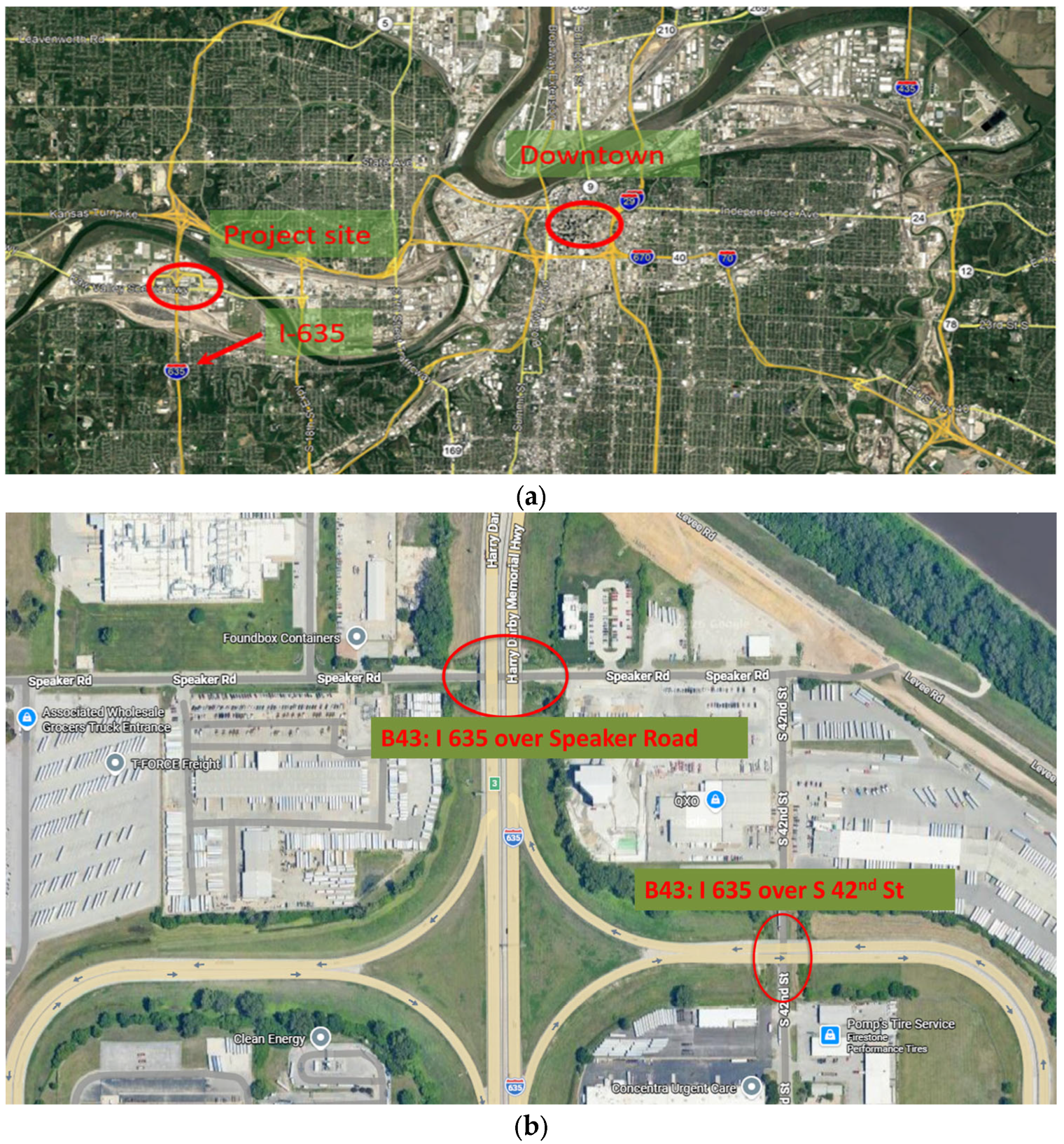
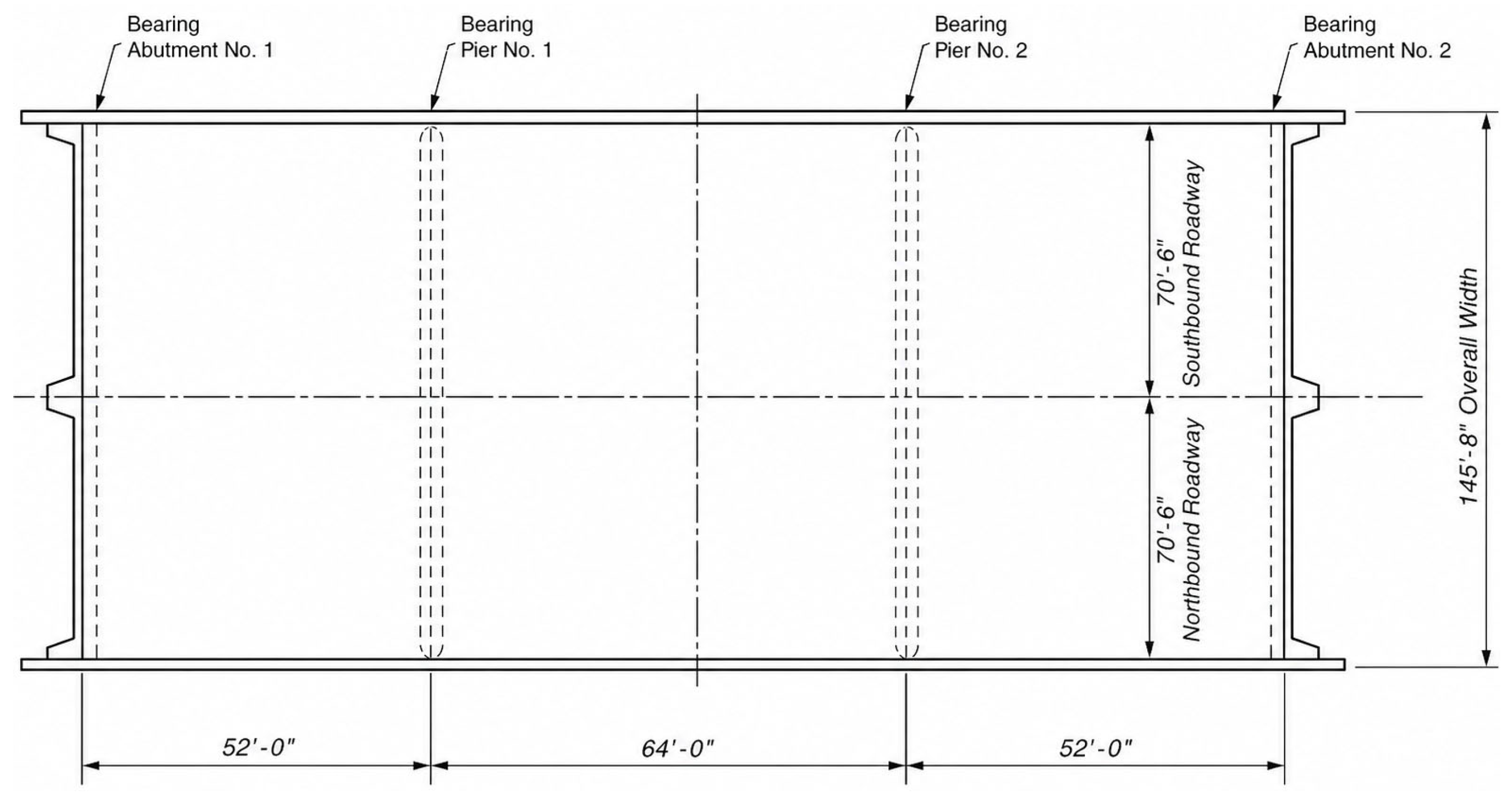
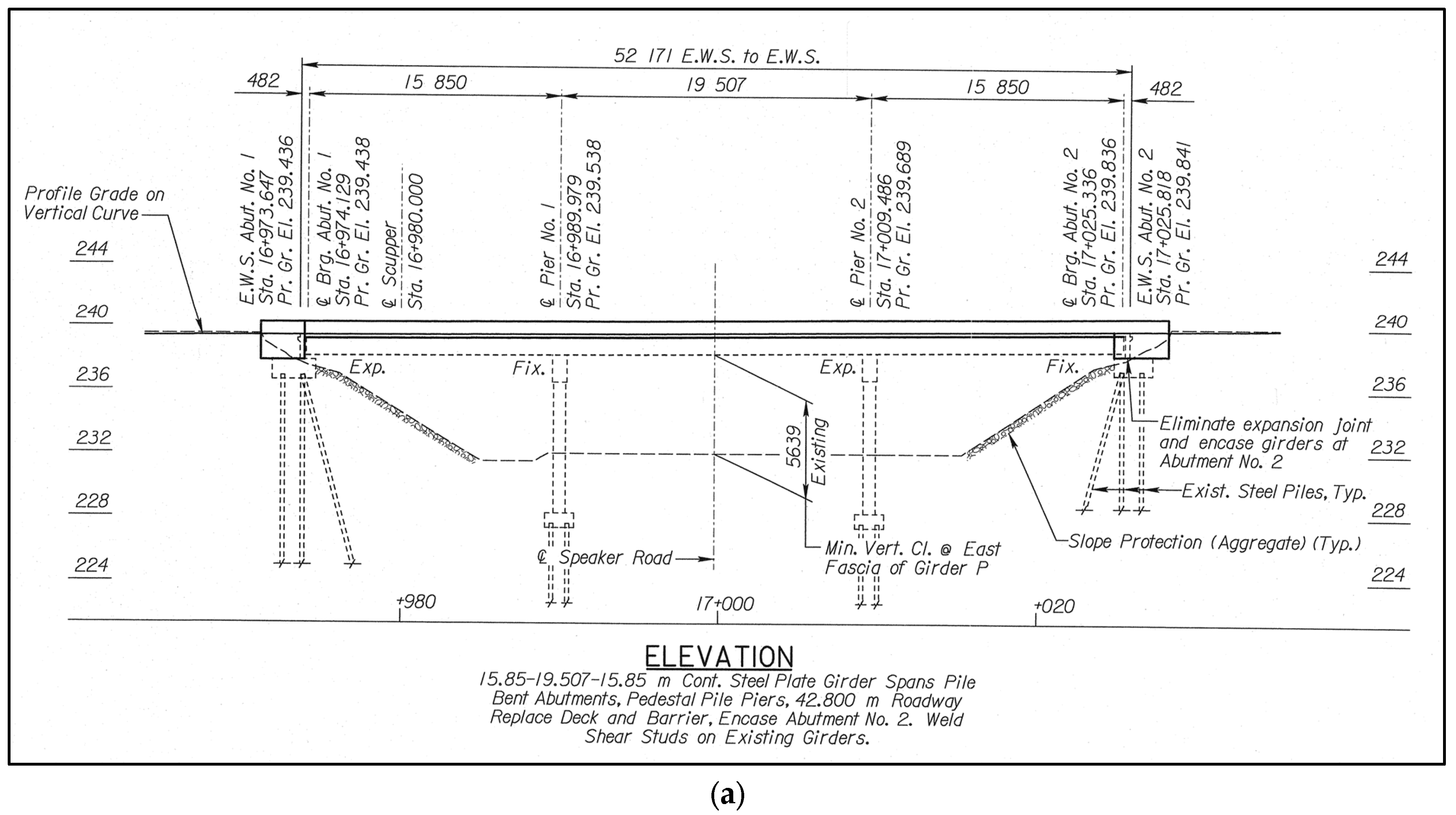
The bridges under investigation are designated B-42 (Bridge 635-105-3.38) and B-43 (Bridge 635-105-3.56), located in Kansas City, Kansas (Figure 3). Both structures carry Interstate 635 traffic and share the same three-span configuration with continuous steel plate girder superstructures spanning 52-64-52 ft (15.85-19.51-15.85 m). The two bridges differ in transverse width: B-42 has a total deck width (out-to-out) of 81 ft 8 in. (24.89 m) carrying nine girders, while B-43 has a total deck width of 145 ft 8 in. (44.40 m) carrying sixteen girders. The bridges were originally constructed in 1972 and had their decks replaced in 2002. The general layout of bridge B-43 is shown in Figure 4.
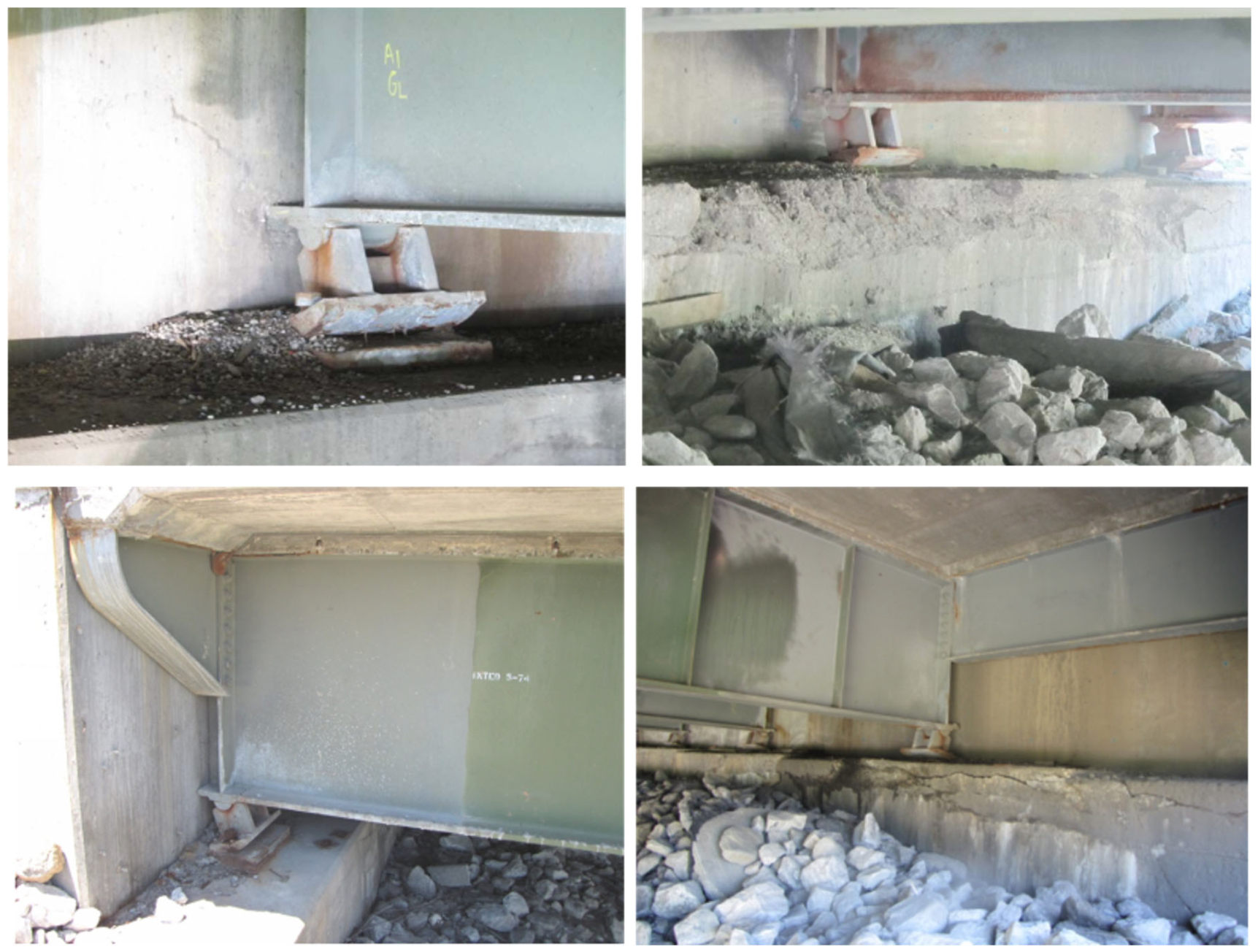
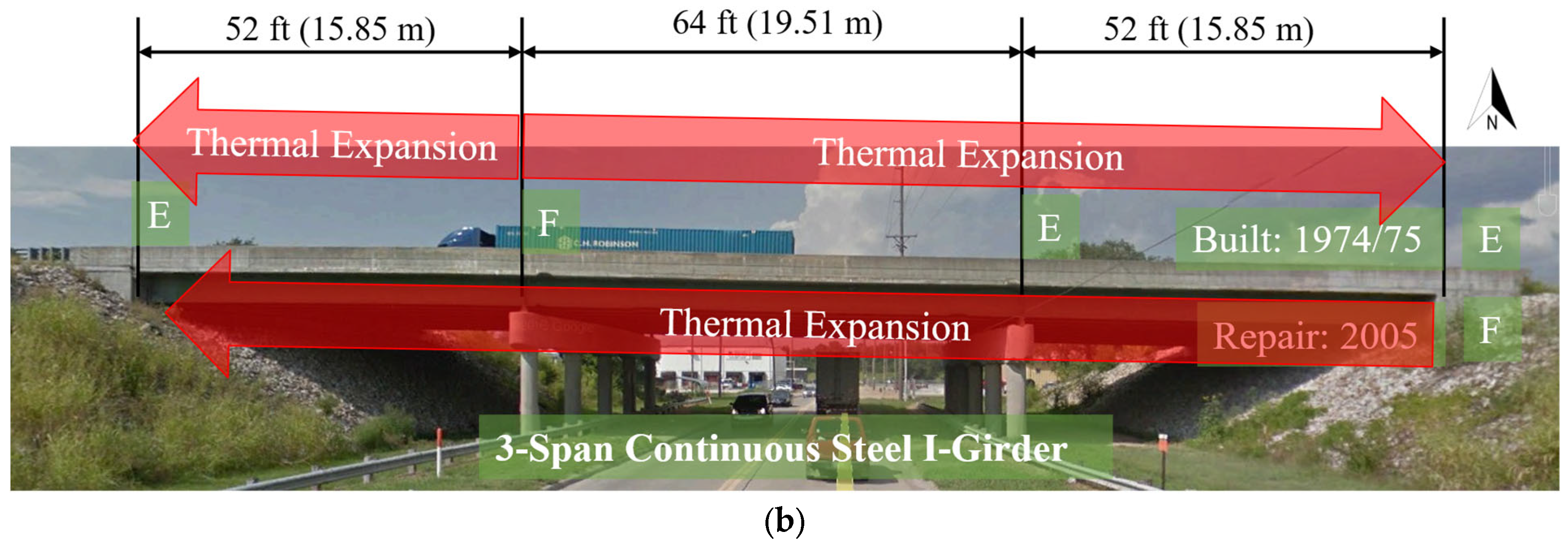
Inspection campaigns conducted in 2011, 2015, and 2017 revealed progressive deterioration at the abutments of both bridges. The 2017 inspection report documented severe damage to the concrete abutment cap at one end of B-43, including spalling and cracking consistent with bearing failure, and also observed that the steel plate girder was making direct contact with the backwall indicating that the available expansion gap had been exhausted (see Figure 5). These findings were attributed to excessive longitudinal thermal movement concentrated at the non-integral abutment, which had occurred after the opposite abutment was made integral through the casting of a concrete diaphragm during 2005 repairs. With one abutment providing full fixity, all thermally induced elongation and contraction of the superstructure was directed toward the remaining non-integral end, exceeding the displacement capacity of the existing bearings and generating large compressive forces on the concrete backwall during thermal expansion. See Figure 6 for an illustration of the problem.
In response, Kansas Department of Transportation (KDOT) proposed making both abutments integral as this is a common retrofitting method in such cases [10,38,47,48,49]. However, it was important to evaluate the structural implications of this proposal, with particular attention to the adequacy of the existing HP 10 × 42 (HP 10 × 42 is American Institute of Steel Construction (AISC) imperial designation. Equivalent in SI units will be HP 250 × 62 (nominal). Note: 1 inch = 25.4 mm, 1 lb/ft = 1.48816 kg/m.) piles and the concrete abutment caps under the combined thermal and gravity loading that would result from bilateral integral fixity. A finite element approach was deemed appropriate for the analysis and Bridge B-43 was selected as the primary structure for modeling since it had sustained more severe damage than B-42. The following section explains the finite element investigation in detail.

4. Finite Element Investigation

4.1. Preliminary Finite Element Model: Validation Against Field Observations

Prior to developing the detailed finite element model described in Section 4.2, a preliminary model of the existing bridge configuration was constructed to confirm the structural mechanism responsible for the abutment distress documented in the 2011 to 2017 inspection campaigns. The objective of this model was not to evaluate a proposed repair, but to validate the finite element model by comparing distressed regions highlighted by the model to the field observed deterioration.
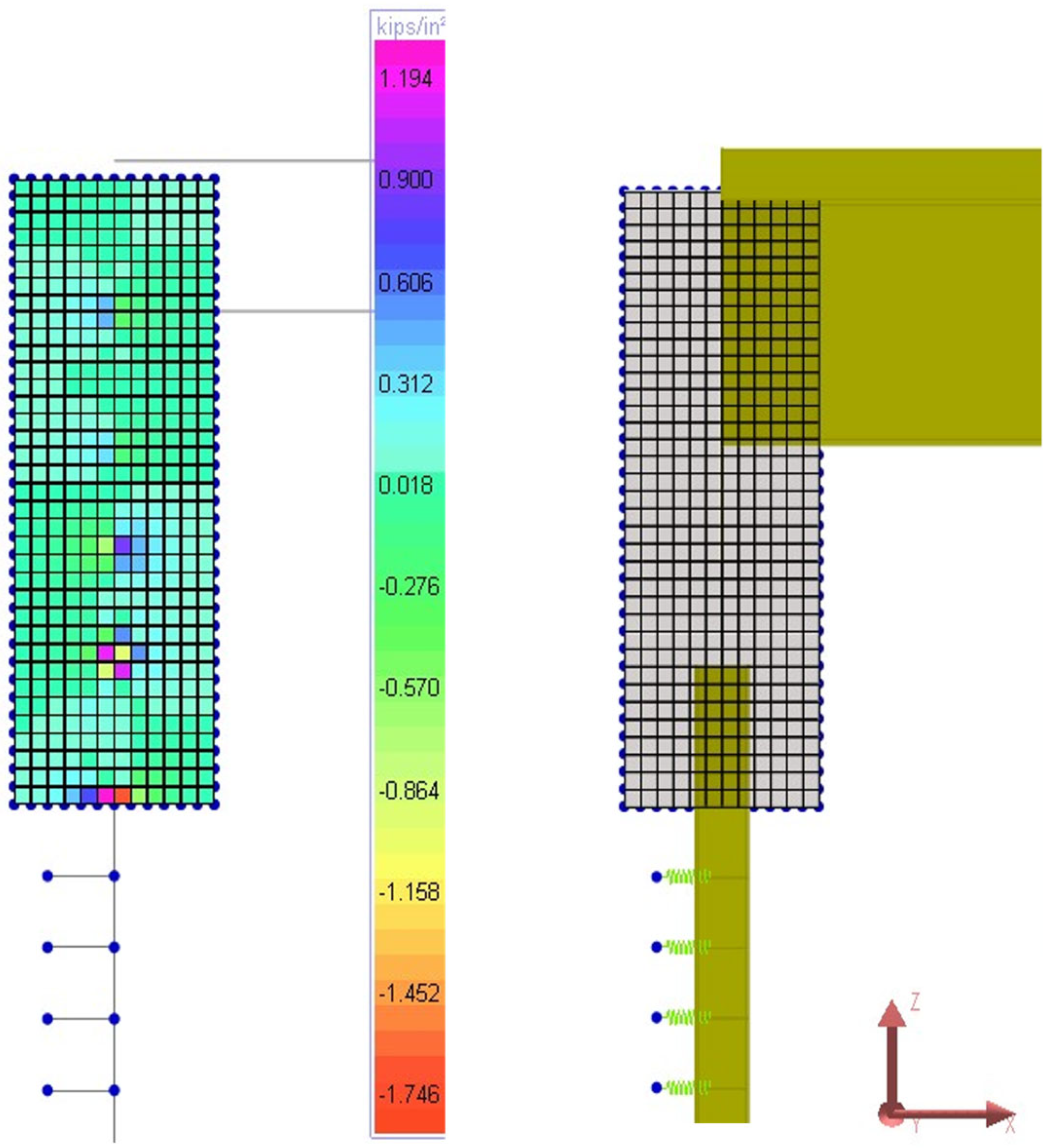
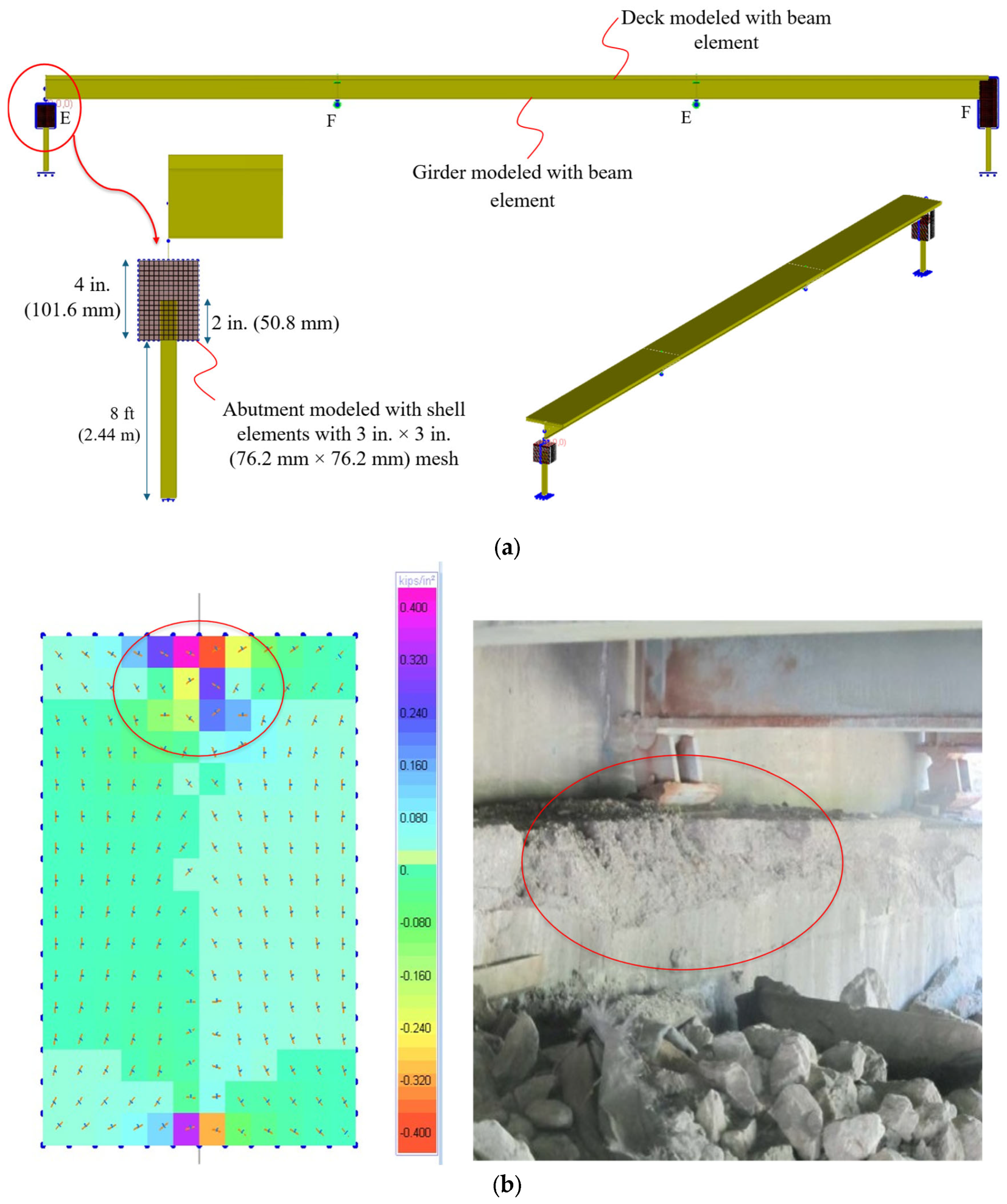
The preliminary model represented the bridge in its post-2005 condition (see Figure 6a,b), in which one abutment had been made integral through the casting of a concrete diaphragm (fixed, F), while the opposite abutment retained its original expansion bearing configuration (expansion, E). In this model (Figure 7a), the deck and girder were represented by beam elements, and the abutment was modeled using shell elements with a 3 in. × 3 in. (76.2 mm × 76.2 mm) mesh. HP 10 × 42 piles were modeled with a single-row vertical configuration, consistent with the as-built plans, with alternate battered piles addressed through conservative assumptions (discussed later in Section 4.5). The piles were modeled as beam elements with an assumed fixity at 8 ft (2.44 m) below the abutment cap and a 2 ft (0.61 m) free length above the cap. Thermal loading was applied consistent with the AASHTO Procedure A temperature range for the bridge site. More details of the fixity assumptions and calculation of thermal loads are provided in Section 4.2, Section 4.3, Section 4.4, Section 4.5, Section 4.6 and Section 4.7.
The qualitative results of this model confirmed that the one-sided integral configuration concentrates the full thermal displacement demand at the expansion abutment (Figure 7b). With the integral end providing complete longitudinal fixity, the superstructure was unable to elongate freely and directed all thermally induced movement toward the remaining non-integral end. This produced large compressive forces on the concrete backwall during thermal expansion and excessive bearing displacement, both of which are consistent with the girder-to-backwall contact and bearing failure documented in the 2017 inspection report. This agreement between the model predictions and the documented field conditions constitutes the qualitative validation for the model and provides confidence in the modeling approach as well as the element configuration adopted for the proposed repair evaluation in the subsequent sections. The model correctly predicts: (1) concentration of thermal displacement at the non-integral abutment; (2) compressive failure of the abutment cap concrete; (3) girder-to-backwall contact due to exhaustion of the expansion gap; and (4) absence of distress at the piers, all consistent with inspection findings from 2011 to 2017.
Having confirmed the cause of damage, the investigation proceeded to assess the proposed repair strategy of converting the remaining expansion abutment to full integral action, making both ends of the bridge fixed. This evaluation required a more refined model, described in the following sections.

4.2. Overview and Modeling Philosophy

A two-dimensional finite element model of Bridge B-43 was developed in LARSA 4D version 8.00r8000 [66] to evaluate the structural response under the proposed full-integral configuration. A full three-dimensional model with solid elements was deemed impractical given the time and data constraints of the investigation. Also, the inspection findings indicated that structural damage was confined to the longitudinal direction, with no evidence of significant transverse distress, justifying the use of a 2D representation. A linear-elastic analysis was deemed appropriate for determining whether pile stresses exceed allowable limits under the proposed full integral configuration. Section 4.8 discusses the modeling limitations in more detail.
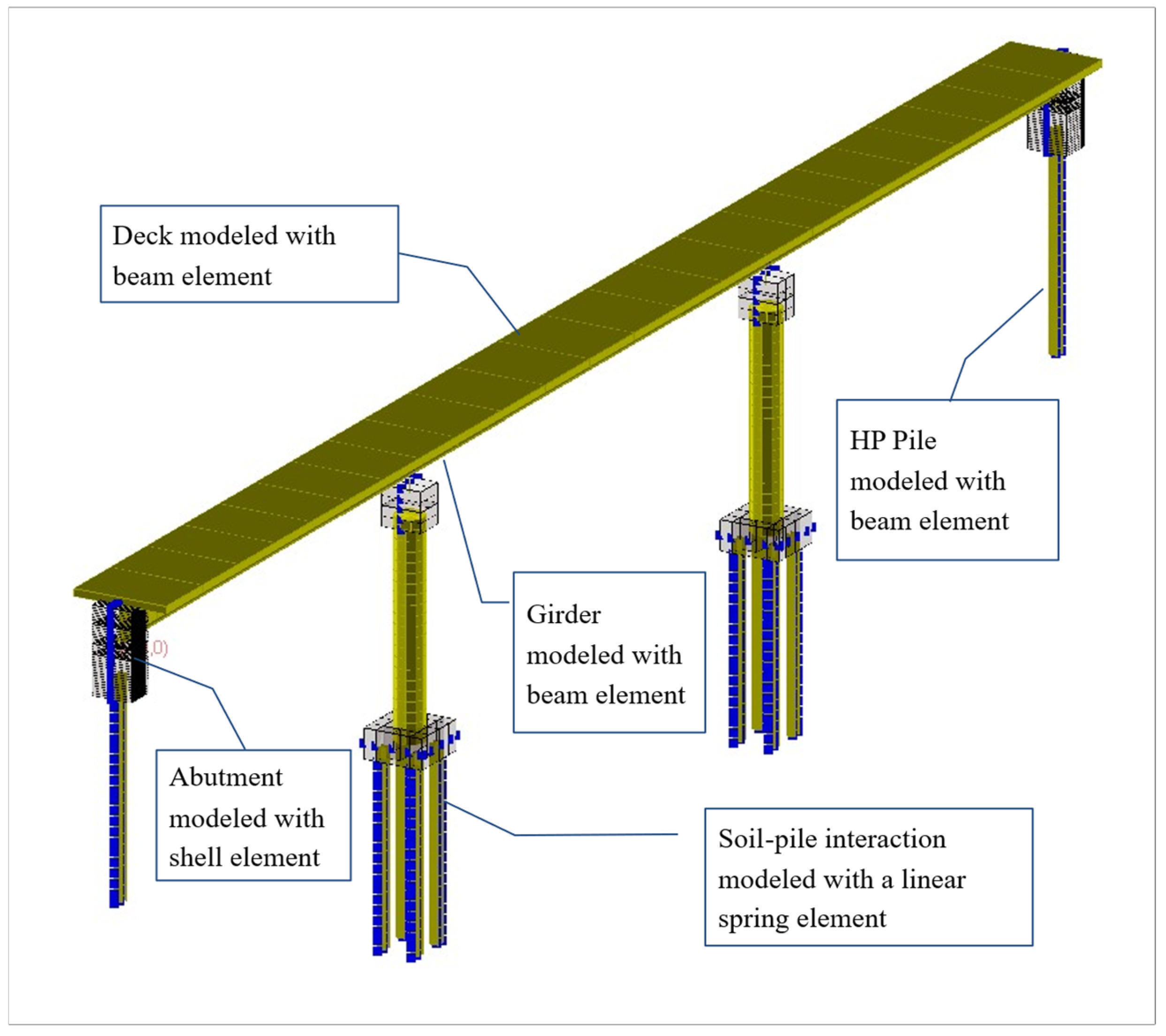
The model captured the full structural system from abutment to abutment, incorporating the superstructure, abutment caps, pier caps and columns, pile foundations, and the lateral stiffness of the surrounding soil. The LARSA 4D software platform provides beam, shell, and spring elements suitable for this type of analysis and has been widely used in bridge engineering practice. Table 1 shows the material properties used in the model, which are closely related to the actual material properties found in the original drawings. The general layout of the model is shown in Figure 8.

4.3. Superstructure

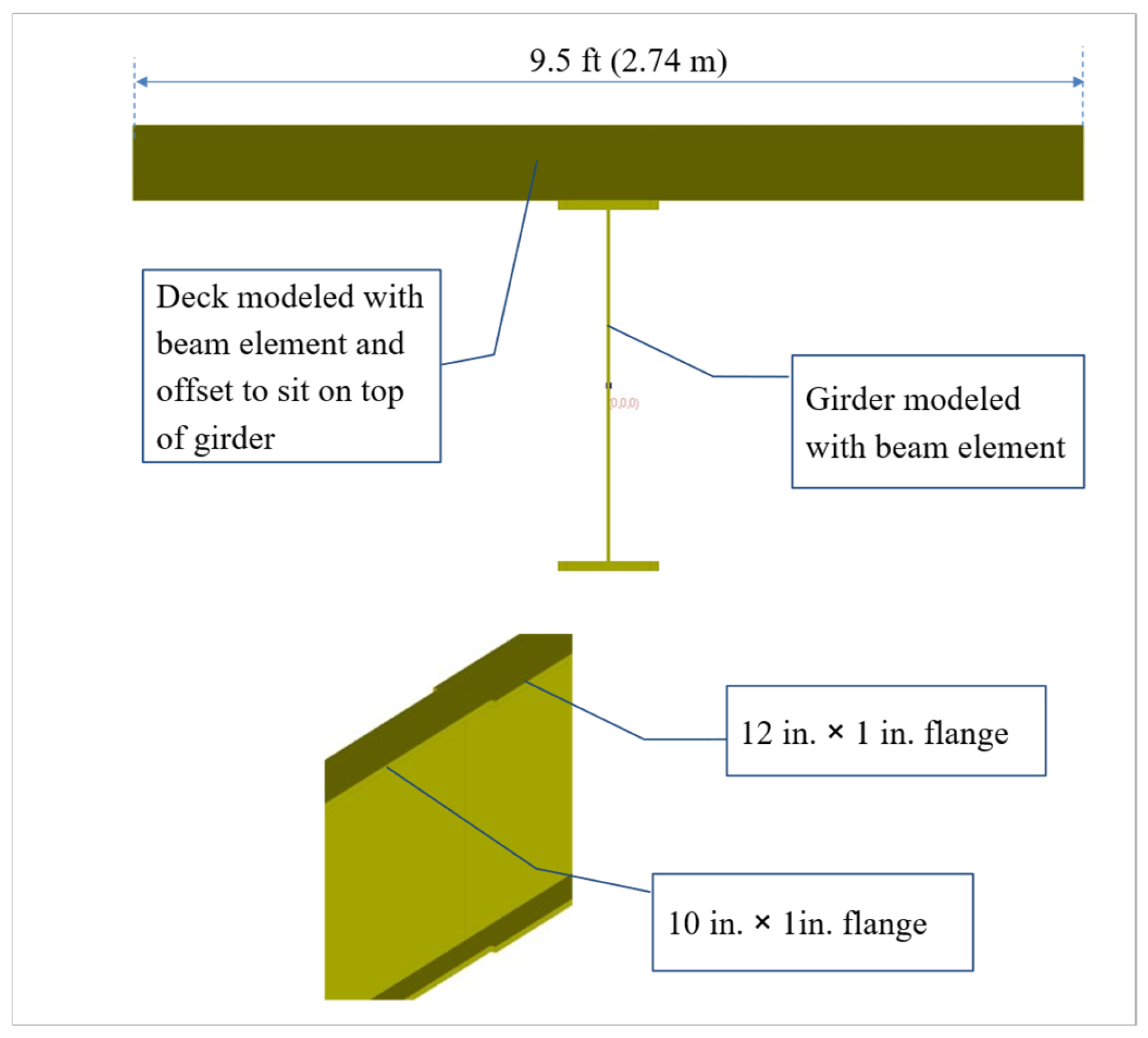
A single composite girder-deck system was modeled, representing one girder with a tributary deck width equal to the girder spacing. Inspection pictures showed substantial effects on structure due to longitudinal thermal movement; however, no significant transverse movement or damages were observed. Therefore, modeling the entire width of the bridge was deemed unnecessary. Both deck and girder were modeled with line beam elements to keep the superstructure simplified. Separate beam elements were used for girders and deck because of the difference in material and cross section of the deck. The concrete deck was modeled using beam elements geometrically offset to the top of the girder, with composite action enforced through shared joints/nodes at the deck-girder interface, as shown in Figure 9. Variations in girder flange sizes were also modeled to stay true to the original configuration.

4.4. Substructure: Abutments and Piers

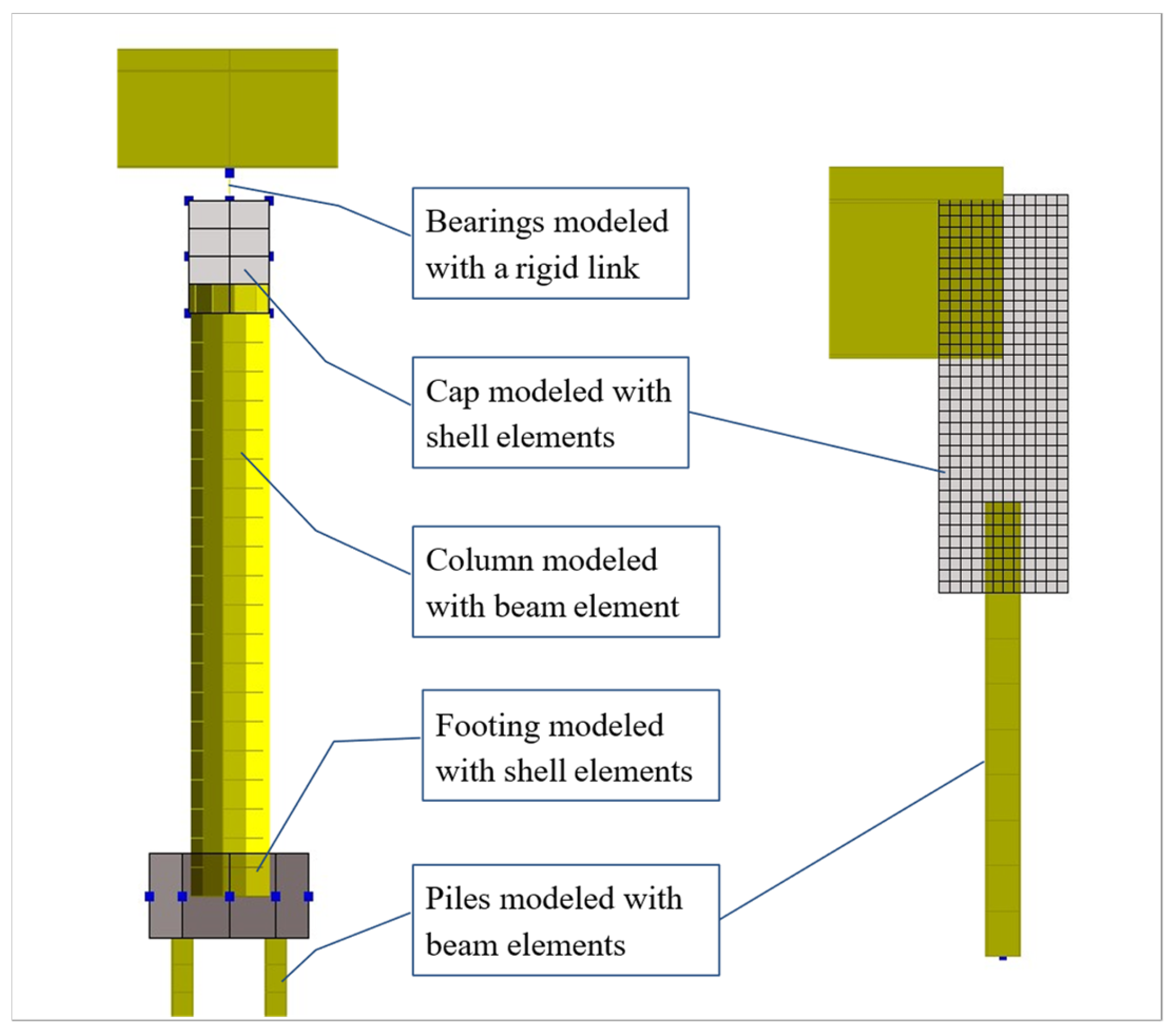
Pier caps and foundations were modeled using shell elements, while columns and piles were modeled as beam elements. At the piers, girder bearings were represented as rigid links connecting the centroid of the girder to the pier cap, consistent with the pinned-to-fixed bearing arrangement at the piers. At the abutments, thick shell elements were used to model the concrete cap, capturing shear deformation effects that are significant in the relatively stocky abutment geometry. This level of detail at the abutments was necessary given that the primary structural concerns identified in the inspection reports were concentrated at these locations. Figure 10 shows the details of the abutment model.

4.5. Modeling of Pile Foundations

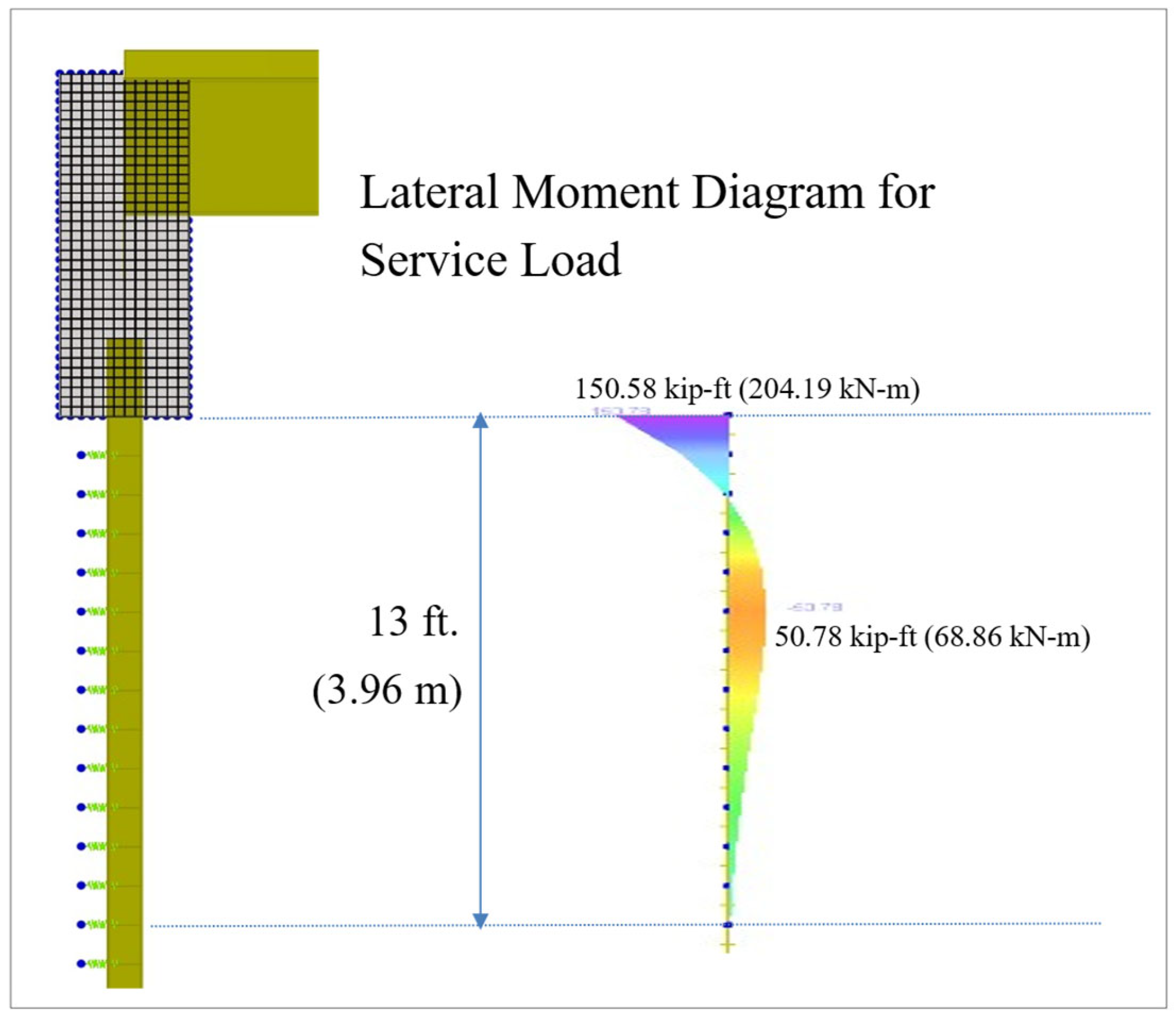
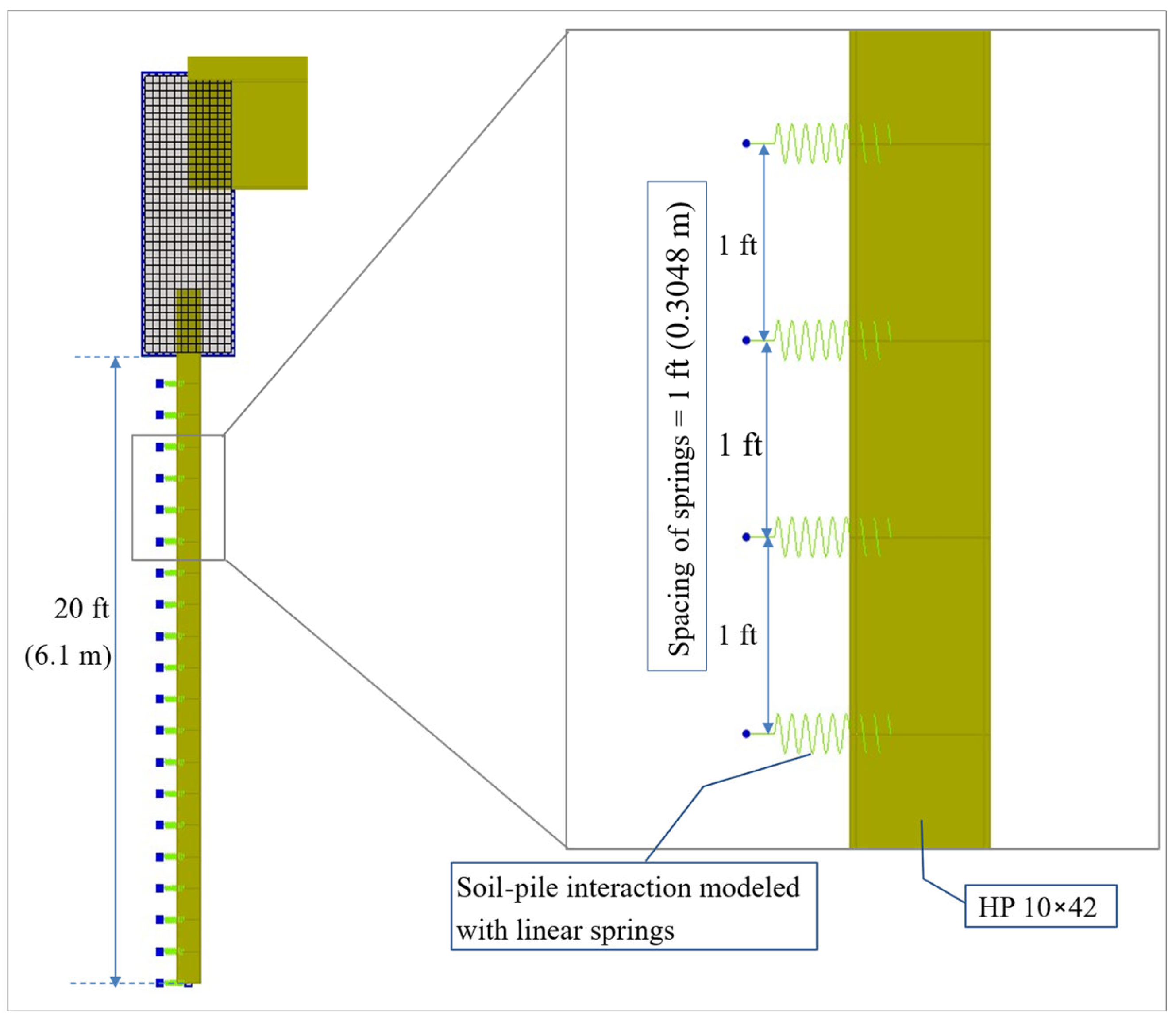
Foundation piles were modeled with beam elements of standard HP 10 × 42 section. Bridge plans indicate that piles are spaced at 9.5 ft on center, and alternate piles are battered at 3 in. per 12 in. (76.2 mm per 304.8 mm). Therefore, the thermal movement from a girder in the superstructure is either resisted by a vertical pile or a battered pile or both depending on proximity of the girder bearing to the pile type (battered or vertical). For this model, it is assumed that the girder bearing is directly in line with a straight vertical pile. Furthermore, bridge plans indicated that road fill material extends to a depth of 20 ft (6.1 m) below the bottom of the abutment cap beam at both bridge sites. Accordingly, piles were modeled as 20 ft (6.1 m) long, with the point of fixity assumed to fall within this depth. Based on the literature reviewed in Section 2.4.2, and consistent with common practice for preliminary pile modeling, the fixity point was initially assumed at 8 ft (2.44 m) below the bottom of the abutment cap beam. The detailed finite element (FE) model, however, revealed that the actual point of fixity under the applied loading conditions occurs at approximately 13 ft (3.96 m) below the bottom of the abutment cap beam, as shown in Figure 11. This result is consistent with the understanding that the fixity depth is load-dependent and sensitive to soil type and pile section properties, as discussed in Section 2.4.2. The initial assumption of 8 ft (2.44 m) therefore represents a conservative estimate, producing a shorter effective cantilever length and consequently higher predicted pile stresses than those computed in the detailed model.

4.6. Soil-Structure Interaction

4.6.1. Modelling and Assumptions

Soil–pile interaction was represented by linearly elastic lateral springs distributed along the embedded pile length at 1 ft (0.3048 m) intervals, with spring stiffness values calibrated from the established literature [68]. While this idealization simplifies the inherently nonlinear soil response, its suitability for the present comparative analysis is discussed in Section 2.4.1.
Lateral stiffness of soil is typically expressed in terms of resilient modulus or lateral modulus of subgrade reaction. Resilient modulus is the ratio of stress to strain of soil and depends on various soil parameters, such as soil type, moisture content, dry density, etc. [68]. The lateral modulus of subgrade reaction is a conceptual relationship between soil pressure and deflection that is widely used in the structural analysis of foundation members [69]. Both the resilient modulus and the lateral modulus of subgrade reaction can be used to characterize the soil-pile interaction, which is modeled by attaching linear springs to the pile, as shown in Figure 12. However, lateral modulus of subgrade reaction is more pertinent in this case because piles are expected to move in the lateral direction due to thermal loads.
Table 16-4 in reference [69] shows range of values of lateral modulus of subgrade reaction (ks) for different soils in wet and dry conditions. Bowles [69] recommends using a reasonable value of ks when pile load tests are not available. Original bridge plans of both bridges indicated road fill layer from the top surface to approximately 20 ft (6.1 m) below the abutment cap. Road fill is generally composed of a mix of medium sand (ks range from 700 kcf (109.9 MN/m3) to 1800 kcf (282.7 MN/m3)) and fine or silty, fine sand (ks range from 500 kcf (78.5 MN/m3) to 1200 kcf (188.5 MN/m3)). In the absence of more details on type of soil, it is reasonable to assume an average value of ks that is (700 + 1800 + 500 + 1200)/4 = 1050 kcf (165 MN/m3).
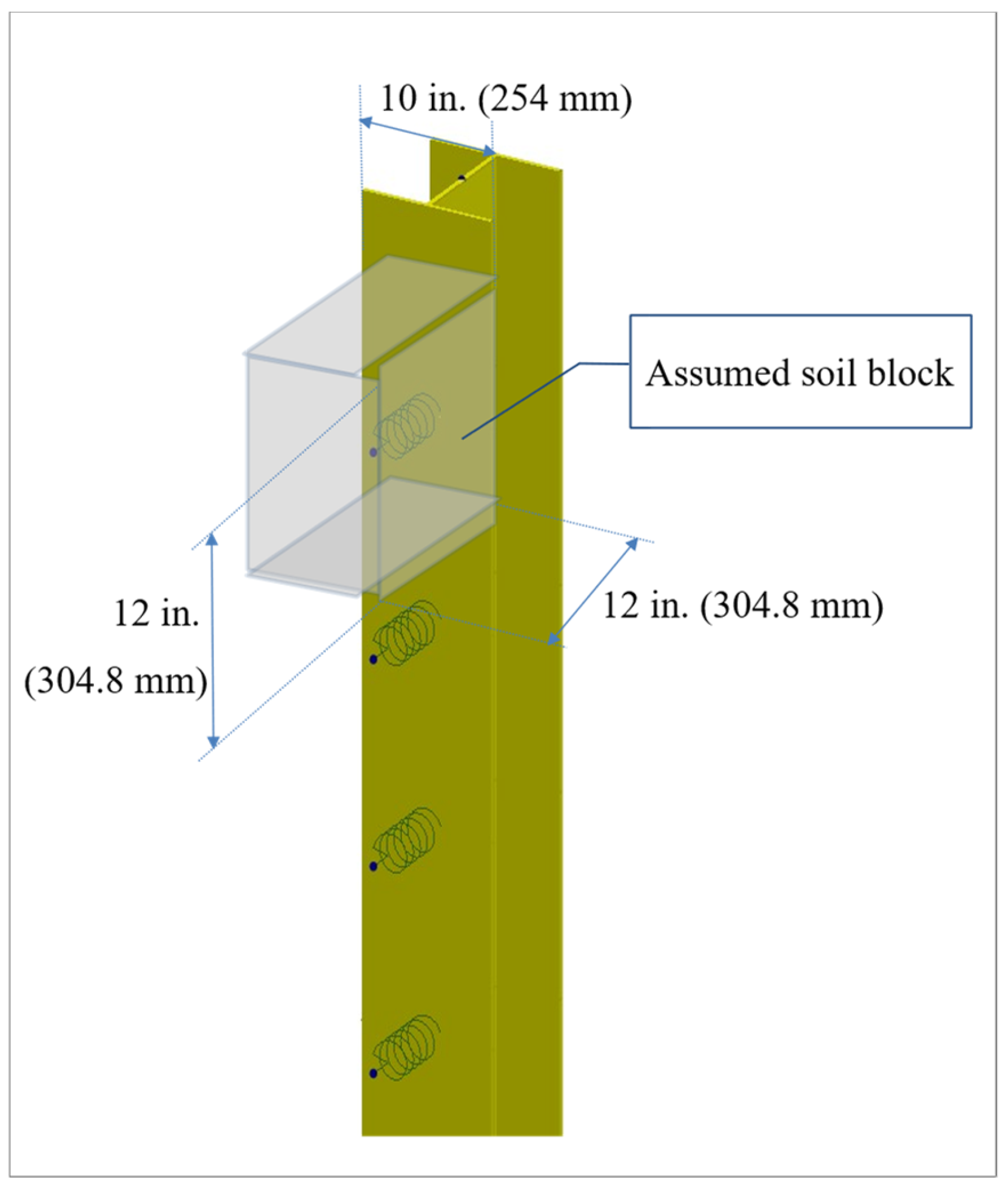
The value of ks computed above was used to the compute spring constant of the springs used in the finite element model. To compute the spring constant, it was assumed that a spring represents a 10 in. × 12 in. × 12 in. (254 mm × 304.8 mm × 304.8 mm) block of soil, as shown in the Figure 13. Using the dimension of soil block shown in Figure 13 and ks = 1050 kcf (165 MN/m3), the spring constant can be calculated as 1050/123 × 10 × 12 = 73 kip/in (12,784.27 kN/m).

4.6.2. Sensitivity of Pile Stress to Soil Stiffness

To assess the influence of the adopted ks value on the computed pile stresses, a sensitivity analysis was carried out by varying the spring constant across a range of ks values spanning the lower and upper bounds of the soil types identified above. The results, summarized in Table 2, show that the variation in thermally induced pile stress is small across the full range considered. As ks increases from 1000 kcf (157.1 MN/m3) to 2500 kcf (392.7 MN/m3), the compressive stress in the pile due to thermal expansion changes from 23.10 ksi (159.3 MPa) to 24.20 ksi (166.9 MPa), a variation of approximately 5% despite a 2.5-fold increase in spring stiffness. This confirms that the adopted spring stiffness has only a secondary influence on peak pile stress, consistent with the findings reported in the literature review in Section 2.4 [11,34], and justifies the use of a single representative ks value for the primary analyses.

4.7. Loading

The model was subjected to four types of loading: dead loads, live loads, braking loads, and thermal loads. The load combinations were applied in accordance with AASHTO LRFD Table 3.4.1-1 [13]. The details of the loading are provided below.

4.7.1. Dead Loads (DC)

Dead loads (DC-) consisted primarily of the self-weight of the composite girder–deck system, representing one girder with tributary deck width. Barrier and utility dead loads were considered negligible and excluded.

4.7.2. Live Loads (LL-)

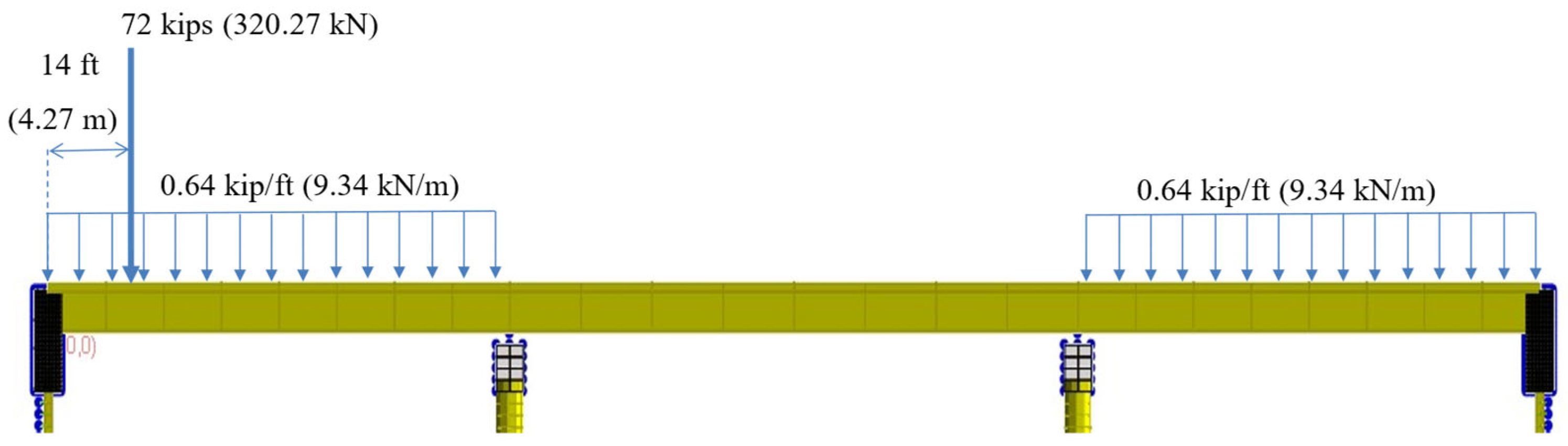
Live loads (LL-) were applied as per AASHTO 3.6.1.2 [13]. Simplified assumptions were made for the live load configuration. Reasonable assumptions were made to simplify the live loads. Figure 14 shows the live load used in the model. A single truck with lane load on odd spans was applied to the model to obtain maximum reaction at the abutments. Since spans are relatively short, the two-truck case will not govern at the abutments. It was assumed that only one lane is loaded and that the entire live load goes to one girder/bearing, which is a conservative assumption. However, multiple presence factor of 1.2 was omitted to offset the conservative assumption that all lane load is carried by one girder. Dynamic Load Allowance (IM) was not applied because the piles are below grade (AASHTO 3.6.2.1).

4.7.3. Braking Loads (BR-)

Braking load (BR) was applied as per AASHTO 3.6.2. Braking load is deemed important because it is a longitudinal load that induces torsion in the abutment and bending in the piles. Thus, 25% of truck load was applied as longitudinal load at the tip of pile plus a moment equivalent to shifting the longitudinal braking load from 6 ft above deck to the tip of pile (see Figure 15 for details).

4.7.4. Thermal Loads (TU-)

Thermal loads (TU-) were computed as per AASHTO 3.12.2.1 Procedure A [13]. Temperature range for a steel bridge in cold climate is from −30 °F (−34.4 °C) to 120 °F (48.9 °C) as per AASHTO Table 3.12.2.1-1. A coefficient of thermal expansion of 6.0 × 10⁻⁶/°F (10.8 × 10⁻⁶/°C) for concrete as per AASHTO 5.4.2.2 and 6.5 × 10⁻⁶/°F (11.7 × 10⁻⁶/°C) for steel as per AASHTO 6.4.1 was used in the model (also noted in Table 1). The base construction temperature was assumed to be 45 °F (7.2 °C), yielding a thermal rise of 75 °F (41.7 °C). Only thermal expansion (temperature rise) was considered for pile stress calculations, as this condition controls compressive demand in the piles at the fixed abutment.

4.8. Limitations of the Analysis

The analysis presented in this study was carried out within a set of practical constraints and simplifying assumptions that should be considered when interpreting the results.
  • The finite element model was two-dimensional, representing a single girder with tributary deck width. Modeling all girders explicitly with the required level of detail would have been computationally intensive with no proportionate benefit, especially since the model was verified by comparing field observations to the stressed region in the analysis results. Similar modeling simplifications are well documented by earlier published studies [34,57,58,60,62,63]. However, the contribution of battered piles was addressed through conservative assumptions rather than explicit modeling, which may underestimate their stiffening effect on the abutment response. A 3D model would better capture transverse load distribution, torsional effects in the abutment cap, and the behavior of battered piles.
  • Soil properties were estimated from published ranges for road fill material in the absence of site-specific geotechnical investigation data. While the sensitivity analysis in Section 4.6.2 confirmed that pile stresses are not significantly affected by reasonable variations in soil stiffness, the assumed subgrade reaction values have not been validated against field measurements at this site.
  • Construction staging was not modeled. All dead loads were applied to the composite section, which underestimates dead load stresses in the non-composite steel section during construction. This is conservative for the thermal and live load-dominated pile stress checks but should be revisited if a detailed superstructure capacity evaluation is undertaken.
  • Wind loads, horizontal earth pressure, and second-order P-Δ effects were not included in the load combinations. These omissions are consistent with the scope of the investigation, which focused on the governing thermal and gravity load demands, but a complete design-level analysis would need to address these effects.

5. Results

5.1. Deflected Shapes

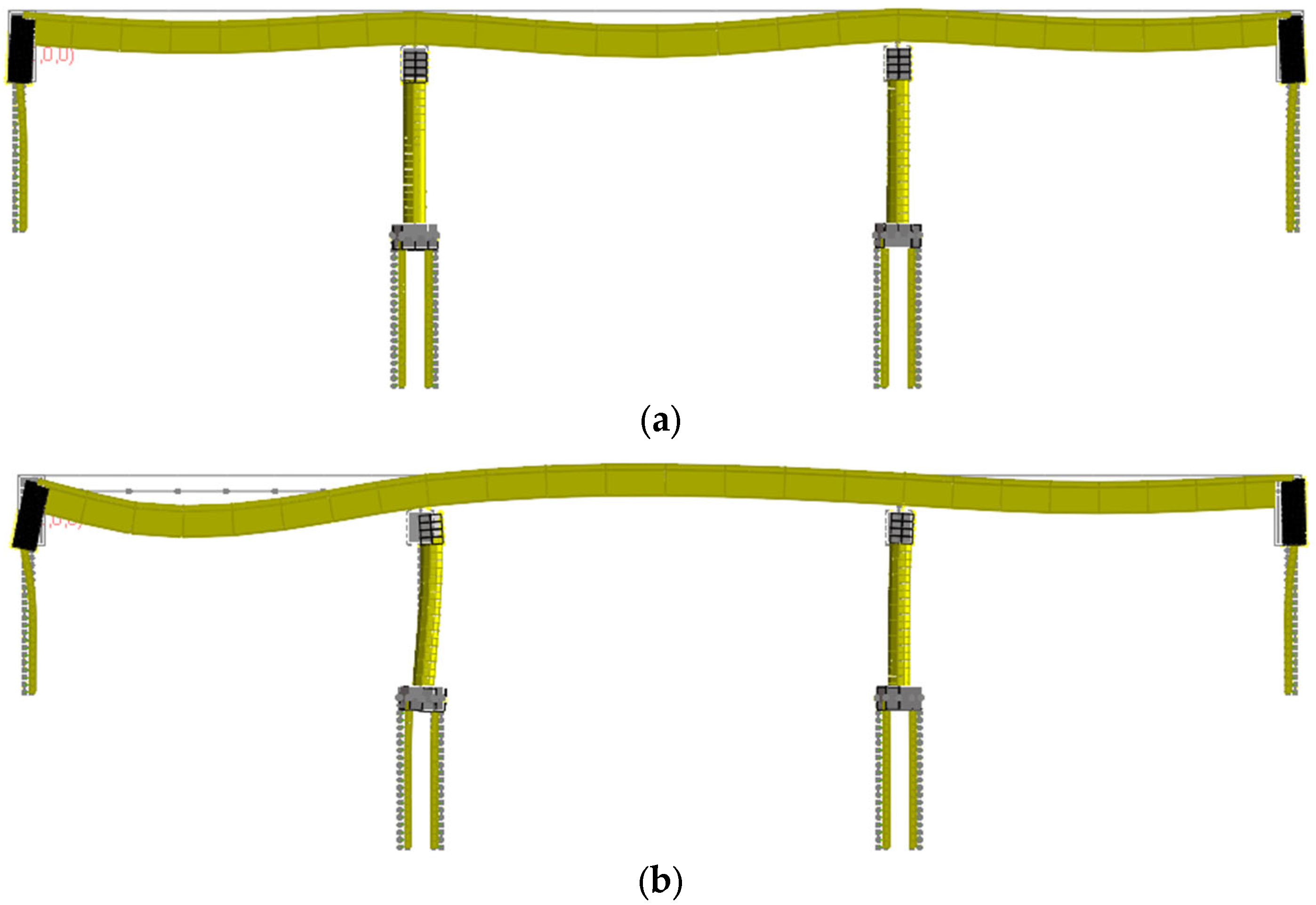
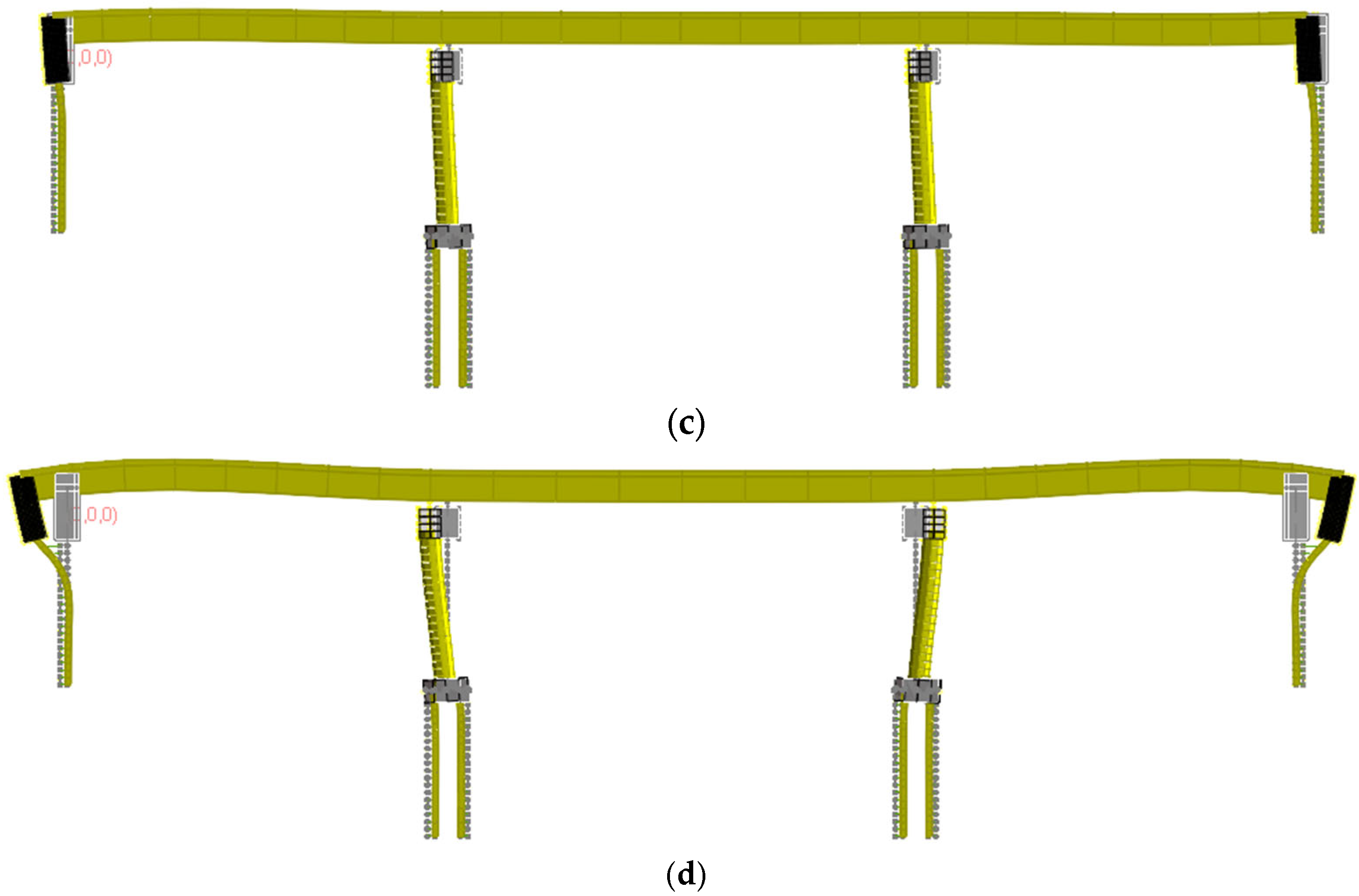
Figure 16a–d presents the deflected shapes of the bridge under different loading conditions. Under dead load (DC), the maximum vertical downward displacement was 0.14 in. (3.6 mm), occurring in the middle span, as shown in Figure 16a. Under live load, the maximum downward vertical deflection was 0.28 in. (7.1 mm) and occurred in the left span, which is consistent with the applied asymmetric span loading configuration (Figure 16b). Under braking load, the bridge experienced a maximum longitudinal displacement of 0.07 in. (1.8 mm) at the loaded abutment, as shown in Figure 16c. Similar to live loads, braking loads were also applied on the left abutment only. Under thermal expansion corresponding to a temperature rise of 75 °F (41.7 °C), the deflected shape exhibited a maximum longitudinal displacement of 0.42 in. (10.7 mm) at the abutments, together with pronounced negative curvature in the superstructure near both abutments (Figure 16d).

Discussion

With regards to the dead load, the small magnitude deflections are due to the absence of construction staging in the model. All dead loads are resisted by composite structure in the model. With regards to the live load, large deflection on the left abutment is observed because of asymmetric live load application (see Figure 14) in order to maximize live loads effects. Since the bridge is symmetrical, it can be assumed that a similar effect will be produced on the right abutment if live loads were applied to maximize the live effects on the right abutment.
The deflected shape under thermal loading (Figure 16d) reveals significant negative curvature in the superstructure at both abutments, indicating that full integral fixity at both ends would generate substantial negative moments in the superstructure, a loading condition not present in the original jointed design. It can be concluded that the thermal loading dominates over all other types of loads, establishing it as the governing consideration for the retrofit evaluation.

5.2. Forces in the Superstructure

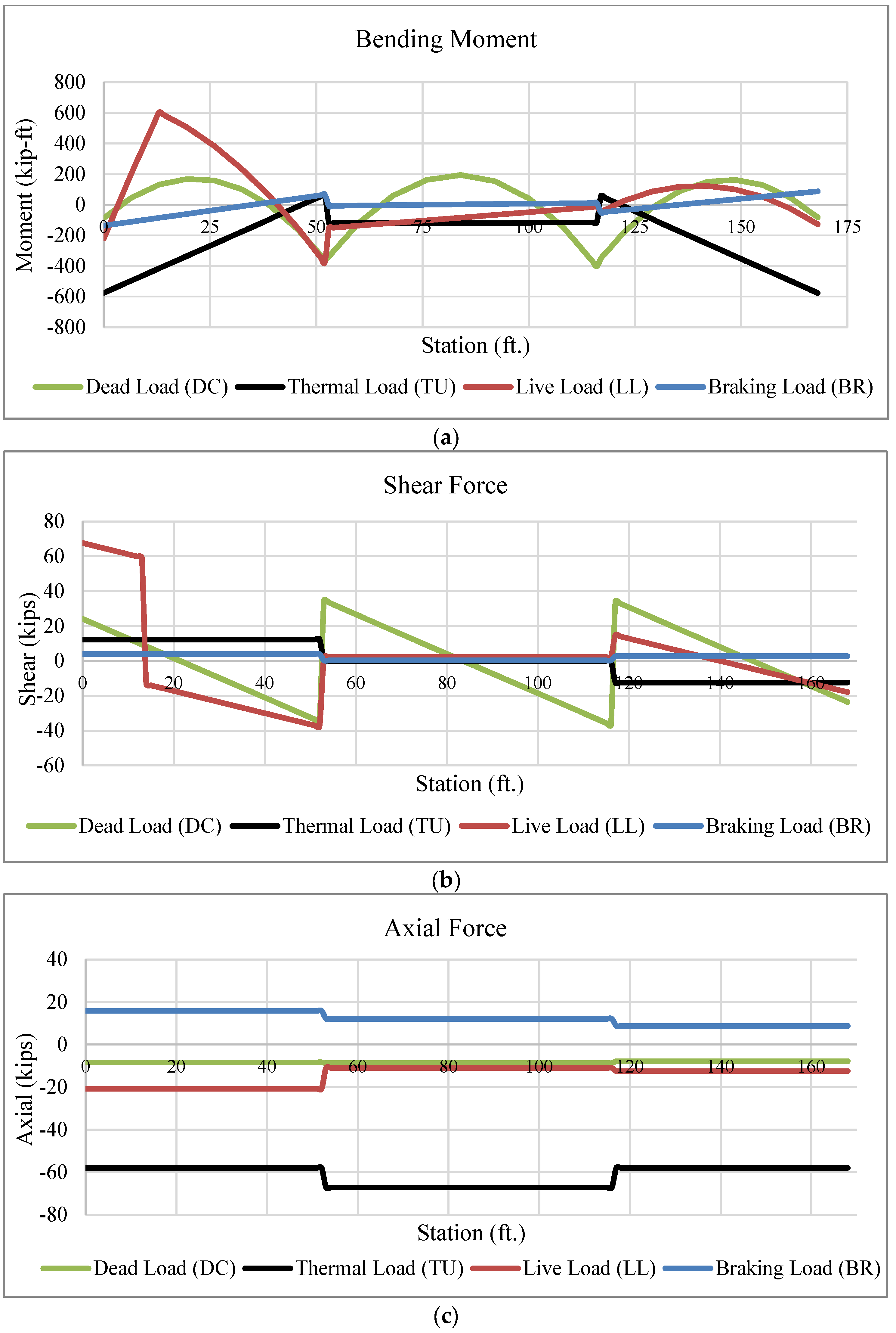
Since the steel girder and concrete deck were modeled as separate but compositely connected beam elements, section forces were combined across both elements to determine total composite section demands, as shown in Figure 17. Some significant results from the bending moment, shear force, and axial force diagrams are discussed below.
With regard to the negative moment demands (Figure 17a), thermal loading (TU) governs by generating approximately 600 kip-ft (813.5 kN-m) at both the left and right abutments. Live load (LL) produces a negative moment of approximately 220 kip-ft (298.3 kN-m) at the left abutment, and a maximum negative moment of approximately 400 kip-ft (542.4 kN-m) around the left pier region. Braking load (BR) contributes a negative moment of approximately 136 kip-ft (184.4 kN-m) at the left abutment, and dead load (DC) generates a negative moment of approximately 82 kip-ft (111.2 kN-m) at both abutments.
With regard to the positive span moments (Figure 17a), live load governs generating approximately 600 kip-ft (813.5 kN-m) in the left loaded span, while dead load contributes a maximum positive moment of approximately 200 kip-ft (271.2 kN-m) in the central span of the bridge. Thermal load produces modest positive moments of approximately 54 kip-ft (73.2 kN-m) at the pier locations, and braking load generates approximately 66 kip-ft (89.5 kN-m) over the left pier.
In the shear force diagram (Figure 17b), live load governs at the support locations with a maximum of approximately 67 kips (298 kN) at the left abutment. Dead load shear at the left abutment is approximately 23 kips (102.3 kN). Thermal and braking loads contribute modestly to shear demand.
Axial forces in the superstructure (Figure 17c) under thermal loading are compressive throughout, with a maximum of approximately 67 kips (298 kN) in the central span and approximately 58 kips (258 kN) in the left and right spans, reflecting the restraint force generated by the fixed abutments resisting free thermal elongation. Braking load contributes a modest compressive axial force of approximately 16 kips (71.2 kN). Axial contributions from dead and live loads are comparatively negligible.

Discussion

The results demonstrate that making both abutments fully integral would introduce substantial additional negative moment near the abutments under thermal loading. The thermal restraint moment of approximately 600 kip-ft (813.5 kN-m) at the abutments is substantially higher than all other load contributions, exceeding the live load negative moment of 220 kip-ft (298.3 kN-m) at the abutment and the dead load negative moment of 82 kip-ft (111.2 kN-m), representing a significant concern for the existing deck reinforcement and top flange of the girder, which may not have been designed for this condition.
The slope discontinuities and points of contraflexure in the live load bending moment diagram, together with the step discontinuities in the shear force diagram, correspond to the point of application of the 72 kip (320.27 kN) concentrated load located 14 ft (4.27 m) from the left abutment, the pier support reactions, and the end of the distributed lane load. These features are consistent with the asymmetric live load configuration shown in Figure 14.

5.3. Stress in the Concrete Abutment Cap

Plate stresses in the longitudinal x-direction for the abutment shell model are shown in Figure 18. The maximum tensile stress in the abutment cap is approximately 1.2 ksi (8.3 MPa), occurring at the girder-to-cap interface. The maximum compressive stress is approximately 1.75 ksi (12.1 MPa), occurring at the pile-to-cap interface.

Discussion

Plate stress contours for the abutment shell model in Figure 18 show stress concentrations at the girder-to-cap and pile-to-cap connections, which is consistent with the expected load transfer at these interfaces. The presence of conventional reinforcement provides redistribution of tensile stresses and limits crack widths; so, the maximum tensile stress of 1.2 ksi (8.3 MPa) at the girder-to-cap interface is considered manageable. Compressive stresses at the pile-to-cap interface of approximately 1.75 ksi (12.1 MPa) are similarly within acceptable bounds. On this basis, the concrete abutment cap is not the limiting element in the proposed integral conversion.

5.4. Stress in Piles

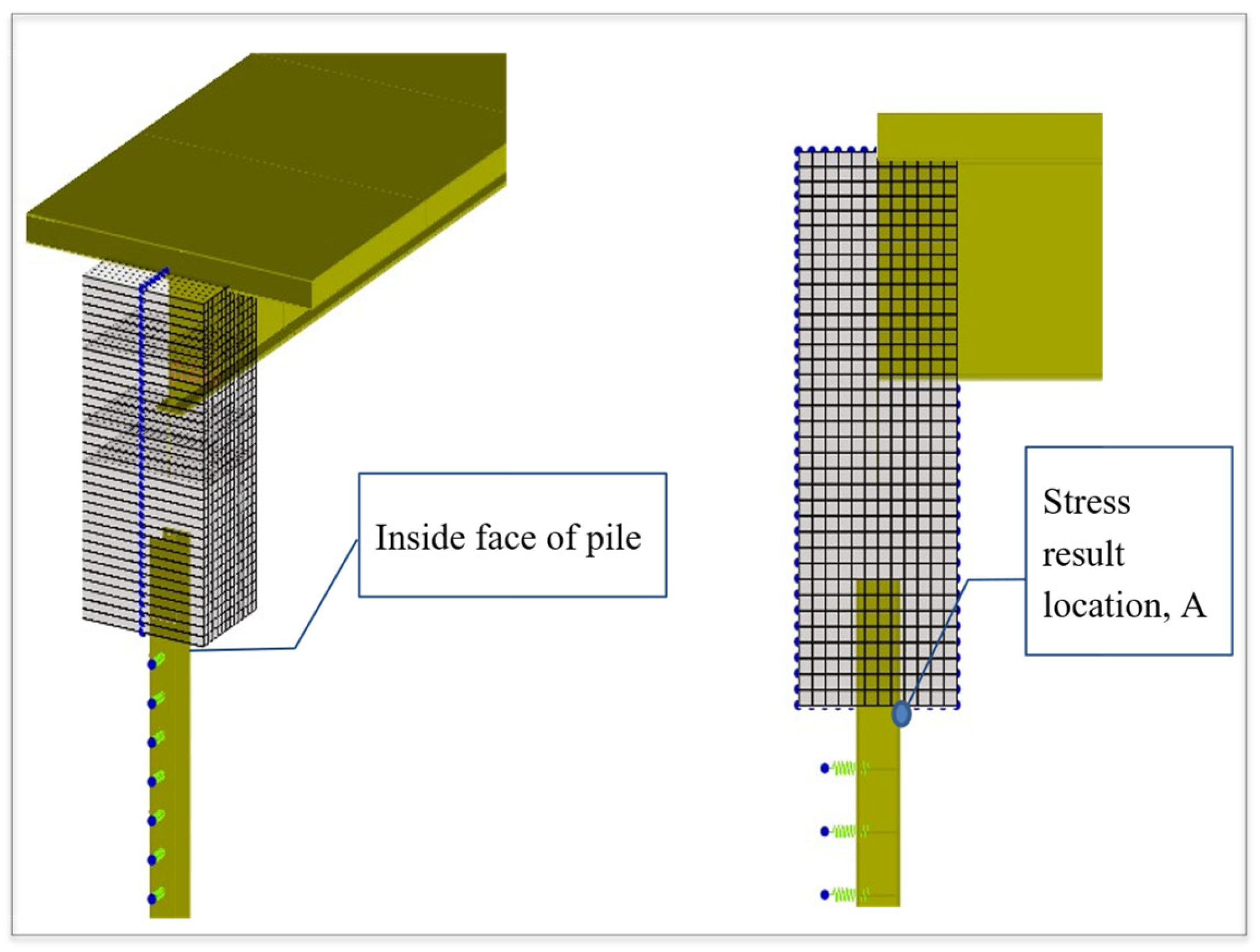
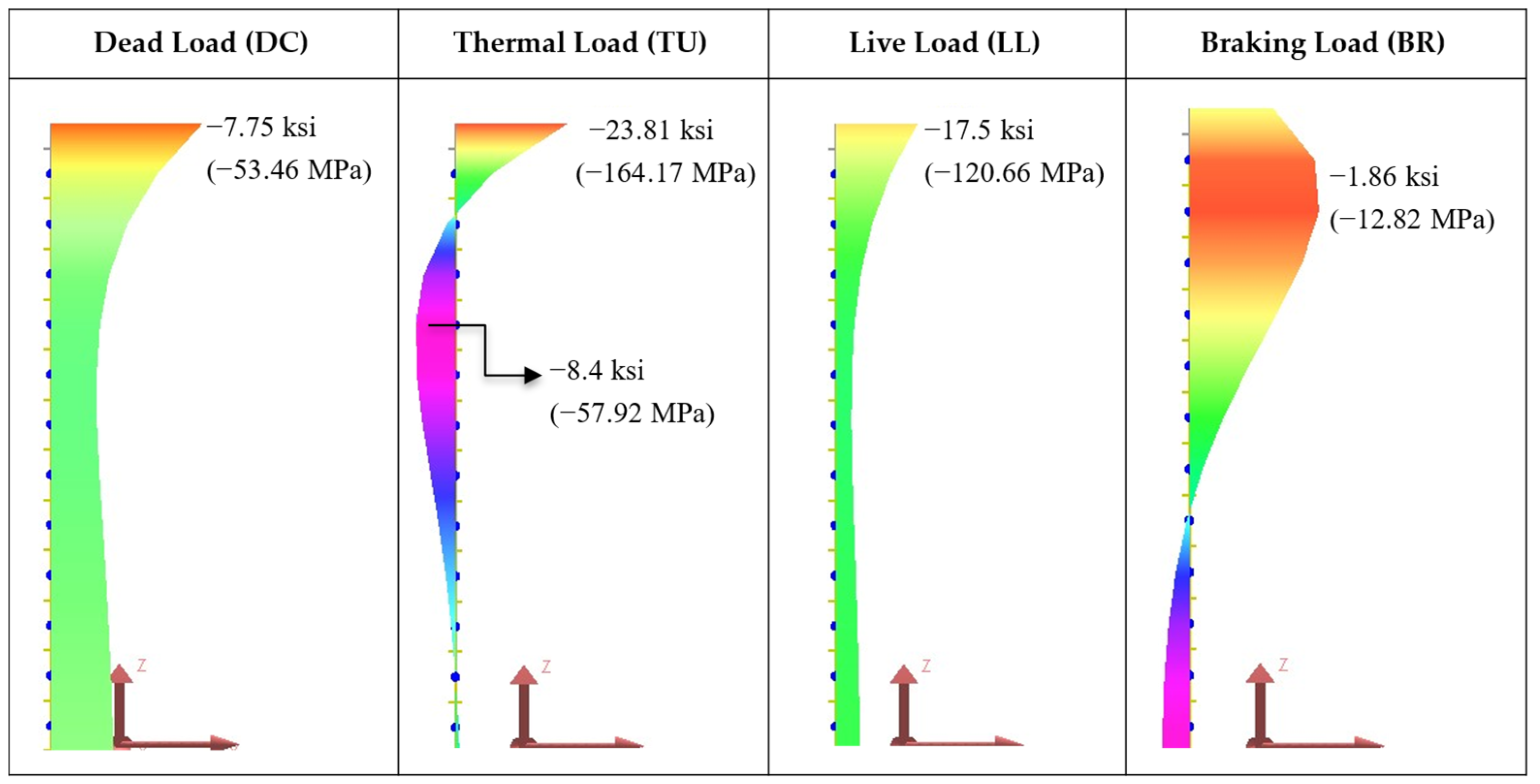
The location of the stress evaluation point on the HP pile section is shown in Figure 19. Stresses were evaluated at the inside face of the pile section (location A), where combined axial and bending stresses are at a maximum. Pile stresses under individual load components are summarized in Figure 20. Thermal loading (TU) generates a compressive stress of 23.81 ksi (164.2 MPa) at location A. Dead load (DC) contributes 7.75 ksi (53.4 MPa), live load (LL) contributes 17.50 ksi (120.7 MPa), and braking load (BR) adds 1.86 ksi (12.8 MPa).

Discussion

The results show that the thermal loading is the dominant contributor to the pile stress demand, generating a compressive stress nearly three times the dead load contribution and exceeding the live load contribution. This thermal dominance is a direct consequence of the full integral fixity imposed at both abutments, which transmits the entire thermal elongation of the 168 ft (51.2 m) superstructure as restraint force to the pile foundations. The pile stress distribution under individual load components establishes the basis for the combined AASHTO LRFD load combinations evaluated in Section 5.5.

5.5. AASHTO LRFD Service I and Strength I Checks

The maximum pile stresses obtained from the FEA are assessed against two allowable stress thresholds: 30 ksi (207 MPa) under Service I and 50 ksi (345 MPa) under Strength I. These correspond to 0.6 fy and fy, respectively, of the A-572 Grade 50 steel for the HP 10 × 42 pile material (see Table 1 for material properties). The 50 ksi threshold represents first yield of the pile section under the factored Strength I load combination. The 30 ksi threshold (0.6 fy) is the conventional AASHTO allowable combined stress corresponding to essentially elastic pile behavior under unfactored service loads, consistent with the approach documented in FHWA integral abutment guidance [31]. These thresholds are applied in this paper to determine whether the existing HP piles, originally designed in 1972 as bearing piles for a jointed superstructure and not for integral action, retain sufficient reserve capacity to sustain the additional restraint forces imposed by full integral conversion. Exceedance of either threshold is interpreted as evidence that the existing pile section is inadequate for the proposed retrofit and that an alternative repair strategy is required.
The AASHTO LRFD load combinations were evaluated through Equations (1) and (2) and compared with allowable stresses as follows:
Service I = DC + 1.2   TU + LL + BR   = 7.75 + ( 1.2 × 23.81 ) + 17.5 + 1.86   = 55.68   ksi > 30   ksi   ( 383.9   MPa > 207   MPa )   [ Not satisfactory ]
Strength I = 1.25   DC + 1.2   TU + 1.75   ( LL + BR )   = ( 1.25 × 7.75 ) + ( 1.2 × 23.81 ) + 1.75 × ( 17.5 + 1.86 )   = 72.14   ksi > 50   ksi   ( 497.4   MPa > 345   MPa )   [ Not satisfactory ]
For both serviceability and strength load combinations, the pile stresses exceeded the respective allowable limits of 30 ksi (206.8 MPa) for Service I and 50 ksi (344.7 MPa) for Strength I, which corresponds to the yield strength of the HP section steel. Thermal loading accounts for approximately 43% of the Service I demand and 40% of the Strength I demand, making it the governing concern in both cases. These results indicate that making both abutments fully integral is not a viable option for the existing HP 10 × 42 pile foundations without significant structural intervention. The cyclic nature of thermal loading may also induce fatigue-related deterioration at the pile head over the service life.
It is important to point out here that the horizontal deformation of the abutment piles visible in Figure 16d reflects the flexibility of the vertical pile configuration assumed in the model. As the superstructure elongates thermally, the vertical pile absorbs a portion of the displacement demand through lateral bending rather than transmitting it entirely as an axial restraint force into the superstructure. The bridge retains its original alternating battered and vertical pile configuration; as noted in Section 4.5, the model assumes the girder bearing aligns with a straight vertical pile. Since vertical piles are more flexible against horizontal thermal displacement than battered piles, this assumption produces a lower-bound estimate of pile restraint force and pile stress. Where a girder bearing is in fact closer to a battered pile, actual pile stresses would exceed those reported in this paper, further reinforcing the conclusion that full integral conversion is not feasible for the existing foundation.
It should also be noted that the stress calculations assume undamaged pile cross-sections. The bridges were constructed in 1972 and have been in service for over five decades, during which section loss due to corrosion may have occurred. Any reduction in effective cross-sectional area would further decrease pile capacity beyond what the analysis predicts. A retrofit design should therefore include physical pile inspection and condition assessment to establish the actual residual capacity before finalizing any repair approach.

6. Elastomeric Bearing Pad: Alternative Repair Strategy

As discussed in the previous sections, converting both abutments to full integral action is not feasible for the existing bridge. An alternative repair was therefore investigated. Rather than making the second abutment fully integral, elastomeric bearing pads were proposed at that location. The abutment that was made integral in 2005 would retain its fixed connection, while the opposite abutment would be free to move longitudinally through bearing pad deformation. This arrangement would release the thermal restraint force at the second abutment entirely, reducing the thermal contribution to pile stress at that end to zero. The expected free thermal movement at the non-integral abutment was calculated using the steel expansion coefficient per AASHTO:
Δ = αs × L × ΔT
= 6.5 × 10−6 × (168 × 12) × 75 ≈ 0.98 in. (24.9 mm)
where αs is the coefficient of thermal expansion for steel, L is the total length of the bridge, and ΔT is the change in the temperature.
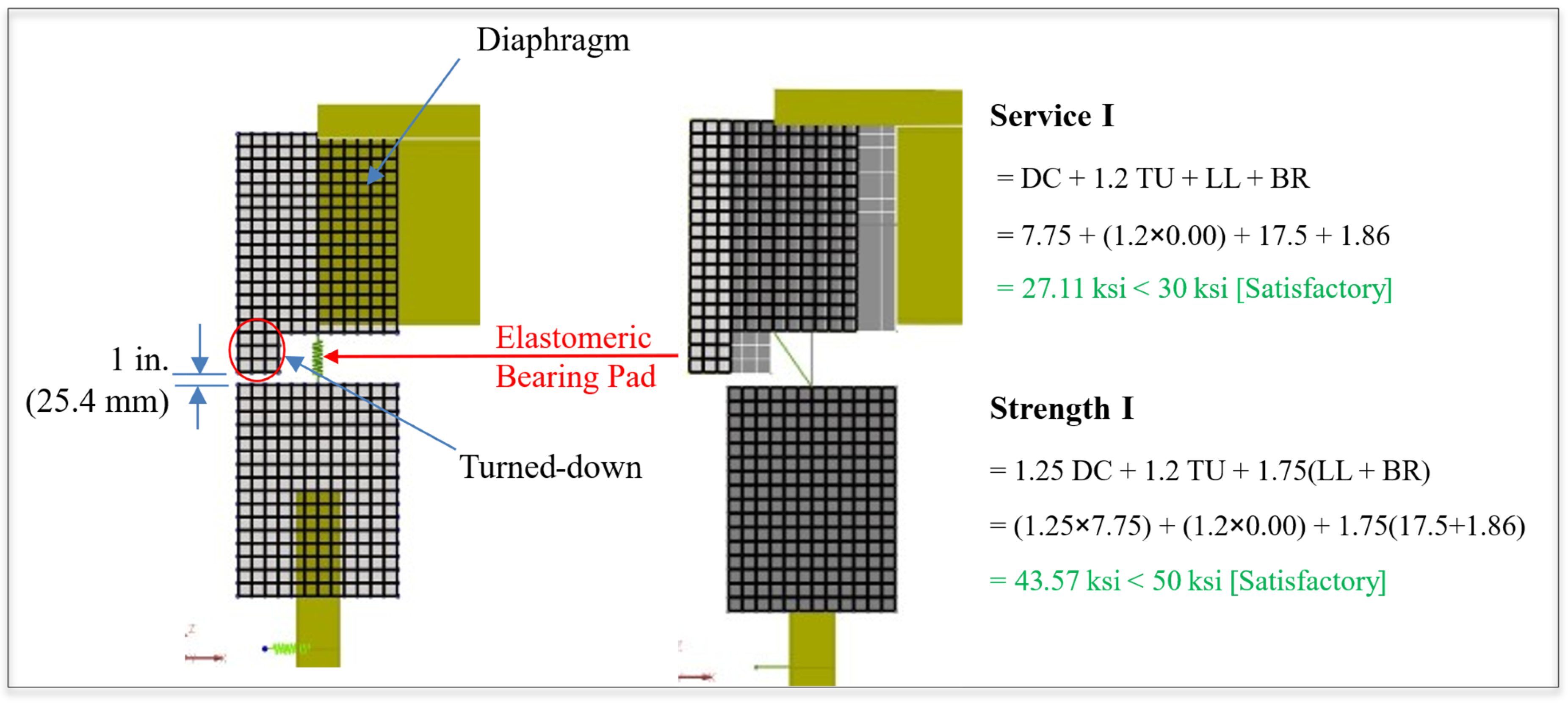
Standard elastomeric pads can accommodate this movement within allowable shear strain limits. Figure 21 shows the proposed repair option of elastomeric bearing pads. The serviceability and strength checks are applied again and results from both retrofit options are compared in Table 3. It can be observed that both combinations now satisfy the allowable stress limits. Introducing the bearing pad at one end breaks the direct load path between superstructure thermal elongation and the pile foundation, which was the source of the overstress in the fully integral case.
Based on this analysis, the backwall was removed and a turned-down diaphragm with elastomeric bearing pads was designed to accommodate the thermal movement. The bearing device consisted of a steel-reinforced elastomeric pad with a total elastomer thickness of 2–5/8 in. (66.7 mm) and 60 Durometer elastomer layers with a vulcanized sole plate fabricated to ASTM A36 steel requirements. A 25.4 mm (1.0 in.) gap filled with preformed joint filler was maintained between the abutment cap and the turn-down of the diaphragm. This detail required no modification to the existing pile foundations, retained the original abutment cap geometry, and minimized construction disruption.
The Virginia/FHWA jointless bridge guidelines [31] identify semi-integral abutments with elastomeric bearing pads as the appropriate alternative when expected bridge end movement is too large to be safely accommodated by piles under a fully fixed integral connection, and when existing bridges are retrofitted with abutments supported on multiple rows of piles. Elastomeric bearing pads are widely regarded as an effective expansion bearing solution, containing no moving parts susceptible to freezing, no components subject to corrosion, and requiring minimal maintenance over the service life of the structure [70]. They are straightforward to install and their use in a semi-integral configuration is reported extensively in the literature [14,25,31,71,72,73,74].

7. Summary and Conclusions

This study investigated the structural implications of converting both abutments of the I-635 bridges B-42 and B-43 in Kansas City, Kansas, to a fully integral configuration. A 2D finite element model was developed in LARSA 4D and analyzed under dead, live, braking, and thermal loads per AASHTO LRFD. An alternative repair using elastomeric bearing pads was also evaluated. The following conclusions are drawn:
  • Unilateral integral conversion, carried out in 2005, concentrated the full thermal displacement demand at the non-integral abutment, causing the bearing failure and concrete damage documented in inspection reports.
  • Full integral conversion generates a thermal restraint moment of approximately 600 kip-ft (813.5 kN-m) at the abutments, substantially exceeding the live load abutment moment of 220 kip-ft (298.3 kN-m) and the dead load abutment moment of 82 kip-ft (111.2 kN-m). This level of additional negative moment at the abutments represents a significant concern for the existing deck reinforcement and top flange of the girder, which were not designed for full integral action.
  • Concrete abutment caps, pier caps, columns, and footings showed no excessive stresses under any load case and are not the governing elements.
  • Pile stresses under full integral conversion reach 55.68 ksi (383.9 MPa) and 72.14 ksi (497.4 MPa) under Service I and Strength I combinations, respectively, both exceeding allowable limits of 30 ksi (206.8 MPa) and 50 ksi (344.7 MPa). Thermal loading accounts for approximately 43% of Service I and 40% of Strength I pile stress demand.
  • Pile stress is relatively insensitive to soil stiffness, varying by only 5% across a 2.5-fold range of subgrade reaction values, confirming that the conclusions are robust to uncertainty in soil properties.
  • The model assumes girder bearings align with vertical piles, which are more flexible against horizontal thermal displacement than the battered piles also present in the original 1972 configuration. This produces a lower-bound estimate of the pile stress, further supporting the conclusion that full integral conversion is not feasible for the existing foundation.
  • The pile stress calculations assume undamaged, full cross-section properties throughout. Given that the bridges have been in service since 1972, corrosion-induced section loss is possible and would reduce the effective pile capacity below the values used in this analysis. Physical pile inspection is recommended before finalizing any repair design.
  • Where pile condition cannot be verified with confidence, supplementing the existing pile group with additional driven piles alongside the abutment cap should be considered as a means of distributing the combined gravity and thermal demand and providing redundancy against localized section deficiency. This mitigation would be compatible with either the full integral or the elastomeric bearing pad repair strategy.
  • Elastomeric bearing pads were recommended as the preferred repair strategy, implemented as a turned-down diaphragm with a 25.4 mm (1.0 in.) preformed joint filler gap. Pile stresses were reduced to 27.11 ksi (186.9 MPa) and 43.57 ksi (300.4 MPa) under Service I and Strength I, respectively, satisfying all allowable limits without modification to the existing pile foundations. Where full integral conversion is ruled out by foundation capacity constraints, this semi-integral arrangement offers a practical and proven alternative for bridges in similar conditions.

Supplementary Materials

The following supporting information can be downloaded at: https://www.mdpi.com/article/10.3390/infrastructures11050163/s1, this manuscript extends a six-page conference paper (https://doi.org/10.14455/ISEC.2025.12(1).STR-30, accessed on 30 April 2026), S1: Statement of Extention.

Author Contributions

Conceptualization, J.H.G. and S.A.; methodology, S.A.; software, J.H.G.; validation, S.A.; formal analysis, J.H.G.; investigation, J.H.G. and S.A.; resources, J.H.G.; data curation, Q.S.K.; writing—original draft preparation, S.A.; writing—review and editing, Q.S.K.; visualization, Q.S.K.; supervision, J.H.G.; Project administration, S.A.; funding acquisition, J.H.G. and S.A. All authors have read and agreed to the published version of the manuscript.

Funding

This work was supported by the Kansas Department of Transportation (KDOT) under project funding, and by the University of Wollongong in Dubai, United Arab Emirates, under research grant no. RY26E013.

Data Availability Statement

All the analysis data are provided in the paper. Original and repair drawings can be provided, if requested.

Acknowledgments

The authors gratefully acknowledge the support of WSP, KDOT, University of Wollongong in Dubai, and University of Engineering and Technology, Lahore, for their support, which contributed to the successful completion and publication of this research. A Statement of Extension and a copy of the conference paper are attached as Supplementary Files.

Conflicts of Interest

Jawad H. Gull reports affiliation with WSP, Lincoln NE at the time of this research. The authors declare no conflict of interest.

References

  1. Shedge, H.N.; Kumar, M. State-of-the-Art: Tracing the history, development, and design of integral abutment bridges. Bridge Struct. 2024, 20, 141–155. [Google Scholar] [CrossRef]
  2. Liu, H.; Han, J.; Parsons, R.L. Integral bridge abutments in response to seasonal temperature changes: State of knowledge and recent advances. Front. Built Environ. 2022, 8, 916782. [Google Scholar] [CrossRef]
  3. Akhnoukh, A.K.; Thangappa, R.; Seracino, R. Overview of integral abutment bridge applications in the United States. In Advances in Road Infrastructure and Mobility; Springer: Cham, Switzerland, 2022; pp. 232–240. [Google Scholar] [CrossRef]
  4. Sigdel, L.; Al-Qarawi, A.; Leo, C.J.; Liyanapathirana, S.; Hu, P. Geotechnical design practices and soil–structure interaction effects of an integral bridge system: A review. Appl. Sci. 2021, 11, 7131. [Google Scholar] [CrossRef]
  5. Oesterle, R.G.; Tabatabai, H. Design considerations for integral abutment/jointless bridges in the USA. Univ. Wis. Milwaukee Fac. Artic. 2014, 1, 33. [Google Scholar]
  6. Arockiasamy, M.; Butrieng, N.; Sivakumar, M. State-of-the-art of integral abutment bridges: Design and practice. J. Bridge Eng. 2004, 9, 497–506. [Google Scholar] [CrossRef]
  7. Polat, E.; Göçmen Polat, E. Spring-based soil–structure interaction modeling of pile–abutment joints in short-span integral abutment bridges with LR and RSM. Buildings 2025, 15, 3493. [Google Scholar] [CrossRef]
  8. Soltani, A.A.; Kukreti, A.R. Performance evaluation of integral abutment bridges. Transp. Res. Rec. 1992, 1371, 17–25. [Google Scholar]
  9. Greimann, L.; Wolde-Tinsae, A.M. Design model for piles in jointless bridges. J. Struct. Eng. 1988, 114, 1354–1371. [Google Scholar] [CrossRef]
  10. Burke, M.P., Jr. Integral bridges. Transp. Res. Rec. 1990, 1275, 53–61. [Google Scholar]
  11. Olson, S.M.; Holloway, K.P.; Buenker, J.M.; Long, J.H.; LaFave, J.M. Thermal Behavior of IDOT Integral Abutment Bridges and Proposed Design Modifications; Report No. FHWA-ICT-12-022; Federal Highway Administration: Washington, DC, USA, 2013.
  12. Jorgensen, J.L. Behavior of abutment piles in an integral abutment in response to bridge movements. Transp. Res. Rec. 1983, 903, 72–79. [Google Scholar]
  13. American Association of State Highway and Transportation Officials (AASHTO). AASHTO LRFD Bridge Design Specifications, 8th ed.; AASHTO: Washington, DC, USA, 2017. [Google Scholar]
  14. Burke, M.P., Jr. Integral bridges: Attributes and limitations. Transp. Res. Rec. 1993, 1393, 1–8. Available online: https://onlinepubs.trb.org/Onlinepubs/trr/1993/1393/1393.pdf (accessed on 30 April 2026).
  15. Hoppe, E.; Weakley, K.; Thompson, P. Jointless bridge design at the Virginia Department of Transportation. Transp. Res. Procedia 2016, 14, 3943–3952. [Google Scholar] [CrossRef]
  16. Tomić, M.; Marchi, A.; Babič, A.; Isaković, T. Evaluation of the second-generation Eurocode 8 framework for the analysis of various integral abutment bridge types. Eng. Struct. 2025, 337, 120501. [Google Scholar] [CrossRef]
  17. Topurova, I.K.; Nikolov, P.V. Advantages of integral abutments for seismic design of bridges. In Proceedings of the 11th International Conference on Bridges in Danube Basin; TUM: Munich, Germany, 2024; Chapter 2; pp. 13–20. [Google Scholar] [CrossRef]
  18. Frosch, R.J.; Kreger, M.E.; Talbott, A.M. Earthquake Resistance of Integral Abutment Bridges; Publication No. FHWA/IN/JTRP-2008/11; Joint Transportation Research Program, Indiana Department of Transportation and Purdue University: West Lafayette, IN, USA, 2009. [CrossRef]
  19. Abdel-Fattah, M.T.; Abdel-Fattah, T.T. Longitudinal seismic response of integral abutment bridges. Proc. Inst. Civ. Eng.—Bridge Eng. 2023, 176, 45–57. [Google Scholar] [CrossRef]
  20. Tabatabai, H.; Magbool, H.; Bahumdain, A.; Fu, C. Criteria and practices of various states for the design of jointless and integral abutment bridges. In Proceedings of the Third International Workshop on Jointless Bridges; UWM Digital Commons: Milwaukee, WI, USA, 2017. [Google Scholar]
  21. Kunin, J.; Alampalli, S. Integral abutment bridges: Current practice in United States and Canada. J. Perform. Constr. Facil. 2000, 14, 104–111. [Google Scholar] [CrossRef]
  22. Wasserman, E.P.; Walker, J.H. Integral abutments for steel bridges. In Highway Structures Design Handbook; Federal Highway Administration: Washington, DC, USA, 1996; Volume 2, Chapter 5. [Google Scholar]
  23. Hoppe, E.J.; Gomez, J.P. Field Study of an Integral Backwall Bridge; Report No. VTRC 97-R7; Virginia Department of Transportation: Richmond, VA, USA, 1996.
  24. Gull, J.; Amir, S. Repair strategies for bridge abutment damage caused by thermal movements: A finite element study. Proc. Int. Struct. Eng. Constr. 2025, 12, STR-30. [Google Scholar] [CrossRef]
  25. Burke, M.P., Jr. Semi-integral bridges: Movements and forces. Transp. Res. Rec. 1994, 1460, 1–7. [Google Scholar]
  26. Frosch, R.J.; Chovichien, V.; Durbin, K.; Fedroff, D. Jointless and Smoother Bridges: Behavior and Design of Piles; Publication No. FHWA/IN/JTRP-2004/24; Joint Transportation Research Program, Indiana Department of Transportation and Purdue University: West Lafayette, IN, USA, 2006. [CrossRef]
  27. Wolde-Tinsae, A.M.; Klinger, J.E. Integral Bridge Design and Construction; Report No. FHWA/MD-87/04; Maryland Department of Transportation: Baltimore, MD, USA, 1987.
  28. Burke, M.P., Jr. Design of integral concrete bridges. Concr. Int. 1993, 15, 37–42. [Google Scholar]
  29. Vasconez, R.; Kustau, A.; Najm, H. An overview of integral abutments: Current practices, field monitoring and deck replacement measures. Bridge Struct. 2022, 18, 27–43. [Google Scholar] [CrossRef]
  30. White, H. Integral Abutment Bridges: Comparison of Current Practice Between European Countries and the United States of America; Special Report No. FHWA/NY/SR-07/152; New York State Department of Transportation: Albany, NY, USA, 2007.
  31. Oesterle, R.; Tabatabai, H.; Lawson, T.; Refai, T.; Volz, J.; Scanlon, A. Jointless and Integral Abutment Bridges: Summary Report (Vol. III); Publication No. FHWA-RD-03-056; Federal Highway Administration: Washington, DC, USA, 2007.
  32. British Highways Agency. The Design of Integral Bridges (BA 42/96); Highways Agency: London, UK, 2003. [Google Scholar]
  33. Swedish Road Administration. Vägverkets Allmänna Tekniska Beskrivning för Broar (ATB Bro 2004); Swedish Road Administration: Borlänge, Sweden, 2004.
  34. Frosch, R.J.; Lovell, M.D. Long-Term Behavior of Integral Abutment Bridges; Report No. FHWA/IN/JTRP-2006/12; Joint Transportation Research Program, Purdue University: West Lafayette, IN, USA, 2006. [Google Scholar]
  35. Comité Euro-International du Béton. CEB-FIP Model Code 1990: Design Code; Thomas Telford: London, UK, 1993. [Google Scholar]
  36. White, H.; Pétursson, H.; Collin, P. Integral Abutment Bridges: The European Way. Pract. Period. Struct. Des. Constr. 2010, 15, 201–208. [Google Scholar] [CrossRef]
  37. Lawver, A.; French, C.; Shield, C.K. Field performance of integral abutment bridge. Transp. Res. Rec. 2000, 1740, 108–117. [Google Scholar] [CrossRef]
  38. Azad, S.; Shafei, B. Performance evaluation of semi-integral abutment bridge ends based on approach slab details. J. Bridge Eng. 2025, 30, 04024117. [Google Scholar] [CrossRef]
  39. Zhou, G.D.; Yi, T.H. Thermal load in large-scale bridges: A state-of-the-art review. Int. J. Distrib. Sens. Netw. 2013, 9, 217983. [Google Scholar] [CrossRef]
  40. Clough, G.W.; Duncan, J.M. Earth pressures. In Foundation Engineering Handbook, 2nd ed.; Fang, H.Y., Ed.; Chapman and Hall: New York, NY, USA, 1991; pp. 223–235. [Google Scholar]
  41. Abendroth, R.E.; Greimann, L.F.; Ebner, P.B. Abutment pile design for jointless bridges. J. Struct. Eng. 1989, 115, 2914–2929. [Google Scholar] [CrossRef]
  42. Roeder, C.W. Proposed design method for thermal bridge movements. J. Bridge Eng. 2003, 8, 12–19. [Google Scholar] [CrossRef]
  43. Coduto, D.P. Foundation Design: Principles and Practices, 2nd ed.; Prentice Hall: Upper Saddle River, NJ, USA, 2001. [Google Scholar]
  44. Greimann, L.F.; Yang, P.S.; Edmunds, S.K.; Wolde-Tinsae, A.M. Design of Piles for Integral Abutment Bridges; Iowa Department of Transportation: Ames, IA, USA, 1984.
  45. Greimann, L.F.; Yang, P.S.; Wolde-Tinsae, A.M. Nonlinear analysis of integral abutment bridges. J. Struct. Eng. 1986, 112, 2263–2280. [Google Scholar] [CrossRef]
  46. Xue, J. Retrofit of Existing Bridges with Concept of Integral Abutment Bridge: Static and Dynamic Parametric Analysis. Ph.D. Thesis, University of Trento, Trento, Italy, 2013. [Google Scholar]
  47. Indiana Department of Transportation. Indiana Design Manual; INDOT: Indianapolis, IN, USA, 2013.
  48. Xu, Z.; Luo, X.; Sennah, K.; Chen, B.; Zhuang, Y. Retrofitting of a multi-span simply supported bridge into a semi-integral bridge. Appl. Sci. 2025, 15, 455. [Google Scholar] [CrossRef]
  49. Caner, A.; Dogan, E.; Zia, P. Seismic performance of multisimple-span bridges retrofitted with link slabs. J. Bridge Eng. 2002, 7, 85–93. [Google Scholar] [CrossRef]
  50. Tsiatas, G.; Boardman, W.G. Expansion Joint Elimination for Steel Highway Bridges; Rhode Island Department of Transportation: Providence, RI, USA, 2002.
  51. Fell, D. Comparative Analysis of Bridge Abutment Types; Honors Research Project, University of Akron: Akron, OH, USA, 2022. [Google Scholar]
  52. Luo, S.; Huang, Z.; Asia, Y.; De Luca, F.; De Risi, R.; Harkness, J.; Le Pen, L.; Watson, G.; Milne, D.; Chapman, D.; et al. Physical and numerical investigation of integral bridge abutment stiffness due to seasonal thermal loading. Transp. Geotech. 2023, 42, 101064. [Google Scholar] [CrossRef]
  53. Asako, T. Parametric Study of Integral Abutment Bridge Using Finite Element Model. Master’s Thesis, University of Massachusetts Amherst, Amherst, MA, USA, 2021. [Google Scholar] [CrossRef]
  54. Naji, M.; Firoozi, A.A.; Firoozi, A.A. A review: Study of integral abutment bridge with consideration of soil–structure interaction. Lat. Am. J. Solids Struct. 2020, 17, e252. [Google Scholar] [CrossRef]
  55. Abdel-Fattah, M.T.; Abdel-Fattah, T.T.; Hemada, A.A. Nonlinear finite-element analysis of integral abutment bridges due to cyclic thermal changes. J. Bridge Eng. 2018, 23, 04017134. [Google Scholar] [CrossRef]
  56. Amirahmad, A.; Al-Sinaidi, A.R. Analysis of integral bridges by finite element method. Procedia Eng. 2013, 54, 308–314. [Google Scholar] [CrossRef][Green Version]
  57. Kim, W.; Laman, J.A.; Jeong, Y.; Ou, Y.-C.; Roh, H. Comparative study of integral abutment bridge structural analysis methods. Can. J. Civ. Eng. 2016, 43, 378–389. [Google Scholar] [CrossRef]
  58. Fennema, J.L.; Laman, J.A.; Linzell, D.G. Predicted and measured response of an integral abutment bridge. J. Bridge Eng. 2005, 10, 666–677. [Google Scholar] [CrossRef]
  59. Faraji, S.; Ting, J.M.; Crovo, D.S.; Ernst, H. Nonlinear analysis of integral bridges: Finite-element model. J. Geotech. Geoenviron. Eng. 2001, 127, 454–461. [Google Scholar] [CrossRef]
  60. Thippeswamy, H.K.; GangaRao, H.V.S. Analysis of in-service jointless bridges. Transp. Res. Rec. 1995, 1476, 162–170. [Google Scholar]
  61. Knickerbocker, D.; Basu, P.K. Analysis of prestressed concrete jointless bridges with integral abutments. In Structures: Building on the Past, Securing the Future; ASCE: Reston, VA, USA, 2004. [Google Scholar] [CrossRef]
  62. Abdullah, A.; Naggar, H. Two-dimensional performance of integral abutment bridges using finite element analysis. In Proceedings of GeoVirtual 2020: Resilience and Innovation; Canadian Geotechnical Society: Richmond, BC, Canada, 2020. [Google Scholar]
  63. Albhaisi, S.; Nassif, H. Correlation between 2D and 3D analysis of integral abutment bridges. In Proceedings of the Transportation Research Board 95th Annual Meeting; Transportation Research Board: Washington, DC, USA, 2016. [Google Scholar]
  64. Chen, F.; Tan, B.; Tang, H.; Zhang, H.; Luo, Y.; Xiao, X.; Liu, Y.; Lu, N. An interpretable random forest surrogate for rapid SIF prediction and fatigue life assessment of double-sided U-rib welds in orthotropic steel decks. Eng. Fail. Anal. 2026, 187, 110582. [Google Scholar] [CrossRef]
  65. Zhang, H.; Zhao, L.; Chen, F.; Luo, Y.; Xiao, X.; Liu, Y.; Deng, Y. A machine learning and multi-source authentic data-driven framework for accurate fatigue life prediction of welds in existing steel bridge decks. Thin-Walled Struct. 2026, 222, 114559. [Google Scholar] [CrossRef]
  66. LARSA, Inc. LARSA 4D, Version 8.00r8000; LARSA, Inc.: Melville, NY, USA, 2020. [Google Scholar]
  67. American Association of State Highway Officials (AASHO). Standard Specifications for Highway Bridges, 11th ed.; AASHO: Washington, DC, USA, 1969. [Google Scholar]
  68. Puppala, A.J. Estimating Stiffness of Subgrade and Unbound Materials for Pavement Design (NCHRP Synthesis 382); National Academies of Sciences, Engineering, and Medicine: Washington, DC, USA, 2008. [Google Scholar] [CrossRef]
  69. Bowles, J.E. Foundation Analysis and Design, 5th ed.; McGraw-Hill: New York, NY, USA, 1996. [Google Scholar]
  70. Mazroi, A.; Wang, L.; Murray, T.M. Effective coefficient of friction of steel bridge bearings. Transp. Res. Rec. 1983, 903, 79–86. [Google Scholar]
  71. Dicleli, M. A rational design approach for prestressed-concrete-girder integral bridges. Eng. Struct. 2000, 22, 230–245. [Google Scholar] [CrossRef]
  72. Silva, P.H.S.; Costa, Y.D.J.; Costa, C.M.L.; Zornberg, J.G. Parametric analysis of the long-term response of a semi-integral bridge abutment under cyclic thermal movements. J. Bridge Eng. 2025, 30, 04025021. [Google Scholar] [CrossRef]
  73. Mofarraj, B.; Zornberg, J.G. Long-term field monitoring of lateral loads in semi-integral bridge foundations. In Geo-Congress 2023; ASCE: Reston, VA, USA, 2023; pp. 114–123. [Google Scholar] [CrossRef]
  74. Jin, X.; Shao, X.; Peng, W.; Yan, B. A new category of semi-integral abutment in China. Struct. Eng. Int. 2005, 15, 186–188. [Google Scholar] [CrossRef]
Figure 3. (a) Interstate 635 (I-635) between I-35 in Overland Park, Kansas, and I-29 in Kansas City, Missouri, approximately 12 miles (19 km) long. (b) Steel bridges B42 and B43. Each bridge is 168 ft (51.21 m) long.
Infrastructures 11 00163 g003
Figure 4. General layout of the original 1972 Bridge B-43. The total bridge length is 168 ft (51.2 m) and the roadway width is 145 ft 8 in. (44.40 m). (Note: 1 ft = 1′ = 0.3048 m; 1 in. = 1″ = 25.4 mm).
Infrastructures 11 00163 g004
Figure 5. Photos taken from the 2017 inspection report showing damage of abutment B-43 and girder hitting backwall B-43.
Infrastructures 11 00163 g005
Figure 6. (a) Retrofit plan of eliminating expansion joint at right abutment and making it fixed (original drawings, 2002). (b) Conversion of one abutment to integral (repair in 2005) shifted the entire thermal expansion to the other end. (Note: E = Expansion; F = Fixed).
Infrastructures 11 00163 g006aInfrastructures 11 00163 g006b
Figure 7. (a) The preliminary finite element model based on existing semi-integral configuration. (b) Left hand-side showing FEA stress results (ksi) confirming damage to the abutment shown on the right hand-side. (Note: 1 in. = 25.4 mm; 1 ft = 0.3048 m; 1 kip/in2 (ksi) = 6.895 MPa).
Infrastructures 11 00163 g007
Figure 8. General layout of the finite element model.
Infrastructures 11 00163 g008
Figure 9. Superstructure model details. (Note: 1 inch = 25.4 mm, 1 ft = 0.3048 m).
Infrastructures 11 00163 g009
Figure 10. Abutment and pier model details.
Infrastructures 11 00163 g010
Figure 11. Demonstration of the point of fixity under the applied loading. (Note: 1 kip-ft = 1.356 kN-m).
Infrastructures 11 00163 g011
Figure 12. Representation of HP 10 × 42 pile and soil-pile interaction model. (Note: 1 ft = 0.3048 m).
Infrastructures 11 00163 g012
Figure 13. Linear spring representation. (Note: 1 inch = 25.4 mm).
Infrastructures 11 00163 g013
Figure 14. Live load (LL) application to the model. (Note: 1 ft = 0.3048 m; 1 kip = 4.4482 kN; 1 kip/ft = 14.5939 kN/m).
Infrastructures 11 00163 g014
Figure 15. Braking load (BR) application to the model. (Note: 1 ft = 0.3048 m; 1 kip = 4.448 kN; 1 kip-ft = 1.356 kN-m).
Infrastructures 11 00163 g015
Figure 16. Deflected shape of the structure due to various types of loads: (a) deflected shape of the structure due to dead loads (DC-); (b) deflected shape of the structure due to live loads (LL-); (c) deflected shape of the structure due to braking loads (BR-); (d) deflected shape of the structure due to thermal loads (TU-).
Infrastructures 11 00163 g016aInfrastructures 11 00163 g016b
Figure 17. Forces in the superstructure caused by dead load, thermal load, live load, and braking load. (a) Bending moment diagram. (b) Shear force diagram. (c) Axial forces diagram. (Note: 1 ft = 0.3048 m; 1 kip = 4.448 kN; 1 kip-ft = 1.356 kN-m).
Infrastructures 11 00163 g017
Figure 18. Stress in concrete abutment cap (both abutments integral) (Note: 1 kip/in2 (ksi) = 6.895 MPa).
Infrastructures 11 00163 g018
Figure 19. Location of the measured stresses.
Infrastructures 11 00163 g019
Figure 20. Stress diagrams along HP pile at location A. (Note: 1 kip/in2 (ksi) = 6.895 MPa; Negative values show compressive stresses).
Infrastructures 11 00163 g020
Figure 21. Strength checks for alternative repair option. (Note: 1 in. = 25.4 mm; 1 ksi = 6.895 MPa).
Infrastructures 11 00163 g021
Table 1. Material properties of various bridge components.
ComponentPropertyValueSource/Notes
Concrete
Deck Slab
Compressive strength, f’c4000 psi (27.6 MPa) (original)Redeck plans (2002)
Modulus of elasticity, Ec~3644 ksi (25 GPa)Derived from f’c = 4000 psi (27.6 MPa)
Thermal expansion coefficient, αc6.0 × 10−6/°F
(10.8 × 10⁻⁶/°C)
AASHTO 5.4.2.2 [13]
Slab thickness~ 7½ in. (190.5 mm) uniform (variable with superelevation)Redeck plans (2002)
Reinforcing steel grade60 ksi (Grade 420)Redeck plans (2002)
Steel
Plate Girders
Steel standardASTM A-36Original plans (1972)
Yield strength, fy36 ksi (248 MPa)ASTM A-36
Modulus of elasticity, Es29,000 ksi (200 GPa)Standard
Thermal expansion coefficient, αs6.5 × 10−6/°F
(11.7 × 10⁻⁶/°C)
AASHTO 6.4.1 [13]
Abutment
H-Piles
Section designationHP 10 × 42Original plans (1972)
Steel gradeASTM A-572 Grade 50Original plans (1972)
Yield strength, fy50 ksi (345 MPa)ASTM A-572,
Grade 50
Modulus of elasticity, Es29,000 ksi (200 GPa)Standard
Cross-section area12.4 in2 (8000 mm2)AISC HP 10 × 42
Abutment
Concrete
Cap
Compressive strength, f’c4000 psi (27.6 MPa) (superstructure zone); 3000 psi (20.68 MPa) (substructure)Original plans (1972)
Reinforcing steel grade60 ksi (Grade 420)Original plans (1972)
PiersConcrete classClass AOriginal plans (1972)
Compressive strength, f’c3000 psi (20.68 MPa)Original plans (1972)
Reinforcing steel gradeIntermediate Grade
fy = 33,000 psi (228 MPa)
Original plans (1972), AASHO ASD, 1969 Edition [67]
Column shape/diameterCircular, 16 in. (406 mm) diameterOriginal plans (1972)
Note: 1 ksi = 6.895 MPa; 1 in. = 25.4 mm.
Table 2. Stress in pile due to thermal expansion for different values of ks.
Lateral Modulus of Subgrade Reaction, ksSpring ConstantStress in Pile Due to Thermal Expansion
(Negative Means Compression)
kcf (MN/m3)kip/in (kN/m)ksi (MPa)
1000 (157.1)69 (12,084)−23.10 (−159.3)
1400 (219.9)97 (16,987)−23.81 (−164.2)
2500 (392.7)173 (30,297)−24.20 (−166.9)
Note: 1 kcf = 0.1571 MN/m3, 1 kip/in = 175.127 kN/m, 1 ksi = 6.895 MPa.
Table 3. Comparison of strength and serviceability checks for the two retrofit options.
Retrofit OptionMaximum Abutment Moment Under Thermal Loads (TU)Maximum Pile Stress,
Service I
Maximum Pile Stress,
Strength I
Assessment
kip-ft (kN-m)kip-ft (kN-m)kip-ft (kN-m)
Full integral conversion 600 (813.5)55.68 (383.9)72.14 (497.4)Exceeds 30 ksi (Service I) and 50 ksi (Strength I)
Elastomeric bearing pad at the non-integral endThermal restraint released; residual moment at integral end from dead, live, and braking loads only *27.11 (186.9)43.57 (300.4)Within 30 ksi (Service I) and 50 ksi (Strength I)
* The elastomeric bearing pad accommodates longitudinal thermal displacement through shear deformation of the elastomer, eliminating the thermal contribution to the abutment moment at the non-integral end. Notes: 1 ksi = 6.895 MPa; 1 kip-ft = 1.356 kN-m; Service I stress combination = DC + 1.2 TU + LL + BR; Strength I stress combination: 1.25 DC + 1.2 TU + 1.75 (LL + BR); Allowable stress thresholds: Service I = 0.6 fy = 30 ksi (207 MPa); Strength I = fy = 50 ksi (345 MPa); fy = 50 ksi for A-572 Grade 50 HP 10 × 42 pile material.
Disclaimer/Publisher’s Note: The statements, opinions and data contained in all publications are solely those of the individual author(s) and contributor(s) and not of MDPI and/or the editor(s). MDPI and/or the editor(s) disclaim responsibility for any injury to people or property resulting from any ideas, methods, instructions or products referred to in the content.