


Degradation of Elastic Modulus of Ordinary Concrete Under Flexural Fatigue Loading

Abstract
1. Introduction
2. Materials and Methods
2.1. Flexural Fatigue Tests on Concrete Specimens
2.1.1. Composition and Properties of Concrete
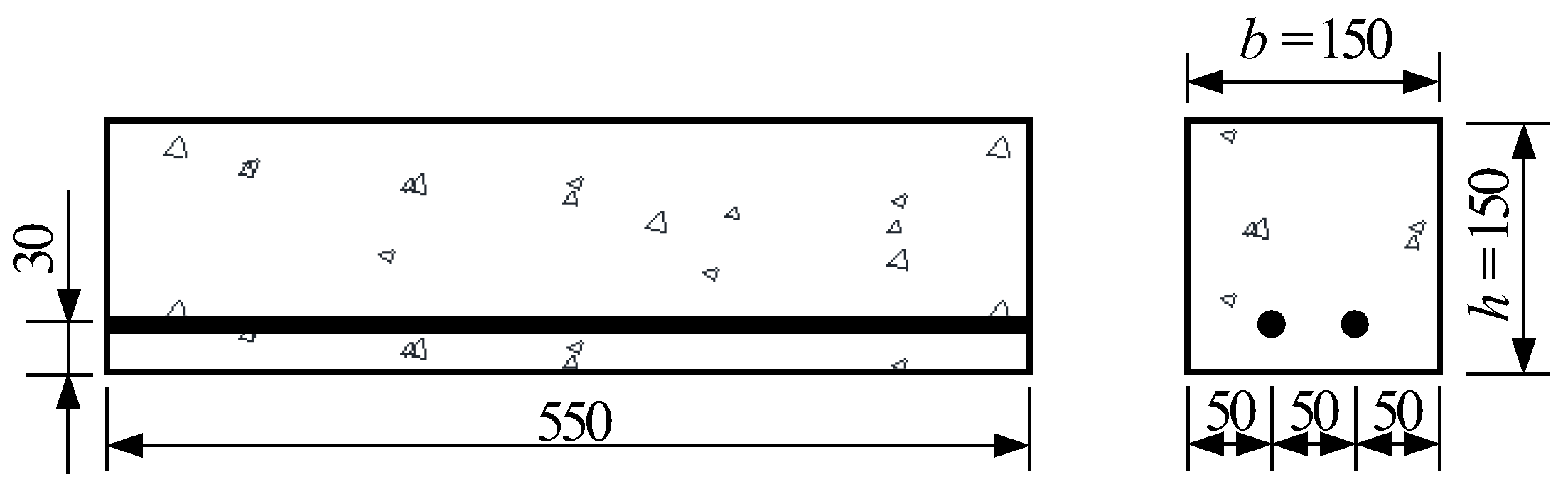
2.1.2. Test Specimens and Grouping
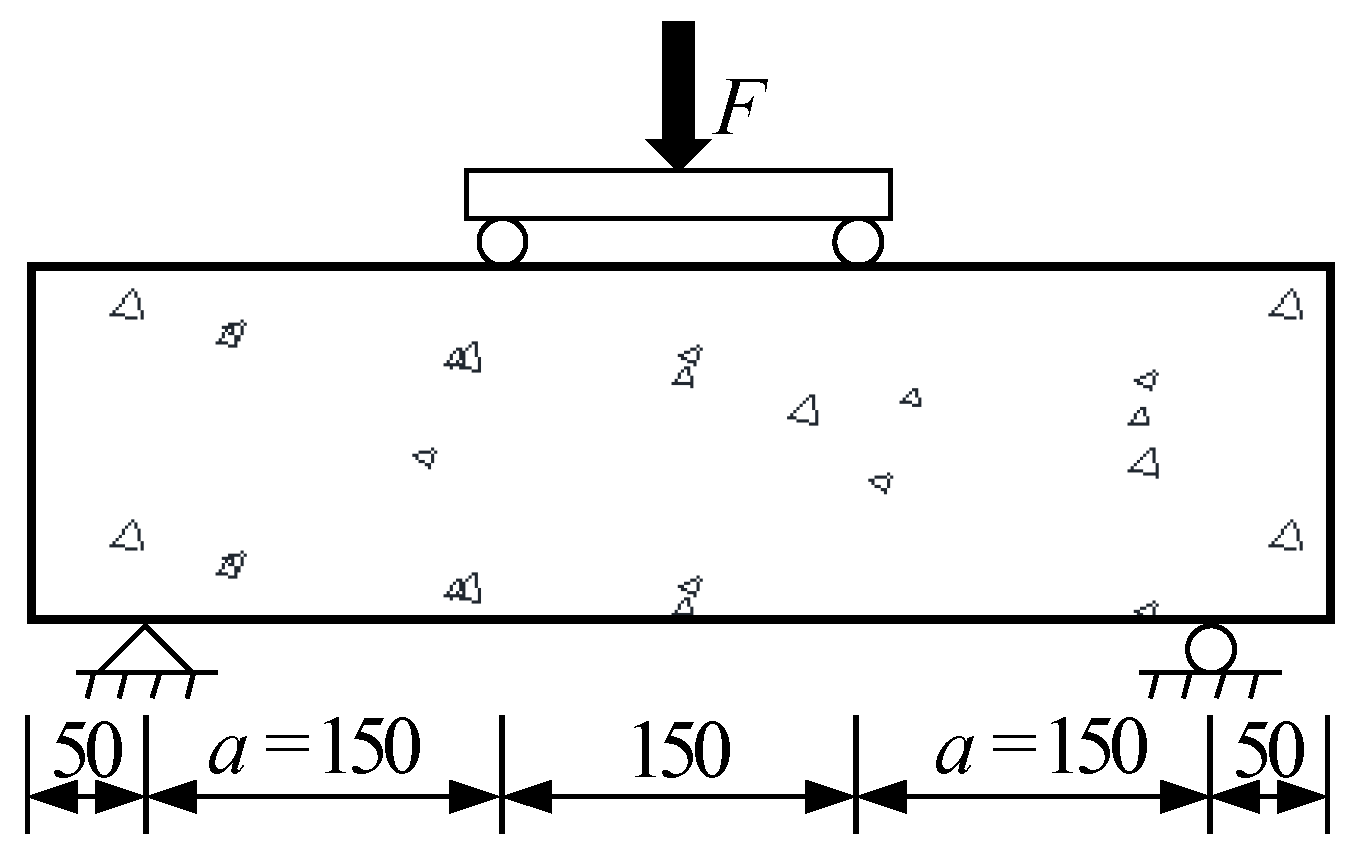
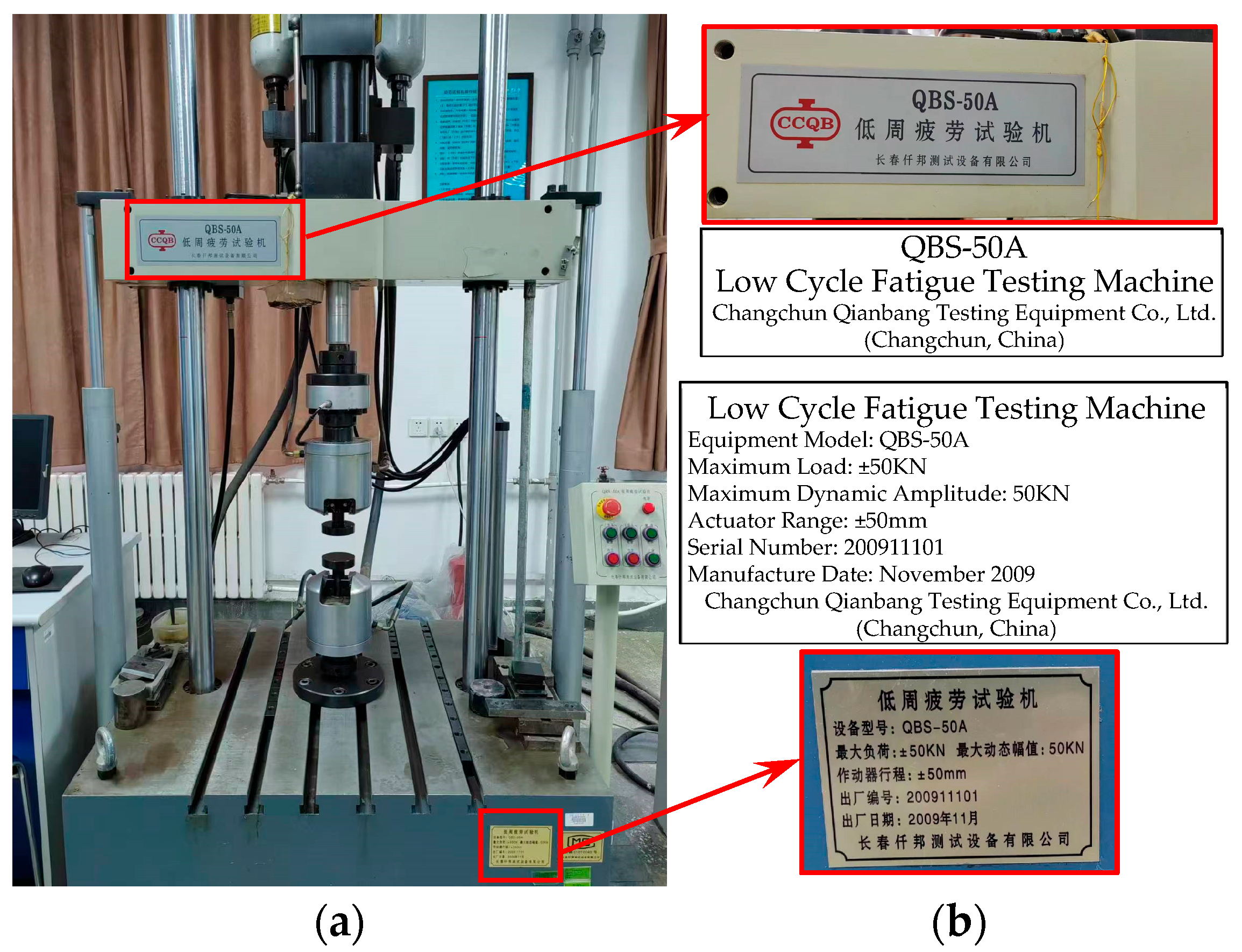
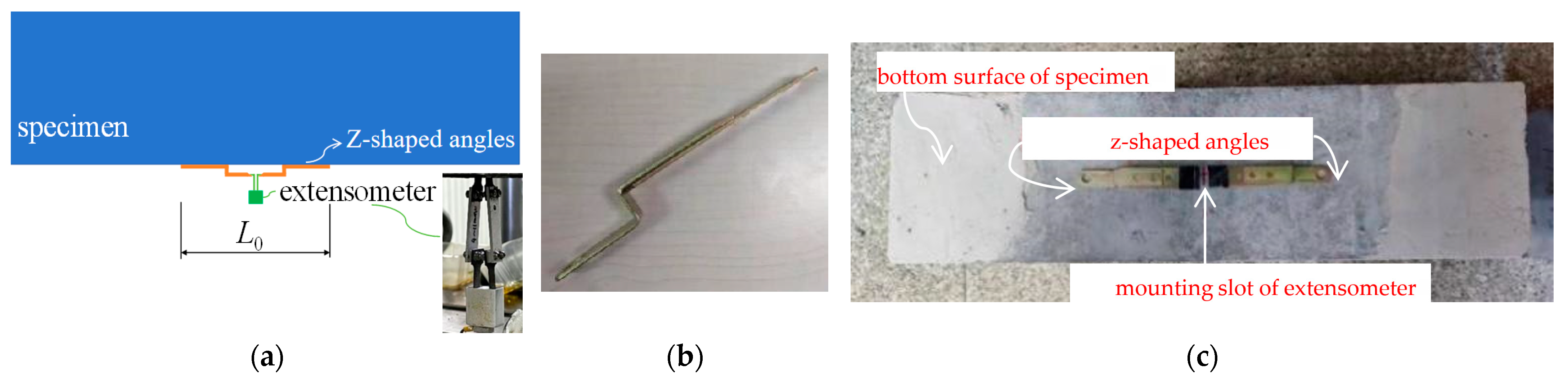
2.1.3. Loading and Instrumentation
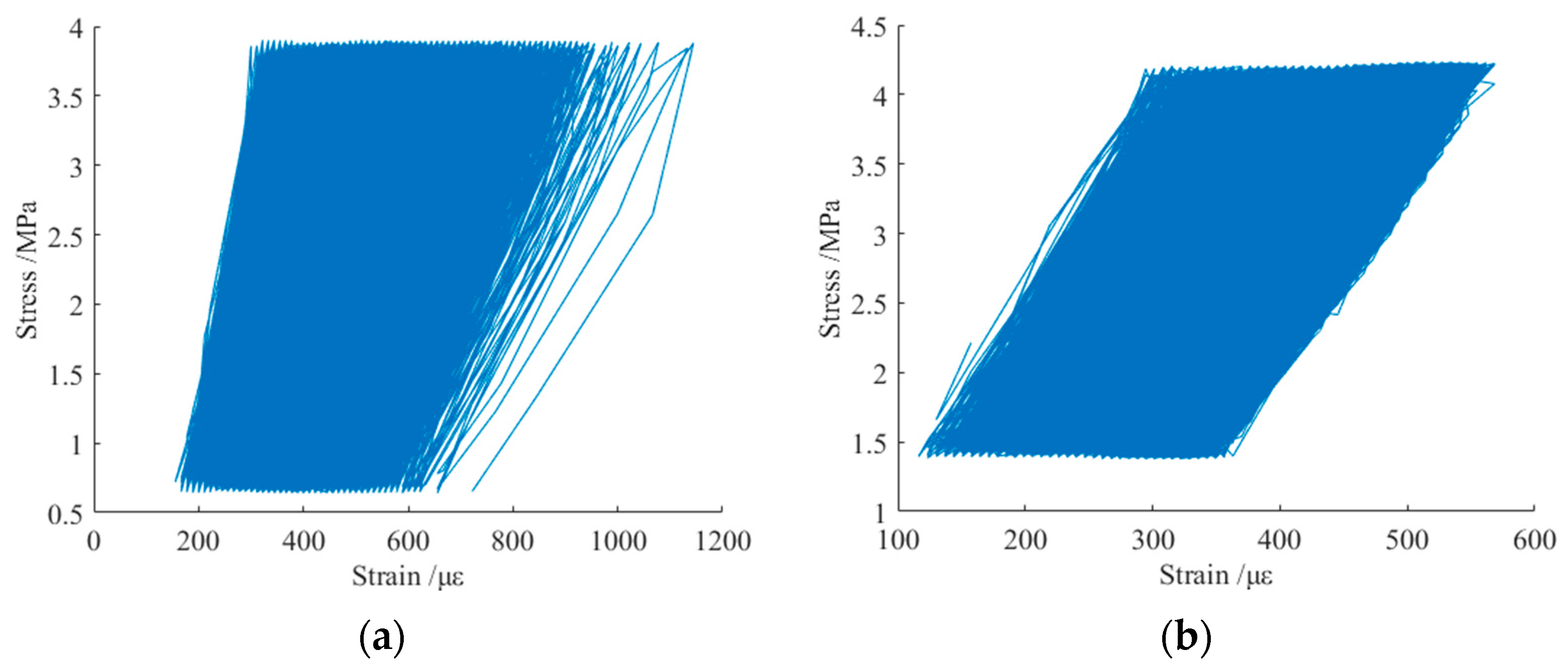
2.2. Computation of Stress–Strain Curves
2.2.1. Stress Calculation
2.2.2. Strain Calculation
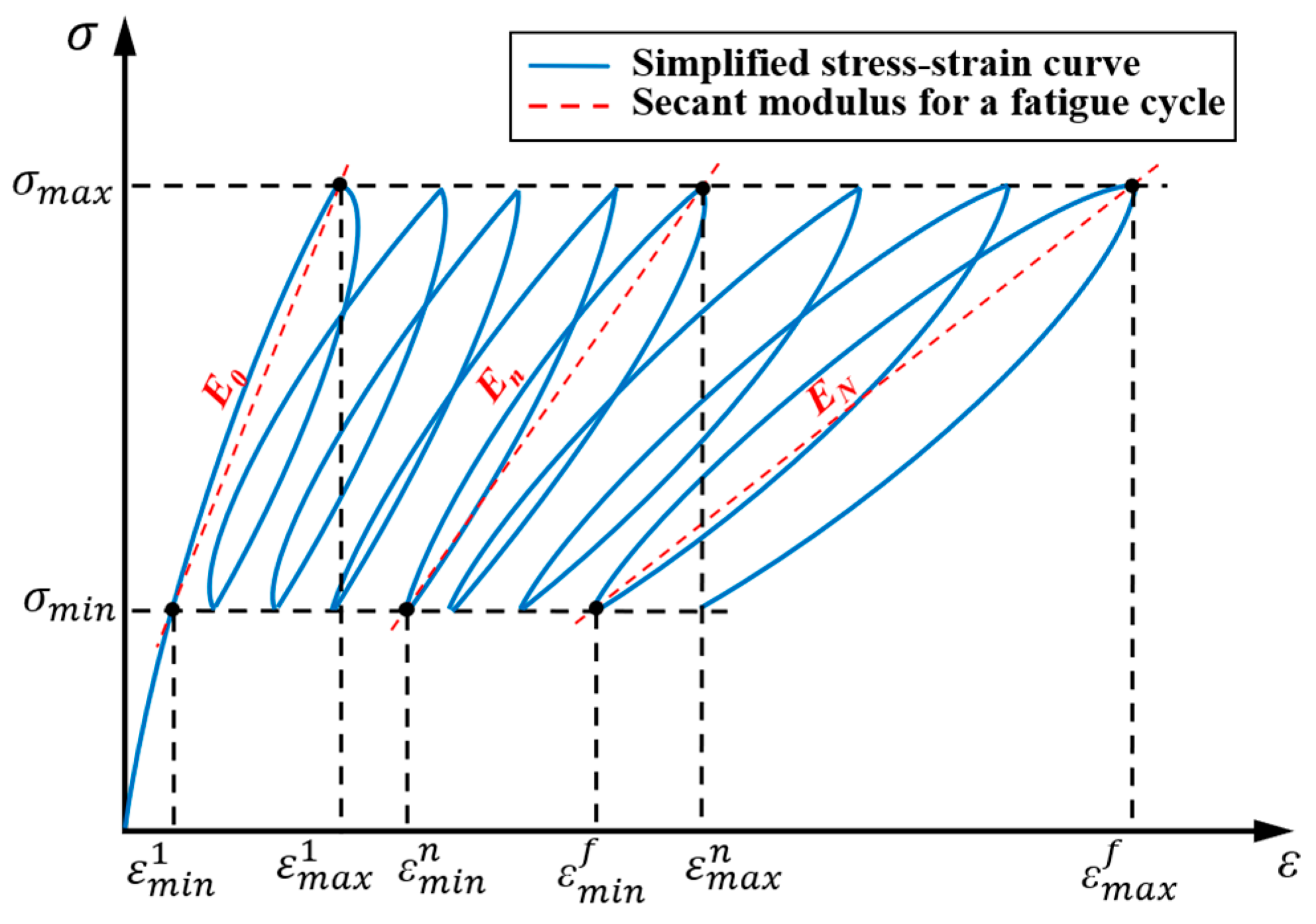
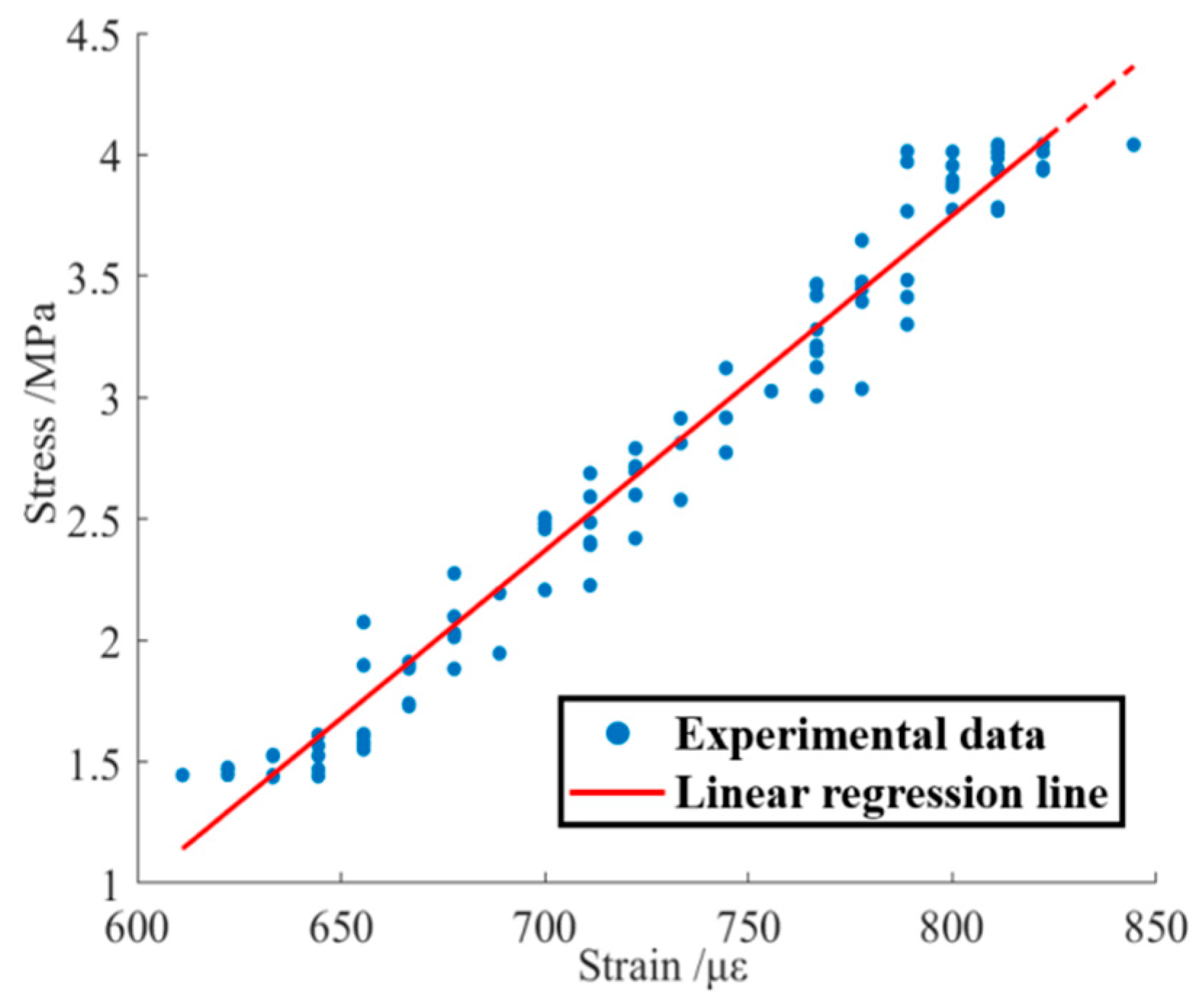
2.3. Calculation of Elastic Modulus
2.4. Definition of Damage Variable
2.5. Degradation Functions
3. Results and Discussion
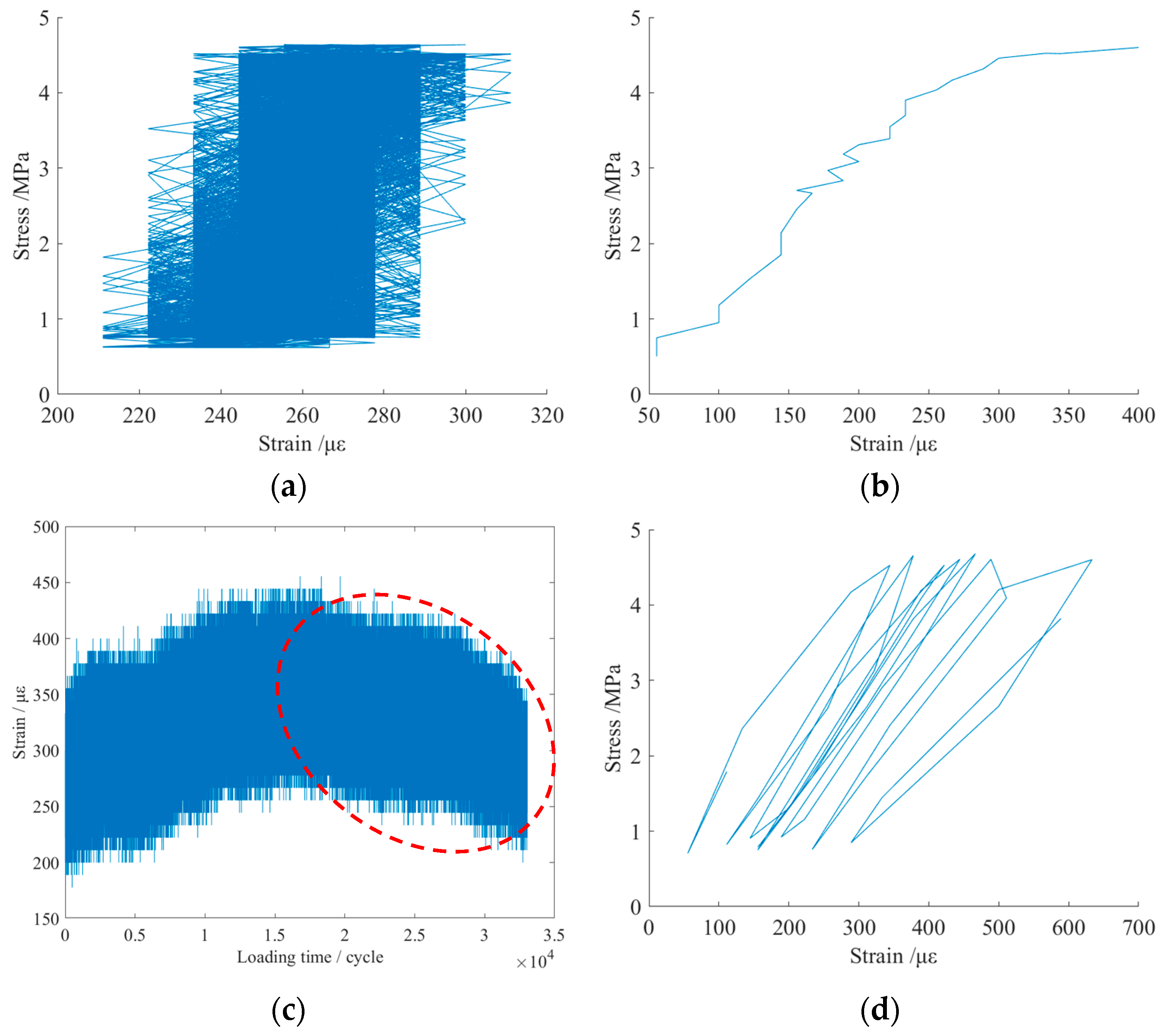
3.1. Prescreening of Specimens
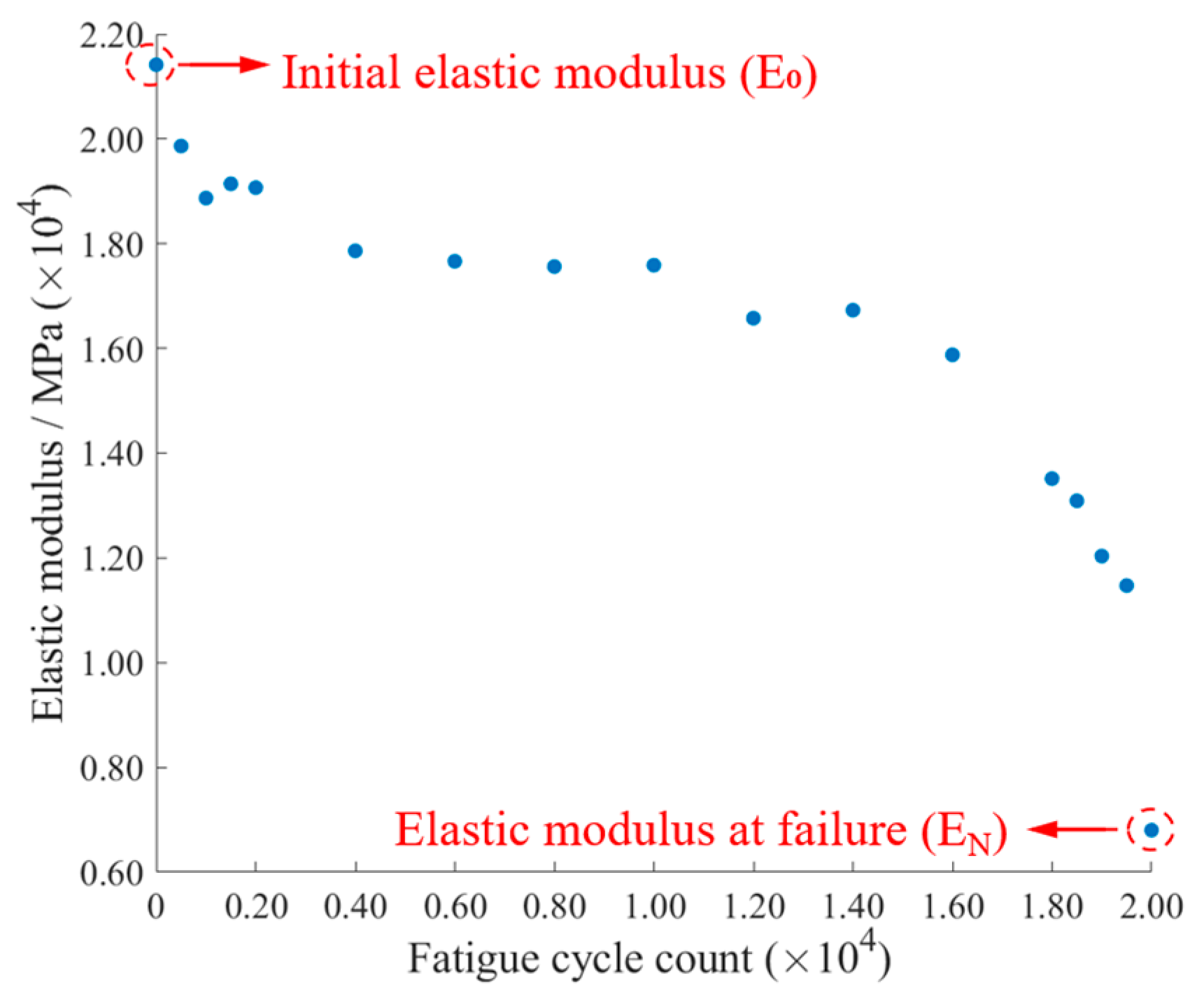
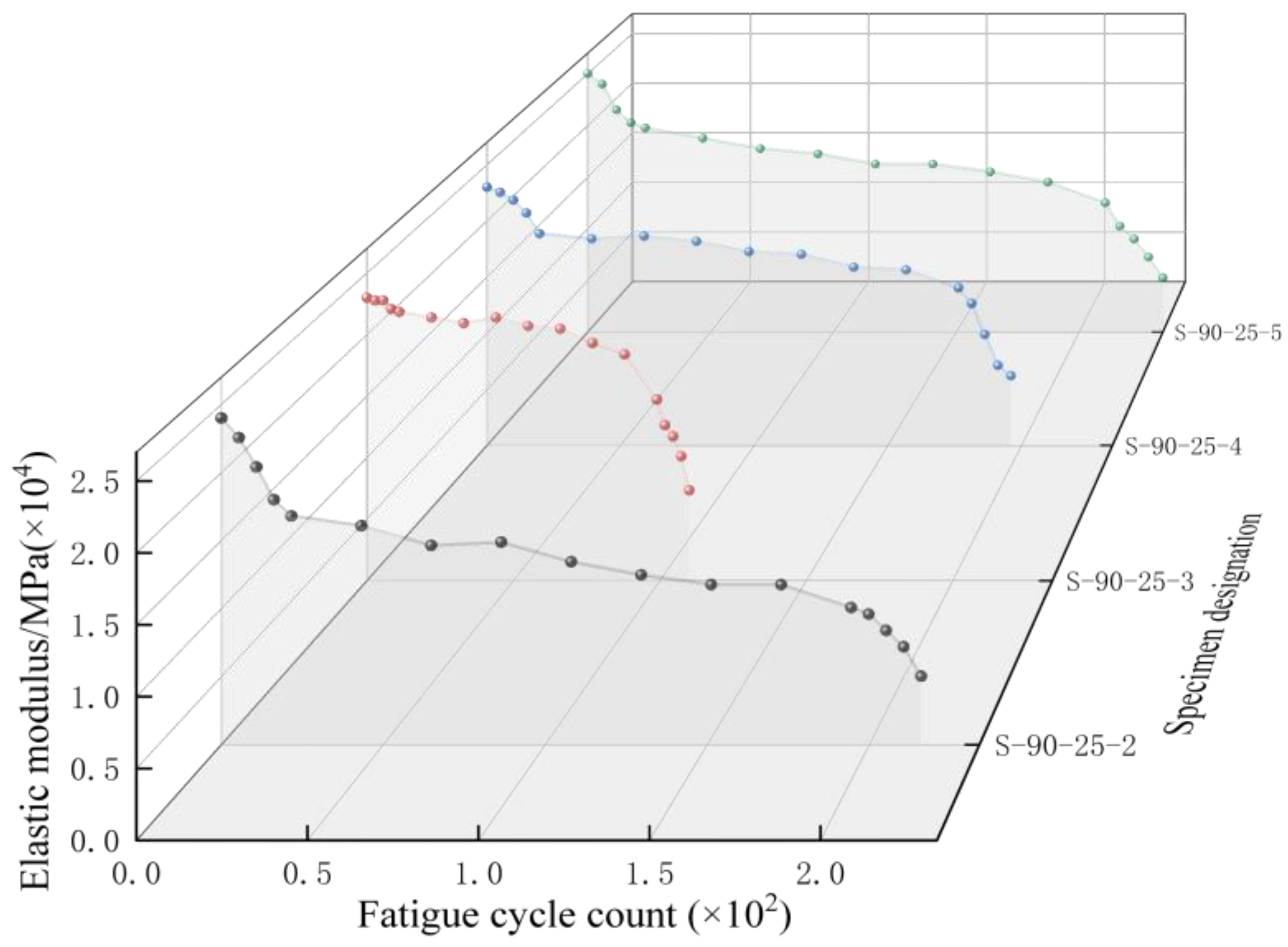
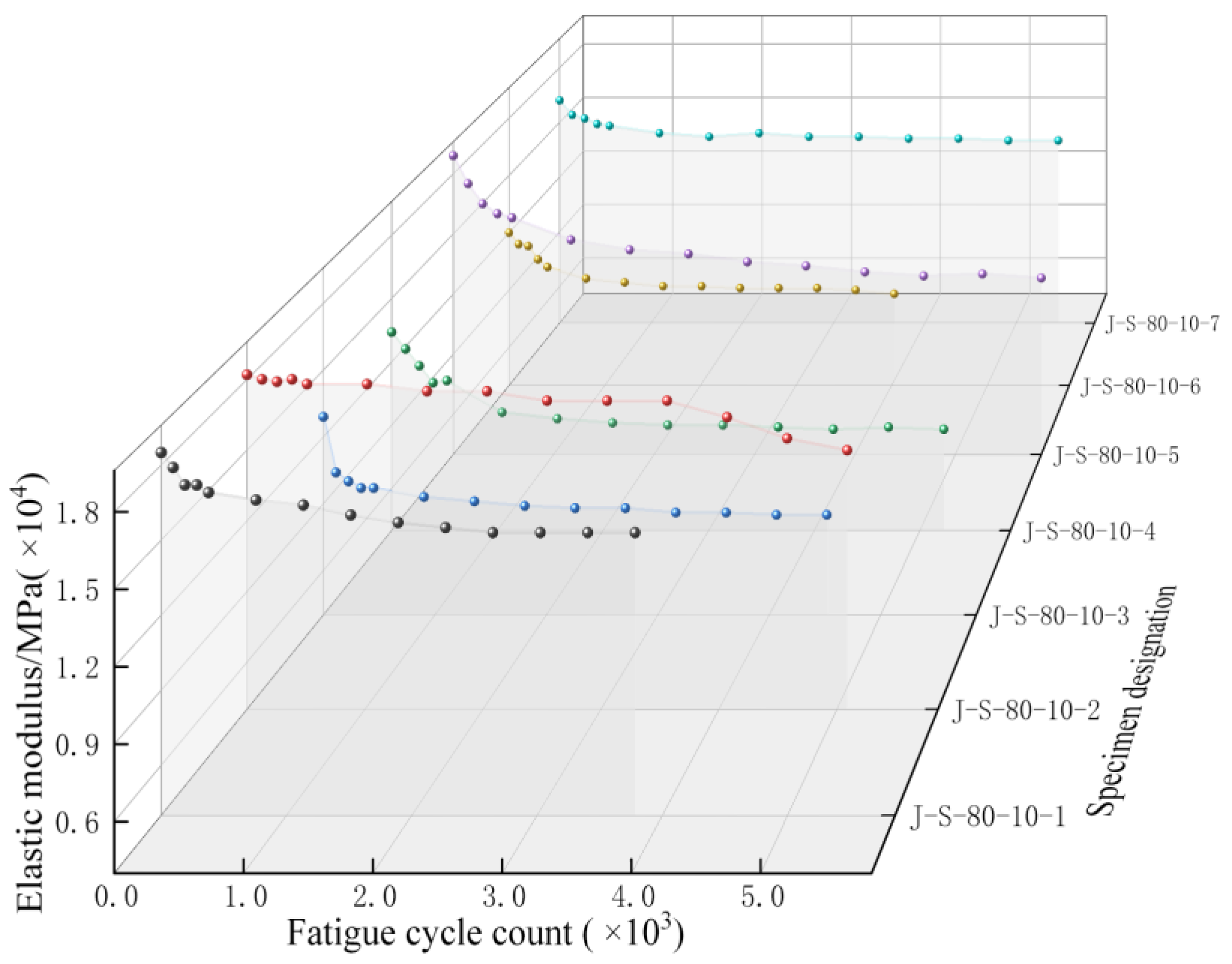
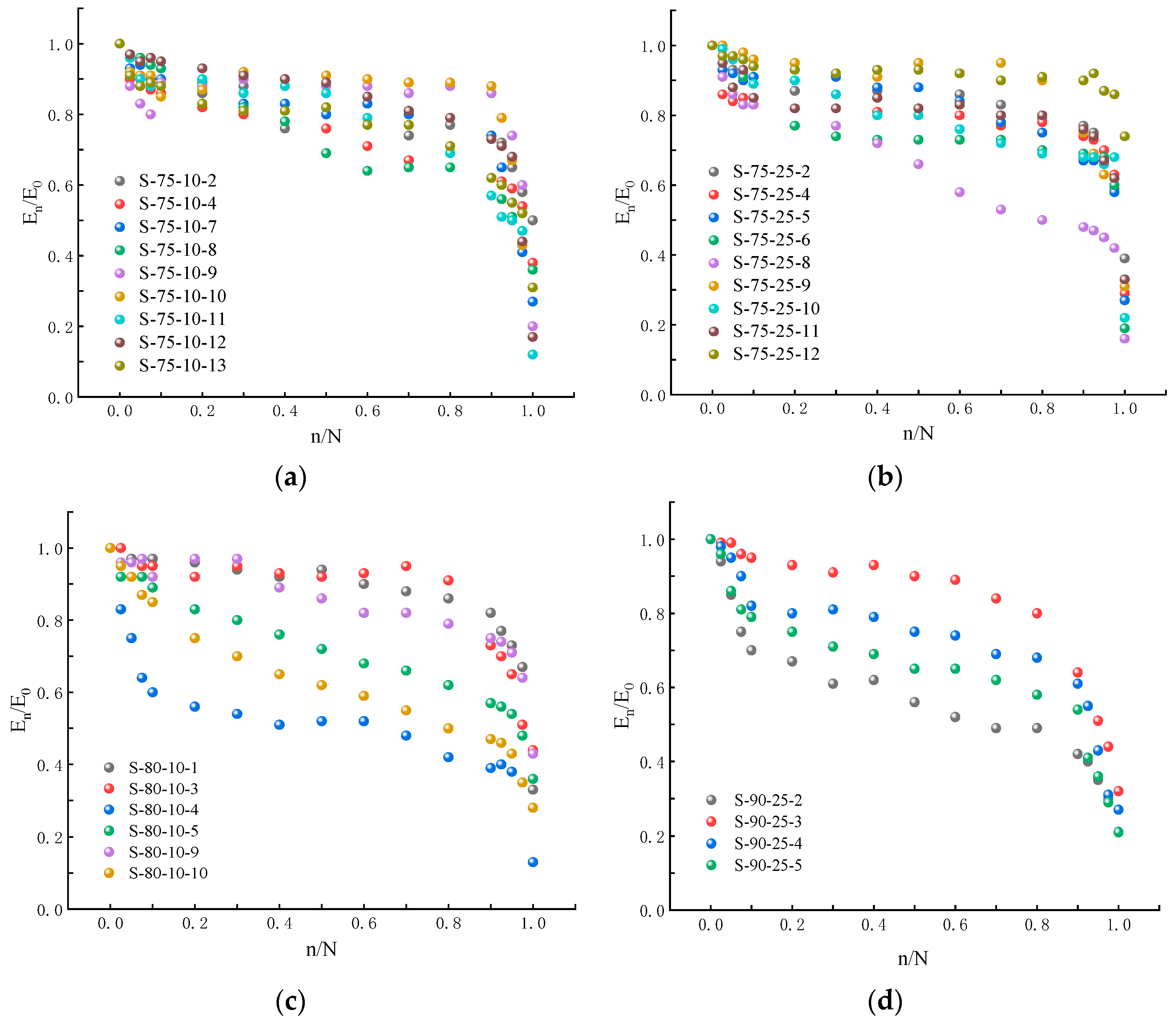
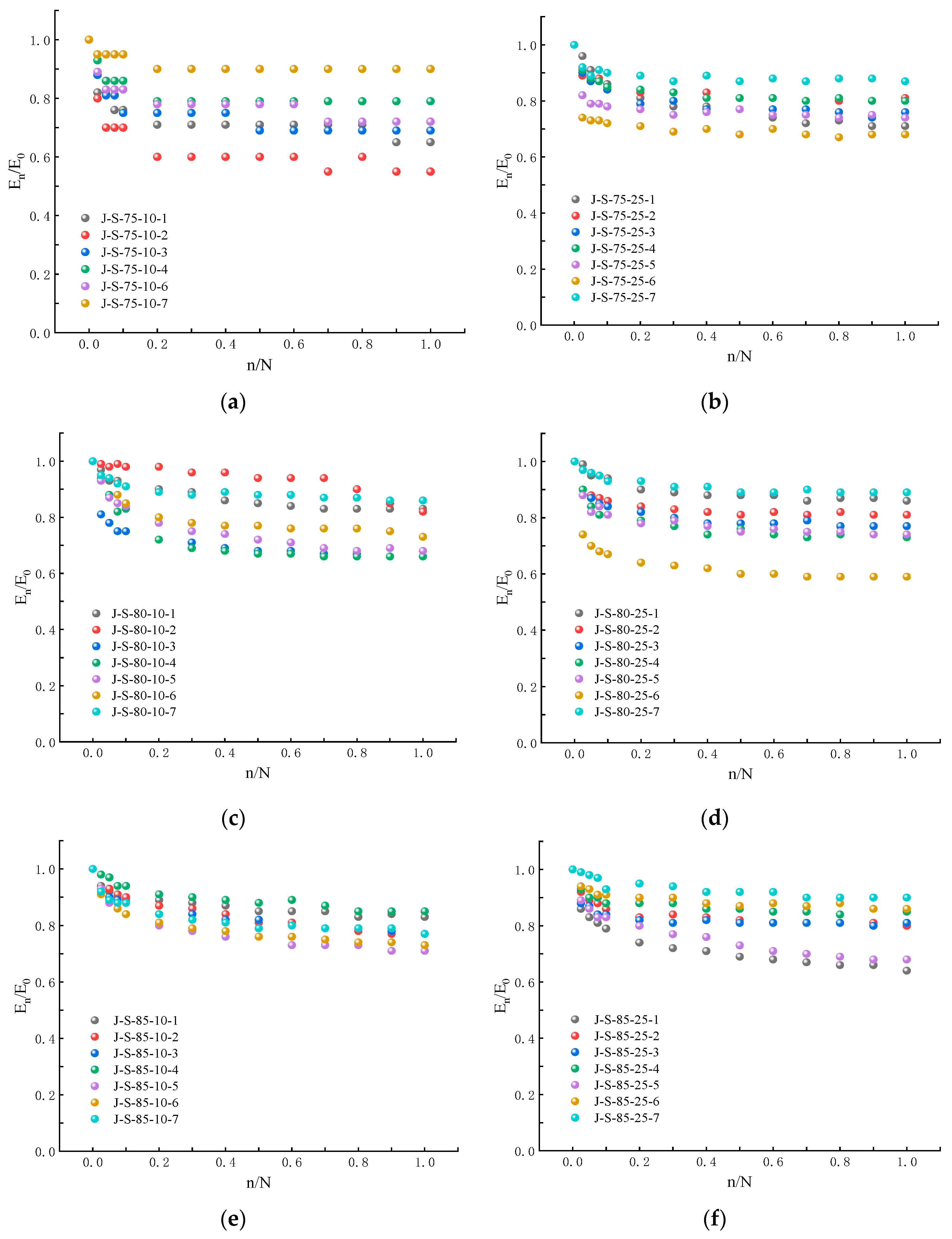
3.2. Elastic Modulus Degradation
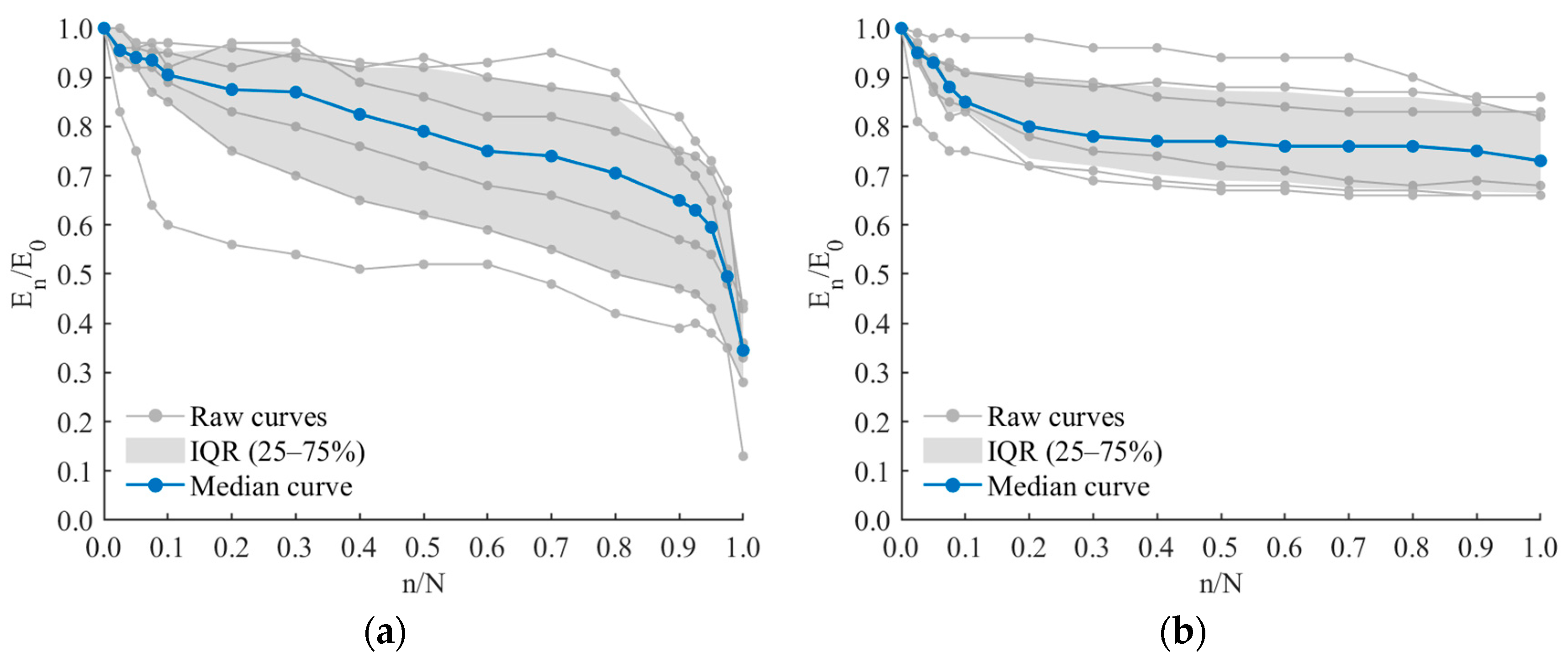
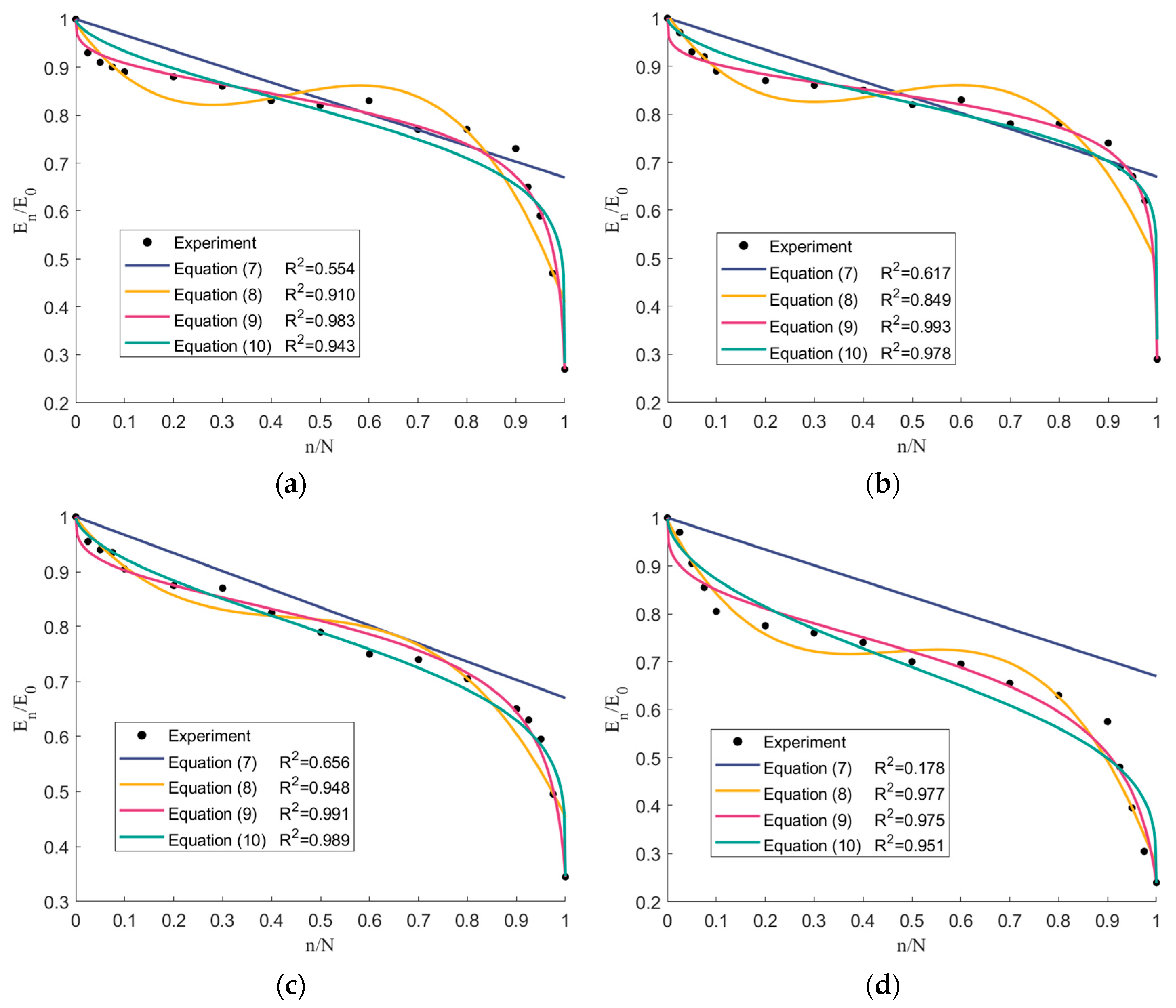
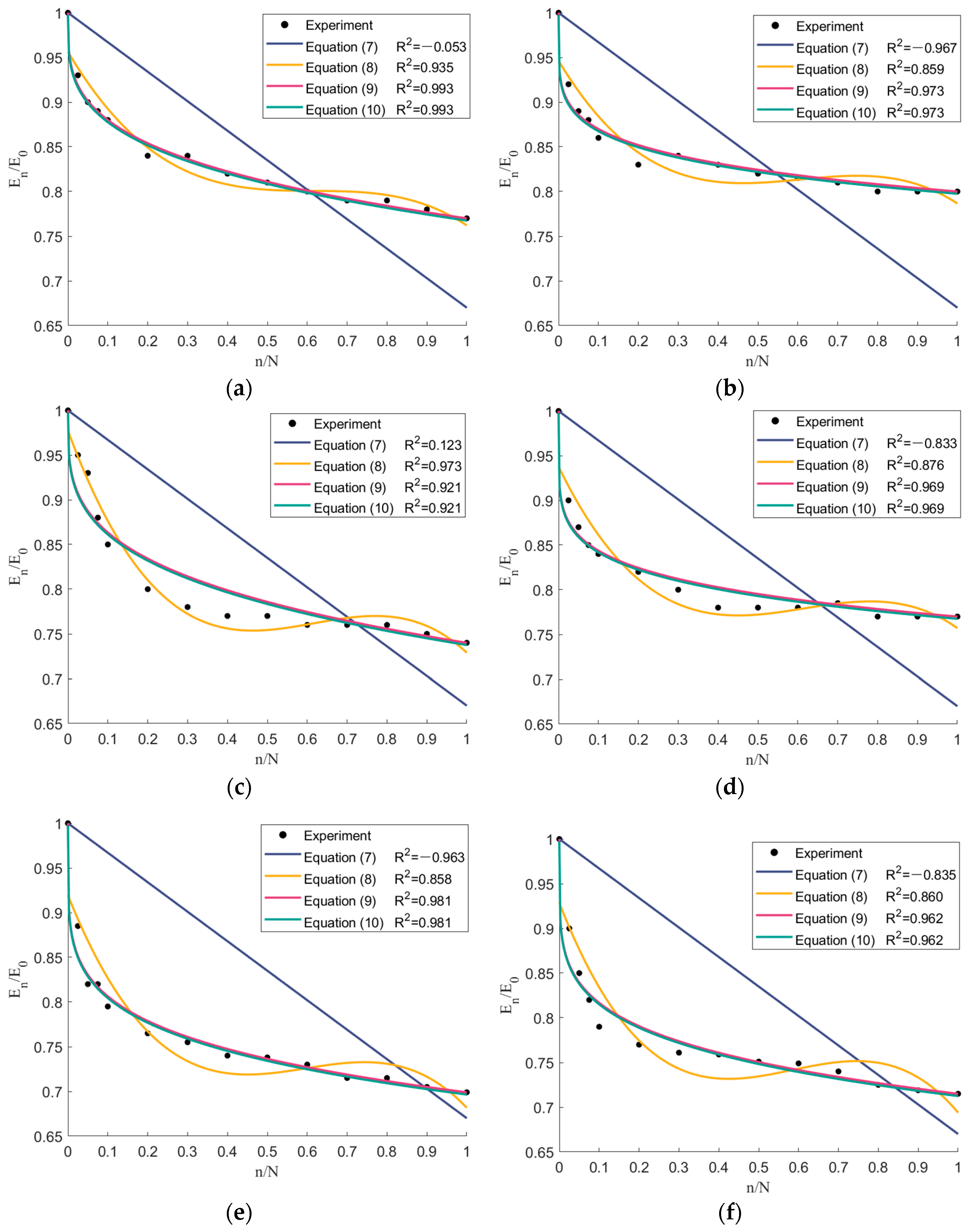
3.3. Characterization of Elastic Modulus Degradation
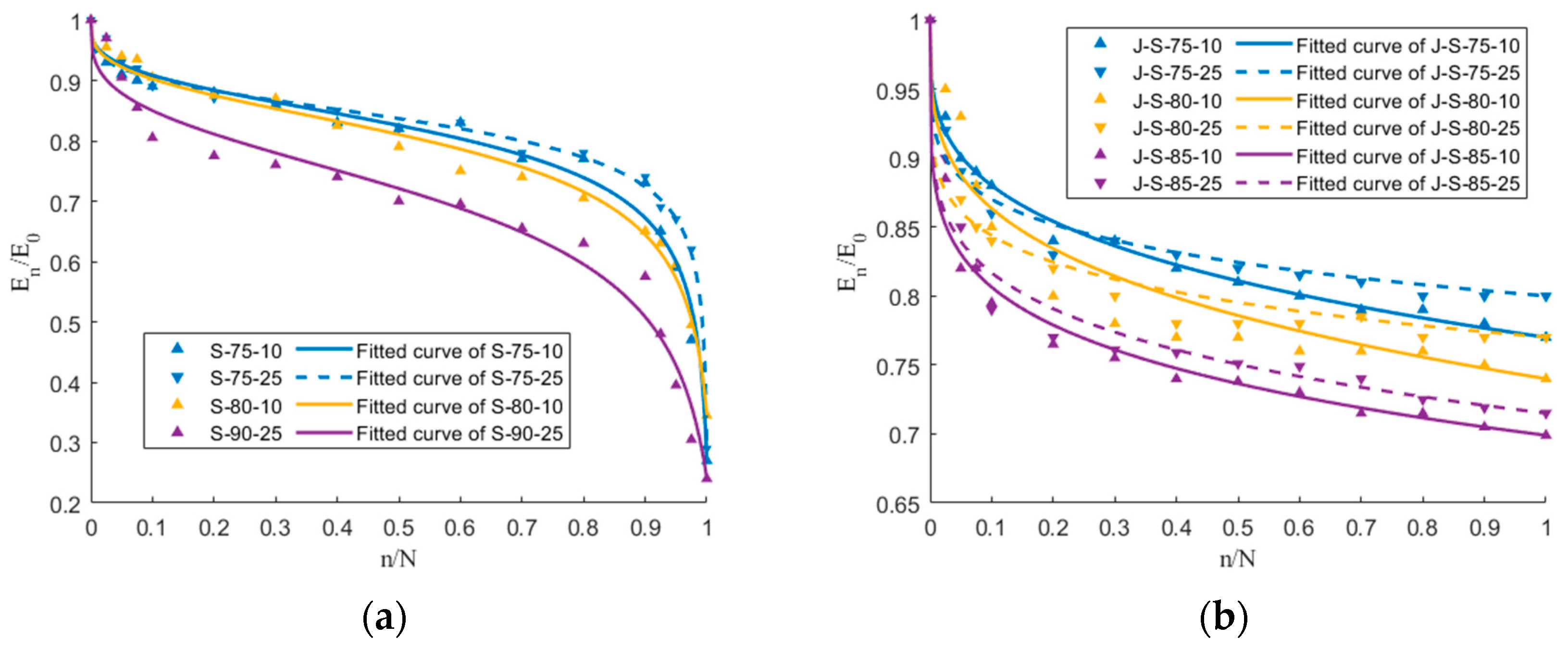
3.4. Elastic Modulus Degradation Law
3.5. Effects of Stress Ratio and Maximum Stress Level
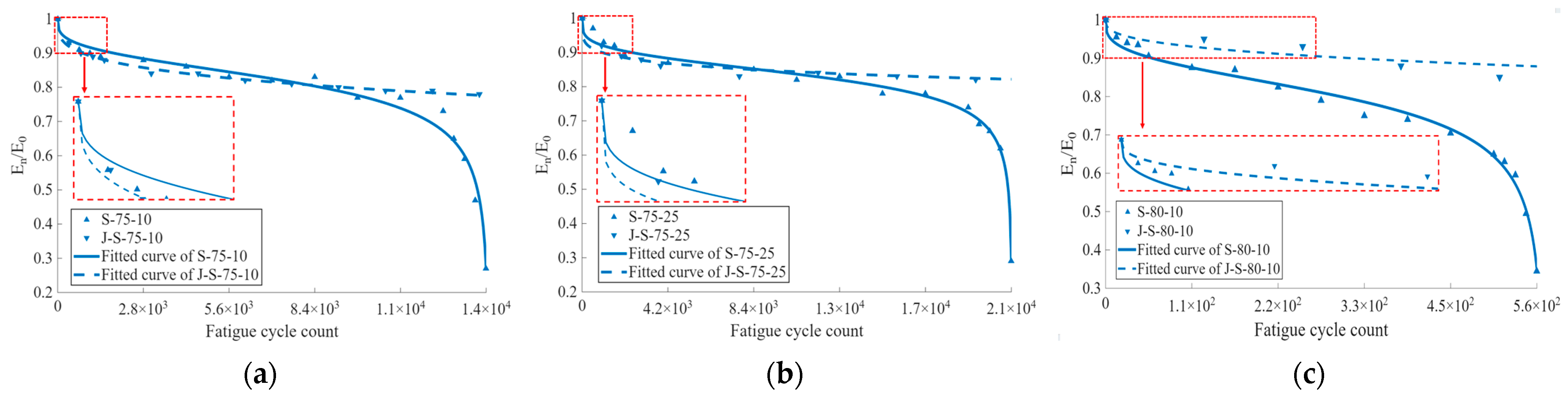
3.6. Influence of Reinforcement
3.7. Limitations and Future Work
4. Conclusions
- (1)
- Under fatigue loading, the elastic modulus degradation of failed plain concrete specimens exhibited a typical three-stage, S-shaped evolution. In contrast, for PC specimens that did not fail within the test duration, the elastic modulus remained essentially stable, with the relative residual elastic modulus exceeding 0.93 throughout the loading process.
- (2)
- Within the tested range, reinforced concrete specimens primarily exhibited an apparent two-stage behavior consisting of an initial rapid reduction followed by a relatively stable phase. Due to practical limitations of the loading system and testing conditions, RC specimens did not reach complete fatigue failure; therefore, the reported degradation characteristics are based on available observations and do not include the near-failure accelerated stage.
- (3)
- The integrated indicators AUC and || offer complementary measures of modulus degradation. AUC represents the overall cumulative degradation over the normalized fatigue life, whereas || quantifies the degradation rate during the stable fatigue stage, enabling consistent comparisons among different stress conditions and specimen types. Because || demonstrated greater sensitivity to variations in fatigue loading and specimen configuration, it is recommended as the primary indicator of modulus degradation.
- (4)
- Stress ratio and maximum stress level exerted distinct influences on elastic modulus degradation. Under the same maximum stress level, increasing the stress ratio mitigated degradation. For PC specimens, AUC increased from 0.8033 (S-75-10) to 0.8215 (S-75-25), while || decreased from 0.2505 to 0.1912. Under the same minimum stress level, increasing the maximum stress level intensified degradation: for PC specimens, AUC decreased from 0.8215 (S-75-25) to 0.6976 (S-90-25), accompanied by an increase in || from 0.1912 to 0.3705.
- (5)
- Under identical fatigue loading conditions, RC specimens exhibited slower elastic modulus degradation than PC specimens. Compared with the corresponding PC specimens, the AUCn of RC specimens was consistently higher, whereas || was markedly lower. For example, relative to S-75-10, J-S-75-10 showed an AUCn increase of about 3% and a || reduction of approximately 54%; relative to S-80-10, J-S-80-10 showed an AUCn increase of approximately 15% and a || reduction of about 74%. Overall, reinforcement reduced cumulative degradation and slowed the stable-stage degradation rate of elastic modulus.
Author Contributions
Funding
Data Availability Statement
Conflicts of Interest
Abbreviations
| PC | Plain concrete |
| RC | Reinforced concrete |
| AUC | Area under the curve |
| IQR | Interquartile range |
References
- Wei, X.L.; Makhloof, D.A.; Ren, X.D. Analytical models of concrete fatigue: A state-of-the-art review. CMES-Comput. Model. Eng. Sci. 2023, 134, 9–34. [Google Scholar] [CrossRef] [Scilit]
- Kachkouch, F.Z.; Noberto, C.C.; Babadopulos, L.F.D.L.; Melo, A.R.S.; Machado, A.M.L.; Sebaibi, N.; Boukhelf, F.; El Mendili, Y. Fatigue behavior of concrete: A literature review on the main relevant parameters. Constr. Build. Mater. 2022, 338, 127510. [Google Scholar] [CrossRef] [Scilit]
- Yang, S. Special issue on fatigue, performance, and damage assessments of concrete. Appl. Sci. 2024, 14, 1845. [Google Scholar] [CrossRef] [Scilit]
- Li, X.; Zhang, J.W.; Cheng, J. Study on the stiffness degradation in concrete continuous beam with externally prestressed CFRP tendons under fatigue loading. Adv. Struct. Eng. 2021, 24, 2119–2130. [Google Scholar] [CrossRef] [Scilit]
- Wang, B.; Huang, Q.; Liu, X.L.; Ding, Y. Study on stiffness deterioration in steel-concrete composite beams under fatigue loading. Steel Compos. Struct. 2020, 34, 499–509. [Google Scholar]
- Qin, C.J.; Dong, X.G.; Wu, B.; Cai, L.D.; Wang, S.H.; Xia, Q. Fatigue damage analysis of plain and steel fiber-reinforced concrete material based on a stiffness degradation microplane model. Front. Mater. 2024, 11, 1505295. [Google Scholar] [CrossRef] [Scilit]
- Liu, F.P.; Zhou, J.T.; Yan, L. Study of stiffness and bearing capacity degradation of reinforced concrete beams under constant-amplitude fatigue. PLoS ONE 2018, 13, e0192797. [Google Scholar] [CrossRef] [Scilit] [PubMed]
- Zuo, X.D.; Ni, Y.S.; Zhang, J.Q.; Zhao, S.C. Influences of fatigue stiffness degradation of in-service concrete T-beams on natural vibration frequency. J. Asian Archit. Build. Eng. 2025, 24, 1176–1185. [Google Scholar] [CrossRef] [Scilit]
- Zhou, J.; Lin, H.; Qiu, K.S.; Ou, K.; Nie, F.H. Prediction of modulus of elasticity of concrete using different homogenization methods. Materials 2025, 18, 2674. [Google Scholar] [CrossRef] [Scilit]
- Birkner, D.; Beltrán Gutiérrez, R.E.; Marx, S. Comparison of stiffness degradation in fatigue-loaded concrete cylinders and large-scale beams. Eng. Struct. 2024, 302, 117360. [Google Scholar] [CrossRef] [Scilit]
- Zhang, T.; Cui, X.J.; Li, P.F.; Li, X.F.; Wang, S.Q.; Zhang, C. Stiffness degradation analysis of reinforced concrete beams under corrosion–fatigue coupling action based on experimental research. Structures 2023, 54, 1278–1298. [Google Scholar] [CrossRef] [Scilit]
- Do, M.T.; Chaallal, O.; Aïtcin, P.C. Fatigue behavior of high-performance concrete. J. Mater. Civ. Eng. 1993, 5, 96–111. [Google Scholar] [CrossRef] [Scilit]
- Kolluru, S.V.; O’Neil, E.F.; Popovics, J.S.; Shah, S.P. Crack propagation in flexural fatigue of concrete. J. Eng. Mech. 2000, 126, 891–898. [Google Scholar] [CrossRef] [Scilit]
- Chen, X.D.; Bu, J.W.; Fan, X.Q.; Lu, J.; Xu, L.Y. Effect of loading frequency and stress level on low cycle fatigue behavior of plain concrete in direct tension. Constr. Build. Mater. 2017, 133, 367–375. [Google Scholar] [CrossRef] [Scilit]
- Viswanath, S.; Kuchma, D.A.; LaFave, J.M. Experimental investigation of concrete fatigue in axial compression. ACI Struct. J. 2021, 118, 263–276. [Google Scholar] [CrossRef] [Scilit]
- Gan, Y.D.; Yang, S.; Zuo, Y.B.; Schlangen, E.; Shi, B.Y.; Savija, B. A comprehensive review of fatigue of cementitious materials: Characterisation, modelling and mechanisms. Constr. Build. Mater. 2024, 452, 138962. [Google Scholar] [CrossRef] [Scilit]
- Meng, Q.L.; Jing, X.F.; Wang, H.L.; Guo, X.Y.; Song, J.B.; Du, J.T. Flexural fatigue properties of concrete based on different replacement percentage of natural sand with manufactured sand. J. Build. Eng. 2024, 87, 108987. [Google Scholar] [CrossRef] [Scilit]
- Yadav, I.N.; Thapa, K.B. Fatigue damage model of concrete materials. Theor. Appl. Fract. Mech. 2020, 108, 102578. [Google Scholar] [CrossRef] [Scilit]
- Wang, Y.P. A new insight into the three phases of secant stiffness degradation of concrete under fatigue loading. Int. J. Fatigue 2023, 167, 107323. [Google Scholar] [CrossRef] [Scilit]
- Chen, H.T.; Sun, Z.Y.; Zhang, X.W.; Fan, J.H. Tensile fatigue properties of ordinary plain concrete and reinforced concrete under flexural loading. Materials 2023, 16, 6447. [Google Scholar] [CrossRef] [Scilit] [PubMed]
- Holmen, J.O. Fatigue of concrete by constant and variable amplitude loading. ACI Spec. Publ. 1982, 75, 71–110. [Google Scholar]
- Zhao, D.F.; Gao, H.J.; Liu, Y.C.; Liu, H.X.; Jia, P.H. Research on the compressive fatigue properties of high strength concrete after high temperature. Eng. Mech. 2018, 35, 201–207. (In Chinese) [Google Scholar] [CrossRef] [Scilit]
- Lian, W.; Yao, W.X. Fatigue life prediction of composite laminates by FEA simulation method. Int. J. Fatigue 2010, 32, 123–133. [Google Scholar] [CrossRef] [Scilit]
- Chen, H.T.; Sun, Z.Y.; Zhang, X.W.; Zhang, W.X. Equivalent fatigue constitutive model based on fatigue damage evolution of concrete. Appl. Sci. 2024, 14, 8721. [Google Scholar] [CrossRef] [Scilit]
- You, K.; Shung, D.; Giuffre, M. On the Wasserstein median of probability measures. J. Comput. Graph. Stat. 2025, 34, 253–266. [Google Scholar] [CrossRef] [Scilit]
- Sohel, K.M.A.; Al-Hinai, M.H.S.; Alnuaimi, A.; Al-Shahri, M.; El-Gamal, S. Prediction of flexural fatigue life and failure probability of normal weight concrete. Mater. Constr. 2022, 72, e291. [Google Scholar] [CrossRef] [Scilit]
- Jia, M.D.; Wu, Z.M.; Li, Q.H.; Jiang, X.Y.; Jin, H.; Yu, R.C.; Xu, S.L. A probabilistic prediction method for mode I fatigue life of concrete based on the statistical laws of material parameters. Eng. Fract. Mech. 2024, 309, 110429. [Google Scholar] [CrossRef] [Scilit]







| Series | Set Designation | Stress Ratio R | Number of Specimens | ||
|---|---|---|---|---|---|
| PC | S-65-10 | 0.65 | 0.10 | 0.154 | 3 |
| S-75-10 | 0.75 | 0.10 | 0.133 | 13 | |
| S-75-25 | 0.75 | 0.25 | 0.333 | 12 | |
| S-80-10 | 0.80 | 0.10 | 0.125 | 12 | |
| S-90-10 | 0.90 | 0.10 | 0.110 | 5 | |
| S-90-25 | 0.90 | 0.25 | 0.280 | 5 | |
| S-90-40 | 0.90 | 0.40 | 0.440 | 5 | |
| RC | J-S-75-10 | 0.75 | 0.10 | 0.133 | 7 |
| J-S-75-25 | 0.75 | 0.25 | 0.333 | 7 | |
| J-S-80-10 | 0.80 | 0.10 | 0.125 | 7 | |
| J-S-80-25 | 0.80 | 0.25 | 0.313 | 7 | |
| J-S-85-10 | 0.85 | 0.10 | 0.117 | 7 | |
| J-S-85-25 | 0.85 | 0.25 | 0.294 | 7 |
| Type of Specimen Abnormality | PC Specimen | RC Specimen |
|---|---|---|
| Irregular fluctuations in stress–strain data | 10 | 0 |
| Missing stress–strain data | 4 | 0 |
| Abnormal strain decrease | 3 | 1 |
| Low-cycle fatigue failure | 5 | 0 |
| Total | 22 | 1 |
| Set Designation | Specimen Designation Fatigue Life N (Cycle) | ||||||
|---|---|---|---|---|---|---|---|
| S-65-10 | S-65-10-1 * 1,000,000 | S-65-10-2 * 1,000,000 | S-65-10-3 * 1,000,000 | ||||
| S-75-10 | S-75-10-2 32,835 | S-75-10-4 7574 | S-75-10-7 528 | S-75-10-8 63 | S-75-10-9 14,048 | S-75-10-10 224,931 | S-75-10-11 11,328 |
| S-75-10-12 49,629 | S-75-10-13 19,585 | ||||||
| S-75-25 | S-75-25-2 2518 | S-75-25-3 * 365,759 | S-75-25-4 34,187 | S-75-25-5 5321 | S-75-25-6 7308 | S-75-25-8 32,646 | S-75-25-9 26,049 |
| S-75-25-10 39,379 | S-75-25-11 14,209 | S-75-25-12 21,097 | |||||
| S-80-10 | S-80-10-1 3872 | S-80-10-3 496 | S-80-10-4 6115 | S-80-10-5 1391 | S-80-10-8 * 61,960 | S-80-10-9 1036 | S-80-10-10 618 |
| S-90-25 | S-90-25-2 216 | S-90-25-3 110 | S-90-25-4 196 | S-90-25-5 234 | |||
| J-S-75-10 | J-S-75-10-1 13,213 | J-S-75-10-2 16,030 | J-S-75-10-3 14,274 | J-S-75-10-4 14,680 | J-S-75-10-6 72,320 | J-S-75-10-7 23,793 | |
| J-S-75-25 | J-S-75-25-1 598 | J-S-75-25-2 32,730 | J-S-75-25-3 35,214 | J-S-75-25-4 41,908 | J-S-75-25-5 38,683 | J-S-75-25-6 41,878 | J-S-75-25-7 48,434 |
| J-S-80-10 | J-S-80-10-1 3782 | J-S-80-10-2 5087 | J-S-80-10-3 4517 | J-S-80-10-4 5226 | J-S-80-10-5 5857 | J-S-80-10-6 4028 | J-S-80-10-7 5459 |
| J-S-80-25 | J-S-80-25-1 9696 | J-S-80-25-2 9900 | J-S-80-25-3 10,954 | J-S-80-25-4 4870 | J-S-80-25-5 9307 | J-S-80-25-6 8976 | J-S-80-25-7 6780 |
| J-S-85-10 | J-S-85-10-1 1800 | J-S-85-10-2 228 | J-S-85-10-3 516 | J-S-85-10-4 634 | J-S-85-10-5 586 | J-S-85-10-6 611 | J-S-85-10-7 691 |
| J-S-85-25 | J-S-85-25-1 2331 | J-S-85-25-2 1765 | J-S-85-25-3 2544 | J-S-85-25-4 2249 | J-S-85-25-5 1976 | J-S-85-25-6 4221 | J-S-85-25-7 6185 |
| Cycle Ratio | Specimen Designation | ||||
|---|---|---|---|---|---|
| S-65-10-1 | S-65-10-2 | S-65-10-3 | S-75-25-3 | S-80-10-8 | |
| 0 | 1.00 | 1.00 | 1.00 | 1.00 | 1.00 |
| 0.025 | 0.96 | 0.95 | 0.98 | 0.98 | 0.98 |
| 0.075 | 1.00 | 0.95 | 0.98 | 0.98 | 0.99 |
| 0.10 | 0.93 | 0.93 | 0.95 | 0.97 | 0.96 |
| 0.20 | 0.93 | 1.00 | 0.98 | 0.98 | 0.96 |
| 0.30 | 0.96 | 1.00 | 0.94 | 0.95 | 0.98 |
| 0.40 | 0.96 | 1.00 | 0.94 | 0.97 | 0.98 |
| 0.50 | 0.96 | 1.00 | 0.93 | 0.98 | 0.98 |
| 0.60 | 1.00 | 1.00 | 1.00 | 0.99 | 0.98 |
| 0.70 | 0.96 | 1.00 | 0.94 | 0.95 | 0.99 |
| 0.80 | 0.96 | 0.95 | 0.94 | 0.99 | 0.97 |
| 0.90 | 1.00 | 1.00 | 0.95 | 1.00 | 0.97 |
| 0.925 | 0.96 | 1.00 | 1.00 | 0.99 | 0.98 |
| 0.95 | 1.00 | 1.00 | 0.96 | 0.99 | 0.98 |
| 0.975 | 0.96 | 1.00 | 0.97 | 0.96 | 0.98 |
| 1.0 | 1.00 | 0.95 | 0.94 | 0.95 | 0.96 |
| Set Designation | Equation | a | b | c | d | R2 |
|---|---|---|---|---|---|---|
| S-75-10 | (7) | / | / | / | / | 0.554 |
| (8) | 4.0548 | −5.2404 | 1.9817 | 0.0119 | 0.910 | |
| (9) | 0.2403 | 3.3876 | / | / | 0.983 | |
| (10) | 0.7860 | 0.8242 | / | / | 0.943 | |
| S-75-25 | (7) | / | / | / | / | 0.617 |
| (8) | 3.7970 | −5.1059 | 2.0404 | −0.0096 | 0.849 | |
| (9) | 0.2303 | 4.1502 | / | / | 0.993 | |
| (10) | 0.7612 | 0.8793 | / | / | 0.978 | |
| S-80-10 | (7) | / | / | / | / | 0.656 |
| (8) | 2.7832 | −3.6441 | 1.6927 | 0.0032 | 0.948 | |
| (9) | 0.2925 | 3.2873 | / | / | 0.991 | |
| (10) | 0.7411 | 0.7652 | / | / | 0.989 | |
| S-90-25 | (7) | / | / | / | / | 0.178 |
| (8) | 4.1216 | −5.7190 | 2.5438 | 0.0062 | 0.977 | |
| (9) | 0.3020 | 3.4969 | / | / | 0.975 | |
| (10) | 0.6467 | 0.7169 | / | / | 0.951 |
| Set Designation | Equation | a | b | c | d | R2 |
|---|---|---|---|---|---|---|
| J-S-75-10 | (7) | / | / | / | / | −0.053 |
| (8) | 2.8720 | −5.3025 | 3.2751 | 0.1899 | 0.935 | |
| (9) | 9.8589 | 3.5363 | / | / | 0.993 | |
| (10) | 0.2826 | 0.0036 | / | / | 0.993 | |
| J-S-75-25 | (7) | / | / | / | / | –0.967 |
| (8) | 3.6815 | −6.8646 | 3.9615 | 0.2796 | 0.859 | |
| (9) | 10.4555 | 5.34662 | / | / | 0.973 | |
| (10) | 0.1619 | 1.0 × 10⁻⁶ | / | / | 0.973 | |
| J-S-80-10 | (7) | / | / | / | / | 0.123 |
| (8) | 4.3911 | −7.9844 | 4.5452 | 0.0814 | 0.973 | |
| (9) | 12.2145 | 3.3233 | / | / | 0.921 | |
| (10) | 0.3009 | 4.2 × 10⁻⁶ | / | / | 0.921 | |
| J-S-80-25 | (7) | / | / | / | / | −0.833 |
| (8) | 3.8724 | −7.1015 | 4.0179 | 0.2691 | 0.876 | |
| (9) | 16.435 | 5.8075 | / | / | 0.969 | |
| (10) | 0.1697 | 1.6 × 10⁻⁶ | / | / | 0.969 | |
| J-S-85-10 | (7) | / | / | / | / | −0.963 |
| (8) | 4.234 | −7.4282 | 4.0176 | 0.2847 | 0.858 | |
| (9) | 15.7181 | 5.1691 | / | / | 0.981 | |
| (10) | 0.1935 | 1.0 × 10⁻⁶ | / | / | 0.981 | |
| J-S-85-25 | (7) | / | / | / | / | −0.835 |
| (8) | 3.2716 | −6.2429 | 3.7976 | 0.2506 | 0.860 | |
| (9) | 16.3067 | 5.20951 | / | / | 0.962 | |
| (10) | 0.1994 | 1.1 × 10⁻⁶ | / | / | 0.962 |
| Set Designation | AUC | | |
|---|---|---|
| S-75-10 | 0.8033 | 0.2505 |
| S-75-25 | 0.8215 | 0.1912 |
| S-80-10 | 0.7885 | 0.2757 |
| S-90-25 | 0.6976 | 0.3705 |
| J-S-75-10 | 0.8207 | 0.1187 |
| J-S-75-25 | 0.8315 | 0.0745 |
| J-S-80-10 | 0.7968 | 0.1330 |
| J-S-80-25 | 0.8031 | 0.0784 |
| J-S-85-10 | 0.7474 | 0.1145 |
| J-S-85-25 | 0.7609 | 0.1085 |
| Series | Indicator | β1 | R2 | |β∗| |
|---|---|---|---|---|
| PC | AUC | −0.2679 | 0.1773 | 0.4211 |
| | | 0.5468 | 0.4026 | 0.6345 | |
| RC | AUC | −0.2169 | 0.3760 | 0.6132 |
| | | 0.2137 | 0.7371 | 0.8585 |
| Set Designation | AUCn | | |
|---|---|---|
| S-75-10 | 1.13 × 10⁴ | 1.77 × 10⁻⁵ |
| J-S-75-10 | 1.16 × 10⁴ | 8.22 × 10⁻⁶ |
| S-75-25 | 1.73 × 10⁴ | 9.02 × 10⁻⁶ |
| J-S-75-25 | 1.79 × 10⁴ | 3.16 × 10⁻⁶ |
| S-80-10 | 4.39 × 10² | 4.94 × 10⁻⁴ |
| J-S-80-10 | 5.07 × 10² | 1.29 × 10⁻⁴ |
Disclaimer/Publisher’s Note: The statements, opinions and data contained in all publications are solely those of the individual author(s) and contributor(s) and not of MDPI and/or the editor(s). MDPI and/or the editor(s) disclaim responsibility for any injury to people or property resulting from any ideas, methods, instructions or products referred to in the content. |
© 2026 by the authors. Licensee MDPI, Basel, Switzerland. This article is an open access article distributed under the terms and conditions of the Creative Commons Attribution (CC BY) license.
Share and Cite
Chen, H.; Du, J. Degradation of Elastic Modulus of Ordinary Concrete Under Flexural Fatigue Loading. Infrastructures 2026, 11, 99. https://doi.org/10.3390/infrastructures11030099
Chen H, Du J. Degradation of Elastic Modulus of Ordinary Concrete Under Flexural Fatigue Loading. Infrastructures. 2026; 11(3):99. https://doi.org/10.3390/infrastructures11030099
Chicago/Turabian StyleChen, Huating, and Jianfei Du. 2026. "Degradation of Elastic Modulus of Ordinary Concrete Under Flexural Fatigue Loading" Infrastructures 11, no. 3: 99. https://doi.org/10.3390/infrastructures11030099
APA StyleChen, H., & Du, J. (2026). Degradation of Elastic Modulus of Ordinary Concrete Under Flexural Fatigue Loading. Infrastructures, 11(3), 99. https://doi.org/10.3390/infrastructures11030099