


Abstract
The paper presents the evaluation and research undertaken to propose an optimal solution for the Capra–Bâlea road tunnel, within the framework of rehabilitating and modernizing the entire road section, with the objective of ensuring uninterrupted vehicular traffic during the winter season. The Capra–Bâlea road tunnel is the longest operational and under exploitation tunnel in Romania, measuring 887 m, and the highest-altitude road tunnel structure in the country, at 2042 m above sea level. It serves as a connection between the historic regions of Tara Romaneasca and Transylvania via the DN7C national road, commonly referred to as the Transfagarasan, which is among Romania’s most significant tourist routes, and contains five of the ten existing road tunnels in the country. The tunnel passes through crystalline metamorphic rocks typical of the Fagaras mountains. The construction method was typical of the 1970s, combining drill-and-blast in the central section with cut-and-cover execution at the two ends. The technical condition of the tunnel, evaluated through a detailed technical inspection, is presented, highlighting defects and proposing rehabilitation or restoration solutions. The existing cross sections are described and comparatively analyzed against the currently recommended cross-sections in accordance with present standards and gauge requirements. A three-dimensional simulation of both the current and original cross-sections was performed to investigate the behavior of this type of structure, and solutions for tunnel rehabilitation and modernization are recommended. Finally, the advantages of the proposed solution are discussed.
1. Introduction
Romania is a country with all types of relief, also called Carpato–Danubiano–Pontic country. It touches the Black Sea in the southeast and stretches from the city of Buzias in the west to Sulina city in the east, encompassing the Danube Delta. Additionally, the Carpathian Mountains, which form an ‘L’ shape, cover more than 50% [1] of the country’s mountain area, extending from western Romania to central Romania and passing through northern Romania to Ukraine.
Due to the challenging relief, Romanians needed to build modern roads through the mountains to connect different regions, with traditional methods and without the support of modern tools such as GIS or BIM [2] and/or the FEM [3,4], which nowadays is mostly used. One such road is the National Road 7C, also known as Transfagarasan.
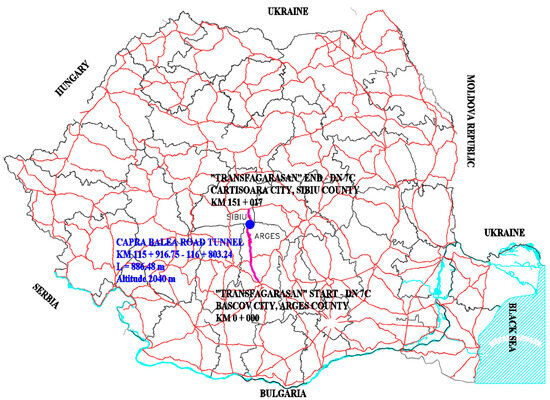
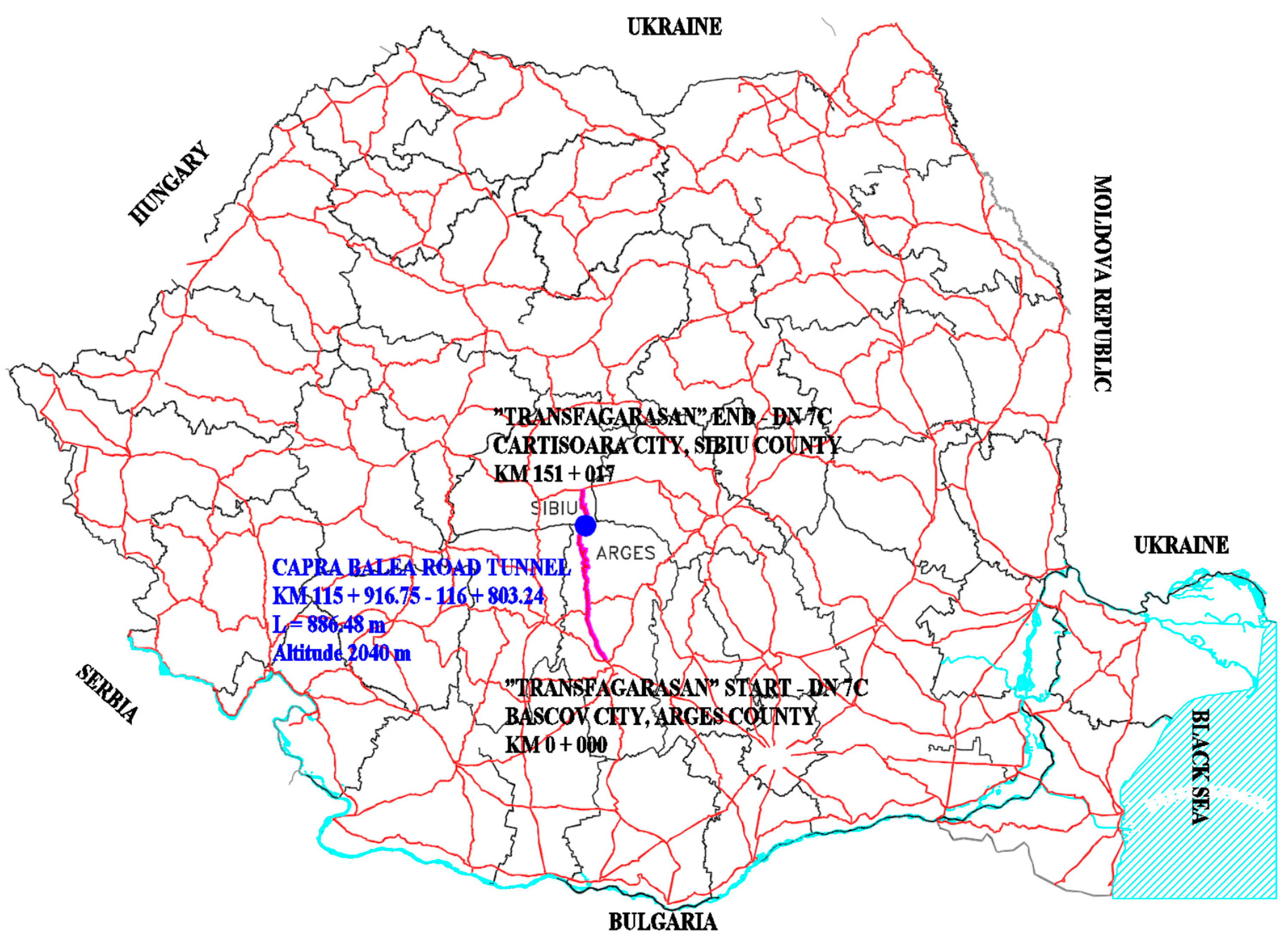
Transfagarasan is a national mountain road (Figure 1) linking the historic regions of Romania, from Transilvania to Tara Romaneasca.
Figure 1.
National Road 7C—Transfagarasan location in Romania and Bâlea–Capra road tunnel, red line—national and county roads in Romania; blue line—river along Romanian border—Danube and Danube Delta.
The road begins in Bascov city, Arges County, at km 0 + 000.00 and ends in Cartisoara city in Sibiu County at km 151 + 070.00. According to national regulations regarding mountain road traffic, AND 615—2020 [5], certain restrictions apply in the road tunnel: according to article 16b, there is gauge restriction for long or tall vehicles, according to article 23, vehicle circulations is permitted only during the daytime, between 07:00 and 21:00, and according to article 25, car circulation is permitted only in summer and autumn months, between June and September.
The route begins at a low altitude in Bascov city, at approximately 425 m, and reaches its highest point at Bâlea, passing through the Capra–Bâlea road tunnel at an elevation of 2042 m at the exit point (km 116 + 803). The altitude then decreases to approximately 440 m near the city of Cartisoara.
The entire road is a work of art and one of the most famous in Romania and Europe, making it a major attraction for both local and international tourists, with visitor numbers increasing each year.
The construction of the tunnel began in 1971, with the excavation completed in two years and an additional year required before it was opened to car traffic. Between 1974 and 1980, the road and the tunnel were modernized [6], the tunnel cross section was expanded to 7.70 m, consisting of two 3.00 m traffic lanes, a 1.00 m sidewalk on the left side, and a 0.70 m shoulder on the right side. Surface protection structures were built at the tunnel entrance and exit to protect the roadway from avalanches, and gates were installed.
Romania has extensive experience in tunnel construction, primarily for railway use. Over a period of more than 170 years, a total of 210 tunnels have been built, with a combined length of almost 84 km [7], covering all types of ground.
2. Tunnel Characteristics and Technical Specifications
The Capra–Bâlea road tunnel is located on DN7C, national road number 7C, between km 115 + 916.75 and km 116 + 803.23 (Figure 2), with a total length of 886.48 m. It is the longest road tunnel in Romania, and it is located at the highest point of the route in our country, at an altitude of 2042.72 m. In plan view, the road has a right curve with a small radius of approximately 44 m for a length of 41.18 m, followed by a straight section of 845.30 m.
Figure 2.
Bâlea–Capra road tunnel plan view [6].
The road has two lanes, one for each direction, with a total width of 6.00 m. It also has a left sidewalk of approximately one meter and a right shoulder of approximately 0.70 m, making it a bidirectional road tunnel.
The legal traffic speed in the tunnel is restricted to 30 km/h, due to traffic conditions and geometrical constraints at the tunnel entrance.
In longitudinal profile, the road inside the tunnel has variable declivities from 1.9% to 2.4% over different lengths. At the two ends of the tunnel, entrance and exit portals are present, with lengths of 1.10 m and 5.55 m, respectively.
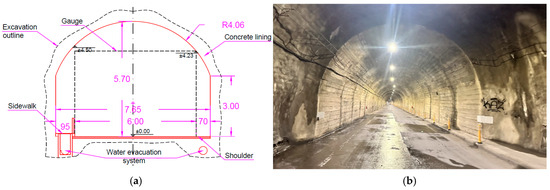
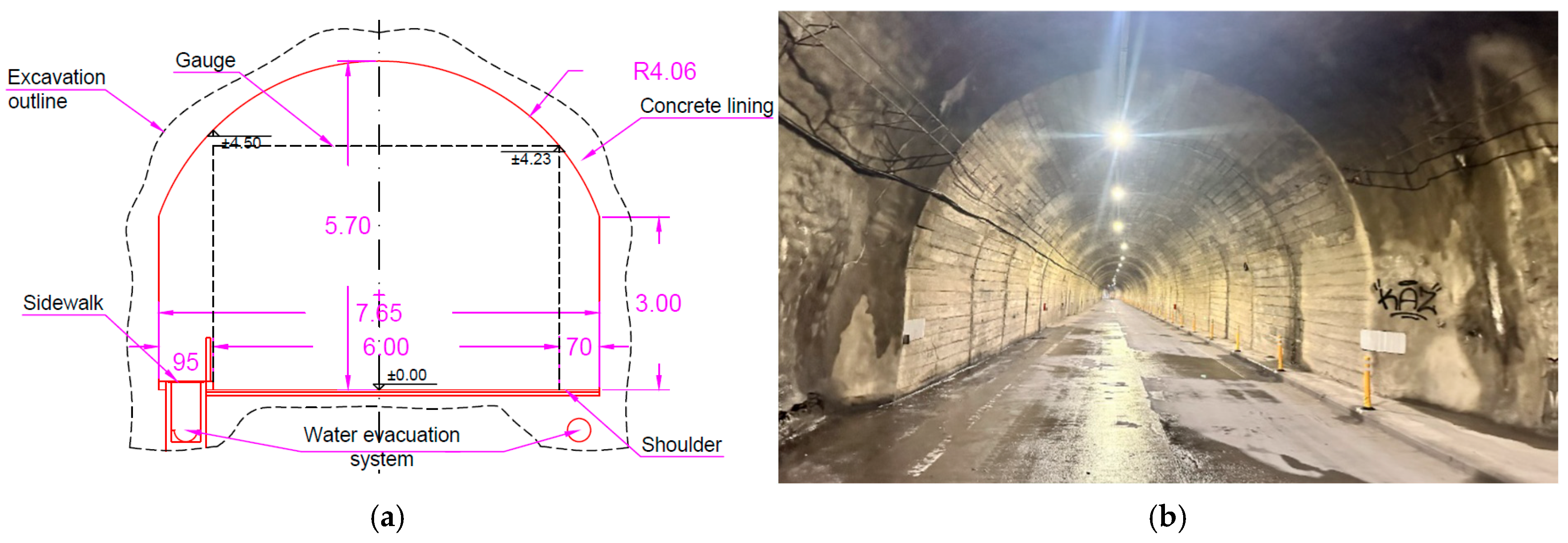
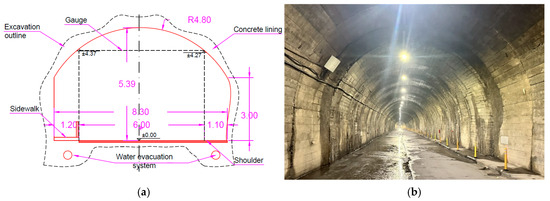
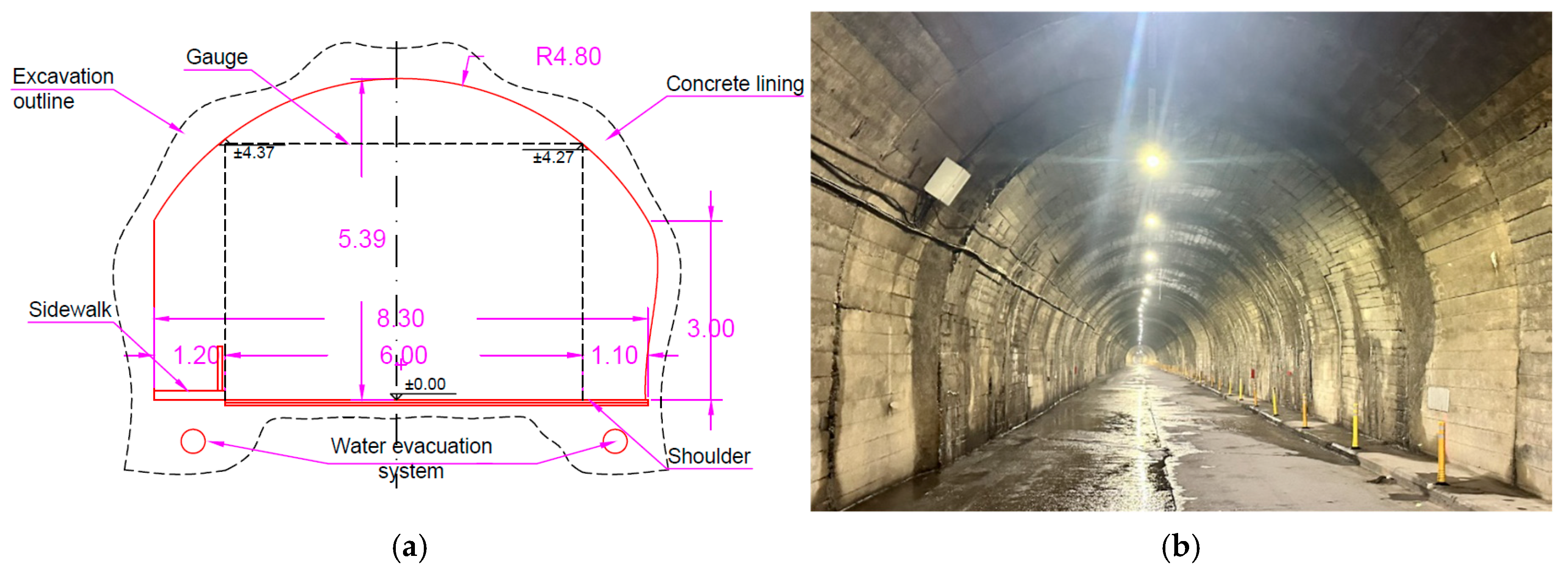
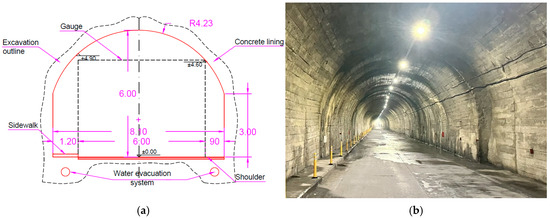
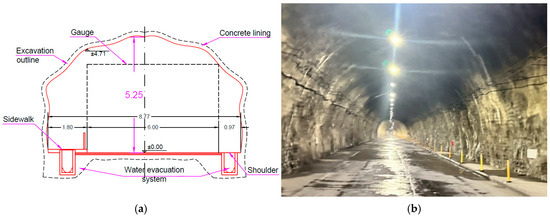
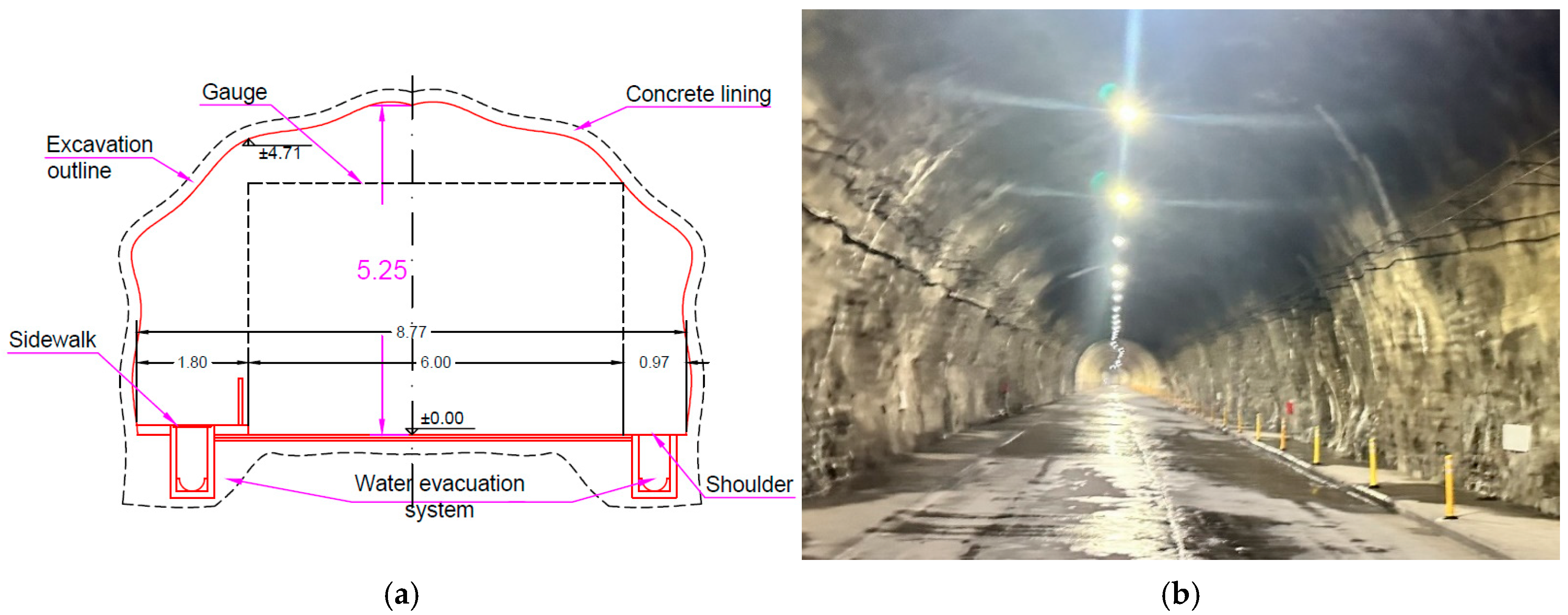
The cross section has a central arch shape type with an inner section of 4.00 m. The gauge is variable, measuring 3.60 m at the gates and varying from 5.25 m to 6.00 m along the tunnel axis from the pavement to the crown. Two types of cross section are present: with and without inner lining, both equipped with left–right water evacuation system [6]:
- Type I—reinforced concrete cross section with variable thickness between 30 and 50 cm, without exterior waterproofing, with different inner dimensions and applicability.
Figure 3.
(a) Type Ia tunnel cross section; (b) photograph of the tunnel cross section—type Ia.
Figure 4.
(a) Type Ib tunnel cross section; (b) photograph of the tunnel cross section—type Ib.
Figure 5.
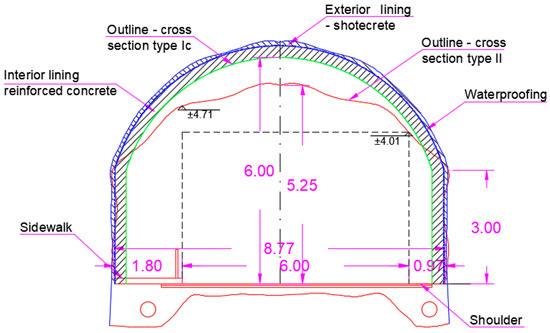
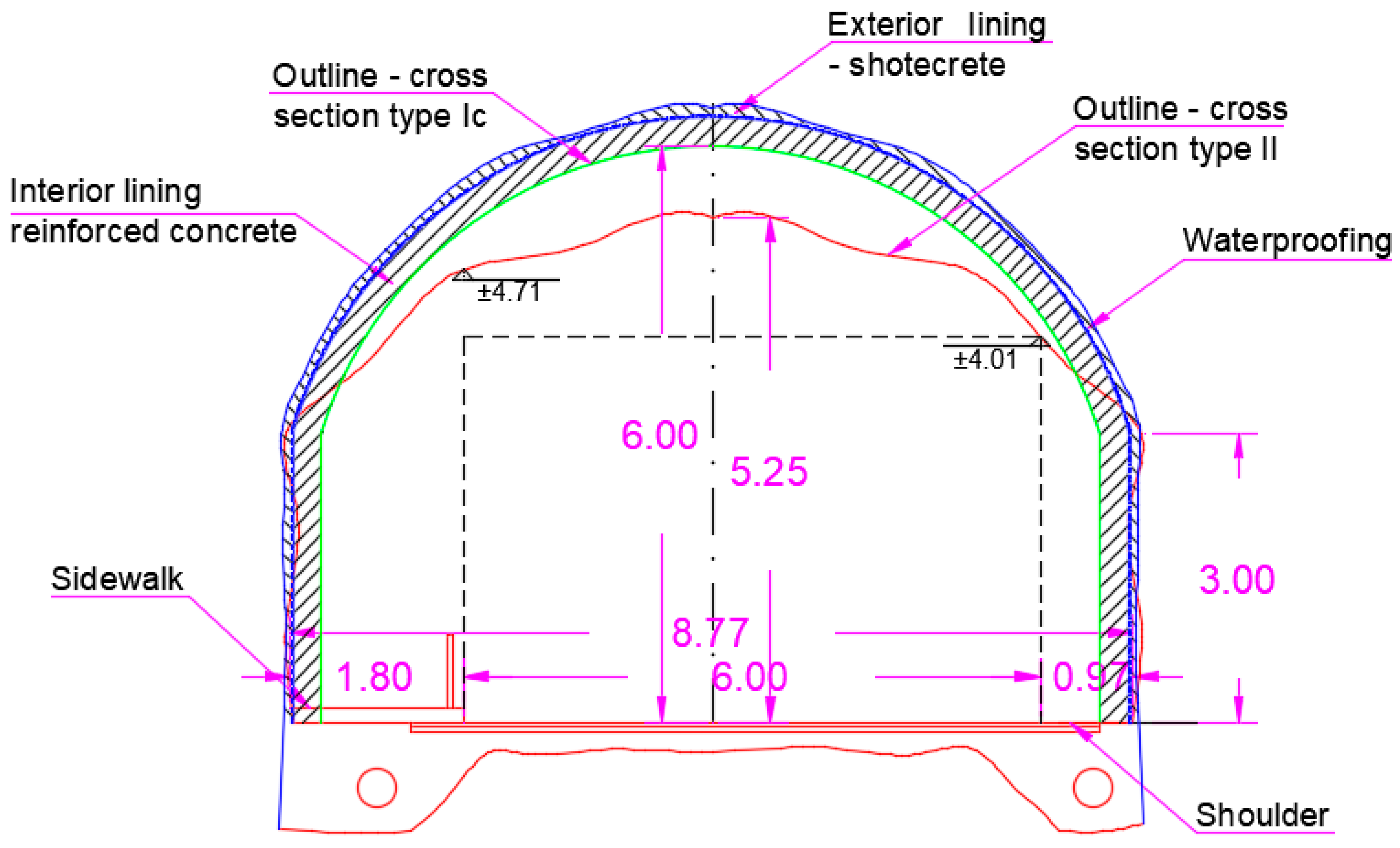
(a) Type Ic tunnel cross section; (b) photograph of the tunnel cross section—type Ic.
- Type II cross section (Figure 6a) and photograph (Figure 6b)—unregulated contour of cross section with a shotcrete thickness of 10–15 cm applied on unexcavated rock, applicability between km 116 + 146.95 and km 116 + 279.90, and km 116 + 288.00 and km 116 + 304.20, for a total length of 149.15 m, representing 16.82% of the tunnel total length.
Figure 6.
(a) Type II tunnel cross section; (b) photograph of the tunnel cross section—type II.
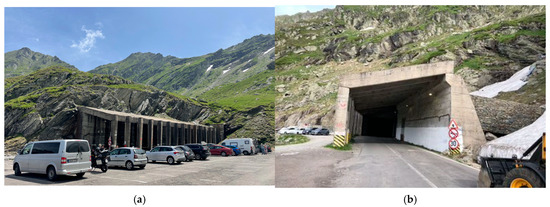
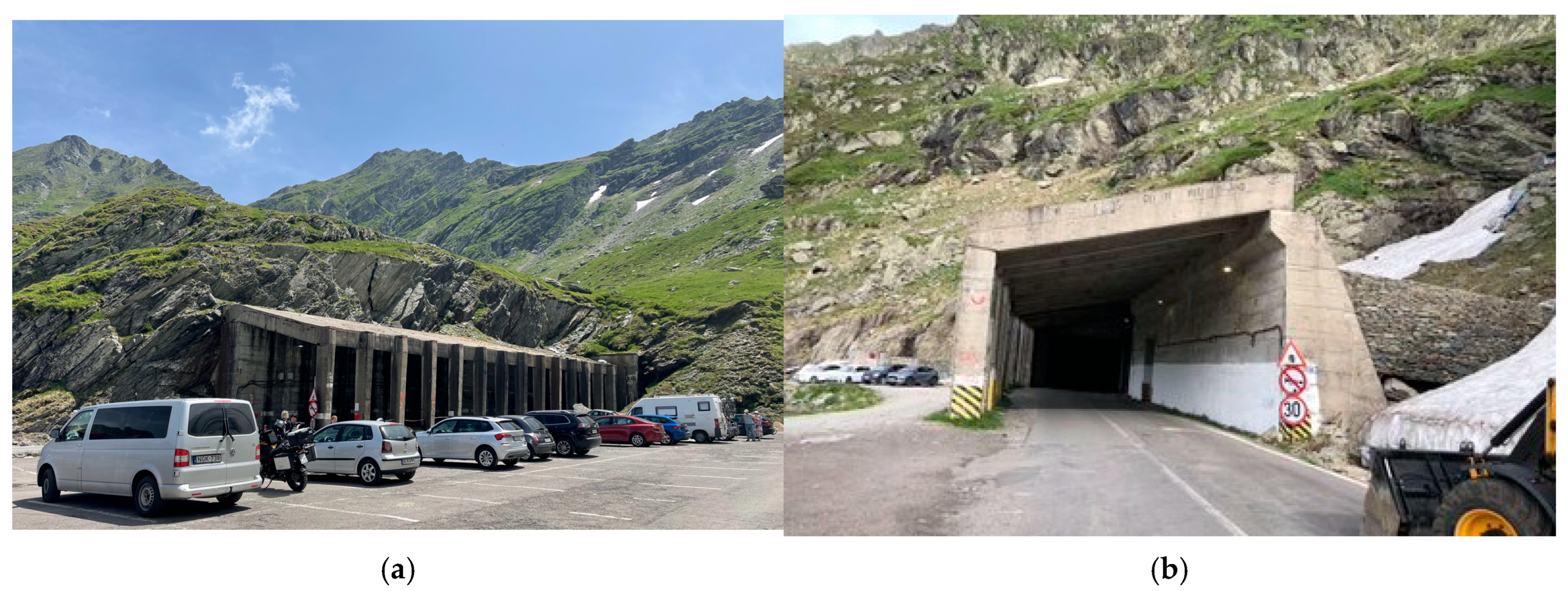
Protection construction structures were built at both ends of the tunnel, extending 38.20 m at the entrance (Figure 7a) and 39.00 m at the exit (Figure 7b), to shield the road from avalanches. Metallic gates were installed at both tunnel ends, which are closed during the winter. The gates are 6.00 m wide and 3.60 m high and are equipped with doors for pedestrian access.
Figure 7.
(a) Auxiliary protection construction at tunnel entrance; (b) auxiliary protection construction at tunnel exit construction.
The geological and geotechnical conditions are influenced by the tunnel’s geographical location. The tunnel crosses the Fagaras mountains, which are composed of metamorphic rocks, also referred to as crystalline schists. The crossed massif consists of gneiss, amphibolite, granite and crystalline schists.
The construction method and the execution technology for the entire tunnel are specific to hard rock conditions, with full-face excavation by blasting and without provisional support.
3. Typical Technical Analysis and Diagnosis Establishment
3.1. Legal Context and Technical Analysis Boundaries
The entire length of the tunnel was inspected ring by ring. Specific photographs were taken for each type of cross section, and all types of observed defects were marked for each ring. Each defect was marked on the inner map of defects and synthetically analyzed in individual tables containing the description, causes, position, dimensions and marking of the gravity class.
According to the Guide for the identification and classification of defects in communication tunnels—GT 061-03—disorders and defects can be ranked into five classes based on their severity [8]:
- Class I—Insignificant defects with normal structural and functional conditions;
- Class II—Defects that develop slowly but are expected to adversely affect the tunnel’s behavior;
- Class III—Defects indicating inappropriate evolution, negatively impacting the structural or functional performance of the tunnel;
- Class IV—Major defects (disorders) that endanger the structural and/or functional safety of the tunnel, that require supervision, interventions, speed restrictions, temporary reinforcement and remediation within a short timeframe;
- Class V—Severe defects indicating imminent danger regarding to the stability of the tunnel and/or the surrounding ground and on to safety of the traffic, which must be fixed imperatively.
A series of factors can influence the ranking of the defects and disorders found identified during the tunnel mapping process, such as the defect area, the rate of evolution (speed), the functional importance of the tunnel, the presence of factors contributing to the severity progression, and the influence on the bearing capacity of the lining as estimated by the structural analysis. The assessment of the overall condition of the tunnel is based on the observed defects and disorders and should be qualitative rather than quantitative.
3.2. Technical Analysis
The methodology for identifying and mapping defects in the Capra–Bâlea road tunnel involved inspecting the tunnel ring by ring and recording and measuring defects during the survey. The collected data were then transcribed into a standardized format for the technical evaluation of existing tunnels in Romania, and severity classes were assigned to each defect.
For the analyzed Capra–Bâlea road tunnel, defects from gravity classes I to III were identified.
The origin of defects found in the tunnel such as moisture, leakages, efflorescence, stalactites or concretions is water infiltration through the tunnel lining.
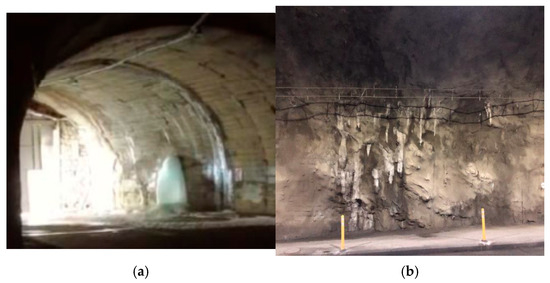
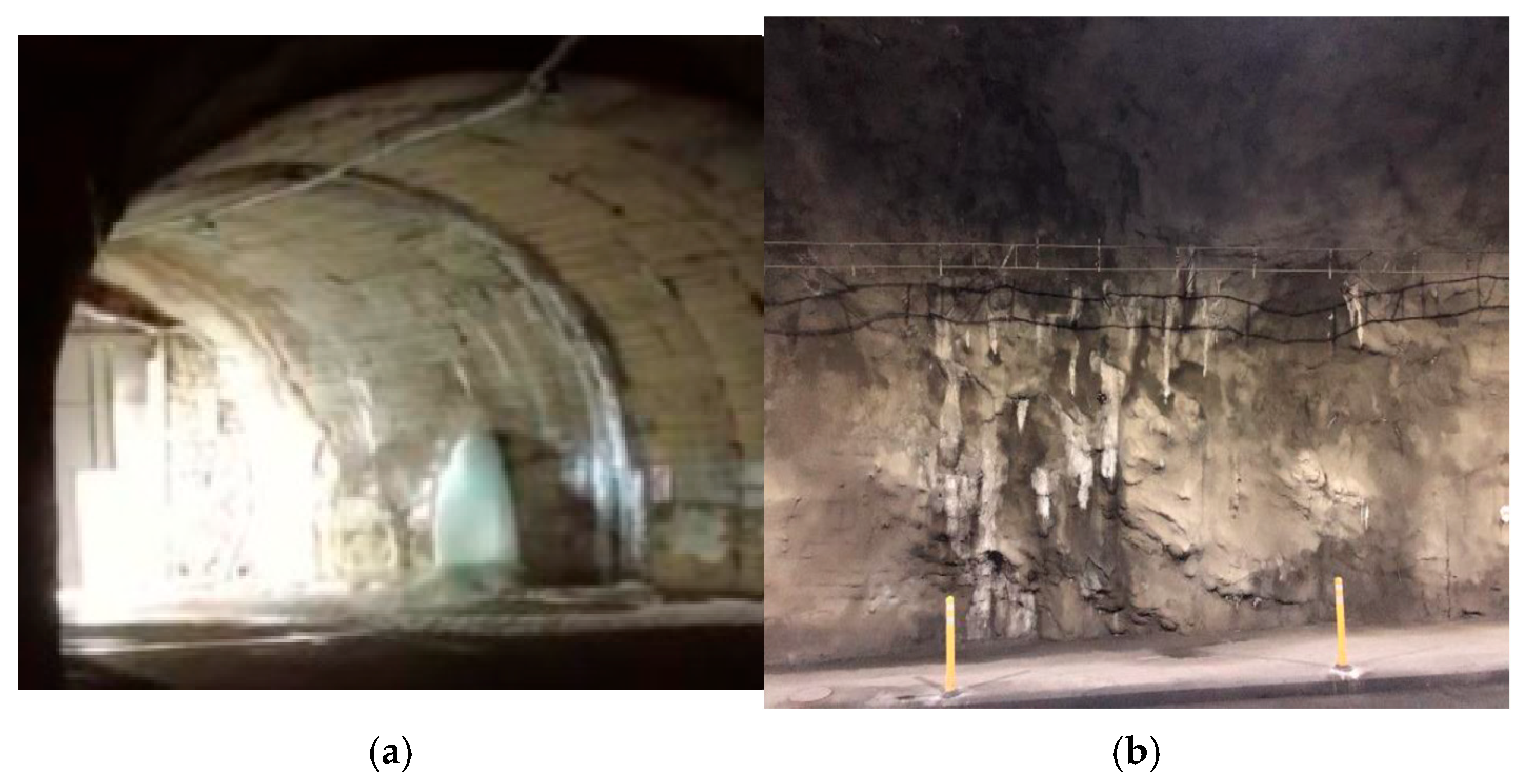
Water infiltration is mainly a cyclical process resulting from irregular circulation and infiltration of precipitation. Leakages are phenomena favored by the cracked rocks, as well as by the drainage role of the tunnel gallery within the crossed massif, and are amplified by the absence of waterproofing. Moisture, leakages and efflorescence can be classified as gravity class two due to their smaller influence. Leakages at the right foot of the tunnel can be classified as gravity class two or three, depending on the flow and the formation of icicles or ice blocks (Figure 8a) during the winter season, at both tunnel ends, which can affect or temporarily stop car circulation. Stalactites and draperies (Figure 8b) can be classified as gravity class three, highlighting the porosity of the concrete lining [6].
Figure 8.
(a) Defect: ice blocks; (b) defect: stalactites and draperies.
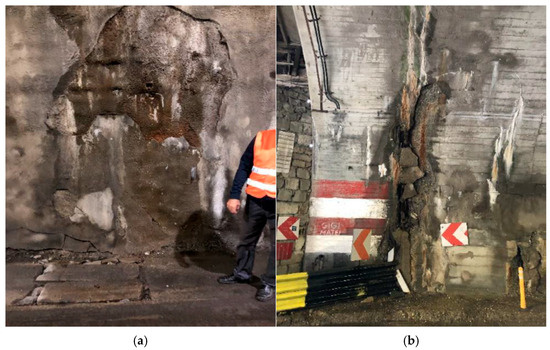
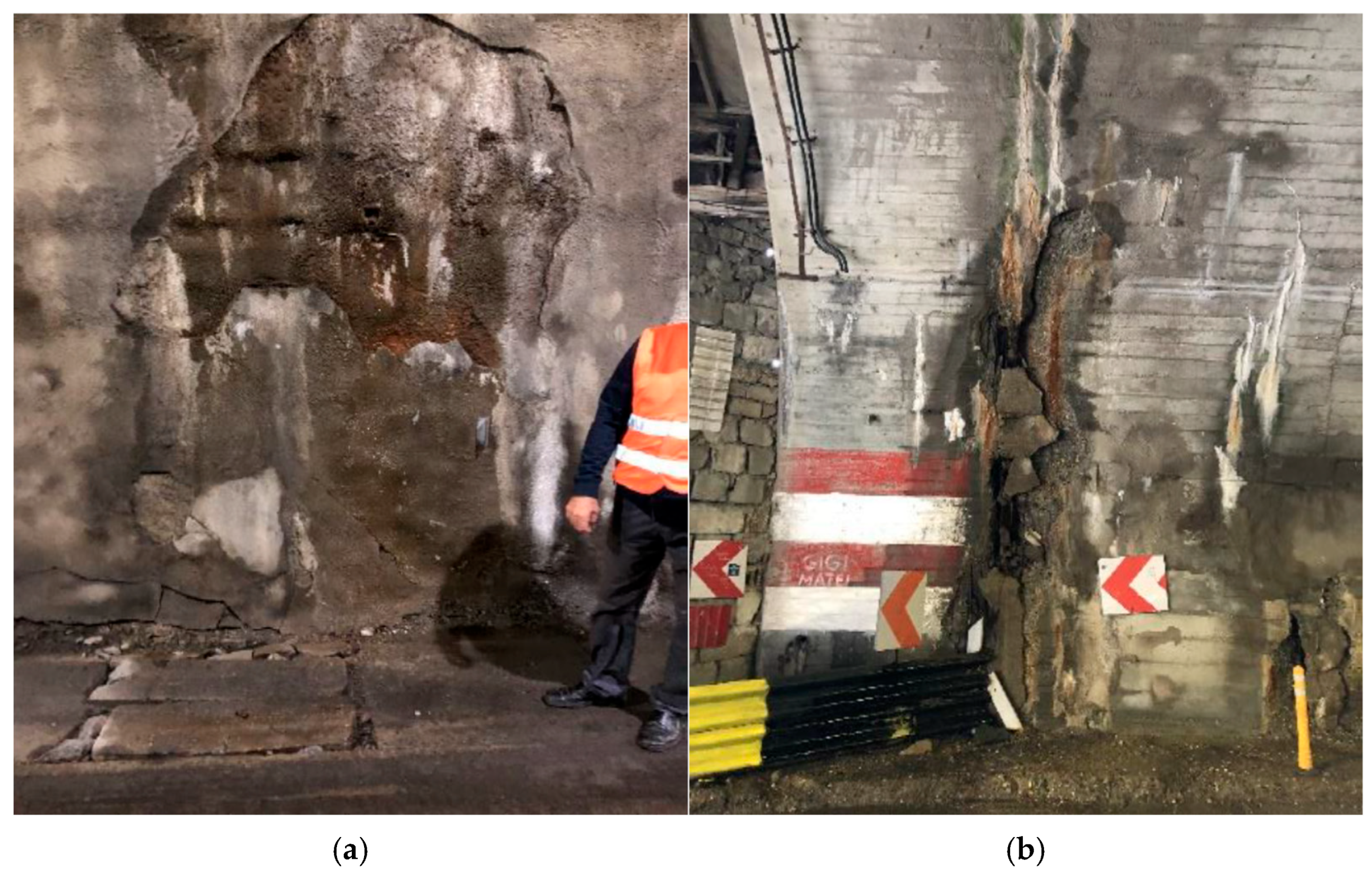
Degradations of the lining, such as segregated, friable, exfoliated concrete (Figure 9a), as well as open joints and caverns (Figure 9b), indicate inappropriate evolution that adversely affects the structural or functional behavior of the tunnel and can be classified as gravity class three [6].
Figure 9.
(a) Defects: segregated, friable, exfoliated concrete; (b) defects: open joint and cavern.
Taking into account the lining thickness and the rock type, the longitudinal, transverse and oblique cracks appear to be stabilized and can therefore be classified as gravity class three.
Clogging of the water drainage systems (canals, barbicans) leads to water accumulation on the road with a negative impact on the car circulation and can be classified as gravity class three.
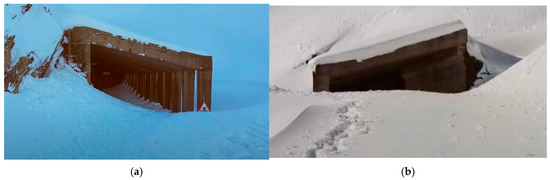
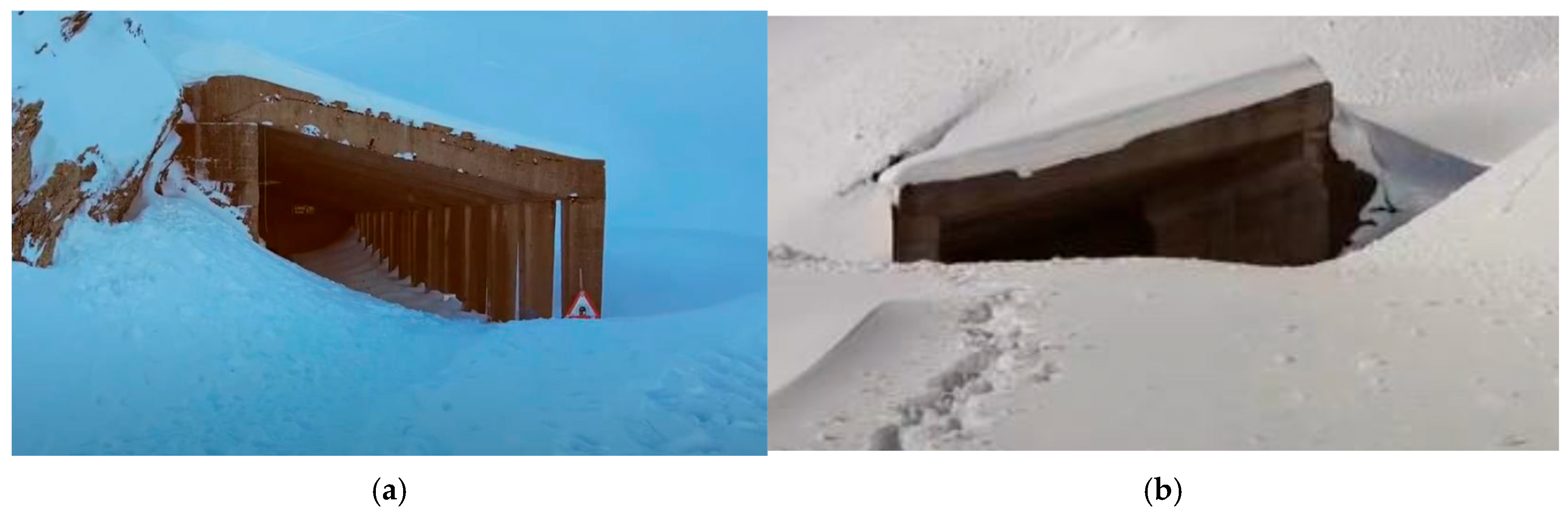
During the winter season and traffic closure, the areas at the tunnel entrance (Figure 10a) and exit (Figure 10b) are completely covered with snow.
Figure 10.
(a) Auxiliary construction at tunnel entrance; (b) auxiliary construction at tunnel exit.
The entire inner section of the tunnel was analyzed and mapped, ring by ring—179 rings, with variable lengths from 1.10 to 8.30 m and zone by zone—16 zones, with variable lengths from 4.10 to 12.85 m. The total mapped area of the tunnel inner section is approximately 14,392.75 square meters.
The distribution of cross section types is as follows: 737.35 m of cross section type I and 149.15 m of cross section type II.
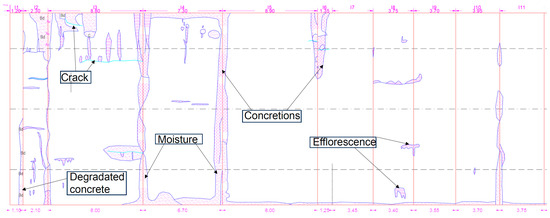
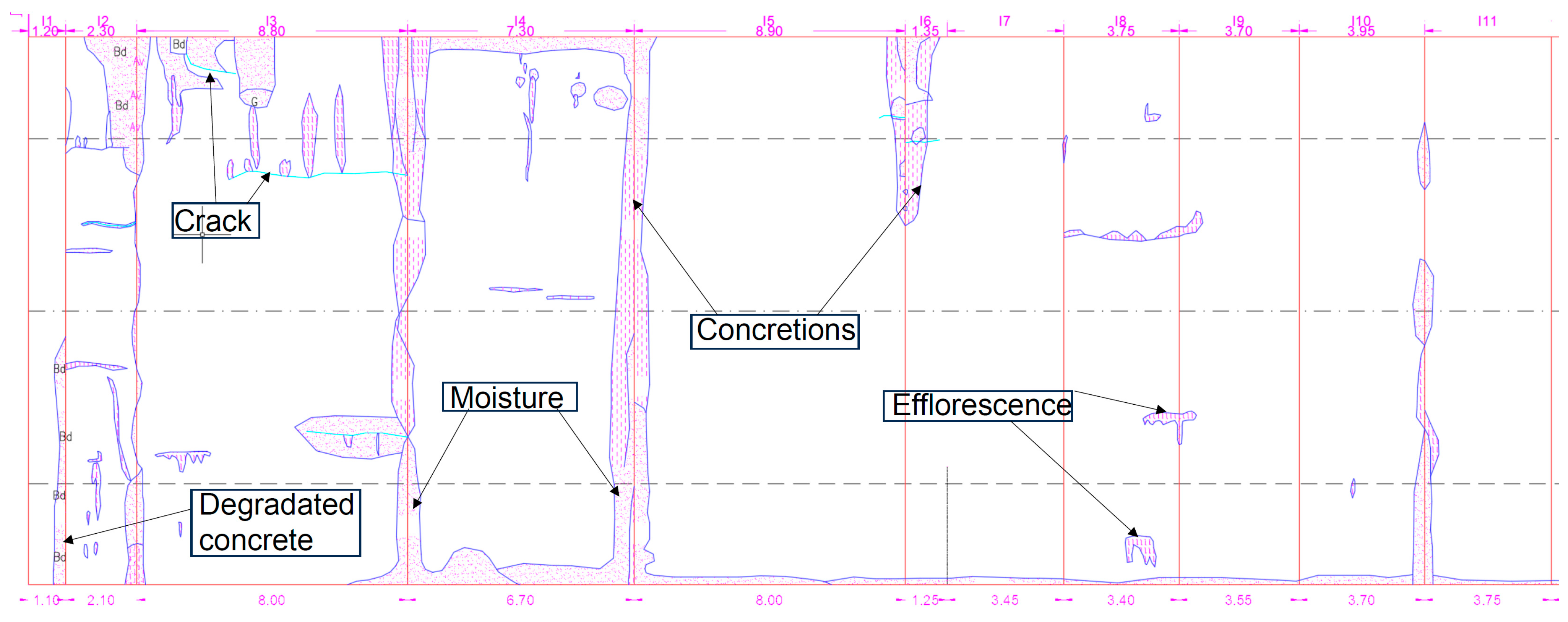
From the complete defect map, the most representative areas for each type are presented [6]:
- Type Ia cross section, rings 1–11 (Figure 11), defects: infiltrations, efflorescence, concretions, cracks, degraded (segregated, friable, exfoliated) concrete, open joint, caverns.
Figure 11.
Type Ia cross section—map of defects, rings 1–11 [6].
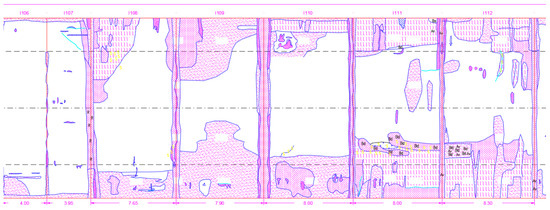
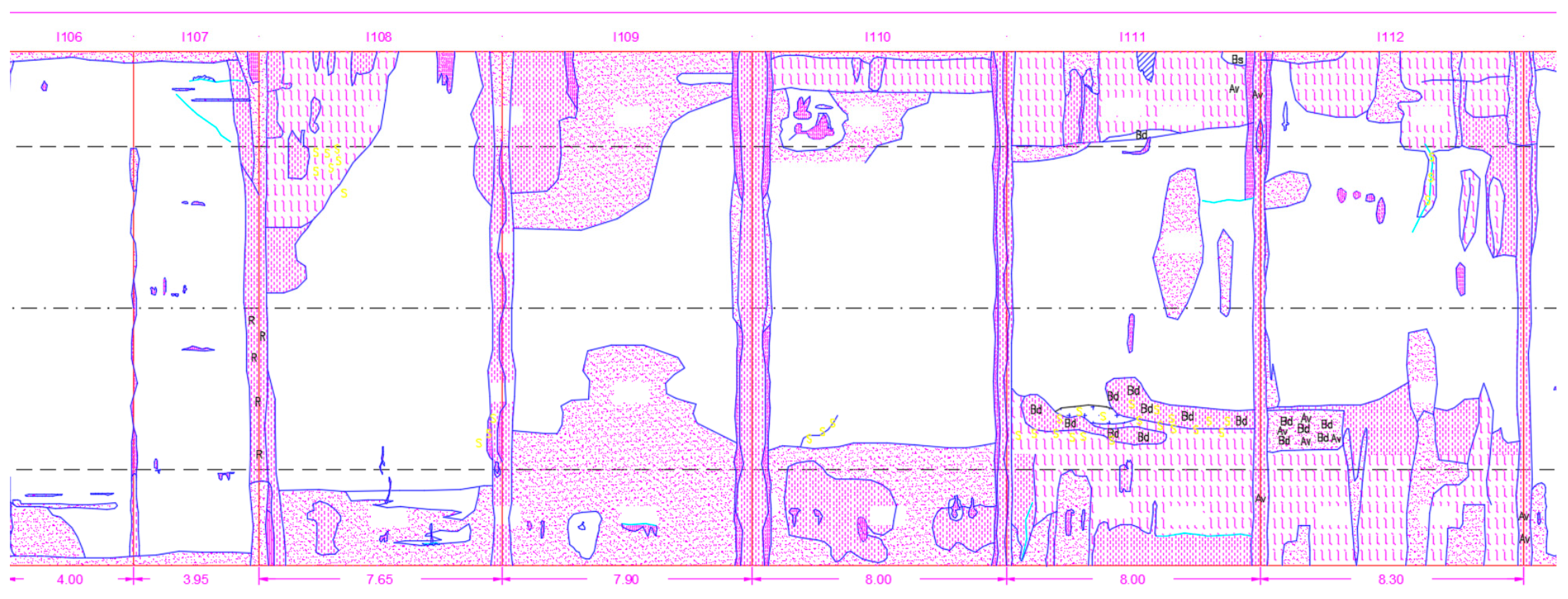
- Type Ib cross section, rings 106–112 (Figure 12)—infiltrations, efflorescence, concretions, cracks, degraded (segregated, friable, exfoliated) concrete.
Figure 12.
Type Ib cross section—map of defects, rings 106–112 [6].
The total mapped area of the type I cross section covers 11,945 square meters. The mapped defects of all gravity classes cover approximately 1492 square meters, with 694 square meters classified as gravity class three.
The geometric imperfections of the concrete lining surface (type I cross section) are the result of improper formwork, from the point of view of both the conception and execution technology, and have a negative aesthetic impact, as the tunnel is accesible to visitors.
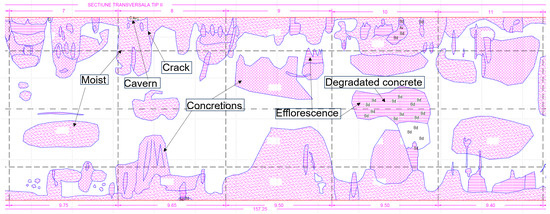
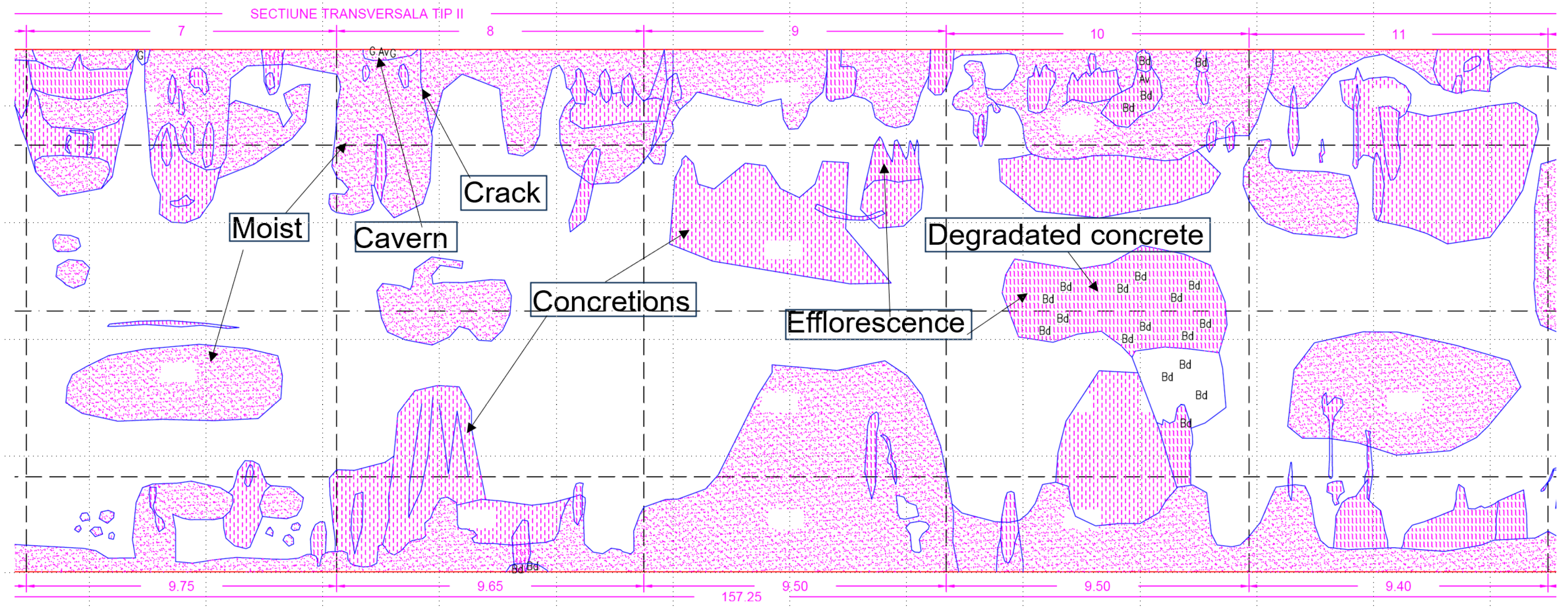
- Type II cross section, zones 7–11 (Figure 13)—infiltrations, efflorescence, concretions, draperies, stalactites, cracks, degraded (segregated, friable, exfoliated) concrete, cavern.
Figure 13.
Type II cross section—map of defects zones 7–11 [6].
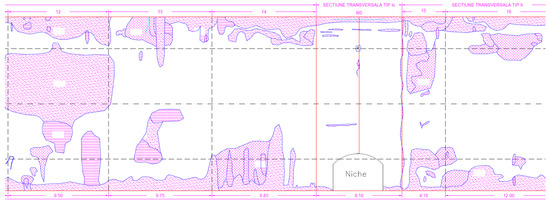
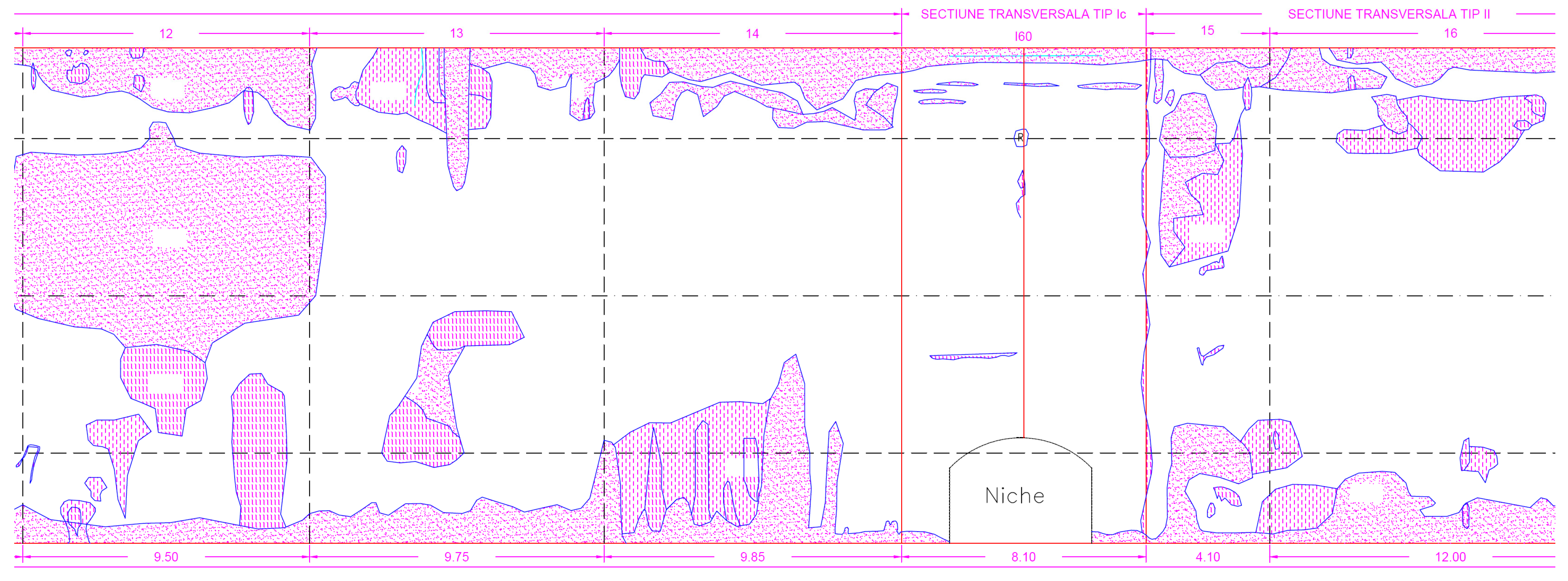
- Type II cross section, zones 12–16 (Figure 14)—infiltrations, efflorescence, concretions, draperies, stalactites, cracks, degraded (segregated, friable, exfoliated) concrete, cavern.
Figure 14.
Type II cross section—map of defects, zones 12–16 [6].
The total mapped area of type II cross section covers 2446 square meters. The mapped defects of all gravity classes cover approximately 995 square meters, with 323 square meters classified as gravity class three.
The general technical condition of the tunnel can be evaluated as satisfactory with a slow, but unfavorable evolution, a general classification of gravity class three and a risk index value of 60 [6].
The analysis of the entire defect map revealed several damaged areas with infiltrations (moisture, dripping, seepage) and their effects (efflorescence; stalactites; draperies; friable and exfoliated concrete; open joints and caverns) in type I cross section, distributed along rings between 1 and 6, 61 and 80, 104 and 122, and 172 and 179, corresponding to a total length of 254.10 m. The entire type II cross section covers 149.15 m, resulting in a combined length of 403.25 m and a total area of approximately 6562.50 square meters. Of this area, the total accumulated defects cover approximately 1984.50 square meters for the type I cross section and approximately 995 square meters for the type II cross section.
3.3. Technical Diagnosis and Analysis
From the analysis of the map of defects, the following can be concluded:
- In the type I cross section, the area of all defects covers approximately 12.50% of the surface, with 5.81% classified as gravity class three.
- In the type II cross section, the area of all defects covers approximately 40.00% of the surface, with 13.21% classified as gravity class three.
Compared to the entire developed surface of the inner cross section, for both types, the accumulated area of defects covers 17.27%, which represents a medium value, while defects of gravity class three cover about 7.07%, representing a low value [6].
The most damaged rings and zones cover approximately 45.50% of the entire tunnel. In these areas, the surface of cumulated defects is significative, approximately 30.24% and particularly for type II cross section, for approximately 40.67%, which is inadequate and has a negative impact on the overall structural and functional performance of the tunnel.
The inadequate condition of the type II cross section is due to the structural solution—shotcrete applied directly to excavated rock without waterproofing. As a result, rehabilitation works are inefficient and for this type of cross section, the construction of a new section with waterproofing and in compliance with current gauge regulations is recommended.
In addition to physical defects, conceptual deficiencies must also be considered, which may come from historical design constraints or from outdated regulations.
The measured dimensions inside the tunnel are variable, with heights between 5.25 m and 6.00 m along the tunnel axis and between 4.01 m and 4.90 m at the edge of the sidewalk. The gates at both ends of the tunnel are 6.00 m wide and 3.60 m high [6].
The road in the Capra–Bâlea tunnel consists of two lanes, each 3.00 m wide, and a variable right shoulder with widths between 0.70 m and 1.00 m. This configuration represents the minimum profile required to allow the circulation of two light vehicles, including the assumed overtaking of a wedge vehicle, under walking-speed conditions [9].
In plan view, the small-radius entrance curve (approximately 44 m) creates visibility issues, resulting in a visibility distance of 30.00 m, a lateral clearance of 2.70 m, and a braking distance of 30.00 m according to CETU specifications [9].
The Bâlea–Capra road tunnel gauge corresponds to the design standards in force at the time of construction (1974), in accordance with Law no. 13/1974 [10] and Law no. 43/1975 [11], which specified a clearance height of 4.00 m and a total width of 6.00 m for two-lane national roads.
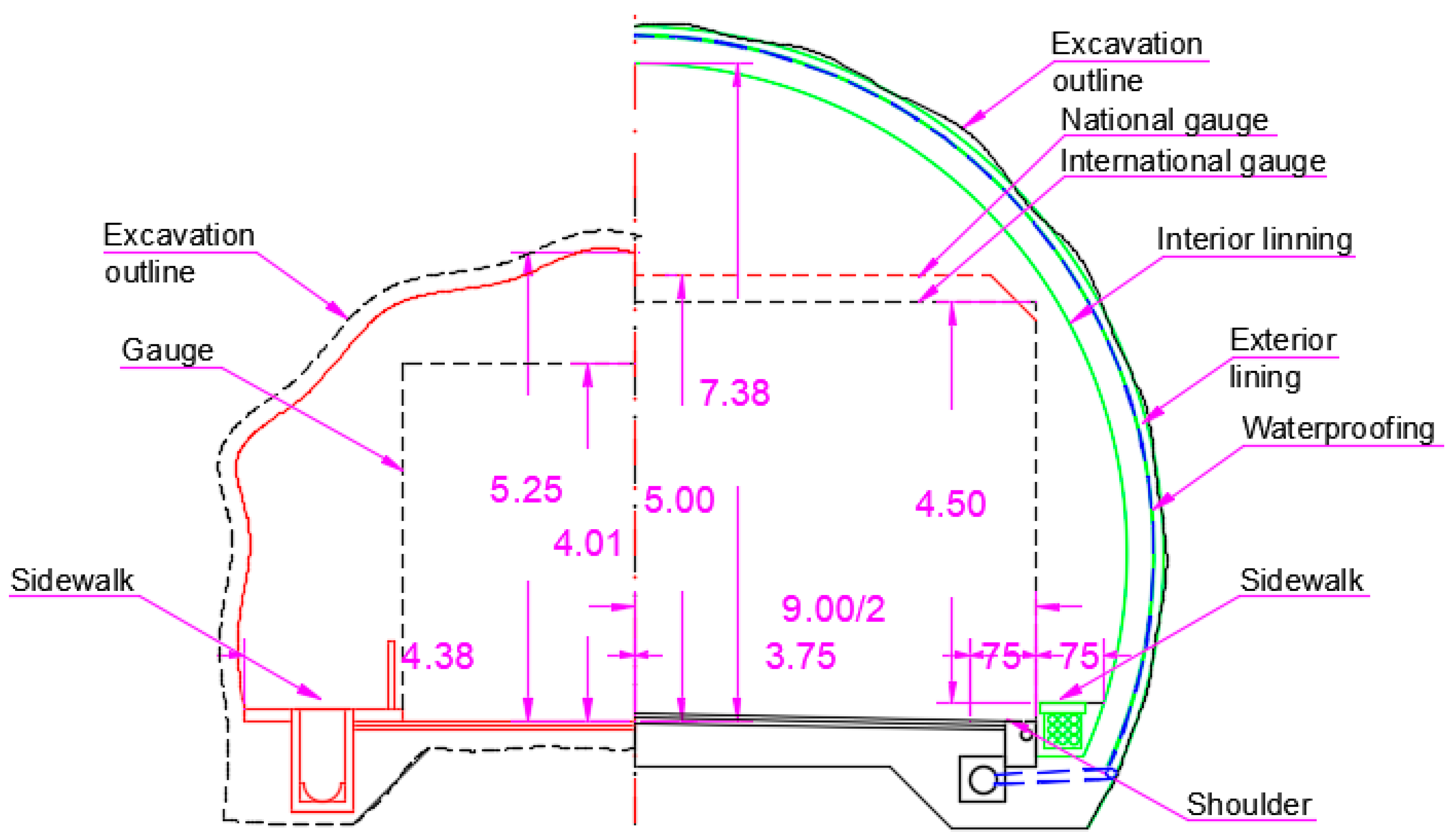
According to national regulations—STAS 2924/91 Road bridges [12]—the required clearance height is 4.50 m at the sidewalk edge and 5.00 m along the road axis, with a lane width of 3.50 m and a 1.00 m shoulder.
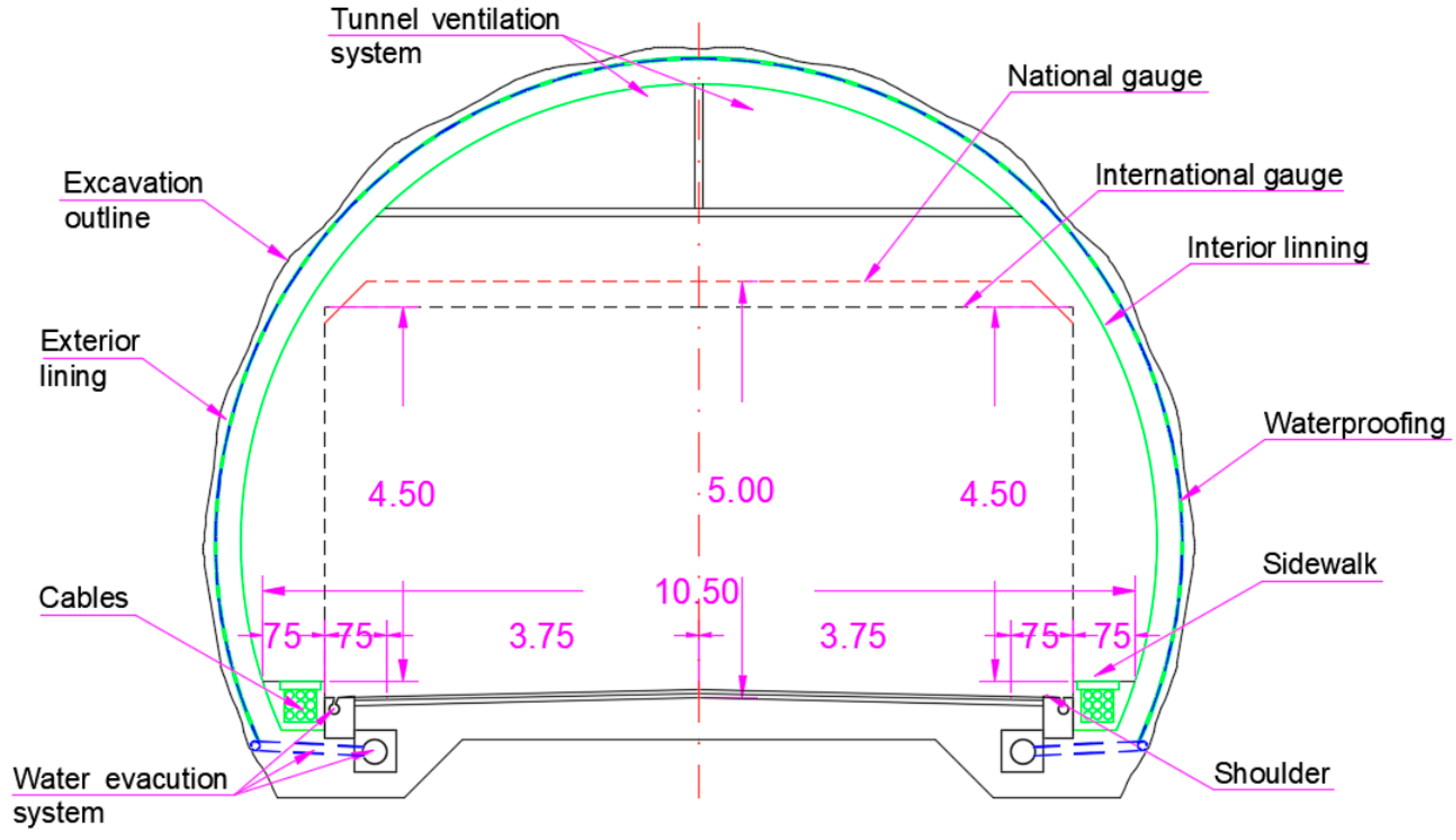
According to international regulations—PIARC, “Cross section design of bidirectional road tunnels—2004” [13], the recommended minimum dimensions are a lane width of 3.75 m, symmetrical shoulders of 0.75 m and symmetrical sidewalks of 0.75 m on each side. The road width of 7.50 m allows the circulation of light vehicles and the safe overtaking of another vehicle at a maximum speed of 40 km/h. The symmetrical sidewalks ensure safe evacuation in case of an emergency.
Taking into account the new regulations, a new tunnel cross section with a width of 10.50 m along the entire length is required in order to meet the standards for a permanently open road, improved safety and higher travel speed.
Alternatively, a sustainable solution could be implemented—rehabilitation of the existing type I cross sections and installing waterproofing together with an interior lining for the type II cross section. However, this sustainable solution cannot fully ensure compliance with current technical regulations, particularly regarding gauge requirements and vehicle speed corresponding to the road’s technical class.
3.4. Cross Section Technical Solutions
3.4.1. Solution I—Cross Section
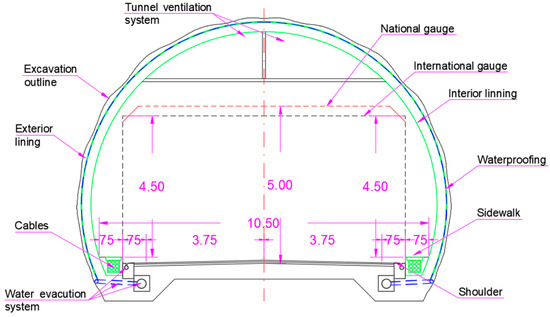
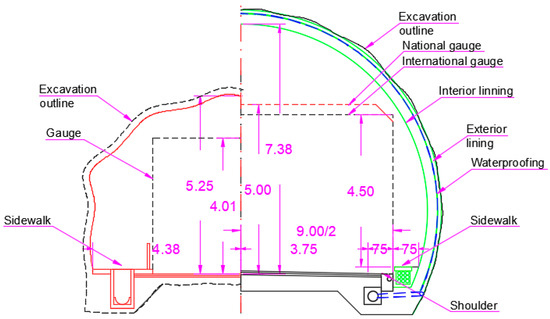
The proposed new cross section (Figure 15) is characterized by two lanes, one for each direction, each 3.75 m wide, shoulders on both sides measuring 0.75 m and sidewalks on both sides also measuring 0.75 m. The national and international clearance requirements are met, with a gauge of 4.50 m measured from the top of the sidewalk and 5.00 m measured along the tunnel axis.
Figure 15.
Proposed new cross section.
The proposed new cross section for the most damaged areas—corresponding to a type II cross section—takes into account all current and updated national and international requirements regarding safety, gauge, durability and sustainability, but first, we must make an assessment regarding the rock quality [14] and quantify the risk associated with the drill and blast method, taking into account the complexity.
3.4.2. Solution II—Cross Section
The second solution (Figure 16) that can be considered is a more sustainable solution, which aims to minimize environmental impact while providing a construction method and execution technology approach that can be implemented during traffic operation or within traffic windows.
Figure 16.
Restoration and rehabilitation of cross section type II.
The existing cross section can continue to operate with the actual gauge for light vehicle traffic; therefore, the road administrator should implement measures to prevent heavy vehicles from entering the tunnel, for safety reasons.
Ensuring the safety of the existing cross section requires maintenance and rehabilitation, including
- Rehabilitation of the sealing system;
- Rehabilitation of degraded concrete areas using environmentally friendly solutions such as injections into the rock mass for the type I cross section;
- Complete restoration of the type II cross section to the configuration of the type Ic cross section, without applying international regulations, including exterior lining, waterproofing and interior lining;
- Rehabilitation of the water collection and drainage system by unclogging and repairing the drainage channels;
- Sheathing of the two niches and construction of additional service niches at 250 m intervals.
3.5. Discussion
The proposed restoration and rehabilitation of the type II cross section to the configuration of type Ic cross section present both advantages and disadvantages that must be evaluated, first from a technical perspective and then from an economic and operational one, by the road administrator. The advantages include reduced intervention on the cross section, resulting in lower environmental impact, shorter execution time, the possibility of performing the works under traffic, and reduced intervention along the entire tunnel.
Another advantage of this solution is positive previous experience with injection-based rehabilitation methods for tunnels in Romania [15], as well as their proven use in other parts of the world [16,17].
The disadvantages include the shorter interval before subsequent maintenance or rehabilitation is required, the risks associated with vehicle circulation (e.g., electric vehicles) [18], the inability to meet international regulations applicable to a national road, and the need for periodic general impact assessments regarding overall behavior, including current seismic effects [19], even if the location is in a low-seismicity zone.
4. Analysis of the Proposed Cross Section with 3D Finite Element Model
4.1. 3D Geometrical Model and Ground Conditions
The 3D model used for the finite element analysis requires two cross sections. The first is the current cross section of the tunnel—type II cross section (Figure 6a) and the second is the proposed cross section (Figure 17). Both cross sections are presented above with typical information.
Figure 17.
Cross section: left—type II, right—proposed.
The concrete characteristics considered for the 3D model are presented in Table 1.
Table 1.
Concrete cross section characteristics.
The geotechnical parameters considered for the calculations (Table 2) are based on the Romanian National Rock Classification [20], other literature [21], known parameters and experience regarding the rocks of the Fagaras mountain area:
Table 2.
Geotechnical parameters—rocks [20].
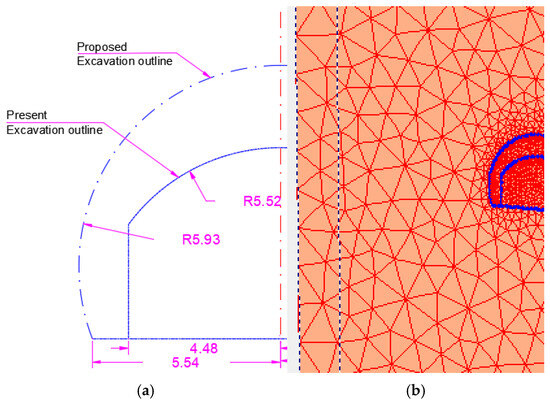
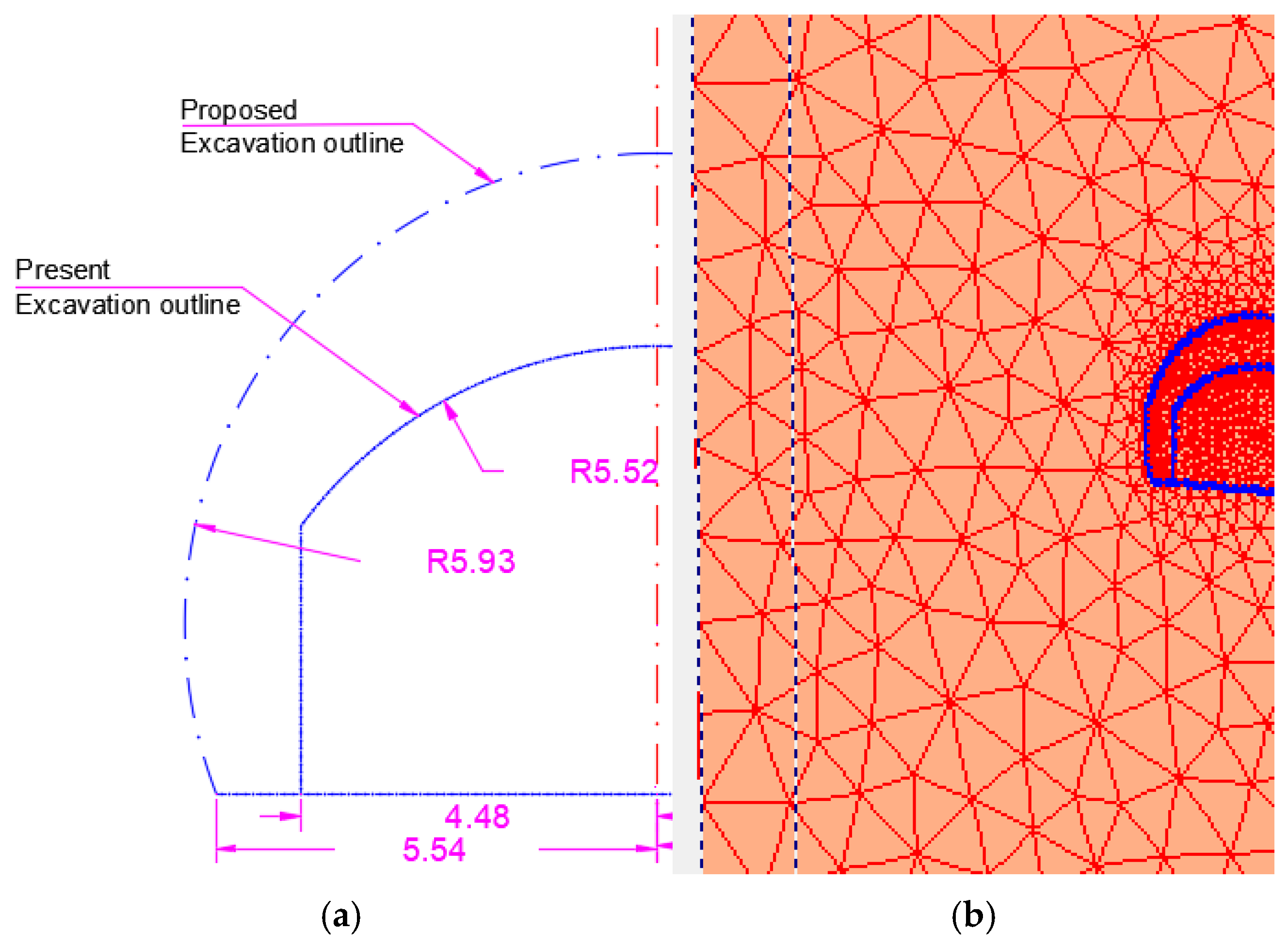
The 3D model takes into account a model with dimensions of 50 × 50 × 50 × 50 m, with a very dense mesh around the studied zone and a coarser mesh for the cross sections. The average element size is 0.68 m. The constitutive law considered and available in the software for rocks was Mohr–Coulomb and the materials were considered elastic, taking into account the program availability.
The geometrical model introduced in the finite element program is presented above. Figure 18a presents both the current cross section and the proposed cross section at the excavation outline while the adjacent Figure 18b illustrates the mesh and the two cross sections in the program.
Figure 18.
(a) Median axes for numerical 3D model; (b) 3D numerical model cross section and mesh exit.
The execution phases considered take into account the actual state of ground conditions by phases: Phase 1, simulation of natural ground conditions; Phase 2, excavation of the actual cross section—approximately 44.50 m2; Phase 3, excavation of the proposed cross section—approximately 80.00 m2.
4.2. Results and Discussion
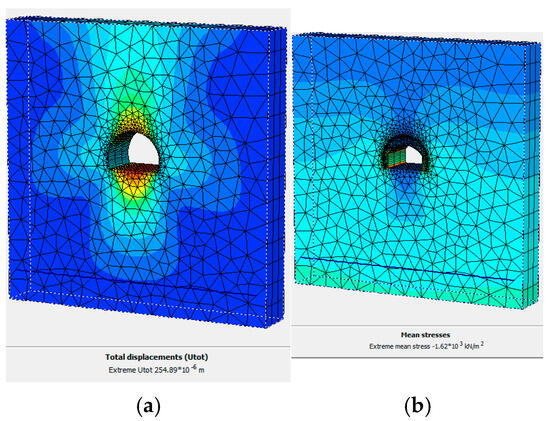
The proposed technical solution addresses all deficiencies of the present type II cross section and can be applied for the entire tunnel. For a better understanding of the cross section behavior in the surrounding rock mass, the present lining was not considered and similarly, the lining was not included for the proposed cross section.
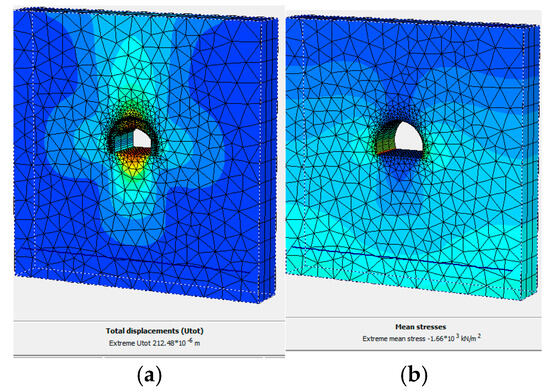
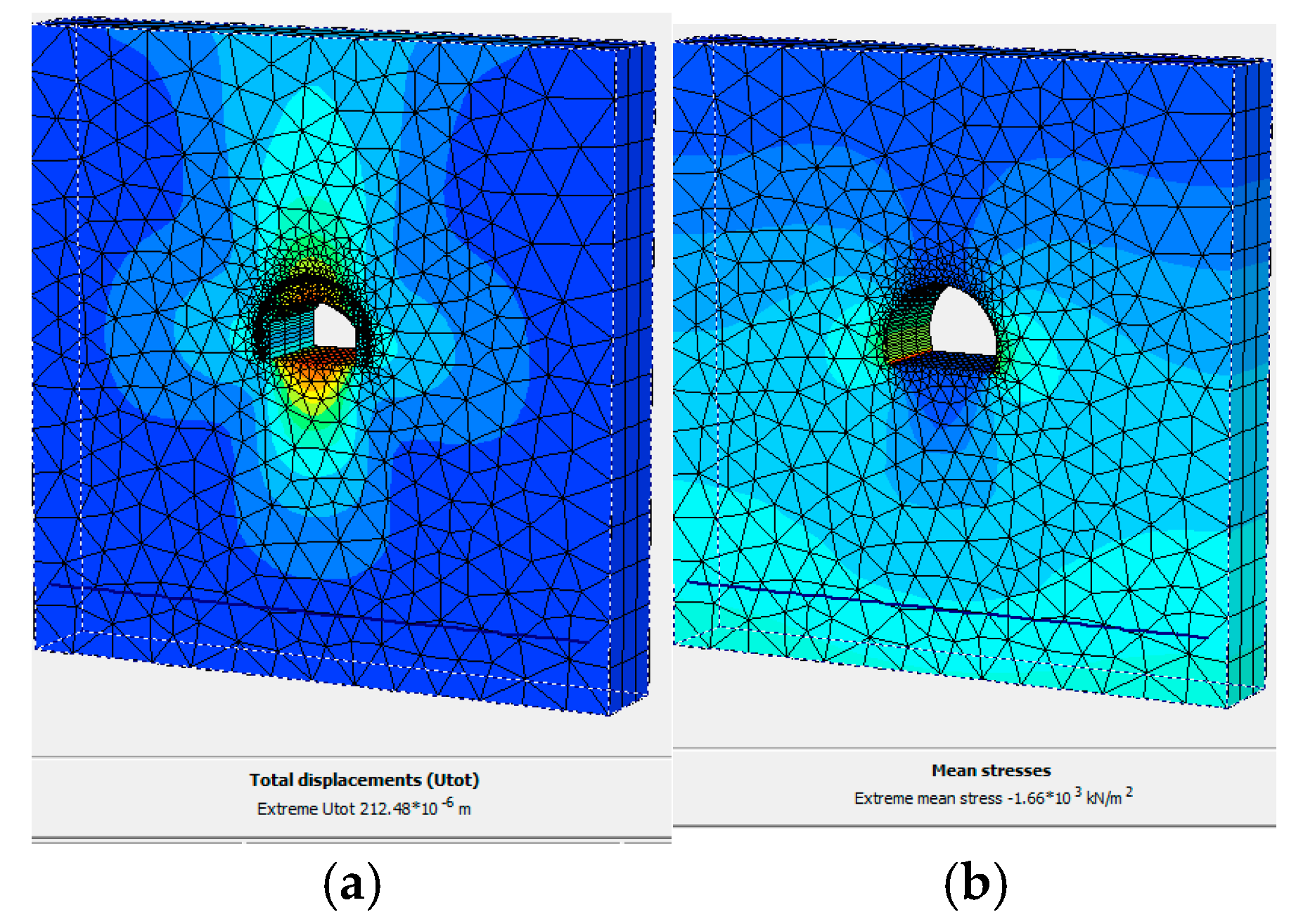
After the geometrical model was developed and the execution phases were completed, the total displacements and stresses for the existing cross section (Figure 19a,b) and the proposed cross section (Figure 20a,b) are presented below.
Figure 19.
(a) Total displacements on the existing cross section; (b) total stresses on the existing cross section.
Figure 20.
(a) Total displacements on the proposed cross section; (b) total stresses on the proposed cross section.
5. Conclusions
Being a country with mountainous relief and still-developing [22] transport infrastructure in the field of roads, highways and railways [23], the presence of works of art like tunnels saw a great period before 1990s [7] and an unhappy period between 1990 and 2015 and now is in full growth because of the need for modernization and connection of the Constanta Port [24], Ukraine [25] and all borders of Romania, so this is a great period for new tunnel construction and maintenance.
The national road, technically called DN7C or touristically called Transfagaran, is one of the highest mountain roads and a representative road for our country. It connects the present counties of Arges, part of South Muntenia Romanian Development Region, and Sibiu, part of Center Romanian Development Region.
The entire road cannot exist without the most important work of art, the Bâlea–Capra Road tunnel, which is the longest road tunnel in Romania under exploitation and at the highest altitude.
The technical condition analysis and diagnosis establishment suggest that the tunnel needs rehabilitation and modernization in the medium term.
The analysis of the map of defects states that the principal defect in the tunnel is the water infiltration caused by the lack of waterproofing, which generates the most damaged area that is present in the cross section type II area and less in cross section type I.
The first proposed solution ensures compliance with the national and international recommendations regarding the gauge and safety in road tunnels but has the drawback of requiring traffic stops during execution.
The second proposed solution is a sustainable solution that does not comply with the current requirements but allows for light car circulation during and after execution, with minimal environmental impact.
The entire action of rehabilitation and/or modernization of the Bâlea–Capra Road tunnel can be classified as a sustainable solution, with low impact and less harm for the environment compared to the other option of building a new tunnel on a new site.
Recommendations regarding the road tunnel include
- Applying the proposed cross section for the entire length of the tunnel;
- Revising the entrance radius curve for higher speed circulation, safety and visibility;
- Conducting extended geotechnical and geological investigations regarding the rock quality mass for future phases;
- Implementing a monitoring system during modernization and/or rehabilitation works as well as during the exploitation phase.
Author Contributions
Conceptualization, T.I.; methodology, F.I.N.; software, F.I.N. and T.I.; validation, T.I.; formal analysis, T.I.; investigation, F.I.N. and T.I.; resources, T.I.; data curation, T.I.; writing—original draft preparation, F.I.N.; writing—review and editing, F.I.N.; visualization, F.I.N. and T.I.; supervision, T.I.; project administration, F.I.N.; funding acquisition, F.I.N. and T.I. All authors have read and agreed to the published version of the manuscript.
Funding
The APC was funded by GnaC ARUST 2024-UTCB 06.
Data Availability Statement
The original contributions presented in this study are included in the article. Further inquiries can be directed to the corresponding author.
Acknowledgments
This work was supported by National Research Grants of the UTCB, project number GnaC ARUST 2024-UTCB 06.
Conflicts of Interest
The authors declare no conflict of interest.
References
- Available online: https://ro.wikipedia.org/wiki/Mun%C8%9Bii_Carpa%C8%9Bi (accessed on 1 September 2024).
- Hedayatzadeh, M.; Rostami, J.; Sarhosis, V.; Nematollahi, M.; Hajiantilaki, N.; Shafiepour, A. Use of GIS and BIM for the integration of tunnel design and construction process in conventional tunneling. Undergr. Space 2024, 16, 261–278. [Google Scholar] [CrossRef] [Scilit]
- Wang, M.; Zhao, S.; Tong, T.; Wang, Z.; Yao, M.; Li, J.; Yi, W. Intelligent classification model of surrounding rock of tunnel using drilling and blasting method. Undergr. Space 2021, 6, 539–550. [Google Scholar] [CrossRef] [Scilit]
- Li, X.; Liu, K.; Yang, J.; Sha, Y.; Song, R. Numerical study on the effect of in-situ stress on smoothwall blasting in deep tunnelling. Undergr. Space 2023, 11, 99–115. [Google Scholar] [CrossRef] [Scilit]
- Compania National de Administrare a Infrastructurii Rutiere S.A. AND 605-2020—Normativ Privind Circulatia Rutiera pe Drumurile Montane. Available online: https://cnadnr.ro/sites/default/files/Reglementari-tehnice/002.%20AND%20615%202020.pdf (accessed on 1 September 2024).
- Iftimie, T. Expertiza Tehnica Tunel Capra Balea; CNAIR—Compania Nationala de Administrare a Infrastructurii Rutiere S.A.: Bucharest, Romania, 2024. [Google Scholar]
- Iftimie, T. Scurt istoric al tunelelor feroviare din România. In Conferinta Științifică 140 ani de Învăƫământ Tehnic Ingineresc în Domeniul Infrastructurii Transporturilor; Facultatea de Căi Ferate, Drumuri și Poduri: Bucureşti, Romania, 2024; pp. 1–17. Available online: https://www.researchgate.net/publication/359266033_SCURT_ISTORIC_AL_TUNELELOR_FEROVIARE_DIN_ROMANIA (accessed on 1 September 2024).
- GT 061-03 Ghid Privind Identificarea și Clasificarea Defectelor la Tunelurile Pentru căi de Comunicații. Available online: https://www.mdlpa.ro/userfiles/reglementari/Domeniul_XXII/22_14_GT_061_2003.pdf (accessed on 1 September 2024).
- CETU. Dosier Pilote des Tunnels—Geometrie; CETU: Addis Ababa, Ethiopia, 1990. [Google Scholar]
- Marea Adunare Nationala. Legea Drumurilor—Legea nr. 13/1974. Available online: https://legislatie.just.ro/Public/DetaliiDocument/348 (accessed on 1 September 2024).
- Marea Adunare Nationala. Legea Pentru Stabilirea Normelor Privind Proiectarea, Construirea și Modernizarea Drumurilor—Legea nr. 43/1975. Available online: https://legislatie.just.ro/Public/DetaliiDocument/385 (accessed on 1 September 2024).
- STAS 2924/91—Poduri de Sosea. Gabarite. 1991. Available online: https://www.scribd.com/document/331006633/STAS-2924-91-Poduri-de-sosea-Gabarite-pdf (accessed on 27 October 2024).
- World Road Association—Technical Committee 5 Road Tunnels. Road Tunnel Operations. In Cross Section Design of Bidirectional Road Tunnels; World Road Association: Paris, France, 2004. [Google Scholar]
- Wu, S.; Qiu, M.; Yang, Z.; Ji, F.; Yue, Z.Q. Rapid profiling rock mass quality underneath tunnel face for Sichuan-Xizang Railway. Undergr. Space 2024, 19, 138–152. [Google Scholar] [CrossRef] [Scilit]
- Iftimie, T.; Craciun, A.; Mihalache, D.; Stachon, W.; Ziegler, R. Testing of sealing technology with polyurethane resins at one railway tunnel. Tunn. Undergr. Space Technol. 2004, 19, 501. [Google Scholar] [CrossRef] [Scilit]
- Feudis, S.; Insana, A.; Barla, M. Seizing the opportunity of energy retrofitting of existing tunnels. Tunn. Undergr. Space Technol. 2024, 154, 106109. [Google Scholar] [CrossRef] [Scilit]
- Zhang, D.M.; Ye, Z.W.; Chu, W.; Zhang, J.Z.; Shao, H. Experimental study on the rehabilitation of a shield tunnel lining with excessive transverse deformation by lateral grouting. Tunn. Undergr. Space Technol. 2024, 148, 105748. [Google Scholar] [CrossRef] [Scilit]
- Wan, H.; Jian, Y.; Jiang, J. A survey of fire accidents during the process of highway tunnel operation in China from 2010 to 2021: Characteristics and countermeasures. Tunn. Undergr. Space Technol. 2023, 139, 105237. [Google Scholar] [CrossRef] [Scilit]
- Jaramillo, A.C. Impact of seismic design on tunnels in rock—Case histories. Undergr. Space 2017, 2, 106–114. [Google Scholar] [CrossRef] [Scilit]
- Iftimie, T.; Nica, F.; Zdrenghea, D. Constructii Subterane si Tuneluri; Conspress: Bucharest, Romania, 2017; pp. 115–116. [Google Scholar]
- Stematiu, D. Mecanica Rocilor; Editura Didactica si Pedagocica, R.A.: Bucharest, Romania, 1997. [Google Scholar]
- Nica, F. New Railway Routes, Cross Section and Water Evacuation System Problems at Tunnels in Romania. IOP Conf. Ser. Mater. Sci. Eng. 2020, 960, 022001. [Google Scholar] [CrossRef] [Scilit]
- Nica, F. Developing Railway Link in Central Region of Romania. IOP Conf. Ser. Mater. Sci. Eng. 2020, 960, 022002. [Google Scholar] [CrossRef] [Scilit]
- Nica, F.; Iftimie, T. Design and execution of Turdas tunnel. Rom. J. Transp. Infrastruct. 2019, 2, 44–57. [Google Scholar] [CrossRef] [Scilit]
- Nica, F. Railway border connections, double railway gauge in Romania during Ukraine crisis and development possibilities. AIP Conf. Proc. 2023, 2928, 190014. [Google Scholar] [CrossRef] [Scilit]



Disclaimer/Publisher’s Note: The statements, opinions and data contained in all publications are solely those of the individual author(s) and contributor(s) and not of MDPI and/or the editor(s). MDPI and/or the editor(s) disclaim responsibility for any injury to people or property resulting from any ideas, methods, instructions or products referred to in the content. |
© 2026 by the authors. Licensee MDPI, Basel, Switzerland. This article is an open access article distributed under the terms and conditions of the Creative Commons Attribution (CC BY) license.