
Post-Fire Inspection, Material Testing, Repair, and Field Load Testing of a Full-Scale Concrete Box Girder Bridge: Delta Bridge Case Study



Abstract
1. Introduction
2. Bridge Description
3. Comprehensive Assessment of Structural Condition After Fire Exposure
3.1. Inspection
3.2. Materials Testing
3.3. Estimation of Elevated Temperatures in Fire-Exposed Bridge Members
4. Field Testing
5. Repair and Rehabilitation of the Delta Bridge
5.1. Damage Removal and Surface Preparation
5.2. Structural Repair and Section Restoration
5.3. Surface Protection and Corrosion Mitigation
5.4. Bearing Replacement
5.5. Post-Repair Evaluation
6. Discussion
7. Conclusions
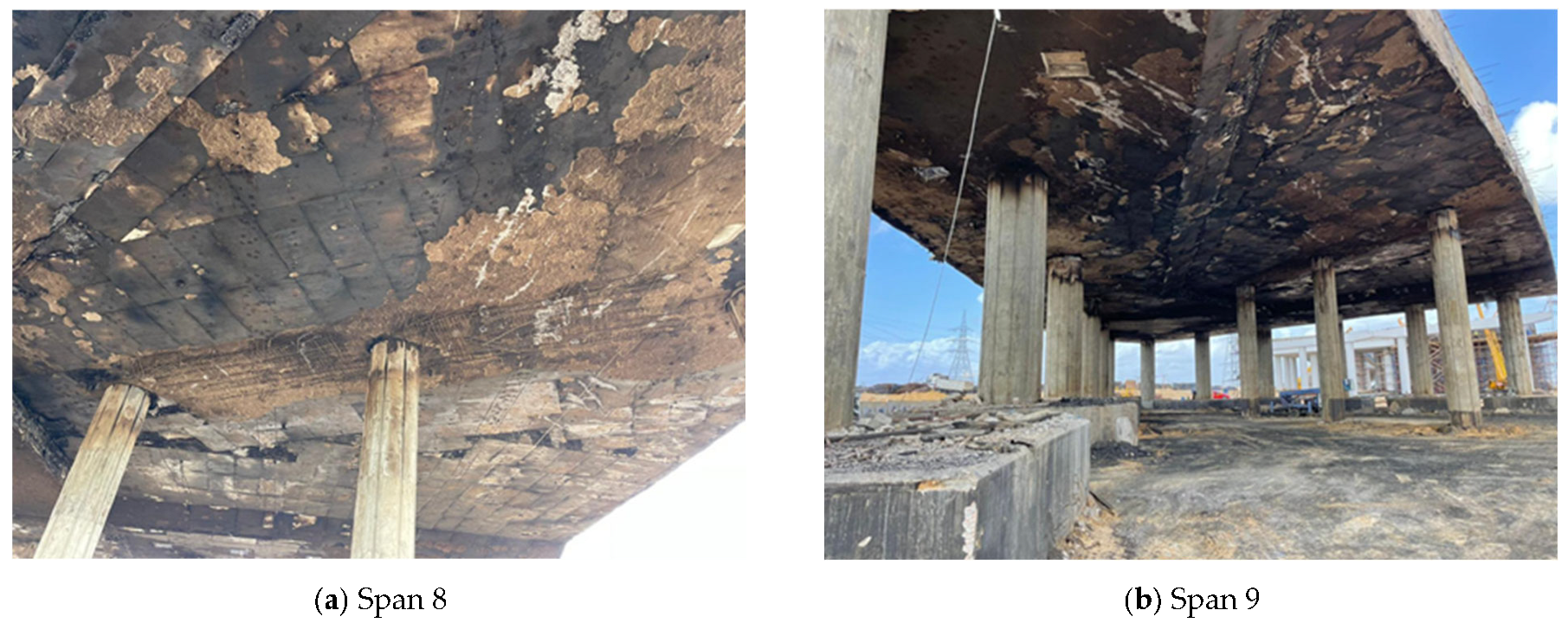
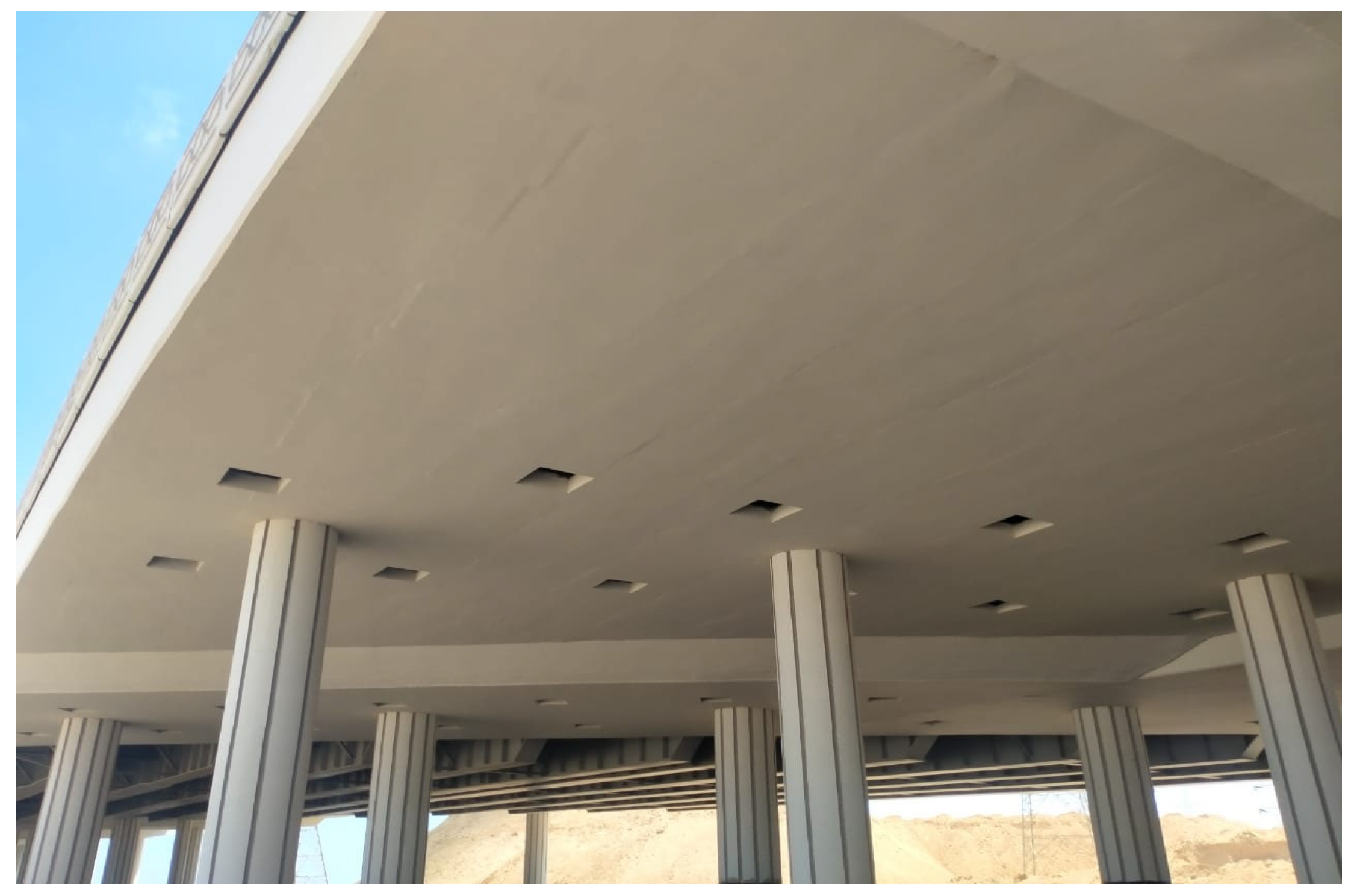
- In the Delta Bridge, fire exposure resulted in concrete spalling, cover loss, cracking, and localized reinforcement exposure in spans 8 and 9; however, the damage was confined mainly to surface layers without causing global structural distortion or collapse.
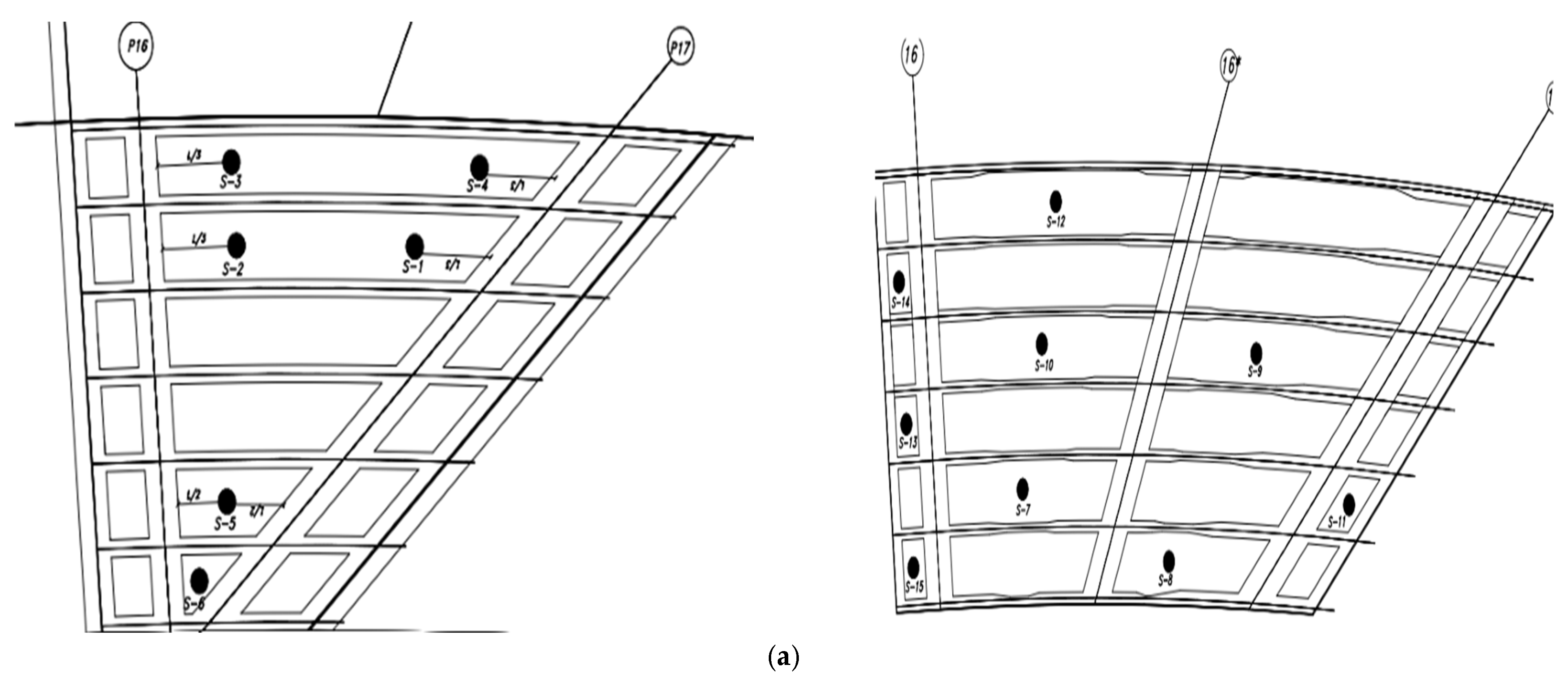
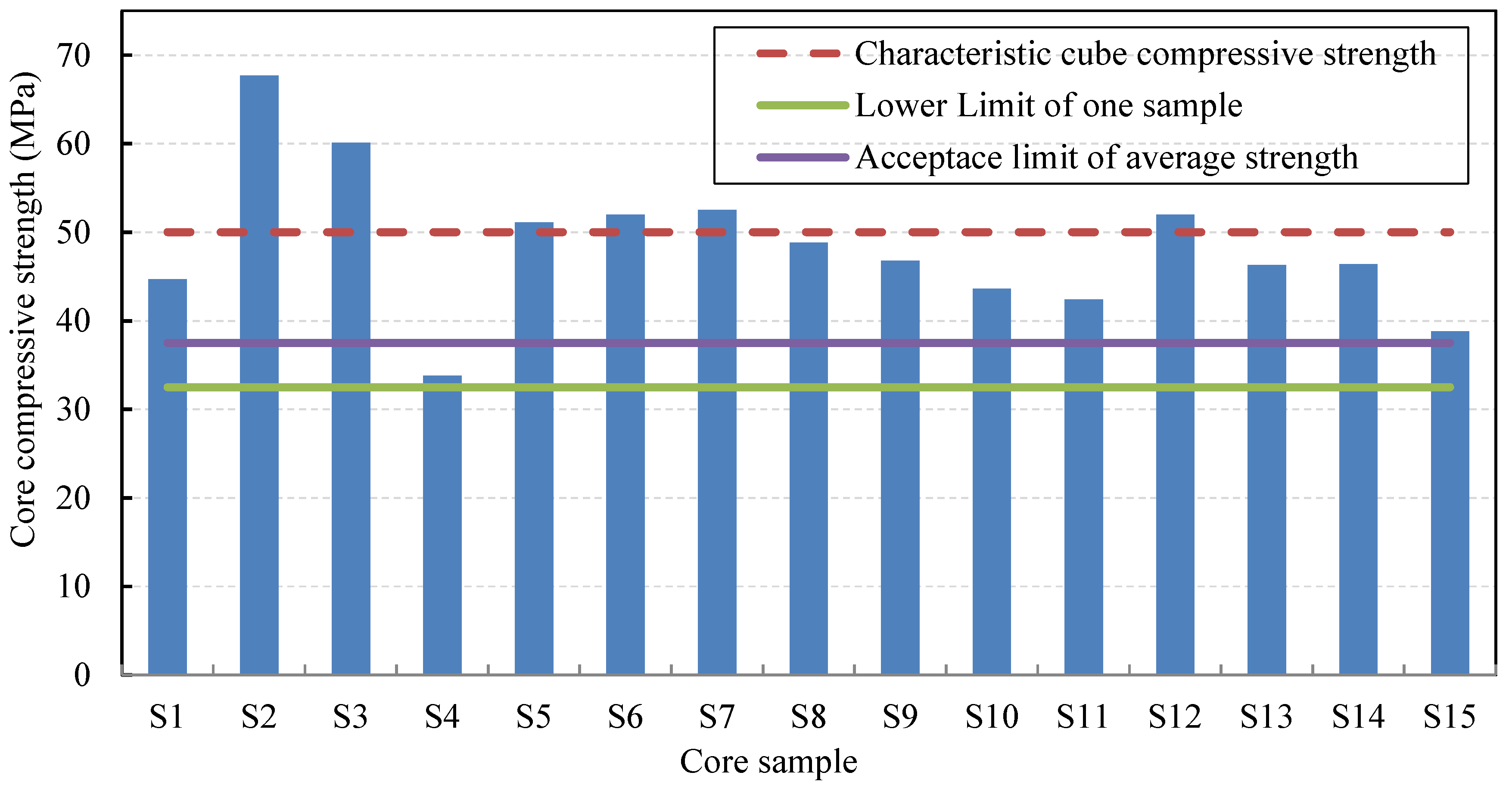
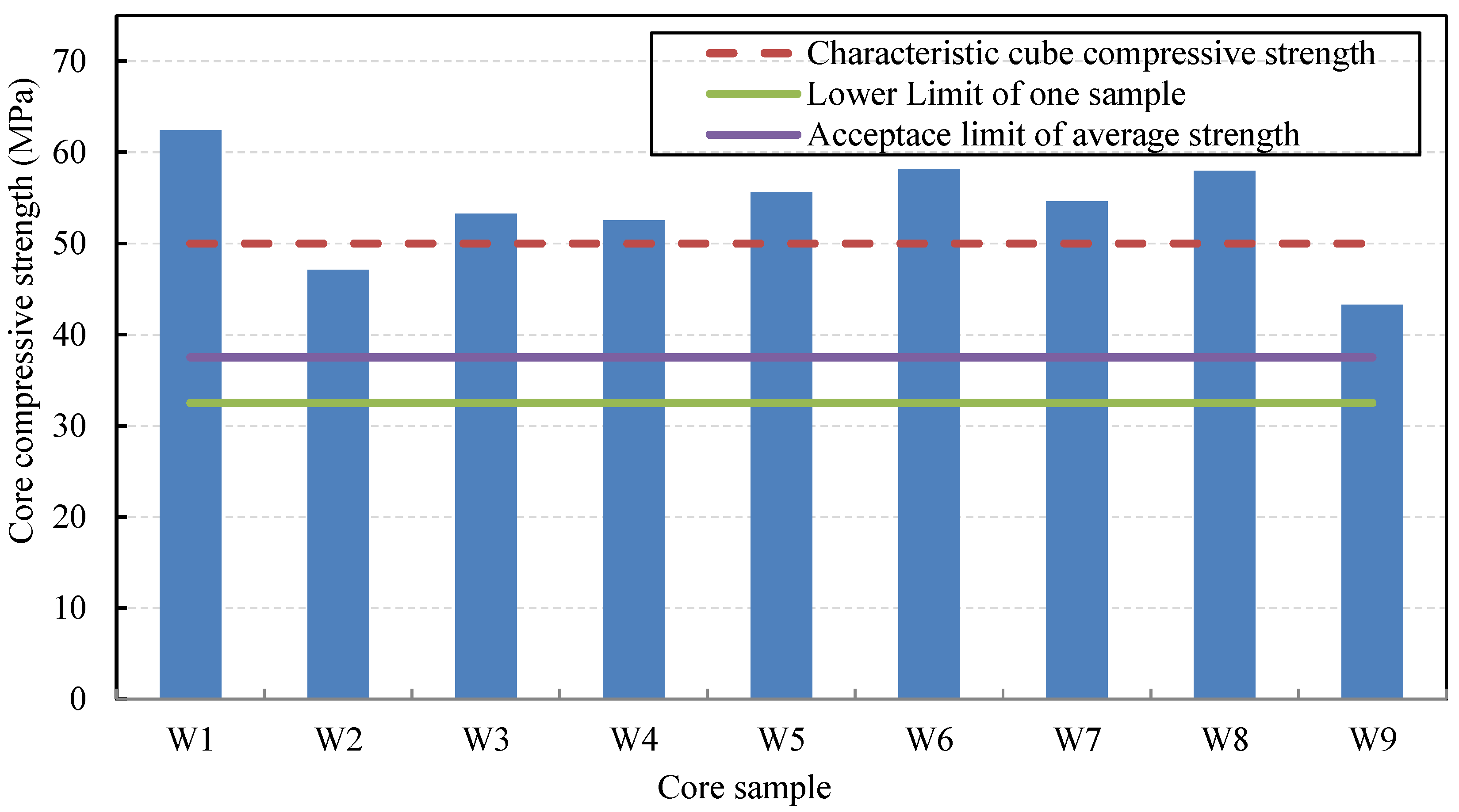
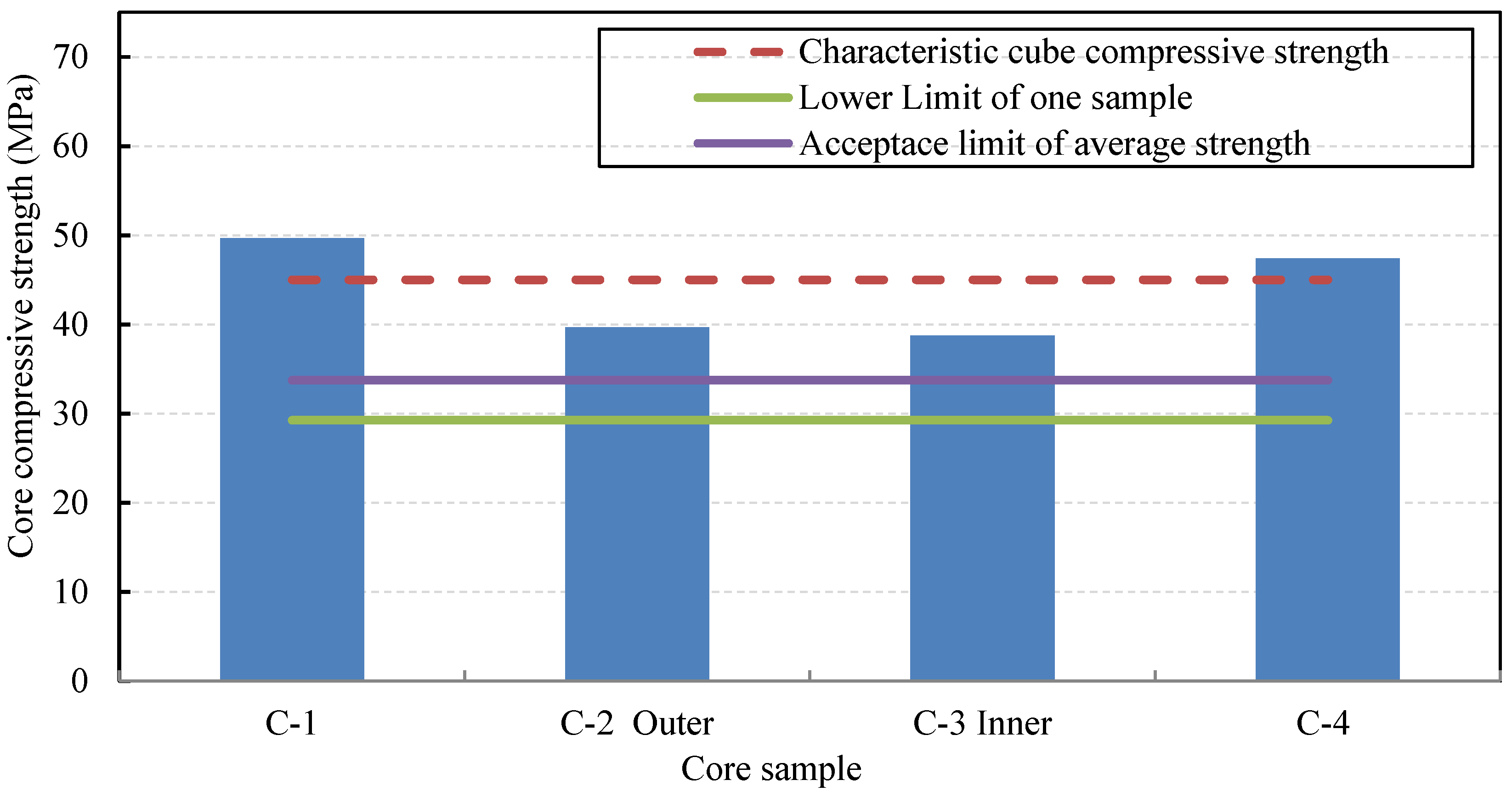
- Post-fire concrete core testing indicated moderate strength reductions relative to the original in situ concrete strength recorded during construction, with average reductions of approximately 8.5% for the bottom slab, 7.9% for the webs, and 10.8% for the columns. Despite these reductions, the residual compressive strengths remained above the minimum acceptance limits specified by ECP 203, confirming the structural adequacy of the fire-exposed concrete elements.
- Post-fire tensile testing of reinforcing bars indicated moderate strength reductions relative to the original in situ yield strength, with reductions of approximately 12.7%, 11.7%, and 11.2% for 12 mm, 16 mm, and 18 mm bars, respectively (average reduction coefficient ≈ 0.87). These results correspond to an estimated peak exposure temperature of approximately 600 °C, yet still meet code-mandated yield strength requirements.
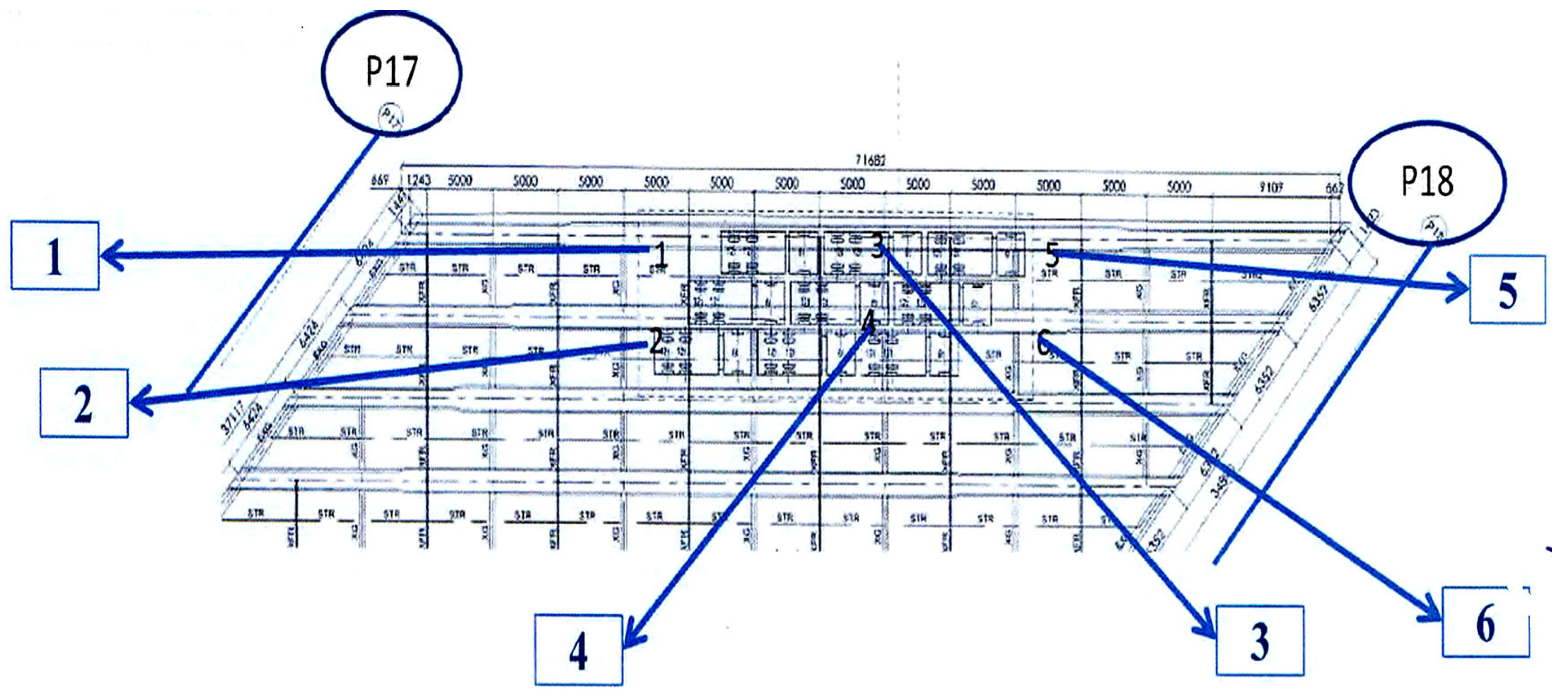
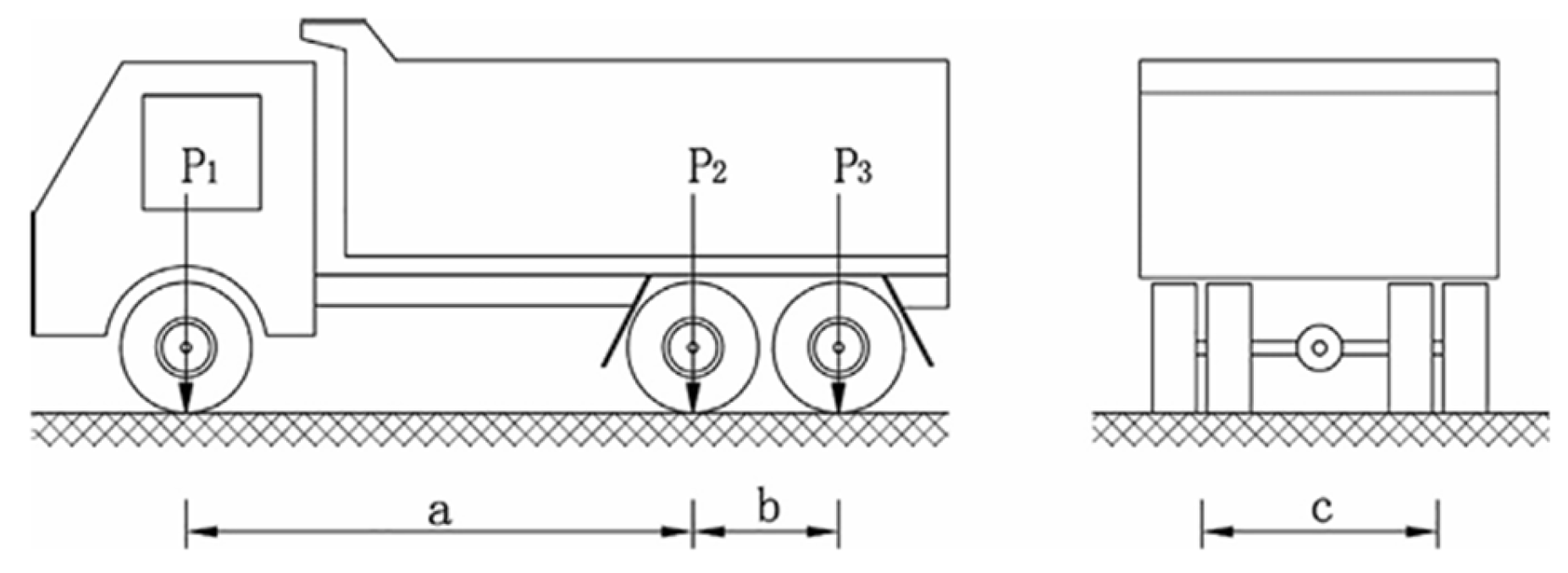
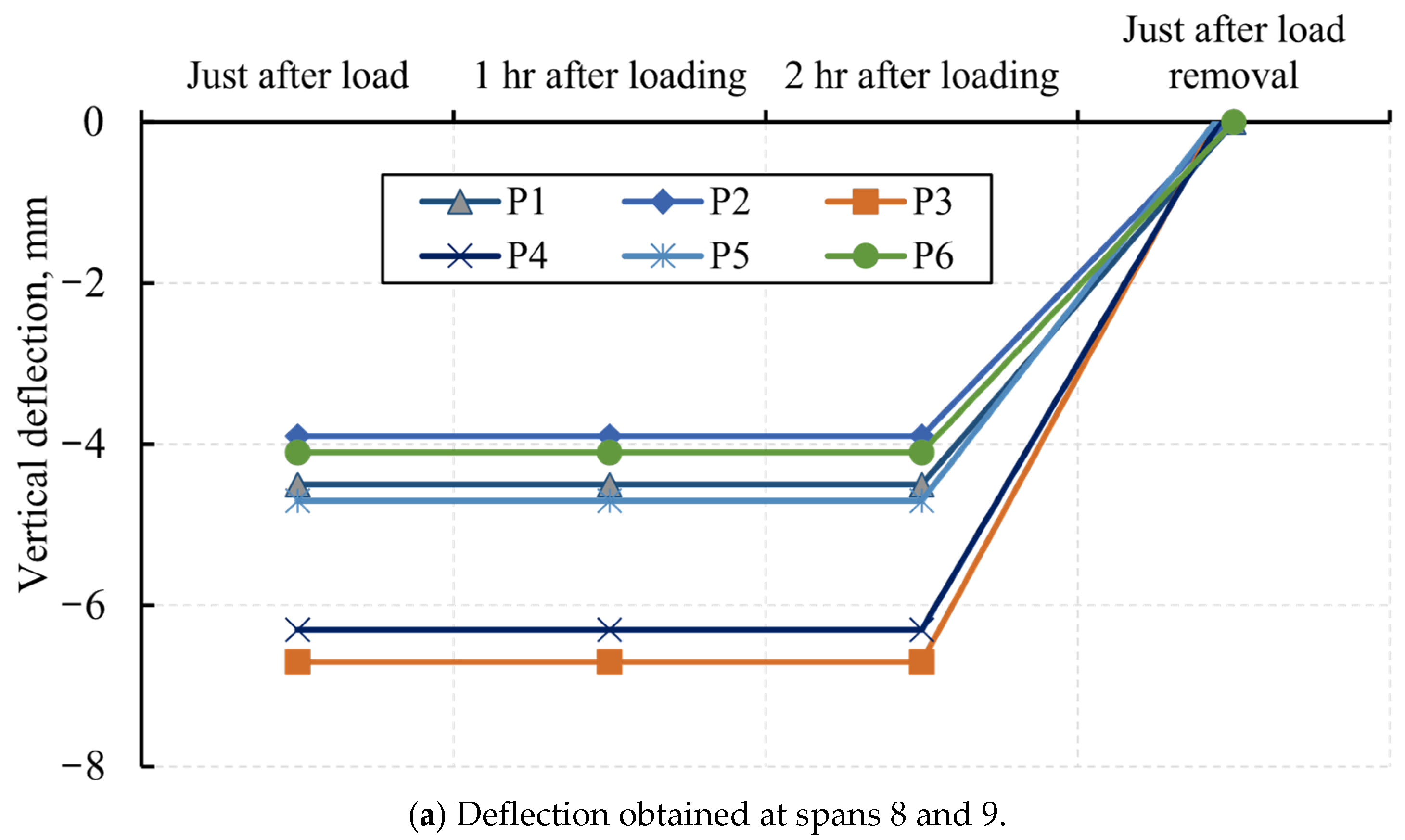
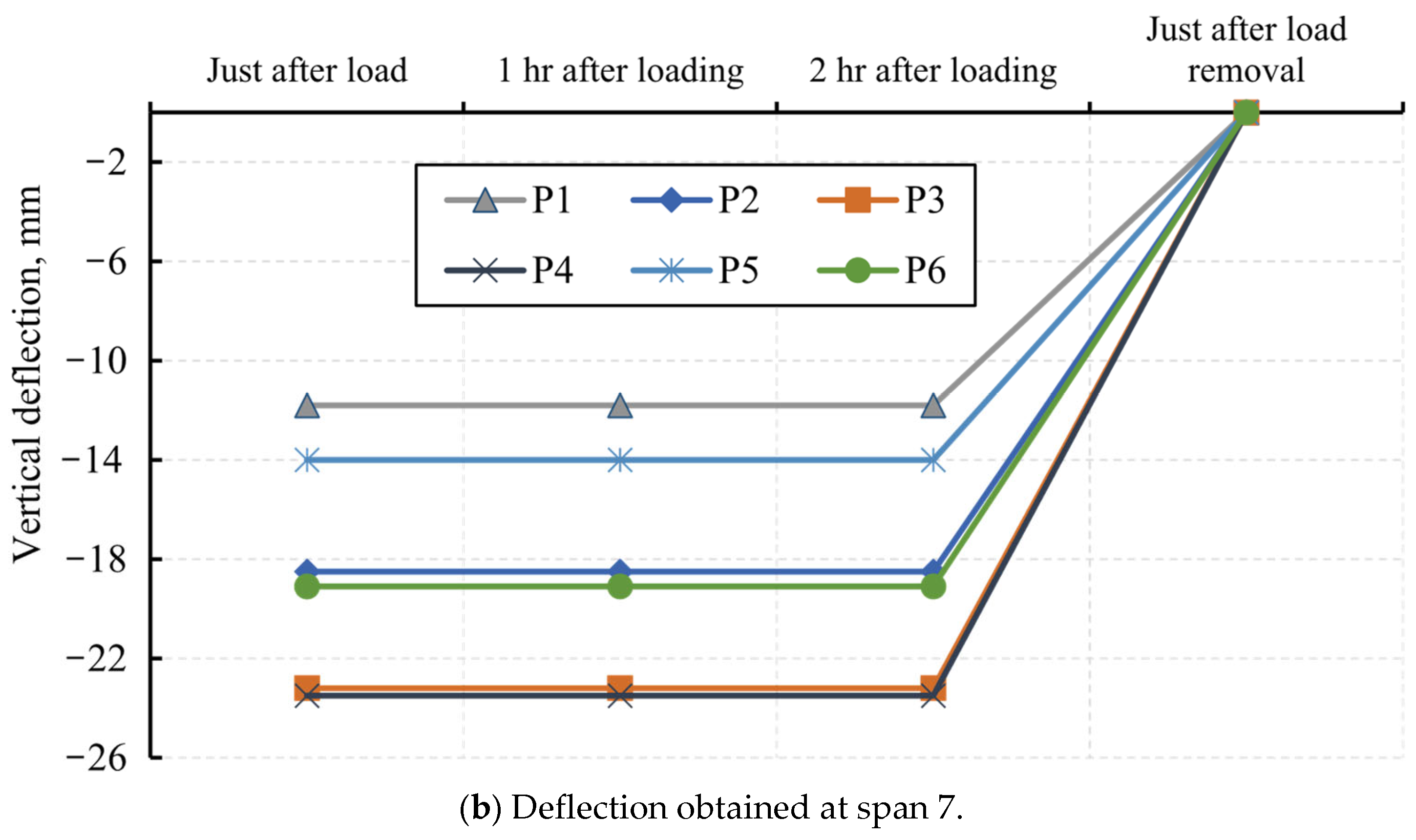
- Static load testing showed stable deflection behavior across all loading stages, with maximum midspan deflections of approximately 6.7 mm and 6.3 mm for the fire-exposed spans (8 and 9), while the longer steel span (span 7) reached a maximum deflection of about 23.5 mm due to its larger span length and different structural system. More than 94% of the deflection was recovered after unloading, indicating predominantly elastic structural behavior.
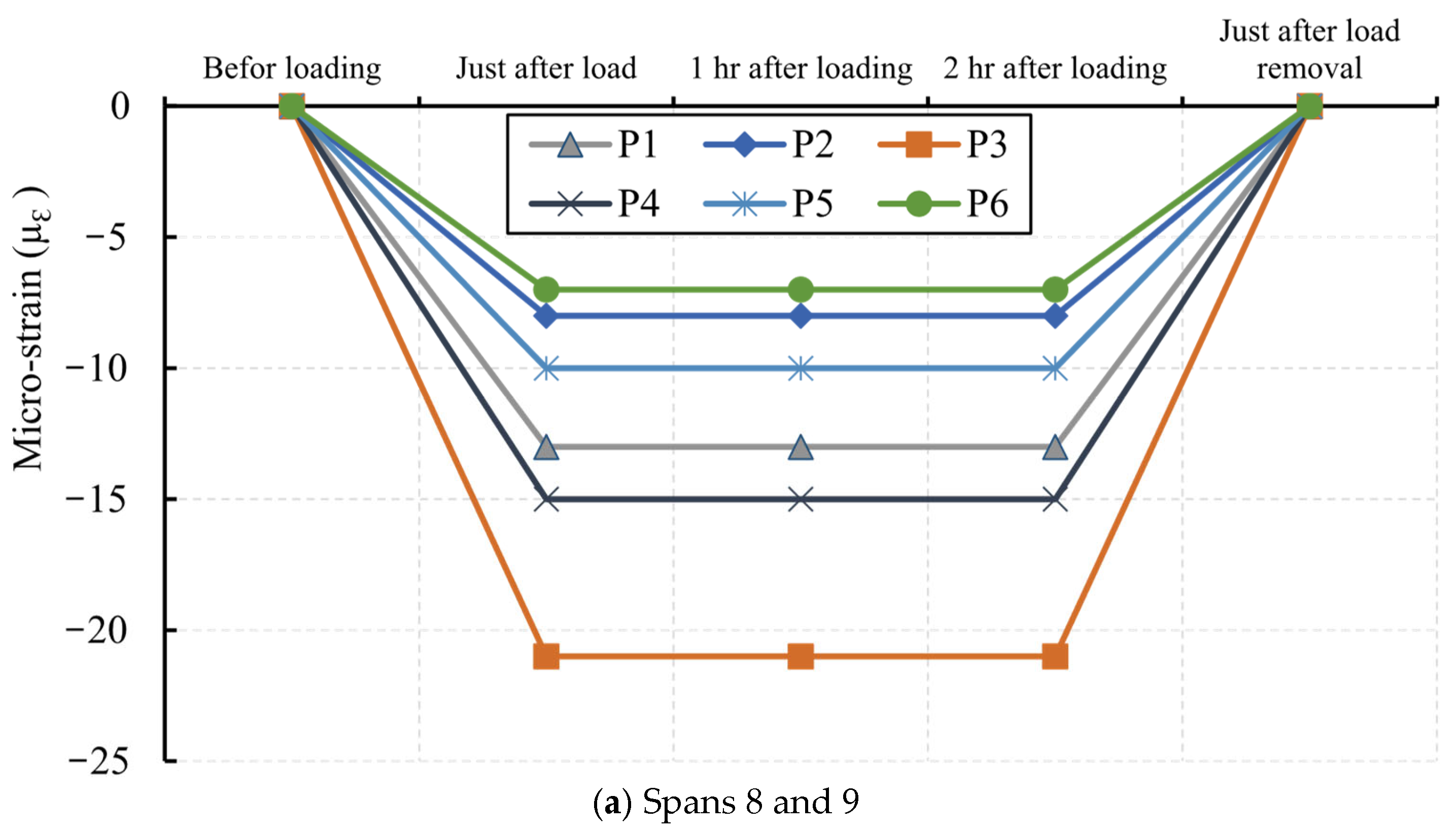
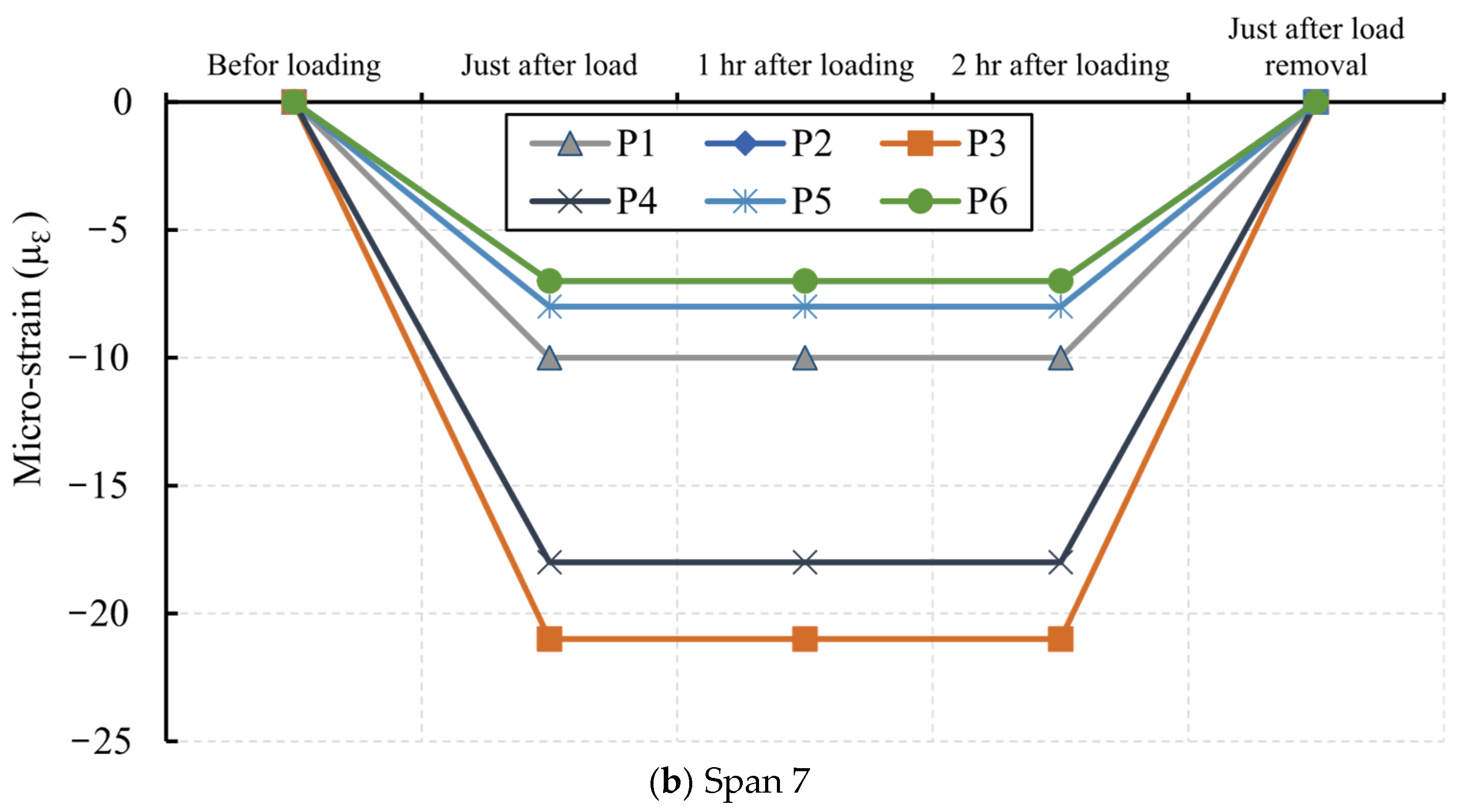
- Measured reinforcement micro-strain values in the post-fire spans remained low, with a maximum value of approximately 21 µε recorded at midspan, and returned to near-zero levels after unloading, indicating negligible permanent deformation and stable structural behavior under service loading.
- For the Delta Bridge, the implemented repair program—including removal of fire-damaged concrete, reinforcement derusting, shotcrete repair, epoxy crack injection, protective surface coating, and bearing replacement—successfully restored the structural performance of the fire-affected spans, as verified by post-repair static load testing and compliance with ECP 203 requirements.
- In this study, the integrated assessment approach (field inspection, material testing, and load verification) enabled reliable residual capacity evaluation, avoided unnecessary demolition, reduced cost and downtime, and ensured safe reopening to traffic.
Author Contributions
Funding
Data Availability Statement
Conflicts of Interest
References
- Heng, K.; Li, R.; Wu, H. Damage Assessment of Simply Supported Double-Pier Bent Bridge under Heavy Truck Collision. J. Bridg. Eng. 2022, 27, 1851. [Google Scholar] [CrossRef] [Scilit]
- Liu, Z.; Xie, H.; Han, B.; Li, P.; Jiang, Z.; Yu, J. Experimental study on residual bearing capacity of full-size fire-damaged prestressed concrete girders. Structures 2022, 45, 1788–1802. [Google Scholar] [CrossRef] [Scilit]
- Pang, Y.; Meng, R.; Li, C.; Li, C. A probabilistic approach for performance-based assessment of highway bridges under post-earthquake induced landslides. Soil Dyn. Earthq. Eng. 2022, 155, 107207. [Google Scholar] [CrossRef] [Scilit]
- Kim, S.; Seyedi, M.; Kim, H.-K. Risk Assessment of Wind-Induced Vehicle Accidents on Long-Span Bridges Using Onsite Wind and Traffic Data. J. Struct. Eng. 2022, 148, 3455. [Google Scholar] [CrossRef] [Scilit]
- Chen, L.; Qian, J.; Tu, B.; Frangopol, D.M.; Dong, Y. Performance-based risk assessment of reinforced concrete bridge piers subjected to vehicle collision. Eng. Struct. 2021, 229, 111640. [Google Scholar] [CrossRef] [Scilit]
- Cheng, J. Reliability analysis of the Sutong Bridge Tower under ship impact loading. Struct. Infrastruct. Eng. 2014, 10, 1320–1329. [Google Scholar] [CrossRef] [Scilit]
- Kodur, V.K.R.; Dwaikat, M. A numerical model for predicting the fire resistance of reinforced concrete beams. Cem. Concr. Compos. 2008, 30, 431–443. [Google Scholar] [CrossRef] [Scilit]
- Liu, X.; Yu, C.; Quan, W.; Chen, L. Inspection, materials testing and field testing of a prestressed concrete box bridge after fire exposure. Fire Saf. J. 2019, 108, 102852. [Google Scholar] [CrossRef] [Scilit]
- Garlock, M.; Paya-Zaforteza, I.; Kodur, V.; Gu, L. Fire hazard in bridges: Review, assessment and repair strategies. Eng. Struct. 2012, 35, 89–98. [Google Scholar] [CrossRef] [Scilit]
- San Francisco Gate. The Maze Meltdown. Available online: www.sfgate.com (accessed on 17 August 2008).
- Chung, P.; Wolfe, R.; Ostrom, T.; Hida, S. Accelerated Bridge Construction Applications in California—A Lessons Learned Report (August 2008). Caltrans CADOT. Available online: https://dokumen.tips/documents/accelerated-bridge-construction-applications-in-i-caltrans-engineering-services.html?page=1 (accessed on 16 January 2025).
- 6 abc Action News. Driver Killed in Ery Truck Crash on NJ Turnpike. Available online: www.abclocal.go.com/wpvi/index (accessed on 28 November 2012).
- Flint, G.; Usmani, A.; Lamont, S.; Lane, B.; Torero, J. Structural Response of Tall Buildings to Multiple Floor Fires. J. Struct. Eng. 2007, 133, 1719–1732. [Google Scholar] [CrossRef] [Scilit]
- Lange, D.; Röben, C.; Usmani, A. Tall building collapse mechanisms initiated by fire: Mechanisms and design methodology. Eng. Struct. 2012, 36, 90–103. [Google Scholar] [CrossRef] [Scilit]
- Peris-Sayol, G.; Paya-Zaforteza, I.; Balasch-Parisi, S.; Alós-Moya, J. Detailed Analysis of the Causes of Bridge Fires and Their Associated Damage Levels. J. Perform. Constr. Facil. 2017, 31, 977. [Google Scholar] [CrossRef] [Scilit]
- Quiel, S.E.; Yokoyama, T.; Bregman, L.S.; Mueller, K.A.; Marjanishvili, S.M. A streamlined framework for calculating the response of steel-supported bridges to open-air tanker truck fires. Fire Saf. J. 2015, 73, 63–75. [Google Scholar] [CrossRef] [Scilit]
- Zhu, Z.; Quiel, S.E.; Carlton, A.; Mueller, K.A.; Marjanishvili, S.M. Performance-based prioritisation of fire protection for steel girder overpasses in a complex highway interchange. Struct. Infrastruct. Eng. 2020, 16, 394–411. [Google Scholar] [CrossRef] [Scilit]
- Kodur, V.; Naser, M.Z. Fire hazard in transportation infrastructure: Review, assessment, and mitigation strategies. Front. Struct. Civ. Eng. 2021, 15, 46–60. [Google Scholar] [CrossRef] [Scilit]
- Gong, X.; Agrawal, A.K. Numerical Simulation of Fire Damage to a Long-Span Truss Bridge. J. Bridg. Eng. 2015, 20, 707. [Google Scholar] [CrossRef] [Scilit]
- Godart, B.F.; Berthellemy, J.; Lucas, J.P. Diagnosis, assessment and repair of the mathilde bridge close to collapse during a fire. Struct. Eng. Int. 2015, 25, 331–338. [Google Scholar] [CrossRef] [Scilit]
- Zhang, X.; Liu, G.; Ma, J.; Wu, H.; Fu, B.; Gao, Y. Status and prospect of technical development for bridges in China. Kexue Tongbao/Chin. Sci. Bull. 2016, 61, 415–425. [Google Scholar] [CrossRef] [Scilit]
- Lu, Z.; Su, L. The Chinese research progress on damage mechanism and evaluation method of concrete structure after fire in China. Jianzhu Jiegou Xuebao/J. Build. Struct. 2010, 31, 202–209. [Google Scholar]
- Lee, G.C.; Mohan, S.B.; Huang, C.; Fard, B.N. A Study of US Bridge Failures (1980–2012). MCEER-13-0008|06/15/2013. Available online: https://www.buffalo.edu/mceer/catalog.host.html/content/shared/www/mceer/publications/MCEER-13-0008.detail.html (accessed on 23 February 2026).
- Luo, W.L.; Liu, Q.W.; Chu, Z.F. Study of Fire Damage Charateristics of Prestressed Concrete Hollow Slab Beam. Bridg. Constr. 2021, 51, 91–98. [Google Scholar]
- Davis, M.; Tremel, P.; Pedrego, A. Bill Williams River Concrete Bridge Fire Damage Assessment. Struct Mag. 2008. Available online: https://www.wsdot.wa.gov/eesc/bridge/WBES/2007/assets/tuesday/8A/Martha_Davis_8A.pdf (accessed on 23 February 2026).
- Giuliani, L.; Crosti, C.; Gentili, F. Vulnerability of bridges to fire. In Proceedings of the 6th International Conference on Bridge Maintenance, Safety and Management, Stresa, Lake Maggiore, Italy, 8–12 July 2012; pp. 1565–1572. [Google Scholar] [CrossRef] [Scilit]
- Joo, S.; Kim, S.; Kim, Y.; Park, C. Fire Risk Evaluation of Bridge underneath Conditions based on Field Investigation. Procedia Eng. 2017, 210, 582–587. [Google Scholar] [CrossRef] [Scilit]
- Gil, A.; Kodur, V. Evaluating Shear Response of UHPC Bridge Girders Exposed to Fire. Fire Technol. 2024, 60, 2349–2372. [Google Scholar] [CrossRef] [Scilit]
- Alos-Moya, J.; Paya-Zaforteza, I.; Garlock, M.E.M.; Loma-Ossorio, E.; Schiffner, D.; Hospitaler, A. Analysis of a bridge failure due to fire using computational fluid dynamics and finite element models. Eng. Struct. 2014, 68, 96–110. [Google Scholar] [CrossRef] [Scilit]
- Ma, R.; Cui, C.; Ma, M.; Chen, A. Performance-based design of bridge structures under vehicle-induced fire accidents: Basic framework and a case study. Eng. Struct. 2019, 197, 109390. [Google Scholar] [CrossRef] [Scilit]
- Shi, B.; Jia, K.; Ge, S.; He, C.; Zhao, J. Numerical simulation study on temperature characteristics of double-deck suspension bridge in vehicle fires. Case Stud. Therm. Eng. 2025, 65, 105626. [Google Scholar] [CrossRef] [Scilit]
- Naser, M.; Kodur, V. Response of fire exposed composite girders under dominant flexural and shear loading. J. Struct. Fire Eng. 2018, 9, 108–125. [Google Scholar] [CrossRef] [Scilit]
- Nicoletta, B.; Kotsovinos, P.; Gales, J. Review of the fire risk, hazard, and thermomechanical response of bridges in fire. Can. J. Civ. Eng. 2020, 47, 363–381. [Google Scholar] [CrossRef] [Scilit]
- Liu, Z.; Li, G.-Q.; Paya-Zaforteza, I.; Cai, C.S.; Huang, Q. Fire Hazards in Bridges: State of the Art, Recent Progress, and Current Research Gaps. J. Bridg. Eng. 2023, 28, 5790. [Google Scholar] [CrossRef] [Scilit]
- Akca, A.H.; Özyurt, N. Post-fire mechanical behavior and recovery of structural reinforced concrete beams. Constr. Build. Mater. 2020, 253, 119188. [Google Scholar] [CrossRef] [Scilit]
- EN 1992-1-2:2023; Eurocode 2: Design of Concrete Structures—Part 1–2: Structural Fire Design. CEN: Brussels, Belgium, 2023.
- ECP 203; Egyptian Code of Practice for Design and Construction of Concrete Structures; “Annex III”, Manual Laboratory Tests for Concrete Material. Ministry of Housing, Utilities & Urban Communities: Giza, Egypt, 2018.
- CECS252; Standard Building Structural Assessment After Fire. China Association for Engineering Construction Standardization (CECS): Beijing, China, 2009.
- American Concrete Institute (ACI) 562-16; Code Requirements for Assessment, Repair, and Rehabilitation of Existing Concrete Structures and Commentary. American Concrete Institute: Farmington Hills, MI, USA, 2016.
- American Concrete Institute (ACI) 546R-14; Guide to Concrete Repair. American Concrete Institute: Farmington Hills, MI, USA, 2014.







| Temperature/°C | 20 | 100 | 200 | 300 | 400 | 500 | 600 | 700 | 800 | 900 | ≥1000 |
|---|---|---|---|---|---|---|---|---|---|---|---|
| Reduction coefficient | 1.00 | 1.00 | 0.97 | 0.91 | 0.85 | 0.74 | 0.60 | 0.43 | 0.27 | 0.15 | 0.00 |
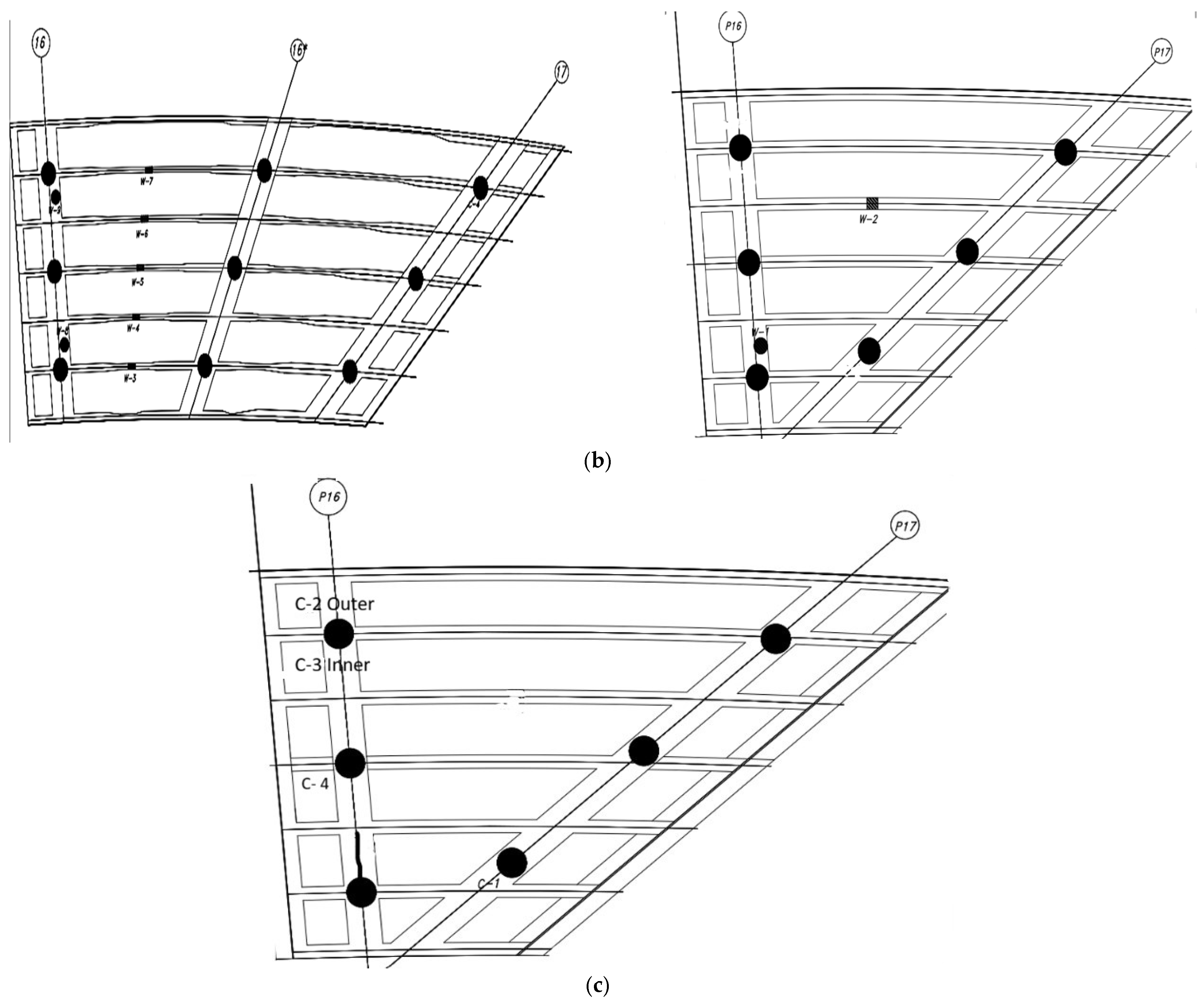
| Member | Sample ID | L (cm) | L/D | No of Steel Bars | Diameter of Steel Bars (d) (mm) | S (cm) | P (KN) | Cylinder Strength (MPa) | Equivalent Cube Strength, fcu (MPa) |
|---|---|---|---|---|---|---|---|---|---|
| Bottom Slab | S1 | 12.30 | 1.31 | 2 | 16–16 | 2.3–5.6 | 257.20 | 37.80 | 44.70 |
| S2 | 12.10 | 1.29 | 1 | 16 | 2.50 | 433.10 | 63.60 | 67.70 | |
| S3 | 13.30 | 1.41 | 3 | 16–16–16 | 2.5–3.9–6.4 | 315.00 | 46.30 | 60.10 | |
| S4 | 13.40 | 1.43 | 2 | 12–16 | 3.2–5.70 | 190.90 | 28.00 | 33.80 | |
| S5 | 12.70 | 1.35 | - | - | - | 338.70 | 49.80 | 51.10 | |
| S6 | 11.70 | 1.24 | 1 | 16 | 2.40 | 336.70 | 49.50 | 52.00 | |
| S7 | 12.20 | 1.30 | 1 | 16 | 4.20 | 324.50 | 47.70 | 52.50 | |
| S8 | 12.40 | 1.32 | 1 | 16 | 5.80 | 291.10 | 42.80 | 48.80 | |
| S9 | 12.20 | 1.30 | 2 | 16–16 | 4.30–2.50 | 275.20 | 40.40 | 46.80 | |
| S10 | 11.80 | 1.26 | - | - | - | 296.40 | 43.50 | 43.60 | |
| S11 | 12.00 | 1.28 | 3 | 16–16–16 | 4.3–5.6–4.3 | 221.10 | 32.50 | 42.40 | |
| S12 | 11.30 | 1.20 | - | - | - | 358.70 | 52.70 | 52.0 | |
| S13 | 12.10 | 1.28 | - | - | - | 312.00 | 45.80 | 46.30 | |
| S14 | 11.50 | 1.24 | - | - | - | 318.20 | 46.70 | 46.40 | |
| S15 | 11.60 | 1.23 | 1 | 16 | 3.1 | 246.40 | 36.20 | 38.80 | |
| Web | W1 | 13.40 | 1.43 | - | - | - | 374.40 | 55.00 | 62.45 |
| W2 | 12.60 | 1.34 | 1 | 16 | 1.70 | 278.60 | 40.92 | 47.12 | |
| W3 | 14.00 | 1.49 | 1 | 12 | 2.50 | 304.40 | 44.71 | 53.24 | |
| W4 | 12.90 | 1.37 | - | - | - | 319.00 | 46.86 | 52.56 | |
| W5 | 11.50 | 1.22 | 1 | 25 | 1.80 | 330.10 | 48.49 | 55.58 | |
| W6 | 14.20 | 1.51 | 1 | 16 | 5.40 | 312.10 | 45.84 | 58.16 | |
| W7 | 11.80 | 1.26 | - | - | - | 341.60 | 50.18 | 54.62 | |
| W8 | 14.00 | 1.49 | - | - | - | 342.80 | 50.35 | 57.97 | |
| W9 | 11.90 | 1.27 | - | - | - | 270.10 | 39.67 | 43.31 | |
| Column | C1 | 12.10 | 1.29 | - | - | - | 308.00 | 45.24 | 49.68 |
| C2 Outer | 9.60 | 1.02 | 2 | 16–12 | 1.7–1.7 | 242.50 | 35.62 | 38.76 | |
| C3 Inner | 9.70 | 1.03 | - | - | - | 266.70 | 39.18 | 39.67 | |
| C4 | 12.30 | 1.31 | - | - | - | 292.30 | 42.94 | 47.41 |
| Item | Original In Situ Cube Concrete Strength, MPa | Characteristic Cube Compressive Strength, MPa (fcu) | Acceptance Limit of Average Strength, MPa (=0.75 × fcu) | Lower Strength Limit of One Sample, MPa (=0.65 × fcu) |
|---|---|---|---|---|
| Slab | 53 | 50 | 37.50 | 32.50 |
| Web | 58.5 | 50 | 37.50 | 32.50 |
| Column | 49.2 | 45 | 33.80 | 29.30 |
| Temperature/°C | Reduction Coefficient | |
|---|---|---|
| Yield Strength (fy) | Ultimate Strength (fu) | |
| 20 | 1.00 | 1.00 |
| 100 | 0.95 | 1.00 |
| 200 | 0.95 | 1.00 |
| 250 | 0.95 | 0.95 |
| 300 | 0.95 | 0.95 |
| 350 | 0.95 | 0.95 |
| 400 | 0.95 | 0.90 |
| 450 | 0.90 | 0.90 |
| 500 | 0.90 | 0.90 |
| 600 | 0.90 | 0.85 |
| 700 | 0.85 | 0.85 |
| 800 | 0.85 | 0.85 |
| 900 | 0.80 | 0.80 |
| Item | Bar Mark | Diameter (mm) | Area (mm2) | Weight per 1 m (Kg) | Yield Load (KN) | Yield Strength (MPa) | Ultimate Load (KN) | Ultimate Strength (MPa) | Neck Elongation (Total at Fracture) (%) |
|---|---|---|---|---|---|---|---|---|---|
| Upper slab reinforcement | US 12A | 12 | 113.10 | 0.860 | 60.17 | 532 | 78.88 | 697 | 23.30 |
| US 12B | 12 | 113.10 | 0.848 | 59.48 | 526 | 78.27 | 692 | 21.70 | |
| US 12C | 12 | 113.10 | 0.854 | 50.40 | 445 | 67.90 | 600 | 26.70 | |
| US 16A | 16 | 201.06 | 1.516 | 107.08 | 533 | 137.79 | 685 | 21.30 | |
| US 16B | 16 | 201.06 | 1.520 | 106.26 | 528 | 137.43 | 684 | 21.30 | |
| US 16C | 16 | 201.06 | 1.613 | 108.05 | 537 | 138.79 | 690 | 20.00 | |
| US 18A | 18 | 254.47 | 1.938 | 128.85 | 506 | 175.57 | 690 | 22.20 | |
| US 18B | 18 | 254.47 | 1.969 | 143.60 | 564 | 181.54 | 713 | 22.20 | |
| US 18C | 18 | 254.47 | 1.973 | 143.19 | 563 | 180.17 | 708 | 22.20 | |
| Lower slab reinforcement | LS 16A | 16 | 201.06 | 1.553 | 107.23 | 533 | 140.41 | 698 | 20.00 |
| LS 16B | 16 | 201.06 | 1.550 | 98.43 | 490 | 128.79 | 641 | 22.50 | |
| LS 16C | 16 | 201.06 | 1.555 | 106.26 | 528 | 138.06 | 687 | 22.50 | |
| LS 18A | 18 | 254.47 | 1.939 | 140.66 | 553 | 181.52 | 713 | 20.00 | |
| LS 18B | 18 | 254.47 | 1.939 | 128.85 | 506 | 175.67 | 690 | 20.00 | |
| LS 18C | 18 | 254.47 | 1.951 | 139.88 | 550 | 180.90 | 711 | 21.10 |
| Member | Depth (cm) | Temperature (°C) |
|---|---|---|
| Slab and web | 0–2 | 600 |
| 2–4 | 450–600 | |
| 4–7 | 300–450 | |
| 7–10 | 150–300 | |
| 10–14 | <150 | |
| Column | 0–2 | 550–650 |
| 2–4 | 400–550 | |
| 4–6 | 300–400 | |
| 6–8 | <300 |
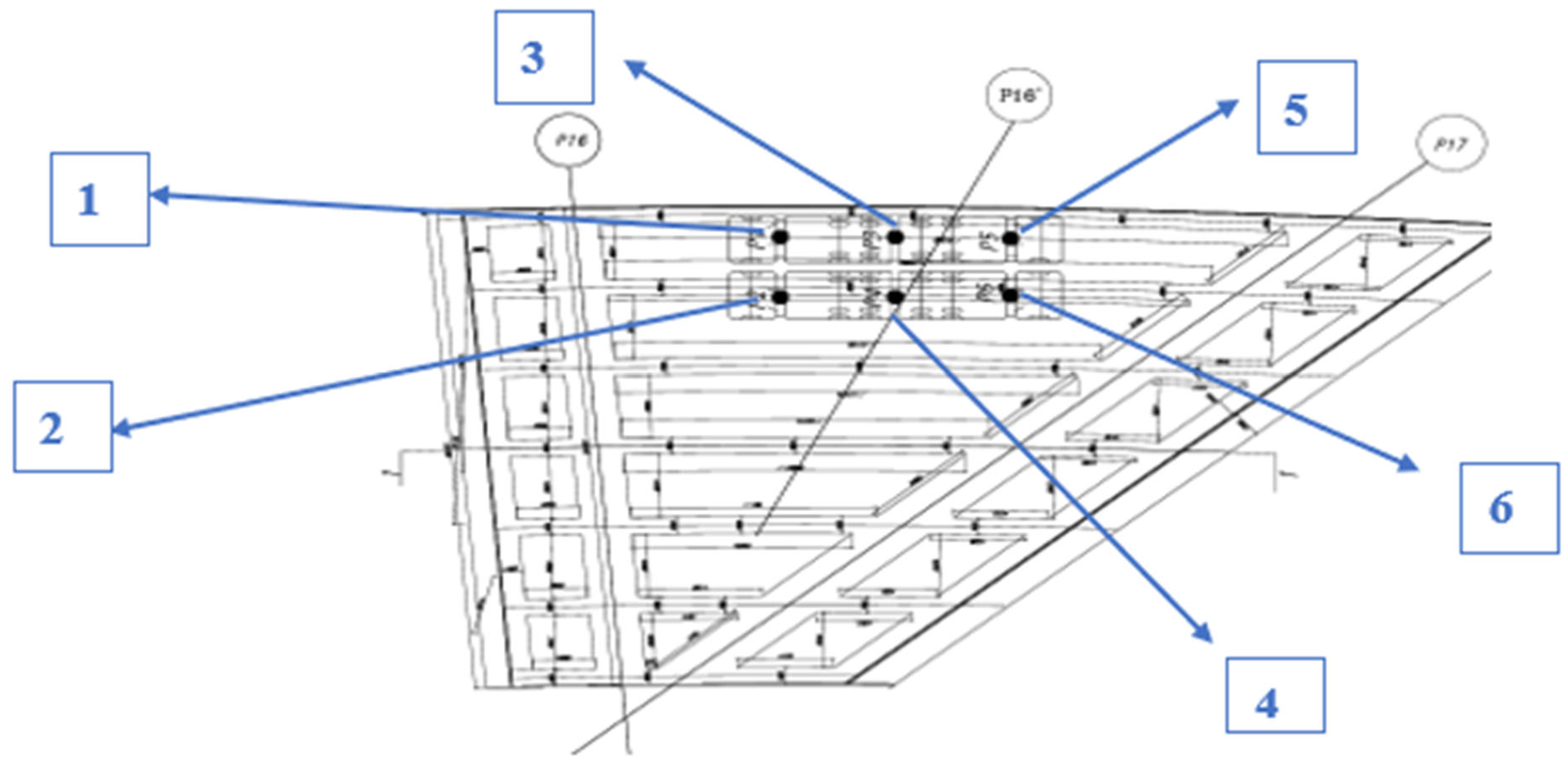
| Span | Point | Data Recorded | Loading Time (min) | Recovery | ||||
|---|---|---|---|---|---|---|---|---|
| Before Loading | Just After Loading | 1 h After Loading | 2 h After Loading | Just After Load Removal | ||||
| Spans 8 and 9 | P1 | µƐ | 0.0 | 13.00 | 13.00 | 13.00 | 0.0 | 100% |
| D mm | 0.0 | −4.50 | −4.50 | −4.50 | 0.0 | 100% | ||
| P2 | µƐ | 0.0 | 8.00 | 8.00 | 8.00 | 0.0 | 100% | |
| D mm | 0.0 | −3.90 | −3.90 | −3.90 | −0.10 | 97% | ||
| P3 | µƐ | 0.0 | 21.00 | 21.00 | 21.00 | 0.0 | 100% | |
| D mm | 0.0 | −6.70 | −6.70 | −6.70 | −0.40 | 94% | ||
| P4 | µƐ | 0.0 | 15.00 | 15.00 | 15.00 | 0.0 | 100% | |
| D mm | 0.0 | −6.30 | −6.30 | −6.30 | −0.30 | 95% | ||
| P5 | µƐ | 0.0 | 10.00 | 10.00 | 10.00 | 0.0 | 100% | |
| D mm | 0.0 | −4.70 | −4.70 | −4.70 | −0.30 | 94% | ||
| P6 | µƐ | 0.0 | 7.00 | 7.00 | 7.00 | 0.0 | 100% | |
| D mm | 0.0 | −4.10 | −4.10 | −4.10 | 0.0 | 100% | ||
| Span 7 | P1 | µƐ | 0.0 | 10.00 | 10.00 | 10.00 | 0.0 | 100% |
| D mm | 0.0 | −11.80 | −11.80 | −11.80 | 0.0 | 100% | ||
| P2 | µƐ | 0.0 | 7.00 | 7.00 | 7.00 | 0.0 | 100% | |
| D mm | 0.0 | −18.50 | −18.50 | −18.50 | 0.0 | 100% | ||
| P3 | µƐ | 0.0 | 21.00 | 21.00 | 21.00 | 0.0 | 100% | |
| D mm | 0.0 | −23.20 | −23.20 | −23.20 | 0.0 | 100% | ||
| P4 | µƐ | 0.0 | 18.00 | 18.00 | 18.00 | 0.0 | 100% | |
| D mm | 0.0 | −23.50 | −23.50 | −23.50 | 0.0 | 100% | ||
| P5 | µƐ | 0.0 | 8.00 | 8.00 | 8.00 | 0.0 | 100% | |
| D mm | 0.0 | −14.00 | −14.00 | −14.00 | 0.0 | 100% | ||
| P6 | µƐ | 0.0 | 7.00 | 7.00 | 7.00 | 0.0 | 100% | |
| D mm | 0.0 | −19.10 | −19.10 | −19.10 | 0.0 | 100% | ||
Disclaimer/Publisher’s Note: The statements, opinions and data contained in all publications are solely those of the individual author(s) and contributor(s) and not of MDPI and/or the editor(s). MDPI and/or the editor(s) disclaim responsibility for any injury to people or property resulting from any ideas, methods, instructions or products referred to in the content. |
© 2026 by the authors. Licensee MDPI, Basel, Switzerland. This article is an open access article distributed under the terms and conditions of the Creative Commons Attribution (CC BY) license.
Share and Cite
Eisa, A.S.; Hassan, H.; Badran, M.A.; El-Zohairy, A. Post-Fire Inspection, Material Testing, Repair, and Field Load Testing of a Full-Scale Concrete Box Girder Bridge: Delta Bridge Case Study. Infrastructures 2026, 11, 76. https://doi.org/10.3390/infrastructures11030076
Eisa AS, Hassan H, Badran MA, El-Zohairy A. Post-Fire Inspection, Material Testing, Repair, and Field Load Testing of a Full-Scale Concrete Box Girder Bridge: Delta Bridge Case Study. Infrastructures. 2026; 11(3):76. https://doi.org/10.3390/infrastructures11030076
Chicago/Turabian StyleEisa, Ahmed S., Hilal Hassan, Mohamed A. Badran, and Ayman El-Zohairy. 2026. "Post-Fire Inspection, Material Testing, Repair, and Field Load Testing of a Full-Scale Concrete Box Girder Bridge: Delta Bridge Case Study" Infrastructures 11, no. 3: 76. https://doi.org/10.3390/infrastructures11030076
APA StyleEisa, A. S., Hassan, H., Badran, M. A., & El-Zohairy, A. (2026). Post-Fire Inspection, Material Testing, Repair, and Field Load Testing of a Full-Scale Concrete Box Girder Bridge: Delta Bridge Case Study. Infrastructures, 11(3), 76. https://doi.org/10.3390/infrastructures11030076