1. Introduction
Road markings are optically active systems composed of a binder material (typically paint or thermoplastic) and embedded glass beads. The glass beads are essential for retroreflectivity, as they refract and return incident headlight beams toward their source, ensuring nighttime visibility. The optical response of road markings is strongly influenced by the marking formulation, including binder composition and functional additives [
1]. Pavement markings must be visible to drivers under a wide range of driving and environmental conditions to be effective. For several decades, the Manual on Uniform Traffic Control Devices (MUTCD) has emphasized nighttime visibility of traffic control devices, including the use of retroreflective or illuminated traffic signs. While these early provisions were largely qualitative, enforceable minimum retroreflectivity requirements were formally established through the FHWA Final Rule published in 2009, which mandated compliance and adopted numerical minimum values within the MUTCD regulatory framework [
2,
3].
Graham et al. [
4] examined pavement-marking retroreflectivity requirements for older drivers and reported that approximately 85% of drivers over 60 achieved satisfactory visibility at retroreflectivity levels near 100 mcd/m
2/lux. Loetterle et al. [
5] investigated driver perception of pavement-marking brightness on rural, unlit two-lane roads under low-beam headlights, suggesting that retroreflectivity levels on the order of 120 mcd/m
2/lux provide adequate perceived brightness. Bowman and Abboud [
6] linked pavement-marking retroreflectivity to crash history and identified a retroreflectivity range of approximately 140–156 mcd/m
2/lux below which crash rates increased.
Another essential factor influencing the visibility of road markings is the luminance contrast between the marking and the pavement surface. Higher contrast enhances the detectability of markings against their background, particularly at night. Previous studies focusing on older drivers have shown that visibility requirements are more stringent for this population, with acceptable performance associated with sufficiently high contrast and retroreflectivity levels rather than retroreflectivity alone [
4,
6,
7].
Previous research has examined the durability of pavement markings and the factors governing their service life. Migletz and Graham [
8] define the marking lifespan as the time or accumulated traffic until retroreflectivity declines to a minimum acceptable threshold, synthesizing evidence from multiple field studies reporting typical service lives for conventional paint markings of approximately one year. Several studies indicate that white pavement markings generally exhibit higher initial retroreflectivity and, in some cases, longer nominal service lives than yellow markings; however, differences in degradation behavior can reduce these advantages over time, resulting in comparable effective service lives under certain conditions [
9,
10]. The degradation of pavement-marking retroreflectivity is influenced by multiple factors. Bowman and Abboud [
6] identified mechanical abrasion associated with winter maintenance activities, such as snow removal, as a significant contributor to retroreflectivity loss, while reporting limited influence of traffic volume and vehicle composition. Additionally, Craig et al. [
9] demonstrated that marking location affects durability, with centerline markings degrading more rapidly than edge lines, likely due to increased tire-crossing frequency and direct mechanical interaction. This observation highlights that localized mechanical exposure depends not only on traffic intensity (e.g., Annual Average Daily Traffic—AADT), but also on lateral vehicle positioning and wheel-path distribution, factors not explicitly captured by AADT alone.
Numerous prior studies have identified traffic intensity as a significant factor influencing pavement marking degradation. For example, Sitzabee et al. [
10] incorporated Annual Average Daily Traffic (AADT) as an explanatory variable in degradation modeling for North Carolina roadways and reported statistically meaningful traffic-related effects. Similarly, Dwyer et al. [
11] documented variations in marking performance across surface types and traffic conditions in Illinois field evaluations. More recently, Mousa et al. [
12] reported significant associations between traffic exposure and waterborne paint retroreflectivity performance under Louisiana climatic conditions. These findings indicate that traffic-related mechanical interaction can substantially affect marking durability in certain environmental and operational conditions.
Collectively, these studies demonstrate that traffic-related mechanical interaction can significantly affect pavement marking durability under climatic conditions associated with winter maintenance operations, higher moisture exposure, or intensive freight loading. Accordingly, the role of traffic volume in degradation modeling appears to be context-dependent and mediated by environmental and operational factors. The present study does not dispute the broader literature but rather examines whether traffic effects remain statistically detectable under the specific dry-climate and low-abrasion conditions of the Israeli intercity network under investigation.
Asphalt pavements are widely used in highway infrastructure due to their favorable mechanical and operational characteristics, including adaptability to traffic loading, ease of construction and maintenance, and suitability for performance-based mixture design [
13,
14,
15,
16]. Consequently, asphalt mixture types are the predominant pavement solution in many national and regional road networks worldwide, as evidenced by extensive field applications and performance studies of highway pavements [
17]. Asphalt is an organic, bituminous material that undergoes physicochemical aging over time, which gradually alters its surface color and optical reflectance. Xu et al. [
18] quantitatively demonstrated that asphalt pavements become progressively lighter with age, as indicated by increasing Munsell values. This observation raises the question of whether the type of asphalt mixture and its aging state influence pavement background reflectance and, in turn, the optical performance of pavement markings. In this study, the term asphalt mixture type denotes the composition of the pavement surface layer, characterized by differences in aggregate mineralogy, gradation, and resulting surface texture. The investigated mixtures include basalt dense-graded concrete (Basalt DCG), basalt stone mastic asphalt (Basalt SMA), and basalt–dolomite dense-graded concrete (Zebra DCG). These mixture-specific properties govern surface color, luminance, and micro-scale optical behavior, thereby influencing the perceived retroreflectivity and luminance contrast of pavement markings.
While numerous studies have examined pavement-marking degradation associated with traffic loading, environmental exposure, material wear, and maintenance practices, relatively little attention has been given to the influence of the optical and surface characteristics of the underlying asphalt mixture on marking visibility. This omission is significant because the pavement surface serves as the visual background against which markings are perceived, thereby directly affecting their apparent brightness and luminance contrast. These parameters are increasingly relevant under diverse lighting conditions and for emerging sensing technologies. Recent European studies have shown that pavement color, pigmentation, and surface condition significantly affect pavement luminance and color appearance under both daytime and nighttime, thereby influencing the visual context in which markings are perceived [
19,
20]. Additional research demonstrates that pavement macro- and micro-texture affects paint distribution, retroreflectivity, and skid resistance at the marking–pavement interface [
21]. North American studies further establish that visibility performance is governed by maintained retroreflectivity thresholds for human drivers [
22] and by marking characteristics critical to machine-vision detectability in automated driving systems [
23].
Recent scholarly work reinforces the importance of interactions between pavement marking retroreflectivity and road safety. Empirical studies have demonstrated a statistically significant association between reduced pavement-marking retroreflectivity and increased nighttime crash frequency, indicating elevated safety risks when retroreflectivity levels fall below commonly accepted visibility thresholds [
24]. In parallel, recent investigations of automated-vehicle and machine-vision performance show that detection reliability declines markedly at retroreflectivity levels of 70–120 mcd/m
2/lux, depending on the roadway environment and sensing modality [
25,
26]. Studies on machine vision for automated driving indicate that detection performance is strongly dependent on pavement-marking contrast and retroreflectivity, particularly under wet or low-light conditions. Experimental evidence suggests that higher contrast ratios and elevated retroreflectivity levels substantially improve the robustness of camera-based detection systems, compared with thresholds typically sufficient for human drivers [
27,
28].
However, relatively few studies have explicitly examined asphalt mixture type itself as a primary determinant of pavement-marking retroreflective performance. Emerging evidence suggests that darker asphalt surfaces may enhance initial contrast, while surface-specific aging behavior can alter these differences over time [
29]. Because pavement-marking degradation is influenced by material properties, environmental exposure, traffic conditions, and maintenance practices, models that incorporate asphalt-related effects are likely to require location-specific calibration [
30,
31,
32]. Several authors have therefore argued that visibility modeling should increasingly adopt performance-based frameworks that account for real-world degradation patterns rather than relying solely on prescriptive material specifications [
33,
34].
From a road safety and automation standpoint, diminished retroreflectivity and contrast have essential implications for roadway visibility. Reduced visibility of markings can adversely affect driver guidance, particularly at night or in adverse weather. In parallel, the growing reliance on lane-detection algorithms in semi-autonomous and autonomous vehicles makes maintaining sufficient pavement–marking contrast critical for the reliability of machine-vision systems. Recent field and laboratory investigations demonstrate that lane-detection performance degrades markedly as pavement–marking contrast decreases, with particularly pronounced effects on unlit intercity roads [
26,
27]. Consequently, ensuring durable, high-contrast pavement markings is increasingly relevant for supporting both human drivers and automated perception systems.
The aim of this study is not to re-examine the underlying physical mechanisms of retroreflectivity and luminance contrast, which are well established in optical and traffic engineering research, but to determine how different asphalt mixtures affect the degradation of these visibility parameters under real operational conditions in Israel. Specifically, the study seeks to quantify how pavement material, through its mineralogical, textural, and optical characteristics, influences both the initial performance of road markings and the rate at which their visibility declines over time. To address this underexplored dimension, the present paper develops a data-driven modeling framework that incorporates asphalt mixture type as a central explanatory factor in the temporal decay of retroreflectivity and contrast. Using an extensive field dataset collected across three widely used asphalt mixtures on Israel’s intercity road network, the study provides new empirical evidence linking asphalt composition to the long-term optical performance of pavement markings. The resulting models offer a practical foundation for improving material selection, refining maintenance and repainting cycles, reducing operational costs, and enhancing visibility-dependent safety for both human drivers and machine-vision systems operating in increasingly automated roadway environments.
2. Materials and Methods
2.1. Data
The dataset was collected specifically for this study to evaluate the retroreflective performance of pavement markings across different asphalt mixture types and was used in full for model development. It includes information on road classification, Annual Average Daily Traffic (AADT), asphalt mixture composition, resurfacing and repainting dates, and retroreflectivity measurements of both pavement markings and the adjacent pavement surface.
Retroreflectivity measurements were conducted in July–August 2018 under dry conditions using a RetroTek-M mobile retroreflectometer (from Dublin, Ireland) (
Figure 1), which is compliant with CEN EN 1436/1463 and ASTM E1710 standards (
https://www.reflective-systems.com/retrotek-m (accessed on 4 June 2024)). The system integrates illumination, optical, and signal-processing components and operates with a continuously active LED illumination source. Under standard conditions, measurement accuracy is ±5% with repeatability better than ±3%. Data were recorded in real time and automatically stored, including traveled route, retroreflectivity values (
RL), geographic coordinates, ambient temperature and humidity, speed, distance, time, and indicators of marking and road-stud presence. Measurements were performed at speeds of 90–110 km/h, with a clearance of 18 cm between the device and the pavement surface.
Pavement-marking performance was evaluated against commonly accepted, maintained retroreflectivity thresholds reported in the literature. In particular, the value of 120 mcd/m2/lux was adopted as a representative serviceability benchmark, consistent with prior visibility research and FHWA guidance indicating that retroreflectivity levels below this range may compromise nighttime visibility for drivers. This threshold was used solely for comparative interpretation of service-life differences among asphalt mixture types, not for regulatory compliance assessment.
Before field measurements, the RetroTek-M device was calibrated using the manufacturer-supplied calibration reference panel in accordance with ASTM E1710 and manufacturer guidelines. Calibration verification was performed at the beginning of each measurement session to ensure measurement accuracy and consistency throughout the data collection campaign.
A known limitation of the RetroTek-M system is that retroreflectivity values below 40 mcd/m2/lux are reported as zero, introducing left-censoring. This may underestimate variance in late-life measurements and artificially steepen apparent degradation near the end of service life. While this does not affect relative comparisons across asphalt mixture types, it may bias absolute service-life estimates. Future studies could address this limitation by using censored regression techniques (e.g., Tobit models) or by incorporating complementary laboratory photometric measurements.
Direct quantitative measurements of pavement macro- and micro-texture (e.g., mean profile depth) were not available for the investigated network; however, mixture-specific differences in texture and surface appearance are implicitly captured through the asphalt mixture classification.
In addition to pavement-marking retroreflectivity, the retroreflectivity of the underlying asphalt pavement surface was measured concurrently using the same mobile system and measurement geometry, ensuring optical consistency between marking and pavement data.
Additional information on traffic, crashes, asphalt mixture composition, and maintenance history was obtained from Netivey Israel’s (the National Roads Company of Israel) databases and satellite imagery. Incomplete records for asphalt mixture type or repainting dates reduced the number of usable observations, highlighting the need for independent dataset validation beyond the scope of this study. To ensure comparability and control exposure conditions, road segments were filtered using the following criteria: (i) dual-carriageway, unlit intercity roads; (ii) known resurfacing and repainting dates; and (iii) a homogeneous asphalt surface layer.
To control for surface-related variability, only road segments with homogeneous asphalt surface layers and uniform mixture composition were included in the analysis. Segments exhibiting surface patching, mixed asphalt layers, or localized texture irregularities were excluded. As a result, systematic differences in surface characteristics are represented at the asphalt mixture level rather than arising from uncontrolled local variability.
The total analyzed road length was 65.1 km, comprising three asphalt mixture types:
Stone mastic asphalt mixture (SMA) consists of only basalt aggregate (33.0 km, 15.0 km with known maintenance history).
Dense coarse-graded asphalt mixture consists of basalt aggregate only (10.0 km, 9.5 km with known maintenance history).
Dense coarse-graded asphalt mixture including basalt and dolomite aggregates (22.1 km, 14.0 with known maintenance history)—hereafter Zebra DCG.
The analysis focuses exclusively on left-side white paint (LSWP) markings. This choice was deliberate because LSWP markings are the most prevalent longitudinal markings on Israeli intercity roads and are subject to relatively uniform exposure conditions compared with centerline or lane-separation markings, which are frequently crossed by tires. In addition, LSWP markings were the only marking type for which sufficient non-censored measurements and reliable repainting histories were consistently available across all asphalt mixture types, enabling statistically robust modeling.
The deterioration models were applied to LSWP markings distributed along homogeneous asphalt mixture segments. All analyzed sections were free of localized patching, structural transitions, or mixed surface layers. Major influencing factors potentially affecting deterioration include environmental exposure (UV radiation, dust accumulation), surface texture variability, marking application quality, and traffic-induced mechanical interaction. These factors were assumed to act uniformly within each homogeneous mixture segment.
Note that a known limitation of the RetroTek-M system is that retroreflectivity values below 40 mcd/m2/lux are reported as zero, which introduces left-censoring in the dataset. This truncation may underestimate variance at low retroreflectivity levels and may artificially steepen the apparent degradation rate near the end of the marking service life.
Because the primary objective of this study is to compare retroreflectivity and contrast behavior across asphalt mixture types, the effects of left-censoring do not compromise the central comparative conclusions. However, they may affect absolute service-life estimates at very low retroreflectivity values.
2.2. Model Selection and Calibration
To assess the parameters affecting the degradation rate of the coefficient of retroreflected luminance from white road markings on the left side of the road, several models, some based on those used in previous research, were examined. Earlier studies on pavement-marking performance guided the choice of model structures. Because base-pavement color and surface texture demonstrably influence pavement luminance and visual contrast with road markings, the functional forms capable of capturing monotonic temporal trends while allowing different initial conditions by asphalt mixture type were explicitly compared [
19,
20]. Previous research has shown that pavement-marking retroreflectivity is closely related to perceived visibility and safety-relevant performance thresholds [
5]. In contrast, systematic evaluations of pavement-marking materials underscore the importance of decay modeling for cost-effective maintenance strategies [
7]. Regression-based frameworks have been widely used to relate pavement-marking retroreflectivity and traffic exposure variables to nighttime crash occurrence [
24].
Information criteria such as the Akaike Information Criterion (AIC) and the Bayesian Information Criterion (BIC) are widely used to compare non-nested models formally. In the present study, however, the objective was not to identify an optimal model in an information-theoretic sense, but to evaluate whether asphalt mixture type exerts a statistically and physically meaningful influence on pavement-marking retroreflectivity. Accordingly, model comparison was based on the coefficient of determination (R2) and adjusted R2, supplemented by assessment of theoretical plausibility and consistency with established retroreflectivity degradation literature. This approach ensured that the selected models remained parsimonious, interpretable, and physically defensible while maintaining coherence with prior empirical evidence, even if they do not constitute the globally optimal fit according to information criteria.
Throughout this paper, the term the coefficient of retroreflected luminance (RL, mcd/m2/lux) is used in accordance with ASTM (American Society for Testing and Materials) E1710 (2018), Measurement of Retroreflective Pavement Marking Materials with CEN-Prescribed Geometry.
Previous studies have shown that pavement-marking retroreflectivity degradation can be represented using linear, logarithmic, and exponential functional forms, depending on material properties, traffic exposure, and environmental conditions [
7,
35,
36,
37,
38,
39,
40,
41,
42,
43], as summarized in earlier reviews [
44,
45]. Accordingly, all three model classes were initially evaluated to determine which formulation most appropriately describes retroreflectivity degradation under Israeli intercity road conditions.
The dependent variable in all models was the coefficient of retroreflected luminance (RL, mcd/m2/lux), expressed as a function of time since repainting (t, months), AADT, and initial retroreflectivity. Linear degradation models incorporating both time and traffic were first examined. Statistical evaluation of these models showed that the traffic-related coefficient was zero and not statistically significant, indicating that AADT does not measurably influence the degradation rate of white pavement-marking retroreflectivity in the present dataset.
This result is consistent with multiple large-scale empirical investigations. Green and Agent [
46], based on statewide measurements conducted by the Kentucky Transportation Center, concluded that average daily traffic (ADT) did not measurably affect pavement-marking retroreflectivity, attributing this outcome to reduced tire–marking interaction on higher-volume facilities with wider lanes. Similarly, Donnell et al. [
47], in their PennDOT Retroreflectivity Database Study, reported that traffic volume was not a statistically significant explanatory variable in either prior studies or their own regression and panel-data analyses. In contrast, time, material properties, pavement surface characteristics, and climatic conditions dominated the degradation process. Together, these independent datasets provide convergent evidence that traffic volume alone does not reliably explain retroreflectivity loss.
The Israeli dataset analyzed in this study was collected on intercity roads with moderate traffic volumes, dry climatic conditions, and no snow-removal abrasion. In this context, regression results showed that AADT is not statistically significant, suggesting that degradation is primarily driven by time-dependent material and environmental effects. Consequently, model testing was restricted to formulations in which retroreflectivity depends only on time. The adopted formulation is phenomenological. Time is treated as an integrative variable representing cumulative environmental exposure, material aging, and surface–marking interaction processes, rather than as a direct representation of a single physical degradation mechanism.
Three time-based models were therefore evaluated: linear, logarithmic, and exponential. Although the exponential model showed convergence over time and yielded statistically significant parameters, it produced an unrealistically high estimate of initial retroreflectivity (RL,initial = 1527 mcd/m2/lux), rendering the estimate physically implausible. Comparison of goodness-of-fit metrics further showed that the linear model had the highest coefficient of determination (R2 = 0.63), compared with 0.50, 0.37, and 0.61 for the alternative formulations. Based on this, the linear time-based model was selected as the most appropriate representation of retroreflectivity degradation.
To evaluate differences in initial retroreflectivity across asphalt mixture types, a generalized linear model was subsequently developed, using basalt dense-graded concrete (DCG) asphalt mixture as the reference surface. The model describes retroreflectivity evolution over time while explicitly accounting for systematic shifts in initial retroreflectivity associated with zebra DCG and basalt stone mastic asphalt mixture (SMA) through indicator variables.
RL—the coefficient of retroreflected luminance from road markings after ‘t’ time from the last repaint date in mcd/m2/lux units.
Rbasalt DCG—Initial coefficient of retroreflected luminance from road markings on asphalt mixture basalt DCG in mcd/m2/lux units.
ΔRzebra DCG—Difference between the initial coefficient of retroreflected luminance from road markings on asphalt mixture zebra DCG and basalt DCG in units of mcd/m2/lux.
ΔRbasalt SMA—Difference between the initial coefficient of retroreflected luminance from road markings on asphalt mixture, basalt SMA, and basalt DCG in units of mcd/m2/lux.
Xzebra DCG—Equals 1 if the road markings are on top of the zebra DCG; otherwise, it equals 0.
Xbasalt SMA—Equals 1 if the road markings are on top of basalt SMA; otherwise, it equals 0.
t—Time in months.
β—Time coefficient.
In this formulation, the time-dependent degradation rate is assumed to be common across asphalt mixture types, while differences in optical response are captured through initial-condition offsets.
Using a single temporal degradation coefficient is a parsimonious modeling choice consistent with the structure and density of the available dataset. While interaction terms between time and asphalt mixture type were explored, the sample size and distribution of post-painting observations did not support stable estimation of mixture-specific slopes. Introducing separate degradation rates did not materially improve model robustness. Consequently, mixture-related performance differences are captured by systematic variation in initial retroreflectivity rather than by independently estimated temporal decay coefficients.
Because luminance contrast between pavement markings and the road surface depends on the evolving optical properties of both elements, an analogous phenomenological, time-based model was adopted to describe contrast degradation. This formulation mirrors the structure used for retroreflectivity, with asphalt-mixture-specific indicator variables representing differences in initial contrast and a common temporal-decay term describing the evolution of contrast.
Contrast—The contrast between road markings and the asphalt surface after the painting date.
Contrastbasalt superpave—Initial contrast between road markings and the asphalt mixture -type basalt DCG surface.
ΔCzebra DCG—The difference between the initial contrast of road markings on the asphalt mixture types, zebra DCG, and basalt DCG.
ΔCbasalt SMA—The difference between initial contrast and road markings on asphalt mixture, basalt SMA, and basalt DCG.
Xzebra DCG—Equals 1 if the road markings are on top of the zebra DCG; otherwise, it equals 0.
Xbasalt SMA—Equals 1 if the road markings are on top of basalt SMA; otherwise, it equals 0.
t—Time in months.
β—Time coefficient.
Together, the retroreflectivity and contrast models constitute the analytical core of this study. They enable quantitative assessment of how different asphalt mixtures influence both the initial optical performance of pavement markings and their degradation behavior over time. The following section presents the statistical results of these models, illustrating the temporal evolution of retroreflectivity and contrast across the three asphalt mixture types and providing a coherent basis for safety-oriented pavement material selection and maintenance planning.
4. Discussion
Although the coefficients of determination (R2 = 0.336 for retroreflectivity and R2 = 0.292 for contrast) indicate moderate explanatory power. These values suggest that additional variables not included in the present framework contribute to performance variability. Accordingly, the models are most appropriate for relative comparisons among asphalt mixture types rather than the precise prediction of absolute retroreflectivity or contrast values. Although the models are sufficient for identifying statistically robust trends and relative comparisons between asphalt mixture types, future work should incorporate a broader range of explanatory variables and larger datasets to improve predictive performance and generalizability. Despite these limitations, the findings offer a solid foundation for integrating asphalt mixture optical properties into marking maintenance strategies and safety-focused pavement design.
Although retroreflectivity values below 40 mcd/m2/lux are truncated by the measurement system, the truncation threshold and protocol were identical across all asphalt mixture types. Accordingly, any bias introduced by left-censoring would affect the datasets systematically rather than selectively. The comparative analysis focuses on the operational visibility range above 120 mcd/m2/lux—well above the truncation boundary—so mixture ranking and threshold-crossing estimates are derived from an interval unaffected by censoring. While truncation may influence absolute slope estimates at very low retroreflectivity levels, it does not materially alter the comparative conclusions. Future studies may further refine late-life modeling through censored regression approaches (e.g., Tobit or survival models) or by incorporating complementary laboratory photometry.
The adopted modeling framework is performance-oriented and empirical rather than mechanism-resolved. While asphalt mixtures may exhibit distinct aging responses and surface–marking interaction characteristics, the available time-series density does not support reliable calibration of mixture-specific decay slopes. Accordingly, time is treated as an integrative proxy for cumulative environmental exposure and material aging, and the reported service-life differences should be interpreted as comparative outcomes within a unified degradation framework rather than as evidence of independently estimated mixture-specific kinetics. Future research incorporating explicit surface-texture and environmental parameters may enable more mechanistic differentiation.
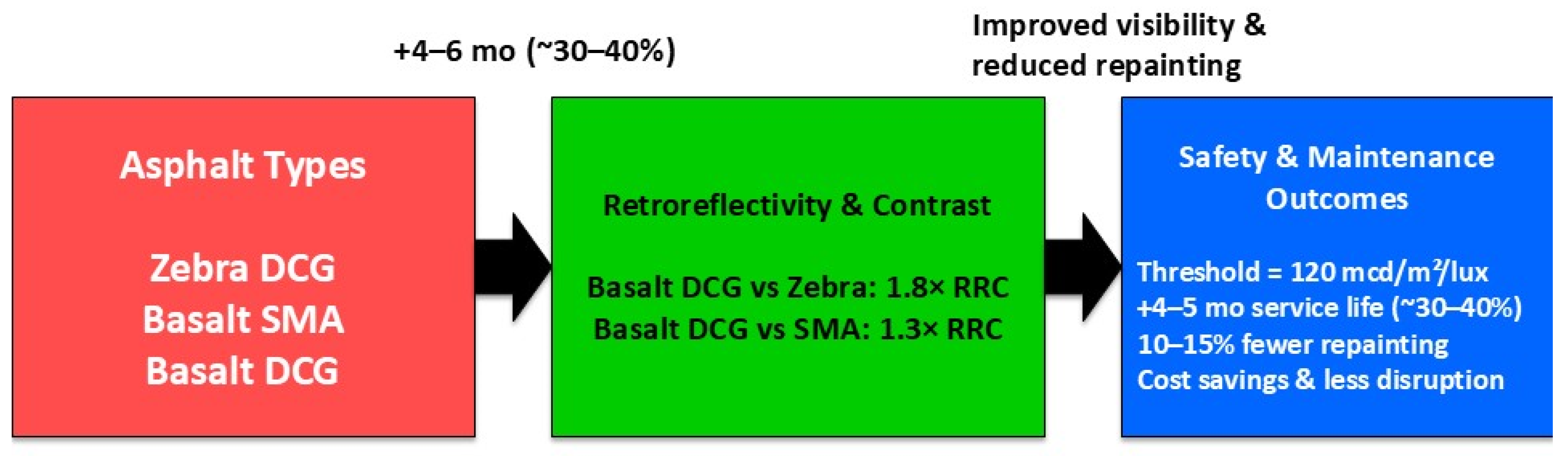
To visually consolidate the relationships established through statistical analysis,
Figure 2 presents a schematic framework illustrating how asphalt mixture type influences initial retroreflectivity and contrast, their temporal degradation, and the subsequent implications for road visibility, machine vision systems, and policy development. This framework highlights the importance of asphalt mixture selection in engineering design and in maintaining safety standards for both human and autonomous road users.
Our findings are consistent with prior observations that pavement surface properties modulate marking visibility: darker or newly laid asphalt can lower pavement luminance and enhance contrast, while aging, contamination, and texture effects can reverse these trends over time [
21,
22]. The present work advances this literature by (i) quantifying initial retroreflectivity and contrast by asphalt mixture, and (ii) estimating degradation rates within a single modeling framework, thereby offering a transferable method for agencies evaluating material choices and repainting schedules [
23].
Importantly, the contribution of pavement background to contrast degradation is not trivial because pavement reflectance is neither constant nor uniform across asphalt mixture types. Variations in aggregate mineralogy, surface texture, and long-term surface evolution lead to distinct temporal reflectance trajectories that modify contrast behavior, even when marking degradation follows a similar temporal trend. Although the present framework does not separately model pavement and marking decay processes, it demonstrates that mixture-dependent background evolution measurably influences overall contrast performance.
It is important to note that although numerous international studies identify traffic loading as a key driver of pavement-marking degradation, the present results indicate that AADT did not significantly affect retroreflectivity loss under the Israeli conditions investigated. This apparent discrepancy can be attributed to the distinct environmental and operational characteristics of the Israeli roadway network. The study corridors are located in regions characterized by a predominantly warm and arid climate, where pavement markings are exposed to minimal rainfall, no snowfall, and no winter maintenance operations such as plowing, salting, or abrasive sanding—activities that, in colder climates, generate substantial mechanical wear of the glass beads and binder system.
In addition, the examined road segments carry moderate traffic volumes and are not subjected to the heavy freight loads typical of major transcontinental corridors. In the absence of freeze–thaw cycles, moisture-related distress, or severe mechanical abrasion, retroreflectivity degradation is governed primarily by time-dependent processes such as material aging, ultraviolet exposure, surface contamination, and asphalt–paint interaction, rather than by traffic-induced scuffing. Under these environmental constraints, the statistical influence of AADT is therefore reduced, and time emerges as the dominant predictor of optical degradation.
Importantly, the lack of a statistically significant AADT effect in the present dataset should not be interpreted as contradicting prior findings. Rather, it suggests that the magnitude of traffic-related influence is strongly mediated by climatic regime, maintenance practices, and marking location. In environments where snowplow abrasion, freeze–thaw cycles, or intensive heavy-vehicle traffic are prevalent, traffic intensity may remain a dominant explanatory factor. These observations underscore the importance of considering regional context when interpreting degradation models and transferring results across countries.
In summary, this study demonstrates that asphalt mixture type represents a statistically significant and practically relevant explanatory factor influencing the optical performance and service life of pavement markings within the investigated operational context. While most prior research has focused on traffic loading, material wear, or environmental exposure, this work demonstrates that the intrinsic properties of asphalt mixtures directly influence initial retroreflectivity, background reflectance, and the resulting apparent service-life differences within a common temporal degradation framework. By integrating asphalt mixture type into a quantitative modeling framework, the study advances the understanding of visibility dynamics beyond conventional paint- and bead-centered analyses. It highlights the importance of pavement optical background as a co-determinant of nighttime and low-light guidance quality. The observed differences among asphalt mixture types are therefore interpreted as the combined effect of mixture-dependent surface color, texture, and aging behavior, rather than isolated mechanical or traffic-induced phenomena.
These findings are particularly relevant in light of the growing reliance on camera-based ADAS and autonomous driving technologies, for which sustained contrast and retroreflectivity are critical performance parameters. Thus, the research not only contributes new empirical evidence but also offers a methodological foundation for visibility-oriented pavement design, maintenance optimization, and safety policy development.
5. Conclusions and Future Lines of Research
This study demonstrates that asphalt mixture type constitutes a statistically significant explanatory factor influencing the initial optical performance and apparent service life of pavement markings under the investigated climatic and operational conditions. The findings are based on field measurements collected along 65.1 km of Israeli intercity roads characterized by dry climate, moderate traffic volumes, and the absence of winter maintenance. Within this context, linear degradation models best described the temporal decay of marking retroreflectivity and contrast.
Among the examined asphalt mixtures, basalt dense-graded concrete (Basalt DCG) consistently had the highest initial retroreflectivity and contrast, followed by basalt stone mastic asphalt (Basalt SMA). In contrast, basalt–dolomite dense-graded asphalt mixture (Zebra DCG) exhibited the lowest performance. These mixture-dependent differences translated into substantial variations in effective service life: markings on Basalt DCG maintained acceptable visibility for approximately 7–8 months, compared with about 3 months on Zebra DCG under comparable conditions.
The results indicate that, under dry climatic conditions without winter abrasion, retroreflectivity degradation is dominated by time-dependent material and optical aging processes. At the same time, traffic volume was not a statistically significant predictor. Pavement background reflectivity and its evolution play a key role in contrast degradation, emphasizing the importance of considering both marking and pavement optics.
From a practical perspective, the findings indicate that asphalt mixture selection may reduce repainting frequency by approximately 10–15%, based on comparative differences in modeled time to reach the 120 mcd/m2/lux serviceability threshold under the investigated climatic and operational conditions.
This estimate should be interpreted as indicative and context-specific rather than as a deterministic forecast, as it reflects the adopted threshold definition and assumes comparable maintenance strategies across mixtures.
Finally, while the analysis focuses on left-side white paint markings and relative performance comparisons, future work should incorporate direct pavement color and texture measurements, censored-regression techniques, and additional marking types to extend the applicability of the proposed framework.