

Qualitative Modelling of Failure Scenarios for Long Linear Transport Infrastructures in Mountain Areas
 , , ,
, , ,
Abstract
1. Introduction
2. Materials and Methods
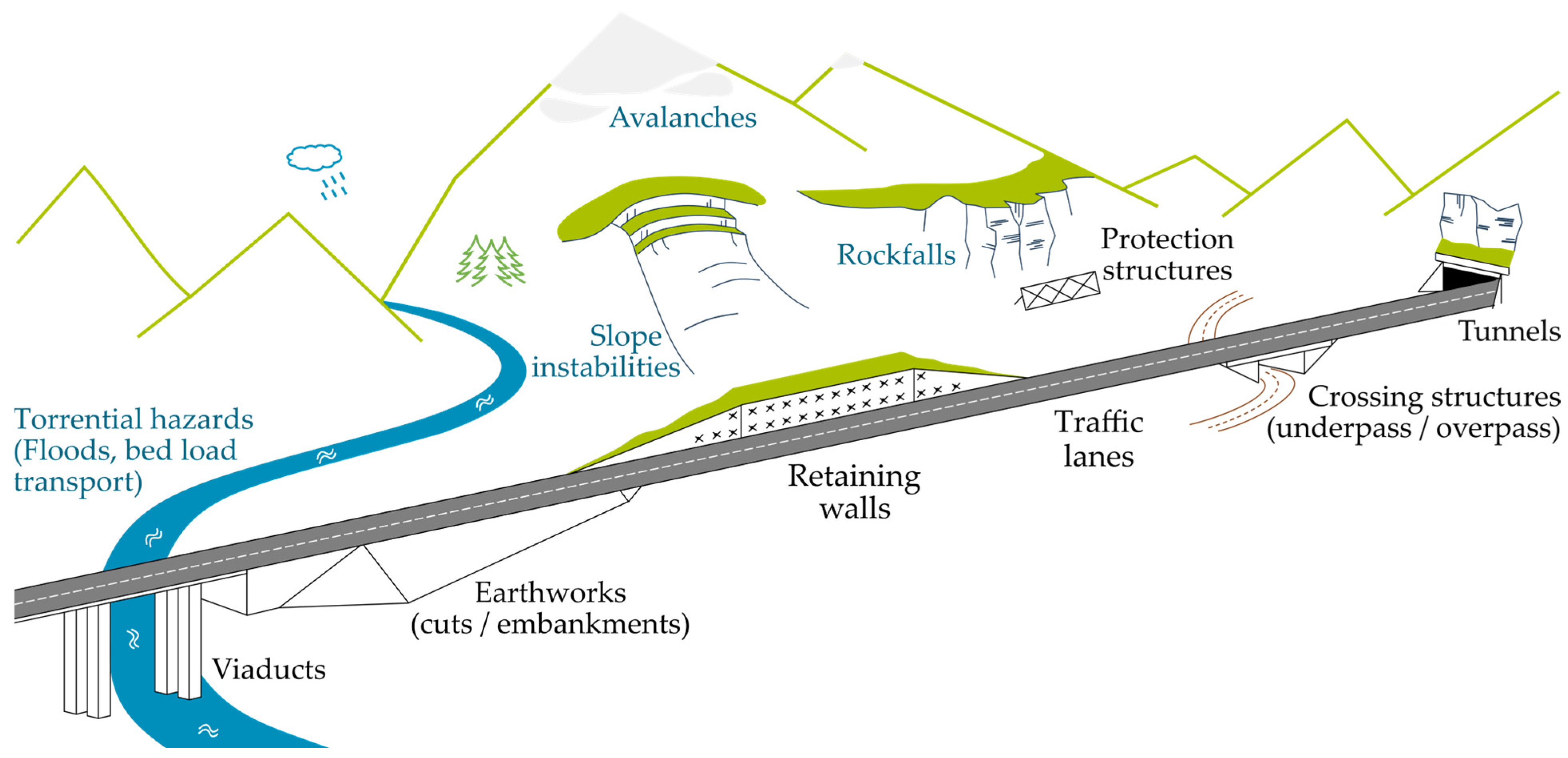
2.1. Long Linear Transport Infrastructures in Mountain Areas
2.2. Functional Analysis
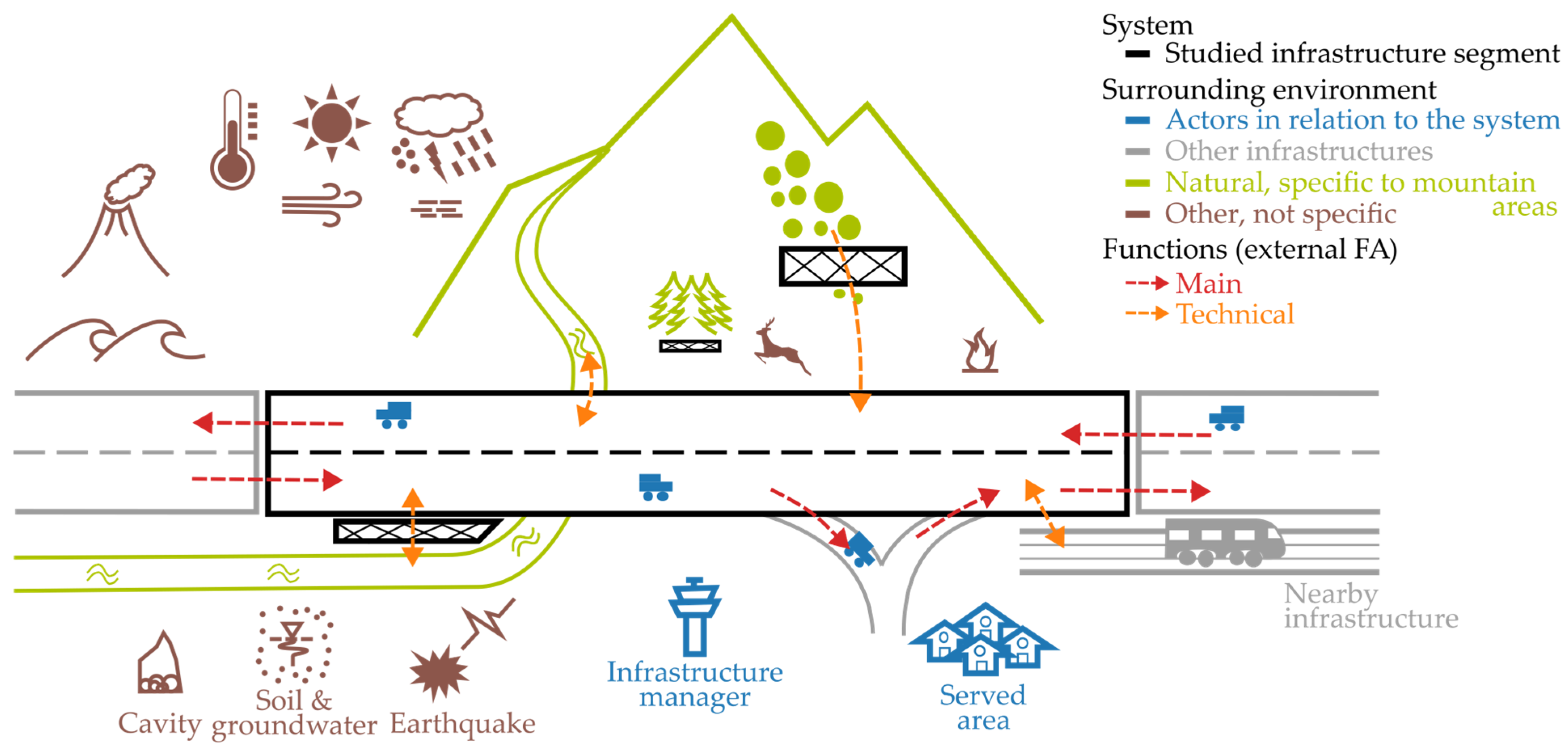
- External FA consists of defining the system as a whole and identifying the need it addresses. It aims to determine the principal functions of the system and the constraints it faces.
- Internal FA describes how the system works, what it is made up of, and what solutions have been implemented. It aims to determine the functions fulfilled by the various components at a finer level of detail.
- Main functions, which are the needs addressed by the system or component studied, linking two external environments through the system [38];
- Technical functions, which are imposed on the system or component by its environment.
2.3. Failure Mode and Effects Analysis
- Failure modes (when a function is no longer fulfilled);
- The causes of the failure modes;
- The effects of the failure modes on the system and its other components.
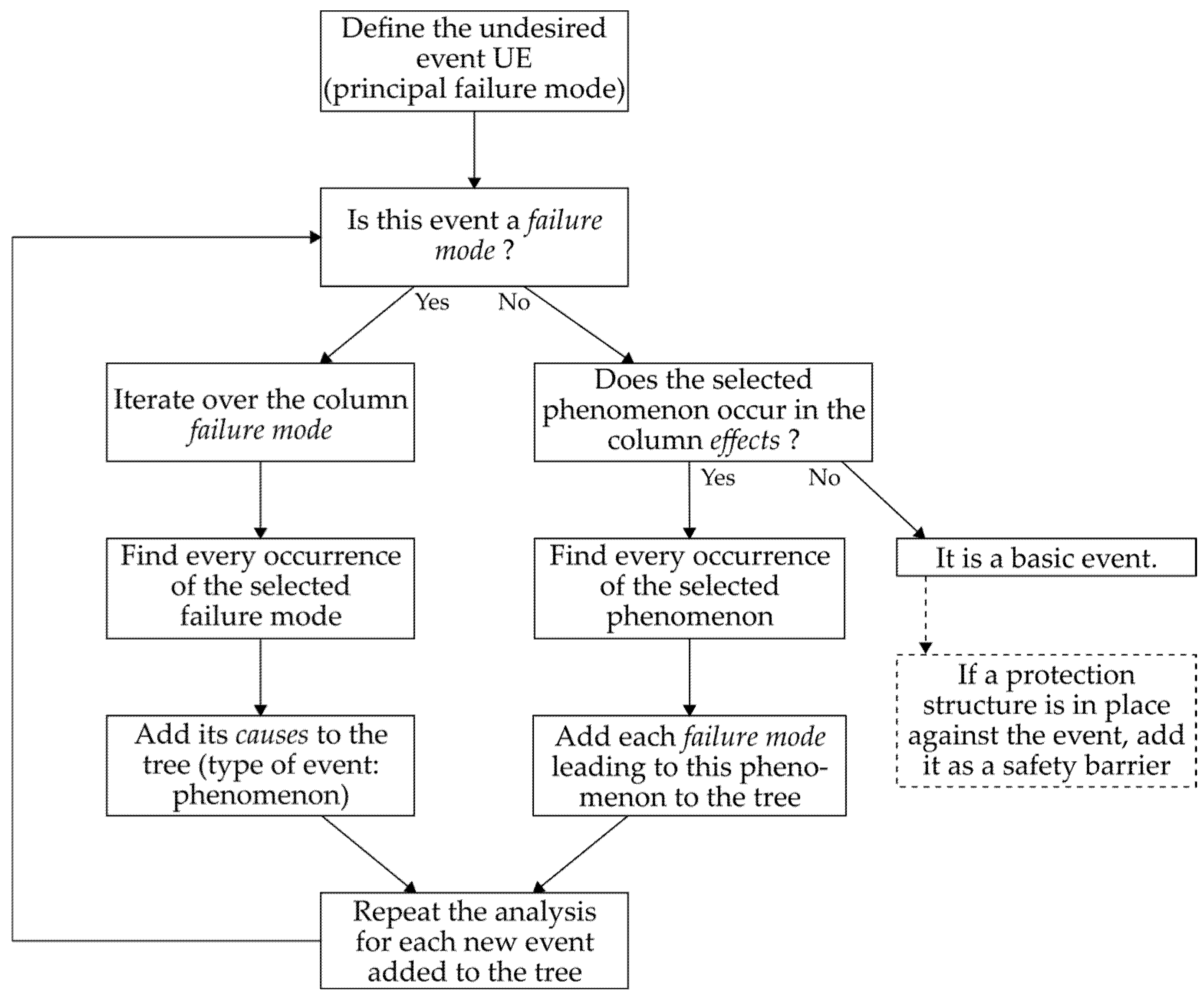
2.4. Fault Tree Analysis
3. Development of the Model of Failure Scenarios for Long Linear Transport Infrastructures in Mountain Areas
3.1. Input Data
- The list of structures in the studied infrastructure and their location;
- The list of (identified) hazards to which the infrastructure is exposed, and their spatial distribution;
- The list of protection structures and their location, whether or not they are managed by the same organisation as the infrastructure;
- The list and location of neighbouring infrastructures and sensitive urbanised or natural areas.
3.2. Functional Analysis Implementation
3.2.1. External Functional Analysis
- G0: The section of infrastructure;
- G1: Homogeneous segments of the section of infrastructure (the systems considered);
- G2: Structures in the segments.
3.2.2. Internal Functional Analysis
- The main function, i.e. the needs it addresses;
- To withstand ordinary stresses to prevent failure under ordinary conditions;
- To withstand external hazards to prevent failure in case of exceptional events;
- Any other technical functions specific to each structure.
3.3. Failure Modes Identification—FMEA
3.4. Modelling of Failure Scenarios—Fault Tree Method
3.4.1. Fault Tree Construction Process
3.4.2. Resulting Model
4. Application of the Failure Scenario Model to a Historical Event
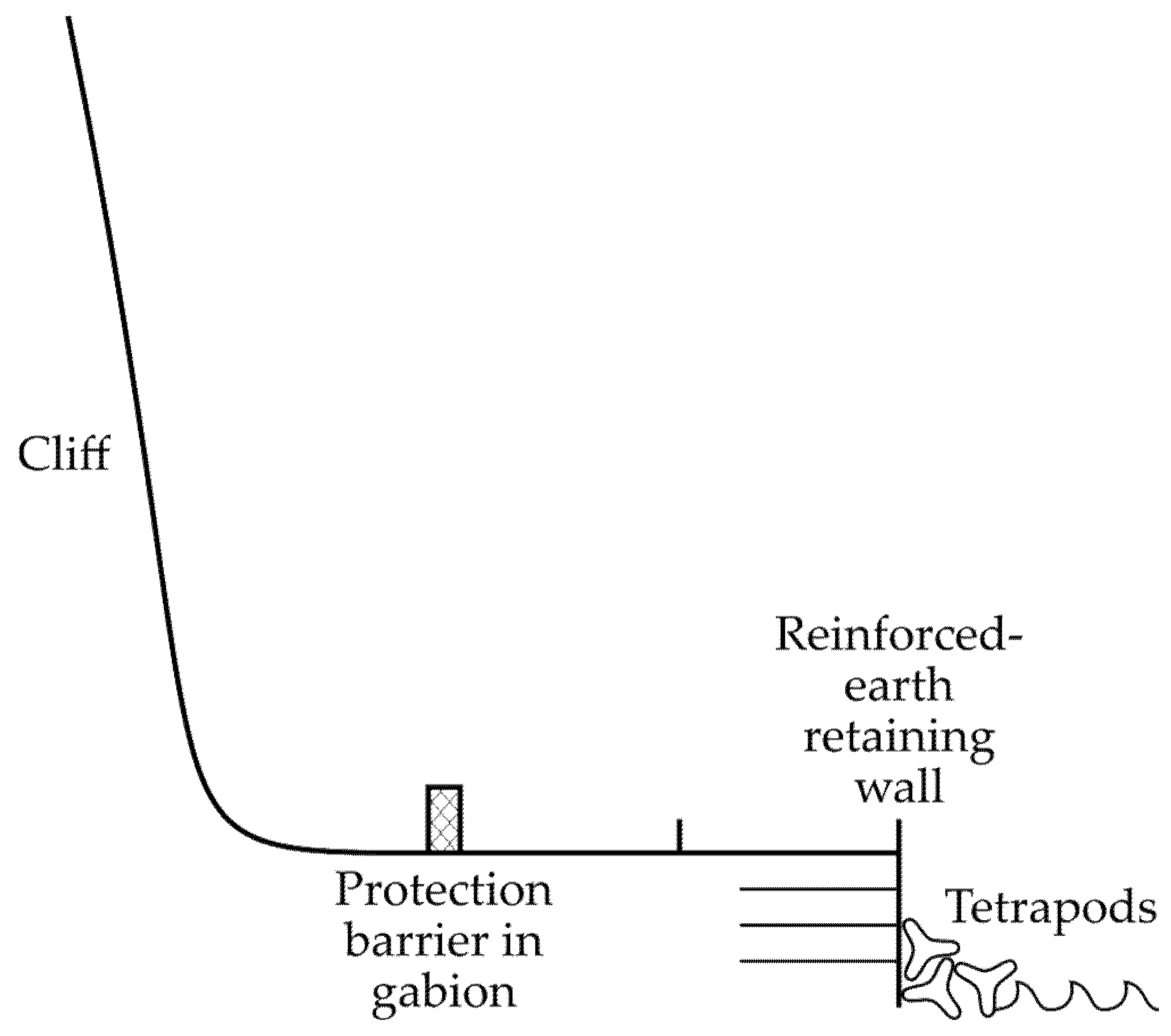
4.1. Context
4.2. Modelling of Failure Scenarios
4.3. The March 2006 Accident
5. Discussion
5.1. Advantages of the Developed Model
5.2. Operational Benefits of the Model—Perspectives
5.3. Some Remarks and Limitations of the Model
6. Conclusions
Author Contributions
Funding
Data Availability Statement
Acknowledgments
Conflicts of Interest
Abbreviations
| HG | Hydrological and gravity-driven |
| FA | Functional analysis |
| FMEA | Failure mode and effects analysis |
| FTA | Fault tree analysis |
| UE | Undesired event |
References
- Hassan, S.A.; Amlan, H.A.; Alias, N.E.; Ab-Kadir, M.A.; Sukor, N.S.A. Vulnerability of Road Transportation Networks under Natural Hazards: A Bibliometric Analysis and Review. Int. J. Disaster Risk Reduct. 2022, 83, 103393. [Google Scholar] [CrossRef] [Scilit]
- Ouyang, M. Review on Modeling and Simulation of Interdependent Critical Infrastructure Systems. Reliab. Eng. Syst. Saf. 2014, 121, 43–60. [Google Scholar] [CrossRef] [Scilit]
- Terzi, S.; Torresan, S.; Schneiderbauer, S.; Critto, A.; Zebisch, M.; Marcomini, A. Multi-Risk Assessment in Mountain Regions: A Review of Modelling Approaches for Climate Change Adaptation. J. Environ. Manag. 2019, 232, 759–771. [Google Scholar] [CrossRef] [Scilit] [PubMed]
- De Angeli, S.; Malamud, B.D.; Rossi, L.; Taylor, F.E.; Trasforini, E.; Rudari, R. A Multi-Hazard Framework for Spatial-Temporal Impact Analysis. Int. J. Disaster Risk Reduct. 2022, 73, 102829. [Google Scholar] [CrossRef] [Scilit]
- Argyroudis, S.A.; Mitoulis, S.A.; Winter, M.G.; Kaynia, A.M. Fragility of Transport Assets Exposed to Multiple Hazards: State-of-the-Art Review toward Infrastructural Resilience. Reliab. Eng. Syst. Saf. 2019, 191, 106567. [Google Scholar] [CrossRef] [Scilit]
- van Westen, C.J.; van Asch, T.W.J.; Soeters, R. Landslide Hazard and Risk Zonation—Why Is It Still so Difficult? Bull. Eng. Geol. Environ. 2006, 65, 167–184. [Google Scholar] [CrossRef] [Scilit]
- Eckert, N.; Mainieri, R.; Bourrier, F.; Giacona, F.; Corona, C.; Le Bidan, V.; Lescurier, A. Une Base de Données Événementielle Du Risque Rocheux Dans Les Alpes Françaises. Rev. Fr. Geotech. 2020, 163, 3. [Google Scholar] [CrossRef] [Scilit]
- Morize, X. Contributions à une Approche Patrimoniale de la Voie Ferrée de Tramway. Doctoral Thesis, Université Paris-Est, Champs-sur-Marne, France, 2020. [Google Scholar]
- IPCC. Climate Change 2014: Synthesis Report. Contribution of Working Groups I, II and III to the Fifth Assessment Report of the Intergovernmental Panel on Climate Change; Intergovernmental Panel on Climate Change: Geneva, Switzerland, 2014; p. 151. [Google Scholar]
- CGEDD. Vulnérabilité des Réseaux D’infrastructures Aux Risques Naturels; Ministère de l’Ecologie, du Développement Durable et de l’Energie (MEDDE): Paris, France, 2013; p. 92. [Google Scholar]
- C2ROP. Prise en Compte des Risques Rocheux par les Maitres D’ouvrage Gestionnaires D’infrastructures; Connaissances; Cerema: Bron, France, 2021. [Google Scholar]
- Sanchez, C. Spécification et Implémentation du Système D’aide à la Décision Multicritère Pour la Maintenance Préventive et la Gestion du Patrimoine de la Société D’autoroute ESCOTA: Le Projet SINERGIE. Ph.D. Thesis, École Nationale Supérieure des Mines de Paris, Paris, France, 2007. [Google Scholar]
- SETRA. Instruction Technique Pour la Surveillance et L’entretien des Ouvrages D’art (ITSEOA)—Fascicule 0: Dispositions Générales Applicables à Tous les Ouvrages; Cerema: Bron, France, 2010. [Google Scholar]
- Jaboyedoff, M.; Choanji, T.; Derron, M.-H.; Fei, L.; Gutierrez, A.; Loiotine, L.; Noel, F.; Sun, C.; Wyser, E.; Wolff, C. Introducing Uncertainty in Risk Calculation along Roads Using a Simple Stochastic Approach. Geosciences 2021, 11, 143. [Google Scholar] [CrossRef] [Scilit]
- Kanno, H.; Moriguchi, S.; Tsuda, Y.; Yoshida, I.; Iwanaga, S.; Terada, K. A Method for Rockfall Risk Quantification and Optimal Arrangement of Protection Structures along a Road. Eng. Geol. 2023, 314, 107004. [Google Scholar] [CrossRef] [Scilit]
- Mignelli, C.; Lo Russo, S.; Peila, D. ROckfall Risk MAnagement Assessment: The RO.MA. Approach. Nat. Hazards 2012, 62, 1109–1123. [Google Scholar] [CrossRef] [Scilit]
- Dalmasso, M.; Frigo, B.; Chiaia, B. A Comparative Analysis of Avalanche Risk Assessment for Local Mountain Roads. Geosciences 2025, 15, 172. [Google Scholar] [CrossRef] [Scilit]
- Wilhelm, C. Quantitative Risk Analysis for Evaluation of Avalanche Protection Projects. In 25 Years of Snow Avalanche Research: Voss, 12–16 May 1998; Norwegian Geotechnical Institute: Oslo, Norway, 1998; pp. 288–293. [Google Scholar]
- Clarke, J.; Obrien, E. A Multi-Hazard Risk Assessment Methodology, Stress Test Framework and Decision Support Tool for Transport Infrastructure Networks. Transp. Res. Procedia 2016, 14, 1355–1363. [Google Scholar] [CrossRef] [Scilit]
- Petrova, E. Natural Hazard Impacts on Transport Infrastructure in Russia. Nat. Hazards Earth Syst. Sci. 2020, 20, 1969–1983. [Google Scholar] [CrossRef] [Scilit]
- Favier, P.; Bertrand, D.; Eckert, N.; Ousset, I.; Naaim, M. Assessing Fragility of a Reinforced Concrete Element to Snow Avalanches Using a Non-Linear Dynamic Mass-Spring Model. Nat. Hazards Earth Syst. Sci. 2018, 18, 2507–2524. [Google Scholar] [CrossRef] [Scilit]
- Ferlisi, S.; Marchese, A.; Peduto, D. Quantitative Analysis of the Risk to Road Networks Exposed to Slow-Moving Landslides: A Case Study in the Campania Region (Southern Italy). Landslides 2021, 18, 303–319. [Google Scholar] [CrossRef] [Scilit]
- Nirandjan, S.; Koks, E.E.; Ye, M.; Pant, R.; Van Ginkel, K.C.H.; Aerts, J.C.J.H.; Ward, P.J. Review Article: Physical Vulnerability Database for Critical Infrastructure Hazard Risk Assessments—A Systematic Review and Data Collection. Nat. Hazards Earth Syst. Sci. 2024, 24, 4341–4368. [Google Scholar] [CrossRef] [Scilit]
- Winter, M.G.; Smith, J.T.; Fotopoulou, S.; Pitilakis, K.; Mavrouli, O.; Corominas, J.; Argyroudis, S. An Expert Judgement Approach to Determining the Physical Vulnerability of Roads to Debris Flow. Bull. Eng. Geol. Environ. 2014, 73, 291–305. [Google Scholar] [CrossRef] [Scilit]
- Cerema. Analyse des Risques Appliquée Aux Murs en Béton Armé sur Semelle; Références; Cerema: Bron, France, 2018. [Google Scholar]
- SETRA. Maîtrise des Risques—Application Aux Ouvrages D’art; Cerema: Bron, France, 2013. [Google Scholar]
- ASTRA. Dangers Naturels sur les Routes Nationales: Concept de Risque—Méthodologie Basée sur les Risques Pour L’évaluation, la Prévention et la Maîtrise des Dangers Naturels Gravitationnels sur les Routes Nationales; Documentation; Bundesamt für Strassen ASTRA (Office fédéral des routes OFROU): Berne, Switzerland, 2012; p. 109. [Google Scholar]
- Modarres, M. What Every Engineer Should Know About Reliability and Risk Analysis; What Every Engineer Should Know; M. Dekker: New York, NY, USA, 1993. [Google Scholar]
- Villemeur, A. Surete de Fonctionnement des Systemes Industriels: Fiabilite-Facteurs Humains, Informatisation; Direction des Études et Recherches d’Electricité de France (EDF); Eyrolles: Paris, France, 1988. [Google Scholar]
- Serre, D.; Peyras, L.; Tourment, R.; Diab, Y. Levee Performance Assessment Methods Integrated in a GIS to Support Planning Maintenance Actions. J. Infrastruct. Syst. 2008, 14, 201–213. [Google Scholar] [CrossRef] [Scilit]
- Vuillet, M.; Peyras, L.; Serre, D.; Diab, Y. Decision-Making Method for Assessing Performance of Large Levee Alignment. J. Decis. Syst. 2012, 21, 137–160. [Google Scholar] [CrossRef] [Scilit]
- Paterna Hidalgo, A.; Vuillet, M.; Duarte Barrio, C.; Diab, Y.; Serre, D. Methodology for the Elaboration of a Technical and Economical Optimisation Tool to Optimise the Asset Management of RATP’s Infrastructures; Transport Research Arena: Paris, France, 2014. [Google Scholar]
- Dabaj, A.; Vuillet, M.; Gache, F.; Jouannic, G.; Diab, Y. Examining the Benefits of the Build Back Better Concept for Parisian Critical Infrastructures Vulnerable to Flooding: From Build Back Better to Build Better Before. Water Secur. 2022, 17, 100123. [Google Scholar] [CrossRef] [Scilit]
- Shahriar, A.; Sadiq, R.; Tesfamariam, S. Risk Analysis for Oil & Gas Pipelines: A Sustainability Assessment Approach Using Fuzzy Based Bow-Tie Analysis. J. Loss Prev. Process Ind. 2012, 25, 505–523. [Google Scholar] [CrossRef] [Scilit]
- Mortureux, Y. Fondamentaux de L’analyse de Risque, Regard Fiabiliste sur la Sécurité Industrielle; Les Regards sur la Sécurité Industrielle; Fondation Pour une Culture de Sécurité Industrielle; FonCSI: Toulouse, France, 2016. [Google Scholar]
- Zwingelstein, G. Diagnostic des Défaillances: Théorie et Pratique Pour les Systèmes Industriels; Traité des Nouvelles Technologies; Hermès: Paris, France, 1995. [Google Scholar]
- Zwingelstein, G. La Maintenance Basée sur la Fiabilité: Guide Pratique D’application de la RCM; Collection Diagnostic et Maintenance; Hermès: Paris, France, 1996. [Google Scholar]
- Peyras, L. Diagnostic et Analyse de Risques Liés au Vieillissement des Barrages, Développement de Méthodes D’aide à L’expertise. Ph.D. Thesis, Université Blaise Pascal II, Clermont-Ferrand, France, 2003; p. 254. [Google Scholar]
- Serre, D. Évaluation de la Performance des Digues de Protection Contre les Inondations: Modélisation de Critères de Décision Dans un Système D’information Géographique. Doctoral Thesis, Université de Marne-la-Vallée, Champs-sur-Marne, France, 2005. [Google Scholar]
- Bluvband, Z.; Polak, R.; Grabov, P. Bouncing Failure Analysis (BFA): The Unified FTA-FMEA Methodology. In Annual Reliability and Maintainability Symposium; IEEE: Piscataway, NJ, USA, 2005; pp. 463–467. [Google Scholar]
- Ruijters, E.; Stoelinga, M. Fault Tree Analysis: A Survey of the State-of-the-Art in Modeling, Analysis and Tools. Comput. Sci. Rev. 2015, 15–16, 29–62. [Google Scholar] [CrossRef] [Scilit]
- Cerema. Vulnérabilités et Risques: Les Infrastructures de Transport Face au Climat; Connaissances; Cerema: Bron, France, 2019. [Google Scholar]
- Corominas, J.; van Westen, C.; Frattini, P.; Cascini, L.; Malet, J.-P.; Fotopoulou, S.; Catani, F.; Van Den Eeckhaut, M.; Mavrouli, O.; Agliardi, F.; et al. Recommendations for the Quantitative Analysis of Landslide Risk. Bull. Eng. Geol. Environ. 2014, 73, 209–263. [Google Scholar] [CrossRef] [Scilit]
- Kaundinya, I.; Nisancioglu, S.; Kammerer, H.; Oliva, R. All-Hazard Guide for Transport Infrastructure. Transp. Res. Procedia 2016, 14, 1325–1334. [Google Scholar] [CrossRef] [Scilit]
- CGPC. Eboulement de la Falaise du 24 Mars 2006 sur la RN1 (Route du Littoral) à la Réunion; Les Rapports; Conseil Général des Ponts et Chaussées: Paris, France, 2006. [Google Scholar]
- Cooke, R.M.; Goossens, L.H.J. Expert Judgement Elicitation for Risk Assessments of Critical Infrastructures. J. Risk Res. 2004, 7, 643–656. [Google Scholar] [CrossRef] [Scilit]
- Rohmer, J. Uncertainties in Conditional Probability Tables of Discrete Bayesian Belief Networks: A Comprehensive Review. Eng. Appl. Artif. Intell. 2020, 88, 103384. [Google Scholar] [CrossRef] [Scilit]
- Tilloy, A.; Malamud, B.D.; Winter, H.; Joly-Laugel, A. A Review of Quantification Methodologies for Multi-Hazard Interrelationships. Earth-Sci. Rev. 2019, 196, 102881. [Google Scholar] [CrossRef] [Scilit]





| Component | Function | Failure Mode | Causes | Effects |
|---|---|---|---|---|
| … | … | … | … | … |
| Structure | Main Functions | Technical Functions |
|---|---|---|
| Traffic lanes | Enable users to travel |
|
| Embankment slope | Support traffic lanes |
|
| Hazard | Avalanche | Flood With(out) Bed Load Transport | Debris Flow | Slope Instability | Rockfall | |
|---|---|---|---|---|---|---|
| Structure | ||||||
| Retaining wall (concrete, reinforced soil, etc.) | na | Scouring, deterioration, failure | na | Significant Deterioration; failure | Localised Deterioration | |
| Embankment slope (earthwork without wall, traffic lanes are not considered) | na | Scouring, erosion, seepage, and failure | Slight deteriorations (if the earthwork deflects the flow) | Significant Deterioration; failure | Localised Deterioration; localised failure | |
| Structure | Function | Failure Mode | Causes | Effects |
|---|---|---|---|---|
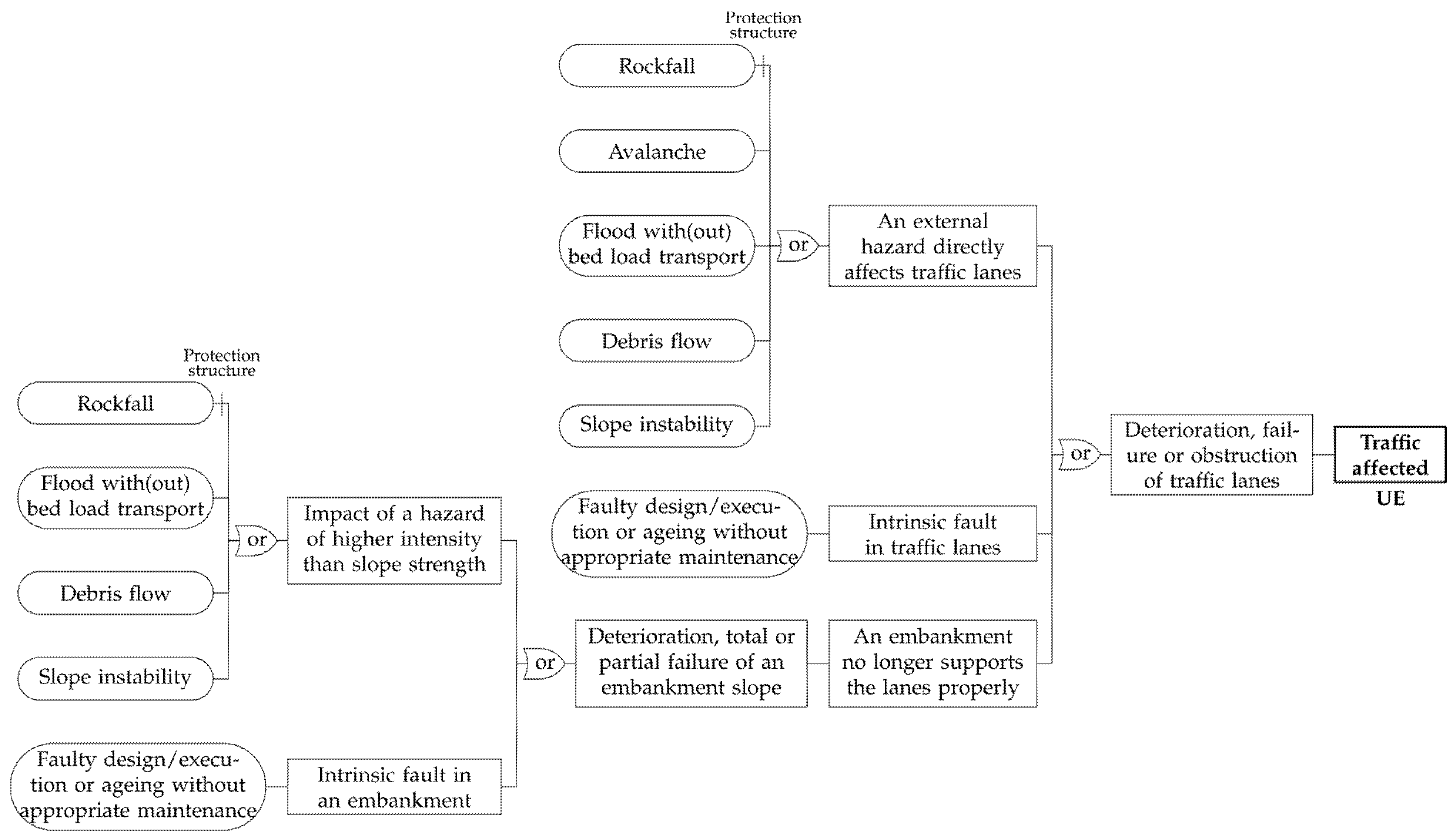
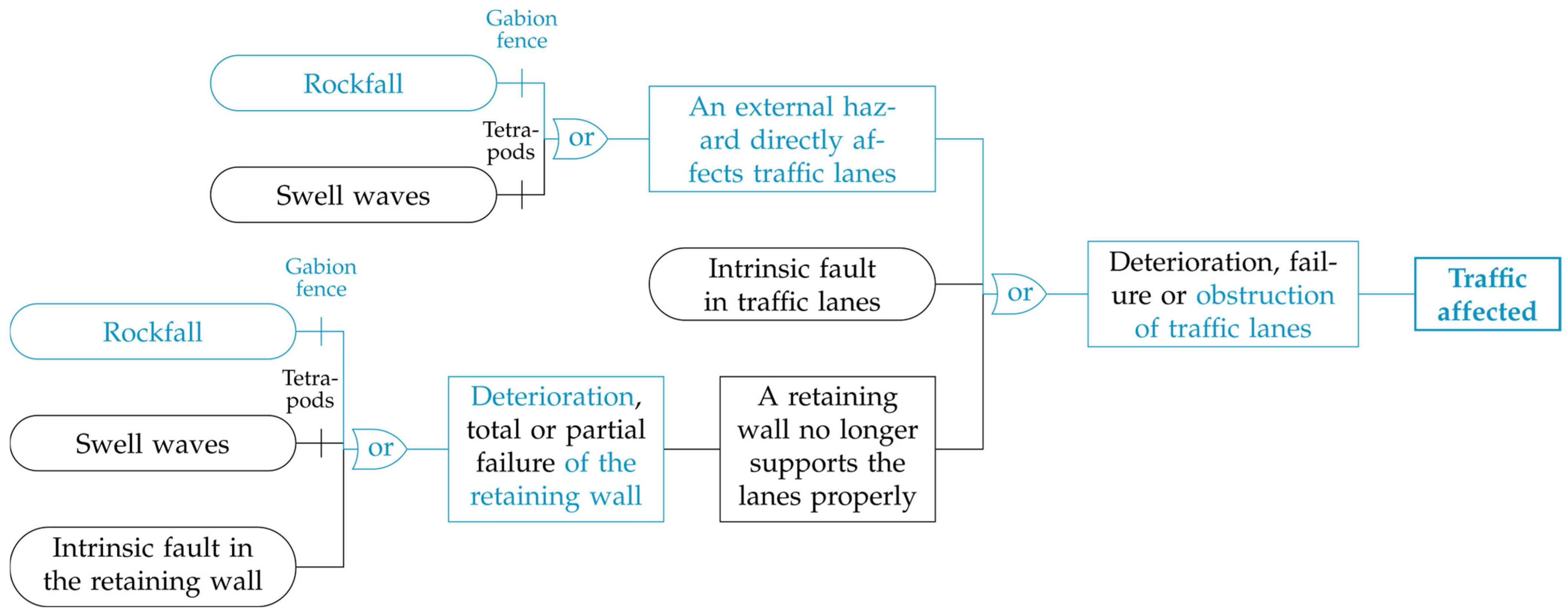
| Traffic lanes | Enable users to travel | Traffic affected | Deterioration, failure or obstruction of traffic lanes | Danger for users, isolation of areas, and environmental impact (in some accidents) |
| Withstand ordinary stresses | Intrinsic fault in traffic lanes | Design/execution error, or ageing without appropriate maintenance | Deterioration or failure of traffic lanes | |
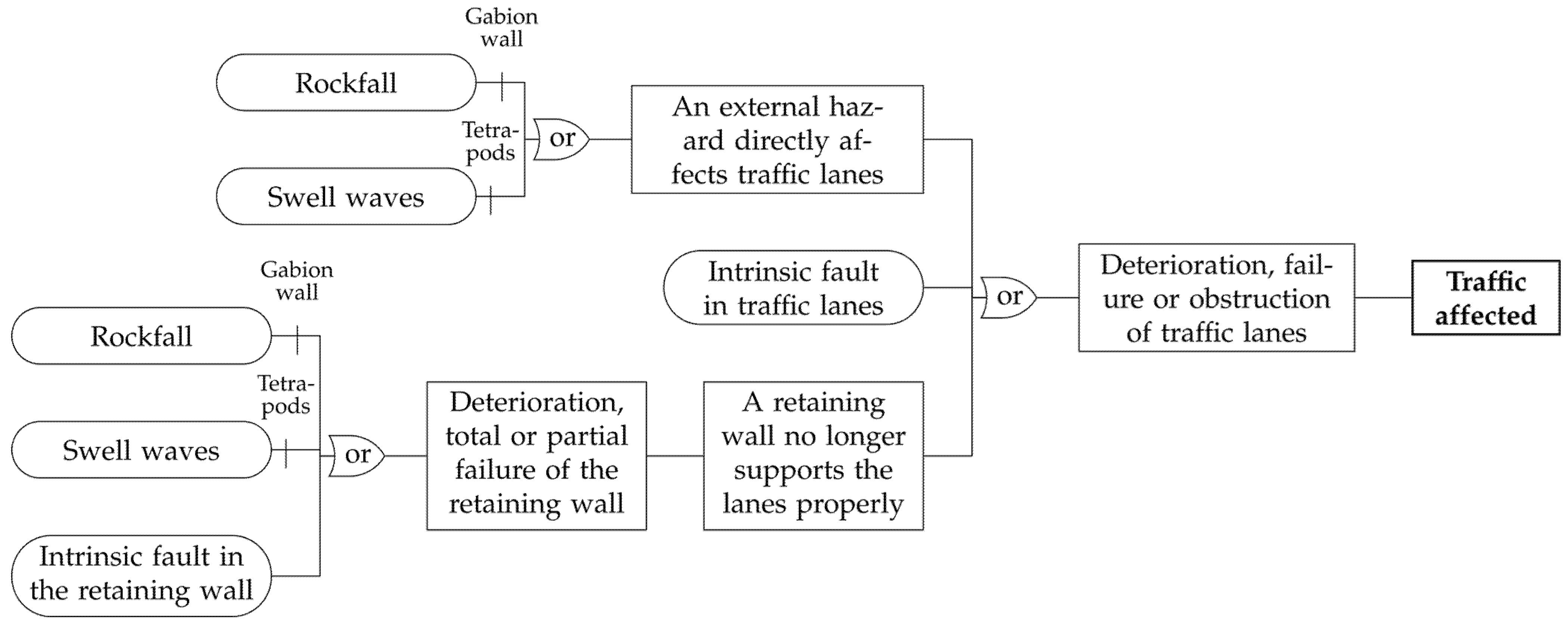
| Remain unaffected by external hazards | An external hazard directly affects traffic lanes | Cf. table structures/ hazards (Table 3) | Deterioration, failure or obstruction of traffic lanes | |
| Embankment slope | Support traffic lanes | An embankment no longer supports the lanes properly | Deterioration or total or partial failure of an embankment slope | Deterioration or failure of traffic lanes |
| Withstand ordinary stresses | Intrinsic fault in an embankment | Faulty design/execution, or ageing without appropriate maintenance | Deterioration or total or partial failure of an embankment slope | |
| Withstand external hazards | Impact of a hazard of higher intensity than slope strength | Cf. table structures/ hazards (Table 3) | Deterioration or total or partial failure of an embankment slope | |
| Not cause incidents in the vicinity | A nearby infrastructure or natural area is impacted | Deterioration, or total or partial failure of an embankment slope | Danger for nearby infrastructures or environmental impact |
Disclaimer/Publisher’s Note: The statements, opinions and data contained in all publications are solely those of the individual author(s) and contributor(s) and not of MDPI and/or the editor(s). MDPI and/or the editor(s) disclaim responsibility for any injury to people or property resulting from any ideas, methods, instructions or products referred to in the content. |
© 2026 by the authors. Licensee MDPI, Basel, Switzerland. This article is an open access article distributed under the terms and conditions of the Creative Commons Attribution (CC BY) license.
Share and Cite
Michez, T.; Peyras, L.; Lambert, S.; Reynaud, S.; Garcin, P. Qualitative Modelling of Failure Scenarios for Long Linear Transport Infrastructures in Mountain Areas. Infrastructures 2026, 11, 71. https://doi.org/10.3390/infrastructures11020071
Michez T, Peyras L, Lambert S, Reynaud S, Garcin P. Qualitative Modelling of Failure Scenarios for Long Linear Transport Infrastructures in Mountain Areas. Infrastructures. 2026; 11(2):71. https://doi.org/10.3390/infrastructures11020071
Chicago/Turabian StyleMichez, Théotime, Laurent Peyras, Stéphane Lambert, Sébastien Reynaud, and Patrick Garcin. 2026. "Qualitative Modelling of Failure Scenarios for Long Linear Transport Infrastructures in Mountain Areas" Infrastructures 11, no. 2: 71. https://doi.org/10.3390/infrastructures11020071
APA StyleMichez, T., Peyras, L., Lambert, S., Reynaud, S., & Garcin, P. (2026). Qualitative Modelling of Failure Scenarios for Long Linear Transport Infrastructures in Mountain Areas. Infrastructures, 11(2), 71. https://doi.org/10.3390/infrastructures11020071