Article

Sustainable Concrete for Rigid Pavements Using Alkali-Activated Recycled Pumice: Strength and Carbonation Assessment


by
Pablo Julián López-González
1,2,
Oscar Moreno-Vázquez
2,
Sergio Aurelio Zamora-Castro
3,
Tania Irene Lagunes-Vega
3,
Efrén Meza-Ruíz
2,
Brenda Suemy Trujillo-García
1,4,
Rodrigo Vivar-Ocampo
5,
David Reyes-González
1,* and
Joaquín Sangabriel-Lomelí
2,3,*
1
Division of Graduate Studies and Research, Tecnológico Nacional de México/ITS de Misantla, Km. 1.8 Carretera a la Loma del Cojolite, Misantla 93821, Veracruz, Mexico
2
Department of Civil Engineering, Tecnológico Nacional de México/ITS de Misantla, Km. 1.8 Carretera a la Loma del Cojolite, Misantla 93821, Veracruz, Mexico
3
Faculty of Engineering, Construction and Habitat, Universidad Veracruzana, Bv. Adolfo Ruiz Cortines 455, Costa Verde, Boca del Río 94294, Veracruz, Mexico
4
Wetlands and Environmental Sustainability Laboratory, Tecnológico Nacional de México/ITS de Misantla, Km. 1.8 Carretera a la Loma del Cojolite, Misantla 93821, Veracruz, Mexico
5
Renewable Energy Engineering, Faculty of Engineering Science and Technology, Universidad Autónoma de Baja California, Blvd. Universitario #1000, Valle de las Palmas, Tijuana 21500, Baja California, Mexico
*
Authors to whom correspondence should be addressed.
Infrastructures 2026, 11(2), 70; https://doi.org/10.3390/infrastructures11020070
Submission received: 22 January 2026 / Revised: 18 February 2026 / Accepted: 19 February 2026 / Published: 22 February 2026
(This article belongs to the Section Sustainable Infrastructures)

Abstract

This study investigates alkali-activated recycled pumice as a sustainable cement replacement for hydraulic concrete used in rigid pavements. Cement was replaced at 15%, 25%, and 50% by mass and activated using NaOH solutions at 1 N, 0.5 N, and 0.25 N, resulting in nine mixture variants. Mechanical performance was assessed through compressive strength at 7, 14, and 28 days, and flexural strength at 28 days. Durability was evaluated via natural carbonation depth at 210 and 1090 days. X-ray diffraction (XRD) identified aluminosilicate phases in the pumice, supporting its alkali-reactive potential. Mixtures with 15% pumice replacement achieved compressive strengths up to 20.99 MPa, comparable to the control mix (20.45 MPa), whereas 25% and 50% replacements produced moderate strength reductions. Flexural strength in 15% mixtures (7.38–7.44 MPa) was also comparable to the control (7.30 MPa), while higher replacement levels reduced flexural performance. Carbonation resistance improved for mixtures with an optimized alkaline-to-pumice ratio (APR, defined as NaOH concentration relative to pumice content) between 0.0167 and 0.02, indicating more balanced activation and reduced CO2 ingress. Overall, alkali-activated recycled pumice enables partial cement replacement while maintaining mechanical performance and carbonation resistance at 15% substitution, supporting circular economy strategies and lowering the carbon footprint of rigid pavement concrete.

1. Introduction

In the construction industry, concrete made with Portland cement (PC) remains one of the primary materials used in the development of rigid pavements [1], including streets, roads, bridges, and airport runways. Concrete is widely adopted for these applications due to its mechanical strength, durability, and ability to withstand traffic loading and environmental exposure [2]. Typically, concrete is produced using coarse and fine aggregates, water, PC, and, in some cases, chemical admixtures to improve workability, setting time, or durability [3]. In this context, hydraulic concrete refers to PC-based mixtures capable of setting under water, commonly employed in infrastructure exposed to moisture and aggressive environmental conditions.
Before the COVID-19 pandemic, cement production in Latin America and the Caribbean (LAC) reached 170 Mt in 2019. Brazil was the largest producer in the region (56.6 Mt), ranking seventh globally, followed by Mexico (40 Mt), ranked fourteenth [4]. In Mexico, the cement industry plays a significant role in the national economy due to its high production capacity [5], and approximately 50% of PC produced is consumed in domestic building construction [6].
Portland cement manufacturing involves the calcination of limestone and clay, with corrective materials (e.g., iron ore and sand) processed in rotary kilns at approximately 1400 °C to produce clinker, which is later ground with gypsum and chemical admixtures [7]. However, this process is highly energy-intensive and carbon-intensive. Each ton of PC produced releases approximately 510 kg of CO2 and requires 3191.91 MJ of energy [8]. As a result, the cement industry contributes about 5–8% of global CO2 emissions [9], consumes nearly 60% of the raw materials extracted from the lithosphere [10], and relies largely on fossil-derived fuels such as coal, oil, natural gas, or waste tires [11].
To reduce PC consumption and the associated environmental burdens, Supplementary Cementitious Materials (SCMs) have been increasingly investigated as sustainable alternatives, since many exhibit cementitious or pozzolanic behavior after mechanical, thermal, and/or chemical treatment. Notable SCMs include calcined clays, natural pozzolans, coal fly ash, specific biomass ashes, recycled concrete fines, and recycled glass [12,13]. Among these, metakaolin (MK) is a highly reactive pozzolan rich in silica and alumina obtained through the calcination of kaolinitic clay [10]. In the presence of water, MK reacts with Ca(OH)2 to form cementitious products similar to those found in conventional PC systems [11]. Multiple studies have reported improved mechanical performance and durability when MK is used alone [12,13] or blended with fly ash [14], silica fume [15], and rice husk ash [16], including applications in concrete for rigid pavements.
Sugarcane bagasse ash (SCBA) has also been explored due to its cementitious potential. After calcination, its organic–silica compounds may transform into reactive pozzolanic oxides (silicates, aluminates, and ferrites) [17]. SCBA has been reported to enhance compressive strength and durability when employed either as a partial PC replacement [18] or as a fine aggregate substitute [19].
Despite their advantages, many SCMs (e.g., calcined clays and MK) require thermal activation at high temperatures (650–800 °C) [20,21], which increases energy demand and may limit their sustainability benefits. In contrast, pumice (PM) does not require calcination because its pozzolanic and cementitious properties are inherent to its volcanic origin, which can significantly reduce energy consumption and emissions. Pumice is a lightweight, porous volcanic rock rich in silica and alumina, and has been used in several countries—including Italy, Germany, Kenya, Turkey, China, and Greece—as an SCM [22,23]. Recent studies have highlighted its potential to produce low-density concrete and improve specific mechanical and durability properties [24,25,26,27,28].
Hydraulic concrete, with an average compressive strength of around 20 MPa, is commonly used in rigid pavement construction due to its capacity to withstand moderate traffic loads and environmental exposure. This strength level is often suitable for light pavements and porous pavement applications [29,30], as well as sidewalks, secondary roads, and airport runways where adequate structural integrity and durability are required [31,32,33]. Therefore, this application is strategically selected to explore the feasibility of partially or fully replacing conventional Portland cement in road infrastructure under sustainability criteria.
Recycled pumice (PM), particularly when alkali-activated, represents a promising but still underexplored alternative in alkali-activated systems, particularly in regions such as central Veracruz. Its performance in moderate-strength hydraulic concrete mixtures remains insufficiently documented, especially regarding carbonation depth and the combined influence of alkaline solution concentration and PM substitution level (alkaline-to-pumice ratio, APR). This knowledge gap supports the need for the present study, which provides experimental evidence on the mechanical and physical behavior of these mixtures.
The novelty of this work lies in the evaluation of recycled pumice activated with different NaOH concentrations [34,35,36] in moderate-strength hydraulic concrete mixtures for sustainable rigid pavement applications. Therefore, this study aims to evaluate the mechanical performance (compressive and flexural strength) and long-term natural carbonation resistance of alkali-activated recycled pumice concrete mixtures designed for sustainable rigid pavement applications. This study is distinct from previous work on pumice-based supersulfated pastes [37] by focusing on rigid pavement concrete mixtures, flexural performance, and long-term natural carbonation under field exposure conditions.

2. Materials and Methods

2.1. Materials

2.1.1. Aggregates

Coarse and fine aggregates were selected according to compliance with the Mexican Standard NMX-C-111-ONNCCE-2014 [38]. The coarse aggregate was primary crushing volcanic material, with a nominal maximum size of 19 mm, water absorption of 6.36%, relative density of 2.36 and varying volumetric weight of 1463 kg/m3; the fine aggregate used had a density of 2780 kg/m3, water absorption of 3.21%, a fineness module of 2.89 and a varying volumetric weight of 1460 kg/m3.

2.1.2. Cement

The cement used in this study was a Portland composite cement CPC30R, according to the Mexican standard [39], selected due to its widespread use in national infrastructure. This cement type enables a practical assessment of alkali-activated pumice as a partial replacement under typical construction conditions.

2.1.3. Pumice

The pumice (PM) used in this study was sourced from mines located in the Perote region of Veracruz, Mexico. This material is typically extracted by local companies and marketed as a raw input for brick manufacturing and for use in denim washing within the textile industry. During the primary grinding of PM, a significant amount of fine particulate residue is generated, which is not fully utilized. In this work, the residual material from the local mining process was recovered and subjected to secondary grinding prior to its use as a cement replacement material in alkali-activated hydraulic concrete mixtures for rigid pavement applications. The particle size distribution of the PM was as follows: 2% retained on sieve No. 100 (150 μm), 27.2% retained on sieve No. 200 (75 μm), and 70.8% passing sieve No. 200. The material had a bulk density of 2358 kg/m3 and a specific surface area of 600 m2/kg [40]. The use of recycled pumice residues as a cement replacement material is consistent with previous pumice-based studies reported by the authors [35,36,37].

2.1.4. Alkaline Activator

It is known that most pozzolanic and waste materials need a chemical activation process to be used as SCM; this is possible by a treatment with an alkaline agent. The alkaline activation of materials with aluminosilicate structures of partial or total amorphous conformation allows for obtaining a material with good cementitious properties. In this work, NaOH is selected as an alkaline activator, due to its easy access, relatively low cost compared to other alkaline compounds (i.e., KOH, Al2(OH)3, Mg (OH)2, and Borax), and its ease of elaboration of controlled concentration solutions by direct relationship between its molar weight and number of equivalents in solution. The NaOH used in this work is of reactive grade with 99.9% purity, from the WHÖLER brand with a molecular weight of 40 g/mol, density of 2.13 g/cm3, and solubility of 1090 g/liter at 20 °C.

2.2. Experimental Methods

In this study, nine experimental concrete mixtures were prepared to investigate the effects of partial cement replacement with alkali-activated materials. Portland composite cement was partially replaced by a pumice-based supplementary cementitious material (PM-SCM) at three replacement levels: 15%, 25%, and 50% by mass. Each replacement level was combined with one of three concentrations of sodium hydroxide (NaOH) solution: 1.00 N, 0.50 N, and 0.25 N, as summarized in Table 1.
The control mixture was proportioned in accordance with the ACI 211.1 standard method to achieve a target slump of 100 mm and a water-to-cementitious materials ratio (w/cm) of 0.61. The mixture contained 205 kg/m3 of water, 336 kg/m3 of Portland composite cement, 807 kg/m3 of fine aggregate, and 892 kg/m3 of coarse aggregate. The fine aggregate was natural river sand with a fineness modulus of 2.89, while the coarse aggregate consisted of crushed gravel with a nominal maximum size of 19 mm.
For the compressive strength test, cylindrical specimens were used; beams were employed for the flexural test, and cubes were used for the carbonation index tests. The mix designs are shown in Table 2.

2.3. Sample Preparation

2.3.1. Preparation of Mixtures

The elaboration of the specimens was carried out following a two-part geopolymer concrete preparation method, in which the activating solution was prepared and conditioned separately prior to its use. In the first stage, pumicite (PM) was placed in an independent container and activated using an alkaline solution prepared separately. After activation, the material was conditioned and incorporated as an activated powder into the cementitious matrix. For concrete preparation, fine and coarse aggregates were initially combined, followed by the addition of Portland cement and the previously activated pumicite. The components were dry-mixed until a homogeneous distribution was achieved. Subsequently, mixing water was added according to the designed water-to-cement ratio (w/cm = 0.61), established in accordance with ACI 211.1, to achieve the target slump of 100 mm. The two-part geopolymer concrete preparation method was reported to exhibit improved fluidity and compressive strength compared to one-part geopolymer systems [41]. Figure 1 presents a schematic representation of the two-part geopolymer concrete preparation procedure adopted in this study.
Nine cubic specimens of 100 mm × 100 mm × 100 mm were produced for each proposed experimental run, according to Table 1. Metal molds with their inner faces covered with mineral oil were used, to facilitate the demolding of specimens; for each specimen, the mixture was poured into the mold, preventing air from being trapped inside, and covered with a wet mesh for 24 h, then carefully demolded and immersed in water until reaching the test times of 7, 14, and 28 days [42].
Upon reaching the test times of 7, 14, and 28 days, samples were removed from storage containers and tested immediately. To obtain reliable results in the tests, it was necessary that the faces of the samples that were used were flat and uniform surfaces. Each sample was surface-dried, with loose grains of sand and scale removed from the faces that would undergo the strength test.

2.3.2. Compressive Strength Test Method

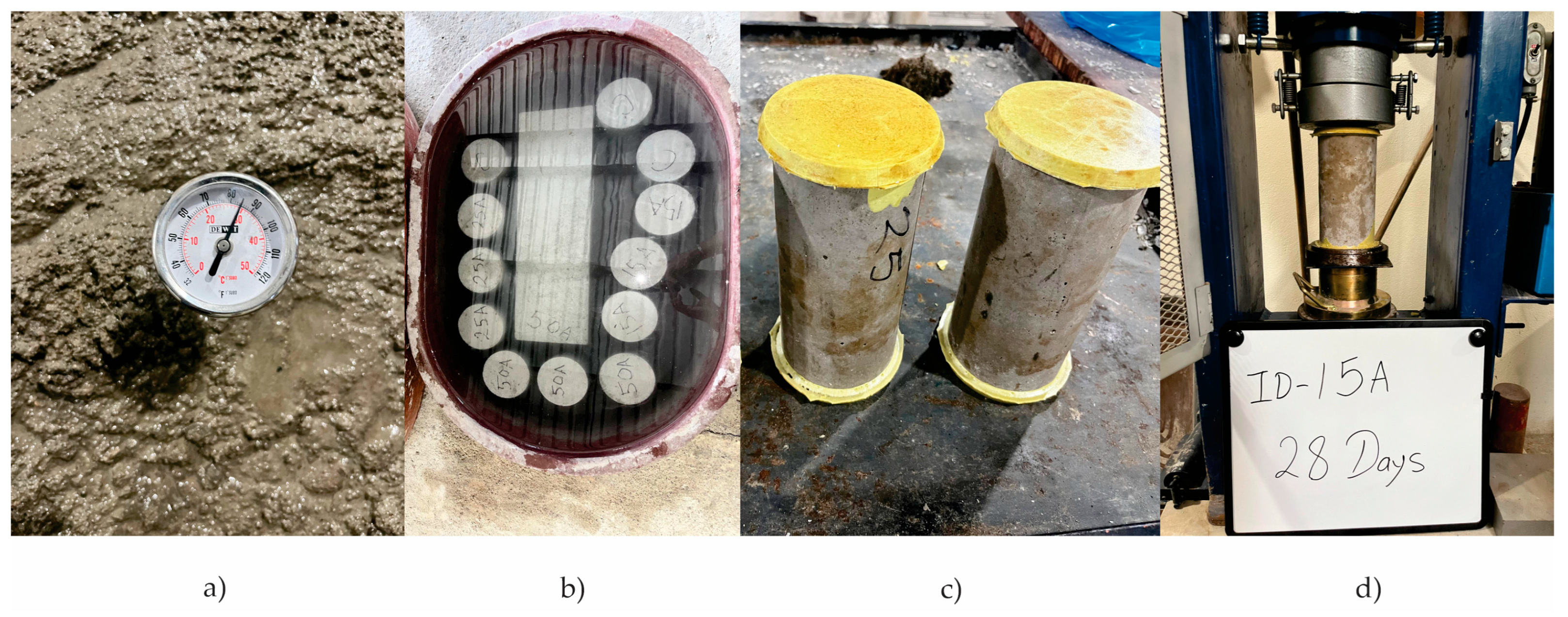
The compressive strength (f’c) was evaluated at curing ages of 7, 14, and 28 days (Figure 2b), in accordance with the guidelines established by the NMX-C-083-ONNCCE standard [43]. The tests were carried out using a properly calibrated hydraulic press at the Civil Engineering Laboratory of the Instituto Tecnológico de Misantla (Figure 2d).
For each curing age and mixture, three specimens were tested, and the average compressive strength was reported.

2.3.3. Flexural Strength Test Method

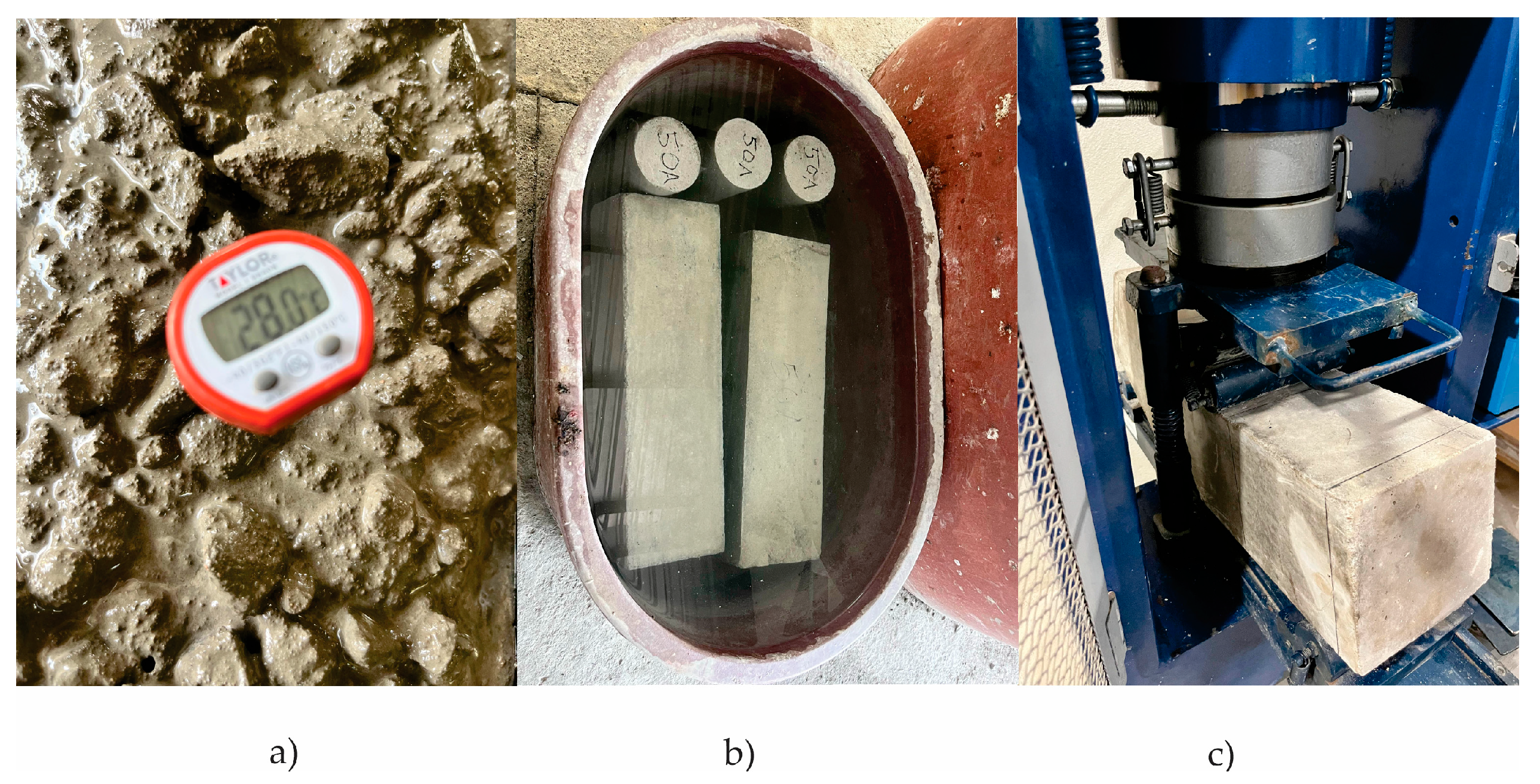
Flexural strength was evaluated at 28 days of curing using a three-point bending test (Figure 3b), in accordance with the specifications of the NMX-C-191-ONNCCE standard [44]. The tests were conducted at the Civil Engineering Laboratory of the Instituto Tecnológico de Misantla, using a properly calibrated universal testing machine (Figure 3c). During the procedure, the maximum load applied to each beam until failure was recorded, and the corresponding flexural strength was determined based on these values. For each experimental factor combination, the average value obtained from the two tested specimens was calculated and reported.

2.3.4. Carbonation Depth

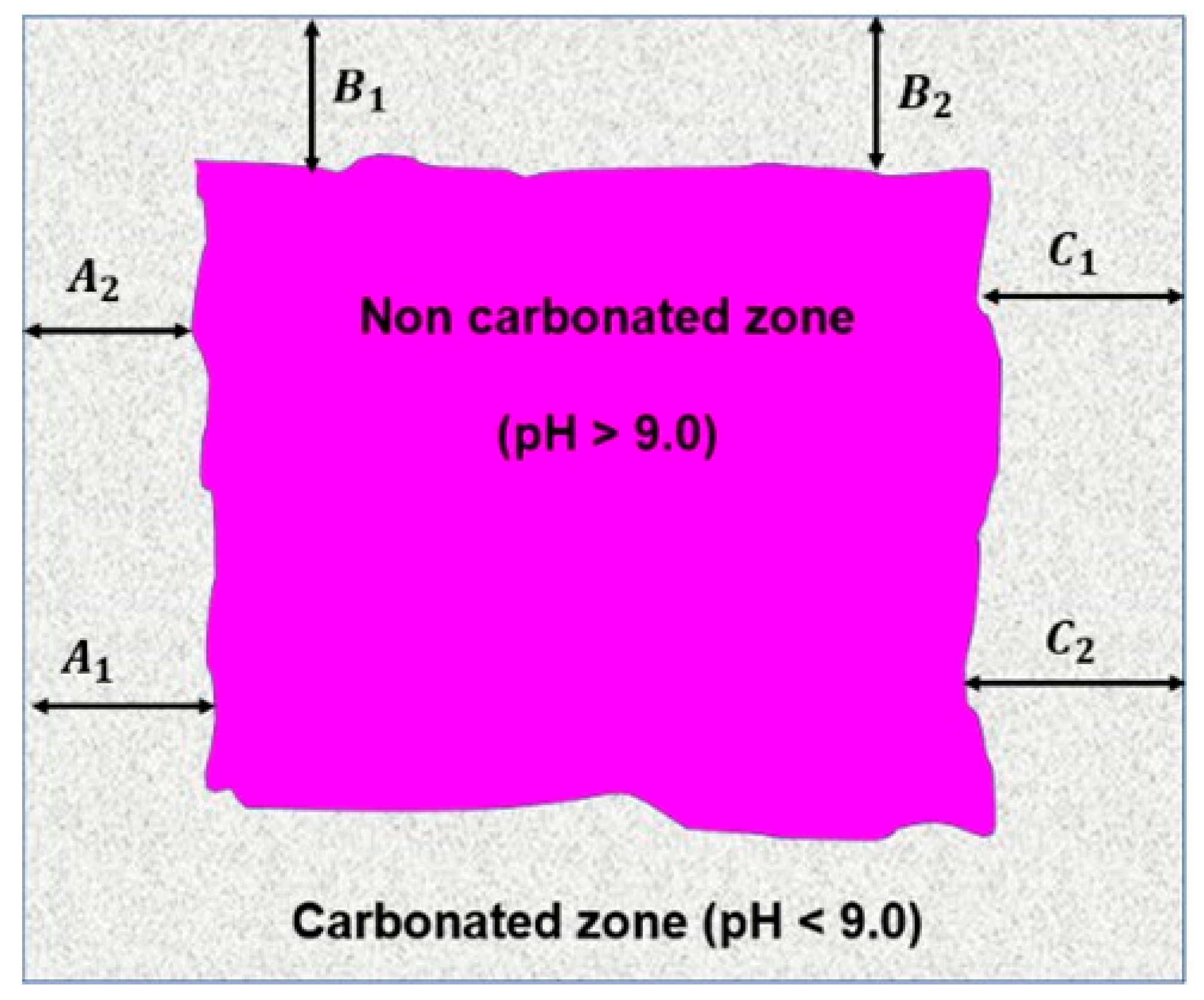
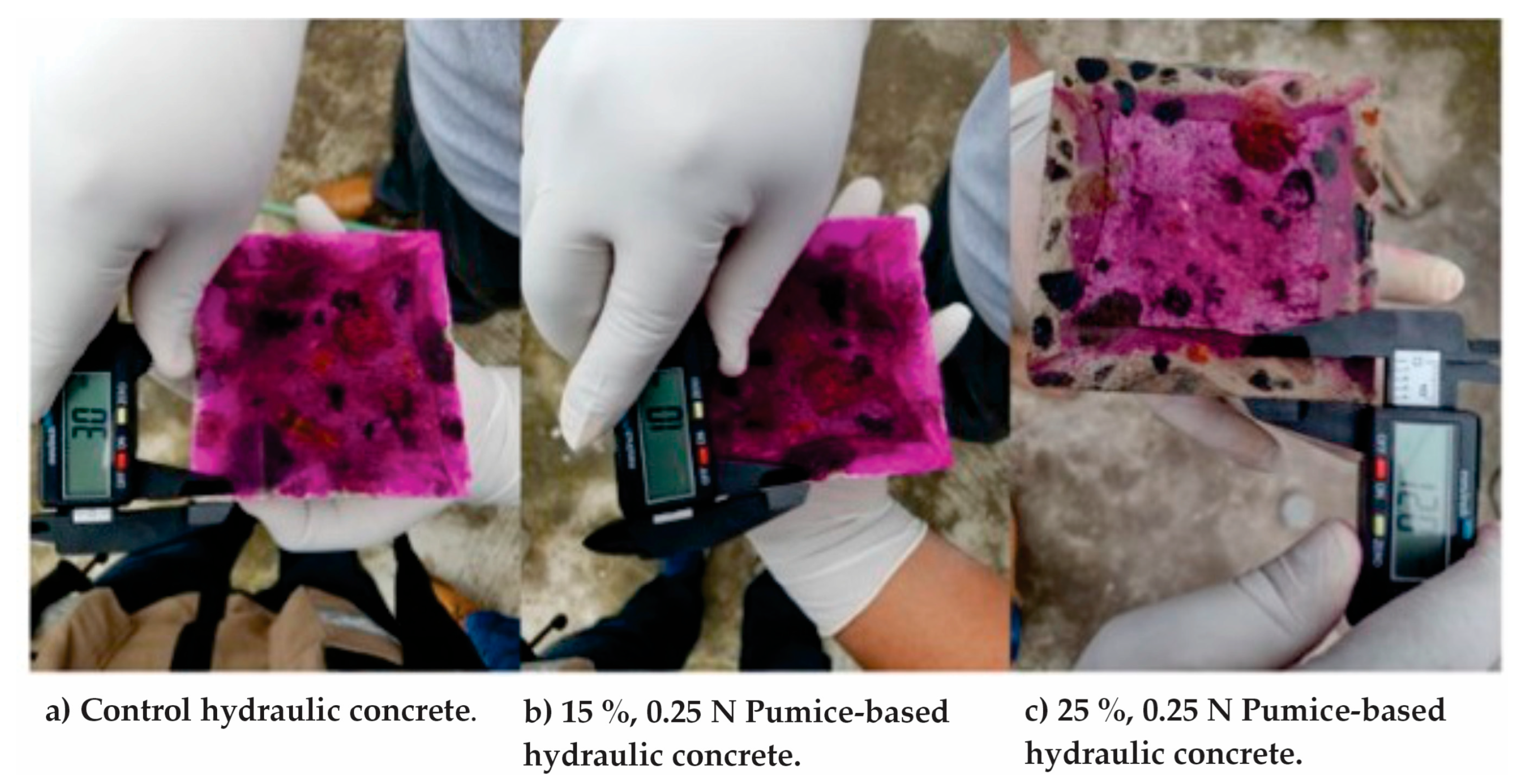
The traditional procedure of measuring the carbonation depth in concrete consists of spraying phenolphthalein on a freshly cut surface of a concrete specimen. The phenolphthalein solution is a colorless basic indicator, which turns pink when the pH is greater than 9 and remains colorless when the pH is less than 9 [45]. Therefore, when spraying a concrete surface with this indicator, it is possible to observe the degree of carbonation by the difference between the purple zone and the colorless zone, the latter being the carbonated zone of the cut of the concrete specimen.
This work shows the carbonation depth in specimens of PM-based modified hydraulic concrete with replacement percentages of 25% and 15%, and concentration of activating solution 0.5 N and 0.25 N, which are the ones with the highest compressive strength. Carbonation was conducted under natural exposure conditions in Misantla, Veracruz (Mexico), with temperatures ranging between 21 °C and 27 °C, relative humidity around 70%, and atmospheric CO2 concentrations of approximately 400 ppm. Carbonation is measured in a specimen of each modified hydraulic concrete by spraying 1% phenolphthalein in ethanol solution (1 g of phenolphthalein and 90 mL of ethanol diluted in water to 100 mL). Figure 4 shows the scheme of the measurement points in a sample of carbonated concrete, which are substituted in Equation (1), to obtain the average value of carbonation depth Xp.
X p = A 1 + A 2 + B 1 + B 2 + C 1 + C 2 6

2.4. Statistical Analysis

The standard error was calculated to evaluate the studied variables. The assumptions of normality and homogeneity of variances were verified through appropriate statistical tests with a 99% confidence level. For the compressive strength analysis, a 33 factorial design with three replicates was applied on cylindrical concrete specimens, considering curing time (7, 14, and 28 days), alkaline solution concentration (1 N, 0.5 N, and 0.25 N), and pumice substitution percentage (15%, 25%, and 50%) as factors.
For the flexural strength analysis, a 32 factorial design was used on concrete beams tested at 28 days, with pumice substitution percentage and alkaline concentration as factors. In both cases, analysis of variance (ANOVA) was performed to determine the statistical significance of the main effects and their interactions, using a significance level of p ≤ 0.01.

3. Results and Discussion

3.1. X-Ray Diffraction (XRD)

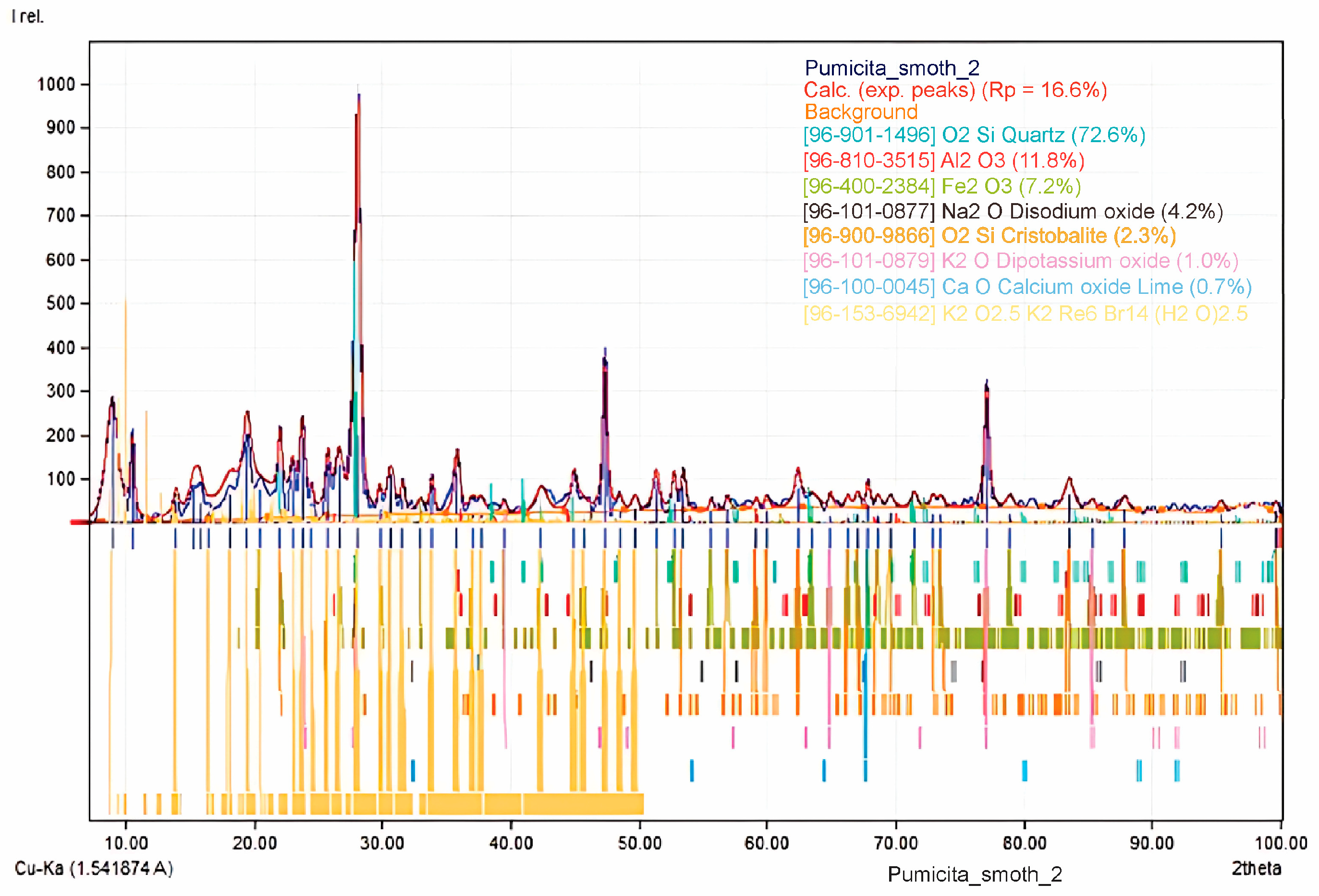
The mineralogical characterization of pumice powder was performed by X-ray diffraction (XRD) using a Bruker D2 Phaser diffractometer with Cu-Kα radiation (λ = 1.5406 Å), within a 2θ range of 7–100° and a step size of 0.018°. Figure 5 shows the XRD pattern of the recycled pumice used in this study, indicating the predominance of aluminosilicate phases typical of volcanic materials. This mineralogical signature supports the potential reactivity of pumice under alkaline activation and its suitability for partial cement replacement in hydraulic concrete. Similar mineralogical features of pumice-based materials have been reported in previous studies by the authors [35,36,37].

3.2. Fresh-State Properties of Concrete Mixtures

The fresh-state properties of the concrete mixtures are summarized in Table 3. All mixtures exhibited fresh temperatures between 28.0 °C and 29.5 °C, within the range of controlled indoor mixing conditions. The slump values ranged from 85 mm to 105 mm, with a slight reduction in workability observed as the percentage of pumice increased. This behavior can be attributed to the higher porosity and irregular surface texture of the recycled pumice particles compared to Portland composite cement.
The unit weight of fresh concrete decreased with increasing substitution levels, from 2165 kg/m3 in the control mix to 2028 kg/m3 in the 50A mix. This decline reflects the lower specific gravity of pumice and confirms the lightweight nature of the material. Despite these reductions, all fresh mixtures maintained acceptable ranges of workability and density for rigid pavement applications.

3.3. Compressive Strength

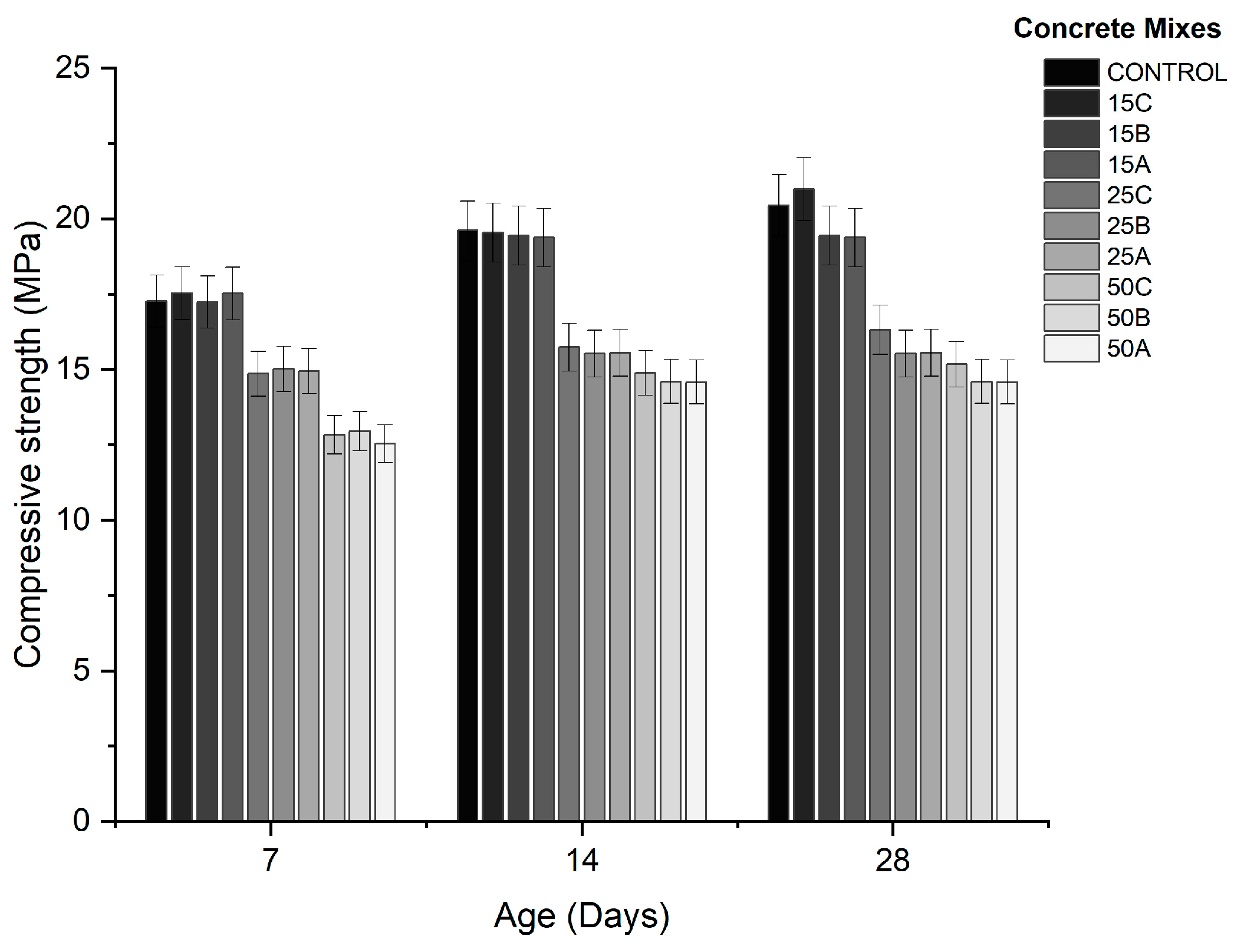
Compressive strength tests were performed on the nine modified concrete mixtures defined in the experimental design using a destructive compression test. Cylindrical specimens were prepared and tested at curing ages of 7, 14, and 28 days under uniaxial loading using a compression testing machine, following standardized procedures for concrete strength evaluation.
Figure 6 shows the evolution of the mean compressive strength of the concrete samples as a function of the percentage of PM substitution and the concentration of the alkaline activating agent. Identifiers 50, 25, and 15 represent the percentage by weight of PM substitution, while identifiers A, B, and C represent the concentration of the alkaline solution at 1 N, 0.5 N, and 0.25 N, respectively. At 28 days, all mixtures reached their highest compressive strength values. However, compared with the control mix (prepared with PC, fine aggregate, coarse aggregate, and water), the mixtures with 50% PM replacement exhibited the lowest compressive strength, whereas those with 15% and 25% replacement showed values closer to the control mix. Figure 6 provides a comparative graphical summary of the average compressive strength for comparative purposes, while Table 4 presents the detailed numerical results for each specimen.
It is important to note that although this study focuses on the mechanical and durability performance of concrete incorporating recycled pumice, further research should address the environmental impacts associated with pumice mining, transportation emissions, and long-term durability in real exposure conditions.

3.4. Flexural Strength

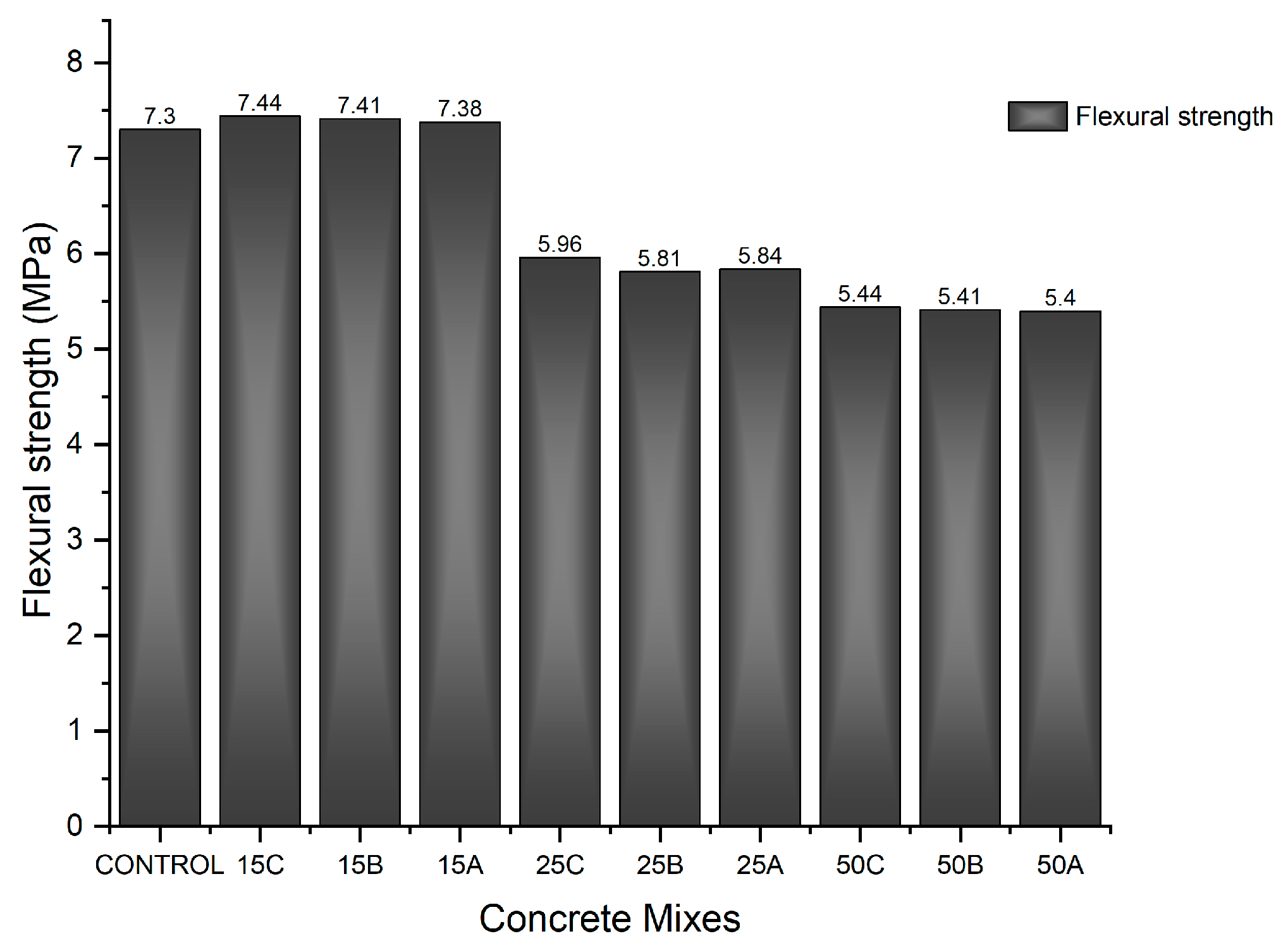
Flexural strength of the concrete mixes incorporating alkali-activated pumice as a partial cement replacement is shown in Figure 7. The control mix exhibited a flexural strength of 7.3 MPa. Concrete mixes with 15% pumice replacement demonstrated slightly higher or comparable strength values, ranging from 7.38 to 7.44 MPa, regardless of the NaOH concentration used for activation (0.25 N, 0.50 N, and 1.00 N). These results indicate that, at low replacement levels, the alkaline activation of pumice—even at low concentrations—is sufficient to maintain or slightly improve the flexural performance.
As the replacement level increased to 25% and 50%, a gradual reduction in flexural strength was observed. At 25% replacement, values decreased to the range of 5.81–5.96 MPa, while at 50% replacement, all mixtures—regardless of NaOH concentration—fell to approximately 5.4 MPa. This suggests that higher replacement ratios may require more robust activation conditions or complementary binders to compensate for the loss in mechanical performance.
Overall, the data demonstrate that 15% pumice replacement can be considered mechanically viable for structural applications, even under low-alkalinity activation, whereas higher replacement levels demand optimization of the alkaline activation system.

3.5. Analysis of Variance

The statistical analysis, conducted using a 33 factorial design with three replicates on cylindrical concrete specimens measuring 10 cm in diameter and 20 cm in height, and with a design compressive strength of f′c = 250 kg/cm2, enabled the evaluation of the influence of three independent factors on the compressive strength of concrete: curing time (7, 14, and 28 days, referred to as factor A), alkaline solution concentration (1 N, 0.5 N, and 0.25 N, factor B), and pumice addition percentage (15%, 25%, and 50%, factor C). The results obtained from the analysis of variance (ANOVA) (Table 4) revealed that all three main effects (A, B, and C) are statistically significant (p-value < 0.01), indicating that each variable has a direct impact on concrete strength.
Among them, Factor C, corresponding to the pumice content (PM), explains the largest proportion of variance in compressive strength, as evidenced by its high F-value (918.362) and extremely low p-value (2.02 × 10−42). This indicates that variations in pumice content produce the greatest changes in compressive strength among the evaluated factors. This suggests that pumice content significantly affects compressive strength development, producing substantial variations in mechanical performance across the evaluated replacement levels. The statistical significance of Factor C does not imply a monotonic increase in strength, but rather highlights the sensitivity of compressive strength to variations in pumice replacement level. The results indicate a non-linear response, with intermediate replacement levels (15–25%) providing more favorable strength values, whereas excessive substitution (50%) leads to strength reduction, likely due to dilution effects within the cementitious matrix.
On the other hand, significant interactions were identified between effects A and B, as well as between A and C, both with p-values < 0.01. This indicates that concrete compressive strength is influenced not only by the individual effects of the factors but also by their combinations. The interaction between curing time and alkalinity concentration (AB) presented an F-value of 4.139 and a p-value of 0.005, suggesting that the effect of alkalinity levels on compressive strength varies depending on the curing duration. Practically speaking, higher alkalinity concentrations (1 N) tend to have a negative effect at early curing stages, but this effect diminishes—or even reverses—as the curing time increases.
Similarly, the interaction between curing time and pumice content (AC) was highly significant, with an F-value of 10.657 and a p-value of 1.94 × 10⁻⁶, indicating that the beneficial effect of pumice on compressive strength becomes more pronounced with longer curing durations. This is consistent with the typical behavior of pozzolanic materials, whose reactivity generally increases over time, promoting secondary hydration reactions and enhancing the mechanical properties of concrete.
In contrast, the interaction between alkalinity concentration and pumice content (BC), as well as the three-way interaction among all factors (ABC), were not statistically significant, with p-values of 0.585 and 0.626, respectively (p > 0.05). This implies that the simultaneous combination of these three factors does not produce a synergistic effect beyond the contributions of the individual or two-way interactions. In other words, no substantial interactive effect is observed when combining alkalinity and pumice simultaneously, even when curing time is included in the interaction.
A 32 factorial experimental design was also implemented for concrete beams measuring 50 cm in length with a square cross-section of 15 cm × 15 cm, maintaining the same target compressive strength of f′c = 250 kg/cm2 used for the cylindrical specimens in the previous analysis. However, the beams were tested only after 28 days of curing. This experimental setup enabled the assessment of the influence of two independent variables on the flexural strength of the concrete beams: the percentage of pumice replacement (15%, 25%, and 50%, Factor A) and the alkalinity concentration of the activating solution (1 N, 0.5 N, and 0.25 N, Factor B).
The analysis of variance (ANOVA) corresponding to this experiment, the results of which are presented in Table 5, determined the statistical significance of the evaluated factors on beam flexural strength. The results indicate that effect A, corresponding to the variation in pumice content, had a highly significant influence on the structural response of the beams, with an F-value of 574.383 and a p-value of 4.95 × 10⁻²², well below the adopted significance threshold (p < 0.01). This finding suggests that pumice content substantially affects the concrete’s ability to resist flexural stresses, likely due to the enhanced cementitious matrix resulting from the pozzolanic reaction, particularly at later curing ages such as 28 days.
In contrast, effect B, associated with the alkalinity concentration during the curing process, did not exhibit a statistically significant influence on the flexural strength, with an F-value of 1.7405 and a p-value of 0.2037. This result indicates that, under the evaluated conditions, variations in alkalinity do not produce meaningful changes in the mechanical response of the beams—unlike the effects observed in compressive strength at early ages. Likewise, the interaction between factors A and B (AB) was also statistically insignificant (F = 0.5792; p = 0.6815), indicating the absence of relevant combined effects between pumice content and alkalinity on the flexural behavior of concrete.
Taken together, these results support the conclusion that the incorporation of pumice into the concrete mix design has a positive and decisive effect on its flexural strength at 28 days, whereas changes in curing alkalinity levels do not represent a significant factor for this type of structural loading. The absence of a significant interaction suggests that the beneficial effect of pumice is independent of the alkaline curing environment, reinforcing its potential as an effective mineral additive for developing concrete mixtures with enhanced flexural mechanical performance.

3.6. Microstructure of PM-Based Modified Hydraulic Concrete Specimens

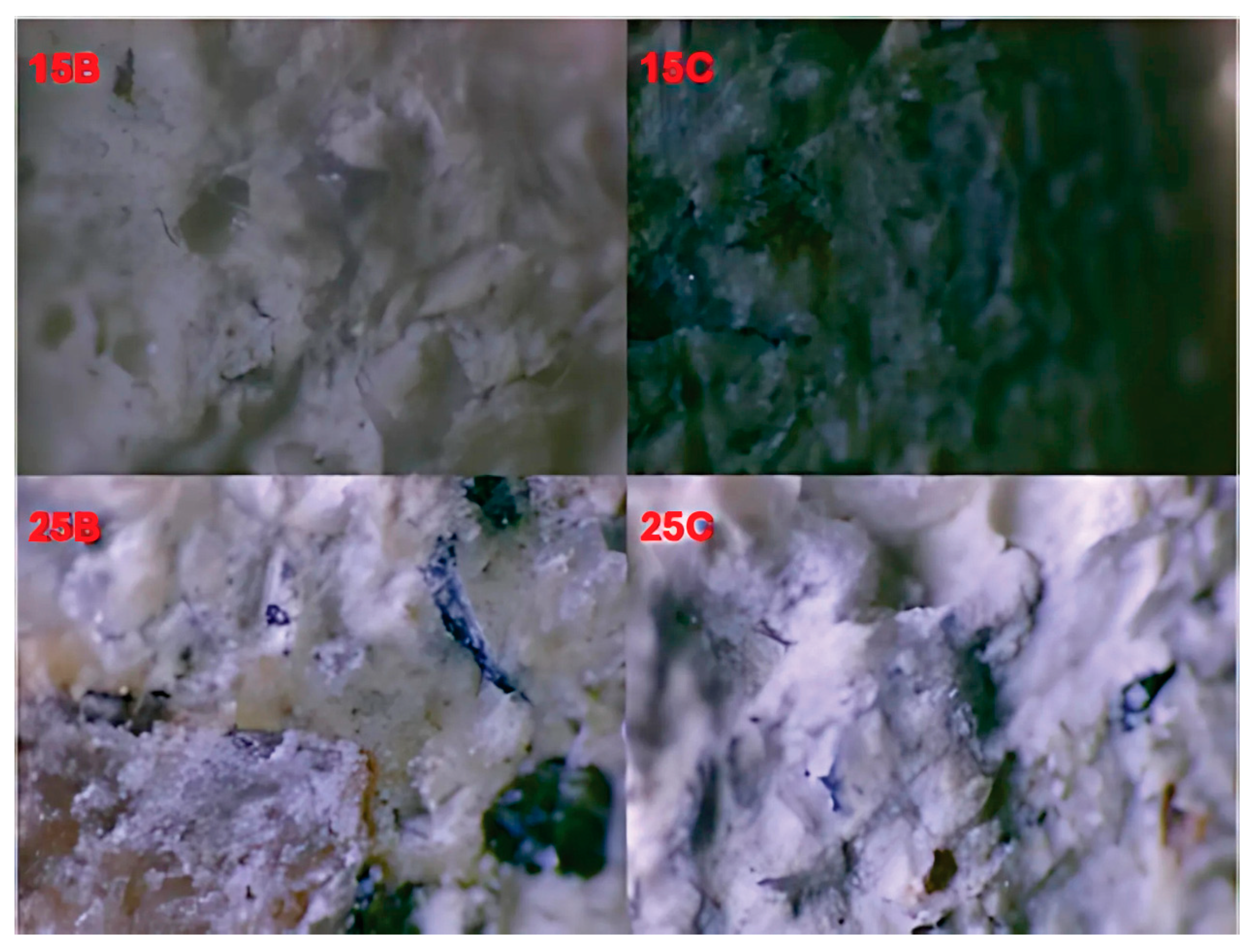
The microstructure of specimens 15C, 15B, 25C, and 25B, at the age of 210 days, is shown in Figure 8. The micrographs are presented for qualitative comparison purposes and were acquired at a fixed magnification (200×); therefore, the analysis does not involve direct dimensional measurements. Although the surface polishing is not optimal, the images offer qualitative insights into the microstructure. The specimen’s selection is directly related to its mean compressive strength value, greater than 20 MPa. It can be seen that specimens 15C and 25B are denser than specimens 15B and 25C, indicating that fewer pores are present, thus reducing permeability and, as a result, CO2 penetration. This result could be due to the significant pozzolanic reactions of silica and alumina from alkaline-activated PM and the calcium hydroxide (CH) generated by cement hydration; the forming products (C-S-H and C-A-H) are deposited into the pores of the modified hydraulic concrete, reducing its permeability. For specimen 25C, a low alkaline solution concentration results in non-activated PM that prevents the pozzolanic reaction of CH with SiO2 and Al2O3, limiting the formation of C-S-H and C-A-H structures, forming gaps between cementitious material (PC and PM-activated) and aggregates, increasing the porosity of the concrete. Finally, specimen 15B shows a compact structure where the excess of alkaline solution concentration leads to the activation of the PM similar to specimens 15C and 25B, CH consumption by pozzolanic reactions form C-S-H and C-A-H filling the pores of the modified hydraulic concrete; however, the excess NaOH reacts with CO2, producing other carbonate products (NaHCO3 and Na2CO3), which is discussed in Section 3.7.

3.7. Carbonation

The carbonation depth results are discussed from a comparative perspective, considering differences among mixtures under the same exposure conditions.
The natural carbonation of concrete is a chemical neutralization reaction, in which CO2 reacts with portlandite (Ca(OH)2) in the presence of water, to form CaCO3 [46]. Portlandite is the product of the hydration of the silica components present in PC. The general chemical reaction commonly used to represent this process is described by Equation (2).
C O 2 + C a O H 2 H 2 O C a C O 3 + H 2 O
The increase in carbonation of concrete depends on the humidity content and the permeability of the concrete, which favors the diffusion of CO2, to generate the reaction with Ca(OH)2 at a greater depth, reducing the alkaline pH of the concrete below 9.
Figure 9 shows the measurement of the PM-based modified hydraulic concrete specimens and the control hydraulic concrete.
Table 6 shows the average carbonation depth value for hydraulic concrete samples with 25% and 15% PM substitution activated with 0.5 N and 0.25 N alkaline solution.
Similar to Section 3.3, samples 15C, 15B, 25C and 25B were selected to measure carbonation depth, which was found to be directly related to their mean compressive strength value, which was greater than 20 MPa. Table 6 shows the alkaline solution concentration and %wt PM substitution ratio (APR), which illustrates the relationship between the activation of the PM as SCM and the binding characteristic of the mixture. The pozzolanic reaction of CH formed during the hydration of concrete with SiO2 and Al2O3 led to the C-S-H and C-A-H structures located in the pores of the formed concrete, reducing the permeability of the PM-based modified hydraulic concrete. Specimens 15C and 25B had APR values of 0.0167 and 0.02, respectively, showing a low carbonation depth. It can be assumed that values of APR between 0.0167 and 0.02 result in PM-based modified hydraulic concrete with an acceptable carbonation depth because there is an equilibrium between the alkaline solution concentration and %wt PM substitution.
In the case of specimen 25C, it had an APR of 0.01, indicating a low concentration of the alkaline solution, which did not allow for an adequate activation of the PM. The non-activated proportion of PM in the modified hydraulic concrete worked as a fine aggregate, and although the concrete compressive strength value was good, the permeability of concrete was high because there was not enough PM activated for the pozzolanic reactions of CH with SiO2 and Al2O3 to generate C-S-H and C-A-H structures, and pores of the modified hydraulic concrete remained unoccupied leading to easy CO2 penetration.
Additionally, in specimen 15B, the APR was high due to the excess concentration of the alkaline solution, which can react with CO2 to form other types of carbonate (NaHCO3 and Na2CO3) [47], which, together with CaCO3 resulting from the reaction of CO2 with Ca(OH)2, favors the increase in the depth of carbonation, as can be seen in Equation (3).
C O 2 + H 2 O H 2 C O 3   C a O H 2 + H 2 C O 3 C a C O 3 + 2 H 2 O   C a C O 3 + C O 2 + 2 H 2 O C a H C O 3 2   C a H C O 3 2 + C a O H 2 2 C a C O 3 + 2 H 2 O +   2 N a O H + C O 2 N a 2 C O 3 + H 2 O +   N a O H + C O 2 N a H C O 3
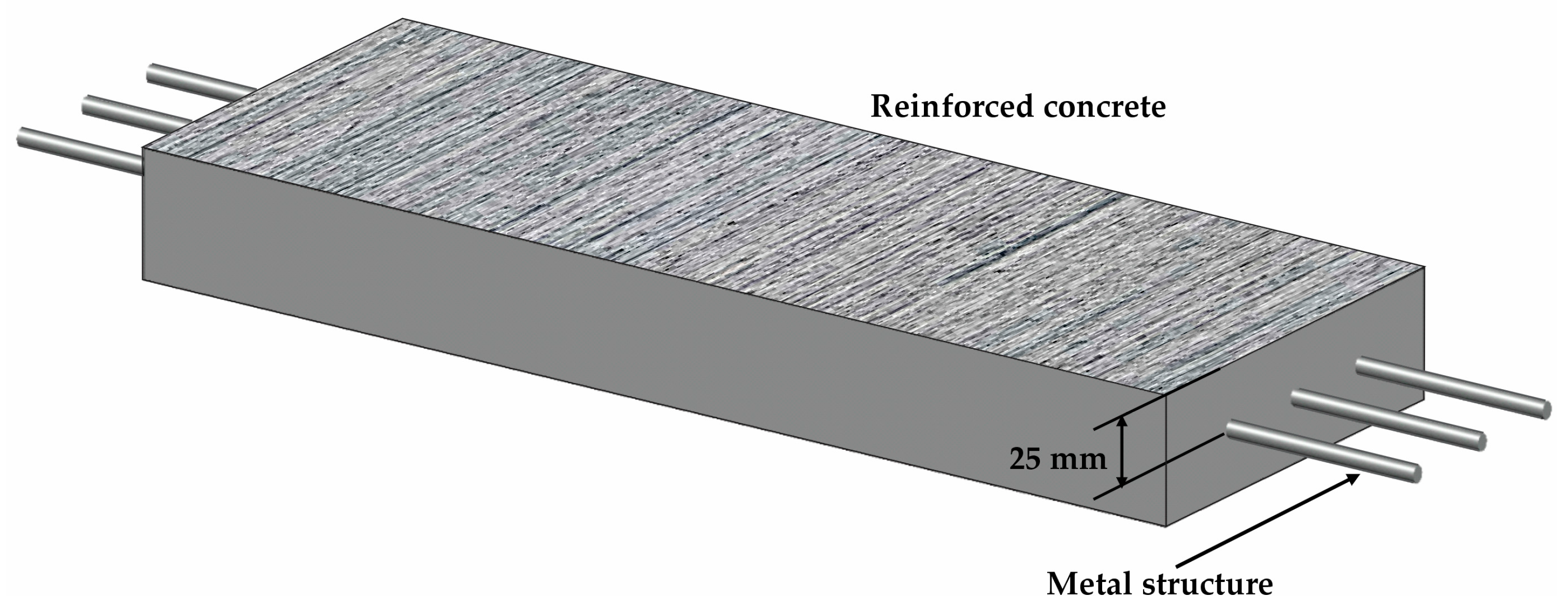
Complementary carbonation depth tests were carried out for specimens 15C, 15B, 25C and 25B after 3 years (1090 days) to evaluate the durability of the PM-based hydraulic concrete. The results shown in Table 6 demonstrate a consistency in the progress of carbonation for the specimens, assuming that the CO2 penetration depth was reasonable. The carbonation depth values in the four samples of modified concrete can be deemed reasonably acceptable, by a thumb rule in structural engineering that establishes a depth not greater than 20 mm, which is applied to reinforced concrete with metal structures commonly located at 25 mm or deeper with respect to the concrete surface [48]; see Figure 10.

4. Conclusions

This study systematically investigates the use of alkali-activated recycled pumice from Perote, Veracruz, as a cement replacement material in modified hydraulic concretes intended for rigid pavement applications. Mechanical performance was evaluated through compressive and flexural strength testing. A factorial experimental design (33 for compressive strength and 32 for flexural strength), combined with analysis of variance (ANOVA), enabled the assessment of the influence of curing age, alkaline solution concentration, and pumice substitution level on the resulting mechanical properties. The results demonstrated that all three factors significantly affect compressive strength (p < 0.01), with pumice content identified as the most statistically influential parameter in terms of variance contribution, confirming its sensitivity within the evaluated experimental range.
Significant interaction effects were observed between curing time and alkaline concentration, as well as between curing time and pumice content, highlighting the complexity of activation and hydration mechanisms in these blended systems. These findings emphasize the importance of optimizing mixture design and curing conditions to maximize mechanical performance. Flexural strength results showed that mixtures with 15% pumice replacement exhibited values comparable to the control mix, whereas higher replacement levels tended to reduce flexural performance. In contrast, alkaline concentration did not show a statistically significant effect on flexural strength under the conditions tested, suggesting that pumice replacement level plays a dominant role in bending resistance for pavement-oriented mixtures.
A key contribution of this research is the introduction of the alkaline-to-pumice ratio (APR), defined as the relationship between NaOH concentration and pumice substitution level, as an empirical, study-specific indicator associated with carbonation behavior. Under identical natural exposure conditions, mixtures exhibiting APR values between 0.0167 and 0.02 showed comparatively lower carbonation depths within the experimental dataset. This interval reflects a balance between alkaline activation efficiency and matrix densification; however, it should be interpreted strictly as a comparative trend observed in this study and not as a generalized or transferable durability threshold.
From a sustainability perspective, the use of recycled pumice recovered as a by-product from regional grinding activities can reduce Portland cement demand and therefore potentially lower the associated carbon footprint. This assessment is presented qualitatively, as no life cycle inventory or emission quantification was conducted within the scope of this work. The local availability of pumice residue may additionally reduce transportation-related emissions and support circular economy strategies through the valorization of industrial by-products.
Despite the promising findings, further research is required to validate the performance of these mixtures under real service conditions. Future investigations should incorporate compressive and flexural strength evaluation at later curing ages (e.g., 90 and 180 days) to establish a more direct correlation between long-term mechanical development and carbonation behavior observed at extended exposure periods. In addition, other durability mechanisms relevant to rigid pavements—such as freeze–thaw cycles, sulfate attack, and abrasion—should be evaluated in future studies to complement the carbonation-based durability assessment. Long-term durability evaluation under cyclic mechanical loading and environmental exposure, permeability and water absorption testing, as well as resistance to aggressive chemical environments, are also recommended.
Overall, the alkali-activated pumice concrete formulations developed in this study demonstrate the technical feasibility for low-structural-demand rigid pavement applications, combining mechanical performance with promising durability indicators under natural carbonation exposure. The integration of experimental testing and rigorous statistical analysis supports the viability of this sustainable approach, while extended durability monitoring, quantitative environmental assessment, and field validation will be essential to support broader infrastructure implementation.

Author Contributions

Conceptualization and writing—review and editing, P.J.L.-G., D.R.-G. and R.V.-O.; validation and data curation, O.M.-V., J.S.-L. and B.S.T.-G.; supervision and methodology, T.I.L.-V., E.M.-R. and S.A.Z.-C. All authors have read and agreed to the published version of the manuscript.

Funding

This research received no external funding.

Data Availability Statement

Request the corresponding authors of this article.

Acknowledgments

The authors wish to express their sincere gratitude to the Civil Engineering Laboratory at the Instituto Tecnológico Superior de Misantla for their essential technical support and for facilitating the research tests that were critical to obtaining the optimal results. Their contribution has been invaluable in advancing the objectives of this study.

Conflicts of Interest

The authors declare no conflicts of interest.

References

  1. Suryani, F.M.; Rizal, S.; Abdullah, A.; Isya, M. Fly Ash Substitution in Lightweight Concrete for Rigid Pavement Construction on Low-Bearing-Capacity Soil. Sustainability 2023, 15, 15239. [Google Scholar] [CrossRef] [Scilit]
  2. Shao, R.; Wu, C.; Li, J. A comprehensive review on dry concrete: Application, raw material, preparation, mechanical, smart and durability performance. J. Build. Eng. 2022, 55, 104676. [Google Scholar] [CrossRef] [Scilit]
  3. Dehghan, A.M.M.N.M.; Maher, M.L.J.; Navarra, M. The Effects of Aggregate Properties on Concrete Mix Design and Behaviour. In Canadian Society of Civil Engineering Annual Conference; Springer Nature: Singapore, 2021; pp. 457–468. [Google Scholar]
  4. Villagrán-Zaccardi, Y.; Pareja, R.; Rojas, L.; Irassar, E.F.; Torres-Acosta, A.; Tobón, J.; John, V.M. Overview of cement and concrete production in Latin America and the Caribbean with a focus on the goals of reaching carbon neutrality. RILEM Tech. Lett. 2022, 7, 30–46. [Google Scholar] [CrossRef] [Scilit]
  5. Vásques, B.; Corrales, S. La industria del cemento en México. Análisis de sus determinantes. Problemas Del Desarrollo. Rev. Latinoam. Econ. 2017, 48, 113–138. [Google Scholar] [CrossRef] [Scilit]
  6. Fry, M. Cement, carbon dioxide, and the ‘necessity’narrative: A case study of Mexico. Geoforum 2013, 49, 127–138. [Google Scholar] [CrossRef] [Scilit]
  7. Achaw, O.W.; Danso-Boateng, E. Cement and Clay Products Technology. In Chemical and Process Industries: With Examples of Industries in Ghana; Springer International Publishing: Cham, Switzerland, 2021; pp. 135–170. [Google Scholar]
  8. León-Velez, A.; Guillén-Mena, V. Energía contenida y emisiones de CO2 en el proceso de fabricación de cemento en Ecuador. Ambiente Construido 2020, 20, 611–625. [Google Scholar] [CrossRef] [Scilit]
  9. Rosewitz, J.A.; Wang, S.; Scarlata, S.F.; Rahbar, N. An enzymatic self-healing cementitious material. Appl. Mater. Today 2021, 23, 101035. [Google Scholar] [CrossRef] [Scilit]
  10. Okashah, A.M.; Zainal, F.F.; Hayazi, N.F.; Nordin, M.N.; Abdullah, A. Pozzolanic properties of calcined clay in geopolymer concrete: A review. In AIP Conference Proceedings; AIP Publishing: Melville, NY, USA, 2021; Volume 2339. [Google Scholar] [CrossRef] [Scilit]
  11. Alrefaei, Y.; Wang, Y.S.; Dai, J.G.; Xu, Q.F. Effect of superplasticizers on properties of one-part Ca (OH) 2/Na2SO4 activated geopolymer pastes. Constr. Build. Mater. 2020, 241, 117990. [Google Scholar] [CrossRef] [Scilit]
  12. Zhao, W.; Chen, Y.; Liu, Z.; Wang, L.; Li, X. Effects of surface-modified coal-bearing metakaolin and graphene oxide on the properties of cement mortar. Constr. Build. Mater. 2023, 372, 130796. [Google Scholar] [CrossRef] [Scilit]
  13. Varshney, H.; Khan, R.A. Assessing the performance of metakaolin-enriched bio-mineralized concrete. Structures 2024, 60, 105793. [Google Scholar] [CrossRef] [Scilit]
  14. Zhang, H.Y.; Qiu, G.H.; Kodur, V.; Yuan, Z.S. Spalling behavior of metakaolin-fly ash based geopolymer concrete under elevated temperature exposure. Cem. Concr. Compos. 2020, 106, 103483. [Google Scholar] [CrossRef] [Scilit]
  15. Sharbatdar, M.K.; Abbasi, M.; Fakharian, P. Improving the properties of self-compacted concrete with using combined silica fume and metakaolin. Period. Polytech. Civ. Eng. 2020, 64, 535–544. [Google Scholar] [CrossRef] [Scilit]
  16. Swaminathen, A.N.; Kumar, C.V.; Ravi, S.R.; Debnath, S. Evaluation of strength and durability assessment for the impact of Rice Husk ash and Metakaolin at High Performance Concrete mixes. Mater. Today Proc. 2021, 47, 4584–4591. [Google Scholar] [CrossRef] [Scilit]
  17. Kolawole, J.T.; Babafemi, A.J.; Fanijo, E.; Paul, S.C.; Combrinck, R. State-of-the-art review on the use of sugarcane bagasse ash in cementitious materials. Cem. Concr. Compos. 2021, 118, 103975. [Google Scholar] [CrossRef] [Scilit]
  18. Prabhath, N.; Kumara, B.S.; Vithanage, V.; Samarathunga, A.I.; Sewwandi, N.; Maduwantha, K.; Madusanka, M.; Koswattage, K. A Review on the Optimization of the Mechanical Properties of Sugarcane-Bagasse-Ash-Integrated Concretes. J. Compos. Sci. 2022, 6, 283. [Google Scholar] [CrossRef] [Scilit]
  19. De Sande, V.T.; Sadique, M.; Pineda, P.; Bras, A.; Atherton, W.; Riley, M. Potential use of sugar cane bagasse ash as sand replacement for durable concrete. J. Build. Eng. 2021, 39, 102277. [Google Scholar] [CrossRef] [Scilit]
  20. Siline, M.; Mehsas, B. Effect of increasing the Blaine fineness of Metakaolin on its chemical reactivity. J. Build. Eng. 2022, 56, 104778. [Google Scholar] [CrossRef] [Scilit]
  21. Abdelmelek, N.; Alimrani, N.S.; Krelias, N.; Lubloy, E. Effect of elevated temperatures on microstructure of high strength concrete based-metakaolin. J. King Saud Univ.-Eng. Sci. 2021; in press. [CrossRef] [Scilit]
  22. Karthika, R.B.; Vidyapriya, V.; Sri, K.N.; Beaula, K.M.G.; Harini, R.; Sriram, M. Experimental study on lightweight concrete using pumice aggregate. Mater. Today Proc. 2021, 43, 1606–1613. [Google Scholar] [CrossRef] [Scilit]
  23. Alqarni, A.S. A comprehensive review on properties of sustainable concrete using volcanic pumice powder ash as a supplementary cementitious material. Constr. Build. Mater. 2022, 323, 126533. [Google Scholar] [CrossRef] [Scilit]
  24. Lehner, P.; Konečný, P.; Ghosh, P. Variation of Durability and Strength Parameters of Pumice Based Mixtures. Materials 2021, 14, 3674. [Google Scholar] [CrossRef] [Scilit]
  25. Hrabová, K.; Lehner, P.; Ghosh, P.; Konečný, P.; Teplý, B. Sustainability Levels in Comparison with Mechanical Properties and Durability of Pumice High-Performance Concrete. Appl. Sci. 2021, 11, 4964. [Google Scholar] [CrossRef] [Scilit]
  26. Zeyad, A.M.; Shubaili, M.; Abutaleb, A. Using volcanic pumice dust to produce high-strength self-curing concrete in hot weather regions. Case Stud. Constr. Mater. 2023, 18, e01927. [Google Scholar] [CrossRef] [Scilit]
  27. Hamada, H.M.; Abed, F.; Beddu, S.; Humada, A.M.; Majdi, A. Effect of Volcanic Ash and Natural Pozzolana on mechanical properties of sustainable cement concrete: A comprehensive review. Case Stud. Constr. Mater. 2023, 19, e02425. [Google Scholar] [CrossRef] [Scilit]
  28. Tran, Q.; Ghosh, P. Influence of pumice on mechanical properties and durability of high performance concrete. Constr. Build. Mater. 2020, 249, 118741. [Google Scholar] [CrossRef] [Scilit]
  29. Ab Latif, A.; Putrajaya, R.; Ing, D.S. A review of porous concrete pavement: Compressive strength and clogging investigation. J. Adv. Res. Appl. Sci. Eng. Technol. 2023, 29, 128–138. [Google Scholar] [CrossRef] [Scilit]
  30. Ferić, K.; Sathish Kumar, V.; Romić, A.; Gotovac, H. Effect of aggregate size and compaction on the strength and hydraulic properties of pervious concrete. Sustainability 2023, 15, 1146. [Google Scholar] [CrossRef] [Scilit]
  31. Yue, Z.; Al-odaini, A. An Investigation of the Application of New Concrete Materials in the Field of Civil Engineering. Int. J. New Dev. Eng. Soc. 2023, 7, 60–65. [Google Scholar] [CrossRef] [Scilit]
  32. Nilimaa, J. Smart materials and technologies for sustainable concrete construction. Dev. Built Environ. 2023, 15, 100177. [Google Scholar] [CrossRef] [Scilit]
  33. Santana, J.J.; Rodríguez-Brito, N.; Blanco-Peñalver, C.; Mena, V.F.; Souto, R.M. Durability of Reinforced Concrete with Additions of Natural Pozzolans of Volcanic Origin. Materials 2022, 15, 8352. [Google Scholar] [CrossRef] [Scilit]
  34. Ibrahim, W.M.W.; Abdullah, M.M.A.B.; Ahmad, R.; Sandu, A.V.; Vizureanu, P.; Benjeddou, O.; Sauffi, A.S. Chemical distributions of different sodium hydroxide molarities on fly ash/dolomite-based geopolymer. Materials 2022, 15, 6163. [Google Scholar] [CrossRef] [Scilit]
  35. López-Gonzalez, P.J.; Vivar-Ocampo, R.; González-Moreno, H.R.; Moreno-Vazquez, O.; Meza-Ruíz, E.; Zamora-Castro, S.A.; Reyes-González, D.; Sangabriel-Lomeli, J. Impact of Pumice Substitution on Mortar Properties: A Case Study on Mechanical Performance and XRD Analysis. Infrastructures 2025, 10, 95. [Google Scholar] [CrossRef] [Scilit]
  36. Moreno-Vázquez, O.; López-González, P.J.; Zamora-Castro, S.A.; Trujillo-García, B.S.; Sangabriel-Lomelí, J. Mechanical Behavior of Sustainable Concrete with Alkali-Activated Pumice as Cement Replacement for Walkway Slabs in Humid Tropical Climates. Eng 2025, 6, 191. [Google Scholar] [CrossRef] [Scilit]
  37. Noel, K.; Reyes-González, D.; Vivar-Ocampo, R.; López-González, P.J.; Martínez Castellanos, G. Effect of the Sea Breeze on the Durability of Pumice-Based Supersulfated Pastes under Accelerated Conditions. AIMS Mater. Sci. 2026, 13, 1–29. [Google Scholar] [CrossRef] [Scilit]
  38. NMX-C-111-ONNCCE-2014; Construction Industry—Aggregates for Hydraulic Concrete—Specifications and Testing Methods. ONNCCE: Mexico City, Mexico, 2014.
  39. NMX-C-414-ONNCCE-2017; Construction Industry—Hydraulic Cements—Specifications and Testing Methods. ONNCCE: Mexico City, Mexico, 2017.
  40. Cabrera Luna, K.; Escalante García, J.I.; Nieves Mendoza, D.; Maldonado Bandala, E.E. Compressive strength and microstructure of concretes manufactured with supersulfated cement based on materials of volcanic origin exposed to a sulfate environment. Rev. ALCONPAT 2019, 9, 106–116. [Google Scholar]
  41. Ghazy, M.F.; Abd Elaty, M.A.; Mostafa, S.M. Properties of one-part versus two-part geopolymers composites-a review. Am. J. Eng. Res. 2022, 11, 1–14. [Google Scholar]
  42. NMX-C-159-ONNCCE-2016; Construction Industry—Concrete—Preparation and Curing of Test Specimens. ONNCCE: Mexico City, Mexico, 2016.
  43. NMX-C-083-ONNCCE-2013; Construction Industry—Concrete—Determination of Compressive Strength—Test Method. ONNCCE: Mexico City, Mexico, 2013.
  44. NMX-C-191-ONNCCE-2015; Construction Industry—Concrete—Determination of Flexural Strength—Test Method. ONNCCE: Mexico City, Mexico, 2015.
  45. Ribeiro, A.B.; Santos, T.; Gonçalves, A. Performance of concrete exposed to natural carbonation: Use of the k-value concept. Constr. Build. Mater. 2018, 175, 360–370. [Google Scholar] [CrossRef] [Scilit]
  46. Medvedev, V.; Pustovgar, A. A Review of Concrete Carbonation and Approaches to Its Research under Irradiation. Buildings 2023, 13, 1998. [Google Scholar] [CrossRef] [Scilit]
  47. Al-Ameeri, A.S.; Rafiq, M.I.; Tsioulou, O.; Rybdylova, O. Impact of climate change on the carbonation in concrete due to carbon dioxide ingress: Experimental investigation and modelling. J. Build. Eng. 2021, 44, 102594. [Google Scholar] [CrossRef] [Scilit]
  48. Robayo-Salazar, R.A.; Aguirre-Guerrero, A.N.; Mejía de Gutiérrez, R. Carbonation-induced corrosion of alkali-activated binary concrete based on natural volcanic pozzolan. Constr. Build. Mater. 2020, 232, 117–189. [Google Scholar] [CrossRef] [Scilit]
Figure 1. Two-part geopolymer concrete elaboration method.
Infrastructures 11 00070 g001
Figure 2. Testing of concrete specimens: (a) Casting of cylinders, (b) curing process, (c) preparation for testing, and (d) testing of specimens using a hydraulic press.
Infrastructures 11 00070 g002
Figure 3. Testing of concrete beams: (a) Casting of beams, (b) curing process, and (c) beam testing using a hydraulic press.
Infrastructures 11 00070 g003
Figure 4. Carbonation depth measurement scheme.
Infrastructures 11 00070 g004
Figure 5. X-ray diffraction (XRD) pattern of the recycled pumice (PM) used in this study, showing the principal mineralogical phases identified.
Infrastructures 11 00070 g005
Figure 6. Evolution of mean compressive strength of PM- based modified hydraulic concrete. Values are presented as averages for each mix.
Infrastructures 11 00070 g006
Figure 7. Average flexural strength (MPa) of modified concrete with 15%, 25%, and 50% cement replacement using alkali-activated pumice. Values are presented as averages for each mix.
Infrastructures 11 00070 g007
Figure 8. Optical micrographs of PM-based hydraulic concrete specimens 15B, 15C, 25B, and 25C at 210 days of curing age. Images were acquired using an optical microscope (AmScope) at a fixed magnification of 200× and are presented for qualitative microstructural comparison.
Infrastructures 11 00070 g008
Figure 9. Carbonation depth measurement in modified hydraulic concrete: (a) control hydraulic concrete; (b) 15% pumice-based hydraulic concrete with 0.25 N alkaline activator; (c) 25% pumice-based hydraulic concrete with 0.25 N alkaline activator.
Infrastructures 11 00070 g009
Figure 10. Cross-sectional detail of reinforcement placement in concrete.
Infrastructures 11 00070 g010
Table 1. Designed blends for experiments.
RunNomenclature% of PM% of Alkaline Solution Concentration
115A151.00 N
215B150.50 N
315C150.25 N
425A251.00 N
525B250.50 N
625C250.25 N
750A501.00 N
850B500.50 N
950C500.25 N
Table 2. Number of specimens for each experimental design.
Shape of SpecimenTestsAge of Test
Cylinders (100 mm × 200 mm)Compression strength7, 14 and 28 days
Beams (500 mm × 150 mm × 150 mm)Flexural strength28 days
Cubes (100 mm × 100 mm × 100 mm)Carbonation210 and 1090 days
Table 3. Fresh properties of concrete mixtures.
Mix IDTemperature (°C)Slump (mm)Unit Weight (kg/m3)
CONTROL28.01052165
15A29.51002120
15B29.01052098
15C28.01002104
25A29.0952079
25B28.5902047
25C28.01002072
50A29.0902028
50B28.5902044
50C29.0852032
Table 4. Analysis of variance (ANOVA) for the 33 experimental design evaluating concrete compressive strength under the influence of three independent variables: Effect A—curing time (7, 14, and 28 days); Effect B—alkalinity concentration of the solution (1 N, 0.5 N, and 0.25 N); and Effect C—pumice addition percentage (15%, 25%, and 50%).
EffectsSum of SquaresDFMean SquaresF ValueCritical F Valuep Value
Effect A50.653225.326137.4673.1686.52 × 10−22
Effect B3.02721.5148.2153.1687.68 × 10−4
Effect C338.3902169.195918.3623.1682.02 × 10−42
Effect AB3.05140.7634.1392.5430.005
Effect AC7.85341.96310.6572.5431.94 × 10−6
Effect BC0.52840.1320.7162.5430.585
Effect ABC1.14380.1430.7752.1150.626
Error9.949540.184
Total414.59380
Table 5. Analysis of variance (ANOVA) for the 32 experimental design evaluating the flexural stress of concrete beams under the influence of two independent variables: Effect A—alkalinity concentration of the activating solution (1 N, 0.5 N, and 0.25 N); and Effect B—pumice addition percentage (15%, 25%, and 50%).
EffectsSum of SquaresDFMean SquaresF ValueCritical F Valuep Value
Effect A43.4115221.7057574.38303.55464.95 × 10−22
Effect B0.131520.06581.74053.55460.2037
Effect AB0.087540.02190.57922.92770.6815
Error0.6802180.0378
Total44.310826
Table 6. Carbonation depth measurements for PM-based modified hydraulic concrete at 210 and 1090 days.
PM-Based Modified Hydraulic ConcreteAge (Days)Points in a Sample of Carbonated Concrete (mm)Mean Carbonation Depth [mm]APR = Alkaline Solution Concentration/%wt PM Substitution
A1A2B1B2C1C2
15C2101.92.02.32.22.22.42.20.0167
25C10.110.39.79.810.110.010.00.01
15B9.99.89.810.19.910.09.90.033
25B4.84.94.95.14.95.04.90.02
15C109016.015.015.016.015.013.015.00.0167
25C19.019.019.019.020.020.019.30.01
15B18.019.021.020.021.021.020.00.033
25B14.015.016.015.015.015.015.00.02
Disclaimer/Publisher’s Note: The statements, opinions and data contained in all publications are solely those of the individual author(s) and contributor(s) and not of MDPI and/or the editor(s). MDPI and/or the editor(s) disclaim responsibility for any injury to people or property resulting from any ideas, methods, instructions or products referred to in the content.