Article

Effect of Cohesive Sediments in Scour Morphology Downstream of Submerged Sluice Gates

Faculty of Civil Engineering, Babol Noshirvani University of Technology, Shariati Avenue, Babol 4714871167, Iran
*
Author to whom correspondence should be addressed.
Infrastructures 2026, 11(2), 59; https://doi.org/10.3390/infrastructures11020059

Submission received: 28 November 2025 / Revised: 6 February 2026 / Accepted: 6 February 2026 / Published: 9 February 2026

Abstract

The scouring of cohesive and non-cohesive materials downstream of sluice gates is primarily based on high-velocity flow. The present study considered an experimental hydraulic model of submerged water flow issuing from a sluice gate installed on an apron that leads to the scour hole and dune in a downstream mixture of sand and clay bed. The purpose was to achieve a suitable efficiency of the weight ratio of clay in the sand–clay mixture (c) for the sediment bed. Scour parameters, including maximum scour depth (dse) and its longitudinal location (xse), and maximum dune height (hd) and its location (xd), were measured and compared for three variations, c = 0.1, 0.2, and 0.3, under five hydraulic conditions. Results revealed that all scour parameters were reduced by adding clay to the sand soil, and the maximum reduction was for dse with the maximum value of 27.66%. The observed data were analyzed by multiple nonlinear regression analyses for each scour parameter to present new prediction equations for practical uses. The computed statistical parameters of correlation coefficient (R2), root mean square error (RMSE), mean absolute percentage error (MAPE), Nash–Sutcliffe efficiency (NSE), and scatter index (SI) present good accuracy for the predicted equations in the ranges of experimental data.

1. Introduction

Scouring is a common phenomenon in riverbeds and erodible water transmission channels, resulting from water–soil interaction. A hydraulic jump may form as a result of the high-velocity outlet jet when the flow passes through the sluice gates. The combination of a hydraulic jump and scouring results in a complex hydraulic performance [1]. The scour caused by horizontal jets issuing through the gate opening [2,3,4,5,6,7,8,9,10,11,12,13,14,15,16,17,18,19,20,21] and vertical jets [22,23,24,25,26] has been investigated by researchers and hydraulic designers. These studies comprehend the hydraulic behavior and develop scour prediction methods for better designs. A summary of the studies on bed scour downstream of sluice gates is described.
The effective hydraulic factors on the downstream scour characteristics of the wall jets are the tailwater depth and the densimetric Froude number, which have been investigated in experimental studies [2,3,4,5,6,7]. Studies without an apron have ascertained that for deep and shallow tailwater, the features of the bed profile at equilibrium conditions depend on the densimetric Froude number.
The installation of a rigid apron before the erodible bed is a protective technique against scour for hydraulic structures such as sluice gates. Nik Hassan and Narayanan [8] performed experimental studies to investigate the scour value downstream of a rigid apron caused by a water jet issuing through the sluice gate opening. They conducted experiments for different values of uniform sand grain sizes, gate openings, flow velocities, and apron lengths. They proposed an equation for mean velocity values downstream of a sluice gate due to the longitudinal distance. To minimize scour depth downstream of sluice gates, rough aprons could be effective. A range of 70–83% reduction in scour depth was reached in the presence of the rough rigid aprons [27]. The trapezoidal roughness elements resulted in a 25.3% reduction in scour depth, 22% in scour length, and 50% in scour volume, while cubic roughness elements generated 20%, 14.35%, and 34.7% reductions, respectively [28].
The physical properties of the bed sediments are essential factors in the scour process and have been studied in the form of grain size and gradation curve parameters. Kells et al. [11] used a total of 36 laboratory tests on four gradations of non-cohesive bed sediments under varied flow velocities and tailwater depths to investigate the scour downstream of a submerged gate. Their experiments were done on sand gradations consisting of three sizes of uniformly graded sand and a fourth size (obtained by mixing three grains of uniformly graded sand in equal proportions by weight) for 24 h. They concluded that scour depth and area increase with decreasing grain size and, in experiments performed with mixed sizes (i.e., graded sand bed), the scour value is less compared to experiments with uniformly graded sand. They observed that the location of the maximum scour depth moves downstream and upstream with increasing flow discharge or tailwater depth and grain size, respectively.
Cohesiveness is one of the properties of sediment bed materials that affects the scour process. Determination of scour in cohesive soils is a complex process, in part because the clay particles in the soil are cohesive due to electrochemical forces that are hard to measure [29]. Mazurek et al. [29] proposed a method to predict scour in cohesive soils from a submerged vertical circular turbulent impinging jet. Their experiments were performed on a cohesive soil bed that included 40% clay, 53% mud, and 7% fine-grained sand. The results indicated that the equilibrium scour hole parameters depended on jet momentum flux, jet impingement height (for enormous impact heights), viscosity (υ), the fluid density, and the soil critical shear stress. They proposed equations to estimate the volume and the maximum equilibrium scour hole depth with correlation coefficients of 0.87.
Dey and Westrich [30] presented a laboratory study for the time evolution of the scour hole and the flow characteristics of the quasi-equilibrium condition of scour of a cohesive bed downstream of a submerged horizontal jet issuing through the sluice gate opening. Their tests were performed with natural cohesive sediments for various sluice gate openings, flow velocities, and apron lengths. They tried to explain the similarities between the scour process and the scour profiles at the apron downstream. The results showed that the evolution scour profiles follow a certain geometric similarity that can be defined using a polynomial expression with corresponding parameters. They determined the effective parameters and obtained Equation (1) for the maximum time variation of the scour hole depth experimentally, with a correlation coefficient of 0.975. dse is the maximum scour depth, b0 is the gate opening, t is time, U is the velocity of the jet issuing from the sluice gate, ht is the tailwater depth, L is the apron length, and H is the difference between the water level in the tailwater and upstream.
d s e b 0 = 0.00886 t U b 0 0.429 h t b 0 0.949 L b 0 0.648 H b 0 0.216
Hamidifar and Omid [31] studied the geometric similarity of the scour hole profiles of cohesive sediments downstream of a sluice gate experimentally. Their experiments consisted of six different bed sediment particles with varying clay ratios. They observed that the scour profile was not uniform across the hole, and the scour value was higher near the walls. One equation was proposed based on the results of their research, which predicts the ratio of scour hole depth at distance x from the downstream of the apron (dsx) to the maximum equilibrium scour hole depth with a correlation coefficient of 0.91.
Shiva et al. [32] evaluated the local scour downstream of a submerged jet at a sluice gate in the presence of cohesive materials in the erodible bed in a laboratory. They per-formed 48 tests after identifying the main effective parameters of the scouring phenome-non by considering three types of bentonite clay as bed materials under three gate openings and four tailwater depths. They found from the results of the experiments that as the amount of clay increases, the maximum scour depth decreases significantly. They presented Equation (2) using experimental data for estimating the maximum equilibrium scour hole depth, which is used both in the presence of cohesive materials and in their absence and has a correlation coefficient of 0.89. Fd50 is the densimetric Froude number, d50 is the median sediment size, and c is the weight ratio of clay in the sand–clay mixture.
d s e b 0 = 3.5 F d 50 0.59 h t b 0 0.32 d 50 b 0 4.04 c + 0.09
Mohamadi et al. [33] conducted a laboratory study on the effect of bentonite clay mineral percentage on the scour profile downstream of the sluice gate. They performed 29 tests in different conditions and with different gates as reference tests on non-cohesive fine-grained sand materials with a median diameter of 0.21 mm and 58 tests on materials with different cohesions. They found by observing the experimental results that the dimensionless scour hole profiles and the dunes created in the three simple crescents and sluice gates retained their shape over time and were almost identical and had similar curves. They proposed the results in the form of a dimensionless equation to predict the maximum equilibrium scour hole depth with a correlation coefficient of 0.76.
Divya performed experimental tests for different ratios of clay–sand mixture of 0, 15, 20, 25, 30, 35, and 40% to present the equation for maximum scour depth [34]. Ibrahim et al. [35] performed experimental tests on the effect of Nanomaterial (Silica fume) on non-cohesive soil scour bed profiles for a sluice gate. For dry-mix, the scour depths increase with an increase in the percentage ratio of Silica fume, while for wet-mix, the scour depth reduces by increasing it.
Table 1 presents a summary of previous experimental studies on the scour of cohesive sediments downstream of a sluice gate and provides the ranges of their experimental parameters.
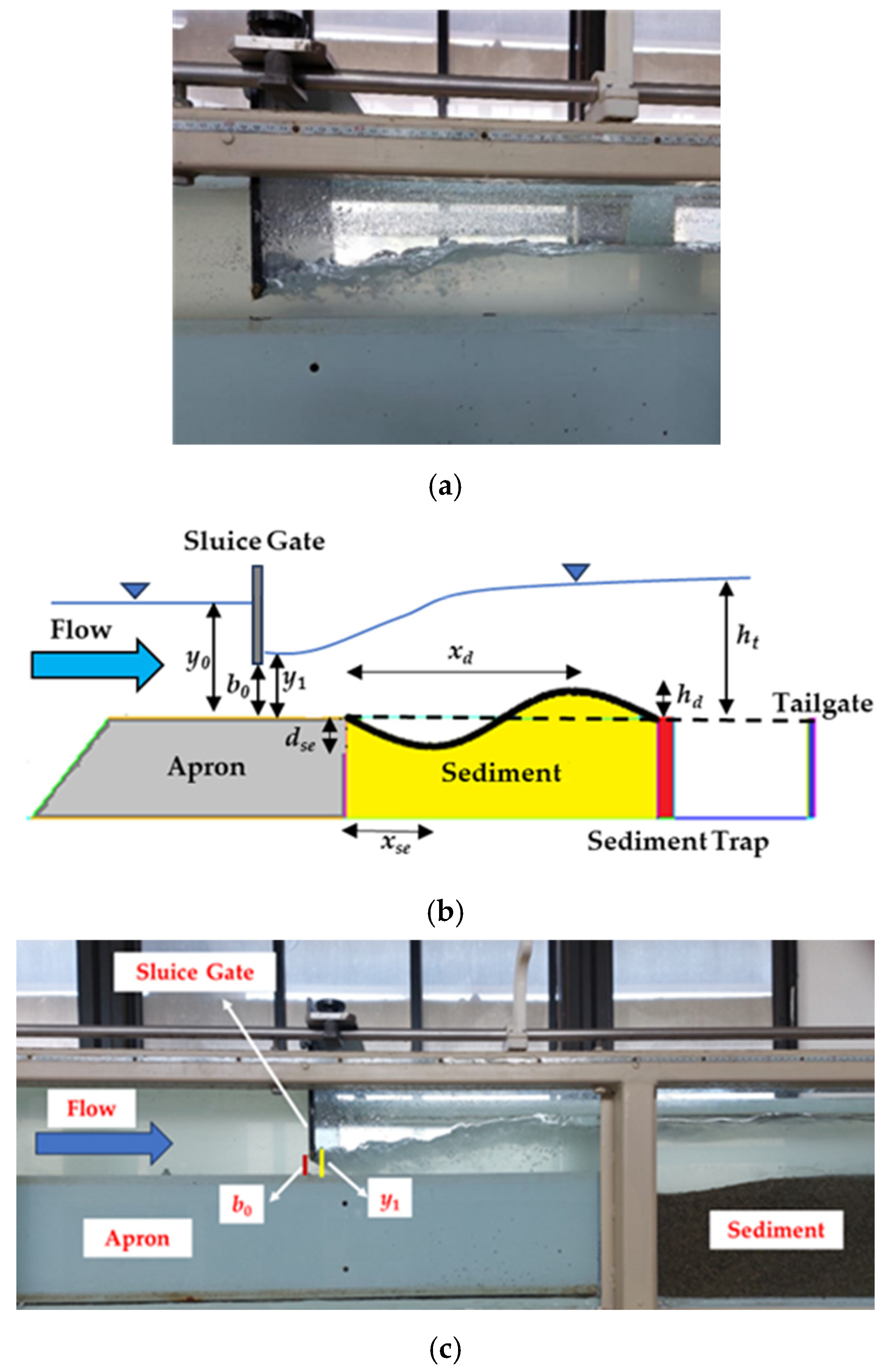
An evaluation of the latest studies concludes that, although the scour depths of cohesive sediments downstream of sluice gates were investigated, other scour parameters, especially dune characteristics, have not been evaluated. Furthermore, Equations (1) and (2) and Table 1 reveal a significant gap in considering all effective parameters for scour in cohesive sands, especially parameter c, which will be covered in the present study. Therefore, in this research, (I) the scour parameters downstream of the sluice gate were studied in cases with sand sediment and sand–clay mixture to investigate the influence of clay on the reduction in scour parameters with different weighting ratios of clay in the sand–clay mix, and (II) some novel prediction equations were proposed for both scour hole and dune parameters for cases of cohesive sediments with clay. The studied sedimentary parameters include the maximum depth of equilibrium scour holes (dse) and its longitudinal location from the sediment recess (xse), and the maximum dune height (hd) and its longitudinal location from the sediment recess (xd), which also provides prediction equations (Figure 1b). A metal gate with a thickness of 8 mm and a sharp-crested edge was used which could be adjusted to different openings from the rigid apron (Figure 1a). It can be observed from Figure 1c that after the gate was submerged, hydraulic jump occurs with a high-velocity jet that erodes the sand bed downstream. ht is the tailwater depth, and y0 and y1 are the flow depths exactly before and after the gate section, respectively.

2. Materials and Methods

2.1. Dimensional Analysis

Dimensional analysis has previously been applied in researchers’ experimental studies to determine the effective parameters on the profiles of scour holes downstream of bed stabilization structures and gates [4,5,12,36,37,38,39,40]. Effective parameters on the scouring phenomenon downstream of the sluice gate in sedimentary channels with a mixture of sand and clay can be expressed by Equation (3):
dse, xse, hd, xd = f (d50, b0, ht, ke, g, L, U, υ, c, ρs, ρw)
where dse is the maximum equilibrium scour depth in m; xse is the horizontal position of the bed stabilization structure where the scour has reached its maximum depth in m; d50 is the median sediment size, for which 50% of sampled particles are finer, in m; b0 is the gate opening in m; ht is the tailwater depth in m; ke is the height of apron roughness in m; g is the gravitational acceleration in m/s2; L is the apron length in m; U is the outlet velocity in m/s; c is the weight ratio of clay in the sand–clay mixtures; ν is the kinematic viscosity of water in m2/s; ρs is the sediment density in kg/m3; and ρw is the water density in kg/m3. b0 is a suitable parameter for scale length due to its significant physical influence on hydraulic parameters; for example, formation of the submerged jump depends on the ratio of ht/b0 [4]. Furthermore, b0 is a good choice for developing prediction equations for scour parameters as it was commonly used in previous equations. Applying dimensional analysis on the parameters of Equation (3) leads to dimensionless Equation (4):
dse/b0, xse/b0, hd/b0, xd/b0 = f (d50/b0, ht/b0, ke/b0, L/b0, Fr = U/√(gb0), Re = Ub0/υ, c, Gs = ρs/ρw)
Some terms in Equation (4) might be eliminated or merged with other parameters. Since U is relatively high in jets, the computed Reynolds number is much higher than a few thousand. Hence, the effect of viscosity could be negligible. ke/b0 might be ignored because the apron surface is relatively flat. It is possible to combine the Froude number of flow Fr and the specific gravity of sediment Gs and introduce the densimetric Froude number of Fd50. This parameter is significant in the investigation of scour phenomena [41,42,43]. Therefore, Equation (4) can be expressed as Equation (5):
dse/b0, xse/b0, hd/b0, xd/b0 = f (d50/b0, ht/b0, L/b0, c, Fd50 = U/(b0√(Gs − 1)·gd50))

2.2. Experimental Setup

The experimental tests were conducted in the flume of the hydraulic laboratory of Noshirvani University of Technology in Babol with a rectangular cross-section and a length of 10 m, a width of 0.3 m, and a height of 0.38 m with a variable slope from 0 to 0.04. It has glass sidewalls and a PVC bottom, in which the storage tank stores water and pumps it to the inlet of the flume. The outlet flow from the flume is stored in the downstream tank and returned to the upstream storage tank by the pipes and continues until the pump is turned on. The flow discharge in the channel is adjusted by a control valve located at the beginning of the flume, which is calculated by a flowmeter installed in the inlet pipe to the flume by reading the head of the piezometric pressure in the two sections of it. This flowmeter has been calibrated in previous studies like Mahdian Khalili and Hamidi [40,44]. The water entering the channel collects in the initial stilling box and flows slowly into the channel once it reaches the zero level. The slope of the channel is adjusted by the inclinometer arm installed at the end of it.
In irrigation channels, the bed slope varies between 0.0005 and 0.006. The channel slope was considered fixed in all tests with a value of 0.005. Important hydraulic parameters affecting scour characteristics include gate opening, outlet jet velocity, and tailwater depth. The desired hydraulic conditions were achieved by setting the outlet flow velocity through the gate by adjusting the gate opening and the flow depth and calculating the flow discharge. Through the set of experiments considered, hydraulic parameters and sediment particles were identified and are presented in Table 2 for each experimental test.
The flume height was 38 cm, the sedimentary recess height was 20 cm, its width was equal to the width of the flume, and its length was selected as 3 m to expand the scour hole and dune formation completely. Breusers and Raudkivi [45] defined a limit value of σg = 1.35 for non-uniform graded sediment size. According to this criterion, the median sediment size of the selected materials in the present study was σg = 1.25 for the uniformly graded size. Also, d50 was constant at 0.8 mm for the selected sand. The length of the apron after the gate opening was chosen as 50 cm based on the calculated submerged hydraulic jump length, which was about 0.5 m.
Installed structures in the channel included a sluice gate, protective apron, and sediment trap. In this study, three different values of 0.015, 0.02, and 0.025 m were considered for the gate opening. The protective structures were used before the erodible bed after the gate opening to protect the sediment bed, as mentioned before. In this study, the rigid apron (made from PVC) was 0.2 m thick and 2 m long, including 1.5 m before the gate and 0.5 m after it. To achieve fully developed turbulent flow: (i) the rectangular box at the beginning of the channel calmed the water, and the flow slowly entered the channel floor level; (ii) an apron started from 4 m after the beginning of the channel; (iii) the gate was installed 1.5 m from the beginning of the apron and 5.5 m from the channel start point. The recess was filled with soil, and at the end of the bed, an obstacle with the selected depth of the sediment bed was located to maintain and trap the sediments. The flume had a tailgate at the end to adjust the tailwater depth as well as trap soils. The layout of the experimental setup is presented in Figure 2.
Table 3 shows the characteristics of clay as a cohesive material used in the present study. When selecting the soil, CL (lean clay with a low liquid limit) or CH (fat clay with a high liquid limit) were the choices. The local common clay in the region, type CL with a low liquid limit (PI < 7), was used. In this table, Gs is the specific gravity of the sediment, LL is the liquid limit, PL is the plastic limit, and PI is the plastic index.
According to Table 2, three combination weights of 10, 20, and 30% of cohesive clay were used as sediment bed material combined with fine-grained sand. To prepare a sample of cohesive sediment, after measuring the weight of clay and dry sand, these materials were poured onto a plastic plate and thoroughly mixed by hand. The mixture was transferred to a plastic container and remixed to ensure that the coarse and fine particles were not separated. Since the amount of moisture is one of the most critical parameters in the amount of scouring, an attempt was made to keep the amount of moisture constant in each test. The value of water added was proportional to the amount of clay used and approximately equal to the volume of clay in each test; water was added to the sand and clay and the combination was remixed on a plastic plate. The prepared mixture was stored in a closed container for 12 h. This combination was slowly transported into the sediment box and the bed surface was smooth and the sediments were submerged for 12 h.
After setting the initial test conditions, i.e., installing the structures, adjusting the gate opening, filling the sedimentary recess, and flattening its surface, first, turn on the flume pump and open the flow control valve to allow water to enter the channel. The flow discharge in the channel is calculated using calibrated piezometers connected to the flow nozzle. Before the start of the scour time and after the water enters the channel, two hydraulic parameters, the outlet jet velocity of the gate and the tailwater depth, must be measured and adjusted. At this stage, the tailwater depth is adjusted by utilizing the end gate of the channel, and the depth of the water is measured with an accuracy of 1 mm, the same as the studies by Aamir et al. [27] and Khalili et al. [46].
The bed profiler of the flume is used to measure the scour depth at the equilibrium time. This device has a transverse and longitudinal accuracy of 5 mm in the transverse axis of the channel. The measurement accuracy of the depth is up to about 1 mm, and the output data is in the form of a text file. When the profiles overlap and their changes approach zero by plotting the bed scour evolution profiles, the scour equilibrium time is reached, and the test finishes.

2.3. Scale Effects

The Froude similitude is commonly applied to scale data of hydraulic models to prototypes in open-channel flows. In hydraulic models, the scale effect could influence the results of the prototype [47]. It occurs when the prototype parameters are not appropriately scaled and the force ratios are different in the model and prototype [48]. In the present study, the hydraulic models were performed based on a laboratory model with a constant width and height. Therefore, the scale effect has not been examined, and the results and proposed equation are only usable under hydraulic and geometric conditions with ranges of dimensionless parameters according to the experimental setup. When the aspect ratio (the flume width to the flow depth) is less than 4–5, it means narrow open channels, and an aspect ratio more than 5 represents wide open channels [49]. The flow depth at a gate opening (y1) is between 0.03 and 0.04 m, and the tailwater depth (ht) is 0.095 to 0.1 m. The computed aspect ratios for y1 are 7.5 to 10; however, they equal 3 to 3.16 for tailwater depth. Furthermore, ht/b0 ranges from 3.8 to 6.33.

2.4. Data Analysis Methods

Scour parameter prediction downstream of sluice gates is essential; hence, some studies applied some data analysis models to predict them [50,51,52,53]. In this study, after performing the experiments and deriving the dimensionless scour profiles of the sediment bed, dimensionless graphs of scouring characteristics were plotted to identify the influence of each effective parameter. The comparative effect of variable parameters was determined by the characteristics of the bed scour profile under different hydraulic conditions (velocity and gate opening), as shown in the dimensionless graphs for each experiment. The prediction equations can be determined, and the correlation coefficient of the equation was obtained based on Equation (6) by analyzing the data and fitting the experimental data.
R 2 = [ i = 1 n O i O a v e . P i P a v e . i = 1 n ( O i O a v e . ) i = 1 n ( P i P a v e . ) ] 2
where Oi is the observational values, Pi is the predicted values, Oave. is the average of the observed values, Pave. is the average of the predicted values and n is the number of data points [54]. When the R2 value is closer to 1, the fitting equation is more compatible with the experimental data, resulting in greater accuracy in predicting the scour profile characteristics. In the present research, nonlinear regression was utilized to fit the experimental data.
The statistical indicators of root mean square error (RMSE), mean absolute percentage error (MAPE), Nash–Sutcliffe efficiency (NSE), and scatter index (SI) were utilized to determine the accuracy of each prediction equation and were calculated from Equations (7), (8), (9) and (10), respectively [55,56,57,58,59].
R M S E = i = 1 N ( O i P i ) 2 N
M A P E = 100 N i = 1 N O i P i O i
N S E = 1 i = 1 N O i P i 2 i = 1 N O i O a v e . 2
SI = RMSE/O(ave.)

3. Results and Discussion

This section provides the detailed observed data of scour parameters and compares and confirms them. Finally, some prediction results are proposed to present the experimental results in a form applicable for practical purposes.

3.1. Equilibrium Time Evolution

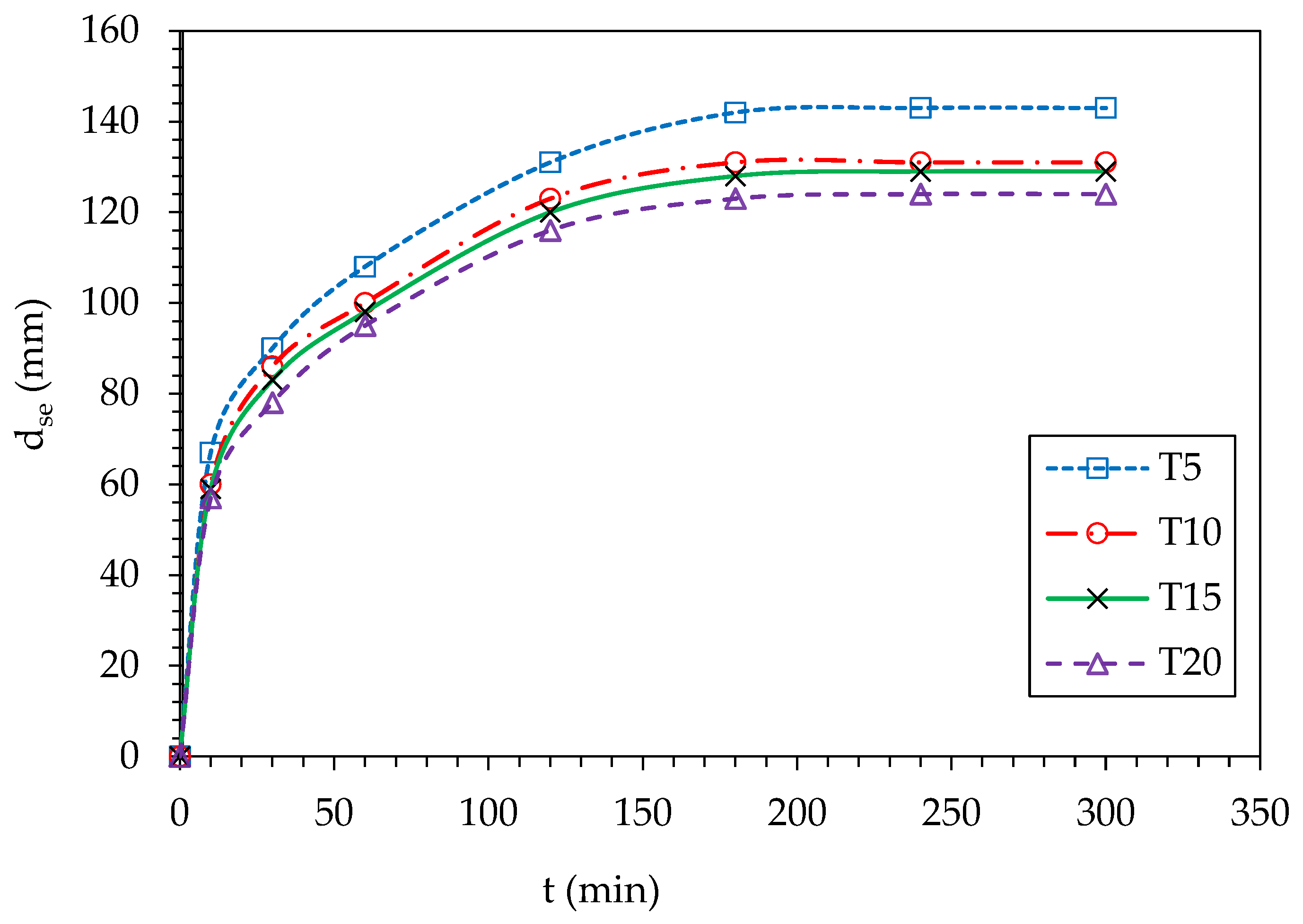
The scour time evolution profiles for long times were investigated by performing reference experiments for different hydraulic conditions. When the changes in scour values approached zero [45], the time that lasted from the beginning of the experiment to that point was selected as the final equilibrium time. This time was generalized to other experimental tests as a run time. For sand sediment (tests T5) and the mixture of sand and clay (tests T5, T10, and T15) in this study, 3 h was the equilibrium scour time as can be observed from Figure 3. The run times in similar studies by Dey and Westrich [30] and Shiva et al. [32] were 3 and 1 h, respectively.

3.2. Scour Depth Verification

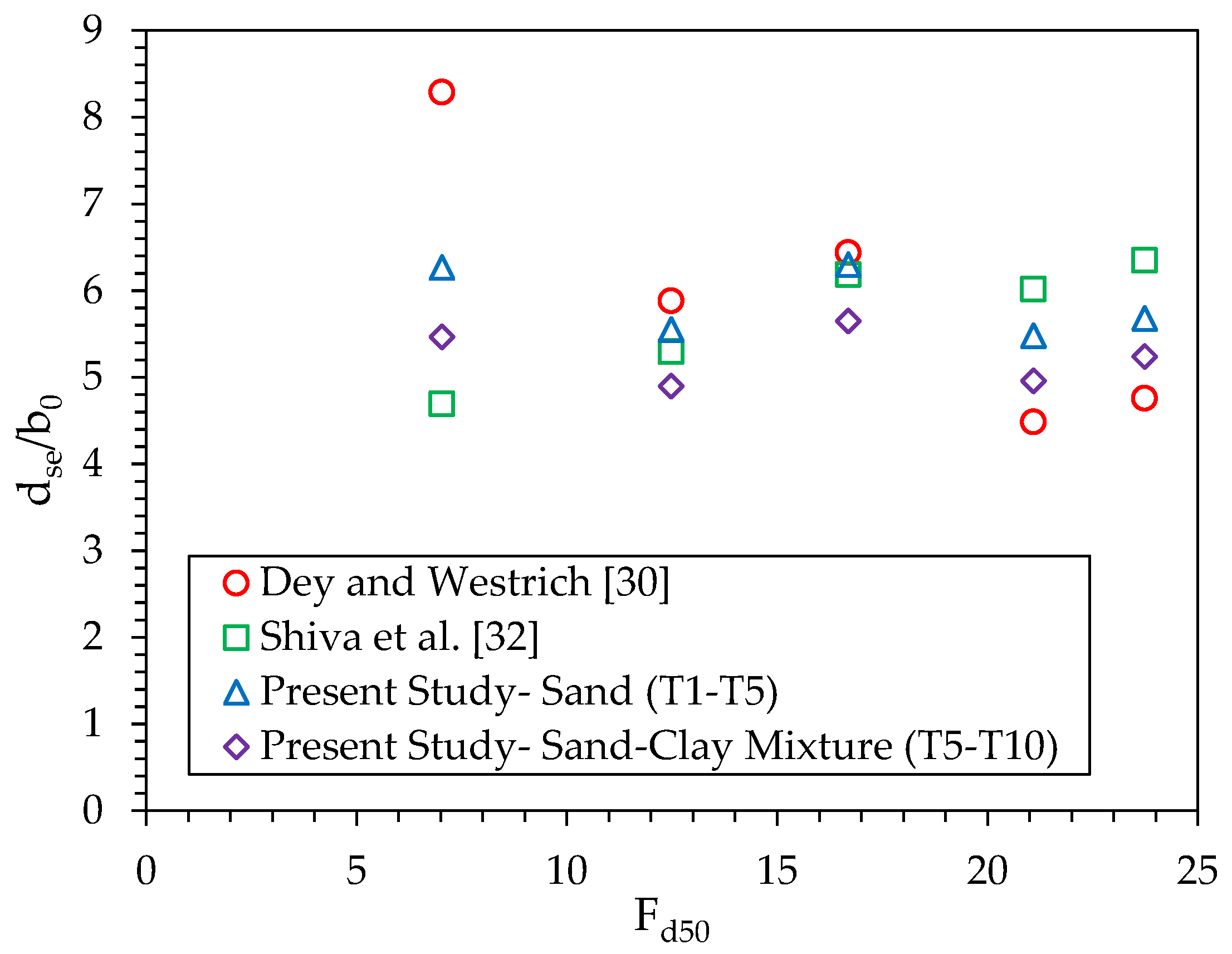
To confirm the experimental results, some comparisons were conducted for the maximum scour depth observed in tests and the relevant prediction equation. Hence, Figure 4 presents the comparisons of sand results, with an equation from the study of Dey and Westrich [30], and a mixture of sand and clay (c = 0.1) with the suggested equation in the study of Shiva et al. [32]. The variations calculated from Figure 4 revealed that in sand soil, the maximum scour depth in the present research ranged from 2.13 to 24.38% with an average error of 14.75% with predicted values. For a mixture of sand and clay, it is −16.49 to 17.58% with an average error value of 13.52%. The calculated relative errors in both cases of sand and mix of sand and clay present acceptable values for maximum scour depth in the experimental tests.

3.3. Scour Parameter Results

Table 4 is provided to present all measured values of the scour parameters in real and dimensionless formats, including the maximum depth of the equilibrium scour hole and its longitudinal distance from the sediment recess, and the maximum height of the dune and its horizontal distance from the sediment recess. Generally, it could be concluded that adding clay to sand reduces scour parameters, especially scour depth.

3.4. Effect of Cohesive Sediment on Reduction in Scour Parameters

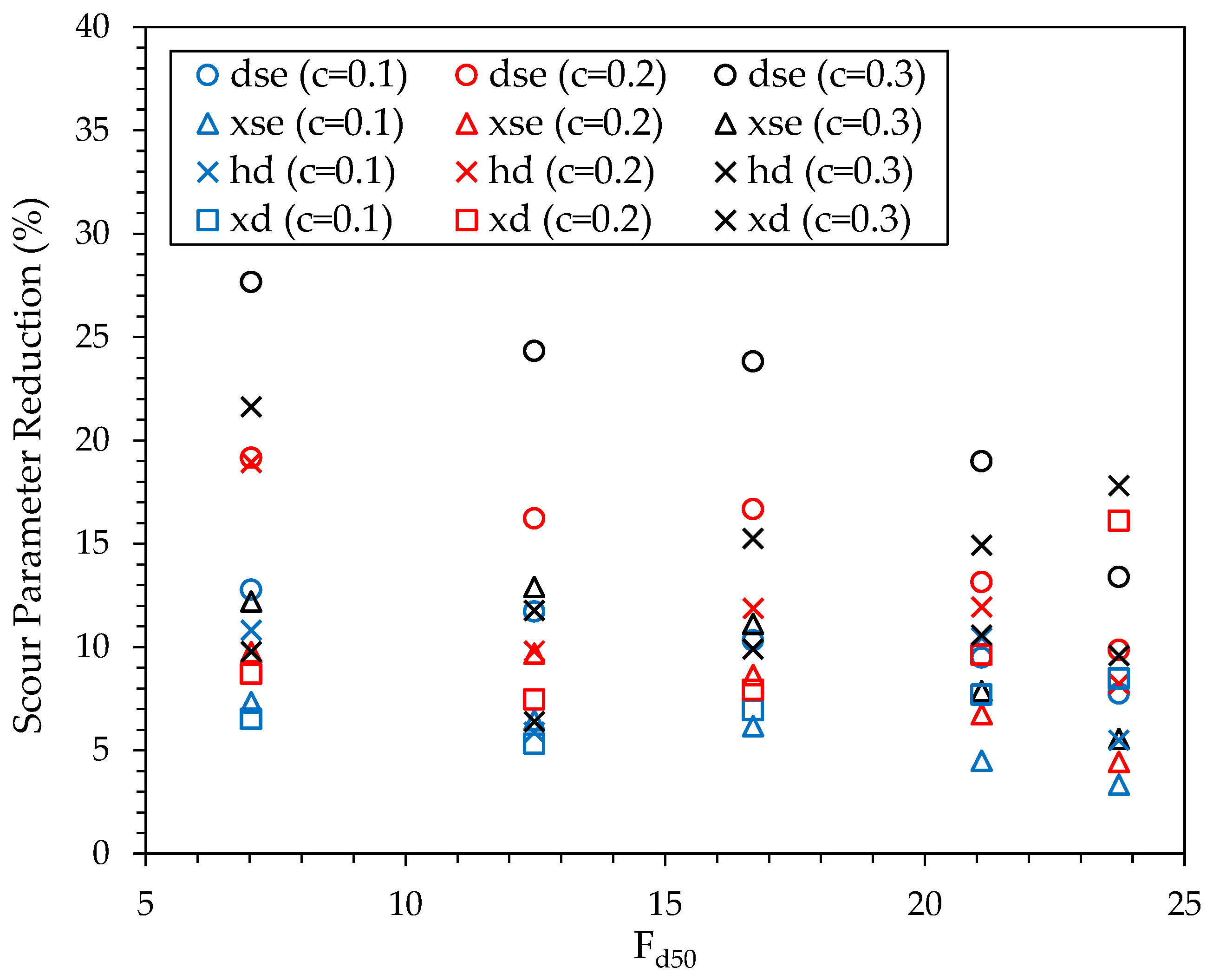
The exact values of the reduction in each scour parameter for defined cases were calculated compared to the same hydraulic conditions. Figure 5 presents the computed reduction values and reveals that dse/b0 has minimum, average, and maximum reductions of 7.75, 15.68, and 27.66%. These values are 3.33, 7.78, and 12.9% for xse/b0, respectively. Also, hd/b0 has minimum, average, and maximum reductions of 5.48, 11.89, and 21.62%, while they are 5.32, 9.28, and 17.8% for xd/b0, respectively. This decrease has physical reasons, including the addition of clay sediments, which increase sediment adhesion. The possibility of absorbing more moisture is provided by increasing the amount of clay, especially in the initial moments of the test when the flow was discharged. Furthermore, the scour rate is highly dependent on the texture of the bed clay and the internal forces of its particles. If the texture of the clay is flocculated, rupture begins from the loose parts of the texture, and erosion will be accompanied by flocculation and blocking, the same as that reported by Shiva et al. [32].

3.5. Proposing Prediction Equations for Scour Parameters

Based on dimensional analysis and finding the effective parameters on scour values downstream of sluice gates, the multiple nonlinear regression analysis was applied to propose empirical equations to predict the scour parameters. The following equations were provided using experimental observed data and could be used in both cases of sand sediment and a mixture of sand and clay with the defined weighting ratio (c).
Equation (11) presents the proposed equation for the dimensionless values for maximum scour depth (dse/b0):
d s e b 0 = 3.054 d 50 b 0 0.539 h t b 0 1.008 L b 0 1.046 F d 50 0.23 1 + c 0.917
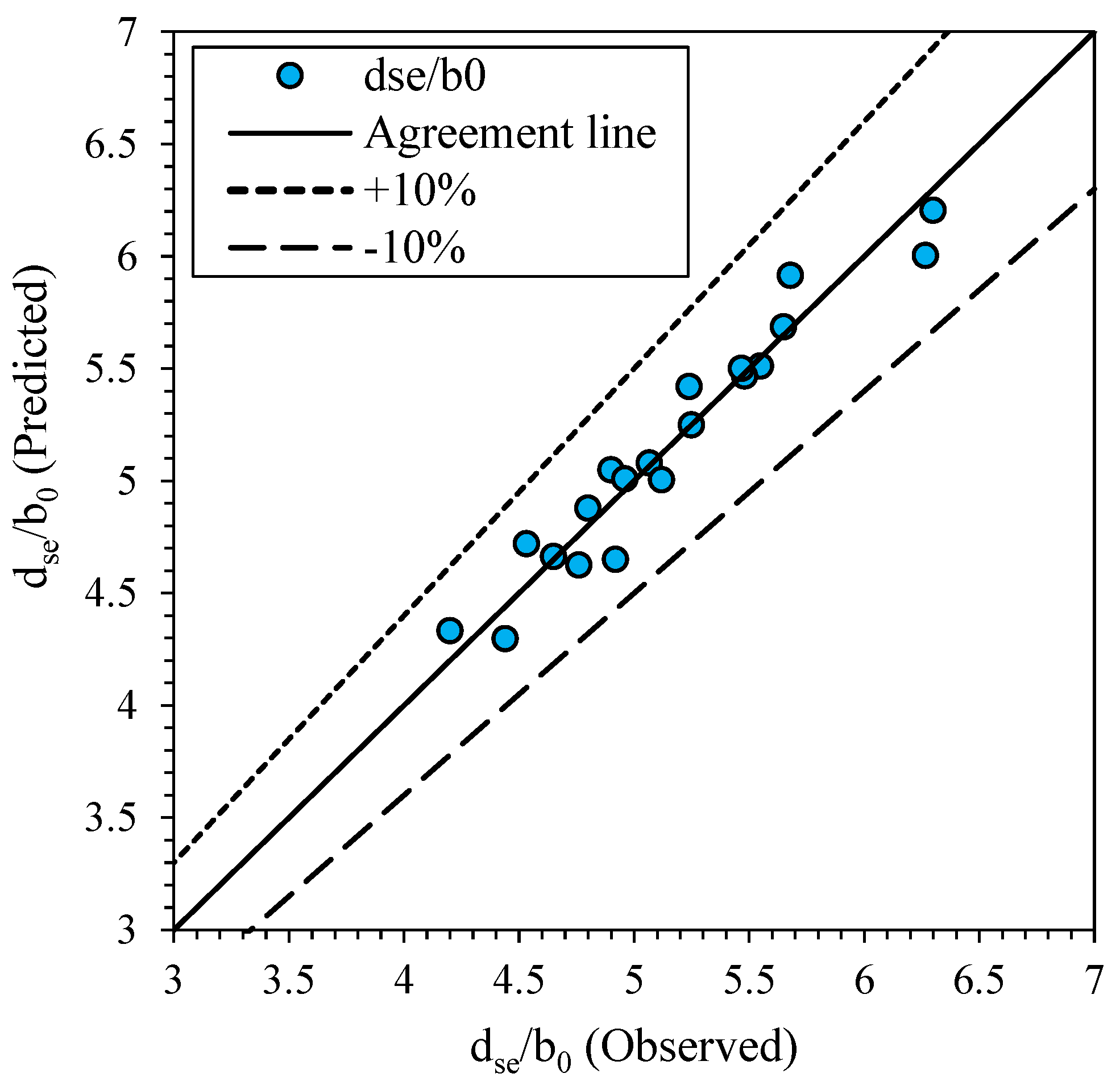
It was concluded that Equation (11) predicts dse/b0 with an accuracy of R2 = 0.9677, RMSE = 0.1375, MAPE = 2.137%, NSE = 0.936, and SI = 0.0266. Furthermore, the exponents of Equation (11) indicate that the apron length and median sediment size have the most significant direct effects on increasing scour depth, respectively. The tailwater depth and the weighting ratio of clay in the sediment mixture adversely affect the scour depth. Figure 6 presents the observed values of dse/b0 versus predicted values due to the calculated values in Equation (11) based on experimental data.
To predict the dimensionless values for the maximum scour depth longitudinal distance from the sediment recess (xse/b0), Equation (12) was provided:
x s e b 0 = 0.1472 d 50 b 0 0.3187 h t b 0 2.0186 L b 0 0.014 F d 50 1.2478 1 + c 0.0281
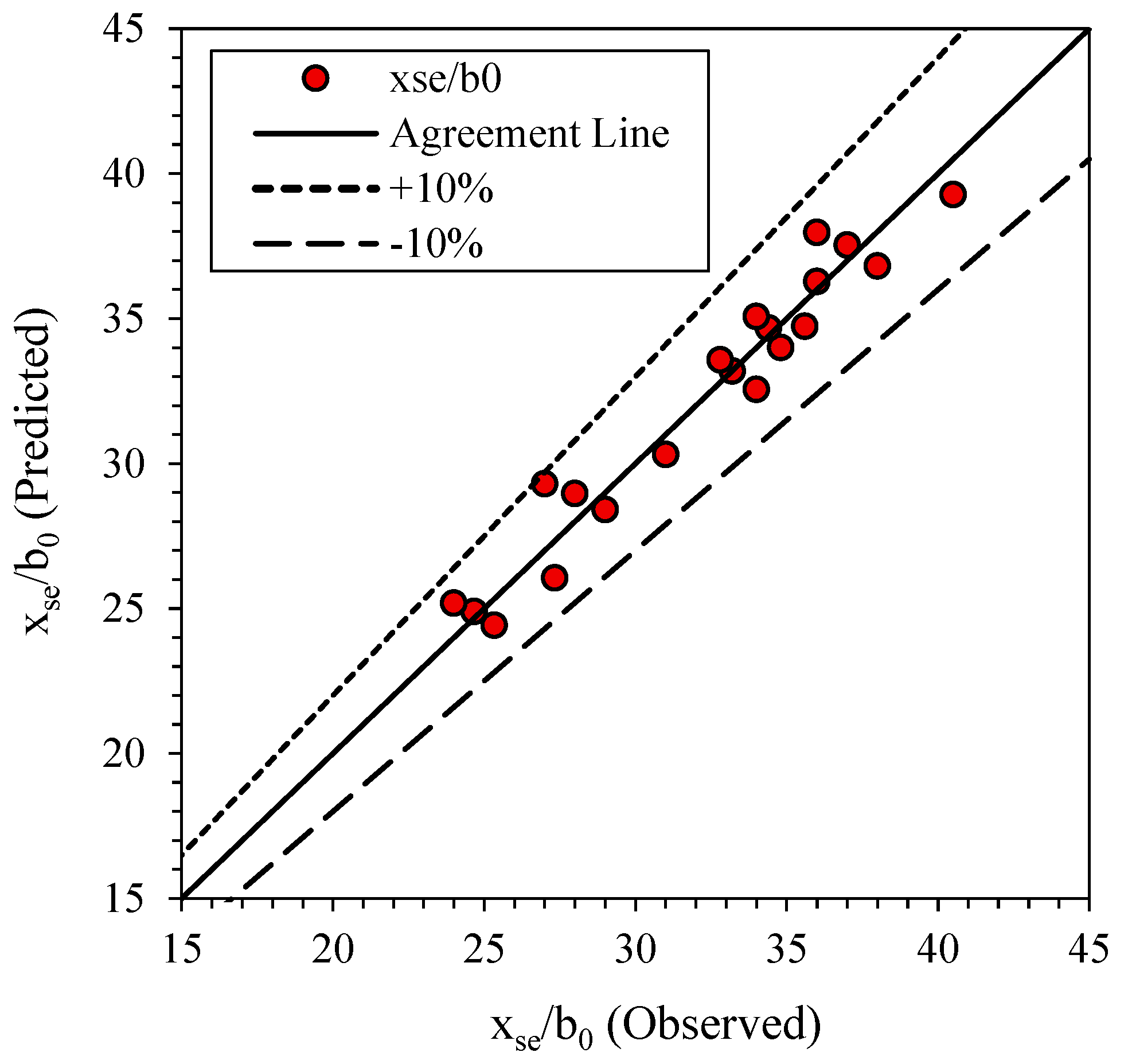
Equation (12) can predict xse/b0 with an accuracy of R2 = 0.9728, RMSE = 1.0825, MAPE = 2.98%, NSE = 0.946, and SI = 0.0337. It can be observed that the tailwater depth and densimetric Froude number have the most significant direct physical effect on maximum scour depth location. According to Equation (12), the influence of median sediment size (d50) is also valuable for xse/b0. Furthermore, apron length has a slight adverse influence on xse. Figure 7 shows the observed and predicted values of xse/b0 based on the computed values in Equation (12) using observed experimental data.
Equation (13) predicts the dimensionless values for maximum dune height (hd/b0) as follows:
h d b 0 = 4.8654 d 50 b 0 0.7092 h t b 0 0.575 L b 0 0.45 F d 50 0.4226 1 + c 0.0481
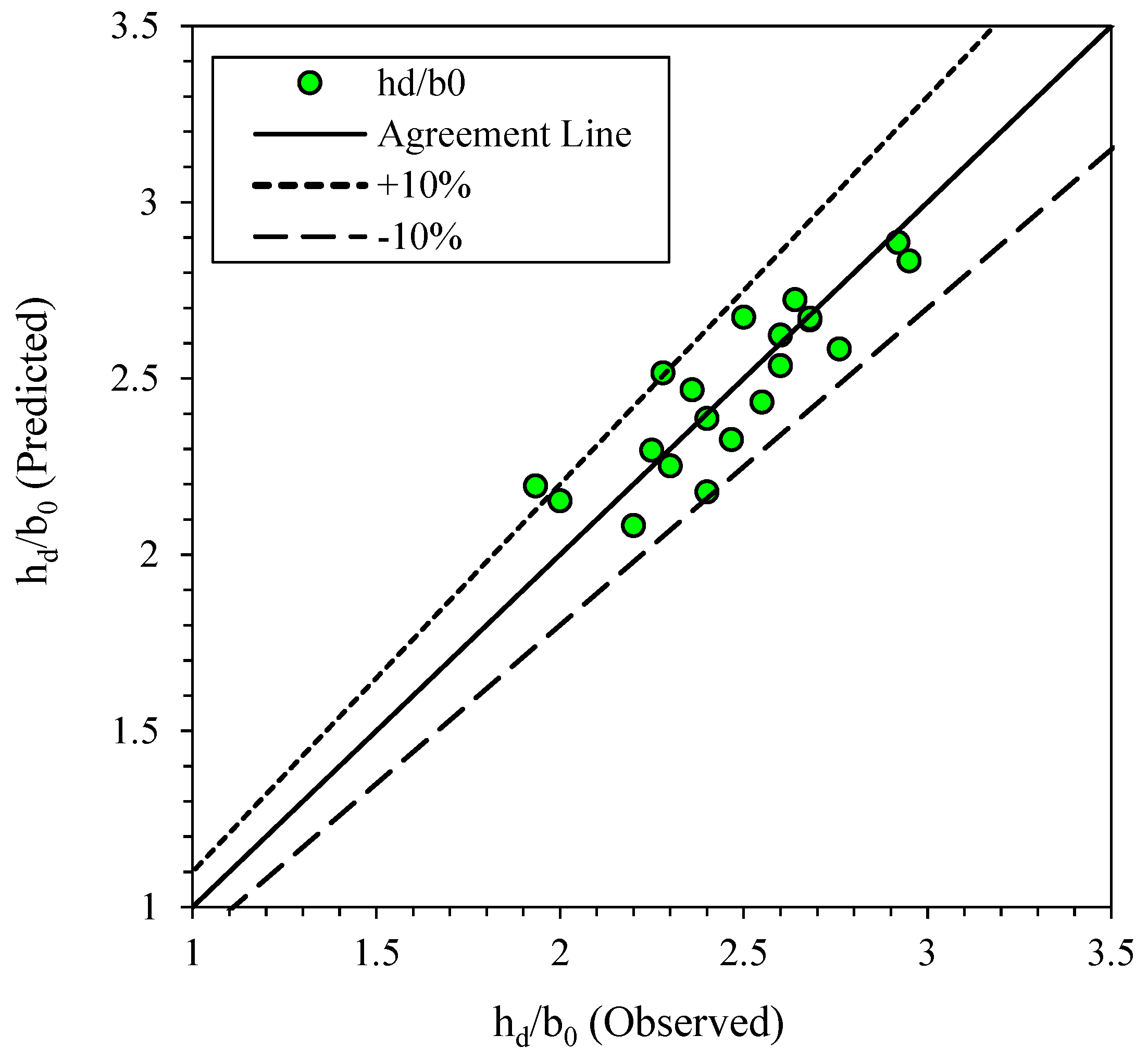
It was calculated that Equation (13) predicts hd/b0 with an accuracy of R2 = 0.8659, RMSE = 0.132, MAPE = 4.58%, NSE = 0.749, and SI = 0.0534. Equation (13) indicates that the median sediment size, apron length, and the densimetric Froude number have a significant direct effect on dune height values in physical models. Also, tailwater depth has an adverse influence on hd/b0. Figure 8 indicates the observed and predicted values of hd/b0 computed from Equation (13) and measured using experimental data.
Equation (14) was provided to calculate the dimensionless values for maximum dune height longitudinal distance from the sediment recess (xd/b0):
x d b 0 = 54.87 d 50 b 0 0.6092 h t b 0 1.894 L b 0 1.54 F d 50 0.1072 1 + c 0.0371
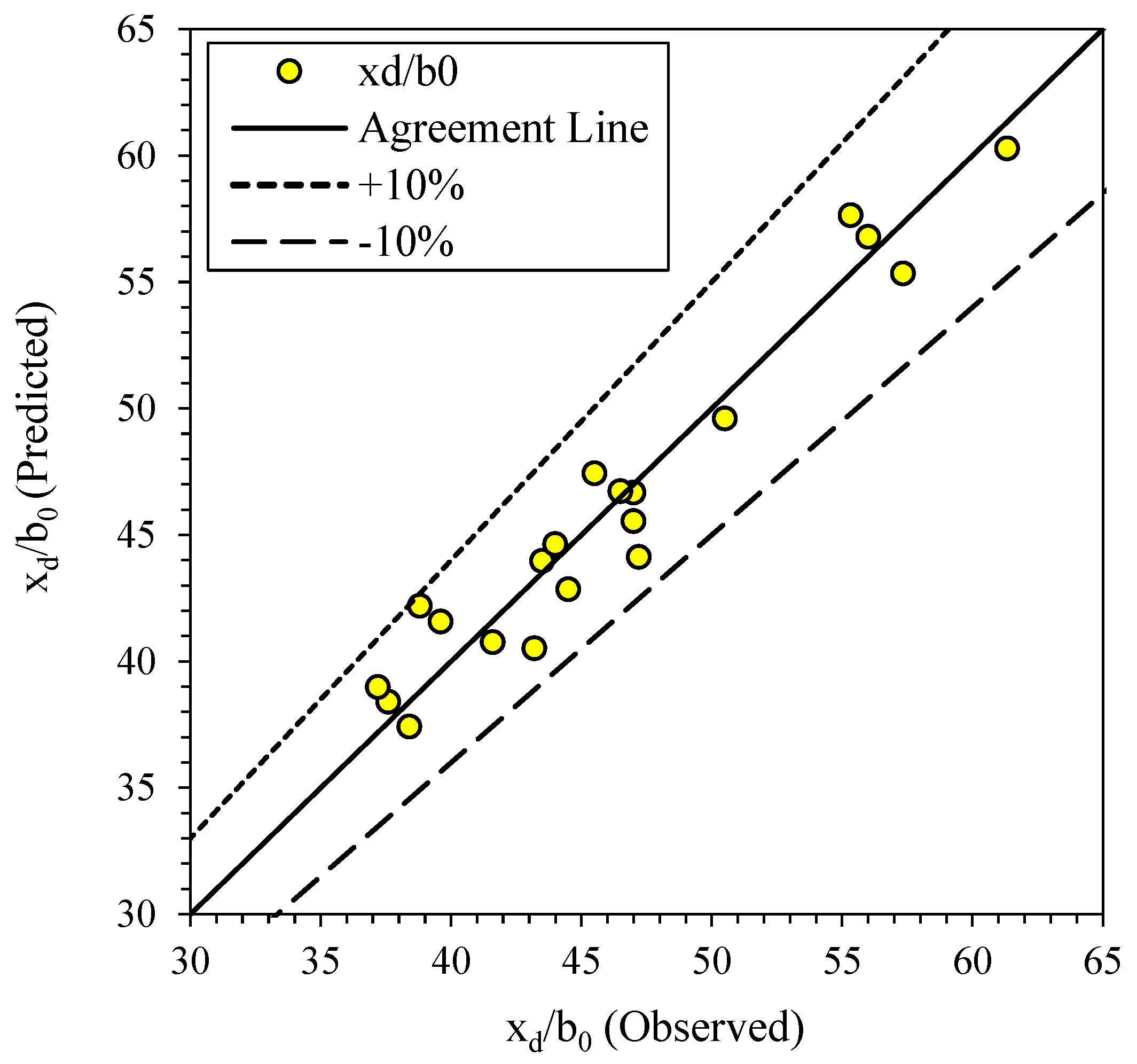
Equation (14) could predict xd/b0 with an accuracy of R2 = 0.9673, RMSE = 1.7141, MAPE = 3.26%, NSE = 0.936, and SI = 0.0372. It can be observed from Equation (14) that the apron length and median sediment size have the most significant influence on the location of the maximum dune height, respectively. In contrast, the tailwater depth has a substantial adverse effect on xd/b0. The comparison of observed values of xd/b0 with the predicted values computed from Equation (14) and obtained from the experimental data is presented in Figure 9.
The results and equations show that adding clay to sand reduces all scour parameters, including the maximum depth of the scour hole and its longitudinal distance from the beginning of the bed, and the dune height and its longitudinal distance from the beginning of the bed. On the other hand, this reduction in parameters is clearer with increasing clay weighting ratio. Also, analysis of the results by the proposed equations revealed the role of each hydraulic and sedimentary parameter in the physical model on the relevant scour parameter of the hole or dune for the parameter ranges used in the experiments.

4. Conclusions

The present study focused on the effect of adding cohesive soil (clay) to fine sand with three weighting ratios of clay in the sand–clay mixtures (c) to evaluate the reduction in scour parameters downstream of sluice gates equipped with an apron. The experimental tests were performed, and real and dimensionless values of scour parameters, which included maximum scour depth (dse) and its location from the sediment recess (xse), and maximum dune height (hd) and its longitudinal location (xd), were measured and compared. To enhance the application of the findings, multiple nonlinear regression analyses and statistical parameters were used to develop prediction equations for the mentioned scour parameters. The summary of the findings will be discussed in the following text.
The comparisons for the dse values measured in the tests and computed from the study of Dey and Westrich [30] for sand soil indicated that dse in the present study was 2.13 to 24.38% with average errors of 14.75% with predicted values. For a mixture of sand and clay (c = 0.1), dse was 16.49 to 17.58% with the average error value of 13.52% with the proposed equation in the study of Shiva et al. [32]. The calculated relative errors in both cases of sand and mix of sand and clay show an acceptable range for dse values.
The observed results revealed that dse/b0 has minimum, average, and maximum reductions of 7.75, 15.68, and 27.66%. xse/b0 has minimum, average, and maximum reductions of 3.33, 7.78, and 12.9%. Furthermore, hd/b0 has minimum, average, and maximum reductions of 5.48, 11.89, and 21.62%, while they are 5.32, 9.28, and 17.8% for xd/b0, respectively.
The proposed equation can predict dse/b0 with an accuracy of R2 = 0.9677, RMSE = 0.1375, MAPE = 2.137%, NSE = 0.936, and SI = 0.0266. The suggested equation for xse/b0 has an accuracy of R2 = 0.9728, RMSE = 1.0825, MAPE = 2.98%, NSE = 0.946, and SI = 0.0337. The values of hd/b0 can be predicted with an accuracy of R2 = 0.8659, RMSE = 0.132, MAPE = 4.58%, NSE = 0.749, and SI = 0.0534 by the proposed equation. The suggested equation can predict xd/b0 with an accuracy of R2 = 0.9673, RMSE = 1.7141, MAPE = 3.26%, NSE = 0.936, and SI = 0.0372. The calculated values demonstrated that the suggested prediction equations are accurate in experimental models with the limited tested ranges of hydraulic conditions, sediment properties, and clay weight ratios applied in the present study. The objectives of this research, its methodology, and its findings are a good contribution to laboratory work and especially field and practical studies in the study of clay and cohesive materials in scour phenomena and hydraulic models.
Future studies could investigate other strategies for reducing scour parameters downstream of sluice gates in experimental models and compare them with the present findings. Furthermore, due to the limited number of data points, numerical models could be applied to enhance the accuracy of scour depth prediction with other values for a mixture of sand and clay.

Author Contributions

Conceptualization, A.M.K. and M.H.; methodology, A.M.K. and M.H.; software, A.M.K.; validation, A.M.K.; formal analysis, A.M.K. and M.H.; investigation, A.M.K. and M.H.; resources, A.M.K.; data curation, A.M.K.; writing—original draft preparation, A.M.K.; writing—review and editing, A.M.K. and M.H.; visualization, A.M.K.; supervision, M.H.; project administration, A.M.K. All authors have read and agreed to the published version of the manuscript.

Funding

This research received no external funding.

Data Availability Statement

The data presented in this study are available on request from the corresponding author.

Conflicts of Interest

The authors declare no conflicts of interest.

References

  1. Sharafati, A.; Tafarojnoruz, A.; Shourian, M.; Mundher, Z.Y. Simulation of the Depth Scouring Downstream Sluice Gate: The Validation of Newly Developed Data-intelligent Models. J. Hydro-Environ. Res. 2020, 29, 20–30. [Google Scholar] [CrossRef]
  2. Espa, P.; Sibilla, S. Experimental Study of the Scour Regimes Downstream of an Apron for Intermediate Tailwater Depth Conditions. J. Appl. Fluid Mech. 2014, 7, 611–624. [Google Scholar] [CrossRef]
  3. Balachandar, R.; Kells, J.A.; Thiessen, R.J. The effect of tailwater depth on the dynamics of local scour. Can. J. Civ. Eng. 2000, 27, 138–150. [Google Scholar] [CrossRef]
  4. Lim, S.Y.; Yu, G. Scouring Downstream of Sluice Gate. In Proceedings of the First International Conference on Scour of Foundations, ICSF-1, College Station, TX, USA, 17–20 November 2002; pp. 17–20. [Google Scholar]
  5. Xie, C.H.; Lim, S.Y. Effects of Jet Flipping on Local Scour Downstream of a Sluice Gate. J. Hydraul. Eng. 2015, 144, 04014088. [Google Scholar] [CrossRef]
  6. Goel, A. Scour Investigations Behind a Vertical Sluice Gate without Apron. Pac. J. Sci. Technol. 2010, 11, 59–65. [Google Scholar]
  7. Farhoudi, J.; Khalili, H.K. Investigation on Local Scour Downstream of Adverse Stilling Basins. Ain Shams Eng. J. 2014, 5, 361–375. [Google Scholar] [CrossRef]
  8. Nik Hassan, N.M.K.; Narayanan, R. Local Scour Downstream of an Apron. J. Hydraul. Eng. 1985, 111, 1371–1384. [Google Scholar] [CrossRef]
  9. Hamidifar, H.; Omid, M.H.; Nasrabadi, M. Scour Downstream of a Rough Rigid Apron. World Appl. Sci. J. 2011, 14, 1169–1178. [Google Scholar]
  10. Kells, J.A.; Balachandar, R.; Hagel, K.P. Effect of Grain Size on Local Channel Scour Below a Sluice Gate. Can. J. Civ. Eng. 2001, 28, 440–451. [Google Scholar] [CrossRef]
  11. Dey, S.; Sarkar, M. Scour Downstream of an Apron Due to Submerged Horizontal Jets. J. Hydraul. Eng. 2006, 132, 246–257. [Google Scholar] [CrossRef]
  12. Dey, S.; Sarkar, A. Effect of Upward Seepage on Scour and Flow Downstream of an Apron due to Submerged Jets. J. Hydraul. Eng. 2007, 133, 59–69. [Google Scholar] [CrossRef]
  13. Ali, K.M.M.; Lim, S.Y. Local Scour Caused by Submerged Wall Jets. Proc. Inst. Civ. Eng. 1986, 81, 607–645. [Google Scholar] [CrossRef]
  14. Dey, S.; Sarkar, A. Response of Velocity and Turbulence in Submerged Wall Jets to Abrupt Changes from Smooth to Rough Beds and Its Application to Scour Downstream of an Apron. J. Fluid Mech. 2006, 556, 387–419. [Google Scholar] [CrossRef]
  15. Ali, H.M.; El-Gendy, M.M.; Mirdan, A.M.; Ali, A.M.; Abdelhaleem, F.S. Minimizing Downstream Scour due to Submerged Hydraulic Jump Using Corrugated Aprons. Ain Shams Eng. J. 2014, 5, 1059–1069. [Google Scholar] [CrossRef]
  16. Hamidifar, H.; Nasrabadi, M.; Mirdan, A.M.; Omid, M.H. Using a Bed Sill as a Scour Countermeasure Downstream of an Apron. Ain Shams Eng. J. 2017, 9, 1663–1669. [Google Scholar] [CrossRef]
  17. Hamidifar, H.; Omid, M.H.; Nasrabadi, M. Reduction of Scour Using a Combination of Riprap and Bed Sill. Water Manag. 2018, 171, 264–270. [Google Scholar] [CrossRef]
  18. Rajaratnam, N.; Aderibigbe, O. A Method for Reducing Scour Below Vertical Gates. Water Marit. Energy 1993, 101, 73–83. [Google Scholar] [CrossRef]
  19. Elshahat, E.M.; AbdelAal, G.M.; EL-Saiad, A.A.; Tantawy, R.F. Reducing the maximum scour depth downstream of the sluice gate using a combination of two buried plates with a sill. ISH J. Hydraul. Eng. 2024, 30, 196–204. [Google Scholar] [CrossRef]
  20. Mahmoudi, B.; Hemmati, M.; Yasi, M.; Ahmad Hamidi, S. Experimental Study of the Time Scale for Local Scour Downstream of Parallel Sluice Gates. J. Irrig. Drain. Eng. 2023, 149, 06023004. [Google Scholar] [CrossRef]
  21. Yoosefdoost, A.; Lubitz, W.D. Sluice Gate Design and Calibration: Simplified Models to Distinguish Flow Conditions and Estimate Discharge Coefficient and Flow Rate. Water 2022, 14, 1215. [Google Scholar] [CrossRef]
  22. Guguloth, S.; Pandey, M. Accuracy evaluation of scour depth equations under the submerged vertical jet. AQUA—Water Infrastruct. Ecosyst. Soc. 2023, 72, 557–575. [Google Scholar] [CrossRef]
  23. Guguloth, S.; Pandey, M.; Pal, M. Application of hybrid AI models for accurate prediction of scour depths under submerged circular vertical jet. J. Hydrol. Eng. 2024, 29, 04024010. [Google Scholar] [CrossRef]
  24. Wang, Y.; Wang, Y.; Zhang, J.; Hu, J.; Duan, Z.; Zhang, Q. Prediction of Scouring Hole Morphology Induced by Underwater Jets Using CFD–DEM Simulation. Water 2025, 17, 2163. [Google Scholar] [CrossRef]
  25. Wang, H.; Jia, X.; Wang, C.; Hu, B.; Cao, W.; Li, S.; Wang, H. Study on the Sand-Scouring Characteristics of Pulsed Submerged Jets Based on Experiments and Numerical Methods. J. Mar. Sci. Eng. 2024, 12, 57. [Google Scholar] [CrossRef]
  26. Wang, C.; Jia, X.; Peng, Y.; Gao, Z.; Yu, H. Transient Sand Scour Dynamics Induced by Pulsed Submerged Water Jets: Simulation Analysis. J. Mar. Sci. Eng. 2024, 12, 2041. [Google Scholar] [CrossRef]
  27. Aamir, M.; Ahmad, Z.; Pandey, M.; Khan, M.A.; Aldrees, A.; Mohamed, A. The effect of rough rigid apron on scour downstream of sluice gates. Water 2022, 14, 2223. [Google Scholar] [CrossRef]
  28. Akbari, I.; Hemmati, M.; Choi, S.U.; Ramezani, Y.; Mahmoudi, B. Effect of bed roughness shape on mitigating scour the downstream of parallel sluice gates. J. Hydraul. Struct. 2025, 12, 220–238. [Google Scholar] [CrossRef]
  29. Mazurek, K.A.; Rajaratnam, N.; Sego, D.C. Scour of Cohesive Soil by Submerged Circular Turbulent Impinging Jets. J. Hydraul. Eng. 2001, 127, 598–606. [Google Scholar] [CrossRef]
  30. Dey, S.; Westrich, B. Hydraulics of Submerged Jet Subject to Change in Cohesive Bed Geometry. J. Hydraul. Eng. 2003, 129, 44–53. [Google Scholar] [CrossRef]
  31. Hamidifar, H.; Omid, M.H. Scour of Cohesive Material Downstream of an Apron due to Submerged Horizontal Jets. J. Hydraul. 2011, 5, 1–12. [Google Scholar] [CrossRef]
  32. Shiva, F.; Attari, J.; Saneie, M. Prediction of scour profile in cohesive beds downstream of vertical sluice gates. Watershed Eng. Manag. 2015, 7, 240–254. [Google Scholar] [CrossRef]
  33. Mohamadi Khanaposhtani, F.; Saneie, M.; Karbasi, M. Experimental Study on the effect of Percent of Bentonite on the Scour hole rate in downstream of gate. J. Water Soil Conserv. 2016, 23, 281–294. [Google Scholar] [CrossRef]
  34. Divya, T.; Sarkar, A.; Kuiry, S.N. Local Scour Near Sluice Gate in Clay–Sand Mixtures. In Fluid Mechanics and Hydraulics; Springer Nature: Singapore, 2021; pp. 63–73. [Google Scholar] [CrossRef]
  35. Ibrahim, M.M.; Helmy, A.; Alafrawi, M.A.; El-Hazek, A.N. Using nanomaterial to minimize the local scour downstream of sluice gate. Alex. Eng. J. 2022, 61, 3201–3214. [Google Scholar] [CrossRef]
  36. Oliveto, G.; Comuniello, V.; Bulbule, T. Time-dependent local scour downstream of positive-step stilling basins. J. Hydraul. Res. 2011, 49, 105–112. [Google Scholar] [CrossRef]
  37. D’Agostino, V.; Ferro, V. Scour on Alluvial Bed Downstream of Grade-Control Structures. J. Hydraul. Eng. 2004, 130, 24–37. [Google Scholar] [CrossRef]
  38. Adduce, C.; Scortino, G. Scour Due to a Horizontal Turbulent Jet Numerical and Experimental Investigation. J. Hydraul. Res. 2006, 44, 663–673. [Google Scholar] [CrossRef]
  39. Ben Meftah, M.; Mossa, M. New Approach to Predicting Local Scour Downstream of Grade-Control Structure. J. Hydraul. Eng. 2020, 146, 04019058. [Google Scholar] [CrossRef]
  40. Mahdian Khalili, A.; Hamidi, M. Modified prediction equations for scour parameters downstream of sluice gates considering nonuniform sediment. Acta Geophys. 2026, 74, 19. [Google Scholar] [CrossRef]
  41. Oliveto, G.; Hager, W.H. Temporal evolution of clear-water pier and abutment scour. J. Hydraul. Eng. 2002, 128, 811–820. [Google Scholar] [CrossRef]
  42. Oliveto, G.; Hager, W.H. Morphological evolution of dune-like bed forms generated by bridge scour. J. Hydraul. Eng. 2014, 140, 06014009. [Google Scholar] [CrossRef]
  43. Mahdian Khalili, A.; Akbari Dadamahalleh, P.; Hamidi, M. Experimental evaluation of dune formation downstream of pier scour hole with upstream debris accumulation. J. Hydraul. Struct. 2024, 10, 13–28. [Google Scholar] [CrossRef]
  44. Mahdian Khalili, A.; Hamidi, M. Time evolution effect on the scour characteristics downstream of the sluice gate with the submerged hydraulic jump in a laboratory model. J. Hydraul. Struct. 2023, 9, 32–47. [Google Scholar] [CrossRef]
  45. Breusers, H.N.C.; Raudkivi, A.J. Scouring. In Hydraulic Structures Design Manual, 1st ed.; Taylor & Francis Group: Milton Park, UK, 1991. [Google Scholar]
  46. Khalili, A.M.; Hamidi, M.; Dadamahalleh, P.A. Scour morphology around the bridge pier with upstream rectangular debris. In Proceedings of the 22nd Iranian Conference on Hydraulics, Maragheh, Iran, 8–9 November 2023; University of Maragheh: Maragheh, Iran, 2023. [Google Scholar]
  47. Daneshfaraz, R.; Norouzi, R.; Ebadzadeh, P.; Di Francesco, S.; Abraham, J.P. Experimental study of geometric shape and size of sill effects on the hydraulic performance of sluice gates. Water 2023, 15, 314. [Google Scholar] [CrossRef]
  48. Heller, V. Scale effects in physical hydraulic engineering models. J. Hydraul. Res. 2011, 49, 293–306. [Google Scholar] [CrossRef]
  49. Auel, C.; Albayrak, I.; Boes, R.M. Turbulence characteristics in supercritical open channel flows: Effects of Froude number and aspect ratio. J. Hydraul. Eng. 2014, 140, 04014004. [Google Scholar] [CrossRef]
  50. Guven, A.; Gunal, M. Prediction of Scour Downstream of Grade-Control Structures Using Neural Networks. J. Hydraul. Eng. 2008, 134, 1656–1660. [Google Scholar] [CrossRef]
  51. Yousif, A.A.; Sulaiman, S.O.; Diop, L.; Ehteram, M.; Shahid, S.; Al-Ansari, N.; Yaseen, Z.M. Open Channel Sluice Gate Scouring Parameters Prediction: Different Scenarios of Dimensional and Non-Dimensional Input Parameters. Water 2019, 11, 353. [Google Scholar] [CrossRef]
  52. Mostaani, A.; Azimi, A.H. Analytical approach for predicting local scour downstream of submerged sluice gate with an apron. Int. J. Sediment Res. 2022, 37, 522–537. [Google Scholar] [CrossRef]
  53. Le, X.H. Integrating machine learning and empirical approaches for scour depth estimation at sluice gates: Evaluating tree-based models, hyperparameter tuning, and proposing new formulas. J. Hydrol. Hydromech. 2025, 73, 51–64. [Google Scholar] [CrossRef]
  54. Sohrabzadeh Anzani, H.; Kantoush, S.A.; Mahdian Khalili, A.; Hamidi, M. Energy Dissipation Assessment in Flow Downstream of Rectangular Sharp-Crested Weirs. Water 2024, 16, 3371. [Google Scholar] [CrossRef]
  55. Riahi-Madvar, H.; Majid Dehghani, M.; Seifi, A.; Salwana, E.; Shamshirband, S.H.; Mosavi, A.; Chau, K.W. Comparative Analysis of Soft Computing Techniques RBF, MLP, and ANFIS with MLR and MNLR for Predicting Grade-control Scour Hole Geometry. Eng. Appl. Comput. Fluid Mech. 2019, 13, 529–550. [Google Scholar] [CrossRef]
  56. Pandey, M.; Oliveto, G.; Pu, J.H.; Sharma, P.K.; Ojha, C.S.P. Pier Scour Prediction in Non-Uniform Gravel Beds. Water 2020, 12, 1696. [Google Scholar] [CrossRef]
  57. Mahdian Khalili, A.; Sohrabzadeh Anzani, H.; Hamidi, M.; Kantoush, S.A. Experimental Study on Influence of Height of Full-Width Plate Weirs on Flow Behavior, Discharge, and Energy Dissipation. Hydrology 2025, 12, 176. [Google Scholar] [CrossRef]
  58. Sohrabzadeh Anzani, H.; Kantoush, S.A.; Mahdian Khalili, A.; Hamidi, M. Experimental investigation of slit weir discharge. ISH J. Hydraul. Eng. 2024, 30, 645–654. [Google Scholar] [CrossRef]
  59. Sohrabzadeh Anzani, H.; Kantoush, S.A.; Mahdian Khalili, A.; Hamidi, M. Experimental and analytical investigation of energy loss in low-discharge weirs with rectangular opening. Model. Earth Syst. Environ. 2025, 11, 418. [Google Scholar] [CrossRef]
Figure 1. Submerged flow conditions at a sluice gate: (a) sluice gate edge; (b) schematic definition of the main local bed morphological characteristics; (c) experimental model.
Infrastructures 11 00059 g001
Figure 2. Layout of the experimental setup.
Infrastructures 11 00059 g002
Figure 3. Equilibrium time evolution profile of scour depth for sand sediment and sand and clay mixture.
Infrastructures 11 00059 g003
Figure 4. Comparison of the maximum scour depths observed in the present study with the predicted values from the equations by Dey and Westrich [30] and Shiva et al. [32].
Infrastructures 11 00059 g004
Figure 5. Reduction rate of scour parameters with Fd50 variations.
Infrastructures 11 00059 g005
Figure 6. Comparison of observed and predicted values of dse/b0 for the prediction equation.
Infrastructures 11 00059 g006
Figure 7. Comparison of observed and predicted values of xse/b0 for the prediction equation.
Infrastructures 11 00059 g007
Figure 8. Comparison of observed and predicted values of hd/b0 for the prediction equation.
Infrastructures 11 00059 g008
Figure 9. Comparison of measured and predicted values of xd/b0 for the prediction equation.
Infrastructures 11 00059 g009
Table 1. The range of effective parameters in previous studies on cohesive materials downstream of a sluice gate.
StudyL (m)b0 (m)ht (m)d50 (mm)Fd50σgc
Dey and Westrich [30]0.3–0.50.02–0.040.12–0.1321–5---
Hamidifar and Omid [31]10.02-0.73-1.12-
Shiva et al. [32]-0.02–0.040.07–0.190.353.69–9.51-0–0.2
Mohamadi et al. [33]-0.01–0.040.05–0.210.21-0.80.02–0.2
Table 2. Experimental setup.
Test NumberSoil typeQ (m3/s)t (h)b0 (m)U (m/s)ht (m)y0 (m)y1 (m)d50 (mm)Fd50c
T1Sand0.002330.0150.80.0950.320.030.87.03-
T20.002530.021.420.1000.340.040.812.48-
T30.003130.021.90.0950.350.030.816.69-
T40.002730.0252.40.1000.340.0350.821.09-
T50.003130.0252.70.1000.350.0320.823.73-
T6Mix of Sand and Clay0.002330.0150.80.0950.320.030.87.030.1
T70.002530.021.420.1000.340.040.812.480.1
T80.003130.021.90.0950.350.030.816.690.1
T90.002730.0252.40.1000.340.0350.821.090.1
T100.003130.0252.70.1000.350.0320.823.730.1
T110.002330.0150.80.0950.320.030.87.030.2
T120.002530.021.420.1000.340.040.812.480.2
T130.003130.021.90.0950.350.030.816.690.2
T140.002730.0252.40.1000.340.0350.821.090.2
T150.003130.0252.70.1000.350.0320.823.730.2
T160.002330.0150.80.0950.320.030.87.030.3
T170.002530.021.420.1000.340.040.812.480.3
T180.003130.021.90.0950.350.030.816.690.3
T190.002730.0252.40.1000.340.0350.821.090.3
T200.003130.0252.70.1000.350.0320.823.730.3
Table 3. Characteristics of clay as a cohesive material in the present study.
Clay TypeCompaction Percentage (%)Gs (kg/m3)Liquid Limit (LL)Plastic Limit (PL)Plastic Index (PI)
CL172700342014
Table 4. Experimental scour parameter values.
Test Numberdse (m)xse (m)hd (m)xd (m)dse/b0xse/b0hd/b0xd/b0
T10.0940.410.0370.926.2727.332.4761.33
T20.1110.620.0510.945.5531.002.5547.00
T30.1260.810.0591.016.3040.502.9550.50
T40.1370.890.0671.045.4835.602.6841.60
T50.1420.900.0731.185.6836.002.9247.20
T60.0820.380.0330.865.4725.332.2057.33
T70.0980.580.0480.894.9029.002.4044.50
T80.1130.760.0520.945.6538.002.6047.00
T90.1240.850.0600.964.9634.002.4038.40
T100.1310.870.0691.085.2434.802.7643.20
T110.0760.370.0300.845.0724.672.0056.00
T120.0930.560.0460.874.6528.002.3043.50
T130.1050.740.0520.935.2537.02.6046.50
T140.1190.830.0590.944.7633.202.3637.60
T150.1280.860.0670.995.1234.402.6839.60
T160.0680.360.0290.834.5324.001.9355.33
T170.0840.540.0450.884.2027.002.2544.00
T180.0960.720.0500.914.8036.002.5045.50
T190.1110.820.0570.934.4432.802.2837.20
T200.1230.850.0660.974.9234.002.6438.80
Disclaimer/Publisher’s Note: The statements, opinions and data contained in all publications are solely those of the individual author(s) and contributor(s) and not of MDPI and/or the editor(s). MDPI and/or the editor(s) disclaim responsibility for any injury to people or property resulting from any ideas, methods, instructions or products referred to in the content.