Article

Behaviour of Shear Stress Distribution in Steel Sections Under Static and Dynamic Loads

1
Department of Civil Engineering, College of Engineering, University of Baghdad, Baghdad 10071, Iraq
2
Faculty of Science, Engineering and Technology, Swinburne University of Technology, Hawthorn, VIC 3122, Australia
3
Civil Engineering Department, Al-Nahrain University, Baghdad 10071, Iraq
*
Author to whom correspondence should be addressed.
Infrastructures 2026, 11(1), 27; https://doi.org/10.3390/infrastructures11010027
Submission received: 1 December 2025 / Revised: 7 January 2026 / Accepted: 8 January 2026 / Published: 12 January 2026
(This article belongs to the Section Infrastructures and Structural Engineering)

Abstract

Shear lag is the phenomenon that occurs when a supported slender member undergoes deformation from lateral loading, causing in-plane non-uniform distribution of stresses that results in reducing the member’s minimum strength capacity. This paper investigates the behaviour of shear distribution in steel I-section and box girders when subjected to both static and impact loadings. Three-dimensional finite element analysis models were prepared in Strand7 and validated against experimental results providing a basis for further comparison research into shear lagging effects. A parametric study was conducted comparing the effects of impact loading through certain specified velocities at the midspan of restrained ends. It provided new insights into the distribution of shear lag and prevalence of loading locality when considering unique impact scenarios. Impact loads provided different shear-lag results compared to static loads as the material’s properties absorb energy through deformation and distribution of stress. Furthermore, the study highlights the need for additional investigation into a variety of impact scenarios and possible factors for designers to consider when implementing members in structures.

1. Introduction

Shear stress distribution along cross sections of beams subjected to flexural actions are non-uniform, unlike what is assumed in the elastic theory of bending. Shear lag is an important structural behaviour that occurs in tall buildings. It happens when a supported slender member undergoes deformation from lateral loading. It describes the uneven distribution of stress in members caused by the interaction of bending and shear deformations resulting in reducing the strength of these members. The distorted members cross section alters the distance between the neutral axis and the bending stress, that in turn causes a “lagging” effect. Samat et al. and Taranth [1,2] go on to further explain that shear lag usually occurs along a cross section of member where it is not restrained; this is due to having reduced stiffness from being allowed to freely move compared to restrained edges or joints. Nouchi et al. [3] justify that it is difficult to calculate and measure the effects of shear lag because of the fundamental theories that simplify the calculations of the effect and do not consider all possible variables. Nhon [4] notes that one of the common theories used to simplify calculating shear in members is the Euler–Bernoulli beam theory which is also known as the ‘bending theory’. However, the theory’s main assumption considers that the members’ cross section remain plane after deformation and therefore does not take into account the effects of shear lag. Multiple methods have been used to analyse the effects of shear lag including the folded plate method [5], harmonic analysis method [6], the bar simulation method [7], the energy method [8], the finite strip method [9] and the finite element method [10]. These methods were developed to provide more detailed analysis with better accuracy on shear lagging effects. However, design standards across the world have incorporated simplified methods based on empirical research for designers to be used efficiently. This was further detailed by Chesson and Munse [11] stating that empirical based work was typically found to have more conservative shear modification factors as those proposed in American Institute of Steel Construction (AISC) [12]. These modification factors simplify design methods for connections and how shear lag effects reduce different cross-sectional member capacities. The shear lag effect has become more widely studied. Results indicate it greatly limits the strength of structural members in tall buildings [2,13]. The design of tall steel buildings usually consists of I-beams for beam and columns. However, the shear lag effect greatly limits the cross-sectional size and spans between supports that I-beams can resist under lateral loading.
International design standards have adopted shear lag checks, including American Institute of Steel Construction [12], American Iron and Steel Institute [14], Standards Australia AS/NZS 4600 Code [15] and British Standard Institute [16], have simplified checks to ensure designs have a reasonable tolerance. However, Pan’s [17] research showed that C-shaped and L-shaped tension members experiencing shear lag conclude many variations in the estimates of failure as most checks simplify the method in conservative calculations. Standards Australia AS 5100.6 [18] also makes note of checking effective width of flanges for bridge design for shear lag effects. The standard also ensures that designers conduct rigorous analysis including the use of analytical modelling. Therefore, methods are constantly being revised to provide more accurate simplified calculations to standards across the globe to ensure the best design practices are being carried out. Gaur and Goliya [19] mentioned that one of the biggest controlling factors to designing tall buildings is to minimise the shear lag effects. The shear lag effects limit the overall height of structures; as buildings are built, materials experience greater lateral loadings as the loading is distributed unevenly along the side like an open box girder. This has in turn lead to the design of effective bracing systems which dampen the overall displacement and increases rigidity of the structure.
Easterling and Giroux [20] state that shear lag effects have been well investigated in the design of bolted connection tension members. However, a gap in studies for welded tension members have become more prominent to negate the effects of large, welded hanger plate failure. Large, welded plate hanger failure usually occurs along cable hanger systems on arch structures by high-amplitude wind vibrations that causes dynamic loading and shear stresses to occur at the weld. This ultimately leads to cracking and brittle fracture as shown in [21].
Methods for the effects of shear lag have constantly adapted over the years to provide greater accuracy, simplification, and time for solutions as technology and understanding has progressed. Some of the most common methods for shear lag analysis include the folded plate method, harmonic analysis, bar simulation, energy method, finite strip and finite element method. These methods vary significantly from the simple bending theory as they provide iterative steps to approximate shear stress along the cross section of the member.

1.1. Simple Bending Theory

Hibbeler [22] explains simple bending theory by assuming that the material behaves in a linear-elastic way and therefore normal stresses and strains vary linearly. Referring to Hooke’s law, the flexural formula derives that the normal strain varies from zero, in about the member’s neutral axis, to the maximum value at a distance farthest from the neutral axis. The key assumptions considered by the simple bending theory are that the cross section remains plane when the beam deforms due to bending, and the resultant internal moment on the cross section is equal to the moment produced by the normal stress distribution about the neutral axis. The flexural formula of stress does account for full width of the cross section being stressed uniformly ignoring the effect of shear lag. However, for wider sections, other methods of analysing stresses shall be used to count for the effect of shear lag.

1.2. Folded Plate Method

Shushkewich [5] describes that the folded plate method uses plane-stress elasticity theory and the classical two-way plate bending theory to determine the stresses and moments in each folded plate of the cross-sectional shape. It considers one-dimensional elements that are connected through four-degree nodes that allow bending and membrane stiffness to be analysed. Classical thin plate theory is used to solve one-dimensional elements for individual stresses and displacements from applied loading. This method is considered an important method for analysing shear lag effect on wide flange steel sections. However, this method may be considered time consuming as it requires complicated lengthy calculations.

1.3. Harmonic Analysis Method

Nhon [6] explains harmonic analysis as a simplified shear lag approximation method that uses continuous beam theory to solve simply supported beams by assuming pin joints at supports. It deferentially solves stresses acting along the flange of box girders. This method determines the maximum shear edge stress values transferred from the web plate to the flange on a box girder by performing an iteration of functions called Fourier series. The shear flow acting on the flange is then separately solved by the stresses and strain due to shear resistance of the flange’s parameters. This method is approximated and simplified which may not give an accurate result to capture maximum shear stresses in a flange.

1.4. Energy Method

Reissner [23] derived the energy method to solve box beams for shear lag by using the principals of minimum potential energy. It is defined by three unknowns that solve by deferential equations. The three unknowns that are considered to solve the minimum potential equation are the potential energy of the load system (Equation (1)), the strain energy of the side webs and flanges (Equation (2)), and the strain energy of the two cover sheets (Equation (3)).
Other methods also exist including the bar simulation method and the finite strip method) but they are not addressed in this paper.
Π l = M x d 2 z d x 2 d x ,
Π w = 1 2 E I w d 2 z d x 2 2 d x
Π s = 1 2 2   t E ϵ x 2 + G γ 2 d x d y
In the above equations, the distribution of bending moments about the cross section is represented by (x). The effective modulus of elasticity and rigidity are considered as E and G. The principal moment of inertia of the two side webs and flanges are counted by I w . The normal strain ϵ x and shear strain γ are measured in terms of sheet displacement. The theory of minimum potential states that the total potential energy (Equation (4)) must solve for the total displacement based on support conditions and continuality of imposed loading.
Π = Π s + Π w + Π l
Reissner [23] assumed that sheet displacements act in a parabolic variation (Equation (5)) where the distance measured from the neutral axis h as it would be varied by the magnitude of shear lag (x) and displacement along the flange y by distance about the centroid w.
u x , y = ± h [ d z d x + 1 y 2 w 2 U x ]
Finite element analysis has become the most prominent developed tool for the simulation of complicated structures. The advancement in computing power has allowed for a large reduction in time to solve complex members. Finite element method has been used in simulating the effect of shear lag in wide flanges sections such as I-beam, box girders and super-T sections. Al-Sherrawi and Fadhil [24] analysed the use of stiffeners in reducing the shear lag effect in box girders. Though the study found the use of stiffeners along the top flange did not reduce the shear lagging effect, it did reduce longitudinal stresses transferred along the box girders span from 18 to 40%.
Another study focused on modifying the shear lag analysis for composite box girders with corrugated steel webs by considering the transverse displacement of the top flange. It showed that local buckling or displacement at the top flange causes stresses along the girder in both directions. Also, the value of width/span causes a more severe shear distribution effect [25]. The effect of axial equilibrium and shear deformation on the sheal lag of box beams was also studied by proposing a new method of analysis including three scenarios of locations of the stresses—top slab, soffit of slab and cantilever panels. The new proposed model can predict the axial stresses and deflection of a simply supported beam. It also indicated that there is an insignificant effect of height/width ration on the distribution of shear stresses [26].
Although other studies focussed on the shear lag performance of steel sections by using different methods to reduce this effect [6,7,27] and based on authors’ knowledge, the behaviour of stress distribution along the width of the flange when subjected to different types of actions including fatigue is still unknown. Yan et al. and Ntaflos et al. [28,29] studied the mechanical properties of steel sections under both static and dynamic load but not in a comprehensive approach when it comes to shear lag and shear distribution. This study investigates the shear stress distribution along the flange width of both I-sections and box girders when subjected to impact loading by using a finite element simulation method.
The current analytical study focusses on the behaviour of shear stresses along the width of a cross section of different steel sections subjected to both static and dynamic loadings based on recent experimental studies used to validate the model under static load.
Utilising finite element analysis software Stand7 to model empirical and analytical studies [30,31]. Both studies were used as a benchmark to check the variation in collected data before conducting dynamic loading for further investigations. Strand7 [32] was chosen as the modelling programme as it allows recreating experiments quickly with the ability to manipulate elements by undergoing highly iterative calculations to simulate static and dynamic loading. The static and dynamic loading are defined as displacement with specific velocities measured in millimetres per second within the programme. Finite element analysis also allows for creation of boundary conditions on the mesh model that can allow fine tuning node interactions to match real world experiments, as explained [15]. However, Lout et al. [33] explains that deviation would need to be taken into consideration when analysing finite element modelling to ensure most cases provide accurate shear lag calculations. Experimental setups usually have deviations in geometry, imperfect section properties, and end support conditions, any small difference in the above factors may cause results deviation. Also, the exact material properties that were tested in the experimental program may vary to the actual properties, and in turn cause additional variation between FE and experimental programme. Comparisons between empirical and numerical data resulted in 25% variation. The chosen dynamic loading for each case differs based on existing experiments loading location. Comparisons are made between the unique loading scenarios to best analyse mitigating shear lag effects.
The first study was chosen to analyse the work conducted by Lin and Zhao [30] which analysed steel box beams by modelling inelastic shear lag. This was chosen based on the extensive and clear explanation of variables considered in the experiment and the variety of data confirmed against Reissner’s energy method analysis through numerical comparison. The comparative study for I-beams by Kraus [31] modelled the numerical approach for bending stress ascertainment in beam theory considering effects of elastic shear lag. This study adopted an analytical method to show comparative verification of the design against the approximation method provided in the Eurocode 3, while also providing clear shear deformation and modelling normal stresses in finite element modelling. The shear stresses in both finite element models were graphed and compared against existing models to verify the accuracy and provide a baseline for additional parametric studies. Both models were adjusted utilising similar parameters such as, material properties, restraint types, and geometrical dimensions, minimising discrepancies for conducting studies on shear lag effects from impact loadings.

2. Shear Lag Experiments and Numerical Finite Element Analysis

As mentioned earlier, the scope of this study is to understand the behaviour of shear distribution of steel beams under dynamic loads. Although several analytical methods were mentioned in the literature such as harmonic analysis, folded plate theory, bar simulation and energy method, the applicability of these methods are usually limited to simplified geometry and loading conditions. Therefore, the finite element method was selected due to its superiority compared to the other methods in modelling complex geometries and allowing the modelling of dynamic behaviour with very high accuracy and in a timely manner. The cross sections were selected based on the commonly used cross sections in practice. The models are to be verified against experimental data, and therefore the following studies were selected:

2.1. Box Beam Model

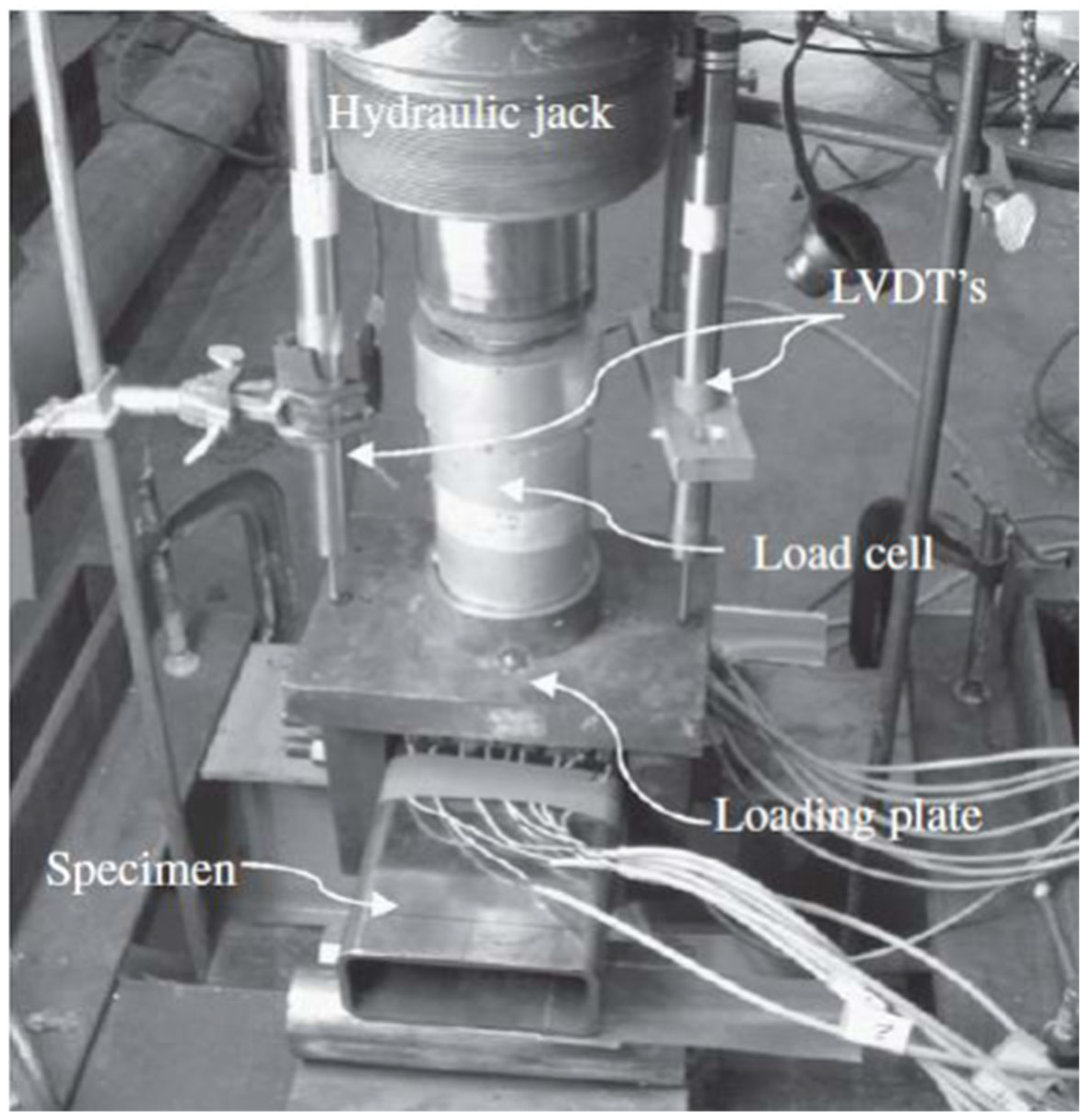
Based on a study conducted by Lin and Zhao [30] which focused on shear lag in box beams, the Large Box Beam (LBOX) was chosen as the model to recreate in Strand7 for verification, comparing the compressive plate stress results to the experimental results. The model includes eight nodded solid elements for the box beam. The selection of solid elements is based on the computational efficiency of the element that is required to capture three-dimensional shear and torsional stresses within the box-section [34]. The dimensions, as stated in the paper, were modelled with an external cross section of 127 × 50 mm and member length between restraints of 305 mm [30]. The wall thickness was 5 mm on average with rolled edges and with a chamfer of 6 mm. The effective Young’s modulus for steel was measured as 192 GPa. Poisson’s ratio was determined from testing before yielding as 0.27, yet it was stated that once the steel started plastically deforming the ratio increased rapidly to 0.48. The use of structural steelwork was considered for modelling in Strand7 and modifying to match above measured material properties. The box beam in the paper was considered as simply supported; however, the rollers were welded to the support beam to prevent movement under large inelastic loading. Due to the large divergence of matrices not solving in finite element modelling, the study considered that the boundary conditions of one end were to be semi-fixed end support (with low stiffness) as this would prevent excessive rotation and result in plastic deformation across the top flange for modelling results. ASTM A325 states bolts were statically loaded by a hydraulic jack and distributed point loads acted through the webs as shown Figure 1 for the test setup. The steel materials were defined by inputting the Young’s modulus of 200 GPa and stress–strain data in both static and dynamic analysis which was extracted from Al-Mosawe et al. 2018 for static properties and Al-Mosawe 2016 for dynamic properties [35,36]. The stress–strain curves for steel under both static and dynamic were extracted from experimental testing, properties are presented as shown in Table 1 below:
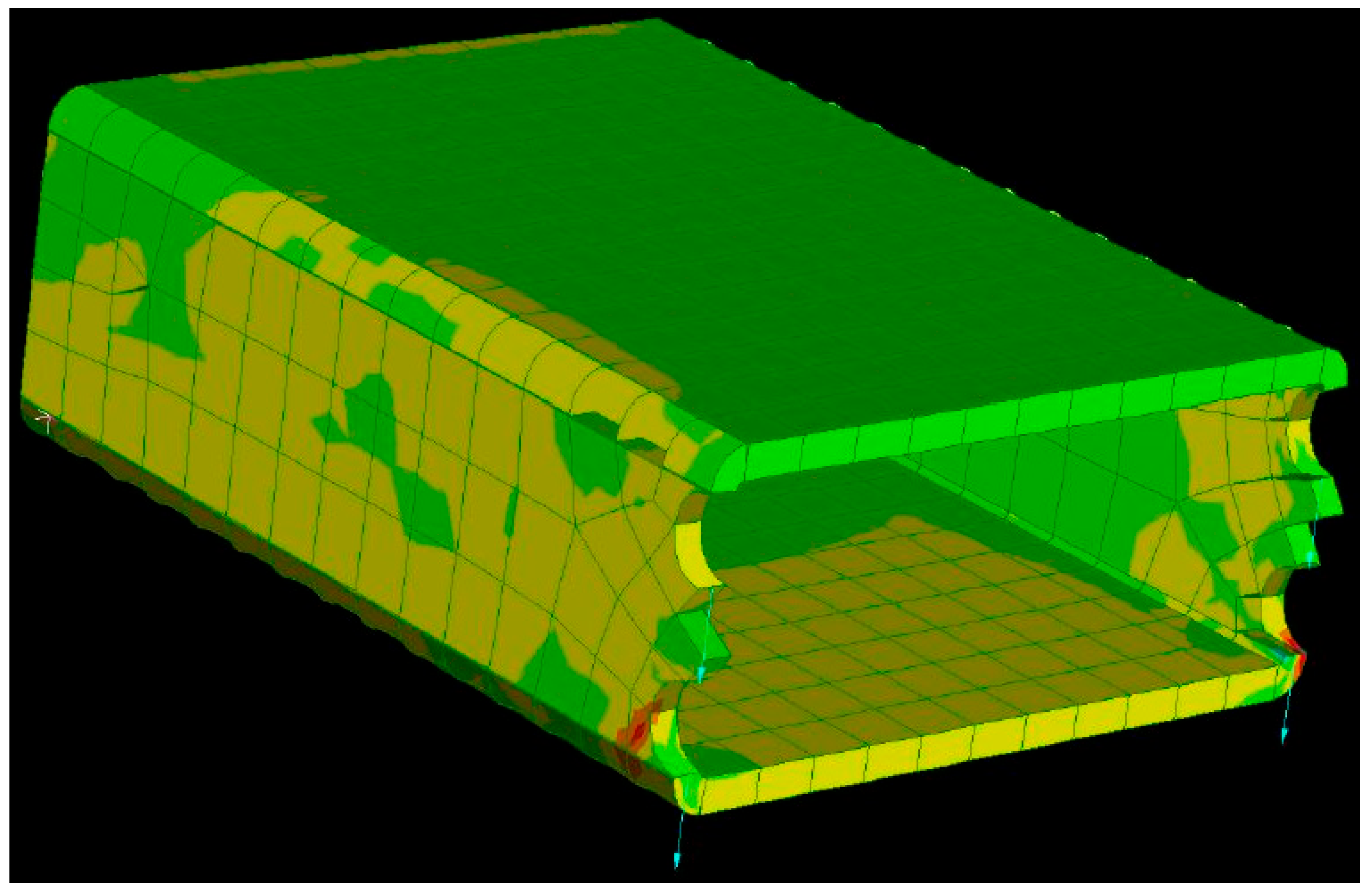
Strain readings from the test were measured by strain gauges and converted to compression stresses using the Giuffre-Menegotto-Pinto model. The box as shown in Figure 2 was modelled in AutoCAD-2020 as a surface and exported to Strand7 allowing the precise sizing and location of 4 × 12.7 mm bolt holes through the web approximately centrally located between restraints. The comparative model was analysed through non-linear analysis for static node loadings at the base of bolt holes to simulate bolt loadings for each loading case. Four iterations of loadings were sufficient to progressively show parabolic deformation across the top flange with loading steps of 0, 0.25, 0.5, 0.75 and 1.0.
The parameters of the comparative model remained the same for further testing of dynamic loading to provide a comparison in deformation occurring across the top flange. Nonlinear transient dynamic loads were transferred through the bolt holes to simulate an impact load as shown in Figure 2. It was considered that impact loading would occur over a one second period with a total of five 0.2 s steps to provide comparable iterations for comparative study iterations.

2.2. I-Beam Model

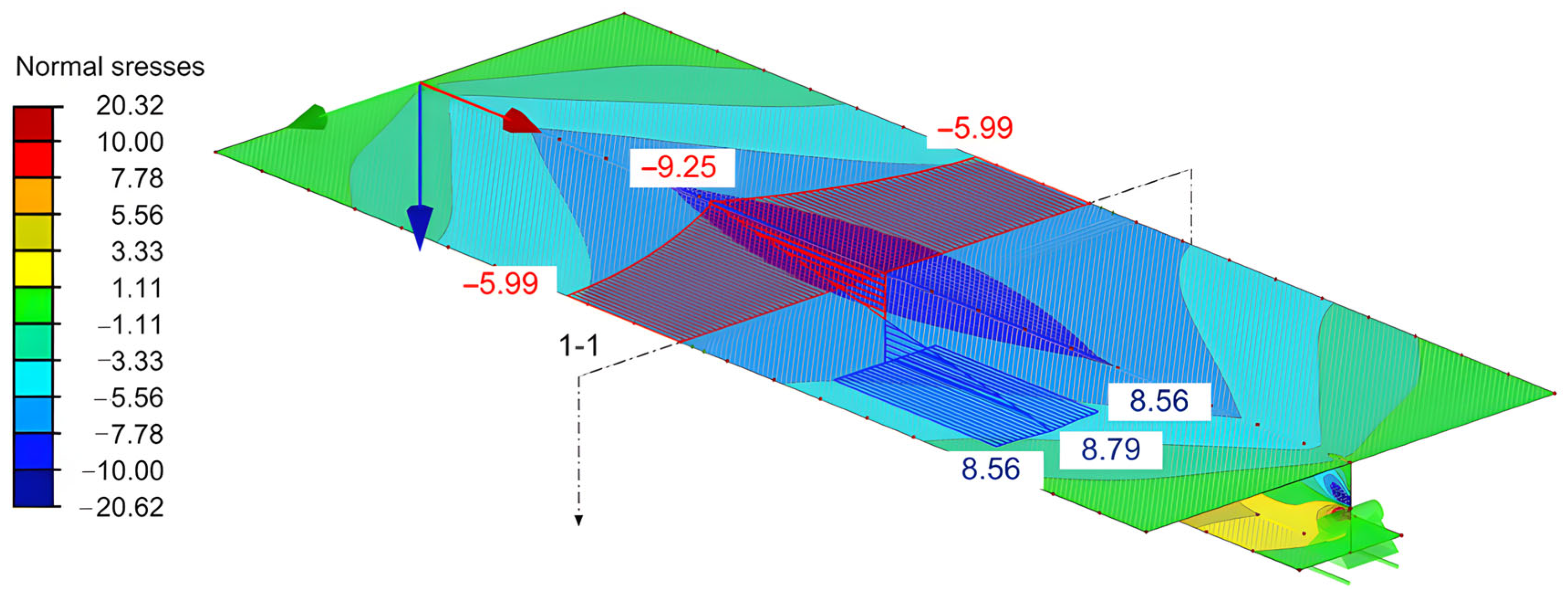
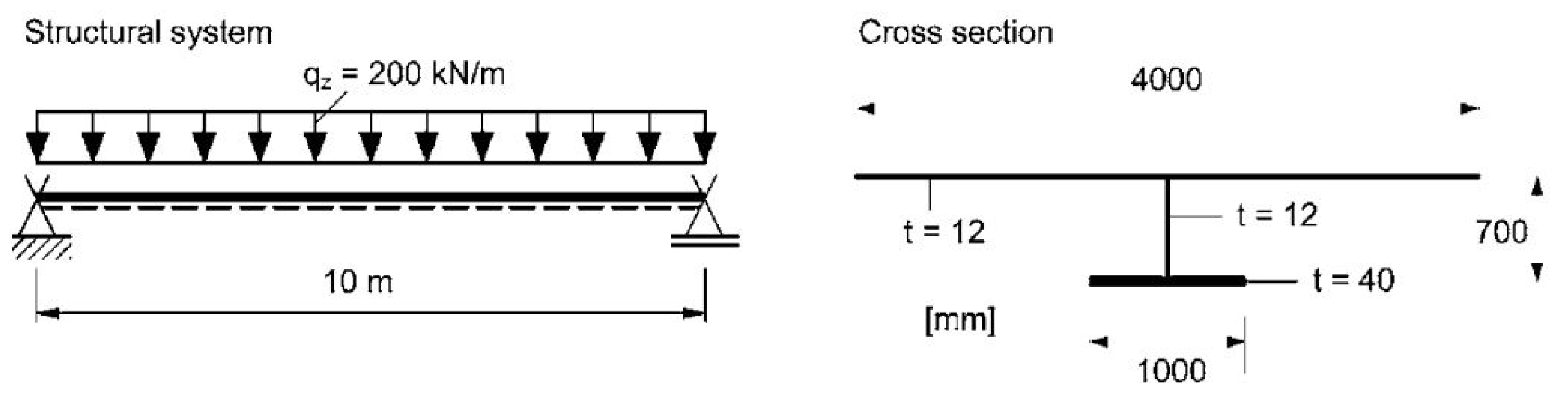
The I-beam model as shown in Kraus’s study [31] and Figure 3 provides the below dimensions for lengths of flanges and webs for simulation. A quadrilateral (4-node) shell elements have been used to model the I-beam in Strand 7. The selection of the shell element is based on the flexural and bending behaviours of the flange and web which can be efficiently captured by using shell element [37]. The cross-sectional dimension of the top flange was taken with a width of 2000 mm and a thickness of 12 mm. The web was of 700 mm depth with a web thickness of 12 mm. The bottom flange had an effective width of 1000 mm with a thickness of 40 mm. The overall length of the I-beam was provided as 10,000 mm between simply supported connection for a semi-fixed and pinned end to achieve convergence, sensitivity analysis was conducted to examine the effect of rigidity definition at the support. The cross-section dimension was chosen intentionally to the extreme and critical case of slenderness. There was no local buckling nor outward buckling shown in the FE analysis (by refining the meshing size in the flange and allowing geometric nonlinearity) despite exceeding the limit of flange slenderness ratio specified in the different standards. A bilinear isotropic hardening model was adopted with a yield strength of 270 MPa and a hardening factor of Et = 0.01 E with large deformation analysis applied to all analyses. For dynamic cases, a Cowper-Symonds Strain rate model was added. The flange slenderness ratio is considered critical when flanges in steel girders work independently; however, in this study the flange is considered as part of a bridge with a deck slab which provides continuous restrains to the flange. A distributed load of 200 kN/m was equally applied across the central y-axis of the top flange causing bending about the major x-axis. A simplified system setup and cross section of the I-beam is shown in Figure 4. Hinge and roller boundary conditions were applied at the two ends to restrain the I-beam model and to measure the reaction forces. The material properties were assumed to have a Young modulus of 200 GPa and a shear modulus of 80 GPa with a Poisson’s ratio of 0.25 to simulate typical AS 4100 steel properties as provided in Strand7. The design of the extended top flanges width provided a similar example to common bridge engineering scenarios. The extent of the flanges also exaggerated the normal stresses, and the degree of shear lag effect experienced elastically by the beam. The comparative model was calculated using a linear static analysis with results in kilograms per millimetre squared and converted to kilonewtons per centimetre squared.
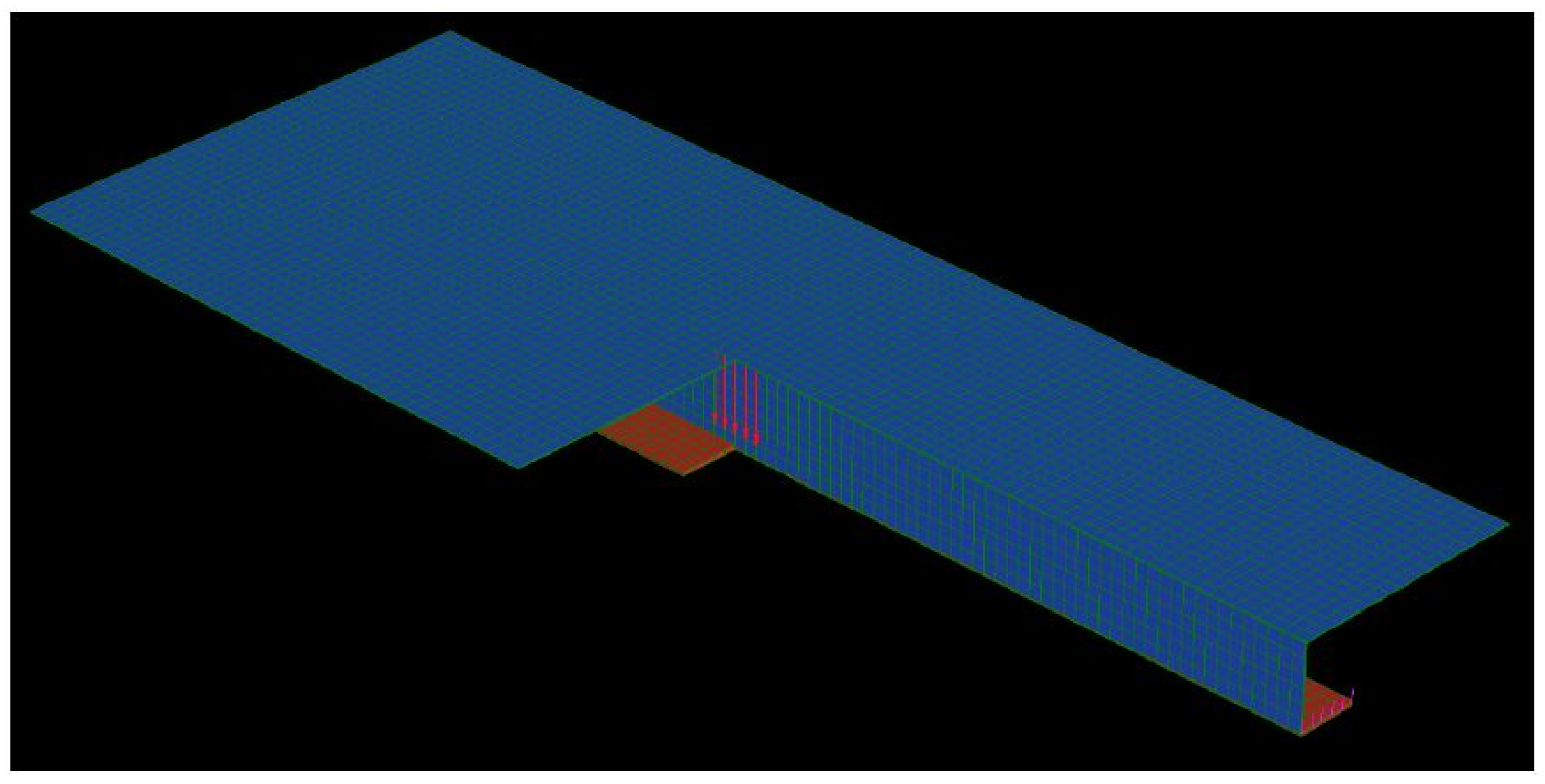
The parameters of the comparative model remained the same for further testing of dynamic loading to provide a comparison in deformation occurring across the top flange. Nonlinear transient dynamic loading acted as a node loading over a 500 mm length at the midspan of the I-beam on the top flange. The study considered this loading condition to simulate a member impacting such as a heavy object as shown in Figure 5 and Figure 6. It was considered that impact loading would occur over a one second period with a total of five 0.2 s steps to provide nonlinear shear lag results.

3. Results

3.1. Box Beam Analysis

3.1.1. Comparative Study Results

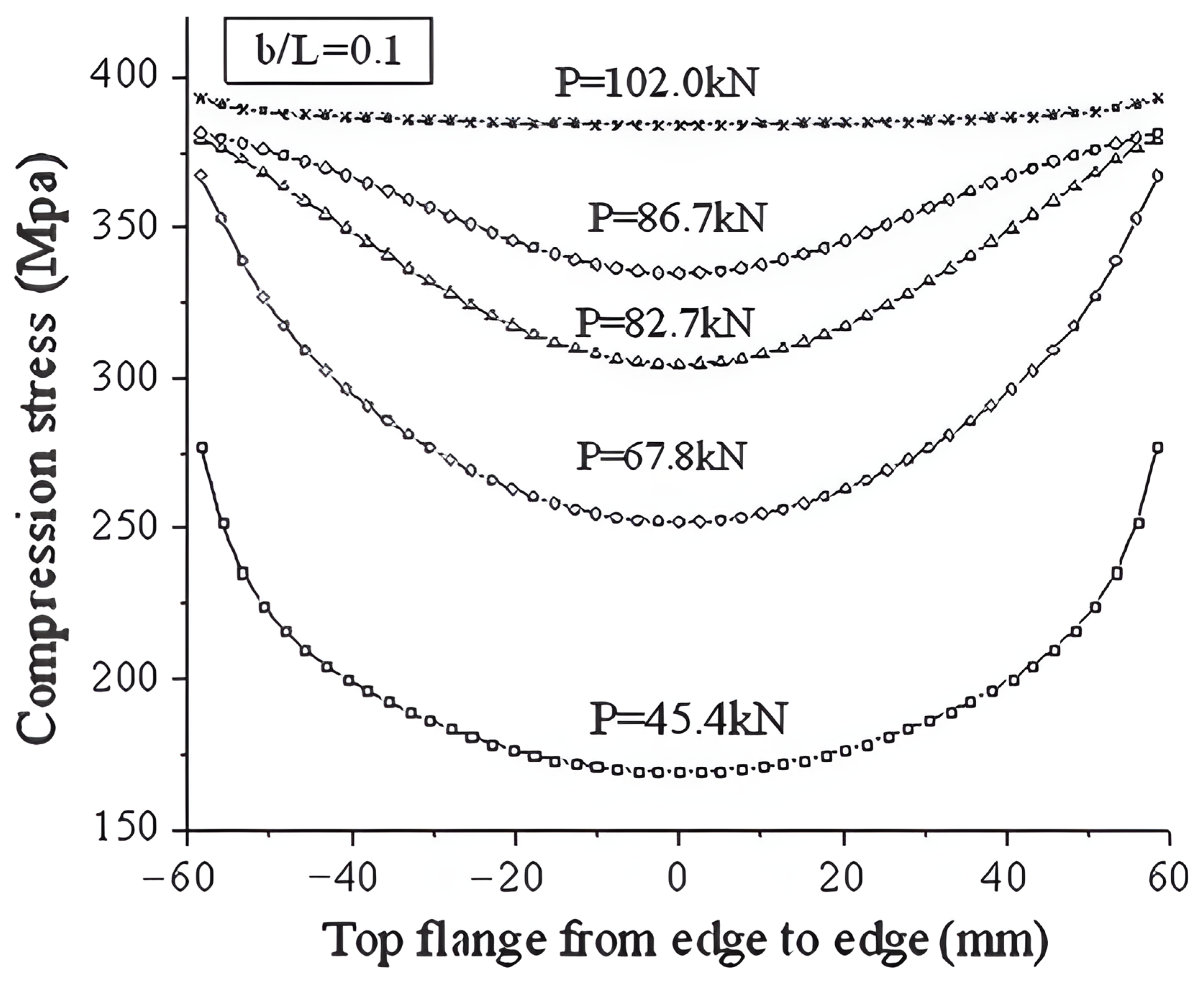
The initial study conducted by Lin and Zhao [30] provided the graphed results of normal stresses as shown in Figure 7 for 5 loading cases known as 45.4 kN, 67.8 kN, 82.7 kN, 86.7 kN and 102.0 kN. Results showed that in non-linear analysis, matrices for loading cases 45.4 kN, 67.8 kN and 102.0 kN solved by convergence in Strand7 as shown in Figure 8. However, 82.7 kN and 86.7 kN did not solve as the matrices did not converge, this is likely due to the material acting elastic-plastically and deviation between solved matrices exceeding rotational limits as stated in error warnings. The model was found to slightly twist clockwise once reaching elastic-plastic range and therefore showing higher stress results in right side edge of top flange.
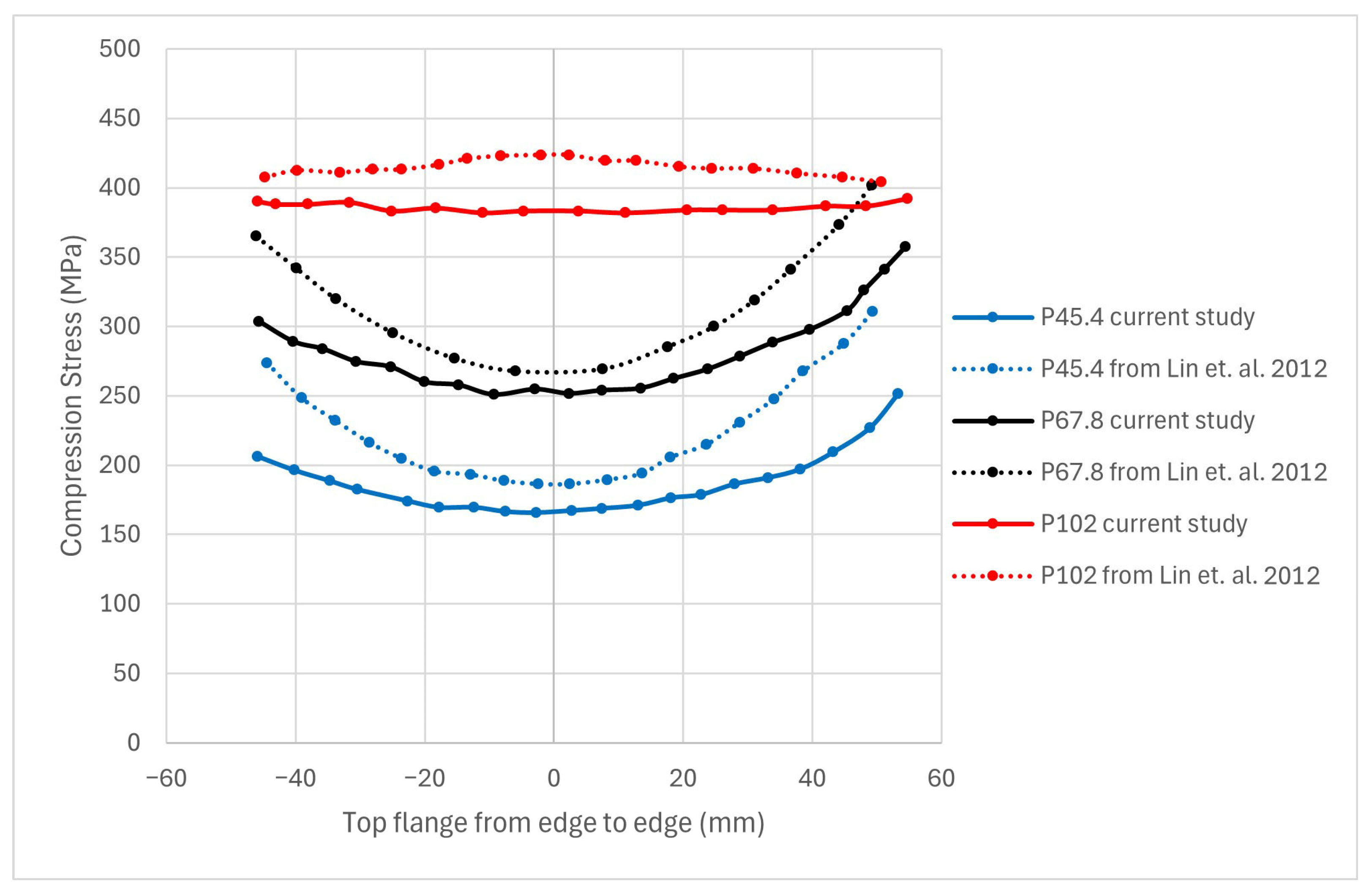
The greatest variation between experimental and modelled case 45.4 kN, was 33.3% with a modelled and experimental value measured, respectively, for 311.7 and 233.8 MPa, located 49.7 mm from the right-side edge of central top flange span. However, the smallest variation was found to be 10.9%, with modelled and measured values of 186.9 and 168.4 MPa, located 2.5 mm from left-side edge of central top flange span. A total of 12 out of 19 modelled points were found to be higher with 25% deviance from experimental results with an allowable accuracy of 63.1%.
The greatest variation between experimental and modelled case 67.8 kN, was 37.9% with a modelled and experimental value measured, respectively, for 465.7 and 337.8 MPa, located 49.7 mm from the right-side edge of central top flange span. However, the smallest variation was found to be 5.3%, with modelled and measured values of 265.6 and 252.2 MPa, located 2.5 mm from left-side edge of central top flange span. A total of 15 out of 19 modelled points were found to be higher with 25% deviance from experimental results with an allowable accuracy of 78.9%.
The greatest variation between experimental and modelled case 102.0 kN, was 9.45% with a modelled and experimental value measured, respectively, for 420.4 and 384.1 MPa, located 2.7 mm from the right-side edge of central top flange span. However, the smallest variation was found to be 4.45%, with modelled and measured values of 405.9 and 388.6 MPa, located 2.5 mm from left-side edge of central top flange span; 19 out of 19 modelled points were found to be higher within the 25% deviance from experimental results for an allowable accuracy of 100% which is consistent with the values reported in [33] for similar studies. However, the model shows a negative parabolic shape compared to a positive shape for experimental test. It can be observed that the compressive shear stress occurs greatest towards the middle of the flange where stress due to bending deformation is occurring.
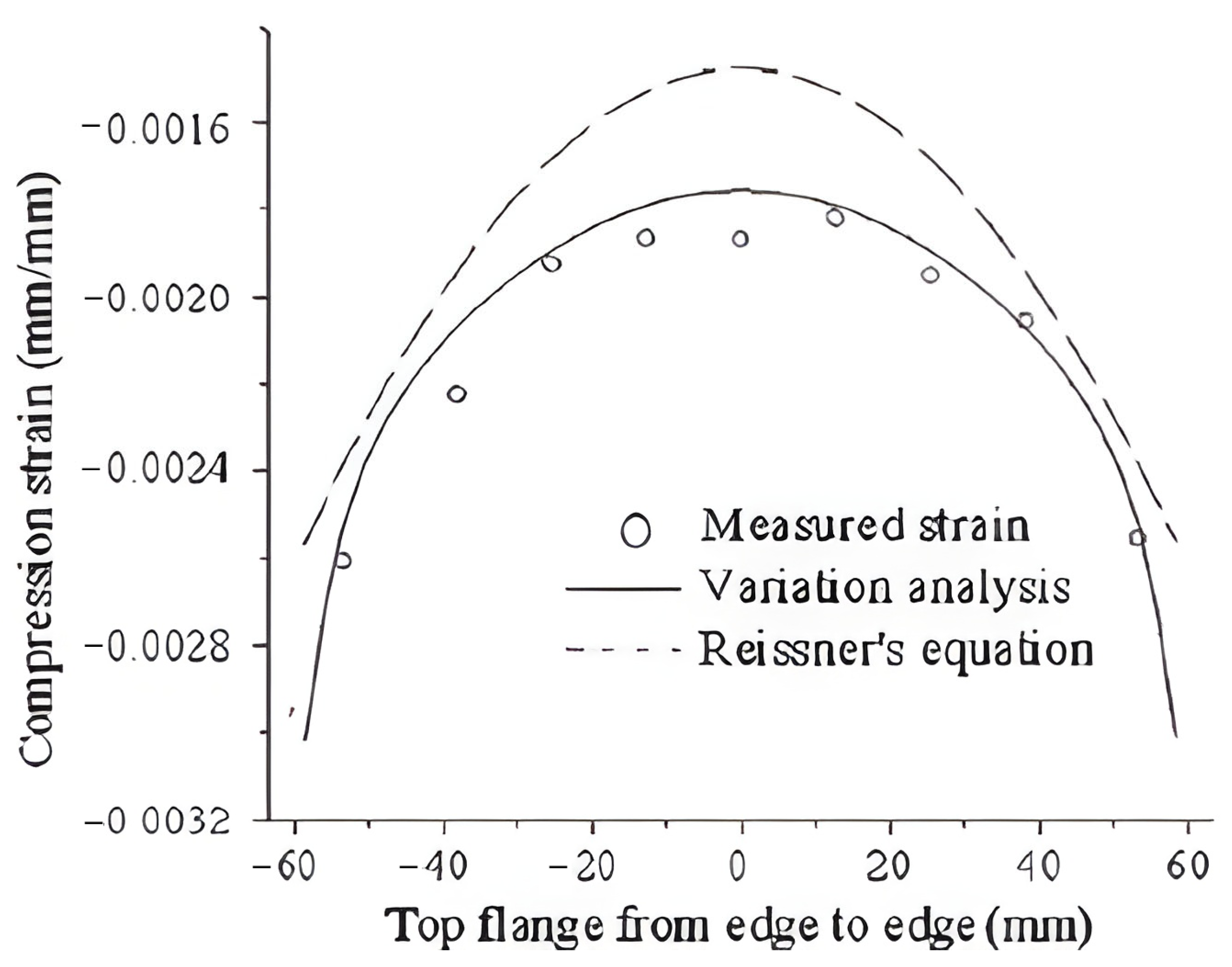
Figure 8 shows some differences between the compression stresses observed in this study and the ones obtained from the experimental programme [30]. This slight difference can be attributed to the method of data collection during experiments. The compression stresses in the experiments are collected by obtaining the strain readings at one location of the flange. The readings of the strain gauges might be affected by different factors including the installation process and connections. Referring to Lin and Zhao’s [30] explanation of potential deviation in finite element modelling and the numerical solved Giuffre-Menegotto-Pinto model, the following assumptions were made: the stresses and strains in other directions were not considered when calculating the flanges normal stress results which had the potential of increasing errors through simplification. It is also stated that the results do not consider the plastic deformation and displacement occurring along the webs from the bolt loadings, potentially reducing calculated stresses along the top flange. It is shown in Figure 9 that Reissner’s equation results in lower strain measurements than measured data and was inferred that local web yielding near the midspan was possible. The finite element model produced displayed local yielding occurring at web bolt holes causing them to deform plastically before the flange followed.

3.1.2. Parametric Study Results

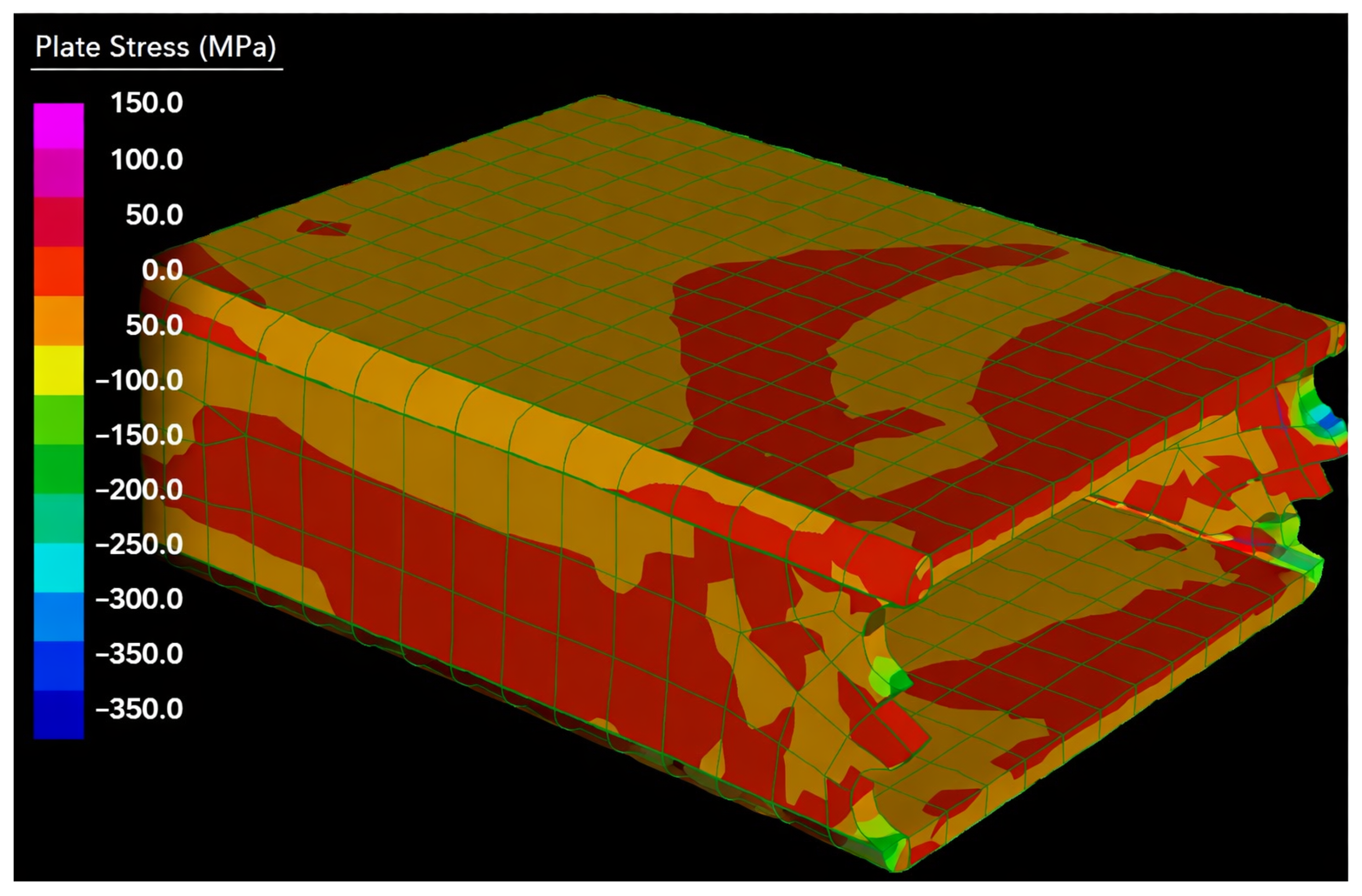
The parametric study of the box beam reviewed a variety of velocities for impacting loading including 5 mm/s, 25 mm/s, 50 mm/s, 100 mm/s and 200 mm/s. The material density was input as 7850 kg/m3, Rayleigh Damping Coefficients α = 0.02 and β = 0.0002. A critical time step analysis was conducted based on element dimensions and wave speed. A sensitivity analysis was performed to select the appropriate meshing size by refining the mesh size until minimal change to the stress distribution was achieved [38]. After exceeding a velocity of 25 mm/s, non-symmetrical shear lag occurred across the box beam with exceeding rotational limits and excessive deformation occurring at the bolt holes. At 5 mm/s the velocity was found to be small with minimal transfer of elastic deformation across the top flange from the web bolt holes. It was therefore considered that in order to provide reasonable shear lag results that match existing comparative studies with a similar parabolic deformation across the top flange, a velocity of 25 mm/s needed to be considered at each bolt hole. It is shown in Figure 10 that normal stress concentrates at the bolt holes while minimal stress is distributed to the top and bottom flanges. It is likely due to the short timeframe of 1 s loading as the impact causes plastic deformation around the bolt holes before elastic deformation from major axis bending occurs across the bottom and top flanges.
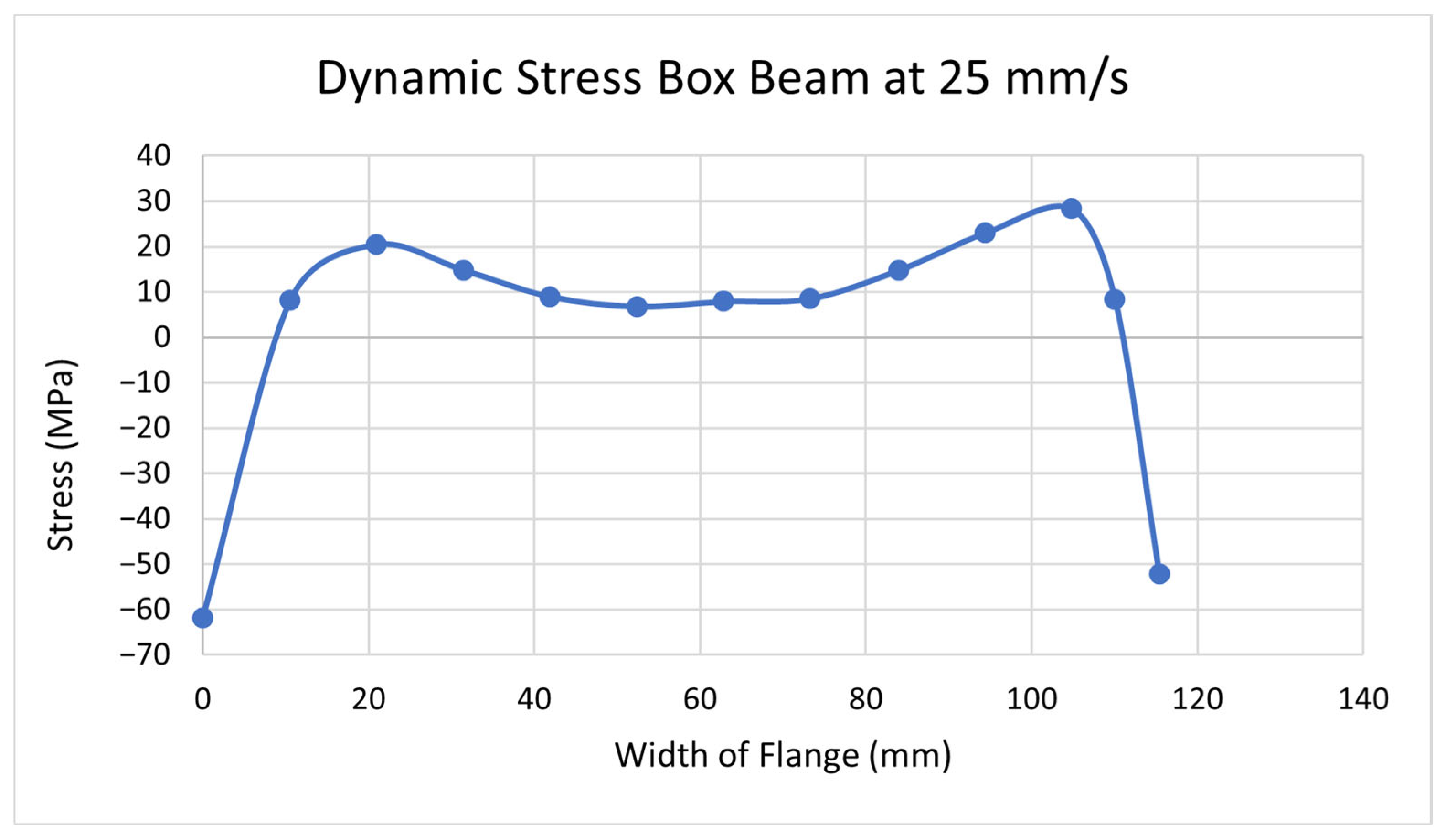
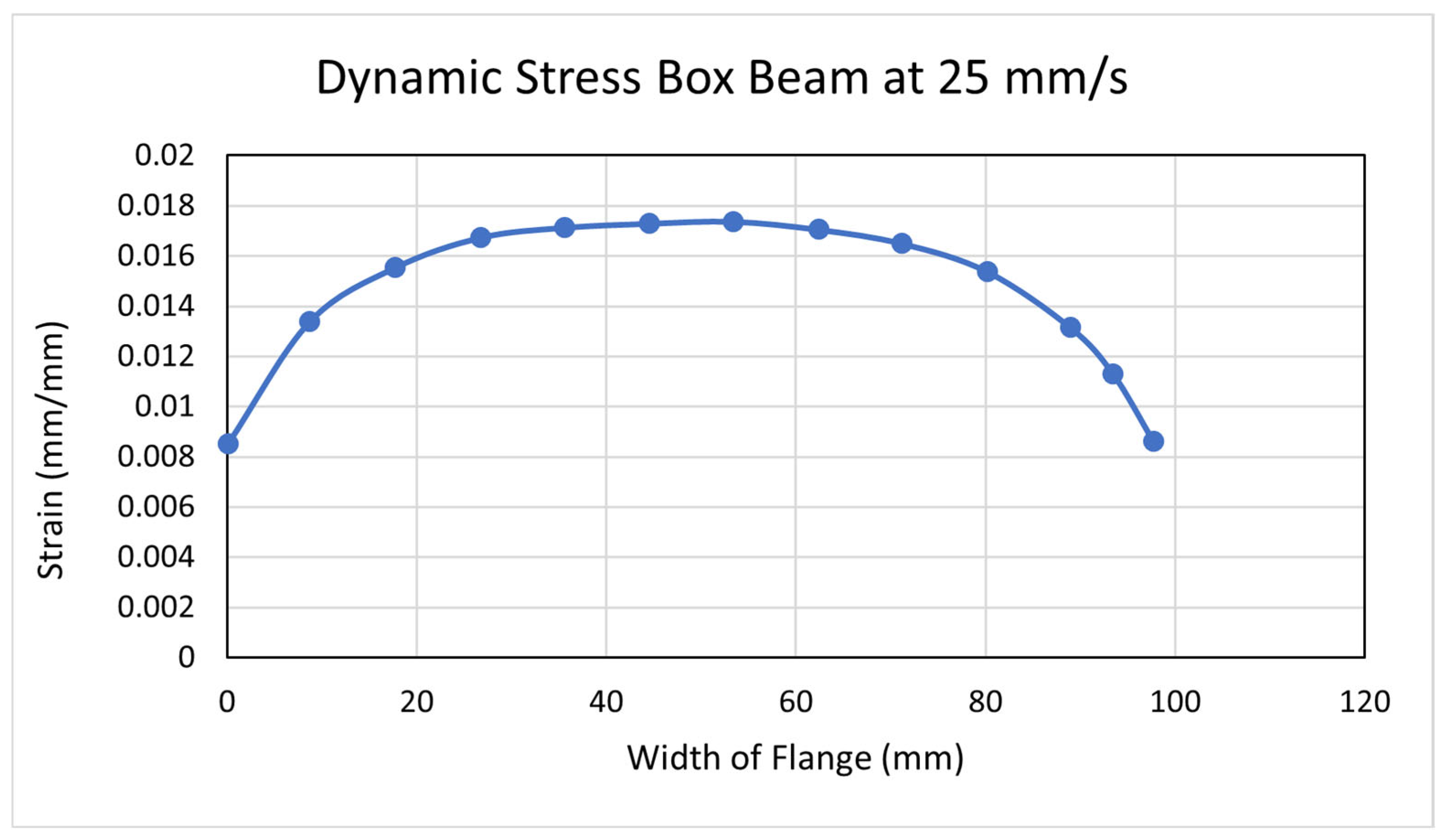
The top flange was graphed for the distribution of stress (Figure 11) and displacement (Figure 12) to review the extent of non-linear shear lag occurring due to deformation in shape. The normal stress distribution excluding points near the flange edges provide a slight parabolic shape, however the edges are likely showing outlier normal stresses. It is hypothesised that the outlier stresses are caused by the unique flow of stresses around the bolt holes causing rotation in deformation and non-uniform meshing of plates with uneven sizing. It can be concluded that the stressed experience across the top flange plate is very minor with 0.02 MPa at 20 mm flange edge and 0.008 MPa around 60 mm. The difference in stress shows a lagging effect as the shear increases towards the flange web edges and less towards the middle as the beam bends about its midspan. A finer mesh was generated around web and flange connection, and the results showed more symmetric behaviour in shear stress distribution. This is similar in nature to comparative study results’ shape. However, it is noted that majority of stress energy from impact is converted to deformation around the bolt holes. Figure 12 shows that the displacement across the top flange increases towards the midspan of the flange and decreases towards the edges. This relates to the work of Samat et al. and Taranth [1,2] explaining that lagging increases further from the restrained edges and therefore inferring that it would be expected that a higher displacement would occur at the unrestrained midspan.

3.2. I-Beam Analysis

3.2.1. Comparative Study Results

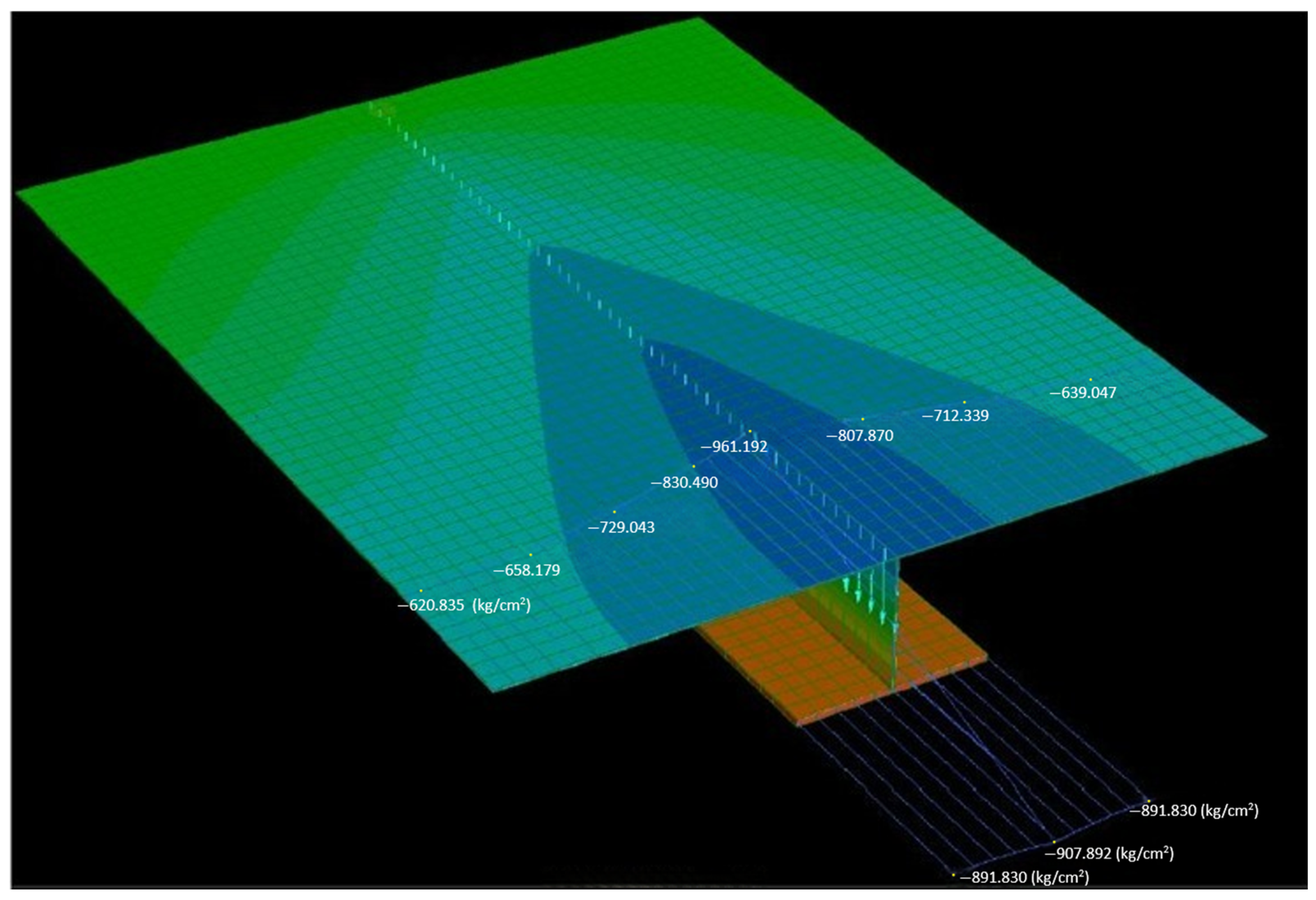
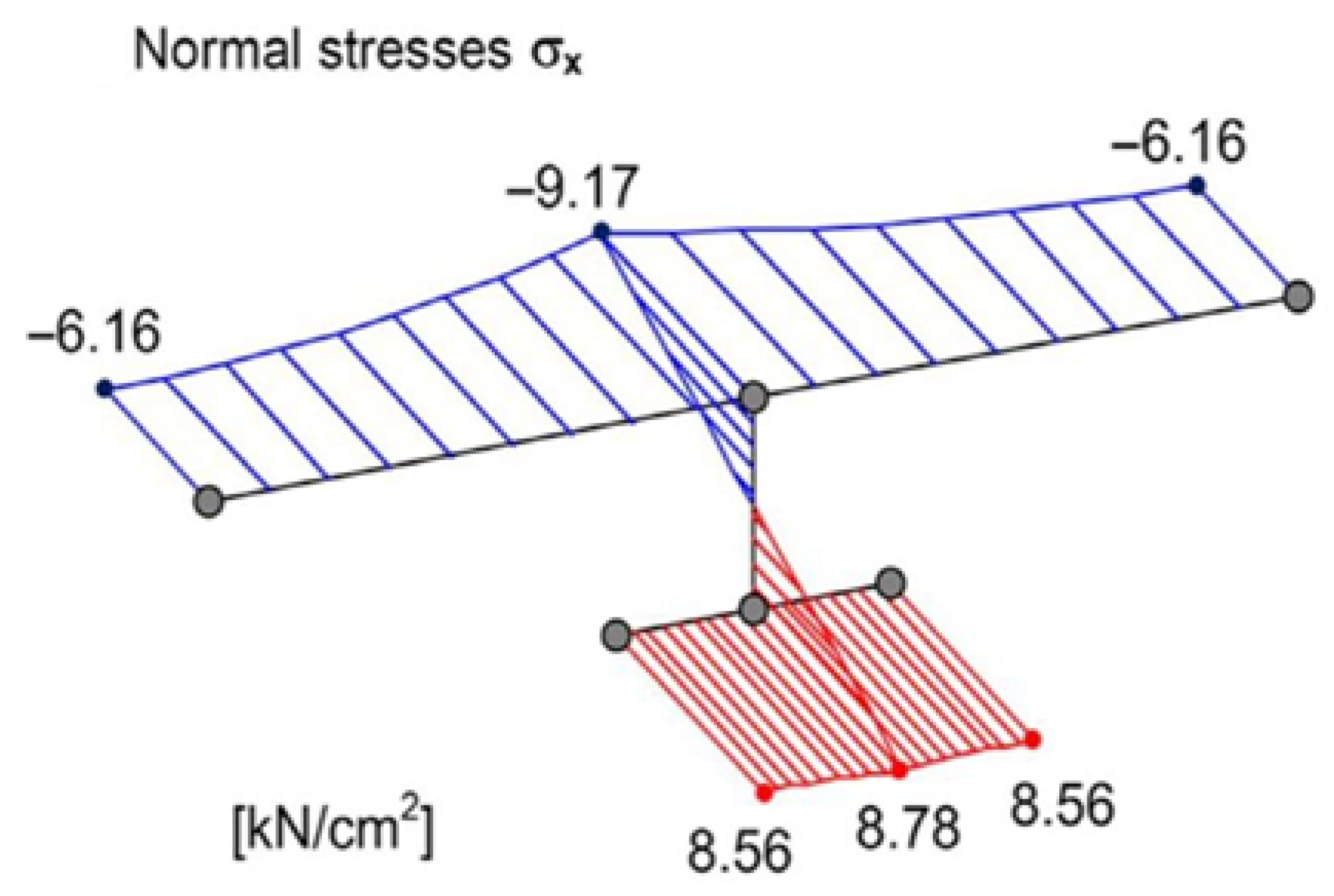
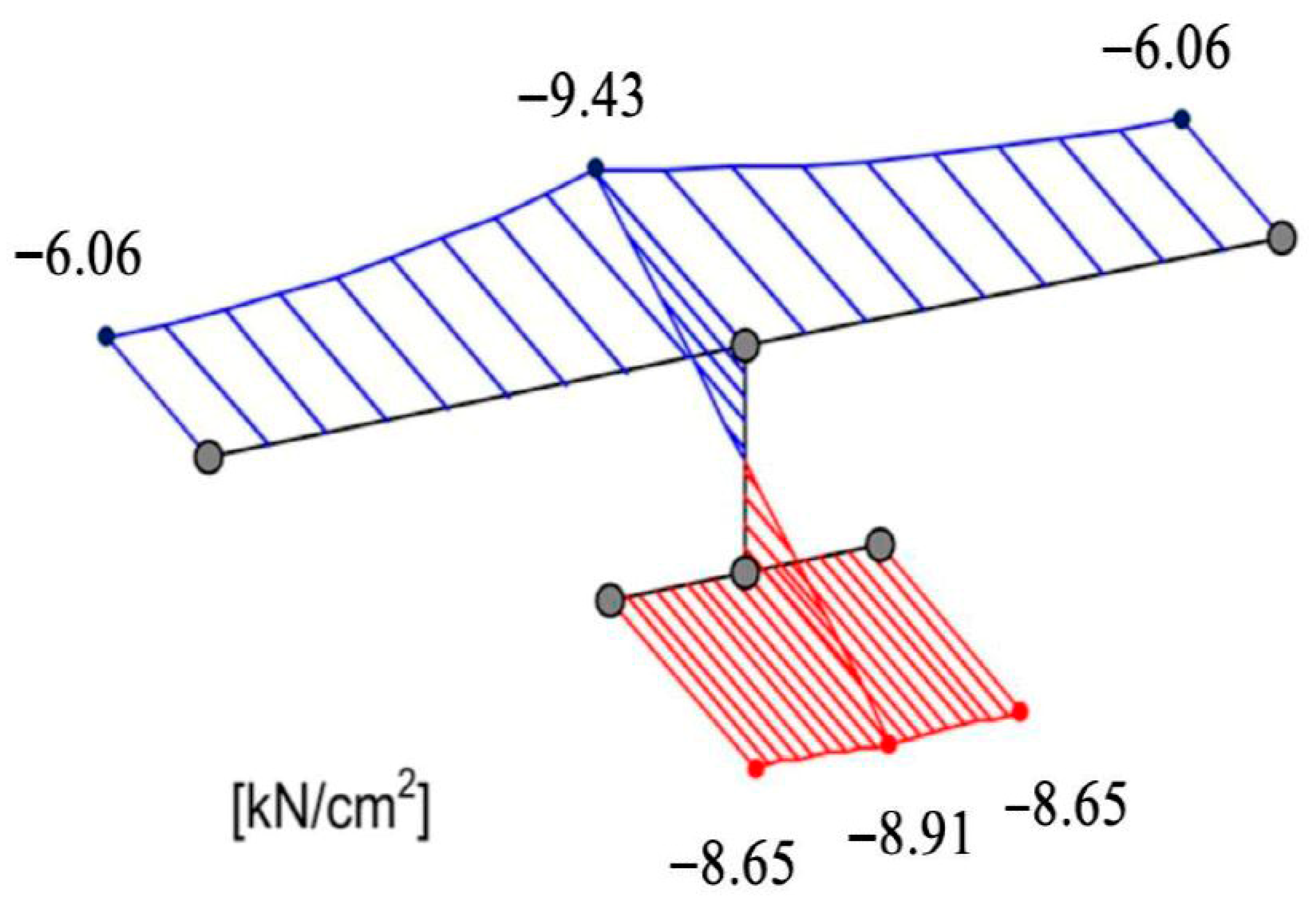
The comparative study of Kraus [31] shear lag I-beam experiment was recreated using the Strand7 finite element model as previously shown in Figure 5. The model was compared against the work of Kraus’s [31] three-dimensional graphed shear stress results as shown in Figure 13 and to modelled results in Figure 14. The results correlate similarly in shape with a maximum deviation of 2.8% between both model results. The deviation is likely a variance of assumptions regarding material property differences between programme calculations and a difference between the number of finite plates considered. The allowable deviation limit is 25%, as previously concluded by Lou et al. [33]. However, results deviated by 33% and that can be attributed to experimental errors in measuring strain using strain gauges. The graphed results in Figure 14 clearly show a non-linear distribution of normal stresses across the top flange with the maximum occurring in the midspan with 9.43 kN/cm2 and the parabolic inflection reducing towards flange edges with measured stresses of 6.06 kN/cm2. The beam is bending about its major axis under distributed loading and therefore the maximum deformation occurs at the midspan of the member. The member however does not reach plastic deformation and therefore results were measured using a linear analysis.

3.2.2. Parametric Study Results

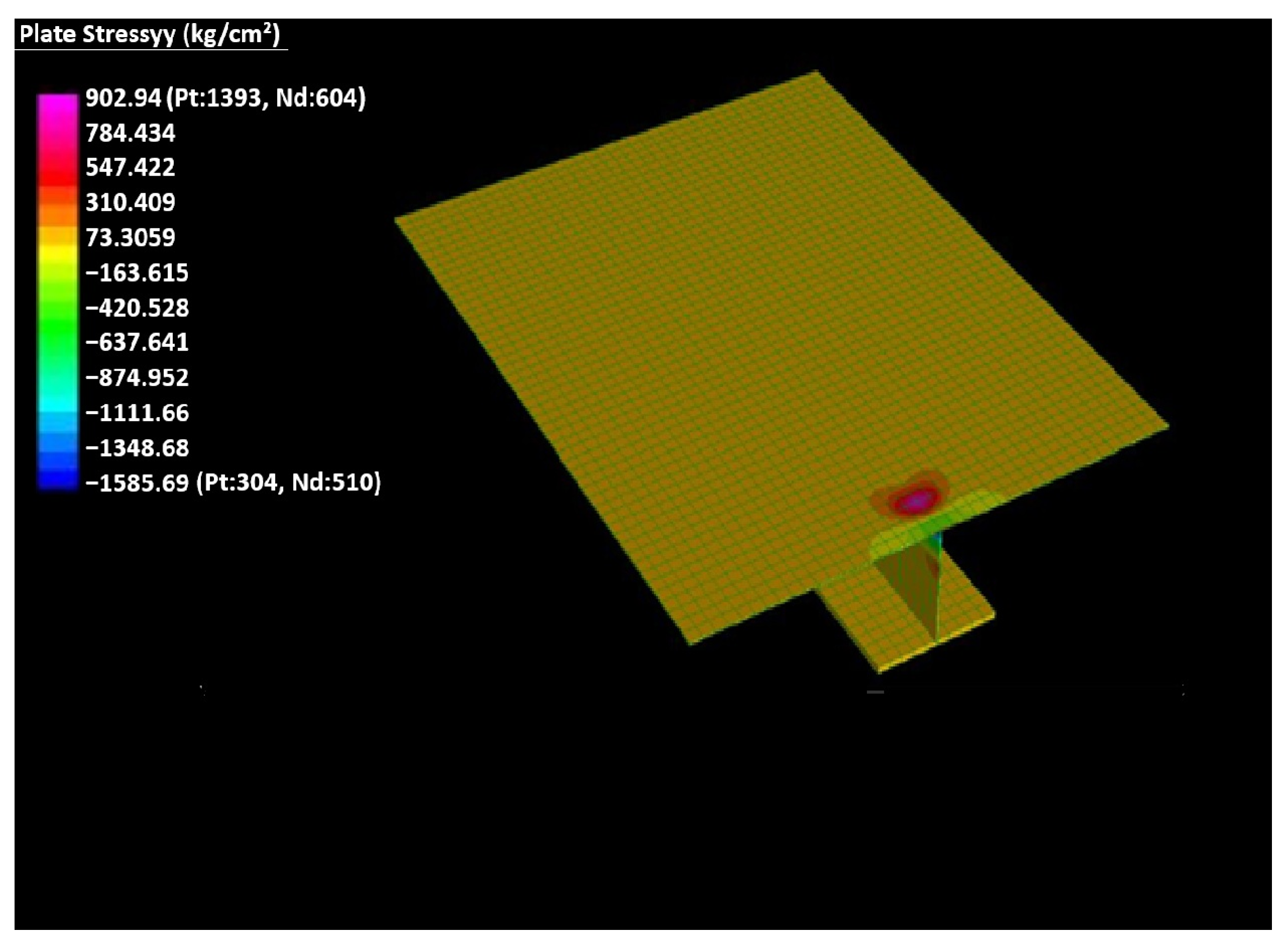
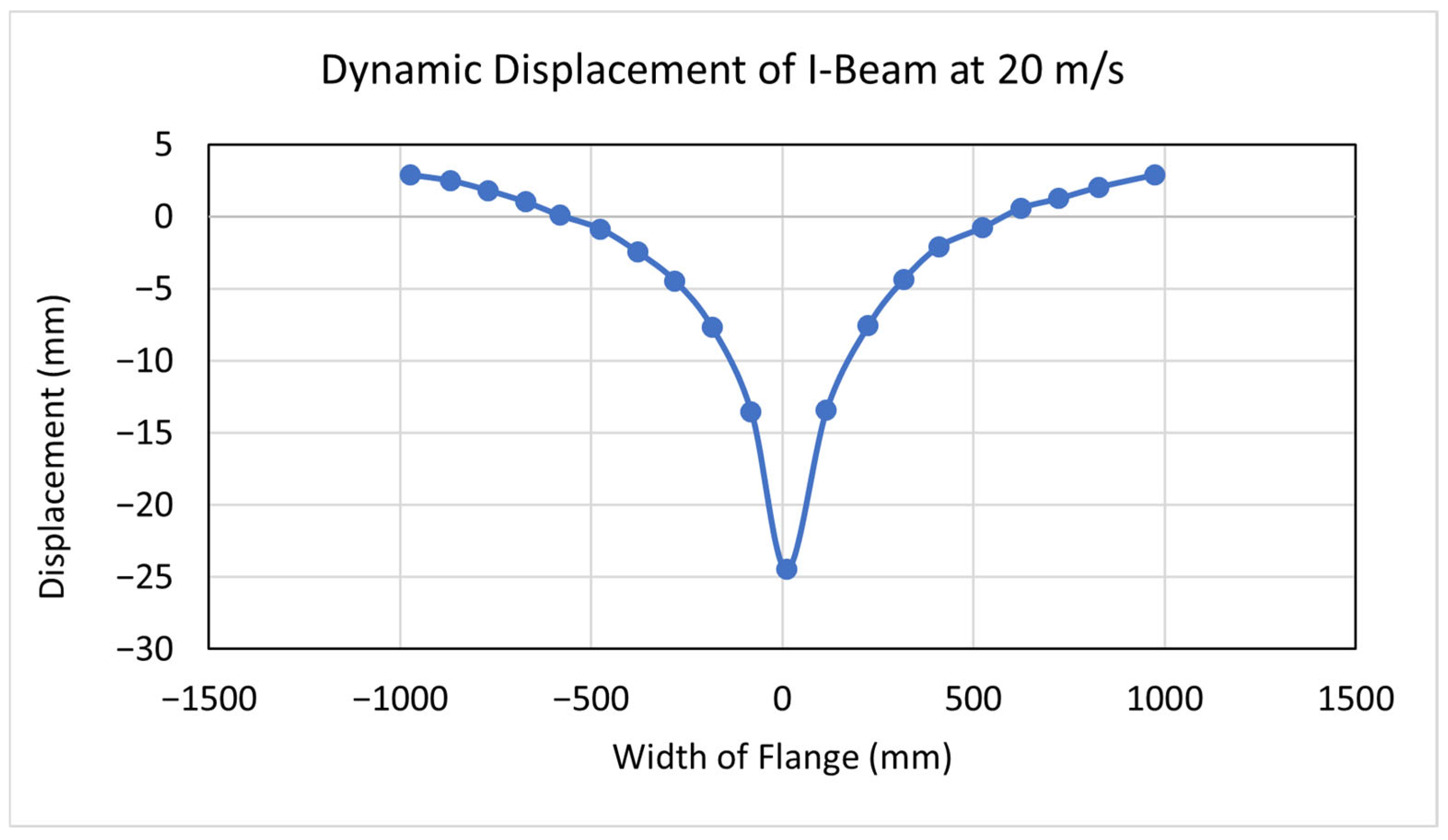
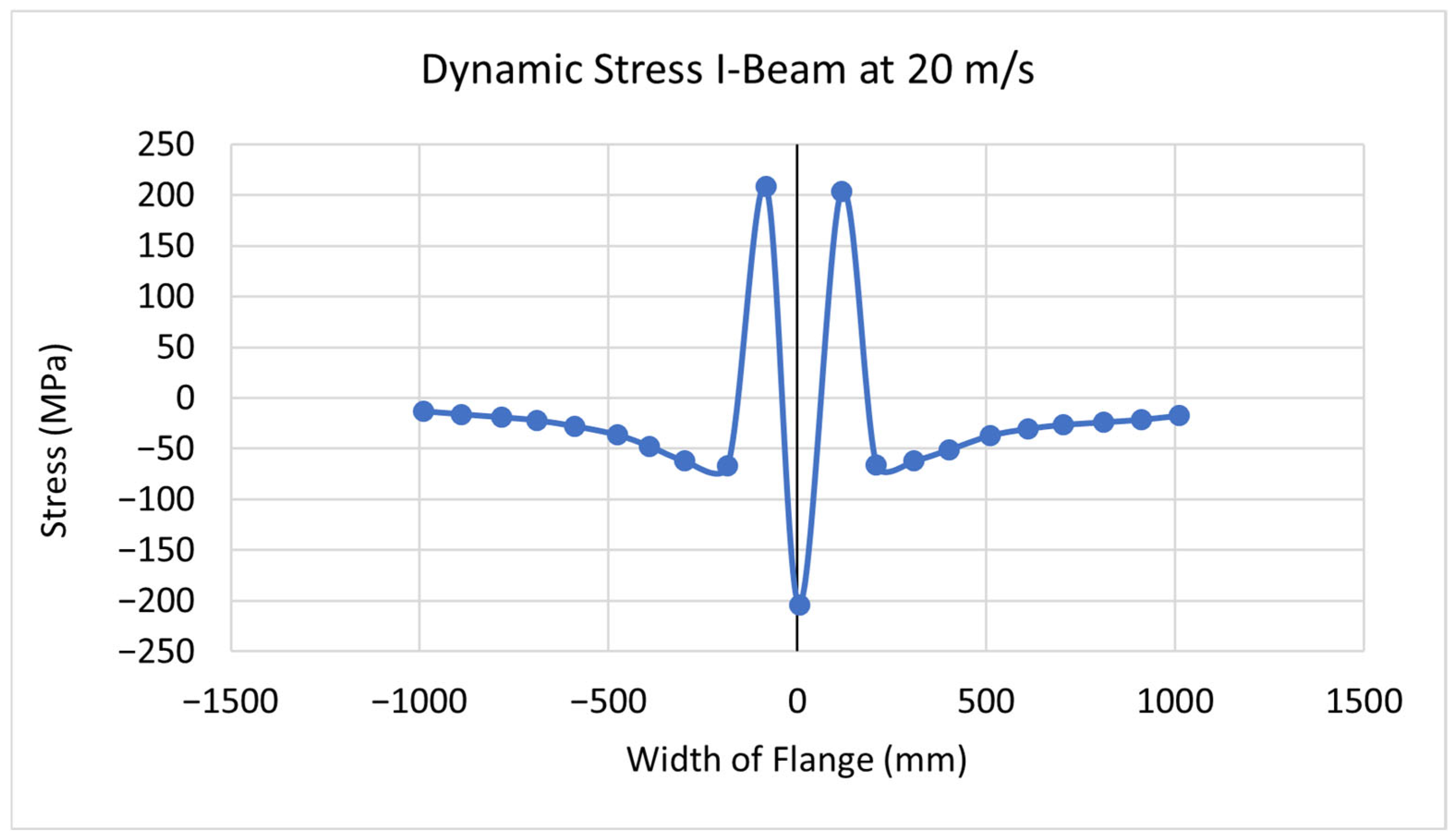
The impact of loading on the I-beam is shown in Figure 15 for a velocity of 20 m/s applied on 5 nodes about the midspan above the web. The contouring of normal stresses shows a concentrated stress distribution on the top flange above the web joint where the impact loading occurs. The maximum deformation occurs directly under the impact load as the material absorbs the energy displacing the material shape. The web directly supports the flange impact loading and dissipates the stress to the surrounding plates. The top flange displaces non-linearly in a V-shape causing a shear lagging effect, as shown in Figure 16. The flange end edges are not restrained and therefore are allowed to freely move; this results in a dissipation of stress to approximately zero located passed 1000 mm from the centre flange location as shown in Figure 17. However, it is shown in the stress distribution of the top flange that the maximum stress occurs directly under impact loading but at 100 mm on either side of the centre. The occurrence of localised positive stresses is referred to as numerical sensitivity related to discretization and post-processing. It is not related to actual physical tensile stress state. These localised positive stress values do not affect the interpretation of the results. These results deviated significantly from typical beam bending theory as the calculated stress would be considered constant across the top flange and not consider permanent deformation of material shape due to exceeding the materials plastic limit.

4. Discussion

Many factors have been assumed in the preparation of the model which caused deviations to occur between the finite element results and the experiment results. These assumptions were also carried through to parametric testing which affected the accuracy of results if compared against empirical measured testing. It is shown in the results that there are likely inaccuracies in model properties and calibration that have resulted in possible outliers in measured data or complications of modelling in finite element. Lin and Zhao [30] confirmed that complications between comparing finite element analysis and numerical methods can vary results significantly as important assumptions typically simplify the calculations where complex situations may arise.

4.1. Box Beam

The key assumptions made in testing and forming the finite element model in Strand7 for the box beam are as follows. The location of bolt holes has been cut symmetrically on the centre of the box beam based on pictures provided in Lin and Zhao’s [30] yielded box beam long section. The complexity of meshing the model from AutoCAD-2020 to Strand7 utilised the auto meshing feature that typically provides inequilateral shapes around circle holes that may cause discrepancies in plate–stress matrices. The steel properties were adjusted to provide measured values, however simplified measured data was used in the stress strain graph. The fixed boundary conditions of restrained supports affected the moment calculations performed by the matrices which reduced the allowable rotation and likely increased plastic deformation through the webs. This may have also contributed to the higher transferring of shear stresses to the edge of flanges when compared to empirical results. It was confirmed when comparing most data points between each loading case that there was a correlation of 25% deviation. This satisfied the requirements for acceptability using the model for the parametric study for impact loading. It is noted that it would be highly beneficial to resurface the mesh to a finer scale and use more powerful computers to run simulations in a timely manner. It is also advised that modelling bolts in Strand7 and loaded within the holes may improve the distribution of stress and plastic deformation results compared to single node loads.
When comparing static loading vs. dynamic loading, the results showed that the location of maximum stress for box beam occurs near the webs edges of the top flange. The shear stress then dissipates in a nonlinear fashion towards the midspan of the top flange in both scenarios. However, the results differ as the majority of the dynamic impact load is distributed closest to the web bolt holes of the impact zone, while the static loading provides a higher distribution across the flanges. This shows how shear lag, although present in both scenarios, can result in very different deformation cases due to the material’s elastic–plastic properties and ability to transfer stress across plates.

4.2. I-Beam

The assumptions made when preparing the comparative I-beam model from Kraus’s study on shear lag considered the following. Due to limited empirical studies on I-beam shear lag effects, it was determined that finite element analysis for shear lag study would be considered as the comparative model. The reason that there is a lack of empirical studies on I-beam shear lag effects is that typically major failure modes occur due to torsion or buckling effects before shearing failure. Another reason empirical studies on I-beams are not usually conducted is due to the complexity of the required testing equipment and the cost compared to computer aided modelling. Therefore, empirical studies typically focus on these common failure modes more than shear lag. Empirical studies on shear lag in I-beams would be beneficial as they would provide comparative results for further studies. Another possible variation between the models is the design of the finite element programmes and how calculations are possibly solved. The number of discrete plates and nodes can increase the accuracy of results when solving for iterative calculations.
Comparing the results of static loading vs. dynamic loading for I-Beam showed similarities between the location of maximum stress occurring at the midspan of the top flange. The shear stress then dissipates in a nonlinear way across the flanges towards the edges in both scenarios. However similar to the results of box beam, the majority of the dynamic impact load is distributed closest to the impact zone while static loading provides a higher distribution across the flanges. This clearly shows that impact loading is more localised and restricted to the area around the impact point. It rapidly decays with small distance as energy transfer likely causes plastic deformation at the loading before transferred energy through the remaining member cross section.

4.3. Comparison with Current Australian Standard AS4100

The current study compares the results of the effective width with the current international standards such as the American Institute of Steel Construction AISC and the Australian standard AS4100. The effective width prediction of the above standards are as below:
b e = b λ e y λ e b
where
  • b e = Effective flange width.
  • b = Flange Width.
  • λ e y = Yield Slenderness Limit.
  • λ e = Slenderness Element.
Al-Sherrawi and Mohammed [39] stated that the effective width is considered when the stress distribution is uniform across a certain width of the flange width. However, this approach is considered conservative as it ignores the effect of actual flange width. For comparison, in this study, the effective flange width was selected by plotting the stress values versus flange width; area where stress distribution is changed was excluded from the calculation of effective width. Figure 17 illustrates an effective width of 200 mm (under dynamic load) which aligns well with AS4100 and which predicts an effective flange width of 192 mm. However, for box beam, the effective width shown in Figure 11 is around 45 mm (under low rate dynamic load), while AS4100 prediction is 40 mm.

5. Conclusions

This study provided analysis on the effects of elastic and plastic shear deformation occurring across a steel box beam and I-beam experiments. It was found that both members were able to be modelled and replicated in finite element analysis software producing within 33% accuracy and correlating between normal shear stress results. The models formed the baseline for further analysis into impact loadings and comparisons between the shear lagging effects. The box beam was analysed with impact loadings through the web acting as bolts with velocities of 25 mm/s over a 1 s loading period. Results provided clear nonlinear deformation across the top flange but most of the stress was transferred to the webs causing deformation of the bolt holes. This highlights how dynamic loading may cause increased plastic deformation at the loading location before transferring shear lagging stresses to the remaining member.
The I-beam was dynamically loaded with a 20 m/s velocity over a 1 s period comparing a 500 mm length impact point loading occurring about the midspan of the top flange. Results also clearly showed that shear lagging effect across a portion of the top flange area under the effect of deformation from the impact load. However, results showed that the web provided sufficient support to transfer most of the impact energy dissipating the shear stresses to the surrounding flange. It was attributed that the impact would likely result in non-linear deformation and reduce the capacity of members strengths due to the altered cross sectional shape. In comparison to static loading, the member was able to elastically bend about its major axis, distrusting stresses in a non-linear shear lag shape. This would ultimately not lead to plastic deformation and the member would be able to return to its original cross-sectional shape after loading is removed. It highlights how nonlinear shear lag can result in plastic deformation of specific areas of the member’s cross-section and that the designer should consider possible scenarios of impact loadings for major structural members and, ultimately, the strength capacity after deformation. The effective width for beams subjected under dynamic loads and quasi-static (low rate loadings) is slightly higher than those subjected to static loads. The results showed little difference in effective width when comparing AS4100 prediction against that from static load; however, it showed a 10% increase in effective width when subjected to dynamic and quasi-static loads.


Author Contributions

Conceptualization, A.A.-M. and D.A.-M.; methodology, A.A.-M. and S.A.H.; software, A.A.-M. and D.A.-M.; validation, A.A.-M., D.A.-M. and B.A.-A.; formal analysis, B.A.-A.; investigation, A.A.-M.; resources, D.A.-M.; data curation, S.A.H.; writing—original draft preparation, A.A.-M. and D.A.-M.; writing—review and editing, A.A.-M.; A.A.A. and B.A.-A.; visualisation, S.A.H. and B.A.-A.; supervision, A.A.-M.; project administration, A.A.-M. and A.A.A. All authors have read and agreed to the published version of the manuscript.

Funding

This research received no external funding.

Data Availability Statement

The data that supports the findings of this study are available from the corresponding author upon reasonable request.

Conflicts of Interest

The authors declare no conflicts of interest.

References

  1. Samat, R.A.; Chua, F.T.; Mohd Mustakim, N.A.H.; Anuar, F.I.; Saad, S.; Abu Bakar, S. Lateral displacement and shear lag effect of high-rise buildings with diagrid system that is constructed above a frame. MATEC Web Conf. 2017, 138, 02001. [Google Scholar] [CrossRef][Green Version]
  2. Taranath, S.B. Structural Analysis and Design of Tall Buildings: Steel and Composite Construction; Chapter 1 Section 1.10.2; Chapman and Hall/CR: Baton Rouge, LA, USA, 2016. [Google Scholar]
  3. Nouchi, E.; Kurata, M.; Buntara, S.G.; Sugiyama, K. A Consistent Beam Element Formulation Considering Shear Lag Effect. In Proceedings of the IOP Conference Series: Materials Science and Engineering, Sydney, Australia, 19–23 July 2010; Volume 10, pp. 1–10. [Google Scholar]
  4. Nhon, Q.D.H. An Assessment of the Accuracy of the Euler-Bernoulli Beam Theory for Calculating Strain and Deflection in Composite Sandwich Beams. Master’s Thesis, University of New Orleans, Orleans, LA, USA, 2015. [Google Scholar]
  5. Shushkewich, W.K. Transverse analysis of strutted box girder bridges. J. Bridge Eng. 2006, 11, 33–47. [Google Scholar] [CrossRef]
  6. Vristek, V.; Evan, H.R.; Ahmad, M.K.M. A shear lag analysis for composite box girders. J. Constr. Steel Res. 1990, 16, 1–21. [Google Scholar] [CrossRef]
  7. Li, C.; Li, B.; Wei, C.; Zhang, J. 3-bar simulation-transfer matrix method for shear lag analysis. Procedia Eng. 2011, 12, 21–26. [Google Scholar] [CrossRef][Green Version]
  8. Chen, J.; Shen, S.L.; Yin, Z.Y.; Horpibulsuk, S. Closed-form solution for shear lag with derived flange deformation function. J. Constr. Steel Res. 2014, 102, 104–110. [Google Scholar] [CrossRef]
  9. Zhou, B.W.; Jiang, L.Z.; Liu, Z.J.; Liu, X.J. Closed-form solution to thin-walled box girders considering effects of shear deformation and shear lag. J. Cent. South Univ. 2012, 19, 2650–2655. [Google Scholar] [CrossRef]
  10. Wu, Y. One Dimensional Finite Element Method for Continuous Curved Box Girder Including the Shear Lag Effect. Appl. Mech. Mater. 2012, 215, 746–749. [Google Scholar] [CrossRef]
  11. Chesson, E.J.; Munse, W.H. Riveted and Bolted Joints: Truss-Type Tensile, Connections. J. Struct. Div. 1963, 89, 67–106. [Google Scholar] [CrossRef]
  12. American Institute of Steel Construction Inc. Load and Resistance Factor Design Specification for Structural Steel Buildings; American Institute of Steel Construction Inc.: Chicago, IL, USA, 1999. [Google Scholar]
  13. Dalbiso, D.A. Study of Shear Lag Effect in Box Girder Bridges. Master’s Thesis, Indian Institute of Technology, Delhi, India, 2013. [Google Scholar]
  14. AISI S100-16w/S1-18; North American Specification for the Design of Cold Formed Steel Structural Members. American Iron and Steel Institute: Washington, DC, USA, 2016.
  15. AS/NZS 4600; Cold-Formed Steel Structures. SAI Global: Sydney, Australia, 2018.
  16. BS 5950-5; British Standard: Structural Use of Steelwork in Building—Part 5. Code of Practice for Design of Cold-Formed Thin Gauge Sections. BSI Group: London, UK, 1998.
  17. Pan, C.-L. Shear Lag Effect on Bolted L-shaped Cold-formed Steel Tension Members. In Proceedings of the Eighteenth International Specialty Conference on Cold-Formed Steel Structures, Scholars’ Mine, Orlando, FL, USA, 26–27 October 2006; pp. 679–694. [Google Scholar]
  18. AS/NZS 5100.6; Bridge Design Part 6: Steel and Composite Construction. SAI Global: Sydney, Australia, 2017.
  19. Gaur, H.; Goliya, R.K. Mitigating shear lag in tall buildings. Int. J. Adv. Struct. Eng. 2015, 7, 269–279. [Google Scholar] [CrossRef]
  20. Easterling, W.S.; Giroux, L.G. Shear Lag Effects in Steel Tension Members. Eng. J. Am. Inst. Steel Constr. 1993, 30, 77–89. [Google Scholar] [CrossRef]
  21. Swindlehurst, J.; Parkinson, F.H. Steel Structures; Silano, L.G., Ed.; Bridge Inspection and Rehabilitation a Practical Guide; Parsons: New York, NY, USA, 1993; pp. 73–116. [Google Scholar]
  22. Hibbeler, R.C. Static and Mechanics of Materials; Pearson Education South Asia: Singapore, 2014. [Google Scholar]
  23. Reissner, E. Analysis of shear lag in box beams by the principle of minimum potential energy. Q. Appl. Math. 1946, 4, 268–278. [Google Scholar] [CrossRef]
  24. Al-Sherrawi, H.M.M.; Fadhil, A.G. Effect of stiffeners on shear lag in steel box girders. Al-Khwarizmi Eng. J. 2012, 8, 63–76. [Google Scholar]
  25. Bian, M.; Zhang, X.; Li, J.; Peng, J.; Qin, S. An Improved Shear Lag Analysis Method for Composite Box Girders with Corrugated Steel Webs. Buildings 2024, 14, 4087. [Google Scholar] [CrossRef]
  26. Zhu, D.; Huang, N.; Li, J.; Zhou, S.; Wu, C. Shear lag analysis of simply supported box girders considering axial equilibrium and shear deformation. Buildings 2023, 13, 2415. [Google Scholar] [CrossRef]
  27. Lertsima, C.; Chaisomphon, T.; Yamaguchi, E.; Sa-nguanmanasak, J. Deflection of simply supported box girder including effect of shear lag. Comput. Struct. 2005, 84, 11–18. [Google Scholar] [CrossRef]
  28. Yan, G.; Lin, Y.; Wang, S.; Xu, E.; He, Z.; Chen, K.; Yuan, S. Experiment for Measuring Mechanical Properties of High-Strength Steel Sheets under Cyclic Loading by V-Shaped Double-Shear-Zone Specimens. Materials 2023, 16, 4645. [Google Scholar] [CrossRef]
  29. Ntaflos, K.I.; Beltsios, K.G.; Hadjigeorgiou, E.P. Static and dynamic analysis of linear piezoelectric structures using higher order shear deformation theories. J. Compos. Sci. 2023, 7, 87. [Google Scholar] [CrossRef]
  30. Lin, Z.; Zhao, J. Modeling inelastic shear lag in steel box beams. Dep. Civ. Eng. Mech. 2012, 41, 90–97. [Google Scholar] [CrossRef]
  31. Kraus, M. Numerical approach for bending stress ascertainment in beam theory considering effects of elastic shear lag. Eng. Struct. Technol. 2017, 9, 1–8. [Google Scholar] [CrossRef]
  32. Strand7. Strand7 Software: Overview, Strand7: Sydney, Australia, 2020. Available online: http://www.strand7.com/html/brochure.htm (accessed on 1 May 2020).
  33. Lou, Q.Z.; Wu, Y.M.; Tang, J.; Li, Q.S. Experimental studies on shear lag of box girders. Eng. Struct. 2002, 24, 469–477. [Google Scholar] [CrossRef]
  34. Aziz, R.J.; Al-Hadithy, L.K.; Resen, S.M. Finite element modelling of concrete filled double skin steel tubular columns under cyclic axial compression load. Al-Nahrain J. Eng. Sci. 2017, 20, 326–340. [Google Scholar]
  35. Al-Mosawe, A.; Agha, H.; Al-Hadeethi, L.; Al-Mahaidi, R. Efficiency of image correlation photogrammetry technique in measuring strain. Aust. J. Struct. Eng. 2018, 19, 207–213. [Google Scholar] [CrossRef]
  36. Al-Mosawe, A. Investigation of the Performance of Cracked Steel Members Strengthened with Carbon Fibre Reinforced Polymers Under Impact Loads. Doctoral Dissertation, Swinburne University of Technology, Swinburne, Australia, 2016. [Google Scholar]
  37. Ibrahim, A.M.; Khaled, Z.S.; Ameer, I.M.A. Effect of Using Internal Steel Plates for Shear Reinforcement on Flexural Behavior of Self-Compacting Concrete Beams. Al-Nahrain J. Eng. Sci. 2017, 20, 1071–1082. [Google Scholar]
  38. Al-Hadithy, L.K.; Jaafar, M.S. Performance of Composite Steel-Concrete Beams with Stud Shear Connectors under Periodical Loadings. Al-Nahrain J. Eng. Sci. 2017, 20, 341–352. [Google Scholar]
  39. Al-Sherrawi, M.H.; Mohammed, S.N. Shear lag in composite steel concrete beams. In Proceedings of the 2018 1st International Scientific Conference of Engineering Sciences-3rd Scientific Conference of Engineering Science (ISCES), Diyala, Iraq, 10–11 January 2018; IEEE: Diyala, Iraq, 2018; pp. 169–174. [Google Scholar]
Figure 1. Test setup showing specimen with the loading plate [30].
Infrastructures 11 00027 g001
Figure 2. Cross section cut at midspan of comparative static finite element model.
Infrastructures 11 00027 g002
Figure 3. Stress distributions (kN/cm2) using finite element shell calculations [31].
Infrastructures 11 00027 g003
Figure 4. Structural system and cross section of the validation sample [31].
Infrastructures 11 00027 g004
Figure 5. Modelled I-beam showing mid-span cross section and stress distribution.
Infrastructures 11 00027 g005
Figure 6. Modelled dynamic impact loading location with hidden cross-sectional area.
Infrastructures 11 00027 g006
Figure 7. Normal stresses in top flange of box beam [30].
Infrastructures 11 00027 g007
Figure 8. Top flange compression stress distribution for experimental [30] compared to modelled LBOX.
Infrastructures 11 00027 g008
Figure 9. Comparative strain measurements for loading 82.7 kN [30].
Infrastructures 11 00027 g009
Figure 10. Plate stress distribution of dynamic loading on cross section of box beam model.
Infrastructures 11 00027 g010
Figure 11. Dynamic normal stress distribution across midspan top flange of box beam.
Infrastructures 11 00027 g011
Figure 12. Dynamic displacement across midspan cross section of top flange box beam.
Infrastructures 11 00027 g012
Figure 13. Stress distribution of flanges and web of I-beam [31].
Infrastructures 11 00027 g013
Figure 14. Modelled stress distribution results of flanges and web of I-beam.
Infrastructures 11 00027 g014
Figure 15. Normal stress distribution of impact loading about cross section of midspan I-beam.
Infrastructures 11 00027 g015
Figure 16. Displacement across midspan of top flange I-beam.
Infrastructures 11 00027 g016
Figure 17. Normal stress distribution across midspan top flange I-beam.
Infrastructures 11 00027 g017
Table 1. Constitutive properties of steel under both static and dynamic conditions (extracted from 31 and 40).
Loading TypeYield Strength (MPa)Ultimate Strength (MPa)Yield StrainInitial Plastic StrainPlastic Strain at Failure
Static3505100.0050.0060.13
Impact5917870.010.01250.27
Disclaimer/Publisher’s Note: The statements, opinions and data contained in all publications are solely those of the individual author(s) and contributor(s) and not of MDPI and/or the editor(s). MDPI and/or the editor(s) disclaim responsibility for any injury to people or property resulting from any ideas, methods, instructions or products referred to in the content.