

Transient Arcing Characteristics of the Pantograph–Catenary System in Electrical Sectioning Overlaps


Abstract
1. Introduction
- (1)
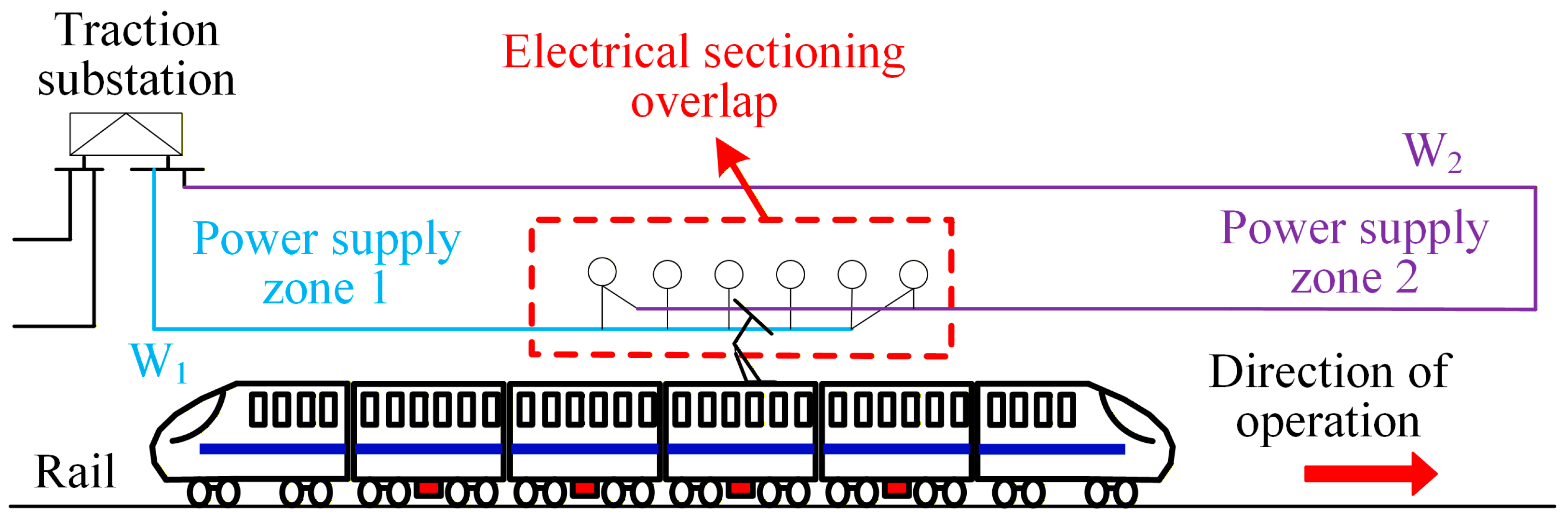
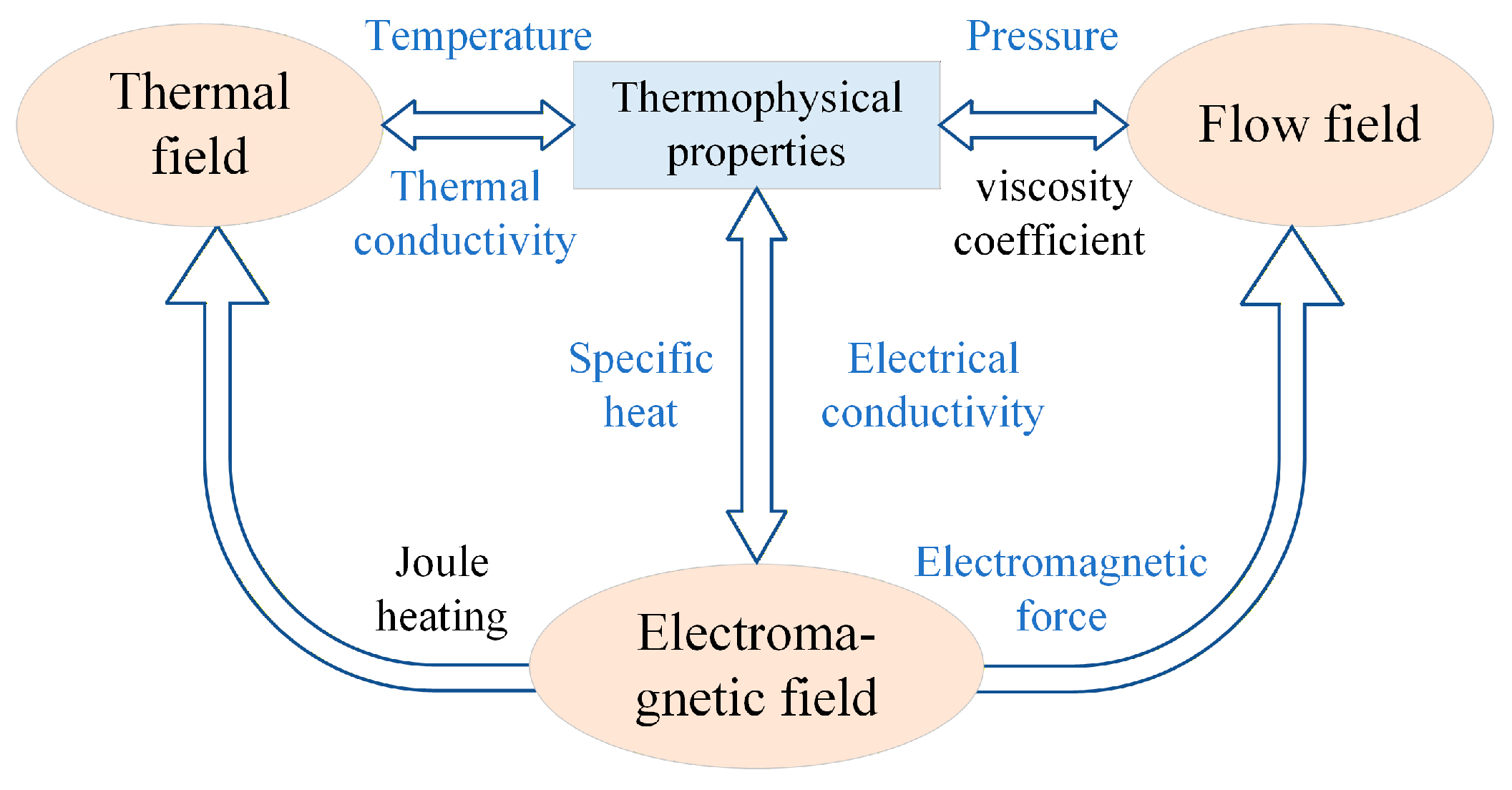
- A Multiphysics coupled arc model based on magnetohydrodynamics theory is developed, incorporating aerodynamic, electromagnetic, and thermal conduction effects to accurately describe transient arcing in the anchored-joint ESO.
- (2)
- By analyzing the power supply circuit of the anchored-joint ESO, the transient arcing mechanism is elucidated. Furthermore, the evolution of arc current density and potential distribution is revealed, providing theoretical guidance for the optimization of electrical section structures and the safe operation of high-speed railway power systems.
2. Transient Arcing Model of ESO
2.1. Transient Arcing Mechanism in ESO
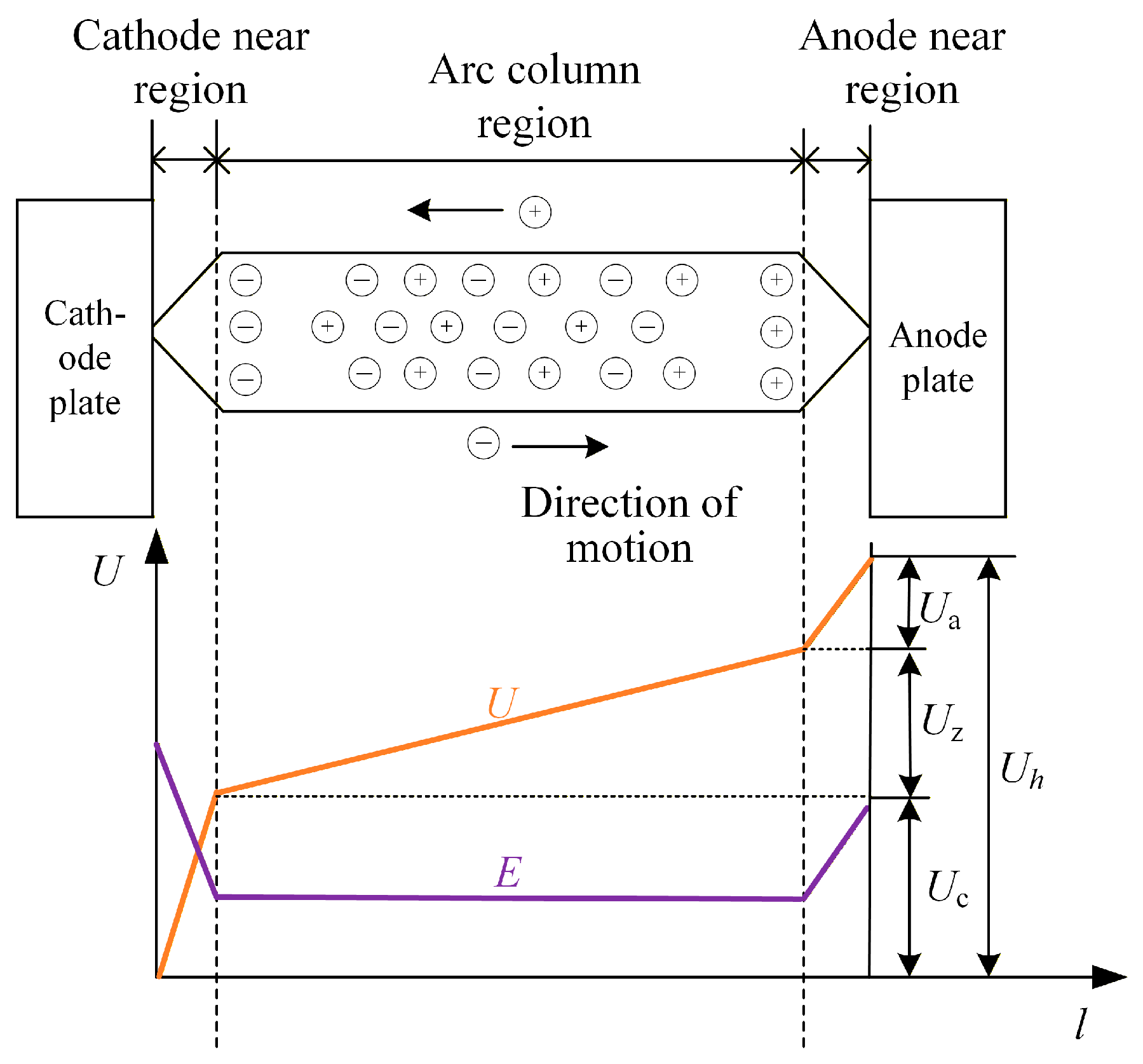
2.2. ESO Arc Plasma Characteristics
2.3. Multiphysics Coupling Mechanism of PC Transient Arcing
2.4. Multi-Physics Coupling Model of the ESO Arc
- (1)
- During PC transient arcing, the arc plasma is assumed to remain in a state of local thermodynamic equilibrium (LTE);
- (2)
- The arc sheath effects and the microscopic interactions between the high-temperature plasma and the contact pair materials are not explicitly considered;
- (3)
- The arc plasma within the computational domain is treated as an electrically neutral Newtonian fluid, and the influence of electric body forces on the arc is neglected.
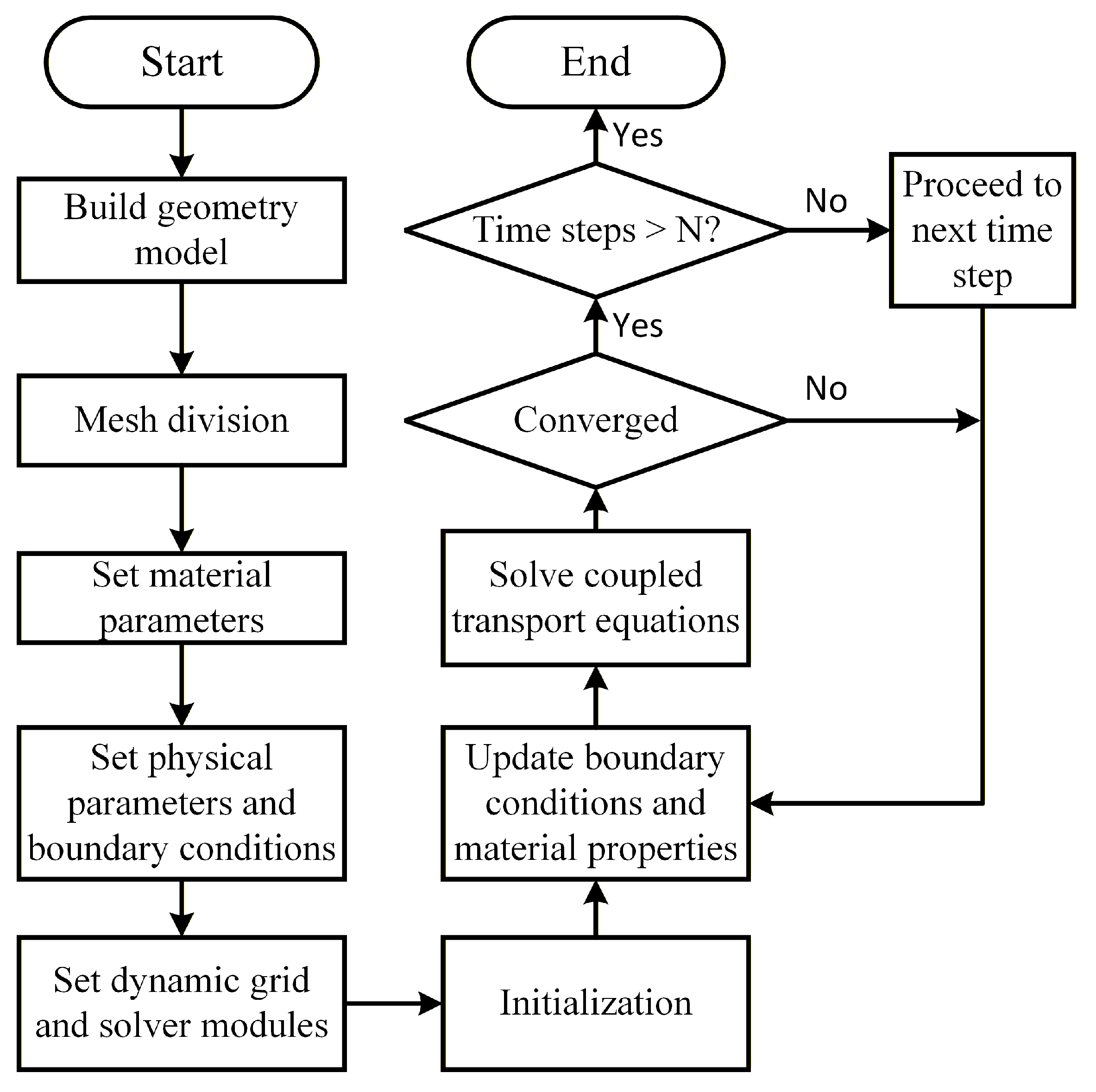
2.5. Solution of the Transient Arcing Model
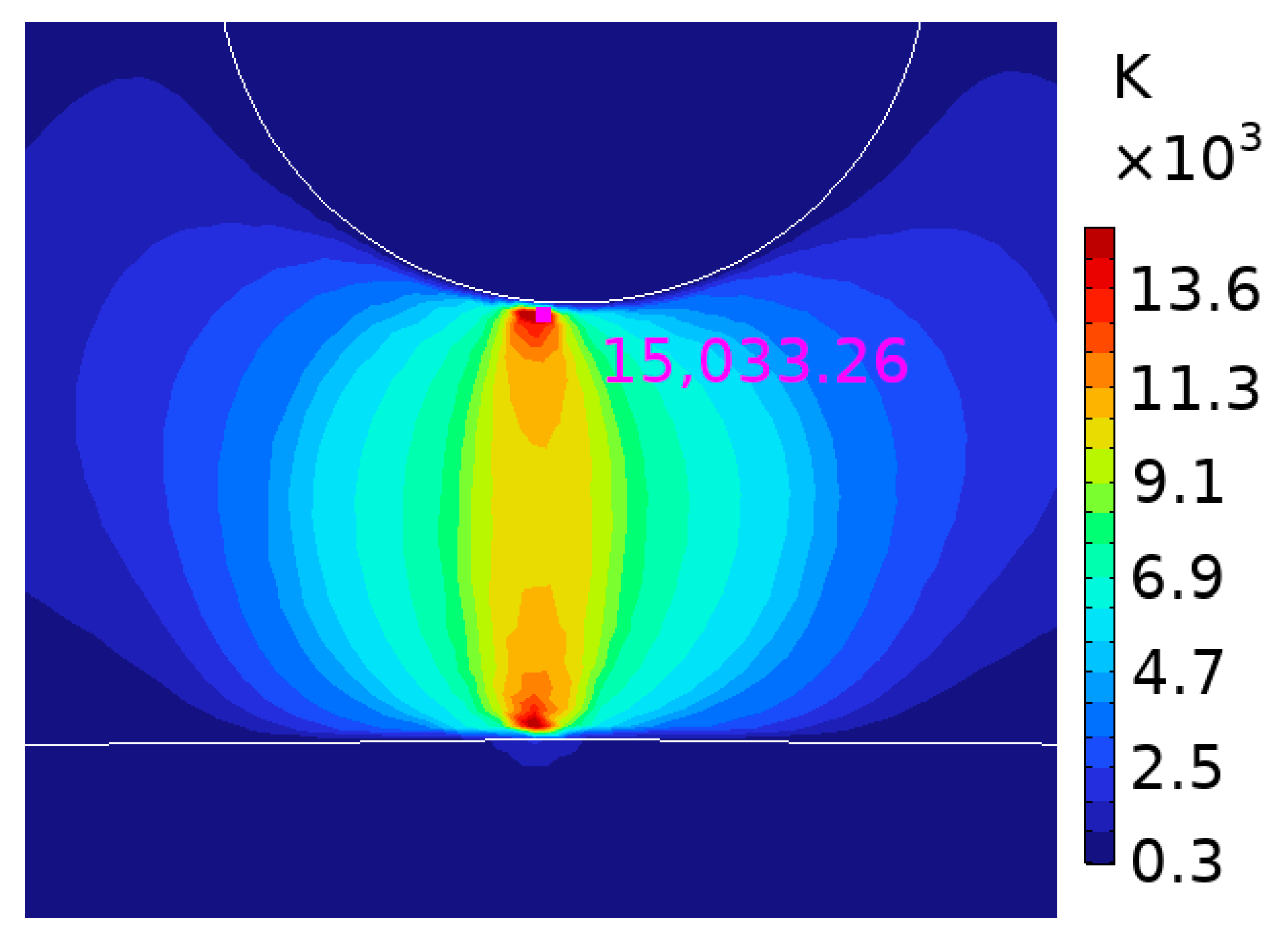
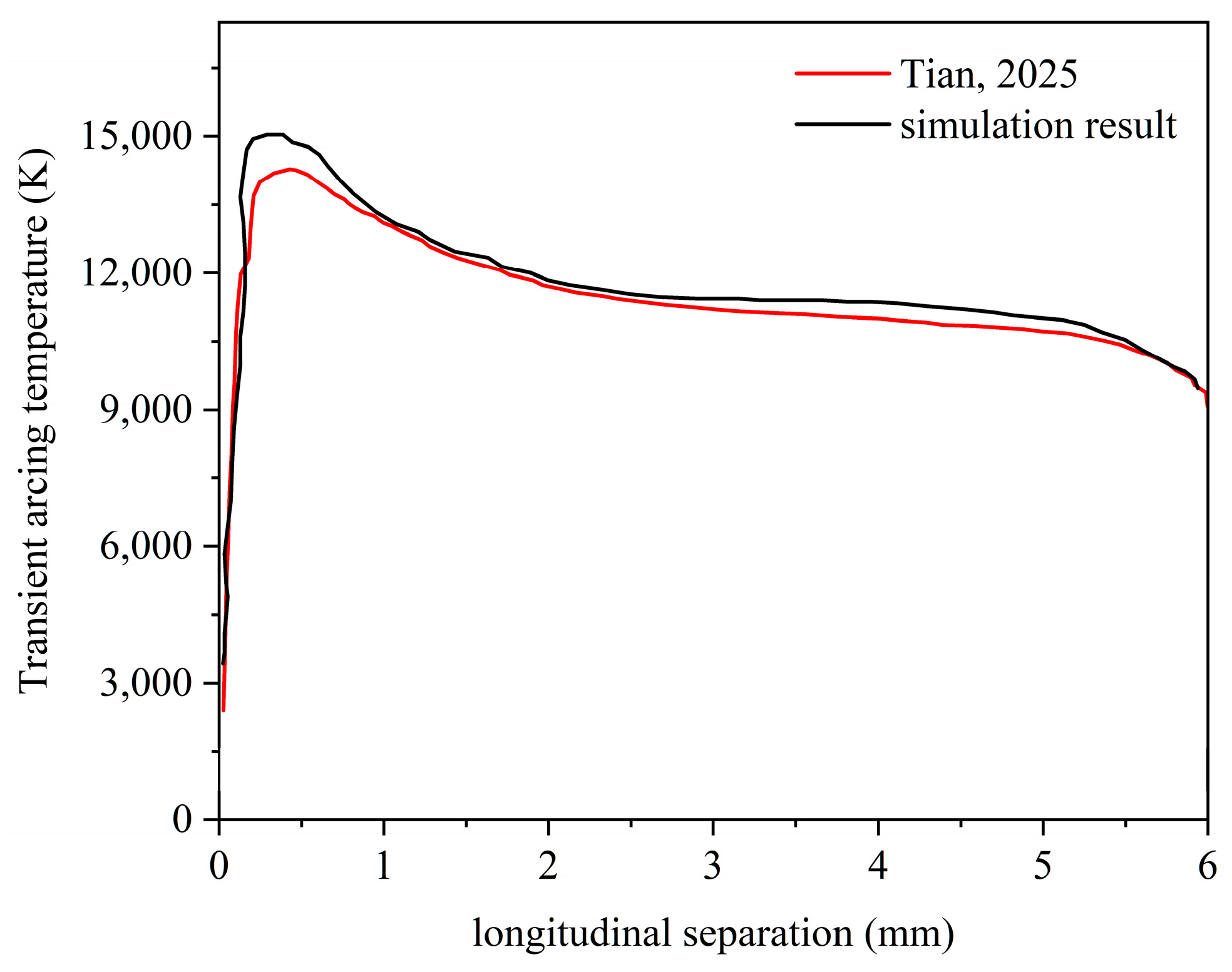
3. Model Validation
4. Results and Discussion
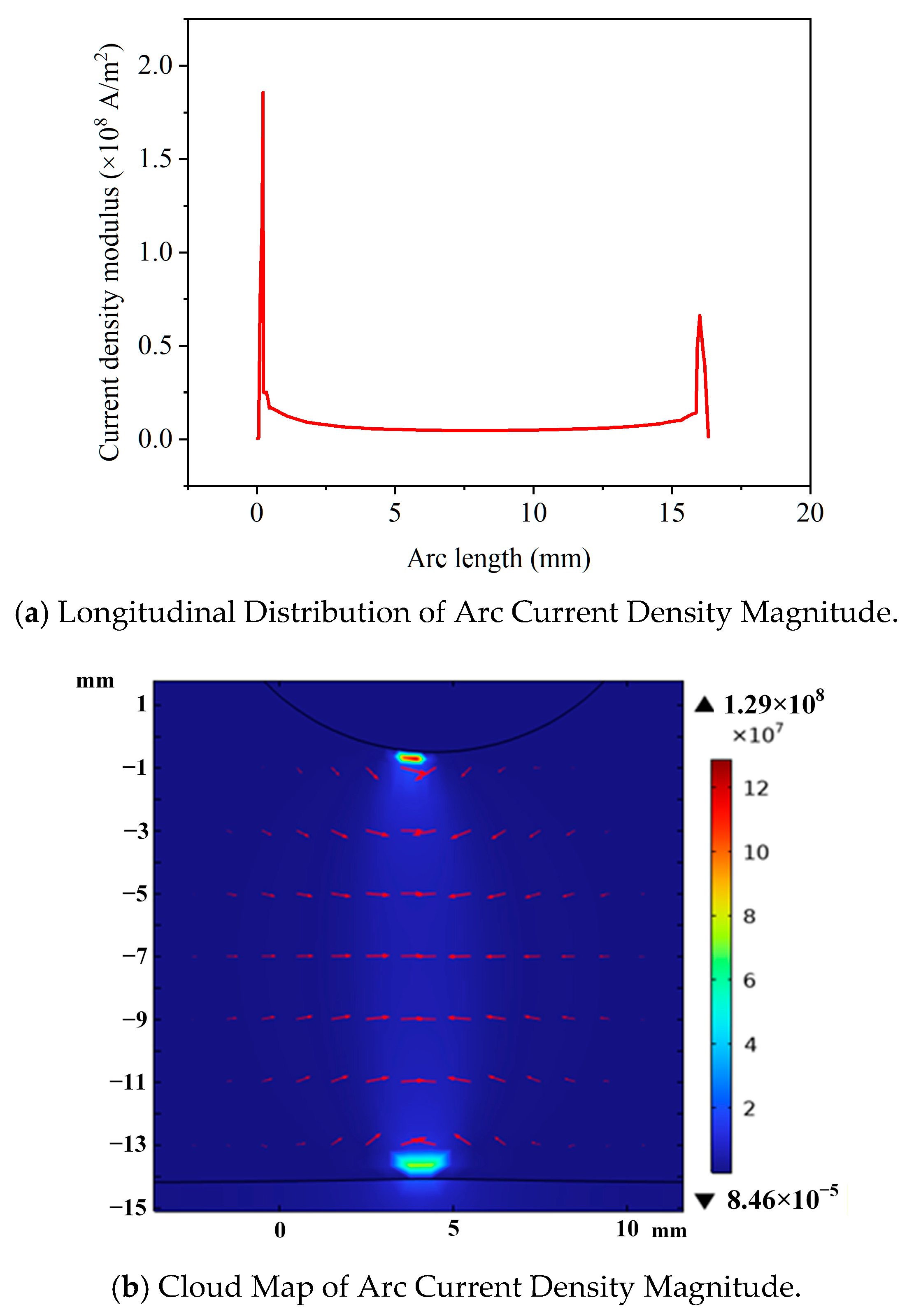
4.1. Current Density Distribution of the ESO Arc
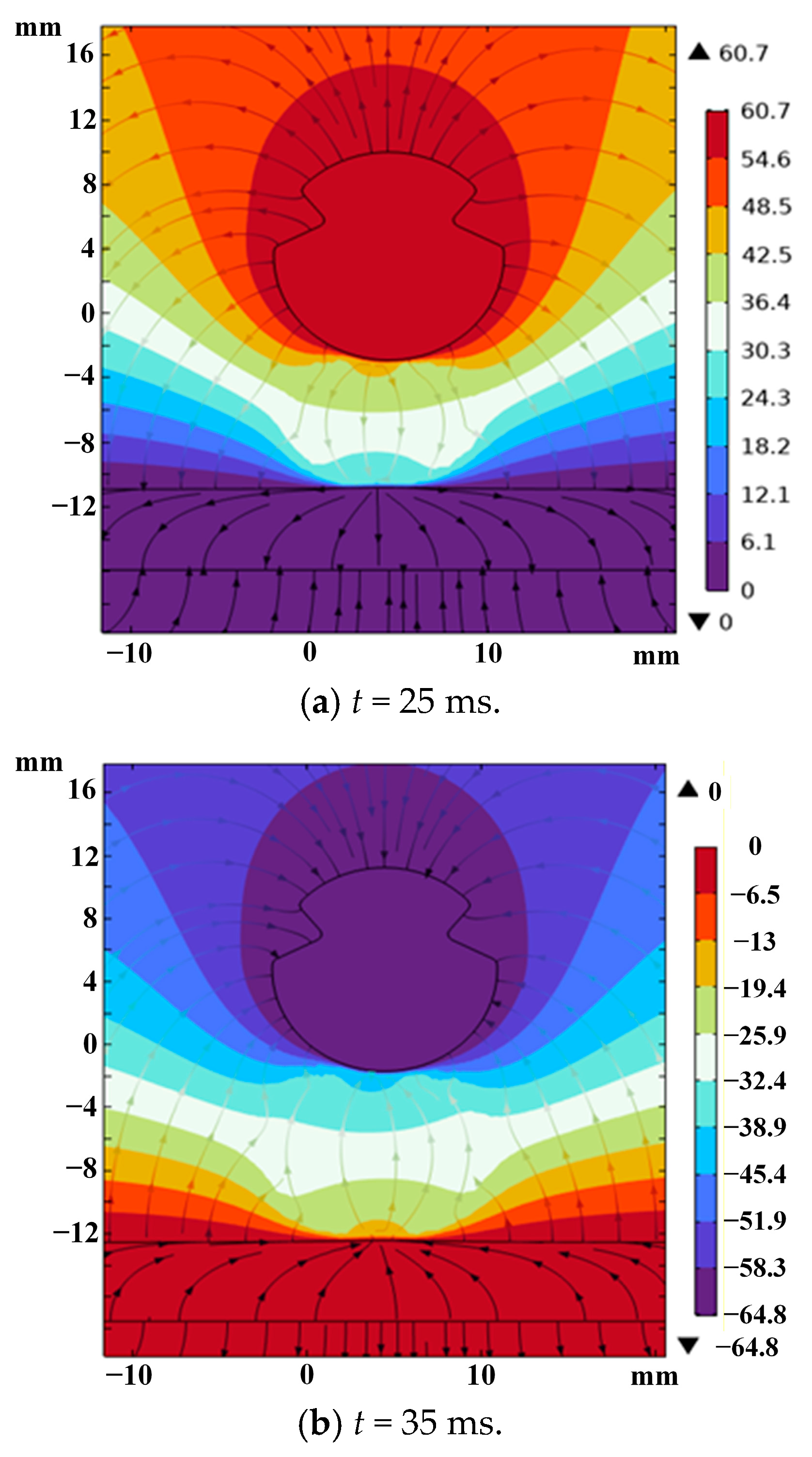
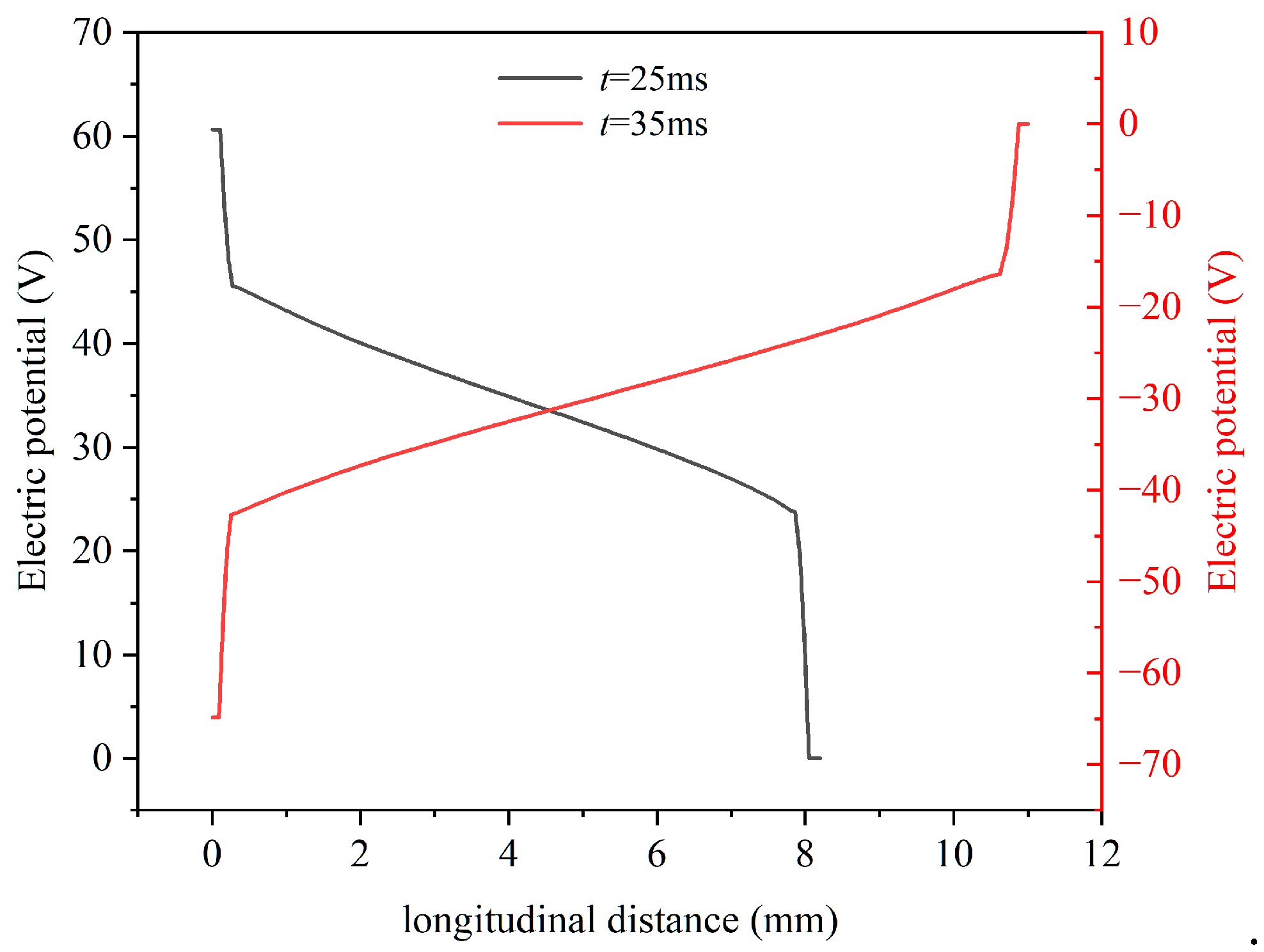
4.2. Electric Potential Distribution of the ESO Arc
5. Conclusions
- (1)
- By analyzing the power supply network topology during the passage of a power locomotive through an anchored-joint ESO, a method is established to calculate the open-circuit voltage difference between the working and non-working contact wires. This result provides a quantitative theoretical reference for evaluating the triggering conditions and voltage-driven characteristics of PC transient arcing under ESO scenarios.
- (2)
- By analyzing the multiphysics coupling mechanisms during PC contact pair separation, a coupled multiphysics model for transient arcing in ESO is developed. Under the prescribed boundary conditions, the model can reasonably capture the dominant evolution features of the current density concentration and electric potential, providing a reference for arcing risk assessment in ESO sections.
- (3)
- The arc plasma is in dynamic equilibrium between thermal expansion and Lorentz force contraction. Under a constant arc current, higher arc temperatures result in smaller plasma contraction radii and higher current densities. The direction of the electric potential gradient changes with polarity. The overall distribution pattern remains largely unchanged, showing rapid potential variation near the electrodes and relatively gentle variation along the arc column.
Author Contributions
Funding
Data Availability Statement
Conflicts of Interest
References
- Wu, G.; Dong, K.; Xu, Z.; Xiao, S.; Wei, W.; Chen, H.; Li, J.; Huang, Z.; Li, J.; Gao, G.; et al. Pantograph–catenary electrical contact system of high-speed railways: Recent progress, challenges, and outlooks. Railw. Eng. Sci. 2022, 30, 437–467. [Google Scholar]
- Pan, L.; Xie, B.; Chen, L.; Xing, T.; Zhang, H.; Lu, Y.; Song, Y. Study on the influencing factors of electrical characteristics of articulated split-zone insulator arc. Energies 2024, 7, 3883. [Google Scholar]
- Liu, Z.; Zhou, H.; Huang, K.; Song, Y.; Zheng, Z.; Cheng, Y. Extended black-box model of pantograph-catenary detachment arc considering pantograph-catenary dynamics in electrified railway. IEEE Trans. Ind. Appl. 2019, 55, 776–785. [Google Scholar] [CrossRef]
- Jiang, D.; Zou, H.; Guo, Y.; Tian, F.; Liu, H.; Yin, Y. Simulation on operating overvoltage of dropping pantograph based on pantograph–catenary arc and variable capacitance model. Appl. Sci. 2024, 14, 6861. [Google Scholar] [CrossRef]
- Zhou, H.; Duan, F.; Liu, Z.; Chen, L.; Song, Y.; Zhang, Y. Study on electric spark discharge between pantograph and catenary in electrified railway. IET Electr. Syst. Transp. 2022, 12, 128–142. [Google Scholar] [CrossRef]
- Wang, Y.; Liu, Z.; Mu, X.; Huang, K.; Wang, H.; Gao, S. An extended habedank’s equation-based EMTP model of pantograph arcing considering pantograph-catenary interactions and train speeds. IEEE Trans. Power Deliv. 2016, 31, 1186–1194. [Google Scholar]
- Zeng, H.; Chen, X.; Deng, F. Simulation analysis of pantograph catenary arc motion characteristics during high-speed train running. In Proceedings of the 2022 IEEE 5th International Electrical and Energy Conference (CIEEC), Nangjing, China, 27–29 May 2022; pp. 858–862. [Google Scholar]
- Yu, X.; Song, M.; Wang, Z. Simulation and verification of effect of arc duration on arc temperature based on COMSOL. Machines 2023, 11, 289. [Google Scholar] [CrossRef]
- Zhu, G.; Gao, G.; Wu, G.; Gu, Z.; Wu, J.; Hao, J. Modeling pantograph-catenary arcing. Proc. Inst. Mech. Eng. Part F-J. Rail Rapid Transit 2016, 230, 1687–1697. [Google Scholar]
- Yang, Z.; Xu, P.; Wei, W.; Gao, G.; Zhou, N.; Wu, G. Influence of the crosswind on the pantograph arcing dynamics. IEEE Trans. Plasma Sci. 2020, 48, 2822–2830. [Google Scholar] [CrossRef]
- Lu, B.; Song, Y.; Liu, Z.; Wang, X.; Zhang, Q.; Lu, Y. Evolution Analysis of Three-Dimensional Wheel Polygonal Wear for Electric Locomotives Considering the Effect of Interharmonics. IEEE Trans. Veh. Technol. 2025, 74, 2443–2457. [Google Scholar]
- Lu, B.; Song, Y.; Liu, Z.; Tao, G.; Wang, X.; Zhang, Q.; Li, Z. Evolution analysis of wheel polygon wear considering the effect of interharmonics in electrical traction drive system. Mech. Mach. Theory 2024, 191, 105470. [Google Scholar]
- Yu, X.; Su, Y.; Song, M.; Yang, J.; Song, L.; Wang, Z.; Liu, Y.; Wei, C.; Cheng, Y. Simulation of pantograph–catenary arc temperature field in urban railway and study of influencing factors on arc temperature. Infrastructures 2025, 10, 237. [Google Scholar] [CrossRef]
- Gao, G.; Li, H.; Qian, P.; Zhou, C.; Zeng, J.; Fu, R.; Weng, X.; Wang, H.; Yang, Z.; Wu, G. Research on the characteristics and influencing factors of arc in segmented insulators. Phys. Scr. 2025, 100, 065605. [Google Scholar] [CrossRef]
- Liu, Z.; Song, Y.; Gao, S.; Wang, H. Review of perspectives on pantograph-catenary interaction research for high-speed railways operating at 400 Km/h and above. IEEE Trans. Transp. Electrif. 2024, 10, 7236–7257. [Google Scholar] [CrossRef]
- Wang, X.; Song, Y.; Fan, J.; Duan, F.; Liu, Z. Thermal behavior of arcing in electrical section overlaps under specialized mechanical configurations. Int. J. Therm. Sci. 2026, 220, 110424. [Google Scholar] [CrossRef]
- Dong, Y.; Wang, H.; Zhang, H.; Gong, H.; Gao, T. Process simulation of humidity and airflow effects on arc discharge characteristics in pantograph–catenary systems. Processes 2025, 13, 3242. [Google Scholar] [CrossRef]
- Zhang, C.; Xiao, S.; Wu, J.; Luo, Y.; Rao, Y.; Wei, W. The thermal dissipation characteristics analysis of the rotatable circular pantograph–catenary system. IEEE Trans. Plasma Sci. 2022, 50, 401–409. [Google Scholar] [CrossRef]
- Zou, D.; Xia, Z.; Xu, G.; Sarkar, S.; Atul, J.; Shi, G. Influence of low air pressure on pantograph–catenary arc model. IEEE Trans. Plasma Sci. 2025, 53, 1292–1298. [Google Scholar] [CrossRef]
- Wang, H.; Song, Y.; Yang, H.; Liu, Z. Generalized Koopman Neural Operator for Data-driven Modelling of Electric Railway Pantograph-catenary Systems. IEEE Trans. Transp. Electrif. 2025, 11, 14100–14112. [Google Scholar] [CrossRef]
- Wang, X.; Song, Y.; Yang, H.; Wang, H.; Lu, B.; Liu, Z. A time-frequency dual-domain deep learning approach for high-speed pantograph-catenary dynamic performance prediction. Mech. Syst. Signal Process. 2025, 238, 113258. [Google Scholar]
- Wang, R.; Wang, Z.; Liu, Y.; Zhang, L. Research on key technologies of intelligent detection of high-speed rail pantograph catenary status based on image fusion. In Proceedings of the 2023 IEEE 15th International Conference on Computational Intelligence and Communication Networks (CICN), Bangkok, Thailand, 22–23 December 2023; pp. 769–774. [Google Scholar]
- Gao, G.; Yan, X.; Yang, Z.; Wei, W.; Hu, Y.; Wu, G. Pantograph–catenary arcing detection based on electromagnetic radiation. IEEE Trans. Electromagn. Compat. 2019, 61, 983–989. [Google Scholar] [CrossRef]
- Wang, X.; Guo, F.; Li, F.; Liu, Z.; Kou, J. Influence of surface roughness of sliding friction pairs on pantograph-catenary contact resistance. IEEE Trans. Transp. Electrif. 2024, 10, 10208–10218. [Google Scholar] [CrossRef]
- Xu, Z.; Gao, G.; Yang, Z.; Wei, W.; Wu, G. An online monitoring device for pantograph catenary arc temperature detect based on atomic emission spectroscopy. In Proceedings of the 2018 IEEE International Conference on High Voltage Engineering and Application (ICHVE), Athens, Greece, 10–13 September 2018; pp. 1–4. [Google Scholar]
- Aydın, İ.; Yaman, O.; Karaköse, M.; Çelebi, S.B. Particle swarm based arc detection on time series in pantograph-catenary system. In Proceedings of the 2014 IEEE International Symposium on Innovations in Intelligent Systems and Applications (INISTA) Proceedings, Alberobello, Italy, 23–25 June 2014; pp. 344–349. [Google Scholar]
- Quan, W.; Xu, X.; Liu, X.; Wang, X.; Gao, S. ArcSE: A dual-branch semantic segmentation model for robust pantograph–catenary arcing detection in complex environments. IEEE Trans. Instrum. Meas. 2025, 74, 2502814. [Google Scholar] [CrossRef]
- Liu, Z.; Yang, Y.; Zhou, H.; Huang, K. Study on the modeling and suppression of arcing generated by articulated split-zone insulator in electrified railways. IEEE Trans. Transp. Electrif. 2021, 8, 542–552. [Google Scholar] [CrossRef]
- Tian, R.; Wang, S.-J.; Lu, M.; Li, J. Study on the Ablation of Slide Plate by Pantograph–Catenary Arc Based on Pantograph Slide Material. Infrastructures 2025, 10, 276. [Google Scholar] [CrossRef]



| Parameter | Pantograph Slide | Contact Wire |
|---|---|---|
| Conductivity [S/m] | 2.857 × 10⁷ | 4.167 × 10⁷ |
| Specific heat [J/(kg·K)] | 376 | 385 |
| Density [kg/m3] | 8100 | 9020 |
| Thermal conductivity [W/(m·K)] | 80 | 400 |
| Melting point [K] | -- | 1356 |
| Boiling point [K] | -- | 2840 |
Disclaimer/Publisher’s Note: The statements, opinions and data contained in all publications are solely those of the individual author(s) and contributor(s) and not of MDPI and/or the editor(s). MDPI and/or the editor(s) disclaim responsibility for any injury to people or property resulting from any ideas, methods, instructions or products referred to in the content. |
© 2026 by the authors. Licensee MDPI, Basel, Switzerland. This article is an open access article distributed under the terms and conditions of the Creative Commons Attribution (CC BY) license.
Share and Cite
Pan, L.; Wang, X.; Yuan, Y.; Xing, T.; Chen, L. Transient Arcing Characteristics of the Pantograph–Catenary System in Electrical Sectioning Overlaps. Infrastructures 2026, 11, 17. https://doi.org/10.3390/infrastructures11010017
Pan L, Wang X, Yuan Y, Xing T, Chen L. Transient Arcing Characteristics of the Pantograph–Catenary System in Electrical Sectioning Overlaps. Infrastructures. 2026; 11(1):17. https://doi.org/10.3390/infrastructures11010017
Chicago/Turabian StylePan, Like, Xiaokang Wang, Yuan Yuan, Tong Xing, and Liming Chen. 2026. "Transient Arcing Characteristics of the Pantograph–Catenary System in Electrical Sectioning Overlaps" Infrastructures 11, no. 1: 17. https://doi.org/10.3390/infrastructures11010017
APA StylePan, L., Wang, X., Yuan, Y., Xing, T., & Chen, L. (2026). Transient Arcing Characteristics of the Pantograph–Catenary System in Electrical Sectioning Overlaps. Infrastructures, 11(1), 17. https://doi.org/10.3390/infrastructures11010017