Abstract
Expansive soils undergo significant volume changes with moisture fluctuations, posing persistent challenges for infrastructure due to heave, settlement, and loss of bearing capacity. Stabilization is a common mitigation strategy, though traditional binders, such as cement and lime, are associated with high energy consumption and considerable CO2 emissions. In this context, identifying low-carbon alternatives is essential. This study evaluates the short-term behavior of expansive marly clays from southern Spain stabilized with volcanic ash generated during the 2021 Tajogaite eruption (La Palma, Canary Islands, Spain). Volcanic ash was incorporated in different proportions to assess its performance as a natural pozzolan, while natural hydrated lime was used both as a direct stabilizer and as an activator to enhance ash reactivity. A key methodological contribution of this research is the monitoring of lime reactivity throughout storage, using XRD and TGA to quantify portlandite loss and partial carbonation before mixing—an aspect seldom addressed in stabilization studies. The experimental program included chemical and mineralogical characterization, compaction, Atterberg limits, free swelling, unconfined compressive strength, and direct shear tests on natural and stabilized mixtures. The results show that volcanic ash, particularly when lime-activated, substantially improves volumetric stability. Free swelling decreased from 11.9% in the natural soil to values as low as 1.7%, while dry density increased and plasticity decreased. Strength gains were modest under short-term conditions, consistent with the limited time for pozzolanic reactions to develop. The combined use of volcanic ash and lime reduced the lime demand required to achieve equivalent volumetric control, offering an eco-efficient and technically viable alternative for stabilizing expansive marly clays.
1. Introduction
Every structure founded on soil or rock requires materials with adequate geotechnical properties to safely support the design load. When natural soils fail to meet these requirements, particularly in the case of expansive, collapsible, or highly plastic materials, technical–economic constraints often necessitate their improvement through stabilization rather than replacement. Reusing such soil is generally the most sustainable option, reducing environmental impact, construction costs, and the demand for granular borrow materials. However, volumetrically unstable soils remain difficult to manage due to their high deformability, low shear strength, and moisture-sensitive behavior, which hinder workability and compromise structural performance.
A wide range of stabilization techniques has been employed historically, from natural oils, plant extracts, and animal derivatives [1] to the engineered solutions used in ancient infrastructures, such as the Great Wall of China and Roman roads [2]. More recently, increasing urban development has intensified the need to reuse problematic soils using non-conventional stabilizers such as cement kiln dust ([3,4]). Volcanic ash has similarly gained attention as a natural pozzolan capable of enhancing soil behavior ([5,6,7,8,9]), offering a locally available and environmentally friendly alternative in volcanic regions.
Although lime and cement remain the most widely used stabilizers ([10,11,12,13]), the production of these binders entails substantial environmental and economic burdens. Cement production alone reached approximately 4.6 billion tons in 2015 and is projected to exceed 4.8 billion tons by 2030 [14]. Both binders release significant CO2 emissions due to fuel combustion and limestone decarbonation, with cement production accounting for 6–10% of global anthropogenic CO2 emissions. Lime manufacture exhibits similar emission intensities and high energy demands [15]. Consequently, substituting part of these binders with natural pozzolans can reduce the environmental footprint of soil stabilization while maintaining or improving performance.
In this context, volcanic ash from the 2021 Tajogaite eruption on La Palma represents a valuable natural by-product with high reuse potential ([16,17]). Its valorization aligns with circular economy principles and provides a sustainable alternative when chemically activated with natural hydrated lime. Previous research has shown that volcanic ashes containing sufficient amorphous silica and alumina can significantly enhance soil behavior when combined with lime ([6,9]). Complementary by-products and additives, such as fly ash, white slag, magnesium hydroxide [18], sulfonated oils [19], nanomaterials, fibers, polymers, industrial wastes [20], and marble dust [21], have also been explored as eco-efficient stabilization agents.
An additional motivation for this research arises from the uncertainty surrounding lime reactivity during storage. Most stabilization studies implicitly assume that commercial lime maintains constant chemical activity, despite known susceptibility to carbonation, particularly under humid conditions. Few studies characterize lime before its use, and even fewer monitor its evolution over time. As noted by Akula and Little (2020) [22], TGA (Thermogravimetric Analysis) and DSC analyses are typically applied to reaction products rather than to the lime itself, while the IECA [23] manual warns about potential storage-induced carbonation but offers no quantitative method for assessing degradation.
To address this gap, the present study introduces methodological innovation by monitoring the physicochemical stability of lime through XRD (X-Ray Diffraction) and TGAs performed at 30-day intervals (samples C-1, C-2, C-3). This approach provides quantitative evidence of carbonation and portlandite depletion, ensuring accurate interpretation of the subsequent stabilization mechanisms.
This research evaluates the short-term performance of expansive marly clays stabilized with volcanic ash (V-C3) and lime (C-1), examining plasticity, compaction behavior, volumetric stability, and mechanical response. The findings demonstrate the technical viability and environmental relevance of lime-activated volcanic ash as an efficient stabilizer and highlight the importance of monitoring lime reactivity to ensure effective activation of pozzolanic materials.
2. Materials and Methods
For the stabilization of problematic soils, such as the highly plastic marly clays that are the object of this study, and with the purpose of optimizing the application process of cement and lime as additives from an economic and environmental perspective, the possible improvements obtained by adding different percentages of volcanic ash were explored, adding lime as an activator of pozzolanic properties. In addition, to compare volumetric stability and chemical, mineralogical, and geotechnical properties, mixtures with only lime as an additive were studied.
In this research, the term short-term conditions refers to tests performed immediately after sample preparation and compaction, without applying any curing period and maintaining the initial moisture content obtained from the modified Proctor test. All tests were carried out under monitoring laboratory ambient conditions.
2.1. Materials
2.1.1. Soil
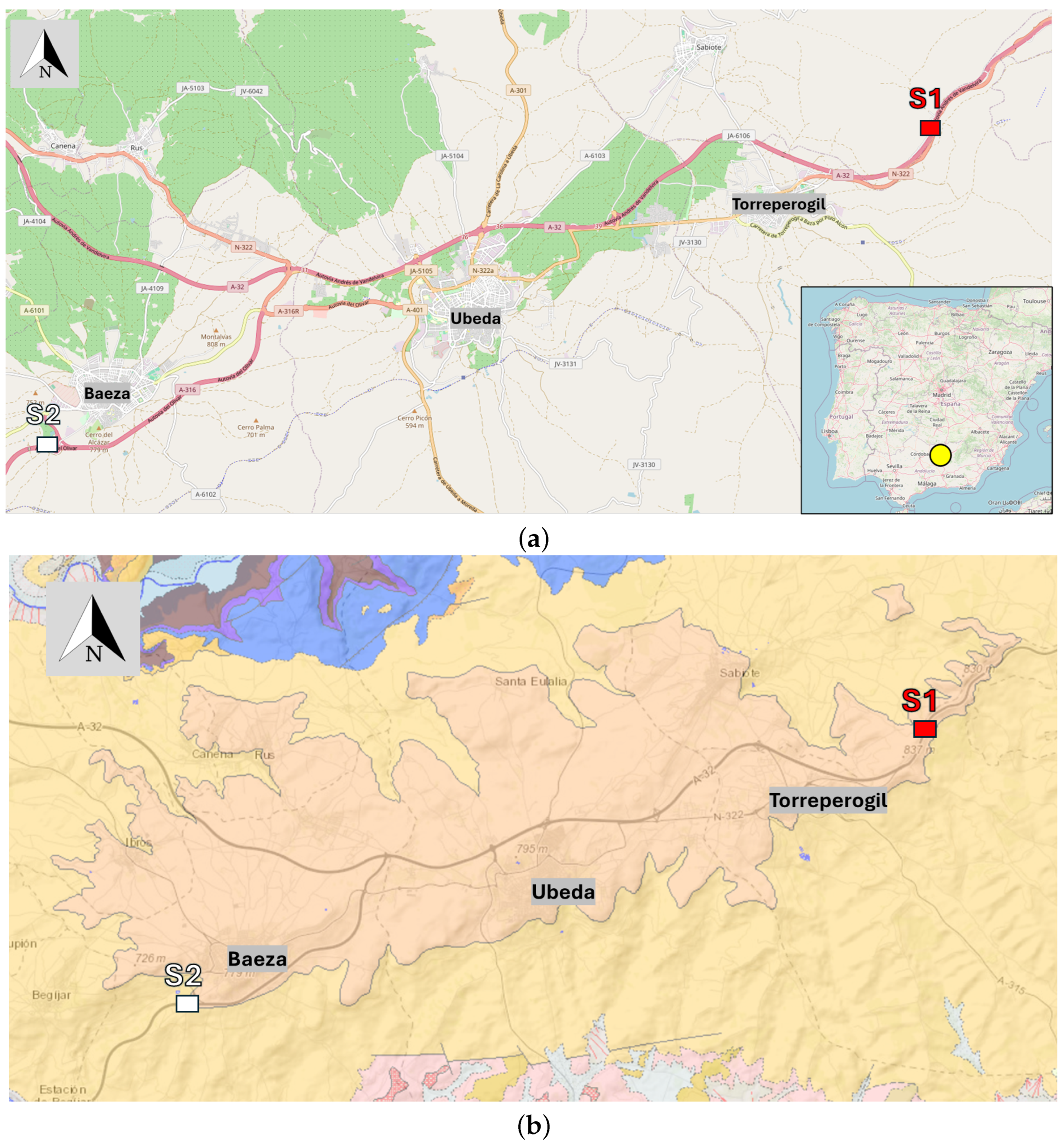
Two samples of marly clay soil, designated S1 and S2, were selected from locations near Torreperogil and Baeza, respectively (Jaén, Southern Spain) (see Figure 1a), for testing. Sample S1 was used to study swelling and deformability, being previously characterized and studied by Montero and Estaire ([24,25]). The second soil sample (S2) was used to study resistance parameters by the direct shear test. Both samples are classified as high-plasticity clay.
Figure 1.
(a) Location of samples S1 (red) and S2 (white), yellow circle indicating the location of samples S1 and S2 within the geographical context of the map of Spain, modified using data from OpenStreetMap contributors. OpenStreetMap. Available online: https://www.openstreetmap.org/#map=13/38.01321/-3.36765 (accessed on 28 November 2025), (b) Location on the IGME 2022 [26] geological map, showing samples S1 (red) and S2 (white).
The two soil samples, S1 and S2, were collected from the same geological unit mapped as “Porcuna–Baeza Unit, Blue and White Marls, Sandstones and Marls. Locally Conglomerates. Turbiditic Systems.”, according to the Continuous Geological Map of Spain, scale 1:50,000 [26]. This unit comprises fine-grained basin marls with alternating calcareous and clayey layers that display relatively homogeneous mineralogical and geotechnical characteristics across the mapped area. The fact that both sampling points fall within this same marly unit supports the comparability of soil samples S1 and S2 and explains their similar classification as expansive marly clays (Figure 1b). Figure 1b shows the sampling locations within this geological context.
The studied soils were also analyzed regarding their chemical and mineralogical composition, index properties, etc. This geological formation was previously extensively studied by numerous authors; thus, the information of the present investigation complemented previous results with selected characterization tests compiled from numerous previous studies ([24,25,27,28,29,30,31,32]). To contextualize the geotechnical behavior of the tested soils, Table 1 presents their fines content and Atterberg limits, alongside the ranges commonly reported for comparable soils in previous studies. These data allow for identifying the degree to which the present soils fall within typical variability ranges for the main reference.
Table 1.
Range of fines content and Atterberg limits; values reported in the literature.
2.1.2. Chemical Stabilizers (Volcanic Ash (V))
To stabilize and improve the geotechnical properties of marly clay in terms of its volumetric and strength properties, volcanic ash (V), known as V-C3, was used, which was sampled during the Tajogaite volcanic eruption on the island of La Palma, at a 3150 m distance from the emission center. The chemical, mineralogical, and geotechnical characterization of this particular sample was evaluated by Melentijević [33], determined by XRF (X-Ray Fluorescence) (Table 2), presenting the following parameters: specific gravity of soil particles Gs = 2.97, particle size at 10% passing D10 = 0.11 mm, particle size at 30% passing D30 = 0.19 mm, particle size at 60% passing D60 = 0.31 mm, and maximum specific dry unit weight γdmax = 14.3 kN/m3. By morphological observations and microanalysis SEM-EDX (Scanning Electron Microscopy–Energy Dispersive X-Ray Spectroscopy), the particle is described as vacuolar, with angular morphology, a small size, and a homogeneous distribution.
Table 2.
Distribution of chemical elements in volcanic ash, based on data reported by Melentijević [33] and Martínez del Pozo [17].
In addition, the physicochemical characterization of the ash deposited during this volcanic event, carried out by Martínez del Pozo [17], is presented to assess its environmental impact and reuse it to obtain zeolite material. Furthermore, this research complies with the principles of the circular economy and the sustainable development goals of the 2030 Agenda (SDGs 3, 6, and 12), which proposes to use local volcanic waste (ash classified as “municipal waste” (code 20 03 03) under the European Waste Catalogue) to generate a value-added material capable of mitigating the fluorine pollution produced by the eruption itself. In these volcanic ashes, plagioclase, pyroxenes, olivine, and amphibole, among others, were identified as crystalline phases by XRD, and a chemical composition was determined by XRF, according to Table 2, as the main elements, allowing for a more in-depth evaluation of their contribution as a potential soil stabilizer and reuse for multiple purposes.
2.1.3. Activator (Lime (C))
To improve the pozzolanic activity of this volcanic ash and to provide a satisfactory mix with highly plastic clays, different cementitious additives, such as lime, cement, or cement kiln dust, are usually applied [34]. Accordingly, lime (C) was incorporated into the soil–volcanic ash (V-C3) mixtures in this study to ensure adequate activation and performance. In addition, to enable a direct comparison of free-swelling behavior, lime (C) was also added alone in low proportions (1%, 3%, and 5% of the dry soil weight), thereby limiting its dosage to evaluate its isolated contribution.
The selection criterion of the activator is based on the chemical properties of lime (C), which has an important content of calcium hydroxide Ca(OH)2 (hydrated lime), known for its strong ability to activate the pozzolanic properties of the volcanic ash and to promote cementitious reactions that improve the soil–stabilizer–activator system under both short- and long-term conditions [22]. A natural hydraulic lime type NHL-5 was selected, mainly due to its rapid development of strength and setting under humid conditions, with pH = 12.4, whose properties are described in Section 3.1.
Three samples of lime, abbreviated as C-1, C-2, and C-3, were used during this study. The differences among them are primarily related to storage time: C-1 corresponds to the material used immediately after opening the supplier’s container; C-2 was obtained one month after opening, with the lime kept in a sealed, dry plastic vacuum bag to preserve its activation properties and prevent carbonation (i.e., CaCO3 formation through exposure to ambient air); and C-3 served as a reference control sample for properties.
2.1.4. Mixtures
A summary of soil mixture designations according to the configurations that were studied in this paper is given in Table 3. The methodology of adding chemical stabilizers in proportion to the mass of dry soil was adopted, as this method allowed for their easy introduction into the construction procedures used on site.
Table 3.
Soil mixture designation and ratios of materials used for sample preparation.
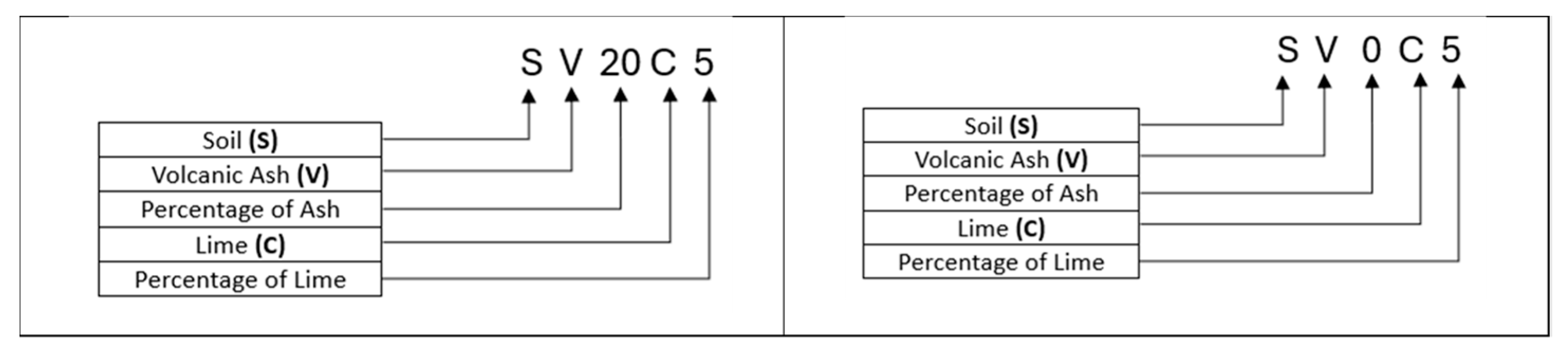
Figure 2 shows an example of the nomenclature of mixture SV20C5, which describes a 20% dry weight of volcanic ash (V-C3) added with respect to the dry weight of the base soil (S), with the addition of a 5% dry weight of lime (C-1) with respect to the dry weight of volcanic ash (V-C3). The 5% lime dosage was selected as a representative activator content commonly used in previous studies on volcanic ash–lime systems, balancing reactivity and sustainability. Reported activator contents typically range between 2 and 6% ([6,22]), making 5% an efficient and widely adopted value for early pozzolanic activation. If the mixture does not contain volcanic ash (V-C3), the weight of lime (C-1) is directly referred to the dry weight of soil (S).
Figure 2.
Example of nomenclature for SV20C5 (α = 20; β = 5) and SV0C5 (δ = 5).
For the preparation of all mixtures, the dry constituents were first blended manually until a uniform color was obtained. Water was then added, and the material was kneaded for approximately 10 min. Afterwards, the mixture was sealed in a plastic bag and allowed to rest for 45 min before molding. This procedure was applied prior to performing the plasticity, compaction, oedometer, and strength tests.
The compaction tests were conducted using modified Proctor energy, following ASTM D1557-12 [35]. These tests were carried out to determine the optimum moisture content and maximum dry unit weight of both the natural remolded clay and the mixtures prepared with VA-C3 and lime C1.
The experimental design incorporates several control specimens (reference mixtures) to isolate the effect of each stabilizing agent:
- SV0C0: soil without additives (natural control);
- SV20C0: soil with volcanic ash only (ash control);
- SV0C5: soil with lime only (lime control).
Volcanic ash does not exhibit cementitious behavior in the absence of an activator; therefore, SV20C0 behaves similarly to a soil mixed with an inert fine granular material. These control mixtures allowed for a direct comparison with the combined ash–lime mixtures to evaluate the contribution of each component to the short-term stabilization.
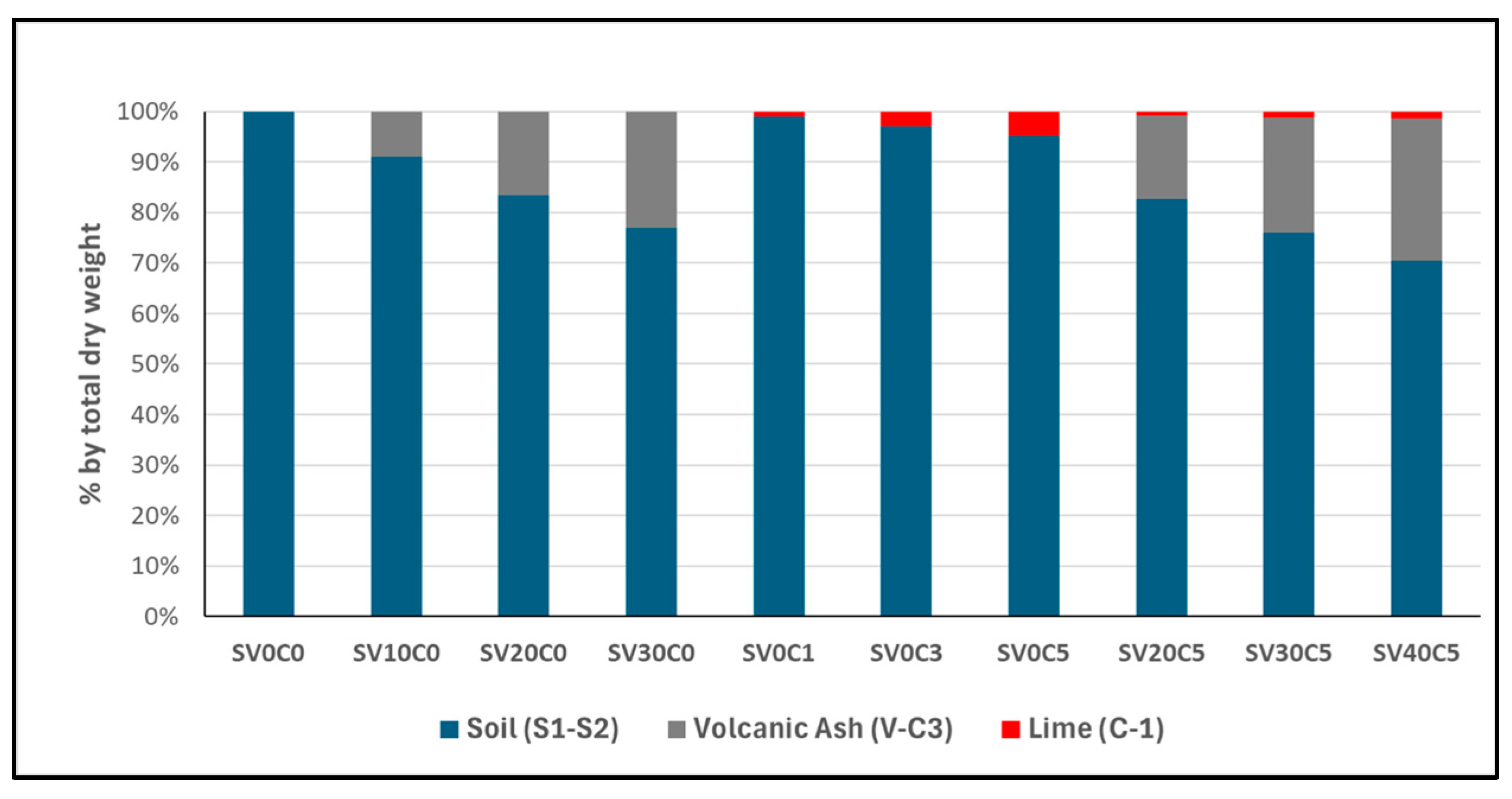
Figure 3 provides a schematic view of the mixture proportions, while Table 4 lists the exact dry-weight dosages and presents the designation of all the samples used, detailing the amount of V-C3 and C-1 added, in dry weight, per 100 g of base soil according to the specified dosage. In addition, it shows the percentage of each component expressed on a dry weight basis, relative to the total dry weight of the mixture. This information is complemented by Figure 3, which graphically illustrates the proportions employed in each mixture analyzed in this research. The monitored lime samples (C-1, C-2, C-3) used in these mixtures correspond to the activation conditions verified by TGA and XRD analyses.
Figure 3.
Relative proportions of base soil, V-C3, and C-1 in soil mixtures on a total dry weight basis of the sample.
Table 4.
Designation and dosage of soil mixtures with V-C3 and C-1 on a dry weight basis and percentage by total dry weight.
2.2. Laboratory Tests
The effective improvement assessment was based on geotechnical laboratory test results that evaluate volumetric and strength properties, as well as chemical and mineralogical characterization. Both the soil and soil mixtures in their different configurations were subjected to the same laboratory tests under controlled conditions and technical procedures according to local and international regulations defined in Table 5.
Table 5.
Standards and test procedures performed.
All specimens were tested under short-term conditions, i.e., immediately after compaction without curing or sealing, under monitoring laboratory ambient conditions.
3. Results
The results of all the tests and their comparison to reference data, characterizing the soils and soil mixtures used in this research, are presented below.
3.1. Chemical and Mineralogical Composition
3.1.1. XRF Chemical Analysis
The chemical characterization performed for the soil (S1), volcanic ash (V-C3), lime (C-1), and dry soil mixtures provides a clear overview of the oxide composition of each constituent material under anhydrous conditions. These analyses allow the identification of the reactive oxides capable of activating pozzolanic processes once water is added and form the basis for interpreting the subsequent mineralogical and mechanical behavior. Table 6 summarizes the chemical composition obtained for all the materials.
Table 6.
Distribution of chemical elements in base soil S1 (SV0C0), V-C3, C-1, and soil mixtures based on soil S1.
The soil (S1) exhibits oxide proportions typical of marly–clayey formations, with silica (SiO2) 36.0%, calcium (CaO) 21.3%, aluminum (Al2O3) 11.6%, iron (Fe2O3) 3.98%, magnesium (MgO) 2.60%, and potassium (K2O) 2.24%. This composition aligns with previous characterizations of soils from the Guadalquivir Basin ([24,30]).
Volcanic ash V-C3 exhibits a chemical signature characteristic of natural pozzolans. Its combined contents of silica (SiO2) 40.62%, iron (Fe2O3) 15.55%, and alumina (Al2O3) 13.71% approach 70%, meeting ASTM-C618 [41] requirements for Class N pozzolans. The sulfur trioxide (SO3) content of 0.33% is well below the 4% threshold established by ASTM-C618 [41] to prevent expansion reactions, and the slightly negative LOI (−0.51%) reflects the predominance of oxidized iron phases rather than unburnt carbonates or organic impurities. This composition is consistent with prior characterizations of Tajogaite ash by Melentijević [33] and Martínez del Pozo [17], both of whom identified this material as suitable for pozzolanic and zeolitic applications. Similar oxide distributions have been documented in volcanic ashes used for soil stabilization in Iran, Saudi Arabia, and Papua New Guinea ([6,7,9,42]), where SiO2 contents in the range of 40–60% and moderate Al2O3–Fe2O3 levels were associated with high pozzolanic reactivity when activated with lime. Taken together, these comparisons support classifying V-C3 as a latent pozzolan that requires lime activation to develop significant C–S–H and C–A–H phases.
The lime (C-1) used as an activator contains calcium oxide (CaO) 55.01% and magnesium MgO 5.10%, totaling 60.11% of basic oxides, which is lower than the 90% required by ASTM C977 [43] for hydraulic lime. Nonetheless, its Ca(OH)2 (portlandite) phase content is sufficient to elevate porewater pH and activate the pozzolanic reaction of volcanic ash. Prior studies ([6,34,44]) confirm that even limes with moderate CaO contents can act effectively as activators when combined with highly reactive natural pozzolans.
The mixtures prepared with different quantities of volcanic ash (SV10C0, SV10C5, SV20C0, SV20C5) exhibit predictable variations in oxide proportions. The most notable change is the increase in iron oxide (Fe2O3) of greater than 20%, reflecting the inherent chemistry of V-C3 and contributing to higher mass per unit volume and improved thermal stability. A substantial reduction in LOI is also observed, decreasing by approximately 10% in mixtures SV10C0 and SV10C5 and by 16% in mixtures SV20C0 and SV20C5 relative to SV0C0. The slight increase in chromium (Cr2O3) introduced by volcanic ash is environmentally negligible and does not pose a public health concern. Similarly, the magnesium (MgO) content exceeding 5%, when considering contributions from volcanic ash and lime, has a limited influence on the dry chemical behavior of the mixtures. The addition of lime (C-1), used as an activator of pozzolanic properties, has practically no impact on the chemical composition of the mixtures, given its low percentage addition in dry weight.
Despite its minimal quantitative effect on bulk oxide composition due to its low dosage, lime (C-1) remains essential functionally. Its Ca(OH)2 content provides the alkaline environment necessary to dissolve amorphous silica and alumina from V-C3, enabling the subsequent formation of C–S–H and C–A–H upon hydration.
3.1.2. Mineralogical Identification by XRD
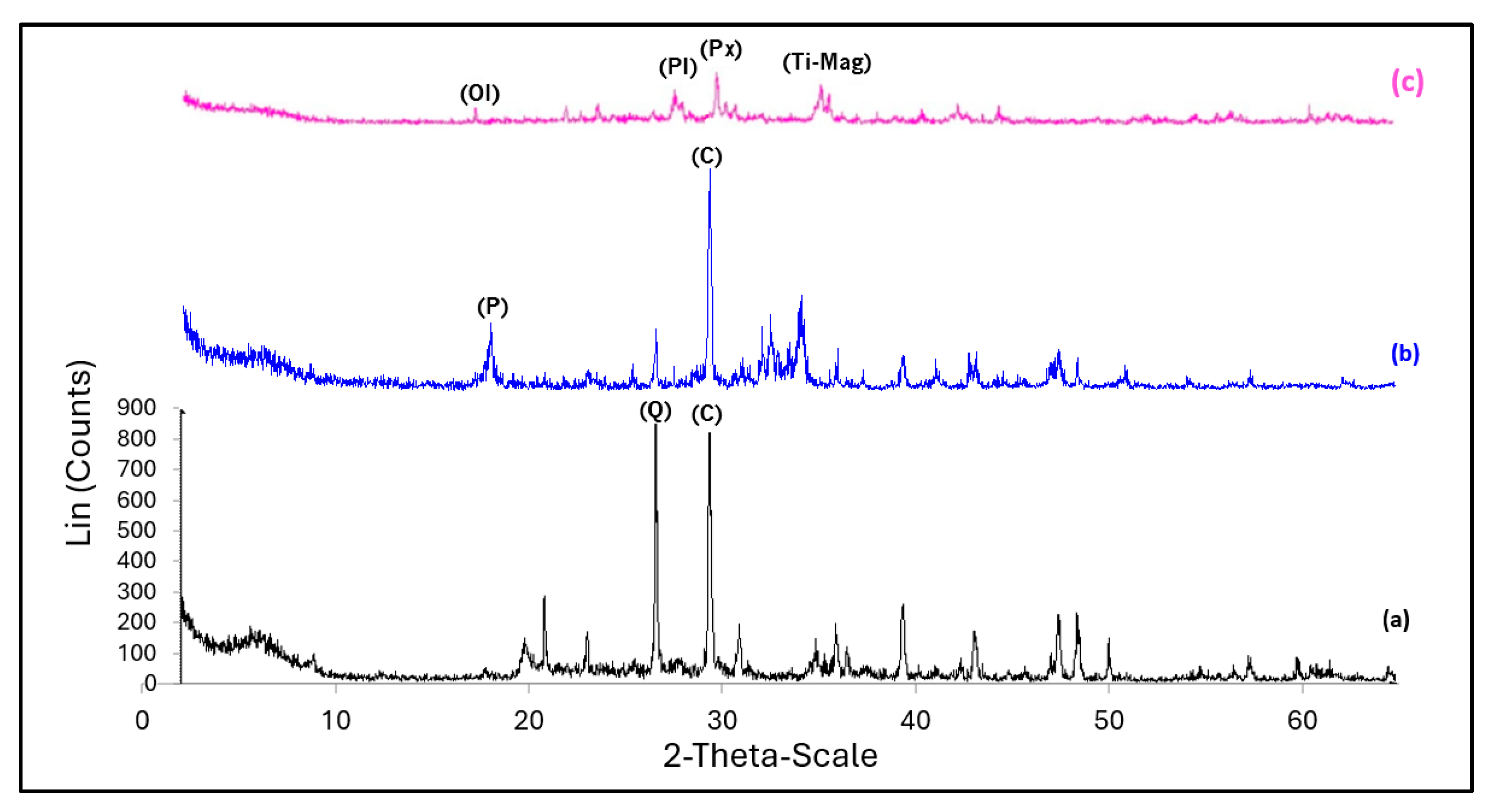
The diffractogram in Figure 4 corresponds to the volcanic ash (V-C3), the base soil S1, and lime (C-1). In the case of V-C3, the mineralogical assemblage is dominated by 34% plagioclase, 36% pyroxene, 19% olivine, 4% amphibole, and 5% titanium magnetite. This composition reflects the typical crystalline phases of basaltic to basaltic–andesitic volcanic ash and is consistent with the mineralogical signatures documented for the Tajogaite eruption by Melentijević [4,8,33] and Martínez-del-Pozo [17]. These ferromagnesian minerals contribute to the physical stability of the soil, increasing density, internal friction, and lower compressibility. However, being largely crystalline, they exhibit limited intrinsic reactivity, reinforcing the need for an external alkaline activator to mobilize the amorphous fraction and promote pozzolanic reactions. Similar broad mineralogical frameworks (plagioclase–pyroxene with a glassy component) have been reported in volcanic ashes employed for soil stabilization ([6,7,42]).
Figure 4.
Diffractogram and analysis for (a) S1 (SV0C0), (b) lime C-1, and (c) volcanic ash V-C3. (Q) quartz, (C) calcite, (P) portlandite, (Ol) olivine, (Px) pyroxene, (Pl) plagioclase, (Ti-Mag) Ti-magnetite.
Lime C-1 shows a predominance of calcite 27.8%, which behaves mainly as an inert filler material, but is inert to chemical hardening reactions, together with portlandite 10.5%, the active phase responsible for increasing porewater alkalinity to values above pH, set at a minimum of 12.4 ([23,43]) for soil stabilization. Portlandite dissolves readily and promotes the breakdown of amorphous silica and alumina in ash, enabling the formation of C–S–H and C–A–H gels. Additionally, the presence of larnite 44.2%, which reacts directly with water to form calcium silicate hydrate, indicates potential for early hydration, although it may increase susceptibility to shrinkage and induced cracking due to its rapid hardening behavior.
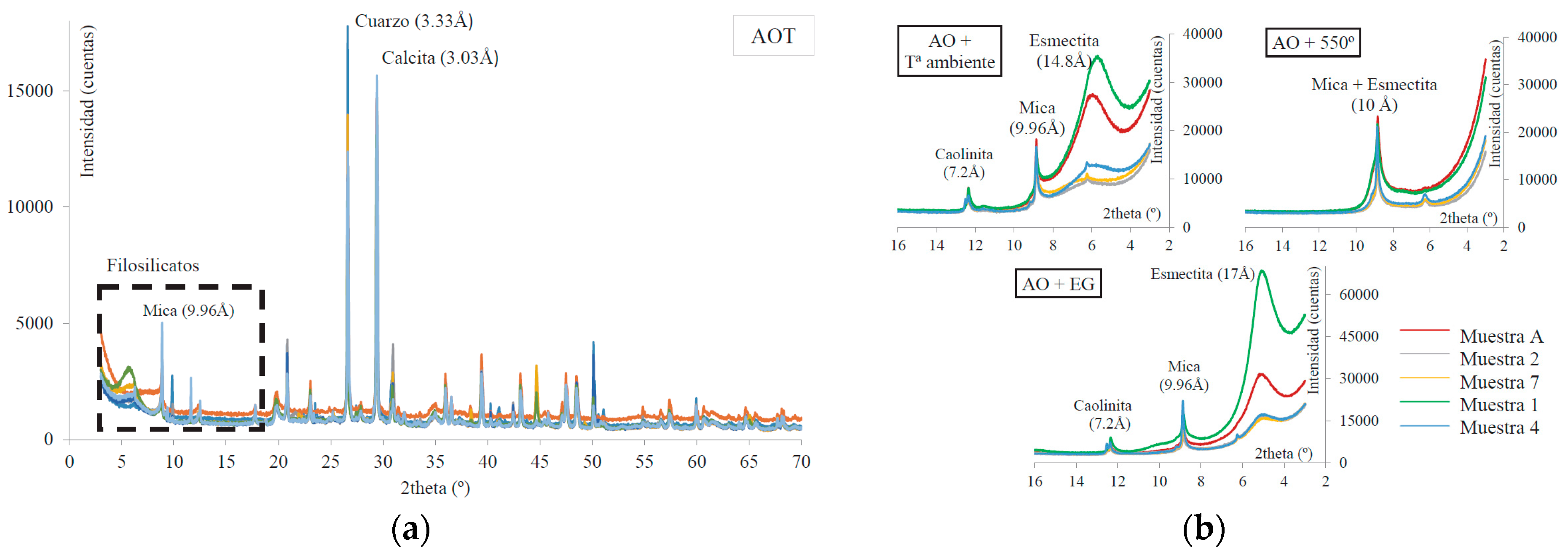
For the base soil S1, the XRD results indicate dominant crystalline phases and their concentrations associated with quartz (20.7%), calcite (25.5%), clay minerals (phyllosilicates) (38.5%), and, to a lesser extent, dolomite (5.8%). These findings are consistent with the mineralogical profile reported by Montero and Estaire [25] for soil S1 (see Figure 5), expanding the analysis by oriented aggregates, observing the presence of smectite, mica, and kaolinite, within the parameters of this type of soil, thus defining S1 as volumetrically unstable and expansive.
Figure 5.
(a) Diffractograms of the analyzed sample of base soil S1 and (b) results of the oriented aggregate technique (Montero and Estaire [25]).
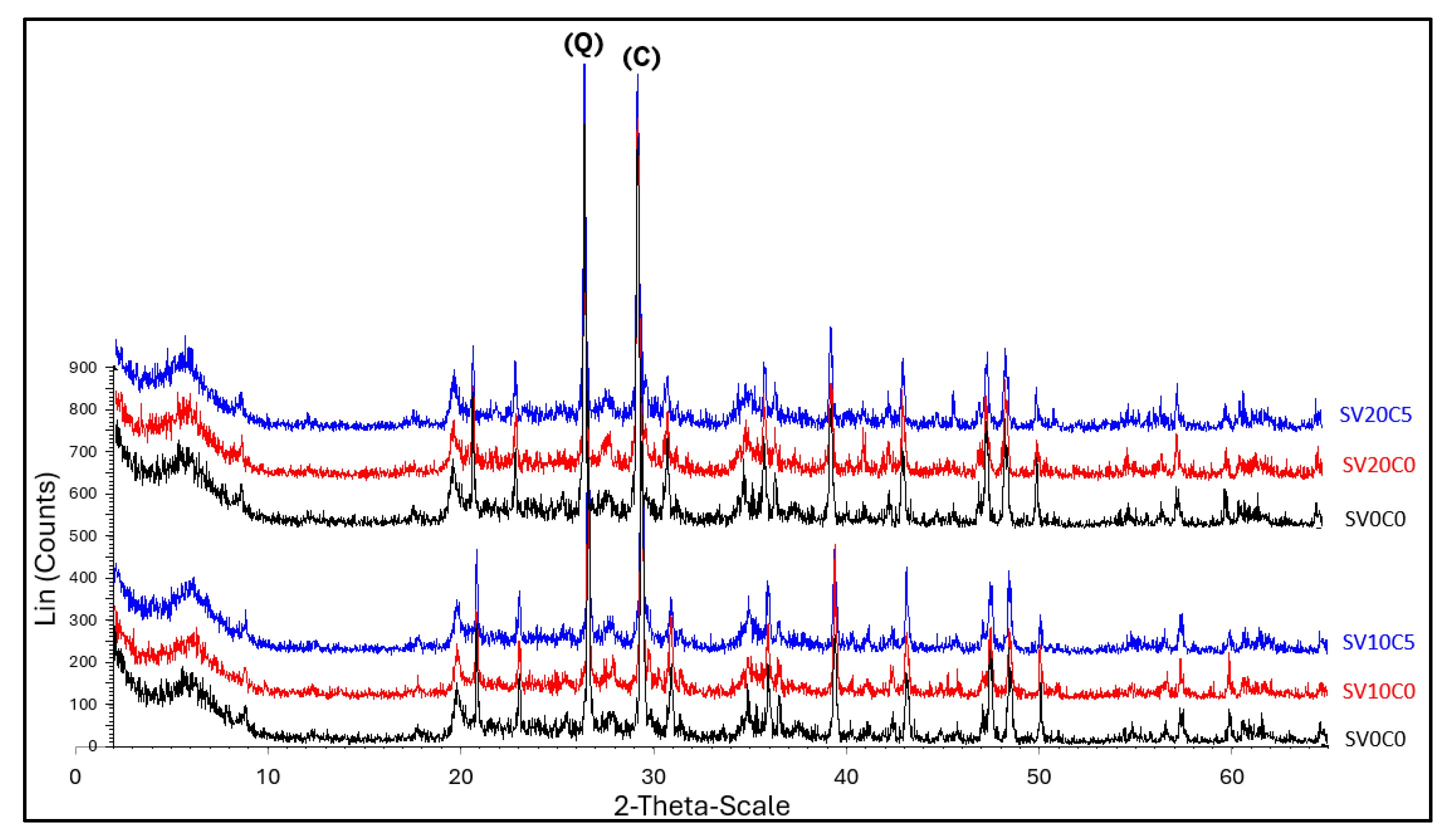
Figure 6 shows the diffractograms of soil mixtures prepared with 10% and 20% volcanic ash V-C3 and 5% lime C-1, while Table 7 shows the corresponding crystalline phase quantification. It is demonstrated that the dry addition of volcanic ash (V-C3) at 10% and 20% to the base soil S1, as well as the incorporation of 5% lime-type activator (C-1), produces noticeable but moderate shifts in the XRD patterns. The results reveal variable changes in the quartz (SiO2) content: when volcanic ash is added alone, its proportion decreases due to a purely mechanical effect, whereas the combined addition of volcanic ash and lime maintains or even increases the quartz content compared with the base soil, possibly because of weight contributions. The mineralogical modifications observed in the mixtures are consistent with the early-stage interactions described for lime-activated volcanic ash systems in the literature ([5,9]). These interactions initiate in the alkaline environment produced by portlandite dissolution and precede the development of fully cemented pozzolanic products.
Figure 6.
Diffractograms of S1 (SV0C0) and soil mixtures SV10C0-SV10C5 and SV20C0–SV20C5. (Q) quartz, (C) calcite.
Table 7.
Quantification of crystalline phase distribution of base soil S1, C-1, V-C3, and soil mixtures based on soil S1.
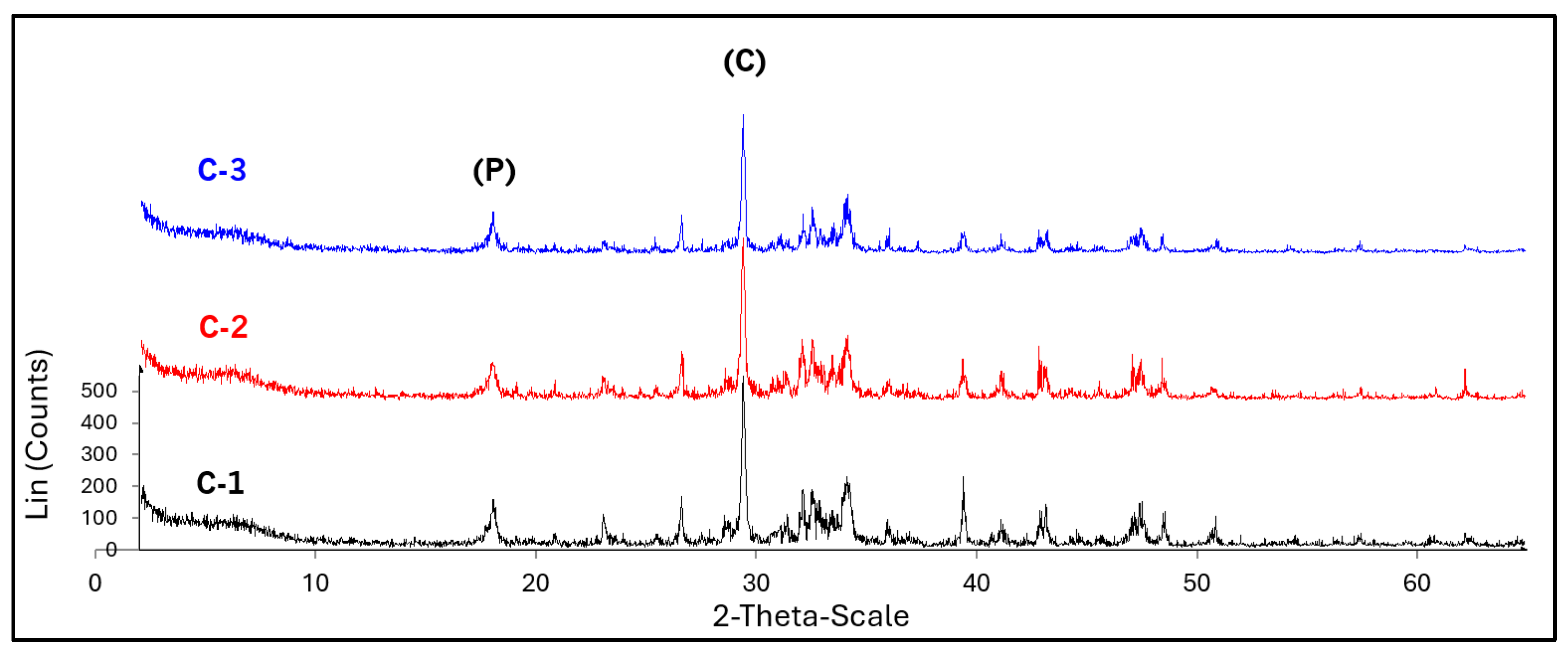
In addition, the lime used was periodically analyzed to verify the preservation of its activation capacity. XRD tests were performed on three different samples, i.e., C-1, C-2, and C-3, collected at 30-day intervals during storage. The corresponding diffractograms (Figure 7) and crystalline-phase quantification (Table 8) show that calcite (CaCO3) remained relatively stable, increasing only slightly from 27.8% to 31.6%, which indicates limited carbonation during storage. Conversely, the portlandite (Ca(OH)2) content remained within the range of 8.4% to 10.5%, substantially lower than the typical content of freshly hydrated lime (≥80% according to PG-3, Part 2, 200.3; [45]) and below the supplier’s specification. This moderate reduction in portlandite content suggests partial carbonation during storage; however, the persistence of measurable portlandite demonstrates that the lime retained sufficient alkalinity and reactivity to act effectively as a pozzolanic activator when combined with volcanic ash V-C3. This observation confirms that the monitored lime remained functional throughout the testing period and, importantly, that its reactive state was quantitatively verified rather than assumed, strengthening the methodological rigor of this study.
Figure 7.
Diffractograms of lime C-1, C-2, and C-3; (P) portlandite, (C) calcite.
Table 8.
Quantification of the crystalline phase distribution of lime (C-1, C-2, and C-3).
3.1.3. Thermogravimetric Analysis (TGA)
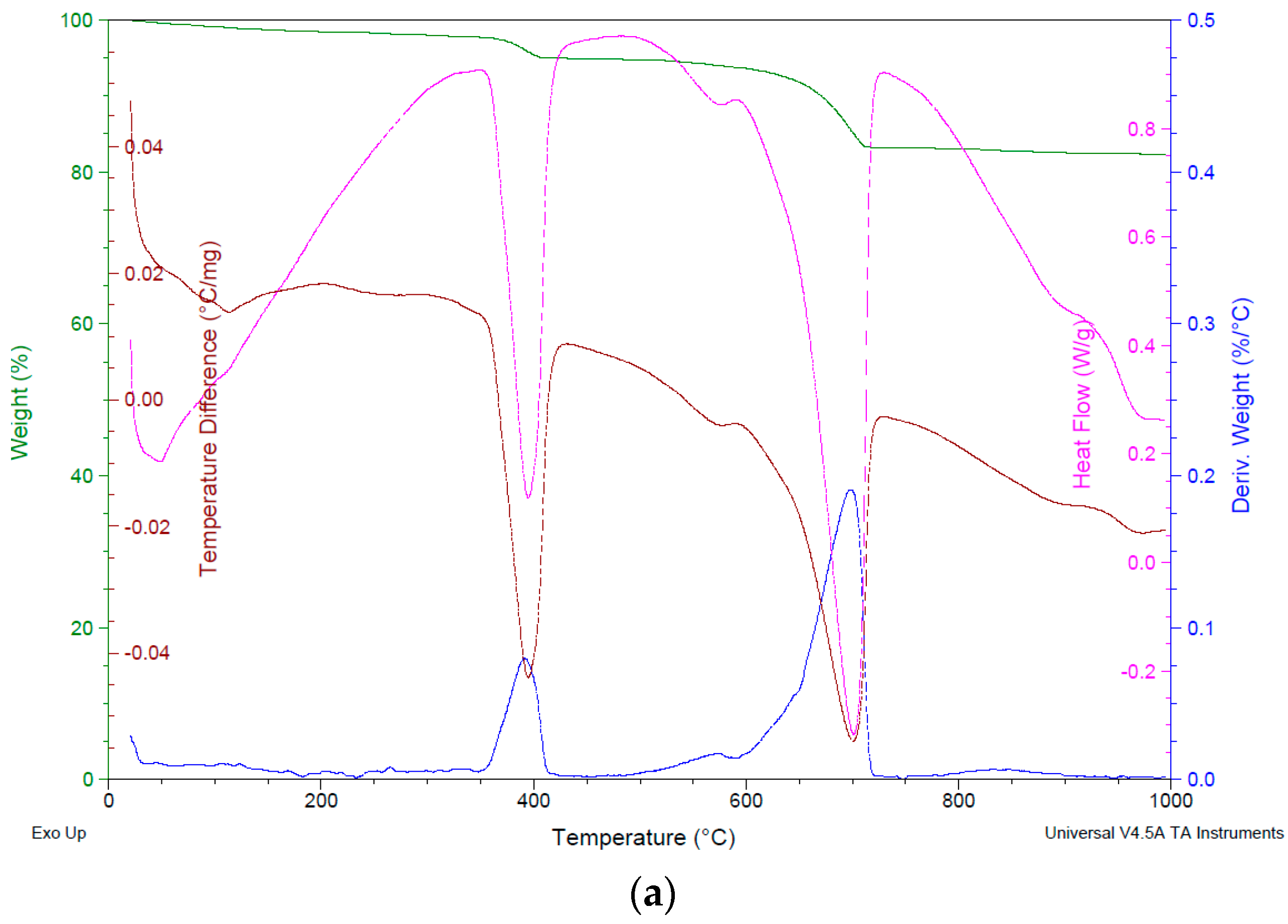
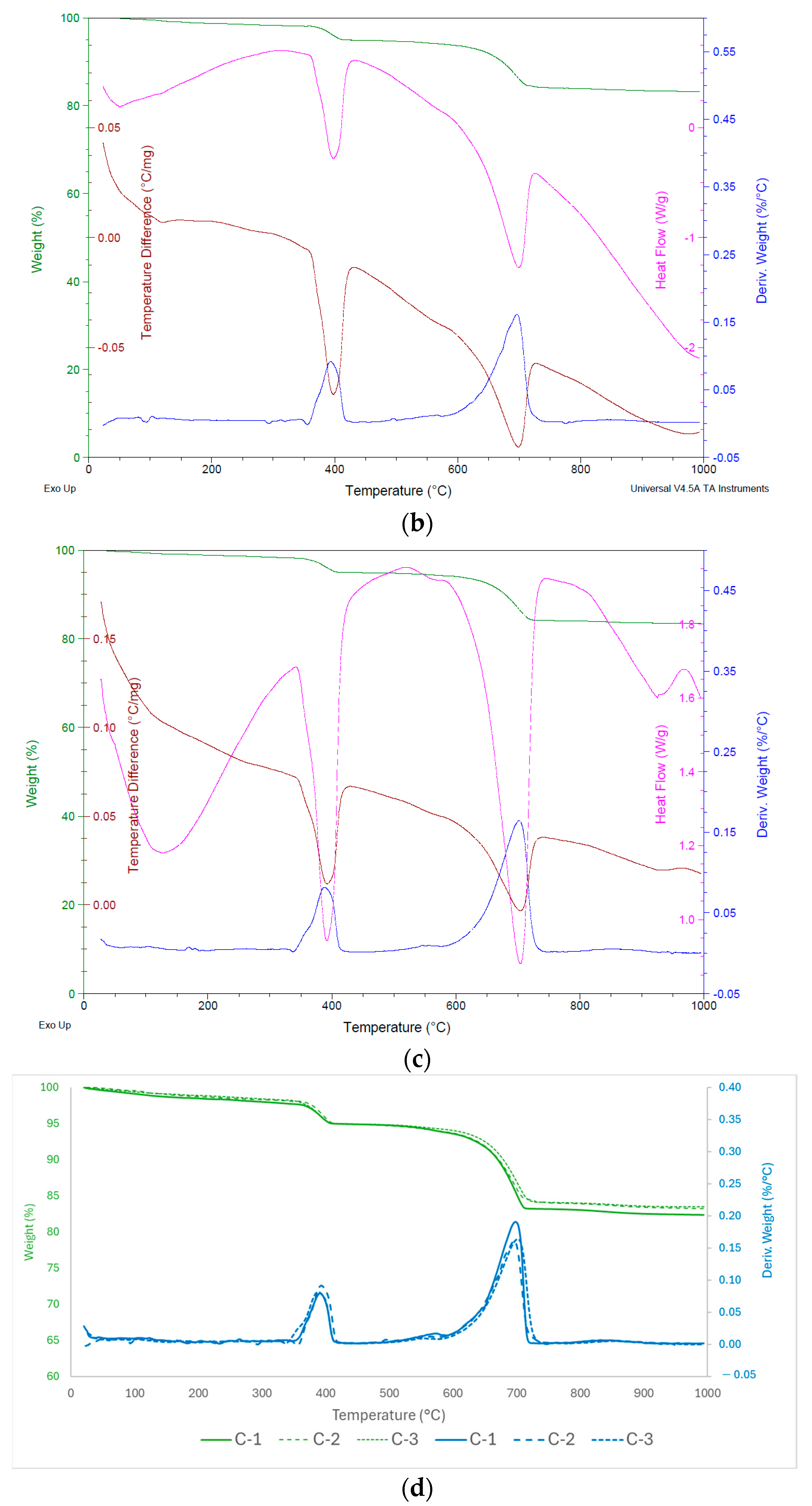
To complement the XRD monitoring and further verify the preservation of the lime during storage, three TGAs were performed at 30-day intervals. The results shown in Figure 8 confirm that the relative weight loss profiles of samples C-1, C-2, and C-3 remained essentially unchanged, demonstrating that the adopted storage conditions effectively maintained the material’s activation properties throughout the experimental program. The thermal reactions observed between room temperature and 1000 °C are summarized in Table 9. Two characteristic weight loss reactions were identified. The first was a loss of approximately 3.2% between 350 and 440 °C, attributable to decomposition of a low to medium content of portlandite, Ca(OH)2, the key alkaline phase responsible for initiating pozzolanic activation. The second reaction was a more pronounced loss of 10.5% between 580 and 730 °C, corresponding to the decarbonation of calcite, Ca(CO3), indicative of the relatively high calcite content detected by XRD. Although calcite contributes less to chemical activation than portlandite, its stability during storage corroborates the limited carbonation previously identified. Overall, the TGA results reinforce the XRD observations, confirming that lime retained sufficient reactive hydroxide to function effectively as a pozzolanic activator and validating the importance of continuously monitoring lime quality over the course of this study.

Figure 8.
General results of (a) TGA-C-1, (b) TGA-C-2, and (c) TGA-C-3 and (d) comparative TGA graphic.
Table 9.
Average temperature and weight loss values of reactions determined by TGA for C-1, C-2, and C-3.
3.1.4. Analysis Using Optical Microscopy
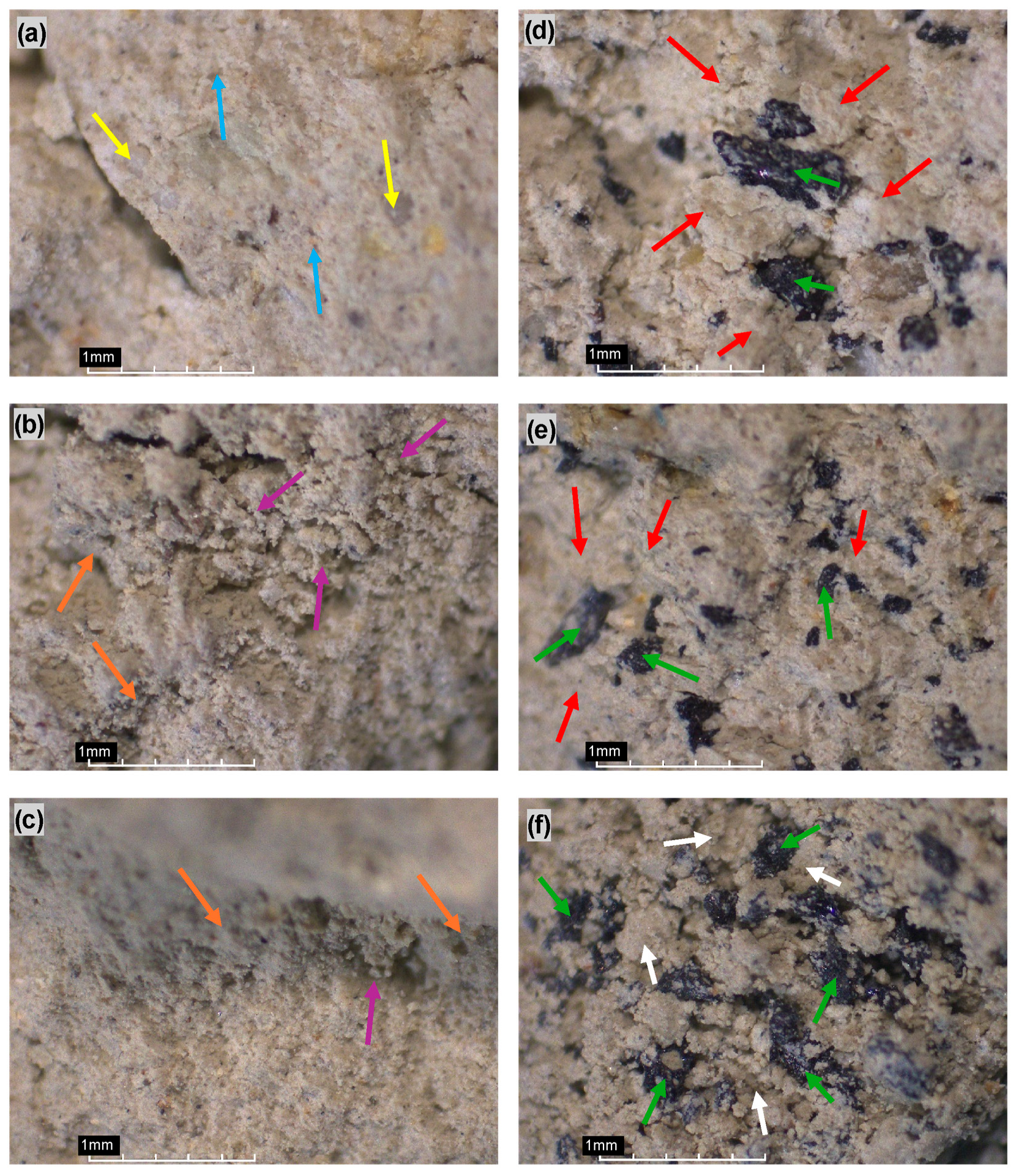
To visualize the internal structure of the soil samples and mixtures after performing the oedometer tests, an optical magnifying glass was used with reflected and transmitted light to obtain images (Figure 9).
Figure 9.
Optical images with 40X magnification maximum range: (a) SV0C0, (b) SV0C3, (c) SV0C5, (d) SV20C5, (e) SV30C5, and (f) SV30C0. Arrows, green—volcanic ash particles V-C3; yellow—quartz; light blue—smooth surface, plastic clay; red—cemented structure (C-S-H/C-A-H) around volcanic ash particles V-C3; magenta—flocculation of grains; white—dispersed material around volcanic ashes; orange—C-S-H gel.
The images obtained confirm the effectiveness of the lime applied as a soil stabilizer and activator of the pozzolanic properties of volcanic ash, evidencing the change in the texture of sample SV0C0, which transitioned from being smooth and plastic, with clearly detectable quartz crystals, to acquiring a rougher and more granular structure when lime C-1 is added. In mixtures SV0C3 and SV0C5, low-bright brownish-grey masses can be observed coating the granular matrix, corresponding to early C-S-H (calcium silicate hydrate) and C-A-H (calcium aluminate hydrate) formation. In the mixtures made with volcanic ash (V-C3), the particle edges become blurred and progressively merge with the surrounding matrix due to the initial bonding provided by C-S-H and C-A-H gels, particularly in the SV20C5 and SV30C5 mixtures, resulting from the dissolution of silica and alumina in an amorphous state mobilized in the alkaline environment provided by the lime. In contrast, this effect is absent in SV30C0, where clusters of unreacted granular particles remain around the volcanic ash without signs of cementation.
The optical magnifying glass images shown in Figure 9 were employed solely to provide qualitative indications of the early interactions between soil particles, volcanic ash, and lime under short-term, non-cured conditions. At this stage, the formation of cementitious products such as C-S-H or C-A-H is still limited; therefore, techniques such as SEM–EDX or hydrated-sample XRD would not yet provide meaningful quantitative information. Future work will include SEM–EDX and XRD analyses on cured specimens to quantify the evolution of cementitious gels and provide a more detailed mechanistic interpretation.
3.2. Index Properties
3.2.1. Grain Size Distribution
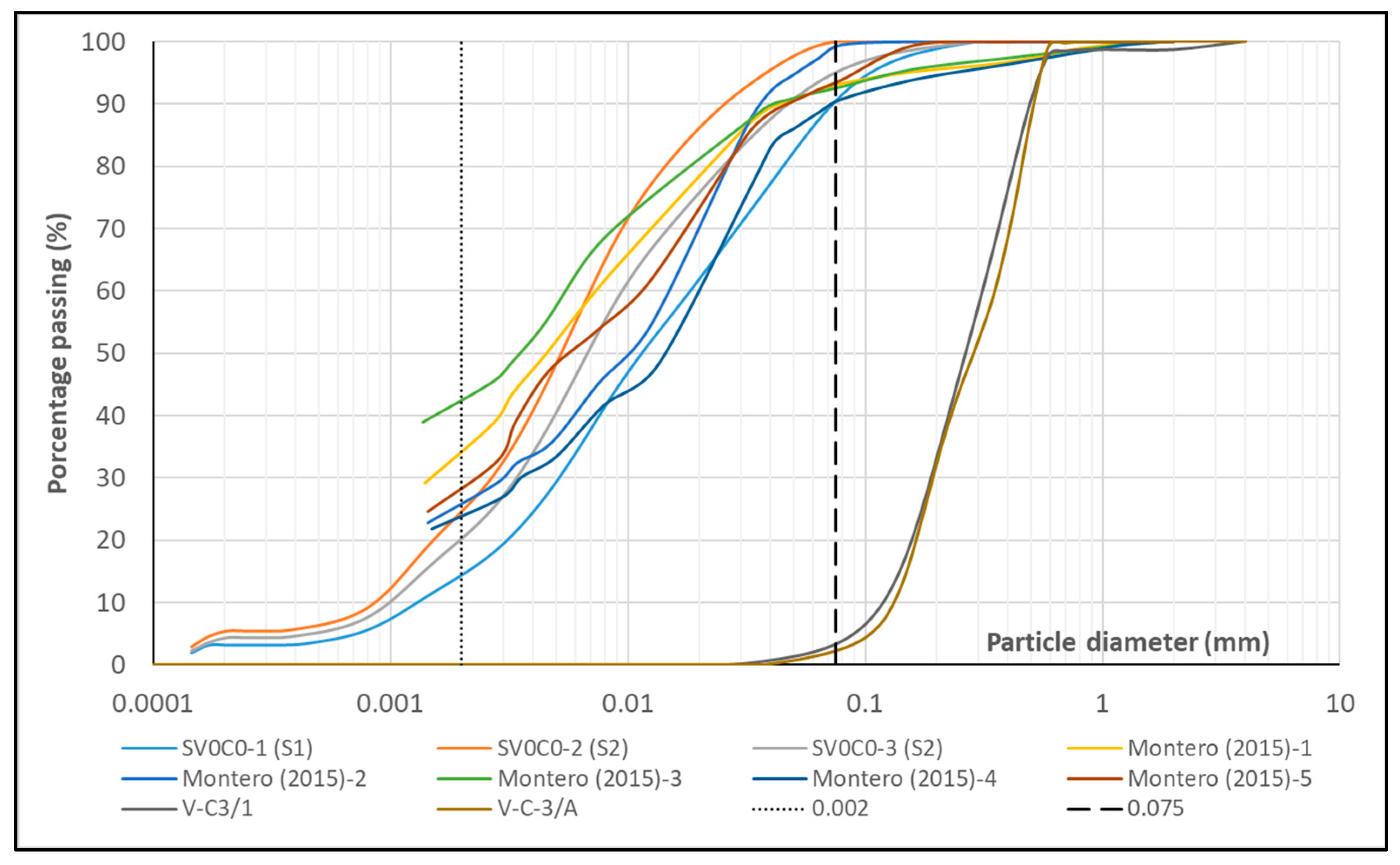
Figure 10 presents the grain size distribution curve for soil samples S1 and S2 (designated SV0C0). The analysis was performed using conventional sieve testing for particle sizes greater than 700 μm, combined with a laser technique using Honeywell Microtrac X100 equipment for particles smaller than 700 μm. The soils exhibit 90% and 99% of fines (i.e., <75 µm) and a clay fraction (<2 µm) in the order of 22%. The results are consistent with previous characterization reported by Montero and Estaire [24] and Vázquez-Boza [30], confirming the similarity of the granulometric range obtained for the base soil (S1 and S2). Table 10 shows the percentage of the fine fraction for the soils studied.
Figure 10.
Grain size distribution of SV0C0, V-C3, and reference soil samples.
Table 10.
Comparison of granulometric results of S1 and S2.
Additionally, the particle size distribution of the volcanic ash (V-C3) used is characterized, classifying it as a poorly graded sand, with a 3% fines content (particles < 75 µm and a maximum size of 2 mm).
3.2.2. Atterberg Limits
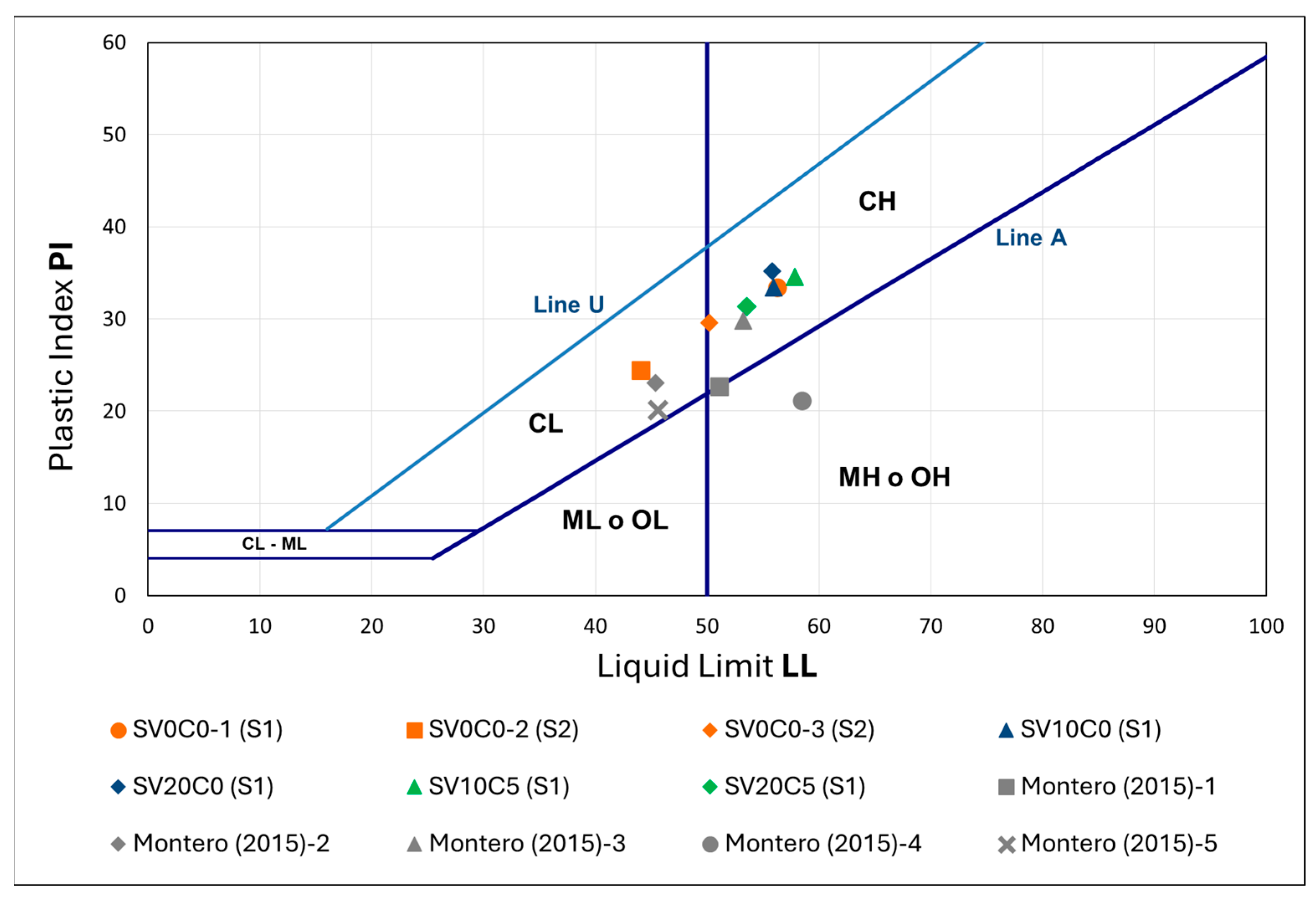
Table 11 and Figure 11 present and illustrate the distribution of liquid limit (LL), plastic limit (PL), and plasticity index (PI) for S and different soil mixtures, showing no significant changes in Atterberg limits with the addition of volcanic ash (V-C3) and lime (C-1).
Table 11.
Atterberg limits for soil and mixtures.
Figure 11.
Plasticity chart of S1, S2, soil mixtures, and reference soil.
Table 12 compares the ranges of LL and PI obtained in the present study and previous studies of the same soil ([24,30]), observing that S1 and S2, named as SV0C0, correspond to the same soil type named as southern Spanish marls, classified as high-plasticity CH clays (S1) according to the Soil Unified Classification System (USCS) [46]. The base soil presents an activity Ac = 1.3–2.0 [47], categorizing it as active clay, associated with significant volumetric changes upon contact with water [48].
Table 12.
Comparison of Atterberg limits results for SV0C0 (S1-S2) and reference soil samples.
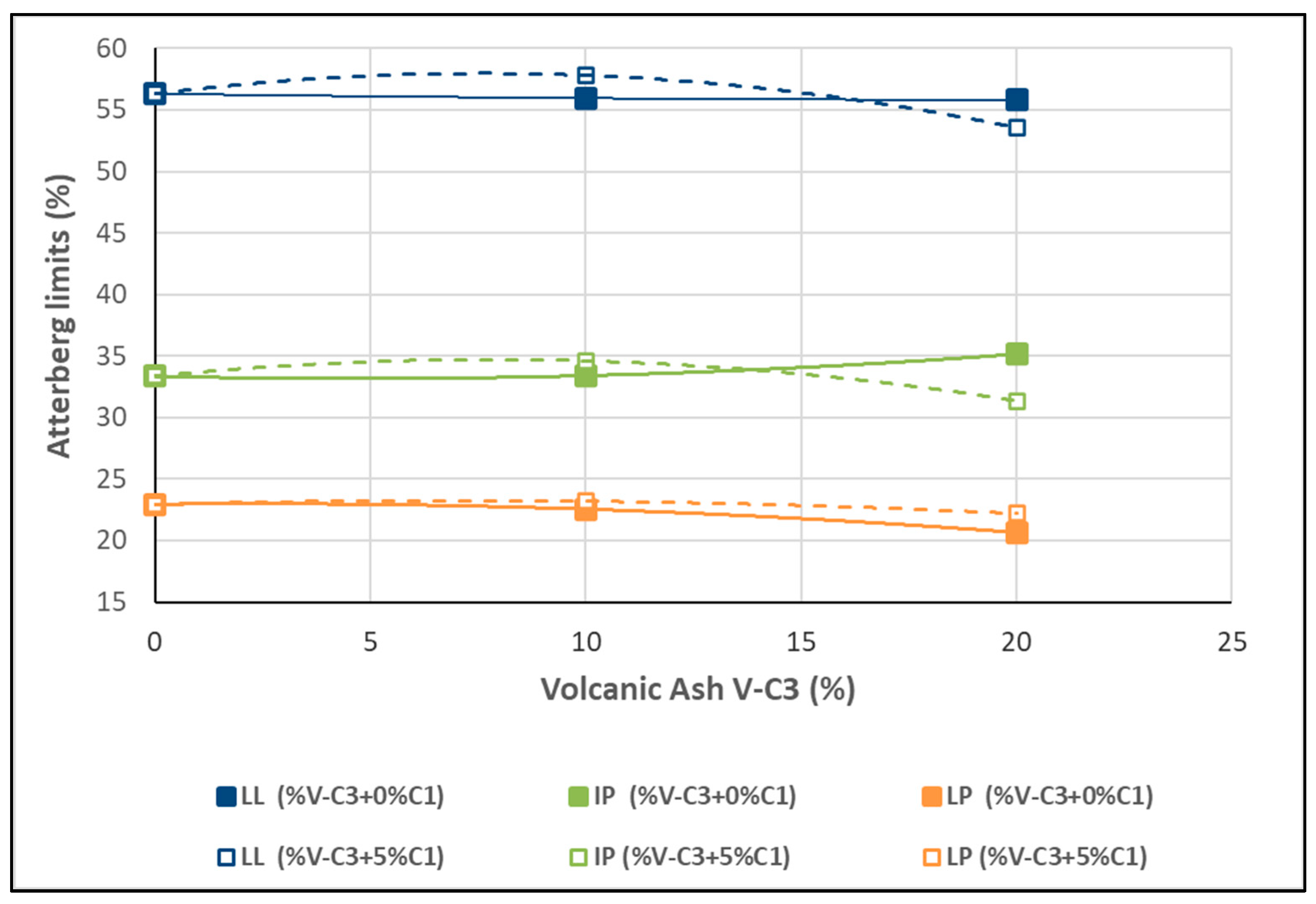
The evolution of Atterberg limits for the natural soil and the stabilized mixtures shows only modest variations upon incorporation of volcanic ash (V-C3), either alone or in combination with lime (C-1) at 0% and 5% (Figure 12), with a practically horizontal relationship. This indicates that under short-term conditions, the ash behaves primarily as a non-plastic granular filler. These results are consistent with the minimal changes observed in LL and PI across mixtures SV10C0, SV20C0, SV10C5, and SV20C5.
Figure 12.
Variation in LL and PI as a function of the variation in V-C3 with the addition of C-1 at 0% and 5%.
These findings agree with those reported by Hossain [6], Játiva [5], Shalabi [42], and Hatefi [9], who highlighted that volcanic ash tends to act as a granular diluent during early stages, producing limited reductions in plasticity unless activated by an alkaline agent. In mixtures such as SV20C5, the small decrease in LL and PI can be attributed to early particle flocculation driven by lime–ash interactions, initiating slight breakdown of the diffuse double layer.
Overall, the slight shifts in Atterberg limits reflect the short-term nature of the testing and confirm that any reductions in plasticity arise predominantly from immediate physicochemical interactions rather than from fully developed cementitious bonding.
3.3. Compaction of Soil and Soil Mixtures
Compaction Tests
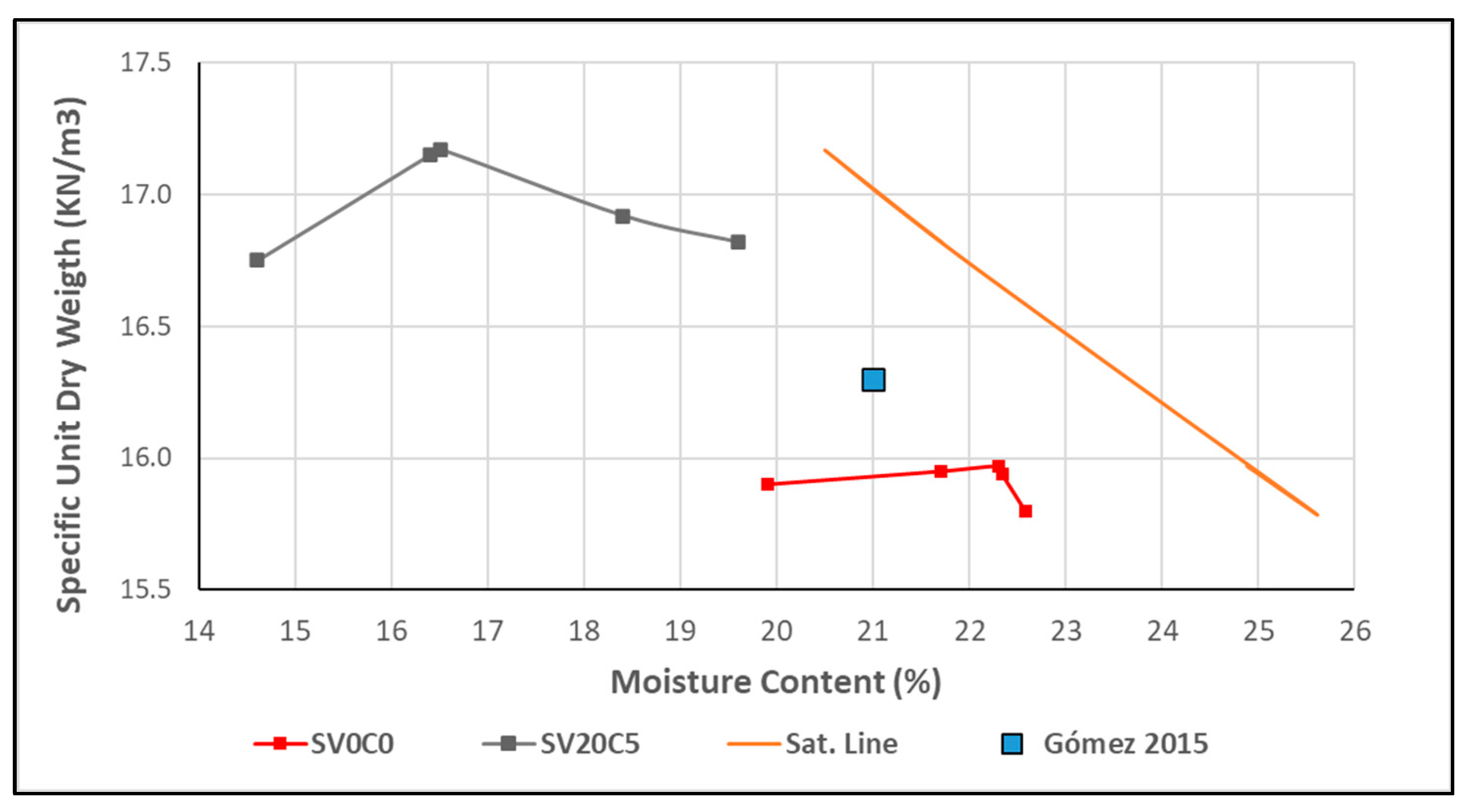
Figure 13 and Table 13 present the specific dry unit weight–moisture relationship for the SV0C0 and SV20C5 mixtures of S1 compacted under modified Proctor energy, together with the saturation curve computed assuming a specific gravity of Gs=2.65 [24]. The results show a clear decrease in optimum moisture content and an increase in maximum dry unit weight for the stabilized mixture, producing an upward and rightward shift of the compaction curve compared with SV0C0. For the untreated soil, the optimum moisture content differs by approximately 6% from the values reported by Gómez 2019 [32] for natural marly clays of similar geological origin, confirming the consistency of the baseline compaction behavior.
Figure 13.
Compaction curve of soil SV0C0 (S1), soil mixture SV20C5, and reference soil.
Table 13.
Compaction parameters by the modified Proctor test.
The improved compaction response of SV20C5 reflects a more efficient packing of particles and reduced water demand during compaction, attributed to the higher specific gravity and angular granular morphology of volcanic ash (V-C3), as also noted by Játiva [5]. When volcanic ash (V-C3) and lime (C-1) are added as an activator, the optimum moisture content decreases further due to reduced soil plasticity, particle flocculation, and the associated decrease in water retention capacity—mechanisms consistent with Melentijević [8] and Vyšvařil [44]. All in all, the compaction behavior observed in SV20C5 results from a combined effect of granular filling, early structural rearrangement, and initial lime–ash interaction prior to substantial pozzolanic hardening, explaining the more favorable compaction characteristics compared with the untreated soil.
Although S1 and S2 belong to the same geological unit and share the same USCS classification, they were used for different experimental purposes (swelling potential and compressibility for S1 and resistance parameters for S2). Therefore, the conclusions regarding optimal mix ratios for swelling control apply specifically to S1. Any correlation with the strength performance observed in S2 should be interpreted with caution and is proposed as a subject for future comparative studies. The representative amounts of the defined fraction, the clay fraction, Atterberg limits, and clay activity obtained for soils S1 and S2 are summarized in Table 14, which shows a high similarity in index properties, with a high content of fines and clay in soils S1 and S2, which, according to their plasticity index, can be classified as soils with high activity [47].
Table 14.
Summary of fines content, clay fraction, Atterberg limits, and clay activity for soils S1 and S2.
3.4. Oedometer Test
Free Swelling
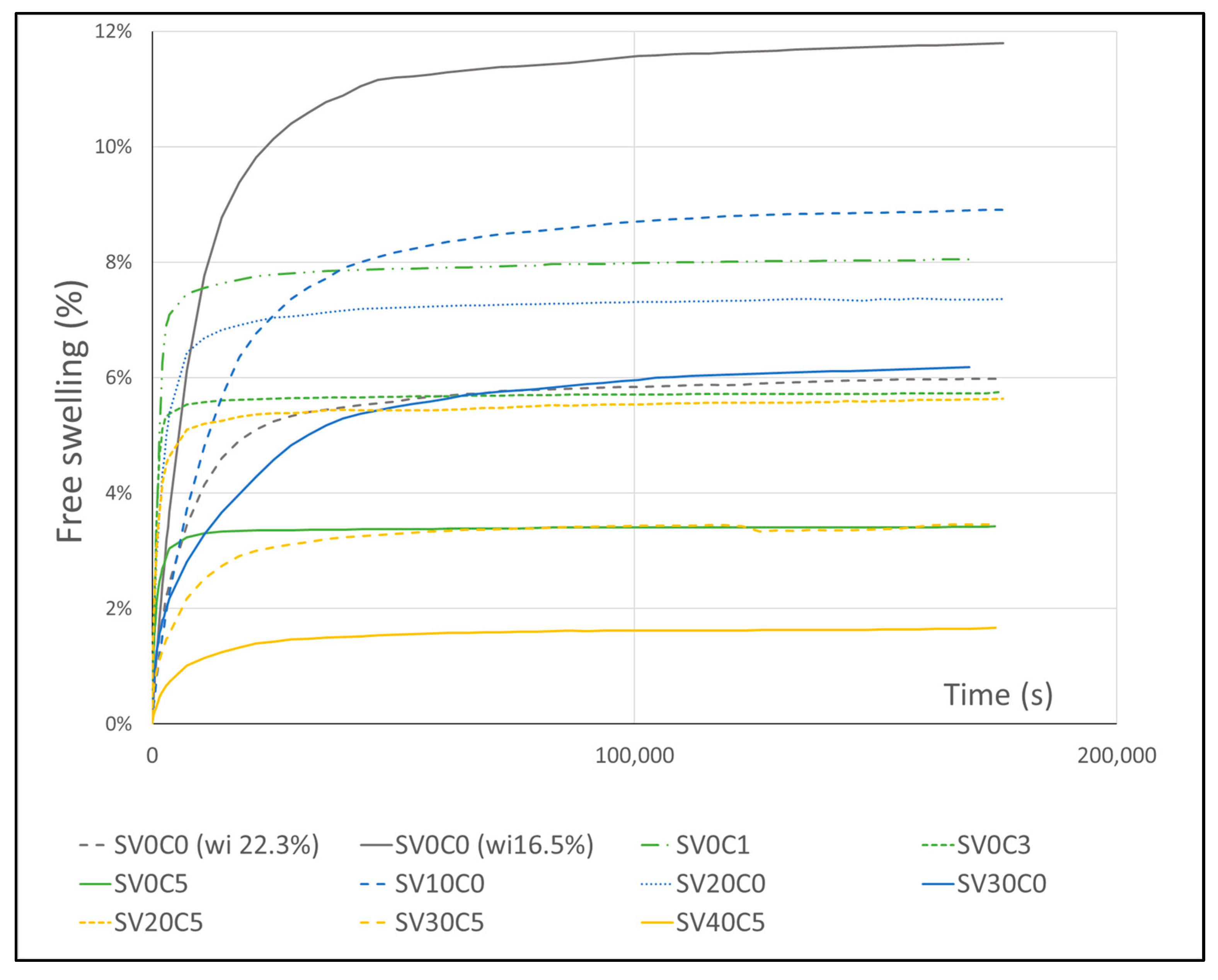
The SV0C0 specimens, corresponding to soil S1 with initial moisture contents of 16.5% and 22.3%, which represent the optimum moisture obtained in the compaction test for SV20C5 and SV0C0, respectively, were subjected to the free swelling test. Additionally, all soil mixtures with different dosages were prepared at a uniform initial moisture content of 16.5% to ensure comparable volumetric responses under consistent water-to-dry soil ratios, thereby isolating the effects of volcanic ash (V-C3) and lime (C-1) on expansive behavior under homogeneous preparation conditions.
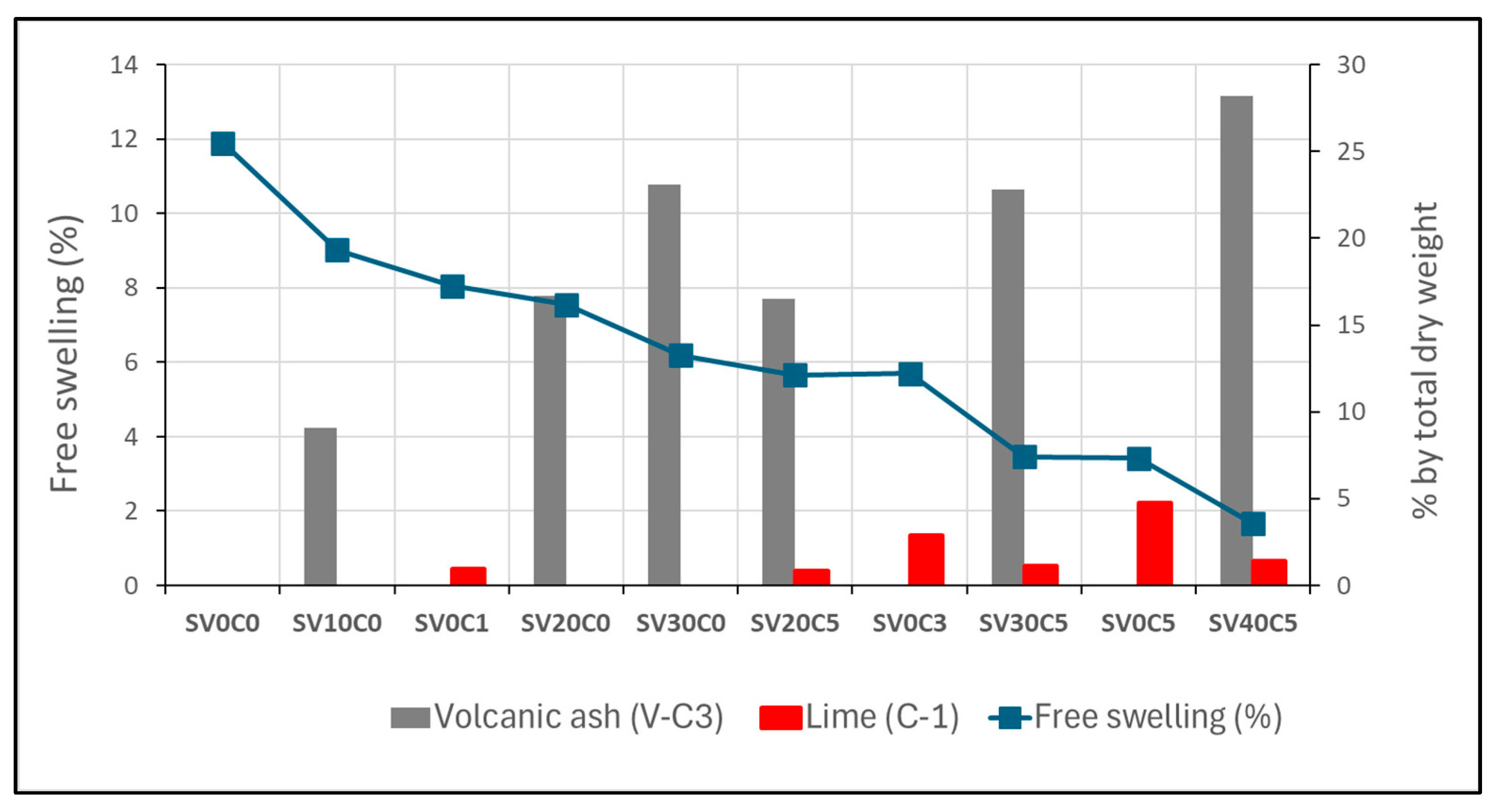
As shown in Figure 14, higher initial moisture contents produced lower free swell in SV0C0 (S1), confirming that standardizing the initial moisture content when preparing mixtures is essential for evaluating the influence of stabilizing agents and their different dosages. Complementarily, Figure 15 illustrates the relationship between free swelling and the different dosages of V-C3 and C-1, expressed as dry weight percentages relative to the total dry weight of the mixture. It is observed that mixtures SV30C5, SV40C5, and SV0C5, with a lime (C-1) content of 1.1%, 1.4%, and 4.8%, respectively, exhibited free swelling values below 5%. These values correspond to an Expansion Index lower than EI = 50, classifying them as low-expansion materials (L), according to ASTM D4829-21 [49] and Chen (1975) [50], as summarized in Table 15. This outcome demonstrates that the addition of volcanic ash (V-C3) significantly improves lime (C-1) utilization efficiency, enabling similar swelling control with markedly lower activator dosages.
Figure 14.
Free swelling test curve for soil and soil mixtures.
Figure 15.
Evolution of free swelling for different soil mixtures, indicating V-C3 and C-1 percentages relative to total dry weight.
Table 15.
Classification of swelling potential by direct measurement in the oedometer test.
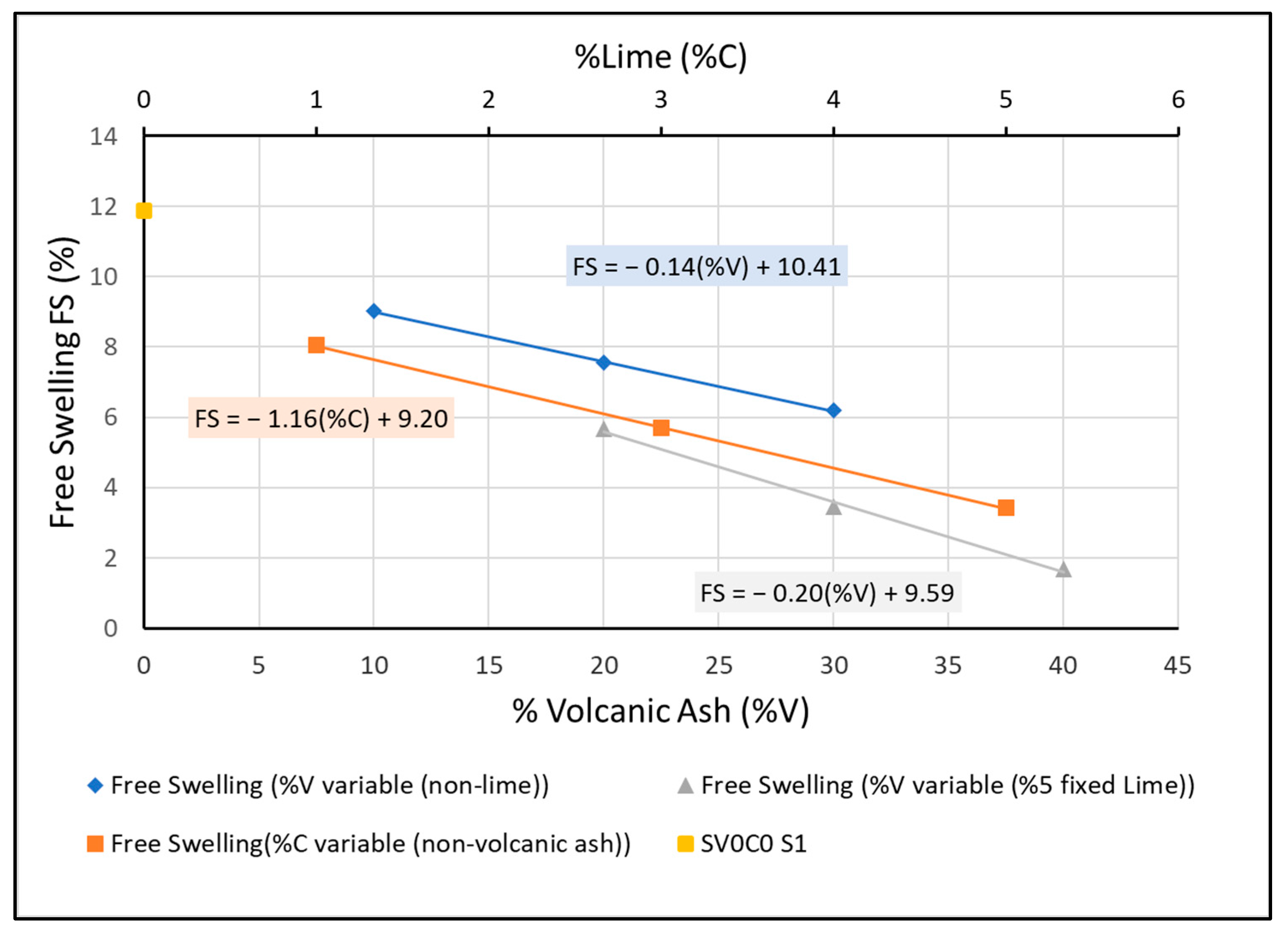
Figure 15 and Figure 16 further show that the mixtures incorporating volcanic ash (V-C3) with 5% lime (C-1) achieve a more substantial reduction in volumetric expansion compared with the mixtures of the base soil containing only volcanic ash or only lime (S1-S2). This behavior reflects the complementary and synergistic mechanisms provided by both stabilizers. Volcanic ash (V-C3), owing to its granular, non-plastic nature, reduces the proportion of active clay, lowers porosity, and diminishes the soil’s water retention capacity. Lime (C-1), in parallel, induces cation exchange, collapses the diffuse double layer, and promotes particle flocculation through Ca2+ substitution. In addition, the portlandite fraction (Ca(OH)2 = 10.5%) measured in lime (C-1), which is highly alkaline, also elevates porewater pH, enabling the dissolution of amorphous silica (SiO2 = 40.62%) and alumina (Al2O3 = 13.71%) in the volcanic ash (V-C3) and initiating the early formation of hydrated calcium silicates and aluminates, C-S-H and C-A-H, respectively. These combined effects, i.e., granular dilution and early pozzolanic activation, can explain the strong reduction in volumetric expansion observed in stabilized mixtures such as SV30C5 and SV40C5, which fall into the low- (L) and very low (VL)-swelling classes. This trend aligns with observations by Hossain [6] for lime-activated volcanic ash in expansive clays, by Miraki [7] for alkali-activated volcanic ash–clay systems, and by Shalabi [42], who also reported early-age volumetric stabilization when ash and lime were combined. Collectively, these comparisons reinforce that volcanic ash–lime blends provide more effective short-term swelling control than either stabilizer used independently.
Figure 16.
Free swelling percentages of mixtures with volcanic ash without lime, volcanic ash with 5% lime added, and only lime.
A particularly notable result is that SV20C5 (1.0g of lime per 100g natural soil) achieved swelling levels comparable to SV0C5 (5.0g of lime per 100g natural soil) despite using approximately 80% less lime, confirming that volcanic ash substantially enhances lime efficiency. This optimization effect reflects not superior short-term performance, but rather the improved reactivity provided by the ash and the more efficient use of lime as an activator, aligning with recent evidence indicating that volcanic ash–lime blends reduce lime demand while maintaining stabilization effectiveness.
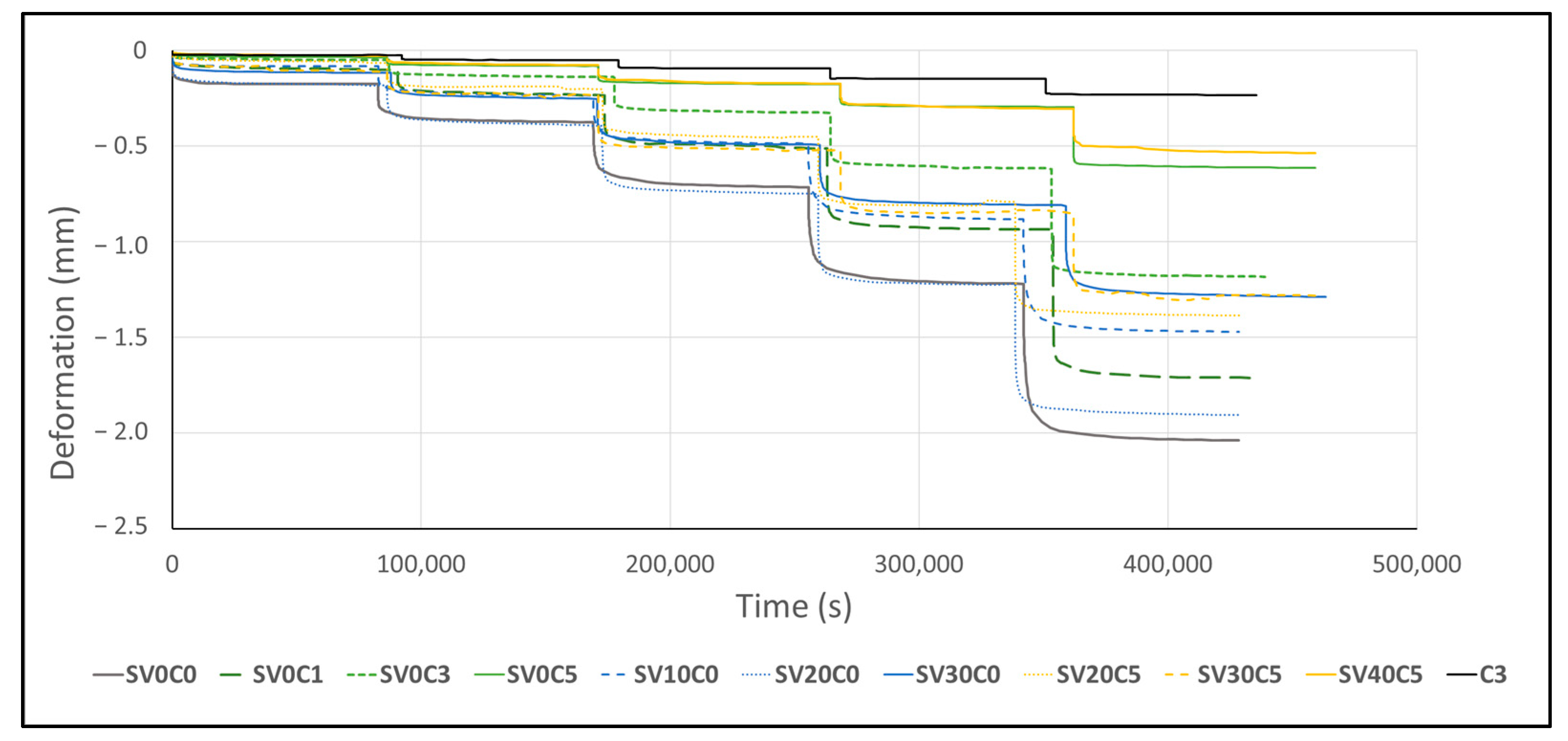
Following the completion of maximum swelling, the samples were subjected to vertical loads ranging from 20 kPa to 600 kPa to evaluate their compressibility and deformation behavior. As shown in Figure 17, the addition of V-C3 and C-1 reduces deformability due to the increased stiffness provided by the mixtures. In particular, V-C3 exhibits less than 0.7% deformation under a 300 kPa load, confirming its volumetric stability under saturated conditions.
Figure 17.
Vertical deformation relationship over time under applied vertical loads.
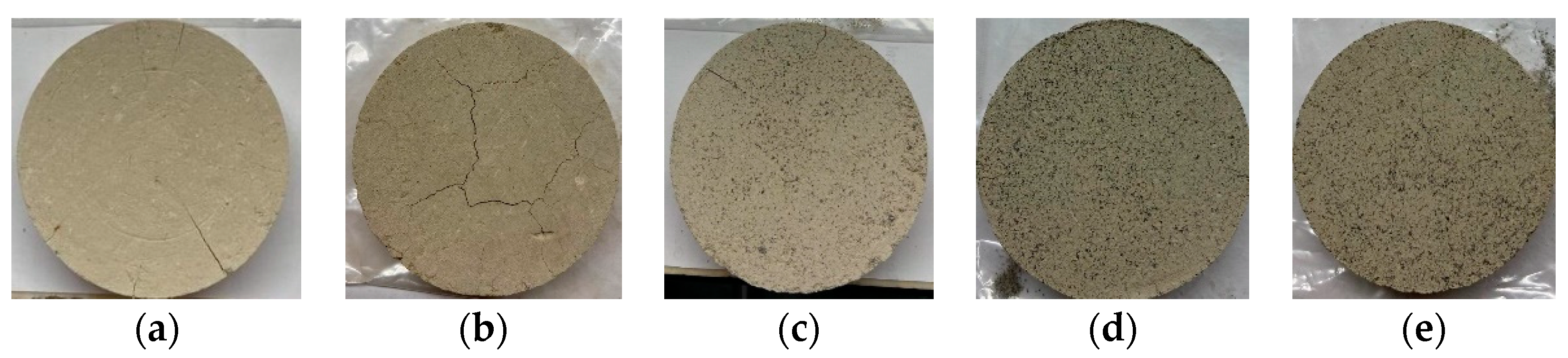
After the oedometer phase, the samples were left to dry under low-humidity conditions to assess shrinkage behavior. As shown in Figure 18, the SV0C5 mixture developed pronounced cracking, primarily caused by hydraulic shrinkage associated with the high lime content used as the main stabilizing agent. This mechanism has been widely documented; rapid lime hydration accompanied by moisture loss generates tensile stresses that may exceed the material’s strength ([51,52]).
Figure 18.
Visual appearance of representative samples (a) SV0C0, (b) SV0C5, (c) SV20C5, (d) SV30C5, and (e) SV40C5.
In contrast, mixtures SV20C5, SV30C5, and SV40C5 showed substantially greater volumetric stability, displaying only minor or negligible cracking. This improved response results from two combined effects: first, the lower lime dosages, which limit uncontrolled hydration and shrinkage, and second, the fact that lime acts chiefly as a pozzolanic activator of volcanic ash, with dosage proportional to the ash mass rather than to the soil mass. This promotes a more gradual and less aggressive hardening process, mitigating shrinkage-induced stress gradients. Cracking in the SV0C5 specimen was not solely the result of the lime content but stemmed from the combined effects of moisture loss and the compaction state of the sample. The elevated lime dosage likely amplified shrinkage behavior, increasing the material’s susceptibility to fissuring. This response is consistent with the observations of Abdi [51], who reported that lime-stabilized soils become more brittle and therefore more prone to cracking as the lime content increases and moisture loss generates internal shrinkage stresses. Consequently, the cracking observed in SV0C5 reflects the interplay of both chemical processes—such as rapid hydration and early cementitious reactions—and physical factors related to drying and compaction.
That is, in the SV0C5 mixture, where lime was added directly relative to soil weight, higher free-lime availability facilitated rapid hydration, heat release, short-term expansion, and subsequent microcracking—effects that intensified during drying. Numerous studies report similar behavior, showing that high lime contents increase brittleness and susceptibility to desiccation cracking ([6,51]). Improved shrinkage control with moderate lime dosages in volcanic ash–lime systems has also been documented by Hossain [6], Hatefi [9], and Shalabi [42].
Collectively, the contrasting behavior of SV0C5 and the ash-activated mixtures (SV20C5–SV40C5) reflects the dual role of lime (C-1). When used in high proportions, it can intensify cracking, whereas in moderate, ash-proportional dosages, it functions primarily as a pozzolanic activator. The combined effects of clay dilution, cation exchange, diffuse double-layer collapse, and early C–S–H/C–A–H formation account for the reductions in free swelling below 5%, consistent with the observations of Hossain [6], Agarwal [52] and Hatefi [9].
3.5. Resistance Test Results
3.5.1. Direct Shear
To determine the short-term drained shear strength parameters of soil S2 and the mixtures SV0C0, SV20C5, and SV30C5, remolded specimens were tested in a circular shear box with a diameter of 50 mm, under normal stresses of 50, 100, 200, and 400 kPa, and at a displacement rate of 0.003 mm/min. Additionally, a direct shear test was performed in a square shear box with 60 mm sides on a volcanic ash specimen (V-C3), under normal stresses of 50, 100, 200, and 300 kPa, with a displacement rate of 0.03 mm/min [33].
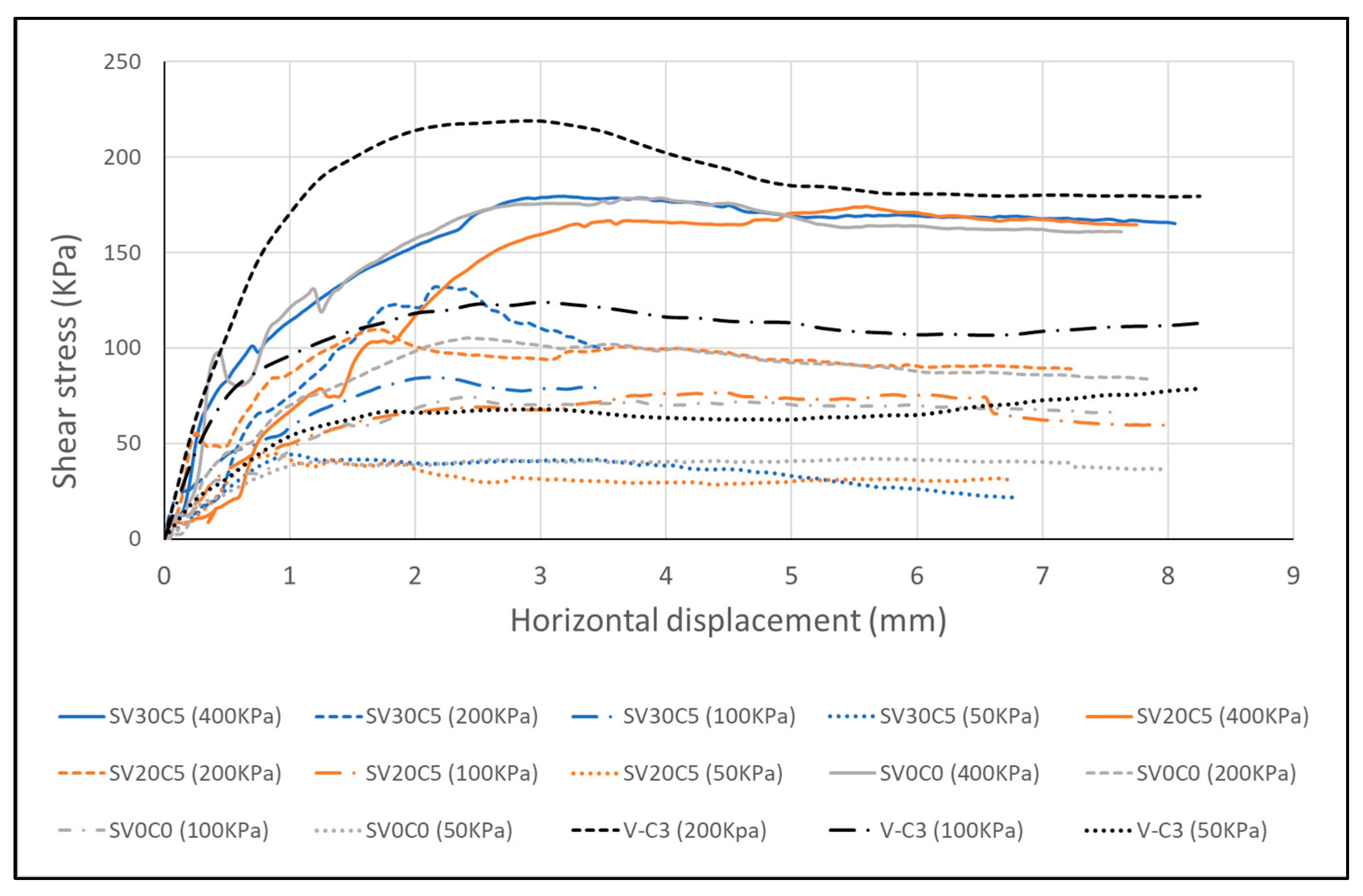
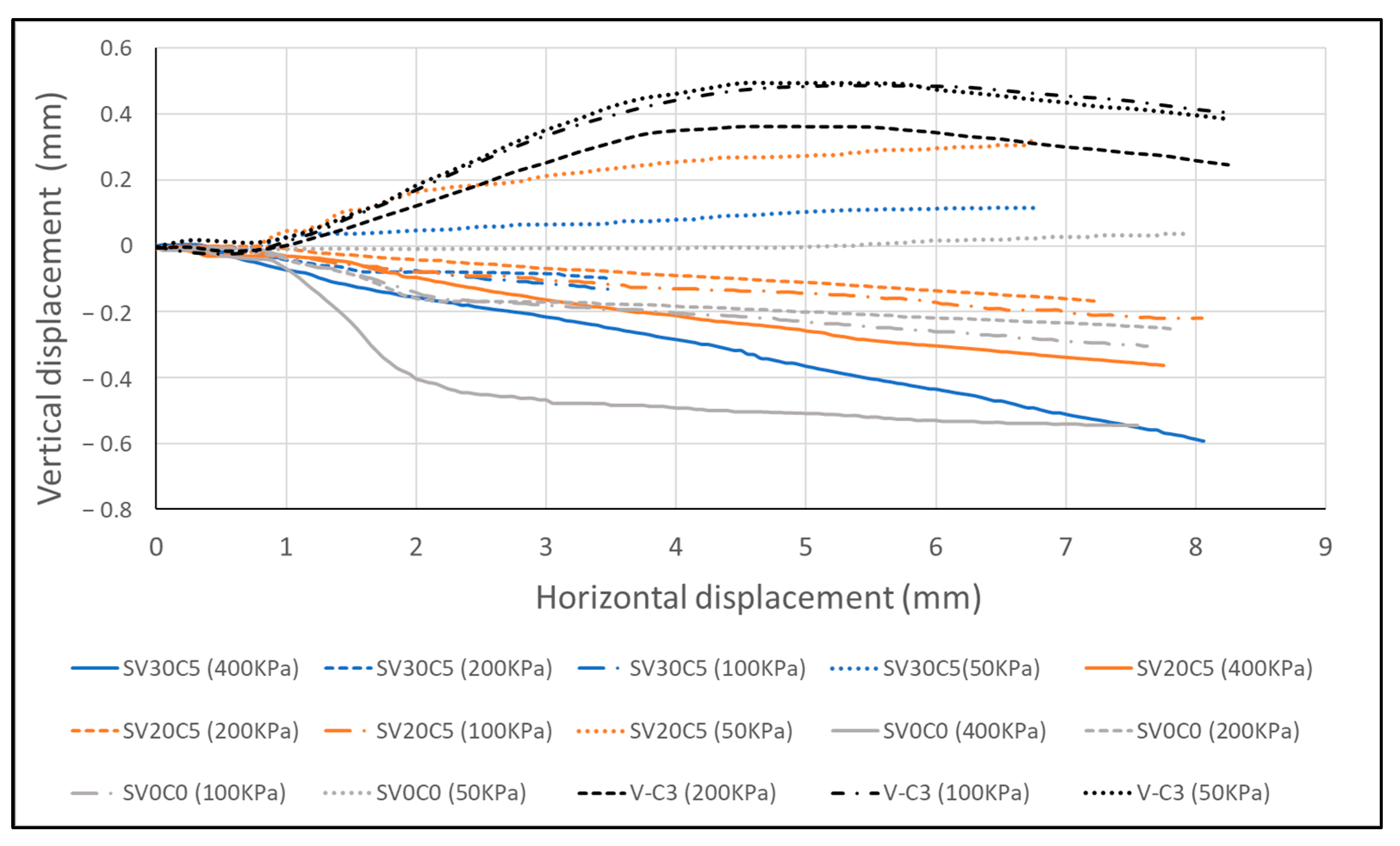
Figure 19 shows that the mixtures incorporating volcanic ash and lime (SV20C5 and SV30C5) achieved slightly higher peak strength than the untreated soil (SV0C0), while residual strength remained broadly similar, with stress–displacement curves converging at large horizontal deformation. Under normal stress of 50 kPa, all specimens exhibited dilative behavior, whereas higher stresses (100, 200, and 400 kPa) produced predominantly contractive responses.
Figure 19.
Shear strength–displacement response of base soil SV0C0 (S2), volcanic ash (V-C3), and soil mixtures.
This behavior aligns with the typical short-term mechanical response of volcanic ash–lime systems, where enhancements arise mainly from improved interparticle contact rather than from fully developed pozzolanic cementation. Similar increases in shear strength associated with volcanic ash activation were reported by Ghadir [53], who attributed the improvement to the development of C–S–H and aluminosilicate gels. The silica-rich composition of volcanic ash also contributes to interlocking [33], explaining the moderate increases in friction angle as presented in Table 16.
Table 16.
Direct shear test parameters under peak strength conditions.
Figure 20 further indicates that the treated mixtures experienced smaller vertical contractive deformations than the untreated soil, highlighting the stabilizing effect of volcanic ash and lime against shear-induced compressibility.
Figure 20.
Vertical–horizontal displacement response of base soil SV0C0 (S2), volcanic ash (V-C3), and soil mixtures.
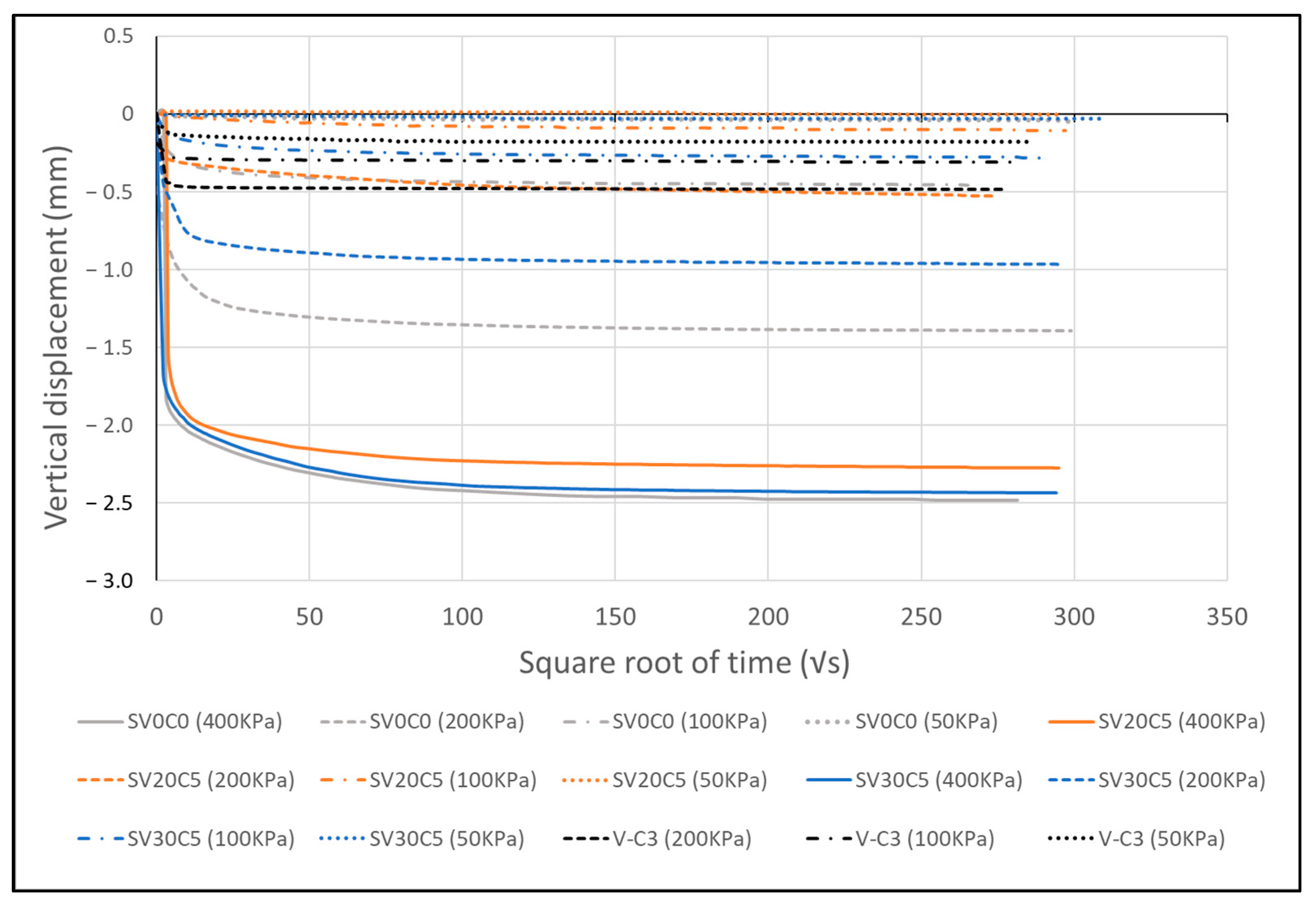
During the consolidation stage (Figure 21), greater applied loads resulted in larger vertical deformations, although the curves for the stabilized mixtures tended to converge under the highest normal stress (400 kPa). Compared with the untreated soil, the stabilized specimens exhibited reduced initial compressibility and more stable volumetric behavior over time.
Figure 21.
Vertical deformation–square root of time response during the consolidation stage of the direct shear test.
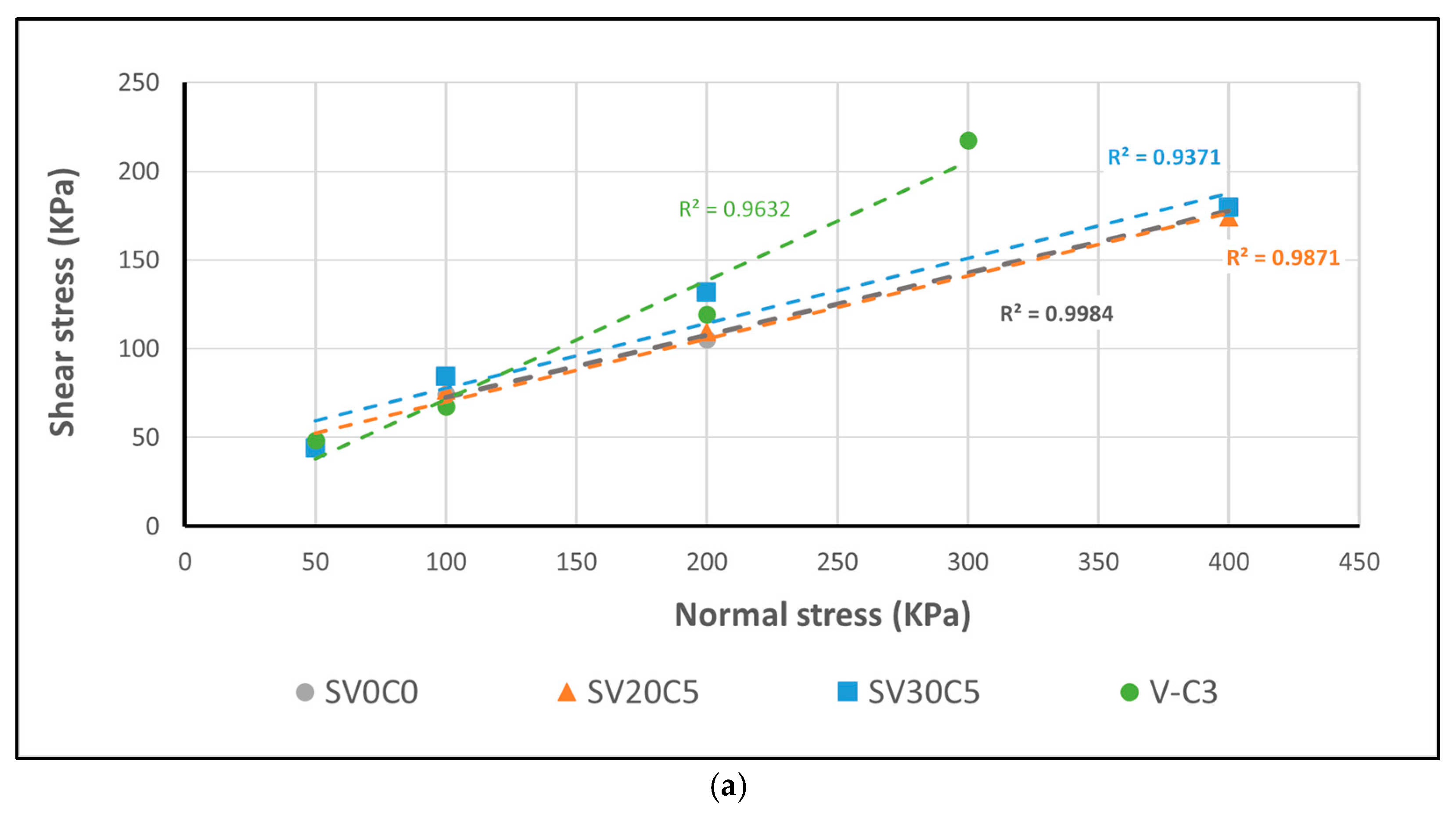
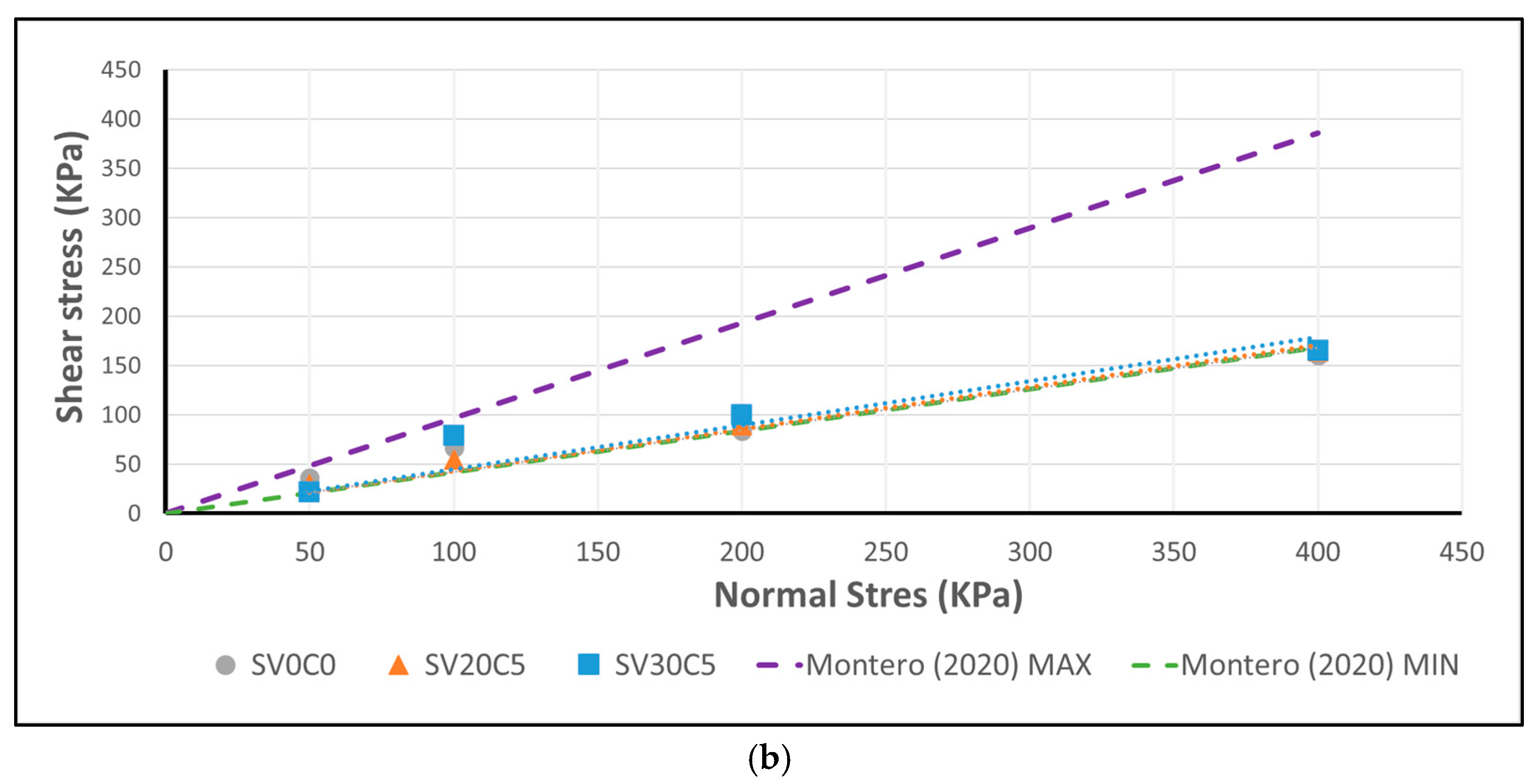
The failure envelope at peak strength (Figure 22a) shows minimal variations in shear strength parameters, though with a slight tendency toward an increased friction angle in the mixtures with volcanic ash and lime, consistent with the values reported in Table 16. Under residual strength conditions (Figure 22b), and assuming zero cohesion, the tendency toward higher friction angles relative to the untreated soil is preserved, but less pronounced due to the remolded nature of the specimens. The convergence of residual strength curves confirms that cohesive cementation had not yet developed—a finding consistent with Hossain [6], who reported that early-age volcanic ash–lime systems are governed by granular rearrangement rather than long-term pozzolanic bonding. Finally, the comparison with the ranges reported by Montero and Estaire [25] (Figure 22b) confirms that the obtained values fall within the expected shear strength behavior of marly clays from the same geological unit, reinforcing the reliability and applicability of the experimental program.

Figure 22.
(a) Correlation between shear and normal stress for peak shear strength. (b) Residual strength envelopes of base soil SV0C0 (S2) and mixtures SV20C5 and SV30C5, compared with the results reported by Montero and Estaire [25].
3.5.2. Unconfined Compressive Strength
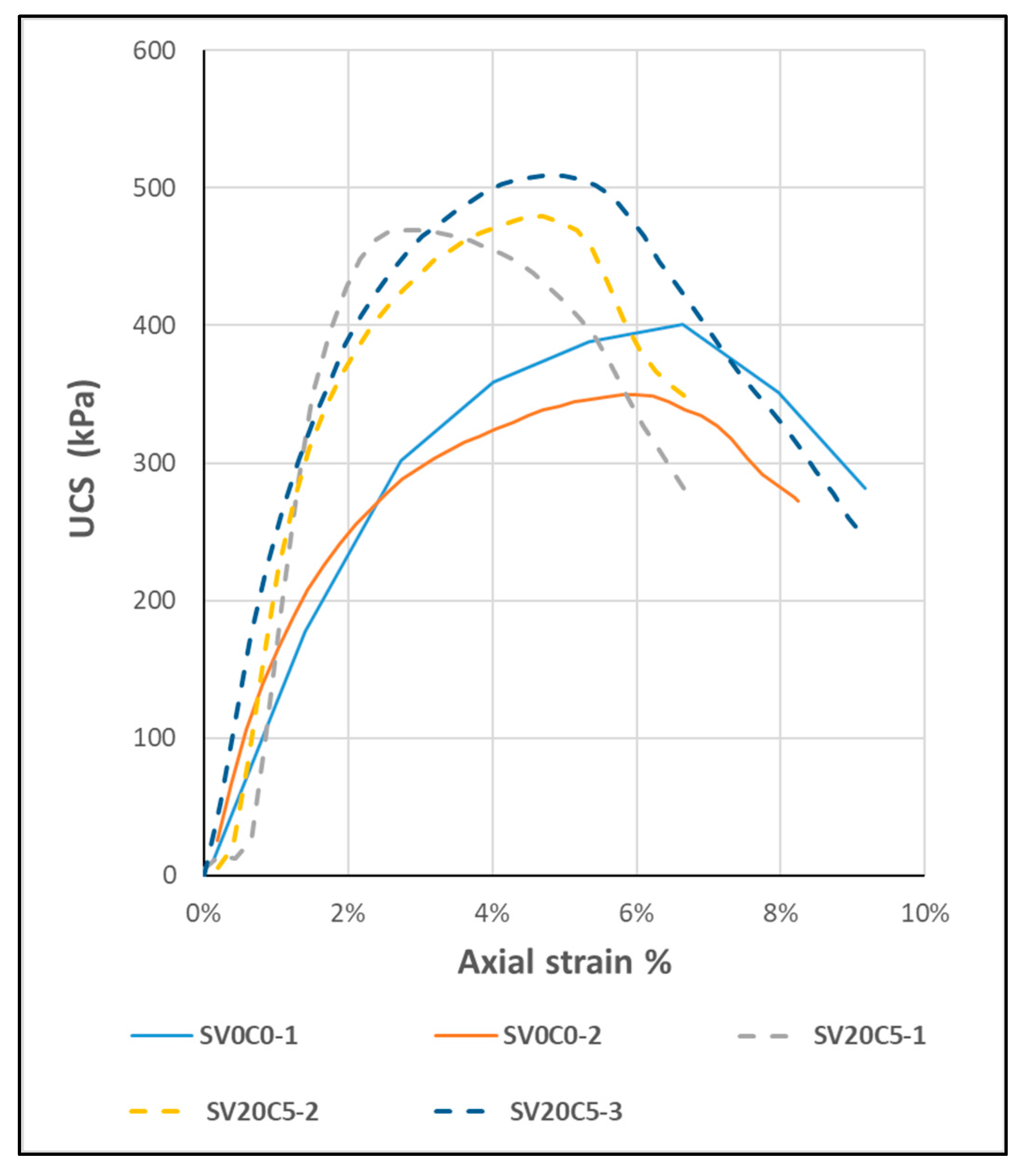
We evaluated the strength properties of the soil and its potential improvement compared to specimens SV0C0 and SV20C5, both prepared using the base natural soil S1. The tests were conducted immediately after specimen preparation, i.e., under short-term conditions, and at the corresponding optimum moisture content and maximum dry unit weight, as reported in Table 17.
Table 17.
Specimen preparation properties and results for UCS.
The unconfined compressive strength curve in Figure 23 shows that the specimens mixed with volcanic ash and lime show a clear increase in short-term strength compared with the base soil specimen S1. The improved performance of mixture SV20C5 is associated with its lower optimum moisture content and higher dry unit weight, which results in a denser and stiffer structure. This is reflected in its consistency index (IC = 1.20), which is higher than that of SV0C0 (IC = 1.02). In terms of the stress–strain response, SV0C0 displays a more ductile behavior, whereas SV20C5 behaves more rigidly, an effect primarily attributed to its lower moisture content, close to the PL. These mechanical improvements are also consistent with the onset of early pozzolanic reactions within the volcanic ash–lime–base soil matrix, which begin to contribute to strength development even under short-term conditions. These findings are consistent with the short-term strength gains documented by Hatefi [9].
Figure 23.
UCS curve of specimens SV0C0 and SV20C5.
Thus, the UCS results confirm that lime-activated volcanic ash provides a meaningful short-term enhancement and establishes the chemical foundation for more substantial long-term strength development.
4. Conclusions
The present work examines soil samples (S) characterized by volumetric and workability instability, obtained in southern Spain, and subsequently mixed with chemical stabilizers, such as volcanic ash (V-C3) obtained after the volcanic eruption of La Palma in 2021, with the objective of evaluating short-term changes in the geotechnical properties of the resulting soil mixtures under different proportions of different additives. Additionally, commercially available natural hydraulic lime (C-1) was added both as a direct soil (S1-S2) stabilizer and as a pozzolanic activator for the volcanic ash (V-C3), enabling the evaluation of its short-term effectiveness in stabilizing marly clays.
In view of the results, we conclude the following:
- Minor variations were observed in the chemical and mineralogical composition of the soil when mixed dry under different configurations. However, in the mixtures studied, there was a tendency for Fe2O3 to increase with the addition of volcanic ash due to its high iron content, which contributes to higher dry unit weight and thermal stability. Furthermore, the high silicon (SiO2) 40.62%, iron (Fe2O3) 15.55%, and alumina (Al2O3) 13.71% contents confirm the pozzolanic character of the ash and its suitability as a natural stabilizer.
- The lime used was selected for its rapid strength gain and favorable setting under humid conditions. Although natural hydraulic lime showed partial carbonation during storage, it retained sufficient reactive portlandite to initiate short-term pozzolanic reactions, as demonstrated by TGAs and XRD analysis. The alkaline environment generated by the remaining portlandite allowed dissolution of amorphous silica and alumina from the volcanic ash, initiating the formation of early C–S–H and C–A–H phases, qualitatively observed under optical microscopy. These findings confirm that lime remained effective both as a stabilizer and as a pozzolanic activator. Monitoring the evolution of lime composition during storage represents a methodological contribution that improves the interpretation of short-term stabilization mechanisms.
- Soil mixtures with different proportions of the chemical stabilizer and activator showed slight changes in their plasticity, with minimal variations in Atterberg limits. The most notable trend occurred between SV20C0 and SV20C5, where, in the latter, a decrease in the liquid limit (LL) was observed due to its lower water retention capacity, leading to a decrease in the plasticity index (PI).
- Based on the results of the free swelling test, the soil exhibited significant and progressive volumetric stabilization as the inclusion of volcanic ash and lime increased. The combined application of volcanic ash (V–C3) and natural hydrated lime (C-1) provided an effective short-term stabilization strategy for expansive marly clays. Lime-activated volcanic ash enhanced the soil’s volumetric stability, reduced free swelling to values below 5%, and increased dry density. These improvements were dosage-dependent, with the most favorable response obtained when lime efficiently activated the intrinsic pozzolanic properties of the volcanic ash. The resulting densification derives from the short-term pozzolanic reactions together with the fine-particle filler effect of the ash, which improves particle packing and reduces void ratios under compaction. The swelling reduction achieved with lime-activated volcanic ash is comparable to that of lime alone, while requiring significantly lower lime dosages, demonstrating the efficiency gains associated with ash activation. Therefore, lime-activated volcanic ash enhances lime efficiency and reduces the overall lime demand required for stabilization.
- The drained shear strength of the soil showed no significant changes, but there was a slight tendency for the friction angle to increase with the addition of volcanic ash and lime. It is likely that the pozzolanic effect of the ash (V-C3) is not fully reflected, due to limited curing time and the relatively low portlandite content that restricts early activation.
- A trend toward improved strength properties was observed in short-term unconfined compressive strength tests on the base soil (SV0C0) and the mixture of volcanic ash and lime (SV20C5).
- From an environmental standpoint, the findings of this research align with current eco-efficient strategies aimed at reducing the carbon footprint associated with calcium-based binders. Since a large share of CO2 emissions in cement and lime production originates from the chemical decomposition of limestone, decreasing the demand for these materials can substantially lower the carbon intensity of soil stabilization. In this context, the volcanic ash used in this research represents a sustainable pozzolanic resource, and its combined use with natural lime not only improves soil performance but also contributes to decarbonization efforts by optimizing lime consumption and valorizing natural by-products.
Author Contributions
R.P.: writing—original draft, methodology, investigation, visualization, conceptualization, formal analysis, and data curation. S.M.: writing—review and editing, resources, methodology, investigation, visualization, conceptualization, project administration, and funding acquisition. N.M.: resources, methodology, investigation, formal analysis, and data curation. S.L.-A.: writing—review and editing, resources, formal analysis, investigation, data curation, validation, and project administration. All authors have read and agreed to the published version of the manuscript.
Funding
This research was funded by Acciones Especiales de Investigación of UCM under grant number 2022/00306/001 and the UCM research project 2024/00469/001 (Pr12/24-31573).
Data Availability Statement
Data will be made available on request.
Acknowledgments
The authors are grateful to the students and Professors of the Master of Environmental Geology at UCM for collecting and shipping the volcanic ash to the Faculty of Geology (UCM). The provision of the Natural Hydrated Lime NHL-5 Tigre by José Toldrá from TIGRE 1845 is appreciated. The provision of soil defined as S1 is based on material availability from Natalia Montero and José Estaire (Laboratorio de Geotecnia, Cedex), and that of soil S2 is from Juan Jiménez Millán, Department of Geology, Faculty of Experimental Sciences, University of Jaén. The support from technicians at the Geological Techniques Unit of CAI and the Geotechnical Laboratory, UCM, in performing different tests is highly appreciated.
Conflicts of Interest
The authors declare that they have no known competing financial interests or personal relationships that could have appeared to influence the work reported in this paper.
References
- Ghavami, K.; Toledo Filho, R.D.; Barbosa, N.P. Behaviour of composite soil reinforced with natural fibres. Cem. Concr. Compos. 1999, 21, 39–48. [Google Scholar] [CrossRef]
- Fernández, C. Mejoramiento y Estabilización de Suelos; Limusa: Mexico City, Mexico, 1982. [Google Scholar]
- Adeyanju, E.A.; Okeke, C.A. Clay soil stabilization using cement kiln dust. IOP Conf. Ser. Mater. Sci. Eng. 2019, 640, 012080. [Google Scholar] [CrossRef]
- Melentijević, S.; Cameia, A.; García, F.; Ponce, R.; López Andrés, S. Application of cement kiln dust for the stabilization of expansive soils in the region of Murcia (Spain). Constr. Build. Mater. 2025, 491, 142743. [Google Scholar] [CrossRef]
- Játiva, A.; Ruales, E.; Etxeberria, M. Volcanic ash as a sustainable binder material: An extensive review. Materials 2021, 14, 1302. [Google Scholar] [CrossRef]
- Hossain, K.M.A.; Lachemi, M.; Easa, S. Characteristics of volcanic ash and natural lime based stabilized clayey soils. Can. J. Civ. Eng. 2006, 33, 1455–1458. [Google Scholar] [CrossRef]
- Miraki, H.; Shariatmadari, N.; Ghadir, P.; Jahandari, S.; Tao, Z.; Siddique, R. Clayey soil stabilization using alkali-activated volcanic ash and slag. J. Rock Mech. Geotech. Eng. 2022, 14, 576–591. [Google Scholar] [CrossRef]
- Melentijević, S.; Marcos, A.; Ponce, R.; López Andrés, S. Stabilization of expansive clay using volcanic ash. Geosciences 2025, 15, 261. [Google Scholar] [CrossRef]
- Hatefi, M.H.; Arabani, M.; Payan, M.; Ranjbar, P.Z. The influence of volcanic ash on the mechanical properties and freeze–thaw durability of lime kiln dust-stabilized kaolin clayey soil. Results Eng. 2024, 24, 103077. [Google Scholar] [CrossRef]
- Jahandari, S.; Saberian, M.; Zivari, F.; Li, J.; Ghasemi, M.; Vali, R. Experimental study of the effects of curing time on geotechnical properties of stabilized clay with lime and geogrid. Int. J. Geotech. Eng. 2017, 13, 170–181. [Google Scholar] [CrossRef]
- Jahandari, S.; Li, J.; Saberian, M.; Shahsavarigoughari, M. Experimental study of the effects of geogrids on elasticity modulus, brittleness, strength, and stress-strain behavior of lime stabilized kaolinitic clay. Geo-Resour. J. 2017, 13, 49–58. [Google Scholar] [CrossRef]
- Saberian, M.; Mehrinejad Khotbehsara, M.; Jahandari, S.; Vali, R.; Li, J. Experimental and phenomenological study of the effects of adding shredded tire chips on geotechnical properties of peat. Int. J. Geotech. Eng. 2018, 12, 347–356. [Google Scholar] [CrossRef]
- Kazemi, M.; Li, J.; Harehdasht, S.L.; Yousefieh, N.; Jahandari, S.; Saberian, M. Non-linear behavior of concrete beams reinforced with GFRP and CFRP bars grouted in sleeves. Structures 2020, 23, 87–102. [Google Scholar] [CrossRef]
- Scrivener, K.L.; John, V.M.; Gartner, E.M. Eco-efficient cements: Potential economically viable solutions for a low-CO2 cement-based materials industry. Cem. Concr. Res. 2018, 114, 2–26. [Google Scholar] [CrossRef]
- European Commission. Best Available Techniques (BAT) Reference Document for the Production of Cement, Lime and Magnesium Oxide; Publications Office of the European Union: Luxembourg, 2013. [Google Scholar] [CrossRef]
- Gómez, O.; Rodríguez, L. Diferencias entre residuo y subproducto: Una aproximación desde la normativa y la jurisprudencia. Revista de Derecho Urbanístico y Medio Ambiente 2019, 135, 77–100. [Google Scholar]
- Martínez-del-Pozo, I.; Esbrí, J.M.; García-Lorenzo, M.L.; López-Andrés, S. Synthesis of zeolites from volcanic ash (Tajogaite, Spain) for the remediation of waters contaminated by fluoride. Environ. Sci. Pollut. Res. 2024, 31, 7058–7072. [Google Scholar] [CrossRef]
- Xeidakis, G.S. Stabilization of swelling clays by Mg(OH)2. Changes in clay properties after addition of Mg-hydroxide. Eng. Geol. 1996, 44, 107–120. [Google Scholar] [CrossRef]
- Camacho Tauta, J.F.; Reyes Ortiz, O.J.; Antolínez, C.; Méndez, D.F. Evaluación de aditivos usados en el tratamiento de arcillas expansivas. Ciencia e Ingeniería Neogranadina 2006, 16, 21–30. [Google Scholar] [CrossRef]
- Khodabandeh, M.A.; Nagy, G.; Török, Á. Stabilization of collapsible soils with nanomaterials, fibers, polymers, industrial waste, and microbes: Current trends. Constr. Build. Mater. 2023, 368, 130463. [Google Scholar] [CrossRef]
- Umar Zada, A.; Jamal, A.; Iqbal, M.; Eldin, S.M.; Almoshaogeh, M.; Bekkouche, S.R.; Almuaythir, S. Recent advances in expansive soil stabilization using admixtures: Current challenges and opportunities. Case Stud. Constr. Mater. 2023, 18, e01985. [Google Scholar] [CrossRef]
- Akula, P.; Little, D.N. Analytical tests to evaluate pozzolanic reaction in lime stabilized soils. MethodsX 2020, 7, 100928. [Google Scholar] [CrossRef] [PubMed]
- Instituto Español del Cemento y sus Aplicaciones (IECA). Manual de Estabilización de Suelos con Cemento o Cal. 2018. Available online: https://www.ieca.es/producto/manual-de-estabilizacion-de-suelos-con-cemento-o-cal/ (accessed on 12 November 2022).
- Montero, N.; Estaire, J. Estudio Geotécnico de Inestabilidad de un Terraplén en la Carretera N-322 (Bailén–Requena). Bachelor’s Thesis, Universidad Politécnica de Madrid, Madrid, Spain, 2015. Available online: https://oa.upm.es/40316/ (accessed on 20 September 2022).
- Montero, N.; Estaire, J. Ensayos de corte en laboratorio para determinar la resistencia residual de arcillas sobreconsolidadas. Geotecnia 2020, 150, 27–50. [Google Scholar] [CrossRef]
- IGME Mapa Geológico Continuo de España, Escala 1:50.000 (GEODE 50). Instituto Geológico y Minero de España, CSIC: Madrid, Spain, 2022. Available online: https://igme.maps.arcgis.com/home/webmap/viewer.html?webmap=44df600f5c6241b59edb596f54388ae4 (accessed on 10 October 2025).
- Olalla, C.; Cuellar, V. Failure mechanism of the Aznalcóllar Dam, Seville, Spain. Géotechnique 2001, 51, 399–406. [Google Scholar] [CrossRef]
- Alonso, E.; Gens, A. Aznalcóllar dam failure. Part 1: Field observations and material properties. Geotechnique 2006, 56, 165–183. [Google Scholar] [CrossRef]
- Alonso, E.; Gens, A. Aznalcóllar dam failure. Part 2: Stability conditions and failure mechanism. Geotechnique 2006, 56, 185–202. [Google Scholar] [CrossRef]
- Vázquez-Boza, M. Comportamiento Volumétrico de la Marga azul del Guadalquivir ante los Cambios de Succión. Ph.D. Thesis, Universidad de Sevilla, Sevilla, Spain, 2014. Available online: https://idus.us.es/items/46a5b19b-e6f2-46b6-ba2c-2b80ab212fce (accessed on 20 September 2022).
- Escolano Sánchez, F.; Bueno Aguado, M.; Melentijević, S. Stress-strain behavior of blue marls from the Guadalquivir river basin in Spain. Acta Geotechnica Slovenica 2019, 16, 59–72. Available online: https://docta.ucm.es/rest/api/core/bitstreams/701f8398-2252-4040-a943-130da7d890a5/content (accessed on 12 December 2024). [CrossRef]
- Gómez, C. Comportamiento Geotécnico de Suelos Arcillosos Compactados, Respuesta a Cargas Estáticas y Dinámicas. Ph.D. Thesis, Universidad Complutense de Madrid, Madrid, Spain, 2019. [Google Scholar]
- Melentijević, S.; López-Andrés, S.; Estaire, J. Chemical, mineralogical and geotechnical properties of volcanic ash of Tajogaite (La Palma, Canary Islands, Spain). Transp. Geotech. 2024, 48, 101326. [Google Scholar] [CrossRef]
- Al-Amoudi, O.S.B.; Khan, S.M.S.; Maslehuddin, M. Lime-activation of natural pozzolan for use as supplementary cementitious material in concrete. Case Stud. Constr. Mater. 2022, 13, 101602. [Google Scholar] [CrossRef]
- ASTM D1557-12; Standard Test Methods for Laboratory Compaction Characteristics of Soil Using Modified Effort. ASTM International: West Conshohocken, PA, USA, 2012.
- ASTM D422-63(2002); Standard Test Method for Particle-Size Analysis of Soils. ASTM International: West Conshohocken, PA, USA, 2002.
- ASTM D4318-17; Standard Test Methods for Liquid Limit, Plastic Limit, and Plasticity Index of Soils. ASTM International: West Conshohocken, PA, USA, 2017.
- ASTM D4546-21; Standard Test Methods for One-Dimensional Swell or Settlement of Cohesive Soils. ASTM International: West Conshohocken, PA, USA, 2021.
- ASTM D2435/D2435M-11(2023); Standard Test Methods for One-Dimensional Consolidation Properties of Soils Using Incremental Loading. ASTM International: West Conshohocken, PA, USA, 2023.
- ASTM D2166/D2166M-16(2020); Standard Test Method for Unconfined Compressive Strength of Cohesive Soil. ASTM International: West Conshohocken, PA, USA, 2020.
- ASTM C618-15; Standard Specification for Coal Fly Ash and Raw or Calcined Natural Pozzolan for Use in Concrete. ASTM International: West Conshohocken, PA, USA, 2015.
- Shalabi, F.I.; Mazher, J.; Khan, K.; Amin, M.N.; Albaqshi, A.; Alamer, A.; Barsheed, A.; Alshuaibi, O. Influence of lime and volcanic ash on the properties of dune sand as sustainable construction materials. Materials 2021, 14, 645. [Google Scholar] [CrossRef]
- ASTM C977-23; Standard Specification for Quicklime and Hydrated Lime for Soil Stabilization. ASTM International: West Conshohocken, PA, USA, 2023.
- Vyšvařil, M. Monitoring the reactivity of pozzolans by thermogravimetric method. Acta Polytech. CTU Proc. 2025, 53, 102–107. [Google Scholar] [CrossRef]
- Ministerio de Fomento. Orden FOM/2523/2014, de 12 de diciembre, por la que se actualizan determinados artículos del Pliego de Prescripciones Técnicas Generales para Obras de Carreteras y Puentes (PG-3) [Parte 2: Materiales básicos; Parte 5; Parte 7]. Boletín Oficial del Estado 2015, 589–590. Available online: https://www.boe.es/boe/dias/2015/01/03/pdfs/BOE-A-2015-48.pdf (accessed on 20 October 2025).
- ASTM D2487-11; Standard Practice for Classification of Soils for Engineering Purposes (Unified Soil Classification System). ASTM International: West Conshohocken, PA, USA, 2011.
- Skempton, A.W. The colloidal activity of clays. In Proceedings of the 3rd International Conference on Soil Mechanics and Foundation Engineering, Zurich, Switzerland, 16–27 August 1953; Volume 1, pp. 57–61. [Google Scholar]
- Nelson, J.D.; Chao, K.C.; Overton, D.D.; Nelson, E.J. Foundation Engineering for Expansive Soils; Wiley: Hoboken, NJ, USA, 2015. [Google Scholar]
- ASTM D4829-21; Standard Test Method for Expansion Index of Soils. ASTM International: West Conshohocken, PA, USA, 2021.
- Chen, F.H. Foundations on Expansive Soils; Elsevier: Amsterdam, The Netherlands, 1975. [Google Scholar]
- Abdi, M.R.; Javdanian, H.; Javdanian, M. Durability and mechanical performance of lime-stabilized soils: Influence of curing conditions and lime content. J. Rock Mech. Geotech. Eng. 2021, 13, 148–158. [Google Scholar] [CrossRef]
- Agarwal, A.; Patel, A.; Kumar, B. Quantification of desiccation cracking and strain localization in lime-treated compacted expansive soils. J. Mater. Civ. Eng. 2020, 32, 04020315. [Google Scholar] [CrossRef]
- Ghadir, P.; Zamanian, M.; Mahbubi-Motlagh, N.; Saberian, M.; Li, J.; Ranjbar, N. Shear strength and life cycle assessment of volcanic ash-based geopolymer and cement stabilized soil: A comparative study. Transp. Geotech. 2021, 31, 100639. [Google Scholar] [CrossRef]
Disclaimer/Publisher’s Note: The statements, opinions and data contained in all publications are solely those of the individual author(s) and contributor(s) and not of MDPI and/or the editor(s). MDPI and/or the editor(s) disclaim responsibility for any injury to people or property resulting from any ideas, methods, instructions or products referred to in the content. |
© 2025 by the authors. Licensee MDPI, Basel, Switzerland. This article is an open access article distributed under the terms and conditions of the Creative Commons Attribution (CC BY) license (https://creativecommons.org/licenses/by/4.0/).