



Effect of Bonding Characteristics on Rutting Resistance and Moisture Susceptibility of Rubberized Reclaimed Asphalt Pavement


 ,
,  ,
, 
 and
and 
Abstract
1. Introduction
2. Materials and Methods
2.1. Materials
2.1.1. Binder
2.1.2. Crumb Rubber
2.2. Sample Production
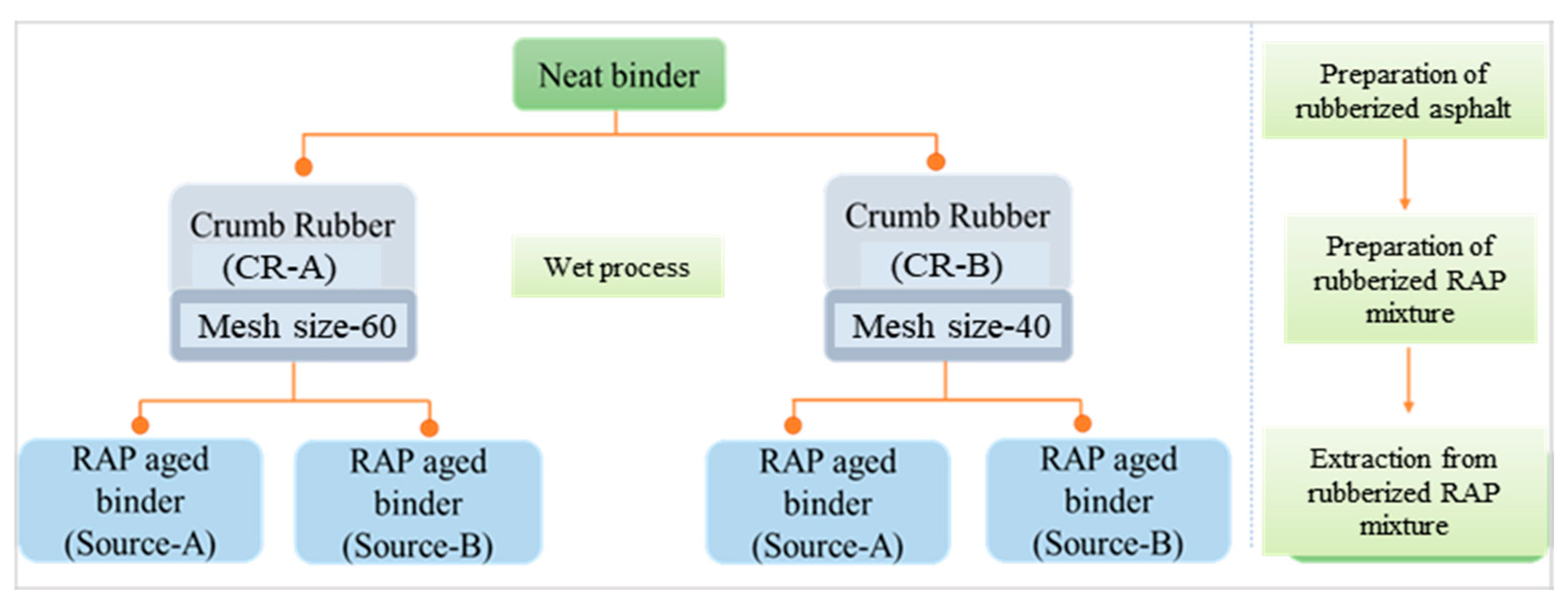
2.2.1. Rubberized RAP Binder
2.2.2. Rubberized RAP Mixture
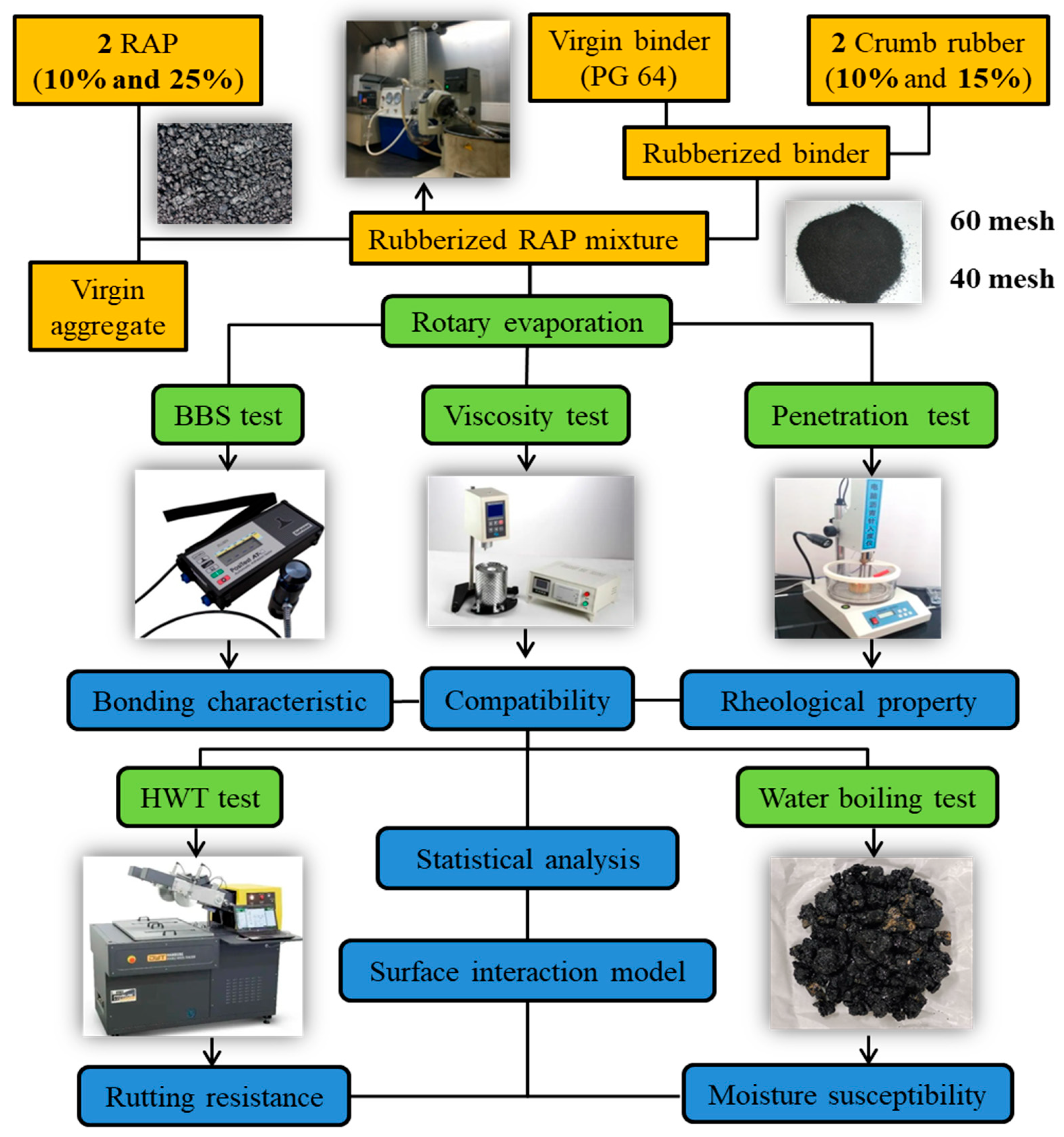
2.3. Experimental Design and Test Method
2.3.1. Binder Bond Strength (BBS) Test
2.3.2. Rotational Viscosity Test
2.3.3. Penetration Test
2.3.4. Hamburg Wheel Track (HWT) Test
2.3.5. Water Boiling Test
3. Results and Discussions
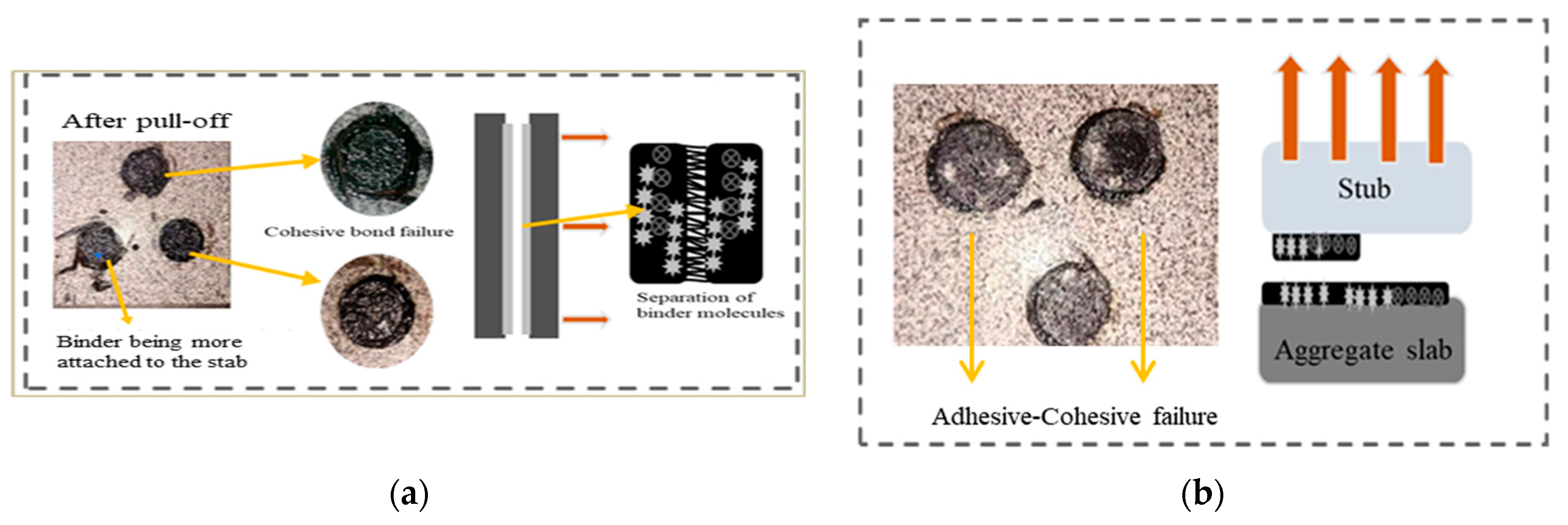
3.1. Bonding Characteristics
3.2. Compatibility Evaluation
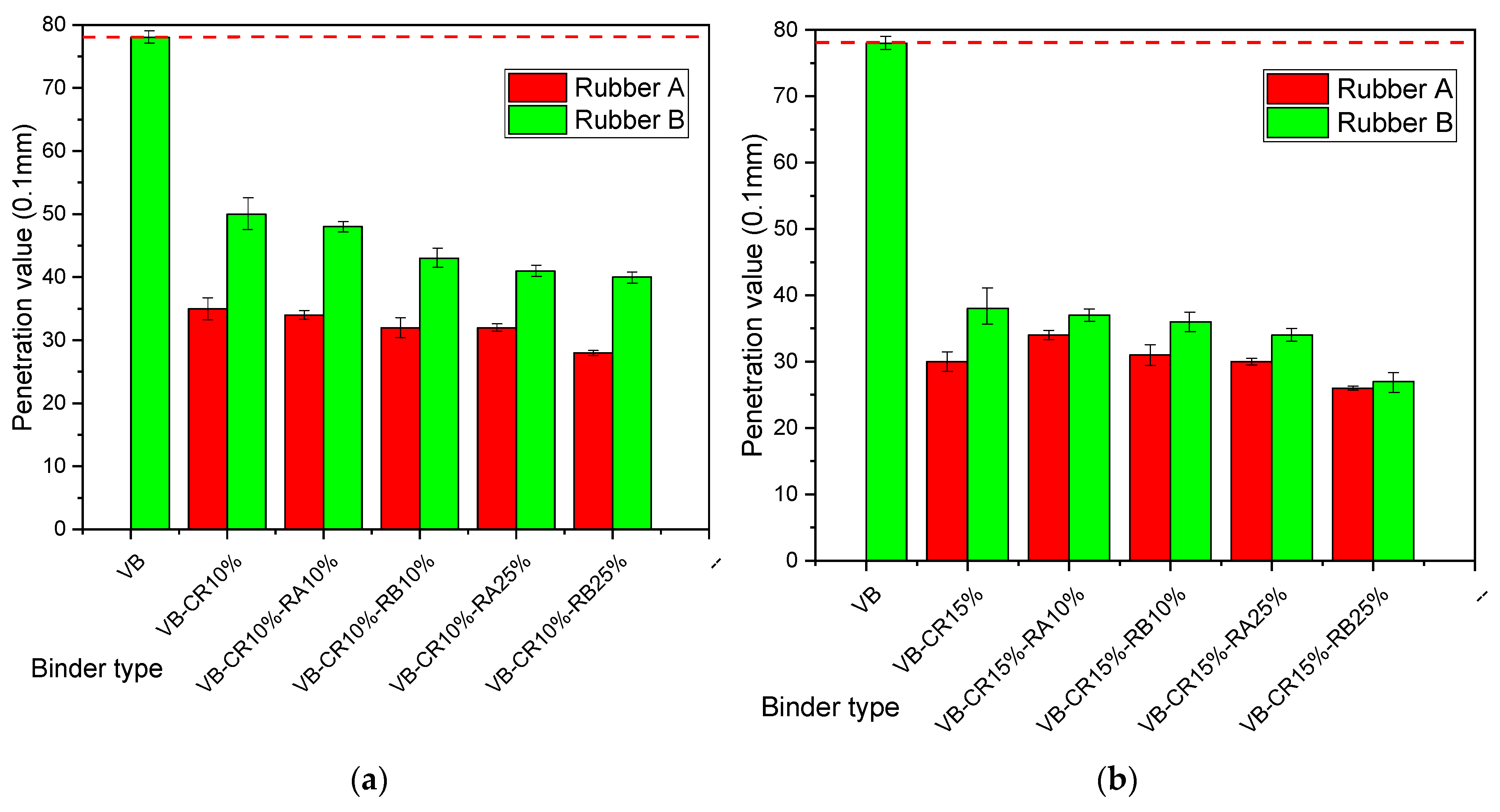
3.3. Penetration Grade
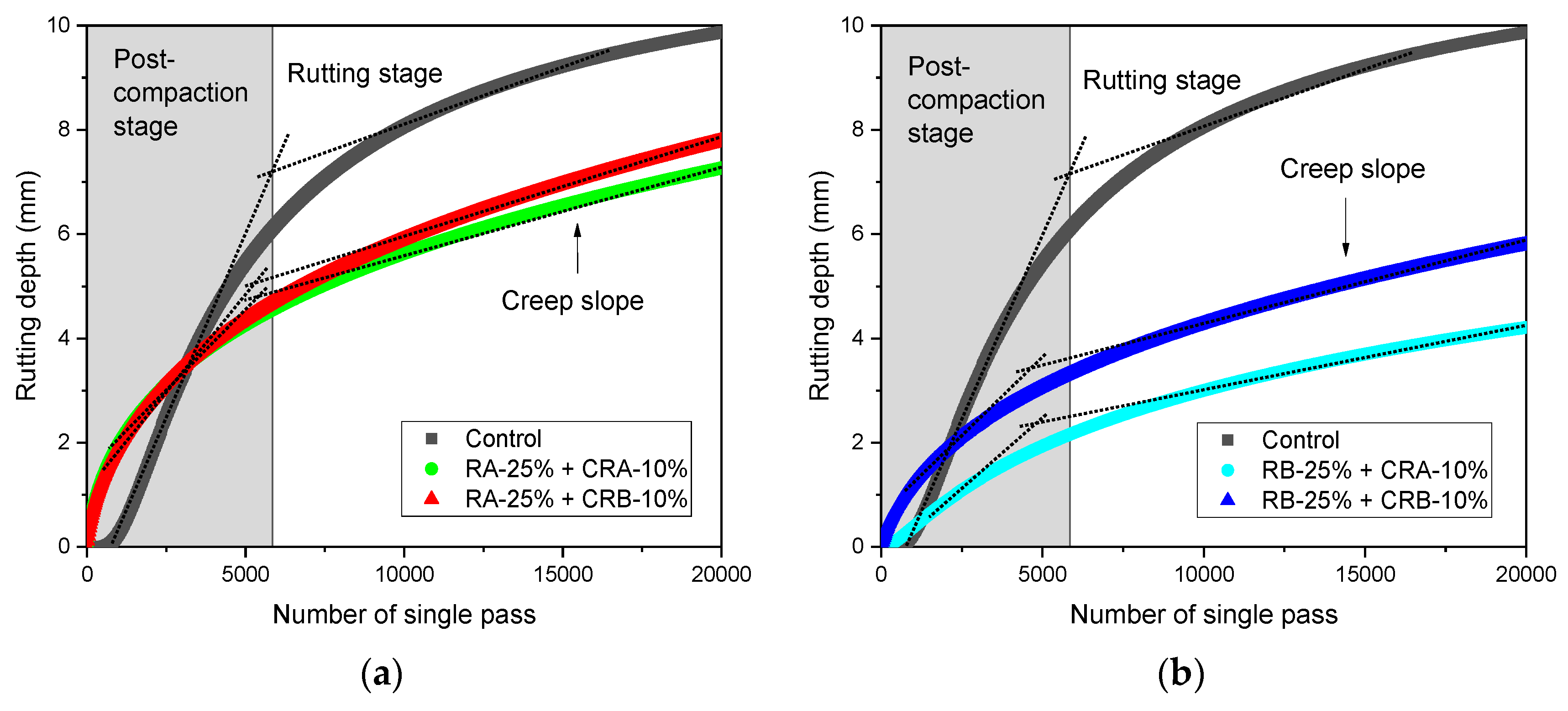
3.4. Rutting Resistance
3.5. Moisture Susceptibility
4. Statistical Analysis
5. Conclusions
- The predominant bonding failure mode of rubberized RAP binders is cohesive. The swelling of smaller CR particles in asphalt enhances adhesion, while RAP oxidation improves the binder’s cohesive properties.
- Increasing CR content can shift rubberized RAP asphalt from a cohesive to a mixed failure mode, leading to a significant reduction in bonding strength. A CR content of 10% is therefore recommended for optimal performance.
- Incorporating large CR particles and highly aged RAP increases the penetration and viscosity of asphalt binders, affecting their elastic deformation response and the uniformity of aggregate coating. For example, the rotational viscosity of control asphalt (i.e., 974 mPa s) increases to 1208 mPa s and 4892 mPa s after incorporating 10% Rubber A and Rubber B, respectively, while the penetration value decreases from 78 decreases to 28 and 40.
- The combination of RAP and CR in asphalt mixtures enhances rutting and moisture resistance, largely due to the formation of a rubbery supporting network within the modified binder. Recycled asphalt with higher oxidation levels exhibits greater cohesion, restricting asphalt film movement. The maximum rut depth of the control mixture decreases from 9.873 mm to 4.212 mm with RAP and rubber addition, while the stripping degree value decreases from 11.9% to 3.6%.
Author Contributions
Funding
Data Availability Statement
Conflicts of Interest
References
- Antunes, V.; Freire, A.C.; Neves, J. A review on the effect of RAP recycling on bituminous mixtures properties and the viability of multi-recycling. Constr. Build. Mater. 2019, 211, 453–469. [Google Scholar] [CrossRef]
- Celauro, C.; Corriere, F.; Guerrieri, M.; Lo Casto, B.; Rizzo, A. Environmental analysis of different construction techniques and maintenance activities for a typical local road. J. Clean. Prod. 2017, 142, 3482–3489. [Google Scholar] [CrossRef]
- Yu, H.; Zhu, Z.; Leng, Z.; Wu, C.; Zhang, Z.; Wang, D.; Oeser, M. Effect of mixing sequence on asphalt mixtures containing waste tire rubber and warm mix surfactants. J. Clean. Prod. 2020, 246, 119008. [Google Scholar] [CrossRef]
- Eskandarsefat, S.; Sangiorgi, C.; Dondi, G.; Lamperti, R. Recycling asphalt pavement and tire rubber: A full laboratory and field scale study. Constr. Build. Mater. 2018, 176, 283–294. [Google Scholar] [CrossRef]
- Magar, S.; Xiao, F.; Singh, D.; Showkat, B. Applications of reclaimed asphalt pavement in India—A review. J. Clean. Prod. 2022, 335, 130221. [Google Scholar] [CrossRef]
- Zaumanis, M.; Mallick, R.B. Review of very high-content reclaimed asphalt use in plant-produced pavements: State of the art. Int. J. Pavement Eng. 2015, 16, 39–55. [Google Scholar] [CrossRef]
- Loprencipe, G.; Moretti, L.; Saltaren Daniel, M. Fatigue Resistance of RAP-Modified Asphalt Mixes Versus Conventional Mixes Using the Indirect Tensile Test: A Systematic Review. Designs 2025, 9, 104. [Google Scholar] [CrossRef]
- Piccone, G.; Loprencipe, G.; Almeida, A.; Fiore, N. Evaluation of the performance of a warm mix asphalt (Wma) considering aged and unaged specimens. Coatings 2020, 10, 1241. [Google Scholar] [CrossRef]
- Saed, S.A.; Kamboozia, N.; Ziari, H.; Hofko, B. Experimental assessment and modeling of fracture and fatigue resistance of aged stone matrix asphalt (SMA) mixtures containing RAP materials and warm-mix additive using ANFIS method. Mater. Struct. 2021, 54, 396. [Google Scholar] [CrossRef]
- Afshin, A.; Behnood, A. Prediction of moisture susceptibility of asphalt mixtures containing RAP materials using machine learning algorithms. Int. J. Pavement Eng. 2024, 25, 14. [Google Scholar] [CrossRef]
- Xiao, F.; Amirkhanian, S.; Putman, B.; Shen, J. Laboratory investigation of engineering properties of rubberized asphalt mixtures containing reclaimed asphalt pavement. Can. J. Civ. Eng. 2010, 37, 1414–1422. [Google Scholar] [CrossRef]
- Thives, L.P.; Pais, J.C.; Pereira, P.A.A.; Palha, C.A.O.F.; Trichês, G. Contribution of Asphalt Rubber Mixtures to Sustainable Pavements by Reducing Pavement Thickness. Materials 2022, 15, 8592. [Google Scholar] [CrossRef]
- Singh, D.; Sawant, D.; Xiao, F. High and intermediate temperature performance evaluation of crumb rubber modified binders with RAP. Transp. Geotech. 2017, 10, 13–21. [Google Scholar] [CrossRef]
- Fakhri, M.; Azami, A. Evaluation of warm mix asphalt mixtures containing reclaimed asphalt pavement and crumb rubber. J. Clean. Prod. 2017, 165, 1125–1132. [Google Scholar] [CrossRef]
- Sol-Sánchez, M.; Jiménez del Barco Carrión, A.; Hidalgo-Arroyo, A.; Moreno-Navarro, F.; Saiz, L.; Rubio-Gámez, M.d.C. Viability of producing sustainable asphalt mixtures with crumb rubber bitumen at reduced temperatures. Constr. Build. Mater. 2020, 265, 120154. [Google Scholar] [CrossRef]
- Ghabchi, R.; Singh, D.; Zaman, M. Evaluation of moisture susceptibility of asphalt mixes containing RAP and different types of aggregates and asphalt binders using the surface free energy method. Constr. Build. Mater. 2014, 73, 479–489. [Google Scholar] [CrossRef]
- Moretti, L.; Palozza, L.; D’Andrea, A. Causes of Asphalt Pavement Blistering: A Review. Appl. Sci. 2024, 14, 2189. [Google Scholar] [CrossRef]
- Kringos, N.; Scarpas, A. Physical and mechanical moisture susceptibility of asphaltic mixtures. Int. J. Solids Struct. 2008, 45, 2671–2685. [Google Scholar] [CrossRef]
- Cala, A.; Caro, S.; Lleras, M.; Rojas-Agramonte, Y. Impact of the chemical composition of aggregates on the adhesion quality and durability of asphalt-aggregate systems. Constr. Build. Mater. 2019, 216, 661–672. [Google Scholar] [CrossRef]
- Xu, L.; Li, X.; Zong, Q.; Xiao, F. Chemical, morphological and rheological investigations of SBR/SBS modified asphalt emulsions with waterborne acrylate and polyurethane. Constr. Build. Mater. 2021, 272, 121972. [Google Scholar] [CrossRef]
- Xu, G.; Wang, H.; Sun, W. Molecular dynamics study of rejuvenator effect on RAP binder: Diffusion behavior and molecular structure. Constr. Build. Mater. 2018, 158, 1046–1054. [Google Scholar] [CrossRef]
- Hossain, K.; Karakas, A.; Hossain, Z. Effects of Aging and Rejuvenation on Surface-Free Energy Measurements and Adhesion of Asphalt Mixtures. J. Mater. Civ. Eng. 2019, 31, 04019125. [Google Scholar] [CrossRef]
- Bionghi, R.; Shahraki, D.; Ameri, M.; Karimi, M.M. Correlation between bond strength and surface free energy parameters of asphalt binder-aggregate system. Constr. Build. Mater. 2021, 303, 124487. [Google Scholar] [CrossRef]
- Huang, W.; Lv, Q.; Xiao, F. Investigation of using binder bond strength test to evaluate adhesion and self-healing properties of modified asphalt binders. Constr. Build. Mater. 2016, 113, 49–56. [Google Scholar] [CrossRef]
- Abd, D.M.; Al-Khalid, H.; Akhtar, R. Adhesion properties of warm-modified bituminous binders (WMBBs) determined using pull-off tests and atomic force microscopy. Road Mater. Pavement Des. 2018, 19, 1926–1939. [Google Scholar] [CrossRef]
- Aguiar-Moya, J.P.; Salazar-Delgado, J.; Baldi-Sevilla, A.; Leiva-Villacorta, F.; Loria-Salazar, L. Effect of aging on adhesion properties of asphalt mixtures with the use of bitumen bond strength and surface energy measurement tests. Transp. Res. Rec. 2015, 2505, 57–65. [Google Scholar] [CrossRef]
- Badughaish, A.; Li, J.; Amirkhanian, S.; Xiao, F. Adhesion and segregation characteristics of crumb rubberized binders based on solution-soaked methods. J. Clean. Prod. 2022, 354, 131762. [Google Scholar] [CrossRef]
- Li, J.; Chen, Z.; Xiao, F.; Amirkhanian, S.N. Solution Soaking Pretreatments of Crumb Rubber for Improving Compatibility of Rubberized Asphalt. J. Mater. Civ. Eng. 2022, 34, 04021377. [Google Scholar] [CrossRef]
- ASTM D 2172; Standard Test Methods for Quantitative Extraction of Bitumen From Bituminous Paving Mixtures. ASTM International: West Conshohocken, PA, USA, 2011.
- ASTM D 5404; Standard Practice for Recovery of Asphalt Binder from Solution Using the Rotary Evaporator. ASTM International: West Conshohocken, PA, USA, 2024.
- ASTM D 4541-22; Standard Test Method for Pull-Off Strength of Coatings Using Portable Adhesion Testers. ASTM International: West Conshohocken, PA, USA, 2022.
- AASHTO T316; Standard Method of Test for Viscosity Determination of Asphalt Binder Using Rotational Viscometer. AASHTO: Washington, DC, USA, 2022.
- ASTM D5; Standard Test Method for Penetration of Bituminous Materials. American Society for Testing and Materials: West Conshohocken, PA, USA, 2020.
- AASHTO T324; Standard Method of Test for Hamburg Wheel-Track Testing of Compacted Asphalt Mixtures. AASHTO: Washington, DC, USA, 2022.
- ASTM D3625; Standard Practice for Effect of Water on Asphalt-Coated Aggregate Using Boiling Water. ASTM International: West Conshohocken, PA, USA, 2024.
- Luo, L.; Chu, L.; Fwa, T.F. Molecular dynamics analysis of oxidative aging effects on thermodynamic and interfacial bonding properties of asphalt mixtures. Constr. Build. Mater. 2021, 269, 121299. [Google Scholar] [CrossRef]
- Wang, L.; Zhang, L.; Liu, Y. Molecular Dynamics Study on the Effect of Mineral Composition on the Interface Interaction between Rubberized Asphalt and Aggregate. J. Mater. Civ. Eng. 2022, 34, 447. [Google Scholar] [CrossRef]
- Rueden, C.; Dietz, C.; Horn, M.; Schindelin, J.; Northan, B.; Berthold, M.; Eliceiri, K. ImageJ Ops. Software. 2021. Available online: https://imagej.net/Ops (accessed on 18 November 2025).






| Property | Virgin Bitumen (VB) | RAP-A (RA) | RAP-B (RB) |
|---|---|---|---|
| Penetration (0.1 mm) | 77.8 | 32.0 | 27.6 |
| Performance grade | PG 64 | PG 94 | PG 112 |
| Softening point (°C) | 49 | 72 | 73 |
| Ductility (15 °C) | 44 | 34 | 31 |
| Solubility (Trichloroethylene) (%) | 99.3 | 97.3 | 96.8 |
| Materials | Control Sample | Sample A | Sample B | Sample C | Sample D |
|---|---|---|---|---|---|
| RAP | 0 | RA-25% | RA-25% | RB-25% | RB-25% |
| Crumb Rubber | 0 | CR-A-10% | CR-B-10% | CR-A-10% | CR-B-10% |
| Sieve size (mm) | Passing (%) | ||||
| 13.2 | 95.48 | 94.56 | 94.56 | 96.40 | 96.40 |
| 9.5 | 78.62 | 75.15 | 75.15 | 82.70 | 82.70 |
| 4.75 | 55.08 | 53.05 | 53.05 | 58.80 | 58.80 |
| 2.36 | 34.35 | 32.44 | 32.44 | 35.21 | 35.21 |
| 1.18 | 23.35 | 21.71 | 21.71 | 22.58 | 22.58 |
| 0.6 | 15.98 | 14.60 | 14.60 | 14.66 | 14.66 |
| 0.3 | 10.60 | 9.46 | 9.46 | 9.40 | 9.40 |
| 0.15 | 8.50 | 7.50 | 7.50 | 7.52 | 7.52 |
| 0.075 | 7.23 | 6.25 | 6.25 | 6.33 | 6.33 |
| RAP Size (mm) | Sieve Gradation of RAP—Passing at Sieve Size (mm) | Bitumen Content (%) | |||||||||
|---|---|---|---|---|---|---|---|---|---|---|---|
| 0.075 | 0.15 | 0.3 | 0.6 | 1.18 | 2.36 | 4.75 | 9.5 | 13.2 | 16 | ||
| 10–15 | 0.11 | 0.29 | 0.30 | 0.31 | 0.31 | 0.32 | 0.52 | 28.55 | 83.75 | 100 | 3.12 |
| 5–10 | 0.29 | 0.43 | 0.49 | 0.51 | 0.53 | 0.55 | 7.27 | 91.63 | 100 | 100 | 4.69 |
| 3–5 | 0.32 | 0.41 | 0.46 | 0.48 | 0.48 | 6.29 | 99.82 | 100 | 100 | 100 | 7.03 |
| 0–3 | 4.38 | 11.37 | 21.9 | 40.97 | 64.95 | 99.94 | 100 | 100 | 100 | 100 | 10.73 |
| Mixture Type | Void Content (%) | Density (g/cm3) | RS (×10−5/pass) | 2000 Passes (mm) | Maximum Rut Depth (mm) |
|---|---|---|---|---|---|
| Control | 7.0 | 2.354 | 18.77 | 1.703 | 9.873 |
| RAPA-25% + CRA-10% | 7.0 | 2.312 | 18.58 | 2.810 | 7.269 |
| RAPA-25% + CRB-10% | 7.0 | 2.303 | 17.21 | 2.797 | 7.787 |
| RAPB-25% + CRA-10% | 7.0 | 2.334 | 16.73 | 0.867 | 4.212 |
| RAPB-25% + CRB-10% | 7.0 | 2.327 | 12.51 | 1.867 | 5.802 |
| Mixture Type | R2 | RMSE |
|---|---|---|
| Control | 0.993 | 0.001 |
| RAP-A-25% + CR-A-10% | 0.963 | 0.004 |
| RAP-A-25% + CR-B-10% | 0.983 | 0.002 |
| RAP-B-25% + CR-A-10% | 0.990 | 0.001 |
| RAP-B-25% + CR-B-10% | 0.988 | 0.002 |
| RAP | CR Content | RAP Content | Significance 1 | ||
|---|---|---|---|---|---|
| RAP-A | A-10% | 0% | 10% | 25% | N |
| A-15% | 0% | 10% | 25% | Y | |
| RAP-B | B-10% | 0% | 10% | 25% | N |
| B-15% | 0% | 10% | 25% | Y | |
| CR | Aged binder content | CR content | Significance 1 | ||
| CR-A | A-10% | 0% | 10% | 15% | Y |
| A-25% | 0% | 10% | 15% | Y | |
| CR-B | B-10% | 0% | 10% | 15% | Y |
| B-25% | 0% | 10% | 15% | Y | |
Disclaimer/Publisher’s Note: The statements, opinions and data contained in all publications are solely those of the individual author(s) and contributor(s) and not of MDPI and/or the editor(s). MDPI and/or the editor(s) disclaim responsibility for any injury to people or property resulting from any ideas, methods, instructions or products referred to in the content. |
© 2025 by the authors. Licensee MDPI, Basel, Switzerland. This article is an open access article distributed under the terms and conditions of the Creative Commons Attribution (CC BY) license (https://creativecommons.org/licenses/by/4.0/).
Share and Cite
Xu, L.; Zhao, Z.; Lai, Y.; Yuan, Y.; Wang, S.; Lin, J.; Moretti, L.; Loprencipe, G. Effect of Bonding Characteristics on Rutting Resistance and Moisture Susceptibility of Rubberized Reclaimed Asphalt Pavement. Infrastructures 2025, 10, 336. https://doi.org/10.3390/infrastructures10120336
Xu L, Zhao Z, Lai Y, Yuan Y, Wang S, Lin J, Moretti L, Loprencipe G. Effect of Bonding Characteristics on Rutting Resistance and Moisture Susceptibility of Rubberized Reclaimed Asphalt Pavement. Infrastructures. 2025; 10(12):336. https://doi.org/10.3390/infrastructures10120336
Chicago/Turabian StyleXu, Ling, Zifeng Zhao, Yuanwen Lai, Yan Yuan, Shuyi Wang, Junjie Lin, Laura Moretti, and Giuseppe Loprencipe. 2025. "Effect of Bonding Characteristics on Rutting Resistance and Moisture Susceptibility of Rubberized Reclaimed Asphalt Pavement" Infrastructures 10, no. 12: 336. https://doi.org/10.3390/infrastructures10120336
APA StyleXu, L., Zhao, Z., Lai, Y., Yuan, Y., Wang, S., Lin, J., Moretti, L., & Loprencipe, G. (2025). Effect of Bonding Characteristics on Rutting Resistance and Moisture Susceptibility of Rubberized Reclaimed Asphalt Pavement. Infrastructures, 10(12), 336. https://doi.org/10.3390/infrastructures10120336



