Mapping the Outcomes of Low-Vision Rehabilitation: A Scoping Review of Interventions, Challenges, and Research Gaps

 , , , ,
Abstract
1. Background
2. Review Questions
- What are the outcomes of low-vision rehabilitation interventions for adults?
- What types of studies have been conducted to evaluate the outcomes of low-vision rehabilitation interventions for adults?
- What are the existing research gaps in the field of low-vision rehabilitation interventions for adults that require further exploration?
3. Methods and Materials
4. Registration Statement
5. Eligibility Criteria
- Study period: This study included studies published up to December 2024.
- Study type: This study included a cross-sectional study, clinical trials, cohort studies, and a case report.
- Language: this study included studies published in the English language.
- Population: This study included studies that were conducted among adults.
- The study included both published and unpublished articles conducted globally.
- Publications without the full text, reviews, and meta-analyses were excluded.
6. Information Sources and the Search Strategy
7. Selection of the Sources of Evidence and Data Items
8. Data Charting Process
9. Critical Appraisal of Included Studies
9.1. Methodological Quality
9.2. Clarity of Intervention Reporting
9.3. Appropriateness of Outcome Measures
9.4. Risk of Bias Indicators
- Allocation bias: Incomplete description of randomization in several RCTs.
- Performance bias: Blinding was rarely feasible due to the nature of rehabilitation interventions.
- Attrition bias: Some studies had notable dropout rates without sensitivity analyses.
- Detection bias: Outcome assessors were not always masked to treatment allocation
10. Synthesis and Analysis of the Results
11. Results
11.1. Selection of the Sources of Evidence
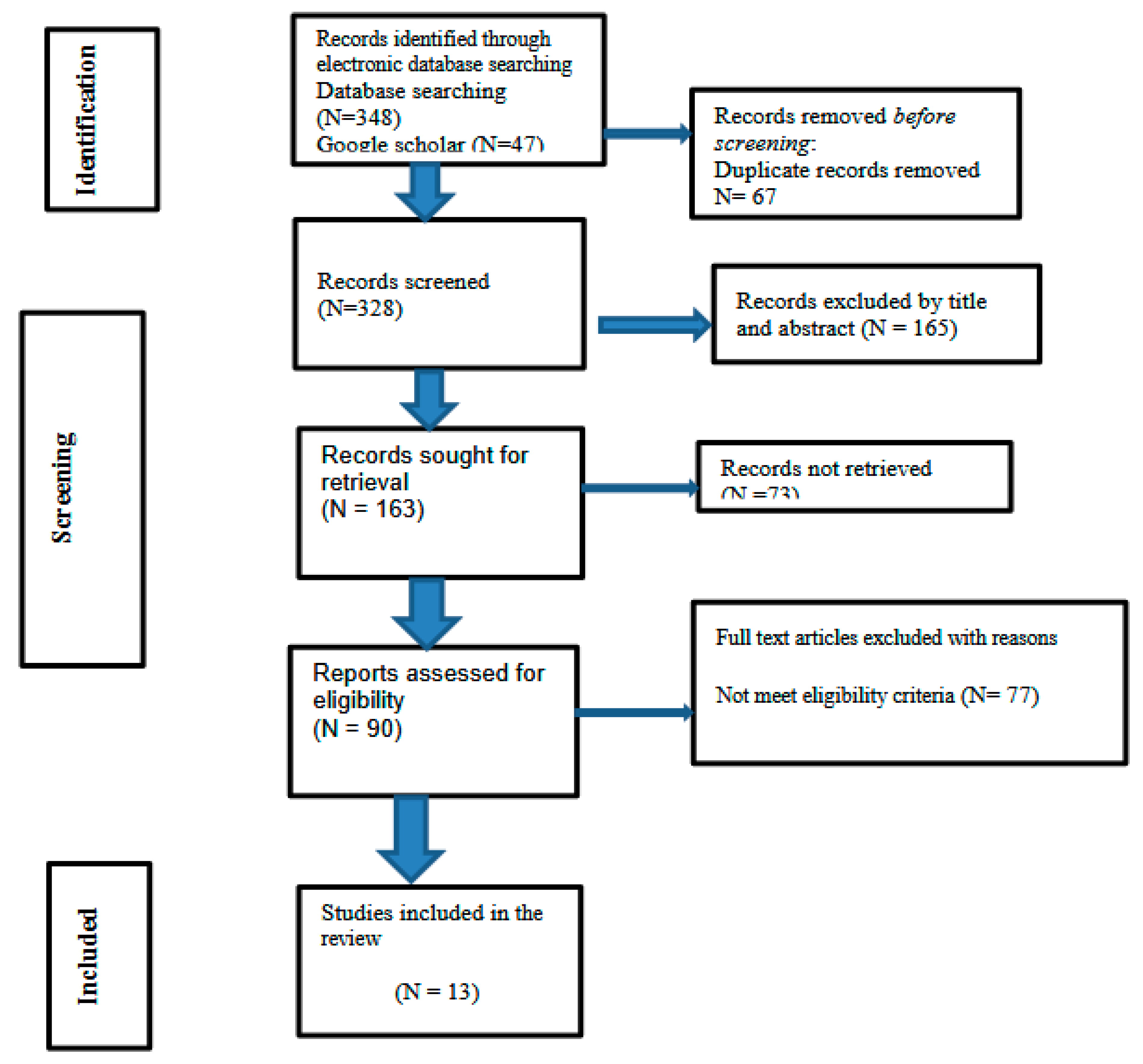
11.1.1. Search Results
- (1)
- Wrong population, including pediatric or mixed-age samples (n = 18);
- (2)
- Absence of a low-vision rehabilitation intervention (n = 22);
- (3)
- Insufficient or non-extractable outcome data (n = 16);
- (4)
- Manuscripts available only in non-English languages (n = 8);
- (5)
- Inaccessible full text despite multiple retrieval attempts (n = 13).
11.1.2. Characteristics of the Included Studies
12. Result of the Individual Study
12.1. Synthesis of Outcomes
- Visual training interventions included structured reading exercises (e.g., MNREAD passages), eccentric viewing training, scanning training for visual field loss, and contrast-enhancement strategies.
- Magnification-based interventions involved optical magnifiers, electronic video magnifiers, and handheld or stand devices, with structured training sessions delivered by certified low-vision therapists.
- Multidisciplinary rehabilitation programs combined occupational therapy, psychological counseling, mobility training, and device training within a coordinated clinical model (e.g., Veterans Affairs low-vision programs).
- Home-based rehabilitation models included therapist-guided training delivered at participants’ homes, emphasizing ADL support, problem-solving strategies, and environmental modifications.
- Self-management programs focused on education, peer support, and coping strategies, delivered without intensive therapist involvement.
12.1.1. Visual Function Outcomes
12.1.2. Activity Limitations Outcome
12.1.3. Participation Restrictions Outcome
12.1.4. Environmental and Personal Factors Outcome
- ADL = Activities of Daily Living; LVD = low vision device; VRQoL = vision-related quality of life; AMD = age-related macular degeneration.
- Outcomes and measurement tools listed represent the most commonly reported assessments across included studies; individual studies may have used multiple tools.
- Impacts summarize cross-study patterns rather than results from a single trial.
13. Research Gap, Outcomes, and Key Findings
13.1. Identified Research Gaps
13.2. Variability in Outcome Measures and Methodology
13.3. Key Intervention-Specific Outcomes
13.4. Integrated Evidence Interpretation
- Structured visual training, multidisciplinary rehabilitation, and home-based interventions consistently yield the most robust improvements in visual function, functional independence, and psychosocial well-being.
- Self-directed or low-intensity programs offer limited benefits, reinforcing the importance of therapist-guided, high-quality rehabilitation models.
- Outcome heterogeneity remains a substantial barrier, as studies frequently employ different measurement instruments for similar constructs, limiting cross-study comparability.
- Long-term outcomes are insufficiently examined, with most studies assessing short-term (1–6 months) effects and providing limited evidence on sustained rehabilitation gains.
- Psychosocial factors, including emotional well-being, adaptation, and social participation, remain underrepresented in both intervention design and assessment, despite their central role in coping with vision loss.
14. Discussion
15. Conclusions
16. Limitation
Supplementary Materials
Author Contributions
Funding
Institutional Review Board Statement
Informed Consent Statement
Data Availability Statement
Acknowledgments
Conflicts of Interest
References
- Jackson, M.L.; Virgili, G.; Shepherd, J.D.; Di Nome, M.A.; Fletcher, D.C.; Kaleem, M.A.; Lam, L.A.; Lawrence, L.M.; Sunness, J.S.; Riddering, A.T. Vision Rehabilitation Preferred Practice Pattern®. Ophthalmology 2023, 130, 271–335. [Google Scholar] [CrossRef]
- Cherinet, F.M.; Tekalign, S.Y.; Anbesse, D.H.; Bizuneh, Z.Y. Prevalence and associated factors of low vision and blindness among patients attending St. Paul’s Hospital Millennium Medical College. BMC Ophthalmol. 2018, 18, 232. [Google Scholar] [CrossRef]
- Almidani, L.; Miller, R.; Varadaraj, V.; Mihailovic, A.; Swenor, B.K.; Ramulu, P.Y. Vision Impairment and Psychosocial Function in US Adults. JAMA Ophthalmol. 2024, 142, 283–291. [Google Scholar] [CrossRef]
- Kuźma, E.; Littlejohns, T.J.; Khawaja, A.P.; Llewellyn, D.J.; Ukoumunne, O.C.; Thiem, U. Visual impairment, eye diseases, and dementia risk: A systematic review and meta-analysis. J. Alzheimer’s Dis. 2021, 83, 1073–1087. [Google Scholar] [CrossRef]
- Rees, G.; Xie, J.; Chiang, P.P.; Larizza, M.F.; Marella, M.; Hassell, J.B.; Keeffe, J.E.; Lamoureux, E.L. A randomised controlled trial of a self-management programme for low vision implemented in low-vision rehabilitation services. Patient Educ. Couns. 2015, 98, 174–181. [Google Scholar] [CrossRef]
- Ekemiri, K.K.; Botchway, E.N.; Ezinne, N.E.; Sirju, N.; Persad, T.; Masemola, H.C.; Chidarikire, S.; Ekemiri, C.C.; Osuagwu, U.L. Comparative analysis of health- and vision-related quality of life measures among Trinidadians with low vision and normal vision—A cross-sectional matched sample study. Int. J. Environ. Res. Public Health 2023, 20, 6436. [Google Scholar] [CrossRef]
- Connors, E.M.; Abbott, P.M.; Norris, D.E.; Ottowitz, J.J.; Morren, B.N. The perspectives of vision rehabilitation therapists on the state of the profession: A time for action. J. Vis. Impair. Blind. 2023, 117, 303–313. [Google Scholar] [CrossRef]
- Wilkinson, M.E.; Shahid, K.S. Low vision rehabilitation: An update. Saudi J. Ophthalmol. 2018, 32, 134–138. [Google Scholar] [CrossRef]
- Pearce, E.; Crossland, M.D.; Rubin, G.S. The efficacy of low-vision device training in a hospital-based low-vision clinic. Br. J. Ophthalmol. 2011, 95, 105–108. [Google Scholar] [CrossRef]
- Elshout, J.A.; Bergsma, D.P.; Sibbel, J.; Baars-Elsinga, A.; Lubbers, P.; Van Asten, F.; Visser-Meily, J.; Berg, A.V.V.D. Improvement in activities of daily living after visual training in patients with homonymous visual-field defects using Goal Attainment Scaling. Restor. Neurol. Neurosci. 2018, 36, 1–12. [Google Scholar] [CrossRef]
- Page, M.J.; McKenzie, J.E.; Bossuyt, P.M.; Boutron, I.; Hoffmann, T.C.; Mulrow, C.D.; Shamseer, L.; Tetzlaff, J.M.; Akl, E.A.; Brennan, S.E.; et al. The PRISMA 2020 statement: An updated guideline for reporting systematic reviews. BMJ 2021, 372, n71. [Google Scholar] [CrossRef]
- Arksey, H.; O’Malley, L. Scoping studies: Towards a methodological framework. Int. J. Soc. Res. Methodol. 2005, 8, 19–32. [Google Scholar] [CrossRef]
- Lamoureux, E.L.; Pallant, J.F.; Pesudovs, K.; Rees, G.; Hassell, J.B.; Keeffe, J.E. The effectiveness of low-vision rehabilitation on participation in daily living and quality of life. Investig. Ophthalmol. Vis. Sci. 2007, 48, 1476–1482. [Google Scholar] [CrossRef]
- Stelmack, J.A.; Tang, X.C.; Reda, D.J.; Stroupe, K.T.; Rinne, S.; Massof, R.W.; LOVIT II Study Group. VA LOVIT II: A protocol to compare low-vision rehabilitation and basic low-vision services. Ophthalmic Physiol. Opt. 2012, 32, 461–471. [Google Scholar] [CrossRef] [PubMed]
- Stelmack, J.A.; Tang, X.C.; Reda, D.J.; Rinne, S.; Mancil, R.M.; Massof, R.W.; LOVIT Study Group. Outcomes of the Veterans Affairs Low-Vision Intervention Trial (LOVIT). Arch. Ophthalmol. 2008, 126, 607–617. [Google Scholar] [CrossRef]
- Acton, J.H.; Molik, B.; Court, H.; Margrain, T.H. Effect of a home-visit-based low-vision rehabilitation intervention on visual function outcomes: An exploratory randomized controlled trial. Investig. Ophthalmol. Vis. Sci. 2016, 57, 6662–6667. [Google Scholar] [CrossRef]
- Reeves, B.C.; Harper, R.A.; Russell, W.B. Enhanced low-vision rehabilitation for people with age-related macular degeneration: A randomized controlled trial. Br. J. Ophthalmol. 2004, 88, 1443–1449. [Google Scholar] [CrossRef] [PubMed]
- Draper, E.M.; Feng, R.; Appel, S.D.; Graboyes, M.; Engle, E.; Ciner, E.B.; Ellenberg, J.H.; Stambolian, D. Low-vision rehabilitation for adult African Americans in two settings. Optom. Vis. Sci. 2016, 93, 673–682. [Google Scholar] [CrossRef] [PubMed]
- Kaltenegger, K.; Küester, S.; Altpeter-Ott, E.; Eschweiler, G.W.; Cordey, A.; Ivanov, I.V.; Martus, P.; Knipp, C.; Trauzettel-Klosinski, S. Effects of home reading training on reading and quality of life in AMD—A randomized and controlled study. Graefe’s Arch. Clin. Exp. Ophthalmol. 2019, 257, 1499–1512. [Google Scholar] [CrossRef]
- Gothwal, V.K.; Bharani, S. Outcomes of multidisciplinary low-vision rehabilitation in adults. Investig. Ophthalmol. Vis. Sci. 2015, 56, 7451–7461. [Google Scholar] [CrossRef]
- Goldstein, J.E.; Jackson, M.L.; Fox, S.M.; Deremeik, J.T.; Massof, R.W. Clinically meaningful rehabilitation outcomes of low-vision patients served by outpatient clinical centers. JAMA Ophthalmol. 2015, 133, 762–769. [Google Scholar] [CrossRef] [PubMed]
- Oeverhaus, M.; Dekowski, D.; Hirche, H.; Esser, J.; Schaperdoth-Gerlings, B.; Eckstein, A. Visual rehabilitation of patients with corneal diseases. BMC Ophthalmol. 2020, 20, 184. [Google Scholar] [CrossRef] [PubMed]
- Tricco, A.C.; Lillie, E.; Zarin, W.; O’Brien, K.K.; Colquhoun, H.; Levac, D.; Moher, D.; Peters, M.D.J.; Horsley, T.; Weeks, L.; et al. PRISMA Extension for Scoping Reviews (PRISMA-ScR): Checklist and Explanation. Ann. Intern. Med. 2018, 169, 467–473. [Google Scholar] [CrossRef] [PubMed]


| Author Name | Publication Year | Study Area | Study Design | Population | Sample Size |
|---|---|---|---|---|---|
| Lamoureux EL et al. | 2007 | Australia | Randomized controlled trial | Individuals with low vision, age 18 years and above. | 192 |
| Elshout JA et al. | 2018 | Netherlands | Prospective cohort study | Patients with homonymous visual field defects between 18 and 75 years of age. | 40 |
| Gothwal VK, Bharani S | 2015 | India | Prospective cohort study | Adults with low vision. | 255 |
| Acton JH et al. | 2016 | United Kingdom | Exploratory randomized controlled trial | Adults with low vision. | 67 |
| Goldstein JE et al. | 2015 | USA | Prospective cohort study | Adults with low vision treated at outpatient clinical centers. | 468 |
| Kaltenegger et al., | 2019 | Germany | Randomized controlled trial | Patients with age-related macular degeneration (AMD). | 37 |
| Oeverhaus M et al., | 2020 | Germany | Prospective, randomized cross-over trial | Patients with visual impairment due to corneal diseases. | 34 |
| Rees G et al. | 2015 | Australia | Randomized controlled trial | Older adults. | 153 |
| Draper EM et al. | 2016 | Pennsylvania | Randomized controlled trial | 40 years of age and older. | 48 |
| Reeves BC et al. | 2004 | UK | A single-center parallel group randomized controlled trial | Individuals referred for low-vision rehabilitation with a primary diagnosis of age-related macular degeneration (AMD), visual acuity worse than 6/18 in both eyes, and equal to or better than 1/60 in the better eye. | 194 |
| Stelmack JA et al. | 2008 | USA | Multicenter randomized clinical trial | Visual acuity in the better-seeing eye worse than 20/100 and better than 20/500. | 126 |
| Stelmack JA et al. | 2012 | USA | Prospective study (RCT) | Visual acuity in the better-seeing eye worse than 20/100 and better than 20/500 and were eligible for Veterans Affairs (VA) services. | 100 |
| Pearce E et al. | 2011 | UK | Randomized controlled trial | Visual acuity in the better-seeing eye worse than 20/100 and better than 20/500 and were eligible for Veterans Affairs (VA) services. | 96 |
| ICF Domain | Outcomes Assessed | Measurement Tools | Studies Impact |
|---|---|---|---|
| Visual Function |
|
|
|
| Activity Limitations |
|
|
|
| Participation Restrictions |
|
|
|
| Environmental and Personal Factors |
|
|
|
| Author Name | Publication Year | Study Area | Research Gaps | Outcomes | Key Finding |
|---|---|---|---|---|---|
| Lamoureux EL et al. | 2007 | Australia | Need for understanding specific components of rehabilitation for different types of vision impairment. | Participation in daily living activities and quality of life (QoL) improvement. | Low-vision rehabilitation improved participation in daily living activities and QoL. Participants in the intervention group showed greater improvements compared to the control group. |
| Elshout JA et al. | 2018 | Netherlands | Lack of studies examining long-term effects of visual training on ADLs and QoL in patients with homonymous visual field defects. | Improvement in activities of daily living (ADLs). | Visual training significantly improved activities of daily living as measured by Goal Attainment Scaling (GAS). The intervention led to a positive impact on functional independence. |
| Gothwal VK, Bharani S | 2015 | India | Limited data on the effectiveness of multidisciplinary approaches for low-vision rehabilitation in diverse populations. | Visual function improvement, quality of life (QoL) improvement, and participation in daily living activities. | Multidisciplinary low-vision rehabilitation improved visual function, QoL, and participation in daily living activities. Significant improvements in mobility, independence, and emotional well-being. |
| Acton JH et al. | 2016 | United Kingdom | Limited research on the effectiveness of home visit- based low-vision interventions for improving visual function. | Visual function outcomes (e.g., contrast sensitivity, visual acuity) and participant satisfaction. | Home visit-based low-vision rehabilitation showed significant improvements in visual function out- comes (contrast sensitivity, visual acuity). Participants reported high satisfaction with the intervention. |
| Goldstein JE et al. | 2015 | USA | Need for standardized measures of clinically meaningful rehabilitation outcomes for low-vision patients. | Visual ability and in visual ability in four functional domains as measured by the Activity Inventory. | 44–50% showed clinically meaningful differences in overall visual ability after low-vision rehabilitation (LVR), and the average effect sizes in overall visual ability were large, close to 1 SD. |
| Kaltenegger et al., | 2019 | Germany | Limited understanding of how home-based interventions can improve quality of life and functional outcomes in AMD patients; need for larger sample sizes and long-term follow-up studies to validate findings. | Reading ability and quality of life. | Patients with AMD who already use magnifying aids benefit from additional RT and it can contribute to preventing depression and improve QoL. |
| Oeverhaus M et al., | 2020 | Germany | Limited data on visual rehabilitation specifically for patients with corneal diseases; need for long-term evaluation of LVA effectiveness in this population. | Reading speed assessed with International Reading Speed Texts (IReST); patient-reported ratings of LVAs; correlation between corneal haze and visual acuity. | LVAs significantly improved reading speed in patients with corneal diseases. |
| Rees G et al. | 2015 | Australia | Limited data on the long-term effectiveness and scalability of self-management programs in this population. | Limited benefit of an LVSM program on QoL for older adults. | At one- and six-month follow-up assessments, no significant between-group differences were found for vision-specific QoL, emotional well-being, adaptation to vision loss or self-efficacy (p > 0.05). Univariate and multivariate analyses revealed no impact of the intervention on outcome measures. |
| Draper EM et al. | 2016 | Pennsylvania | Not explicitly stated; however, the study suggests a need for further research into the psychosocial factors influencing rehabilitation outcomes and the effectiveness of different rehabilitation settings. | Primary outcome: change in functional vision in activities of daily living, assessed with the Veteran’s Administration Low-Vision Visual Function Questionnaire (VFQ-48), including overall visual ability and specific domains (reading, mobility, visual information processing, and visual motor skills). | Both clinic-based and home-based groups showed significant improvement in overall visual ability at the final visit compared with baseline. |
| Reeves BC et al. | 2004 | UK | The study highlights the need for preliminary evidence of effectiveness before proposing new low-vision rehabilitation interventions, given the lack of effectiveness observed in the enhanced model evaluated. | Primary outcome: Vision-specific quality of life (QoL) measured byVCM1. Secondary outcomes: generic health-related QoL (SF-36), psychological adjustment to vision loss, measured task performance, restriction in everyday activities, and use of low-vision aids (LVAs). | Except for generic health-related QoL (SF-36) and physical and mental component summary scores, outcomes did not differ significantly for any of the outcomes. Differences in vision-specific quality of life (QoL (VCM1) were ELVR (enhanced low-vision rehabilitation model) vs. CLVR (conventional low-vision rehabilitation), 0.06 (95% CI to 0.17 to 0.30, p = 0.60); ELVR vs. CELVR, 0.12 (95% CI to 0.11 to 0.34, p = 0.31); CELVR (CLVR with home visits that did not include rehabilitation) vs. CLVR, −0.05 (95% CI −0.29 to 0.18, p = 0.64). Differences in the SF-36 favored CLVR compared to ELVR (ELVR vs. CLVR: physical = −6.05, 95% CI −10.2 to− 1.91, p = 0.004; mental = −4.04, 95% CI −7.44 to −0.65, p = 0.02). At 12 months, 94% of participants reported using at least one LVA. |
| Stelmack JA et al. | 2008 | USA | The effectiveness of such programs in a veteran population, in which prior studies were limited. | The primary outcome was vision-related quality of life, measured through questionnaires, and secondary outcomes included visual functioning (acuity, contrast sensitivity) and mobility. | The treatment group demonstrated significant improvement in all aspects of visual function compared with the control group. |
Disclaimer/Publisher’s Note: The statements, opinions and data contained in all publications are solely those of the individual author(s) and contributor(s) and not of MDPI and/or the editor(s). MDPI and/or the editor(s) disclaim responsibility for any injury to people or property resulting from any ideas, methods, instructions or products referred to in the content. |
© 2026 by the authors. Licensee MDPI, Basel, Switzerland. This article is an open access article distributed under the terms and conditions of the Creative Commons Attribution (CC BY) license.
Share and Cite
Ekemiri, K.; Adebo, O.; Ekemiri, C.; Osuji, S.; Amobi, M.; Ekwe, L.; Lootawan, K.-A.; Williams, C.O.; Daniel, E. Mapping the Outcomes of Low-Vision Rehabilitation: A Scoping Review of Interventions, Challenges, and Research Gaps. Vision 2026, 10, 3. https://doi.org/10.3390/vision10010003
Ekemiri K, Adebo O, Ekemiri C, Osuji S, Amobi M, Ekwe L, Lootawan K-A, Williams CO, Daniel E. Mapping the Outcomes of Low-Vision Rehabilitation: A Scoping Review of Interventions, Challenges, and Research Gaps. Vision. 2026; 10(1):3. https://doi.org/10.3390/vision10010003
Chicago/Turabian StyleEkemiri, Kingsley, Onohomo Adebo, Chioma Ekemiri, Samuel Osuji, Maureen Amobi, Linda Ekwe, Kathy-Ann Lootawan, Carlene Oneka Williams, and Esther Daniel. 2026. "Mapping the Outcomes of Low-Vision Rehabilitation: A Scoping Review of Interventions, Challenges, and Research Gaps" Vision 10, no. 1: 3. https://doi.org/10.3390/vision10010003
APA StyleEkemiri, K., Adebo, O., Ekemiri, C., Osuji, S., Amobi, M., Ekwe, L., Lootawan, K.-A., Williams, C. O., & Daniel, E. (2026). Mapping the Outcomes of Low-Vision Rehabilitation: A Scoping Review of Interventions, Challenges, and Research Gaps. Vision, 10(1), 3. https://doi.org/10.3390/vision10010003