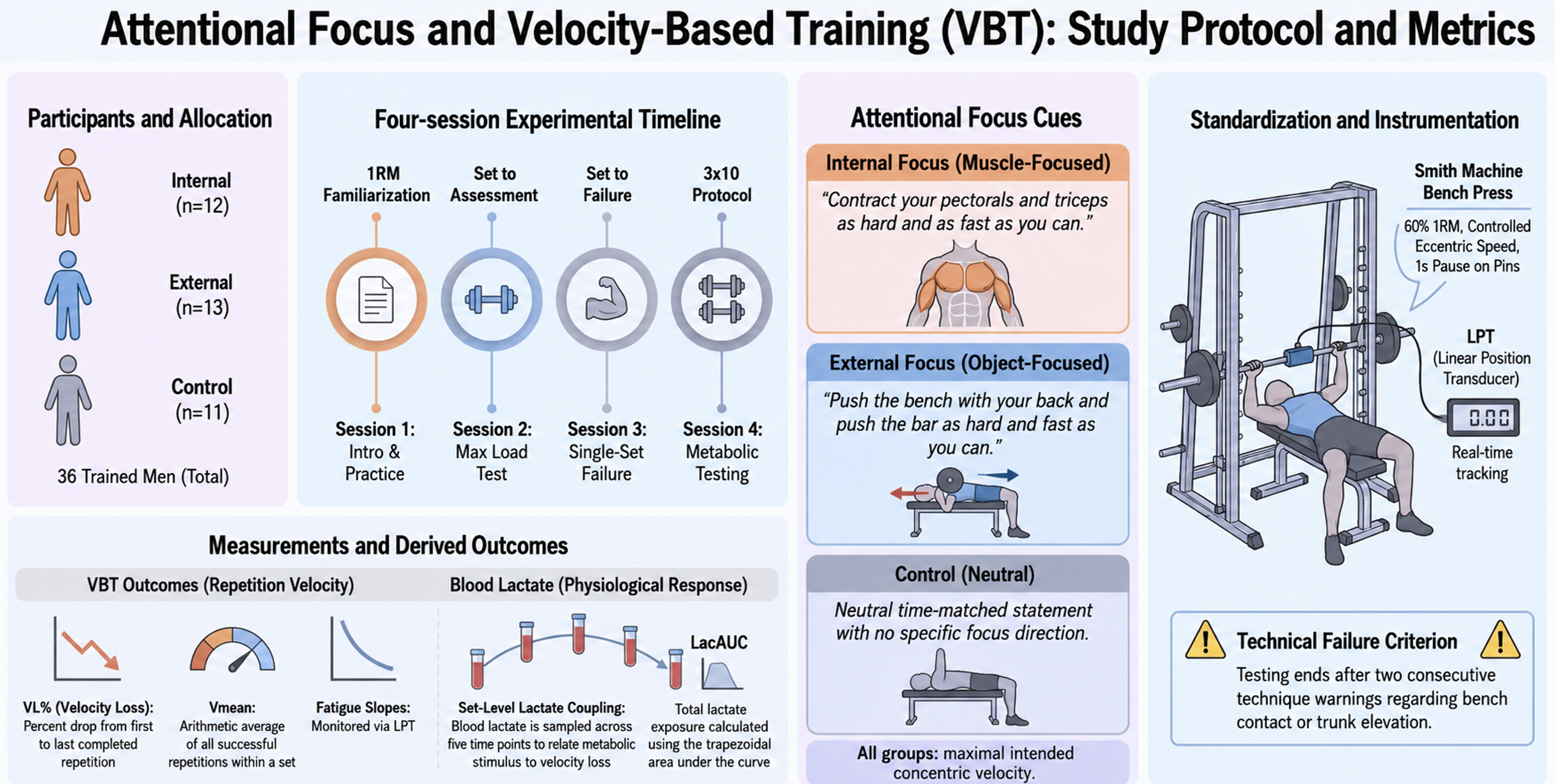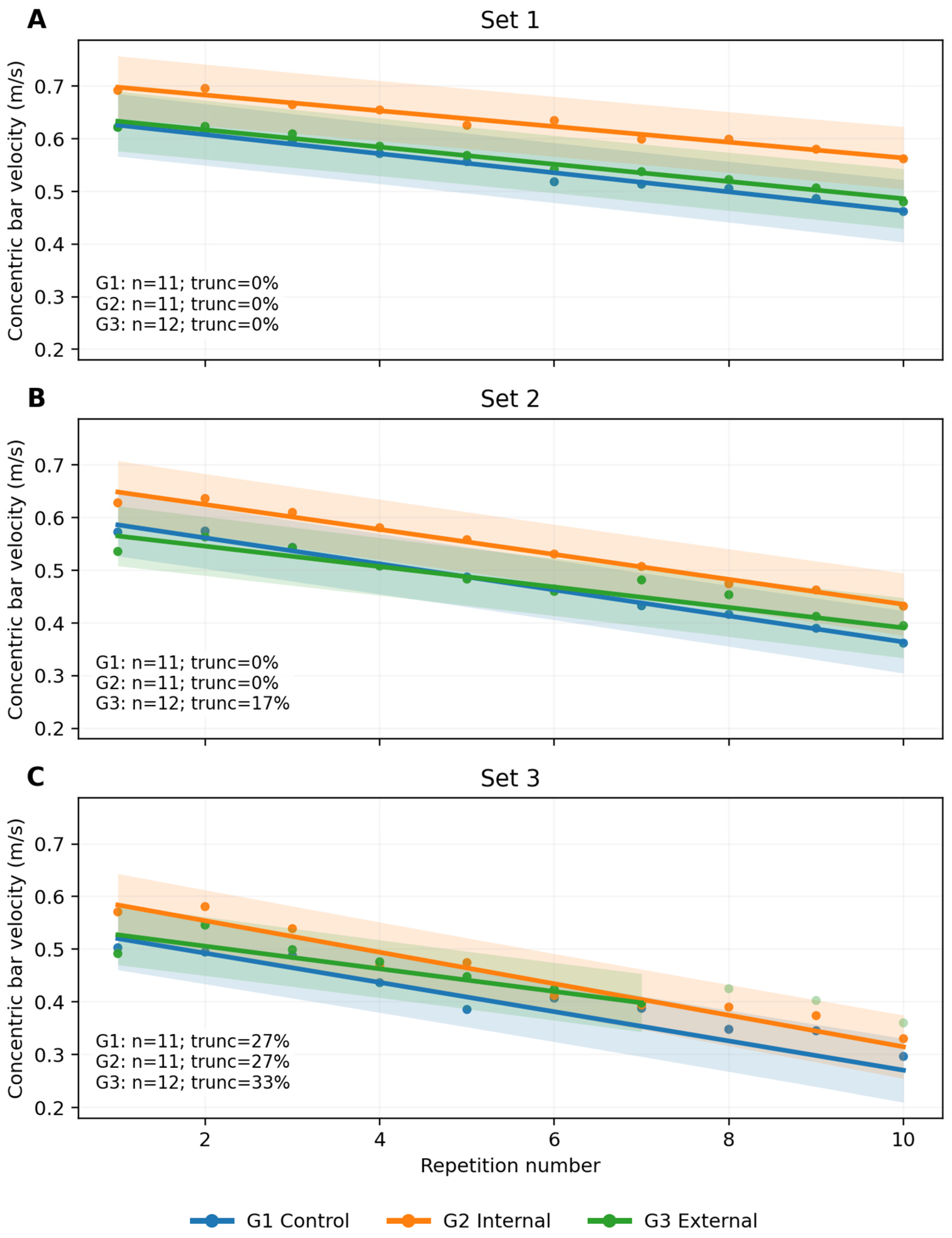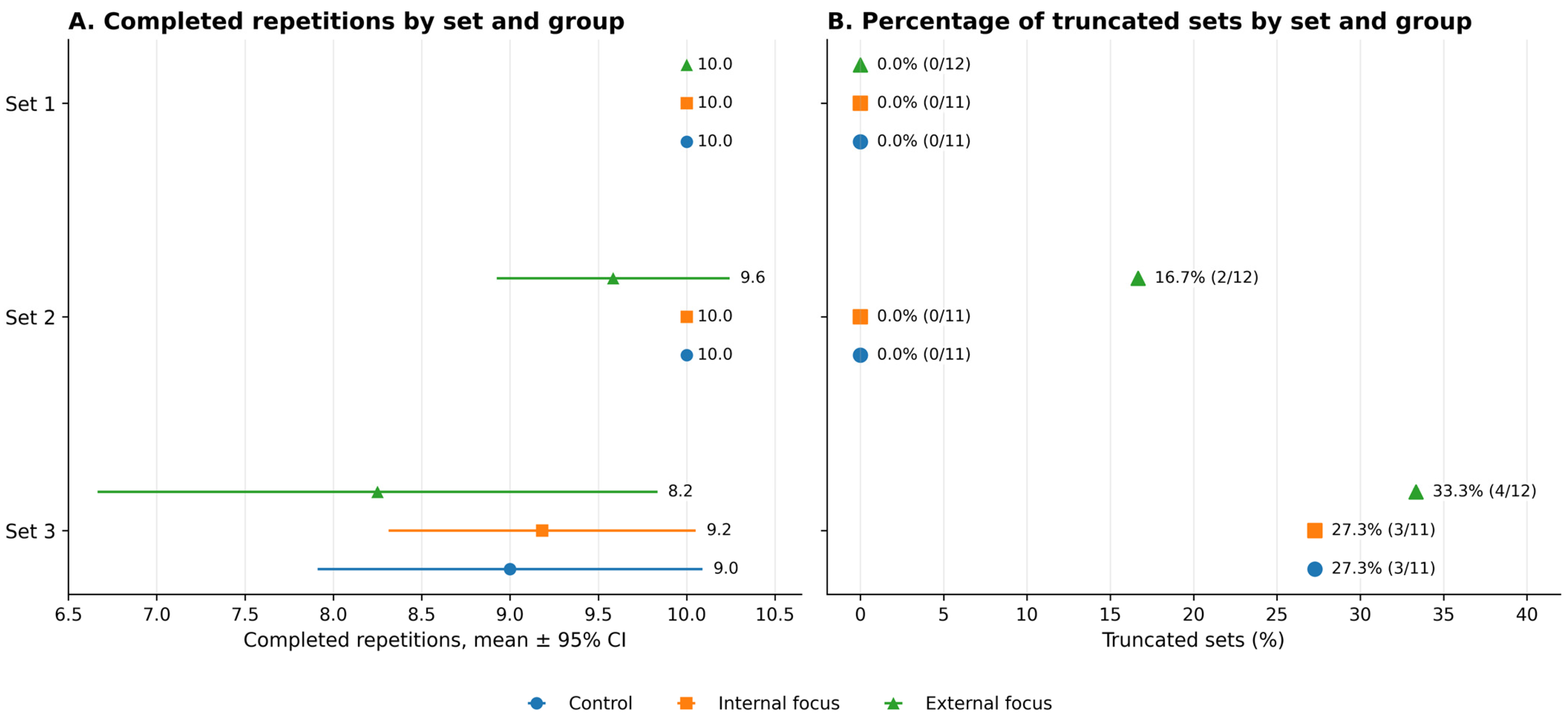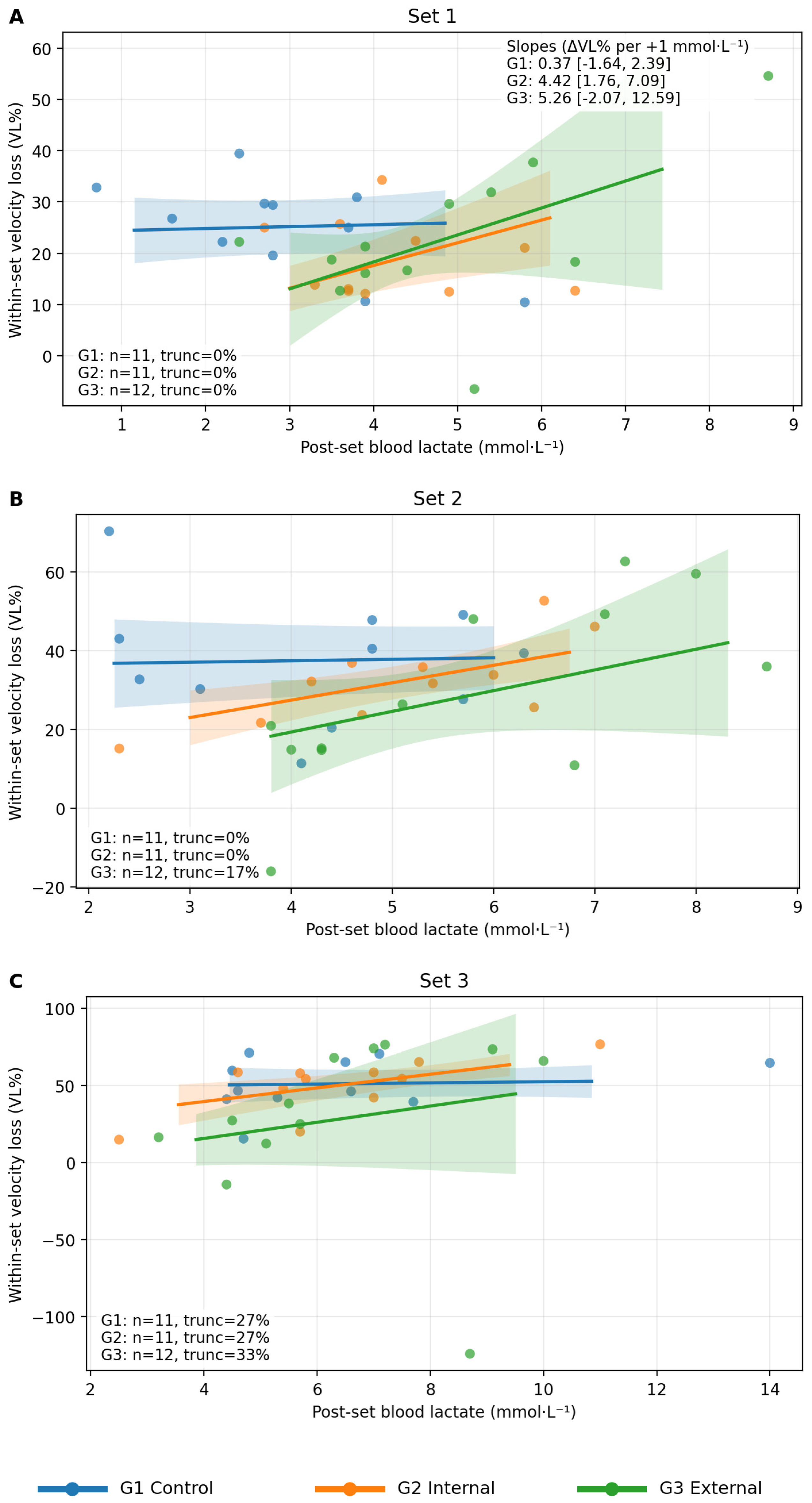

Attentional Cueing Modifies the Observed Association Between Post-Set Lactate and Velocity Loss During Smith Machine Bench Press
 , , , and
Abstract
1. Introduction
2. Materials and Methods
2.1. Study Design
2.2. Participants
2.3. Randomization and Blinding
2.4. Equipment and Exercise Standardization
2.5. Session Procedures
2.6. Attentional Focus
2.7. Velocity and Lactate Measures
2.8. Statistical Analysis
3. Results
3.1. Data Completeness, Early Termination, and Operational Definition of Last Completed Repetition
3.2. Experimental Session: Set-to-Failure at 60% 1RM
3.3. Experimental Session: Repetition-Level Velocity Dynamics During the 3 × 10 Protocol
3.4. Set-Level VBT Outcomes Derived from Repetition Data
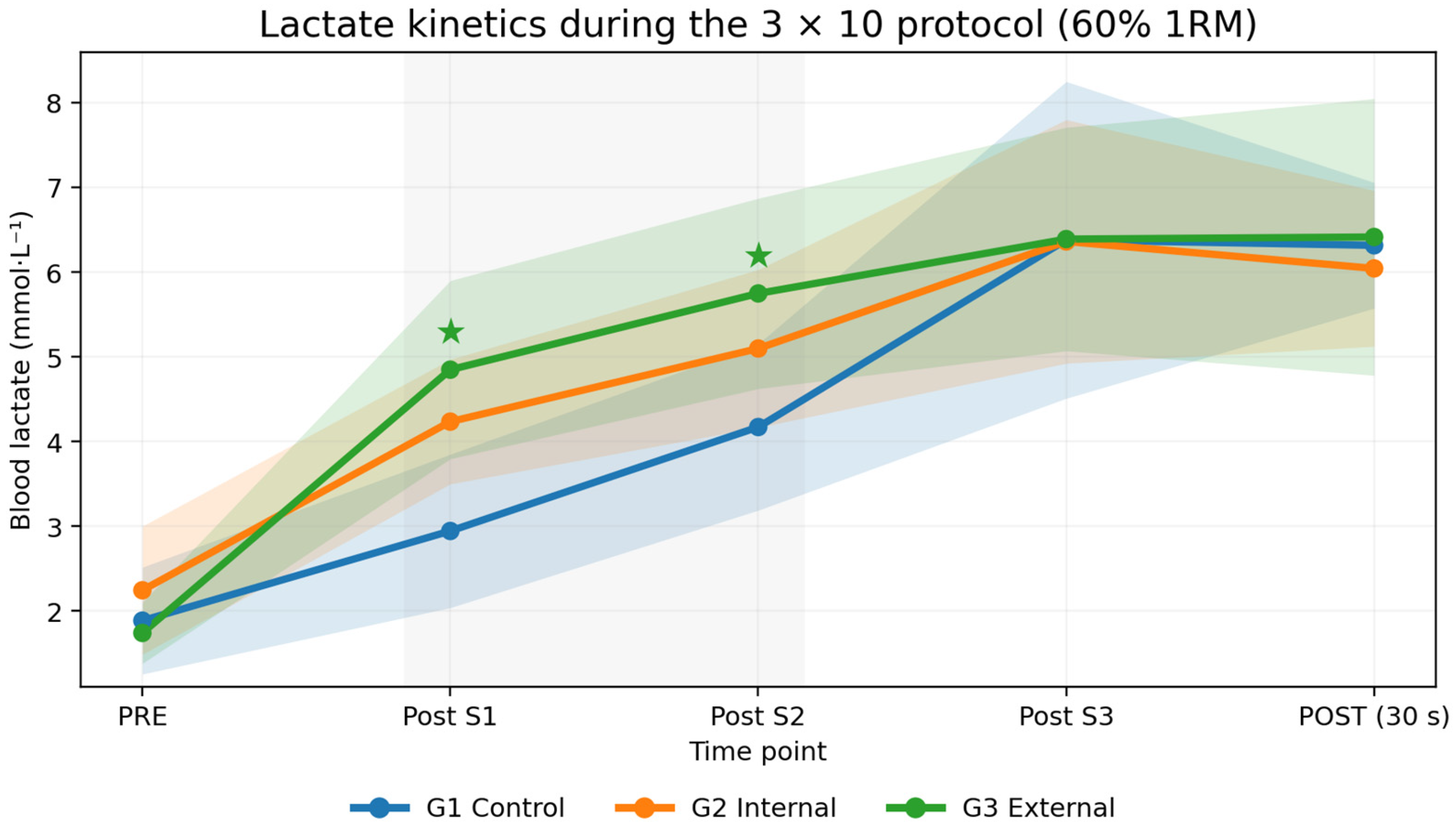
3.5. Internal Load: Lactate Kinetics During the 3 × 10 Protocol
3.6. Group-Dependent Lactate–Mechanical Fatigue Coupling
3.7. Multiplicity-Controlled Aggregated Outcomes
4. Discussion
4.1. Mechanical Fatigue Responses Under Standardized Cueing Conditions
4.2. Lactate Kinetics and Lactate–VL% Coupling
4.3. Methodological Implications for VBT Research and Applied Monitoring
4.4. Limitations and Future Directions
- (i)
- The parallel between-group design, with approximately 11 participants per condition, constrains statistical precision for higher-order interaction terms (e.g., Group × Set × Repetition), which are typically small-to-moderate in attentional focus research.
- (ii)
- Premature set finalization also reduced the number of repetitions available for slope-based estimates and increased informational imbalance across cells; although defining VL% using the “last completed repetition” is methodologically sound, it likely increases uncertainty for outcomes such as Vslope. The achieved volume and truncation data should also be considered when interpreting the VL% and lactate findings. Because truncated sets reflected fatigue-related inability to maintain the required technical standard, group- and set-specific differences in completed repetitions may have contributed to the observed mechanical and metabolic patterns. Accordingly, the lactate–VL% coupling results should be interpreted as time-aligned associations within the achieved repeated-set workload, rather than as estimates obtained under perfectly equivalent volume completion across all participants and cueing conditions.
- (iii)
- An additional limitation is that lactate was only monitored up to 30 s after the final set. Therefore, the present data cannot determine whether between-condition differences would persist, increase, or disappear during later recovery. Future studies should include additional post-exercise sampling points to characterize peak lactate responses and subsequent clearance kinetics more completely.
- (iv)
- Concerning post-set blood lactate provides a systemic and temporally delayed marker of metabolic disturbance. Thus, the present coupling model cannot isolate the metabolic cost of each individual set, particularly under short inter-set recovery. Future studies could combine more frequent blood sampling, longer recovery intervals, near-infrared spectroscopy, electromyography, or other local physiological measures to better characterize the temporal and mechanistic relationship between mechanical fatigue and metabolic stress.
- (v)
- A limitation of the present study is the absence of a formal manipulation check to verify adherence to the assigned attentional focus during each set. Although cue delivery was standardized, researcher-controlled, reinforced before each set, and matched for contact time across groups, participants’ actual attentional state was not directly assessed. Accordingly, the observed differences should be interpreted as effects of assigned cueing conditions, rather than definitive evidence that an internal or external focus was consistently maintained throughout the task. Futures studies should include manipulation checks, such as immediate post-set self-reports or validated attentional focus adherence scales, to determine whether the prescribed focus was adopted and sustained during fatiguing resistance exercise.
- (vi)
- Cue content differed across conditions despite matching cue duration, delivery, and frequency. Although the corrected external cue aimed to standardize body position while directing attention toward rapid bar displacement, it included more movement- and technique-related information than the control condition. Therefore, the observed effects cannot be attributed solely to attentional direction, as cue content may also have influenced execution strategy, stabilization demands, or perceived effort.
- (vii)
- Although technical failure was defined a priori and monitored by two investigators, no formal inter-rater reliability statistic was calculated for warning decisions. Because these decisions directly affected repetitions to failure, truncation, Vlast, VL%, and Vslope, future studies should implement inter-rater standardization procedures or video-based reliability checks for technical failure classification.
- (viii)
- In addition, the results were obtained using the Smith machine BP and may not generalize directly to free-weight conditions, where stabilization demands and movement degrees of freedom are greater.
5. Conclusions
Supplementary Materials
Author Contributions
Funding
Institutional Review Board Statement
Informed Consent Statement
Data Availability Statement
Acknowledgments
Conflicts of Interest
Abbreviations
| VL | Velocity loss |
| VBT | Velocity-based training |
| BP | Bench press |
| 1RM | One-repetition maximum |
| GEEs | Generalized estimating equations |
| RT | Resistance training |
| VL% | Velocity loss percentage |
| LPT | Linear position transducer |
| RPE | Rate of perceived exertion |
| LacAUC | Lactate area under the curve |
| Vmax | Maximum concentric velocity |
| Vmean | Mean set velocity |
| Vrep1 | First-repetition velocity |
| Vlast | Last-repetition velocity |
| AbsVL | Absolute velocity loss |
| Vslope | Within-set fatigue slope |
| LacPost | Post-set lactate |
| ANOVA | Analysis of variance |
| CI | Confidence interval |
| GLM | Generalized linear model |
| LMM | Linear mixed-effects model |
| REML | Restricted maximum likelihood |
| ML | Maximum likelihood |
| LRT | Likelihood ratio test |
| LacS1 | Post-set one lactate |
| LacS3 | Post-set three lactate |
References
- Colado, J.C.; Gene-Morales, J.; Jiménez-Martínez, P.; Saez-Berlanga, A.; Ferri-Caruana, A.M.; Garcia-Ramos, A.; Flandez, J.; Babiloni-Lopez, C. Concurrent Validation of the Resistance Intensity Scale for Exercise for Monitoring Velocity-Based Training with Elastic Bands. Heliyon 2024, 10, e28298. [Google Scholar] [CrossRef] [Scilit]
- Colado, J.C.; Gene-Morales, J.; Jiménez-Martínez, P.; Hammami, R.; Juesas, A.; Babiloni-Lopez, C. Psychological and Physical Predictors of Perceived Effort in Elastic Band Training: A Velocity-Based Approach. Int. J. Sports Phys. Ther. 2025, 20, 1232–1242. [Google Scholar] [CrossRef] [Scilit]
- Weakley, J.; Morrison, M.; García-Ramos, A.; Johnston, R.; James, L.; Cole, M.H. The Validity and Reliability of Commercially Available Resistance Training Monitoring Devices: A Systematic Review. Sports Med. 2021, 51, 443–502. [Google Scholar] [CrossRef] [Scilit]
- Weakley, J.; Ramirez-Lopez, C.; McLaren, S.; Dalton-Barron, N.; Weaving, D.; Jones, B.; Till, K.; Banyard, H. The Effects of 10%, 20%, and 30% Velocity Loss Thresholds on Kinetic, Kinematic, and Repetition Characteristics During the Barbell Back Squat. Int. J. Sports Physiol. Perform. 2020, 15, 180–188. [Google Scholar] [CrossRef] [Scilit] [PubMed]
- Jukic, I.; Castilla, A.P.; Ramos, A.G.; Van Hooren, B.; McGuigan, M.R.; Helms, E.R. The Acute and Chronic Effects of Implementing Velocity Loss Thresholds During Resistance Training: A Systematic Review, Meta-Analysis, and Critical Evaluation of the Literature. Sports Med. 2023, 53, 177–214. [Google Scholar] [CrossRef] [Scilit] [PubMed]
- Weakley, J.; Chalkley, D.; Johnston, R.; García-Ramos, A.; Townshend, A.; Dorrell, H.; Pearson, M.; Morrison, M.; Cole, M. Criterion Validity, and Interunit and Between-Day Reliability of the FLEX for Measuring Barbell Velocity During Commonly Used Resistance Training Exercises. J. Strength Cond. Res. 2020, 34, 1519–1524. [Google Scholar] [CrossRef] [Scilit]
- Marchant, D.C. Attentional Focusing Instructions and Force Production. Front. Psychol. 2010, 1, 210. [Google Scholar] [CrossRef] [Scilit]
- Marchant, D.C.; Greig, M.; Scott, C. Attentional Focusing Instructions Influence Force Production and Muscular Activity during Isokinetic Elbow Flexions. J. Strength Cond. Res. 2009, 23, 2358–2366. [Google Scholar] [CrossRef] [Scilit]
- Lohse, K.; Sherwood, D.E. Defining the Focus of Attention: Effects of Attention on Perceived Exertion and Fatigue. Front. Psychol. 2011, 2, 332. [Google Scholar] [CrossRef] [Scilit]
- Lohse, K.R.; Sherwood, D.E. Thinking about Muscles: The Neuromuscular Effects of Attentional Focus on Accuracy and Fatigue. Acta Psychol. 2012, 140, 236–245. [Google Scholar] [CrossRef] [Scilit] [PubMed]
- Snyder, B.J.; Fry, W.R. Effect of Verbal Instruction on Muscle Activity during the Bench Press Exercise. J. Strength Cond. Res. 2012, 26, 2394–2400. [Google Scholar] [CrossRef] [Scilit]
- Marchant, D.C.; Greig, M.; Bullough, J.; Hitchen, D. Instructions to Adopt an External Focus Enhance Muscular Endurance. Res. Q. Exerc. Sport. 2011, 82, 466–473. [Google Scholar] [CrossRef] [Scilit]
- Vargas-Molina, S.; Sillero, M.G.; Salgado, U.; Carbone, L.; Martín-Rivera, F. Effect of Attentional Focus on Squats on Lactate Production and Rating of Perceived Exertion in Trained Men. Retos 2023, 47, 452–457. [Google Scholar] [CrossRef] [Scilit]
- Rodríguez-Rosell, D.; Yáñez-García, J.M.; Mora-Custodio, R.; Pareja-Blanco, F.; Ravelo-García, A.G.; Ribas-Serna, J.; González-Badillo, J.J. Velocity-Based Resistance Training: Impact of Velocity Loss in the Set on Neuromuscular Performance and Hormonal Response. Appl. Physiol. Nutr. Metab. 2020, 45, 817–828. [Google Scholar] [CrossRef] [Scilit]
- Pérez-Castilla, A.; Piepoli, A.; Delgado-García, G.; Garrido-Blanca, G.; García-Ramos, A. Reliability and Concurrent Validity of Seven Commercially Available Devices for the Assessment of Movement Velocity at Different Intensities During the Bench Press. J. Strength Cond. Res. 2019, 33, 1258–1265. [Google Scholar] [CrossRef] [Scilit]
- González-Badillo, J.J.; Yañez-García, J.M.; Mora-Custodio, R.; Rodríguez-Rosell, D. Velocity Loss as a Variable for Monitoring Resistance Exercise. Int. J. Sports Med. 2017, 38, 217–225. [Google Scholar] [CrossRef] [Scilit]
- Pallarés, J.G.; Sánchez-Medina, L.; Pérez, C.E.; De La Cruz-Sánchez, E.; Mora-Rodriguez, R. Imposing a Pause between the Eccentric and Concentric Phases Increases the Reliability of Isoinertial Strength Assessments. J. Sports Sci. 2014, 32, 1165–1175. [Google Scholar] [CrossRef] [Scilit] [PubMed]
- Haff, G.G.; Triplett, N.T. (Eds.) Essentials of Strength Training and Conditioning, 5th ed.; Human Kinetics: Champaign, IL, USA, 2026. [Google Scholar]
- Kass, L.; Carpenter, R. The Effect of Sampling Time on Blood Lactate Concentration ([Bla]) in Trained Rowers. Int. J. Sports Physiol. Perform. 2009, 4, 218–228. [Google Scholar] [CrossRef] [Scilit] [PubMed]
- Scherr, J.; Wolfarth, B.; Christle, J.W.; Pressler, A.; Wagenpfeil, S.; Halle, M. Associations between Borg’s Rating of Perceived Exertion and Physiological Measures of Exercise Intensity. Eur. J. Appl. Physiol. 2013, 113, 147–155. [Google Scholar] [CrossRef] [Scilit]
- Rodríguez-Rosell, D.; Yáñez-García, J.M.; Sánchez-Medina, L.; Mora-Custodio, R.; González-Badillo, J.J. Relationship Between Velocity Loss and Repetitions in Reserve in the Bench Press and Back Squat Exercises. J. Strength Cond. Res. 2020, 34, 2537–2547. [Google Scholar] [CrossRef] [Scilit] [PubMed]
- Pareja-Blanco, F.; Alcazar, J.; Sánchez-Valdepeñas, J.; Cornejo-Daza, P.J.; Piqueras-Sanchiz, F.; Mora-Vela, R.; Sánchez-Moreno, M.; Bachero-Mena, B.; Ortega-Becerra, M.; Alegre, L.M. Velocity Loss as a Critical Variable Determining the Adaptations to Strength Training. Med. Sci. Sports Exerc. 2020, 52, 1752–1762. [Google Scholar] [CrossRef] [Scilit]
- Paoli, A.; Mancin, L.; Saoncella, M.; Grigoletto, D.; Pacelli, F.Q.; Zamparo, P.; Schoenfeld, B.J.; Marcolin, G. Mind-Muscle Connection: Effects of Verbal Instructions on Muscle Activity during Bench Press Exercise. Eur. J. Transl. Myol. 2019, 29, 8250. [Google Scholar] [CrossRef] [Scilit]
- Grgic, J.; Mikulic, I.; Mikulic, P. Acute and Long-Term Effects of Attentional Focus Strategies on Muscular Strength: A Meta-Analysis. Sports 2021, 9, 153. [Google Scholar] [CrossRef] [Scilit]
- Halperin, I.; Williams, K.J.; Martin, D.T.; Chapman, D.W. The Effects of Attentional Focusing Instructions on Force Production During the Isometric Midthigh Pull. J. Strength Cond. Res. 2016, 30, 919–923. [Google Scholar] [CrossRef] [Scilit]
- Halperin, I.; Vigotsky, A.D. The Mind-Muscle Connection in Resistance Training: Friend or Foe? Eur. J. Appl. Physiol. 2016, 116, 863–864. [Google Scholar] [CrossRef] [Scilit] [PubMed]
- Calatayud, J.; Vinstrup, J.; Jakobsen, M.D.; Sundstrup, E.; Brandt, M.; Jay, K.; Colado, J.C.; Andersen, L.L. Importance of Mind-Muscle Connection during Progressive Resistance Training. Eur. J. Appl. Physiol. 2016, 116, 527–533. [Google Scholar] [CrossRef] [Scilit]
- Calatayud, J.; Vinstrup, J.; Jakobsen, M.D.; Sundstrup, E.; Colado, J.C.; Andersen, L.L. Mind-Muscle Connection Training Principle: Influence of Muscle Strength and Training Experience during a Pushing Movement. Eur. J. Appl. Physiol. 2017, 117, 1445–1452. [Google Scholar] [CrossRef] [Scilit] [PubMed]
- Calatayud, J.; Vinstrup, J.; Jakobsen, M.D.; Sundstrup, E.; Colado, J.; Andersen, L.L. Attentional Focus and Grip Width Influences on Bench Press Resistance Training. Percept. Mot. Ski. 2018, 125, 265–277. [Google Scholar] [CrossRef] [Scilit] [PubMed]




| Variable | Control | Internal | External | Welch F | p-Value | ω2 |
|---|---|---|---|---|---|---|
| Age (years) | 28.09 (23.04, 33.14) ± 7.52 | 26.45 (22.97, 29.94) ± 5.18 | 25.08 (20.37, 29.80) ± 7.42 | 0.45 (2, 20.12) | 0.643 | 0.000 |
| Body mass (kg) | 85.89 (72.50, 99.28) ± 19.93 | 74.89 (69.54, 80.24) ± 7.96 | 75.71 (68.20, 83.22) ± 11.82 | 1.41 (2, 18.79) | 0.269 | 0.061 |
| Height (cm) | 177.64 (172.81, 182.46) ± 7.19 | 175.55 (172.48, 178.61) ± 4.57 | 177.25 (173.17, 181.33) ± 6.43 | 0.44 (2, 19.95) | 0.648 | 0.000 |
| Body fat (%) | 21.03 (14.61, 27.44) ± 9.55 | 16.75 (13.81, 19.68) ± 4.36 | 15.86 (13.87, 17.85) ± 3.13 | 1.45 (2, 17.93 | 0.261 | 0.066 |
| 1RM load (kg) | 113.64 (94.88, 132.39) ± 27.91 | 92.12 (79.05, 105.18) ± 21.62 | 102.50 (87.72, 117.28) ± 23.26 | 2.17 (2, 21.10) | 0.139 | 0.070 |
| Velocity at 1RM (m·s−1) | 0.159 (0.132, 0.186) ± 0.040 | 0.178 (0.152, 0.203) ± 0.042 | 0.141 (0.103, 0.178) ± 0.059 | 1.64 (2, 21.39) | 0.218 | 0.045 |
| Relative strength (kg·kg−1) | 1.34 (1.14, 1.55) ± 0.30 | 1.18 (1.02, 1.34) ± 0.24 | 1.35 (1.23, 1.48) ± 0.20 | 1.88 (2, 19.64) | 0.179 | 0.042 |
| 60% 1RM load (kg) | 68.18 (56.93, 79.43) ± 16.75 | 55.27 (47.43, 63.11) ± 12.97 | 61.50 (52.63, 70.37) ± 13.95 | 2.17 (2, 21.10) | 0.139 | 0.070 |
| Set | Variable | Control (n = 11) | Internal (n = 11) | External (n = 12) |
|---|---|---|---|---|
| Set 1 | Vmean (m·s−1) | 0.544 (0.492, 0.597) ± 0.079 | 0.631 (0.573, 0.688) ± 0.085 | 0.560 (0.511, 0.608) ± 0.076 |
| Vrep1 (m·s−1) | 0.622 (0.562, 0.682) ± 0.089 | 0.692 (0.625, 0.758) ± 0.099 | 0.622 (0.575, 0.669) ± 0.074 | |
| Vlast (m·s−1) | 0.462 (0.417, 0.507) ± 0.067 | 0.562 (0.502, 0.621) ± 0.088 | 0.480 (0.415, 0.545) ± 0.103 | |
| VL (%) | 25.17 (19.15, 31.20) ± 8.97 | 31.18 (12.27, 50.09) ± 31.30 | 22.79 (13.33, 32.24) ± 14.89 | |
| Vslope (m·s−1·rep−1) | −0.0181 (−0.0227, −0.0135) ± 0.0069 | −0.0149 (−0.0179, −0.0120) ± 0.0044 | −0.0163 (−0.0215, −0.0112) ± 0.0081 | |
| Set 2 | Vmean (m·s−1) | 0.475 (0.405, 0.545) ± 0.104 | 0.542 (0.481, 0.604) ± 0.092 | 0.481 (0.418, 0.544) ± 0.099 |
| Vrep1 (m·s−1) | 0.573 (0.500, 0.645) ± 0.108 | 0.628 (0.566, 0.690) ± 0.092 | 0.536 (0.463, 0.609) ± 0.115 | |
| Vlast (m·s−1) | 0.362 (0.274, 0.449) ± 0.130 | 0.432 (0.348, 0.515) ± 0.124 | 0.372 (0.296, 0.447) ± 0.119 | |
| VL (%) | 37.55 (26.91, 48.18) ± 15.84 | 32.35 (25.08, 39.61) ± 10.81 | 37.28 (14.47, 60.10) ± 35.91 | |
| Vslope (m·s−1·rep−1) | −0.0247 (−0.0312, −0.0182) ± 0.0096 | −0.0237 (−0.0274, −0.0200) ± 0.0055 | −0.0192 (−0.0287, −0.0097) ± 0.0141 | |
| Set 3 | Vmean (m·s−1) | 0.401 (0.314, 0.488) ± 0.130 | 0.457 (0.380, 0.534) ± 0.115 | 0.444 (0.380, 0.508) ± 0.101 |
| Vrep1 (m·s−1) | 0.503 (0.410, 0.595) ± 0.138 | 0.571 (0.500, 0.642) ± 0.105 | 0.492 (0.424, 0.559) ± 0.107 | |
| Vlast (m·s−1) | 0.252 (0.158, 0.345) ± 0.139 | 0.298 (0.191, 0.406) ± 0.160 | 0.326 (0.206, 0.445) ± 0.188 | |
| VL (%) | 61.75 (42.56. 80.94) ± 28.57 | 61.04 (41.09, 80.98) ± 29.69 | 54.10 (27.85, 80.34) ± 41.31 | |
| Vslope (m·s−1·rep−1) | −0.0309 (−0.0403, −0.0215) ± 0.0122 | −0.0305 (−0.0388, −0.0222) ± 0.0107 | −0.0216 (−0.0363, −0.0069) ± 0.0176 |
| Variable | Control (n = 11) | Internal (n = 11) | External (n = 12) | Welch p | ω2 | Holm p |
|---|---|---|---|---|---|---|
| Lactate Pre-Set 1 (mmol·L−1) | 1.89 (1.26, 2.52) ± 0.88 | 2.25 (1.49, 3.00) ± 1.13 | 1.74 (1.38, 2.10) ± 0.57 | ––– | ––– | ––– |
| Lactate Post-Set 1 (mmol·L−1) | 2.95 (2.04, 3.85) ± 1.35 | 4.24 (3.50, 4.97) ± 1.09 | 4.85 (3.80, 5.90) ± 1.66 | ––– | ––– | ––– |
| Lactate Post-Set 2 (mmol·L−1) | 4.17 (3.19, 5.16) ± 1.46 | 5.10 (4.17, 6.03) ± 1.39 | 5.75 (4.63, 6.87) ± 1.77 | ––– | ––– | ––– |
| Lactate Post-Set 3 (mmol·L−1) | 6.38 (4.51, 8.25) ± 2.78 | 6.36 (4.93, 7.80) ± 2.14 | 6.39 (5.07, 7.71) ± 2.08 | 0.999 | 0.000 | 1.000 |
| Lactate 30 s Post-Set 3 (mmol·L−1) | 6.32 (5.58, 7.06) ± 1.10 | 6.05 (5.13, 6.97) ± 1.37 | 6.42 (4.78, 8.05) ± 2.57 | ––– | ––– | ––– |
| LacAUC (mmol·L−1·a.u.) | 17.39 (13.99, 20.80) ± 4.76 | 19.85 (16.67, 23.02) ± 4.72 | 21.07 (16.93, 25.21) ± 6.51 | 0.301 | 0.016 | 1.000 |
| Vmean (Session 1–3) (m·s−1) | 0.474 (0.406, 0.541) ± 0.101 | 0.543 (0.480, 0.607) ± 0.095 | 0.495 (0.442, 0.547) ± 0.083 | 0.252 | 0.036 | 1.000 |
| VL% (Session 1–3) | 41.49 (30.67, 52.30) ± 16.10 | 46.99 (31.01, 62.97) ± 26.44 | 38.05 (19.97, 56.14) ± 28.47 | 0.715 | 0.000 | 1.000 |
| Post-Session RPE | 8.32 (8.09, 8.54) ± 0.34 | 8.08 (7.67, 8.48) ± 0.67 | 8.83 (8.63, 9.04) ± 0.33 | <0.001 | 0.276 | 0.004 |
| Model | Outcome | Predictor | β | Robust SE | 95% CI | p-Value |
|---|---|---|---|---|---|---|
| Primary | VL% | Intercept | 25.04 | 4.14 | 16.93 to 33.16 | <0.001 |
| Internal focus | −28.69 | 7.40 | −43.20 to −14.17 | <0.001 | ||
| External focus | −68.23 | 8.10 | −84.11 to −52.34 | <0.001 | ||
| Set 2 | 12.32 | 4.41 | 3.67 to 20.96 | 0.005 | ||
| Set 3 | 36.43 | 10.25 | 16.32 to 56.53 | <0.001 | ||
| Set 2 × Internal focus | −3.19 | 5.94 | −14.84 to 8.45 | 0.591 | ||
| Set 3 × Internal focus | −5.26 | 15.08 | −34.82 to 24.29 | 0.727 | ||
| Set 2 × External focus | −10.06 | 9.29 | −28.28 to 8.15 | 0.279 | ||
| Set 3 × External focus | −26.09 | 13.20 | −51.96 to −0.21 | 0.048 | ||
| Post-set lactate | 0.04 | 1.04 | −2.01 to 2.09 | 0.968 | ||
| Post-set lactate × Internal focus | 5.22 | 2.18 | 0.94 to 9.50 | 0.017 | ||
| Post-set lactate × External focus | 13.56 | 1.51 | 10.58 to 16.53 | <0.001 | ||
| Secondary | Vmean | Intercept | 0.55 | 0.03 | 0.48 to 0.62 | <0.001 |
| Internal focus | 0.11 | 0.05 | 0.003 to 0.21 | 0.045 | ||
| External focus | 0.10 | 0.04 | 0.01 to 0.19 | 0.023 | ||
| Set 2 | −0.06 | 0.01 | −0.09 to −0.03 | <0.001 | ||
| Set 3 | −0.13 | 0.03 | −0.19 to −0.06 | <0.001 | ||
| Set 2 × Internal focus | −0.01 | 0.01 | −0.05 to 0.01 | 0.361 | ||
| Set 3 × Internal focus | −0.02 | 0.04 | −0.11 to 0.06 | 0.571 | ||
| Set 2 × External focus | 0.005 | 0.02 | −0.03 to 0.04 | 0.823 | ||
| Set 3 × External focus | 0.04 | 0.03 | −0.03 to 0.12 | 0.234 | ||
| Post-set lactate | −0.004 | 0.006 | −0.01 to 0.009 | 0.572 | ||
| Post-set lactate × Internal focus | −0.005 | 0.010 | −0.02 to 0.01 | 0.626 | ||
| Post-set lactate × External focus | −0.017 | 0.008 | −0.03 to −0.002 | 0.029 |
Disclaimer/Publisher’s Note: The statements, opinions and data contained in all publications are solely those of the individual author(s) and contributor(s) and not of MDPI and/or the editor(s). MDPI and/or the editor(s) disclaim responsibility for any injury to people or property resulting from any ideas, methods, instructions or products referred to in the content. |
© 2026 by the authors. Licensee MDPI, Basel, Switzerland. This article is an open access article distributed under the terms and conditions of the Creative Commons Attribution (CC BY) license.
Share and Cite
Martin-Rivera, F.; Rodrigo-Mallorca, D.; Juesas, A.; Saez-Berlanga, A.; Chulvi-Medrano, I. Attentional Cueing Modifies the Observed Association Between Post-Set Lactate and Velocity Loss During Smith Machine Bench Press. J. Funct. Morphol. Kinesiol. 2026, 11, 189. https://doi.org/10.3390/jfmk11020189
Martin-Rivera F, Rodrigo-Mallorca D, Juesas A, Saez-Berlanga A, Chulvi-Medrano I. Attentional Cueing Modifies the Observed Association Between Post-Set Lactate and Velocity Loss During Smith Machine Bench Press. Journal of Functional Morphology and Kinesiology. 2026; 11(2):189. https://doi.org/10.3390/jfmk11020189
Chicago/Turabian StyleMartin-Rivera, Fernando, Darío Rodrigo-Mallorca, Alvaro Juesas, Angel Saez-Berlanga, and Iván Chulvi-Medrano. 2026. "Attentional Cueing Modifies the Observed Association Between Post-Set Lactate and Velocity Loss During Smith Machine Bench Press" Journal of Functional Morphology and Kinesiology 11, no. 2: 189. https://doi.org/10.3390/jfmk11020189
APA StyleMartin-Rivera, F., Rodrigo-Mallorca, D., Juesas, A., Saez-Berlanga, A., & Chulvi-Medrano, I. (2026). Attentional Cueing Modifies the Observed Association Between Post-Set Lactate and Velocity Loss During Smith Machine Bench Press. Journal of Functional Morphology and Kinesiology, 11(2), 189. https://doi.org/10.3390/jfmk11020189