

Electrophysiological Evaluation of Post-Activation Potentiation/Post-Activation Performance Enhancement Using Strength-Duration Properties

 ,
,  ,
,  and
and 
Abstract
1. Introduction
2. Materials and Methods
2.1. Subjects
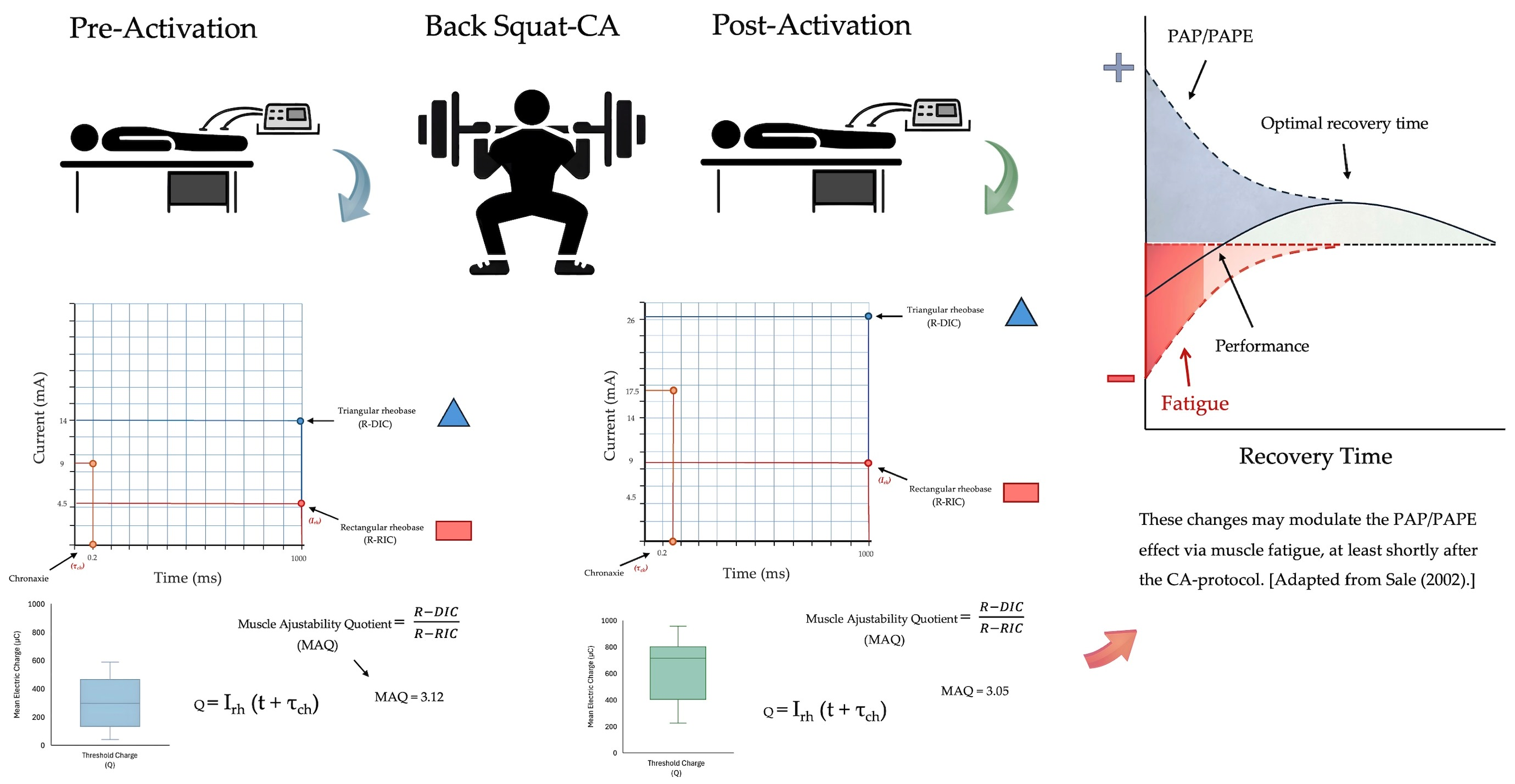
2.2. Experimental Design
2.2.1. Overview
2.2.2. One Repetition Maximum Back Squat Assessment
2.2.3. Main Experiment—Back Squat Protocol
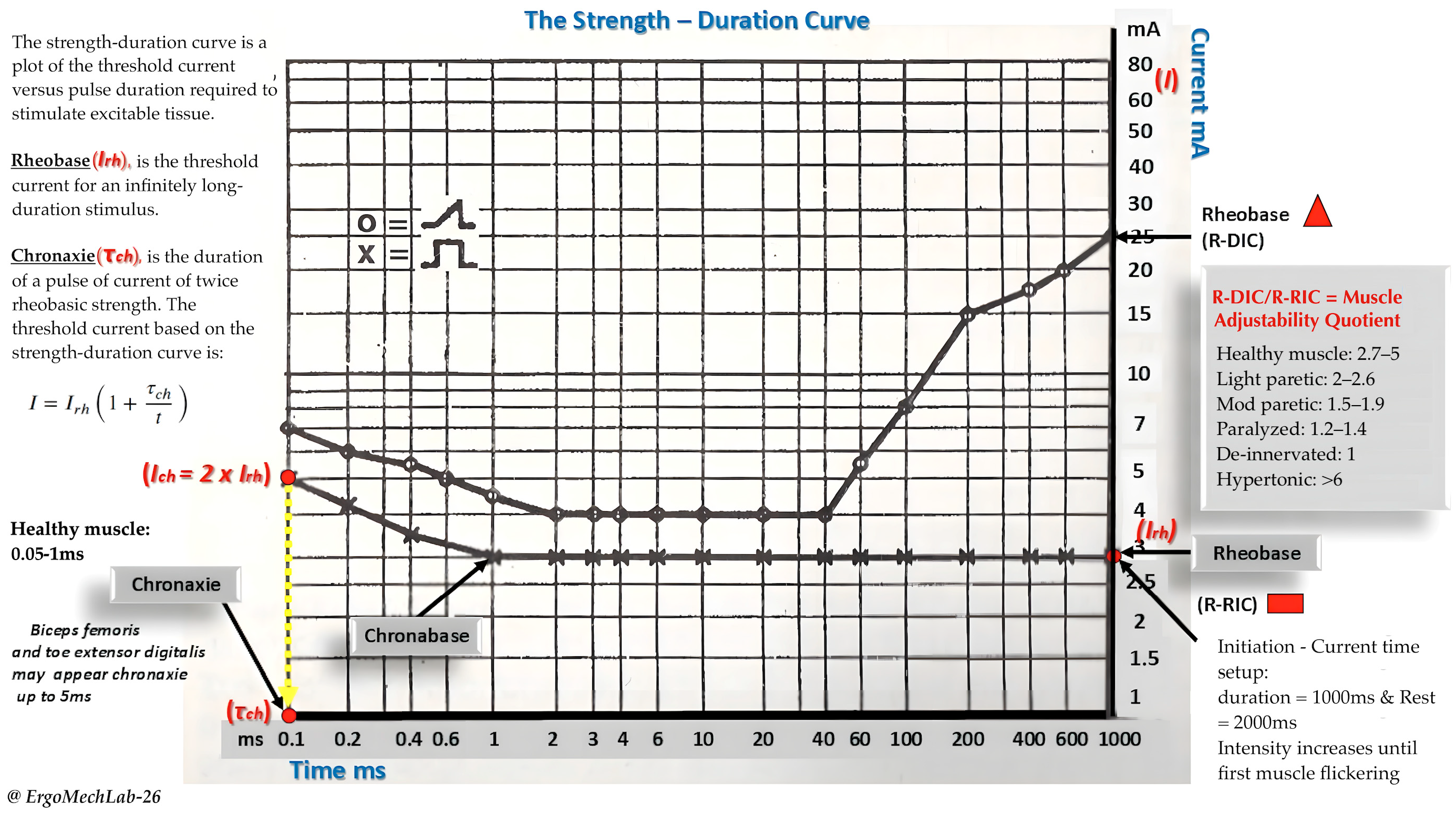
2.2.4. Collection of Rheobase Parameters and the Chronaxie
2.3. Formulas for Threshold Charge and Muscle Adjustability Quotient
2.4. Statistical Analysis
3. Results
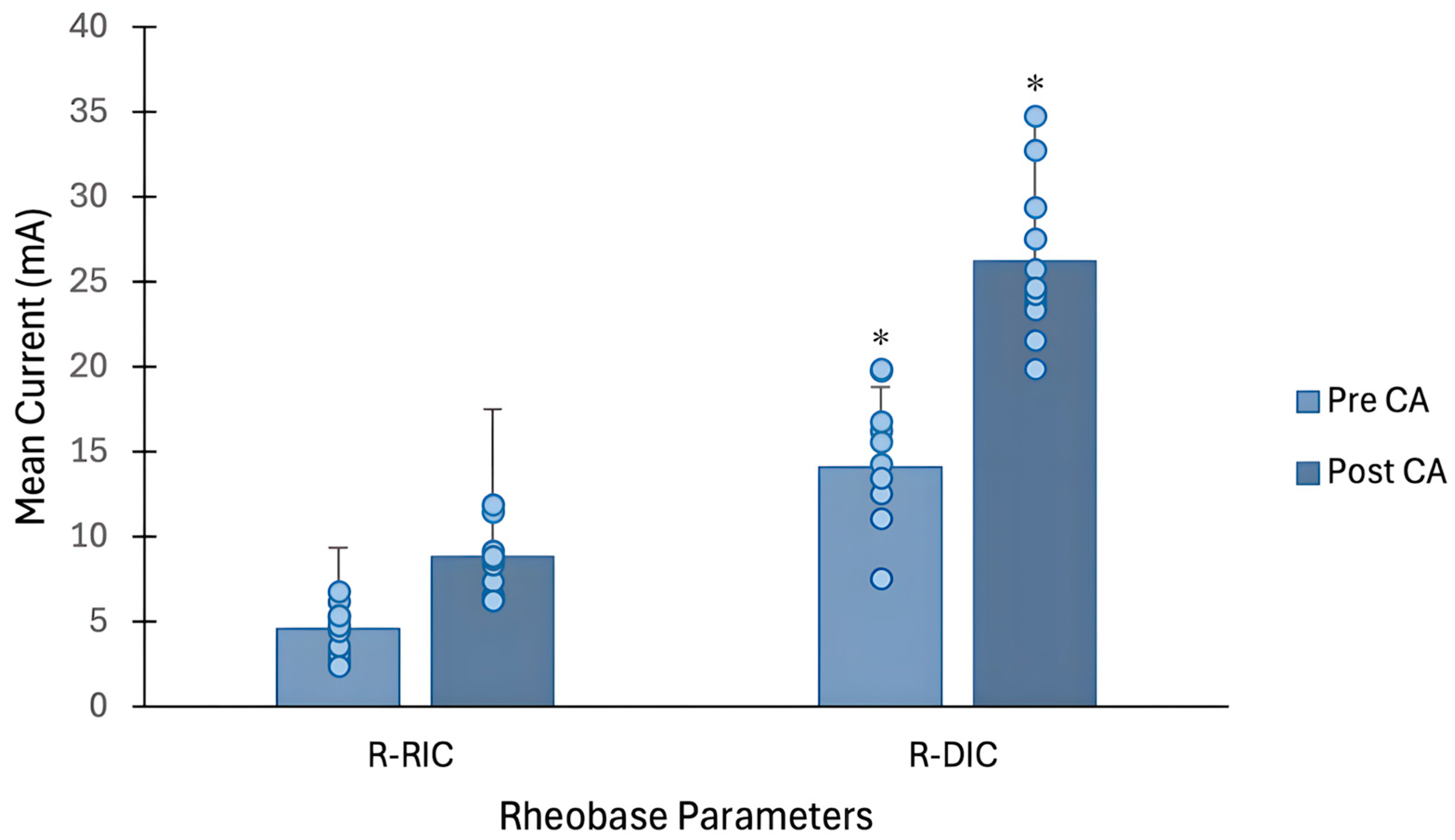
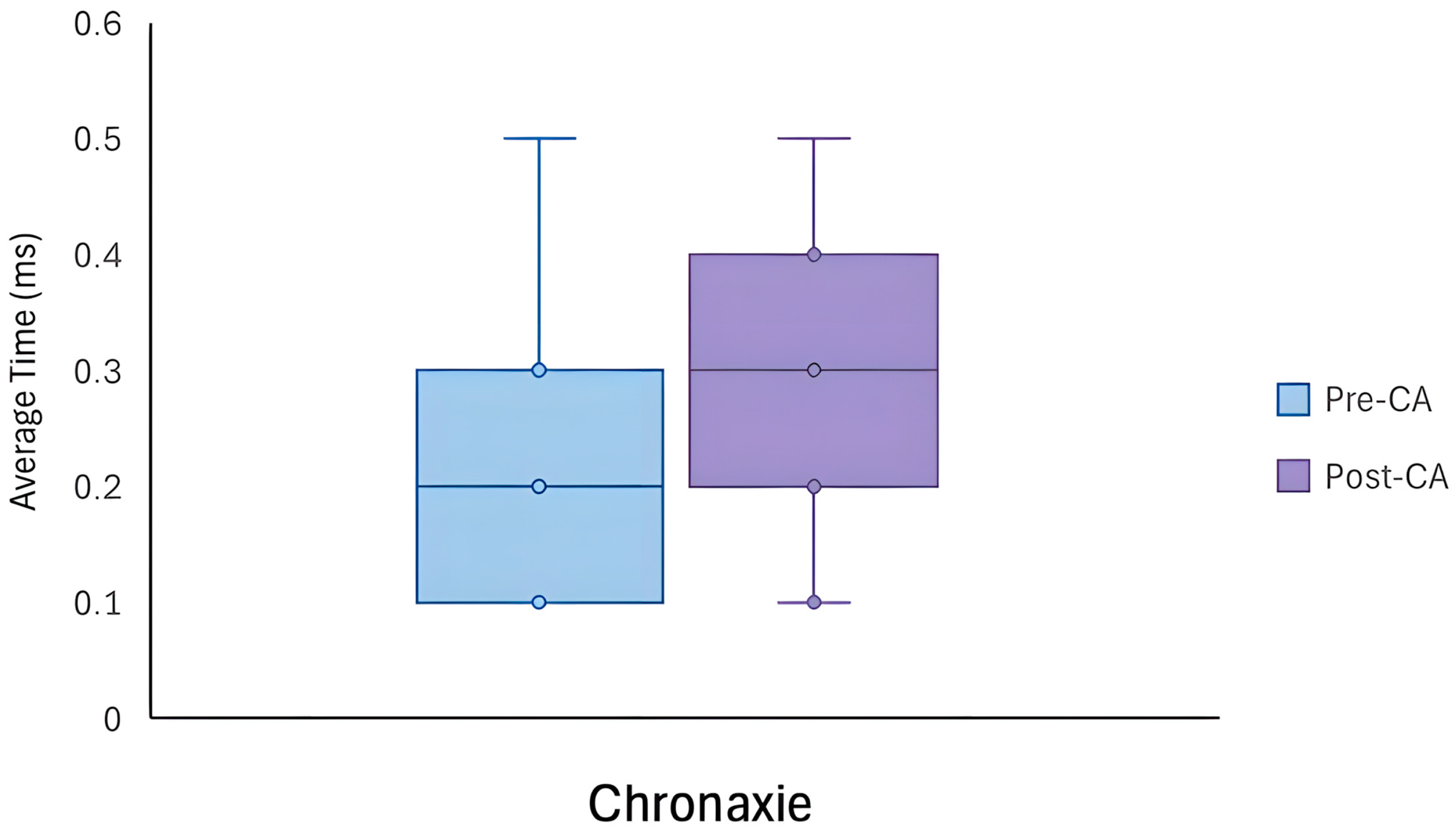
3.1. Rheobase Parameters and the Chronaxie
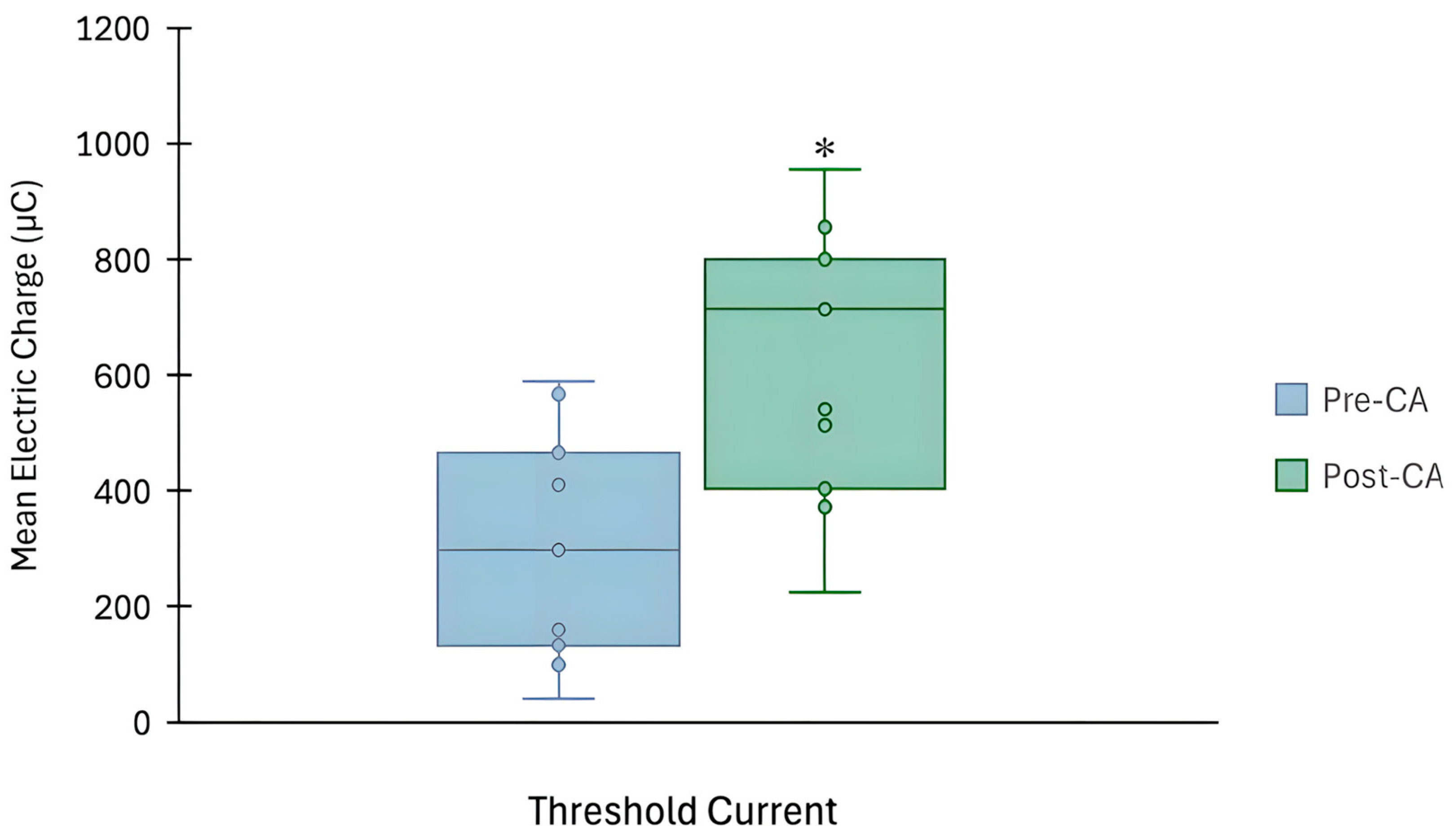
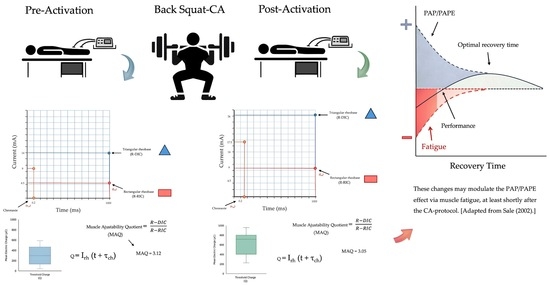
3.2. Threshold Charge and Muscle Adjustability Quotient
4. Discussion
4.1. Practical Applications
4.2. Limitations and Future Recommendations
5. Conclusions
Author Contributions
Funding
Institutional Review Board Statement
Informed Consent Statement
Data Availability Statement
Acknowledgments
Conflicts of Interest
Abbreviations
| [K+]0 | Extracellular Potassium Concentrations |
| [K+]i | Intracellular Potassium Concentrations |
| 1-RM | One-Repetition Maximum |
| BS | Back Squat |
| BW | Bodyweight |
| CA | Conditioning Activity |
| Ca+ | Calcium Ion |
| CNS | Central Nervous System |
| CMJ | Countermovement Jump |
| DJ | Drop Jump |
| EEG | Electroencephalogram |
| M-wave | Compound Muscle Action Potential |
| MAQ | Muscle Adjustability Quotient |
| MRLC | Myosin Regulatory Light Chain |
| MVC | Maximum Voluntary Contraction |
| NMJ | Neuromuscular Junction |
| PAP | Post-Activation Potentiation |
| PAPE | Post-Activation Performance Enhancement |
| PPO | Peak Power Output |
| PTT | Peak Twitch Torque |
| Q | Threshold Charge |
| R-DIC | Triangular Rheobase |
| R-RIC | Rectangular Rheobase |
| Reps | Repetitions |
| RFD | Rate of Force Development |
| RSA | Repeated Sprint Ability |
| S-D | Strength-Duration |
| SD | Standard Deviations |
| SDC | Strength-Duration Curve |
| SR | Sarcoplasmic Reticulum |
| TMS | Transcranial Magnetic Stimulation |
| VGSCs | Voltage-Gated Sodium Channels |
| VM | Vastus Medialis |
| μC | Microcoulomb |
References
- Plant, D.R.; Lynch, G.S. Excitation-contraction coupling and sarcoplasmic reticulum function in mechanically skinned fibres from fast skeletal muscles of aged mice. J. Physiol. 2002, 543, 169–176. [Google Scholar] [CrossRef] [Scilit]
- Hernández-Ochoa, E.O.; Schneider, M.F. Voltage sensing mechanism in skeletal muscle excitation-contraction coupling: Coming of age or midlife crisis? Skelet. Muscle 2018, 8, 22. [Google Scholar] [CrossRef] [Scilit]
- Wang, B.; Dudko, O.K. A theory of synaptic transmission. eLife 2021, 10, e73585. [Google Scholar] [CrossRef] [Scilit] [PubMed]
- Stull, J.T.; Kamm, K.E.; Vandenboom, R. Myosin light chain kinase and the role of myosin light chain phosphorylation in skeletal muscle. Arch. Biochem. Biophys. 2011, 510, 120–128. [Google Scholar] [CrossRef] [Scilit]
- Pitake, S.; Ochs, R.S. Membrane depolarization increases ryanodine sensitivity to Ca2+ release to the cytosol in L6 skeletal muscle cells: Implications for excitation–contraction coupling. Exp. Biol. Med. 2015, 241, 854–862. [Google Scholar] [CrossRef] [Scilit]
- Allen, D.G.; Lamb, G.D.; Westerblad, H. Skeletal Muscle Fatigue: Cellular Mechanisms. Physiol. Rev. 2008, 88, 287–332. [Google Scholar] [CrossRef] [Scilit] [PubMed]
- Cairns, S.P.; Taberner, A.J.; Loiselle, D.S. Changes of surface and t-tubular membrane excitability during fatigue with repeated tetani in isolated mouse fast- and slow-twitch muscle. J. Appl. Physiol. 2009, 106, 101–112. [Google Scholar] [CrossRef] [Scilit]
- Fauler, M.; Jurkat-Rott, K.; Lehmann-Horn, F. Membrane excitability and excitation–contraction uncoupling in muscle fatigue. Neuromuscul. Disord. 2012, 22, S162–S167. [Google Scholar] [CrossRef] [Scilit] [PubMed]
- Kaya, P.; Alemdaroğlu, İ.; Yılmaz, Ö. Effect of muscle weakness distribution on balance in neuromuscular disease. Pediatr. Int. 2015, 57, 92–97. [Google Scholar] [CrossRef] [Scilit]
- Iyer, S.R.; Shah, S.B.; Lovering, R.M. The Neuromuscular Junction: Roles in Aging and Neuromuscular Disease. Int. J. Mol. Sci. 2021, 22, 8058. [Google Scholar] [CrossRef] [Scilit]
- Padilla, C.J.; Harrigan, M.E.; Harris, H.; Schwab, J.M.; Rutkove, S.B.; Rich, M.M.; Clark, B.C.; Arnold, W.D. Profiling age-related muscle weakness and wasting: Neuromuscular junction transmission as a driver of age-related physical decline. GeroScience 2021, 43, 1265–1281, Correction in GeroScience 2021, 43, 2835–2836. [Google Scholar] [CrossRef] [Scilit]
- Shigemoto, K.; Kubo, S.; Mori, S. Muscle weakness and neuromuscular junctions in aging and disease. Geriatr. Gerontol. Int. 2010, 10, S137–S147. [Google Scholar] [CrossRef] [Scilit]
- Jerath, N.U.; Simoens, K.; Mann, D. Survey of the functional priorities in patients with disability due to neuromuscular disorders. Disabil. Rehabil. Assist. Technol. 2019, 14, 133–137. [Google Scholar] [CrossRef] [Scilit]
- Miao, Y.; Xie, L.; Song, J.; Cai, X.; Yang, J.; Ma, X.; Chen, S.; Xie, P. Unraveling the causes of sarcopenia: Roles of neuromuscular junction impairment and mitochondrial dysfunction. Physiol. Rep. 2024, 12, e15917. [Google Scholar] [CrossRef] [Scilit]
- Kwai, N.C.; Arnold, R.; Wickremaarachchi, C.; Lin, C.S.-Y.; Poynten, A.M.; Kiernan, M.C.; Krishnan, A.V. Effects of Axonal Ion Channel Dysfunction on Quality of Life in Type 2 Diabetes. Diabetes Care 2013, 36, 1272–1277. [Google Scholar] [CrossRef] [Scilit] [PubMed]
- Wong, K.S.W.; Sen, A.; Michell-Sodhi, J. Assessing the Relationship of Quality of Life with Functional Status in a Large Cohort of Adult Patients with Neuromuscular Disorders. Neurol. Clin. Pract. 2026, 16, e200590. [Google Scholar] [CrossRef] [Scilit] [PubMed]
- Silva, P.E.; Maldaner, V.; Vieira, L.; de Carvalho, K.L.; Gomes, H.; Melo, P.; Babault, N.; Cipriano, G.; Durigan, J.L.Q. Neuromuscular electrophysiological disorders and muscle atrophy in mechanically-ventilated traumatic brain injury patients: New insights from a prospective observational study. J. Crit. Care 2018, 44, 87–94, Erratum in J. Crit. Care 2019, 50, 316. https://doi.org/10.1016/j.jcrc.2018.11.018. [Google Scholar] [CrossRef] [Scilit] [PubMed]
- Wróbel, B.; Dolibog, P.; Penkala, A.; Kierszniok, K.; Król, P. The Determination of Normative Values for the Median Nerve Using Classic Electrodiagnostic Methods. Rehabil. Med. 2022, 25, 9–14. [Google Scholar] [CrossRef] [Scilit]
- Lee, W.-D.; Kim, J.-H.; Lee, J.-U.; Kim, M.-Y.; Lee, L.-K.; Yang, S.-M.; Jeon, H.-J.; Lee, T.-H.; Kim, J. Differences in Rheobase and Chronaxie between the Paretic and Non-Paretic Sides of Hemiplegic Stroke Patients: A Pilot Study. J. Phys. Ther. Sci. 2013, 25, 717–719. [Google Scholar] [CrossRef] [Scilit]
- Bostock, H. The strength-duration relationship for excitation of myelinated nerve: Computed dependence on membrane parameters. J. Physiol. 1983, 341, 59–74. [Google Scholar] [CrossRef] [Scilit]
- Smit, J.E.; Hanekom, T.; Hanekom, J.J. Predicting action potential characteristics of human auditory nerve fibres through modifi-cation of the Hodgkin–Huxley equations. S. Afr. J. Sci. 2008, 104, 284–292. [Google Scholar]
- Arnold, D.; Thielker, J.; Klingner, C.M.; Puls, W.C.; Misikire, W.; Guntinas-Lichius, O.; Volk, G.F. Selective Surface Electrostimulation of the Denervated Zygomaticus Muscle. Diagnostics 2021, 11, 188. [Google Scholar] [CrossRef] [Scilit]
- De-La-Cruz-Torres, B.; Abuín-Porras, V.; Navarro-Flores, E.; Calvo-Lobo, C.; Romero-Morales, C. Ultrasound-Guided Percutaneous Neuromodulation in Patients with Chronic Lateral Epicondylalgia: A Pilot Randomized Clinical Trial. Int. J. Environ. Res. Public Health 2021, 18, 4877. [Google Scholar] [CrossRef] [Scilit]
- Geddes, L. Accuracy Limitations of Chronaxie Values. IEEE Trans. Biomed. Eng. 2004, 51, 176–181. [Google Scholar] [CrossRef]
- Salian, S.C.; Tulsankar, G.N. Strength-duration curve: A measure for assessing pain in trapezius spasm. Indian J. Pain 2017, 31, 41. [Google Scholar] [CrossRef] [Scilit] [PubMed]
- Abalkhail, T.M.; MacDonald, D.B.; AlThubaiti, I.; AlOtaibi, F.A.; Stigsby, B.; Mokeem, A.A.; AlHamoud, I.A.; Hassounah, M.I.; Baz, S.M.; AlSemari, A.; et al. Intraoperative direct cortical stimulation motor evoked potentials: Stimulus parameter recommendations based on rheobase and chronaxie. Clin. Neurophysiol. 2017, 128, 2300–2308. [Google Scholar] [CrossRef] [Scilit]
- Krarup, C.; Moldovan, M. Nerve conduction and excitability studies in peripheral nerve disorders. Curr. Opin. Neurol. 2009, 22, 460–466. [Google Scholar] [CrossRef] [Scilit]
- Fortune, E.; Lowery, M.M. Effect of membrane properties on skeletal muscle fiber excitability: A sensitivity analysis. Med. Biol. Eng. Comput. 2012, 50, 617–629. [Google Scholar] [CrossRef] [Scilit] [PubMed]
- Boërio, D.; Bostock, H.; Spescha, R.; Z’GRaggen, W.J. Potassium and the Excitability Properties of Normal Human Motor Axons In Vivo. PLoS ONE 2014, 9, e98262. [Google Scholar] [CrossRef] [Scilit]
- Kiernan, M.C.; Walters, R.J.L.; Andersen, K.V.; Taube, D.; Murray, N.M.F.; Bostock, H. Nerve excitability changes in chronic renal failure indicate membrane depolarization due to hyperkalaemia. Brain 2002, 125, 1366–1378. [Google Scholar] [CrossRef] [Scilit]
- Weiss, G. Sur la possibilite de rendre comparables entre eux les appareils servant a l’excitation electrique. Arch. Ital. Biol. 1901, 35, 413. [Google Scholar]
- Mogyoros, I.; Kiernan, M.C.; Burke, D. Strength-duration properties of human peripheral nerve. Brain 1996, 119, 439–447. [Google Scholar] [CrossRef] [Scilit]
- Shellock, F.G.; Prentice, W.E. Warming-Up and Stretching for Improved Physical Performance and Prevention of Sports-Related Injuries. Sports Med. 1985, 2, 267–278. [Google Scholar] [CrossRef] [Scilit] [PubMed]
- Bishop, D. Warm Up I: Potential Mechanisms and the Effects of Passive Warm Up on Exercise Performance. Sports Med. 2003, 33, 439–454. [Google Scholar] [CrossRef] [Scilit] [PubMed]
- Duchateau, J.; Baudry, S. Maximal discharge rate of motor units determines the maximal rate of force development during ballistic contractions in human. Front. Hum. Neurosci. 2014, 8, 234. [Google Scholar] [CrossRef] [Scilit]
- Lee, J.; Park, D.; Lee, J.-Y.; Park, J. Effect of Warm-Up Exercise on Functional Regulation of Motor Unit Activation during Isometric Torque Production. J. Hum. Kinet. 2024, 92, 29–41. [Google Scholar] [CrossRef] [Scilit] [PubMed]
- McGowan, C.J.; Pyne, D.B.; Thompson, K.G.; Rattray, B. Warm-Up Strategies for Sport and Exercise: Mechanisms and Applications. Sports Med. 2015, 45, 1523–1546. [Google Scholar] [CrossRef] [Scilit]
- Blazevich, A.J.; Babault, N. Post-activation Potentiation Versus Post-activation Performance Enhancement in Humans: Historical Perspective, Underlying Mechanisms, and Current Issues. Front. Physiol. 2019, 10, 1359. [Google Scholar] [CrossRef] [Scilit]
- Garbisu-Hualde, A.; Santos-Concejero, J. Post-Activation Potentiation in Strength Training: A Systematic Review of the Scientific Literature. J. Hum. Kinet. 2021, 78, 141–150. [Google Scholar] [CrossRef] [Scilit] [PubMed]
- Miyamoto, N.; Kanehisa, H.; Fukunaga, T.; Kawakami, Y. Effect of Postactivation Potentiation on the Maximal Voluntary Isokinetic Concentric Torque in Humans. J. Strength Cond. Res. 2011, 25, 186–192. [Google Scholar] [CrossRef] [Scilit]
- Cuenca-Fernández, F.; Smith, I.C.; Jordan, M.J.; MacIntosh, B.R.; López-Contreras, G.; Arellano, R.; Herzog, W. Nonlocalized postactivation performance enhancement (PAPE) effects in trained athletes: A pilot study. Appl. Physiol. Nutr. Metab. 2017, 42, 1122–1125. [Google Scholar] [CrossRef] [Scilit]
- Hodgson, M.J.; Docherty, D.; Zehr, E.P. Postactivation Potentiation of Force Is Independent of H-Reflex Excitability. Int. J. Sports Physiol. Perform. 2008, 3, 219–231. [Google Scholar] [CrossRef] [Scilit]
- Folland, J.P.; Wakamatsu, T.; Fimland, M.S. The influence of maximal isometric activity on twitch and H-reflex potentiation, and quadriceps femoris performance. Eur. J. Appl. Physiol. 2008, 104, 739–748. [Google Scholar] [CrossRef] [Scilit]
- Hamada, T.; Sale, D.G.; MacDougall, J.D.; Tarnopolsky, M.A. Postactivation potentiation, fiber type, and twitch contraction time in human knee extensor muscles. J. Appl. Physiol. 2000, 88, 2131–2137. [Google Scholar] [CrossRef] [Scilit]
- Hicks, A.; Fenton, J.; Garner, S.; McComas, A.J. M wave potentiation during and after muscle activity. J. Appl. Physiol. 1989, 66, 2606–2610. [Google Scholar] [CrossRef] [Scilit] [PubMed]
- Rodriguez-Falces, J.; Place, N. Sarcolemmal Excitability, M-Wave Changes, and Conduction Velocity During a Sustained Low-Force Contraction. Front. Physiol. 2021, 12, 732624. [Google Scholar] [CrossRef] [Scilit]
- Gallardo, P.; Giakas, G.; Sakkas, G.K.; Tsaklis, P.V. Are Surface Electromyography Parameters Indicative of Post-Activation Potentiation/Post-Activation Performance Enhancement, in Terms of Twitch Potentiation and Voluntary Performance? A Systematic Review. J. Funct. Morphol. Kinesiol. 2024, 9, 106. [Google Scholar] [CrossRef] [Scilit]
- Seitz, L.B.; Trajano, G.S.; Maso, F.D.; Haff, G.G.; Blazevich, A.J. Postactivation potentiation during voluntary contractions after continued knee extensor task-specific practice. Appl. Physiol. Nutr. Metab. 2015, 40, 230–237. [Google Scholar] [CrossRef] [Scilit]
- Johnson, M.; Baudin, P.; Ley, A.L.; Collins, D.F. A Warm-Up Routine That Incorporates a Plyometric Protocol Potentiates the Force-Generating Capacity of the Quadriceps Muscles. J. Strength Cond. Res. 2019, 33, 380–389. [Google Scholar] [CrossRef] [Scilit] [PubMed]
- Boullosa, D. Post-activation performance enhancement strategies in sport: A brief review for practitioners. Hum. Mov. 2021, 22, 101–109. [Google Scholar] [CrossRef] [Scilit]
- Esformes, J.I.; Bampouras, T.M. Effect of Back Squat Depth on Lower-Body Postactivation Potentiation. J. Strength Cond. Res. 2013, 27, 2997–3000. [Google Scholar] [CrossRef] [Scilit] [PubMed]
- Mina, M.A.; Blazevich, A.J.; Tsatalas, T.; Giakas, G.; Seitz, L.B.; Kay, A.D. Variable, but not free-weight, resistance back squat exercise potentiates jump performance following a comprehensive task-specific warm-up. Scand. J. Med. Sci. Sports 2018, 29, 380–392. [Google Scholar] [CrossRef] [Scilit]
- de Freitas, M.C.; Rossi, F.E.; Colognesi, L.A.; de Oliveira, J.V.N.; Zanchi, N.E.; Lira, F.S.; Cholewa, J.M.; Gobbo, L.A. Postactivation Potentiation Improves Acute Resistance Exercise Performance and Muscular Force in Trained Men. J. Strength Cond. Res. 2021, 35, 1357–1363. [Google Scholar] [CrossRef] [Scilit]
- Zagatto, A.M.; Claus, G.M.; Dutra, Y.M. Drop jumps versus sled towing and their effects on repeated sprint ability in young basketball players. BMC Sports Sci. Med. Rehabil. 2022, 14, 4. [Google Scholar] [CrossRef] [Scilit]
- Enoka, R.M.; Duchateau, J. Muscle fatigue: What, why and how it influences muscle function. J. Physiol. 2008, 586, 11–23. [Google Scholar] [CrossRef] [Scilit]
- Finsterer, J. Biomarkers of peripheral muscle fatigue during exercise. BMC Musculoskelet. Disord. 2012, 13, 218. [Google Scholar] [CrossRef] [Scilit]
- Wan, J.; Qin, Z.; Wang, P. Muscle fatigue: General understanding and treatment. Exp. Mol. Med. 2017, 49, e384. [Google Scholar] [CrossRef] [Scilit] [PubMed]
- Sale, D.G. Postactivation potentiation: Role in human performance. Exerc. Sport. Sci. Rev. 2002, 30, 138–143. [Google Scholar] [CrossRef] [Scilit]
- Stastny, P.; Kolinger, D.; Pisz, A. Effects of Eccentric Speed during Front Squat Conditioning Activity on Post-activation Performance Enhancement of Hip and Thigh Muscles. J. Hum. Kinet. 2024, 91, 5–18. [Google Scholar] [CrossRef] [Scilit]
- Robbins, D.W. Postactivation Potentiation and Its Practical Applicability: A Brief Review. J. Strength Cond. Res. 2005, 19, 453. [Google Scholar] [CrossRef] [Scilit] [PubMed]
- Tillin, N.A.; Bishop, D. Factors Modulating Post-Activation Potentiation and its Effect on Performance of Subsequent Explosive Activities. Sports Med. 2009, 39, 147–166. [Google Scholar] [CrossRef] [Scilit]
- Del Toro, S.F.; Wei, Y.; Olmeda, E.; Ren, L.; Guowu, W.; Díaz, V. Validation of a Low-Cost Electromyography (EMG) System via a Commercial and Accurate EMG Device: Pilot Study. Sensors 2019, 19, 5214. [Google Scholar] [CrossRef] [Scilit]
- Nguyen, A.T.; Aris, I.M.; Snyder, B.D.; Harris, M.B.; Kang, J.D.; Murray, M.; Rodriguez, E.K.; Nazarian, A. Musculoskeletal health: An ecological study assessing disease burden and research funding. Lancet Reg. Health—Am. 2024, 29, 100661. [Google Scholar] [CrossRef] [Scilit]
- Thomas, K.; Brownstein, C.G.; Dent, J.; Parker, P.; Goodall, S.; Howatson, G. Neuromuscular Fatigue and Recovery after Heavy Resistance, Jump, and Sprint Training. Med. Sci. Sports Exerc. 2018, 50, 2526–2535. [Google Scholar] [CrossRef] [Scilit] [PubMed]
- Tsoukos, A.; Brown, L.E.; Veligekas, P.; Terzis, G.; Bogdanis, G.C. Postactivation Potentiation of Bench Press Throw Performance Using Velocity-Based Conditioning Protocols with Low and Moderate Loads. J. Hum. Kinet. 2019, 68, 81–98. [Google Scholar] [CrossRef] [Scilit] [PubMed]
- Eken, Ö.; Mainer-Pardos, E.; Yagin, F.H.; Eken, I.; Prieto-González, P.; Nobari, H. Motoric performance variation from morning to evening: 80% intensity post-activation potentiation protocol impacts performance and its diurnal amplitude in basketball players. Front. Psychol. 2022, 13, 1066026. [Google Scholar] [CrossRef] [Scilit] [PubMed]
- Botter, A.; Oprandi, G.; Lanfranco, F.; Allasia, S.; Maffiuletti, N.A.; Minetto, M.A. Atlas of the muscle motor points for the lower limb: Implications for electrical stimulation procedures and electrode positioning. Eur. J. Appl. Physiol. 2011, 111, 2461–2471. [Google Scholar] [CrossRef] [Scilit]
- Babb, T.L.; Soper, H.V.; Lieb, J.P.; Brown, W.J.; Ottino, C.A.; Crandall, P.H. Electrophysiological studies of long-term electrical stimulation of the cerebellum in monkeys. J. Neurosurg. 1977, 47, 353–365. [Google Scholar] [CrossRef] [Scilit]
- Kloth, L.C. Electrical Stimulation Technologies for Wound Healing. Adv. Wound Care 2014, 3, 81–90. [Google Scholar] [CrossRef] [Scilit]
- Rodríguez-Fernández, Á.L.; Rebollo-Roldán, J.; Jiménez-Rejano, J.J.; Güeita-Rodríguez, J. Strength-Duration Curves of the Common Fibular Nerve Show Hypoexcitability in People With Functional Ankle Instability. PM&R 2015, 8, 536–544. [Google Scholar] [CrossRef] [Scilit]
- Zagatto, A.M.; Dutra, Y.M.; Claus, G.; de Sousa Malta, E.; de Poli, R.A.B.; Brisola, G.M.P.; Boullosa, D. Drop jumps improve repeated sprint ability performances in professional basketball players. Biol. Sport 2022, 39, 59–66. [Google Scholar] [CrossRef] [Scilit] [PubMed]
- Baudry, S.; Duchateau, J. Postactivation potentiation in a human muscle: Effect on the rate of torque development of tetanic and voluntary isometric contractions. J. Appl. Physiol. 2007, 102, 1394–1401. [Google Scholar] [CrossRef] [Scilit]
- Bigland-Ritchie, B.; Jones, D.A.; Hosking, G.P.; Edwards, R.H.T. Central and Peripheral Fatigue in Sustained Maximum Voluntary Contractions of Human Quadriceps Muscle. Clin. Sci. 1978, 54, 609–614. [Google Scholar] [CrossRef] [Scilit]
- Rodriguez-Falces, J.; Place, N. Sarcolemmal membrane excitability during repeated intermittent maximal voluntary contractions. Exp. Physiol. 2018, 104, 136–148. [Google Scholar] [CrossRef] [Scilit] [PubMed]
- Renaud, J.-M.; Ørtenblad, N.; McKenna, M.J.; Overgaard, K. Exercise and fatigue: Integrating the role of K+, Na+ and Cl− in the regulation of sarcolemmal excitability of skeletal muscle. Eur. J. Appl. Physiol. 2023, 123, 2345–2378. [Google Scholar] [CrossRef] [Scilit]
- Juel, C. Muscle action potential propagation velocity changes during activity. Muscle Nerve 1988, 11, 714–719. [Google Scholar] [CrossRef] [Scilit]
- Cairns, S.P.; Flatman, J.A.; Clausen, T. Relation between extracellular [K+], membrane potential and contraction in rat soleus muscle: Modulation by the Na+-K+ pump. Pflügers Arch. 1995, 430, 909–915. [Google Scholar] [CrossRef] [Scilit]
- Cairns, S.P.; Leader, J.P.; Higgins, A.; Renaud, J.-M. The peak force-resting membrane potential relationships of mouse fast- and slow-twitch muscle. Am. J. Physiol. Physiol. 2022, 322, C1151–C1165. [Google Scholar] [CrossRef] [Scilit] [PubMed]
- Rocchi, L.; Brown, K.; Di Santo, A.; Smith, H.; Peterchev, A.V.; Rothwell, J.C.; Hannah, R. Distinct impacts of sodium channel blockers on the strength–duration properties of human motor cortex neurons. Epilepsia 2025, 66, 4223–4234. [Google Scholar] [CrossRef] [Scilit]
- Hodgkin, A.L.; Huxley, A.F. A quantitative description of membrane current and its application to conduction and excitation in nerve. J. Physiol. 1952, 117, 500–544. [Google Scholar] [CrossRef] [Scilit]
- Catterall, W.A. Voltage-gated sodium channels at 60: Structure, function and pathophysiology. J. Physiol. 2012, 590, 2577–2589. [Google Scholar] [CrossRef] [Scilit]
- Xie, Y.-F.; Yang, J.; Ratté, S.; Prescott, S.A. Similar excitability through different sodium channels and implications for the analgesic efficacy of selective drugs. eLife 2024, 12, RP90960. [Google Scholar] [CrossRef] [Scilit]
- Goldfarb, M. Voltage-gated sodium channel-associated proteins and alternative mechanisms of inactivation and block. Cell. Mol. Life Sci. 2011, 69, 1067–1076. [Google Scholar] [CrossRef] [Scilit]
- Vandael, D.H.F.; Ottaviani, M.M.; Legros, C.; Lefort, C.; Guérineau, N.C.; Allio, A.; Carabelli, V.; Carbone, E. Reduced availability of voltage-gated sodium channels by depolarization or blockade by tetrodotoxin boosts burst firing and catecholamine release in mouse chromaffin cells. J. Physiol. 2015, 593, 905–927. [Google Scholar] [CrossRef] [Scilit]
- Kang, Y.-J.; Clement, E.M.; Sumsky, S.L.; Xiang, Y.; Park, I.-H.; Santaniello, S.; Greenfield, L.J.; Garcia-Rill, E.; Smith, B.N.; Lee, S.-H. The critical role of persistent sodium current in hippocampal gamma oscillations. Neuropharmacology 2020, 162, 107787. [Google Scholar] [CrossRef] [Scilit]
- Hennings, K.; Arendt-Nielsen, L.; Andersen, O.K. Breakdown of accommodation in nerve: A possible role for persistent sodium current. Theor. Biol. Med. Model. 2005, 2, 16. [Google Scholar] [CrossRef] [Scilit]
- Mogyoros, I.; Lin, C.S.; Kuwabara, S.; Cappelen-Smith, C.; Burke, D. Strength-duration properties and their voltage dependence as measures of a threshold conductance at the node of Ranvier of single motor axons. Muscle Nerve 2000, 23, 1719–1726. [Google Scholar] [CrossRef] [PubMed]
- Stern, S.; Agudelo-Toro, A.; Rotem, A.; Moses, E.; Neef, A. Chronaxie Measurements in Patterned Neuronal Cultures from Rat Hippocampus. PLoS ONE 2015, 10, e0132577. [Google Scholar] [CrossRef] [Scilit] [PubMed]
- Rattay, F.; Paredes, L.; Leao, R.N. Strength–duration relationship for intra- versus extracellular stimulation with microelectrodes. Neuroscience 2012, 214, 1–13. [Google Scholar] [CrossRef] [Scilit] [PubMed]
- Kullo, I.J.; Hensrud, D.D.; Allison, T.G. Comparison of numbers of circulating blood monocytes in men grouped by body mass index (<25, 25 to <30, ≥30). Am. J. Cardiol. 2002, 89, 1441–1443. [Google Scholar] [CrossRef] [Scilit]
- Romero-Corral, A.; Somers, V.K.; Sierra-Johnson, J. Accuracy of body mass index in diagnosing obesity in the adult general population. Int. J. Obes. 2008, 32, 959–966. [Google Scholar] [CrossRef] [Scilit]
- Mazic, S.; Djelic, M.; Suzic, J. Overweight in trained subjects—Are we looking at wrong numbers? (Body mass index compared with body fat percentage in estimating overweight in athletes.). Gen. Physiol. Biophys. 2009, 28, 200–204. [Google Scholar] [PubMed]
- Santos, D.A.; Silva, A.M.; Matias, C.N. Utility of novel body indices in predicting fat mass in elite athletes. Nutrition 2015, 31, 948–954. [Google Scholar] [CrossRef] [Scilit]
- Comfort, P.; Bullock, N.; Pearson, S.J. A Comparison of Maximal Squat Strength and 5-, 10-, and 20-Meter Sprint Times, in Athletes and Recreationally Trained Men. J. Strength Cond. Res. 2012, 26, 937–940. [Google Scholar] [CrossRef] [Scilit]
- Terzis, G.; Kyriazis, T.; Karampatsos, G. Muscle Strength, Body Composition, and Performance of an Elite Shot-Putter. Int. J. Sports Physiol. Perform. 2012, 7, 394–396. [Google Scholar] [CrossRef] [Scilit]
- Case, M.J.; Knudson, D.V.; Downey, D.L. Barbell Squat Relative Strength as an Identifier for Lower Extremity Injury in Collegiate Athletes. J. Strength Cond. Res. 2020, 34, 1249–1253. [Google Scholar] [CrossRef] [Scilit]
- Pürzel, A.; Kaufmann, P.; Koller, W. Biomechanical analysis of hip, knee, and ankle joint contact forces during squats in elite powerlifters. PLoS ONE 2025, 20, e0327973. [Google Scholar] [CrossRef] [Scilit] [PubMed]
- De Oliveira, B.L.; Pfeiffer, E.R.; Sundnes, J.; Wall, S.T.; McCulloch, A.D. Increased Cell Membrane Capacitance is the Dominant Mechanism of Stretch-Dependent Conduction Slowing in the Rabbit Heart: A Computational Study. Cell. Mol. Bioeng. 2015, 8, 237–246. [Google Scholar] [CrossRef] [Scilit]
- Dougherty, P.M.; Chen, J. Relationship of membrane properties, spike burst responses, laminar location, and functional class of dorsal horn neurons recorded in vitro. J. Neurophysiol. 2016, 116, 1137–1151. [Google Scholar] [CrossRef] [Scilit]
- Boinagrov, D.; Loudin, J.; Palanker, D. Strength–Duration Relationship for Extracellular Neural Stimulation: Numerical and Analytical Models. J. Neurophysiol. 2010, 104, 2236–2248, Erratum in J. Neurophysiol. 2010, 104, 3734. https://doi.org/10.1152/jn.z9k-0501-corr.2010. [Google Scholar] [CrossRef] [Scilit] [PubMed]
- Rozand, V.; Grosprêtre, S.; Stapley, P.J.; Lepers, R. Assessment of Neuromuscular Function Using Percutaneous Electrical Nerve Stimulation. J. Vis. Exp. 2015, e52974. [Google Scholar] [CrossRef] [Scilit]
- Brümmer, V.; Schneider, S.; Strüder, H.; Askew, C. Primary motor cortex activity is elevated with incremental exercise intensity. Neuroscience 2011, 181, 150–162. [Google Scholar] [CrossRef] [Scilit] [PubMed]
- Collins, B.W.; Gale, L.H.; Buckle, N.C.M.; Button, D.C. Corticospinal excitability to the biceps brachii and its relationship to postactivation potentiation of the elbow flexors. Physiol. Rep. 2017, 5, e13265. [Google Scholar] [CrossRef] [Scilit] [PubMed]



| Characteristics | (Mean ± SD) |
|---|---|
| Age (years) | 19.6 ± 1.5 |
| Height (cm) | 175.6 ± 3.5 |
| Weight (kg) | 78.3 ± 13.8 |
| 1-RM BS (kg) | 135.45 ± 40.4 |
| Rel. 1-RM BS (kg·kg−1) | 1.71 ± 0.3 |
| BMI (kg/m2) | 25.34 ± 3.73 |
| Task | Time (min) |
|---|---|
| Preparation (skin, electrodes and machine) | 0–5.0 |
| 5 min cycling | 5.5–10.5 |
| Pre-Intervention (R-RIC, R-DIC and τch) | 11.0–13.0 |
| 10 BW Squats | 13.5–14.5 |
| BS-CA Protocol | 15.0–29.0 |
| Post-Intervention (R-RIC, R-DIC and τch) | 29.5–31.5 |
| Intensity (% of 1-RM) | Reps | Rest (min)/Set |
|---|---|---|
| <50 (20 kg) | 10 | 2 |
| 50 | 6 | 2 |
| 60–65 | 5 | 3 |
| 70–75 | 5 | 3 |
| 80 (Top Set) | 5 |
| Parameter | Pre | Post | Cohen’s d | p-Value |
|---|---|---|---|---|
| R-RIC (mA) | 4.56 ± 1.45 | 8.83 ± 2.15 | 2.8 | <0.001 |
| R-DIC (mA) | 14.01 ± 4.2 | 26.18 ± 4.6 | 2.1 | <0.001 |
| τch (ms) | 0.20 ± 0.13 | 0.27 ± 0.13 | 0.66 | 0.054 |
| Parameter | Pre | Post | Cohen’s d | p-Value |
|---|---|---|---|---|
| Q (μC) | 293.14 ± 192.78 | 627.36 ± 231.13 | 1.4 | <0.001 |
| MAQ | 3.12 ± 0.34 | 3.05 ± 0.54 | 0.16 | 0.61 |
Disclaimer/Publisher’s Note: The statements, opinions and data contained in all publications are solely those of the individual author(s) and contributor(s) and not of MDPI and/or the editor(s). MDPI and/or the editor(s) disclaim responsibility for any injury to people or property resulting from any ideas, methods, instructions or products referred to in the content. |
© 2026 by the authors. Licensee MDPI, Basel, Switzerland. This article is an open access article distributed under the terms and conditions of the Creative Commons Attribution (CC BY) license.
Share and Cite
Gallardo, P.; Papageorgiou, A.; Tsagkogiannis, V.; Tsaklis, P.V. Electrophysiological Evaluation of Post-Activation Potentiation/Post-Activation Performance Enhancement Using Strength-Duration Properties. J. Funct. Morphol. Kinesiol. 2026, 11, 188. https://doi.org/10.3390/jfmk11020188
Gallardo P, Papageorgiou A, Tsagkogiannis V, Tsaklis PV. Electrophysiological Evaluation of Post-Activation Potentiation/Post-Activation Performance Enhancement Using Strength-Duration Properties. Journal of Functional Morphology and Kinesiology. 2026; 11(2):188. https://doi.org/10.3390/jfmk11020188
Chicago/Turabian StyleGallardo, Philip, Antonios Papageorgiou, Vasileios Tsagkogiannis, and Panagiotis V. Tsaklis. 2026. "Electrophysiological Evaluation of Post-Activation Potentiation/Post-Activation Performance Enhancement Using Strength-Duration Properties" Journal of Functional Morphology and Kinesiology 11, no. 2: 188. https://doi.org/10.3390/jfmk11020188
APA StyleGallardo, P., Papageorgiou, A., Tsagkogiannis, V., & Tsaklis, P. V. (2026). Electrophysiological Evaluation of Post-Activation Potentiation/Post-Activation Performance Enhancement Using Strength-Duration Properties. Journal of Functional Morphology and Kinesiology, 11(2), 188. https://doi.org/10.3390/jfmk11020188