
Machine Learning-Based Prognostic Prediction for Knee Osteoarthritis After High Tibial Osteotomy Using Wavelet-Derived Gait Features

 , ,
, ,
Abstract
1. Introduction
2. Materials and Methods
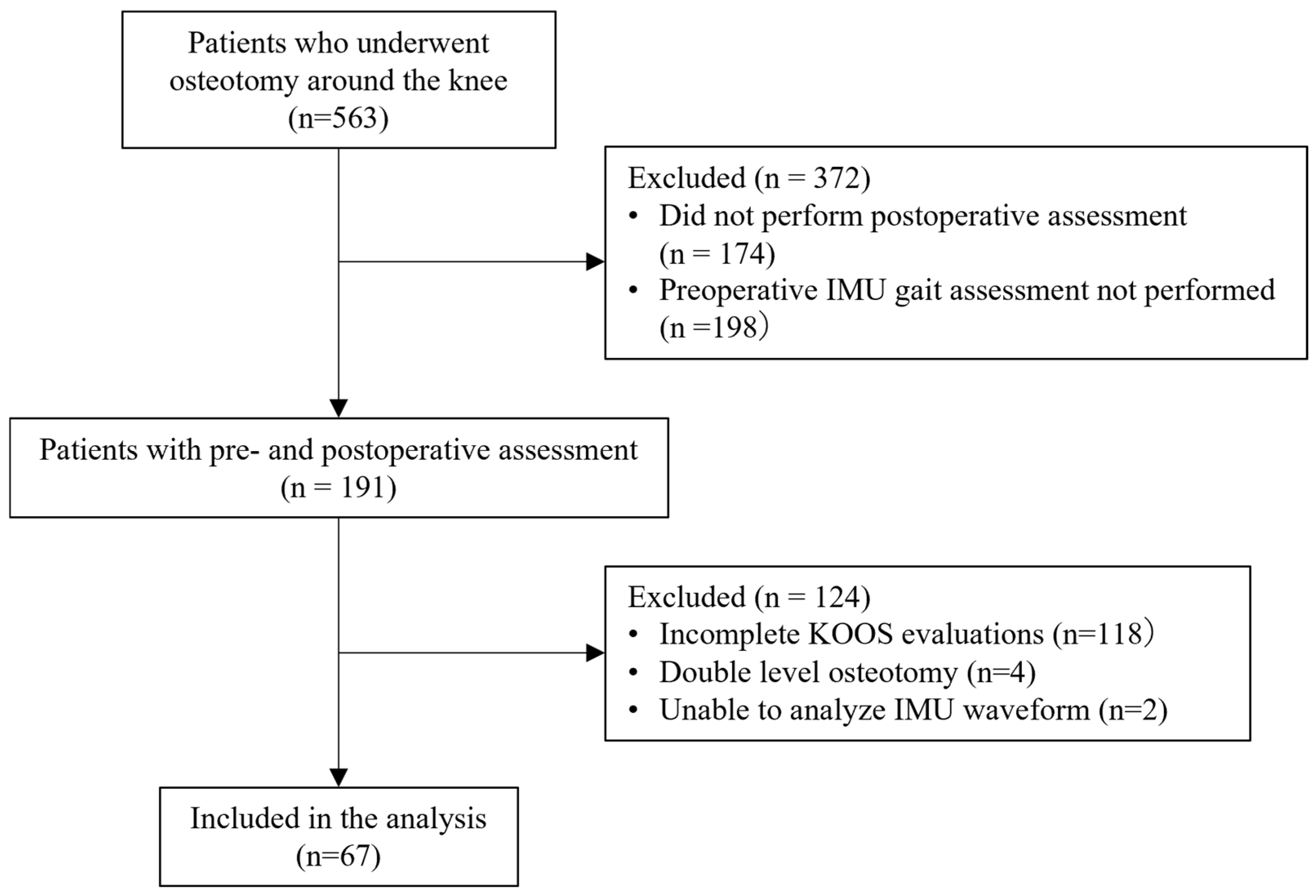
2.1. Study Design and Participants
2.2. Gait Data Acquisition
2.3. Signal Processing and Gait Cycle Segmentation
2.4. Feature Extraction Using Wavelet Analysis
2.5. Machine Learning Model Development
2.6. Statistical Analysis
3. Results
3.1. Patient Demographics and Baseline Characteristics
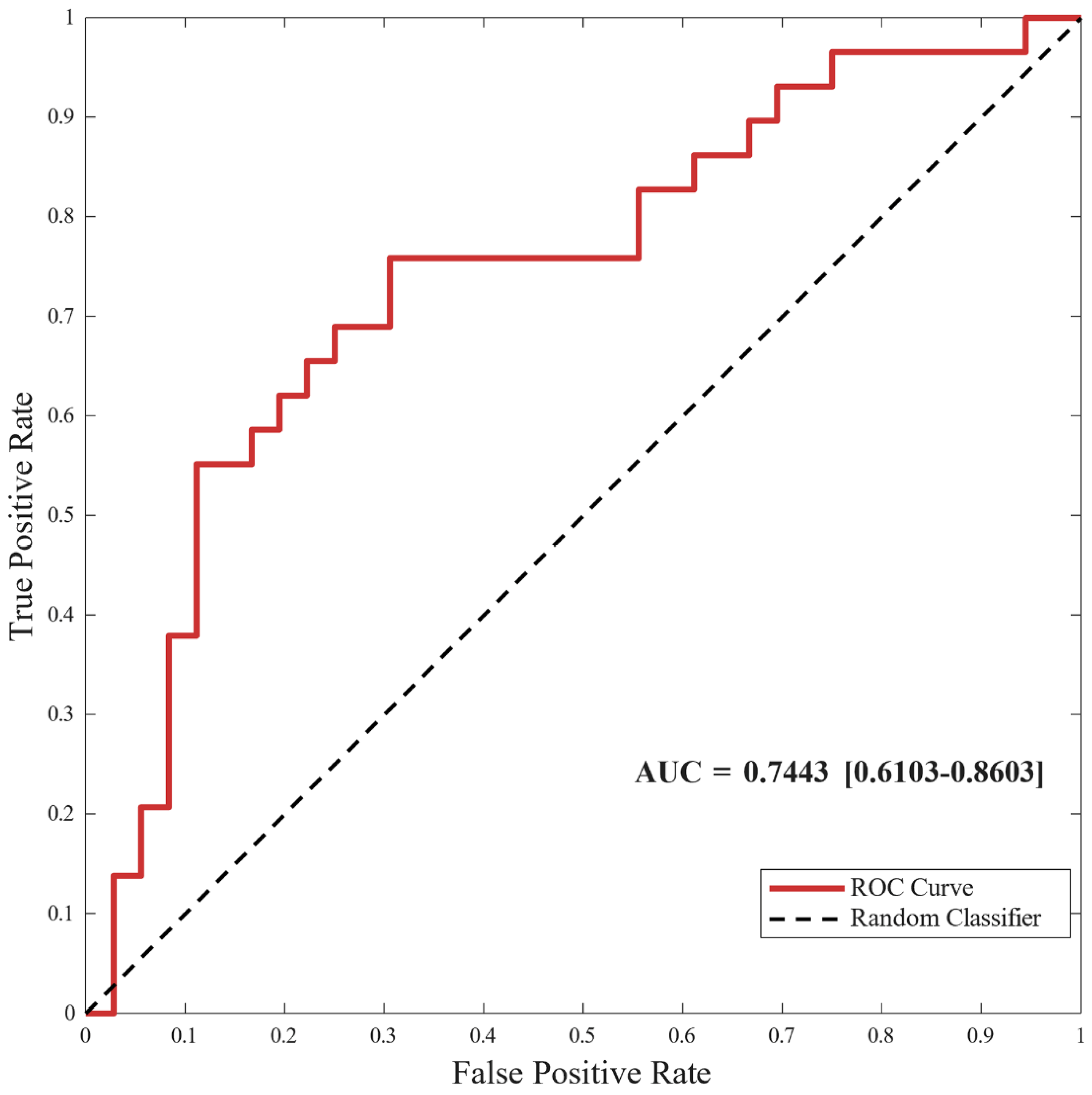
3.2. Predictive Performance of the Machine Learning Model
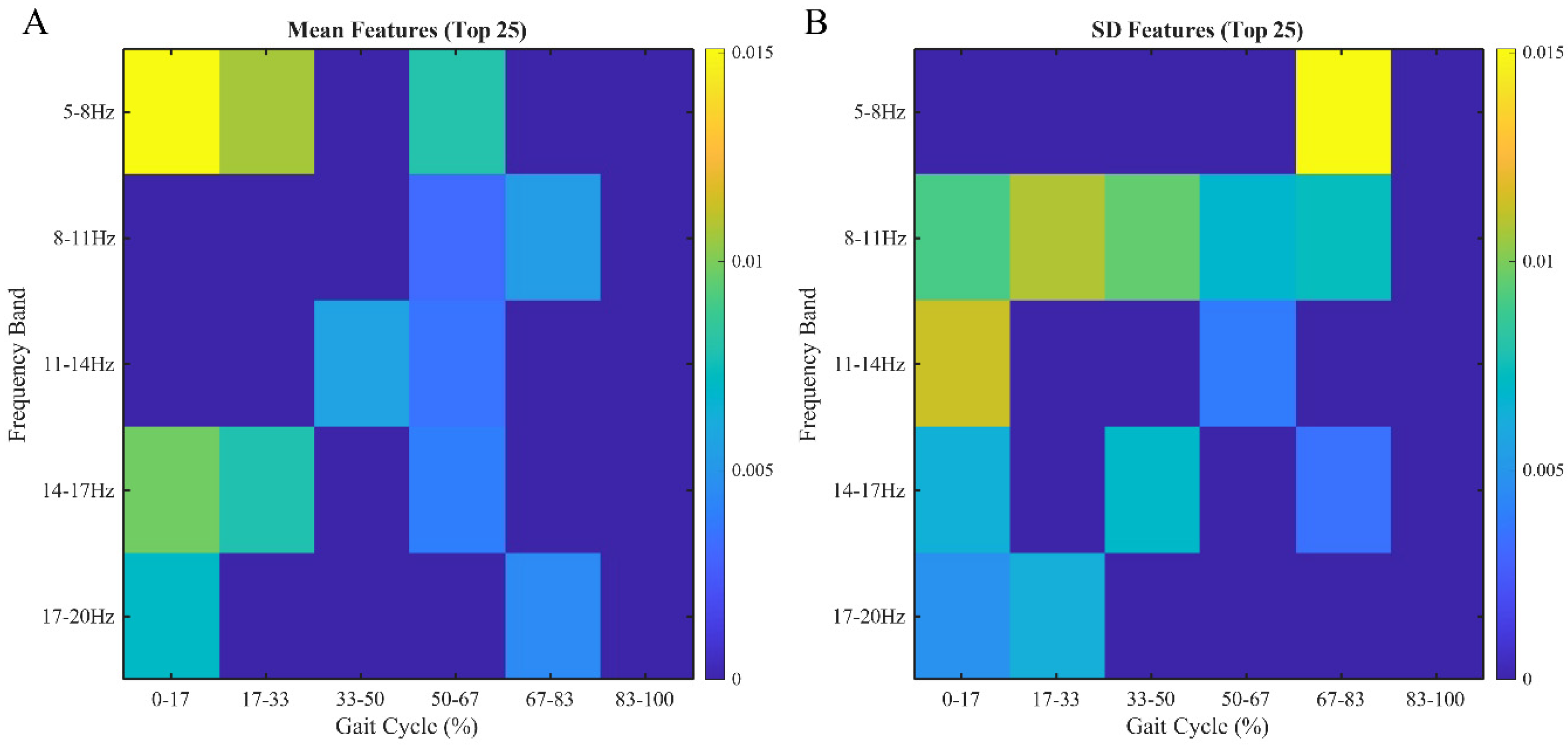
3.3. Feature Importance Analysis
3.4. Sensitivity Analysis
4. Discussions
5. Conclusions
Supplementary Materials
Author Contributions
Funding
Institutional Review Board Statement
Informed Consent Statement
Data Availability Statement
Acknowledgments
Conflicts of Interest
Abbreviations
| Abbreviation | Full Term |
| ADL | Activities of Daily Living |
| AUC | Area Under the Curve |
| BMI | Body Mass Index |
| CI | Confidence Interval |
| CWHTO | Closed-Wedge High Tibial Osteotomy |
| CWT | Continuous Wavelet Transform |
| DLO | Double-Level Osteotomy |
| HKA | Hip–Knee–Ankle angle |
| HTO | High Tibial Osteotomy |
| IMU | Inertial Measurement Unit |
| KAM | Knee Adduction Moment |
| KOA | Knee Osteoarthritis |
| KOOS | Knee injury and Osteoarthritis Outcome Score |
| LOSO CV | Leave-One-Subject-Out Cross-Validation |
| MCID | Minimal Clinically Important Difference |
| mLDFA | Mechanical Lateral Distal Femoral Angle |
| MPTA | Medial Proximal Tibial Angle |
| mRMR | minimum Redundancy Maximum Relevance |
| OA | Osteoarthritis |
| OAK | Osteotomy Around the Knee |
| OWDTO | Open-Wedge Distal Tuberosity Osteotomy |
| OWHTO | Open-Wedge High Tibial Osteotomy |
| QOL | Quality of Life |
| ROC | Receiver Operating Characteristic |
| RUSBoost | Random Undersampling Boost |
| SD | Standard Deviation |
| TKA | Total Knee Arthroplasty |
References
- Lobenhoffer, P.P.; van Heerwaarden, R.J.M.D.P.; Staubli, A.E.D.; Jakob, R.P.P.D.; Galla, M.D.; Agneskirchner, J.D.D. Osteotomies around the Knee: Indications–Planning–Surgical Techniques Using Plate Fixators; Georg Thieme Verlag: Stuttgart, Germany, 2013. [Google Scholar]
- Bode, G.; von Heyden, J.; Pestka, J.; Schmal, H.; Salzmann, G.; Sudkamp, N.; Niemeyer, P. Prospective 5-year survival rate data following open-wedge valgus high tibial osteotomy. Knee Surg. Sports Traumatol. Arthrosc. 2015, 23, 1949–1955. [Google Scholar] [CrossRef]
- DeMeo, P.J.; Johnson, E.M.; Chiang, P.P.; Flamm, A.M.; Miller, M.C. Midterm follow-up of opening-wedge high tibial osteotomy. Am. J. Sports Med. 2010, 38, 2077–2084. [Google Scholar] [CrossRef]
- Parvizi, J.; Hanssen, A.D.; Spangehl, M.J. Total knee arthroplasty following proximal tibial osteotomy: Risk factors for failure. J. Bone Jt. Surg. Am. 2004, 86, 474–479. [Google Scholar] [CrossRef]
- Dawson, M.; Elson, D.; Claes, S.; Predescu, V.; Khakha, R.; Espejo-Reina, A.; Schroter, S.; van Heerwarden, R.; Menetrey, J.; Beaufils, P.; et al. Osteotomy around the painful degenerative varus knee has broader indications than conventionally described but must follow a strict planning process: ESSKA Formal Consensus Part I. Knee Surg. Sports Traumatol. Arthrosc. 2024, 32, 1891–1901. [Google Scholar] [CrossRef] [PubMed]
- Ollivier, M.; Claes, S.; Mabrouk, A.; Elson, D.; Espejo-Reina, A.; Predescu, V.; Schroter, S.; Van Heerwarden, R.; Menetrey, J.; Beaufils, P.; et al. Surgical strategy and complication management of osteotomy around the painful degenerative varus knee: ESSKA Formal Consensus Part II. Knee Surg. Sports Traumatol. Arthrosc. 2024, 32, 2194–2205. [Google Scholar] [CrossRef]
- Birmingham, T.B.; Moyer, R.; Leitch, K.; Chesworth, B.; Bryant, D.; Willits, K.; Litchfield, R.; Fowler, P.J.; Giffin, J.R. Changes in biomechanical risk factors for knee osteoarthritis and their association with 5-year clinically important improvement after limb realignment surgery. Osteoarthr. Cartil. 2017, 25, 1999–2006. [Google Scholar] [CrossRef]
- Iijima, H.; Eguchi, R.; Aoyama, T.; Takahashi, M. Trunk movement asymmetry associated with pain, disability, and quadriceps strength asymmetry in individuals with knee osteoarthritis: A cross-sectional study. Osteoarthr. Cartil. 2019, 27, 248–256. [Google Scholar] [CrossRef]
- Akiba, A.; Harato, K.; Yoshihara, H.; Iwama, Y.; Nishizawa, K.; Nagura, T.; Nakamura, M. Development of a wearable system to estimate knee adduction moment of patients with knee osteoarthritis during gait using a single inertial measurement unit. J. Jt. Surg. Res. 2025, 3, 84–89. [Google Scholar] [CrossRef]
- Matsuda, T.; Watanabe, J.; Sotokawa, T.; Shishime, T.; Katoh, H. Estimation of the External Knee Adduction Moment Using Inertial Measurement Unit Sensors on the Shank and Lower Back: A Pilot Study. J. Funct. Morphol. Kinesiol. 2025, 10, 356. [Google Scholar] [CrossRef] [PubMed]
- Wang, C.; Chan, P.P.K.; Lam, B.M.F.; Wang, S.; Zhang, J.H.; Chan, Z.Y.S.; Chan, R.H.M.; Ho, K.K.W.; Cheung, R.T.H. Real-Time Estimation of Knee Adduction Moment for Gait Retraining in Patients with Knee Osteoarthritis. IEEE Trans. Neural Syst. Rehabil. Eng. 2020, 28, 888–894. [Google Scholar] [CrossRef] [PubMed]
- Kluge, F.; Hannink, J.; Pasluosta, C.; Klucken, J.; Gassner, H.; Gelse, K.; Eskofier, B.M.; Krinner, S. Pre-operative sensor-based gait parameters predict functional outcome after total knee arthroplasty. Gait Posture 2018, 66, 194–200. [Google Scholar] [CrossRef] [PubMed]
- Polce, E.M.; Kunze, K.N.; Dooley, M.S.; Piuzzi, N.S.; Boettner, F.; Sculco, P.K. Efficacy and Applications of Artificial Intelligence and Machine Learning Analyses in Total Joint Arthroplasty: A Call for Improved Reporting. J. Bone Jt. Surg. Am. 2022, 104, 821–832. [Google Scholar] [CrossRef]
- Jacquet, C.; Pioger, C.; Khakha, R.; Steltzlen, C.; Kley, K.; Pujol, N.; Ollivier, M. Evaluation of the “Minimal Clinically Important Difference” (MCID) of the KOOS, KSS and SF-12 scores after open-wedge high tibial osteotomy. Knee Surg. Sports Traumatol. Arthrosc. 2021, 29, 820–826. [Google Scholar] [CrossRef] [PubMed]
- Plaza-Bravo, J.M.; Mateo-March, M.; Sanchis-Sanchis, R.; Perez-Soriano, P.; Zabala, M.; Encarnacion-Martinez, A. Validity and Reliability of the Leomo Motion-Tracking Device Based on Inertial Measurement Unit with an Optoelectronic Camera System for Cycling Pedaling Evaluation. Int. J. Environ. Res. Public Health 2022, 19, 8375. [Google Scholar] [CrossRef]
- Thompson, R.; Rico Bini, R.; Paton, C.; Hebert-Losier, K. Validation of LEOMO inertial measurement unit sensors with marker-based three-dimensional motion capture during maximum sprinting in track cyclists. J. Sports Sci. 2024, 42, 179–188. [Google Scholar] [CrossRef]
- Kobsar, D.; Masood, Z.; Khan, H.; Khalil, N.; Kiwan, M.Y.; Ridd, S.; Tobis, M. Wearable Inertial Sensors for Gait Analysis in Adults with Osteoarthritis-A Scoping Review. Sensors 2020, 20, 7143. [Google Scholar] [CrossRef]
- Ben Mansour, K.; Rezzoug, N.; Gorce, P. Analysis of several methods and inertial sensors locations to assess gait parameters in able-bodied subjects. Gait Posture 2015, 42, 409–414. [Google Scholar] [CrossRef]
- Jasiewicz, J.M.; Allum, J.H.; Middleton, J.W.; Barriskill, A.; Condie, P.; Purcell, B.; Li, R.C. Gait event detection using linear accelerometers or angular velocity transducers in able-bodied and spinal-cord injured individuals. Gait Posture 2006, 24, 502–509. [Google Scholar] [CrossRef]
- Aubol, K.G.; Milner, C.E. Foot contact identification using a single triaxial accelerometer during running. J. Biomech. 2020, 105, 109768. [Google Scholar] [CrossRef]
- Caramia, C.; De Marchis, C.; Schmid, M. Optimizing the Scale of a Wavelet-Based Method for the Detection of Gait Events from a Waist-Mounted Accelerometer Under Different Walking Speeds. Sensors 2019, 19, 1869. [Google Scholar] [CrossRef] [PubMed]
- Ji, N.; Zhou, H.; Guo, K.; Samuel, O.W.; Huang, Z.; Xu, L.; Li, G. Appropriate Mother Wavelets for Continuous Gait Event Detection Based on Time-Frequency Analysis for Hemiplegic and Healthy Individuals. Sensors 2019, 19, 3462. [Google Scholar] [CrossRef]
- Seiffert, C.; Khoshgoftaar, T.M.; Hulse, J.V.; Napolitano, A. RUSBoost: A Hybrid Approach to Alleviating Class Imbalance. IEEE Trans. Syst. Man Cybern.—Part A Syst. Hum. 2010, 40, 185–197. [Google Scholar] [CrossRef]
- Lewis, M.J.; Spiliopoulou, A.; Goldmann, K.; Pitzalis, C.; McKeigue, P.; Barnes, M.R. nestedcv: An R package for fast implementation of nested cross-validation with embedded feature selection designed for transcriptomics and high-dimensional data. Bioinform. Adv. 2023, 3, vbad048. [Google Scholar] [CrossRef]
- Peng, H.; Long, F.; Ding, C. Feature selection based on mutual information: Criteria of max-dependency, max-relevance, and min-redundancy. IEEE Trans. Pattern Anal. Mach. Intell. 2005, 27, 1226–1238. [Google Scholar] [CrossRef]
- Robnik-Šikonja, M.; Kononenko, I. Theoretical and Empirical Analysis of ReliefF and RReliefF. Mach. Learn. 2003, 53, 23–69. [Google Scholar] [CrossRef]
- Kellgren, J.H.; Lawrence, J.S. Radiological assessment of osteo-arthrosis. Annu. Rheumatol. Dis. 1957, 16, 494–502. [Google Scholar] [CrossRef] [PubMed]
- Xiang, L.; Gu, Y.; Rong, M.; Gao, Z.; Yang, T.; Wang, A.; Shim, V.; Fernandez, J. Shock Acceleration and Attenuation During Running with Minimalist and Maximalist Shoes: A Time- and Frequency-Domain Analysis of Tibial Acceleration. Bioengineering 2022, 9, 322. [Google Scholar] [CrossRef] [PubMed]
- Luo, J.; Ahmadvand, N.; Crooks, M. Assessing loading rate in frequency domain by accelerometry. Proc. Inst. Mech. Eng. Part H J. Eng. Med. 2025, 239, 1147–1155. [Google Scholar] [CrossRef] [PubMed]
- Yakhdani, H.R.; Bafghi, H.A.; Meijer, O.G.; Bruijn, S.M.; van den Dikkenberg, N.; Stibbe, A.B.; van Royen, B.J.; van Dieen, J.H. Stability and variability of knee kinematics during gait in knee osteoarthritis before and after replacement surgery. Clin. Biomech. 2010, 25, 230–236. [Google Scholar] [CrossRef]
- Kiss, R.M. Effect of severity of knee osteoarthritis on the variability of gait parameters. J. Electromyogr. Kinesiol. 2011, 21, 695–703. [Google Scholar] [CrossRef]
- Busa, M.A.; Lim, J.; van Emmerik, R.E.; Hamill, J. Head and Tibial Acceleration as a Function of Stride Frequency and Visual Feedback During Running. PLoS ONE 2016, 11, e0157297. [Google Scholar] [CrossRef]
- Richards, R.; van den Noort, J.C.; Dekker, J.; Harlaar, J. Gait Retraining with Real-Time Biofeedback to Reduce Knee Adduction Moment: Systematic Review of Effects and Methods Used. Arch. Phys. Med. Rehabil. 2017, 98, 137–150. [Google Scholar] [CrossRef]
- Gerbrands, T.A.; Pisters, M.F.; Theeven, P.J.R.; Verschueren, S.; Vanwanseele, B. Lateral trunk lean and medializing the knee as gait strategies for knee osteoarthritis. Gait Posture 2017, 51, 247–253. [Google Scholar] [CrossRef] [PubMed]
- Bugane, F.; Benedetti, M.G.; Casadio, G.; Attala, S.; Biagi, F.; Manca, M.; Leardini, A. Estimation of spatial-temporal gait parameters in level walking based on a single accelerometer: Validation on normal subjects by standard gait analysis. Comput. Methods Programs Biomed. 2012, 108, 129–137. [Google Scholar] [CrossRef] [PubMed]
- James, K.A.; Corrigan, P.; Lanois, C.; Huang, C.H.; Davis, I.S.; Stefanik, J.J. Association of tibial acceleration during walking to pain and impact loading in adults with knee osteoarthritis. Clin. Biomech. 2023, 109, 106097. [Google Scholar] [CrossRef] [PubMed]



| Baseline Characteristics | Postoperative Characteristics | |||||
|---|---|---|---|---|---|---|
| Good (n = 37) | Poor (n = 30) | p Value | Good | Poor | p Value | |
| Age (year) | 61.8 (58.8–64.7) | 60.3 (57.0–63.7) | 0.51 | N/A | N/A | N/A |
| Sex (Male:Female) | 18:19 | 14:16 | 0.99 | N/A | N/A | N/A |
| BMI (kg/m2) | 27.2 (25.9–28.4) | 27.1 (25.6–28.5) | 0.92 | 27.3 (25.9–28.9) | 27.6 (25.9–29.5) | 0.89 |
| OA grade (2:3:4) | 10:22:5 | 9:15:6 | 0.70 | 9:23:5 | 8: 16: 6 | 0.68 |
| HKA (degree) | −5.7 (−7–−4.2) | −6.2 (−7.8–−4.6) | 0.34 | 2.8 (1.9–3.7) | 2.5 (1.5–3.6) | 0.69 |
| MPTA (degree) | 84.6 (83.6–85.6) | 83.9 (82.8–85.1) | 0.38 | 89.7 (88.6–90.8) | 89.3 (88.0–90.7) | 0.65 |
| mLDFA (degree) | 88.5 (87.7–89.4) | 87.6 (86.7–88.6) | 0.18 | 89.0 (87.3–90.1) | 88.5 (87.1–89.5) | 0.61 |
| Type of osteotomy (OWHTO:OWDTO:CWHTO) | 21:11:5 | 18:10:2 | 0.84 | N/A | N/A | N/A |
| Walking speed (m/s) | 1.1 (1.0–1.2) | 1.2 (1.0–1.4) | 0.43 | N/A | N/A | N/A |
| KOOS | Baseline Characteristics | Postoperative Characteristics | Changes Between Baseline and Postoperative Value | ||||||
|---|---|---|---|---|---|---|---|---|---|
| Good (n = 37) | Poor (n = 30) | p Value | Good | Poor | p Value | Good | Poor | p Value | |
| Pain | 47.9 (42.4–53.4) | 62.8 (56.6–69.1) | <0.01 | 81.6 (76.5–86.7) | 66.5 (60.7–72.3) | <0.01 | 34.1 (29.0–39.2) | 2.8 (−3.1–8.6) | <0.01 |
| Symptom | 52.9 (47.2–58.4) | 72.7 (66.3–79.0) | <0.01 | 80.8 (76.4–85.1) | 70.5 (65.6–75.5) | <0.01 | 28.2 (23.4–33.0) | −2.9 (−8.5–2.6) | <0.01 |
| ADL | 40.3 (33.5–47.2) | 65.1 (57.2–72.9) | <0.01 | 74.3 (67.6–81.0) | 60.7 (53.0–68.3) | <0.01 | 34.2 (28.7–39.6) | −4.9 (−11.2–1.3) | <0.01 |
| Sports/Rec | 40.4 (32.3–48.5) | 56.1 (46.8–65.3) | 0.01 | 69.4 (61.3–77.5) | 56.5 (47.2–65.7) | 0.04 | 28.8 (23.4–34.2) | 0.5 (−5.7–6.7) | <0.01 |
| QOL | 26.6 (21.1–32.1) | 42.9 (36.7–49.1) | <0.01 | 61.1 (54.7–67.4) | 51.7 (44.4–58.9) | 0.06 | 34.5 (28.0–41.0) | 8.6 (1.2–16.1) | <0.01 |
| Confusion Matrix | |||
|---|---|---|---|
| Predicted Good | Predicted Poor | Total | |
| Actual Good | 26 (TP) | 11 (FN) | 37 |
| Actual Poor | 8 (FP) | 22 (TN) | 30 |
| Total | 34 | 33 | 67 |
| Classification Performance Metrics | |||
| Value | Calculation | ||
| Sensitivity (Recall) | 0.70 | 26/37 | |
| Specificity | 0.73 | 22/30 | |
| Positive Predictive Value (PPV) | 0.76 | 26/34 | |
| Negative Predictive Value (NPV) | 0.67 | 22/33 | |
| Accuracy | 0.72 | 48/67 | |
| F1-score | 0.73 | 2 × (PPV × Recall)/(PPV + Recall) | |
| K Value | Number of Folds | Percentage (%) |
|---|---|---|
| 5 | 4 | 6.0 |
| 7 | 2 | 3.0 |
| 11 | 3 | 4.5 |
| 13 | 14 | 20.9 |
| 15 | 15 | 22.4 |
| 17 | 2 | 3.0 |
| 19 | 6 | 9.0 |
| 21 | 7 | 10.4 |
| 23 | 3 | 4.5 |
| 25 | 11 | 16.4 |
Disclaimer/Publisher’s Note: The statements, opinions and data contained in all publications are solely those of the individual author(s) and contributor(s) and not of MDPI and/or the editor(s). MDPI and/or the editor(s) disclaim responsibility for any injury to people or property resulting from any ideas, methods, instructions or products referred to in the content. |
© 2026 by the authors. Licensee MDPI, Basel, Switzerland. This article is an open access article distributed under the terms and conditions of the Creative Commons Attribution (CC BY) license.
Share and Cite
Iwasaki, K.; Sabashi, K.; Koyano, H.; Kodama, Y.; Sakurai, S.; Ukishiro, K.; Ito, R.; Matsumoto, H.; Abe, Y.; Mori, N.; et al. Machine Learning-Based Prognostic Prediction for Knee Osteoarthritis After High Tibial Osteotomy Using Wavelet-Derived Gait Features. J. Funct. Morphol. Kinesiol. 2026, 11, 94. https://doi.org/10.3390/jfmk11010094
Iwasaki K, Sabashi K, Koyano H, Kodama Y, Sakurai S, Ukishiro K, Ito R, Matsumoto H, Abe Y, Mori N, et al. Machine Learning-Based Prognostic Prediction for Knee Osteoarthritis After High Tibial Osteotomy Using Wavelet-Derived Gait Features. Journal of Functional Morphology and Kinesiology. 2026; 11(1):94. https://doi.org/10.3390/jfmk11010094
Chicago/Turabian StyleIwasaki, Koji, Kento Sabashi, Hidenori Koyano, Yuji Kodama, Shigeyuki Sakurai, Kengo Ukishiro, Ryusuke Ito, Hisashi Matsumoto, Yuichiro Abe, Noriaki Mori, and et al. 2026. "Machine Learning-Based Prognostic Prediction for Knee Osteoarthritis After High Tibial Osteotomy Using Wavelet-Derived Gait Features" Journal of Functional Morphology and Kinesiology 11, no. 1: 94. https://doi.org/10.3390/jfmk11010094
APA StyleIwasaki, K., Sabashi, K., Koyano, H., Kodama, Y., Sakurai, S., Ukishiro, K., Ito, R., Matsumoto, H., Abe, Y., Mori, N., Inoue, C., Ohkoshi, Y., Onodera, T., Kondo, E., & Iwasaki, N. (2026). Machine Learning-Based Prognostic Prediction for Knee Osteoarthritis After High Tibial Osteotomy Using Wavelet-Derived Gait Features. Journal of Functional Morphology and Kinesiology, 11(1), 94. https://doi.org/10.3390/jfmk11010094