
Kinematic Characteristics and Reliability of Selective Toe Extension Tasks in Young and Older Adults


Abstract
1. Introduction
2. Materials and Methods
2.1. Participants
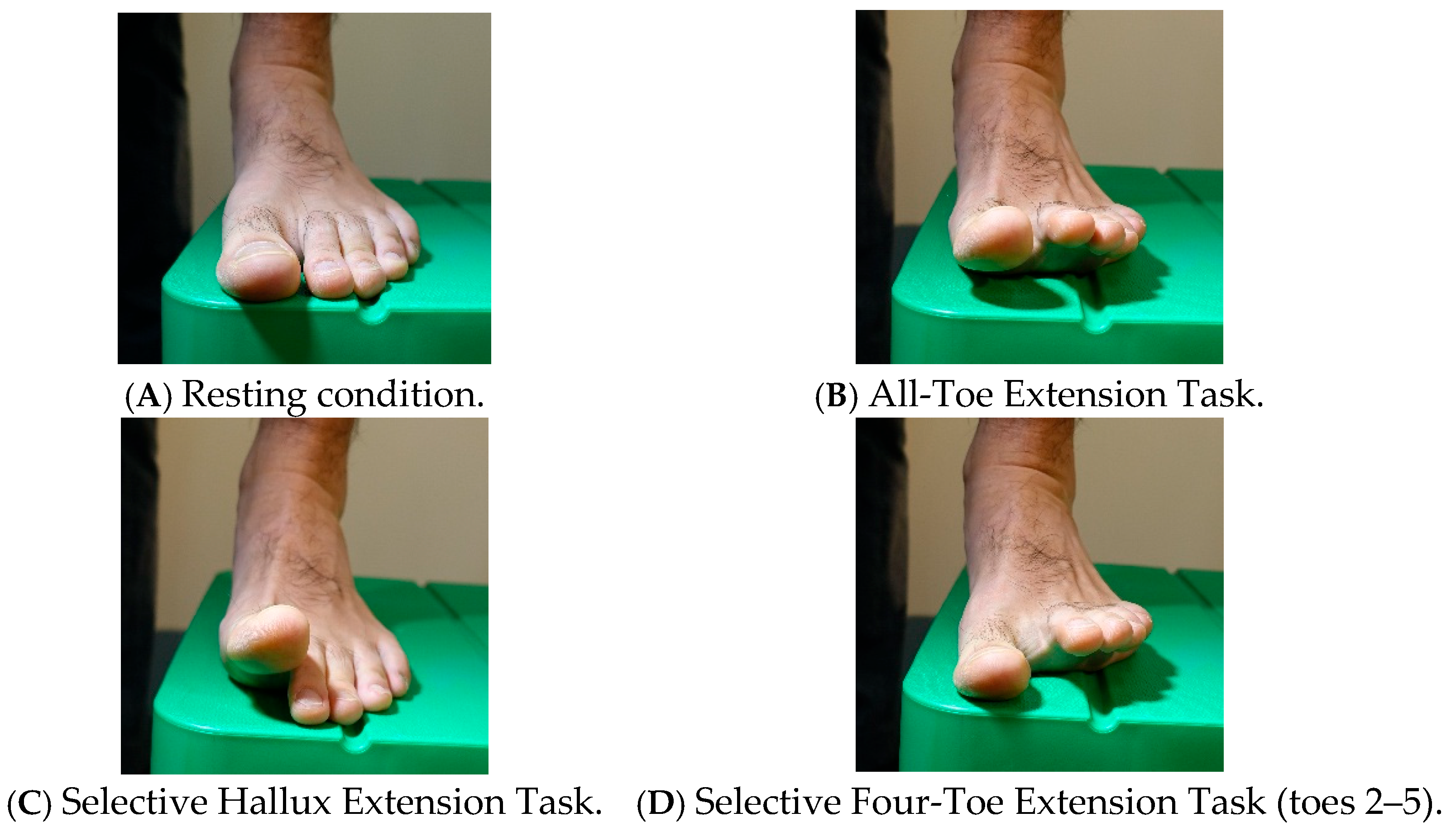
2.2. Experimental Methods
2.3. Statistical Analysis
3. Results
3.1. Reliability Assessment Using ICCs
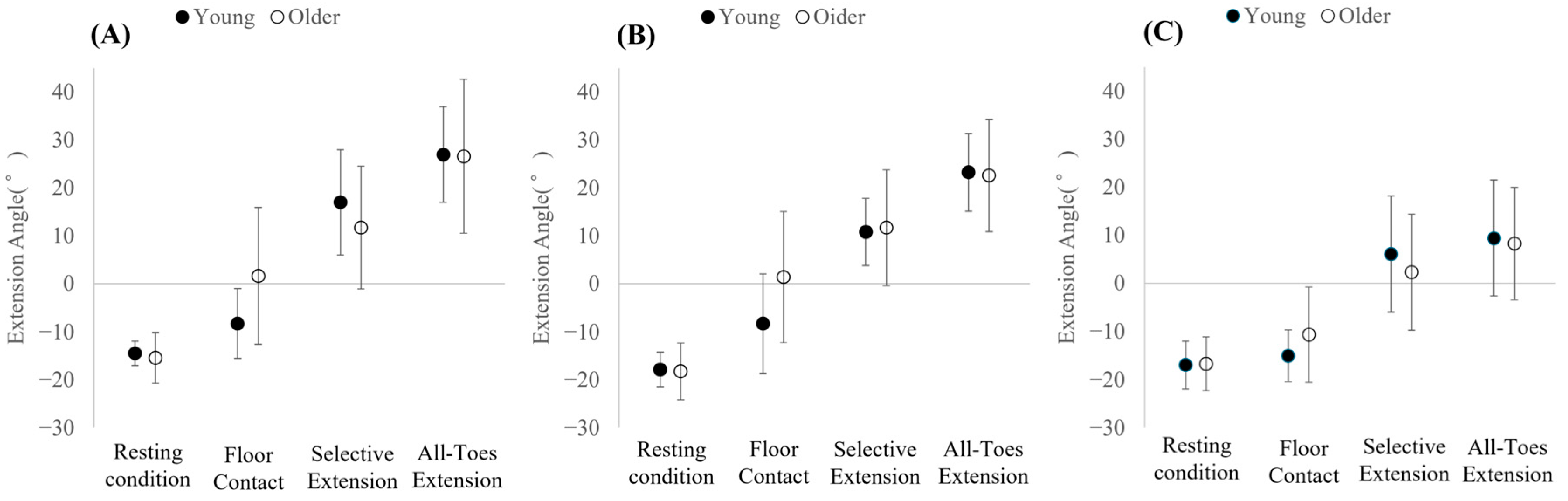
3.2. Toe Angle
3.2.1. Hallux
3.2.2. Second Toe
3.2.3. Fifth Toe
3.3. Toe-Grip Strength
3.4. Exploratory Analysis of Sex Differences Within the Older Adult Group
4. Discussion
4.1. Measurement Reliability
4.2. Limited Range of Motion and Associated Movements During Selective Toe Extension
4.3. Effects of Aging on Toe Control
4.4. Limitations of the Study
5. Conclusions
Author Contributions
Funding
Institutional Review Board Statement
Informed Consent Statement
Data Availability Statement
Acknowledgments
Conflicts of Interest
Abbreviations
| ANOVA | Analysis of variance |
| ICC | Intraclass correlation coefficient |
| ηp2 | Partial eta squared |
References
- Dorn, T.W.; Schache, A.G.; Pandy, M.G. Muscular strategy shift in human running: Dependence of running speed on hip and ankle muscle performance. J. Exp. Biol. 2012, 215, 1944–1956. [Google Scholar] [CrossRef] [PubMed]
- Holowka, N.B.; Lieberman, D.E. Rethinking the evolution of the human foot: Insights from experimental research. J. Exp. Biol. 2018, 221, jeb174425. [Google Scholar] [CrossRef] [PubMed]
- Kelly, L.A.; Cresswell, A.G.; Racinais, S.; Whiteley, R.; Lichtwark, G. Intrinsic foot muscles have the capacity to control deformation of the longitudinal arch. J. R. Soc. Interface 2014, 11, 20131188. [Google Scholar] [CrossRef] [PubMed]
- Mickle, K.J.; Angin, S.; Crofts, G.; Nester, C.J. Effects of age on strength and morphology of toe flexor muscles. J. Orthop. Sports Phys. Ther. 2016, 46, 1065–1070. [Google Scholar] [CrossRef] [PubMed]
- Menz, H.B.; Morris, M.E.; Lord, S.R. Foot and ankle characteristics associated with impaired balance and functional ability in older people. J. Gerontol. A Biol. Sci. Med. Sci. 2005, 60, 1546–1552. [Google Scholar] [CrossRef] [PubMed]
- Menz, H.B.; Lord, S.R. The contribution of foot problems to mobility impairment and falls in community-dwelling older people. J. Am. Geriatr. Soc. 2001, 49, 1651–1656. [Google Scholar] [CrossRef] [PubMed]
- Smith, G.; Lake, M.; Lees, A. Metatarsophalangeal joint function during sprinting: A comparison of barefoot and sprint spike shod foot conditions. J. Appl. Biomech. 2014, 30, 206–212. [Google Scholar] [CrossRef] [PubMed]
- Goldmann, J.P.; Brüggemann, G.P. The potential of human toe flexor muscles to produce force. J. Anat. 2012, 221, 187–194. [Google Scholar] [CrossRef] [PubMed]
- Mickle, K.J.; Caputi, P.; Potter, J.M.; Steele, J.R. Efficacy of a progressive resistance exercise program to increase toe flexor strength in older people. Clin. Biomech. 2016, 40, 14–19. [Google Scholar] [CrossRef] [PubMed]
- Amaha, K.; Arimoto, T.; Kitamura, N. Effect of toe exercises and toe grip strength on the treatment of primary metatarsalgia. J. Orthop. Surg. Res. 2020, 15, 580. [Google Scholar] [CrossRef] [PubMed]
- Koo, T.K.; Li, M.Y. A guideline of selecting and reporting intraclass correlation coefficients for reliability research. J. Chiropr. Med. 2016, 15, 155–163, Erratum in J. Chiropr. Med. 2017, 16, 346. [Google Scholar] [CrossRef] [PubMed]
- Uritani, D.; Fukumoto, T.; Matsumoto, D. Intrarater and interrater reliabilities for a toe grip dynamometer. J. Phys. Ther. Sci. 2012, 24, 639–643. [Google Scholar] [CrossRef]
- Zatsiorsky, V.M.; Li, Z.M.; Latash, M.L. Enslaving effects in multi-finger force production. Exp. Brain Res. 2000, 131, 187–195. [Google Scholar] [CrossRef] [PubMed]
- Mirakhorlo, M.; Maas, H.; Veeger, H.E.J. Increased enslaving in elderly is associated with changes in neural control of the extrinsic finger muscles. Exp. Brain Res. 2018, 236, 1583–1592. [Google Scholar] [CrossRef] [PubMed]
- O’Sullivan, E.; Carare-Nnadi, R.; Greenslade, J.; Bowyer, G. Clinical significance of variations in the interconnections between flexor digitorum longus and flexor hallucis longus in the region of the knot of Henry. Clin. Anat. 2005, 18, 121–125. [Google Scholar] [CrossRef]
- Edama, M.; Kubo, M.; Onishi, H.; Takabayashi, T.; Yokoyama, E.; Inai, T.; Watanabe, H.; Nashimoto, S.; Kageyama, I. Anatomical study of toe flexion by flexor hallucis longus. Ann. Anat. 2016, 204, 80–85. [Google Scholar] [CrossRef]
- Mann, R.A.; Coughlin, M.J. Lesser toes. In Surgery of the Foot and Ankle, 8th ed.; Coughlin, M.J., Mann, R.A., Saltzman, C.L., Eds.; Mosby Elsevier: Philadelphia, PA, USA, 2007; pp. 255–308. [Google Scholar]
- Coughlin, M.J.; Mann, R.A.; Saltzman, C.L. Lesser toe deformities. In Surgery of the Foot and Ankle, 9th ed.; Coughlin, M.J., Ed.; Mosby Elsevier: Philadelphia, PA, USA, 2014; pp. 300–359. [Google Scholar]
- Seidler, R.D.; Bernard, J.A.; Burutolu, T.B.; Fling, B.W.; Gordon, M.T.; Gwin, J.T.; Kwak, Y.; Lipps, D.B. Motor control and aging: Links to age-related brain structural, functional, and biochemical effects. Neurosci. Biobehav. Rev. 2010, 34, 721–733. [Google Scholar] [CrossRef] [PubMed]
- Hunter, S.K.; Pereira, H.M.; Keenan, K.G. The aging neuromuscular system and motor performance. J. Appl. Physiol. 2016, 121, 982–995. [Google Scholar] [CrossRef]



| Task | Toe | Measurement | ICC | 95% CI |
|---|---|---|---|---|
| All-Toe Extension | Hallux | Single | 0.77 | 0.614–0.874 |
| Average | 0.87 | 0.761–0.933 | ||
| Second | Single | 0.76 | 0.599–0.868 | |
| Average | 0.87 | 0.749–0.929 | ||
| Fifth | Single | 0.68 | 0.479–0.819 | |
| Average | 0.81 | 0.648–0.901 | ||
| Selective Hallux Extension | Hallux | Single | 0.81 | 0.667–0.893 |
| Average | 0.89 | 0.800–0.944 | ||
| Second | Single | 0.68 | 0.467–0.814 | |
| Average | 0.81 | 0.637–0.898 | ||
| Fifth | Single | 0.74 | 0.567–0.855 | |
| Average | 0.85 | 0.724–0.922 | ||
| Selective Four-Toe Extension (Toes 2–5) | Hallux | Single | 0.85 | 0.736–0.918 |
| Average | 0.92 | 0.848–0.957 | ||
| Second | Single | 0.73 | 0.539–0.841 | |
| Average | 0.84 | 0.700–0.915 | ||
| Fifth | Single | 0.90 | 0.826–0.948 | |
| Average | 0.95 | 0.905–0.974 | ||
| Toe-Grip Strength (Dominant Foot) | Single | 0.99 | 0.971–0.992 | |
| Average | 0.99 | 0.986–0.994 | ||
| Young (n = 20) | Older (n = 20) | Cohen’s d | t | p-Value | |
|---|---|---|---|---|---|
| Dominant foot | 21.0 ± 7.4 | 6.1 ± 3.9 | 2.51 | 7.95 | <0.001 |
Disclaimer/Publisher’s Note: The statements, opinions and data contained in all publications are solely those of the individual author(s) and contributor(s) and not of MDPI and/or the editor(s). MDPI and/or the editor(s) disclaim responsibility for any injury to people or property resulting from any ideas, methods, instructions or products referred to in the content. |
© 2026 by the authors. Licensee MDPI, Basel, Switzerland. This article is an open access article distributed under the terms and conditions of the Creative Commons Attribution (CC BY) license.
Share and Cite
Abe, S.; Koda, H.; Yasuda, T.; Kida, N. Kinematic Characteristics and Reliability of Selective Toe Extension Tasks in Young and Older Adults. J. Funct. Morphol. Kinesiol. 2026, 11, 93. https://doi.org/10.3390/jfmk11010093
Abe S, Koda H, Yasuda T, Kida N. Kinematic Characteristics and Reliability of Selective Toe Extension Tasks in Young and Older Adults. Journal of Functional Morphology and Kinesiology. 2026; 11(1):93. https://doi.org/10.3390/jfmk11010093
Chicago/Turabian StyleAbe, Seiya, Hitoshi Koda, Takashi Yasuda, and Noriyuki Kida. 2026. "Kinematic Characteristics and Reliability of Selective Toe Extension Tasks in Young and Older Adults" Journal of Functional Morphology and Kinesiology 11, no. 1: 93. https://doi.org/10.3390/jfmk11010093
APA StyleAbe, S., Koda, H., Yasuda, T., & Kida, N. (2026). Kinematic Characteristics and Reliability of Selective Toe Extension Tasks in Young and Older Adults. Journal of Functional Morphology and Kinesiology, 11(1), 93. https://doi.org/10.3390/jfmk11010093