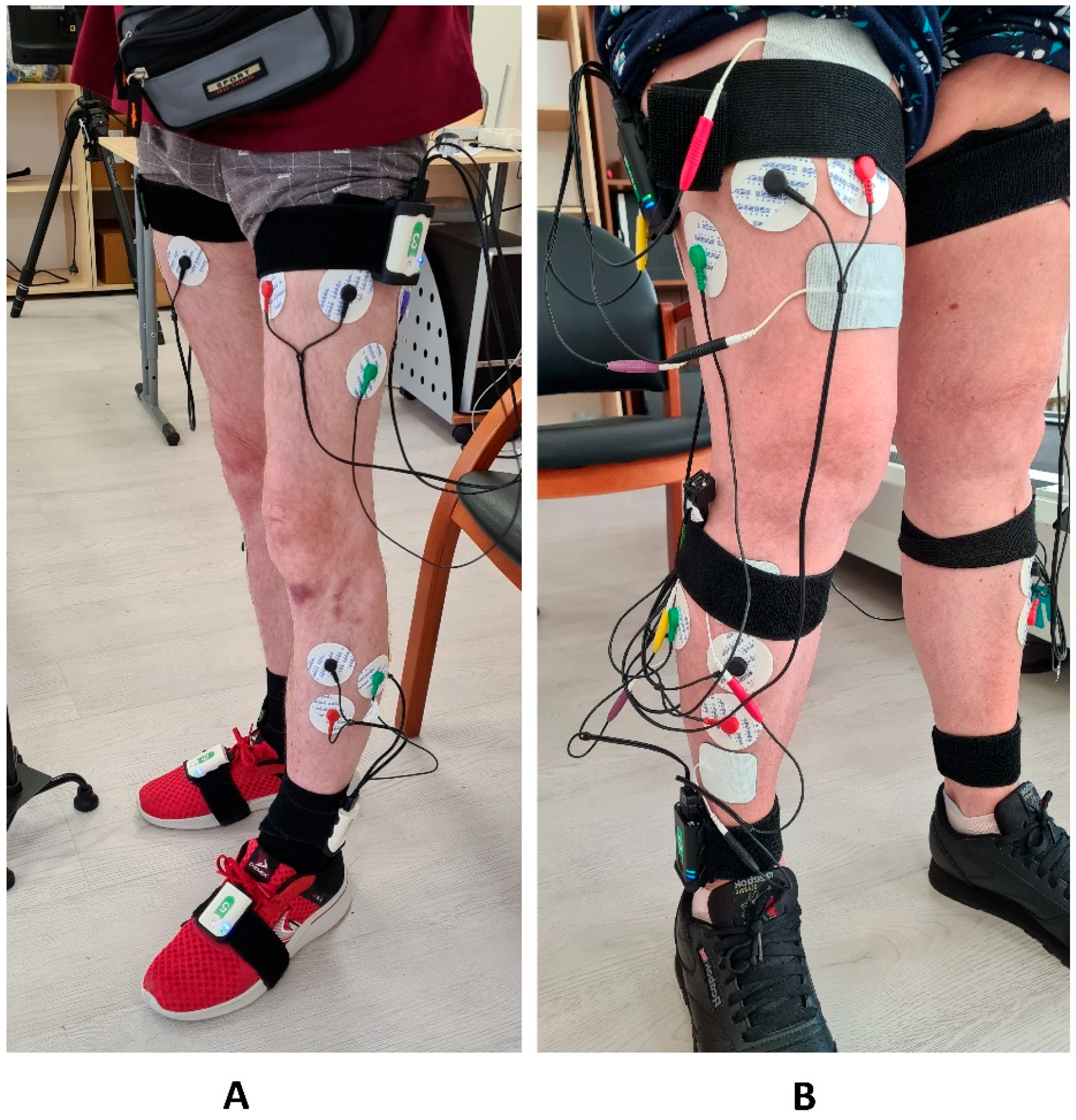


The Effect of a Single Session of Functional Electrical Muscle Stimulation During Walking in Patients with Hemiparesis After Stroke: A Pilot Pre–Post Study

Abstract
1. Introduction
2. Materials and Methods
2.1. Study Design
2.2. Study Patients
2.3. Eligibility Criteria for Patients
2.4. Methods of Biomechanical Assessment
2.5. FES Procedure
2.6. Statistical Analysis
3. Results
3.1. Spatiotemporal Gait Parameters
3.2. Joint Kinematics
3.3. Surface EMG Amplitude
3.4. Phases of Maximum Muscle Activity
4. Discussion
5. Conclusions
6. Patents
Author Contributions
Funding
Institutional Review Board Statement
Informed Consent Statement
Data Availability Statement
Conflicts of Interest
Abbreviations
| FES | Functional Electrical Stimulation |
| EMG | Electromyography |
| CNS | Central Nervous System |
| TA | Tibialis Anterior |
| GM | Gastrocnemius |
| QF | Quadriceps Femoris |
| HM | Hamstring |
| IMU | Inertial Measurement Unit |
| MRC | Medical Research Council |
| EEG | Electroencephalogram |
References
- Katan, M.; Luft, A. Global Burden of Stroke. Semin. Neurol. 2018, 38, 208–211. [Google Scholar] [CrossRef] [PubMed]
- Hachinski, V.; Donnan, G.A.; Gorelick, P.B.; Hacke, W.; Cramer, S.C.; Kaste, M.; Fisher, M.; Brainin, M.; Buchan, A.M.; Lo, E.H.; et al. Stroke: Working toward a prioritized world agenda. Int. J. Stroke 2010, 5, 238–256. [Google Scholar] [CrossRef]
- Uivarosan, D.; Bungau, S.; Tit, D.M.; Moisa, C.; Fratila, O.; Rus, M.; Bratu, O.G.; Diaconu, C.C.; Pantis, C. Financial Burden of Stroke Reflected in a Pilot Center for the Implementation of Thrombolysis. Medicina 2020, 56, 54. [Google Scholar] [CrossRef]
- Pollock, A.; St George, B.; Fenton, M.; Firkins, L. Top ten research priorities relating to life after stroke. Lancet Neurol. 2012, 11, 209. [Google Scholar] [CrossRef]
- Allred, R.P.; Maldonado, M.A.; Hsu, J.E.; Jones, T.A. Training the “less-affected” forelimb after unilateral cortical infarcts interferes with functional recovery of the impaired forelimb in rats. Restor. Neurol. Neurosci. 2005, 23, 297–302. [Google Scholar] [CrossRef] [PubMed]
- Patterson, K.K.; Gage, W.H.; Brooks, D.; Black, S.E.; McIlroy, W.E. Gait asymmetry in community-ambulating stroke survivors. Arch. Phys. Med. Rehabil. 2008, 89, 304–310. [Google Scholar] [CrossRef] [PubMed]
- Buckley, C.; Micó-Amigo, M.E.; Dunne-Willows, M.; Godfrey, A.; Hickey, A.; Lord, S.; Rochester, L.; Del Din, S.; Moore, S.A. Gait Asymmetry Post-Stroke: Determining Valid and Reliable Methods Using a Single Accelerometer Located on the Trunk. Sensors 2020, 20, 37. [Google Scholar] [CrossRef]
- Charalambous, C.C.; Bowden, M.G.; Adkins, D.L. Motor Cortex and Motor Cortical Interhemispheric Communication in Walking After Stroke: The Roles of Transcranial Magnetic Stimulation and Animal Models in Our Current and Future Understanding. Neurorehabilit. Neural Repair 2016, 30, 94–102. [Google Scholar] [CrossRef]
- Auchstaetter, N.; Luc, J.; Lukye, S.; Lynd, K.; Schemenauer, S.; Whittaker, M.; Musselman, K.E. Physical Therapists’ Use of Functional Electrical Stimulation for Clients with Stroke: Frequency, Barriers, and Facilitators. Phys. Ther. 2016, 96, 995–1005. [Google Scholar] [CrossRef]
- Hara, Y. Brain plasticity and rehabilitation in stroke patients. J. Nippon. Med. Sch. 2015, 82, 4–13. [Google Scholar] [CrossRef]
- Khaslavskaia, S.; Sinkjaer, T. Motor cortex excitability following repetitive electrical stimulation of the common peroneal nerve depends on the voluntary drive. Exp. Brain Res. 2005, 162, 497–502. [Google Scholar] [CrossRef]
- Al-Majed, A.A.; Neumann, C.M.; Brushart, T.M.; Gordon, T. Brief electrical stimulation promotes the speed and accuracy of motor axonal regeneration. J. Neurosci. 2000, 20, 2602–2608. [Google Scholar] [CrossRef]
- Chae, J.; Sheffler, L.; Knutson, J. Neuromuscular Electrical Stimulation for Motor Restoration in Hemiplegia. Top. Stroke Rehabil. 2008, 15, 412–426. [Google Scholar] [CrossRef] [PubMed]
- Veerbeek, J.M.; van Wegen, E.; van Peppen, R.; van der Wees, P.J.; Hendriks, E.; Rietberg, M.; Kwakkel, G. What is the evidence for physical therapy poststroke? A systematic review and meta-analysis. PLoS ONE 2014, 9, e87987. [Google Scholar] [CrossRef]
- Shin, H.E.; Kim, M.; Lee, D.; Jang, J.Y.; Soh, Y.; Yun, D.H.; Kim, S.; Yang, J.; Kim, M.K.; Lee, H.; et al. Therapeutic Effects of Functional Electrical Stimulation on Physical Performance and Muscle Strength in Post-stroke Older Adults: A Review. Ann. Geriatr. Med. Res. 2022, 26, 16–24. [Google Scholar] [CrossRef]
- van Bloemendaal, M.; Bus, S.A.; de Boer, C.E.; Nollet, F.; Geurts, A.C.; Beelen, A. Gait training assisted by multi-channel functional electrical stimulation early after stroke: Study protocol for a randomized controlled trial. Trials 2016, 17, 477. [Google Scholar] [CrossRef]
- Kojovic, J.; Djuric-Jovicic, M.; Dosen, S.; Popovic, M.B.; Popovic, D.B. Sensor-driven four-channel stimulation of paretic leg: Functional electrical walking therapy. J. Neurosci. Methods 2009, 181, 100–105. [Google Scholar] [CrossRef]
- Yan, T.; Hui-Chan, C.W.Y.; Li, L.S.W. Functional electrical stimulation improves motor recovery of the lower extremity and walking ability of subjects with first acute stroke: A randomized placebo-controlled trial. Stroke 2005, 36, 80–85. [Google Scholar] [CrossRef] [PubMed]
- Awad, L.N.; Reisman, D.S.; Kesar, T.M.; Binder-Macleod, S.A. Targeting paretic propulsion to improve poststroke walking function: A preliminary study. Arch. Phys. Med. Rehabil. 2014, 95, 840–848. [Google Scholar] [CrossRef] [PubMed]
- Burridge, J.; Taylor, P.; Hagan, S.; Wood, D.; Swain, I. The effects of common peroneal stimulation on the effort and speed of walking: A randomized controlled trial with chronic hemiplegic patients. Clin. Rehabil. 1997, 11, 201–210. [Google Scholar] [CrossRef]
- Robbins, S.M.; Houghton, P.E.; Woodbury, M.G.; Brown, J.L. The therapeutic effect of functional and transcutaneous electric stimulation on improving gait speed in stroke patients: A meta-analysis. Arch. Phys. Med. Rehabil. 2006, 87, 853–859. [Google Scholar] [CrossRef] [PubMed]
- Palmer, J.A.; Hsiao, H.; Wright, T.; Binder-Macleod, S.A. Single Session of Functional Electrical Stimulation-Assisted Walking Produces Corticomotor Symmetry Changes Related to Changes in Poststroke Walking Mechanics. Phys. Ther. 2017, 97, 550–560. [Google Scholar] [CrossRef]
- Li, L.; Hu, C.; Leung, K.W.C.; Tong, R.K.Y. Immediate Effects of Functional Electrical Stimulation-Assisted Cycling on the Paretic Muscles of Patients with Hemiparesis After Stroke: Evidence From Electrical Impedance Myography. Front. Aging Neurosci. 2022, 14, 880221. [Google Scholar] [CrossRef] [PubMed]
- Elsner, V.R.; Trevizol, L.; de Leon, I.; da Silva, M.; Weiss, T.; Braga, M.; Pochmann, D.; Blembeel, A.S.; Dani, C.; Boggio, E. Therapeutic effectiveness of a single exercise session combined with WalkAide functional electrical stimulation in post-stroke patients: A crossover design study. Neural Regen. Res. 2021, 16, 805–812. [Google Scholar] [CrossRef]
- Skvortsov, D.V.; Grebenkina, N.V.; Klimov, L.V.; Kaurkin, S.N.; Bulatova, M.A.; Ivanova, G.E. Functional electrical stimulation for gait correction in the early recovery phase after ischemic stroke. Extrem. Med. 2025, 27, 417–428. [Google Scholar] [CrossRef]
- de Kroon, J.R.; Ijzerman, M.J.; Chae, J.; Lankhorst, G.J.; Zilvold, G. Relation between stimulation characteristics and clinical outcome in studies using electrical stimulation to improve motor control of the upper extremity in stroke. J. Rehabil. Med. 2005, 37, 65–74. [Google Scholar] [CrossRef]
- Hwang, S.; Song, C.S. Rehabilitative effects of electrical stimulation on gait performance in stroke patients: A systematic review with meta-analysis. NeuroRehabilitation 2024, 54, 185–197. [Google Scholar] [CrossRef]
- Skvortsov, D.V.; Klimov, L.V.; Lobunko, D.A.; Kaurkin, S.N. Results of functional electrical stimulation of leg muscles during walking in a patient in the early recovery period after a stroke. Phys. Rehabil. Med. Med. Rehabil. 2024, 6, 73–83. [Google Scholar] [CrossRef]
- Stein, R.B.; Everaert, D.G.; Thompson, A.K.; Chong, S.L.; Whittaker, M.; Robertson, J.; Kuether, G. Long-term therapeutic and orthotic effects of a foot drop stimulator. Neurorehabilit. Neural Repair 2010, 24, 152–160. [Google Scholar] [CrossRef] [PubMed]
- Hernandez, A.; Lenz, A.L.; Thelen, D.G. Electrical stimulation of the rectus femoris during pre-swing diminishes hip and knee flexion during the swing phase of normal gait. IEEE Trans. Neural Syst. Rehabil. Eng. 2010, 18, 523–530. [Google Scholar] [CrossRef]
- Sheffler, L.R.; Chae, J. Neuromuscular electrical stimulation in neurorehabilitation. Muscle Nerve 2007, 35, 562–590. [Google Scholar] [CrossRef] [PubMed]
- Bhadra, N.; Peckham, P.H. Peripheral nerve stimulation and motor unit recruitment dynamics. Muscle Nerve 1997, 20, 948–962. [Google Scholar]
- Gandevia, S.C. Spinal and supraspinal factors in human muscle fatigue. Physiol. Rev. 2001, 81, 1725–1789. [Google Scholar] [CrossRef]
- Klein, C.S.; Brooks, D.; Richardson, D.; McIlroy, W.E.; Bayley, M.T. Voluntary activation failure contributes to plantar flexor weakness after stroke. J. Appl. Physiol. 2010, 109, 1337–1346. [Google Scholar] [CrossRef]
- Enoka, R.M.; Duchateau, J. Muscle fatigue: What, why and how it influences function. J. Physiol. 2008, 586, 11–23. [Google Scholar] [CrossRef] [PubMed]
- Vanderthommen, M.; Duchateau, J. Electrical stimulation to improve neuromuscular performance. Exerc. Sport. Sci. Rev. 2007, 35, 180–185. [Google Scholar] [CrossRef]
- Gondin, J.; Brocca, L.; Bellinzona, E.; D’Antona, G.; Maffiuletti, N.A.; Miotti, D.; Pellegrino, M.A.; Bottinelli, R. Neuromuscular electrical stimulation training induces atypical adaptations of human skeletal muscle phenotype: A functional and proteomic analysis. J. Appl. Physiol. 2011, 110, 433–450. [Google Scholar] [CrossRef]
- Clark, D.J.; Ting, L.H.; Zajac, F.E.; Neptune, R.R.; Kautz, S.A. Merging of healthy motor modules predicts reduced locomotor performance poststroke. J. Neurophysiol. 2010, 103, 844–857. [Google Scholar] [CrossRef]
- Chen, G.; Patten, C.; Kothari, D.H.; Zajac, F.E. Gait differences in post-stroke hemiparesis vs controls. Gait Posture 2005, 22, 51–56. [Google Scholar] [CrossRef]
- Sullivan, K.J.; Mulroy, S.; Kautz, S.; Stein, J.; Harvey, R.L.; Macko, R.F.; Zorowitz, R.D. Walking recovery and rehabilitation after stroke. Stroke Recovery Rehabil. 2009, 15, 323–342. [Google Scholar]
- Maffiuletti, N.A. Physiological and methodological considerations for the use of neuromuscular electrical stimulation. Eur. J. Appl. Physiol. 2010, 110, 223–234. [Google Scholar] [CrossRef]
- MacLellan, C.L.; Keough, M.B.; Granter-Button, S.; Chernenko, G.A.; Butt, S.; Corbett, D. Task-specific gait training + FES dorsiflexors improves walking. Neurorehabilit. Neural Repair 2011, 25, 561–571. [Google Scholar] [CrossRef]
- Mijic, M.; Schoser, B.; Young, P. Efficacy of functional electrical stimulation in rehabilitating patients with foot drop symptoms after stroke and its correlation with somatosensory evoked potentials—A crossover randomised controlled trial. Neurol. Sci. 2023, 44, 1301–1310. [Google Scholar] [CrossRef] [PubMed]
- Hakakzadeh, A.; Shariat, A.; Honarpishe, R.; Moradi, V.; Ghannadi, S.; Sangelaji, B.; Ansari, N.N.; Hasson, S.; Ingle, L. Concurrent impact of bilateral multiple joint FES and treadmill walking after stroke: Pilot study. Physiother. Theory Pract. 2021, 37, 1324–1331. [Google Scholar] [CrossRef] [PubMed]
- Huang, S.; Zhang, Y.; Liu, P.; Chen, Y.; Gao, B.; Chen, C.; Bai, Y. Contralaterally controlled FES vs NMES for lower limb recovery after stroke: RCT. Front. Neurol. 2022, 13, 1010975. [Google Scholar] [CrossRef]
- Skvortsov, D.V.; Klimov, L.V.; Lobunko, D.A.; Ivanova, G.E. Multi-Channel Functional Electrostimulation: The Method of Restoring the Walking Function in Patients with a Past History of Acute Cerebrovascular Event. J. Clin. Pract. 2025, 16, 69–81. [Google Scholar] [CrossRef]


| Parameter | BEFORE | AFTER | ||
|---|---|---|---|---|
| Nonparetic | Paretic | Nonparetic | Paretic | |
| Gait cycle (s) | 1.55 [1.4;2.35] | 1.55 [1.4;2.3] | 1.55 [1.35;2.25] | 1.55 [1.3;2.2] |
| Stance phase (%) | 70.9 [67.6;82.6] | 65.8 [62.9;70.7] | 71.2 [68.2;82.4] | 64.5 [63.1;70.7] |
| Single support (%) | 35.2 [30.8;36.9] | 30.1 [19.0;32.5] | 34.4 [30.8;36.1] | 28.1 [17.8;31.4] p = 0.0156 |
| Double support (%) | 35.7 [31.1;50.0] | 35.9 [31.3;49.6] | 35.9 [32.8;51.0] | 36.3 [32.6;51.4] |
| Beginning of the terminal double limb stance phase (%) | 55.2 [53.5;63.0] | 45.0 [38.6;47.2] | 54.7 [53.2;62.0] | 44.3 [39.0;46.3] |
| Foot clearance (cm) | 12.5 [11.0;13.5] | 8.5 [6.5;14.0] | 12.5 [10.5;13.5] | 8.0 [6.0;13.5] |
| Circumduction (cm) | 3.0 [2.5;3.5] | 8.5 [3.0;9.5] | 3.0 [2.5;3.5] | 7.5 [4.0;10.5] |
| Rhythm index | 0.83 [0.7;0.9] | 0.81 [0.6;0.8] | ||
| Walking speed (km/h) | 2.0 [0.9; 2.7] | 2.2 [0.9; 2.8] | ||
| Amplitude | BEFORE | AFTER | ||
|---|---|---|---|---|
| Nonparetic | Paretic | Nonparetic | Paretic | |
| Hip (degree) | 30.0 [28.0;37.0] | 26.0 [19.5;32.0] | 30.5 [28.5;38.0] | 26.5 [17.5;35.0] |
| Knee (degree) | 48.5 [43.5;56.0] | 35.5 [22.0;55.0] | 53.5 [46.0;57.5] p = 0.0234 | 39.0 [23.5;57.0] |
| Ankle (degree) | 22.0 [18.5;27.5] | 21.0 [16.0;29.0] | 23.0 [19.0;28.0] | 21.0 [14.0;31.0] |
| Quadriceps femoris (µV) | 61.5 [51.5;101.5] | 47.5 [32.0;66.5] | 61.0 [49.0;82.0] | 54.5 [35.5;66.5] |
| Hamstring (µV) | 78.5 [68.5;155.0] | 74.0 [48.0;165.5] | 77.0 [57.5;148.5] | 59.0 [26.0;106.0] p = 0.0156 |
| Gastrocnemius (µV) | 108.0 [81.0;129.5] | 64.0 [28.0;97.5] | 116.5 [85.5;143.5] | 50.0 [29.0;83.5] p = 0.0391 |
| Tibialis anterior (µV) | 195.5 [122.0;237.0] | 84.5 [67.0;118.5] | 172.0 [98.5;193.0] p = 0.0078 | 73.0 [56.0;112.5] |
| Phase of EMG Envelope Maximum (% of GC) | BEFORE | AFTER | ||
|---|---|---|---|---|
| Nonparetic | Paretic | Nonparetic | Paretic | |
| Quadriceps femoris | 13.2 [9.7;52.7] | 10.0 [7.5;15.0] | 11.7 [9.2;45.0] | 11.5 [9.5;16.7] |
| Hamstring | 51.2 [28.0;97.2] | 15.0 [10.7;42.5] | 51.7 [22.0;78.7] | 13.5 [10.0;52.2] |
| Gastrocnemius | 44.0 [22.5;52.5] | 26.2 [20.2;36.2] | 42.5 [40.7;47.7] | 34.5 [21.2;37.5] |
| Tibialis anterior | 10.7 [7.5;58.7] | 70.2 [62.7;86.0] | 8.5 [7.5;59.2] | 70.5 [65.7;79.5] |
Disclaimer/Publisher’s Note: The statements, opinions and data contained in all publications are solely those of the individual author(s) and contributor(s) and not of MDPI and/or the editor(s). MDPI and/or the editor(s) disclaim responsibility for any injury to people or property resulting from any ideas, methods, instructions or products referred to in the content. |
© 2025 by the authors. Licensee MDPI, Basel, Switzerland. This article is an open access article distributed under the terms and conditions of the Creative Commons Attribution (CC BY) license (https://creativecommons.org/licenses/by/4.0/).
Share and Cite
Skvortsov, D.; Lobunko, D.; Grebenkina, N.; Ivanova, G. The Effect of a Single Session of Functional Electrical Muscle Stimulation During Walking in Patients with Hemiparesis After Stroke: A Pilot Pre–Post Study. J. Funct. Morphol. Kinesiol. 2025, 10, 480. https://doi.org/10.3390/jfmk10040480
Skvortsov D, Lobunko D, Grebenkina N, Ivanova G. The Effect of a Single Session of Functional Electrical Muscle Stimulation During Walking in Patients with Hemiparesis After Stroke: A Pilot Pre–Post Study. Journal of Functional Morphology and Kinesiology. 2025; 10(4):480. https://doi.org/10.3390/jfmk10040480
Chicago/Turabian StyleSkvortsov, Dmitry, Danila Lobunko, Natalia Grebenkina, and Galina Ivanova. 2025. "The Effect of a Single Session of Functional Electrical Muscle Stimulation During Walking in Patients with Hemiparesis After Stroke: A Pilot Pre–Post Study" Journal of Functional Morphology and Kinesiology 10, no. 4: 480. https://doi.org/10.3390/jfmk10040480
APA StyleSkvortsov, D., Lobunko, D., Grebenkina, N., & Ivanova, G. (2025). The Effect of a Single Session of Functional Electrical Muscle Stimulation During Walking in Patients with Hemiparesis After Stroke: A Pilot Pre–Post Study. Journal of Functional Morphology and Kinesiology, 10(4), 480. https://doi.org/10.3390/jfmk10040480