
Improving Quality of Life Through Supervised Exercise in Oncology: A Systematic Review and Meta-Analysis of Randomized Trials in Breast and Prostate Cancer

 ,
,  , , , ,
  and
and
Abstract
1. Introduction
2. Materials and Methods
2.1. Search Strategy
2.2. Eligibility Criteria
2.3. Data Extraction and Study Quality Assessment
2.4. Data Analysis
3. Results
3.1. Systematic Review
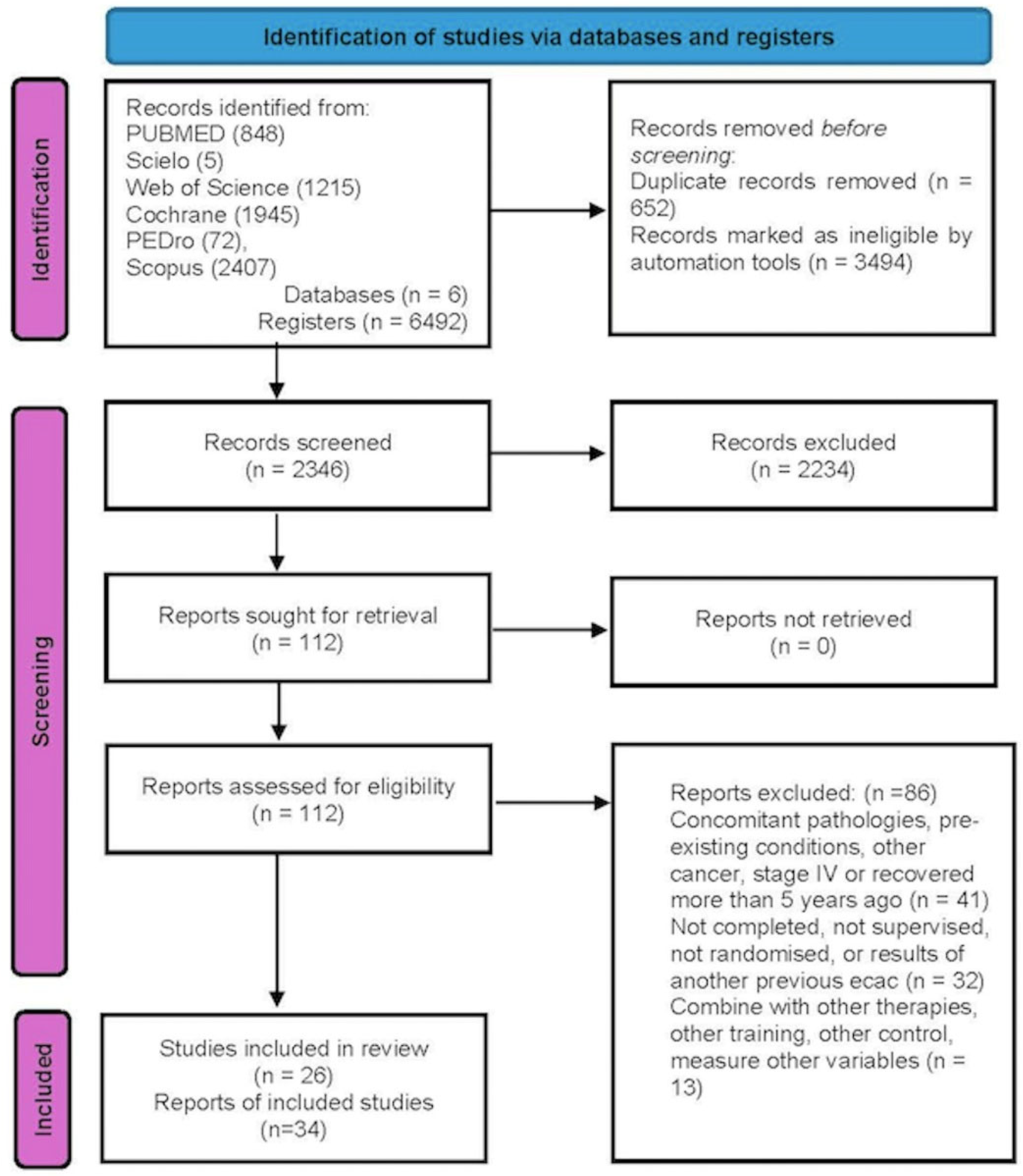
3.1.1. Study Selection
3.1.2. General Characteristics of Included Studies
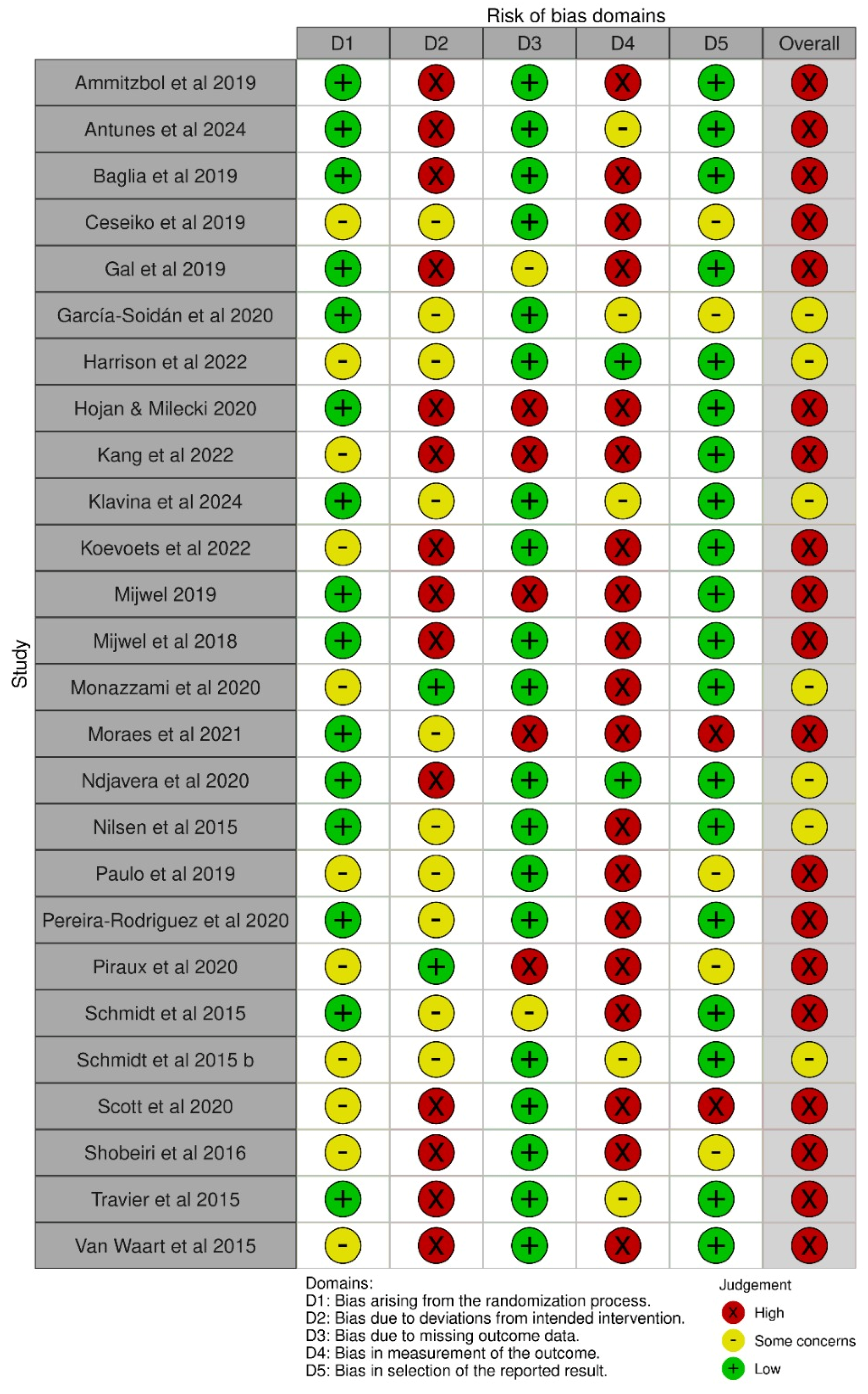
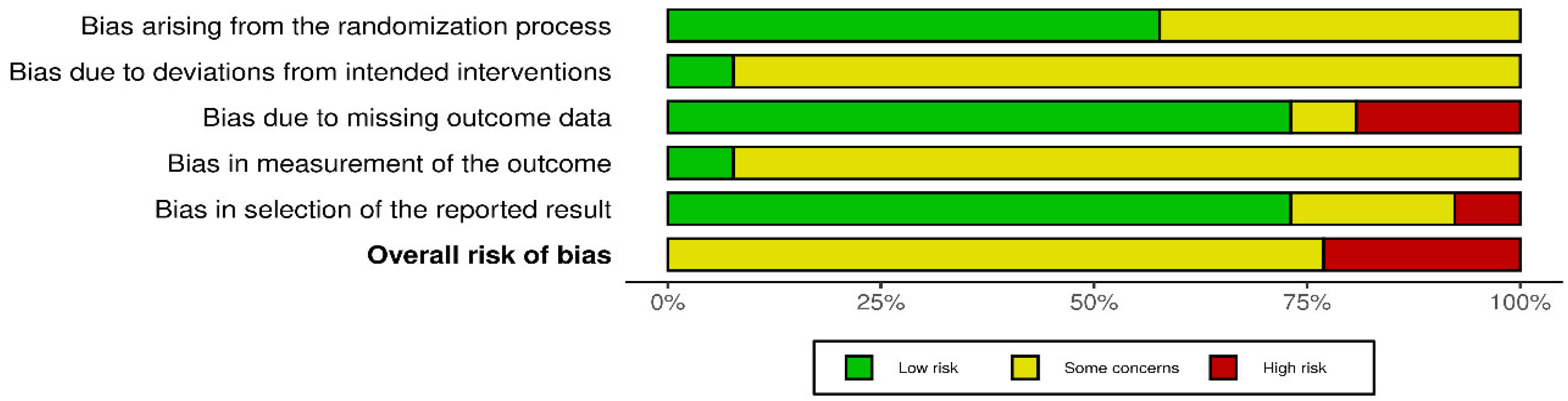
3.1.3. Quality and Risk of Bias Assessment
3.2. Data Synthesis
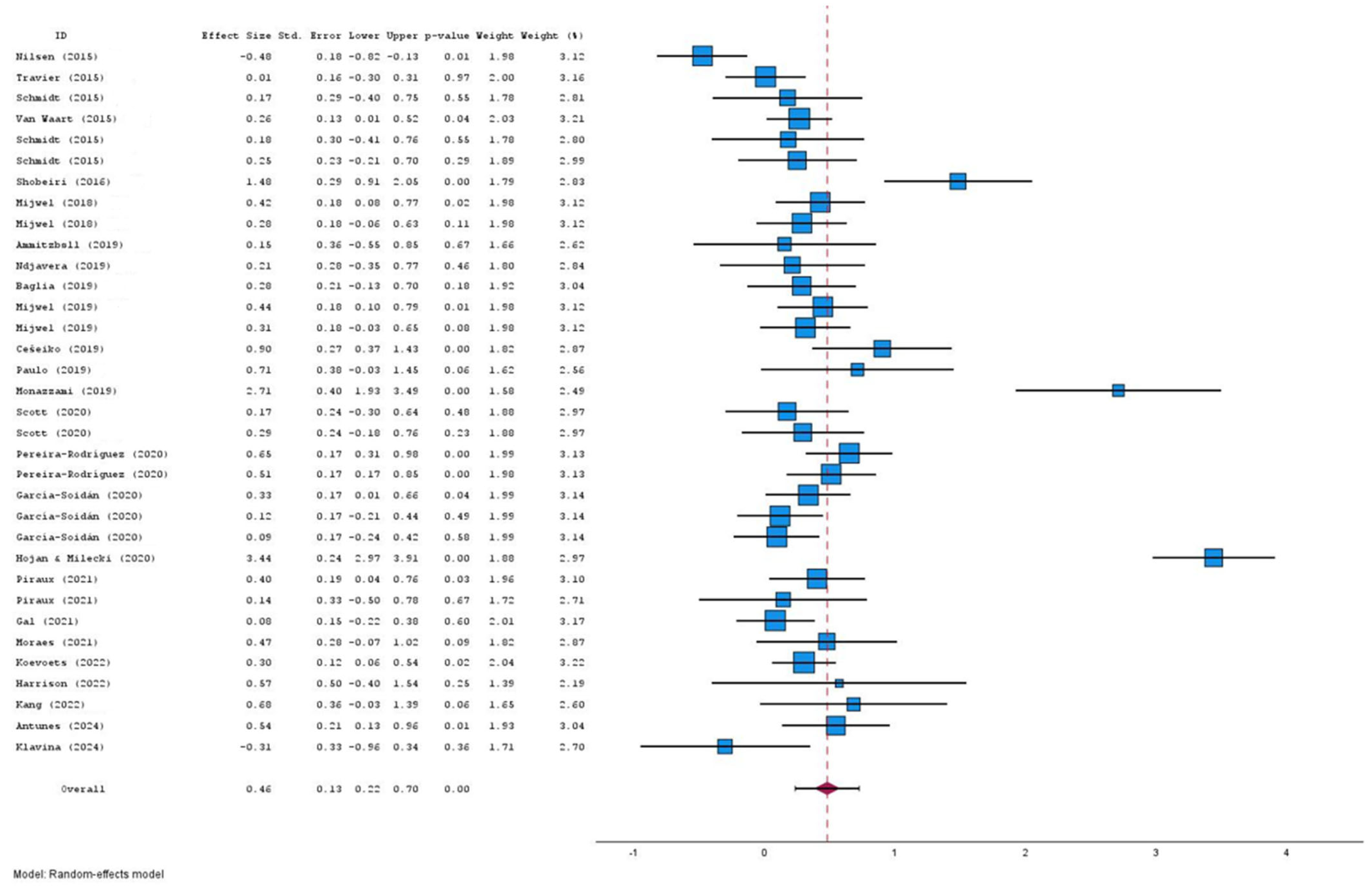
3.2.1. Meta-Analysis
3.2.2. Sensitivity and Subgroup Analysis
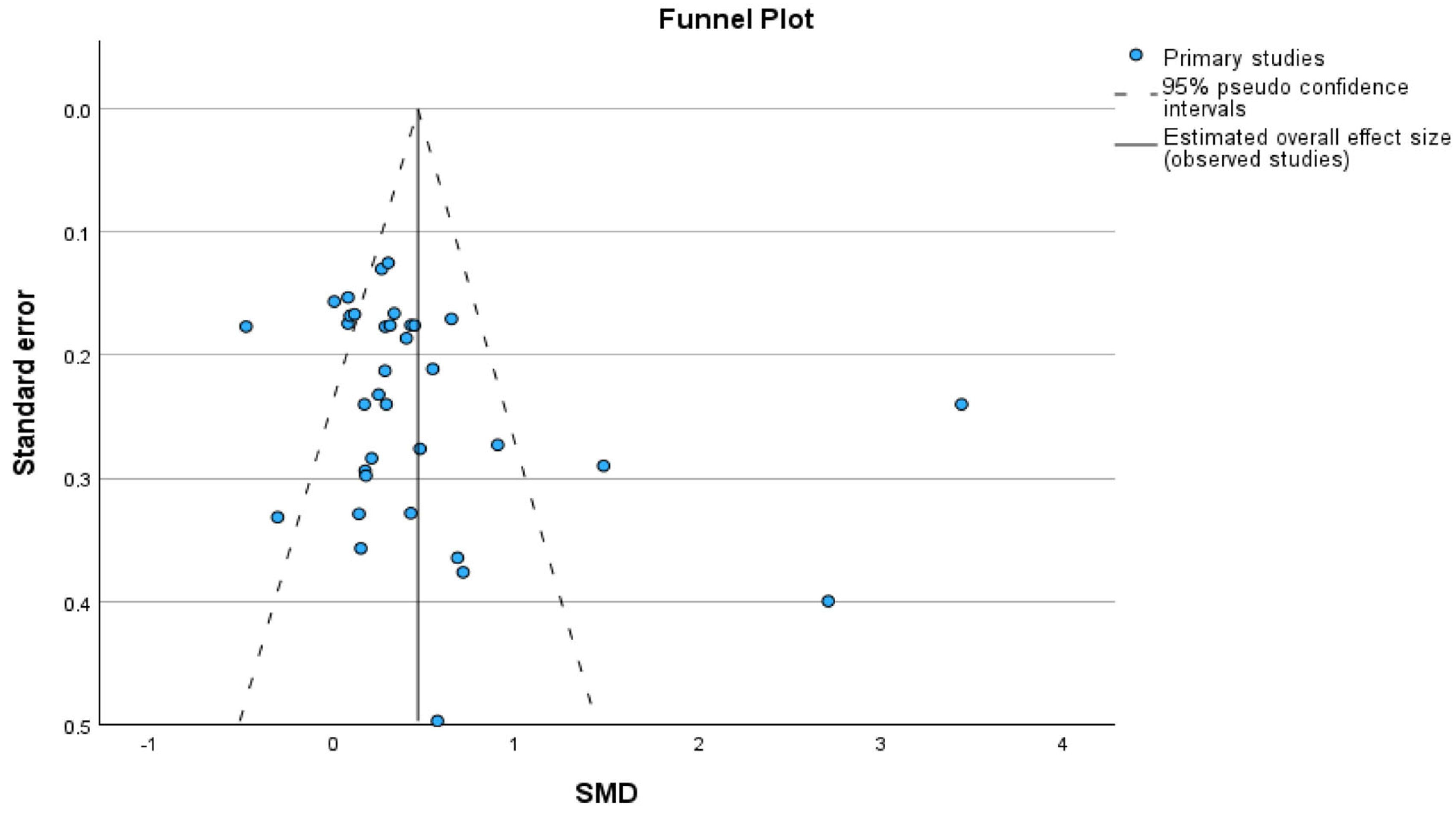
3.2.3. Publication Bias
4. Discussion
5. Conclusions
Author Contributions
Funding
Institutional Review Board Statement
Informed Consent Statement
Data Availability Statement
Conflicts of Interest
Appendix A. PICOS Framework Used to Define the Inclusion and Exclusion Criteria of the Review
| PICOS Category | Inclusion Criteria | Exclusion Criteria |
|
P (Population) | Patients diagnosed with stage I-III breast or prostate cancer who began the training program no later than 5 years after completing treatment. | Patients with stage IV or metastatic disease, with concomitant pathologies or pre-existing conditions, or who have another type of cancer or completed treatment more than 5 years ago. |
| I (Intervention) | Supervised therapeutic exercise program that included modalities such as strength training, cardiorespiratory training, HIIT, stretching, or a combination of these. | Usual care, unsupervised training, or supervised training combined with some other type of intervention not specifically targeted at cancer. |
| C (Comparators) | Regular care or unsupervised training | Control groups that received other types of training |
| O (Outcomes) | Studies reporting cancer-specific quality of life (QoL) outcomes assessed using validated instruments (e.g., EORTC QLQ-C30, FACT-G, or similar). | Studies measuring other primary variables other than QoL, incomplete results |
| S (Study Design) | Randomized Controlled Trials (RCTs) with a control group. Published between January 2014 and December 2024 (last 10 years). | Systematic reviews. Studies that are not RCTs (e.g., pilot studies, single-arm trials, non-randomized or non-controlled trials, retrospective or cross-sectional studies) |
Appendix B. The Included Studies
| Author/ Year | Country | Cancer Type | Sample Size | Age (SD) | Sex | Intervention Characteristics | Duration of Intervention | Measure Tool | Results |
| Schmidt et al. 2015 [33] | Germany | Breast | IG: 49 CG: 46 | IG: 52.2 (9.9) CG: 53.3 (10.2) | W | IG: RT CG: active structured controls (relaxation) | 12 weeks 2 days/week | EORTC QLQ-C30 | IG Pre: 61.5 ± 17.5 Post: 61.7 ± 18.3 CG Pre: 59.4 ± 16.6 Post: 54.9 ± 22.9 |
| Schmidt et al. 2015 [79] | Germany | Breast | GRT: 21 GET: 20 CG: 26 | RT: 53 (12.55) ET: 56 (10.15) CG: 54 (11.19) | W | RT: RT ET: AT CG: Passive Usual Care (no exercise/maintain habitual activity/no specific advice) | 12 weeks 2 days/week | EORTC QLQ-C30 | GRT Pre: 24.8 ± 14.0 Post: 31.3 ± 18.0 GET Pre: 30.4 ± 18.2 Post: 36.7 ± 17.8 CG Pre: 31.1 ± 19.7 Post: 31.0 ± 15.3 |
| Travier et al. 2015 [34] | Netherlands | Breast | IG: 102 CG: 102 | IG: 49.7 (8.2) CG: 49.5 (7.9) | W | IG: Combined CG: Passive Usual Care (no exercise/maintain habitual activity/no specific advice) | 18 weeks 2 days/week | EORTC QLQ-C30 SF-36 | IG Pre: 74.8 ± 20.4 Δ change IC95% −4.5 [−8.4 to −0.3] CG Pre: 72.5 ± 19.4 Δ change IC95% −4. [−8.8 to −0.3] |
| Van Waart et al. 2015 [35] | Netherlands | Breast | IG: 76 CG: 77 | IG: 49.9 (8.4) CG: 51.6 (8.8) | W | CI: Combined CG: Passive Usual Care (no exercise/maintain habitual activity/no specific advice) | 20 weeks 2 days/week | EORTC QLQ-C30 | IG Pre: 89.4 ± 10.2 Post: 80.3 ± 14.1 CG Pre:84.8 ± 13.8 Post: 68.1 ± 17.6 |
| Mijwel et al. 2018 [73] | Sweden | Breast | GRT/HIIT: 74 GAT/HIIT: 72 CG: 60 | RT/HIIT: 52.7 (10.3) AT/HIIT: 54.4 (10.3) CG: 52.6 (10.2) | W | GRT/HIIT + RT GAT/HIIT + AT CG: Usual Care with General Recommendations (ACSM, WHO, healthy lifestyle advice) | 16 weeks 2 days/week | EORTC QLQ-C30 | GRT/HIIT Pre: 63.56 ± 24.97 Post: 63.68 ± 19.11 GAT/HIIT Pre: 66.67 ± 20.90 Post: 63.48 ± 19.06 CG Pre: 68.84 ± 21.66 Post: 59.91 ± 19.03 |
| Ammitzbøllet al. 2019 [38] | Denmark | Breast | IG: 82 CG: 76 | IG: 53 (33–73) CG: 52 (30–74) | W | IG: RT CG: Passive Usual Care (no exercise/maintain habitual activity/no specific advice) | 20 weeks 2 days/week | EORTC QLQ-C30 | IG Δ change IC95% 1.5 (5.5; 8.5) CG Δ changeIC95% 0.00 Reference |
| Baglia et al. 2019 [64] | USA | Breast | IG: 61 CG: 60 | IG: 61.2 (7.09 CG: 62.0 (7.0) | W | IG: RT + AT CG: Passive Usual Care (no exercise/maintain habitual activity/no specific advice) | 52 weeks 2 days/week | FACT-B | IG Pre: 102.2 ± 18.07 Δ change IC95% + 10.2 (6.7 to13.6) CG Pre: 100.2 ± 18.7 Δ change IC95% + 2.0 (1.8 to 5.7) |
| Mijwel et al. 2019 [36] | Sweden | Breast | GRT/HIIT: 74 GAT/HIIT: 72 CG: 60 | GRT/HIIT: 52.7 (10.3) GAT/HIIT: 54.4 (10.3) CG: 52.6 (10.2) | W | RT: HIIT + RT AT HIIT: HIIT + AT CG: Usual Care with General Recommendations (ACSM, WHO, healthy lifestyle advice) | 16 weeks 2 days/week | EORTC QLQ-C30 | GRT/HIIT Pre: 63.56 ± 24.97 Post: 63.85 ± 19.88 GAT/HIIT Pre: 66.67 ± 20.90 Post: 63.75 ± 20.29 CG Pre: 68.84 ± 21.66 Post: 59.52 ± 19.62 |
| Ndjavera et al. 2020 [37] | UK | Prostate | IG: 24 CG: 26 ITT | IG: 71.4 (5.4) CG: 72.5 (4.2) | M | IG: Combined CG: Passive Usual Care (no exercise/maintain habitual activity/no specific advice) | 12 weeks 2 days/week | FACT-P | IG Pre: 119.0 ± 19.0 Post: 123.0 ± 22.0 CG Pre: 123.0 ± 16.0 Post: 123.0 ± 19.0 |
| Pereira-Rodríguez et al. 2020 [77] | Mexico | Breast | GMICT: 80 GHIIT: 70 CG: 66 | MICT: 51 (4) HIIT: 55 (5) CG: 53 (7) | W | MICT: Combined HIIT: HIIT + RT CG: Usual Care with General Recommendations (ACSM, WHO, healthy lifestyle advice) | 36 weeks 3 days/week | EORTC QLQ-C30 | GMICT Pre: 60.7 ± 16.7 Post: 68.7 ± 13.6 GHIIT Pre: 58.6 ± 17.0 Post: 125 ± 11.8 CG Pre: 64.5 ± 12.96 Post: 63.3 ± 13.4 |
| Piraux et al. 2020 [78] | Belgium | Prostate | GHIIT: 24 GRES: 24 CG: 24 | HIIT: 67.4 (8.9) RES: 67.9 (7.1) CG: 71.9 (8.1) | M | HIIT: HIIT RT: RT CG: Usual Care with General Recommendations (ACSM, WHO, healthy lifestyle advice) | 5–8 weeks 3 days/week | FACT-G | GHIIT Pre 86.0 [78.2; 91.0] Post: 89.0 [78.5; 92.5] GRES Pre: 83.5 [75.5; 91.8] Post: 82.5 [72.3; 93.9] CG Pre: 79.3 [73.3; 83,3] Post: 77.9 [67.5; 85.4] |
| Scott et al. 2020 [80] | USA | Breast | GLET: 58 GNLET:59 CG:57 | LET: 58 (9) NLET: 59 (9) CG: 58 (9) | W | LET: AT NLET: AT + HIIT CG: active structured controls (Stretching) | 16 weeks 3–4 days/week | FACT-B | GLET Pre: 104.8 ± 17.2 Post: 107.8 ± 20.7 GNLET Pre: 111.6 ± 14.1 Post: 116.7 ± 14.0 CG Pre: 107.6 ± 16.3 Post: 108.9 ± 16.2 |
| Gal et al. 2021 [66] | Netherlands | Breast | IG: 68 CG: 114 | IG: 58.0 (9.8) CG: 58.3 (9.5) | W | IG: Combined CG: Passive Usual Care (no exercise/maintain habitual activity/no specific advice) | 12 weeks 2 days/week | EORTC QLQ-C30 | IG Δ change IC95% 0.8 (−1.4 to 3.0) CG Δ change IC95% 0.00 Reference |
| Moraes et al. 2021 [75] | Brazil | Breast | IG: 13 CG: 13 | IG: 55.0 (5.8) CG: 54.3 (5.2) | W | IG: RT CG: Passive Usual Care (no exercise/maintain habitual activity/no specific advice) | 8 weeks 1 day/week | EORTC QLQ-C30 | IG Pre: 54.6 ± 27.2 Post: 76.81 ± 22.5 CG Pre: 58.5 ± 28.9 Post: 59.85 ± 30.0 |
| Harrison et al. 2022 [68] | USA | Prostate | IG: 13 CG: 13 | IG: 65.7 (8.1) CG: 64.4 (8.3) | M | IG: Combined CG: Passive Usual Care (no exercise/maintain habitual activity/no specific advice) | 16 weeks 3 days/week | FACT-P | IG vs. CC Δ change IC95% +5.7 [−4.0 to 15.5] |
| Kang et al. 2022 [70] | Canada | Prostate | IG: 26 CG: 26 | 63.4 (7.1) | M | IG: HIIT CG: Passive Usual Care (no exercise/maintain habitual activity/no specific advice) | 12 weeks 3 days/week | EORTC QLQ-C30 | IG Pre: 76.7 ± 13.4 Post: 80.7 ± 13.5 CG Pre: 74.7 ± 14.9 Post: 74.3 ± 16.7 |
| Koevoets et al. 2022 [72] | Netherlands | Breast | IG: 91 CG: 90 | IG: 52.1 (8.6) CG: 52.5 (8.7) | W | IG: Combined CG: Passive Usual Care (no exercise/maintain habitual activity/no specific advice) | 6 months 4 days/week | EORTC QLQ-C30 | IG vs. CC Δ change IC95% 3.96 [1.21 to 6.71] |
| Antunes et al. 2024 [30] | Portugal | Breast | IG: 47 CG: 46 | IG: 49.66 (9.43) CG: 51.02 (9.54) | W | IG: Combined. CG: Passive Usual Care (no exercise/maintain habitual activity/no specific advice) | 20–24 weeks 3 days/week | EORTC QLQ-C30 EORTC QLQ-BR23 | IG Pre: 85.66 ± 9.15 Post: 82.78 ± 10.65 CG Pre: 87.64 ± 8.52 Post: 76.96 ± 13.98 |
| Cešeiko et al. 2019 [65] | Latvia | Breast | IG: 27 CG: 28 | IG: 48.2 (6.7) CG: 49.0 (8.0) | W | IG: RT CG: Usual Care with weekly phone call/maintain activity | 12 weeks 2 days/week | EORTC QLQ-C30 EORTC QLQ-BR23 | IG Pre: 67.2 ± 15.6 Post: 76.2 ± 14.3 CG Pre: 66.3 ± 16.5 Post: 63.5 ± 14.7 |
| García-Soidán et al. 2015 [67] | Spain | Breast | RTG: 79 AG: 79 ATG: 79 CG: 79 | RTG: 63 (7) AG: 62 (6.8) ATG: 64 (7.1) CG: 63 (4.6) | W | IG: RT IAG: Aquagym IG: AT CG: Passive Usual Care (no exercise/maintain habitual activity/no specific advice) | 2 years (45 weeks/year) 2 days/week | SF-12 | GRT Pre: 45.6 ± 4.2 Post: 47.5 ± 7.8 GIAG Pre: 45.1 ± 4.1 Post: 47.8 ± 7.0 GAT Pre: 44.8 ± 3.8 Post: 47.3 ± 8.5 CG Pre: 43.8 ± 4.5 Post: 46.9 ± 7.4 |
| Klavina et al. 2024 [71] | Latvia | Breast | IG: 17 CG: 20 | IG: 48.56 (7.84) CG: 48.53 (8.21) | W | IG: HIIT CG: Passive Usual Care (no exercise/maintain habitual activity/no specific advice) | 6 months 2–3 days/week | EORTC QLQ-C30 EORTC QLQ-BR23 | GHIIT Pre: 69.6 ± 16.9 Post: 64.67 ± 22.2 CG Pre: 66.9 ± 24.58 Post: 68.51 ± 20.67 |
| Monazzami et al. 2020 [74] | Iran | Breast | IG: 22 CG: 20 | IG: >30 CG: >30 | W | IG: Combined CG: Passive Usual Care (no exercise/maintain habitual activity/no specific advice) | 8 weeks 3 days/week | MQOL | IG Pre: 4.52 ± 0.89 Post: 7.52 ± 0.67 CG Pre: 4.94 ± 0.53 Post: 5.23 ± 0.55 |
| Nilsen et al. 2015 [39] | Norway | Prostate | IG: 30 CG: 28 | IG: 66 (6.6) CG: 66 (5) | M | IG: RT CG: Passive Usual Care (no exercise/maintain habitual activity/no specific advice) | 16 weeks 3 days/week | EORTC QLQ-C30 | IG Pre: 76.5 ± 17.3 Post: 79.6 ± 17.0 CG Pre: 66.7 ± 19.6 Post: 78.9 ± 20.7 |
| Paulo et al. 2019 [76] | Brazil | Breast | IG: 18 CG: 18 | IG: 63.2 (7.1) CG: 66.6 (9.6) | W | IG: Combined CG: active structured controls (Stretching) | 9 months 3 days/week a | EORTC QLQ-C30 EORTC QLQ-BR23 | IG Pre: 70.6 ± 14.1 Post: 84.4 ± 9.8 CG Pre: 66.6 ± 15.2 Post: 73.8 ± 11.1 |
| Shobeiri et al. 2016 [41] | Iran | Breast | IG: 27 CG: 26 | IG: 42.70 (9.60) CG: 43.50 (8.60) | W | IG: AT CG: Passive Usual Care (no exercise/maintain habitual activity/no specific advice) | 10 weeks 2 days/week | EORTC QLQ-C30 EORTC QLQ-BR23 | IG Pre: 48.76 ± 24.96 Post: 81.79 ± 16.34 CG Pre: 47.75 ± 15.73 Post: 52.88 ± 14.51 |
| Hojan & Milecki 2020 [69] | Poland | Prostate | IG: 36 CG: 36 | IG: 65.7 (6.2) CG: 67.9 (4.9) | M | IG: Combined CG: Passive Usual Care (no exercise/maintain habitual activity/no specific advice) | 8 weeks 5 days/week | FACT-G | IG Pre: 70.7 ± 2.1 Post: 73.3 ± 6.3 CG Pre: 70.2 ± 1.9 Post: 55.3 ± 3.9 |
| IG: intervention group. CG: control group. EORTC QLQ-C30 = European Organisation for Research and Treatment of Cancer Quality-of-Life Questionary Core 30. SF-36 = Short Form 36. FACT-B = Functional Assessment of Cancer Therapy—Breast. FACT-P = Functional Assessment of Cancer Therapy—Prostate. FACT-G = Functional Assessment of Cancer Therapy—General. EORTC QLQ-BR23 = European Organisation for Research and Treatment of Cancer Quality of Life Questionnaire Breast Cancer. SF-12 = Short Form-12. MQOL = McGill Quality of Life Questionnaire. RT = resistance training. AT = aerobic training. HIIT = High-intensity Interval training. MICT = Moderate-Intensity Continuous Training. ET = Endurance Training. LET = Linear Exercise Therapy. NLET = Non-Linear Exer. | |||||||||
Appendix C. Timing of Exercise Interventions in Breast and Prostate Cancer Studies
| Study | Cancer Type | Intervention Timing | During Tx | Post-Tx < 6 m | Post-Tx 6–12 m | Post-Tx 12–24 m | Post-Tx >24 m |
| Schmidt et al. 2015 [33] | Breast | During chemotherapy | ✔ | ||||
| Schmidt et al. 2015 [79] | Breast | During chemotherapy | ✔ | ||||
| Travier et al. 2015 [34] | Breast | During chemotherapy | ✔ | ||||
| Van Waart et al. 2015 [35] | Breast | During chemotherapy | ✔ | ||||
| Mijwel et al. 2018 [73] | Breast | During chemotherapy | ✔ | ||||
| Ammitzbøllet al. 2019 [38] | Breast | Post cx | ✔ | ||||
| Baglia et al. 2019 [64] | Breast | Post-cx During hormonal treatment | ✔ | ||||
| Mijwel et al. 2019 [36] | Breast | Post cx During chemotherapy | ✔ | ||||
| Hojan &Milecki 2020 [69] | Prostate | During radiotherapy and ADT treatment | ✔ | ||||
| Ndjavera et al. 2020 [37] | Prostate | During ADT treatment | ✔ | ||||
| Pereira-Rodríguez et al. 2020 [77] | Breast | During or after oncologic treatment (timing not specified; treatment not interrupted) | ✔ | ||||
| Piraux et al. 2020 [78] | Prostate | During radiotherapy | ✔ | ||||
| Scott et al. 2020 [80] | Breast | Post-treatment | ✔ | ||||
| Gal et al. 2021 [66] | Breast | Post-treatment Possibly concomitant with hormonal therapy | ✔ | ||||
| Moraes et al. 2021 [75] | Breast | Post-treatment Possibly concomitant with hormonal therapy | ✔ | ||||
| Harrison et al. 2022 [68] | Prostate | 4 weeks prior to ADT + enzalutamide, continuing during treatment | ✔ | ||||
| Kang et al. 2022 [70] | Prostate | Active surveillance | ✔ | ||||
| Antunes et al. 2024 [30] | Breast | During chemotherapy | ✔ | ||||
| Cešeiko et al. 2019 [65] | Breast | During chemotherapy | ✔ | ||||
| García-Soidán et al. 2015 [67] | Breast | Post-treatment | ✔ | ||||
| Klavina et al. 2024 [71] | Breast | During chemotherapy | ✔ | ||||
| Monazzami et al. 2020 [74] | Breast | During hormonal treatment | ✔ | ||||
| Nilsen et al. 2015 [39] | Prostate | During ADT treatment | ✔ | ||||
| Paulo et al. 2019 [76] | Breast | During hormonal treatment | ✔ | ||||
| Shobeiri et al. 2016 [41] | Breast | Post non-hormonal treatment; possibly concomitant with hormonal therapy | ✔ | ||||
| Note: The “✔” symbol indicates compliance with the corresponding feature. | |||||||
References
- Bray, F.; Ferlay, J.; Soerjomataram, I.; Siegel, R.L.; Torre, L.A.; Jemal, A. Global cancer statistics 2018: GLOBOCAN estimates of incidence and mortality worldwide for 36 cancers in 185 countries. CA Cancer J. Clin. 2018, 68, 394–424, Erratum in CA Cancer J. Clin. 2020, 70, 313. [Google Scholar] [CrossRef] [PubMed]
- Bray, F.; Laversanne, M.; Sung, H.; Ferlay, J.; Siegel, R.L.; Soerjomataram, I.; Jemal, A. Global cancer statistics 2022: GLOBOCAN estimates of incidence and mortality worldwide for 36 cancers in 185 countries. CA Cancer J. Clin. 2024, 74, 229–263. [Google Scholar] [CrossRef] [PubMed]
- Tan, K.; Naylor, M.J. The Influence of Modifiable Factors on Breast and Prostate Cancer Risk and Disease Progression. Front. Physiol. 2022, 13, 840826. [Google Scholar] [CrossRef] [PubMed]
- Zhao, X.; Liu, S.; Zou, Z.; Liang, C. Global, regional, and national prevalence of prostate cancer from 1990 to 2021: A trend and health inequality analyses. Front. Public Health 2025, 13, 1595159. [Google Scholar] [CrossRef]
- Schafer, E.J.; Laversanne, M.; Sung, H.; Soerjomataram, I.; Briganti, A.; Dahut, W.; Bray, F.; Jemal, A. Recent Patterns and Trends in Global Prostate Cancer Incidence and Mortality: An Update. Eur. Urol. 2025, 87, 302–313. [Google Scholar] [CrossRef]
- Schaeffer, E.M.; Srinivas, S.; Adra, N.; An, Y.; Barocas, D.; Bitting, R.; Bryce, A.; Chapin, B.; Cheng, H.H.; D’Amico, A.V.; et al. Prostate Cancer. J. Natl. Compr. Cancer Netw. 2023, 21, 1067–1096. [Google Scholar] [CrossRef]
- Pishgar, F.; Ebrahimi, H.; Saeedi Moghaddam, S.; Fitzmaurice, C.; Amini, E. Global, Regional and National Burden of Prostate Cancer, 1990 to 2015: Results from the Global Burden of Disease Study 2015. J. Urol. 2018, 199, 1224–1232. [Google Scholar] [CrossRef]
- Zhai, Z.; Zheng, Y.; Li, N.; Deng, Y.; Zhou, L.; Tian, T.; Yang, S.; Hao, Q.; Song, D.; Wu, Y.; et al. Incidence and disease burden of prostate cancer from 1990 to 2017: Results from the Global Burden of Disease Study 2017. Cancer 2020, 126, 1969–1978. [Google Scholar] [CrossRef]
- Clinton, S.K.; Giovannucci, E.L.; Hursting, S.D. The World Cancer Research Fund/American Institute for Cancer Research Third Expert Report on Diet, Nutrition, Physical Activity, and Cancer: Impact and Future Directions. J. Nutr. 2020, 150, 663–671. [Google Scholar] [CrossRef]
- Solin, L.J. Breast Conservation Treatment With Radiation: An Ongoing Success Story. J. Clin. Oncol. 2010, 28, 709–711. [Google Scholar] [CrossRef]
- Waks, A.G.; Winer, E.P. Breast Cancer Treatment: A Review. JAMA 2019, 321, 288–300. [Google Scholar] [CrossRef] [PubMed]
- Harbeck, N.; Gnant, M. Breast cancer. Lancet 2017, 389, 1134–1150. [Google Scholar] [CrossRef] [PubMed]
- Nigdelis, M.P.; Karamouzis, M.V.; Kontos, M.; Alexandrou, A.; Goulis, D.G.; Lambrinoudaki, I. Updates on the treatment of invasive breast cancer: Quo Vadimus? Maturitas 2021, 145, 64–72. [Google Scholar] [CrossRef] [PubMed]
- Chakrabarti, D.; Albertsen, P.; Adkins, A.; Kishan, A.; Murthy, V.; Parker, C.; Pathmanathan, A.; Reid, A.; Sartor, O.; Van As, N.; et al. The contemporary management of prostate cancer. CA Cancer J. Clin. 2025, 75, 552–586. [Google Scholar] [CrossRef]
- Evans, A.J. Treatment effects in prostate cancer. Mod. Pathology 2018, 31, 110–121. [Google Scholar] [CrossRef]
- Gogola, S.; Rejzer, M.; Bahmad, H.F.; Alloush, F.; Omarzai, Y.; Poppiti, R. Anti-Cancer Stem-Cell-Targeted Therapies in Prostate Cancer. Cancers 2023, 15, 1621. [Google Scholar] [CrossRef]
- Sekhoacha, M.; Riet, K.; Motloung, P.; Gumenku, L.; Adegoke, A.; Mashele, S. Prostate Cancer Review: Genetics, Diagnosis, Treatment Options, and Alternative Approaches. Molecules 2022, 27, 5730. [Google Scholar] [CrossRef]
- Edmunds, K.; Tuffaha, H.; Galvão, D.A.; Scuffham, P.; Newton, R.U. Incidence of the adverse effects of androgen deprivation therapy for prostate cancer: A systematic literature review. Support. Care Cancer 2020, 28, 2079–2093. [Google Scholar] [CrossRef]
- Takahashi, S. Management of cancer treatment-induced bone loss (CTIBL) in patients with breast cancer or prostate cancer. J. Bone Miner. Metab. 2023, 41, 307–316. [Google Scholar] [CrossRef]
- Michaelson, M.D.; Cotter, S.E.; Gargollo, P.C.; Zietman, A.L.; Dahl, D.M.; Smith, M.R. Management of Complications of Prostate Cancer Treatment. CA Cancer J. Clin. 2008, 58, 196–213. [Google Scholar] [CrossRef]
- Van Vulpen, J.K.; Sweegers, M.G.; Peeters, P.H.M.; Courneya, K.S.; Newton, R.U.; Aaronson, N.K.; Jacobsen, P.; Galvão, D.A.; Chinapaw, M.J.; Steindorf, K.; et al. Moderators of Exercise Effects on Cancer-related Fatigue: A Meta-analysis of Individual Patient Data. Med. Sci. Sports Exerc. 2020, 52, 303–314. [Google Scholar] [CrossRef]
- Malhotra, A.; Fransen, H.P.; Quaresma, M.; Raijmakers, N.; Versluis, M.A.J.; Rachet, B.; van Maaren, M.C.; Leyrat, C. Associations between treatments, comorbidities and multidimensional aspects of quality of life among patients with advanced cancer in the Netherlands—A 2017–2020 multicentre cross-sectional study. Qual. Life Res. 2023, 32, 3123–3133. [Google Scholar] [CrossRef] [PubMed]
- Ferreira, A.R.; Di Meglio, A.; Pistilli, B.; Gbenou, A.S.; El-Mouhebb, M.; Dauchy, S.; Charles, C.; Joly, F.; Everhard, S.; Lambertini, M.; et al. Differential impact of endocrine therapy and chemotherapy on quality of life of breast cancer survivors: A prospective patient-reported outcomes analysis. Ann. Oncol. 2019, 30, 1784–1795. [Google Scholar] [CrossRef] [PubMed]
- Fuzissaki, M.A.; Paiva, C.E.; Oliveira, M.A.; Lajolo Canto, P.P.; Paiva Maia, Y.C. The Impact of Radiodermatitis on Breast Cancer Patients’ Quality of Life During Radiotherapy: A Prospective Cohort Study. J. Pain. Symptom Manag. 2019, 58, 92–99.e1. [Google Scholar] [CrossRef] [PubMed]
- Nikitas, J.; Jamshidian, P.; Tree, A.C.; Hall, E.; Dearnaley, D.; Michalski, J.M.; Lee, W.R.; Nguyen, P.L.; Sandler, H.M.; Catton, C.N.; et al. The interplay between acute and late toxicity among patients receiving prostate radiotherapy: An individual patient data meta-analysis of six randomised trials. Lancet Oncol. 2025, 26, 378–386. [Google Scholar] [CrossRef]
- Duncan, M.; Moschopoulou, E.; Herrington, E.; Deane, J.; Roylance, R.; Jones, L.; Bourke, L.; Morgan, A.; Chalder, T.; Thaha, M.A.; et al. Review of systematic reviews of non-pharmacological interventions to improve quality of life in cancer survivors. BMJ Open 2017, 7, e015860. [Google Scholar] [CrossRef]
- Man, K.H.; Law, H.K.W.; Tam, S.Y. Psychosocial needs of post-radiotherapy cancer survivors and their direct caregivers—A systematic review. Front. Oncol. 2023, 13, 1246844. [Google Scholar] [CrossRef]
- Qu, H.M.; Zhong, H.Y.; Xiao, T.; Li, Y.J.; Ren, P.; Chen, X.J. Perceived control, self-management efficacy, and quality of life in patients treated with radiation therapy for breast cancer: A longitudinal study. Support. Care Cancer 2024, 32, 284. [Google Scholar] [CrossRef]
- Gerritsen, J.K.W.; Vincent, A.J.P.E. Exercise improves quality of life in patients with cancer: A systematic review and meta-analysis of randomised controlled trials. Br. J. Sports Med. 2016, 50, 796–803. [Google Scholar] [CrossRef]
- Antunes, P.; Joaquim, A.; Sampaio, F.; Nunes, C.; Ascensão, A.; Vilela, E.; Teixeira, M.; Oliveira, J.; Capela, A.; Amarelo, A.; et al. Exercise Training Benefits Health-Related Quality of Life and Functional Capacity during Breast Cancer Chemotherapy: A Randomized Controlled Trial. Med. Sci. Sports Exerc. 2024, 56, 600–611. [Google Scholar] [CrossRef]
- Ramírez-Vélez, R.; Zambom-Ferraresi, F.; García-Hermoso, A.; Kievisiene, J.; Rauckiene-Michealsson, A.; Agostinis-Sobrinho, C. Evidence-based exercise recommendations to improve mental wellbeing in women with breast cancer during active treatment: A systematic review and meta-analysis. Cancers 2021, 13, 264. [Google Scholar] [CrossRef] [PubMed]
- Schmidt, M.E.; Wiskemann, J.; Armbrust, P.; Schneeweiss, A.; Ulrich, C.M.; Steindorf, K. Effects of resistance exercise on fatigue and quality of life in breast cancer patients undergoing adjuvant chemotherapy: A randomized controlled trial. Int. J. Cancer 2015, 137, 471–480. [Google Scholar] [CrossRef] [PubMed]
- Schmidt, M.E.; Wiskemann, J.; Steindorf, K. Quality of life, problems, and needs of disease-free breast cancer survivors 5 years after diagnosis. Qual. Life Res. 2018, 27, 2077–2086. [Google Scholar] [CrossRef]
- Travier, N.; Velthuis, M.J.; Steins Bisschop, C.N.; van den Buijs, B.; Monninkhof, E.M.; Backx, F.; Los, M.; Erdkamp, F.; Bloemendal, H.J.; Rodenhuis, C.; et al. Effects of an 18-week exercise programme started early during breast cancer treatment: A randomised controlled trial. BMC Med. 2015, 13, 121. [Google Scholar] [CrossRef] [PubMed]
- Van Waart, H.; Stuiver, M.M.; Van Harten, W.H.; Geleijn, E.; Kieffer, J.M.; Buffart, L.M.; de Maaker-Berkhof, M.; Boven, E.; Schrama, J.; Geenen, M.M.; et al. Effect of low-intensity physical activity and moderate- to high-intensity physical exercise during adjuvant chemotherapy on physical fitness, fatigue, and chemotherapy completion rates: Results of the PACES randomized clinical trial. J. Clin. Oncol. 2015, 33, 1918–1927. [Google Scholar] [CrossRef]
- Mijwel, S.; Jervaeus, A.; Bolam, K.A.; Norrbom, J.; Bergh, J.; Rundqvist, H.; Wengström, Y. High-intensity exercise during chemotherapy induces beneficial effects 12 months into breast cancer survivorship. J. Cancer Surviv. 2019, 13, 244–256. [Google Scholar] [CrossRef]
- Ndjavera, W.; Orange, S.T.; O’Doherty, A.F.; Leicht, A.S.; Rochester, M.; Mills, R.; Saxton, J.M. Exercise-induced attenuation of treatment side-effects in patients with newly diagnosed prostate cancer beginning androgen-deprivation therapy: A randomised controlled trial. BJU Int. 2020, 125, 28–37. [Google Scholar] [CrossRef]
- Ammitzbøll, G.; Kjær, T.K.; Johansen, C.; Lanng, C.; Wreford Andersen, E.; Kroman, N.; Zerahn, B.; Hyldegaard, O.; EnvoldBidstrup, P.; Oksbjerg Dalton, S. Effect of progressive resistance training on health-related quality of life in the first year after breast cancer surgery–results from a randomized controlled trial. Acta Oncol. 2019, 58, 665–672. [Google Scholar] [CrossRef]
- Nilsen, T.S.; Raastad, T.; Skovlund, E.; Courneya, K.S.; Langberg, C.W.; Lilleby, W.; Fosså, S.D.; Thorsen, L. Effects of strength training on body composition, physical functioning, and quality of life in prostate cancer patients during androgen deprivation therapy. Acta Oncol. 2015, 54, 1805–1813. [Google Scholar] [CrossRef]
- Cano-Uceda, A.; Pareja-García, P.; Sánchez-Rodríguez, E.; Fraguas-Ramos, D.; Martín-Álvarez, L.; Asencio-Vicente, R.; Rivero-de la Villa, A.; Pérez-Pérez, M.d.M.; Obispo-Portero, B.M.; Morales-Ruiz, L.; et al. Effects of a Short-Term Supervised Exercise Program in Women with Breast Cancer. Appl. Sci. 2024, 14, 6553. [Google Scholar] [CrossRef]
- Shobeiri, F.; Masoumi, Z.; Karami, M.; Nikravesh, A.; Moghadam, H. The Impact of Aerobic Exercise on Quality of Life in Women with Breast Cancer: A Randomized Controlled Trial The Impact of Aerobic Exercise on Quality of Life in Women with Breast Cancer: A Randomized Controlled Trial. J. Res. Health Sci. 2016, 16, 127–132. [Google Scholar]
- Kraemer, M.B.; Priolli, D.G.; Reis, I.G.M.; Pelosi, A.C.; Garbuio, A.L.P.; Messias, L.H.D. Home-based, supervised, and mixed exercise intervention on functional capacity and quality of life of colorectal cancer patients: A meta-analysis. Sci. Rep. 2022, 12, 2471. [Google Scholar] [CrossRef] [PubMed]
- Chen, Y.J.; Li, X.X.; Ma, H.K.; Zhang, X.; Wang, B.W.; Guo, T.T.; Xiao, Y.; Bing, Z.T.; Ge, L.; Yang, K.H.; et al. Exercise Training for Improving Patient-Reported Outcomes in Patients With Advanced-Stage Cancer: A Systematic Review and Meta-Analysis. J. Pain. Symptom Manag. 2020, 59, 734–749.e10. [Google Scholar] [CrossRef] [PubMed]
- Han, B.; Zhang, P.; Zhao, H.; Zhang, X.; Gao, H.; Dong, J.; Zeng, L.; Pi, P.; Pei, J. Effects of exercise interventions on quality of life in patients with breast cancer: A systematic review and network meta-analysis. Psychooncology 2024, 33, e6370. [Google Scholar] [CrossRef] [PubMed]
- de Moura Ferraz Barbosa, M.P.; de Jesus, N.T.; Bergmann, A.; da Silva Alves Gomes, V.M.; Sacomori, C.; Dantas, D. Efficacy of supervised exercise on sleep of women who survived breast cancer: A systematic review with meta-analysis. J. Cancer Surviv. 2024, 19, 1069–1079. [Google Scholar] [CrossRef]
- Sweegers, M.G.; Altenburg, T.M.; Chinapaw, M.J.; Kalter, J.; Verdonck-de Leeuw, I.M.; Courneya, K.S.; Newton, R.; Aaronson, N.K.; Jacobsen, P.B.; Brug, J.; et al. Which exercise prescriptions improve quality of life and physical function in patients with cancer during and following treatment? A systematic review and meta-analysis of randomised controlled trials. Br. J. Sports Med. 2018, 52, 505–513. [Google Scholar] [CrossRef]
- Buffart, L.M.; Kalter, J.; Sweegers, M.G.; Courneya, K.S.; Newton, R.U.; Aaronson, N.K.; Jacobsen, P.B.; May, A.M.; Galvão, D.A.; Chinapaw, M.J.; et al. Effects and moderators of exercise on quality of life and physical function in patients with cancer: An individual patient data meta-analysis of 34 RCTs. Cancer Treat. Rev. 2017, 52, 91–104. [Google Scholar] [CrossRef]
- Lavín-Pérez, A.M.; Collado-Mateo, D.; Mayo, X.; Liguori, G.; Humphreys, L.; Copeland, R.J.; Jiménez, A. Effects of high-intensity training on the quality of life of cancer patients and survivors: A systematic review with meta-analysis. Sci. Rep. 2021, 11, 15089. [Google Scholar] [CrossRef]
- Moher, D.; Liberati, A.; Tetzlaff, J.; Altman, D.G. Preferred reporting items for systematic reviews and meta-analyses: The PRISMA statement. PLos Med. 2009, 339, 332–336. [Google Scholar]
- Higgins, J.P.T.; Thomas, J.; Chandler, J.; Cumpston, M.; Li, T.; Page, M.J.; Welch, V.A. (Eds.) Cochrane Handbook for Systematic Reviews of Interventions; Version 6.5; Cochrane: London, UK, 2024. [Google Scholar]
- Higgins, J.P.T.; Altman, D.G.; Gøtzsche, P.C.; Jüni, P.; Moher, D.; Oxman, A.D.; Savovic, J.; Schulz, K.F.; Weeks, L.; Sterne, J.A.; et al. The Cochrane Collaboration’s tool for assessing risk of bias in randomised trials. BMJ 2011, 343, d5928. [Google Scholar] [CrossRef]
- Sherrington, C.; Herbert, R.D.; Maher, C.G.; Moseley, A.M. PEDro. A database of randomized trials and systematic reviews in physiotherapy. Man. Ther. 2000, 5, 223–226. [Google Scholar] [CrossRef] [PubMed]
- Wilson, D.B. Practical Meta-Analysis Effect Size Calculator. Version 2023.11.27. Available online: https://www.campbellcollaboration.org/calculator (accessed on 5 November 2025).
- MedCalc Software Ltd. MedCalc Sample Size Calculator. Ostend (Belgium): MedCalc Software Ltd. Available online: https://www.medcalc.org/en/calc/sample-size.php (accessed on 5 November 2025).
- Rohatgi, A. WebPlotDigitizer. Version 4.7. Pacifica (CA): Ankit Rohatgi. Available online: https://automeris.io/WebPlotDigitizer/ (accessed on 5 November 2025).
- Sidik, K.; Jonkman, J.N. A simple confidence interval for meta-analysis. Stat. Med. 2002, 21, 3153–3159. [Google Scholar] [CrossRef] [PubMed]
- Higgins, J.P.T. Measuring inconsistency in meta-analyses. BMJ 2003, 327, 557–560. [Google Scholar] [CrossRef] [PubMed]
- Rücker, G.; Schwarzer, G.; Carpenter, J.R.; Schumacher, M. Undue reliance on I 2 in assessing heterogeneity may mislead. BMC Med. Res. Methodol. 2008, 8, 79. [Google Scholar] [CrossRef]
- Patsopoulos, N.A.; Evangelou, E.; Ioannidis, J.P. Sensitivity of between-study heterogeneity in meta-analysis: Proposed metrics and empirical evaluation. Int. J. Epidemiol. 2008, 37, 1148–1157. [Google Scholar] [CrossRef]
- Deeks, J.J.; Higgins, J.P.T.; Altman, D.G.; McKenzie, J.E.; Veroniki, A.A. Chapter 10: Analysing data and undertaking meta-analyses. In Cochrane Handbook for Systematic Reviews of Interventions, Version 6.5; Cochrane: London, UK, 2024. [Google Scholar]
- Thompson, S.G.; Higgins, J.P.T. How should meta-regression analyses be undertaken and interpreted? Stat. Med. 2002, 21, 1559–1573. [Google Scholar] [CrossRef]
- Egger, M.; Smith, G.D.; Schneider, M.; Minder, C. Bias in meta-analysis detected by a simple, graphical test. BMJ 1997, 315, 629–634. [Google Scholar] [CrossRef]
- Duval, S.; Tweedie, R. Trim and Fill: A Simple Funnel-Plot–Based Method of Testing and Adjusting for Publication Bias in Meta-Analysis. Biometrics 2000, 56, 455–463. [Google Scholar] [CrossRef]
- Baglia, M.L.; Lin, I.H.; Cartmel, B.; Sanft, T.; Ligibel, J.; Hershman, D.; Harrigan, M.; Ferrucci, L.M.; Li, F.Y.; Irwin, M.L. Endocrine-related quality of life in a randomized trial of exercise on aromatase inhibitor–induced arthralgias in breast cancer survivors. Cancer 2019, 125, 2262–2271. [Google Scholar] [CrossRef]
- Cešeiko, R.; Eglītis, J.; Srebnijs, A.; Timofejevs, M.; Purmalis, E.; Erts, R.; Vētra, A.; Tomsone, S. The impact of maximal strength training on quality of life among women with breast cancer undergoing treatment. Exp. Oncol. 2019, 41, 166–172. [Google Scholar] [CrossRef]
- Gal, R.; Monninkhof, E.M.; van Gils, C.H.; Groenwold, R.H.H.; Elias, S.G.; van den Bongard, D.H.J.G.; Peeters, P.H.M.; Verkooijen, H.M.; May, A.M. Effects of exercise in breast cancer patients: Implications of the trials within cohorts (TwiCs) design in the UMBRELLA Fit trial. Breast Cancer Res. Treat. 2021, 190, 89–101. [Google Scholar] [CrossRef]
- García-Soidán, J.L.; Pérez-Ribao, I.; Leirós-Rodríguez, R.; Soto-Rodríguez, A. Long-term influence of the practice of physical activity on the self-perceived quality of life of women with breast cancer: A randomized controlled trial. Int. J. Environ. Res. Public. Health 2020, 17, 4986. [Google Scholar] [CrossRef] [PubMed]
- Harrison, M.R.; Davis, P.G.; Khouri, M.G.; Bartlett, D.B.; Gupta, R.T.; Armstrong, A.J.; McNamara, M.A.; Zhang, T.; Anand, M.; Onyenwoke, K.; et al. A randomized controlled trial comparing changes in fitness with or without supervised exercise in patients initiated on enzalutamide and androgen deprivation therapy for non-metastatic castration-sensitive prostate cancer (EXTEND). Prostate Cancer Prostatic Dis. 2022, 25, 58–64. [Google Scholar] [CrossRef]
- Hojan, K.; Milecki, P. Does regular physical exercises during radiotherapy influence fatigue and physical endurance in high-risk prostate cancer patients? Rehabil. Medyczna. 2019, 23, 21–27. [Google Scholar] [CrossRef]
- Kang, D.W.; Fairey, A.S.; Boulé, N.G.; Field, C.J.; Wharton, S.A.; Courneya, K.S. A Randomized Trial of the Effects of Exercise on Anxiety, Fear of Cancer Progression and Quality of Life in Prostate Cancer Patients on Active Surveillance. J. Urol. 2022, 207, 814–822. [Google Scholar] [CrossRef] [PubMed]
- Klavina, A.; Ceseiko, R.; Campa, M.; Jermolenko, G.F.; Eglitis, K.; Llorente, A.; Linē, A. The Effect of High-Intensity Interval Training on Quality of Life and Incidence of Chemotherapy Side Effects in Women With Breast Cancer. Integr. Cancer Ther. 2024, 23, 15347354241297384. [Google Scholar] [CrossRef] [PubMed]
- Koevoets, E.W.; Schagen, S.B.; de Ruiter, M.B.; Geerlings, M.I.; Witlox, L.; van der Wall, E.; Stuiver, M.M.; Sonke, G.S.; Velthuis, M.J.; Jobsen, J.J.; et al. Effect of physical exercise on cognitive function after chemotherapy in patients with breast cancer: A randomized controlled trial (PAM study). Breast Cancer Res. 2022, 24, 36. [Google Scholar] [CrossRef]
- Mijwel, S.; Backman, M.; Bolam, K.A.; Jervaeus, A.; Sundberg, C.J.; Margolin, S.; Browall, M.; Rundqvist, H.; Wengström, Y. Adding high-intensity interval training to conventional training modalities: Optimizing health-related outcomes during chemotherapy for breast cancer: The OptiTrain randomized controlled trial. Breast Cancer Res. Treat. 2018, 168, 79–93. [Google Scholar] [CrossRef]
- Monazzami, A.; Momenpour, R.; Alipoor, E.; Yari, K.; Payandeh, M. The Effects of Concurrent Training on the Body Composition, Quality of Life, and Sleep Quality of Postmenopausal Women with Breast Cancer. J. Kermanshah Univ. Med. Sci. 2020, 24, e101186. [Google Scholar] [CrossRef]
- Moraes, R.F.; Ferreira-Júnior, J.B.; Marques, V.A.; Vieira, A.; Lira, C.A.B.; Campos, M.H.; Freitas-Junior, R.; Rahal, R.M.S.; Gentil, P.; Vieira, C.A. Resistance training, fatigue, quality of life, anxiety in breast cancer survivors. J. Strength Cond. Res. 2021, 35, 1350–1356. [Google Scholar] [CrossRef]
- Paulo, T.R.S.; Rossi, F.E.; Viezel, J.; Tosello, G.T.; Seidinger, S.C.; Simões, R.R.; de Freitas, R., Jr.; Freitas, I.F., Jr. The impact of an exercise program on quality of life in older breast cancer survivors undergoing aromatase inhibitor therapy: A randomized controlled trial. Health Qual. Life Outcomes 2019, 17, 17. [Google Scholar] [CrossRef] [PubMed]
- Pereira-Rodríguez, J.E.; Peñaranda-Florez, D.G.; Pereira-Rodríguez, R.; Pereira-Rodríguez, P.; Velásquez-Badillo, X.; Cañizares-Pérez, Y.A. Fatiga asociada al cáncer de mama luego de un programa de entrenamiento. Acta Med. Costarric. 2020, 62, 18–25. [Google Scholar] [CrossRef]
- Piraux, E.; Caty, G.; Renard, L.; Vancraeynest, D.; Tombal, B.; Geets, X.; Reychler, G. Effects of high-intensity interval training compared with resistance training in prostate cancer patients undergoing radiotherapy: A randomized controlled trial. Prostate Cancer Prostatic Dis. 2021, 24, 156–165. [Google Scholar] [CrossRef] [PubMed]
- Schmidt, T.; Weisser, B.; Dürkop, J.; Jonat, W.; Van Mackelenbergh, M.; Röcken, C.; Mundhenke, C. Comparing endurance and resistance training with standard care during chemotherapy for patients with primary breast cancer. Anticancer. Res. 2015, 35, 5623–5629. [Google Scholar]
- Scott, J.M.; Thomas, S.M.; Peppercorn, J.M.; Herndon, J.E., 2nd; Douglas, P.S.; Khouri, M.G.; Dang, C.T.; Yu, A.F.; Catalina, D.; Ciolino, C. Effects of Exercise Therapy Dosing Schedule on Impaired Cardiorespiratory Fitness in Patients With Primary Breast Cancer: A Randomized Controlled Trial. Circulation 2020, 141, 560–570. [Google Scholar] [CrossRef]
- Ozemek, C.; Bonikowske, A.; Christle, J.W.; Gallo, P.M. (Eds.) ACSM’s Guidelines for Exercise Testing and Prescription, 12th ed.; Wolters Kluwer Health: Philadelphia, PA, USA, 2025; ISBN 978-1-975219-21-5. [Google Scholar]
- Xiong, Z.; Yuan, Y.; Yang, Y.; Qiu, B.; Bai, Y.; Wang, T.; Wang, J.; Zhang, L.; Li, Y. Optimal exercise dose-response improves health-related quality of life in cancer survivors: A systematic review and Bayesian network meta-analysis of RCTs. Front. Oncol. 2024, 14, 1510578. [Google Scholar] [CrossRef]
- Herranz-Gómez, A.; Cuenca-Martínez, F.; Suso-Martí, L.; Varangot-Reille, C.; Prades-Monfort, M.; Calatayud, J.; Casaña, J. Effectiveness of Therapeutic Exercise Models on Cancer-Related Fatigue in Patients With Cancer Undergoing Chemotherapy: A Systematic Review and Network Meta-analysis. Arch. Phys. Med. Rehabil. 2023, 104, 1331–1342. [Google Scholar] [CrossRef]
- Adams, S.C.; Delorey, D.S.; Davenport, M.H.; Fairey, A.S.; North, S.; Courneya, K.S. Effects of high-intensity interval training on fatigue and quality of life in testicular cancer survivors. Br. J. Cancer 2018, 118, 1313–1321. [Google Scholar] [CrossRef]
- Reljic, D.; Herrmann, H.J.; Jakobs, B.; Dieterich, W.; Mougiakakos, D.; Neurath, M.F.; Zopf, Y. Feasibility, Safety, and Preliminary Efficacy of Very Low-Volume Interval Training in Advanced Cancer Patients. Med. Sci. Sports Exerc. 2022, 54, 1817–1830. [Google Scholar] [CrossRef]
- Furzer, B.J.; Ackland, T.R.; Wallman, K.E.; Petterson, A.S.; Gordon, S.M.; Wright, K.E.; Joske, D.J. A randomised controlled trial comparing the effects of a 12-week supervised exercise versus usual care on outcomes in haematological cancer patients. Support. Care Cancer 2016, 24, 1697–1707. [Google Scholar] [CrossRef]
- Mikkelsen, M.K.; Lund, C.M.; Vinther, A.; Tolver, A.; Johansen, J.S.; Chen, I.; Ragle, A.M.; Zerahn, B.; Engell-Noerregaard, L.; Larsen, F.O.; et al. Effects of a 12-Week Multimodal Exercise Intervention Among Older Patients with Advanced Cancer: Results from a Randomized Controlled Trial. Oncologist 2022, 27, 67–78. [Google Scholar] [CrossRef]
- Morales Rodríguez, E.; Lorenzo Calvo, J.; Granado-Peinado, M.; Pérez-Bilbao, T.; San Juan, A.F. Effects of Exercise Programs on Psychoemotional and Quality-of-Life Factors in Adult Patients with Cancer and Hematopoietic Stem Cell Transplantation or Bone Marrow Transplantation: A Systematic Review. Int. J. Environ. Res. Public Health 2022, 19, 15896. [Google Scholar] [CrossRef] [PubMed]
- Andersen, M.F.; Midtgaard, J.; Bjerre, E.D. Do Patients with Prostate Cancer Benefit from Exercise Interventions? A Systematic Review and Meta-Analysis. Int. J. Environ. Res. Public Health 2022, 19, 972. [Google Scholar] [CrossRef]
- Ligibel, J.A.; Bohlke, K.; May, A.M.; Clinton, S.K.; Demark-Wahnefried, W.; Gilchrist, S.C.; Irwin, M.L.; Late, M.; Mansfield, S.; Marshall, T.F.; et al. Exercise, Diet, and Weight Management During Cancer Treatment: ASCO Guideline. J. Clin. Oncol. 2022, 40, 2491–2507. [Google Scholar] [CrossRef]
- Rendeiro, J.A.; Rodrigues, C.A.M.P.; de Barros Rocha, L.; Rocha, R.S.B.; da Silva, M.L.; da Costa Cunha, K. Physical exercise and quality of life in patients with prostate cancer: Systematic review and meta-analysis. Support. Care Cancer 2021, 29, 4911–4919. [Google Scholar] [CrossRef]



| Pub Med—Search Strategy: | Natural Terms and Equations | Results Obtained |
|---|---|---|
| 1 | (“Breast Neoplasms” [MeSH Terms] OR “breast cancer” [Title/Abstract]) OR (“Prostatic Neoplasms” [MeSH Terms] OR “prostate cancer” [Title/Abstract]) | |
| 2 | (“Exercise” [MeSH Terms] OR “Exercise Therapy ” [MeSH Terms] OR “supervised exercise” [Title/Abstract] OR “aerobic” [Title/Abstract] OR “resistance” [Title/Abstract] OR “strength” [Title/Abstract] OR “HIIT” [Title/Abstract] OR “stretching” [Title/Abstract]) | |
| 3 | (“Quality of Life” [MeSH Terms] OR “quality of life” [Title/Abstract] OR “QoL” [Title/Abstract]) | |
| 4 | 1 AND 2 AND 3 | |
| 848 |
| Study | 1 | 2 | 3 | 4 | 5 | 6 | 7 | 8 | 9 | 10 | 11 | Total |
|---|---|---|---|---|---|---|---|---|---|---|---|---|
| Ammitzbøll et al. 2019 [38] | + | + | − | + | − | − | − | − | + | + | + | 5 |
| Antunes et al. 2024 [30] | + | + | + | + | − | − | − | + | + | + | + | 7 |
| Baglia et al. 2019 [64] | + | + | + | + | − | − | − | + | + | + | + | 7 |
| Cešeiko et al. 2019 [65] | + | + | − | + | − | − | − | + | − | + | + | 5 |
| Gal et al. 2021 [66] | + | + | − | + | − | − | − | − | + | + | + | 5 |
| García-Soidán et al. 2015 [67] | + | + | + | + | − | − | + | + | − | + | + | 7 |
| Harrison et al. 2022 [68] | − | + | − | + | − | − | + | + | − | + | + | 6 |
| Hojan & Milecki 2020 [69] | + | + | + | + | − | − | − | + | + | + | + | 7 |
| Kang et al. 2022 [70] | + | + | − | + | − | − | − | + | + | + | + | 6 |
| Klavina et al. 2024 [71] | + | + | + | + | − | − | − | − | − | + | + | 5 |
| Koevoets et al. 2022 [72] | − | + | − | + | − | − | − | + | + | + | + | 6 |
| Mijwel et al. 2018 [73] | + | + | − | + | − | − | − | − | − | + | + | 4 |
| Mijwel et al. 2019 [36] | + | + | − | + | − | − | − | + | + | + | + | 6 |
| Monazzami et al. 2020 [74] | + | + | − | + | − | − | − | − | − | + | + | 4 |
| Moraes et al. 2021 [75] | + | + | − | + | − | − | − | + | + | + | + | 6 |
| Ndjavera et al. 2020 [37] | + | + | + | + | − | − | + | − | + | + | + | 7 |
| Nilsen et al. 2015 [39] | + | + | + | + | − | − | + | − | + | + | + | 7 |
| Paulo et al. 2019 [76] | − | + | − | + | − | − | − | − | + | + | + | 5 |
| Pereira-Rodríguez et al. 2020 [77] | + | + | + | + | − | − | + | − | − | + | + | 6 |
| Piraux et al. 2020 [78] | − | + | − | + | − | − | − | + | + | + | + | 6 |
| Schmidt et al. 2015 [33] | + | + | + | − | − | − | − | − | − | + | + | 5 |
| Schmidt et al. 2015 [79] | + | + | − | + | − | − | − | + | + | + | + | 6 |
| Scott et al. 2020 [80] | − | + | − | + | − | − | − | + | + | + | + | 6 |
| Shobeiri et al. 2016 [41] | + | + | − | + | − | − | − | + | + | + | + | 6 |
| Travier et al. 2015 [34] | + | + | + | + | − | − | + | + | + | + | + | 8 |
| Van Waart et al. 2015 [35] | + | + | − | + | − | − | − | + | + | + | + | 6 |
| Certainty Assessment | № of Patients | Effect | Certainty | Importance | |||||||
|---|---|---|---|---|---|---|---|---|---|---|---|
| № of Studies | Study Design | Risk of Bias | Inconsistency | Indirectness | Imprecision | Other | Therapeutic Exercise | Control | SMD (95% CI) | ||
| Supervised Exercise vs. Control for Quality of Life (Include all supervised exercise types) | |||||||||||
| 26 * | Randomized trials | serious | serious | not serious | not serious | none | 1781/3502 (51%) | 1721/3502 (49%) | SMD 0.46 (0.22 to 0.70) | ⨁⨁◯◯ Low | Important |
| Supervised HIIT vs. Control for Quality of Life | |||||||||||
| 8 | Randomized trials | serious | not serious | not serious | not serious | none | 424/800 (53.0%) | 376/800 (47.0%) | SMD 0.30 (0.10 to 0.49) | ⨁⨁⨁◯ Moderate | Important |
| Supervised Combined Exercise vs. Control for Quality of Life | |||||||||||
| 14 | Randomized trials | serious | serious | not serious | serious | none | 789/1559 (50.6%) | 770/1559 (49.4%) | SMD 0.77 (0.20 to 1.34) | ⨁◯◯◯ Very low | important |
| Supervised Aerobic Exercise vs. Control for Quality of Life | |||||||||||
| 4 | Randomized trials | serious | serious | not serious | serious | none | 243/488 (49.8%) | 245/488 (50.2%) | SMD 0.42 (−0.08 to 0.92) | ⨁◯◯◯ Very low | Important |
| Supervised Resistance exercise vs. Control for Quality of Life | |||||||||||
| 8 | Randomized trials | serious | serious | not serious | serious | none | 325/655 (49.6%) | 330/655 (50.4%) | SMD 0.20 (−0.05 to 0.46) | ⨁◯◯◯ Very low | Important |
| Author. Year | Exercise | ES | LL | UL | I2 |
|---|---|---|---|---|---|
| Nilsen et al. (2015) [39] | R | 0.492 | 0.251 | 0.733 | 91.2 |
| Travier et al. (2015) [34] | C | 0.478 | 0.231 | 0.724 | 91.5 |
| Schmidt et al. (2015) [33] | R | 0.470 | 0.220 | 0.717 | 91.8 |
| Van Waart et al. (2015) [35] | C | 0.470 | 0.222 | 0.717 | 91.4 |
| Schmidt et al. (2015) [79] | R | 0.471 | 0.224 | 0.718 | 91.8 |
| Schmidt et al. (2015) [79] | A | 0.471 | 0.222 | 0.720 | 91.4 |
| Shobeiri et al. (2016) [41] | A | 0.434 | 0.193 | 0.674 | 91.3 |
| Mijwel et al. (2018) [73] | R-HIIT | 0.465 | 0.217 | 0.712 | 91.7 |
| Mijwel et al. (2018) [73] | A-HIIT | 0.463 | 0.222 | 0.703 | 91.5 |
| Ammitzbøll et al. (2019) [38] | R | 0.471 | 0.225 | 0.718 | 91.8 |
| Ndjavera et al. (2019) [37] | C | 0.470 | 0.223 | 0.718 | 91.8 |
| Baglia et al. (2019) [64] | C | 0.469 | 0.221 | 0.716 | 91.7 |
| Mijwel et al. (2019) [36] | A-HIIT | 0.468 | 0.220 | 0.716 | 91.6 |
| Mijwel et al. (2019) [36] | R-HIIT | 0.464 | 0.216 | 0.712 | 91.7 |
| Cešeiko et al. (2019) [65] | R | 0.451 | 0.204 | 0.697 | 91.7 |
| Paulo et al. (2019) [76] | C | 0.457 | 0.210 | 0.704 | 91.9 |
| Monazzami et al. (2019) [74] | C | 0.405 | 0.191 | 0.619 | 89.1 |
| Scott et al. (2020) [80] | AI | 0.468 | 0.221 | 0.716 | 91.8 |
| Scott et al. (2020) [80] | AC | 0.472 | 0.225 | 0.719 | 91.8 |
| Pereira-Rodríguez et al. (2020) [77] | C | 0.458 | 0.210 | 0.705 | 91.6 |
| García-Soidán et al. 2015 (2020) [67] | R | 0.467 | 0.220 | 0.715 | 91.6 |
| Pereira-Rodríguez et al. (2020) [77] | HIIT | 0.475 | 0.228 | 0.722 | 91.6 |
| García-Soidán et al. 2015 (2020) [67] | A | 0.475 | 0.228 | 0.722 | 91.5 |
| García-Soidán et al. 2015 (2020) [67] | C | 0.474 | 0.227 | 0.721 | 91.6 |
| Hojan & Milecki(2020) [69] | C | 0.359 | 0.189 | 0.529 | 82.1 |
| Piraux et al. (2021) [78] | HIIT | 0.465 | 0.217 | 0.713 | 91.7 |
| Piraux et al. (2021) [78] | R | 0.472 | 0.225 | 0.719 | 91.8 |
| Gal et al. (2021) [66] | C | 0.475 | 0.229 | 0.722 | 91.5 |
| Moraes et al. (2021) [75] | R | 0.463 | 0.215 | 0.711 | 91.8 |
| Koevoets et al. (2022) [72] | C | 0.469 | 0.221 | 0.716 | 91.3 |
| Harrison et al. (2022) [68] | C | 0.461 | 0.214 | 0.708 | 91.9 |
| Kang et al. (2022) [70] | HIIT | 0.458 | 0.211 | 0.705 | 91.9 |
| Antunes et al. (2024) [30] | C | 0.461 | 0.213 | 0.709 | 91.7 |
| Klavina et al. (2024) [71] | HIIT | 0.484 | 0.240 | 0.727 | 91.6 |
| Exercise | ES | LL | UL | I2 |
|---|---|---|---|---|
| Endurance | 0.424 | −0.079 | 0.926 | 82.5 |
| Combined | 0.771 | 0.204 | 1.338 | 96.2 |
| HIIT | 0.301 | 0.103 | 0.499 | 49.4 |
| Resistance | 0.201 | −0.054 | 0.457 | 64.5 |
| Duration | ES | LL | UL | I2 |
| ≤12 weeks | 0.846 | 0.266 | 1.426 | 94.1 |
| 12–24 weeks | 0.235 | 0.069 | 0.400 | 54.0 |
| >24 weeks | 0.253 | 0.059 | 0.447 | 59.3 |
| Gender | ES | LL | UL | I2 |
| Men | 0.711 | −0.234 | 0.882 | 95.8 |
| Women | 0.391 | 0.198 | 0.583 | 84.4 |
| Coefficient | p-Value | |
|---|---|---|
| Age | 0.005 | 0.742 |
| Year of Publication | 0.021 | 0.687 |
| Main Result | p-Value | 95% CI | |
|---|---|---|---|
| Egger’s test | −0.092 | 0.801 | −0.827 to 0.643 |
| Trim and Fill | Imputed studies = 0 Effect size = 0.463 | <0.001 | 0.222 to 0.703 |
Disclaimer/Publisher’s Note: The statements, opinions and data contained in all publications are solely those of the individual author(s) and contributor(s) and not of MDPI and/or the editor(s). MDPI and/or the editor(s) disclaim responsibility for any injury to people or property resulting from any ideas, methods, instructions or products referred to in the content. |
© 2025 by the authors. Licensee MDPI, Basel, Switzerland. This article is an open access article distributed under the terms and conditions of the Creative Commons Attribution (CC BY) license (https://creativecommons.org/licenses/by/4.0/).
Share and Cite
Cano-Uceda, A.; De Sousa-De Sousa, L.; Bueno-Fermoso, R.; Rozalén-Bustín, M.; Lucio-Allende, C.; Barba-Ruiz, M.; Sánchez-Barroso, L.; Maté-Muñoz, J.L.; García-Fernández, P. Improving Quality of Life Through Supervised Exercise in Oncology: A Systematic Review and Meta-Analysis of Randomized Trials in Breast and Prostate Cancer. J. Funct. Morphol. Kinesiol. 2025, 10, 453. https://doi.org/10.3390/jfmk10040453
Cano-Uceda A, De Sousa-De Sousa L, Bueno-Fermoso R, Rozalén-Bustín M, Lucio-Allende C, Barba-Ruiz M, Sánchez-Barroso L, Maté-Muñoz JL, García-Fernández P. Improving Quality of Life Through Supervised Exercise in Oncology: A Systematic Review and Meta-Analysis of Randomized Trials in Breast and Prostate Cancer. Journal of Functional Morphology and Kinesiology. 2025; 10(4):453. https://doi.org/10.3390/jfmk10040453
Chicago/Turabian StyleCano-Uceda, Arturo, Luis De Sousa-De Sousa, Rebeca Bueno-Fermoso, Manuel Rozalén-Bustín, Carmen Lucio-Allende, Manuel Barba-Ruiz, Lara Sánchez-Barroso, José Luis Maté-Muñoz, and Pablo García-Fernández. 2025. "Improving Quality of Life Through Supervised Exercise in Oncology: A Systematic Review and Meta-Analysis of Randomized Trials in Breast and Prostate Cancer" Journal of Functional Morphology and Kinesiology 10, no. 4: 453. https://doi.org/10.3390/jfmk10040453
APA StyleCano-Uceda, A., De Sousa-De Sousa, L., Bueno-Fermoso, R., Rozalén-Bustín, M., Lucio-Allende, C., Barba-Ruiz, M., Sánchez-Barroso, L., Maté-Muñoz, J. L., & García-Fernández, P. (2025). Improving Quality of Life Through Supervised Exercise in Oncology: A Systematic Review and Meta-Analysis of Randomized Trials in Breast and Prostate Cancer. Journal of Functional Morphology and Kinesiology, 10(4), 453. https://doi.org/10.3390/jfmk10040453