1. Introduction
Human movement, particularly in skilled performance contexts such as the golf swing, arises from a rich interplay between translational and rotational motion [
1,
2]. The challenge of understanding such coordination lies in modeling not only individual joint actions but the overall structure and efficiency of the movement as a dynamic whole [
3]. One of the most effective abstractions in this context is the rigid-body model—a simplification where connected anatomical segments are assumed to move cohesively, preserving distances between internal points [
4]. Although biological systems are not perfectly rigid, the approximation holds remarkably well at the segmental level during high-speed ballistic actions such as a golf downswing [
5].
Within this modeling framework, the motion of a rigid body is fully described by its instantaneous screw axis (ISA)—a spatial line along which translation and rotation are intrinsically coupled [
6]. This axis is not fixed; it evolves as the movement progresses, especially in complex compound actions involving the whole body [
3]. The theory of screws, originally formalized by Ball (1900), provides a unified geometric language for describing these motions through twists (velocity screws) and wrenches (force screws). This approach bypasses the limitations of traditional coordinate-based systems that rely heavily on angle derivatives and segmented force vectors [
7].
In the golf swing, the body–club system exhibits a highly constrained rotational-translational motion, where the pitch—the ratio of linear to angular velocity along the ISA—emerges as a key biomechanical variable [
6]. A constant pitch implies uniform screw motion and often correlates with skilled, efficient execution. Conversely, pitch irregularities reveal underlying asymmetries, disruptions, or compensatory patterns. Thus, pitch offers a powerful lens through which to evaluate motor coordination and segmental coupling, particularly in elite athletic contexts [
3].
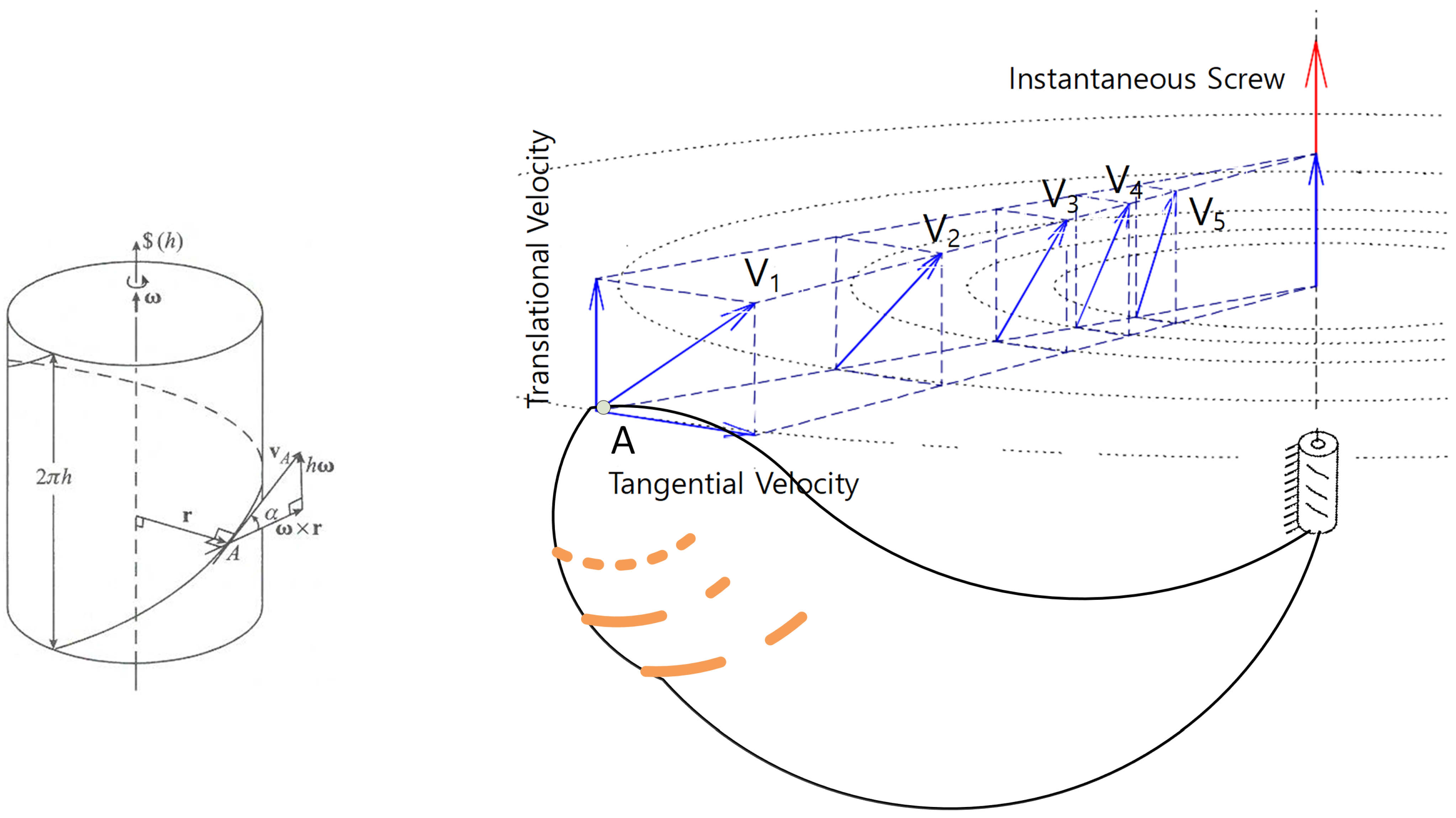
As illustrated in
Figure 1, screw motion naturally gives rise to a helicoidal velocity field, where each point on the moving rigid body traces a path tangential to a helix aligned with the ISA [
8]. The motion of any segment or limb can be decomposed into two components: a rotation about the ISA and a translation along it. This decomposition underpins not only the mathematical formalism of screw theory but also the embodied experience of coordinated motion—what skilled athletes often describe as smooth, connected, or rhythmic [
9].
When applied to the downswing phase of a golf swing, this framework reveals how the club’s helicoidal path entrains and reflects pelvic rotation, not through explicit control, but through biomechanical necessity and inertial feedback [
10]. By treating the club and the body as rigidly coupled, the analysis reduces to studying the evolution of pitch across time, grounded on the assumption that internal constraint forces (those preserving segment cohesion) do not perform work and may therefore be excluded from the virtual work equations (d’Alembert’s principle) [
5].
In this study, we apply screw theory to reanalyze a previously recorded motion capture dataset of a professional and novice golfer. Using synchronized plots of pitch dynamics and vertical ground reaction force (GRF), we quantify the efficiency of segmental coordination during the downswing.
By focusing on the geometry of motion rather than the control signals themselves, our approach positions pitch as a perceptual–motor invariant [
10]—a compact descriptor of how the body organizes itself relative to external affordances [
11] like gravity, inertia, and ground contact. Through this lens, the rigid-body model is not a mechanical idealization but a perceptual-cognitive strategy for reducing control complexity in high-speed motor tasks. We conclude by exploring how this perspective may inform future applications in performance optimization, motor learning, and real-time biomechanical feedback systems.
2. Materials and Methods
2.1. Participants and Study Design
This study leveraged a previously validated biomechanical dataset [
12] that recorded full-body golf swing dynamics of two female participants representing contrasting levels of expertise (
Table 1).
The selection of this dataset was motivated by its comprehensive multi-modal instrumentation, which included high-speed motion capture synchronized with ground reaction force (GRF) data, providing a robust platform for advanced mechanical modeling.
The original data acquisition was conducted using a 12-camera Qualisys optoelectronic motion capture system (model: Oqus-300, Qualisys AB, Gothenburg, Sweden) operating at a sampling frequency of 300 Hz. A total of 24 retroreflective markers, in conjunction with 4 rigid-body clusters, were affixed to key anatomical landmarks following ISAK anthropometric protocols. This configuration enabled accurate 3D tracking of major body segments (e.g., head, thorax, pelvis, upper and lower limbs) and the golf club. Simultaneously, kinetic data were acquired via a Kistler force platform, aligned with the lead foot to define the global reference frame based on the initial center of pressure (COP).
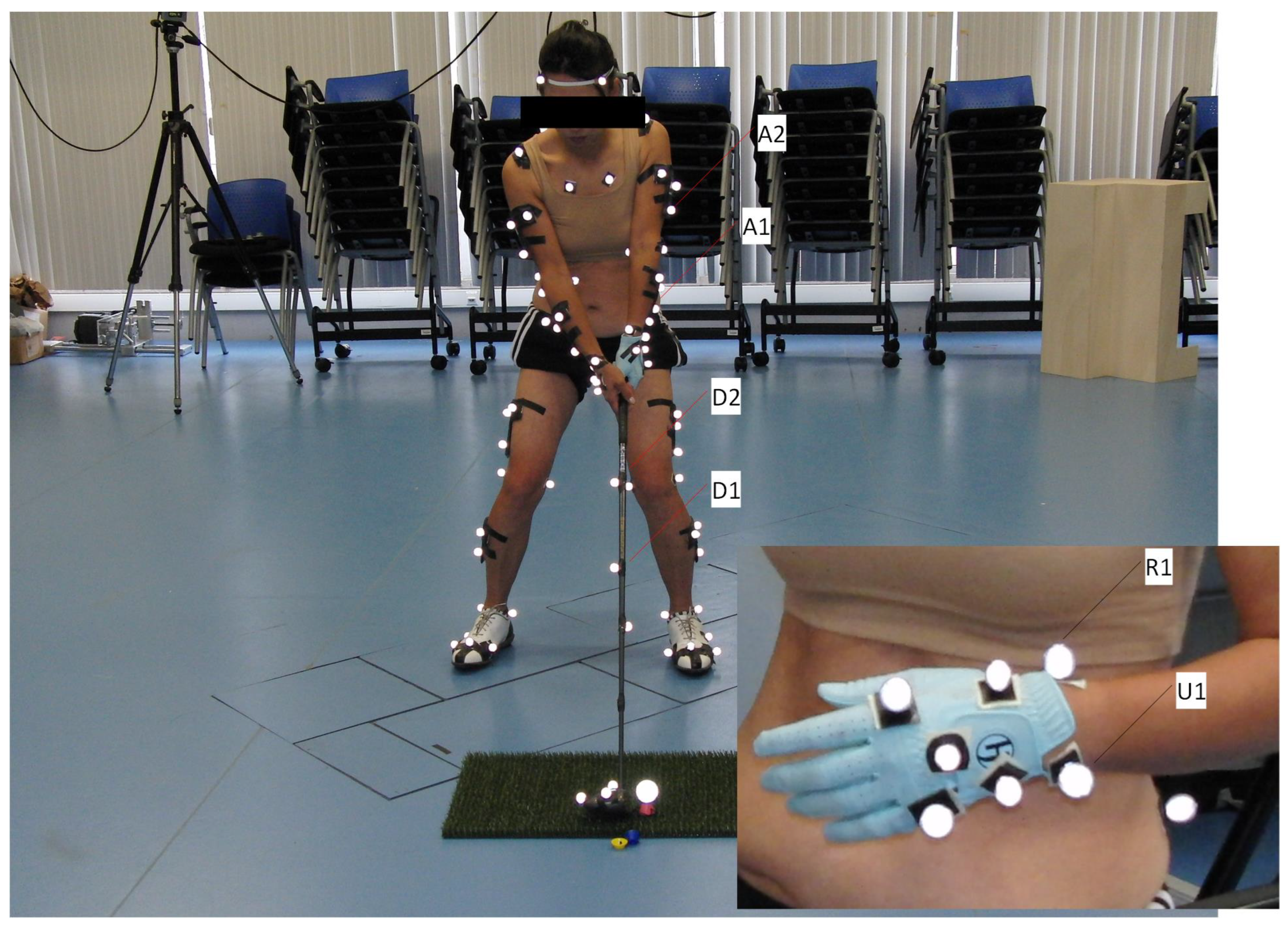
Figure 2 illustrates the marker arrangement at the address phase, highlighting the detailed setup used for wrist and club tracking. These features were essential for subsequent analysis of grip torque dynamics and transmission of force impulses through the kinetic chain.
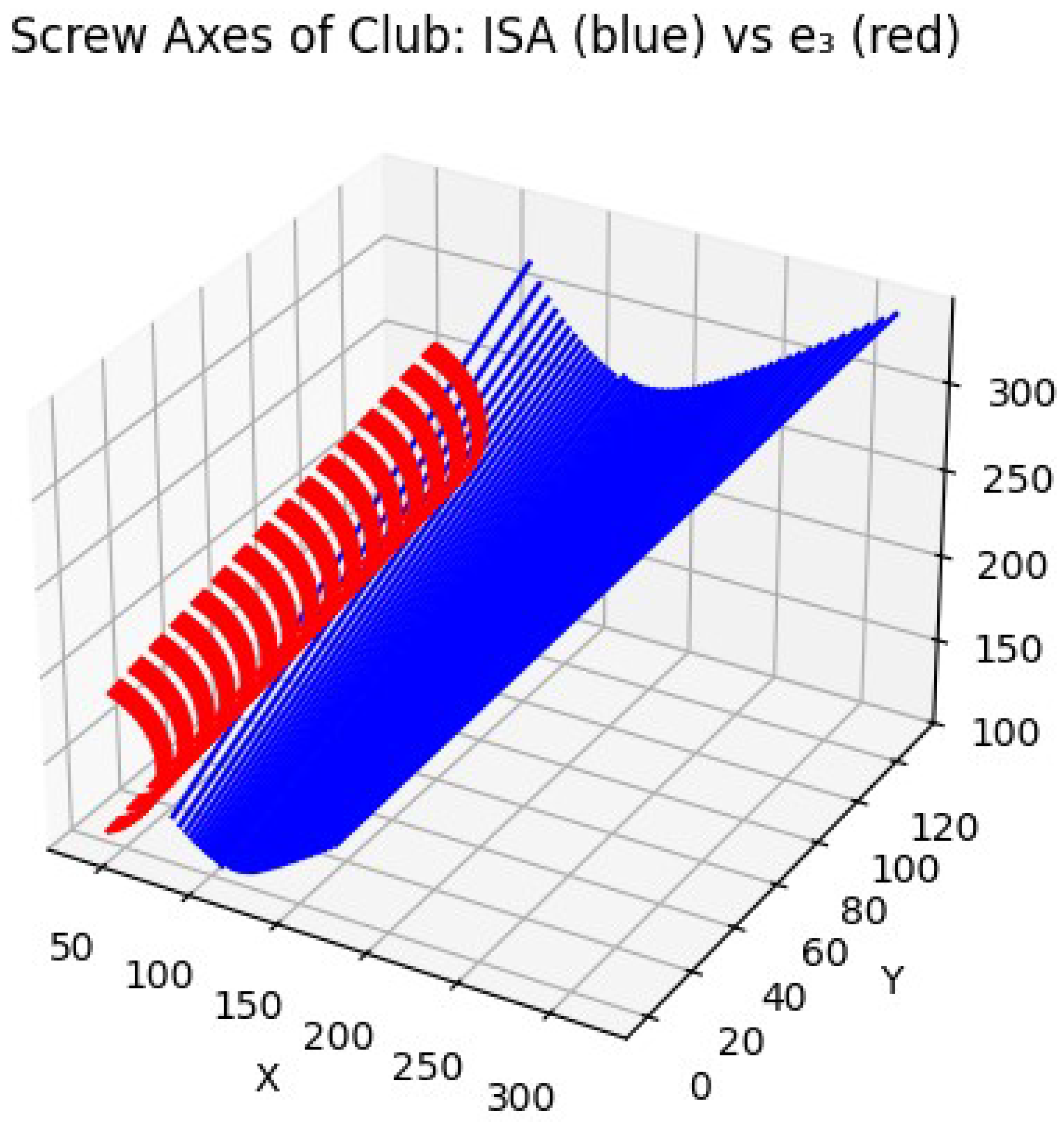
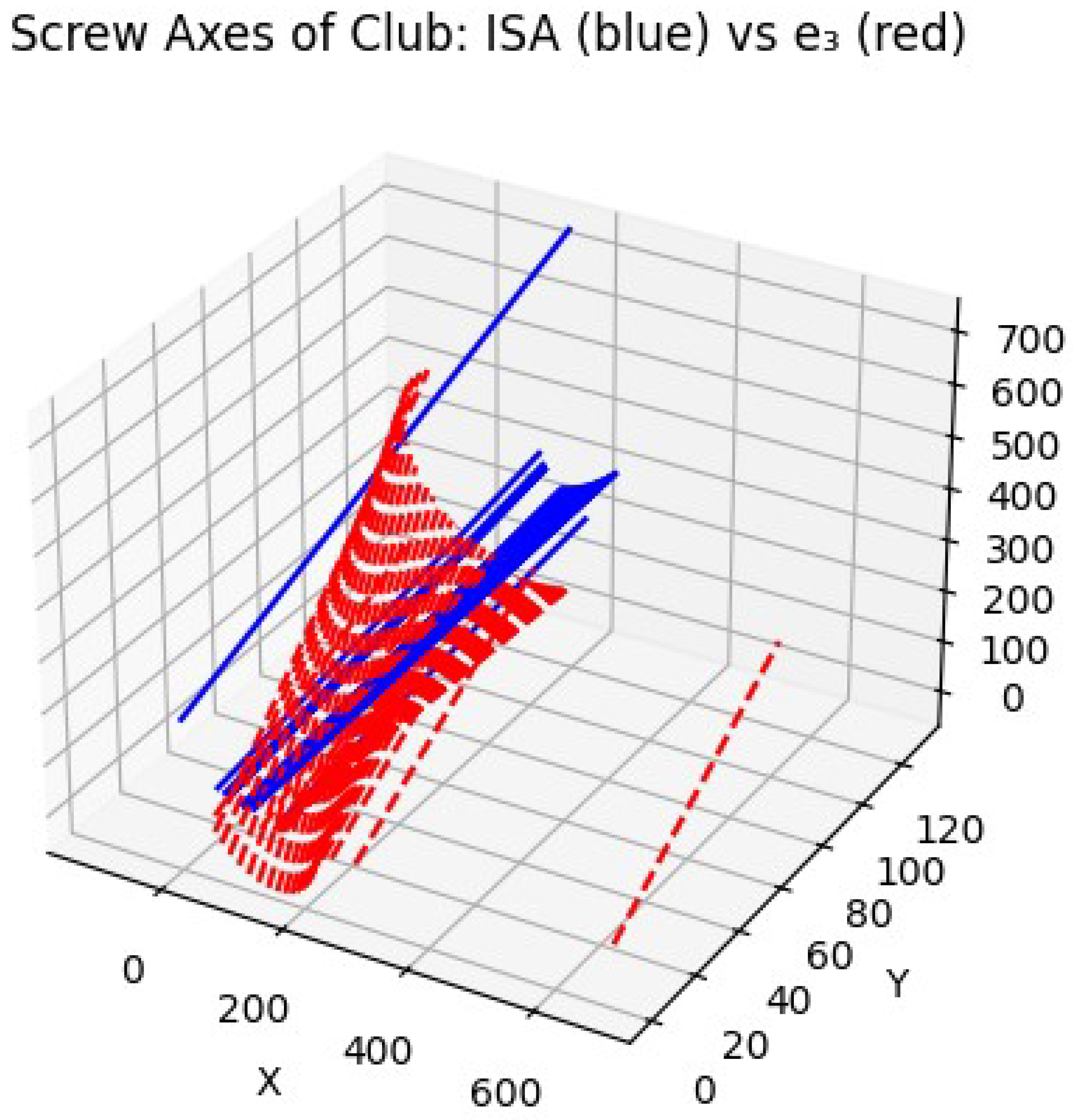
To focus the analysis on the most critical biomechanical phase of the swing, only the downswing portion—from the initiation of forward acceleration to just before club–ball contact—was examined. Using segment-based local coordinate systems, we computed the instantaneous screw axes (ISAs) of the club relative to the trunk, as well as the corresponding angular velocities and linear displacements.
The ISA trajectories [
3] were interpreted as functional representations of the club’s inertial coordination with upper-body rotation. Using a screw-theoretic framework, the twist motion of the club was decomposed into time-varying pitch and orientation parameters, allowing us to characterize the dynamic coupling between translational and rotational components. This formulation enabled identification of control strategies used by each participant and provided a biomechanically grounded measure of skill-dependent swing organization.
This methodological choice to reuse an existing, high-quality dataset ensured internal consistency while reducing inter-session variability. It also preserved the ecological fidelity of the motor behavior, making it possible to examine how perception–action couplings unfold in real-world performance contexts. This approach is consistent with the theoretical framework adopted in our prior research on symmetry and motor optimization in skilled action.
2.2. Procedures and Data Acquisition
The spatial inertia tensor [
12]
integrates both translational and rotational dynamics of a rigid body and is defined as
where
m is the mass,
is the position vector from the body frame to the center of mass,
is the
rotational inertia tensor about the center of mass,
is the skew-symmetric matrix of
, and
is the
identity matrix.
The associated eigenvalue problem [
3] seeks screw vectors [
7]
, combining angular velocity
and linear velocity
, that satisfy
The pitch
h of the screw is defined when
as
This scalar represents the ratio of translation along the axis to rotation about it, encapsulating the geometric essence of the screw motion.
Furthermore, in the case of a finite twist, the pitch
can be derived from the following geometric components:
where
defines the screw axis and
is the raw moment vector [
7]. The component of
along
isolates the pitch as follows:
Although multiple coordinate choices for are possible, the screw axis remains uniquely defined. If is not colinear with , the extracted pitch alters the final moment vector , thereby changing the screw. Therefore, for the screw to represent a unique line in Plücker coordinates, must be proportional to . This constraint ensures that the moment vector defines a consistent axis independent of parametric representation, as required in screw theory and spatial kinematics.
2.3. Signal Processing
According to Ball’s formulation of screw theory [
6], any wrench acting on a rigid body constrained to twist about a given screw
can be represented as a component of a resultant wrench projected onto that screw. The principle of reciprocity states that for equilibrium to be maintained, the applied wrench must be reciprocal to the screw of allowable motion.
Formally, consider a system of wrenches acting on a body free to twist only about a given screw
. The total virtual work performed by the wrenches during an infinitesimal twist about
must be zero as follows:
which simplifies to
Here, represents the intensity of the ith wrench, and denotes the corresponding screw coordinate projection onto . This condition ensures that the net effect of the applied wrenches does not disturb the constrained motion.
From this principle, Ball further notes that a given wrench can always be equivalently replaced by another wrench acting along a different screw, provided the body is constrained to twist only about . This leads to the concept of a harmonic screw, whereby the applied and reactive wrenches achieve a dynamic balance across a screw system, allowing the body to undergo pure oscillation.
This harmonic relationship is foundational for modeling single-body oscillations—such as those seen in sports movements—where the effective action results from rhythmic alternation of forces applied on reciprocal screw systems [
4]. The harmonic screw thus describes a self-consistent twist–wrench pairing that resonates with the mechanical affordances of the body and its constraints.
As Ball observed, this principle bears strong analogy to the classical condition for equilibrium of a particle constrained to a line under the action of multiple forces. If
P and
Q are two such forces acting at angles
l and
m to the direction of allowable motion, then
This analogy emphasizes that in both particle and screw systems, projected force components must cancel in the direction of allowable motion. The harmonic screw generalizes this idea to spatial rigid-body systems.
In the present study, we exploit this harmonic screw formulation to identify oscillatory modes in biomechanical motion—especially where the body pivots or twists rhythmically about a constrained axis. These modes provide insight into invariant biomechanical structures underlying efficient movement.
2.4. Computation of Instantaneous Screw Axis and Comparative Analysis
To identify the instantaneous screw axis (ISA) and spatial principal direction of inertia during the downswing, we used a screw-theoretic transformation framework based on rigid-body marker data. The motion segment (e.g., lower limb or club) was modeled as a rigid body defined by six non-collinear reflective markers tracked over time.
Let
and
denote the 3D coordinates of the
k-th marker at two consecutive frames. The relative motion between time frames was computed using singular value decomposition (SVD) applied to centered marker configurations. Let
and
represent the positions at
and
t, respectively. After removing the centroid offset, we computed the following:
where
and
denote mean marker positions. The rotation matrix
was extracted via the following:
where
ensures proper rotation. The translational shift
was derived from the mean displacement of marker centroids.
To incorporate spatial inertia, we mapped the original inertia tensor
into the moving frame via a screw transformation
constructed as
The eigensystem of the
rotational inertia submatrix
of the transformed inertia tensor was then computed to obtain the principal directions of rotation as follows:
To extract the eigen-screw, the cross-coupling term
was projected onto each eigenvector
, giving rise to the screw moment as follows:
Among these, the direction corresponding to the minimum eigenvalue of the inverse inertia matrix was selected as the dominant principal screw, representing the minimal-energy configuration for rotational–translational coupling.
This computation was repeated for each frame following downswing initiation (). The dominant screw axes were normalized and written to an output array, representing the time-evolving primary ISA during the downswing. These were exported as the matrix ‘Sprime.xlsx‘ for subsequent analysis and visualization.
The screw-based principal directions provide a biomechanically meaningful axis of movement coordination, invariant to translation and frame shifts, and consistent with screw theory’s geometric formalism.
4. Discussion
This study applied screw-theoretic analysis to reexamine skill-level differences in golf swing dynamics, focusing on the behavior of pitch—the ratio of linear to angular velocity along the instantaneous screw axis (ISA). The key finding is that pitch functions as a robust biomechanical invariant, capable of capturing the temporal and spatial coherence of segmental coordination in a high-speed, multi-joint action.
4.1. Pitch as a Marker of Coordinated Efficiency
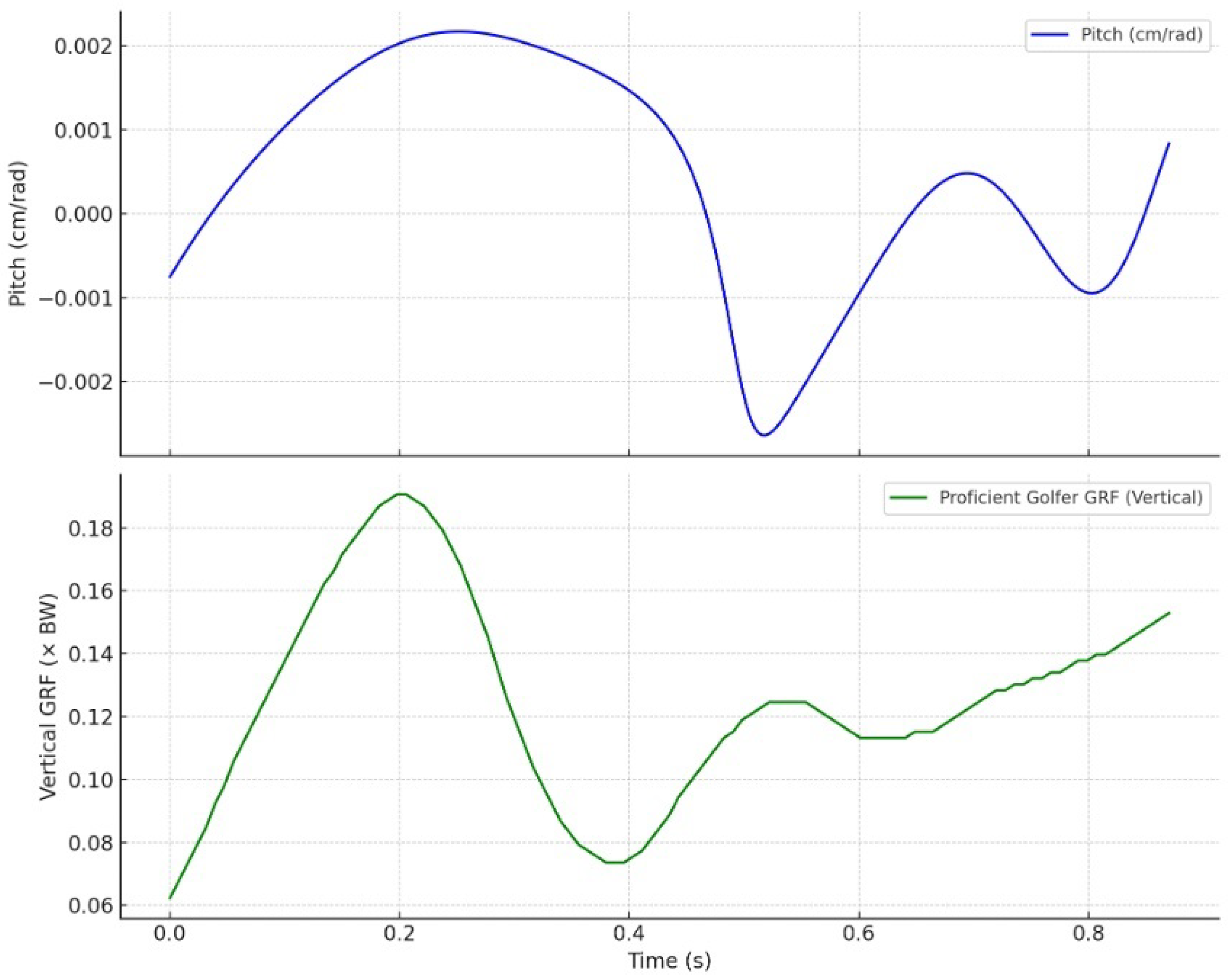
The skilled golfer consistently maintained pitch within a narrow, low-amplitude range, oscillating near zero. This pattern reflects a dynamic balance between rotational torque and linear translation, indicative of efficient energy transmission through the kinetic chain [
15]. The observed stability in pitch suggests that the golfer’s body–club system behaves, in effect, as a unified rigid body during the downswing phase. This rigid-body-like behavior allows for minimal internal work, optimized momentum transfer, and predictable impact timing.
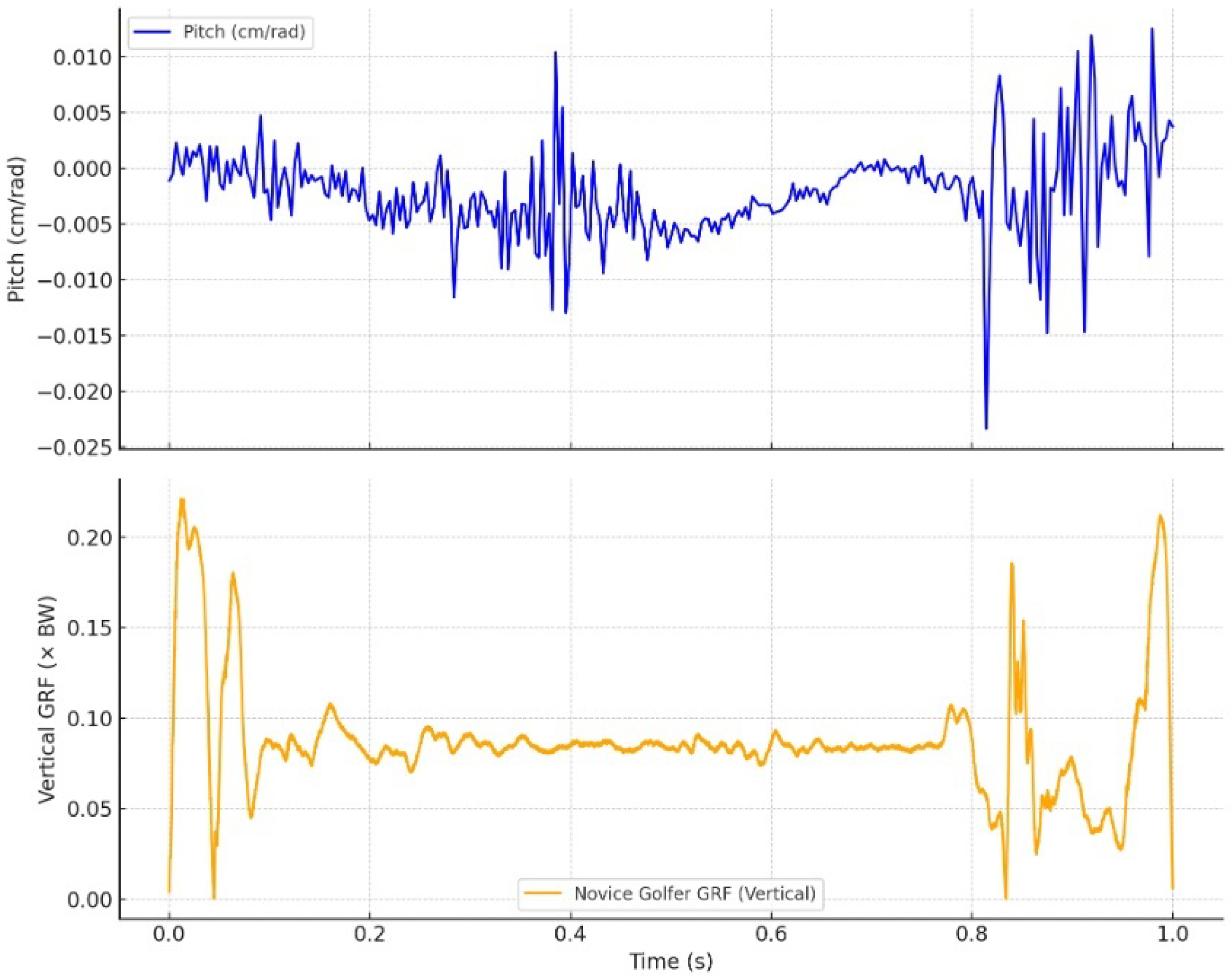
In contrast, the novice exhibited erratic pitch variation, characterized by frequent sign changes and large magnitude fluctuations. These findings reveal a failure to stabilize the coupling between angular and linear components of motion. Such instability may arise from inconsistent joint torque generation, mistimed segmental coordination, or an inability to exploit the body’s mechanical constraints effectively.
4.2. Harmonic Screw Alignment and Mechanical Resonance
From a mechanical standpoint, pitch directly encodes the helicoidal structure of rigid-body motion, with constant pitch indicating a uniform coupling of translation and rotation about a moving axis. In the skilled golfer, the narrow-band oscillations in pitch suggest a close approach to the harmonic screw condition described by Ball, in which the pitch of the twist equals the pitch of the wrench. Under this condition, the twist and wrench are aligned such that the virtual work is maximized without internal dissipation, allowing external impulses—such as the ground reaction force—to reinforce the motion rather than resist it. This resonance-like state yields a self-sustaining mechanical efficiency, reducing energy leakage and enhancing repeatability.
The novice’s high variability in pitch reflects repeated departures from this harmonic alignment, forcing compensatory joint actions and dissipating energy into non-productive degrees of freedom.
4.3. Pitch as a Perceptual Invariant
From an ecological perspective, pitch invariance operates as what Gibson termed a higher-order invariant: a stable relationship in the sensory flow that remains constant despite fluctuations in lower-level sensory variables. Here, the invariant emerges from the co-organization of body segments around the ISA, whose migration is shaped by both inertial and gravitational constraints. Skilled performers appear attuned to this invariant, allowing them to exploit environmental affordances—such as the ground’s reactive capability—without micromanaging each joint or segment. This aligns with the concept of visual kinesthesis, in which perception and action are tightly coupled through biomechanical invariants.
4.4. Applied Implications
The relationship between ISA geometry and pitch invariance opens practical possibilities for performance assessment and skill acquisition. Since pitch is a scalar quantity computable from motion capture or IMU data, it can serve as a compact and interpretable feedback metric. Training interventions could target stabilizing pitch during key phases, using haptic or visual cues to reinforce optimal angular–linear coupling. While demonstrated here in golf, the same principle may apply to other ballistic or high-speed actions, such as baseball pitching, tennis serving, or military tasks involving precise weapon handling, where efficient twist–wrench coupling is critical.
4.5. Broader Relevance
Finally, this work illustrates how screw-theoretic dynamics can bridge mechanical analysis and perceptual–motor theory, offering a unifying framework for understanding skilled performance. By integrating harmonic screw theory with Gibson’s ecological approach, pitch invariance emerges not only as a biomechanical signature of expertise but also as a perceptual anchor for coordinating action in complex environments.
5. Conclusions
This study applied screw-theoretic analysis to identify pitch—the ratio of linear to angular velocity along the instantaneous screw axis (ISA)—as a biomechanical invariant that reveals the quality of motor coordination in golf swing performance. The comparison between a proficient and a novice golfer showed that skilled performance is characterized by stable, low-amplitude pitch variation synchronized with well-timed ground reaction forces. In contrast, the novice demonstrated erratic pitch behavior and temporal misalignment, indicating disrupted segmental coordination and inefficient kinetic sequencing.
Achieving pitch stability is not merely a matter of local joint control but requires the golfer’s entire body to adapt continuously to the evolving spatial structure of the swing. Whether interacting with the shape of the environment, the contour of the swing path, or the forces being generated internally, the golfer must coordinate multiple joint functions in a fluid and integrated manner. Anatomically, pitch regulation demands dynamic blending across muscle groups, enabling the body to mold itself in response to inertial demands. In this way, the golfer becomes actively attuned to the form of space—not just reacting to it, but co-creating it as a functional environment for efficient movement.
These findings reinforce the value of pitch as a perceptual–motor invariant, linking biomechanical organization with task-specific adaptability. Future work may explore how training protocols or real-time feedback systems can help athletes learn to stabilize pitch through improved kinetic timing, intersegmental coupling, and ecological sensitivity to the dynamic constraints of the swing.