1. Introduction
Digital learning in schools increasingly depends on the reliable circulation, charging, storage, and maintenance of mobile devices. Timotheou et al. [
1] showed that digital technologies affect not only student learning outcomes but also school routines, stakeholders, and institutional capacity. Dorris et al. [
2] reviewed mobile-device use in primary school classrooms and emphasized that classroom effects depend on the conditions under which devices are implemented. Lohr et al. [
3] further showed that support conditions, internet speed, and device-ownership arrangements influence how digital learning is enacted. These studies imply that educational technology adoption is inseparable from the physical and organizational infrastructure that keeps devices ready for use.
Most educational-technology research emphasizes pedagogy, learning applications, or digital competence. By contrast, the mechanical artifacts that organize daily device circulation are rarely treated as engineering design problems. A tablet charging cart is often specified by device capacity, locking type, electrical input, or cabinet dimensions; however, its classroom performance depends on a human–machine interaction sequence that includes queue formation, access direction, door opening, body posture, slot visibility, plug alignment, cable routing, and custody. If this sequence is poorly designed, instructional time can be lost before any digital learning activity begins.
This study frames the charging cart as a human-centered mechanical product and task-support artifact. Gregoriades and Sutcliffe [
4] argued that functional requirements should be connected explicitly to the tasks that human agents must perform. Gaiardelli et al. [
5] described product-service systems as configurations in which value emerges from interactions among products, users, and service routines. Fang et al. [
6] demonstrated that user-centered collective design can guide smart product-service systems, while Peters et al. [
7] emphasized that product development is strengthened when users participate as sources of design knowledge rather than as passive recipients. These arguments justify treating charging-cart design as a task-support and product-architecture problem.
Lean Product and Process Development is relevant because it emphasizes front-end knowledge creation, problem definition, cross-functional communication, and waste reduction before product decisions are locked in. Cukor Kirinić and Hegedić [
8] identified recent lean product-development trends toward sustainability, digitalization, and broader implementation contexts. Jaffré et al. [
9] showed that lean product-development barriers and success factors are context-dependent rather than universal. Islam [
10] reported that lean product development can support sustainable operational performance in new production-system introduction. Treviño-Elizondo et al. [
11] connected lean and Industry 4.0 maturity, and Mezher et al. [
12] interpreted Lean 4.0 as a socio-technical configuration. For a school charging cart, the same alignment is operational: product architecture must support how students, teachers, and support staff actually handle devices.
The present research combines Lean Product and Process Development with jobs-to-be-done inquiry and outcome-driven opportunity scoring. Nam et al. [
13] demonstrated that outcome-driven innovation can transform customer outcomes into prioritized opportunity areas. Gille [
14] showed that manual-handling cart design should consider the mechanical forces and conditions that shape user effort. Hefter et al. [
15] used participatory human-factors design to redesign supply carts and improve workflow access in a healthcare setting. Lamé et al. [
16] argued that design expertise can function as a quality-improvement strategy. At the methodological-foundation level, the workflow also draws on Morgan and Liker’s account of the Toyota Product Development System [
17] and Ward and Sobek’s lean product and process development framework [
18]. The jobs-to-be-done perspective is grounded in Christensen et al.’s theory of customer choice [
19], and the opportunity-scoring logic follows Ulwick’s jobs-to-be-done and outcome-driven innovation formulation [
20]. Stakeholder inquiry, personas, and design communication are further aligned with service-design practice as described by Stickdorn et al. [
21]. Together, these studies and methodological foundations support a research position in which a charging cart is evaluated through observed tasks, prioritized opportunity scores, product architecture, and field performance rather than through nominal capacity alone.
Against this background, the novelty of this study is twofold. First, the article proposes a bilateral drawer-type access architecture that converts a conventional front-door, single-queue cabinet into a two-sided parallel handling artifact while retaining storage, charging, and custody functions. Second, the article demonstrates a reproducible design-validation workflow linking contextual inquiry, opportunity scoring, competitor benchmarking, product essence mapping, A3 synthesis, comparative concept testing, and classroom field validation. The contribution is therefore framed as a stand-alone engineering-design article that tests how a specific product architecture can improve K-12 device-handling performance.
The research objective is to design and validate a drawer-type tablet/laptop charging cart that improves classroom handling efficiency without sacrificing storage capacity, charging function, security, or classroom compatibility. The study makes three contributions. First, it provides empirical evidence of device-handling bottlenecks in K-12 school settings. Second, it describes a reproducible method for translating observed bottlenecks into quantified opportunities and product requirements. Third, it provides prototype evidence showing how bilateral drawer access can reduce average handling time, increase throughput, and maintain positive user satisfaction in routine classroom use.
2. Materials and Methods
2.1. Research Design and Case Context
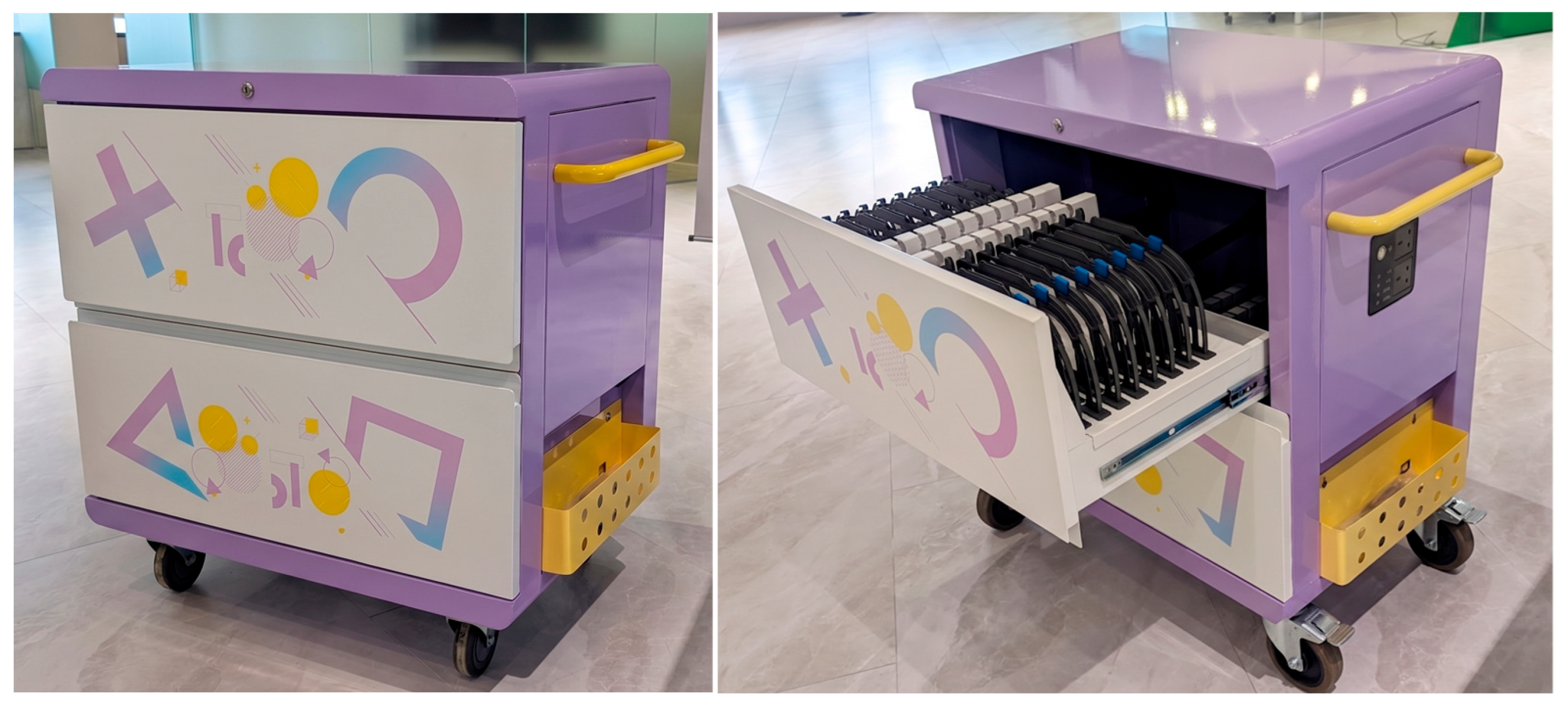
The study adopted an exploratory mixed-methods engineering design approach with an embedded prototype-validation stage. The unit of analysis was the product architecture and handling workflow of classroom tablet/laptop charging carts. Empirical work was conducted in Taiwanese K-12 educational settings where classroom tablets were already used in routine school activities. The article is reported as a stand-alone product-innovation study. The process diagrams, prototype photographs, and descriptive datasets presented in the article were generated during the engineering design and validation work reported here.
The study was designed as an applied engineering design case with field-informed prototype validation, rather than as a randomized controlled trial. Accordingly, the evidentiary standard is exploratory and design-oriented. Field observations, opportunity scoring, concept-level timing, and post-use satisfaction ratings were triangulated to determine whether the bilateral drawer-access architecture was sufficiently promising for further engineering development.
Three school sites were included. Site A was an elementary school where a class-level charging cart was placed inside the classroom, and pupils were expected to retrieve and return their own tablets. Site B was a senior high school where devices were managed by an information center and transported by assigned students. Site C was a high school where device management was organized through a library-based system and supported by dedicated staff. The sites were anonymized to protect participants, school operations, and institutional routines.
Participant numbers were constrained by authentic school operation, site access, and prototype availability. The samples should therefore be interpreted as design-stage samples suitable for identifying use problems, prioritizing design opportunities, and validating prototype feasibility. They were not intended to function as statistically powered samples for generalizing the results to all K-12 classrooms.
2.2. LPPD-JTBD/ODI Workflow
The workflow followed the Lean Product and Process Development learning cycle of Look, Ask, Model, Discuss, and Act and was implemented as a design-research sequence. The Look phase documented authentic device-handling tasks; the Ask phase converted critical events into personas and paired importance-satisfaction questions; the Model phase translated evidence into product requirements; the Discuss phase used A3 synthesis to compare alternatives and manage design risks; and the Act phase produced and validated a full-scale prototype.
Figure 1 summarizes the design-to-validation logic, while
Table 1 identifies the data source, sample/material, decision purpose, and output of each stage.
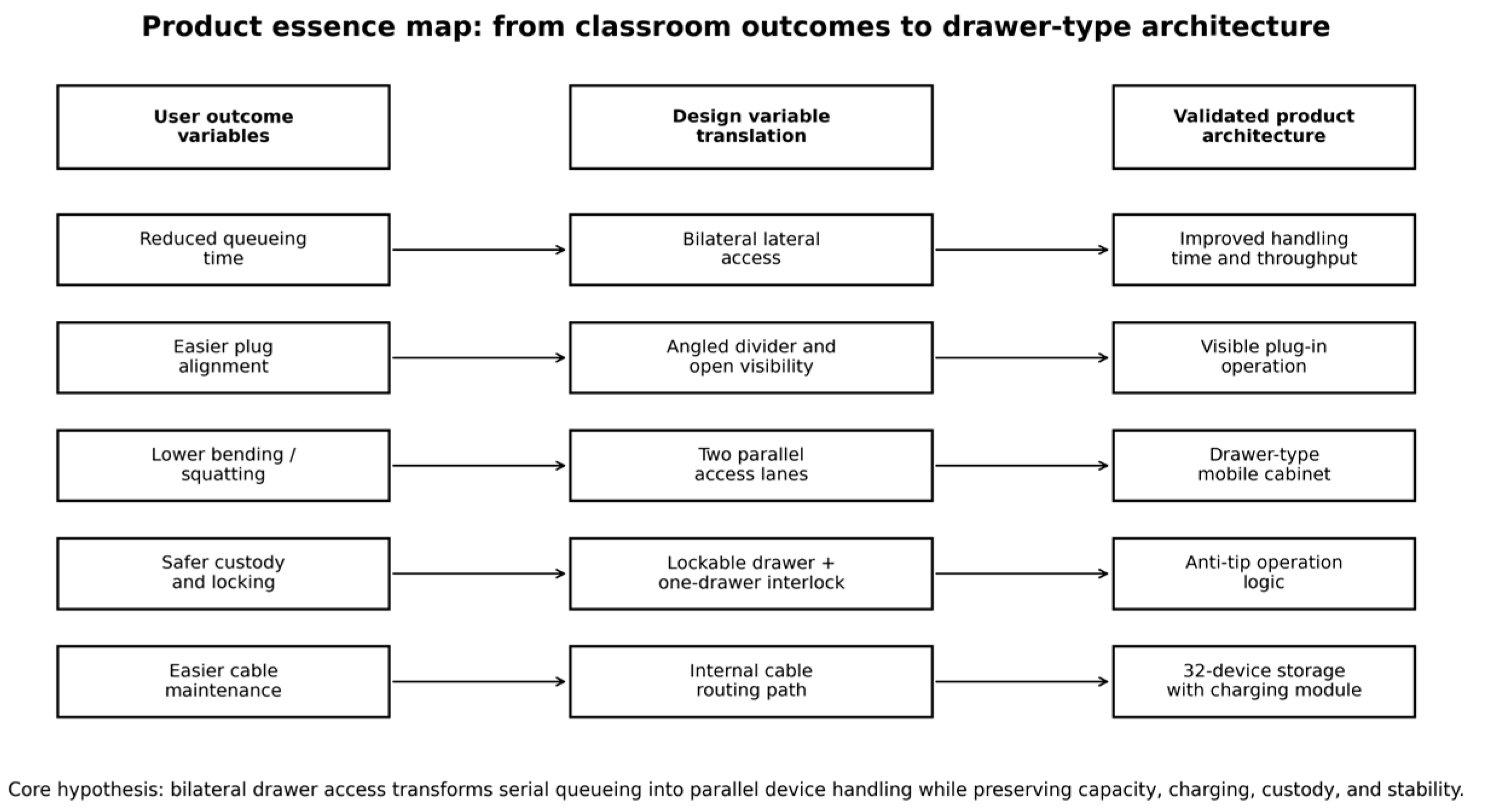
Table 1 summarizes the operational protocol of the study by linking each design stage to its data source, decision purpose, and subsequent output. The sequence was cumulative: Contextual inquiry first identified critical handling events; the opportunity questionnaire then prioritized these events; competitor benchmarking translated market evidence and user-review themes into secondary requirements; product-essence mapping and A3 synthesis supported the selection of the drawer-type architecture; and prototype testing generated validation evidence. In this sense,
Table 1 functions as a methodological bridge between field observation, design decision-making, and empirical prototype validation rather than as a general project-management summary.
The opportunity-scoring sample consisted of 14 experienced users and stakeholders and was used to prioritize design opportunities derived from field observations. It was not intended to validate a psychometric scale. Likewise, the concept-testing and classroom-validation samples were used to compare observable handling performance under prototype-use conditions. Because the participants were not randomly assigned and the sample sizes were not equal across all concepts, the study reports descriptive design-validation evidence and does not claim inferential hypothesis testing.
2.3. Data Collection Instruments
Contextual inquiry was conducted through structured field notes, photographs, short on-site interviews, and task-sequence observation. The observation checklist covered device location, access direction, door opening, queue formation, body posture, lighting and visibility, plug alignment, cable handling, locking behavior, transport conditions, and surrounding spatial constraints. Observation records were coded as critical events when repeated actions produced waiting time, additional postural demand, collision risk, reduced visibility, plug-alignment difficulty, or custody concerns. The resulting critical events were then reviewed in relation to four stakeholder roles: elementary pupils, secondary students, classroom teachers, and information-management staff. These personas were used as design communication tools to represent different operational perspectives, rather than as statistical categories.
The opportunity questionnaire translated the six observed critical events into paired importance and satisfaction items measured on a 10-point scale. Respondents included students, teachers, and information-technology support staff with direct experience using or managing charging carts. After opportunity scoring, competitor benchmarking was conducted using four commercial carts in the 24–32-device range. Publicly available product specifications were used to compare capacity, device compatibility, access mode, material, and mass. In addition, 62 online user-review comments were coded into positive and negative product-attribute themes so that market expectations and recurring complaints could be incorporated as secondary design constraints rather than treated only as anecdotal background information.
The questionnaire was a project-specific outcome-rating instrument derived from the six field-observed critical events. It was reviewed by the design team for wording consistency, relevance to stakeholder experience, and alignment with the observed handling tasks; however, it was not independently validated as a psychometric scale. The 62 online review comments used in the competitor benchmark were coded according to recurring product attributes, including sturdiness, assembly, locking quality, wheel quality, slot spacing, and cable routing. The coding results were checked through team discussion to support requirement translation, although a formal inter-rater reliability coefficient was not calculated. This evidence was therefore used for design prioritization and requirement development rather than for statistical scale validation.
2.4. Measures and Equations
Opportunity scores were calculated using the outcome-driven opportunity algorithm shown in Equation (1). For critical event
,
denotes the mean importance score,
denotes the mean satisfaction score, and
denotes the opportunity score. Both
and
were measured on a 10-point scale.
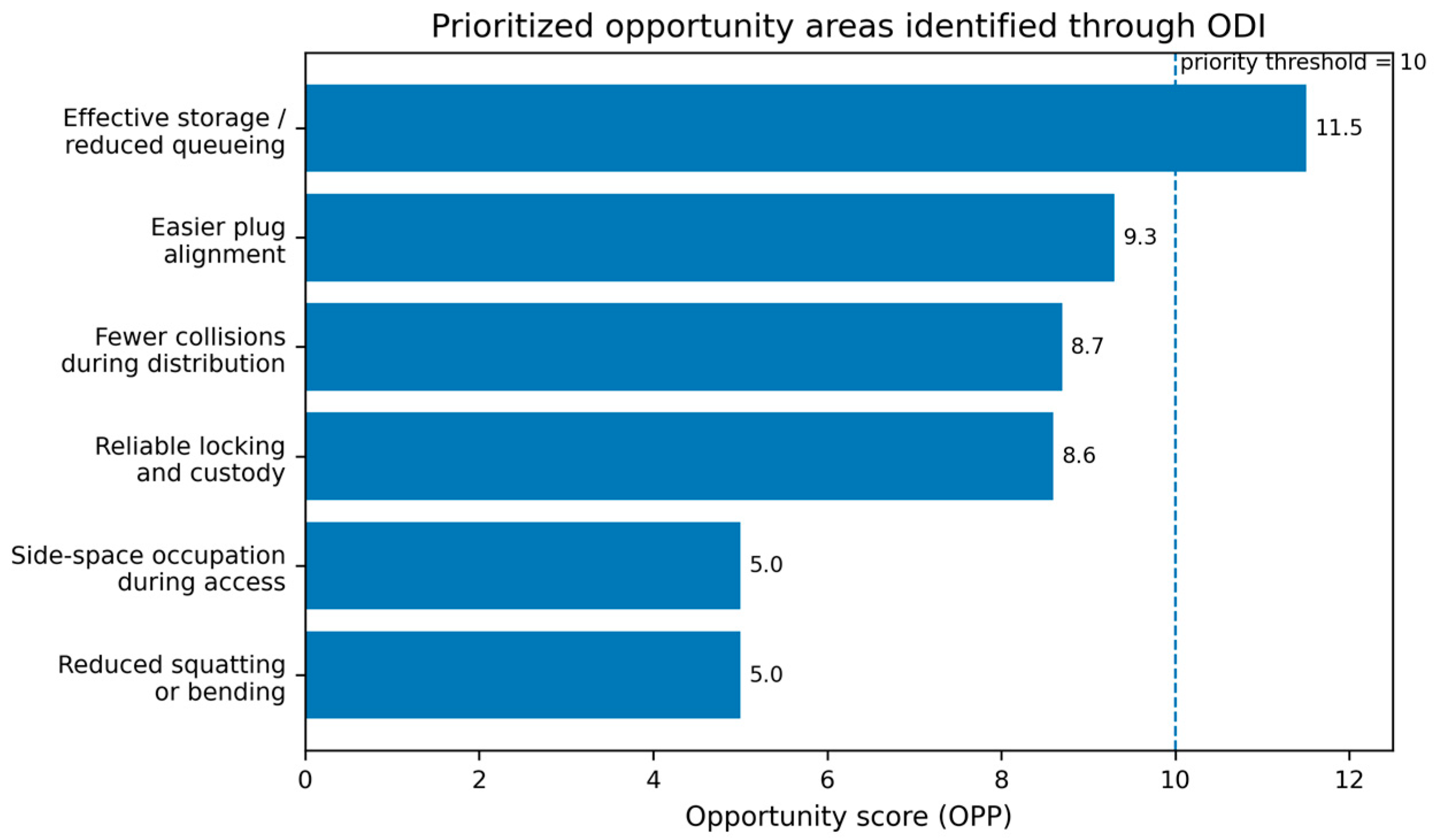
In this formulation, a larger opportunity score is produced when an outcome is considered important but current satisfaction is relatively low. In this study, > 10 was used as an operational screening rule for identifying priority opportunity areas in the front-end design process. Scores below 10 were interpreted as secondary or constraint-related requirements when the corresponding events affected safety, custody, compatibility, or product acceptance. Therefore, the threshold should be understood as a design-prioritization rule for this applied engineering project, rather than as a universal statistical cut-off.
Handling performance was calculated using Equation (2), where
denotes total session time in seconds,
denotes the number of devices handled during the session, and
denotes average handling time per device.
Throughput was calculated using Equation (3), where
denotes the number of devices handled per minute.
Descriptive percentage change was calculated using Equation (4), where x_{baseline} denotes the baseline value and x_{prototype} denotes the prototype value.
For handling time, a negative percentage change indicates improvement because a lower value is desirable. For throughput and satisfaction, a positive percentage change indicates improvement because higher values are desirable.
Because the classroom validation used aggregate session records and different cohort sizes in the baseline and prototype sessions, the analysis was descriptive rather than inferential. The equations were used to make the design comparison transparent, reproducible, and interpretable, not to claim population-level statistical inference. The available dataset contained aggregate session totals, concept-level totals, and satisfaction item means. Accordingly, analysis of variance, mixed-effects modeling, confidence intervals based on participant-level repeated trials, and reliability statistics were not appropriate for the present dataset. The analysis therefore reports descriptive statistics only and avoids causal or population-level claims.
2.5. Validation Model and Key Indicators
The validation model was derived from the highest-ranked opportunity area and the secondary design constraints identified through field inquiry, opportunity scoring, and competitor benchmarking. The central design hypothesis was that bilateral drawer access could transform a conventional single-queue retrieval sequence into two parallel access lanes, thereby reducing handling time while preserving device capacity, charging readiness, and custody functions. The validation model therefore combined performance indicators with user-acceptance and requirement-preservation indicators, rather than relying on a single usability measure.
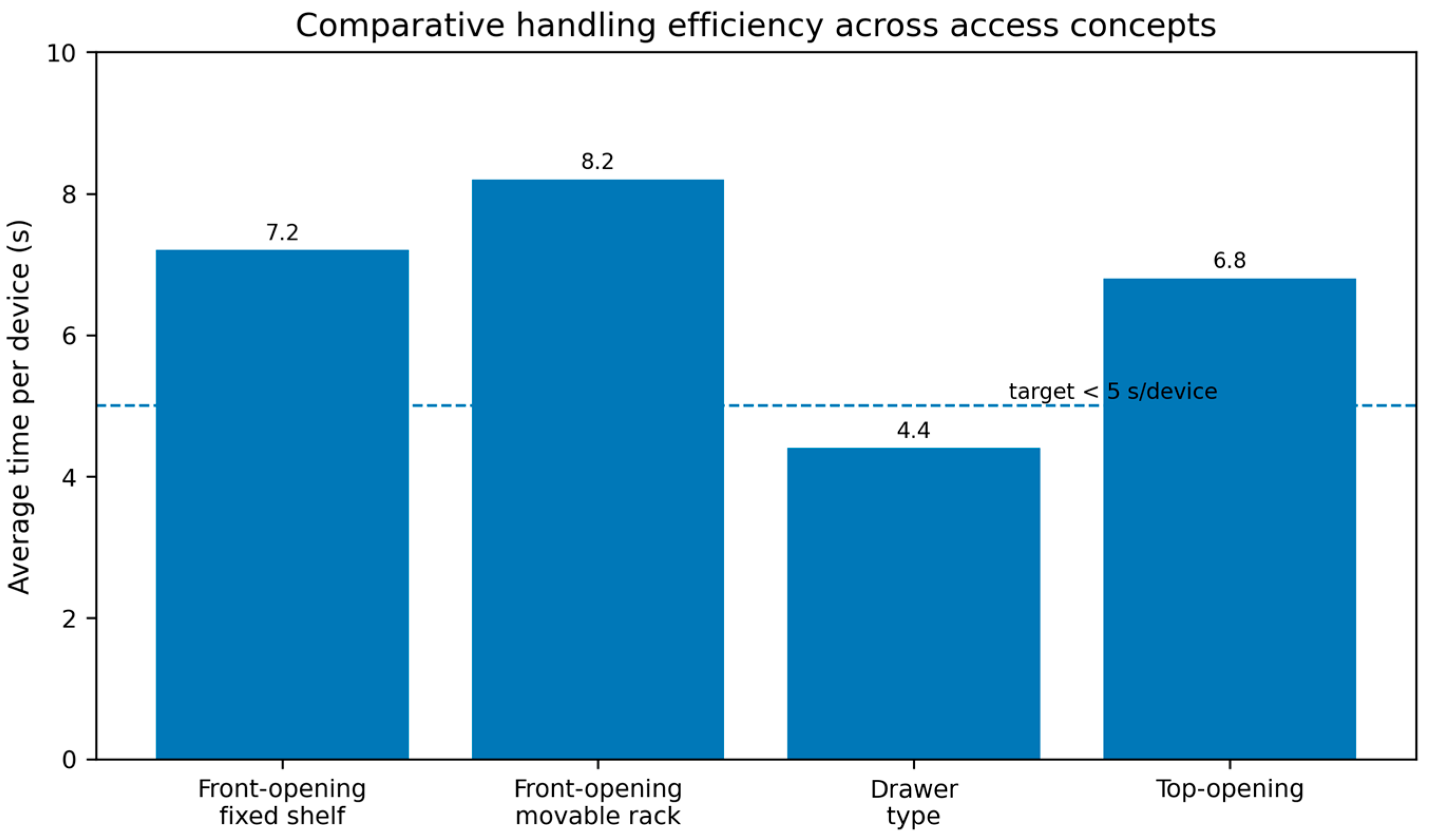
Five indicators were used to evaluate the prototype. The first indicator was opportunity priority, measured by , which identified the critical handling event that justified design intervention. The second was concept-level handling efficiency, measured by average handling time per device () and throughput () across four access concepts. The third was classroom field performance, measured by the baseline-to-prototype change in average handling time and throughput under routine classroom use. The fourth was user acceptance, measured through post-use satisfaction ratings on a five-point scale. The fifth was requirement preservation, assessed descriptively through storage capacity, lockability, anti-tip logic, cable-routing feasibility, device compatibility, and compatibility with classroom furniture scale.
This indicator structure connected the front-end opportunity score to the product architecture and then to prototype-level evidence. In other words, the validation model did not evaluate the drawer-type cart only as an isolated object; it evaluated whether the proposed access architecture responded to the observed school workflow, improved handling performance, and maintained the functional requirements expected of a classroom charging cart.
2.6. Methodological Scope, Controls, and Engineering Validation Boundary
To define the evidentiary scope of the study, the validation design distinguished among three levels of evidence. First, contextual inquiry and opportunity scoring provided problem-discovery evidence by identifying and prioritizing field-observed handling bottlenecks. Second, comparative concept testing provided design-screening evidence by comparing four access architectures under prototype-use conditions. Third, classroom validation provided field-feasibility evidence by testing the fabricated drawer-type prototype in a routine school setting. These three levels of evidence support engineering design decision-making, but they do not establish a statistically generalizable treatment effect.
Before concept testing and classroom validation, users received a brief standardized explanation of the access procedure. The sessions were timed as complete handling events using stopwatch and video-assisted field records, rather than as repeated participant-level trials. The timing results were therefore normalized as seconds per device and devices per minute. Measurement uncertainty, user fatigue, handedness, individual learning effects, and queue-density variation were not statistically modeled in the present dataset.
The engineering validation was limited to prototype feasibility. The drawer-type prototype incorporated a one-drawer-at-a-time anti-tip logic as a design precaution; however, the study did not conduct finite element analysis, dynamic stability testing, formal drawer-load certification, thermal distribution modeling, charging-temperature monitoring, vibration testing, lifecycle durability testing, or electrical safety certification. These boundaries are stated explicitly because they represent required tasks for product certification, procurement qualification, and future engineering research. Accordingly, the present study should be interpreted as a design-stage prototype validation that demonstrates feasibility and design promise, rather than as final certification of mechanical, thermal, electrical, or long-term durability performance.
4. Discussion
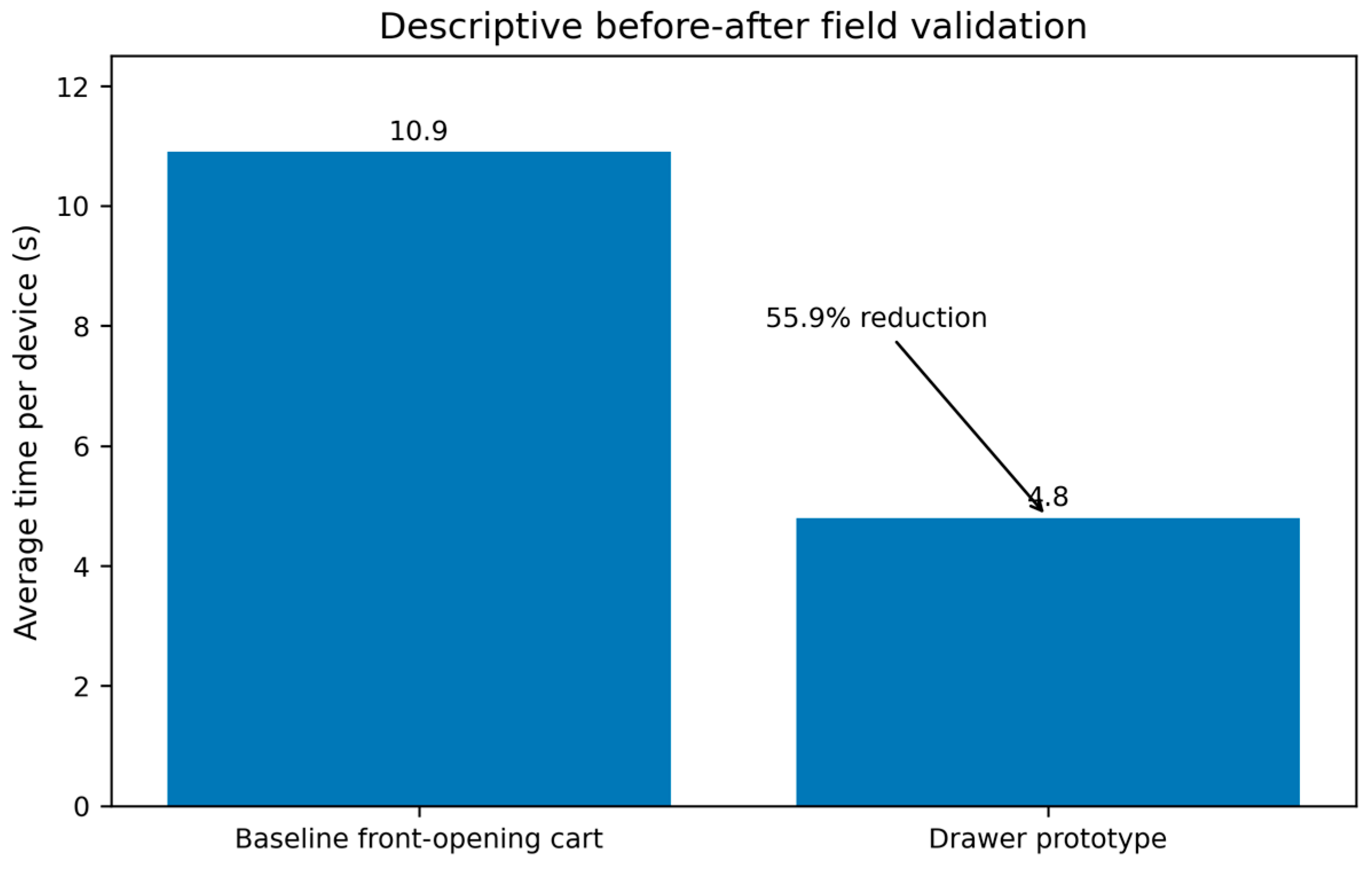
The results indicate that a school charging cart should be understood as a human–machine interaction artifact rather than merely as a storage cabinet or electrical accessory. The main performance improvement came from reorganizing the product-access architecture. Conventional front-opening cabinets require users to form a single serial queue and reach into a partially enclosed storage volume. By contrast, the drawer-type prototype created two lateral access zones, improved slot visibility, and shortened the device-handling sequence. This architectural change explains why the drawer-type concept met the target of less than 5 s/device in concept testing and reduced classroom handling time during field validation.
The findings extend recent research on digital learning infrastructure by drawing attention to the physical conditions that support device readiness. Timotheou et al. [
1] showed that digital technologies influence not only learning outcomes but also institutional capacity and school routines. The present study complements that perspective by showing that device circulation, charging access, and storage workflow are part of the infrastructure that enables digital learning. Dorris et al. [
2] emphasized that mobile-device implementation in primary classrooms depends on implementation conditions, and the present results identify charging-cart access as one such condition. Lohr et al. [
3] highlighted school support, internet speed, and device-ownership arrangements as important conditions for active digital learning. This article adds that device readiness, storage access, and handling flow are also practical support conditions that can affect classroom technology use before instruction even begins.
The study also contributes to human-centered and socio-technical design by showing how task-support requirements can be translated into mechanical product architecture. Gregoriades and Sutcliffe [
4] argued that system requirements should be connected to the tasks that human agents must perform. In the present study, queueing time, plug alignment, posture, visibility, and custody were translated into design requirements and then into a drawer-type architecture. Gaiardelli et al. [
5] described product-service-system value as interactional; this view is reflected in the interaction among the charging cart, students, teachers, devices, and classroom routines. Fang et al. [
6] emphasized user-centered collective design for smart product-service systems, and Peters et al. [
7] argued for user-driven product development. In this study, contextual inquiry, stakeholder personas, and classroom validation served this role by allowing design decisions to be informed by observed use rather than by assumed product features.
The results further clarify the role of Lean Product and Process Development in applied engineering design. Cukor Kirinić and Hegedić [
8] showed that lean product-development research is increasingly connected with sustainability, digitalization, and broader implementation contexts. Jaffré et al. [
9] argued that lean product development should be configured according to context rather than applied as a fixed checklist. Islam [
10] reported that lean product development can support operational performance when it is connected to implementation needs. Treviño-Elizondo et al. [
11] linked lean thinking with Industry 4.0 maturity, while Mezher et al. [
12] interpreted Lean 4.0 as a socio-technical configuration. The present study demonstrates a context-specific application of these ideas: the Look–Ask–Model–Discuss–Act workflow generated design knowledge, and the A3 process connected the opportunity score, product essence map, prototype risks, and validation indicators.
The opportunity-scoring results show why prioritization was necessary. Several problems were visible in the field, including awkward posture, locking and custody concerns, plug-alignment difficulty, side-space occupation, and transport disturbance. However, only effective storage with reduced queueing exceeded the opportunity threshold. Nam et al. [
13] demonstrated that outcome-driven innovation can rank underserved opportunities; the present study applies this principle to a tangible educational infrastructure product. The lower-scoring issues were not discarded. Instead, they became secondary requirements that the final architecture had to preserve. The drawer-type cart therefore needed to be faster while also remaining lockable, stable, compatible with classroom furniture, and manageable for cable routing.
The competitor benchmark strengthens the design contribution by showing that the proposed architecture differs from the sampled market configuration.
Table 3 showed that the benchmarked products were dominated by front-opening cabinet access, while
Table 4 translated review themes into product requirements. Customer reviews praised sturdiness and capacity but criticized assembly difficulty, lock quality, wheel quality, slot spacing, and cable routing. These findings indicate that invention-oriented product development must evaluate both the main architectural novelty and the implementation details that influence adoption. The drawer-type architecture is therefore not only a different external form; it is a product-architecture response to a queueing bottleneck that must still satisfy capacity, security, stability, mobility, and maintenance requirements.
The findings are also consistent with adjacent research on mobile carts and workflow redesign. Gille [
14] showed that cart geometry and wheel behavior can influence manual-handling forces and injury-prevention potential, supporting the view that cart design affects user effort. Hefter et al. [
15] redesigned bedside supply carts through participatory human-factors methods and improved workflow access in a demanding environment. Although the present study addresses school device management rather than healthcare work, the underlying design principle is similar: mobile storage artifacts shape workflow because they structure access, visibility, motion, and sequence. Lamé et al. [
16] argued that design expertise can function as a quality-improvement strategy. The present article provides an applied example in which design expertise improved an everyday infrastructure artifact by converting an observed workflow bottleneck into a measurable product-architecture intervention.
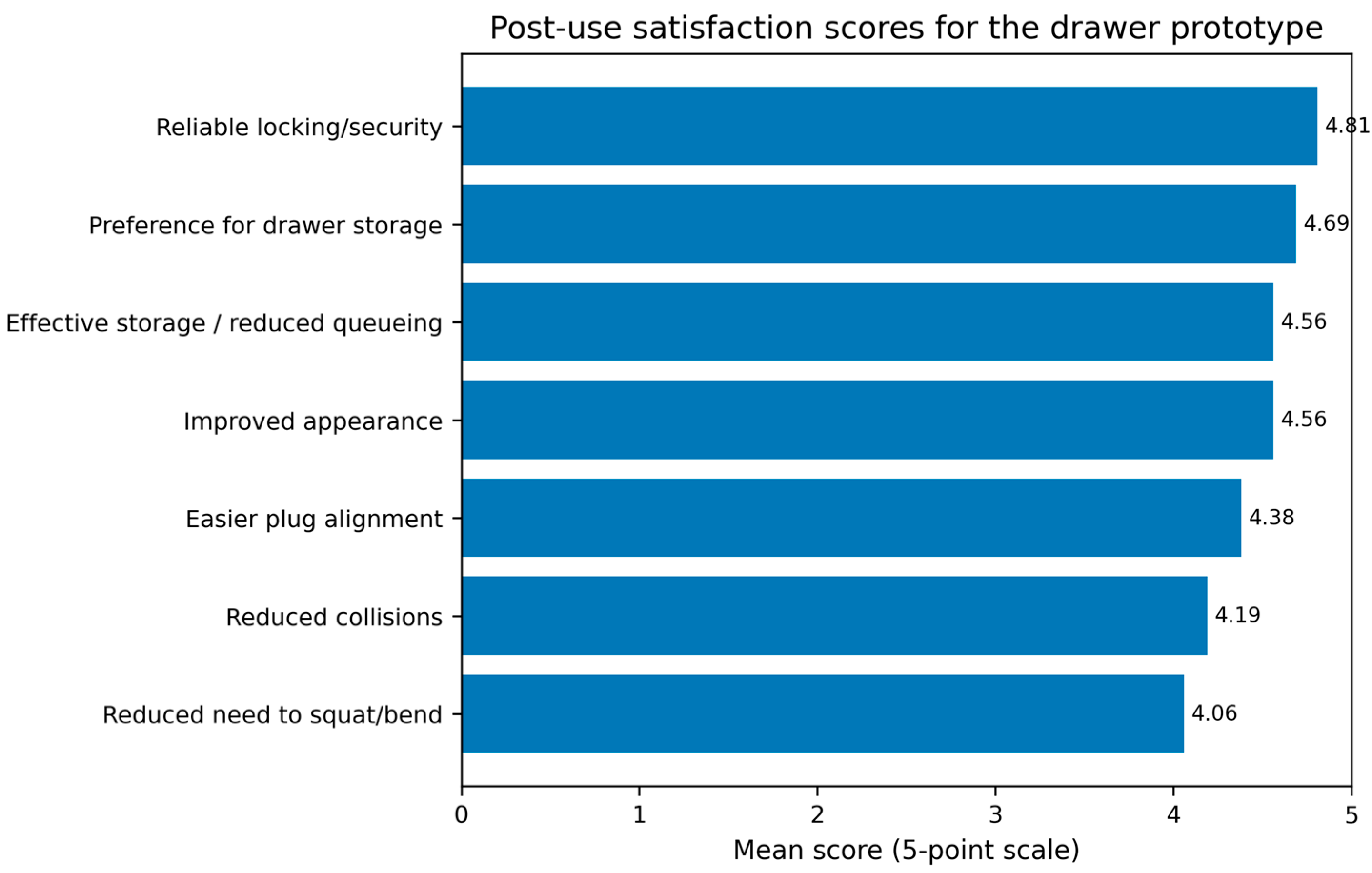
Figure 7 provides an additional interpretation of the validation results. The satisfaction scores were not simply a general endorsement of the prototype; they show that the solution preserved trust-related and adoption-related requirements while improving handling efficiency. Reliable locking/security received the highest score, which is important because schools manage expensive shared devices and require confidence in custody. Preference for drawer storage and effective storage with reduced queueing confirmed the intended access innovation. Easier plug alignment and reduced collisions supported the secondary requirements derived from opportunity scoring and competitor benchmarking. The lower but still positive score for reduced squatting or bending indicates a remaining ergonomic opportunity, especially for lower drawers, younger pupils, or users handling heavier devices.
The study has limitations. The field validation used aggregate session data, and the baseline and prototype sessions involved different numbers of users. The opportunity-scoring sample was modest, and the competitor benchmark relied on one online retail platform. The concept tests were not balanced randomized experiments, and individual-level repeated timing data were not collected. Therefore, the results should be interpreted as descriptive design-stage prototype-validation evidence rather than as a statistically generalizable effect estimate. Future research should include larger multi-school trials, participant-level timing records, balanced access-concept conditions, randomized or counterbalanced testing sequences, ergonomic posture measurements, long-term durability testing, electrical safety certification data, and maintenance logs.
These limitations also define the next stage of engineering development. A rigorous follow-up experiment should recruit substantially more participants from multiple schools, standardize device mass and size, record repeated participant-level trials, apply video-based motion and posture analysis, and analyze repeated measurements using analysis of variance or mixed-effects models when the data structure supports such analysis. For engineering qualification, the prototype should undergo drawer-load testing, rail stress analysis, anti-tip moment testing, dynamic movement stability testing, vibration testing, thermal monitoring during charging, and electrical safety certification. Future design iterations should also investigate USB-C fast charging, energy monitoring, modular cable trays, inventory status sensing, and sustainable materials.
5. Conclusions
This study designed and field-validated a drawer-type tablet/laptop charging cart for K-12 digital learning infrastructure. The main novelty lies in integrating a bilateral drawer-access product architecture with a field-informed engineering design and validation workflow. Unlike conventional front-opening charging cabinets that concentrate retrieval and return activities at a single access face, the proposed architecture creates two lateral access zones and converts serial device handling into parallel handling within one mobile cabinet.
The study translated a routine classroom bottleneck into a measurable product-architecture innovation by combining Lean Product and Process Development, jobs-to-be-done inquiry, outcome-driven opportunity scoring, contextual inquiry, competitor benchmarking, product essence mapping, A3 synthesis, comparative concept testing, and classroom field validation. This workflow linked observed school-device handling problems to product requirements, design variables, prototype construction, and validation indicators.
The principal empirical finding is that bilateral drawer access improved device-handling performance under the tested conditions. In comparative concept testing, the drawer-type concept achieved 4.4 s/device and was the only access concept that met the target of less than 5 s/device. In classroom field validation, the prototype reduced average handling time from 10.9 to 4.8 s/device and increased throughput from 5.5 to 12.5 devices/min. Post-use satisfaction was also positive, with all measured items scoring above 4.0 on a five-point scale.
These findings should be interpreted within the design-stage scope of the study. The timing data, opportunity scores, and satisfaction ratings support prototype feasibility, design refinement, and the promise of the drawer-type architecture. They do not constitute final proof of statistically generalizable superiority, certification-level mechanical safety, thermal performance, electrical safety, or long-term durability.
The practical implication is that procurement and design criteria for school charging carts should not be limited to capacity and electrical specifications. Handling time, access direction, queue dispersion, plug visibility, cable maintainability, anti-tip stability, custody, classroom fit, and user satisfaction should also be considered. The methodological implication is that Lean Product and Process Development combined with outcome-driven opportunity scoring can support applied engineering innovation by linking user outcomes to physical product architecture and field validation. Future work should extend the present design-stage evidence through larger multi-school trials, balanced repeated experiments, ergonomic assessment, mechanical and electrical safety verification, durability testing, and long-term maintenance evaluation.