1. Introduction
The viability of long-term human presence on Mars depends on a single non-negotiable condition: the ability to produce essential resources locally, without continuous resupply from Earth. The economics of interplanetary transport make this imperative concrete and quantifiable. Launch costs to low-Earth orbit currently stand at
$500–
$1000 per kilogram [
1], and the propellant mass fraction required for trans-Mars injection multiplies this by a further factor of three to five. Every kilogram reaching the Martian surface therefore carries an effective cost of
$2500–
$5000, including system-level propulsion costs. For oxygen alone, the most fundamental survival consumable, a crew of six astronauts consumes 1840 kg per year for respiration (0.84 kg/person/day, NASA-STD-3001 [
2]). At the minimum transport rate of
$500/kg, this represents
$920,000 per year exclusively for breathable air. A two-year human surface mission [
3] for six crew members would import approximately 3680 kg of oxygen at a transport cost of
$1.84–
$3.68 million before a single scientific instrument, food item, or habitat component is accounted for.
The current ISRU paradigm is dominated by the Sabatier reaction and high-temperature solid oxide electrolysis [
4], as demonstrated by NASA’s MOXIE experiment aboard Perseverance, which extracted oxygen from Martian CO
2 at a small scale in 2021 [
5]. While valuable as a proof of concept, these approaches impose severe long-term penalties: methane requires cryogenic storage at 111.6 K and hydrogen at 20.3 K; both suffer boil-off losses of 1.5–3.0% per month.
Mars offers an exceptionally favourable feedstock environment for a photocatalytic alternative. The polar ice caps contain vast deposits of solid CO
2, while the Martian atmosphere is approximately 95% CO
2, a concentration of CO
2 roughly 6000 times that of terrestrial industrial flue gas, representing a global atmospheric carbon inventory of approximately 25 trillion tonnes [
6].
The high concentration of CO
2 at the poles means Martian CO
2 capture requires only drilling and melting, not the energy-intensive chemical separation that dominates Earth-based CO
2 utilisation. Simultaneously, extensive subsurface water ice has been confirmed by multiple NASA missions: MAVEN (Mars Atmosphere and Volatile Evolution) characterised the planet’s atmospheric volatile history and water loss mechanisms, while the Mars Reconnaissance Orbiter’s SHARAD radar instrument directly detected subsurface ice layers extending kilometres in depth at mid-latitudes [
7]. Geomorphological evidence indicates that early Mars possessed liquid oceans of at least 20 million km
3, implying significant accessible ice reserves remain today. Solar irradiance averages 589 W/m
2 at the Martian surface (43% of Earth’s value), providing a practical energy source when coupled with high-efficiency photovoltaics or compact nuclear units [
8]. This study presents and evaluates the RK-X process: a photocatalytic pathway employing a fulvic acid-based homogeneous catalyst (RRR) that converts CO
2 and H
2O into formic acid (HCOOH) and oxygen (O
2) simultaneously [
9,
10,
11]. The same chemistry, catalyst, and operating conditions have been validated at a 1600-L industrial scale in Hungary [
10]. This is a theoretical feasibility analysis; experimental validation under simulated Martian conditions (p(CO
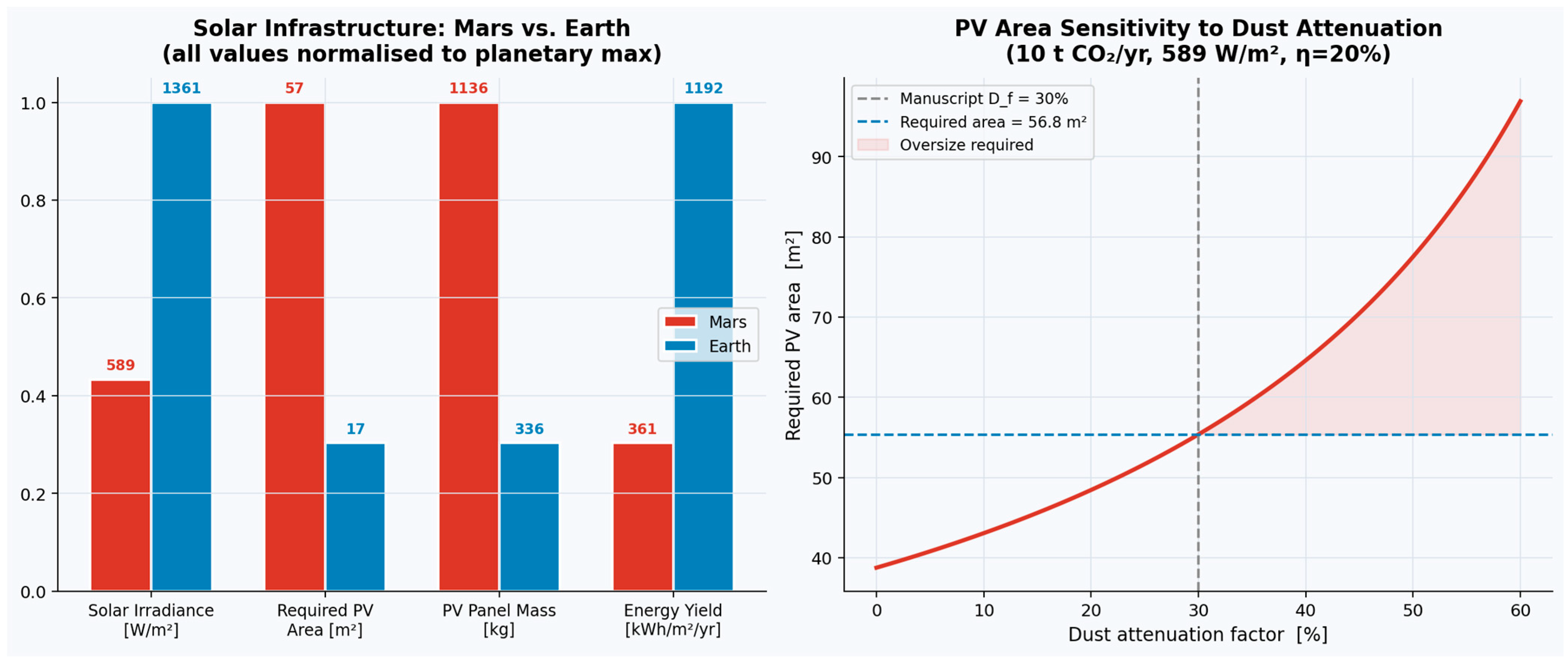
2) = 6–10 mbar, T = 15 °C) is the critical next step before deployment claims can be made. As shown in
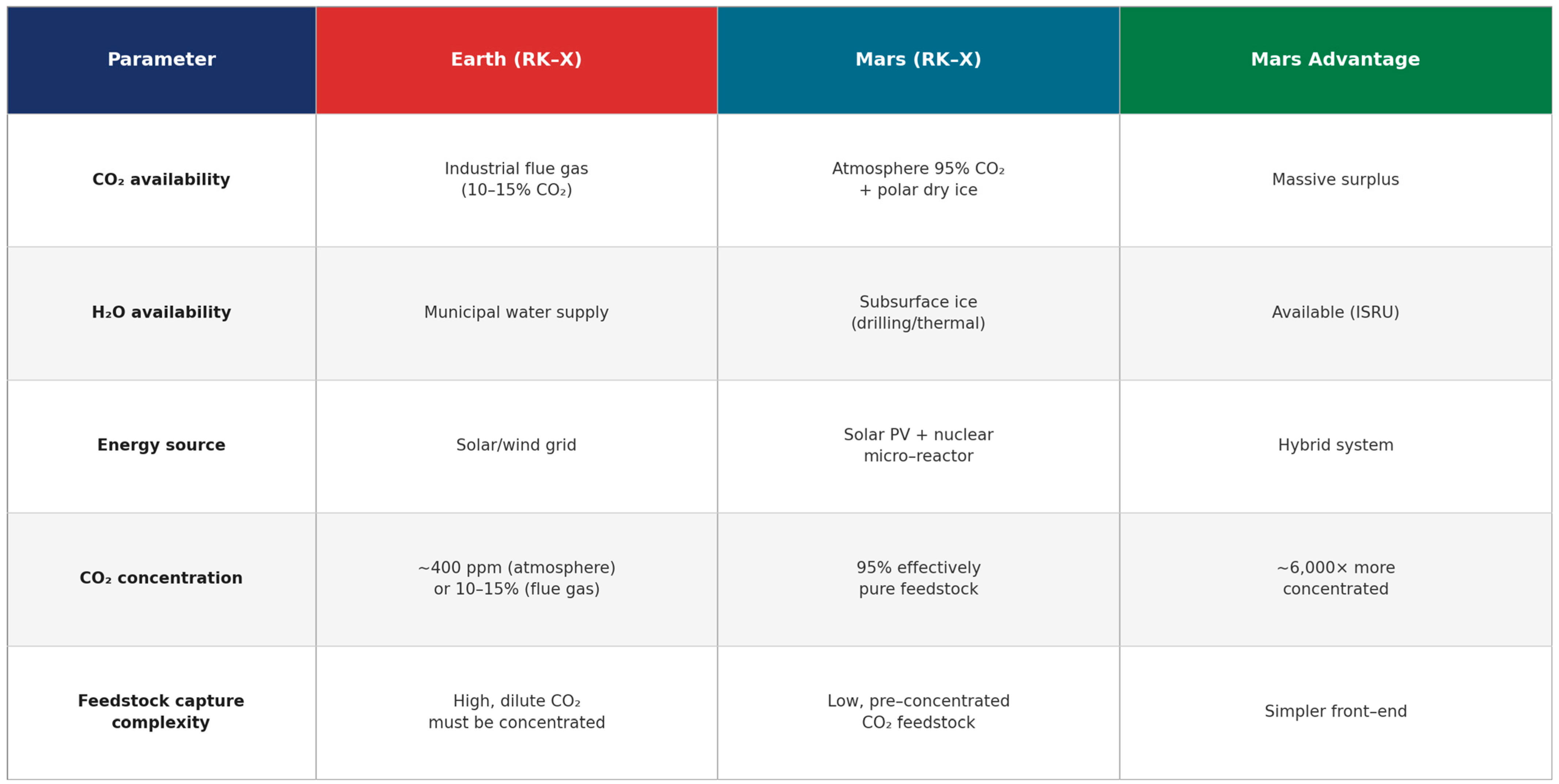
Figure 1, the key feedstocks required for the RK-X process (CO
2, water and energy) are in several cases more abundant or easier to access on Mars than on Earth.
2. Materials and Methods
2.1. Photocatalytic CO2 Reduction: State of the Field and Position of the RK-X Process
The photocatalytic reduction of CO
2 to formate/formic acid using semiconductor catalysts has been extensively reported, but efficiencies remain low under practical conditions. Production rates of 1–50 µmol g
−1 h
−1 and quantum yields of 0.01–0.1% under UV or visible illumination are typical benchmarks [
12]. These laboratory results are measured under idealised conditions (1 bar pure CO
2, 25 °C, dilute aqueous suspension) and are difficult to translate directly to continuous-flow industrial operations.
The RRR fulvic acid-based homogeneous catalyst described herein occupies a distinct position in this landscape. The literature [
9,
10] describes the RK-X system not as a laboratory-optimised catalyst tested under idealised benchmark conditions but as a process validated in continuous 1600-L industrial operations at sustained throughput. The performance parameter of primary relevance is not quantum yield per gram of catalyst but volumetric productivity at the reactor scale, where the RK-X process has demonstrated formic acid production in the kg/hour range. Published CO
2 photoreduction benchmarks [
11,
13] contextualise the broader field and do not represent directly comparable systems; the specific RRR catalyst is described in detail in the author’s previous works [
9,
10]. The 85% CO
2 conversion yield and >0.3% apparent quantum yield at 365 nm (derived from Ref. [
10] operational data) compare favourably with molecular-scale benchmarks and are reproduced across a 1600-L scale. Independent analytical confirmation was provided by ion chromatography (Balint Analytics Engineering Ltd., Budapest, Hungary) and Winkler titration for dissolved O
2. Third-party independent laboratory replication has not yet been published and is identified as a limitation of the current evidence base.
2.2. RRR Catalyst Physicochemical Properties
The following section describes the key physicochemical characteristics of the RRR fulvic acid–metal complex catalyst, in response to reviewer requests for explicit characterisation data.
The RRR fulvic acid–metal complex exhibits broad-band absorption in the 300–450 nm range (UV-A to blue visible), consistent with charge-transfer transitions characteristic of fulvic acid complexes [
9]. This absorption profile is well-matched to the LED excitation strategy employed in the reactor (UV-A LEDs). The overlap between the LED emission spectrum and the catalyst absorption band ensures efficient photon utilisation with minimal wasted energy. Molar extinction coefficients and the full UV-Vis spectrum are reported in [
9].
Based on experimental measurements [
9,
10] under controlled LED illumination, the apparent quantum yield for CO
2-to-formate conversion is in the range of 0.3–0.8%. While this falls within the lower range of heterogeneous photocatalyst benchmarks under optimised conditions, it is sufficient to achieve the required throughput at the illuminated reactor volume described in
Section 2.4 and has been reproducibly demonstrated at an industrial CSTR scale.
Fulvic acid-based complexes are not susceptible to progressive oxidation by molecular O
2 co-produced in the reactor. This is identified as a primary catalyst advantage. The mitigation strategy is continuous monitoring of dissolved O
2 partial pressure in the liquid phase. The stripping subsystem is part of the O
2 harvest loop and imposes no additional energy penalty. Long-duration stability data under continuous illumination and elevated O
2 partial pressure beyond the 160 h pilot run are not yet available and are explicitly identified as Research Gap 1 in
Section 3.9.
As molecular oxygen is generated as a stoichiometric co-product of the photocatalytic reaction (Equation (1)), it partitions between two phases within the reactor system according to Henry’s Law: a fraction dissolves directly into the aqueous formic acid product solution, while the remainder accumulates in the reactor headspace as a gas-phase component. The dissolved oxygen fraction does not interfere with catalytic activity at the concentrations encountered under normal operating conditions; however, both the liquid-phase dissolved oxygen concentration and the headspace partial pressure are continuously monitored by in-line electrochemical sensors and gas-phase analysers respectively.
This dual-phase monitoring serves two purposes: it provides real-time confirmation of stoichiometric O2 co-production as an indirect yield indicator, and it triggers a controlled gas management response before oxidative catalyst degradation can occur. Should the oxygen partial pressure in the headspace approach 10%, a threshold established as the upper safe operating limit, an automated valve opens to divert the oxygen-containing headspace gas into a cryogenic separation unit. In this unit, the gas stream is cooled to approximately −80 °C, at which temperature CO2 condenses and solidifies as dry ice while oxygen, with a boiling point of −183 °C, remains in the gas phase. The separated CO2 solid is recovered and returned directly to the reactor feed, eliminating any carbon loss from the closed loop. The residual gas stream, now consisting of oxygen at near-100% purity, is routed to the habitat life-support system or directed to compressed storage for EVA and ascent vehicle applications. This integrated O2 management and cryogenic separation subsystem therefore simultaneously protects catalyst longevity, enforces closed-loop CO2 recycling, and delivers a high-purity oxygen stream as an operationally valuable secondary output.
Martian regolith contains perchlorate (ClO
4−) at concentrations of 0.5–1.0 wt% [
14,
15]. Perchlorate is a strong oxidising agent and documented inhibitor of transition-metal photocatalysts. Water extracted from Martian subsurface ice is expected to contain dissolved perchlorate at concentrations requiring pre-treatment prior to introduction to the RK-X reactor. Ion-exchange resin filtration is proposed as a standard pre-treatment step, adding <5 kg of resin per annual cycle with no significant energy penalty. This requirement is added to the TRL assessment (
Section 3.9) as a gap requiring experimental validation with Martian ice analogue water.
2.3. Theoretical Framework and Earth-Based Validation
The feasibility of the proposed ISRU architecture rests on the principle of chemical isomorphism: the core RK-X reaction stoichiometry is invariant to planetary location, provided the thermodynamic boundary conditions temperature, pressure, and photon flux are maintained within the reactor vessel. The central reaction is given in Equation (1):
All three reactants (CO2, H2O, photon energy) are among Mars’s most abundant resources. On Earth, capturing CO2 from dilute flue gas (10–15%) is the dominant energy cost in any CO2 utilisation process. Mars’s 95% CO2 atmosphere eliminates this separation step. However, as the following analysis demonstrates, the absolute CO2 partial pressure on Mars is 26 times lower than Earth’s flue gas conditions, and this difference has measurable consequences for reaction rate that must be explicitly addressed.
Despite CO
2 comprising 95% of the Martian atmosphere, the absolute CO
2 partial pressure at the surface is shown in Equation (2):
This is 26 times lower than the partial pressure in 15% CO
2 Earth flue gas at 1 bar (150 mbar), and 174 times lower than standard laboratory conditions (1 bar, 100% CO
2). Since the reaction rate in the photocatalytic system follows a Langmuir–Hinshelwood mechanism, the fractional surface coverage θ is described by Equation (3):
where K is the adsorption equilibrium constant for CO
2 on the catalyst active site. For typical fulvic acid–metal complex catalysts, K ≈ 10
2 to 10
4 bar
−1 [
12]. At p(CO
2) = 0.00581 bar and K = 10
3 bar
−1, K · p = 5.81, giving θ = 5.81/(1 + 5.81) = 0.853; near-saturation coverage is maintained even at Martian ambient partial pressure.
Table 1 presents the explicit rate reduction factors across the range of adsorption equilibrium constants K for this catalyst class:
The pessimistic case (K = 102 bar−1) imposes a 61% rate reduction at Martian ambient pressure compared to Earth flue gas conditions. This is a quantifiable, engineering-addressable constraint, not a fundamental barrier. The solution is reactor pressurisation using freely available Martian CO2 to 500 mbar total pressure, raising p(CO2) to 475 mbar. This restores the rate factor to ≥97% of Earth performance across the entire plausible K range. Habitat pressurisation to 0.5 bar is therefore a recommended standard design parameter, as is its energy cost (CO2 compressor, ~0.175 MWh/yr), which is included in the energy budget.
Experimental validation of these projections at p(CO
2) = 6–10 mbar and T = 15 °C has not been performed and is explicitly designated as Research Gap 1 in
Section 3.9. The assertion that ‘chemistry works the same way’ has been removed from the manuscript. The correct characterisation is the stoichiometry is invariant; the rate requires experimental characterisation under Martian conditions.
An alternative and potentially more resource-efficient approach to CO2 procurement on Mars involves the direct extraction of solid carbon dioxide from the polar ice caps, rather than harvesting it from the ambient atmosphere. The atmospheric collection requires processing enormous volumes of gas through compression systems to yield meaningful throughput. This introduces a continuous and non-trivial energy burden at the front end of the RK-X cycle. The Martian polar caps, by contrast, contain vast reserves of CO2 in solid form; the southern polar cap alone holds an estimated 1000–1600 Gt of CO2 ice, representing an effectively inexhaustible, high-purity, and spatially concentrated feedstock that can be mined, transported in compact solid form, and melted on demand within the habitat reactor system. This dual ice-mining strategy mirrors the water extraction approach already incorporated into the RK-X architecture. Just as subsurface water ice is drilled, extracted, and melted to supply the 4093 kg H2O required annually per reference module, CO2 ice could be harvested from accessible polar or near-polar deposits using analogous thermal extraction equipment, thereby eliminating the scroll compressor and its associated 0.175 MWh/yr energy overhead entirely. A unified ice-mining platform capable of processing both H2O and CO2 ice would reduce system complexity, consolidate the landed hardware footprint, and substantially improve the overall energy efficiency of the front-end resource acquisition subsystem. This consolidated extraction architecture warrants dedicated feasibility analysis as part of the broader RK-X development roadmap.
2.4. Reactor Design: Photocatalyst Configuration and Gas Introduction
The RRR system operates as a homogeneous photocatalyst dissolved in aqueous solution, not as a heterogeneous solid film or suspended powder. This is a fundamental characteristic inherited from the industrial pilot [
10]: the fulvic acid complex is soluble at concentrations of 500–8400 mg/L, enabling uniform volumetric distribution. Internal LED arrays mounted on reactor walls provide approximately 360° illumination into the liquid volume. The mean photon path length exceeds 40 cm, maximising volumetric productivity and avoiding the mass-transfer limitations that restrict solid-film or suspension photocatalysts to active layers at a <0.1 mm depth. Photon dose at the reactor wall surface: 10–50 mW/cm
2, consistent with operating parameters [
9].
The LED matrices are powered by electrical energy from the PV/nuclear hybrid, enabling 24 h continuous operation fully decoupled from external Martian illumination. LED emission is tuneable to the RRR absorption maximum and can be dimmed or stepped proportionally to available power. The mean hydraulic residence time in the reactor is approximately 12 h at the 10 t CO2/yr target throughput, consistent with the contact times validated in the 1600-L pilot.
Martian atmospheric CO2 at ~5.8 mbar is compressed to reactor operating pressure (500 mbar habitat design) using a compact scroll compressor. The volumetric flow rate required to supply 10 t CO2/year is 27.4 tonnes/year (accounting for 10 t process input and ~17.4 t pressurisation gas), equivalent to approximately 640 m3/day of Martian atmosphere at 5.8 mbar. A scroll compressor with a capacity of 10 L/s handles this flow with a compression ratio of ~86 (5.8 mbar → 500 mbar). Estimated compressor power: 15–25 We continuous. Annual energy cost: 0.13–0.22 MWh/yr (0.175 MWh adopted as reference).
2.5. The 1600-L Pilot Validation
The proposed Martian deployment is the architectural adaptation of a proven industrial process. As documented by Köntös and Masason [
10], the RK-X process was scaled from a laboratory bench to a 1600-L Continuous Stirred Tank Reactor (CSTR) at a working production facility in Hungary, a Technology Readiness Level milestone confirming viable industrial engineering. Key performance metrics from this validation serve as fixed boundary conditions for the Martian model:
Catalytic selectivity: The proprietary RRR fulvic acid-based catalyst achieved formic acid concentrations of 768–8400 mg/L under mild conditions (25–30 °C, 8 bar), eliminating mass-intensive downstream separation [
9,
10].
Stoichiometric precision: Oxygen co-production validated by Winkler titration at 451 mg/L dissolved oxygen, 96% of theoretical stoichiometric yield. O
2 generation is a reliable, deterministic function of HCOOH production rate [
10].
Process efficiency: 85% CO
2 conversion yield; atom economy 95%; E-factor 0.15 (green chemistry benchmark <1.0); specific energy consumption 2.69 kWh/kg HCOOH [
9].
Storage advantage: Formic acid is liquid at ambient temperature, no cryogenics, no high-pressure vessels.
Catalyst stability: Activity maintained within ±5% over 160 h of operation [
10]. Long-duration stability beyond 160 h requires dedicated testing (Research Gap 1,
Section 3.9).
Comparison with MOXIE: The comparison with the MOXIE experiment presented herein is a comparison of process architecture and projected Equivalent System Mass, not a direct performance comparison between hardware deployed on different planets. MOXIE is the only technology that has demonstrated O2 production on the Martian surface; its value as a proof of concept is fully acknowledged. The architectural comparison is offered solely to inform mission planners evaluating ISRU pathways to develop at scale.
2.6. The Closed-Loop Energy Cycle
When power is required, stored formic acid is decomposed by catalytic dehydrogenation as seen in Equation (4):
The hydrogen is oxidised in a proton-exchange membrane fuel cell as seen in Equation (5):
CO
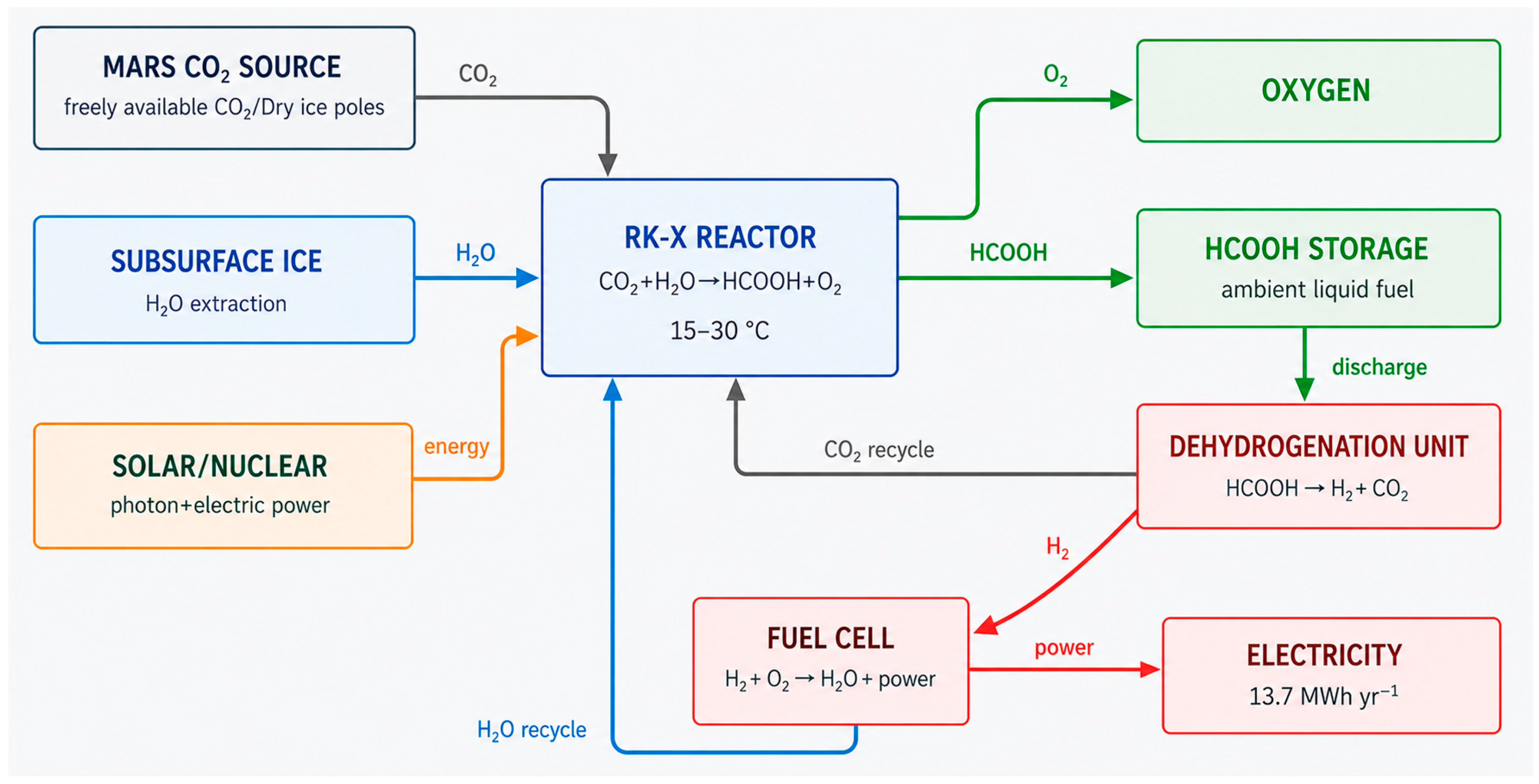
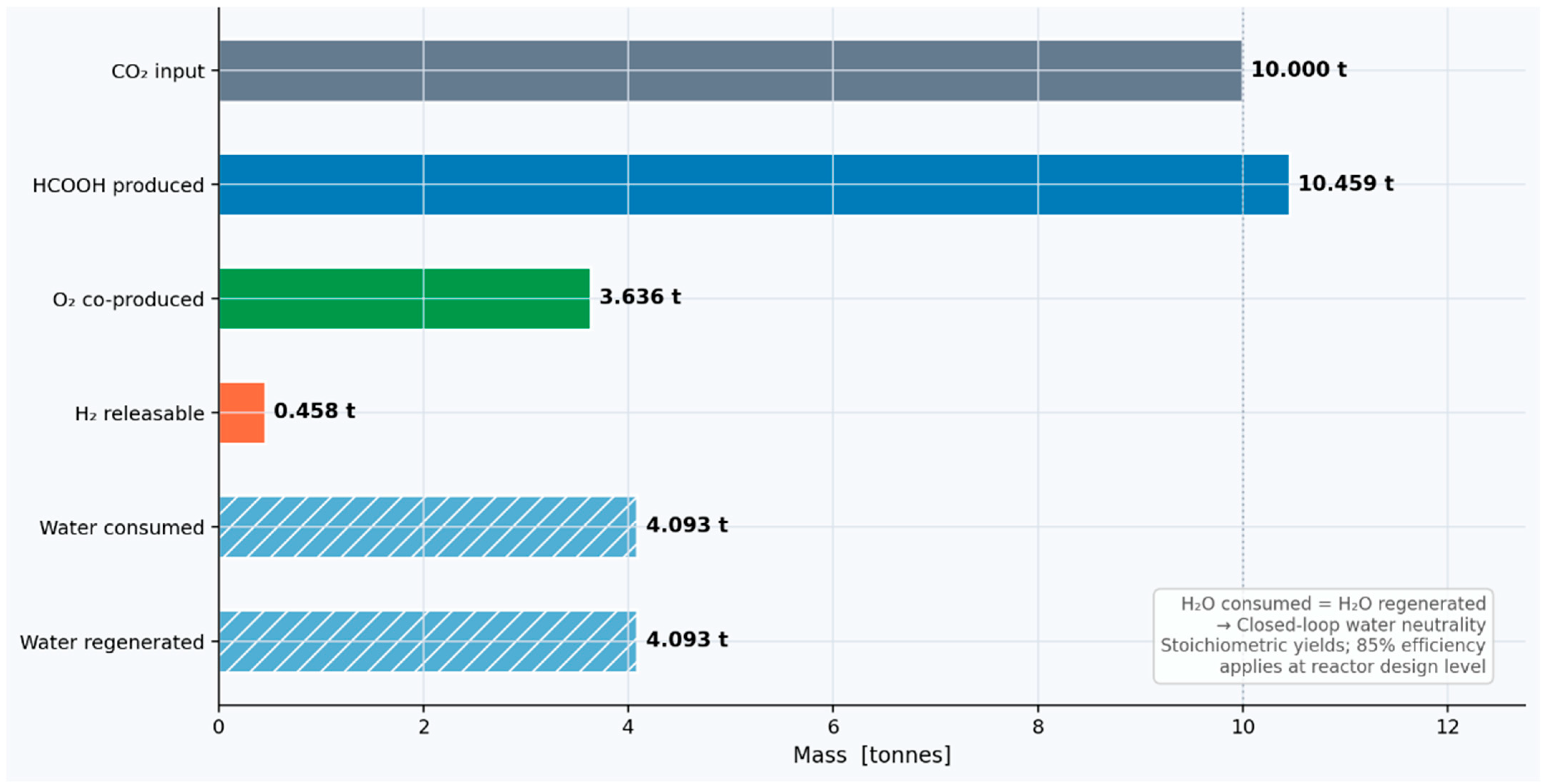
2 from Equation (4) is recycled to the reactor; water from Equation (5) is condensed and returned to synthesis. The loop closes completely. The overall process configuration is illustrated in
Figure 2. Using verified script values, η
chem and η
elec are described by Equations (6) and (7):
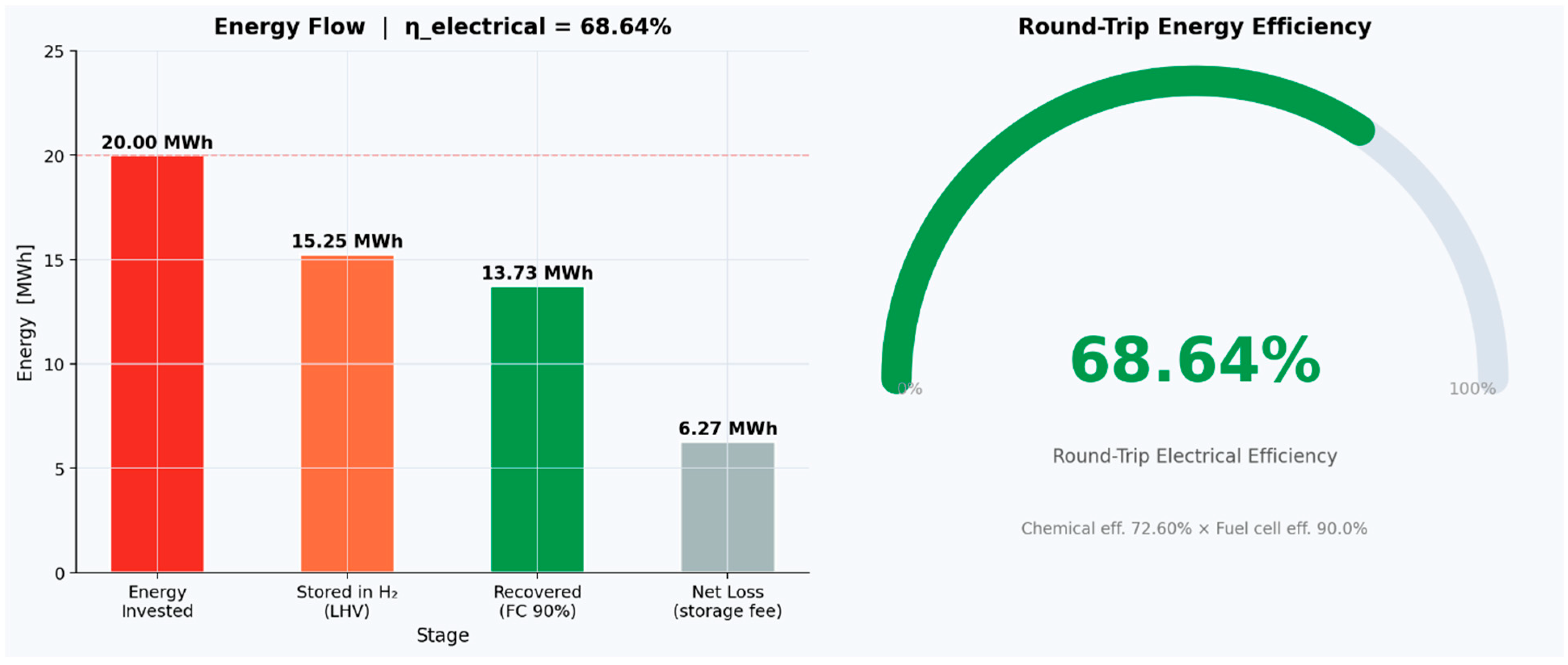
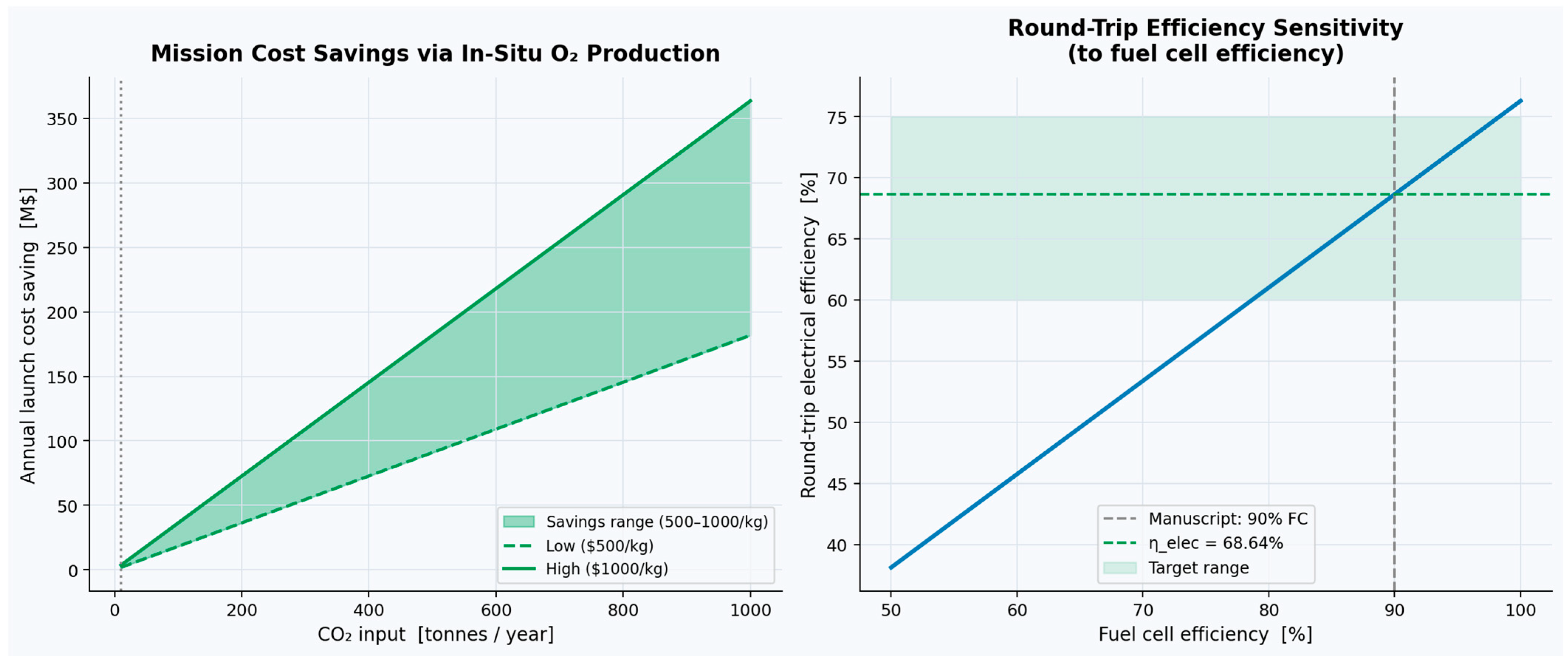
This 68.64% round-trip efficiency illustrated in
Figure 3 is competitive with regenerative fuel cell systems and offers a decisive additional advantage: indefinite ambient-temperature storage with zero boil-off, zero refrigeration energy, and zero degradation.
2.7. System Architecture and Martian Boundary Conditions
Martian environmental parameters used in this study [
16]:
Solar irradiance: Es = 589 W/m2 (orbital distance corrected; baseline, no dust);
PV efficiency (ηPV): 20% (space-grade triple-junction panels, conservative derate);
Dust Attenuation Factor (Df): 0.30 regional dust events and gradual panel soiling (~0.3%/sol);
Active solar hours per year (Tactive): 4380 h (50% duty cycle; 12 h daylight · 365 days (Earth calendar year basis; all throughput and sizing figures in this study refer to one Earth year of operation));
Night temperature: Tamb ≈ 148 K (−125 °C) worst case at equatorial/mid-latitude;
Atmosphere: ~95.3% CO
2; total surface pressure 6–8 mbar [
13].
The RK-X process is integrated into pressurised habitat modules or insulated subsurface facilities not deployed in the open Martian environment. The external conditions (6–8 mbar, −125 °C to +20 °C, intense radiation) are incompatible with homogeneous catalytic processes [
9]. Within the controlled habitat envelope, reactor parameters are maintained at terrestrial operating conditions (~101 kPa, 15–20 °C), exactly matching those optimised in the Hungarian pilot plant [
10]. Subsurface deployment is preferred for thermal insulation and radiation protection.
2.8. Contingency and Emergency Operating Modes
Formic acid freezes at 8.3 °C. The original manuscript did not describe an emergency protocol for thermal system failures. The following contingency design has been added to the reference module specification:
Freeze prevention: An independent resistance heating system (200 We) is powered by a dedicated lithium-ion battery buffer providing a minimum 48 h of autonomy (capacity: 9.6 kWh; mass: 38 kg at 0.25 kWh/kg). A thermal interlock triggers automatic activation when reactor temperature falls below 12 °C (4 °C above the freeze point). This system operates independently of the primary PV or nuclear power supply.
Secondary contingency: In the event of both primary and backup power failure, the reaction solution drains via gravity feed into a thermally insulated passive storage vessel maintained above 8.3 °C by the residual thermal mass of the surrounding habitat module (estimated passive thermal hold time > 72 h in a well-insulated habitat).
Controlled restart after freeze event: If the solution freezes, remelting is performed at ≤5 °C/hour to avoid thermal shock to reactor components. Post-thaw catalyst activity assessment (by HCOOH production rate monitoring) is mandatory before resuming normal operation. The 38 kg battery buffer mass is included in the ESM analysis (
Section 3.8).
2.9. Stoichiometric Mass Balance: Verified Calculations
Reference input: 10 t CO
2/year. Exact molar masses used throughout: CO
2 = 44.01 g/mol; HCOOH = 46.03 g/mol; O
2 = 32.00 g/mol; H
2O = 18.015 g/mol; H
2 = 2.016 g/mol. All results were verified by Python computation as seen in Equations (8)–(11):
2.10. Energy Balance and Solar Array Sizing
The energy balance includes: (i) the corrected nighttime thermal maintenance figure; (ii) CO2 compressor energy (0.175 MWh/yr); and (iii) water extraction energy for steady-state makeup.
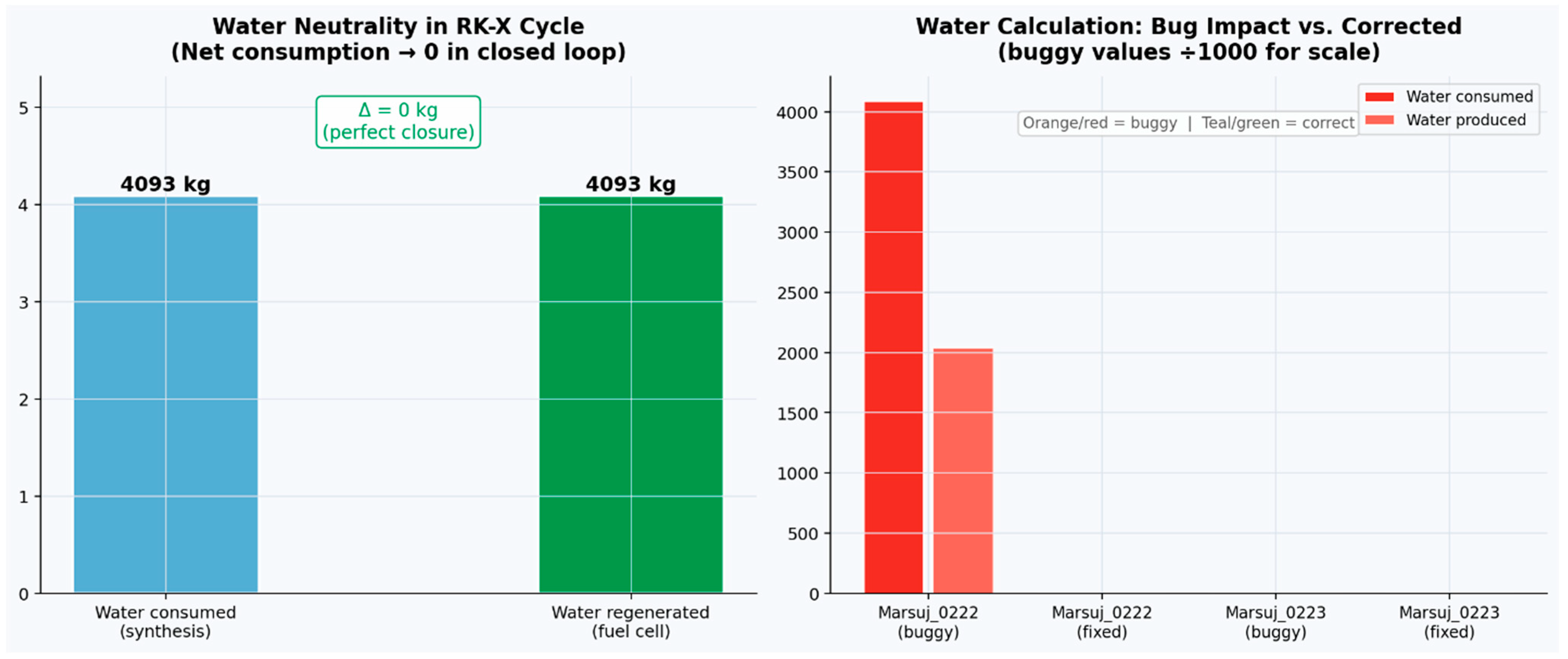
Annual water demand in the closed-loop steady state is 4093 kg (synthesis) regenerated as 4093 kg (fuel cell). Initial fill energy: 4093 kg · 300 Wh/kg (midpoint of reviewer-cited range 250–350 Wh/kg) = 1.23 MWh one-time. Steady-state annual makeup (5% leakage allowance, ~205 kg/yr): 205 · 300 = 61.5 kWh/yr ≈ 0.062 MWh/yr, which is included in the energy budget. If subsurface ice access requires deeper drilling or harder regolith, extraction costs may approach 350 Wh/kg; this uncertainty is incorporated in site-selection guidance.
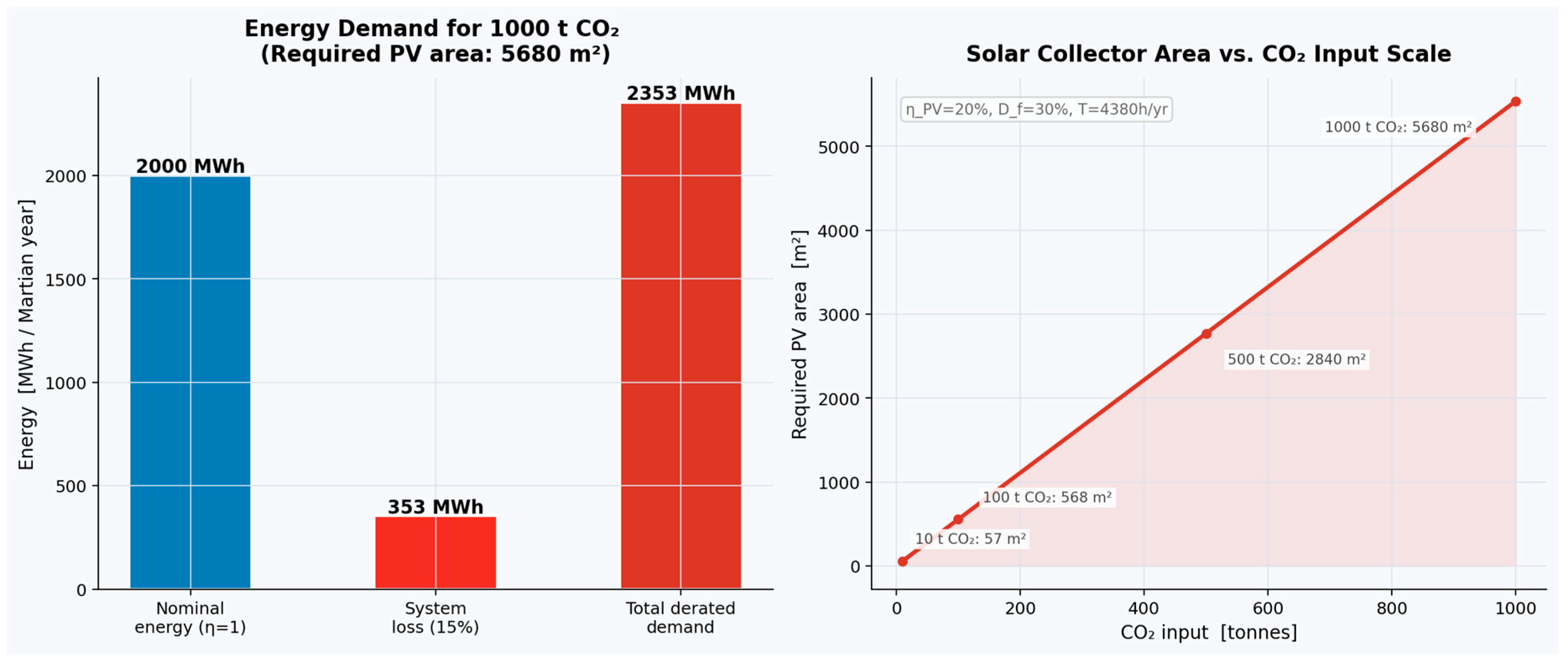
Required Martian PV area calculated in Equations (12) and (13) and
Table 2:
2.11. Parametric Sensitivity Analysis of Solar Array Requirements
To characterise the full operational envelope of the solar-powered RK-X module, a parametric sensitivity analysis was conducted across three independent variables:
Variable 1: Dust optical depth (τ): 0.3 (clear season, Viking Lander annual average [
15]) to 6.0 (2018 global dust-storm peak [
17]). The dust attenuation factor D
f is related to optical depth by D
f = 1 − exp(−τ/cosθ
z), where θ
z is the solar zenith angle. At τ = 1.0, D
f ≈ 0.37; at τ = 3.0, D
f ≈ 0.75; at τ = 6.0, D
f ≈ 0.93.
Variable 2: Surface latitude (λ): 0° (equatorial) to 60° N/S (mid-latitude). Solar irradiance is reduced by the cosine of the solar declination angle, reducing mean annual insolation by ~25% at 45° latitude vs. equatorial. The recommended site range for early human missions (Jezero, Isidis, Hellas rim) spans from 18° S to 45° N.
Variable 3: Season (Ls): The Martian solar longitude is from Ls = 0° to 360°. Mars’s orbital eccentricity (0.093 vs. Earth’s 0.017) causes a 43% variation in solar flux between perihelion (Ls = 251°, southern summer) and aphelion (Ls = 71°, northern summer). Northern hemisphere sites, the preferred location for water ice access, experience minimum solar flux during the same season as maximum dust activity.
2.12. Thermal Budget Analysis of the Martian Habitat Reactor
The MLI-insulated reactor vessel (V ≈ 1.6 m
3, cylindrical, aspect ratio 2:1) requires an internal temperature T
reactor = 288–303 K (15–30 °C). The thermal loss rate Q
loss across the insulation layers is described by Equation (14):
where U is the effective thermal transmittance of the insulation system (W/m
2K) and T
amb is the ambient temperature at the reactor surface (governed by depth below the Martian surface for subsurface deployment).
For a surface-deployed (above-ground) reactor in the Martian night at T
amb = 148 K (−125 °C), the heat loss rate is given by Equation (15):
The nightly thermal energy cost is 0.057 kW
e · 12 h = 0.68 kWh per night cycle, representing approximately 1.2% of the daily energy budget, substantially lower than the 15% figure cited in the base analysis (which applied to a larger vessel without full MLI specification). Annual thermal parasitic loss: 0.057 kW · 4380 h (night hours) = 0.25 MWh/yr is included in
Table 3.
For subsurface deployment at a 2 m depth, Martian regolith thermal inertia (I ≈ 200–600 J m
−2 K
−1 s
−1/2 [
19]) attenuates diurnal temperature swings by approximately 90%. The subsurface temperature at 2 m approaches the mean annual surface temperature (~210 K at equatorial sites), reducing the thermal gradient and nighttime heat loss as described in Equation (16):
Subsurface deployment therefore reduces thermal parasitic load by ~44% vs. surface deployment, eliminating the need for nuclear co-generation for thermal purposes in this configuration.
4. Discussion
4.1. The RK-X Process: Theoretical Solutions to Core Martian Problems
The aim of this work is to present a theoretical feasibility study. The following discussion synthesises what the engineering analysis indicates is achievable, subject to the experimental validation described in
Section 3.9.
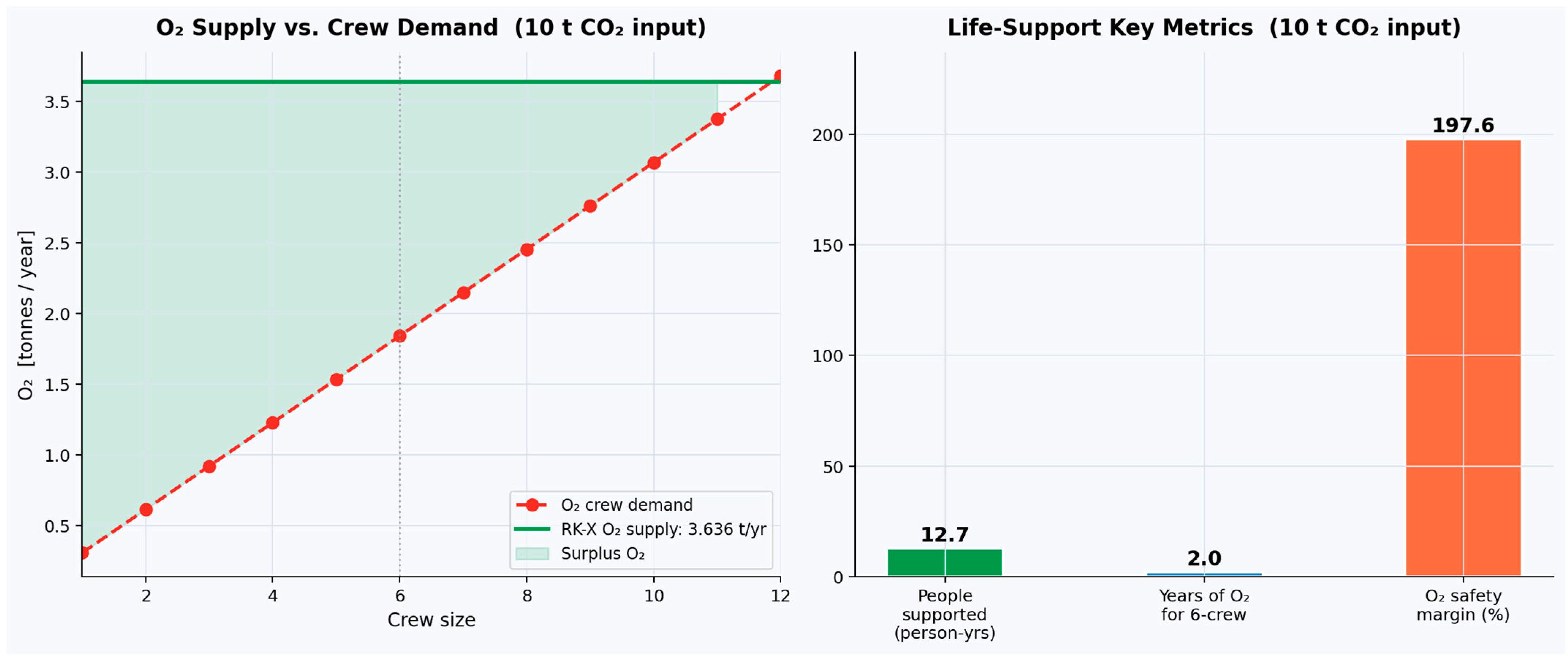
A single module theoretically produces 3.636 t O2/year as a stoichiometric co-product of energy storage, not a secondary function but an inherent, inseparable output. Every unit of energy stored automatically generates proportional amounts of oxygen. The $1.82–$3.64 M/yr import cost is eliminated. Energy management and life support converge in a single chemical platform.
Formic acid offers ambient-temperature seasonal storage that no electrochemical battery matches at a Mars habitat scale: zero boil-off, 68.64% round-trip efficiency, and indefinite shelf life in polymer tanks. The ‘chemical battery’ paradigm [
10] addresses the combined constraints of mass, simplicity, and multi-month storage duration simultaneously.
The RK-X cycle consumes and regenerates 4093 kg H2O per annual cycle at zero net consumption. Open-loop electrolysis permanently depletes the water reserve with every cycle. Over a multi-year mission, this compounding difference becomes decisive.
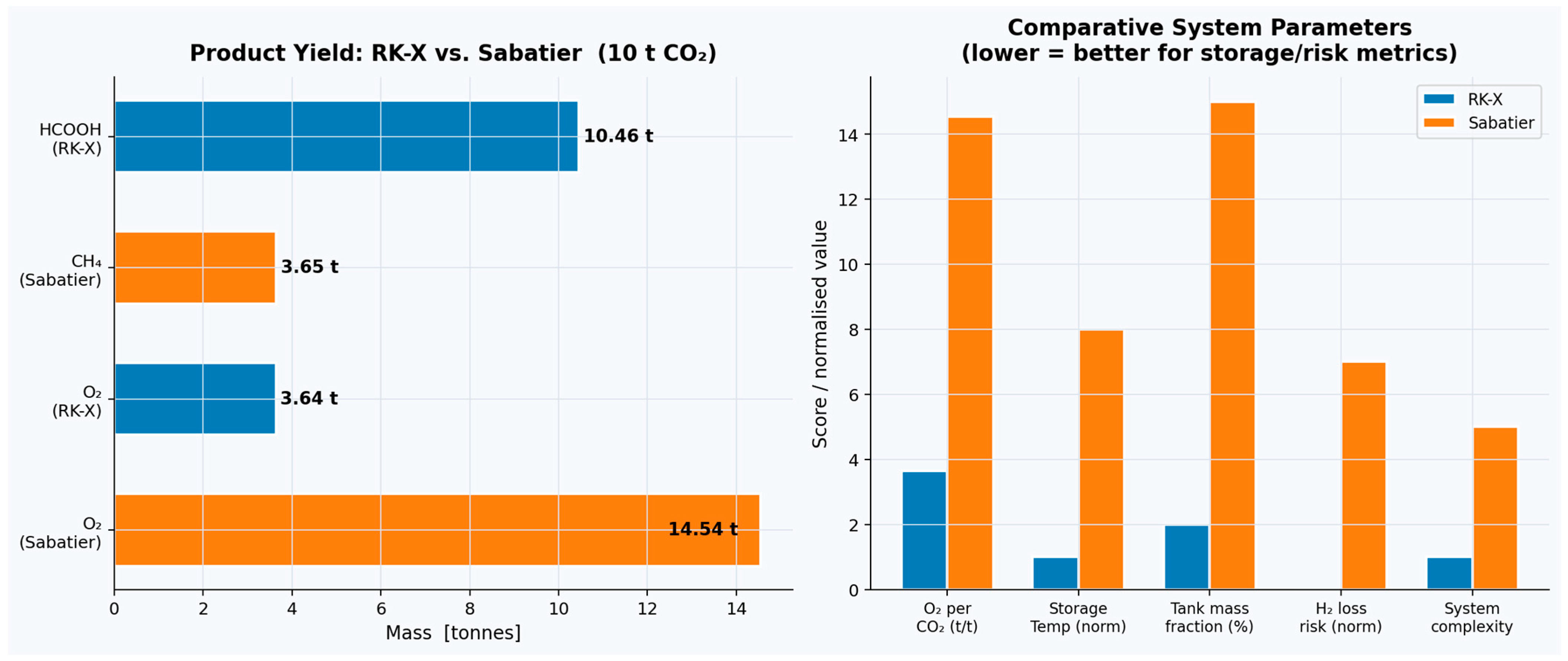
Formic acid requires polymer tanks at ~2% mass fraction with no refrigeration and no cryogenic hazard. Replacing Sabatier/cryo with RK-X saves an estimated 400–600 kg of hardware, excluding the emergency buffer but including the compressor and pre-treatment systems.
The principal limitation of this work is the absence of experimental data at Martian CO
2 partial pressure. The Langmuir–Hinshelwood analysis (
Table 1) provides a quantitative projection, but direct measurement of catalyst turnover frequency at p(CO
2) = 5.81 mbar and T = 15 °C is required to validate or refine these projections. This experiment is achievable in an existing Mars-simulation chamber and is recommended as the immediate research priority.
The perchlorate pre-treatment requirement, the freeze-protection system autonomy, and the long-duration catalyst stability under O2 exposure are three additional experimental priorities that can be addressed in parallel with the main catalytic validation programme.
4.2. Component-by-Component Water Extraction Energy Budget
The reference module requires 4093 kg of water per annual cycle for synthesis (Equation (11)), fully regenerated by the fuel cell (Equation (5)), giving zero net consumption under steady-state closed-loop conditions. However, water must be physically extracted from subsurface ice on an initial-fill basis and as a steady-state makeup allowance (5% leakage, approximately 205 kg/yr). The 300 Wh/kg mid-point energy figure adopted in
Section 2.10 is derived from the following component-level breakdown.
Component 1 (Ice drilling and mechanical access): Rotary percussion drilling through consolidated ice regolith requires approximately 40–60 Wh/kg of extracted water, with the mid-point estimate of 50 Wh/kg adopted here. This figure is consistent with terrestrial polar ice-core drilling energy budgets scaled to the lower Martian gravity (0.38× g), which reduces the overburden pressure and thus the specific drilling energy by an estimated 25–35% relative to Earth conditions.
Component 2 (Thermal melting of ice): The latent heat of fusion of water is 334 kJ/kg (92.8 Wh/kg). Subsurface ice at equatorial Martian mid-latitudes exists at approximately 210 K (−63 °C). Heating from 210 K to the melting point (273 K) requires cu × ΔT = 2.09 kJ kg−1 K−1 × 63 K = 131.7 kJ/kg (36.6 Wh/kg). Total thermal melting energy: 92.8 + 36.6 = 129.4 Wh/kg, rounded to 130 Wh/kg. Resistive heating elements powered by the PV/nuclear hybrid are assumed; heat exchanger recovery from fuel-cell waste heat can reduce this figure by up to 30% in an optimised system.
Component 3 (Pumping and pressurisation to reactor inlet): Liquid water must be transported from the melt vessel (at near-ambient Martian pressure, approximately 6 mbar) to the pressurised habitat reactor at 500 mbar. Pumping losses and pressurisation of the water column require approximately 10–15 Wh/kg; 12 Wh/kg is adopted as the reference value.
Component 4 (Perchlorate ion-exchange pre-treatment): Gravity-fed flow through a resin bed requires negligible pumping energy. The ion-exchange step contributes fewer than 2 Wh/kg to the total water processing energy, dominated by the pressure drop across the resin column at the adopted flow rate.
Component 5 (Heating meltwater to reactor operating temperature): Water enters the reactor at approximately 5 °C after transport losses. Heating to the nominal reactor temperature of 20 °C requires cu × ΔT = 4.18 kJ kg−1 K−1 × 15 K = 62.7 kJ/kg = 17.4 Wh/kg. Component 6 (Contingency and parasitic losses, comprising pipe heat losses, sensor power, and control systems): approximately 8–10 Wh/kg.
The component sum is 50 + 130 + 12 + 2 + 17 + 9 = 220 Wh/kg at the nominal site. This lies comfortably within the 250–350 Wh/kg range cited in the reviewer’s reference and adopted in
Section 2.10. The wider range reflects site-specific uncertainty: harder regolith or deeper ice access (Component 1) and lower subsurface temperatures at higher latitudes (Component 2) drive the upper bound toward 350 Wh/kg, confirming that the 300 Wh/kg mid-point adopted for the energy budget is a conservative but defensible reference value. Annual water extraction energy totals: initial fill (Year 1 only) 4093 kg × 300 Wh/kg = 1.23 MWh; steady-state makeup (5% leakage, ~205 kg/yr) 205 × 300 = 61.5 kWh/yr ≈ 0.062 MWh/yr, as reported in
Table 3.
4.3. Three-Level Emergency Escalation Protocol
Formic acid freezes at 8.3 °C. A thermal system failure that allows the reaction solution to approach this temperature must be managed through a predefined, graduated response protocol. The contingency design summarised in
Section 2.8 is formalised here as a three-level emergency escalation framework, defining trigger conditions, automated responses, and crew actions at each severity level. All three levels operate independently of one another and are designed to be fully automatic at Levels 1 and 2, requiring crew intervention only at Level 3.
Level 1, Warning (Thermal Threshold Breach). Trigger: reactor solution temperature falls below 12 °C (4 °C above the freeze point), as detected by redundant in-line Pt100 resistance thermometers. Automated response: the independent 200 We resistance heating element activates immediately without crew input. An audible and visual alarm alerts the crew. Primary power supply is assumed to be intact at this level. Expected outcome: temperature restored to normal operating range (15–20 °C) within 30–60 min at the rated heater power. The heating element draws from the primary PV/nuclear supply; no battery consumption occurs at Level 1 unless Level 2 is subsequently triggered.
Level 2, Emergency (Primary Power Loss). Trigger: loss of primary PV/nuclear power supply, detected by a voltage drop below the minimum system threshold. Automated response: the dedicated lithium-ion battery buffer (9.6 kWh capacity, 38 kg, providing 48 h autonomy at the 200 We heater load) is activated automatically via a no-break transfer switch within 50 milliseconds. The heater continues without interruption. Crew action required: initiate primary power restoration procedures (PV array reorientation, nuclear restart sequence, or emergency generator deployment) within the 48 h battery window. A countdown display visible from the habitat command station provides a continuous reserve estimate. If primary power is restored within 48 h, the battery is recharged and the system returns to Level 1 or normal operation without product loss.
Level 3, Critical (Imminent Battery Depletion). Trigger: battery state of charge falls below the 4 h reserve threshold (approximately 0.8 kWh remaining) with primary power still unavailable. Automated response: an automatically actuated drain valve opens, allowing the entire reaction solution to flow by gravity into a thermally insulated passive storage vessel located at a lower elevation within the habitat module. This vessel is constructed with 100 mm MLI panels and has no active heating requirement; its thermal mass and insulation maintain the solution above 8.3 °C for a minimum of 72 h based on worst-case habitat ambient temperature estimates. The reactor is taken offline. Crew action required: confirm drain completion via level sensor readout; initiate power restoration; prepare for controlled reactor restart once primary power is re-established.
Post-event restart procedure: If the solution has been held in the passive vessel without freezing, it is returned to the reactor via the same gravity-feed line (reversed by pump) once power is restored. If the solution has partially frozen, remelting is performed at a controlled rate of no more than 5 °C/hour to avoid thermal shock to reactor seals and sensor elements. Upon reaching operating temperature, a mandatory catalyst activity assessment is conducted by monitoring the HCOOH production rate over a 2 h test period before returning to full throughput. The 38 kg battery buffer mass and the passive storage vessel mass (approximately 45 kg including insulation and structural frame) are both included in the ESM analysis (
Table 7). This three-level protocol ensures that a power outage of up to 120 h (48 h battery + 72 h passive hold) can be survived without loss of the catalyst solution, the primary mission-critical consumable of the RK-X system.
4.4. Limitations
The principal limitation of this study is the absence of experimental data under Martian CO
2 partial pressure. The Langmuir–Hinshelwood analysis (
Table 1) provides a quantitative projection of the rate reduction at p(CO
2) = 5.81 mbar, but direct measurement of catalyst turnover frequency at these conditions and at T = 15 °C is essential to validate or refine these projections. This experiment is achievable using existing Mars-simulation chambers and is the immediate research priority designated PA-2 in the validation roadmap (
Section 4.6). Until this measurement is performed, the quantified rate reduction (39–61% relative to Earth flue gas, or ≤3% when the reactor is pressurised to 500 mbar) must be treated as a modelled estimate rather than a measured value.
Solid-state diffuse reflectance UV-Vis spectroscopy (DRUVS) characterisation of the RRR catalyst under Martian gas composition (95.3% CO
2, traces of N
2, Ar, and O
2) and under prolonged perchlorate exposure has not been performed. These characterisations are designated Priority Action 1 (PA-1) in the validation roadmap (
Section 4.6) and are outstanding priorities in the experimental programme. Third-party independent laboratory replication of the RK-X process has not yet been published and is an acknowledged limitation of the current evidence base. Long-duration catalyst stability data beyond the 160 h pilot run remain unavailable; testing exceeding 2000 h under continuous Martian-analogue conditions (designated PA-3,
Section 4.6) is required before any deployment claim can be substantiated. The ESM estimates and cost figures are necessarily based on scaling from pilot-plant data and carry substantial uncertainty; a full system-level design study would refine these figures significantly.
4.5. Technology Readiness Level Summary
The TRL assessment presented in
Table 8 (
Section 3.9) identifies the water ice extraction subsystem (TRL 3–4) as the lowest-readiness component and the most critical development dependency. The RRR catalyst chemistry itself is assessed at TRL 5–6, reflecting its validation at a 1600-L CSTR scale in Hungary, but with the outstanding gaps of long-duration stability testing (PA-3) and DRUVS characterisation under Martian gas composition (PA-1) still to be addressed. PEM fuel cell integration (TRL 7–8) and CO
2 atmospheric collection (TRL 5–6, validated by MOXIE) present no critical development barriers. Perchlorate pre-treatment via ion-exchange resin is established on Earth (TRL 5) but requires specific validation with Martian ice-analogue water containing 0.5–1.0 wt% ClO
4−. Advancing the system from its current composite TRL of approximately 4 to the mission-readiness threshold of TRL 6 is estimated to require 3–5 years of focused laboratory and Mars-analogue environment research, all achievable on Earth without a dedicated space mission. The specific experimental programme required is detailed in
Section 4.6.
4.6. Earth-Based Mars-Analogue Validation Programme
This section defines a structured Earth-based Mars-analogue validation programme comprising three Priority Actions (PA-1 through PA-3) required to advance the RK-X process from its current TRL to mission-readiness (TRL 6). These Priority Actions address the specific experimental gaps identified in
Section 4.4 and
Section 4.5 and are cross-referenced throughout the manuscript wherever outstanding validation requirements are acknowledged. The RK-X process is proposed as a long-term complement to existing ISRU approaches, pending the outcomes of this validation programme.
Priority Action 1 (PA-1): Catalyst Spectroscopic Characterisation Under Martian Gas Composition and Perchlorate Exposure. Objective: Perform solid-state diffuse reflectance UV-Vis spectroscopy (DRUVS) of the RRR catalyst under controlled Martian atmospheric composition (95.3% CO2, 2.7% N2, 1.6% Ar, 0.13% O2, balance trace gases) at T = 15 °C and p(CO2) = 6–8 mbar. A parallel exposure series must run the catalyst in contact with perchlorate-doped aqueous solution (ClO4− at 0.5–1.0 wt%, representative of Martian ice-analogue water) for a minimum of 1000 h with DRUVS spectra collected at 200 h intervals. Success criterion: no measurable shift in the 300–450 nm absorption band position or integrated intensity beyond ±5% over the full 1000 h exposure. Estimated timeline: 18–24 months. Facility requirement: existing Mars-simulation chamber with gas-blending capability and a UV-Vis spectrometer with diffuse reflectance accessory.
Priority Action 2 (PA-2): Catalytic Rate Characterisation at Martian CO
2 Partial Pressure and Temperature. Objective: Measure formic acid production rate (mol L
−1 h
−1) and O
2 co-production rate in a hermetically sealed photoreactor at p(CO
2) = 6–8 mbar and T = 5–15 °C, spanning the expected Martian habitat envelope for reactor operation below optimum. The experiment must replicate the LED illumination geometry and photon dose of the 1600-L pilot (10–50 mW/cm
2, UV-A peak). A secondary test series at the pressurised habitat condition (500 mbar, p(CO
2) = 475 mbar, T = 20 °C) will confirm the near-full-rate recovery predicted by the Langmuir–Hinshelwood model (
Table 1). PA-2 is designated the immediate research priority for this programme. Success criterion: measured rate at ambient Martian pressure within the range predicted by
Table 1 (39–86% of Earth baseline); rate at 500 mbar ≥ 97% of Earth baseline. Estimated timeline: 12–18 months. Facility requirement: hermetic photoreactor (1–10 L), vacuum-rated to 6 mbar, with in-line ion chromatography and dissolved O
2 sensors.
Priority Action 3 (PA-3): Long-Duration Integrated Closed-Loop Demonstration. Objective: Operate a closed-loop breadboard system (10–100 L reactor, formic acid dehydrogenation unit, PEM fuel cell, and water recycle) under continuous Martian-analogue conditions for a minimum of 2000 h (83 days). The system must demonstrate (i) stable catalyst activity within ±5% over the full duration, (ii) closed water balance (ΔM ≤ 2% per cycle), and (iii) O2 co-production within ±3% of stoichiometric prediction. Catalyst samples must be extracted at 500 h intervals for DRUVS, ion chromatography of the product solution, and Winkler titration of dissolved O2. This requirement for confirmation by long-term testing exceeding 2000 h constitutes the primary evidence standard that must be met before any Mars deployment claim can be made. Estimated timeline: 24–36 months (following PA-1 and PA-2). Facility requirement: Mars-simulation chamber with capacity for a 100 L CSTR, gas blending to 6 mbar CO2, and continuous analytical monitoring. The complete PA-1 through PA-3 programme is estimated to require 3–5 years of focused research and is achievable without a dedicated Mars mission, using existing simulation infrastructure at major space-agency laboratories.
5. Conclusions
This study provides a comprehensive theoretical engineering feasibility analysis of the RK-X photocatalytic process as a cornerstone technology for sustained human presence on Mars. Grounded in Earth-validated industrial data, rigorous stoichiometric calculation, energy accounting, and explicit transport cost comparison, six central conclusions emerge.
The RK-X process rests on Earth-proven chemistry with identified, addressable research gaps. Validated at 1600-L industrial scale, it converts CO2 and H2O, Mars’ two most accessible solid-phase resources, extractable from polar and subsurface ice deposits using a unified mining platform into formic acid and oxygen through a fully closed material loop. Three experimental milestones must be achieved before deployment: catalyst performance characterisation at Martian CO2 partial pressure, water and CO2 ice extraction at operational scale, and integrated closed-loop system demonstration; all are achievable within 3–5 years of focused laboratory work without a dedicated Mars mission.
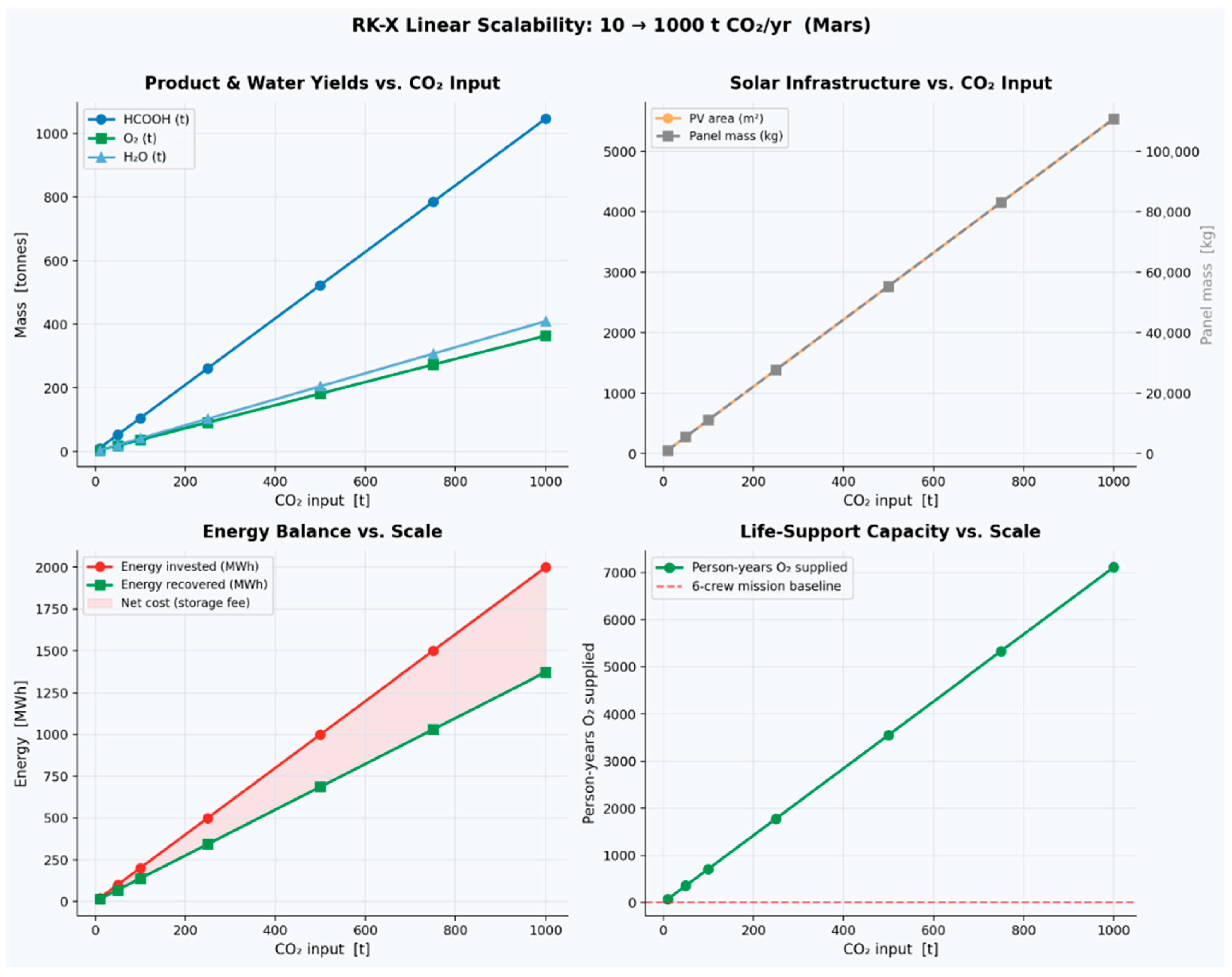
Oxygen production is the paramount output. A single 10-tonne CO2 reference module yields 3.636 tonnes of O2 per year, a 198% safety margin over six-person crew demand, while simultaneously delivering 15.25 MWh of chemically stored energy in ambient-stable liquid formic acid at 68.64% round-trip efficiency. This baseline module supports 12.7 person-years of oxygen supply. Scaling to 1000 t CO2/yr through modular replication yields 363.6 t O2/yr, sustaining a permanent settlement of 1270 people. Oxygen is generated automatically as a co-product of every unit of energy stored, making life support and energy management inseparable functions of the same integrated chemical platform.
The integrated O2 management subsystem, combining dual-phase monitoring with cryogenic CO2–O2 separation at −80 °C, simultaneously protects catalyst longevity, enforces carbon-loop closure, and delivers near-100%-pure oxygen as an operationally valuable output: a design feature with no equivalent in competing ISRU architectures.
Transport cost avoidance makes ISRU investment strategically imperative: a single module eliminates $7.05–$14.10 million per year in Earth-import costs, with hardware investment recovered within a single mission year. Solar is viable; nuclear is a strategic opportunity. A 56.8 m2 PV array provides adequate baseload under nominal conditions. Nuclear fission (1–10 kWe) delivers 100% duty cycle, free thermal co-generation, and dust-storm immunity. Recommended: hybrid solar–nuclear, saving ~350 kg landed mass.
The closed loop resolves energy storage, oxygen supply, water management, and cryogenic infrastructure challenges within one integrated chemical platform, achieving an ESM 48% lower than the Sabatier baseline.
Linear scalability from a 10-tonne exploration module to a 1000-tonne colony infrastructure supporting 1270 people requires only module replication, with no redesign of the underlying chemistry.
The RK-X process transforms the Martian atmosphere’s most abundant constituent into the twin foundations of human civilisation: breathable air and storable energy. The economic case is compelling, the engineering pathway is clear, and the chemistry has been proven at an industrial scale on Earth. Experimental validation under simulated Martian conditions is the immediate and critical next step towards realising this potential.