Next Article in Journal
A Review of Recent Advances in Micro Heat Exchangers in the Food and Pharmaceutical Industries
Previous Article in Journal
Vertical-Axis Wind Turbines for Extreme Environments: A Systematic Review of Performance, Adaptation Challenges, and Future Pathways
 
 
Due to scheduled maintenance work on our servers, there may be short service disruptions on this website between 11:00 and 12:00 CEST on March 28th.
Article

Impact of Damaged Dropper on Pantograph–Catenary Current Collection Quality in High-Speed Railways


1
China Academy of Railway Sciences Corporation Limited, Beijing 100081, China
2
School of Electrical Engineering, Southwest Jiaotong University, Chengdu 611756, China
*
Author to whom correspondence should be addressed.
Inventions 2026, 11(2), 26; https://doi.org/10.3390/inventions11020026

Submission received: 21 January 2026 / Revised: 14 February 2026 / Accepted: 24 February 2026 / Published: 14 March 2026
(This article belongs to the Section Inventions and Innovation in Biotechnology and Materials)

Abstract

The regularity of the catenary system and the stability of pantograph–catenary interaction are crucial for ensuring continuous and stable current collection quality in high-speed trains. Given that the dropper is a key suspension component within the catenary, the state of service integrity directly determines the regularity of, and dynamics within, the pantograph–catenary system. However, under long-term alternating loads and environmental influences, the dropper inevitably suffers damage due to strand fracture. The geometric regularity of the catenary is consequently disrupted, and the current collection quality of trains can deteriorate. While substantial efforts have been devoted to the study of pantograph–catenary dynamics under ideal or intact dropper conditions, research on current collection quality when the dropper has different types of damage remains insufficiently understood. This study focuses on the practical operational situation of high-speed railways, investigating the impact of dropper damage on current collection quality. Firstly, based on the pantograph–catenary parameters of an actual line, a dynamic model capable of simulating different types of dropper damage was built. Secondly, the current contact quality under various types of damage was explored in detail by several time-domain statistical features. Finally, within the typical speed range of 250 km/h to 350 km/h, the evolution of pantograph–catenary dynamic behavior under the combined effects of operating speed and dropper damage was analyzed, providing a theoretical basis for the reliable assessment of pantograph–catenary current collection quality and the formulation of stable operation and maintenance strategies.

1. Introduction

The high-speed railway, as a vital component of the modern comprehensive transportation system, holds strategic significance for national economic and social development due to its safe, efficient, and reliable operation [1]. Trains’ continuous and stable current collection from the catenary is fundamental to achieving this objective [2]. The pantograph–catenary contact force, as the most direct dynamic representation of the energy transfer interface, serves as a core indicator for evaluating current collection quality, with its magnitude, fluctuation characteristics, and statistical distribution being key metrics [3]. A stable contact force implies that the pantograph and catenary should maintain continuous and appropriate mechanical contact. On one hand, excessively high contact force significantly accelerates mechanical wear between the pantograph strip and the contact wire, and may induce harmful strong impact loads at the pantograph–catenary interface, adversely affecting equipment service life and operational stability [4,5,6]. On the other hand, insufficient contact force leads to undesirable pantograph–catenary contact or even separation, resulting in sustained arcing and potential interruption of power transmission [7,8]. Therefore, maintaining the contact force within a reasonable range and controlling its fluctuations are crucial for achieving high-quality current collection. To maintain ideal contact conditions, the catenary system must have good geometric regularity and dynamic stability.
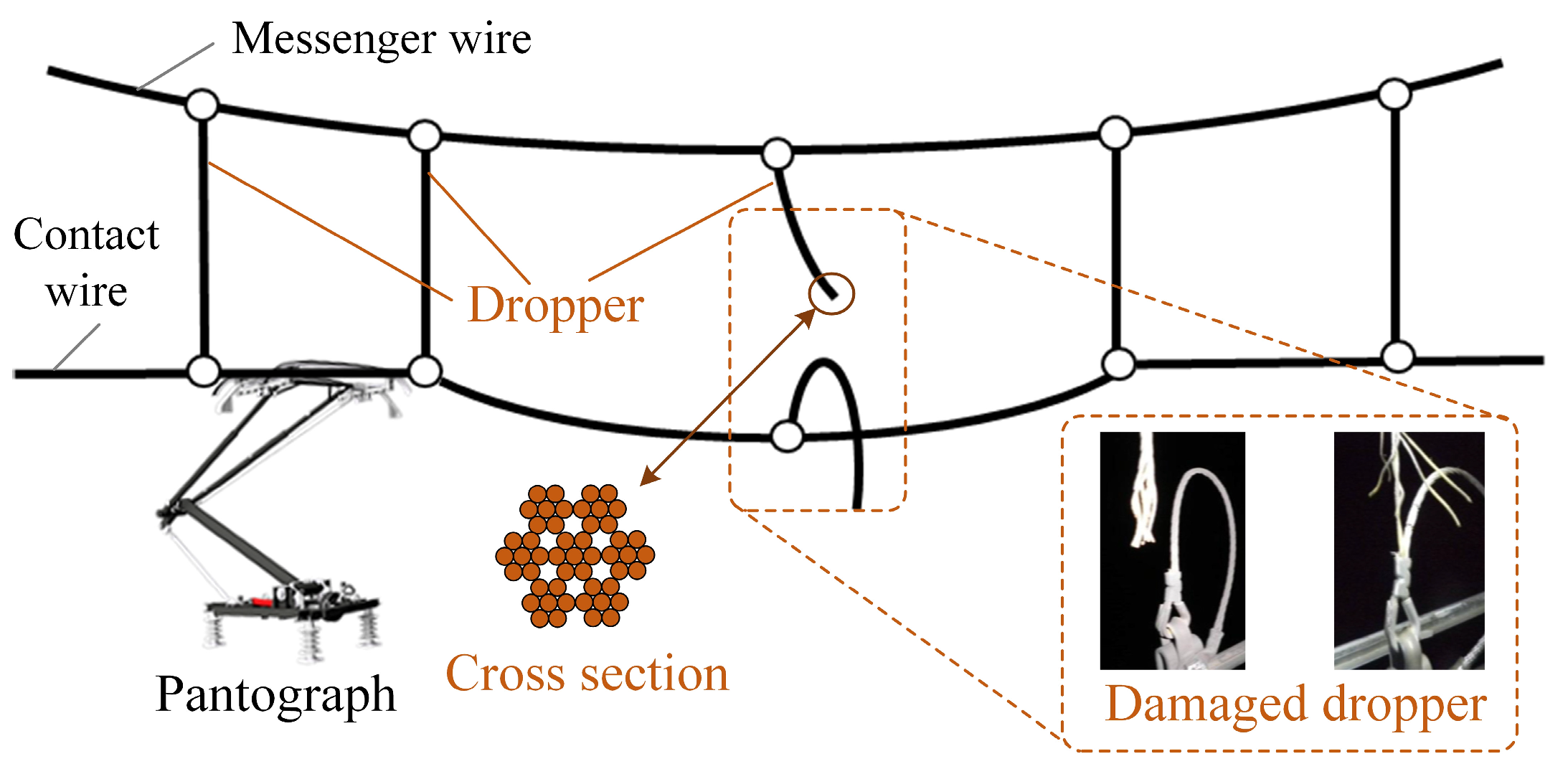
The dropper, as a critical suspension component in the catenary, is responsible for precisely adjusting the height of the contact wire and maintaining the necessary geometric position of the catenary [9]. Thus, the integrity of the dropper’s service condition directly determines the spatial regularity of the contact wire. Substantial efforts, ranging from improvements in crimping processes to optimizations of the installation positions under ideal conditions, have been made to extend the service life of droppers [5,10]. However, under actual operating conditions, droppers are subjected to long-term mechanical impacts induced by passing trains, temperature variations due to current-carrying effects, and coupled environmental loads, inevitably leading to progressive damage [11], as shown in Figure 1. Typical forms of damage include the degradation of mechanical strength due to strand breakage, and even complete failure [12]. The damage degree can be used to describe the number of broken strands, with, for example, 0% representing an undamaged condition, 50% indicating that half of the strands are broken, and 100% denoting complete failure. In addition, because each span contains multiple droppers, the location of the damaged dropper also varies. Such damage directly compromises the intended function of the dropper, causing local sag variations in the contact wire and introducing additional geometric irregularities, which may degrade the current collection quality.
Pantograph–catenary current collection quality directly affects the stable operation of trains and has long attracted significant attention from researchers [13,14]. To investigate the complex dynamic interactions between the pantograph and catenary, scholars widely employ numerical simulation techniques to generate coupled pantograph–catenary models [15,16]. By calculating and solving for the pantograph–catenary contact force, current collection conditions can be assessed without requiring complex and costly field tests [17]. Simulation methods are also utilized in efforts to optimize the structural parameters of the pantograph–catenary system that aim to reduce contact force fluctuations and support the design of catenary systems for new generation high-speed railways [18,19]. Although parameter optimization can improve the dynamic performance of the pantograph–catenary system, the catenary, as a long-term exposed service equipment, still faces numerous interference factors that affect its stable current collection state. On one hand, the catenary is subject to disturbances from external environmental loads, leading to increased fluctuations in contact force [20,21,22]. On the other hand, interference arises from changes in the state of the catenary, including geometric irregularities caused by installation deviations, contact wire wear, and other factors [23,24,25]. Existing research incorporating these factors into the dynamic model indicates that they have a nonnegligible impact on current collection quality. Nevertheless, present research remains largely focused on analyzing current collection quality under intact dropper conditions, and there is a lack of systematic research considering dropper damage conditions. Specifically, the quantitative influence of different locations and degrees of dropper damage on key performance indicators, such as dynamic contact force, remains insufficiently understood.
Therefore, this study focuses on the typical high-speed railway operational situation and systematically investigates pantograph–catenary current collection quality, considering key variables such as the degree of dropper damage, location, and train speed. Firstly, a finite element dynamic model that is based on actual line parameters and is capable of simulating various types of damage is described. Secondly, the influence of different types of damage on pantograph–catenary contact quality is analyzed in detail by multiple time-domain statistical features. Finally, within the typical speed range of 250 km/h to 350 km/h, the evolution of pantograph–catenary dynamic responses under the combined effects of train speed and different types of damage is explored.

2. Materials and Methods

In this section, the dynamic interaction within PCS is simulated using the finite element method. A detailed modeling method for the catenary that considers damaged droppers is shown, and the results of pantograph–catenary interactions have been carefully validated against simulation standards.

2.1. Modeling Method for Catenary

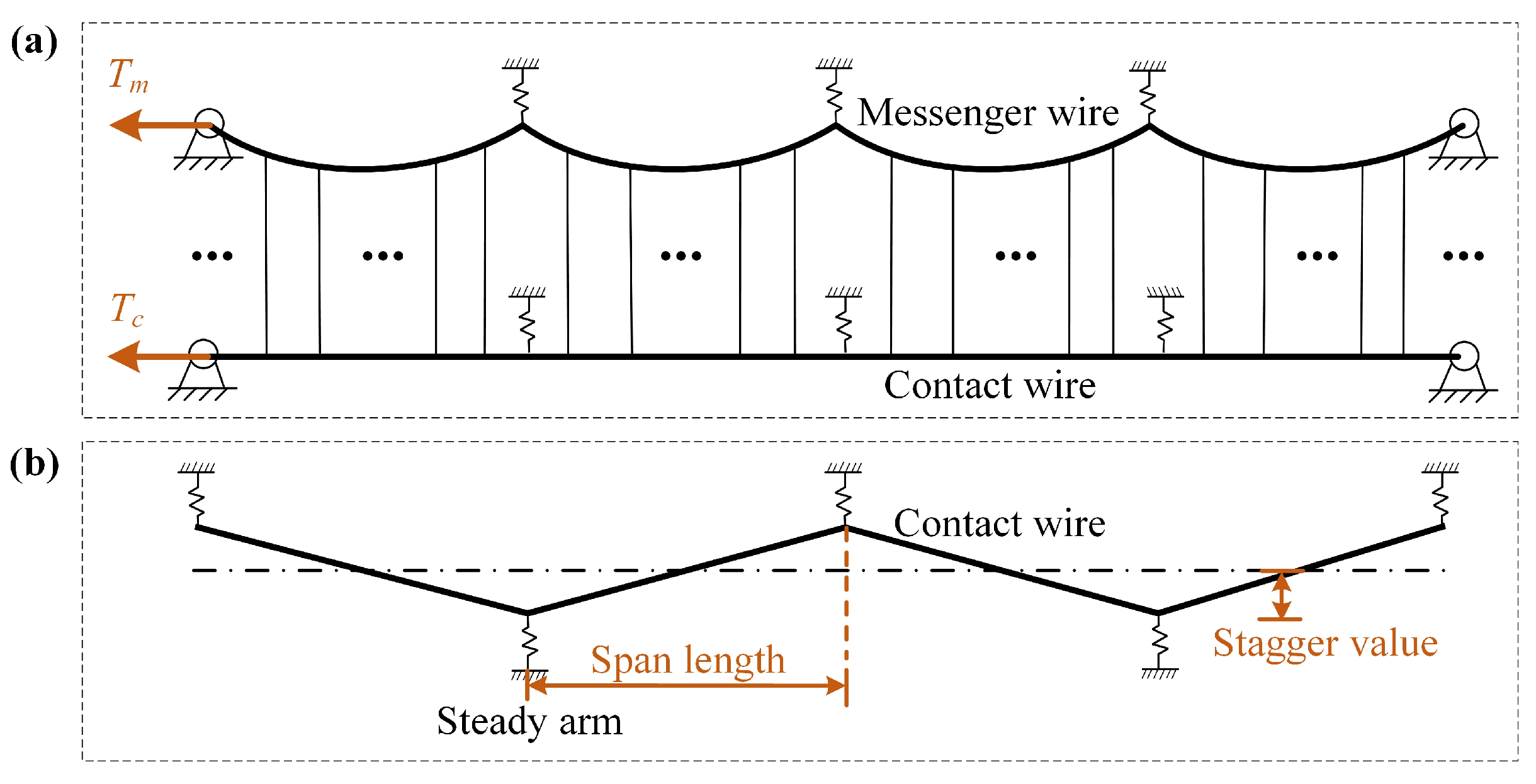
For the catenary model, the primary components under consideration are the contact wire, messenger wire, dropper, and steady arm [26]. These components can describe key parameters of the catenary system, such as span length, wire tension, catenary sag, stagger value, dropper spacing, and structure height. On the one hand, the cross-sectional size of each component is much smaller than its axial length. On the other hand, the catenary wire not only suffers tensile forces but also exhibits axial bending behavior. Therefore, beam elements are used to model the equivalent catenary components [27]. The additional mass approach is used for other components, such as dropper clamps, to appropriately reflect the inertial effects during the vibration process. Furthermore, the boundary conditions and added loads of the catenary model are also crucial for accurate simulation, as shown in Figure 2.
The catenary endpoints and support points are fully positioned to fix the spatial location. The displacement constraints are applied to the pull-out points of adjacent spans to simulate the zigzag configuration of the contact wire. Additional forces are applied to the end of contact wire and messenger wire to simulate the wire tension. Meanwhile, in order to simulate different damage states of catenary droppers, damaged droppers are replaced with healthy ones prior to solving for the static equilibrium of the catenary system. It should be noted that the dropper is made of multiple strands of wire, meaning that any damage to droppers will inevitably result in a reduction in cross-sectional area and a degradation of material strength. According to continuum damage mechanics theory, it can be assumed that the strength of the dropper material is proportional to its remaining cross-sectional area [28,29]. After completion of the catenary assembly, the overall motion differential equations can be expressed as
M g Δ u ¨ + C g Δ u ˙ + K g Δ u = Δ F g
where Mg, Cg, and Kg are the mass, damping, and stiffness matrices, respectively. Δ u , Δ u ˙ , and Δ u ¨ are the displacement, velocity, and acceleration matrix increments. ΔFg is the external force matrix.

2.2. Modeling Method for Pantograph

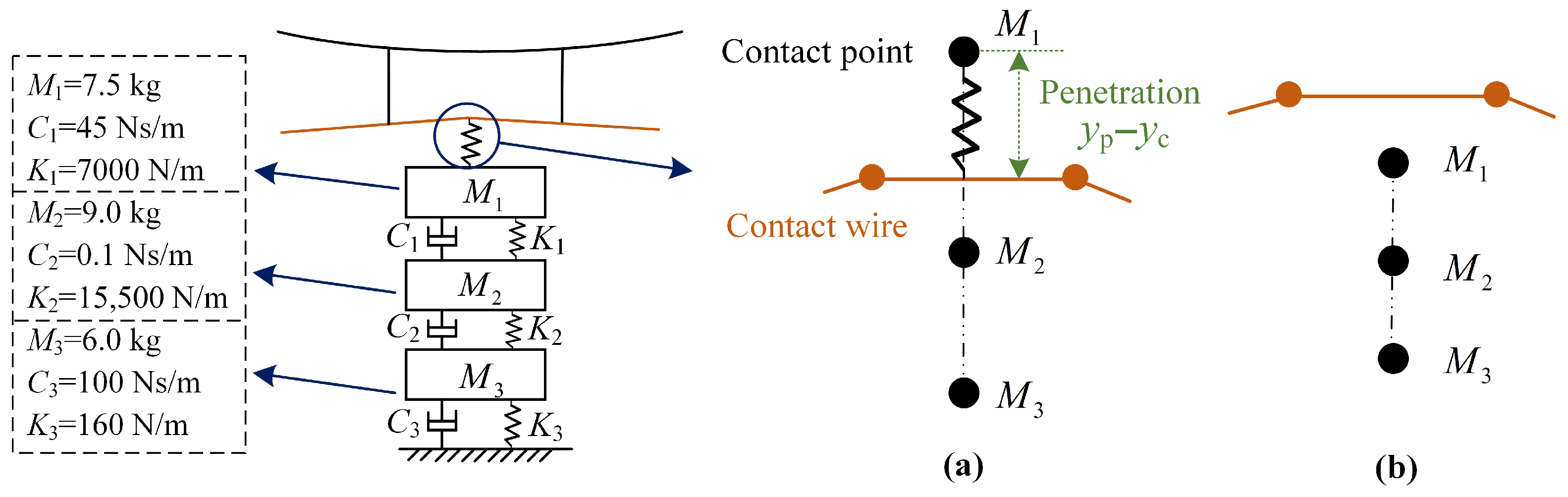
The pantograph typically includes several parts, which can be divided into the head, upper frame, and lower frame according to its structure. The three-level quality–damping–stiffness system is used to enhance the structural integrity of the pantograph model [30]. The upward concentrated force applied to the pantograph represents the static lift force provided by the airbag, and the aerodynamic lift of the pantograph during operation is fitted using an empirical equation [31]. During the process of dynamic interaction within PCS, the penalty function is used to solve the nonlinear contact relationship [32], and the contact force can be expressed by Equation (2):
F ( x , t ) = K s ( y p y c )     y 1   > y c 0                                     y 1   < y c
where Ks is contact stiffness within PCS, and yp and yc are the vertical motion displacement of the pantograph and contact wire, as shown in Figure 3. Finally, the Newmark-β method is adopted to solve the dynamic equations of the pantograph–catenary coupled system [33].

2.3. Validation of PCS Dynamics

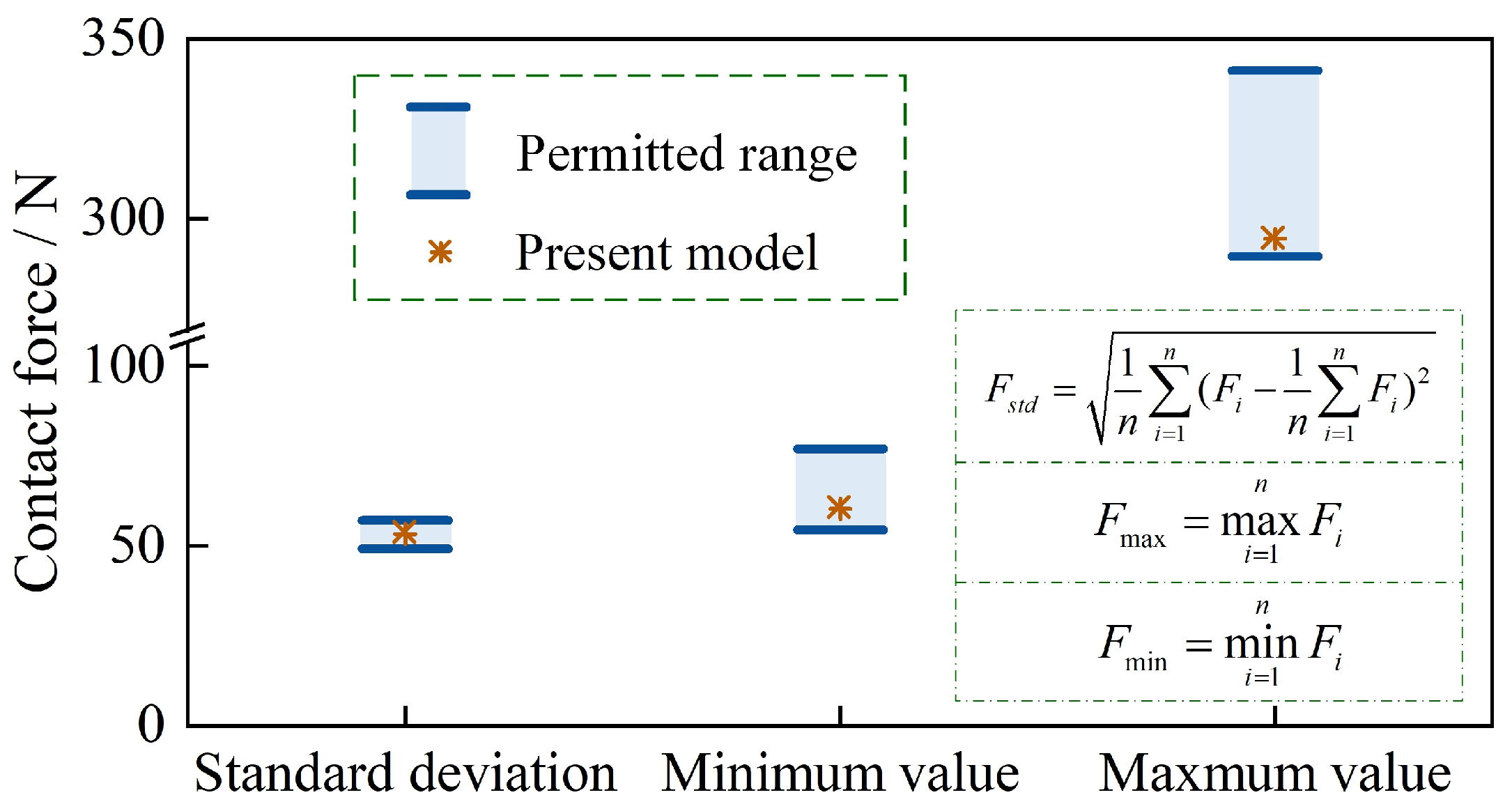
To further verify the validity and accuracy of the PCS model, a ten-span catenary system was built using the parameters provided in reference [34]. The train speed was set at 320 km/h, and the dynamic contact force was compared, with the results shown in Figure 4. The results of the present model are in the permitted range.

3. Results

Based on the above method, an 11-span pantograph–catenary model was built using the actual catenary and pantograph parameters provided in Reference [35]. In order to explore the influence of damaged droppers on the current collection quality, several different types of dropper damage are set in the mid-span of the catenary, as detailed in Table 1. D0 indicates that droppers at the mid-span of the catenary are undamaged, D50 means the damage degree of one dropper is 50%, and D100 denotes the complete failure of one dropper. It should be noted that there are usually several droppers installed within a catenary span. Even if the damage degree is the same, changing the location of the damaged dropper may also affect the pantograph–catenary contact quality. To account for this, the subsequent analysis includes different damage locations (labeled L1 to L6) for each damage degree to fully evaluate the impact of the damaged dropper on the current collection quality.
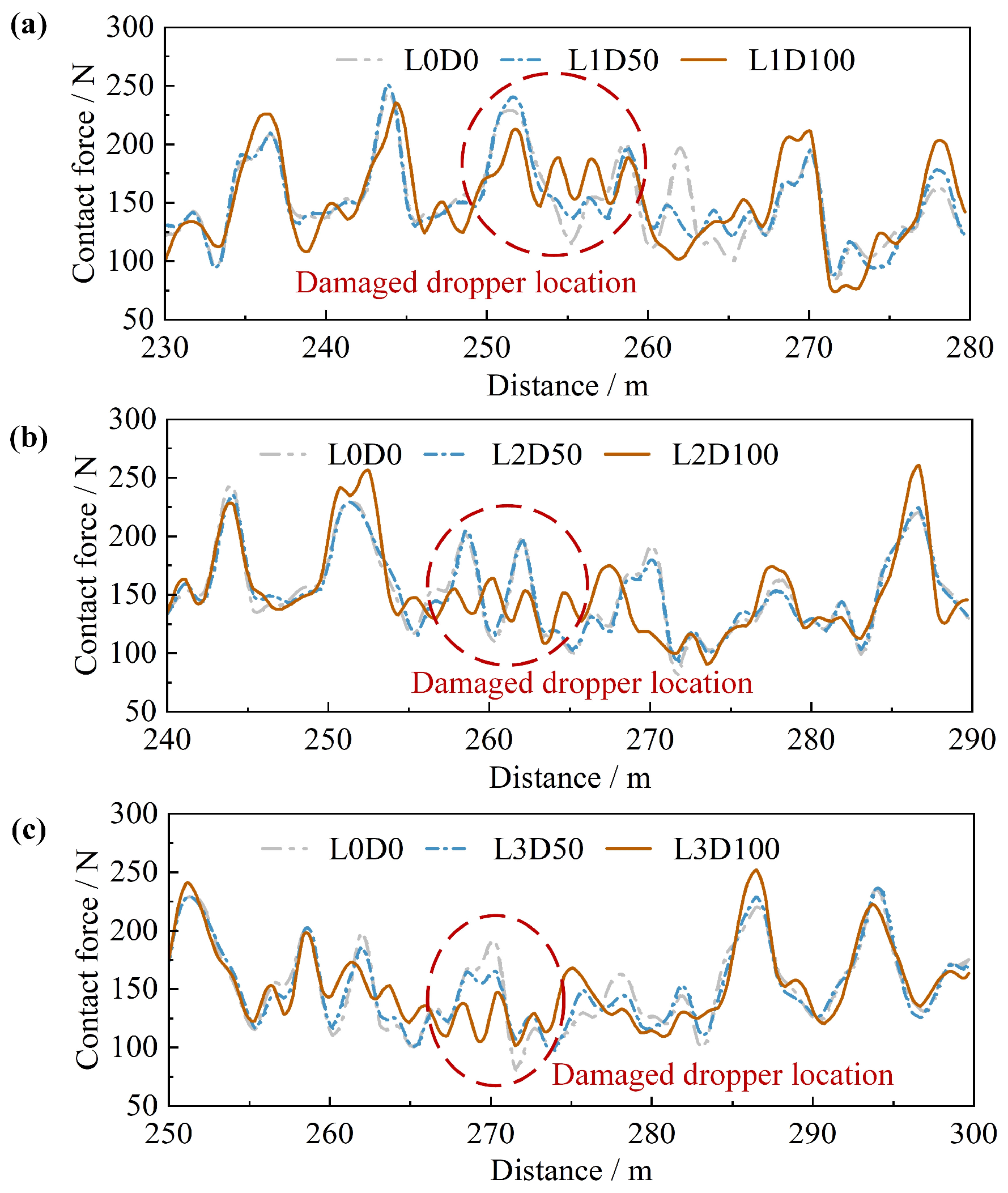
Figure 5 presents the time series of contact force at 300 km/h corresponding to the three dropper damage levels. It can be observed that the contact force near the damaged dropper location exhibits increasingly severe distortion as the damage degree rises. This phenomenon occurs because dropper damage disrupts the periodic structural integrity of the catenary, thereby disturbing the dynamic interaction between the pantograph and the contact wire.
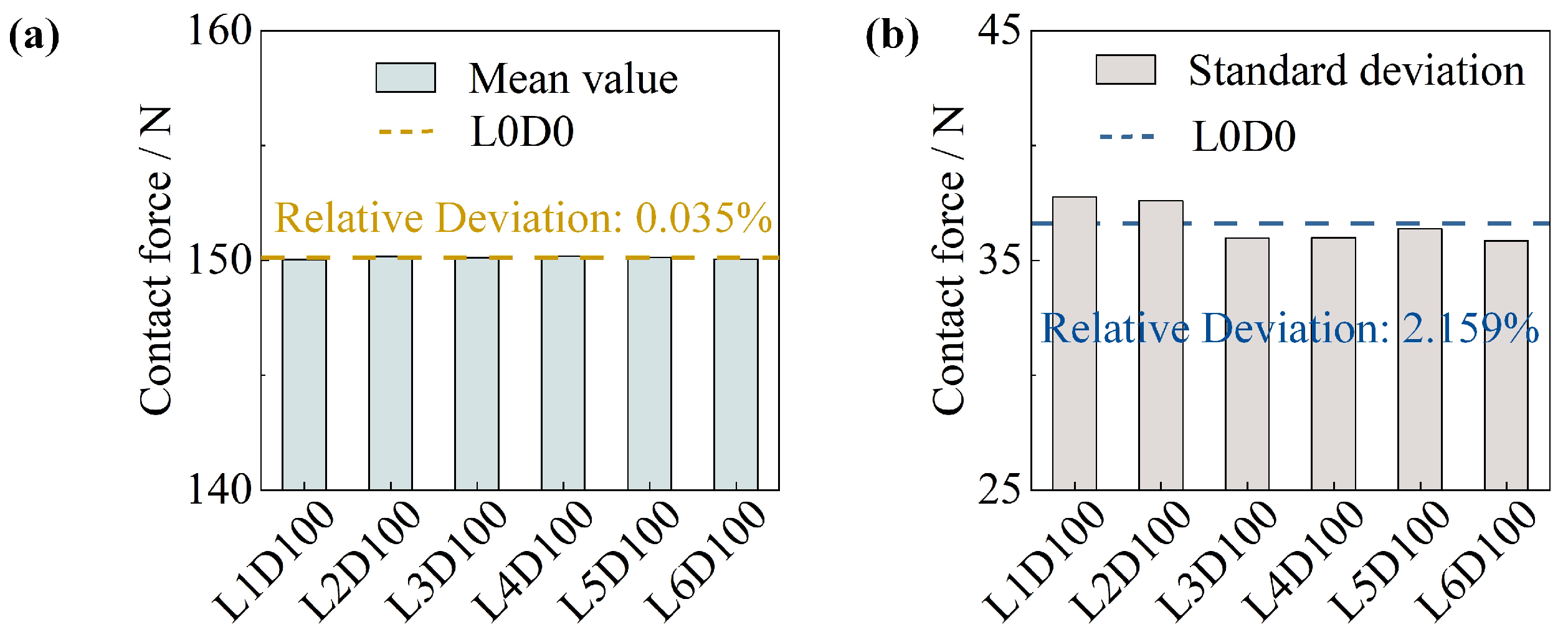
The mean contact force and its standard deviation are two key metrics of primary concern in field tests of pantograph–catenary current collection quality. They represent the average level of contact force within a given section and the fluctuation around this mean, respectively. Figure 6 presents the mean and standard deviation of the contact force within one span for both the healthy condition and the case of a failed dropper. It is observed that at 300 km/h, even with a failed dropper present in the catenary, causing the contact force to exhibit severe distortion, the relative deviation of the mean contact force is still below 0.035%, and the relative deviation of the standard deviation is below 2.159%. This indicates that while the local contact force is severely distorted (Figure 5), the span-averaged metric remains deceptively stable, masking the underlying dynamic issue. According to current field test specifications, the measurement system is only required to ensure a relative error within 20% for the standard deviation. Therefore, changes in pantograph–catenary contact quality caused by damaged droppers cannot be sufficiently captured by the mean contact force and standard deviation obtained in field tests.
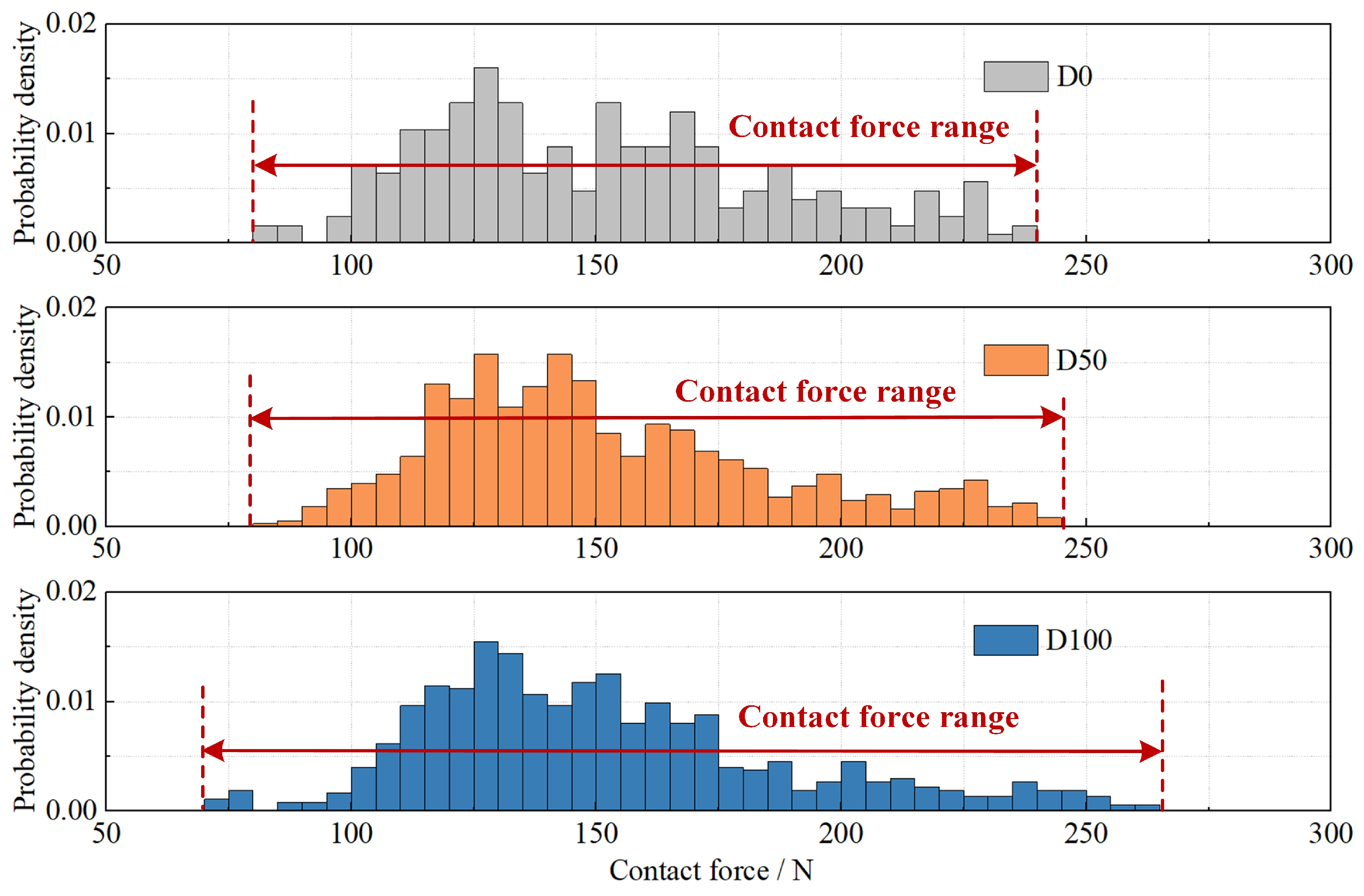
To fully understand the influence of dropper damage on the statistical characteristics of the pantograph–catenary contact force, Figure 7 presents the probability density distribution histograms of the dynamic contact force under three degrees of damage, 0%, 50%, and 100%. Each damage degree result includes six different dropper damage locations. It can be observed that the probability density histogram exhibits distinct differences across varying degrees of damage. Compared to the D0 case, both D50 and D100 exhibit broader contact force distributions, with the most pronounced widening in the upper tail corresponding to extreme maximum forces. This broadening becomes increasingly severe as the damage degree increases from D50 to D100. The results indicate that dropper damage intensifies contact irregularities, generating excessive dynamic forces that are highly unfavorable for stable current collection within PCS, and may accelerate the wear of the pantograph carbon slider.
Moreover, variations in probability density at the same contact force location within the diagram represent changes in the distribution pattern of pantograph–catenary contact forces. To quantify the degree of change in contact force, the skewness sk and excess of kurtosis ek values from EN 50318:2018 [34] are employed to characterize the instability of pantograph–catenary contact, as shown in Equations (3) and (4).
s k = 1 n i = 1 n ( F i F m ) 3 ( 1 n i = 1 n ( F i F m ) 2 ) 3 2
e k = 1 n i = 1 n ( F i F m ) 4 ( 1 n i = 1 n ( F i F m ) 2 ) 2 3
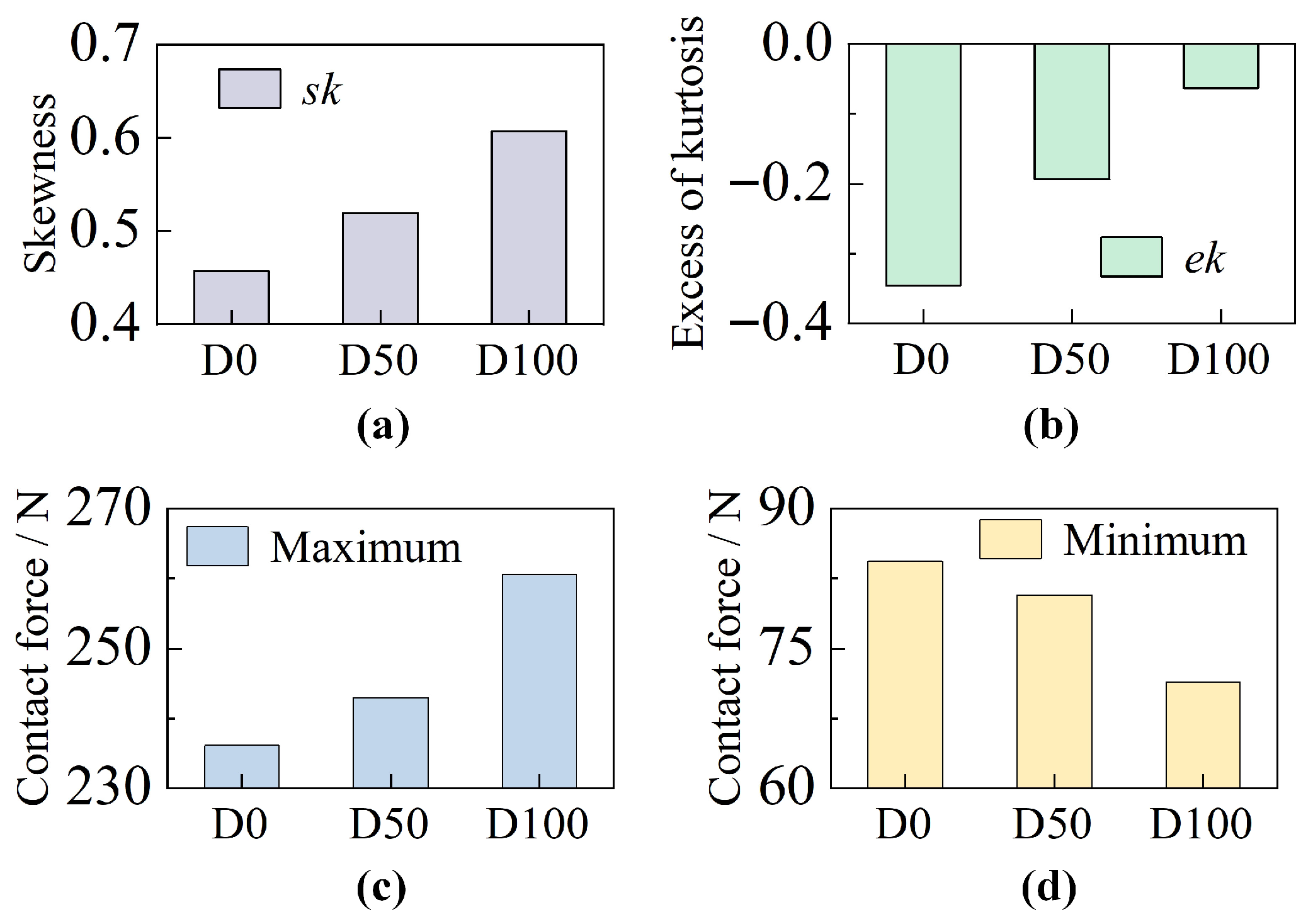
where Fi is the contact force at the contact point i, and Fm is the mean value of contact force. sk quantifies the symmetry of the data distribution shape, and ek quantifies the sharpness and tail thickness of a distribution relative to a normal distribution. Figure 8 presents the statistical characteristics of the contact force, including sk, ek, and extreme values. As the severity of dropper damage increases, the sk rises from 0.457 to 0.607, indicating a rightward shift in the contact force distribution and a higher frequency of large-impact events. The ek increases from −0.346 to −0.063, showing that the contact force distribution is relatively concentrated with few extreme values when the dropper is undamaged. As damage degree increases, the distribution develops a slight heavy-tailed tendency, and the probability of both extremely high and low values increases. Meanwhile, the maximum contact force increases by 24 N, and the minimum decreases by 13 N, together illustrating the changing characteristics of the contact force. This indicates that the damaged dropper not only introduces high-magnitude impacts but also leads to larger force fluctuations, thereby reducing the stability of pantograph–catenary current collection quality.
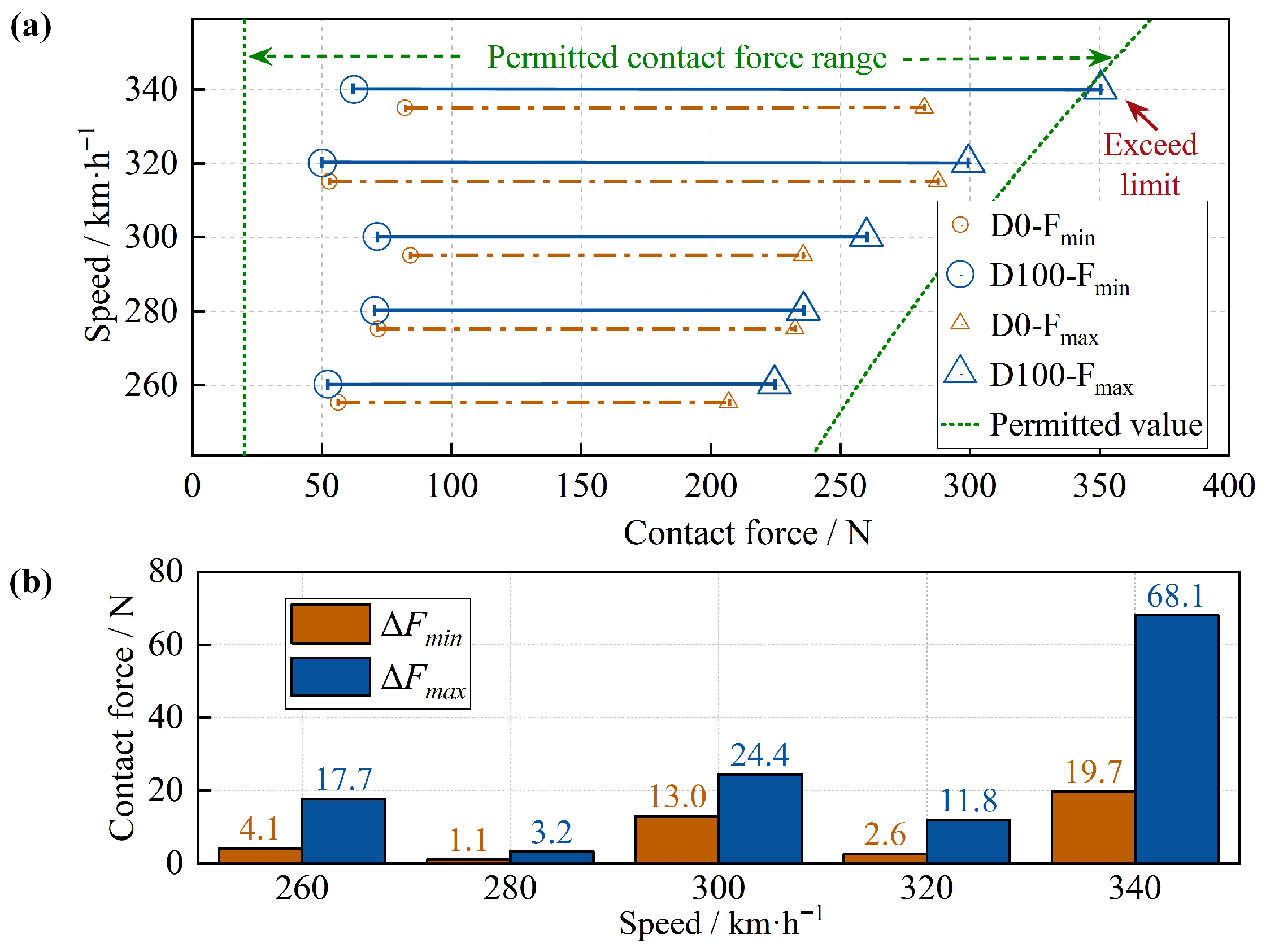
The above analysis clarifies the changes in the statistical characteristics of contact force due to dropper damage under a fixed speed condition of 300 km/h. Having established that dropper damage alters the distribution shape of contact forces at a fixed speed, we now investigate how this damaging effect interacts with and is amplified by the critical operational variable of train speed. In practice, high-speed railway operating speeds typically fall within the range of 250 km/h to 350 km/h, and the pantograph–catenary system is inherently a strongly speed-dependent dynamic system. For example, present operational safety specifications stipulate that the allowable fluctuation range of contact force gradually widens as speed increases: Fmin must be greater than 20 N, and Fmax should not exceed (0.00097v2 + 70) + 3σ [36]. Similarly, the dynamic defects induced by dropper damage may also depend on the train’s operating speed. To systematically evaluate the risk of dropper damage to the stability of pantograph–catenary contact, this study calculates and analyzes the pantograph–catenary contact force response under dropper failure within the typical operational speed range. To maintain generality, six practically possible dropper failure locations (L1–L6) are considered for each speed level. Figure 9 presents a comparison of the contact force fluctuation ranges under intact and failed dropper conditions across five speed levels.
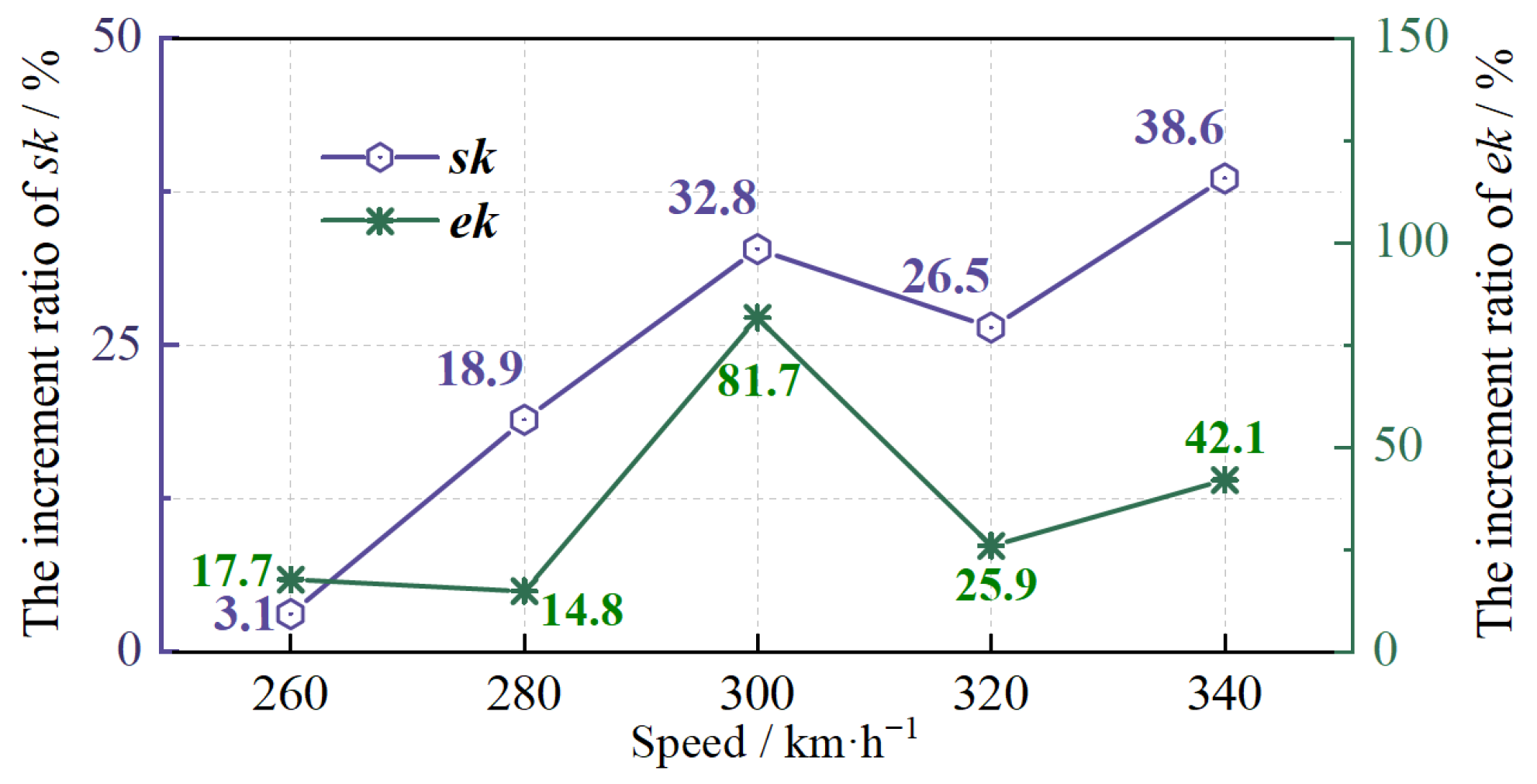
The results show that as the speed level increases, the overall fluctuation range of the contact force gradually expands. Dropper failure further intensifies this trend, as is particularly reflected in the significant rise in the maximum contact force. The decrease in the minimum contact force is slight, not exceeding 20 N. However, the maximum contact force increases by an additional 70 N due to dropper failure, even exceeding the specification limit for the maximum contact force. Figure 10 displays the increment ratio in contact force sk and ek caused by dropper failure at different operating speeds. The overall trend indicates that as train speed increases, both sk and ek increments rise. Specifically, sk increases from 3.1% to 38.6%, and ek increases from 17.7% to 42.1%. This means that the asymmetry of the contact force and the impact intensity of the pantograph increase with speed, and the probability of extreme contact force values also rises with speed. These results reflect that increasing train speed not only amplifies the original fluctuations of the contact force, but also increases extreme contact force values coupled with dropper damage, continuously reducing the stability of the pantograph–catenary system.

4. Conclusions

This study focuses on the inevitable damage of catenary droppers during the long-term operation of high-speed railways, exploring the impact of damaged droppers on PCS current collection quality. Firstly, a dynamic PCS model containing a damaged dropper was built based on actual line parameters, and the PCS contact quality was evaluated under different types of damage. Furthermore, using typical train operating speed ranges, a comprehensive analysis was undertaken to analyze the cumulative effect of the operating speed and damage type on current collection quality. The main conclusions are as follows:
1. Dropper damage induces noticeable local distortion in contact force, but conventional statistical indicators such as the mean and standard deviation of contact force show low sensitivity to dropper damage. Specifically, after dropper failure, the relative deviation of the mean contact force is only 0.035%, while the relative deviation of the standard deviation remains below 2.159%.
2. Dropper damage significantly deteriorates the distribution characteristics of the contact force. This is shown by an expanded fluctuation range and an increased probability of extreme values. Once dropper failure occurs, the contact force distribution exhibits pronounced heavy-tailed and skewed characteristics, with sk increasing from 0.457 to 0.607 and ek increasing from −0.346 to −0.063.
3. An increase in train speed not only amplifies the original fluctuations of contact force but also exacerbates the negative impact of dropper damage on current collection stability, leading to a higher rise in both the magnitude and occurrence probability of extreme contact forces, and thereby intensifying the risk of system instability. As the train speed increases from 260 km/h to 340 km/h, the additional increase in the maximum contact force due to dropper failure rises about 68.1 N, while the increment ratios in sk and ek increase from 3.1% to 38.6% and from 17.7% to 42.1%, respectively.
4. Given that localized dropper damage can be masked by conventional low-order statistical indicators (e.g., mean and standard deviation of contact force), higher-order statistics are necessary to capture its impact on pantograph–catenary interaction. Based on the current collection quality standards, the D50 condition is considered marginally acceptable, as the extreme contact forces remain within the prescribed limits despite a broadening of the force distribution. In contrast, the D100 condition leads to excessive extreme forces that likely exceed acceptable thresholds, and is therefore deemed unacceptable.

Author Contributions

Writing—original draft preparation, C.Y.; methodology, H.Z.; writing—review and editing, L.P.; visualization, Y.Y.; data curation, Q.Y.; validation, Q.X.; software, Z.Y.; project administration, W.W. All authors have read and agreed to the published version of the manuscript.

Funding

This research was funded by the Research Projects of China Academy of Railway Sciences Corporation Limited, grant number 2024YJ276.

Institutional Review Board Statement

Not applicable.

Informed Consent Statement

Not applicable.

Data Availability Statement

The raw data supporting the conclusions of this article will be made available by the authors on request.

Acknowledgments

The authors have reviewed and edited the output and take full responsibility for the content of this article.

Conflicts of Interest

Caizhi Yang, Like Pan, Yuan Yuan and Qun Yu were employed in China Academy of Railway Sciences Corporation Limited. The authors declare that this research was conducted in the absence of any commercial or financial relationships that could be construed as a potential conflict of interest. The authors declare that this study received funding from China Academy of Railway Sciences Corporation Limited. The funders had no role in the design of the study; in the collection, analyses, or interpretation of data; in the writing of the manuscript, or in the decision to publish the results.

Abbreviations

The following abbreviations are used in this manuscript:
PCSPantograph–catenary system
skSkewness
ekExcess of kurtosis

References

  1. Pi, Y.; Wang, Y. Transportation infrastructure, comparative advantage, and regional specialization: Evidence from China’s high-speed railway network. Transp. Res. Part A Policy Pract. 2025, 191, 104334. [Google Scholar] [CrossRef]
  2. Wu, G.; Dong, K.; Xu, Z.; Xiao, S.; Wei, W.; Chen, H.; Li, J.; Huang, Z.; Li, J.; Gao, G.; et al. Pantograph–catenary electrical contact system of high-speed railways: Recent progress, challenges, and outlooks. Railw. Eng. Sci. 2022, 30, 437–467. [Google Scholar] [CrossRef]
  3. Bruni, S.; Bucca, G.; Carnevale, M.; Collina, A.; Facchinetti, A. Pantograph–catenary interaction: Recent achievements and future research challenges. Int. J. Rail Transp. 2018, 6, 57–82. [Google Scholar] [CrossRef]
  4. Yang, Z.; Huang, Z.; Pan, L.; Huang, C.; Xing, T.; Fu, R.; Zhang, H.; Wei, W.; Wu, G. Analysis and prediction of uneven wear in metro pantograph-rigid catenary system. Tribol. Int. 2024, 198, 109925. [Google Scholar] [CrossRef]
  5. Wei, W.; Zhang, H.; Xia, L.; Luo, Y.; Zhou, S.; Huang, G.; Yang, Z.; Wu, G. Fatigue life enhancement of catenary droppers for high-speed railways based on arrangement optimization. Eng. Fail. Anal. 2024, 163, 108480. [Google Scholar] [CrossRef]
  6. Wei, W.; Xia, L.; Yang, Z.; Zhang, H.; Pan, L.; Wu, J.; Wu, G. Fast evaluation on the fatigue level of copper contact wire based on laser induced breakdown spectroscopy and supervised machine learning for high speed railway. High Volt. 2024, 9, 1302–1310. [Google Scholar] [CrossRef]
  7. Yang, Z.; Huang, C.; Luo, Y.; Huang, Z.; Xia, L.; Zhang, H.; Zhou, S.; Dong, K.; Wei, W. Regulation of the pantograph-catenary arc by an alternating transverse magnetic field. Plasma Sci. Technol. 2025, 27, 035402. [Google Scholar] [CrossRef]
  8. Wei, W.; Zeng, K.; Wan, Y.; Xia, L.; Zhang, H.; Yang, Z. A pantograph-catenary arcing detection method based on the fusion of current and electromagnetic radiation. Eng. Res. Express 2025, 7, 035346. [Google Scholar] [CrossRef]
  9. Li, Z.; Rao, Z.; Ding, L.; Ding, B.; Fang, J.; Ma, X.; Li, Z.; Rao, Z.; Ding, L.; Ding, B.; et al. YOLOv5s-D: A Railway Catenary Dropper State Identification and Small Defect Detection Model. Appl. Sci. 2023, 13, 7881. [Google Scholar] [CrossRef]
  10. Qin, Y.; Xiao, S.; Lu, L.; Yang, B.; Zhu, T.; Yang, G. Fatigue failure of integral droppers of high-speed railway catenary under impact load. Eng. Fail. Anal. 2022, 134, 106086. [Google Scholar] [CrossRef]
  11. Liu, X.-Y.; Peng, J.-F.; Tan, D.-Q.; Xu, Z.-B.; Liu, J.-H.; Mo, J.-L.; Zhu, M.-H. Failure analysis and optimization of integral droppers used in high-speed railway catenary system. Eng. Fail. Anal. 2018, 91, 496–506. [Google Scholar] [CrossRef]
  12. Yao, Y.; Wang, J.; Xu, Y.; Wang, B.; Kou, H.; Zhou, X.; Lu, H. Image-based fatigue life prediction of catenary droppers in high-speed railways. Eng. Fail. Anal. 2026, 185, 110375. [Google Scholar] [CrossRef]
  13. Xu, Z.; Song, Y.; Liu, Z. Effective Measures to Improve Current Collection Quality for Double Pantographs and Catenary Based on Wave Propagation Analysis. IEEE Trans. Veh. Technol. 2020, 69, 6299–6309. [Google Scholar] [CrossRef]
  14. Guo, F.; Wang, X.; Kou, J.; Li, F.; Han, C. Impact of Surface Roughness on Pantograph-Catenary Current Collection Quality. IEEE Access 2022, 10, 93951–93959. [Google Scholar] [CrossRef]
  15. Xu, Y.; Liu, Z.; Pan, L.; Chen, L.; Zhu, W.; Lei, J. A Reduced Pantograph-Catenary Interaction Model for Efficient Pantograph-Catenary Interaction Dynamic Analysis. In Advances in Dynamics of Vehicles on Roads and Tracks III; Huang, W., Ahmadian, M., Eds.; Springer Nature: Cham, Switzerland, 2025; pp. 353–362. [Google Scholar] [CrossRef]
  16. Vesali, F.; Rezvani, M.A.; Molatefi, H.; Hecht, M. Static form-finding of normal and defective catenaries based on the analytical exact solution of the tensile Euler–Bernoulli beam. Proc. Inst. Mech. Eng. Part F J. Rail Rapid Transit 2019, 233, 691–700. [Google Scholar] [CrossRef]
  17. Nåvik, P.; Rønnquist, A.; Stichel, S. Variation in predicting pantograph–catenary interaction contact forces, numerical simulations and field measurements. Veh. Syst. Dyn. 2017, 55, 1265–1282. [Google Scholar] [CrossRef]
  18. Zhang, J.; Yi, J.; Liu, W. Study of Time-Frequency Characteristics of Contact Force Signal and Parameter Sensitivity of Catenary of High-Speed Railway. IEEE Trans. Instrum. Meas. 2022, 71, 6500611. [Google Scholar] [CrossRef]
  19. Wang, J.; Mei, G.; Lu, L. Analysis of the pantograph’s mass distribution affecting the contact quality in high-speed railway. Int. J. Rail Transp. 2023, 11, 529–551. [Google Scholar] [CrossRef]
  20. Yang, Z.; Yang, Z.; Huang, G.; Chen, X.; Ma, T.; Zhang, H.; Wei, W.; Wu, G. Effect of ice-covered catenary on dynamic interactions of pantograph-catenary system and limited speed of trains. Cold Reg. Sci. Technol. 2024, 228, 104331. [Google Scholar] [CrossRef]
  21. Stickland, M.T.; Scanlon, T.J. An investigation into the aerodynamic characteristics of catenary contact wires in a cross-wind. Proc. Inst. Mech. Eng. Part F J. Rail Rapid Transit 2001, 215, 311–318. [Google Scholar] [CrossRef]
  22. Zhang, H.; Wei, W.; Pan, L.; Yang, Z.; Huang, G.; Liu, Y.; Chen, X.; Yang, Z.; Wu, G. Ice-Covered Environmental Adaptability Assessment for Overhead Contact System in High-Speed Railways. Chin. J. Electr. Eng. 2024, 10, 70–79. [Google Scholar] [CrossRef]
  23. Song, Y.; Liu, Z.; Gao, S. Current Collection Quality of High-speed Rail Pantograph-catenary Considering Geometry Deviation at 400 km/h and Above. IEEE Trans. Veh. Technol. 2024, 73, 14415–14424. [Google Scholar] [CrossRef]
  24. Gregori, S.; Tur, M.; Gil, J.; Fuenmayor, F.J. Assessment of catenary condition monitoring by means of pantograph head acceleration and Artificial Neural Networks. Mech. Syst. Signal Process. 2023, 202, 110697. [Google Scholar] [CrossRef]
  25. Amano, Y.; Kobayashi, S. Analytical Study on the Influence of Friction on Unstable Oscillation of Pantograph. Q. Rep. RTRI 2023, 64, 109–114. [Google Scholar] [CrossRef]
  26. Tur, M.; García, E.; Baeza, L.; Fuenmayor, F.J. A 3D absolute nodal coordinate finite element model to compute the initial configuration of a railway catenary. Eng. Struct. 2014, 71, 234–243. [Google Scholar] [CrossRef]
  27. Ambrósio, J.; Pombo, J.; Pereira, M.; Antunes, P.; Mósca, A. Recent Developments in Pantograph-Catenary Interaction Modelling and Analysis. Int. J. Railw. Technol. 2012, 1, 249–278. [Google Scholar] [CrossRef]
  28. Meng, Q.; Wang, Z. Creep damage models and their applications for crack growth analysis in pipes: A review. Eng. Fract. Mech. 2019, 205, 547–576. [Google Scholar] [CrossRef]
  29. Yang, C.; Liu, Y. Detecting the damage of bridges under changing environmental conditions using the characteristics of the nonlinear narrow dimension of damage features. Mech. Syst. Signal Process. 2021, 159, 107842. [Google Scholar] [CrossRef]
  30. Lee, J.H.; Park, T.W.; Oh, H.K.; Kim, Y.G. Analysis of dynamic interaction between catenary and pantograph with experimental verification and performance evaluation in new high-speed line. Veh. Syst. Dyn. 2015, 53, 1117–1134. [Google Scholar] [CrossRef]
  31. Zhao, M.; Duan, Y.; Lan, X.; Jia, Z.; Zhao, M.; Duan, Y.; Lan, X.; Jia, Z. Research on the Uplift Characteristics of Pantographs of High-Speed Trains Under Crosswind Conditions. Appl. Sci. 2024, 14, 9739. [Google Scholar] [CrossRef]
  32. Cheng, Y.; Yan, J.; Zhang, F.; Li, M.; Zhou, N.; Shi, C.; Jin, B.; Zhang, W. Surrogate modeling of pantograph-catenary system interactions. Mech. Syst. Signal Process. 2025, 224, 112134. [Google Scholar] [CrossRef]
  33. Wang, Y.; Huang, Q.; Chen, X.; Zhao, G.; Mu, X. Dynamic Characteristics Analysis of Double Pantograph Catenary of AC Rigid Catenary System. IEEE Access 2023, 11, 70396–70407. [Google Scholar] [CrossRef]
  34. BS EN 50318; Railway Applications-Current Collection Systems-Validation of Simulation of the Dynamic Interaction Between Pantograph and Overhead Contact Line. British Standards Institution: London, UK, 2018.
  35. Zhang, J.; Liu, W.; Zhang, Z. Study on Characteristics Location of Pantograph–Catenary Contact Force Signal Based on Wavelet Transform. IEEE Trans. Instrum. Meas. 2019, 68, 402–411. [Google Scholar] [CrossRef]
  36. IEC 62486; Railway Applications-Current Collection Systems-Technical Criteria for the Interaction Between Pantograph and Overhead Contact Line. International Electrical Commission: Geneva, Switzerland, 2017.
Figure 1. The structure of a pantograph–catenary system with a damaged dropper.
Inventions 11 00026 g001
Figure 2. The boundary conditions and added loads of the catenary model. (a) Lateral view. (b) Top view.
Inventions 11 00026 g002
Figure 3. The model of the coupled pantograph–catenary system. (a) Pantograph and catenary in contact. (b) Pantograph and catenary separation.
Inventions 11 00026 g003
Figure 4. The results of the contact force comparison at a speed of 320 km/h.
Inventions 11 00026 g004
Figure 5. Comparation of contact force time series with different types of dropper damage. (a) L0D0, L1D50 and L1D100. (b) L0D0, L2D50 and L2D100. (c) L0D0, L3D50 and L3D100.
Inventions 11 00026 g005
Figure 6. The statistic values of contact force for different types of damage (a) mean value (b) standard deviation.
Inventions 11 00026 g006
Figure 7. Probability density of the dynamic contact force with different degrees of damage, 0%, 50% and 100%.
Inventions 11 00026 g007
Figure 8. Statistical characteristics of contact force at different degrees of dropper damage. (a) Skewness value. (b) Excess of kurtosis. (c) Maximum value. (d) Minimum value.
Inventions 11 00026 g008
Figure 9. The effect of a damaged dropper on the contact force fluctuation range within the typical operating speed of 250–350 km/h. (a) The range of contact force. (b) Variation in contact force extreme values.
Inventions 11 00026 g009
Figure 10. The increment ratio of sk and ek within the typical operating speed.
Inventions 11 00026 g010
Table 1. Different types of dropper damage in catenary system.
Damage TypeDamage Information
D0L0D0
D50L1D50, L2D50, L3D50, L4D50, L5D50, L6D50
D100L1D100, L2D100, L3D100, L4D100, L5D100, L6100
Disclaimer/Publisher’s Note: The statements, opinions and data contained in all publications are solely those of the individual author(s) and contributor(s) and not of MDPI and/or the editor(s). MDPI and/or the editor(s) disclaim responsibility for any injury to people or property resulting from any ideas, methods, instructions or products referred to in the content.