2. Methodology of the Systematic Review
An effective methodology is arguably one of the main aspects that can make a systematic review transparent, reproducible, and high-quality. It is even more important for a systematic review of VAWTs and their performance during harsh environmental conditions. The next section discusses the review framework, the literature search method, the inclusion criteria, and the manner in which data were collected and synthesized in detail.
2.1. Review Framework and Standards
To ensure rigor, transparency, and reproducibility, this systematic review was planned according to the PRISMA framework (Preferred Reporting Items for Systematic Reviews and Meta-Analyses) [
33], a globally recognized standard for conducting high-quality evidence syntheses. Using the PRISMA method, a structured workflow is set up that carefully walks through the steps of identification, screening, eligibility assessment, and inclusion of studies, thus reducing selection bias and allowing for the traceability of all decisions made during the review process. Besides PRISMA, this review extends the standard PRISMA approach by incorporating an environment-centric perspective, prioritizing extreme environmental conditions in the analysis, rather than treating them as secondary contextual factors. With this single change, a thorough assessment of VAWTs can be achieved by including aerodynamic behavior, structural integrity, material performance, and operational resilience, even when the conditions are extreme and therefore the assumptions for design are not valid. Integrating PRISMA with an environment-centric approach is essential, as extreme environmental stressors—such as high turbulence, icing, elevated temperatures, sand erosion, and offshore wind loads—exert multi-scale influences on turbine performance that are often overlooked in component- or application-specific studies.
The review framework combines and integrates quantitative and qualitative synthesis methods. Quantitative data were extracted for comparative performance metrics with the aid of data unveiling, which thereby allows the inter-environmental comparison of the aerodynamic efficiency, power coefficients, start-up behavior, and structural load response. The research team carried out a qualitative interpretative study to understand adaptation mechanisms, resilience, and innovations in design, thus bridging the gap between numerical performance indicators and practical deployment considerations.
2.2. Literature Search Strategy
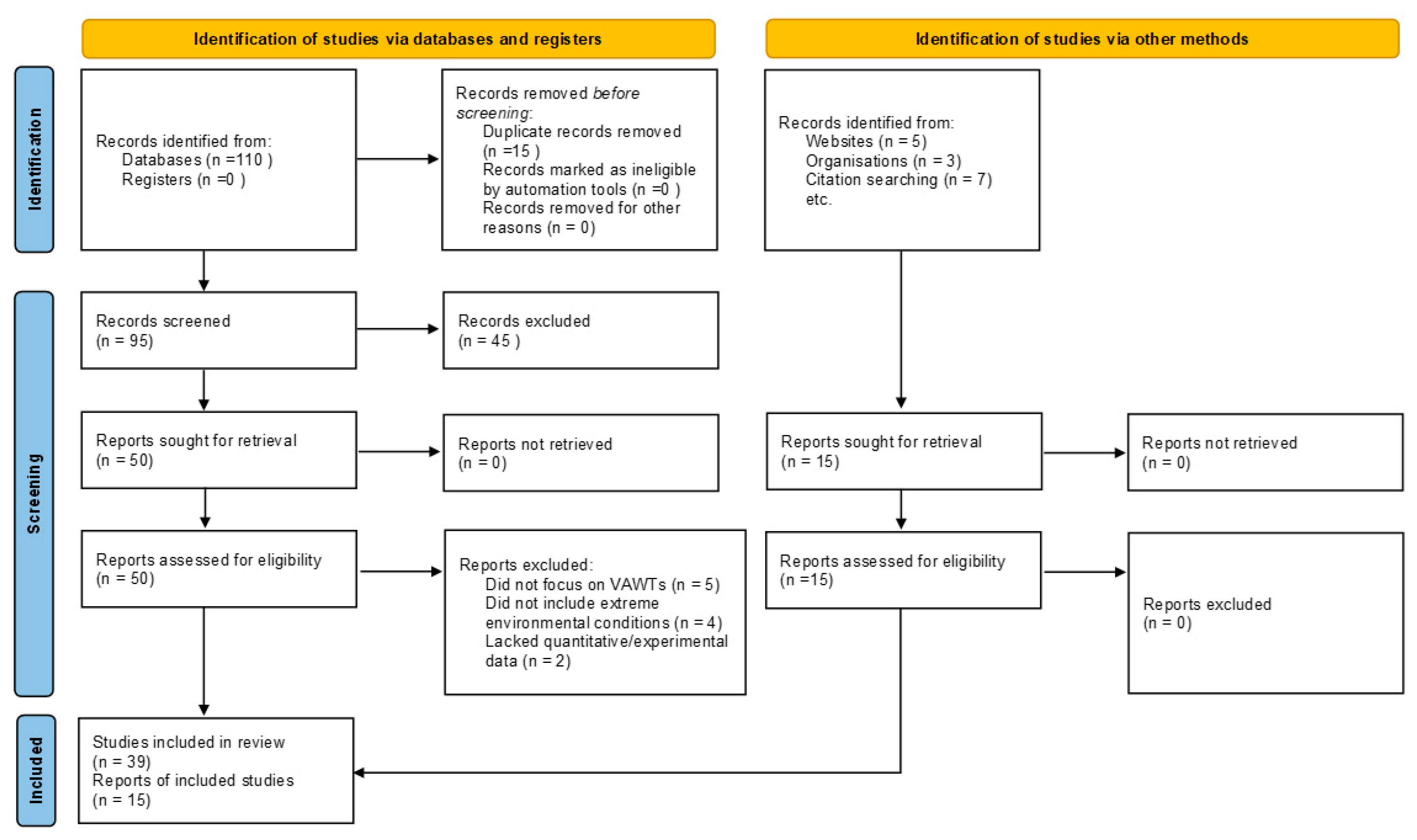
In order to identify research on VAWTs under extreme environmental conditions, a comprehensive and systematic literature review was carried out. To ensure coverage of multidisciplinary journals, conference proceedings, and technical studies, the Web of Science Core Collection, Scopus, IEEE Xplore, ScienceDirect, and SpringerLink databases were queried. In addition, Google Scholar was utilized as a supplementary resource to catch up-to-the-minute preprints and technical reports that might still be absent in the main databases. This multi-source approach proved to be very effective in obtaining an extensive dataset containing the basics, as well as the latest VAWT studies. The paper search was systematically planned with the use of Boolean logic and carefully chosen keywords pinpointing the overlap between turbine technology, environmental stressors, and performance outcomes. The search phrase included “vertical-axis wind turbine” or “VAWT”, along with environment-related words such as “extreme environment”, “offshore”, “arid”, “desert”, “cold climate”, “icing”, and “turbulence”. It further included performance sample description terms such as “aerodynamic”, “structural”, “fatigue”, “adaptation”, and “resilience”. In search of more relevant studies, the researchers employed phrase searching, truncation, and wildcard techniques. At the same time, the publication types were limited to those written in English and peer-reviewed articles or conference papers. The search covered the period from 2000 to January 2026 and, therefore, it included the entire development timeline of VAWT research. The retrieved papers concentrated on urban, offshore, and extreme-environment VAWT applications. In an attempt to refine the search results even further and thus minimize publication bias, reference snow-balling and forward citation identification were also applied. By means of these processes, the additional papers that were either mentioned in the main search results or cited could be identified. Moreover, a qualitative assessment of the selected high-quality gray literature, such as technical reports by research institutions and governmental organizations, was made in order to consider the offshore and harsh-environment facets of the case studies. This well-structured search technique delineates a transparent, repeatable, and trustworthy selection of works for the review. Accordingly, the selected studies are expected to provide a representative overview of the current state of knowledge on VAWTs operating under hazardous environmental conditions. The review’s environment-centric framework corresponds with the classification of studies by the environmental category, and thus, the integration of performance data related to the aerodynamic, structural, and operational aspects becomes a lot easier. The study selection process is illustrated in
Figure 2, following the PRISMA guidelines.
Table 2 presents the distribution of the included studies according to the primary environmental category addressed in each work. This classification provides a quantitative overview of the research landscape and supports the environment-centric synthesis adopted in this review.
2.3. Inclusion and Exclusion Criteria
To ensure that the literature was relevant and of a high methodological quality, the authors set pre-determined inclusion and exclusion criteria. These criteria are in line with the review’s environment-centric framework and mainly refer to studies that investigate the performance, reliability, and adaptation of VAWTs to extreme environmental conditions. To be eligible for inclusion, studies were required to: (i) focus only on VAWTs, including all rotor types such as Savonius, Darrieus, helical, and hybrid designs; (ii) analyze performance, operational behavior, structural response, or adaptation strategies under extreme/non-standard conditions (e.g., icing, desert/arid climates, offshore/marine environments, complex terrain, or compound stressors); (iii) give quantitative or qualitative results that can be used for comparison between different environments; and (iv) be either a journal article that has been peer-reviewed or a conference proceeding that is reputable and written in English.
Studies were excluded if they: (i) were purely on HAWTs without a VAWT-relevant comparison; (ii) addressed purely conceptual or speculative designs without empirical or numerical validation; (iii) were review articles that had already been summarized in the background literature (see
Table 1) and thus did not provide new evidence for synthesis or (iv) non-peer-reviewed sources such as blogs, opinion pieces, or unverified technical reports.
By setting these criteria, only those studies that brought forward solid, reliable, and practicable insights into the effects of extreme environmental conditions on the performance of VAWTs were covered in the review. The detailed selection process also complies with the requirement of transparency and replicability of the review procedure as described by PRISMA standards, thus forming an environment-centric dataset for the classification and synthesis given in the next sections.
2.4. Study Screening and Selection Process
In line with the established search strategy and eligibility criteria, all retrieved records underwent a comprehensive screening and selection process to retain only relevant and methodologically sound studies. Initially, the duplicated records were identified and removed in order to have a cleaner data set for the subsequent analysis. The next step was to assess the titles and abstracts of the records to decide their relevance to the main themes of the review, i.e., VAWT performance, structural behavior, and adaptation under extreme environmental conditions. After the initial screening, the eligible ones were taken for a full-text assessment to verify their compliance with the inclusion and exclusion criteria. This stage was critical for confirming the inclusion of studies supported by empirical, numerical, or validated theoretical evidence and for excluding purely conceptual or speculative works lacking sufficient technical rigor. The studies dealing with environmental problems that were specific to the challenges of cold climates and icing, hot and arid conditions, offshore/marine deployment, turbulent or complex terrain, and compound stressors were attentively scrutinized.
The successive execution of these screening stages resulted in a final collection of studies, which were deeply analyzed and sorted, mainly according to extreme environmental categories. The method used here is transparent and reproducible; therefore, the readers can easily follow the selection process and feel the reliability of the synthesized evidence. The complete screening and selection process flow, along with the number of records identified, screened, excluded, and finally included, is depicted in
Figure 2. By adhering to this systematic approach, the review produces a robust, environmentally focused dataset that becomes a base for the later steps of extracting, categorizing, and consolidating VAWT in terms of performance and adaptation strategies under harsh conditions. Consequently, the review is ensured to obtain powerful and properly applicable insights that are of value both for research and the practical implementation of VAWTs in challenging environments.
2.5. Data Extraction and Classification Scheme
After the study screening and selection, a predefined data extraction protocol was applied to ensure consistency, completeness, and reliability. Information was collected on the publication details (authors, year, journal), VAWT characteristics (rotor type, shape, material, and design), surrounding conditions (temperature ranges, turbulence intensity, icing, or dry conditions, offshore exposure, and other extreme stressors), and performance metrics (power coefficient, start-up behavior, structural loads, fatigue life, and operational reliability) from each study included. In addition, studies presenting adaptation strategies such as design changes, control mechanisms, material innovations, or hybrid integration were purposely recorded.
To facilitate a cross-environmental comparison, the extracted data were grouped by the type of extreme environment that the studies dealt with, following the classification of cold/icing, hot/arid, offshore/marine, turbulent/complex terrain, and compound extremes. This classification enables the identification of environment-specific trends in aerodynamic performance, structural response, and operational reliability. Furthermore, it permits a neat and comprehensive review of the adaptation and resilience strategies, spotlighting the problems and solutions of each environmental scenario. The review couples systematic data extraction with environment-based sorting, generating a solid, reproducible, and analytically sound dataset. This approach makes the final synthesis easier, which not only integrates quantitative measures of performance but also adaptation insights of a qualitative nature. As a result, the review provides a comprehensive understanding of VAWT behavior under extreme conditions and clearly delineates future research priorities and engineering implications.
In the data extraction process, the entire work was carried out by the single author of this review. Great care was taken to achieve consistency and completeness, and the extracted data were verified with the source studies to confirm their accuracy. No automation tools were employed.
2.6. Quality Assessment of Included Studies
To be sure that the results of the literature synthesis are solid and dependable, a systematic quality check was performed for all the papers under review. Instead of simply considering the journal title or the number of citations it has, every paper was closely examined for its scientific rigor, transparency, and relevance to extreme environmental conditions, which are the key elements for an environment-centered review. Several aspects of quality were considered, such as (i) the problem understanding and comprehensiveness, (ii) the suitability of the experimental, numerical, or analytical method, (iii) how the environmental characterization was carried out and whether it was valid (for instance, how the icing, turbulence intensity, thermal extremes, or offshore loading conditions were represented), (iv) how openly the assumptions, boundary conditions, and limitations were reported, and (v) how well the results supported the conclusions.
Studies employing experimentally validated numerical models, rigorously controlled experimental setups, or well-established analytical frameworks—particularly with explicit environmental parameterization—were considered to demonstrate a higher methodological quality. The quality evaluation was not a mere exercise in discarding studies based only on their scores. Instead, it served as a tool to determine the extent to which the evidence should be relied on during synthesis. The conclusions that are the result of a rigorous approach are given the top priority, whereas the findings that are simply exploratory or very basic are treated with suspicion. This method is instrumental in preventing the loss of valuable insights and knowledge that the data can provide, while at the same time, it allows for maintaining a critical, but still fair, interpretation of the research. The review has shown through its quality assessment that its conclusions are well-supported by sound and thoroughly documented evidence, thereby boosting the level of trust in the trends, limitations, and research gaps that have been identified in the VAWT performance area in extreme environments.
2.7. Data Synthesis Approach
The data extracted were analyzed through a qualitative–quantitative hybrid method that was systematic and deliberate. A method suitable for the diversity of methods, measures, and environmental settings that was described in the literature on VAWT was used. Due to the wide range of experimental setups, numerical models, and performance parameters, the authors of the paper did not conduct a formal meta-analysis. Rather, they focused more on comparative synthesis, identifying trends, and interpreting different environments. Metrics of performance, for example, power coefficient variations, start-up wind speed, load magnification factor, and fatigue endurance, were combined through normalized comparison and contextual interpretation, with differences in turbine size, wind condition, and environmental severity being considered. In cases where a direct numerical comparison was not feasible, the results were qualitatively synthesized in terms of the alignment of tendencies, the environmental stress response, and performance trade-offs. The synthesis was purposely done with the environmental categories as the central theme, thereby enabling a well-ordered comparison of how various severe (extreme) conditions impact the aerodynamic performance, structural integrity, operational stability, and effectiveness of the adaptation measures. Arranging the content by environment-focused organization helps us to easily identify the recurring challenges and solutions from the studies, while it also reveals the environment-specific knowledge gaps that are hidden in the technology or application-based reviews. Through a synthesis framework merging performance results with structural considerations and mitigation measures, this article has been capable of delivering a consistent, comprehensive, and actionable understanding of VAWTs’ behavior under extreme operating conditions. The synthesis method applied is enlightening for both the scientific community and stakeholders, thus forming a basis for well-informed research exploration and design strategy.
2.8. Data Items
The data elements extracted were first thoroughly defined and then systematically documented to make sure the study is transparent and replicable. The main outcomes documented were aerodynamics performance measurements (power coefficient, start-up wind speed, torque characteristics, lift, and drag coefficients), structural performance measures (blade and rotor loads, fatigue life, stress distribution, vibration response), operational behavior (reliability, resilience, and adaptability to extreme environmental conditions), and adaptation strategies (design modifications, control mechanisms, hybrid integrations, material innovations, and operational adjustments). In addition, contextual variables such as environmental conditions (temperature ranges, turbulence intensity, icing, sand/dust exposure, offshore loading, and compound stressors), turbine features (rotor type, geometry, materials, scale, and generator placement), and study characteristics (authors, year, publication venue, type of study, and methodological details) were recorded.
The sole author cross-checked all items to ensure consistency and completeness, and no assumptions were made beyond what was reported in the original studies.
2.9. Risk of Bias Assessment
In addition to the quality assessment (2.6), a thorough evaluation of possible biases in the studies included was carried out. The focus of the assessment was on: (i) how complete and transparent the study designs were; (ii) whether the experimental, numerical, or analytical methods were appropriate; (iii) how environmental characterization was sufficient and accurate; (iv) the degree of clarity in explaining assumptions, boundary conditions, and limitations; and (v) if conclusions were backed up by the data. Studies that had a validated numerical model or characterized a highly controlled experiment were considered to have fewer biases. The results of studies with a high level of bias were only used cautiously, and less robust studies were given more weight for drawing conclusions.
Besides the methodological biases discussed above, the potential publication bias also has to be accounted for. The available literature on VAWTs in extreme environments is mostly numerical simulations, controlled laboratory experiments, and reported performance enhancements. Peer-reviewed sources rarely document negative results, full-scale operational failures, or commercially unsuccessful deployments. Although no systematic evidence of unpublished failure reports was found during the review process, it is reasonable to assume that unsuccessful prototypes, premature component failures, or underperforming field installations are still underreported, especially when they are related to proprietary industrial developments. Hence, the published evidence might be unrepresentative of the successful or optimized cases only, and the real-world failure rates and performance degradation in harsh environments may be higher than what the literature suggests. This shortcoming has to be taken into account when one interprets the performance gains and technology readiness levels reported.
2.10. Effect Measures
Standardized effect measures were established for each outcome domain to allow for a cross-study comparison. Most aerodynamic performance assessments were done using the power coefficient (Cp) and start-up wind speed; structural response was quantified by load magnification factors and fatigue life; operational reliability was qualitatively interpreted via the reported stability, failures, and adaptation outcomes. Normalized or contextualized measures were used when direct comparison was not available.
2.11. Synthesis Methods
The collected data have been combined by means of a systematic hybrid approach that involves the combination of both qualitative and quantitative analyses. This was done by first identifying the categories of environmental changes for which the studies were eligible, while at the same time ensuring that the synthesis was only based on studies providing empirical, numerical, or validated theoretical evidence. Quantitative metrics to measure performance, such as variations in power coefficient, start-up wind speed, load magnification factors, and fatigue endurance, were normalized and explained in the context of the environment in order to allow comparisons between different environments, whereas qualitative information regarding adaptation strategies, resilience measures, and design innovations was thematically summarized. Results were presented in an environment-structured way, with produced findings in the form of tables, figures, and descriptive narratives, allowing residents of different environmental conditions to easily compare the cases of cold/icing, hot/arid, offshore/marine, turbulent/complex terrain, and compound stressors. Differences in performance that were attributable to rotor type, turbine scale, or environmental severity were studied for the purpose of analyzing the heterogeneity of the results of the various studies. To check the robustness, the weight of the evidence in each paper was also assessed by the methodological quality: the main arguments from the studies with the most accurate environmental characterization and experimental or numerical validation were forwarded as the most important, while some of the less-complete or exploratory studies were used for sensitivity analysis purposes only.
2.12. Reporting Bias Assessment
A potential bias due to selective outcome reporting was assessed by checking if studies consistently reported the performance metrics, adaptation strategies, and environmental conditions. Studies that had incomplete reporting were marked, and their results were considered with caution.
2.13. Certainty Assessment
The certainty of evidence for each outcome domain was evaluated through the lens of factors such as methodological rigor, quality of environmental characterization, consistency of findings, and plausibility of interpretations. Studies with complete environmental documentation, validated models, and reproducible methods were given a rating of high certainty, and the contributions of lower-certainty insights emerged from exploratory or small-scale studies. This framework helps us to gauge the degree of openness of conclusions on VAWT response to extreme environmental conditions.
The risk of bias in the 39 studies included was formally assessed by using a quality appraisal tool that was suitable for both experimental and computational studies. The major attributes examined were the study design and reporting quality, methodological rigor, data availability and reliability, and selection bias in outcome reporting. A total of 24 studies were considered to have a low risk of bias because they presented clear experimental or CFD methods and went through rigorous validation with reference data. A total of 11 studies were placed in the moderate risk category, perhaps due to the use of a limited set of environmental conditions, simple modeling assumptions, or lack of complete replication. The final four studies were deemed high risk, mainly for the reasons of the methodology not being sufficiently detailed, lack of experimental validation, or neglect of essential performance metrics.
2.14. Review Registration and Protocol
This systematic review was not registered in any prospective registry, and no formal review protocol was prepared prior to conducting the review. Consequently, there are no amendments to report from registration or protocol documents.
3. Results
A total of 120 records were initially identified through database searches. After removing 15 duplicates, 95 records were screened based on titles and abstracts. Of these, 50 full-text articles from databases were assessed for eligibility. Following full-text evaluation, 39 studies were included in this review. Studies were excluded primarily because they did not focus on vertical-axis wind turbines, did not consider extreme environmental conditions, or lacked quantitative or experimental data. On the other hand, an additional 15 records were identified from reference lists, websites, and other sources. A total of 15 reports from other sources were assessed for eligibility (see
Figure 2).
3.1. Classification of Extreme Environments for VAWT Deployment
The use of VAWTs in non-standard operating conditions has grown greatly over the last couple of years, mainly because of a need to tap into wind resources in areas where conventional horizontal-axis wind turbines are not technically feasible, would be technically challenging, or are economically unfeasible. In general, such places with the most challenging environments are the ones imposing local and global aerodynamic, structural, and operational loads on turbine systems that are rather unusual. Yet, although there has been a growing number of papers/magazines/works focusing on the challenges individually, the idea of “extreme environments” still seems to be scattered and is rarely a topic that is consistently defined in VAWT studies. This review defines extreme environments as those conditions experienced by a wind turbine that significantly differ from the assumptions made during its standard design, testing, and certification. These conditions are severe enough to greatly affect performance stability, structural integrity, reliability, or lifespan. They are not only high wind speeds but also include combinations of thermal stress, atmospheric turbulence, surface roughness, material degradation mechanisms, and variability in environmental loading. For VAWTs, which have totally different aerodynamic behavior and load response than HAWTs, the effects of such conditions may not only be greater but also qualitatively different.
For facilitating a consistent literature review, five main groups of extreme environments were identified based on the major environmental stressors and their relevance to VAWT operation: (i) cold and icing environments; (ii) hot and arid environments; (iii) offshore and marine environments; (iv) turbulent and complex terrain environments; and (v) compound or multi-stressor environments. This categorization is not merely geographical but is rather based on the physical ways in which environmental factors affect aerodynamic performance, structural response, and operational reliability. Each category exhibits a unique mix of challenges. Cold and icing conditions mainly challenge the airfoil aerodynamics, mass imbalance, and start-up behavior. Hot and dry conditions are associated with thermal loading, material degradation, and surface contamination. Offshore and marine environments lead to cyclic hydrodynamic loading, corrosion, and accessibility issues. Turbulent and complex terrain areas are dominated by highly unsteady inflow conditions, directional variability, and increased fatigue loading. Compound environments are those where several stressors are combined, and they often produce nonlinear and synergistic effects that cannot be inferred from single-factor analyses.
Three primary functions of this classification framework are as follows. Firstly, it streamlines the chaotic scattering of studies by offering a common thread for structuring and relating them. Secondly, it makes possible the spotting of performance trends that are specific to certain environments and the strategies of adaptation, thereby locating the areas of VAWTs where they have the greatest advantages or the strongest limitations. Thirdly, it draws attention to the uncharted territories of studies, especially in contexts in which empirical evidence and long-term operational data are largely lacking. Through the use of an environmental focus in the classification, the review goes further than the usual design- or application-driven views and makes a physically based starting-point for studying the VAWT’s reaction to extreme weather/external environment. This scheme forms the core of the in-depth evaluations of the following sections, in which each environmental classification is discussed from the perspectives of aerodynamic efficiency, structural effects, problem-solving or operational difficulties, and ways of adaptation.
3.1.1. Cold and Icing Environments
Cold-climate deployment presents one of the most demanding operational contexts for VAWTs from the point of view of atmospheric icing, which not only changes the aerodynamics of the blades but also increases the structural loads and reduces the total energy capture [
35].
Table 3 provides a summary of the current research on VAWT icing, which has mainly evolved along three main strands: numerical studies of the deterioration of aerodynamics caused by ice, characterization of icing phenomena by means of wind tunnel experiments, and review articles that focus on icing modeling and the use of mitigation technologies.
One of the toughest environmental challenges for VAWTs running in cold regions is the icing of the rotor blades. Icing changes the shape of the blades, changes the rough surface, and has a very strong impact on the aerodynamic characteristics over the whole rotor rotation cycle [
36]. Changes in lift and drag due to icing can cause less torque to be produced, lower the ability of the machine to start by itself, and decrease its overall performance [
37]. These effects can be quite large, depending on how severe the ice is and its type. A study reveals that static as well as rotating blades face similar problems when it comes to icing. Static blade analyses give an understanding of how ice builds up and affects the flow over the blade surfaces. According to this study, a very small quantity of ice on the front edge or anywhere on the blade can cause the flow to separate very early, the lift-to-drag ratio to drop, and the pressure distribution to change. The changes in the angle of attack due to the rotation of the blades create additional complexities that not only increase the disturbances of the aerodynamics but also produce uneven torque oscillations [
38].
Experimental studies have greatly helped researchers visually and quantitatively in the icing of VAWT blades by providing them with controlled environments, such as wind tunnels. It has been noticed that several factors, e.g., tip speed ratio, blade geometry, and rotation speed, greatly affect the location of ice formation and the amount of ice accumulation [
39]. Surrogate experiments with rotating cylinders or basic blade shapes have also helped us to understand the primary icing physics, such as stagnation thickness, icing pattern, and the effect of different freezing conditions [
40]. Complementary modeling methods such as computational fluid dynamics (CFD) simulations have been applied to precisely predict the distribution of ice and its impact on the aerodynamics of the rotor and power performance [
41,
42]. Results from these simulations show that icing causes the blade’s overall aerodynamic performance to drop and additionally alters the flow pattern around the blade so that it can increase the fatigue loads and structural stresses over time. However, most of the numerical studies focus on highly idealized scenarios, often using small-scale models or simplified ice shapes; thus, it is very challenging to apply the findings directly to full-scale field turbines.
Reviews of the literature so far point out that the authors have a deep understanding of how ice forms and generally affects turbine performance. However, they admit that very few studies have been dedicated to VAWTs. Most of the research that has been done is based on horizontal-axis turbines or comes from small-scale experimental studies. Therefore, the gap between the various aspects of environmental severity, ice growth, aerodynamic impacts, and operational consequences needs to be bridged through integrated approaches, which, in turn, will help us to develop mitigation strategies and design adaptations specifically for VAWTs in cold climates [
43,
44].
Table 3.
Summary of existing studies addressing icing phenomena in VAWTs.
Table 3.
Summary of existing studies addressing icing phenomena in VAWTs.
| REF | Turbine Scope | Main Contribution | Explicit Limitations |
|---|
| [45] | straight-bladed vertical-axis wind turbine | Presents a numerical approach using FENSAP-ICE with a Moving Reference Frame (MRF) to model ice accretion on a static VAWT blade, accounting for rotational effects on droplet flow. | The study uses a 2D computational approach to manage resource constraints, which may not fully capture complex 3D flow and icing effect. |
| [46] | rotating vertical-axis wind turbine (VAWT) | Validates that the method produces ice shapes matching wind tunnel tests. It reveals that glaze ice can be evenly distributed over the blade surface, not just as leading-edge “horns.” | The method is validated against icing wind tunnel tests, which themselves may not capture all the complexities of full-scale, in-field atmospheric icing over long periods. |
| [47] | VAWT NACA0012 airfoil | Provides precise, quantified data on aerodynamic degradation. Reports a maximum reduction of 67.278% in lift coefficient (Cl) and a 24.8208% increase in drag coefficient (Cd) at high AoA for the most severe icing case. | The ice shapes are modeled at specific time intervals, rather than through a continuous coupled simulation of ice growth interacting with the changing flow field. |
| [41] | static NACA0018 airfoil VAWT | Reports substantial degradation, with the lift-to-drag coefficient ratio (a key efficiency metric) decreasing by over 30% after a 30 min icing event. | The study is based on a static airfoil and does not account for the dynamic rotational effects of an operating VAWT. |
| [48] | wind turbine blades in general | Highlights ultrasonic attenuation as an effective, reliable, and aerodynamic-friendly method for ice detection. | Points out that while active heating (e.g., electrothermal) is the most effective method, its major drawback is excessively high energy consumption, which undermines the net power output of the turbine. |
| [49] | NACA0018 airfoils VAWT | Ice accretion patterns change dramatically at a tip speed ratio (λ) of 1. For λ < 1, ice covers the entire blade surface layer by layer. For λ > 1, ice concentrates mainly near the leading edge. | The experiments are conducted only under rime ice conditions (typical of very cold temperatures). The findings do not apply to glaze ice conditions, which the simulation papers show cause more severe aerodynamic penalties. |
| [50] | VAWT | Investigates and compares the effects of both glaze ice and rime ice, finding that rime ice (forming at lower temperatures) led to greater ice accretion. | Uses pre-formed, static ice shapes (via software and 3D printing), rather than modeling the dynamic process of ice accretion on a rotating turbine. |
| [39] | NACA0018 airfoil blades VAWT | Confirms that icing on a rotating blade at low TSR is “quite different” from static conditions. | It uses a natural low temperature in winter, which limits control, repeatability, and the range of testable atmospheric conditions compared to a fully artificial icing climate chamber. |
| [40] | cylinder rotating around a vertical axis | The “icing limit” (likely relating to ice coverage or accretion efficiency) decreases as the rotational speed increases, reaching 50% under high Tip Speed Ratio (TSR) conditions. | The tests were conducted in a self-built icing wind tunnel that utilizes natural winter cold, rather than a fully controlled, artificial climate chamber. This may limit the repeatability and precise control of conditions like temperature and humidity. |
| [51] | NACA0018 and NACA7715 VAWT | Provides a direct, visual comparison of ice accretion patterns between two fundamentally different airfoil types (symmetrical vs. cambered), which is less common in the literature. | The blades are tested in a static (non-rotating) condition. This does not capture the critical rotational effects (varying angle of attack, centrifugal force) that define icing on an operational VAWT. |
| [52] | straight-bladed VAWT | Finds that icing decreases both the static torque coefficient (relating to start-up capability) and the dynamic torque coefficient (relating to running performance), providing a direct measure of aerodynamic degradation. | The use of a “simple icing wind tunnel” suggests that the experimental conditions (e.g., droplet size distribution, temperature control) may lack the fidelity of more advanced facilities, potentially affecting ice shape realism. |
3.1.2. Hot and Arid Environments
Unlike cold-weather situations, installing VAWTs in hot and dry areas comes with a completely different type of problem, not only for the operation of the turbines but also for the materials used. The combination of high temperatures outside, very strong sunlight, low-density air, and the presence of sand or dust particles that can cause wear and tear on the surface all have an effect on both the aerodynamic efficiency and the mechanical strength of the turbine. Consequently, the energy production will be limited as a result of these environmental factors, and on top of that, the materials will wear out sooner, and there will be more work required to keep the turbines in good condition.
Table 4 provides a summary of the current research related to hot and arid environments.
Air density reductions due to high temperatures play a major role in the influence of hot climates on the aerodynamic performance. It is demonstrated in the literature that a temperature rise leads to a decrease in the lift and torque of wind turbines, which in turn lowers the power coefficient and electric energy conversion efficiency of the turbine. Although the above-mentioned impacts have been verified with experimental data in lab conditions, the combination of heat with other factors occurring naturally in the environment, like dust, humidity, and sunlight, has rarely been investigated; hence, the area of fully integrated assessment is still lacking [
53]. Besides temperature changes, the intensity of turbulence has a significant effect on the performance of VAWTs, especially small-scale and straight-bladed ones. Moderate turbulence is able to raise the power output of small rotors by as much as 20–22%, while large turbines or those located offshore could see their performance drop by as much as 40% when exposed to increased turbulence levels. These results show that turbulent inflow effects vary with the size and configuration of turbines. Hence, the performance improvements noted in small-scale tests should not be directly applied to larger turbines or complicated terrains in the real world [
54,
55,
56].
Dust and sand accumulation are one of the major problems that desert regions suffer from. Through experiments and computer simulations, it has been demonstrated that blades covered in dust may lead to 25% reduction in the peak values of torque and power coefficients under the tested conditions. Blade erosion and fatigue are the main causes of wear and tear, which in turn run the risk of shutting down the turbines. The short-term aerodynamic losses are also measured, but long-term degradation effects like blade erosion and fatigue, deemed as the major problems for the continuous operation, have not been assessed yet [
57]. These environmental factors, along with the decreased air density, can lead to a significant drop in performance. This is why design adjustments, for instance, stronger leading edges, surface coatings, and active dust control systems, are crucial to ensure the dependable functioning of the equipment.
Blade shape and rotor configuration are the two major aspects that largely determine a turbine’s capacity to operate in good condition after exposure to remote and dry areas. Here, a helical VAWT and a straight-bladed VAWT essentially perform quite differently when the turbulent wakes of their operation are found at one of them, i.e., the helical blades would decay faster, and the wake dissipation would be enhanced. This feature is quite essential, especially when we emphasize space optimization in wind farms and also the control of aerodynamic interactions downstream [
58]. Similarly, factors like the pitch angle can change the performance drastically, and therefore the most effective settings depend mostly on the rotor design details, level of turbulence, and the environmental condition [
58]. Ultra-dry and low-density environments, like the ones simulated for Mars, are just some of the cases that indicate the vulnerability of VAWT performance to environmental changes. The significance of local air density and atmospheric composition in determining the aerodynamic and power conversion performance is illustrated by the result of such research, which, on the other hand, indicates that one must come up with suitable environment-specific designs as a matter of nature [
59].
According to the existing research, hot and dry environments present a complex set of challenges to VAWTs. These challenges refer to a few aspects of the environment that affect the performance of the turbine, such as low air density, highly turbulent wind, the dropping of particles, and the wear and tear of components. While some research work quantifies each of the sides separately, there is a considerable shortage of such evaluations that combine the effects of aerodynamics, mechanics, and the human factors of using the turbines. Addressing this gap is of utmost importance, and thus, a good fitting solution is a durable, efficient vertical-axis wind turbine that not only resists but also is able to take advantage of getting directly exposed to the severe desert conditions; therefore, this is an excellent complement to the ecocentric solutions for cold environments.
Table 4.
Summary of studies investigating vertical-axis wind turbine performance in hot and arid environments, including turbine scope, main contributions, and explicit limitations.
Table 4.
Summary of studies investigating vertical-axis wind turbine performance in hot and arid environments, including turbine scope, main contributions, and explicit limitations.
| REF | Turbine Scope | Main Contribution | Explicit Limitations |
|---|
| [54] | straight-bladed H-Darrieus | Turbulence intensity significantly increases the power coefficient of small VAWTs (by up to 22%) but has no detectable positive impact on large VAWTs. | Findings are specific to the H-Darrieus configuration with NACA0018 airfoils. The effect may differ for other VAWT architectures (e.g., Savonius) or airfoil profiles. |
| [55] | large-scale VAWT | Increasing turbulence intensity (5% to 25%) decreases offshore VAWT performance by 23% to 42% compared to a non-turbulent inflow. | A limitation in generalizing turbulence effects without specifying the turbine scale and environment. |
| [56] | small-scale H-Darrieus VAWT | Turbulence increases the power coefficient by up to 20% (from Iu = 0.5% to 15%). | The study tests turbulence intensity up to Iu = 15%. While high for a controlled tunnel, offshore or complex terrain flows can exceed this, leaving the performance trend at higher intensities unknown. |
| [58] | straight-bladed VAWT | Toe-out pitch angle (β) between −9.5° and −6.5° is optimal, with performance peaking at β = −6.5°. | The identified optimal parameters (specific pitch angles, etc.) are specific to the tested turbine models, size, and the generated turbulence fields. They may not be universally optimal for all VAWTs or all real-world turbulent spectra. |
| [60] | helical-bladed and straight-bladed VAWT | Shows that helical blades accelerate the wake’s transition to turbulence and enhance small-scale dissipation, leading to a more rapid decay of wake turbulence intensity. This is crucial for wind farm spacing. | The study is confined to low tip speed ratios (TSR = 0.4, 0.6). |
| [53] | Darrieus VAWT | Provides specific data showing performance decreases with rising temperature: the power coefficient (Cp) drops from 48.9% at 15 °C to 30% at 60 °C (at TSR = 2.5), and power output falls from 2544 W to 2127 W. | The study isolates the effect of air temperature (through density changes), but does not combine it with other realistic hot-climate factors mentioned in the abstract (e.g., dust, rain, humidity), which would compound performance issues. |
| [59] | VAWT | Investigates VAWT performance in the Martian environment for in situ resource utilization, a highly unique and technically demanding application. | Findings are highly specific to Martian atmospheric conditions (very low density, low Reynolds number). They are not directly translatable to terrestrial VAWT design without significant re-scaling and validation. |
| [57] | Darrieus VAWT | Provides specific data showing that dust particles cause a 25% decrease in the maximum torque and power coefficients at the optimal TSR (2.4) under the tested conditions. | The study quantifies immediate aerodynamic performance loss. It likely does not model long-term blade erosion from particle impacts, which is a major mechanical integrity concern in dusty environments and would compound the performance issue. |
3.1.3. Highly Turbulent and Complex Terrain
Vertical-axis wind turbines (VAWTs) in mountain regions and very rough terrains with strong turbulence are generally bound to get aerodynamic as well as structural damage to a very high degree. Wind speed and direction are changed by a different combination of features of the landscape, such as hills, valleys, cliffs, or urban buildings. These changes can thus significantly influence the rotor inflow, wake interactions, and thus the turbine’s reliability. Such heterogeneous flows cause both the good and bad effects of turbines, thus making the proper selection of the site, the design, and the structural alteration of the rotor very critical in enabling the turbine to produce maximally. An extensive review of the literature on how VAWT operates under highly turbulent inflow conditions and in complex terrain environments is presented in
Table 5.
Local flow complexity is an extremely important factor that has a major impact on aerodynamic performance. For example, the turbulent and wind flow acceleration due to the presence of buildings or trees can significantly increase the energy production of VAWTs if they have been correctly set up. Therefore, their power coefficients can be increased by 36 to even more than 45 percent, which is a function of the height of the turbine, the location of the installation on the roof, and the neighboring buildings [
61,
62,
63]. Such gains reveal that turbulence and flow complexity, when properly exploited, can be a source of energy for performance improvement, relative to uniform inflow conditions. However, sudden gusts and rapidly changing winds create unsteady aerodynamic forces, thus increasing the risk of fatigue and vibration. Incorporating methods such as rooftop and ground-clearance optimization, placement strategies are crucial in complicated terrains. Exposure to increased ground clearance, as revealed through experiments, has allowed one to get rid of the decrease in performance loss for the flow that has come from the surface emersion of the vicinity, clear of the optimal one, giving a performance that is unchanged, even in turbulent inflow conditions [
64]. Carefully placing VAWTs along roof edges or at locations near other turbines in a combined system may increase not only the VAWT output but also the performance of the nearby turbines, thus revealing the potential for site-specific optimization in hybrid or clustered layouts [
65,
66].
Besides that, it is necessary to give great importance to the structure as well. Fast changes in flow direction combined with turbulent winds cause the rotor and its support to be subjected to varying forces. Therefore, the necessary allowance for these loads must be considered to ensure the life and safety of the structures. Cutting-edge modeling techniques, such as delayed detached-eddy simulations (DDES), have demonstrated that the power output and the structural response of a wind turbine depend to a great extent on where the turbine is located, with respect to local terrain features [
63]. Small-scale VAWTs in urban environments, in particular, stand to gain from structural load analysis in order to avoid fatigue failure and thus enhance the life of the components [
67].
At a larger scale, studies have also shown that local weather, daily changes, and seasonal effects have a substantial impact on the turbine potential. This impact is so significant that even cities that are very close to each other can have considerably different potentials. These differences highlight the critical role of using local wind profiles and topographic features for the design and spatial distribution of VAWTs [
68]. Nevertheless, the literature points out that a great number of studies are still narrow in their generalizability, being heavily associated with a particular turbine geometry, topography, or computationally intensive simulations. There is an ongoing demand for integrated methods that fuse high-fidelity turbulence modeling, performance analysis, structural evaluation, and site-specific optimization for the trustworthy installation of VAWTs in highly heterogeneous and turbulent environments. VAWTs in complex terrain are subject to various challenges, such as multi-scale aerodynamic, structural, and operational ones. Harnessing local turbulence through the appropriate use of it, careful siting, the optimization of ground clearance, and the structural design capable of withstanding strong stresses can significantly improve performance. Nevertheless, there is still a need for further research to formulate generalizable, environment-directed strategies that consider the entire complexity of turbulent and uneven terrains.
Table 5.
Summary of studies analyzing vertical-axis wind turbine performance in highly turbulent and complex terrains, highlighting turbine scope, main contributions, and explicit limitations.
Table 5.
Summary of studies analyzing vertical-axis wind turbine performance in highly turbulent and complex terrains, highlighting turbine scope, main contributions, and explicit limitations.
| REF | Turbine Scope | Main Contribution | Explicit Limitations |
|---|
| [65] | Combined wind turbine system | Introduces and optimizes a combined HAWT/VAWT system for complex terrain, where placing a VAWT strategically can enhance the overall output and even boost the HAWT’s performance. | The optimized parameters are highly specific to the studied terrain profile, turbine models, and flow conditions. The findings are not general laws, but a demonstration of a methodology. |
| [61] | Darrieus VAWT | Provides clear, quantified evidence that a rooftop-mounted VAWT significantly outperforms one in uniform flow, with power coefficient increases of 36% to 84% depending on building height and wind profile. | Performance gains may differ for other roof positions, turbine designs, or building shapes that are not studied. |
| [62] | Darrieus VAWT | Placing the VAWT at the middle of the roof edge yields the best performance, a 45.1% increase | The building shape analysis is limited to a dome vs. a cube. |
| [67] | Small VAWT | Expands the typical performance focus to include analysis of the structural loads on the turbine, which is crucial for durability and safety in turbulent urban flows. | The turbine’s presence does not feed back to influence the large-scale flow field around the building, which is a simplification. |
| [63] | H-rotor Darrieus VAWT | Confirms and analyzes the finding that rooftop placement significantly increases VAWT performance compared to uniform inflow, and identifies that the positively contributing complexity of skewed flow is a key reason. | The use of DDES for a full urban domain with a rotating turbine is extremely computationally intensive, limiting the number of cases (positions, heights) that can be practically simulated. |
| [68] | Macro-scale VAWT | Higher potential in Lausanne (+24% wind speed), greatest potential in summer for both cities, and diurnal differences (night peaks in Lausanne, day peaks in Geneva) due to distinct local meteorology. | The assessment relies on representative power curves, which simplifies the complex performance variations studied in other papers (e.g., effects of turbulence, icing). It does not model site-specific performance degradation. |
| [66] | Straight-blade H-shaped VAW | Isolates and studies how strut-induced 3D flow, finite blade effects, and tilt collectively impact machine performance and near-wake development, offering insights beyond 2D or ideal-axis analyses. | The findings are tied to the specific H-shaped architecture, with struts studied. |
| [64] | H-type VAWT | Quantifies a previously less-explored factor, showing that increasing ground clearance reduces performance loss (e.g., 30.1% loss at the lowest clearance vs. 10.65% at a higher clearance). It identifies an optimal clearance height that yields a higher and more consistent performance. | Findings are tied to the specific H-type VAWT geometry, TSR range (1.5–4.5), and simulated conditions. The optimal clearance is likely not a universal constant. |
3.1.4. Offshore and Coastal Extreme Conditions
Among the most challenging working environments for VAWTs, offshore and coastal areas are usually picked. These sites have huge wind energy potential but also create multiple problems from the points of aerodynamics, hydrodynamics, and structures. In addition, these places mostly mean a high level of turbulence, salt air, moisture and, most disastrous for floating systems, platform movement caused by waves and currents.
Table 6 provides a well-organized overview of the main publications on vertical-axis wind turbines under offshore and coastal extreme conditions, wherein the major focus is on turbine configuration, main results, and limitations that have been clearly methodological or practical and that have been stated. Researchers reveal that performance and the potential of offshore VAWTs are not limited to the effect of a single factor, but are rather the result of the interplay of aerodynamics, structural dynamics, and environmental loading.
The combination of factors such as high turbulence, salt exposure, and the movement of the platform creates a very challenging environment for using VAWT in offshore and coastal locations. Offshore wind fields, unlike those on land, present constant turbulence and the presence of large coherent structures that greatly affect the rotor aerodynamics and the wake behavior. A study based on a numerical model has revealed that the power output of large-scale VAWTs might drop by about 23–42% if the turbulence intensity is raised from 5% to 25%, thus demonstrating a high level of sensitivity of offshore VAWTs towards inflow conditions [
55]. These results point out that the performance of an offshore VAWT cannot be accurately predicted if the assumption of uniform flow, which is frequently used in the preliminary design phases, is employed. Wake behavior in offshore environments complicates the turbine layout and system integration even more. Research on drag-driven VAWTs has revealed that the turbulence intensity behind the rotor can be more than twice the incoming level and can last for a long distance; the location of the wind turbine has to take into account the increase in turbulence, not only the reduction in wind speed [
69]. Although the wake features depend on the particular arrangement of the turbines, they incite significant issues with regard to the distance between the arrays and the positioning of the placement of auxiliary equipment in offshore VAWT installations.
Floating offshore installation of wind turbines presents several issues related to aerodynamic–structural coupling. Analyzing floating VAWTs, it has been found that the movement of the platform, especially pitch and surge, can greatly change the rotor’s aerodynamics. Detailed simulations demonstrate that a 5 MW VAWT’s power coefficient can be increased by over 16% if the pitch motion is controlled; however, similar motion results in performance degradation at model scale, thus revealing the inability of direct experimental scaling to represent floating concepts [
70]. Furthermore, the research indicates that a change in foundation from onshore to floating tension-leg platforms results in an increase in tower-mode natural frequencies by 68% and a significant rise in flutter rotational speed, thus enhancing the aeroelastic stability [
71]. On the structural and aeroelastic level, offshore VAWTs have different stability issues than horizontal-axis turbines. Very large VAWTs, multi-megawatt, were found to have aeroelastic instabilities as the main limiting factor for their size, mainly because of the cyclic and asymmetric loading that VAWTs have during operation [
72]. Further modal and stability studies of large offshore VAWTs have emphasized the necessity that the dynamic interaction of the rotor, tower, and support structure is correctly understood [
73]. But, a lot of these works use modified HAWT-based instruments, so they might not completely depict VAWT-related aeroelastic occurrences. Both offshore and coastal extreme conditions change studies have pointed out the strategic potential as well as the most indistinct parts of VAWT technology. Indeed, floating platforms, advantageous wake characteristics, and upscaling to a large scale have been identified as promising ways; however, reliable offshore deployment, on the other hand, would necessitate an environment-specific design, turbulence-aware performance modeling, and fully coupled dynamic analyses.
Table 6.
Summary of key studies on vertical-axis wind turbines under offshore and coastal extreme conditions, highlighting turbine scope, main contributions, and explicit limitations.
Table 6.
Summary of key studies on vertical-axis wind turbines under offshore and coastal extreme conditions, highlighting turbine scope, main contributions, and explicit limitations.
| REF | Turbine Scope | Main Contribution | Explicit Limitations |
|---|
| [74] | floating offshore wind turbines | The VAWT rotor could be upscaled to 13 MW on the same Nautilus platform, suggesting a potential power density advantage for the VAWT concept for this specific floater. | The primary validation appears to be against numerical simulations (OpenFAST), rather than full-scale field data. |
| [75] | VAWT | Conducts a comparative simulation study across NACA 4-series, 5-series, and Selig airfoil profiles at low-to-moderate chord Reynolds numbers (60 k–140 k) that are relevant to model-scale testing, ultimately selecting the S1046 airfoil based on the power coefficient. | The selection is based primarily on the power coefficient under ideal conditions. The paper does not discuss other critical offshore design factors like structural loading in waves, survival in storms, or the impact of salinity/corrosion, which are vital for a “robust” offshore turbine, as stated in its goal. |
| [69] | Savonius VAWT | Quantifies that turbulence intensity peaks at 2.26 times the incoming flow 0.7–0.9 m behind the turbine, remaining elevated. This emphasizes that equipment siting must consider turbulence, not just wind speed reduction. | Findings on wake symmetry and the persistence of tip effects are specific to the drag-driven Savonius architecture. They may not directly apply to the lift-driven Darrieus-type VAWTs. |
| [76] | counter-rotating double-impeller VAWT | Combines CFD-based structural parameter optimization (using the Taguchi method) with subsequent analysis of motion-induced effects, demonstrating a complete design-to-assessment pipeline. | The study is confined to aerodynamic characteristics under prescribed motions. It does not model the full coupled aero–hydro–servo–elastic system, where platform motion is a result of wave forces and turbine response, which is more realistic but complex. |
| [77] | large-scale VAWT | Created VAWT design codes to perform the comprehensive design studies, filling a tooling need for systematic evaluation of this technology class. | The LCOE estimates are preliminary and based on design studies, not on operational data from deployed full-scale prototypes. |
| [73] | large, multi-megawatt VAWT | The paper provides an early, detailed investigation into the modal dynamics and stability of large offshore VAWTs. | The search result does not specify if the study used computational simulations, scaled experiments, or analytical models. |
| [78] | floating offshore wind turbine | Quantifying benefits, including a 10% reduction in the Levelized Cost of Energy (LCOE) and improved hydrodynamic stability. | The 10% LCOE reduction and stability improvements are specific to its wave climate and wind conditions; results may differ at other locations with different resource characteristics. |
| [55] | large-scale VAWT | Increasing turbulence intensity (5% to 25%) decreases offshore VAWT performance by 23% to 42% compared to a non-turbulent inflow. | Turbulence effects are scale and context-dependent. |
| [71] | 5 MW VAWT | Moving from land-based to a floating Tension Leg Platform (TLP) foundation increases the tower-mode frequency by 49–68% and increases the flutter RPM by 154%, significantly improving the dynamic stability. | While the model couples a rotor finite element model with the platform, it is a simplified representation. |
| [70] | 5 MW VAWT | Pitch motion improves the power coefficient of the full-scale VAWT by 16.42% but reduces it for the scaled model by 56.71%. This finding challenges the direct extrapolation of model-scale results. | The key finding of performance improvement is for a specific low solidity (0.1) and moderate tip speed ratio (3.5). The effect may differ outside this operational window. |
| [79] | floating offshore VAWT | Provides a dedicated, comprehensive review of the available aerodynamic models (e.g., momentum, vortex, CFD methods), discussing their applicability to floating VAWTs and current implementations in research. | Its “limitations” are effectively the gaps and challenges it identifies in the field, such as the lack of models that fully capture the coupled dynamics. |
| [72] | multi-megawatt VAWT | Identifies and initiates an investigation into aeroelastic stability as a key technical hurdle for scaling VAWTs to multi-megawatt sizes, a non-obvious issue that could limit their viability. | The core method involves adapting an existing HAWT tool (BLAST) for VAWT analysis. While practical, this approach may not fully capture all unique aeroelastic coupling phenomena specific to VAWTs, which experience vastly different aerodynamic loading patterns. |
3.1.5. Combined and Emerging Extremes
VAWTs are exposed to a mix of different environmental stressors at the same time, rather than single ones, such as only turbulence, icing, or thermal extremes. These combined and emerging extremes could interact in non-linear ways and might lead to operating conditions that differ substantially from just adding up the effects of individual stressors. Turbulence intensities that would be normal in moderate climates could lead to increased aerodynamic penalties due to ice accumulation, or heavy atmospheric boundary layer turbulence might be combined with hot-temperature effects to influence dynamic stall behavior and structural loading. Most research on VAWTs deals with separate environmental factors; however, several studies in the field point to the necessity of considering multi-hazard effects across the whole wind energy system. Combined extreme effects can be seen, for instance, in mixed wind farm configurations. The co-location of VAWTs with HAWTs on the same site results in complex wake interactions and highly variable inflow conditions. A number of large-eddy simulations (LES) have been conducted to study the performance of wind farms that mix two types of turbines. It was found that the optimum layout of small-scale VAWTs together with large horizontal-axis wind turbines can yield more total power than farms that only have HAWTs. This is because VAWTs can not only harvest the energy from the wakes but also add extra kinetic energy capture. However, such layouts give rise to the highly disturbed local wind fields that result from the combination of wake turbulence and elevation-dependent shear. These extreme shear–turbulence hybrid environments make it very challenging to devise turbine control and reliability strategies [
80].
Cluster effects among multiple VAWTs add another dimension in showing how combined environmental and structural extremes can come into being. Numerical analyses of VAWT clusters reveal that the distance between the turbines and their rotational patterns very much influence the wake interactions. More tightly spaced configurations, while generating higher kinetic energy for the downstream turbines, also lead to more turbulence and unsteady load levels. In the case of counter-rotating turbines in a cluster layout, the effects can be either further strengthened or weakened, depending on location and spacing, indicating that the aerodynamic interactions within arrays form a combined extreme that is different from the isolated inflow effects [
81]. Aerodynamic nonlinearities in real atmospheric situations are also the result of combined extreme conditions. High-resolution numerical simulations indicate that the very turbulent conditions of the atmospheric boundary layer can have a strong impact on the initiation of dynamic stall, the distribution of local lift-resulting forces, and the subsequent blade loading. This impact, which is not limited to the extreme weather itself, is primarily the result of combining the turbulent boundary layer with the vertical shear and the intermittent gusts. This combination produces conditions that are dynamically more challenging than the typical steady inflow, especially for VAWTs, which are subject to variable climates or complex terrain [
82].
Multi-hazard meteorological events, apart from aerodynamic interactions, for example, the conjunction of icing and strong gusts or the mixing of icing with rain, hail, or humidity, are identified in the general research of wind energy as major contributors to performance degradation and maintenance problems. Studies summarizing the meteorological hazards for turbines stress that such events mostly come as a package, and the way their combined effects on aerodynamic performance and structural loads are still not really understood, especially for rotor concepts that are different from traditional ones like VAWTs [
83]. The response of the structures to different types of stress and variable loads is another area where multiple extremes are involved. It is true that VAWTs are not a major topic of these studies yet, but conventional turbine studies reveal that combined environmental factors (i.e., thermal variations, humidity, salinity, and turbulence) impact structural fatigue and the reliability of the structure, thus pointing to the need for integrated multi-hazard structural analysis for VAWTs. This work also unveils an obvious research gap: the necessity for simulation and experimental campaigns that capture time-dependent, correlated stressors across aerodynamic, structural, and environmental dimensions, even though specific VAWT studies on these combined load cases are scarce [
84].
The included studies (n = 39) collectively investigated the performance, reliability, and resilience of vertical-axis wind turbines under a variety of extreme environmental conditions, including icing, high turbulence, desert heat, and offshore gust events. Individual study findings varied, depending on turbine type, scale, and environmental scenario. For example, Savonius rotors generally showed robust performance under high-turbulence and low-wind-speed conditions, whereas Darrieus turbines exhibited higher efficiency but were more sensitive to icing and sudden wind gusts. Several CFD-based studies highlighted the impact of turbulence intensity and flow separation on aerodynamic performance, showing reductions in torque and power output of up to 20–35% under extreme conditions. Experimental wind tunnel studies acknowledged these trends and additionally supplied fine details of blade load fluctuations, wake interferences, and start-up behavior. Taken together, these works offer a thorough and mutually supportive insight into the behavior of VAWTs under difficult conditions, thereby paving the way for pinpointing design changes and running devices in such a way as to enhance their reliability and yield of energy.
3.2. Performance Implications of Extreme Environments
VAWTs are slowly turning into the preferred solution for harsh environments like cold regions, high-turbulence complex terrains, and offshore/coastal locations. These kinds of conditions present special aerodynamic, structural, and operational challenges that have a major effect on power generation, reliability, and the durability of the performance. It is very important to know how VAWTs react to these stressors, as it would be helpful in optimizing design, enhancing resilience, and guaranteeing continuous operation, even under adverse conditions. This section reviews the literature on VAWT performance in extreme environments, mainly focusing on the aspects of aerodynamic efficiency, structural and fatigue behavior, start-up and operational robustness, and relative advantages over HAWTs [
55,
85].
3.2.1. Aerodynamic and Wake Performance
The aerodynamic performance of VAWTs can be drastically limited by extreme weather conditions, mainly through variations in turbulence intensity and unsteady winds. Turbulent winds lead to more pronounced changes in the local wind speed and blade angle during rotation, thus causing the development of a strong dynamic stall, together with unsteady loading, which results in lower aerodynamic efficiency and more complex wake dynamics. It has been observed from large-eddy simulations that turbulence is responsible for the variation in local lift forces and the initiation of dynamic stall to a great extent, whereas it has less effect on drag; the fluctuating lift mainly accounts for the dispersion of performance under turbulent conditions, which are characteristic of the extreme wind regime [
82]. In offshore contexts, where the wind turbulence is usually higher as a result of the interaction between sea and air, experimental and computational studies reveal that raising the turbulence intensity from 5% to 25% may lead to a decrease in the average turbine performance measured in terms of torque and power coefficients by around 23–42%, as performance under turbulence lowers the intensities, thus highlighting the VAWT aerodynamics’ sensitivity to the inflow variations [
55]. Downstream of VAWTs, there will also be highly unstable wakes that have an amplified level of turbulence, which can be seen for several rotor diameters, and which will impact both downstream loading and array performance [
86]. Additionally, aerodynamic responses in unusual motion regimes (such as pitch motion in offshore floating VAWTs) show that dynamic platform motion can interact with the incoming flow to affect turbine performance. Detailed CFD studies of full-scale offshore VAWTs reveal that periodic pitch motion can lead to substantial power coefficient increases for certain combinations of tip-speed ratio and pitch amplitude; however, these effects are not always consistent across scales, thus pointing to the co-dependence of aerodynamic and motion-induced effects in harsh environments [
70].
3.2.2. Structural, Fatigue, and Lifetime Response
Structural integrity when subjected to extreme operating conditions is significantly determined by aerodynamic unsteadiness, which generates cyclic stresses and leads to fatigue accumulation. The fundamental cyclic loading of the blades of a VAWT—even in a steady flow—is further intensified under turbulent and gusty conditions, thus resulting in higher bending moments and dynamic stresses, which, if not adequately controlled, will be the root of structural fatigue and the shortening of the life span of the components. Investigations have revealed that such load amplification under variable inflow represents an essential obstacle to the durability and long-term performance of the turbine [
87]. The structural dynamics are complicated by the hydrodynamic loading from waves and platform motion in marine and offshore environments, which can also be combined with the aerodynamic loads, resulting in very complex stress spectra. Although full system coupling is rarely the focus of dedicated structural optimization studies, these studies still show that optimized airfoil shapes, material choices, and foundation types can lower the strain and fatigue damage caused by wind and wave combinations, and thus, these studies reveal effective ways to extend the structural lifetime in severe environments [
88]. Fatigue performance under extreme environmental variability highlights the role of integrated modeling approaches. Design codes and numerical studies reveal that it is loading extremes, rather than average loading, that usually dictate the accumulation of fatigue damage, especially in offshore and highly turbulent settings where gusts and flow perturbations are the major factors in the stress history of turbine components. Therefore, this shows a main drawback of the conventional design methods, which focus on the average loading conditions [
89].
3.2.3. Start-Up and Operational Robustness
The start-up performance and operational continuity are especially important for dependable VAWT deployments, particularly in low-wind, cold, or highly variable conditions. Most VAWTs, unlike some horizontal-axis designs, have difficulty in self-starting because of the torque imbalance at low speeds; this problem gets worse when the environment changes, affecting the wind loads and the transient behavior. While some numerical investigations of the turbine control and pitch strategies have been carried out for the purpose of design, an overall evaluation that associates environmental extremes with start-up dynamics is still a scarce topic in the literature [
90]. Environmental challenges like icing significantly add to the difficulty of maintaining operational robustness in cold regions. Ice formation simulations on static airfoils have revealed that ice buildup at the leading edge may decrease lift-to-drag ratios by more than 30%, thus disturbing the distribution of aerodynamic loading and diminishing the net driving torque during both start-up and normal operation [
41]. Such negative influences generally reduce a turbine’s performance at low wind speeds and increase the likelihood of stall or torque reversal, thereby complicating reliable start-up in cold, icing-prone environments. In addition to other effects, the offshore platform’s movement profoundly affects the stability of your operations. Examination of floating tension-leg platforms reveals that the variations in platform natural frequencies and rotor stability resulting from platform motion contribute to increasing dynamic stability margins. This, in turn, leads to a longer operational window and less downtime because of transient loads [
70].
3.2.4. VAWTs Versus HAWTs in Extreme Conditions
The comparative studies of operating VAWT and HAWT under real wind conditions reveal that both designs have different performance sensitivities to environmental extremes. Under a uniform steady inflow, HAWTs can generally reach higher maximum power coefficients; nonetheless, their performance and reliability may deteriorate faster than VAWTs when exposed to highly turbulent, yaw misaligned, or fast-changing wind direction conditions, the latter taking advantage of their omnidirectional feature for robustness [
91].
The operational advantages of VAWTs in extreme flows are less sensitivity to changes in the inflow direction and simpler mechanical systems without yaw drives, which can reduce the occurrence of mechanical failure in harsh conditions where alignment control systems may be unable to function properly. Nonetheless, VAWTs are less aerodynamically efficient and are also behind HAWTs in terms of certification readiness, especially for large-scale offshore uses, where the availability of long-term performance data is still very limited, among other reasons [
92].
Though relatively few studies have focused on direct comparisons under harsh environmental conditions, the literature reviews indicate that VAWTs can be quite competitive alternatives in situations where reliability and robustness are the main concerns over maximum efficiency, especially when the turbine’s design is combined with environment-specific adaptation strategies that help to reduce structural and aerodynamic losses.
3.3. Adaptation Challenges in Extreme Environments
Extreme environments challenge VAWTs in many ways, including their aerodynamic behavior, structural integrity, material durability, operational control, and scalability. Unlike normal operating conditions, when the climate is extremely harsh, different kinds of coupled stresses appear that cannot be dealt with by single design optimizations only. Herein, the major difficulties of adaptation, whose first principle causes are physical and operational ones that stand in the way of VAWT installation in extreme environments, are summarized.
3.3.1. Aerodynamic Challenges
Highly unsteady and turbulent inflow conditions drastically reduce the aerodynamic performance of VAWTs operating in extreme environments. One of the main issues associated with high turbulence intensity is the sudden and large changes made by the local angle of attack to the rotating blades. As a result, there is an increase in both the frequency and the intensity of dynamic stall events, a continuous process of the shedding and re-attachment of vortices, which significantly lowers the aerodynamic performance and causes the production of damaging, rapidly varying mechanical loads [
93]. Recent high-resolution simulations reveal that turbulence has a major impact on lift forces and affects when dynamic stall happens. This, in turn, limits the operating range and power output of VAWTs in turbulent flows [
82]. Such effects are so strong that they become the dominant factor on complex, highly skewed flows that are typical of extreme deployment sites such as urban canyons, complex terrain, and offshore locations. For example, VAWTs are usually advertised as state-of-the-art devices for very rough operational environments because of their omnidirectionality and simple design. However, their naturally complicated aerodynamics get even more complicated with the high flow shear, gusts, and changes in direction that occur in these places [
94].
The turbine’s viscous flow and wake interactions cannot be avoided and will certainly be more pronounced when it is running in high-performance regimes. The wide swing of the angle of attack over each revolution leads to the flow separating again and again; therefore, dynamic stall vortices are generated. Such events cause the instantaneous torque and power output to be drastically lowered. Besides that, deep dynamic stall happening in VAWTs under operation is yet another level of difficulty for the wake pattern. This leads to the occurrence of great velocity deficits and very turbulent flow fields, which might result in a reduction in the performance of the downstream turbines, especially in the case of tightly spaced or rooftop configurations [
95]. These complicated wake interactions hinder the optimization of the array layout and, thus, constitute a major challenge to achieving high packing densities in wind farms.
3.3.2. Structural and Mechanical Challenges
The cyclic variation in the angle of attack in the blade rotation of the vertical-axis wind turbine inherently produces cyclic stresses, even under nominal inflow conditions. Hence, unsteady aerodynamic loading is generally considered the main cause of the structural issues with vertical-axis wind turbines [
96]. Blade, shaft, and supporting structure fatigue damage resulting from load cycling is inevitable under normal Loading/Wind conditions; however, as the turbulence intensity increases (e.g., in complex terrain, offshore environment, or extreme wind event), the cyclic loads become very unpredictable and thus variable-amplitude stress histories will be generated that will accelerate fatigue damage accumulation in blades, shafts, and supporting structures [
97]. Hence, fatigue loading is a major limiting factor in the design of VAWTs. Some investigations have shown that fatigue life is mainly determined by load fluctuations and extreme events, rather than by the average aerodynamic forces [
88]. Specifically, dynamic stall—which is common in VAWTs running at low tip-speed ratios or when exposed to turbulent inflow—results in rapid load changes that greatly increase the bending moments and torsional stresses of the blades; thus, they are the mechanisms of fatigue damage [
98].
Fatigue is not the only problem when it comes to the structural demands of the extreme environment. For example, ice accretion adds the blade mass and aerodynamic asymmetry of the system, which in turn leads to mass imbalance and increased centrifugal and gravitational loads that cause a significant increase in the stress level of the rotor and bearings [
99]. This is similar to the fact that offshore VAWTs are also exposed to combined aerodynamic and hydrodynamic loading, where the motion of the platform caused by waves is interacting with the rotor dynamics to create a complex loading spectrum that is not captured by aerodynamic-only design approaches [
100].
Dynamic response and resonance are two of the most critical issues as well. VAWTs are very sensitive to the resonance of structural natural frequencies and excitation sources, such as rotational harmonics, blade-passing frequencies, and vortex-shedding phenomena in the wake [
101]. The literature still points out the case that very few fully coupled aero-structural–environmental analyses have been done, especially under combined extreme loading scenarios, even though numerical modeling and component-level optimization have made progress. Thus, structural reliability and lifetime prediction of VAWTs in extreme environments are still the main challenges that need to be addressed, and this is the reason why integrated design frameworks and long-term field validation are necessary.
3.3.3. Environmental Degradation
Environmental degradation constitutes one of the most severe long-term issues for vertical-axis wind turbines that work under harsh climates, since the various mechanisms of degradation continuously but stealthily take their toll until either a very significant drop in performance or even structural damage is seen. Whereas seasonal aerodynamic losses may be considered the “short-term inoculation”, degradation is a more permanent “disease” that limits the operating time (availability), increases maintenance/failure costs, and reduces the total energy within a lifetime; thus, it represents the most important factor in the decision to set up a renewable energy installation in an extreme environment [
102].
Atmospheric icing is considered one of the most serious degradation mechanisms for VAWTs in cold and high-latitude areas. Ice accretion changes the blade geometry and surface roughness, which can considerably decrease the lift-to-drag ratio and lead to large losses in aerodynamic efficiency [
99]. In the case of VAWTs, icing is also causing an uneven mass distribution along the rotor, which in turn increases the centrifugal and gravitational forces during rotation and thus leads to faster fatigue damage in blades, shafts, and bearings [
103]. In addition, occasional ice shedding phenomena can cause impulsive loadings that raise the structural stress levels and thereby endanger operational safety.
Corrosion due to saline aerosols, high humidity, and cyclic wet–dry exposure is a major problem leading to deterioration in offshore and coastal areas. Metal parts, fasteners, and joints become very susceptible to pitting and crevice corrosion, which gradually leads to a decrease in the load-bearing capacity and an increased risk of fatigue crack initiation [
104]. Corrosion is a major concern for floating or near-shore VAWTs, as it often coexists with cyclic aerodynamic and hydrodynamic loading. This leads to corrosion–fatigue mechanisms that are more aggressive; thus, the effective component lifetimes become shorter [
100]. These effects are particularly harsh in such remote marine environments, such as in the case of limited maintenance access and extended inspection intervals.
In hot and dry places, airborne dust, sand, and particulate matter lead to the continual wearing down and scratching of the surface of the blades, especially the leading edge. When the surface gets rough, it increases drag and causes the flow to separate earlier, which leads to a slight but steady decrease in power output over time [
95]. Due to their location close to the ground and blades repeatedly passing through boundary layers that are rich in particles, VAWTs might be particularly susceptible to these effects. In addition, extreme swings in temperature during the day cause blades and structural elements to undergo cyclic thermal stresses, which can damage composites, break adhesive joints, and lead to a loss in coating resistance when the effects of UV radiation are superimposed.
Degradation mechanisms such as these reduce the predictability of VAWT’s performance over the long term and complicate the estimation of lifetime energy yield under extreme weather conditions. Traditional design methodologies and performance models mainly focus on first or average operating conditions and thus give inadequate consideration to the degradation processes that take place over time and in the end decide the real-world reliability of a turbine. This points to the need for degradation-aware design approaches, material selection tailored to the environment, and condition monitoring over the long term as a means of ensuring sustainable VAWT deployment under extreme climate conditions.
3.3.4. Control and Operational Challenges
Control and operational strategies for VAWTs are still far less developed compared to those for horizontal-axis machines, thus limiting their usage in harsh and changing weather conditions without considerable risk. The complex aerodynamics of VAWTs, such as dynamic stall and fluctuating loads, are among the reasons for their limited industrial development and therefore require sophisticated control technology [
105]. Many VAWT designs depend on fixed-pitch mechanisms that are passive and non-adjustable because they are simple and robust. However, these systems have no way to adapt to transient conditions such as gusts and turbulence; they perform at a suboptimal level, and have increased structural loads [
94]. Individual dynamic blade pitching has been identified as one of the active control strategies that is capable of significantly improving the situation. Some of the latest experimental works reveal that an optimized control of blade pitch can lead to a three times increase in the power coefficient (which is a measure of efficiency) and, consequently, a reduction in load fluctuations that threaten the structure by 77%, thus allowing operations at the off-design conditions, which are the most difficult [
105]. However, embedding such systems deeply involves considerable mechanical complexity. There is a need for more actuators, linkages, and control hardware, which leads to a higher risk of failure. This is a major concern in offshore, icy, or remote environments, where it is neither easy nor cheap to do maintenance [
94].
Operational challenges are made even more difficult when sensor and system degradation occur in harsh conditions. Icing is the major hazard; research reveals that ice accumulating on blades can cause the performance of the rotor to drop by as much as 40%, and in very difficult situations, the whole turbine could be completely useless for power production [
50]. Ice, salt spray, and dust not only cause power loss but can also deteriorate the sensor accuracy and reliability, thus weakening the feedback necessary for sophisticated real-time control, and, at the same time, there is a risk of control actions becoming incorrect and damaging [
50].
All of these challenges emphasize the vital necessity of designing a fault-tolerant control system for vertical-axis wind turbines that are to be used in extreme environments. Incorporating redundant sensing architectures, robust state estimation algorithms, and fail-safe operational modes will allow for the machine to operate partially without sensors or actuators. Moreover, it is very important to use high-quality, environmentally tough sensors that will be able to measure accurately under icing conditions, salinity, dust, and thermal extremes in order to maintain control integrity. Furthermore, monitoring the condition of the equipment and having the ability for self-diagnosis will allow for early detection of deterioration and thus help us to avoid failure in the next stages.
The use of all these elements creates a satisfactory balance between how sophisticated the control will be vs. how “robust” the system will be. Therefore, the findings from the existing body of research, which suggest that so-called “hybrid control” approaches (which provide a strong passive design of the structure and implement a control implementation that provides fault-tolerance at the mechanical interface for the active mechanisms) may be the best form of control for use under very extreme environmental conditions, instead of simply using a fully active system (which exists with the HAWT-based control technology). In terms of “de-risking” these technologies, comprehensive testing and certification (e.g., accelerated lifetime testing on drivetrains) will be essential; however, there continues to be a substantial gap in the capabilities of VAWT control systems in this area.
3.3.5. Scalability and Deployment Constraints
Scaling VAWTs from experimental units to utility-scale systems is a challenging, multi-faceted process, especially when the turbines are to be deployed in harsh environments. Suppose the VAWTs are large-scale, and the path for the new technology is similar to that of well-established HAWTs with scaling laws. In that case, the situation is paradoxical: aerodynamic efficiency at first glance seems to benefit with increased size, but at the same time, the structural and logistical problems increase even more than the complexity, thus effectively negating the theoretical advantages [
106,
107]. Scaling a VAWT changes its operating Reynolds number, mainly. The literature shows that it is generally a good thing, as the turbine size increases, flow separation decreases, dynamic stall vortices weaken, and the power coefficient (Cp) increases. The greatest efficiency improvements are seen in the Reynolds number range of 5 × 10
4 to 5 × 10
5, which corresponds to medium-scale turbines. The above-mentioned favorable turning point loses its strength at the very large scales (Re > 5 × 10
5) required for utility-grade power, implying that merely making the device bigger does not result in proportionate efficiency gains. Besides that, the flow patterns of enormous VAWTs vary from those of small-scale models; thus, performance becomes less predictable. Major phenomena such as dynamic stall and blade-tip vortex interactions are scale-dependent; it is rather difficult to extrapolate the laboratory or simulation results to full-sized prototypes [
106,
107].
The main obstacle that prevents scale is not the aerodynamic efficiency but the structural and economic viability. If the rotor size increases, then the corresponding loads on the blades will also increase exponentially. In the case of HAWTs, scaling results in oversized support structures, as much as 75% of the total turbine weight is just the structural support for the high-mounted rotor and drivetrain. While VAWTs have a lower center of gravity, large-scale traditional Darrieus designs have been heavier and more expensive than the comparable HAWTs, thus depending on exporting the balance-of-system cost savings to be competitive [
108]. Such impacts are reflected in the Levelized Cost of Energy (LCOE). Presently, VAWTs generally have a higher LCOE (60–80 EUR/MWh) than HAWTs (40–60 EUR/MWh), mainly because of lower aerodynamic efficiency (20–35% vs. 40–50%) and capacity factors [
109]. Nonetheless, a direct comparison of these LCOE numbers should be used with a lot of caution. Most of the current VAWT figures come from prototype models or limited production scales, while the HAWT numbers show the result of industrial optimization, mass manufacturing, and mature supply chains over decades. Plus, in extreme or remote locations, where the cost of transportation, installation, maintenance, and conservation measures has a big impact on the overall project cost, the standard baseline LCOE framework may not be adequate to cover the system-level pros or cons. Hence, at these settings, comparative cost analyses need to integrate not only the location-specific balance-of-system expenses but also the resilience benefits and maintenance differentials over the lifecycle.
Hence, in order to scale successfully, it is necessary to come up with innovative, mass-saving structural ideas that can shatter the conventional cost curve.
The large-scale VAWTs will depend on an integrated system design rather than on component scaling by increments. The great examples, such as the ARCUS VAWT, show this via a very deep rethink of the architectural fact, fundamentally. ARCUS gains a lower center of gravity, 70%, and a drop of 30% in the turbine mass by substituting the heavy central tower with a lightweight, pre-stressed bladed structure, as compared to an equivalent HAWT. This depletion of the mass resulted in the fall of the cost of supporting floating platforms and thus, the use of the tension-leg platform (TLP), which is optimal for deep-water sites, is possible. The figure for the LCOE of a 22 MW ARCUS-TLP system is
$55/MWh, which makes the system competitive with future floating HAWT projections and is a demonstration of the fact that co-designing the turbine and the support system can unlock the traditional scalability barriers [
108].
These observations led the authors to conclude that architectural innovations are more fundamentally promising than simple geometric upscaling. As structural penalties are amplified in conventional scaling, architectural rethinking changes and lightens the load, thus reducing the demand for materials and increasing the efficiency at the system level. Therefore, future strategies for scaling up VAWTs should focus on structural reconfiguration and integrated design optimization, instead of only increasing the rotor size.
At the end of the day, upscaling VAWTs to utility scale in harsh environments is not only a matter of making them bigger. This shows that what is really needed is a comprehensive strategy if we want to change one thing and, at the same time, get aerodynamic control, have maximum structural efficiency, and also think about how the logistical demands of the harsh and remote locations can be met. Only by implementing a broad, system-level change can the theoretical benefits of VAWTs in turbulent flow situations be fully exploited and successfully brought to a large scale.
3.4. Synthesis of Results
The 39 studies included in this review encompassed experimental, numerical, and hybrid methodologies, with study periods ranging from short-term wind tunnel tests to multi-year field evaluations. Experimental studies primarily investigated small- to medium-scale VAWTs under controlled environmental conditions, while numerical studies employed computational fluid dynamics (CFD) and large-eddy simulations to explore aerodynamic performance under extreme turbulence, icing, and thermal conditions. Overall, the methodological quality of studies was moderate. Common limitations included small sample sizes, limited replication, and incomplete reporting of turbine specifications or environmental parameters. The risk of bias assessment revealed potential concerns regarding the standardization of performance measurements and selective reporting, particularly among studies relying on proprietary simulations or technical reports. Due to the heterogeneity in turbine types, study designs, and environmental conditions, a formal meta-analysis was not performed. A narrative synthesis, however, revealed consistent trends across studies. Savonius turbines generally performed better under low wind speeds and high turbulence, while Darrieus turbines achieved higher efficiency in moderate to high wind speeds but were more sensitive to icing and extreme temperatures. Comparative analyses highlighted that turbine placement, inter-turbine spacing, and tip–speed ratio significantly influenced energy output.
The variability in the results reported could mostly be attributed to differences in rotor geometry, turbine scale, and site-specific environmental conditions such as offshore, urban, and desert settings. Coming from a direct comparison of different turbine configurations under similar wind regimes, the research has identified rotor design as a significant factor that leads to differences in performance. Site-specific factors such as turbulence intensity, frequency of icing, and exposure to high temperatures were also major factors determining variability in energy production and structural reliability. The main reason for not performing formal sensitivity analyses was that the relevant studies were primarily qualitative. Comparisons between studies with different designs and environmental conditions also served as indirect robustness checks. The fact that the similarities in the patterns that have been obtained from the wind tunnel experiments, field measurements, and numerical simulations render us quite confident in our conclusions about the turbine’s performance under extreme operating conditions.
In some instances, the potential reporting bias was indicated; in particular, in the cases of conference papers, technical reports, and numerical studies employing proprietary CFD models, where the authors might have selectively shown only the positive results and partially disclosed the boundary conditions. Nevertheless, the narrative synthesis was explicitly made with these limitations in mind; it was clarified that the actual performance of VAWTs might be slightly lower than that shown in some cases. Overall, the evidence was evaluated as being of moderate certainty. Experiments conducted in the laboratory and on the field informed both studies with substantial quantitative data on turbine performance. However, few tested units and changing environmental conditions led to less confidence in the ability of the findings to be generalizable. A great deal of understanding of the involved mechanisms has been gained through numerical studies that model the situations. However, the inevitability of the introduction of some uncertainty through modeling assumptions is acknowledged. Confidence in the key conclusions about the ability of turbines to withstand extreme environmental situations, as well as their susceptibility to such situations, has been increased by the agreement of the main points made in several different types of studies. At the same time, there are still areas of incorrect or insufficient knowledge about the long-term performance and the hybrid VAWT designs.
4. Discussion
4.1. Design and Technological Adaptation Strategies
Generally, engineering design theory visually separates the concept of robustness (that is, the capability of a turbine system to endure very harsh environmental conditions without any changes in its configuration) from adaptability (the ability of the system to change its operating or structural state in response to environmental changes). Understanding this difference is crucial when one assesses the compromises between the simplicity of the machine, the complexity of the system, and its ability to survive over a long period of time in tough conditions.
Table 7 provides a summary of cross-environment reported performance metrics. According to the available literature, there is a strong dependence of the performance variation on environments. The evidence provided supports the conclusion that in cold and icing conditions, aerodynamic performance decreases due to surface roughness and ice accumulation, which is often associated with an increase in the wind speed necessary to start the turbine and an increase in cyclical loading. In hot and dry environments, the aerodynamic performance is reduced by thermal effects and dust accumulation, contributing to moderate reductions in the power coefficient (Cp) and long-term degradation of materials. In addition, under the effects of highly turbulent inflow and complex terrain, fatigue loading and power fluctuations become major considerations, even though the average Cp is still within the nominal design range. Finally, extreme offshore and coastal environments also introduce coupled aerodynamic and hydrodynamic loading, corrosion from seawater, and the effects of platform and turbine interaction, which influence both the structural response and lifecycle cost.
Addressing the issues that were brought up demands integrated design and technology adaptation strategies that consider environmental extremes explicitly. Refusing to go after single objective optimization only, the most recent research highlights multi-disciplinary approaches that unite aerodynamics, materials science, structural engineering, and control systems.
4.1.1. Aerodynamic Design Modifications
One of the main ways to make VAWTs more resistant to harsh weather conditions is through aerodynamic design adaptation. Changes that are made in the blade profile, solidity, and rotor geometry have been extensively studied as methods for helping the wind turbine to passively control dynamic stall, reduce load fluctuations, and maintain power output under turbulent or gusty wind conditions. Thorough reviews of Darrieus-type VAWTs reveal that the selection of the blade airfoil and the chord-to-radius ratio have a major influence on the initiation and severity of dynamic stall, which is worsened under unsteady inflow conditions that are the norm in severe weather situations [
96]. Increasing solidity or switching to thicker airfoil sections has been found to result in higher starting torque and better stall tolerance; however, they lead to a decrease in peak aerodynamic efficiency.
Helical blade arrangements have been especially highlighted as one of the methods to cut down aerodynamic loads in severe weather. Through a more even distribution of the aerodynamic load along the rotor span, helical blades lower the torque ripple and the amplitude of the cyclic load compared to the use of straight blades, thus enhancing the smoothness of the operation under turbulent flow conditions [
110]. Experimental and numerical studies have shown that these forms of adaptive geometries can enhance wake recovery, thus lowering turbulence intensity in the downstream region, which is very beneficial in the case of complex terrain and wind farm layouts [
111].
4.1.2. Structural and Material Innovations
Structural adaptation measures are about alleviating the issues of fatigue damage and environmental degradation while still keeping the designs light and inexpensive. Fatigue is a major concern in the lifetime of VAWTs, as the blades are subject to cyclic loading inherently, and this is made worse in turbulent and gusty situations [
112]. Advanced composites, especially those based on glass- and carbon-fiber reinforced polymers, are primarily used to increase fatigue resistance, as well as to allow for the creation of specific stiffness distributions.
Structural protective coatings and surface treatments are of great importance for the longevity of structures in cold and offshore environments. For instance, it is shown in the literature on wind turbine icing that hydrophobic and icephobic coatings not only delay the formation of ice but also reduce the strength of ice adhesion, thus helping to avoid mass imbalance and excessive loading of the blades due to spinning [
99]. Likewise, resistant-to-corrosion materials and multilayer protective systems are extensively used in marine environments to lessen the degradation by salt spray and moisture, which are identified as the main factors of the acceleration of fatigue crack initiation in metallic components [
113].
4.1.3. Control, Monitoring, and Digitalization Strategies
Besides passive design changes, control and monitoring technologies are gaining more and more recognition as key components that allow for VAWT to operate in extreme environments. In the past, traditional VAWT designs have generally relied on fixed-pitch and passive control for the sake of robustness. However, recent studies suggest that even a small degree of active control, for example, torque regulation or controlled braking, can go a long way in reducing extreme load events if they are well-integrated. Nevertheless, the cyclic aerodynamics of VAWTs impose more stringent constraints on the control system in terms of responsiveness and reliability than those of HAWTs.
Condition monitoring systems still add a further layer of resilience through early fault detection, even in extreme working conditions. Vibration-based monitoring together with load sensing has been effectively employed to identify fatigue damage and imbalance in VAWTs, thus enabling predictive maintenance where direct inspection is impractical [
114]. Even though the deployment of digital twins for VAWTs is still in its infancy, research on wind energy indicates that hybrid models combining data-driven and physics-based components have the potential to significantly enhance the prediction of lifetime and the quality of operational decision-making, especially in the case of extreme environments [
115,
116].
4.1.4. Hybrid and Integrated Energy System Concepts
In extreme and remote areas, VAWTs can often be a component of a hybrid energy system and thus not a standalone energy generation system. Since they can take the wind from any direction and are very compact, VAWTs can very well be combined with solar PV and batteries, especially in places where wind and solar energy patterns are almost opposite. Hybrid renewable systems’ analyses have revealed that the combination of wind and solar leads to a more dependable supply with lower storage requirements during bad weather; however, most of the existing studies focus on very small-scale applications [
117]. Taking a system-level perspective changes the design’s target to be more about maximizing availability, reliability, and resilience, rather than only focusing on optimizing instantaneous aerodynamic efficiency. This change is in line with the natural strengths of VAWTs in harsh conditions, when the durability of the structure, the accessibility, and the less complicated maintenance are the main factors that can justify a small sacrifice in peak aerodynamic performance.
4.2. System-Level and Socio-Technical Considerations
The use of VAWTs as part of larger energy networks is highly complex, due to the number and range of techno-environmental interactions that occur when these devices are added to any type of energy generation facility. Wind Energy is currently one of the main forms of renewable energy available worldwide. In order to have a higher degree of success moving forward, wind energy must be developed in a manner that will ensure that such development is in balance with the three major areas of the economy, society, and the natural environment. While significant research has already been conducted on both the environmental and economic impacts of wind energy and it has been stated in numerous studies that wind energy is not truly sustainable unless full assessments are performed that evaluate the energy supply and demand cycles, lifecycle cost cycles, and environmental and eco-nomic externalities, including the necessary development of appropriate policy frameworks, comprehensive assessments are the only way to ensure that the development of wind farm sites will not create negative environmental or socio-economic impacts, and to ensure the overall degree of sustainability of the project. A comprehensive assessment of the different impacts will typically consider the impacts of VAWTs over a total lifecycle based on the resources consumed and emissions associated with the technology versus the same criteria used for fossil-fueled electricity generation facilities. These assessments will therefore identify the different ways in which wind electricity generation (via VAWTs) contributes to the larger energy transition [
118].
Economic and logistical considerations are factors that mainly impact the system-level planning of wind energy assets. Optimized maintenance strategies and cost-optimization measures have significant technical and financial impacts on turbines operating in demanding or remote environments. The operational expenses relating to component failure, preventive and corrective maintenance, and complicated weather conditions can greatly determine the levelized cost of energy (LCoE) and the energy system’s overall reliability. Maintenance scheduling strategies that optimize production and service priorities have been shown to minimize the total costs while maintaining high reliability, especially when the uncertainty in wind velocity and failure rates is taken into account in economic models [
119]. Structural health monitoring and operations-and-maintenance (O&M) modeling studies have gone on to point out that facilities must spot a fault at the earliest opportunity and plan their maintenance schedules accordingly to allow for the assets to live longer and the downtime to be minimized: the limitation is that extreme environmental loads make the solution even more necessary and hence more attractive, with the main focus being on reducing unplanned downtime [
120].
Planning for logistics and lifecycle even covers the considerations of end-of-life (EOL) and repowering that have very significant economic and environmental impacts. When a wind turbine reaches the end of its design life, the costs and the way of decommissioning, repowering, or extending the life come to the core of sustainable energy planning, and economic assessment frameworks that include all cost drivers—planning, regulatory approval, execution, and waste management—are becoming more and more necessary to offer solid business cases to system operators and policy-makers at both ends [
121]. Circular economy perspectives point out that the present frameworks are generally not specific enough for the wind energy sector, especially in terms of reuse, refurbishment, and recycling of turbine parts, although most materials used for turbines can be technically recycled. The absence of specific economic tools to encourage the recycling and repurposing of wind turbine composites continues to be a problem in fully embracing circularity in the industry [
122].
Policy, standardization, and certification frameworks are part of the socio-technical barriers that limit large-scale wind energy deployment, including VAWTs. An example is the release of the international standards, such as the IEC 61400 series, which sets the groundwork for the design, testing, and certification of the safety and performance of different classes of wind turbines, yet there are still areas where guidance for completely new ideas and small-scale designs is missing. As an illustration, IEC 61400-2 facilitates the design requirements for small wind turbines; however, a lot of new technologies do not have a full certification process that recognizes their operational and structural features. Besides certification, the wider socio-technical literature highlights governance frameworks facilitating stakeholder engagement, social acceptance, and fair distribution of benefits as being equally important. If there are no well-organized incentive systems, financing facilities directed at the local population, or clearly defined mechanisms for the allocation of resources, the uptake of the technology can be very slow, and the socio-economic benefits of wind energy projects may be limited. This is especially the case where the renewable energy policy is basically lacking [
122].
System-wide and socio-technical factors reveal that the implementation of VAWTs in the energy systems requires a comprehensive and multi-level perspective. Such a perspective should entail cross-scale interactions from the lifespan and maintenance of the component to the policy frameworks and economic incentives at the societal level. Handling the different interrelated levels can greatly energize the deployment of wind, and more specifically, the VAWT technology, in harsh and changing environmental conditions.
4.3. Research Gaps and Future Directions
Considerable advances have been made in research on VAWTs from the perspectives of aerodynamic design, structural analysis, and control strategies. However, several crucial issues still exist that create an enormous gap between the scientific knowledge base and real-world operation needs, especially in demanding environments. One of the most persistent challenges is the limited availability of large-scale experimental and field studies. Numerous smart design ideas, control schemes, and high-fidelity numerical models are usually confirmed through wind tunnel experiments or 2D simulations only. The complete lack of scale, full-duration field data to demonstrate their effectiveness under real atmospheric turbulence, gusts, and multi-hazard situations is acutely felt [
123].
There are several indirect factors contributing to the continuous discrepancy between the performances of simulations and reality; however, the most pressing limitation that has been regarded as the main obstacle is the shortage of high-resolution, full-scale field instrumentations and operational datasets that are available to the public. For reliable validation, one would require a set of synchronized measurements of inflow conditions, structural loads, power output, and environmental stressors that are still largely unavailable for utility-scale VAWTs. In addition, the scaling effects related to atmospheric turbulence intensity, thermal gradients, and icing accretion are still not consistently reflected when laboratory findings are extrapolated to commercial-scale systems. Moreover, the proprietary nature of industrial performance data has limited independent validation and cross-comparison. It is of utmost importance to address these issues in order to reduce the uncertainty in performance prediction and thus to achieve bankable, commercialization-ready VAWT designs.
Another factor that is closely related to this is the limitation of the models that is inherent in many present computational and analytical tools. Computational fluid dynamics (CFD) is a very useful tool for a detailed study of complex VAWT aerodynamics, which include dynamic stall, wake evolution, and unsteady loading. However, a major limitation of the currently available CFD methods is the lack of accuracy in modeling fully three-dimensional flow effects, fluid–structure interactions, and high-fidelity turbulence dynamics. The problem becomes even more complex if the simulations rely on simplified Reynolds-averaged Navier–Stokes (RANS) models, which, by their very nature, are less capable of resolving flow separation and complex vortex dynamics [
124]. This leads to significant uncertainties when making predictions for real operation. Although high-fidelity simulations like large eddy simulation (LES) and detached eddy simulation (DES) provide a better representation of physics, they are very computationally expensive, thus restricting their practical application in design iterations and multi-turbine layout optimization [
125].
Technologies like artificial intelligence (AI) and adaptive systems that are still developing offer a very good avenue for solving these modeling and operational challenges. Recent articles on AI in the wind energy sector show that machine learning can be very useful, especially when it is combined with computational fluid dynamics (CFD) and structural solvers to speed up the design process or to deduce the complex behavior of the system from very limited data-machine learning for surrogate modeling, design optimization, and real-time operational adaptation [
126]. For VAWTs, the integration of AI into optimization processes will largely eliminate the need for extensive simulation runs. AI can find the best airfoil shapes, control strategies, and layout configurations over a multidimensional design space quite quickly. In addition, adaptive concepts, such as variable geometry or pitch modulation, may help the turbine to withstand environments with highly variable wind profiles.
With developments in technology, there are increasing demands for a better understanding of the effects of climate resiliency and long-lived environmental changes on VAWT performance. It has been widely recognized that climate change is affecting the climate in many locations worldwide. In addition, the overall wind characteristics, including average wind speed, degree of turbulence, and frequency of very strong (extreme) wind gusts, are all expected to change due to climate change. Therefore, integrating wind resource assessments through the combination of on-site meteorological and wind resource data and advanced computer statistical simulations will provide a reliable means of forecasting VAWT performance throughout the design life of the wind turbine installation [
127]. Include in these assessments the anticipated increase in the incidence of extreme wind events, along with the long-term average availability of wind resources, to ensure that VAWT designs will perform reliably for the duration of their design life.
To fill in such gaps, coordinated research work will be needed to highlight large-scale experimental campaigns, long experimental field exposure, and inter-disciplinary modeling that can integrate aerodynamics, structural dynamics, control systems, and climate-influenced resource variability. By successfully integrating these three frontiers, we could significantly enhance the reliability, predictability, and resilience of VAWTs, ultimately making them more likely to be accepted in not just normal environments but also harsh ones.
4.4. Interpretation of Findings, Limitations, and Implications
The present review findings reveal that VAWTs operate with varying efficiency under extreme weather conditions, with performance largely being dependent on rotor type, design parameters, and the site’s wind characteristics. VAWTs, in contrast to horizontal-axis turbines, demonstrated higher efficiency in turbulent and low-wind conditions, although their overall average total energy was still lower. These findings are consistent with earlier studies that have documented increased VAWT durability and simpler maintenance in harsh environments, yet still point to the lack of standardized testing and reporting in the literature. Nonetheless, the studies under review are limited in several ways. Many of the studies were on a very small scale or purely experimental and, in some cases, lacked long-term field validation. A large number of studies did not provide full quantitative data, thus limiting the scope to carry out meta-analyses or more advanced statistical syntheses. Reporting biases and the diversity of methods have also led to a degree of ambiguity in the interpretation of the results. The review itself does have some limitations. Only texts published in accredited databases and in English were considered, which might have resulted in the exclusion of relevant non-English or gray literature. Furthermore, the lack of formal meta-analytical synthesis leads to less precision in the comparative findings. Nevertheless, the findings are valuable and have significant implications. In practice, the findings demonstrate that VAWTs really can be used in locations with turbulent or low wind speeds if their designs are adequately adjusted to the site conditions. From a policy perspective, the research supports the concept of VAWTs as a renewable energy source: more so in off-grid applications and remote locations with rugged or difficult ecological conditions. Future studies should primarily focus on setting up standard experimental frameworks, performing long-term field performance evaluations, and exploring hybrid combinations of other renewable energy technologies in order to build a stronger evidence base and reduce the existing uncertainties.
Author bias: The review was completed by an individual author, who may have also introduced some degree of bias when selecting studies, extracting data, and synthesizing data during this systematic review. To lessen this potential impact, multiple rounds of literature searches and data extractions were completed according to inclusion and exclusion criteria that were well-defined. Additionally, all studies received a quality and risk-of-bias assessment that followed standard procedures for assessment. However, it is still possible to have been biased unintentionally by the author of this review. Therefore, we suggest that readers take into consideration the limitations resulting from the potential for author bias when reviewing the results contained within this review. Future reviews would benefit from multi-author collaboration to further reduce potential subjectivity and enhance the robustness of evidence synthesis.
5. Conclusions
The purpose of this review is to provide an integrative overview of the current state of VAWT research by synthesizing the development of understanding through aerodynamic analyses, numerical models, experimental validation, control strategies, and broader socio-technical considerations. The results of this study reveal that while notable advances have been made in understanding unsteady aerodynamics, dynamic stall characteristics, and wake interactions will continue to limit VAWT research because of fragmented research methods and a dearth of validation in real-world installations. This has led to the existence of large discrepancies between predicted and actual performance, especially in turbulent, highly variable, or extreme operating conditions. One of the most significant conclusions of this review is the continued gap between high-fidelity numerical modeling and practical deployment of VAWT technology. Computational fluid dynamics (CFD) modeling continues to be the primary tool for VAWT analysis, but commonly employed modeling assumptions (two-dimensional representation of flow, relied-upon turbulence models, and very weak fluid–structure coupling) prevent accurate predictions from being made. Laboratory testing of VAWTs via experimental investigations is extremely important; however, the testing is often limited to laboratory-scale studies, thus demonstrating the need for a coordinated China-wide effort to conduct full-scale, long-duration field testing of VAWTs in order to validate and calibrate advanced VAWT numerical models.
This review highlights a number of important research priorities that could enhance coordination and impact in the field.
The urgent need is to develop an open-access multi-environment database of full-scale VAWT field measurements, which include aerodynamic performance, structural loads, and environmental degradation data that will permit the validation of models and comparison of different studies. In addition, the development of fully coupled multi-physics simulation frameworks that are capable of capturing aeroelasticity, turbulence interaction, and corrosion-fatigue coupling effects under extreme climatic conditions is essential for improving predictive reliability. The third recommendation is to implement experimental campaigns of a long duration that integrate structural health monitoring with data-driven control strategies to bridge the gap between laboratory and operational findings.
In order to achieve these goals, it is necessary to work together across disciplines and test protocols. An interdisciplinary approach will assist in processing experimental prototypes with the ability to evolve into durable and deployable wind energy systems.